NEET-UG 2014 Question Paper

QUESTION PAPER

2014 NEET EXAM

NEET-UG 2014 Question Paper

2014

NEET-UG

CBSE EXAMINATION PAPER-2014

NEET-ZOOLOGY

(Solved)

Time allowed : 3 hours

Maximum Marks : 723

General Instructions :

Read the following instructions carefully and follow them :

  1. This question paper contains 180 questions. All questions are compulsory.
  2. This question paper is divided into 1 sections.
  3. Section A – questions number 1 to 180 are multiple choice questions
  4. There is no overall choice given in the question paper. However, an internal choice has been provided in few questions.
  5. Use of calculator is NOT allowed.

Section A

Question 1.

When 22.4 litres of H₂(g) is mixed with 11.2 litres of Cl₂(g), each at S.T.P., the moles of HCl(g) formed is equal to:

[4 Marks]
  • (A) 1.5 moles of HCl(g)
  • (B) 0.5 moles of HCl(g)
  • (C) 1 mole of HCl(g)
  • (D) 2 moles of HCl(g)
Question 2.

1.0 g of magnesium is burnt with 0.56 g O₂ in a closed vessel. Which reactant is left in excess and how much? (At. wt. Mg = 24; O = 16)

[4 Marks]
  • (A) Mg, 0.44 g
  • (B) O₂, 0.16 g
  • (C) Mg, 0.16 g
  • (D) O₂, 0.28 g
Question 3.

Calculate the energy in joule corresponding to light of wavelength 45 nm: (Planck’s constant h = 6.63 × 10⁻³⁴ Js; speed of light c = 3 × 10⁸ ms⁻¹)

[4 Marks]
  • (A) 4.42 × 10⁻¹⁵
  • (B) 4.42 × 10⁻¹⁸
  • (C) 6.67 × 10⁻¹⁵
  • (D) 6.67 × 10¹¹
Question 4.

What is the maximum number of orbitals that can be identified with the following quantum numbers? n = 3, l = 1, m = 0

[4 Marks]
  • (A) 3
  • (B) 4
  • (C) 1
  • (D) 2
Question 5.

Which of the following orders of ionic radii is correctly represented?

[4 Marks]
  • (A) F⁻ > O²⁻ > Na⁺
  • (B) Al³⁺ > Mg²⁺ > N³⁻
  • (C) Na⁺ > F⁻ > O²⁻
  • (D) H⁻ > H⁺ > H
Question 6.

Which of the following molecules has the maximum dipole moment?

[4 Marks]
  • (A) CO₂
  • (B) NH₃
  • (C) CH₄
  • (D) NF₃
Question 7.

Be²⁺ is isoelectronic with which of the following ions?

[4 Marks]
  • (A) H⁺
  • (B) Na⁺
  • (C) Mg²⁺
  • (D) Li⁺
Question 8.

Equal masses of H₂, O₂ and methane have been taken in a container of volume V at temperature 27°C in identical conditions. The ratio of the volumes of gases H₂ : O₂ : methane would be:

[4 Marks]
  • (A) 16 : 1 : 2
  • (B) 16 : 8 : 1
  • (C) 8 : 16 : 1
  • (D) 8 : 1 : 2
Question 9.

Which one of the following species has plane triangular shape?

[4 Marks]
  • (A) NO₃⁻
  • (B) N₃⁻
  • (C) NO₂⁻
  • (D) CO₂
Question 10.

‘Which property of colloidal solution is independent of charge on the colloidal particles:-

[4 Marks]
  • (A) Electro-osmosis
  • (B) Tyndall effect
  • (C) Electrophoresis
  • (D) Coagulation
Question 11.

For the reversible reaction, N₂(g) + 3H₂(g) ⇌ 2NH₃(g) + heat The equilibrium shifts in forward direction:

[4 Marks]
  • (A) By increasing the concentration of NH₃(g)
  • (B) By increasing pressure and decreasing temperature.
  • (C) By decreasing concentration of N₂(g) and H₂(g)
  • (D) By decreasing the pressure
Question 12.

For the reaction: X₂O₄(l) → 2XO₂(g)

ΔU = 2.1 kcal, ΔS = 20 cal K⁻¹ at 300 K Calculate ΔG is:

[4 Marks]
  • (A) 2.7 kcal
  • (B) 9.3 kcal
  • (C) −9.3 kcal
  • (D) −2.7 kcal
Question 13.

Which of the following salts will give highest pH in water?

[4 Marks]
  • (A) CuSO₄
  • (B) Na₂CO₃
  • (C) NaCl
  • (D) KCl
Question 14.

For a given exothermic reaction, Kₚ and K′ₚ are the equilibrium constants at temperatures T₁ and T₂ respectively. Assuming that heat of reaction is constant in temperature range between T₁ and T₂, it is readily observed that:

[4 Marks]
  • (A) Kₚ = 1/K′ₚ
  • (B) Kₚ < K′ₚ
  • (C) Kₚ = K′ₚ
  • (D) Kₚ > K′ₚ
Question 15.

Using the Gibbs energy change, ΔG° = +63.3 kJ, for the following reaction,

Ag₂CO₃(s) ⇌ 2Ag⁺(aq) + CO₃²⁻(aq) The Kₛₚ of Ag₂CO₃(s) in water at 25°C is: (R = 8.314 J K⁻¹ mol⁻¹)

[4 Marks]
  • (A) 2.9 × 10⁻³
  • (B) 3.2 × 10⁻²⁶
  • (C) 8.0 × 10⁻¹²
  • (D) 7.9 × 10⁻²⁰
Question 16.

(i) H₂O₂ + O₃ → H₂O + 2O₂

(ii) H₂O₂ + Ag₂O → 2Ag + H₂O + O₂

Role of hydrogen peroxide in the above reactions is respectively:

[4 Marks]
  • (A) Oxidizing in (i) and reducing in (ii)
  • (B) Reducing in (i) and oxidizing in (ii)
  • (C) Oxidizing in (i) and (ii)
  • (D) Reducing in (i) and (ii)
Question 17.

In the Kjeldahl’s method for estimation of nitrogen present in a soil sample, ammonia evolved from 0.75 g of sample neutralized 10 mL of 1 M H₂SO₄. The percentage of nitrogen in the soil is:

[4 Marks]
  • (A) 43.33
  • (B) 35.33
  • (C) 45.33
  • (D) 37.33
Question 18.

Acidity of diprotic acids in aqueous solutions increases in the order:

[4 Marks]
  • (A) H₂Se < H₂Te < H₂S
  • (B) H₂Se < H₂S < H₂Te
  • (C) H₂Te < H₂S < H₂Se
  • (D) H₂S < H₂Se < H₂Te
Question 19.

Which of the following organic compounds has same hybridization as its combustion product (CO₂)?

[4 Marks]
  • (A) Ethane
  • (B) Ethanol
  • (C) Ethene
  • (D) Ethyne
Question 20.

Magnetic moment 2.83 BM is given by which of the following ions? (At. nos. Ti = 22, Cr = 24, Mn = 25, Ni = 28):-

[4 Marks]
  • (A) Mn²⁺
  • (B) Cr³⁺
  • (C) Ti³⁺
  • (D) Ni²⁺
Question 21.

‘Which of the following is not a common component of Photochemical Smog?

[4 Marks]
  • (A) Peroxyacetyl nitrate
  • (B) Chlorofluorocarbons
  • (C) Acrolein
  • (D) Ozone
Question 22.

Reason of lanthanoid contraction is:

[4 Marks]
  • (A) Decreasing nuclear charge
  • (B) Negligible screening effect of f-orbitals
  • (C) Decreasing screening effect
  • (D) Increasing nuclear charge
Question 23.

out Of the following 0.10 M aqueous solutions, which one will exhibit the largest freezing point depression?

[4 Marks]
  • (A) K₂SO₄
  • (B) Al₂(SO₄)₃
  • (C) KCl
  • (D) C₆H₁₂O₆
Question 24.

The pair of compounds that can exist together is:

[4 Marks]
  • (A) HgCl₂, SnCl₂
  • (B) FeCl₃, SnCl₂
  • (C) FeCl₂, SnCl₂
  • (D) FeCl₃, KI
Question 25.

When 0.1 mol MnO₄²⁻ is oxidised, the quantity of electricity required to completely oxidise MnO₄²⁻ to MnO₄⁻ is:

[4 Marks]
  • (A) 96500 C
  • (B) 2 × 96500 C
  • (C) 96.50 C
  • (D) 9650 C
Question 26.

In acidic medium, H₂O₂ changes Cr₂O₇²⁻ to CrO₅, which has two (–O–O–) bonds. Oxidation state of Cr in CrO₅ is:

[4 Marks]
  • (A) −10
  • (B) +6
  • (C) +5
  • (D) +3
Question 27.

The weight of silver (at. wt. = 108) displaced by a quantity of electricity which displaced 5600 mL of O₂ at STP will be:

[4 Marks]
  • (A) 5.4 g
  • (B) 10.8 g
  • (C) 54.9 g
  • (D) 108.0 g
Question 28.

The reaction of aqueous KMnO₄ with H₂O₂ in acidic conditions gives:

[4 Marks]
  • (A) Mn²⁺ and O₂
  • (B) Mn⁴⁺ and MnO₂
  • (C) Mn²⁺ and O₃
  • (D) Mn⁴⁺ and O₂
Question 29.

Among the following complexes the one which shows zero crystal field stabilization energy (CFSE) is:

[4 Marks]
  • (A) [Mn(H₂O)₆]³⁺
  • (B) [Co(H₂O)₆]²⁺
  • (C) [Fe(H₂O)₆]³⁺
  • (D) [Co(H₂O)₆]³⁺
Question 30.

Which of the following complexes is used as an anti-cancer agent: _________.

[4 Marks]
  • (A) Na₂CoCl₄
  • (B) cis-K₂[PtCl₂Br₂]
  • (C) cis-[PtCl₂(NH₃)₂]
  • (D) mer-[Co(NH₃)₃Cl₃]
Question 31.

Among the sets of reactants which one produces anisole?

[4 Marks]
  • (A) C₆H₅OH; neutral FeCl₃
  • (B) C₆H₅CH₃; CH₃COCl; AlCl₃
  • (C) C₆H₅OH; NaOH; CH₃I
  • (D) CH₃CHO; RMgX
Question 32.

Which of the following compounds will undergo racemisation with solution of KOH hydrolysis?
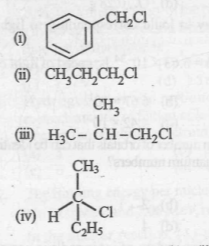
[4 Marks] Diagram 1 – NEET-UG 2014 Question Paper
  • (A) (iii) and (iv)
  • (B) (ii) and (iv)
  • (C) (i) and (ii)
  • (D) (i) and (iv)
Question 33.

‘Which of the following will not be soluble in sodium hydrogen carbonate?

[4 Marks]
  • (A) Benzenesulphonic acid
  • (B) 2,4-dinitrophenol
  • (C) o-Nitrophenol
  • (D) Benzoic acid
Question 34.

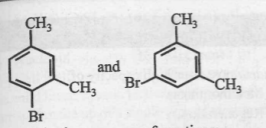
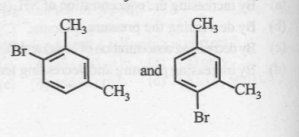
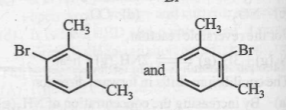
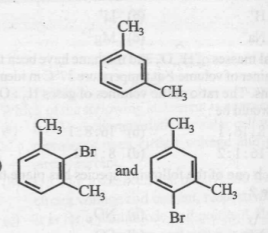
What products are formed when the following compounds are treated with Br₂ in the presence of FeBr₃?
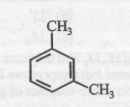
[4 Marks] Diagram 2 – NEET-UG 2014 Question Paper
  • (A) Diagram 3 – NEET-UG 2014 Question Paper
  • (B) Diagram 4 – NEET-UG 2014 Question Paper
  • (C) Diagram 5 – NEET-UG 2014 Question Paper
  • (D) Diagram 6 – NEET-UG 2014 Question Paper
Question 35.

Identify Z in the sequence of reactions:

[4 Marks] Diagram 7 – NEET-UG 2014 Question Paper
  • (A) CH₃(CH₂)₄─O─CH₃
  • (B) CH₃CH₂─CH(CH₃)─O─CH₂CH₃
  • (C) (CH₃)₂CH₂─O─CH₂CH₃
  • (D) CH₃─(CH₂)₃)─O─CH₂CH₃
Question 36.

In the following reaction, the product (A)
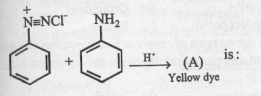
[4 Marks] Diagram 8 – NEET-UG 2014 Question Paper
  • (A) Diagram 9 – NEET-UG 2014 Question Paper
  • (B) Diagram 10 – NEET-UG 2014 Question Paper
  • (C) Diagram 11 – NEET-UG 2014 Question Paper
  • (D) Diagram 12 – NEET-UG 2014 Question Paper
Question 37.

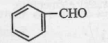
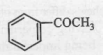
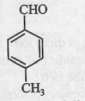
Which one is most reactive towards Nucleophilic addition reaction?

[4 Marks]
  • (A) Diagram 13 – NEET-UG 2014 Question Paper
  • (B) Diagram 14 – NEET-UG 2014 Question Paper
  • (C) Diagram 15 – NEET-UG 2014 Question Paper
  • (D) Diagram 16 – NEET-UG 2014 Question Paper
Question 38.

Which of the following will be most stable diazonium salt RN₂⁺ X⁻ ?

[4 Marks]
  • (A) CH₃N₂⁺ X⁻
  • (B) C₆H₅N₂⁺ X⁻
  • (C) C₆H₅CH₂N₂⁺ X⁻
  • (D) CH₃CH₂N₂⁺ X⁻
Question 39.

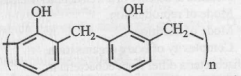
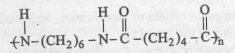
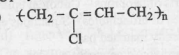
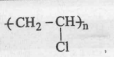
Which one of the following is an example of a thermoset- ting polymer?

[4 Marks]
  • (A) Diagram 17 – NEET-UG 2014 Question Paper
  • (B) Diagram 18 – NEET-UG 2014 Question Paper
  • (C) Diagram 19 – NEET-UG 2014 Question Paper
  • (D) Diagram 20 – NEET-UG 2014 Question Paper
Question 40.

Which of the following compounds polymer- izes to form the polyester Dacron?

[4 Marks]
  • (A) Benzoic acid and para HO─(C₆H₄)─OH
  • (B) Terephthalic acid and ethylene glycol
  • (C) Benzoic acid and ethanol
  • (D) Propylene and para HO─(C₆H₄)─OH
Question 41.

Which of the following hormones is produced under the condition of stress which stimulates glycogenolysis in the liver of human beings?

[4 Marks]
  • (A) Insulin
  • (B) Thyroxin
  • (C) Estradiol
  • (D) Adrenaline
Question 42.

Artificial sweetner which is stable under cold conditions only is:

[4 Marks]
  • (A) Saccharine
  • (B) Aspartame
  • (C) Sucralose
  • (D) Alitame
Question 43.

If a is the length of the side of a cube, the distance between the body centred atom and one corner atom in the cube will be

[4 Marks]
  • (A) 2/ √3 a
  • (B) √3/4 a
  • (C) √3/2 a
  • (D) 4/√3 a
Question 44.

Five kingdom system of classification suggested by RH.‘Whittaker is not based on:

[4 Marks]
  • (A) Mode of nutrition.
  • (B) Complexity of body organisation.
  • (C) Presence or absence of a well defined nucleus.
  • (D) Mode of reproduction.
Question 45.

Archaebacteria differ from eubacteria in:

[4 Marks]
  • (A) Mode of nutrition
  • (B) Mode of reproduction
  • (C) Cell shape
  • (D) Cell membrane
Question 46.

The motile bacteria are able to move by:

[4 Marks]
  • (A) Cilia
  • (B) Pili
  • (C) Fimbriae
  • (D) Flagella
Question 47.

‘Which one of the following fungi contains hallucinogens?

[4 Marks]
  • (A) Ustilago sp.
  • (B) Neurosporasp.
  • (C) Amanita muscaria
  • (D) Morchella esculenta
Question 48.

Which of the following shows coiled RNA strand and capsomeres?

[4 Marks]
  • (A) Tobacco masaic virus
  • (B) Polio virus
  • (C) Measles virus
  • (D) Retrovirus
Question 49.

Viruses have:

[4 Marks]
  • (A) Prokaryotic nucleus
  • (B) DNA enclosed in a protein coat
  • (C) Both DNA and RNA
  • (D) Single chromosome
Question 50.

‘Which one of the following shows isogamy with non-flagellated gametes?

[4 Marks]
  • (A) Spirogyra
  • (B) Ectocarpus
  • (C) Sargassum
  • (D) Ulothrix
Question 51.

‘Which one of the following is wrong about Chara?

[4 Marks]
  • (A) Globule and nucule present on the same plant.
  • (B) Upper oogonium and lower round antheridium.
  • (C) Upper antheridium and lower oogonium.
  • (D) Globule is male reproductive structure.
Question 52.

An alga which can be employed as food for human being is:

[4 Marks]
  • (A) Polysiphonia
  • (B) Spirogyra
  • (C) Ulothrix
  • (D) Chlorella
Question 53.

‘Which of the following is responsible for peat formation?

[4 Marks]
  • (A) Sphagnum
  • (B) Funaria
  • (C) Marchanita
  • (D) Riccia
Question 54.

Select the Taxon mentioned that represents both marine and fresh water species:

[4 Marks]
  • (A) Cnidaria
  • (B) Ctenophora
  • (C) Echinoderms
  • (D) Cephalochordata
Question 55.

‘Which one of the following living organisms completely lacks a cell wall?

[4 Marks]
  • (A) Saccharomyces
  • (B) Blue—green algae
  • (C) Sea—fan(Gorgonia)
  • (D) Cyanobacteria
Question 56.

Planaria possesses high capacity of:

[4 Marks]
  • (A) Bioluminescence
  • (B) Regeneration
  • (C) Alternation of generation
  • (D) Metamorphosis
Question 57.

A marine cartilaginous fish that can produce electric current is:

[4 Marks]
  • (A) Pristis
  • (B) Torpedo
  • (C) Scoliodon
  • (D) Trygon
Question 58.

An example of edible underground stem is:

[4 Marks]
  • (A) Sweet potato
  • (B) Potato
  • (C) Carrot
  • (D) Groundnut
Question 59.

‘When the margins of sepals or petals overlap one another without any particular direction, the condition is termed as:

[4 Marks]
  • (A) Valvate
  • (B) Twisted
  • (C) Imbricate
  • (D) Vexillary
Question 60.

Placenta and pericarp are both edible portions in:

[4 Marks]
  • (A) Banana
  • (B) Apple
  • (C) Potato
  • (D) Tomato
Question 61.

An aggregate fruit is one which develops from:

[4 Marks]
  • (A) Multicarpellary syncarpous gynoecium
  • (B) Multicarpellary apocarpus gynoecium
  • (C) Multicarpellary superior ovary
  • (D) Complete inflorescence
Question 62.

Tracheids differ from other tracheary elements in:

[4 Marks]
  • (A) being Ygnified
  • (B) being imperforate
  • (C) lacking nucleus
  • (D) having casparian strips
Question 63.

You are given a fairly old piece of dicot stem and dicot root. Which of the following anatomical structures. will you use to distinguish between the two?

[4 Marks]
  • (A) Secondary phloem
  • (B) Secondary xylem
  • (C) Cortical cells
  • (D) Protoxylem
Question 64.

Choose the correctly matched pair:

[4 Marks]
  • (A) Tubular parts of nephrons – Cuboidal epithelium
  • (B) Moist surface of buccal cavity – Glandular epithelium
  • (C) Inner lining of salivary ducts – Ciliated epithelium
  • (D) Inner surface of bronchioles – Squamous epithelium
Question 65.

Choose the correctly matched pair:

[4 Marks]
  • (A) Tendon—Specialized connective tissue
  • (B) Adipose tissue — Dense connective tissue
  • (C) Cartilage-Loose connective tissue
  • (D) Areolar tissue — Loose connective tissue
Question 66.

Which structures perform the function of mitochondria in bacteria ?

[4 Marks]
  • (A) Nucleoid
  • (B) Ribosomes
  • (C) Cell wall
  • (D) Mesosomes
Question 67.

The solid linear cytoskeletal elements having a diameter of 6 nm and made up of a single type of monomer are known as:

[4 Marks]
  • (A) Lamins
  • (B) Intermediate filaments
  • (C) Microfilaments
  • (D) Microtubules
Question 68.

The osmotic expansion of a cell kept in water is chiefly regulated by:

[4 Marks]
  • (A) Mitochondria
  • (B) Vacuoles
  • (C) Plastids
  • (D) Ribosomes
Question 69.

Match the following and select the correct answer:
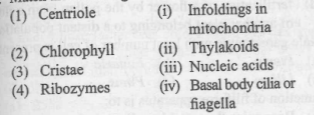
[4 Marks] Diagram 21 – NEET-UG 2014 Question Paper
  • (A) (a) iv ii i iii
  • (B) (d) i ii iv iii
  • (C) (b) i iii ii iv
  • (D) (c) iv iii i ii
Question 70.

Select the option which is not correct with respect to enzyme action:

[4 Marks]
  • (A) Substrate binds with enzyme at its active site.
  • (B) Addition of lot of succinate does not reverse the inhibition of succinic dehydrogenase by malonate.
  • (C) Malonate is a competitive inhibitor of succinic dehydrogenase.
  • (D) A non-competitive inhibitor binds the enzyme at a site distinct from that which binds the substrate.
Question 71.

Which one of the following is a non-reducing carbohydrate?

[4 Marks]
  • (A) Maltose
  • (B) Sucrose
  • (C) Ribose 5 - phosphate
  • (D) Lactose
Question 72.

During which phase(s) of cell cycle, amount of DNA ina cell remains at 4C level if the initial amount is denoted as 2C?

[4 Marks]
  • (A) G₀ and G₁
  • (B) G₁ and S
  • (C) G₂ and M
  • (D) Only G₂
Question 73.

In ‘S’ phase of the cell cycle:

[4 Marks]
  • (A) Amount of DNA doubles in each cell.
  • (B) Amount of DNA remains same in each cell.
  • (C) Chromosome number is increased.
  • (D) -Amount of DNAis reduced to half in each cell
Question 74.

The enzyme recombinase is required at which stage of meiosis:

[4 Marks]
  • (A) Zygotene
  • (B) Pachytene
  • (C) Diplotene
  • (D) Diakinesis
Question 75.

Deficiency symptoms of nitrogen and potassium are visible first in:

[4 Marks]
  • (A) Senescent leaves:
  • (B) Roots
  • (C) Buds
  • (D) Young leaves
Question 76.

Anoxygenic photosynthesis is characteristic of:

[4 Marks]
  • (A) Rhodospirillum
  • (B) Ulva
  • (C) Spirogyra
  • (D) Chlamydomonas
Question 77.

In which one of the following processes CO₂ in not released?

[4 Marks]
  • (A) Aerobic respiration in animals
  • (B) Aerobic respiration in plants
  • (C) Alcoholic fermentation
  • (D) Lactate fermentation
Question 78.

Dr. F. Went noted that if coleoptile tips were removed and placed on agar for one hour, the agar would produce a bending when placed on one side of freshly-cut coleoptile stumps. Of what significance is this experiment?

[4 Marks]
  • (A) It is the basis for quantitative determination of small amounts of growth-promoting substances.
  • (B) It supports the hypothesis that IAA is auxin.
  • (C) It made possible the isolation and exact identification of auxin.
  • (D) It demonstrated polar movement of auxins.
Question 79.

A few normal seedlings of tomato were kept in a dark room.After a few days they were found to have become white-coloured like albinos. Which of the following terms will you use to describe them?

[4 Marks]
  • (A) Mutated
  • (B) Embolised
  • (C) Defoliated
  • (D) Etiolated
Question 80.

Which one of the following growth regulators is known as “stress hormone’?

[4 Marks]
  • (A) Ethylene
  • (B) Abscissic acid
  • (C) Indole acetic acid
  • (D) GA₃
Question 81.

The initial step in the digestion of milk in humans is carried out by

[4 Marks]
  • (A) Lipase
  • (B) Trypsin
  • (C) Rennin
  • (D) Pepsin
Question 82.

Fructose is absorbed into the blood through mucosa cells of intestine by the process called:

[4 Marks]
  • (A) facilitated transport
  • (B) co-transport ‘mechanism
  • (C) simple diffusion
  • (D) active transport
Question 83.

Approximately seventy percent of carbon-dioxide absorbed by the blood will be transported to the lungs:

[4 Marks]
  • (A) as bicarbonate ions
  • (B) by binding to R.B.C.
  • (C) in the form of dissolved gas ‘molecules
  • (D) as carbamino - haemoglobin
Question 84.

Person with blood group AB is considered as universal recipient because he has:

[4 Marks]
  • (A) both A and B antibodies in the plasma.
  • (B) both A and B antigens in the plasma but no antibodies.
  • (C) no antigen on RBC and no antibody in the plasma.
  • (D) both A and B antigens on RBC but no antibodies in the plasma.
Question 85.

How do parasympathetic neural signals affect the working of the heart?

[4 Marks]
  • (A) Reduce both heart rate and cardiac output.
  • (B) Heart rate is increased without affecting the cardiac output.
  • (C) Heart rate decreases but cardiac output increases.
  • (D) Both heart rate and cardiac output increase.
Question 86.

‘Which of the following causes an increase in sodium reabsorption in the distal convoluted tubule?

[4 Marks]
  • (A) Increase in aldosterone levels
  • (B) Increase in antidiuretic hormone levels
  • (C) Decrease in aldosterone levels
  • (D) Decrease in antidiuretic hormone levels
Question 87.

Select the correct matching of the type of the joint with the example in human skeletal system:
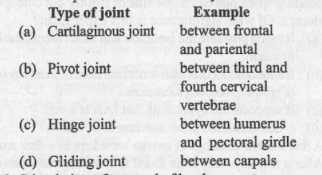
[4 Marks] Diagram 22 – NEET-UG 2014 Question Paper
  • (A) b
  • (B) a
  • (C) c
  • (D) d
Question 88.

Stimulation of a muscle fiber by a motor neuron occurs at:

[4 Marks]
  • (A) the transverse tubules
  • (B) the neuromuscular junction
  • (C) the myofibril
  • (D) the sacroplasmic reticulum
Question 89.

Injury localized to the hypothalamus would most likely disrupt:

[4 Marks]
  • (A) executive finctions, such as decision making.
  • (B) regulation of body temperature.
  • (C) short-term memory.
  • (D) co-ordination during locomotion.
Question 90.

‘Which one of the following statements is not correct?

[4 Marks]
  • (A) Retinal is the light absorbing portion of visual photo pigments
  • (B) In retina the rods have the photopigment rhodopsin while cones have three different photopigments.
  • (C) Retinal is a derivative of Vitamin C.
  • (D) Rhodopsin is the purplish red protein present in rods only.
Question 91.

Identify the hormone with its correct matching of source and function:

[4 Marks]
  • (A) Melatonin - pineal gland, regulates the normal rthythm of sleepwake cycle.
  • (B) Oxytocin - posterior pituitary, growth and maintenance of mammary glands.
  • (C) Progesterone - corpus-luteum, stimulatiuon of growth and activities of female secondary sex organs.
  • (D) Atrial natriuretic factor - ventricular wall increases the blood pressure.
Question 92.

Fight-or-flight reactions cause activation of:

[4 Marks]
  • (A) the parathyroid glands, leading to increased metabolic rate.
  • (B) the kidney, leading to suppression of renin-angiotensin- aldosterone pathway.
  • (C) the adrenal medulla, leading to increased secretion of epinephrine and norepinephrine.
  • (D) the pancreas leading to a reduction in the blood sugar levels.
Question 93.

Geitonogamy involves:

[4 Marks]
  • (A) fertilization of a flower by the pollen from anothe flower of the same plant.
  • (B) fertilization of a flower by the pollen from the same flower.
  • (C) fertilization of a flower by the pollen from a flower of another plant in the same population.
  • (D) fertilization of a flower by the pollen from a flower of another plant belonging a distant population
Question 94.

Male gametopyte with least number of cell is present in

[4 Marks]
  • (A) Funaria
  • (B) Pteris
  • (C) Lilium
  • (D) Pinus
Question 95.

Function of filiform apparatus is to:

[4 Marks]
  • (A) Recognize the suitable pollen at stigma
  • (B) Stimulate division of generative cell
  • (C) Produce nectar
  • (D) Guide the entry of pollen tube
Question 96.

Non-albuminous seed is produced in:

[4 Marks]
  • (A) Maize
  • (B) Castor
  • (C) Wheat
  • (D) Pea
Question 97.

The shared terminal duct of the reproductive and urinary system in the human male is:

[4 Marks]
  • (A) Ureter
  • (B) Urethra
  • (C) Vas deferens
  • (D) Vasa efferentia
Question 98.

The main function of mammalian corpus luteum is to produce:

[4 Marks]
  • (A) estrogen only
  • (B) progesterone
  • (C) relaxin only
  • (D) human chorionic gonadotropin
Question 99.

Select the correct option describing gonadotropin activity in a normal pregnant female:

[4 Marks]
  • (A) High level of FSH and LH stimulates the thickening of endometrium.
  • (B) High level of hCG stimulates the synthesis of estrogen and progesterone.
  • (C) High level of FSH and LH facilitate implantation of the embryo.
  • (D) High level of hCG stimulates the thickening of endometrium.
Question 100.

Tubectomy is a method of sterilization in which:

[4 Marks]
  • (A) small part of the fallopian tube is removed or tied up.
  • (B) ovaries are removed surgically
  • (C) small part of vas deferens is removed or tied up.
  • (D) uterus is removed surgically
Question 101.

Which of the following is a hormone releasing Intra Uterine Device (IUD)?

[4 Marks]
  • (A) LNG-20
  • (B) Multiload 375
  • (C) Vault
  • (D) Cervical cap
Question 102.

Assisted reproductive technology, IVF involves transfer of:

[4 Marks]
  • (A) Zygote into the uterus.
  • (B) Embryo with 16 blastomeres into the fallopian tube.
  • (C) Zygote into the fallopian tube.
  • (D) Ovum into the fallopian tube.
Question 103.

Fruit colour in squash in an example of

[4 Marks]
  • (A) Recessive epistasis
  • (B) Dominant epistasis
  • (C) Complementary genes
  • (D) Inhibitory genes
Question 104.

In a population of 1000 individuals 360 belong to genotype AA, 480 to Aa. and the remaining 160 to aa. Based on this data, the frequency of allele A in the population is:

[4 Marks]
  • (A) 0.4
  • (B) 0.5
  • (C) 0.7
  • (D) 0.6
Question 105.

A man whose father was colour blind marries a womanwhose father was colour blind and her normal father. Whatpercentage of male children of this couple will be colour blind?

[4 Marks]
  • (A) 25%
  • (B) 0%
  • (C) 50%
  • (D) 75%
Question 106.

A human female with Turner’s syndrome:

[4 Marks]
  • (A) has 45 chromosomes with XO.
  • (B) is able to produce children with normal husband.
  • (C) exhibits male characters.
  • (D) has one additional X chromosome.
Question 107.

Transformation was discovered by:

[4 Marks]
  • (A) Hershey and Chase
  • (B) Meselson and Stahl
  • (C) Watson and Crick
  • (D) Griffith
Question 108.

Which one of the following is wrongly matched?

[4 Marks]
  • (A) Transcription – Writing information from DNA to RNA.
  • (B) Translation – Using information in mRNA to make protein.
  • (C) Operon – Structural genes, operator and promoter.
  • (D) Repressor protein – Binds to operator to stop enzyme synthesis.
Question 109.

Select the correct option:

[4 Marks] Diagram 23 – NEET-UG 2014 Question Paper
  • (A) a
  • (B) c
  • (C) b
  • (D) d
Question 110.

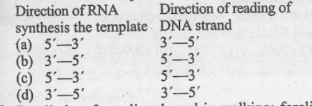
Forelimbs of cat, lizard used in walking; forelimbs of whale used in swimming and forelimbs of bats used in flying are an example of:

[4 Marks]
  • (A) Adaptive radiation
  • (B) Analogous organs
  • (C) Homologous organs
  • (D) Convergent evolution
Question 111.

Which one of the following are analogous structures?

[4 Marks]
  • (A) Wings of Bat and Wings of Pigeon.
  • (B) Gills of Prawn and Lungs of Man.
  • (C) Thorns of Bougainvillea and Tendrils of Cucurbita
  • (D) Flippers of Dolphin and Legs of Horse
Question 112.

At which stage of HIV infection does one usually show symptoms of AIDS:-

[4 Marks]
  • (A) Within 15 days of sexual contact with an infected person.
  • (B) When the infected retro virus enters host cells.
  • (C) When HIV damages large number of helper T-Lymphocytes.
  • (D) When the viral DNA is produced by reverse transcriptase.
Question 113.

‘Which is the particular type of drug that is obtained from the plant whose one flowering branch is shown below?
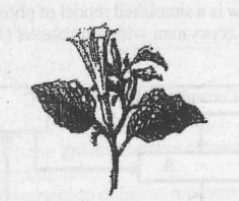
[4 Marks] Diagram 24 – NEET-UG 2014 Question Paper
  • (A) Depressant
  • (B) Hallucinogen
  • (C) Pain - killer
  • (D) Stimulant
Question 114.

To obtain virus-fiee healthy plants from a diseased one by tissue culture technique, which part/parts of the diseased plant will be taken:

[4 Marks]
  • (A) Apical meristem only
  • (B) Palisade parenchyma
  • (C) Both apical and axillary meristems
  • (D) Epidermis only
Question 115.

What gases are produced in anaerobic sludge digesters?

[4 Marks]
  • (A) Hydrogen Sulphide and CO₂
  • (B) Methane, Hydrogen Sulphide and CO₂
  • (C) Methane, Hydrogen Sulphide and O₂
  • (D) Methane and CO₂ only
Question 116.

An analysis of chromosomal DNA using the Southern hybridization technique does not use:

[4 Marks]
  • (A) Blotting
  • (B) Electrophoresis
  • (C) Autoradiography
  • (D) PCR
Question 117.

Which vector can clone only a small fragment of DNA?

[4 Marks]
  • (A) Bacterial artificial chromosome
  • (B) Yeast artificial chromosome
  • (C) Plasmid
  • (D) Cosmid
Question 118.

In vitro clonal propagation in plants is characterized

[4 Marks]
  • (A) Northern blotting
  • (B) PCR and RAPD
  • (C) Electrophoresis and HPLC
  • (D) Microscopy
Question 119.

Which of the following statements is correct for the spontaneous adsorption of a gas?

[4 Marks]
  • (A) ΔS is positive and, therefore, ΔH should be negative
  • (B) ΔS is negative and, therefore, ΔH should be highly negative
  • (C) ΔS is positive and, therefore, ΔH should also be highly positive
  • (D) ΔS is negative and, therefore, ΔH should be highly positive
Question 120.

‘Which one of the following statements is correct?

[4 Marks]
  • (A) A sterile pistil is called a staminode.
  • (B) A proteinaceous aleurone layer is present in maize grain.
  • (C) Mango is a parthenocarpic fruit.
  • (D) The seed in grasses is not endospermic.
Question 121.

Commonly used vectors for human genome sequencing are:

[4 Marks]
  • (A) BAC and YAC
  • (B) T-DNA
  • (C) Expression Vectors
  • (D) KT/A Cloning Vectors
Question 122.

Pollen tablets are available in the market for:

[4 Marks]
  • (A) Breeding programmes
  • (B) Invitro fertilization
  • (C) Ex situ conservation
  • (D) Supplementing food
Question 123.

The first human hormone produced by recombinant DNA technology is:

[4 Marks]
  • (A) Thyroxin
  • (B) Progesterone
  • (C) Estrogen
  • (D) Insulin
Question 124.

Match the following and select the correct option:

Column-I

Column-II

(A) Earthworm

___

(i) Pioneer species

(B) Succession

___

(ii) Detritivore

(C) Ecosystem service

___

(iii) Natality

(D) Population growth

___

(iv) Pollination

[4 Marks]
  • (A) (c) (iii) (ii) (iv) (i)
  • (B) (d) (ii) (i) (iv) (iii)
  • (C) (b) (iv) (i) (iii) (ii)
  • (D) ( a) (i) (ii) (iii) (iv)
Question 125.

Given below is a simplified model of phosphorus cycling in a terrestrial ecosystem with four blanks (A-D). Identify the blanks:-
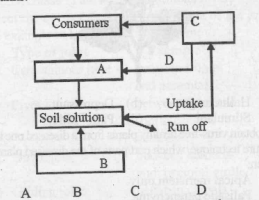
[4 Marks] Diagram 25 – NEET-UG 2014 Question Paper
  • (A) Litter Producers Rock Detritus fall mineral
  • (B) Rock Demitus Litterfall Producers minerals
  • (C) Producers Litter fall Rock Detrifus minerals
  • (D) Detitus Rock Producer Litter fall minerals
Question 126.

A species facing extremely high risk of extinction in the immediate future is called:

[4 Marks]
  • (A) Vulnerable
  • (B) Endemic
  • (C) Critically endangered
  • (D) Extinct
Question 127.

The organization which publishes the Red List of species is:

[4 Marks]
  • (A) UNEP
  • (B) WWF
  • (C) IUCN
  • (D) ICFRE
Question 128.

Just as a person moving from Delhi to Shimla to escape the heat for the duration of hot summer, thosand of‘migratory birds from Siberia and other-extremely cold northern regions move to:

[4 Marks]
  • (A) Western Ghat
  • (B) Meghalaya
  • (C) Keoladeo National park
  • (D) Corbett National Park
Question 129.

A location with luxuriant growth of lichens on the trees indicates that the:

[4 Marks]
  • (A) Trees are very healthy
  • (B) Trees are heavily infested
  • (C) Location is not poltuted
  • (D) Location is highly polluted
Question 130.

A scrubber in the exhaust of a chemical industrial Temoves:-

[4 Marks]
  • (A) gases like sulphur dioxide
  • (B) particulate matter of the size 5 ‘micrometer or above
  • (C) gases like ozone and methane
  • (D) particulate matter of the size 2.5 micrometer or less
Question 131.

An example of ex situ conservation is:

[4 Marks]
  • (A) Sacred Grove
  • (B) Wildlife Sanctuary
  • (C) National Park
  • (D) Seed Bank
Question 132.

The zone of atmosphere in which the ozone layer is pressent is called:

[4 Marks]
  • (A) Ionosphere
  • (B) Mesosphere
  • (C) Troposphere
  • (D) Stratosphere
Question 133.

If 20J of energy is trapped at producer level, then how much energy will be available to peacock as food in the following chain?

Plant → Mice →Snake → Peacock

[4 Marks]
  • (A) 0.02J
  • (B) 0.002J
  • (C) 0.2J
  • (D) 0.0002J
Question 134.

If force (F), velocity (V) and time (T) are taken as fundamental units, then the dimensions of mass are:

[4 Marks]
  • (A) [FV T⁻¹]
  • (B) [FV T⁻²]
  • (C) [F⁻¹V⁻¹T⁻¹]
  • (D) [FV ⁻¹T]
Question 135.

A particle is moving such that its position coordinate (x, y) are
(2 m, 3 m) at time t = 0
(6 m, 7 m) at time t = 2 s and
(13 m, 14 m) at time t = 5 s.
Average velocity vector (v̄ₐᵥ) from t = 0 to
t = 5 s is:

[4 Marks]
  • (A) (11/5)(î + ĵ)
  • (B) 2(î + ĵ)
  • (C) (1/5)(13î + 14ĵ)
  • (D) (7/3)(î + ĵ)
Question 136.

A projectile is fired from the surface of the earth with avelocity of 5 ms⁻¹ and angle θ with the horizontal.Another projectile fired from another planet with a velocity of 3 ms⁻¹ at the same angle follows a trajectory which is identical with the trajectory of the projectile fired from the earth. The value of the acceleration due to gravity on the planet is (in ms⁻²) given g = 9.8 m/s²?

[4 Marks]
  • (A) 110.8
  • (B) 5.9
  • (C) 16.3
  • (D) 3.5
Question 137.

The force ‘F’ acting on a particle of mass ‘m’ is indicated by the force-time graph shown below. The change in momentum of the particle over the time interval from zero to 8s is:
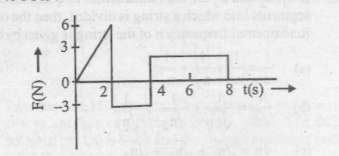
[4 Marks] Diagram 26 – NEET-UG 2014 Question Paper
  • (A) 24Ns
  • (B) 20Ns
  • (C) 6Ns
  • (D) 12Ns
Question 138.

A system consists of three masses m₁, m₂ and m₃ connected by a string passing over a pulley P. The massm₁ hangs freely and m₂ and m₃ are on a rough horizontal table (coefficient of friction = μ). The pulley is frictionless and of negligible mass. The downward acceleration of mass m₁ is: (Assume m₁ = m₂ = m₃ = m)
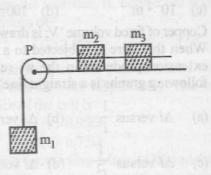
[4 Marks] Diagram 27 – NEET-UG 2014 Question Paper
  • (A) g(1-2μ)/2
  • (B) g(1-2μ)/3
  • (C) 2gμ/3
  • (D) g(1-gμ)/g
Question 139.

A mass m is attached to thin wire and whirled in a vertical circle. The wire is most likely to break when:

[4 Marks]
  • (A) the mass is at the lowest point
  • (B) inclined at an angle of 60° from vertical
  • (C) themass is at the highest point
  • (D) thewireishorizontal
Question 140.

A bodyof mass (4m) is lying in x-y planeat rest. It suddenly explodes into three pieces. Two pieces, each of mass (m) move perpendicular to each other with equal speeds (v). The total kinetic energy generated due to explosion is :

[4 Marks]
  • (A) mv²
  • (B) 3/2 mv²
  • (C) 2mv²
  • (D) 4mv²
Question 141.

A solid cylinder of mass 50 kg and radius 0.5 mis free to rotate about the horizontal axis. A massless string is wound round the cylinder with one end attached to it and the other hanging freely. Tension in the string required to produce an angular acceleration of 2 revolutions s⁻² is:

[4 Marks]
  • (A) 50 N
  • (B) 157 N
  • (C) 78.5 N
  • (D) 25 N
Question 142.

The ratio of the accelerations for a solid sphere (mass ‘m’ and radius ‘R’) rolling down an incline of: angle ‘0’ without slipping and slipping down the incline without rolling is :

[4 Marks]
  • (A) 7 : 5
  • (B) 5 : 7
  • (C) 2 : 3
  • (D) 2 : 5
Question 143.

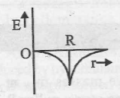
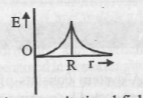
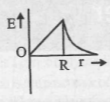
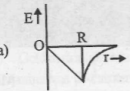
Dependence of intensity of gravitational field (E) of earth with distance (r) from centre of earth is correctly represented by:

[4 Marks]
  • (A) Diagram 28 – NEET-UG 2014 Question Paper
  • (B) Diagram 29 – NEET-UG 2014 Question Paper
  • (C) Diagram 30 – NEET-UG 2014 Question Paper
  • (D) Diagram 31 – NEET-UG 2014 Question Paper
Question 144.

A black hole is an object whose gravitational field is so strong that even light cannot escape from it. To what approximate radius would our earth (mass = 5.98 × 10²⁴ kg)
have to be compressed to be a black hole?

[4 Marks]
  • (A) 100 m
  • (B) 10⁻² m
  • (C) 10⁻⁶ m
  • (D) 10⁻⁹ m
Question 145.

Copper of fixed volume ‘V; is drawn into wire of length */’. When this wire is subjected to a constant force ‘F’, the extension produced in the wi re is ‘Al Which of the

following graphsis a straight line?

[4 Marks]
  • (A) Δl versus l
  • (B) Δl versus 1/l
  • (C) Δl versus 1/l²
  • (D) Δl versus l²
Question 146.

A certain number of spherical drops of a liquid of radius 'r coalesce to form a single drop of radius 'R' and volume 'V'. If 'T' is the surface tension of the liquid, then:

[4 Marks]
  • (A) energy is neither released nor absorbed
  • (B) energy = 3VT (1/r + 1/R) is absorbed
  • (C) energy = 4VT (1/r − 1/R) is released
  • (D) energy = 3VT (1/r − 1/R) is released
Question 147.

Steam at 100°C is passed into 20 g of water at 10°C. When
water acquires a temperature of 80°C, the mass of water
present will be:

[Take specific heat of water = 1 cal g⁻¹ °C⁻¹ and latent heat
of steam = 540 cal g⁻¹]

[4 Marks]
  • (A) 42.5 g
  • (B) 31.5 g
  • (C) 22.5 g
  • (D) 24 g
Question 148.

Certain quantity of water cools from 70°C to 60°C in the first 5 minutes and to 54°C in the next 5 minutes. The temperature of the surroundings is:

[4 Marks]
  • (A) 10°C
  • (B) 20°C
  • (C) 45°C
  • (D) 42°C
Question 149.

A monoatomic gas at a pressure P, having a volume V expands isothermally to a volume 2V and then adiabatically to a volume 16V. The final pressure of the gas is :
(take {5}{3}]


[4 Marks]
  • (A) 16P
  • (B) P/64
  • (C) 64P
  • (D) 32P
Question 150.

A thermodynamic system undergoes cyclic process ABCDA as shown in fig. The work done by the system in the cycle is :
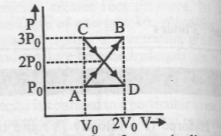
[4 Marks] Diagram 32 – NEET-UG 2014 Question Paper
  • (A) Zero
  • (B) P₀V₀/2
  • (C) 2P₀V₀
  • (D) P₀V₀
Question 151.

The mean free path of molecules of a gas, (radius 'r') is inversely proportional to

[4 Marks]
  • (A) r
  • (B) r²
  • (C) √r
  • (D) r³
Question 152.
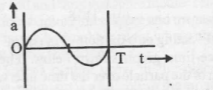
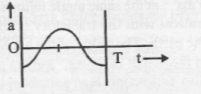
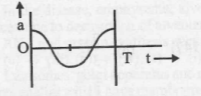
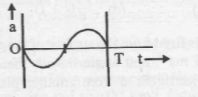
The oscillation of a body on a smooth horizontal surface is
represented by the equation,

X = A cos(ωt)

where X = displacement at time t

ω = frequency of oscillation

Which one of the following graphs shows correctly the
variation of 'a' with 't' ?

[4 Marks]
  • (A) Diagram 33 – NEET-UG 2014 Question Paper
  • (B) Diagram 34 – NEET-UG 2014 Question Paper
  • (C) Diagram 35 – NEET-UG 2014 Question Paper
  • (D) Diagram 36 – NEET-UG 2014 Question Paper
Question 153.

If n₁, n₂ and n₃ are the fundamental frequencies of threesegments into which a string is divided, then the original fundamental frequency n of the string is given by:

[4 Marks]
  • (A) 1/n = 1/n₁ + 1/n₂ + 1/n₃
  • (B) 1/√n = 1/√n₁ + 1/√n₂ + 1/√n₃
  • (C) n = n₁ + n₂ + n₃
  • (D) √n = √n₁ + √n₂ + √n₃
Question 154.

The number of possible natural oscillation of air column in a pipe closed at one end of length 85 cm whose frequencies lie below 1250 Hz are: (velocity of sound = 340 ms⁻¹)

[4 Marks]
  • (A) 5
  • (B) 4
  • (C) 7
  • (D) 6
Question 155.

A speeding motorcyclist sees traffic jam ahead of him. He slows down to 36 km/hour. He finds that traffic has ceased and a car moving ahead of him at 18 km/hour is honking at a frequency of 1392 Hz. If the speed of sound is 343 m/s, the frequency of the honk as heard by him will be:

[4 Marks]
  • (A) 1332 Hz
  • (B) 1412 Hz
  • (C) 1372 Hz
  • (D) 1464 Hz
Question 156.

In a region, the potential is represented byV(x, y, z) = 6x − 8xy − 8y + 6yz, where V is in volts and x, y, z are in metres.
The electric force experienced by a charge of 2 coulomb situated at point (1, 1, 1) is:

[7 Marks]
  • (A) 6√5 N
  • (B) 30 N
  • (C) 24 N
  • (D) 4√35 N
Question 157.

A conducting sphere of radius R is given a charge Q. The electric potential and the electric field at the centre of the sphere respectively are:

[4 Marks]
  • (A) Q/4πε₀R and Q/4πε₀R²
  • (B) Zero and Q/4πε₀R²
  • (C) Both are zero
  • (D) Q/4πε₀R and Zero
Question 158.

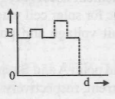
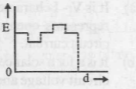
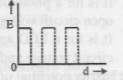
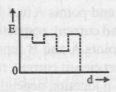
Two thin dielectric slabs of dielectric constant K₁ and K₂ (K₁ < K₂) are inserted between the plates of a parallel plate capacitor, as shown in the figure. The variation of electric field 'E' between the plates with distance 'd' as measured from plate P is correctly shown by:
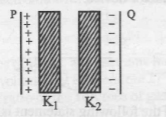
[4 Marks] Diagram 37 – NEET-UG 2014 Question Paper
  • (A) Diagram 38 – NEET-UG 2014 Question Paper
  • (B) Diagram 39 – NEET-UG 2014 Question Paper
  • (C) Diagram 40 – NEET-UG 2014 Question Paper
  • (D) Diagram 41 – NEET-UG 2014 Question Paper
Question 159.

Two cities are 150 km apart. Electric power is sent from one city to another city through copper wires. The fall of potential per km is 8 volt and the average resistance per km is 0.5 Ω. The power loss in the wires is:

[4 Marks]
  • (A) 12.2 kW
  • (B) 19.2 W
  • (C) 19.2 J
  • (D) 19.2 kW
Question 160.

The resistances in the two arms of the meter bridge are 5Ω and RΩ, respectively. When the resistance R is shunted
with an equal resistance, the new balance point is at 1.6l.₁ The resistance 'R' is:
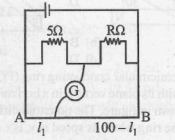
[4 Marks] Diagram 42 – NEET-UG 2014 Question Paper
  • (A) 15Ω
  • (B) 20Ω
  • (C) 25Ω
  • (D) 10Ω
Question 161.

A potentiometer circuit has been set up for finding the internal resistance of a given cell. The main battery used across the potentiometer wire, has an emf0of2.0 V and a negligible internal resistance. The potentiometer wire itself is 4m long, When the resistace R, connected across the given cell, has values of (i) infinity (i) 9.5Ω,

The balancing lengths’, on the potentiometer wire are found to be 3 m and 2.85 m, respectively. The value of internal resistance of the cell is

[4 Marks]
  • (A) 0.5Ω,
  • (B) 0.25Ω,
  • (C) 0.75Ω,
  • (D) 0.95Ω,
Question 162.

Two identical long conducting wires AOB and COD are placed at right angle to each other, with one above other such that 'O' is their common point for the two. The wires carry I₁ and I₂ currents respectively. Point 'P' is lying at distance 'd' from 'O' along a direction perpendicular to the plane containing the wires. The magnetic field at the point 'P' will be:

[4 Marks]
  • (A) μₒ​​/2Π d( I₁²+ I₂²) ¹ᐟ²
  • (B) μₒ​​/2Π d( I₁ / I₂)
  • (C) μₒ​​/2Π d( I₁²- I₂²)
  • (D) μₒ​​/2Π d( I₁+ I₂)
Question 163.

In an ammeter 0.2% of main current passes through galvanometer. If resistance of galvanometer is G, the resistance of ammeter will be:

[4 Marks]
  • (A) 500/499 G
  • (B) 1/500G
  • (C) 499/500G
  • (D) 1/499 G
Question 164.

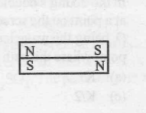
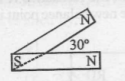
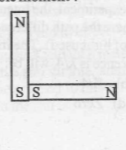
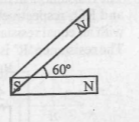
Following figures show the arrangement of bar magnets in different configurations. Each magnet has magnetic dipole moment Which configuration has highest net magnetic dipole moment ?

[4 Marks]
  • (A) Diagram 43 – NEET-UG 2014 Question Paper
  • (B) Diagram 44 – NEET-UG 2014 Question Paper
  • (C) Diagram 45 – NEET-UG 2014 Question Paper
  • (D) Diagram 46 – NEET-UG 2014 Question Paper
Question 165.

A thin semicircular conducting ring (PQR) of radius ‘r’ is falling with its plane vertical ina horizontal magnetic field B, as shown in figure. The potential difference developed across the ring when its speed is v, is
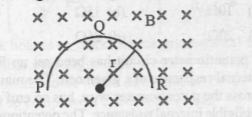
[4 Marks] Diagram 47 – NEET-UG 2014 Question Paper
  • (A) 2rBvand R is at higher potential
  • (B) Zero
  • (C) ΠrBv and R is at higher potnetial
  • (D) BvΠr² /2 and P is at higher potential
Question 166.

A transformer having efficiency of 90% is working on 200 V and 3 kW power supply. If the current in the secondary coil is 6 A, the voltage across the secondary coil and the current in the primary coil respectively are:

[4 Marks]
  • (A) 450 V, 15 A
  • (B) 300 V, 15 A
  • (C) 600 V, 15 A
  • (D) 450 V, 13.5 A
Question 167.

The angle of a prism is 'A'. One of its refracting surfaces is silvered. Light rays falling at an angle of incidence 2A on the first surface returns back through the same path after suffering reflection at the silvered surface. The refractive index, μ, of the prism is

[4 Marks]
  • (A) 1/2 cos A
  • (B) tan ⁡ 𝐴
  • (C) 2cosA
  • (D) 2sinA
Question 168.

Light with an energy flux of 25 × 10⁴ W m⁻² falls on a perfectly reflecting surface at normal incidence. If the surface area is 15 cm², the average force exerted on the surface is:

[4 Marks]
  • (A) 3.0×10⁻⁶ N
  • (B) 2.50×10 ⁻⁶ N
  • (C) 1.25×10 ⁻⁶ N
  • (D) 1.20×10⁻⁶ N
Question 169.

If the focal length of objective lens is increased then magnifying power of:

[4 Marks]
  • (A) microscope will increase but that of telescope decrease
  • (B) microscope will decrease but that of telescope increase.
  • (C) microscope and telescope both will increase.
  • (D) microscope and telescope both will decrease.
Question 170.

In the Young's double-slit experiment, the intensity of light at a point on the screen where the path difference is λ is K, (λ being the wave length of light used). The intensity at a point where the path difference is λ/4, will be:

[4 Marks]
  • (A) K
  • (B) K/2
  • (C) K/4
  • (D) Zero
Question 171.

A beam of light of λ = 600 nm from a distant source falls on a single slit 1 mm wide and the resulting diffraction pattern is observed on a screen 2 m away. The distance between first dark fringes on either side of the central bright fringe is:

[4 Marks]
  • (A) 2.4 cm
  • (B) 1.2 mm
  • (C) 2.4 mm
  • (D) 1.2 cm
Question 172.

If the kinetic energy of the particle is increased to 16 times its previous value, the percentage change in the de-Broglie wavelength of the particle is

[4 Marks]
  • (A) 60
  • (B) 25
  • (C) 50
  • (D) 75
Question 173.

When the energy of the incident radiation is increased by 20%, the kinetic energy of the photoelectrons emitted from a metal surface increased from 0.5 eV to 0.8 eV. The work function of the metal is:

[4 Marks]
  • (A) 1.0 eV
  • (B) 1.5 eV
  • (C) 1.3 eV
  • (D) 0.65 eV
Question 174.

Hydrogen atom in ground state is excited by a monochromatic radiation of λ = 975 Å. Number of spectral lines in the resulting spectrum emitted will be:

[4 Marks]
  • (A) 2
  • (B) 10
  • (C) 3
  • (D) 6
Question 175.

The binding energy per nucleon of ⁷₃Li and ⁴₂He nuclei are 5.60 MeV and 7.06 MeV, respectively.

In the nuclear reaction, ⁷₃Li + ¹₁H →⁴₂He + Q the value of energy Q released is:

[4 Marks]
  • (A) 19.6 MeV
  • (B) - 2.4 MeV
  • (C) 8.4 MeV
  • (D) 17.3 MeV
Question 176.

A radio isotope "X" with a half life 1.4 × 10⁹ years decays to "Y", which is stable. A sample of the rock from a cave was found to contain "X" and "Y" in the ratio 1:7. The age of the rock is:

[4 Marks]
  • (A) 8.40 × 10⁹years
  • (B) 4.20 × 10⁹years
  • (C) 3.92 × 10⁹ years
  • (D) 1.96 × 10⁹ years
Question 177.

The given graph represents V–I characteristic for a semiconductor device.

Which of the following statement is correct?
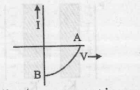
[4 Marks] Diagram 48 – NEET-UG 2014 Question Paper
  • (A) It is for a photodiode and points A and B represent open circuit voltage and current, respectively.
  • (B) It is for a LED and points A and B represent open circuit voltage and short circuit current, respectively.
  • (C) It is for a solar cell and points A and B represent open circuit voltage and current, respectively.
  • (D) It is V–I characteristic for a solar cell where point A represents open circuit voltage and point B short circuit current.
Question 178.

The barrier potential of a p–n junction depends on:

(A) type of semiconductor material

(B) amount of doping

(C) temperature

Which one of the following is correct?

[4 Marks]
  • (A) (B) and (C) only
  • (B) (A) and (B) only
  • (C) (B) only
  • (D) (A), (B) and (C)
Question 179.

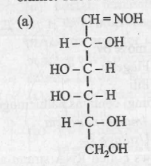
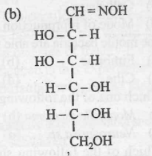
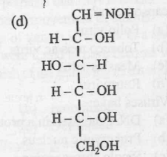
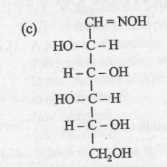
D(+) glucose reacts with hydroxylamine and yields an oxime. The structure of the oxime would be :

[4 Marks]
  • (A) Diagram 49 – NEET-UG 2014 Question Paper
  • (B) Diagram 50 – NEET-UG 2014 Question Paper
  • (C) Diagram 51 – NEET-UG 2014 Question Paper
  • (D) Diagram 52 – NEET-UG 2014 Question Paper
Question 180.

Given below is the representation of the extent of global diversity of invertebrates. What groups the four portion (A-D) represent respectively?
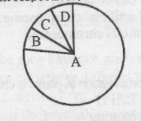
[4 Marks] Diagram 53 – NEET-UG 2014 Question Paper
  • (A) Diagram 54 – NEET-UG 2014 Question Paper
  • (B) Diagram 55 – NEET-UG 2014 Question Paper
  • (C) Diagram 56 – NEET-UG 2014 Question Paper
  • (D) Diagram 57 – NEET-UG 2014 Question Paper