CBSE EXAMINATION PAPER-2012
NEET-ZOOLOGY
(Solved)
General Instructions :
Read the following instructions carefully and follow them :
- This question paper contains 200 questions. All questions are compulsory.
- This question paper is divided into 1 sections.
- Section A – questions number 1 to 200 are multiple choice questions
- There is no overall choice given in the question paper. However, an internal choice has been provided in few questions.
- Use of calculator is NOT allowed.
Section A
A particle has initial velocity (2î + 3ĵ) and acceleration (0.3î + 0.2ĵ). The magnitude of velocity after 10 seconds will be:
𝐯⃗ = 𝐮⃗ + 𝐚⃗t
v = (2î + 3ĵ) + (0.3î + 0.2ĵ) × 10 = 5î + 5ĵ
|𝐯⃗| = √(5² + 5²)
|𝐯⃗| = 5√2
The motion of a particle along a straight line is described by equation:
x = 8 + 12t − t³
where x is in metre and t in second. The retardation of the particle when its velocity becomes zero, is:
x = 8 + 12t − t³
The final velocity of the particle will be zero, because it retarded
∴ v = 0 + 12 − 3t² = 0
3t² = 12
t = 2 sec
Now the retardation
a = dv/dt = 0 − 6t
a[t = 2] = 12 m/s²
retardation = 12 m/s²
The horizontal range and the maximum height of a projectile are equal. The angle of projection of the projectiles is:
Horizontal range,
R = u² sin 2θ / g ...(1)
Maximum height,
H = u² sin² θ / 2g ...(2)
According to the condition,
R = H
⇒ u² sin 2θ / g = u² sin² θ / 2g
⇒ 2 sin θ cos θ = sin² θ / 2
⇒ 2 cos θ = sin θ / 2
⇒ cot θ = 1/4
⇒ tan θ = 4
⇒ θ = [tan⁻¹(4)]
A car of mass 1000 kg negotiates a banked curve of radius 90 m on a frictionless road. If the banking angle is 45°, the speed of the car is:
For banking tan θ = V² / Rg
tan 45° = V² / 90 × 10 = 1
V = 30 m/s
A solid cylinder of mass 3 kg is rolling on a horizontal surface with velocity 4 ms⁻¹. It collides with a horizontal spring of force constant 200 Nm⁻¹. The maximum compression produced in the spring will be:
At maximum compression the solid cylinder will stop so loss in K.E. of cylinder = gain in P.E. of spring
⇒ 1/2 mv² + 1/2 Iω² = 1/2 kx²
⇒ 1/2 mv² + (1/2) (mR²/2) (v/R)² = 1/2 kx²
⇒ 3/4 mv² = 1/2 kx²
⇒ 3/4 × 3 × (4)² = 1/2 × 200 x²
⇒ 36/100 = x²
⇒ x = 0.6 m
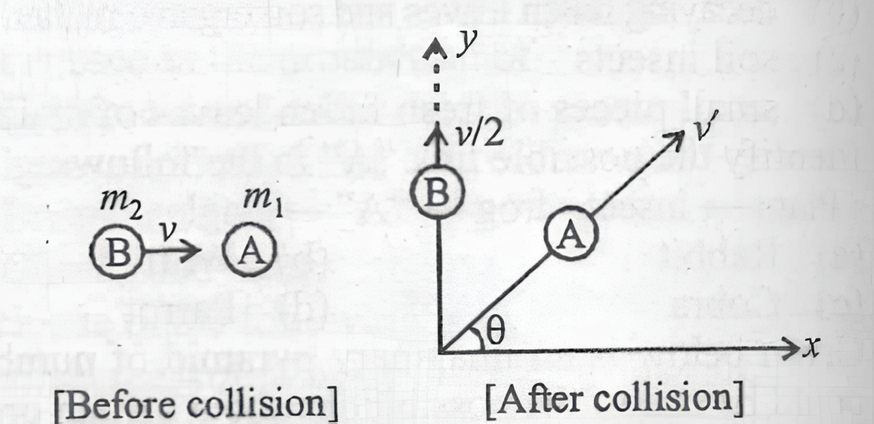
Two spheres A and B of masses m₁ and m₂ respectively collide. A is at rest initially and B is moving with velocity v along x-axis. After collision B has a velocity v/2 in a direction perpendicular to the original direction. The mass A moves after collision in the direction.
According to law of conservation of linear momentum
along x-axis, we get
∴⇒ m₁(0) + m₂v = m₁v′ cos θ
⇒ cos θ = (m₂v)/(m₁v′) ...(i)
Similarly, by law of conservation of linear momentum along y-axis, we get
⇒ m₁(0) + m₂(0) = m₁v′ sin θ + m₂(v/2)
⇒ sin θ = -(m₂v)/(2m₁v′) ...(ii)
From equations, (i) and (ii),
tan θ = −(m₂v/2mv′) × (m₁v′/m₂v) = −1/2
θ = tan⁻¹(−1/2) to the x-axis.
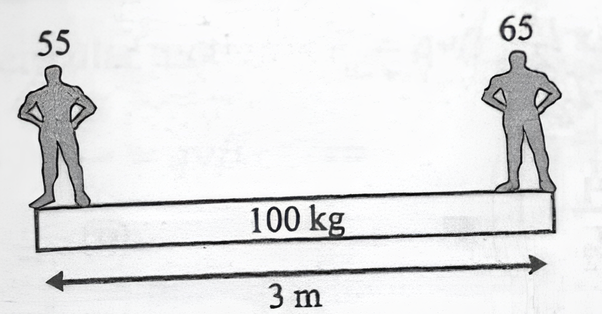
Two persons of masses 55 kg and 65 kg respectively, are at the opposite ends of a boat. The length of the boat is 3.0 m and weighs 100 kg. The 55 kg man walks up to the 65 kg man and sits with him. If the boat is in still water the centre of mass of the system shifts by
There is no external force so centre of mass of the system will not shift
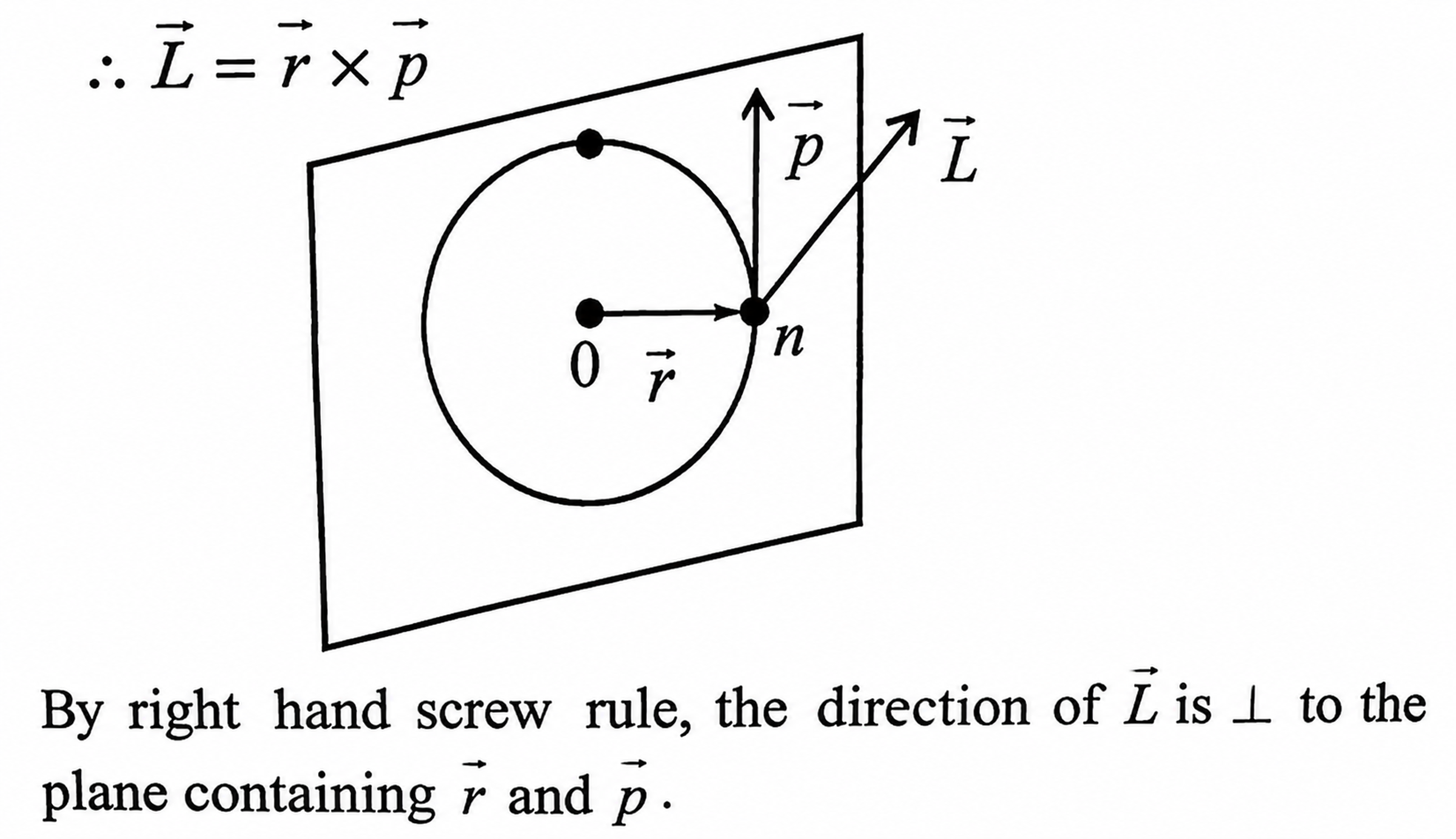
When a mass is rotating in a plane about a fixed point, its angular momentum is directed along :
ABC is an equilateral triangle with O as its centre. 𝐅⃗₁, 𝐅⃗₂ and 𝐅⃗₃ represent three forces acting along the sides AB, BC and AC respectively. If the total torque about O is zero, the magnitude of 𝐅⃗₃ is:
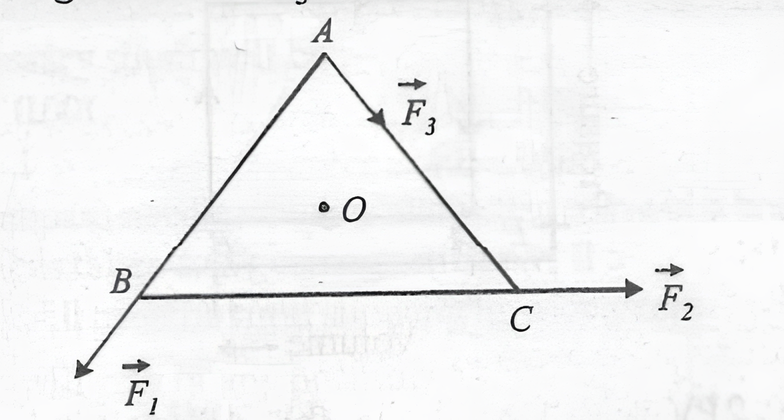
F₁ x + F₂ x = F₃ x
F₃ = F₁ + F₂
A spherical planet has a mass Mₚ and diameter Dₚ. A particle of mass m falling freely near the surface of this planet will experience an acceleration due to gravity, equal to:
Gravitational attraction force on particle B,
F_g =GMₚm / (Dₚ/2)²
Acceleration of particle due to gravity
a = F_g / m = 4GMₚ / D²ₚ
The height at which the weight of a body becomes 1/16th, its weight on the surface of earth (radius R), is:
GMₘ / (R + h)² = 1 GMₘ / 16 R²
⇒ 1 / (R + h)² = 1 / 16 R²
⇒ R / (R + h) = 1/4
⇒ (R + h) / R = 4
⇒ h = 3R
A geostationary satellite s orbiting the earth at a height of 5R above that surface of the earth, R being the radius of the earth. The time period of another satellite in hours at a height of 2R from the surface of the earthis:
According to Kepler's law of period
T² ∝ R³
T₁² / T₂² = R₁³ / R₂³ = (6R)³ / (3R)³
= 8
⇒ 24 × 24 / T₂² = 8
⇒ T₂² = (24 × 24) / 8 = 72 = 36 × 2
⇒ T₂ = 6√2
If the radius of a star is R and it acts as a black body, what would be the temperature of the star, in which the rate of energy production is Q?
(σ stands for Stefan’s constant)
Stefan’s law for black body radiation
Q = σeAT⁴
T = [Q / σ(4πR²)]¹ᐟ⁴
Here e = 1
A = 4πR²
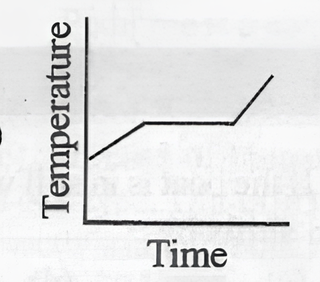
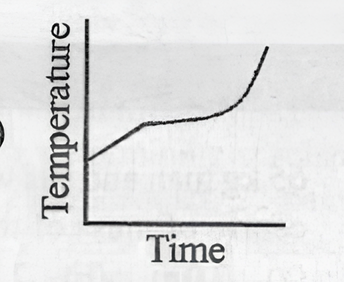
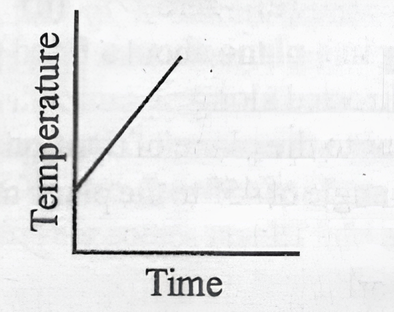
Liquid oxygen at 50K is heated to 300 K at constant pressure of 1 atm. The rate of heating is constant. Which one of the following graphs represents the variation of temperature with time?
-
(A) a
-
(B) b
-
(C) c
-
(D) d
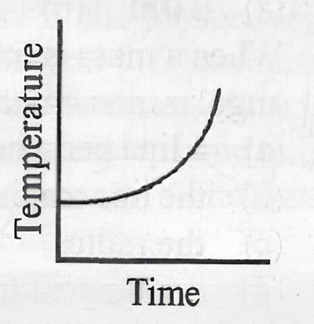
Initially liquid oxygen will gain the temperature up to its boiling temperature then it change its state to gas. After this again its temperature will increase, so corresponding graph will be graph(a).
A thermodynamic system is taken through the cycle ABCD as shown in figure. Heat rejected by the gas during the cyclic process is :
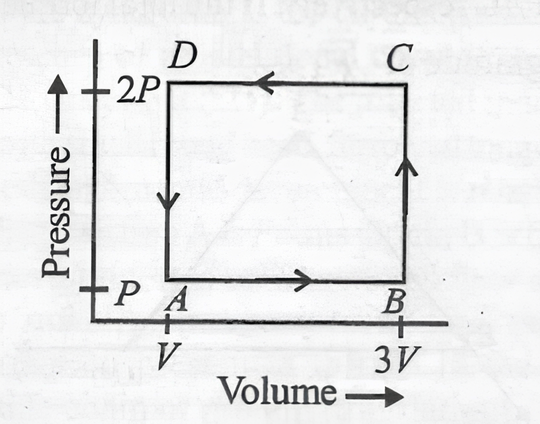
∴ Internal energy is the state function.
∴ In cyclic process; ΔU = 0
According to 1st law of thermodynamics
ΔQ = ΔU + W
So heat absorbed
ΔQ = W = Area under the curve
= −(2V)(P) = −2PV
So heat rejected = 2PV
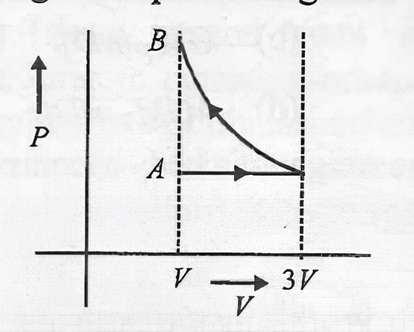
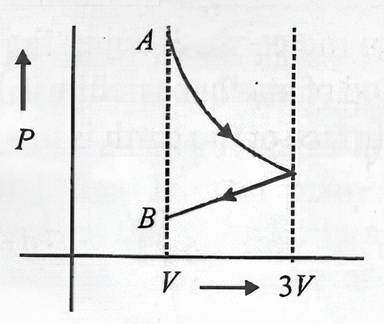
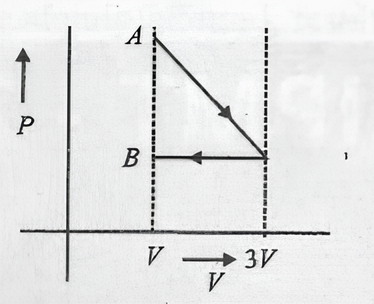
One mole of an ideal gas goes from an initial state A to final state B via two processes : It first undergoes isothermal expansion from volume V to 3V and then its volume is reduced from 3V to V at constant pressure. The correct P-V diagram representing the two processes is :
-
(A) a
-
(B) b
-
(C) c
-
(D) d
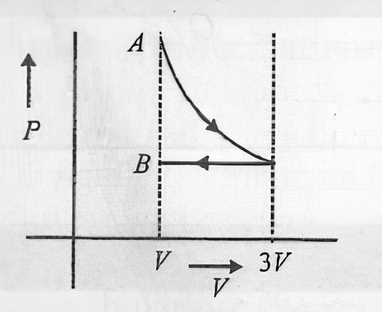
1st process is isothermal expansion which is only correct shown in option (d)
2nd process is isobaric compression which is correctly shown in option (d)
The damping force for an oscillator is directly proportional to the velocity. The unit of the constant of proportionality is:
F ∝ v ⇒ F = kv
k = F / v ⇒ [k] = [kgms⁻²] / [ms⁻¹] = kgs⁻¹
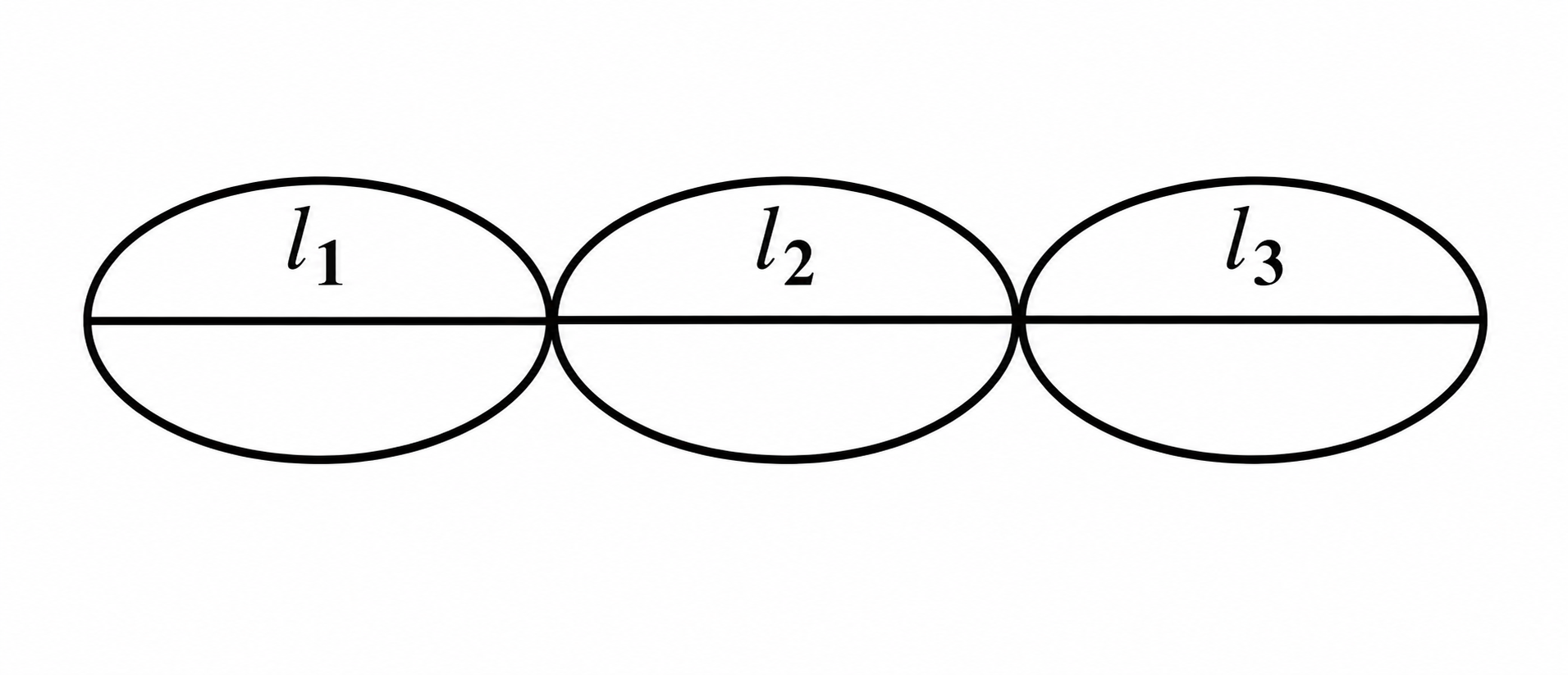
If n₁, n₂ and n₃ are the fundamental frequencies of three segments into which a string is divided, then the original fundamental frequency n of the string is given by :
n = 1 / 2l √(T/m)
or, n ∝ 1 / l or nl = constant, K
∴ n₁l₁ = K,
n₂l₂ = K, n₃l₃ = K
Also, l = l₁ + l₂ + l₃
or, K / n = K / n₁ + K / n₂ + K / n₃
or, 1 / n = 1 / n₁ + 1 / n₂ + 1 / n₃
Two sources of sound placed close to each other are emitting progressive waves given by y₁ = 4 sin 600πt and y₂ = 5 sin 608πt. An observer located near these two sources of sound will hear:
2πf₁ = 600π
f₁ = 300 ...... (1)
2πf₂ = 608π
f₂ = 304 ...(2)
|f₁ − f₂| = 4 beats
Iₘₐₓ / Iₘᵢₙ = (A₁ + A₂)² / (A₁ + A₂)² = (5 + 4)² / (5 - 4)² = 81 / 1
where A₁, A₂ are amplitudes of given two sound wave.
An electric dipole of moment 'p' is placed in an electric field of intensity 'E'. The dipole acquires a position such that the axis of the dipole makes an angle θ with the direction of the field. Assuming that the potential energy of the dipole to be zero when = 90°, the torque and the potential energy of the dipole will be respectively be:
The torque on the dipole is given as
τ = pE sin θ
The potential energy of the dipole in the electric field is given as
U = − pE cos θ
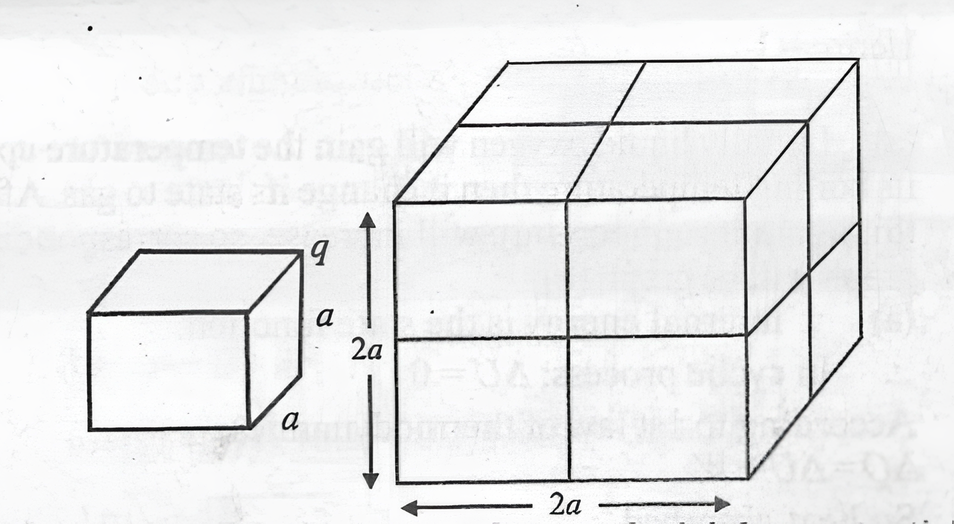
What is the flux through a cube of side 'a' if a point charge q is at one of its corner:
Eight identical cubes are required to arrange so that this charge is at centre of the cube formed so flux.
ϕ = q/8ε₀
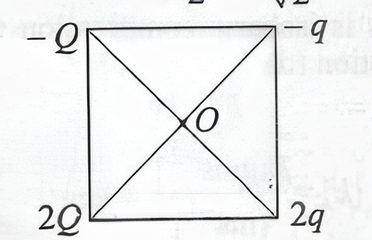
Four point charges -Q, -q, 2q and 2Q are placed, one at each corner of the square. The relation between Q and q for which the potential at the centre of the square is zero is:
Let the side length of square be 'a' then potential at centre O is
Ac = BD = √ (a² + a²) = a√2
OA = OB = OC = OD = a√2 / 2 = a / √2
V = k(-Q) / (a√2 ) + k(-q) / a√2 + k(2q) / a√2 + k(2Q) / a√2 = 0
Given
= -Q - q + 2q + 2Q = 0 ⇒ Q +q =0
⇒Q= -q
The potential energy of particle in a force field is U = A / r² - B / r, where A and B are positive constants and r is the distance of particle from the centre of the field. For stable equilibrium, the distance of the particle is:
For equilibrium
dU /dr = 0 ⇒ -2A / r³ + B / r² = 0
r = 2A / B
for stable equilibrium
d²U / dr² should be positive for the value of r
Here .d²U / dr² = 6A / r⁴ - 2B / r³ is +ve value for r = 2A / B
A ring is made of a wire having a resistance R₀=12Ω. Find the points A and B as shown in the figure, at which a current carrying conductor should be connected so that the resistance R of the sub-circuit between these points is equal to 8/3 Ω.
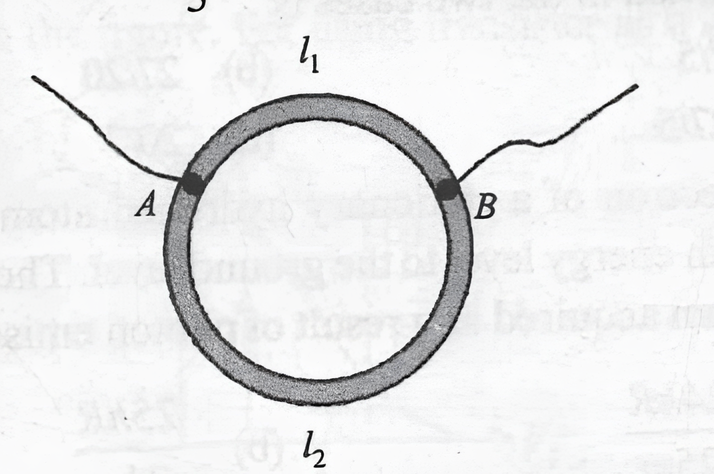
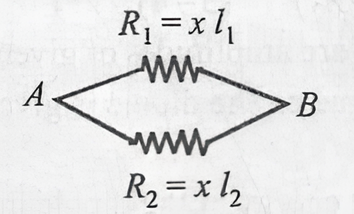
Let x is the resistance per unit length then
equivalent resistance R = (R₁R₂ / R₁ + R₂)[(xl₁)(xl₂) / xl₁ + xl₂]
⇒ 8 / 3 = x(l₁l₂ / l₁ + l₂
⇒ 8 / 3 = x(l₁ / (l₁ / l₂) + 1).....(i)
also R₀ = xl₁ + xl₂
12 = x(l₁ + l₂)
12 = xl₂ ( l₁/ l₂ + 1 ...(ii)
(i) / (ii) ⇒ (8/3) / (12/1)
= xl₁ / ((l₁/l₂) +1) / xl₂((l₁/l₂) +1)
= l₁ / l₂((l₁/l₂) +1)²
((l₁/l₂) +1)² × 8 / 36 = l₂ / l₂
(y² + 1 + 2y) × 8/36 = y (where y = l₁/l₂)
⇒ 8y² + 8 + 16y = 36y
⇒ 8y² − 20y + 8 = 0
⇒ 2y² − 5y + 2 = 0
⇒ 2y² − 4y − y + 2 = 0
⇒ 2y(y − 2) − 1(y − 2) = 0
⇒ (2y − 1)(y − 2) = 0
⇒ y = l₁/l₂ = 1/2 or 2
If voltage across a bulb rated 220 Volt-100 Watt drops by 2.5% of its rated value, the percentage of the rated value by which the power would decrease is:
Resistance of bulb is constant
P = V² / R ⇒ Δp / p = 2ΔV/V + ΔR/R
⇒ Δp/ p = 2 × 2.5 + 0 = 5%
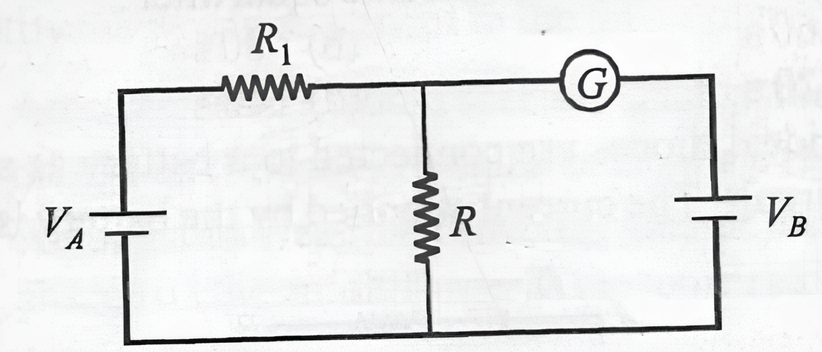
In the circuit shown the cells A and B have negligible resistances. For V_A= 12V, R₁ = 500Ω and R = 100Ω the galvanometer (G) shows no deflection. The value of V_B is:
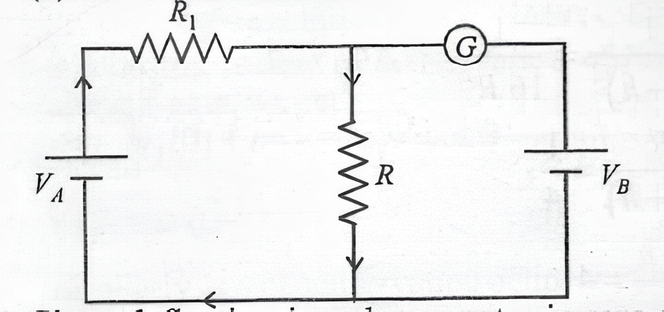
Since deflection in galvanometer is zero so current will flow as shown in the above diagram.
current I = V_A / R₁ + R = 12 / 500 + 100 = 12 / 600
So,
V_B = IR = 12 / 600 × 100 = 2V
An alternating electric field, of frequency v, is applied across the dees (radius = R) of a cyclotron that is being used to accelerate protons (mass = m). The operating magnetic field (B) used in the cyclotron and the kinetic energy (K) of
the proton beam, produced by it, are given by :
Time period of cyclotron is
T = 1 / v = 2πm / eB ; B= (2πm / e) v ; R = mv / eB = p / eB
⇒ p = eBR = e × (2πmν/e) R = 2πmνR
K.E. = p² / 2m = (2πmνR)² / 2m
= 2π²mν²R²
An α-particle moves in a circular path of radius 0.83 cm in the presence of a magnetic field of 0.25 Wb/m². The wavelength associated with the particle will be :
Wavelength
λ = h / p⇒ λ = h/mv ,
h = Planck's constant = 6.63 × 10⁻³⁴ J·S
For circular motion,
= F_c = qvB
⇒ mv² / r = qvB ⇒ mv / qB = r
r = mv / qB ⇒ mv = qrB
⇒ (2e)(0.83 × 10⁻²) (1/4)
λ = 6.6 × 10⁻³⁴ × 4 / 2 × 1.6 × 10⁻¹⁹ × 0.83 × 10⁻²
λ = 9.93 × 10⁻³⁴⁺²¹ ≈ 0.01 Å
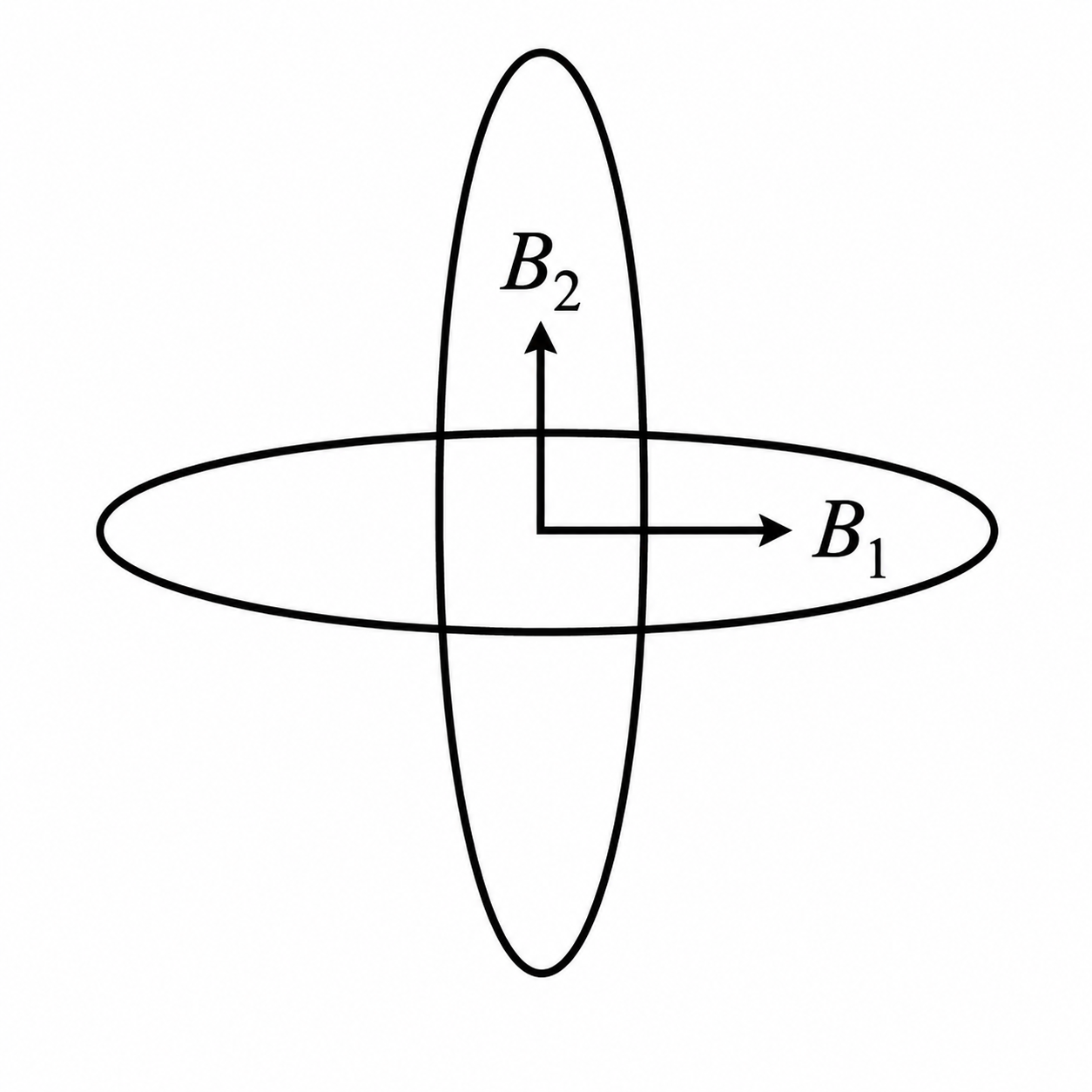
Two similar coils of radius R are lying concentrically with their planes at right angles to each other. The currents flowing in them are I and 2I, respectively. The resultant magnetic field induction at the center will be :
The magnetic field, due the coil, carrying current I Ampere
B₁ = μ₀I / 2R
The magnetic field due to the coil, carrying current 2I Ampere
B₂ = μ₀(2I) / 2R
The resultant B
Bₙₑₜ = √(B₁² + B₂² + 2B₁B₂ cosθ), θ = 90°
Bₙₑₜ = √(B₁² + B₂²) = (μ₀(2I) / 2R )√(1 + 4)
= √5 μ₀I / 2R
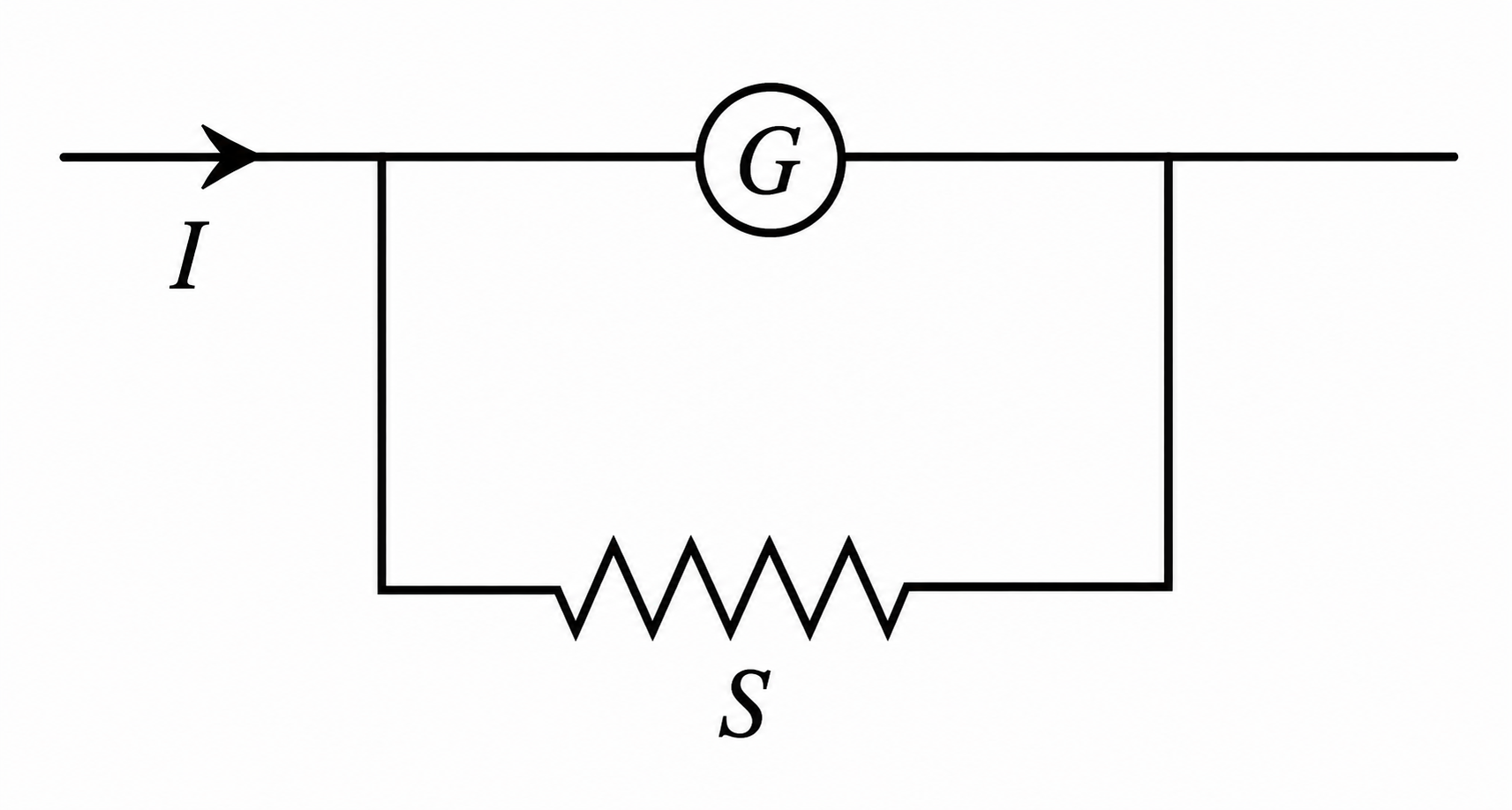
A milli voltmeter of 25 milli volt range is to be converted into an ammeter of 25 ampere range. The value (in ohm) of necessary shunt will be :
Galvanometer is converted into ammeter, by connected a shunt, in parallel with it.
GS / G + S = V_G / I = 25 × 10⁻³ / 25
GS / G + S = 0.001 Ω
Here S << G so
S = 0.001 Ω
A compass needle which is allowed to move in a horizontal plane is taken toa geomagnetic pole. It :
Since magnetic field is in vertical direction and needle is free to totate in horizontal plane only so magnetic force cannot rotate the needle in horizontal plane so needle can stay in any position.
A coil of resistance 400Ω is placed in a magnetic field. If the magnetic flux ϕ (wb) linked with the coil varies with time t (sec) as ϕ = 50t² + 4. The current in the coil at t = 2 sec is :
According to Faraday's law of induction
Induced e.m.f. ε = - dϕ / dt = -(100t)
Induced current i at t = 2 sec.
|ε / R| = +100 × 2 / 400 = + 0.5 A
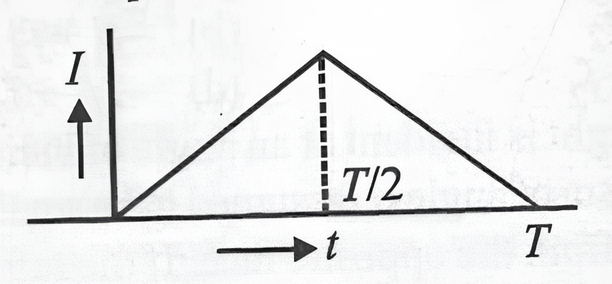
The current (I) in the inductance is varying with time according to the plot shown in figure.
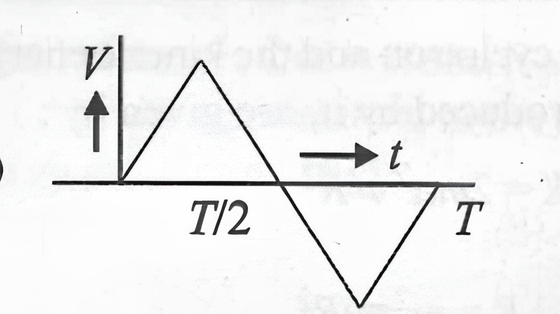
Which one of the following is the correct variation of voltage with time in the coil?
-
(A) a
-
(B) b
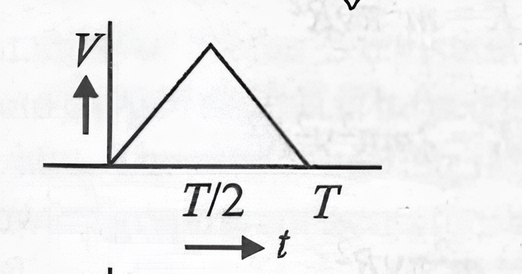
-
(C) c
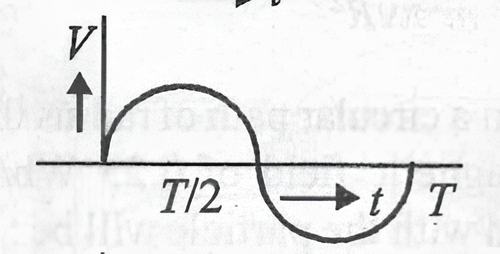
-
(D) d
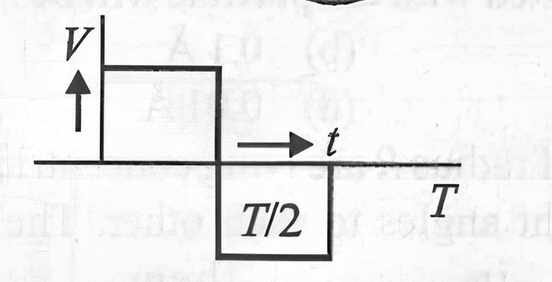
V = -L(di / dt)
Here di / dt is +ve for T / 2 time and
di / dt is -ve for next T / 2 time so
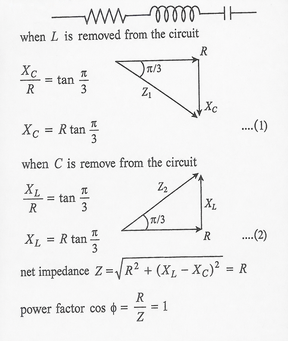
In an electrical circuit R, L, C and an a.c. voltage source are all connected in series. When L is removed from the circuit, the phase difference between the voltage the current in the circuit is π / 3. If instead, C is removed from the circuit, the phase difference is again π / 3. The power factor of the circuit is:
The electric field associated with an e.m. wave in vacuum is given by 𝐄⃗ = î 40 cos (kz − 6 × 10⁸t), where E, z and t are in volt / m, meter and seconds respectively. The value of wave vector k is :
On comparing the given equation to
𝐄⃗ = a₀î cos (ωt − kz)
ω = 6 × 10⁸
Wave factor,
k = 2π / r = ω / c
k = ω / c = 6 × 10⁸ / 3 × 10⁸
= 2 m⁻¹
When a biconvex lens of glass having refractive index 1.47 is dipped in a liquid, it acts as a plane sheet of glass. This implies that the liquid must have refractive index.
1 / f = (μ_g / μₘ -1) (1 / R₁ - 1 / R₂)
If μ_g = μₘ , then 1 / f = (1 - 1)(1 / R₁ - 1 / R₂)
⇒ 1 / f = 0
f = 1 / 0 = ∞
This implies that the liquid must have refractive index equal to glass.
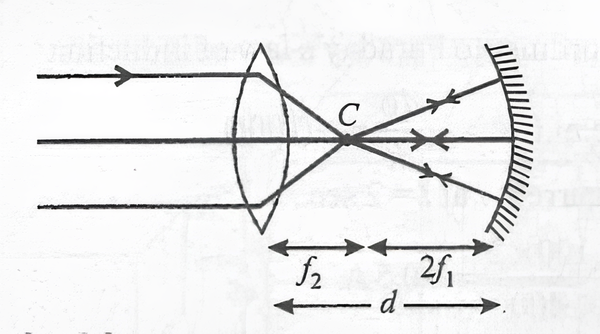
A concave mirror of focal length ‘f₁’ is placed at a distance of ‘d’ from a convex lens of focal length ‘f₂’. A beam of light coming from infinity and falling on this convex lens- concave mirror combination returns to infinity.
The distance ‘d’ must equal :
d = f₂ + 2f₁
A ray of light is incident at an angle of incidence, i, on one face of a prism of angle A (assumed to be small) and emerges normally from the opposite face. If the refractive index of the prism is μ, the angle of incidence, i, is nearly equal to :
For normally emerge e = 0
Therefore r₂ = 0 and r₁ = A
Snell's Law for incident ray's
1 sin i = μ sin r₁ = μ sin A
For small angle
i = μA
The magnifying power of a telescope is 9. When it is adjusted for parallel rays the distance between the objective and eyepiece is 20 cm. The focal length of lenses are :
M.P. = 9 = f₀ / fₑ
⇒ f₀ = 9fₑ ...(1)
f₀ + fₑ = 20 ...(2)
on solving
f₀ = 18 cm = focal length of the objective
fₑ = 2 cm = focal length of the eyepiece
A 200 W sodium street lamp emits yellow light of wavelength 0.6 μm. Assuming it to be 25% efficient in converting electrical energy to light, the number of photons of yellow light it emits per second is :
Give that, only 25% of 200W converter electrical energy into light of yellow colour
(hc / λ) × N = 200 × 25 / 100
Where N is the No. of photons emitted per second, plank's constant, c, speed of light.
N = 200 × 25 / 100 × λ / hc
= 200 × 25 × 0.6 × 10⁻⁶ / 100 × 6.2 × 10⁻³⁴ × 3 × 10⁸
= 1.5 × 10²⁰
Monochromatic radiation emitted when electron on hydrogen atom jumps from first excited to the ground state irradiates a photosensitive material. The stopping potential is measured to be 3.57 V. The threshold frequency of the materials is :
n → 2 − 1
E = 10.2 eV
kE = E − ϕ
Q = 10.20 − 3.57
hν₀ = 6.63 eV
v₀ = 6.63 × 1.6 × 10⁻¹⁹ / 6.67 × 10⁻³⁴
= 1.6 × 10¹⁵ Hz
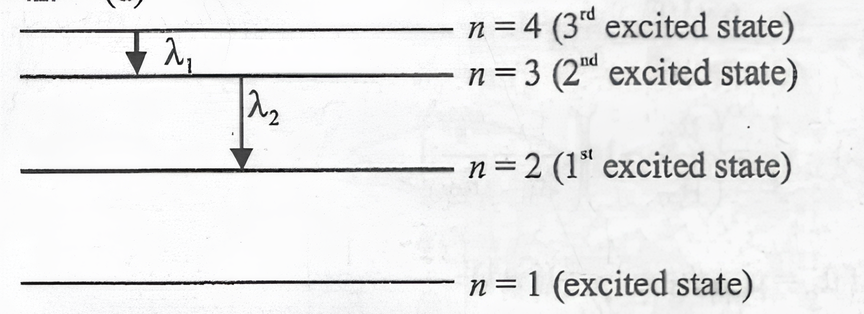
Electron in hydrogen atom first jumps from third excited state to second excited state and then from second excited to first excited state. The ratio of the wavelength λ₁ : λ₂ emitted in the two cases is
According to Rydberg formula
1/λ = R[1/n²_f - 1/n²ᵢ]
In first case, n_f = 3, nᵢ = 4
∴ 1/λ₁ = R [1/3² − 1/4²] = R [1/9 − 1/16] = (7/144)R ...(i)
In second case, n_f = 2, nᵢ = 3
∴ 1/λ₂ = R [1/2² − 1/3²] = R [1/4 − 1/9] = (5/36)R ...(ii)
Divide (ii) by (i), we get
λ₁/λ₂ = (5/36) × (144/7) = 20/7
An electron of a stationary hydrogen atom passes from the fifth energy level to the ground level. The velocity that the atom acquired as a result of photon emission will be :
(m = mass of the electron, R, Rydberg constant and h Planck's constant)
For emission, the wave number of the radiation is given as
1/λ = RZ² (1/n₁² − 1/n₂²)
R = Rydberg constant, Z = atomic number
= R (1/1² − 1/5²)
= R (1 − 1/25)
⇒ 1/λ = R (24/25)
linear momentum
p = h/λ = h × R × 24/25 (de -Broglie hypothesis)
⇒ mv = 24hR/25
⇒ v = 24hR/25m
If the nuclear radius of ²⁷Al is 3.6 Fermi, the approximate nuclear radius of ⁶⁴Cu in Fermi is:
The radius of the nucleus is directly proportional to cube root of atomic number i.e. R ∝ A¹ᐟ³
R = R₀A¹ᐟ³, where R₀ is a constant of proportionality
R₂/R₁ = (A₂/A₁)¹ᐟ³
⇒ (64/27)¹ᐟ³ = 4/3
where
R₁ = the radius of ²⁷Al, and
A₁ = Atomic mass number of Al
R₂ = the radius of ⁶⁴Cu and A₂ = Atomic mass number of C4
R₂ = 3.6 × 4/3 = 4.8 m
A mixture consists of two radioactive materials A₁ and A₂ with half lives of 20 s and 10 s respectively. Initially the mixture has 40 g of A₁ and 160 g of A₂. The amount of the two in the mixture will become equal after :
Let, the amount of the two in the mixture will become equal after t years.
The amount of A₁, which remains after t years
N₁ = N₀₁ / (2)ᵗᐟ²⁰
The amount of A₂, which remains, after t years
N₂ = N₀₂ / (2)ᵗᐟ¹⁰
According to the problem
N₁ = N₂
40 / (2)ᵗᐟ²⁰ = 160 / (2)ᵗᐟ¹⁰
2ᵗᐟ¹⁰ = 2⁽ᵗᐟ¹⁰⁻²⁾
t / 20 = t / 10 - 2
t / 20 - t / 10 = 2
t / 20 = 2
t = 40 s
Two ideal diodes are connected to a battery as shown in the circuit. The current supplied by the battery is :
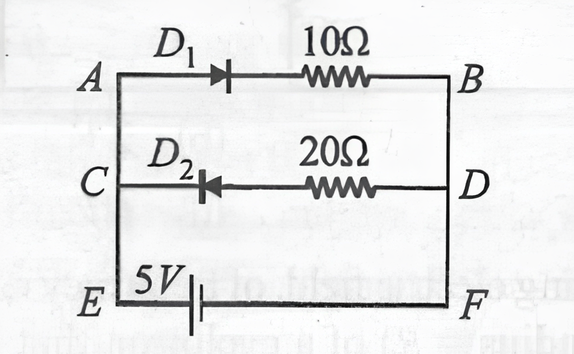
Here D₁ is in forward bias and D₂ is in reverse bias so, D₁ will conduct and D₂ will not conduct. Thus, no current will flow through DC.
I = V / R = 5 / 10 = 1 / 2 Amp.
C and Si both have same lattice structure, having 4 bonding electrons in each. However, C is insulator whereas Si is intrinsic semiconductor. This is because :
Electronic configuration of ⁶C
⁶C =1s², 2s² 2p²
The electronic configuration of ¹⁴Si
¹⁴Si = 1s², 2s² 2p⁶, 3s² 3p²
As they are away from Nucleus, so effect of nucleus is low for Si even for Sn and Pb are almost metalic.
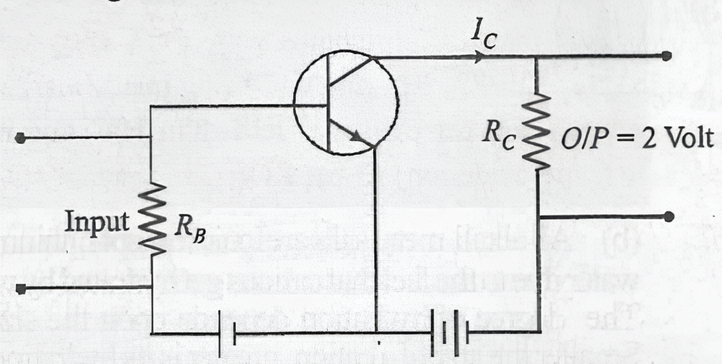
In a CE transistor amplifier, the audio signal voltage across the collector resistance of 2kΩ is 2V. If the base resistance is 1kΩ and the current amplification of the transistor is 100, the input signal voltage is :
The output voltage, across the load R_C
V₀ = I_C R_C = 2
The collector current (I_C)
I_C = 2/2× 10³ =10⁻³ Amp
Current gain (β)
(β) current gain = I_C / I_B = 100
I_B = I_C / 100 = 10⁻³ / 100 = 10⁻⁵ Amp
Input voltage (Vᵢ)
Vᵢ = R_B I_B = 1 × 10³ × 10⁻⁵ = 10⁻²Volt
Vᵢ = 10mV
Transfer characteristics [output voltage (V₀) vs input voltage (V₁)] for a base biased transistor in CE configuration is as shown in the figure. For using transistor as a switch, it is used :
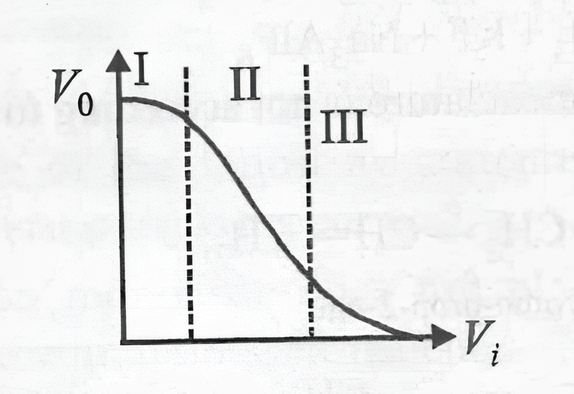
I → ON
III → OFF
In IIⁿᵈ state it is used as a amplifier it is active region.
The figure shows a logic circuit with two inputs A and B and the output C. The voltage wave forms across A ,B and C are as given. The logic circuit gate is :
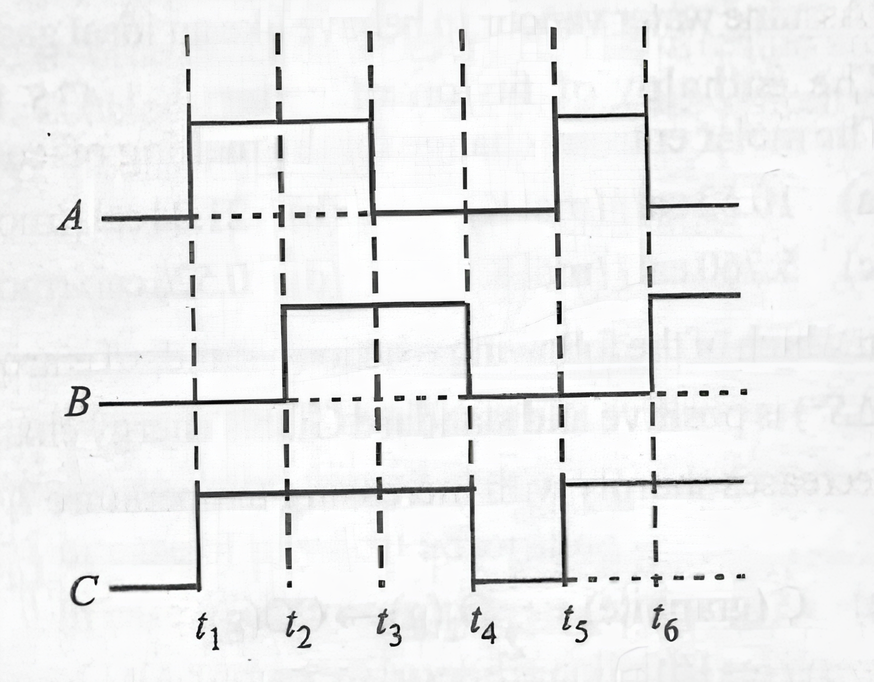
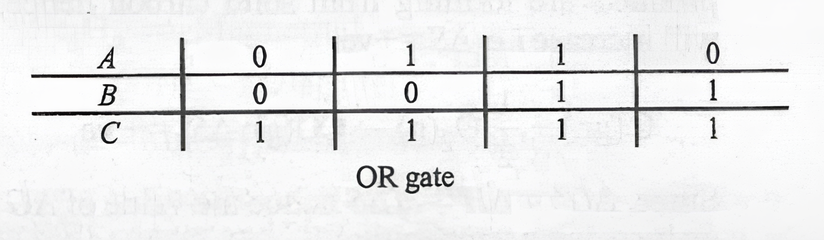
OR gate
The correct set of four quantum numbers for the valence electron of rubidium atom (Z=37) is
Electronic configuration of Rb = [Kr]5s¹
Set of quantum numbers, n = 5
ℓ = 0, ∴ s-orbital
m = 0, s = +1/2
Maximum number of electrons in a subshell with : /=3 and n = 4 is:
(n = 4, ℓ = 3) ⇒ 4f subshell
Since, maximum no. of electrons in a subshell
= 2(2ℓ + 1)
So, total no. of electron in 4f subshell
= 2(2 × 3 + 1) = 14 electrons.
Identify the wrong statement in the following:
As the positive charge increases on metal cation, radius decreases. This is due to the fact that nuclear charge in the case of a cation is acting on lesser number of electrons and pulls them closer.
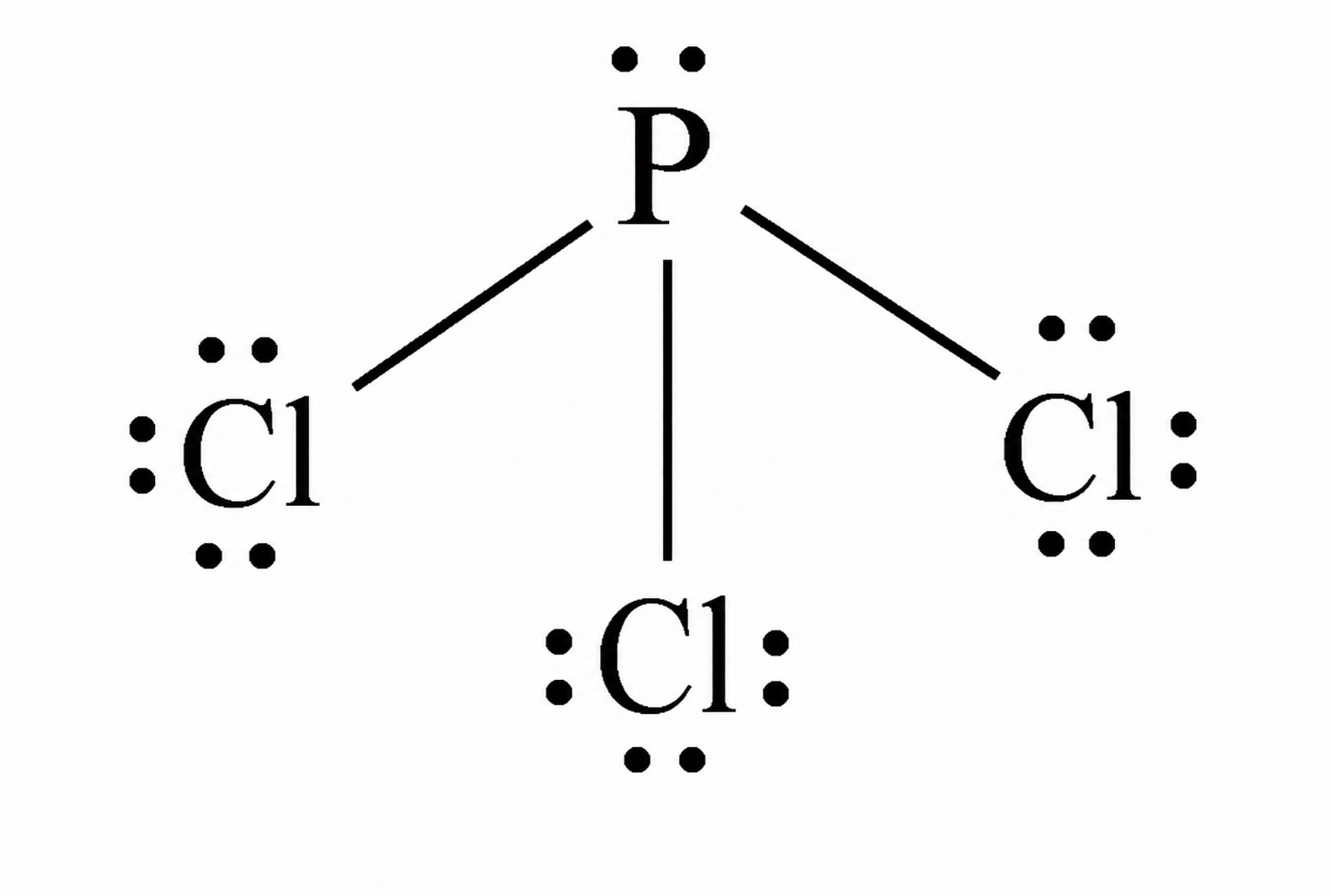
Which of the following species contains three bond pairs and one lone pair around the central atom ?
PCl₃
Which one of the following pairs is isostructural (i.e., having the same shape and hybridization)?
BF₄⁻ hybridisation sp³, tetrahedral structure.
NH₄⁺ hybridisation sp³, tetrahedral structure.
The pair of species with the same bond order is:
Both O₂²⁻ and B₂ has bond order equal to 1.
B₂ (10) = [σ1s² σ*1s² σ2s² σ*2s² π2p¹_y π2p¹_z]
Bond order = N_b − Nₐ / 2
= 6 - 4 / 2 = 2 / 2 = 1
B₂ is known to be in the gas phase.
O₂²⁻ = σ1s² σ*1s² σ2s² σ*2s² σ2p²_z π2pₓ² π2p²_y π*2pₓ² π*2p²_y
Bond order = 1 / 2 (10 − 8) = 1
Bond order of 1.5 is shown by
(O₂) = σ1s² σ*1s² σ2s² σ*2s² σ2p²_z π2pₓ²
= π2p²_y π*2pₓ¹ = π*2p¹_y
Bond order = N_b − Nₐ / 2 =10 − 6 / 2 = 4 / 2 = 2
(O₂⁺ ion) = σ1s² σ*1s² σ2s² σ*2s²
σ2p²_z π2pₓ² = π2p²_y π*2pₓ¹
Bond order = N_b - Nₐ / 2 = 10 - 5 / 2 = 5 / 2 = (2)1 / 2
(O₂⁻) = σ1s² σ*1s² σ2s² σ*2s² σ2p²_z
π2pₓ² = π2p²_y π*2pₓ² π*2p¹_y
Bond order = (N_b − Nₐ) / 2 = 10 − 7 / 2 = 3 / 2 = (1)1 / 2
(O₂²⁻) = σ1s² σ*1s² σ2s² σ*2s² σ2p²_z π2pₓ²
= π2p²_y π*2pₓ² = π*2p²_y
Bond order = N_b - Nₐ / 2 = 10 - 8 / 2 = 2 / 2 = 1
Standard enthalpy of vapourisation ΔᵥₐₚH° for water at 100°C is 40.66 kJ mol⁻¹. The internal energy of vapourisation of water at 100°C (in kJ mol⁻¹) is:
ΔᵥₐₚH° = 40.66 kJ mol⁻¹
T = 100 + 273 = 373 K, ΔE = ?
ΔH = ΔE + Δn_gRT ⇒ ΔE = ΔH − Δn_gRT
Δn_g = number of gaseous moles of products − number of gaseous moles of reactants
H₂O(1) ⇌ H₂O(g)
Δn_g = 1 − 0 = 1
ΔE = ΔH − RT = ΔE = (40.66 × 10³) − (8.314 × 373)
= 37559 J/mol or 37.56 kJ/mol
The enthalpy of fusion of water is 1.435 kcal/mol. The molar entropy change for the melting of ice at 0°C is:
ΔS = ΔH / T = 1.435 × 10³ / 273
= 5.260 cal/mol − K
In which of the following reactions, standard entropy change (ΔS°) is positive and standard Gibb's energy change (ΔG°) decreases sharply with increasing temperature?
Since, in the first reaction more (Δn > 0) gaseous products are forming from solid carbon hence, entropy will increase i.e. ΔS = +ve.
C(gr.) + 1/2 O₂(g) → CO(g); ΔS° = +ve
Since, ΔG° = ΔH° − TΔS hence the value of ΔG decreases on increasing temperature.
pH of a saturated solution of Ba(OH)₂ is 12. The value of solubility product (Kₛₚ) of Ba(OH)₂ is :
Given pH = 12
or [H⁺] = 10⁻¹²
Since, [H⁺][OH⁻] = 10⁻¹⁴
∴ [OH⁻] = 10⁻¹⁴ / 10⁻¹²= 10⁻²
Ba(OH)₂ ⇌ Ba²⁺ + 2OH⁻
s 2s
[OH⁻] = 10⁻²
2s = 10⁻²
s = 10⁻² / 2 = 5 × 10⁻³ m, Kₛₚ = s · (2s)²
⇒ Kₛₚ = 5 × 10⁻⁷
Equimolar solutions of the following substances were prepared separately. Which one of these will record the highest pH value ?
(AlCl₃, LiCl & BeCl₂) all these solutions are acidic due to cationic hydrolysis, whereas BaCl₂, is salt of strong base (Ba(OH)₂) and strong acid (HCl), hence it will have maximum pH.
Buffer solutions have constant acidity and alkalinity because
Constant acidity and alkalinity of buffer solution is due to the unionised acid or base.
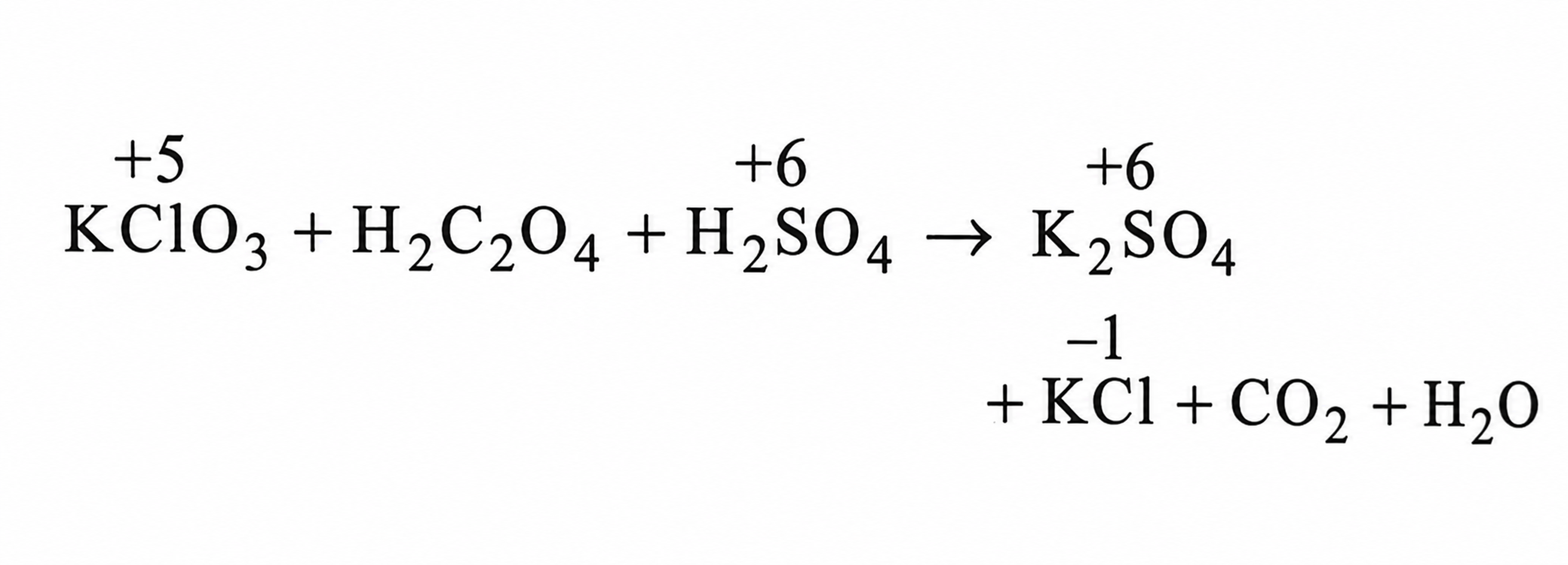
A mixture of potassium chlorate, oxalic acid and sulphuric acid is heated. During the reaction which element undergoes maximum change in the oxidation number ?
i.e. maximum change in oxidation number is observed in Cl (+5 to −1).
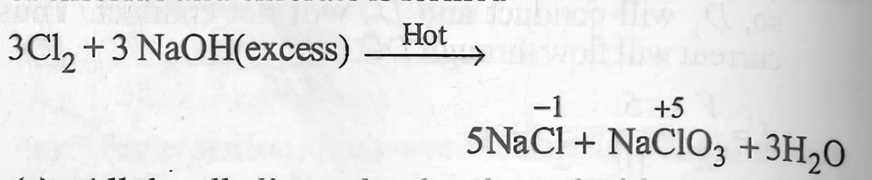
When Cl₂ gas reacts with hot and concentrated sodium hydroxide solution, the oxidation number of chlorine changes from :
On reaction with hot and concentrated alkali a mixture of chloride and chlorate is formed
Which one of the alkali metals, forms only, the normal oxide, M₂O on heating in air ?
All the alkali metals when heated with oxygen form different types of oxides for example lithium forms lithium oxide (Li₂O), sodium forms sodium peroxide (Na₂O₂), while K, Rb and Cs form their respective superoxide.
The ease of adsorption of the hydrated alkali metal ions on an ion-exchange resins follows the order :
All alkali metal salts are ionic (except Lithium) and soluble in water due to the fact that cations gets hydrated by water molecules. The degree of hydration depends upon the size of the cation. Smaller the size of a cation, greater is its hydration energy.
Relative ionic radii:
Cs⁺ > Rb⁺ > K⁺ > Na⁺ > Li⁺
Relative ionic radii in water or relative degree of hydration:
Li⁺ > Na⁺ > K⁺ > Rb⁺ > Cs⁺
Aluminium is extracted from alumina (Al₂O₃) by electrolysis of a molten mixture of :
Fused alumina (Al₂O₃) is a bad conductor of electricity. Therefore, cryolite (Na₃AlF₆) and fluorspar (CaF₂) are added to purified alumina which not only make alumina a good conductor of electricity but also reduce the melting point of the mixture to around 1140 K.
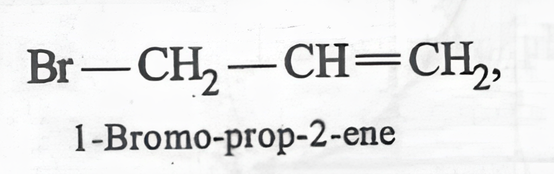
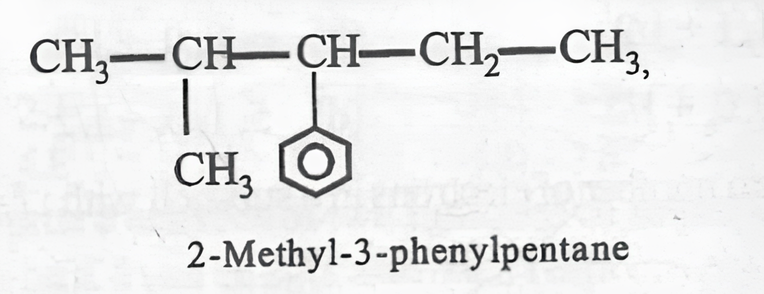
Which nomenclature is not according to IUPAC system?
-
(A)
-
(B)
-
(C)
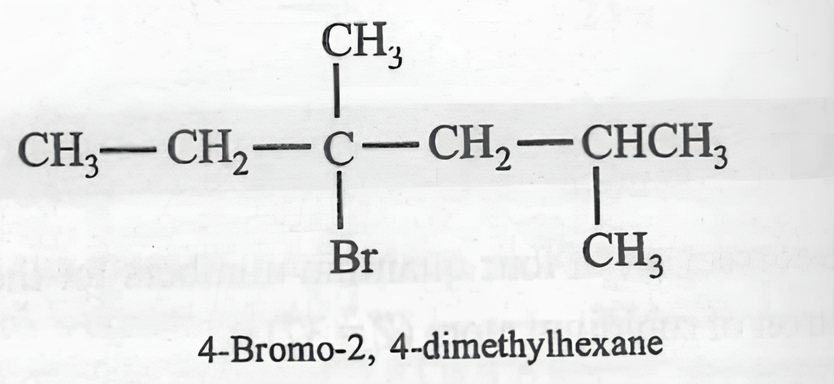
-
(D)
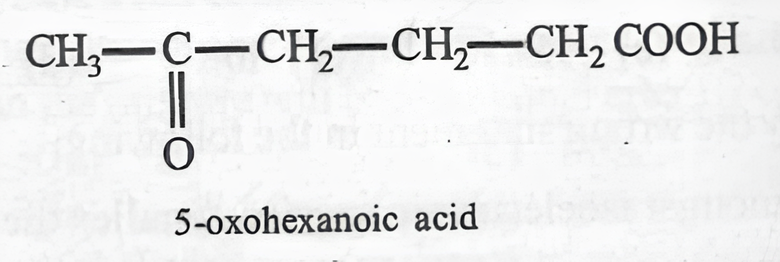
The correct name is 3-Bromoprop-1-ene.

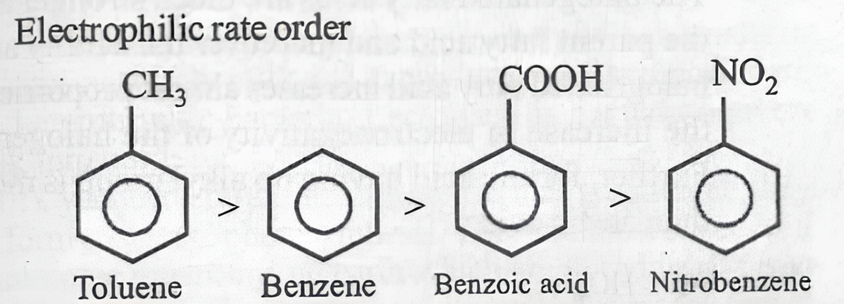
Among the following compounds the one that is most reactive towards electrophilic nitration is:
Since nitration is an electrophilic substitution hence presence of electron releasing group like CH₃ in the nucleus facilitates nitration.
Which one of the following statements regarding photochemical smog is not correct?
The oxidised hydrocarbons and ozone in presence of humidity cause photochemical smog.
Hydrocarbons + O₂, NO₂, NO, O, O₃ → Peroxides, formaldehyde, peroxyacetyl nitrate (PAN), acrolein etc.
It is oxidising in nature and causes irritation to eyes, lungs, nose, asthamatic attack and damage plants.
The number of octahedral void(s) per atom present in a cubic close-packed structure is :
Number of octahedral voids in ccp is equal to effective number of atoms.
In ccp, effective number of atoms are 4 so, 4 octahedral voids.
So, 1 octahedral voids per atom
A metal crystallizes with a face-centered cubic lattice. The edge length of the unit cell is 408 pm. The diameter of the metal atom is :
For fcc structure,
√2a = 4r
√2 × 408 / 2 = 2r
(2r = Diameter)
Diameter = 288.5 ≈ 288 pm
P_A and P_B are the vapour pressure of pure liquid components, A and B, respectively of an ideal binary solution. If X_A represents the mole fraction of component A, the total pressure of the solution will be
P = P_A X_A + P_B X_B= P_A X_A + P_B(1 − X_A)
(for binary sol. X_A + X_B = 1)
⇒ P_A X_A + P_B − P_B X_A
⇒ P_B + X_A(P_A − P_B)
Limiting molar conductivity of NH₄OH
(i.e., Λ°ₘ(NH₄OH)) is equal to :
Λ°ₘ_(NH₄Cl) = Λ°ₘ_NH₄⁺ + Λ°ₘ_Cl⁻
Λ°ₘ_(NaOH) = Λ°ₘ_Na⁺ + Λ°ₘ_OH⁻
Λ°ₘ_(NaCl) = Λ°ₘ_Na⁺ + Λ°ₘ_Cl⁻
∴ Λ°ₘ_(NH₄⁺) + Λ°ₘ_(OH⁻)
= Λ°ₘ_(NH₄⁺) + Λ°ₘ_(Cl⁻) + Λ°ₘ_(Na⁺) + Λ°ₘ_(OH⁻) − [Λ°ₘ_(Na⁺) + Λ°ₘ_(Cl⁻)]
Λ°ₘ_(NH₄OH) = Λ°ₘ_(NH₄Cl) + Λ°ₘ_(NaOH) − Λ°ₘ_(NaCl)
In a reaction, A + B → Product, rate is doubled when the concentration of B is doubled, and rate increases by a factor of 8 when the concentrations of both the reactants (A and B) are doubled. Rate law for the reaction can be written as :
According to statement given in the question, it is clear that
r ∝ [A]² and r ∝ [B]
That means, order of reaction with respect to B is 1 and w.r.t A is 2.
Hence, Rate = k[A]²[B]¹
In a zero-order reaction for every 10° rise in temperature, the rate is doubled. If the temperature is increased from 10°C to 100°C, the rate of the reaction will become:
r₁₀₀∘_C / r₁₀∘_C = 2⁽¹⁰⁰⁻¹⁰ᐟ¹⁰⁾ = 2⁹ = 512 times
In Freundlich Adsorption isotherm, the value of 1/n is
According to Freundlich Adsorption isotherm
x / m = KP¹ᐟⁿ
at low pressure 1 / n = 1
∴ x / m ∝ P¹
at high pressure 1 / n = 0
x/m = constant
i.e. the value of n varies between 0 to 1.
The protecting power of lyophilic colloidal sol is expressed in terms of
The lyophobic sols are less stable than lyophilic sols. The lyophilic sols are thus used to protect the lyophobic sols. This property of lyophilic sols is known as protective action of lyophilic sols.
Which can be represented by gold number.
Which one of the following is a mineral of iron?
[Fe₃O₄ ⇒ Magnetite]
[CuCO₃ Cu(OH)₂ – Malachite]
[Pyrolusite – MnO₂] [Cassiterite – SnO₂]
Identify the alloy containing a non-metal as a constituent in it.
Invar is a nickel iron alloy, Bell metal is an alloy of about 80% copper and 20% tin, Bronze is also an alloy of copper and tin.
Steel: It always have few % of carbon.
In the extraction of copper from its sulphide ore, the metal finally obtained by the reduction of cuprous oxide with :
2Cu₂S(s) + 3O₂(g) → 2Cu₂O(s) + 2SO₂(g)
The unchanged Cu₂S, mixed with Cu₂O and heated strongly in absence of air
Cu₂S + 2Cu₂O → 6Cu + SO₂
In which of the following compounds, nitrogen exhibits highest oxidation state ?
Compound Oxidation number of nitrogen
N₂H₄ = −2
NH₃ = −3
N₃H = −1/3
NH₂OH = −1
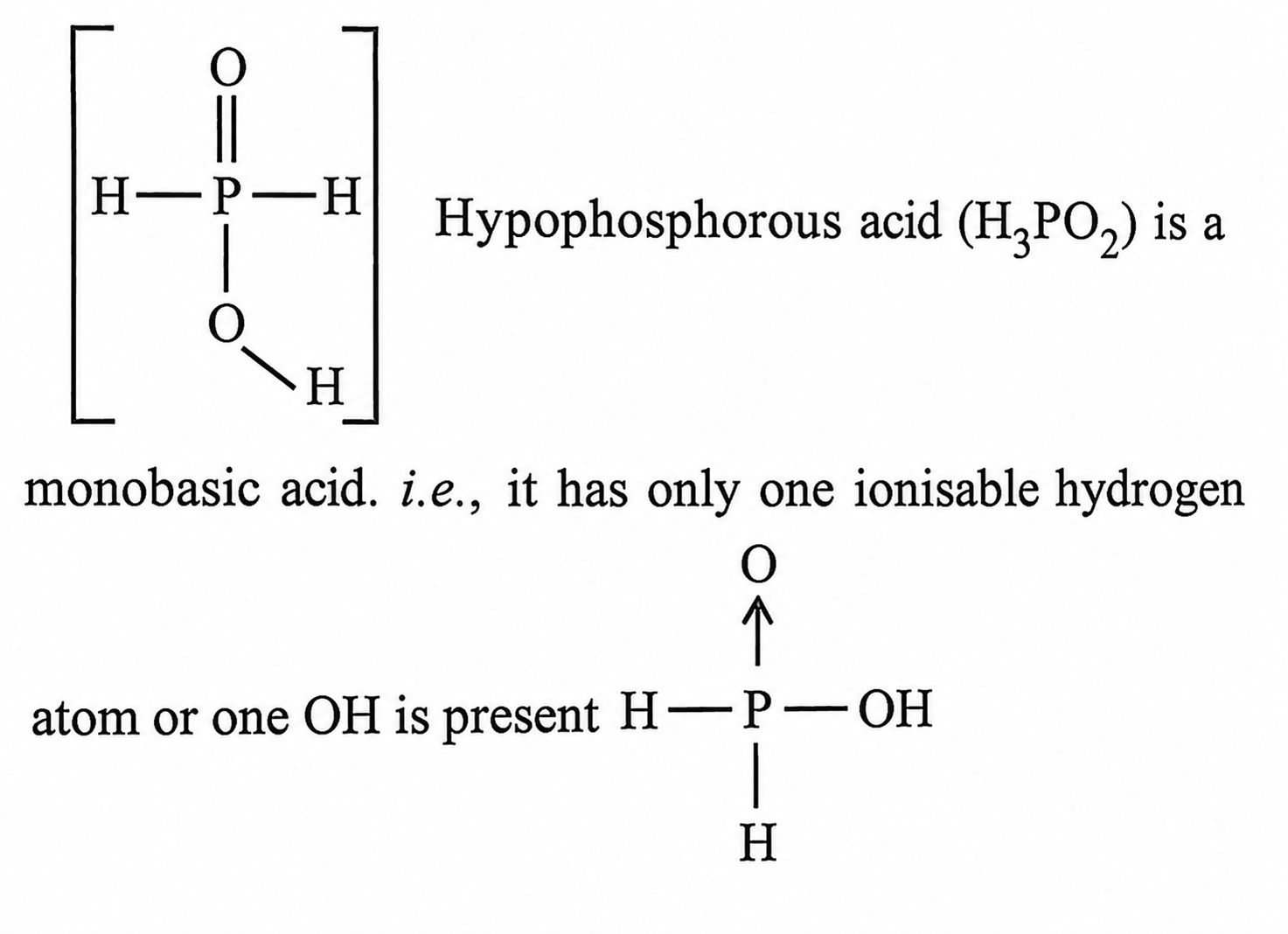
Which of the following statements is not valid for oxoacids of phosphorus?
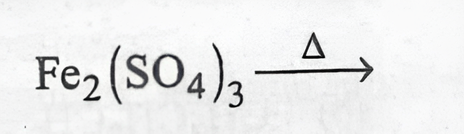
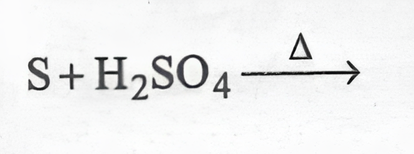
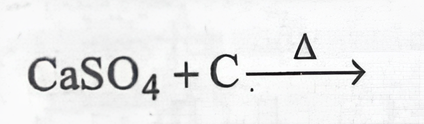
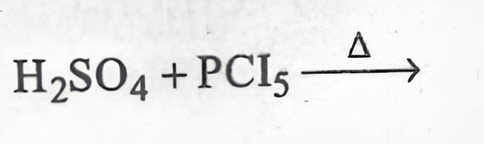
Sulphur trioxide can be obtained by which of the following reaction :
-
(A)
-
(B)
-
(C)
-
(D)
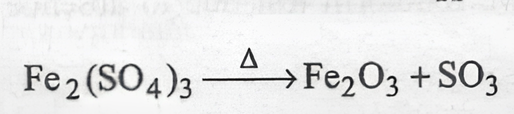
Which of the statements is not true?
Na₂Cr₂O₇ is hygroscopic in nature and therefore accurate weighing is not possible in normal atmospheric conditions. A hygroscopic substance absorbs moisture from atmosphere and this could lead to inaccuracies in weight.
Which one of the following is an outer orbital complex and exhibits paramagnetic behaviour?
[Ni(NH₃)₆]²⁺
Ni²⁺ = 3d⁸, according to CFT = t⁶ ₂_g e²_g, therefore,Hybridisation is sp³d² & complex is paramagnetic and outer orbital.
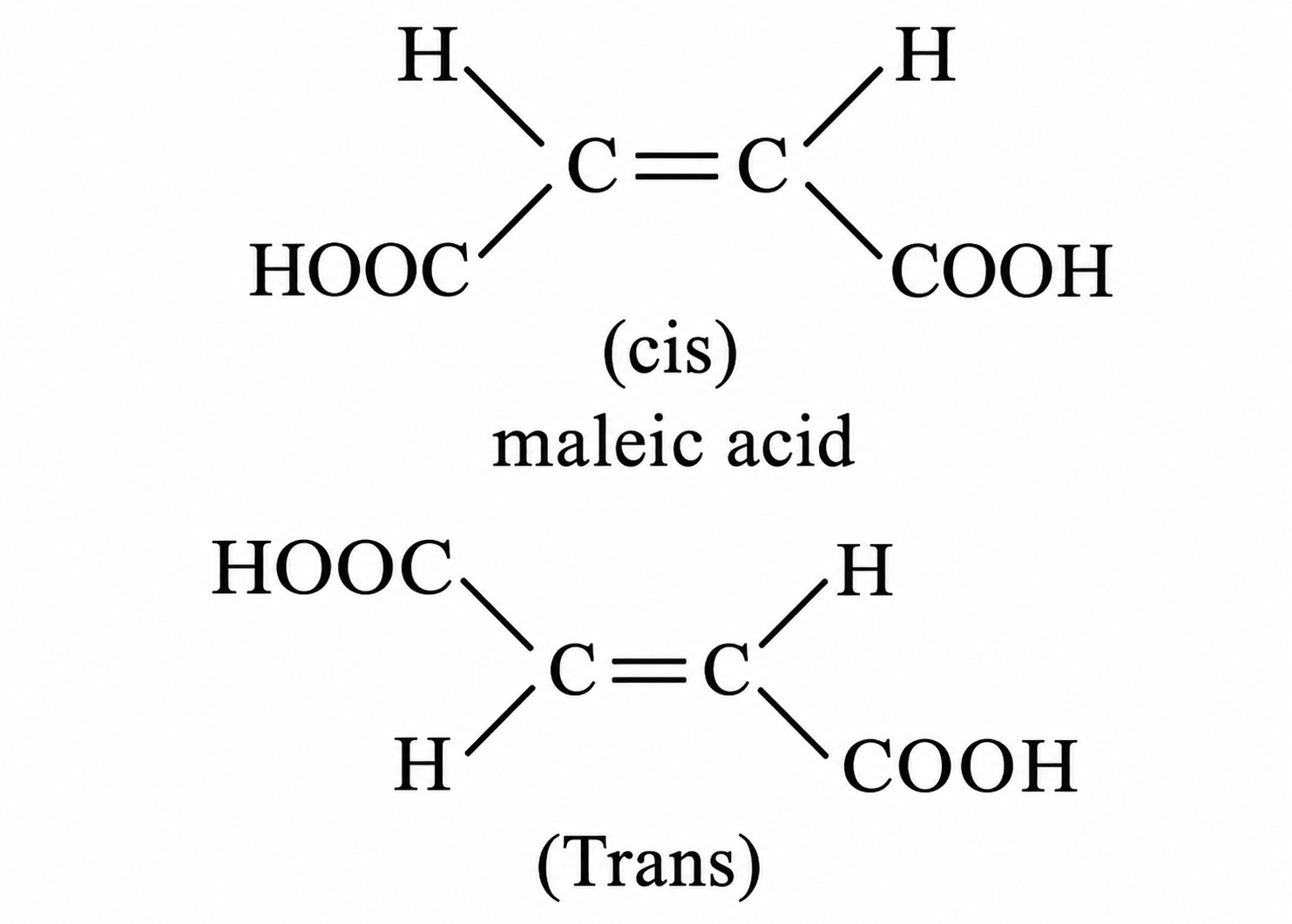
Which of the following acids does not exhibit optical isomerism?
It shows geometrical isomerism but does not show optical isomerism.
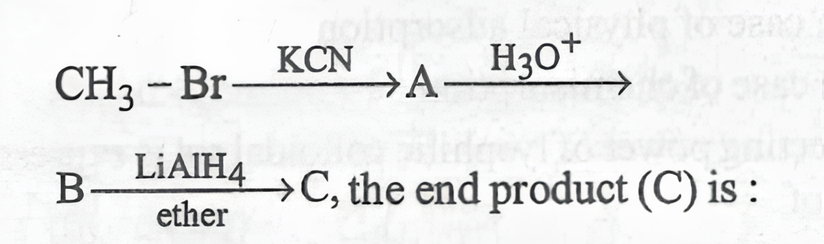
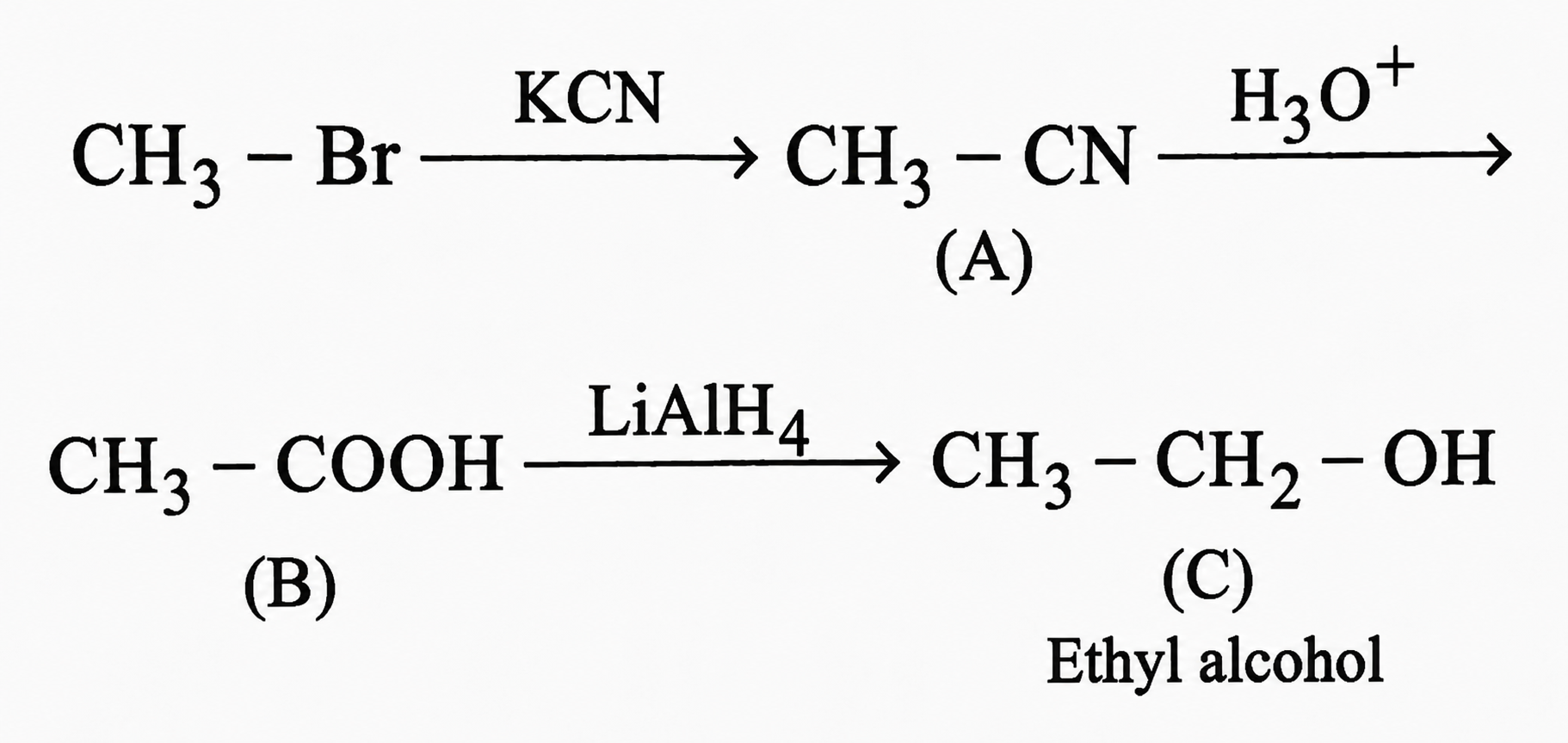
In the following sequence of reactions
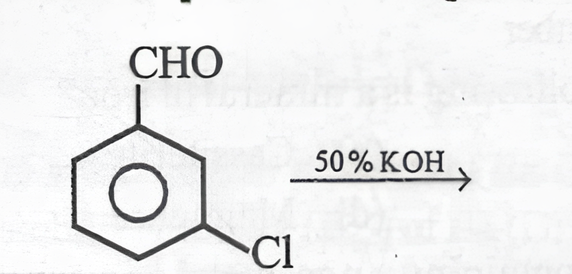
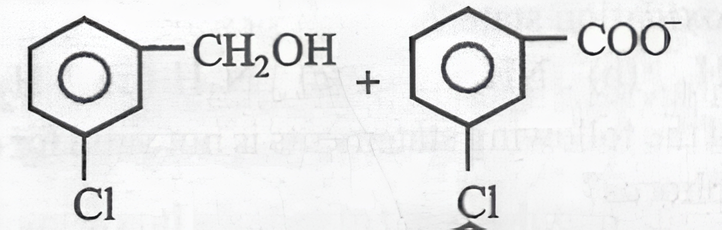
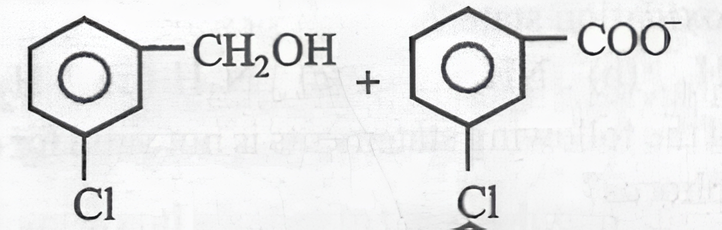
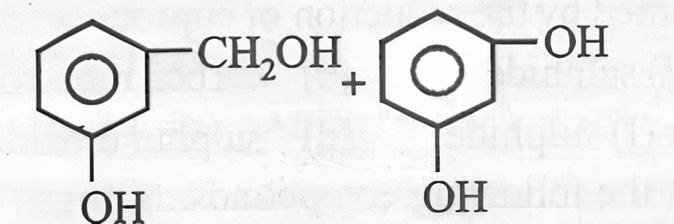
Predict the product in the given reaction.
-
(A)
-
(B)
-
(C)
-
(D)
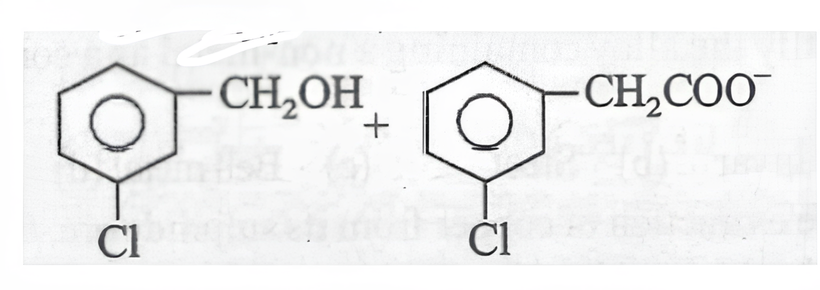
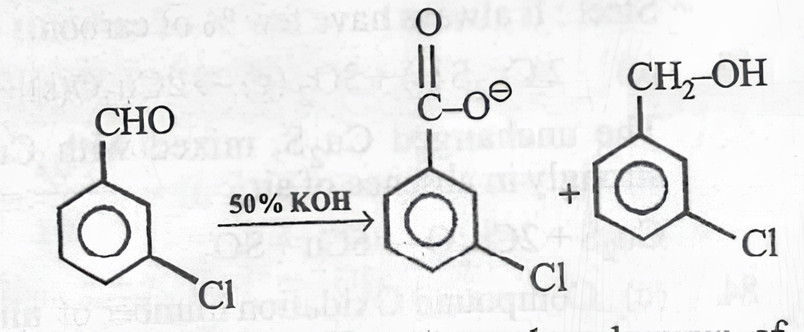
Cannizzaro reaction - when an aldehyde containing no α - H undergo reaction in presence of 50% KOH. It disproportionates to form a molecule of carboxylic acid and a molecule of alcohol.
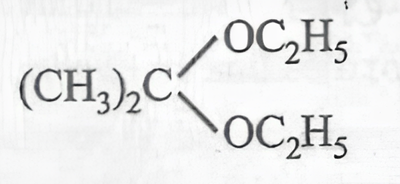
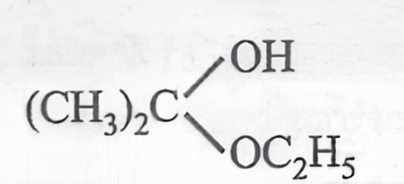
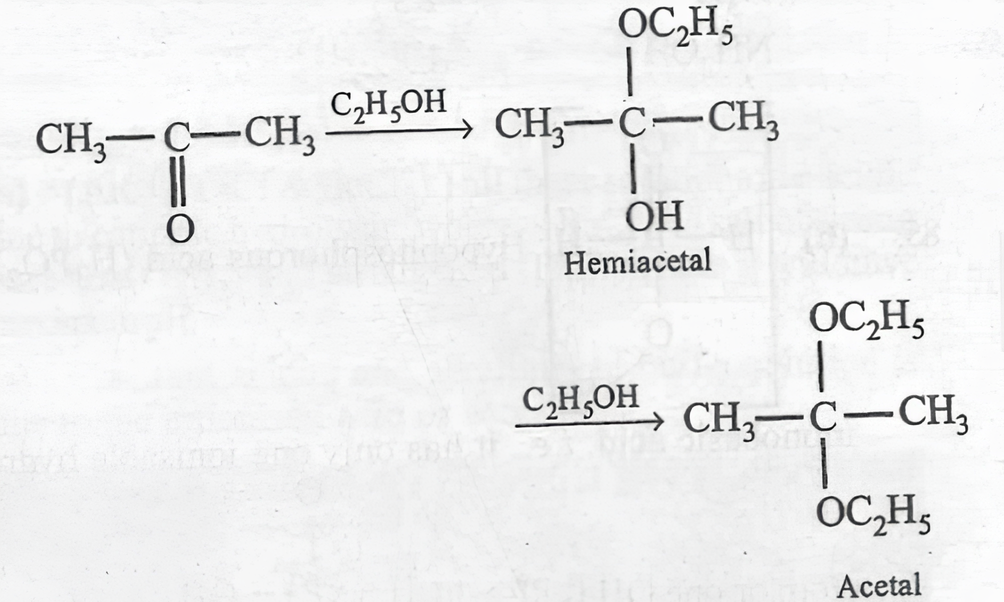
Acetone is treated with excess of ethanol in the presence of hydrochloric.acid. The product obtained is :
-
(A)
-
(B)
-
(C)
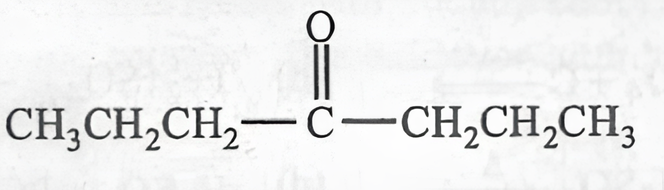
-
(D)
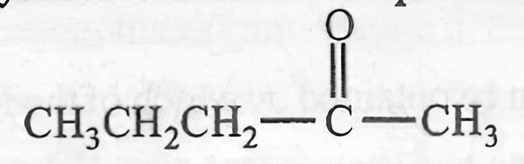
Anhydrous alcohols add to the carbonyl group of aldehydes in the presence of anhydrous hydrogen chloride to form acetals via hemiacetals.
CH₃CHO and C₆H₅CH₂CHO can be distinguished chemically by :
CH₃CHO gives Todoform test but C₆H₅CH₂CHO does not give Iodoform test due to absence of methyl group.
The correct order of decreasing acid strength of trichloroacetic acid (A), trifluoroacetic acid (B), acetic acid (C) and formic acid (D) is :
CF₃COOH > CCl₃COOH > HCOOH > CH₃COOH
(Kₐ order)
The halogenated fatty acids are much stronger acids than the parent fatty acid and moreover the acidity among the halogenated fatty acid increases almost proportionately with the increase in electronegativity of the halogen present.
Further, formic acid having no alkyl group is more acidic than acetic acid.
Which one of the following sets of monosaccharides forms sucrose?
Sucrose is a disaccharide of α-D Glucopyranose and β- D-Fructofuranose.
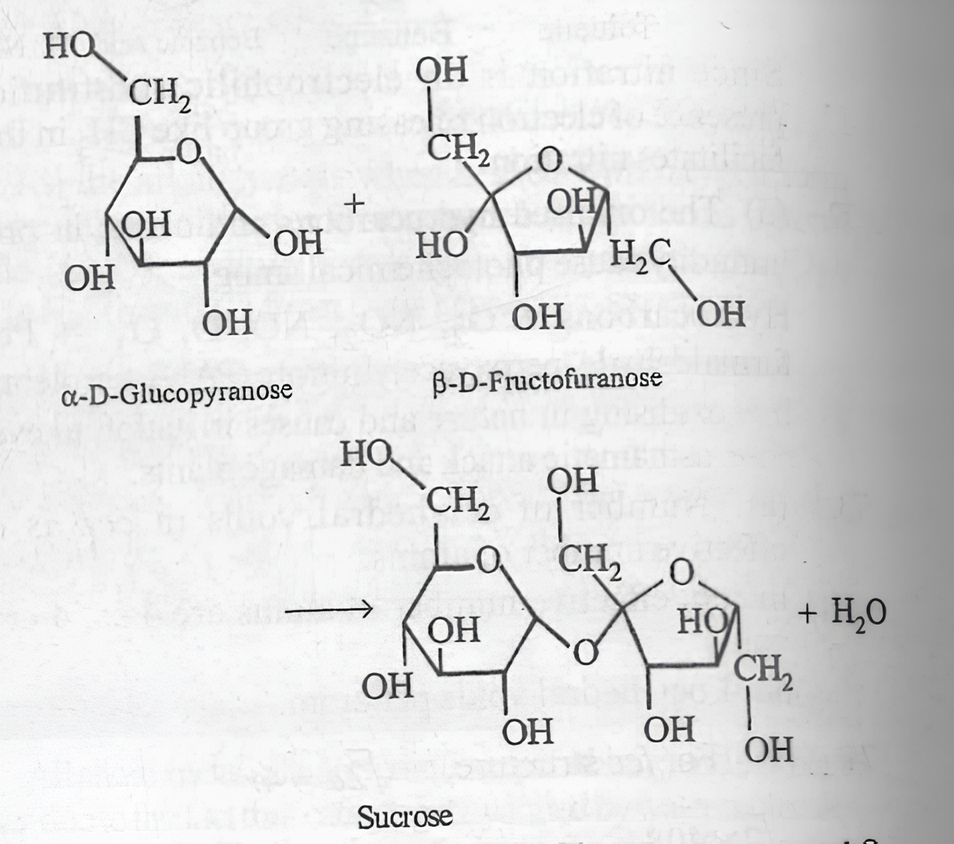
Which one of the following statements is incorrect about enzyme catalysis?
Enzymes are most reactive at optimum temperature.
The optimum temperature for enzymc activity is the human body temp.
Deficiency of vitamin B₁ causes the disease.
Bari-Beri.
Which one of the following is not a condensation polymer?
Neoprene is an addition polymer of isoprene.
Which of the following statements is false?
Nylon-6,6 is an example of first synthetic fibres produced from simple molecules. It is prepared by condensation polymerisation of adipic acid and hexamethylene diamine.
50 mL of each gas A and gas B takes 150 and 200s respectively using through a pin hole under similar conditions. If molecular mass of gas B is 36, the molecular mass of gas A will be
r_B / r_A = √(M_A / M_B) = V_B T_A / T_B.V_A
⇒ √(M_A / 36) = V_A / 200 × 150 / V_A
or √(M_A / 36) = 15 / 20 = 3 / 4
√ M_A / 36 = 9 / 16
M_A = (9 × 36) / 16 = (9 × 9) / 4 = 81 / 4 = 20.2
Therefore, none of the option is correct.
The most abundant prokaryotes helpful to humans in making curd from milk and in production of antibiotics are the ones as:
The most abundant prokaryotes helpful to humans in making curd from milk and in production of antibiotics are the heterotrophic bacteria. Lactobacillis bacteria convert milk into curd.
The cyanobacteria are also referred to as
Cyanobacteria are also referred as blue green algae, they perform oxygenic photosynthesis. They are most successful autotrophic organisms on earth which are found in all types of environment - fresh water, sea water, salt marshes, moist rocks, tree trunks, moist soils, hot springs, frozen waters.
Which statement is wrong for viruses?
All the viruses are obligate parasite i.e. they remain inert outside the host cell. They have ability to syntheize nucleic acids and proteins by using host cellular machinery (ribosomes, tRNAs, aminoacids, energy). Three shapes are found in viruses helical (elongate body e.g. T.M.V), cuboidal (short broad body with rhombic rounded, polyhedral shape e.g. Poliomyelitis virus) and binal (with both cuboidal and
helical parts e.g. many bacteriophages like T2). Antibiotics have no effect on them, antiviral drugs can only kill them.
Which one single organism or the pair of organisms is correctly assigned to its taxonomic group?
Lichens cannot grow in places where sulphur dioxide is present in the environment.
Which one of the following is common to multicellular fungi, filamentous algae and protonema of mosses
Vegetative reproduction in mosses is by fragmentation and budding in the secondary proteonema. In sexual reproduction, the sex organs antheridia and archegonia are
produced at the apex of the leafy shoots. So, Multiplication by fragmentation takes place in the multicellular fungi, fila-mentous algae and protonema of mosses.
Cycas and Adiantum resemble each other in having:
Cycas (a gymnosperm) and Adiantum a pteridophyte, known as Maiden hair fern resemble each other in having motile sperm. Seeds, cambium are common in gymno-sperms and absent in pteridophytes.
Which one of the following is a correct statement?
Gametophyte of bryophytes bears protonemal & leafy stage.
In gymnosperm female gametophyte is not free living.
Antheridiophores and archegoniophores are present in Marchantia which is a bryophyte.
Origin of seed habit started in pteridophyte Selaginaella.
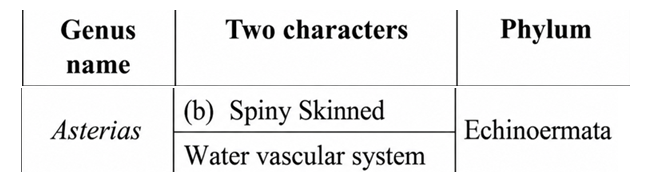
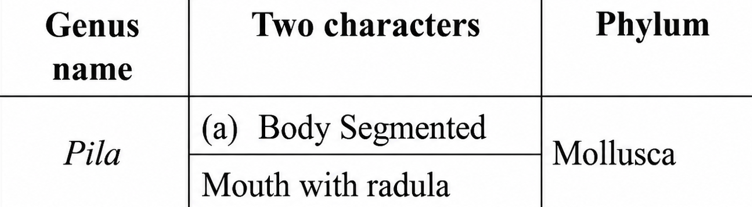
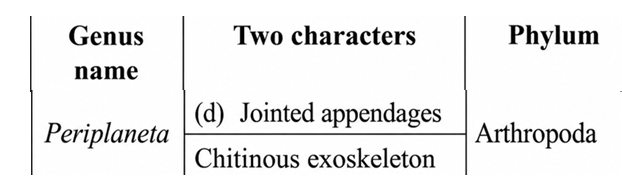
In which one of the following the genus name, its two charcters and its phylum are not correctly matched, whereas the remaining three are correct
-
(A)
-
(B)
-
(C)
-
(D)
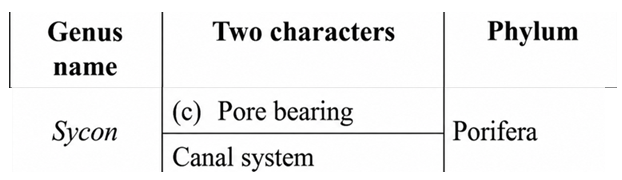
Molluscans are soft bodied animals. Their body is unsegmented with a distinct head, muscular foot and visceral hump. In Pila, the buccal cavity contains a resping organ, the radula with transverse rows of teeth.
Phyllode is present in :
Phyllode is present in Australian Acacia. It is modification of leaf in which lamina is absent and petiole becomes flattened and perform the function of food synthesis.
Placentation in tomato and lemon is
Parietal Ex. - Mustard
Free central Ex. - Primula & Dianthus
Marginal Ex. - Pea
Axile Ex. - Tomato, lemon, Chinarose
Cymose inflorescence is present in :
Cymose infloresence is present in Solanum. Cymose inflorescence is the name of determinate or definite inflorescence in which the tip of the main axis terminates in a flower and further growth continues by one or more lateral
branches which also behaves like the main axis.
The gynoecium consists of many free pistils in flowers of
The female reproductive part of a flower is gynoecium, It is syncarpous or fused in tomato.
How many plants in the list given below have composite fruits that develop from an inflorescence: Walnut, poppy, radish, fig, pineapple, apple, tomato, mulberry
Fig-develops from hypanthodium inflorescence; pineapple-develops from spike inflorescence; Mulberry-develops from catkin inflorescence.
The coconut water and the edible part of coconut are equivalent to :
Liquid endosperm is the edible part of coconut.
Vexillary aestivation is characteristic of the family
This type of aestivation is seen in fabaceae. Here, the posterior largest petal overlaps the petals that are lateral, which in turn overlap the two anterior petals.
Companion cells are closely associated with:
Companion cells are narrow, elongated and thin walled living cells. They lie on the sides of the sieve tubes and are closely associated with them through compound plasmodesmata.
Closed vascular bundles lack
In closed vascular bundle cambium is absent between xylem and phloem.
Water containing cavities in vascular bundles are found in:
Stem of maize has water containing cavities in vascular bundles.
The common bottle cork is a product of:
The common bottle cork is the product of phellogen. Phellogen produces cork or phellem on the outer side. It consists of dead and compactly arranged rectangular cells that possess suberised cell walls.
Gymnosperms are also called soft wood spermatophytes because they lack :
Xylem fibres provide rigidity to the plant.
Compared to those of humans, the erythrocytes in frog are
The erythrocytes or RBCs in frog are large, oval and biconvex nucleated cells with respiratory red pigment haemoglobin in its cytoplasm.
Select the correct statement from the ones given below with respect to Periplaneta americana.
The anal styles in males cockroaches help in copulation.
Which one of the following does not differ in E.coli and Chlamydomonas?
Cell membrane of E coli. a bacteria and Chlamydomonas a unicellular green alga does not differ. As in both cell membrane is composed of lipids and proteins.
Nuclear mebrane is absent in
Nostoc is a prokaryote while rest are eukaryotes. Nuclear membrane is absent in prokaryotes.
Ribosomal RNA is actively synthesized in
Ribosomal RNA is actively synthesized in nucleolus. Nucleolus is also known as ribosomal factory.
What is true about ribosomes?
Ribosomes are amembraneous (i.e. without membrane) cell organelle composed of rRNA and protein. These are found in both prokaryotic and eukaryotic cells.
In prokaryotes, ribosomes are 70S type while in eukaryotes, it is 80S type.
Select the correct statement from the following regarding cell membrane.
Fluid mosaic membrane model was proposed by Singer and Nicholson in 1972. It is most accepted model of structure of biomembrane.
Which one is the most abundant protein in the animal world
Collagen is the most abundant protein in the animal world. Rubisco (ribulose biphosphte carboxylase - oxy-genase) is not only the most abundant protein in plants but also in the whole biosphere.
Which one out of A-D given below correctly respresents the structural formula of the basic amino acid
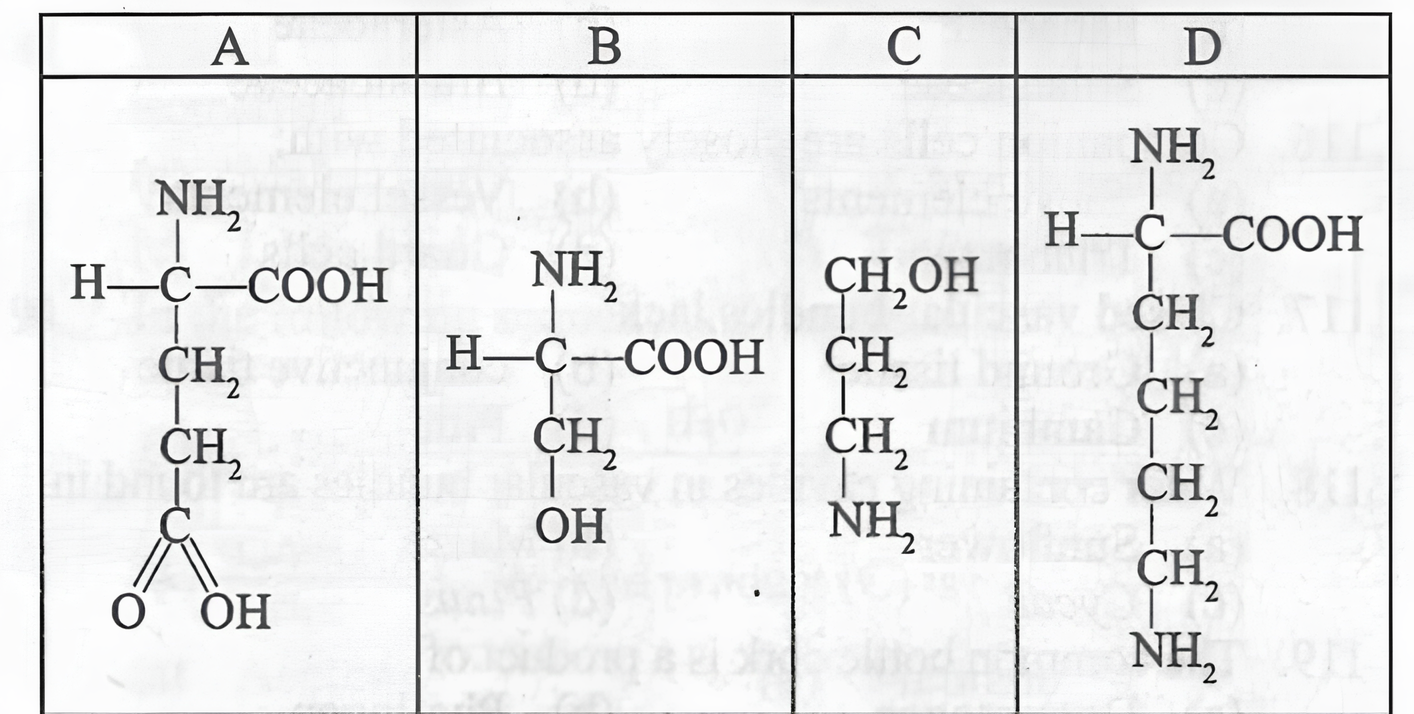
It is structural formula of basic amino acld lysine.
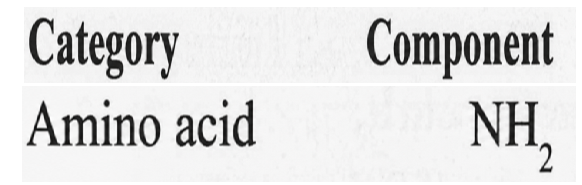
Given below is the diagrammatic representation of one of the categories of small molecular weight organic compounds in the living tissues. Identify the category shown and the one blank component “X” in it.
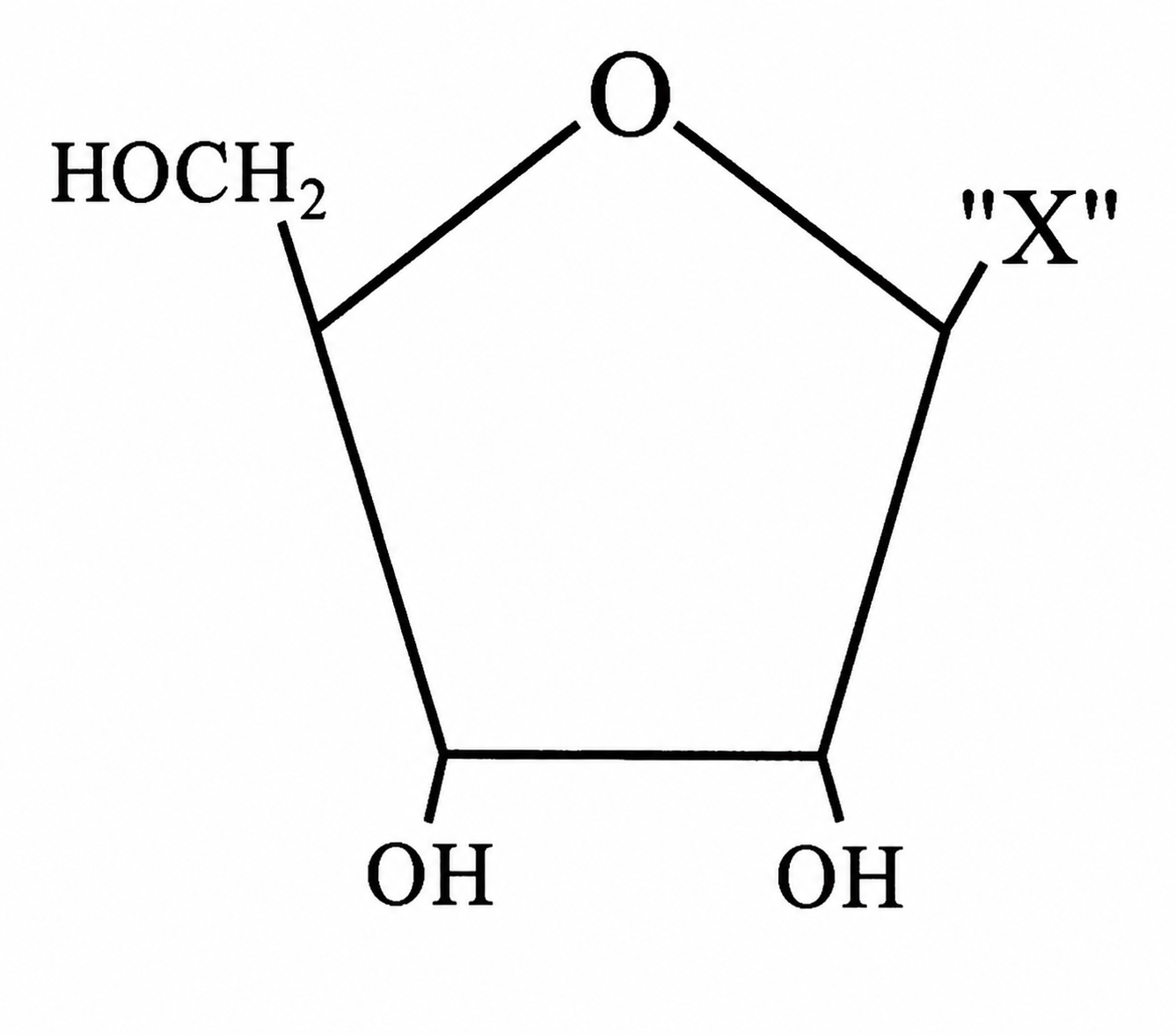
-
(A)
-
(B)

-
(C)
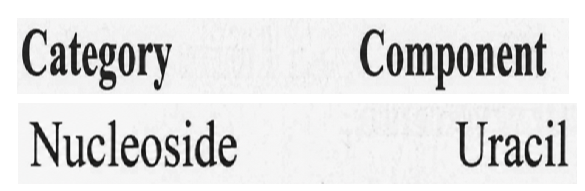
-
(D)
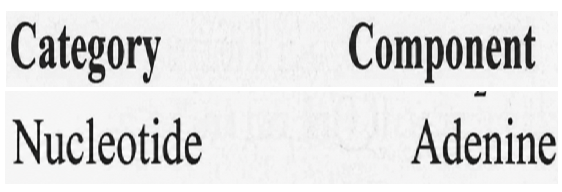
A combination of a nitrogen base with a pentose sugar is known as nucleoside. The nitrogen base combines with the sugar molecule at its 1' carbon atom in a glycosidic bond (C — N — C) by one of its nitrogen atoms (usually 1 in pyrimidines and 9 in purines). Depending upon the type of pentose sugar, nucleosides are differentiated into ribonucleosides and deoxyribonucleosides.
During gamete formation, the enzyme recombinase participates during
Recombinase enzyme catalyzes the exchange of short pieces of DNA between two long DNA strands, particularly the exchange of homologous regions between the paired maternal and paternal chromosome in prophase - I of meiosis I.
Given below is the representation of a certain event at a particular stage of a type of cell division. Which is this stage?
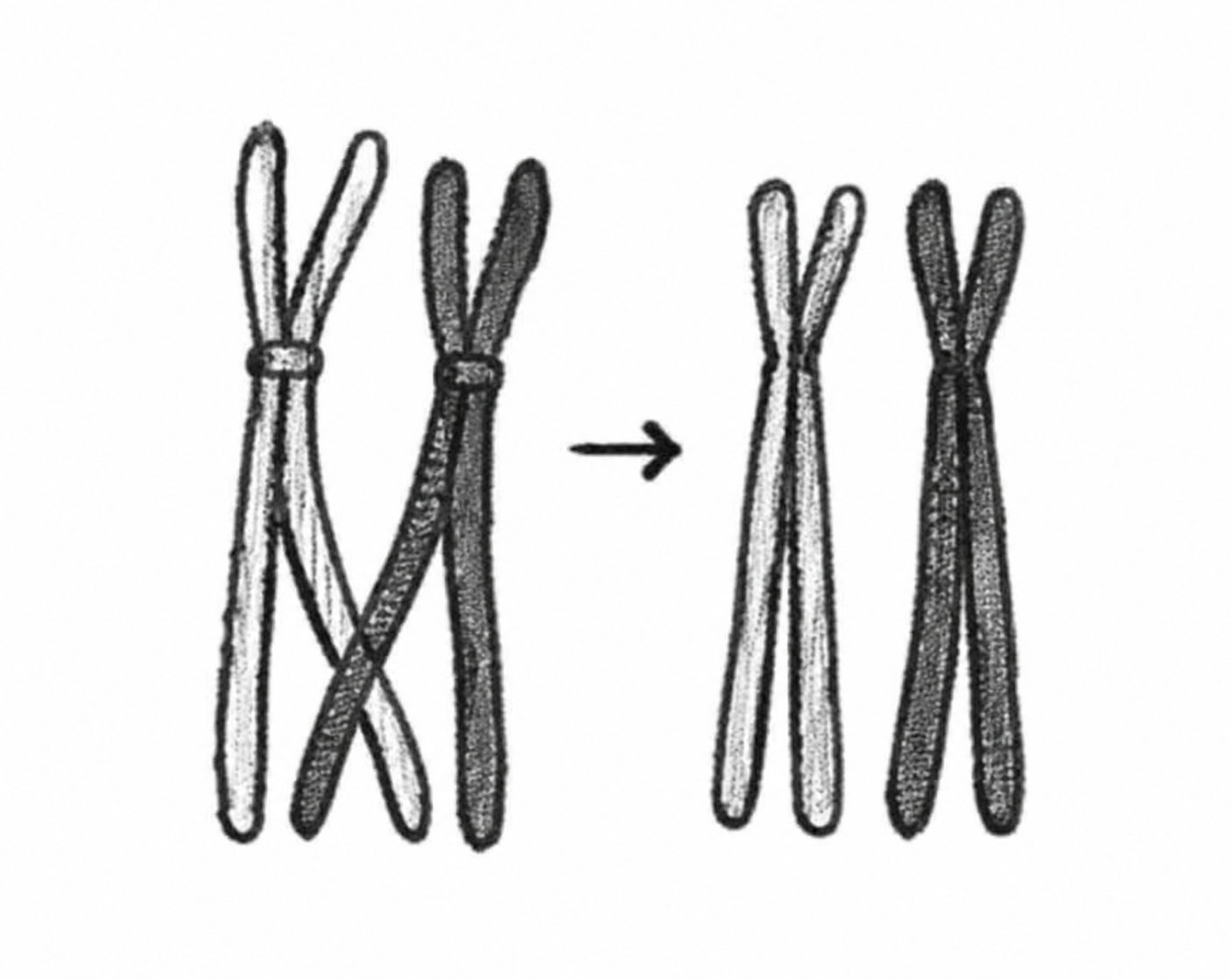
The given diagram represents crossing over that takes place in pachytene stage of prophase - I during meiosis.
Best defined function of Manganese in green plants is :
The best defined function of manganese is in the splitting of water to liberate oxygen during photosynthesis. It is absorbed in the form of manganese ions (Mn2+). It activates many enzymes involved in photosynthesis, respiration and nitrogen metabolism.
Which one of the following is correctly matched ?
Potassium immobilisation is the conversion of water soluble potassium into water insoluble form. Readily available potassium constitutes about 1% of total potassium available in soil, whereas slightly soluble potassium accounts for about 98%.
Which one of the following is wrong statement?
Phosphorus is a constituent of nucleic acids of both DNA and RNA but absent in cell membranes and cell proteins.
A process that makes important difference between C₃ and C₄ plants is :
Photorespiration is absent is C₄ plants. Photorespiration does not produce energy or reducing power. Rather, it consumes energy. Further, it undoes the work of photosynthesis. There is 25% loss of fixed CO₂. Therefore,
photorespiration is a highly wasteful process. This happens only in case of C₃ plants.
The correct sequence of cell organelles during photorespiration is :
It is chloroplast followed by peroxisomes and finally mitochondria
Anxiety and eating spicy food together in an otherwise normal human, may lead to
Anxiety and eating spicy food together in normal healthy man can lead to indigestion which causes difficulty in digestion.
Which of the following are the correct statement for respiration in human?
(Cigarette smoking may lead to inflammation of bronchi ) and(Workers in grinding and stone - breaking industries may suffer from lung fibrosis). Neural signals from pneumotaxic center in pons region of brain can limit the duration of inspiration. About 25% of carbon dioxide (CO₂) is carried by haemoglobin as carboxyhaemglobin.
The maximum amount of electrolytes and water (70 - 80 percent) from the glomerular filtrate is reabsorbed in which part of the nephron ?
Nearly all the essential nutrients, and 70 -80 percent of electrolytes and H₂O are reabsorbed by proximal con- voluted tubules.
Select the correct statement regarding the specific disorder of muscular or skeletal system:
Major causative factors of osteoporosis are imbalances of hormones like calcitonin of thyroid, parathormone of parathyroids, sex hormones, and deficiencies of calcium and vitamin D.
The human hind brain comprises three parts, one of which Is :
The human hind brain comprises of pons, cerebellum and medulla oblongata.
A person entering an empty room suddenly finds a snake right in front on opening the door. Which one of the following is likely to happen in his neuro-hormonal control system ?
Epinephrine and norepinephrine are secreted by adrenalmedulla in response to stress of any kind and during emergency situations and are called emergency hormones or hormones of flight, or fight.
Which part of the human ear plays no role in hearing as such but is otherwise very much required?
Rhodopsin contained in the rod type of photoreceptor cells of human eye is a derivative of vitamin A .
Which one of the following pairs of hormones are the examples of those that can easily pass through the cell membrane of the target cell and bind to a receptor inside it (Mostly in the nucleus)
Cortisol and testosterone are steroid hormones which are lipid soluble and easily pass through the cell membrane of a target cell and bind to specific intracellular receptor.
What is correct to say about the hormone action in humans?
Glucagon is secreted by α cells of islets of langerhans and stimulate glycogenolysis i.e. breakdown of glycogen into glucose Thymosin hormone secreted from thymus gland stimulates the development of certain kinds of white blood cells involved in producing immunity. It also hastens attainment of sexual maturity.
Which one of the following is correctly matched?
Onion - Bulb - Underground stem
Ginger - Rhizome
Chlamydomonas - Zoospore
Yeast - Ascospores
Both, autogamy and geitonogamy are prevented in -
Papaya is dioecious i.e. male and female flowers occurs in separate plants so that it prevents both autogamy & geitonogamy (method of self pollination).
An organic substance that can withstand environmental extremes and cannot be degraded by any enzyme is:
Sporopollenin is fatty substance present in pollen wall and provides resistance against extremes conditions like high temperature, acid, bases.
Even in absence of pollinating agents seed setting is as sured in
Cleistogamous flower produce assured seed set even in the absence of pollinations. Plants such as Viola, Oxalis and Commelina.
The Leydig cells found in the human body are the secretory source of
Leydig cells found in testis is the endocrine portion of the testis which are present in between seminiferous tubules secretes androgens or male sex hormone e.g. testosterone.
Which one of the following statements is false in respect of viability of mammalian sperm?
Sperm is viable for 2-3 days.
In a normal pregnant woman, the amount of total gonadotropin activity was assessed. The result expected was
Pregnancy can be confirmed by detecting the presence of human chorionic gonadotropin (HCG) in blood or urine of pregnant woman. HCG is a hormone produced by the placenta after implantation. HCG plays an essential role in maintenance of corpus luteum and allows the secretion of the progesterone and estrogen hormone. Progesterone enriches the uterus with a thick lining of blood vessels and capillaries so that it can sustain the growing foetus.
Signals for parturition originate from :
The signals for child blrth (parturition) originate fromn the fully matured foetus and placenta which induce mild uterine contractions called foetal ejection reflex.
What is the figure given below showing in particular?
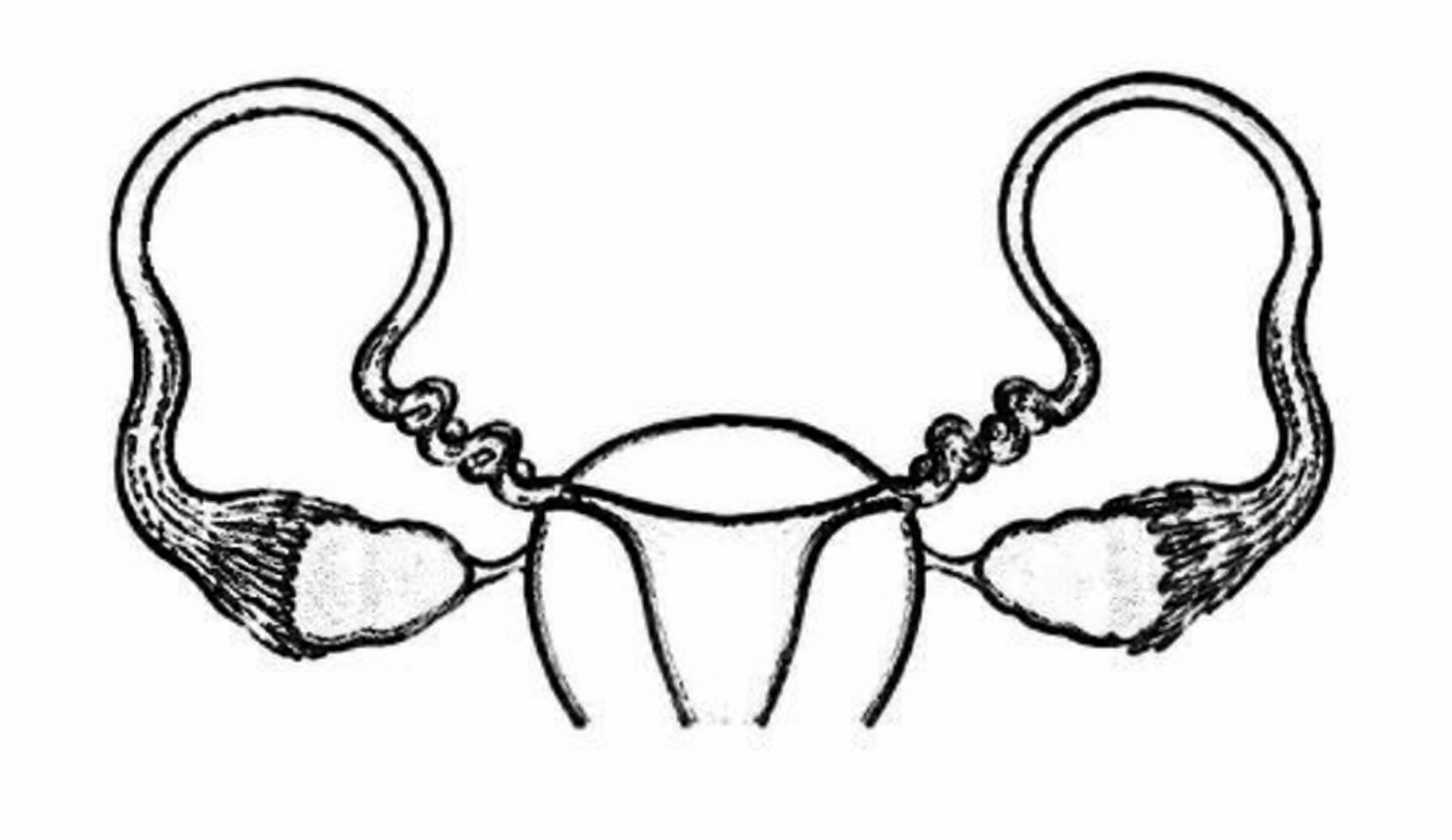
The figure shows the tubectomy. This is a surgical method to prevent pregnancy in women. In tubectomy small part of the fallopian tube is removed or tied through a small cut in the abdomen or through vagina. It is very effective method but reversibility is very poor.
The test-tube Baby Programme employs which one of the following techniques?
Test tube baby programme employs Zygote Intrafallopian Transfer (ZIFT) Technique. In this technique, fusion of ovum and sperm is done outside the body of woman to form zygote which is allowed to divide forming 8 blastomeres, then it is transfered the fallopion tube of the woman.
A certain road accident patient with unknown blood group needs immediate blood transfusion. His care doctor friend at once offers his blood. What was the blood group of the donor?
Blood group O acts as universal donor.
F₂ generation in a Mendelian cross showed that both genotypic and phenotypic ratios are same as 1 : 2 : 1. It represents a case of:
Incomplete (partial or mosaic) dominance is the phenomenon where none of the two contrasting alleles or factors is dominant. The expression of the character in a hybrid or F₁ individual is intermediate or a fine mixture of the expression of the two factors (as found in homozygous state). Incomplete or mosaic inheritance is not an example of pre- Mendelian concept of blending inheritance because the parental types reappear in the F₂ generation. It is however, considered by some workers to be an example of quantitative inheritance where only a single gene pair is involved. F₂ phenotypic ratio is 1:2: 1, similar to genotypic ratio.
A normal-visioned man whose father was colour blind, marries a woman whose father was also colour blind. They have their first child as a daughter. What are the chance that this child would be colour blind?
If a normal visioned man marries a woman whose father was also colourblind, then his wife would be carrier of this disease if her mother was normal. This trait is passed into children but daughters produced by this couple are carrier not the colourblind. 50% of sons would be colourblind.
If one strand of DNA has the nitrogenous base sequence ATCTG, what would be the complementary RNA strand sequence?
Sequence of DNA is ATCTG then sequence of m-RNA will UAGAC. As adenine base pairs with uracil and guanine with cytosine.
Removal of RNA polymerase III from nucleoplasm will affect the synthesis of:
Removal of RNA polymerase III from nucleoplasm will affect the synthesis of tRNA while RNA polymerase I forms r-RNA and RNA polymerase II form m-RNA in eukaryotes.
Which one of the following is not a part of a transcription unit in DNA?
Transcription unit consists of promoter, structural gene & terminator.
Removal of introns and joining of exons in a defined order during transcription is called:
Removal of introns by spliceosome in hnRNA and joining of exons by DNA liagse in a defined order during transcription is called splicing.
Evolution of different species in a given area starting from a point and spreading to other geographical areas is known as:
Process of evolution of different species in a given area starting from a point and radiating to other area of geographical areas is called adaptive radiations.
Example : Darwin’s finches, Australian marsupials.
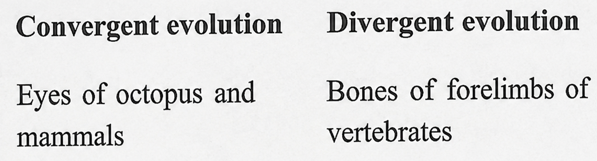
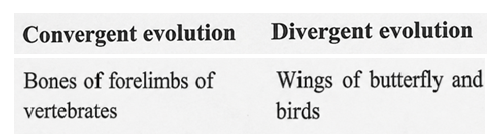
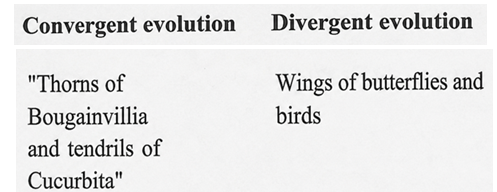
Which one of the following options gives one correct example each of convergent evolution and divergent evolution?
-
(A)
-
(B)
-
(C)
-
(D)
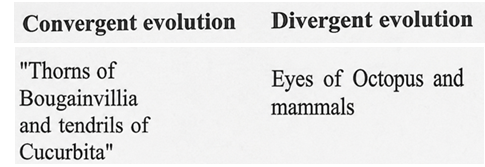
Eyes of octopus and mammals is an example of convergent evolution because they both have different structures of eyes but evolving for the same function and hence having similarity.
The forelimb consists of: Humerus, radius and ulna, carpals, metacarpals, digits or phalanges. The top of the humerus moves against (articulates with) the scapula at the shoulder joint. By changing the number, size and shape of the various bones, fore limbs have evolved to fit different ways of life.
The extinct human who lived 1,00,000 to 40,000 years ago, in Europe, Asia and parts of Africa, With short stature, heavy eyebrows, retreating fore heads, large jaws with heavy teeth, stocky bodies, a lumbering gait and stooped posture was
Neanderthals are an extinct species or subspecies of archaic humans who lived in Eurasia until about 40,000 years ago. They probably went extinct due to competition with or extermination by immigrating European early modern humans or due to great climatic change, disease, or a combination of these factors.
Motile zygote of Plasmodium occurs in:
Motile zygote of Plasmodium occurs in gut of female Anopheles. Zygote formed in stomach of mosquito about 9 to 10 days after sucking the blood of an infected human. Anopheles receives RBCs containing different stages of erthyrocytic cycle, including gametocyte. In its gut, all stages except the gametocytes are digested. The gametocytes remain unaffected by digestive enzymes of the mosquito, hatch out from the RBCs into the lumen of mosquito’s stomach and form sperm and ovum by game- togenesis. Syngamy or fusion of male and female gamete.
Widal Test is carried out to test :
Widal test is carried out to test typhoid fever caused by Salmonella typhii bacteria. Typhoid vaccine is available.
Common cold differs from pneumonia in that :
Common cold is most infectious viral disease caused by Rhino viruses which is transmitted through inhalation of droplets from infected person or through contaminated objects. Pneumonia is a bacterial disease caused by Streptococcus pneumoniae and Haemophillus influenzae. This serious disease of lungs spread by sputum of the patient.
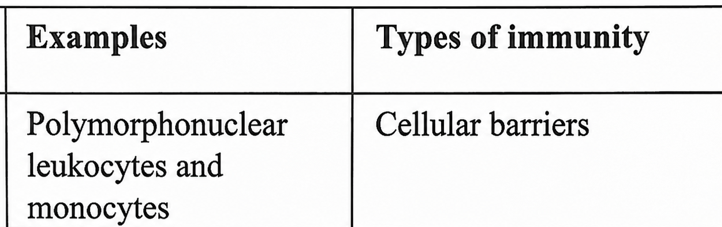
In which one of the following options the two examples are correctly matched with their particular type of immunity.
-
(A)
-
(B)
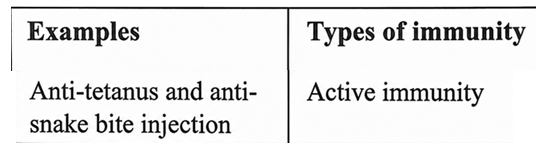
-
(C)
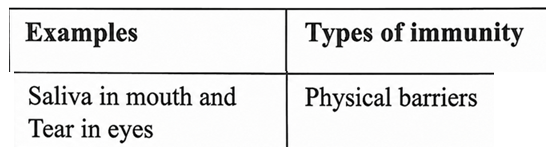
-
(D)
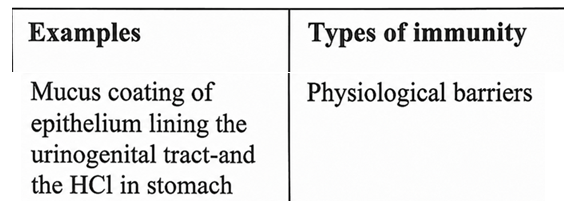
Polymorphonuclear leukocytes named so, as they have multilobed nucleus or neutrophils and monocytes are the cellular barrier provide innate or nonspecific immunity. Cellular barriers are the internal defence or second live of defence.
Which one of the following is not a property of cancerous cells whereas the remaining three are ?
Contact inhibition is a property of normal cell not of cancer cells. Due to this property they remain in contact with other cells inhibit their grow
Cirrhosis of liver is caused by the chronic intake of
Long term intake of alcohol causes damage to liver which is known as cirrhosis of liver with continued alcohol intake, there is destruction of hepatocytes and fibroblasts (cell which form fibres) and stimulation of collagean protein formation.
Which part would be most suitable for raising virus-free plants for micropropagation?
Meristem is most suitable for raising virus free plants for micropropagation.
Which one of the following is a case of wrong matching ?
Vector DNA are the DNA molecules that can carry a foreign DNA segment and replicate inside the host cells. Vector DNA may be plasmids, a bacteriophage, cosmids, yeast artificial chromosomes.
Monascus purpureus is a yeast used commercially in the production of :
Monascus purpureus is a yeast used in the production of statins which are used in lowering blood cholestrol.
A patient brought to a hospital with myocardial infarction is normally immediately given:
Streptokinase is immediately given to dissolve the thrombus carring myocardial infarction.
Yeast is used in the production of :
Bread and beer
Which one of the following is an example of carrying out biological control of pests/diseases using microbes?
Trichoderma sp. against certain plant pathogens
Which one of the following microbes forms symbiotic association with plants and helps them in their nutrition
Glomus is endomycorrhiza that helps in absorption of nutrition specially phosphorus from soil.
A nitrogen-fixing microbe associated with Azolla in rice fields is:
Anabaena
The figure below is the diagrammatic representation of the E. coli vector pBR 322. Which of the given options correctly identifies its certain component(s)?
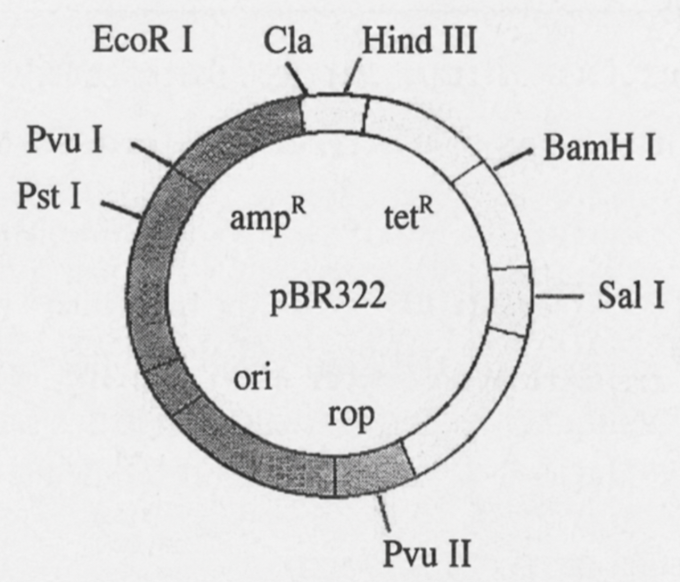
In pBR 322
ori-represents site of origin or replication
rop-represents those proteins that take part in replication of plasmid.
Hind III, EcoRI- Recoginition sites of Restriction endonucleases
ampᴿ, tetᴿ - They are antibiotic resistance genes part
A single strand of nucleic acid tagged with a radioactive molecule is called :
A single strand DNA or RNA tagged with radioactive molecule that is used in hybridization of DNA or RNA is called probe.
PCR and Restriction Fragment Length Polymorphism are the methods for :
PCR and RFLP are the methods used for genetic fingerprinting. DNA fragmentation plays an important part in forensics, especially that of DNA profiling. Restriction fragment lengths polymorphism (RFLP) analyses the variable lengths of DNA fragments which are formed from the digestion of a DNA sample with a restriction endonuclease. They are then hybridized with DNA probes that bind to a complementary DNA sequence in the sample.
Which one is a true statement regarding DNA polymerase used in PCR.
It remains active at high temperature
For transformation, micro-particles coated with DNA to be bombarded with gene gun are made up of :
For gene transfer into the host cell without using vector microparticles made of tungsten and gold coated with foreign DNA are bombarded into target cells at a very high velocity.
Consumption of which one of the following foods can prevent the kind of blindness associated with vitamin ‘A’ deficiency?
Golden rice is vitamin A rich variety developed by rDNA technology and used in the treatment of vitamin A deficiency.
Pheretima and its close relatives derive nourishment from:
Earthworm derives its nutrition from decaying fallen leaves and soil organic matter. Thus the type of feeding in earthworm is detritus.
Identify the possible “A” in the following food chain:
Plant → insect - frog → “A” → Eagle
Cobra
Given below is an imaginary pyramid of numbers. What could be one of the possibilities about certain organisms at some of the different levels?
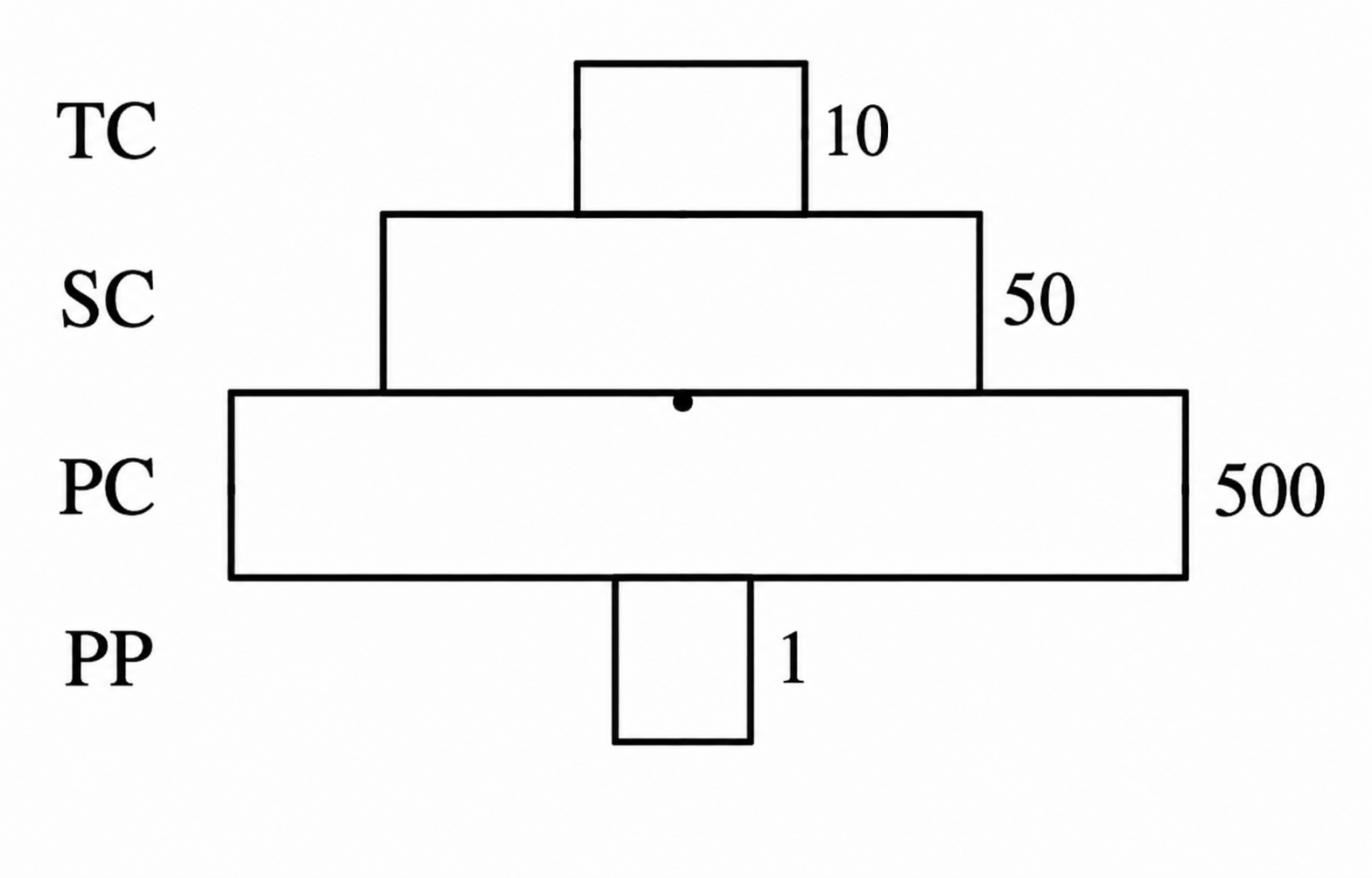
Level PC is “insects” and level SC is “small insectivorous birds”.
Which one of the following is not a function of an ecosystem?
Four important functional aspects of the ecosystem are:
(i) Productivity
(ii) Decomposition,
(iii) Energy flow and
(iv) Nutrient cycling.
The upright pyramid of number is absent in
In forest, a single tree can support a large of number of birds, thus base showing producers in a pyramid of number will be narrower than the next slab showing primary consumers.
Which one of the following is not a gaseous biogeochemical cycle in ecosystem ?
Phosphorus is mostly used as phosphate. Its reservoir pool is phosphate rocks while cycling pool is soil for terrestrial ecosystems and water for aquatic ecosystems.
Maximum nutritional diversity is found in the group.
Monera
The highest number of species in the world is represented by
Recent estimate suggests that 5.1 million fungal species exists.
Which one of the following areas in India, is a hotspot of biodiversity?
Hots are the geographical area where biodiversity is maximum. Two hotspots in India are western ghats and north eastern himalayan region.
In an area where DDT had been used extensively, the population of birds declined significantly because:
High concentration of DDT disturbs calcium metabolism in birds which caused thinning of eggshell and their premature breaking.
Measuring Biochemical Oxygen Demand (BOD) is a method used for :
estimating the amount of organic matter in sewage water.
Which one of the following is a wrong statement?
Ozone present in upper part of the atmosphere i.e. stratosphere is benefical for living beings. As, it
functions as a shield against harmful UV-radiation.
In an area where DDT had been used extensively, the population of birds declined significantly because:
High concentration of DDT disturbs calcium metabolism in birds which caused thinning of eggshell and their premature breaking.
Which one of the following is not a gaseous biogeochemical cycle in ecosystem?
Phosphorus is mostly used as phosphate. Its reservoir pool is phosphate rocks while cycling pool is soil for terrestrial ecosystems and water for aquatic ecosystems.
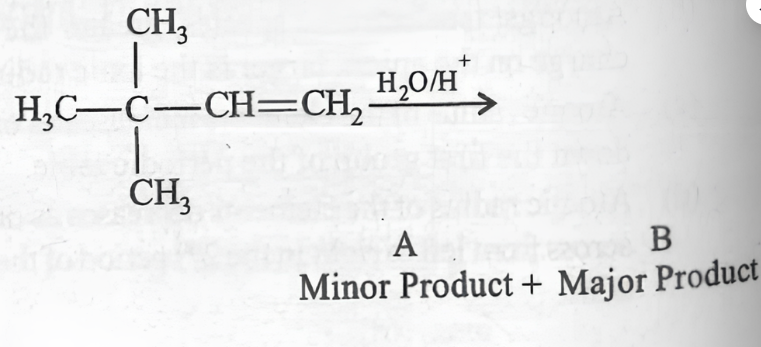
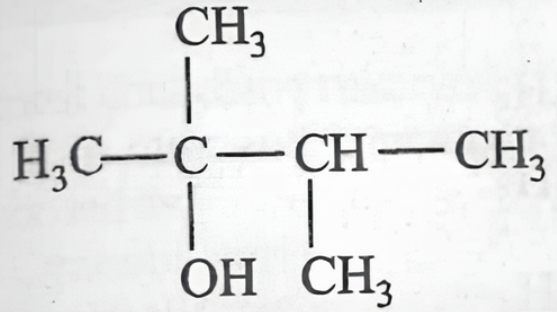
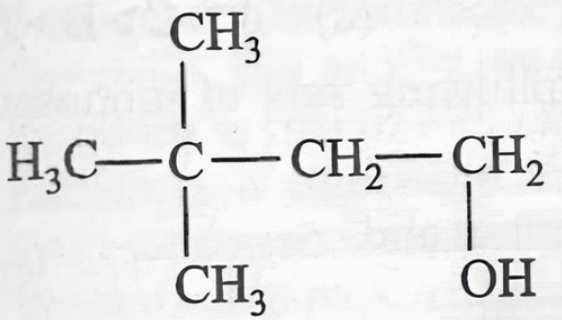
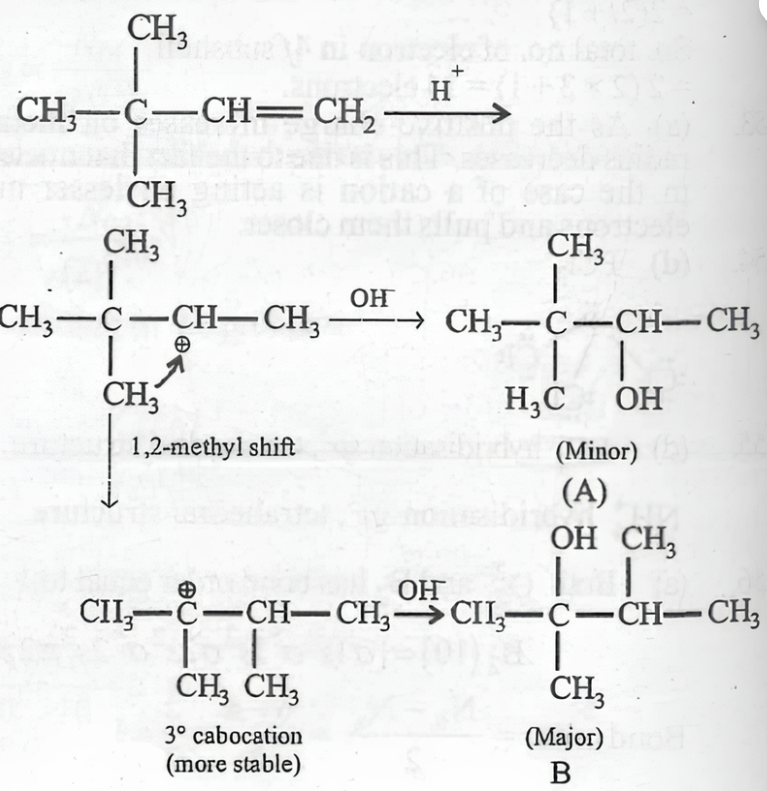
In the following reaction :
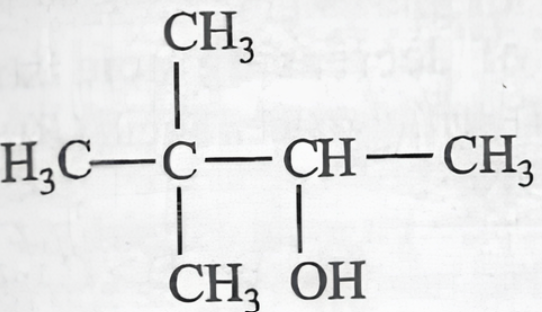
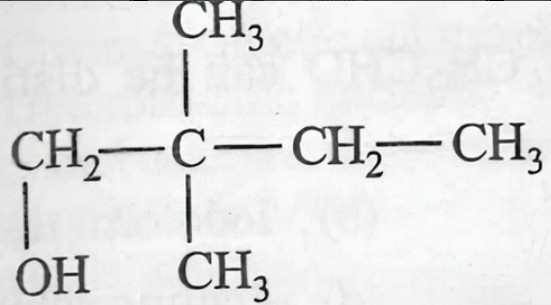
The major product is :
-
(A)
-
(B)
-
(C)
-
(D)
Other Years