CBSE EXAMINATION PAPER-2008
NEET-ZOOLOGY
(Solved)
General Instructions :
Read the following instructions carefully and follow them :
- This question paper contains 200 questions. All questions are compulsory.
- This question paper is divided into 1 sections.
- Section A – questions number 1 to 200 are multiple choice questions
- There is no overall choice given in the question paper. However, an internal choice has been provided in few questions.
- Use of calculator is NOT allowed.
Section A
Which two of the following five physical parameters have the same dimensions?
(A) Energy density
(B) Refractive index
(C) Dielectric constant
(D) Young’s modulus
(E) Magnetic field
Energy density = Energy / Volume
⇒ [ML² T⁻²] / [L³]= [ML⁻¹ T⁻²]
Refractive index and dielectric constant have no dimensions.
Young’s Modulus = F / A × 𝑙 / Δ𝑙
⇒ [MLT⁻²] / [L²] . [L] / [L]= [ML⁻¹T⁻²]·
Magnetic field, B = F / iℓ = [MLT⁻²] / [A][L]
= [MT⁻²A⁻¹]
If the error in the measurement of radius of a sphere is 2%, then the error in the determination of volume of the sphere will be:
Given, error in the measurement of radius of a sphere Δr / r × 100 = 2%
Volume of the sphere V = (4 / 3) πr³
∴ Error in the volume ΔV / V × 100
= ±3 . Δr / r × 100 = 3 × 2% = ±6%
The distance travelled by a particle starting from rest and moving with an acceleration (4 / 3) ms⁻², in the third second is:
Distance travelled in the nth second is given by Sₙ = u + (a / 2) (2n − 1)
Given u = 0, a = (4 / 3) ms⁻², n = 3
∴ Sₙ = 0 + ((4 / 3 × 2) (2 × 3 − 1)) = 4 / 6 × 5 = (10 / 3) m
A particle shows distance–time curve as given in this figure.
The maximum instantaneous velocity of the particle is around the point:
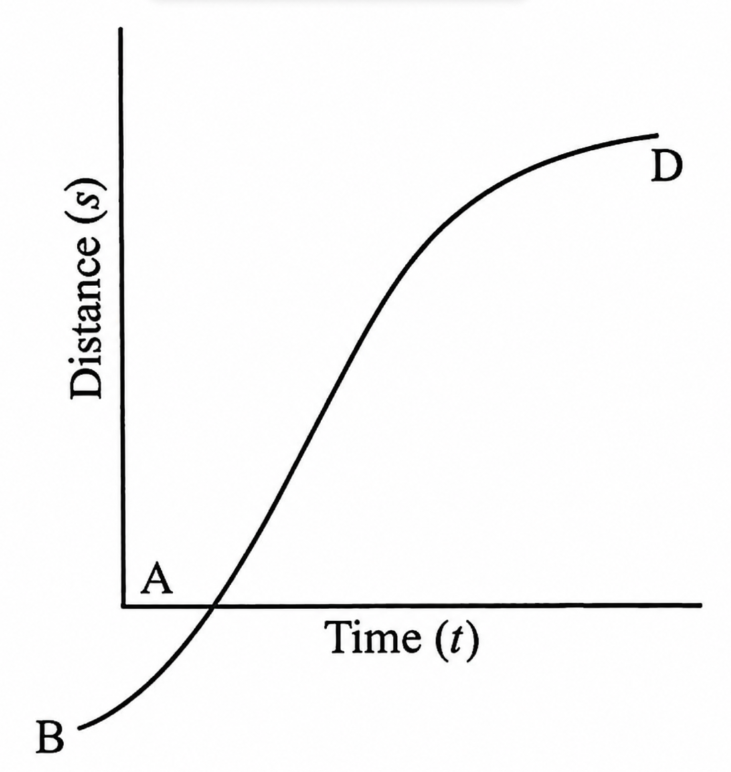
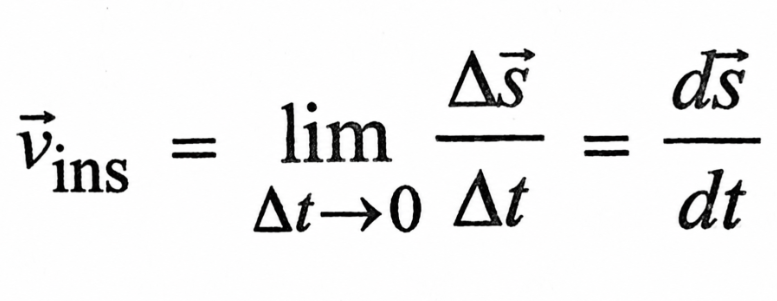
The slope of the graph (ds / dt) is maximum at C and hence the instantaneous velocity is maximum at C.
Instantaneous velocity,
A particle moves in a straight line with a constant acceleration. It changes its velocity from 10 ms⁻¹ to 20 ms⁻¹ while passing through a distance 135 m in t second. The value of t is:
Initial velocity, u = 10 ms⁻¹
Final velocity, v = 20 ms⁻¹
Distance, s = 135 m
Let, acceleration = a
Using the formula, v² = u² + 2as
a = v²- u² / 2s = ((20)² - (10)² / 2 ×135) = 400 -100 / 2×135
or, a = 300 / 2×135 = 150 / 135 = (10 / 9) ms⁻²
Now, using the relation, v = u + at
t = v - u / a = (20 - 10 / (10 / 9)) = 10 / 10 × 9 sec= 9 sec.
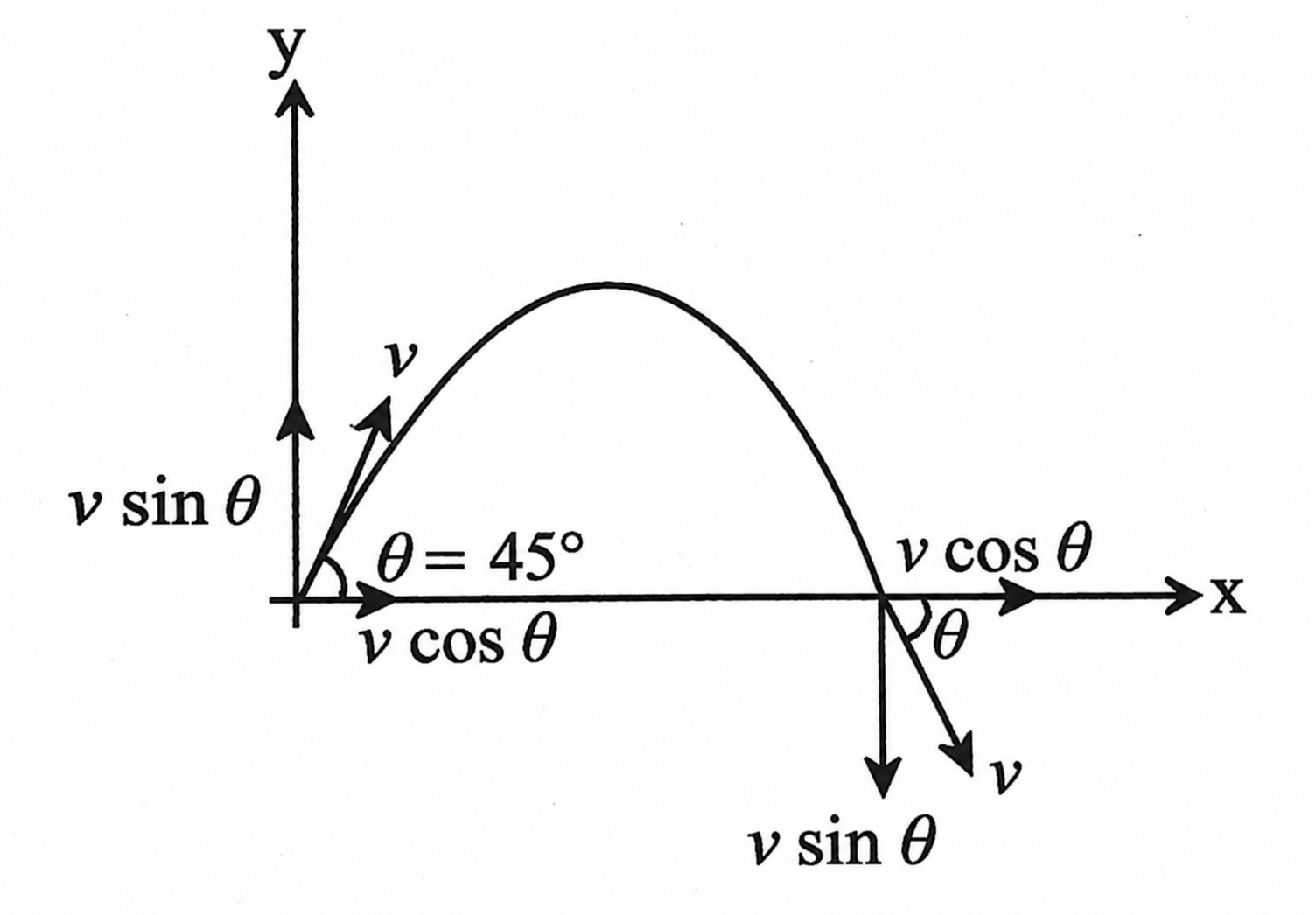
A particle of mass m is projected with velocity v making an angle of 45° with the horizontal. When the particle lands on the level ground the magnitude of the change in its momentum will be:
The momentum along a-axis remains unchanged
Clearly, change in momentum along x-axis = mvcosθ − mvcosθ=0
Momentum changed only in vertical direction or y-axis.
So, ΔP = P_vertical
⇒ P_final = P_initial
= mvsinθ − (−mvsinθ) = 2mvsinθ
= 2mv × sin 45°
= 2mv × 1 / √2 = √2mv
Hence, resultant change in momentum = √2mv
Sand is being dropped on a conveyor belt at the rate of M kg/s. The force necessary to keep the belt moving with a constant velocity of v m/s will be:
F= d(Mv) / dt = M(dv / dt) + v (dM / dt)
∴ v is constant,
∴ F = v (dM / dt) But (dM / dt) = Mkg/s ∴F=vM newton.
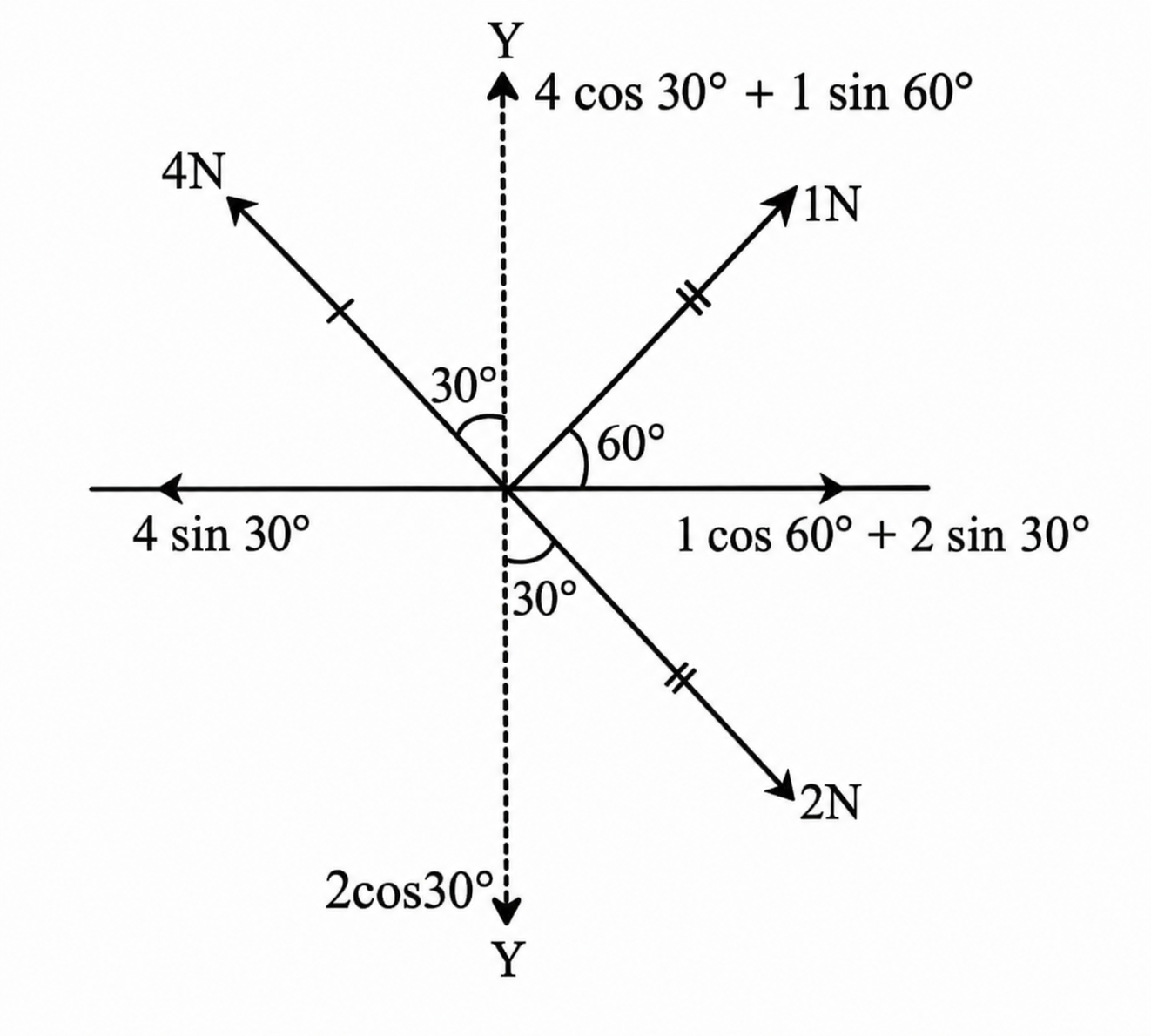
Three forces acting on a body are shown in the figure. To have the resultant force only along the y‑direction, the magnitude of the minimum additional force needed is:
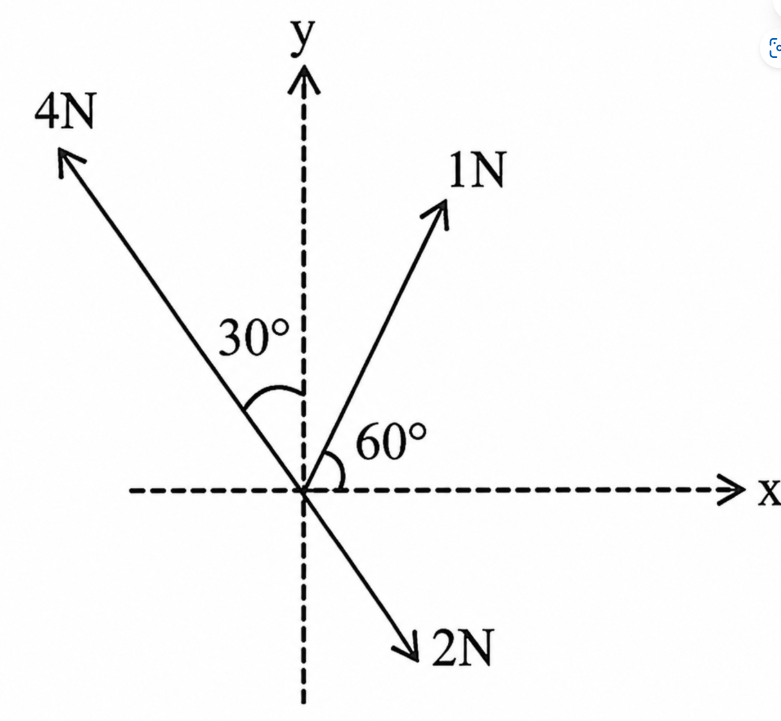
The Components of 1 N and 2 N forces along + x-axis
=1 cos 60° + 2 sin 30°
=1× 1 / 2 + 2× 1 / 2 = 1 / 2 + 1 = 3 / 2 = 1.5N
The component of 4 N force along –x-axis = 4 sin 30°
= 4 × 1 / 2 = 2 N.
Therefore, if a force of 0.5 N is applied along +x-axis, the resultant force along x-axis will become zero and the resultant force will be obtained only along y-axis.
Water falls from a height of 60 m at the rate of 15 kg/s to operate a turbine. The losses due to frictional force are 10% of energy. How much power is generated by the turbine? (g = 10 m/s²)
Given, h = 60 m, g = 10 ms⁻²,
Rate of flow of water = 15 kg/s
∴ Power of the falling water
= 15 kgs⁻¹ × 10 ms⁻² × 60 m = 9000 watt.
Loss in energy due to friction
= 9000 × 10 / 100 = 900 watt.
∴ Power generated by the turbine
= (9000 – 900) watt = 8100 watt = 8.1 kW
A shell of mass 200 gm is ejected from a gun of mass 4 kg by an explosion that generates 1.05 kJ of energy. The initial velocity of the shell is:
Let the initial velocity of the shell be v, then by the conservation of momentum mv = Mv′
where v′ = velocity of gun.
∴ v′ = (m / M) v
Now, total K.E. = (1 / 2)mv² + (1 / 2)Mv′²
= (1 / 2)mv² + ((1 / 2) M) (m / M)² v² = (1 / 2)mv² [1 + m / M]
= (1 / 2 × 0.2) (1 + 0.2 / 4) v² = (0.1 × 1.05) v²
But total K.E. =1.05 kJ =1.05 × 10³ J
∴ 1.05 × 10³ = 0.1 × 1.05 × v²
⇒ v² = 1.05 × 10³ / 0.1 × 1.05 = 10⁴
∴ v = 10² = 100 ms⁻¹
The ratio of radii of gyration of a circular ring and a circular disc, of the same mass and radius, about an axis passing through their centres and perpendicular to their planes are:
∵ I = MK² ∴ K = √(I / M)
I_ring =MR² and I_disc = (1 / 2) MR²
K₁ / K₂ = √(I₁ / I₂) = √(MR² / (MR²/2)) = √(2:1)
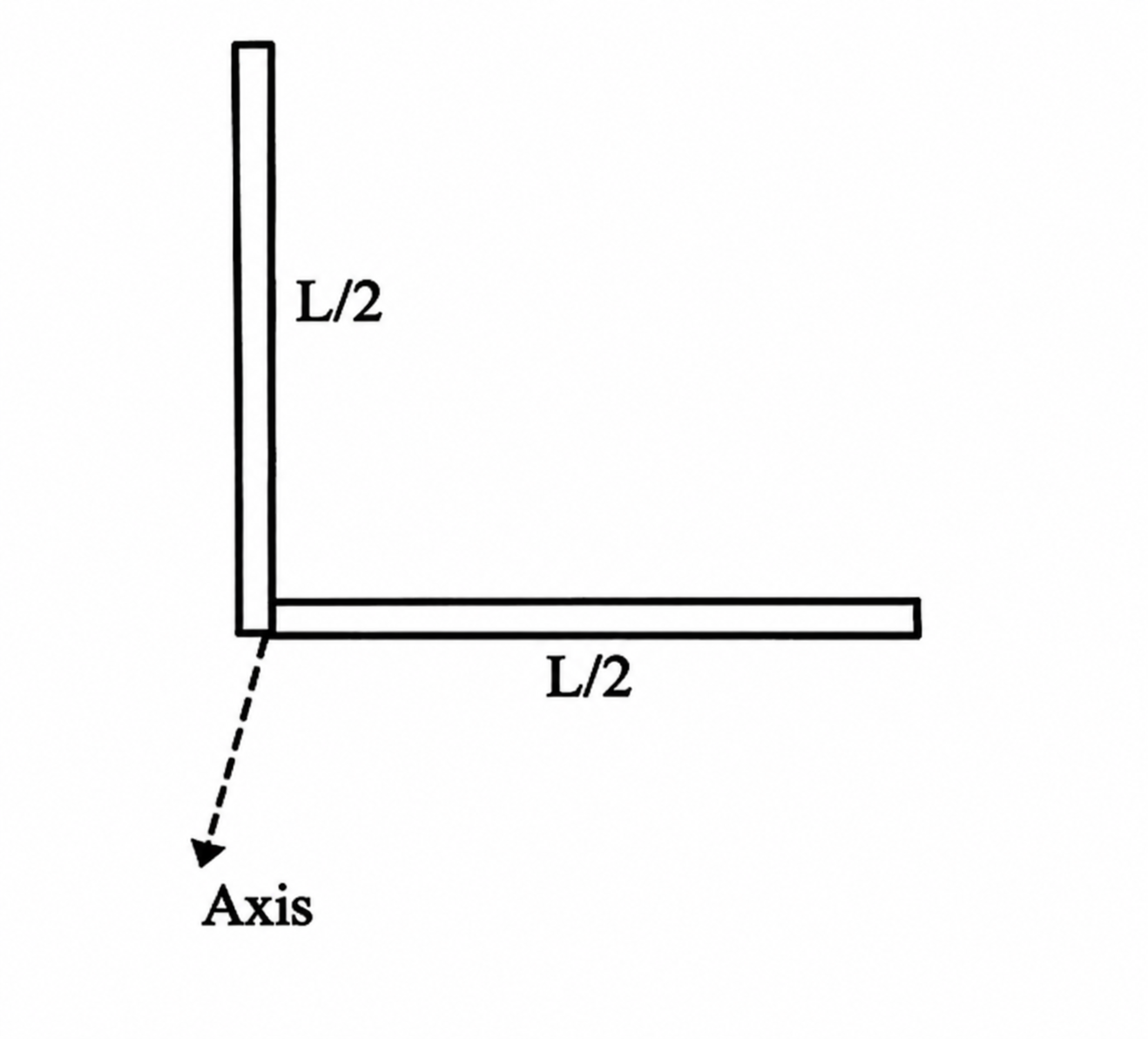
A thin rod of length L and mass M is bent at its midpoint into two halves so that the angle between them is 90°. The moment of inertia of the bent rod about an axis passing through the bending point and perpendicular to the plane defined by the two halves of the rod is:
Mass of each part = M / 2
Length of each part = L / 2
Total M.Ⅰ. = Sum of M.Ⅰ.s of both parts
= (M / 2) (L / 2)² × 1 / 3 + (M / 2) (L / 2)² × 1 / 3
=2× M / 2 × L² / 4 ×1 / 3 = ML² / 12
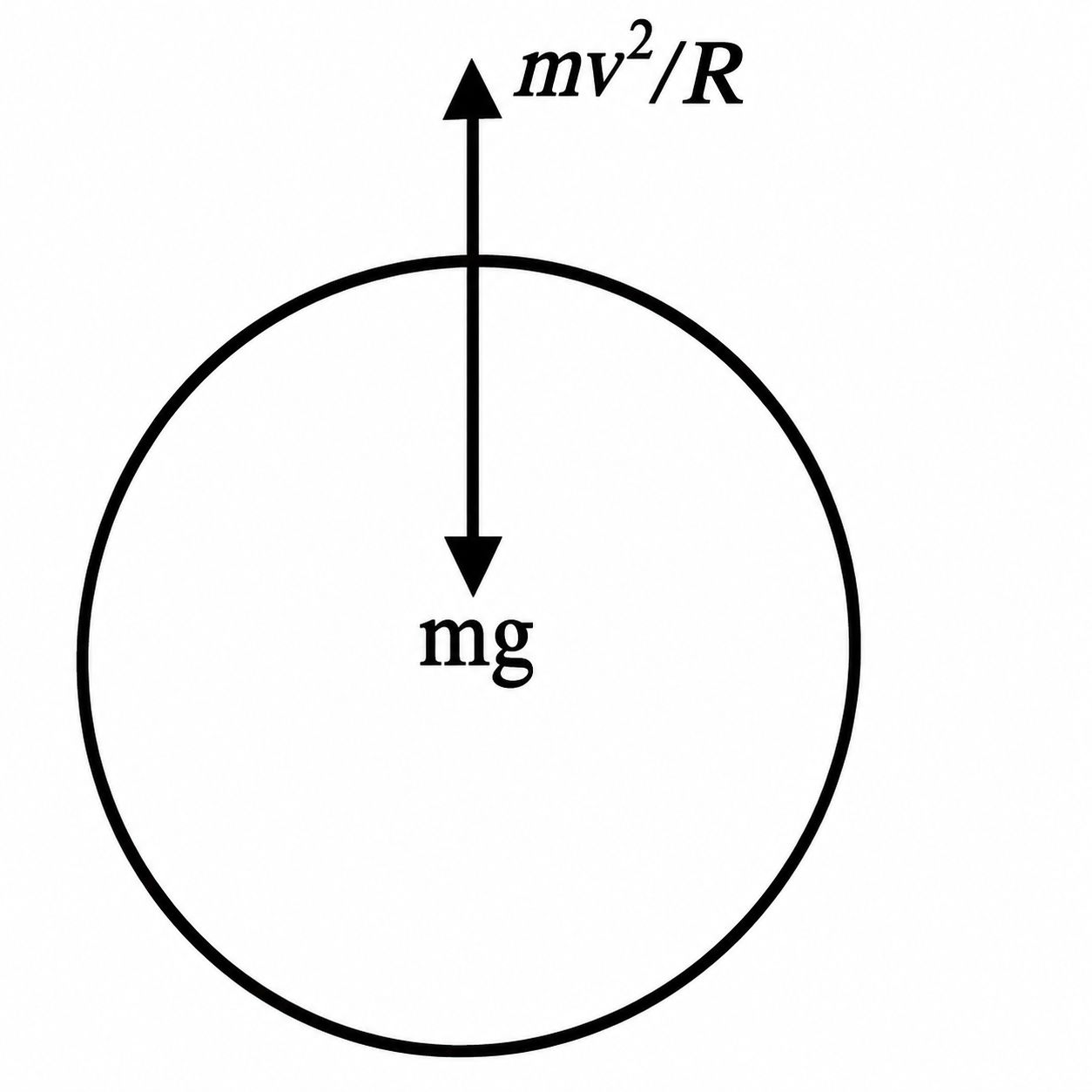
A roller coaster is designed such that riders experience “weightlessness” as they go round the top of a hill whose radius of curvature is 20 m. The speed of the car at the top of the hill is between:
For the riders to experience weightlessness at the top of the hill, the weight of the rider must be balanced by the centripetal force.
i.e., mg = mv² / R
⇒ v= √gR = √10×20 = 14.1 ms⁻¹
Hence, the speed of the car should be between 14 ms⁻¹ an 15 ms⁻¹
On a new scale of temperature (which is linear) and called the W scale, the freezing and boiling points of water are 39° W and 239° W respectively. What will be the temperature on the new scale, corresponding to a temperature of 39° C on the Celsius scale?
For different temperature scales, we have
x − L.F.P / U.F.P. − L.F.P. =constant
Where L.F.P ⇒ Lower Fixed Point
U.F.P ⇒ Upper Fixed Point
Where x is the measurement at that scale. Here, if C and W be the measurements on Celsius and W scale then,
C - 0 / 100 - 0 = W - 39 / 239 - 39 (∴ C = 39°C)
⇒ W = (39 × 200 / 100) + 39 = 78 + 39 = 117° W
An electric kettle takes 4 A current at 220 V. How much time will it take to boil 1 kg of water from temperature 20° C? The temperature of boiling water is 100° C.
Heat required to raise the temperature of 1 kg water from 20°C to 100°C is given by
Q = msΔθ = (1 × 4200 × 80) J
Power of kettle (P) = VI = (220 × 4) W
Time taken=Q / P = ((1 × 4200 × 80) / (220 × 4))
= 381.81 sec =6.36 min
If Q, E and W denote respectively the heat added, change in internal energy and the work done in a closed cyclic process, then:
In a cyclic process, the initial state coincides with the final state. Hence, the change in internal energy is zero, as it depends only on the initial and final states.
At 10°C the value of the density of a fixed mass of an ideal gas divided by its pressure is x. At 110°C this ratio is:
Let the mass of the gas be m.
At a fixed temperature and pressure, volume is fixed.
Density of the gas, ρ = m / V
Now ρ / P = m / nRT ⇒ m / nRT = x (By question)
⇒ xT = constant ⇒ x₁T₁= x₂T₂
⇒ x₂ ⇒ x₁T₁ / T₂ = (283 / 383)x
[given T₁= 283K]
[T₂ = 383K]
Two simple harmonic motions of angular frequency 100 and 1000 rad s⁻¹ have the same displacement amplitude. The ratio of their maximum acceleration is:
Maximum acceleration of a particle in the simple harmonic motion is directly proportional to the square of angular frequency
i.e., a ∝ ω²
∴ a₁ / a₂ = ω₁² / ω₂² = (100)² / (1000)² = 1 / 100
⇒ a₁ : a₂ = 1 : 10².
A point performs simple harmonic oscillation of period T and the equation of motion is given by x = a sin(ωt + π / 6). After the elapse of what fraction of the time period the velocity of the point will be equal to half of its maximum velocity?
We have x = a sin (ωt + π / 6)
∴ Velocity, v = dx / dt = aω cos (ωt + π / 6)
Maximum velocity = aω
According to question,
aω / 2 = aω cos (ωt + π / 6)
or, cos (ωt + π / 6) = 1 / 2 = cos 60° or cos π / 3
⇒ ωt + π / 6 = π / 3
ωt = π / 3 − π / 6 or, ωt = π / 6
or, (2π / T) · t = π / 6 ⇒ t = T / 12
The wave described by y=0.25sin(10πx−2πt),
where x and y are in meters and t in seconds, is a wave travelling along the:
y=0.25sin(10πx−2πt)
Comparing this equation with the standard wave equation
y=a sin(kx−ωt)
We get, k=10π
⇒ 2π / λ = 10π ⇒ λ = 0.2 m
And ω = 2π or, 2πν = 2π ⇒ ν = 1 Hz
The sign inside the bracket is negative, hence the wave travels in +ve x-direction.
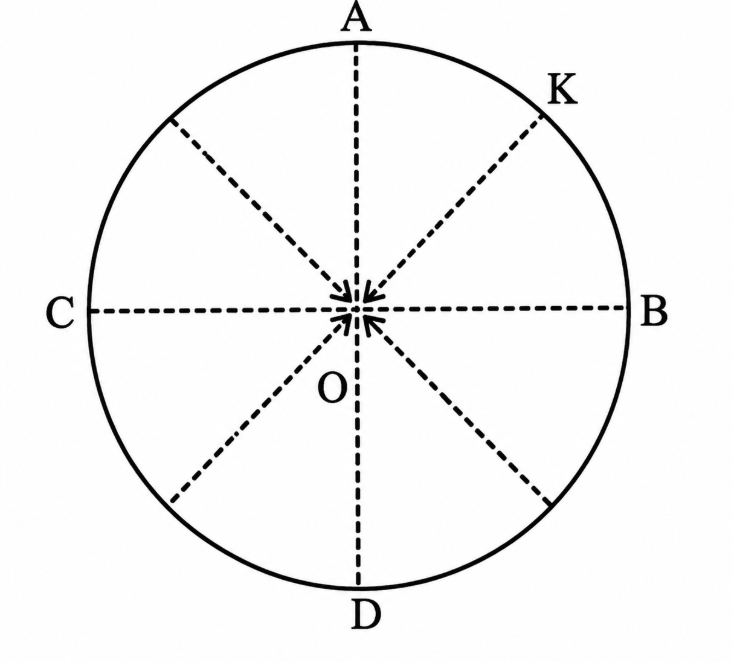
A thin conducting ring of radius R is given a charge +Q. The electric field at the centre O of the ring due to the charge on the part AKB of the ring is E. The electric field at the centre due to the charge on the part ACDB of the ring is
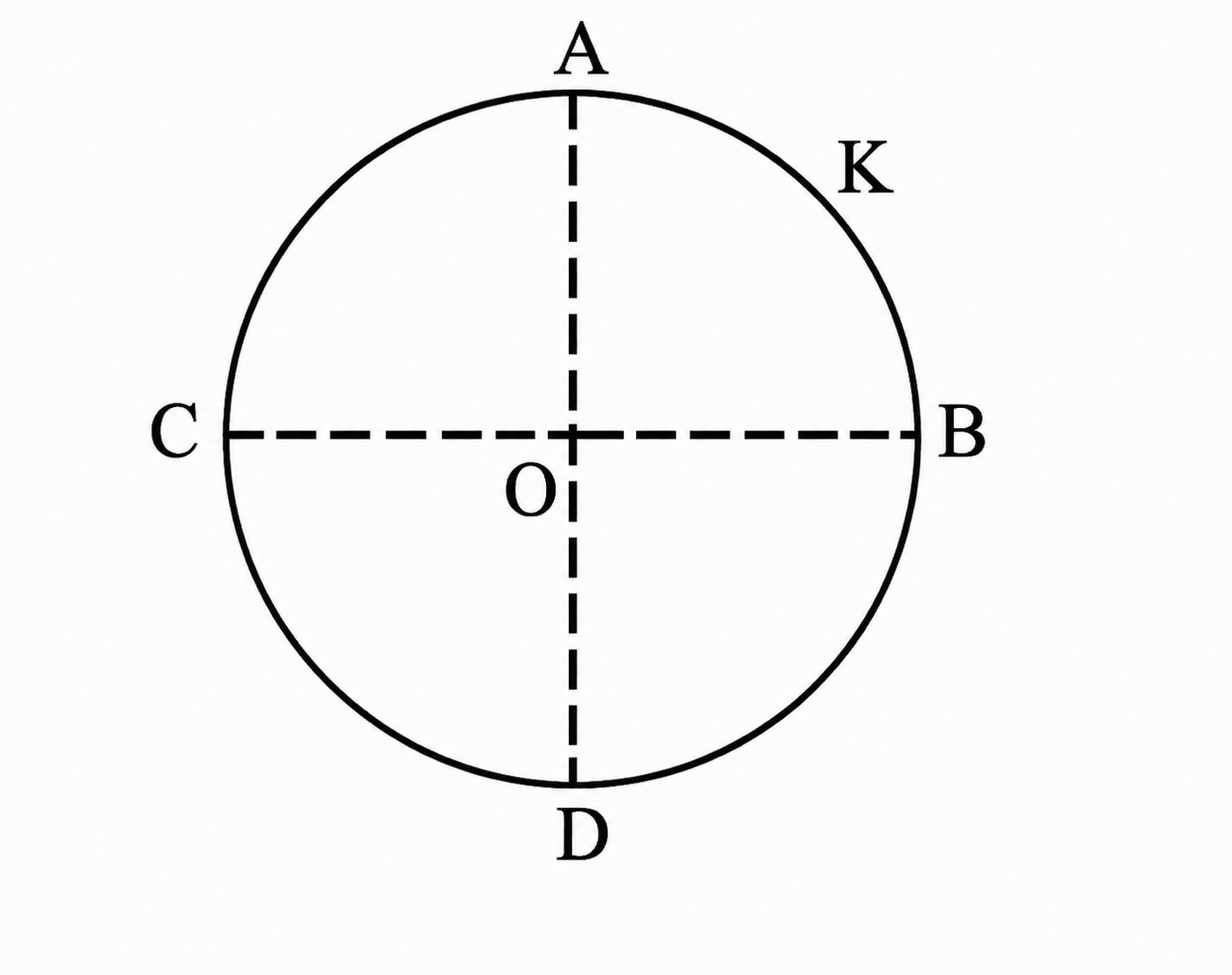
By the symmetry of the figure, the electric fields at O due to the portions AC and BD are equal in magnitude and opposite in direction. So, they cancel each other.
Similarly, the field at O due to CD and AKB are equal in magnitude but opposite in direction. Therefore, the electric field at the centre due to the charge on the part ACDB is E along OK.
The electric potential at a point in free space due to a charge Q coulomb is Q × 10¹¹ volts. The electric field at that point is
Given that, V = Q × 10¹¹ volts
Electric potential at point is given by
V = 1 / 4π ε₀ . Q / r or, Q × 10¹¹ = 1 / 4π ε₀ . Q / r
⇒ r = 1 / 4π ε₀ × 10⁻¹¹ m.
As |E| = |V| / r = (Q × 10¹¹ / (1 / 4π ε₀ ).10⁻¹¹)
= 4π ε₀ Q × 10²² volt m⁻¹.
A parallel plate capacitor has a uniform electric field E in the space between the plates. If the distance between the plates is d and area of each plate is A, the energy stored in the capacitor is:
The energy stored by a capacitor
U = (1 / 2) CV² ...........(i)
V is the p.d. between two plates of the capacitor
Potential difference V = E.d.
The capacitance of the parallel plate capacitor
C = Aε₀ / d
Substituting the value of C in equation (i):
U = (1 / 2) (Aε₀ / d)(Ed)² = (1 / 2) Aε₀E²d
A wire of a certain material is stretched slowly by ten per cent. Its new resistance and specific resistance become respectively:
Resistance of a wire is given by R= ρ (𝑙 / a)
If the length is increased by 10 % then new
length 𝑙′ = 𝑙 + (1 / 10) = (11 / 10)𝑙
In that case, area of cross section of wire would decrease by 10 %
∴ New area of cross section
A′= A - A / 10 = (9 / 10) A
∴ R′ = ρ (ℓ′ / A′) = ρ ((11 / 10)𝑙 / (9 / 10)) A
R′ = (1 1 / 9) ρ (𝑙 / R) R′=1.21R
The new resistance increases by 1.21 times. The specific resistance (resistivity) remains unchanged as it depends on the nature of the material of the wire.
Bacterial leaf blight of rice is caused by a species of
Bacterial leaf blight of rice is caused by a species Xanthomonas. Mature rice plants are infected by these bacteria, lesion begin as water-soaked stripes on the leaf blades and eventually increase in length and width, becoming yellow to grayish-white until the entire leaf dries up.
In the light of recent classification of living organisms into three domains of life (bacteria, archaea and eukarya), which one of the following statements is true about archaea?
A domain of prokaryotic organisms containing the archaeobacteria including the methanogens, which produce methane; the thermoacidophilic bacteria, which live in extremely hot and acidic environments & and the halophilic bacteria, which can only function at high salt concentrations, are abundant in the world’s oceans.
Thermococcus, Methanococcus and Methan-obacterium exemplify:
Thermococcus, Methanococcus and Methanobacterium exemplify archaebacteria that contain protein homologous to eukaryotic core histones.
In which one of the following, male and female gametophytes do not have free living independent existence?
Male and female gametophytes of Cedrus do not have free-living independent existence. Cedrus belongs to conifer.
Which one of the following is heterosporous?
Salvinia is an heterosporous aquatic fern with both annual and perennial species. The heterospores have two types of spores — microspores and megaspores.
Select one of the following pairs of important features distinguishing Gnetum from Cycas and Pinus and showing affinities with angiosperms
The important features distinguishing Gnetum from Cycas and Pinus and showing affinities with angiosperms are the presence of vessel elements and absence of archegonia.
Ascaris is characterized by
Ascaris is a common parasite found in the large intestine of man. It is worldwide in distribution. The number of worms may be 500 or more in a single host. Ascaris is characterized by the presence of neither true coelom nor metamerism.
Which one of the following is NOT a characteristic of phylum Annelida?
Characteristic of phylum Annelida is pseudocoelomate. Pseudocoelomate is any invertebrate animal whose body cavity is a pseudocoel, a cavity between the gut and the outer body wall derived from a persistent blastocoel, rather than a true coelom. Pseudocoelomate animals include the Rotifera and Nematoda.
Which one of the following phyla is correctly matched with its two general characteristics?
Mollusca mostly oviparous and a few viviparous. The development may be direct or indirect with trochophore, velliger, and glochidium.
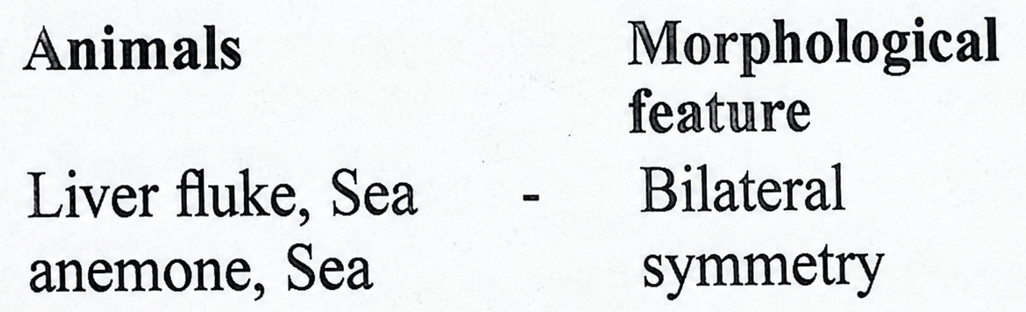
Which one of the following groups of three animals each is correctly matched with their one characteristic morphological feature?
-
(A)
-
(B)
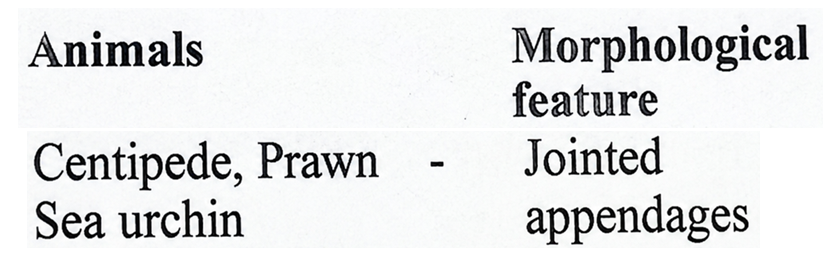
-
(C)
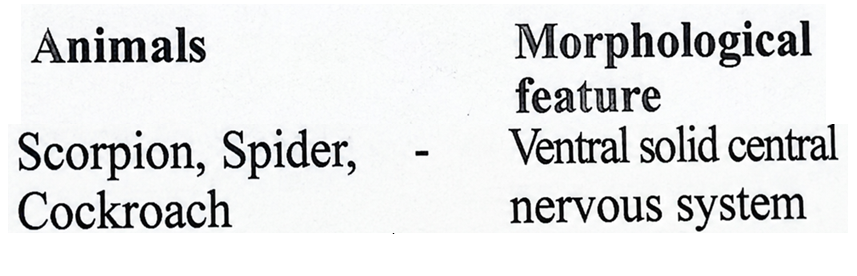
-
(D)
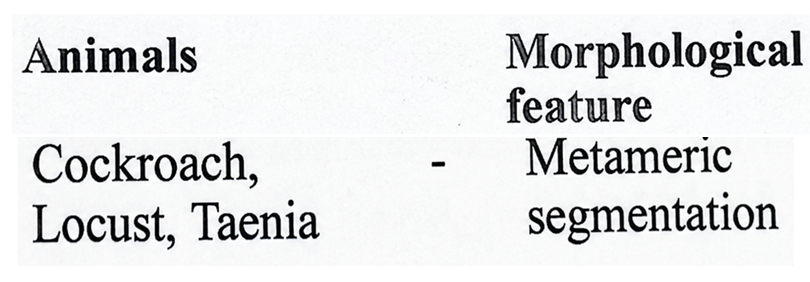
Scorpion, spider, and cockroach have a ventral solid central nervous system. All three belong to phylum Arthropoda.
— Spider belongs to class Arachnida
— Scorpion belongs to class Arachnida
— Cockroach belongs to class Insecta
Which one of the following is the true description about an animal concerned?
Cockroach belongs to phylum Arthropoda. It has 10 pairs of Spiracles (2 pairs on thorax and 8 pairs on abdomen).
Replum is present in the ovary of flower of
Replum is present in the ovary of flower of mustard. A false septun called replum develops between the two parietal placentae in mustard and other members of family
Brassicaceae. The ovary becomes bilocular.
The length of different internodes in a culm of sugarcane is variable because of
The length of different internodes in a culm of sugarcane is variable because of intercalary meristem. Intercalary meristem is not a part of apical meristem. It occurs in the internodes of grasses (sugarcane) between leaf nodes and enables longitudinal growth of the stem.
Vascular tissues in flowering plants develop from
Vascular tissues in flowering plants develop from plerome. Plerome is a central core of primary meristem which gives rise to all cells of the stele from the pericycle inward.
Which one of the following is resistant to enzyme action?
Pollen exine is resistant to enzyme action. The hard outer layer called the exine is made up of sporopollenin which is one of the most resistant organic material known.
It can withstand high temperatures and strong acids and alkali. No enzymes that degrade sporopollenin are so far known.
Earthworms have no skeleton but during burrowing, the anterior end becomes turgid and acts as a hydraulic skeleton. It is due to
Earthworms have no skeleton but during burrowing, anterior end becomes turgid and acts as a hydraulic skeleton. It is due to coelomic fluid. The coelom is filled with an alkaline milky coelomic fluid.
Keeping in view the fluid mosaic model for the structure of cell membrane, which one of the following statements is correct with respect to movement of lipids and proteins from one lipid monolayer to the other (described as flip-flop movement)?
Keeping in view of the ‘Fluid mosaic model’ for the structure of cell membrane, the movement of lipids and proteins from one lipid monolayer to the other, lipid can rarely flip-flop, protein can not. The fluid mosaic model is the most important and widely accepted latest model for plasma membrane was given by Singer and Nicolson in 1972. According to them it resembles “protein icebergs in a sea of lipids”.
Cellulose is the major component of cell walls of
Cellulose is a major component of cell wall of Pythium. Pythium is a genus of parasitic Oomycete. Because this group of organisms were once classified as fungi, they are sometimes still treated as such. Pythium, like others in the family Pythiaceae, are usually characterized by their production of coenocytic hyphae, hyphae without separations. Oogonia generally contain a single oospore. Antheridia contain an elongated and club shaped antheridium.
The two sub-units of ribosome remain united at critical ion level of
The two subunits of ribosome remain united at a critical ion level of magnesium. The presence of magnesium and its amount plays an important role in the appearance and structure of the ribosomes.
Vacuole in a plant cell
Vacuole in a plant cell is membrane bound and contains water and excretory substance. Vacuole is a space within the cytoplasm of living cell that is filled with air,
water or other liquid, cell sap or food particles. In plant cells, there is usually one large vacuole bounded by a single layered membrane (tonoplast or vacuole membrane);
animal cells usually have several small vacuoles.
A competitive inhibitor of succinic dehydrogenase is
Malonate is a powerful inhibitor of cellular respiration, because it binds to the active site of succinate dehydrogenase in the citric acid cycle but does not react. It thereby competes with succinate, since it does not have the -CH₂,-CH₂,- group (as in succinate which is required for dehydrogenation). For the oxidative phosphorylation reaction, malonate is an inhibitor for complex II which again contains succinate dehydrogenase.
The rupture and fractionation do not usually occur in the water column in vessel/tracheids during the ascent of sap because of
Rupture and fractionation do not usually occur in the water column in vessel/ tracheids during the ascent of sap because of cohesion and tension.
Carbohydrates are commonly found as starch in plant storage organs. Which of the following five properties of starch (A–E) make it useful as a storage material?
(A) Easily translocated
(B) Chemically non-reactive
(C) Easily digested by animals
(D) Osmotically inactive
(E) Synthesized during photosynthesis
The useful properties are
Carbohydrates are commonly found as starch in plant storage organs. It is a chemically non-reactive and osmotically inactive polysaccharide with a molecular weight. Carbohydrates perform a vital role in living organisms. Starch and other polysaccharides serve as energy storage in plants, particularly in seeds, tubers, etc. which provide a major energy source for animals, including humans.
Nitrogen fixation in root nodules of Alnus is brought about by:
Nitrogen fixation in root nodules of Alnus is brought about by Frankia. It is a symbiotic nitrogen-fixing bacteria in root nodules of several non-legume plants like Casuarina (Australian Pine), Myrica and Alnus (Alder).
Electrons from excited chlorophyll molecule of photosystem II are accepted first by:
Electrons from excited chlorophyll molecule of photosystem II are accepted first by quinone. Photosystem II is a photosynthetic pigment system along with some electron carriers that are located in the appressed part of the grana thylakoids. Photosystem II has chlorophyll a, b and carotenoids. Other components of PS II are pheophytin, plastoquinone (PQ), cytochrome complex and blue coloured copper containing plastocyanin.
In leaves of C₄ plants malic acid synthesis during CO₂ fixation occurs in
In leaves of C₄ plants, malic acid synthesis during CO₂ fixation occurs in mesophyll cells. The mesophyll cells perform C₄ cycle and the cells of bundle sheath perform C₃ cycle.
The energy-releasing process in which the substrate is oxidised without an external electron acceptor is called
Glycolysis takes place in all body cells and is of two types—
(a) Anaerobic glycolysis—From glycogen or glucose to lactic acid in muscles.
(b) Aerobic glycolysis—From glycogen or glucose to pyruvic acid (all cells of body).
The chemiosmotic coupling hypothesis of oxidative phosphorylation proposes that adenosine triphosphate (ATP) is formed because:
Chemiosmotic theory was postulated by the British biochemist Peter Mitchell (1920–22) to explain the formation of ATP in the mitochondrial electron transport chain. As electrons are transferred along the electron carrier system in the inner mitochondrial membrane, hydrogen ions (protons) are actively transported into the space between the inner and outer mitochondrial membranes, which thus contains a higher concentration of protons than the matrix. This creates an electrochemical gradient across the inner membrane, through which protons move back into the matrix.
In germinating seeds fatty acids are degraded exclusively in the
In germinating seeds, fatty acids are degraded exclusively in the glyoxysomes.
Glyoxylate cycle occurs in tissues rich in fats, such as those of germinating seeds; the enzymes involved in the cycle, which have not been found in mammals, are contained in organelles called glyoxysomes.
Senescence as an active developmental cellular process in the growth and functioning of a flowering plant, is indicated in
Senescence is an active developmental cellular process in the growth and functioning of a flowering plant, indicated in leaf abscission. Senescence is the changes that occur in an organism between maturity and death, i.e. ageing.
Characteristically there is a deterioration in functioning as the cells become less efficient in maintaining and replacing vital cell components.
Importance of day length in flowering of plants was first shown in
Photoperiodism was first studied by Garner and Allard (1920). They observed that “Maryland Mammoth” variety of tobacco could be made to flower in summer by reducing the light hours with artificial darkening. It could be made to remain vegetative in winter by providing extra light.
Which one of the following is the correct matching of the site of action on the given substrate, the enzyme acting upon it and the end product?
Small intestine- Starch disaccharide (maltose)
Small intestine is the portion of the alimentary canal between the stomach and large intestine. It is subdivided into the duodenum, jejunum and ileum. It plays an essential
role in the final digestion and absorption of food.
What will happen if the secretion of parietal cells of gastric glands is blocked with an inhibitor?
If the secretion of parietal cells of gastric glands is blocked with an inhibitor, in the absence of HCI secretion, inactive pepsinogen is not converted into the active enzyme pepsin.
Which type of white blood cells are concerned with the release of histamine and the natural anti-coagulant heparin?
Basophil is a type of white blood cell (leucocyte) that has a lobed nucleus surrounded by granular cytoplasm. Basophils are produced continually by stem cells in the red bone marrow & move about in an amoeboid fashion. Like mast cells, they produce histamine and heparin as part of the body’s defences at the site of an infection or injury.
The most active phagocytic white blood cells are:
The most active phagocytic white blood cells are neutrophils and monocytes which modulate the innate immune response and phagocytose infectious agents.
Neutrophil has a lobed nucleus and granular cytoplasm. Neutrophils engulf bacteria and release various substances such as lysozyme and oxidising agents.
Monocyte is the largest form of WBC in vertebrates. It has a kidney-shaped nucleus and is actively phagocytic, ingesting bacteria and cell debris.
The haemoglobin of a human foetus
The haemoglobin of a human foetus has a higher affinity for oxygen than that of an adult. Foetal haemoglobin binds to oxygen more strongly than adult haemoglobin, enabling the transfer of oxygen from mother to foetus prenatally.
In humans, blood passes from the post caval to the diastolic right atrium of heart due to
In humans, blood passes from the post caval to the diastolic right atrium of heart due to suction pull.
Which one of the following items gives its correct total number?
In humans total number of ribs are Fourteen (14). These are of three types:
(1) True ribs – These are 7 in number.
(2) False ribs – These are 2 in number.
(3) Floating ribs – These are 4 in number.
During the propagation of a nerve impulse, the action potential results from the movement of:
Total sum of physio-electrochemical changes that takes place along the length of nerve fibre is known as nerve impulse.
Change in potential due to stimulation of nerve fibre is called action potential. During propagation of nerve impulse, Na⁺ enters inside so (+ve) charge is formed inside the membrane. K⁺ ions come out.
Given below is a diagrammatic cross section of a single loop of human cochlea:
Which one of the following options correctly represents the names of three different parts?
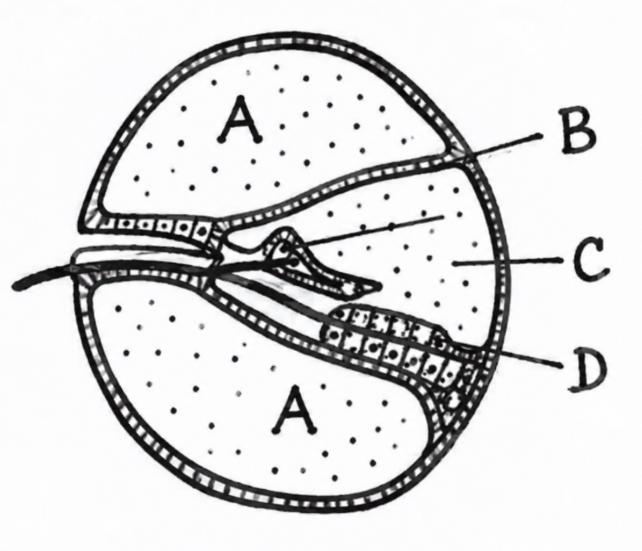
The diagrammatic cross section of a single loop of human cochlea represents three different parts—
A - Perilymph
B - Tectorial membrane
C - Endolymph
Cochlea arises from sacculus. It is spirally coiled duct. It is also known as Lagena.
It is connected with sacculus by duct of reuniens.
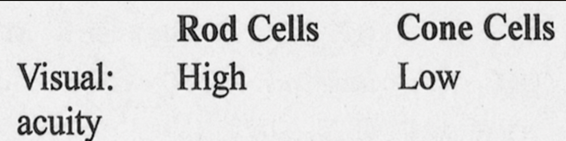
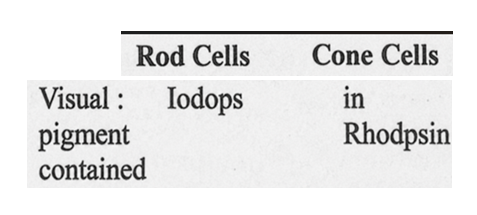
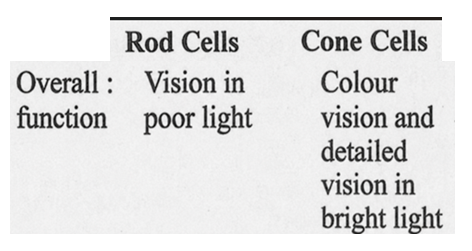
Which one of the following is the correct difference between Rod Cells and Cone Cells of our retina?
-
(A)
-
(B)
-
(C)
-
(D)
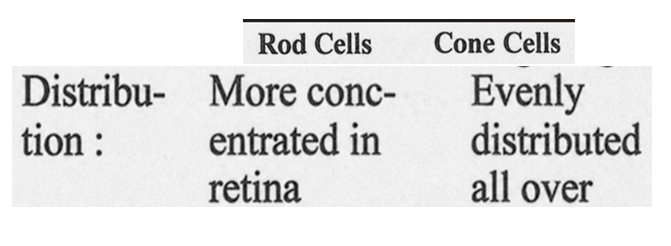
Rod cells is a type of light sensitive receptor cell present in the retinas of vertebrates. Rod contains the pigment rhodopsin and are essential for vision in dim light.
Cone cells is a type of light sensitive receptor cell, found in retinas of all diurnal vertebrates. Cones are specialized to transmit information about colour and are responsible for the visual acuity of the eye. They function best in bright light.
A cell can be balanced against 110 cm and 100 cm of potentiometer wire, respectively with and without being short circuited through a resistance of 10Q. Its internal resistance is
Here E > ER / R + r, hence the lengths 110 cm and 100 cm are interchanged.
Without being short-circuited through R, only the battery E is balanced.
E = V / L × 𝑙₁ = V / L ×110 ...(i)
When R is connected across E, Ri = V / L× 𝑙₂
or, R (E / R+r) = V / L × 100
Diving (i) by (ii), we get
R + r / R = 110 / 100
or, 100 R +100r = 110 R
or, 10R = 100 r
∴ r = 10R / 100 = ((10 × 10) / 100) (∴R = 10Ω)
⇒ r = 1 Ω
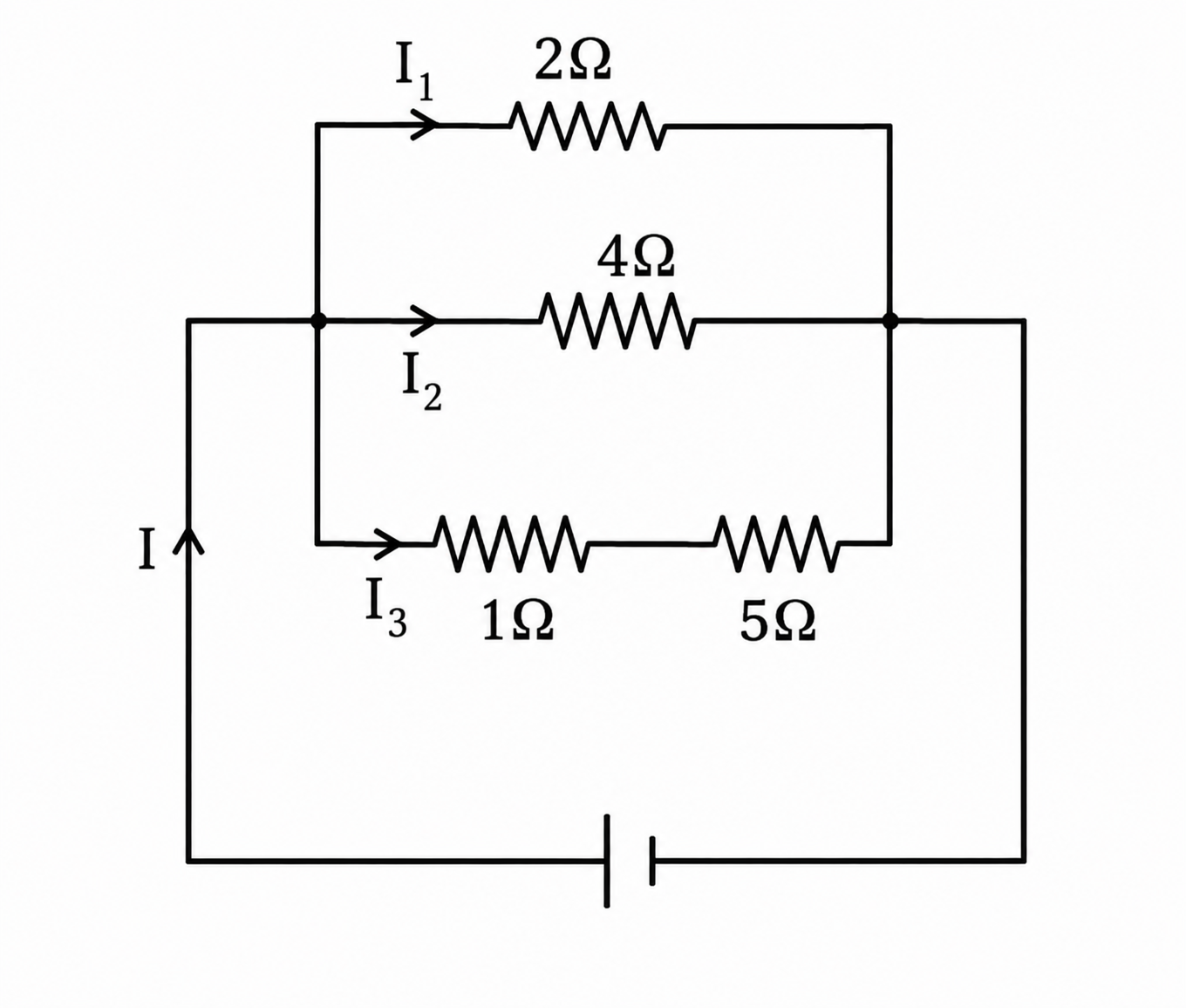
A current of 3 amp flows through the 2Ω resistor shown in the circuit. The power dissipated in the 5-Ω resistor is:
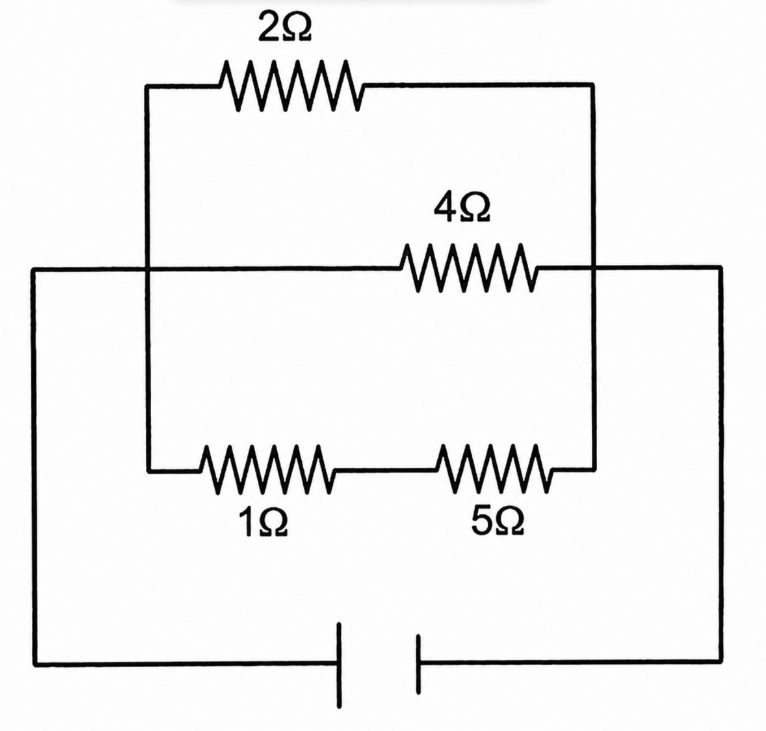
Clearly, 2Ω, 4Ω and (1+5) Ω resistors are in parallel.
Hence, potential difference is same across each of them.
∴ Ⅰ₁ × 2 = Ⅰ₂ × 4 = Ⅰ₃ × 6
Given Ⅰ₁ = 3A (∴ Ⅰ₁ × 2 = Ⅰ₃ × 6 )
Given Ⅰ₁= 3A
∴ Ⅰ₁ × 2 = Ⅰ₃ × 6 provides
Ⅰ₃ = (Ⅰ₁ × 2 / 6) = (3 × 2 / 6) = 1A.
Now, the potential across the 5Ω resistor is
V = Ⅰ₃ × 5 = 1 × 5 = 5V
the power dissipated in the 5Ω resistor
P = V² / R = 5² / 5 = 5watt.
A particle of mass m, charge Q and kinetic energy T enters a transverse uniform magnetic field of induction 𝐁⃗. After 3 seconds, the kinetic energy of the particle will be:
When a charged particle enters a transverse magnetic field it traverse a circular path. Its kinetic energy remains constant.
A closed loop PQRS carrying a current is placed in a uniform magnetic field. If the magnetic forces on segments PS, SR, and RQ are F₁, F₂, and F₃ respectively and are in the plane of the paper and along the directions shown, the force on the segment QP is
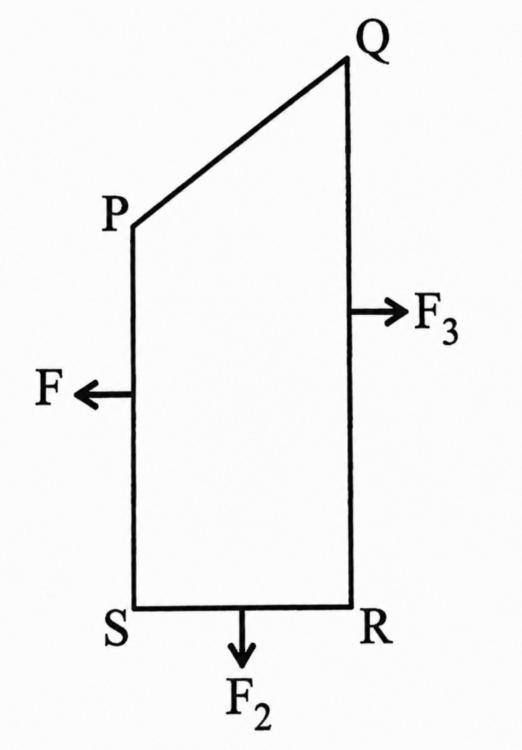
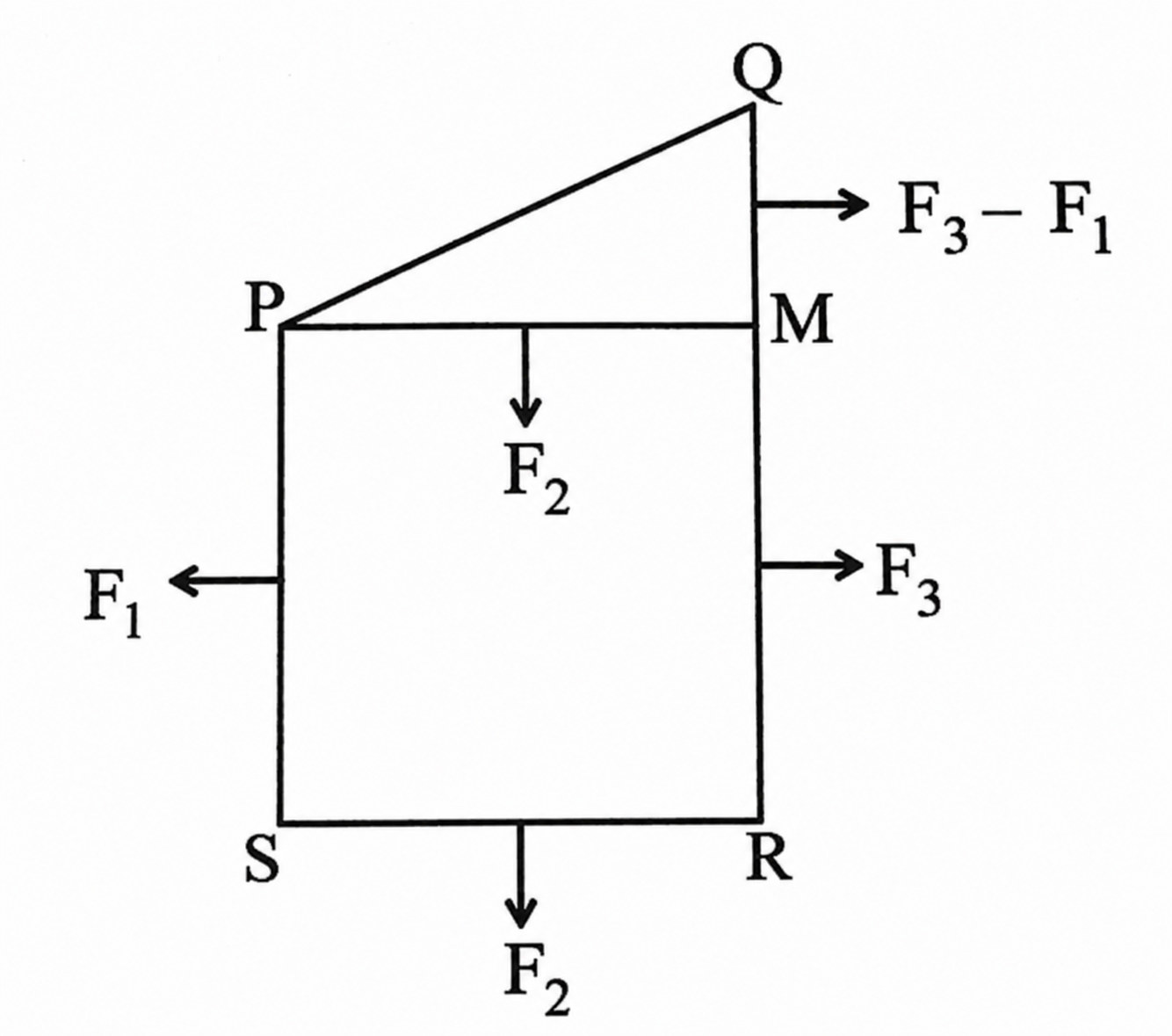
According to the figure the magnitude of force on the segment QM is F₃ —F₁, and PM is F₂.
Therefore, the magnitude of the force on segment PQ is √(F₃-F₁)² + F₂²
A galvanometer of resistance 50 Ω is connected to battery of 3V along with a resistance of 2950 Ω in series. A full scale deflection of 30 divisions is obtained in the galvanometer. In order to reduce this deflection to 20 divisions, the resistance in series should be
Total internal resistance = (50 +2950)Ω = 3000Ω
Emf of the cell, ε= 3V
∴ Current = ε / R = 3 / 3000 = 1×10⁻³A = 1.0mA
∴ Current for full scale deflection of 30 division is 1.0mA
∴ Current for a deflection of 20 divisions,
Ⅰ = (20 / 30 ×1) mA or Ⅰ = (2 / 3)mA
Let the resistance be x Ω. Then
x= ε / Ⅰ = (3V / (2/3×10⁻³A)) = (3 × 3 × 10³ / 2) Ω = 4500Ω
But the resistance of the galvanometer is 50Ω.
∴ Resistance to be added
= (4500-50)Ω= 4450Ω
Curie temperature is the temperature above which
Curie temperature is the temperature above which ferromagnetic material becomes paramagnetic material.
A circular disc of radius 0.2 meter is placed in a uniform magnetic field of induction 1/π (Wb/m²) in such a way that its axis makes an angle of 60° with 𝐁⃗. The magnetic flux linked with the disc is:
Here, B=1 / π (Wb/m²)
θ = 60°
Area normal to the plane of the disc
=πr² cos 60° = πr² / 2
Flux = B × normal area
= 0.2 × 0.2 / 2 = 0.02Wb
A long solenoid has 500 turns. When a current of 2 ampere is passed through it, the resulting magnetic flux linked with each turn of the solenoid is 4×10⁻³ Wb. The self-inductance of the solenoid is
Total number of turns in the solenoid, N= 500
Current , Ⅰ = 2A.
Magnetic flux linked with each turn
= 4×10⁻³Wb
As, Φ = LⅠ or NΦ= LⅠ ⇒ L = NΦ / 1
= (500 × 4 × 10⁻³ / 2) henry = 1 H.
In an a.c. circuit the e.m.f. (e) and the current (i) at any instant are given respectively by
e = E₀ sin ωt
i = I₀ sin (ωt−ϕ)
The average power in the circuit over one cycle of a.c. is
The average power in the circuit over one cycle of a.c. is given by
Pₐᵥ = eᵣₘₛ ×iᵣₘₛ ×cosΦ
= E₀ / √2 × Ⅰ₀ /√2 × cos Φ = (E₀ Ⅰ₀ / 2) cosΦ
The velocity of electromagnetic radiation in a medium of permittivity ε₀ and permeability μ₀ is given by
The velocity of electromagnetic radiation in a medium of permittivity ε₀ and permeability μ₀ is equal to 1/√(μ₀ ε₀) ·
Two thin lenses of focal lengths f₁ and f₂ are in contact and coaxial. The power of the combination is:
The focal length of the combination
1 / f = 1 / f₁+ 1 / f₂
∴ Power of the combinations,
P= f₁+f₂ / f₁f₂ (∵ P=1 / f)
A boy is trying to start a fire by focusing sunlight on a piece of paper using an equiconvex lens of focal length 10 cm. The diameter of the Sun is 1.39 x10⁹ m and its mean distance from the earth is 1.5 x 10¹¹ m. What is the diameter of the Sun’s image on the paper?
We have, |v / u| = size of image / size of object
or, size of image = |v / u| × size of object
= (10⁻¹ / 1.5 ×10¹¹) × (1.39 × 10⁹)
= 0.92 × 10⁻³ m = 9.2 × 10⁻⁴m
∴ Diameter of the sun’s image = 9.2 ×10⁻⁴m
The periodic waves of intensities I₁ and I₂ pass through a region at the same time in the same direction. The sum of the maximum and minimum intensities is:
The resultant intensity of two periodic waves at a point is given by
I = I₁ + I₂ + 2√(I₁I₂) . cosϕ.
Resultant intensity is maximum if
cosϕ = −1
i.e. Iₘₐₓ = I₁ + I₂ + 2√(I₁I₂)
Resultant intensity is minimum if
cosϕ = +1
i.e., Iₘᵢₙ = I₁ + I₂ − 2√(I₁I₂)
Therefore, the sum of the maximum and minimum intensities is
Iₘₐₓ + Iₘᵢₙ
= I₁ + I₂ + 2√(I₁I₂) + I₁ + I₂ − 2√(I₁I₂)
= 2(I₁ + I₂)
In the phenomenon of electric discharge through gases at low pressure, the coloured glow in the tube appears as a result of:
In discharge tube, collisions between the charged particles emitted from the cathode and atoms of the gas results to the coloured glow in the tube.
A particle of mass 1 mg has the same wavelength as an electron moving with a velocity of 3×10⁶ ms⁻¹. The velocity of the particle is:
Wavelength of particle
(λ₁)= h / mv = (h / (1×10⁻⁶)× v)
where v is the velocity of the particle.
Wave length of electron,
(λ₂) = (h / (9.1 ×10⁻³¹) × (3×10⁶))
but λ₁ = λ₂ (Given)
∴ (h / (1×10⁻⁶) × v) = (h / (9.1 ×10⁻³¹) × (3×10⁶))
⇒ v = 9.1 ×10⁻³¹ × 3×10⁶ / 10⁻⁶ = 2.73 ×10⁻¹⁸ ms⁻¹
The work function of a surface of a photosensitive material is 6.2 eV. The wavelength of incident radiation for which the stopping potential is 5 V lies in the:
Work function, Φ₀= 6.2eV.
Stopping Potential V₀ = 5V.
As, eV₀ = hv - Φ₀
or eV₀ + Φ₀ =hc / λ
or λ = (hc / eV₀ + Φ₀)
λ = (6.62 ×10⁻³⁴ Js × 3 × 10⁸ms⁻¹ / 1.6 × 10⁻¹⁹ × 5J + 6.2 × 1.6 × 10⁻¹⁹J)
= (6.62 × 10⁻³⁴ × 3 × 10⁸ / 1.6 × 10⁻¹⁹ (5+6.2)) m
= (19.86 ×10⁻²⁶ /17.92 ×10⁻¹⁹) = 1.10 × 10⁻⁷ m.
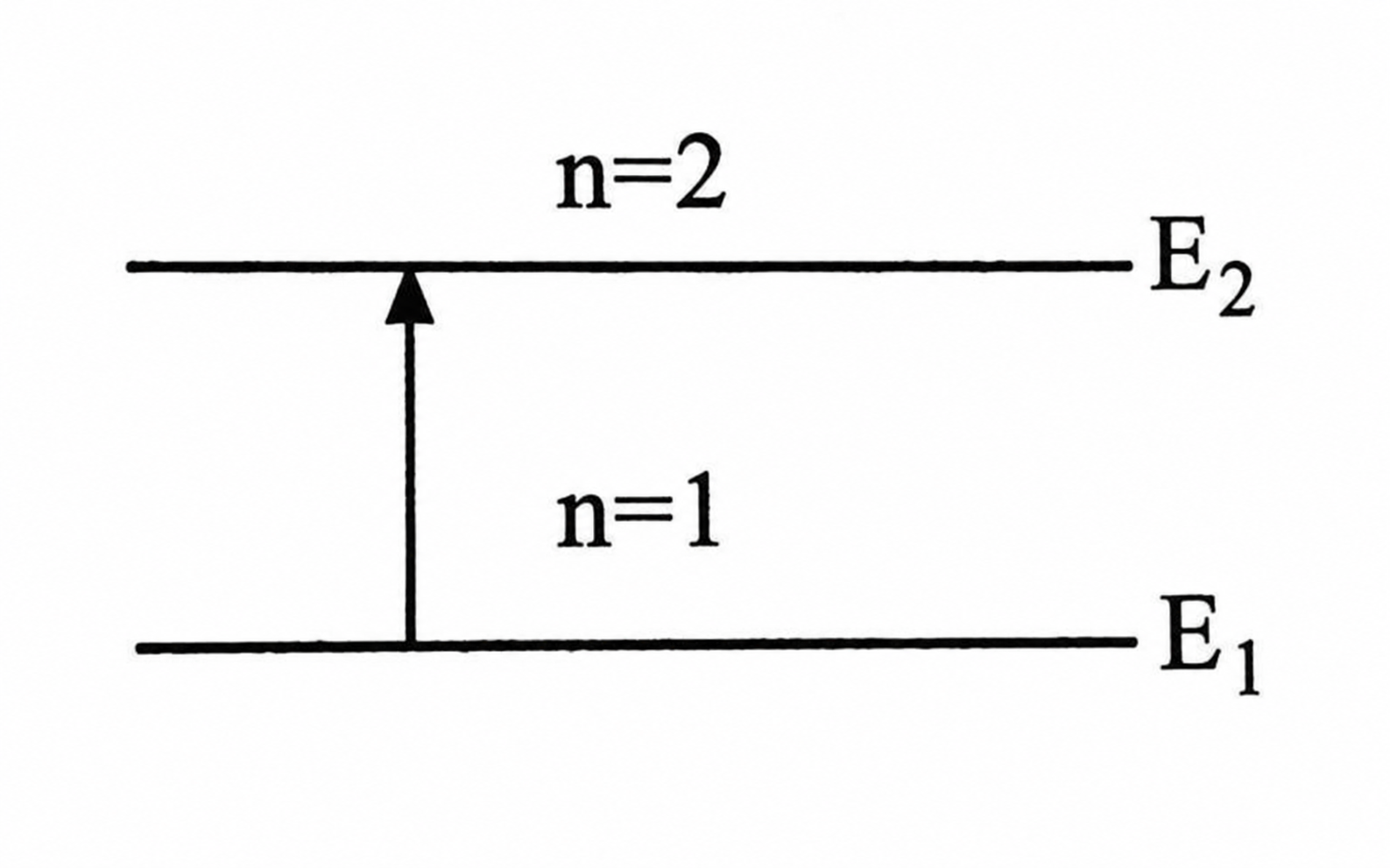
The ground state energy of hydrogen atom is 13.6 eV. When its electron is in the first excited state, its excitation energy is
When the electron is in first excited state
(n = 2), the excitation energy is given by
ΔE = E₂ - E₁
We have, Eₙ = (-13.6 / n²) eV
∴ E₂ = (-13.6 / 2²) eV = -3.4eV
Given E₁ = -13.6eV
∴ ΔE = (-3.4) - (-13.6)= 10.2 eV.
Two nuclei have their mass numbers in the ratio of 1 : 3. The ratio of their nuclear densities would be
Required ratio of nuclear densities = ρ₁ / ρ₂
= ((M₁/V₁) / (M₂/V₂)) = M₁/M₂ × V₂/V₁ = 1 / 3 × ((4/3)πR₂³ / (4/3)πR₁³
= 1 / 3 × (R₂ / R₁)³ = 1 / 3 × (R₀M₂¹ᐟ³ / R₀M₁¹ᐟ³)³ [∴ R = R₀M¹ᐟ³ ]
= 1 / 3 × (M₂ / M₁) = 1 / 3 × ( 3 / 1)
= 1 : 1
If M(A; Z), Mₚ, and Mₙ denote the masses of the nucleus ᴬ_ZX, proton and neutron respectively in units of u (1 u = 931.5 MeV/c²) and BE represents its bonding energy in MeV, then
Mass defect = ZMₚ + (A − Z)Mₙ − M(A, Z)
or, B.E. / c² = ZMₚ + (A − Z)Mₙ − M(A, Z)
∴ M(A, Z) = ZMₚ + (A − Z)Mₙ − B.E. / c²
Two radioactive materials X₁ and X₂ have decay constants 5λ and λ respectively. If initially they have the same number of nuclei, then the ratio of the number of nuclei of X₁ to that of X₂ will be 1 / e after a time
Let the required time be t. Then
N₁ = N₀e_(−λ₁t) ; N₂ = N₀e_(−λ₂t)
Where
N₁ = number of nuclei of X₁ after time t
N₂ = number of nuclei of X₂ after time t
N₀ = initial number of nuclei of X₁ and X₂ each
Now, N₁ / N₂ = ((N₀e_(−λ₁t) / N₀e_(−λ₂t)) Here N₁ / N₂ = 1 / e
λ₁ = 5λ ; λ₂ = λ
∴ 1 / e = (e_(−5λt) / e_(−λt)) ⇒ e⁻¹ = e_(−4λt) ⇒ 4λt = 1
∴ t = 1 / 4λ
A p-n photodiode is made of a material with a band gap of 2.0 eV. The minimum frequency of the radiation that can be absorbed by the material is nearly
E_g = 2.0 eV = 2 × 1.6 × 10⁻¹⁹ J
∴ E_g = hν
∴ ν = E_g / h
= ((2 × 1.6 × 10⁻¹⁹ J) / (6.62 × 10⁻³⁴Js))
= 0.4833 × 10¹⁵ s⁻¹ = 4.833 × 10¹⁴ Hz ≃ 5×10¹⁴ Hz
The voltage gain of an amplifier with 9% negative feedback is 10. The voltage gain without feedback will be
Negative feedback is applied to reduce the output voltage of an amplifier. If there is no negative feedback, the value of output voltage could be very high. In the options given, the maximum value of voltage gain is 100. Hence it is the correct option.
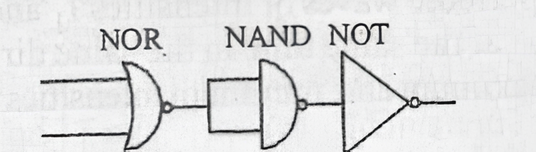
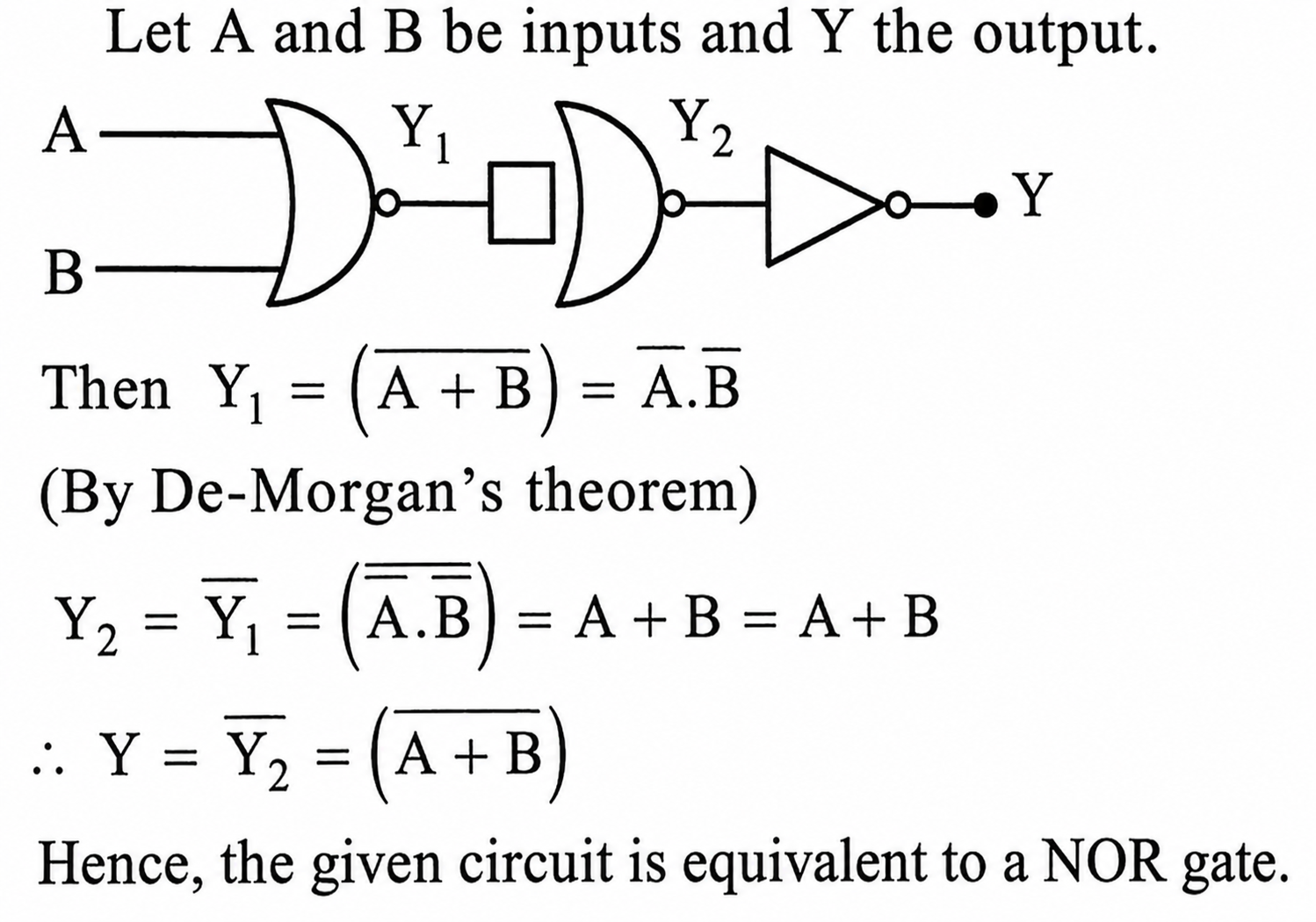
The circuit
is equivalent to
If the lattice parameter for a crystal line structure is 3.6 Å, then the atomic radius in fcc crystal is
Atomic radius is the distance between two nearest neighbours. For fcc crystal
Atomic radius = (1 / 2√2) × lattice parameter
or r = (a / (2√2))
r = (3.6 / (2√2)) Å = 1.27 Å
The energy required to charge a parallel plate condenser of plate separation d and plate area of cross‑section A such that the uniform electric field between the plates is E₁, is
Energy given by the cell E = CV²
Here, C = capacitance of condenser = (Aε₀ / d)
V = potential difference across the plates = Ed
∴ E = (Aε₀ / d) (Ed)² = A ε₀ E² d
In the circuit shown, the current through the 4 Ω resistor is 1 A when the points P and M are connected to a DC voltage source. The potential difference between the points M and N is
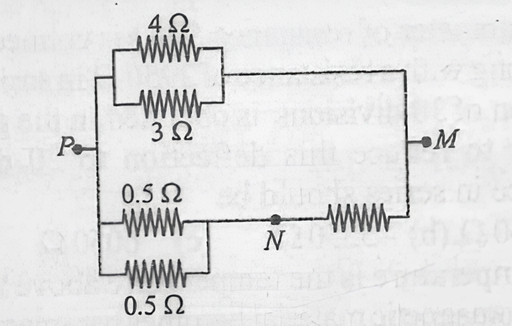
Potential difference across PM
V = 4 × 1 = 4 volt (i.e., across 4 Ω)
Equivalent resistance of lower side arm,
R_eq = 1 + ((0.5 × 0.5) / (0.5 + 0.5)) = 1.25 Ω
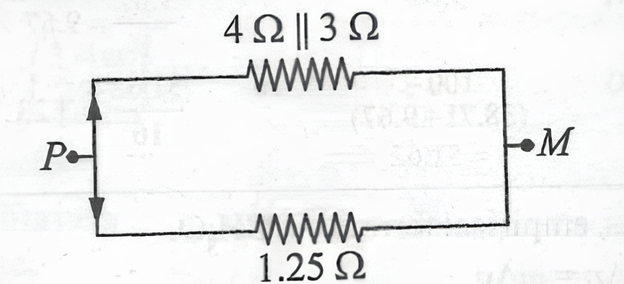
Now the circuit can be shown as
Let current I flows in lower branch, so
1.25 I = 4 V
or I = 4 / 1.25 = 3.2 A
Therefore, 3.2 A current flows in 1 Ω resistance, hence potential difference between M and N
V′ = 3.2 × 1 = 3.2 volt
What volume of oxygen gas (O₂) measured at 0°C and 1 atm, is needed to burn completely 1 L of propane gas (C₃H₈) measured under the same conditions?
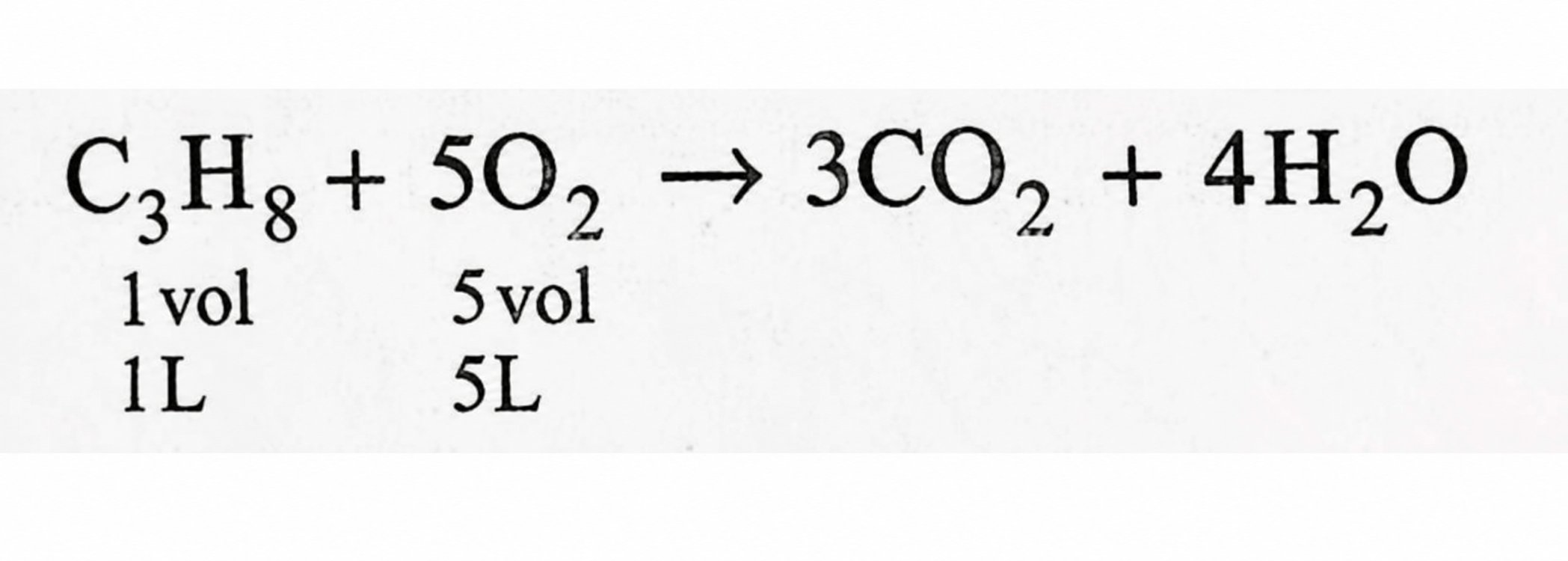
Writing the equation of combustion of propane (C₃H₈), we get
From the above equation we find that we need 5 L of oxygen at N.T.P. to completely burn 1 L of propane at N.T.P.
If we change the conditions for both the gases from N.T.P. to same conditions of temperature and pressure, the same results are obtained. i.e. 5 L is the correct answer.
Number of moles of MnO₄⁻ required to oxidize one mole of ferrous oxalate completely in acidic medium will be:
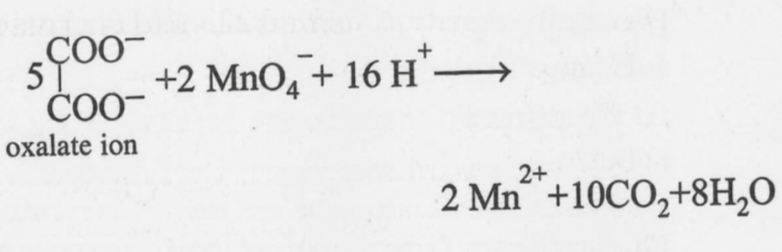
From above equation, 2 moles of MnO₄ required to oxidise 5 moles of oxalate.
Thus, number of moles of MnO₄⁻ required to oxidise one mole of oxalate = (2 × 2 / 5) = 0.4 moles.
Volume occupied by one molecule of water (density = 1 g cm⁻³) is:
∴ Volume occupied by 1 gram water = 1 cm³
or Volume occupied by
(6.023 × 10²³ / 18) molecules of water = 1 cm³
[∴ 1 g water = (1 / 18) moles of water]
Thus, volume occupied by 1 molecule of water
= (1 × 18 / 6.023 × 10²³) cm³ = 3.0 × 10⁻²³ cm³
i.e. the correct answer is option (3.0 × 10⁻²³ cm³).
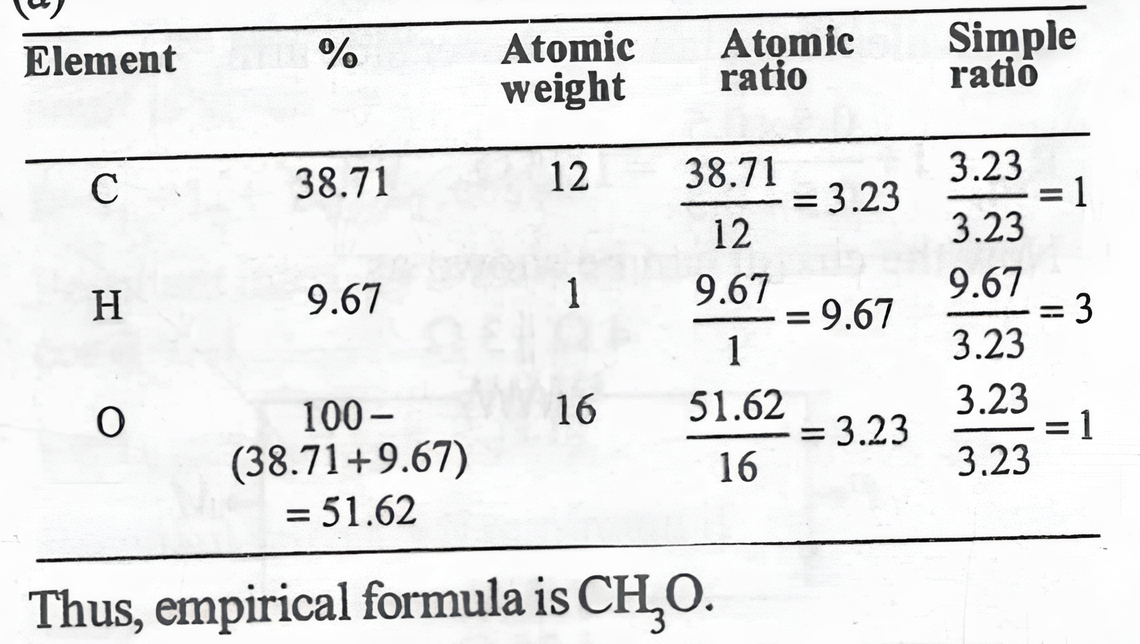
An organic compound contains carbon, hydrogen and oxygen. Its elemental analysis gave C, 38.71% and H, 9.67%. The empirical formula of the compound would be:
The measurement of the electron position if associated with an uncertainty in momentum, which is equal to 1 × 10⁻¹⁸ g cm s⁻¹. The uncertainty in electron velocity is, (mass of an electron is 9 × 10⁻²⁸ g)
Δp = mΔv
Substituting the given values of Δx and m, we get
1×10⁻¹⁸ gcms⁻¹
= 9×10⁻²⁸ g × Δv
or Δv = (1×10⁻¹⁸ / 9×10⁻²⁸)
= 1.1 × 10⁹ cm s⁻¹ ≃ 1×10⁹ cm s⁻¹
How many moles of lead (II) chloride will be formed from a reaction between 6.5 g of PbO and 3.2 g of HCl?
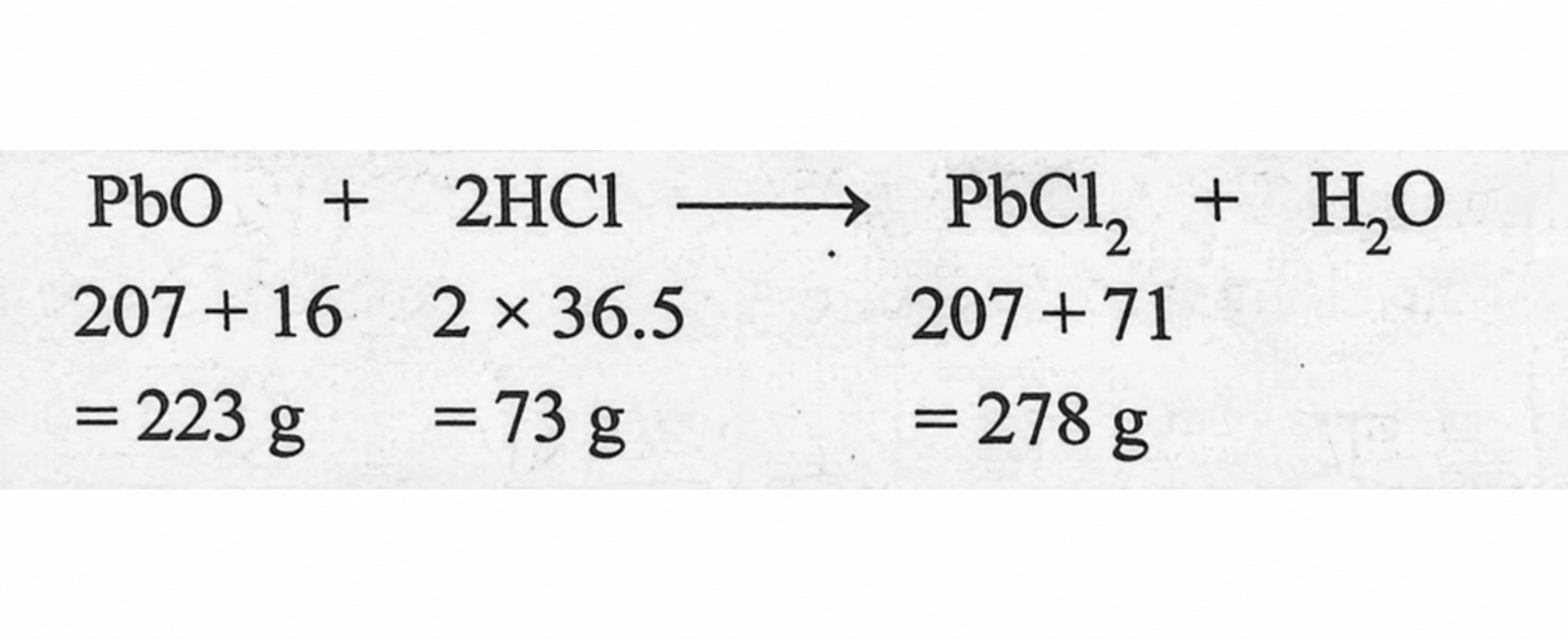
Writing the equation for the reaction, we get
From this equation we find 223 g of PbO reacts 0with 73 g of HCl to form 278 g of PbCl₂.
If we carry out the reaction between 3.2 g HCl and 6.5 g PbO.
Amount of PbO that reacts with 3.2 g HCl = (223 / 73) × 3.2 = 9.77 g.
Since amount of PbO present is only 6.5 g so PbO is the limiting reagent.
Amount of PbCl₂ formed by 6.5 g of PbO = (278 / 223) × 6.5 g
Number of moles of PbCl₂ formed
= (278 / 223) × (6.5 / 278) moles = 0.029 moles.
If uncertainty in position and momentum are equal, then uncertainty in velocity is:
We know Δp·Δx ≥ h / 4π
or m·Δv·Δx = h / 4π
[∴ Δp = mΔv]
Since Δp = Δx (given)
∴ Δp·Δp = h / 4π or mΔv mΔv = h / 4π
or (Δv)² = h / 4πm²
∴ Δv = √(h / 4πm²) = 1 / 2m √(h / π)
The angular shape of ozone molecule (O₃) consists of:
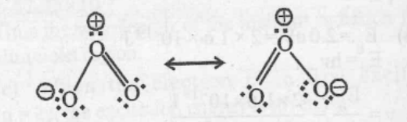
The shape of ozone molecules is
In it we find 2σ and 1π bond, i.e., the correct answer is 2 sigma and 1 pi bond
The correct order of increasing bond angles in the following triatomic species is:
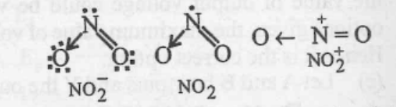
From the structure of three species we can determine the number of lone pair electrons on the central atom (i.e. N atom) and thus the bond angle.
We know that higher the number of lone pairs of electron on the central atom, greater is the lp–lp repulsion between Nitrogen and Oxygen atoms. Thus smaller is the bond angle.
The correct order of bond angle is
NO₂⁻ < NO₂ < NO₂⁺
Which of the following are not the state functions?
(I) q + w
(II) q
(III) w
(IV) H − TS
We know that q (heat) and work (w) are not state functions but (q + w) is a state functions. H – TS (i.e. G) is also a state function.
Cornea transplant in humans is almost never rejected. This is because
Cornea transplant in humans is almost never rejected. This is because it has no blood supply. Cornea is a transparent layer of tissue, continuous with the sclerotic, that forms the front part of the vertebrate eye, over the iris and lens.
The blood calcium level is lowered by the deficiency of
A peptide hormone secreted by the parathyroid gland in response to low levels of calcium in the blood. It acts to maintain normal blood levels of calcium by increasing the number of osteoclasts, which break down the bone matrix and release calcium into the blood. It also increases the reabsorption of calcium and magnesium ions in the kidney tubules, so that their concentration is maintained in the blood.
Which one of the following pairs of organs includes only the endocrine glands?
Parathyroid and adrenal are the endocrine glands. Adrenal glands are the pairs of endocrine glands situated immediately above the kidneys. Hence they are also known as suprarenal glands.
Parathyroid glands are the two pairs of endocrine glands situated behind or embedded within the thyroid gland in higher vertebrates. They produce parathyroid hormone, which controls the amount of calcium in the blood.
Unisexuality of flowers prevents
Unisexuality of flowers prevents autogamy, but not geitonogamy. In self fertilisation, the male and female gametes are derived from the same individual. Among plants, self fertilization also called autogamy is common in many cultivated species, e.g., wheat and oats.
However, self fertilization is a form of inbreeding and does not allow for the mixing of genetic material; if it occurs over a number of generations it will result in offspring being less vigorous and productive than those resulting from cross fertilization.
What does the filiform apparatus do at the entrance into ovule?
Filiform apparatus helps in the entry of pollen tube into a synergid in ovule.
Filiform apparatus is form of finger like projection comprising a core of micro fibrils enclosed in a sheath. The filiform apparatus resembles transfer cells meant for short distance movement of metabolites. The filiform apparatus is responsible for the absorption of food from the nucleus.
Endosperm is consumed by developing embryo in the seed of
In pea, endosperm is consumed by developing embryo in the seed. The endosperm is completely absorbed by the growing embryo and the food reserve gets stored in the cotyledons. Such seeds are called non endospermic or exalbuminous.
Dry indehiscent single‑seeded fruit formed from bicarpellary syncarpous inferior ovary is
Dry indehiscent single-seeded fruit formed from bicarpellary syncarpous inferior ovary is cypsela. Cypsela is also calied inferior, false or pseudocarpic achene, the thin fruit wall (developed from pericarp and thalamus)is attached to the seed at one point but the fruits develops from an inferior, unilocular and uniovuled ovary, e.g., sunflower, marigold. Some cypsela develop pappus for dispersal e.g. Soncus, Taraxacum.
The fleshy receptacle of syconus of fig encloses a number of:
The fleshy receptacle of syconus of fig encloses a number of Achenes. Achene is the thin dry pericarp is free from seed except at one point. The fruit develops from a monocarpellary pistil having superior unilocular and ovuled ovary.
The fruit is chambered, developed from inferior ovary and has seeds with succulent testa in
The fruit of pomegranate is chambered, developed from inferior ovary and has seeds with succulent testa. The fruit is Balausta. It is a special type of false or pseudocarpic
berry in which the syncarpous pistil consists of two rows of fused carpels, one above the other.
Which one of the following statements is incorrect about menstruation?
In human female, the periodic discharge of blood, mucus and cellular debris from uterine wall from non pregnant women of sexual maturity is known as menstrual
cycle. Few hours before the start of menstruation, the spiral arterioles constrict one by one resulting into the blanched mucosa. The mucosa shrinks and the death of the blood deprived tissues takes place. Blood clotting doesn’t occur due to presence of fibrinolysin.
Which extra‑embryonic membrane in humans prevents desiccation of the embryo inside the uterus?
An organizer is a signal aligning center that directs the development of embryo or part of embryo, e.g. in amphibians, it is dorsal tip of blastophore.
Given below are four methods (A-D) and their modes of action (a-d) in achieving contraception. Select their correct matching from the four options that follow:
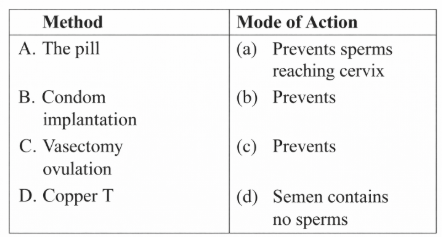
A. The pill — Prevents ovulation
B. Condom — Prevents sperm reaching cervix
C. Vasectomy — Semen contains nosperms
D. Copper‑T — Prevent implantation
Consider the statements given below regarding contraception and answer as directed thereafter
(i) Medical Termination of Pregnancy (MTP) during first trimester is generally safe
(ii) Generally chances of conception are nil until mother ‘breast-feeds the infant upto two years
(iii) Intrauterine devices like copper-T are effective contraceptives
(iv) Contraception pills may be taken upto one week after coitus to prevent conception
Which two of the above statements are correct?
Statements i and iii are correct.
Medical Termination of Pregnancy (MTP) during first trimester is generally safe.
Intrauterine device like copper‑T are effective contraceptives.
Which one of the following conditions in humans is correctly matched with its chromosomal abnormality/linkage?
Klinefelter’s syndrome is a genetic disorder affecting men in which an individual gains an extra X chromosome, so that the usual karyotype of XY is replaced by XXY. Symptoms of Klinefelter, syndrome named after U.S. physician H.P. Klinefelter, include female characteristics (such as breast enlargement).
Haploids are more suitable for mutation studies than the diploids. This is because
Haploids describes a nucleus cell or organism with a single set of unpaired chromosomes. The haploid number is designated as X. Reproductive cells, formed as a result of meiosis are haploid. Fusion of two such cells restores the normal diploid number. Therefore, haploids are more suitable for mutation studies than the diploids. This is because all mutations, whether dominant or recessive are expressed in haploids.
Which one of the following pairs of nitrogenous bases of nucleic acids, is wrongly matched with the category mentioned against it?
Purine is an organic nitrogenous base sparingly soluble in water, that gives rise to a group of biologically important derivatives, notably adenine and guanine, which occur in nucleotides and nucleic acids (DNA and RNA).
Which one of the following pairs of codons is correctly matched with their function or the signal for the particular amino acid?
GCU indicates alanine but GUU indicates valine. Stop codons are AUG, UGA and UAA.
AUG is the most common start codon which codes for methionine.
UUA indicates leucine but UCA indicates serine.
Polysome is formed by
Polysome (Polyribosome) is a complex formed by several ribosomes attached to a single mRNA molecule in the process of translation.
In the DNA molecule
In the DNA molecule, there are two strands which run anti‑parallel, one in 5’–3’ direction and the other in 3’–5’ direction. The two strands are held together by hydrogen bonds between their bases. Adenine (A), a purine of one chain is exactly opposite to thymine (T), a pyrimidine of the other chain. Similarly, cytosine (C), a pyrimidine lies opposite to guanine (G), a purine. This allows a sort of lock & key arrangement between large sized purine & small sized pyrimidine. It is strengthened by the appearance of hydrogen bonds between the two.
Which one of the following scientists name is correctly matched with the theory put forth by him?
The theory of the continuity of the germplasm published by August Weismann (1834–1914) in 1886. It proposes that the contents of the reproductive cells (sperms and ova) are passed on unchanged from one generation to the next, unaffected by any changes undergone by the rest of the body. It thus rules out any possibility of the inheritance of acquired characteristics, and has become fundamental to Neo‑Darwinian theory.
Darwinism finches are an excellent example of
Darwin’s Finches are an excellent example of adaptive radiation. Adaptive radiation is the occurrence of the diversification of a single or small groups of species into a large
number or descendents that occupy various ecological niches. This is an evolutionary process driven by natural selection.
Thorn of Bougainvillea and tendril of Cucurbita are example of
Thorn of Bougainvillea and tendril of Cucurbita are example of homologous organs.
Which one of the following pairs of items correctly belongs to the category of organs mentioned against it?
Nephridia of earthworm and malphigian tubules of cockroach belongs to excretory organs. Earthworm has a well‑developed excretory system which is composed of large number of minute, coiled and glandular segmentally arranged excretory tubules called the nephridia. Malphigian tubules of cockroach are extremely fine yellowish unbranched thread‑like structure present at the function of midgut and hindgut.
Which one of the following is incorrect about the characteristics of protobionts (coacervates and microspheres) as envisaged in the biogenic origin of life?
Coacervate is an aggregate of macromolecules such as proteins, lipids and membrane, and contain enzymes that are capable of converting substances such as glucose into more complex molecules, such as starch. Coacervate droplets arise spontaneously under appropriate conditions and may have been the prebiological systems from which living organisms originated.
Match the disease in Column I with the appropriate items (pathogen/prevention/treatment) in Column II.
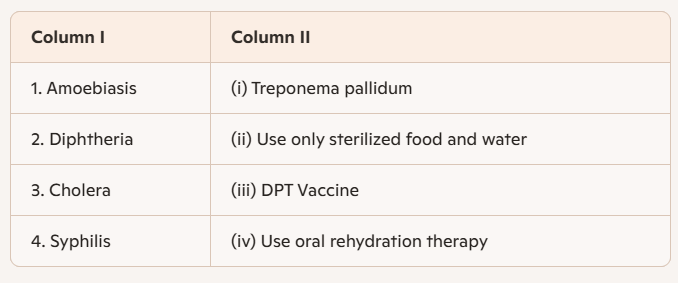
Amoebiasis : Use only sterilized food and water
Diphtheria : DPT Vaccine
Cholera : Use oral rehydration therapy
Syphilis : Treponema pallidum
To which type of barriers under innate immunity, do the saliva in the mouth and the tears from the eyes, belong?
The saliva in the mouth and the tears from the eyes belong to physiological barriers.
Which one of the following is the correct statement regarding the particular psychotropic drug specified?
Hashish causes after‑thought perceptions and hallucinations. Hashish is a preparation of Cannabis composed of the compressed trichomes collected from the Cannabis plant. Psychoactive effects vary between types of Hashish but are usually the same as those of other Cannabis preparations such as marijuana. Hashish is generally prohibited to the same extent as all other forms of cannabis. It is consumed in much the same way as Cannabis buds, used by itself in miniature smoking pipes, vapourized, hot‑knifed, or smoked in joints mixed with tobacco, Cannabis buds or other herbs.
Which one of the following is being tried in India as a biofuel substitute for fossil fuels?
Jatropha is being tried in India as a biofuel substitute for fossil fuels. Biofuels are the fuels of biological origin. They consist of renewable form of energy.
Energy problems can be solved up to a great extent by efficient and proper used of these biofuels.
Consider the following four measures (a–d) that could be taken to successfully grow chickpea in an area where bacterial blight disease is common
(1) Spray with Bordeaux mixture
(2) Control of the insect vector of the disease pathogen
(3) Use of only disease-free seeds
(4) Use of varieties resistant to the disease
Which two of the above measures can control the disease?
Use of only disease free seeds and use of disease resistant varieties are the most important control measures that could be taken to successfully grow chickpea in an
area where bacterial blight disease is common.
Which one of the following proved effective for biological control of nematodal disease in plants?
Paecilomyces is a cosmopolitan filamentous fungus which inhabits the soil, decaying plants, and food products. Some species of Paecilomyces are isolated from insect. The telomorphs of Paecilomyces are classified in the genera Cilromocleista, Talaromyces. Paecilomyces is usually considered as a contaminant but may also cause
infections in humans and animals.
Trichoderma harzianum has proved a useful microorganism for
Trichoderma harzianum has proved a useful microorganism for biological control of soil borne plant pathogens. Trichoderma harzianum is a fungus that is also used as a fungicide. It is used for foliar application, seed treatment and soil treatment for suppression of various disease causing fungal pathogens. Commercial biotechnological products such as 3 Tac have been useful for treatment of Botrytis, Fusarium, Penicillium sp. It is also used for manufacturing enzymes.
Modern detergents contain enzyme preparations of:
Modern detergent contain enzymes preparations of alkaliphiles. Alkaliphiles live in alkaline environments like soda lakes, or alkaline soil. The pH level in alkaline substances is from about 9 to 11 on the pH scale. The alkaliphiles keep an alkaline level of about pH 9 inside the cells, but the environment has a higher level of alkalinity. Alkaliphiles can keep the right pH level by pumping in hydrogen ions in out at the right rate.
Human insulin is being commercially produced from a transgenic species of
Human insulin is being commercially produced from a transgenic species of Escherichia coli. E. coli is a bacterium that is commonly found in the lower intestine of warm blooded animals. The bacteria can also be grown easily and its genetics are comparatively simple and easily manipulated, making it one of the best studied prokaryotic model organisms, and an important species in biotechnology.
Which one of the following is linked to the discovery of Bordeaux mixture as a popular fungicide?
Downy mildew of grapes disease is linked to the discovery of Bordeaux mixture as a popular fungicide. Bordeaux mixture was discovered by Millardet in France in 1882. Bordeaux mixture is prepared by dissolving 40g of copper sulphate and 40 g of calcium hydroxide in 5 litres of water. Bordeaux mixture is used primarily as a fungicide, it was first used to control downy mildew disease of grape‑vine caused by a fungus, Plasmopara viticola.
The linking of antibiotic resistance gene with the plasmid vector became possible with
The linking of antibiotic resistance gene with the plasmid vector became possible with DNA ligase. DNA ligase is an enzyme that is able to join together two portions of DNA and therefore plays an important role in DNA repair. DNA ligase is also used in recombinant DNA technology as it ensures that the foreign DNA is bound to the plasmid into which it is incorporated.
Gel electrophoresis is used for
Gel electrophoresis is a technique far separation of DNA fragments according to their size. DNA is negatively charged so in gel tank when electricity is passed, DNA move towards positive electrode.
What is antisense technology?
An RNA molecule whose base sequence is complementary to that of the RNA transcript of a gene, i.e. the sense RNA, such as a messenger RNA (mRNA). Hence, an antisense RNA can undergo base pairing with its complementary mRNA sequence. This blocks gene expression, either by preventing access for ribosome to translate the mRNA or by triggering degradation of the double stranded RNA by ribonuclease
enzymes. Antisense RNA and DNA both have therapeutic potential for modifying the activity of disease causing genes.
Cry endotoxins obtained from Bacillus thuringiensis are effective against
Cry endotoxin obtained from Bacillus thuringiensis are effective against bollworms. A bollworm is a common term for any larva of a moth that attacks the fruiting bodies
of certain crops, especially cotton.
Consider the following statements about biomedical technologies?
During open heart surgery blood is circulated in the heart‑lung machine
Blockage in coronary arteries is removed by angiography
Computerised axial tomography (CAT) shows detailed internal structure as seen in a section of body
X‑ray provides clear and detailed images of organs like prostate glands and lungs Which two of the above statements are correct?
A modern hospital can make use of variety of sophisticated instruments and equipment for accurate diagnosis and treatment of diseases. Three main categories of instruments and equipments used are diagnostic, imaging and therapeutic. From the above given statements, statement 1 & 3 are correct.
During open heart surgery blood is circulated in the heart lung machine.
Computerised Axial Tomography (CAT) shows detailed internal structure as seen in a section of body.
A transgenic food crop which may help in solving the problem of night blindness in developing countries is
Golden rice is a transgenic food crop which may help in solving the problem of night blindness in developing countries. Golden rice or miracle rice is rich in vitamin A or β‑carotene and iron.
Consider the following four statements (a–d) about certain desert animals such as kangaroo rat.
They have dark colour and high rate of reproduction and excrete solid urine
They do not drink water, breathe at a slow rate to conserve water and have their body covered with thick hairs
They feed on dry seeds and do not require drinking water
They excrete very concentrated urine and do not use water to regulate body temperature
Which two of the above statements for such animals are true?
Characteristics of certain desert animals such as kangaroo, rat are
They feed on dry seeds and do not require drinking water.
They excrete very concentrated urine and do not use water to regulate body temperature.
What is true about the isolated small tribal populations?
‘A’ is more recent and shows slight reduction in growth rate.
About 70% of total global carbon is found in
About 70% of total global carbon is found in oceans. This oceanic reservoir regulates the amount of carbon dioxide in the atmosphere. Atmosphere contains only about one percent of total global carbon.
The slow rate of decomposition of fallen logs in nature is due to their
Low moisture content will lead to decrease in number of decomposers because decomposers need an optimum moisture for their growth and functioning.
Consider the following statements concerning food chains
removal of 80% tigers from an area resulted in greatly increased growth of vegetation
removal of most of the carnivores resulted in an increased population of deers
the length of food chains is generally limited to 3–4 trophic levels due to energy loss
the length of food chains may vary from 2 to 8 trophic levels
Which two of the above statements are correct?
Food chain is the transfer of energy from green plants (Primary producers), through a sequence of organisms occupies in a food chain is known as its trophic level. Therefore, statements b and c are correct.
The table below gives the population (in thousands) of ten species (A–J) in four areas (a–d) consisting of the number of habitats given within brackets against each. Study the table and answer the question which follows:
Which area out of a to d shows maximum species diversity?
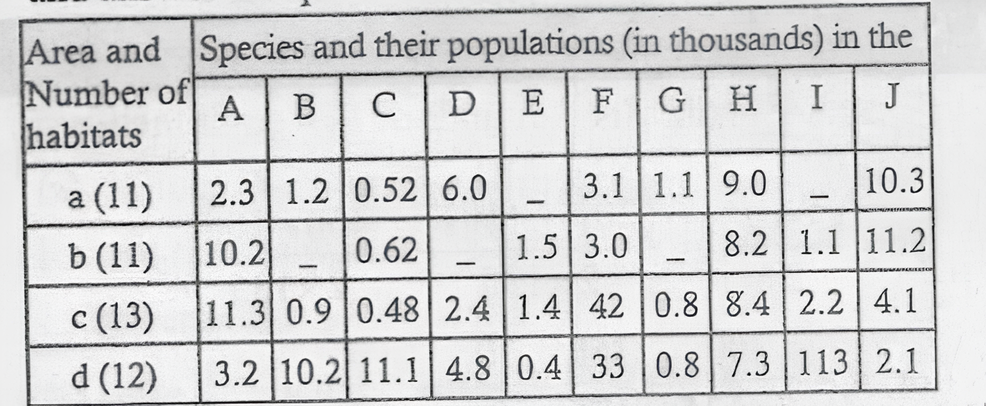
Species richness refers to the number of species per unit area. Species evenness is the relative abundance with which each species is represented in an area. Thus variation in the number of species, kinds of species as well as the number of individuals per species lead to diversity. Area(d) and number of habitats (12) shows the maximum species diversity.
Quercus species are the dominant component in
Quercus species is a dominant component in temperate - deciduous forests. The common name of Quercus is cork oak belongs to family fabaceae. Cork used as a bottle stoppers, soles for shoes, insulating material and for manufacture of linoleum.
Which one of the following is not observed in biodiversity hotspots?
Lesser inter-specific competition is not observe in biodiversity hotspots, levels of species richness and high degree of endemism. Initially 25 biodiversity hotspots
were identified but subsequently nine more have of biodiversity hotspots in the world to 34. These hotspots are also regions of accelerated habitat loss.
World Summit on Sustainable Development (2002) was held in
World Summit on sustainable development (2002) was held in Johannesburg, South Africa, 190 countries pledged their commitment to achieve by 2010, a significant in reduction the current rate of biodiversity loss at global, regional and local levels.
According to Central Pollution Control Board (CPCB), which particulate size in diameter (in micrometers) of the air pollutants is responsible for greatest harm to human health?
The Central Pollution Control Board (CPCB), statutory organisation, was constituted in September 1974 under the Water (Prevention and Control of Pollution) Act 1974. Further, CPCB was entrusted with the powers and functions under Air (Prevention and Control of Pollution) Act, 1981. It serves as a field formation and also provides technical services to the Ministry of Environment and Forest, of the provisions of the Environment (Protection) Act, 1986. Principal functions of the CPCB, as spelt out in the Water (Prevention and Control of Pollution) Act, 1974, and the Air (Prevention and Control of Pollution) Act, 1981.
(i) To promote cleanliness of streams and wells in different areas of the states by prevention, control and abatement of water pollution.
(ii) To improve the quality of air and to prevent, control or abate air pollution in the country.
A lake near a village suffered heavy mortality of fishes within a few days. Consider the following reasons for this?
Lots of urea and phosphate fertilizer were used in the crops in the vicinity
The area was sprayed with DDT by an aircraft
The lake water turned green and stinky
Phytoplankton populations in the lake declined initially thereby greatly reducing photosynthesis.
Which two of the above were the main causes of fish mortality in the lake ?
Lots of urea and phosphate fertilizer were used in the crops in the vicinity and the lake water turned green and stinky. Due to this, lake near a village suffered heavy mortality of fishes within a few days.
Which one of the following is the correct percentage of the two (out of the total of 4) green house gases that contribute to the total global warming?
CFC 14%, Methane 20% is the correct percentage of the two (out of the total 4) greenhouse gases that contribute to the total global warming. A regular assessment of abundance of greenhouse gases and their impact on global environment is being made by IPCC (Inter‑Governmental Panel on Climate Change). The various greenhouse gases are CO₂ (warming effect 60%), CH₄ (effect 20%), chlorofluorocarbons or CFCs (14%) and nitrous oxide (N₂O, 6%). Others of minor significance are water vapours and ozone.
In human adult females oxytocin:
In human adult females, oxytocin is a hormone released by the pituitary gland (neurohypophysis), that causes contraction of uterine muscles during labour.
What is vital capacity of our lungs?
Vital capacity of lungs is the largest possible expiration after largest possible inspiration that is greatest. Volume of air can be exchanged in single respiration or amount of air breathed in and out with greatest possible efforts.
Vital capacity = TV + IRV + ERV
Total lung capacity = VC + RV
So, we can say that VC = Total lung capacity - Residual volume
The C4 plants are photosynthetically more efficient than C3 plants because:
C4plants are photosynthetically more efficient than C3 plants because C4 plant contain two types of chloroplast i.e., bundle sheath chloroplast and mesophyll chloroplast. So such plants operate a dicarboxylic acid cycle in addition to Calvin
cycle. CO₂, acceptor molecule (PEP) is present in large bundle sheath cell which has higher efficiency in picking up CO₂,.
Thus, photosynthesis continues even at low CO₂, concentration and the rate of photorespiration is also negligible.
Which one of the following is incorrect about the characteristics of protobionts (coacervates and microspheres) as envisaged in the abiogenicorigin of life?
Coacervates and microspheres reproduced by asexual methods such as budding, fission and fragmentation.
Bacterial leaf blight of rice is caused by aspecies of:
Bacterial leaf blight of rice is caused by Xanthomonasoryzae a bacterium which is gram- negative, aerobic, capsulated, and motile with a single polar flagellum. Primary
infection is carried through the infected seeds. The entry of the pathogen occurs through wounds and stomata. The symptoms of the disease are the appearance of linear, yellow to straw coloured stripes, usually on both the edges of the leaf. As the disease progresses, the drying and twisting of the leaf tip occurs. The most destructive phase of the disease is the ‘Ikresek’ or wilt resulting from early systematic infection.
If a gas expands at constant temperature, it indicates that:
At any constant temperature the K.E. of gaseous molecules remains same.
Bond dissociation enthalpy of H₂, Cl₂ and HCl are 434, 242 and 431 kJ mol⁻¹ respectively. Enthalpy of formation of HCl is:
The reaction for formation of HCl can be written as
H₂ + Cl₂ → 2HCl
H–H + Cl–Cl → 2(H–Cl)
Substituting the given values, we get enthalpy of formation of
ΔH_f(HCl) = [(B.E)_H–H + (B.E)_Cl–Cl] – [2 × B.E_(H–Cl)]
= 434 + 242 – 2 × (431) = –186 kJ
∴ Enthalpy of formation for
1 mol HCl = (–186 / 2) kJ = –93 kJ
For the gas phase reaction,
PCl₅(g) ⇌ PCl₃(g) + Cl₂(g)
which of the following conditions are correct?
For the reaction:
PCl₅(g) ⇌ PCl₃(g) + Cl₂(g)
The reaction given is an example of decomposition reaction and we know that decomposition reactions are endothermic in nature, i.e. ΔH > 0.
Further
Δn = (1 + 1) – 1 = +1
Hence more number of molecules are present in products which shows more randomness i.e. ΔS > 0 (ΔS is positive).
If the concentration of OH⁻ ions in the reaction
Fe(OH)₃(s) ⇌ Fe³⁺(aq) + 3OH⁻(aq)
is decreased by 1/4 times, then equilibrium concentration of Fe³⁺ will increase by:
For this reaction K_eq is given by
K = [Fe³⁺][OH⁻]³ / [Fe(OH)₃]
= (Fe³⁺)(OH⁻)³ [∴ solid = 1]
If (OH⁻) is decreased by 1 / 4 times, then for given reaction, equilibrium constant to remain constant, we have to increase the concentration of (Fe³⁺) by a factor of (4³) i.e. 4 × 4 × 4 = 64. Thus, option (64 times) is correct.
The dissociation equilibrium of a gas AB₂ can be represented as
2AB₂(g) ⇌ 2AB(g) + B₂(g)
The degree of dissociation is ‘x’ and is small compared to 1. The expression relating the degree of dissociation (x) with equilibrium constant Kₚ and total pressure P is:
For the reaction
2 AB₂(g)⇌2 AB (g) + B₂(g)
initially 2 0 0
at equi 2(1 -x) 2x x
The partial pressure at equilibrium are calculated on the basis of total numbers of moles at equilibrium.
Total number of moles
= 2 (1- x) + 2x + x = (2 + x)
∴ P_AB₂ = (2(1 - x) / (2 + x)) × P where P is the total pressure.
P_AB = (2x / (2 + x)) × P, P_B₂ = (x / (2+x)) ×P
Since x is very small so can be neglected in denominator Thus, we get
P_AB₂ = (1 - x) × P P_AB = x × P
P_B₂ = x / 2 ×P
Now, K_P = ((P_AB)² (P_B₂) / (P_AB₂)²) = ((x)² × P²·P× x / 2 / (1-x)² × P²)
= (x³·P³ / 2 × 1 × P²) [∵ 1 - x ≃1]
= x³·P / 2 or x³ = (2·Kp / P) or x = (2K_P/ P)¹ᐟ³
The values of Kp₁ and Kp₂ for the reactions:
X ⇌ Y + Z ...(a)
A ⇌ 2B ...(b)
are in the ratio of 9 : 1. If degree of dissociation of X and A be equal, then total pressure at equilibrium for (a) and (b) are in the ratio:
Given reaction are
x⇌ Y+Z ...(i)
and A ⇌ 2B ...(ii)
Let the total pressure for reaction (i) and (ii) be P₁ and P₂ respectively, then
Kp₁/Kp₂ = 9/1 (given)
After dissociation
x⇌Y+Z
(1-α) α α
At equilibrium
[Let 1 mole of X dissociate with α as degree of dissociation]
Total number of moles = 1-α + α+ α = (1+α)
Thus Pₓ = (1-α/1+α)· P₁; P_y= (α/1+α) P₁;
P_z = (α/1+α)·P₁
∴Kp₁= (α/1+α)·P₁×α/(1+α)·
P₁/(1-α/1+α)·P₁ ....(i)
Similarly for A⇌2B
At equilibrium (1-α) 2α
We have,
Kp₂ = (2αP₂/1+α)² / (1-α/1+α) P₂ ....(ii)
Diving (i) by (ii), we get
Kp₁/Kp₂ = α²·P₁/4α²·P₂ or Kp₁/Kp₂ = 1/4 · P₁/P₂
or 9= 1/4 · P₁/P₂ [∴ Kp₁/Kp₂ = 9/1]
or P₁/P₂ = 36/1 or P₁: P₂ = 36:1
Equal volumes of three acid solutions of pH3, 4, and 5 are mixed in a vessel. What will be the H⁺ ion concentration in the mixture?
[H₃O]⁺ for a solution having pH = 3 is given by
[H₃O]⁺ = 1 × 10⁻³ moles/litre [∴ [H₃O]⁺ = 10⁻ᵖᴴ]
Similarly for solution having pH = 4,
[H₃O]⁺ = 1 × 10⁻⁴ moles/litre and for pH = 5
[H₃O]⁺ = 1 × 10⁻⁵ moles/litre
Let the volume of each solution in the mixture be 1 L ,then total volume of mixture solution
(1+1+1) L = 3 L
Total [H₃O]⁺ ion present in mixture solution
= (10⁻³ + 10⁻⁴ + 10⁻⁵) moles
Then [H₃O]⁺ ions concentration of mixture solution
= ((10⁻³ + 10⁻⁴ + 10⁻⁵) / 3) M = (0.00111 / 3) M
= 0.00037 M = 3.7 × 10⁻⁴ M.
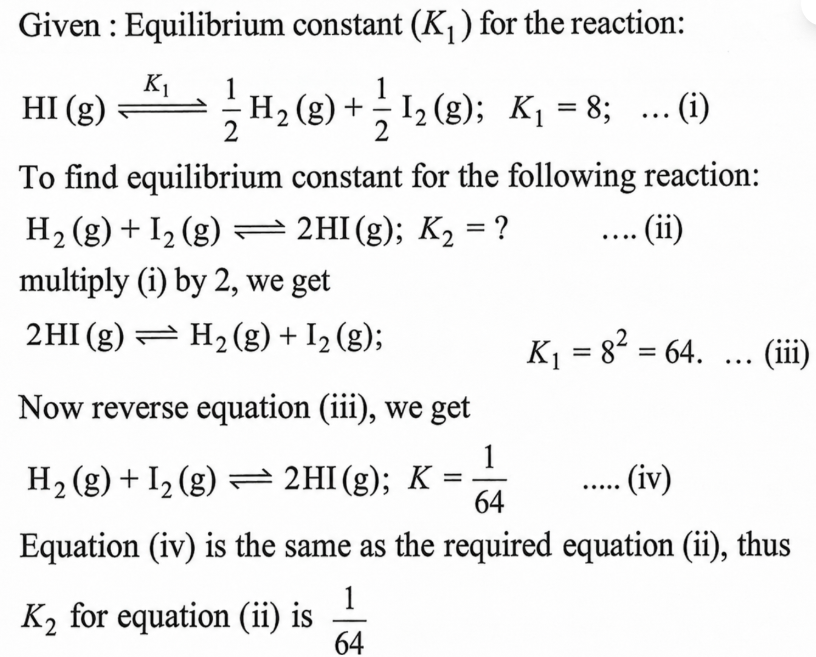
The value of equilibrium constant of the reaction
HI(g) ⇌ (1 / 2) H₂(g) + (1 / 2) I₂(g) is 8.0.
The equilibrium constant of the reaction
H₂(g) + I₂(g) ⇌ 2HI(g) will be:
Equimolar solutions of the following were prepared in water separately. Which one of the solutions will record the highest pH?
The highest pH will be recorded by the most basic solution. The basic nature of hydroxides of alkaline earth metals increase as we move from Mg to Ba thus the solution of BaCl₂ in water will be most basic and so it will have highest pH.
The sequence of ionic mobility in aqueous solution is:
Smaller the ion, more is its ionic mobility in aqueous solution. Ionic radii of the given alkali metals is in the order Na⁺ < K⁺ < Rb⁺ < Cs⁺ and thus expected ionic mobility will be in the same order Cs⁺ < Rb⁺ < K⁺ < Na⁺. However, due to high degree of solvation (or hydration) and because of lower size or high charge density, the hydrated ion size follows the same order Cs⁺ > Rb⁺ > K⁺ > Na⁺ and thus, conductivity order is Cs⁺ > Rb⁺ > K⁺ > Na⁺.
The alkali metals form salt‑like hydrides by the direct synthesis at elevated temperature. The thermal stability of these hydrides decreases in which of the following orders?
The stability of alkali metal hydrides decreases from Li to Cs. It is due to the fact that M–H bonds become weaker with increase in size of alkali metals as we move down the group from Li to Cs. Thus the order of stability of hydrides is
LiH > NaH > KH > RbH > CsH
In the hydrocarbon
CH₃ – CH = CH – CH₂ – C ≡ CH
6 5 4 3 2 1
The state of hybridization of carbons 1, 3, and 5 are in the following sequence:
C–1 is sp hybridized (C≡C)
C–3 is sp³ hybridized (C–C)
C–5 is sp² hybridized (C=C)
Correct sequence: sp, sp³, sp²
The amount of s‑character in various hybrid orbitals is as follows.
sp = 50%, sp² = 33%, sp³ = 25%
Therefore, s‑character of the C–H bond in acetylene (sp) is greater than that of the C–H bond in alkene (sp² hybridized), which in turn has greater s‑character of the C–H bond in alkanes. Thus, owing to a high s‑character of the C–H bond in alkynes, the electrons constituting this bond are more strongly held by the carbon nucleus with the result the hydrogen present on such a carbon atom can be easily removed as a proton.
The acidic nature of three types of C–H bonds follows the order
≡C–H > =C–H > –C–H
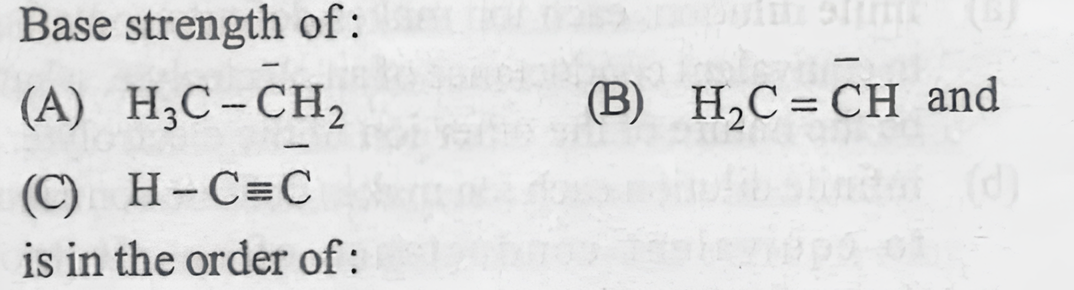
Further, as we know that conjugate base of a strong acid is a weak base, hence the correct order of basicity is:

The stability of carbanions in the following:
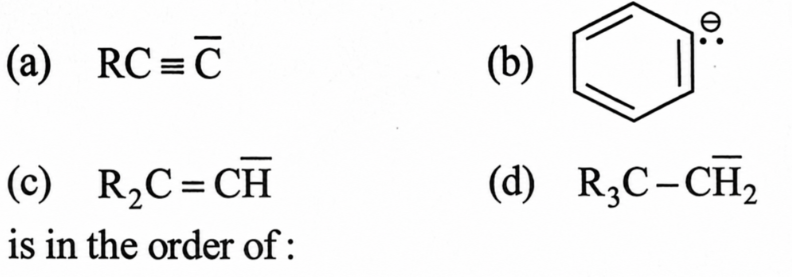
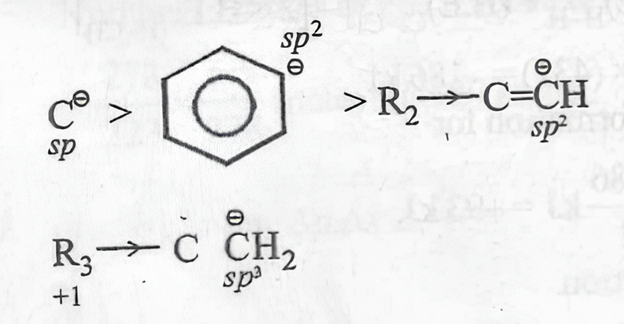
As 's' character increases, stability of carbanion increases. Electron donating groups decrease stability of carbanion. Hence, correct stability order:
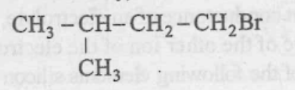
-
(A)
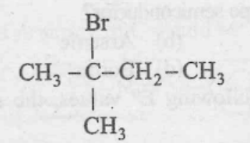
-
(B)
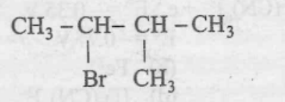
-
(C)
-
(D)
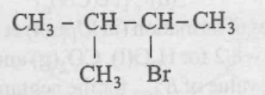
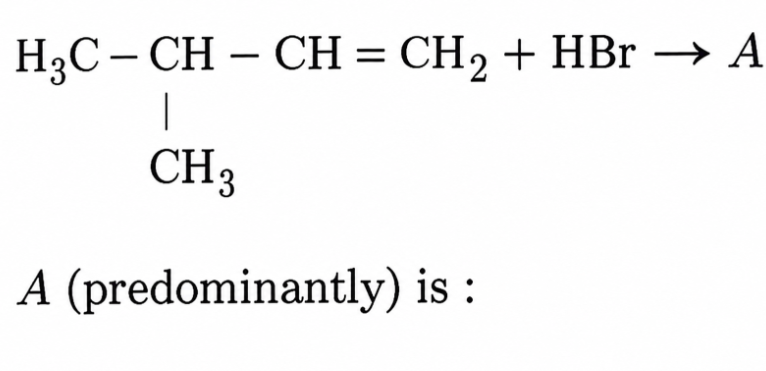
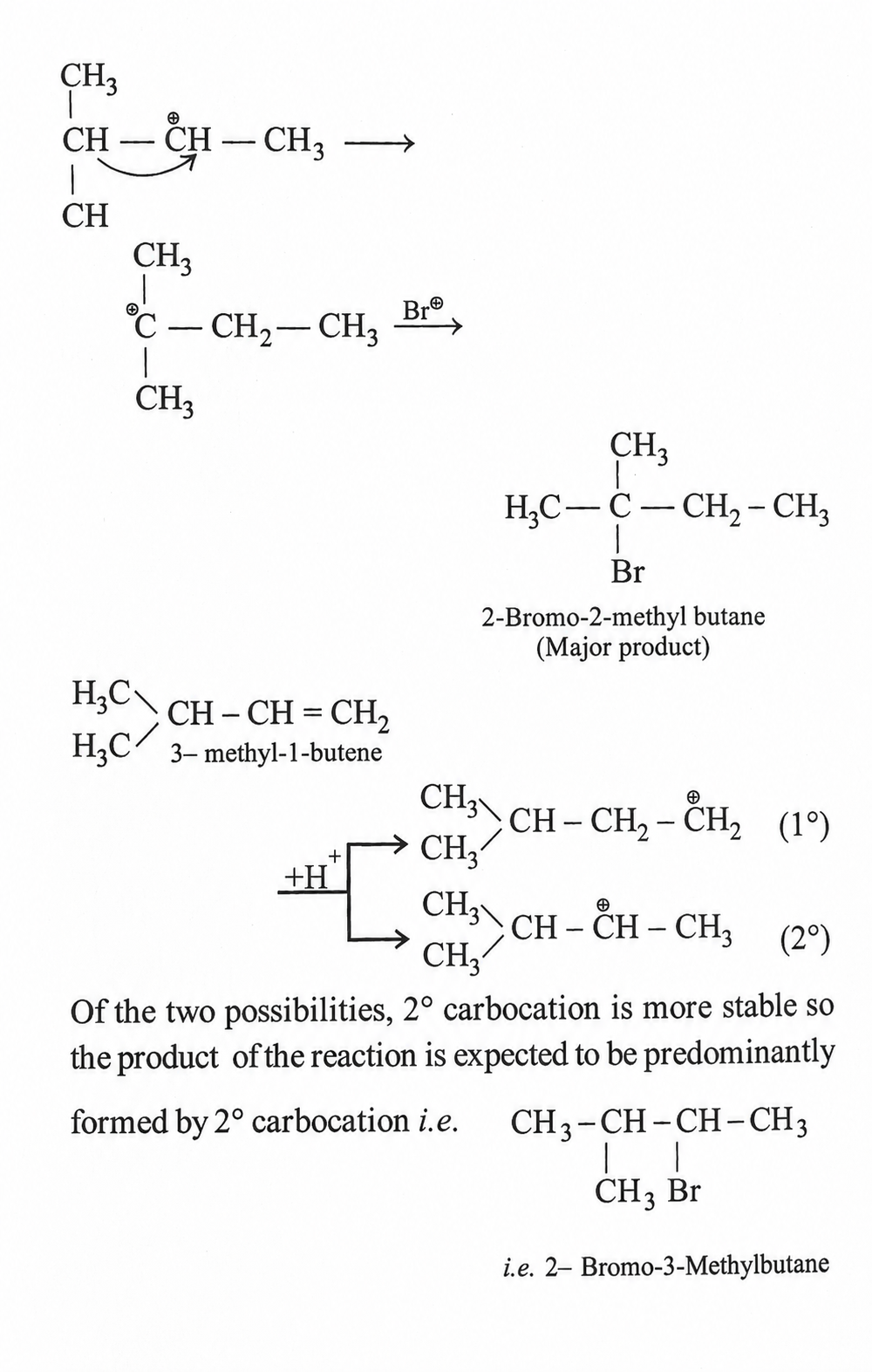
The formed 2° carbocation will rearrange to a more stable 3° carbocation as :
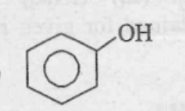
Which one of the following is most reactive towards electrophilic attack ?
-
(A)
-
(B)
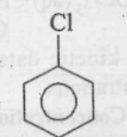
-
(C)
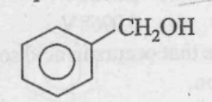
-
(D)
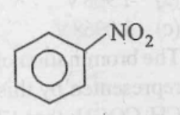
Out of the given compounds the most reactive towards nucleophilic attack is
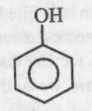
Green chemistry means such reactions which
Green chemistry are the reaction, which reduces the use of hazardous chemicals.
Percentage of free space in a body centred cubic unit cell is:
Percentage of occupied space in a bcc is 68%.
∴ Percentage of free space in a bcc is
(100 – 68) = 32%
If ‘a’ stands for the edge length of the cubic systems:
simple cubic, body centred cubic and face centred cubic, then the ratio of radii of the spheres in these systems will be respectively,
Following generalization can be easily derived for various types of lattice arrangements in cubic cells between the edge length (a) of the cell and r the radius of the sphere.
For simple cubic : a = 2r or r = a / 2
For body centred cubic:
a = (4 / √3)r or r = (√3 / 4)a
For face centred cubic:
a = 2√2r or r = (1 / 2√2)a
Thus the ratio of radii of spheres will be simple: bcc : fcc
= a / 2 :(√3 / 4)a :(1 / 2√2)a
Kohlrausch’s law states that at:
Kohlrausch’s Law states that at infinite dilution, each ion migrates independently of its co‑ion and contributes to the total equivalent conductance of an electrolyte a definite share which depends only on its own nature.
From this definition we can see that option (infinite dilution, each ion makes definite contribution to equivalent conductance of an electrolyte, whatever be the nature of the other ion of the electrolyte.) is the correct answer.
With which one of the following elements silicon should be doped so as to give p‑type semiconductor?
The semiconductors formed by the introduction of impurity atoms containing one elecron less than the parent atoms of insulators are termed as p-type semiconductors.
Therefore, silicon containing 14 electrons has to be doped with boron containing 13 electrons to give a p-type semi-conductor.
On the basis of the following E° values, the strongest oxidizing agent is:
[Fe(CN)₆]⁴⁻ → [Fe(CN)₆]³⁻ + e⁻ ; E° = −0.35 V
Fe²⁺ → Fe³⁺ + e⁻ E° = −0.77 V
From the given data we find Fe³⁺
(E°_(Fe³⁺/ Fe²⁺) = + 0.77V) is strongest oxidizing agent.
Standard free energies of formation (in kJ/mol) at 298 K are –237.2, –394.4 and –8.2 for H₂O(l), CO₂(g) and pentane (g), respectively. The value of E°_cell for the pentane–oxygen fuel cell is:
Writing the equation for pentane–oxygen fuel cell at respective electrodes and over all reaction, we get
At Anode:
C₅H₁₂ + 10H₂O → 5CO₂ + 32H⁺ + 32e⁻
(pentane)
At Cathode:
8O₂ + 32H⁺ + 32e⁻ → 16H₂O
__________________________
Overall: C₅H₁₂ + 8O₂ → 5CO₂ + 6H₂O
Calculation of ΔG° for the above reaction
ΔG° = [5×(−394.4) + 6×(−237.2)] − [−8.2]
= −1972.0 − 1423.2 + 8.2 = −3387.0 kJ
= −3387000 Joules
From the overall equation we find n = 32
Using the relation ΔG° = −nFE°_cell and
substituting values we get
−3387000 = −32 × 96500 × E°_cell (F = 96500 C)
or E°_cell = 3387000 / (32×96500) = 3387000 / 3088000
= (3387 / 3088) V = 1.0968 V
The bromination of acetone that occurs in acid solution is represented by this equation:
CH₃COCH₃(aq) + Br₂(aq) → CH₃COCH₂Br(aq) + H⁺(aq) + Br⁻(aq)
These kinetic data were obtained for given reaction concentrations.
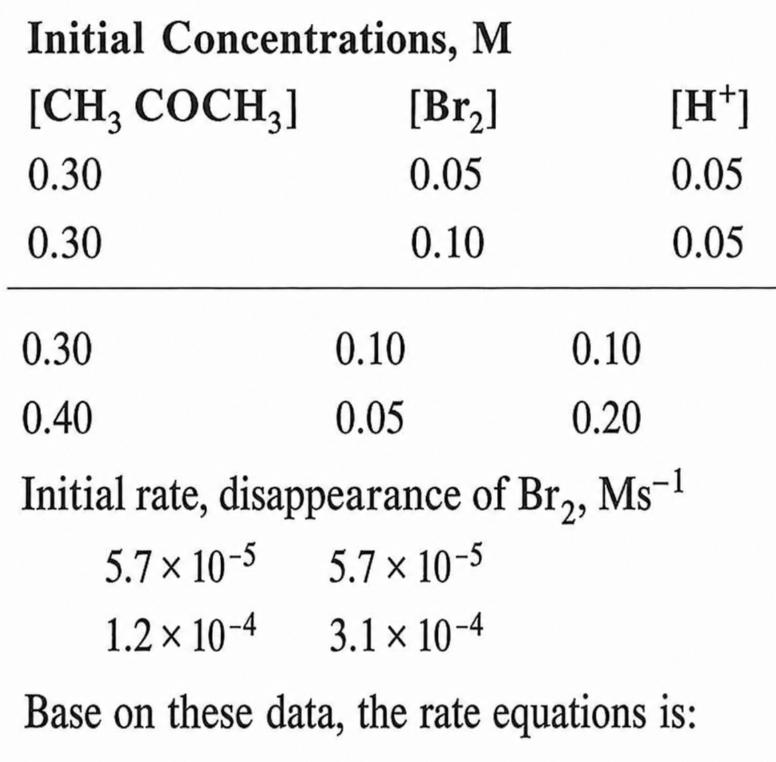
This reaction is autocatalyzed and involves complex calculation for concentration terms.
We can look at the above results in a simple way to find the dependence of reaction rate (i.e. rate of disappearance of Br₂).
From data (1) and (2) in which concentration of CH₃COCH₃ and H⁺ remain unchanged and only the concentration of Br₂ is doubled, there is no change in rate of reaction. It means the rate of reaction is independent of concentration of Br₂.
Again from (2) and (3) in which (CH₃COCH₃) and (Br₂) remain constant but H⁺ increases from 0.05 M to 0.10 i.e. doubled, the rate of reaction changes from 5.7×10⁻⁵ to 1.2×10⁻⁴ (or 12×10⁻⁵), thus it also becomes almost doubled. It shows that rate of reaction is directly proportional to [H⁺]. From (3) and (4), the rate should have doubled due to increase in conc of [H⁺] from 0.10 M to 0.20 M but the rate has changed from 1.2×10⁻⁴ to 3.1×10⁻⁴. This is due to change in concentration of CH₃COCH₃ from 0.30 M to 0.40 M. Thus, the rate is directly proportional to [CH₃COCH₃].
Rate = k[CH₃COCH₃]¹[Br₂]⁰[H⁺]¹
= k[CH₃COCH₃][H⁺]
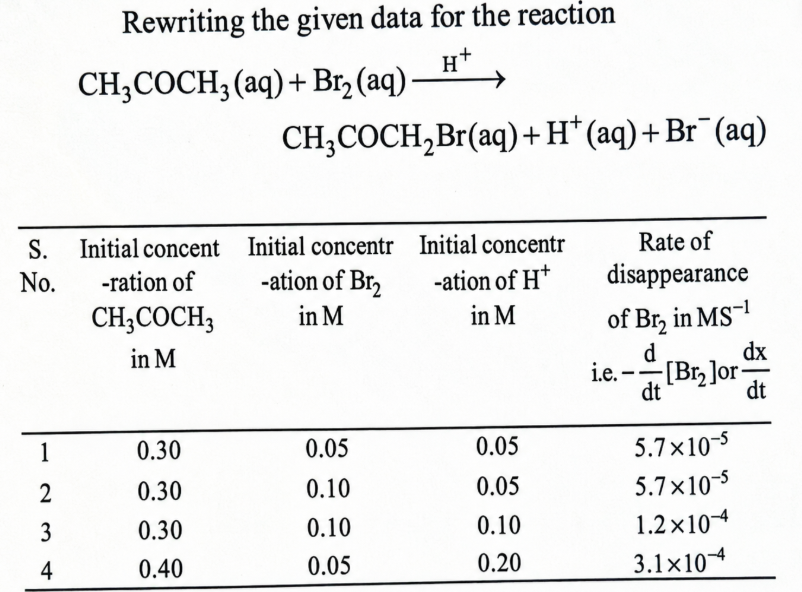
The rate constants k₁ and k₂ for two different reactions are 10¹⁶. e_(-2000/T) and 10¹⁵.e_(-1000/T), respectively. The temperature at which k₁ = k₂ is:
Given: k₁ = 10¹⁶ e_(−2000/T) and k₂ = 10¹⁵ .e_(-1000/T)
When k₁ = k₂ at temperature T, we have
10¹⁶. e_(-2000/T) = 10¹⁵. e_(−1000/T)
or 10 × 10¹⁵ e_(−2000/T) = 10¹⁵ e_(−1000/T)
or 10 .e_(−2000/T) = e_(−1000/T)
or ln 10 - (2000/T) = − (1000/T)
or ln 10 = 2000/T - 1000/T
or 2.303 log 10 = 1000/T
or 2.303 × 1 × T = 1000 [∴ log 10 = 1]
or T = (1000 / 2.303) K
The correct order of decreasing second ionisation enthalpy of Ti (22), V (23), Cr (24) and Mn (25) is:
Ti ; Z (22) is 1s²2s²2p⁶3s²3p⁶4s²3d²
V ; Z (23) is 1s²2s²2p⁶3s²3p⁶4s²3d³
Cr ; Z (24) is 1s²2s²2p⁶3s²3p⁶3d⁵4s¹
Mn ; Z (25) is 1s²2s²2p⁶3s²3d⁵4s²
The Second electron in all the cases (except Cr) is taken out from 4s orbital and for Cr it is taken from half‑filled 3d orbital. The force required for removal of second electron will be more for Mn than (except for Cr) due to having more positive charge. Based on this, we find the correct order Mn > V > Ti.
i.e. Cr > Mn > V > Ti.
In an S_N2 substitution reaction of the type
which one of the following has the highest reactivity rate?
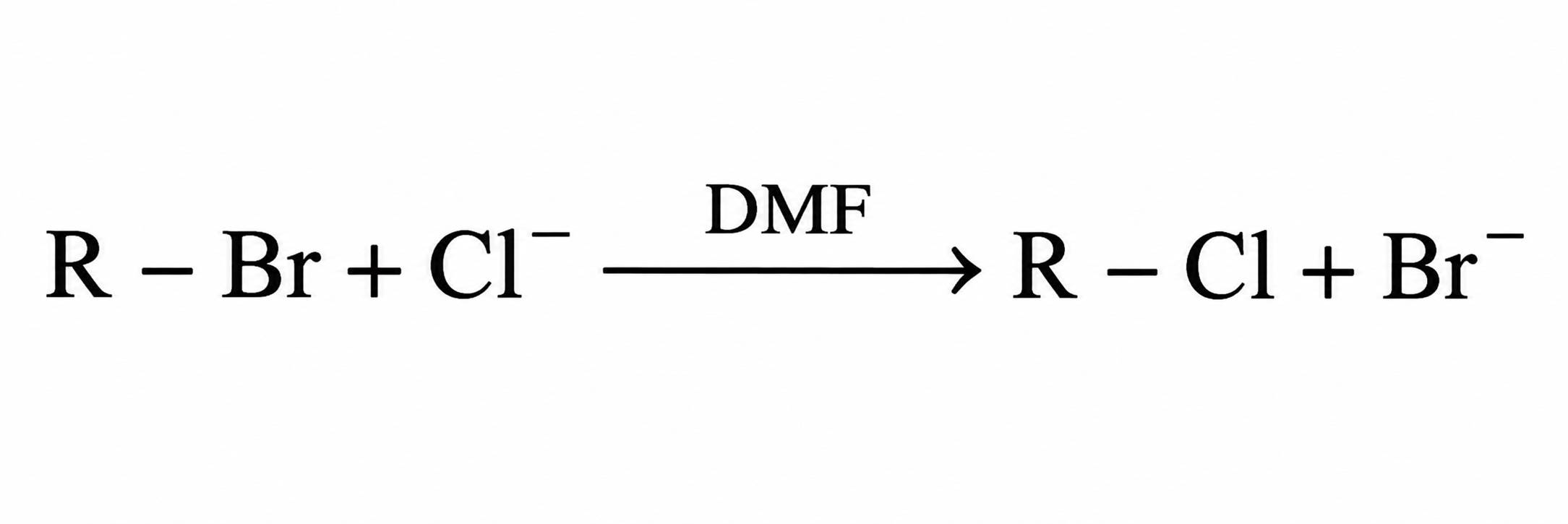
-
(A)
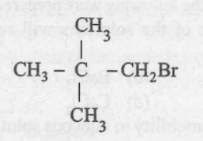
-
(B)
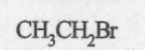
-
(C)
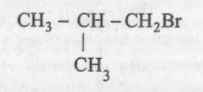
-
(D)

S_N2 mechanism is followed in case of primary and secondary halides i.e., S_N2 reaction is favoured by small groups on the carbon atom attached to halogens so reactivity order is:
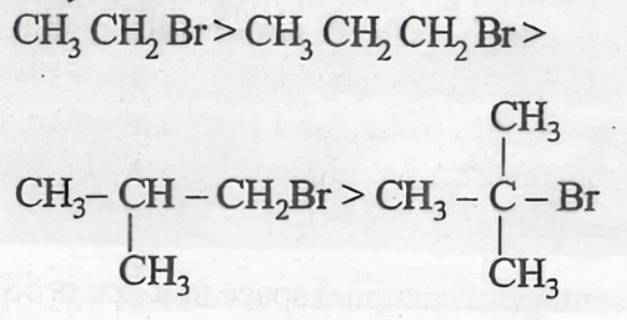
How many stereoisomers does this molecule have?
CH₃CH = CHCH₂CHBrCH₃
In the molecule
the number of stereoisomers is given by sum of geometrical isomers (because of presence of C = C) and optical isomers (because of presence of chiral carbon atom).
Number of geometrical isomers = 2 (one C = C is present).
Number of optical isomers = 2 (one chiral carbon atom).
Total number of stereoisomers = 2 + 2 = 4
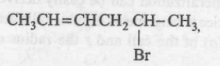
A strong base can abstract an α-hydrogen from:
A strong base (OH⁻) abstract an α — H atom from ketone which is acidic in nature.
Acetophenone when reacted with a base, C₂H₅ONa, yields a stable compound which has the structure.
-
(A)
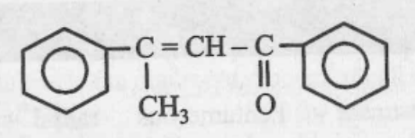
-
(B)
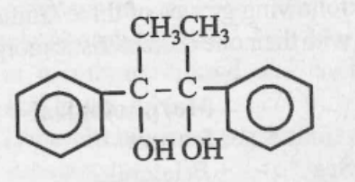
-
(C)
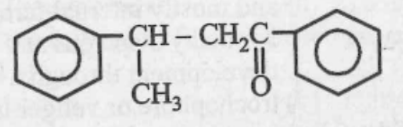
-
(D)
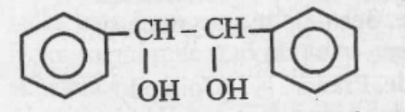
Thus, two molecules of acetophenone condense to form a β‑hydroxy ketone which gets dehydrated in the presence of acid upon heating to form α, β‑unsaturated compound.
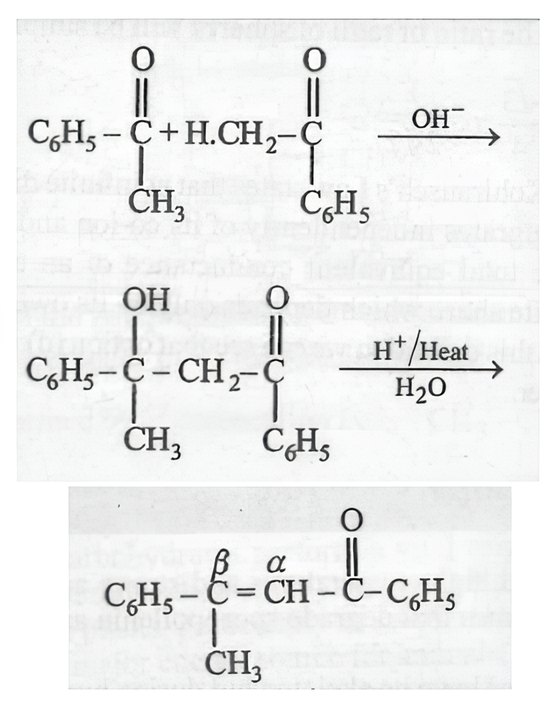
The relative reactivities of acyl compounds towards nucleophilic substitution are in the order of:
The more the basic character of the leaving group, the lesser is the reactivity. The basic character follows the order:
NH₂⁻ > OR⁻ > RCOO⁻ > Cl⁻
Hence, the relative reactivities of acyl compounds towards nucleophilic substitution follow the order Acyl halides > Acid anhydride > Ester > Amide.
Which one of the following is an amine hormone?
Thyroxine is an amino hormone.
Which one of the following statement is not true?
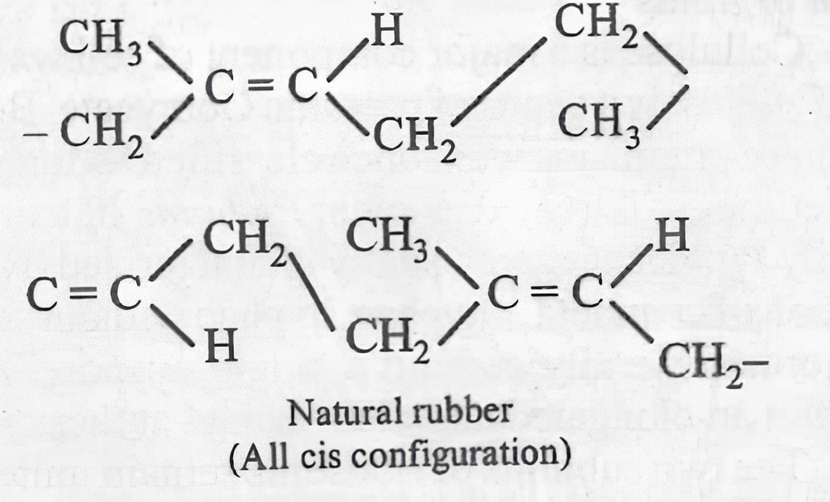
Which of the following complexes exhibits the highest paramagnetic behaviour?
where gly = glycine, en = ethylenediamine and bpy = bipyridyl moieties
(At.nos Ti = 22, V = 23, Fe = 26, Co = 27)
More the number of unpaired electrons present in a complex, more is its paramagnetic behaviour.
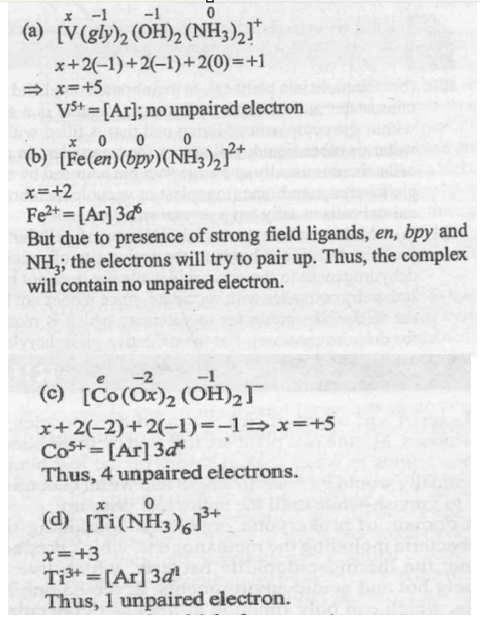
In which of the following coordination entities the magnitude Δ₀ (CFSE in octahedral field) will be maximum?
(At. No. Co = 27)
Out of the given ligands water, ammonia, cyanide and oxalate, maximum splitting will occur in case of cyanide (CN⁻), i.e. the magnitude of Δ₀ will be maximum in case of [Co(CN)₆]³⁻.
Which of the following statements is not correct?
Diamond has ZnS type structure. So, number of atoms in a unit cell of diamond is 8.
Four diatomic species are listed below the different sequences. Which of these presents the correct order of their increasing bond order?
He₂⁺ < O₂⁻ < NO < C₂²⁻
In DNA, the complimentary bases are
A = = = T
G ≡ ≡ ≡ C
In a reaction of aniline a coloured product C was obtained The structure of C would be
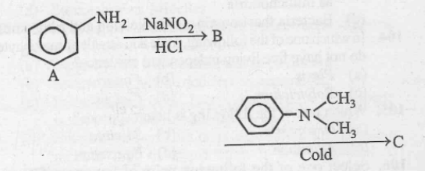
-
(A)
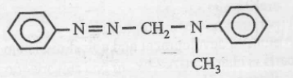
-
(B)
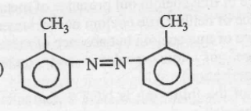
-
(C)
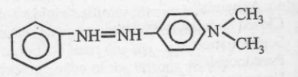
-
(D)
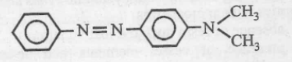
Diazotisation followed by electrophilic substitution at para position.
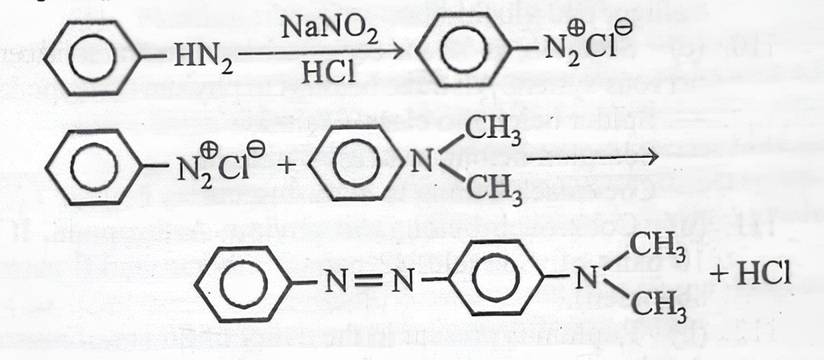
Which one of the following proved effective for biological control of nematodal disease in plants?
Paecilomyces is a cosmopolitan filamentous fungus which inhabits the soil, decaying plants, and food prod-ucts. Some species of Paecilomyces are isolated from insect. The telomorphs of Paecilomyces are classified in the genera Cilromocleista, Talaromyces. Paecilomyces is usually considered as a contaminant but may also cause infections in humans and animals.
Trichoderma harzianum has proved a useful microorgan-ism for
Trichoderma harzianum has proved a useful microor- 18 ganism for biological control of soil borne plant pathogens. Trichoderma harzianum is a fungus that is also used as a fun-gicide. It is used for foliar application, seed treatment and soil treatment for suppression of various disease causing fungal pathogens. Commercial biotechnological products such as 3 Tac have been useful for treatment of Botrytis, Fusarium, Penicillium sp. It is also used for manufacturing enzymes.
Modern detergents contain enzyme preparations of:
Modern detergent contain enzymes preparations of alkaliphiles. Alkaliphiles live in alkaline environments like soda lakes, or alkaline soil. The pH level in alkaline substances is from about 9 to 11 on the pH scale. The al-kaliphiles keep an alkaline level of about pH 9 inside the cells, but the environment has a higher level of alkalinity. Alkaliphiles can keep the right pH level by pumping in hydrogen ions in out at the right rate.
Other Years