NEET-UG 2020 Question Paper — Set 2

QUESTION PAPER

2020 NEET EXAM

NEET-UG 2020 Question Paper — Set 2

2020

NEET-UG

CBSE EXAMINATION PAPER-2020

NEET-ZOOLOGY

(Solved)

Time allowed : 3 hours

Maximum Marks : 719

General Instructions :

Read the following instructions carefully and follow them :

  1. This question paper contains 180 questions. All questions are compulsory.
  2. This question paper is divided into 1 sections.
  3. Section A – questions number 1 to 180 are multiple choice questions
  4. There is no overall choice given in the question paper. However, an internal choice has been provided in few questions.
  5. Use of calculator is NOT allowed.

Section A

Question 1.

An intrinsic semiconductor is converted into n-type extrinsic semiconductor by doping it with

[4 Marks]
  • (A) Phosphorous
  • (B) Aluminium
  • (C) Germanium
  • (D) Silver
Question 2. The half life of a radioactive sample undergoing α-decay is 1.4 × 10¹⁷ s. If the number of nuclei in the sample is 2.0 × 10²¹, the activity of the sample is nearly
[4 Marks]
  • (A) 10³ Bq
  • (B) 10⁴ Bq
  • (C) 10⁵ Bq
  • (D) 10⁸ Bq
Question 3.

The E.M. wave with shortest wavelength among the following is,

[4 Marks]
  • (A) X-rays
  • (B) Ultraviolet rays
  • (C) Microwaves
  • (D) Gamma rays
Question 4.

A wheel with 20 metallic spokes each 1 m long is rotated with a speed of 120 rpm in a plane perpendicular to a magnetic field of 0.4 G. The induced emf between the axle and rim of the wheel will be (1 G = 10⁻⁴ T)

[4 Marks]
  • (A) 4.0 × 10⁻⁵ V
  • (B) 2.51 × 10⁻⁴ V
  • (C) 2.51 × 10⁻⁵ V
  • (D) 2.51 V
Question 5.

Out of the following which one is a forward biased diode?

[4 Marks]
  • (A) Diagram 1 – NEET-UG 2020 Question Paper — Set 2
  • (B) Diagram 2 – NEET-UG 2020 Question Paper — Set 2
  • (C) Diagram 3 – NEET-UG 2020 Question Paper — Set 2
  • (D) Diagram 4 – NEET-UG 2020 Question Paper — Set 2
Question 6. Two solid conductors are made up of same material, have same length and same resistance. One of them has a circular cross section of area A₁ and the other one has a square cross section of area A₂. The ratio A₁/A₂ is
[4 Marks]
  • (A) 2
  • (B) 1.5
  • (C) 1
  • (D) 0.8
Question 7.

Two coherent sources of light interfere and produce fringe pattern on a screen. For central maximum, the phase difference between the two waves will be,

[4 Marks]
  • (A) π
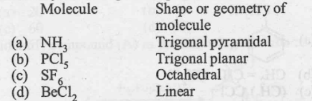
  • (B) 3π/2
  • (C) π/2
  • (D) Zero
Question 8.

Time intervals measured by a clock give the following readings : 1.25 s, 1.24 s, 1.27 s, 1.21 s and 1.28 s What is the percentage relative error of the observations?

[4 Marks]
  • (A) 16%
  • (B) 4%
  • (C) 1.6%
  • (D) 2%
Question 9.

An ideal gas equation can be written as P = ρRT / M₀ where ρ and M₀ are respectively,

[4 Marks]
  • (A) Mass density, molar mass
  • (B) Mass density, mass of the gas
  • (C) Number density, Molar mass
  • (D) Number density, mass of the gas
Question 10.

The magnetic field in a plane electromagnetic wave is given by, B_y = 2×10⁻⁷ sin(π×10³x + 3π×10¹¹t)T Calculate the wavelength.

[4 Marks]
  • (A) 2×10³ m
  • (B) 2×10⁻³ m
  • (C) π×10⁻³ m
  • (D) π×10³ m
Question 11.

A barometer is constructed using a liquid (density = 760 kg/m³). What would be the height of the liquid column, when a mercury barometer reads 76 cm? (density of mercury = 13600 kg/m³)

[4 Marks]
  • (A) 13.6 m
  • (B) 1.36 m
  • (C) 0.76 m
  • (D) 136 m
Question 12.

The P-V diagram for an ideal gas in a piston cylinder assembly undergoing a thermodynamic process is shown in the figure.
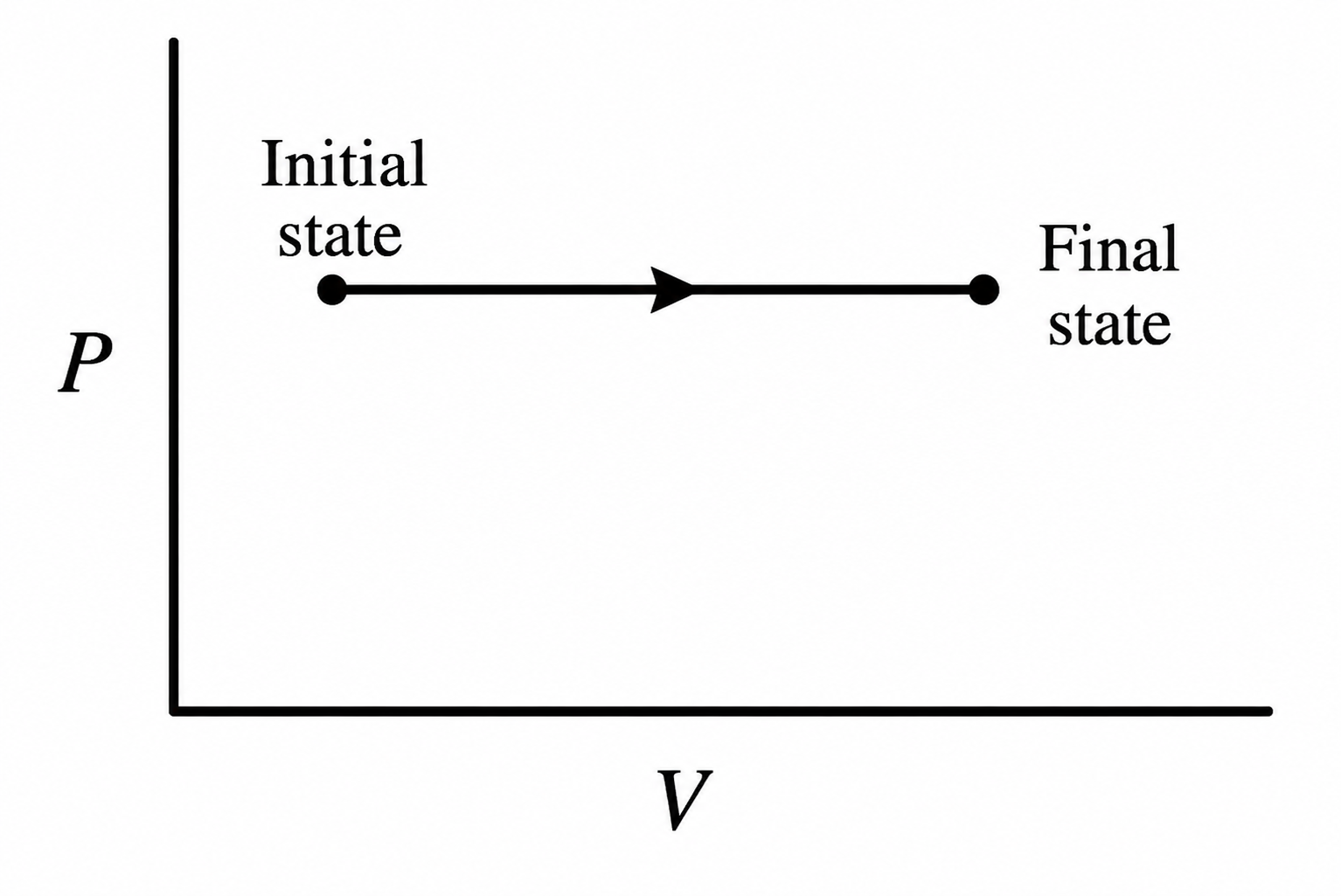
[4 Marks] Diagram 5 – NEET-UG 2020 Question Paper — Set 2
  • (A) isotherma
  • (B) adiabatic
  • (C) isobaric
  • (D) isochoric
Question 13. The efficiency of a Carnot engine depends upon
[4 Marks]
  • (A) the temperature of the source only
  • (B) the temperature of the sink only
  • (C) the temperatures of the source and sink
  • (D) the volume of the cylinder of the engine
Question 14.

The electric field at a point on the equatorial plane at a distance r from the centre of a dipole having dipole moment p(vector) is given by, (r >> separation of two charges forming the dipole, ε₀ - permittivity of free space)

[4 Marks]
  • (A) E(vector) = − P(vector) / 4π ε₀ r²
  • (B) E(vector) = − 2P(vector) / 4π ε₀ r³
  • (C) E(vector) = − P(vector) / 4π ε₀ r³
  • (D) E(vector) = P(vector) / 4π ε₀ r³
Question 15. A liquid does not wet the solid surface if angle of contact is
[4 Marks]
  • (A) equal to 45°
  • (B) zero
  • (C) greater than 90°
  • (D) equal to 60°
Question 16. Three stars A, B, C have surface temperatures T_A, T_B, T_C respectively. Star A appears bluish, star B appears reddish and star C yellowish. Hence,
[4 Marks]
  • (A) T_A > T_C > T_B
  • (B) T_A > T_B > T_C
  • (C) T_B > T_C > T_A
  • (D) T_C > T_B > T_A
Question 17.

A light bulb and an inductor coil are connected to an ac source through a key as shown in the figure below. The key is closed and after sometime an iron rod is inserted into the interior of the inductor. The glow of the light bulb
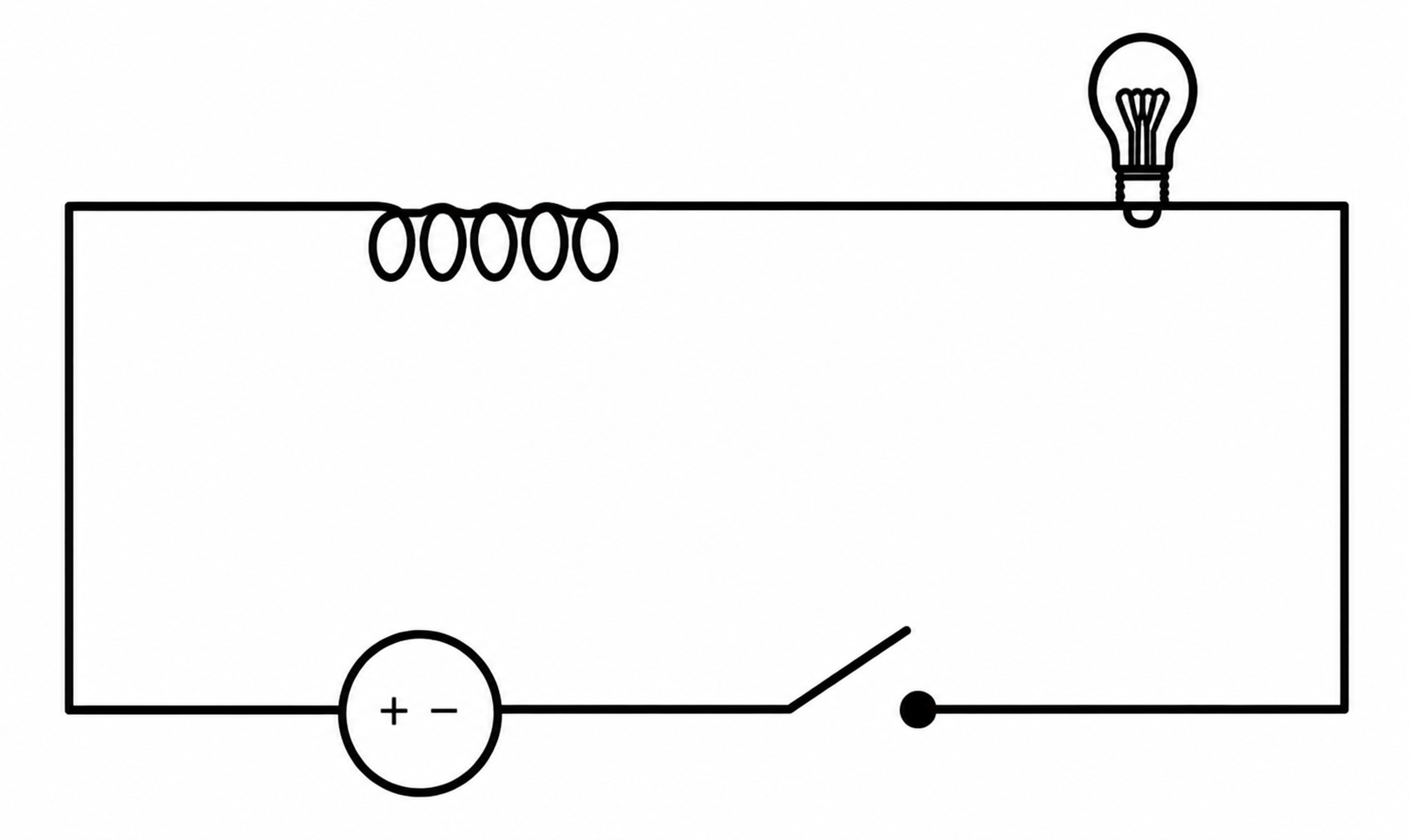
[4 Marks] Diagram 6 – NEET-UG 2020 Question Paper — Set 2
  • (A) decreases
  • (B) will fluctuate
  • (C) remains unchanged
  • (D) increases
Question 18.

Three identical spheres, each of mass M, are placed at the corners of a right angle triangle with mutually perpendicular sides equal to 2 m (see figure). Taking the point of intersection of the two mutually perpendicular sides as the origin, find the position vector of centre of mass.
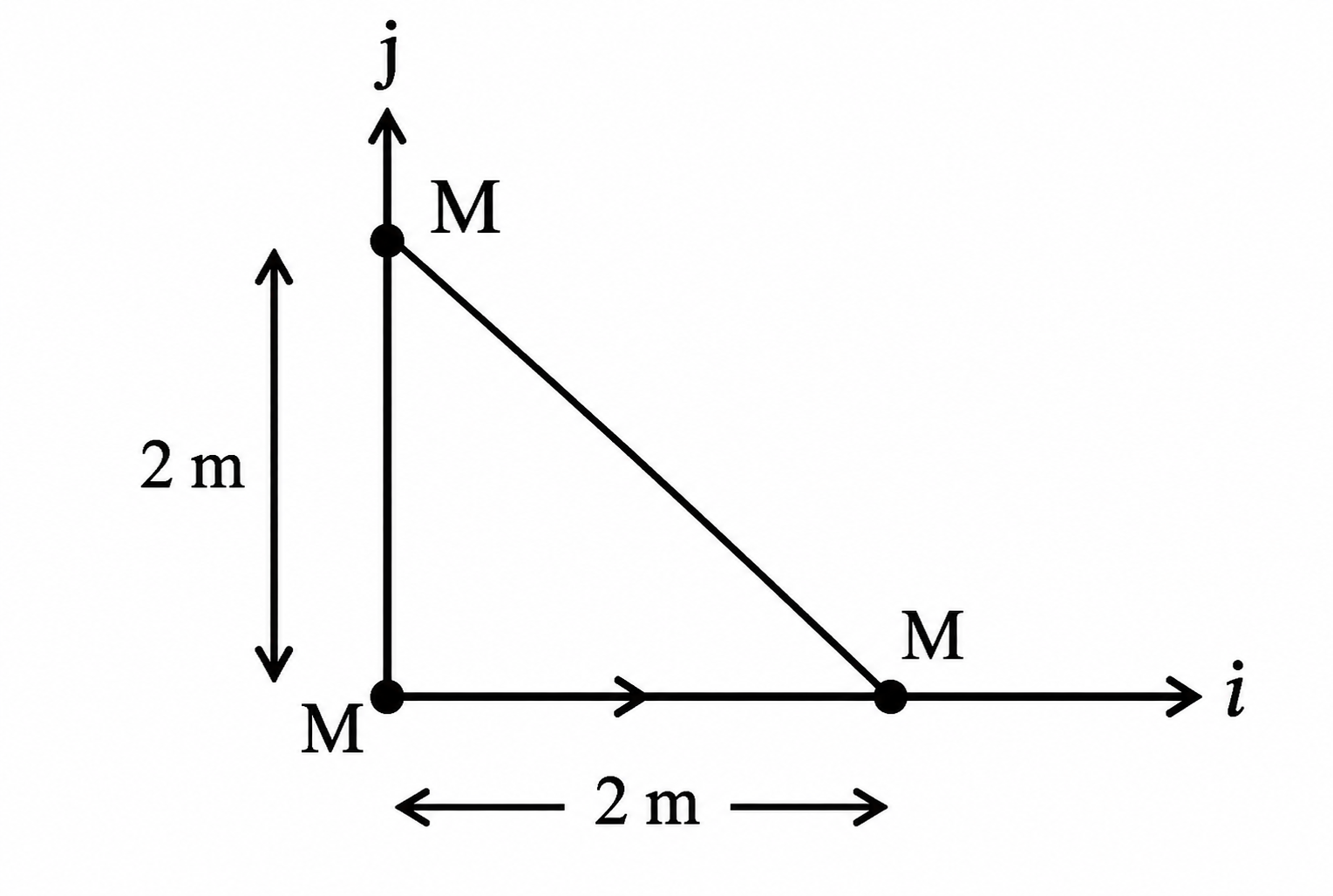
[4 Marks] Diagram 7 – NEET-UG 2020 Question Paper — Set 2
  • (A) (î + ĵ)
  • (B) 2/3 (î + ĵ)
  • (C) 4/3 (î + ĵ)
  • (D) 2(î + ĵ)
Question 19. The de Broglie wavelength of an electron moving with kinetic energy of 144 eV is nearly
[4 Marks]
  • (A) 102 × 10⁻² nm
  • (B) 10² × 10⁻³ nm
  • (C) 10² × 10⁻⁵ nm
  • (D) 102 × 10⁻⁴ nm
Question 20.

The angle of 1' (minute of angle) in radian is nearly equal to

[4 Marks]
  • (A) 4.80 × 10⁻⁶ rad
  • (B) 4.85 × 10⁻⁴ rad
  • (C) 1.75 × 10⁻² rad
  • (D) 2.91 × 10⁻⁴ rad
Question 21.

The total energy of an electron in the nᵗʰ stationary orbit of the hydrogen atom can be obtained by

[4 Marks]
  • (A) E_n = −1.36/n² eV
  • (B) E_n = −13.6/n² eV
  • (C) E_n = 13.6/n² eV
  • (D) E_n = −13.6 × n² eV
Question 22.

A wire of length L metre carrying a current of I Ampere is bent in the form of circle. Its magnetic moment is

[4 Marks]
  • (A) 2IL²/π A m²
  • (B) IπL²/4 A m²
  • (C) IL²/4 A m²
  • (D) IL²/4π A m²
Question 23.

What is the depth at which the value of acceleration due to gravity becomes 1/n times the value that at the surface of earth? (radius of earth = R)

[4 Marks]
  • (A) Rn/(n − 1)
  • (B) R(n − 1)/n
  • (C) R/n²
  • (D) R/n
Question 24.

An object is placed on the principal axis of a concave mirror at a distance of 1.5 f (f is the focal length). The image will be at,

[4 Marks]
  • (A) 1.5f
  • (B) −1.5f
  • (C) −3f
  • (D) 3f
Question 25. The angular speed of the wheel of a vehicle is increased from 360 rpm to 1200 rpm in 14 second. Its angular acceleration is,
[4 Marks]
  • (A) 1 rad/s²
  • (B) 2π rad/s²
  • (C) 28π rad/s²
  • (D) 120π rad/s²
Question 26.

The acceleration of an electron due to the mutual attraction between the electron and a proton when they are 1.6 Å apart is, (mₑ = 9 × 10⁻³¹ kg, e = 1.6 × 10⁻¹⁹ C) (Take 1/4πε₀ = 9 × 10⁹ Nm²C⁻²)

[4 Marks]
  • (A) 10²⁵ m/s²
  • (B) 10²² m/s²
  • (C) 10²³ m/s²
  • (D) 10²⁴ m/s²
Question 27. What happens to the mass number and atomic number of an element when it emits γ-radiation?
[4 Marks]
  • (A) Mass number increases by four and atomic number increases by two
  • (B) Mass number decreases by four and atomic number decreases by two
  • (C) Mass number and atomic number remain unchanged
  • (D) Mass number remains unchanged while atomic number decreases by one
Question 28.

If the critical angle for total internal reflection from a medium to vacuum is 45°, then velocity of light in the medium is,

[4 Marks]
  • (A) 3 × 10⁸ m/s
  • (B) 1.5 × 10⁸ m/s
  • (C) 3/√2 × 10⁸ m/s
  • (D) √2 × 10⁸ m/s
Question 29.

A point mass 'm' is moved in a vertical circle of radius 'r' with the help of a string. The velocity of the mass is √7gr at the lowest point. The tension in the string at the lowest point is

[4 Marks]
  • (A) 6 mg
  • (B) 1 mg
  • (C) 7 mg
  • (D) 8 mg
Question 30. A plano-convex lens of unknown material and unknown focal length is given. With the help of a spherometer we can measure the,
[4 Marks]
  • (A) refractive index of the material
  • (B) radius of curvature of the curved surface
  • (C) focal length of the lens
  • (D) aperture of the lens
Question 31.

The power of a biconvex lens is 10 dioptre and the radius of curvature of each surface is 10 cm. Then the refractive index of the material of the lens is

[4 Marks]
  • (A) 4/3
  • (B) 3/2
  • (C) 5/3
  • (D) 9/8
Question 32.

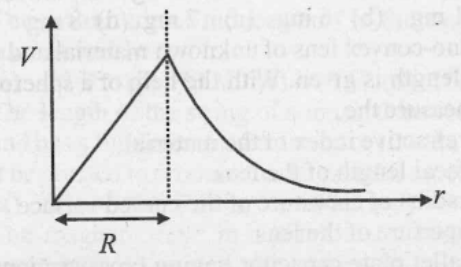
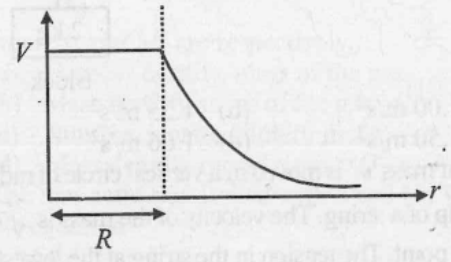
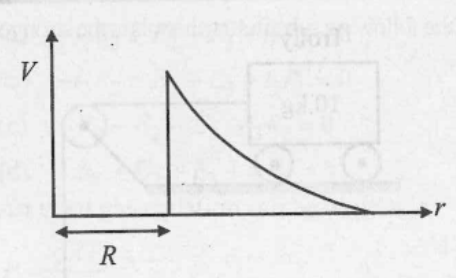
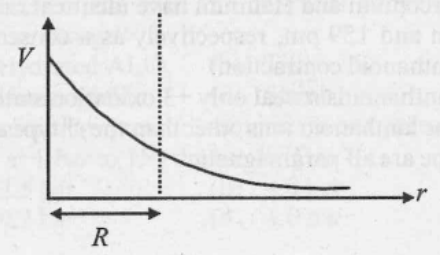
The variation of electrostatic potential with radial distance rfrom the centre of a positively charged metallic thin shell of radius R is given by the graph

[4 Marks]
  • (A) Diagram 8 – NEET-UG 2020 Question Paper — Set 2
  • (B) Diagram 9 – NEET-UG 2020 Question Paper — Set 2
  • (C) Diagram 10 – NEET-UG 2020 Question Paper — Set 2
  • (D) Diagram 11 – NEET-UG 2020 Question Paper — Set 2
Question 33.

Which of the following gate is called universal gate?

[4 Marks]
  • (A) NAND gate
  • (B) AND gate
  • (C) OR gate
  • (D) NOT gate
Question 34.

Identify the function which represents a periodic motion.

[4 Marks]
  • (A) sin ωt + cos ωt
  • (B) logₑ(ωt)
  • (C) e^(ωt)
  • (D) e^(-ωt)
Question 35. The wave nature of electrons was experimentally verified by,
[4 Marks]
  • (A) Davisson and Germer
  • (B) de Broglie
  • (C) Hertz
  • (D) Einstein
Question 36.

A person sitting in the ground floor of a building notices through the window, of height 1.5 m, a ball dropped from the roof of the building crosses the window in 0.1 s. What is the velocity of the ball when it is at the top most point of the window? (g = 10 m/s²)

[4 Marks]
  • (A) 4.5 m/s
  • (B) 14.5 m/s
  • (C) 15.5 m/s
  • (D) 20 m/s
Question 37.

Which among the following salt solutions is basic in nature?

[3 Marks]
  • (A) Ammonium nitrate
  • (B) Ammonium sulphate
  • (C) Sodium acetate
  • (D) Ammonium chloride
Question 38.

If 8 g of a non-electrolyte solute is dissolved in 114 g of n-octane to reduce its vapour pressure of 80%, the molar mass (in g mol⁻¹) of the solute is [Given that molar mass of n-octane is 114 g mol⁻¹]

[4 Marks]
  • (A) 60
  • (B) 40
  • (C) 20
  • (D) 80
Question 39.

Identify compound (a) in the following reaction:
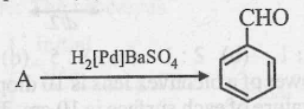
[4 Marks] Diagram 12 – NEET-UG 2020 Question Paper — Set 2
  • (A) Benzoyl chloride
  • (B) Toluene
  • (C) Benzoic acid
  • (D) Acetophenone
Question 40.

Identify the incorrect statement from the following:

[4 Marks]
  • (A) Lanthanoids reveal only +3 oxidation state
  • (B) The lanthanoid ions other than the 4f⁰ and the 4f¹⁴ type are all paramagnetic
  • (C) Zirconium and Hafnium have identical radii of 160 pm and 159 pm, respectively as a consequence of lanthanoid contraction
  • (D) The overall decrease in atomic and ionic radii from lanthanum to lutetium is called lanthanoid contraction
Question 41.

The half-life for a zero order reaction having 0.02 M initial concentration of reactant is 100 s. The rate constant (in mol L⁻¹ s⁻¹) for the reaction is

[4 Marks]
  • (A) 1.0 × 10⁻⁴
  • (B) 1.0 × 10⁻²
  • (C) 2.0 × 10⁻⁴
  • (D) 2.0 × 10⁻⁵
Question 42.

Match the coordination number and type of Hybridisation with distribution of hybrid orbitals in space based on valence bond theory.
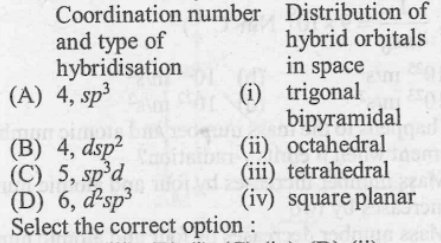
[4 Marks] Diagram 13 – NEET-UG 2020 Question Paper — Set 2
  • (A) (A)-(iii), (B)-(iv), (C)-(i), (D)-(ii)
  • (B) (A)-(iii), (B)-(i), (C)-(iv), (D)-(ii)
  • (C) (A)-(ii), (B)-(iii), (C)-(iv), (D)-(i)
  • (D) (A)-(iv), (B)-(i), (C)-(ii), (D)-(iii)
Question 43.

Match the element in column I with that in column II.
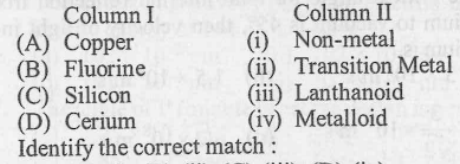
[4 Marks] Diagram 14 – NEET-UG 2020 Question Paper — Set 2
  • (A) (A)-(i), (B)-(ii), (C)-(iii), (D)-(iv)
  • (B) (A)-(ii), (B)-(iv), (C)-(i), (D)-(iii)
  • (C) (A)-(iv), (B)-(iii), (C)-(i), (D)-(ii)
  • (D) (A)-(ii), (B)-(i), (C)-(iv), (D)-(iii)
Question 44.

In collision theory of chemical reaction, Z₍AB₎ represents

[4 Marks]
  • (A) the collision frequency of reactants, A and B
  • (B) the fraction of molecules with energies equal to Eₐ
  • (C) the fraction of molecules with energies greater than Eₐ
  • (D) steric factor
Question 45.

At standard conditions, if the change in enthalpy for the following reaction is −109 kJ mol⁻¹.

H₂(g) + Br₂(g) → 2HBr(g)

Given that bond energy of H₂ and Br₂ is 435 kJ mol⁻¹ and 192 kJ mol⁻¹ respectively, what is the bond energy (in kJ mol⁻¹) of HBr?

[4 Marks]
  • (A) 735
  • (B) 518
  • (C) 368
  • (D) 259
Question 46.

The solubility product for a salt of the type AB is 4 × 10⁻⁸. What is the molarity of its standard solution?

[4 Marks]
  • (A) 2 × 10⁻⁴ mol/L
  • (B) 4 × 10⁻⁴ mol/L
  • (C) 2 × 10⁻⁶ mol/L
  • (D) 16 × 10⁻¹⁶ mol/L
Question 47.

The potential energy (y) curve for H₂ formation as a function of internuclear distance (x) of the H atoms is shown below. The bond energy of H₂ is
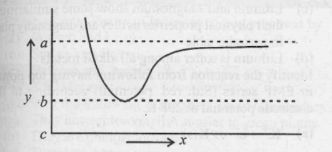
[4 Marks] Diagram 15 – NEET-UG 2020 Question Paper — Set 2
  • (A) (b − a)
  • (B) (c − a)
  • (C) (b − a)/2
  • (D) (c − a)/2
Question 48.

Match the element in Column I with methods of purification in Column II.
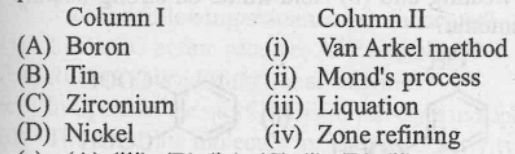
[4 Marks] Diagram 16 – NEET-UG 2020 Question Paper — Set 2
  • (A) (A)-(iv), (B)-(iii), (C)-(ii), (D)-(i)
  • (B) (A)-(iv), (B)-(iii), (C)-(i), (D)-(ii)
  • (C) (A)-(ii), (B)-(i), (C)-(iv), (D)-(iii)
  • (D) (A)-(iii), (B)-(iv), (C)-(i), (D)-(ii)
Question 49.

A liquid compound (x) can be purified by steam distillation only if it is

[4 Marks]
  • (A) Steam volatile, miscible with water
  • (B) Not steam volatile, miscible with water
  • (C) Not steam volatile, immiscible with water
  • (D) Steam volatile, immiscible with water
Question 50.

What is the role of gypsum, CaS0₄.2H₂O in setting of cement? Identify the correct option from the following :

[4 Marks]
  • (A) to provide water molecules for hydration process
  • (B) to help to remove water molecules
  • (C) to fasten the setting process
  • (D) to slow down the setting process
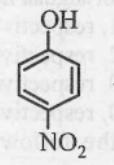
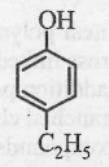
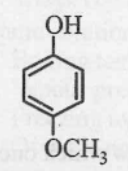
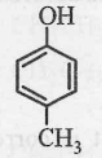
Question 51.

‘Which of te following substituted phenols is the strongest acid?

[4 Marks]
  • (A) Diagram 17 – NEET-UG 2020 Question Paper — Set 2
  • (B) Diagram 18 – NEET-UG 2020 Question Paper — Set 2
  • (C) Diagram 19 – NEET-UG 2020 Question Paper — Set 2
  • (D) Diagram 20 – NEET-UG 2020 Question Paper — Set 2
Question 52.

Deficiency of which vitamin causes osteomalacia?

[4 Marks]
  • (A) Vitamin E
  • (B) Vitamin A
  • (C) Vitamin K
  • (D) Vitamin D
Question 53.

Which one of the following reaction does not come under hydrolysis of phosphorus?

[4 Marks]
  • (A) P₄O₁₀(s) + 6H₂O(l) → 4H₃PO₄(aq)
  • (B) 2F₂(g) + 2H₂O(l) → 4HF(aq) + O₂(g)
  • (C) SiCl₄(l) + 2H₂O(l) → SiO₂(s) + 4HCl(aq)
  • (D) Li₃N(s) + 3H₂O(l) → NH₃(g) + 3LiOH(aq)
Question 54.

Which one of the following compounds shows both, Frenkel as well as Schottky defects?

[4 Marks]
  • (A) ZnS
  • (B) AgI
  • (C) AgBr
  • (D) NaCl
Question 55.

Which of the following is not true about chloramphenicol?

[4 Marks]
  • (A) It inhibits the growth of only gram positive bacteria
  • (B) It is bacteriostatic
  • (C) It is not bactericidal
  • (D) It is a broad spectrum antibiotic
Question 56.

The oxidation number of the underlined atom in the following species

Identify the incorrect option.

[4 Marks]
  • (A) K₂Cr₂O₇ is +6
  • (B) HAuCl₄ is +3
  • (C) Cu₂O is −1
  • (D) ClO₃⁻ is +5
Question 57.

Which of the following will NOT undergo Sₙ1 reaction with OH⁻ ?

[4 Marks]
  • (A) CH₂ = CH − CH₂Cl
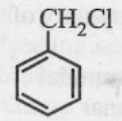
  • (B) Diagram 21 – NEET-UG 2020 Question Paper — Set 2
  • (C) CH₂ = C(CH₃) − CH₂Cl
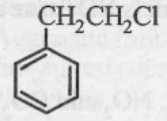
  • (D) Diagram 22 – NEET-UG 2020 Question Paper — Set 2
Question 58.

Reaction of propanamide with ethanolic sodium hydroxide and bromine will give

[4 Marks]
  • (A) Methylamine
  • (B) Aniline
  • (C) Ethylamine
  • (D) Propylamine
Question 59.

In which of the sols, the colloidal particles are with negative charge?

[4 Marks]
  • (A) Haemoglobin
  • (B) TiO₂
  • (C) Starch
  • (D) Hydrated Al₂O₃
Question 60.

The minimum pressure required to compress 600 dm³ of a gas at 1 bar to 150 dm³ at 40°C is

[4 Marks]
  • (A) 2.5 bar
  • (B) 4.0 bar
  • (C) 1.0 bar
  • (D) 0.2 bar
Question 61.

The number of angular nodes and radial nodes in 3s orbital are

[4 Marks]
  • (A) 3 and 0, respectively
  • (B) 0 and 2, respectively
  • (C) 0 and 1, respectively
  • (D) 1 and 0, respectively
Question 62.

Which of the following statement is correct about Bakelite?

[4 Marks]
  • (A) It is a linear polymer
  • (B) It is a cross linked polymer
  • (C) It is an addition polymer
  • (D) It is a branched chain-polymer
Question 63.

Among the compounds shown below which one revealed a linear structure?

[4 Marks]
  • (A) HOCl
  • (B) N₂O
  • (C) NO₂
  • (D) O₃
Question 64.

The reaction of concentrated sulphuric acid with carbohydrate (C₁₂H₂₂O₁₁) is an example of

[4 Marks]
  • (A) Reduction
  • (B) Oxidation
  • (C) Sulphonation
  • (D) Dehydration
Question 65.

Which of the following compound is most reactive in electrophilic aromatic substitution?

[4 Marks]
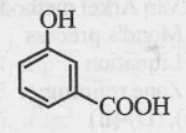
  • (A) Diagram 23 – NEET-UG 2020 Question Paper — Set 2
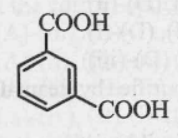
  • (B) Diagram 24 – NEET-UG 2020 Question Paper — Set 2
  • (C) Diagram 25 – NEET-UG 2020 Question Paper — Set 2
  • (D) Diagram 26 – NEET-UG 2020 Question Paper — Set 2
Question 66.

In a typical fuel cell, the reactant (R) and product (P) are

[4 Marks]
  • (A) R = H₂(g), N₂(g) ; P = NH₃(aq)
  • (B) R = H₂(g), O₂(g) ; P = H₂O(l)
  • (C) R = H₂(g), O₂(g) ; Cl₂(g) ; P = HClO₄(aq)
  • (D) R = H₂(g), O₂(g) ; P = H₂O(v)
Question 67.

Which of the following statement is NOT true about acid rain?

[4 Marks]
  • (A) It is due to reaction of SO₂, NO₂ and CO₂ with rain water
  • (B) Its pH is less than 5.6
  • (C) Causes no damage to monuments like Taj Mahal
  • (D) It is harmful for plants
Question 68.

Match the compounds of Xe in column I with the molecular structure in column II
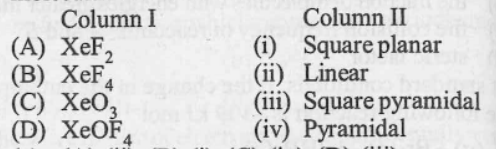
[4 Marks] Diagram 27 – NEET-UG 2020 Question Paper — Set 2
  • (A) (A)-(iii), (B)-(iv), (C)-(ii), (D)-(i)
  • (B) (A)-(ii), (B)-(i), (C)-(iv), (D)-(iii)
  • (C) (A)-(ii), (B)-(i), (C)-(iii), (D)-(iv)
  • (D) (A)-(i), (B)-(ii), (C)-(iv), (D)-(iii)
Question 69.

Which of the following is a free radical substitution reaction?

[4 Marks]
  • (A) Benzene with Br₂/AlCl₃
  • (B) Propene with HBr/(C₆H₅COO)₂
  • (C) Acetylene with HBr
  • (D) Methane with Br₂/hν
Question 70.

If for a certain reaction ΔᵣᵣH is 30 kJ mol⁻¹ at 450 K, the value of Δ ᵣS (in JK⁻¹ mol⁻¹) for which the same reaction will be spontaneous at the same temperature, is

[4 Marks]
  • (A) 33
  • (B) 70
  • (C) -33
  • (D) -70
Question 71.

Which of the following statement is not true about glucose?

[4 Marks]
  • (A) It is an aldopentose
  • (B) It is a reducing sugar
  • (C) It contains five hydroxyl groups
  • (D) It is an aldohexose
Question 72.

Identify the correct statement from the following.

[4 Marks]
  • (A) Lithium chloride is deliquescent and crystallises as a hydrate, LiCl·H₂O.
  • (B) Lithium and Magnesium show some similarities in their physical properties as they are diagonally placed in periodic table
  • (C) The order of hydration enthalpies of alkaline earth cations Be²⁺ < Mg²⁺ < Ca²⁺ < Sr²⁺ < Ba²⁺
  • (D) Lithium is softer among all alkali metals
Question 73.

Identify the reaction from following having top position in EMF series (Std. red. potential at 298 K).

[4 Marks]
  • (A) K⁺ + e⁻ → K(s)
  • (B) Fe²⁺ + 2e⁻ → Fe(s)
  • (C) Au³⁺ + 3e⁻ → Au(s)
  • (D) Mg²⁺ + 2e⁻ → Mg(s)
Question 74.

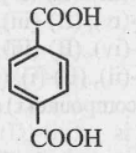
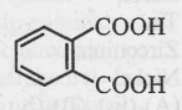
Which of the following acid will form an (a) Anhydride on heating and (b) Acid imide on strong heating with ammonia?

[4 Marks]
  • (A) Diagram 28 – NEET-UG 2020 Question Paper — Set 2
  • (B) Diagram 29 – NEET-UG 2020 Question Paper — Set 2
  • (C) Diagram 30 – NEET-UG 2020 Question Paper — Set 2
  • (D) Diagram 31 – NEET-UG 2020 Question Paper — Set 2
Question 75.

One mole carbon atom weighs 12 g, the number of atoms in it is equal to, (Mass of carbon-12 is 1.9926 × 10⁻²³ g)

[4 Marks]
  • (A) 12 × 10²³
  • (B) 1.2 × 10²³
  • (C) 6.022 × 10²³
  • (D) 6.022 × 10²²
Question 76.

Which of the following oxide is amphoteric in nature?

[4 Marks]
  • (A) GeO₂
  • (B) SiO₂
  • (C) CO₂
  • (D) SnO₂
Question 77.

Isotonic solutions have same

[4 Marks]
  • (A) Osmotic pressure
  • (B) Freezing temperature
  • (C) Boiling temperature
  • (D) Vapour pressure
Question 78.

How many (i) sp² hybridised carbon atoms and (ii) π bonds are present in the following compound?
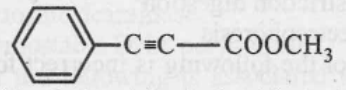
[4 Marks] Diagram 32 – NEET-UG 2020 Question Paper — Set 2
  • (A) 7,6
  • (B) 8,6
  • (C) 7,5
  • (D) 8,5
Question 79.

Chromosomal theory of inheritance was proposed by

[4 Marks]
  • (A) T.H. Morgan
  • (B) Bateson and Punnet
  • (C) Sutton and Boveri
  • (D) Watson and Crick
Question 80.

Which of the following is incorrect about Cynobacteria?

[4 Marks]
  • (A) They are photoautotrophs
  • (B) They have chlorophyll A similar to green plants
  • (C) They lack heterocysts
  • (D) They often form blooms in polluted water bodies
Question 81.

The impact of immigration on population density is

[7 Marks]
  • (A) Neutralized by natality
  • (B) Both positive and negative
  • (C) Negative
  • (D) Positive
Question 82.

Which of the following statements is incorrect?

[4 Marks]
  • (A) RuBisCO is a bifunctional enzyme
  • (B) RuBisCO action requires ATP and NADPH
  • (C) In C₄ plants, the site of RuBisCO activity is mesophyll cell
  • (D) The substrate molecule for RuBisCO activity is a 5-carbon compound
Question 83.

Inclusion bodies of blue-green, purple and green photosynthetic bacteria are

[4 Marks]
  • (A) Microtubules
  • (B) Gas vacuoles
  • (C) Contractile vacuoles
  • (D) Centrioles
Question 84.

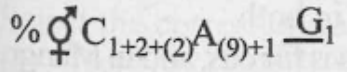
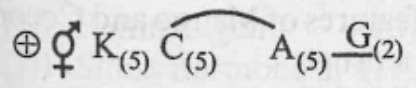
Which of the following is the correct floral formula of Liliaceae?

[4 Marks]
  • (A) Diagram 33 – NEET-UG 2020 Question Paper — Set 2
  • (B) Diagram 34 – NEET-UG 2020 Question Paper — Set 2
  • (C) Diagram 35 – NEET-UG 2020 Question Paper — Set 2
  • (D) Diagram 36 – NEET-UG 2020 Question Paper — Set 2
Question 85.

Male and female gametophytes do not have an independent free living existence in :

[4 Marks]
  • (A) Angiosperms
  • (B) Algae
  • (C) Pteridophytes (c) Algae
  • (D) Bryophytes
Question 86.

Inhibitory substances in dormant seeds cannot be removed by subjecting seeds to :

[4 Marks]
  • (A) Nitrate
  • (B) Chilling conditions
  • (C) Gibberellic acid
  • (D) Ascorbic acid
Question 87.

In some plants thalamus contributes to fruit formation. Such fruits are termed as:

[4 Marks]
  • (A) True fruits
  • (B) Parthenocarpic fruit
  • (C) False fruits
  • (D) Aggregate fruits
Question 88.

The biosynthesis of ribosomal RNA occurs in :

[4 Marks]
  • (A) Ribosomes
  • (B) Nucleolus
  • (C) Golgi apparatus
  • (D) Microbodies
Question 89.

Large, empty colorless cells of the adaxial epidermis along the veins of grass leaves are

[4 Marks]
  • (A) Bulliform cells
  • (B) Bundle sheath cells
  • (C) Lenticels
  • (D) Guard cells
Question 90.

Identify the wrong match pair :

[4 Marks] Diagram 37 – NEET-UG 2020 Question Paper — Set 2
  • (A) b
  • (B) d
  • (C) a
  • (D) c
Question 91.

Match the following aspects with the respective metal

Aspects

Metal

(A) The metal which reveals a maximum number of oxidation states

(i) Scandium

(B) The metal although placed in the 3d block is considered not as a transition (ii) Copper

element.

(C) The metal which does not exhibit variable oxidation states. (iii) Manganese

(D) The metal which in +1 oxidation state in aqueous solution (iv) Zinc

undergoes disproportionation.

[4 Marks]
  • (A) (A)-(ii), (B)-(iv), (C)-(i), (D)-(ii)
  • (B) (A)-(iii), (B)-(i), (C)-(iv), (D)-(ii)
  • (C) (A)-(ii), (B)-(iv), (C)-(i), (D)-(iii)
  • (D) (A)-(i), (B)-(iv), (C)-(ii), (D)-(iii)
Question 92.

What is Z?

[4 Marks] Diagram 38 – NEET-UG 2020 Question Paper — Set 2
  • (A) CH₃CH₂CH(OH)CH₃
  • (B) CH₃CH₂CH₂CHO
  • (C) CH₃CH₂CH₂CH₂OH
  • (D) CH₃CH₂CH₂CH₃
Question 93.

The Mean Free Path l for a gas molecule depends upon the diameter, d, of the molecule as:

[4 Marks]
  • (A) 𝑙 ∝ 1/ 𝑑²
  • (B) 𝑙 ∝ 𝑑
  • (C) 𝑙 ∝ 1 /𝑑²
  • (D) 𝑙 ∝ 𝑑²
Question 94.

For the circuit shown in the figure, the current I will be
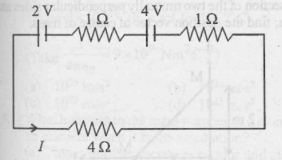
[4 Marks] Diagram 39 – NEET-UG 2020 Question Paper — Set 2
  • (A) 0.5A
  • (B) 0.75 A
  • (C) 1.5A
  • (D) 1A
Question 95.

The equivalent resistance between A and B for the mesh shown in the figure is
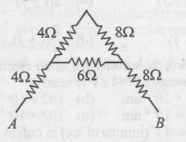
[4 Marks] Diagram 40 – NEET-UG 2020 Question Paper — Set 2
  • (A) 4.8Ω
  • (B) 16Ω
  • (C) 7.2Ω
  • (D) 30Ω
Question 96.

In a mixture, DNA fragments are separated by

[4 Marks]
  • (A) Restriction digestion
  • (B) Electrophoresis
  • (C) Bioprocess engineering
  • (D) Polymerase chain reaction
Question 97.

Which of the following is incorrect for wind-pollinated plants?

[4 Marks]
  • (A) Pollen grains are light and non-sticky
  • (B) Well exposed stamens and stigma
  • (C) Many ovules in each ovary
  • (D) Flowers are small and not brightly coloured
Question 98.

In a mitotic cycle, the correct sequence of phases is

[4 Marks]
  • (A) G₁, G₂, S, M
  • (B) S, G₁, G₂, M
  • (C) G₁, S, G₂, M
  • (D) M, G₁, G₂, S
Question 99.

Embryological support for evolution was proposed by

[4 Marks]
  • (A) Ernst Haeckel
  • (B) Alfred Wallace
  • (C) Karl Ernst von Baer
  • (D) Charles Darwin
Question 100.

Phycorythrin is the major pigment in

[4 Marks]
  • (A) Green algae
  • (B) Blue green algae
  • (C) Brown algae
  • (D) Red algae
Question 101.

According to Alexander von Humboldt

[4 Marks]
  • (A) There is no relationship between species richness and area explored
  • (B) Species richness increases with increasing area, but only up to limits
  • (C) Species richness goes on increasing with increasing area of exploration
  • (D) Species richness decreases with increasing area of exploration
Question 102.

In the polynucleotide chain of DNA, a nitrogenous base is linked to the -OH of

[4 Marks]
  • (A) 1' C pentose sugar
  • (B) 2' C pentose sugar
  • (C) 3' C pentose sugar
  • (D) 5' C pentose sugar
Question 103.

During non-cyclic photophosphorylation, when electrons are lost from the reaction centre at PSII, what is the source which replaces these electrons?

[4 Marks]
  • (A) Carbon dioxide
  • (B) Water
  • (C) Oxygen
  • (D) Light
Question 104.

In Recombinant DNA technology antibiotics are used

[4 Marks]
  • (A) to detect alien DNA
  • (B) to impart disease-resistance to the host plant
  • (C) as selectable markers
  • (D) to keep medium bacteria-free
Question 105.

Which of the following statements is incorrect?

[4 Marks]
  • (A) Number of individuals decreases from first trophic level to fourth trophic level
  • (B) Energy content gradually decreases from first to fourth trophic level
  • (C) Biomass decreases from first to fourth trophic level
  • (D) Energy content gradually increases from first to fourth trophic level
Question 106.

Attachment of spindle fibers to kinetochores of chromosomes begins in

[4 Marks]
  • (A) Metaphase
  • (B) Anaphase
  • (C) Telophase
  • (D) Prophase
Question 107.

Correct position of floral parts over thalamus in mustard plant is

[4 Marks]
  • (A) Gynoecium occupies the highest position, while the other parts are situated below it.
  • (B) Gynoecium is situated in the centre, and other parts of the flower are located at the rim of the thalamus, at the same level.
  • (C) Margin of the thalamus grows upward, enclosing the ovary completely, and other parts arise below the ovary.
  • (D) Gynoecium is present in the centre and other flowers cover it partially.
Question 108.

After about how many years of formation of earth, life appeared on this planet?

[4 Marks]
  • (A) 50 million years
  • (B) 50 billion years
  • (C) 500 million years
  • (D) 500 billion years
Question 109.

The term 'Nuclein' for the genetic material was used by

[4 Marks]
  • (A) Franklin
  • (B) Chargaff
  • (C) Miescher
  • (D) Mendel
Question 110.

Select the incorrect statement.

[4 Marks]
  • (A) Elements most easily mobilized in plants from one region to another are : phosphorus, sulphur, nitrogen and potassium
  • (B) Transport of molecules in phloem can be bidirectional
  • (C) Unloading of sucrose at sink does not involve the utilization of ATP
  • (D) Movement of minerals in xylem is unidirectional
Question 111.

The number of contrasting characters studied by Mendel for his experiments was

[4 Marks]
  • (A) 2
  • (B) 4
  • (C) 14
  • (D) 7
Question 112.

Vegetative propagule in Agave is termed as

[4 Marks]
  • (A) Rhizome
  • (B) Eye
  • (C) Bulbil
  • (D) Offset
Question 113.

Identify the statement which is incorrect.

[4 Marks]
  • (A) Tyrosine possesses aromatic ring in its structure
  • (B) Sulphur is an integral part of cysteine
  • (C) Glycine is an example of lipids
  • (D) Lecithin contains phosphorus atom in its structure
Question 114.

A species which was introduced for ornamentation but has become a trouble-some weed in India :

[4 Marks]
  • (A) Parthenium hysterophorus
  • (B) Eichhornia crassipes
  • (C) Trapa spinosa
  • (D) Pmpsalis juliflora
Question 115.

Pyruvate dehydrogenase activity during aerobic respiration requires :

[4 Marks]
  • (A) Iron
  • (B) Cobalt
  • (C) Calcium
  • (D) Magnesium
Question 116.

A n-p-n transistor is connected in common emitter configuration (see figure) in which collector voltage drop across load resistance (800 Ω) connected to the collector circuit is 0.8 V. The collector current is
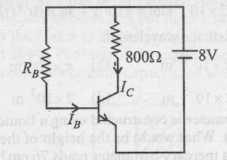
[4 Marks] Diagram 41 – NEET-UG 2020 Question Paper — Set 2
  • (A) 2mA
  • (B) 0.2mA
  • (C) 0.1mA
  • (D) 1mA
Question 117.

For the circuit given below, the Kirchoff's loop rule for the loop BCDERB is given by the equation
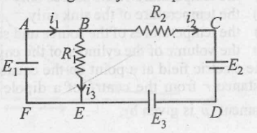
[4 Marks] Diagram 42 – NEET-UG 2020 Question Paper — Set 2
  • (A) -i₂R₂+E₂+E₃+i₃R₁ =0
  • (B) -i₂R₂+E₂-E₃+i₃R₁ =0
  • (C) i₂ R₂+E₂-E₃- i₃ R₁ =0
  • (D) i₂R₂+E₂+E₃+i₃R₁ =0
Question 118.

Calculate the acceleration of the block and trolly system shown in the figure. The coefficient of kinetic friction between the trolly and the surface is 0.05. (g = 10 m/s²?, ‘mass of the string is negligible and no other friction exists).
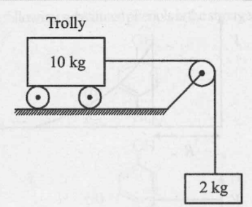
[4 Marks] Diagram 43 – NEET-UG 2020 Question Paper — Set 2
  • (A) 1.25m/s²
  • (B) 1.00 m/s²
  • (C) 1.50m/s²
  • (D) 1.66m/s²
Question 119.

A parallel plate capacitor having cross-sectional area A and separation d has air in between the plates. Now an insulating slab of same area but thickness d/2 is inserted between the plates as shown in figure having dielectric constant K(=4). The ratio of new capacitance to its original capacitance to its original capacitance will be
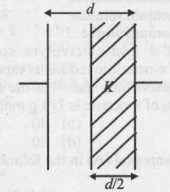
[4 Marks] Diagram 44 – NEET-UG 2020 Question Paper — Set 2
  • (A) 4:1
  • (B) 8:5
  • (C) 2:1
  • (D) 6:5
Question 120.

In the following, in each set a conservation approach and an example of method of conservation are given

(A) In situ conservation – Biosphere Reserve

(B) Ex situ conservation – Sacred groves

(C) In situ conservation – Seed bank

(D) Ex situ conservation – Cryopreservation

Select the option with correct match of approach and method

[1 Mark]
  • (A) (B) and (D)
  • (B) (A) and (C)
  • (C) (A) and (D)
  • (D) (A) and (B)
Question 121.

Match the following techniques or instruments with their usage:

Techniques / Instruments

Usage

(A) Bioreactor

(i) Separation of DNA fragments

(B) Electrophoresis

(ii) Production of large quantities of products

(C) PCR

(D) ELISA

(iii) Detection of pathogen, based on antigen-antibody reaction

(iv) Amplification of

[4 Marks]
  • (A) (A)-(ii), (B)-(i), (C)-(iv), (D)-(iii)
  • (B) (A)-(iv), (B)-(iii), (C)-(ii), (D)-(i)
  • (C) (A)-(iii), (B)-(ii), (C)-(iv), (D)-(i)
  • (D) (A)-(ii), (B)-(i), (C)-(iii), (D)-(iv)
Question 122.

Identify the correct features of Mango and Coconut fruits.

(i) In both, fruit is a drupe.
(ii) Endocarp is edible in both.
(iii) Mesocarp in Coconut is fibrous, and in Mango it is fleshy.
(iv) In both, fruit develops from a monocarpellary ovary only.

Select the correct option from below:

[4 Marks]
  • (A) (i) and (iv) only
  • (B) (i), (ii) and (iii) only
  • (C) (i), (iii) and (iv) only
  • (D) (i) and (ii) only
Question 123.

Match the items in Column I with those in Column II:

Column I

Column II

(A) Herbivores–Plants

(i) Commensalism

(B) Mycorrhiza–Plants

(ii) Mutualism

(C) Sheep–Cattle

(iii) Predation

(D) Orchid–Tree

(iv) Competition

Select the correct option from the following:

[4 Marks]
  • (A) (A)–(ii), (B)–(i), (C)–(iii), (D)–(iv)
  • (B) (A)–(iii), (B)–(ii), (C)–(iv), (D)–(i)
  • (C) (A)–(i), (B)–(iii), (C)–(iv), (D)–(ii)
  • (D) (A)–(iv), (B)–(ii), (C)–(i), (D)–(iii)
Question 124.

Air (Prevention and Control of Pollution) Act was amended in 1987 to include among pollutants:

[4 Marks]
  • (A) Particulates of size 2.5 micrometer or below
  • (B) Vehicular exhaust
  • (C) Allergy causing pollen
  • (D) Noise
Question 125.

In Glycine max, the product of biological nitrogen fixation is transported from the root nodules to other parts as:

[4 Marks]
  • (A) Ureides
  • (B) Ammonia
  • (C) Glutamate
  • (D) Nitrates
Question 126.

Which of the following statements about cork cambium is incorrect?

[4 Marks]
  • (A) It is couple of layers thick.
  • (B) It forms secondary cortex on its outer side.
  • (C) It forms a part of periderm.
  • (D) It is responsible for the formation of lenticels.
Question 127.

Match the following:

Column I

Column II

(A) Aquaporin

(i) Amide

(B) Asparagine

(ii) Polysaccharide

(C) Abscisic acid

(iii) Polypeptide

(D) Chitin

(iv) Carotenoids

Select the correct option:

[4 Marks]
  • (A) (A)–(iii), (B)–(i), (C)–(iv), (D)–(ii)
  • (B) (A)–(iii), (B)–(i), (C)–(ii), (D)–(iv)
  • (C) (A)–(ii), (B)–(i), (C)–(iv), (D)–(iii)
  • (D) (A)–(ii), (B)–(iii), (C)–(iv), (D)–(i)
Question 128.

Which of the following statements is incorrect about gymnosperms?

[4 Marks]
  • (A) Their seeds are not covered.
  • (B) They are heterosporous.
  • (C) Male and female gametophytes are free living.
  • (D) Most of them have narrow leaves with thick cuticle.
Question 129.

Which of the following elements helps in maintaining the structure of ribosomes?

[4 Marks]
  • (A) Molybdenum
  • (B) Magnesium
  • (C) Zinc
  • (D) Copper
Question 130.

Match the following concerning the activity/function and the phytohormone involved:

Column I

Column II

(A) Fruit ripener

(i) Abscisic acid

(B) Herbicide

(ii) GA₃

(C) Bolting agent

(iii) 2, 4-D

(D) Stress hormone

(iv) Ethephon

Select the correct option from the following:

[4 Marks]
  • (A) (A)–(iv), (B)–(iii), (C)–(i), (D)–(iii)
  • (B) (A)–(ii), (B)–(iii), (C)–(iv), (D)–(i)
  • (C) (A)–(ii), (B)–(iii), (C)–(iv), (D)–(i)
  • (D) (A)–(iv), (B)–(iii), (C)–(ii), (D)–(i)
Question 131.

Who coined the term 'Kinetin'?

[4 Marks]
  • (A) Darwin
  • (B) Went
  • (C) Kurosawa
  • (D) Skoog and Miller
Question 132.

Which of the following statements is incorrect regarding the phosphorus cycle?

[4 Marks]
  • (A) It is sedimentary cycle
  • (B) Phosphates are the major form of phosphorus reservoir
  • (C) Phosphorus solubilising bacteria facilitate the release of phosphorus from organic remains
  • (D) There is appreicable respiratory release of phosphorus into atmosphere
Question 133.

First discovered restriction endonuclease that always cuts DNA molecule at a particular point by recognising a specific sequence of six base pairs is

[4 Marks]
  • (A) Thermostable DNA polymerase
  • (B) Adenosine deaminase
  • (C) EcoR I
  • (D) Hind II
Question 134.

Which of the following is associated with decrease in cardiac output?

[4 Marks]
  • (A) Parasympathetic neural signals
  • (B) Pneumotaxic centre
  • (C) Sympathetic nerves
  • (D) Adrenal medullary hormones
Question 135.

Match the following group of organisms with their respective distinctive characteristics and select the correct option.

Organisms

Characteristics

(A) Platyhelminthes

(i) Cylindrical body with no segmentation

(B) Echinoderms

(ii) Warm-blooded animals with direct development

(C) Hemichordates

(iii) Bilateral symmetry with incomplete digestive system

(D) Aves

(iv) Radial symmetry with indirect development

[4 Marks]
  • (A) (A)–(i), (B)–(ii), (C)–(iii), (D)–(iv)
  • (B) (A)–(iii), (B)–(iv), (C)–(i), (D)–(ii)
  • (C) (A)–(iv), (B)–(i), (C)–(ii), (D)–(iii)
  • (D) (A)–(ii), (B)–(iii), (C)–(iv), (D)–(i)
Question 136.

Which is the basis of genetic mapping of human genome as well as DNA fingerprinting?

[4 Marks]
  • (A) Polymorphism in hnRNA sequence
  • (B) Single nucleotide polymorphism
  • (C) Polymorphism in DNA sequence
  • (D) Polymorphism in RNA sequence
Question 137.

The best example for pleiotropy is:

[4 Marks]
  • (A) Phenylketonuria
  • (B) Colour Blindness
  • (C) Skin colour
  • (D) ABO Blood group
Question 138.

The total Lung Capacity (TLC) is the total volume of air accommodated in the lungs at the end of a force inspiration. This includes:

[4 Marks]
  • (A) RV; ERV; VC (Vital Capacity) and FRC (Functional Residual Capacity)
  • (B) RV; ERV; IC and EC
  • (C) RV; IC (Inspiratory Capacity); EC (Expiratory Capacity); and ERV
  • (D) RV (Residual Volume); ERV (Expiratory Reserve Volume); TV (Tidal Volume); and IRV (Inspiratory Reserve Volume)
Question 139.

Hormones stored and released from neurohypophysis are

[4 Marks]
  • (A) Prolactin and Vasopressin
  • (B) Thyroid stimulating hormone and Oxytocin
  • (C) Oxytocin and Vasopressin
  • (D) Oxytocin and Vasopressin
Question 140.

According to Central Pollution Control Board (CPCB) what size (in diameter) of particulate is responsible for causing greater harm to human health?

[4 Marks]
  • (A) 3.0 micrometers
  • (B) 3.5 micrometers
  • (C) 4.0 micrometers
  • (D) 2.5 micrometers
Question 141.

Cyclosporin A, used as immunosuppression agent, is produced from

[4 Marks]
  • (A) Trichoderma polysporum
  • (B) Saccharomyces cerevisiae
  • (C) Penicillium notatum
  • (D) Monascus purpureus
Question 142.

For the commercial and industrial production of Critic Acid, which of the following microbes is used?

[4 Marks]
  • (A) Saccharomyces cerevislae
  • (B) Clostridium butylicum
  • (C) Lactobacillus sp
  • (D) Aspergillus niger
Question 143.

All vertebrates are chordates but all chordates are not vertebrates, why?

[4 Marks]
  • (A) All chordates possess notochord throughout their life
  • (B) Notochord is replaced by vertebral column in adult of some chordates
  • (C) Ventral hollow nerve cord remains throughout life in some chordates
  • (D) All chordates possess vertebral column
Question 144.

The phenomenon of evolution of different species in a given geographical area starting from a point and spreading to other habitats is called

[4 Marks]
  • (A) Natural selection
  • (B) Co-evolution
  • (C) Saltation
  • (D) Adaptive radiation
Question 145.

E. coli has only 4.6 × 10⁶ base pairs and completes the process of replication within 18 minutes; then the average rate of polymerisation is approximately:

[4 Marks]
  • (A) 1000 base pairs/second
  • (B) 3000 base pairs/second
  • (C) 4000 base pairs/second
  • (D) 2000 base pairs/second
Question 146.

The size of Pleuropneumonia-like organism (PPLO) is:

[4 Marks]
  • (A) 0.1 µm
  • (B) 0.02 µm
  • (C) 10–20 µm
  • (D) 1–2 µm
Question 147.

Intrinsic factor that helps in the absorption of vitamin B₁₂ is secreted by:

[4 Marks]
  • (A) Chief cells
  • (B) Goblet cells
  • (C) Hepatic cells
  • (D) Oxyntic cells
Question 148.

Match the following columns with reference to cockroach and select the correct option:

Column I

Column II

(A) Grinding of the food

(i) Hepatic caecal particles

(B) Secrete gastric juice

(ii) 10th segment

(C) 10 pairs

(iii) Proventriculus

(D) Anal Cerci

(iv) Spiracles

(v) Alary muscles

[4 Marks]
  • (A) (A)–(ii), (B)–(iii), (C)–(i), (D)–(iv)
  • (B) (A)–(iii), (B)–(i), (C)–(iv), (D)–(ii)
  • (C) (A)–(iv), (B)–(iii), (C)–(v), (D)–(ii)
  • (D) (A)–(i), (B)–(iv), (C)–(iii), (D)–(ii)
Question 149.

The increase in osmolarity from outer to inner medullary interstitium is maintained due to:

(i) Close proximity between Henle's loop and vasa recta
(ii) Counter current mechanism
(iii) Selective secretion of HCO₃⁻ and hydrogen ions in PCT
(iv) Higher blood pressure in glomerular capillaries

[4 Marks]
  • (A) (iii) and (iv)
  • (B) (i), (ii) and (iii)
  • (C) Only (ii)
  • (D) (i) and (ii)
Question 150.

Select the correct statement:

[4 Marks]
  • (A) Atrial Natriuretic Factor increases the blood pressure.
  • (B) Reduction in Glomerular Filtration Rate activates JG cells to release renin.
  • (C) Angiotensin II is a powerful vasodilator.
  • (D) Angiotensin II is a powerful vasodilator.
Question 151.

Which of the following STDs are not curable?

[4 Marks]
  • (A) Chlamydiasis, Syphilis, Genital warts
  • (B) HIV, Gonorrhoea, Trichomoniasis
  • (C) Genital herpes, Hepatitis B, HIV infection
  • (D) Gonorrhoea, Trichomoniasis, Hepatitis B
Question 152.

Match the following columns and select the correct option:

Column I

Column II

(A) Smooth endoplasmic reticulum

(i) Protein synthesis

(B) Rough endoplasmic reticulum

(ii) Lipid synthesis

(C) Golgi complex

(iii) Glycosylation

(D) Centriole

(iv) Spindle formation

[4 Marks]
  • (A) (A)–(i), (B)–(ii), (C)–(iii), (D)–(iv)
  • (B) (A)–(ii), (B)–(i), (C)–(iii), (D)–(iv)
  • (C) (A)–(iv), (B)–(ii), (C)–(i), (D)–(iii)
  • (D) (A)–(iii), (B)–(i), (C)–(ii), (D)–(iv)
Question 153.

Hominid fossil discovered in Java in 1891, now extinct, having cranial capacity of about 900 cc was:

[4 Marks]
  • (A) Homo sapiens
  • (B) Homo erectus
  • (C) Australopithecus
  • (D) Neanderthal man
Question 154.

The proteolytic enzyme rennin is found in:

[4 Marks]
  • (A) Pancreatic juice
  • (B) Intestinal juice
  • (C) Gastric juice
  • (D) Bile juice
Question 155.

Match the following columns and select the correct option:

Column I

Column II

(A) Dragonflies

(i) Biocontrol agents of several plant pathogens

(B) Bacillus thuringiensis

(ii) Get rid of Aphids and mosquitoes

(C) Glomus

(iii) Narrow spectrum insecticidal applications

(D) Baculoviruses

(iv) Biocontrol agent of lepidopteran plant pests

(v) Absorb phosphorus from soil

[4 Marks]
  • (A) (A)–(iii), (B)–(v), (C)–(iv), (D)–(i)
  • (B) (A)–(ii), (B)–(iv), (C)–(v), (D)–(iii)
  • (C) (A)–(ii), (B)–(iii), (C)–(iv), (D)–(v)
  • (D) (A)–(ii), (B)–(i), (C)–(iii), (D)–(iv)
Question 156.

Select the incorrectly matched pair from the following:

[4 Marks]
  • (A) Neurons — Nerve cells
  • (B) Fibroblast — Areolar tissue
  • (C) Chondrocytes — Smooth muscle cells
  • (D) Osteocytes — Bone cells
Question 157.

The yellowish fluid "colostrum" secreted by mammary glands of mother during the initial days of lactation has abundant antibodies (IgA) to protect the infant. This type of immunity is called as:

[4 Marks]
  • (A) Autoimmunity
  • (B) Passive immunity
  • (C) Active immunity
  • (D) Acquired immunity
Question 158.

Select the correct option of haploid cells from the following groups:

[4 Marks]
  • (A) Spermatogonia, Primary spermatocyte, Spermatid
  • (B) Primary oocyte, Secondary oocyte, Spermatid
  • (C) Secondary spermatocyte, First polar body, Ovum
  • (D) Primary spermatocyte, Secondary spermatocyte, Second polar body
Question 159.

During Meiosis I, in which stage synapsis takes place?

[4 Marks]
  • (A) Leptotene
  • (B) Pachytene
  • (C) Diplotene
  • (D) Zygotene
Question 160.

Select the correct statement from the following:

[4 Marks]
  • (A) The polymerase enzyme joins the gene of interest and the vector DNA.
  • (B) Restriction enzyme digestions are performed by incubating purified DNA molecules with restriction enzymes under optimum conditions.
  • (C) PCR is used for isolation and separation of gene of interest.
  • (D) Gel electrophoresis is used for amplification of a DNA segment.
Question 161.

Spooling is:

[4 Marks]
  • (A) Cutting of separated DNA bands from the agarose gel
  • (B) Collection of isolated DNA
  • (C) Transfer of separated DNA fragments to synthetic membranes
  • (D) Amplification of DNA
Question 162.

Match the following columns and select the correct option:

Column I

Column II

(A) Ovary

(i) Human chorionic Gonadotropin

(B) Placenta

(ii) Estrogen & Progesterone

(C) Corpus luteum

(iii) Androgens

(D) Leydig cells

(iv) Progesterone only

[4 Marks]
  • (A) (A)–(i), (B)–(iii), (C)–(ii), (D)–(iv)
  • (B) (A)–(iv), (B)–(iii), (C)–(ii), (D)–(i)
  • (C) (A)–(i), (B)–(ii), (C)–(iii), (D)–(iv)
  • (D) (A)–(ii), (B)–(i), (C)–(iv), (D)–(iii)
Question 163.

Match the following columns and select the correct option:

Column I

Column II

(A) Pituitary hormone

(i) Steroid

(B) Epinephrine

(ii) Neuropeptides

(C) Endorphins

(iii) Peptides, proteins

(D) Cortisol

(iv) Biogenic amines

[4 Marks]
  • (A) (A)–(iii), (B)–(iv), (C)–(i), (D)–(ii)
  • (B) (A)–(iv), (B)–(i), (C)–(ii), (D)–(iii)
  • (C) (A)–(iii), (B)–(iv), (C)–(ii), (D)–(i)
  • (D) (A)–(iv), (B)–(iii), (C)–(i), (D)–(ii)
Question 164.

The laws and rules to prevent unauthorised exploitation of bio-resources are termed as:

[4 Marks]
  • (A) Biopiracy
  • (B) Bioethics
  • (C) Biopatenting
  • (D) Bioengineering
Question 165.

Match the following columns and select the correct option:

Column I

Column II

(i) Typhoid

(A) Haemophilus influenzae

(ii) Malaria

(B) Wuchereria bancrofti

(iii) Pneumonia

(C) Plasmodium vivax

(iv) Filariasis

(D) Salmonella typhi

[4 Marks]
  • (A) (i)–(A), (ii)–(B), (iii)–(D), (iv)–(C)
  • (B) (i)–(D), (ii)–(C), (iii)–(A), (iv)–(B)
  • (C) (i)–(C), (ii)–(D), (iii)–(B), (iv)–(A)
  • (D) (i)–(A), (ii)–(C), (iii)–(B), (iv)–(D)
Question 166.

RNA interference is used for which of the following purposes in the field of biotechnology?

[4 Marks]
  • (A) to develop a pest resistant plant against infestation by nematode
  • (B) to enhance the mineral usage by the plant
  • (C) RNA interference is used for which of the following purposes in the field of biotechnology?
  • (D) to develop a plant tolerant to abiotic stresses
Question 167.

The rate of decomposition is faster in the ecosystem due to following factors EXCEPT:

[4 Marks]
  • (A) Presence of aerobic soil microbes
  • (B) Warm and moist environment
  • (C) Detritus rich in sugars
  • (D) Detritus richer in lignin and chitin
Question 168.

Which of the following conditions cause erythroblastosis foetalis?

[4 Marks]
  • (A) Mother Rh⁻ve and foetus Rh⁺ve
  • (B) Mother Rh⁺ve and foetus Rh⁻ve
  • (C) Both mother and foetus Rh⁻ve
  • (D) Both mother and foetus Rh⁺ve
Question 169.

In Human beings, at the end of 12 weeks (first trimester) of pregnancy, the following is observed:

[4 Marks]
  • (A) The head is covered with fine hair
  • (B) Most of the major organ systems are formed
  • (C) Eyelids and eyelashes are formed
  • (D) Movement of the foetus
Question 170.

Progestogens alone or in combination with estrogens can be used as a contraceptive in the form of

[4 Marks]
  • (A) Pills, injections and implants
  • (B) Injections only
  • (C) Implants only
  • (D) Pills only
Question 171.

‘Which of the following options does correctly represent the characteristic features of phylum Annelida?

[4 Marks]
  • (A) Triploblastic, segmented body and bilaterally symmetrical
  • (B) Triploblastic, flattened body and acoelomate condition
  • (C) Triploblastic, unsegmented body and bilaterally symmetrica
  • (D) Diploblastic, mostly marine and radially symmetrical
Question 172.

Inbreeding depression is

[4 Marks]
  • (A) Reduced fertility and productivity due to continued close inbreeding
  • (B) Reduced motility and immunity due to close inbreeding
  • (C) Decreased productivity due to mating of superior male and inferior female
  • (D) Decrease in body mass of progeny due to continued close inbreeding
Question 173.

Match the following columns and select the correct option:

Column I

Column II

(A) Rods and Cones

(i) Absence of photoreceptor cells

(B) Blind Spot

(ii) Cones are densely packed

(C) Fovea

(iii) Photoreceptor cells

(D) Iris

(iv) Visible coloured portion of the eye

[4 Marks]
  • (A) (A)–(iii), (B)–(i), (C)–(ii), (D)–(iv)
  • (B) (A)–(ii), (B)–(iv), (C)–(iii), (D)–(i)
  • (C) (A)–(iii), (B)–(iv), (C)–(ii), (D)–(i)
  • (D) (A)–(ii), (B)–(iii), (C)–(i), (D)–(iv)
Question 174.

Match the following columns and select the correct option:

Column I

Column II

(A) Pneumotaxic Centre

(i) Alveoli

(B) O₂ Dissociation Curve

(ii) Pons region of the brain

(C) Carbonic Anhydrase

(iii) Haemoglobin

(D) Primary site of exchange of gases

(iv) R.B.C.

[4 Marks]
  • (A) (A)–(ii), (B)–(iii), (C)–(iv), (D)–(i)
  • (B) (A)–(iv), (B)–(i), (C)–(iii), (D)–(ii)
  • (C) (A)–(iii), (B)–(ii), (C)–(iv), (D)–(i)
  • (D) (A)–(i), (B)–(iii), (C)–(ii), (D)–(iv)
Question 175.

Match the following columns and select the correct option:

Column I

Column II

(A) Gout

(i) Decreased levels of estrogen

(B) Osteoporosis

(ii) Low Ca²⁺ ions in the blood

(C) Tetany

(iii) Accumulation of uric acid crystals

(D) Muscular dystrophy

(iv) Autoimmune dystrophy disorder

(v) Genetic disorder

[4 Marks]
  • (A) (A)–(i), (B)–(ii), (C)–(iii), (D)–(iv)
  • (B) (A)–(iii), (B)–(i), (C)–(ii), (D)–(v)
  • (C) (A)–(iv), (B)–(v), (C)–(i), (D)–(ii)
  • (D) (A)–(ii), (B)–(i), (C)–(iii), (D)–(iv)
Question 176.

Match the following columns and select the correct option:

Column I

Column II

(A) Aptenodytes

(i) Flying fox

(B) Pteropus

(ii) Angel fish

(C) Pterophyllum

(iii) Lamprey

(D) Petromyzon

(iv) Penguin

[4 Marks]
  • (A) (A)–(iii), (B)–(iv), (C)–(ii), (D)–(i)
  • (B) (A)–(ii), (B)–(i), (C)–(iv), (D)–(iii)
  • (C) (A)–(iii), (B)–(iv), (C)–(i), (D)–(ii)
  • (D) (A)–(iv), (B)–(i), (C)–(ii), (D)–(iii)
Question 177.

In cockroach, identify the parts of the foregut in correct sequence:

[4 Marks]
  • (A) Mouth → Pharynx → Oesophagus → Crop → Gizzard
  • (B) Mouth → Crop → Pharynx → Oesophagus → Gizzard
  • (C) Mouth → Gizzard → Crop → Pharynx → Oesophagus
  • (D) Mouth → Oesophagus → Pharynx → Crop → Gizzard
Question 178.

Match the following events that occur in their respective phases of cell cycle and select the correct option:

Column I

Column II

(A) G₁ phase

(i) Cell grows and organelle duplication

(B) S phase

(ii) DNA replication and chromosome duplication

(C) G₂ phase

(iii) Cytoplasmic growth

(D) Metaphase in M-phase

(iv) Alignment of chromosomes

[4 Marks]
  • (A) (A)–(ii), (B)–(iii), (C)–(iv), (D)–(i)
  • (B) (A)–(i), (B)–(ii), (C)–(iii), (D)–(iv)
  • (C) (A)–(iii), (B)–(iv), (C)–(i), (D)–(ii)
  • (D) (A)–(iv), (B)–(i), (C)–(ii), (D)–(iii)
Question 179.

Bt cotton variety that was developed by the introduction of toxin gene of Bacillus thuringiensis (Bt) is resistant to

[4 Marks]
  • (A) Plant nematodes
  • (B) Fungal diseases
  • (C) Insect predators
  • (D) Insect pests
Question 180.

According to Robert May, the global species diversity is about

[4 Marks]
  • (A) 1.5 million
  • (B) 20 million
  • (C) 7 million
  • (D) 50 million