CBSE EXAMINATION PAPER-2023
NEET-ZOOLOGY
(Solved)
General Instructions :
Read the following instructions carefully and follow them :
- This question paper contains 200 questions. All questions are compulsory.
- This question paper is divided into 1 sections.
- Section A – questions number 1 to 200 are multiple choice questions
- There is no overall choice given in the question paper. However, an internal choice has been provided in few questions.
- Use of calculator is NOT allowed.
Section A
Two particles A and B initially at rest, move towards each other under mutual force of attraction. At an instance when the speed of A is v and speed of B is 3v, the speed of centre of mass is
As there is no external force acting on COM i.e., vector F_ext =0 and initial velocity of COM is zero, SESY) therefore it will remain at rest i.e., the speed of centre of mass is zero.
On the basis of electrical conductivity, which one of the following material has the smallest resistivity?
Resistivity ρ = 1/σ(conductivity) and σ maximum for silver so silver has the smallest re resistivity.
A charge Q μ C is placed at the centre of a cube. The flux coming out from any one of its faces will be (in SI unit)
From Gauss's law, total electric flux through a closed surface
Φ_net = q / ε₀
∴ Total electric flux through the cube
Φ_c = (Q × 10⁻⁶) / ε₀
As charge is placed at the centre of the cube, so flux through each face is same.
∴ Φ = (1 / 6) Φ_c = (1 / 6) × (Q × 10⁻⁶) / ε₀
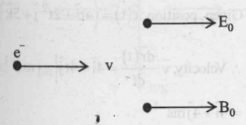
A uniform electric field and a uniform magnetic field are acting along the same direction in a certain region. If an electron is projected in the region such that its velocity is pointed along the direction of fields, then the electron
Force due to magnetic field F_m = qvB sinθ Here θ = 0 ⇒ F_m = 0
Force due to electric field vector F_e = qE vector
Here , vector F_e = -eE vector
Clearly, force due to electric field is opposite to the direction of motion, so its speed will decrease.
A ball is projected from point A with velocity 20 m s⁻¹ at an angle 60° to the horizontal direction. At the highest point B of the path (as shown in figure), the velocity v m s⁻¹ of the ball will be
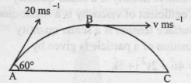
At the highest point (B) of a projectile,
v = v₀ cos 60° = 20 cos 60° = 20 × (1 / 2) = 10 m/s
[ ∵ At B, V_y = 0 ]
The amount of elastic potential energy per unit volume (in SI unit) of a steel wire of length 100 cm to stretch it by 1 mm is (if Young's modulus of the wire = 2.0 × 10¹¹ N m⁻²)
Elastic potential energy per unit volume
= (1 / 2) × Young's modulus × (Strain)²
= (1 / 2) × 2 × 10¹¹ × [ 1 / 1000 ]²
= (1 / 2) × 2 × 10¹¹ × 10⁻⁶ = 10⁵ J/m³
A certain wire A has resistance 81 Ω. The resistance of another wire B of same material and equal length but of diameter thrice the diameter of A will be
∵ Resistance R = ρl / A , where A = (π / 4) d²
∴ 81 = (ρ × l) / ((π / 4) d²) , and R' = (ρ × l) / ((π / 4) × (3d)²) = (ρl) / ((π / 4) × 9d²)
∴ R' = R / 9 = 81 / 9 = 9 Ω
If Z₁ and Z₂ are the impedances of the given circuits (a) and (b) as shown in figures, then choose the correct option.
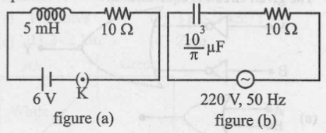
As, D. C. voltage is supplied so impedance Z₁ = R = 10 Ω
And Z₂ = √[ R² + (X_c)² ]
= √[ (10)² + [ 1 / (2 × π × 50 × (10³ / π) × 10⁻⁶) ]² ]
⇒ Z₂ = √[ (10)² + (10)² ] = 10√2
∴ Z₂ > Z₁ or Z₁ < Z₂
The ground state energy of hydrogen atom is -13.6 eV. The energy needed to ionize hydrogen atom from its second excited state will be
Total energy of electron in hydrogen atom
E_η = -13.6 / n²
In second excited state = -13.6 / (3)² = -1.51 eV
Therefore 1.51 eV energy required to ionize hydrogen atom from its second excited state.
The mechanical quantity, which has dimensions of reciprocal of mass (M⁻¹) is
Gravitational force, F = GM₁M₂ / r²
⇒ [G] = ([F][r]²) / ([M₁][M₂]) = ([MLT⁻²][L²]) / ([M][M])
⇒ [G] = [M⁻¹ L³ T⁻²] Torque T = F · r = [ML² T⁻²] Angular momentum, L = Mvr = [ML² T⁻¹]
A p-type extrinsic semiconductor is obtained when Germanium is doped with
To make a p–type extrinsic semiconductor, an intrinsic semiconductor is doped with trivalent intrinsic impurity like Gallium, Indium, Boron, Aluminum, etc.
The viscous drag acting on a metal sphere of diameter 1 mm, falling through a fluid of viscosity 0.8 Pa s with a velocity of 2 m s⁻¹ is equal to
From stoke's law, Viscous drag acting on sphere Fᵥ = 6πηrv
= 6 × (22 / 7) × 0.8 × (10⁻³ / 2) × 2 = 15.08 × 10⁻³ N
= 15 × 10⁻³ N
The maximum power is dissipated for an ac in a/an
Power, P = V_rms I_rms cosϕ In purely resistive circuit voltage and current are in same phase ∴ cosϕ = cos0° = 1 ∴ Power dissipated in maximum.
According to Gauss law of electrostatics, electric flux through a closed surface depends on
According to Gauss' law, total electric flux
ϕ = ∮ 𝐄⃗ · d 𝐬⃗ = q_enclosed / ε₀
∴ Electric flux depends on quantity of charges enclosed by surface.
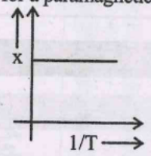
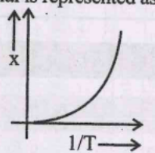
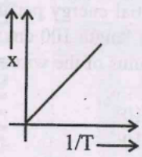
The variation of susceptibility (χ) with absolute temperature (T) for a paramagnetic material is represented as:
-
(A)
-
(B)
-
(C)
-
(D)
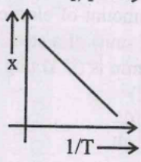
As per Curie law χ_m ∝ 1 / T (Paramagnetic)
Susceptibility χ varies inversely with absolute temperature. Therefore option (c) represents correct χ versus 1 / T graph.
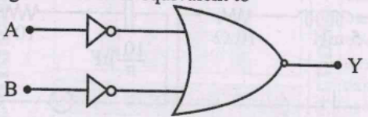
The given circuit is equivalent to
-
(A)
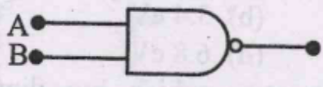
-
(B)
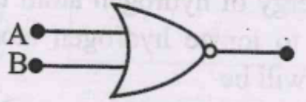
-
(C)
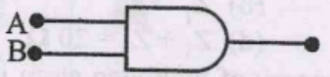
-
(D)
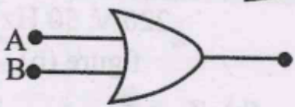
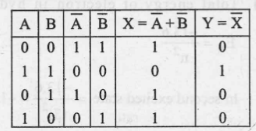
Truth table of given logic circuit is as follows.
Find out put is same as that of and gate out put so given circuit is equivalent to and gate.
The above figure shows the circuit symbol of a transistor. Select the correct statements given below:
(A) The transistor has two segments of p-type semiconductor separated by a segment of n-type semiconductor.
(B) The emitter is of moderate size and heavily doped.
(C) The central segment is thin and lightly doped.
(D) The emitter base junction is reverse biased in common emitter amplifier circuit.
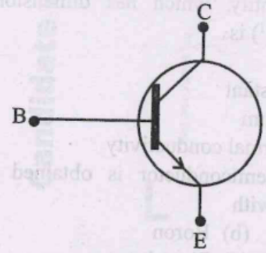
The given transistor represents a n–p–n transistor so statement (A) is incorrect Emitter base junction is forward biased. Emitter is of moderate size and heavily doped and central segment is thin and lightly doped. So, statements (B) and (C) are correct.
A horizontal ray of light is incident on the right-angled prism with prism angle 6°. If the refractive index of the material of the prism is 1.5, then the angle of emergence will be
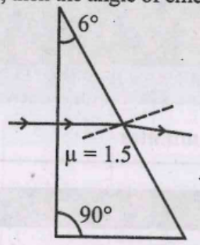
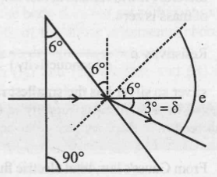
Deviation produced by a thin prism
δ = (μ - 1)A = (3/2 - 1) 6° = 3°
Angle of emergence, e=6° +3°=9°
A particle moves with a velocity (5î - 3ĵ + 6k̂) ms⁻¹ horizontally under the action of constant force (10î + 10ĵ + 20k̂) N. The instantaneous power supplied to the particle is:
Instantaneous power P = 𝐅⃗ ·𝐕⃗
P = [10î + 10ĵ + 20k̂] · [5î - 3ĵ + 6k̂] W
= [50 - 30 + 120] W = 140 W
The maximum kinetic energy of the emitted photoelectrons in photoelectric effects is independent of:
By Einstein's photoelectric equation KE_max = hf - ϕ₀
or, KE_max = hc / λ - hc / λ₀
Clearly KE_max is independent of intensity of incident radiation.
The diameter of a spherical bob, when measured with vernier callipers yielded the following values: 3.33 cm, 3.32 cm, 3.34 cm, 3.33 cm and 3.32 cm. The mean diameter to appropriate significant figures is:
Mean diameter,
d̄ = [3.33 cm + 3.32 cm + 3.34 cm + 3.33 cm + 3.32 cm] / 5
= 3.328 cm
After rounding off to 2 decimal places, d̄ = 3.33 cm
Which of the following statement is not true?
All pressure, relative density, coefficient of viscosity and surface tension are scalar quantity
The position of a particle is given by 𝐫⃗(t) = 4t î + 2t² ĵ + 5k̂ where t is in seconds and r in metre. Find the magnitude and direction of velocity v(t), at t = 1 s, with respect to x-axis.
Given, position,𝐫⃗(t) = (4t î + 2t² ĵ + 5k̂) m
∴ Velocity, 𝐯⃗ = dr𝐫⃗(t) / dt = 4î + 4t ĵ |_(t=1) m s⁻¹ =
= 4î + 4ĵ m s⁻¹
∴ | 𝐯⃗| = √[4² + 4²] = 4√2 m s⁻¹
And, tan ϕ = v_y / v_x = 4 / 4 = 1
∴ Direction with respect to X-axis is 45°
For the given cycle, the work done during isobaric process is:
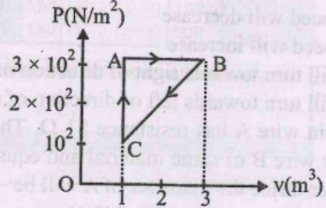
Work done in isobaric i.e., when pressure is constant (AB) process = P ΔV = 3 × 10² [2] J = 600 J
The de Broglie wavelength associated with an electron, accelerated by a potential difference of 81 V is given by:
De Broglie wavelength,
λ = 12.27 / √V Å = 12.27 / √81 Å = 12.27 / 9 Å
∴ λ = 1.36 Å or 0.136 nm
The 4ᵗʰ overtone of a closed organ pipe is same as that of 3ʳᵈ overtone of an open pipe. The ratio of the length of the closed pipe to the length of the open pipe is:
4ᵗʰ overtone for closed organ pipe → 9ᵗʰ harmonic and 3ʳᵈ overtone for open organ pipe → 4ᵗʰ harmonic
∴ 9 × (V / 4l_c) = 4 × (V / 2l_o) ⇒ l_c / l_o = 9 / 8
The equivalent capacitance of the arrangement shown in figure is
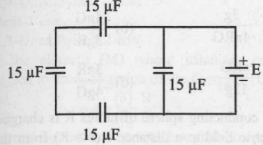
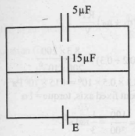
The equivalent circuit of the given circuit is as follows
∴ C_net = 15 + 5 = 20 μF
ε₀ and μ₀ are the electric permittivity and magnetic permeability of free space respectively. If the corresponding quantities of a medium are 2ε₀ and 1.5 μ₀ respectively, the refractive index of the medium will nearly be
We know Refractive index of the medium, μ_med
= √[μ ε] / √[μ₀ ε₀] = √[ (1.5)μ₀ (2)ε₀ ] / √[μ₀ ε₀] = √3
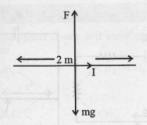
Along straight wire of length 2 m and mass 250 g is suspended horizontally in a uniform horizontal magnetic field of 0.7 T. The amount of current flowing through the wire will be (g = 9.8 ms⁻²)
From FBD of the given diagram, F = mg or, I l B = mg
⇒ I = mg / (l B) = (250 × 10⁻³ × 9.8) / ( (2)(0.7) ) = 1750 × 10⁻³ A
= 1.75 A
A lens is made up of 3 different transparent media as shown in figure. A point object O is placed on its axis beyond 2f. How many real images will be obtained on the other side?
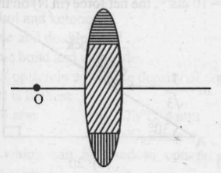
Since object distance u > 2f so all three medium will form individual real images at different points on the other side of lens ∴ Number of real images formed = 3.
An ac source is connected in the given circuit. The value of ϕ will be
V = 220 sin(100πt + ϕ) volt
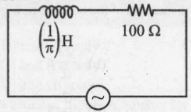
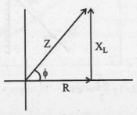
Inductive reactance, X_L = ωL
X_L = 100 π × (1 / π) = 100 Ω
∴ tan ϕ = X_L / R = 100 / 100 = 1 ∴ ϕ = 45°
A bullet of mass m hits a block of mass M elastically. The transfer of energy is the maximum, when
During elastic collision between two equal masses, the velocity of the two bodies gets interchanged so if one body is at rest, energy transfer will be maximum for M = m
The escape velocity of a body on the earth surface is 11.2 km/s. If the same body is projected upward with velocity 22.4 km/s, the velocity of this body at infinite distance from the centre of the earth will be
The velocity of the body at infinite distance from the centre of the earth, V' = √[ V² - V_e² ]
= √[ (22.4)² - (11.2)² ]
∴ V' = 11.2√3 km/s
Which set of colours will come out in air for a situation shown in figure?
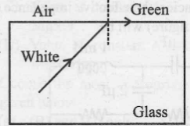
From the relation, sin i_c = 1 / μ and μ ∝ 1 / λ
sin i_c ∝ λ Therefore, for higher value of λ critical angle will be more, so Yellow, Orange and Red will come out to air. The order of wavelength of different colours V < I < B < G < Y < O < R
The wavelength of Lyman series of hydrogen atom appears in
Lyman series of hydrogen atom appears in Ultraviolet region. Balmer series in visible region and Paschen, Bracket and P–fund series in infrared region.
A particle is executing uniform circular motion with velocity 𝐯⃗ and acceleration 𝐚⃗ . Which of the following is true?
In uniform circular motion, due to change in direction, velocity 𝐯⃗ and acceleration 𝐚⃗ is not a constant.
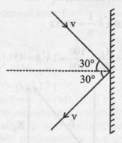
A 1 kg object strikes a wall with velocity 1 ms⁻¹ at an angle of 60° with the wall and reflects at the same angle. If it remains in contact with wall for 0.1 s, then the force exerted on the wall is
Force is equal to rate of change of momentum
∴ F = Δp / Δt
∴ Δp = 2 mv cos30°
= 2 × 1 × (√3 / 2) = √3
∴ F = Δp / Δt = √3 / 0.1 = 10√3 N
A simple pendulum oscillating in air has a period of √3 s. If it is completely immersed in non-viscous liquid, having density (1/4)ᵗʰ of the material of the bob, the new period will be
Time period of simple pendulum T = 2π √[ l / g_eff ]
∴ √3 = 2π √[ l / g ]
After immersed in liquid Mg_eff = Mg - (Mg / ρ_s) · ρ_l
or, Mg_eff = Mg - (Mg / 4)= (3Mg / 4) ⇒ g_eff = 3g / 4
∴ T₁ = 2π √[ l / (3g/4) ] = ( 2π √[l/g] ) × 2 / √3 = 2T/√3 √3 = 2 s
An object is mounted on a wall. Its image of equal size is to be obtained on a parallel wall with the help of a convex lens placed between these walls. The lens is kept at distance x in front of the second wall. The required focal length of the lens will be
If object is placed at 2f then its image of equal size is to be obtained on a parallel wall with the help of a convex lens placed between the two walls.
∴ 2f = x ⇒ f = x / 2
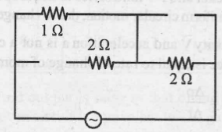
For very high frequencies, the effective impedance of the circuit (shown in the figure) will be
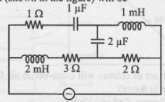
Inductive reactance, X_L = ωL and Capacitive reactance, X_C = 1 / ωC At very high frequency X_C = 0₁ , X_L =∞
Therefore the effective impedance of the circuit,
Z = (1 + 2) Ω = 3 Ω
A copper wire of radius 1 mm contains 10²² free electrons per cubic metre. The drift velocity for free electrons when 10 A current flows through the wire will be (Given, charge on electron = 1.6 × 10⁻¹⁹ C)
Drift velocity, V_d = i / (neA)
V_d = 10 / ( 10²² × 1.6 × 10⁻¹⁹ × π(10⁻³)² )
V_d = 10 / (1.6π × 10⁻³) = 6.25 / π × 10³ m/s
A container of volume 200 cm³ contains 0.2 mole of hydrogen gas and 0.3 mole of argon gas. The pressure of the system at temperature 200 K (R = 8.3 J K⁻¹ mol⁻¹) will be
We know that PV = nRT
P_net = P₁ + P₂ = (n₁ / V)RT + (n₂ / V)RT
= (n₁ + n₂) RT / V
= (0.2 + 0.3) × (8.3 × 200) / (200 × 10⁻⁶)
= 8.3 × 0.5 × 10⁶ = 4.15 × 10⁵ Pa
A constant torque of 100 N m turns a wheel of moment of inertia 300 kg m² about an axis passing through its centre. Starting from rest, its angular velocity after 3 s is
About fixed axis, torque = I α
α = 100 / 300 = 1 / 3 rad/s²
For constant α ⇒ ω_i = 0 ω_f = ω_i + αt ∴ At t = 3 s
ω_f = 1 / 3 × 3 = 1 rad/s
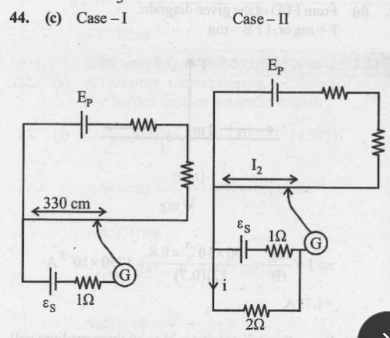
The emf of a cell having internal resistance 1 Ω is balanced against a length of 330 cm on a potentiometer wire. When an external resistance of 2 Ω is connected across the cell, the balancing length will be
For case – I ⇒ ε_s = ϕ × 330
⇒ ϕ = εₛ / 330 (V / cm) ....(1)
For case – II ⇒ i × 2 = ϕ i₂
⇒ (εₛ / 3) × 2 = (εₛ/ 330) × i₂ [From equation 1] ⇒ i₂ = 220 cm
If R is the radius of the earth and g is the acceleration due to gravity on the earth surface. Then the mean density of the earth will be
Acceleration due to gravity on the earth surface
g = GM / R² = (G · 4/3 π R³ ρ) / R²
g = G · 4/3 πRρ ⇒ ρ = 3g / 4GπR
If a conducting sphere of radius R is charged. Then the electric field at a distance r (r > R) from the centre of the sphere would be, (V = potential on the surface of the sphere)
For r > R, Electric Field E = Kq / r² ....(i)
and potential at surface of sphere V = Kq / R
∴ From equation (i)
V = Er² / R ⇒ E = RV / r²
To produce an instantaneous displacement current of 2 mA in the space between the parallel plates of a capacitor of capacitance 4 μF, the rate of change of applied variable potential difference (dV / dt) must be
Displacement current i_d = C (dV / dt)
⇒ 2 × 10⁻³ = 4 × 10⁻⁶ × (dV / dt)
dV / dt = (2 × 10⁻³) / (4 × 10⁻⁶) = 500 V/s
A block of mass 2 kg is placed on an inclined rough surface AC (as shown in figure) of coefficient of friction μ. If g = 10 ms⁻², the net force (in N) on the block will be
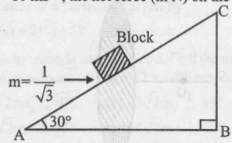
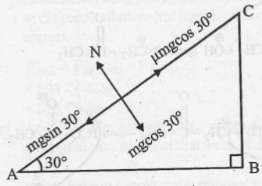
⇒ (F_net)_H = mg sin30° - μmg cos30°
= mg / 2 - (1 / √3) mg · (√3 / 2)
F_net = 0
An emf is generated by an ac generator having 100 turn coil, of loop area 1 m². The coil rotates at a speed of one revolution per second and placed in a uniform magnetic field of 0.05 T perpendicular to the axis of rotation of the coil. The maximum value of emf is
Maximum value of emf generated by an ac generator ε₀ = NBA_ω = 100 × 0.05 × 1 × 2π = 31.415 V ∴ ε₀ = 31.4 V
The angular momentum of an electron moving in an orbit of hydrogen atom is 1.5 (h / π). The energy in the same orbit is nearly
Angular momentum of electron moving in nᵗʰ orbit from Bohr's postulate
L = nh / 2π ....(i)
Given, L = 1.5 (h / π) So, n = 3 ....(ii)
Now, energy of electron in 3ʳᵈ orbit
E = (-13.6 × z²) / n² = (-13.6 × 1²) / 3² ≈ -1.5 eV
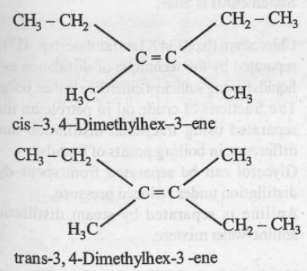
Which amongst the following compounds will show geometrical isomerism?
3, 4–Dimethylhex–3–ene will show geometrical isomerism
Select the element (M) whose trihalides cannot be hydrolysed to produce an ion of the form [M(H₂O)₆]³⁺.
Boron trihalides cannot be hydrolysed to produce an ion of the form [B(H₂O)₆]³⁺ because of absence of d orbitals in boron.
The correct option for the rate law that corresponds to overall first order reaction is
Rate = k [A]⁻¹/² [B]³/²
∴ order of reaction = -1/2 + 3/2 = 1
Which one of the following represents all isoelectronic species?
Ca²⁺ = 20 - 2 = 18 e⁻
Ar = 18 e⁻
K⁺ = 19 - 1 = 18 e⁻
Cl⁻ = 17 + 1 = 18 e⁻
So, Ca²⁺, Ar, K⁺ and Cl⁻ are isoelectronic species.
Cheilosis occurs due to deficiency of _________
Cheilosis refers to the inflammation and small cracks in one or both corners of the mouth. Cheilosis occurs due to deficiency of vitamin B₂ (Riboflavin)
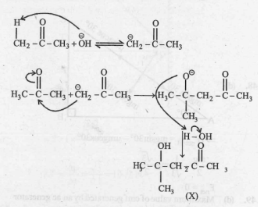
Consider the given reaction:
The functional groups present in compound "X" are

So, the functional group present in compound "X" is alcohol and Ketone.
The correct option in which the density of argon (Atomic mass = 40) is highest
PV = nRT
P = (n / V) RT
P = (d / M) RT
PM / RT = d
⇒ d ∝ 1 / T , d ∝ P
So, for maximum density P should be maximum and T should be minimum which is in option 0°C, 4 atm
Reagents which can be used to convert alcohols to carboxylic acids, are
(A) CrO₃ – H₂SO₄
(B) K₂Cr₂O₇ + H₂SO₄
(C) KMnO₄ + KOH / H₃O⁺
(D) Cu, 573 K
(E) CrO₃ , (CH₃CO)₂O
Choose the most appropriate answer from the options given below.
PV = nRT
P = (n / V) RT
P = (d / M) RT
PM / RT = d
⇒ d ∝ 1 / T , d ∝ P
So, for maximum density P should be maximum and T should be minimum which is in option (A), (B) and (C) only
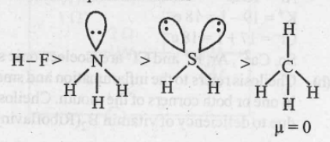
The correct order of dipole moments for molecules NH₃, H₂S, CH₄ and HF, is
Fluorine is the most electronegative element. H – F bond has maximum and polarity. Order of dipole moment is
H – F > NH₃ > H₂S > CH₄ (μ = 0)
Molar conductance of an electrolyte increases with dilution according to the equation:
Λₘ = Λ°ₘ – A√c
Which of the following statements are true?
(A) This equation applies to both strong and weak electrolytes.
(B) Value of the constant A depends upon the nature of the solvent.
(C) Value of constant A is same for both BaCl₂ and MgSO₄.
(D) Value of constant A is same for both BaCl₂ and Mg(OH)₂.
Choose the most appropriate answer from the options given below.
Λₘ = Λ°ₘ – A√c
For strong electrolytes, Λₘ increases slowly with dilution.
The value of 'A' depends on the type of electrolyte.
All electrolytes of particular type have the same value for 'A'
e.g. BaCl₂ and Mg(OH)₂ → 2 – 1 electrolytes
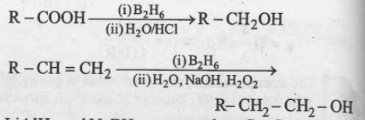
Identify 'X' in above reactions.
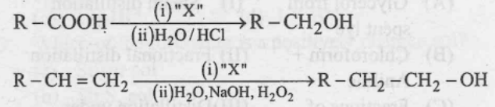
LiAlH₄ and NaBH₄ cannot reduce C = C
H₂/Pd reduce alkene to alkane
Given below are two statements: one is labelled as Assertion (A) and the other is labelled as Reason (R).
Assertion (A): Ionisation enthalpy increases along each series of the transition elements from left to right. However, small variations occur.
Reason (R): There is corresponding increase in nuclear charge which accompanies the filling of electrons in the inner d-orbitals.
In the light of the above statements, choose the most appropriate answer from the options given below.
Due to an increase in nuclear charge which accompanies the filling of the inner d-orbitals, there is an increase in ionisation enthalpy along each series of the transition elements, from left to right. However, many small variations occur.
Which one of the following statements is incorrect related to Molecular Orbital Theory?
According to molecular orbital theory, the sigma (σ) molecular orbitals are symmetrical around the bond-axis while pi (π) molecular orbitals are not symmetrical.
As z–axis is taken as internuclear axis, 2pₓ and 2p_y forms π molecular orbitals, hence these are unsymmetrical around the bond-axis
Which amongst the following is used in controlling depression and hypertension?
Tranquilizers and analgesics are neurologically active drugs. Equanil is used in controlling depression and hypertension.
Given below are two statements:
Statement I: The value of wave function, ψ depends upon the coordinates of the electron in the atom.
Statement II: The probability of finding an electron at a point within an atom is proportional to the orbital wave function.
In the light of the above statements, choose the correct answer from the options given below.
The wave function is a mathematical function whose value depends coordinates of the electron in an atom and does not carry any physical significance. So, Statement I is true.
The probability of finding an electron at a point within an atom is proportional to the square of the orbital wave function i.e. |ψ|² at the point. So, Statement II is false.
Match List-I with List-II.
Choose the correct answer from the options given below:
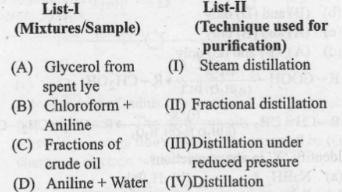
Chloroform (b.p. 334 K) and aniline (b.p. 457) are easily separated by the technique of distillation as both the liquids having sufficient difference in their boiling points.
The fractions of crude oil in petroleum industry is separated using fractional distillation due to less difference in boiling points of liquids.
Glycerol can be separated from spent–dye using distillation under reduced pressure.
Aniline is separated by steam distillation from aniline-water mixture.
Which of the following is correctly matched?
Mn₂O₇, SO₂ and TeO₃ are acidic oxides.
GeO is distinctly acidic in nature.
NO₂ is acidic in nature.
The density of 1 M solution of a compound 'X' is 1.25 g mL⁻¹. The correct option for the molality of solution is (Molar mass of compound X = 85 g)
Relation between Molality (m), Molarity (M) and density (d) is
m = 1000M / (1000 × d - M × M_solute)
M_solute denotes molar mass of solute.
m = (1000 × 1) / ((1000 × 1.25) - (1 × 85)) = 1000 / (1250 - 85) = 1000 / 1165
m = 0.858 m
Given below are two statements:
Statement I: High density polythene is formed in the presence of catalyst triethylaluminium and titanium tetrachloride.
Statement II: High density polymers are chemically inert.
In the light of the above statements, choose the correct answer from the options given below
High density polythene is formed by addition polymerisation of ethene in the presence of catalyst triethyl aluminium and titanium tetrachloride (Ziegler Natta Catalyst) (TiCl₄ and Al(C₂H₅)₃ Cl) So, Statement I is correct. High density polymers are chemically inert. So, Statement II is also correct.
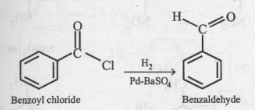
The following conversion is known as
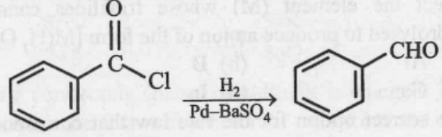
Hydrogenation of Acyl chloride in the presence of catalyst palladium on barium sulphate to form aldehyde is known as Rosenmund reaction.
Match List – I with List – II.
Choose the correct answer from the options given below:
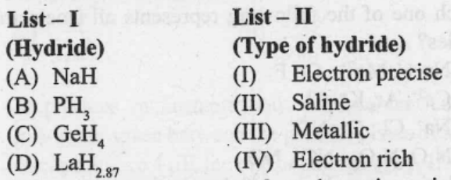
(A) NaH → Saline or Ionic hydride
(B) PH₃ → Electron rich hydride (Elements of group 15-17 form such hydrides)
(C) GeH₄ → Electron precise (Elements of group 14 form such hydrides)
(D) LaH₂.₈₇ → Metallic or Non-stoichiometric hydrides
Incorrect set of quantum numbers from the following is
For any value of l, mₗ value will be -l to +l
So for n = 5 and l = 2: mₗ = -2, -1, 0, +1, +2 and mₛ = +1/2 or -1/2
Hence,
the set n = 5, l = 2, mₗ= -2, -1, +1, +2, mₛ = +1/2 is incorrect.
Given below are two statements: one is labelled as Assertion (A) and the other is labelled as Reason (R).
Assertion (A): Lithium and beryllium unlike their other respective group members form compounds with pronounced ionic character.
Reason (R): Lithium and Magnesium have similar properties due to diagonal relationship.
In the light of the above statements, choose the correct answer from the options given below:
Lithium and Beryllium are the first members of their respective groups (i.e. group 1 and 2 respectively). Due to their exceptionally small atomic and ionic sizes they form compounds with covalent character not ionic. Hence, Assertion statement is wrong. Lithium and Magnesium have similar properties due to diagonal relationship hence, reason statement is correct.
The correct value of cell potential in volt for the reaction that occurs when the following two half cells are connected, is
Fe²⁺_((aq)) + 2e⁻ → Fe(s), E° = -0.44 V
Cr₂O₇²⁻ + 14H⁺ + 6e⁻ → 2Cr³⁺ + 7H₂O, E° = +1.33 V
E°_cell = E°_cathode - E°_anode = 1.33 - (-0.44) = 1.33 + 0.44 = +1.77 V
An acidic buffer is prepared by mixing:
Acidic buffer is a mixture of weak acid and its conjugate base or salt of that weak acid with another strong base in a molar ratio ranging from 1/10 to 10 e.g.,
CH₃COOH + CH₃COONa
(Weak acid) (Salt of weak acid with strong base NaOH)
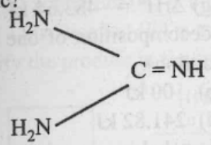
Which amongst the following compounds/species is least basic?
-
(A)
-
(B)
-
(C)
-
(D)
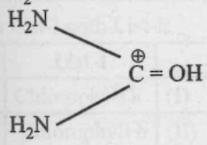
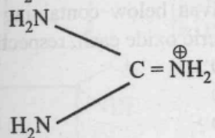
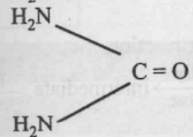
Amides are not basic in nature because of non availability of lone-pair on nitrogen, protonated amide will be even weaker bases.
The correct van der Waals equation for 1 mole of a real gas is
van der Waal equation for n mole gas is
(p + an²/V²) (V - nb) = nRT
For n = 1 mol
(p + a/V²) (V - b) = RT
The E° values for Al⁺/Al = +0.55 V and Tl⁺/Tl = -0.34 V, Al³⁺/Al = -1.66 V and Tl³⁺/Tl = +1.26 V. Identify the incorrect statement.
(1) Al⁺ is unstable in solution because SRP of Al⁺/Al is positive hence, it will get reduced in solution.
(2) Tl/Tl⁺ = +0.34 (SOP)
Tl/Tl³⁺ = -1.26 (SOP)
Since, SOP Tl/Tl⁺ > Tl/Tl³⁺
Hence, Tl will get oxidised to Tl⁺ easily than Tl³⁺
(3) Since Al/Al³⁺ has more SOP than Tl/Tl⁺ it will be more electropositive
(4) Since Tl³⁺ + 2e⁻ → Tl⁺; E = (3 × 1.26 + 0.34) / 2 = +2.04 Hence, Tl³⁺ is better oxidising agent not reducing agent.
Given below are two statements:
Statement I: Hydrated chlorides and bromides of Ca, Sr and Ba on heating undergo hydrolysis.
Statement II: Hydrated chlorides and bromides of Be and Mg on heating undergo dehydration.
In the light of the above statements, choose the correct answer from the options given below:
Since hydrated chlorides and bromides of Ca, Sr and Ba are ionic in nature they will get dehydrated on heating and hydrolysis will not take place, while chloride and bromide of Be and Mg has covalent nature hence, they will get hydrolysed.
Which of the following forms a set of a complex and a double salt, respectively?
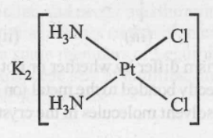
K₂PtCl₂ · 2NH₃ is complex compound
KAl(SO₄)₂ · 12H₂O is empirical formula of potash alum which is a double salt K₂SO₄ · Al₂(SO₄)₃ · 24H₂O
For a reaction 3A → 2B
The average rate of appearance of B is given by Δ[B] / Δt The correct relation between the average rate of appearance of B with the average rate of disappearance of A is given in option
For reaction, 3A → 2B
Average rate of reaction = - (1 / 3) (Δ[A] / Δt) = (1 / 2) (Δ[B] / Δt)
So, Δ[B] / Δt = - (2 / 3) (Δ[A] / Δt)
For a weak acid HA, the percentage of dissociation is nearly 1% at equilibrium. If the concentration of acid is 0.1 mol L⁻¹, then the correct option for its Ka at the same temperature is
HA ⇌ H⁺ + A⁻
At t = 0: C - -
At eq.: C - Cα, Cα Cα
K = ([H⁺][A⁻]) / [HA] = (Cα)(Cα) / (C(1 - α)) = Cα² / (1 - α) = Cα²
(∵ α is very small) = 0.1 (0.01)² = 1 × 10⁻⁵
Which of the following is a positively charged sol?
Methylene Blue sol is a positively charged sol.
Silver sol, Sb₂S₃ sol and congo red sol are negatively charged sol.
Which amongst the following reaction of alkyl halides produces isonitrile as a major products?
(A) R - X + HCN →
(B) R - X + AgCN →
(C) R - X + KCN →
(D) R - X + NaCN —(H₂O / C₂H₅OH) —→
Choose the most appropriate answer from the options given below
KCN is predominately ionic and provides cyanide ions in solution. Although both carbon and nitrogen atoms are in a position to donate electron pairs, the attack takes place mainly through carbon atom and not through nitrogen atom since C – C bond is more stable than C – N bond. However, AgCN is mainly covalent in nature and nitrogen is free to donate electron pair forming isocyanide as the major product
R – X + AgCN → R – NC + AgX
The correct order for the rate of α–β dehydrohalogenation for the following compounds is _____.
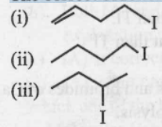
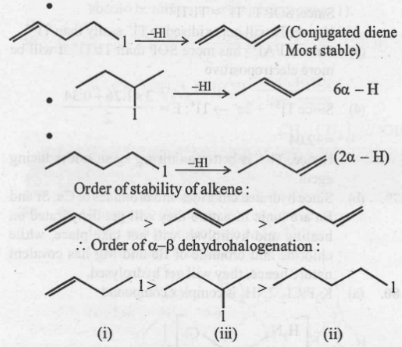
More is the stability of alkene formed, more will be the rate of α–β dehydrohalogenation
Type of isomerism exhibited by compounds [Cr(H₂O)₆]Cl₃, [Cr(H₂O)₅Cl]Cl₂ · H₂O, [Cr(H₂O)₄Cl₂]Cl · 2H₂O and the value of coordination number (CN) of central metal ion in all these compounds, respectively is:
Solvate isomerism differ by whether or not a solvent molecule is directly bonded to the metal ion or merely present as free solvent molecules in the crystal lattice.
[Cr(H₂O)₆]Cl₃, [Cr(H₂O)₅Cl]Cl₂ · H₂O and [Cr(H₂O)₄Cl₂]Cl · 2H₂O show solvate isomerism.
Co–ordination number of Cr is 6
Given below are two statements:
Statement I: In an organic compound when inductive and electromeric effects operate in opposite directions, the inductive effect predominates.
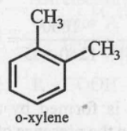
Statement II: Hyperconjugation is observed in o-xylene. In the light of the above statements, choose the correct answer from the options given below
In an organic compound when inductive and electromeric effects operate in opposite directions, the electromeric effect predominates.
In alkylarene, sp³ hybridized C – H bonds are present the carbon of which is directly bonded to sp² carbon atoms so, hyperconjugation effect is observed in o-xylene.
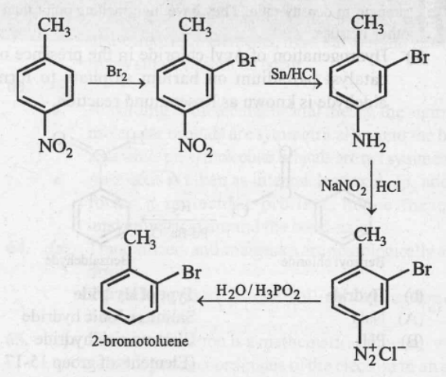
Choose the correct sequence of reagents in the conversion of 4-nitrotoluene to 2-bromotoluene.
I
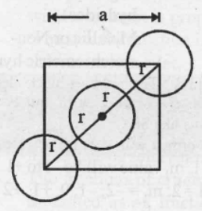
How are edge length 'a' of the unit cell and radius 'r' of the sphere related to each other in ccp structure? (Choose correct option for your answer.)
For a ccp structure,
4r = a√2
∴ a = 4r / √2
a = 2√2r
Which statement is not true about photochemical smog?
Photochemical smog is harmful to humans as well as plants so option (c) is incorrect.
Photochemical smog occurs in warm, dry and sunny climate.
How many number of tetrahedral voids are formed in 5 mol of a compound having cubic close packed structure? (Choose the correct option)
As in a ccp unit cell having 'N' number of atoms there are '2N' number of tetrahedral voids, so number of tetrahedral voids formed in a 5 mol of a compound having ccp structure is 5 × 2 × 6.022 × 10²³ = 6.022 × 10²⁴ voids.
The correct option for a redox couple is
A redox couple is defined as having together the oxidised and reduced forms of a substance taking part in an oxidation or reduction half reaction.
Consider the following reaction:
2H₂(g) + O₂(g) → 2H₂O(g) ΔrH° = -483.64 kJ.
What is the enthalpy change for decomposition of one mole of water? (Choose the right option).
2H₂O(g) → 2H₂(g) + O₂(g)
ΔH° = 483.64 kJ
For decomposition of 2 moles of H₂O, enthalpy change = 483.64 kJ For decomposition of 1 mole of H₂O, enthalpy change = 483.64 / 2 kJ = 241.82 kJ
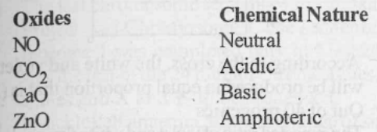
The correct sequence given below containing neutral, acidic, basic and amphoteric oxide each, respectively, is
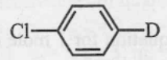
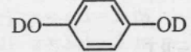
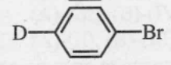
Identify 'X' in the following reaction.

-
(A)
-
(B)
-
(C)
-
(D)
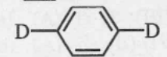
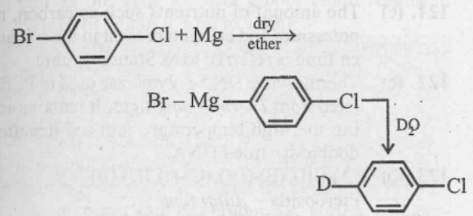
Read the following statements and choose the set of correct statements:
(A) Chrome steel is used for cutting tools and crushing machines.
(B) The fine dust of aluminium is used in paints and lacquers.
(C) Copper is used for reduction of alcohol.
(D) Zinc dust is used as a reducing agent in the manufacture of paints.
(E) Iron is used for galvanising zinc.
Choose the most appropriate answer from the options given below:
Chrome steel is used for cutting tools and crushing machines while fine dust of aluminium is used in paints and lacquers. Zinc dust is a reducing agent for manufacture of dye–stuffs and paints. So, statements A, B and D are correct. Copper is used for oxidation of primary and secondary alcohols into aldehydes and ketones respectively at high temperature. So, statement (C) is incorrect. For galvanisation of iron, zinc is used to prevent iron from corrosion so, statement (E) is also incorrect. Hence, correct statements are (A), (B) and (D) only.
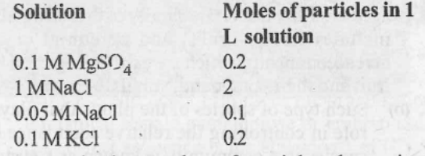
Which amongst the following aqueous solutions of electrolytes will have minimum elevation in boiling point? Choose the correct option.
Lesser is the number of particles, lower is the elevation in boiling point
Given below are two statements : one is labelled as Assertion (A) and the other is labelled as Reason (R).
Assertion (A) : Ionisation enthalpies of early actinoids are lower than for early lanthanoids.
Reason (R) : Electrons are entering 5f orbitals in actinoids which experience greater shielding from nuclear charge.
In the light of the above statements, choose the correct answer from the options given below:
Ionisation enthalpies of early actinoids are lower than early lanthanoids. This is because 5f orbitals will penetrate less into the inner core of electrons. The 5f electrons, will be more effectively shielded from the nuclear charge than the 4f electrons of corresponding lanthanoids.
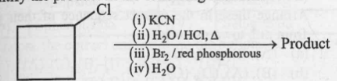
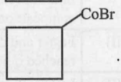
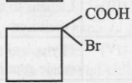
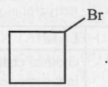
Identify the product in the following reaction.
-
(A)
-
(B)
-
(C)
-
(D)
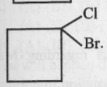
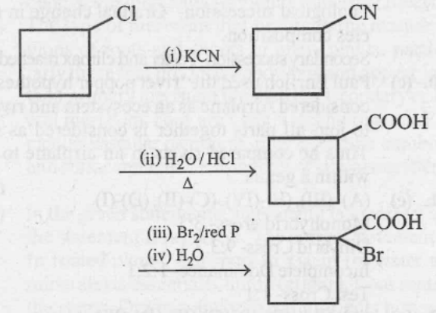
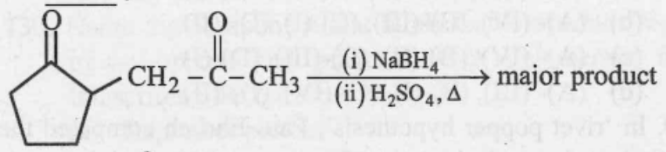
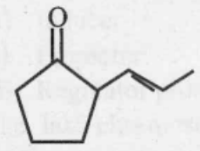
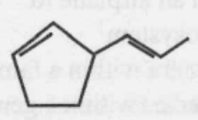
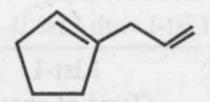
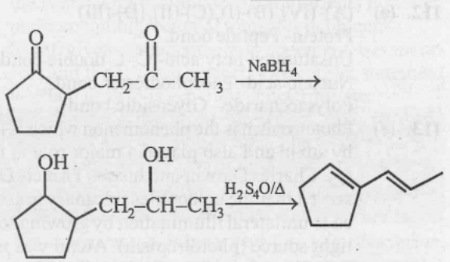
The major product formed in the following conversion is
-
(A)
-
(B)
-
(C)
-
(D)
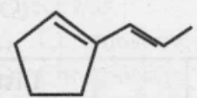
Major product formed will be a conjugated alkene.
Doubling of the number of chromosomes can be achieved by disrupting mitotic cell division soon after
At anaphase the doubling of chromosomes takes place. During this phase the separation of sister chromatids occurs, since mitotic apparatus is disrupted soon after metaphase therefore option (b) is correct.
Match List-I with List-II
Choose the correct answer from the options given below:
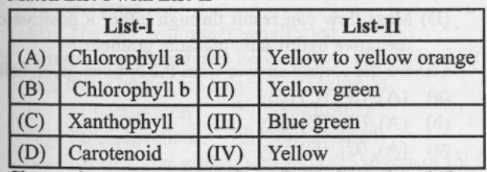
(A)-(III), (B)-(II), (C)-(IV), (D)-(I) Chlorophyll a - Blue green
Chlorophyll b - Yellow green
Xanthophyll - Yellow
Carotenoid - Yellow to yellow orange.
Which classes of algae possess pigment fucoxanthin and pigment phycoerythrin, respectively?
Phaeophyceae and Rhodophyceae classes of algae possess pigment fucoxanthin and pigment phycoerythrin, respectively.
Ligation of foreign DNA at which of the following site will result in loss of tetracycline resistance of pBR322?
Ligation of foreign DNA at BamH I site will result in loss of tetracycline resistance of pBR322.
Plants offer rewards to animals in the form of pollen and nectar and the animals facilitate the pollination process. This is an example of :
Mutualism is a type of interaction in which both the organisms are benefitted from each other. Since plants offer rewards to animals in the form of pollen and nectar and the animals facilitate the pollination process so this is an example of mutualism.
In which of the following sets of families, the pollen grains are viable for months?
In some members of Leguminosae, Solanaceae and Rosaceae sets of families, the pollen grains are viable for months.
The species of plants that plays a vital role in controlling the relative abundance of other species in a community is called __________.
Such type of species of the plants that plays a vital role in controlling the relative abundance of other species in a community is known as Keystone species. They play important role in the maintenance of the species and function of an ecosystem.
The dissolution of synaptonemal complex occurs during
Diplotene is a fourth stage of the prophase of meiosis. During this stage of the chromosome synapsis dissolves. However, chiasmata remain attached.
Match List-I with List-II.
Choose the correct answer from the options given below:
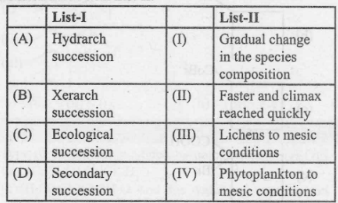
(A)-(IV), (B)-(III), (C)-(I), (D)-(II)
Hydrarch succession → Phytoplankton to mesic conditions.
Xerarch succession → Lichens to mesic conditions.
Ecological succession → Gradual change in the species composition.
Secondary succession → Faster and climax reached quickly.
In river poper hypothesis, Paul Ehrlich compared the rivets in an airplane to
Paul Ehrlich used the "rivet popper hypothesis" and considered Airplane as ecosystem and rivets used to join all parts together is considered as species. Thus he compared rivets in an airplane to species within a genus.
Match List-I with List-II.
Choose the correct answers from the options given below:
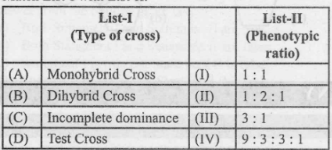
(A)-(III), (B)-(IV), (C)-(II), (D)-(I)
Monohybrid cross →3: 1
Dihybrid cross → 9 : 3 : 3 : 1
Incomplete dominance → 1 : 2 : 1
Test cross → 1 : 1
Match List-I with List-II.
Choose the correct answer from the options given below:
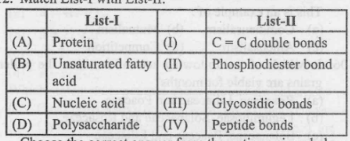
(A)-(IV), (B)-(I), (C)-(II), (D)-(III)
Protein → Peptide bond.
Unsaturated fatty acid → C = C double bonds.
Nucleic acid → Phosphodiester bond.
Polysaccharide → Glycosidic bonds.
The phenomenon which is influenced by auxin and also played a major role in its discovery:
Phototropism is the phenomenon which is influenced by auxin and also played a major role in its discovery. Charles Darwin and his son Francis Darwin observed that the coleoptiles of canary grass responded to unilateral illumination by growing towards the light source (phototropism). Auxin was isolated by F.W. Went from tips of coleoptiles of oat seedlings.
In Calotropis, aestivation is:
When sepals or petals in a whorl just touch one another at the margin, without overlapping, said to be valvate such as in Calotropis.
Given below are two statements:
Statement I: RuBisCO is the most abundant enzyme in the world.
Statement II: Photorespiration does not occur in C₄ plants.
In the light of the above statements, choose the most appropriate answer from the options given below:
Both statements are correct.
RuBisCO is the most abundant enzyme in the world. Photorespiration does not occur in C₄ plants. It takes place in C₃ plants.
Consider the following tissues in the stellar region of a stem showing secondary growth.
(A) Primary xylem
(B) Secondary xylem
(C) Primary phloem
(D) Secondary phloem
Arrange these in the correct sequence of their position from pith towards cortex.
The correct sequence of tissues in the stellar region of the stem that show secondary growth from pith towards cortex is:
Primary xylem → Secondary xylem → Secondary phloem → Primary phloem.
Identify the correct statements regarding Mass flow hypothesis.
(A) Mass flow is faster than diffusion.
(B) Mass flow is the result of pressure difference between the end points.
(C) Different substances involved in mass flow move at different paces.
(D) Mass flow can result through either a positive or a negative hydrostatic pressure gradient.
Choose the correct answer from the options given below:
(A), (B), (D) only
According to the Mass flow hypothesis, the statements A, B and D are correct while statement C is incorrect.
Mass flow is the movement of substances in bulk or en masse from one point to another as a result of pressure differences between the two points. It is a characteristic of mass flow that substances, whether in solution or in suspension, are swept along at the same pace, as in flowing river. Bulk flow can be achieved either through a positive hydrostatic pressure gradient (e.g., a garden hose) or a negative hydrostatic pressure gradient (e.g., suction through a straw).
Fatty acids are connected with the respiratory pathway through:
Fatty acids are connected with the respiratory pathway through Acetyl CoA.
Inulin is a polymer of:
Inulin is a polymer of fructose.
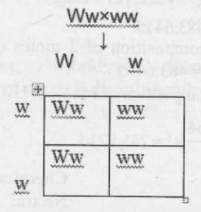
A heterozygous pea plant with violet flowers was crossed with a homozygous pea plant with white flowers.
Violet is dominant over white. Which one of the Following represents the expected combinations among 40 progenies formed?
Genotype of heterozygous violet flowers is Ww.
Genotype of homozygous white flower is ww.
According to the cross, the white and violet flowers will be produced in equal proportion that is (20 : 20) out of 40 progenies.
The expected ratio of violet and white flower plant is 1 : 1.
The amount of nutrients such as carbon, nitrogen, potassium and calcium present in the soil at any given time is referred to as:
The amount of nutrients such as carbon, nitrogen, potassium and calcium present in the soil at any given time is referred to as Standing state.
Thermostable DNA polymerase used in PCR was isolated from:
Thermostable DNA polymerase used in PCR was isolated from Thermus aquaticus. It remains active during the high temperature induced denaturation of double stranded DNA.
Match List-I with List-II.
Choose the correct answer from the options given below:
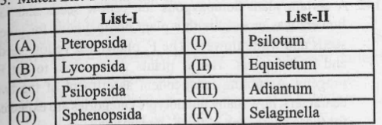
(A)-(III), (B)-(IV), (C)-(I), (D)-(II)
Pteropsida → Adiantum
Lycopsida → Selaginella
Psilopsida → Psilotum
Sphenopsida → Equisetum
What will happen if fresh water lake gets contaminated by addition of polluted water with high BOD?
When addition of polluted water with high BOD take place in fresh water lake then the lake gets contaminated and amount of dissolved oxygen in the lake will decrease.
Nitrates and phosphates flowing from agricultural farms into water bodies are a significant cause of:
Eutrophication is the natural aging of a lake by nutrient enrichment of its water. In a young lake the water is cold and clear, supporting little life. With time, streams draining into the lake introduce nutrients such as nitrogen and phosphorus, which encourage the growth of aquatic organisms and finally converting into land. Thus nitrates and phosphates flowing from agricultural farms into water bodies are a significant cause of Eutrophication.
Transfer of pollen grains from anther to stigma of another flower of same plant is known as:
Transfer of pollen grain from anther to stigma of another flower of same plant is known as Geitonogamy.
Match List-I with List-II.
Choose the correct answer from the options given below:
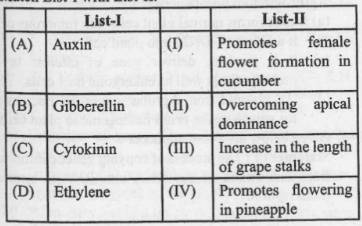
(A)-(IV), (B)-(III), (C)-(II), (D)-(I)
Auxin → Promotes flowering in pineapple.
Gibberellin → Increase in the length of grape stalks.
Cytokinin → Overcoming apical dominance.
Ethylene → Promotes female flower formation in cucumber.
How many times decarboxylation occurs during each TCA cycle?
The TCA cycle starts with the condensation of acetyl group with oxaloacetic acid (OAA) and water to yield citric acid. The reaction is catalysed by the enzyme citrate synthase and a molecule of CoA is released.
Citrate is then isomerised to isocitrate. During this cycle two successive steps of decarboxylation takes place that leads to the formation of α-ketoglutaric acid and then succinyl-CoA. During this cycle, first decarboxylation occurs when isocitrate is converted into α-ketoglutarate and second decarboxylation occurs when α-ketoglutarate is converted into succinyl CoA.
For chemical defence against herbivores, Calotropis has:
The Calotropis is a type of weed that grows in abandoned fields. The plant produces highly poisonous cardiac glycosides that is why never any cattle or goats browsing on this plant.
Calotropis, commonly called milkweed, produces very toxic chemicals called cardiac glycosides that affect the heart. Hence, cattle avoid browsing this plant.
Name the component that binds to the operator region of an operon and prevents RNA polymerase from transcribing the operon.
Repressor protein is the component that binds to the operator region of an operon and prevents RNA polymerase from transcribing the operon.
The last chromosome sequenced in Human Genome Project was :
The last chromosome sequenced in Human Genome Project was Chromosome 1. The sequence of chromosome 1 was completed only in May 2006. This was the last of the 24 human chromosomes - 22 autosomes and X and Y - to be sequenced.
In which disorder change of single base pair in the gene for beta globin chain results in change of glutamic acid to valine?
In sickle cell anaemia disorder change of single base pair in the gene for beta globin chain results in change of glutamic acid to valine.
The transverse section of a plant part showed polyarch, radial and exarch xylem, with endodermis and pericycle. The plant part is identified as :
The monocot root has epidermis, cortex, endodermis, pericycle, vascular bundles and pith. There are usually more than six (polyarch) xylem bundles in the monocot root. Pith is large and well developed.
In a pea flower, five petals are arranged in a specialized manner with one posterior, two lateral and two anterior. These are named as __________, __________ and __________ respectively.
In pea and bean flowers, there are five petals, the largest (standard) overlaps the two lateral petals (wings) which in turn overlap the two smallest anterior petals (keel).
During symport two different molecules move across the membrane
During symport two different molecules move across the membrane in same direction with the help of same carrier.
Which of the following mineral ion is not remobilized in plants?
The deficiency symptoms tend to appear first in the young tissues whenever the elements are relatively immobile and are not transported out of the mature organs, for example, element like sulphur and calcium are a part of the structural component of the cell and hence are not easily released.
Match List-I with List-II.
Choose the correct answer from the options given below.
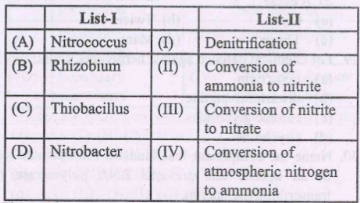
(A)-(II), (B)-(IV), (C)-(I), (D)-(III)
Nitrococcus - Conversion of ammonia to nitrate.
Rhizobium - Conversion of atmospheric nitrogen to ammonia.
Thiobacillus - Denitrification.
Nitrobacter - Conversion of nitrite to nitrate.
In angiosperms the correct sequence of events in formation of female gametophyte in the ovule is
(A) 3 successive free nuclear divisions in functional megaspores.
(B) Degeneration of 3 megaspores.
(C) Meiotic division in megaspore mother cell.
(D) Migration of 3 nuclei towards each pole.
(E) Formation of wall resulting in seven celled embryo sac.
Choose the correct answer from the options given below.
During the formation of the female gametophyte, first of all the megaspore mother cell (MMC) undergoes meiotic division. In the next step, in a majority of flowering plants, one of the megaspores is functional while the other three degenerate. Then the nucleus of the functional megaspore divides mitotically to form two nuclei which move to the opposite poles, forming the 2-nucleate embryo sac. Two more sequential mitotic nuclear divisions result in the formation of the 4-nucleate and later the 8-nucleate stages of the embryo sac. After the 8-nucleate stage, cell walls are laid down leading to the organisation of the typical female gametophyte or embryo sac. So the correct sequence is the statements of (C), (B), (A), (D), (E).
Match List-I with List-II.
Choose the correct answer from the options given below.
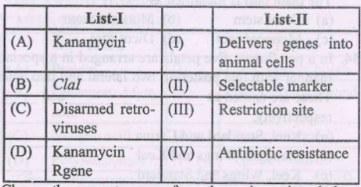
(A)-(II), (B)-(III), (C)-(I), (D)-(IV)
Kanamycin - Selectable marker
ClaI - Restriction site
Disarmed retroviruses - Deliver genes into animal cell. Kanamycin Rgene. - Antibiotic resistance.
Which of the following statements is true?
Pteridophytes are the first terrestrial plants to possess vascular tissues - xylem and phloem. All pteridophytes exhibit haplo-diplontic pattern of lifecycle.
Consider the following plant tissues:
(A) Axillary buds
(B) Fascicular vascular cambium
(C) Interfascicular cambium
(D) Cork cambium
(E) Intercalary meristem
Identify the lateral meristems among the above.
The type of meristem that occurs in the mature regions of roots and shoots of many plants, particularly those that produce woody axis and appear later than primary meristem is called the secondary or lateral meristem. They are cylindrical meristems. Fascicular vascular cambium, interfascicular cambium and cork-cambium are examples of lateral meristems.
A certain plant homozygous for yellow seeds and red flowers was crossed with a plant homozygous for green seeds and white flowers. The F₁ plants had yellow seeds and pink flowers. The F₁ plants were selfed to get F₂ progeny. Assuming independent assortment of the two characters, how many phenotypic categories are expected for these characters in the F₂ generation?
6 is correct answer.
Given below are two statements :
Statement I: The process of translocation through phloem is unidirectional but through xylem, it is bidirectional.
Statement II: The most readily mobilized elements are phosphorus, sulphur, nitrogen and potassium.
In the light of the above statements, choose the most appropriate answer from the options given below :
In the given statements, statement I is incorrect and the statement II is correct. The correct statement is- In rooted plants, transport in xylem (of water and minerals) is essentially unidirectional, from roots to the stems. Organic and mineral nutrients however, undergo multidirectional transport in phloem.
Which of the following statements is not correct?
In the given statements, only statement 1 is incorrect and the rest are correct. The correct statement is- Plant growth is generally indeterminate.
Which of the following statement is incorrect about Agrobacterium tumifaciens?
The statement that is incorrect about Agrobacterium tumifaciens is statement
. The correct statement is that Agrobacterium tumifaciens is used to deliver gene of interest into a variety of plant i.e., in eukaryotic host cells and not in any prokaryotic cell. All other given statements are correct about Agrobacterium tumifaciens.
Given below are two statements :
Statement I : The process of copying genetic information from one strand of the DNA into RNA is termed as transcription.
Statement II : A transcription unit in DNA is defined primarily by the three regions in the DNA, i.e., a promotor, the structural gene and a terminator.
In the light of the above statements, choose the correct answer from the options given below :
Both the statements are correct. The process of copying genetic information from one strand of the DNA into RNA is termed as transcription. A transcription unit in DNA is defined primarily by the three regions in the DNA: (i) A Promoter (ii) The Structural gene (iii) A Terminator
Which scientist conducted an experiment with ³²P and ³⁵S labelled phages for demonstrating that DNA is the genetic material?
Hershey and Chase used 32P and 35S labelled phages for their experiment to discover whether it was protein or DNA from the viruses that entered the bacteria. They grew some viruses on a medium that contained radioactive phosphorus and some others on medium that contained radioactive sulfur. Viruses grown in the presence of radioactive phosphorus contained radioactive DNA but not radioactive protein because DNA contains phosphorus but protein does not. Similarly, viruses grown on radioactive sulfur contained radioactive protein but not radioactive DNA because DNA does not contain sulfur.
Which out of the following statements is incorrect?
In the given statements Cyclic photophosphorylation involves both PS I and PS II is only correct.
The correct statement is- In cyclic photophosphorylation only PS I is functional. In this system the electron is circulated within the photosystem and the phosphorylation occurs due to cyclic flow of electrons. This process takes place in the stroma lamellae.
During which stages of mitosis and meiosis, respectively does the centromere of each chromosome split?
During anaphase stage of mitosis and anaphase II stage of meiosis the centromere of each chromosome splits and moves towards the opposite poles.
Match the following.
Select the correct option :
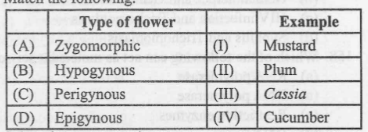
(A)-(III), (B)-(I), (C)-(II), (D)-(IV)
Zygomorphic - Cassia
Hypogynous - Mustard
Perigynous - Plum
Epigynous - Cucumber
Which of the following statements are correct with respect to the hormone and its function?
(A) Thyrocalcitonin (TCT) regulates the blood calcium level.
(B) In males, FSH and androgens regulate spermatogenesis.
(C) Hyperthyroidism can lead to goitre.
(D) Glucocorticoids are secreted in Adrenal Medulla.
(E) Parathyroid hormone is regulated by circulating levels of sodium ions.
Choose the most appropriate answer from the options given below :
In the given statements, only statements (A) and (B) are correct about the hormone and its functions. Statements (C), (D) and (E) are incorrect. The correct statements are- Goitre is a form of hypothyroidism. Glucocorticoids are secreted in Adrenal Cortex. The parathyroid glands secrete a peptide hormone called parathyroid hormone (PTH). The secretion of PTH is regulated by the circulating levels of calcium ions.
'X' and 'Y' are the components of Binomial nomenclature. This naming system was proposed by 'Z' :
Binomial nomenclature has two components - the Generic name and the specific epithet. This naming system was given by Carolus Linnaeus. Thus, X - Generic name, Y - Specific epithet, Z - Carolus Linnaeus.
Select the sequence of steps in Respiration.
(A) Diffusion of gases (O₂ and CO₂) across alveolar membrane.
(B) Diffusion of O₂ and CO₂ between blood and tissues.
(C) Transport of gases by the blood.
(D) Pulmonary ventilation by which atmospheric air is drawn in and CO₂ rich alveolar air is released out.
(E) Utilisation of O₂ by the cells for catabolic reactions and resultant release of CO₂.
Choose the correct answer from the options given below:
The sequences of respiration are:- (D) Pulmonary ventilation by which atmospheric air is drawn in and CO₂ rich alveolar air is released out → (A) Diffusion of gases (O₂ and CO₂) across alveolar membrane → (C) Transport of gases by the blood → (B) Diffusion of O₂ and CO₂ between blood and tissues→ (E) Utilisation of O₂ by the cells for catabolic reactions and resultant release of CO₂.
Which of the following is/are cause(s) of biodiversity losses?
The accelerated rates of species extinctions that the world is facing now are largely due to human activities. The four major causes of loss of biodiversity are- Habitat loss and fragmentation Over-exploitation Alien species invasions Co-extinctions
Match List-I with List-II.
Choose the correct answer from the options given below:
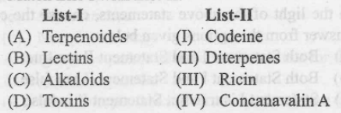
(A)-(II), (B)-(IV), (C)-(I), (D)-(III)
Terpenoides→ Diterpenes
Lectins → Concanavalin A
Alkaloids → Codeine
Toxins→ Ricin
Match List-I with List-II.
Choose the correct answer from the options given below:
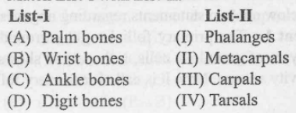
(A)-(II), (B)-(III), (C)-(IV), (D)-(I)
Palm bones → Metacarpals
Wrist bones → Carpals
Ankle bones → Tarsals
Digit bones → Phalanges
Which of the following sexually transmitted infections are completely curable?
Gonorrhoea, syphilis, genital herpes, chlamydiasis, genital warts, trichomoniasis, hepatitis-B and HIV infection are sexually transmitted infections. Except for hepatitis-B, genital herpes and HIV infections, other diseases are completely curable if detected early and treated properly.
Which of the following can act as molecular scissors?
Restriction enzyme is a type of enzyme that is used to cut the DNA molecule near a specific sequence of bases. So it is also called as molecular scissors.
Select correct sequence of substages of Prophase-I of meiotic division:
(A) Zygotene
(B) Pachytene
(C) Diakinesis
(D) Leptotene
(E) Diplotene
Choose the correct answer from the options given below:
Prophase I of the first meiotic division is typically longer and more complex. It has been further subdivided into the following five phases based on chromosomal behaviour, i.e., Leptotene, Zygotene, Pachytene, Diplotene and Diakinesis. So the correct sequence of substages of Prophase-I of meiotic division is (D), (A), (B), (E), (C).
Given below are two statements:
Statement I: RNA being unstable, mutate at a faster rate.
Statement II: RNA can directly code for synthesis of proteins, hence can easily express the characters.
In the light of the above statements, choose the correct answer from the options given below:
Both the statements are correct. RNA being unstable, mutate at a faster rate. Consequently, viruses having RNA genome and having shorter life span mutate and evolve faster. RNA can directly code for the synthesis of proteins, hence can easily express the characters.
Given below are two statements:
Statement I : Goblet cells are unicellular glands.
Statement II : Earwax is the secretion of exocrine gland.
In the light of the above statements, choose the correct answer from the options given below:
Both the statements are correct.
Goblet cells are unicellular glands.
Earwax is the secretion of exocrine gland.
If there are 250 snails in a pond, and within a year their number increases to 2500 by reproduction. What should be their birth rate per snail per year?
In the question initial population = 250, final population = 2500 and time = 1 year are given.
So change in population = Final population − Initial population
= 2500 − 250 = 2250
So birth rate = 2250/250 × 1 = 9.
Given below are two statements regarding oogenesis.
Statement I : The primary follicles get surrounded by more layers of granulosa cells, a theca and shows fluid filled cavity antrum. Now it is called secondary follicle.
Statement II : Graafian follicle ruptures to release the secondary oocyte from the ovary by the process called ovulation.
In the light of the above statements, choose the correct answer from the options given below:
Statement II is correct and Statement I is incorrect.
Each primary oocyte gets surrounded by a layer of granulosa cells and is called the primary follicle. The primary follicle gets surrounded by more layers of granulosa cells and a new theca layer and are called secondary follicles. The secondary follicle soon transforms into a tertiary follicle which is characterised by a fluid filled cavity called antrum.
House fly belongs to __________ family.
House fly belongs to the family of Muscidae.
Housefly belongs to the family Muscidae, class Insecta and phylum Arthropoda.
Diacetyl morphine is also called as:
Smack is chemically diacetylmorphine which is a white, odourless, bitter crystalline compound. This is obtained by acetylation of morphine.
Which of the following statements are correct?
(A) Reproductive health refers to total well-being in all aspects of reproduction.
(B) Amniocentesis is legally banned for sex determination in India.
(C) "Saheli" - a new oral contraceptive for females was developed in collaboration with ICMR (New Delhi).
(D) Amniocentesis is used to determine genetic disorders and survivability of foetus.
Choose the most appropriate answer from the options given below:
In the given statements, statements (A), (B) and (D) only are correct while statement (C) is incorrect.
Which one of the following is the quiescent stage of cell cycle?
Certain cells do not divide further etc. G₁ phase to enter an inactive stage called quiescent stage (G₀) of the cell cycle. Cells in this stage remain metabolically active but no longer proliferate unless called on to do so depending on the requirement of the organism.
Match List-I with List-II.
Choose the correct answer from the options given below:
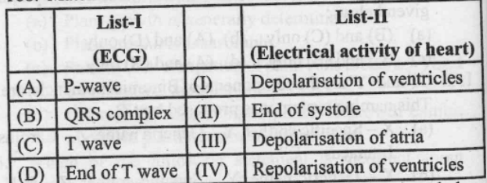
(A)-(III), (B)-(I), (C)-(IV), (D)-(II)
P-wave → Depolarisation of atria.
QRS complex → Depolarisation of ventricles.
T-wave → Repolarisation of ventricles.
End of T-wave → End of systole.
Which of the following is not a secondary metabolite?
Alkaloids such as morphine, cannabinoids, rubber, essential oils, antibiotics, coloured pigments, scents, gums, spices. These are called secondary metabolites. Lecithin is not a secondary metabolite. It is a phospholipid that is found in cell membrane.
Given below are two statements:
Statement I : Intra Cytoplasmic Sperm Injection (ICSI) is another specialised procedure of in-vivo fertilisation.
Statement II : Infertility cases due to inability of the male partner to inseminate female can be corrected by artificial insemination (AI).
In the light of the above statements, choose the correct answer from the options given below :
Statement I is incorrect but Statement II is true.
The correct statement is that Intra Cytoplasmic Sperm Injection (ICSI) is the another specialised procedure of in-vitro fertilization to correct infertility cases due to the inability of the male partner to inseminate the female or due to very low sperm counts in the ejaculates, could be corrected by artificial insemination.
Match List-I with List-II.
Choose the correct answer from the options given below.
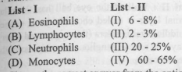
A-(II), B-(III), C-(IV), D-(I)
Eosinophils → 2-3%
Lymphocytes → 20-25%
Neutrophils → 60-65%
Monocytes → 6-8%
Select incorrect statement, regarding chemical structure of insulin.
In the given question only statement (c) is incorrect about chemical structure of insulin. The correct statement is that the mature insulin does not contain C-peptide chain which is removed during maturation of pro-insulin into insulin. Thus it has only two polypeptide chains that are only A and B chains.
Given below are two statements : one is labelled as Assertion (A) and the other is labelled as Reason (R).
Assertion (A) : Ascending limb of loop of Henle is impermeable to water and allows transport of electrolytes actively or passively.
Reason (R) : Dilution of filtrate takes place due to efflux of electrolytes in the medullary fluid.
In the light of the above statements, choose the correct answer from the options given below :
In the given question, both assertion and reason are true but reason is not the correct explanation of assertion. Ascending limb of loop of Henle is impermeable to water and allows transport of electrolytes actively or passively. Dilution of filtrate takes place due to efflux of electrolytes in the medullary fluid.
Match List-I with List-II.
Choose the correct answer from the options given below.
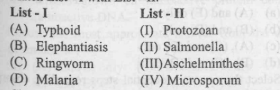
A-(II), B-(III), C-(IV), D-(I)
Typhoid → Salmonella
Elephantiasis → Aschelminthes
Ringworm → Microsporum
Malaria → Protozoan
The Cockroach is :
Insects such as cockroaches excrete nitrogenous wastes as uric acid and thus are called uricotelic.
Brainstem of human brain consists of:
There are three major regions that make up the brain stem; mid brain, pons and medulla oblongata. Brain stem forms the connections between the brain and spinal cord.
Match List-I with List-II.
Choose the correct answer from the options given below.
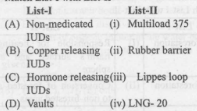
(A)-(III), (B)-(I), (C)-(IV), (D)-(II).
Non-medicated IUDs → Lippes loop
Copper releasing IUDs → Multiload 375
Hormone releasing IUDs → LNG-20
Vaults → Rubber barrier
Which one of the following acts as an inducer for lac operon?
Lactose is the substrate for the enzyme beta-galactosidase and it regulates switching on and off of the operon. So it is termed as inducer.
Identify the fossil of man who showed the following characteristics.
(A) Brain capacity of 1400 cc
(B) Used hides to protect their body
(C) Buried their dead bodies
In the light of above statements, choose the correct answer from the options given below:
The given characteristics are characteristics of the Neanderthal man that has a brain size of 1400cc, lived in near east and central Asia between 1,00,000-40,000 years back. They used hides to protect their body and buried their dead.
Arrange the sequence of different hormones for their role during gametogenesis.
(A) Gonadotropin LH stimulates synthesis and secretion of Androgen
(B) Gonadotropin releasing hormone from hypothalamus
(C) Androgen stimulates spermatogenesis
(D) Gonadotropin FSH helps in the process of spermiogenesis
(E) Gonadotropins from anterior pituitary gland
Choose the correct answer from the options given below:
The correct sequence of different hormones for their role during gametogenesis is:-(B) Gonadotropin releasing hormone from hypothalamus → (E) Gonadotrophin from anterior pituitary gland → (A) Gonadotropin LH stimulates synthesis and secretion of Androgen → (C) Androgen stimulates spermatogenesis → (D) Gonadotropin FSH helps in the process of spermiogenesis.
Given below are two statements:
Statement I : In bacteria, the mesosomes are formed by the extensions of plasma membrane.
Statement II: The mesosomes, in bacteria, help in DNA replication and cell wall formation.
In the light of the above statements, choose the most appropriate answer from the options given below:
Both Statement I and Statement II are correct. In bacteria, the mesosomes are formed by the extensions of plasma membrane. The mesosomes, in bacteria, help in DNA replication and cell wall formation.
Match List-I with List-II.
Choose the correct answer from the options given below.
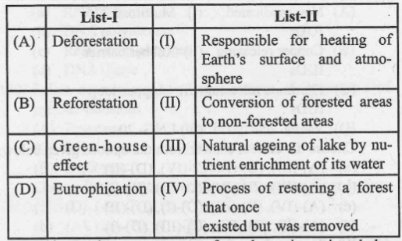
(A)-(II), (B)-(IV), (C)-(I), (D)-(III)
Deforestation → Conversion of forested areas to non-forested areas.
Reforestation → Process of restoring a forest that once existed but was removed.
Green-house effect → Responsible for heating earth's surface and atmosphere.
Eutrophication → Natural ageing of lake by nutrient enrichment of its water.
Select the correct statements about sickle cell anaemia.
(A) There is a change in gene for beta globin.
(B) In the beta globin, there is valine in the place of Lysine.
(C) It is an example of point mutation.
(D) In the normal gene U is replaced by A.
Choose the correct answer from the options given below:
In the given statements about sickle cell anaemia only statement (A) and (C) are correct. Sickle cell anaemia occurs due to change in a single base pair of DNA. This is an example of point mutation. The defect is caused by the substitution of Glutamic acid (Glu) by Valine (Val) at the sixth position of the beta globin chain of the haemoglobin molecule. The substitution of amino acid in the globin protein results due to the single base substitution at the sixth codon of the beta globin gene from GAG to GUG.
Given below are two statements:
Statement I : The nose contains mucus-coated receptors which are specialised for receiving the sense of smell and are called olfactory receptors.
Statement II : Wall of the eye ball has three layers. The external layer is called choroid (dense connective tissue), middle layer is sclera (thin pigmented layer) and internal layer is retina (ganglion cells, bipolar cells and photoreceptor cells).
In the light of the above statements, choose the correct answer from the options given below:
Statement I is true but Statement II is false. The adult human eye ball is nearly a spherical structure. The wall of the eye ball is composed of three layers. The external layer is composed of a dense connective tissue and is called the sclera. The anterior portion of this layer is called the cornea. The middle layer is known as choroid.
Match List-I with List-II.
Choose the correct answer from the options given below.
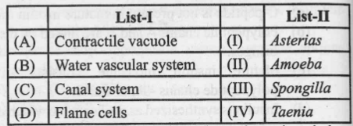
(A)-(II), (B)-(I), (C)-(III), (D)-(IV).
Contractile vacuole → Amoeba
Water vascular system → Asterias
Canal system → Spongilla
Flame cells → Taenia
Arrange the events of Renin - Angiotensin mechanism in correct sequence.
(A) Activation of JG cells and release of renin.
(B) Angiotensin II activates release of aldosterone.
(C) Fall in glomerular blood pressure.
(D) Reabsorption of Na^+ and water from distal convoluted tubule.
(E) Angiotensinogen is converted to Angiotensin I and then to Angiotensin II.
Choose the correct answer from the options given below :
The correct sequence of the events of Renin-Angiotensin mechanism is:-(C) Fall in glomerular blood pressure' !(A) Activation of J.G cells and release of renin' !(E) Angiotensinogen is converted to Angiotensin I and then to Angiotensin II ' !(B) Angiotensin II activates release of aldosterone ! (D) Reabsorption of Na+ and water from distal convoluted tubule.
Select the correct statements :
(A) Platyhelminthes are triploblastic pseudocoelomate and bilaterally symmetrical organisms.
(B) Ctenophores reproduce only sexually and fertilization is external.
(C) In tapeworm, fertilization is internal but sexes are not separate.
(D) Ctenophores are exclusively marine, diploblastic and bioluminescent organisms.
(E) In sponges, fertilization is external and development is direct.
Choose the correct answer from the options given below:
Only statement (B), (C) and (D) are correct. Ctenophores reproduce only sexually and fertilization is external. In tapeworm, fertilization is internal but sexes are not separate. Ctenophores are exclusively marine, diploblastic and bioluminescent organisms.
Select the correct sequential steps regarding absorption of fatty acids and glycerol, in intestine.
(A) Micelles are reformed into small protein coated fat globules called chylomicrons.
(B) Micelles move into intestinal mucosa.
(C) Fatty acids and glycerol are incorporated into small droplets called micelles.
(D) Lacteals release the absorbed substances into blood stream.
(E) Chylomicrons are transported into lacteals.
Choose the correct answer from the options given below
The correct sequential steps regarding absorption of fatty acids and glycerol, in intestine is:-(C) Fatty acid and glycerol are incorporated into small droplets called micelles !(B) Micelles move into intestinal mucosa !(A) Micelles are reformed into small protein coated fat globules called chylomicrons !(E) Chylomicrons are transported into lacteals !(D) Lacteals release the absorbed substances into blood stream.
Given below are two statements :
Statement I : In cockroach, the forewings are transparent and prothoracic in origin.
Statement II : In cockroach, the hind wings are opaque, leathery and mesothoracic in origin.
In the light of the above statements, choose the correct answer from the options given below :
Both Statement I and Statement II are false. The correct statatements are:- In cockroach forewings (mesothoracic) called tegmina are opaque dark and leathery and cover the hind wings when at rest. The hind wings are transparent, membranous and are used in flight.
Match List-I with List-II.
Choose the correct answer from the options given below.
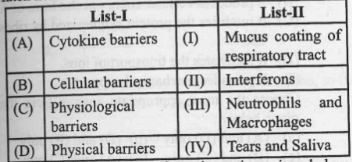
(A)-(II), (B)-(III), (C)-(IV), (D)-(I)
Cytokine barriers ! Interferons
Cellular barriers ! Neutrophils and macrophages Physiological barriers ! Tears and saliva
Physical barriers ! Mucus coating of respiratory tract
With reference to Hershey and Chase experiments. Select the correct statements.
(A) Viruses grown in the presence of radioactive phosphorus contained radioactive DNA.
(B) Viruses grown on radioactive sulphur contained radioactive proteins.
(C) Viruses grown on radioactive phosphorus contained radioactive protein.
(D) Viruses grown on radioactive sulphur contained radioactive DNA.
(E) Viruses grown on radioactive protein contained radioactive DNA.
Choose the most appropriate answer from the options given below :
According to Hershey and Chase experiment only statement (A) and (B) are corrects. Hershey and Chase grew some viruses on a medium that contained radioactive phosphorus and some others on medium that contained radioactive sulfur. Viruses grown in the presence of radioactive phosphorus contained radioactive DNA but not radioactive protein because DNA contains phosphorus but protein does not. Similarly, viruses grown on radioactive sulfur contained radioactive protein but not radioactive DNA because DNA does not contain sulphur.
The salient features of genetic code are :
(A) The code is palindromic
(B) UGA act as initiator codon
(C) The code is unambiguous and specific
(D) The code is nearly universal
Choose the most appropriate answer from the options given below :
Only statements (C) and (D) are correct about genetic code. The characteristics of genetic code are:- The codon is triplet. Some amino acids are coded by more than one codon, so the code is degenerate. The codon is read in mRNA in a contiguous fashion. The code is nearly universal. AUG has dual functions. It codes for Methionine (met), and it also act as initiator codon. UAA, UAG, UGA are stop terminator codons.
Select the correct statements regarding dissolved Oxygen and Biochemical oxygen demand.
(A) BOD is inversely related to dissolved oxygen.
(B) Low dissolved oxygen and high BOD lead to loss of aquatic life.
(C) High BOD leads to high dissolved oxygen.
(D) Both BOD and dissolved oxygen are indicator of health of a water body.
(E) Both BOD and dissolved oxygen are affected by amount of organic matter in the water body.
Choose the most appropriate answer from the options given below :
The correct statements regarding dissolved Oxygen and biochemical oxygen demand are statements (A), (B), (D), and (E) only. BOD is inversely related to dissolved oxygen. Low dissolved oxygen and high BOD lead to loss of aquatic life. High BOD leads to high dissolved oxygen. Both BOD and dissolved oxygen are indicator of health of a water body. Both BOD and dissolved oxygen are affected by amount of organic matter in the water body.
Select the incorrect statement with respect to Multiple Ovulation Embryo Transfer (MOET) Technology.
In Multiple Ovulation Embryo Transfer (MOET) Technology, the fertilised eggs at 8–32 cells stages, are recovered non-surgically and transferred to surrogate mothers.
Match List-I with List-II.
Choose the correct answer from the options given below.
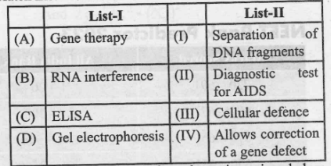
(A)-(IV), (B)-(III), (C)-(II), (D)-(I).
Gene therapy ! Allows correction of a gene defect.
RNA interferance → Cellular defence.
ELISA ! Diagnostic test for AIDS.
Gel Electrophoresis ! Separation of DNA fragments.
Given below are two statements:
Statement I : Parathyroid hormone acts on bones and stimulates the process of bone resorption.
Statement II : Parathyroid hormone along with Thyrocalcitonin plays a significant role in carbohydrate metabolism.
In the light of the above statements, choose the correct answer from the options given below :
Statement I is correct but Statement II is false. The correct statement is :- Parathyroid hormone(PTH) along with TCT plays a significant role in calcium balance in the body.
Select the correct statement/s with respect to mechanism of sex determination in Grasshopper.
(A) It is an example of female heterogamety.
(B) Male produces two different types of gametes either with or without X chromosome.
(C) Total number of chromosomes (autosomes and sex chromosomes) is same in both males and females.
(D) All eggs bear an additional X chromosome besides the autosomes.
Choose the correct answer from the options given below:
The correct statements with respect to mechanism of sex determination in Grasshopper are only statements (B) and (D). Male Grasshopper produces two different types of gametes either with or without X chromosome. All eggs bear an additional X chromosome besides the autosomes.
Match List-I with List-II.
Choose the correct answer from the options given below.
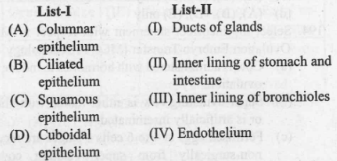
(A)-(II), (B)-(III), (C)-(IV), (D)-(I).
Columnar epithelium → Inner lining of stomach and intestine.
Ciliated epithelium → Inner lining of bronchioles Squamous epithelium → Endothelium
Cuboidal epithelium → Ducts of glands.
Given below are two statements: one is labelled as Assertion (A) and the other is labelled as Reason (R).
Assertion (A) : A person goes to high altitude and experiences "Altitude Sickness" with symptoms like breathing difficulty and heart palpitations.
Reason (R) : Due to low atmospheric pressure at high altitude, the body does not get sufficient oxygen.
In the light of the above statements, choose the correct answer from the options given below :
Both assertion and reason are true and reason is the correct explanation of assertion. Some organisms possess adaptations that are physiological which allow them to respond quickly to a stressful situation. When a person goes to high altitude experiences altitude sickness. Its symptoms include nausea, fatigue and heart palpitations. This is because in the low atmospheric pressure of high altitudes, the body does not get enough oxygen.
Which of the following statements are correct with respect to Golgi apparatus?
(A) It is the important site of formation of glycoprotein and glycolipids.
(B) It produces cellular energy in the form of ATP.
(C) It modifies the protein synthesized by ribosomes on ER.
(D) It facilitates the transport of ions.
(E) It provides mechanical support.
Choose the most appropriate answer from the options given below :
Only statements (A) and (C) are correct about Golgi apparatus. Golgi apparatus is the important site of formation of glycoprotein and glycolipids. It modifies the protein synthesized by ribosomes on ER.
Other Years