CBSE EXAMINATION PAPER-2017
NEET-ZOOLOGY
(Solved)
General Instructions :
Read the following instructions carefully and follow them :
- This question paper contains 180 questions. All questions are compulsory.
- This question paper is divided into 1 sections.
- Section A – questions number 1 to 180 are multiple choice questions
- There is no overall choice given in the question paper. However, an internal choice has been provided in few questions.
- Use of calculator is NOT allowed.
Section A
A physical quantity of the dimensions of length that can be formed out of c, G and e²/4πϵ₀ [c is velocity of light, G is universal constant of gravitation and e is charge
Let dimensions of length is related as,
[L] = [c]ˣ [G]ʸ [ e²/4πϵ₀ ]ᶻ
⇒ e²/4πϵ₀ = [ML³T⁻²]
[L] = [LT⁻¹]ˣ [M⁻¹L³T⁻²]ʸ [ML³T⁻²]ᶻ
[L] = [Lˣ⁺³ʸ⁺³ᶻ M⁻ʸ⁺ᶻ T⁻ˣ⁻²ʸ⁻²ᶻ]
Comparing both sides
−y + z = 0 ⇒ Z ...(i)
x + 3y + 3z = 1 ...(ii)
−x − 4z = 0 (∵ y = z) ...(iii)
From (i), (ii) and (iii)
z = y = −1/2 ; x = −2
Hence,
[L] = c⁻² [ G · e²/4πϵ₀ ]¹ᐟ²
Preeti reached the metro station and found that the escalator was not working. She walked up the stationary escalator in time t₁. On other days, if she remains stationary on the moving escalator, then the escalator takes her up in time t₂. The time taken by her to walk up on the moving escalator will be
Let the distance be ‘d’ time taken by Preeti to travel up
the stationary escalator = t₁

Velocity of Preeti w.r.t. elevator

v₁ = d/t₁

Since the distance is same let the time taken when Preeti
stands on the moving escalator = t₂.

Velocity of elevator w.r.t. ground

v₂ = d/t₂

The net velocity of Preeti w.r.t. ground

v = v₁ + v₂

d/t = d/t₁ + d/t₂

1/t = 1/t₁ + 1/t₂

t = t₁t₂/(t₁ + t₂)

(time taken by Preeti to walk up the
moving escalator)The x and y coordinates of the particle at any time are
x = 5t − 2t² and y = 10t respectively, where x and y are in me
Given:
x = 5t − 2t² y = 10t
vₓ = dx/dt = 5 − 4t
vᵧ = dy/dt = 10
aₓ = dvₓ/dt = −4 aᵧ = dvᵧ/dt = 0
𝐚⃗ = aₓî + aᵧĵ
𝐚⃗ = −4î m/s²
Hence, acceleration of particle at (t = 2 s) = −4 m/s²
Two blocks A and B of masses 3m and m respectively are connected by a massless and inextensible string. The whole system is suspended by a massless spring as shown in figure. The magnitudes of acceleration of A and B immediately after the string is cut, are respectively:
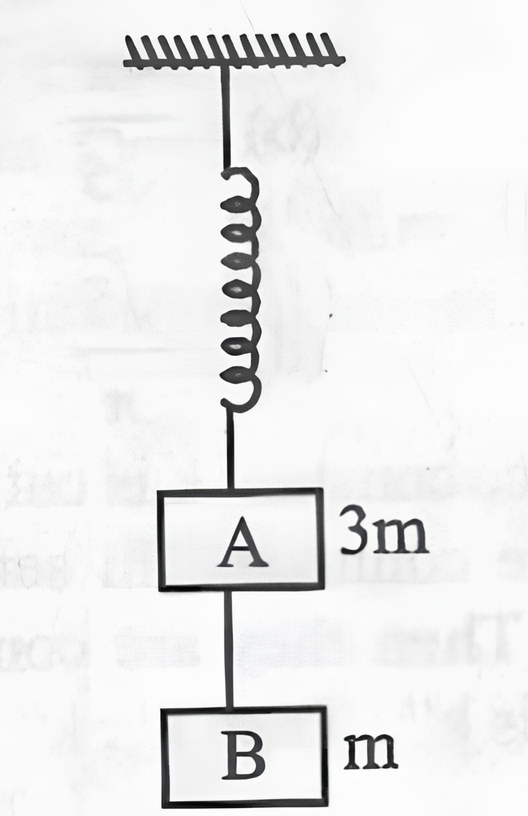
Before cutting the string
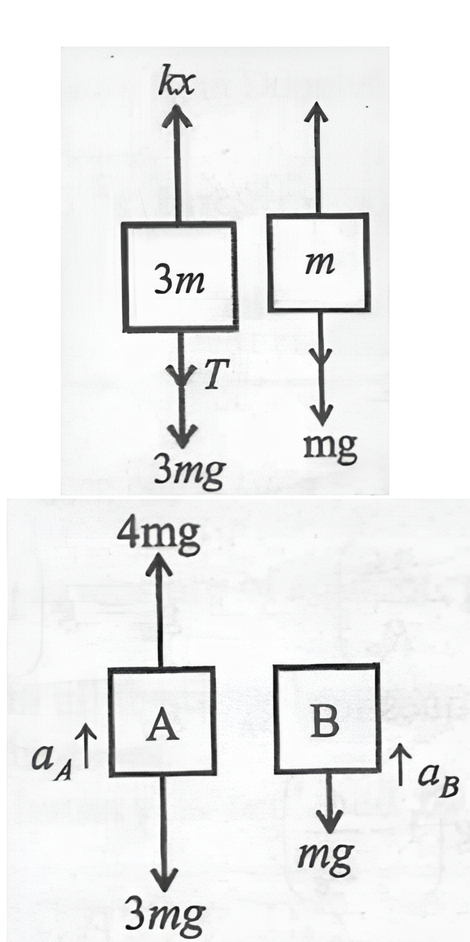
kx = T + 3mg ...(i)
T = mg ..(ii)
Force on spring,
⇒ kx = 4mg
After cutting the string T = 0
For block A:
3ma_A = 4mg − 3mg
a_A= (4mg − 3mg)/3m = g/3
a_A = g/3
For block B:
ma_B= mg
a_B = g
One end of string of length l is connected to a particle of mass 'm' and the other end is connected to a small peg on a smooth horizontal table. If the particle moves in circle with speed 'v' then the net force on the particle (directed towards centre) will be (T represents the tension in the string):
Net force on particle in uniform circular motion is centripetal force (mv²/ℓ) which is provided by tension in string so the net force will be equal to tension i.e., T.
Two discs of same moment of inertia rotating about their regular axis passing through centre and perpendicular to the plane of disc with angular velocities ω₁ and ω₂. They are brought into contact face to face coinciding the axis of rotation. The expression for loss of energy during this process is:
Here, Iω₁ + |ω₂ = 2Iω
⇒ ω = (ω₁ + ω₂)/2
(K.E.)ᵢ = 1/2 Iω₁² + 1/2 Iω₂²
(K.E.)𝒇 = 1/2 × 2Iω² = I[(ω₁ + ω₂)/2]²
Loss in K.E. = (K.E.)𝒇 ᵢ − (K.E.) ᵢ = 1/4 I(ω₁ − ω₂)²
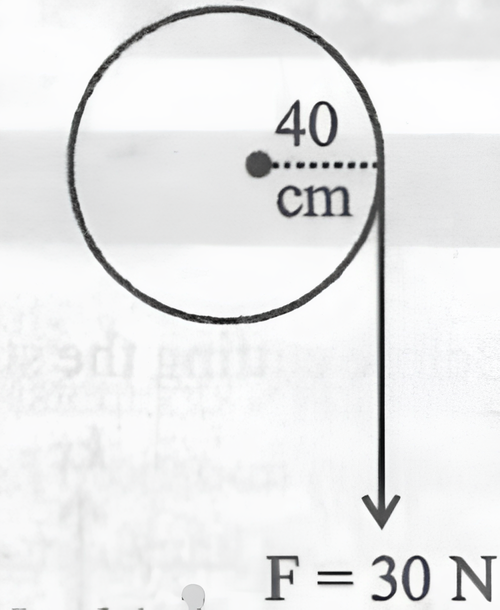
A rope is wound around a hollow cylinder of mass 3 kg and radius 40 cm. What is the angular acceleration of the cylinder if the rope is pulled with a force of 30 N?
Given, mass of cylinder m = 3 kg
R = 40 cm = 0.4 m
F = 30 N ; α = ?
As we know, torque τ = Iα
F × R = MR²α
α = (F × R)/(MR²)
α = (30 × 0.4)/(3 × (0.4)²)
or, α = 25 rad/s²
Two astronauts are floating in gravitation free space after having lost contact with their spaceship. The two will
Both the astronauts are in the condition of ‘weightlessness. Gravitational force between them pulls towards each other. Hence Astronauts move towards each other under mutual gravitional force.
The acceleration due to gravity at a height 1 km above the earth is the same as at a depth d below the surface of earth. Then
Above earth surface Below earth surface
gₕ = g (1 − 2h/Rₑ) g_d = g (1 − d/Rₑ)
According to question, gₕ = g_d
g (1 − 2h/Rₑ) = g (1 − d/Rₑ)
Clearly,
d = 2h = 2 km
The bulk modulus of a spherical object is 'B'. If it is subjected to uniform pressure 'p', the fractional decrease in radius is
Bulk modulus is given by
B = p/(ΔV/V)
or
ΔV/V = p/B
3 ΔR/R = p/B (here, ΔR/R = fractional decrease in radius)
⇒ ΔR/R = p/3B
A U tube with both ends open to the atmosphere, is partially filled with water. Oil, which is immiscible with water, is poured into one side until it stands at a distance of 10 mm above the water level on the other side. Meanwhile the water rises by 65 mm from its original level (see diagram).
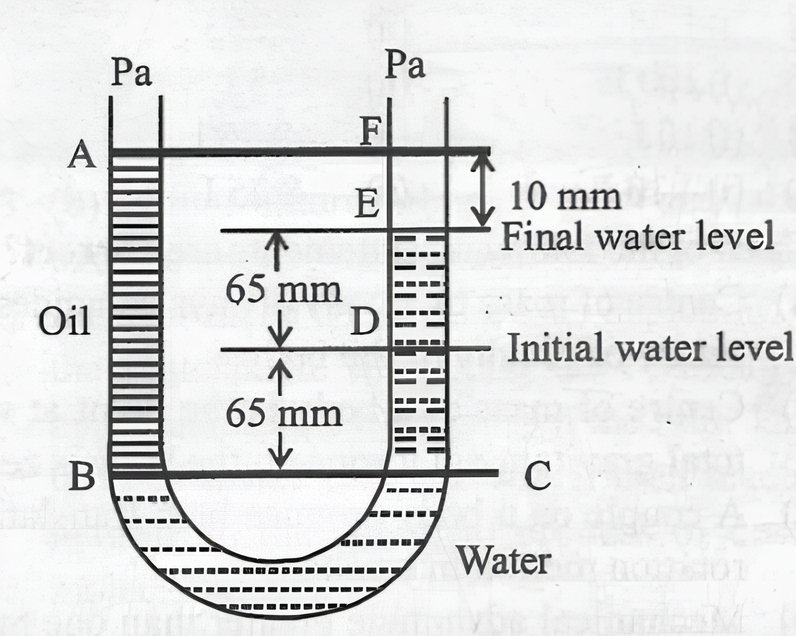
Here, hₒᵢₗ × ρₒᵢₗ × g = h(water)subscript × ρ(water)subscript × g
ρ₀g × 140 × 10⁻³ = ρ_w g × 130 × 10⁻³
ρₒᵢₗ = 130/140 × 10³ ≈ 928 kg/m³
[∵ ρ_w = 1 kgm⁻³]
Two rods A and B of different materials are welded together as shown in figure. Their thermal conductivities are K₁ and K₂. The thermal conductivity of the composite rod will be :
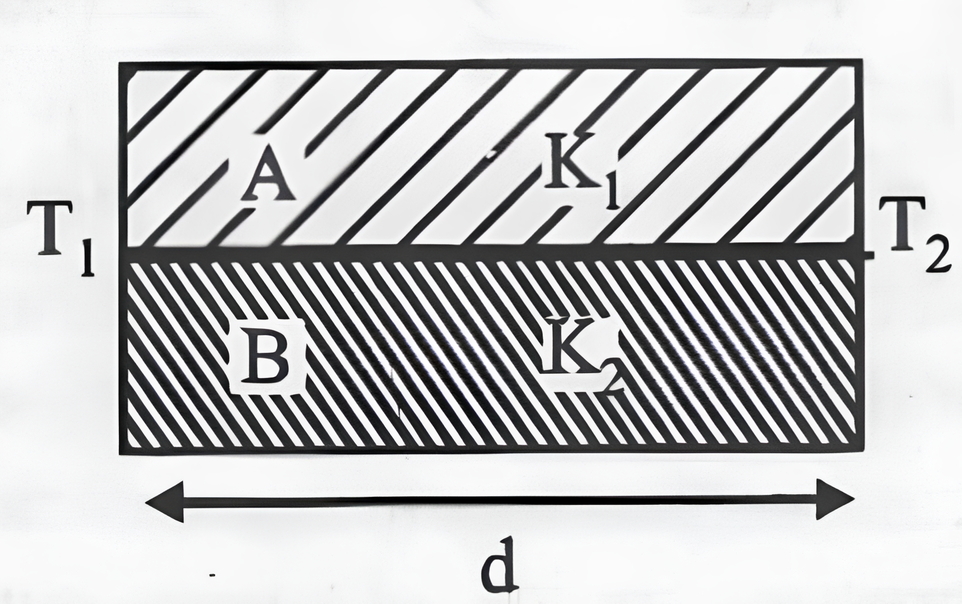
quivalent thermal conductivity of the composite rod in parallel combination will be,
K = K₁A(T₁ − T₂)/d + K₂A(T₁ − T₂)/d
K_EQ 2A(T₁ − T₂)/d = A(T₁ − T₂)/d [K₁ + K₂]
Hence equivalent thermal conductivities for two rods of
equal area is given by
K_EQ = (K₁ + K₂)/2
A spherical black body with a radius of 12 cm radiates 450 watt power at 500 K. If the radius were halved and the temperature doubled, the power radiated in watt would be
Given r₁ = 12 cm, r₂ = 6 cm
T₁ = 500 K and T₂ = 2 × 500 = 1000 K
P₁ = 450 watt
Rate of power loss P ∝ r²T⁴
P₁/P₂ = r₁²T₁⁴/r₂²T₂⁴
P₂ = P₁(r₂²T₂⁴)/(r₁²T₁⁴)
Solving we get,
P₂ = 1800 watt
Thermodynamic processes are indicated in the following diagram:
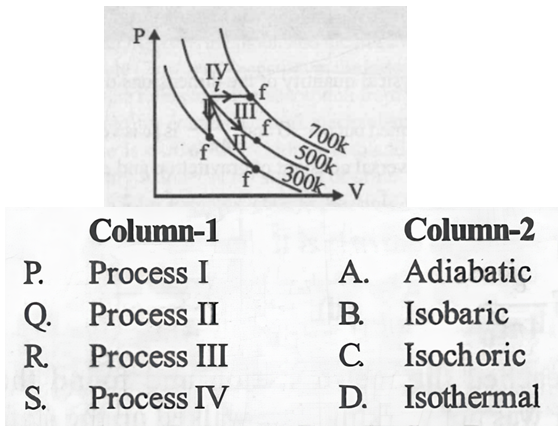
Process I volume is constant hence, it is isochoric.
In process IV, pressure is constant hence, it is isobaric
A carnot engine having an efficiency of 1/10 as heat engine, is used as a refrigerator. If the work done on the system is 10 J, the amount of energy absorbed from the reservoir at lower temperature is
Given, efficiency of engine,

η = 1/10

work done on system W = 10 J

Coefficient of performance of refrigerator,

β = Q₂/W = (1 − η)/η

= (1 − 1/10)/(1/10)

= (9/10)/(1/10)

= 9

Energy absorbed from reservoir,

Q₂ = βW

Q₂ = 9 × 10 = 90 JA gas mixture consists of 2 moles of O₂ and 4 moles of Ar at temperature T. Neglecting all vibrational modes, the total internal energy of the system is:
Internal energy of the system is given by
U = f/2 nRT
Degree of freedom
F_diatomic = 5
F_monatomic₎ = 3
and, number of moles
n(O₂) = 2
n(Ar) = 4
U_total = 5/2 (2)RT + 3/2 (4)RT = 11RT
A particle executes linear simple harmonic motion with an amplitude of 3 cm. When the particle is at 2 cm from the mean position, the magnitude of its velocity is equal to that of its acceleration. Then its time period in seconds is
Given, Amplitude A = 3 cm
When particle is at x = 2 cm
According to question, magnitude of velocity = acceleration
ω√(A² − x²) = xω²
√(3)² − (2)² = 2(2π/T)
√5 = 4π/T
⇒ T = 4π/√5
A spring of force constant k is cut into lengths of ratio 1 : 2 : 3. They are connected in series and the new force constant is k'. Then they are connected in parallel and force constant is k''. Then k' : k'' is
Let ℓ be the complete length of spring.
Length when cut in ratio 1 : 2 : 3 are
ℓ/6, ℓ/3 and ℓ/2
Spring constant (k) ∝ 1/length (ℓ)
Spring constant for given segments
k₁, 6k, k₂ =3k and  k₃ =2k
When they are connected in series
1/k′ = 1/6k + 1/3k + 1/2k
⇒ 1/k′ = 6/6k
∴ Force constant k′ = k
And when they are connected in parallel
k″ = 6k + 3k + 2k
⇒ k″ = 11k
Then the ratios
k /k″ =1/11 i.e., 1 : 11The two nearest harmonics of a tube closed at one end and open at other end are 220 Hz and 260 Hz. What is the fundamental frequency of the system?
Difference in two successive frequencies of closed pipe, 2v/4l ⇒ 260 - 220= 40 Hz
or
2v/4ℓ = 40 Hz
⇒ v/4ℓ = 20 Hz
Which is the fundamental frequency of system of closed organ pipe.
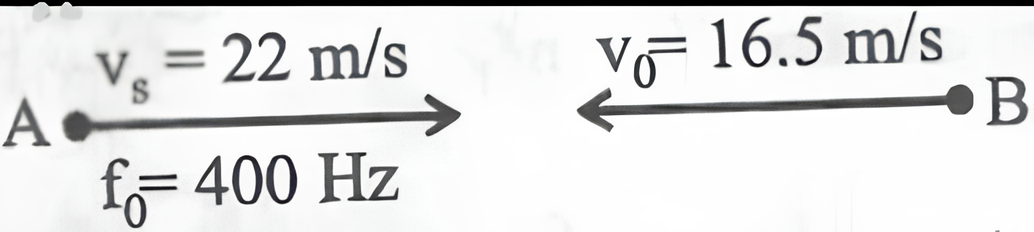
Two cars moving in opposite directions approach each other with speed of 22 m/s and 16.5 m/s respectively. The driver of the first car blows a horn having a frequency 400 Hz. The frequency heard by the driver of the second car is (velocity of sound 340 m/s):
As we known from Doppler’s Effect
fₐₚₚₐᵣₑₙₜ = f₀ [(v + v₀)/(v − vₛ)] = 400 [(340 + 16.5)/(340 − 22)]
fₐₚₚₐᵣₑₙₜ = 448 Hz
Suppose the ratio of proton and electron differ slightly. One of them is −e, the other is (e + Δe). If the net of electrostatic force and gravitational force between two hydrogen atoms placed at a distance d (much greater than atomic size) apart is zero, then Δe is of the order of [Given mass of hydrogen mₕ = 1.67 × 10⁻²⁷ kg]
Net charge on one H atom = −e + (e + Δe) = Δe
According to question, the net electrostatic force (F_E) = gravitational force (F_G)
F_E = F_G
or
1/4πϵ₀ · Δe²/d² = Gm²/d²
⇒ Δe = m√(G/k) [∵ 1/4πϵ₀ = k = 9 × 10⁹]
= 1.67 × 10⁻²⁷ √(6.67 × 10⁻¹¹ / 9 × 10⁹)
Δe ≈ 1.436 × 10⁻³⁷ C
The diagrams below show regions of equipotentials.
A positive charge is moved from A to B in each diagram.
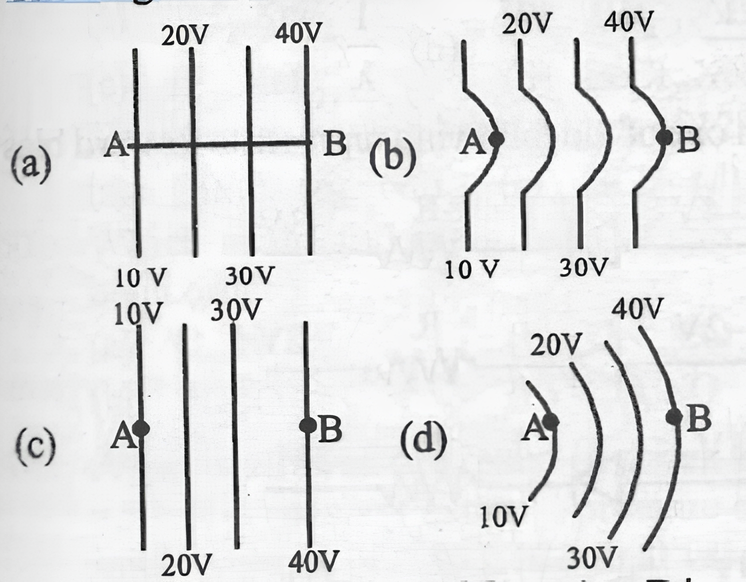
As the regions are of equipotentials, so Work done
W = qΔV
ΔV is same in all the cases hence work done will also be same in all the cases.
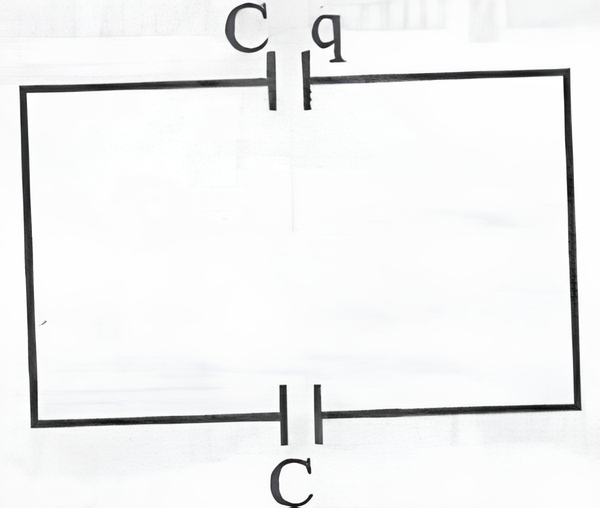
A capacitor is charged by a battery. The battery is removed and another identical uncharged capacitor is connected in parallel. The total electrostatic energy of resulting system:
When battery is replaced by another uncharged
capacitor
As uncharged capacitor is connected parallel
So, C′ = 2C
and V_c = (q₁ + q₂)/(C₁ + C₂)
V_c = (q + 0)/(C + C) = CV/(C + C) [∵ q = CV]
⇒ V_c = V/2
Initial Energy of system, Ui = 1/2 CV² ...(i)
Final energy of system, U_f = 1/2 (2C)(V/2)²
= 1/2 CV² (1/2) ...(ii)
From equation (i) and (ii)
U_f = 1/2 Ui
i.e., Total electrostatic energy of resulting system decreases by a factor of 2.
The resistance of a wire is 'R ohm. If it is melted and stretched to 'n' times its original length, its new resistance will be:-
We know that,
R = ρℓ/A
or
R = ρℓ²/Volume ∝ ℓ²
According to question ℓ₂ = nℓ₁
R₂/R₁ = n²ℓ₁²/ℓ₁²
or,
R₂/R₁ = n²
⇒ R₂ = n²R₁
A potentiometer is an accurate and versatile device to make electrical measurements of E.M.F. because the method involves
Reading of potentiometer is accurate because during taking reading it does not draw any current from the circuit .
A 250-turn rectangular coil of length 2.1 cm and width 1.25 cm can carry a current of 85 μA and subjected to magnetic field of strength 0.85 T. Work done for rotating the coil by 180° against the torque is
Work done,
W = MB(cosθ₁ − cosθ₂)
When it is rotated by angle 180°
W = MB(cos0° − cos180°) = MB(1 + 1)
W = 2MIA
W =2(NIA) B
= 2 × 250 × 85 × 10⁻⁶ (1.25 × 2.1 × 10⁻⁴) × 85 × 10⁻²
≈ 9.1 μJ
An arrangement of three parallel straight wires placed perpendicular to plane of paper carrying same current I along the same direction is shown in fig. Magnitude of force per unit length on the middle wire 'B' is given by
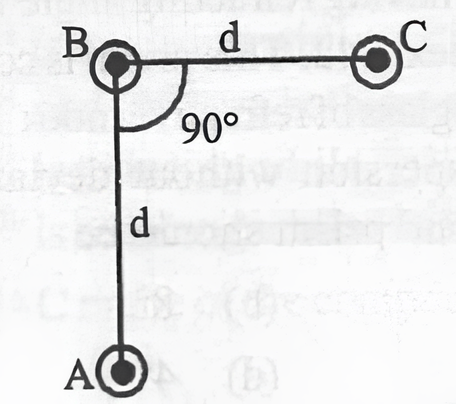
Force per unit length between two parallel current carrying conductors,
F = μ₀i₁i₂/2πd
Since same current flowing through both the wires
i₁ = i₂ = i
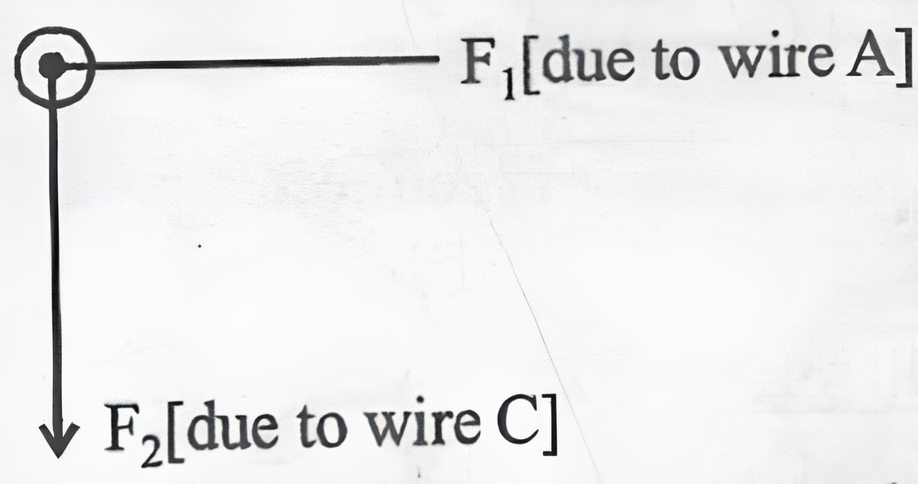
so F₁ = μ₀i²/2πd = F₂
∴ Magnitude of force per unit length on the middle wire 'B'
F_net = √(F₁² + F₂²)
= μ₀i²/√2πd
If θ₁ and θ₂ be the apparent angles of dip observed in two vertical planes at right angles to each other, then true angle of dip θ is given by :
If θ₁ and θ₂ are apparent angles of dip
Let α be the angle which one of the plane make with the magnetic meridian.
tan θ₁ = V/(H cos α)
i.e.,
cos α = V/(H tan θ₁) ...(i)
tan θ₂ = V/(H sin α)
i.e.,
sin α = V/(H tan θ₂) ...(ii)
Squaring and adding (i) and (ii), we get
cos² α + sin² α = (V/H)² (1/tan² θ₁ + 1/tan² θ₂)
i.e.,
1 = V²/H² [cot² θ₁ + cot² θ₂]
or
H²/V² = cot² θ₁ + cot² θ₂
i.e.,
cot² θ = cot² θ₁ + cot² θ₂
A long solenoid of diameter 0.1 m has 2 x 10⁴ turns per meter. At the centre of the solenoid, a coil of 100 turns and radius 0.01 m is placed with its axis coinciding with the solenoid axis. The current in the solenoid reduces at a constant rate to OA from 4 A in 0.05 s. If the resistance of the coil is 10π²Ω. the total charge flowing through the coil during this time is :
Given, no. of turns N = 100
radius, r = 0.01 m
resistance, R = 10π² Ω, n = 2 × 10⁴
As we know,
ε = −N dϕ/dt
⇒ ε/R = −N/R dϕ/dt
ΔI = −N/R dϕ/dt
= Δq/Δt
= −N/R Δϕ/Δt
Δq = −[N/R(Δϕ/Δt)] Δt
'−' ve sign shows that induced emf opposes the change of flux.
Δq = [μ₀nNπr²(Δi/Δt)] (1/R) Δt
= μ₀nNπr²Δi/R
Δq = (4π × 10⁻⁷) × 100 × 4 × π × (0.01)² × 2 × 10⁴/
10π ²
Δq = 32 μC
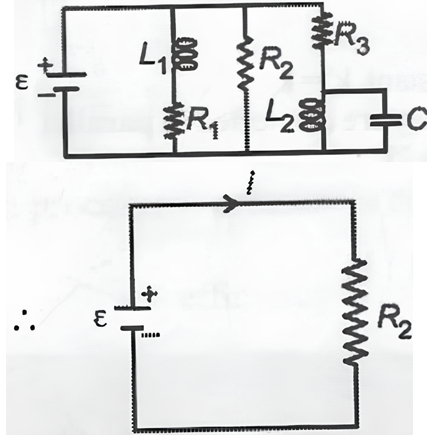
Figure shows a circuit that contains three identical resistors with resistance R = 9.0 Ω each, two identical inductors with inductance L = 2.0 mH each, and an ideal battery with emf ε = 18 V. The current ‘i’ through the battery just after the switch closed is
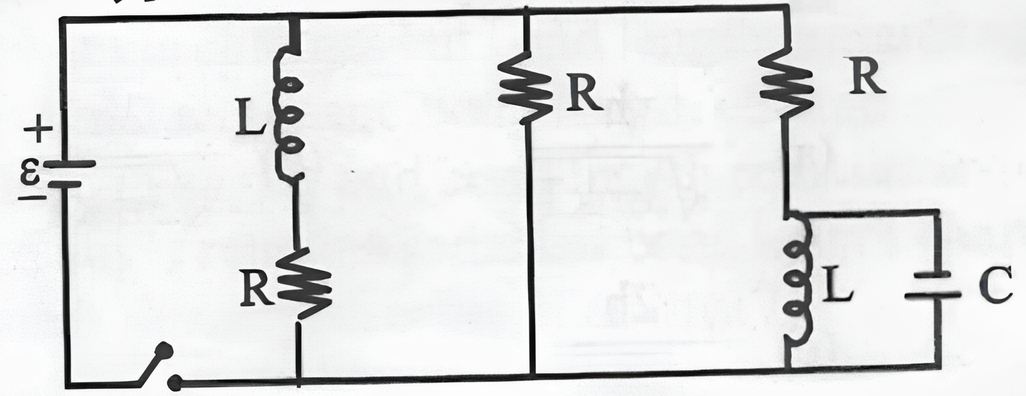
At t = 0, no current flows through R₁ and R₃.
Current through battery just after the switch closed is
i =ε/ R₂ = 18/9 = 2 A
In an electromagnetic wave in free space the root mean square value of the electric field is Eₘₛ = 6 V/m. The peak value of the magnetic field is
Given, Eₘₛ = 6 V/m
Eₘₛ/Bₘₛ = c
⇒ Bᵣₘₛ = Eᵣₘₛ/c ...(i)
Bᵣₘₛ = B₀/√2⇒ B₀ = √2 Bᵣₘₛ
B₀ = √2 × Eᵣₘₛ/c From
equation (i)
= √2 × 6/3 × 10⁸
= 2.83 × 10⁻⁸ T
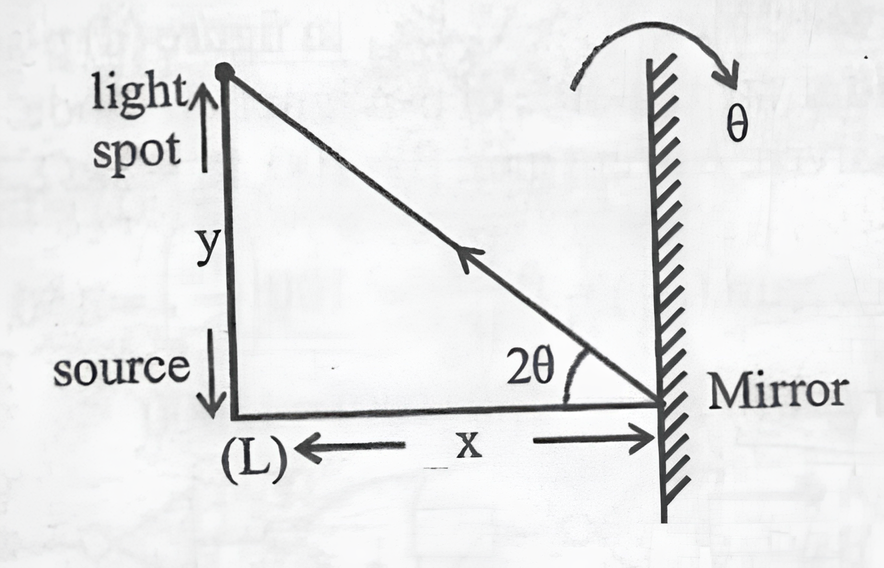
A beam of light from a source L is incident normally on a plane mirror fixed at a certain distance x from the source. The beam is reflected back and a spot on a scale placed just above the source I. When the mirror is rotated through a small angle θ, the spot of the light is found to move through a distance y on the scale. The angle θ is given by
When mirror is rotated by angle θ reflected ray will be rotated by 2θ.
According to the condition,
y/ x = 2θ
⇒ θ = y/2x
A thin prism having refracting angle 10° is made of glass of refractive index 1.42. This prism is combined with another thin prism of glass of refractive index 1.7. This combination produces dispersion without deviation. The refracting angle of second prism should be
For dispersion without deviation
(μ − 1)A₁ + (μ′ − 1)A₂ = 0
|(μ − 1)A₁| = |(μ′ − 1)A₂|
(1.42 − 1) × 10° = (1.7 − 1)A₂
4.2 = 0.7A₂
A₂ = 6°
Young's double slit experiment is first performed in air and then in a medium other than air. It is found that 8th bright fringe is observed where 5th dark fringe lies in air. The refractive index of the medium is nearly
According to question
8ᵀʰ bright fringe in medium = 5ᵀʰ dark fringe in air
Y₈ₜₕ bright = 8 (λD/μd)
Y₅ₜₕ dark = (2 × 5 − 1) λD/2d = 9λD/2d
⇒ 9 /2 (λD/d ) = 8 (λD/μd)
or, refractive index
μ = 16/9 = 1.78
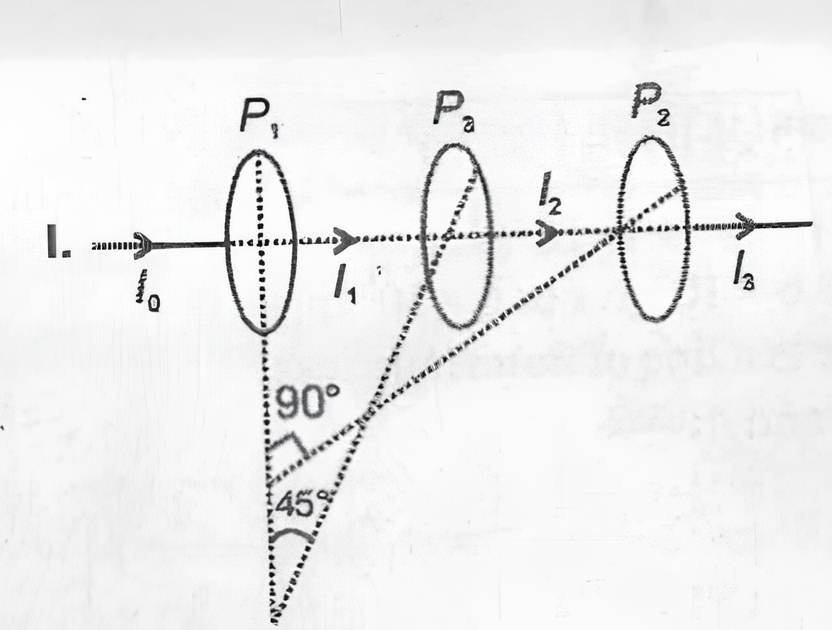
Two Polaroids P₁ and P₂ are placed with their axis perpendicular to each other. Unpolarized light I₀ is incident on P₁. A third polaroid P₃ is kept in between P₁ and P₂ such that its axis makes an angle 45° with that of P₁. The intensity of transmitted light P₂ is
According to Malus law, I = I₀cos²θ
I₁ = I₀/2
I₂ = (I₀/2) cos²45°
= (I₀/2) × 1/2
= I₀/4
I₃ = (I₀/4) cos²45°
= I₀/8
The ratio of resolving powers of an optical microscope for two wavelengths λ₁ = 4000 Å and λ₂ = 6000 Å is
Resolving power of a microscope = 2μ sin θ/λ
i.e., R ∝ 1/λ, or R₁/R₂ = λ₂/λ₁
Given that the two wavelengths,
λ₁ = 4000 Å and λ₂ = 6000 Å
R₁/R₂ = 6000 Å /4000 Å = 3/2
The de-Broglie wavelength of a neutron in thermal equilibrium with heavy water at a temperature T (Kelvin)
and mass m, is :-
We know that, de-Broglie wavelength λ = h/√(2mKE)
K.E. of thermal neutron = 3/2 kT
λ = h/√ 2m (3/2 kT)
λ = h/√3mkT
The ratio of wavelengths of the last line of Balmer series and the last line of Lyman series is
For last line of Balmer series:
n₁ = 2 and n₂ = ∞
1/λB = RZ² [1/n₁² − 1/n₂²]

     = R₁² [1/2² − 1/∞²]
    1/λ_B   = 4/R   ...(i)


For last line of Lyman series:
n₁ = 1 and n₂ = ∞
1/λ_L = RZ² [1/n₁² − 1/n₂²]
     = RZ² [1/1² − 1/∞²]

λ_L = 1/R                      ...(ii)
Dividing equation (i) by (ii)
λ_B/λ_L = (4/R)/(1/R)
Ratio of wavelengths is
λ_B/λ_ = 4
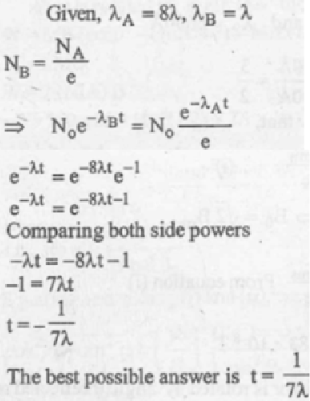
Radioactive material 'A' has decay constant λ and material 'B' has decay constant λ'. Initially they have same number of nuclei. After what time, the ratio of number of nuclei of material 'B' to that 'A' will be 1/e?
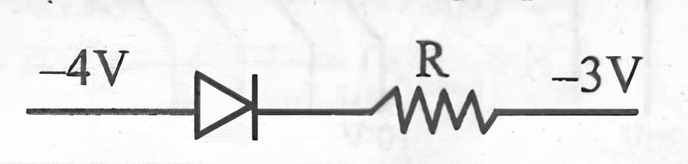
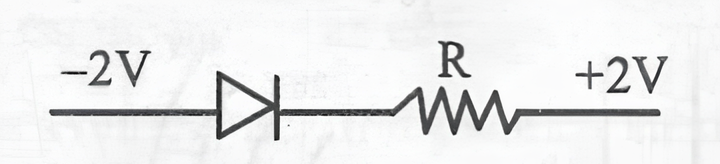
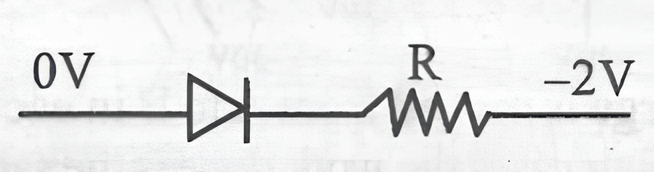
Which one of the following represents forward bias diode?
-
(A)
-
(B)
-
(C)
-
(D)
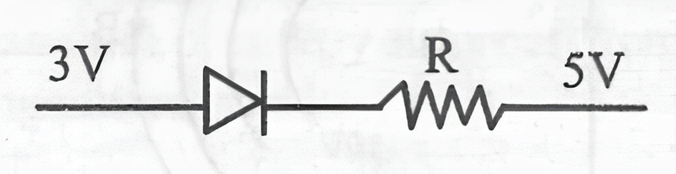
In forward bias, V₁ > V₂ i.e., in figure (d) p-side is at higher potential w.r.t. n-side of p-n junction diode.

In a common emitter transistor amplifier the audio signal voltage across the collector is 3 V. The resistance of collector is 3 kΩ. If current gain is 100 and the base resistance is 2 kΩ, the voltage and power gain of the amplifier is
Given, current gain β = 100, R_C = 3kΩ, R_b = 2kΩ
Voltage gain (A_v) = β R_C/R_b = 100 (3/2) = 150
Power gain = A_v β = 150 × 100 = 15000
The given electrical network is equivalent to :

Y₁ = A̅ + B̅
Y₂ = Y₁ + Y̅₁ = Y̅₁ = A + B
Y = Y̅₂ = A̅ + B̅ i.e. NOR gate.

Which one is the wrong statement ?
For hydrogen like atoms energy of 2s orbital and 2p-orbital is equal.
The element Z = 114 has been discovered recently.
It will belong to which of the following family/group and electronic configuration?
After ₈₆Rn (Group 18), elements from atomic number 89 to 103 (actinoids) are in group 3 114 = 103 + 11. Thus, element with atomic number 114 will be in group (3 + 11) or group 14 (carbon family).
The outer shell configuration of group 14 is ns²np².
Hence, only option (a) is correct.
Which of the following pairs of compounds isoelectronic and isostructural?
IBr₂⁻, XeF₂
Total number of valence electrons are equal in both the species and both the species exhibit linear shape.
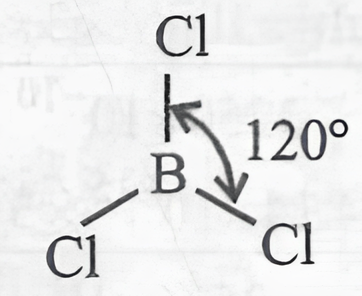
The species, having bond angles of 120° is:
BCl₃ is trigonal planar and hence the bond angle is 120°.
Which of the following pairs of species have the same bond order?
CN⁻ and CO have same no. of electrons and have same bond order equal to 3.
A gas is allowed to expand in a well insulated container against a constant external pressure of 2.5 atm from an initial volume of 2.50 L to a final volume of 4.50 L. The change in internal energy ΔU of the gas in joules will be:
The system is in isolated state.
∴ For an adiabatic process, q = 0
ΔU = q + w
∴ ΔU = w
= −PΔV
= −2.5 atm × (4.5 − 2.5) L
= −2.5 × 2 L-atm.
= −5 × 101.3 J
= −506.5 J ≈ −505 J
For a given reaction, ΔH = 35.5 kJ mol⁻¹ and ΔS = 83.6 JK⁻¹ mol⁻¹. The reaction is spontaneous at:
(Assume that ΔH and ΔS do not vary with temperature)
Given ΔH = 35.5 kJ mol⁻¹
ΔS = 83.6 J K⁻¹ mol⁻¹
∴ ΔG = ΔH − TΔS
For a reaction to be spontaneous, ΔG = −ve
i.e., ΔH < TΔS
∵ T > ΔH /ΔS = 35.5*10³ Jmol⁻¹/83.6Jk⁻¹
So, the given reaction will be spontaneous at
T > 425 K
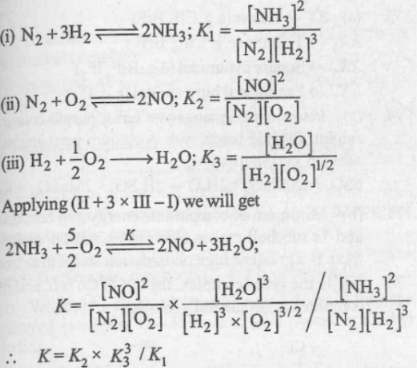
The equilibrium constant of the following are:
N₂ + 3H₂ ⇌ 2NH₃ K₁
N₂ + O₂ ⇌ 2NO K₂
H₂ + 1/2 O₂ ⇌ H₂O K₃
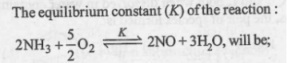
A 20 litre container at 400 K contains CO₂(g) at pressure 0.4 atm and excess of SrO (neglect volume occupied by SrO). The volume of the container is now decreased by moving the movable piston tighter, with constant temperature. The maximum volume of the container, when pressure of CO₂ attains its maximum value, will be:
(Given that : SrCO₃(s) ⇌ SrO(s) + CO₂(g), KP = 1.6 atm)
Max. pressure of CO₂ = Pressure of CO₂ at equilibrium
SrCO₃(s) ⇌ SrO(s) + CO₂(g)
Kₚ = P_CO₂ = 1.6 atm = maximum pressure of CO₂.
volume of container at this stage,
V = nRT/P                                  ...(i)
Since container is sealed and reaction was not earlier at equilibrium,
n = PV/RT = (0.4 × 20)/(RT)                  ...(ii)
Put equation (ii) in equation (i)
V = [(0.4 × 20)/(RT)]RT / 1.6
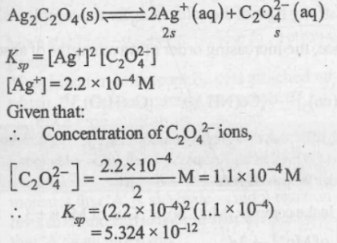
V = 5 LConcentration of the Ag⁺ ions in a saturated solution of Ag₂C₂O₄ is 2.2 × 10⁻⁴ mol L⁻¹. Solubility product of Ag₂C₂O₄ is:
It is because of inability of np² electrons of the valence shell to participate in bonding that:
Due to inert pair effect, Pb(II) is more stable than Pb(IV).
Sn(IV) is more stable than Sn(II).
Pb(IV) is easily reduced to Pb(II) and can acts as an oxidising agent whereas Sn(II) is easily oxidised to Sn(IV) and can acts as a reducing agent.
The IUPAC name of the compound is:
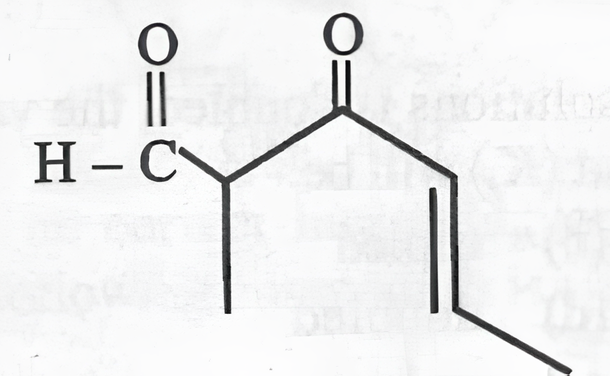
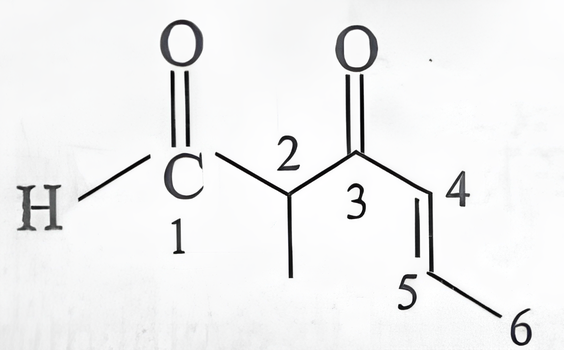
3-keto-2-methylhex-4-enal
Aldehydes get higher priority over ketone and alkene in numbering of principal carbon chain.
The most suitable method of separation of 1 : 1 mixture of ortho and para-nitrophenols is:
The o-isomer is steam volatile due to intra-molecular H-bonding. The p-isomer is not steam volatile due to intermolecular H-bonding or association of molecules.
Thus, both can be separated by steam distillation.
The correct statement regarding electrophile is:
Electrophile is a electron deficient species and can accept pair of electrons from nucleophile.
With respect to the conformers of ethane, which of the following statements is true?
There is no change in bond angles and bond lengths in the conformation of ethane.
Which one is the correct order of acidity?
Correct order is
H-C≡C -H > H₃c – C ≡ C-H > H₂c
(Two acidine hydrogensc) (One acidichydrogen)
= CH₂> CH₃ - CH₃
Which of the following is a sink for CO?
Microorganisms present in the soil is a sink for CO.
If molality of the dilute solutions is doubled, the value of molal depression constant (K_f) will be-
K_f (molal depression constant) only depends on the nature of the solvent and is independent of the Concentration of the solution.
Which of the following is dependent on temperature?
Molarity depends on the volume of a solution which can be changed with change in temperature.
Ionic mobility of which of the following alkali metal ions is lowest when aqueous solution of their salts are put under an electric field?
Li⁺ being smallest, has maximum charge density.
∴ Li⁺ is most heavily hydrated among all alkali metal ions. Effective size of Li⁺ in aqueous solution is therefore, largest. So, moves slowest under electric field.
In the electrochemical cell:-
Zn | ZnSO₄ (0.01 M) || CuSO₄ (1.0 M) | Cu, the emf of this Daniell cell is E₁. When the concentration of ZnSO₄ is changed to 1.0 M and that of CuSO₄ changed to 0.01 M, the emf changes to E₂. From the following, which one is the relationship between E₁ and E₂? (Given, RT/F = 0.059)
For cell,
Zn | ZnSO₄ (0.01 M) || CuSO₄ (1.0 M) | Cu
Ecell = E°cell − (2.303RT/ /nF log ([Zn²⁺] / [Cu²⁺]
∴ E₁ = E°cell − (2.303RT/2F) log(0.01/0.1)
When concentrations are changed for ZnSO₄ and CuSO₄, we can write
E₂ = E°cell − (2.303RT/2F) * log(1/0.01)
∴ E₁ > E₂
Mechanism of a hypothetical reaction
X₂ + Y₂ → 2XY is given below:
(i) X₂ → X + X (fast)
(ii) X + Y₂ ⇌ XY + Y (slow)
(iii) X + Y → XY (fast)
The overall order of the reaction will be:
Overall rate = k[X][Y₂]      ...(1)
k = rate constant
Assuming step (i) to be reversible, its equilibrium constant,
k(eq)subscript = [X]²/[X₂]
⇒[X]² = k(eq)subscript [X₂]
⇒[X] = k(eq)subscript ½[X₂]½     ...(2)
From (eq)subscript  (1) and (2)
Rate = kk(eq)subscript ½[X₂]½[Y₂]
Overall order = 1/2 + 1 = 3/2 = 1.5A first order reaction has a specific reaction rate of 10⁻² s⁻¹. How much time will it take for 20 g of the reactant to reduce to 5 g?
Half life for a first order reaction,
t₁/₂ = 0.693/K
So,
t₁/₂ = 0.693/10⁻² sec
Also, for the reduction of 20 g of reactant to 5 g, two half lives will be required.
∴ For 20 g of the reactant to reduce to 5 g, time taken,
t = 2 × (0.693/10⁻²) sec = 138.6 sec.
Which one of the following statements is not correct?
A catalyst speeds up both forward and backward reaction with the same rate.
So, equilibrium constant is not affected by the presence of a catalyst at any given temperature.
Extraction of gold and silver involves leaching with CN⁻ ion. Silver is later recovered by
Zn being more reactive than Ag and Au, displaces them.
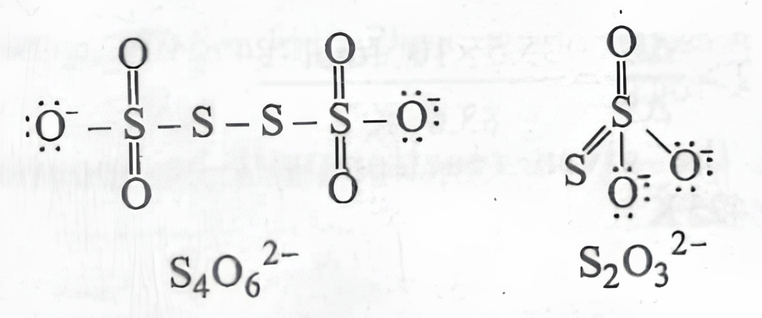
In which pair of ions both the species contain S–S bond?
Zn being more reactive than Ag and Au, displaces them.
Name the gas that can readily decolourise acidified KMnO₄ solution :
Potassium permanganate has a purple colour. When sulphur dioxide reacts with potassium permanganate, the solution decolourises.
5SO₂ + 2KMnO₄ + 2H₂O → 2H₂SO₄ + 2MnSO₄ + K₂SO₄
The reason for greater range of oxidation states in actinoids is attributed to :
Minimum comparable energy gap between 5f, 6d and 7s subshell makes electron excitation easier, hence there is a greater range of oxidation states in actinoids.
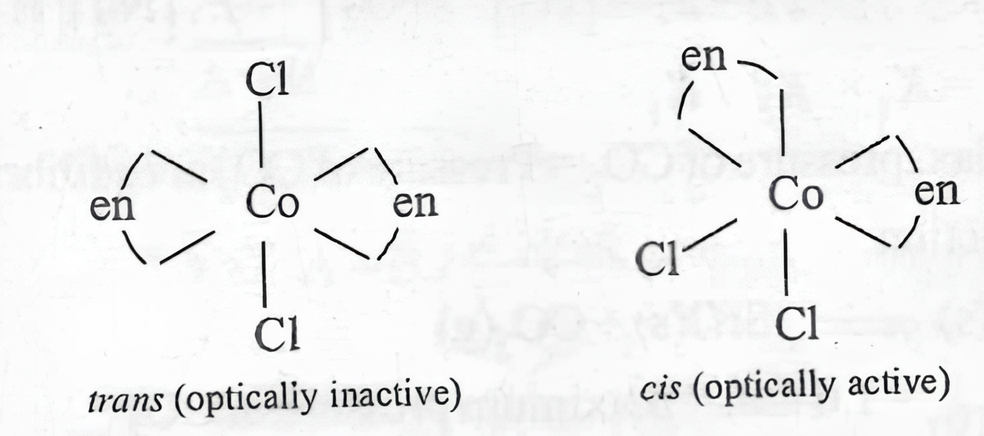
The correct order of the stoichiometries of AgCl formed when AgNO₃ in excess is treated with the complexes CoCl₃·6NH₃, CoCl₃·5NH₃, CoCl₃·4NH₃ respectively is :
In the given complex, the CN of Co is 6, and the complex has octahedral geometry.
HgCl₂ and I₂ both when dissolved in water containing I⁻ ions, the pair of species formed is :
In a solution containing HgCl₂, I₂ and I⁻, both HgCl₂ and I₂ compete for I⁻.
Since formation constant of [HgI₄]²⁻ is very large (1.9 × 10³⁰) as compared with I₃⁻ (Kf = 700).
∴ I⁻ will preferentially combine with HgCl₂.
HgCl₂ + 2I⁻ → HgI₂ (Red ppt ) ↓ + 2Cl⁻
HgI₂ + 2I⁻ → [HgI₄]²⁻ soluble
Correct increasing order for the wavelengths of absorption in the visible region the complexes of Co³⁺ is :-
The order of strength of ligand is
en > NH₃ > H₂O
For stronger ligand, the value of Δ₀ for the complex is higher.
Hence, the increasing order of wavelengths of absorption is:
[Co(en)₃]³⁺ < [Co(NH₃)₆]³⁺ < [Co(H₂O)₆]³⁺
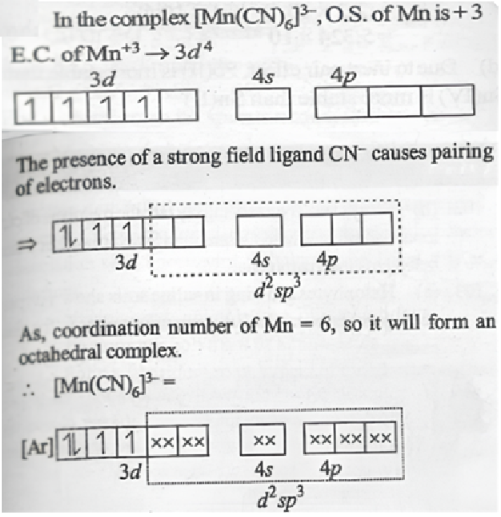
Pick out the correct statement with respect to [Mn(CN)₆]³⁻ :-
An example of sigma bonded organometallic compound is :
Grignard's reagent (RMgX) is a σ-bonded organometallic compound.
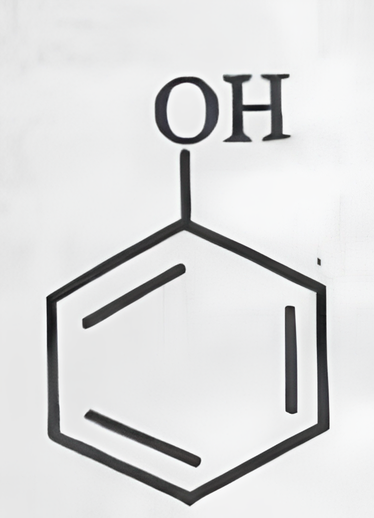
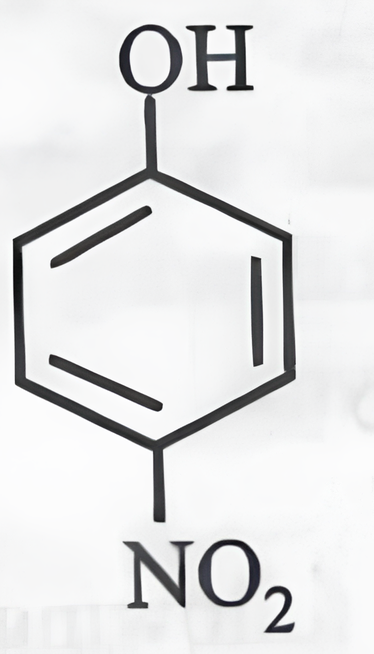
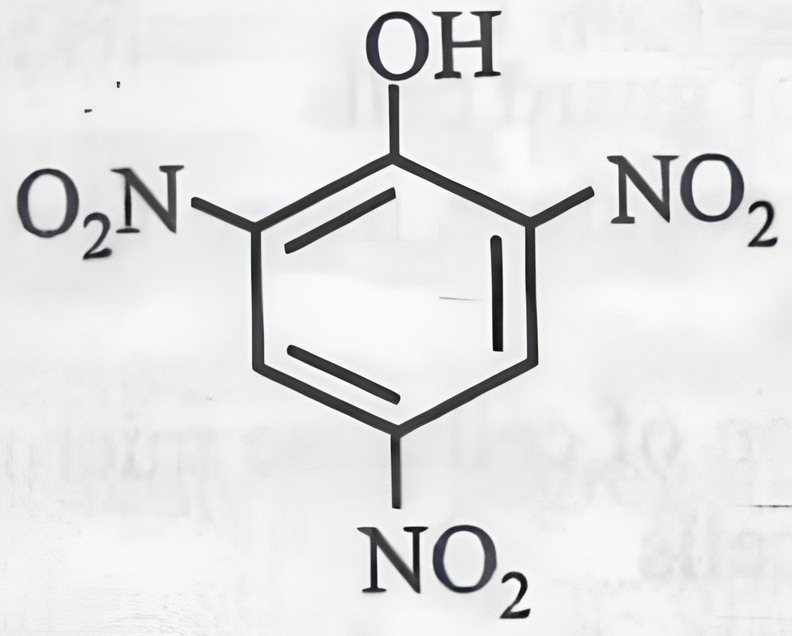
Which one is the most acidic compound ?
-
(A)
-
(B)
-
(C)
-
(D)
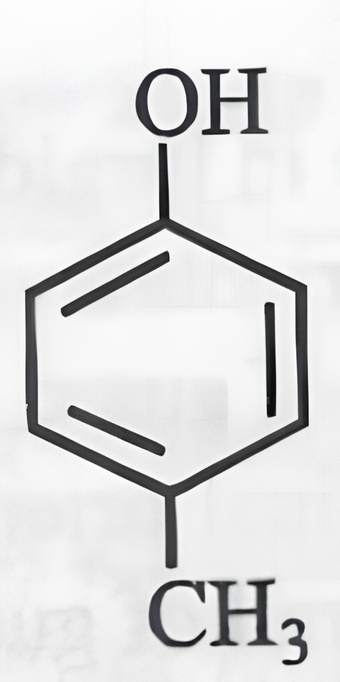
Electron withdrawing –NO₂ group has very strong –I and –R effects so, compound 3 will be most acidic
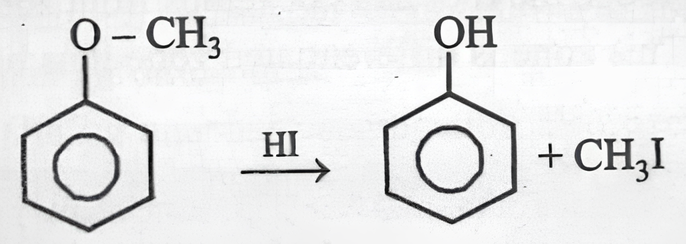
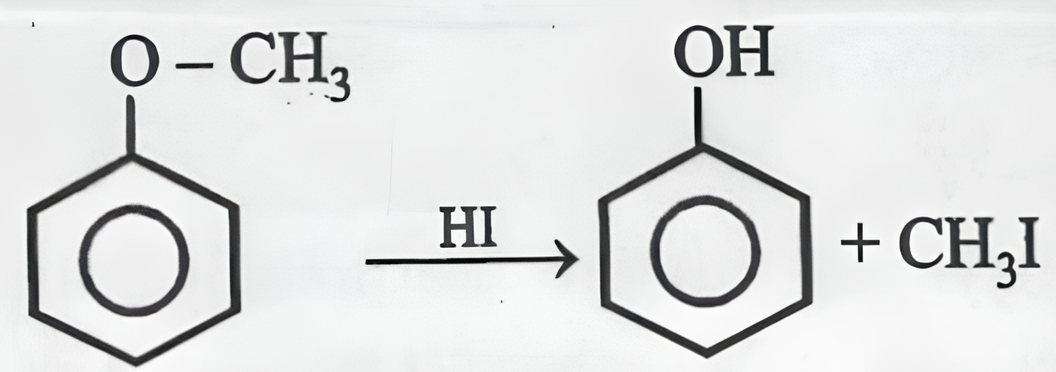
The heating of phenyl-methyl ethers with HI produces
When Ar–O–R ethers are reacted with HI, they are cleaved at weaker O–R bond to give phenol and alkyl iodide.
Consider the reactions :-
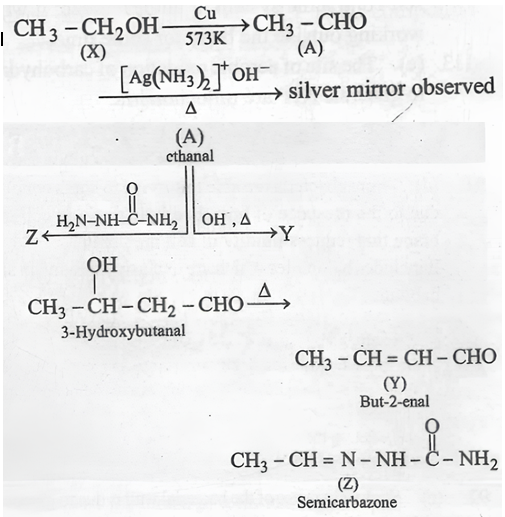
Identify A, X, Y and Z
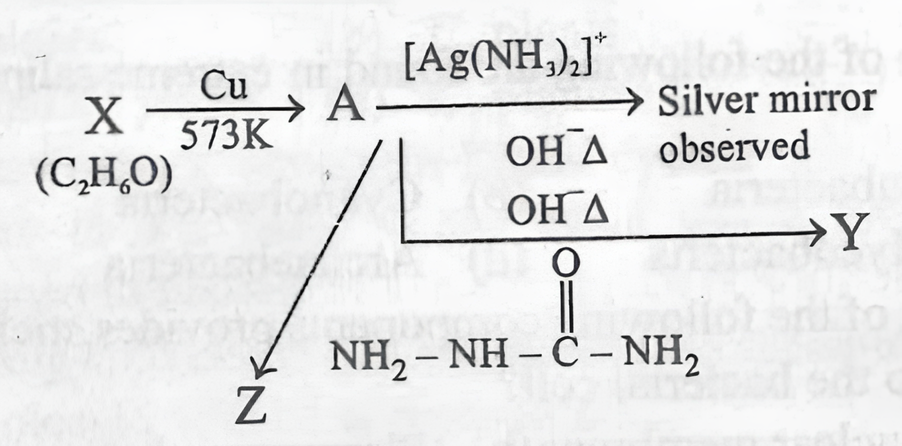
Since 'A' gives positive silver mirror test therefore, it must be an aldehyde or α-Hydroxyketone. Also, reaction with OH⁻ i.e., aldol condensation (by assuming alkali to be dilute) indicates that 'A' is aldehyde as aldol reaction of ketone is reversible and carried out in special apparatus. It indicates that 'A' is an aldehyde.
The correct increasing order of basic strength for the following compounds is :
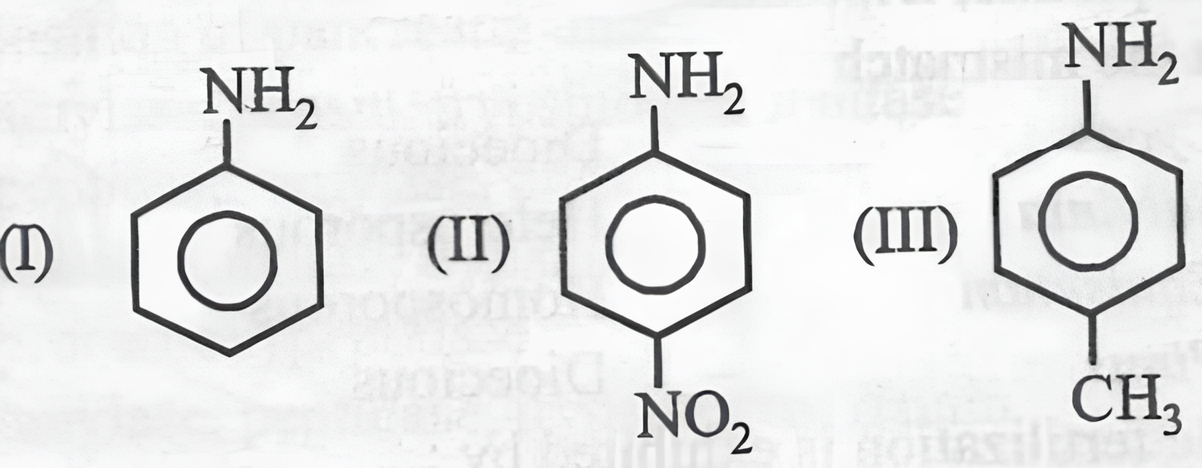
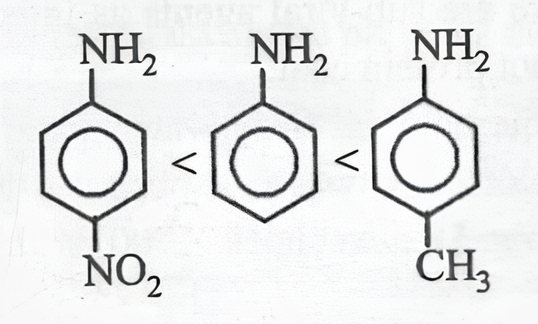
–NO₂ group has strong –R effect and –CH₃ shows +R effect.
∴ Order of basic strength is
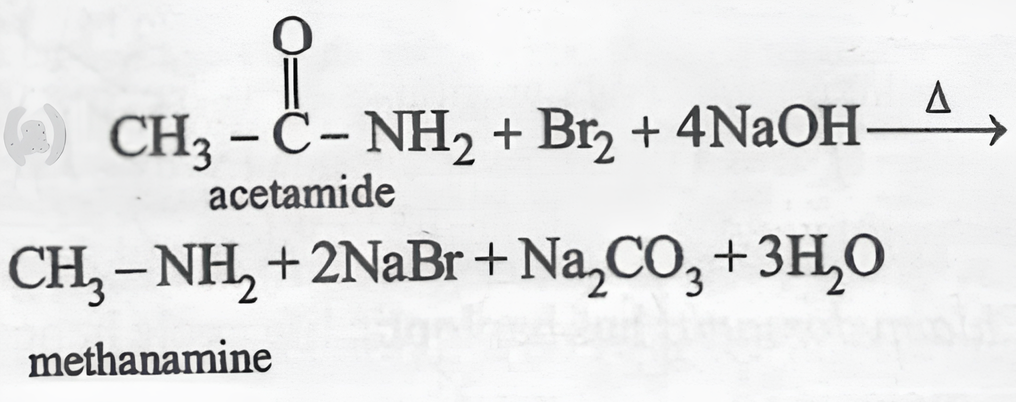
Which of the following reactions is appropriate for converting acetamide to methanamine?
It is called Hoffmann Bromamide reaction.
Which of the following statements is not correct :
Due to denaturation of proteins, helix get uncoiled and protein loses its biological activity.
Mixture of chloroxylenol and terpineol acts as:
Dettol is a mixture of chloroxylenol and terpineol which is a very commonly known antiseptic.
The heating of phenyl-methyl ethers with HI produces
When Ar–O–R ethers are reacted with HI, they are cleaved at weaker O–R bond to give phenol and alkyl iodide.
Which of the following are found in extreme saline conditions?
Archaebacteria are able to survive in harsh conditions due to the presence of branched lipid chain in cell membrane that reduces fluidity of cell membrane. It includes halophiles which are exclusively found in saline habitats.
Which of the following components provides sticky character to the bacterial cell?
Sticky character of the bacterial wall is due to glycocalyx which is rich in glycoproteins.
Which among the following are the smallest living cells, known without a definite cell wall, pathogenic to plants as well as animals and can survive without oxygen?
Mycoplasmas are smallest, prokaryotes lacking cell wall and are pleomorphic in nature. These are pathogenic to both plants and animals.
Viroids differ from viruses in having:
Viroids in nature are sub-viral agents as infectious
RNA particles, without protein coat.
An example of colonial alga is:
Volvox is a motile colonial fresh water green alga. It forms spherical colonies. It was first observed with a light microscope by Van Leeuwenhoek (1700) within the volvocales.
Zygotic meiosis is characteristic of:
Chlamydomonas has haplontic life cycle hence shows
zygotic meiosis.
Life cycle of Ectocarpus and Fucus respectively are:
Ectocarpus exhibits haplodiplontic life cycle while
Fucus has diplontic life cycle
Select the mismatch
Pinus is monoecious plant comprising of both male and female cones on same plant.
Double fertilization is exhibited by :
Double fertilisation is a unique feature exhibited only by angiosperms. It involves both syngamy and triple fusion.
In case of poriferans, the spongocoel is lined with flagellated cells called:
In poriferans (sponges) choanocytes (collar cells)
form lining of spongocoel. Flagella present in collar cells
provide circulation to water in water canal system.
An important characteristic that Hemichordates share with
Chordates is
Pharyngeal gflI slns are present in hemlchordates and in chordates. Notochord is present in chordates only. Ventral tubular nerve cord is present in non-chordates.
Which among these is the correct combination of aquatic
mammals?
Sharks and Trygon (sting ray) are the members of cartilag- inous fish while Whale, Dolphin and Seals are aquatic mammals belong to class mammalia.
Plants which produce characteristic pneumatophores and show
vivipary belong to:
Halophytes growing in saline soils show vivipary:
seed germination and have pneumatophores for gaseq
exchange.
In Bougainvillea thoms are the modifications of
Thorns are hard, pointed straight structures for protection against grazing animal. These are modified stem.
Coconut fruit is a:
Coconut fruit is a drupe . A drupe is a fleshy fruit with thin skin and central stone containing the seed
The morphological nature of the edible part of coconut is;
The edible part of coconut is its endosperm. Coconut has double endosperm, liquid endosperm and cellular.
Root hairs develop from the region of
In roots, the root hairs develops from zone of mat ration. This zone is differentiated zone thus bearing hairs.
‘Which of the following is made up of dead cells?
Cork cambium undergoes periclinal division and Cuts off thick walled suberised dead cells towards outside i.e phellem (cork) and it cuts off thin walled living cells i.e., phelloderm inner side.
Which of the following facilitates opening of stomatal aperture?
Cellulose microfibrils are arranged radially rather than longitudinally which makes easy for the stomata to open.
The vascular cambium normally gives rise to :
During secondary growth in plants vascular cambium gives rise to secondary xylem and secondary phloem. Phelloderm is formed by cork cambium. Periderm is the corky outer layer formed in secondary thickening.
Frog’s heart when taken out of the body continues to beat for sometime.Select the best option from the following statements.
(A) Frog is a poikilotherm.
(B) Frog does not have any coronary circulation.
(C) Heart is “myogenic” in nature.
(D) Heart is autoexcitable
The vertebrates process myogenic heart which is self contractile system or auto excitable; it will thus keep working outside the body for some time.
which of the following cell organelles is responsible for extracting energy from carbohydrates to form ATP?
The site of aerobic oxidation of carbohydrates in cells to generate ATP are mitochondria.
About 98 percent of the mass of every living organism is composed of just six elements including carbon, hydrogen, nitrogen, oxygen and
Calcium and phosphorus are the remaining elements.
Which one of the following statements is correct, with reference to enzymes?
Holoenzyme is conjugated enzyme which consists of a protein part called apoenzyme and a non-protein called cofactor. Coenzyme are also organic compounds but their association with apoenzyme is only transient and acts as cofactors.
Which of the following options gives the correct sequence of events during mitosis?
The correct sequence of events occurred during mitosis would be as follows:
(i) DNA condensation occurs so that chromosomes become visible during early to mid-prophase.
(ii) Disassembly of nuclear membrane begins at late prophase or transition to metaphase.
(iii) Chromosomes align at equator during metaphase.
(iv) Centromere division occurs during anaphase forming daughter chromosomes.
(v) During anaphase segregation also occurs in which daughter chromosomes separate and move to opposite poles.
(vi) Telophase finally leads to formation of two daughter nuclei.
Which of the following are not polymeric?
– Nucleic acids are polymers of nucleotides.
– Proteins are polymers of amino acids.
– Polysaccharides are polymers of monosaccharides.
– Lipids are tri-esters of fatty acids with glycerol.
DNA replication in bacteria occurs
In bacteria DNA replication occurs in cytoplasm prior to fission. Prokaryotes due to their primitive nature do not show well marked S-phase
Anaphase Promoting Complex (APC) is a protein degradation machinery necessary for proper mitosis of animal cells. If APC is defective in a human cell, which of the following is expected to occur?
During anaphase, Anaphase Promoting Complex (APC) is a protein necessary for separation of daughter chromosomes. A defective APC will cause the chromosomes fail to segregate during anaphase.
The water potential of pure water is
By convention, the water potential of pure water at standard temperature, which is not under any pressure, is taken to be zero. (Ψw = 0)
With reference to factors affecting the rate of photosynthesis, which of the following statements is not correct?
In C₃ plants photosynthesis decreases at higher temperature due to increased photorespiration.
C₄ plants have higher temperature optimum because of the presence of enzyme called pyruvate phosphate dikinase, which is sensitive to low temperature.
Phosphoenol Pyruvate (PEP) is the primary CO₂ acceptor in:
In the mesophyll cells cytoplasm of C₄ plants like sugarcane, maize, sorghum etc. PEP is 3C compound which serves as primary CO₂ acceptor.
Which statement is wrong for Kreb's cycle?
Krebs cycle begins with condensation of acetyl CoA (2C) with oxaloacetic acid (4C) to form citric acid (6C).
Fruit and leaf drop at early stages can be prevented by the application of
Auxins helps to prevent premature leaf and fruit fall.
Which cells of "Crypts of Lieberkuhn" secrete antibacterial lysozyme?
– Kupffer-cells are phagocytic cells present in liver.
– Zymogen cells are enzyme producing cells which are secreted by pancreas.
– Paneth cell secrete lysozyme which acts as anti-bacterial agent, into the lumen of intestine.
– Argentaffin cells are hormone producing cells.
The hepatic portal vein drains blood to liver from:
In hepatic portal system, hepatic portal vein drains blood to liver from intestine.
A baby boy aged two years is admitted to play school and passes through a dental check-up. The dentist observed that the baby had twenty teeth. Which teeth were absent?
Total number of teeth in a human child is 20. In primary dentition premolars are absent.
Which of the following options best represents the enzyme composition of pancreatic juice?
Rennin and Pepsin enzymes are present in the gastric juice whereas Maltase is present in the intestinal juice.
Lungs are made up of air-filled sacs, the alveoli. They do not collapse even after forceful expiration, because of:
Volume of air present in lungs after forceful expiration is residual volume prevents the collapsing of alveoli.
Adult human RBCs are enucleated. Which of the following statement(s) is/are most appropriate explanation for this feature?
(1) They do not need to reproduce
(2) They are somatic cells
(3) They do not metabolize
(4) All their internal space is available for oxygen transport
In human RBCs, nucleus get degenerates during maturation and it provide more space for oxygen carrying pigment (haemoglobin). It lacks many cell organelles including mitochondria so respires anaerobically.
Which of the following statements is correct?
Descending limb of loop of Henle is permeable to swater but impermeable to electrolytes whereas ascending limb is impermeable to water but permeable to electrolytes.
The pivot joint between atlas and axis is a type of:
Pivot joint is a type of synovial joint which provide freely movement between atlas and axis vertebrae of vertebral column.
X' pairs of ribs in humans and 'Y' pairs are true ribs. Select the option that correctly represents values of X and Y and provides their explanation:
In human, 12 pairs of ribs are present out of which 7 pairs of ribs 1st to 7th pair) are dorsally attached to vertebral column and ventrally to the sternum.
Myelin sheath is produced by:
Miyelin sheath wrapped around the nerve axon. Oligodendrocytes are neuroglial cells which produce myelin sheath in central nervous system while Schwann cell produces myelin sheath in peripheral nervous system.
Receptor sites for neurotransmitter are present on:
Pre-synaptic membrane is involved in the release of neurotransmitter in the chemical synapse. The receptors sites for neurotransmitters are present on post-synaptic membrane of neuron.
Good vision depends on adequate intake of carotene rich food.
Select the best option from the following statements:
(i) Vitamin A derivatives are formed from carotene
(ii) The photopigments are embedded in the membrane of the inner segment
(iii) Retinal is a derivative of Vitamin A
(iv) Retinal is a light absorbing part of all the visual photopigments
Carotene is the source of retinal which is involved in formation of thodopsin of rod cells. Retinal, a derivative of vitamin A, is the light-absorbing part of all visual photopigments. Photopigments are occur entirely on the surface of membrane disc.
A decrease in blood pressure / volume will not cause the release of:
A decrease in blood pressure / volume stimulates the release of renin, aldosterone, and ADH while increase in blood pressure / volume stimulates the release of Atrial Natriuretic Factor (ANF) secreted by atria of heart, which causes vasodilation and also inhibits RAAS (Renin Angiotensin Aldosterone System) mechanism that decreases the blood volume/pressure.
Attractants and rewards are required for:
Insect pollinated plants provide rewards as edible pollen grain and nectar as usual rewards. In order to mate Hialize and maximize pollination flowers have developed a set of attributes which are aimed at attracting the pollinators called attractants.
Flowers which have single ovule in the ovary and are packed into inflorescence are usually pollinated by:
Wind pollination or anemophily occurs in flowers which are having a single ovule in each ovary, and numerous flowers packed in an inflorescence. It is a non-directional pollination.
A dioecious flowering plant prevents both:
Autogamy occurs in bisexual flowers. Geitonogamous flowers are unisexual but present in the same plant. Dioecious condition is observed when unisexual male and female flowers are present on different plants and it prevents both autogamy and geitonogamy.
Functional megaspore in an angiosperm develops into?
The first cell of female gametophytic generation in angiosperm is megaspore. It undergoes three successive mitotic division to form 8-mucleated and 7-celled embryo sac.
Capacitation occurs in:
Capacitation is increase in fertilising capacity of sperms which occurs in female reproductive tract. It is required to render sperm to fertilize an oocyte.
The function of copper ions in copper releasing IUD's is:
Cu²⁺interfere in the sperm movement, ‘which suppress the sperm motility and fertilising capacity of sperms.
In case of a couple where the male is having a very low sperm count, which technique will be suitable for fertilisation?
Infertility cases due to inability of the male partner to inseminate the female or due to very low sperm count in the ejaculates, could be corrected by using artificial insemination (AI) technique. In this procedure, semen is injected directly into the vagina or uterus.
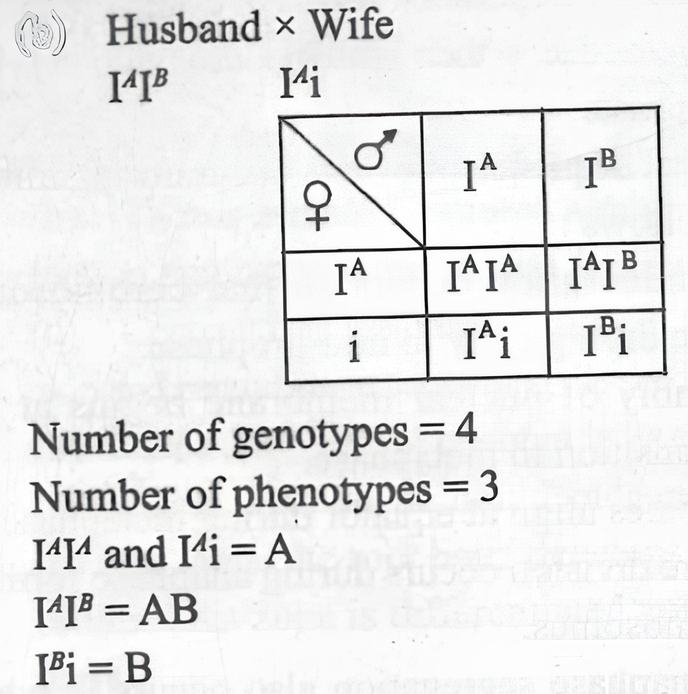
The genotypes of husband and wife are IᴬIᴮ and Iᴬi. Among the blood types of their children, how many different genotypes and phenotypes are possible?
Among the following characters, which one was not considered by Mendel in his experiments on pea?
During his experiments Mendel have taken seven characters in a pea plant. Among these, nature of trichomes i.e. glandular or non-glandular was not considered by Mendel.
Which one from those given below is the period for Mendel's hybridisation experiments?
According to NCERT, Mendel conducted hybridisation experiments for 7 years on Pea plant between 1856 to 1863 and his data was published in 1865.
Thalassemia and sickle cell anemia are caused due to a problem in globin molecule synthesis. Select the correct statement:
Thalassemia is a quantitative problem of synthesising very few globin molecules while sickle cell anaemia is a qualitative problem of synthesising an incorrectly functioning globin.
A disease caused by an autosomal primary non-disjunction is:
Down’s syndrome is caused by non-disjunction of 21ˢᵗ chromosome i.e. Trisomy.
The final proof for DNA as the genetic material came from the experiments of:
Hershey and Chase proved that DNA as genetic material. They used bacteriophage for their experimental.
DNA fragments are:
DNA fragments are negatively charged because presence of phosphate group.
Which of the following RNAs should be most abundant
in animal cell?
Ribosomal RNA (rRNA) is most abundant in animal cell. It constitutes 80% of total RNA of the cell.
The association of histone H1 with a nucleosome indicates:
The association of H1 protein indicates the complete formation of nucleosome which requires DNA condensa tion. The DNA is therefore in condensed form.
If there are 999 bases in an RNA that codes for a protein with 333 amino acids, and the base at position 901 is deleted such that the length of the RNA becomes 998 bases, how many codons will be altered?
If deletion happens at 901st position then the remaining 98 bases specifying for 33 codons of amino acids will be altered
During DNA replication, Okazaki fragments are used to
elongate:
Two DNA polymerase molecules simultaneously work at the DNA fork, one on the leading strand and the other on the lagging strand. DNA polymerase synthesizes each Okazaki fragment a laggIing strand in 5'-3' direction. As the replication fork opens further, new Okazaki fragments appear. The first Okazaki fragment appears away from the replication fork and thus the direction of elongation would be away from replication fork.
Spliceosomes are not found in cells of;
In eukaryotes, spliceosomes are used in removal of introns during post-transcriptional processing of hnRNA. they are absent in prokaryotes.
Which of the following represents order of Horse’?
Horse belongs to
Orders - Perissodactyla
Family - Equidae
Genus - Equus
Species - ferus
‘Subspecies - caballus
Transplantation of tissues/organs fails often due to non-acceptance by the patient’s body. Which type of immune-response is responsible for such rejections
Cell mediated immune response causes non-acceptance o rejection of graft or transplanted tissues/organs.Transplant rejection is caused primarily by a cell-mediated jmmune response to HLA antigens expressed on donor . antigen-presenting cells (APCs) transferred along with the transplanted organ. Recognition of donor HLA antigens on the cells of the graft induces vigorous T cell proliferation
in the recipient.
MALT constitutes about ............. percent of the lymphoid tissue in human body.
MAL Mucosa Associated Lymphoid Tissue constitutes about 50 percent of the lymphoid tissue in human body. It is scattered along mucosal lining in the human body
Homozygous pure lines in cattle can be obtained by:
Inbreeding increases homozygosity. So, mating ofthe related indi viduals of same breed will give homozygous
purelines.
‘Which of the following in sewage treatment removes suspended solids?
Primary treatment is a physical process which involves two process, i.e. filtration and sedimentation of big solid waste.
‘Which of the following is correctly matched for the product produced by them ?
Saccharomyces cerevisiae commonly know as Brewer’s yeast, causes fermentation of carbohydrates and produces ethanol.
The DNA fragments separated on an agarose gel can be visualised after staining with:
Ethidium bromide (EtBr) is used to stain the DNA fragments and will appear as orange coloured ‘bands when kept under UV light.
A gene whose expression helps to identify transformed cell is known as :
Selectable markers in recombinant DNA technology,
helps in identification and elimination of ‘non-transformants
and selectively permits the growth of the transformants.
‘What is the criterion for DNA fragments movement on agarose gel during gel electrophoresis?
DNA fragments during gel electrophoresis, separate
(resolve) according to their size due to sieving effect provided by agarose gel.
The process of separation and purification of expressed protein before marketing is called:
The various stages of processing that occur after the completion of fermentation or biosynthetic stage which include separation and purification of product called downstream processing.
Presence of plants arranged into well defined vertical layers depending on their height can be seen best in:
The tropical rain forest have five vertical strata on the basis of plants height i.e., ground vegetation, shrubs, short canopy trees, tall canopy trees and tall emergent trees.
Asymptote in a logistic growth curve is obtained when :
In logistic growth curve, the curve has an upper asymptote known as carrying capacity (K) is obtained when the maximum population size is at dN/dt = 0. A population growing in a habitat with limited resources shows logistic growth curve.
For logistic growth,
dN/dt = rN[(K − N)/K]
If K = N then
(K − N)/K = 0
∴ dN/dt =0.
The population reaches asymptote.
Mycorrhizae are the example of :
Mycorrhizaeis a symbiotic association between fungi and roots of higher plants.
Which ecosystem has the maximum biomass?
Forest ecosystem has the maximum biomass.
Some very high productive ecosystem are
— Tropical rain forest
— Coral reef
— Estuaries
— Sugarcane fields
Alexander Von Humboldt described for the first time:
Alexander Von Humboldt noticed that within a region species richness increases with the increase in area.
‘Which one of the following statements is not valid for aerosols?
Aerosols through its direct or indirect effects on plants can cause various problems in agriculture. However, continuous increase in air pollution may represent a threat to agriculture in the future that is persistent and largely irreversible.
Artificial selection to obtain cows yielding higher milk
output represents :
Artificial selection to obtain cow yielding higher milk output will shift the peak to one direction, so this represent an example of Directional selection. In stabilizing selection, the organisms with the mean value of the trait are selected. In disruptive selection, both extremes get selected.
Select the mismatch :
Rhodospirillum is facultative anaerobe and free living nitrogen fixer. Mycorrhiza show symbiotic relationship between fungi and roots of higher plants.
Which one of the following is related to Ex-situ conservation of threatened animals and plants ?
Ex-situ conservation is offsite strategy for conservation of biological diversity in zoological park and botanical gardens respectively.
A temporary endocrine gland in the human body is:
Corpus luteum is the temporary endocrine gland formed in the ovary after ovulation. It release hormones like progesterone, oestrogen etc.
Match the following sexually transmitted diseases (Column-I) with their causative agent (Column-II) and select
the correct option :
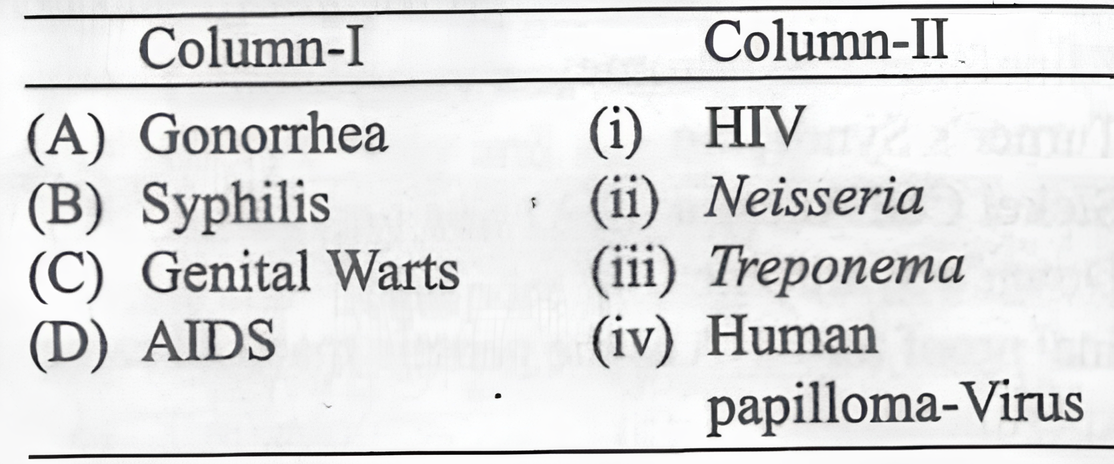
Gonorrhoea – Neisseria (Bacteria)
Syphilis – Treponema (Bacteria)
Genital Warts – Human papilloma virus
AIDS – HIV (Virus)
‘Which of the following in sewage treatment removes suspended solids
Primary treatment is a physical process which involves two process, i.e. filtration and sedimentation of big solid waste.
Select the correct route for the passage of sperms in male frogs:
In male frog the sperms passage is:
Testes → Vasa efferentia → Kidney → Bidder's canal → Urinogenital duct → Cloaca.
GnRH, a hypothalamic hormone, needed in reproduction, acts on:
GnRH is secreted by hypothalamus which stimulates anterior pituitary gland for the secretion of gonadotropins (FSH and LH).
Identify the wrong statement in context of heartwood:
Heartwood is inactive physiologically due to deposition of organic compounds and formation of tyloses so it will not conduct water and minerals.
Consider a drop of rain water having mass 1 g falling from a height of 1 km. It hits the ground with a speed of 50 m/s. Take 'g' constant with a value 10 m/s². The work done by the(i) gravitational force and
(ii) resistive force of air is
From work-energy theorem,
W_g + W_a = ΔK.E.
or, mgh + W_a = 1/2 mv² − 0
10⁻³ × 10 × 10³ + W_a = 1/2 × 10⁻³ × (50)²
⇒ W_a = −8.75 J
which is the work done due to air resistance
Work done due to gravity = mgh
= 10⁻³ × 10 × 10³ = 10 J
Which of the following statements are correct?
(A) Centre of mass of a body always coincides with the centre of gravity of the body.
(B) Centre of mass of a body is the point at which the total gravitational torque on the body is zero.
(C) A couple on a body produce both translational and rotation motion in a body.
(D) Mechanical advantage greater than one means that small effort can be used to lift a large load.
Mechanical advantage, M.A = Load/Effort
If M.A. > 1 ⇒ Load > Effort
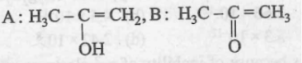
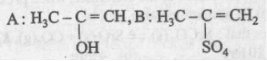
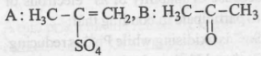
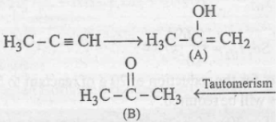
Predict the correct intermediate and product in the following reaction

-
(A)
-
(B)
-
(C)
-
(D)

Hydration of alkynes give ketones.
Match the interhalogen compounds of column-I with the geometry in column Il and assign the correct code.
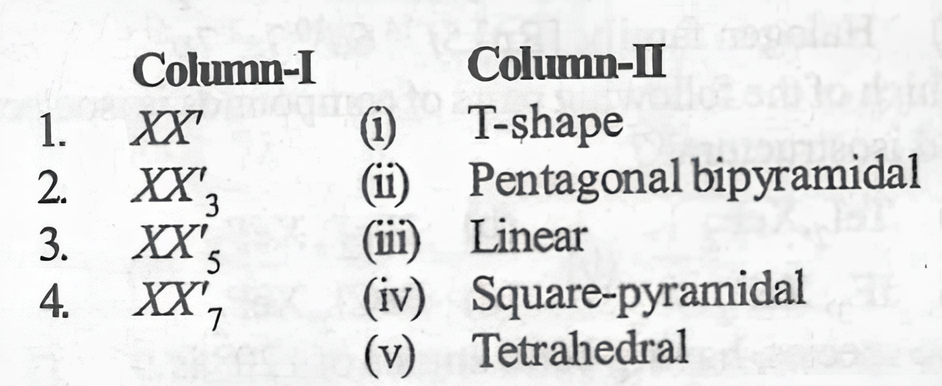
XX' → Linear (e.g. ClF, BrF)
XX₃' → T-Shape (e.g. ClF₃, BrF₃)
XX₅' → Square pyramidal (e.g. BrF₅, IF₅)
XX₇' → Pentagonal bipyramidal (e.g. IF₇)
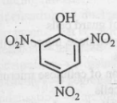
Which one is the most acidic compound ?
-
(A)
-
(B)
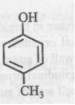
-
(C)
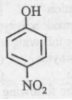
-
(D)

Electron withdrawing—NO₂, group has very strong -I
and —R effects so, compound 3 will be most acidic.
Identify A and predict the type of reaction
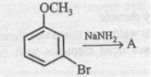
-
(A)
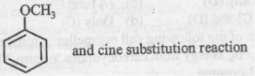
-
(B)
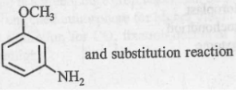
-
(C)
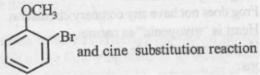
-
(D)
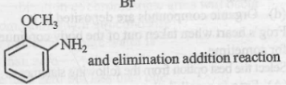
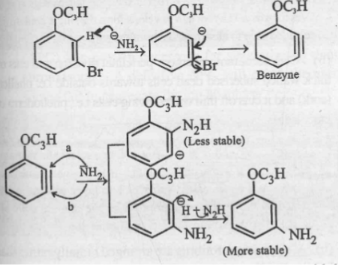
More stable as —ve charge is close to electron withdrawing group.
Also, incoming nucleophile gets attached on same 'C'on
which 'Br' (Leaving group) was present.
. nota cine substitution reaction.
out of the following, which is the product formed when cyclohexanone undergoes aldol condensation followed by heating ?
-
(A)
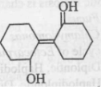
-
(B)

-
(C)

-
(D)
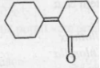
More stable as —ve charge is close to electron withdrawing group.
Also, incoming nucleophile gets attached on same 'C'on
which 'Br' (Leaving group) was present.
. nota cine substitution reaction.
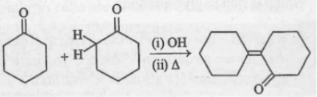
Other Years