NEET Ug . NEET Chemistry . Chemistry . Hydrocarbons
Chapter 9: Hydrocarbons
Ch 9
NEET Chemistry
NEET Ug
Introduction
Key Points
- Hydrocarbons are organic compounds made up only of carbon (C) and hydrogen (H) atoms.
- Main natural sources: natural gas, petroleum, and coal.
Solved Examples
- Ex 1: Identify the elements in hydrocarbons.
Answer: Carbon and Hydrogen only.
Practice Set
- Q1: What elements do hydrocarbons contain?
A. Carbon and Oxygen
B. Carbon and Hydrogen
C. Hydrogen and Oxygen
D. Carbon, Hydrogen, and Oxygen - Q2: Which of the following is a major source of hydrocarbons?
A. Water
B. Natural gas
C. Air
D. Salt - Q3: Hydrocarbons are primarily composed of which two elements?
A. Carbon and Nitrogen
B. Carbon and Hydrogen
C. Hydrogen and Oxygen
D. Nitrogen and Oxygen
Answer Key
- Q1: B - Hydrocarbons contain only carbon and hydrogen atoms.
- Q2: B - Natural gas is a main source of hydrocarbons.
- Q3: B - Hydrocarbons are composed of carbon and hydrogen only.
Memory Aids
- Hydrocarbons = Hydro (H) + Carbon (C) only.
- Sources: Natural gas, Petroleum, Coal (NPC).
Classification
Types of Hydrocarbons
- Based on carbon-carbon bonds, hydrocarbons are classified into:
- Saturated: Only single bonds (C–C, C–H).
- Unsaturated: Contain double or triple bonds (C=C, C≡C).
- Aromatic: Special cyclic compounds with resonance (e.g., benzene).
- Saturated Hydrocarbons:
- Alkanes: Open chain with single bonds.
- Cycloalkanes: Closed ring with single bonds.
- Unsaturated Hydrocarbons: Contain multiple bonds (double/triple).
- Aromatic Hydrocarbons: Cyclic compounds with special stability due to resonance.
Solved Examples
- Ex 1: Classify C2H6.
Answer: Saturated alkane (ethane, single bonds only). - Ex 2: Classify C2H4.
Answer: Unsaturated alkene (contains a double bond).
Practice Set
- Q1: Which hydrocarbon is saturated?
A. Ethene
B. Ethyne
C. Ethane
D. Benzene - Q2: Which hydrocarbon contains a triple bond?
A. Ethane
B. Ethene
C. Ethyne
D. Cyclohexane - Q3: Aromatic hydrocarbons are characterized by:
A. Only single bonds
B. Multiple bonds without resonance
C. Cyclic structure with resonance
D. Open chain with double bonds
Answer Key
- Q1: C - Ethane is saturated with single bonds only.
- Q2: C - Ethyne contains a triple bond.
- Q3: C - Aromatic hydrocarbons have cyclic structure with resonance.
Memory Aids
- Saturated = Single bonds only (alkanes, cycloalkanes).
- Unsaturated = Double or triple bonds (alkenes, alkynes).
- Aromatic = Cyclic with resonance (benzene ring).
Alkanes
General Properties
- Alkanes are saturated hydrocarbons with formula CnH2n+2.
- Examples: Methane (CH4), Ethane (C2H6), Propane (C3H8).
Structure
- Carbon atoms are sp3 hybridized, forming tetrahedral geometry.
- All C–C and C–H bonds are sigma (σ) bonds.
- Bond lengths: C–C = 1.54 Å, C–H = 1.09 Å; bond angle = 109° 28'.
Isomerism
- Exhibit chain isomerism.
- First three members (methane, ethane, propane) have no isomers.
- Number of isomers increases with carbon atoms: Butane (2), Pentane (3), Hexane (5), Heptane (9), Octane (18), Decane (75).

Solved Examples
- Ex 1: Identify isomers of pentane.
Answer: n-pentane (straight chain), iso-pentane (one branch), neo-pentane (more branched).
Practice Set
- Q1: What is the general formula of alkanes?
A. CnH2n B. CnH2n+2 C. CnH2n-2 D. CnHn - Q2: Which alkane has 5 isomers?
A. Butane B. Pentane C. Hexane D. Heptane - Q3: What type of isomerism do alkanes exhibit?
A. Position B. Chain C. Functional D. Geometrical
Answer Key
- Q1: B - Alkanes have the formula CnH2n+2.
- Q2: C - Hexane has 5 isomers.
- Q3: B - Alkanes show chain isomerism.
Memory Aids
- Alkanes = Saturated hydrocarbons, formula CnH2n+2.
- Isomer count increases with carbon number; no isomers for C1-C3.
Preparation
Hydrogenation of Unsaturated Hydrocarbons
- Alkenes/alkynes + H2 (Pt, Pd, Ni catalyst) → Alkanes.

Reduction of Alkyl Halides
- Alkyl halides (except fluorides) + Zn + dilute HCl → Alkanes.

Wurtz Reaction
- Alkyl halides + 2Na (dry ether) → Higher alkanes (even carbon number) + 2NaX.

From Carboxylic Acids
- Decarboxylation: Sodium salts of carboxylic acids + soda lime (NaOH + CaO) → Alkane (one C less) + CO2.

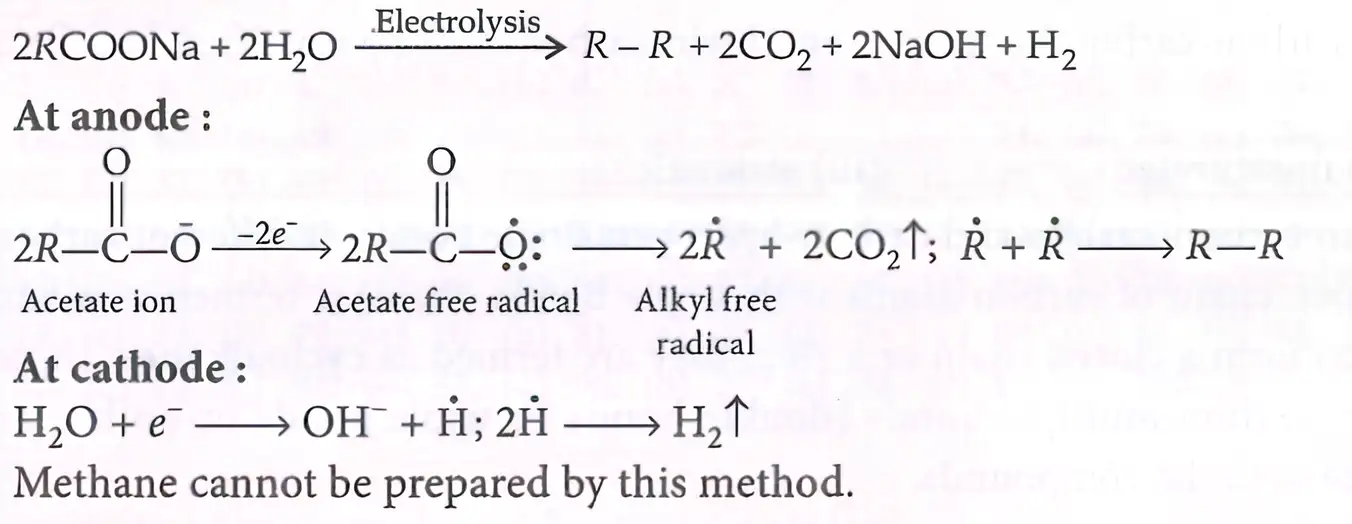
- Kolbe’s Electrolysis: Electrolysis of sodium/potassium salts of carboxylic acids → Alkane with even number of carbons.
Solved Examples
- Ex 1: Write reaction for hydrogenation of ethene.
CH2=CH2 + H2 (Pt) → CH3–CH3 - Ex 2: Write Wurtz reaction for chloromethane.
2CH3Cl + 2Na → C2H6 + 2NaCl
Practice Set
- Q1: Which catalyst is used in hydrogenation?
A. Fe B. Ni C. Cu D. Zn - Q2: Wurtz reaction is used to prepare alkanes with:
A. Odd number of carbons B. Even number of carbons C. Any number of carbons D. Only methane - Q3: Decarboxylation removes which group?
A. Hydroxyl B. Carboxyl C. Carbonyl D. Amino
Answer Key
- Q1: B - Nickel is a common hydrogenation catalyst.
- Q2: B - Wurtz reaction forms alkanes with even carbon numbers.
- Q3: B - Decarboxylation removes the carboxyl group.
Memory Aids
- Hydrogenation uses Pt, Pd, Ni catalysts.
- Wurtz reaction joins alkyl halides using sodium in dry ether.
- Decarboxylation removes CO2 from carboxylic acids.
Physical Properties
States and Solubility
- C1 to C4: gases; C5 to C17: liquids; C18 and above: solids at 298 K.
- Colourless, odourless, insoluble in water, soluble in non-polar solvents.
Boiling and Melting Points
- Boiling points increase with molecular mass.
- Branching decreases boiling points.
- Alkanes with even carbon numbers have higher melting points than adjacent odd-numbered alkanes due to symmetry.
Solved Examples
- Ex 1: State physical state of hexane at room temperature.
Answer: Liquid (C5 to C17 are liquids).
Practice Set
- Q1: Which alkane is a gas at room temperature?
A. Hexane B. Methane C. Octadecane D. Nonane - Q2: Alkanes are soluble in:
A. Water B. Polar solvents C. Non-polar solvents D. Acids - Q3: Branching in alkanes causes:
A. Increase in boiling point B. Decrease in boiling point C. No change D. Increase in melting point
Answer Key
- Q1: B - Methane is a gas at room temperature.
- Q2: C - Alkanes dissolve in non-polar solvents.
- Q3: B - Branching lowers boiling points.
Memory Aids
- First 4 alkanes are gases; next are liquids; long chains are solids.
- Branching lowers boiling points due to less surface contact.
Chemical Properties
Reactivity
- Generally inert to acids, bases, oxidizing and reducing agents.
- Undergo halogenation under UV light and heat.
- Halogenation rate: F2 > Cl2 > Br2 > I2.
- Hydrogen replacement rate: 3° > 2° > 1° hydrogens.
- Fluorination is violent; iodination is slow and reversible with oxidizing agents.
Halogenation Mechanism
- Chain initiation: UV light splits Cl2 into 2 Cl radicals.
- Chain propagation: Cl radical abstracts H from alkane forming alkyl radical + HCl; alkyl radical reacts with Cl2 forming alkyl halide + Cl radical.
- Chain termination: Radicals combine to form stable molecules.

Other Reactions
- Combustion: Complete → CO2 + H2O; Incomplete → C (soot) + H2O.
- Controlled oxidation forms methanol, formaldehyde, ethanoic acid.
- Isomerisation converts n-butane to iso-butane.
- Aromatisation converts hexane to benzene.
- Reaction with steam produces CO and H2.
- Pyrolysis/cracking breaks large hydrocarbons into smaller ones.
Solved Examples
- Ex 1: Write the product of methane chlorination.
CH4 + Cl2 → CH3Cl + HCl (under UV light)
Practice Set
- Q1: Which halogen reacts fastest with alkanes?
A. I2 B. Br2 C. Cl2 D. F2 - Q2: Rate of hydrogen replacement in alkanes is:
A. 1° > 2° > 3° B. 3° > 2° > 1° C. 2° > 3° > 1° D. Equal for all - Q3: What is the main step in chain propagation during halogenation?
A. Radical formation B. Radical combination C. Hydrogen abstraction D. Radical termination
Answer Key
- Q1: D - Fluorine reacts fastest but is violent.
- Q2: B - Tertiary hydrogens are replaced fastest.
- Q3: C - Hydrogen abstraction by halogen radical is key propagation step.
Memory Aids
- Halogenation proceeds via free radical mechanism: initiation, propagation, termination.
- Fluorination is uncontrollable; iodination is slow and reversible.
- Substitution rate: 3° > 2° > 1° hydrogens.
Conformations
Definition
- Conformational isomers arise from rotation about C–C single bonds.
- Also called rotational isomers.
Conformations of Ethane
- Infinite conformations possible by rotation of one methyl group around C–C bond.
- Eclipsed: Hydrogens align, causing maximum repulsion; least stable.
- Staggered: Hydrogens are maximally apart; most stable, 12.5 kJ/mol more stable than eclipsed.
- Skew (Gauche): Intermediate conformations between eclipsed and staggered.

Solved Examples
- Ex 1: Identify the most stable conformation of ethane.
Answer: Staggered conformation.
Practice Set
- Q1: Which conformation has highest energy?
A. Staggered B. Eclipsed C. Skew D. Chair - Q2: Rotation about which bond causes conformational isomerism?
A. C=O B. C–C single bond C. C≡C D. C–H - Q3: Energy difference between eclipsed and staggered ethane is approximately:
A. 5 kJ/mol B. 12.5 kJ/mol C. 20 kJ/mol D. 50 kJ/mol
Answer Key
- Q1: B - Eclipsed conformation has highest energy due to repulsion.
- Q2: B - Rotation about C–C single bond causes conformational isomerism.
- Q3: B - Energy difference is about 12.5 kJ/mol.
Memory Aids
- Staggered = stable; eclipsed = unstable; skew = intermediate.
- Rotation about C–C single bond changes conformation.
Alkenes Structure
Explanation
- Alkenes have molecular formula CnH2n with a carbon-carbon double bond (C=C).
- In ethylene, sp2 orbitals of carbons overlap axially forming a sigma (σ) bond.
- Remaining sp2 orbitals overlap with hydrogen 1s orbitals.
- Pure p orbitals on carbons overlap sideways forming a pi (π) bond.
- Double bond consists of one σ and one π bond.
Solved Examples
- Ex 1: Describe bonding in ethene.
- Each carbon is sp2 hybridized.
- σ bond formed by axial overlap of sp2 orbitals.
- π bond formed by lateral overlap of p orbitals.
Practice Set
- Q1: What type of hybridization is present in alkene carbons?
- A. sp
- B. sp2
- C. sp3
- D. dsp2
- Q2: The pi bond in alkenes is formed by overlap of?
- A. sp2 orbitals
- B. p orbitals
- C. s orbitals
- D. sp orbitals
- Q3: Which bond in alkene allows free rotation?
- A. Sigma bond
- B. Pi bond
- C. Both sigma and pi bonds
- D. None
Answer Key
- Q1: B - Alkene carbons are sp2 hybridized.
- Q2: B - Pi bond is formed by lateral overlap of p orbitals.
- Q3: A - Sigma bond allows free rotation; pi bond restricts rotation.
Memory Aids
- Double bond = 1 σ + 1 π bond.
- sp2 hybridization in alkene carbons.
- Pi bond formed by sideways p orbital overlap.
Alkenes Isomerism
Explanation
- Chain isomerism: Different carbon chain arrangements (e.g., 1-pentene and 2-methyl-1-butene).
- Position isomerism: Double bond position differs (e.g., 1-butene vs 2-butene).
- Ring chain isomerism: One is open chain, other is cyclic (e.g., propene and cyclopropane).
- Geometrical isomerism: Due to restricted rotation around C=C, cis (same side) and trans (opposite side) forms exist.
- Trans isomers are generally more stable than cis due to less steric crowding.
Solved Examples
- Ex 1: Identify isomers of butene.
- 1-butene: double bond at carbon 1.
- 2-butene: double bond at carbon 2 (cis and trans forms).
Practice Set
- Q1: Which is an example of chain isomerism?
- A. 1-butene and 2-butene
- B. 1-pentene and 2-methyl-1-butene
- C. Cis-butene and trans-butene
- D. Propene and cyclopropane
- Q2: Geometrical isomerism arises due to?
- A. Free rotation around C=C
- B. Restricted rotation around C=C
- C. Different molecular formula
- D. Different carbon chain
- Q3: Which is more stable?
- A. Cis-isomer
- B. Trans-isomer
- C. Both equally stable
- D. None
Answer Key
- Q1: B - Chain isomerism involves different carbon chains.
- Q2: B - Geometrical isomerism due to restricted rotation around double bond.
- Q3: B - Trans isomers are more stable due to less steric hindrance.
Memory Aids
- Cis = same side; Trans = opposite side.
- Chain isomers differ in carbon skeleton.
- Position isomers differ in double bond location.
Alkenes Preparation
Explanation
- Partial hydrogenation of alkynes: Using Lindlar’s catalyst (Pd on CaCO3 poisoned with Pb), alkynes convert to cis-alkenes.
- Birch reduction: Sodium in liquid ammonia converts alkynes to trans-alkenes.
- Dehydrohalogenation of alkyl halides: β-elimination using alcoholic KOH removes HX forming alkenes.
- From vicinal dihalides: Zn reduces vicinal dihalides to alkenes.
- Dehydration of alcohols: Heating alcohols with conc. H2SO4 removes water forming alkenes.
- Saytzeff rule: More substituted alkene is major product.
Solved Examples
- Ex 1: Partial hydrogenation of ethyne.
- C2H2 + H2 (Lindlar’s catalyst) → C2H4 (cis-ethene)
- Ex 2: Dehydrohalogenation of 1-bromoethane.
- CH3CH2Br + KOH (alc) → CH2=CH2 + KBr + H2O
Practice Set
- Q1: Lindlar’s catalyst produces which alkene?
- A. Trans-alkene
- B. Cis-alkene
- C. Alkane
- D. Alkyne
- Q2: Dehydration of alcohols requires?
- A. Dilute H2SO4
- B. Conc. H2SO4 and heat
- C. KOH and heat
- D. Na and NH3
- Q3: In dehydrohalogenation, which carbon loses hydrogen?
- A. α-carbon
- B. β-carbon
- C. γ-carbon
- D. None
Answer Key
- Q1: B - Lindlar’s catalyst gives cis-alkenes.
- Q2: B - Dehydration requires conc. H2SO4 and heat.
- Q3: B - Hydrogen is removed from β-carbon in dehydrohalogenation.
Memory Aids
- Lindlar’s catalyst → cis-alkene.
- Birch reduction → trans-alkene.
- Saytzeff rule → more substituted alkene major product.
Alkenes Physical Properties
Explanation
- First 3 alkenes are gases; next 14 are liquids; higher are solids.
- All alkenes are colourless and odourless except ethene (faint sweet smell).
- Insoluble in water; soluble in non-polar solvents.
- Boiling points increase with molecular size; straight chains have higher boiling points than branched isomers.
Solved Examples
- Ex 1: Boiling point trend.
- Butene (C4H8) boiling point higher than 2-methylpropene due to straight chain.
Practice Set
- Q1: Which alkene is a gas at room temperature?
- A. Ethene
- B. Hexene
- C. Decene
- D. Dodecene
- Q2: Alkenes are generally soluble in?
- A. Water
- B. Polar solvents
- C. Non-polar solvents
- D. None
- Q3: Boiling point increases with?
- A. Branching
- B. Molecular size
- C. Decrease in chain length
- D. None
Answer Key
- Q1: A - First three alkenes including ethene are gases.
- Q2: C - Alkenes dissolve in non-polar solvents.
- Q3: B - Boiling point increases with molecular size.
Memory Aids
- Alkenes: gases (C1-C3), liquids (C4-C17), solids (higher).
- Insoluble in water, soluble in non-polar solvents.
- Straight chain > branched in boiling point.
Markovnikov’s and Anti-Markovnikov’s Rule
Explanation
- Markovnikov’s rule: In addition to unsymmetrical alkenes, the negative part of the reagent attaches to carbon with fewer hydrogens.
- Anti-Markovnikov’s rule (Peroxide effect): In presence of peroxide, HBr adds opposite to Markovnikov’s rule.
- Peroxide effect observed only with HBr, not HCl or HI.
Solved Examples
- Ex 1: Addition of HBr to propene.
- Without peroxide: Br attaches to carbon with fewer H (Markovnikov product).
- With peroxide: Br attaches to carbon with more H (Anti-Markovnikov product).
Practice Set
- Q1: Markovnikov’s rule applies to addition of?
- A. HCl
- B. HBr without peroxide
- C. HBr with peroxide
- D. HI
- Q2: Anti-Markovnikov addition occurs in presence of?
- A. Heat
- B. Peroxide
- C. Acid
- D. Base
- Q3: Peroxide effect is observed with?
- A. HCl
- B. HBr
- C. HI
- D. All HX
Answer Key
- Q1: B - Markovnikov’s rule applies to HBr without peroxide.
- Q2: B - Peroxide causes Anti-Markovnikov addition.
- Q3: B - Peroxide effect only with HBr.
Memory Aids
- Markovnikov: Negative part attaches to carbon with fewer H.
- Anti-Markovnikov: Peroxide reverses addition in HBr.
- Peroxide effect only with HBr.
Dienes and Polymerization
Explanation
- Dienes: Alkenes with two double bonds.
- Types of dienes:
- Isolated dienes: double bonds separated by ≥1 single bond.
- Conjugated dienes: double bonds separated by exactly one single bond.
- Cumulated dienes: double bonds adjacent on same carbon.
- Polymerization: Alkenes like propene polymerize under heat, pressure, and catalyst to form polymers (e.g., polypropylene).
- Polymer structure: Repeating units with opened double bonds linked in chains.
Solved Examples
- Ex 1: Polymerization of propene.
- Many propene molecules (CH3-CH=CH2) link to form polypropylene.
- Requires heat, pressure, and catalyst.
Practice Set
- Q1: Dienes have how many double bonds?
- A. One
- B. Two
- C. Three
- D. None
- Q2: Conjugated dienes have double bonds separated by?
- A. No bond
- B. One single bond
- C. Two single bonds
- D. Adjacent carbons
- Q3: Polymerization of propene produces?
- A. Polyethylene
- B. Polypropylene
- C. Polystyrene
- D. Polyvinyl chloride
Answer Key
- Q1: B - Dienes have two double bonds.
- Q2: B - Conjugated dienes have double bonds separated by one single bond.
- Q3: B - Propene polymerizes to polypropylene.
Memory Aids
- Dienes = 2 double bonds.
- Conjugated = alternate double bonds.
- Polymerization opens double bonds to form chains.
Alkynes
Definition and Characteristics
- Alkynes are unsaturated hydrocarbons with the general formula CnH2n-2.
- Contain a carbon-carbon triple bond (≡), e.g., acetylene (C2H2, HC≡CH) and propyne (HC≡CCH3).
- More acidic than alkenes and alkanes due to sp-hybridised carbon atoms which are more electronegative.
Isomerism
- Ethyne does not show isomerism.
- Other alkynes exhibit chain, position, and functional isomerism.
- Examples include:
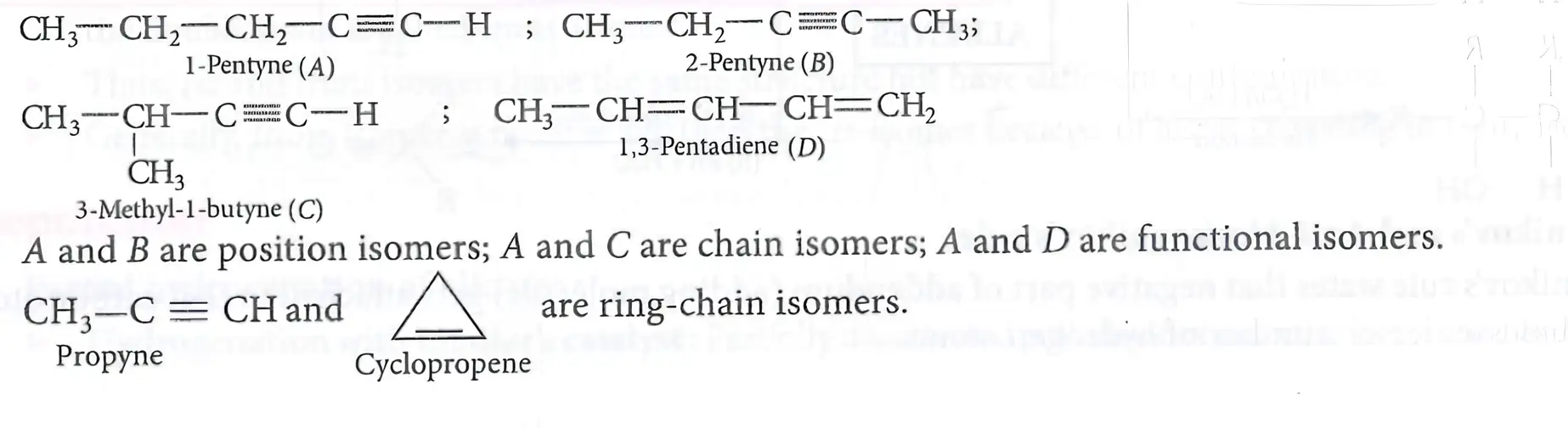
- Position isomers: 1-Pentyne and 2-Pentyne (same chain, different triple bond position).
- Chain isomers: 1-Pentyne and 3-Methyl-1-butyne (different carbon chain arrangement).
- Functional isomers: 1-Pentyne and 1,3-Pentadiene (alkyne vs diene).
- Ring-chain isomers: Propyne (linear) and cyclopropene (ring) with same formula but different structures.
Structure
- In acetylene, sp-hybridised orbitals of carbons overlap axially to form a C–C σ-bond.
- Each carbon's other sp orbital overlaps with hydrogen 1s orbitals forming two C–H σ-bonds.
- Remaining p-orbitals overlap sideways forming two C–C π-bonds.
Preparation of Acetylene
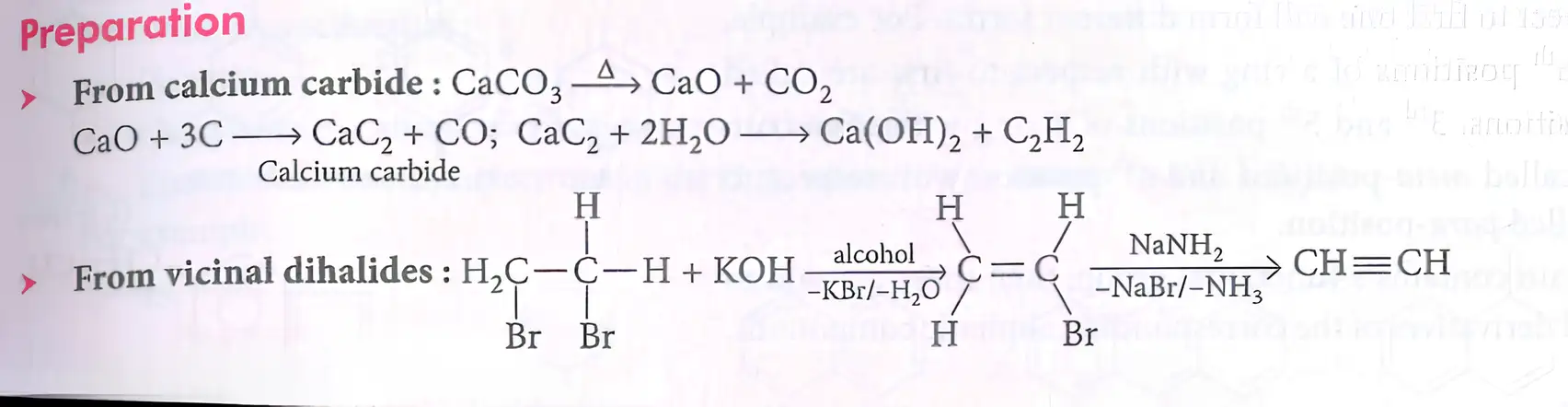
- From calcium carbide:
- Heat CaCO3 → CaO + CO2
- CaO + C → CaC2
- CaC2 + H2O → Ca(OH)2 + C2H2
- From vicinal dihalides:
- Vicinal dihalide + alcoholic KOH → alkene
- Alkene + NaNH2 → acetylene (C2H2)
Solved Examples
- Ex 1: Write the reaction for acetylene preparation from calcium carbide.
- CaC2 + 2H2O → Ca(OH)2 + C2H2
Practice Set
- Q1: What is the general formula of alkynes?
- A. CnH2n+2
- B. CnH2n
- C. CnH2n-2
- D. CnHn
- Q2: Which type of isomerism is not shown by ethyne?
- A. Chain isomerism
- B. Position isomerism
- C. Functional isomerism
- D. All of the above
- Q3: Which compound is a ring-chain isomer of propyne?
- A. 1-Pentyne
- B. Cyclopropene
- C. 1,3-Pentadiene
- D. 3-Methyl-1-butyne
Answer Key
- Q1: C - Alkynes have the formula CnH2n-2 due to one triple bond.
- Q2: D - Ethyne does not show chain, position, or functional isomerism.
- Q3: B - Cyclopropene is a ring-chain isomer of propyne (same formula, different structure).
Memory Aids
- Alkynes = CnH2n-2, triple bond present.
- Ethyne = no isomers; others show chain, position, functional isomers.
- Ring-chain isomers: linear alkynes vs cyclic alkenes.
Physical Properties
General Properties
- First three alkynes are gases; next eight are liquids; higher members are solids.
- All alkynes are colourless and odourless except ethyne which has a characteristic odour.
- Insoluble in water; soluble in non-polar solvents.
- Melting point, boiling point, and density increase with molar mass.

Acidic Nature
- Acetylene reacts with sodium in liquid ammonia to form sodium acetylide and hydrogen gas:
- CH≡CH + 2Na → 2NaC≡CH + H2
- Acidic character order: CH≡CH > CH2=CH2 > CH3–CH3.
- —C≡CH group is acidic due to 50% s-character of sp-hybridised carbon, facilitating proton release.
Solved Examples
- Ex 1: Write the reaction of acetylene with sodium in liquid ammonia.
- CH≡CH + 2Na → 2NaC≡CH + H2
Practice Set
- Q1: Which alkyne member is a gas at room temperature?
- A. C5H8
- B. C2H2
- C. C10H18
- D. C12H22
- Q2: Why are alkynes more acidic than alkenes?
- A. Due to sp3 hybridisation
- B. Due to sp2 hybridisation
- C. Due to sp hybridisation with higher s-character
- D. Due to presence of double bond
- Q3: What is the product when acetylene reacts with sodium in liquid ammonia?
- A. Sodium ethoxide
- B. Sodium acetylide
- C. Sodium hydroxide
- D. Sodium chloride
Answer Key
- Q1: B - First three alkynes including acetylene (C2H2) are gases.
- Q2: C - sp hybridisation has 50% s-character, increasing acidity.
- Q3: B - Acetylene reacts with sodium to form sodium acetylide.
Memory Aids
- Acidity order: alkyne > alkene > alkane.
- sp hybridised carbons increase acidity due to higher s-character.
- Acetylene + Na → sodium acetylide + H2.
Chemical Reactions
Addition Reactions
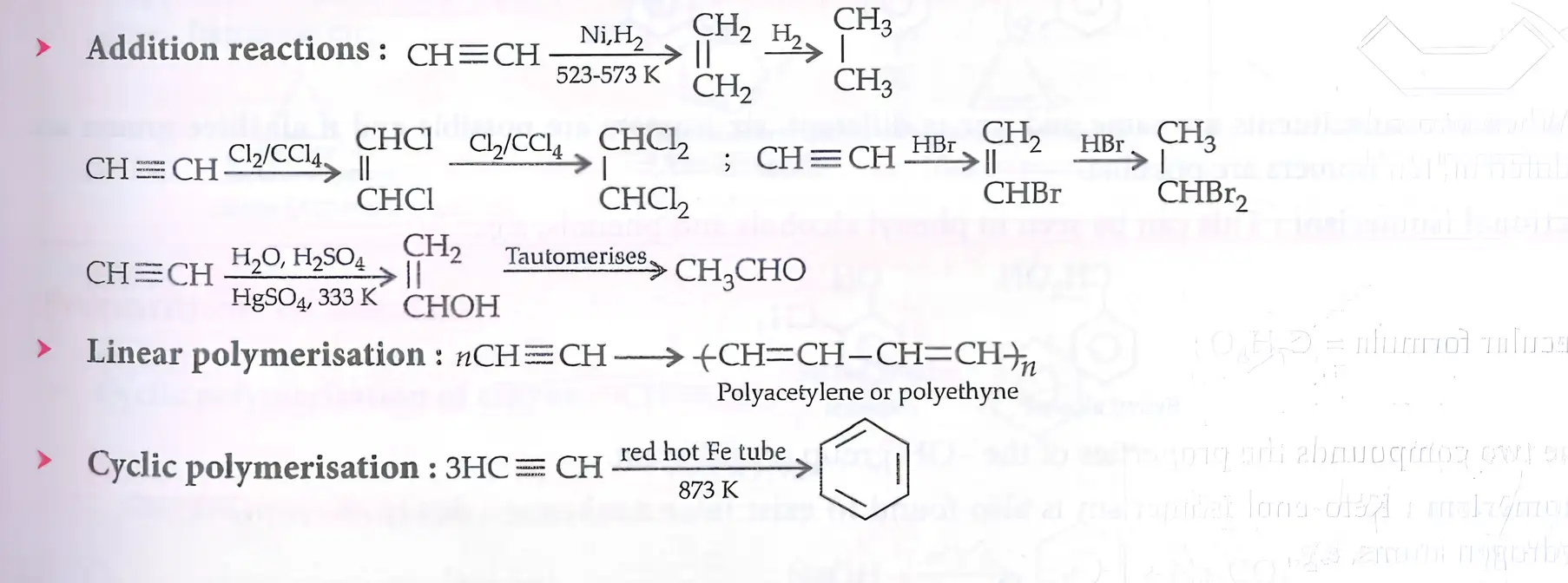
- Hydrogenation:
- C2H2 + H2 (Ni, heat) → C2H4 → C2H6
- Halogenation:
- C2H2 + Cl2 (CCl4) → addition of Cl atoms
- C2H2 + HBr → stepwise addition of Br atoms
- Hydration:
- C2H2 + H2O + H2SO4 (HgSO4) → acetaldehyde (via tautomerism)
Polymerisation
- Linear polymerisation: multiple acetylene molecules form polyacetylene (polyethyne).
- Cyclic polymerisation: 3 acetylene molecules react in hot iron tube to form benzene.
Solved Examples
- Ex 1: Write the product of acetylene hydrogenation.
- C2H2 + 2H2 (Ni) → C2H6
Practice Set
- Q1: What is the product of acetylene hydrogenation?
- A. Ethylene
- B. Ethane
- C. Ethanol
- D. Acetaldehyde
- Q2: Which catalyst is used for acetylene hydration?
- A. Nickel
- B. Mercury sulfate
- C. Platinum
- D. Iron
- Q3: What is formed by cyclic polymerisation of acetylene?
- A. Polyacetylene
- B. Benzene
- C. Ethane
- D. Cyclohexane
Answer Key
- Q1: B - Acetylene hydrogenates to ethane with Ni catalyst.
- Q2: B - HgSO4 catalyses hydration to acetaldehyde.
- Q3: B - Cyclic polymerisation forms benzene.
Memory Aids
- Hydrogenation: acetylene → ethylene → ethane (Ni catalyst).
- Hydration uses HgSO4 catalyst to form acetaldehyde.
- 3 acetylene molecules → benzene (cyclic polymerisation).
Aromatic Hydrocarbons
Overview
- Aromatic hydrocarbons are called arenes; benzene is the simplest arene.
- General formula: CnH2n-6m, where n ≥ 6, m = number of benzene rings.
Nomenclature
- Aromatic compounds consist of nucleus (benzene ring) and side chain (alkyl or aliphatic groups attached).
- Benzene ring carbons are sp2 hybridised with alternating double bonds or delocalised π-electrons.
- Monosubstituted derivatives: one hydrogen replaced by alkyl/group.
- Disubstituted derivatives: substituents at ortho (1,2), meta (1,3), para (1,4) positions.
- Phenyl derivatives: side chains with functional groups attached to benzene.
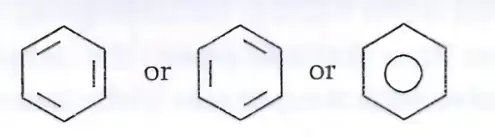
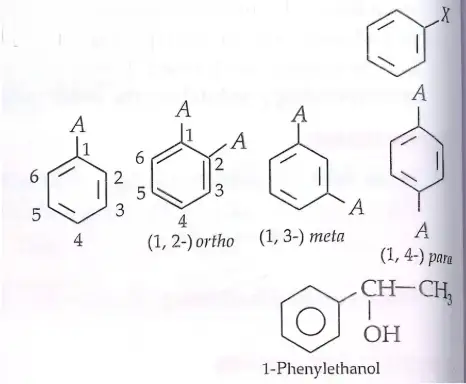
Isomerism
- All six hydrogens in benzene are equivalent; only one monosubstituted derivative possible.
- Position isomerism: two substituents form ortho, meta, para isomers.
- Three identical substituents yield three position isomers.
- Two same and one different substituent: six isomers; all different: ten isomers.
- Functional isomerism: e.g., benzyl alcohol and o-cresol (same formula, different structure).
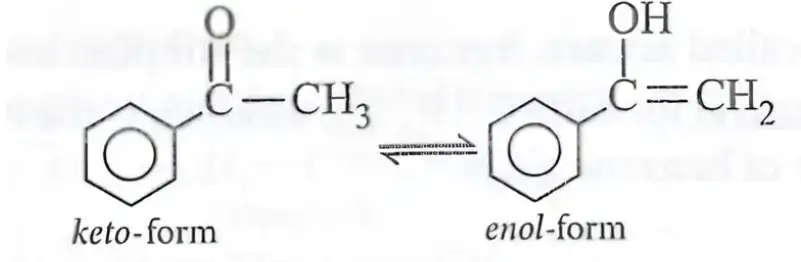
- Tautomerism: keto-enol isomerism in acetophenone due to α-hydrogen mobility.
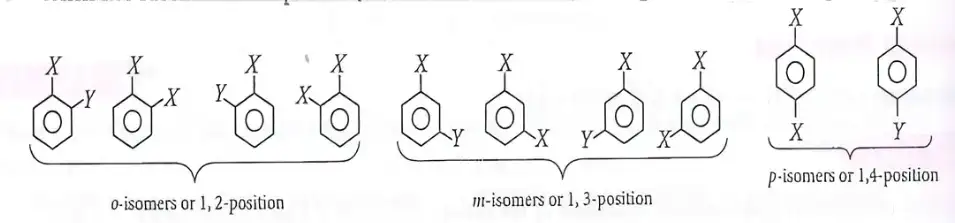
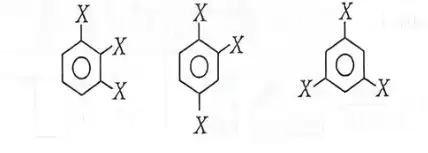

Solved Examples
- Ex 1: Identify the type of isomerism in benzyl alcohol and o-cresol.
Solution: Functional isomerism due to different functional groups (-CH2OH vs -OH). - Ex 2: How many position isomers are possible for disubstituted benzene?
Solution: Three (ortho, meta, para).
Practice Set
- Q1: What is the general formula of arenes?
A. CnH2n B. CnH2n-6m C. CnH2n+6 D. CnHn - Q2: Which positions are called meta in disubstituted benzene?
A. 1,2 B. 1,3 C. 1,4 D. 2,4 - Q3: How many isomers are possible when two substituents are same and one is different?
A. 3 B. 6 C. 9 D. 10
Answer Key
- Q1: B - Arenes follow CnH2n-6m formula.
- Q2: B - Meta positions are 1,3.
- Q3: B - Six isomers possible with two same and one different substituent.
Memory Aids
- Ortho = adjacent carbons (1,2), Meta = separated by one carbon (1,3), Para = opposite carbons (1,4).
- Functional isomers have same formula but different functional groups.
- Tautomerism involves keto-enol interconversion.
Structure of Benzene
Bonding and Hybridisation
- Each carbon is sp2 hybridised.
- Two sp2 orbitals form σ bonds with adjacent carbons; third forms σ bond with hydrogen.
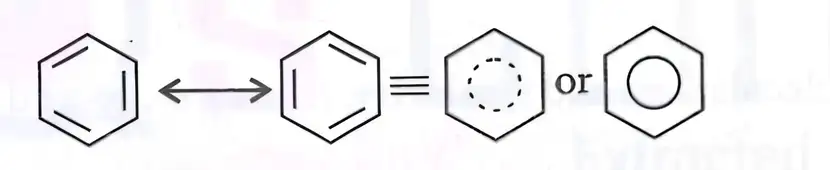
- Unhybridised p-orbitals overlap to form delocalised π-electrons above and below the ring plane.
- All bonds lie in the same plane.
- High unsaturation and unusual stability due to resonance.
Solved Examples
- Ex 1: Explain why benzene is more stable than cyclohexatriene.
Solution: Resonance delocalisation of π-electrons in benzene stabilises it.
Practice Set
- Q1: What is the hybridisation of carbon atoms in benzene?
A. sp B. sp2 C. sp3 D. sp2d - Q2: What type of bond forms between carbon and hydrogen in benzene?
A. π bond B. σ bond C. Ionic bond D. Hydrogen bond - Q3: Why is benzene unusually stable?
A. Due to single bonds B. Due to resonance C. Due to ionic bonds D. Due to hydrogen bonding
Answer Key
- Q1: B - Carbon atoms in benzene are sp2 hybridised.
- Q2: B - σ bonds form between carbon and hydrogen.
- Q3: B - Resonance delocalisation provides stability.
Memory Aids
- Benzene ring is planar with delocalised π-electrons.
- Resonance structures show bond equalisation.
Huckel Rule of Aromaticity
Criteria for Aromaticity
- Ring must be planar.
- Complete delocalisation of π-electrons in the ring.
- Number of π-electrons must be (4n + 2), where n = 0,1,2,...
Examples
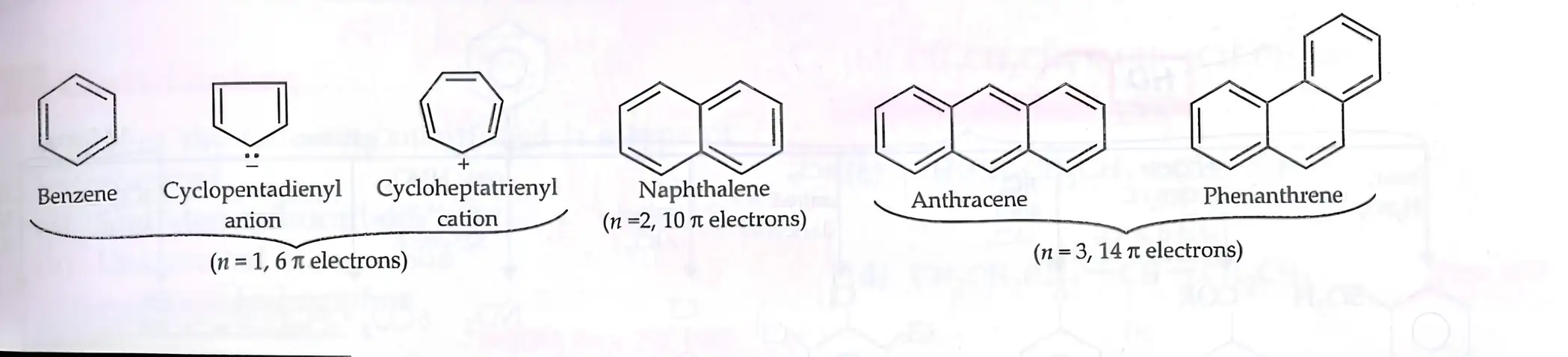
- Benzene (6 π-electrons, n=1) is aromatic.
- Cyclopentadienyl anion and cycloheptatrienyl cation (6 π-electrons) are aromatic.
- Naphthalene (10 π-electrons, n=2) and anthracene/phenanthrene (14 π-electrons, n=3) are aromatic.
Comparison of Aromatic, Anti-aromatic and Non-aromatic
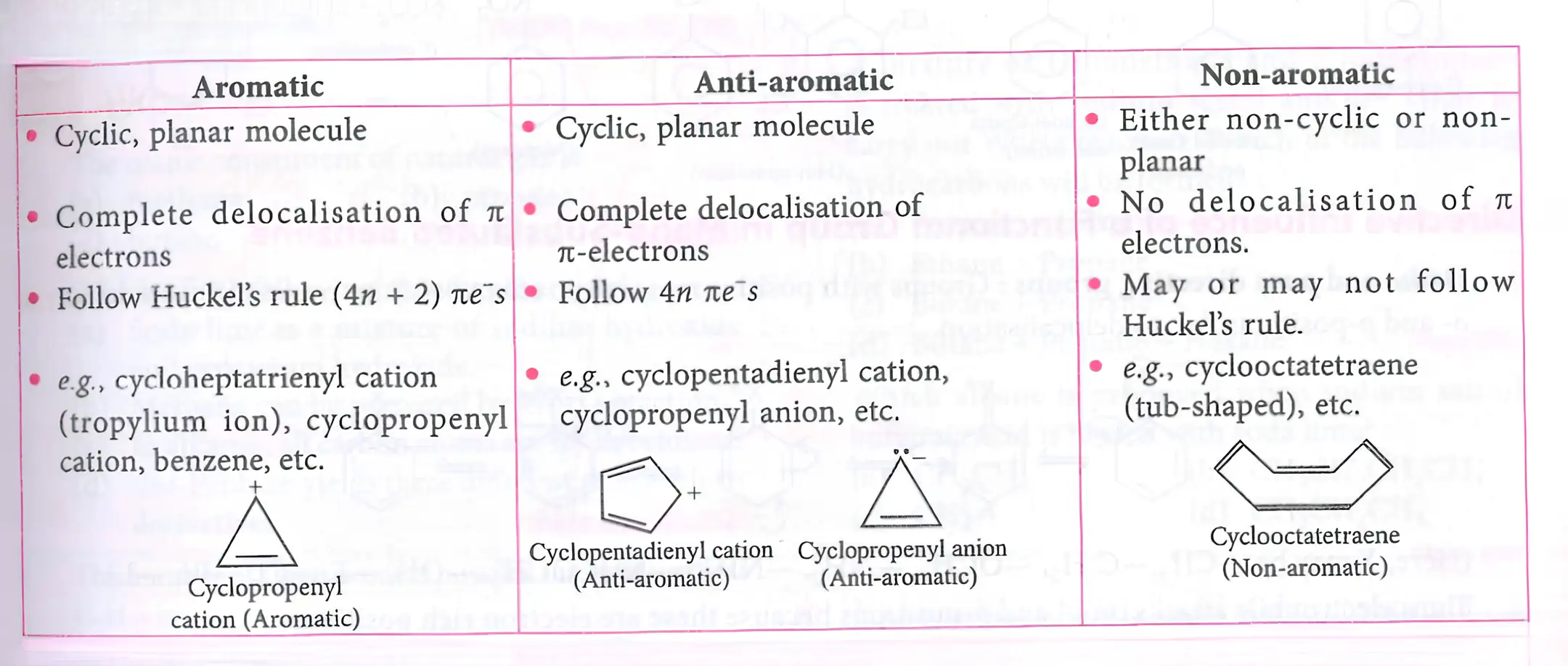
- Aromatic: Cyclic, planar, delocalised π-electrons, follow (4n+2) rule, e.g., benzene.
- Anti-aromatic: Cyclic, planar, delocalised π-electrons, follow 4n rule, e.g., cyclopentadienyl cation.
- Non-aromatic: Non-planar or non-cyclic, no delocalisation, e.g., cyclooctatetraene.
Solved Examples
- Ex 1: Determine if cyclopentadienyl anion is aromatic.
Solution: It has 6 π-electrons (4n+2, n=1), planar and cyclic, so aromatic.
Practice Set
- Q1: What is the number of π-electrons in benzene?
A. 4 B. 6 C. 8 D. 10 - Q2: Which rule defines aromaticity?
A. (4n) B. (4n+2) C. (2n+1) D. (3n+2) - Q3: Which molecule is anti-aromatic?
A. Benzene B. Cyclopentadienyl cation C. Naphthalene D. Anthracene
Answer Key
- Q1: B - Benzene has 6 π-electrons.
- Q2: B - Huckel's rule is (4n+2) π-electrons.
- Q3: B - Cyclopentadienyl cation follows 4n rule, anti-aromatic.
Memory Aids
- Aromatic: planar, cyclic, (4n+2) π-electrons.
- Anti-aromatic: planar, cyclic, 4n π-electrons.
- Non-aromatic: non-planar or non-cyclic.
Preparation of Benzene
Methods
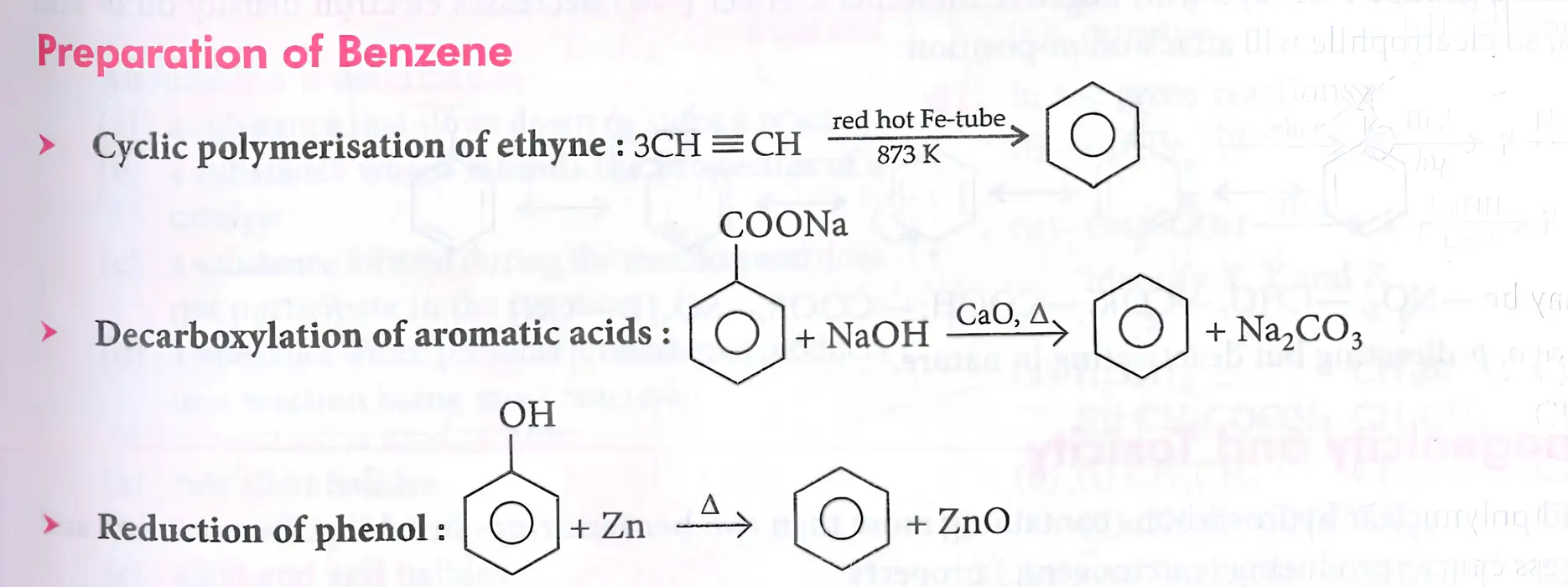
- Cyclic polymerisation of ethyne: 3 CH≡CH molecules heated at 873 K in red-hot iron tube form benzene.
- Decarboxylation of aromatic acids: Benzene carboxylate salt + NaOH + CaO heat → benzene + CO2 + Na2CO3.
- Reduction of phenol: Phenol + Zn heat → benzene + ZnO.
Solved Examples
- Ex 1: Write the reaction for benzene preparation by decarboxylation.
Solution: C6H5COONa + NaOH + CaO → C6H6 + Na2CO3 + CO2.
Practice Set
- Q1: Which reagent is used in cyclic polymerisation of ethyne?
A. Zn B. CaO C. Red-hot iron tube D. NaOH - Q2: What is the product of phenol reduction with zinc?
A. Cyclohexane B. Benzene C. Phenol D. Benzene oxide - Q3: Decarboxylation of benzoic acid salt produces?
A. Toluene B. Benzene C. Phenol D. Benzaldehyde
Answer Key
- Q1: C - Red-hot iron tube is used for ethyne polymerisation.
- Q2: B - Phenol reduces to benzene with zinc.
- Q3: B - Decarboxylation yields benzene.
Memory Aids
- Ethynes polymerise at high temperature to benzene.
- Decarboxylation removes CO2 from aromatic acid salts.
- Phenol reduction with Zn yields benzene.
Physical Properties
Key Points
- Aromatic hydrocarbons are non-polar.
- Colourless liquids or solids with characteristic aroma.
- Immiscible with water, miscible with organic solvents.
- Burn with sooty flame.
- Boiling point increases with molecular size due to van der Waals forces.
- Melting point depends on size and symmetry; p-isomer of xylenes has highest melting point.
Solved Examples
- Ex 1: Why does boiling point increase with molecular size?
Solution: Increased van der Waals forces with larger molecules.
Practice Set
- Q1: Aromatic hydrocarbons are generally:
A. Polar B. Non-polar C. Ionic D. Metallic - Q2: Which is miscible with water?
A. Benzene B. Ethanol C. Toluene D. Xylene - Q3: Which isomer of xylene has highest melting point?
A. Ortho B. Meta C. Para D. None
Answer Key
- Q1: B - Aromatic hydrocarbons are non-polar.
- Q2: B - Ethanol is miscible with water, arenes are not.
- Q3: C - Para-xylene has highest melting point due to symmetry.
Memory Aids
- Non-polar, aromatic smell, sooty flame.
- Boiling point ↑ with size; melting point depends on symmetry.
Chemical Properties
Reactivity
- Aromatic hydrocarbons are less reactive than alkenes/alkynes due to π-electron delocalisation.
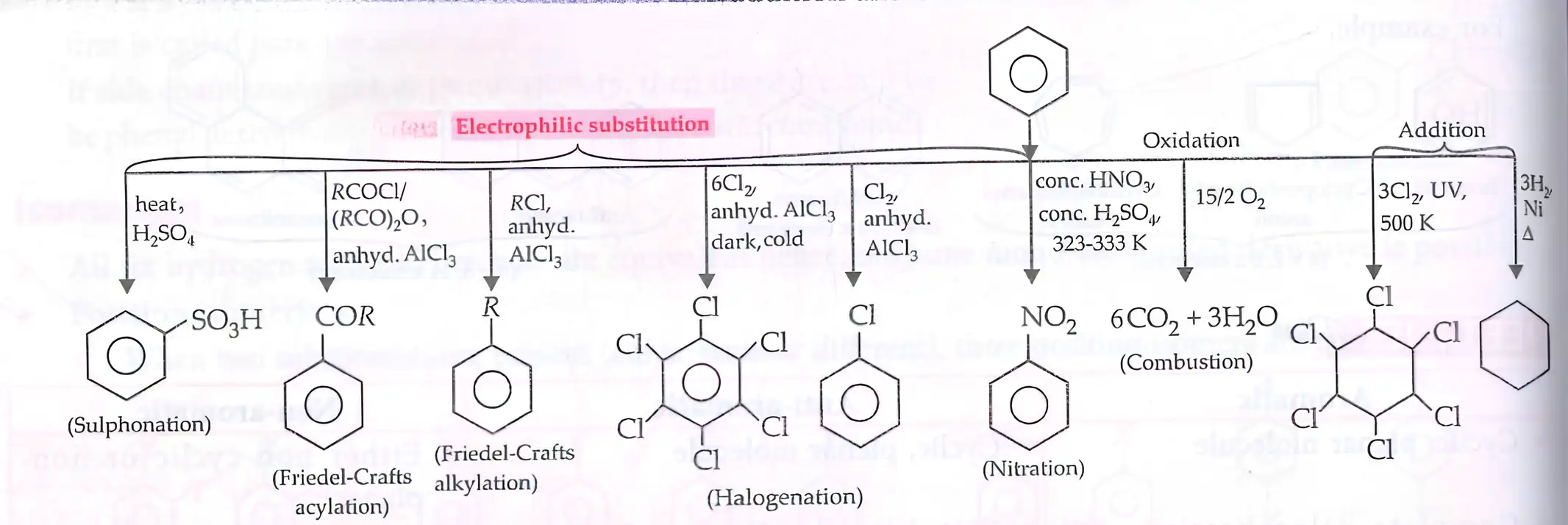
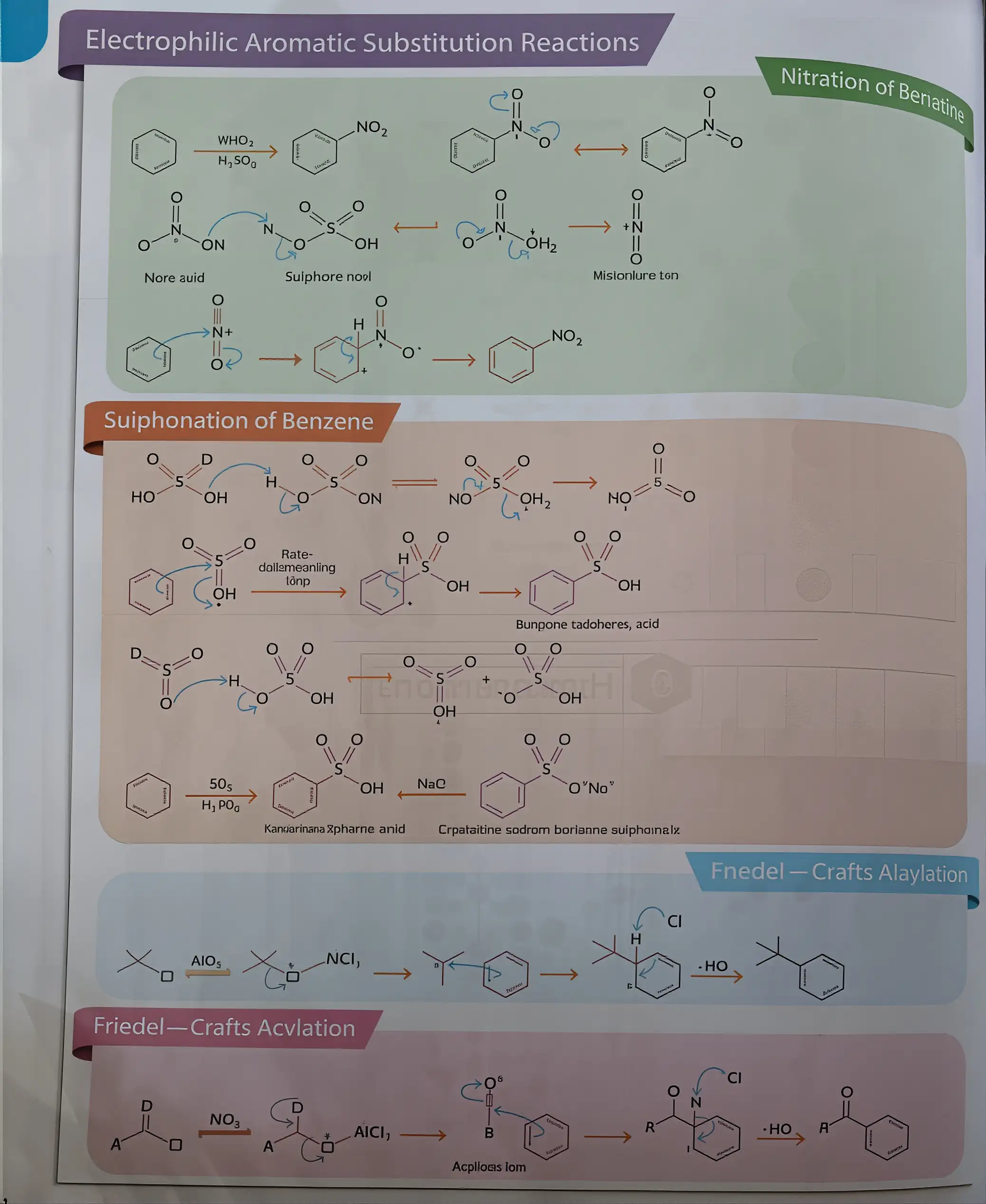
- Undergo electrophilic substitution reactions (EAS) replacing H on benzene ring.
- Can undergo addition and oxidation under special conditions.
Solved Examples
- Ex 1: Name the product of nitration of benzene.
Solution: Nitrobenzene (benzene with -NO2 group). - Ex 2: What catalyst is used in Friedel-Crafts alkylation?
Solution: AlCl3.
Practice Set
- Q1: Which reaction is typical for benzene?
A. Addition B. Electrophilic substitution C. Free radical substitution D. Polymerisation - Q2: Which reagent is used for sulphonation of benzene?
A. HNO3 B. H2SO4 C. SO3 in H2SO4 D. AlCl3 - Q3: Friedel-Crafts alkylation requires?
A. RCl + AlCl3 B. RCOCl + AlCl3 C. HNO3 + H2SO4 D. Cl2 + FeCl3
Answer Key
- Q1: B - Benzene undergoes electrophilic substitution.
- Q2: C - Sulphonation uses SO3 in H2SO4.
- Q3: A - Friedel-Crafts alkylation uses alkyl halide and AlCl3.
Memory Aids
- Benzene prefers substitution over addition due to π-electron stability.
- Common EAS: nitration, sulphonation, Friedel-Crafts alkylation/acylation.
Directive Influence of a Functional Group in Mono-Substituted Benzene
Ortho and Para Directing Groups
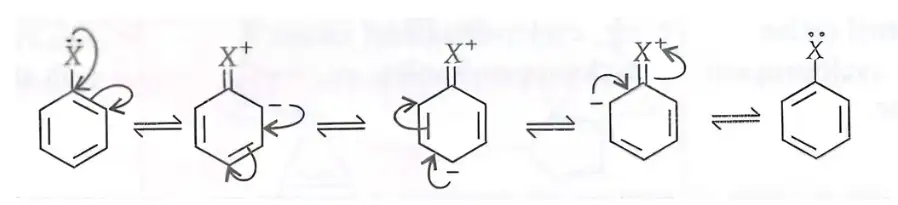
- Groups with +M effect increase electron density at ortho and para positions.
- Electrophiles attack electron-rich ortho and para positions.
- Examples: —CH3, —C2H5, —OCH3, —NH2, —NHR, —NHCOCH3, —OH, —F, —Cl, —Br, —I.
Meta Directing Groups
- Groups with -M effect decrease electron density at ortho and para positions.
- Electrophiles attack meta position.
- Examples: —NO2, —CHO, —COR, —COOH, —COOR, —SO3H, —CN.
- Halogens are ortho/para directing but deactivating.

Solved Examples
- Ex 1: Predict the major product when chlorobenzene undergoes nitration.
Solution: Nitro group attaches at meta position due to -M effect of Cl.
Practice Set
- Q1: Which group directs electrophiles to ortho and para positions?
A. —NO2 B. —OH C. —COOH D. —CN - Q2: Halogens are:
A. Ortho/para directing and activating B. Meta directing and deactivating C. Ortho/para directing and deactivating D. Meta directing and activating - Q3: Which group is meta directing?
A. —NH2 B. —CH3 C. —NO2 D. —OH
Answer Key
- Q1: B - —OH is ortho/para directing (+M effect).
- Q2: C - Halogens are ortho/para directing but deactivating.
- Q3: C - —NO2 is meta directing (-M effect).
Memory Aids
- +M groups: activate ring, direct ortho/para.
- -M groups: deactivate ring, direct meta.
- Halogens: special case, ortho/para directing but deactivating.
Carcinogenicity and Toxicity
Overview
- Benzene and polynuclear hydrocarbons with more than two fused benzene rings are toxic and carcinogenic.
- These compounds form during incomplete combustion of organic materials like tobacco, coal, and petroleum.
- They enter the human body, undergo biochemical reactions, damage DNA, and cause cancer.
Solved Examples
- Ex 1: Identify a carcinogenic compound formed from incomplete combustion of coal.
Answer: Benzo[a]pyrene (a polynuclear hydrocarbon with five fused benzene rings).
Practice Set
- Q1: Which of the following is a carcinogenic polynuclear hydrocarbon?
A. Benzene
B. Naphthalene
C. Benzo[a]pyrene
D. Toluene - Q2: Polynuclear hydrocarbons are primarily formed by:
A. Complete combustion of organic materials
B. Incomplete combustion of organic materials
C. Photosynthesis
D. Electrolysis of water - Q3: What is the primary biological effect of carcinogenic hydrocarbons?
A. DNA repair
B. DNA damage leading to cancer
C. Protein synthesis
D. Cell respiration
Answer Key
- Q1: C. Benzo[a]pyrene - It is a known carcinogenic polynuclear hydrocarbon formed during incomplete combustion.
- Q2: B. Incomplete combustion of organic materials - This process forms toxic polynuclear hydrocarbons.
- Q3: B. DNA damage leading to cancer - Carcinogens damage DNA causing mutations and cancer.
Memory Aids
- Polynuclear hydrocarbons = multiple fused benzene rings > 2 rings.
- Incomplete combustion = source of carcinogens like benzo[a]pyrene.
- Carcinogens damage DNA → cancer.
NEET Chemistry — ALL CHAPTERS
1
Some Basic Concepts of Chemistry
2
Structure of Atom
3
Classification of Elements and Periodicity in Properties
4
Chemical Bonding and Molecular Structure
5
Thermodynamics
6
Equilibrium
7
Redox Reactions
8
Organic Chemistry - Some Basic Principles and Techniques
9
Hydrocarbons
10
Solutions
11
Electrochemistry
12
Chemical Kinetics
13
The d- and f- Block Elements
14
Coordination Compounds
15
Haloalkanes and Haloarenes
16
Alcohols, Phenols and Ethers
17
Aldehydes, Ketones and Carboxylic Acids
18
Amines
19
Biomolecules
20
The p-Block Elements (Group 13 and 14)
21
The p-Block Elements (Group 15 to 18)
22
Principles Related to Practical Chemistry