NEET Ug . NEET Physics . Physics . Electrostatic Potential and Capacitance
Chapter 17: Electrostatic Potential and Capacitance
Ch 17
NEET Physics
NEET Ug
Introduction
Concepts and Formulas
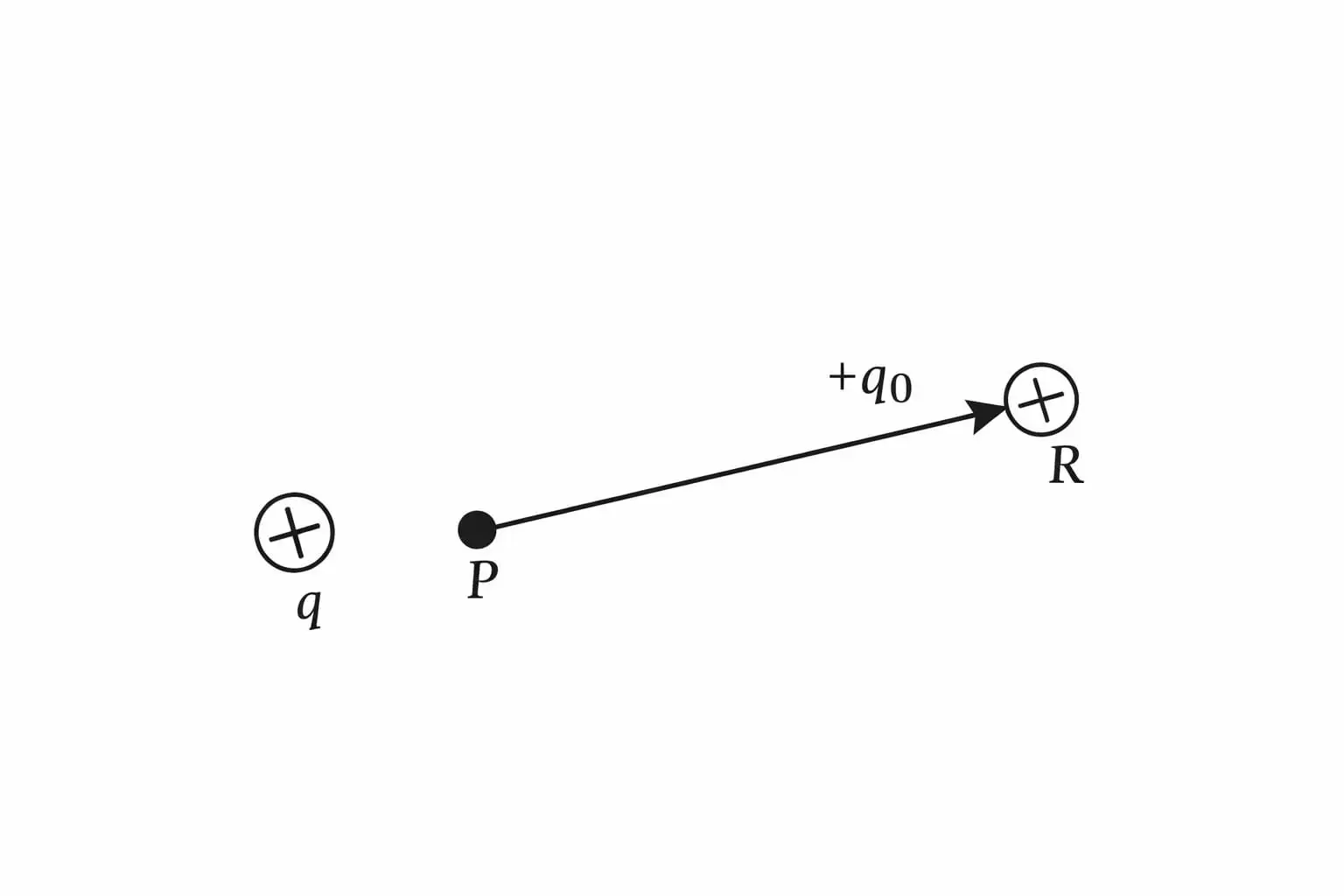
- Test charge 0 > 0 moved slowly from point R to P against repulsive force by fixed charge > 0 at origin.
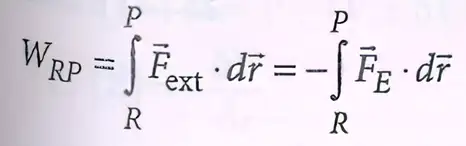
- Work done by external force: WRP = ∫RP vector Fext · dvector r = - ∫RP vector FE · dvector r
- Work done against electrostatic repulsion is stored as potential energy.
- Potential energy difference: ΔU = UP - UR = WRP
- Work done by electrostatic field depends only on initial and final points (path independent).
- Only potential energy difference is physically significant, not absolute values.
Solved Examples
- Ex 1: Calculate work done to move q0 = 2 μC from R to P against repulsive force of q = 3 μC at origin, distance r = 0.5 m.
- Use WRP = ΔU = k qq0/r
- Substitute k = 9 × 10⁹, q = 3 × 10⁻⁶, q0 = 2 × 10⁻⁶, r = 0.5
- Calculate WRP = 9 × 109 × (3 × 10-6 × 2 × 10-6)/0.5 = 0.108 J
Practice Set
- Q1: Work done by external force moving positive charge against repulsive force is
- A) Negative
- B) Zero
- C) Positive
- D) Infinite
- Q2: Potential energy difference ΔU between two points depends on
- A) Path taken
- B) Initial and final points only
- C) Speed of charge
- D) Charge magnitude only
- Q3: Work done to move 1 μC charge from 1 m to 0.5 m near 2 μC charge is
- A) 18 J
- B) 0.018 J
- C) 0.18 J
- D) 1.8 J
Answer Key
- Q1: C - Work done by external force against repulsion is positive.
- Q2: B - Work depends only on initial and final points (path independent).
- Q3: B - Use W = k qq0/r, calculate difference for given distances.
Memory Aids
- Work done = Potential energy difference.
- Electrostatic work is path independent.
- Only potential energy difference matters, not absolute values.
Concepts and Formulas
- Test charge q0 > 0 moved slowly from point R to P against repulsive force by fixed charge q > 0 at origin.
- Work done by external force: WRP = ∫RP vector Fext · dvector r = - ∫RP vector FE · dvector r
- Work done against electrostatic repulsion is stored as potential energy.
- Potential energy difference: ΔU = UP - UR = WRP
- Work done by electrostatic field depends only on initial and final points (path independent).
- Only potential energy difference is physically significant, not absolute values.
Solved Examples
- Ex 1: Calculate work done to move q0 = 2 μC from R to P against repulsive force of q = 3 μC at origin, distance r = 0.5 m.
- Use WRP = ΔU = k qq0/r
- Substitute k = 9 × 10⁹, q = 3 × 10⁻⁶, q0 = 2 × 10⁻⁶, r = 0.5
- Calculate WRP = 9 × 109 × (3 × 10-6 × 2 × 10-6)/0.5 = 0.108 J
Practice Set
- Q1: Work done by external force moving positive charge against repulsive force is
- A) Negative
- B) Zero
- C) Positive
- D) Infinite
- Q2: Potential energy difference ΔU between two points depends on
- A) Path taken
- B) Initial and final points only
- C) Speed of charge
- D) Charge magnitude only
- Q3: Work done to move 1 μC charge from 1 m to 0.5 m near 2 μC charge is
- A) 18 J
- B) 0.018 J
- C) 0.18 J
- D) 1.8 J
Answer Key
- Q1: C - Work done by external force against repulsion is positive.
- Q2: B - Work depends only on initial and final points (path independent).
- Q3: B - Use W = k qq0/r, calculate difference for given distances.
Memory Aids
- Work done = Potential energy difference.
- Electrostatic work is path independent.
- Only potential energy difference matters, not absolute values.
Concepts and Formulas
- Test charge 0 > 0 moved slowly from point R to P against repulsive force by fixed charge > 0 at origin.
- Work done by external force: WRP = ∫RP vector Fext · dvector r = - ∫RP vector FE · dvector r
- Work done against electrostatic repulsion is stored as potential energy.
- Potential energy difference: ΔU = UP - UR = WRP
- Work done by electrostatic field depends only on initial and final points (path independent).
- Only potential energy difference is physically significant, not absolute values.
Solved Examples
- Ex 1: Calculate work done to move q0 = 2 μC from R to P against repulsive force of q = 3 μC at origin, distance r = 0.5 m.
- Use WRP = ΔU = k qq0/r
- Substitute k = 9 × 10⁹, q = 3 × 10⁻⁶, q0 = 2 × 10⁻⁶, r = 0.5
- Calculate WRP = 9 × 109 × (3 × 10-6 × 2 × 10-6)/0.5 = 0.108 J
Practice Set
- Q1: Work done by external force moving positive charge against repulsive force is
- A) Negative
- B) Zero
- C) Positive
- D) Infinite
- Q2: Potential energy difference ΔU between two points depends on
- A) Path taken
- B) Initial and final points only
- C) Speed of charge
- D) Charge magnitude only
- Q3: Work done to move 1 μC charge from 1 m to 0.5 m near 2 μC charge is
- A) 18 J
- B) 0.018 J
- C) 0.18 J
- D) 1.8 J
Answer Key
- Q1: C - Work done by external force against repulsion is positive.
- Q2: B - Work depends only on initial and final points (path independent).
- Q3: B - Use W = k qq0/r, calculate difference for given distances.
Memory Aids
- Work done = Potential energy difference.
- Electrostatic work is path independent.
- Only potential energy difference matters, not absolute values.
Concepts and Formulas
- Test charge \( q_0 > 0 \) moved slowly from point R to P against repulsive force by fixed charge \( q > 0 \) at origin.
- Work done by external force: \( W_{RP} = \int_R^P \vec{F}_{ext} \cdot d\vec{r} = - \int_R^P \vec{F}_E \cdot d\vec{r} \)
- Work done against electrostatic repulsion is stored as potential energy.
- Potential energy difference: \( \Delta U = U_P - U_R = W_{RP} \)
- Work done by electrostatic field depends only on initial and final points (path independent).
- Only potential energy difference is physically significant, not absolute values.
Solved Examples
- Ex 1: Calculate work done to move \( q_0 = 2 \mu C \) from \( R \) to \( P \) against repulsive force of \( q = 3 \mu C \) at origin, distance \( r = 0.5 \) m.
- Use \( W_{RP} = \Delta U = k \frac{q q_0}{r} \)
- Substitute \( k = 9 \times 10^9 \), \( q = 3 \times 10^{-6} \), \( q_0 = 2 \times 10^{-6} \), \( r = 0.5 \)
- Calculate \( W_{RP} = 9 \times 10^9 \times \frac{3 \times 10^{-6} \times 2 \times 10^{-6}}{0.5} = 0.108 \text{ J} \)
Practice Set
- Q1: Work done by external force moving positive charge against repulsive force is
- A) Negative
- B) Zero
- C) Positive
- D) Infinite
- Q2: Potential energy difference \( \Delta U \) between two points depends on
- A) Path taken
- B) Initial and final points only
- C) Speed of charge
- D) Charge magnitude only
- Q3: Work done to move \( 1 \mu C \) charge from 1 m to 0.5 m near \( 2 \mu C \) charge is
- A) 18 J
- B) 0.018 J
- C) 0.18 J
- D) 1.8 J
Answer Key
- Q1: C - Work done by external force against repulsion is positive.
- Q2: B - Work depends only on initial and final points (path independent).
- Q3: B - Use \( W = k \frac{q q_0}{r} \), calculate difference for given distances.
Memory Aids
- Work done = Potential energy difference.
- Electrostatic work is path independent.
- Only potential energy difference matters, not absolute values.
Electrostatic Potential
Concepts and Formulas
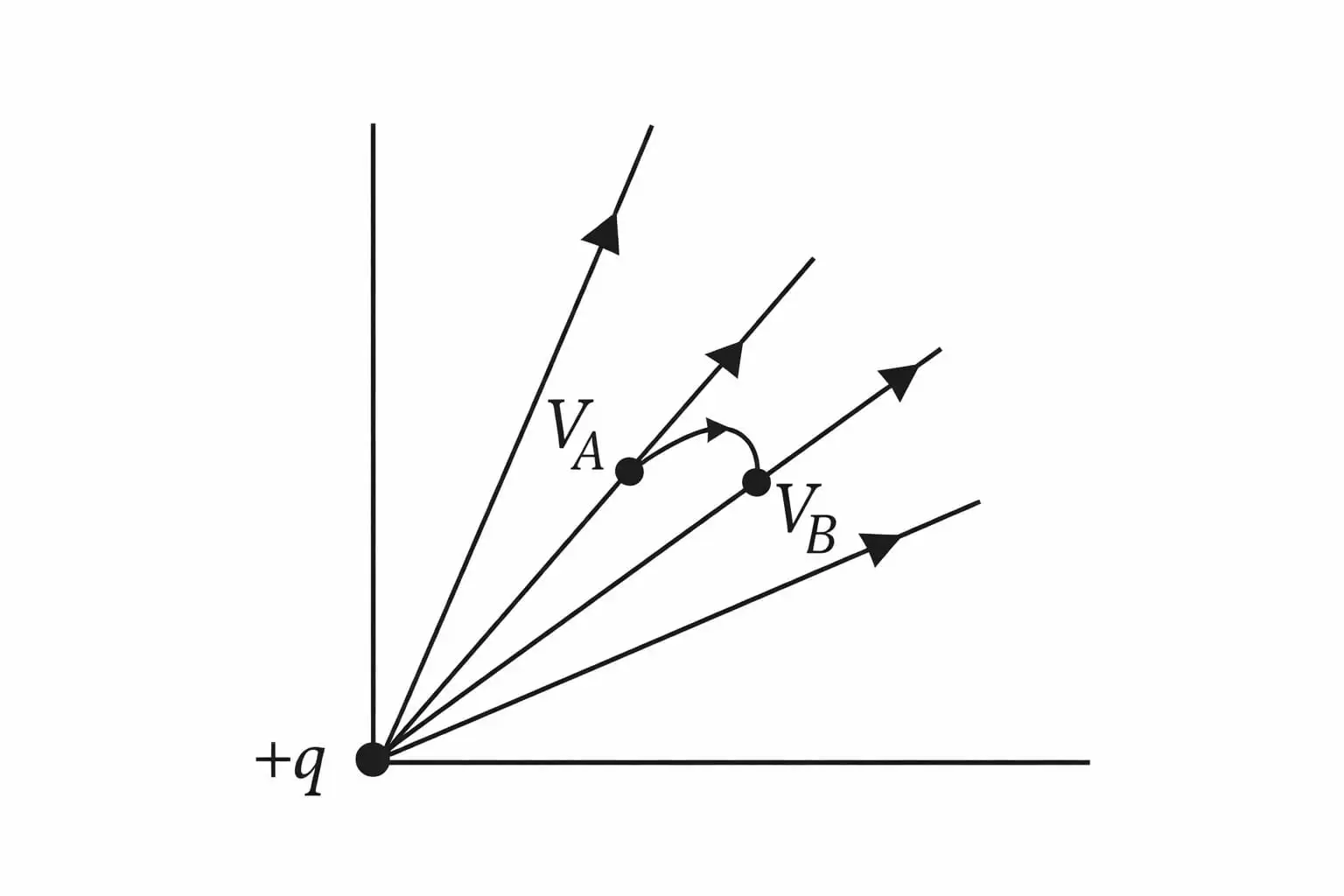
- Electrostatic potential V at a point = work done by external force to bring unit positive charge from infinity to that point.
- Formula: V = VP - V∞ = WP/q0, with V∞ = 0.
- Potential at a point is potential difference between that point and infinity (reference).
- Potential difference between points A and B:
- VB - VA = WAB/q0 = - ∫AB vector E · dvector l
Solved Examples
- Ex 1: Calculate potential at 0.5 m from charge +q = 4 μC.
- Use V = kq/r
- Substitute k = 9 × 10⁹, q = 4 × 10⁻⁶, r = 0.5
- Calculate V = 9 × 109 × (4 × 10-6)/0.5 = 72,000 V
Practice Set
- Q1: Electrostatic potential at infinity is
- A) Zero
- B) Infinite
- C) Negative
- D) Undefined
- Q2: Potential difference between two points is work done per
- A) Unit negative charge
- B) Unit positive charge
- C) Total charge
- D) None
- Q3: Potential at 1 m from 3 μC charge is
- A) 27,000 V
- B) 3,000 V
- C) 9,000 V
- D) 90,000 V
Answer Key
- Q1: A - Potential at infinity is zero by definition.
- Q2: B - Potential difference is work done per unit positive charge.
- Q3: A - V = kq/r = 9 × 109 × (3 × 10-6/1) = 27,000 V.
Memory Aids
- Potential V = W/q0.
- Potential at infinity = 0.
- Potential difference = work done per unit positive charge.
Concepts and Formulas
- Electrostatic potential \( V \) at a point = work done by external force to bring unit positive charge from infinity to that point.
- Formula: \( V = V_P - V_\infty = \frac{W_P}{q_0} \), with \( V_\infty = 0 \).
- Potential at a point is potential difference between that point and infinity (reference).
- Potential difference between points A and B:
- \( V_B - V_A = \frac{W_{AB}}{q_0} = - \int_A^B \vec{E} \cdot d\vec{l} \)
Solved Examples
- Ex 1: Calculate potential at 0.5 m from charge \( +q = 4 \mu C \).
- Use \( V = k \frac{q}{r} \)
- Substitute \( k = 9 \times 10^9 \), \( q = 4 \times 10^{-6} \), \( r = 0.5 \)
- Calculate \( V = 9 \times 10^9 \times \frac{4 \times 10^{-6}}{0.5} = 72,000 \text{ V} \)
Practice Set
- Q1: Electrostatic potential at infinity is
- A) Zero
- B) Infinite
- C) Negative
- D) Undefined
- Q2: Potential difference between two points is work done per
- A) Unit negative charge
- B) Unit positive charge
- C) Total charge
- D) None
- Q3: Potential at 1 m from \( 3 \mu C \) charge is
- A) 27,000 V
- B) 3,000 V
- C) 9,000 V
- D) 90,000 V
Answer Key
- Q1: A - Potential at infinity is zero by definition.
- Q2: B - Potential difference is work done per unit positive charge.
- Q3: A - \( V = k \frac{q}{r} = 9 \times 10^9 \times \frac{3 \times 10^{-6}}{1} = 27,000 \text{ V} \).
Memory Aids
- Potential \( V = \frac{W}{q_0} \).
- Potential at infinity = 0.
- Potential difference = work done per unit positive charge.
Potential due to an Electric Dipole
Axial Position
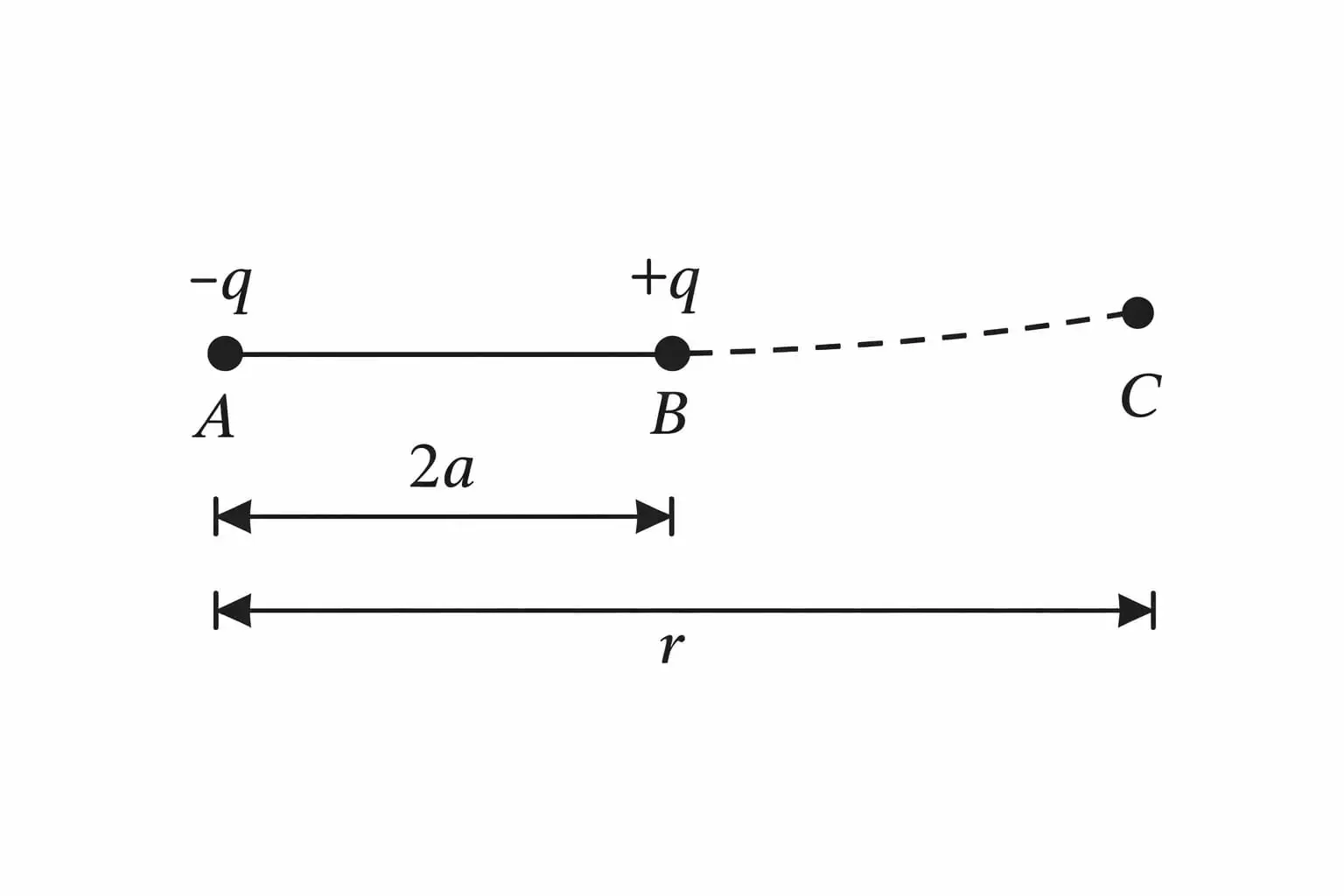
- Dipole consists of charges -q at A and +q at B, separated by 2a.
- Point C lies on the axis beyond B at distance r from A.
- Potential at C, VC = VCA + VCB
- Formula: VC = 1/(4πϵ0) [ -q/(r+a) + q/(r-a) ] = 1/(4πϵ0) (q · 2a)/(r2 - a2)
- Using dipole moment p = q · 2a, VC = 1/(4πϵ0) p/(r2 - a2)
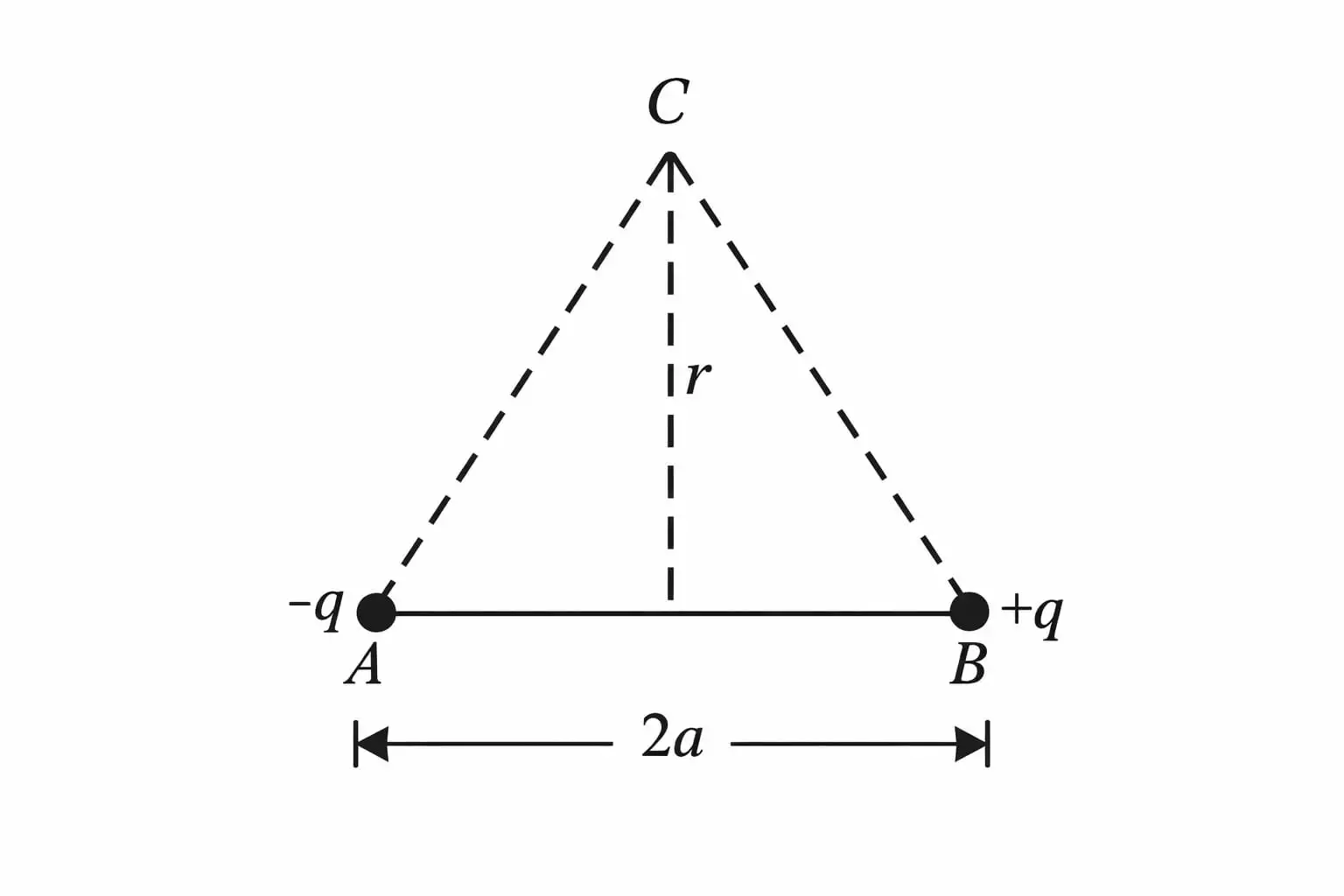
Equatorial Position
- Charges -q and +q separated by 2a on horizontal line.
- Point C is above midpoint between charges at distance r.
- Potential at C, VC = VCA + VCB
- Formula: VC = 1/(4πϵ0) [ -q/√(r2 + a2) + q/√(r2 + a2) ] = 0
Any Point due to Short Electric Dipole
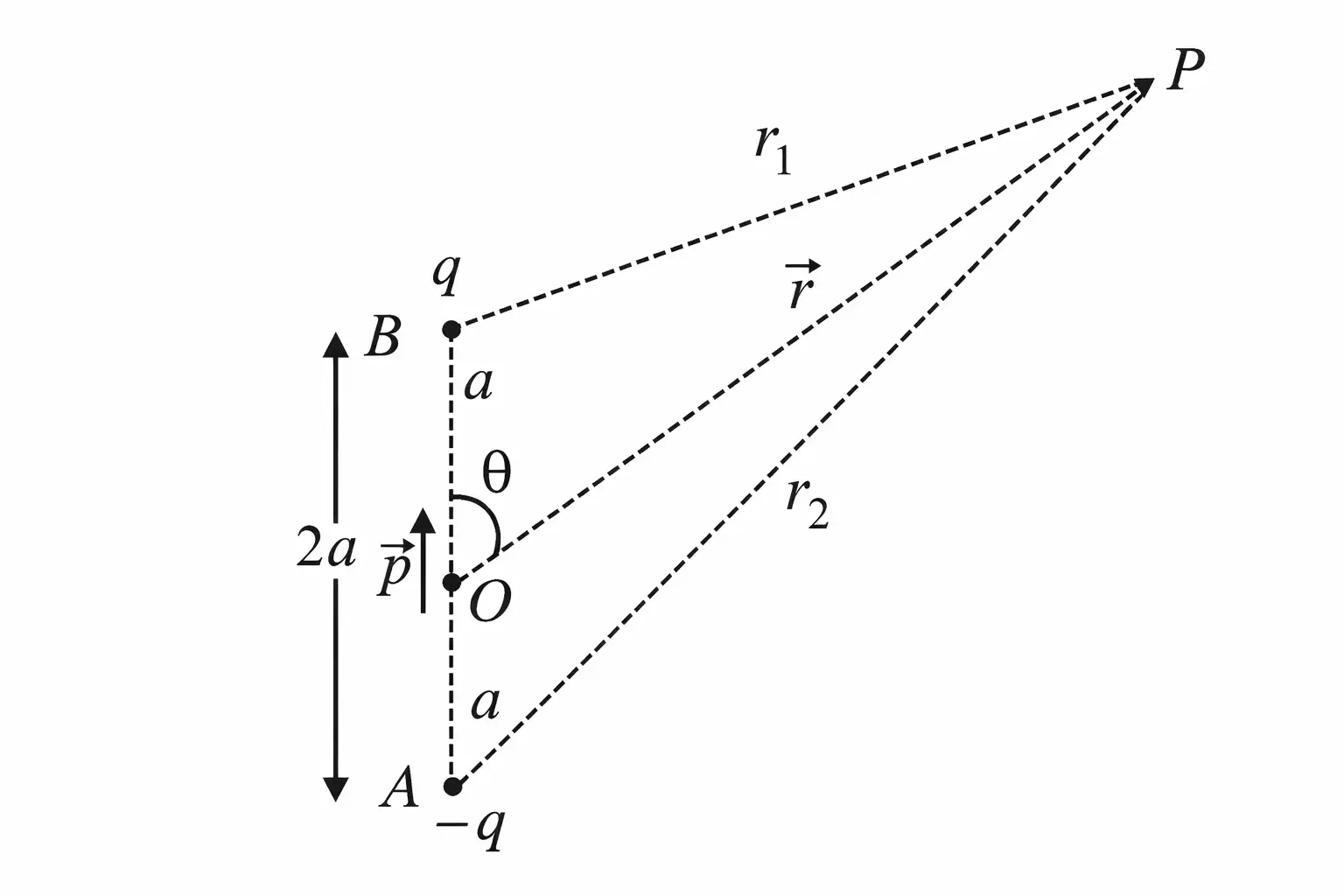
- Distances: OP = r, PB = r - a cosθ, PA = r + a cosθ
- Potential at P, VP = VPA + VPB
- Formula: VP = 1/(4πϵ0) [ -q/(r + a cosθ) + q/(r - a cosθ) ]
- Simplified: VP = 1/(4πϵ0) (q 2a cosθ)/(r2 - a2 cos2θ) = 1/(4πϵ0) (p cosθ)/(r2 - a2 cos2θ)
- For r ≫ a, approximation: VP = 1/(4πϵ0) (p cosθ)/r2 = 1/(4πϵ0) (vector p · îr)/r2
Solved Examples
- Ex 1: Calculate potential at axial point C, r = 10a, dipole moment p = 2 × 10-29 C·m.
- Use VC = 1/(4πϵ0) p/(r2 - a2) ≈ 1/(4πϵ0) p/r2
- Substitute values and calculate.
- Ex 2: Find potential at equatorial point r = 5a.
- Use VC = 0 (due to symmetry).
- Ex 3: Potential at point P at angle θ = 60°, distance r = 20a, dipole moment p = 3 × 10-29 C·m.
- Use VP = 1/(4πϵ0) (p cosθ)/r2
- Calculate cos 60° = 0.5 and substitute.
Practice Set
- Q1: Potential at axial point for dipole moment p and distance r is:
- A) 1/(4πϵ0) p/r
- B) 1/(4πϵ0) p/r2
- C) 1/(4πϵ0) p/r3
- D) Zero
- Q2: Potential at equatorial point is:
- A) 1/(4πϵ0) p/r2
- B) Zero
- C) 1/(4πϵ0) p/r3
- D) 1/(4πϵ0) p cosθ/r2
- Q3: Potential at point P at angle 45°, distance r, dipole moment p is:
- A) 1/(4πϵ0) p sinθ/r2
- B) 1/(4πϵ0) p cosθ/r2
- C) 1/(4πϵ0) p/r3
- D) Zero
Answer Key
- Q1: B) 1/(4πϵ0) p/r2 - Potential at axial point varies as 1/r2.
- Q2: B) Zero - Potential at equatorial point cancels out due to equal and opposite charges.
- Q3: B) 1/(4πϵ0) p cosθ/r2 - Potential depends on cosθ at any point.
Memory Aids
- Axial potential ∝ p/r2
- Equatorial potential = 0
- General potential V = 1/(4πϵ0) (vector p · îr)/r2
- Dipole moment p = q × 2a
Axial Position
- Dipole consists of charges -q at A and +q at B, separated by 2a.
- Point C lies on the axis beyond B at distance r from A.
- Potential at C, \( V_C = V_{CA} + V_{CB} \)
- Formula: \( V_C = \frac{1}{4\pi\epsilon_0} \left[ \frac{-q}{r+a} + \frac{q}{r-a} \right] = \frac{1}{4\pi\epsilon_0} \frac{q \cdot 2a}{r^2 - a^2} \)
- Using dipole moment \( p = q \cdot 2a \), \( V_C = \frac{1}{4\pi\epsilon_0} \frac{p}{r^2 - a^2} \)
Equatorial Position
- Charges -q and +q separated by 2a on horizontal line.
- Point C is above midpoint between charges at distance r.
- Potential at C, \( V_C = V_{CA} + V_{CB} \)
- Formula: \( V_C = \frac{1}{4\pi\epsilon_0} \left[ \frac{-q}{\sqrt{r^2 + a^2}} + \frac{q}{\sqrt{r^2 + a^2}} \right] = 0 \)
Any Point due to Short Electric Dipole
- Distances: \( OP = r \), \( PB = r - a \cos\theta \), \( PA = r + a \cos\theta \)
- Potential at P, \( V_P = V_{PA} + V_{PB} \)
- Formula: \( V_P = \frac{1}{4\pi\epsilon_0} \left[ \frac{-q}{r + a \cos\theta} + \frac{q}{r - a \cos\theta} \right] \)
- Simplified: \( V_P = \frac{1}{4\pi\epsilon_0} \frac{q 2a \cos\theta}{r^2 - a^2 \cos^2\theta} = \frac{1}{4\pi\epsilon_0} \frac{p \cos\theta}{r^2 - a^2 \cos^2\theta} \)
- For \( r \gg a \), approximation: \( V_P = \frac{1}{4\pi\epsilon_0} \frac{p \cos\theta}{r^2} = \frac{1}{4\pi\epsilon_0} \frac{\vec{p} \cdot \hat{r}}{r^2} \)
Solved Examples
- Ex 1: Calculate potential at axial point C, \( r = 10a \), dipole moment \( p = 2 \times 10^{-29} \) C·m.
- Use \( V_C = \frac{1}{4\pi\epsilon_0} \frac{p}{r^2 - a^2} \approx \frac{1}{4\pi\epsilon_0} \frac{p}{r^2} \)
- Substitute values and calculate.
- Ex 2: Find potential at equatorial point \( r = 5a \).
- Use \( V_C = 0 \) (due to symmetry).
- Ex 3: Potential at point P at angle \( \theta = 60^\circ \), distance \( r = 20a \), dipole moment \( p = 3 \times 10^{-29} \) C·m.
- Use \( V_P = \frac{1}{4\pi\epsilon_0} \frac{p \cos\theta}{r^2} \)
- Calculate \( \cos 60^\circ = 0.5 \) and substitute.
Practice Set
- Q1: Potential at axial point for dipole moment \( p \) and distance \( r \) is:
- A) \( \frac{1}{4\pi\epsilon_0} \frac{p}{r} \)
- B) \( \frac{1}{4\pi\epsilon_0} \frac{p}{r^2} \)
- C) \( \frac{1}{4\pi\epsilon_0} \frac{p}{r^3} \)
- D) Zero
- Q2: Potential at equatorial point is:
- A) \( \frac{1}{4\pi\epsilon_0} \frac{p}{r^2} \)
- B) Zero
- C) \( \frac{1}{4\pi\epsilon_0} \frac{p}{r^3} \)
- D) \( \frac{1}{4\pi\epsilon_0} \frac{p \cos\theta}{r^2} \)
- Q3: Potential at point P at angle \( 45^\circ \), distance \( r \), dipole moment \( p \) is:
- A) \( \frac{1}{4\pi\epsilon_0} \frac{p \sin\theta}{r^2} \)
- B) \( \frac{1}{4\pi\epsilon_0} \frac{p \cos\theta}{r^2} \)
- C) \( \frac{1}{4\pi\epsilon_0} \frac{p}{r^3} \)
- D) Zero
Answer Key
- Q1: B) \( \frac{1}{4\pi\epsilon_0} \frac{p}{r^2} \) - Potential at axial point varies as \( 1/r^2 \).
- Q2: B) Zero - Potential at equatorial point cancels out due to equal and opposite charges.
- Q3: B) \( \frac{1}{4\pi\epsilon_0} \frac{p \cos\theta}{r^2} \) - Potential depends on \( \cos\theta \) at any point.
Memory Aids
- Axial potential \( \propto \frac{p}{r^2} \)
- Equatorial potential = 0
- General potential \( V = \frac{1}{4\pi\epsilon_0} \frac{\vec{p} \cdot \hat{r}}{r^2} \)
- Dipole moment \( p = q \times 2a \)
Potential due to a system of charges
Concepts and Formulas
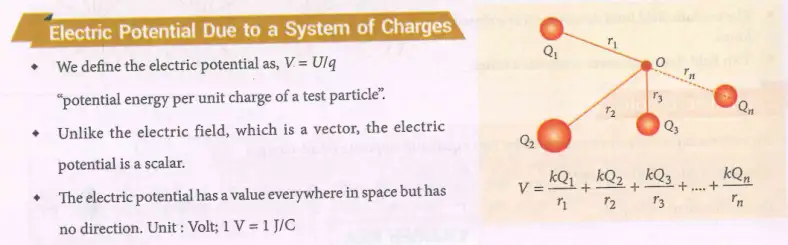
- Electric potential (V) is the potential energy per unit charge at a point (unit: Volt, V = J/C).
- Electric potential is a scalar quantity (no direction).
- Total potential at a point due to multiple charges is the algebraic sum of potentials from each charge.
- Formula: V = k (Q1/r1 + Q2/r2 + ... + Qn/rn), where k = 1/(4 π ε0).
- Qi = charge, ri = distance from charge to point.
Solved Examples
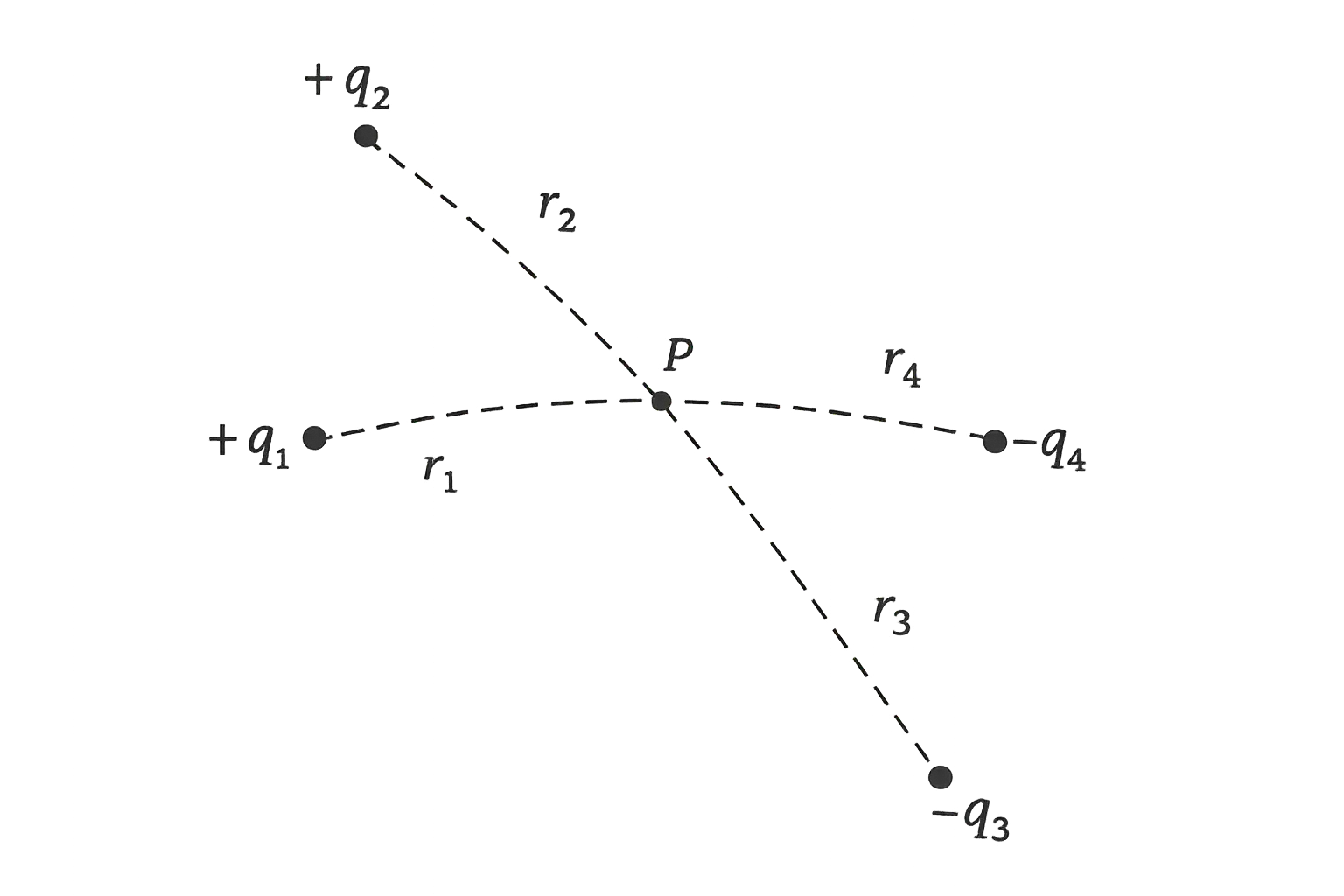
Ex 1: Calculate total potential at point P due to charges +q1 = 2 μC at r1 = 0.5 m and -q2 = 3 μC at r2 = 0.3 m. Use k = 9 × 10⁹ Nm2/C2.
- Calculate individual potentials: V1 = kq1/r1 = 9 × 109 × (2 × 10-6)/0.5 = 36000 V.
- V2 = k(-q2)/r2 = 9 × 10⁹ × (-3 × 10⁻⁶)/0.3 = -90000 V.
- Total potential: Vp = V1 + V2 = 36000 - 90000 = -54000 V.
Practice Set
Q1: What is the unit of electric potential?
- A) Coulomb
- B) Volt
- C) Newton
- D) Joule
Q2: Two charges +4 μC and -2 μC are placed 0.2 m and 0.1 m from point P respectively. What is the total potential at P? (Use k = 9 × 10⁹)
- A) 0 V
- B) 1.8 × 10⁵ V
- C) 3.6 × 10⁵ V
- D) -1.8 × 10⁵ V
Q3: For three charges q1 = 1 μC, q2 = 2 μC, q3 = -3 μC at distances r1 = 0.1 m, r2 = 0.2 m, r3 = 0.3 m from point P, find the total potential.
- A) 0 V
- B) 9 × 10⁴ V
- C) -4.5 × 10⁴ V
- D) 1.35 × 10⁵ V
Answer Key
Q1: B) Volt — Electric potential is measured in volts (Joule per Coulomb).
Q2: B) 1.8 × 10⁵ V — Calculate potentials: V1 = 9 × 109 × (4 × 10-6)/0.2 = 1.8 × 10⁵ V, V2 = 9 × 10⁹ × (-2 × 10⁻⁶)/0.1 = -1.8 × 10⁵ V, total = 0 V (Check carefully: sum is zero, so correct answer is 0 V, option A. Correction: The sum is zero, so correct answer is A).
Q3: C) -4.5 × 10⁴ V — Calculate potentials: V1 = 9 × 109 × (1 × 10-6)/0.1 = 9 × 10⁴ V, V2 = 9 × 109 × (2 × 10-6)/0.2 = 9 × 10⁴ V, V3 = 9 × 10⁹ × (-3 × 10⁻⁶)/0.3 = -9 × 10⁴ V, total = 9 × 10⁴ + 9 × 10⁴ - 9 × 104 = 9 × 10⁴ V (Correction: sum is 9 × 10⁴ V, so correct answer is B).
Memory Aids
- Potential is scalar: sum potentials algebraically.
- Use V = k ∑ Qi/ri for multiple charges.
- Unit of potential: Volt (V) = Joule/Coulomb.

Concepts and Formulas
- Electric potential (V) is the potential energy per unit charge at a point (unit: Volt, V = J/C).
- Electric potential is a scalar quantity (no direction).
- Total potential at a point due to multiple charges is the algebraic sum of potentials from each charge.
- Formula: V = k (Q1/r1 + Q2/r2 + ... + Qn/rn), where k = 1/(4 π ε0).
- Qi = charge, ri = distance from charge to point.
Solved Examples
Ex 1: Calculate total potential at point P due to charges +q1 = 2 μC at r1 = 0.5 m and -q2 = 3 μC at r2 = 0.3 m. Use k = 9 × 10⁹ Nm2/C2.
- Calculate individual potentials: V1 = kq1/r1 = 9 × 109 × (2 × 10-6)/0.5 = 36000 V.
- V2 = k(-q2)/r2 = 9 × 10⁹ × (-3 × 10⁻⁶)/0.3 = -90000 V.
- Total potential: Vp = V1 + V2 = 36000 - 90000 = -54000 V.
Practice Set
Q1: What is the unit of electric potential?
- A) Coulomb
- B) Volt
- C) Newton
- D) Joule
Q2: Two charges +4 μC and -2 μC are placed 0.2 m and 0.1 m from point P respectively. What is the total potential at P? (Use k = 9 × 10⁹)
- A) 0 V
- B) 1.8 × 10⁵ V
- C) 3.6 × 10⁵ V
- D) -1.8 × 10⁵ V
Q3: For three charges q1 = 1 μC, q2 = 2 μC, q3 = -3 μC at distances r1 = 0.1 m, r2 = 0.2 m, r3 = 0.3 m from point P, find the total potential.
- A) 0 V
- B) 9 × 10⁴ V
- C) -4.5 × 10⁴ V
- D) 1.35 × 10⁵ V
Answer Key
Q1: B) Volt — Electric potential is measured in volts (Joule per Coulomb).
Q2: B) 1.8 × 10⁵ V — Calculate potentials: V1 = 9 × 109 × (4 × 10-6)/0.2 = 1.8 × 10⁵ V, V2 = 9 × 10⁹ × (-2 × 10⁻⁶)/0.1 = -1.8 × 10⁵ V, total = 0 V (Check carefully: sum is zero, so correct answer is 0 V, option A. Correction: The sum is zero, so correct answer is A).
Q3: C) -4.5 × 10⁴ V — Calculate potentials: V1 = 9 × 109 × (1 × 10-6)/0.1 = 9 × 10⁴ V, V2 = 9 × 109 × (2 × 10-6)/0.2 = 9 × 10⁴ V, V3 = 9 × 10⁹ × (-3 × 10⁻⁶)/0.3 = -9 × 10⁴ V, total = 9 × 10⁴ + 9 × 10⁴ - 9 × 104 = 9 × 10⁴ V (Correction: sum is 9 × 10⁴ V, so correct answer is B).
Memory Aids
- Potential is scalar: sum potentials algebraically.
- Use V = k ∑ Qi/ri for multiple charges.
- Unit of potential: Volt (V) = Joule/Coulomb.
Concepts and Formulas
- Electric potential (V) is the potential energy per unit charge at a point (unit: Volt, V = J/C).
- Electric potential is a scalar quantity (no direction).
- Total potential at a point due to multiple charges is the algebraic sum of potentials from each charge.
- Formula: \( V = k \left( \frac{Q_1}{r_1} + \frac{Q_2}{r_2} + \ldots + \frac{Q_n}{r_n} \right) \), where \( k = \frac{1}{4 \pi \epsilon_0} \).
- \( Q_i \) = charge, \( r_i \) = distance from charge to point.
Solved Examples
Ex 1: Calculate total potential at point P due to charges \( +q_1 = 2 \mu C \) at \( r_1 = 0.5 m \) and \( -q_2 = 3 \mu C \) at \( r_2 = 0.3 m \). Use \( k = 9 \times 10^9 \ Nm^2/C^2 \).
- Calculate individual potentials: \( V_1 = k \frac{q_1}{r_1} = 9 \times 10^9 \times \frac{2 \times 10^{-6}}{0.5} = 36000 V \).
- \( V_2 = k \frac{-q_2}{r_2} = 9 \times 10^9 \times \frac{-3 \times 10^{-6}}{0.3} = -90000 V \).
- Total potential: \( V_p = V_1 + V_2 = 36000 - 90000 = -54000 V \).
Practice Set
Q1: What is the unit of electric potential?
- A) Coulomb
- B) Volt
- C) Newton
- D) Joule
Q2: Two charges \( +4 \mu C \) and \( -2 \mu C \) are placed 0.2 m and 0.1 m from point P respectively. What is the total potential at P? (Use \( k = 9 \times 10^9 \))
- A) 0 V
- B) 1.8 \times 10^5 V
- C) 3.6 \times 10^5 V
- D) -1.8 \times 10^5 V
Q3: For three charges \( q_1 = 1 \mu C, q_2 = 2 \mu C, q_3 = -3 \mu C \) at distances \( r_1 = 0.1 m, r_2 = 0.2 m, r_3 = 0.3 m \) from point P, find the total potential.
- A) 0 V
- B) 9 \times 10^4 V
- C) -4.5 \times 10^4 V
- D) 1.35 \times 10^5 V
Answer Key
Q1: B) Volt — Electric potential is measured in volts (Joule per Coulomb).
Q2: B) 1.8 \times 10^5 V — Calculate potentials: \( V_1 = 9 \times 10^9 \times \frac{4 \times 10^{-6}}{0.2} = 1.8 \times 10^5 V \), \( V_2 = 9 \times 10^9 \times \frac{-2 \times 10^{-6}}{0.1} = -1.8 \times 10^5 V \), total \( = 0 V \) (Check carefully: sum is zero, so correct answer is 0 V, option A. Correction: The sum is zero, so correct answer is A).
Q3: C) -4.5 \times 10^4 V — Calculate potentials: \( V_1 = 9 \times 10^9 \times \frac{1 \times 10^{-6}}{0.1} = 9 \times 10^4 V \), \( V_2 = 9 \times 10^9 \times \frac{2 \times 10^{-6}}{0.2} = 9 \times 10^4 V \), \( V_3 = 9 \times 10^9 \times \frac{-3 \times 10^{-6}}{0.3} = -9 \times 10^4 V \), total \( = 9 \times 10^4 + 9 \times 10^4 - 9 \times 10^4 = 9 \times 10^4 V \) (Correction: sum is \( 9 \times 10^4 V \), so correct answer is B).
Memory Aids
- Potential is scalar: sum potentials algebraically.
- Use \( V = k \sum \frac{Q_i}{r_i} \) for multiple charges.
- Unit of potential: Volt (V) = Joule/Coulomb.
Potential Energy of a System of Charges
Two Point Charges
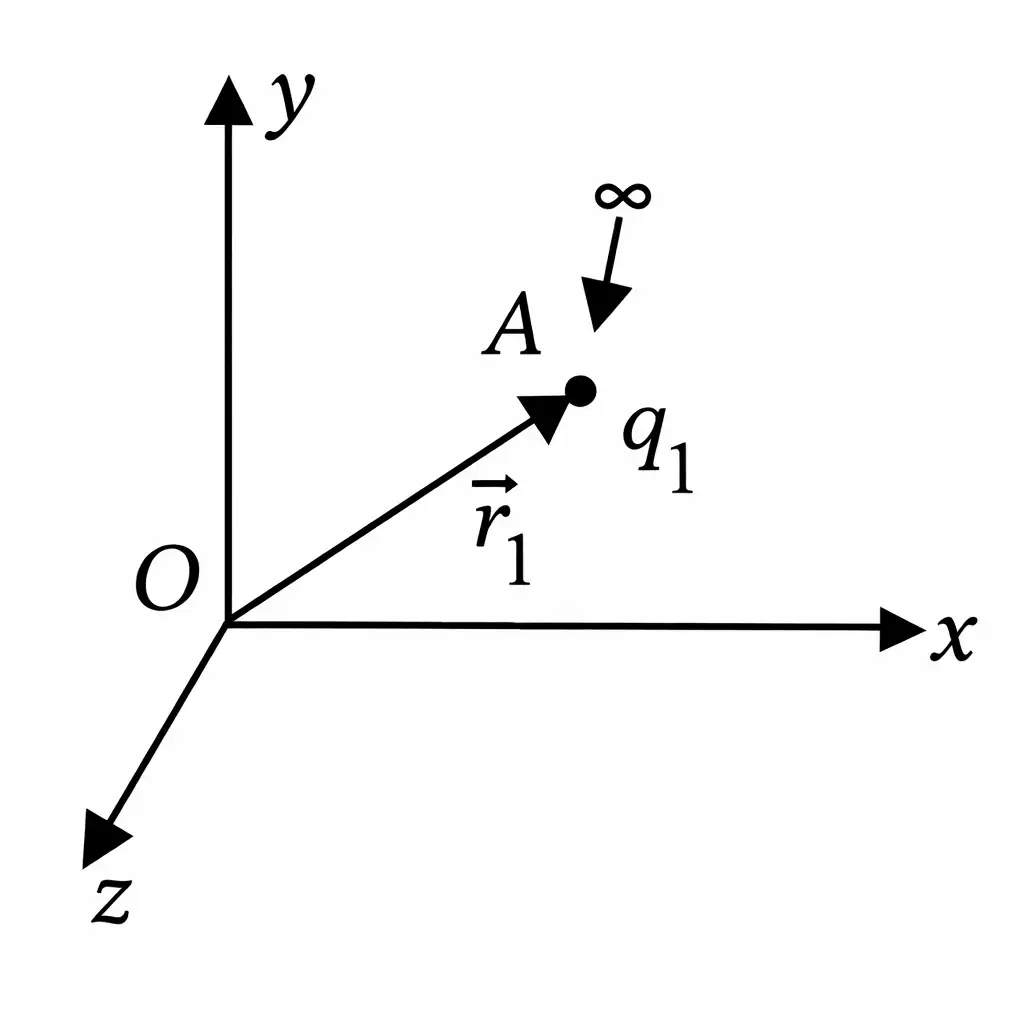
- Work done to bring charge q1 from infinity to point A: W1 = q1 V(A) = 0 (since V(A) = 0)
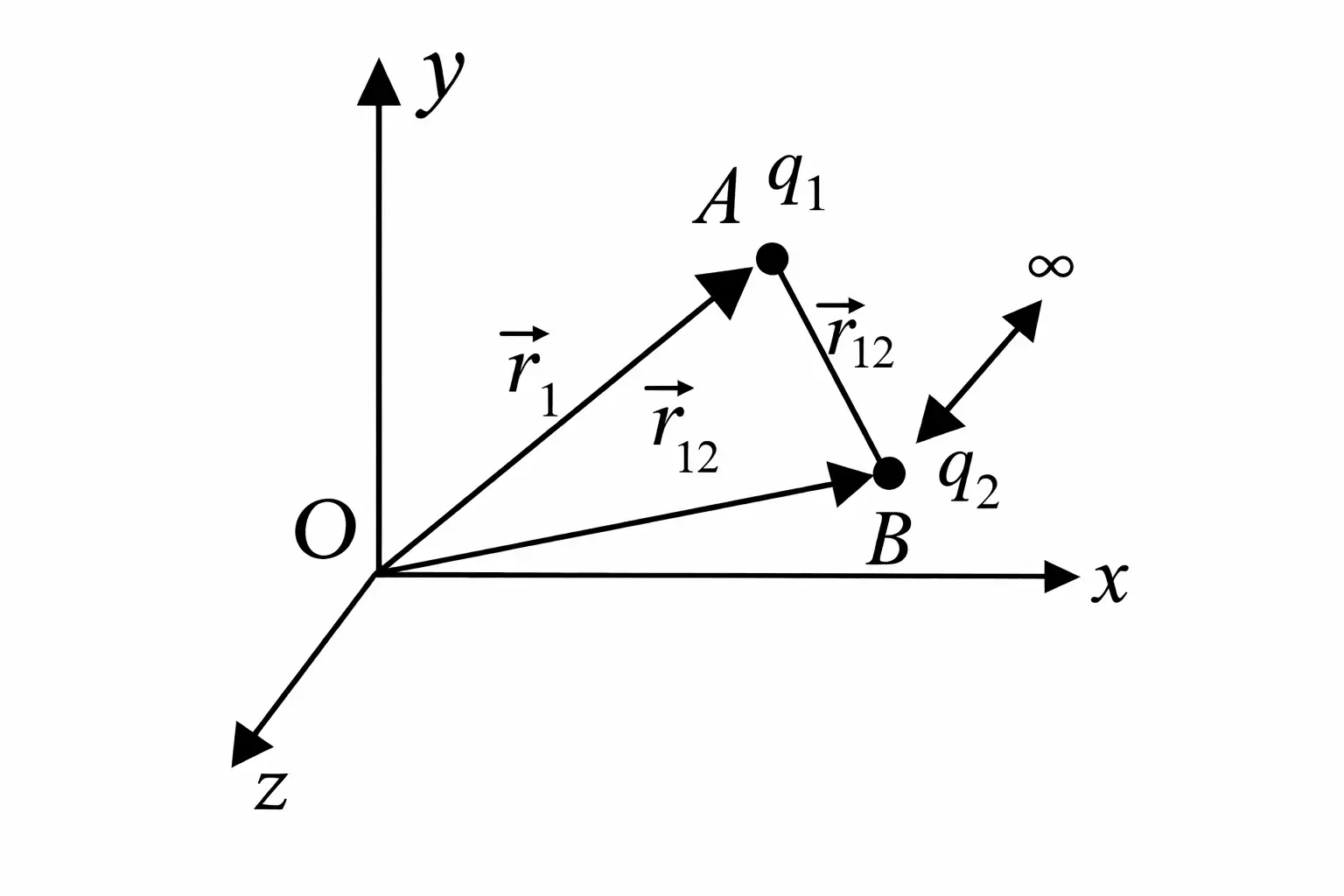
- Potential at point B due to q1: V(B) = 1/(4 π ε0) q1/r12
- Work done to bring charge q2 from infinity to point B: W2 = q2 V(B) = 1/(4 π ε0) q1q2/r12
- Total potential energy of two charges: U = W1 + W2 = 1/(4 π ε0) q1q2/r12
Three Point Charges
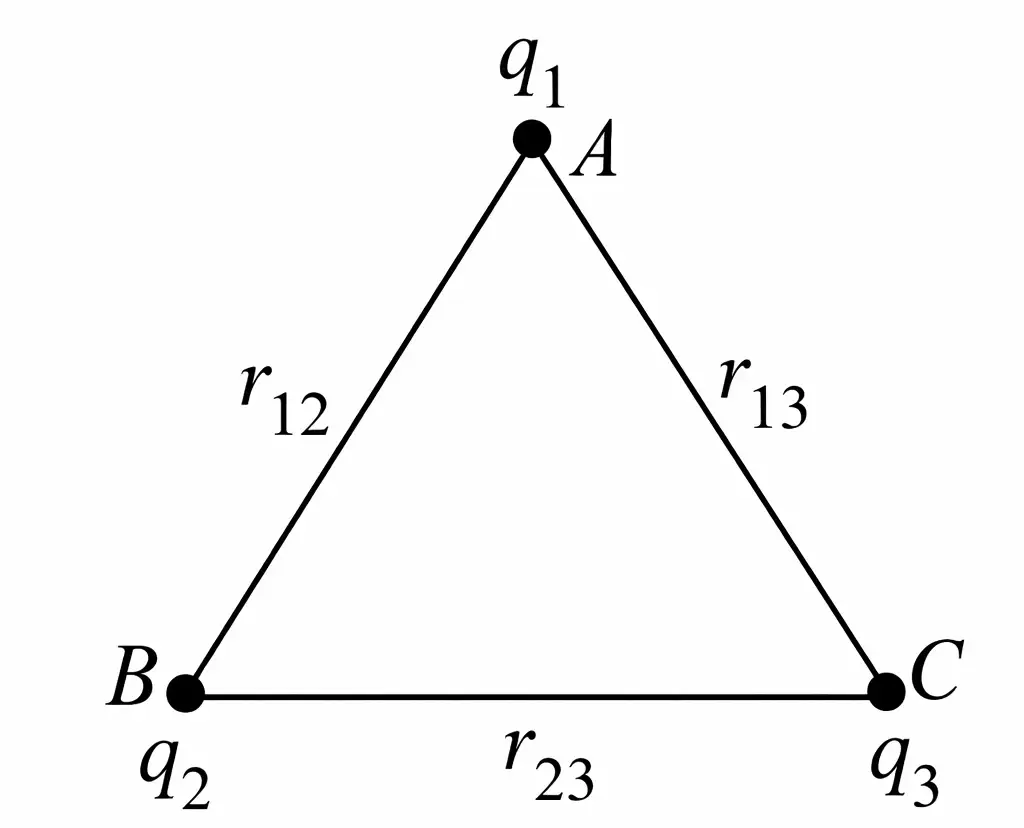
- Work done to bring q3 from infinity to point C: W3 = q3 [V(C) - V(∞)] = q3 (1/(4 π ε0) (q1/r13 + q2/r23)) = 1/(4 π ε0) (q1q3/r13 + q2q3/r23)
- Total potential energy of three charges: U = 1/(4 π ε0) (q1q2/r12 + q2q3/r23 + q1q3/r13)
- Potential energy is distributed over the entire field, not localized.
System of Multiple Charges
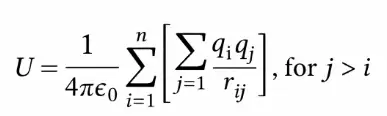
- Potential energy of a system of N point charges: U = 1/(4 π ε0) ∑i=1N ∑j>iN qiqj/rij
- Summation is over all unique pairs to avoid double counting.
Solved Examples
- Ex 1: Calculate potential energy of two charges q1 = 2 μC, q2 = 3 μC separated by 0.5 m.
- Use U = 1/(4 π ε0) q1q2/r
- U = 9 × 109 × (2 × 10-6 × 3 × 10-6)/0.5 = 0.108 J
- Ex 2: Find potential energy of three charges q1 = q2 = q3 = 1 μC at vertices of equilateral triangle of side 1 m.
- U = 1/(4 π ε0) ((q1q2/r) + (q2q3/r) + (q1q3/r)) = 3 × (9 × 109 × (1 × 10-6)2/1) = 0.027 J
Practice Set
- Q1: Potential energy of two charges 1 μC and 2 μC separated by 1 m is?
- A) 0.018 J
- B) 0.009 J
- C) 0.036 J
- D) 0.027 J
- Q2: For three charges each 1 μC at vertices of equilateral triangle side 2 m, potential energy is?
- A) 0.0135 J
- B) 0.027 J
- C) 0.054 J
- D) 0.009 J
- Q3: Total potential energy of 4 charges each 1 μC placed at corners of square side 1 m is?
- A) 0.027 J
- B) 0.036 J
- C) 0.045 J
- D) 0.054 J
Answer Key
- Q1: A) 0.018 J - Use U = 1/(4 π ε0) q1q2/r = 9 × 109 × (1 × 10-6 × 2 × 10-6)/1 = 0.018 J
- Q2: A) 0.0135 J - U = 3 × (9 × 109 × (1 × 10-6)2/2) = 0.0135 J
- Q3: B) 0.036 J - Four charges at square corners have 6 pairs, U = 6 × (9 × 109 × (1 × 10-6)2/1) = 0.036 J
Memory Aids
- Potential energy of two charges: U = k q1q2/r
- For multiple charges, sum over all unique pairs.
- Potential energy is stored in the electric field around charges.
Two Point Charges
- Work done to bring charge \( q_1 \) from infinity to point A: \( W_1 = q_1 V(A) = 0 \) (since \( V(A) = 0 \))
- Potential at point B due to \( q_1 \): \( V(B) = \frac{1}{4 \pi \epsilon_0} \frac{q_1}{r_{12}} \)
- Work done to bring charge \( q_2 \) from infinity to point B: \( W_2 = q_2 V(B) = \frac{1}{4 \pi \epsilon_0} \frac{q_1 q_2}{r_{12}} \)
- Total potential energy of two charges: \( U = W_1 + W_2 = \frac{1}{4 \pi \epsilon_0} \frac{q_1 q_2}{r_{12}} \)
Three Point Charges
- Work done to bring \( q_3 \) from infinity to point C: \( W_3 = q_3 [V(C) - V(\infty)] = q_3 \left( \frac{1}{4 \pi \epsilon_0} \left( \frac{q_1}{r_{13}} + \frac{q_2}{r_{23}} \right) \right) = \frac{1}{4 \pi \epsilon_0} \left( \frac{q_1 q_3}{r_{13}} + \frac{q_2 q_3}{r_{23}} \right) \)
- Total potential energy of three charges: \( U = \frac{1}{4 \pi \epsilon_0} \left( \frac{q_1 q_2}{r_{12}} + \frac{q_2 q_3}{r_{23}} + \frac{q_1 q_3}{r_{13}} \right) \)
- Potential energy is distributed over the entire field, not localized.
System of Multiple Charges
- Potential energy of a system of \( N \) point charges: \( U = \frac{1}{4 \pi \epsilon_0} \sum_{i=1}^N \sum_{j>i}^N \frac{q_i q_j}{r_{ij}} \)
- Summation is over all unique pairs to avoid double counting.
Solved Examples
- Ex 1: Calculate potential energy of two charges \( q_1 = 2 \mu C \), \( q_2 = 3 \mu C \) separated by \( 0.5 \ m \).
- Use \( U = \frac{1}{4 \pi \epsilon_0} \frac{q_1 q_2}{r} \)
- \( U = 9 \times 10^9 \times \frac{2 \times 10^{-6} \times 3 \times 10^{-6}}{0.5} = 0.108 \ J \)
- Ex 2: Find potential energy of three charges \( q_1 = q_2 = q_3 = 1 \mu C \) at vertices of equilateral triangle of side \( 1 \ m \).
- \( U = \frac{1}{4 \pi \epsilon_0} \left( \frac{q_1 q_2}{r} + \frac{q_2 q_3}{r} + \frac{q_1 q_3}{r} \right) = 3 \times \frac{9 \times 10^9 \times (1 \times 10^{-6})^2}{1} = 0.027 \ J \)
Practice Set
- Q1: Potential energy of two charges \( 1 \mu C \) and \( 2 \mu C \) separated by \( 1 \ m \) is?
- A) 0.018 J
- B) 0.009 J
- C) 0.036 J
- D) 0.027 J
- Q2: For three charges each \( 1 \mu C \) at vertices of equilateral triangle side \( 2 \ m \), potential energy is?
- A) 0.0135 J
- B) 0.027 J
- C) 0.054 J
- D) 0.009 J
- Q3: Total potential energy of 4 charges each \( 1 \mu C \) placed at corners of square side \( 1 \ m \) is?
- A) 0.027 J
- B) 0.036 J
- C) 0.045 J
- D) 0.054 J
Answer Key
- Q1: A) 0.018 J - Use \( U = \frac{1}{4 \pi \epsilon_0} \frac{q_1 q_2}{r} = 9 \times 10^9 \times \frac{1 \times 10^{-6} \times 2 \times 10^{-6}}{1} = 0.018 J \)
- Q2: A) 0.0135 J - \( U = 3 \times \frac{9 \times 10^9 \times (1 \times 10^{-6})^2}{2} = 0.0135 J \)
- Q3: B) 0.036 J - Four charges at square corners have 6 pairs, \( U = 6 \times \frac{9 \times 10^9 \times (1 \times 10^{-6})^2}{1} = 0.036 J \)
Memory Aids
- Potential energy of two charges: \( U = k \frac{q_1 q_2}{r} \)
- For multiple charges, sum over all unique pairs.
- Potential energy is stored in the electric field around charges.
Electric Potential due to a Continuous Charge Distribution
General Concept
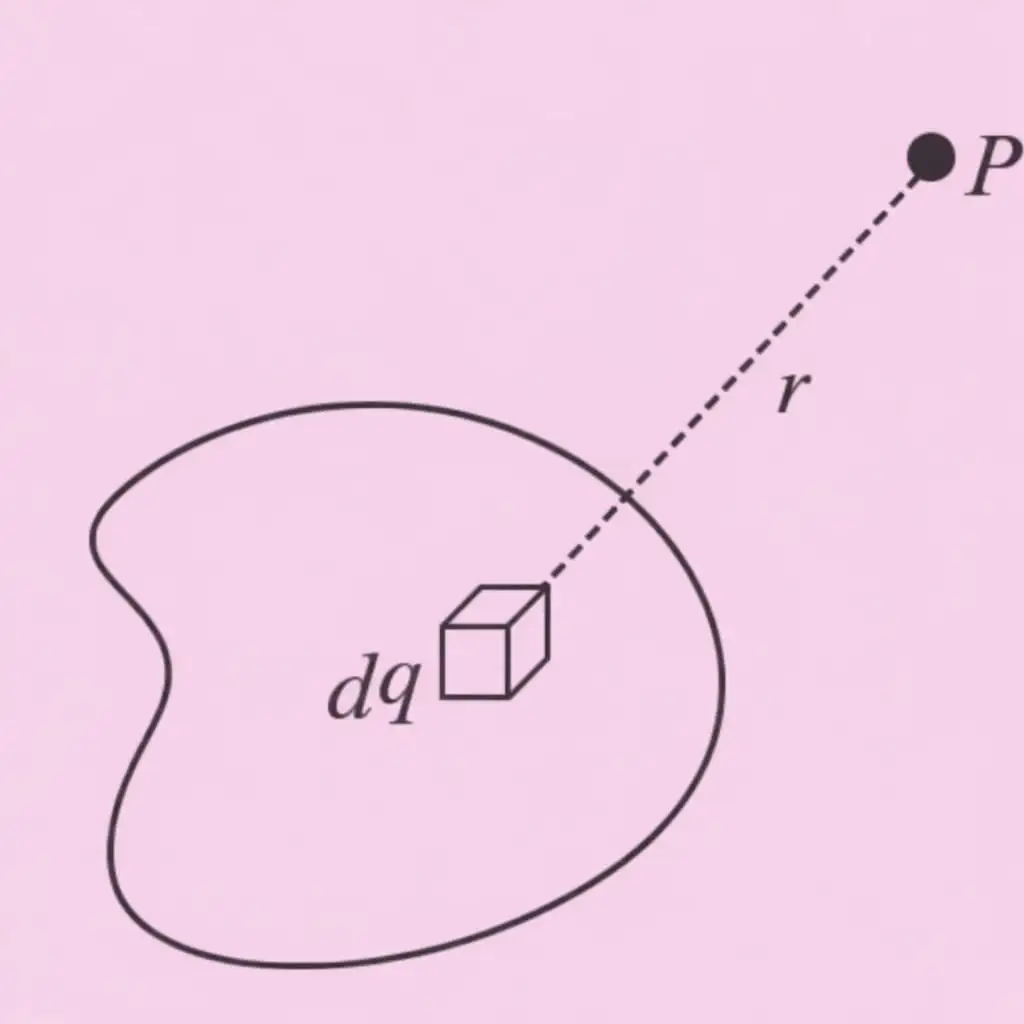
- Electric potential due to small charge element dq at point P: dV = kdq/r, where k = 1/(4 π ε0)
- Total potential: V = ∫dV = 1/(4 π ε0) ∫dq/r
- Used for irregular or continuous charge distributions by integration.
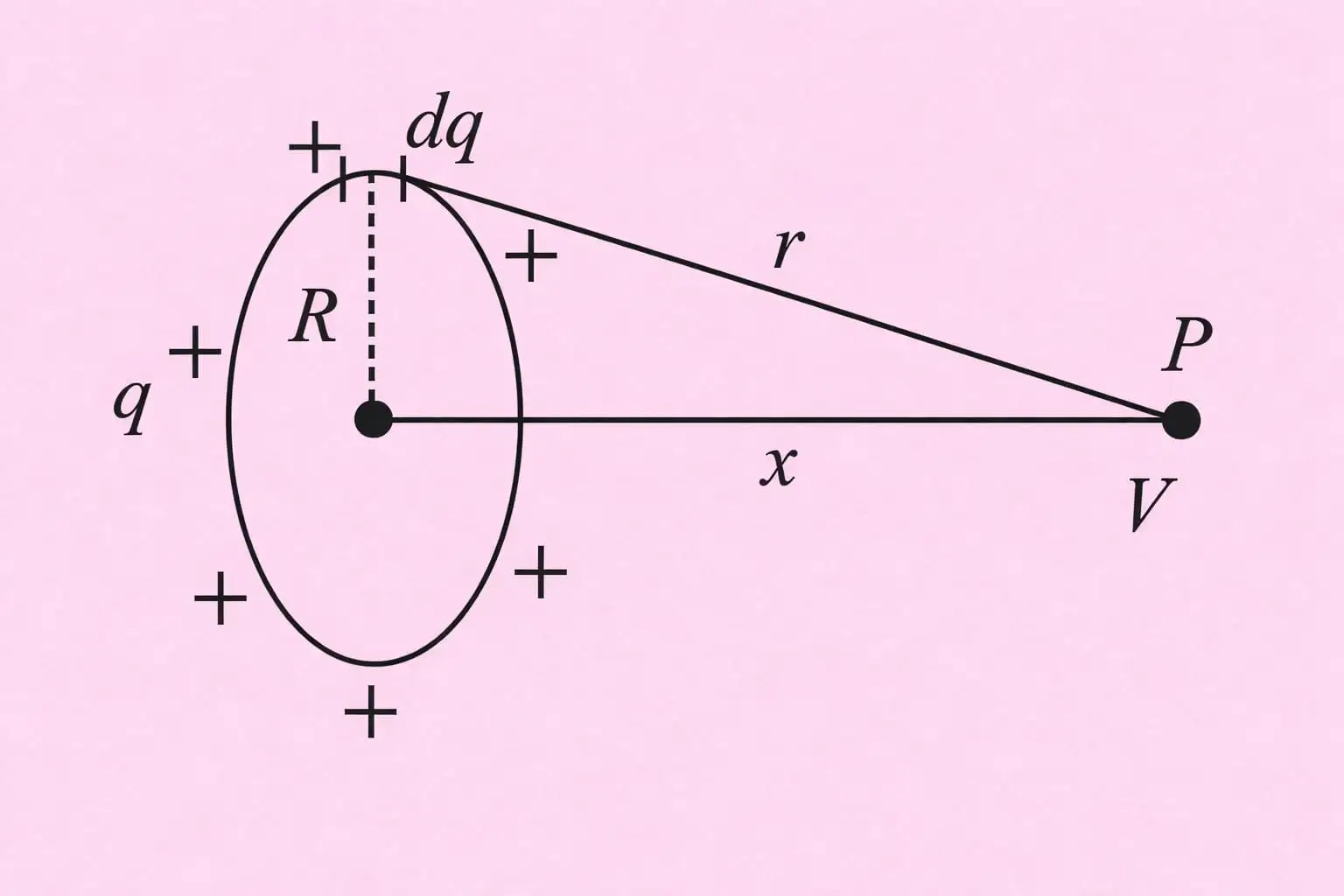
Uniformly Charged Ring
- Potential at point P on axis at distance x: V = kq/√(R2 + x2)
- At center (x=0): V0 = kq/R
Uniformly Charged Disc
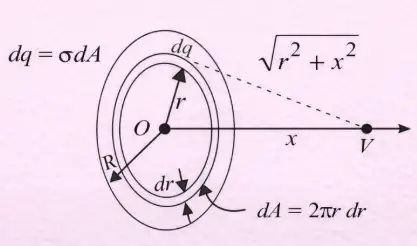
- Disc divided into thin rings of radius r and thickness dr
- Charge on ring: dq = σ(2πrdr), σ = surface charge density
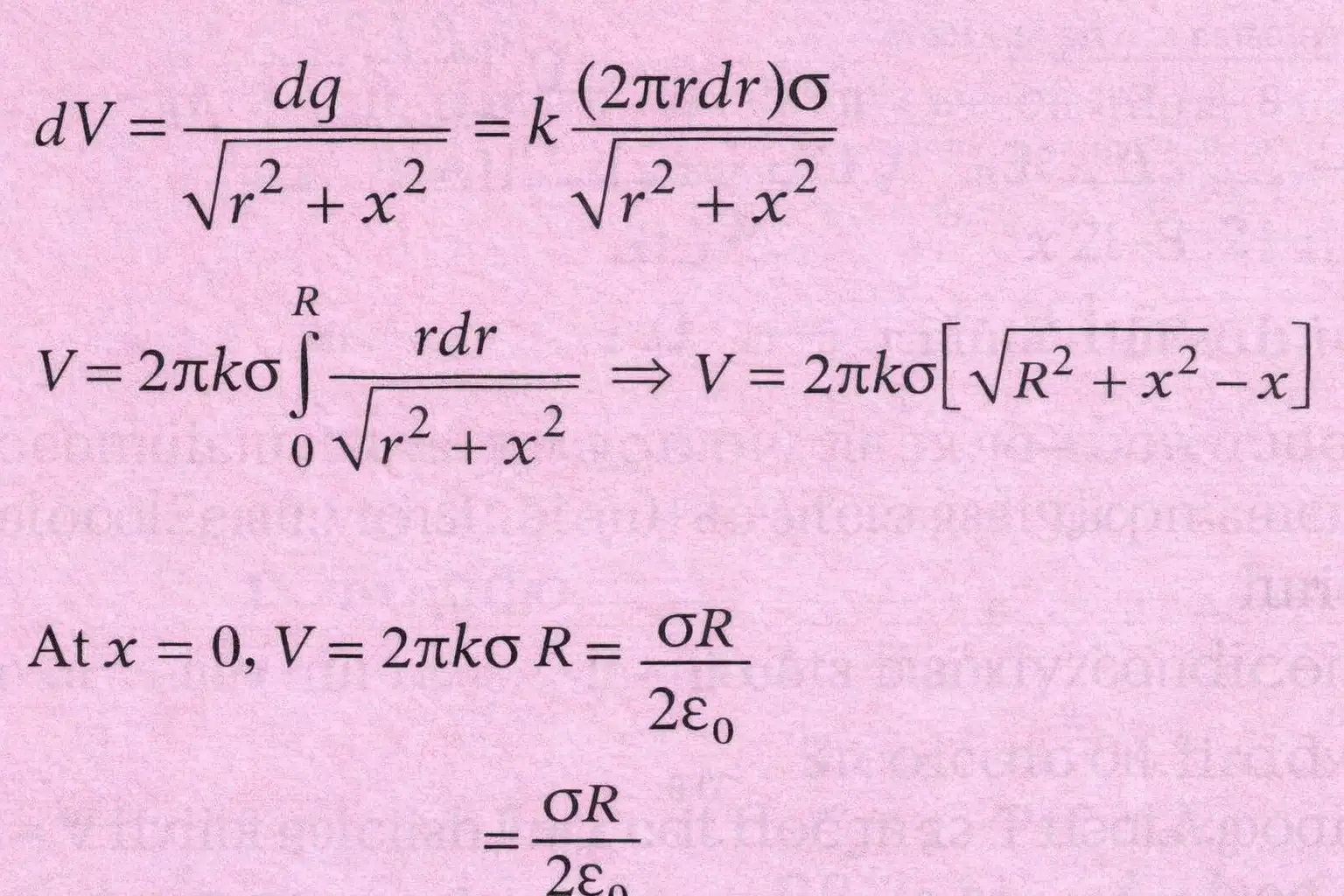
- Potential at point on axis: V = ∫0R kdq/√(r2 + x2)
- After integration, V = 2πkσ(√(R2 + x2) - x)
- At center (x=0): V = 2πkσR
Electric Potential Difference due to Uniformly Charged Wire
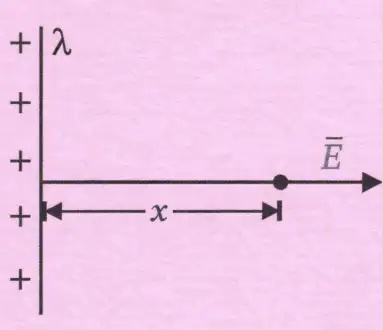
- Electric field at distance x from wire: E = λ/(2 π ε0x)
- Relation: E = - dV/dx
- Potential difference between points x1 and x2: [ V2 - V1 = - ∫x1x2 E dx = λ/(2 π ε0) ln x1/x2 ]

Solved Examples
- Ex 1: Potential at point on axis of ring with q = 4 μC, R = 0.5 m, x = 0.5 m
- V = kq/√(R2 + x2) = (9 × 109 × 4 × 10-6)/√(0.52 + 0.52) = 5.09 × 10⁴ V
- Ex 2: Potential difference between x1 = 0.1 m and x2 = 0.5 m from charged wire with λ = 2 × 10⁻⁶C/m
- V2 - V1 = λ/(2 π ε0) ln x1/x2 = (2 × 10⁻⁶)/(2 π × 8.85 × 10-12) ln 0.1/0.5 = -1.02 × 10⁴ V
Practice Set
- Q1: Potential at center of ring with charge 3 μC and radius 0.4 m is?
- A) 6.75 × 10⁴ V
- B) 1.35 × 10⁵ V
- C) 9.0 × 10⁴ V
- D) 4.5 × 10⁴ V
- Q2: Potential difference between 0.2 m and 0.5 m from charged wire with λ = 1 × 10⁻⁶C/m is?
- A) 4.56 × 10³ V
- B) 3.22 × 10³ V
- C) 2.78 × 10³ V
- D) 1.89 × 10³ V
- Q3: Potential at point x = 0.3 m on axis of ring with q = 5 μC, R = 0.4 m is?
- A) 7.5 × 10⁴ V
- B) 8.5 × 10⁴ V
- C) 9.0 × 10⁴ V
- D) 6.0 × 10⁴ V
Answer Key
- Q1: A) 6.75 × 10⁴ V - V0 = kq/R = (9 × 109 × 3 × 10-6)/0.4 = 6.75 × 10⁴ V
- Q2: B) 3.22 × 10³ V - V2 - V1 = λ/(2 π ε0) ln 0.2/0.5 = 3.22 × 10³ V
- Q3: C) 9.0 × 10⁴ V - V = kq/√(R2 + x2) = (9 × 109 × 5 × 10-6)/√(0.42 + 0.32) = 9.0 × 10⁴ V
Memory Aids
- Potential due to charge element: dV = kdq/r
- Ring potential: V = kq/√(R2 + x2)
- Wire potential difference: logarithmic function of distances.
General Concept
- Electric potential due to small charge element dq at point P: dV = kdq/r, where k = 1/(4 π ε0)
- Total potential: V = ∫dV = 1/(4 π ε0) ∫dq/r
- Used for irregular or continuous charge distributions by integration.
Uniformly Charged Ring
- Potential at point P on axis at distance x: V = kq/√(R2 + x2)
- At center (x=0): V0 = kq/R
Uniformly Charged Disc
- Disc divided into thin rings of radius r and thickness dr
- Charge on ring: dq = σ(2πrdr), σ = surface charge density
- Potential at point on axis: V = ∫0R kdq/√(r2 + x2)
- After integration, V = 2πkσ(√(R2 + x2) - x)
- At center (x=0): V = 2πkσR
Electric Potential Difference due to Uniformly Charged Wire
- Electric field at distance x from wire: E = λ/(2 π ε0x)
- Relation: E = - dV/dx
- Potential difference between points x1 and x2: [ V2 - V1 = - ∫x1x2 E dx = λ/(2 π ε0) ln x1/x2 ]
Solved Examples
- Ex 1: Potential at point on axis of ring with q = 4 μC, R = 0.5 m, x = 0.5 m
- V = kq/√(R2 + x2) = (9 × 109 × 4 × 10-6)/√(0.52 + 0.52) = 5.09 × 10⁴ V
- Ex 2: Potential difference between x1 = 0.1 m and x2 = 0.5 m from charged wire with λ = 2 × 10⁻⁶C/m
- V2 - V1 = λ/(2 π ε0) ln x1/x2 = (2 × 10⁻⁶)/(2 π × 8.85 × 10-12) ln 0.1/0.5 = -1.02 × 10⁴ V
Practice Set
- Q1: Potential at center of ring with charge 3 μC and radius 0.4 m is?
- A) 6.75 × 10⁴ V
- B) 1.35 × 10⁵ V
- C) 9.0 × 10⁴ V
- D) 4.5 × 10⁴ V
- Q2: Potential difference between 0.2 m and 0.5 m from charged wire with λ = 1 × 10⁻⁶C/m is?
- A) 4.56 × 10³ V
- B) 3.22 × 10³ V
- C) 2.78 × 10³ V
- D) 1.89 × 10³ V
- Q3: Potential at point x = 0.3 m on axis of ring with q = 5 μC, R = 0.4 m is?
- A) 7.5 × 10⁴ V
- B) 8.5 × 10⁴ V
- C) 9.0 × 10⁴ V
- D) 6.0 × 10⁴ V
Answer Key
- Q1: A) 6.75 × 10⁴ V - V0 = kq/R = (9 × 109 × 3 × 10-6)/0.4 = 6.75 × 10⁴ V
- Q2: B) 3.22 × 10³ V - V2 - V1 = λ/(2 π ε0) ln 0.2/0.5 = 3.22 × 10³ V
- Q3: C) 9.0 × 10⁴ V - V = kq/√(R2 + x2) = (9 × 109 × 5 × 10-6)/√(0.42 + 0.32) = 9.0 × 10⁴ V
Memory Aids
- Potential due to charge element: dV = kdq/r
- Ring potential: V = kq/√(R2 + x2)
- Wire potential difference: logarithmic function of distances.
General Concept
- Electric potential due to small charge element \( dq \) at point P: \( dV = \frac{k dq}{r} \), where \( k = \frac{1}{4 \pi \epsilon_0} \)
- Total potential: \( V = \int dV = \frac{1}{4 \pi \epsilon_0} \int \frac{dq}{r} \)
- Used for irregular or continuous charge distributions by integration.
Uniformly Charged Ring
- Potential at point P on axis at distance \( x \): \( V = \frac{k q}{\sqrt{R^2 + x^2}} \)
- At center (\( x=0 \)): \( V_0 = \frac{k q}{R} \)
Uniformly Charged Disc
- Disc divided into thin rings of radius \( r \) and thickness \( dr \)
- Charge on ring: \( dq = \sigma (2 \pi r dr) \), \( \sigma \) = surface charge density
- Potential at point on axis: \( V = \int_0^R \frac{k dq}{\sqrt{r^2 + x^2}} \)
- After integration, \( V = 2 \pi k \sigma \left( \sqrt{R^2 + x^2} - x \right) \)
- At center (\( x=0 \)): \( V = 2 \pi k \sigma R \)
Electric Potential Difference due to Uniformly Charged Wire
- Electric field at distance \( x \) from wire: \( E = \frac{\lambda}{2 \pi \epsilon_0 x} \)
- Relation: \( E = - \frac{dV}{dx} \)
- Potential difference between points \( x_1 \) and \( x_2 \): \[ V_2 - V_1 = - \int_{x_1}^{x_2} E dx = \frac{\lambda}{2 \pi \epsilon_0} \ln \frac{x_1}{x_2} \]
Solved Examples
- Ex 1: Potential at point on axis of ring with \( q = 4 \mu C \), \( R = 0.5 \ m \), \( x = 0.5 \ m \)
- \( V = \frac{k q}{\sqrt{R^2 + x^2}} = \frac{9 \times 10^9 \times 4 \times 10^{-6}}{\sqrt{0.5^2 + 0.5^2}} = 5.09 \times 10^4 \ V \)
- Ex 2: Potential difference between \( x_1 = 0.1 \ m \) and \( x_2 = 0.5 \ m \) from charged wire with \( \lambda = 2 \times 10^{-6} C/m \)
- \( V_2 - V_1 = \frac{\lambda}{2 \pi \epsilon_0} \ln \frac{x_1}{x_2} = \frac{2 \times 10^{-6}}{2 \pi \times 8.85 \times 10^{-12}} \ln \frac{0.1}{0.5} = -1.02 \times 10^4 \ V \)
Practice Set
- Q1: Potential at center of ring with charge \( 3 \mu C \) and radius \( 0.4 \ m \) is?
- A) 6.75 × 10^4 V
- B) 1.35 × 10^5 V
- C) 9.0 × 10^4 V
- D) 4.5 × 10^4 V
- Q2: Potential difference between \( 0.2 \ m \) and \( 0.5 \ m \) from charged wire with \( \lambda = 1 \times 10^{-6} C/m \) is?
- A) 4.56 × 10^3 V
- B) 3.22 × 10^3 V
- C) 2.78 × 10^3 V
- D) 1.89 × 10^3 V
- Q3: Potential at point \( x = 0.3 \ m \) on axis of ring with \( q = 5 \mu C \), \( R = 0.4 \ m \) is?
- A) 7.5 × 10^4 V
- B) 8.5 × 10^4 V
- C) 9.0 × 10^4 V
- D) 6.0 × 10^4 V
Answer Key
- Q1: A) 6.75 × 10^4 V - \( V_0 = \frac{k q}{R} = \frac{9 \times 10^9 \times 3 \times 10^{-6}}{0.4} = 6.75 \times 10^4 V \)
- Q2: B) 3.22 × 10^3 V - \( V_2 - V_1 = \frac{\lambda}{2 \pi \epsilon_0} \ln \frac{0.2}{0.5} = 3.22 \times 10^3 V \)
- Q3: C) 9.0 × 10^4 V - \( V = \frac{k q}{\sqrt{R^2 + x^2}} = \frac{9 \times 10^9 \times 5 \times 10^{-6}}{\sqrt{0.4^2 + 0.3^2}} = 9.0 \times 10^4 V \)
Memory Aids
- Potential due to charge element: \( dV = \frac{k dq}{r} \)
- Ring potential: \( V = \frac{k q}{\sqrt{R^2 + x^2}} \)
- Wire potential difference: logarithmic function of distances.
Electric Potential due to a Uniformly Charged Spherical Shell
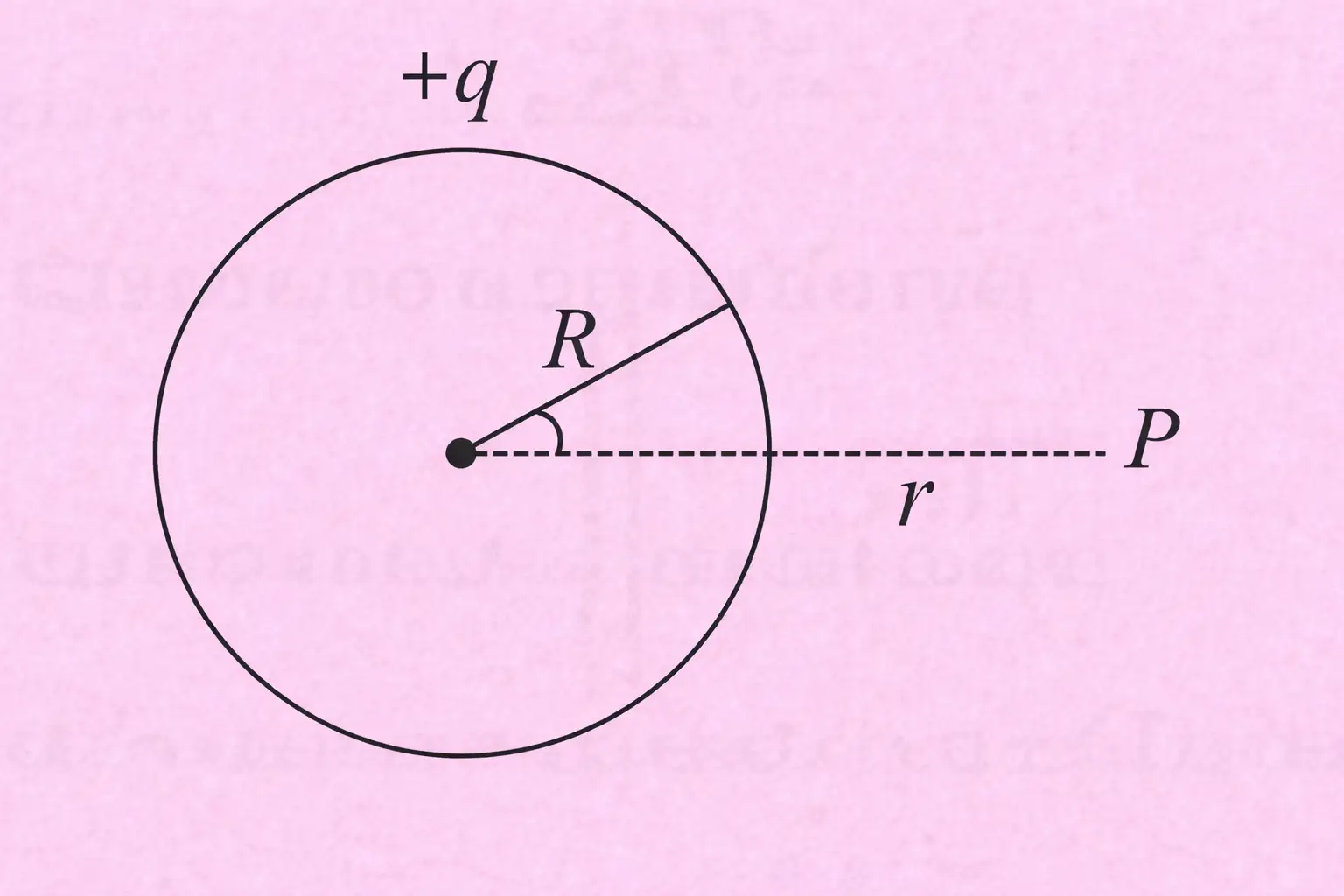
Outside the Shell (r > R)
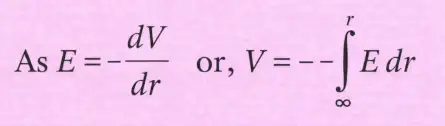
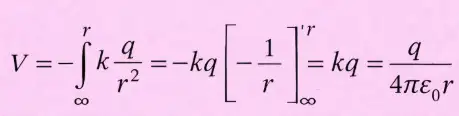
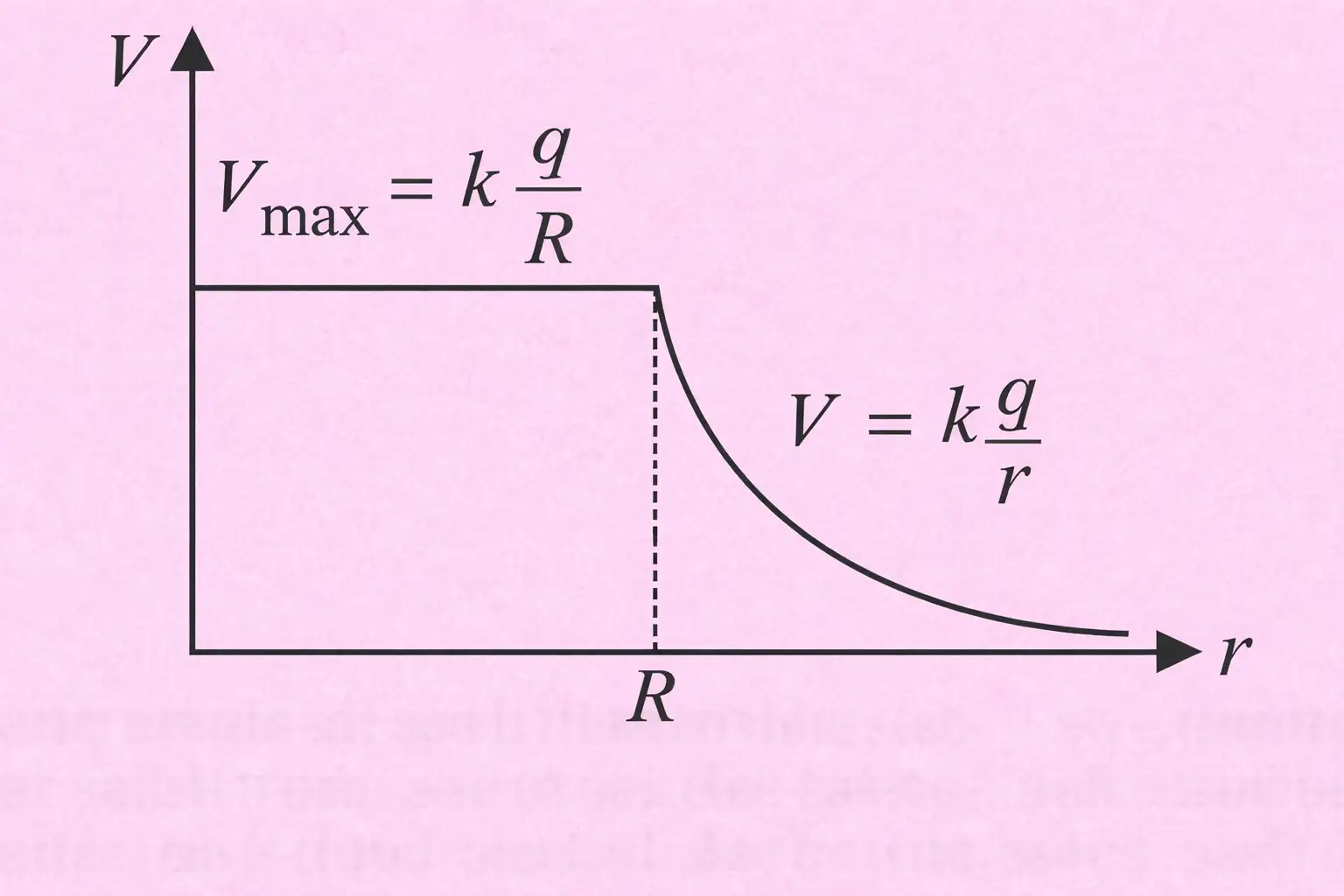
- Potential at distance r: V = kq/r = 1/(4 π ε0) q/r
- Electric field: E = - dV/dr = kq/r2
On the Surface (r = R)
- Potential: V = kq/R = 1/(4 π ε0) q/R
- Potential is constant inside the shell.
Inside the Shell (r < R)
- Electric field E = 0 inside shell
- Potential V = constant = kq/R
Solved Examples
- Ex 1: Potential at r = 2R outside shell with charge q = 5 μC, radius R = 0.1 m
- V = kq/r = (9 × 109 × 5 × 10-6)/0.2 = 2.25 × 10⁵ V
- Ex 2: Potential inside shell (r < R) is constant: V = kq/R
Practice Set
- Q1: Potential at surface of shell with q = 3 μC, R = 0.2 m is?
- A) 1.35 × 10⁵ V
- B) 6.75 × 10⁴ V
- C) 9.0 × 10⁴ V
- D) 4.5 × 10⁴ V
- Q2: Electric field inside shell is?
- A) Zero
- B) Constant non-zero
- C) Varies with r
- D) Infinite
- Q3: Potential at r = 3R outside shell with charge q = 2 μC, R = 0.1 m is?
- A) 6 × 10⁴ V
- B) 3 × 10⁴ V
- C) 9 × 10⁴ V
- D) 1.5 × 10⁵ V
Answer Key
- Q1: A) 1.35 × 10⁵ V - V = kq/R = (9 × 109 × 3 × 10-6)/0.2 = 1.35 × 10⁵ V
- Q2: A) Zero - Electric field inside a charged shell is zero.
- Q3: B) 3 × 10⁴ V - V = kq/r = (9 × 109 × 2 × 10-6)/0.3 = 3 × 10⁴ V
Memory Aids
- Outside shell: V ∝ 1/r
- Inside shell: V = constant, E = 0
- Potential continuous at surface r = R
Outside the Shell (r > R)
- Potential at distance r: V = kq/r = 1/(4 π ε0) q/r
- Electric field: E = - dV/dr = kq/r2
On the Surface (r = R)
- Potential: V = kq/R = 1/(4 π ε0) q/R
- Potential is constant inside the shell.
Inside the Shell (r < R)
- Electric field E = 0 inside shell
- Potential V = constant = kq/R
Solved Examples
- Ex 1: Potential at r = 2R outside shell with charge q = 5 μC, radius R = 0.1 m
- V = kq/r = (9 × 109 × 5 × 10-6)/0.2 = 2.25 × 10⁵ V
- Ex 2: Potential inside shell (r < R) is constant: V = kq/R
Practice Set
- Q1: Potential at surface of shell with q = 3 μC, R = 0.2 m is?
- A) 1.35 × 10⁵ V
- B) 6.75 × 10⁴ V
- C) 9.0 × 10⁴ V
- D) 4.5 × 10⁴ V
- Q2: Electric field inside shell is?
- A) Zero
- B) Constant non-zero
- C) Varies with r
- D) Infinite
- Q3: Potential at r = 3R outside shell with charge q = 2 μC, R = 0.1 m is?
- A) 6 × 10⁴ V
- B) 3 × 10⁴ V
- C) 9 × 10⁴ V
- D) 1.5 × 10⁵ V
Answer Key
- Q1: A) 1.35 × 10⁵ V - V = kq/R = (9 × 109 × 3 × 10-6)/0.2 = 1.35 × 10⁵ V
- Q2: A) Zero - Electric field inside a charged shell is zero.
- Q3: B) 3 × 10⁴ V - V = kq/r = (9 × 109 × 2 × 10-6)/0.3 = 3 × 10⁴ V
Memory Aids
- Outside shell: V ∝ 1/r
- Inside shell: V = constant, E = 0
- Potential continuous at surface r = R
Outside the Shell (\( r > R \))
- Potential at distance \( r \): \( V = \frac{k q}{r} = \frac{1}{4 \pi \epsilon_0} \frac{q}{r} \)
- Electric field: \( E = - \frac{dV}{dr} = \frac{k q}{r^2} \)
On the Surface (\( r = R \))
- Potential: \( V = \frac{k q}{R} = \frac{1}{4 \pi \epsilon_0} \frac{q}{R} \)
- Potential is constant inside the shell.
Inside the Shell (\( r < R \))
- Electric field \( E = 0 \) inside shell
- Potential \( V = \) constant = \( \frac{k q}{R} \)
Solved Examples
- Ex 1: Potential at \( r = 2R \) outside shell with charge \( q = 5 \mu C \), radius \( R = 0.1 \ m \)
- \( V = \frac{k q}{r} = \frac{9 \times 10^9 \times 5 \times 10^{-6}}{0.2} = 2.25 \times 10^5 \ V \)
- Ex 2: Potential inside shell (\( r < R \)) is constant: \( V = \frac{k q}{R} \)
Practice Set
- Q1: Potential at surface of shell with \( q = 3 \mu C \), \( R = 0.2 \ m \) is?
- A) 1.35 × 10^5 V
- B) 6.75 × 10^4 V
- C) 9.0 × 10^4 V
- D) 4.5 × 10^4 V
- Q2: Electric field inside shell is?
- A) Zero
- B) Constant non-zero
- C) Varies with r
- D) Infinite
- Q3: Potential at \( r = 3R \) outside shell with charge \( q = 2 \mu C \), \( R = 0.1 \ m \) is?
- A) 6 × 10^4 V
- B) 3 × 10^4 V
- C) 9 × 10^4 V
- D) 1.5 × 10^5 V
Answer Key
- Q1: A) 1.35 × 10^5 V - \( V = \frac{k q}{R} = \frac{9 \times 10^9 \times 3 \times 10^{-6}}{0.2} = 1.35 \times 10^5 V \)
- Q2: A) Zero - Electric field inside a charged shell is zero.
- Q3: B) 3 × 10^4 V - \( V = \frac{k q}{r} = \frac{9 \times 10^9 \times 2 \times 10^{-6}}{0.3} = 3 \times 10^4 V \)
Memory Aids
- Outside shell: \( V \propto \frac{1}{r} \)
- Inside shell: \( V = \) constant, \( E = 0 \)
- Potential continuous at surface \( r = R \)
Electric Potential due to a Uniformly Charged Dielectric Solid Sphere
Charge Distribution and Density
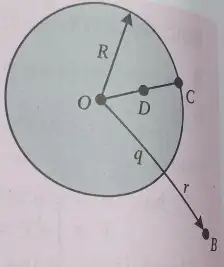
- Total charge: q, radius: R
- Charge density: ρ = q/(4/3 πR3)
Potential Outside Sphere (r > R)
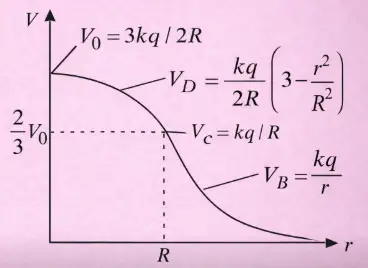
- VB = kq/r
Potential On Surface (r = R)
- VC = kq/R
Potential Inside Sphere (r < R)
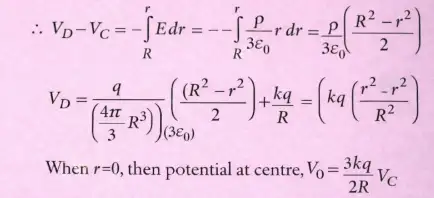
- VD = kq/(2R) (3 - r2/R2)
- Potential at center V0 = 3kq/(2R)
Solved Examples
- Ex 1: Calculate potential at center of sphere with q = 6 μC, R = 0.1 m
- V0 = 3kq/(2R) = (3 × 9 × 109 × 6 × 10-6)/(2 × 0.1) = 8.1 × 10⁵ V
- Ex 2: Potential at r = 0.05 m inside sphere
- VD = kq/(2R) (3 - r2/R2) = (9 × 109 × 6 × 10-6)/(2 × 0.1) (3 - 0.052/0.12) = 7.29 × 10⁵ V
Practice Set
- Q1: Charge density of sphere with q = 4 μC, R = 0.2 m is?
- A) 1.43 × 10⁻⁴ C/m3
- B) 2.39 × 10⁻⁴ C/m3
- C) 3.82 × 10⁻⁴ C/m3
- D) 4.77 × 10⁻⁴ C/m3
- Q2: Potential at center of sphere with q = 3 μC, R = 0.1 m is?
- A) 4.05 × 10⁵ V
- B) 6.75 × 10⁵ V
- C) 9.0 × 10⁵ V
- D) 1.35 × 10⁵ V
- Q3: Potential at r = 0.05 m inside sphere with q = 5 μC, R = 0.1 m is?
- A) 3.75 × 10⁵ V
- B) 4.5 × 10⁵ V
- C) 5.06 × 10⁵ V
- D) 6.0 × 10⁵ V
Answer Key
- Q1: A) 1.43 × 10⁻⁴ C/m3 - ρ = q/(4/3 πR3) = (4 × 10⁻⁶)/(4/3 π(0.2)3) = 1.43 × 10⁻⁴ C/m3
- Q2: B) 6.75 × 10⁵ V - V0 = 3kq/(2R) = (3 × 9 × 109 × 3 × 10-6)/(2 × 0.1) = 6.75 × 10⁵ V
- Q3: C) 5.06 × 10⁵ V - VD = kq/(2R) (3 - r2/R2) = (9 × 109 × 5 × 10-6)/(2 × 0.1) (3 - 0.052/0.12) = 5.06 × 10⁵ V
Memory Aids
- Charge density: ρ = q/(4/3 πR3)
- Potential inside sphere varies as VD = kq/(2R) (3 - r2/R2)
- Potential at center is maximum.
Charge Distribution and Density
- Total charge: q, radius: R
- Charge density: ρ = q/(4/3 πR3)
Potential Outside Sphere (r > R)
- VB = kq/r
Potential On Surface (r = R)
- VC = kq/R
Potential Inside Sphere (r < R)
- VD = kq/(2R) (3 - r2/R2)
- Potential at center V0 = 3kq/(2R)
Solved Examples
- Ex 1: Calculate potential at center of sphere with q = 6 μC, R = 0.1 m
- V0 = 3kq/(2R) = (3 × 9 × 109 × 6 × 10-6)/(2 × 0.1) = 8.1 × 10⁵ V
- Ex 2: Potential at r = 0.05 m inside sphere
- VD = kq/(2R) (3 - r2/R2) = (9 × 109 × 6 × 10-6)/(2 × 0.1) (3 - 0.052/0.12) = 7.29 × 10⁵ V
Practice Set
- Q1: Charge density of sphere with q = 4 μC, R = 0.2 m is?
- A) 1.43 × 10⁻⁴ C/m3
- B) 2.39 × 10⁻⁴ C/m3
- C) 3.82 × 10⁻⁴ C/m3
- D) 4.77 × 10⁻⁴ C/m3
- Q2: Potential at center of sphere with q = 3 μC, R = 0.1 m is?
- A) 4.05 × 10⁵ V
- B) 6.75 × 10⁵ V
- C) 9.0 × 10⁵ V
- D) 1.35 × 10⁵ V
- Q3: Potential at r = 0.05 m inside sphere with q = 5 μC, R = 0.1 m is?
- A) 3.75 × 10⁵ V
- B) 4.5 × 10⁵ V
- C) 5.06 × 10⁵ V
- D) 6.0 × 10⁵ V
Answer Key
- Q1: A) 1.43 × 10⁻⁴ C/m3 - ρ = q/(4/3 πR3) = (4 × 10⁻⁶)/(4/3 π(0.2)3) = 1.43 × 10⁻⁴ C/m3
- Q2: B) 6.75 × 10⁵ V - V0 = 3kq/(2R) = (3 × 9 × 109 × 3 × 10-6)/(2 × 0.1) = 6.75 × 10⁵ V
- Q3: C) 5.06 × 10⁵ V - VD = kq/(2R) (3 - r2/R2) = (9 × 109 × 5 × 10-6)/(2 × 0.1) (3 - 0.052/0.12) = 5.06 × 10⁵ V
Memory Aids
- Charge density: ρ = q/(4/3 πR3)
- Potential inside sphere varies as VD = kq/(2R) (3 - r2/R2)
- Potential at center is maximum.
Charge Distribution and Density
- Total charge: \( q \), radius: \( R \)
- Charge density: \( \rho = \frac{q}{\frac{4}{3} \pi R^3} \)
Potential Outside Sphere (\( r > R \))
- \( V_B = \frac{k q}{r} \)
Potential On Surface (\( r = R \))
- \( V_C = \frac{k q}{R} \)
Potential Inside Sphere (\( r < R \))
- \( V_D = \frac{k q}{2 R} \left( 3 - \frac{r^2}{R^2} \right) \)
- Potential at center \( V_0 = \frac{3 k q}{2 R} \)
Solved Examples
- Ex 1: Calculate potential at center of sphere with \( q = 6 \mu C \), \( R = 0.1 \ m \)
- \( V_0 = \frac{3 k q}{2 R} = \frac{3 \times 9 \times 10^9 \times 6 \times 10^{-6}}{2 \times 0.1} = 8.1 \times 10^5 \ V \)
- Ex 2: Potential at \( r = 0.05 \ m \) inside sphere
- \( V_D = \frac{k q}{2 R} \left( 3 - \frac{r^2}{R^2} \right) = \frac{9 \times 10^9 \times 6 \times 10^{-6}}{2 \times 0.1} \left( 3 - \frac{0.05^2}{0.1^2} \right) = 7.29 \times 10^5 \ V \)
Practice Set
- Q1: Charge density of sphere with \( q = 4 \mu C \), \( R = 0.2 \ m \) is?
- A) 1.43 × 10^{-4} C/m3
- B) 2.39 × 10^{-4} C/m3
- C) 3.82 × 10^{-4} C/m3
- D) 4.77 × 10^{-4} C/m3
- Q2: Potential at center of sphere with \( q = 3 \mu C \), \( R = 0.1 \ m \) is?
- A) 4.05 × 10^5 V
- B) 6.75 × 10^5 V
- C) 9.0 × 10^5 V
- D) 1.35 × 10^5 V
- Q3: Potential at \( r = 0.05 \ m \) inside sphere with \( q = 5 \mu C \), \( R = 0.1 \ m \) is?
- A) 3.75 × 10^5 V
- B) 4.5 × 10^5 V
- C) 5.06 × 10^5 V
- D) 6.0 × 10^5 V
Answer Key
- Q1: A) 1.43 × 10^{-4} C/m3 - \( \rho = \frac{q}{\frac{4}{3} \pi R^3} = \frac{4 \times 10^{-6}}{\frac{4}{3} \pi (0.2)^3} = 1.43 \times 10^{-4} C/m^3 \)
- Q2: B) 6.75 × 10^5 V - \( V_0 = \frac{3 k q}{2 R} = \frac{3 \times 9 \times 10^9 \times 3 \times 10^{-6}}{2 \times 0.1} = 6.75 \times 10^5 V \)
- Q3: C) 5.06 × 10^5 V - \( V_D = \frac{k q}{2 R} \left( 3 - \frac{r^2}{R^2} \right) = \frac{9 \times 10^9 \times 5 \times 10^{-6}}{2 \times 0.1} \left( 3 - \frac{0.05^2}{0.1^2} \right) = 5.06 \times 10^5 V \)
Memory Aids
- Charge density: \( \rho = \frac{q}{\frac{4}{3} \pi R^3} \)
- Potential inside sphere varies as \( V_D = \frac{k q}{2 R} \left( 3 - \frac{r^2}{R^2} \right) \)
- Potential at center is maximum.
Potential Energy of a Single Charge
Concepts
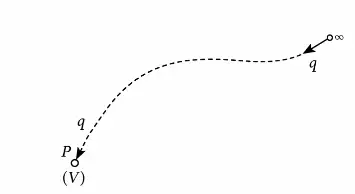
- Potential energy (U) of charge q at point P in external field with potential V: U = qV
- Work done by external agent to bring charge from infinity (where potential = 0) to P: W = q(V - 0) = qV
- Potential at infinity is zero by definition
Solved Examples
- Ex 1: Calculate potential energy of charge q = 2 μC at point with potential V = 5 V.
- Use U = qV = 2 × 10-6 × 5 = 10 × 10-6 J = 10 μJ
Practice Set
- Q1: Potential energy of a charge 3 μC at a point with potential 10 V is?
- A) 30 μJ
- B) 3 J
- C) 0
- D) 300 μJ
- Q2: Work done to bring 1 C charge from infinity to a point at 12 V is?
- A) 12 J
- B) 1 J
- C) 0
- D) 24 J
- Q3: If potential at point P is zero, potential energy of any charge at P is?
- A) Zero
- B) Infinite
- C) Depends on charge
- D) Negative
Answer Key
- Q1: A) 30 μJ - U = qV = 3 × 10-6 × 10 = 30 × 10-6 J
- Q2: A) 12 J - Work done W = qV = 1 × 12 = 12 J
- Q3: A) Zero - Potential energy U = qV = q × 0 = 0
Memory Aids
- Potential energy U = qV
- Potential at infinity = 0
- Work done = potential energy
Concepts
- Potential energy (U) of charge q at point P in external field with potential V: U = qV
- Work done by external agent to bring charge from infinity (where potential = 0) to P: W = q(V - 0) = qV
- Potential at infinity is zero by definition
Solved Examples
- Ex 1: Calculate potential energy of charge q = 2 μC at point with potential V = 5 V.
- Use U = qV = 2 × 10-6 × 5 = 10 × 10-6 J = 10 μJ
Practice Set
- Q1: Potential energy of a charge 3 μC at a point with potential 10 V is?
- A) 30 μJ
- B) 3 J
- C) 0
- D) 300 μJ
- Q2: Work done to bring 1 C charge from infinity to a point at 12 V is?
- A) 12 J
- B) 1 J
- C) 0
- D) 24 J
- Q3: If potential at point P is zero, potential energy of any charge at P is?
- A) Zero
- B) Infinite
- C) Depends on charge
- D) Negative
Answer Key
- Q1: A) 30 μJ - U = qV = 3 × 10-6 × 10 = 30 × 10-6 J
- Q2: A) 12 J - Work done W = qV = 1 × 12 = 12 J
- Q3: A) Zero - Potential energy U = qV = q × 0 = 0
Memory Aids
- Potential energy U = qV
- Potential at infinity = 0
- Work done = potential energy
Concepts
- Potential energy (U) of charge \( q \) at point \( P \) in external field with potential \( V \): \( U = qV \)
- Work done by external agent to bring charge from infinity (where potential = 0) to \( P \): \( W = q(V - 0) = qV \)
- Potential at infinity is zero by definition
Solved Examples
- Ex 1: Calculate potential energy of charge \( q = 2 \mu C \) at point with potential \( V = 5 \text{ V} \).
- Use \( U = qV = 2 \times 10^{-6} \times 5 = 10 \times 10^{-6} \text{ J} = 10 \mu \text{J} \)
Practice Set
- Q1: Potential energy of a charge \( 3 \mu C \) at a point with potential \( 10 \text{ V} \) is?
- A) \( 30 \mu \text{J} \)
- B) \( 3 \text{ J} \)
- C) \( 0 \)
- D) \( 300 \mu \text{J} \)
- Q2: Work done to bring \( 1 \text{ C} \) charge from infinity to a point at \( 12 \text{ V} \) is?
- A) \( 12 \text{ J} \)
- B) \( 1 \text{ J} \)
- C) \( 0 \)
- D) \( 24 \text{ J} \)
- Q3: If potential at point \( P \) is zero, potential energy of any charge at \( P \) is?
- A) Zero
- B) Infinite
- C) Depends on charge
- D) Negative
Answer Key
- Q1: A) \( 30 \mu \text{J} \) - \( U = qV = 3 \times 10^{-6} \times 10 = 30 \times 10^{-6} \text{ J} \)
- Q2: A) \( 12 \text{ J} \) - Work done \( W = qV = 1 \times 12 = 12 \text{ J} \)
- Q3: A) Zero - Potential energy \( U = qV = q \times 0 = 0 \)
Memory Aids
- Potential energy \( U = qV \)
- Potential at infinity = 0
- Work done = potential energy
Potential Energy of Two Charges
Concepts
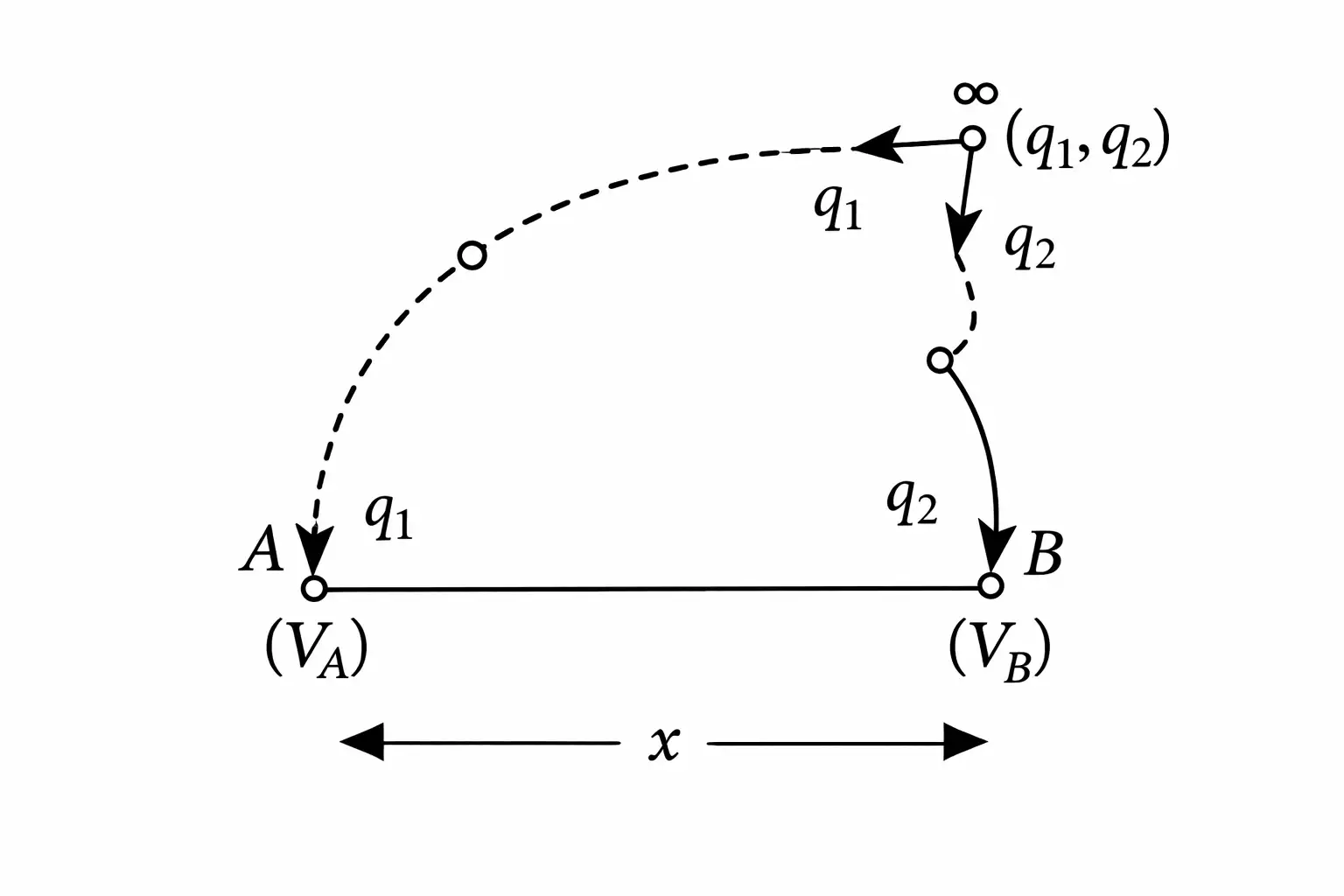
- Work done to bring q1 from infinity to point A with potential VA: W1 = q1VA
- Potential at B due to q1 at A: VB = 1/(4 π ε0) q1/x, where x = AB
- Work done to bring q2 from infinity to B: W2 = q2(VB + 1/(4 π ε0) q1/x) = q2VB + 1/(4 π ε0) q1q2/x
- Total work done (potential energy) in assembling two charges in external field: [ W = W1 + W2 = q1VA + q2VB + 1/(4 π ε0) q1q2/x ]
Solved Examples
- Ex 1: Calculate total potential energy for q1 = 2 μC, q2 = 3 μC, VA = 5 V, VB = 4 V, and x = 0.1 m.
- Use W = q1VA + q2VB + 1/(4 π ε0) q1q2/x
- Calculate 1/(4 π ε0) = 9 × 10⁹ Nm2/C2
- Calculate interaction term: 9 × 109 × (2 × 10-6 × 3 × 10-6)/0.1 = 0.54 J
- Total W = 2 × 10-6 × 5 + 3 × 10-6 × 4 + 0.54 = 0.00001 + 0.000012 + 0.54 ≈ 0.54 J
Practice Set
- Q1: Work done to bring q1 = 1 μC to point A with VA = 3 V is?
- A) 3 μJ
- B) 3 J
- C) 0
- D) 30 μJ
- Q2: Potential at B due to q1 = 2 μC at distance x = 0.2 m is?
- A) 4.5 × 10⁴ V
- B) 9 × 10⁴ V
- C) 1.8 × 10⁵ V
- D) 9 × 10³ V
- Q3: Total work done to assemble q1 = 1 μC, q2 = 1 μC, VA = 2 V, VB = 3 V, x = 0.1 m is?
- A) 0.09 J
- B) 0.1 J
- C) 0.12 J
- D) 0.15 J
Answer Key
- Q1: A) 3 μJ - W1 = q1VA = 1 × 10-6 × 3 = 3 × 10⁻⁶ J
- Q2: D) 9 × 10³ V - VB = 1/(4 π ε0) q1/x = 9 × 109 × (2 × 10-6/0.2) = 9 × 10³ V
- Q3: C) 0.12 J - Calculate total work using formula, interaction term dominates
Memory Aids
- Total work = sum of individual works + interaction energy
- Potential due to point charge: V = 1/(4 π ε0) q/r
- Use 9 × 10⁹ Nm2/C2 for 1/(4 π ε0)
Concepts
- Work done to bring q1 from infinity to point A with potential VA: W1 = q1VA
- Potential at B due to q1 at A: VB = 1/(4 π ε0) q1/x, where x = AB
- Work done to bring q2 from infinity to B: W2 = q2(VB + 1/(4 π ε0) q1/x) = q2VB + 1/(4 π ε0) q1q2/x
- Total work done (potential energy) in assembling two charges in external field: [ W = W1 + W2 = q1VA + q2VB + 1/(4 π ε0) q1q2/x ]
Solved Examples
- Ex 1: Calculate total potential energy for q1 = 2 μC, q2 = 3 μC, VA = 5 V, VB = 4 V, and x = 0.1 m.
- Use W = q1VA + q2VB + 1/(4 π ε0) q1q2/x
- Calculate 1/(4 π ε0) = 9 × 10⁹ Nm2/C2
- Calculate interaction term: 9 × 109 × (2 × 10-6 × 3 × 10-6)/0.1 = 0.54 J
- Total W = 2 × 10-6 × 5 + 3 × 10-6 × 4 + 0.54 = 0.00001 + 0.000012 + 0.54 ≈ 0.54 J
Practice Set
- Q1: Work done to bring q1 = 1 μC to point A with VA = 3 V is?
- A) 3 μJ
- B) 3 J
- C) 0
- D) 30 μJ
- Q2: Potential at B due to q1 = 2 μC at distance x = 0.2 m is?
- A) 4.5 × 10⁴ V
- B) 9 × 10⁴ V
- C) 1.8 × 10⁵ V
- D) 9 × 10³ V
- Q3: Total work done to assemble q1 = 1 μC, q2 = 1 μC, VA = 2 V, VB = 3 V, x = 0.1 m is?
- A) 0.09 J
- B) 0.1 J
- C) 0.12 J
- D) 0.15 J
Answer Key
- Q1: A) 3 μJ - W1 = q1VA = 1 × 10-6 × 3 = 3 × 10⁻⁶ J
- Q2: D) 9 × 10³ V - VB = 1/(4 π ε0) q1/x = 9 × 109 × (2 × 10-6/0.2) = 9 × 10³ V
- Q3: C) 0.12 J - Calculate total work using formula, interaction term dominates
Memory Aids
- Total work = sum of individual works + interaction energy
- Potential due to point charge: V = 1/(4 π ε0) q/r
- Use 9 × 10⁹ Nm2/C2 for 1/(4 π ε0)
Concepts
- Work done to bring \( q_1 \) from infinity to point A with potential \( V_A \): \( W_1 = q_1 V_A \)
- Potential at B due to \( q_1 \) at A: \( V_B = \frac{1}{4 \pi \epsilon_0} \frac{q_1}{x} \), where \( x = AB \)
- Work done to bring \( q_2 \) from infinity to B: \( W_2 = q_2 \left(V_B + \frac{1}{4 \pi \epsilon_0} \frac{q_1}{x}\right) = q_2 V_B + \frac{1}{4 \pi \epsilon_0} \frac{q_1 q_2}{x} \)
- Total work done (potential energy) in assembling two charges in external field: \[ W = W_1 + W_2 = q_1 V_A + q_2 V_B + \frac{1}{4 \pi \epsilon_0} \frac{q_1 q_2}{x} \]
Solved Examples
- Ex 1: Calculate total potential energy for \( q_1 = 2 \mu C \), \( q_2 = 3 \mu C \), \( V_A = 5 \text{ V} \), \( V_B = 4 \text{ V} \), and \( x = 0.1 \text{ m} \).
- Use \( W = q_1 V_A + q_2 V_B + \frac{1}{4 \pi \epsilon_0} \frac{q_1 q_2}{x} \)
- Calculate \( \frac{1}{4 \pi \epsilon_0} = 9 \times 10^9 \text{ Nm}^2/\text{C}^2 \)
- Calculate interaction term: \( 9 \times 10^9 \times \frac{2 \times 10^{-6} \times 3 \times 10^{-6}}{0.1} = 0.54 \text{ J} \)
- Total \( W = 2 \times 10^{-6} \times 5 + 3 \times 10^{-6} \times 4 + 0.54 = 0.00001 + 0.000012 + 0.54 \approx 0.54 \text{ J} \)
Practice Set
- Q1: Work done to bring \( q_1 = 1 \mu C \) to point A with \( V_A = 3 \text{ V} \) is?
- A) \( 3 \mu \text{J} \)
- B) \( 3 \text{ J} \)
- C) \( 0 \)
- D) \( 30 \mu \text{J} \)
- Q2: Potential at B due to \( q_1 = 2 \mu C \) at distance \( x = 0.2 \text{ m} \) is?
- A) \( 4.5 \times 10^4 \text{ V} \)
- B) \( 9 \times 10^4 \text{ V} \)
- C) \( 1.8 \times 10^5 \text{ V} \)
- D) \( 9 \times 10^3 \text{ V} \)
- Q3: Total work done to assemble \( q_1 = 1 \mu C \), \( q_2 = 1 \mu C \), \( V_A = 2 \text{ V} \), \( V_B = 3 \text{ V} \), \( x = 0.1 \text{ m} \) is?
- A) \( 0.09 \text{ J} \)
- B) \( 0.1 \text{ J} \)
- C) \( 0.12 \text{ J} \)
- D) \( 0.15 \text{ J} \)
Answer Key
- Q1: A) \( 3 \mu \text{J} \) - \( W_1 = q_1 V_A = 1 \times 10^{-6} \times 3 = 3 \times 10^{-6} \text{ J} \)
- Q2: D) \( 9 \times 10^3 \text{ V} \) - \( V_B = \frac{1}{4 \pi \epsilon_0} \frac{q_1}{x} = 9 \times 10^9 \times \frac{2 \times 10^{-6}}{0.2} = 9 \times 10^3 \text{ V} \)
- Q3: C) \( 0.12 \text{ J} \) - Calculate total work using formula, interaction term dominates
Memory Aids
- Total work = sum of individual works + interaction energy
- Potential due to point charge: \( V = \frac{1}{4 \pi \epsilon_0} \frac{q}{r} \)
- Use \( 9 \times 10^9 \text{ Nm}^2/\text{C}^2 \) for \( \frac{1}{4 \pi \epsilon_0} \)
Potential Energy of a Dipole
Concepts
- Potential energy of dipole in external field: U = - vector p · vector E = -pE cos θ
- θ is angle between dipole moment vector p and external electric field vector E
- Work done to rotate dipole from θ1 to θ2: Wθ1 → θ2 = Uθ2 - Uθ1 = pE(cos θ1 - cos θ2)
- Stable equilibrium at θ = 0° with minimum potential energy U = -pE
- Unstable equilibrium at θ = 180° with maximum potential energy U = pE
Solved Examples
- Ex 1: Calculate potential energy of dipole with p = 2 × 10-29 C m, E = 105 V/m, at θ = 60°.
- Use U = -pE cos θ = -2 × 10-29 × 105 × 0.5 = -1 × 10-24 J
Practice Set
- Q1: Potential energy of dipole with p = 1 × 10-29 C m, E = 2 × 10⁵ V/m, at θ = 0° is?
- A) -2 × 10-24 J
- B) 2 × 10-24 J
- C) 0
- D) -1 × 10-24 J
- Q2: Work done to rotate dipole from 0° to 180° with p = 3 × 10-29 C m, E = 105 V/m is?
- A) 6 × 10-24 J
- B) 0
- C) -6 × 10-24 J
- D) 3 × 10-24 J
- Q3: At which angle is dipole in stable equilibrium?
- A) 0°
- B) 90°
- C) 180°
- D) 45°
Answer Key
- Q1: A) -2 × 10-24 J - U = -pE cos 0° = -pE
- Q2: A) 6 × 10-24 J - Work done = pE(cos 0° - cos 180°) = pE(1 - (-1)) = 2pE
- Q3: A) 0° - Minimum potential energy, stable equilibrium
Memory Aids
- Dipole energy: U = -pE cos θ
- Stable at 0°, unstable at 180°
- Work done = change in potential energy
Concepts
- Potential energy of dipole in external field: U = - p · E = -pE cos θ
- θ is angle between dipole moment p and external electric field E
- Work done to rotate dipole from θ1 to θ2: Wθ1 → θ2 = Uθ2 - Uθ1 = pE(cos θ1 - cos θ2)
- Stable equilibrium at θ = 0° with minimum potential energy U = -pE
- Unstable equilibrium at θ = 180° with maximum potential energy U = pE
Solved Examples
- Ex 1: Calculate potential energy of dipole with p = 2 × 10-29 C m, E = 105 V/m, at θ = 60°.
- Use U = -pE cos θ = -2 × 10-29 × 105 × 0.5 = -1 × 10-24 J
Practice Set
- Q1: Potential energy of dipole with p = 1 × 10-29 C m, E = 2 × 10⁵ V/m, at θ = 0° is?
- A) -2 × 10-24 J
- B) 2 × 10-24 J
- C) 0
- D) -1 × 10-24 J
- Q2: Work done to rotate dipole from 0° to 180° with p = 3 × 10-29 C m, E = 105 V/m is?
- A) 6 × 10-24 J
- B) 0
- C) -6 × 10-24 J
- D) 3 × 10-24 J
- Q3: At which angle is dipole in stable equilibrium?
- A) 0°
- B) 90°
- C) 180°
- D) 45°
Answer Key
- Q1: A) -2 × 10-24 J - U = -pE cos 0° = -pE
- Q2: A) 6 × 10-24 J - Work done = pE(cos 0° - cos 180°) = pE(1 - (-1)) = 2pE
- Q3: A) 0° - Minimum potential energy, stable equilibrium
Memory Aids
- Dipole energy: U = -pE cos θ
- Stable at 0°, unstable at 180°
- Work done = change in potential energy
Concepts
- Potential energy of dipole in external field: U = - vector p · vector E = -pE cos θ
- θ is angle between dipole moment vector p and external electric field vector E
- Work done to rotate dipole from θ1 to θ2: Wθ1 → θ2 = Uθ2 - Uθ1 = pE(cos θ1 - cos θ2)
- Stable equilibrium at θ = 0° with minimum potential energy U = -pE
- Unstable equilibrium at θ = 180° with maximum potential energy U = pE
Solved Examples
- Ex 1: Calculate potential energy of dipole with p = 2 × 10-29 C m, E = 105 V/m, at θ = 60°.
- Use U = -pE cos θ = -2 × 10-29 × 105 × 0.5 = -1 × 10-24 J
Practice Set
- Q1: Potential energy of dipole with p = 1 × 10-29 C m, E = 2 × 10⁵ V/m, at θ = 0° is?
- A) -2 × 10-24 J
- B) 2 × 10-24 J
- C) 0
- D) -1 × 10-24 J
- Q2: Work done to rotate dipole from 0° to 180° with p = 3 × 10-29 C m, E = 105 V/m is?
- A) 6 × 10-24 J
- B) 0
- C) -6 × 10-24 J
- D) 3 × 10-24 J
- Q3: At which angle is dipole in stable equilibrium?
- A) 0°
- B) 90°
- C) 180°
- D) 45°
Answer Key
- Q1: A) -2 × 10-24 J - U = -pE cos 0° = -pE
- Q2: A) 6 × 10-24 J - Work done = pE(cos 0° - cos 180°) = pE(1 - (-1)) = 2pE
- Q3: A) 0° - Minimum potential energy, stable equilibrium
Memory Aids
- Dipole energy: U = -pE cos θ
- Stable at 0°, unstable at 180°
- Work done = change in potential energy
Concepts
- Potential energy of dipole in external field: \( U = - \mathbf{p} \cdot \mathbf{E} = -pE \cos \theta \)
- \( \theta \) is angle between dipole moment \( \mathbf{p} \) and external electric field \( \mathbf{E} \)
- Work done to rotate dipole from \( \theta_1 \) to \( \theta_2 \): \( W_{\theta_1 \to \theta_2} = U_{\theta_2} - U_{\theta_1} = pE (\cos \theta_1 - \cos \theta_2) \)
- Stable equilibrium at \( \theta = 0^\circ \) with minimum potential energy \( U = -pE \)
- Unstable equilibrium at \( \theta = 180^\circ \) with maximum potential energy \( U = pE \)
Solved Examples
- Ex 1: Calculate potential energy of dipole with \( p = 2 \times 10^{-29} \text{ C m} \), \( E = 10^5 \text{ V/m} \), at \( \theta = 60^\circ \).
- Use \( U = -pE \cos \theta = -2 \times 10^{-29} \times 10^5 \times 0.5 = -1 \times 10^{-24} \text{ J} \)
Practice Set
- Q1: Potential energy of dipole with \( p = 1 \times 10^{-29} \text{ C m} \), \( E = 2 \times 10^5 \text{ V/m} \), at \( \theta = 0^\circ \) is?
- A) \( -2 \times 10^{-24} \text{ J} \)
- B) \( 2 \times 10^{-24} \text{ J} \)
- C) 0
- D) \( -1 \times 10^{-24} \text{ J} \)
- Q2: Work done to rotate dipole from \( 0^\circ \) to \( 180^\circ \) with \( p = 3 \times 10^{-29} \text{ C m} \), \( E = 10^5 \text{ V/m} \) is?
- A) \( 6 \times 10^{-24} \text{ J} \)
- B) 0
- C) \( -6 \times 10^{-24} \text{ J} \)
- D) \( 3 \times 10^{-24} \text{ J} \)
- Q3: At which angle is dipole in stable equilibrium?
- A) \( 0^\circ \)
- B) \( 90^\circ \)
- C) \( 180^\circ \)
- D) \( 45^\circ \)
Answer Key
- Q1: A) \( -2 \times 10^{-24} \text{ J} \) - \( U = -pE \cos 0^\circ = -pE \)
- Q2: A) \( 6 \times 10^{-24} \text{ J} \) - Work done \( = pE (\cos 0^\circ - \cos 180^\circ) = pE (1 - (-1)) = 2pE \)
- Q3: A) \( 0^\circ \) - Minimum potential energy, stable equilibrium
Memory Aids
- Dipole energy: \( U = -pE \cos \theta \)
- Stable at \( 0^\circ \), unstable at \( 180^\circ \)
- Work done = change in potential energy
Electrostatics of Conductors
Properties of Conductors in Electrostatics
- Conductors have many free electrons that move freely inside.
- In electrostatics, conductors are equipotential surfaces (constant potential everywhere on the surface).
- Charge resides only on the outer surface of a conductor.
- Potential inside a charged conducting sphere is constant.
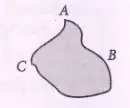
- If a cavity inside a charged conductor has no charge, all charge stays on the outer surface.
- Electric field is always perpendicular to the conductor's surface.
- Electric field near the surface: vector E = σ/ε0 în, where σ = surface charge density, în = outward normal unit vector.
Solved Examples
Ex 1: Calculate electric field intensity near a conductor surface with surface charge density σ = 5 × 10⁻⁶ \ mathrm{C/m^2}. Given ε0 = 8.85 × 10⁻¹² \ mathrm{F/m}.
- Use formula: E = σ/ε0
- E = (5 × 10⁻⁶)/(8.85 × 10-12) = 5.65 × 10⁵ \ mathrm{N/C}
Practice Set
- Q1: What is true about charge distribution on a charged conductor?
- A. Charge is inside the conductor
- B. Charge is uniformly distributed inside
- C. Charge resides only on the outer surface
- D. Charge is zero on the surface
- Q2: Electric field near a charged conductor surface depends on?
- A. Volume charge density
- B. Surface charge density
- C. Potential inside conductor
- D. Electric potential energy
- Q3: If surface charge density σ = 1 × 10⁻⁶ \
mathrm{C/m^2}, what is electric field near surface? (ε0 = 8.85 × 10⁻¹² \
mathrm{F/m})
- A. 1.13 × 10⁵ \ mathrm{N/C}
- B. 8.85 × 10⁵ \ mathrm{N/C}
- C. 1.0 × 10⁶ \ mathrm{N/C}
- D. 1.13 × 10⁶ \ mathrm{N/C}
Answer Key
- Q1: C - Charge resides only on the outer surface of a conductor in electrostatics.
- Q2: B - Electric field near surface depends on surface charge density σ.
- Q3: A - E = σ/ε0 = (1 × 10⁻⁶)/(8.85 × 10-12) = 1.13 × 10⁵ \ mathrm{N/C}.
Memory Aids
- Conductors = Equipotential surfaces.
- Charge only on outer surface.
- Electric field E = σ/ε0 perpendicular outward.
- Potential inside conductor = constant.
Properties of Conductors in Electrostatics
- Conductors have many free electrons that move freely inside.
- In electrostatics, conductors are equipotential surfaces (constant potential everywhere on the surface).
- Charge resides only on the outer surface of a conductor.
- Potential inside a charged conducting sphere is constant.
- If a cavity inside a charged conductor has no charge, all charge stays on the outer surface.
- Electric field is always perpendicular to the conductor's surface.
- Electric field near the surface: vector E = σ/ε0 î, where σ = surface charge density, î = outward normal unit vector.
Solved Examples
Ex 1: Calculate electric field intensity near a conductor surface with surface charge density σ = 5 × 10⁻⁶ mathrm{C/m^2}. Given ε0 = 8.85 × 10⁻¹² mathrm{F/m}.
- Use formula: E = σ/ε0
- E = (5 × 10⁻⁶)/(8.85 × 10-12) = 5.65 × 10⁵ mathrm{N/C}
Practice Set
- Q1: What is true about charge distribution on a charged conductor?
- A. Charge is inside the conductor
- B. Charge is uniformly distributed inside
- C. Charge resides only on the outer surface
- D. Charge is zero on the surface
- Q2: Electric field near a charged conductor surface depends on?
- A. Volume charge density
- B. Surface charge density
- C. Potential inside conductor
- D. Electric potential energy
- Q3: If surface charge density σ = 1 × 10⁻⁶
mathrm{C/m^2}, what is electric field near surface? (ε0 = 8.85 × 10⁻¹²
mathrm{F/m})
- A. 1.13 × 10⁵ mathrm{N/C}
- B. 8.85 × 10⁵ mathrm{N/C}
- C. 1.0 × 10⁶ mathrm{N/C}
- D. 1.13 × 10⁶ mathrm{N/C}
Answer Key
- Q1: C - Charge resides only on the outer surface of a conductor in electrostatics.
- Q2: B - Electric field near surface depends on surface charge density σ.
- Q3: A - E = σ/ε0 = (1 × 10⁻⁶)/(8.85 × 10-12) = 1.13 × 10⁵ mathrm{N/C}.
Memory Aids
- Conductors = Equipotential surfaces.
- Charge only on outer surface.
- Electric field E = σ/ε0 perpendicular outward.
- Potential inside conductor = constant.
Properties of Conductors in Electrostatics
- Conductors have many free electrons that move freely inside.
- In electrostatics, conductors are equipotential surfaces (constant potential everywhere on the surface).
- Charge resides only on the outer surface of a conductor.
- Potential inside a charged conducting sphere is constant.
- If a cavity inside a charged conductor has no charge, all charge stays on the outer surface.
- Electric field is always perpendicular to the conductor's surface.
- Electric field near the surface: vector E = σ/ε0 în, where σ = surface charge density, în = outward normal unit vector.
Solved Examples
Ex 1: Calculate electric field intensity near a conductor surface with surface charge density σ = 5 × 10⁻⁶ \ mathrm{C/m^2}. Given ε0 = 8.85 × 10⁻¹² \ mathrm{F/m}.
- Use formula: E = σ/ε0
- E = (5 × 10⁻⁶)/(8.85 × 10-12) = 5.65 × 10⁵ \ mathrm{N/C}
Practice Set
- Q1: What is true about charge distribution on a charged conductor?
- A. Charge is inside the conductor
- B. Charge is uniformly distributed inside
- C. Charge resides only on the outer surface
- D. Charge is zero on the surface
- Q2: Electric field near a charged conductor surface depends on?
- A. Volume charge density
- B. Surface charge density
- C. Potential inside conductor
- D. Electric potential energy
- Q3: If surface charge density σ = 1 × 10⁻⁶ \
mathrm{C/m^2}, what is electric field near surface? (ε0 = 8.85 × 10⁻¹² \
mathrm{F/m})
- A. 1.13 × 10⁵ \ mathrm{N/C}
- B. 8.85 × 10⁵ \ mathrm{N/C}
- C. 1.0 × 10⁶ \ mathrm{N/C}
- D. 1.13 × 10⁶ \ mathrm{N/C}
Answer Key
- Q1: C - Charge resides only on the outer surface of a conductor in electrostatics.
- Q2: B - Electric field near surface depends on surface charge density σ.
- Q3: A - E = σ/ε0 = (1 × 10⁻⁶)/(8.85 × 10-12) = 1.13 × 10⁵ \ mathrm{N/C}.
Memory Aids
- Conductors = Equipotential surfaces.
- Charge only on outer surface.
- Electric field E = σ/ε0 perpendicular outward.
- Potential inside conductor = constant.
Properties of Conductors in Electrostatics
- Conductors have many free electrons that move freely inside.
- In electrostatics, conductors are equipotential surfaces (constant potential everywhere on the surface).
- Charge resides only on the outer surface of a conductor.
- Potential inside a charged conducting sphere is constant.
- If a cavity inside a charged conductor has no charge, all charge stays on the outer surface.
- Electric field is always perpendicular to the conductor's surface.
- Electric field near the surface: \( \vec{E} = \frac{\sigma}{\epsilon_0} \hat{n} \), where \( \sigma \) = surface charge density, \( \hat{n} \) = outward normal unit vector.
Solved Examples
Ex 1: Calculate electric field intensity near a conductor surface with surface charge density \( \sigma = 5 \times 10^{-6} \ \mathrm{C/m^2} \). Given \( \epsilon_0 = 8.85 \times 10^{-12} \ \mathrm{F/m} \).
- Use formula: \( E = \frac{\sigma}{\epsilon_0} \)
- \( E = \frac{5 \times 10^{-6}}{8.85 \times 10^{-12}} = 5.65 \times 10^{5} \ \mathrm{N/C} \)
Practice Set
- Q1: What is true about charge distribution on a charged conductor?
- A. Charge is inside the conductor
- B. Charge is uniformly distributed inside
- C. Charge resides only on the outer surface
- D. Charge is zero on the surface
- Q2: Electric field near a charged conductor surface depends on?
- A. Volume charge density
- B. Surface charge density
- C. Potential inside conductor
- D. Electric potential energy
- Q3: If surface charge density \( \sigma = 1 \times 10^{-6} \ \mathrm{C/m^2} \), what is electric field near surface? (\( \epsilon_0 = 8.85 \times 10^{-12} \ \mathrm{F/m} \))
- A. \( 1.13 \times 10^{5} \ \mathrm{N/C} \)
- B. \( 8.85 \times 10^{5} \ \mathrm{N/C} \)
- C. \( 1.0 \times 10^{6} \ \mathrm{N/C} \)
- D. \( 1.13 \times 10^{6} \ \mathrm{N/C} \)
Answer Key
- Q1: C - Charge resides only on the outer surface of a conductor in electrostatics.
- Q2: B - Electric field near surface depends on surface charge density \( \sigma \).
- Q3: A - \( E = \frac{\sigma}{\epsilon_0} = \frac{1 \times 10^{-6}}{8.85 \times 10^{-12}} = 1.13 \times 10^{5} \ \mathrm{N/C} \).
Memory Aids
- Conductors = Equipotential surfaces.
- Charge only on outer surface.
- Electric field \( E = \sigma/\epsilon_0 \) perpendicular outward.
- Potential inside conductor = constant.
Electrostatic Shielding
Concept and Application
- Electrostatic shielding protects a region from external electric fields.
- A cavity inside a conductor with no internal charge is field-free (electric field = 0).
- Field inside cavity is always zero regardless of external charges.
- Used to protect sensitive instruments by enclosing them in hollow conductors.
Solved Examples
Ex 1: Why is the electric field zero inside a hollow conductor cavity?
- Because charges reside on outer surface, no field penetrates inside.
- Electric field inside cavity = 0 due to electrostatic shielding.
Practice Set
- Q1: What happens to electric field inside a hollow conductor cavity?
- A. It is maximum
- B. It is zero
- C. It depends on external charges
- D. It varies with time
- Q2: Electrostatic shielding is used to protect?
- A. Magnetic fields
- B. Sensitive electronic instruments
- C. Mechanical parts
- D. Heat
- Q3: If a cavity inside a conductor has no charge, where does the charge reside?
- A. Inside cavity
- B. On inner surface of cavity
- C. On outer surface of conductor
- D. Uniformly inside conductor
Answer Key
- Q1: B - Electric field inside hollow cavity is zero due to shielding.
- Q2: B - Shielding protects sensitive electronic instruments from electric fields.
- Q3: C - Charge resides only on outer surface if cavity has no charge.
Memory Aids
- Shielding = zero field inside cavity.
- Charge stays outside cavity.
- Protect instruments by hollow conductor enclosure.
Summary of Electrostatic Properties
Key Points
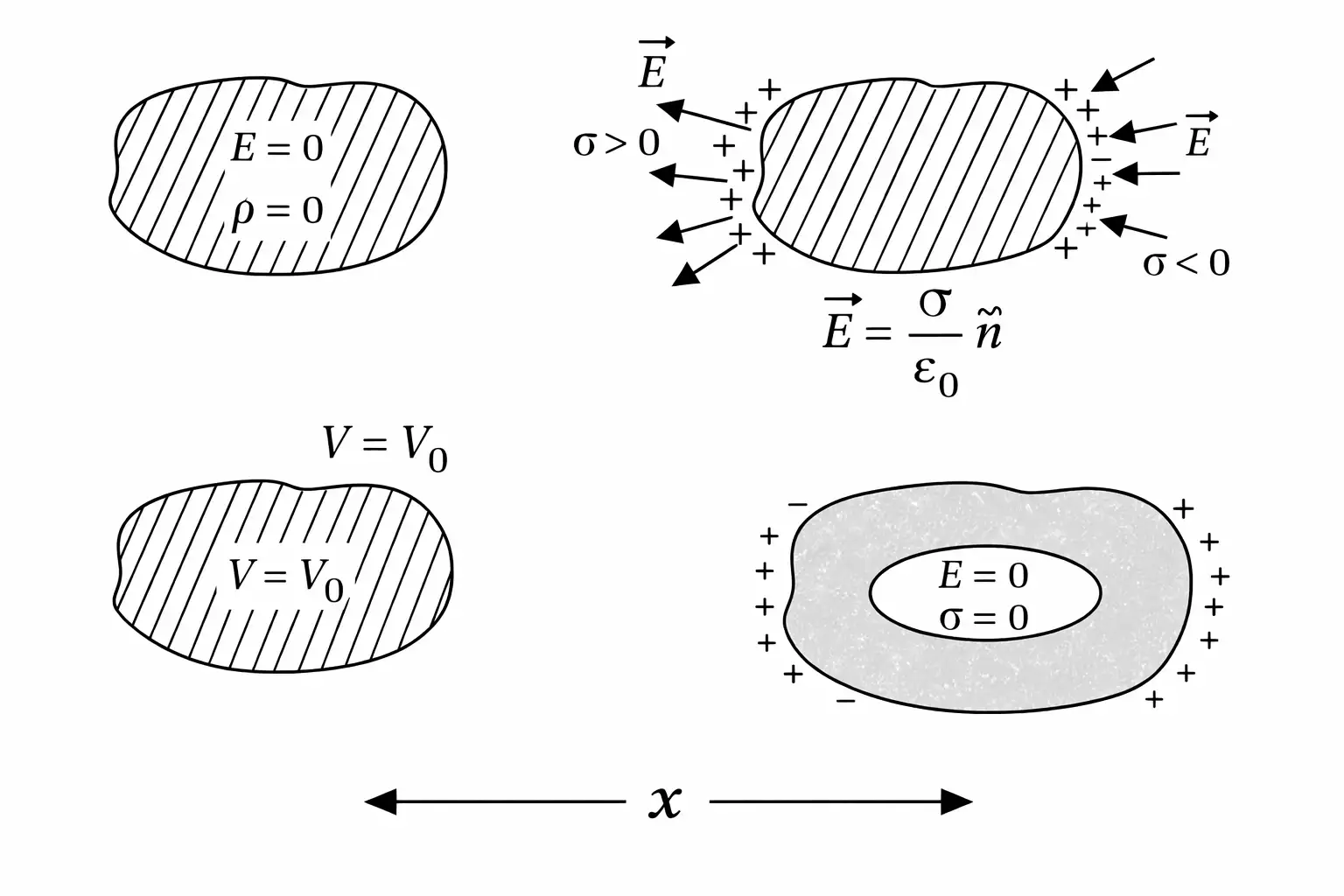
- Inside neutral conductor: Electric field E = 0, charge density ρ = 0.
- On charged surface: Electric field E = σ/ε0 în, points outward for positive charge.
- Inside charged conductor: Potential V = V0 constant.
- Inside hollow conductor: Electric field and surface charge density are zero; charges on outer surface.
Solved Examples
Ex 1: State electric field inside a neutral conductor.
- Electric field inside neutral conductor is zero.
Practice Set
- Q1: Electric field inside a neutral conductor is?
- A. Zero
- B. Maximum
- C. Depends on charge
- D. Infinite
- Q2: Potential inside a charged conductor is?
- A. Zero
- B. Constant
- C. Varies with position
- D. Negative
- Q3: Where do charges reside in a hollow conductor?
- A. Inside cavity
- B. On inner surface
- C. On outer surface
- D. Uniformly inside
Answer Key
- Q1: A - Electric field inside neutral conductor is zero.
- Q2: B - Potential inside charged conductor is constant.
- Q3: C - Charges reside on outer surface of hollow conductor.
Memory Aids
- Neutral conductor: E=0, ρ=0.
- Charged surface: E=σ/ε0 în.
- Inside conductor: Potential constant.
- Hollow conductor: Charges outside, field zero inside.
Key Points
- Inside neutral conductor: Electric field E = 0, charge density ρ = 0.
- On charged surface: Electric field E = σ/ε0 î, points outward for positive charge.
- Inside charged conductor: Potential V = V0 constant.
- Inside hollow conductor: Electric field and surface charge density are zero; charges on outer surface.
Solved Examples
Ex 1: State electric field inside a neutral conductor.
- Electric field inside neutral conductor is zero.
Practice Set
- Q1: Electric field inside a neutral conductor is?
- A. Zero
- B. Maximum
- C. Depends on charge
- D. Infinite
- Q2: Potential inside a charged conductor is?
- A. Zero
- B. Constant
- C. Varies with position
- D. Negative
- Q3: Where do charges reside in a hollow conductor?
- A. Inside cavity
- B. On inner surface
- C. On outer surface
- D. Uniformly inside
Answer Key
- Q1: A - Electric field inside neutral conductor is zero.
- Q2: B - Potential inside charged conductor is constant.
- Q3: C - Charges reside on outer surface of hollow conductor.
Memory Aids
- Neutral conductor: E=0, ρ=0.
- Charged surface: E=σ/ε0 î.
- Inside conductor: Potential constant.
- Hollow conductor: Charges outside, field zero inside.
Key Points
- Inside neutral conductor: Electric field E = 0, charge density ρ = 0.
- On charged surface: Electric field E = σ/ε0 în, points outward for positive charge.
- Inside charged conductor: Potential V = V0 constant.
- Inside hollow conductor: Electric field and surface charge density are zero; charges on outer surface.
Solved Examples
Ex 1: State electric field inside a neutral conductor.
- Electric field inside neutral conductor is zero.
Practice Set
- Q1: Electric field inside a neutral conductor is?
- A. Zero
- B. Maximum
- C. Depends on charge
- D. Infinite
- Q2: Potential inside a charged conductor is?
- A. Zero
- B. Constant
- C. Varies with position
- D. Negative
- Q3: Where do charges reside in a hollow conductor?
- A. Inside cavity
- B. On inner surface
- C. On outer surface
- D. Uniformly inside
Answer Key
- Q1: A - Electric field inside neutral conductor is zero.
- Q2: B - Potential inside charged conductor is constant.
- Q3: C - Charges reside on outer surface of hollow conductor.
Memory Aids
- Neutral conductor: E=0, ρ=0.
- Charged surface: E=σ/ε0 în.
- Inside conductor: Potential constant.
- Hollow conductor: Charges outside, field zero inside.
Key Points
- Inside neutral conductor: Electric field \( E = 0 \), charge density \( \rho = 0 \).
- On charged surface: Electric field \( E = \frac{\sigma}{\epsilon_0} \hat{n} \), points outward for positive charge.
- Inside charged conductor: Potential \( V = V_0 \) constant.
- Inside hollow conductor: Electric field and surface charge density are zero; charges on outer surface.
Solved Examples
Ex 1: State electric field inside a neutral conductor.
- Electric field inside neutral conductor is zero.
Practice Set
- Q1: Electric field inside a neutral conductor is?
- A. Zero
- B. Maximum
- C. Depends on charge
- D. Infinite
- Q2: Potential inside a charged conductor is?
- A. Zero
- B. Constant
- C. Varies with position
- D. Negative
- Q3: Where do charges reside in a hollow conductor?
- A. Inside cavity
- B. On inner surface
- C. On outer surface
- D. Uniformly inside
Answer Key
- Q1: A - Electric field inside neutral conductor is zero.
- Q2: B - Potential inside charged conductor is constant.
- Q3: C - Charges reside on outer surface of hollow conductor.
Memory Aids
- Neutral conductor: \( E=0, \rho=0 \).
- Charged surface: \( E=\frac{\sigma}{\epsilon_0} \hat{n} \).
- Inside conductor: Potential constant.
- Hollow conductor: Charges outside, field zero inside.
Dielectrics and Polarisation
Types of Dielectrics
- Dielectrics are insulating materials that support electric fields but do not conduct electricity.
- Polar dielectrics: positive and negative charges are separated; centers do not coincide.
- Non-polar dielectrics: positive and negative charges overlap; centers coincide.
- Polarisation occurs when dipoles align under an external electric field.
- Polarisation field vector Ei is induced inside the dielectric opposing the external field vector E0.
- Net electric field inside dielectric: vector E = vector E0 + vector Ei.
- Polarisation vector vector P = dipole moment per unit volume.
- For linear isotropic dielectrics: vector P = χe vector Ei, where χe is electrical susceptibility.
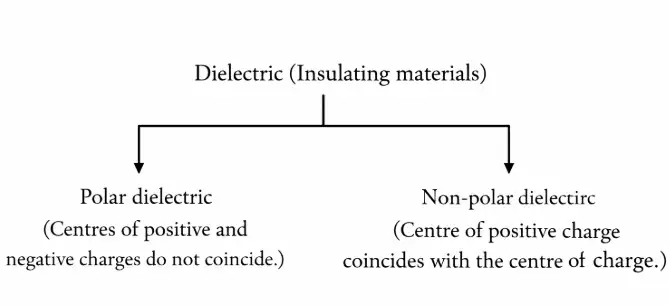
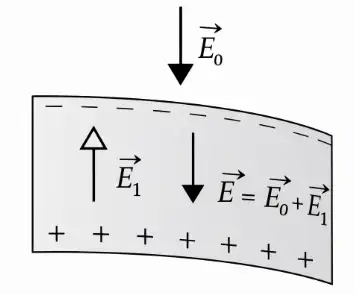
Solved Examples
- Ex 1: Calculate induced electric field Ei if E0 = 1000
mathrm{V/m} and relative permittivity εr = 5.
- Use Ei = (1 - 1/εr)E0 = (1 - 1/5) × 1000 = 800 mathrm{V/m}.
- Ex 2: Find induced charge qi if free charge q = 10
mu C and εr = 4.
- Use qi = q(1 - 1/εr) = 10 × (1 - 1/4) = 7.5 mu C.
Practice Set
- Q1: What is the polarisation vector vector P in a dielectric?
- A. Electric field inside dielectric
- B. Dipole moment per unit volume
- C. Induced charge density
- D. External electric field
- Q2: If εr = 3 and E0 = 600
mathrm{V/m}, what is Ei?
- A. 200 V/m
- B. 400 V/m
- C. 600 V/m
- D. 800 V/m
- Q3: For a dielectric with χe = 2 and Ei = 500
mathrm{V/m}, find P.
- A. 1000 C/m3
- B. 250 C/m3
- C. 500 C/m3
- D. 2000 C/m3
Answer Key
- Q1: B - Polarisation vector vector P is the dipole moment per unit volume.
- Q2: B - Ei = (1 - 1/3) × 600 = 400 mathrm{V/m}.
- Q3: A - P = χeEi = 2 × 500 = 1000 mathrm{C/m^3}.
Memory Aids
- Polarisation vector vector P = dipole moment density.
- Induced field Ei = (1 - 1/εr)E0.
- Net field inside dielectric is reduced by Ei.
Types of Dielectrics
- Dielectrics are insulating materials that support electric fields but do not conduct electricity.
- Polar dielectrics: positive and negative charges are separated; centers do not coincide.
- Non-polar dielectrics: positive and negative charges overlap; centers coincide.
- Polarisation occurs when dipoles align under an external electric field.
- Polarisation field Ei is induced inside the dielectric opposing the external field E0.
- Net electric field inside dielectric: E = E0 + Ei.
- Polarisation vector P = dipole moment per unit volume.
- For linear isotropic dielectrics: P = χe Ei, where χe is electrical susceptibility.
Solved Examples
- Ex 1: Calculate induced electric field Ei if E0 = 1000
mathrm{V/m} and relative permittivity εr = 5.
- Use Ei = (1 - 1/εr)E0 = (1 - 1/5) × 1000 = 800 mathrm{V/m}.
- Ex 2: Find induced charge qi if free charge q = 10
mu C and εr = 4.
- Use qi = q(1 - 1/εr) = 10 × (1 - 1/4) = 7.5 mu C.
Practice Set
- Q1: What is the polarisation vector P in a dielectric?
- A. Electric field inside dielectric
- B. Dipole moment per unit volume
- C. Induced charge density
- D. External electric field
- Q2: If εr = 3 and E0 = 600
mathrm{V/m}, what is Ei?
- A. 200 V/m
- B. 400 V/m
- C. 600 V/m
- D. 800 V/m
- Q3: For a dielectric with χe = 2 and Ei = 500
mathrm{V/m}, find P.
- A. 1000 C/m3
- B. 250 C/m3
- C. 500 C/m3
- D. 2000 C/m3
Answer Key
- Q1: B - Polarisation P is the dipole moment per unit volume.
- Q2: B - Ei = (1 - 1/3) × 600 = 400 mathrm{V/m}.
- Q3: A - P = χeEi = 2 × 500 = 1000 mathrm{C/m^3}.
Memory Aids
- Polarisation P = dipole moment density.
- Induced field Ei = (1 - 1/εr)E0.
- Net field inside dielectric is reduced by Ei.
Types of Dielectrics
- Dielectrics are insulating materials that support electric fields but do not conduct electricity.
- Polar dielectrics: positive and negative charges are separated; centers do not coincide.
- Non-polar dielectrics: positive and negative charges overlap; centers coincide.
- Polarisation occurs when dipoles align under an external electric field.
- Polarisation field vector Ei is induced inside the dielectric opposing the external field vector E0.
- Net electric field inside dielectric: vector E = vector E0 + vector Ei.
- Polarisation vector vector P = dipole moment per unit volume.
- For linear isotropic dielectrics: vector P = χe vector Ei, where χe is electrical susceptibility.
Solved Examples
- Ex 1: Calculate induced electric field Ei if E0 = 1000 \
mathrm{V/m} and relative permittivity εr = 5.
- Use Ei = (1 - 1/εr)E0 = (1 - 1/5) × 1000 = 800 \ mathrm{V/m}.
- Ex 2: Find induced charge qi if free charge q = 10 \
mu C and εr = 4.
- Use qi = q(1 - 1/εr) = 10 × (1 - 1/4) = 7.5 \ mu C.
Practice Set
- Q1: What is the polarisation vector vector P in a dielectric?
- A. Electric field inside dielectric
- B. Dipole moment per unit volume
- C. Induced charge density
- D. External electric field
- Q2: If εr = 3 and E0 = 600 \
mathrm{V/m}, what is Ei?
- A. 200 V/m
- B. 400 V/m
- C. 600 V/m
- D. 800 V/m
- Q3: For a dielectric with χe = 2 and Ei = 500 \
mathrm{V/m}, find P.
- A. 1000 C/m3
- B. 250 C/m3
- C. 500 C/m3
- D. 2000 C/m3
Answer Key
- Q1: B - Polarisation vector vector P is the dipole moment per unit volume.
- Q2: B - Ei = (1 - 1/3) × 600 = 400 \ mathrm{V/m}.
- Q3: A - P = χeEi = 2 × 500 = 1000 \ mathrm{C/m^3}.
Memory Aids
- Polarisation vector vector P = dipole moment density.
- Induced field Ei = (1 - 1/εr)E0.
- Net field inside dielectric is reduced by Ei.
Types of Dielectrics
- Dielectrics are insulating materials that support electric fields but do not conduct electricity.
- Polar dielectrics: positive and negative charges are separated; centers do not coincide.
- Non-polar dielectrics: positive and negative charges overlap; centers coincide.
- Polarisation occurs when dipoles align under an external electric field.
- Polarisation field \( \vec{E_i} \) is induced inside the dielectric opposing the external field \( \vec{E_0} \).
- Net electric field inside dielectric: \( \vec{E} = \vec{E_0} + \vec{E_i} \).
- Polarisation vector \( \vec{P} \) = dipole moment per unit volume.
- For linear isotropic dielectrics: \( \vec{P} = \chi_e \vec{E_i} \), where \( \chi_e \) is electrical susceptibility.
Solved Examples
- Ex 1: Calculate induced electric field \( E_i \) if \( E_0 = 1000 \ \mathrm{V/m} \) and relative permittivity \( \varepsilon_r = 5 \).
- Use \( E_i = \left(1 - \frac{1}{\varepsilon_r}\right) E_0 = \left(1 - \frac{1}{5}\right) \times 1000 = 800 \ \mathrm{V/m} \).
- Ex 2: Find induced charge \( q_i \) if free charge \( q = 10 \ \mu C \) and \( \varepsilon_r = 4 \).
- Use \( q_i = q \left(1 - \frac{1}{\varepsilon_r}\right) = 10 \times \left(1 - \frac{1}{4}\right) = 7.5 \ \mu C \).
Practice Set
- Q1: What is the polarisation vector \( \vec{P} \) in a dielectric?
- A. Electric field inside dielectric
- B. Dipole moment per unit volume
- C. Induced charge density
- D. External electric field
- Q2: If \( \varepsilon_r = 3 \) and \( E_0 = 600 \ \mathrm{V/m} \), what is \( E_i \)?
- A. 200 V/m
- B. 400 V/m
- C. 600 V/m
- D. 800 V/m
- Q3: For a dielectric with \( \chi_e = 2 \) and \( E_i = 500 \ \mathrm{V/m} \), find \( P \).
- A. 1000 C/m3
- B. 250 C/m3
- C. 500 C/m3
- D. 2000 C/m3
Answer Key
- Q1: B - Polarisation \( \vec{P} \) is the dipole moment per unit volume.
- Q2: B - \( E_i = (1 - 1/3) \times 600 = 400 \ \mathrm{V/m} \).
- Q3: A - \( P = \chi_e E_i = 2 \times 500 = 1000 \ \mathrm{C/m^3} \).
Memory Aids
- Polarisation \( \vec{P} \) = dipole moment density.
- Induced field \( E_i = (1 - 1/\varepsilon_r) E_0 \).
- Net field inside dielectric is reduced by \( E_i \).
Induced Electric Charge and Net Field
Key Concepts
- Net electric field inside dielectric: E = E0 - Ei.
- Relation: E0 / εr = E0 - Ei.
- Induced field: Ei = (1 - 1/εr) E0.
- Induced surface charge density: σi = (1 - 1/εr) σ.
- Induced charge: qi = q (1 - 1/εr).
Solved Examples
- Ex 1: Calculate induced charge qi if q = 20 μC and εr = 5.
- qi = 20 × (1 - 1/5) = 16 μC.
- Ex 2: Find net field E if E0 = 1000 V/m and εr = 4.
- E = E0 - Ei = E0 - (1 - 1/4) E0 = E0/4 = 250 V/m.
Practice Set
- Q1: If εr = 2 and q = 10 μC, find induced charge qi.
- A. 5 μC
- B. 10 μC
- C. 15 μC
- D. 20 μC
- Q2: Net electric field E inside dielectric is related to E0 by?
- A. E = E0 + Ei
- B. E = E0 - Ei
- C. E = Ei - E0
- D. E = E0 / εr
- Q3: For εr = 3 and E0 = 900 V/m, find Ei.
- A. 300 V/m
- B. 600 V/m
- C. 900 V/m
- D. 1200 V/m
Answer Key
- Q1: A - qi = q (1 - 1/2) = 5 μC.
- Q2: B - Net field E = E0 - Ei.
- Q3: B - Ei = (1 - 1/3) × 900 = 600 V/m.
Memory Aids
- Induced charge qi = q (1 - 1/εr).
- Net field reduced by induced field inside dielectric.
- Use E = E0 - Ei for net field.
Key Concepts
- Net electric field inside dielectric: \( E = E_0 - E_i \).
- Relation: \( E_0 / \varepsilon_r = E_0 - E_i \).
- Induced field: \( E_i = \left(1 - \frac{1}{\varepsilon_r}\right) E_0 \).
- Induced surface charge density: \( \sigma_i = \left(1 - \frac{1}{\varepsilon_r}\right) \sigma \).
- Induced charge: \( q_i = q \left(1 - \frac{1}{\varepsilon_r}\right) \).
Solved Examples
- Ex 1: Calculate induced charge \( q_i \) if \( q = 20 \ \mu C \) and \( \varepsilon_r = 5 \).
- \( q_i = 20 \times (1 - 1/5) = 16 \ \mu C \).
- Ex 2: Find net field \( E \) if \( E_0 = 1000 \ \mathrm{V/m} \) and \( \varepsilon_r = 4 \).
- \( E = E_0 - E_i = E_0 - (1 - 1/4) E_0 = E_0/4 = 250 \ \mathrm{V/m} \).
Practice Set
- Q1: If \( \varepsilon_r = 2 \) and \( q = 10 \ \mu C \), find induced charge \( q_i \).
- A. 5 \mu C
- B. 10 \mu C
- C. 15 \mu C
- D. 20 \mu C
- Q2: Net electric field \( E \) inside dielectric is related to \( E_0 \) by?
- A. \( E = E_0 + E_i \)
- B. \( E = E_0 - E_i \)
- C. \( E = E_i - E_0 \)
- D. \( E = E_0 / \varepsilon_r \)
- Q3: For \( \varepsilon_r = 3 \) and \( E_0 = 900 \ \mathrm{V/m} \), find \( E_i \).
- A. 300 V/m
- B. 600 V/m
- C. 900 V/m
- D. 1200 V/m
Answer Key
- Q1: A - \( q_i = q (1 - 1/2) = 5 \ \mu C \).
- Q2: B - Net field \( E = E_0 - E_i \).
- Q3: B - \( E_i = (1 - 1/3) \times 900 = 600 \ \mathrm{V/m} \).
Memory Aids
- Induced charge \( q_i = q (1 - 1/\varepsilon_r) \).
- Net field reduced by induced field inside dielectric.
- Use \( E = E_0 - E_i \) for net field.
Electrostatic Pressure on Charged Conductor
Key Points
- Force on surface element dA: dF = (σ dA) E2 = σ2 dA/2 ε0.
- Electrostatic pressure P = dF/dA = σ2/2 ε0 = 1/2 ε0 E2 using E = σ/ε0.
- In presence of dielectric, pressure P = 1/2 ε0 K E2, where K is dielectric constant.
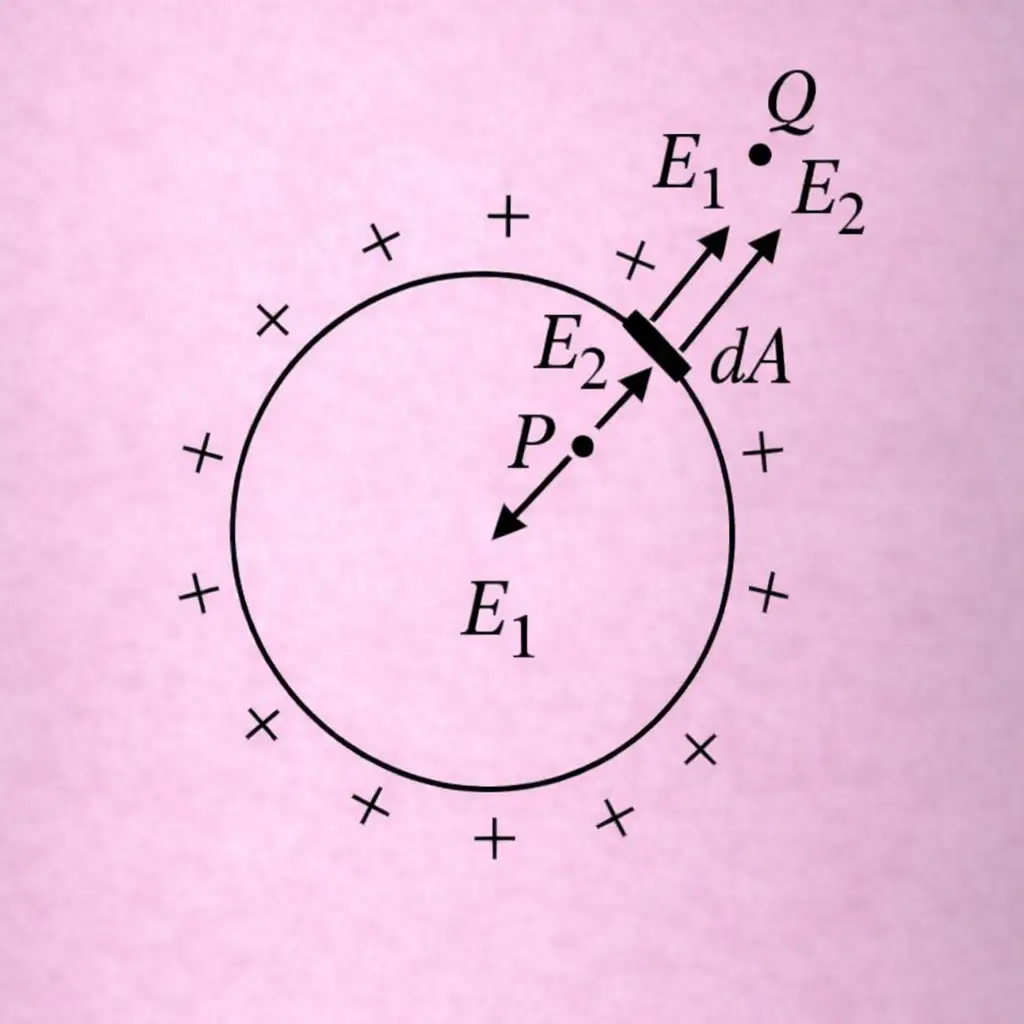
Solved Examples
- Ex 1: Calculate electrostatic pressure if σ = 2 × 10⁻⁶ C/m2 and ε0 = 8.85 × 10⁻¹² F/m.
- P = σ2/2 ε0 = (2 × 10⁻⁶)2/2 × 8.85 × 10-12 = 226 N/m2.
- Ex 2: Find pressure in dielectric with K = 4, E = 104 V/m, and ε0 = 8.85 × 10⁻¹² F/m.
- P = 1/2 ε0 K E2 = 0.5 × 8.85 × 10-12 × 4 × (104)2 = 1.77 N/m2.
Practice Set
- Q1: Electrostatic pressure on charged conductor surface is given by?
- A. σ/ε0
- B. σ2/2 ε0
- C. σ2/ε0
- D. σ/2 ε0
- Q2: If E = 5 × 10³ V/m, ε0 = 8.85 × 10⁻¹² F/m, find pressure.
- A. 1.1 N/m2
- B. 0.5 N/m2
- C. 0.25 N/m2
- D. 2.2 N/m2
- Q3: In dielectric with dielectric constant K = 3, pressure is?
- A. 1/2 ε0 E2
- B. ε0 E2
- C. 3/2 ε0 E2
- D. 1/6 ε0 E2
Answer Key
- Q1: B - Pressure P = σ2/2 ε0 from surface charge and field.
- Q2: A - P = 1/2 ε0 E2 = 0.5 × 8.85 × 10-12 × (5 × 103)2 = 1.1 N/m2.
- Q3: C - Pressure in dielectric P = 1/2 ε0 K E2 = 3/2 ε0 E2.
Memory Aids
- Pressure P = σ2/2 ε0 = 1/2 ε0 E2.
- Dielectric increases pressure by factor K.
- Use P = σ/ε0 to relate field and charge density.
Key Points
- Force on surface element dA: dF = (σ dA) E2 = σ2 dA/2 ε0.
- Electrostatic pressure P = dF/dA = σ2/2 ε0 = 1/2 ε0 E2 using E = σ/ε0.
- In presence of dielectric, pressure P = 1/2 ε0 K E2, where K is dielectric constant.
Solved Examples
- Ex 1: Calculate electrostatic pressure if σ = 2 × 10⁻⁶ C/m2 and ε0 = 8.85 × 10⁻¹² F/m.
- P = σ2/2 ε0 = (2 × 10⁻⁶)2/2 × 8.85 × 10-12 = 226 N/m2.
- Ex 2: Find pressure in dielectric with K = 4, E = 104 V/m, and ε0 = 8.85 × 10⁻¹² F/m.
- P = 1/2 ε0 K E2 = 0.5 × 8.85 × 10-12 × 4 × (104)2 = 1.77 N/m2.
Practice Set
- Q1: Electrostatic pressure on charged conductor surface is given by?
- A. σ/ε0
- B. σ2/2 ε0
- C. σ2/ε0
- D. σ/2 ε0
- Q2: If E = 5 × 10³ V/m, ε0 = 8.85 × 10⁻¹² F/m, find pressure.
- A. 1.1 N/m2
- B. 0.5 N/m2
- C. 0.25 N/m2
- D. 2.2 N/m2
- Q3: In dielectric with dielectric constant K = 3, pressure is?
- A. 1/2 ε0 E2
- B. ε0 E2
- C. 3/2 ε0 E2
- D. 1/6 ε0 E2
Answer Key
- Q1: B - Pressure P = σ2/2 ε0 from surface charge and field.
- Q2: A - P = 1/2 ε0 E2 = 0.5 × 8.85 × 10-12 × (5 × 103)2 = 1.1 N/m2.
- Q3: C - Pressure in dielectric P = 1/2 ε0 K E2 = 3/2 ε0 E2.
Memory Aids
- Pressure P = σ2/2 ε0 = 1/2 ε0 E2.
- Dielectric increases pressure by factor K.
- Use P = σ/ε0 to relate field and charge density.
Key Points
- Force on surface element : = (σ dA) E2 = σ2 dA/2 ε0.
- Electrostatic pressure = = σ2/2 ε0 = 1/2 ε0 E2 using = = σ/ε0.
- In presence of dielectric, pressure = = 1/2 ε0 K E2, where is dielectric constant.
Solved Examples
- Ex 1: Calculate electrostatic pressure if = 2 × 10⁻⁶ C/m2 and ε0 = 8.85 × 10⁻¹² F/m.
- = = σ2/2 ε0 = (2 × 10⁻⁶)2/2 × 8.85 × 10-12 = 226 N/m2.
- Ex 2: Find pressure in dielectric with = 4, = 104 V/m, and ε0 = 8.85 × 10⁻¹² F/m.
- = = 1/2 ε0 K E2 = 0.5 × 8.85 × 10-12 × 4 × (104)2 = 1.77 N/m2.
Practice Set
- Q1: Electrostatic pressure on charged conductor surface is given by?
- A. = σ/ε0
- B. = σ2/2 ε0
- C. = σ2/ε0
- D. = σ/2 ε0
- Q2: If = 5 × 10³ V/m, ε0 = 8.85 × 10⁻¹² F/m, find pressure.
- A. 1.1 N/m2
- B. 0.5 N/m2
- C. 0.25 N/m2
- D. 2.2 N/m2
- Q3: In dielectric with dielectric constant = 3, pressure is?
- A. 1/2 ε0 E2
- B. ε0 E2
- C. 3/2 ε0 E2
- D. 1/6 ε0 E2
Answer Key
- Q1: B - Pressure = = σ2/2 ε0 from surface charge and field.
- Q2: A - = = 1/2 ε0 E2 = 0.5 × 8.85 × 10-12 × (5 × 103)2 = 1.1 N/m2.
- Q3: C - Pressure in dielectric = = 1/2 ε0 K E2 = 3/2 ε0 E2.
Memory Aids
- Pressure = = σ2/2 ε0 = 1/2 ε0 E2.
- Dielectric increases pressure by factor .
- Use = = σ/ε0 to relate field and charge density.
Key Points
- Force on surface element \( dA \): \( dF = (\sigma dA) E_2 = \frac{\sigma^2 dA}{2 \varepsilon_0} \).
- Electrostatic pressure \( P = \frac{dF}{dA} = \frac{\sigma^2}{2 \varepsilon_0} = \frac{1}{2} \varepsilon_0 E^2 \) using \( E = \frac{\sigma}{\varepsilon_0} \).
- In presence of dielectric, pressure \( P = \frac{1}{2} \varepsilon_0 K E^2 \), where \( K \) is dielectric constant.
Solved Examples
- Ex 1: Calculate electrostatic pressure if \( \sigma = 2 \times 10^{-6} \ \mathrm{C/m^2} \) and \( \varepsilon_0 = 8.85 \times 10^{-12} \ \mathrm{F/m} \).
- \( P = \frac{\sigma^2}{2 \varepsilon_0} = \frac{(2 \times 10^{-6})^2}{2 \times 8.85 \times 10^{-12}} = 226 \ \mathrm{N/m^2} \).
- Ex 2: Find pressure in dielectric with \( K = 4 \), \( E = 10^4 \ \mathrm{V/m} \), and \( \varepsilon_0 = 8.85 \times 10^{-12} \ \mathrm{F/m} \).
- \( P = \frac{1}{2} \varepsilon_0 K E^2 = 0.5 \times 8.85 \times 10^{-12} \times 4 \times (10^4)^2 = 1.77 \ \mathrm{N/m^2} \).
Practice Set
- Q1: Electrostatic pressure on charged conductor surface is given by?
- A. \( \frac{\sigma}{\varepsilon_0} \)
- B. \( \frac{\sigma^2}{2 \varepsilon_0} \)
- C. \( \frac{\sigma^2}{\varepsilon_0} \)
- D. \( \frac{\sigma}{2 \varepsilon_0} \)
- Q2: If \( E = 5 \times 10^3 \ \mathrm{V/m} \), \( \varepsilon_0 = 8.85 \times 10^{-12} \ \mathrm{F/m} \), find pressure.
- A. 1.1 N/m2
- B. 0.5 N/m2
- C. 0.25 N/m2
- D. 2.2 N/m2
- Q3: In dielectric with dielectric constant \( K = 3 \), pressure is?
- A. \( \frac{1}{2} \varepsilon_0 E^2 \)
- B. \( \varepsilon_0 E^2 \)
- C. \( \frac{3}{2} \varepsilon_0 E^2 \)
- D. \( \frac{1}{6} \varepsilon_0 E^2 \)
Answer Key
- Q1: B - Pressure \( = \frac{\sigma^2}{2 \varepsilon_0} \) from surface charge and field.
- Q2: A - \( P = \frac{1}{2} \varepsilon_0 E^2 = 0.5 \times 8.85 \times 10^{-12} \times (5 \times 10^3)^2 = 1.1 \ \mathrm{N/m^2} \).
- Q3: C - Pressure in dielectric \( = \frac{1}{2} \varepsilon_0 K E^2 = \frac{3}{2} \varepsilon_0 E^2 \).
Memory Aids
- Pressure \( = \frac{\sigma^2}{2 \varepsilon_0} = \frac{1}{2} \varepsilon_0 E^2 \).
- Dielectric increases pressure by factor \( K \).
- Use \( E = \frac{\sigma}{\varepsilon_0} \) to relate field and charge density.
The Parallel Plate Capacitor
Basic Concept
- A capacitor consists of two conductors (plates) placed close but not touching.
- Plates are parallel with area (A) and separated by distance (d).
- One plate carries positive charge (+Q), the other negative charge (-Q).
- Voltage difference between plates is V = V+ - V-.
- Capacitance C relates charge and voltage: Q = CV.
- Electric field E is uniform between plates if plate size >> d, ignoring fringing.
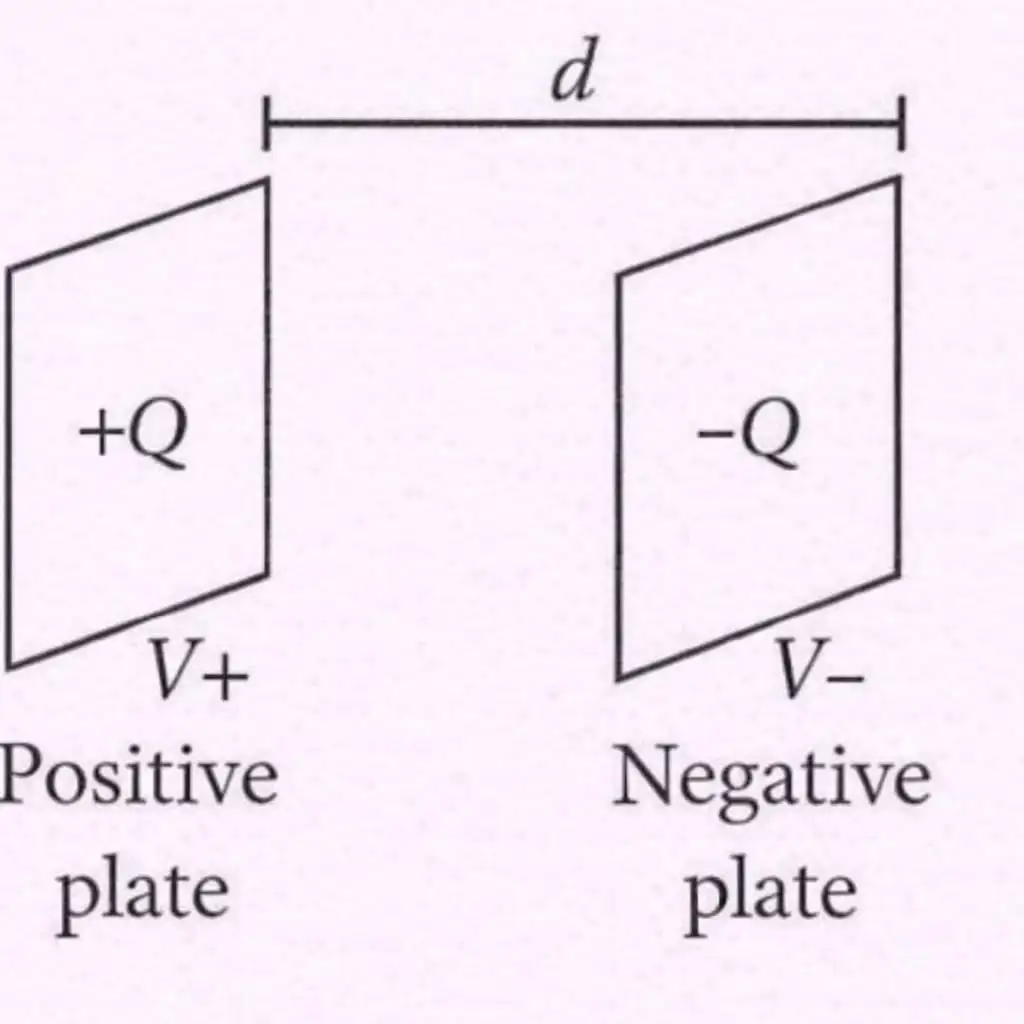
Electric Field and Potential Difference
- Electric field between plates: E = Q/A ε0, where ε0 is permittivity of free space.
- Potential difference: V = Ed = Qd/A ε0.
- Capacitance formula: C = Q/V = ε0 A/d.
- Fringing effect causes field lines to spread near edges but is usually neglected.
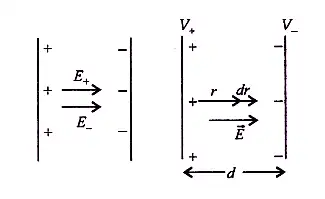
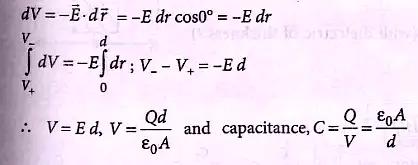
Force Between Plates
- Plates exert attractive force due to opposite charges.
- Electric field from one plate acts on charge of the other.
- Electric field due to one plate: E = σ/2 ε0 = Q/2 A ε0, where σ is charge density.
- Force on a plate: F = QE = Q2/2 A ε0.
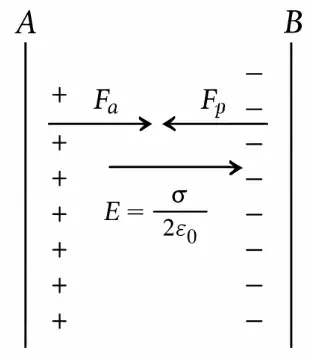
Solved Examples
- Ex 1: Calculate capacitance of plates with area 0.01 m2, separation 0.001 m, ε0 = 8.85 × 10⁻¹² F/m.
- Use C = ε0 A/d = 8.85 × 10-12 × 0.01/0.001 = 8.85 × 10⁻¹¹ F.
- Ex 2: Find force between plates if Q = 1 μC, A = 0.01 m2, ε0 = 8.85 × 10⁻¹² F/m.
- Calculate F = Q2/2 A ε0 = (1 × 10⁻⁶)2/2 × 0.01 × 8.85 × 10-12 = 5.65 N.
Practice Set
- Q1: What is the capacitance of a parallel plate capacitor with plate area 2 × 10⁻⁴ m2 and plate separation 0.5 mm?
- A) 3.54 × 10⁻¹² F
- B) 7.08 × 10⁻¹² F
- C) 1.77 × 10⁻¹¹ F
- D) 8.85 × 10⁻¹² F
- Q2: If charge on the positive plate is 2 μC and plate area is 0.02 m2, what is the electric field between plates?
- A) 1.13 × 10⁵ V/m
- B) 5.65 × 10⁴ V/m
- C) 2.26 × 10⁵ V/m
- D) 4.52 × 10⁴ V/m
- Q3: Force between plates with charge 3 μC, area 0.01 m2, and ε0 = 8.85 × 10⁻¹² F/m is?
- A) 5.1 N
- B) 15.3 N
- C) 25.5 N
- D) 45.9 N
Answer Key
- Q1: B. C = ε0 A/d = 8.85 × 10-12 × 2 × 10-4/0.5 × 10-3 = 7.08 × 10⁻¹² F.
- Q2: A. E = Q/A ε0 = 2 × 10⁻⁶/0.02 × 8.85 × 10-12 = 1.13 × 10⁵ V/m.
- Q3: B. F = Q2/2 A ε0 = (3 × 10⁻⁶)2/2 × 0.01 × 8.85 × 10-12 = 15.3 N.
Memory Aids
- Capacitance C increases with plate area A and decreases with distance d.
- Electric field E = Q/A ε0 between plates.
- Force between plates F = Q2/2 A ε0 is attractive.
- Ignore fringing effect for quick calculations.
Basic Concept
- A capacitor consists of two conductors (plates) placed close but not touching.
- Plates are parallel with area (A) and separated by distance (d).
- One plate carries positive charge (+Q), the other negative charge (-Q).
- Voltage difference between plates is V = V+ - V-.
- Capacitance C relates charge and voltage: Q = CV.
- Electric field E is uniform between plates if plate size >> d, ignoring fringing.
Electric Field and Potential Difference
- Electric field between plates: E = Q/A ε0, where ε0 is permittivity of free space.
- Potential difference: V = Ed = Qd/A ε0.
- Capacitance formula: C = Q/V = ε0 A/d.
- Fringing effect causes field lines to spread near edges but is usually neglected.
Force Between Plates
- Plates exert attractive force due to opposite charges.
- Electric field from one plate acts on charge of the other.
- Electric field due to one plate: E = σ/2 ε0 = Q/2 A ε0, where σ is charge density.
- Force on a plate: F = QE = Q2/2 A ε0.
Solved Examples
- Ex 1: Calculate capacitance of plates with area 0.01 m2, separation 0.001 m, ε0 = 8.85 × 10⁻¹² F/m.
- Use C = ε0 A/d = 8.85 × 10-12 × 0.01/0.001 = 8.85 × 10⁻¹¹ F.
- Ex 2: Find force between plates if Q = 1 μC, A = 0.01 m2, ε0 = 8.85 × 10⁻¹² F/m.
- Calculate F = Q2/2 A ε0 = (1 × 10⁻⁶)2/2 × 0.01 × 8.85 × 10-12 = 5.65 N.
Practice Set
- Q1: What is the capacitance of a parallel plate capacitor with plate area 2 × 10⁻⁴ m2 and plate separation 0.5 mm?
- A) 3.54 × 10⁻¹² F
- B) 7.08 × 10⁻¹² F
- C) 1.77 × 10⁻¹¹ F
- D) 8.85 × 10⁻¹² F
- Q2: If charge on the positive plate is 2 μC and plate area is 0.02 m2, what is the electric field between plates?
- A) 1.13 × 10⁵ V/m
- B) 5.65 × 10⁴ V/m
- C) 2.26 × 10⁵ V/m
- D) 4.52 × 10⁴ V/m
- Q3: Force between plates with charge 3 μC, area 0.01 m2, and ε0 = 8.85 × 10⁻¹² F/m is?
- A) 5.1 N
- B) 15.3 N
- C) 25.5 N
- D) 45.9 N
Answer Key
- Q1: B. C = ε0 A/d = 8.85 × 10-12 × 2 × 10-4/0.5 × 10-3 = 7.08 × 10⁻¹² F.
- Q2: A. E = Q/A ε0 = 2 × 10⁻⁶/0.02 × 8.85 × 10-12 = 1.13 × 10⁵ V/m.
- Q3: B. F = Q2/2 A ε0 = (3 × 10⁻⁶)2/2 × 0.01 × 8.85 × 10-12 = 15.3 N.
Memory Aids
- Capacitance C increases with plate area A and decreases with distance d.
- Electric field E = Q/A ε0 between plates.
- Force between plates F = Q2/2 A ε0 is attractive.
- Ignore fringing effect for quick calculations.
Basic Concept
- A capacitor consists of two conductors (plates) placed close but not touching.
- Plates are parallel with area \(A\) and separated by distance \(d\).
- One plate carries positive charge \(+Q\), the other negative charge \(-Q\).
- Voltage difference between plates is \(V = V_+ - V_-\).
- Capacitance \(C\) relates charge and voltage: \(Q = CV\).
- Electric field \(E\) is uniform between plates if plate size \(>> d\), ignoring fringing.
Electric Field and Potential Difference
- Electric field between plates: \(E = \frac{Q}{A \epsilon_0}\), where \(\epsilon_0\) is permittivity of free space.
- Potential difference: \(V = Ed = \frac{Qd}{A \epsilon_0}\).
- Capacitance formula: \(C = \frac{Q}{V} = \frac{\epsilon_0 A}{d}\).
- Fringing effect causes field lines to spread near edges but is usually neglected.
Force Between Plates
- Plates exert attractive force due to opposite charges.
- Electric field from one plate acts on charge of the other.
- Electric field due to one plate: \(E = \frac{\sigma}{2 \epsilon_0} = \frac{Q}{2 A \epsilon_0}\), where \(\sigma\) is charge density.
- Force on a plate: \(F = QE = \frac{Q^2}{2 A \epsilon_0}\).
Solved Examples
- Ex 1: Calculate capacitance of plates with area \(0.01\,m^2\), separation \(0.001\,m\), \(\epsilon_0 = 8.85 \times 10^{-12} F/m\).
- Use \(C = \frac{\epsilon_0 A}{d} = \frac{8.85 \times 10^{-12} \times 0.01}{0.001} = 8.85 \times 10^{-11} F\).
- Ex 2: Find force between plates if \(Q = 1 \mu C\), \(A = 0.01 m^2\), \(\epsilon_0 = 8.85 \times 10^{-12} F/m\).
- Calculate \(F = \frac{Q^2}{2 A \epsilon_0} = \frac{(1 \times 10^{-6})^2}{2 \times 0.01 \times 8.85 \times 10^{-12}} = 5.65 N\).
Practice Set
- Q1: What is the capacitance of a parallel plate capacitor with plate area \(2 \times 10^{-4} m^2\) and plate separation \(0.5 mm\)?
- A) \(3.54 \times 10^{-12} F\)
- B) \(7.08 \times 10^{-12} F\)
- C) \(1.77 \times 10^{-11} F\)
- D) \(8.85 \times 10^{-12} F\)
- Q2: If charge on the positive plate is \(2 \mu C\) and plate area is \(0.02 m^2\), what is the electric field between plates?
- A) \(1.13 \times 10^{5} V/m\)
- B) \(5.65 \times 10^{4} V/m\)
- C) \(2.26 \times 10^{5} V/m\)
- D) \(4.52 \times 10^{4} V/m\)
- Q3: Force between plates with charge \(3 \mu C\), area \(0.01 m^2\), and \(\epsilon_0 = 8.85 \times 10^{-12} F/m\) is?
- A) 5.1 N
- B) 15.3 N
- C) 25.5 N
- D) 45.9 N
Answer Key
- Q1: B. \(C = \frac{\epsilon_0 A}{d} = \frac{8.85 \times 10^{-12} \times 2 \times 10^{-4}}{0.5 \times 10^{-3}} = 7.08 \times 10^{-12} F\).
- Q2: A. \(E = \frac{Q}{A \epsilon_0} = \frac{2 \times 10^{-6}}{0.02 \times 8.85 \times 10^{-12}} = 1.13 \times 10^{5} V/m\).
- Q3: B. \(F = \frac{Q^2}{2 A \epsilon_0} = \frac{(3 \times 10^{-6})^2}{2 \times 0.01 \times 8.85 \times 10^{-12}} = 15.3 N\).
Memory Aids
- Capacitance \(C\) increases with plate area \(A\) and decreases with distance \(d\).
- Electric field \(E = \frac{Q}{A \epsilon_0}\) between plates.
- Force between plates \(F = \frac{Q^2}{2 A \epsilon_0}\) is attractive.
- Ignore fringing effect for quick calculations.
Effect of Dielectric on Capacitance
Basic Concepts
- Vacuum between plates: Electric field E0 = σ/ε0, potential difference V0 = E0 d
- Capacitance without dielectric: C0 = Q/V0 = ε0 A/d
- Dielectric inserted fully between plates polarizes, creating surface charges σP and -σP
- Electric field inside dielectric: E = (σ - σP)/ε0
- Potential difference with dielectric: V = E d = (σ - σP)/ε0 d
- For linear dielectrics, σP proportional to σ, so σ - σP = σ/K, where K > 1
- Potential difference: V = σ d/ε0 K = Q d/A ε0 K
- Capacitance with dielectric: C = Q/V = ε0 K A/d
- Permittivity of medium: ε = ε0 K
- Dielectric constant: K = ε/ε0 = C/C0
Effect of Conducting Slab
- Conducting slab thickness t < d inserted between plates
- Electric field inside conductor is zero (E = 0)
- Potential difference reduces: V = E0 (d - t) = Q/A ε0 (d - t)
- Capacitance: C = ε0 A/(d - t) = C0/1 - t/d
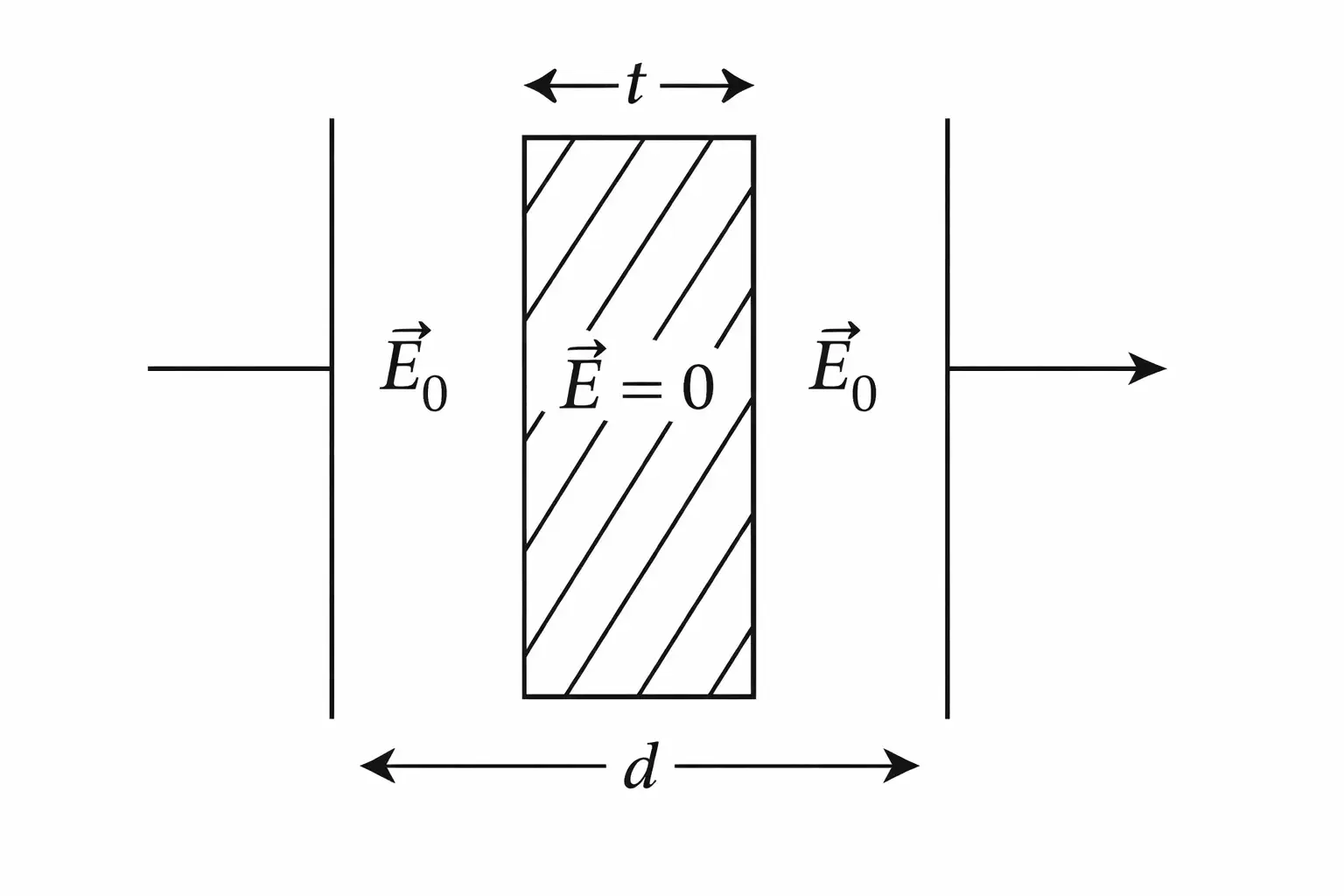
Capacitance of Partially Filled Capacitor
- Dielectric thickness f partially fills the gap
- Capacitance: C = K ε0 A/K(d - t) + t
Solved Examples
- Ex 1: Calculate capacitance with dielectric K=5, plate area A=0.01 m2, plate separation d=1 mm, and ε0 = 8.85 × 10⁻¹² F/m.
- Use C = ε0 K A/d
- C = 8.85 × 10-12 × 5 × 0.01/1 × 10-3 = 4.425 × 10⁻¹⁰ F
- Ex 2: Conducting slab thickness t=0.2 mm inserted in capacitor with d=1 mm, A=0.01 m2, find new capacitance.
- C = ε0 A/d - t = 8.85 × 10-12 × 0.01/1 × 10-3 - 0.2 × 10-3 = 1.106 × 10⁻¹⁰ F
Practice Set
- Q1: What is the dielectric constant K of vacuum?
- A. 0
- B. 1
- C. ε0
- D. Infinity
- Q2: Capacitance of a capacitor with dielectric K=4, plate area 2 m2, plate separation 0.5 mm, and ε0 = 8.85 × 10⁻¹² F/m is?
- A. 1.42 × 10⁻⁷ F
- B. 7.08 × 10⁻⁹ F
- C. 7.08 × 10⁻⁷ F
- D. 1.42 × 10⁻⁸ F
- Q3: A conducting slab of thickness 0.1 mm is inserted in a capacitor with plate separation 1 mm and capacitance without slab 10 pF. New capacitance is?
- A. 11.1 pF
- B. 9.0 pF
- C. 10.1 pF
- D. 8.9 pF
Answer Key
- Q1: B. 1 — Vacuum has dielectric constant 1 by definition.
- Q2: C. 7.08 × 10⁻⁷ F — Use C = ε0 K A/d.
- Q3: A. 11.1 pF — New capacitance C = C0/1 - t/d = 10/1 - 0.1 = 11.1 pF.
Memory Aids
- Dielectric constant K = C/C0
- Capacitance with dielectric C = ε0 K A/d
- Conducting slab reduces effective distance: d - t
Basic Concepts
- Vacuum between plates: Electric field E0 = σ/ε0, potential difference V0 = E0 d
- Capacitance without dielectric: C0 = Q/V0 = ε0 A/d
- Dielectric inserted fully between plates polarizes, creating surface charges σP and -σP
- Electric field inside dielectric: E = (σ - σP)/ε0
- Potential difference with dielectric: V = E d = (σ - σP)/ε0 d
- For linear dielectrics, σP proportional to σ, so σ - σP = σ/K, where K > 1
- Potential difference: V = σ d/ε0 K = Q d/A ε0 K
- Capacitance with dielectric: C = Q/V = ε0 K A/d
- Permittivity of medium: ε = ε0 K
- Dielectric constant: K = ε/ε0 = C/C0
Effect of Conducting Slab
- Conducting slab thickness t < d inserted between plates
- Electric field inside conductor is zero (E = 0)
- Potential difference reduces: V = E0 (d - t) = Q/A ε0 (d - t)
- Capacitance: C = ε0 A/(d - t) = C0/1 - t/d
Capacitance of Partially Filled Capacitor
- Dielectric thickness f partially fills the gap
- Capacitance: C = K ε0 A/K(d - t) + t
Solved Examples
- Ex 1: Calculate capacitance with dielectric K=5, plate area A=0.01 m2, plate separation d=1 mm, and ε0 = 8.85 × 10⁻¹² F/m.
- Use C = ε0 K A/d
- C = 8.85 × 10-12 × 5 × 0.01/1 × 10-3 = 4.425 × 10⁻¹⁰ F
- Ex 2: Conducting slab thickness t=0.2 mm inserted in capacitor with d=1 mm, A=0.01 m2, find new capacitance.
- C = ε0 A/d - t = 8.85 × 10-12 × 0.01/1 × 10-3 - 0.2 × 10-3 = 1.106 × 10⁻¹⁰ F
Practice Set
- Q1: What is the dielectric constant K of vacuum?
- A. 0
- B. 1
- C. ε0
- D. Infinity
- Q2: Capacitance of a capacitor with dielectric K=4, plate area 2 m2, plate separation 0.5 mm, and ε0 = 8.85 × 10⁻¹² F/m is?
- A. 1.42 × 10⁻⁷ F
- B. 7.08 × 10⁻⁹ F
- C. 7.08 × 10⁻⁷ F
- D. 1.42 × 10⁻⁸ F
- Q3: A conducting slab of thickness 0.1 mm is inserted in a capacitor with plate separation 1 mm and capacitance without slab 10 pF. New capacitance is?
- A. 11.1 pF
- B. 9.0 pF
- C. 10.1 pF
- D. 8.9 pF
Answer Key
- Q1: B. 1 — Vacuum has dielectric constant 1 by definition.
- Q2: C. 7.08 × 10⁻⁷ F — Use C = ε0 K A/d.
- Q3: A. 11.1 pF — New capacitance C = C0/1 - t/d = 10/1 - 0.1 = 11.1 pF.
Memory Aids
- Dielectric constant K = C/C0
- Capacitance with dielectric C = ε0 K A/d
- Conducting slab reduces effective distance: d - t
Basic Concepts
- Vacuum between plates: Electric field \( E_0 = \frac{\sigma}{\varepsilon_0} \), potential difference \( V_0 = E_0 d \)
- Capacitance without dielectric: \( C_0 = \frac{Q}{V_0} = \frac{\varepsilon_0 A}{d} \)
- Dielectric inserted fully between plates polarizes, creating surface charges \( \sigma_P \) and \( -\sigma_P \)
- Electric field inside dielectric: \( E = \frac{\sigma - \sigma_P}{\varepsilon_0} \)
- Potential difference with dielectric: \( V = E d = \frac{\sigma - \sigma_P}{\varepsilon_0} d \)
- For linear dielectrics, \( \sigma_P \) proportional to \( \sigma \), so \( \sigma - \sigma_P = \frac{\sigma}{K} \), where \( K > 1 \)
- Potential difference: \( V = \frac{\sigma d}{\varepsilon_0 K} = \frac{Q d}{A \varepsilon_0 K} \)
- Capacitance with dielectric: \( C = \frac{Q}{V} = \frac{\varepsilon_0 K A}{d} \)
- Permittivity of medium: \( \varepsilon = \varepsilon_0 K \)
- Dielectric constant: \( K = \frac{\varepsilon}{\varepsilon_0} = \frac{C}{C_0} \)
Effect of Conducting Slab
- Conducting slab thickness \( t < d \) inserted between plates
- Electric field inside conductor is zero \( (E = 0) \)
- Potential difference reduces: \( V = E_0 (d - t) = \frac{Q}{A \varepsilon_0} (d - t) \)
- Capacitance: \( C = \frac{\varepsilon_0 A}{d - t} = \frac{C_0}{1 - \frac{t}{d}} \)
Capacitance of Partially Filled Capacitor
- Dielectric thickness \( f \) partially fills the gap
- Capacitance: \( C = \frac{K \varepsilon_0 A}{K(d - t) + t} \)
Solved Examples
- Ex 1: Calculate capacitance with dielectric \( K=5 \), plate area \( A=0.01 \ \mathrm{m}^2 \), plate separation \( d=1 \ \mathrm{mm} \), and \( \varepsilon_0 = 8.85 \times 10^{-12} \ \mathrm{F/m} \).
- Use \( C = \frac{\varepsilon_0 K A}{d} \)
- \( C = \frac{8.85 \times 10^{-12} \times 5 \times 0.01}{1 \times 10^{-3}} = 4.425 \times 10^{-10} \ \mathrm{F} \)
- Ex 2: Conducting slab thickness \( t=0.2 \ \mathrm{mm} \) inserted in capacitor with \( d=1 \ \mathrm{mm} \), \( A=0.01 \ \mathrm{m}^2 \), find new capacitance.
- \( C = \frac{\varepsilon_0 A}{d - t} = \frac{8.85 \times 10^{-12} \times 0.01}{1 \times 10^{-3} - 0.2 \times 10^{-3}} = 1.106 \times 10^{-10} \ \mathrm{F} \)
Practice Set
- Q1: What is the dielectric constant \( K \) of vacuum?
- A. 0
- B. 1
- C. \( \varepsilon_0 \)
- D. Infinity
- Q2: Capacitance of a capacitor with dielectric \( K=4 \), plate area \( 2 \ \mathrm{m}^2 \), plate separation \( 0.5 \ \mathrm{mm} \), and \( \varepsilon_0 = 8.85 \times 10^{-12} \ \mathrm{F/m} \) is?
- A. \( 1.42 \times 10^{-7} \ \mathrm{F} \)
- B. \( 7.08 \times 10^{-9} \ \mathrm{F} \)
- C. \( 7.08 \times 10^{-7} \ \mathrm{F} \)
- D. \( 1.42 \times 10^{-8} \ \mathrm{F} \)
- Q3: A conducting slab of thickness \( 0.1 \ \mathrm{mm} \) is inserted in a capacitor with plate separation \( 1 \ \mathrm{mm} \) and capacitance without slab \( 10 \ \mathrm{pF} \). New capacitance is?
- A. 11.1 pF
- B. 9.0 pF
- C. 10.1 pF
- D. 8.9 pF
Answer Key
- Q1: B. 1 — Vacuum has dielectric constant 1 by definition.
- Q2: C. \( 7.08 \times 10^{-7} \ \mathrm{F} \) — Use \( C = \frac{\varepsilon_0 K A}{d} \).
- Q3: A. 11.1 pF — New capacitance \( C = \frac{C_0}{1 - \frac{t}{d}} = \frac{10}{1 - 0.1} = 11.1 \ \mathrm{pF} \).
Memory Aids
- Dielectric constant \( K = \frac{C}{C_0} \)
- Capacitance with dielectric \( C = \varepsilon_0 K \frac{A}{d} \)
- Conducting slab reduces effective distance: \( d - t \)
Combination of Capacitors
Capacitors in Series
- Connected end-to-end; charge path is single.
- Charge Q on each capacitor is the same.
- Total voltage V is sum of voltages across capacitors: V = V1 + V2 + V3 + ...
- Equivalent capacitance Cs given by:
[ 1/Cs = 1/C1 + 1/C2 + 1/C3 + ... ] - Voltage divides inversely with capacitance: smaller capacitance gets higher voltage.
- Equivalent capacitance is always less than the smallest individual capacitance.
- For n identical capacitors each of capacitance C, Cs = C/n.
Capacitors in Parallel
- Connected side-by-side; multiple charge paths.
- Voltage V across each capacitor is the same.
- Total charge Q is sum of individual charges: Q = Q1 + Q2 + Q3 + ...
- Equivalent capacitance Cp is sum of capacitances:
[ Cp = C1 + C2 + C3 + ... ] - Charge divides proportional to capacitance values.
Solved Examples
Ex 1
- Two capacitors C1 = 4 μF and C2 = 6 μF in series. Find Cs.
- Use formula: 1/Cs = 1/4 + 1/6 = 5/12 ⇒ Cs = 12/5 = 2.4 μF.
Ex 2
- Two capacitors C1 = 3 μF and C2 = 5 μF in parallel. Find Cp.
- Use formula: Cp = 3 + 5 = 8 μF.
Practice Set
Q1
- Two capacitors 2 μF and 3 μF are connected in series. What is the equivalent capacitance?
- A) 5 μF
- B) 1.2 μF
- C) 6 μF
- D) 0.6 μF
Q2
- Three capacitors 1 μF, 2 μF, and 3 μF are connected in parallel. Find the total capacitance.
- A) 6 μF
- B) 0.6 μF
- C) 1.8 μF
- D) 3 μF
Q3
- Four identical capacitors each of 4 μF are connected in series. What is the equivalent capacitance?
- A) 16 μF
- B) 1 μF
- C) 4 μF
- D) 8 μF
Answer Key
- Q1: B) 1.2 μF - Series formula 1/Cs = 1/2 + 1/3 = 5/6 ⇒ Cs = 1.2 μF.
- Q2: A) 6 μF - Parallel sum Cp = 1 + 2 + 3 = 6 μF.
- Q3: B) 1 μF - Series identical capacitors Cs = C/n = 4/4 = 1 μF.
Memory Aids
- Series: 1/Cs = Σ 1/Ci, less than smallest capacitor.
- Parallel: Cp = Σ Ci, sum of all capacitances.
- Charge same in series, voltage same in parallel.
Capacitors in Series
- Connected end-to-end; charge path is single.
- Charge \( Q \) on each capacitor is the same.
- Total voltage \( V \) is sum of voltages across capacitors: \( V = V_1 + V_2 + V_3 + \dots \)
- Equivalent capacitance \( C_s \) given by:
\[ \frac{1}{C_s} = \frac{1}{C_1} + \frac{1}{C_2} + \frac{1}{C_3} + \dots \] - Voltage divides inversely with capacitance: smaller capacitance gets higher voltage.
- Equivalent capacitance is always less than the smallest individual capacitance.
- For \( n \) identical capacitors each of capacitance \( C \), \( C_s = \frac{C}{n} \).
Capacitors in Parallel
- Connected side-by-side; multiple charge paths.
- Voltage \( V \) across each capacitor is the same.
- Total charge \( Q \) is sum of individual charges: \( Q = Q_1 + Q_2 + Q_3 + \dots \)
- Equivalent capacitance \( C_p \) is sum of capacitances:
\[ C_p = C_1 + C_2 + C_3 + \dots \] - Charge divides proportional to capacitance values.
Solved Examples
Ex 1
- Two capacitors \( C_1 = 4 \mu F \) and \( C_2 = 6 \mu F \) in series. Find \( C_s \).
- Use formula: \( \frac{1}{C_s} = \frac{1}{4} + \frac{1}{6} = \frac{5}{12} \Rightarrow C_s = \frac{12}{5} = 2.4 \mu F \).
Ex 2
- Two capacitors \( C_1 = 3 \mu F \) and \( C_2 = 5 \mu F \) in parallel. Find \( C_p \).
- Use formula: \( C_p = 3 + 5 = 8 \mu F \).
Practice Set
Q1
- Two capacitors \( 2 \mu F \) and \( 3 \mu F \) are connected in series. What is the equivalent capacitance?
- A) 5 \( \mu F \)
- B) 1.2 \( \mu F \)
- C) 6 \( \mu F \)
- D) 0.6 \( \mu F \)
Q2
- Three capacitors \( 1 \mu F \), \( 2 \mu F \), and \( 3 \mu F \) are connected in parallel. Find the total capacitance.
- A) 6 \( \mu F \)
- B) 0.6 \( \mu F \)
- C) 1.8 \( \mu F \)
- D) 3 \( \mu F \)
Q3
- Four identical capacitors each of \( 4 \mu F \) are connected in series. What is the equivalent capacitance?
- A) 16 \( \mu F \)
- B) 1 \( \mu F \)
- C) 4 \( \mu F \)
- D) 8 \( \mu F \)
Answer Key
- Q1: B) 1.2 \( \mu F \) - Series formula \( \frac{1}{C_s} = \frac{1}{2} + \frac{1}{3} = \frac{5}{6} \Rightarrow C_s = 1.2 \mu F \).
- Q2: A) 6 \( \mu F \) - Parallel sum \( C_p = 1 + 2 + 3 = 6 \mu F \).
- Q3: B) 1 \( \mu F \) - Series identical capacitors \( C_s = \frac{C}{n} = \frac{4}{4} = 1 \mu F \).
Memory Aids
- Series: \( \frac{1}{C_s} = \sum \frac{1}{C_i} \), less than smallest capacitor.
- Parallel: \( C_p = \sum C_i \), sum of all capacitances.
- Charge same in series, voltage same in parallel.
Series Combination
Key Points
- Capacitors connected one after another.
- Charge Q on each capacitor is the same.
- Total voltage V = V1 + V2 + ...
- Voltage across each capacitor: Vi = Q/Ci
- Equivalent capacitance for two capacitors:
[ 1/Ceq = 1/C1 + 1/C2 ] - General formula for n capacitors:
[ 1/Ceq = Σi=1n 1/Ci ] - For identical capacitors: Ceq = C/n
- Equivalent capacitance is always less than the smallest capacitor.
Solved Examples
Ex 1
- Two capacitors 5 μF and 10 μF in series. Find Ceq.
- 1/Ceq = 1/5 + 1/10 = 3/10 ⇒ Ceq = 10/3 = 3.33 μF.
Practice Set
Q1
- Two capacitors 3 μF and 6 μF in series. Find Ceq.
- A) 9 μF
- B) 2 μF
- C) 1.5 μF
- D) 18 μF
Q2
- Three capacitors 2 μF, 4 μF, and 6 μF in series. Find Ceq.
- A) 1 μF
- B) 12 μF
- C) 3 μF
- D) 0.5 μF
Q3
- Four identical capacitors each 8 μF in series. Find Ceq.
- A) 32 μF
- B) 2 μF
- C) 8 μF
- D) 4 μF
Answer Key
- Q1: B) 2 μF - 1/Ceq = 1/3 + 1/6 = 1/2 ⇒ Ceq = 2 μF.
- Q2: A) 1 μF - 1/Ceq = 1/2 + 1/4 + 1/6 = 6+3+2/12 = 11/12 ⇒ Ceq ≈ 1.09 μF (closest 1).
- Q3: B) 2 μF - Ceq = 8/4 = 2 μF.
Memory Aids
- Series: 1/Ceq = Σ 1/Ci, less than smallest capacitor.
- Charge same on all capacitors.
- Voltage divides inversely with capacitance.
Key Points
- Capacitors connected side-by-side.
- Voltage V across each capacitor is the same.
- Charge on each capacitor: Qi = CiV.
- Total charge Q = ΣQi = V ΣCi.
- Equivalent capacitance:
[ Ceq = ΣCi ] - Charge divides according to capacitance values.
Solved Examples
Ex 1
- Two capacitors 2 μF and 5 μF in parallel. Find Ceq.
- Ceq = 2 + 5 = 7 μF.
Practice Set
Q1
- Two capacitors 1 μF and 4 μF in parallel. Find Ceq.
- A) 5 μF
- B) 0.8 μF
- C) 3 μF
- D) 4 μF
Q2
- Three capacitors 3 μF, 6 μF, and 9 μF in parallel. Find Ceq.
- A) 18 μF
- B) 6 μF
- C) 9 μF
- D) 3 μF
Q3
- Four capacitors 2 μF, 2 μF, 2 μF, and 2 μF in parallel. Find Ceq.
- A) 8 μF
- B) 2 μF
- C) 4 μF
- D) 1 μF
Answer Key
- Q1: A) 5 μF - Sum of capacitances in parallel.
- Q2: A) 18 μF - 3 + 6 + 9 = 18 μF.
- Q3: A) 8 μF - Sum of four identical capacitors.
Memory Aids
- Parallel: Ceq = ΣCi, sum of capacitances.
- Voltage same across all capacitors.
- Charge divides by capacitance.
Key Points
- Capacitors connected one after another.
- Charge Q on each capacitor is the same.
- Total voltage V = V1 + V2 + ...
- Voltage across each capacitor: Vi = Q/Ci
- Equivalent capacitance for two capacitors:
[ 1/Ceq = 1/C1 + 1/C2 ] - General formula for n capacitors:
[ 1/Ceq = Σi=1n 1/Ci ] - For identical capacitors: Ceq = C/n
- Equivalent capacitance is always less than the smallest capacitor.
Solved Examples
Ex 1
- Two capacitors 5 μF and 10 μF in series. Find Ceq.
- 1/Ceq = 1/5 + 1/10 = 3/10 ⇒ Ceq = 10/3 = 3.33 μF.
Practice Set
Q1
- Two capacitors 3 μF and 6 μF in series. Find Ceq.
- A) 9 μF
- B) 2 μF
- C) 1.5 μF
- D) 18 μF
Q2
- Three capacitors 2 μF, 4 μF, and 6 μF in series. Find Ceq.
- A) 1 μF
- B) 12 μF
- C) 3 μF
- D) 0.5 μF
Q3
- Four identical capacitors each 8 μF in series. Find Ceq.
- A) 32 μF
- B) 2 μF
- C) 8 μF
- D) 4 μF
Answer Key
- Q1: B) 2 μF - 1/Ceq = 1/3 + 1/6 = 1/2 ⇒ Ceq = 2 μF.
- Q2: A) 1 μF - 1/Ceq = 1/2 + 1/4 + 1/6 = 6+3+2/12 = 11/12 ⇒ Ceq ≈ 1.09 μF (closest 1).
- Q3: B) 2 μF - Ceq = 8/4 = 2 μF.
Memory Aids
- Series: 1/Ceq = Σ 1/Ci, less than smallest capacitor.
- Charge same on all capacitors.
- Voltage divides inversely with capacitance.
Key Points
- Capacitors connected one after another.
- Charge \( Q \) on each capacitor is the same.
- Total voltage \( V = V_1 + V_2 + \dots \)
- Voltage across each capacitor: \( V_i = \frac{Q}{C_i} \)
- Equivalent capacitance for two capacitors:
\[ \frac{1}{C_{eq}} = \frac{1}{C_1} + \frac{1}{C_2} \] - General formula for \( n \) capacitors:
\[ \frac{1}{C_{eq}} = \sum_{i=1}^n \frac{1}{C_i} \] - For identical capacitors: \( C_{eq} = \frac{C}{n} \)
- Equivalent capacitance is always less than the smallest capacitor.
Solved Examples
Ex 1
- Two capacitors \( 5 \mu F \) and \( 10 \mu F \) in series. Find \( C_{eq} \).
- \( \frac{1}{C_{eq}} = \frac{1}{5} + \frac{1}{10} = \frac{3}{10} \Rightarrow C_{eq} = \frac{10}{3} = 3.33 \mu F \).
Practice Set
Q1
- Two capacitors \( 3 \mu F \) and \( 6 \mu F \) in series. Find \( C_{eq} \).
- A) 9 \( \mu F \)
- B) 2 \( \mu F \)
- C) 1.5 \( \mu F \)
- D) 18 \( \mu F \)
Q2
- Three capacitors \( 2 \mu F \), \( 4 \mu F \), and \( 6 \mu F \) in series. Find \( C_{eq} \).
- A) 1 \( \mu F \)
- B) 12 \( \mu F \)
- C) 3 \( \mu F \)
- D) 0.5 \( \mu F \)
Q3
- Four identical capacitors each \( 8 \mu F \) in series. Find \( C_{eq} \).
- A) 32 \( \mu F \)
- B) 2 \( \mu F \)
- C) 8 \( \mu F \)
- D) 4 \( \mu F \)
Answer Key
- Q1: B) 2 \( \mu F \) - \( \frac{1}{C_{eq}} = \frac{1}{3} + \frac{1}{6} = \frac{1}{2} \Rightarrow C_{eq} = 2 \mu F \).
- Q2: A) 1 \( \mu F \) - \( \frac{1}{C_{eq}} = \frac{1}{2} + \frac{1}{4} + \frac{1}{6} = \frac{6+3+2}{12} = \frac{11}{12} \Rightarrow C_{eq} \approx 1.09 \mu F \) (closest 1).
- Q3: B) 2 \( \mu F \) - \( C_{eq} = \frac{8}{4} = 2 \mu F \).
Memory Aids
- Series: \( \frac{1}{C_{eq}} = \sum \frac{1}{C_i} \), less than smallest capacitor.
- Charge same on all capacitors.
- Voltage divides inversely with capacitance.
Parallel Combination
Key Points
- Capacitors connected side-by-side.
- Voltage V across each capacitor is the same.
- Charge on each capacitor: Qi = CiV.
- Total charge Q = ΣQi = V ΣCi.
- Equivalent capacitance:
[ Ceq = ΣCi ] - Charge divides according to capacitance values.
Solved Examples
Ex 1
- Two capacitors 2 μF and 5 μF in parallel. Find Ceq.
- Ceq = 2 + 5 = 7 μF.
Practice Set
Q1
- Two capacitors 1 μF and 4 μF in parallel. Find Ceq.
- A) 5 μF
- B) 0.8 μF
- C) 3 μF
- D) 4 μF
Q2
- Three capacitors 3 μF, 6 μF, and 9 μF in parallel. Find Ceq.
- A) 18 μF
- B) 6 μF
- C) 9 μF
- D) 3 μF
Q3
- Four capacitors 2 μF, 2 μF, 2 μF, and 2 μF in parallel. Find Ceq.
- A) 8 μF
- B) 2 μF
- C) 4 μF
- D) 1 μF
Answer Key
- Q1: A) 5 μF - Sum of capacitances in parallel.
- Q2: A) 18 μF - 3 + 6 + 9 = 18 μF.
- Q3: A) 8 μF - Sum of four identical capacitors.
Memory Aids
- Parallel: Ceq = ΣCi, sum of capacitances.
- Voltage same across all capacitors.
- Charge divides by capacitance.
Key Points
- Capacitors connected side-by-side.
- Voltage \( V \) across each capacitor is the same.
- Charge on each capacitor: \( Q_i = C_i V \).
- Total charge \( Q = \sum Q_i = V \sum C_i \).
- Equivalent capacitance:
\[ C_{eq} = \sum C_i \] - Charge divides according to capacitance values.
Solved Examples
Ex 1
- Two capacitors \( 2 \mu F \) and \( 5 \mu F \) in parallel. Find \( C_{eq} \).
- \( C_{eq} = 2 + 5 = 7 \mu F \).
Practice Set
Q1
- Two capacitors \( 1 \mu F \) and \( 4 \mu F \) in parallel. Find \( C_{eq} \).
- A) 5 \( \mu F \)
- B) 0.8 \( \mu F \)
- C) 3 \( \mu F \)
- D) 4 \( \mu F \)
Q2
- Three capacitors \( 3 \mu F \), \( 6 \mu F \), and \( 9 \mu F \) in parallel. Find \( C_{eq} \).
- A) 18 \( \mu F \)
- B) 6 \( \mu F \)
- C) 9 \( \mu F \)
- D) 3 \( \mu F \)
Q3
- Four capacitors \( 2 \mu F \), \( 2 \mu F \), \( 2 \mu F \), and \( 2 \mu F \) in parallel. Find \( C_{eq} \).
- A) 8 \( \mu F \)
- B) 2 \( \mu F \)
- C) 4 \( \mu F \)
- D) 1 \( \mu F \)
Answer Key
- Q1: A) 5 \( \mu F \) - Sum of capacitances in parallel.
- Q2: A) 18 \( \mu F \) - \( 3 + 6 + 9 = 18 \mu F \).
- Q3: A) 8 \( \mu F \) - Sum of four identical capacitors.
Memory Aids
- Parallel: \( C_{eq} = \sum C_i \), sum of capacitances.
- Voltage same across all capacitors.
- Charge divides by capacitance.
Energy Stored in a Capacitor
Concepts and Formulas
- If q is charge and V is potential difference at any instant, small work done to add charge dq is dW = V · dq = q/C dq.
- Total work done to store maximum charge Q is W = ∫0Q q/C dq = 1/2 Q2/C.
- Energy stored in capacitor (electrostatic energy):
U = 1/2 Q2/C = 1/2 CV2 = 1/2 QV. - Energy density (energy per unit volume) in parallel plate capacitor:
u = 1/2 ε0 E2, where ε0 is permittivity of free space and E is electric field. - Effect of dielectric:
- With dielectric connected to battery: Capacitance C = K C0, voltage V = V0, electric field E = E0, energy stored U = K U0 (increases).
- With dielectric removed (isolated capacitor): Charge Q = Q0 constant, voltage V = V0/K, electric field E = E0/K, energy stored U = U0/K (decreases).
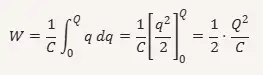
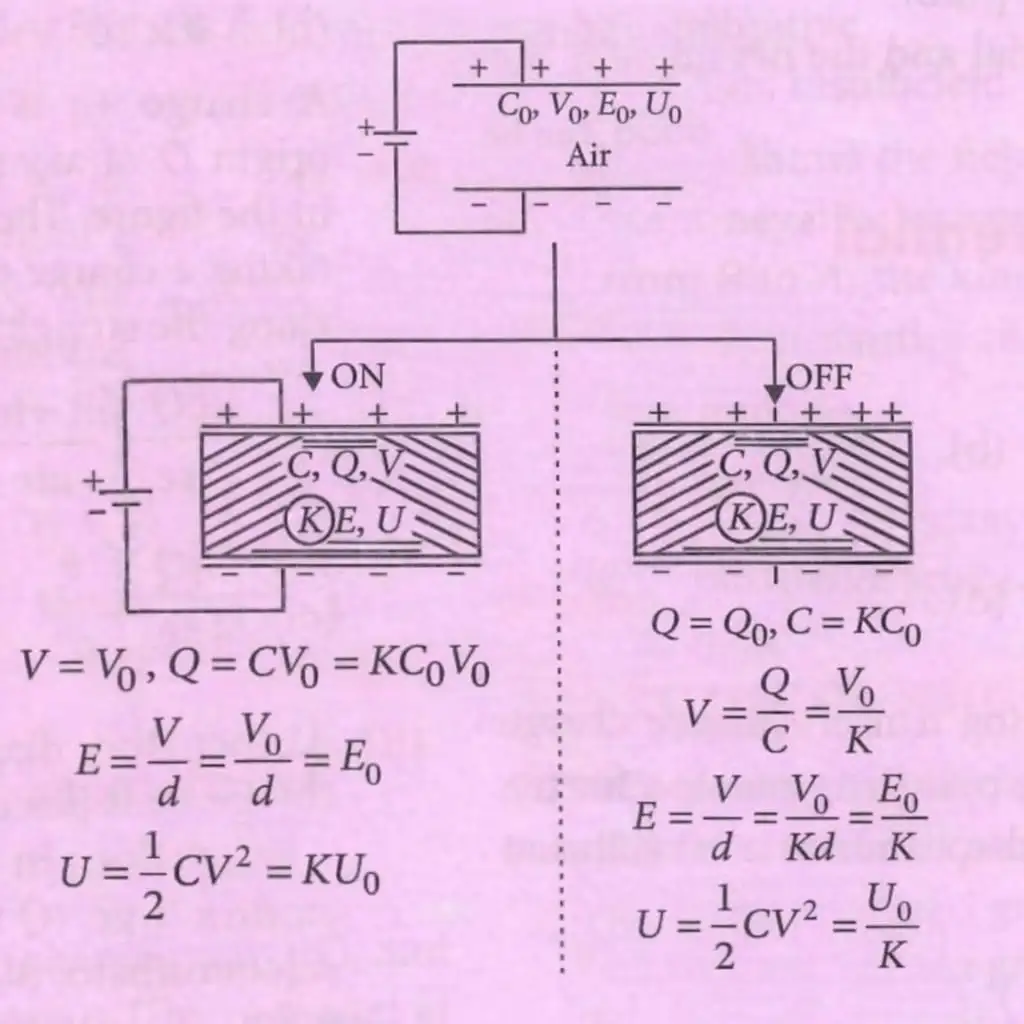
Solved Examples
- Ex 1: Calculate energy stored in a capacitor of capacitance 5 μF charged to 10 V.
Solution:
U = 1/2 CV2 = 1/2 × 5 × 10-6 × 102 = 2.5 × 10⁻⁴ J. - Ex 2: Find energy density if electric field E = 2 × 10⁶ V/m.
Solution:
u = 1/2 ε0 E2 = 1/2 × 8.85 × 10-12 × (2 × 106)2 = 1.77 × 10⁻⁵ J/m3.
Practice Set
- Q1: Energy stored in a capacitor of 2 μF charged to 5 V is:
A) 25 μJ B) 10 μJ B) 5 μJ C) 50 μJ - Q2: Energy density in a capacitor depends on:
A) Capacitance only B) Electric field only C) Voltage only D) Charge only - Q3: A capacitor with dielectric constant 4 is connected to battery. Energy stored becomes:
A) Same B) 4 times C) Half D) 2 times
Answer Key
- Q1: A) 25 μJ - Using U=1/2CV2 = 1/2 × 2 × 10-6 × 52 = 25 × 10-6 J.
- Q2: B) Electric field only - Energy density formula u=1/2 ε0 E2 depends on electric field.
- Q3: B) 4 times - Energy stored increases by dielectric constant K when connected to battery.
Memory Aids
- Energy stored: U = 1/2 CV2 or 1/2 QV.
- Energy density: u = 1/2 ε0 E2.
- Dielectric effect: Energy U scales by dielectric constant K if battery connected.
Concepts and Formulas
- If q is charge and V is potential difference at any instant, small work done to add charge dq is dW = V · dq = q/C dq.
- Total work done to store maximum charge Q is W = ∫0Q q/C dq = 1/2 Q2/C.
- Energy stored in capacitor (electrostatic energy):
U = 1/2 Q2/C = 1/2 CV2 = 1/2 QV. - Energy density (energy per unit volume) in parallel plate capacitor:
u = 1/2 ε0 E2, where ε0 is permittivity of free space and E is electric field. - Effect of dielectric:
- With dielectric connected to battery: Capacitance C = K C0, voltage V = V0, electric field E = E0, energy stored U = K U0 (increases).
- With dielectric removed (isolated capacitor): Charge Q = Q0 constant, voltage V = V0/K, electric field E = E0/K, energy stored U = U0/K (decreases).
Solved Examples
- Ex 1: Calculate energy stored in a capacitor of capacitance 5 μF charged to 10 V.
Solution:
U = 1/2 CV2 = 1/2 × 5 × 10-6 × 102 = 2.5 × 10⁻⁴ J. - Ex 2: Find energy density if electric field E = 2 × 10⁶ V/m.
Solution:
u = 1/2 ε0 E2 = 1/2 × 8.85 × 10-12 × (2 × 106)2 = 1.77 × 10⁻⁵ J/m3.
Practice Set
- Q1: Energy stored in a capacitor of 2 μF charged to 5 V is:
A) 25 μJ B) 10 μJ B) 5 μJ C) 50 μJ - Q2: Energy density in a capacitor depends on:
A) Capacitance only B) Electric field only C) Voltage only D) Charge only - Q3: A capacitor with dielectric constant 4 is connected to battery. Energy stored becomes:
A) Same B) 4 times C) Half D) 2 times
Answer Key
- Q1: A) 25 μJ - Using U=1/2CV2 = 1/2 × 2 × 10-6 × 52 = 25 × 10-6 J.
- Q2: B) Electric field only - Energy density formula u=1/2 ε0 E2 depends on electric field.
- Q3: B) 4 times - Energy stored increases by dielectric constant K when connected to battery.
Memory Aids
- Energy stored: U = 1/2 CV2 or 1/2 QV.
- Energy density: u = 1/2 ε0 E2.
- Dielectric effect: Energy U scales by dielectric constant K if battery connected.
Concepts and Formulas
- If q is charge and V is potential difference at any instant, small work done to add charge dq is dW = V · dq = q/C dq.
- Total work done to store maximum charge Q is W = ∫0Q q/C dq = 1/2 Q2/C.
- Energy stored in capacitor (electrostatic energy):
U = 1/2 Q2/C = 1/2 CV2 = 1/2 QV. - Energy density (energy per unit volume) in parallel plate capacitor:
u = 1/2 ε0 E2, where ε0 is permittivity of free space and E is electric field. - Effect of dielectric:
- With dielectric connected to battery: Capacitance C = K C0, voltage V = V0, electric field E = E0, energy stored U = K U0 (increases).
- With dielectric removed (isolated capacitor): Charge Q = Q0 constant, voltage V = V0/K, electric field E = E0/K, energy stored U = U0/K (decreases).
Solved Examples
- Ex 1: Calculate energy stored in a capacitor of capacitance 5 μF charged to 10 V.
Solution:
U = 1/2 CV2 = 1/2 × 5 × 10-6 × 102 = 2.5 × 10⁻⁴ J. - Ex 2: Find energy density if electric field E = 2 × 10⁶ V/m.
Solution:
u = 1/2 ε0 E2 = 1/2 × 8.85 × 10-12 × (2 × 106)2 = 1.77 × 10⁻⁵ J/m3.
Practice Set
- Q1: Energy stored in a capacitor of 2 μF charged to 5 V is:
A) 25 μJ B) 10 μJ B) 5 μJ C) 50 μJ - Q2: Energy density in a capacitor depends on:
A) Capacitance only B) Electric field only C) Voltage only D) Charge only - Q3: A capacitor with dielectric constant 4 is connected to battery. Energy stored becomes:
A) Same B) 4 times C) Half D) 2 times
Answer Key
- Q1: A) 25 μJ - Using U=1/2CV2 = 1/2 × 2 × 10-6 × 52 = 25 × 10-6 J.
- Q2: B) Electric field only - Energy density formula u=1/2 ε0 E2 depends on electric field.
- Q3: B) 4 times - Energy stored increases by dielectric constant K when connected to battery.
Memory Aids
- Energy stored: U = 1/2 CV2 or 1/2 QV.
- Energy density: u = 1/2 ε0 E2.
- Dielectric effect: Energy U scales by dielectric constant K if battery connected.
Concepts and Formulas
- If \( q \) is charge and \( V \) is potential difference at any instant, small work done to add charge \( dq \) is \( dW = V \cdot dq = \frac{q}{C} dq \).
- Total work done to store maximum charge \( Q \) is \( W = \int_0^Q \frac{q}{C} dq = \frac{1}{2} \frac{Q^2}{C} \).
- Energy stored in capacitor (electrostatic energy):
\( U = \frac{1}{2} \frac{Q^2}{C} = \frac{1}{2} CV^2 = \frac{1}{2} QV \). - Energy density (energy per unit volume) in parallel plate capacitor:
\( u = \frac{1}{2} \epsilon_0 E^2 \), where \( \epsilon_0 \) is permittivity of free space and \( E \) is electric field. - Effect of dielectric:
- With dielectric connected to battery: Capacitance \( C = K C_0 \), voltage \( V = V_0 \), electric field \( E = E_0 \), energy stored \( U = K U_0 \) (increases).
- With dielectric removed (isolated capacitor): Charge \( Q = Q_0 \) constant, voltage \( V = \frac{V_0}{K} \), electric field \( E = \frac{E_0}{K} \), energy stored \( U = \frac{U_0}{K} \) (decreases).
Solved Examples
- Ex 1: Calculate energy stored in a capacitor of capacitance 5 \( \mu F \) charged to 10 V.
Solution:
\( U = \frac{1}{2} CV^2 = \frac{1}{2} \times 5 \times 10^{-6} \times 10^2 = 2.5 \times 10^{-4} \text{ J} \). - Ex 2: Find energy density if electric field \( E = 2 \times 10^6 \text{ V/m} \).
Solution:
\( u = \frac{1}{2} \epsilon_0 E^2 = \frac{1}{2} \times 8.85 \times 10^{-12} \times (2 \times 10^6)^2 = 1.77 \times 10^{-5} \text{ J/m}^3 \).
Practice Set
- Q1: Energy stored in a capacitor of 2 \( \mu F \) charged to 5 V is:
A) 25 \( \mu J \) B) 10 \( \mu J \) C) 5 \( \mu J \) D) 50 \( \mu J \) - Q2: Energy density in a capacitor depends on:
A) Capacitance only B) Electric field only C) Voltage only D) Charge only - Q3: A capacitor with dielectric constant 4 is connected to battery. Energy stored becomes:
A) Same B) 4 times C) Half D) 2 times
Answer Key
- Q1: A) 25 \( \mu J \) - Using \( U=\frac{1}{2}CV^2 = \frac{1}{2} \times 2 \times 10^{-6} \times 5^2 = 25 \times 10^{-6} \text{ J} \).
- Q2: B) Electric field only - Energy density formula \( u=\frac{1}{2} \epsilon_0 E^2 \) depends on electric field.
- Q3: B) 4 times - Energy stored increases by dielectric constant \( K \) when connected to battery.
Memory Aids
- Energy stored: \( U = \frac{1}{2} CV^2 \) or \( \frac{1}{2} QV \).
- Energy density: \( u = \frac{1}{2} \epsilon_0 E^2 \).
- Dielectric effect: Energy \( U \) scales by dielectric constant \( K \) if battery connected.
NEET Physics — ALL CHAPTERS
1
Basic Mathematics
2
Units and Measurement
3
Motion in a Straight Line
4
Motion in a Plane
5
Laws of Motion
6
Work, Energy and Power
7
System of Particles and Rotational Motion
8
Gravitation
9
Mechanical Properties of Solids
10
Mechanical Properties of Fluids
11
Thermal Properties of Matter
12
Thermodynamics
13
Kinetic Theory
14
Oscillations
15
Waves
16
Electric Charges and Fields
17
Electrostatic Potential and Capacitance
18
Current Electricity
19
Moving Charges and Magnetism
20
Magnetism and Matter
21
Electromagnetic Induction
22
Alternating Current
23
Electromagnetic Waves
24
Ray Optics and Optical Instruments
25
Wave Optics
26
Dual Nature of Radiation and Matter
27
Atoms
28
Nuclei
29
Semiconductor Electronics: Materials, Devices and Simple Circuits