NEET-UG 2019 Question Paper — Set 2

QUESTION PAPER

2019 NEET EXAM

NEET-UG 2019 Question Paper — Set 2

2019

NEET-UG

CBSE EXAMINATION PAPER-2019

NEET-ZOOLOGY

(Solved)

Time allowed : 3 hours

Maximum Marks : 721

General Instructions :

Read the following instructions carefully and follow them :

  1. This question paper contains 180 questions. All questions are compulsory.
  2. This question paper is divided into 1 sections.
  3. Section A – questions number 1 to 180 are multiple choice questions
  4. There is no overall choice given in the question paper. However, an internal choice has been provided in few questions.
  5. Use of calculator is NOT allowed.

Section A

Question 1.

The main scale of a vernier callipers has n divisions/cm. n divisions of the vernier scale coincide with (n−1) divisions of main scale. The least count of the vernier callipers is,

[4 Marks]
  • (A) 1/ (n+1)(n−1) cm
  • (B) 1/n cm
  • (C) 1/n² cm
  • (D) 1/ n(n+1) cm
Question 2.

A person travelling in a straight line moves with a constant velocity v₁, for certain distance 'x' and with a constant velocity v₂ for next equal distance x. The average velocity v is given by the relation

[4 Marks]
  • (A) 2/v = 1/v₁ + 1/v₂
  • (B) v/2= v₁ + v₂/2
  • (C) v = √v₁v₂
  • (D) 1/v = 1/v₁ + 1/v₂
Question 3.

A body of mass m is kept on a rough horizontal surface (coefficient of friction = α). A horizontal force is applied on the body, but it does not move. The resultant of normal reaction and the frictional force acting on the object is given by F, where F is,

[4 Marks]
  • (A) | 𝐅⃗| = mg
  • (B) | 𝐅⃗| = mg + αmg
  • (C) | 𝐅⃗|= α mg
  • (D) | 𝐅⃗| ≤ mg √(1 + μ²)
Question 4.

An object of mass 500 g, initially at rest, is acted upon by a variable force whose X-component varies with X in the manner shown. The velocities of the object at the points X
= 8 m and X = 12 m, would have the respective values of (nearly)
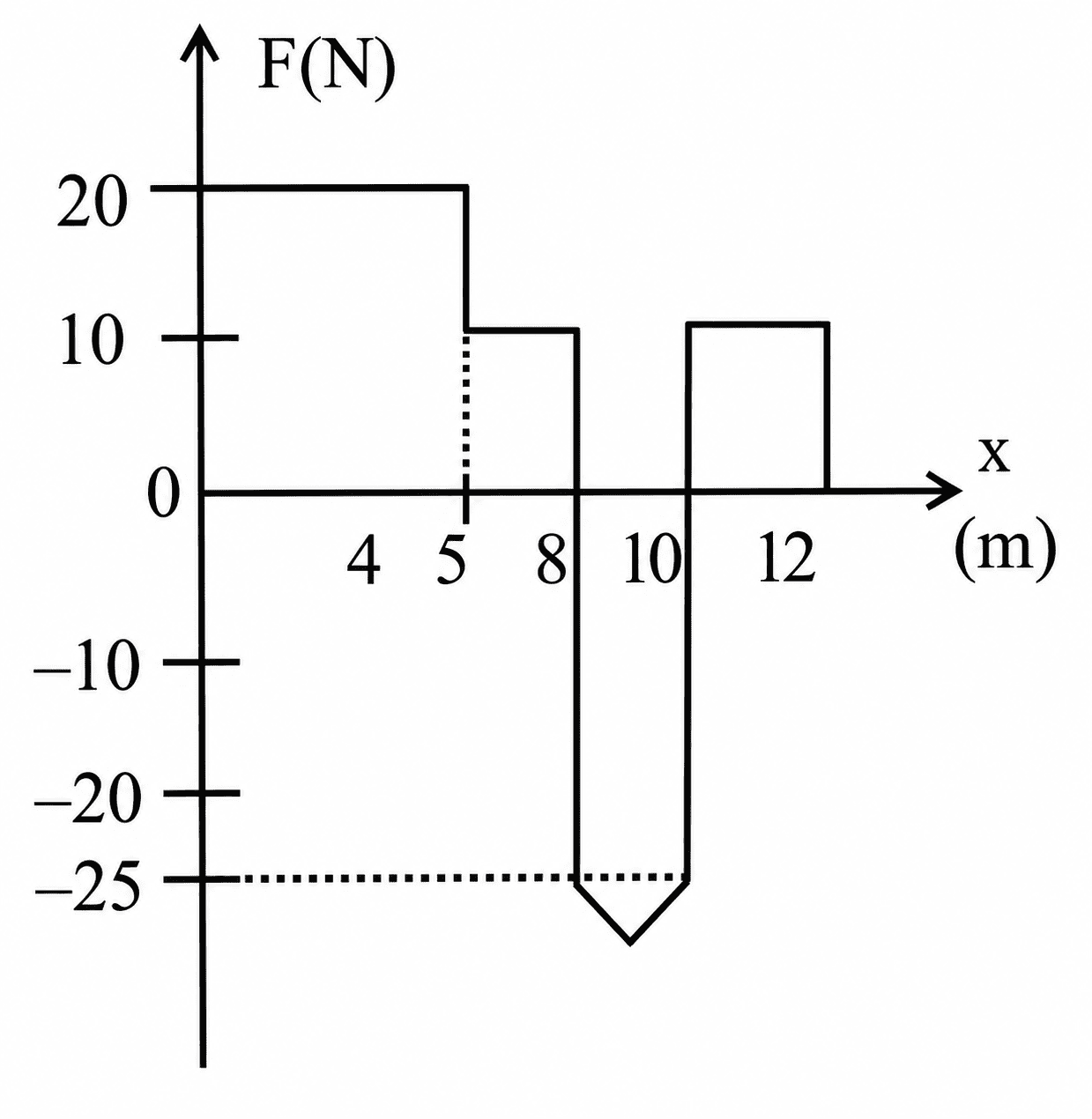
[4 Marks] Diagram 1 – NEET-UG 2019 Question Paper — Set 2
  • (A) 18 m/s and 24.4 m/s
  • (B) 18 m/s and 20.6 m/s
  • (C) 23 m/s and 24.4 m/s
  • (D) 23 m/s and 20.6 m/s
Question 5.

An object flying in air with velocity (20î +25ĵ −12k̂) suddenly breaks into two pieces whose masses are in the ratio 1 : 5. The smaller mass flies off with a velocity (100î +35ĵ +8k̂). The velocity of the larger piece will be

[4 Marks]
  • (A) −100î −35ĵ −80k̂
  • (B) 20î +15ĵ −80k̂
  • (C) 4î +23ĵ −16k̂
  • (D) −20î −15ĵ −80k̂
Question 6.

Two bullets are fired horizontally simultaneously towards each other from roof tops of two buildings 100 m apart of same height of 200 m, with the same velocity of 25 m/s. When and where will the two bullets collide? (g = 10 m/s²)

[4 Marks]
  • (A) They will not collide
  • (B) After 2 s at a height of 20 m
  • (C) After 2 s at a height of 180 m
  • (D) After 4 s at a height of 120 m
Question 7.

A particle of mass 5 m at rest suddenly breaks on its own into three fragments. Two fragments of mass m each move along mutually perpendicular direction with speed v each. The energy released during the process is,

[4 Marks]
  • (A) 3/2 mv²
  • (B) 3/5 mv²
  • (C) 4/3 mv²
  • (D) 5/3 mv²
Question 8.

A particle starting from rest, moves in a circle of radius 'r'. It attains a velocity of V₀ m/s in the nᵗʰ round. Its angular acceleration will be,

[4 Marks]
  • (A) V₀²/ 4πnr² rad/s²
  • (B) V₀²/ 2πnr² rad/s²
  • (C) V₀²/ 4πnr rad/s²
  • (D) V₀ /n rad/s²
Question 9.

A solid cylinder of mass 2 kg and radius 50 cm rolls up an inclined plane of angle of inclination 30°. The centre of mass of the cylinder has speed of 4 m/s. The distance travelled by the cylinder on the inclined surface will be, [take g = 10 m/s²]

[4 Marks]
  • (A) 2.4 m
  • (B) 2.2 m
  • (C) 1.6 m
  • (D) 1.2 m
Question 10.

Assuming that the gravitational potential energy of an object at infinity is zero, the change in potential energy (final – initial) of an object of mass m, when taken to a height h from the surface of earth (of radius R), is given by,

[4 Marks]
  • (A) GMmh/R(R + h)
  • (B) −GMm/R + h
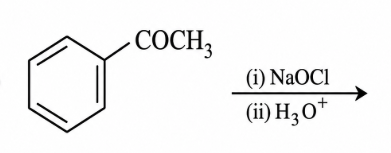
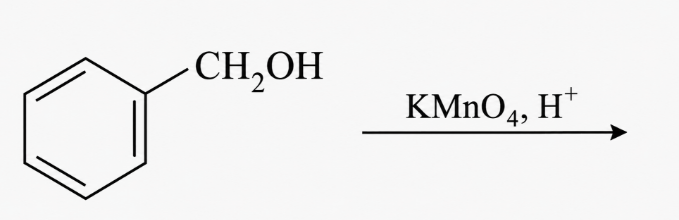
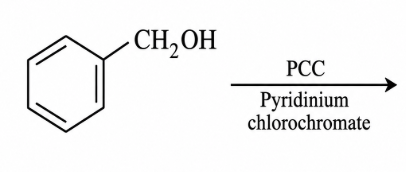
  • (C) mgh
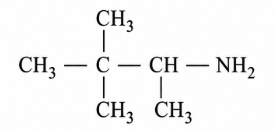
  • (D) GMm/R + h
Question 11.

The time period of a geostationary satellite is 24 h, at a height 6R_E (R_E is radius of earth) from surface of earth. The time period of another satellite whose height is 2.5R_E from surface will be,

[4 Marks]
  • (A) 24/2.5 h
  • (B) 12√2 h
  • (C) 12/2.5 h
  • (D) 6√2 h
Question 12.

The stress-strain curves are drawn for two different materials X and Y. It is observed that the ultimate strength point and the fracture point are close to each other for material X but are far apart for material Y. We can say that materials X and Y are likely to be (respectively),

[4 Marks]
  • (A) Plastic and ductile
  • (B) Ductile and brittle
  • (C) Brittle and ductile
  • (D) Brittle and plastic
Question 13.

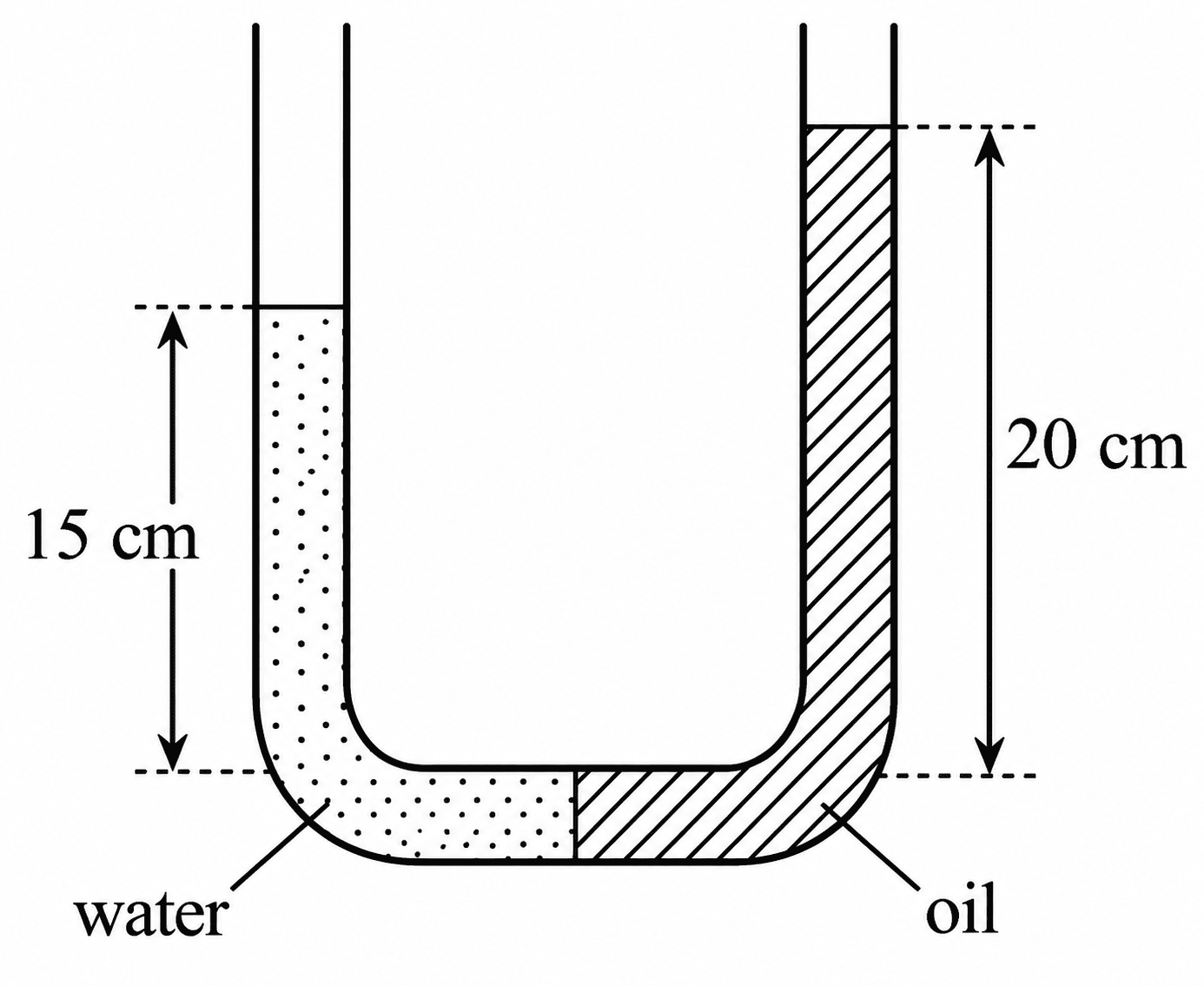
In a u-tube as shown in the fig. water and oil are in the left side and right side of the tube respectively. The heights from the bottom of water and oil columns are 15 cm and 20 cm respectively. The density of the oil is

[take π water =1000kg/m³]
[4 Marks] Diagram 2 – NEET-UG 2019 Question Paper — Set 2
  • (A) 750 kg/m³
  • (B) 1000 kg/m³
  • (C) 1333 kg/m³
  • (D) 1200 kg/m³
Question 14.

Two small spherical metal balls, having equal masses, and made from materials of densities ρ₁ and ρ₂ (ρ₁ = 8ρ₂) and have radii of 1 mm and 2 mm respectively, they are made to fall vertically (from rest) in a viscous medium whose coefficient of viscosity equals η and whose density is 0.1ρ₂. The ratio of their terminal velocities would be,

[4 Marks]
  • (A) 19/36
  • (B) 39/72
  • (C) 79/72
  • (D) 79/36
Question 15.

A deep rectangular pond of surface area A, containing water (density = ρ), specific heat (capacity = s), is located in a region where the outside air temperature is at a steady value of –26°C. The thickness of the frozen ice layer in this pond, at a certain instant is x. Taking the thermal conductivity of ice as K, and its specific latent heat of fusion as L, the rate of increase of the thickness of ice layer, at this instant, would be given by

[4 Marks]
  • (A) 26K/ρx(L + 4s)
  • (B) 26K/(ρx²L)
  • (C) 26K/(ρxL)
  • (D) 26K/ρx(L − 4s)
Question 16.

An object kept in a large room having air temperature of 25°C takes 12 minutes to cool from 80°C to 70°C. The time taken to cool for the same object from 70°C to 60°C would be nearly.

[4 Marks]
  • (A) 15 min
  • (B) 10 min
  • (C) 12 min
  • (D) 20 min
Question 17.

1 g of water, of volume 1 cm³ at 100°C, is converted into steam at same temperature under normal atmospheric pressure (>> 1 × 10⁵ Pa). The volume of steam formed equals 1671 cm³. If the specific latent heat of vaporisation of water is 2256 J/g, the change in internal energy is,

[4 Marks]
  • (A) 167J
  • (B) 2089J
  • (C) 2423 J
  • (D) 2256J
Question 18.

The value of γ = (Cₚ /Cᵥ), for hydrogen, helium and another ideal diatomic gas X (whose molecules are not rigid but have an additional vibrational mode), are respectively equal to,

[4 Marks]
  • (A) 5/3, 7/5, 7/5
  • (B) 5/3, 7/5, 9/7
  • (C) 7/5, 5/3, 9/7
  • (D) 7/5, 5/3, 7/5
Question 19.

The distance covered by a particle undergoing SHM in one time period is (amplitude = A),

[4 Marks]
  • (A) 4A
  • (B) Zero
  • (C) 2A
  • (D) A
Question 20.

A truck is stationary and has a bob suspended by a light string, in a frame attached to the truck. The truck suddenly moves to the right with an acceleration of a. The pendulum will tilt

[4 Marks]
  • (A) to the left and angle of inclination of the pendulum g with the vertical is tan⁻¹(g/a)
  • (B) to the left and angle of inclination of the pendulum with the vertical s sin⁻¹(a/g)
  • (C) to the left and angle of inclination of the pendulum a with the vertical is tan⁻¹(a/g)
  • (D) to the left and angle of inclination of the pendulum g with the vertical is sin⁻¹(g/a)
Question 21.

A mass falls from a height ‘h’ and its time of fall ‘t’ is recorded in terms of time period T of a simple pendulum on the surface of earth it is found that t = 2T. The entire set up is taken to the surface of another planet. Some mass is half that of earth and radius the same. Same experiment is repeated and corresponding time noted as t′ and T′. Then we can say

[4 Marks]
  • (A) t′ < 2T′
  • (B) t′ > 2T′
  • (C) t′ = 2T′
  • (D) t′ = T′
Question 22.

A tuning fork having frequency 800 Hz produces resonance in a resonance column tube with upper end open and lower end closed by water surface. Successive resonance are observed at lengths 9.75 cm, 31.25 cm and 52.75 cm. The speed of sound in air is,

[4 Marks]
  • (A) 500 m/s
  • (B) 172 m/s
  • (C) 156 m/s
  • (D) 344 m/s
Question 23.

Two metal spheres, one of radius R and the other of radius 2R respectively have the same charge density. They are brought in contact and separated. What will be the new surface charge densities on them?

[4 Marks]
  • (A) σ₁ = 5/2 σ, σ₂ = 5/3 σ
  • (B) σ₁ = 5/2 σ, σ₂ = 5/6 σ
  • (C) σ₁ = 5/6 σ, σ₂ = 5/2 σ
  • (D) σ₁ = 5/3 σ, σ₂ = 5/6 σ
Question 24.

A sphere encloses an electric flux with magnitude ± 3 × 10⁻⁶ C. What is the total electric flux across the sphere?

[4 Marks]
  • (A) 6 × 10⁻⁶ Nm²/C
  • (B) Zero
  • (C) −3 × 10⁶ Nm²/C
  • (D) 3 × 10⁻⁶ Nm²/C
Question 25.

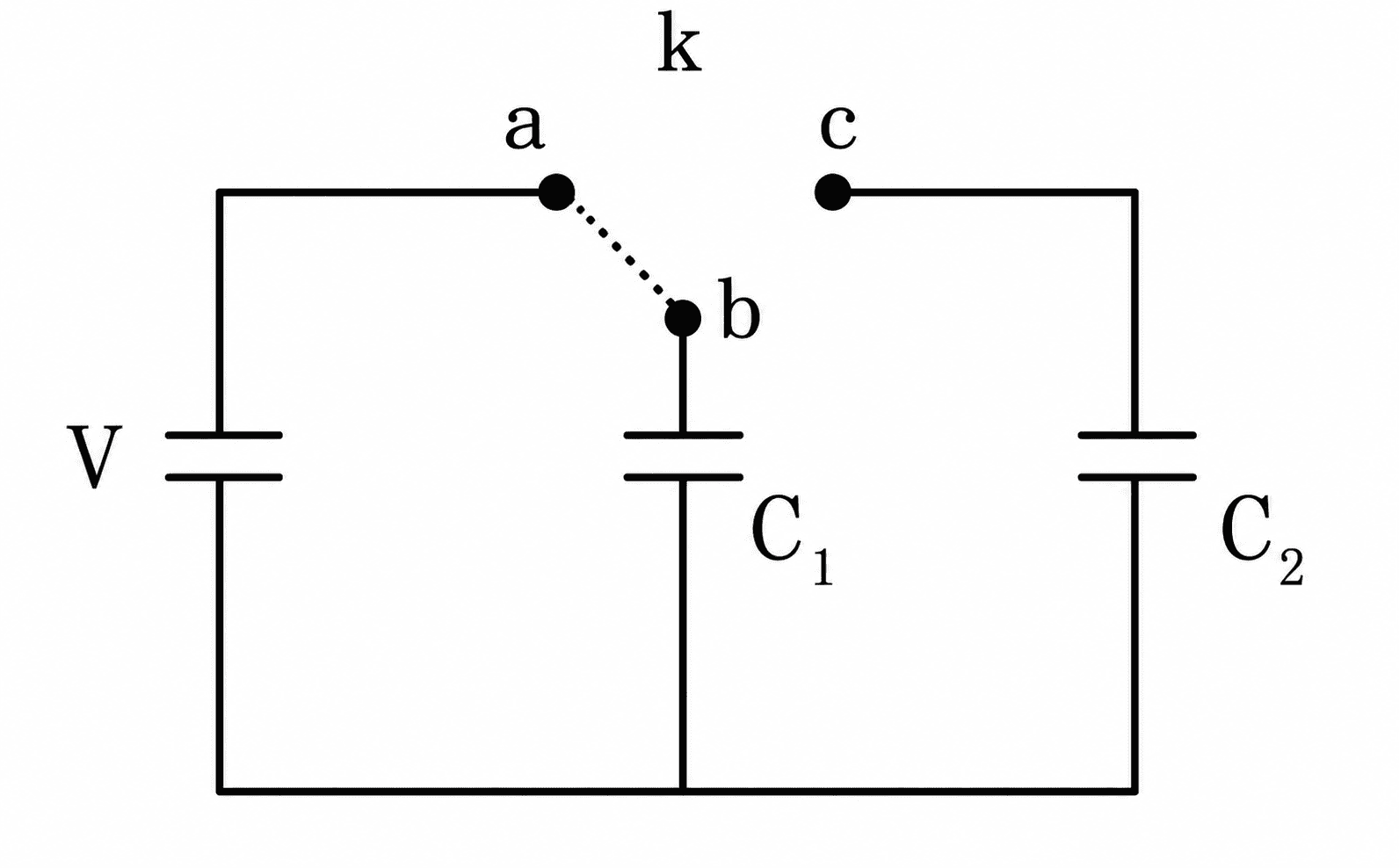
Two identical capacitors C₁ and C₂ of equal capacitance are connected as shown in the circuit. Terminals a and b are on the key k are connected to charge capacitor C₁ using battery of emf V volt. Now disconnecting a and b the terminals a and b are connected. Due to this, will be the percentage loss of energy?
[4 Marks] Diagram 3 – NEET-UG 2019 Question Paper — Set 2
  • (A) 0%
  • (B) 50%
  • (C) 25%
  • (D) 75%
Question 26.

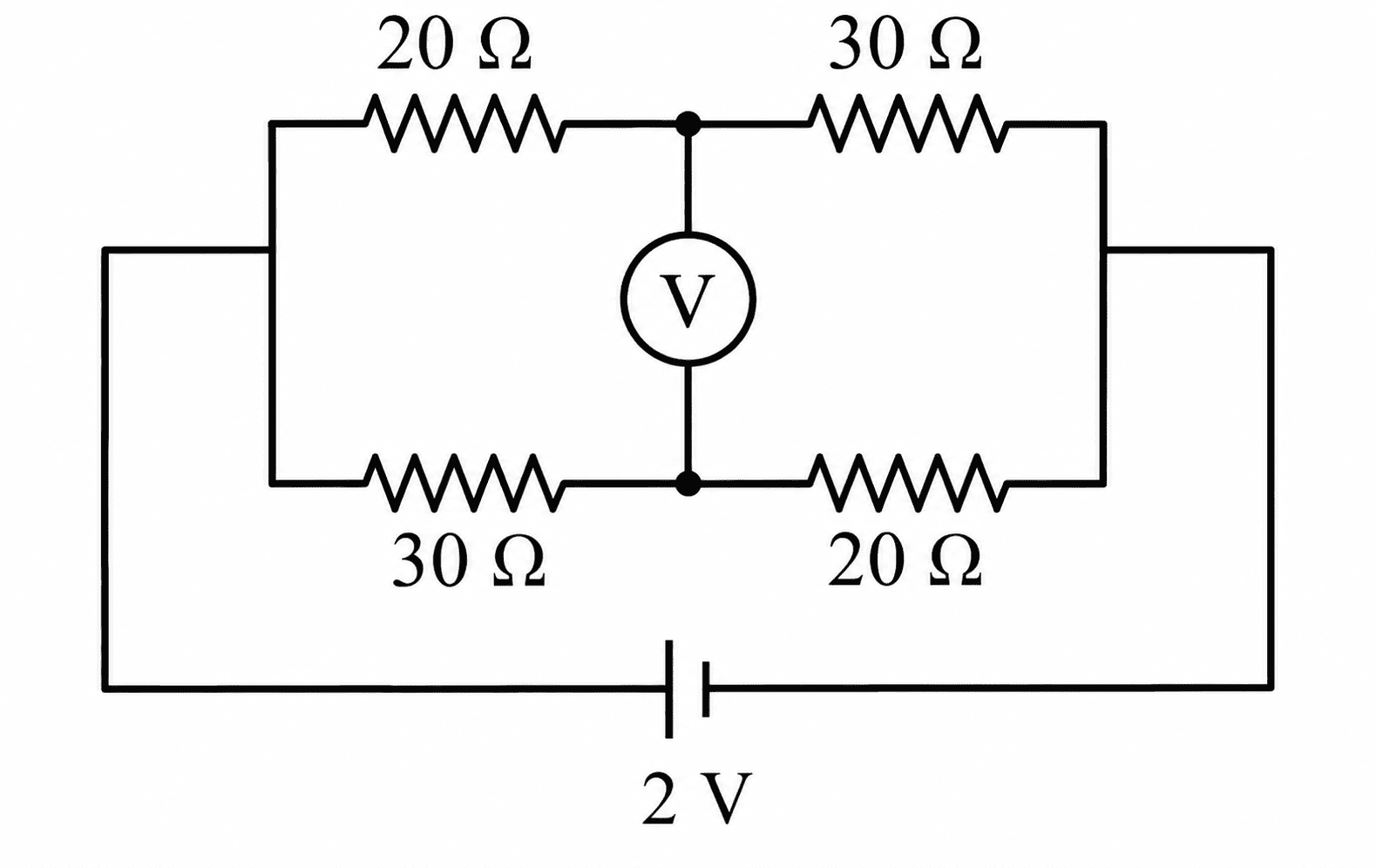
The reading of an ideal voltmeter in the circuit shown is,
[4 Marks] Diagram 4 – NEET-UG 2019 Question Paper — Set 2
  • (A) 0.4 V
  • (B) 0.6 V
  • (C) 0 V
  • (D) 0.5 V
Question 27.

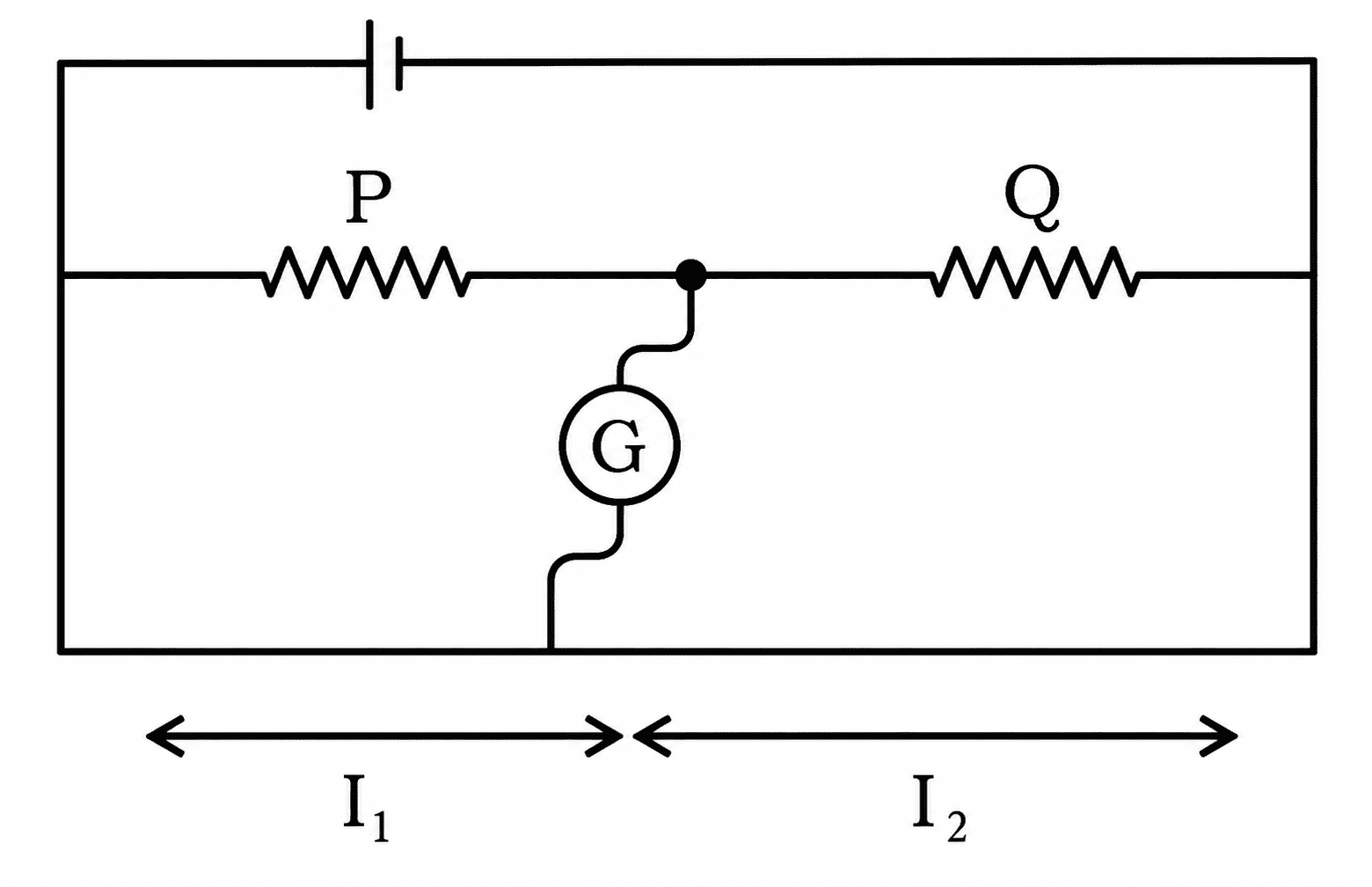
The metre bridge shown is in balance position with P/Q= l₁/l₂. If we now interchange the position of galvanometer and cell, will the bridge work? If yes, what will be balance condition?
[4 Marks] Diagram 5 – NEET-UG 2019 Question Paper — Set 2
  • (A) yes, P/Q = l₂/l₁
  • (B) yes, P/Q = l₂ − l₁ / l₂ + l₁
  • (C) no, no null point
  • (D) yes, P/Q = l₁/l₂
Question 28.

Two toroids 1 and 2 have total no. of turns 200 and 100 respectively with average radii 40 cm and 20 cm respectively. If they carry same current I, the ratio of the magnetic fields along the loops is,

[4 Marks]
  • (A) 2:1
  • (B) 1:1
  • (C) 4:1
  • (D) 1:2
Question 29.

A straight conductor carrying current i splits into two parts as shown in the figure. The radius of the circular loop is R. The total magnetic field at the centre P of the loop is,

[4 Marks]
  • (A) Zero
  • (B) 3μ₀i/32R, inward
  • (C) 3μ₀i/32R, outward
  • (D) μ₀i/2R, inward
Question 30.

The relations among the three components of earth’s magnetic field, namely horizontal component H, vertical component V and dip δ are, (B_E = total magnetic field)

[4 Marks]
  • (A) V = B_E sinδ, H = B_Ecosδ
  • (B) V = B_Ecosδ, H = B_Esinδ
  • (C) V = B_E tanδ, H = B_E
  • (D) V = B_E, H = B_E tanδ
Question 31.

The variation of EMF with time for four types of generators are shown in the figures. Which amongst them can be called AC?
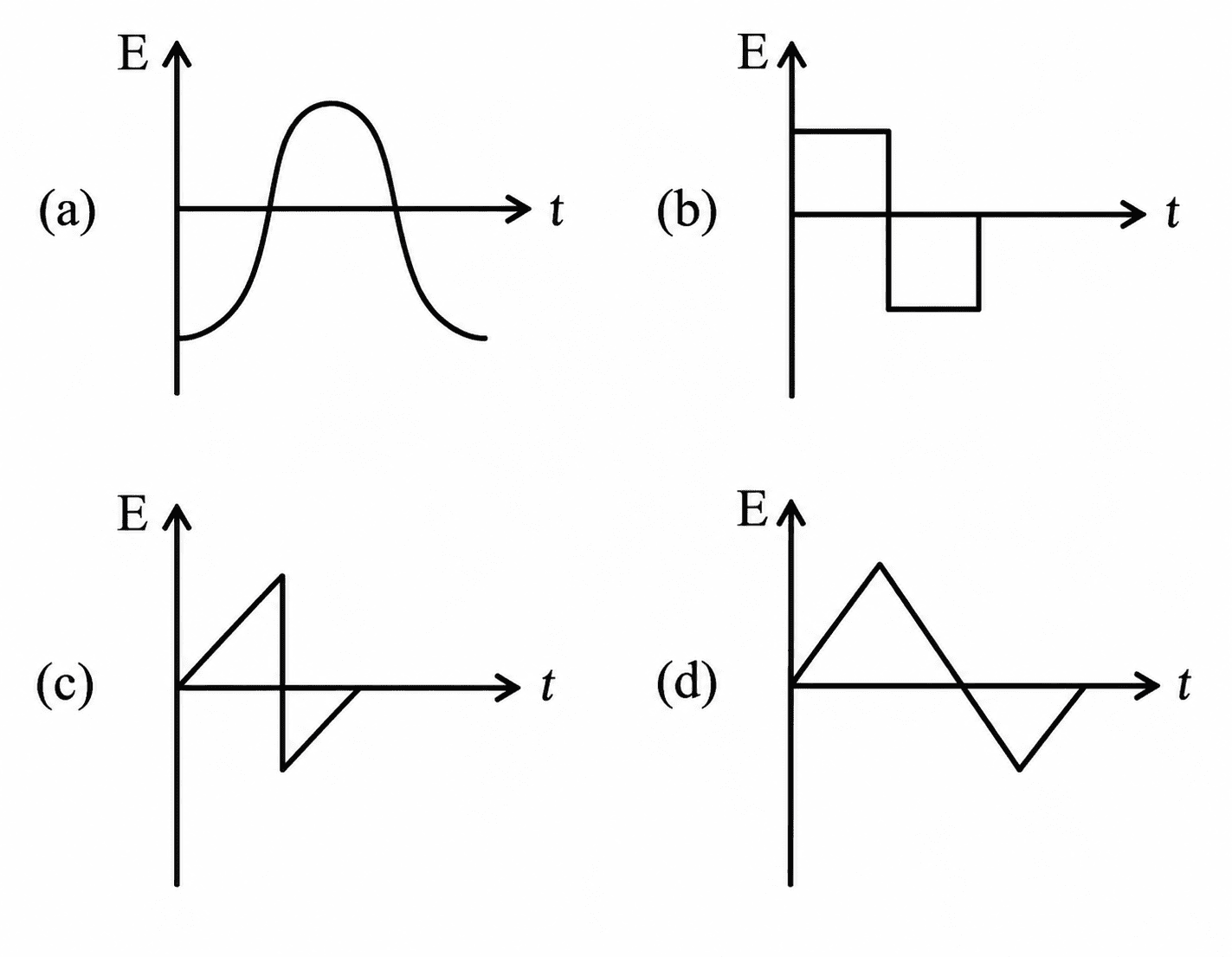
[4 Marks] Diagram 6 – NEET-UG 2019 Question Paper — Set 2
  • (A) Only(a)
  • (B) (a) and (d)
  • (C) (a) and (b)
  • (D) (a), (b), (c), (d)
Question 32.

A cycle wheel of radius 0.5 m is rotated with constant angular velocity of 10 rad/s in a region of magnetic field of 0.1 T which is perpendicular to the plane of the wheel. The EMF generated between its centre and rim is

[4 Marks]
  • (A) 0.5 V
  • (B) 0.125 V
  • (C) Zero
  • (D) 0.25 V
Question 33.

A circuit when connected to an AC source of 12 V gives a current of 0.2 A. The same circuit when connected to a DC source of 12 V, gives a current of 0.4 A. The circuit is

[4 Marks]
  • (A) Series LCR
  • (B) Series LR
  • (C) Series LC
  • (D) Series RC
Question 34.

An equiconvex lens has power P. It is cut into two symmetrical halves by a plane containing the principal axis. The power of one part will be,

[4 Marks]
  • (A) P/2
  • (B) 0
  • (C) P/4
  • (D) P
Question 35.

A double convex lens has focal length 25 cm. The radius of curvature of one of the surfaces is double of the other. Find the radii if the refractive index of the material of the lens is 1.5.

[4 Marks]
  • (A) 18.75 cm, 37.5 cm
  • (B) 25 cm, 50 cm
  • (C) 50 cm, 100 cm
  • (D) 100 cm, 50 cm
Question 36.

In a Young's double slit experiment, if there is no initial phase difference between the light from the two slits, a point on the screen corresponding to the fifth minimum has path difference

[4 Marks]
  • (A) 9 (λ/2) t
  • (B) 10 (λ/2)
  • (C) 5 (λ/2)
  • (D) 11 (λ/2)
Question 37.

Angular width of the central maxima in the Fraunhofer diffraction for λ = 6000 Å is θ₀. When the same slit is illuminated by another monochromatic light, the angular width decreases by 30%. The wavelength of this light is,

[5 Marks]
  • (A) 420 Å
  • (B) 6000 Å
  • (C) 1800 Å
  • (D) 4200 Å
Question 38.

A proton and an α-particle are accelerated from rest to the same energy. The de Broglie wavelengths λₚ and λα are in the ratio,

[4 Marks]
  • (A) 4 : 1
  • (B) 2 : 1
  • (C) 1 : 1
  • (D) √2 : 1
Question 39.

The work function of a photosensitive material is 4.0 eV. The longest wavelength of light that can cause photon emission from the substance is (approximately)

[4 Marks]
  • (A) 310 nm
  • (B) 3100 nm
  • (C) 31 nm
  • (D) 966 nm
Question 40.

The radius of the first permitted Bohr orbit, for the electron in a hydrogen atom equals .51 Å and its ground state energy equals –13.6 eV. If the electron in the hydrogen atom is replaced by muon (μ⁻) [charge same as electron and mass 207 mₑ], the first Bohr radius and ground state energy will be,

[4 Marks]
  • (A) 0.53 × 10⁻¹³ m, –3.6 eV
  • (B) 2.56 × 10⁻¹³ m, –13.6 eV
  • (C) 2.56 × 10⁻¹³ m, –2.8 eV
  • (D) 2.56 × 10⁻¹³ m, –2.8 eV
Question 41.

The rate of radioactive disintegration at an instant for a radioactive sample of half life 2.2 × 10⁹ s is 10¹⁰ s⁻¹. The number of radioactive atoms in that sample at that instant is,

[4 Marks]
  • (A) 3.17 × 10¹⁹
  • (B) 3.17 × 10²⁰
  • (C) 3.17 × 10¹⁷
  • (D) 3.17 × 10¹⁸
Question 42.

An LED is made from a p-n junction diode using GaAsP. The energy gap is 1.9 eV. The wavelength of the light emitted will be equal to

[4 Marks]
  • (A) 654 × 10⁻¹¹ m
  • (B) 10.4 × 10⁻²⁶ m
  • (C) 654 nm
  • (D) 654 Å
Question 43.

An LED is made from a p-n junction diode using GaAsP. The energy gap is 1.9 eV. The wavelength of the light emitted will be equal to

[4 Marks]
  • (A) 654 × 10⁻¹¹ m
  • (B) 10.4 × 10⁻²⁶ m
  • (C) 654 nm
  • (D) 654 Å
Question 44.

The circuit diagram shown here corresponds to the logic gate
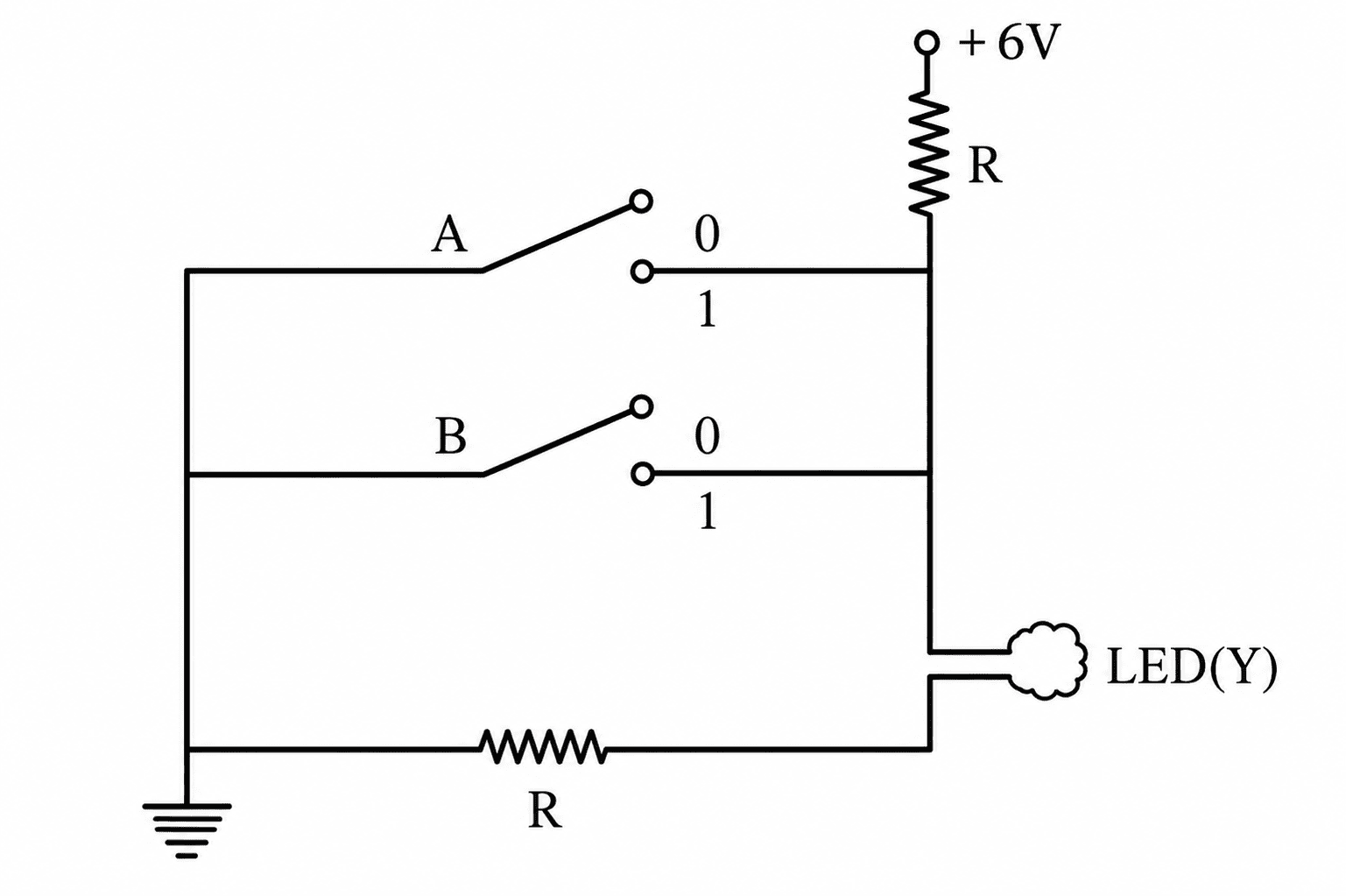
[4 Marks] Diagram 7 – NEET-UG 2019 Question Paper — Set 2
  • (A) NAND
  • (B) NOR
  • (C) OR
  • (D) AND
Question 45.

For a transparent medium of relative permeability and permittivity μᵣ and εᵣ are 1.0 and 1.44 respectively, the velocity of light in this medium would be

[4 Marks]
  • (A) 2.5 × 10⁸ m/s
  • (B) 3 × 10⁸ m/s
  • (C) 2.08 × 10⁸ m/s
  • (D) 4.32 × 10⁸ m/s
Question 46.

A person standing on the floor of an elevator drops a coin. The coin reaches the floor in time t₁, if the elevator at rest and in time t₂ if the elevator is moving uniformly. The which of the following option is correct?

[4 Marks]
  • (A) t₁ = t₂
  • (B) t₁ > t₂
  • (C) t₁ < t₂
  • (D) t₁ < t₂ or t₁ > t₂ depending upon whether the lift is going up or down
Question 47.

In hydrogen atom, the de-Broglie wavelength of an electron in the second Bohr orbit is [Given that Bohr radius, a₀ = 52.9 pm]

[4 Marks]
  • (A) 52.9π pm
  • (B) 211.6 pm
  • (C) 105.8 pm
  • (D) 211.6π pm
Question 48.

Orbital having 3 angular nodes and 3 total nodes is

[4 Marks]
  • (A) 6d
  • (B) 5p
  • (C) 3d
  • (D) 4f
Question 49.

Match the oxide given in column A with its property given in column B

Which of the following options has all correct pairs?
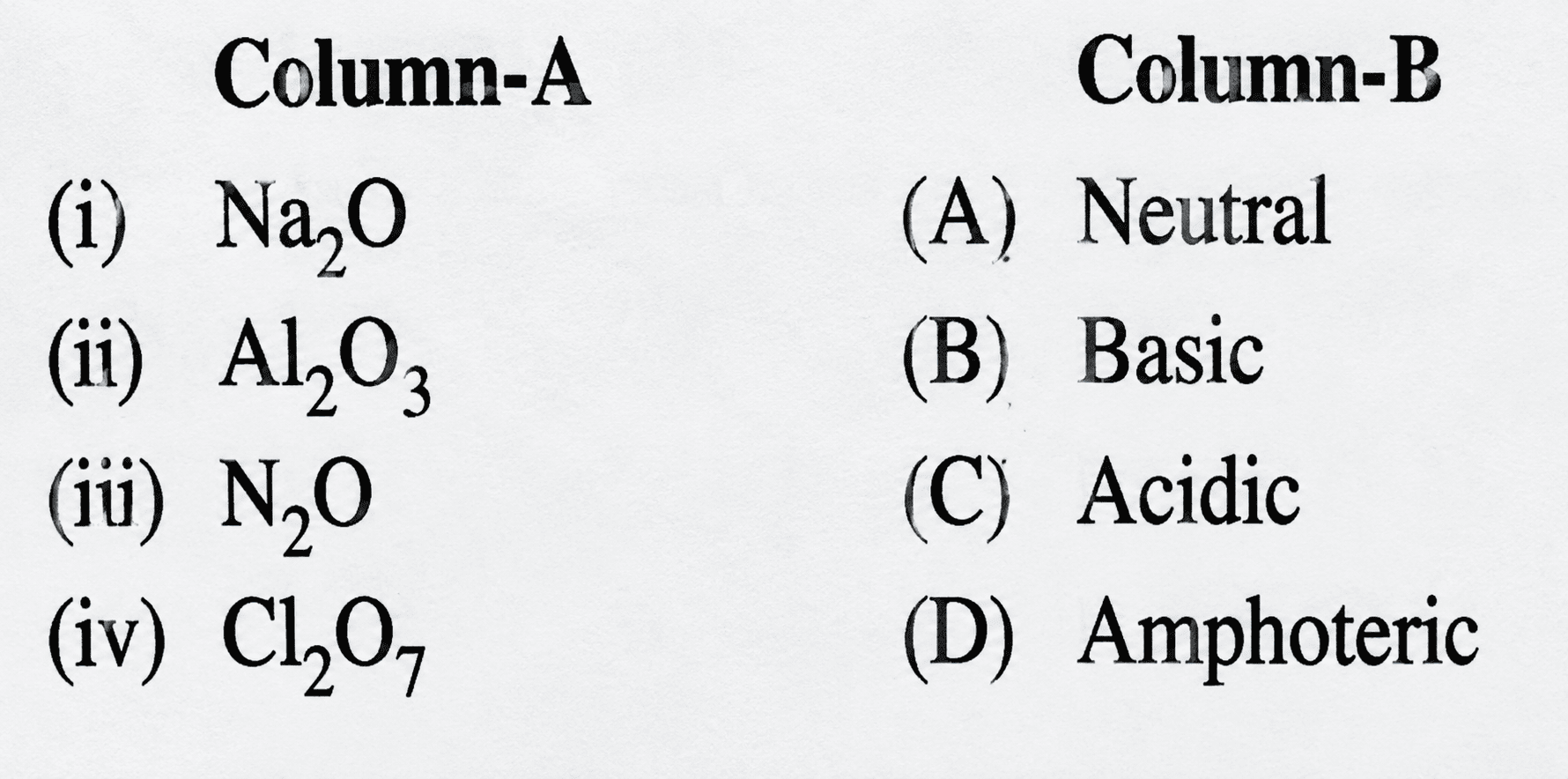
[4 Marks] Diagram 8 – NEET-UG 2019 Question Paper — Set 2
  • (A) (i)-(B), (ii)-(D), (iii)-(A), (iv)-(C)
  • (B) (i)-(B), (ii)-(A), (iii)-(D), (iv)-(C)
  • (C) (i)-(C), (ii)-(B), (iii)-(A), (iv)-(D)
  • (D) (i)-(A), (ii)-(D), (iii)-(B), (iv)-(C)
Question 50.

Which of the following is the correct order of dipole moment?

[4 Marks]
  • (A) NH₃ < BF₃ < NF₃ < H₂O
  • (B) H₂O < NF₃ < NH₃ < BF₃
  • (C) BF₃ < NF₃ < NH₃ < H₂O
  • (D) BF₃ < NH₃ < NF₃ < H₂O
Question 51.

Which of the following is paramagnetic?

[4 Marks]
  • (A) H₂
  • (B) Li₂
  • (C) N₂
  • (D) O₂
Question 52.

The volume occupied by 1.8 g of water vapour at 374°C and 1 bar pressure will be
[Use R = 0.083 bar L K⁻¹ mol⁻¹]

[4 Marks]
  • (A) 55.87 L
  • (B) 3.10 L
  • (C) 96.66 L
  • (D) 5.37 L
Question 53.

A gas at 350 K and 15 bar has molar volume 20 percent smaller than that for an ideal gas under the same conditions. The correct option about the gas and its compressibility factor (Z) is:

[4 Marks]
  • (A) Z > 1 and repulsive forces are dominant
  • (B) Z < 1 and repulsive forces are dominant
  • (C) Z > 1 and attractive forces are dominant
  • (D) Z < 1 and attractive forces are dominant
Question 54.

An ideal gas expands isothermally from 10⁻³ m³ to 10⁻² m³ at 300 K against a constant pressure of 10⁵ Nm⁻². The work done on the gas is

[4 Marks]
  • (A) +900 kJ
  • (B) +270 kJ
  • (C) −900 J
  • (D) −900 KJ
Question 55.

Reversible expansion of an ideal gas under isothermal and adiabatic conditions are as shown in the figure.
AB → Isothermal expansion
AC → Adiabatic expansion
Which of the following options is not correct?
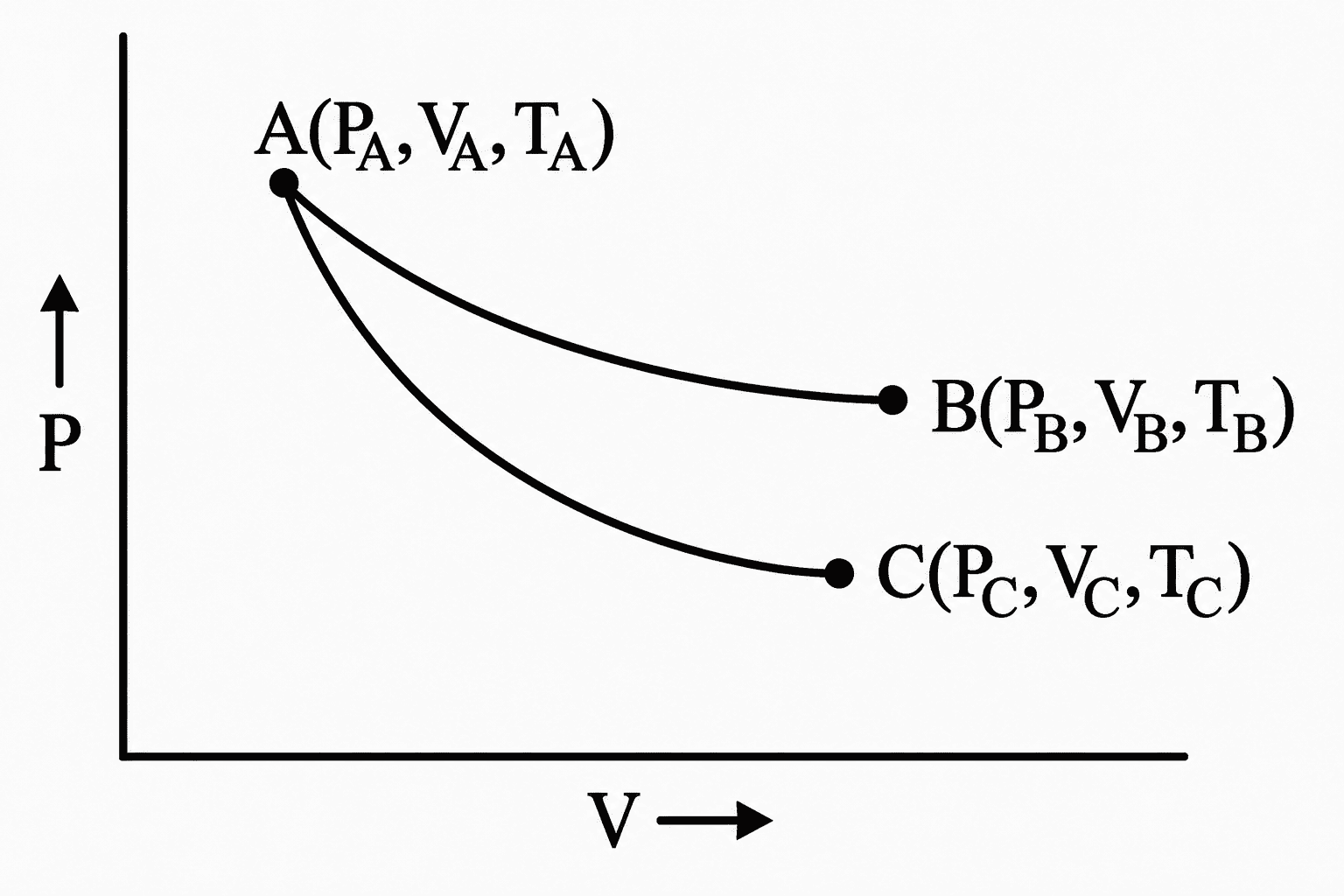
[4 Marks] Diagram 9 – NEET-UG 2019 Question Paper — Set 2
  • (A) T_C > T_A
  • (B) ΔS_isothermal > ΔS_adiabatic
  • (C) T_A = T_B
  • (D) W_isothermal > W_adiabatic
Question 56.

Reversible expansion of an ideal gas under isothermal and adiabatic conditions are as shown in the figure.
AB → Isothermal expansion
AC → Adiabatic expansion
Which of the following options is not correct?
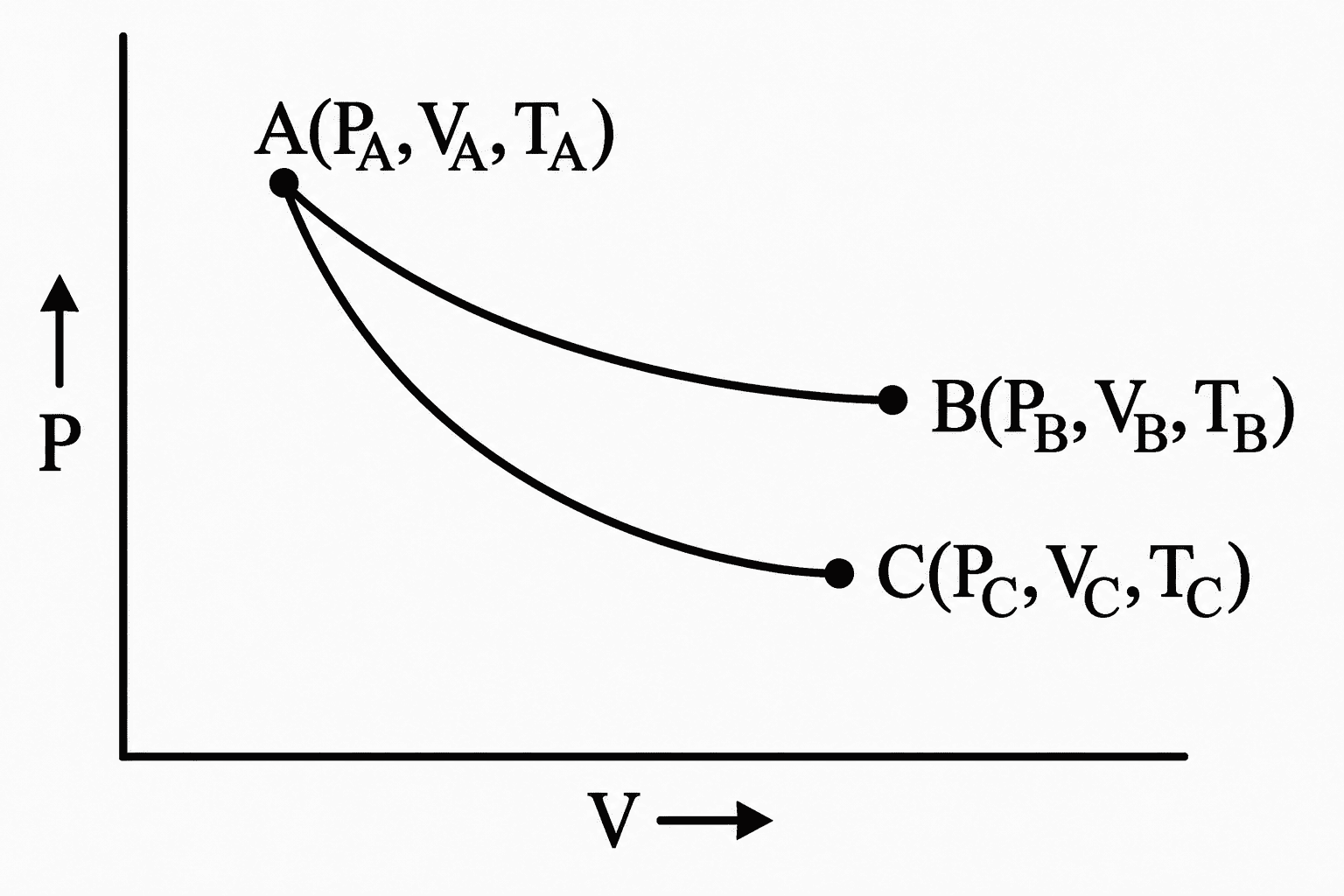
[4 Marks] Diagram 10 – NEET-UG 2019 Question Paper — Set 2
  • (A) T_C > T_A
  • (B) ΔS_isothermal > ΔS_adiabatic
  • (C) T_A = T_B
  • (D) W_isothermal > W_adiabatic
Question 57.

The pH of 0.01 M NaOH(aq) solution will be

[4 Marks]
  • (A) 9
  • (B) 7.01
  • (C) 2
  • (D) 12
Question 58.

Which of the following cannot act both as Bronsted acid and as Bronsted base?

[4 Marks]
  • (A) HCO₃⁻
  • (B) HSO₄⁻
  • (C) HCl
  • (D) NH₃
Question 59.

The molar solubility of CaF₂ [Kₛₚ = 5.3 × 10⁻¹¹] in 0.1 M solution of NaF will be

[4 Marks]
  • (A) 5.3 × 10⁻⁹ mol L⁻¹
  • (B) 5.3 × 10⁻⁸ mol L⁻¹
  • (C) 5.3 × 10⁻¹¹ mol L⁻¹
  • (D) 5.3 × 10⁻¹⁰ mol L⁻¹
Question 60.

The oxidation state of Cr in CrO₆ is

[4 Marks]
  • (A) +12
  • (B) +6
  • (C) −6
  • (D) +4
Question 61.

The standard electrode potential (E°) values of Al³⁺/Al, Ag⁺/Ag, K⁺/K and Cr³⁺/Cr are −1.66 V, 0.80 V, −2.93 V and −0.74 V, respectively. The correct decreasing order of reducing power of the metal is

[4 Marks]
  • (A) K > Al > Cr > Ag
  • (B) Ag > Cr > Al > K
  • (C) Al > K > Ag > Cr
  • (D) K > Al > Ag > Cr
Question 62.

The number of hydrogen bonded water molecule(s) associated with CuSO₄·5H₂O is

[4 Marks]
  • (A) 2
  • (B) 1
  • (C) 3
  • (D) 5
Question 63.

Which of the alkali metal chloride (MCl) forms its dihydrate salt (MCl·2H₂O) easily?

[4 Marks]
  • (A) KCl
  • (B) LiCl
  • (C) CsCl
  • (D) RbCl
Question 64.

Crude sodium chloride obtained by crystallisation of brine solution does not contain

[4 Marks]
  • (A) MgCl₂
  • (B) Na₂SO₄
  • (C) MgSO₄
  • (D) CaSO₄
Question 65.

Aluminium chloride in acidified aqueous solution forms a complex 'A', in which hybridisation state of Al is 'B'. What are 'A' and 'B', respectively?

[4 Marks]
  • (A) [Al(H₂O)₄]³⁺, dsp²
  • (B) [Al(H₂O)₄]³⁺, sp³
  • (C) [Al(H₂O)₆]³⁺, d²sp³
  • (D) [Al(H₂O)₆]³⁺, sp³d²
Question 66.

Which of the following compounds is used in cosmetic surgery?

[4 Marks]
  • (A) Zeolites
  • (B) Silica
  • (C) Silicates
  • (D) Silicones
Question 67.

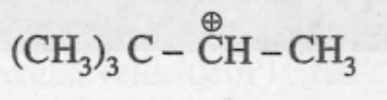
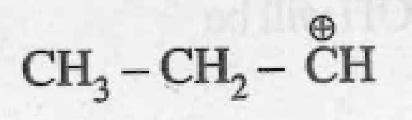
The most stable carbocation among the following is

[4 Marks]
  • (A) Diagram 11 – NEET-UG 2019 Question Paper — Set 2
  • (B) Diagram 12 – NEET-UG 2019 Question Paper — Set 2
  • (C) Diagram 13 – NEET-UG 2019 Question Paper — Set 2
  • (D) Diagram 14 – NEET-UG 2019 Question Paper — Set 2
Question 68.

The alkane that gives only one mono-chloro product on chlorination with Cl₂ in presence of diffused sunlight is

[4 Marks]
  • (A) neopentane
  • (B) n-pentane
  • (C) Isopentane
  • (D) 2,2-dimethylbutane
Question 69.

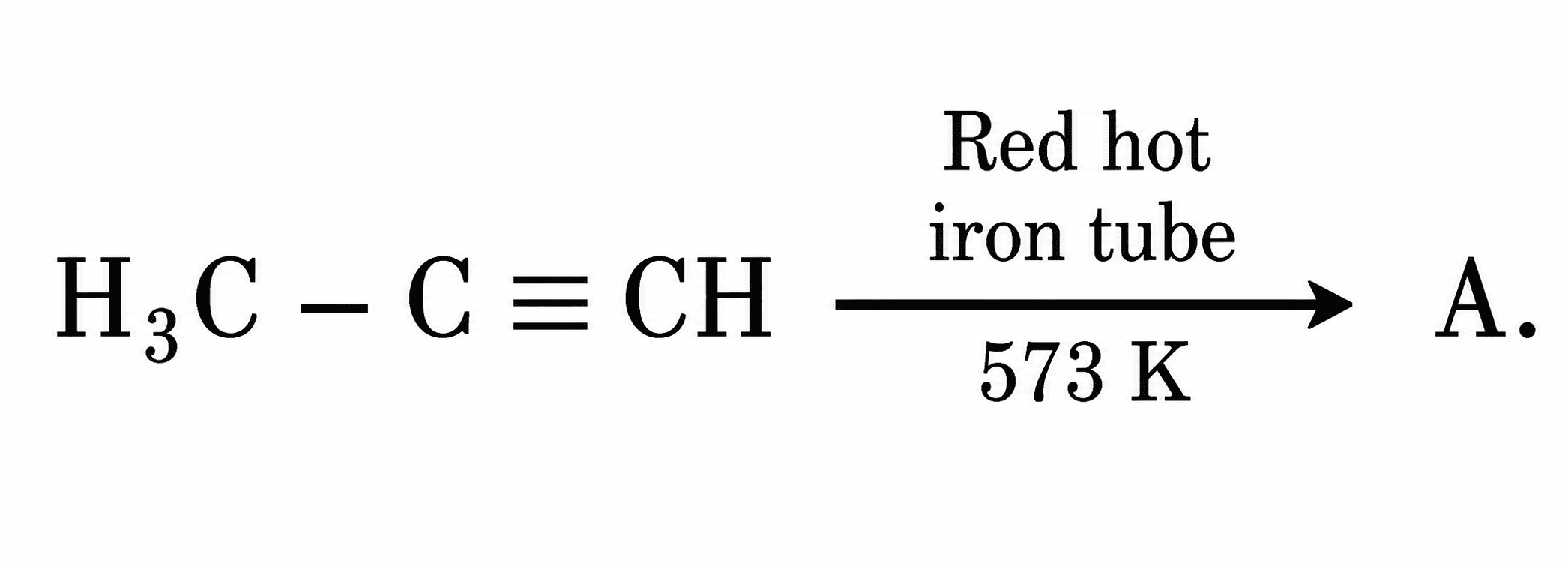
In the following reaction,
the number of sigma (σ) bonds present in the product A is
[4 Marks] Diagram 15 – NEET-UG 2019 Question Paper — Set 2
  • (A) 21
  • (B) 18
  • (C) 24
  • (D) 9
Question 70.

The liquefied gas that is used in dry cleaning along with a suitable detergent is

[4 Marks]
  • (A) Water gas
  • (B) CO₂
  • (C) Petroleum gas
  • (D) NO₂
Question 71.

Formula of nickel oxide with metal deficiency defect in its crystal is Ni₀.₉₈O. The crystal contains Ni²⁺ and Ni³⁺ ions. The fraction of nickel existing as Ni²⁺ ions in the crystal is

[4 Marks]
  • (A) 0.50
  • (B) 0.96
  • (C) 0.04
  • (D) 0.31
Question 72.

The density of 2 M aqueous solution of NaOH is 1.28 g/cm³. The molality of the solution is [Given that molecular mass of NaOH = 40 g mol⁻¹]

[4 Marks]
  • (A) 1.32 m
  • (B) 1.20 m
  • (C) 1.56 m
  • (D) 1.67 m
Question 73.

Which of the following statements is correct regarding a solution of two components A and B exhibiting positive deviation from ideal behaviour?

[4 Marks]
  • (A) ΔₘᵢₓV = 0 at constant T and P.
  • (B) Δₘᵢₓ H = 0 at constant T and P.
  • (C) Intermolecular attractive forces between A–A and B–B are stronger than those between A–B.
  • (D) Intermolecular attractive forces between A–A and B–B are equal to those between A–B.
Question 74.

In water saturated air, the mole fraction of water vapour is 0.02. If the total pressure of the saturated air is 1.2 atm, the partial pressure of dry air is

[4 Marks]
  • (A) 1.176 atm
  • (B) 1.76 atm
  • (C) 1.18 atm
  • (D) 0.98 atm
Question 75.

Following limiting molar conductivities are given as

λ°ₘ(H₂SO₄) = x S cm² mol⁻¹
λ°ₘ(K₂SO₄) = y S cm² mol⁻¹
λ°ₘ(CH₃COOK) = z S cm² mol⁻¹
λ°ₘ (in S cm² mol⁻¹) for CH₃COOH will be

[4 Marks]
  • (A) x − y + 2z
  • (B) (x − y)/2 + z
  • (C) x + y + z
  • (D) x − y + z
Question 76.

A first order reaction has a rate constant of 2.303 × 10⁻³ s⁻¹. The time required for 40 g of this to reduce to 10 g will be
[Given that log₁₀2 = 0.3010]

[4 Marks]
  • (A) 301 s
  • (B) 230.3 s
  • (C) 602 s
  • (D) 2000 s
Question 77.

For a reaction, according to Arrhenius equation, Eₐ = 0 and the rate constant at 200 K is 1.6 × 10⁶ s⁻¹. The rate constant at 400 K will be
[Given that gas constant, R = 8.314 JK⁻¹ mol⁻¹]

[4 Marks]
  • (A) 1.6 × 10⁶ s⁻¹
  • (B) 1.6 × 10³ s⁻¹
  • (C) 3.2 × 10⁴ s⁻¹
  • (D) 3.2 × 10⁶ s⁻¹
Question 78.

The correct option representing a Freundlich adsorption isotherm is

[4 Marks]
  • (A) x/m = kp⁻⁰·⁵
  • (B) x/m = kp²·⁵
  • (C) x/m = kp⁰·³
  • (D) x/m = kp⁻¹
Question 79.

Identify the incorrect statement.

[4 Marks]
  • (A) Gangue is an ore contaminated with undesired materials.
  • (B) Minerals are naturally occurring chemical substances in the earth's crust.
  • (C) Ores are minerals that may contain a metal.
  • (D) The scientific and technological process used for isolation of the metal from its ore is known as metallurgy.
Question 80.

A compound 'X' upon reaction with H₂O produces a colourless gas 'Y' with rotten fish smell. Gas 'Y' is absorbed in a solution of CuSO₄ to give Cu₃P₂ as one of the products. Predict the compound 'X'.

[4 Marks]
  • (A) NH₄Cl
  • (B) Ca₃P₂
  • (C) Ca₃(PO₄)₂
  • (D) As₂O₃
Question 81.

Which of the following oxoacids of phosphorus has strongest reducing property?

[4 Marks]
  • (A) H₃PO₃
  • (B) H₄P₂O₇
  • (C) H₃PO₂
  • (D) H₃PO₄
Question 82.

Identify the correct formula of 'oleum' from the following.

[4 Marks]
  • (A) H₂SO₄
  • (B) H₂SO₃
  • (C) H₂S₂O₇
  • (D) H₂S₂O₈
Question 83.

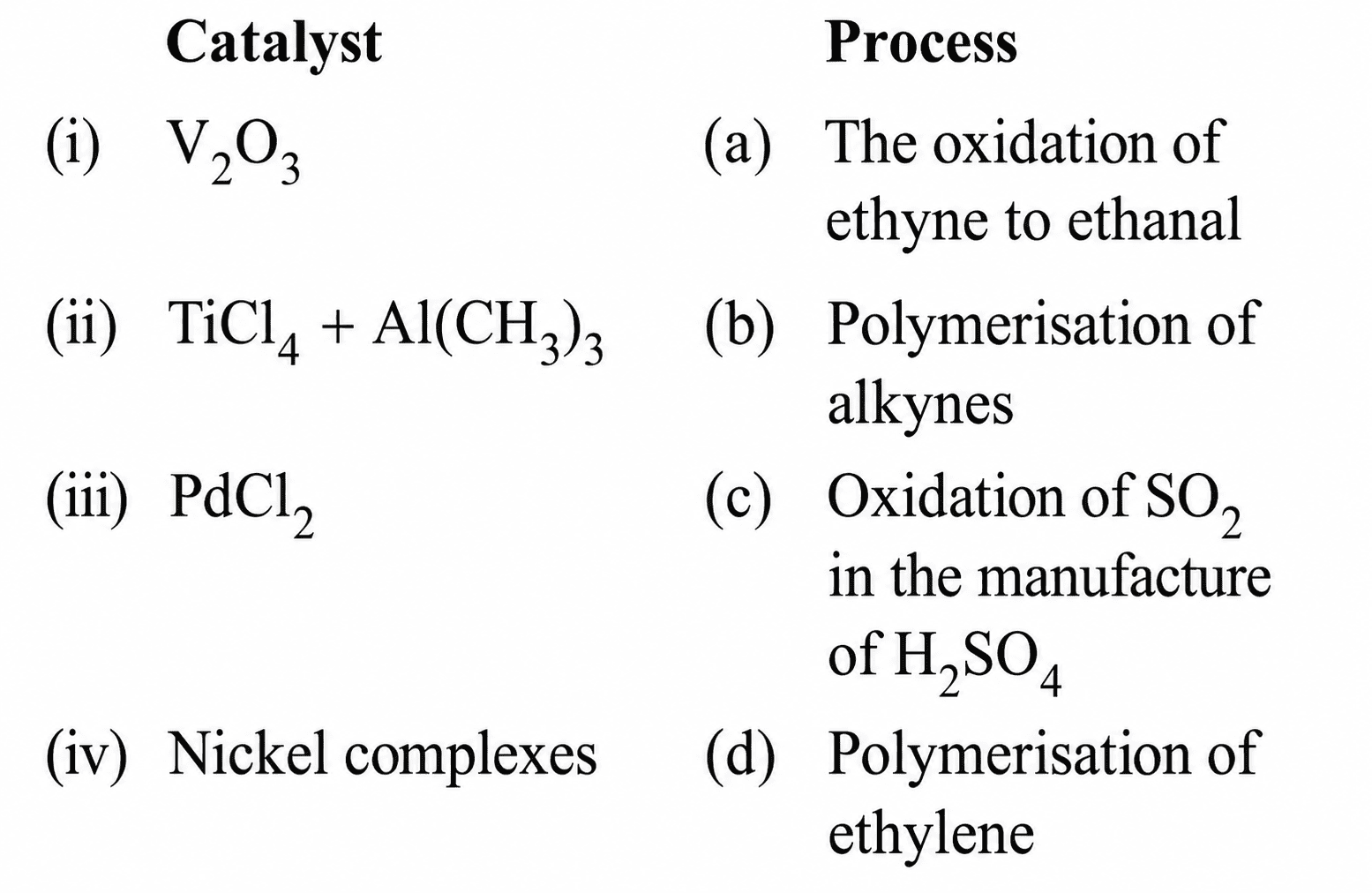
Match the catalyst with the process.
Which of the following is the correct option?
[4 Marks] Diagram 16 – NEET-UG 2019 Question Paper — Set 2
  • (A) (i)-(c), (ii)-(d), (iii)-(a), (iv)-(b)
  • (B) (i)-(a), (ii)-(b), (iii)-(c), (iv)-(d)
  • (C) (i)-(a), (ii)-(c), (iii)-(b), (iv)-(d)
  • (D) (i)-(c), (ii)-(a), (iii)-(d), (iv)-(b)
Question 84.

The Crystal Field Stabilisation Energy (CFSE) for [CoCl₆]⁴⁻ is 18000 cm⁻¹. The CFSE for [CoCl₄]²⁻ will be

[4 Marks]
  • (A) 6000 cm⁻¹
  • (B) 8000 cm⁻¹
  • (C) 16000 cm⁻¹
  • (D) 18000 cm⁻¹
Question 85.

The hydrolysis reaction that takes place at the slowest rate, among the following is

[4 Marks]
  • (A) Diagram 17 – NEET-UG 2019 Question Paper — Set 2
  • (B) Diagram 18 – NEET-UG 2019 Question Paper — Set 2
  • (C) Diagram 19 – NEET-UG 2019 Question Paper — Set 2
  • (D) Diagram 20 – NEET-UG 2019 Question Paper — Set 2
Question 86.

When vapour of a secondary alcohol is passed over heated copper at 573 K, the product formed is

[4 Marks]
  • (A) a ketone
  • (B) an aldehyde
  • (C) an alkene
  • (D) a carboxylic acid
Question 87.

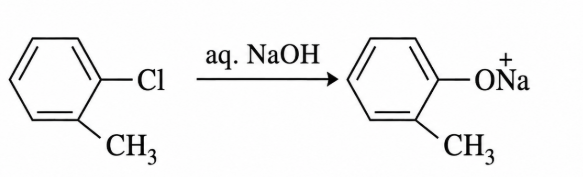
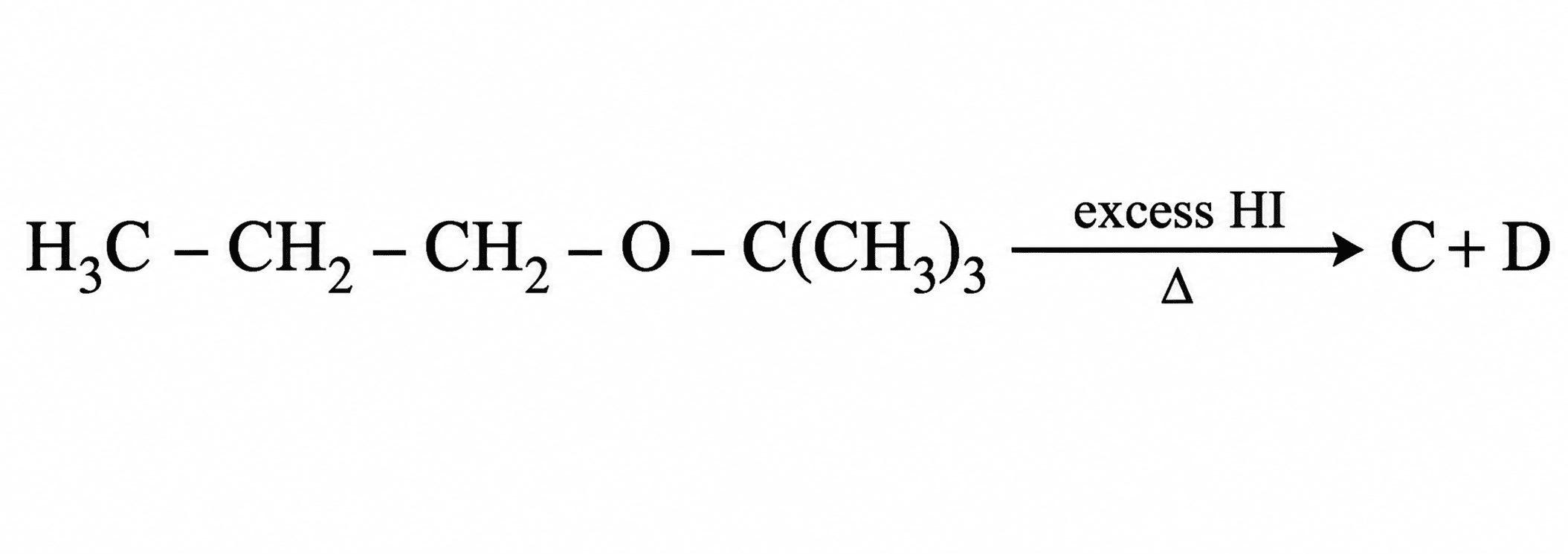
The major products C and D formed in the following reaction respectively are
[4 Marks] Diagram 21 – NEET-UG 2019 Question Paper — Set 2
  • (A) H₃C-CH₂-CH₂-I and HO–C(CH₃)₃
  • (B) H₃C-CH₂-CH₂-OH and HO-C(CH₃)₃
  • (C) H₃C-CH₂-CH₂-OH and I–C(CH₃)₃
  • (D) H₃C-CH₂-CH₂-I and I–C(CH₃)₃
Question 88.

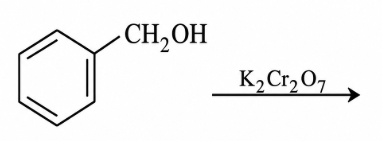
The reaction that does not give benzoic acid as the major product is

[4 Marks]
  • (A) Diagram 22 – NEET-UG 2019 Question Paper — Set 2
  • (B) Diagram 23 – NEET-UG 2019 Question Paper — Set 2
  • (C) Diagram 24 – NEET-UG 2019 Question Paper — Set 2
  • (D) Diagram 25 – NEET-UG 2019 Question Paper — Set 2
Question 89.

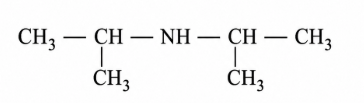
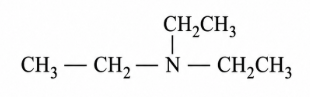
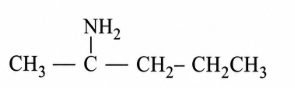
The amine that reacts with Hinsberg's reagent to give an alkali insoluble product is

[4 Marks]
  • (A) Diagram 26 – NEET-UG 2019 Question Paper — Set 2
  • (B) Diagram 27 – NEET-UG 2019 Question Paper — Set 2
  • (C) Diagram 28 – NEET-UG 2019 Question Paper — Set 2
  • (D) Diagram 29 – NEET-UG 2019 Question Paper — Set 2
Question 90.

Which structure(s) of proteins remain(s) intact during denaturation process?

[4 Marks]
  • (A) Both secondary and tertiary structures
  • (B) Tertiary structure only
  • (C) Primary structure only
  • (D) Secondary structure only
Question 91.

The polymer that is used as a substitute for wool in making commercial fibres is

[4 Marks]
  • (A) polyacrylonitrile
  • (B) nylon-6,6
  • (C) melamine
  • (D) Buna-N
Question 92.

The artificial sweetener stable at cooking temperature and does not provide calories is

[4 Marks]
  • (A) alitame
  • (B) saccharin
  • (C) aspartame
  • (D) sucralose
Question 93.

A selectable marker is used to :

[4 Marks]
  • (A) Identify the gene for a desired trait in an alien organism.
  • (B) Select a suitable vector for transformation in a specific crop.
  • (C) Help in eliminating the non-transformants, so that the transformants can be regenerated.
  • (D) Mark a gene on a chromosome for isolation using restriction enzyme.
Question 94.

Western Ghats have a large number of plant and animal species that are not found anywhere else. Which of the following terms will you use to notify such species?

[4 Marks]
  • (A) Keystone
  • (B) Vulnerable
  • (C) Endemic
  • (D) Threatened
Question 95.

Which of the following statements about ozone is correct?

[4 Marks]
  • (A) Stratospheric ozone protects us from UV radiations.
  • (B) Tropospheric ozone protects us from UV radiations.
  • (C) Tropospheric ozone is ‘good’.
  • (D) Stratospheric ozone is ‘bad’.
Question 96.

Exploration of molecular, genetic and species level diversity for novel products of economic importance is known as :

[4 Marks]
  • (A) Bioremediation
  • (B) Bioenergetics
  • (C) Biopiracy
  • (D) Bioprospecting
Question 97.

Which of the following is an innovative remedy for plastic waste?

[4 Marks]
  • (A) Electrostatic precipitator
  • (B) Burning in the absence of oxygen
  • (C) Burying 500 m deep below soil surface
  • (D) Polyblend
Question 98.

Between which among the following, the relationship is not an example of commensalism?

[4 Marks]
  • (A) Cattle egret and grazing cattle
  • (B) Sea anemone and clown fish
  • (C) Orchid and the tree on which it grows
  • (D) Female wasp and fig species
Question 99.

If an agricultural field is liberally irrigated for a prolonged period of time, it is likely to face a problem of :

[4 Marks]
  • (A) Alkalinity
  • (B) Salinity
  • (C) Acidity
  • (D) Metal toxicity
Question 100.

Which of the following statements about methanogens is not correct?

[4 Marks]
  • (A) They grow aerobically and breakdown cellulose-rich food.
  • (B) They produce methane gas.
  • (C) They are found in the rumen of cattle and their excreta.
  • (D) They can be used to produce biogas.
Question 101.

In mung bean, resistance to yellow mosaic virus and powdery mildew were brought about by :

[4 Marks]
  • (A) Tissue culture
  • (B) Mutation breeding
  • (C) Hybridisation and selection
  • (D) Biofortification
Question 102.

Coca alkaloid or cocaine is obtained from :

[4 Marks]
  • (A) Erythroxylum coca
  • (B) Papaver somniferum
  • (C) Datra
  • (D) Atropa belladonna
Question 103.

Among the following pairs of microbes, which pair has both the microbes that can be used as biofertilisers?

[4 Marks]
  • (A) Rhizobium and Rhizopus
  • (B) Cyanobacteria and Rhizobium
  • (C) Aspergillus and Cyanobacteria
  • (D) Aspergillus and Rhizopus
Question 104.

Given below are four statements pertaining to separation of DNA fragments using Gel electrophoresis. Identify the correct statement.
(A) DNA is negatively charged molecule and so it is loaded on gel towards the Anode terminal.
(B) DNA fragments travel along the surface of the gel whose concentration does not affect movement of DNA.
(C) Smaller the size of DNA fragment, larger is the distance it travels through it.
(D) Pure DNA can be visualised directly by exposing to UV radiation.
Choose correct answer from the options given below :

[4 Marks]
  • (A) (A), (B) and (D)
  • (B) (A), (C) and (D)
  • (C) (B), (C) and (D)
  • (D) (A), (B) and (C)
Question 105.

An enzyme catalysing the removal of nucleotides from ends of DNA is :

[4 Marks]
  • (A) Endonuclease
  • (B) Exonuclease
  • (C) DNA ligase
  • (D) Protease
Question 106.

In RNAi, the genes are silenced using :

[4 Marks]
  • (A) ss-RNA
  • (B) ss-DNA
  • (C) ds-RNA
  • (D) ds-RNA
Question 107.

Which is the most common type of embryo sac in angiosperms?

[4 Marks]
  • (A) Bisporic with two sequential mitotic divisions.
  • (B) Tetrasporic with one mitotic stage of divisions.
  • (C) Monosporic with two sequential mitotic divisions.
  • (D) Monosporic with three sequential mitotic divisions.
Question 108.

From the following, identify the correct combination of salient features of Genetic Code.

[4 Marks]
  • (A) Universal, Ambiguous, Degenerate
  • (B) Degenerate, Overlapping, Commaless
  • (C) Universal, Non-ambiguous, Overlapping
  • (D) Degenerate, Non-overlapping, Nonambiguous
Question 109.

Which scientist experimentally proved that DNA is the sole genetic material in bacteriophage?

[4 Marks]
  • (A) Meselson and Stahl
  • (B) Hershey and Chase
  • (C) Jacob and Monod
  • (D) Beadle and Tatum
Question 110.

In the process of transcription in Eukaryotes, the RNA polymerase II transcribes :

[4 Marks]
  • (A) rRNAs – 28S, 18S and 5.8S
  • (B) tRNA, 5S rRNA and snRNAs
  • (C) Precursor of mRNA, hnRNA
  • (D) Precursor of mRNA, hnRNA with additional processing, capping and tailing
Question 111.

In which genetic condition, each cell in the affected person has three sex chromosomes XXY?

[4 Marks]
  • (A) Klinefelter's syndrome
  • (B) Turner's syndrome
  • (C) Phenylketonuria
  • (D) Thalassemia
Question 112.

What initiation and termination factors are involved in transcription in Eukaryotes?

[4 Marks]
  • (A) β and y , respectively
  • (B) ρ and σ, respectively
  • (C) α and β, respectively
  • (D) σ and ρ, respectively
Question 113.

Which of the following statements is correct about the origin and evolution of men?

[4 Marks]
  • (A) Homo habilis probably ate meat.
  • (B) The Dryopithecus and Ramapithecus primates existing 15 million years ago, walked like men.
  • (C) Neanderthal men lived in Asia between 1,00,000 and 40,000 years back.
  • (D) Agriculture came around 50,000 years back.
Question 114.

The production of gametes by the parents, the formation of zygotes, the F₁ and F₂ plants, can be understood using

[4 Marks]
  • (A) A pyramid diagram
  • (B) Punnet square
  • (C) Pie diagram
  • (D) Wenn diagram
Question 115.

In Hatch and Slack pathway, the primary CO₂ acceptor is

[4 Marks]
  • (A) Phosphoenol pyruvate
  • (B) Phosphoglycolic acid
  • (C) Oxaloacetic acid
  • (D) Rubisco
Question 116.

Removal of shoot tips is a very useful technique to boost the production of tea leaves. This is because :

[4 Marks]
  • (A) Effect of auxins is removed and growth of lateral buds is enhanced.
  • (B) Auxins prevent leaf drop at early stages.
  • (C) Gibberellins delay senescence of leaves.
  • (D) Gibberellins prevent bolting and are inactivated.
Question 117.

One scientist cultured Cladophora in a suspension of Azotobacter and illuminated the culture by splitting light through a prism. He observed that bacteria accumulated mainly in the region of :

[4 Marks]
  • (A) Orange and yellow light
  • (B) Indigo and green light
  • (C) Violet and green light
  • (D) Blue and red light
Question 118.

In order to increase the yield of sugarcane crop, which of the following plant growth regulators should be sprayed?

[4 Marks]
  • (A) Gibberellins
  • (B) Auxins
  • (C) Ethylene
  • (D) Cytokinins
Question 119.

What type of pollination takes place in Vallisneria?

[4 Marks]
  • (A) Pollination occurs in submerged condition by water.
  • (B) Flowers emerge above water surface and pollen is carried by wind.
  • (C) Flowers emerge above water surface and pollination occurs by insects.
  • (D) Male flowers are carried by water currents to female flowers at surface of water.
Question 120.

In which one of the following, both autogamy and geitonogamy are prevented?

[4 Marks]
  • (A) Castor
  • (B) Papaya
  • (C) Maize
  • (D) Wheat
Question 121.

Match the placental types (column-I) with their examples (column-II).
Choose the correct answer from the following options:
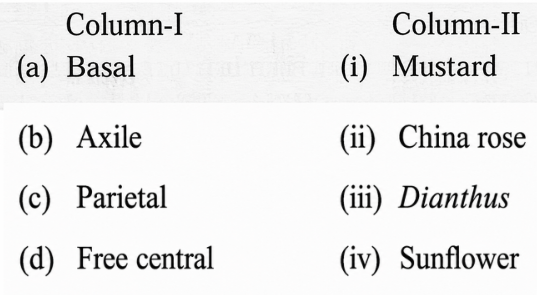
[4 Marks] Diagram 30 – NEET-UG 2019 Question Paper — Set 2
  • (A) (a)-(i), (b)-(ii), (c)-(iii), (d)-(iv)
  • (B) (a)-(iii), (b)-(iv), (c)-(i), (d)-(ii)
  • (C) (a)-(ii), (b)-(iii), (c)-(iv), (d)-(i)
  • (D) (a)-(iv), (b)-(ii), (c)-(i), (d)-(iii)
Question 122.

Match the cell organelle in column I with column II.
Choose the right match from the options given below:
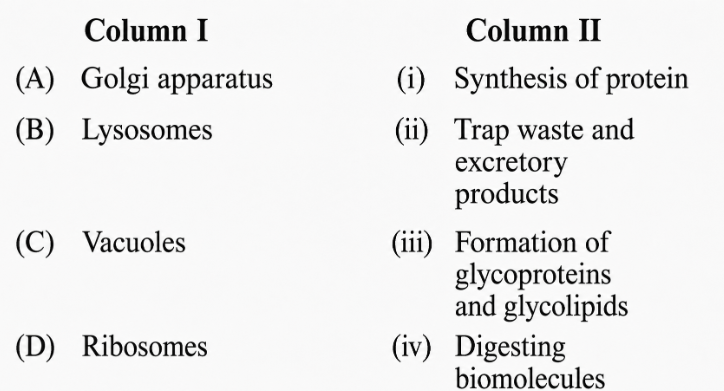
[4 Marks] Diagram 31 – NEET-UG 2019 Question Paper — Set 2
  • (A) (A)-(iv), (B)-(iii), (C)-(i), (D)-(ii)
  • (B) (A)-(iii), (B)-(ii), (C)-(iv), (D)-(i)
  • (C) (A)-(iii), (B)-(iv), (C)-(ii), (D)-(i)
  • (D) (A)-(i), (B)-(ii), (C)-(iv), (D)-(iii)
Question 123.

Prosthetic groups differ from co-enzymes in that-

[4 Marks]
  • (A) Their association with apoenzymes is transient.
  • (B) They (prosthetic groups) are tightly bound to apoenzymes.
  • (C) They can serve as co-factors in a number of enzyme-catalysed reactions.
  • (D) They require metal ions for their activity.
Question 124.

Crossing over takes place between which chromatids and in which stage of the cell cycle?

[4 Marks]
  • (A) Non-sister chromatids of homologous chromosomes at Zygotene stage of prophase I.
  • (B) Non-sister chromatids of homologous chromosomes at Pachytene stage of prophase I.
  • (C) Non - sister chromatids of non-homologous chromosomes at Zygotene stage of prophase I.
  • (D) Non-sister chromatids of non-homologous chromosomes at Pachytene stage of prophase I.
Question 125.

"Ramachandran plot" is used to confirm the structure of

[4 Marks]
  • (A) Proteins
  • (B) Triacylglycerides
  • (C) RNA
  • (D) DNA
Question 126.

Which of the following is not a feature of active transport of solutes in plants?

[4 Marks]
  • (A) Requires ATP
  • (B) Occurs through membranes
  • (C) Non-selective
  • (D) Occurs against concentration gradient
Question 127.

Which of the following bacteria reduce nitrate in soil into nitrogen?

[4 Marks]
  • (A) Nitrococcus
  • (B) Thiobacillus
  • (C) Nitrosomonas
  • (D) Nitrobacter
Question 128.

What will be the direction of flow of water when a plant cell is placed in a hypotonic solution?

[4 Marks]
  • (A) Water will flow in both directions.
  • (B) No flow of water in any direction.
  • (C) Water will flow into the cell.
  • (D) Water will flow out of the cell/
Question 129.

Where is the respiratory electron transport system (ETS) located in plants?

[4 Marks]
  • (A) Mitochondrial matrix
  • (B) Intermembrane space
  • (C) Outer mitochondrial membrane
  • (D) Inner mitochondrial membrane
Question 130.

Which of the following is against the rules of ICBN?

[4 Marks]
  • (A) Every species should have a generic name and a specific epithet.
  • (B) Scientific names are in Latin and should be italicized.
  • (C) Hand written scientific names should be underlined.
  • (D) Generic and specific names should be written starting with small letters.
Question 131.

Mad cow disease in cattle is caused by an organism which has :

[4 Marks]
  • (A) Free DNA without protein coat
  • (B) Inert crystalline structure
  • (C) Free RNA without protein coat
  • (D) Abnormally folded protein
Question 132.

Which of the following statements is correct?

[4 Marks]
  • (A) Lichens are not good pollution indicators.
  • (B) Lichens do not grow in polluted areas.
  • (C) Algal component of lichens is called mycobiont.
  • (D) Fungal component of lichens is called phycobiont.
Question 133.

Match the organisms in column I with habitats in column II.
Select the correct answer from the options given below:
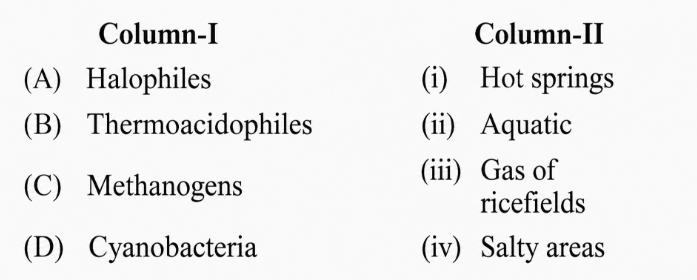
[4 Marks] Diagram 32 – NEET-UG 2019 Question Paper — Set 2
  • (A) (A)-(i), (B)-(iii), (C)-(ii), (D)-(iv)
  • (B) (A)-(iii), (B)-(iv), (C)-(ii), (D)-(i)
  • (C) (A)-(ii), (B)-(iv), (C)-(iii), (D)-(i)
  • (D) (A)-(iv), (B)-(i), (C)-(iii), (D)-(ii)
Question 134.

In the dicot root the vascular cambium originates from :

[4 Marks]
  • (A) Parenchyma between endodermis and pericycle.
  • (B) Cortical region
  • (C) Tissue located below the phloem bundles and a portion of pericycle tissue above protoxylem.
  • (D) Intrafascicular and interfascicular tissue in a ring.
Question 135.

Which of the following shows whorled phyllotaxy?

[4 Marks]
  • (A) Calotropis
  • (B) China rose
  • (C) Alstonia
  • (D) Mustard
Question 136.

Regeneration of damaged growing grass following grazing is largely due to :

[4 Marks]
  • (A) Apical meristem
  • (B) Intercalary meristem
  • (C) Lateral meristem
  • (D) Secondary meristem
Question 137.

Bicarpellary ovary with obliquely placed septum is seen in :

[4 Marks]
  • (A) Sesbania
  • (B) Aloe
  • (C) Solanum
  • (D) Brassica
Question 138.

Select the incorrect statement regarding inbreeding.

[4 Marks]
  • (A) Continued inbreeding reduces fertility and leads to inbreeding depression.
  • (B) Inbreeding is necessary to evolve a pure line in any animal.
  • (C) Inbreeding helps in elimination of deleterious alleles from the population.
  • (D) Inbreeding depression cannot be overcome by out-crossing.
Question 139.

A biocontrol agent to be a part of an integrated pest management should be :

[4 Marks]
  • (A) Free living and broad spectrum.
  • (B) Narrow spectrum and symbiotic.
  • (C) Species-specific and symbiotic.
  • (D) Species-specific and inactive on nontarget organisms.
Question 140.

Match the following enzymes with their functions:
Select the correct option from the following:
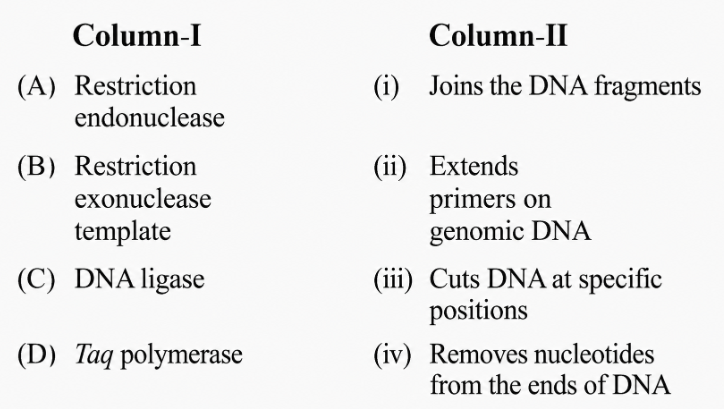
[4 Marks] Diagram 33 – NEET-UG 2019 Question Paper — Set 2
  • (A) (A)-(ii), (B)-(iv), (C)-(i), (D)-(iii)
  • (B) (A)-(iii), (B)-(i), (C)-(iv), (D)-(ii)
  • (C) (A)-(iv), (B)-(iii), (C)-(i), (D)-(ii)
  • (D) (A)-(iii), (B)-(iv), (C)-(i), (D)-(ii)
Question 141.

The two antibiotic resistance genes on vector pBR322 are for

[4 Marks]
  • (A) Chloramphenicol and Tetracycline
  • (B) Ampicillin and Chloramphenicol
  • (C) Tetracycline and Kanamycin
  • (D) Ampicillin and Tetracycline
Question 142.

Exploitation of bioresources of a nation by multinational companies without authorisation from the concerned country is referred to as

[4 Marks]
  • (A) Biowar
  • (B) Bioweapon
  • (C) Biopiracy
  • (D) Bioethics
Question 143.

Carnivorous animals – lions and leopards, occupy the same niche but lions predate mostly larger animals and leopards take smaller ones. This mechanism of competition is referred to as

[4 Marks]
  • (A) Character displacement
  • (B) Competitive exclusion
  • (C) Altruism
  • (D) Resource partitioning
Question 144.

Decline in the population of Indian native fishes due to introduction of Clarias gariepinus in river Yamuna can be categorised as

[4 Marks]
  • (A) Over exploitation
  • (B) Habitat fragmentation
  • (C) Co-extinction
  • (D) Alien species invasion
Question 145.

Match the following RNA polymerases with their transcribed products:
Select the correct option from the following:

[4 Marks] Diagram 34 – NEET-UG 2019 Question Paper — Set 2
  • (A) (A)-(iii), (B)-(iii), (C)-(i)
  • (B) (A)-(i), (B)-(iii), (C)-(ii)
  • (C) (A)-(ii), (B)-(iii), (C)-(i)
  • (D) (A)-(i), (B)-(iii), (C)-(iii)
Question 146.

In a marriage between male with blood group A and female with blood group B, the progeny had either blood group AB or B. What could be the possible genotype of parents?

[4 Marks]
  • (A) Iᴬi (Male); IᴮIᴮ (Female)
  • (B) IᴬIᴬ (Male); IᴮIᴮ (Female)
  • (C) Iᴬi (Male); IᴮIᴮ (Female)
  • (D) Iᴬi (Male); Iᴮi (Female)
Question 147.

A population of a species invades a new area. Which of the following condition will lead to adaptive radiation?

[4 Marks]
  • (A) Area with many habitats occupied by a large number of species.
  • (B) Area with large number of habitats having very low food supply.
  • (C) Area with a single type of vacant habitat.
  • (D) Area with many types of vacant habitats.
Question 148.

Identify A, B and C in the diagrammatic representation of the mechanism of hormone action.
Select the correct option from the following:
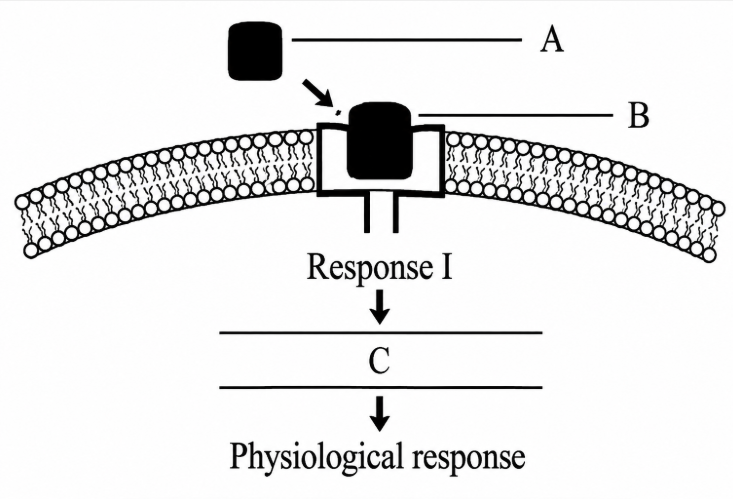
[4 Marks] Diagram 35 – NEET-UG 2019 Question Paper — Set 2
  • (A) A= Protein hormone; B = Receptor C = Cyclic AMP
  • (B) A = Steroid hormone; B = Receptor;C = second messenger
  • (C) A = Steroid hormone; B = Hormone-receptor complex; C = protein
  • (D) A="Protein hormone; B = Cyclic AMP; C = Hormone-receptor complex
Question 149.

Humans have acquired immune system that produces antibodies to neutralise pathogens. Still innate immune system is present at the time of birth because it

[4 Marks]
  • (A) provides passive immunity.
  • (B) is very specific and uses different macrophages.
  • (C) produces memory cells for mounting secondary response.
  • (D) has natural killer cells which can phagocytose and destroy microbes.
Question 150.

Select the correct sequence of events.

[4 Marks]
  • (A) Gametogenesis → Syngamy → Gamete transfer → Zygote → Cell division (Cleavage) → Cell differentiation → Organogenesis
  • (B) Gametogenesis → Gamete transfer → Syngamy → Zygote → Cell division (Cleavage) → Organogenesis → Cell differentiation
  • (C) Gametogenesis → Gamete transfer → Syngamy → Zygote → Cell division (Cleavage) → Cell differentiation → Organogenesis
  • (D) Gametogenesis → Gamete transfer → Syngamy → Zygote → Cell differentiation → Cell division (Cleavage) → Organogenesis
Question 151.

Which of the following hormones is responsible for both the milk ejection reflex and the foetal ejection reflex?

[4 Marks]
  • (A) Oxytocin
  • (B) Prolactin
  • (C) Oestrogen
  • (D) Relaxin
Question 152.

No new follicles develop in the luteal phase of the menstrual cycle because:

[4 Marks]
  • (A) Follicles do not remain in the ovary after ovulation.
  • (B) Both FSH and LH levels are low in the luteal phase.
  • (C) LH levels are high in the luteal phase.
  • (D) FSH levels are high in the luteal phase.
Question 153.

In Australia, marsupials and placental mammals have evolved to share many similar characteristics. This type of evolution may be referred to as

[4 Marks]
  • (A) Cyclical evolution
  • (B) Divergent evolution
  • (C) Adaptive radiation
  • (D) Convergent evolution
Question 154.

Match the items of Column-I with Column-II.
Select the correct option from the following:
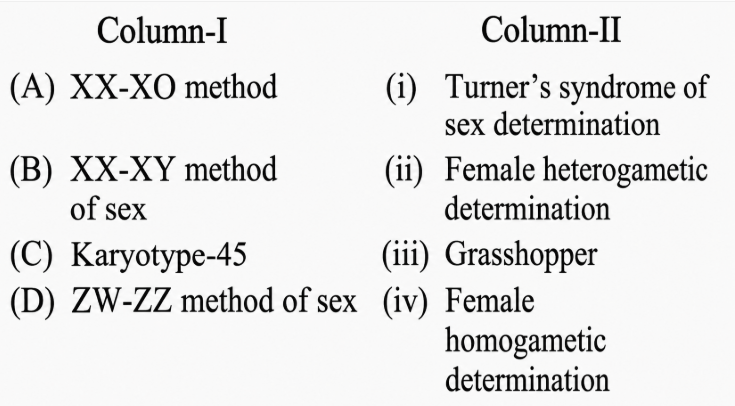
[4 Marks] Diagram 36 – NEET-UG 2019 Question Paper — Set 2
  • (A) (A)-(i), (B)-(iv), (C)-(ii), (D)-(iii)
  • (B) (A)-(iii), (B)-(iv), (C)-(i), (D)-(ii)
  • (C) (A)-(ii), (B)-(iv), (C)-(i), (D)-(iii)
  • (D) (A)-(iv), (B)-(ii), (C)-(i), (D)-(iii)
Question 155.

What will be the sequence of mRNA produced by the following stretch of DNA?
3′ ACTGATGCATGCAG 5′ TEMPLATE STRAND
5′ TACTGATGCATGCAG 3′ CODING STRAND

[4 Marks]
  • (A) 3′ AUGCAUGCAUGCAUG 5′
  • (B) 3′ AUGCAUGCAUGCAUG 3′
  • (C) 3′ UACGUACGUACGUAC 5′
  • (D) 5′ UACGUACGUACGUAC 3′
Question 156.

Which of the following statements is not correct?

[4 Marks]
  • (A) In the knee-jerk reflex, stimulus is the stretching of muscle and response is its contraction.
  • (B) Depolarisation of hair cells of cochlea results in the opening of the mechanically gated potassium ion channels.
  • (C) Rods are very sensitive and contribute to daylight vision.
  • (D) An action potential in an axon does not move backward because the segment behind is in a refractory phase.
Question 157.

Match the following joints with the bones involved.

Select the correct option from the following:
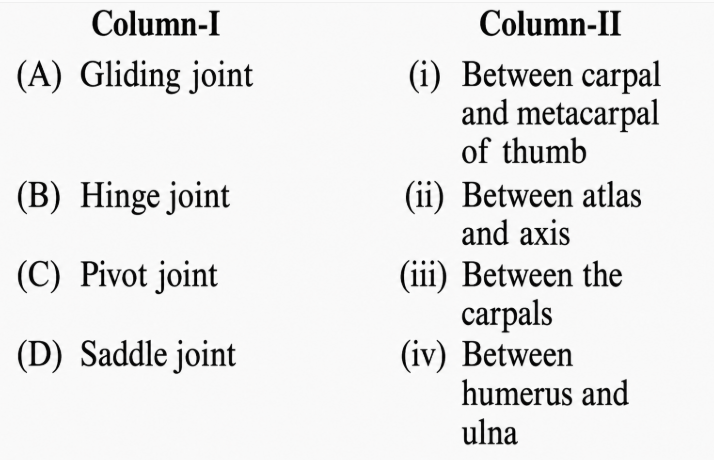
[4 Marks] Diagram 37 – NEET-UG 2019 Question Paper — Set 2
  • (A) (A)-(iv), (B)-(ii), (C)-(iii), (D)-(i)
  • (B) (A)-(iv), (B)-(i), (C)-(ii), (D)-(iii)
  • (C) (A)-(iii), (B)-(iv), (C)-(ii), (D)-(i)
  • (D) (A)-(i), (B)-(iii), (C)-(ii), (D)-(iv)
Question 158.

Which of the following diseases is an autoimmune disorder?

[4 Marks]
  • (A) Osteoporosis
  • (B) Arthritis
  • (C) Gout
  • (D) Myasthenia gravis
Question 159.

Artificial light, extended work-time and reduced sleep-time disrupt the activity of

[4 Marks]
  • (A) Pineal gland
  • (B) Adrenal gland
  • (C) Thymus gland
  • (D) Posterior pituitary gland
Question 160.

Which of the following is a correct statement?

[4 Marks]
  • (A) IUDs once inserted need not be replaced.
  • (B) IUDs are generally inserted by the user herself.
  • (C) IUDs increase phagocytosis of sperms in the uterus.
  • (D) IUDs suppress gametogenesis.
Question 161.

Which of the following sexually transmitted diseases do not specifically affect reproductive organs?

[4 Marks]
  • (A) Chlamydiasis and AIDS
  • (B) Genital warts and Hepatitis-B
  • (C) AIDS and Hepatitis B
  • (D) Syphilis and Genital herpes
Question 162.

Select the correct statement.

[4 Marks]
  • (A) Expiration is initiated due to contraction of diaphragm.
  • (B) Expiration occurs due to external intercostal muscles.
  • (C) Inspiration occurs when atmospheric pressure is less than intrapulmonary pressure.
  • (D) Intrapulmonary pressure is lower than the atmospheric pressure during inspiration.
Question 163.

The maximum volume of air a person can breathe in after a forced expiration is known as:

[4 Marks]
  • (A) Inspiratory capacity
  • (B) Vital capacity
  • (C) Expiratory capacity
  • (D) Total lung capacity
Question 164.

All the components of the nodal tissue are autoexcitable. Why does the SA node act as the normal pacemaker?

[4 Marks]
  • (A) SA node has the highest rate of depolarisation.
  • (B) SA node is the only component to generate the threshold potential.
  • (C) Only SA node can convey the action potential to the other components.
  • (D) SA node has the lowest rate of depolarisation.
Question 165.

A specialised nodal tissue embedded in the lower corner of the right atrium, close to Atrio-ventricular septum, delays the spreading of impulses to heart apex for about 0.1 sec. This delay allows

[4 Marks]
  • (A) the atria to empty completely.
  • (B) the ventricles to empty completely.
  • (C) blood to enter aorta.
  • (D) blood to enter pulmonary arteries.
Question 166.

Match the following parts of a nephron with their function:
Select the correct option from the following:
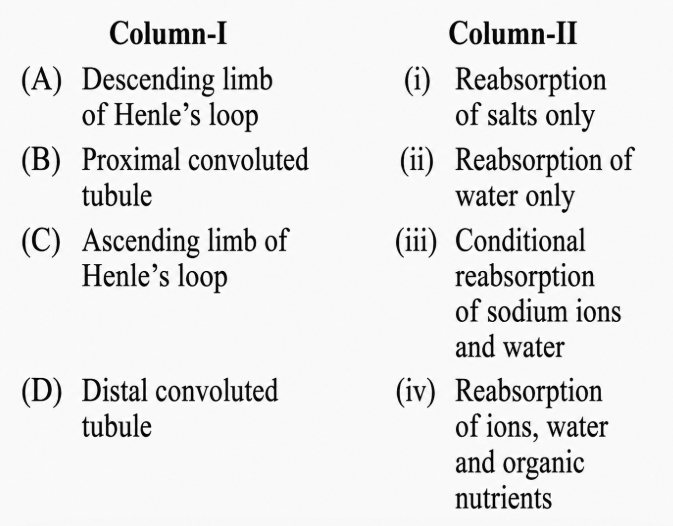
[4 Marks] Diagram 38 – NEET-UG 2019 Question Paper — Set 2
  • (A) (A)-(iv), (B)-(i), (C)-(iii), (D)-(ii)
  • (B) (A)-(i), (B)-(iii), (C)-(ii), (D)-(iv)
  • (C) (A)-(i), (B)-(iv), (C)-(ii), (D)-(iii)
  • (D) (A)-(ii), (B)-(iv), (C)-(i), (D)-(iii)
Question 167.

Match the items in Column-I with those in Column-II.
Select the correct option from the following:
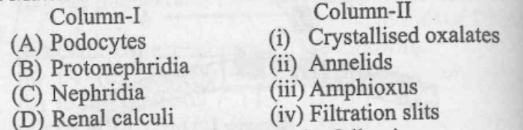
[4 Marks] Diagram 39 – NEET-UG 2019 Question Paper — Set 2
  • (A) (A)-(iv), (B)-(ii), (C)-(iii), (D)-(i)
  • (B) (A)-(iii), (B)-(ii), (C)-(iv), (D)-(i)
  • (C) (A)-(iii), (B)-(iv), (C)-(ii), (D)-(i)
  • (D) (A)-(iv), (B)-(iii), (C)-(ii), (D)-(i)
Question 168.

Which of the following receptors are specifically responsible for maintenance of balance of body and posture?

[4 Marks]
  • (A) Crista ampullaris and macula
  • (B) Basilar membrane and otoliths
  • (C) Hair cells and organ of Corti
  • (D) Tectorial membrane and macula
Question 169.

Which of the following cell organelles is present in the highest number in secretory cells?

[4 Marks]
  • (A) Lysosome
  • (B) Mitochondria
  • (C) Golgi complex
  • (D) Endoplasmic reticulum
Question 170.

Non-membranous nucleoplasmic structures in nucleus are the site for active synthesis of

[4 Marks]
  • (A) tRNA
  • (B) protein synthesis
  • (C) mRNA
  • (D) rRNA
Question 171.

Which of the following nucleic acids is present in an organism having 70 S ribosomes only?

[4 Marks]
  • (A) Single stranded DNA with protein coat.
  • (B) Double stranded circular DNA with histone proteins.
  • (C) Double stranded circular naked DNA.
  • (D) Double stranded DNA enclosed in nuclear membrane.
Question 172.

After meiosis I, the resultant daughter cells have

[4 Marks]
  • (A) same amount of DNA as in the parent cell in S phase.
  • (B) four times the amount of DNA in comparison to haploid gamete.
  • (C) same amount of DNA in comparison to haploid gamete.
  • (D) twice the amount of DNA in comparison to haploid gamete.
Question 173.

Which of the following organic compounds is the main constituent of lecithin?

[4 Marks]
  • (A) Phosphoprotein
  • (B) Arachidonic acid
  • (C) Cholesterol
  • (D) Phospholipid
Question 174.

The main difference between active and passive transport across cell membrane is :

[4 Marks]
  • (A) Passive transport is non-selective whereas active transport is selective.
  • (B) Active transport occurs more rapidly than passive transport.
  • (C) Passive transport requires a concentration gradient across a biological membrane whereas active transport requires energy to move solutes.
  • (D) Passive transport is confined to anionic carrier proteins whereas active transport is confined to cationic channel proteins.
Question 175.

Match the items given in Column-I with those in Column-II and choose the correct option.
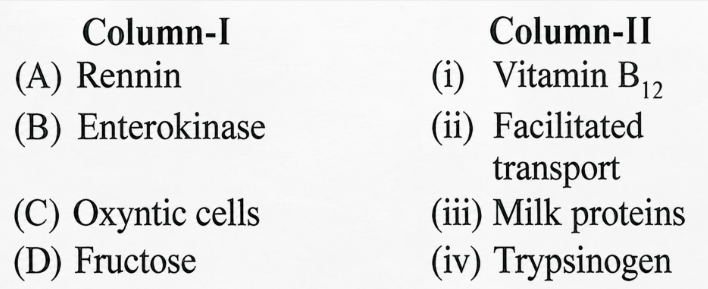
[4 Marks] Diagram 40 – NEET-UG 2019 Question Paper — Set 2
  • (A) (A)-(iii), (B)-(iv), (C)-(i), (D)-(ii)
  • (B) (A)-(iv), (B)-(iii), (C)-(i), (D)-(ii)
  • (C) (A)-(iii), (B)-(iv), (C)-(ii), (D)-(i)
  • (D) (A)-(iv), (B)-(iii), (C)-(ii), (D)-(i)
Question 176.

Match the following genera with their respective phylum.
Select the correct option:
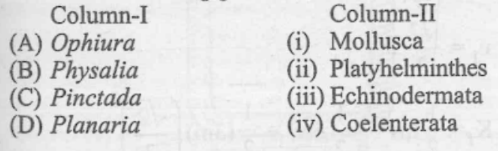
[4 Marks] Diagram 41 – NEET-UG 2019 Question Paper — Set 2
  • (A) (A)-(iii), (B)-(iv), (C)-(ii), (D)-(i)
  • (B) (A)-(iii), (B)-(iv), (C)-(i), (D)-(ii)
  • (C) (A)-(iv), (B)-(i), (C)-(iii), (D)-(ii)
  • (D) (A)-(i), (B)-(iii), (C)-(iv), (D)-(ii)
Question 177.

Which of the following animals are true coelomates with bilateral symmetry?

[4 Marks]
  • (A) Annelids
  • (B) Adult echinoderms
  • (C) Aschelminthes
  • (D) Platyhelminthes
Question 178.

The contrasting characters generally in a pair used for identification of animals in Taxonomic Key are referred to as :

[4 Marks]
  • (A) Alternate
  • (B) Lead
  • (C) Couplet
  • (D) Doublet
Question 179.

Match the following cell structure with its characteristic feature:
Select correct option from the following:
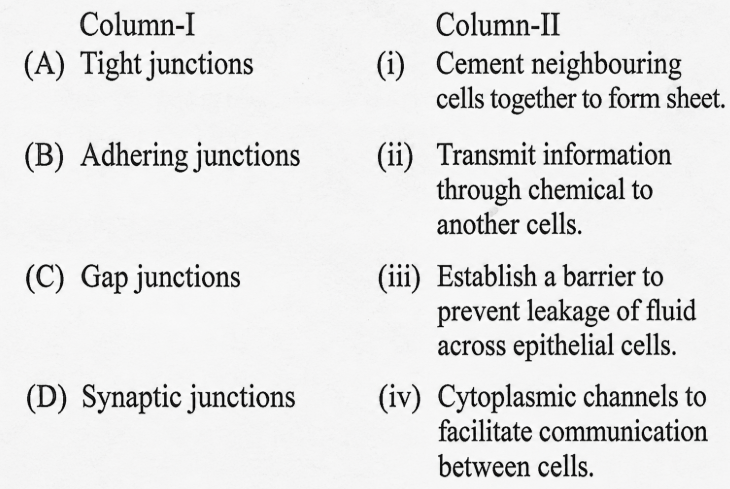
[4 Marks] Diagram 42 – NEET-UG 2019 Question Paper — Set 2
  • (A) (A)-(iii), (B)-(i), (C)-(iv), (D)-(ii)
  • (B) (A)-(iv), (B)-(ii), (C)-(i), (D)-(iii)
  • (C) (A)-(iv), (B)-(iii), (C)-(i), (D)-(ii)
  • (D) (A)-(ii), (B)-(iv), (C)-(i), (D)-(iii)
Question 180.

Which of the following statements is INCORRECT?

[4 Marks]
  • (A) Cockroaches exhibit mosaic vision with less sensitivity and more resolution.
  • (B) Female cockroach possesses sixteen ovarioles in the ovaries.
  • (C) A mushroom-shaped gland is present in the 6th–7th abdominal segments of male cockroach.
  • (D) A pair of spermatheca is present in the 6th segment of female cockroach.