CBSE EXAMINATION PAPER-2007
NEET-ZOOLOGY
(Solved)
General Instructions :
Read the following instructions carefully and follow them :
- This question paper contains 200 questions. All questions are compulsory.
- This question paper is divided into 1 sections.
- Section A – questions number 1 to 200 are multiple choice questions
- There is no overall choice given in the question paper. However, an internal choice has been provided in few questions.
- Use of calculator is NOT allowed.
Section A
Dimensions of resistance in an electrical circuit, in terms of dimension of mass [M], of length [L], of time [T] and of current [I], would be
As we know that
R = [V]/[I] = w/ q.i
= w / (i . t . i) Dimension of Resistance = [ML²T⁻³I⁻¹] / [T][I] = [ML²T⁻³I⁻²]
A car moves from X to Y with a uniform speed v_u and returns to Y with a uniform speed v_d. The average speed for this round trip is
Average speed = total distance travelled / total time taken Let s be the distance from X to Y. Therefore, Average speed = (s + s) / (t_1 + t_2) = 2s / (s/v_u + s/v_d) = 2v_u v_d / (v_d + v_u)
The position x of a particle with respect to time t along x-axis is given by x = 9t² - t³ where x is in metres and t in second. What will be the position of this particle when it achieves maximum speed along the +ve x direction?
Speed v = dx/dt = d/dt(9t² - t³) = 18t - 3t² For maximum speed its acceleration should be zero, Acceleration = dv/dt = 0 => 18 - 6t = 0 => t = 3 At t = 3 its speed is max => x_max = 81 - 27 = 54 m
A particle moving along x-axis has acceleration f, at time t, given by f = f_0 (1 - t/T), where f_0 and T are constants. The particle at t = 0 has zero velocity. In the time interval between t = 0 and the instant when f = 0, the particle's velocity (v_x) is
Here, f = f_0(1 - t/T)
or, dv/dt = f_0(1 - t/T)
If f = 0, then
0 = f_0(1 - t/T) => t = T
Hence, particle's velocity in the time interval t = 0 and t = T is given by
v_x = integral from v=0 to v=v_z of dv = integral from t=0 to t=T of [f_0(1 - t/T)]dt
= f_0 [t - t²/(2T)] evaluated from 0 to T
= f_0 (T - T²/(2T)) = f_0 × (T - T/2) = (1/2)f_0 T.
𝐀⃗ and 𝐁⃗ are two vectors and θ is the angle between them, if | 𝐀⃗ x 𝐁⃗| = √3( 𝐀⃗ . 𝐁⃗ ), the value of θ is
|𝐀⃗ x 𝐁⃗| = √3(𝐀⃗ . 𝐁⃗)
=> AB sin θ = √3 AB cos θ
=> tan θ = √3 => θ = 60°
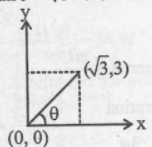
A particle starting from the origin (0, 0) moves in the (x, y) plane. Its coordinates at a later time are (√3, 3). The path of the particle makes with the x-axis an angle of
Let θ be the angle which the particle makes with x-axis.
From figure, tan θ = 3 / √3 = √3
=> θ = tan⁻¹(√3) = 60°
A block B is pushed momentarily along a horizontal surface with an initial velocity V. If μ is the coefficient of sliding friction between B and the surface, block B will come to rest after a time
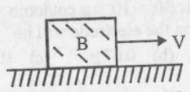
Friction is the retarding force for the block
F = ma = μR = μmg
Therefore, from the first equation of motion
v = u - at
0 = V - μg * t => V/μg = t
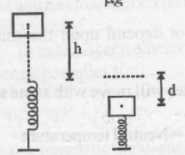
A vertical spring with force constant k is fixed on a table. A ball of mass m at a height h above the free upper end of the spring falls vertically on the spring so that the spring is compressed by a distance d. The net work done in the process is
W = Potential energy stored in the spring + Loss of potential energy of mass
W = mg(h + d) - (1/2)kd²
A wheel has angular acceleration of 3.0 rad/sec² and an initial angular speed of 2.00 rad/sec. In a time of 2 sec it has rotated through an angle (in radian) of
Since, θ = ω_0 t + (1/2)αt²
Where α is angular acceleration, ω_0 is the initial angular speed. t = 2s
θ = 2 2 + (1/2) 3 * (2)² = 4 + 6 = 10 rad
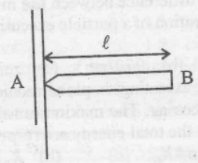
A uniform rod AB of length l, and mass m is free to rotate about point A. The rod is released from rest in the horizontal position. Given that the moment of inertia of the rod about A is ml²/3, the initial angular acceleration of the rod will be
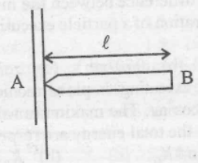
Weight of the rod will produce torque,
τ = mg * l/2
Also, τ = Iα
where, I is the moment of inertia = ml²/3
and α is the angular acceleration
Therefore, (ml²/3)α = mg * l/2 => α = 3g / (2l)
A particle of mass m moves in the XY plane with a velocity v along the straight line AB. If the angular momentum of the particle with respect to origin O is L_A when it is at A and L_B when it is at B, then
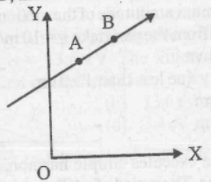
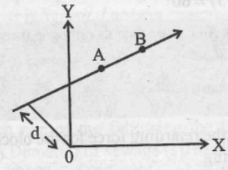
Angular momentum = Linear momentum * distance of line of action of linear momentum about the origin.
L_A = p_A *d, L_B = p_B * d
As linear momenta are p_A and p_B equal,
therefore, L_A = L_B.
Two satellites of earth, S₁ and S₂ are moving in the same orbit. The mass of S₁ is four times the mass of S₂. Which one of the following statements is true?
Since orbital velocity of satellite is v = √(GM / r), it does not depend upon the mass of the satellite. Therefore, both satellites will move with same speed.
If the cold junction of a thermo-couple is kept at 0°C and the hot junction is kept at T°C then the relation between neutral temperature (T_n) and temperature of inversion (T_i) is
Since T_n = (T_i + T_c) / 2 = Neutral temperature
T_n = (T_i + 0) / 2 = T_i / 2
[T_c = 0°C = temperature of cold junction]
A black body is at 727°C. It emits energy at a rate which is proportional to
According to Stefan's law,
E ∝ T⁴
E ∝ (t + 273)⁴ K [727°C = (727 + 273)K]
E ∝ (727 + 273)⁴ K
E ∝ (1000)⁴ K
Assuming the sun to have a spherical outer surface of radius r, radiating like a black body at temperature t°C, the power received by a unit surface, (normal to the incident rays) at a distance R from the centre of the sun is
Power radiated by the sun at t°C
= σ(t + 273)⁴ 4πr²
Power received by a unit surface
= σ(t + 273)⁴ 4πr² / (4πR²) = r²σ(t + 273)⁴ / R²
An engine has an efficiency of 1/6. When the temperature of sink is reduced by 62°C, its efficiency is doubled. Temperature of the source is
Since efficiency of engine is η = 1 - T_2/T_1
According to problem,
1/6 = 1 - T_2/T_1 ........(i)
When the temperature of the sink is reduced by 62°C, its efficiency is doubled
2(1/6) = 1 - (T_2 - 62) / T_1 ........(ii)
Solving (i) and (ii) T_2 = 372 K
T_1 = 99°C = Temperature of source.
The phase difference between the instantaneous velocity and acceleration of a particle executing simple harmonic motion is
Let y = A sin ωt
v_inst = dy/dt = Aω cos ωt = Aω sin(ωt + π/2)
Acceleration = -Aω² sin ωt = Aω² sin(π + ωt)
Therefore, φ = π/2 = 0.5π
The particle executing simple harmonic motion has a kinetic energy K_0 cos² ωt. The maximum values of the potential energy and the total energy are respectively
We have, U + K = E
where, U = potential energy, K = Kinetic energy, E = Total energy.
Also, we know that, in S.H.M., when potential energy is maximum,
K.E. is zero and vice-versa.
Therefore, U_max + 0 = E => U_max = E
Further,
K.E. = (1/2)mω²a² cos² ωt
But by question, K.E. = K_0 cos² ωt
Therefore, K_0 = (1/2)mω²a²
Hence, total energy, E = (1/2)mω²a² = K_0
Therefore, U_max = K_0 & E = K_0.
A mass of 2.0 kg is put on a flat pan attached to a vertical spring fixed on the ground as shown in the figure. The mass of the spring and the pan is negligible. When pressed slightly and released the mass executes a simple harmonic motion. The spring constant is 200 N/m. What should be the minimum amplitude of the motion so that the mass gets detached from the pan (take g = 10 m/s²)?
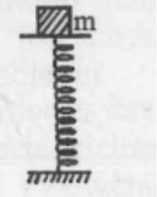
Mass gets detached at the upper extreme position when pan returns to its mean position.
At that point, R = mg - mω²a = 0
i.e. g = ω²a
=> a = g / ω² = mg / k
=> a = 2 * 10 / 200 [As ω² = k / m]
=> a = 1/10 m = 10cm
A particle executes simple harmonic oscillation with an amplitude a. The period of oscillation is T. The minimum time taken by the particle to travel half of the amplitude from the equilibrium position is
Displacement from the mean position
y = a sin((2π / T)t)
According to problem y = a/2
a/2 = a sin((2π / T)t)
=> π/6 = (2π / T)t => t = T/12
This is the minimum time taken by the particle to travel half of the amplitude from the equilibrium position.
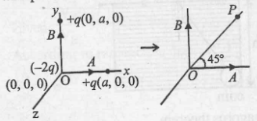
Three point charges +q, -q and +q are placed at points (x = 0, y = a, z = 0), (x = 0, y = 0, z = 0) and (x = a, y = 0, z = 0) respectively. The magnitude and direction of the electric dipole moment vector of this charge assembly are
Three point charges +q, -2q and +q are placed at points B(x = 0, y = a, z = 0), O(x = 0, y = 0, z = 0) and A(x = a, y = 0, z = 0)
The system consists of two dipole moment vectors due to (+q and -q) and again due to (+q and -q) charges having equal magnitudes qa units — one along 𝐎⃗ 𝐀⃗ and other along 𝐎⃗ 𝐁⃗. Hence, net dipole moment,
P_net = √((qa)² + (qa)²) = √2 qa along 𝐎⃗ 𝐏⃗ at an angle 45° with positive X-axis.
A hollow cylinder has a charge q coulomb within it. If φ is the electric flux in units of voltmeter associated with the curved surface B, the flux linked with the plane surface A in units of voltmeter will be
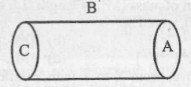
Since φ_total = φ_A +φ_B + φ_C = q / ε_0,
where q is the total charge.
As shown in the figure, flux associated with the curved surface B is φ = φ_B
Let us assume flux linked with the plane surfaces A and C be Φ_A = φ_C = φ'
Therefore,
q / ε_0 = 2φ' +φ_B = 2φ' +φ
=> φ' = (1/2) * (q / ε_0 - φ)
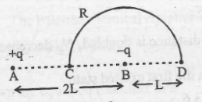
Charges +q and -q are placed at points A and B respectively which are a distance 2L apart, C is the midpoint between A and B. The work done in moving a charge +Q along the semicircle CRD is
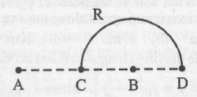
Potential at C = V_C = 0
Potential at D = V_D
= k(-q/ L) + kq /3 L = -2 /3 kq / L
Potential difference
V_D - V_C = - 2/ 3 kq / L = 1 / (4π ε_0) ( - 2 / 3 .q / L)
=> Work done = Q(V_D - V_C)
= 2/3 * 1 / (4π ε_0) (qQ / L) = -qQ / (6π ε_0 L)
Two condensers, one of capacity C and other of capacity C/2 are connected to a V-volt battery, as shown.
The work done in charging fully both the condensers is
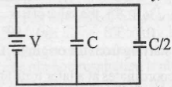
Work done = Change in energy
= (1/2)(C + C/2)V² = (1/2)(3C / 2)V² = 3CV² / 4
A steady current of 1.5 amp flows through a copper voltameter for 10 minutes. If the electrochemical equivalent of copper is 30 × 10⁻⁵ g coulomb⁻¹, the mass of copper deposited on the electrode will be
We have, m = ZIt
where, Z is the electrochemical equivalent of copper.
=> m = 30 × 10⁻⁵ × 1.5 *10 × 60
= 0.27 gm
The total power dissipated in watts in the circuit shown here is
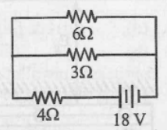
Power dissipated = P
= V² / R = (18)² / 6 = 54 W
Three resistances P, Q, R each of 2Ω and an unknown resistance S form the four arms of a Wheatstone bridge circuit. When a resistance of 6Ω is connected in parallel to S the bridge gets balanced. What is the value of S?
A balanced wheatstone bridge simply requires
P / Q = R / S => 2 / 2 = 2 / S
Therefore, S should be 2Ω.
A resistance of 6Ω is connected in parallel.
In parallel combination,
1 / R = 1 / R_1 + 1 / R_2
1 / 2 = 1 / 6 + 1 / S => S = 3Ω
A beam of electron passes undeflected through mutually perpendicular electric and magnetic fields. If the electric field is switched off, and the same magnetic field is maintained, the electrons move
If the electric field is switched off, and the same magnetic field is maintained, the electrons move in a circular orbit and electron will travel a magnetic field perpendicular to its velocity.
In a mass spectrometer used for measuring the masses of ions, the ions are initially accelerated by an electric potential V and then made to describe semicircular path of radius R using a magnetic field B. If V and B are kept constant, the ratio (charge on the ion / mass of the ion) will be proportional to
In mass spectrometer, when ions are accelerated through potential V
(1/2)mv² = qV ........(i)
As the magnetic field curves the path of the ions in a semicircular orbit
Bqv = mv² / R => v = BqR / m ........(ii)
Substituting (ii) in (i)
(1/2)m × (BqR / m)² = qV
or q / m = 2V / (B²R²)
Since V and B are constants, therefore, q / m ∝ 1/R²
A charged particle (charge q) is moving in a circle of radius R with uniform speed v. The associated magnetic moment μ is given by
Magnetic moment, m = IA
= (qv / (2πR)) × (πR²) = qvR / 2
[ I = q/T and T = 2πR/v ]
Under the influence of a uniform magnetic field a charged particle is moving in a circle of radius R with constant speed v. The time period of the motion
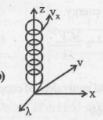
When a test charge q_0 enters a magnetic field 𝐁⃗ directed along z-axis, with a velocity 𝐕⃗ making angles d with the z-axis. The time period of the motion is independent of R and v.
The resistance of an ammeter is 13 Ω and its scale is graduated for a current upto 100 amps. After an additional shunt has been connected to this ammeter it becomes possible to measure currents upto 750 amperes by this meter. The value of shunt-resistance is
We know
I / I_s = 1 + G / S
750 / 100 = 1 + 13 / S
S ⇒ 2Ω
Nickel shows ferromagnetic property at room temperature. If the temperature is increased beyond Curie temperature, then it will show
Beyond Curie temperature, ferromagnetic substances behaves like a paramagnetic substance.
What is the value of inductance L for which the current is maximum in a series LCR circuit with C = 10 μF and ω = 1000 s⁻¹?
Condition for which the current is maximum in a series LCR circuit is,
ω = 1 / √(LC) => 1000 = 1 / √(L(10 × 10⁻⁶))
=> L = 100 mH
The primary and secondary coil of a transformer have 50 and 1500 turns respectively. If the magnetic flux φ linked with the primary coil is given by φ = φ_0 + 4t, where φ is in webers, t is time in seconds and φ_0 is a constant, the output voltage across the secondary coil is
Since V_s / V_p = N_s / N_p
Where
N_s = No. of turns across primary coil = 50
N_p = No. of turns across secondary coil = 1500
and V_p = dφ/dt = d/dt(φ_0 + 4t) = 4
=> V_s = (1500 / 50) × 4 = 120 V
A transformer is used to light a 100 W and 110 V lamp from a 220 V mains. If the main current is 0.5 amp, the efficiency of the transformer is approximately
Efficiency of the transformer
η = P_output / P_input × 100 = 100 / (220 × 0.5) × 100 = 90.9%
The electric and magnetic field of an electro-magnetic wave are
Variation in magnetic field causes electric field and vice-versa. In electromagnetic waves, 𝐄⃗ is perpendicular to 𝐁⃗. Both 𝐄⃗ and 𝐁⃗ are in the same phase.
In electromagnetic waves
E = E_0 sin(ωt - kx)
B = B_0 sin(ωt - kx)
The electromagnetic waves travel in the direction of ( 𝐄⃗ x 𝐁⃗).
The frequency of a light wave in a material is 2 × 10¹⁴ Hz and wavelength is 5000 Å. The refractive index of material will be
By using v = nλ
Here, n = 2 × 10¹⁴ Hz
λ = 5000 Å = 5000 × 10⁻¹⁰ m
v = 2 × 10¹⁴ × 5000 × 10⁻¹⁰ = 10⁸ m/s
Refractive index of the material,
μ = c / v = (3 × 10⁸) / 10⁸ = 3
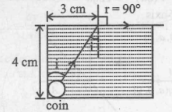
A small coin is resting on the bottom of a beaker filled with liquid. A ray of light from the coin travels upto the surface of the liquid and moves along its surface. How fast is the light travelling in the liquid?
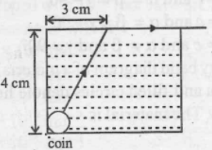
From pythagorus theorem, Hypotenuse comes out to be 5 cm.
Since, 1 / μ = sin i / sin 90°
μ = 1 / sin i = 5 / 3
Speed, v = c / μ = (3 * 10⁸) / (5/3) = 1.8 * 10⁸ m/s
Monochromatic light of frequency 6.0 × 10¹⁴ Hz is produced by a laser. The power emitted is 2 × 10⁻³ W. The number of photons emitted, on the average, by the sources per second is
Since p = nhν
=> n = p / hν = (2 ×10⁻³) / (6.6 × 10⁻³⁴ × 6 × 10¹⁴) = 5 × 10¹⁵
Biological organisation starts with
Biological organisms starts with submicroscopic molecular level like viruses, bacteria etc.
The living organisms can be unexceptionally distinguished from the non-living things on the basis of their ability for
There are several factors and processes which differentiate living beings from non-living things like reproduction, respiration, growth etc. But among them, reproduction is the only difference, which differentiates living beings from non-living things without any exception.
ICBN stands for
ICBN (International code of Botanical Nomenclature) - It is one of the code of nomenclature which is independent of zoological and bacteriological nomenclature.
Which one of the following statements about mycoplasma is wrong?
While working at the Rockefeller Institute, Brown reported isolation of a PPLO from human arthritic joint tissue in 1938. In 1949, Dienes reported to the 7th International Rheumatology Congress, the isolation of PPLO from the genitourinary tracts of men afflicted with arthritis. In discussing the significance of this observation, Brown reported successful treatment of arthritic patients in 1949 with a new antibiotic called aureomycin (Clark, 1997).
Which one of the following is a slime mould?
Physarum polycephalum belongs to phylum Amoebozoa, infraphylum Mycetozoa, and class Myxogastrea. P. polycephalum, often referred to as the “many-headed slime,” is a slime mold that inhabits shady, cool, moist areas, such as decaying leaves and logs.
Which pair of the following belongs to Basidiomycetes?
The class Basidiomycetes includes those members that produce their basidia and basidiospores on or in a basidiocarp.
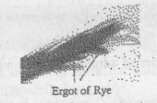
Ergot of rye is caused by species of of
Ergot of Rye is a plant disease that is caused by the fungus Claviceps purpurea. The so-called ergot that replaces the grain of the rye is a dark, purplish sclerotium, from which the sexual stage, of the life cycle will form after over wintering.
If you are asked to classify the algae into distinct groups, which of the following characters you should choose?
Algae are classified on the basis of types of pigment present in the cell, like Rhodophyceae shows presence of phycoerythrin, chlorophyceae shows presence of phycocyanin etc. Phaeophyceae contains the amount of the xanthophyll pigment such as fucoxanthin.
Spore dissemination in some liverworts is aided by
Elater is an elongated, spirally thickened, water-attracting cell in the capsule of a liverwort, derived from sporogenous tissue and assist in spore dispersal. In mosses calyptra is a structure initially present around sporophyte then break later. It is developed from venter wall after fertilization. It provides protective covering to the developing
Peristome teeth are found in the capsule of moss. These are present below operculum and are hygroscopic in nature.
In the prothallus of a vascular cryptogam, the antherozoids and eggs mature at different times. As a result
In the prothallus of a vascular cryptogams the antherozoids and eggs mature at different times which result in failure of self-fertilisation.
Flagellated male gametes are present in all the three of which one of the following sets?
The male gametes of bryophytes are biflagellate and those of pteridophytes are multiflagellate, except Selaginella having biflagellates gametes. The male gametes of gymnosperms are non-motile except those of Cycas having multiflagellate gametes.
In gymnosperms, the pollen chamber represents
In gymnosperms, the pollen chamber represents a cavity in the ovule in which pollen grains are stored after pollination within the pollen chamber, the generative cell nucleus divides to form two genetic nuclei and the tube cell elongates results in the formation of pollen tube, the pollen tube penetrates the female gametophyte and the sperm nuclei and then it pass through the tube. So, one of the sperm nuclei get fused with the egg results in the formation of zygote (diploid).
What is true about Nereis, scorpion, cockroach and silver fish?
Nereis (belongs to class polychaeta of phylum Annelida), scorpion and cockroach (belonging to phylum arthropoda) and silver fish all have dorsal heart.
Which one of the following is a matching pair of a body feature and the animal possessing it?
Leech has ventral central nervous system which consists of nerve ring, a solid, double, mid ventral nerve cord with ganglia.
Which of the following pairs are correctly matched?
Animals – Morphological features
(i) Crocodile – 4-chambered heart
(ii) Sea urchin – Parapodia
(iii) Obelia – Thecodont
(iv) Lemur – Thecodont
Crocodile belongs to class reptilia which has four chambered heart. Lemur teeth are embedded in the sockets of jaw, two of which is known as thecodont.
Which of the following is a flowering plant with nodules containing filamentous nitrogen-fixing micro-organism
It also know as Australian pine, which is a deciduous tree with a soft, wispy, pine-like appearance that can grow to 100 feet or more in height.
Passage cells are thin walled cells found in
The innermost layer of the cortex is called endodermis. It comprises a single layer of barrel shaped cells without any intercellular spaces. In roots thick walled endodermal cells are interrupted by thin walled passage cells or transfer tissue.
For a critical study of secondary growth in plants, which one of the following pairs is suitable?
Teak and pine are most suitable for the study of critical secondary growth because in secondary growth, secondary tissues are formed from lateral meristem which is well developed in these two cases and secondary growth occurs in gymnosperms and dicots.
In which one of the following preparations are you likely to come across cell junctions most frequently?
It is ciliated epithelium which bears numerous delicate hair like outgrowths, the cilia, arising from basal granules. The cilia remains in rhythmic motion and creates current to transport the materials which comes in contact with them.
Select the wrong statement from the following
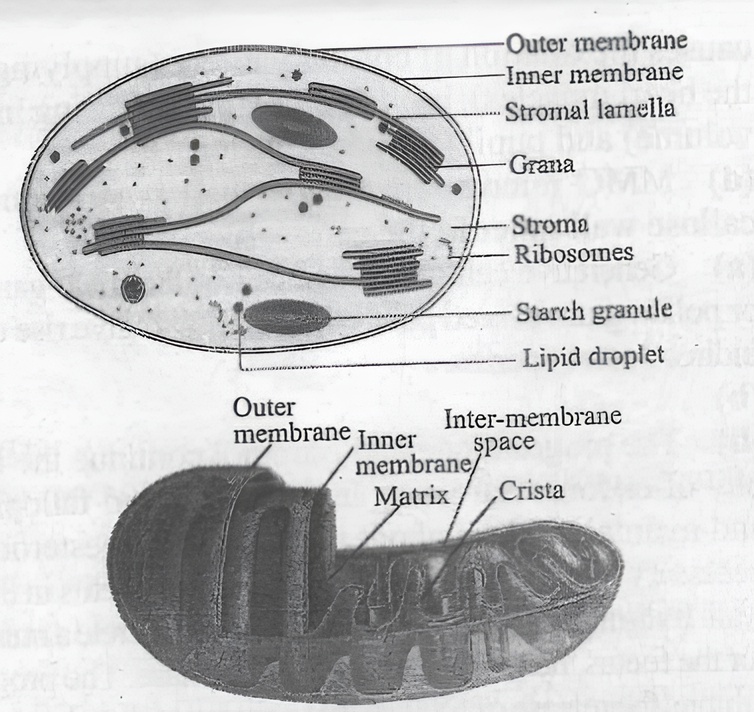
Both chloroplasts and mitochondria have an internal compartment, the thylakoid space bounded by double membrane
Which one of the following is not a constituent of cell membrane?
Proline (symbol Pro or P) is a proteinogenic amino acid that is used in the biosynthesis of proteins.
A 5 watt source emits monochromatic light of wavelength 5000 Å. When placed 0.5 m away, it liberates photoelectrons from a photosensitive metallic surface. When the source is moved to a distance of 1.0 m, the number of photoelectrons liberated will be reduced by a factor of
Number of emitted electrons N_E ∝ Intensity ∝ 1 / (Distance)² Therefore, as distance is doubled, N_E decreases by (1/4) times.
About 98 percent of the mass of every living organism is composed of just six elements including carbon, hydrogen, nitrogen, oxygen and
Calcium and phosphorus are the remaining elements.
The total energy of electron in the ground state of hydrogen atom is -13.6 eV. The kinetic energy of an electron in the first excited state is
Energy in the first excited state
= -13.6 / n² = -13.6 / 2² = -3.4 eV
But K.E. = -(Total energy) = +3.4 eV.
If the nucleus ²⁷₁₃ Al has nuclear radius of about 3.6 fm, then ¹²⁵₃₂Te would have its radius approximately as
It has been known that a nucleus of mass number A has radius
R = R_0 A^(1/3), where R_0 = 1.2 10⁻¹⁵ m
and A = mass number
In case of ²⁷₁₃Al, let nuclear radius be R_1
and for ¹²⁵₃₂Te, nuclear radius be R_2
For ²⁷₁₃Al, R_1 = R_0 (27)^(1/3) = 3R_0
For ¹²⁵₃₂Te, R_2 = R_0 (125)^(1/3) = 5R_0
R_2 / R_1 = 5R_0 / 3R_0
= 5 / 3R_1
= 5/3 × 3.6=6fm
Two cells A and B are contiguous. Cell A has osmotic pressure 10 atm, turgor pressure 7 atm and diffusion pressure deficit 3 atm. Cell B has osmotic pressure 8 atm, turgor pressure 3 atm and diffusion pressure deficit 5 atm. The result will
Movement of water will be from low DPD to high DPD i.e from A to B.
The term diffusion pressure deficit (DPD) was coined by B. S. Meyer in 1938. Originally DPD was described as suction pressure by Renner (1915). It is a reduction in the diffusion pressure of water in solution or cell over its pure state due to the presence of solutes in it and forces opposing diffusion. Diffusion pressure deficit (DPD) is the amount by which two solutions differ in their diffusion pressure. It is defined as the amount by which the diffusion pressure of water of solvent in a solution is lower than that of pure water or solvent. It allows easy absorption of water due to diffusion pressure gradient.
A plant requires magnesium for
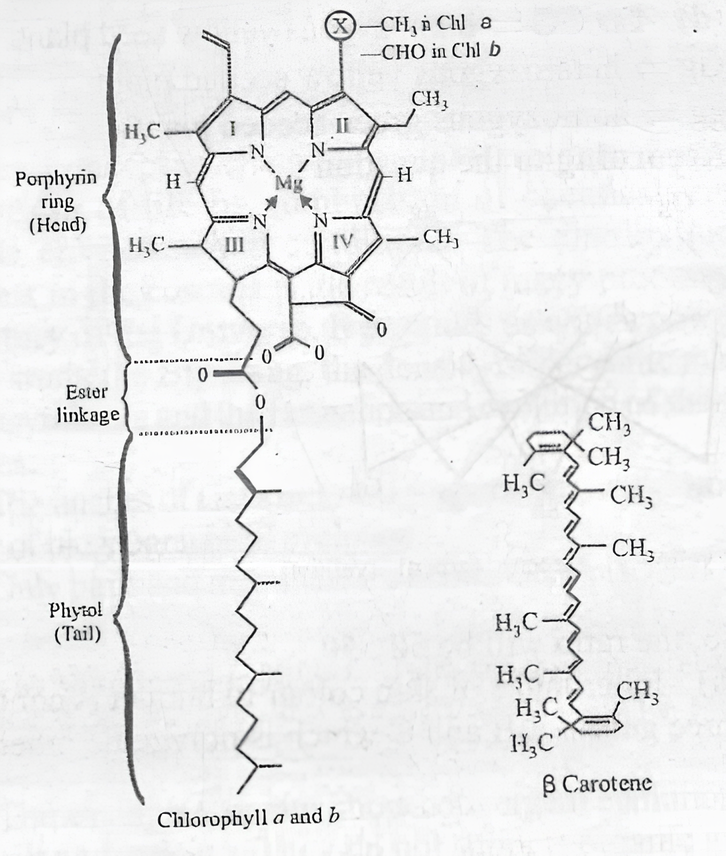
A plant requires magnesium for chlorophyll synthesis. All four rings bind with metal atom magnesium (Mg++ ), which remain present at the center of chlorophyll molecule.
A nucleus ᴬ_Z X has mass represented by M(A, Z). If M_p and M_n denote the mass of proton and neutron respectively and B.E. the binding energy in MeV, then
The difference in mass of a nucleus and its constituents, ΔM, is called the mass defect and is given by
ΔM = [ZM_p + (A - Z)M_n] - M
and binding energy = ΔMc²
= {[ZM_p + (A - Z)M_n] - M}c²
Which one of the following elements is not an essential micronutrient for plant growth?
Essential micro elements are Fe, Mn, Zn, B, Cu, Mo and essential macronutrients are C, H, N, P, S, Ca, K, Mg.
Two radioactive substances A and B have decay constants 5λ and λ respectively. At t = 0 they have the same number of nuclei. The ratio of number of nuclei of A to those of B will be (1/e)² after a time interval
λ_A = 5λ and λ_B = λ
At t = 0, (N_0)_A = (N_0)_B
Given, N_A / N_B = (1/e)²
According to radioactive decay,
N / N_0 = e^(-λt)
Therefore, N_A / (N_0)_A = e^(-λ_A t) ........(i)
N_B / (N_0)_B = e^(-λ_B t) ........(ii)
From (1) and (2),
N_A / N_B = e^(-(5λ - λ)t)
=> (1/e)² = e^(-4λt) = (1/e)^(4λt)
=> 4λt = 2
Therefore, t = 1 / (2λ).
In a radioactive decay process, the negatively charged emitted β-particles are
In beta minus decay (β⁻), a neutron is transformed into a proton, and an electron is emitted from the nucleus along with antineutrino. n = p + e⁻ + ν_bar
The first acceptor of electrons from an excited chlorophyll molecule of photosystem II is
The first acceptor of electrons from an excited chlorophyll of PSII is quinone.
NOTES- Quinones represent a class of toxicological intermediates which can create a variety of hazardous effects in vivo, including acute cytotoxicity, immunotoxicity, and carcinogenesis. Quinones are Michael acceptors, and cellular damage can occur through alkylation of crucial cellular proteins and/or DNA.
For a cubic crystal structure which one of the following relations indicating the cell characteristics is correct?
For a cubic crystal,
a = b = c and α = β = γ = 90°
The wavelength of light absorbed by Pr form of phytochrome is
The Pr form absorbs light between 660 to 680 nm and absorbs at a peak of 666 nm. It is the form synthesized in dark-grown seedlings. When Pr absorbs red light, it is converted to the Pfr form.
In the energy band diagram of a material shown below, the open circles and filled circles denote holes and electrons respectively. The material is
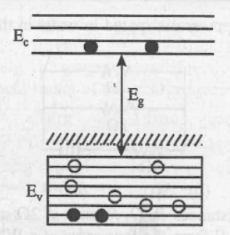
For a p-type semiconductor, the acceptor energy level, as shown in the diagram, is slightly above the top E_v of the valence band. With very small supply of energy an electron from the valence band can jump to the level E_A and ionise acceptor negatively.
A common emitter amplifier has a voltage gain of 50, an input impedance of 100 Ω and an output impedance of 200 Ω. The power gain of the amplifier is
Power gain = voltage gain current gain
= V_G × I_G = (V_o / V_i) × (I_o / I_i)
= (V_o)² × (V_i)² × (R_i / R_o) = 50 × 50 × 100 / 200
= 2500 / 2 = 1250
In the leaves of C₄ plants, malic acid formation during CO ₂ fixation occurs in the cells of
In C₄ plants, C₄ cycle occurs in mesophyll cells and C₃ -cycle occurs in bundle sheath cells.
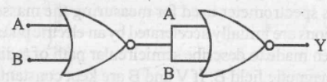
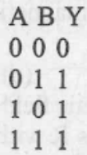
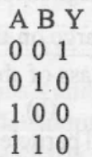
In the following circuit, the output Y for all possible inputs A and B is expressed by the truth table
-
(A)
-
(B)
-
(C)
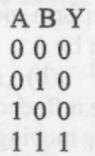
-
(D)
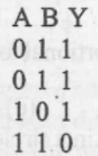
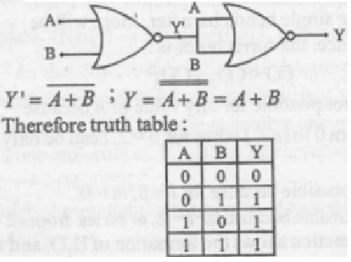
The C₄ plants have photosynthetic efficiency more than C₃ plants because
The C₄ pathway allows photosynthesis to occur at very low concentrations of carbon dioxide as PEP carboxylase has an extremely high affinity for carbon dioxide. This pathway also works well at high temperatures and light intensity, enabling efficient photosynthesis in tropical plants.
All enzymes of TCA cycle are located in the mitochondrial matrix except one which is located in inner mitochondrial membrane in eukaryotes and in cytosol in prokaryotes. This enzyme is
Succinate dehydrogenase (SDH) or succinate-coenzyme Q reductase (SQR) or respiratory Complex II is an enzyme complex, found in many bacterial cells and in the inner mitochondrial membrane of eukaryotes.
It is the only enzyme that participates in both the citric acid cycle and the electron transport chain. Succinate dehydrogenase catalyses the oxidation of succinate to fumarate in the citric acid cycle by simultaneously reducing ubiquinone to ubiquinol in the electron transport chain.
The overall goal of glycolysis, krebs cycle and the electron transport system is the formation of
Glycolysis, Krebs cycle and electron transport system, they all give ATP which is the main energy currency of our body. Glycolysis takes place in cytoplasm, Krebs cycle also occurs in cytoplasm while ETS takes place in the mitochondria.
Opening of floral buds into flowers, is a type of
Opening of floral buds into flowers, is a type of autonomic movement of growth which is dependent.
NOTES
Epinasty is caused by ethylene that is released by the leaves and roots are flooded. Flooded roots make ACC, the precursor to ethylene, and this is transported up the xylem stream where to leaf where it is converted to the gas hormone.
Which one of the following pairs, is not correctly matched?
Gibberellic acid stimulates cell growth of leaves and stem causing their expansion, elongation respectively and leaf fall is controlled by ABA.
The number of moles of KMnO₄ that will be needed to react with one mole of sulphite ion in acidic solution is
The balance chemical equation is:
2MnO₄⁻ + 6H⁺ + 5SO₃²⁻ -> 2Mn²⁺ + 5SO₄²⁻ + 3H₂O From the equation it is clear that
Moles of MnO₄⁻ require to oxidise 5 moles of SO₃²⁻ are 2
Moles of MnO₄⁻ require to oxidise 1 mole of SO₃²⁻ are 2/5.
Identify the correct order of the size of the following:
For isoelectronic species, size of anion increases as negative charge increases whereas size of cation decreases with increase in positive charge. Further ionic radii of anions is more than that of cations. Thus the correct order is
Ca²⁺ < K⁺ < Ar < Cl⁻ < S²⁻
An element, X has the following isotopic composition:
²⁰⁰X : 90%
¹⁹⁹X : 8.0%
²⁰²X : 2.0%
The weighted average atomic mass of the naturally occuring element X is closest to
Average isotopic mass of X = (200 × 90 + 199 × 8 + 202 × 2) / (90 + 8 + 2)
= (18000 + 1592 + 404) / 100
= 19996 / 100 = 199.96 ≈ 200 amu
In which of the following pairs, the two species are isostructural?
Hybridization of Br in BrO₃⁻
H = (1/2) × (7 + 0 - 0 + 1) = 4
hybridization = sp³
Hybridization of Xe in XeO₃
H = (1/2) × (8 + 0 - 0 + 0) = 4
Hybridization = sp³
In both cases, the structure is trigonal pyramidal.
Concentrated aqueous sulphuric acid is 98% H₂SO₄ by mass and has a density of 1.80 g mL⁻¹. Volume of acid required to make one litre of 0.1M H₂SO₄ solution is
Molarity of H₂SO₄ solution
= (98 × 1000) / (98 × 100) × 1.80 = 18.0
Suppose V mL of this H₂SO₄ is used to prepare 1 lit. of 0.1M H₂SO₄
Therefore, V × 18.0 = 1000 × 0.1
or V = (1000 × 0.1) / 18.0 = 5.55 mL.
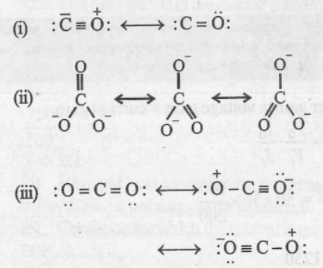
The correct order of C-O bond length among CO, CO₃²⁻, CO₂ is
All these structures exhibits resonance and can be represented by the following resonating structures.
More is the single bond character. More will be the bond length.
Hence, the correct order is:
CO < CO₂ < CO₃²⁻
Consider the following sets of quantum numbers:
Which of the following sets of quantum number is not possible?
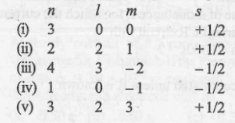
(ii) is not possible for any value of n because
l varies from 0 to (n - 1) thus for n = 2, l can be only 0 and 1.
(iv) is not possible because for l = 0, m = 0.
(v) is not possible because for l = 2, m varies from -2 to +2.
Consider the following reactions:
Enthalpy of formation of H₂O (l) is
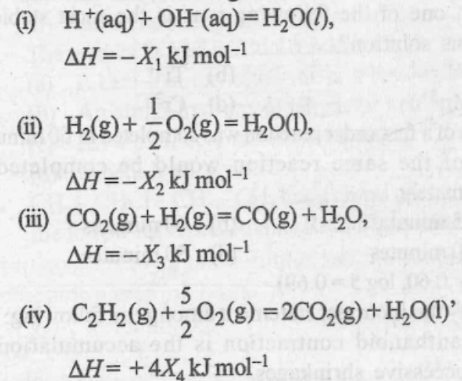
This reaction shows the formation of H₂O, and the X₂ represents the enthalpy of formation of H₂O.
Which one of the following ionic species has the greatest proton affinity to form stable compound?
Proton affinity decreases in moving across the period from left to right due to increase in charge, within a group the proton affinities decreases from top to bottom.
Nitrogen family > Oxygen family > Halogens
Which of the following electronic configuration of an atom has the lowest ionisation enthalpy?
1s², 2s², 2p⁵, 3s¹ is an unstable configuration with the outermost electron in 3rd orbit. Hence, it has lowest ionisation enthalpy.
Given that bond energies of H - H and Cl - Cl are 430 kJ mol⁻¹ and 240 kJ mol⁻¹ respectively and ΔH_f for HCl is -90 kJ mol⁻¹, bond enthalpy of HCl is
(1/2)H₂ + (1/2)Cl₂ -> HCl
ΔH_HCl = ∑ B.E. of reactant
- ∑ B.E. of products
-90 = (1/2) 430 + (1/2) 240 - B.E. of HCl
Therefore, B.E. of HCl = 215 + 120 + 90
= 425 kJ mol⁻¹
The order of decreasing reactivity towards an electrophilic reagent, for the following would be
(i) benzene
(ii) toluene
(iii) chlorobenzene
(iv) phenol
Electrophiles have high affinity for electrons. They attack at the site where electron-density is highest. Electron donating groups increases the electron density. The electron donating tendency decreases in the order:
-OH > -CH₃ > -H > -Cl
Therefore, the correct order of reactivity towards electrophile is
phenol > toluene > benzene > chlorobenzene
The following equilibrium constants are given:
N₂ + 3H₂ ⇌ 2NH₃; K₁
N₂ + O₂ ⇌ 2NO; K₂
H₂ + (1/2)O₂ ⇌ H₂O; K ₃
The equilibrium constant for the oxidation of 2 moles NH₃ by oxygen to give NO is
Given,
N₂ + 3H₂ ⇌ 2NH₃; K₁........(i)
N₂ + O₂ ⇌ 2NO; K₂ ........(ii)
H₂ + (1/2)O₂ ⇌ H₂O; K ₃ ........(iii)
We have to calculate
4NH₃ + 5O₂ -> 4NO + 6H₂O; K = ?
or 2NH₃ + (5/2)O₂ -> 2NO + 3H₂O
For this equation, K = [NO]² [H₂O]³ / ([NH₃]² [O₂]^(5/2))
but K₁ = [NH₃]² / ([N₂][H₂]³), K₂ = [NO]² / ([N₂][O₂])
&K ₃ = [H₂O] / ([H₂][O₂]^(1/2)) or K ₃³ = [H₂O]³ / ([H₂]³ [O₂]^(3/2))
Now operate, (K₂. K ₃³) / K₁
= ([NO]² / ([N₂][O₂]))*([H₂O]³ / ([H₂]³ [O₂]^(3/2))). ([N₂][H₂]³ / [NH₃]²)
= ([NO]² [H₂O]³) / ([NH₃]² [O₂]^(5/2)) = K
Therefore, K = K₂. K ₃³ / K₁
Calculate the pOH of a solution at 25°C that contains 1 * 10⁻¹⁰ M of hydronium ions, i.e. H₃O⁺.
Given [H₃O⁺] = 1 * 10⁻¹⁰ M
at 25°C [H₃O⁺][OH⁻] = 10⁻¹⁴
Therefore, [OH⁻] = 10⁻¹⁴ / 10⁻¹⁰ = 10⁻⁴
Now, [OH⁻] = 10^(-pOH) = 10⁻⁴
Therefore, pOH = 4
A weak acid, HA, has a Kₐ of 1.00 × 10⁻⁵. If 0.100 mol of this acid is dissolved in one litre of water, the percentage of acid dissociated at equilibrium is closest to
Given Kₐ = 1.00 × 10⁻⁵, C = 0.100 mol
for a weak electrolyte,
degree of dissociation
α = √(Kₐ/ C) = √(1 × 10⁻⁵ / 0.100) = 10⁻² = 1%
The fraction of total volume occupied by the atoms present in a simple cube is
Number of atoms per unit cell = 1
Atoms touch each other along edges. Hence
r = a / 2
(r = radius of atom and a = edge length)
Therefore % fraction = ((4/3)πr³) / (2r)³ = π / 6 = 0.52
The correct order of increasing thermal stability of K₂CO₃, MgCO₃, CaCO₃ and BeCO₃ is
As the cation size increases down the group, the metal carbonates become more ionic in nature. Hence, the thermal stability increases as: BeCO₃ < MgCO₃ < CaCO₃.
The ionic character of group 1 carbonates is more than that of group 2, thus they possess more thermal stability. Hence, the correct order of thermal stability: BeCO₃ < MgCO₃ < CaCO₃ < K₂CO₃.
If NaCl is doped with 10⁻⁴ mol % of SrCl₂, the concentration of cation vacancies will be (N_A = 6.02 × 10²³ mol⁻¹)
For each Sr²⁺ ion added, one Na⁺ ion is removed to maintain the electrical neutrality.
Hence concentration of cation vacancies = mole % of SrCl₂ added = 10⁻⁴ mole %
= (10⁻⁴ / 100) × 6.023 × 10²³ = 6.023 × 10¹⁷
In which of the following the hydration energy is higher than the lattice energy?
The solubility and the hydration energy of sulphates of alkaline earth metals decreases as we move down the group from Be to Ba due to the reason that ionic size increases down the group. The lattice energy remains constant because sulphate ion is so large, so that small change in cationic sizes do not make any difference. Thus the order will be:
BeSO₄ > MgSO₄ > CaSO₄ > SrSO₄ > BaSO₄
0.5 molal aqueous solution of a weak acid (HX) is 20% ionised. If K_f for water is 1.86 K kg mol⁻¹, the lowering in freezing point of the solution is
As ΔT_f = i × K_f m
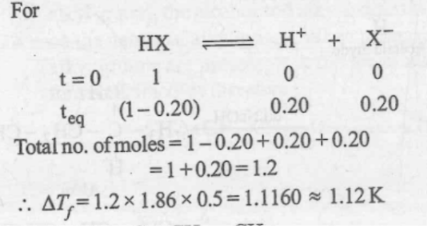
Which of the compounds with molecular formula C₅H₁₀ yields acetone on ozonolysis?
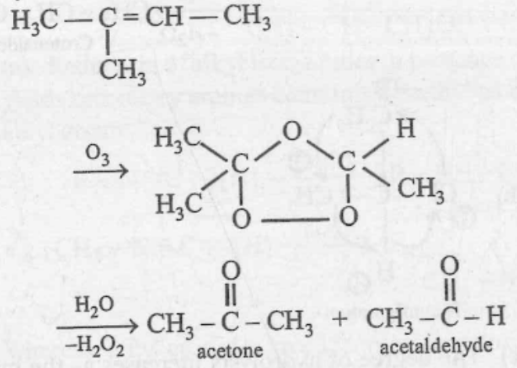
The equilibrium constant of the reaction:
Cu(s) + 2Ag⁺(aq) ⟶ Cu²⁺(aq) + 2Ag(s) ; E° = 0.46 V at 298 K is
As E°_cell = (0.0591 / n) × log K_c
Therefore, 0.46 = (0.0591 / 2) × log K_c
Therefore, log K_c = (2 × 0.46) / 0.0591 = 15.57
or K_c = Antilog 15.57 = 3.7 × 10¹⁵ ≈ 4 × 10¹⁵
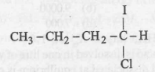
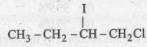
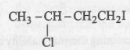
Predict the product C obtained in the following reaction of butyne-1.

-
(A)
-
(B)
-
(C)
-
(D)
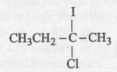
According to Markownikoff's rule which states that when an unsymmetrical alkene undergo hydrohalogenation, the negative part goes to the C-atom which contain lesser no. of H-atom.
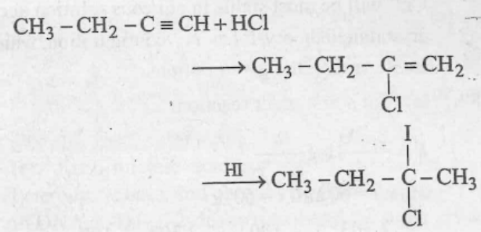
The efficiency of a fuel cell is given by
Efficiency of a fuel cell (η) = ΔG / ΔH
Sulphide ores of metals are usually concentrated by froth flotation process. Which one of the following sulphide ores offer an exception and concentrated by chemical leaching?
Leaching is the selective dissolution of the desired mineral leaving behind the impurities in a suitable dissolving agent, e.g. Argentite or Silver glance, Ag₂S is an ore of silver. Silver is extracted from argentite by the mac-Arthur and Forest process (leaching process).
Ag₂S + 4NaCN ⟶ 2Na[Ag(CN)₂] + Na₂S
The reaction of hydrogen and iodine monochloride is given as:
H₂(g) + 2ICl(g) ⟶ 2HCl(g) + I₂(g)
The reaction is of first order with respect to H₂(g) and ICl(g), following mechanisms were proposed.
Mechanism A:
H₂(g) + 2ICl(g)⟶ 2HCl(g) + I₂(g)
Mechanism B:
H₂(g) + ICl(g) ⟶ HI(g); slow
HI(g) + ICl(g) ⟶ HCl(g) + I₂(g); fast
Which of the above mechanism(s) can be consistent with the given information about the reaction?
As the slowest step is the rate determining step thus the mechanism B will be more consistent with the given information. Also because it involve one molecule of H₂ and one molecule of ICl, it can be expressed as:
r = k[H₂][ICl]
Which shows that the reaction is of first order w.r.t. both H₂ & ICl.
Which one of the following orders correctly represents the increasing acid strengths of the given acids?
HOCl (+1) < HOClO (+3) < HOClO₂ (+5) < HOClO₃ (+7)
In a first-order reaction A ⟶ B, if k is rate constant and initial concentration of the reactant A is 0.5 M, then the half-life is
For a first order reaction
k = (2.303 / t) × log₁₀(a / (a - x))
when t = t_(1/2)
k = (2.303 / t_(1/2)) × log₁₀(a / (a - a/2))
or t_(1/2) = (2.303 / k) × log₁₀ 2 = ln 2 / k
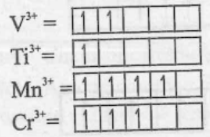
Which one of the following ions is the most stable in aqueous solution?
Cr³⁺ will be most stable in aqueous solution according to crystal field theory. It has t₂_g³ configuration, which is most stable among the given options.
If 60% of a first order reaction was completed in 60 minutes, 50% of the same reaction would be completed in approximately (log 4 = 0.60, log 5 = 0.69)
For a first order reaction
k = (2.303 / t) × log(a / (a - x))
when t = 60 and x = 60%
k = (2.303 / 60) × log(100 / (100 - 60))
= (2.303 / 60) × log(100 / 40)
= 0.0153
Now,
t_(1/2) = (2.303 / 0.0153) × log(100 / (100 - 50))
= (2.303 / 0.0153) × log 2
= (2.303 / 0.0153) × 0.3010
= 45.31 min.
Identify the incorrect statement among the following:
Due to lanthanoid contraction the properties of 4d series of the transition element have similarities with the 5d series of elements.
The Langmuir adsorption isotherm is deduced using the assumption:
Langmuir adsorption isotherm is based on the assumption that every adsorption site is equivalent and the ability of a particle to bind there is independent of whether or not nearby sites are occupied.
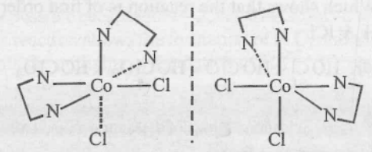
Which of the following will give a pair of enantiomorphs?
Non-superimposable mirror images are called optical isomers and may be described as 'chiral'. They are also called enantiomers and rotate plane polarised light in opposite directions.
Which of the following statements, about the advantage of roasting of sulphide ore before reduction is not true?
The sulphide ore is roasted to oxide before reduction because the ΔG°_f of most of the sulphides are greater than those of CS₂ and H₂S, therefore, neither C nor H can reduce metal sulphide to metal. Further, the standard free energies of formation of oxide are much less than those of SO₂. Hence, oxidation of metal sulphides to metal oxide is thermodynamically favourable.
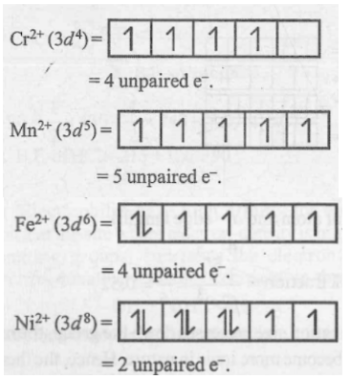
The d electron configurations of Cr²⁺, Mn²⁺, Fe²⁺ and Ni²⁺ are 3d⁴, 3d⁵, 3d⁶ and 3d⁸ respectively. Which one of the following aqua complexes will exhibit the minimum paramagnetic behaviour?
(At. No. Cr = 24, Mn = 25, Fe = 26, Ni = 28)
Lesser is the number of unpaired electrons smaller will be the paramagnetic behaviour. As Cr²⁺, Mn²⁺, Fe²⁺ & Ni²⁺ contains.
As Ni²⁺ has minimum no. of unpaired e⁻ thus this is least paramagnetic.
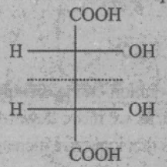
If there is no rotation of plane polarised light by a compound in a specific solvent, though to be chiral, it may mean that
Compounds which do not show optical activity in spite of the presence of chiral carbon atoms are called meso-compounds.
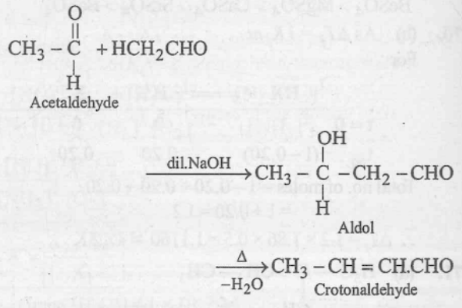
The product formed in Aldol condensation is
Aldehydes and ketones having at least one α-hydrogen atom in presence of dilute alkali give β-hydroxy aldehyde or β-hydroxy ketone.
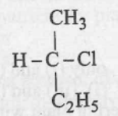
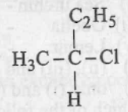
CH₃ - CHCl - CH₂ - CH₃ has a chiral centre. Which one of the following represents its R-configuration?
-
(A)
-
(B)
-
(C)
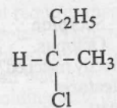
-
(D)
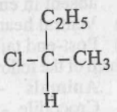
Aldehydes and ketones having at least one α-hydrogen atom in presence of dilute alkali give β-hydroxy aldehyde or β-hydroxy ketone.
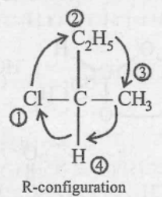
Consider the following compounds.
The correct decreasing order of their reactivity towards hydrolysis is
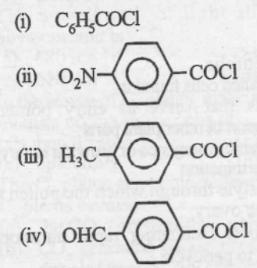
The degree of hydrolysis increases as the magnitude of positive charge on carbonyl group increases. Electron withdrawing group increases the positive charge and electron releasing group decreases the positive charge. Among these NO₂ & -CHO are electron withdrawing group from which -NO₂ exhibit more -I effect than -CHO. On the other hand -CH₃ is a electron releasing group therefore the order of reactivity towards hydrolysis is
(ii) > (iv) > (i) > (iii)
For (i) I⁻, (ii) Cl⁻, (iii) Br⁻, the increasing order of nucleophilicity would be
Nucleophilicity increases down the periodic table : I⁻ > Br⁻ > Cl⁻ > F⁻
Which of the following represents the correct order of the acidity in the given compounds?
Electron withdrawing substituents (like halogen, -NO₂, -C₆H₅ etc.) would disperse the negative charge and hence stabilise the carboxylate ion and thus increase acidity of the parent acid. On the other hand, electron-releasing substituents would intensify the negative charge, destabilise the carboxylate ion and thus decrease acidity of the parent acid.
Electronegativity decreases in order
F > Cl > Br
and hence -I effect also decreases in the same order, therefore the correct option is
[FCH₂COOH > ClCH₂COOH > BrCH₂COOH > CH₃COOH]
In the reaction:
Which of the following compounds will be formed?

-
(A)
-
(B)
-
(C)
-
(D)
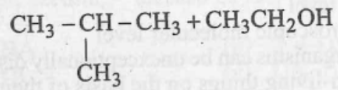
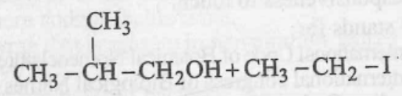
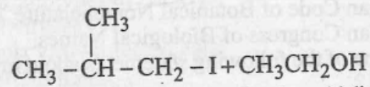
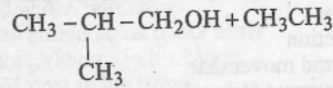
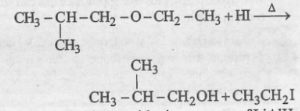
In the cleavage of mixed ethers with two different alkyl groups, the alcohol and alkyl iodide that form depend on the nature of alkyl group. When primary or secondary alkyl groups are present, it is the lower alkyl group that forms alkyl iodide therefore
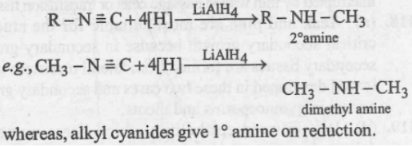
Which one of the following on reduction with lithium aluminium hydride yields a secondary amine?
Reduction of alkyl isocyanides in presence of LiAlH₄ yields secondary amines containing methyl as one of the alkyl group.
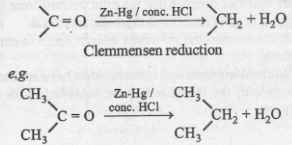
Reduction of aldehydes and ketones into hydrocarbons using zinc amalgam and conc. HCl is called
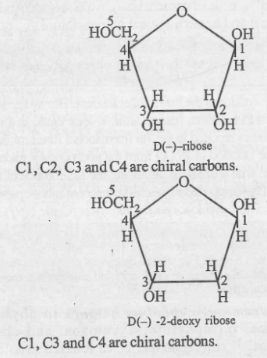
RNA and DNA are chiral molecules, their chirality is due to
Each nucleic acid consists of a pentose sugar a heterocyclic base, and phosphoric acid. The sugar present in DNA is -D(-)-2-deoxy ribose and the sugar present in RNA is D (-)-ribose. The chirality of DNA and RNA molecules are due to the presence of sugar components.
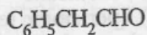
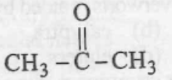
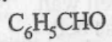
Which one of the following on treatment with 50% aqueous sodium hydroxide yields the corresponding alcohol and acid?
-
(A)
-
(B)
-
(C)
-
(D)
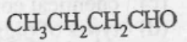
Aldehydes containing no α-hydrogen atom on warming with 50% NaOH or KOH undergo disproportionation i.e. self oxidation-reduction known as Cannizzaro's reaction.

Which of the following is water-soluble?
Vitamin B is water soluble whereas all other are fat soluble.
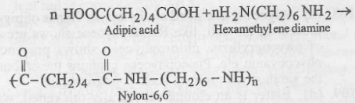
Which one of the following polymers is prepared by condensation polymerisation?
Copolymer of adipic acid (6C) and hexamethylene diamine (6C).
Which one of the following anions is present in the chain structure of silicates?
Chain silicates have the general formula (SiO₃²⁻)ₙ
Which of the following oxidation states are the most characteristic for lead and tin respectively?
Among common characteristic states for Pb and Sn, we find +2 and +4 respectively.
“Foolish seedling” disease of rice led to the discovery of
The effect of gibberellins had been known in Japan since early 1800 where certain rice plants were found to suffer from bakane or bakanae (foolish seedling) disease. Such rice plants were thin, pale green, spindle-shaped, longer by 50% than the healthy plants, and were sterile.
A person who is one day hunger strike and is surviving only on water, will have
Due to long hunger strike and survival on water, a person will have less urea in his urine because urea is delivered to kidneys as a waste product from liver which is formed after the breakdown of proteins, fats, carbohydrates during hunger.
Lysozyme that is present in perspiration, saliva and tears, destroys
Lysozyme is an antibacterial agent which is secreted by the major salivary glands.
Which one of the following is a fat-soluble vitamin and its related deficiency disease?
Fat soluble vitamins are - A, D, E and K and lack of vitamin A causes xerophthalmia.
A drop of each of the following, is placed separately on four slides. Which of them will not coagulate?
Blood serum is of pale yellow colour and is liquid minus clotting elements. It does not have fibrinogen and other clotting materials therefore it does not takes part in blood clotting.
Which one of the following mammalian cells is not capable of metabolising glucose to carbon-dioxide aerobically?
Since RBCs do not have mitochondria so they can respire only anaerobically.
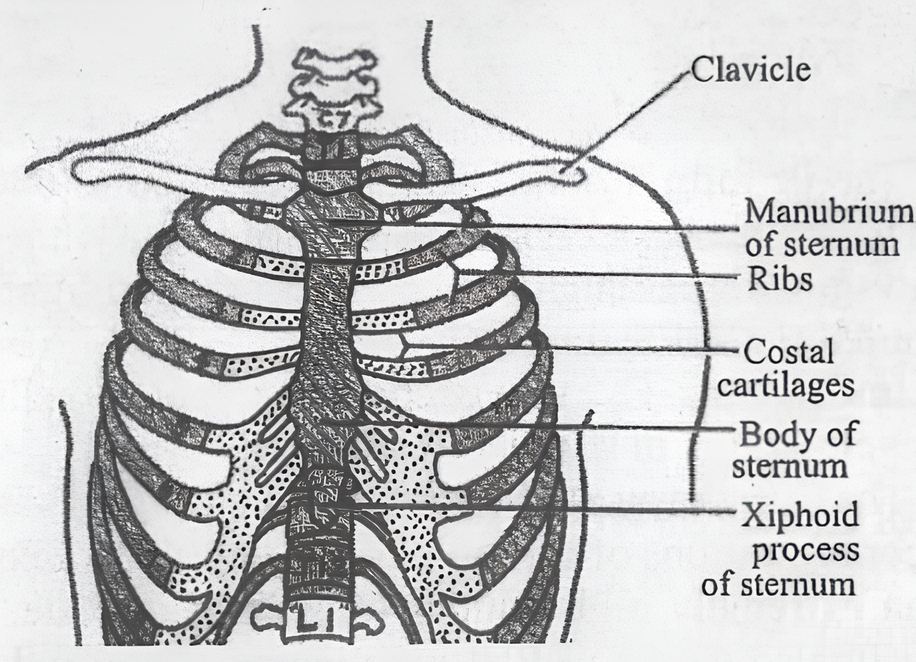
In human body, which one of the following is anatomically correct?
Floating ribs are 2-pairs (11th and 12th pair) which are not attached to sternum.
During the transmission of nerve impulse through a nerve fibre, the potential on the inner side of the plasma membrane has which type of electric charge?
Once the events of depolarization have occurred, a nerve impulse or spike is initiated. Action potential is another name of nerve impulse. It lasts for about 1 msec (millisecond). The stimulated, negatively charged point on the outside of the membrane sends out an electrical current to the positive point (still polarized adjacent to it).
NOTES
This local current causes the adjacent inner part of the membrane to reverse its potential from –70 mV to +30 mV. The reversal repeats itself over and over until the nerve impulse is conducted through the length of the neuron.
Which one of the following pairs of structures distinguishes a nerve axon from other types of cells?
The cytoplasm immediately surrounding the nucleus is loaded with protein synthetic machinery and is called perikaryon, dendrites are usually shorter, tapering and much branched processes which may be one to several. These two are only present in nerve cells.
Which of the following is an example of negative feedback loop in humans?
When the set point of hypothalamus is disturbed by high temperature, it stimulates vasodilation and sweating while in low temperatures there is vasoconstriction and shivering.
Which part of ovary in mammals acts as an endocrine gland after ovulation?
Graafian follicle – the ovarian medulla contains many rounded or oval bodies, called ovarian, or graafian follicles, at various stages of development. Each follicle contains a large ovum surrounded by many layers of follicle cells.
A person is having problems with calcium and phosphorus metabolism in his body. Which one of following glands may not be functioning properly?
Parathyroid disorders : It causes the lowering of blood calcium level. This increases the excitability of nerves and muscles causing cramps and convulsions.
Feeling the tremors of an earthquake, a scared resident of seventh floor of a multistored building starts climbing down the stairs rapidly. Which hormone initiated this action ?
It is commonly called as “emergency hormone” or 3F-hormone (For fear, fight & flight). Its secretion is regulated by SNS, and not by pituitary, as in case of adrenal cortex. It stimulates sweating, heart beat and breathing rate. It causes the dilation of coronary artery (supplying blood to the heart muscles), bronchioles (for increasing inspiratory volume) and pupil (for better vision).
Which one of the following is surrounded by a callose wall?
MMC riscopore mother cell is surrounded by a callose wall inter to the cell wall.
Male gametes in angiosperms are formed by the division of
Generative cell which is a cell of the male gametophyte or pollen grain in seed plants that divides to give rise directly or indirectly two sperms.
Which one of the following pairs of plant structures has haploid number of chromosomes?
Egg cell and antipodal cells is right answer.
In human female, menstruation can be deferred by the administration of
The progesterone and estradiol continue the hypertrophy of endometrial lining in the uterus and fallopian tubes and maintain the throughout pregnancy. Progesterone is also necessary for the proper implantation of the foetus in the uterine wall. It stimulates the endometrial glands to secrete nutrient fluid for the foetus, hence the term secretory phase. The progesterone inhibits the release of FSH so that it may not develop additional follicles and eggs.
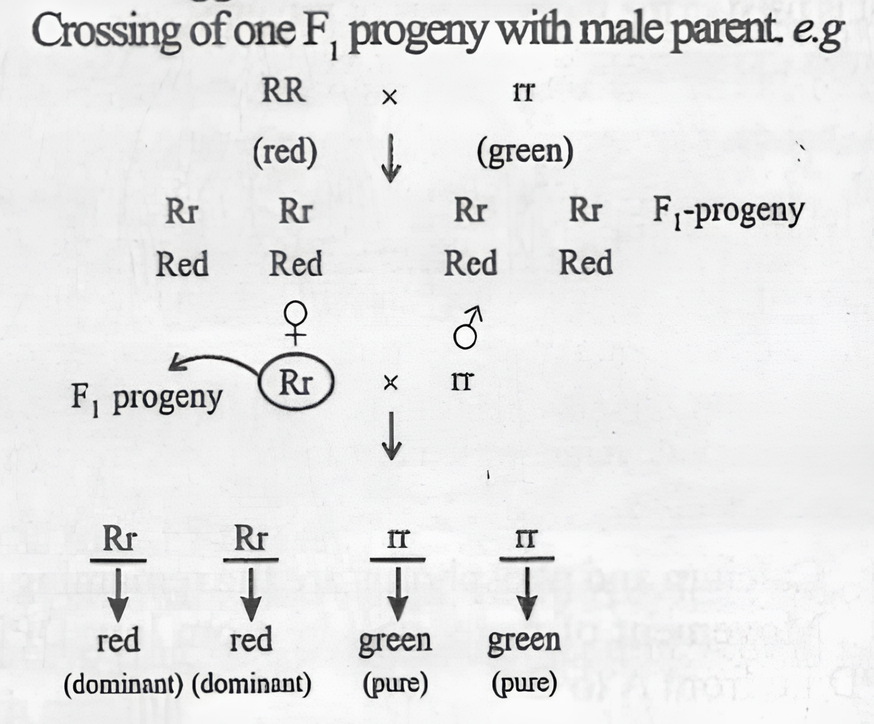
A common test to find the genotype of a hybrid is by
Two genes R and Y are located very close on the chromosomal linkage map of maize plant. When RRYY and rryy genotypes are hybridized, the F ₂ segregation will show
When the linked genes are situated quite close, the chances of crossing over are highly reduced. Due to this, large number of parental gametes are formed and only few recombinant gametes are formed. This results in higher number of parental types in F₂ generation as compared to recombinant.
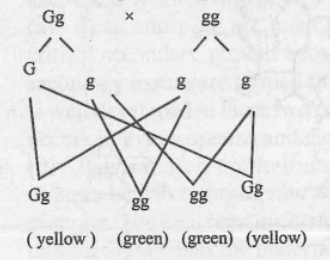
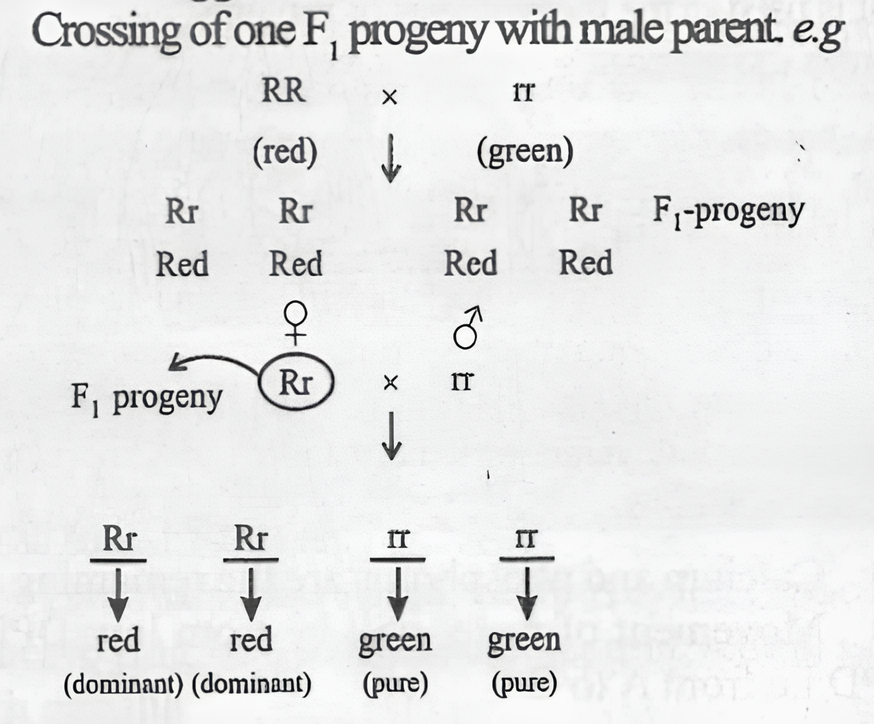
In pea plants, yellow seeds are dominant to green. If a heterozygous yellow seeded plant is crossed with a green seeded plant, what ratio of yellow and green seeded plants would you expect in F₁ generation?
Let GG = homozygous yellow seed plant.
Gg ⇒ heterozygous yellow seeded plant
gg ⇒ homozygous green seeded plant
According to the question :
Inheritance of skin colour in humans is an example of
Inheritance of skin colour in human is controlled by three genes, A B and C which is polygenic inheritance.
A human male produces sperms with the genotypes AB, Ab, aB, and ab pertaining to two diallelic characters in equal proportions. What is the corresponding genotype of this person?
Ans.
The length of DNA molecule greatly exceeds the dimensions of the nucleus in eukaryotic cells. How is this DNA accommodated?
The nucleosome model explains the packaging of histone proteins and DNA in the chromatin material which forms the chromosome.
A sequential expression of a set of human genes
A sequential expression of a set of human genes is the DNA sequence. Because gene is the functional part of DNA sequence.
During transcription, RNA polymerase holoenzyme binds to a gene promoter and assumes a saddle-like structure, what is it’s DNA-binding sequence?
The DNA binding sequence for RNA polymerase is called TATA box.
The two polynucleotide chains in DNA are
The two chains are antiparallel, one aligned in 5'→3' direction the other in 3'→5' direction.
Molecules basis of organ differentiation depends on the modulation in transcription by
Transcription factor is right answer.
The okazaki fragments in DNA chain growth
Okazaki fragments in DNA are linked up by the enzyme DNA ligase. Replication always occurs in 5'→3' direction. Okazaki fragments synthesised on 3'→5' DNA template, join to form lagging strand.
one gene-one enzyme relationship was established for the first time in
It was given by Geneticist George W. Beadle and E. L. Tatum which states that each gene in an organism controls the production of a specific enzyme. It is the enzyme that catalyses the reactions that leads to the phenotype of the organism.
When two species of different genealogy come to resemble each other as a result of adaptation, the phenomenon is termed
The analogous organs show convergent evolution due to similar adaptations which do not support organic evolution.
Which one of the following statement is correct?
Ontogeny recapitulates phylogeny.
NOTE
The theory of recapitulation, also called the biogenetic law or embryological parallelism—often expressed using Ernst Haeckel’s phrase “ontogeny recapitulates phylogeny”—is a historical hypothesis that the development of the embryo (of an animal, from fertilization to gestation or hatching/fancying) goes through stages resembling or representing successive adult stages in the evolution of the animal’s remote ancestors (phylogeny). It was formulated in the 1820s by Étienne Serres based on the work of Johann Friedrich Meckel, after whom it is also known as Meckel–Serres law.
The concept of chemical evolution is based on
The concept of chemical evolution is based on possible origin of life by combination of chemicals under suitable environmental conditions. The distribution of elements in the cosmos is the result of many processes in the history of the Universe. It provides us with a powerful tool to study the Big Bang, the density of baryonic matter, galaxiesynthesis and the formation and evolution of stars and galaxies.
The finches of Galapagos islands provide an evidence in favour of
The finches of Galapagos islands provides an evidence in favour of biogeographical evolution.
What is common between parrot, platypus and kangaroo?
Only birds and mammals are homeothermous.
What is common to whale, seal and shark?
The analogous organs show convergent evolution due to similar adaptation. They do not support organic evolution. Whale, seal and shark shows convergent evolution due to similar habitats.
Industrial melanism as observed in peppered moth proves that
During the period when the number of coal-burning factories in England, was increasing (during the so-called Industrial Revolution) it was noticed that the mutant melanic individuals of the species of Peppered Moth (Biston betularia) was becoming more common. Originally rare in the population of normally light-colored moths, the frequency of the melanic form increased in polluted areas until it was over 90%. This change in coloration has become known as “industrial melanism.”
Adaptive radiation refers to
Adaptive radiation refers to evolution of different species from a common ancestor. The mammals are adapted for different mode of life, they show adaptive radiation. They can be aerial (bat), aquatic (whale and dolphins), burrowing or fossorial (rat), cursorial (horse), scansorial (squirrel) or arboreal (monkey). The adaptive radiation, the term is obso, is also known as Divergent evolution.
NOTES
An adaptation or adaptive trait is a trait/characteristic that has evolved in a population of organisms which provides a functional advantage andaptation increases the biological fitness of a population. Fredity describe how the trait evolved e.g. mutation.
One of the important consequences of geographical isolation is
Speciation takes place via reproductive isolation which is the most important consequence of geographical isolation.
Among the human ancestors the brain size was more that 1000 cc in
According to Hugo de Vries, mutations are random and directionless.
Hugo deVries believed that mutation caused speciation and hence called it saltation (single step large mutation).
Select the correct statements from the following?
Brain capacity in decreasing order:-
Homo sapiens (1300 - 1600 c.c.)
Homo neanderthalensis (approx. 1400 c.c.)
Homo erectus (600 - 700 c.c.)
Homo habilis (550 - 687 c.c.)
Thus the lowest brain capacity is of Homo habilis as shown above. Homo habilis lived in early pleistocene period and used tools of chipped stones.
If you suspect major deficiency of antibodies in a person to which of the following would you look for confirmatory evidence?
Serum globulins → It makes 2 to 3% of plasma proteins. The α and β-globulin sent with the hormones to transport them the γ-globulin from antibodies.
Increased asthmatic attacks in certain seasons are related to
Pollen-grain of many species are responsible for some of the severe allergies and bronchial affliction in some people often lead to chronic respiratory disorders - asthma, bronchitis.
Which one of the following pair is mismatched?
From Pinctada vulgaris, pearl is obtained.
Pearl muscles as Pearls are made by marine oysters and freshwater mussels; a natural defence against an irritant such as a parasite entering their shell or damage to the fragile body. This creates a material called nacre, also known as mother-of-pearl, which encases the irritant and protects the mollusc from it.
Compared to a bull a bullock is docile because of
A bullock is docile (less aggressive animal which is easy to handle) because it has degenerated testes due to which it has low testosterone levels in blood.
NOTE
Testosterone is a sex hormone and principal androgen secreted in males by testes. It stimulates the development of secondary sex organs, sexual characters and body tissues like muscles.
Which one of the following is a viral disease of poultry?
New castle disease (ND) is a highly contagious, generalised viral disease of domestic poultry and wild birds characterised by gastrointestinal, respiratory and nervous signs.
NOTE
New castle disease is caused by the virus belongs to Paramyxoviruses.
Which one of the following is being utilized as a source of biodiesel in the Indian countryside?
Pongamia pinnata is one of the few nitrogen fixing trees (NFTs) to produce seeds containing 30-40% oil. It is often planted as an ornamental and shade tree but now-a-days it is considered an alternative source for Bio-Diesel. This species is commonly called pongam, kanajra, or a derivation of these names. Pongam, Jatropha, Euphorbia are petrocrops. However, in the Indian countryside, pongamia (kanjra) is being utilized as a source of biodiesel.
In maize, hybrid vigour is exploited by
Hybrid vigour is also called Heterosis which is measured in terms of size growth rate / field and number of other characters. Hybridization increases vigour and fertility. It is exploited by crossing of two inbred parental lines. It is best maintained in vegetatively reproducing crops because of genetic recombinations.
Probiotics are
Probiotics are defined as live microorganisms, including Lactobacillus species, Bifidobacterium species and yeasts, that may beneficially affect the host upon ingestion by improving the balance of the intestinal microflora. The dietary use of live microorganisms has a long history.
Which one of the following pairs is wrongly matched?
Coliforms are a broad class of bacteria found in our environment, including the feces of man and other warm-blooded animals. The presence of coliform bacteria in drinking water may indicate a possible presence of harmful, disease-causing organisms.
Ultrasound of how much frequency is beamed into human body for sonography ?
Ultrasound imaging has frequency range 1 - 15 MHz which has become part of our lives in the last decade. We are now all familiar with the blurry black and white sonograms (ultrasound pictures) that show the unborn baby inside the mother’s uterus. Although it may take a little imagination on our part to understand that a round circle is the baby’s head, that does not prevent a proud mother-to-be from showing off her first baby picture.
Geometric representation of age structure is a characteristic of population.
Geometric representation of age structure is a characteristic of population.
The population of an insect species shown an explosive increase in numbers during rainy season followed by its disappearance at the end of the season. What does this show?
If a population (e.g reindeer population) is allowed to grow in a predator free environment, the population grows beyond carrying capacity and there occurs population crash due to sudden shortage of food. Such growth curves also occur in insect populations during rainy season and in algal blooms.
Two plants can be conclusively said to belong to the same species if they
When the members of a species are inter - fertile and produce fertile offsprings.
A high density of elephant population in an area can result in
It is competition between individuals of same species. The intraspecific competition may be very severe because all the members of a species have similar requirements of food, habitat mate, etc. and they also have similar adaptations to get their needs.
Which one of the following ecosystem types has the highest annual net primary productivity?
They are found in the equatorial regions rainfall exceeds 140 cm. The warm humid climate supports broad leaved evergreen plants. Productivity is very high (12000 kcal/m²/year). The vegetation show stratification into two or more well defined layers.
One of endangered species of Indian medicinal plants is that of
Podophyllum is one of the endangered species of Indian medicinal plants. It is used to remove benign (not cancer) growths, such as certain kinds of warts. It works by destroying the tissue of the growth.
Identify the odd combination of habitat and the particular animal concerned.
Dachigam national park is for conservation of Hangul which is one of India’s most scenically beautiful wildlife reserve. It is located only 22 kilometers from Srinagar, the capital city of the northern state of Jammu and Kashmir. It covers an area of 141 square kilometers.
Which one of the following pairs of organisms are exotic species introduced in India?
Exotic Species - a species that has been introduced from another geographic region to an area outside its natural range. Examples are water hyacinth, Lantana camara.
In a coal fired power plant electrostatic precipitators are installed to control emission of
In recent years, the increases in toxic substances of NOₓ and/or SPM (Suspended Particulate Matter) from vehicles come to be serious problem. About the correlation between the traffic volume in our model and the real volume, we obtained the correlation coefficient of 0.74. Simultaneously, we got the result that the concentration of NOₓ was approximately 70 to 230 ppm. The total mass was approximately 40 to 100 μg/m³.
Which one of the following is not a bioindicator of water pollution?
Stone files are not bio-indicators on polluted or range of techniques to assess the impacts of air pollution from reactive nitrogen (N) compounds on statutory nature conservation site. They complement physical monitoring of atmospheric concentrations and deposition and risk assessment based on the critical loads approach by providing site-based information on atmospheric N concentrations, N deposition and/or ecological impacts.
NOTES
Stone flies, mayflies and caddisflies are aquatic insects and are important indicators of water quality.
Which one of the following statements is correct?
Extensive use of chemical fertilizers may lead to eutrophication of nearby water bodies.
If the mean and the median pertaining to a certain character of a population are of the same value, the following is most likely to occur:-
In statistics, a bimodal distribution is a continuous probability distribution with two different modes. These appear as distinct peaks in the probability density functions. If the distribution is symmetric then the mean is equal to the median and the distribution will have zero skewness. Since bimodal distribution may not be symmetric both mean and mode fall in the center but it has two modes.
In which one of the following the BOD (Biochemical Oxygen Demand) of sewage (S), distillery effluent (DE), paper mill effluent (PE) and sugar mill effluent (SE) have been arranged in ascending order?
Sewage strength of degree for water pollution is measured in terms of BOD (Biological oxygen demand) value.
BOD may be defined as, number of milligrams of oxygen required for decomposition of one liter of waste or water by decomposing micro-organisms (bacteria). According to central pollution control board, limit of BOD prescribed is 30 ppm (mg/d) for 3 days at 27 degree C.
The BOD of the given pollutants in ascending order is PE < S < SE < DE.
Which one of the following is not a part of a renal pyramid?
The medulla is divided into a few conical masses called medullary pyramids projecting into the calyces. The cortex extends in between the medullary pyramids as renal columns called Columns of Bertini. Hence convoluted tubules are not a part of the renal tubule.
Arteries are best defined as the vessel which :
Arteries and veins are main blood vessels. Arteries carry blood from the heart to different body parts. Veins bring blood from different body parts to the heart.
Match the source gland with its respective hormone as well as the function
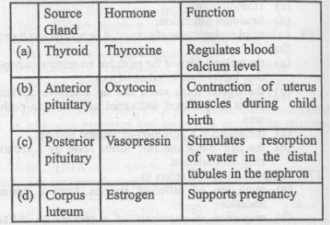
source Gland- Anterior pituitary ,
Hormone - oxytocin, Function - Contraction of uterus muscles during child birth
What is common to whale, seal and shark?
The analogous organs show convergent evolution due to similar adaptation. They do not support organic evolution. Whale, seal and shark shows convergent evolution due to similar habitats.
Other Years