CBSE EXAMINATION PAPER-2022
NEET-ZOOLOGY
(Solved)
General Instructions :
Read the following instructions carefully and follow them :
- This question paper contains 200 questions. All questions are compulsory.
- This question paper is divided into 1 sections.
- Section A – questions number 1 to 200 are multiple choice questions
- There is no overall choice given in the question paper. However, an internal choice has been provided in few questions.
- Use of calculator is NOT allowed.
Section A
An energy of 484 J is spent in increasing the speed of a flywheel from 60 rpm to 360 rpm. The moment of inertia of the flywheel is
Given: ωᵢ = 60 rpm = 60 × (2π/60) = 2π rad / s
ωf = 360 rpm = 360 × (2π/60) = 12π rad / s
Energy spent, ΔKE = 484 J
Energy spent, ΔKE = ½ I (ωf² − ωᵢ²) where
I = moment of inertia
486 = 1/2 × I [(12π)² − (2π)²]
∴ I = (2 × 486)/(140π²) ≈ 0.7 kg-m²
Let R₁ be the radius of the second stationary and R₂ be the radius of the fourth stationary orbit of an electron in Bohr’s model. The ratio R₁/R₂ is:
Radius, R = 0.529 × (n²/Z) Å ∴ R₁/R₂ = 2²/4² = 1/4 = 0.25
During a cloudy day, a primary and a secondary rainbow may be created, then the:
When light rays undergo two internal reflections inside a raindrop, instead of one as in the primary rainbow, a secondary rainbow is formed. The secondary rainbow forms above the primary rainbow.
The reciprocal of resistance is:
Resistance offers obstruction to current while conductance allows electric current to flow, so conductance is the reciprocal of resistance.
Two copper vessels A and B have the same base area but of different shapes. A take twice the volume of water as that B requires to fill upto a particular common height. Then the correct statement among the following is:
Pressure, P = hρg. Since water is filled upto the same height so pressure at the bottom will be the same.
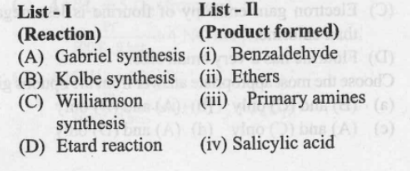
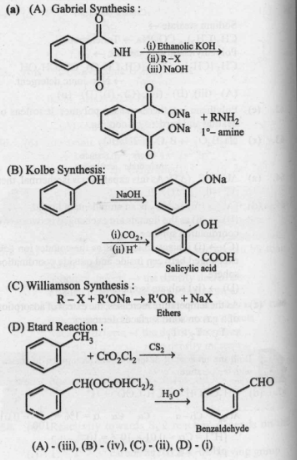
Match List - I with List - II: Choose the correct answer from the options given below:
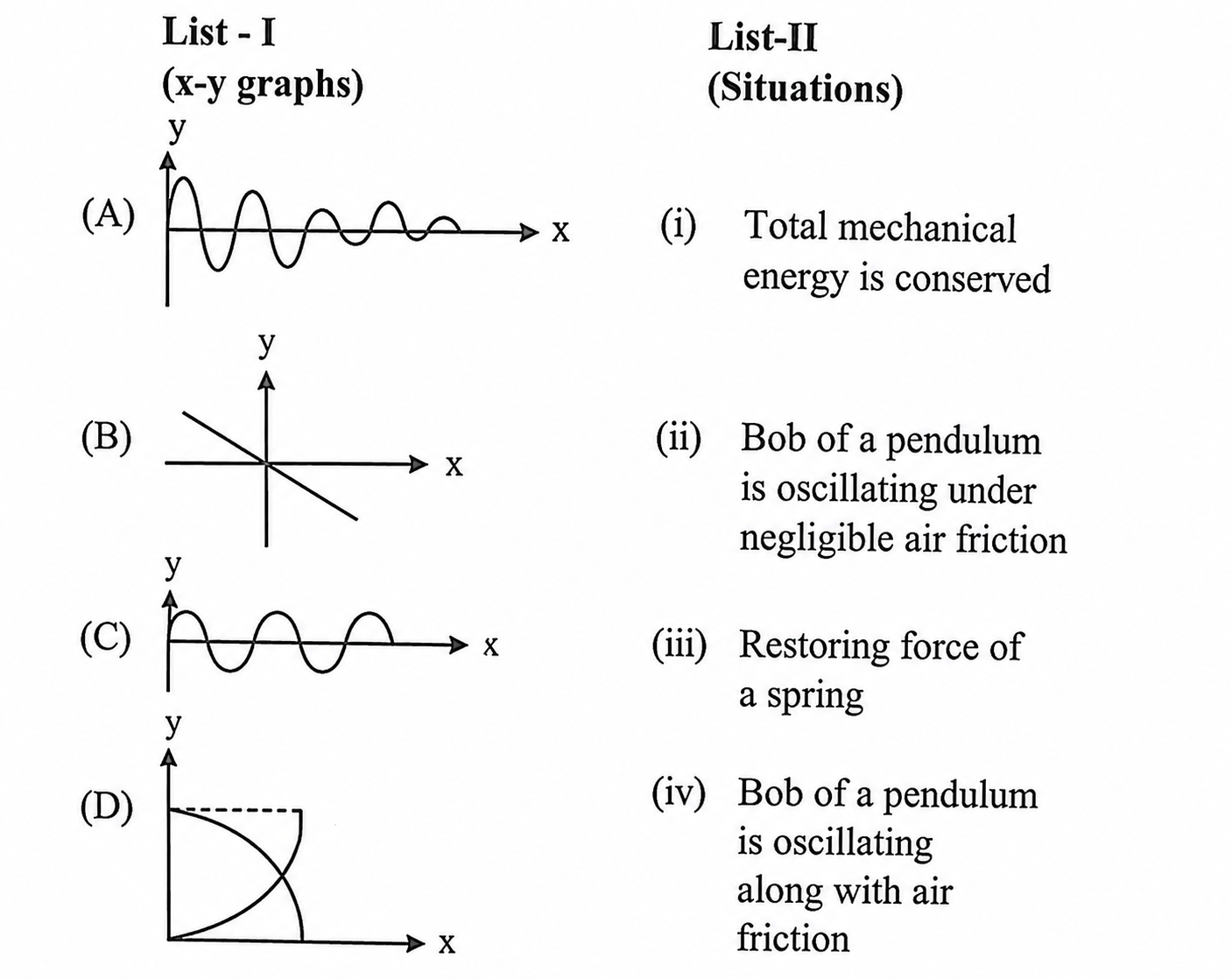
Graph (a) represents damped oscillation bob of a pendulum oscillating along with air friction. Graph (b) represents restoring force of spring F = -kx.
Graph (c) represents undamped oscillations of a pendulum oscillating under negligible air friction. Graph (d) represents total mechanical energy conservation.
The distance covered by a body of mass 5 g having linear momentum 0.3 kg m/s in 5 s is:
Given P = 0.3 kg m/s, mass m = 5 g = 5/1000 kg, t = 5 s, S = ? P = mv. 0.3 = (5/1000) × v ⇒ v = 60 m/s. Distance travelled in 5 s = v × t = 60 × 5 = 300 m.
The distance between the two plates of a parallel plate capacitor is doubled and the area of each plate is halved. If C is its initial capacitance, its final capacitance is equal to:
Given: A' = A/2 and d'=2dCapacitance C = Aε₀/d ∴ C' = (A/2)ε₀ / (2d) = C/4.
A closely packed coil having 1000 turns has an average radius of 62.8 cm. If current carried by 62.8 cm the wire of the coil is 1 A the value of magnetic field produced at the centre of the coil will be (permeability of free space = 4π×10⁻⁷ H/m) nearly.
Magnetic field at the centre of the coil
B = μ₀nI / 2R
= (4π × 10⁻⁷ × 1000 × 1) / (2 × 62.8 × 10⁻²) = 10⁻³ T.
The magnetic field of a plane electromagnetic wave is given by 𝐁⃗ = 3×10⁻⁸ cos(1.6×10³x + 48×10¹⁰t) ĵ, then the associated electric field will be:
From given equation B₀ = 3×10⁻⁸ V/m. E₀/B₀ = c ⇒ E₀ = B₀c = 3×10⁻⁸ × 3×10⁸ = 9 V/m. Phase of magnetic and electric field is same for a travelling EM wave. Ê = B̂ × ĉ = ĵ × (-î) = k̂. ∴ E→ = 9 cos(1.6×10³x + 48×10¹⁰t) k̂ V/m.
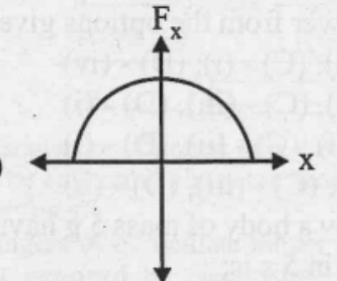
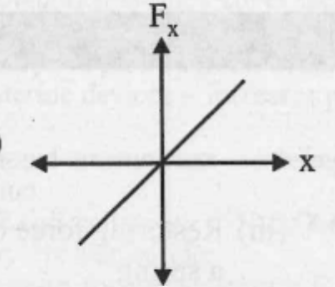
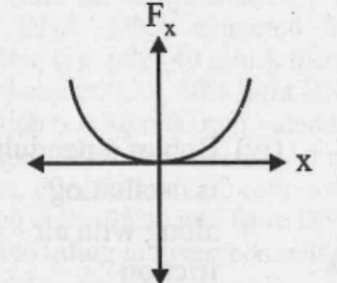
The restoring force of a spring with a block attached to the free end of the spring is represented by:
-
(A)
-
(B)
-
(C)
-
(D)
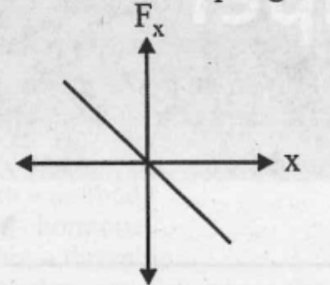
Graph (a) represents restoring force of a spring, F = -kx
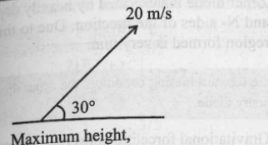
A cricket ball is thrown by a player at a speed of 20 m/s in a direction 30° above the horizontal. The maximum height attained by the ball during its motion is. (g = 10 m/s²)
H = u² sin²θ / 2g = (20)² × (1/2)² / (2 × 10) = 5 m.
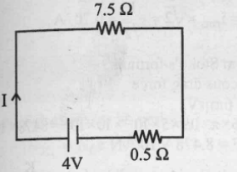
A cell of emf 4 V and internal resistance 0.5 Ω is connected to a 7.5 Ω external resistance. The terminal potential difference of the cell is.
Current I = V / (R + r) = 4 / (7.5 + 0.5) = 0.5 A.
Terminal voltage V = E - ir =
4 - 0.5 × 0.5 = 3.75 V.
An ideal gas follows a process described by the equation PV² = C from the initial (P₁, V₁, T₁) to final (P₂, V₂, T₂) thermodynamic states, where C is a constant. Then :
Given, PV² = C ⇒ TV = const and T²/P = const P ↑ ⇒ V ↓ T ↑ ⇒ V ↓ T ↑ =P ↑ P₁ > P₂ ⇒ V₂ > V₁ V₂ > V₁ ⇒ T₁ > T₂ P₁ > P₂=T₁ > T₂
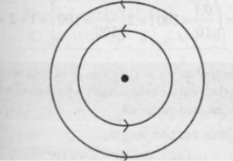
The shape of the magnetic field lines due to an infinite long, straight current carrying conductor is:
For an infinite long current carrying conductor, magnetic field lines are concentric circles.
The light rays having photons of energy 4.2 eV are falling on a metal surface having a work function of 2.2 eV. The stopping potential of the surface is:
By Einstein's photoelectric equation hν = W + eVₛ. 4.2 eV = 2.2 eV + e × Vₛ ⇒ 2 eV = eVₛ ⇒ 2 × 1.6 × 10⁻¹⁹ = 1.6 × 10⁻¹⁹ × Vₛ ∴ Vₛ = 2v
Identify the function which represents a non periodic motion.
Periodic motion is represented by sine & cosine (harmonic functions). So e⁻ʷᵗ is not a harmonic function.
An inductor of inductance 2 mH is connected to a 220 V, 50 Hz a.c. source. Let the inductive reactance in the circuit is X₁. If a 220 V dc source replaces the ac source in the circuit, then the inductive reactance in the circuit is X₂. X₁ and X₂ respectively are:
When A.C. source is applied X₁ = ωL = 2πfL = 2π × 50 × 2 × 10⁻³ = 0.628 Ω. And when D.C. source is applied X₂ = ωL = 2πfL = 0 (∴ f = 0)
The ratio of the magnitude of the magnetic field and electric field intensity of a plane electromagnetic wave in free space of permeability μ₀ and permittivity ε₀ is (Given that C=velocity of light in free space):
We know |E| = c|B| ⇒ |B|/|E| = 1/c.
The threshold frequency of a photoelectric metal is ν₀. If light of frequency 4ν₀ is incident on this metal, then the maximum kinetic energy of emitted electrons will be
By photoelectric equation hν = hν₀ + K.E_max
h×4ν₀ = hν₀ + K.E_max (∵ v = 4v₀)
h×4ν₀ = hν₀ + K.E_max ∴ K.E.max = 4hν₀ - hν₀ = 3hν₀.
Given below are two statements one is labelled as Assertion (A) and the other is labelled as Reason (R). Assertion (A): When a fire cracker (rocket) explodes in mid air, its fragments fly in such a way that they continue moving in the same path, which the fire cracker would have followed, had it not exploded. Reason (R): Explosion of cracker (rocket) occurs due to internal forces only and no external force acts for this explosion.
In the light of the above statements, choose the most appropriate answer from the options given below:
Centre of mass, CoM of the rocket follows the same path not the fragments. It is because the explosion takes place due to internal forces.
Given below are two statements.
Statement I: In an ac circuit, the current through a capacitor leads the voltage across it.
Statement II: In ac circuits containing pure capacitance only, the phase difference between the current and the voltage is π.
In the light of the above statements, choose the most appropriate answer from the options given below:
In an AC circuit, current through the capacitor leads the potential difference across it by a phase of π/2, not π.
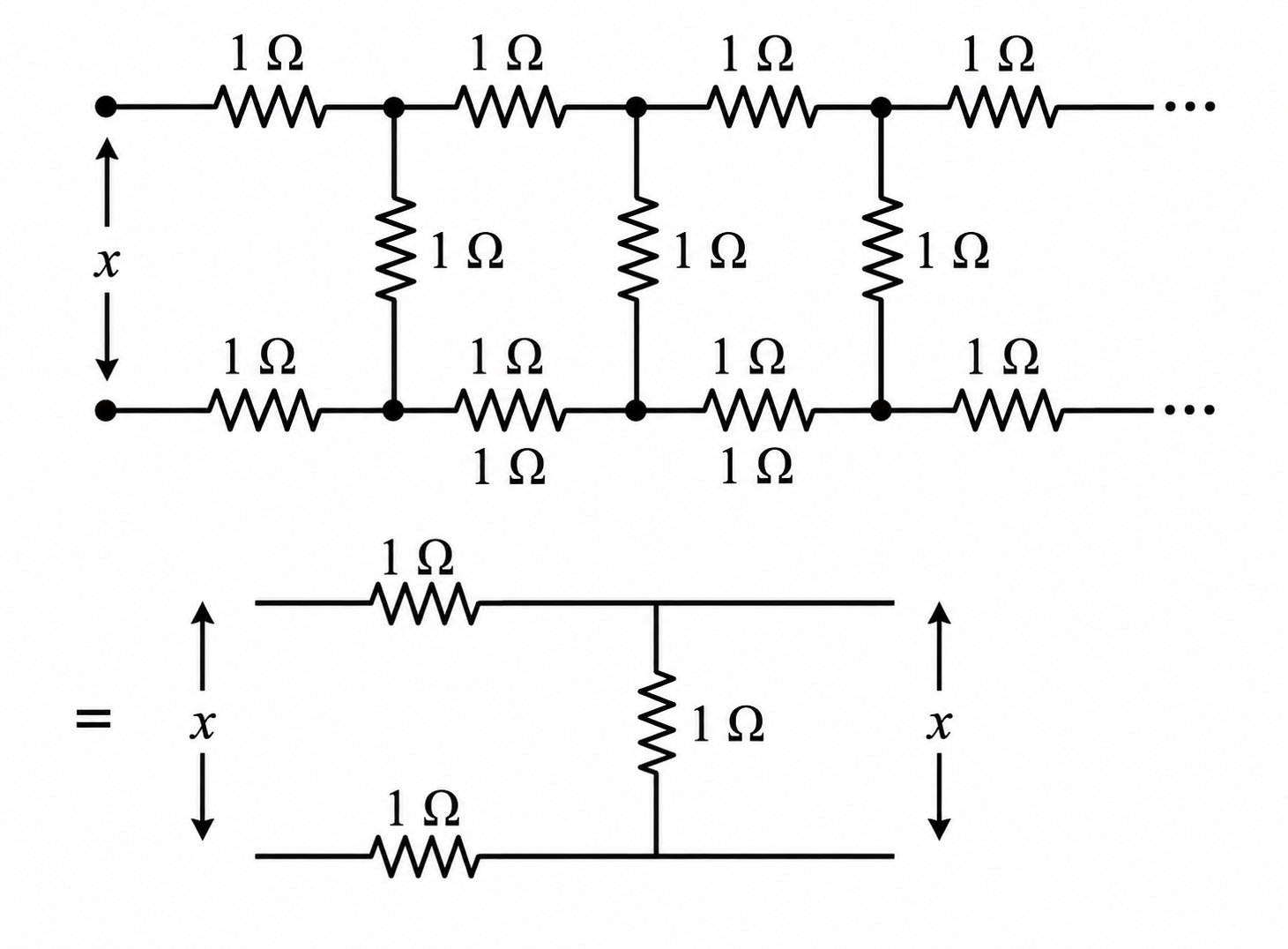
The equivalent resistance of the infinite network given below is :
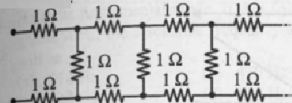
By removing the repeated part of the circuit, ⇒ (x × 1)/(x + 1) + 2=x ⇒ x² - 2x - 2 = 0
⇒ x = (2 ± 2√3)/2
∴ x = 1 + √3
If 𝐅⃗ = 2î + ĵ - k̂ and 𝐅⃗ = 3î + 2ĵ - 2k̂ then the scalar and vector products of 𝐅⃗ and𝐫⃗ have the magnitudes respectively as:
Given 𝐅⃗ = 2î + ĵ - k̂, 𝐫⃗ = 3î + 2ĵ - 2k̂,
Scalar product = 𝐅⃗ · 𝐫⃗ = (2î + ĵ - k̂) · (3î + 2ĵ - 2k̂)
= 2 × 3 + 1 × 2 + (-1) × (-2) = 6 + 2 + 2 = 10
Vector product = 𝐅⃗ × 𝐫⃗
| î ĵ k̂ |
| 2 1 -1 |
|3 2 -2|
= î(-2 + 2) - ĵ(-4 + 3) + k̂(4 - 3)
𝐅⃗ × 𝐫⃗ = ĵ + k̂ ∴ |𝐅⃗ × 𝐫⃗| = √2
Given below are two statements:
Statement I: The law of radioactive decay states that the number of nuclei undergoing the decay per unit time is inversely proportional to the total number of nuclei in the sample.
Statement II: The half life of a radionuclide is the sum of the life time of all nuclei, divided by the initial concentration of the nuclei at time t = 0.
In the light of the above statements, choose the most appropriate answer from the options given below:
According to the Radioactive decay law, -dN/dt ∝ N.
So the number of nuclei undergoing decay per unit time is directly proportional to the total number of nuclei.
Half life ( t_½) is the duration in which half of the active nuclei decayed. Both statements are incorrect.
The physical quantity that has the same dimensional formula as pressure is:
Pressure = F/A and Young's modulus Y = Stress/Strain = (F/A)/(Δl/l₀). Hence the dimensions of pressure and Young's modulus (Y) are the same.
The effective capacitances of two capacitors are 3 μF and 16 μF, when they are connected in series and parallel respectively. The capacitance of two capacitors are:
In series effective resistance of two capacitors of capacitance C₁ and C₂
= (C₁C₂) / (C₁ + C₂) = 3μF ...(i)
In parallel effective resistance, = C₁ + C₂ = 16 μF ...(ii)
From (i) & (ii) C₁C₂ = 48 μF (C₁ - C₂)² = (C₁ + C₂)² - 4C₁ C₂
C₁ - C₂ = 8 μF ...(iii)
From (ii) & (iii) we get Ĉ₁ = 12 μF and C₂ = 4 μF
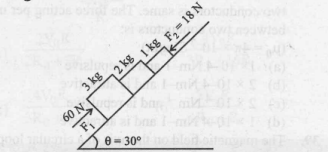
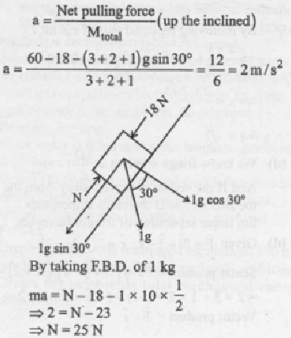
In the diagram shown, the normal reaction force between 2 kg and 1 kg is (Consider the surface, to be smooth): Given g = 10 ms⁻²
A gravitational field is present in a region and a mass is shifted from A to B through different paths as shown. If W₁, W₂ and W₃ represent the work done by the gravitational force along the respective paths, then:
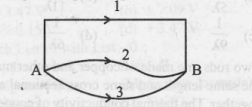
Gravitational force is a conservative force and work done by conservative force is path independent, so W₁ = W₂ = W₃.
A standard filament lamp consumes 100 W when connected to 200 V ac mains supply. The peak current through the bulb will be:
Power, P = Vrms Irms ⇒ Irms = P / Vrms = 1 / 2 Peak current, i₀ = Irms × √2 = 1 / √2 = 0.707 A.
The terminal velocity of a copper ball of radius 5 mm falling through a tank of oil at room temperature is 10 cm s⁻¹. If the viscosity of oil at room temperature is 0.9 kg m⁻¹s⁻¹ the viscous drag force is:
From Stoke's formula,
Viscous drag force F = 6πηrV_t
F = 6 × π × 0.9 × 5×10⁻³ × 10×10⁻² F = 84.78 × 10⁻⁴
F ≈ 8.478 × 10⁻³ N.
In a gravitational field, the gravitational potential is given by V = -K/x (J/kg). The gravitational field intensity at point (2,0,3) m is:
Gravitational potential, V(x) = -K/x. Gravitational field, E_g = -dV/dx = -d/dx(-K/x) = -K/x² î.
Now |Ε ̂_g(2,0,3)| = -K/(2)² = -K/4.
Two very long, straight, parallel conductors A and B carry current of 5 A and 10 A respectively and are at a distance of 10 cm from each other. The direction of current in two conductors is same. The force acting per unit length between two conductors is: (μ₀ = 4π×10⁻⁷ SI unit)
Force per unit length,
F/l = (μ₀i₁i₂)/(2πd) = (2×10⁻⁷ × 5 × 10) / (10×10⁻²) = 10⁻⁴ N/m. Two parallel wires carrying current in same direction will attract each other.
The magnetic field on the axis of a circular loop of radius 100 cm carrying current I = √2 A at point 1 m away from the centre of the loop is given by:
Magnetic field, on the axis of wire,
B = (μ₀IR²) / [2(R² + x²)^(3/2)]
= (4π × 10⁻⁷ × √2 × 1²) / [2(1² + 1²)^(3/2)]
= (4π × 10⁻⁷ × √2) / (2 × 2√2) = π × 10⁻⁷ T
∴ B = 3.14 × 10⁻⁷ T
At any instant, two elements X₁ and X₂ have same number of radioactive atoms. If the decay constant of X₁ and X₂ are 10λ and λ respectively, then the time when the ratio of their atoms becomes 1/e respectively will be :
For elements X₁ and X₂
N_X₁ = N₀e^(-λₓ t)
N_X₂ = N₀e^(-λ_y t)
N_X₁ / N_X₂ = e^[-(λ_X₁ - λ_X₂)t]
1/e = e^[-(λ_X₁ - λ_X₂)t] => e⁻¹
= e^[-(λ_X₁ - λ_X₂)t]
(λ_X₁ - λ_X₂)t = 1
t = 1 / (λ_X₁ - λ_X₂) = 1 / (10λ - 1λ) = 1 / 9λ
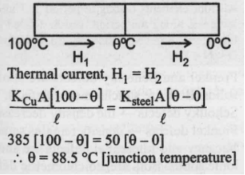
Two rods one made of copper and other made of steel of the same length and same cross sectional area are joined together. The thermal conductivity of copper and steel are 385 J s⁻¹ K⁻¹ m⁻¹ and 50 J s⁻¹ K⁻¹ m⁻¹ respectively. The free ends of copper and steel are held at 100°C and 0°C respectively. The temperature at the junction is, nearly:
The ratio of Coulomb's electrostatic force to the gravitational force between an electron and a proton separated by some distance is 2.4×10³⁹. The ratio of the proportionality constant, K = 1/(4πε₀) to the Gravitational constant G is nearly (Given that the charge of the proton and electron each = 1.6×10⁻¹⁹ C, the mass of the electron = 9.11×10⁻³¹ kg, the mass of the proton = 1.67×10⁻²⁷ kg):
Coulomb's force F_G = Kq₁q₂/r². Gravitational force, FG = Gm₁m₂/r². FG/FG = (Kq₁q₂)/r². / (Gm₁m₂)/r². = (K/G) × (1.6×10⁻¹⁹)² / (1.67×9.11×10⁻⁵⁸). 2.4×10³⁹ = (K/G) 1.6×1.6×10⁻³⁸ / (1.67×9.11×10⁻⁵⁸). K/G ≈ 10²⁰.
An astronomical refracting telescope is being used by an observer to observe planets in normal adjustment. The focal lengths of the objective and eye piece used in the construction of the telescope are 20 m and 2 cm respectively. Consider the following statements about the telescope:
(A) The distance between the objective and eyepiece is 20.02 m
(B) The magnification of the telescope is (-) 1000
(C) The image of the planet is erect and diminished
(D) The aperture of eye piece is smaller than that of objective. The correct statements are:
In normal adjustment of an astronomical telescope, the final image is inverted and formed at infinity. Magnification m = -f₀/fe = -20 / (2×10⁻²) = -1000.
Length of telescope L = f₀ + fe = 20 + 0.02 = 20.02 . Aperture of eye piece is smaller than that of objective. Statements (A), (B), and (D) are correct.
The magnetic flux linked to a circular coil of radius R is ϕ = 2t³ + 4t² + 2t + 5 Wb. The magnitude of induced emf in the coil at t = 5 is:
Given magnetic flux, ϕ = 2t³ + 4t² + 2t + 5
Induced emf, e = -dϕ / dt ∴ |e| = | dϕ / dt | = d/dt [2t³ + 4t² + 2t + 5] = 6t² + 8t + 2
e(t) = 6t² + 8t + 2 e(t = 5) = 6(5)² + 8(5) + 2 = 150 + 40 + 2
∴ |e| = 192 V
Three vessels of equal capacity have gases at the same temperature and pressure. The first vessel contains helium (monoatomic), the second contains fluorine (diatomic) and the third contains sulfur hexafluoride (polyatomic). The correct statement, among the following is:
Root mean square speed, v_rms = √(3RT / M) v_rms is independent of degree of freedom. M_Helium is smallest among all given so, v_rms for helium is maximum.
An organ pipe filled with a gas at 27°C resonates at 400 Hz in its fundamental mode. If it is filled with the same gas at 90°C, the resonance frequency at the same mode will be:
Velocity of sound, V ∝ √T and f = V / λ ∴ f₁ / f₂ = √(T₁ / T₂) 400 / f₂ = √[(273 + 27) / (273 + 90)] = √(300 / 363) = 1 / 1.1 ∴ f₂ = 440 Hz
Match List - I with List - II: Choose the correct answer from the options given below:
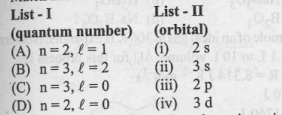
l ; 0 1 2 3
subshell : s p d f
∴ n = 2, l = 1 => 2p ; n = 3, l = 2 => 3d ;
n = 3, l = 0 => 3s ; n = 2, l = 0 => 2s
∴ (A) - (iii), (B) - (iv), (C) - (ii), (D) - (i)
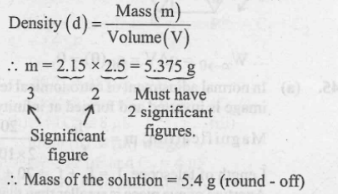
The density of the solution is 2.15 g mL⁻¹, then mass of 2.5 mL solution in correct significant figures is:
Two half cell reactions are given below.
Co³⁺ + e⁻ → Co²⁺, E°_(Co²⁺/Co³⁺) = -1.81 v
2Al³⁺ + 6e⁻ → 2Al(s), E°_(Al/Al³⁺) = +1.66 V
The standard EMF of a cell with feasible redox reaction will be:
E_Cell = E_ox + E_red
= E_Al/Al³⁺ + E_Co³⁺/Co²⁺
= (+1.66 + 1.81) V = +3.47 V
Match List - I with List - II:
Choose the correct answer from the options given below:
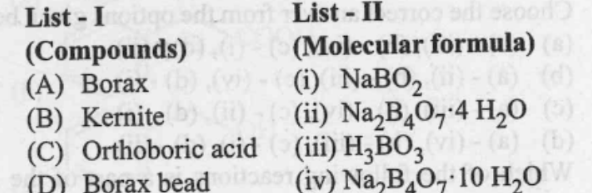
Orthoboric acid : H₃BO₃;
Borax : Na₂B₄O₇·10H₂O;
Borax Bead : NaBO₂;
Kernite : Na₂B₄O₇·4H₂O
∴ (A) – (iv), (B) – (ii), (C) – (iii), (D) – (i)
The correct order of first ionization enthalpy for the given four elements is:
Electronic configurations: C → 1s² 2s² 2p²;O → 1s² 2s² 2p⁴;
N → 1s² 2s² 2p³ (half-filled); F → 1s² 2s² 2p⁵
Match List - I with List - II:
Choose the correct answer from the options given below:
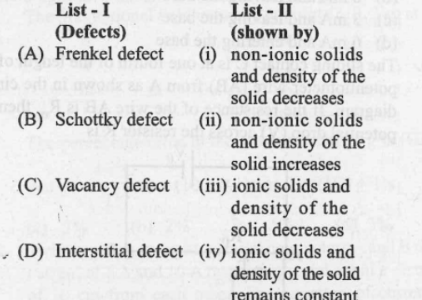
Frenkel and Schottky defects are shown by ionic solids. Both are stoichiometric defects. Schottky defects → the density decreases. Frenkel defects → density remains same. Vacancy and Interstitial defects are shown by non-ionic solids. Both are stoichiometric defects. Vacancy defects → the density decreases. Interstitial defects → the density increases. (A)-(iv), (B)-(iii), (C)-(i), (D)-(ii)
Predict the order of reactivity of the following four isomers towards S_N2 reaction:
(I) CH₃CH₂CH₂CH₂Cl
(II) CH₃CH₂CH(Cl)CH₃
(III) (CH₃)₂CHCH₂Cl
(IV) (CH₃)₃CCl
Reactivity towards S_N2 reaction depends on the following parameters: (i) 1°> 2° > 3° carbon attached to the leaving group.
(ii) Less steric hindrance → more S_N2 reaction. Correct order: (I) > (III) > (II) > (IV).
Match List - I with List - II:
correct answer from the options given below:
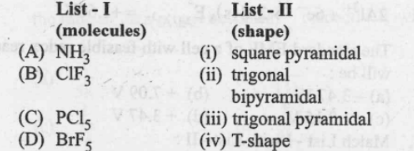
NH₃ → sp³ → Trigonal pyramidal.
ClF₃ → sp³d → T-shape.
PCl₅ → sp³d Trigonal bipyramidal.
BrF₅ → sp³d² → Square Pyramidal.
Correct matching is (A)-(iii), (B)-(iv), (C)-(ii), (D)-(i).
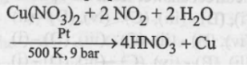
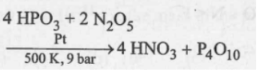
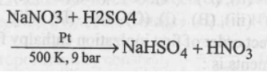
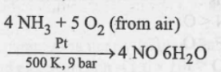
Which of the following reactions is a part of the large scale industrial preparation of nitric acid?
-
(A)
-
(B)
-
(C)
-
(D)
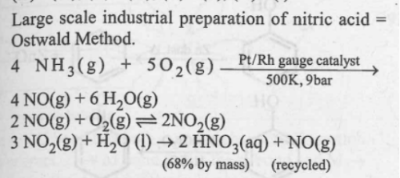
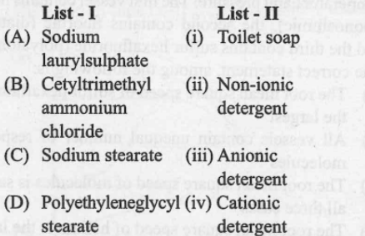
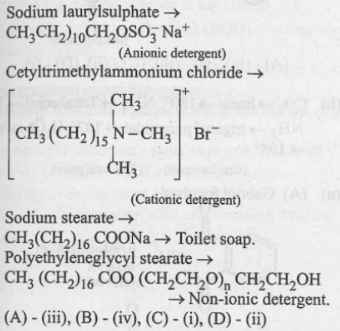
Match List - I with List - II:
Choose the correct answer from the options given below:

Na₂B₄O₇ → B₂O₃ + 2NaBO₂.
Boric Sodium
Anhydride metaborate
Match List - I with List - II:
Choose the correct answer from the options given below:
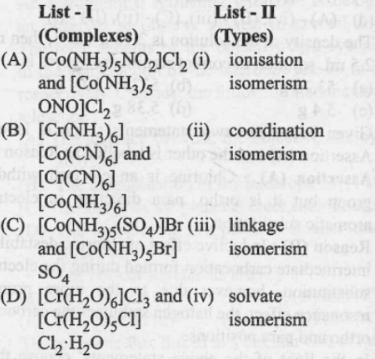
(A) → (iii) as NO₂ is an ambidentate ligand.
(B) → (ii) as the ligands are exchanged between two coordination spheres.
(C) → (i) ionization isomers as the counter ion gets exchanged between inside and outside coordination sphere.
(D) → (iv) solvate isomerism.
Shown below are adsorption isotherms for a gas 'X' at temperatures T₁, T₂ and T₃: p and x/m represent pressure and extend of adsorption, respectively.
The correct order of temperatures for the given adsorption is:
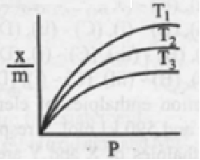
As the temperature increases, the extent of adsorption of a gas on solid surfaces decreases. ∴ T₃ > T₂ > T₁.
0.01 M acetic acid solution is 1% ionised, then pH of this acetic acid solution is:
CH₃COOH ⇌ CH₃COO⁻ + H⁺. At t_eq C(i-α Cα Cα α = 1% =1/100 = 0.01 ∴ [H⁺] = Cα = 0.01 × 10⁻² = 10⁻⁴ ∴ pH = -log[H⁺] = 4
The half life of a first order reaction is 2000 years. If the concentration after 8000 years is 0.02 M, then the initial concentration was:
t½ = 2000 yrs Number of half-lives (n) = t / t½ = 8000 / 2000 = 4 ∴ [A]₀ / [A]t = 2ⁿ = 2⁴ = 16 ∴ [A]₀ = 16 × 0.02 = 0.32 M
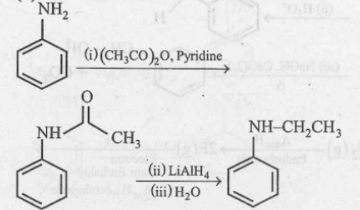
The product formed from the following reaction sequence is:
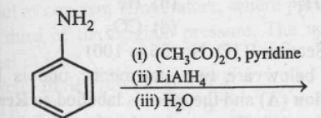
-
(A)
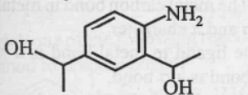
-
(B)
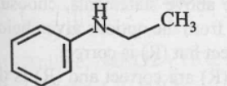
-
(C)
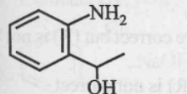
-
(D)
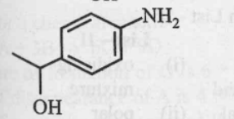
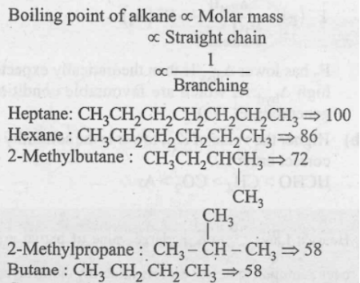
The decreasing order of boiling points of the following alkanes is:
(A) heptane
(B) butane
(C) 2-methylbutane
(D) 2-methylpropane
(E) hexane
Decrease in size from left to right in actinoid series is greater and gradual than that in lanthanoid series due to :
5f orbitals have poor shielding effect
The product formed from the following reaction sequence is:
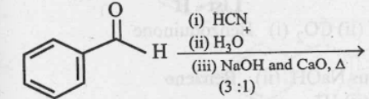
-
(A)
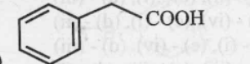
-
(B)
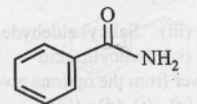
-
(C)
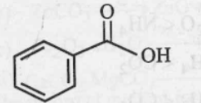
-
(D)
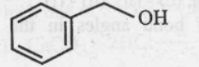
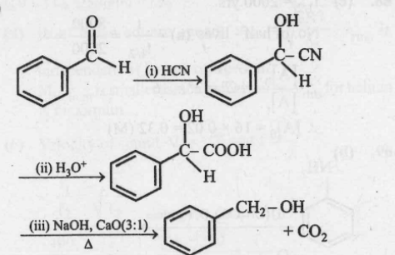
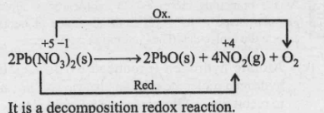
Which of the following reactions is a decomposition redox reaction?
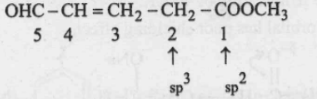
What is the hybridization shown by C₁ and C₂ carbons, respectively in the given compound? OHC-CH=CH-CH₂COOCH₃
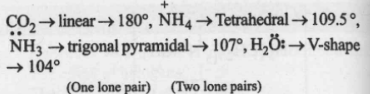
The correct order of bond angles in the following compounds/ species is:
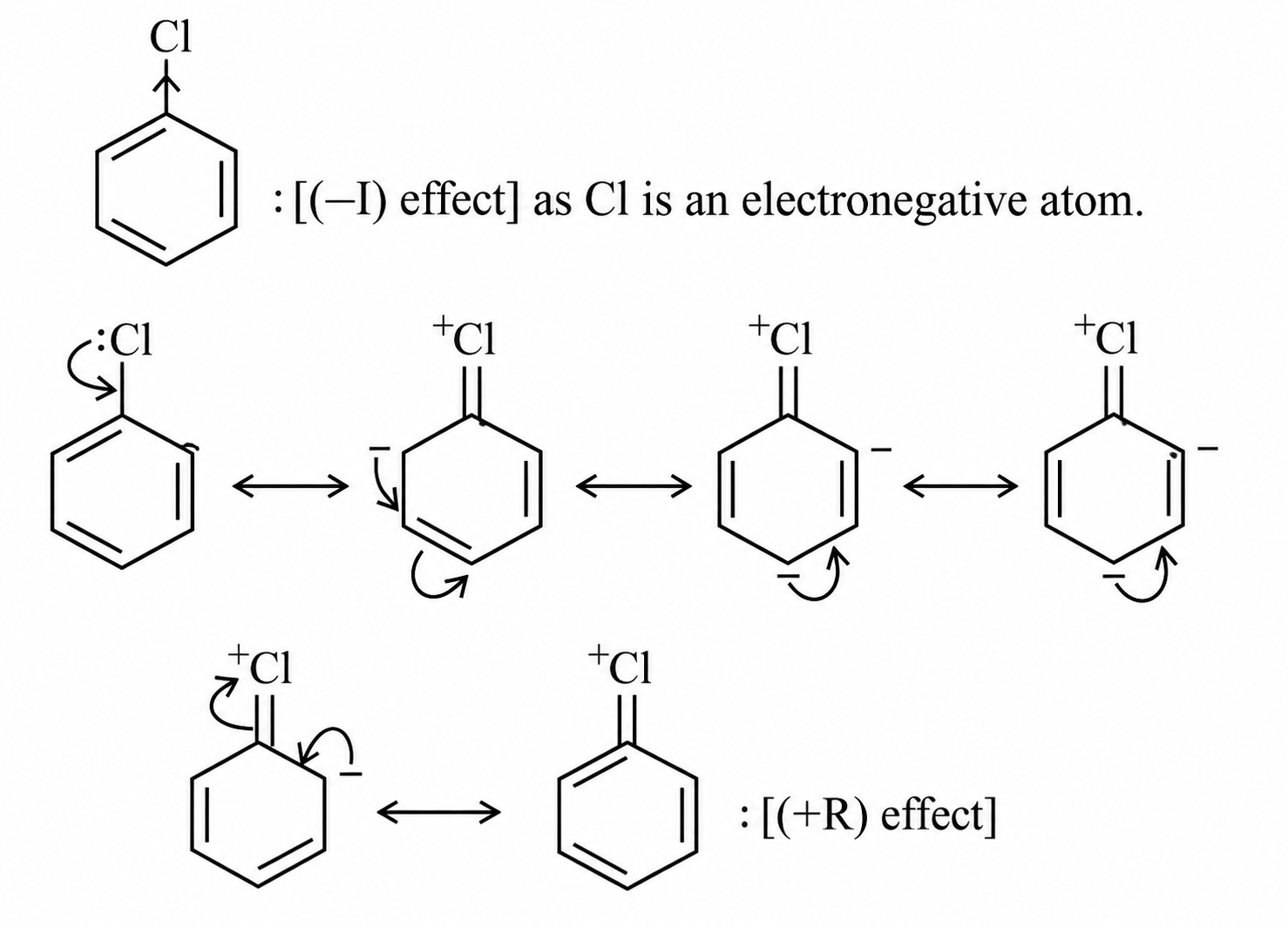
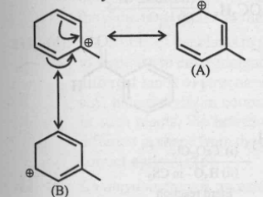
Given below are two statements one is labelled as Assertion (A) and the other is labelled as Reason (R). Assertion (A): Chlorine is an electron withdrawing group but it is ortho, para directing in electrophilic aromatic substitution.
Reason (R): Inductive effect of chlorine destabilises the intermediate carbocation formed during the electrophilic substitution, however due to the more pronounced resonance effect, the halogen stabilises the carbocation at ortho and para positions.
In the light of the above statements, choose the most appropriate answer from the options given below:
∴ Electrophilic aromatic substitution is o- and p- directing. Therefore, assertion is correct.
However, — I effect is more pronounced than + R effect of halogens.
Therefore, Reason is not correct.
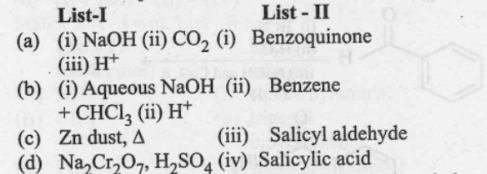
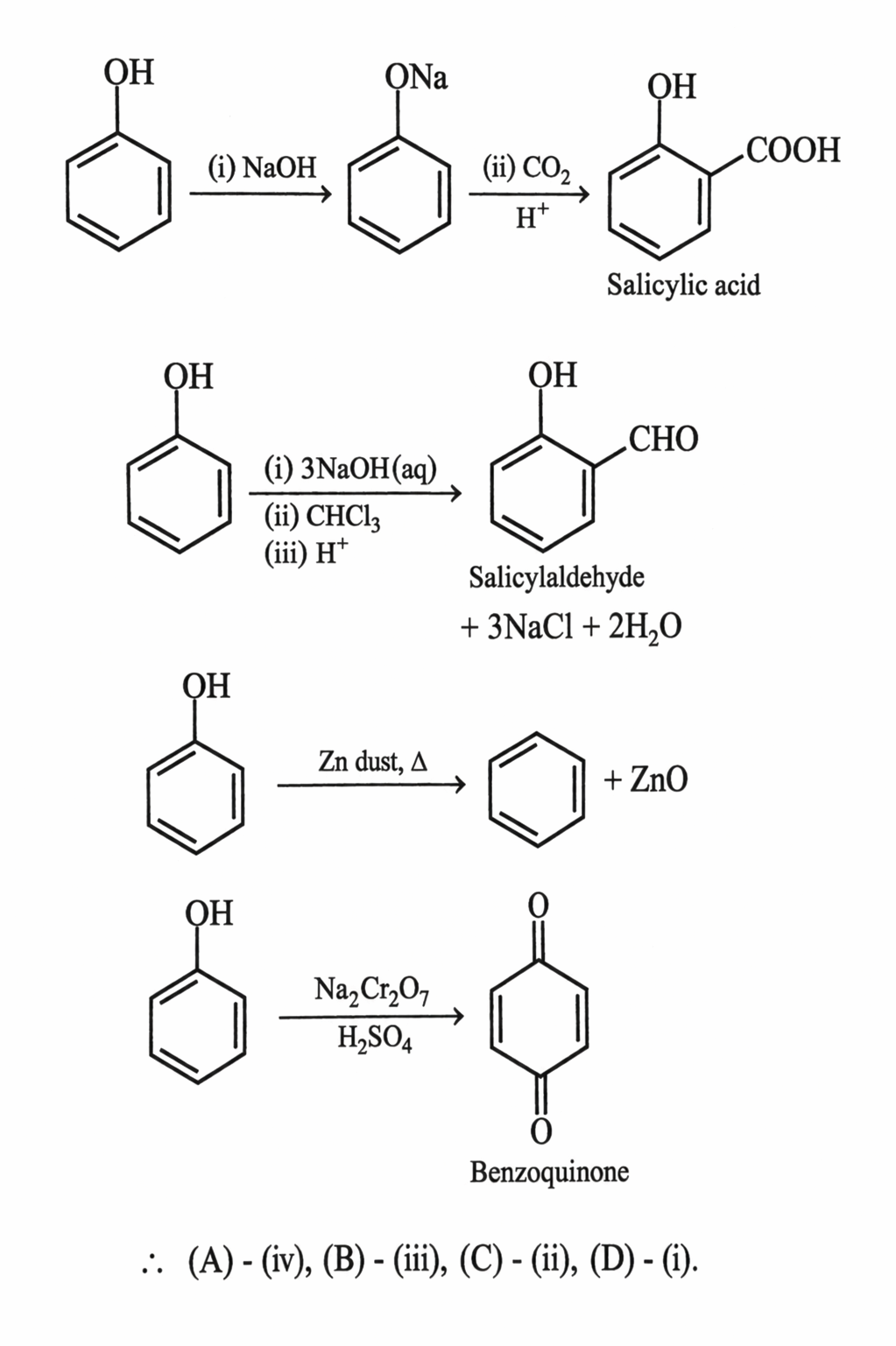
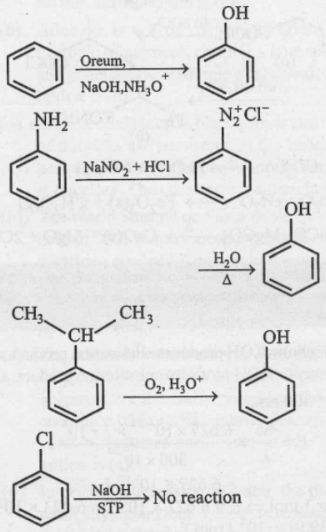
Match the reagents (List - I) with the product (List - II) obtained from phenol.
Choose the correct answer from the options given below:
Match List - I with List-II:
Choose the correct answer from the options given below:
If first ionization enthalpies of elements X and Y are 419 kJ mol⁻¹ and 590 kJ mol⁻¹, respectively and second ionization enthalpies of X and Y are 3069 kJ mol⁻¹ and 1145 kJ mol⁻¹, respectively. Then correct statement is:
X is an alkali metal and Y is alkaline earth metal.
The incorrect statement about denaturation of proteins is:
Protein formation is not related to the denaturation of protein. The primary bonds remain intact during and after denaturation.
Four gas cylinders containing He, N₂, CO₂ and NH₃ gases separately are gradually cooled from a temperature of 500 K. Which gas will liquify first? (Given T_c in K - He: 5.3, N₂: 126, CO₂: 304.1 and NH₃: 405.5)
Higher Tc ⇒ Easier liquefaction.
Given below are two statements: one is labelled as Assertion (A) and the other is labelled as Reason (R).
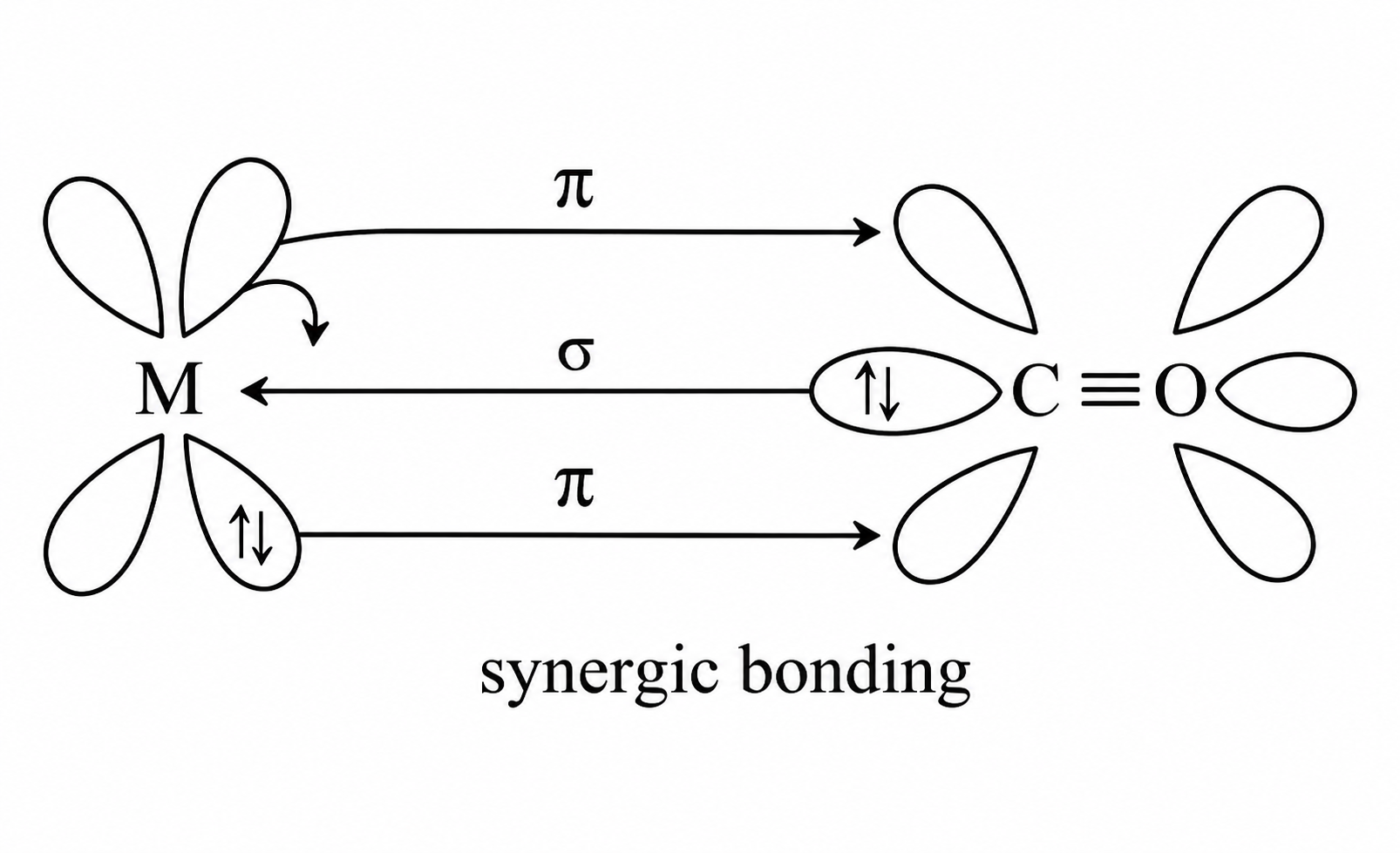
Assertion (A): The metal carbon bond in metal carbonyls possesses both σ and π character.
Reason (R): The ligand to metal bond is a π bond and metal to ligand bond is a σ bond. In the light of the above statements, choose the most appropriate answer from the options given below:
M — CO bond has both σ and π -character. Assertion is correct. L → M bond forms the o-bond and M→ L forms the n-bond. Reason is not correct.
Match List - I with List - II:
Choose the correct answer from the options given below:
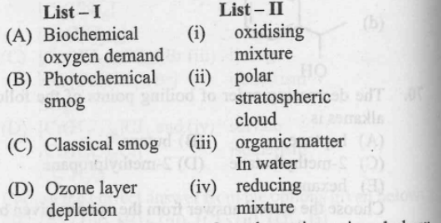
Biochemical Oxygen Demand (BOD) → organic matter in water. Photochemical smog → Oxidizing smog has a high concentration of oxidizing agents.
Classical smog → Reducing has smoke, fog and SO₂ .
Ozone layer depletion - polar stratospheric clouds.
∴ (A)-(iii), (B)-(i), (C)-(iv), (D)-(ii).
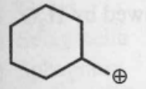
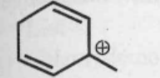
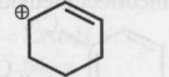
Which of the following is the most stable carbocation?
-
(A)
-
(B)
-
(C)
-
(D)
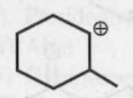
Stability of carbocation: 1° < 2° < 3°
Stability of carbocation α no. of resonating structure.
Two resonating structures and the initial carbocation is tertiary carbocation.
Given below are two statements:
Statement I: Cr²⁺ is oxidising and Mn³⁺ is reducing in nature.
Statement II: Sc³⁺ compounds are repelled by the applied magnetic field.
In the light of the above statements, choose the most appropriate answer from the options given below:
Cr²⁺ (22) → [Ar] 3d⁴ 4s⁰ → Tend to lose one electron so that it gains t³₂_g electronic configuration in an octahedral field.
∴ Tend to form Cr²⁺ (d⁴) → Cr³⁺ (d³)
Mn³⁺ (d⁴) tends to accept one electron to gain d⁵ electronic configuration (Mn²⁺).
Therefore, Mn³⁺ itself is reducing in character. Statement (I) is not completely correct.
Sc³⁺ (d⁰) system; all electrons are paired; so diamagnetic and repelled by the magnetic field.
Kp for the following reaction is 3.0 at 1000 K. CO₂(g) + C(s) ⇌ 2CO(g). What will be the value of Kc for the reaction at the same temperature? (Given R = 0.083 L bar K⁻¹ mol⁻¹)
Kp = Kc(RT)^Δng ; Δn_g = 1 – 2 = –1
Kc = Kp / RT
= 3 / (0.082 × 1000)
= 3 / 82
= 3.6 × 10⁻²
A vessel contains 3.2 g of dioxygen gas at STP (273.15 K and 1 atm pressure). The gas is now transferred to another vessel at constant temperature, where pressure becomes one third of the original pressure. The volume of new vessel in L is: (Given - molar volume at STP is 22.4 L)
At isothermal condition,
P₁V₁ = P₂V₂
n_O₂ = 3.2 / 32 = 0.1 mole
At STP, 0.1 mole of oxygen contains 2.24 L (V₁).
P₁ = 1 atm, P₂ = 1/3 atm
∴ P₁V₁ = P₂V₂
1 × 2.24 = (1/3) × V₂
V₂ = 3 × 2.24 = 6.72 L
For a chemical reaction 4A + 3B → 6C + 9D, rate of formation of C is 6×10⁻² mol L⁻¹ s⁻¹ and rate of disappearance of A is 4×10⁻² mol L⁻¹ s⁻¹. The rate of reaction and amount of B consumed in interval of 10 seconds, respectively will be:
4A + 3B → 6C + 9D
Rate of reaction:
-1/4 d[A]/dt = -1/3 d[B]/dt = 1/6 d[C]/dt = 1/9 d[D]/dt
∴ Rate of reaction = 1/6 d[C]/dt
= (1/6) × 6 × 10⁻²
= 1 × 10⁻² mol L⁻¹ s⁻¹
Now, -1/3 d[B]/dt = 1 × 10⁻²
or, -d[B]/dt = 3 × 10⁻²
∴ Rate of consumption of B
= 3 × 10⁻² mol L⁻¹ s⁻¹
∴ Consumption of B in 10 s
= 3 × 10⁻² × 10
= 3 × 10⁻¹
= 0.3 mol L⁻¹
= 30 × 10⁻² mol L⁻¹
Standard electrode potential for the cell with cell reaction Zn(s) + Cu²⁺(aq) → Zn²⁺(aq) + Cu(s) is 1.1 V. Calculate the standard Gibbs energy change for the cell reaction. (Given F = 96487 C mol⁻¹)
ΔG° = -nFE°cell
= -2 × 96500 × 1.1 J mol⁻¹
= -212300 J mol⁻¹
= -212.3 kJ mol⁻¹
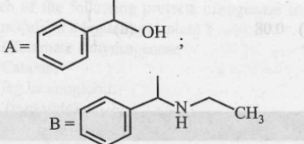
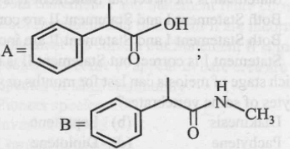
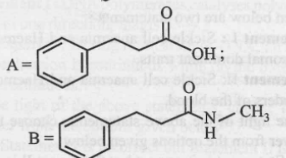
The products A and B in the following reaction sequence are:

-
(A)
-
(B)
-
(C)
-
(D)
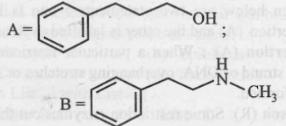
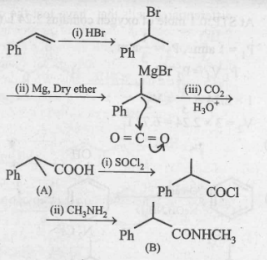
Which one of the following is not a calcination reaction?
ZnCO₃(s) ─Δ→ ZnO(s) + CO₂(g)
FeCO₃·xH₂O ─Δ→ Fe₂O₃(s) + xH₂O(g)
CaCO₃·MgCO₃ ─Δ→ CaO(s) + MgO + 2CO₂(g)
The incorrect method for the synthesis of alkenes is:
Alcoholic KOH produces elimination product, alkene.
Aqueous KOH produces substitution product, alcohol.
When electromagnetic radiation of wavelength 300 nm falls on the surface of a metal, electrons are emitted with the kinetic energy of 1.68×10⁵ J mol⁻¹. What is the minimum energy needed to remove an electron from the metal?
(h = 6.626 × 10⁻³⁴ Js, c = 3 × 10⁸ ms⁻¹, NA = 6.022 × 10²³ mol⁻¹)
λ = 300 nm
E = hc/λ
= (6.627 × 10⁻³⁴ × 3 × 10⁸) / (300 × 10⁻⁹) J
= 6.627 × 10⁻¹⁹ J
For 1 mol, ⇒ E = 6.627 × 10⁻¹⁹ × 6.023 × 10²³
= 39.91 × 10⁴ J mol⁻¹
= 3.99 × 10⁵ J mol⁻¹
∴ hν = ϕ + K.E.
∴ ϕ = hν − K.E.
= 3.99 × 10⁵ − 1.68 × 10⁵
= 2.31 × 10⁵ J mol⁻¹
What fraction of Fe exists as Fe(III) in Fe₀.₉₆O?
(Consider Fe₀.₉₆O to be made up of Fe(Il) and Fe(III) only)
Suppose, Fe²⁺ in Fe₀.₉₆O = x
and Fe³⁺ in Fe₀.₉₆O = 0.96 − x
∴ Total positive charge in Fe₀.₉₆O
= (0.96 − x) × 3 + 2x
Total negative charge = 2 × 1 = 2
∴ (0.96 − x) × 3 + 2x = 2
or, 2.88 − 3x + 2x = 2
or, 2.88 − x = 2
x = 0.88
∴ Fe³⁺ = 0.96 − 0.88 = 0.08
∴ Fraction of Fe³⁺ = 0.08 / 0.96
= 8 / 96
= 1 / 12
Given below are two statements :
Statement I : Sickle cell anaemia and Haemophilia are autosomal dominant traits.
Statement II: Sickle cell anaemia and Haemophilia are disorders of the blood. In the light of the above statements, choose the correct answer from the options given below:
In the given statements, Statement I is incorrect and the statement II is correct. The correct statement is Sickle cell anaemia is autosomal recessive disorder and the haemophilia is sex linked recessive disorder.
Which stage of meiosis can last for months or years in the oocytes of some vertebrates?
Diplotene stage of meiosis lasts for months or years in oocytes of some vertebrates.
Given below are two statements : one is labelled as Assertion (A) and the other is labelled as Reason (R).
Assertion (A) : When a particular restriction enzyme cuts strand of DNA, overhanging stretches or sticky ends are formed.
Reason (R): Some restriction enzymes cut the strand of DNA a little away from the centre of the palindromic site.
In the light of the above statements, choose the correct answer from the options given below
In the given statements both assertion and reason are correct and reason is the correct explanation of the assertion because restriction enzymes cut the strand of DNA a little away from the centre of the palindrome
sites, but between the same two bases on the opposite strands, then single stranded portions are left at the ends. These overhanging stretches on each strand are. called sticky ends. These are named so because they form hydrogen bonds with their complementary cut counterparts. This stickiness of the ends facilitates the action of the enzyme DNA ligase.
Give the correct descending order of organisms with reference to their estimated number found in Amazon forest.
(A) Plants (B) Invertebrates (C) Fishes (D) Mammals (E) Birds
Choose the correct answer from the options given below
‘The Amazon rain forest that is present in South America
has the greatest biodiversity on earth in which more than 40,000 species of plants, more than 1,25,000 invertebrates, 3,000 of fishes, 427 of mammals, and 1,300 of birds are found.
In lac operon, z gene codes for :
In the lac operon, the z gene codes for beta-galactosidase (b-gal), which is primarily responsible for the hydrolysis of the disaccharide, lactose into
its monomeric units, galactose and glucose.
The 5-C compound formed during TCA cycle is:
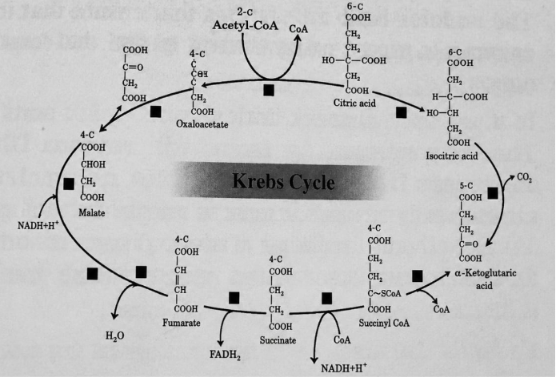
In TCA cycle, the alpha Ketogluataric acid is a 5-C compound, Oxalosuccinic acid is a 6-C compound, whereas succinic acid and fumaric acid are and 4-C compounds.
In meiosis, crossing over and exchange of material between homologous chromosomes catalyzed by the enzyme:
In meiosis, crossing over and exchange of genetic material between homologous chromosomes are catalyzed with the help of recombinase enzyme.
All successions irrespective of the habitat proceed to which type of climax community?
Xeric succession takes place in dry areas and the series progresses from xeric to mesic succession. Hence, both hydrach and xerach successions lead to medium water conditions (mesic). Mesic succession includes neither too dry (xeric) nor too wet (hydric).
When a carrier protein facilitates the movement of two molecules across the membrane in same direction, it is called :
In a symport, both molecules cross the membrane in the same direction. In an antiport, they move in opposite directions. When a molecule moves across a membrane independent of other molecules, the process is called uniport.
When one CO₂ molecule is fixed as one molecule of triose phosphate, which of the following photochemically made, high energy chemical intermediates are used in the reduction phase?
When one molecule of = CO₂ is fixed as one molecule of triose phosphate, 2 ATP and 2 NADPH are used in the reduction phase.
The ability of plants to follow different pathways in response to environment leading to formation of different kinds of structures is called :
The ability of the Plants to follow different pathways in response to environment or phases of life to form different kinds of structures is known as plasticity, e.g., heterophylly in cotton, coriander and larkspur. In such plants, the leaves of the juvenile plant are different in shape from those in mature plants.
Match List-I with List-II :
Choose the correct answer from the options given below.
Chlamydomonas is an example of unicellular alga. Cycas is an example of gymnosperm. Selaginella is an example of pteridophyte and Sphagnum is an example of moss.
The phenomenon by which the undividing parenchyma cells start to divide mitotically during plant tissue culture is called as :
The Phenomenon by which the undividing parenchyma cells start to divide mitotically during plant tissue culture is called as dedifferentiation. The living differentiated cells, that have lost the capacity to divide can regain the capacity of division under certain conditions. For example, formation of meristems – interfascicular cambium and cork cambium from fully differentiated parenchyma cells. While doing so, such meristems/tissues are able to divide and produce cells that once again lose the capacity to divide but mature to perform specific functions, i.e., get redifferentiated.
Interfascicular cambium is present between
Interfascicular cambium is found between primary xylem and primary phloem hence between two vascular bundles.
Which of the following growth regulators is an adenine derivative?
Cytokinin growth regulators is an adenine derivative.
The chromosomal theory of inheritance was proposed by
The chromosomal theory of inheritance was proposed by Sutton and Boveri. Sutton and Boveri argued that the pairing and separation of a pair of chromosomes would lead to the segregation of a pair of factors they carried.
Which of the following statements is not correct?
In the given statement, the statement 4 is incorrect, the correct statement is rhizome is a type of underground (sub-aerial) stem and bears distinct nodes and internodes.
Match List I- with List-II :
Choose the correct answer from the options given below.
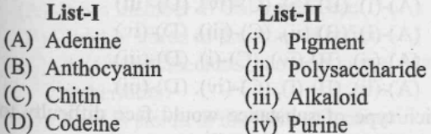
Adenine is a type of purine, anthocyanin is an example of pigment, chitin is a homopolysaccharide and codeine is an example of alkaloid.
The residual persistent part which forms the perisperm in the seeds of beet is :
In some seeds such as black pepper and beet, remnants of nucellus are persistent so the residual persistent part which forms the perisperm in the seeds of beet is nucellus.
The World Summit on sustainable development held in 2002 in Johannesburg, South Africa pledged for :
The World Summit on Sustainable Development that held in 2002 in Johannesburg, South Africa and 190 countries pledged their commitment to achieve by 2010, a significant reduction in the current rate of biodiversity loss at global, regional and local levels.
The type of tissue commonly found in the fruit wall of nuts is
The sclereids are spherical, oval or cylindrical, highly thickened dead cells with narrow cavities (lumen). Sclereids are generally present in the fruit walls of nuts, pulp of fruits like guava, pear and sapota, seed coats of legumes and leaves of tea.
The pioneer species in a hydrarch succession are :
In primary succession in water, the pioneers are the small phytoplanktons, which are replaced with time by rooted-submerged plants, rooted-floating angiosperms followed by free-floating plants, then reed swamp, marsh-meadow, scrub and finally the trees.
Which of the following protects nitrogenase inside the root nodule of a leguminous plant?
Leg-haemoglobin is called as oxygen scavenger. It is present in nodule and protects the enzyme nitrogenase. The enzyme nitrogenase is highly sensitive to the molecular oxygen and it requires anaerobic conditions. The nodules have adaptations that ensure that the enzyme is protected from oxygen.
Given below are two statements .
Statement I : DNA polymerases catalyses polymerisation only in one direction, that is 5' → 3'
Statement II : During replication of DNA, on one strand the replication is continuous while on the other strand it is discontinuous. In the light of the above statements, choose the correct answer from the options given below
In the given statement, both statements are correct. The main enzyme for DNA replication is DNA dependent DNA polymerase. DNA polymerases catalyse polymerisation only in one direction, that is 5 → 3 '. During replication of DNA, on one strand the replication is continuous while on other strand it is discontinuous.
The species that come to appear in bare area are called
The species that invade a bare area are called pioneer species. In primary succession on rocks these are usually lichens which are able to secrete acids to dissolve rock, helping in weathering and soil formation.
Initiation of lateral roots and vascular cambium during secondary growth takes place in cells of
A few layers of thick-walled parenchymatous cells known as pericycle in which initiation of lateral roots and vascular cambium takes place during the secondary growth.
Match List - I with List - II
Choose the correct answer from the options given below.
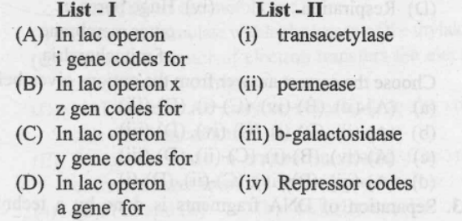
a. The i gene codes for the repressor of the lac operon.
b. The z gene codes for beta-galactosidase (b-gal).
c. The y gene codes for permease.
d. The a gene encodes a transacetylase.
To ensure that only the desired pollens fall on the stigma in artifical hybridization process
(A) the female flower buds of plant producing unisexual flowers need not be bagged
(B) there is no need to emasculate unisexual flowers of selected female parent
(C) emasculated flowers are to be bagged immediately after cross pollination
(D) emasculated flowers are to be bagged after removal of anthers bisexual flowers, showing protogyny are never selected for cross
Choose the correct answer from the options given below:
In the given statement only statements b, c and d are correct. In artificial cross hybridisation when female parent is bisexual then emasculation is done that is removal of anthers, before it dehisce. If female parent is unisexual, there is no need of emasculation. After emasculation, flowers are bagged to prevent contamination of stigma. Desired pollen grains are dusted on stigma and it is rebagged after cross pollination. Bisexual flowers which show protogynous condition can also be used for artificial hybridisation.
The ascent of xylem sap in plants is mainly accomplished by the:
Ascent of xylem sap depends mainly on the following physical properties of water:
Cohesion – mutual attraction between water molecules.
Adhesion – attraction of water molecules to polar surfaces (such as the surface of tracheary elements).
Match List - I with List - IT :
Choose the correct answer from the options given below
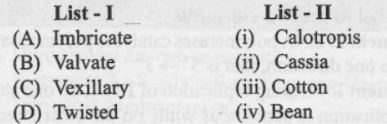
a. The aestivation in Cassia flowers is called as imbricate.
b. Calotropis has valvate type of aestivation.
c. Bean flowers, have vexillary or papilionaceous type of aestivation.
d. The aestivation of cotton is twisted.
The number of time(s) decarboxylation of isocitrate occurs during single TCA cycle is:
The TCA cycle starts with the condensation of acetyl group with oxaloacetic acid (OAA) and water to yield citric acid. The reaction is catalysed by the enzyme citrate synthase and a molecule of CoA is released. Citrate is then isomerised to isocitrate. At 4th step of TCA cycle, isocitrate gives off a pair of H atoms and a molecule of CO2(decarboxylation) and becomes 5-C alpha-Ketoglutarate.
Match List - I with List - II:
Choose the correct answer from the options given below:
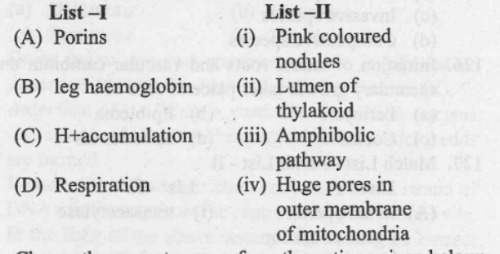
a. The porins are proteins that form large pores in the outer membranes of the plastids, mitochondria and some bacteria. b. The pink colour of nodules of the plant is due to the presence of leg-haemoglobin that is oxygen scavenger.
c. H + accumulation takes place in the lumen of the thylakoid.
d. Respiration is a type of amphibolic pathway because in this reaction both anabolic and catabolic processes takes place.
Separation of DNA fragments is done by a technique known as
Gel electrophoresis is a type of technique that is used to separate the fragments of DNA. The formation of the fragments of DNA takes place by the enzyme, restriction endonuclease.
In general the egg apparatus of embryo sac in angiosperm consists of
In general the egg apparatus of embryo sac in angiosperm consists of one egg cell, two synergids, three antipodal cells, two polar nuclei.
The Floral Diagram represents which one of the following families
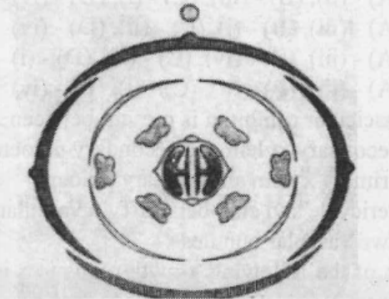
The given diagram shows the floral diagram of family Brassicaceae.
The floral formula of the family Brassicaceae is K₂₊₂ C₄ A₂₊₄ G₍₂₎
Primary proteins are also called as polypeptides because :
Primary proteins are also called as polypeptides because successive amino acids are joined by peptide bonds.
Match List-I with List-II :
Choose the correct answer from the options given below:
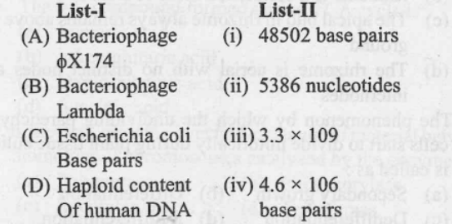
Bacteriophage Φ × 174 contains 5386 nucleotides.
Bacteriophage lambda contains 48502 basepairs.
Escherichia coli contains 4.6 × 10⁶ basepairs.
Haploid content of human DNA contains 3.3 × 10⁹ basepairs.
Which type of substance would face difficulty to pass through the cell membrane?
Transport of any substance across the membrane depends on its solubility in lipids. The cell membrane is mainly composed of lipids and proteins. The major lipids are phospholipids that are arranged in a bilayer so substances with hydrophilic moiety would face difficulty to pass through the cell membrane.
What is the expected percentage of F2 progeny with yellow and inflated pod in dihybrid cross experiment involving pea plants with green coloured, inflated pod and yellow coloured constricted pod?
Since the green pod (G) colour is dominant over yellow pod colour (g) and inflated pod (I) is dominant over constricted pod (i). So, Green, Inflated Pod X Yellow, constricted Pod. After cross all F1 progeny will be dominant green, inflated plants and the phenotypic ratio of F2 plants will be 9:3:3:1.
Green, inflated - 9
Green, constricted - 3
Yellow, inflated - 3
Yellow, constricted - 1
Thus the % of yellow inflated plants will be 3/16 = 18.75%.
Match List I with List - II:
Choose the correct answer from the options given below:
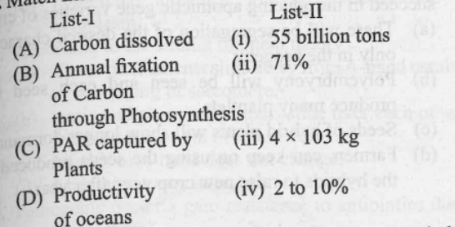
a. Carbon dissolved in oceans - 71%
b. Annual fixation of carbon through photosynthesis - 4 x 10³ Kg
c. PAR captured by plants - 2 to 10%
d. Productivity of oceans - 55 billion tons.
If a female individual is with small round head, furrowed tongue, partially open mouth and broad palm with characteristic palm crease. Also the physical, psychomotor and mental development is retarded. The karyotype analysis of such an individual will show:
If a female individual is with small round head, furrowed tongue, partially open mouth and broad palm with characteristic palm crease. Also the physical, psychomotor and mental development is retarded. These are the symptoms of Down's syndrome. In this genetic disorder an additional copy of the chromosome number 21 (trisomy of 21) is present. So the karyotype analysis of such an individual will show trisomy of chromosome 21.
Read the following statements and identify the characters related to the alga shown in the diagram
(A) It is a member of Chlorophyceae
(B) Food is stored in the form of starch
(C) It is a monoecious plant showing oogonium and antheridium
(D) Food is stored in the form of laminarin or mannitol
(E) It shows dominance of pigments Chlorophyll a, c and Fucoxanthin
Choose the correct answer from the options given below:
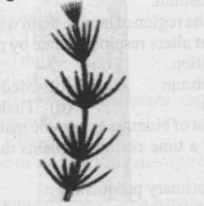
The alga shown in the diagram is Chara that is monoecious plant. It is a member of Chlorophyceae and the food is stored in the form of starch.
The enzyme (a) is needed for isolating genetic material from plant cells and enzyme (b) for isolating genetic material from fungus. Choose the correct pair of options from the following:
The enzyme cellulase is used for isolating genetic material from plant cells and enzyme chitinase is used for isolating genetic material from fungus.
Identify the correct sequence of events during Prophase I of meiosis: (A) Synapsis of homologous chromosomes (B) Chromosomes become gradually visible under microscope (C) Crossing over between non-sister chromatids of homologous chromosomes (D) Terminalisation of chiasmata (E) Dissolution of synaptonemal complex Choose the correct answer from the options given below:
The prophase I of meiosis is subdivided into five phases based on chromosomal behaviour, i.e., Leptotene, Zygotene, Pachytene, Diplotene and Diakinesis. The correct sequence of events during Prophase I of meiosis is:- Chromosomes become gradually visible under microscope during leptotene stage -> during zygotene stage synapsis of homologous chromosomes takes place -> crossing over between non-sister chromatids of homologous chromosomes occurs in pachytene stage -> In diplotene stage, dissolution of synaptonemal complex occurs -> terminalisation of chiasmata takes place during diakinesis.
Which of the following pair represents free living nitrogen fixing aerobic bacteria?
Azotobacter and Beijerinckia are the examples of free living nitrogen fixing aerobic bacteria.
Frugivorous birds are found in large numbers in tropical forests mainly because of:
Frugivorous birds are those birds that eat fruits so they are found in large numbers in tropical forests mainly because of availability of fruits throughout the year.
Identify the correct statements regarding chemiosmotic hypothesis: (A) Splitting of the water molecule takes place on the inner side of the membrane. (B) Protons accumulate within the lumen of the thylakoids. (C) Primary acceptor of electron transfers the electrons to an electron carrier. (D) NADP reductase enzyme is located on the stroma side of the membrane. (E) Protons increase in number in stroma. Choose the correct answer from the options given below:
In the given statements about chemiosmotic hypothesis, statements (c) and (e) are incorrect. The correct statements are, primary acceptor of electron transfers its electron to a proton carrier not to an electron carrier and protons increase in number in lumen of the thylakoid not in stroma.
Match List-I with List-II:
Choose the correct answer from the options given below:
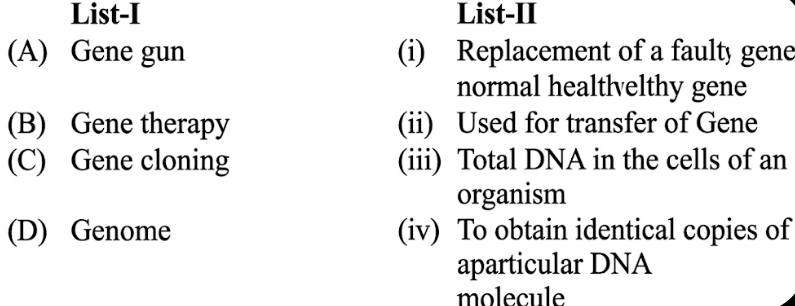
(a) Gene gun - Used for transfer of gene in plant cells.
(b) Gene therapy - Replacement of a faulty gene by a normal healthy gene
(c) Gene cloning - To obtain identical copies of a particular DNA molecule
(d) Genome - Total DNA in the cells of an organism
Which of the following can be expected if scientists succeed in introducing apomictic gene varieties of crops?
If the hybrids are made into apomicts, there is no segregation of characters in the hybrid progeny. Then the farmers can keep on using the hybrid seeds to raise new crop year after year and they does not have to buy hybrid seeds every year.
Which of the following animals has three chambered heart?
Chelone (turtle) is an example of a reptile. The heart of reptiles is usually three-chambered, with the exception of crocodiles.
Which of the following types of epithelium is present in the bronchioles and Fallopian tubes?
Ciliated epithelium is a type of columnar or cuboidal epithelium that bears cilia on its free surface. It is mainly present in the inner surface of hollow organs like bronchioles and fallopian tubes. Its function is to move particles or mucus in a specific direction over the epithelium.
Which of the following is not an Intra Uterine Device?
The Intra Uterine Devices (IUDs) are a type of contraception. These are small devices that are inserted by doctors or expert nurses in the uterus through vagina. These Intra Uterine Devices are presently available as the non-medicated IUDs (e.g., Lippes loop), copper releasing IUDs (CuT, Cu7, Multiload 375) and the hormone releasing IUDs (Progestasert, LNG-20). Thus Progestogens are not example of IUDs.
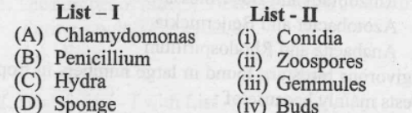
Match List - I with List - II:
Choose the correct answer from the options given below:
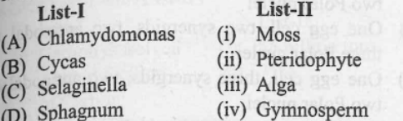
Chlamydomonas asexually reproduces by zoospores. Penicillium asexually reproduces by conidia formation. Hydra reproduces by budding. Sponges produce gemmules for asexual reproduction.
Which of the following reasons is mainly responsible for graft rejection in transplantation of organs?
Cell-mediated immune response is mainly responsible for graft rejection in transplantation of organs.
Bivalent or Tetrad formation is a characteristic feature observed during:
The complex formed by a pair of synapsed homologous chromosomes is called a bivalent or a tetrad. It is a characteristic feature that is observed during the zygotene stage when the homologous chromosomes undergo synapsis.
Given below are two statements: one is labelled as Assertion (A) and the other is labelled as Reason (R). Assertion (A): FSH which interacts with membrane bound receptors does not enter the target cell. Reason (R): Binding of FSH to its receptors generates second messenger (cyclic AMP) for its biochemical and physiological responses. In the light of the above statements, choose the most appropriate answer from the options given below:
In the given statements, both assertion and reason are correct but reason is not the correct explanation of assertion.
Choose the correct statement about a muscular tissue:
In the given statements about muscular tissue, only statement (c) is correct. Communication junctions (intercalated discs) at some fusion points allow the cells to contract as a unit, i.e., when one cell receives a signal to contract, its neighbours are also stimulated to contract. Smooth muscle fibres are uninucleated not multinucleated
Skeletal muscle fibres are multinucleated not uninucleated.
The wall of blood vessels are made up of simple squamous epithelium not columnar epithelium.
Identify the region of human brain which has pneumotaxic centre that alters respiratory rate by reducing the duration of inspiration.
Pons are the region of human brain which has pneumotaxic centre that alters respiratory rate by reducing the duration of inspiration.
The amount of biomass or organic matter produced per unit area over a time period by plants during photosynthesis is called:
Primary production is defined as the amount of biomass or organic matter produced per unit area over a time period by plants during photosynthesis. It is expressed in terms of weight (gm-2) or energy (kcal m-2). The rate of biomass production is called productivity. It is expressed in terms of gm-2 yr-1 or (kcal m-2) yr-1 to compare the productivity of different ecosystems. It can be divided into gross primary productivity (GPP) and net primary productivity (NPP). Gross primary productivity of an ecosystem is the rate of production of organic matter during photosynthesis. A considerable amount of GPP is utilised by plants in respiration. Gross primary productivity minus respiration losses (R), is the net primary productivity (NPP).
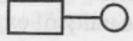
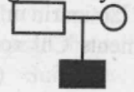
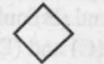
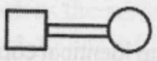
Select the incorrect match regarding the symbols used in Pedigree analysis
-
(A) Consanguineous mating
-
(B) Parent with male child affected with disease
-
(C) Sex unspecified
-
(D) Affected individual

Symbol is used in the human pedigree analysis to indicate the mating between relative (consanguineous mating). So symbol given in the option (4) is incorrect.
If the pH in lysosomes is increased to alkaline, what will be the outcome?
Lysosomes are very rich in almost all types of hydrolytic enzymes (hydrolases - lipases, proteases, carbohydrases) and are optimally active at the acidic pH. If pH in lysosomes is increased to alkaline or basic then hydrolytic enzymes will become inactive.
According to the sliding filament theory:
The sliding filament theory states that contraction of a muscle fibre takes place by the sliding of the thin filaments over the thick filaments. According to this theory, during shortening of the muscle, i.e., contraction, the 'I' bands get reduced, whereas the 'A' bands retain the length that means length of A-band does not change.
Pathogenic bacteria gain resistance to antibiotics due to changes in their:
Plasmid is an autonomously replicating circular extra-chromosomal DNA. The plasmid DNA provides certain unique phenotypic characters to the bacteria such as resistance to antibiotics.
Panspermia, an idea that is still a favourite for some astronomers, means:
Early Greek thinkers thought units of life called spores were transferred to different planets including earth. 'Panspermia' is still a favourite idea for some astronomers transfer of spores as unit of life from other planets to earth.
Why CNG is considered better fuel than diesel?
(A) It can not be adulterated.
(B) It takes less time to fill the fuel tank.
(C) It burns more efficiently.
(D) It is cheaper.
(E) It is less inflammable.
Choose the most appropriate answer from the options given below:
Due to following reasons CNG is better fuel than diesel because:-
It cannot be adulterated
It burns more efficiently than diesel or petrol
It is cheaper
Which of the following statements are correct with respect to vital capacity?
(A) It includes ERV, TV and IRV.
(B) Total volume of air a person can inspire after a normal expiration.
(C) The maximum volume of air a person can breathe in after forced expiration.
(D) It includes ERV, RV and IRV.
(E) The maximum volume of air a person can breathe out after a forced inspiration.
Choose the most appropriate answer from the options given below:
Vital Capacity (VC) is defined as the maximum volume of air a person can breathe in after a forced expiration. This includes ERV, TV and IRV or the maximum volume of air a person can breathe out after a forced inspiration. In the given statements, statements (i), (iii) and (v) are correct about vital capacity.
How many secondary spermatocytes are required to form 400 million spermatozoa?
Since one primary spermatocyte produces two secondary spermatocytes during the meiosis I and one secondary spermatocyte produces two spermatozoa during meiosis II. Thus 200 million secondary spermatocytes will be required to produce 400 million spermatozoa.
Mad cow disease in cattle and Cr Jacob disease in humans are due to infection by........
Prions are infectious agent that are consisting of abnormally folded protein. The agent was similar in size to viruses. The most notable diseases caused by prions are bovine spongiform encephalopathy (BSE) commonly called mad cow disease in cattle and its analogous variant Cr-Jacob disease (CJD) in humans.
Arrange the components of mammary gland (from proximal to distal):
(A) Mammary duct
(B) Lactiferous duct
(C) Alveoli
(D) Mammary ampulla
(E) Mammary tubules
Choose the most appropriate answer from the options given below:
The glandular tissue of each breast is divided into 15-20 mammary lobes containing clusters of cells called alveoli. The alveoli open into mammary tubules. The tubules of each lobe join to form a mammary duct. Several mammary ducts join to form a wider mammary ampulla which is connected to lactiferous duct through which milk is sucked out. Thus, alveoli -> Mammary tubules -> Mammary duct -> Mammary ampulla -> Lactiferous duct.
Western Ghats have a large number of plants and animal species that are not found anywhere else. Which of the following term is used to notify such species?
Endemic species are those species that are confined to a particular region such as Western Ghats and not found anywhere else.
Match List I with List II
Choose the correct answer from the options given below:
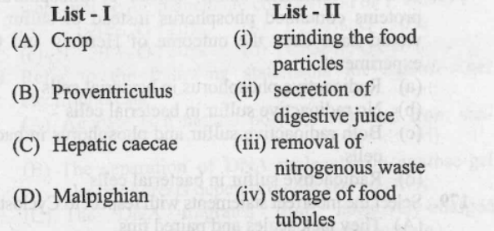
Crop – Storage of food.
Proventriculus – Grinding the food particles.
Hepatic caecae – Secretion of digestive juice.
Malpighian tubules – Removal of nitrogenous waste.
Two butterfly species are competing for the same nectar of a flower in a garden. To survive and coexist together, they may avoid competition in the same garden by:
If two species compete for the same resource, they could avoid competition by choosing, for instance, different times for feeding or different foraging patterns. Thus when two butterfly species are competing for the same nectar of a flower in a garden. To survive and coexist together, they may avoid competition in the same garden by choosing different foraging patterns.
Role of enamel is to:
The hard chewing surface of the teeth is made up of enamel that helps in the process of mastication of food.
Choose the incorrect enzymatic reaction.
Maltose is an example of disaccharide which is dissocioated or hydrolysed into two molecules of glucose
Maltose → Glucose + Glucose
Given below are two statements one is labelled as Assertion
(A) and the other is labelled as Reason (R). Assertion
(A): During pregnancy the level of thyroxine is increased in the maternal blood.
Reason (R): Pregnancy is characterised by metabolic changes in the mother.
In the light of the above statements, choose the most appropriate answer from the options given below:
In the given statements both assertion and reason are correct and reason is the correct explanation of assertion.
Choose the correct statements:
(A) Bones support and protect softer tissues and organs
(B) Weight bearing function is served by limb bones
(C) Ligament is the site of production of blood
(D) Adipose tissue is specialised to store fats.
(E) Tendons attach one bone to another.
Choose the most appropriate answer from the options given below:
In the given statements, statement (i), (ii) and (iv) are correct. Statements (iii), and (v) are incorrect. The correct statements are, Bone marrow is the site of production of blood cell and tendons attach bones to muscles.
If DNA contained sulfur instead of phosphorus and proteins contained phosphorus instead of sulfur, what would have been the outcome of Hershey and Chase experiment?
Alfred Hershey and Martha Chase used radioactive phosphorus for DNA and radioactive sulfur for protein for their experiment. But in the given question sulphur is considered for DNA and phosphorous is considered for proteins. So radioactive sulphur will be found in bacterial cell.
Select the incorrect statements with respect to Cyclostomes.
(A) They lack scales and paired fins.
(B) They have circular mouth with jaws.
(C) They bear 6-15 pairs of gills.
(D) They migrate to deep sea for spawning.
Choose the most appropriate answer from the options given below:
In the given statements, statement (i) and (iii) are correct and statements (ii) and (iv) are incorrect. The correct statements are cyclostomes have a circular mouth without jaws and they migrate from marine water to fresh water for spawning respectively.
A unique vascular connection between the digestive tract and liver is called:
Unique vascular connection between the digestive tract and liver is called Hepatic portal system.
Milk of transgenic 'Cow Rosie' was nutritionally more balanced product for human babies than natural cow milk because it contained:
Cow Rosie was a transgenic animal and was first transgenic cow. This cow was able to produce human protein enriched milk. This milk contains the human alpha-lactalbumin and was a complete product for human infants than non-transgenic cow milk.
Gout is a type of disorder which leads to:
Gout is a disorder of joints caused due to the collection of uric acid crystals in the joints. This causes inflammation of the joints.
Which of the following methods is not commonly used for introducing foreign DNA into the plant cell?
Bacteriophage is a vector useful for transfer of viral DNA into the bacterial cell. It is not used for the transfer of foreign DNA in a plant cell.
Given below are two statements:
Statement I: Amino acids have a property of ionizable nature of -NH₂ and -COOH groups, hence have different structures at different pH.
Statement II: Amino acids can exist as Zwitterionic form at acidic and basic pH. In the light of the above statements, choose the most appropriate answer from the options given below:
Ionizable nature is a particular characteristic of -NH₂ and -COOH groups. In a solution containing different pH, the structure of amino acid is expected to change. Amino acid in a dipolar ionic form is called zwitterion. For a particular amino acid there exists an isoelectric point at which the net charge on amino acid becomes zero.
Here, in the given figure, (B) is a zwitterion.

Given below are two statements one is labelled as Assertion (A) and the other is labelled as Reason (R). Assertion (A): Spirulina is a microbe that can be used for reducing environmental pollution.
Reason (R): Spirulina is a rich source of protein, carbohydrates, fats, minerals and vitamins.
In the light of the above statements, choose the most appropriate answer from the options given below:
Spirulina can be grown easily on waste water consisting of starch, straw, animal manure or on sewage. This helps in the reduction of biodegradable pollutants from the environment and also beneficial for the growth of Spirulina on a large scale. Spirulina is a rich source of proteins, fats, minerals, carbohydrates and vitamins.
With respect to metaphase, which of the following statements is incorrect?
During the metaphase stage of the cell cycle. Each chromosome has only two chromatids that are linked together by a centromere. The four chromatids can never be found in a cell cycle.
Against the codon 5' UAC 3', what would be the sequence of anticodon on tRNA?
The codons present on mRNA are complimentary to the anticodons of tRNA. The codon 5'-UAC-3' the expected anticodon will be 3'-AUG-5'.
Arrange the following formed elements in the decreasing order of their abundance in blood in humans: (A) Platelets
(B) Neutrophils
(C) Erythrocytes
(D) Eosinophils
(E) Monocytes
Choose the most appropriate answer from the options given below:
For a healthy adult human male on an average:
Erythrocytes: 5 millions to 5.5 millions of RBCs(erythrocytes) mm-3 of blood.
Platelets: Blood normally contains 1,50,000–3,50,000 platelets mm-3.
Neutrophils: Neutrophils form 60-65% of the total WBCs.
Monocytes: Monocytes form 6-8% of the total WBCs.
Eosinophils: Eosinophils form 2-3% of the total WBCs.
Thus, according to their relative abundance in blood the decreasing order of the formed elements in the blood:
Erythrocytes - Platelets - Neutrophils - Monocytes- Eosinophils
Which of the following are true about the taxonomical aid 'key'?
(A) Keys are based on the similarities and dissimilarities.
(B) Key is analytical in nature.
(C) Keys are based on the contrasting characters in pair called Couplet.
(D) Same key can be used for all taxonomic categories.
(E) Each statement in the key is called Lead.
Choose the most appropriate answer from the options given below:
Key can be defined as a taxonomical aid that can be used for the purpose of identification of organisms including plants and animals. The identification process is based on analysis of the similarities and dissimilarities between organisms. In this process, the contrasting characters appear in a pair called couplet. Each and every statement described in a key is called a lead. Separate key is used for describing each taxonomic category like family, genus and species required for the purpose of identification. These keys are analytical.
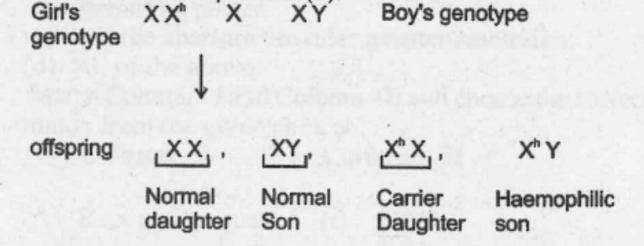
A normal girl, whose mother is haemophilic marries a male with no ancestral history of haemophilia. What will be the possible phenotypes of the offsprings?
(a) Haemophilic son and haemophilic daughter.
(b) Haemophilic son and carrier daughter.
(c) Normal daughter and normal son.
(d) Normal son and haemophilic daughter.
Choose the most appropriate answer from the options given below:
If a mother is heterozygous (a carrier) for haemophilia and father is normal and not affected by the disorder then each son will have a 1 in 2 (50%) chances of getting his mother's haemophilic allele and get affected by haemophilia. Each daughter has a 1 in 2 (50%) chances of getting her mother's haemophilic allele and being heterozygous carrier of the disease.
In the enzyme which catalyses the breakdown of: H₂O₂ → H₂O + O₂, the prosthetic group is:
Peroxidase is the catalytic enzyme that facilitate the breakdown of hydrogen peroxide into water and oxygen. Haem is the catalytic group of this enzyme.
Select the incorrect statement with respect to inbreeding of animals.
Inbreeding involves mating between closely related individuals belonging to the same species upto 4-6 generations. This process will increase the homozygosity.
IUDs are small objects made up of plastic or copper that are inserted in the uterine cavity.
Which of the following statements are correct about IUDs?
(A) IUDs decrease phagocytosis of sperm within the uterus.
(B) The released copper ions suppress the sperm motility.
(C) IUDs do not make the cervix hostile to the sperm.
(D) IUDs suppress the fertilization capacity of sperm.
(E) The IUDs require surgical intervention for their insertion in the uterine cavity.
Choose the most appropriate answer from the options given below:
Copper releasing IUD suppresses the motility of the sperms and also reduces the fertilising ability of the sperms.
Select the correct statement regarding mutation theory of evolution.
Hugo de Vries, based on his experimental work on evening primrose proposed the idea of mutations. According to deVries mutation causes speciation and hence called it saltation (Single step large mutation).
Excretion in cockroach is performed by all, EXCEPT:
Hepatic caeca can be defined as the ring of 6-8 tubules. It is present at the junction of foregut and midgut of cockroach. It is responsible for secretion of digestive juices in the cockroach. Hepatic caeca has no role in the excretion process. Urecose glands is involved in the excretion process of the male cockroach. Malpighian tubules and fat bodies are excretory structures in both male and female cockroach.
Select the correct statements.
(A) Angiotensin II activates the cortex of adrenal gland to release aldosterone.
(B) Aldosterone leads to increase in blood pressure.
(C) ANF acts as a check on renin-angiotensin mechanism.
(D) ADH causes vasodilation.
(E) Vasopressin is released from adenohypophysis.
Choose the most appropriate answer from the options given below:
Angiotensin II causes the activation of the adrenal cortex of adrenal gland to release aldosterone hormone. Aldosterone causes an increase in the blood volume resulting in increase in blood pressure by increasing reabsorption of water and electrolytes from distal parts of nephron in the kidney. ANF causes vasodilation and decreases blood pressure and glomerular filtration rate (GFR).
If A and C make 30% and 20% of DNA, respectively, what will be the percentage composition of T and G?
According to Chargaff's rule, the amount of Adenine (A) will be always equal to Thymine and the amount of Cytosine (C) will always be equal to that Guanine (G). So,
A=T=30%+30%=60%
C=G=20%+20%=40%
So, T and G will be 30% and 20% respectively,
Refer to the following statements for agarose-gel electrophoresis:
(A) Agarose is a natural polymer obtained from sea-weed.
(B) The separation of DNA molecules in agarose-gel electrophoresis depends on the size of DNA.
(C) The DNA migrates from negatively-charged electrode to the positively-charged electrode.
(D) The DNA migrates from positively-charged electrode to the negatively-charged electrode.
Choose the most appropriate answer from the options given below:
The matrix used for the purpose of gel electrophoresis is agarose gel. It is obtained from natural polymer extracted from the sea weeds. In agarose gel electrophoresis, the fragments of DNA separate according to the size resulting due to the sieving effect produced by the agarose gel. As DNA fragments are negatively charged molecules, they migrate towards the anode (positively charged electrode) under the influence of an electric field through a matrix.
Match List - I with List - II:
Choose the correct answer from the options given below:
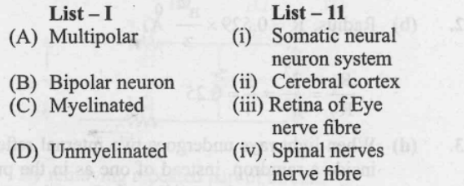
(a) Multipolar neurons are a part of the cerebral cortex.
(b) Bipolar neurons can be found in the retina of the eye.
(c) Myelinated nerve fibres can be found in spinal nerves.
(d) Unmyelinated nerve fibres can be found in the somatic neural systems.
Match List - I with List II:
Choose the correct answer from the options given below:
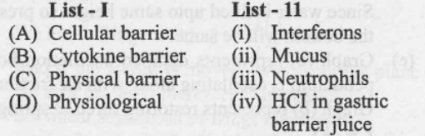
Cellular barriers include neutrophils. Cytokine barriers include interferons. Physical barriers include mucus membranes. Physiological barriers include HCl in gastric juice.
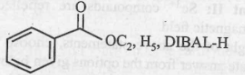
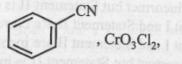
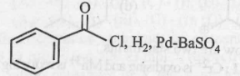
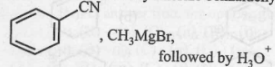
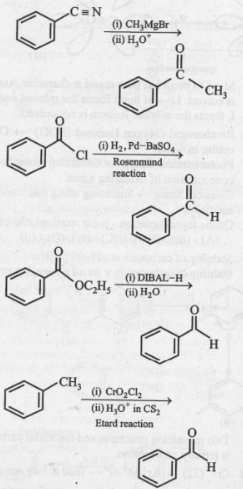
The incorrect method to synthesize benzaldehyde is:
-
(A)
-
(B)
-
(C)
-
(D)
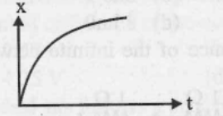
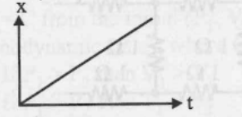
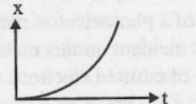
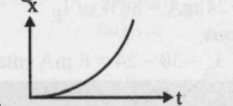
The position-time (x-t) graph for positive acceleration is
-
(A)
-
(B)
-
(C)
-
(D)
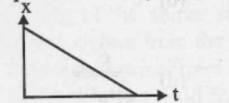
For + ve acceleration, dv/dt > 0 so, velocity is increasing therefore, slop of x-t graph is increasing and graph is as shown in figure
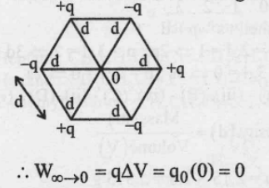
Six charges +q, -q, +q, -q +q and -q are fixed at the corners of a hexagon of side d as shown in the figure. The work done in bringing a charge q₀ to the centre of the hexagon from infinity is: (ε₀ - permittivity of free space)
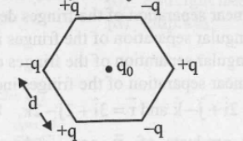
Potential at the centre of hexagon is zero i.e., V _0 = 0
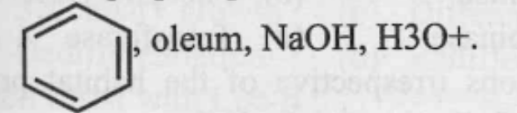
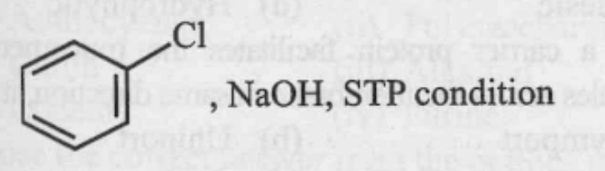
Which one of the following reaction sequence is incorrect method to prepare phenol?
-
(A)
-
(B)

-
(C)

-
(D)
Potential at the centre of hexagon is zero i.e., Vo =0
Identify the equivalent logic gate represented by the given circuit:
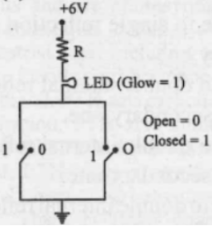
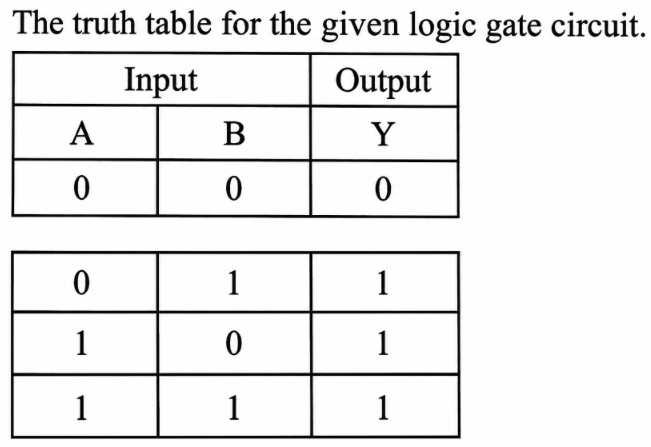
When both inputs are given as ''0'', means open circuit, and no current flows through the LED. If the inputs given as 0,1 & 1,0 & 1,1 current flows through the LED. Hence the equivalent logic gate is ''OR'' gate.
The incorrect statement about the property of a Zener diode is:
Zener diode is fabricated by heavily doping both p and N- sides of the junction. Due to this, the depletion region formed is very thin.
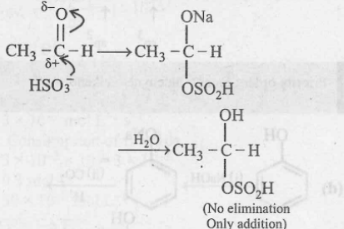
Which of the following reactions is not an example for nucleophilic addition - elimination reaction?
-
(A)

-
(B)
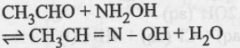
-
(C)

-
(D)
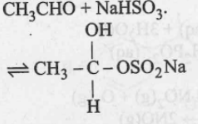
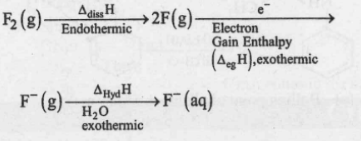
Flourine is a stronger oxidising agent than chlorine because:
(A) F-F bond has a low enthalpy of dissociation.
(B) Flouride ion (F⁻) has high hydration enthalpy.
(C) Electron gain enthalpy of flourine is less negative than chlorine.
(D) Flourine has a very small size.
Choose the most appropriate answer from the options given:
F₂ has lower Δ_diss H than theoratically expected and high Δ_hyd H, which are favourable conditions for generating F⁻(aq).
K_H value for some gases at the same temperature 'T' are given :
where K_H is Henry's Law constant in water. The order of their solubility in water is:
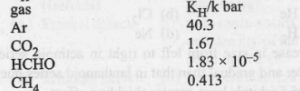
Higher the value K_H, lower is the solubility of gas, Correct order: HCHO>CH₄>CO₂>Ar
DNA polymorphism forms the basis of:
DNA polymorphism form the basis of genetic mapping and DNA fingerprinting.
Other Years