CBSE EXAMINATION PAPER-2025
NEET-ZOOLOGY
(Solved)
General Instructions :
Read the following instructions carefully and follow them :
- This question paper contains 180 questions. All questions are compulsory.
- This question paper is divided into 1 sections.
- Section A – questions number 1 to 180 are multiple choice questions
- There is no overall choice given in the question paper. However, an internal choice has been provided in few questions.
- Use of calculator is NOT allowed.
Section A
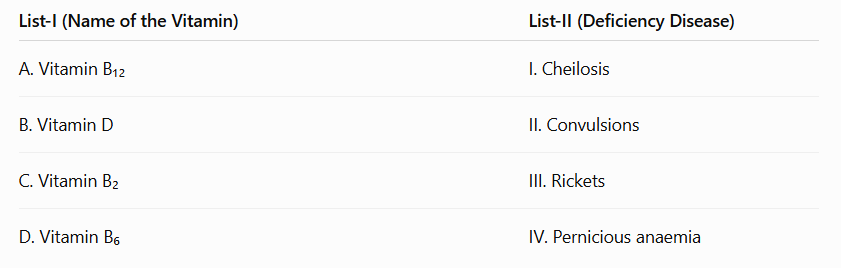
Match List-I with List-II
Choose the option with all correct matches:
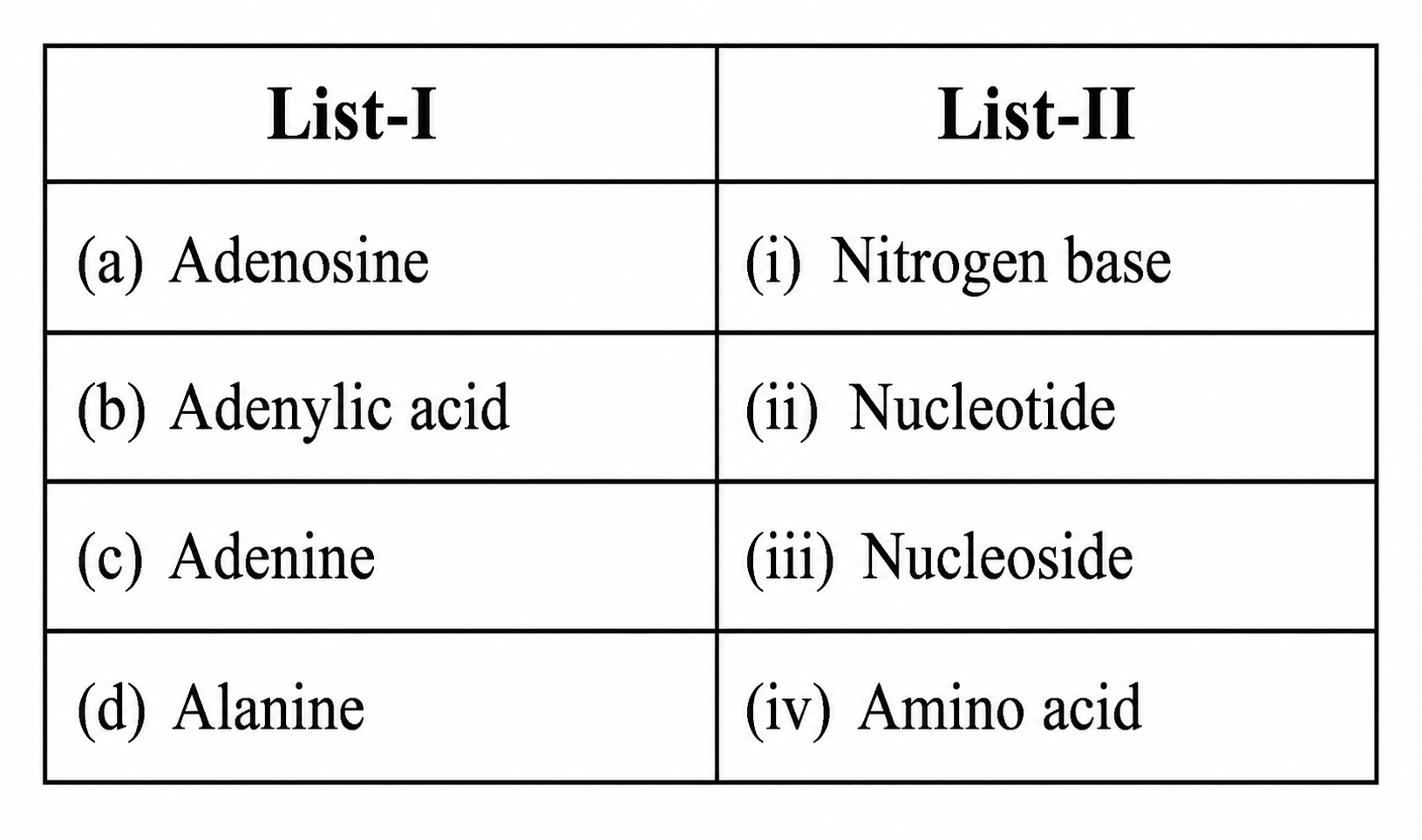
A-III, B-II, C-I, D-IV
Adenosine is nucleoside
Adenylic acid is nucleotide
Adenine is nitrogen base
Alanine is amino acid
All living members of the class Cyclostomata are:
Cyclostomata are jawless vertebrates that are ectoparasites on fish.
Assertion (A): The primary function of the Golgi apparatus is to package the materials made by the endoplasmic reticulum and deliver it to intracellular targets and outside the cell.
Reason (R): Vesicles containing materials made by the endoplasmic reticulum fuse with the cis face of the Golgi apparatus, and they are modified and released from the trans face of the Golgi apparatus.
In the light of the above statements, choose the correct answer from the options given below:
Both Aand R are true and R is the correct explanation of A.
The Golgi apparatus packages materials from the endoplasmic reticulum via vesicle fusion at the cis face and release at the trans face .
Match List-I with List-II. List-I List-II
choose the option with all correct matches.
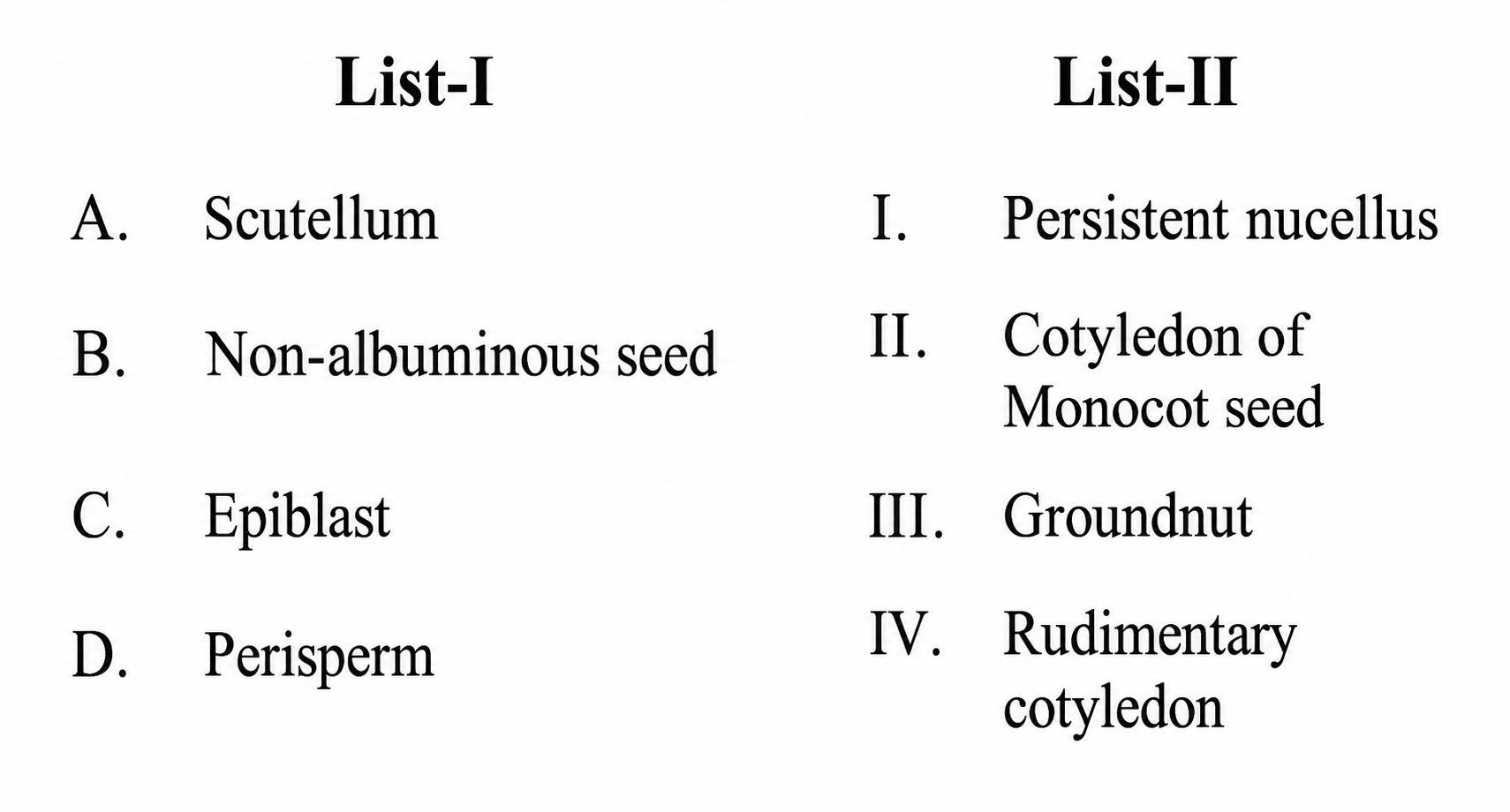
A-II; Scutellum is the cotyledon in monocot seeds B-III; Non-albuminous seeds store food in cotyledons, e.g., groundnut C-IV; Epiblast is a rudimentary cotyledon D-I; Perisperm is persistent nucellus
Assertion (A): All vertebrates are chordates but all chordates are not vertebrate.
Reason (R): The members of subphylum vertebrata possess notochord during the embryonic period, the notochord is replaced by a cartilaginous or bony vertebral column in adults.
In the light of the above statements, choose the correct answer from the options given below:
All vertebrates are chordates, but not vice versa and in vertebrates notochord is replace with vertebral column
Silencing of specific mRNA is possible via RNAi because of -
RNAi silences mRNA via complementary dsRNA (processed into siRNA).
Genes R and Y follow Independent assortment. If RRYY produce round yellow seeds and rryy produce wrinkled green seeds, what will be the phenotypic ratio of the F₂ generation?
In dihybrid cross, independent assortment — 9:3:3:1 phenotypic ratio.
Histones are enriched with
Histones are rich in lysine & arginine. They bind to negatively charged DNA.
The first menstruation is called:
Menarche is the first menstruation.
Match List I with List - II.
Choose the correct answer from the options given below:
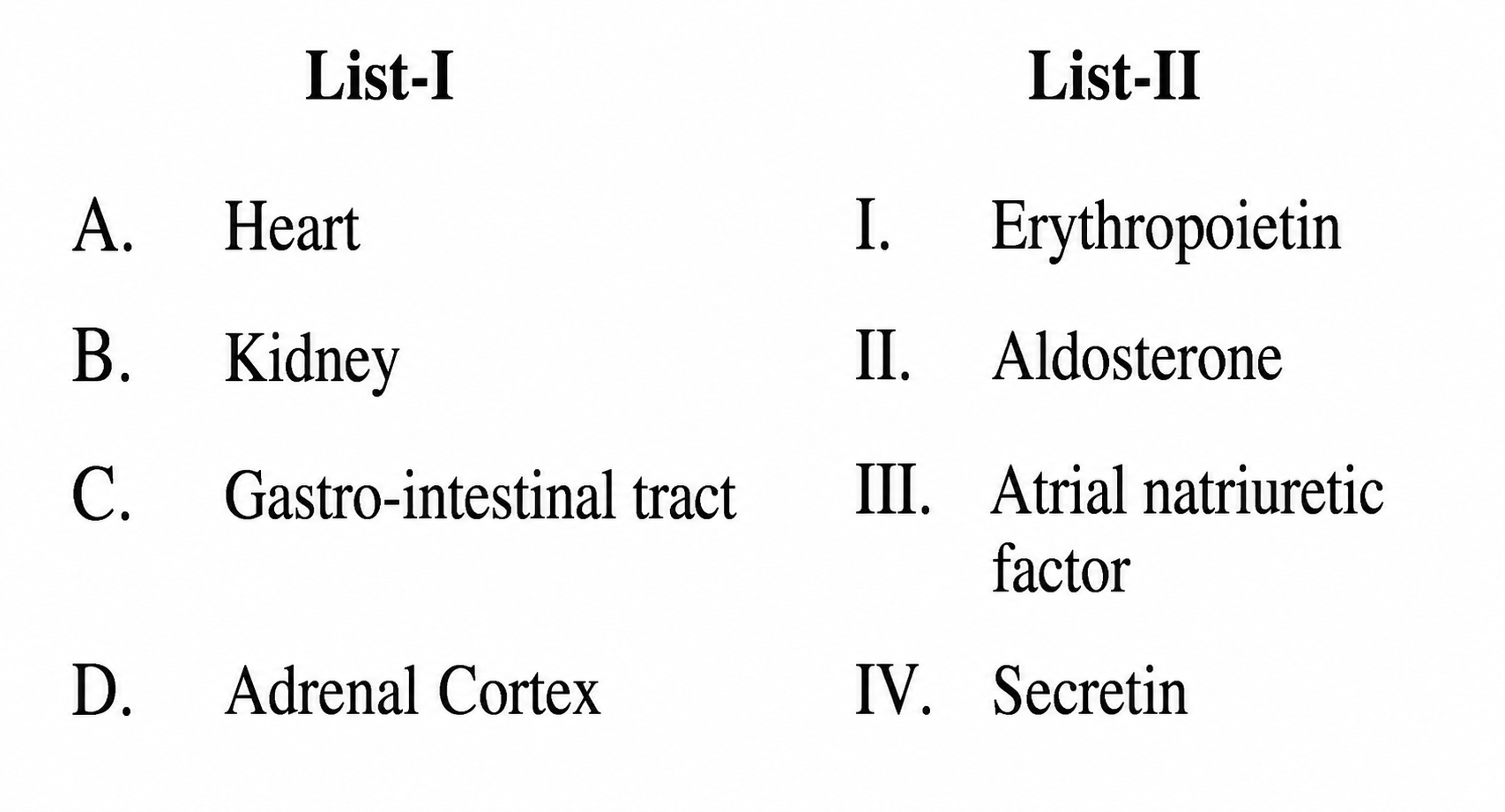
A-III, B-I, C-IV, D-II
Heart- Atrial Natriuretic Factor
Kidney-Erythropoietin.
Gastro intestinal tract- Secretin
Adrenal Cortex- Aldosterone
The protein portion of an enzyme is called:
Apoenzyme is the protein component.
Which of the following is the unit of productivity of an ecosystem?
Ecosystem productivity is measured as (KCal m⁻²) yr⁻¹.
Sweet potato and potato represent a certain type of evolution. Select the correct combination of terms to explain the evolution.
Sweet potato and potato are analogous structures (convergent evolution; different origins, similar function).
Assertion (A): Cells of the tapetum possess dense cytoplasm and generally have more than one nucleus. Reason (R): Presence of more than one nucleus in the tapetum increase the efficiency of nourishing the developing microspore mother cells.
In light of the above statements, choose the most appropriate answer from the options given below:
Both A and R are true and R is the correct
explaination of A.
Tapetum have dense cytoplasm and it is multinucleate to
nourishes pollen.
How many meiotic and mitotic divisions need to occur for the development of a mature female gametophyte from the megaspore mother cell in an angiosperm plant?
1 Meiosis and 3 Mitosis
Which of the following is an example of a zygomorphic flower?
Zygomorphic flower- Pea (bilaterally symmetrical). Others are actinomorphic.
After maturation, in primary lymphoid organs, the lymphocytes migrate for interaction with antigens to secondary lymphoid organ(s)/ tissue(s) like:
A. thymus
B. bone marrow
C. spleen
D. lymph nodes
E. Peyer’s patches
Choose the correct answer from the options given below:
Secondary Lymphoid Organs are spleen, lymph nodes, Peyer’s patches (not thymus and bone marrow).
Statement-I: Fig fruit is a non-vegetarian fruit as it has enclosed fig wasps in it.
Statement-II: Fig wasp and fig tree exhibit mutual relationship as fig wasp completes its life cycle in fig fruit and fig fruit gets pollinated by fig wasp.
In the light of the above statements, choose the most appropriate answer from the options given below:
Both statement I and statement II are incorrect
What is the main function of the spindle fibers during mitosis?
Spindle functions to separates chromosomes during mitosis.
Which one of the following is the characteristic feature of gymnosperms?
Gymnosperms have naked seeds an no seeds are enclosed fruit.
Consider the following statements regarding function of adrenal medullary hormones:
A. It causes pupillary constriction
B. It is a hyperglycemic hormone
C. It causes piloerection
D. It increases strength of heart contraction
Choose the correct answer from the options given below:
B, C and D only, Adrenal medulla hormone epinephrine causes hyperglycemia, piloerection and increases the strength of heart contraction.
Why can’t insulin be given orally to diabetic patients?
Insulin must be injected. It will be digested in the gastro-intestinal tract if taken orally.
Match List-I with List-II
Choose the option with all correct matches:
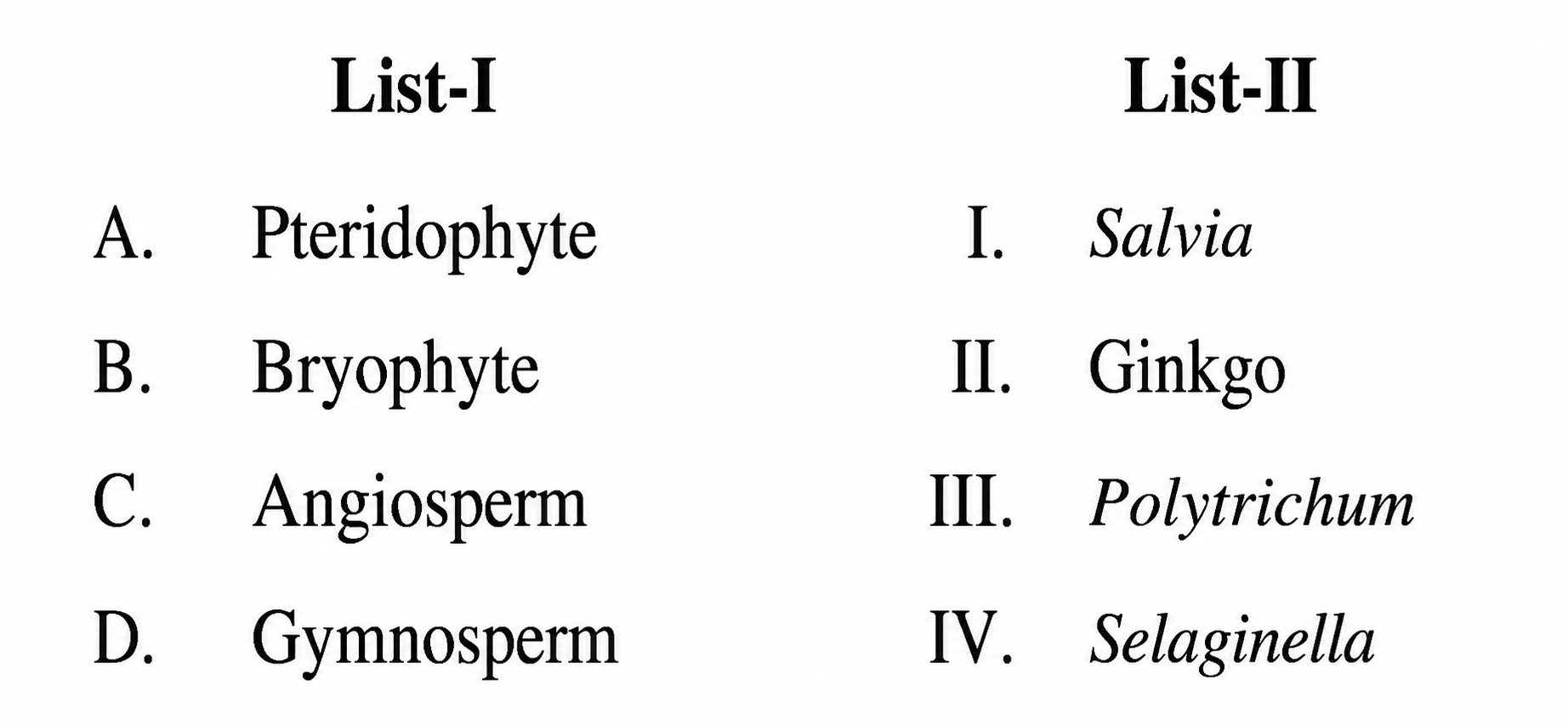
A-IV, B-III, C-I, D-II
Pteridophyte - Salvinia
Bryophyte - Polytrichum
Angiosperm - Salvia
Gymnosperm - Ginkgo
Who proposed that the genetic code for amino acids should be made up of three nucleotides?
George Gamow proposed triplet codon.
Match List-I with List-II:
Choose the option with all correct matches:
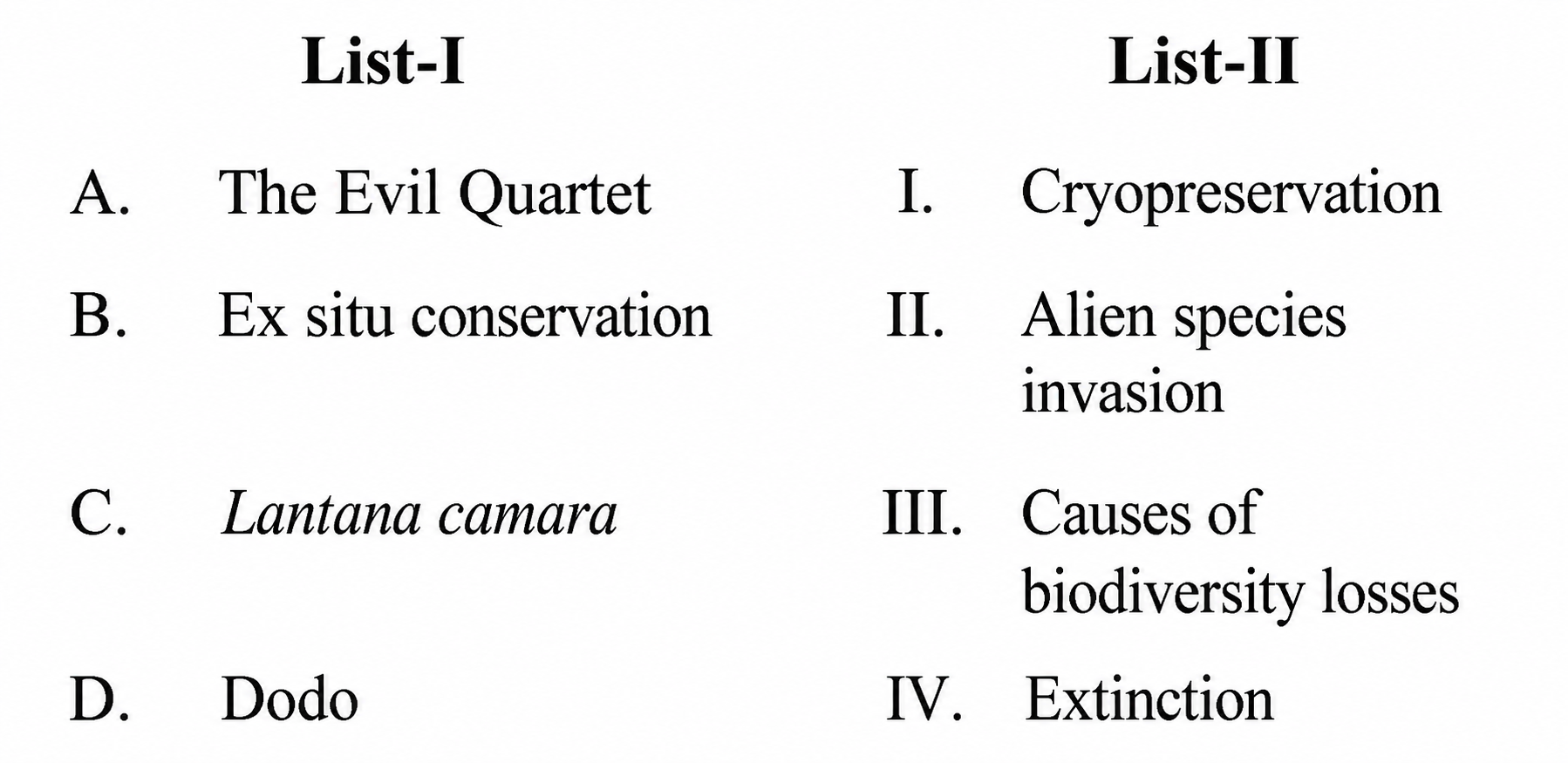
A-III, B-I, C-II, D-IV
Which of the following hormones released from the pituitary is actually synthesized in the hypothalamus?
Anti-diuretic hormone (ADH) is made in hypothalamic and stored in posterior pituitary.
Role of the water vascular system in Echinoderms is:
A. Respiration and Locomotion
B. Excretion and Locomotion
C. Capture and transport of food
D. Digestion and Respiration
E. Digestion and Excretion
Choose the correct answer from the options given below:
Echinoderm have water vascular system that helps in respiration, locomotion, capturing and transporting food.
Which of the following type of immunity is present at the time of birth and is a non-specific type of defence in the human body?
Innate Immunity is non-specific, present at birth.
In bryophytes, the gemmae help in which one of the following?
In bryophytes, the gemmae help in asexual reproduction.
In frog, the renal portal system is a special venous connection that acts to link:
In the Frog Renal Portal System kidney connects and hind limbs.
Statement-I: In ecosystem, there is unidirectional flow of energy of sun from producers to consumers.
Statement-II: Ecosystems are exempted from 2ⁿᵈnd law of thermodynamics.
In the light of the above statements, choose the most appropriate answer from the options given below:
Energy Flow in Ecosystems is unidirectional and it follows 2ⁿᵈ law. of thermodynamics.
Which of the following statements about RuBisCO is true?
RuBisCO catalyzes RuBP carboxylation in Calvin cycle.
Which of the following enzyme(s) are NOT essential for gene cloning?
A. Restriction enzymes
B. DNA ligase
C. DNA mutase
D. DNA recombinase
E. DNA polymerase
Choose the correct answer from the options given below:
DNA mutase and recombinase are non-essential cloning enzymes
Which factor is important for termination of transcription?
Transcription Termination Rho (ρ) factor stops transcription in prokaryotes.
Frogs respire in water by skin and buccal cavity and on land by skin, buccal cavity and lungs. Choose the correct answer from the following:
Frog respire through skin in water and on on land by skin, lungs and buccal cavity.
Twins are born to a family that lives next door to you. The twins are a boy and a girl. Which of the following must be true?
Fraternal or dizygotic twins are born when two eggs released from the ovary are fertilised by separate sperm.
Which of the following microbes is NOT involved in the preparation of household products?
A. Aspergillus niger
B. Lactobacillus
C. Trichoderma polysporum
D. Saccharomyces cerevisiae
E, Propionibacterium sharmanii
A and C; Trichoderma polysporum and Aspergillus niger are not used at home
Match List-I with List-II.
Choose the correct answer from the options given below:
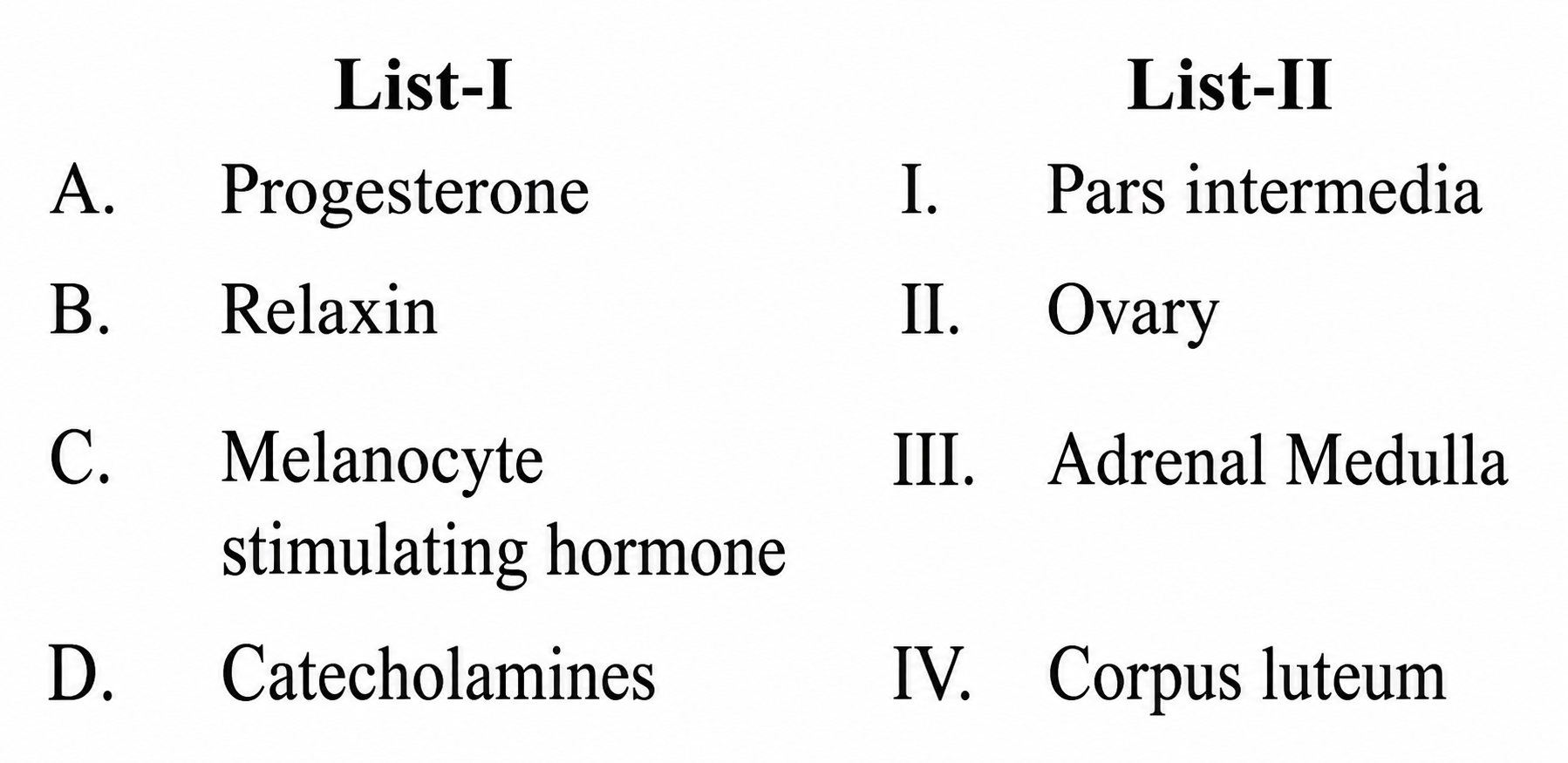
A-IV, B-II, C-I, D-III
The blue and white selectable markers have been developed which differentiate recombinant colonies from non-recombinant colonies on the basis of their ability to produce colour in the presence of a chromogenic substrate.
Given below are two statements about this method:
Statement-I: The blue coloured colonies have DNA insert in the plasmid and they are identified as recombinant colonies.
Statement-II: The colonies without blue colour have DNA insert in the plasmid and are identified as recombinant colonies.
In the light of the above statements, choose the most appropriate answer from the options given below:
Statement I incorrect and II correct.
Non-recombinant colonies will produce functional
B-galacméidase and appear blue on plates containing
X-gal.
Recombinant colonies will not produce functional
B-galactosidase and appear white on plates containing
X-gal.
The complex II of mitochondrial electron transport chain is also known as
Succinate dehydrogenase is the complex II of the mitochondrial electron transport chain.
The electron transport chain consists of following complexes -
Complex I- NADH dehydrogenase
Complex II- Succinate dehydrogenase
Complex III- Cytochrome bc,
Complex IV- Cytochrome c oxidase
Polymerase chain reaction (PCR) amplifies DNA following the equation
The polymerase chain reaction (PCR) amplifies DNA exponentially. After n cycles, the number of DNA copies produced is 2ⁿ.
What are the potential drawbacks in adoption of the IVF method?
A. High fatality risk to mother
B. Expensive instruments and reagents
C. Husband / wife necessary for being donors
D. Less adoption of orphans
E. Not available in India
F. Possibility that the early embryo does not survive
Choose the correct answer from the options given below:
B,D, F only because IVF (In Vitro Fertilization) has drawbacks such as expensive instruments and reagents, less adoption of orphans, and the possibility that the early embryo does not survive. IVF is legally and medically available in India with very low fatality risk to the mother.
What is the name of the blood vessel that carries deoxygenated blood from the body to the heart in a frog?
In frogs, the vena cava carries deoxygenated blood from the body to the heart. The pulmonary artery carries deoxygenated blood to the lungs, while the pulmonary vein carries oxygenated blood back to the heart.
Which one of the following statements refers to Reductionist Biology?
The physico-chemical approach to study and understand living organisms is called ‘Reductionist Biology’. The concepts and techniques of physics and chemistry are applied to understand biology.
Statement-I: In the RNA world, RNA is considered the first genetic material evolved to carry out essential life processes. RNA acts as a genetic material and also as a catalyst for some important biochemical reactions in living systems. Being reactive, RNA is unstable.
Statement-II: DNA evolved from RNA and is a more stable genetic material. Its double helical strands being complementary, resist changes by evolving repairing mechanism.
In the light of the above statements, choose the most appropriate answer from the options given below:
Both statement I and statement II are correct. RNA is considered the first genetic material (RNA world hypothesis) and is unstable. DNA evolved later as a more stable genetic material with repair mechanisms.
Match List-I with List-II.
Choose the correct answer from the options given below
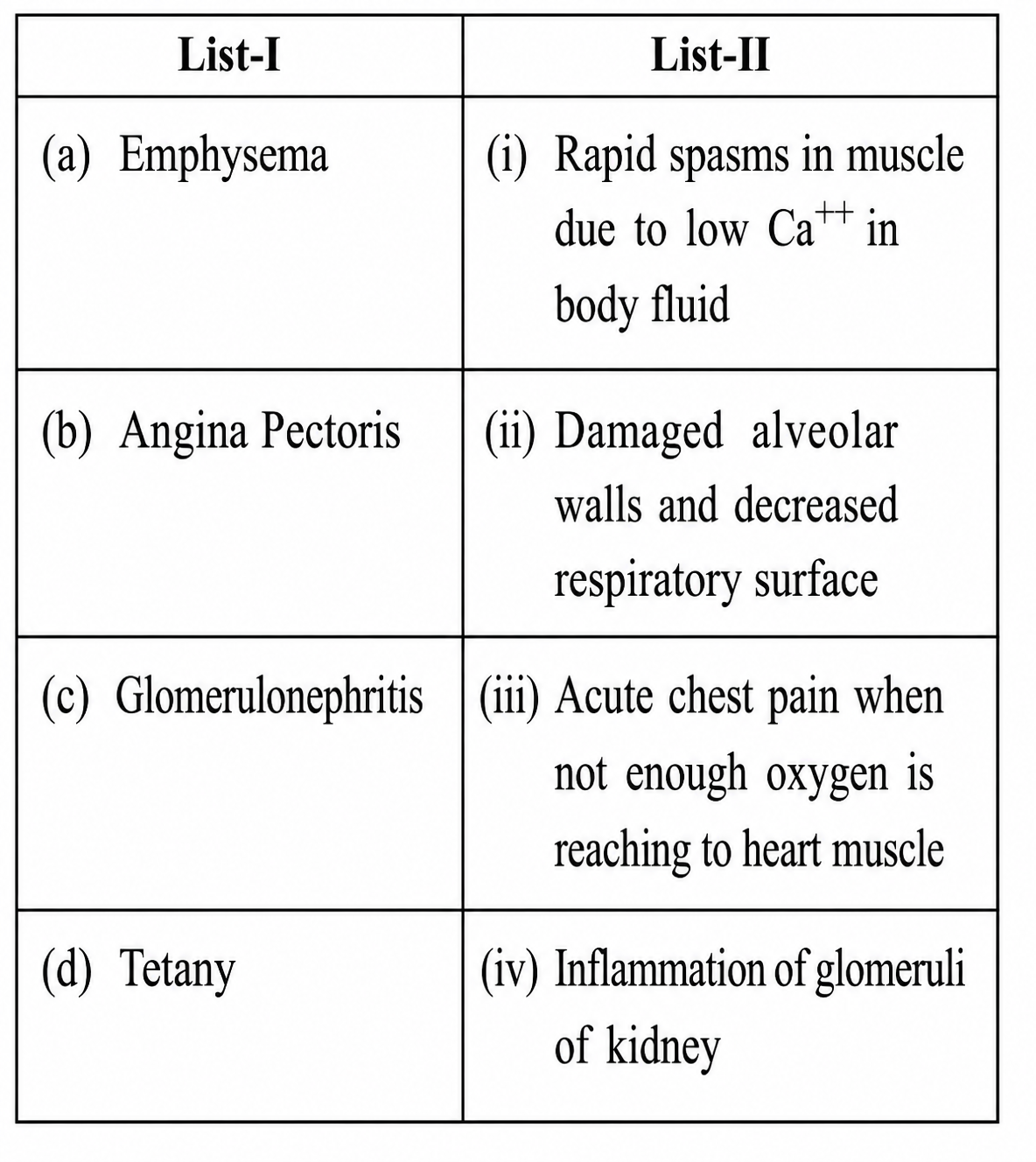
A-II, B-III, C-IV, D-I
Emphysema: Damaged alveolar walls and decreased respiratory surface
Angina Pectoris: Acute chest pain due to oxygen deficiency
Glomerulonephritis: Inflammation of glomeruli of kidney
Tetany: Rapid spasms in muscle due to low Ca⁺⁺ in body fluid.
Which of the following is an example of non-distilled alcoholic beverage produced by yeast?
Beer is a non-distilled alcoholic beverage produced by yeast fermentation. Whisky, brandy, and rum are distilled beverages.
Given below are two statements:
Statement-I: In a floral formula ⊕ stands for zygomorphic nature of the flower, and ( G with under line )
stands for inferior ovary.
Statement-II: In a floral Formula ⊕ stands for actinomorphic nature of the flower and ( G with under line ) stands for superior ovary.
In the light of the above statements,
choose the correct answer from the options given below:
Statement I is incorrect but Statement II is correct. In the floral formula ⊕ represents actinomorphic nature of flower, not zygomorphic. ( G with under line) represents a superior ovary, not inferior ovary.
Streptokinase produced by bacterium Streptococcus is used for
Streptokinase produced by Streptococcus, is used as a clotbuster for removing clots from blood vessels of patients who have undergone myocardial infarction leading to heat attack.
Which chromosome in the human genome has the highest number of genes?
Chromosome 1 in humans has most genes (2968 genes) and the Y has the fewest (231genes).
Which of the following statement is correct about location of the male frog copulatory pad?
In male frogs, the copulatory pad is present on the first digit of the forelimbs. It is absent in female frogs.
Which one of the following phytohormones promotes nutrient mobilization which help in the delay of leaf senescence in plants?
Cytokinins delay- leaf senescence by promoting nutrient mobilization and cell division.
While trying to find out the characteristic of a newly found animal, a researcher did the histology of adult animal and observed a cavity with presence of mesodermal tissue towards the body wall but no mesodermal tissue was observed towards the alimentary canal. What could be the possible coelom of that animal?
In pseudocoelomate, the body cavity is not lined by mesoderm, instead, the mesoderm is present as scattered pouches in between the ectoderm and endoderm. The animals possessing pseudocoelom are called pseudocoelomates, e.g., Aschelminthes.
Match List-I with List-II.
Choose the correct answer from the options given below:
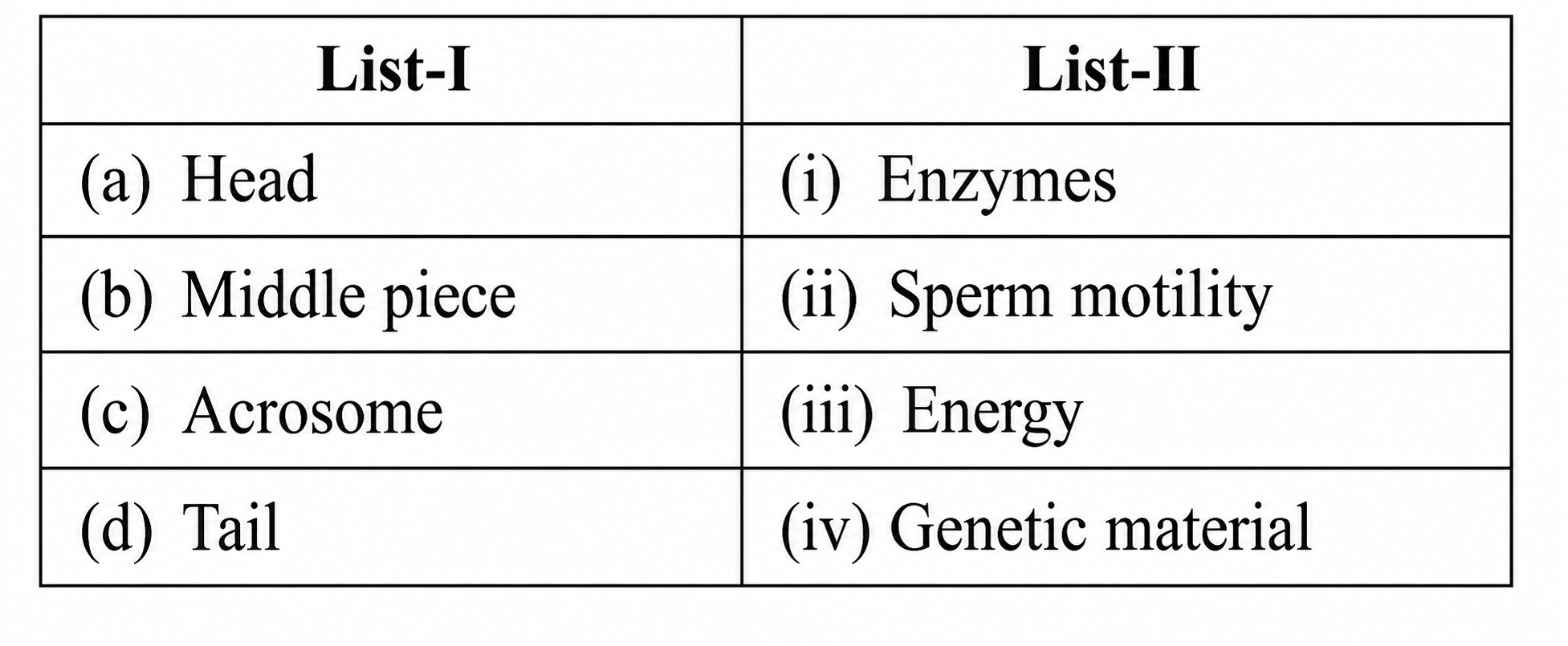
A-IV, B-III, C-I, D-II,
In the structure of a sperm:
The head contains genetic material.
The acrosome contains enzymes that aid in sperm-egg fusion.
The middle piece contains mitochondria that provides energy.
The tail provides motility to the sperm.
Given below are the stages in the life cycle of pteridophytes. Arrange the following stages in the correct sequence.
A. Prothallus stage
B. Meiosis in spore mother cells
C. Fertilisation
D. Formation of archegonia and antheridia in gametophyte
E. Transfer of antherozoids to the archegonia in presence of water
Choose the correct answer from the options given below:
The correct sequence in the life cycle of pteridophytes is:
B- Meiosis in spore mother cells (sporophyte)
A- Prothallus formation
D- formation of archegonia and antheridia in gametophyte
E- Transfer of antherozoids to archegonia in presence of water.
C- Fertilization
Cardiac activities of the heart are regulated by:
A. Nodal tissue
B. A special neural centre in the medulla oblongata
C. Adrenal medullary hormones
D. Adrenal cortical hormones
Choose the correct answer from the options given below:
Cardiac activity is regulated by nodal tissue (e.g., SA node), medulla oblongata (neural control) and adrenal medullary hormones (adrenaline). Adrenal cortical hormones do not directly regulate heart activity.
Which of following organisms cannot fix nitrogen?
A. Azotobacter
B. Oscillatoria
C. Anabaena
D. Volvox
Volvox is a green alga that cannot fix nitrogen. Azotobacter, Oscillatoria, Anabaena, Nostoc are nitrogen-fixing organisms.
Statement-I: Transfer RNAs and ribosomal RNA do not interact with mRNA.
Statement-II: RNA interference (RNAi) takes place in all eukaryotic organisms as a method of cellular defence.
In the light of the above statements, choose the most appropriate answer from the options given below:
Statement I is incorrect but Statement II is correct. Statement I is incorrect because tRNAs interact with mRNA during translation, and rRNA forms ribosomes. Statement II is correct because RNA interference (RNAI) is a defence mechanism in eukaryotes. This method involves silencing of a specific mRNA due to a complementary dsRNA molecule that binds to and prevents translation of the mRNA (silencing).
In the above represented plasmid an alien piece of DNA is inserted at EcoRI site. Which of the following strategies will be chosen to select the recombinant colonies?
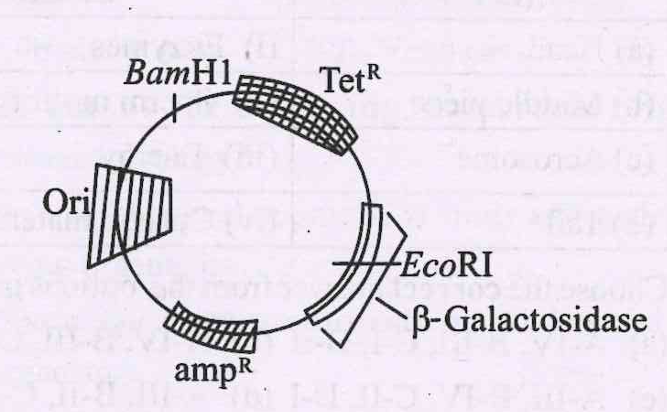
When an alien piece of DNA fragment is inserted at EcoRI site, it disrupts the β-galactosidase gene. Bacteria with this plasmid cannot produce functional β-galactosidase and will remain white when grown on medium containing X-gal.
Non-recombinant colonies will produce functional β-galactosidase and appear blue on plates containing X-gal.
Recombinant colonies will not produce functional β-galactosidase and appear white on plates containing X-gal.
Which of the following genetically engineered organisms was used by Eli Lilly to prepare human insulin?
Eli Lilly used recombinant E.coli to produce human insulin.
Name the class of enzyme that usually catalyze the following reaction:
S–G + S^# → S + S^# –G
Where,
G → a group other than hydrogen
S → a substrate
S^# → another substrate
The reaction shows a functional group (G) being transferred from one substrate (S) to another (S'), which is an example of group transfer. Transferases are enzymes that catalyse the transfer of a functional group (like methyl, phosphate groups) from one molecule to another.
Find the statement that is NOT correct with regard to the structure of monocot stem.
In monocot stems, the hypodermis is sclerenchymatous (not parenchymatous) for mechanical support.
The correct sequence of events in the life cycle of bryophytes is
A. Fusion of antherozoid with egg.
B. Attachment of gametophyte to substratum.
C. Reduction division to produce haploid spores.
D. Formation of sporophyte.
E. Release of antherozoids into water.
Choose the correct answer from the options given below:
B,E,A,D,C.
The correct sequence in the bryophyte life cycle is:
Attachment of gametophyte to substratum
Release of antherozoids into water
Fertilization
Sporophyte formation
Meiosis to produce haploid spores.
Which are correct?
A. Computed tomography and magnetic resonance imaging detect cancers of internal organs.
B. Chemotherapeutics drugs are used to kill non-cancerous cells.
C. α-interferon activate the cancer patient's immune system and helps in destroying the tumour.
D. Chemotherapeutic drugs are biological response modifiers.
E. In the case of leukaemia blood cell counts are decreased.
Choose the correct answer from the options given below:
A and Conly
Computed tomography- (CT) and magnetic resonance imaging (MRI) detect internal cancers. o-interferon boosts immunity against tumour. Chemotherapeutics target cancerous cells. Blood cell counts increase in leukaemia.
Match List-I with List-II.
Choose the correct answer from the options given below:
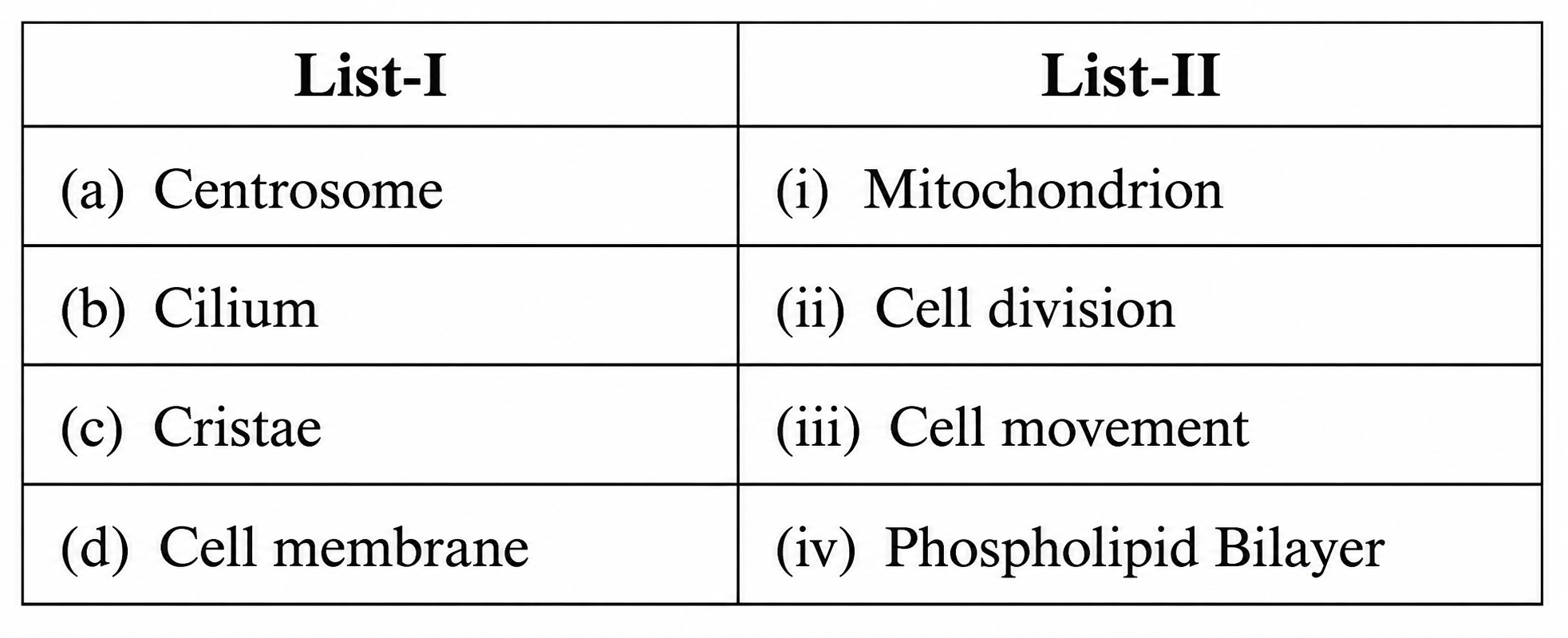
A-II, B-III, C-I, D-IV
Centromere is involved in cell division.
Cilium helps in cell movement.
Cristae are mitochondrial folds.
Cell membrane consist of phospholipid bilayer.
Match List-I with List-II.
Choose the option from with all correct matches.
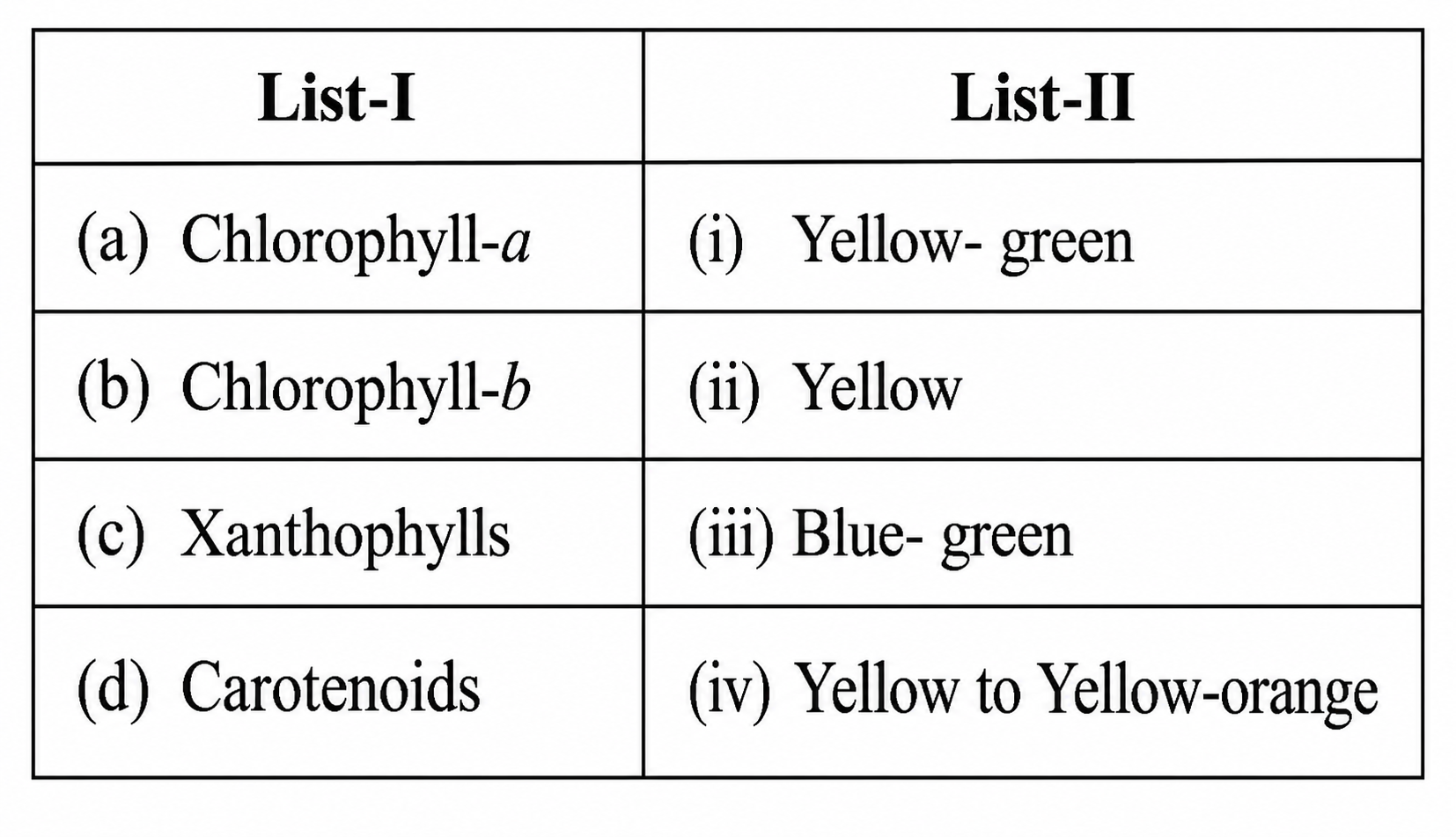
A-III, B-I, C-II, D-IV
Chlorophyll a: Blue-green
Chlorophyll B: Yellow-green
Xanthophylls: Yellow
Carotenoids: Yellow-orange
Find the correct statements:
A. In human pregnancy, the major organ systems are formed at the end of 12 weeks.
B. In human pregnancy the major organ systems are formed at the end of 8 weeks.
C. In human pregnancy heart is formed after one month of gestation.
D. In human pregnancy, limbs and digits develop by the end of second month.
E. In human pregnancy the appearance of hair is usually observed in the fifth month.
Choose the correct answer from the options given below:
In human pregnancy, the most of the major organ systems are formed by the end of 12 weeks (first trimester).
Embryo’s heart is formed after one month.
Limbs and digits develop by the end of second month.
Hair appears in the fifth month.
In the seeds of cereals, the outer covering of endosperm separates the embryo by a protein-rich layer called:
The aleurone layer is a protein-rich layer separating the embryo from the endosperm in cereal seeds.
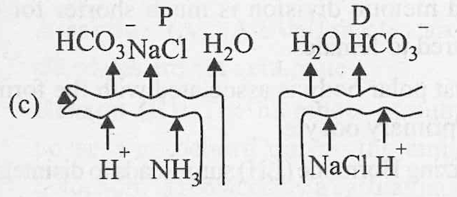
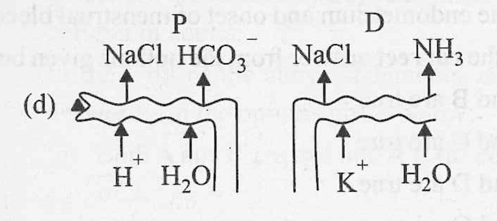
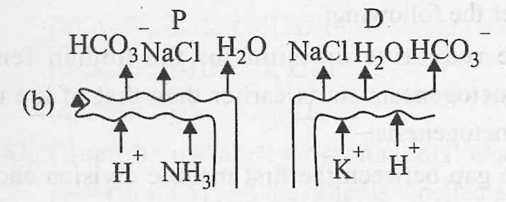
Which of the following diagrams is correct with regard to the proximal (P) and distal (D) tubule of the Nephron.
-
(A)
-
(B)
-
(C)
-
(D)
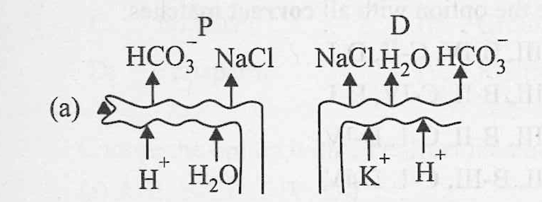
Proximal tubule shows reabsorption of HCO₃⁻, NaCl, and H₂O, and secretion of H⁺ and NH₃. Distal tubule ‘shows reabsorption of NaCl, H₂O, and HCO₃⁻, and secretion of K⁺ and H⁺.
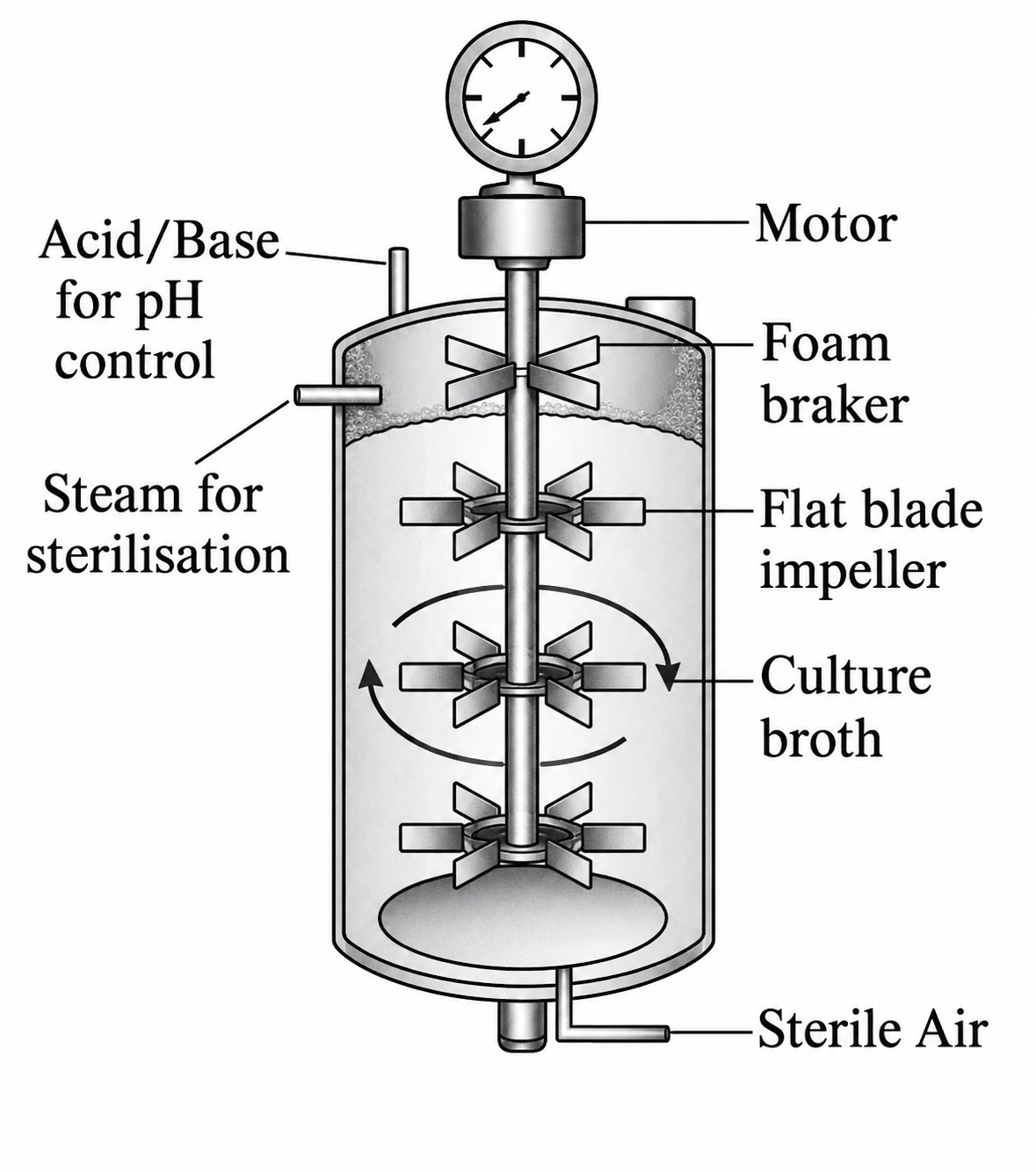
Identify the part of a bio-reactor which is used as a foam breaker from the given figure.
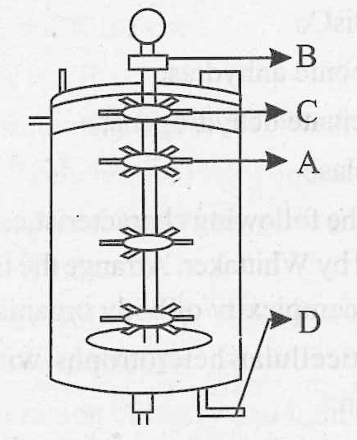
C- foam braker
Assertion (A): A typical unfertilised, angiosperm embryo sac at maturity is 8 nucleated and 7-celled. Reason (R): The egg apparatus has 2 polar nuclei. In the light of the above statements, choose the correct answer from the options given below:
A mature unfertilized angiosperm embryo sac is 8-nucleate and 7-celled (1 egg cell, 2 synergids, 3 antipodals, and 1 central cell with 2 polar nuclei) and the egg apparatus consists of 1 egg cell and 2 synergids, not polar nuclei. The 2 polar nuclei are part of the central cell, not the egg apparatus.
A specialised membranous structure in a prokaryotic cell which helps in cell wall formation, DNA replication and respiration is:
Mesosome is a specialized infolding of the plasma membrane in prokaryotes that aids in cell wall formation.
DNA replication and respiration.
Chromatophores are pigment —containing structures (in photosynthetic bacteria).
Cristae are mitochondrial folds.
Endoplasmic Reticulum is a eukaryotic organelle.
Which of the following are the post-transcriptional events in an eukaryotic cell?
A. Transport of pre-mRNA to cytoplasm prior to splicing.
B. Removal of introns and joining of exons.
C. Addition of methyl group 5′ end of hnRNA.
D. Addition of adenine residues at 3′ end of hnRNA.
E. Base pairing of two complementary RNAs.
Choose the correct answer from the options given below:
Post-transcriptional modifications in eukaryotes include:
Splicing i.e., removal of introns and joining exons
5 ' Capping i.e., addition of methyl guanosine to 5' end of hnRNA
Polyadenylation is the addition of adenine residues at 3' end to form poly-A tail
Pre-mRNA is spliced in the nucleus before transport.
Base pairing of RNAs is not a post-transcriptional event.
What is the pattern of inheritance for polygenic trait?
Non-Mendelian inheritance pattern.
Which one of the following enzymes contains ‘Haem’ as the prosthetic group?
Catalase contains a heam (iron) prosthetic group, which aids in breaking down hydrogen peroxide.
Each of the following characteristics represent a Kingdom proposed by Whittaker. Arrange the following in increasing order of complexity of body organization.
A. Multicellular heterotrophs with cell wall made of chitin.
B. Heterotrophs with tissue/organ/organ system level of body organization.
C. Prokaryotes with cell wall made of polysaccharides and amino acids.
D. Eukaryotic autotrophs with tissue/organ level of body organization.
E. Eukaryotes with cellular body organization.
Choose the correct answer from the options given below:
C,E,A,D,B
Increasing complexity order is as follows
Monera, Protista, Fungi (multicellular with chitin), Plants (autotrophic with tissues), Animals (heterotrophic with organ systems)
Who is known as the father of Ecology in India?
Ramdeo Misra is regarded as the father of ecology in India
Match List-I with List-II.
Choose the correct answer from the options given below:
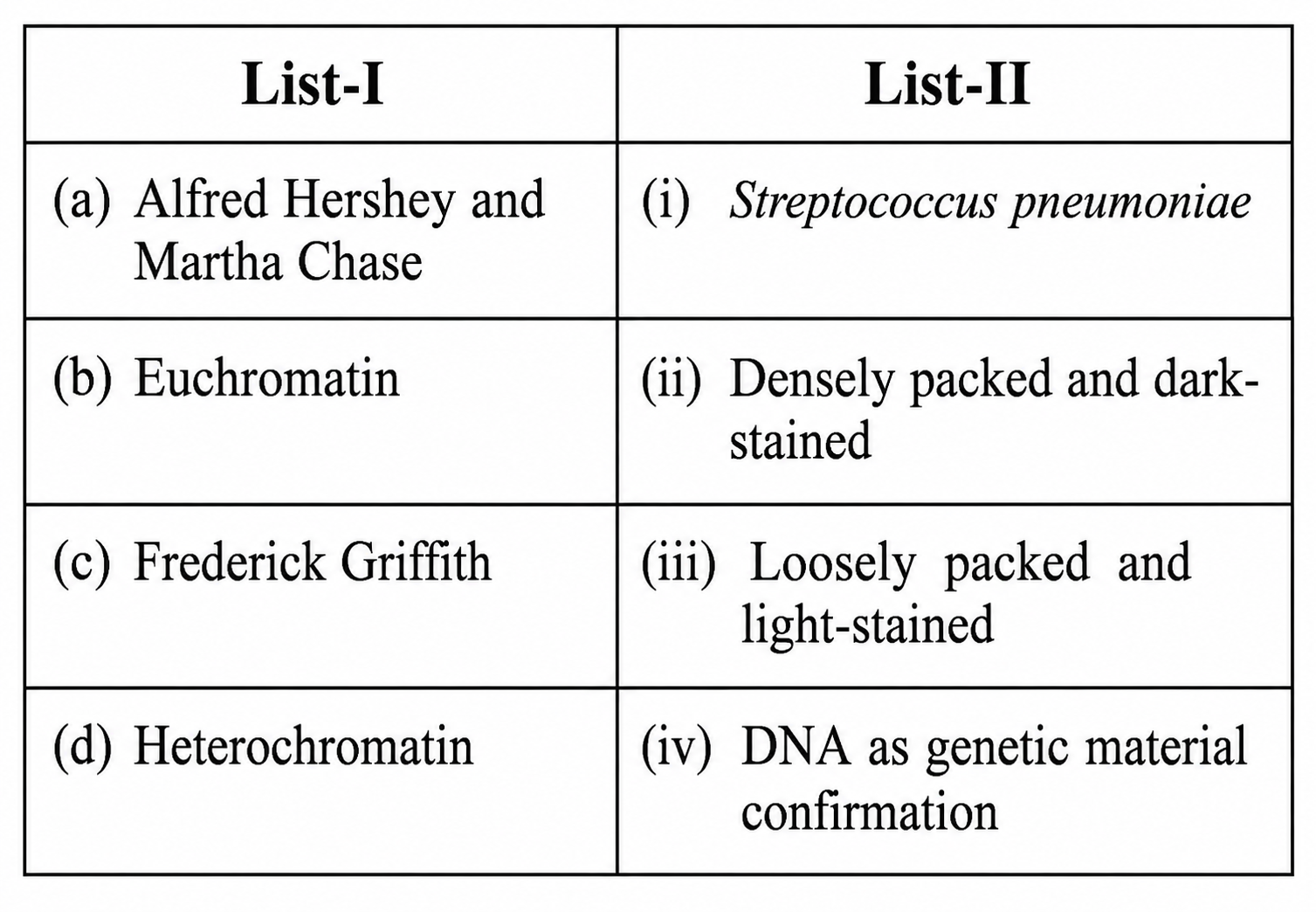
A-IV, B-III, C-I, D-II
Hershey and Chase- DNA as genetic material
Euchromatin- Loosely packed and light-stained
Griffith- Streptococcus experiments
Heterochromatin- Densely packed and dark-stained
Neoplastic characteristics of cells refer to:
A. A mass of proliferating cell
B. Rapid growth of cells
C. Invasion and damage to the surrounding tissue
D. Those confined to original location
Choose the correct answer from the options given below:
A, B, C only. Neoplastic cells show uncontrolled proliferation, rapid growth, and invasion.
Note: As neoplastic cells actively divide and grow they also starve the normal cells by competing for vital nutrients. Cells sloughed from such tumors reach distant sites through blood, and wherever they get lodged in the body, they start a new tumor there. This property called metastasis is the most feared property of malignant tumors.
With the help of given pedigree, find out the probability for the birth of a child having no disease and being a carrier (has the disease mutation in one allele of the gene) in F₃ generation
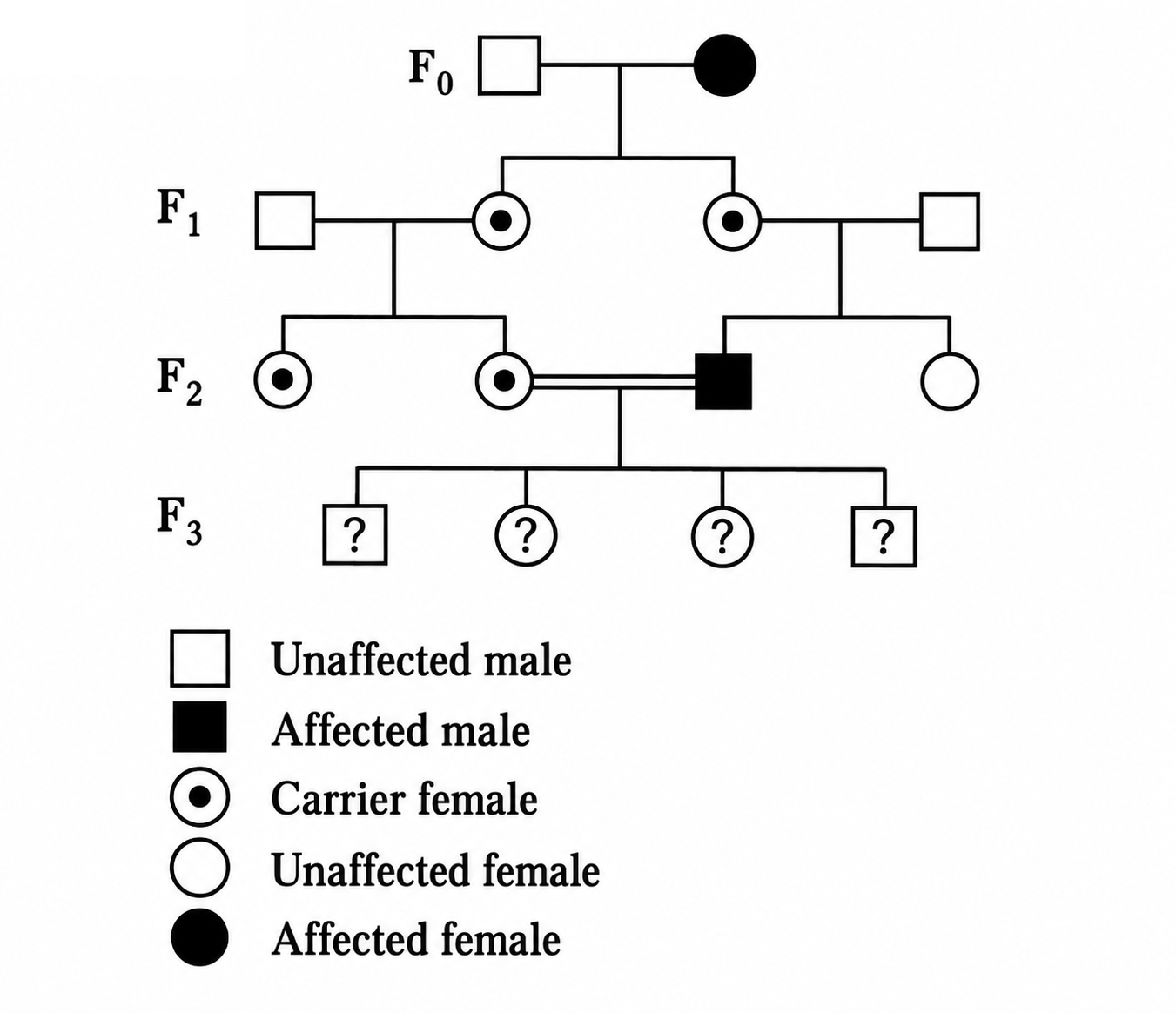
1/2
Statement-I: The primary source of energy in an ecosystem is solar energy.
Statement-II: The rate of production of organic matter during photosynthesis in an ecosystem is called net primary productivity (NPP).
In the light of the above statements, choose the. most appropriate answer form the options given below:
Statement I is correct but statement II is incorrect. Solar energy is the primary source of energy in an ecosystem. The rate of production of organic matter during photosynthesis in an ecosystem is called gross primary productivity (GPP), not net primary productivity (NPP).
Given below are two
Statement I: The DNA fragments extracted from gel electrophoresis can be used in construction of recombinant DNA.
Statement II: Smaller size DNA fragments are observed near anode while larger fragments are found near the wells in An agarose gel.
In the light of the above statements, choose the most appropriate answer from the options given below:
Both statement I and statement II are correct. DNA fragments extracted from gel electrophoresis can be used for recombinant DNA. In which smaller DNA fragments migrate farther toward the anode (positive electrode).
Read the following statements on plant growth and development.
A. Parthenocarpy can be induced by auxins.
B. Plant growth regulators can be involved in promotion as well as inhibition of growth.
C. Dedifferentiation is a pre-requisite for re-differentiation.
D. Abscisic acid is a plant growth promoter.
E. Apical dominance promotes the growth of lateral buds.
Choose the option with all correct statements.
A, B, C only
Consider the following:
A. The reductive division for the human female gametogenesis starts earlier than that of the male gametogenesis.
B. The gap between the first meiotic division and the second meiotic division is much shorter for males compared to females.
C. The first polar body is associated with the formation of the primary oocyte.
D. Luteinizing Hormone (LH) surge leads to disintegration of the endometrium and onset of menstrual bleeding.
Choose the correct answer from the options given below:
Aand B are true
Female gametogenesis begins earlier than male The gap between meiotic divisions is shorter in males The first polar body with the secondary oocyte
Luteinzing hormone (LH) surge triggers ovulation, not menstruation
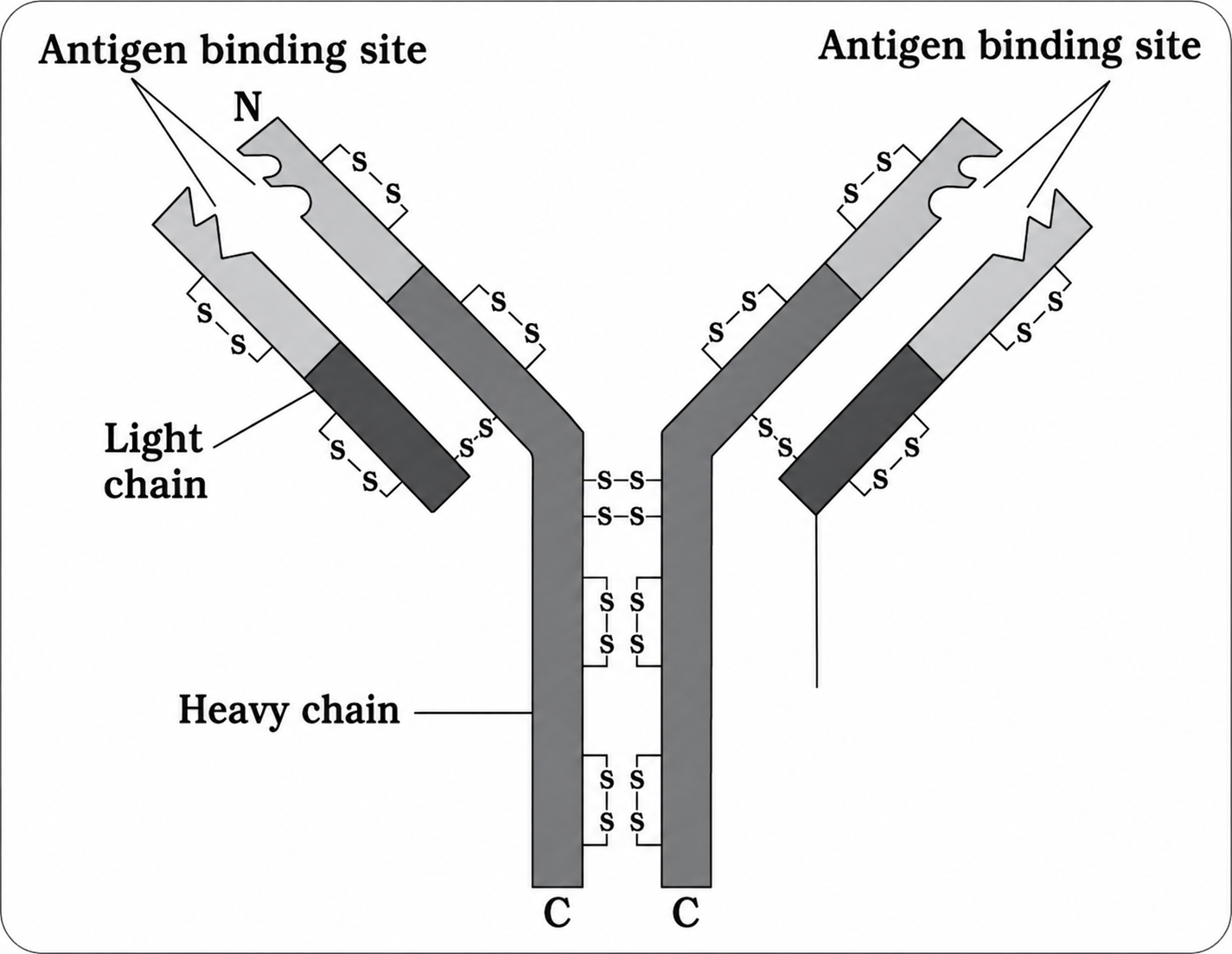
Identify the statement that is NOT correct.
In antibody structure, antigen-binding site is at N-terminal, not C-terminal Antigen binding site region of antibody molecules.
From the statements given below choose the correct option:
A. The eukaryotic ribosomes are 80S and prokaryotic ribosomes are70S
B. Each ribosome has two sub-units.
C. The two sub-units of 80S ribosome are 60S and 40S while that of 70S are 50S and 30S.
D. The two sub-units of 80S ribosome are 60S and 20S and that of 70S are 50S and 20S.
E. The two sub-units of 80S ribosome are 60S and 30S and that of 70S are 50S and 30S
Eukaryotic ribosomes are 80S having two subunits of 60S and 40S. Prokaryotic ribosomes are 70S having two subunits of 50S and 30S.
The ratio of the wavelengths of the light absorbed by a Hydrogen atom when it undergoes n=2→n=3 and n=4→n=6 transitions, respectively, is
1/λ = R_Hz²(1/n₁² - 1/n₂²)
For 2 → 3
1/λ₁ = R_H × (1)²(1/2² - 1/3²) ....(i)
For 4 → 6
1/λ₂ = R_H × (1)²(1/4² - 1/6²) ....(ii)
Divide equation (ii) by (i),
λ₁/λ₂ = (1/4² - 1/6²)/(1/2² - 1/3²) = 1/4
λ₁/λ₂ = 1/4
Which of the following statements are true? A. Unlike Ga that has a very high melting point, Cs has a very low melting point. B. On Pauling scale, the electronegativity values of N and Cl are not the same. C. Ar, K⁺, Cl⁻, Ca²⁺ and S²⁻ are all isoelectronic species. D. The correct order of the first ionization enthalpies of Na, Mg, Al, and Si is Si > Al > Mg > Na. E. The atomic radius of Cs is greater than that of Li and Rb. Choose the correct answer from the options given below:
(A) Ga has a very low melting point, approximately 303 K, and Cs has almost the same melting point (302 K).
(B) On the Pauling scale, the electronegativity value of N and Cl is 3.
(C) Ar, K⁺, Cl⁻, Ca²⁺ and S²⁻ all species have 18 electrons; therefore, these are isoelectronic species.
(D) The first ionisation enthalpies order of Na, Mg, Al and Si is: Si>Mg>Al>Na
(E) The atomic radius increases on going down the groups; therefore, the radius order is: Cs>Rb>K>Na>Li
Match List-I with List-II. Choose the correct answer from the option given below:
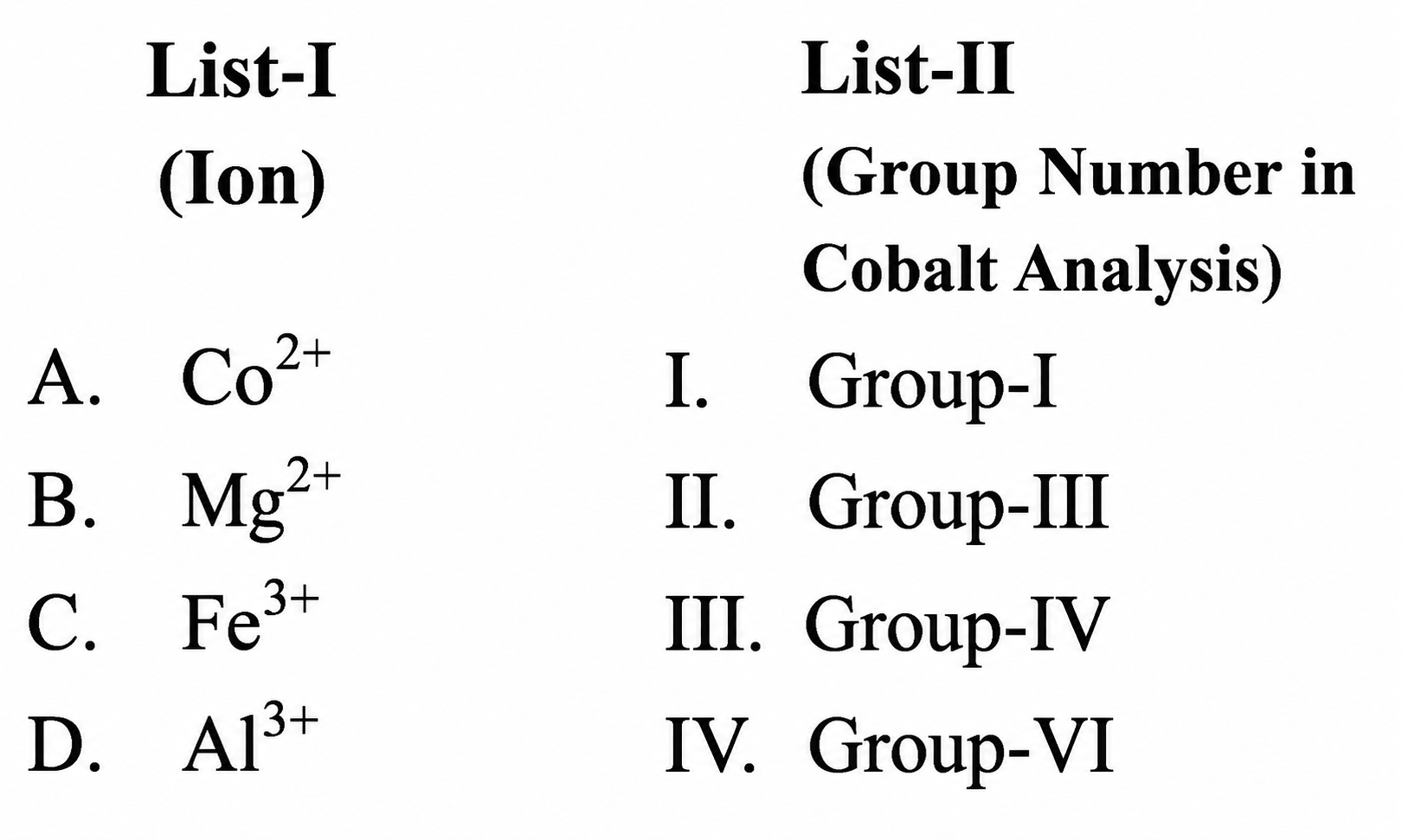
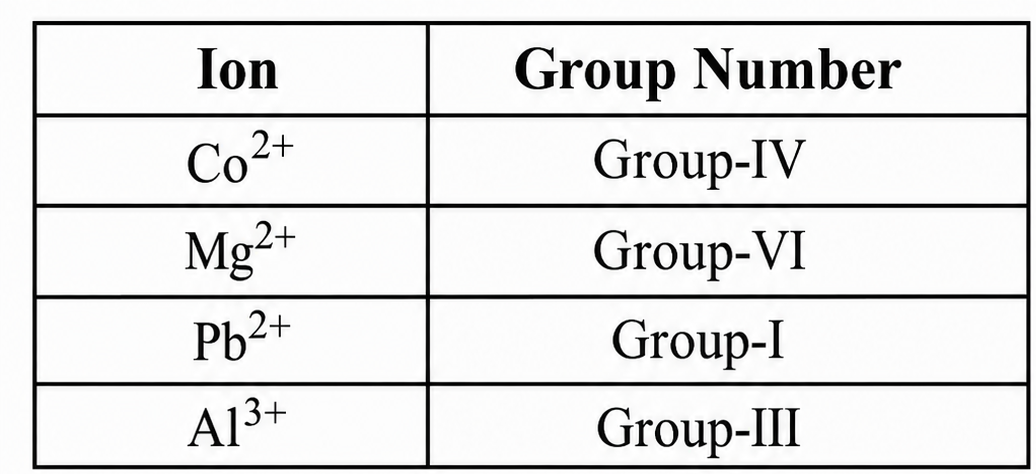
A-III, B-IV, C-I, D-II
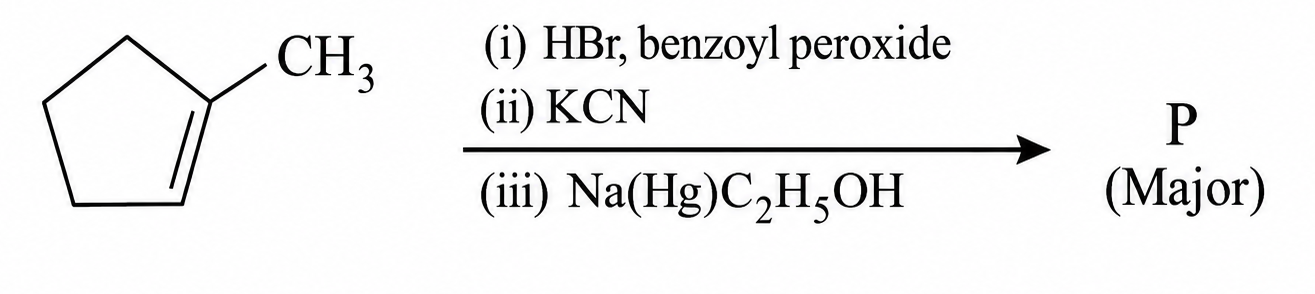
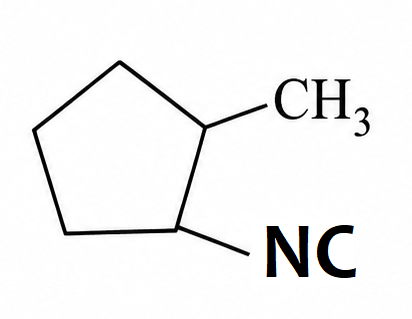
Predict the major product ‘P’ in the following sequence of reactions -
-
(A)
-
(B)
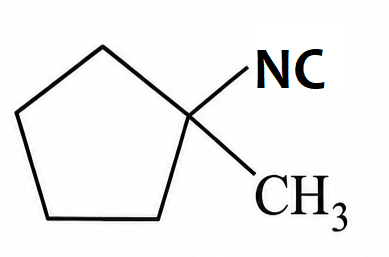
-
(C)
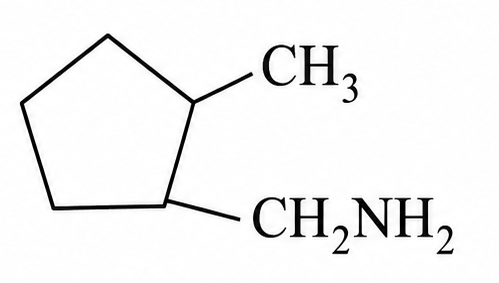
-
(D)
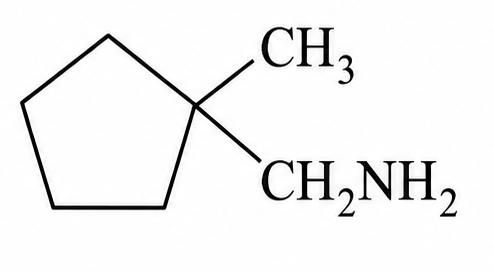
(A) Ga has a very low melting point, approximately 303 K, and Cs has almost the same melting point (302 K). (B) On the Pauling scale, the electronegativity value of N and Cl is 3.
(C) Ar, K⁺, Cl⁻, Ca²⁺ and S²⁻ all species have 18 electrons; therefore, these are isoelectronic species.
(D) The first ionisation enthalpies order of Na, Mg, Al and Si is: Si>Mg>Al>Na
(E) The atomic radius increases on going down the groups; therefore, the radius order is: Cs>Rb>K>Na>Li
Energy and radius of first Bohr orbit of He² and Li²⁺ are [Given R_H = 2.18 × 10⁻¹⁸ J, a₀ = 52.9 pm]
Eₙ = - 2.18 × 10⁻¹⁸(z²/n²)J For He⁺ ⇒ E₁(He⁺) = - 2.18 × 10⁻¹⁸(2²/1²)J = -8.72 × 10⁻¹⁸ J
For Li²⁺ ⇒ E₁(Li²⁺) = - 2.18 × 10⁻¹⁸(3²/1²)J
= -19.62 × 10⁻¹⁸ J
rₙ = 52.9(n²)/z pm
For He⁺ ⇒ r₁(He⁺) = 52.9 × 1²/2 = 26.4 pm
For Li²⁺ ⇒ r₁(Li²⁺ ) = 52.9 × 1²/3 = 17.6 pm
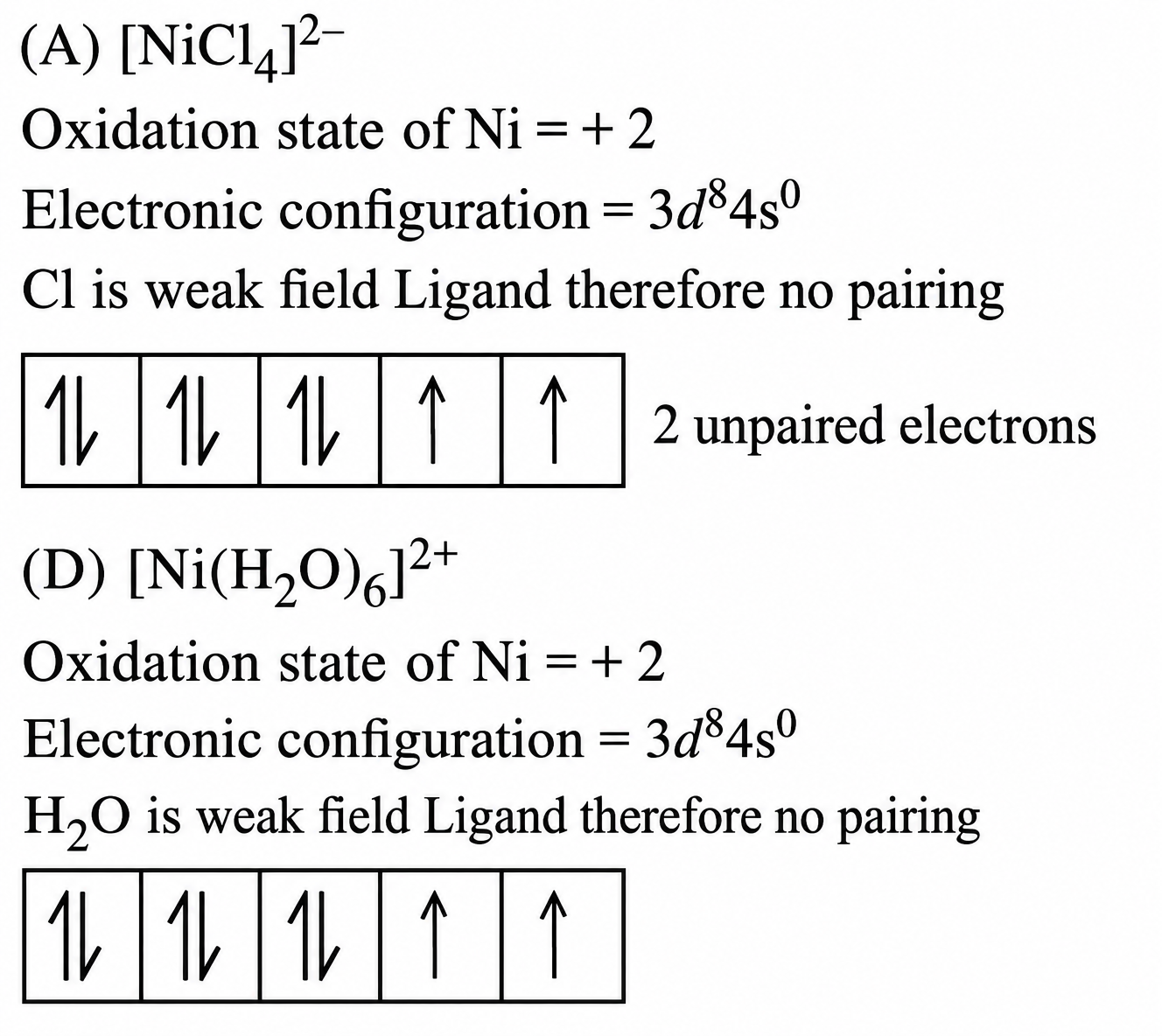
Which of the following are paramagnetic?
A. [NiCl₄]²⁻
B. Ni(CO)₄
C. [Ni(CN)₄]²⁻
D. [Ni(H₂O)₆]²⁺
E. Ni(PPh₃)₄
Choose the correct answer from the options given below:
Given below are two statements :
Statement-I: Like nitrogen that can form antmonia, arsenic can form arsine,
Statement-II : Antimony cannot form antimony pentoxide.
In the light of the above statements, choose the most appropriate answer from the options given below :
Nitrogen forms ammonia (NH₃) and arsenic can form arsine (AsH₃). All elements of the nitrogen family form two types of oxides, E₂O₃ and E₂O₅. Therefore, statement I is correct but statement II is incorrect.
Which among the following electronic configurations belong to main group elements? A. [Ne] 3s¹ B. [Ar] 3d³4s² C. [Kr] 4d¹⁰5s²5p⁵ D. [Ar] 3d¹⁰4s¹ E. [Rn] 5f⁰6d²7s² Choose the correct answer from the option given below:
Main group elements are s- and p-block elements. [Ne] 3s¹ = s-block [Kr] 4d¹⁰5s²5p⁵ ⇒ p-block
Consider the following compounds: KO₂, H₂O₂ and H₂SO₄. The oxidation states of the underlined elements in them are, respectively,
K₂O: Alkali metals always show +1 oxidation state in their compounds. For H₂SO₄: 2(+1) + x + 4(−2) = 0
⇒ x = +6
For H₂O₂: 2(+1) + 2x = 0
⇒ x −1
The correct order of the wavelength of light absorbed by the following complexes is, A. [Co(NH₃)₆]³⁺ B. [Co(CN)₆]³⁻ C. [Cu(H₂O)₄]²⁺ D. [Ti(H₂O)₆]³⁺ Choose the correct answer from the options given below:
As the strength of the ligands increases, the splitting factor Δ₀ increases and, as a result, the energy absorbed increases and consequently, the wavelength (λ absorbed) decreases. CN⁻ and NH₃ are strong-field ligands, and CN⁻ is a stronger ligand due to back bonding. Among tetrahedral and octahedral complexes of the same ligand, octahedral complexes are more stable as Δt = 4/9Δ₀ where Δₜ is the tetrahedral crystal field splitting and Δ₀ is the octahedral crystal field splitting.
Thus [Ti(H₂O)₆]³⁺ will have higher energy of the wavelength λ_absorbed than[Cu(H₂O)₄]²⁺
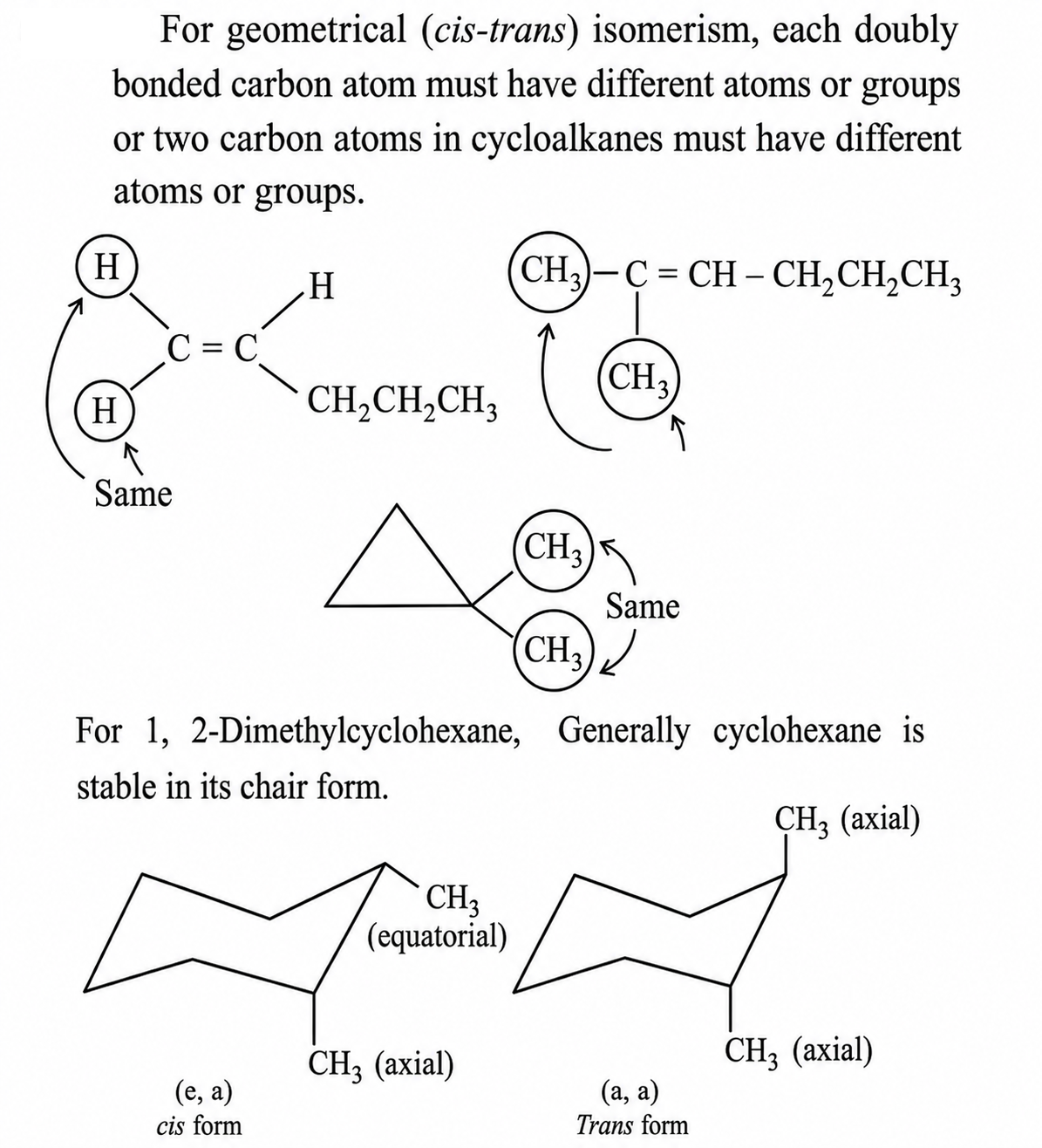
Which one of the following compounds can exist as cis-trans isomers?
Phosphoric acid ionizes in three steps with their ionization constant values Kₐ₁, Kₐ₂ and Kₐ₃, respectively, While K is the overall ionization constant. Which of the following statements are true?
A. log K = log Kₐ₁+ log Kₐ₂ + log Kₐ₃
B. H₃PO₄ is a stronger acid than H₂PO₄⁻ and HPO₄²⁻
C. Kₐ₁ > Kₐ₂ > Kₐ₃ D. Kₐ₁= Kₐ₃ + Kₐ₂/2
Choose the correct answer from the options given below:
For phosphoric acid, which is a polybasic acid, K = Kₐ₁ × Kₐ₂ × Kₐ₃ and Kₐ₁ Kₐ₂> Kₐ₃
log K=log(Kₐ₁ × Kₐ₂ × Kₐ₃) = log Kₐ₁+ log Kₐ₂ + log Kₐ₃ There is no particular relationship among Kₐ₁, Kₐ₂ values of a polybasic acid. Thus, D is incorrect. Therefore, A, B and C are correct.
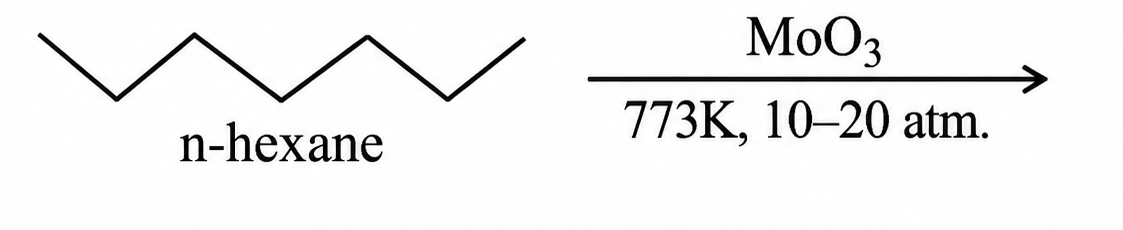
Which one of the following reactions does NOT give benzene as the product?
-
(A)
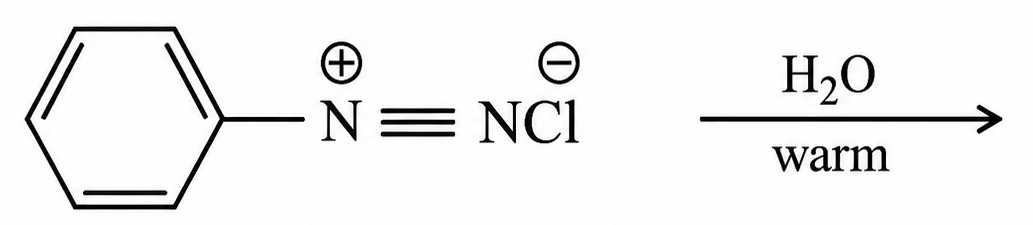
-
(B)
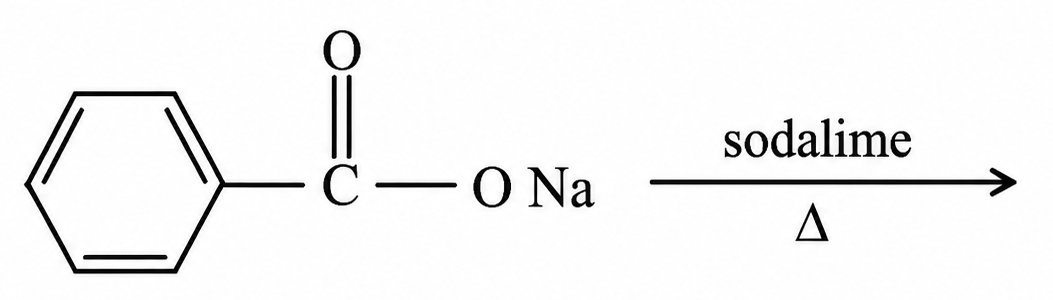
-
(C)

-
(D)
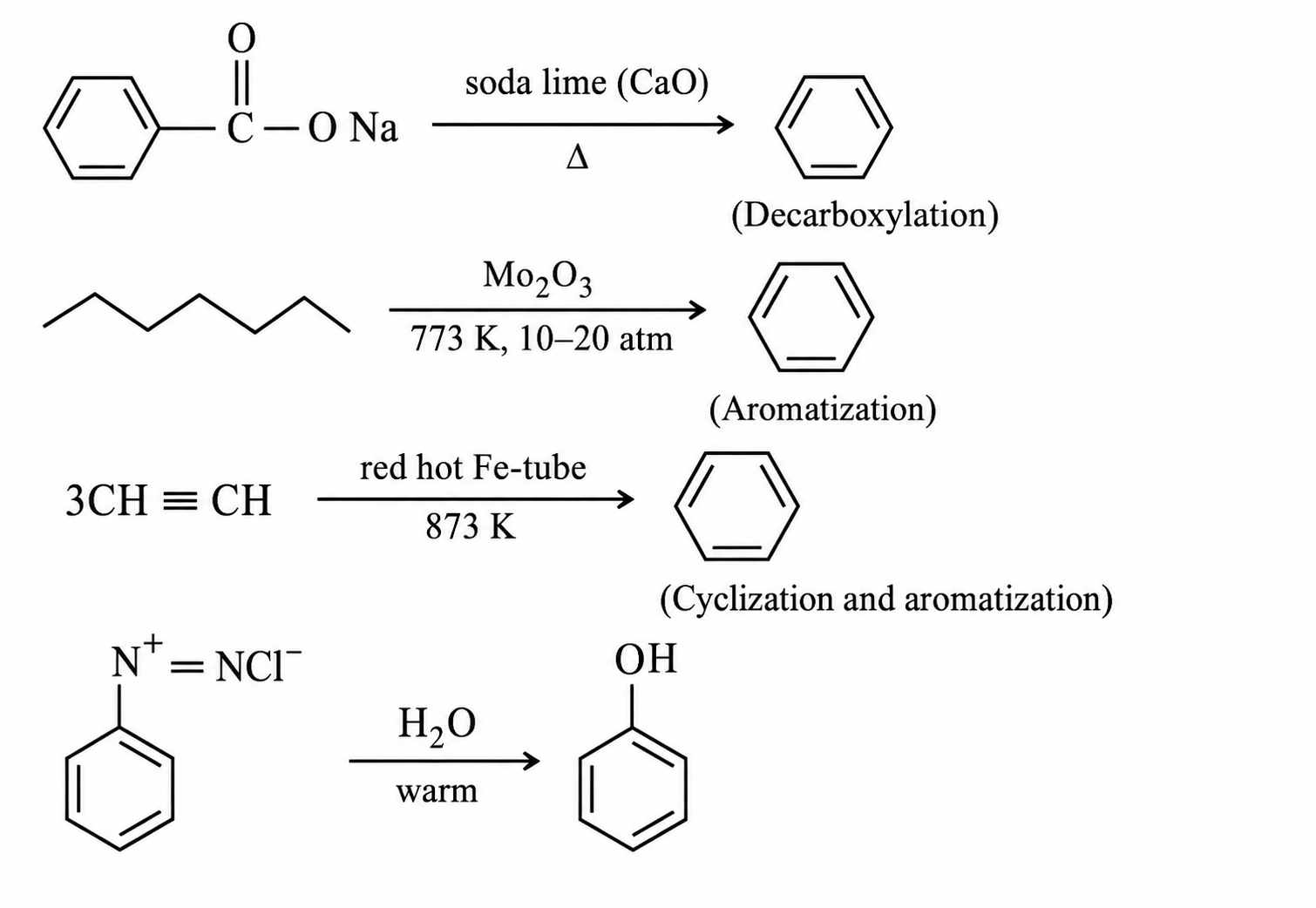
If the molar conductivity (Aₘ) of a 0.050 mol L⁻¹ solution of a monobasic weak acid is 90 S cm² mol⁻¹, its extent (degree) of dissociation will be [ Assume Λ⁰₊ 349.6 S cm² mol⁻¹ and Λ⁰₋ = 50.4 S cm² mol⁻¹]
Degree of dissociation (α) = α = Λₘ/Λ⁰ₘ From Kohlrausch law: Λ⁰ₘ = Λ⁰₊ + Λ⁰₋ = 349.6 + 50.4 = 400 S cm² mol⁻¹ Thus, α = Λₘ/Λ⁰ₘ = 90/400 = 0.225
Given below are two statements :
Statement-I: A hypothetical diatomic molecule with bond order zero is quite stable.
Statement-II: As bond order increases, the bond length increases.
In the light of the above statements, choose the most appropriate answer from the options given below:
If a diatomic molecule has a bond order of zero, it does not exist. With an increase in bond order, the bond strength increases, leading to a shorter bond length. Thus, both statements are incorrect.
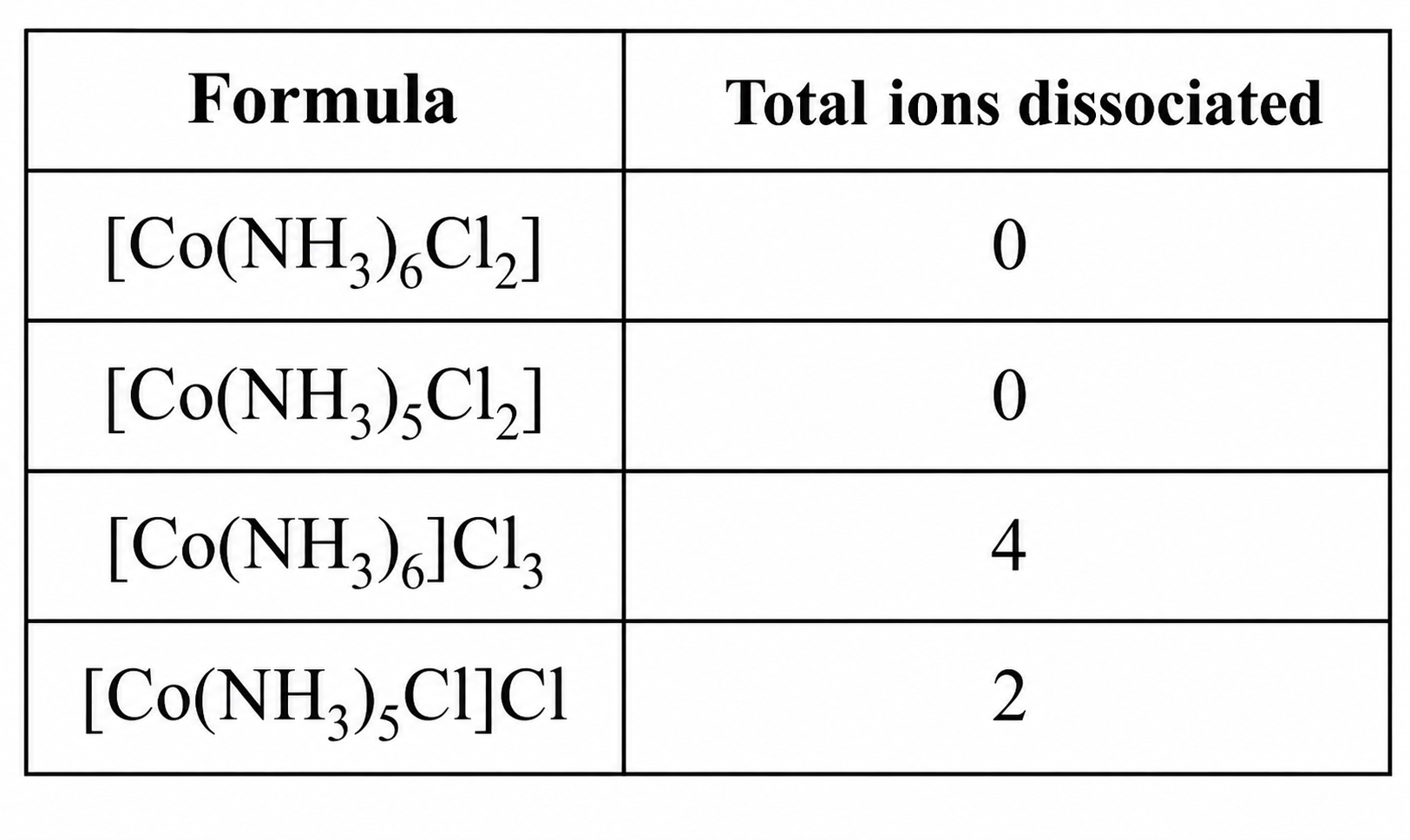
Out of the following complex compounds, which of the compound will be having the minimum conductance in solution?
more will be the ions dissociated in solution, more will be the conductance.
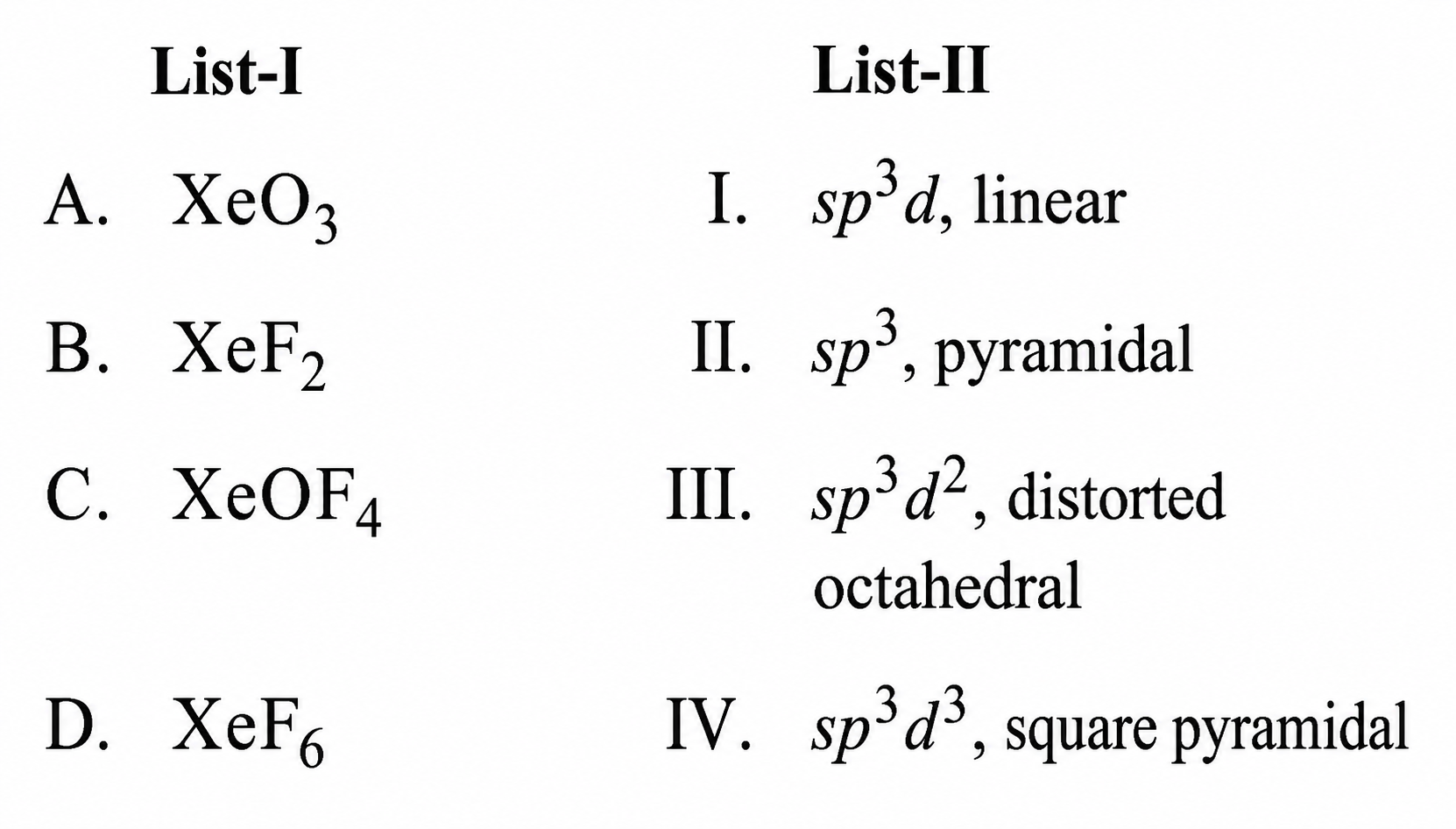
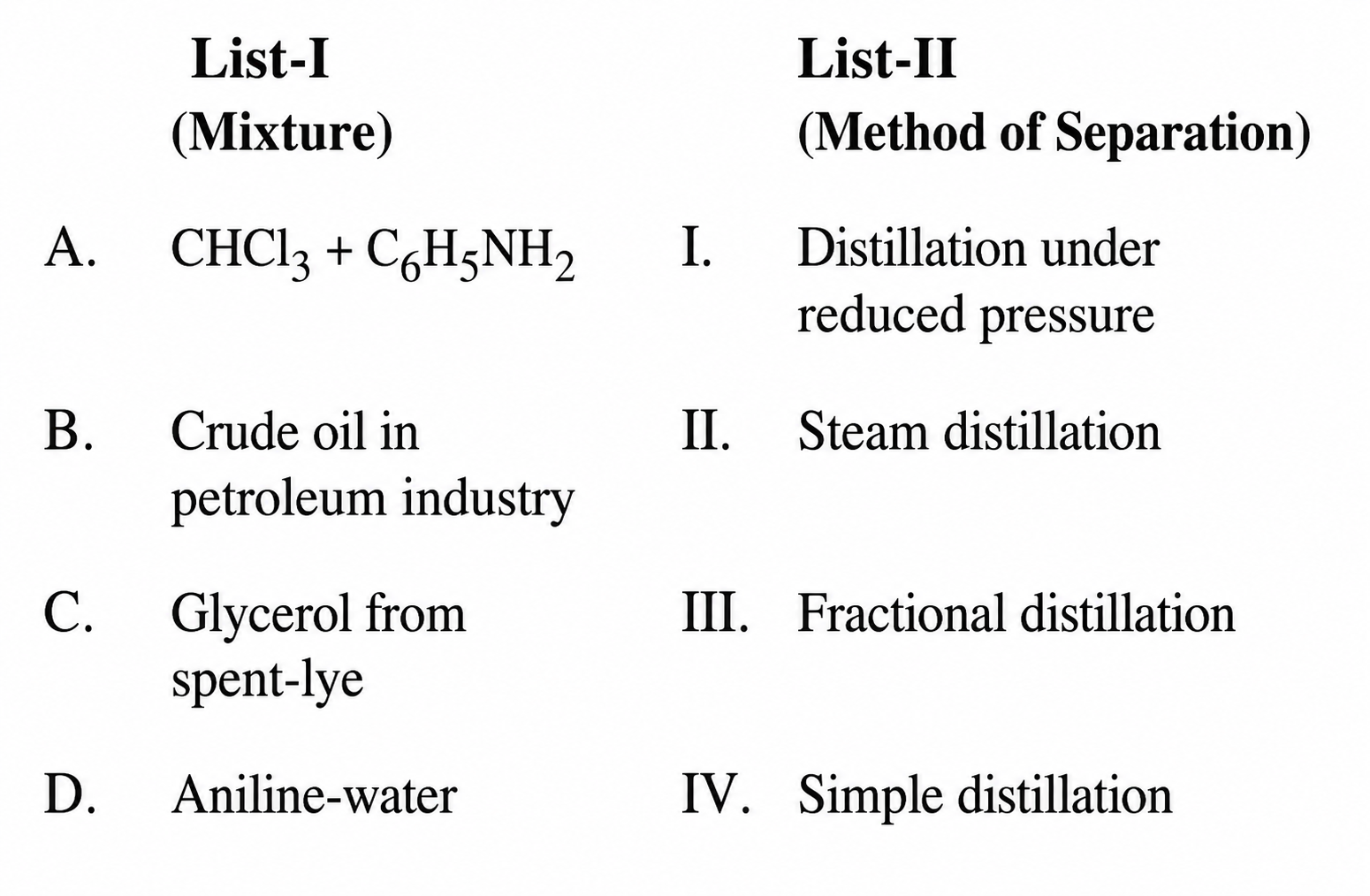
Match List-I with List-II. Choose the correct answer from the options given below
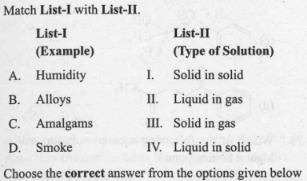
Humidity = Liquid in gas Alloy = Solid in solid Amalgam = Liquid ( like Hg) in solid Smoke = Solid particles in gas.
Among the following choose the ones with equal number of atoms. A. 212 g of Na₂CO₃(s) [molar mass = 106 g] B. 248 g of Na₂O(s) [molar mass = 62 g] C. 240 g of NaOH(s) [molar mass = 40 g] D. 12 g of H₂(g) [molar mass = 2 g] E. 220 g of CO₂(g) [molar mass = 44 g] Choose the correct answer from the options given below:
Number of atoms = Atomicity × Number of moles × N_A For (A), Number of atoms = 6 × (212/106) × N_A = 12 N_A For (B), Number of atoms = 3 × (248/62) × N_A = 12 N_A For (C), Number of atoms = 3 × (240/40) × N_A = 18 N_A
For (D), Number of atoms = 2 × (12/2) × NA=12 N_A For (E), Number of atoms = 3 × (220/44) × N_A = 15 N_A
Thus, (A), (B) and (D) have the same number of atoms.
The correct order of decreasing acidity of the following aliphatic acids is:
The acidic strength increases with –I effect or decreases with +I effect. Thus, the presence of –CH₃ groups decreases the acidity. Therefore, HCOOH is the most acidic and (CH₃)₃CCOOH is the least acidic.
Given below are two statement :
Statement-I: Ferromagnetism is considered as an extreme form of paramagnetism.
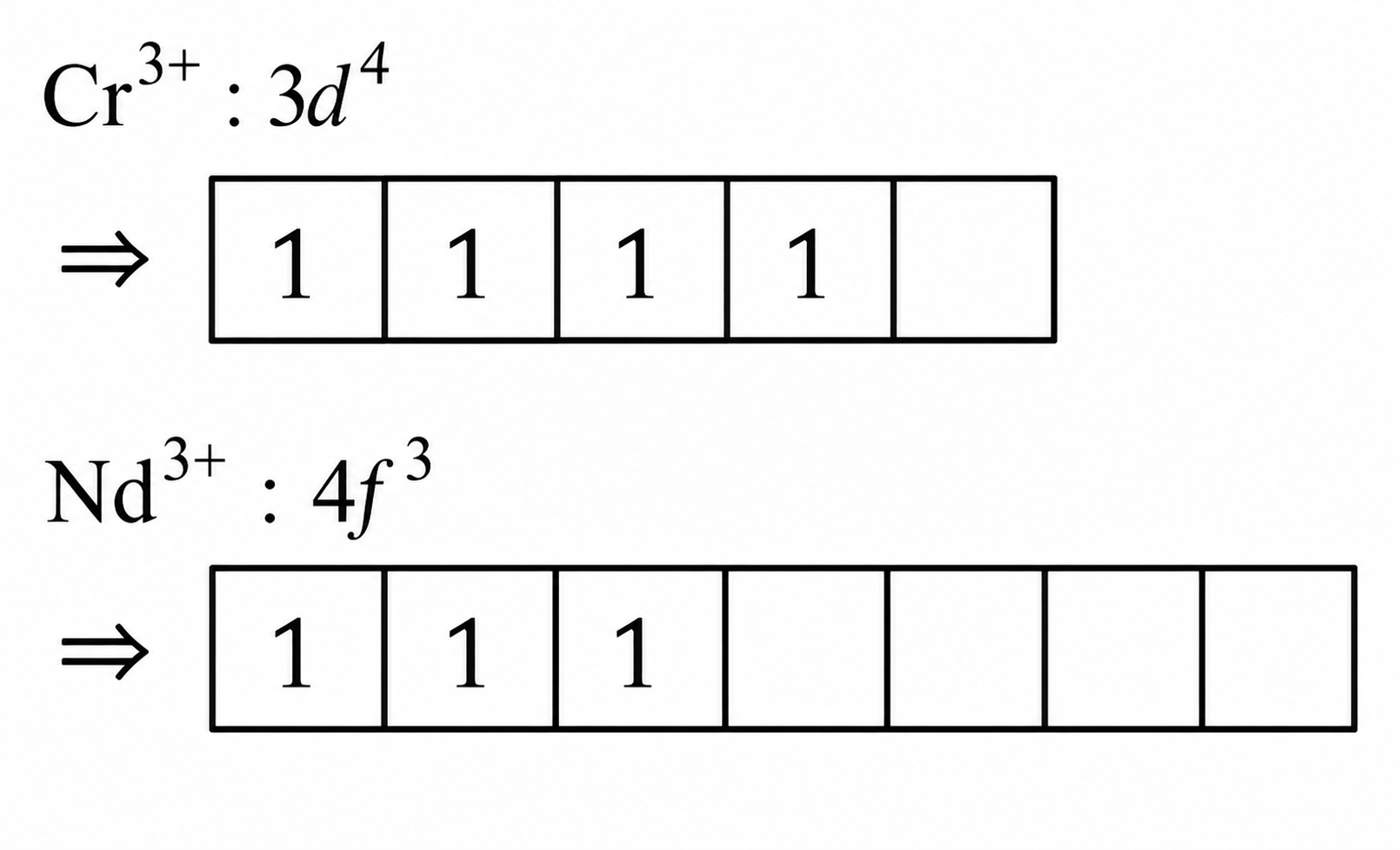
Statement-II: The number of unpaired electrons in a Cr²⁺ ion (Z = 24) is the same as that of a Nd³⁺ ion (Z = 60). In the light of the above statements,
choose the correct answer from the options given below:
Ferromagnetism is considered as an extreme form of paramagnetism due to greater number of unpaired electrons and stronger pull towards a magnetic field. Thus, statement I is true.
Thus, statement II is false:
For the reaction A(g) ⇌ 2B(g) the backward reaction rate constant is higher than the forward reaction rate constant by a factor of 2500, at 1000 K. [Given: R = 0.0831 L atm mol⁻¹K⁻¹] Kₚ for the reaction at 1000 K is
K_C = K_f/K_b = K_f/2500K_f = 1/2500 ⇒ Kₚ = K_C(RT)^Δⁿᵍ ;(Δn_g = 2-1 = 1) = (1/2500)(0.0831 × 1000)¹ = 0.033
Given below are two statements :
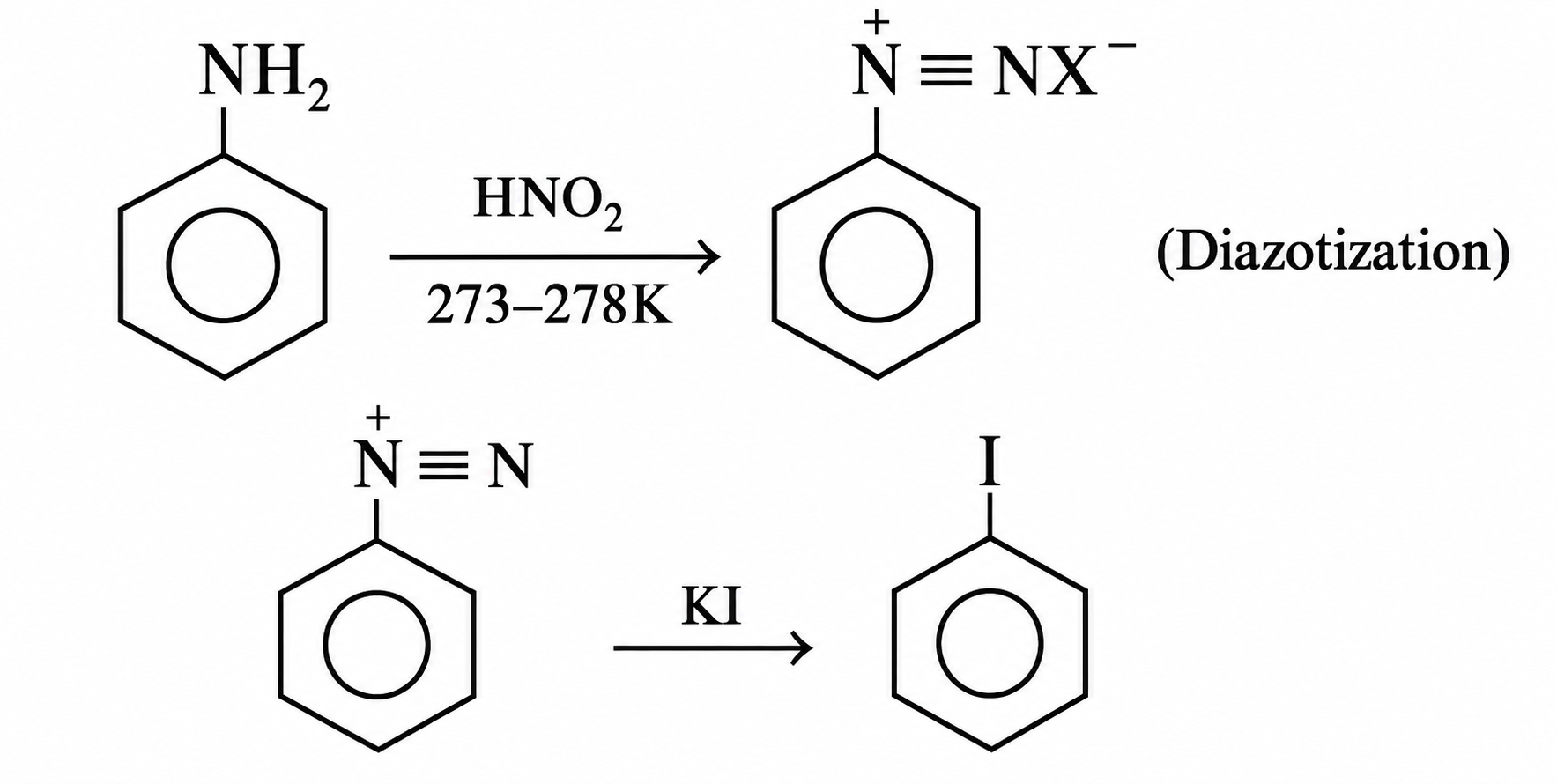
Statement-I: Benzenediazonium salt is prepared by the reaction of aniline with nitrous acid at 273–278 K. It decomposes easily in the dry state.
Statement-II: Insertion of iodine into the benzene ring is difficult and hence iodobenzene is prepared through the reaction of benzenediazonium salt with KI. In the light of the above statements, choose the most appropriate answer from the options given below:
Both statements are correct as diazotization is the method of preparation of benzenediazonium salt, and iodobenzene is prepared by the reaction of benzenediazonium salt with KI instead of direct iodination of benzene.
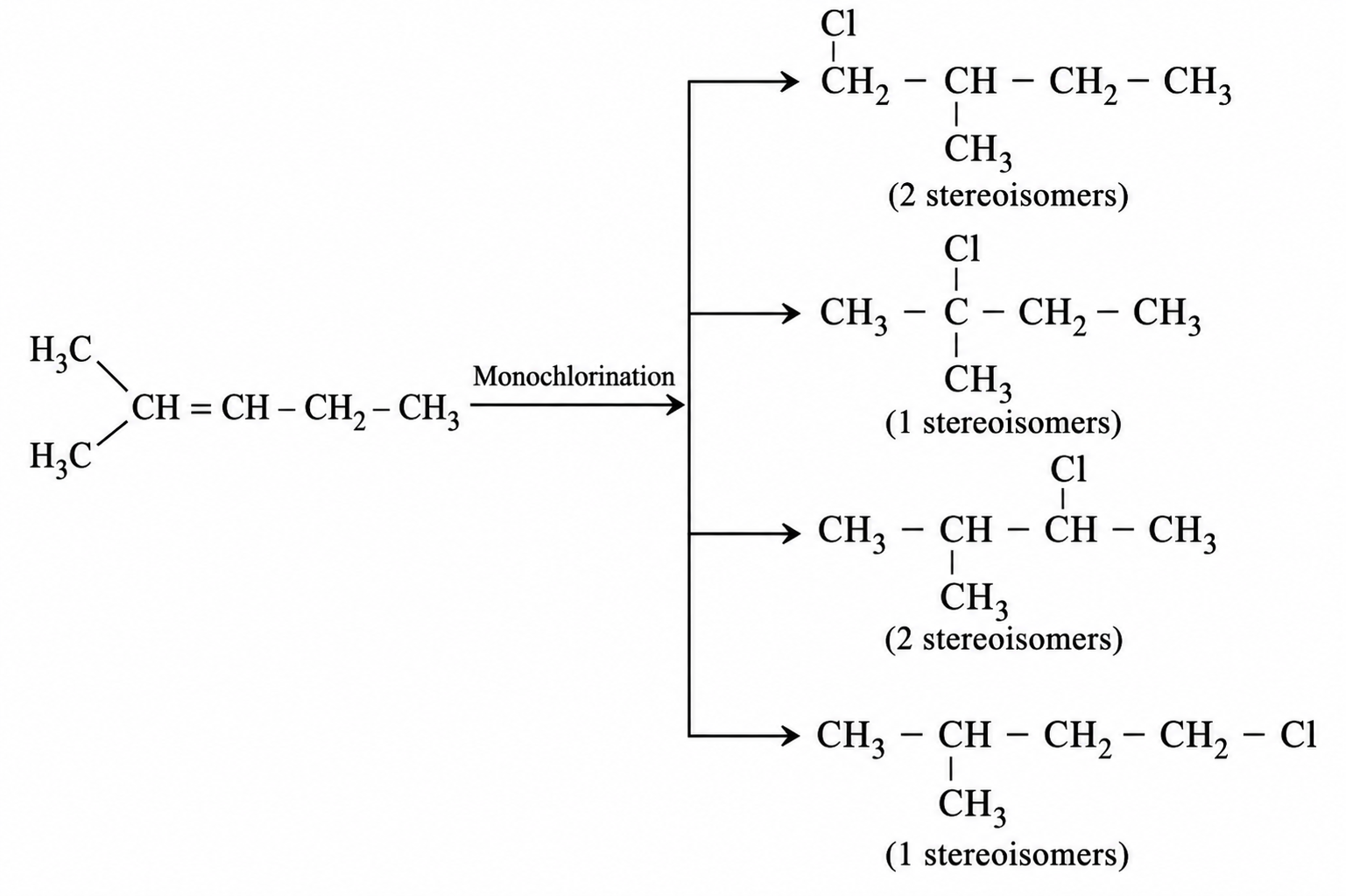
How many products (including stereoisomers) are expected from monochlorination of the following compound ?
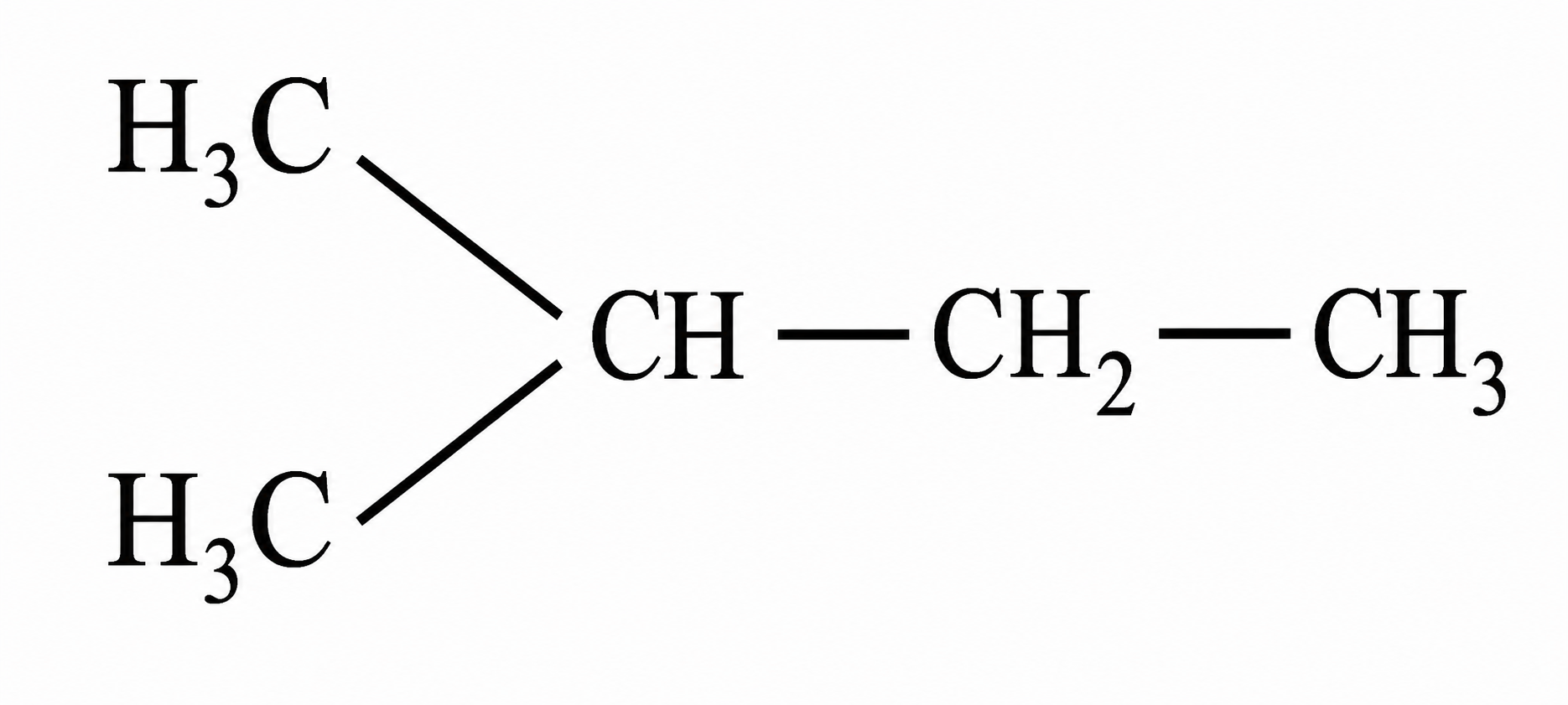
Thus, total of six stereoisomers.
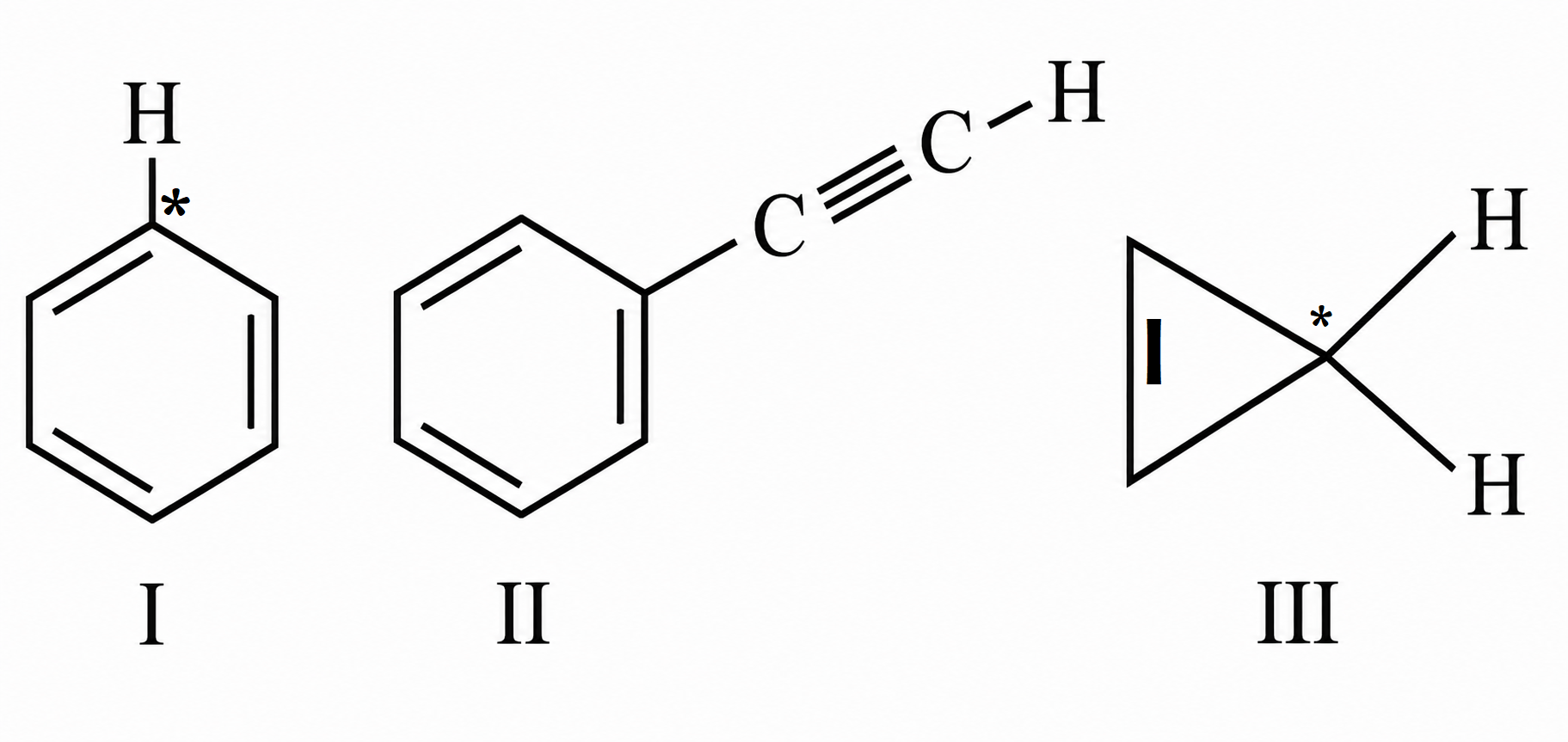
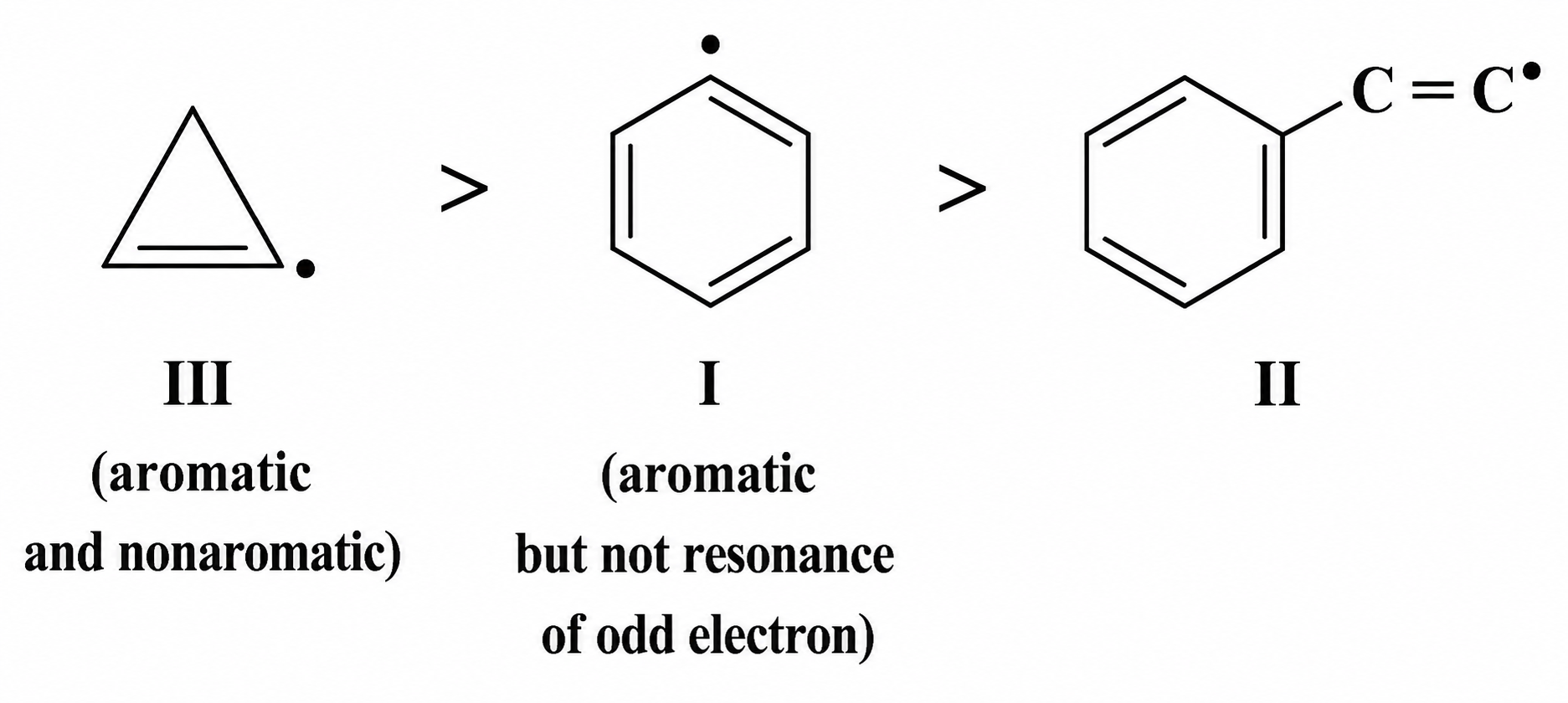
Among the given compound I-III, the correct order of bond dissociation energy of C-H bond marked with * is :
Bond dissociation energy will be higher for less stable species (free radical) formed after the dissociation of the C-H bond. The stability order is :
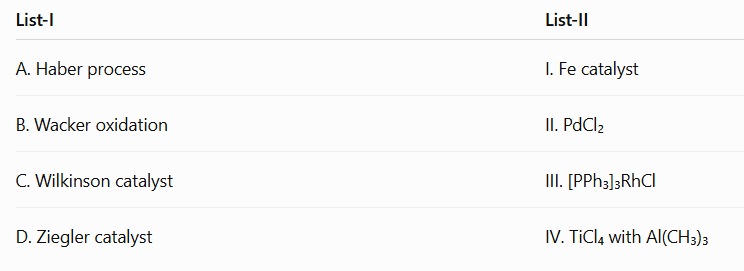
5 moles of liquid X and 10 moles of liquid Y make a solution having a vapour pressure of 70 torr. The vapour pressures of pure X and Y are 63 torr and 78 torr respectively. Which of the following is true regarding the described solution?
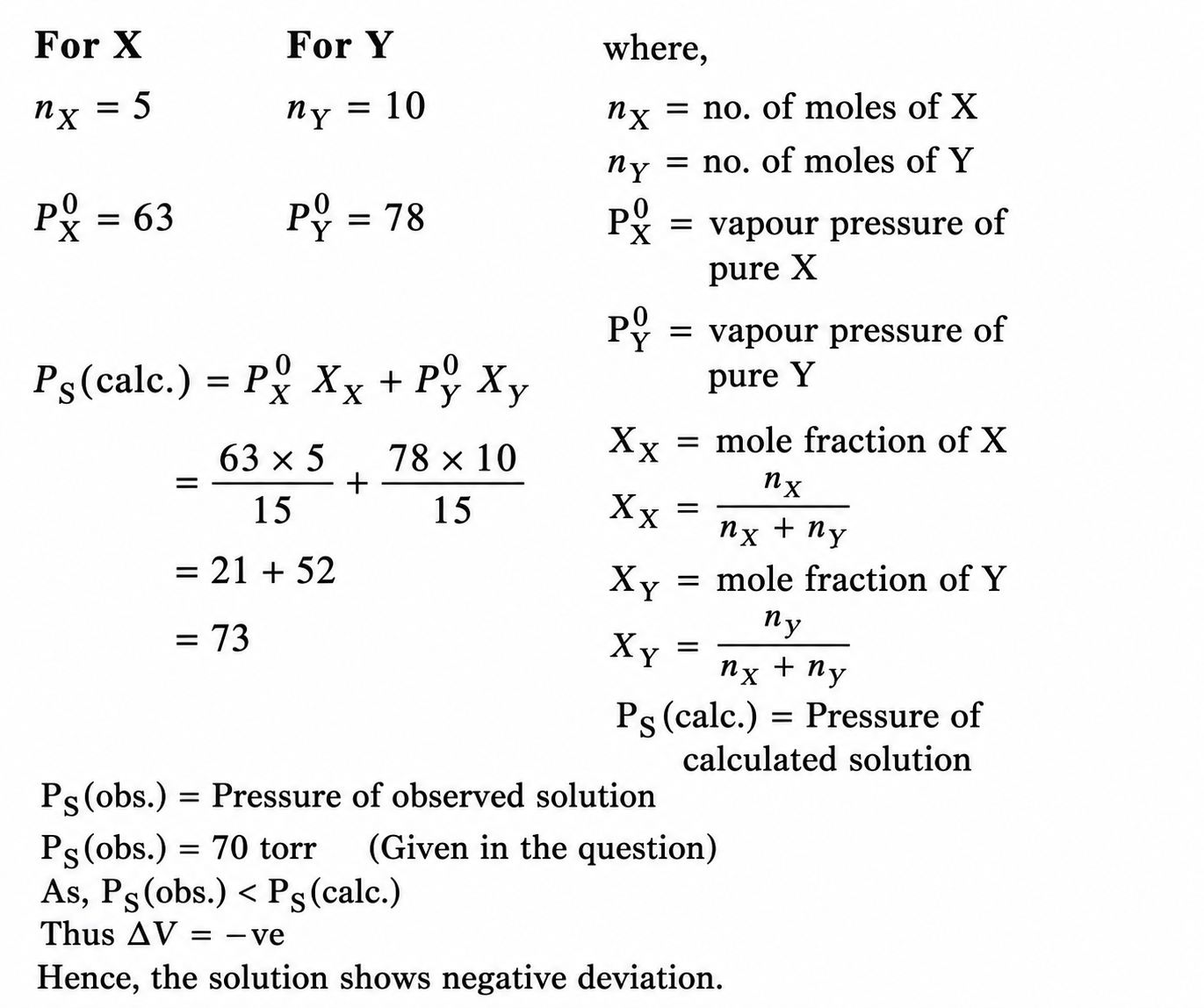
Sugar ‘X’ A. is found in honey. B. is a keto sugar. C. exists in α and β-anomeric forms. D. is laevorotatory. ‘X’ is:
D-Fructose is a ketohexose sugar that exists in α and β anomeric forms. It is a laevorotatory compound and is found in honey.
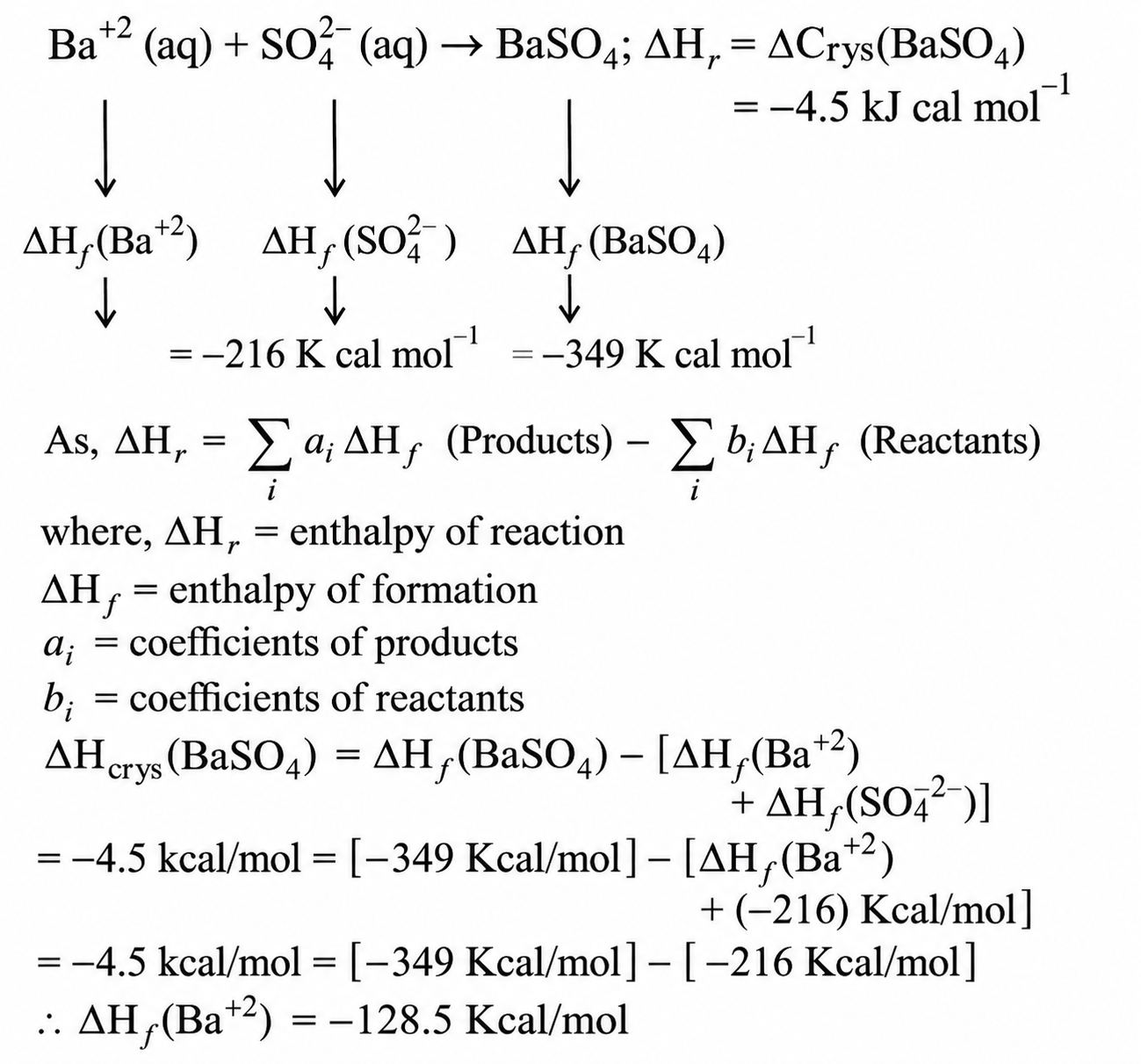
The standard heat of formation, in kcal / mol⁻¹, of Ba²⁺ is: {Given: Standard heat of formation of SO₄²⁻ ion (aq) = −216 kcal mol ; Standard heat of crystallisation of BaSO₄(s) = −4.5 kcal /mol ; Standard heat of formation of BaSO₄(s) = −349 kcal / mol }
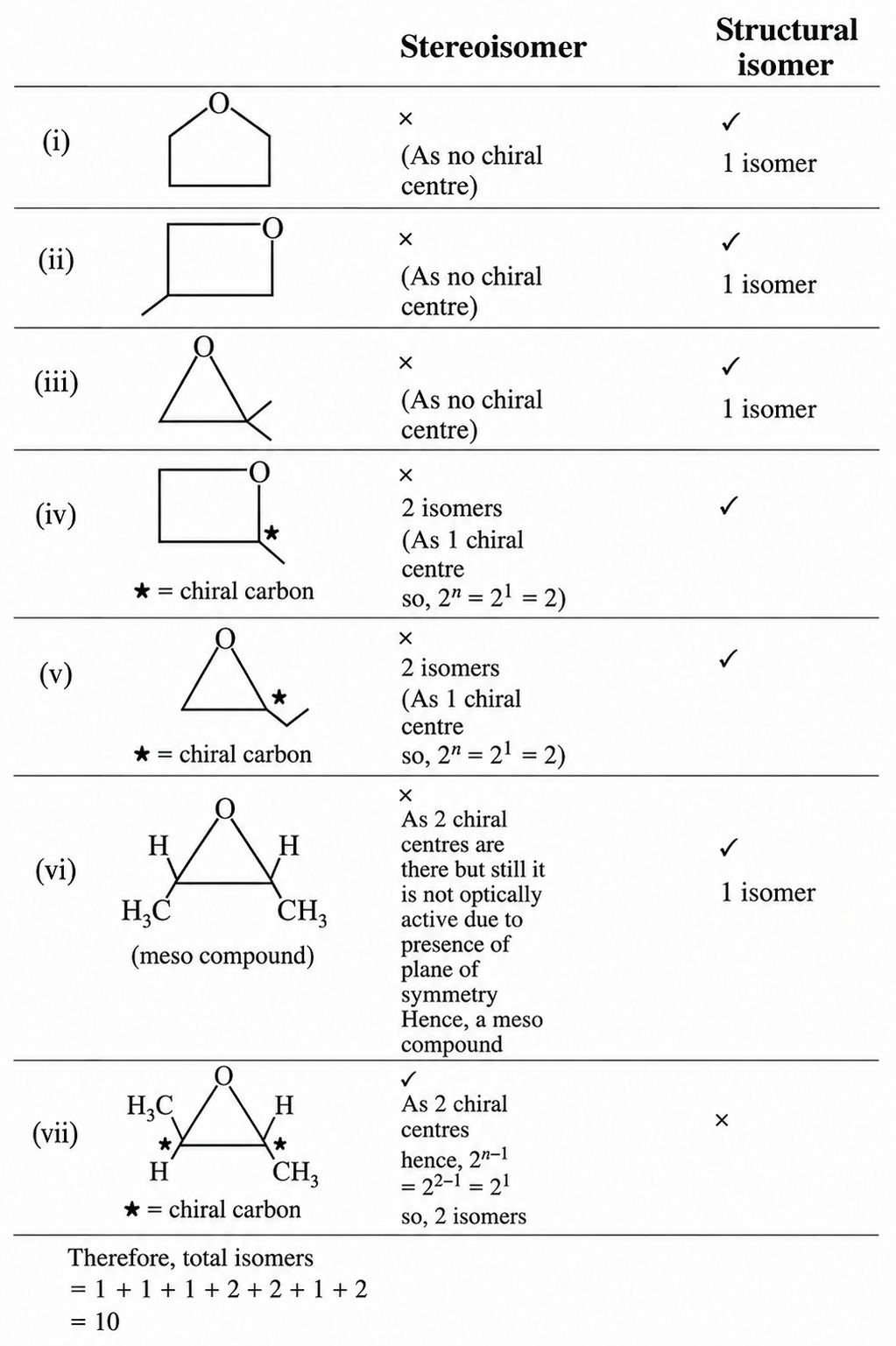
Total number of possible isomers (both structural as well as stereoisomers) of cyclic ethers of molecular formula C₄H₈O is :
As the molecular formula is C₄H₈O and as given in the question that C₄H₈O is cyclic ether, ∴ The possible ring structures along with the possible isomers are:
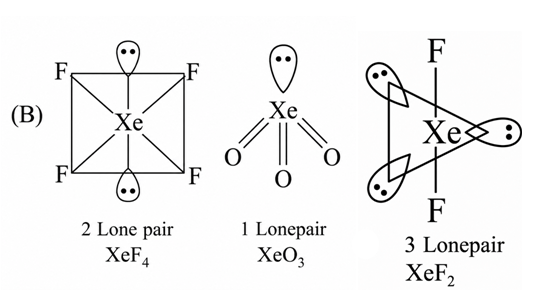
Identify the correct orders against the property mentioned
(A) H₂O > NH₃ > CHCl₃ — dipole moment
(B) XeF₄ > XeO₃ > XeF₂ — number of lone pairs on central atom
(C) O–H > C–H > N–O — bond length
(D) N₂ > O₂ > H₂ — bond enthalpy
Choose the correct options given below:
(A) H₂O > NH₃ > CHCl₃
(C) O−H > C−H > N−O According to the size of the element.
(D) N₂ > O₂ > H₂ N≡N, O=O, H−H
Thus, (A) and (D) are correct statements.
Higher yield of NO in N₂(g) + O₂(g) ⇌ 2NO(g) can be obtained at [ΔH of the reaction = + 180.7 kJ mol⁻¹] A. higher temperature B. lower temperature C. higher concentration of N₂ D. higher concentration of O₂ Choose the correct answer from the options given below:
N₂(g) + O₂ ⇌ 2NO
ΔH = = + 180.7 kJ mol⁻¹
(A) As temperature increases, the reaction shifts in the forward direction because the reaction is endothermic.
(B) As temperature decreases, the reaction shifts backward because the reaction is endothermic.
(C) As [N₂]↑ ⇒ the reaction shifts forward.
(D) As [O₂]↑ ⇒ the reaction shifts forward.
If the rate constant of a reaction is 0.03 s⁻¹, how much time does it take for 7.2 mol L⁻¹ concentration of the reactant to get reduced to 0.9 mol L⁻¹? (Given : log2 = 0.301)
k = 0.03 s⁻¹ (First-order reaction) where, k = rate constant A₀ = initial concentration of reactant Aₜ = concentration of reactant at time t
t = half-life
A₀ =7.2 mol L⁻¹ Aₜ = 0.9 mol L⁻¹
7.2→ t₁ᐟ₂ →3.6 — t₁ᐟ₂ → 1.8 — t₁ᐟ₂ → 0.9
t = 3t₁ᐟ₂ = 3 × 0.693/0.03 = 69.3 s
Which one of the following reactions does NOT belong to “Lassaigne’s test”?
-
(A)

-
(B)
-
(C)
-
(D)

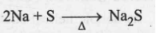
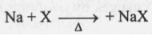
2CuO + C —Δ→ 2Cu + CO₂ Lassaigne's test is used to detect the presence of Nitrogen, Halogen, Sulphur, and Phosphorus. Option is the detection of carbon. It is the Liebig method.
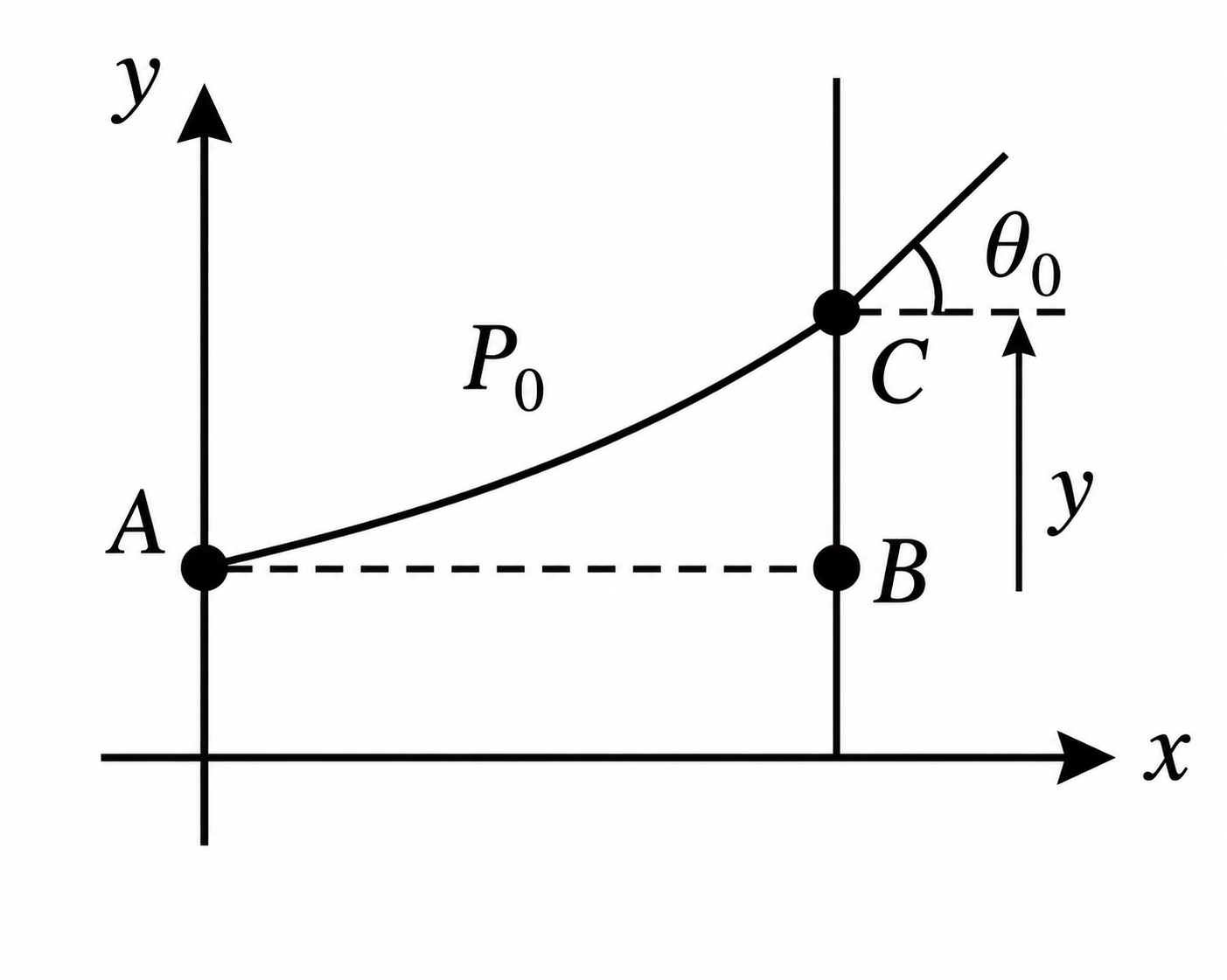
Consider a water tank shown in the figure. It has one wall at x = L and can be taken to be very wide in the z direction. When filled with a liquid of surface tension S and density ρ, the liquid surface makes angle θ₀ (θ₀ ≪ 1) with the x-axis at x = L. If y(x) is the height of the surface then the equation for y(x) is: (take θ(x) = sinθ(x) = tanθ(x) = dy/dx, g is the acceleration due to gravity)
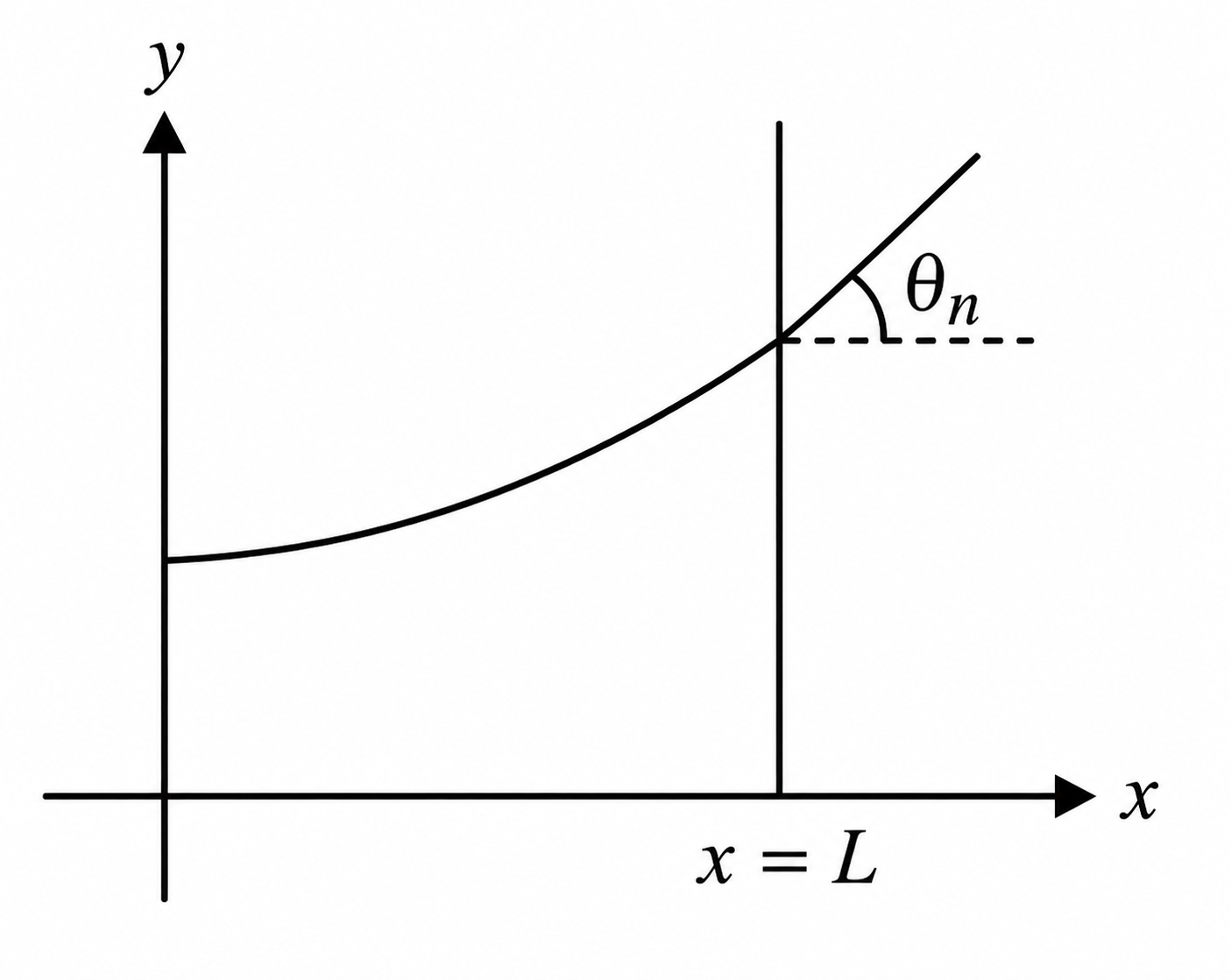
At horizontal level, P_A = P_B = P₀
Along vertical level, P_C = P₀ - ρ gy
Also, P_C = P₀ - S/R ∴ ρ gy = S/R ...(i)
The radius of curvature is R = {1+(dy/dx)²}³ᐟ² / d²y/dx²
dy/dx is very small ∴ dy/dx = 0 R = 1/d²y/dx² ∴ d²y/dx² = 1/R ...(ii) From eq (i) and (ii),
ρ gy = S d²y/dx²
d²y/dx² = ρgy/S
An electron (mass 9×10⁻³¹ kg and charge 1.6×10⁻¹⁹ ) moving with speed c/100 (c = speed of light) is injected into a magnetic field 𝐁⃗ of magnitude 9×10⁻⁴ T perpendicular to its direction of motion. We wish to apply a uniform electric field 𝐄⃗ together with the magnetic field so that the electron does not deflect from its path. Then (speed of light c = 3 × 10⁸ m s⁻¹)
For electron to be undeflected, 𝐅⃗ₑ = -𝐅⃗ₘ ⇒ eE = e v B sin θ ∴ E = c/100 × 9 × 10⁻⁴ sin 90° = 27 ×10 V/m
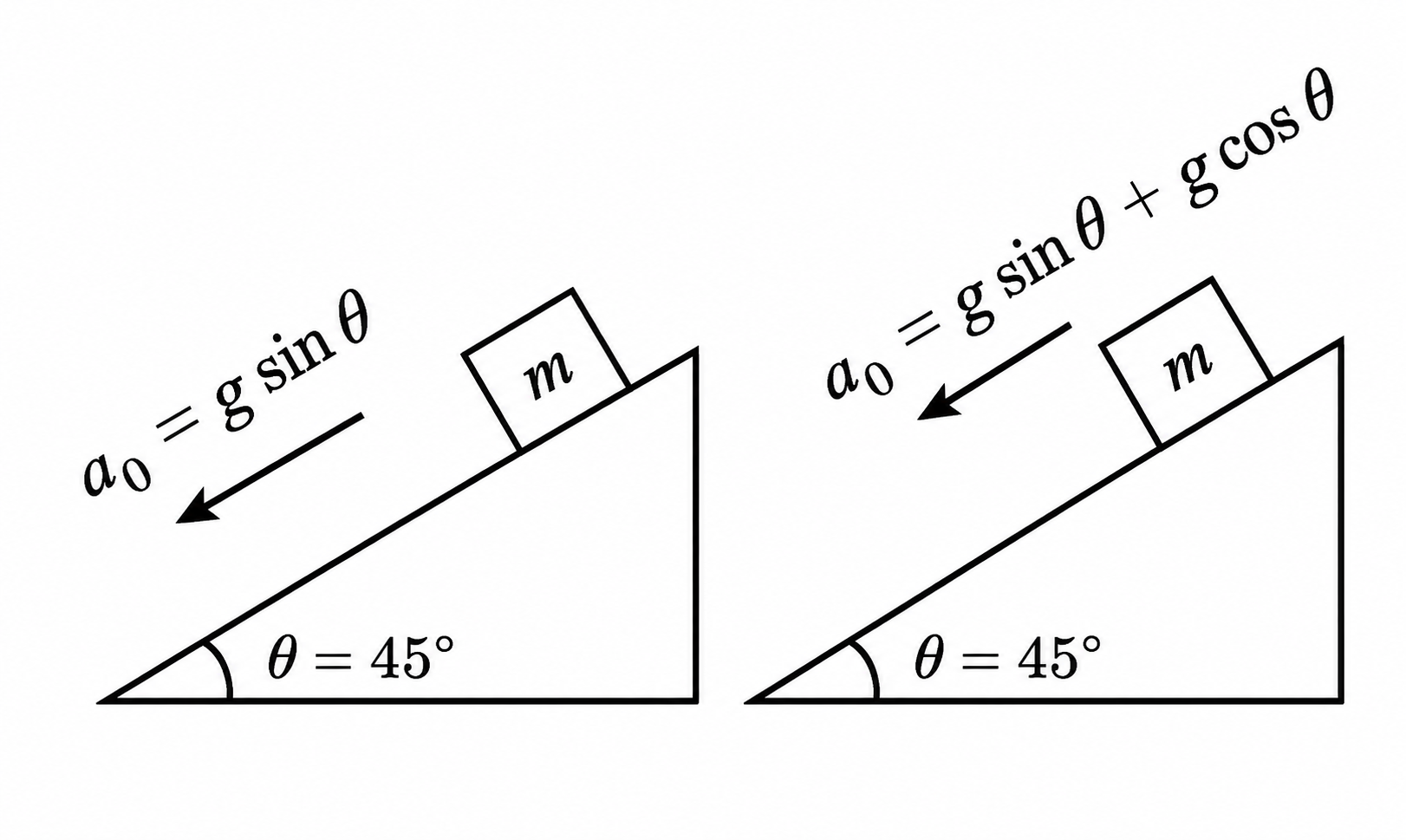
There are two inclined surfaces of equal length (L) and same angle of inclination 45° with the horizontal. One of them is rough and the other is perfectly smooth. A given body takes 2 times as much time to slide down the rough surface than on the smooth surface. The coefficient of kinetic friction (μₖ) between the object and the rough surface is close to:
The distance travelled on inclined plane is
L = 1/2 at ² ⇒ a ∝1/ t² ⇒ t ∝ a
⇒ (t_S/t_R)² = a_R/a_S
⇒ (1/2)² = g sin θ - μₖg cos θ/ g sin θ
⇒ 1/4 = sin 45° - μₖcos 45° / sin 45°
⇒ 1/4 = (1/√2)/(1/√2) (1 - μₖ /1)
⇒ 1/4 = 1 - μₖ ⇒ μₖ = 1 - 1/4 = 3/4 = 0.75
The kinetic energies of two similar cars A and B are 100 J and 225 J respectively. On applying brakes, car A stops after 1000 m and car B stops after 1500 m. If F_A and F_B are the forces applied by the brakes on cars A and B, respectively, then the ratio F_A/F_B is:
By work–energy theorem, W.D. = Δ KE (Δ KE)_A/(Δ KE)_B = (WD)_A/(WD)_B = - F_AS_A/-F_BS_B ⇒ - 100/ -225 = F_A(1000)/ -F_B(1500) ⇒ F_A/F_B = 2/3
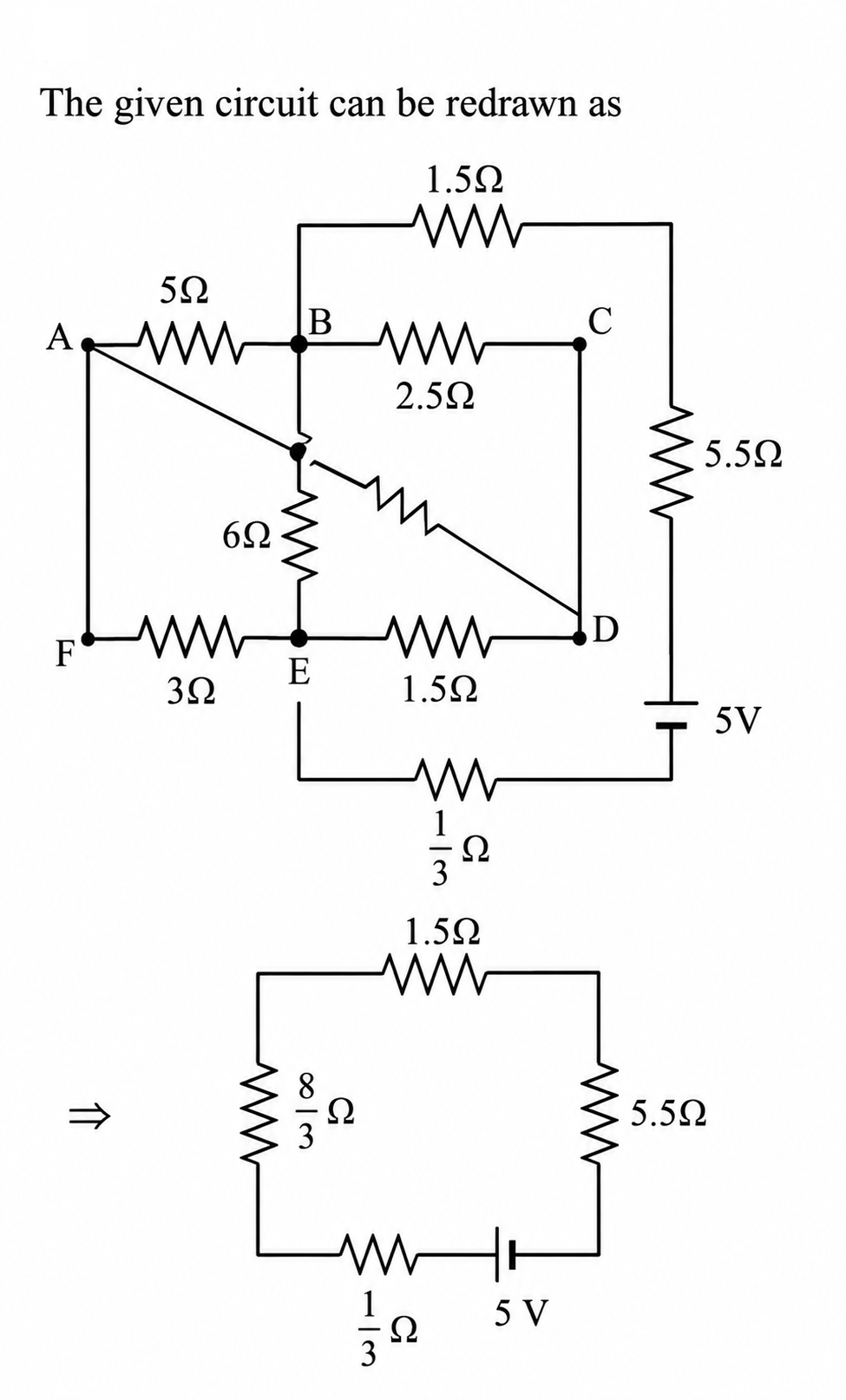
The current passing through the battery in the given circuit,is:
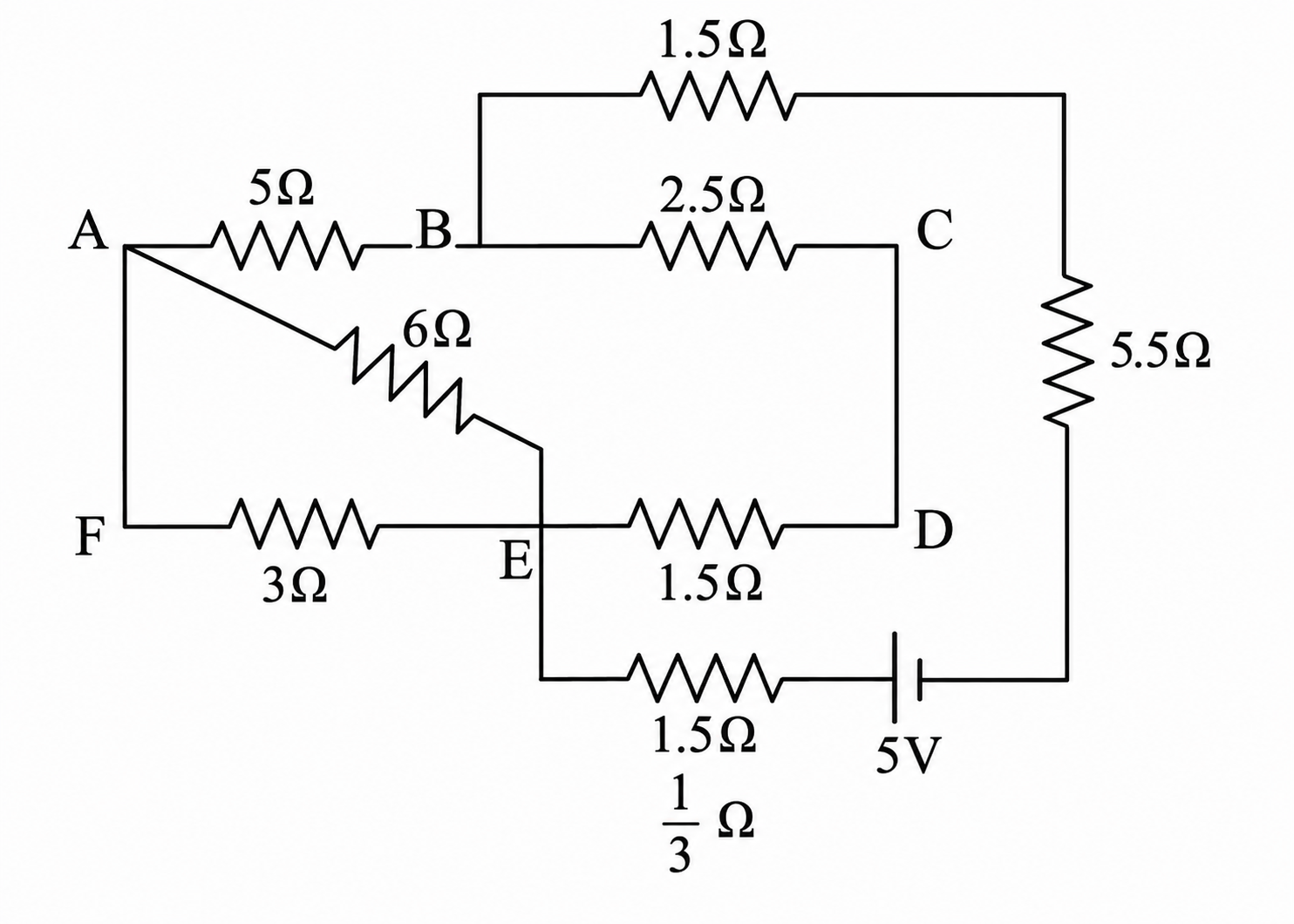
∴ The current passing through the battery is i = V/R_eq = 5/(1/3 + 8/3 + 1.5 + 5.5) = 5/10 = 0.5 A
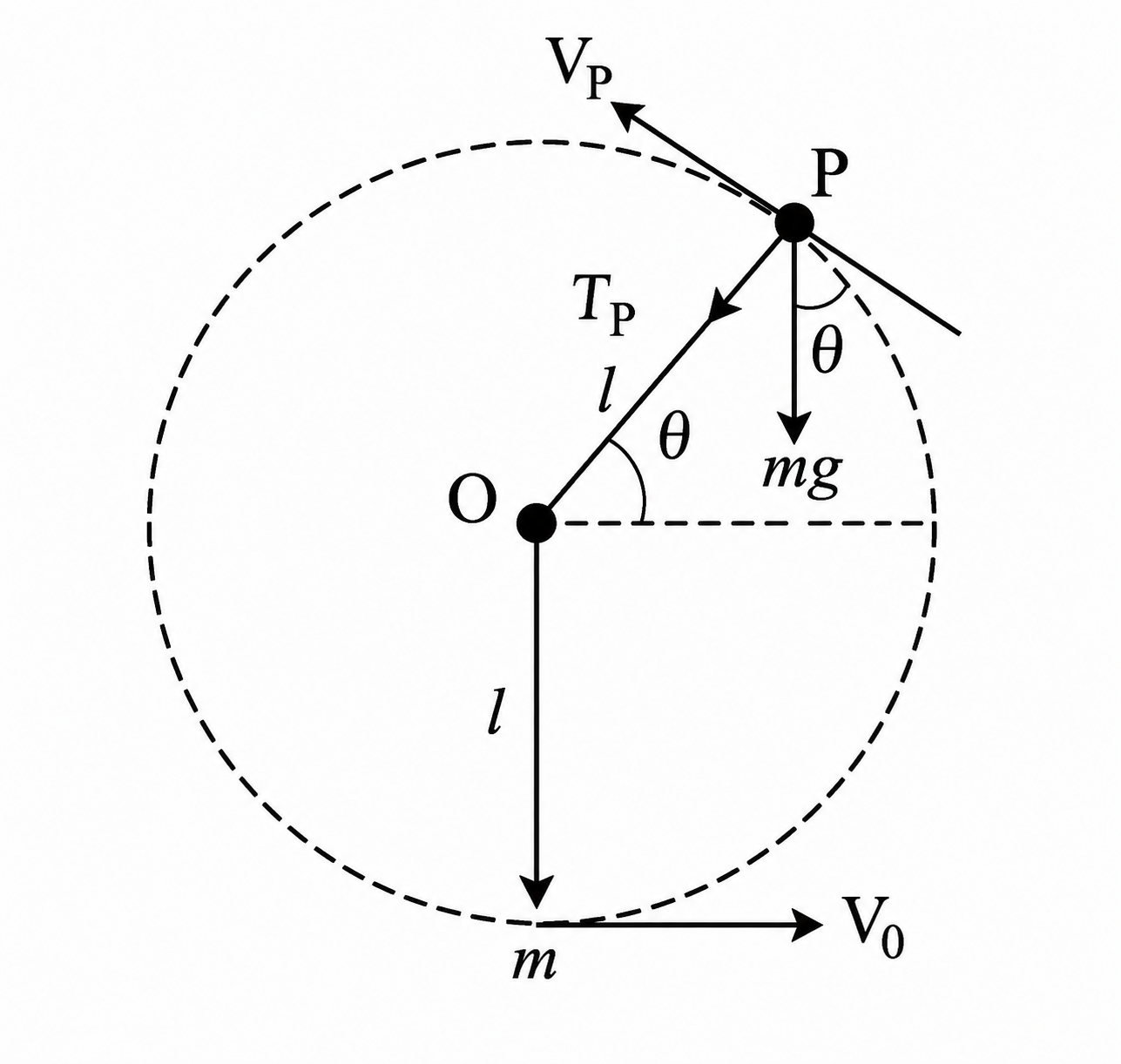
A bob of heavy mass m is suspended by a light string of length l. The bob is given a horizontal velocity v₀ as shown in the figure. If the string gets slack at some point P, making an angle θ from the horizontal, the ratio of the speed v of the bob at point P to its initial speed v₀ is:
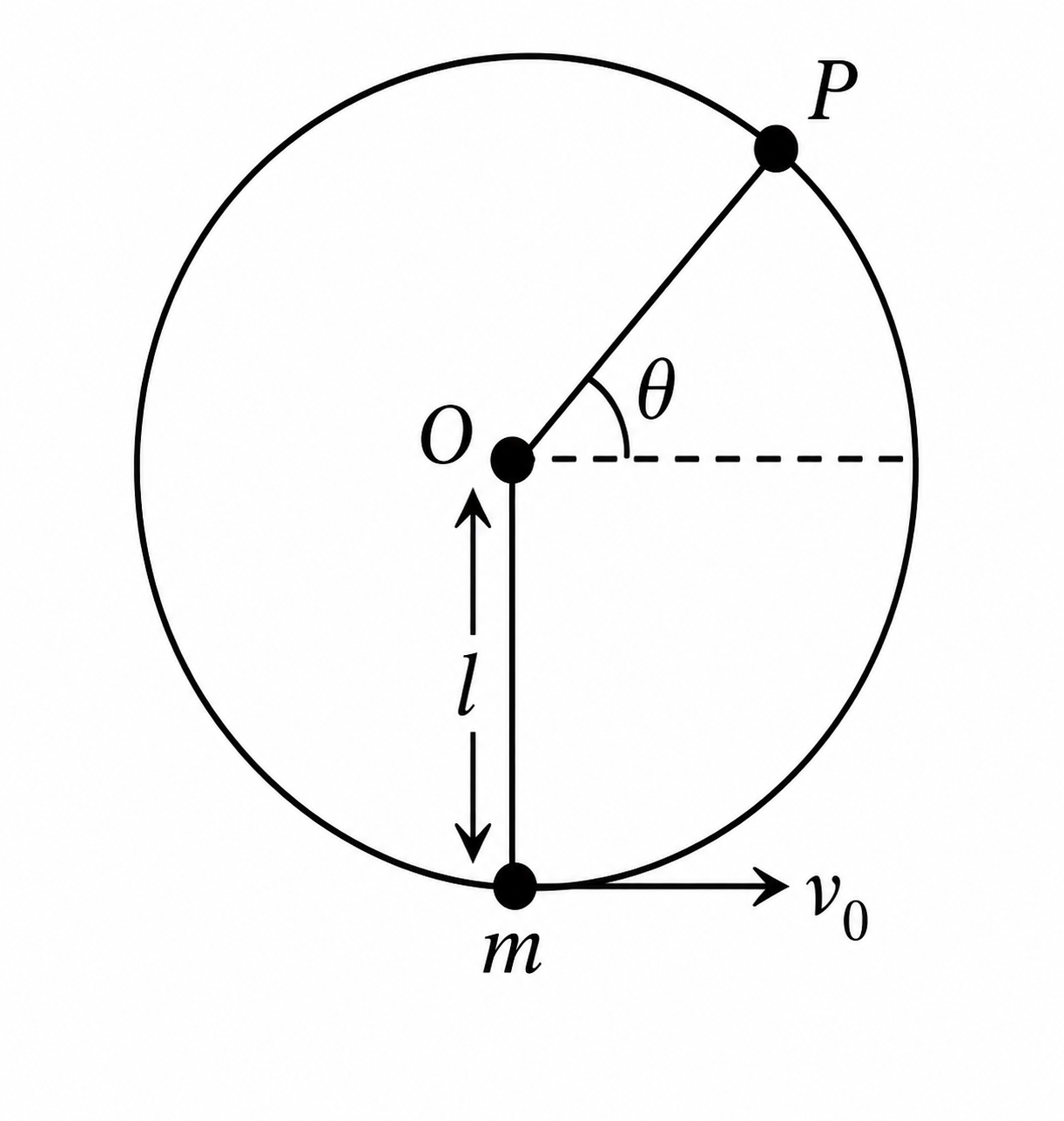
By mechanical energy conservation, 1/2 mv₀² = mgl(1+sin θ) + 1/2 mv²ₚ ....(i)
At point P,
Tₚ = + mg sin θ = mv²ₚ /l
Here, Tₚ = 0
mg sin θ = mv²ₚ /l ⇒ mv²ₚ = mgl sin θ
∴ vₚ = √gl sin θ
From equations (i) & (ii),
1/2mv₀² = mgl(1 + sin θ) + 1/2 mgl sin θ
v₀² = 2gl(1 + sin θ) + gl sin θ
⇒ v₀ = √(2gl + 3gl sin θ) ∴ vₚ/v₀ = √(sinθ/ 2+3 sin θ)
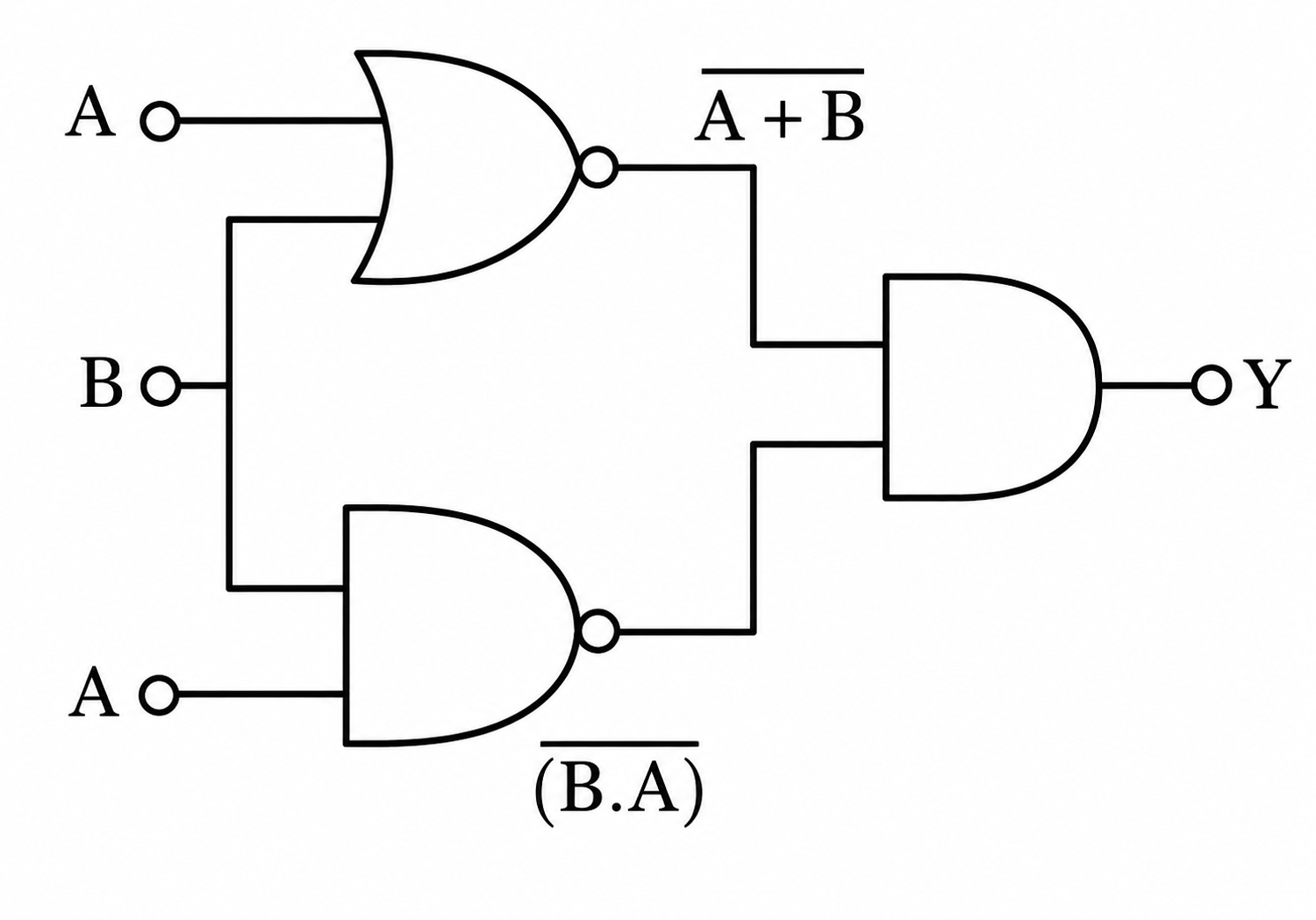
The output (Y) of the given logic implementation is similar to the output of an/a ________ gate.
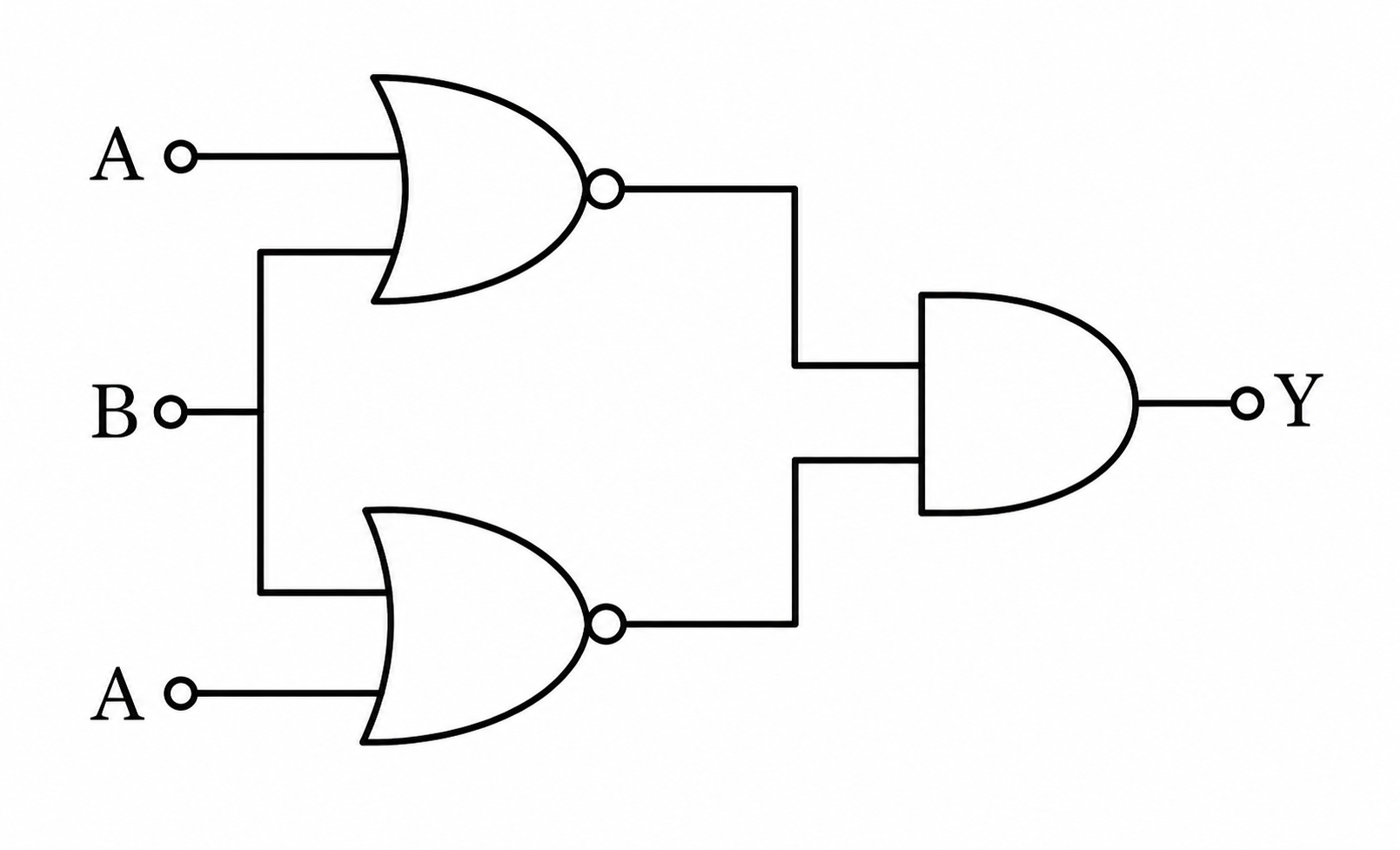
The output of the logic circuit is Y= (A̅+B̅).(A̅+B̅) = A̅.B̅.(A̅+B̅) = A̅.B̅.A̅ + A̅.B̅.B̅ = A̅.B̅ + A̅.B̅ = A̅.B̅ = (A̅+B̅) So, the given circuit behaves as a NOR gate.
The electric field in a plane electromagnetic wave is given by E_z = 60 cos(5x + 1.5 × 10⁹t) V/m Then expression for the corresponding magnetic field is (here subscripts denote the direction of the field):
Given, E₀ = 60 V/m, ω = 1.5 × 10⁹ rad/s, k = 5 m⁻¹
c = ω/k = 1.5 × 10⁹/5 = 3 × 10⁸ m/s
B₀ = E₀/c = 60/3 × 10² = 20 × 10⁻⁸ = 2 × 10⁻⁷ T ∴ B_y = 2 × 10⁻⁷ cos(5x + 1.5 × 10⁹t) T
A ball of mass 0.5 kg is dropped from a height of 40 m. The ball hits the ground and rises to a height of 10 m. The impulse imparted to the ball during its collision with the ground is (Take g = 9.8 m/s²)
Initial velocity, v₁ = -√2gh₁ = -√(2 × 9.8 × 10) = -28 m/s
Final velocity, v₂ = √2gh₂ = √(2 × 9.8 × 10) = 14 m/s
∴ Impulse, I = m(v₂ - v₁) = 0.5[14-(-28)] = 0.5 × 42 = 21 Ns
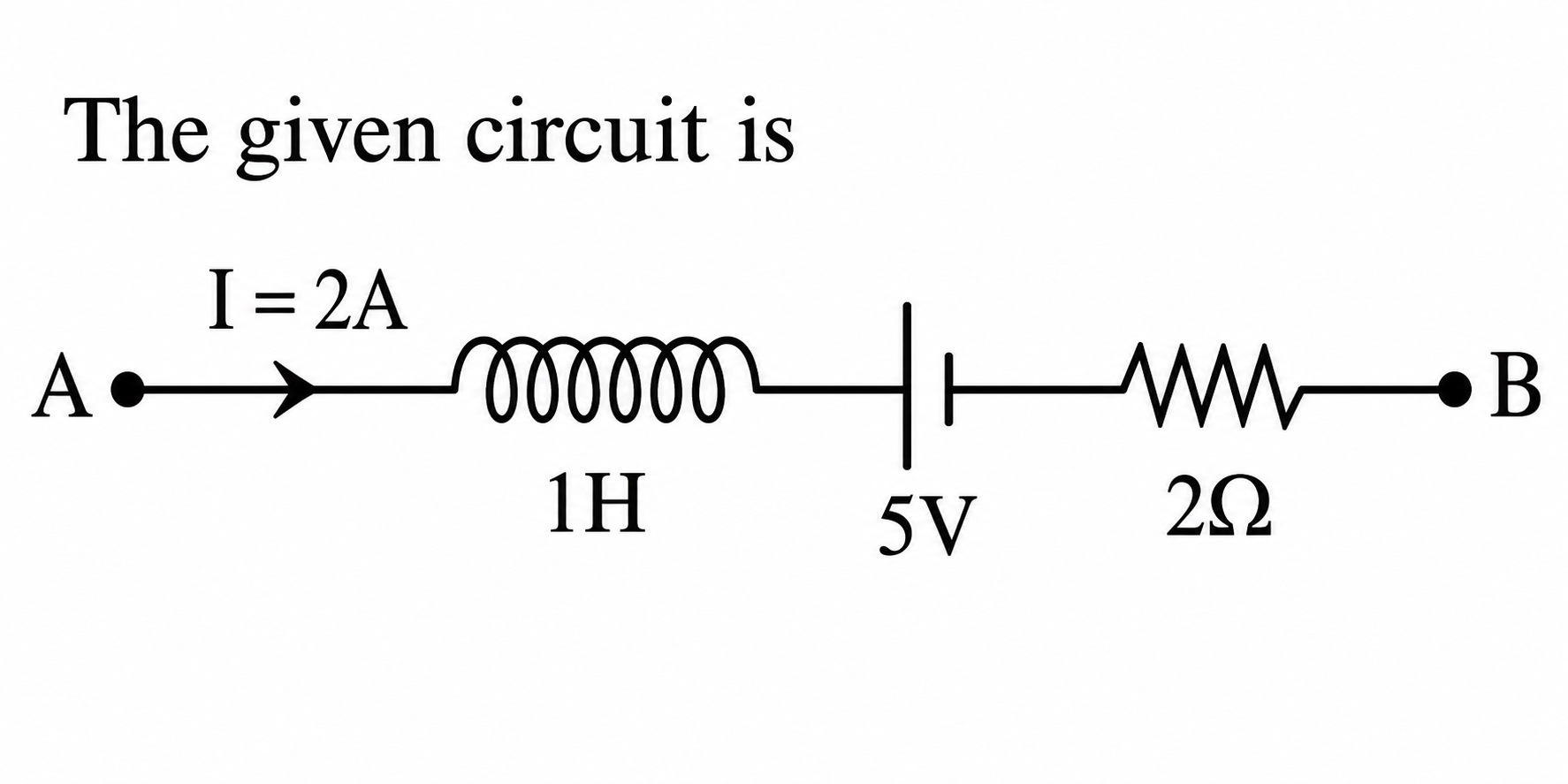
AB is a part of an electrical circuit (see figure). The potential difference "V_A−V_B" at the instant when current i = 2 A and is increasing at a rate of 1 A/s is:
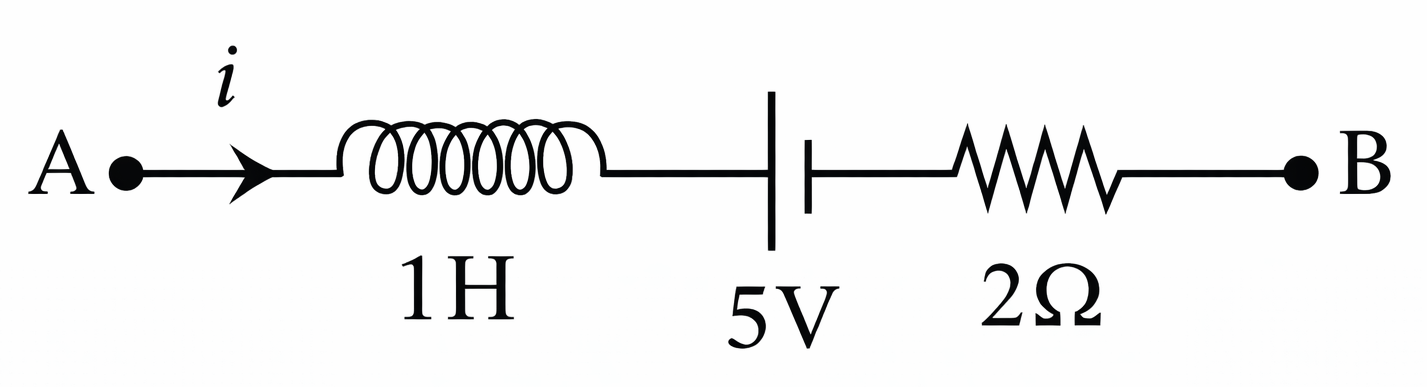
By KVL between points A and B, V_A - LdI/dt - 5 -IR = V_B
V_A - V_B = LdI/dt + 5 + I R Here ,I 2A, dl /dt =1 A/S
V_A -V_B = 1 × 1 + 5 +2 × 2 = 10 V
An oxygen cylinder of volume 30 litre has 18.20 moles of oxygen. After some oxygen is withdrawn from the cylinder, its gauge pressure drops to 11 atmospheric pressure at temperature 27°C. The mass of the oxygen withdrawn from the cylinder is nearly equal to: [Given, R = 100/12 J mol⁻¹K⁻¹ and molecular mass of O₂ = 32; 1 atm pressure = 1.01 × 10⁵ N/m]
Given, V = 30 L = 30 × 10⁻³ m³, nᵢ = 18.20 moles, P_f = 12 atm T = 27°C = 300 K, M_O₂ = 32 kg ∴ Final moles of O₂ is n_f = P_fV/RT = (1.2 × 1.01 × 10⁵ × 30 × 10⁻³)/(100/12)× 300 = 14.544 moles ∴ Δn = nᵢ - n_f = 18.2 - 14.544 = 3.656 moles ∴ Mass removed, Δm = (Δn)(M_O₂) = 3.656 × 32/100 kg = 0.116 kg
A model for quantized motion of an electron in a uniform magnetic field B states that the flux passing through the orbit of the electron is n(h/e) where n is an integer, h is Planck's constant and e is the magnitude of electron's charge. According to the model, the magnetic moment of an electron in its lowest energy state will be (m is the mass of the electron)
Magnetic moment, M = IA = I(πr²)
∴ M = (ev/2πr)(πr²) ...(i)
Given flux = B.(πr²) = h(h/e)
⇒ r² = h/Bπe .....(ii)
(∵ n = 1)
And when charge moving in external magnetic field then
r = mv/qB
⇒ v/r = eB/m ....(iii)
(∵ q = e)
From equation (i), (ii) and (iii),
M = (ev/2πr)(πr²)
= ev/2π(eB/m)π(h/Bπe)
= eh/2πm
Three identical heat-conducting rods are connected in series as shown in the figure. The rods on the sides have thermal conductivity 2K while that in the middle has thermal conductivity K. The left end of the combination is maintained at temperature 3T and the right end at T. The rods are thermally insulated from outside. In steady state, the temperature at the left junction is T₁ and that at the right junction is T₂. The ratio T₁/T₂ is
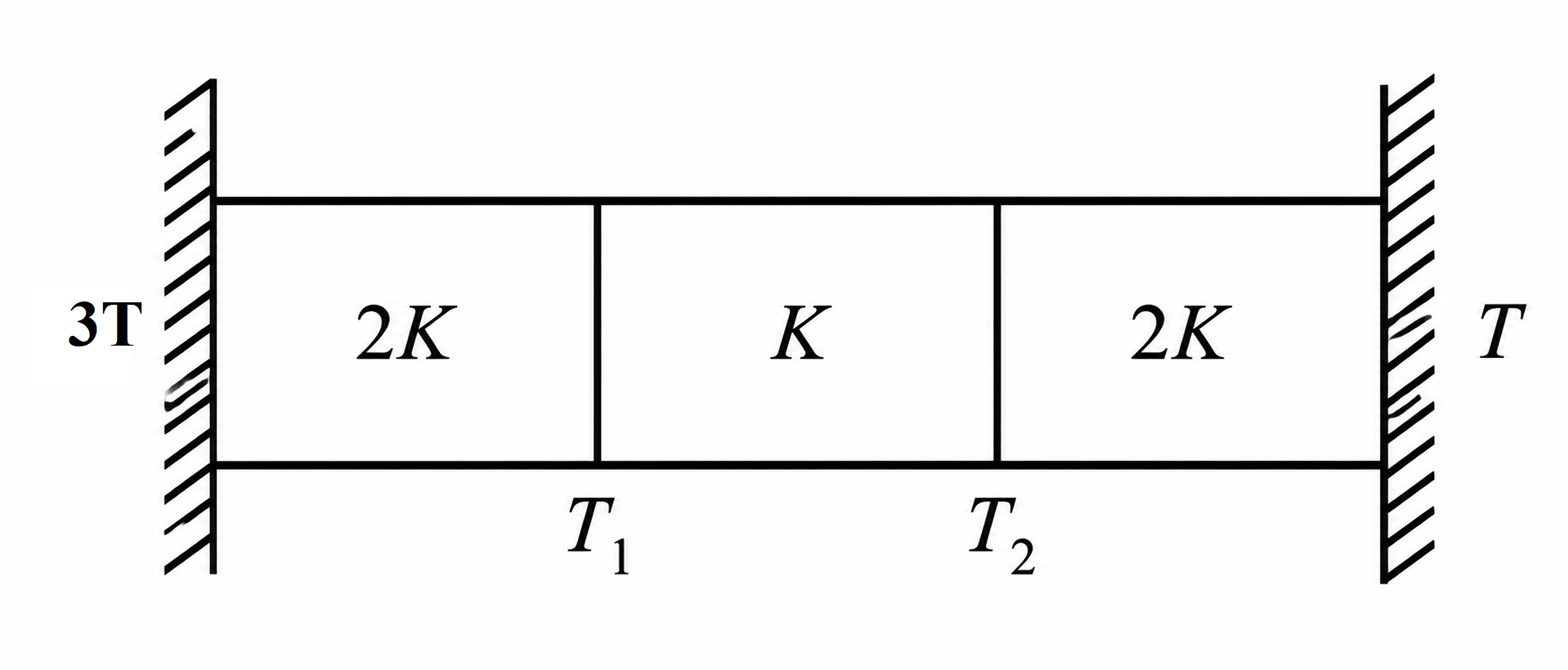
At steady state, dQ/dt = constant
∴ (dQ/dt)₁ = (dQ/dt)₂ = (dQ/dt)₃
2KA(3T - T₁)/L = KA(T₁ - T₂)/L = 2KA(T₂ - T)/L
⇒ 6T = 2T₁ = T₁ - T₂ = 2T₂ - 2T
⇒ 6T - 2T₁ = T₁ - T₂
∴ 6T + T₂ = 3T₁ ....(i)
Also, T₁ - T₂ = 2T₂ - 2T
∴ 2T - 3T₂ = - T₁ ...(ii)
From equations (i) and (ii),
10 T₂ = 6T₁
∴ T₁/T₂ = 5/3
The plates of a parallel plate capacitor are separated by d. Two slabs of different dielectric constant K₁ and K₂ with thickness 3/8 d and d/2, respectively are inserted in the capacitor. Due to this, the capacitance becomes two times larger than when there is nothing between the plates. (If K₁ = 1.25 K₂), the value of K₁ is :
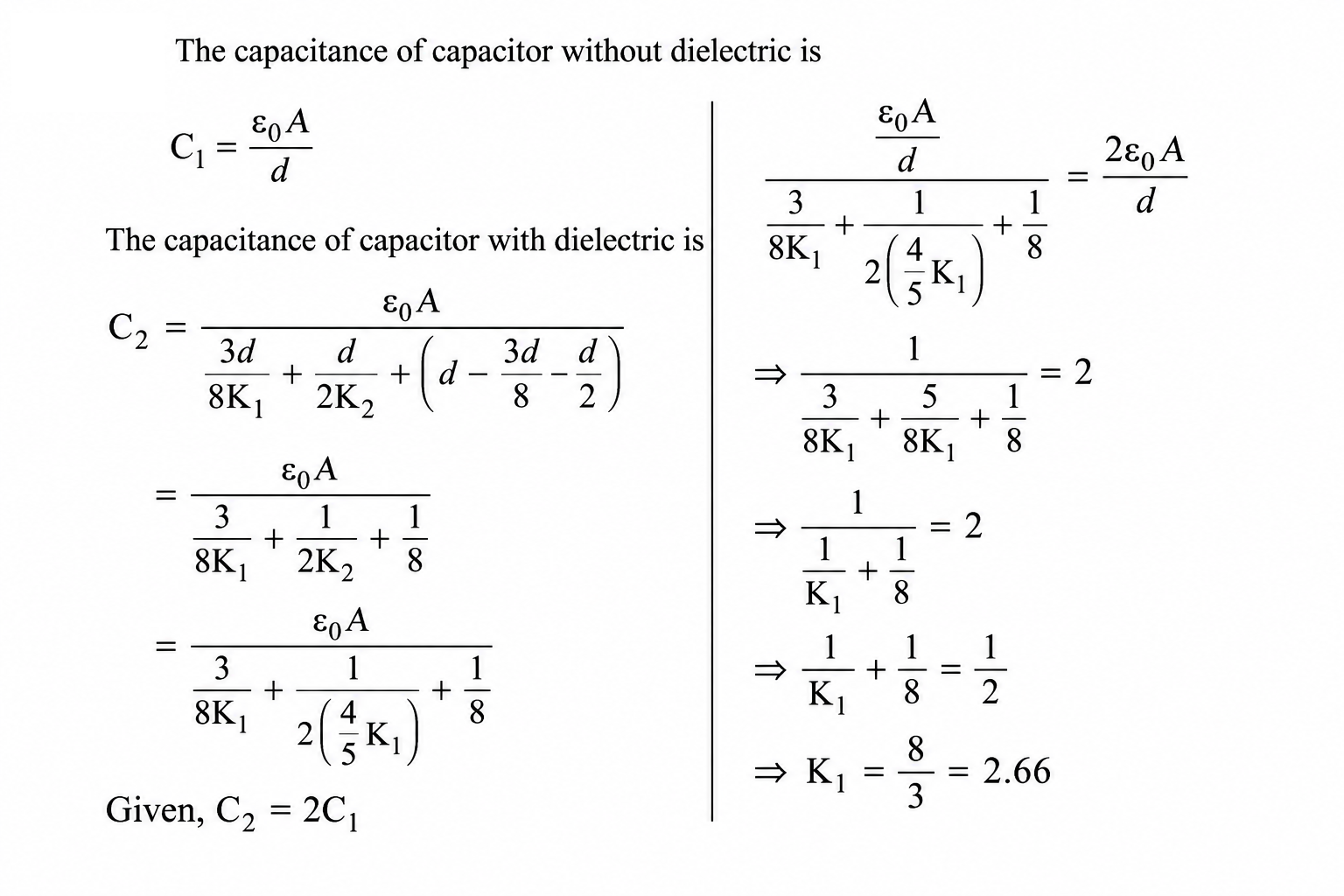
Two cities X and Y are connected by a regular bus service with a bus leaving in either direction every T min. A girl is driving scooty with a speed of 60 km/h in the direction X to Y notices that a bus goes past her every 30 minutes in the direction of her motion, and every 10 minutes in the opposite direction. Choose the correct option for the period of the bus . service and the speed (assumed constant) of the buses.
Given, t₁ = 30 min = 1/2 hr t₂ = 10 min = 1/6 hr V_B = Speed of Bus V_S = Speed of scooty (girl) As, bus and scooty moves same distance d between points X and Y. ∴ d = (V_B - V_S)t₁ = (V_B + V_S)t₂ ⇒ (V_B - 60)1/2 = (V_B +60)1/6 ⇒ 3V_B - 180 = V_B +60 ⇒ 2V_B = 240 ∴ V_B = 120 km/h Distance, d = (V_B - V_S)t₁ = (120 - 60)1/2 = 30 KM ∴ t = d/V_B = 30/120 = 1/4 = 15 min
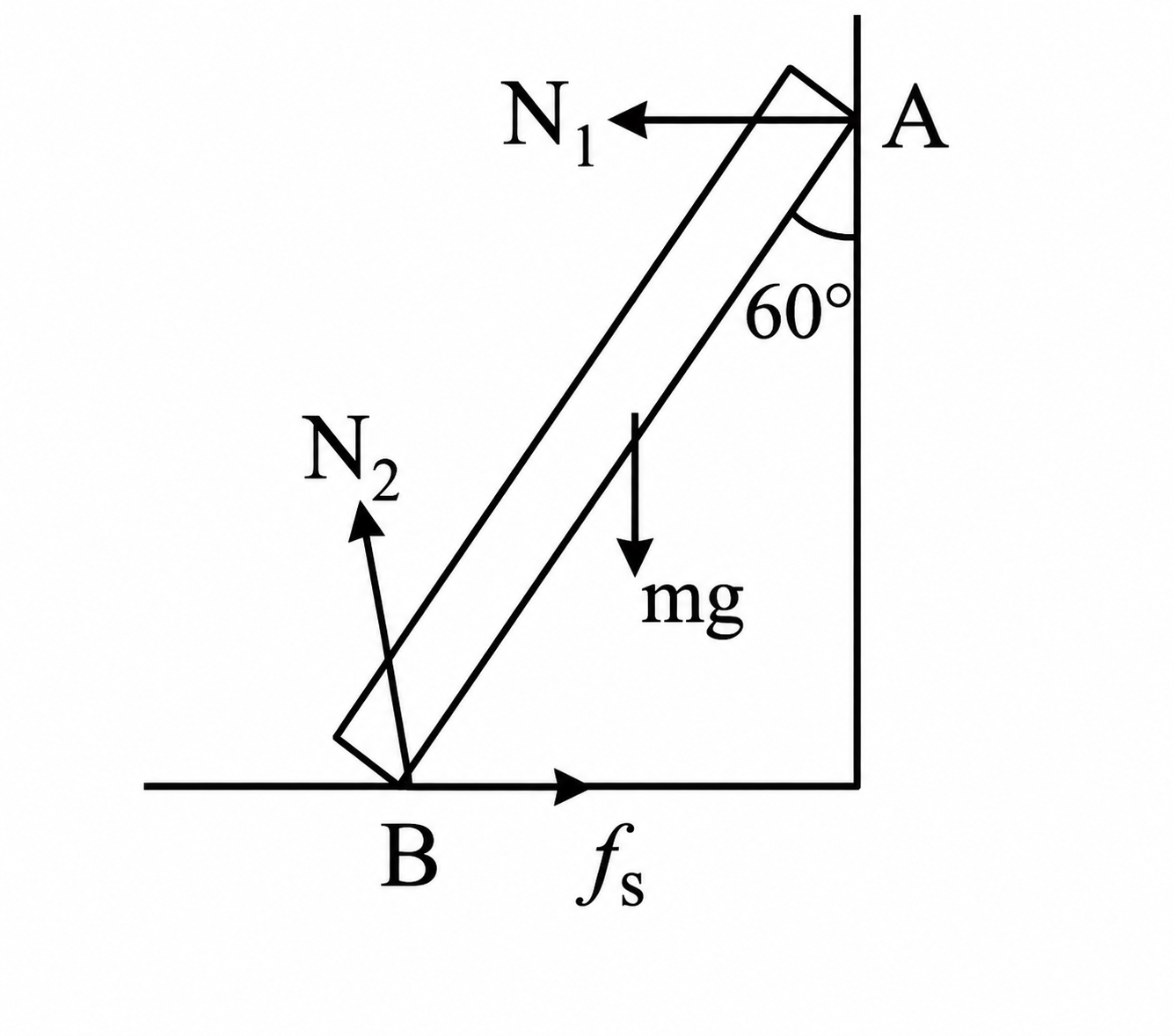
A uniform rod of mass 20 kg and length 5 m leans against a smooth vertical wall making an angle of 60° with it. The other end rests on a rough horizontal floor. The friction force that the floor exerts on the rod is (take g = 10 m/s²)
The FBD of the rod is
N₂ = mg = 200N Στ_A = 0 ⇒ fₛ L cos 60° + mg L/2 sin 60° = N₂L sin 60° ⇒ fₛ(1/2) + 200(1/2)√3/2 = 200 √3/2 ∴ fₛ = 100 √3 N
A balloon is made of a material of surface tension S and its inflation outlet (from where gas is filled in it) has a small area A. It is filled with a gas of density ρ and takes a spherical shape of radius R. When the gas is allowed to flow freely out of it, its radius changes from R to 0 (zero) in time T. If the speed v(r) of gas coming out of the balloon depends on r as rᵃ and T ∝ S^α Aᵝ ρᵞ Rᵟ then
Writing the dimensions of each and every term T(Time) = [T₁] S (Surface Tension) = F/l = [M¹l¹T⁻²]/[L¹] = [M¹T⁻²] A (Area) = [L⁻²] ρ (density) = [M¹L⁻³] R (Radius) = [L¹] Putting dacu all dimensions on the both side of equation and comparing T ∝ S^α Aᵝ ρᵞ Rᵟ [M⁰L⁰T⁰] = [MT⁻²][L²]ᵝ [ML⁻³]ᵞ [L]ᵟ [M⁰L⁰T⁰] = [M^α+ᵞ, L²ᵝ ⁺ ᵟ ⁻³ᵞ, T ^-2α ⇒ -2α = 1 α + δ = 0 ⇒ α = -1/2 γ = -α = 1/2 2β + γ - 3γ = 0 2β + δ - 3(1/2) = 0 ⇒ 2β + δ - 3/2
Consider the diameter of a spherical object being measured with the help of a Vernier calipers. Suppose its 10 Vernier Scale Divisions (V.S.D.) are equal to its 9 Main Scale Divisions (M.S.D.). The least division in the Main Scale is 0.1 cm and the zero of V.S. is at x = 0.1 cm when the jaws of Vernier calipers are closed. If the main scale reading for the diameter is M = 5 cm and the number of coinciding vernier division is 8, the measured diameter after zero error correction is,
Least count of main scale 10 V.S.D. = 9 M.S.D. Given, 1 M.S.D. = 0.1 cm
Positive zero error = 0.1 cm (Given)
1 V.S.D.= 0.9 M.S.D.
1 V.S.D.=0.9×0.1 cm
V.S.D.=0.09 cm
L.C. = 1 M.S.D.− 1 V.S.D. = (0.1−0.09) cm = 0.01 cm
Total reading = 5.08 cm
Apply zero error correction: (5.08−0.1) cm = 4.98 cm
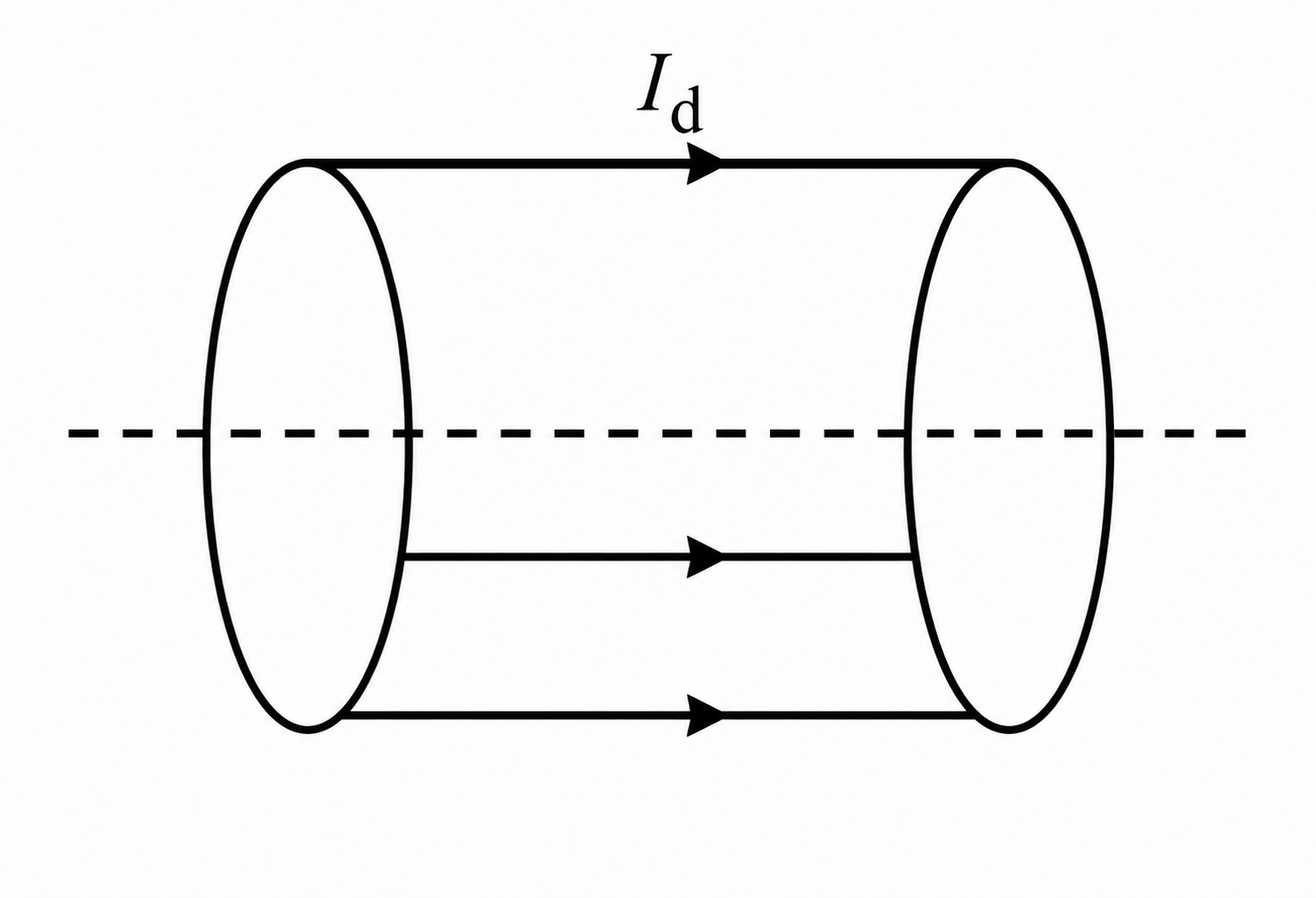
A parallel plate capacitor made of circular plates is being charged such that the surface charge density on its plates is increasing at a constant rate with time. The magnetic field arising due to displacement current is:
When a capacitor is charging, the changing electric field between the plates produces a displacement current I_d given by I_d = ε₀dΦₑ/dt = ε₀d/dt(EA cos°) I_d = ε₀ AdE/dt The electric field, (E) = σ/ε₀ ; I_d = ε₀ A d/dt (σ/ε₀) I_d = A(dσ/dt) = constant The magnetic field (B) is non-zero both inside and outside. It peaks at =R (the periphery)
An unpolarized light beam travelling in air is incident on a medium of refractive index 1.73 at Brewster’s angle. Then
Given: n = 1.73 At Brewester’s angle θ_B, the reflected light is completely polarized, and the reflected and refracted rays are at 90° to each other. tan θ_B = n ⇒ θ_B = tan t (l.73.) θ_B = 60° Using law of reflection iₚ = r = 60°
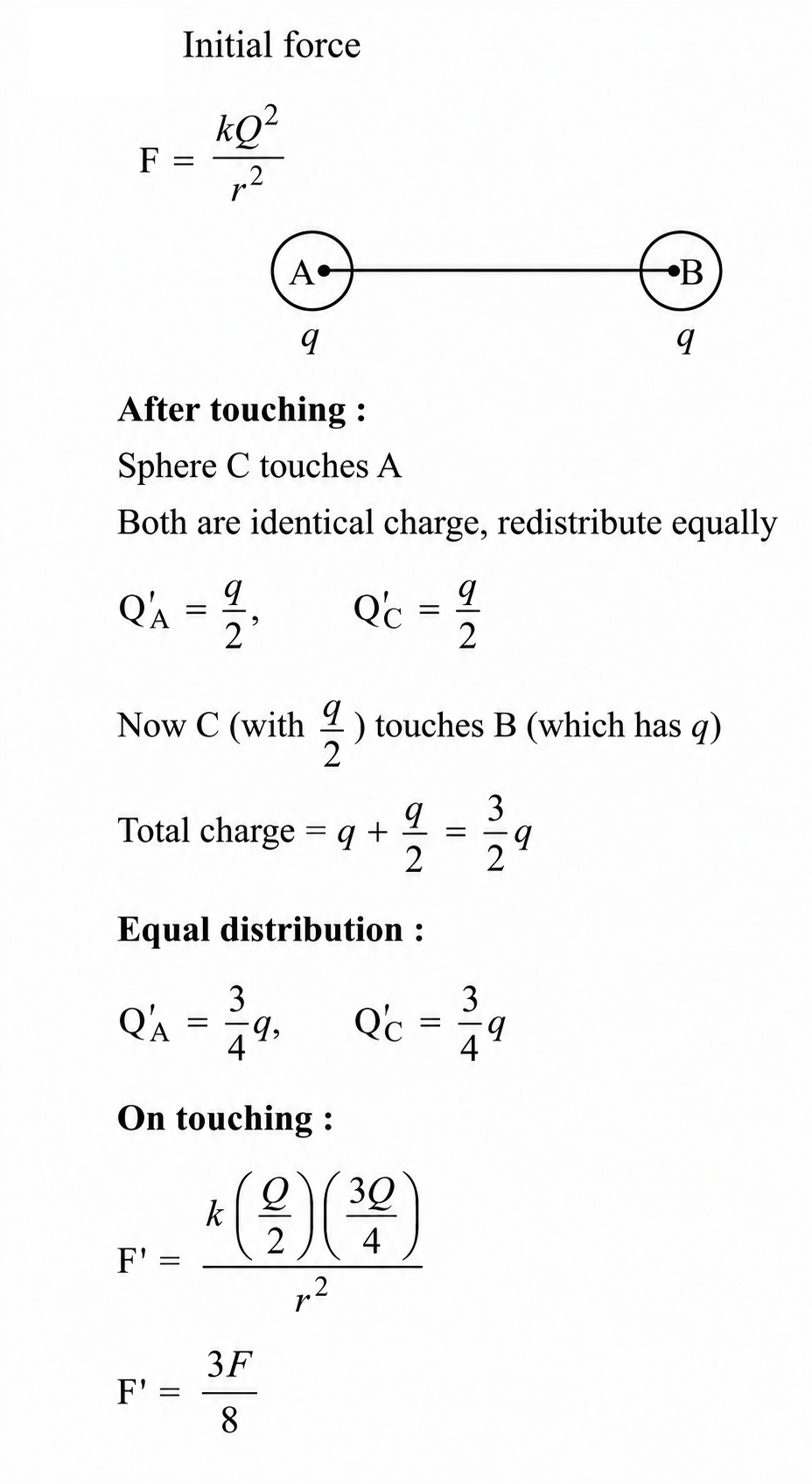
Two identical charged conducting spheres A and B have their centres separated by a certain distance. Charge on each sphere is q and the force of repulsion between them is F. A third identical uncharged conducting sphere is brought in contact with sphere A first and then with B and finally removed from both. New force of repulsion between spheres A and B (Radii of A and B are negligible compared to the distance of separation so that for calculating force between them they can be considered as point charges) is best given as :
3F/8
A container has two chambers of volumes V₁ =2 litres and V₂ =3 litres separated by a partition made of a thermal insulator. The chambers contains n₁ =5 and n₂ = 4 moles of ideal gas at pressures p₁ = 1 atm and p₂ = 2 atm, respectively. When the partition is removed, the mixture attains an equilibrium pressure of :
Given, V₁ =2 L, n₁ =5 mol, p₁ =1 atm V₂ =3 L, n₂ = 4 mol, p₂ = 2 atm Using the principle of total pressure after mixing P_final = P₁V₁+P₂V₂ / V₁+V₂ P_final = 1×2+2×3 / 2+3 = 2+6 / 5 = 8/5
P_final = 1.6 atm
A particle of mass m is moving around the origin with a constant force F pulling it towards the origin. If Bohr model is used to describe its motion, the radius r of the ntʰ orbit and the particle’s speed v in the orbit depend on n as
mv²/r = F (centripetal force) ⇒v² = Fr/m ...(i) Bohr’s quantization condition mvr = nh/2π ⇒ v = nh/2πmr (ii) From equation (i), mr(nh/2πmr)² = F ⇒ n²h²/4π²mF = r³ ⇒ r³ ∝ n² ⇒ r ∝ n²ᐟ³ From equation (ii) v ∝ n/r ∝n/n²ᐟ³ ⇒ v ∝ n¹ᐟ³
A body weighs 48 N on the surface of the earth. The gravitational force experienced by the body due to the earth at a height equal to one-third the radius of the earth from its surface is :
Given : weight of the body on surface of the earth = 48 N
W'= mg' = mg (R/R+h)² ∴ g' = g(R/R+h)² = 48(R/R+R/3)² = 48 × 9/16 = 27 N
De-Broglie wavelength of an electron orbiting in the n = 2 state of hydrogen atom is close to (Given Bohr radius = 0.052 nm)
Given n = 2, Z = 1 for hydrogen atom
2πr = nλ
2π×(0.052 n²/Z) = nλ
∴ r = 0.052 h²/z
λ = 0.67 nm
An electric dipole with dipole moment 5×10⁻⁶ C m is aligned with the direction of a uniform electric field of magnitude 4×10⁵ N/C. The dipole is then rotated through an angle of 60° with respect to the electric field. The change in the potential energy of the dipole is:
Given, (Dipole moment) p =5 × 10⁻⁶ Cm (Electric Field) E = 4 × 10⁵ N/C θ_d = 0° θ_f = 60°
ΔU = U_f - U₁ (CHange in p.E.)
= - pEcos θ₁ - (-pEcos θ_q) ⇒ pE (cos θ₁ - cos θ_f) ⇒ 5 × 10⁻⁶ × 4 × 10⁵ (1 - 1/2) = 1J
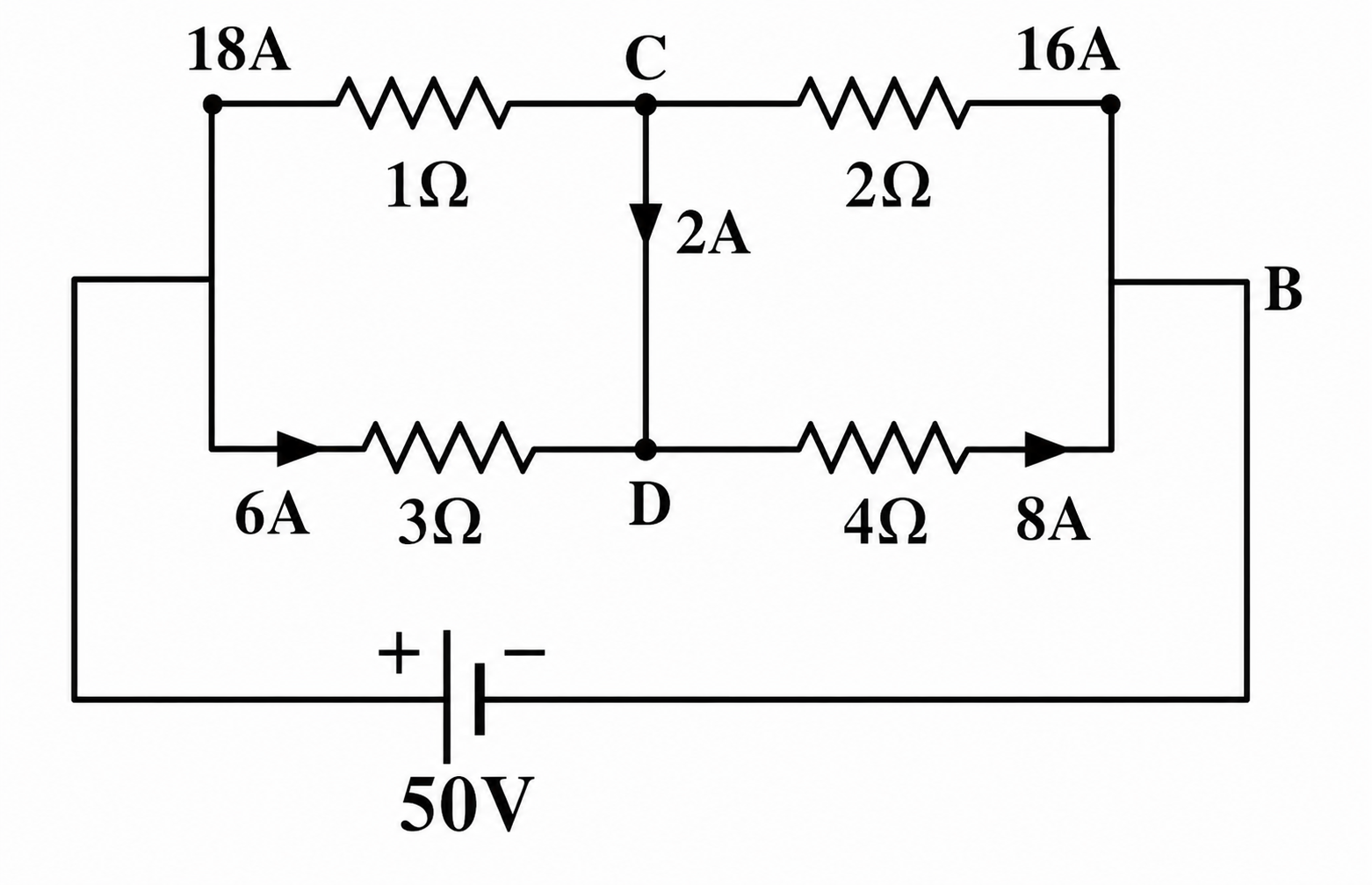
A constant voltage of 50 V is maintained between the points A and B of the circuit shown in the figure. The current through the branch CD of the circuit is:
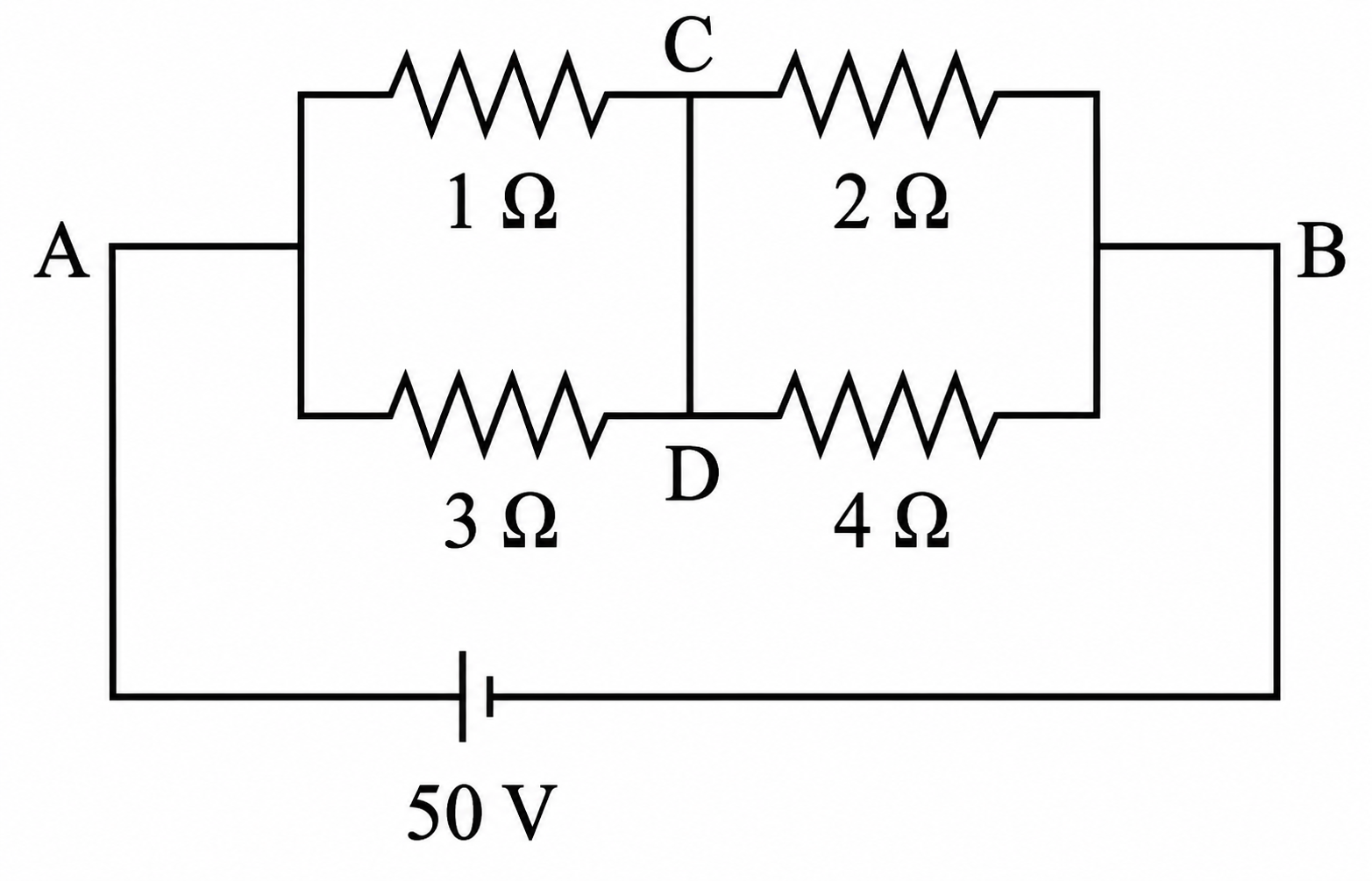
Voltage across 1 Ω = 18 V, Voltage across 2 Ω = 32 V Applying Kirchhoff’s Current Law (KCL): Current in branch CD = 18 − 16 = 2 A
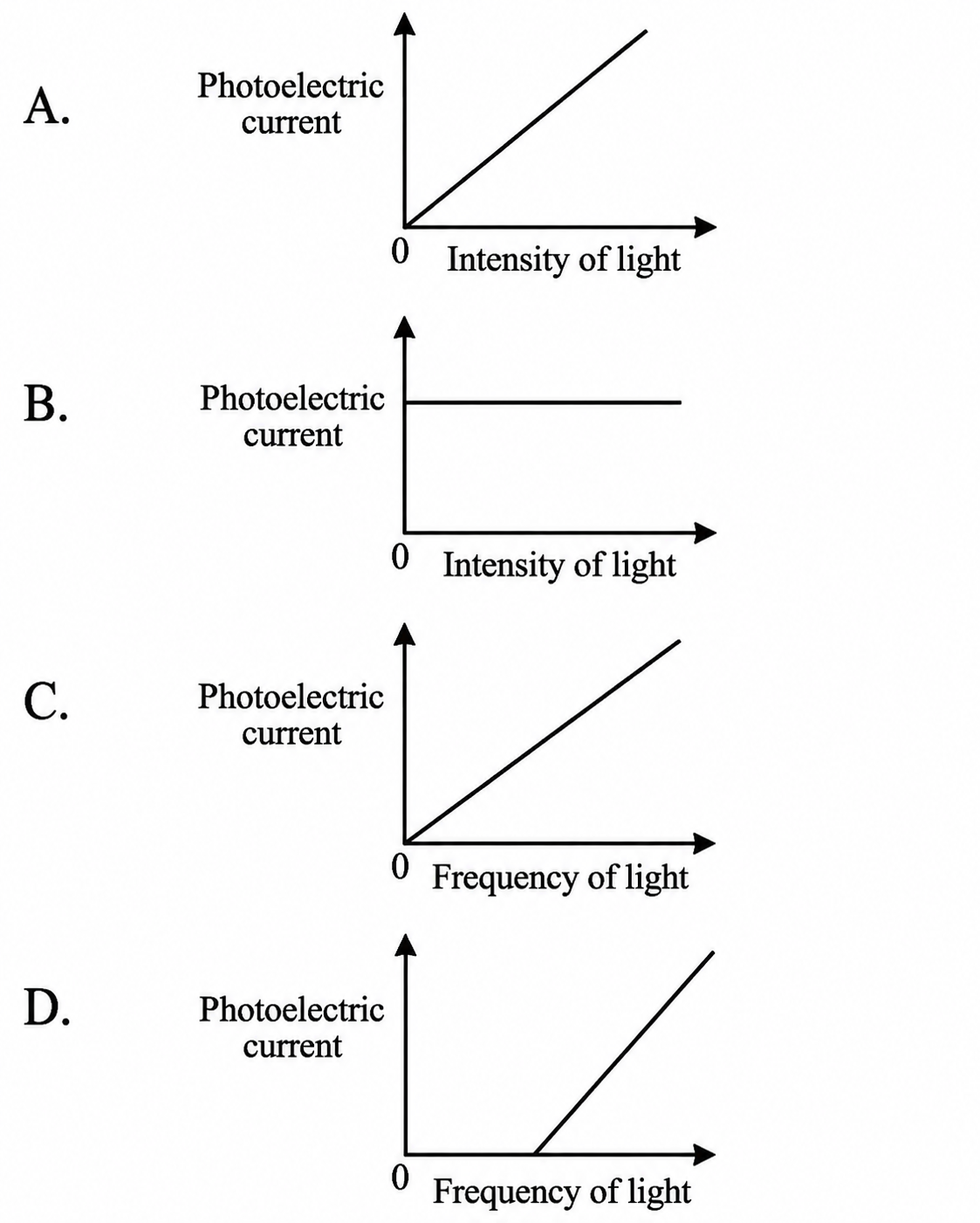
A photon and an electron (mass m) have the same energy E. The ratio (λₚₕₒₜₒₙ/λ_electron) of their de-Broglie wavelengths is ( c is the speed of light):
Photon & electron will have same energy E
E(photon) = hc/λ and E(electron) = h/√(2m/E) λₚₕₒₜₒₙ/λ_electron = hc/E/ h/√(2mE) = c√(2m/E)
A full wave rectifier circuit with diodes (D₁) and (D₂) is shown in the figure. If input supply voltage Vᵢₙ =220 sin (100 π t) volt, then at t = 15 msec
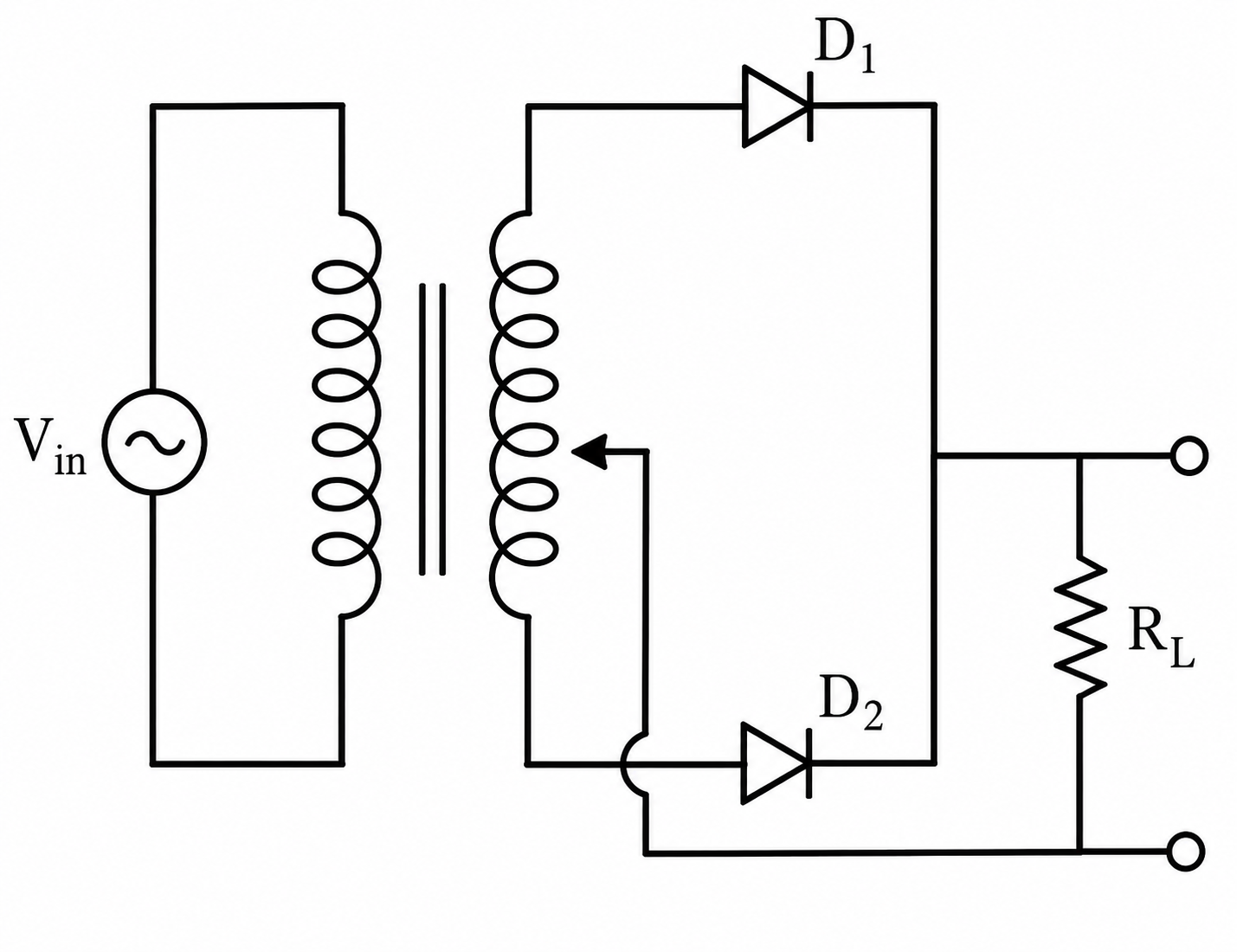
Given: =15 msec putting it in given equation Vᵢₙ = 220 sin (100 π × 15 × 10⁻³) = 220 sin (3π/2) = -220 V Hence, diode D₁ will be in reverse bias and D₂ will be in forward bias.
Two gases A and B are filled at the same pressure in separate cylinders with movable pistons of radius r_A and r_B, respectively. On supplying an equal amount of heat to both the systems reversibly under constant pressure, the pistons of gas A and B are displaced by 16 cm and 9 cm, respectively. If the change in their internal energy is the St e same, then the ratio r_A/r_B is equal to
According to question Pressure is constant P_A = P_B ΔU_A = Q - W_A ΔU_B = Q - W_B Given ΔU_A = ΔU_B, So W_A = W_B P_AΔV_A = P_BΔV_B
(πr²_A)x_B = (πr²_B)x_A r_A/r_B = √(x_B/x_A) = √(9/16) = 3/4
A physical quantity P is related to four observations a, b, c and d as follows: P = a³b²/c√d
The percentage errors of measurement in a, b, c and d are 1%, 3%, 2% and 4% respectively. The percentage error in the quantity P is
Given, a³b²c⁻¹d⁻¹ᐟ²
(ΔP/P ×100) = (3Δa/a + 2Δb/b + 1Δc/c + 1/2. 3Δd/d) × 100 = 3(1%) + 2(3%) + 1(2%) + 1/2(4%) = 13%
The intensity of transmitted light when a polaroid sheet, placed between two crossed polaroids at 22.5° from the polatization axis of one of the polaroid, is (I₀ is the intensity of polarised light after passing through the first polaroid):
I₀/8
Two identical point masses P and Q, suspended from two separate massless springs of spring constants k₁ and k₂, respectively, oscillate vertically. If their maximum speeds A are the same, the ratio (A_Q/A_P) of the amplitude A_Q of mass Q to the amplitude A_P of mass P is :
Given m_P = m_Q Also (Vₘₐₓ)_P = (Vₘₐₓ)_Q
Also (Vₘₐₓ)_P = A_Qω_Q
∵ v = Aω
∴ A_P √(k₁/m_P) = A_Q √( k₂/m_Q)
[∵ ω =√(k /m)]
∴ A_Q/A_P = √(k₁ /k₂)
Three identical heat-conducting rods are connected in series as shown in the figure. The rods on the sides have thermal conductivity 2K while that in the middle has thermal conductivity K. The left end of the combination is maintained at temperature 3T and the right end at T. The rods are thermally insulated from outside. In steady state, the temperature at the left junction is T₁ and that at the right junction is T₂. The ratio T₁/T₂ is
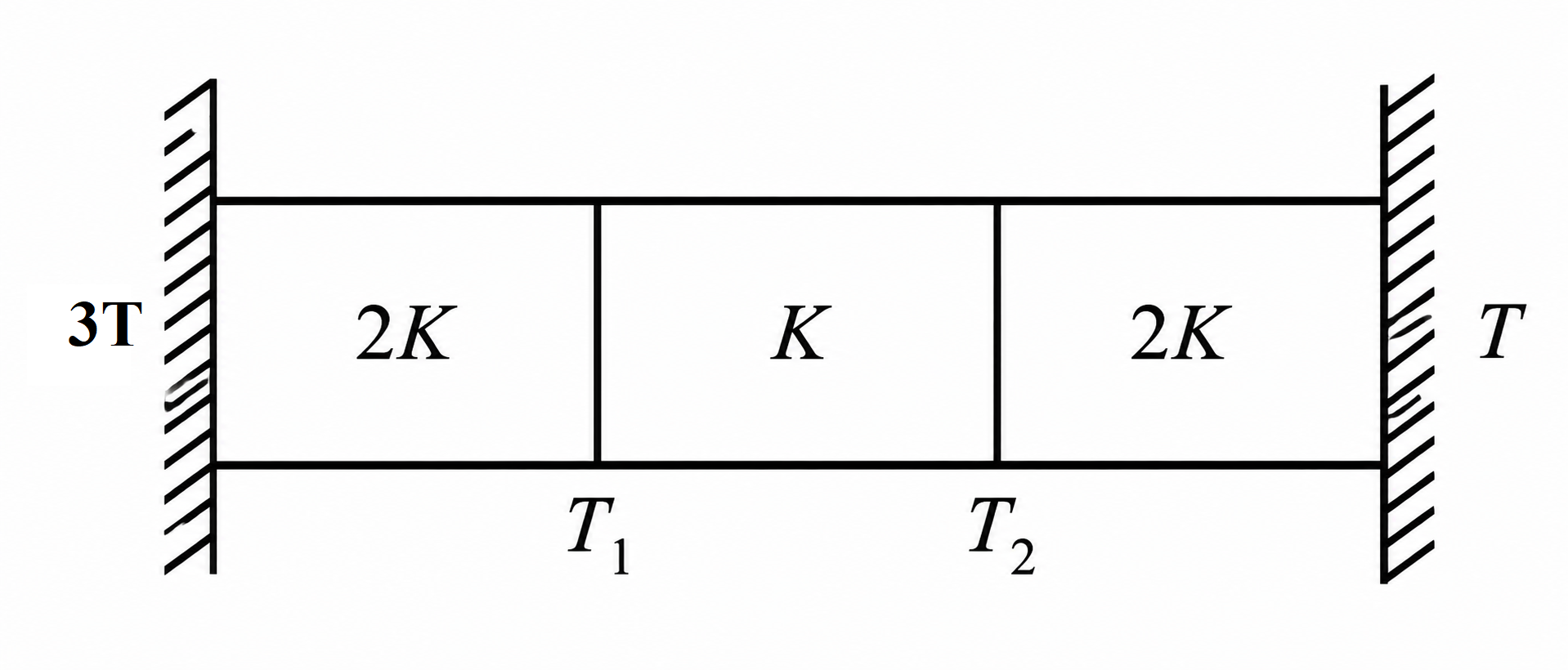
At steady state, dQ/dt = constant
∴ (dQ/dt)₁ = (dQ/dt)₂ = (dQ/dt)₃
2KA(3T - T₁)/L = KA(T₁ - T₂)/L = 2KA(T₂ - T)/L
⇒ 6T = 2T₁ = T₁ - T₂ = 2T₂ - 2T
⇒ 6T - 2T₁ = T₁ - T₂
∴ 6T + T₂ = 3T₁ ....(i)
Also, T₁ - T₂ = 2T₂ - 2T
∴ 2T - 3T₂ = - T₁ ...(ii)
From equations (i) and (ii),
10 T₂ = 6T₁
∴ T₁/T₂ = 5/3
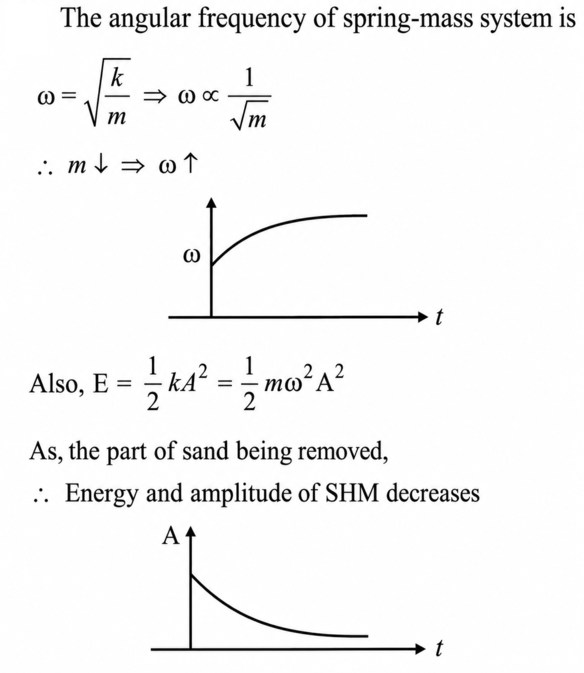
In an oscillating spring mass system, a spring is connected to a box filled with sand. As the box oscillates, sand leaks slowly out of the box vertically so that the average frequency ω (t) and average amplitude A(t) of the system change with time t. Which one of the following options schematically depicts these changes correctly?
-
(A)
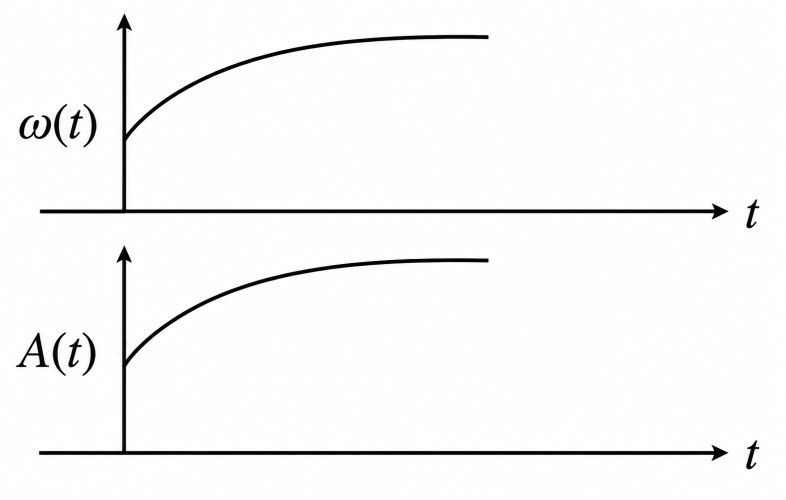
-
(B)
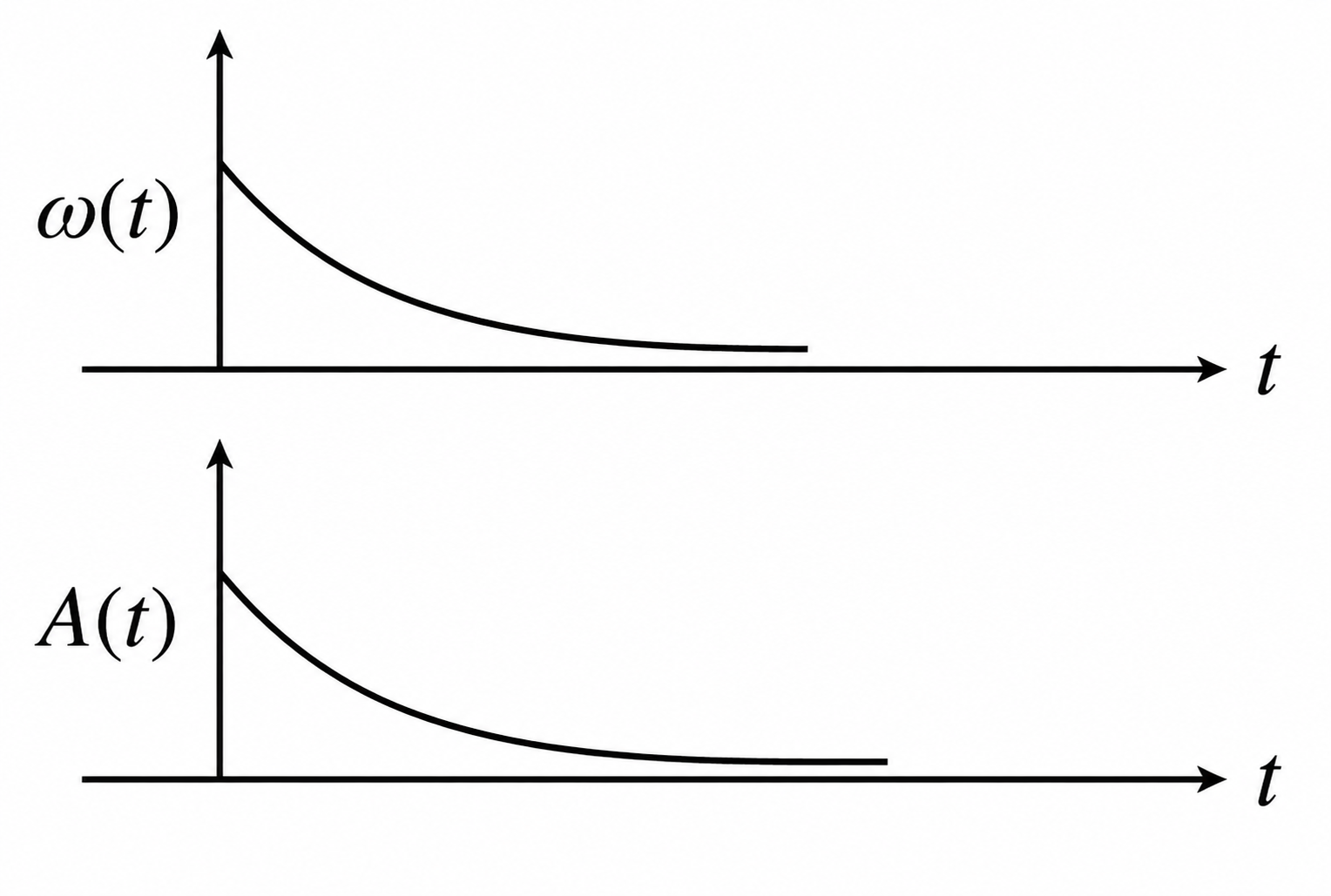
-
(C)
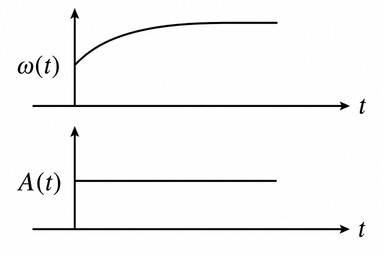
-
(D)
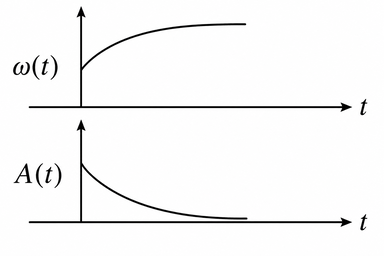
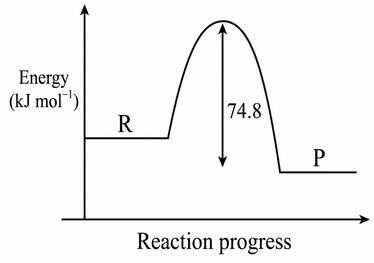
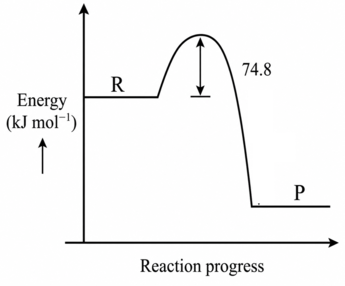
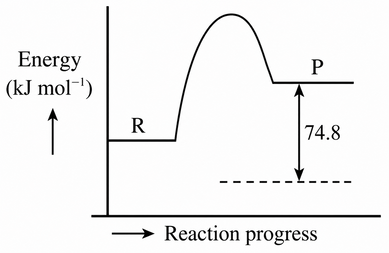
C(s) + 2H₂(g) → CH₄(g); ΔH = −74.8 kJ mol⁻¹
Which of the following diagrams gives an accurate representation of the above reaction?
[R = reactants, P = products]
-
(A)
-
(B)
-
(C)
-
(D)
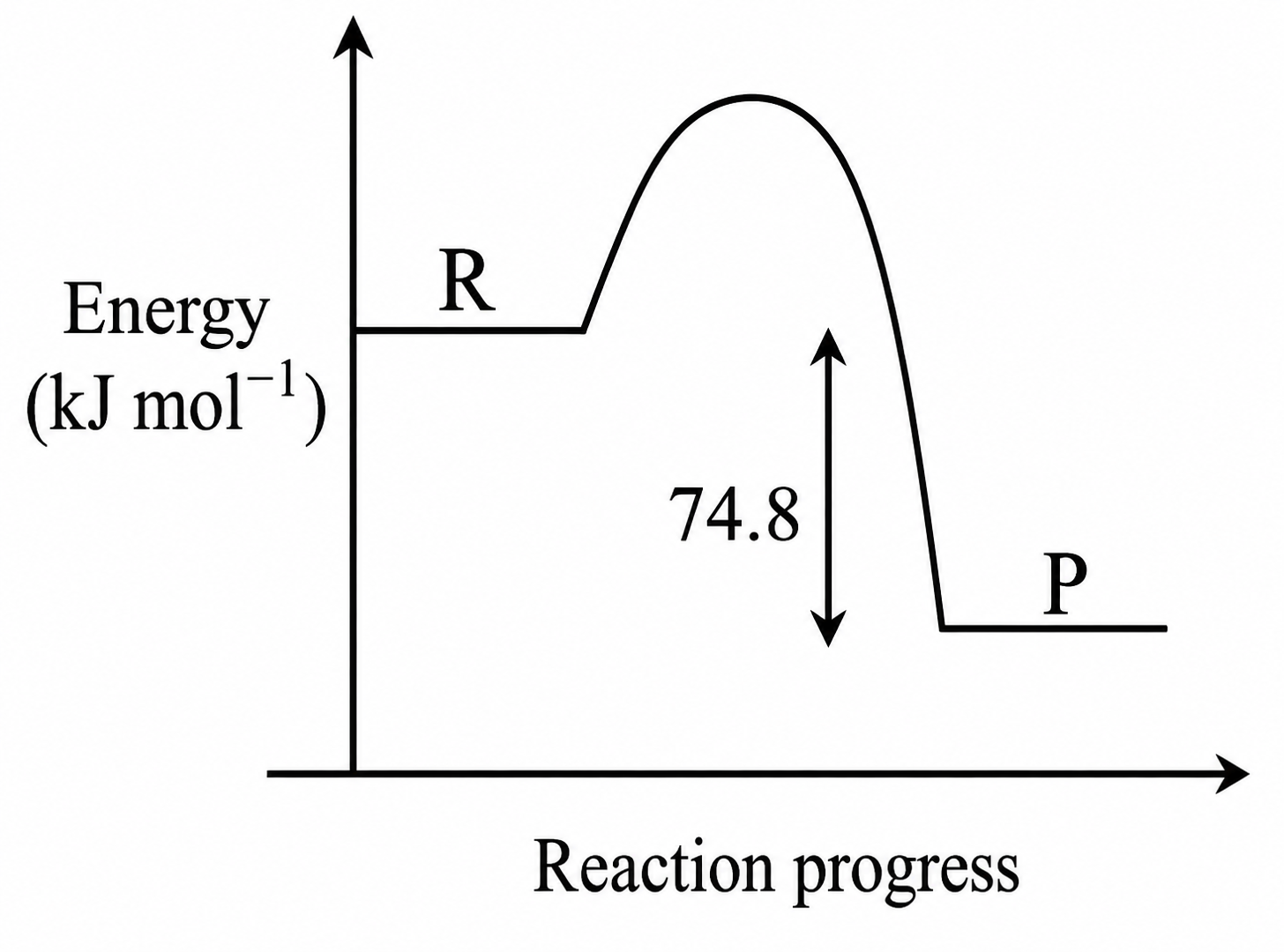
ΔH = H_Products−H_Reactants= Negative
⇒ H_Products < H_Reactants
Therefore, the energy of the reactants will be higher than that of the products.
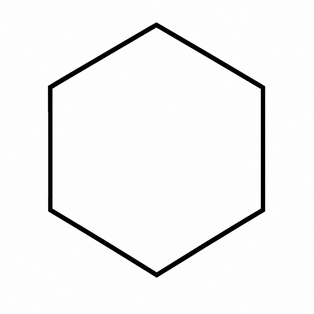
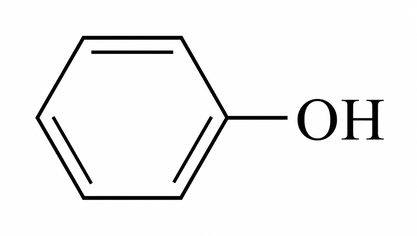
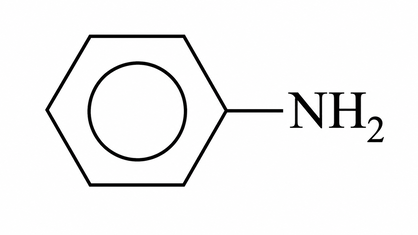
Which one of the following compounds does not decolourize bromine water ?
-
(A)
-
(B)
-
(C)
-
(D)
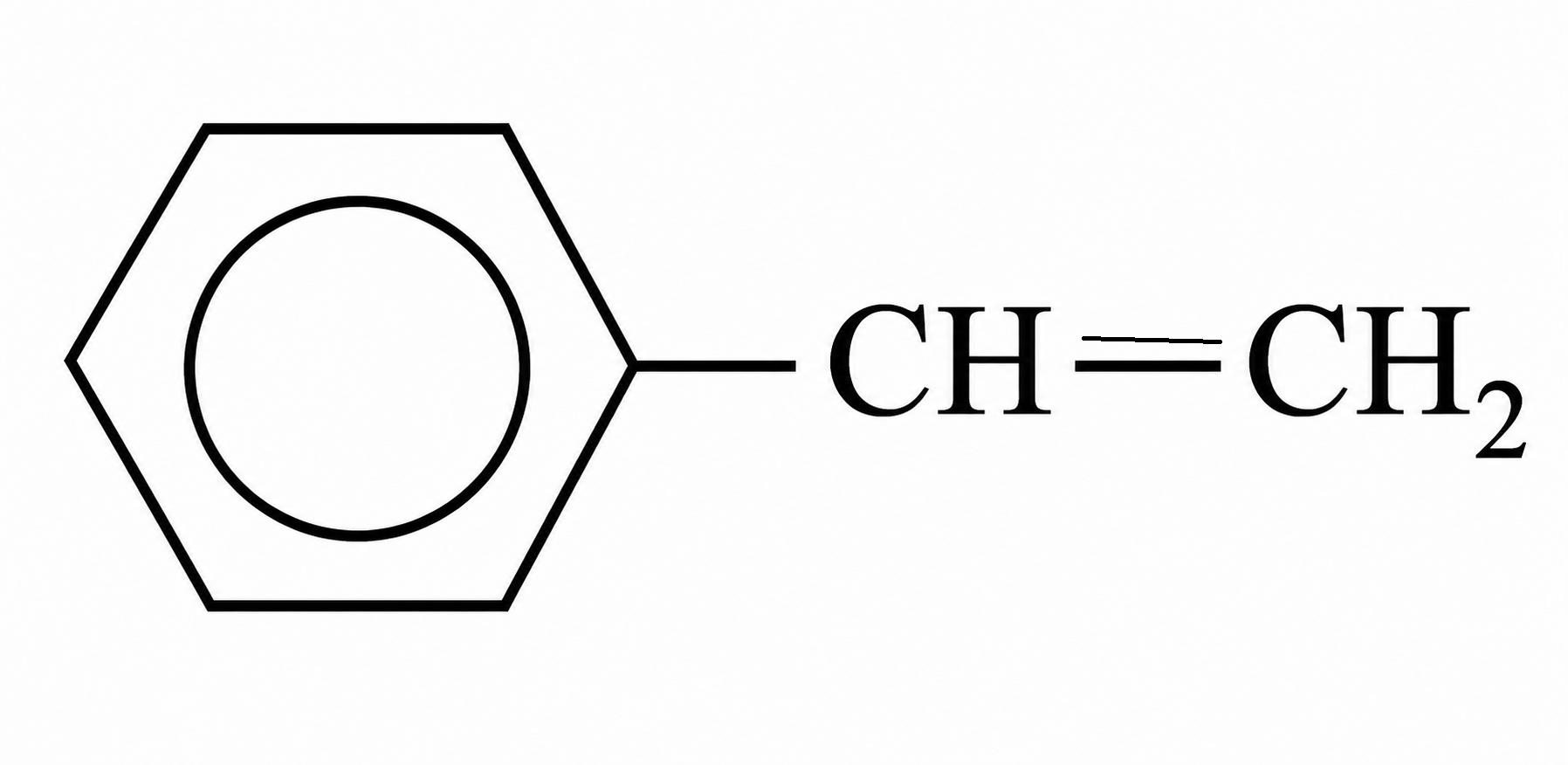
Bromine water decolourizes in compounds which have C=C bonds or with functional groups that react with it.
Br₂–H₂O does not react with cyclohexane.
Phenol and aniline give tri-substituted products with Br₂–H₂O.
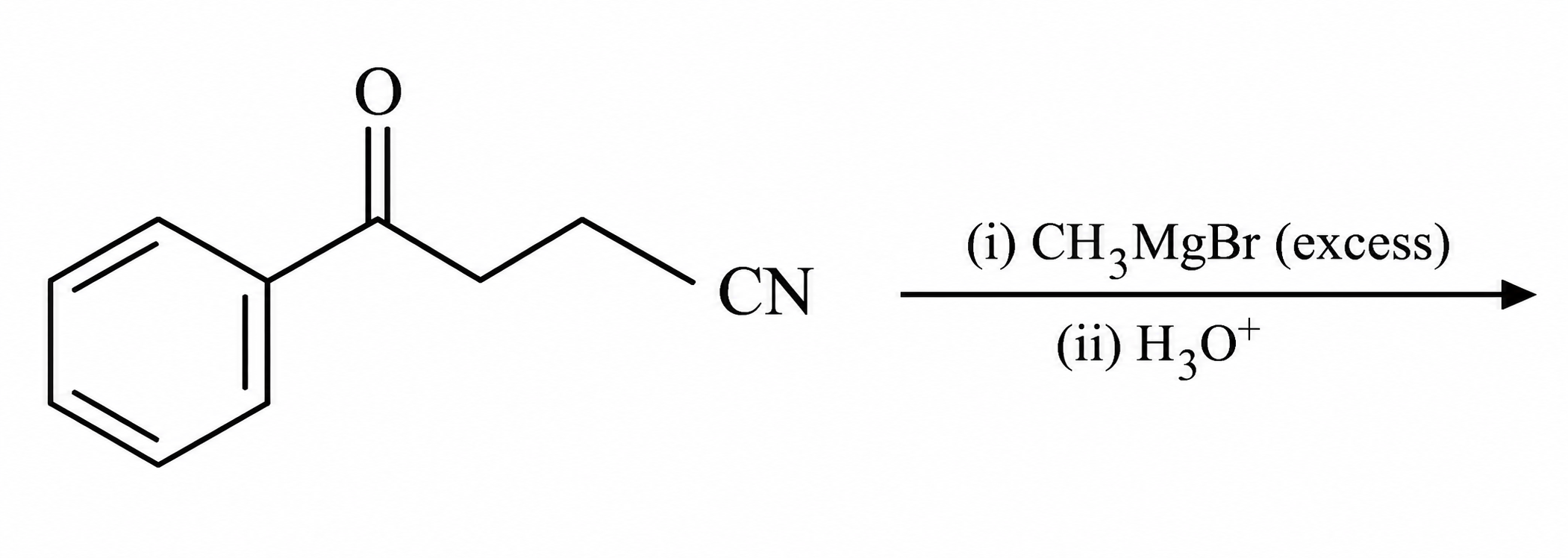
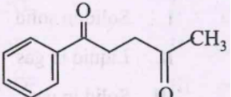
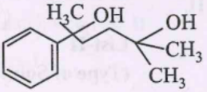
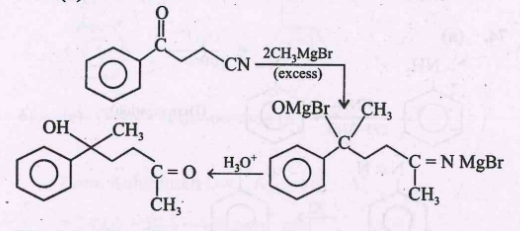
The major product of the following reaction is
-
(A)
-
(B)
-
(C)
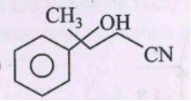
-
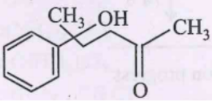
(D)
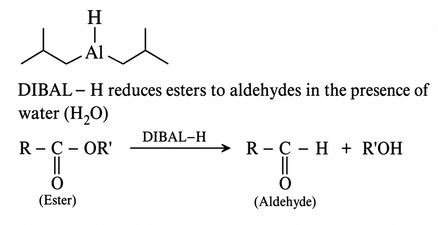
Identify the suitable reagent for the following conversion
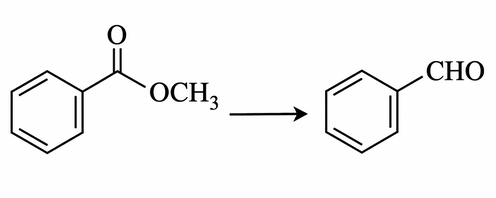
DIBAL- H ⇒ It is Diisobutyl aluminium hydride which is a reducing agent with the formula AIH (iBu)₂ and the structure is
Other Years