CBSE EXAMINATION PAPER-2021
NEET-ZOOLOGY
(Solved)
General Instructions :
Read the following instructions carefully and follow them :
- This question paper contains 200 questions. All questions are compulsory.
- This question paper is divided into 1 sections.
- Section A – questions number 1 to 200 are multiple choice questions
- There is no overall choice given in the question paper. However, an internal choice has been provided in few questions.
- Use of calculator is NOT allowed.
Section A
A body is executing simple harmonic motion with frequency 'n', the frequency of its potential energy is
Displacement of particle executing
SHM y = Asin(ωt + ϕ) ...(i)
Potential energy U = 1/2 ky²
or, U = 1/2 kA² sin²(ωt + ϕ) ...(ii)
From eq. (i) and (ii),
Time period of y = Asin(ωt + ϕ)
T₁ = 2π/ω
∴ Frequency n₁ = ω/2π and time period of y² = A²sin²(ωt + ϕ) T₂ = π/ω
∴ Frequency n₂ = ω/π
∴ n₂ = 2n₁ = 2n
Potential energy varies periodically with double the frequency of SHM. It is maximum and equal to total energy at extreme position and minimum at mean position.
Polar molecules are the molecules
In polar molecules, like HCl → Hᵟ⁺ Clᵟ⁻ the centre of positive charges does not coincide with the centre of negative charges. Hence, permanent electric dipole exists.
Column-I gives certain physical terms associated with flow of current through a metallic conductor. Column-II gives some mathematical relations involving electrical quantities. Match Column-I and Column-II with appropriate relations.
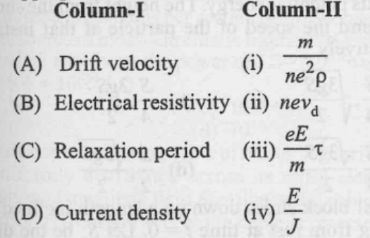
Drift velocity, v Subscript (d)= I/neA = eEτ/m
Electrical resistivity, ρ = 1/σ = E/J (∵ σ = J/E)
Relaxation period, τ = m/(ne²ρ)
Current density, J = I/A = nev₍d₎
(A) - (iii), (B) - (iv), (C) - (i), (D) - (ii)
Relation between drift velocity, v₍d₎, electrical resistivity (ρ), relaxation period (τ) and current density (J)
v_d = i / neA = J/ne = σE/ne = E/ρne = V/ρlne ;
R = ρl/A = m/(ne²τ) · l/A
Two charged spherical conductors of radius R₁ and R₂ are connected by a wire. Then the ratio of surface charge densities of the spheres (σ₁/σ₂) is
Charge density σ = charge / area When two conductors are connected by a conducting wire, then they have same potential i.e., V₁ = V₂ ∴ 1/(4πε₀) · Q₁/R₁ = 1/(4πε₀) · Q₂/R₂ ⇒ 1/(4πε₀) · Q₁/R₁ × R₁/R₁ = 1/(4πε₀) · Q₂/R₂ × R₂/R₂ ⇒ Q₁R₁ / (4πR₁²ε₀) = Q₂R₂ / (4πR₂²ε₀) ∴ [Q₁ / (4πR₁²)] / [Q₂ / (4πR₂²)] = R₂ / R₁ or, σ₁/σ₂ = R₂ / R₁
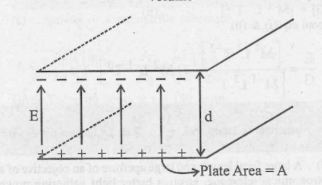
A parallel plate capacitor has a uniform electric field E vector in the space between the plates. If the distance between the plates is 'd' and the area of each plate is 'A', the energy stored in the capacitor is (ε₀ = permittivity of free space)
Energy density i.e. energy / volume with electric field [Plate Area = A] u = dU / dV = 1/2 ε₀E² ⇒ dU = 1/2 ε₀E² dV ∴ Energy stored in the capacitor U = ∫ dU = ∫ 1/2 ε₀E² dV = 1/2 ε₀E² ∫ dV = 1/2 ε₀E² V ∴ U = 1/2 ε₀E² Ad [∵ V = Ad]
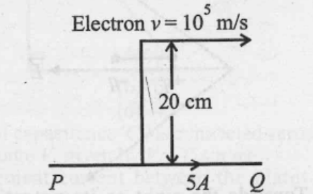
An infinitely long straight conductor carries a current of 5 A as shown. An electron is moving with a speed of 10⁵ m/s parallel to the conductor. The perpendicular distance between the electron and the conductor is 20 cm at an instant. Calculate the magnitude of the force experienced by the electron at that instant.
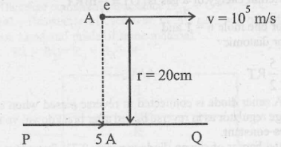
Magnetic field due to a current carrying wire at a distance r from the wire. or, B = (10⁻⁷ × 2 × 5) / (20 × 10⁻²) = 1/2 × 10⁻⁵ B = (μ₀ / 4π) · (2I / r) = (4π × 10⁻⁷ × 2 × 5) / (4π × 20 × 10⁻²) or, B = (10⁻⁷ × 2 × 5) / (20 × 10⁻²) = 1/2 × 10⁻⁵ B upward to the plane of paper Therefore, force acting on electron Fvector = q(vvector × Bvector) |Fvector| = 1.6 × 10⁻¹⁹ × 10⁵ × 1/2 × 10⁻⁵ = 8 × 10⁻²⁰ N
If E and G respectively denote energy and gravitational constant, then E/G has the dimensions of
Dimensional formula of energy E = 1/2 mv² [E] = [M¹ L² T⁻²] ...(i) Dimensional formula of gravitational constant G = Fr² / (m₁m₂) [G] = [M⁻¹ L³ T⁻²] ...(ii) From eq. (i) & (ii) ∴ E/G = [M¹ L² T⁻²] / [M⁻¹ L³ T⁻²] = [M² L⁻¹ T⁰]
Numerical constant like, ½, 1, 2 or 2π has no dimension.
A lens of large focal length and large aperture is best suited as an objective of an astronomical telescope since
A large focal length and large aperture of an objective of an astronomical telescope, ensures better light gathering power, and resolution so contributes to the quality and visibility of the images of the far-off objects. Resolving power of a telescope RP = a / (1.22λ) , a = aperture of the objective. And resolving limit of telescope dθ = 1.22λ / a
Match Column - I and Column - I and choose the correct match from the given choices.
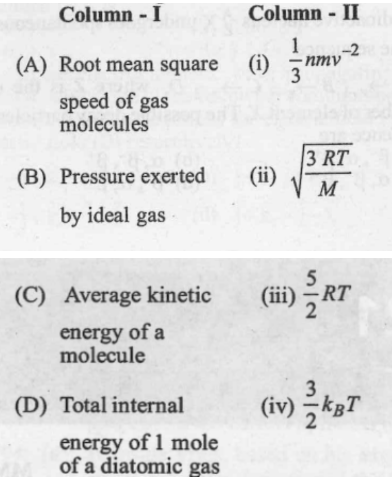
Root mean square RMS speed of gas molecule vsubscript(RMS) = √(3 RT / M) Pressure exerted by ideal gas P = 1/3 nmv̄² Average kinetic energy of a molecule = 3/2 ksubscript(B) T Total internal energy of a gas is (U) = 1/2 nfRT Here, for one mole n = 1 and f = 5 for diatomic ∴ U = 5/2 RT
Consider the following statements (A) and (B) and identify the correct answer.
(A) A zener diode is connected in reverse bias, when used as a voltage regulator.
(B) The potential barrier of p-n junction lies between 0.1 V to 0.3 V.
• A zener diode is connected in reverse biased when used as voltage regulator as in reverse biased after breakdown, voltage becomes constant.
• Potential barrier of silicon diode is nearly 0.7V Statement A is correct and statement B is incorrect.
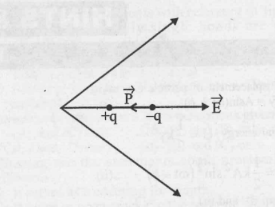
A dipole is placed in an electric field as shown. In which direction will it move?
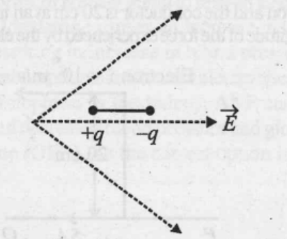
Potential energy of electric dipole in external electric field U = −Pvector · Evector = −PE cos θ = −PE cos 180° Since angle between Evector and Pvector is 180° ∴ U = +PE On moving towards right electric field strength decrease ∴ U decreases. Net force on electric dipole is towards right and net torque acting on it is zero so move towards right.
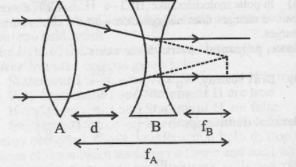
A convex lens 'A' of focal length 20 cm and a concave lens 'B' of focal length 5 cm are kept along the same axis with a distance 'd' between them. If a parallel beam of light falling on 'A' leaves 'B' as a parallel beam, then the distance 'd' in cm will be
From the ray diagram light refracted from convex lens virtually meet at focus of concave lens ∴ d = f subscript A - f subscript B = 20 - 5 = 15 cm
The escape velocity from the Earth's surface is v. The escape velocity from the surface of another planet having a radius, four times that of Earth and same mass density is
Escape velocity from the earth's surface v subscript e = √[2GM / R] = √[ (2Gρ · 4/3 πR³) / R ] [ ∵ ρ = M/V ] or, v_e = √[ (8Gρπ / 3) R² ] or, v_e ∝ R (∵ same density) ∴ v / v₁ = R / 4R or, v₁ = 4v
An inductor of inductance L, a capacitor of capacitance C and a resistor of resistance 'R' are connected in series to an ac source of potential difference 'V' volts as shown in figure. Potential difference across L, C and R is 40 V, 10 V and 40 V, respectively. The amplitude of current flowing through LCR series circuit is 10√2 A. The impedance of the circuit is
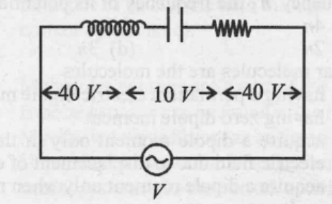
Impedance Z = V_RMS / I_RMS V subscript (RMS) = √[ V subscript R² + (V subscript L − V subscript C)² ] = √[ (40)² + (40 − 10)² ] = 50 V I_RMS = I₀ / √2 = 10√2 / √2 = 10 A ∴ Z = V subscript RMS / I subscript RMS = 50 / 10 = 5 Ω
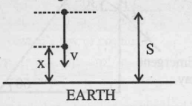
A particle is released from height S from the surface of the Earth. At a certain height its kinetic energy is three times its potential energy. The height from the surface of earth and the speed of the particle at that instant are respectively
Let the height from the surface of the earth be x. When body from rest falls through height (S − x) Then from v² = u² + 2gs v² = 0² + 2g(S − x) ⇒ v = √[ 2g(S − x) ] ...(i) At this point, U = mgx From question, kinetic energy, K = 3U ∴ 1/2 m(v)² = 3 × mg(x) ⇒ 1/2 × m × 2g(S − x) = 3 × mgx (using (i)) ⇒ S − x = 3x ∴ x = S/4 ...(ii) ∴ v = √[ 2 × g(S − S/4) ] = √[ 3gS / 2 ]
A small block slides down on a smooth inclined plane, starting from rest at time t = 0. Let S subscript n be the distance travelled by the block in the interval t = n − 1 to t = n. Then, the ratio S subscript (n) / S subscript (n+1) is
Acceleration along inclined plane, a = g sin θ S subscript n = distance travelled by object during nᵗʰ second. Initial speed u = 0 S subscript n = u + a/2 (2n − 1) ⇒ S subscript n = 0 + (g sin θ)/2 (2n − 1) = (g sin θ)/2 (2n − 1) ...(i) Ssubscript (n+1) = 0 + (g sin θ)/2 [ 2(n + 1) − 1 ] = (g sin θ)/2 (2n + 1) ...(ii) Dividing equations (i) and (ii) S subscript n / S subscript (n+1) = [ (g sin θ)/2 (2n − 1) ] / [ (g sin θ)/2 (2n + 1) ] = (2n − 1) / (2n + 1)
The half-life of a radioactive nuclide is 100 hours. The fraction of original activity that will remain after 150 hours would be
activity of a radioactive substance A = A₀ (1/2)ᵗᐟᵀ₁ᐟ₂⇒ A/A₀ = (1/2)ᵗᐟᵀ₁ᐟ₂ Given, T₁/₂ = 100 hours & t = 150 hours ⇒ A/A₀ = (1/2)¹⁵⁰ᐟ¹⁰⁰ ⇒ A/A₀ = (1/2)³ᐟ² ∴ A/A₀ = 1 / 2√2 Activity of a radioactive substance is the rate of disintegration or the number of atoms of any material decaying per second. Activity ∝ 1 / half life
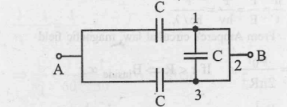
The equivalent capacitance of the combination shown in the figure is
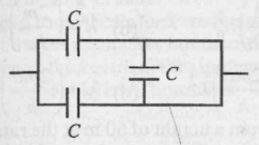
The circuit is as shown is figure, Points 1, 2, 3 are connected by conducting wire so these points are at same potential. So the capacitor is short circuited. So it does not store any charge. Therefore equivalent capacitance C subscript (AB) = C + C = 2C
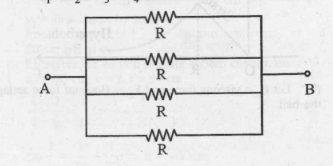
The effective resistance of a parallel connection that consists of four wires of equal length, equal area of cross-section and same material is 0.25 Ω. What will be the effective resistance if they are connected in series?
Resistance of each wire in this case will be same as l & A are same and made of same material. ∴ R₁ = R₂ = R₃ = R₄ = R In parallel, 1/R subscript p = 1/R₁ + 1/R₂ + 1/R₃ + 1/R₄ ∴ R subscript p = R/4 ⇒ 0.25 = R/4 ∴ R = 1 Ω When arranged in series then equivalent resistance. R subscript s = R + R + R + R = 4R ∴ R subscript s = 4 × 1 = 4Ω
A nucleus with mass number 240 breaks into two fragments each of mass number 120, the binding energy per nucleon of unfragmented nuclei is 7.6 MeV while that of fragments is 8.5 MeV. The total gain in the binding energy in the process is
Gain in BE = (BE) of products – (BE) of reactants. = [120 + 120] × 8.5 – [240] × 7.6 = (240) × 8.5 – 240 × 7.6 = (2040 – 1824) MeV = 216 MeV
The number of photons per second on an average emitted by the source of mono-chromatic light of wavelength 600 nm, when it delivers the power of 3.3 × 10⁻³ watt will be (h = 6.6 × 10⁻³⁴ J s)
Power, P = E/t = n/t (hc/λ) ∴ No. of photons / second, n/t = P / (hc/λ) ⇒ n/t = (3.3 × 10⁻³ × 6 × 10⁻⁷) / (6.6 × 10⁻³⁴ × 3 × 10⁸) = 10¹⁶ The number of photons emitted per second from a source of monochromatic radiation of wavelength λ and power P and if E = energy of each photon then, n/t = P/E = P/hν = P / (hc/λ)
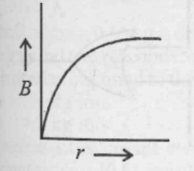
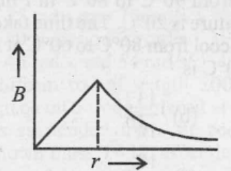
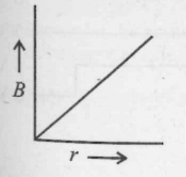
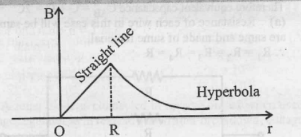
A thick current carrying cable of radius 'R’ carries current ' uniformly distributed across its cross-section. The variation of magnetic field B(r) due to the cable with the distance ' from the axis of the cable is represented by
-
(A)
-
(B)
-
(C)
-
(D)
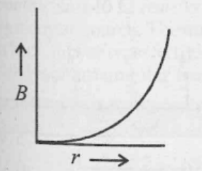
From Ampere's circuital law, magnetic field B = (μ₀I / 2πR²).r If r < R ⇒ B Subscript (inside) ∝ r B = μ₀I / 2πr If r ≥ R ⇒ B Subscript (outside) ∝ 1/r Hence the correct magnetic field B versus distance r graph is shown in the option.
A capacitor of capacitance 'C', is connected across an ac source of voltage V, given by V = V₀sin ωt The displacement current between the plates of the capacitor, would then be given by
Displacement current I Subscript (d) = C dV/dt = C d/dt(V₀ sin ωt) (∵ V = V₀ sin ωt given) = C(V₀ω)cos ωt ∴ I Subscript (d) = V₀ωCcos ωt
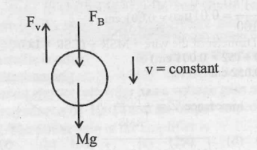
The velocity of a small ball of mass M and density d, when dropped in a container filled with glycerine becomes constant after some time. If the density of glycerine is d/2, then the viscous force acting on the ball will be
Let Fᵥ = viscous force and F Subscript (B) = Bouyant force acting on the ball. When body moves with constant velocity 𝐌𝐠 = 𝐅_𝐁 + 𝐅ᵥ [𝐚 = 𝟎] 𝐅ᵥ = 𝐌𝐠 − 𝐅 Subscript (B) = 𝐝𝐕𝐠 − 𝐝/𝟐 . 𝐕𝐠 (𝐌 = 𝐝𝐕𝐠) 𝐕 = volume of ball. or 𝐅ᵥ = 𝐝/𝟐 𝐕𝐠 = 𝐌/𝟐 𝐠 [∵ 𝐌 = 𝐝𝐕] Due to motion of a body through the fluid, the fluid in contact with the body is dragged with it causes relative motion in fluid layers near the body and hence viscous force starts.
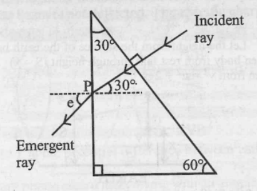
Find the value of the angle of emergence from the prism. Refractive index of the glass is √𝟑.
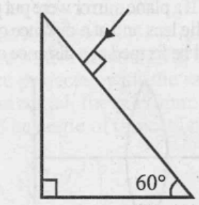
From Snell's law at point P. sin i / sin r = μ Subscript (air) / μ Subscript (Prism) ⇒ sin 30° / sin e = 1 / √3 (∵ ∠r = ∠e emergent angle) ⇒ sin e = √3 · 1/2 ∴ ∠e = 60°
If a light ray is incident normally on first surface i.e., ∠i = 0° so refraction of first surface ∠r₁ = 0°. When angle of prism A > C (critical angle) then no ray emerges from second surface of the prism.
If force [F], acceleration [A] and time [T] are chosen as the fundamental physical quantities. Find the dimensions of energy.
Energy, E ∝ Fᵃ Aᵇ Tᶜ [E] = [Fᵃ][Aᵇ][Tᶜ] ⇒ [ML²T⁻²] = [MLT⁻²]ᵃ [LT⁻²]ᵇ [T]ᶜ [ML²T⁻²] = [𝐌ᵃ𝐋ᵃ ⁺ ᵇ 𝐓⁻²ᵃ ⁻ ²ᵇ ⁺ ᶜ] Comparing dimensions on both sides. a = 1; a + b = 2 and −2 = −2a − 2b + c ∴ b = 1 and −2 = −2 − 2 + c or, c = 2 ∴ Dimensions of energy = [FAT²]
In a potentiometer circuit a cell of EMF 1.5 V gives balance point at 36 cm length of wire. If another cell of EMF 2.5 V replaces the first cell, then at what length of the wire, the balance point occurs?
If ℓ₁ and ℓ₂ are balancing lengths then E₁ / E₂ = ℓ₁ / ℓ₂ ∴ ℓ₂ = ℓ₁ (E₂ / E₁) = 36 (2.5 / 1.5) = 60 cm
A spring is stretched by 5 cm by a force 10 N. The time period of the oscillations when a mass of 2 kg is suspended by it is
Spring constant k = F / x = 10 / (5 × 10⁻²) = 200 N / m And for spring-mass system undergoing SHM T = 2π √(m / k) = 2π √(2 / 200) = 2π / 10 = 0.628 s (because m = 2 kg given)
For a plane electromagnetic wave propagating in x-direction, which one of the following combination gives the correct possible directions for electric field (E) and magnetic field (B) respectively?
Direction of propagation along x-axis. (-ĵ + k̂) × (-ĵ - k̂) = 2î [NOTES] E vector × B vector is always in the direction of propagation of wave. The EM wave propagating in the positive x-direction E = E Subscript (y) = E₀ sin(kx - ωt) and B = B Subscript (z) = B₀ sin (kx - ωt)
An electromagnetic wave of wavelength 'λ' is incident on a photosensitive surface of negligible work function. If 'm' mass is of photoelectron emitted from the surface has de-Broglie wavelength λ Subscript d, then
From Einstein's photoelectric equation hc / λ = ϕ₀ + k Where ϕ₀ = work function k = maximum kinetic energy of photoelectrons ∴ hc / λ = k = P² / 2m ⇒ P = √(2mhc / λ) [∵ ϕ = negligible] de-Broglie wavelength, λ Subscript d = h / P = h / √(2mhc / λ) ⇒ √λ = λ Subscript d √(2mc / h) ∴ λ = (2mc / h) λ Subscript d²
Water falls from a height of 60 m at the rate of 15 kg/s to operate a turbine. The losses due to frictional force are 10% of the input energy. How much power is generated by the turbine? (g = 10 m/s²)
Power on turbine P = d(mgh) / dt = gh (dm / dt) = 10 × 60 × 15 = 9000 W Due to frictional force, lossses are 10% ∴ Power generated = (1 - 10 / 100) × 9000 = 8.1 kW
Twenty seven drops of same size are charged at 220 V each. They combine to form a bigger drop. Calculate the potential of the bigger drop.
Let charge and radius of smaller drop is q and r respectively and R = radius of bigger drop For smaller drop, electric potential, V = kq / r = 220 V As volume remains the same (4/3 πr³) × 27 = 4/3 πR³ ⇒ R = ∛(27r) = 3r And from conservation of charge, Q = 27q ∴ Potential of bigger drop, V Subscript (big drop) = kQ / R = k(27q) / 3r = 9(kq / r) = 9 × 220 = 1980 V
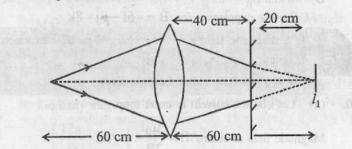
A point object is placed at a distance of 60 cm from a convex lens of focal length 30 cm. If a plane mirror were put perpendicular to the principal axis of the lens and at a distance of 40 cm from it, the final image would be formed at a distance of
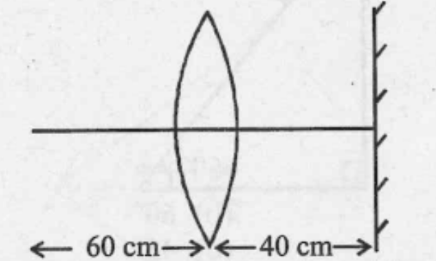
For first refraction from convex lens v₁ = ?, u = -60 cm, f = 30 cm From lens formula, 1/v₁ - 1/u = 1/f ⇒ 1/v₁ + 1/60 = 1/30 ⇒ v₁ = 60 cm v₁ = first image by lens Image produced by plane mirror at distance 20 cm left of it. Therefore for second refraction from convex lens, u = -20 cm, v = ?, f = 30 cm 1/v - 1/u = 1/f ⇒ 1/v + 1/20 = 1/30 ⇒ 1/v = 1/30 - 1/20 ⇒ v = -60 cm Hence the final image which is virtual formed at a distance, 60 - 40 = 20 cm from plane mirror.
In the product F vector = q (v vector × B vector) = q v vector × (B î + B ĵ + B₀ k̂) For q = 1 and v vector = 2î + 4ĵ + 6k̂ and F vector = 4î - 20ĵ + 12k̂ What will be the complete expression for B vector
Lorentz force, F vector = q (v vector × B vector) = q v vector × (B î + B ĵ + B₀ k̂) ∴ q = 1, v vector = 2î + 4ĵ + 6k̂ and F vector = 4î - 20ĵ + 12k̂ (given) ∴ (4î - 20ĵ + 12k̂) = 1 × [(2î + 4ĵ + 6k̂) × (B î + B ĵ + B₀ k̂)] or (4î - 20ĵ + 12k̂) = î (4B₀ - 6B) - ĵ (2B₀ - 6B) + k̂ (2B - 4B) Comparing L.H.S and R.H.S, we get 4B₀ - 6B = 4 ⇒ 2B₀ - 3B = 2 ...(i) -(2B₀ - 6B) = -20 ⇒ B₀ - 3B = 10 ...(ii) 2B - 4B = 12 ⇒ B = -6 ...(iii) From eq. (ii) and (iii) B = -6 and B₀ = -8 ∴ Complete expression for B vector = -6î - 6ĵ - 8k̂ [NOTES] In a magnetic field a moving charged particle experiences magnetic force F Subscript (m) = q (v vector × B vector) F Subscript (m) = q (v vector × B vector) is called Lorentz force.
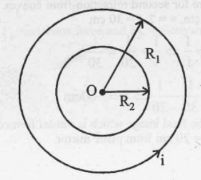
Two conducting circular loops of radii R₁ and R₂ are placed in the same plane with their centres coinciding. If R₁ >> R₂, the mutual inductance M between them will be directly proportional to
Let i be the current in outer loop Magnetic field at centre B = μ₀i / 2R₁ Magnetic flux through inner coil ϕ Subscript (i) = B × πR₂² ϕ Subscript (i) = μ₀i / 2R₁ × πR₂² ϕ Subscript (i) = μ₀i / 2 × πR₂² / R₁ ∴ ϕ = Mi ∴ M = (μ₀π / 2) R₂² / R₁ or, M ∝ R₂² / R₁
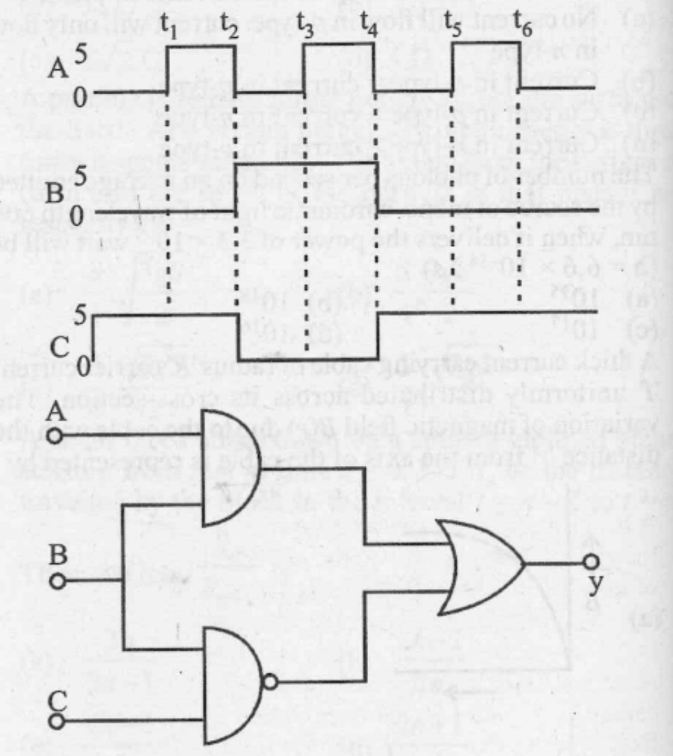
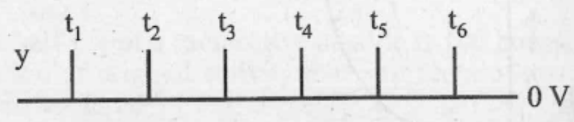
For the given circuit, the input digital signals are applied at the terminals A, B and C. What would be the output at the terminal y?
-
(A)

-
(B)

-
(C)
-
(D)

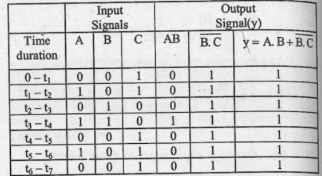
Boolean expression for combination of logic gates Output, y = A . B + Bar (B . C)
Output y is high (1) so output at the terminal y, v₀ = 5V
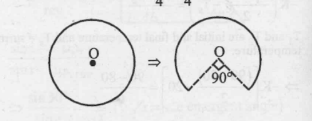
From a circular ring of mass 'M' and radius 'R' an arc corresponding to a 90° sector is removed. The moment of inertia of the remaining part of the ring about an axis passing through the centre of the ring and perpendicular to the plane of the ring is 'K' times 'MR²'. Then the value of 'K' is
As per question, 90° arc is removed from circular ring, ∴ Mass removed = M / 4 ∴ Mass remaining M - M/4 = 3/4 M
Moment of inertia of remaining I_remaining = ∫ dmr² = R² ∫ dm (∵ r = R)
∴ I Subscript (remaining) = 3MR² / 4 = KMR² ∴ K = 3 / 4 [NOTES] Moment of inertia of a continuous distribution of mass, treating the element of mass dm at position r as particle then dI = dmr² so I = ∫ r²dm
Three resistors having resistances r₁, r₂ and r₃ are connected as shown in the given circuit. The ratio i₃ / i₁ of currents in terms of resistances used in the circuit is
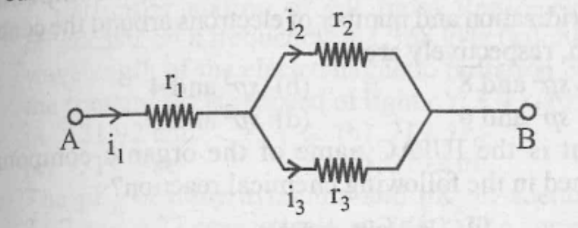
Resistance r₂ and r₃ are in parallel so potential difference across r₂ = r₃, = V ∴ i₂r₂ = i₃r₃ ⇒ i₂ = i₃r₃ / r₂ ...(i) Current i₁ = i₂ + i₃ ⇒ i₁ = (r₃ / r₂ + 1) i₃ ∴ i₃ / i₁ = r₂ / (r₂ + r₃)
A car starts from rest and accelerates at 5 m/s². At t = 4 s, a ball is dropped out of a window by a person sitting in the car. What is the velocity and acceleration of the ball at t = 6 s? (Take g = 10 m/s²)
Velocity of car at t = 4 s = velocity of the ball dropped out of a window v = u + at ⇒ v = 0 + 5 × 4 = 20 ms⁻¹ ∴ Velocity of ball along the horizontal and is 20ms⁻¹. After 2 seconds of motion: Vertical velocity of ball (v Subscript (y)) = u Subscript (y) + a Subscript (y) t v Subscript (y)= 0 + 10 × 2 = 20 ms⁻¹ (∵ a Subscript (y) = g = 10 m/s²) ∴ Magnitude of velocity of ball (v) = √(v Subscript (x²) + v Subscript (y²)) = 20√2 m/s Since the ball is under free fall. Acceleration of ball (a) at t = 6s a = g = 10 m/s² [NOTES] All bodies, in the absence of air resistance, irrespective of the size, weight or composition fall with same acceleration near the surface of the earth is called free fall.
A step down transformer connected to an ac mains supply of 220 V is made to operate at 11 V, 44 W lamp. Ignoring power losses in the transformer, what is the current in the primary circuit?
Power P = V × I For an ideal transformer Input power = Output power VₚIₚ = VₛIₛ or, 220 × Iₚ = 44 ∴ Iₚ = 0.2 A
A ball of mass 0.15 kg is dropped from a height 10 m, strikes the ground and rebounds to the same height. The magnitude of impulse imparted to the ball is (g = 10 m/s²) nearly
Impulse, 𝐈⃗ = change in linear momentum or, I = Δ𝐏⃗ = 𝐏⃗ Subscript (𝐟) − 𝐏⃗ Subscript (i) or, I = m₂v₂ − m₁v₁ Velocity of ball at ground (v) = √(2gh) [∵ v² − u² = 2gh] = √(2 × 10 × 10) = 10√2 m/s ∴ 𝐈⃗ = 0.15 × 10√2 (−𝒋̂) − 0.15 × 10√2 (𝒋̂) ⇒ 𝐈⃗ = 2 × 0.15 × 10√2 (−𝒋̂) = 4.2 (𝒋̂) = 4.2 kg m/s [NOTES] Impulse I = Δ𝐏⃗ = 𝐏⃗ Subscript (𝐟) − 𝐏⃗ Subscript (i) = change in momentum is called impulse momentum theorem. Impulse of a force is a measure of total effect of force.
A series LCR circuit containing 5.0 H inductor, 80μ F capacitor and 40 Ω resistor is connected to 230V variable frequency ac source. The angular frequencies of the source at which power transferred to the circuit is half the power at the resonant angular frequency are likely to be
For LCR series circuit resonance frequency ω₀ = 1 / √(LC) = 1 / √(5 × 80 × 10⁻⁶) = 50 rad / s ∴ Half power frequency, ω = ω₀ ± R / 2L i.e. ω Subscript L = 50 - 40 / (2 × 5) = 46 rad / s and ω Subscript H = 50 + 40 / (2 × 5) = 54 rad / s
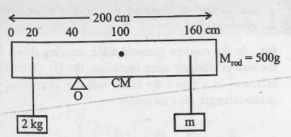
A uniform rod of length 200 cm and mass 500 g is balanced on a wedge placed at 40 cm mark. A mass of 2 kg is suspended from the rod at 20 cm and another unknown mass 'm' is suspended from the rod at 160 cm mark as shown in the figure. Find the value of 'm' such that the rod is in equilibrium. (g = 10 m/s²)
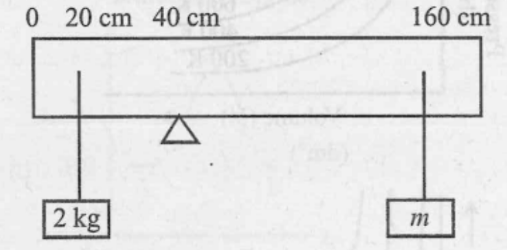
Rod will be in equilibrium, if 𝛕⃗ Subscrip𝐭 (net) = 0 about point O. Torque at point O due to 2 kg mass 𝛕⃗ = 𝐫⃗ × 𝐅⃗ = rF sin θ (𝐧̂) 𝛕 ₁ = 20 × 20 × 10⁻² × sin 90° (𝐤̂) = 4 Nm (𝐤̂) Torque due to mass of rod 𝛕 ₂ = 5 × 60 × 10⁻² × sin 90° (−𝐤̂) = 3 Nm (−𝐤̂) Torque due to mass m 𝛕 ₃ = mg × 120 × 10⁻² × sin 90° (−𝐤̂) = 12m Nm (−𝐤̂) So 𝛕⃗ ₁ + 𝛕⃗₂ + 𝛕⃗ ₃ = 0 (∵ 𝛕⃗ Subscrip𝐭 (net) = 0) ⇒ 4 − 3 − 12m = 0 ⇒ 12m = 1 ∴ m = 1 / 12 kg
A uniform conducting wire of length 12a and resistance 'R' is wound up as a current carrying coil in the shape of, (i) an equilateral triangle of side 'a'. (ii) a square of side 'a'. The magnetic dipole moments of the coil in each case respectively are
Current in the loop I = V / R equal for both loops. Magnetic moment of equilateral triangle of side a M Subscript (T) = (12a / 3a) · I · (√3 / 4) a² = √3 I a² [∵ M = NIA] Similarly magnetic moment of square of side a = (12a / 4a) · I · a² [∵ M = NIA] M Subscript (S) = 3 I a² [NOTES] A current carrying coil behaves as a bar magnet and its magnetic moment M = NiA, N = no. of turns, i = current through the coil, A = area of the coil. For a given perimeter circular shape has maximum area hence maximum magnetic moment.
Right option for the number of tetrahedral and octahedral voids in hexagonal primitive unit cell are :
Number of octahedral and tetrahedral voids formed by N closed packed atoms are N and 2N respectively. Hexagonal unit cell contains 6 atoms therefore, number of tetrahedral void =N=6x2=12 Number of octahedral void = N = 6
-
(A)
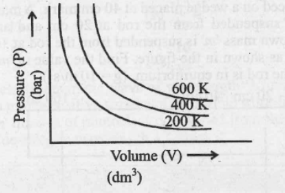
-
(B)
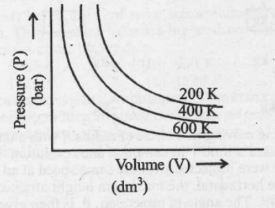
-
(C)
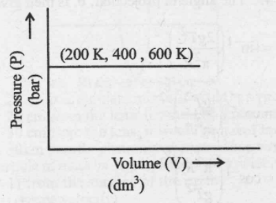
-
(D)
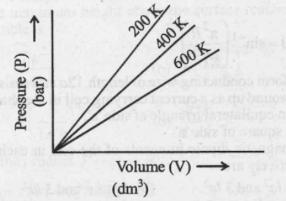
Which one among the following is the correct option for right relationship between 𝐂ₚ and 𝐂ᵥ for one mole of ideal gas?
At constant volume, 𝐪 ᵥ = 𝐂 ᵥ Δ𝐓 = Δ𝐄 ...(i) At constant pressure,
𝐪 ₚ = 𝐂 Subscript (p) Δ𝐓 = Δ𝐇 ...(ii) For a mole of an ideal gas, Δ𝐇 = Δ𝐄 + Δ(𝐏𝐕) = Δ𝐄 + 𝐑Δ𝐓 ...(iii) On putting the values of Δ𝐇 and Δ𝐄 in eqn. (iii), we get 𝐂ₚ Δ𝐓 = 𝐂 ᵥ Δ𝐓 + 𝐑Δ𝐓 𝐂ₚ = 𝐂ᵥ + 𝐑 𝐂ₚ − 𝐂ᵥ = 𝐑
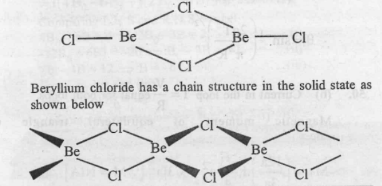
The structures of beryllium chloride in solid state and vapour phase, are :
In vapour phase Beryllium chloride tends to form a chloro-bridged dimer.
[NOTES] In the solid, BeCl₂ molecules polymerise to make long chains. They do this by forming coordinate bonds between one pairs on Cl and adjacent Be atoms.
The major product formed in dehydrohalogenation reaction of 2-Bromo pentane is Pent-2-ene. This product formation is based on?
According to Saytzeff's rule, in dehydrohalogenation reactions, highly substituted alkene is the major product.

BF₃ is planar and electron deficient compound. Hybridization and number of electrons around the central atom, respectively are :
In BF₃, hybridisation is sp² and number of electrons are 6.
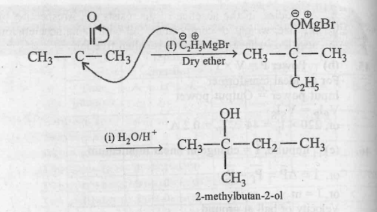
‘What is the IUPAC name of the organic compound formed in the following chemical reaction?

2-methylbutan-2-ol
The molar conductance of NaCl, HCl and CH₃COONa at infinite dilution are 126.45, 426.16 and 91.0 S cm² mol⁻¹ respectively. The molar conductance of CH₃COOH at infinite dilution is. Choose the right option for your answer.
According to Kohlrausch law of independent migration of ions. Λ° ₘ (CH₃COOH) = Λ°ₘ (CH₃COONa) + Λ° ₘ (HCl) − Λ° ₘ(NaCl) = 91.0 S cm² mol⁻¹ + 426.16 S cm² mol⁻¹ − 126.45 S cm² mol⁻¹ = 390.71 S cm² mol⁻¹
The incorrect statement among the following is:
Most of the trivalent lanthanoids ions are coloured both in the solid state and in aqueous solutions. [NOTES] Actinoid contraction is greater from element to element than lanthanoid contraction due to the poor shielding by 5f electrons.
Statement I : Acid strength increases in the order given as HF << HCl << HBr << HI.
Statement II : As the size of the elements F, Cl, Br, I increases down the group, the bond strength of HF, HCl, HBr and HI decreases and so the acid strength increases. In the light of the above statements, choose the correct answer from the options given below.
In the modern periodic table, moving down the group as the size of halogen atom increases, the H − X bond length also increases as a result the bond enthalpy decreases. Hence, The acidic strength also increases.
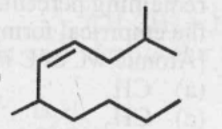
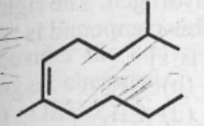
The correct structure of 2, 6-Dimethyl-dec-4-ene is
-
(A)
-
(B)
-
(C)
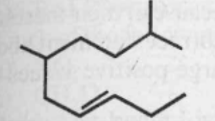
-
(D)
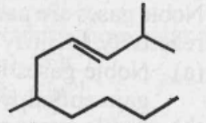
2,6-Dimethyl-dec-4-ene:
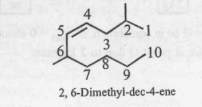
The correct sequence of bond enthalpy of 'C—X' bond is :
The size of halogen atom increases from F to I hence bond length from C - F to C - I increases. ∴ Bond enthalpy from CH₃ - F to CH₃ - I decreases.
A particular station of All India Radio, New Delhi broadcasts on a frequency of 1,368 kHz (kilohertz). The wavelength of the electromagnetic radiation emitted by the transmitter is : [speed of light c = 3.0 × 10⁸ ms⁻¹]
Given ν = 1,368 kHz = 1368 × 10³ Hz Wavelength = c / ν = 3 × 10⁸ / (1368 × 10³) = 219.3 m
The p K Subscript (b) of dimethylamine and p Kₐ of acetic acid are 3.27 and 4.77 respectively at T (K). The correct option for the pH of dimethylammonium acetate solution is :
Dimethylammonium acetate is a salt of weak acid and weak base whose pH can be calculated as pH = 7 + 1/2 (pK ₐ− pK Subscript (b)) = 7 + 1/2 (4.77 − 3.27) = 7.75
The following solutions were prepared by dissolving 10 g of glucose (C₆H₁₂O₆) in 250 mL of water (P₁), 10 g of urea (CH₄N₂O) in 250 mL of water (P₂) and 10 g of sucrose (C₁₂H₂₂O₁₁) in 250 mL of water (P₃). The right option for the decreasing order of osmotic pressure of these solutions is :
Order of molar mass of solute decreases as Sucrose > Glucose > Urea So, correct order of osmotic pressure of solution is P₃ < P₁ < P₂
[NOTE] Osmotic pressure (π) = iCRT where C is molar concentration of the solution. With increase in molar concentration of solution osmotic pressure increases. Since, weight of all solutes and its solution volume are equal, so higher will be the molar mass of solute, smaller will be molar concentration and smaller will be the osmotic pressure.
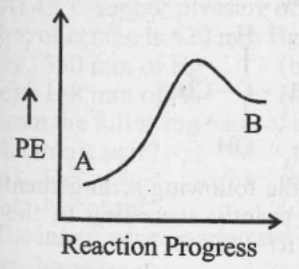
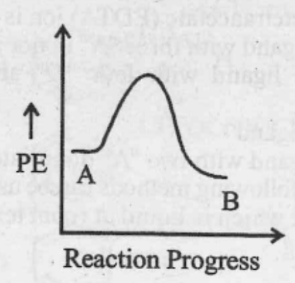
For a reaction A → B, enthalpy of reaction is −4.2 kJ mol⁻¹ and enthalpy of activation is 9.6 kJ mol⁻¹. The correct potential energy profile for the reaction is shown in option.
-
(A)
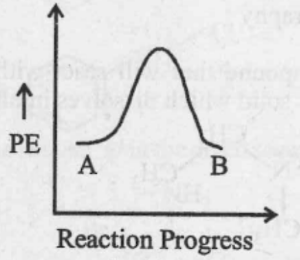
-
(B)
-
(C)
-
(D)
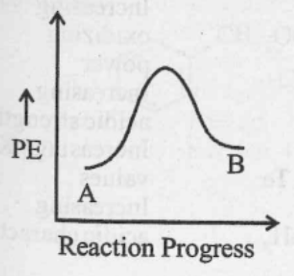
ΔHᵣₓₙ = (Eₐ)f − (Eₐ)b −4.2 = 9.6 − (Eₐ)b (Eₐ)b = 9.6 + 4.2 = 13.8 kJ mol⁻¹ Since reaction is exothermic, so possible graph is (c) only.
The compound which shows metamerism is :
Compounds with formula C₄H₁₀O can be ethers which may exhibit metamerism. For example CH₃–CH₂–O–CH₂–CH₃ CH₃–O–CH(CH₃)–CH₃ CH₃–O–CH₂–CH₂–CH₃ are metamers.
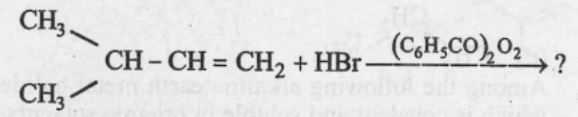
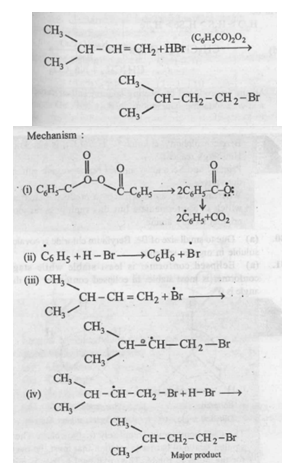
The major product of the following chemical reaction is:
-
(A)
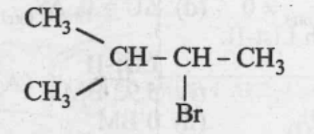
-
(B)
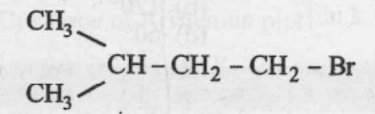
-
(C)
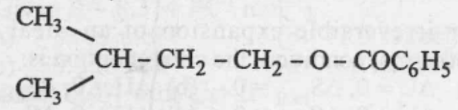
-
(D)
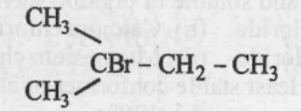
The correct option is (CH₃)₂CH–CH₂–CH₂Br
Which of the following reactions is the metal displacement reaction? Choose the right option.
-
(A)

-
(B)

-
(C)

-
(D)

Reactions(a)and (b) are decomposition reactions. Reaction (d) s displacement reaction, while reaction (c) is an example of metal displacement reaction.
Ethylene diaminetetraacetate (EDTA) ion is :
EDTA ion is a hexadentate ligand with four oxygen and two nitrogen donor atoms.

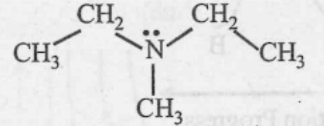
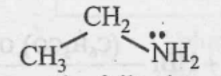
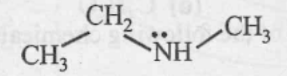
Identify the compound that will react with Hinsberg's reagent to give a solid which dissolves in alkali.
-
(A)
-
(B)
-
(C)
-
(D)
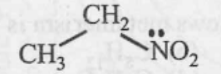
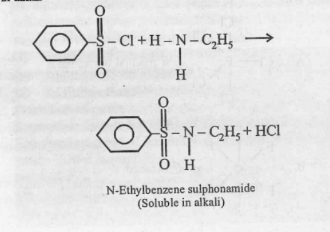
The reaction of Hinsberg's reagent with primary amine (CH₃CH₂NH₂) yields N-ethylbenzene sulphonamide which is soluble in alkali. Benzenesulphonyl chloride (C₆H₅SO₂Cl) is also known as Hinsberg's reagent. Primary and Secondary amines reacts to give sulfonamide derivatives. Whereas tertiary amines reacts to produce quaternary salt which is a intermediate but this rapidly breakdowns to original tertiary amine.
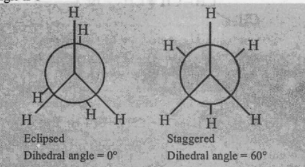
Dihedral angle of least stable conformer of ethane is :
Eclipsed conformer is least stable while staggered conformer is most stable. In eclipsed conformer the dihedral angle is 0°.
NOTES:
The C–C bond is not completely free to rotate. There is a small 3 kcal/mol barrier to rotation that must be overcome for the bond to rotate. This rotational barrier is not high enough to prevent constant rotation except at extremely cold temperature.
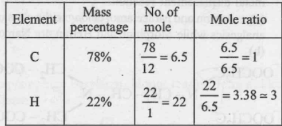
An organic compound contains 78% (by wt.) carbon and remaining percentage of hydrogen. The right option for the empirical formula of this compound is : [Atomic wt. of C is 12, H is 1]
Possible empirical formula is CH₃.
Noble gases are named because of their inertness towards reactivity. Identify an incorrect statement about them.
Noble gases have weak dispersion forces hence they have low melting and boiling points.
Which one of the following polymers is prepared by addition polymerisation?
Teflon is an addition polymer. Monomer of teflon is tetrafluoroethene.
Notes; Dacron, Nylon-66 and Novolac are prepared by condensation polymerisation.

Match List-I with List-II. Choose the correct answer from the options given below.
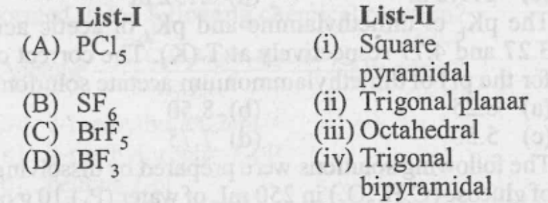
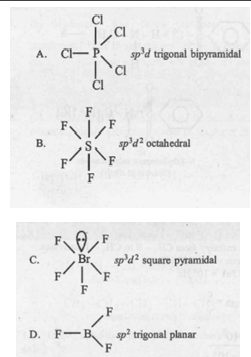
A-(iv), B-(iii), C-(i), D-(ii)
For irreversible expansion of an ideal gas under isothermal condition, the correct option is:
For a spontaneous process, ΔSₜₒₜₐₗ > 0 and since irreversible process is always spontaneous, therefore ΔSₜₒₜₐₗ > 0. Since ΔU = nCᵥΔT and ΔT = 0 for isothermal process, therefore ΔU = 0.
Match List-I with List-II.
Choose the correct answer from the options given below.
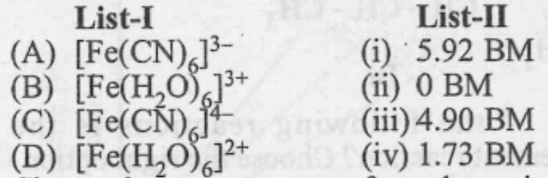
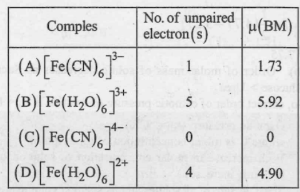
Magnetic moment, μ = √[n(n + 2)] BM
The product formed in the following chemical reaction is:
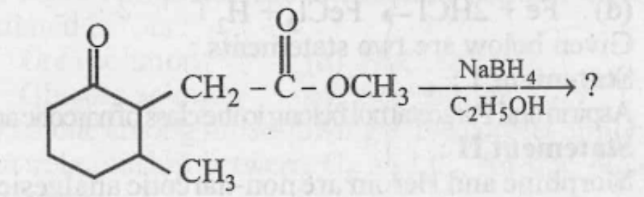
-
(A)
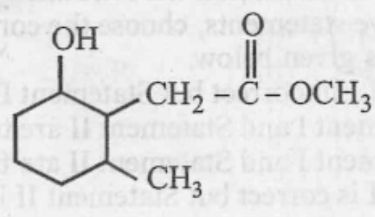
-
(B)
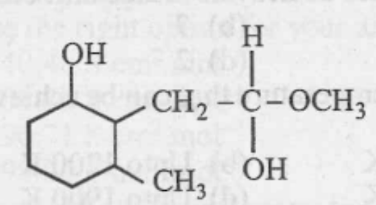
-
(C)
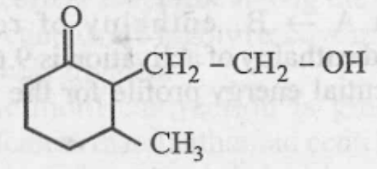
-
(D)
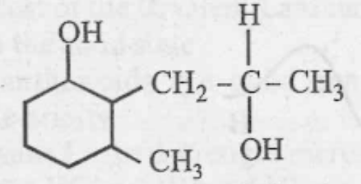
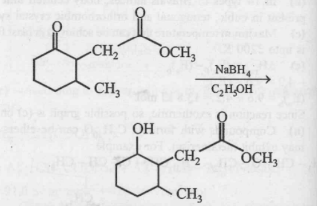
NaBH₄ is a reducing agent. It reduces carbonyl group into alcohols but does not reduce esters. NaBH₄ is a selective reducing agent for carbonyl group while LiAlH₄ can reduce both carbonyl group and ester group.
In which one of the following arrangements the give sequence is not strictly according to the properties indicated against it?
On moving down the group, bond dissociation enthalpy of hydrides of Group 16 elements decreases; hence acidity increases and pKₐ value decreases. Correct order of pKₐ value will be H₂O > H₂S > H₂Se > H₂Te
Consider the above reaction and identify the missing reagent/chemical.

CH₃CH₂COO⁻Na⁺ ⟶(NaOH + CaO, Heat) CH₃CH₃ + Na₂CO₃
Note: Alkane is produced by heating sodium salt of carboxylic acid with sodalime. The ratio of NaOH : CaO = 3 : 1.
Which of the following molecules is non-polar in nature?
SbCl₅ : Net vector summation of bond moments will be zero so SbCl₅ is a non-polar molecule.
• NO₂ ⇒ polar molecule.
• POCl₃ ⇒ polar molecule.
• CH₂O ⇒ polar molecule.
Match List-I with List-II.
Choose the correct answer from the options given below.
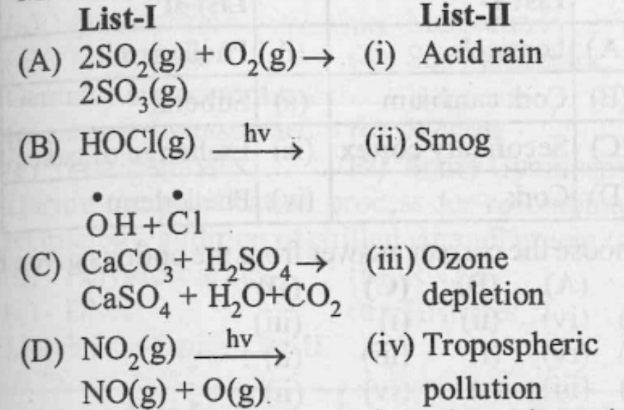
A - (iv), B - (iii), C - (i), D - (ii) A chain reaction occurs from interaction of NO with sunlight in which NO is converted to NO₂ which absorb energy from sunlight and breaks into NO and O, which causes photochemical smog. NO₂(g) ──hv──> NO(g) + O(g)
Choose the correct option for the total pressure (in atm.) in a mixture of 4 g O₂ and 2 g H₂ confined in a total volume of one litre at 0°C is: [Given R = 0.082 L atm mol⁻¹ K⁻¹, T = 273 K]
ⁿO₂ = 4/32 = 1/8 ⁿH₂ = 2/2 = 1 nₜₒₜₐₗ = 1/8 + 1 = 9/8 PₜₒₜₐₗV = nₜₒₜₐₗRT
P₁ = (9/8 × 0.082 × 273)/1 = 25.18 atm
The correct option for the value of vapour pressure of a solution at 45°C with benzene to octane in molar ratio 3 : 2 is: [At 45°C vapour pressure of benzene is 280 mm Hg and that of octane is 420 mm Hg. Assume Ideal gas]
Given : n subscript (benzene) : n subscript (octane) = 3 : 2 So, X Subscript (benzene) = 3/5 X Subscript (octane) = 2/5 Pₛ = P° Subscript (benzene) X Subscript (benzene) + P° Subscript (octane) X Subscript (octane) = 280 × (3/5) + 420 × (2/5) = 168 + 168 = 336 mm of Hg
From the following pairs of ions which one is not an iso-electronic pair?
Species Number of electrons
Fe²⁺ 26 − 2 = 24
Mn²⁺ 25 − 2 = 23
O²⁻ 8 + 2 = 10
F⁻ 9 + 1 = 10
Na⁺ 11 − 1 = 10
Mg²⁺ 12 − 2 = 10
Fe³⁺ 26 − 3 = 23
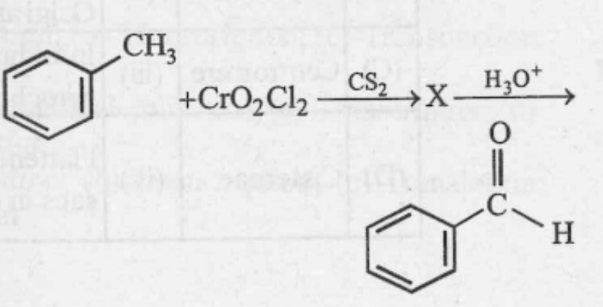
The intermediate compound 'X' in the following chemical reaction is:
-
(A)
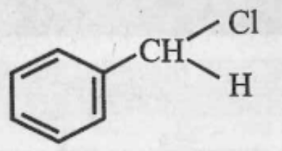
-
(B)
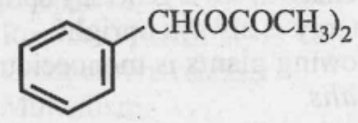
-
(C)
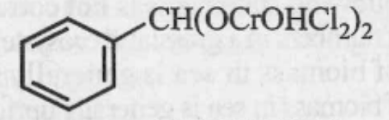
-
(D)
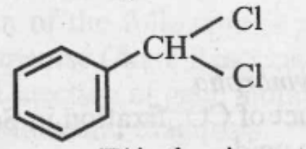
Etard’s reaction
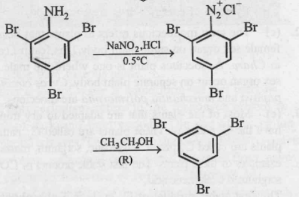
The reagent 'R! in the given sequence of chemical reaction is:
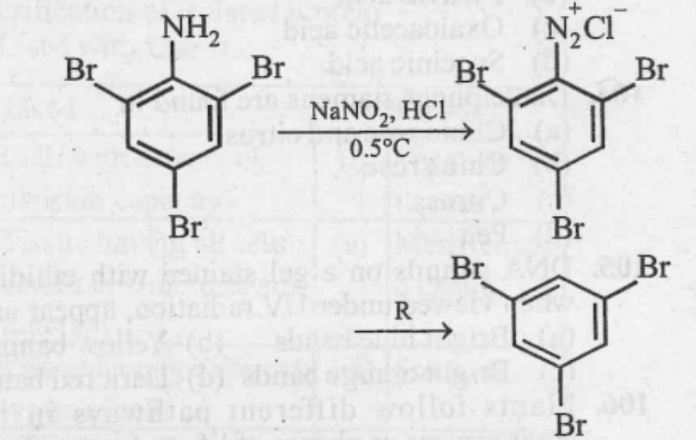
Reagent R is C₂H₅OH with diazonium salt. Ar–N₂⁺X⁻ + RCH₂–OH → Ar–O–CH₂R + N₂ + HX (A) Ar–N₂⁺X⁻ + RCH₂–OH ⇌ Ar–N=N–O–CH₂R Ar–N=N–O–CH₂R → ArH + RCHO + N₂ + HX (B) Where process A proceeds through an S Subscript (N) 2 displacement of the diazonium group, while process B involves homolytic fission of the bonds to produce radicals which ultimately lead to aromatic hydrocarbon and aldehyde.
The slope of Arrhenius plot (ln k v/s 1/T) of first order reaction is −5 × 10³ K. The value of Eₐ of the reaction is. Choose the correct option for your answer. [Given R = 8.314 J K⁻¹ mol⁻¹]
Arrhenius equation k = Ae⁻ᴱᵃ/ᴿᵀ ln k = ln A + ln e⁻ᴱᵃ/ᴿᵀ ln k = ln A − (Eₐ/R)(1/T) ...(1) Slope of ln k vs 1/T curve, m = −Eₐ/R −5 × 10³ = −Eₐ/R Eₐ = 5 × 10³ × 8.314 J mol⁻¹ = 41.57 × 10³ J mol⁻¹ = 41.5 kJ mol⁻¹
Match List-I with List-II Choose the correct answer from the options given below.
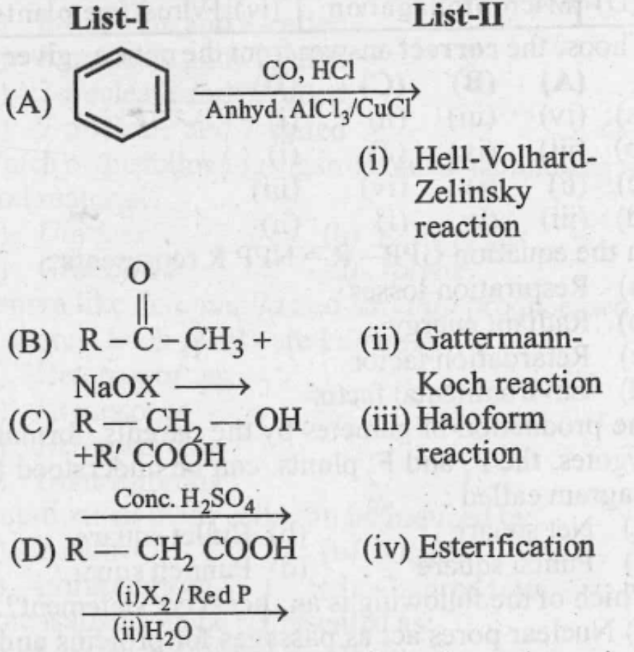
A - (ii), B - (iii), C - (iv), D - (i) Gattermann Koch reaction is inapplicable to phenol substrate.

Which of the following statements is not correct?
Pyramid of biomass in sea is inverted because the amount of biomass is least at the base of the pyramid and the amount of biomass is maximum at the apex of the pyramid. For example, biomass of zooplanktons is higher than that of phytoplanktons because zooplanktons have a low weight and are smaller in size. Phytoplankton has a shorter life span when compared to zooplankton. An ecological pyramid shows the relationship of biomass, productivity or energy at different trophic level. There are three types of Ecological Pyramid. • Pyramid of number – It can be upright or inverted. • Pyramid of biomass – It can be upright or inverted. • Pyramid of energy – It is always upright.
Which of the following plants is monoecious?
The term monoecious refers to plants that bear male and female sex organ on same plant body. This feature can be seen in Chara. A dioecious plant is one where the male and female sex organs occur on separate plant body. Cycas circinalis, Carica papaya and Marchantia polymorpha are dioecious.
The first stable product of CO₂ fixation in Sorghum is
Most of the plants that are adapted to dry tropical regions have the C₄ pathway. These plants are called C₄ plants. Sugarcane, sorghum, maize etc. are examples of these plants. The first stable product of CO₂ fixation in sorghum is oxaloacetic acid. The first stable product of C₃ cycle is 3-phosphoglyceric acid.Pyruvic acid is the end product of glycolysis. Succinic acid is an intermediate product in Krebs cycle.
Diadelphous stamens are found in
In diadelphous condition, stamens are arranged in two bundles. For example, pea. Monoadelphous stamens are grouped in single bundle whereas polyadelphous stamens occur in more than two bundles. China rose has monoadelphous stamens while citrus has polyadelphous stamens. The filaments are united forming two bundles e.g. in Lathyrus (sweet pea), Pisum (edible pea) there are 10 stamens; filaments of 9 stamens are fused forming one bundle and the other bundle is represented by the filament of the tenth free stamen (Ai + (9)).
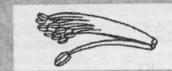
DNA strands on a gel stained with ethidium bromide when viewed under UV radiation, appear as
After the bands are stained, they.are viewed in UV light. The bands appear bright orange in colour. Ethidium brofnide is the intercalating agent that stacks in between the nitrogenous bases.
Plants follow different pathways in response to environment or phases of life to form different kinds of structures. This ability is called
The ability of an organism to change its structure in response to different environments is termed as plasticity. It is a particularly important characteristic to enable sessile plants to adapt to rapid changes in their surroundings. A special case of plasticity is represented by heterophylly, the ability of semi-aquatic plants to produce different types of leaves below and above water.
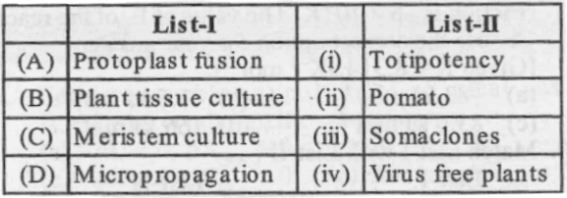
In the equation GPP − R = NPP, R represents:
The overall productivity of a system can be found in an equation where the Net Primary Production (NPP) is equal to the Gross Primary Production (GPP) minus the Respiration loss (R). Formula: NPP = GPP − R The NPP is the overall efficiency of the plants in the ecosystem.Through having a constant efficiency in NPP, the ecosystem is more sustainable. The GPP refers to the rate of energy stored by photosynthesis in plants. The R refers to the maintenance and reproduction of plants from the energy expended.
The production of gametes by the parents, formation of zygotes, the F₁ and F₂ plants, can be understood from a diagram called:
The production of gametes (n) by the parents (2n), the formation of the zygote (2n), the F₁ and F₂ plants can be understood from a diagram called Punnett square. It is used to predict the genotypes of a particular cross or breeding experiment. It is named after Reginald C.
Which of the following is an incorrect statement?
Mature sieve tube elements are deep , tubular and do not contain nucleus in the cells with no secondary wall and terminal sieve plate. They lack nucleus at the maturity so that they are associated with companion cells for support. Their features are ' the same as prokaryotic cells.Rest all statements are correct.
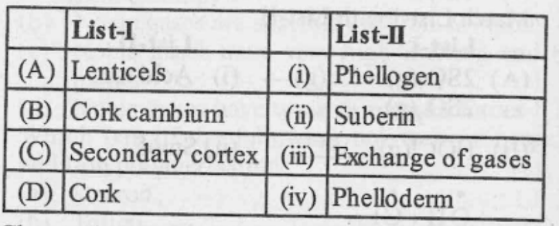
The amount of nutrients, such as carbon, nitrogen, phosphorus and calcium present in the soil at any given time, is referred as:
The amount of all the inorganic substances or nutrients such as carbon, nitrogen, phosphorus and calcium present in soil at any given time is referred as standing state. ‘Each trophic level has a certain mass of living material at a particular time called the standing crop.It is measured as the mass of living organism (biomass) or the number in a unit area. ‘Climax community is the last community in biotic succession which is relatively stable and is in near equilibrium with the environment of that area.
The term used for transfer of pollen grains from anthers of one plant to stigma of a different plant which, during pollination, brings genetically different types of pollen grains to stigma, is :
Xenogamy refers to the transfer of pollen grains from anthers of one plant to stigma of a different plant which, during pollination, brings genetically different types of pollen grains to stigma. Cleistogamy is a type of automatic self-pollination of certain plants that can propagate by using non opening, self-pollinating flowers. Geitonogamy refers to the transfer of pollen grain from anther to stigma of another flower of the same plant. Chasmogamy is a condition in which flowers remain open.
Which of the following stages of meiosis involves division of centromere?
• Division of centromere occurs in anaphase II.
• Telophase II is the last stage of meiosis II.
• During this phase, the chromatids reach the poles and start uncoiling.
• Chromosomes form two parallel plates in metaphase I and one plate in metaphase II.
Which of the following is a correct sequence of steps in a PCR (Polymerase Chain Reaction)?
Polymerase chain reaction or PCR consists of the following three steps: Denaturation- The two DNA strands of template DNA separate from each other when heated to 94°C. Annealing- The primers anneal to the 3’ end of single strands of DNA. Extension- The primers are extended by DNA polymerase by the addition of nucleotides to form complete strands of DNA. Hence the sequence of steps is denaturation, annealing, extension.
When gene targeting involving gene amplification is attempted in an individual's tissue to treat disease, it is known as:
Gene therapy is a technique that modifies a person’s genes to treat or cure disease. Biopiracy is the term used to refer to the use of bioresources by multinational companies and other organisation without proper authorisation from the countries and people concerned without compensatory payment. Bioresources by multinational companies and other organisations without proper authorisation from the countries and people concerned without compensatory payment. Molecular diagnosis refers to the act or process of determining the nature and cause of disease.
Match List-I with List-II. Choosethe correct answer from the options given below.
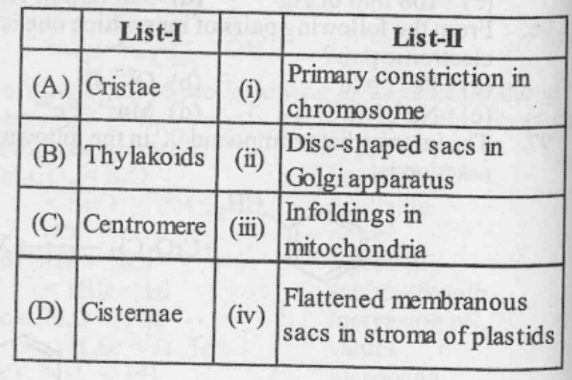
The inner membrane of mitochondria forms infoldings called cristae. Thylakoids are flattened membranous sacs in stroma of plastids. Cisternae are disc shaped sacs in Golgi apparatus. Primary constriction in chromosome that holds two chromatids together is called centromere.
The factor that leads to Founder effect in a population is :
Genetic drift is a random process that can lead to large changes in populations over a short period of time. Random drift is caused by recurring small population sizes, severe reductions in population size called “bottlenecks” and founder events where a new population starts from a small number of individuals. Crossing over which occurs during gamete formation results in genetic recombination. Mutations are random and directionless.
When the centromere is situated in the middle of two equal arms of chromosomes, the chromosome is referred as :
Chromosomes are classified into four types based on the position of the centromere. These are metacentric, sub-metacentric, telocentric and acrocentric. A chromosome having centromere at the center is called as metacentric chromosome. In this, centromere divides chromosome into two equal arms. A chromosome having centromere slightly away from the center is called as sub-metacentric chromosome. A chromosome having centromere close to one of the end is called as acrocentric chromosome. A chromosome having a terminal centromere is called as telocentric chromosome.
Gemmae are present in
The gemmae are green, small discs of haploid tissue, and they directly give rise to new gametophytes. They are produced by some liverworts like marchantia. Mosses reproduce vegetatively by fragmentation and budding of protonema. Pteridophytes and Gymnosperms normally do not reproduce asexually.
During the purification process for recombinant DNA technology, addition of chilled ethanol precipitates out :
Various enzymes like protease, RNase, etc. are added to break down substances like proteins, RNA, etc. Once all these substances are broken down, DNA is left which is precipitated out by adding chilled ethanol. Histones are basic proteins that help condense DNA in a cell.
Match List-I with List-II. Choose the correct answer from the options given below.
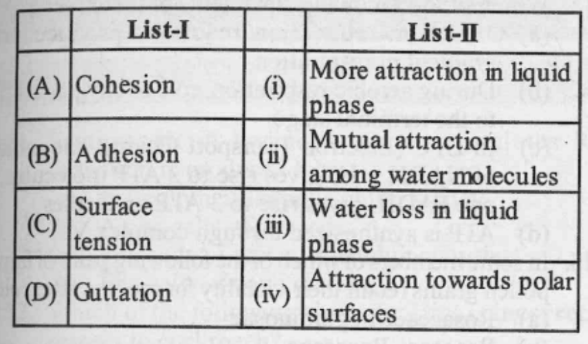
Cohesion is mutual attraction among water molecules.
Adhesion is attraction towards polar surfaces.
Surface tention explains water molecules are more attracted in
liquid phase than gaseous phase. Guttation is loss of water is liquid form the leaf margins
The site of perception of light in plants during photoperiodism is
Photoperiodism refers to the responses related to the lengths of dark and light periods. The site of perception of photoperiod is leaves. The hormone florigen, which is responsible for flowering, induces flowering as it migrates from leaves to shoot apices on induction of required photoperiods. The site of perception of low temperature stimulus during vernalisation is shoot apex and embryo. Axillary bud are not sites of perception of photoperiod.
The plant hormone used to destroy weeds in a field
The compound 2,4-dichlorophenoxyacetic acid, or 2,4-D, is a weedicide used to remove broad leaved weeds or dicotyledonous weeds in cereal crops or monocotyledonous plants. IAA and IBA are natural auxins. NAA is a synthetic auxin.
Which of the following algae produce Carrageen?
Algae are eukaryotic organisms with different chemical components in their cell wall. The cell wall of red algae is composed of agar, carrageen and funori along with cellulose.
Cell wall of brown algae contains algin while in green algae it is composed of cellulose and pectin.
In blue green algae cell wall is composed of mucopeptides.
Carrageen are a family of natural linear sulphated polysaccharide that are extracted from red edible sea weeds.
Complete the flow chart on central dogma.

DNA replication is the process by which DNA makes a copy of itself during cell division. The process by which DNA is copied to RNA is called transcription, and that by which RNA is used to produce proteins is called translation. Transduction is transfer of genetic material from one bacterium to another with the help of virus or a bacteriophages.
Inspite of interspecific competition in nature, which mechanism the competing species might have evolved for their survival?
Interspecific competition is the competition for resources by individuals of different species. Inspite of interspecific competition the competing species may co-exist by doing resource partitioning. • Mutualism is defined as an interaction between individuals of different species that results in positive (beneficial) effects on per capita reproduction and/or survival of the interacting populations. • Predation is a biological interaction where one organism, the predator, kills and eats another organism, its prey. • In competitive release there occurs dramatic increase in population of a less distributed species when its superior competitor is removed.
Which of the following is not an application of PCR (Polymerase Chain Reaction)?
PCR is Polymerase Chain Reaction. It is used for making multiple copies of the gene. Hence PCR is used for • Gene amplification. • PCR-based assays have been developed that detect the presence of gene sequences of the infectious agents. • It is also used in detecting mutations. • Protein is not the target of PCR. Hence, plays no role in its purification.
Match List-I with List-II. Select the correct answer from the options given below.
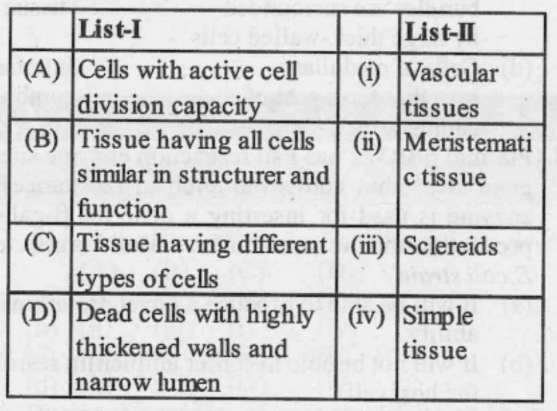
Meristematic tissues are those tissues which have cells with active cell division capacity. Simple tissues are those tissues which have all the cells similar in structure and function. Vascular tissues are complex permanent tissues hence they have different types of cells. Sclereids are sclerenchymatous cells which are dead with highly thickened walls and narrow lumen.
A typical angiosperm embryo sac at maturity is:
The embryo sac of angiosperms consists of seven cells. A typical angiosperm embryo at maturity is called 7 celled 8 nucleates. The cells are arranged in three sets. In the centre, there are two polar nuclei which are a part of the large central cell. The polar nuclei are present at the centre of the cell. The polar nuclei are not separated by a membrane. There are two ends of the yolk sac. One of the ends is called the chalazal end. This end has 3 antipodal cells.
Which of the following algae contains mannitol as reserve food material?
Ectocarpus belongs to class-Phaeophyceae, in which reserve food is found in form of laminarin, mannitol and oil. Ulothrix and Volvox belong to chlorophyceae (green algae). Members of this class have starch as reserve food material. Gracilaria is a member of red algae (Rhodophyceae). This class is characterised by having Floridean starch as storeg. food material.
Genera like Selaginella and Salvinia produce two kinds of spores. Such plants are known as:
Genera like Selaginella and Salvinia which produce two kinds of spores i.e. macro (large) and micro (small) spores, are known as heterosporous. Most of the pteridophytes produce single type of spores and are called homosporous. Sorus are brownish or yellowish cluster of spores producing structures located on the lower surface of fern leaves. Selaginella and Salvinia are considered the first plants to exhibit a significant step towards the evolution of seed habit because embryo develops in female gametophyte which is retained on parent sporophyte.
Amensalism can be represented as:
Amensalism refers to association wherein one partner is inhibited while other remains nearly unaffected and is denoted by − 0. Commensalism refers to relationship wherein one organism is benefitted while other remains unaffected and is denoted by + 0. Mutualism is association of organisms wherein both are benefitted and is denoted by + +. Association of organisms which benefits one of the partners at the expense of other is called as parasitism and is denoted by + −. A prime example of amensalism is penicillin killing bacteria. The bread mould Penicillium secretes penicillin that ultimately kills bacteria. In this contact between two organisms, one is destroyed or inhibited, and other remains unaffected.
What is the role of RNA polymerase III in the process of transcription in eukaryotes?
In eukaryote cells, RNA polymerase III (also called Pol III) transcribes DNA to synthesize ribosomal 5S rRNA, tRNA and other small RNAs. The genes transcribed by RNA Pol III fall in the category of "housekeeping" genes whose expression is required in all cell types and most environmental conditions. Therefore, the regulation of Pol III transcription is primarily tied to the regulation of cell growth and the cell cycle, thus requiring fewer regulatory proteins than RNA polymerase II.
Select the correct pair.
The correct pair is when the cells of medullary rays differentiated they give rise to the new cambium called interfascicular cambium. Other pairs are incorrect and can be corrected as. Loose parenchyma cells rupturing the epidermis and forming a lens shaped opening in bark are called complementary cells. Large colorless empty cells in the epidermis of grass leaves are called Bulliform cells. In dicot leaves, vascular bundles are surrounded by large thick walled cells called bundle sheath cells.
Plasmid pBR322 has PstI restriction enzyme site within gene ampᴿ that confers ampicillin resistance. If this enzyme is used for inserting a gene for β-galactoside production and the recombinant plasmid is inserted in an E.coli strain
pBR322 is a commonly used cloning vector. When the gene for β-galactoside is inserted in the ampicillin resistance gene by using Pst I, the recombinant E.coli will lose ampicillin resistance due to insertional inactivation of the antibiotic resistance gene. The host (recombinant) cell will produce β-galactoside which is not a novel protein nor does it have dual ability. The transformed cells cannot resist ampicillin as they have lost ampicillin resistance. A recombinant E. coli is produced and the host cell will not undergo lysis due to insertion of β-galactoside gene. pBR322 is a plasmid and was one of the first widely used E. coli cloning vectors. Created in 1977 in the laboratory of Herbert Boyer at the University of California, San Francisco, it was named after Francisco Bolivar Zapata and Raymond L. Rodriguez. The p stands for "plasmid" and BR for "Bolivar" and "Rodriguez". pBR322 is 4361 base pairs in length and has two antibiotic resistance genes - the gene bla encoding the ampicillin resistance (Ampᴿ) protein, and the gene tetA encoding the tetracycline resistance (Tetᴿ) protein.
DNA fingerprinting involves identifying differences in some specific regions in DNA sequence, called as
DNA fingerprinting involves identifying differences in some specific regions in DNA sequence called as repetitive DNA, because in these sequences, a small stretch of DNA is repeated many times. These sequences normally do not code for any proteins, but they form a large portion of human genome. The basis of DNA fingerprinting is VNTR (Variable number tandem repeats) a satellite DNA as a probe that show very high degree of polymorphism. Polymorphism is the variation at genetic level. Allelic sequence variation has traditionally been described as a DNA Polymorphism.
In the exponential growth equation Nₜ = N₀eʳᵗ, e represents
The integral equation for exponential growth is Nₜ = N₀eʳᵗ. Where Nₜ = Population density after time t, N₀ = Population density at time zero, r = intrinsic rate of natural increase, e = the base of natural logarithms (2.71828)
Which of the following statements is incorrect?
Statement 1 is incorrect because cyclic photophosphorylation involves only PSI. Both PSI and PSII are involved in non cyclic photophosphorylation where both ATP and NADPH + H⁺ are synthesised. Both PSI and PSII are found on grana lamellae whereas stroma lamellae have PSI only and lack NADP reductase.
Which of the following statements is correct?
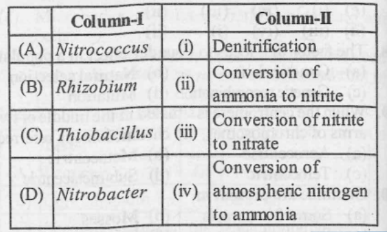
In some blue-green algae specialised cells called heterocyst fixes atmospheric nitrogen into ammonia.
• Fusion of two nuclei is called Karyogamy.
• Organisms that depend on living plants are parasites, saprophytes grow on dead material.
• Fusion of protoplasts of two cells is called plasmogamy.
Which of the following statements is incorrect?
During respiration, process of ATP synthesis is explained by chemiosmotic model. It says that a proton gradient is required for ATP synthesis that is established by oxidation-reduction reactions.
In ETC, one NADH + H⁺ produces 3 ATP while one FADH₂ produces 2 ATP molecules.
ATP is synthesised via complex V.
In ETS, oxygen acts as terminal electron acceptor.
In some members of which of the following pairs of families, pollen grains retain their viability for months after release?
In members of some plant families like Solanaceae, Rosaceae and Leguminosae the pollen grains retain their viability for several months.
In cereals (Poaceae) pollen grains retain viability for around 30 minutes.
Identify the correct statement.
Split gene arrangement is characteristic of eukaryotes.
In capping 5-methyl guanosine triphosphate is added at 5′ end of hn RNA.
At 3′ end poly-A tail is added.
The non-coding or template strand is copied to an mRNA.
RNA polymerase associate with rho factor and it alters the specificity of the RNA polymerase to terminate the processes.
Match Column-I with Column-II
Select the correct answer from the options given below.
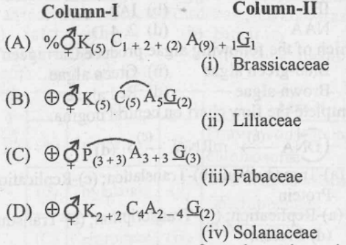
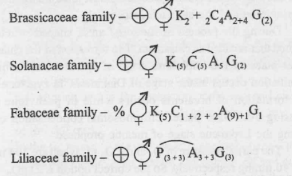
The floral formula of
Match List-I with List-II.
Choose the correct answer from the options given below.
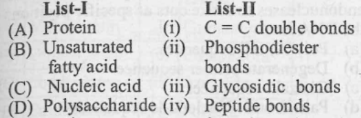
In a polypeptide or a protein, amino acids are linked by a peptide bond which is formed when the carboxyl (–COOH) group of one amino acid reacts with amino (–NH₂) group of the next amino acid with the elimination of a water moiety.
Unsaturated fatty acids are with one or more C = C double bonds.
In nucleic acids, a phosphate moiety links the 3′-carbon of one sugar of one nucleotide to the 5′-carbon of the sugar of the succeeding nucleotide. The bond between the phosphate and hydroxyl group is an ester bond. As there is one such ester bond on either side, it is called phosphodiester bond.
In a polysaccharide, the individual monosaccharides are linked by a glycosidic bond.
Match List-I with List-II.
Choose the correct answer from the options given below.
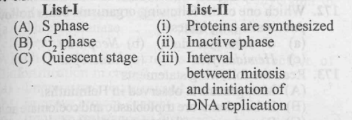
• In S phase DNA replication takes place.
• In G₂ phase there is synthesis of proteins, RNA etc.
• Quiescent stage is inactive stage of cell cycle but cells remain metabolically active in this stage.
• G₁ phase is the interval between mitosis and initiation of DNA replication.
Now a days it is possible to detect the mutated gene causing cancer by allowing radioactive probe to hybridise its complimentary DNA in a clone of cells, followed by its detection using autoradiography because :
Autoradiography allows the detection/localisation of radioactive isotope within a biological sample. Probe is a radiolabelled ss DNA or ss RNA depending on the technique.
To identify the mutated gene probe is allowed to hybridise to its complementary DNA in a clone of cells followed by detection using autoradiography. The mutated gene will not appear on the photographic film, because the probe does not have complementarity with the mutated gene.
Erythropoietin hormone which stimulates R.B.C. formation is produced by:
The juxtaglomerular cells that are present in the kidney produce a specific peptide hormone, erythropoetin. This hormone plays a important role in the stimulation of RBC formation. Glucagon is produced by alpha cells of pancreas, formed elements are synthesised from the cells of bone marrow and the cells of rostral adenohypophysis are involved in the formation of hormones of the anterior lobe of the pituitary gland.
Which of the following characteristics is incorrect with respect to cockroach?
A ring of gastric caecae is located at the junction of foregut and midgut so option 2 is incorrect. At the junction of midgut and hindgut a ring of 100-150 thin filaments are present and called as Malpighian tubule.
Succus entericus is referred to as:
The secretion of brush border cells of the mucosa and the goblet cells constitute the intestinal juice that is also called as succus entericus. Different type of enzymes such as maltase, lipase, dipeptidases etc are present in this juice.
When food is mixed with the acidic juice of the stomach then called as chyme. Pancreatic juice and gastric juice are the secretion of pancreas and the stomach respectively.
Which stage of meiotic prophase shows terminalisation of chiasmata as its distinctive feature?
During the process of meiosis I an X shaped structure is formed that is called as chiasmata. The formation of the chiasmata takes place in the Diplotene stage of the meiosis I while its termination occurs in the stage of Diakinesis. In zygotene stage the formation of bivalents occurs while in pachytene stage crossing over takes place. Chromosomal condensation occurs during the Leptotene stage of meiotic prophase.
The partial pressures (in mm Hg) of oxygen (O₂) and carbon dioxide (CO₂) at alveoli (the site of diffusion) are:
The partial pressure of O₂ and CO₂ in alveoli are 104 mmHg and 40 mmHg respectively. So the correct option is 2) pO₂ = 104 and pCO₂ = 40.
159 mmHg and 0.3 mmHg are the partial pressure of O₂ and CO₂ respectively at atmospheric level. In the case of deoxygenated blood the partial pressures of O₂ and CO₂ are 40 mmHg and 45 mmHg.
Oxygenated blood has 95 mmHg of pO₂ and 40 mmHg of pCO₂.
Match the following:
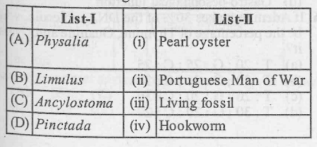
Physalia is a marine hydrozoans and is generally found in the atlantic ocean and the Indian ocean. It is also known as Portuguese man of war or blue bottle jelly fish. Limulus is known as king crab and is considered as living fossil. Pinctata is named as pearl oyster and the Ancylostoma is called hookworm.
During the process of gene amplification using PCR, if very high temperature is not maintained in the beginning, then which of the following steps of PCR will be affected first?
Denaturation of the DNA is a process in which the separation of double stranded DNA into single strands takes place. For this process high temperature is needed. So when high temperature is not maintained during PCR then denaturation process is affected.
DNA Ligase is responsible for the ligation of the DNA fragments.
Annealing and the extension are the second and third steps of PCR.
Match the following:
Choose the correct answer from the options given below
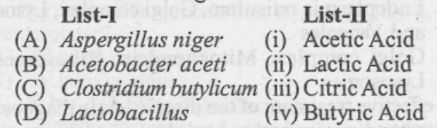
Aspergillus niger is a fungus that is used for the production of citric acid. Acetic acid is produced with the help of Acetobacter aceti. Clostridium butylicum and lactobacillus are involved in the production of butyric acid and lactic acid respectively.
Which of the following statements wrongly represents the nature of smooth muscle?
Intercalated disc is a type of junction that is present only in the cardiac muscle tissue so this is not a characteristic of smooth muscle. Thus option (d) has incorrect statement.
The smooth muscle fibres have no striations and are involuntary in nature. They are generally present in the wall of internal organs like stomach, intestine and the blood vessels.
Chronic auto immune disorder affecting neuro muscular junction leading to fatigue, weakening and paralysis of skeletal muscle is called as:
Myasthenia gravis is a type of chronic auto immune disorder that affects the neuromuscular junction and causes weakness and paralysis of the skeletal muscle.
Muscular dystrophy is a type of genetic disorder that leads to the progressive degeneration of skeletal muscle.
When uric acid crystal is deposited in the joints and causes inflammation is called as Gout disease.
Persons with 'AB' blood group are called as "Universal recipients". This is due to :
Blood group AB have antigen A and antigen B and do not contain antibodies A and B in the plasma. So the person who has blood group AB can receive the blood from persons with any type of blood group. Thus person with AB blood group is called as Universal recipients.
The fruit fly has 8 chromosomes (2n) in each cell. During interphase of Mitosis if the number of chromosomes at G₁ phase is 8, what would be the number of chromosomes after S phase?
S phase of the cell cycle is a synthesis phase in which amount of DNA increases but the number of chromosomes remain constant. So the number of chromosomes will be 8 in S phase because the number of chromosome is 8 at the time of G₁ phase.
Receptors for sperm binding in mammals are present on :
In mammals during the process of fertilisation sperm interacts with thick extracellular coat of an egg that is called as the zona pellucida receptors are present. The space that is present between the vitelline membrane and the zona pellucida is called as Perivitelline space. Corona radiata is present in the brain. It is a layer that is made up of radially arranged cells of membrane
Which one of the following belongs to the family Muscidae?
Muscidae are a family of flies such as house flies. Firefly belongs to the family Lampyridae, grasshopper is present in the family of Acrididae and cockroach is kept in Blattidae family.
Identify the incorrect pair
Ricin is a type of toxin that are obtained from Ricinus plant.
Opioids are drugs, codeine is a type of alkaloids. Concanavalin A is lectin and the abrin that is obtained from plant Abrus is a toxin.
Venereal diseases can spread through :
(A) Using sterile needles
(B) Transfusion of blood from infected person
(C) Infected mother to foetus
(D) Kissing
(E) Inheritance
Choose the correct answer from the option given below
Such type of infections or disease that are spreaded through sexual intercourse are known as venereal disease or sexually transmitted disease. These diseases are transmitted by the sharing of infected needles, transfusion of blood from an infected person or from an infected mother to foetus.
The organelles that are included in the endomembrane system are
Endoplasmic reticulum, lysosomes, golgi complex and vacuoles are considered as an endomembrane system. These organelles show co-ordination in their functions. Ribosomes does not contain any membrane and play important role in the process of protein synthesis.
For effective treatment of the disease, early diagnosis and understanding its pathophysiology is very important. Which of the following molecular diagnostic techniques is very useful for early detection?
Enzyme Linked Immuno sorbent assay (ELISA) is a technique that is used to early diagnosis of the disease. This technique identify the presence of pathogenic antigen or the antibodies that are formed against the pathogen.
Hybridisation technique is used to detect the mutated gene, Southern blotting is used to identify the specific DN sequence that is present in the given samples and a specific protein is detected by the technique of Western blotting.
With regard to insulin choose correct options.
(A) C-peptide is not present in mature insulin.
(B) The insulin produced by rDNA technology has C- peptide.
(C) The pro-insulin has C-peptide.
(D) A-peptide and B-peptide of insulin are interconnected by disulphide bridges.
Choose the correct answer from the options given below
Insulin is an important hormone that is made up of two short polypeptide chains in which one is named as A and the other is B. These two chains are attached by disulphide bridges.
C peptide is an extra stretch that is not present in the mature insulin.
A specific recognition sequence identified by endonucleases to make cuts at specific positions within the DNA is:
Endonuclease is a type of restriction enzyme that is responsible to make a cut in a specific position within a DNA. It recognises a specific sequence of the DNA that is called as palindromic nucleotide sequence.
The primer sequence of the PCR is called as degenerate primer sequence due to presence of several possible bases on of its some positions.
Which is the "Only enzyme" that has "Capability" to catalyse Initiation, Elongation and Termination in the process of transcription in prokaryotes?
The DNA-dependent RNA polymerase is an important enzyme. In prokaryotic organisms, this enzyme is responsible for the process of initiation, elongation and termination during the process of transcription.
DNase is an enzyme that is involved in the cleavage of phosphodiester linkages of the DNA backbone.
DNA dependent DNA polymerase is responsible for the process of DNA replication. DNA ligase joins the fragments of the DNA.
DNA ligase joins the fragments of the DNA.
Which one of the following organisms bears hollow and pneumatic long bones?
Pneumatic bones are hollow and contain many air cells. These bones are present in the animals that are kept in the class of Aves such as Neophron. These bones are helpful in the flying of the birds because they defy gravity during flying process.
Hemidactylus belongs to the class of Reptilia, Ornithorhynchus and Macropus are grouped in the class of Mammalia.
Read the following statements
(A) Metagenesis is observed in Helminths.
(B) Echinoderms are triploblastic and coelomate animals.
(C) Round worms have organ-system level of body organization.
(D) Comb plates present in ctenophores help in digestion.
(E) Water vascular system is characteristic of Echinoderms.
Choose the correct answer from the options given below.
The process of reproduction in which there is alternation of an asexual with a sexual generation is present is known as metagenesis such as in a Cnidarian.
Echinoderms have water vascular system that is involved in the locomotion, capturing and transportation of the food. It also helps in the process of respiration.
Comb plates are responsible for locomotion and are generally found in Ctenophores.
Match List-I with List-IL.
Choose the correct answer from the option given below
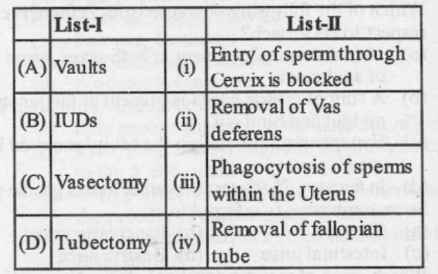
• Diaphragms, cervical caps and vaults are barrier methods of contraception for female which works by blocking the entry of sperms through the cervix.
• IUDs increase phagocytosis of sperms within the uterus.
• Vasectomy is a surgical method of contraception in males in which a small part of the vas deferens is removed or tied up through a small incision on the scrotum.
• Tubectomy is a surgical method of contraception in females where a small part of the fallopian tube is removed or tied up through a small incision in the abdomen or through vagina.
Sphincter of oddi is present at:
The sphincter of oddi is a type of muscular valve that regulates the common hepato-pancreatic duct.
The junction of ileum and caecum is guarded by Ileo-caecal valve that inhibit the back flow of faecal matter into the ileum of the humans.
The opening of Oesophagus into the stomach is regulated by the gastro-oesophageal sphincter.
If Adenine makes 30% of the DNA molecule, what will be the percentage of Thymine, Guanine and Cytosine in it?
According to the Chargaff’s rule, the amount of adenine
(A) should be equal to thymine (T) and the cytosine (C) should be equal to guanine (G) in a double stranded DNA.
In the question Adenine is given 30% so thymine will be 30%. Thymine and adenine will be 60% and rest 40% will be guanine and cytosine. Since cytosine and guanine are equal in amount so each will be 20%.
Thus, A = 30%, T = 30%, G = 20% and C = 20%.
Match List - I with List - II
Choose the correct answer from the options given below.
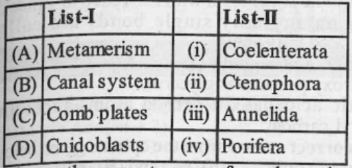
Metamerism is commonly seen in the members of phylum Annelida where the body is externally and internally divided intosegments with a serial repetition of atleast some organs.
Water canal system is present in the members of phylum Porifera.
The body of Ctenophores bears 8 external rows of ciliated comb plates which help in locomotion.
Cnidoblasts or cnidocytes are characteristic feature of cnidarians (coelentrata).
Which enzyme is responsible for the conversion of inactive fibrinogen to fibrins?
During coagulation of blood, an enzyme complex thrombokinase helps in the conversion of prothrombin (present in plasma) into thrombin.
Thrombin further helps in the conversion of inactive fibrinogens into fibrins which form network of threads.
Renin is secreted by JG cells in response to fall in glomerular blood flow, which converts angiotensinogen in blood to angiotensin-I.
Epinephrine or adrenaline is secreted by adrenal medulla in response to stress of any kind and during emergency.
Which of the following is not an objective of Biofortification in crops?
Biofortification is a process that is used to increase the bioavailability and the amount of nutrients in the crops with the help of plant breeding and recombinant DNA technology.
Generally, it is used to increase the content and quality of the protein, oil, vitamin, micronutrient and the mineral.
It is not used to create resistance in plants against diseases.
Dobson units are used to measure thickness of:
Dobson unit is used to measure the thickness of ozone layer. Troposphere is the lowermost layer of the atmosphere. Chlorofluorocarbons (CFCs) are chemicals that are involved inthe depletion of ozone layer.
Which of the following statements is incorrect?
During respiration, process of ATP synthesis is explained
by chemiosmotic model. It says that a proton gradient is required
for ATP synthesis that is established by oxidation-reduction
In ETC, one NADH + H⁺ produces 3 ATP while one FADH,
produces 2 ATP molecules.
Which one of the following is an example of Hormone releasing IUD?
LNG 20 is hormone releasing IUD that releases levonorgestrel. It is responsible to increase the sperm phagocytosis.
Multiload 375, Cu T and Cu 7 are copper releasing IUDs.
The centriole undergoes duplication during:
Centriole is a cylindrical organelle that is involved in the cell division and in the formation of flagella and cilia. In animal cells, the duplication of centriole takes place during the S-phase of the cell cycle.
In the G₂ phase of the cell cycle, many important organelles such as mitochondria, golgi bodies, chloroplast etc are duplicated.
Chromatin starts to condense in prophase and the alignment of the chromosomes occurs during metaphase.
Which of the following RNAs is not required for the synthesis of protein?
siRNA is silencing RNA that is not involved in the process of protein synthesis.
mRNA, tRNA and rRNA are the types of RNA that are respon- sible for the protein synthesis.
In a cross between a male and female, both heterozygous for sickle cell anaemia gene, what percentage of the progeny will be diseased?
As given in the question
HbᴬHbˢ × HbᴬHbˢ – Parents
↓
HbˢHbˢ, HbᴬHbˢ, HbᴬHbˢ, HbᴬHbᴬ – Progenies
Since total number of affected progenies = 1
So Percentage of diseased/affected progenies
= 1/4 × 10 = 25%
Select the favourable conditions required for theformation of oxyhaemoglobin at the alveoli.
There are certain factors such as high pO₂, Low pCO₂, Less H⁺ concentration and lower temperature that favour the formation of oxyhaemoglobin of the alveoli.
Match List-I with List - II
Choose the correct answer from the options given below.
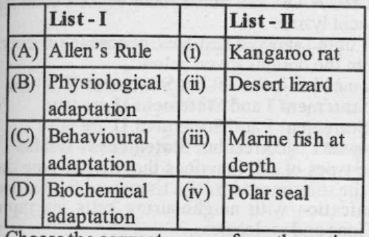
Polar seal contains short ears and limbs that help to minimise heat loss. This follows the Allen's rule. Physiological adaptation is shown by Kangaroo rat. Behavioural adaptation is exhibited by desert lizard. Generally Marine fishes are found in great depths in the ocean so they follow biochemical adaptation to survive there.
Match List-I with List - II
Choose the correct answer from the options given below.
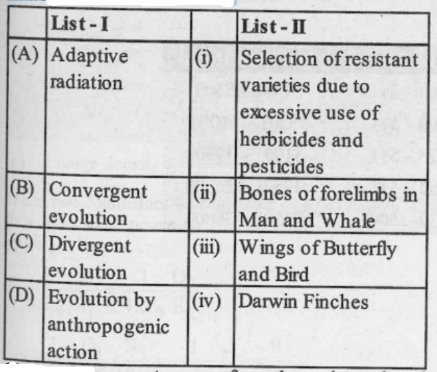
The process of evolution in which different species in a given geographical area starting from a point and literally radiating to other areas of geography is known as adaptive radiation such as Darwin’s finches.
The organs whose anatomical structures are not similar but show similar functions are known as analogous organs such as wings of butterfly and Bird. This is the result of convergent evolution.
Homologous organs shows different functions but shows similarities in their anatomical structure such as bones of forelimbs in man and whale. It is the result of divergent evolution.
The evolution that occurs due to human interference is called as evolution by anthropogenic action such as antibiotic resistant microbes, herbicides resistant varieties and pesticide resistant varieties.
Which of these is not an important component of initiation of parturition in humans?
Prolactin is a lactation hormone that is involved in the development of mammary glands and in milk production. This hormone is not involved in the process of parturition in humans.
Oxytocin is known as birth hormone because it plays importantrole during parturition and causes strong uterine contractions.
Prostaglandins also help in the uterine contraction so they are released during this process.
Which one of the following statements about Histones is wrong?
Histones contain basic amino acids such as lysine and arginine and their pH is basic in nature. The histone proteins are classified into five types such as H₁, H₂A, H₂B, H₃ and H₄. Four of them are paired and produce a unit of 8 molecules that is called as histone octamer.
During muscular contraction which of the following events occur?
(A) 'H' zone disappears
(B) 'A' band widens
(C) 'I' band reduces in width
(D) Myosine hydrolyzes ATP, releasing the ADP and Pi.
(E) Z-lines attached to actin are pulled inwards.
Choose the correct answer from the options given below:
Muscle contraction is initiated by the signal that is sent by the central nervous system. In this process certain events occurs such as
• the head of the myosin hydrolyses ATP molecule and binds with the active sites of actin and forms the cross bridge.
• the Z-line that is connected with actins are pulled inwards and thus causes the shortening of the sarcomeres.
• During the contraction of muscle, 'I' bands reduces and A bands remain the same.
• ADP + Pi are released by myosin and goes back to the relaxed condition.
Match List-I with List - II
Choose the correct answer from the options given below.
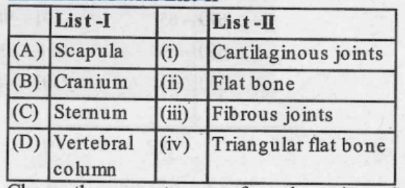
Scapula is a large triangular flat bone situated in the dorsal part of the thorax between the second and the seventh ribs.
Fibrous joint is shown by the flat skull bones which fuse end-to- end with the help of dense fibrous connective tissues in the form of sutures, to form cranium.
Sternum is a flat bone on the ventral midline of thorax.
Cartilaginous joints between the adjacent vertebrae in the vertebral column permits limited movement.
Assertion (A): A person goes to high altitude and experiences altitude sickness with symptoms like breathing difficulty and heart palpitations.
Reason (R): Due to low atmospheric pressure at high altitude, the body does not get sufficient oxygen.
In the light of the above statements, choose the correct options from the options given below
Altitude sickness can be experienced at high altitude where body does not get enough oxygen due to low atmospheric pressure and causes nausea, fatigue and heart palpitations.
Hence correct option is [R] is correct explanation of [A].
The Adenosine deaminase deficiency results into
Adenosine deaminase (ADA) enzyme is crucial for the immune system to function. Hence, its deficiency results in the dysfunction of immune system.
• Hyposecretion of hormones of the adrenal cortex causes Addison's disease.
• Parkinson's disease is a long-term degenerative disorder of the central nervous system.
• Disorders which affect GIT & associated glands are called digestive disorders.
Which of the following is not a step in Multiple Ovulation Embryo Transfer Technology (MOET)?
Multiple Ovulation Embryo Transfer Technology is used for herd improvement in short time.
• Cows are administered hormones, with FSH-like activity for superovulation.
• 8-32 celled embryos are transferred to surrogate mothers.
• 6-8 eggs are produced per cycle.
• Cows can be fertilised by artificial insemination.
Match List-I with List - II
Choose the correct answer from the options given below.
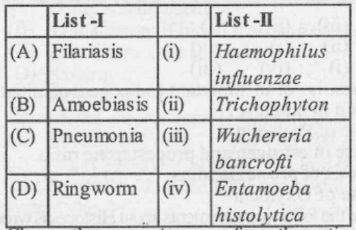
Wuchereria bancrofti is a type of worm that causes a disease named as filariasis.
Amoebiasis is protozoal disease that is caused by Entamoeba histolytica.
Pneumonia is a type of bacterial disease that occurs due to the infection of Streptococcus pneumoniae and Haemophilus influenzae bacteria.
Ringworm is a fungal disease that is caused by Trichophyton.
Following are the statements with reference to 'lipids'
(A) Lipids having only single bonds are called unsaturated fatty acids
(B) Lecithin is a phospholipid.
(C) Trihydroxy propane is glycerol.
(D) Palmitic acid has 20 carbon atoms including carboxyl carbon.
Choose the correct answer from the options given below.
The lipids in which only single bonds are present are known as saturated fatty acids. Unsaturated fatty acids contain atleast one double bond between two carbon atoms in the molecule.
Lecithin is an important phospholipid that is present in the cell membrane. Palmitic acid is a type of saturated fatty acid that contains 16 carbon atoms in the molecule.
Following are the statements about prostomium of earthworm.
(A) It serves as a covering for mouth.
(B) It helps to open cracks in the soil into which it can crawl.
(C) It is one of the sensory structures.
(D) It is the first body segment.
Choose the correct answer from the options given below.
A small fleshy lobe like structure is present on the mouth of earthworm is known as prostomium. It covers the mouth and help to create crackles in the soil. It also act as a sensory organ of the earthworm.
Which of the following secretes the hormone, relaxin, during the later phase of pregnancy?
Relaxin is a type of hormone that helps in the process of childbirth by relaxing the ligaments in the pelvis. It also helps in the softening and widening of the cervix. This hormone is released by corpus luteum.
During the pregnancy of the women, graafian follicle is not formed so it is not involved in relaxin secretion.
Relaxin is not produced by uterus and foetus.
Statement I: The codon 'AUG' codes for methionine and phenylalanine.
Statement II: 'AAA' and 'AAG' both codons code for the amino acid lysine.
In the light of the above statements, choose the correctanswer from the options given below.
Statement I is incorrect because phenylalanine is not coded by AUG, only methionine is coded b AUG.
Statement II is correct because lysine is coded by both 'AAA' and 'AAG' codons.
Identify the types of cell junctions that help to stop the leakage of the substances across a tissue and facilitation of communication with neighbouring cells via rapid transfer of ions and molecules.
Tight junction and gap junctions are the type of cell junction and are generally present in the epithelium and some other tissues.
Tight junction is responsible to stop the leakage of the substances across the tissues. Gap junctions play important role in the process of communication among the cells or the tissues.
Other Years