NEET-UG 2015 Question Paper

QUESTION PAPER

2015 NEET EXAM

NEET-UG 2015 Question Paper

2015

NEET-UG

CBSE EXAMINATION PAPER-2015

NEET-ZOOLOGY

(Solved)

Time allowed : 3 hours

Maximum Marks : 720

General Instructions :

Read the following instructions carefully and follow them :

  1. This question paper contains 180 questions. All questions are compulsory.
  2. This question paper is divided into 1 sections.
  3. Section A – questions number 1 to 180 are multiple choice questions
  4. There is no overall choice given in the question paper. However, an internal choice has been provided in few questions.
  5. Use of calculator is NOT allowed.

Section A

Question 1. In his classic experiments on sea plants, Mendel did not use
[4 Marks]
  • (A) Pod length
  • (B) Seed shape
  • (C) Flower position
  • (D) Seed colour
Question 2. Which one of the following is not applicable to RNA?
[4 Marks]
  • (A) Heterocyclic nitrogenous bases
  • (B) 5'phosphoryl and 3' hydroxyl ends
  • (C) Complementary base pairing
  • (D) Chargaff's rule
Question 3. Male gametophyte in angiosperms produces:
[4 Marks]
  • (A) Single sperm and two vegetative cells
  • (B) Single sperm and vegetative cell
  • (C) Two sperms and a vegetative cell
  • (D) Three sperms
Question 4. Which of the following are not membrane-bound?
[4 Marks]
  • (A) Ribosomes
  • (B) Lysosomes
  • (C) Mesosomes
  • (D) Vacuoles
Question 5. The chitinous exoskeleton of arthropods is formed by the polymerisation of:
[4 Marks]
  • (A) lipoglycans
  • (B) D-glucosamine
  • (C) N-acetyl glucosamine
  • (D) Keratin sulphate and chondroitin sulphate
Question 6. Among china rose, mustard, brinjal, potato, guava, cucumber, onion and tulip, how many plants have superior ovary?
[4 Marks]
  • (A) Six
  • (B) Three
  • (C) Five
  • (D) Four
Question 7. The function of the gap junction is to
[4 Marks]
  • (A) separate two cells from each other.
  • (B) stop substance from leading across a tissue
  • (C) facilitate communication between adjoining cells by connecting the cytoplasm for rapid transfer of ions, small molecules and some large molecules.
  • (D) stop substance from leading across a tissue
Question 8. Which one of the following immunoglobulins does constitute the largest percentage in human milk?
[4 Marks]
  • (A) IgM
  • (B) IgA
  • (C) IgG
  • (D) IgD
Question 9. In mammalian eye, the 'fovea' is the center of the visual field, where:
[4 Marks]
  • (A) the optic nerve leaves the eye
  • (B) only rods are present
  • (C) high density of cones occur, but has no rods.
  • (D) more rods than cones are found
Question 10.

Doctors use stethoscope to hear the sounds produced during each cardiac cycle. The second sound is heard when:

[4 Marks]
  • (A) AV valves open up
  • (B) Semilunar valves close down after the blood flows into vessels from ventricles
  • (C) Semilunar valves close down after the blood flows into vessels from ventricles
  • (D) Ventricular wail vibrate due to gushing in of blood from atria
Question 11. Coconut water from a tender coconut is
[4 Marks]
  • (A) Free nuclear endosperm
  • (B) Degenerated nucellus
  • (C) Immature embryo
  • (D) Innermost layers of the seed coar
Question 12.

The cutting of DNA at specific locations became possible with the discovery of

[4 Marks]
  • (A) Restriction enzymes
  • (B) Ligases
  • (C) Selectable markers
  • (D) Probes
Question 13. Which of the following structures is not found in a prokaryotic cell?
[4 Marks]
  • (A) Mesosome
  • (B) Ribosome
  • (C) Plasma membrane
  • (D) Nuclear envelope
Question 14.

Choose the correct option for the following events of meiosis in correct sequence:

(A) Crossing over

(B) Synapsis

(C) Terminalisation of chiasmata

(D) Disappearance of nucleolus
[4 Marks]
  • (A) A → B → D → C
  • (B) D → C → B → A
  • (C) A → B → C → D
  • (D) B → A → C → D
Question 15. A column of water within xylem vessels of tall trees does not break under its weight because
[4 Marks]
  • (A) Tensile strength of water
  • (B) Positive root pressure
  • (C) Lignification of xylem vessels
  • (D) Dissolved sugars in water
Question 16. The imperfect fungi which are decomposer of litter and help in mineral cycling belong to:
[4 Marks]
  • (A) Phycomycetes
  • (B) Basidiomycetes
  • (C) Deuteromycetes
  • (D) Ascomycetes
Question 17. The structures that help some bacteria to attach to rocks and / or host tissues are:
[4 Marks]
  • (A) Mesosomes
  • (B) Fimbriae
  • (C) Holdfast
  • (D) Holdfast
Question 18. The DNA molecule to which the gene of interest is integrated for cloning is called:
[4 Marks]
  • (A) Template
  • (B) Vector
  • (C) Carrier
  • (D) Transformer
Question 19. Pick up the wrong statement
[4 Marks]
  • (A) Protista have photosynthetic and heterotrophic modes of nutrition
  • (B) Some fungi are edible
  • (C) Nuclear membrane is present Monera
  • (D) Cell wall is absent in Animalia
Question 20. Metagenesis refers to:
[4 Marks]
  • (A) Alteration of generation between asexual and sexual phases of an organism
  • (B) Occurrence of a drastic change in form during post-embryonic development
  • (C) Presence of a segmented body and parthenogenetic mode of reproduction
  • (D) Presence of different morphic forms
Question 21. Which of the following events is not associated with ovulation in human female?
[4 Marks]
  • (A) Full development of Graffin follicle
  • (B) Release of secondary oocyte
  • (C) LH surge
  • (D) Decrease in estradiol
Question 22. Which of the following joints would allow no movement?
[4 Marks]
  • (A) Cartilaginous joint
  • (B) Synovial joint
  • (C) Synovial joint
  • (D) Fibrous joint
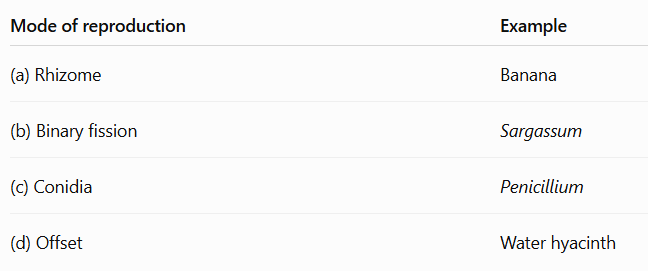
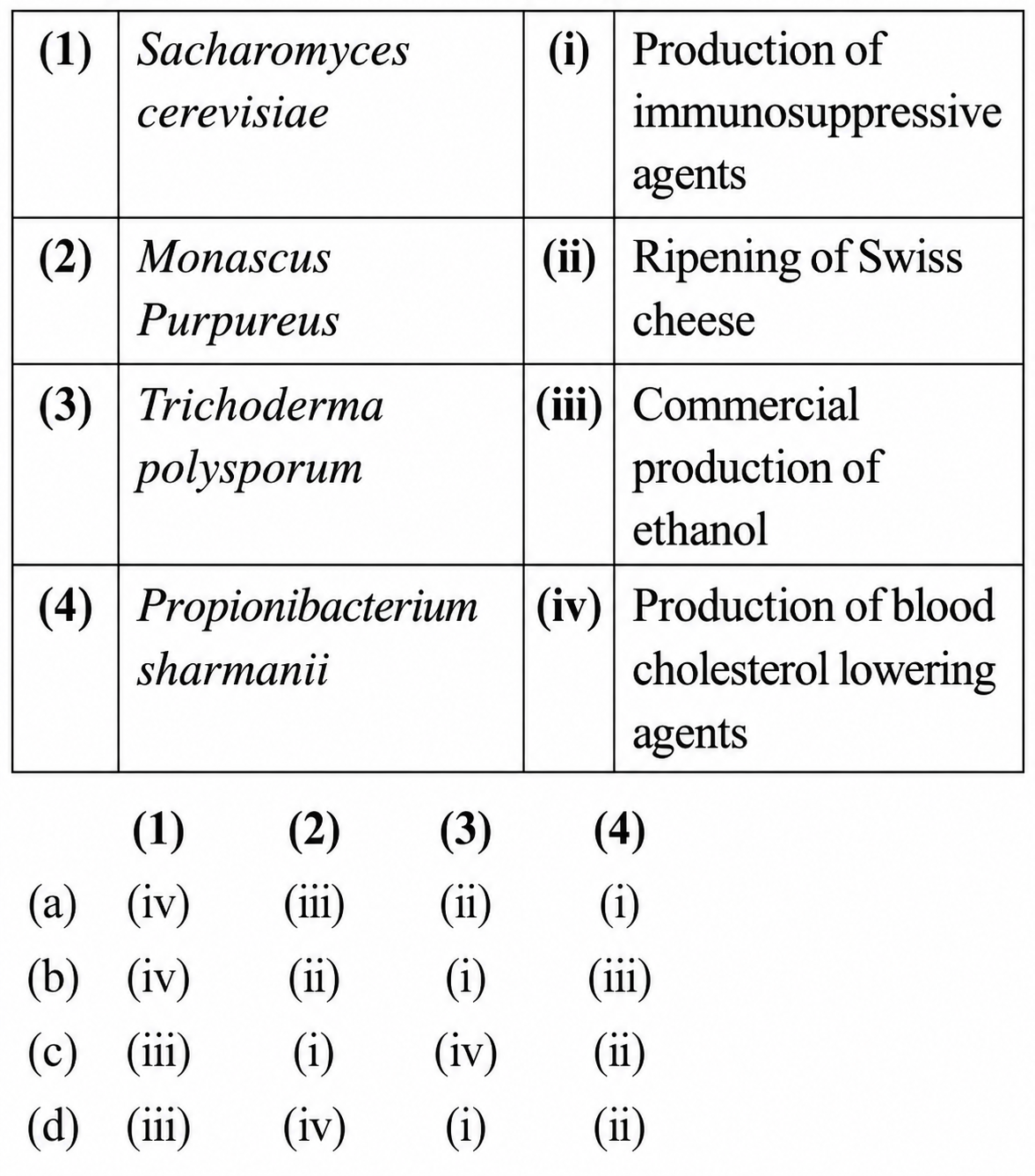
Question 23. Match the following list of microbes and their importance:
[4 Marks] Diagram 1 – NEET-UG 2015 Question Paper
  • (A) A
  • (B) B
  • (C) C
  • (D) D
Question 24. The UN Conference of Parties on climate change in the year 2012 was held at:
[4 Marks]
  • (A) Lima
  • (B) Doha
  • (C) Warsaw
  • (D) Durban
Question 25. If you suspect major deficiency of antibodies in a person, to which of the following would you look for confirmatory evidences?
[4 Marks]
  • (A) Serum albumins
  • (B) Serum globulins
  • (C) Haemocytes
  • (D) Fibrinogen in plasma
Question 26.

Chromatophores take part in:

[4 Marks]
  • (A) Movement
  • (B) Photosynthesis
  • (C) Growth
  • (D) Respiration
Question 27. Acid rain is caused by increase in the atmospheric concentration of:
[4 Marks]
  • (A) SO₃ and CO
  • (B) CO₂ and CO
  • (C) O₃ and dust
  • (D) SO₂ and NO₂
Question 28. During ecological succession:
[4 Marks]
  • (A) The numbers and types of animals remain constant.
  • (B) The establishment of a new biotic community is very fast in its primary phase.
  • (C) The changes lead to a community that is in near equilibrium with the environment and is called pioneer community.
  • (D) The gradual and predictable change in species composition occurs in a given area.
Question 29. The oxygen evolved during photosynthesis comes from water molecules. Which one of the following pairs of elements is involved in this reaction?
[4 Marks]
  • (A) Magnesium and Molybdenum
  • (B) Manganese and Potassium
  • (C) Magnesium and Chlorine
  • (D) Manganese and Chlorine
Question 30. Which of the following pairs is not correctly matched?
[4 Marks] Diagram 2 – NEET-UG 2015 Question Paper
  • (A) A
  • (B) B
  • (C) D
  • (D) C
Question 31.

In the following human pedigree, the filled symbols represent the affected individuals. Identify the type of given pedigree.
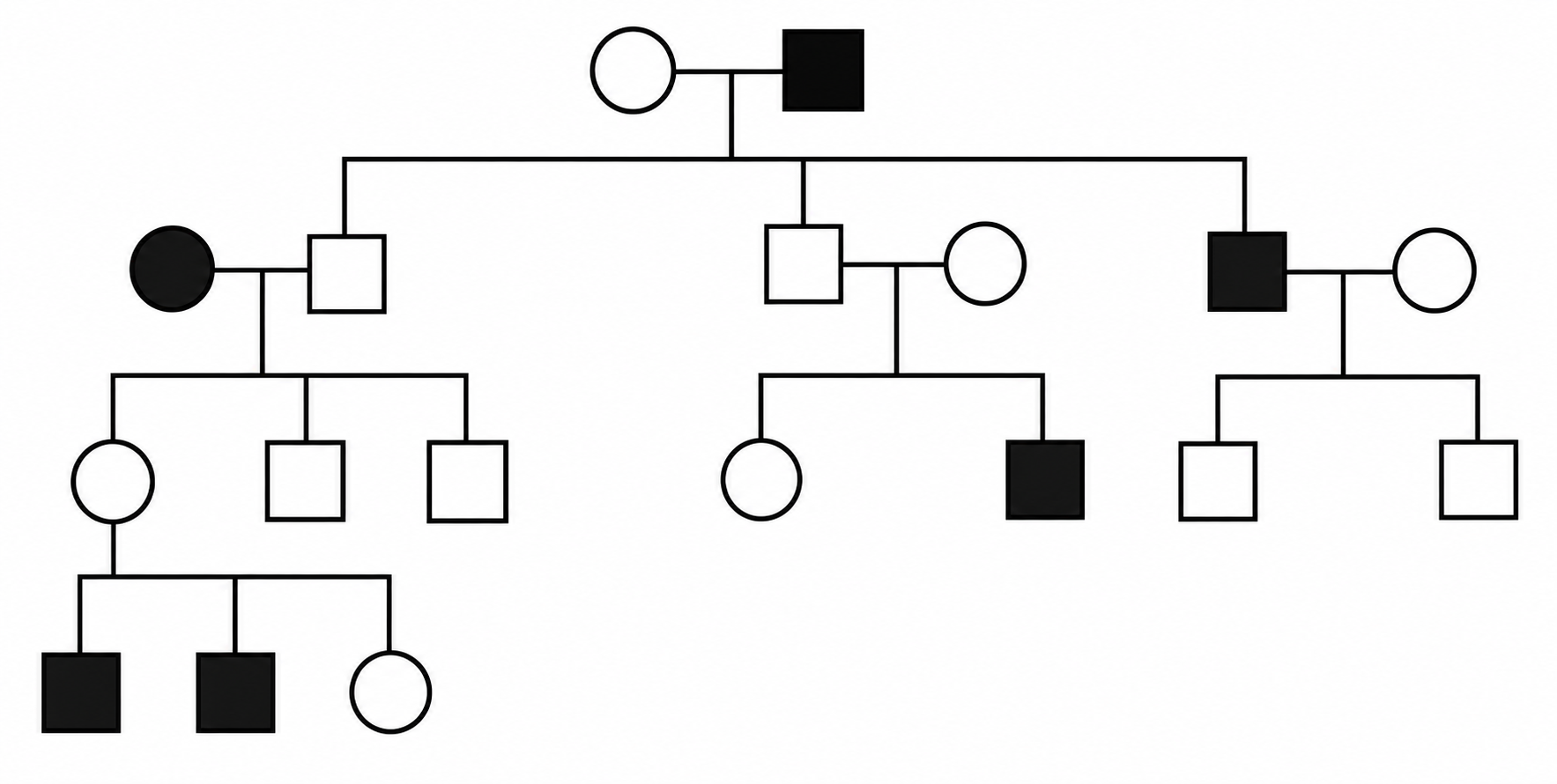
[4 Marks] Diagram 3 – NEET-UG 2015 Question Paper
  • (A) Autosomal dominant
  • (B) X-linked dominant
  • (C) Autosomal recessive
  • (D) X- linked recessive
Question 32. Which one of the following animals has two separate circulatory pathways?
[4 Marks]
  • (A) Lizard
  • (B) Whale
  • (C) Shark
  • (D) Frog
Question 33.

Flowers are unisexual in:

[4 Marks]
  • (A) Pea
  • (B) Onion
  • (C) Cucumber
  • (D) China rose
Question 34. Which one of the following fruits is parthenocarpic?
[4 Marks]
  • (A) Apple
  • (B) Jackfruit
  • (C) Banana
  • (D) Brinjal
Question 35. A pleiotropic gene:
[4 Marks]
  • (A) is a gene evolved during Pliocene.
  • (B) controls a trait only in combination with another gene.
  • (C) is expressed only in primitive plants.
  • (D) controls multiple traits in an individual.
Question 36. Which of the following is not a function of the skeletal system?
[4 Marks]
  • (A) Storage of minerals
  • (B) Production of body heat
  • (C) Locomotion
  • (D) Production of erythrocytes
Question 37. A jawless fish, which lays eggs in fresh water and whose ammocoetes larva after metamorphosis return to the ocean is:
[4 Marks]
  • (A) Myxine
  • (B) Neomyxine
  • (C) Eptatretus
  • (D) Petromyzon
Question 38. Filiform apparatus is characteristic feature of:
[4 Marks]
  • (A) Nucellar embryo
  • (B) Aleurone cell
  • (C) Synergids
  • (D) Generative cell
Question 39.

Read the different components from (A) to (D) in the list given below and tell the correct order of the components with reference to their arrangement from outer side to inner side in a woody dicot stem.

(A) Secondary cortex (B) Wood

(C) Secondary phloem (D) Phellem The correct order is:

[4 Marks]
  • (A) (C), (D), (B), (A)
  • (B) (D), (A), (C), (B)
  • (C) (D), (A), (C), (B)
  • (D) (A), (B), (D), (C)
Question 40. Which one of the following hormones is not involved in sugar metabolism?
[4 Marks]
  • (A) Aldosterone
  • (B) Glucagon
  • (C) Insulin
  • (D) Cortisone
Question 41. Golden rice is a genetically modified crop plant where the incorporated gene is meant for biosynthesis of:
[4 Marks]
  • (A) Omega 3
  • (B) Vitamin C
  • (C) Vitamin B
  • (D) Vitamin A
Question 42. Outbreeding is an important strategy of animal husbandry because it:
[4 Marks]
  • (A) is useful in producing pure lines of animals.
  • (B) is useful in overcoming inbreeding depression.
  • (C) exposes harmful recessive genes that are eliminated by selection.
  • (D) helps in accumulation of superior genes.
Question 43. A gene showing codominance has:
[4 Marks]
  • (A) A gene showing codominance has:
  • (B) alleles that are recessive to each other
  • (C) one allele dominant on the other
  • (D) both alleles independently expressed in the heterozygote
Question 44. Which one of the following hormones though synthesised elsewhere is stored and released by the master gland?
[4 Marks]
  • (A) Prolactin
  • (B) Luteinizing hormone
  • (C) Antidiuretic hormone
  • (D) Melanocyte stimulating hormone
Question 45. Increase in concentration of the toxicant at successive trophic levels is known as:
[4 Marks]
  • (A) Biotransformation
  • (B) Biodeterioration
  • (C) Biogeochemical
  • (D) Biomagnification
Question 46. Industrial melanism is an example of:
[4 Marks]
  • (A) Natural selection
  • (B) Mutation
  • (C) Neo Darwinism
  • (D) Neo Lamarckism
Question 47. The primary dentition in human differs from permanent dentition in not having one of the following type of teeth:
[4 Marks]
  • (A) Premolars
  • (B) Molars
  • (C) Incisors
  • (D) Canine
Question 48. The wheat grain has an embryo with one, large, shield-shaped cotyledon known as:
[4 Marks]
  • (A) Scutellum
  • (B) Coleorhiza
  • (C) Coleoptile
  • (D) Epiblast
Question 49. The body cells in cockroach discharge their nitrogenous waste in the haemolymph mainly in the form of:
[4 Marks]
  • (A) Potassium urate
  • (B) Urea
  • (C) Ammonia
  • (D) Calcium carbonate
Question 50. Which of the following biomolecules does have phosphodiester bond?
[4 Marks]
  • (A) Monosaccharides in a polysaccharide
  • (B) Amino acids in a polypeptide
  • (C) Nucleic acids in a nucleotide
  • (D) Fatty acids in a diglyceride
Question 51. The term 'linkage' was coined by:
[4 Marks]
  • (A) G. Mendel
  • (B) T. Boveri
  • (C) W. Sutton
  • (D) T.H. Morgan
Question 52. Which one is wrong statement?
[4 Marks]
  • (A) Mucor has biflagellate zoospores
  • (B) Haploid endosperm is typical feature of gymnosperms
  • (C) Brown algae have chlorophyll a and c and fucoxanthin
  • (D) Archegonia are found in Bryophyta, Pteridophyta and Gymnosperms
Question 53. Ectopic pregnancies are referred to as:
[4 Marks]
  • (A) Implantation of embryo at site other than uterus.
  • (B) Implantation of defective embryo in the uterus
  • (C) Pregnancies terminated due to hormonal imbalance.
  • (D) Pregnancies with genetic abnormality.
Question 54. Most animals that live in deep oceanic waters are:
[4 Marks]
  • (A) Secondary consumers
  • (B) Tertiary consumers
  • (C) Primary consumers
  • (D) Detritivores
Question 55. Which of the following diseases is caused by a protozoan?
[4 Marks]
  • (A) Babesiosis
  • (B) Influenza
  • (C) Blastomycosis
  • (D) Syphilis
Question 56. In which of the following interactions both partners are adversely affected?
[4 Marks]
  • (A) Predation
  • (B) Parasitism
  • (C) Mutualism
  • (D) Competition
Question 57. Identify the correct order of organisation of genetic material from largest to smallest:
[4 Marks]
  • (A) Genome, chromosome, nucleotide, gene
  • (B) Genome, chromosome, gene, nucleotide
  • (C) Chromosome, gene, genome, nucleotide
  • (D) Chromosome, genome, nucleotide, gene
Question 58.

A colour blind man marries a woman with normal sight who has no history of colour blindness in her family. ‘What is the probability of their grandson being colour blind?

[4 Marks]
  • (A) 0.5
  • (B) 0.25
  • (C) Nil
  • (D) 1
Question 59. In photosynthesis the light-independent reactions take place at:
[4 Marks]
  • (A) Photosystem-I
  • (B) Photosystem-II
  • (C) Stromal matrix
  • (D) Thylakoid lumen
Question 60.

In which of the following both pairs have correct combination?
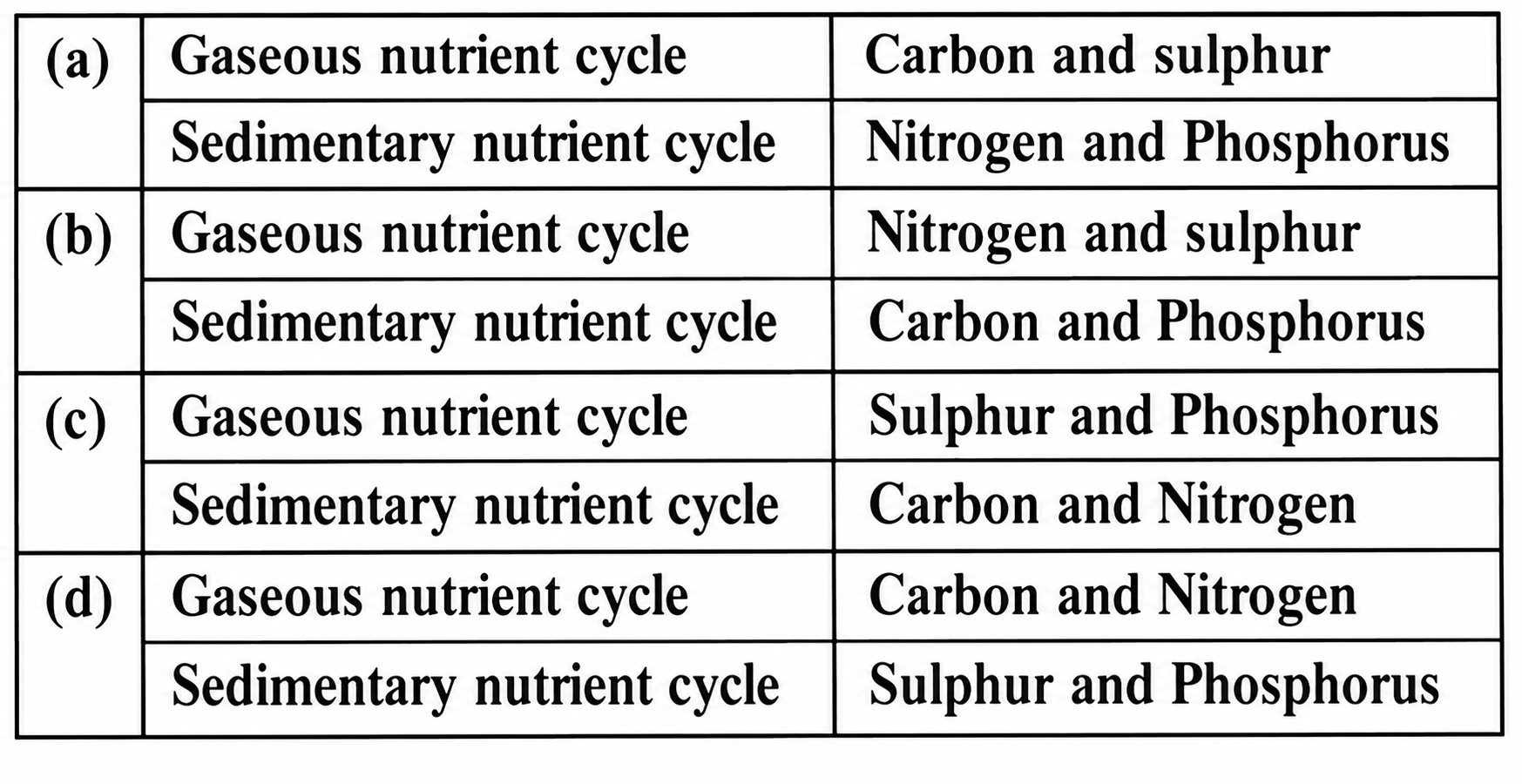
[4 Marks] Diagram 4 – NEET-UG 2015 Question Paper
  • (A) D
  • (B) B
  • (C) A
  • (D) C
Question 61. The introduction of t-DNA into plants involves:
[4 Marks]
  • (A) Exposing the plants to cold for a brief period
  • (B) Altering the pH of the soil, then heat shocking the plants
  • (C) Allowing the plant roots to stand in water
  • (D) Infection of the plant by Agrobacterium tumefaciens
Question 62. The wings of a bird and the wings of an insect are:
[4 Marks]
  • (A) Analogous structures and represent convergent evolution
  • (B) Phylogenetic structures and represent divergent evolution
  • (C) Homologous structures and represent divergent evolution
  • (D) Homologous structures and represent convergent evolution
Question 63. Root pressure develops due to:
[4 Marks]
  • (A) Passive absorption
  • (B) Low osmotic potential in soil
  • (C) Active absorption
  • (D) Increase in transpiration
Question 64. Human urine is usually acidic because:
[4 Marks]
  • (A) Excreted plasma proteins are acidic
  • (B) The sodium transporter exchanges one hydrogen ion for each sodium ion, in peritubular capillaries
  • (C) Potassium and sodium exchange generates acidity
  • (D) Hydrogen ions are actively secreted into the filtrate
Question 65. A protoplast is a cell:
[4 Marks]
  • (A) Without nucleus
  • (B) Undergoing division
  • (C) Without cell wall
  • (D) Without plasma membrane
Question 66. The species confined to a particular region and not found elsewhere is termed as:
[4 Marks]
  • (A) Alien
  • (B) Endemic
  • (C) Keystone
  • (D) Rare
Question 67. Select the wrong statements:
[4 Marks]
  • (A) The term contagium vivum fluidum was coined by M.W. Beijerinck
  • (B) W.M. Stanley showed that viruses could be crystallized.
  • (C) Mosaic disease in tobacco and AIDS in human being are caused by viruses.
  • (D) The viroids were discovered by D.J. Ivanowski.
Question 68. Axile placentation is present in:
[4 Marks]
  • (A) Lemon
  • (B) Argemone
  • (C) Pea
  • (D) Dianthus
Question 69.

A childless couple can be assisted to have a child through a technique called GIFT. The full form of this technique is:

[4 Marks]
  • (A) Gamete internal fertilization and transfer
  • (B) Gamete inseminated fallopian transfer
  • (C) Germ cell internal fallopian transfer
  • (D) Gamete intra fallopian transfer
Question 70.

Destruction of the anterior horn cell of the spinal cord would result in loss of:

[4 Marks]
  • (A) Sensory impulses
  • (B) Integrating impulses
  • (C) Commissural impulses
  • (D) Voluntary motor impulses
Question 71. During biological nitrogen fixation, inactivation of nitrogenase by oxygen poisoning is prevented by:
[4 Marks]
  • (A) Xanthophyll
  • (B) Carotene
  • (C) Cytochrome
  • (D) Leghemoglobin
Question 72. An association of individuals of different species living in the same habitat and having functional interactions is:
[4 Marks]
  • (A) Biotic community
  • (B) Population
  • (C) Ecological niche
  • (D) Ecosystem
Question 73.

Name the pulmonary disease in which alveolar surface area involved in gas exchange is drastically reduced due to damage in the alveolar walls.

[4 Marks]
  • (A) Pleurisy
  • (B) Asthma
  • (C) Pneumonia
  • (D) Emphysema
Question 74. Balbiani rings are sites of:
[4 Marks]
  • (A) Nucleotide synthesis
  • (B) Polysaccharide synthesis
  • (C) Lipid synthesis
  • (D) RNA and protein synthesis
Question 75.

Cellular organelles with membranes are:

[4 Marks]
  • (A) Nuclei, ribosomes and mitochondria
  • (B) Endoplasmic reticulum, ribosomes and nuclei
  • (C) Lysosomes, Golgi apparatus and mitochondria
  • (D) Chromosomes, ribosomes and endoplasmic reticulum
Question 76. Auxin can be bioassayed by:
[4 Marks]
  • (A) Hydroponics
  • (B) Lettuce hypocotyl elongation
  • (C) Avena coleoptile curvature
  • (D) Potometer
Question 77.

Match the columns and identify the correct option.
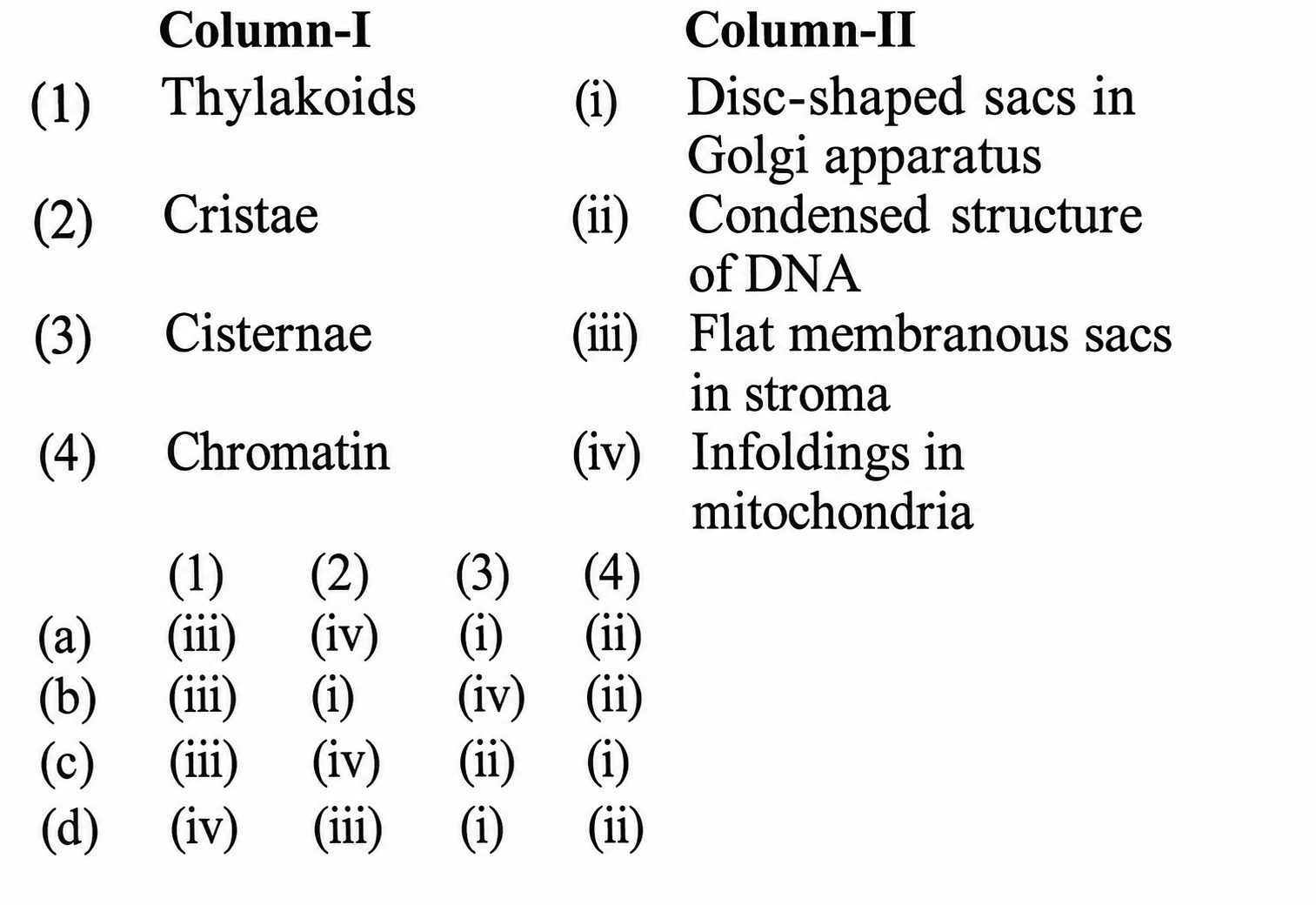
[4 Marks] Diagram 5 – NEET-UG 2015 Question Paper
  • (A) d
  • (B) c
  • (C) b
  • (D) a
Question 78. Which of the following layers in an antral follicle is acellular?
[4 Marks]
  • (A) Stroma
  • (B) Granulosa
  • (C) Zona pellucida
  • (D) Theca interna
Question 79.

Satellite DNA is important because it:

[4 Marks]
  • (A) Codes for proteins needed in cell cycle.
  • (B) Codes for enzymes needed for DNA replication.
  • (C) Does not code for proteins and is same in all members of the population.
  • (D) Shows high degree of polymorphism in population and also the same degree of polymorphism in an individual, which is heritable from parents to children.
Question 80. Cell wall is absent in:
[4 Marks]
  • (A) Nostoc
  • (B) Mycoplasma
  • (C) Aspergillus
  • (D) Funaria
Question 81. In angiosperms, microsporogenesis and megasporogenesis:
[4 Marks]
  • (A) Form gametes without further divisions
  • (B) Involve meiosis
  • (C) Occur in ovule
  • (D) Occur in anther
Question 82. Roots play insignificant role in absorption of water in:
[4 Marks]
  • (A) Pistia
  • (B) Wheat
  • (C) Pea
  • (D) Sunflower
Question 83. Which of the following are most suitable indicators of SO₂ pollution in the environment?
[4 Marks]
  • (A) Conifers
  • (B) Algae
  • (C) Fungi
  • (D) Lichens
Question 84. Grafted kidney may be rejected in a patient due to:
[4 Marks]
  • (A) Cell-mediated immune response
  • (B) Passive immune response
  • (C) Innate immune response
  • (D) Humoral immune response
Question 85. Body having meshwork of cells, internal cavities lined with food filtering flagellated cells and indirect development are the characteristics of phylum:
[4 Marks]
  • (A) Porifera
  • (B) Mollusca
  • (C) Coelenterata
  • (D) Protozoa
Question 86. In which group of organisms do the cell walls form two thin overlapping shells which fit together?
[4 Marks]
  • (A) Euglenoids
  • (B) Dinoflagellates
  • (C) Slime moulds
  • (D) Chrysophytes
Question 87. Choose the wrong statements:
[4 Marks]
  • (A) Morels and truffles are poisonous mushrooms.
  • (B) Neurospora is used in the study of biochemical genetics.
  • (C) Yeast is unicellular and useful in fermentation.
  • (D) Penicillium is multicellular and produces antibiotics.
Question 88. In human females, meiosis-II is not complete until?
[4 Marks]
  • (A) Uterine implantation
  • (B) Fertilization
  • (C) Puberty
  • (D) Birth
Question 89. Eutrophication of water bodies leading to killing of fishes is mainly due to non-availability of:
[4 Marks]
  • (A) Light
  • (B) Essential minerals
  • (C) Oxygen
  • (D) Food
Question 90. The enzyme that is not present in succus entericus is:
[4 Marks]
  • (A) Nucleases
  • (B) Nucleosidase
  • (C) Maltase
  • (D) Lipase
Question 91.

A mixture of gases contains H₂ and O₂ gases in the ratio of 1 : 4 (w/w). What is the molar ratio of the two gases in the mixture?

[4 Marks]
  • (A) 1:4
  • (B) 4:1
  • (C) 2:1
  • (D) 16:1
Question 92.

The species Ar, K⁺ and Ca²⁺ contain the same number of electrons. In which order do their radii increase?

[4 Marks]
  • (A) Ca²⁺ < Ar < K⁺
  • (B) Ca²⁺ < K⁺ < Ar
  • (C) Ar < K⁺ < Ca²⁺
  • (D) K⁺ < Ar < Ca²⁺
Question 93.

Which of the following pairs of ions are isoelectronic and isostructural?

[4 Marks]
  • (A) ClO₃⁻, CO₃²⁻
  • (B) SO₃²⁻, NO₃⁻
  • (C) CO₃²⁻, SO₃²⁻
  • (D) ClO₃⁻, SO₃²⁻
Question 94.

Maximum bond angle at nitrogen is present in which of the following?

[4 Marks]
  • (A) NO₂
  • (B) NO₃⁻
  • (C) NO₂⁺
  • (D) NO₂⁻
Question 95.

The correct bond order in the following species is:

[4 Marks]
  • (A) O₂⁻ < O₂⁺ < O₂²⁺
  • (B) O₂²⁺ < O₂⁺ < O₂⁻
  • (C) O₂⁺ < O₂⁻ < O₂²⁺
  • (D) O₂²⁺ < O₂⁻ < O₂⁺
Question 96.

Which of the following options represents the correct bond order?

[4 Marks]
  • (A) O₂ < O₂⁻ < O₂⁺
  • (B) O₂⁻ > O₂ > O₂⁺
  • (C) O₂⁻ < O₂ > O₂⁺
  • (D) O₂⁻ > O₂ > O₂⁺
Question 97.

Which of the following species contains equal number of σ- and π-bonds?

[4 Marks]
  • (A) XeO₄
  • (B) (CN)₂
  • (C) CH₂(CN)₂
  • (D) HCO₃⁻
Question 98.

If the value of an equilibrium constant for a particular reaction is 1.6 × 10¹², then at equilibrium the system will contain:

[4 Marks]
  • (A) All reactants
  • (B) Mostly products
  • (C) Similar amounts of reactants and products
  • (D) Mostly reactants
Question 99.

Which of the following statements is correct for a reversible process in a state of equilibrium?

[4 Marks]
  • (A) ΔG = –2.30 RT log K
  • (B) ΔG° = 2.30 RT log K
  • (C) ΔG = 2.30 RT log K
  • (D) ΔG° = –2.30 RT log K
Question 100.

The Kₛₚ​ of Ag₂CrO₄, AgCl, AgBr and AgI are respectively,

1.1 × 10⁻¹², 1.8 × 10⁻¹⁰, 5.0 × 10⁻¹³, 8.3 × 10⁻¹⁷

Which of the following salts will precipitate first on adding AgNO₃ solution to a solution containing equal moles of NaCl, NaBr, NaI and Na₂CrO₄?

[4 Marks]
  • (A) AgBr
  • (B) Ag₂CrO₄
  • (C) AgCl
  • (D) AgI
Question 101.

The function of "Sodium pump" is a biological process operating in each and every cell of all animals. Which of the following biologically important ions is also a constituent of this pump?

[4 Marks]
  • (A) K⁺
  • (B) Mg²⁺
  • (C) Ca²⁺
  • (D) Fe²⁺
Question 102.

Solubility of the alkaline earth's metal sulphates in water decreases in the sequence:

[4 Marks]
  • (A) Ca > Sr > Ba > Mg
  • (B) Sr > Ca > Mg > Ba
  • (C) Ba > Mg > Sr > Ca
  • (D) Mg > Ca > Sr > Ba
Question 103.

Given

Which of the given compounds can exhibit tautomerism?
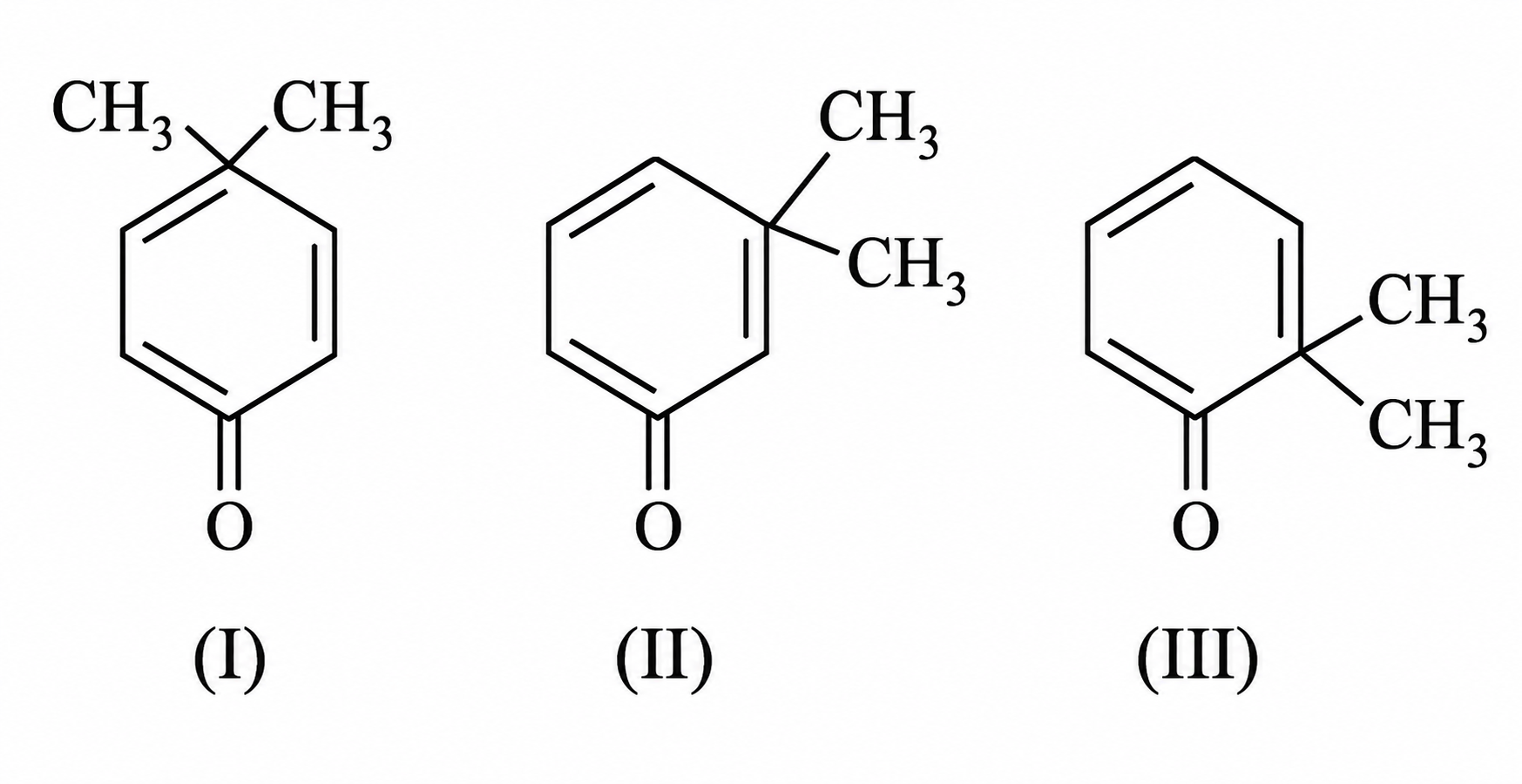
[4 Marks] Diagram 6 – NEET-UG 2015 Question Paper
  • (A) II and III
  • (B) I and III
  • (C) I, II and III
  • (D) I and II
Question 104.

Consider the following compounds

Hyperconjugation occurs in :
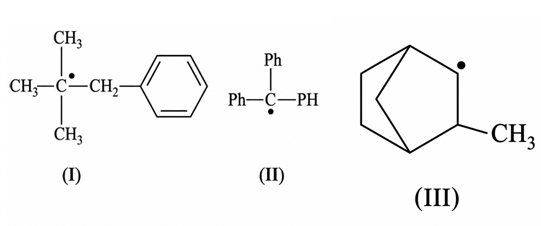
[4 Marks] Diagram 7 – NEET-UG 2015 Question Paper
  • (A) I only
  • (B) Il only
  • (C) I and III
  • (D) IIl only
Question 105.

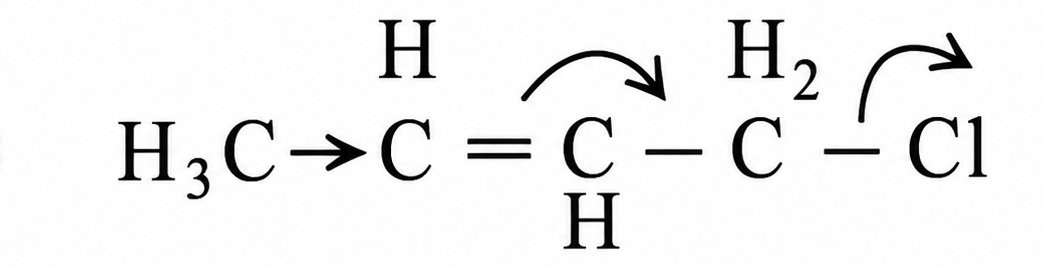
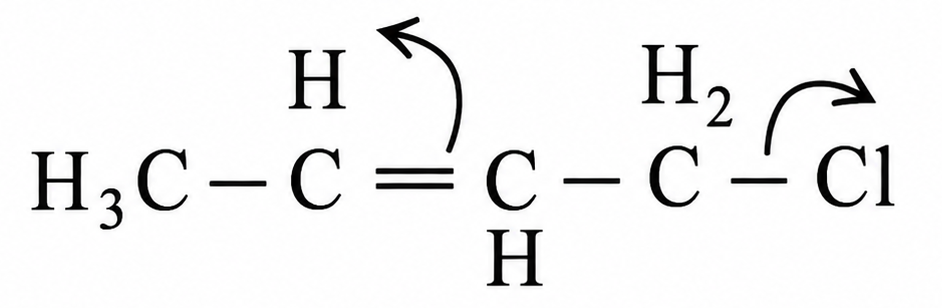
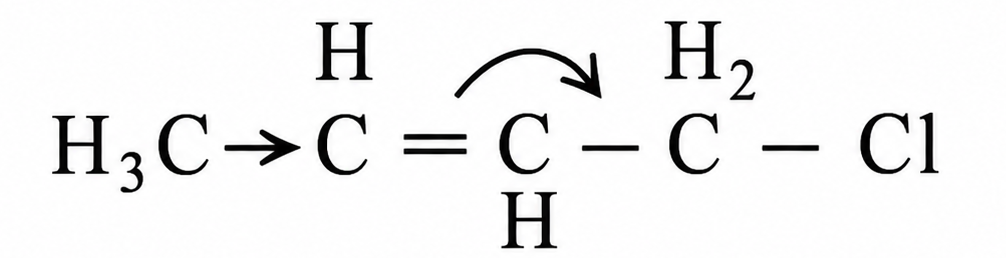
Which of the following is the most correct electron displacement for a nucleophilic reaction to take place?

[4 Marks]
  • (A) Diagram 8 – NEET-UG 2015 Question Paper
  • (B) Diagram 9 – NEET-UG 2015 Question Paper
  • (C) Diagram 10 – NEET-UG 2015 Question Paper
  • (D) Diagram 11 – NEET-UG 2015 Question Paper
Question 106.

In Duma's method for estimation of nitrogen, 0.25 g of an organic compound gave 40 mL of nitrogen collected at 300 K temperature and 725 mm pressure. If the aqueous tension at 300 K is 25 mm, the percentage of nitrogen in the compound is:

[4 Marks]
  • (A) 16.76
  • (B) 15.76
  • (C) 17.36
  • (D) 18.20
Question 107.

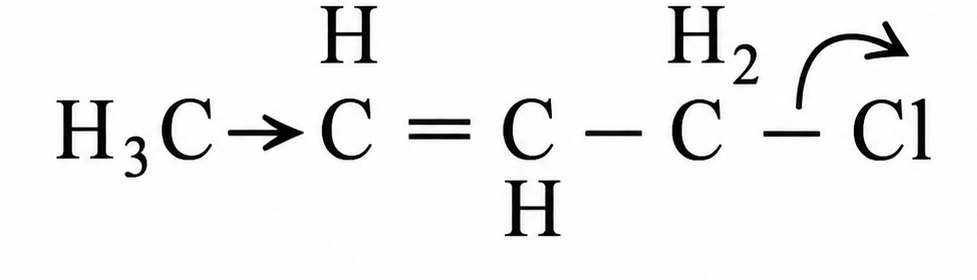
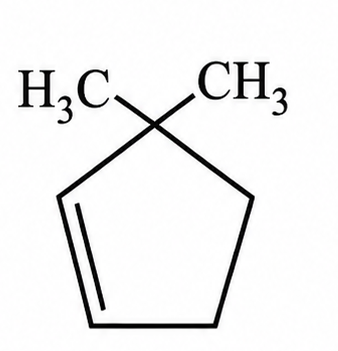
A single compound of the structure :

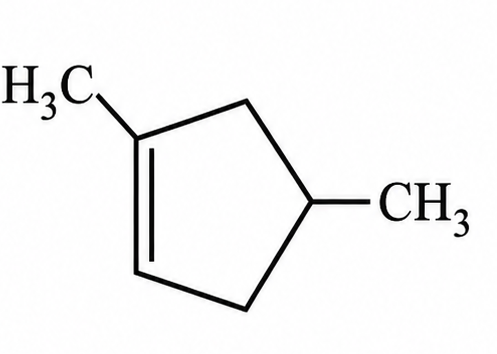
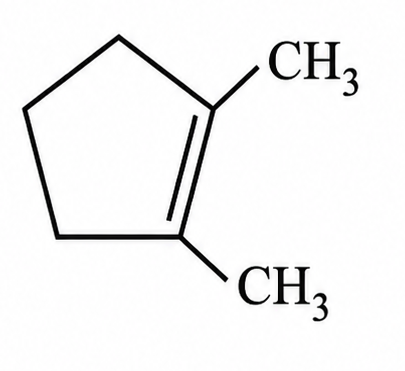
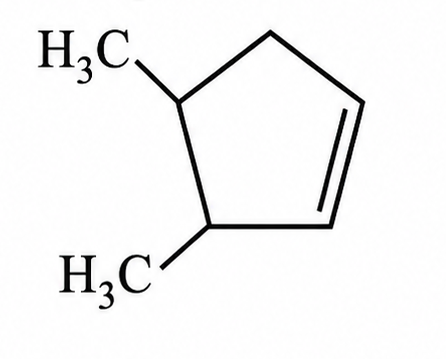
is obtainable from ozonolysis of which of the following cyclic compounds ?
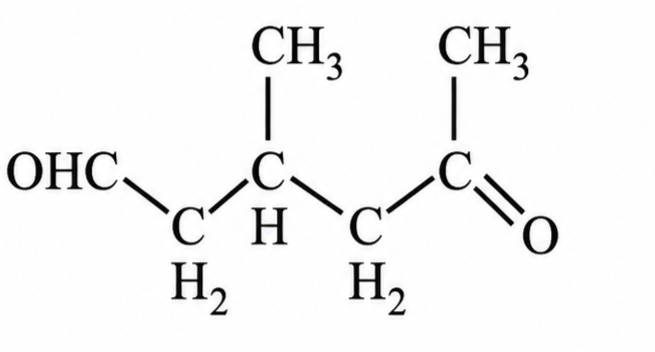
[4 Marks] Diagram 12 – NEET-UG 2015 Question Paper
  • (A) Diagram 13 – NEET-UG 2015 Question Paper
  • (B) Diagram 14 – NEET-UG 2015 Question Paper
  • (C) Diagram 15 – NEET-UG 2015 Question Paper
  • (D) Diagram 16 – NEET-UG 2015 Question Paper
Question 108.

The total number of π - bond electrons in the following structure is :
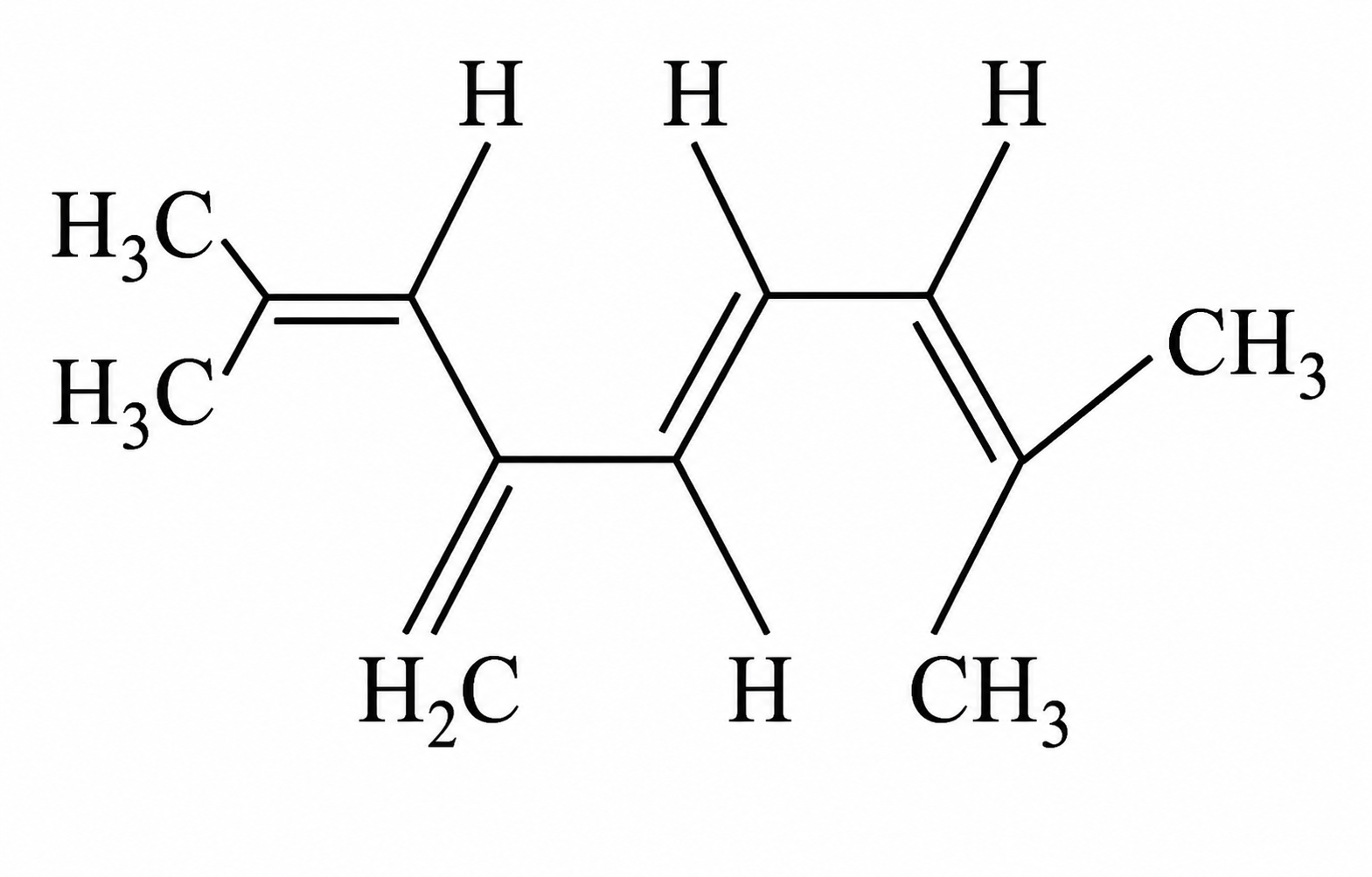
[4 Marks] Diagram 17 – NEET-UG 2015 Question Paper
  • (A) 8
  • (B) 16
  • (C) 12
  • (D) 4
Question 109.

Which one is not equal to zero for an ideal solution?

[4 Marks]
  • (A) ΔHₘᵢₓ
  • (B) ΔP = Pₒbₛₑᵣᵥₑd − Pᵣₐₒᵤₗₜ
  • (C) ΔSₘᵢₓ
  • (D) ΔVₘᵢₓ
Question 110.

The oxidation of benzene by V₂O₅ in presence of air produces:

[4 Marks]
  • (A) Benzoic anhydride
  • (B) Benzoic acid
  • (C) Maleic anhydride
  • (D) Benzaldehyde
Question 111.

Which one of the following electrolytes has the same value of van't Hoff's factor (i) as that of Al₂(SO₄)₃ (if all are 100% ionised)?

[4 Marks]
  • (A) K₂SO₄
  • (B) Al(NO₃)₃
  • (C) K₄[Fe(CN)₆]
  • (D) K₃[Fe(CN)₆]
Question 112.

The boiling point of 0.2 mol kg⁻¹ solution of X in water is greater than equimolal solution of Y in water. Which one of the following statements is true in this case?

[4 Marks]
  • (A) Molecular mass of X is greater than the molecular mass of Y.
  • (B) Molecular mass of X is less than the molecular mass of Y.
  • (C) X is undergoing dissociation in water.
  • (D) Y is undergoing dissociation in water while X undergoes no change.
Question 113.

A device that converts energy of combustion of fuels like hydrogen and methane, directly into electrical energy is known as:

[4 Marks]
  • (A) Dynamo
  • (B) Electrolytic cell
  • (C) Ni-Cd cell
  • (D) Fuel Cell
Question 114.

When initial concentration of a reactant is doubled in a reaction, its half-life period is not affected. The order of the reaction is:

[4 Marks]
  • (A) Zero
  • (B) More than zero but less than first
  • (C) Second
  • (D) First
Question 115.

The activation energy of a reaction can be determined from the slope of which of the following graphs?

[4 Marks]
  • (A) ln K/T vs. T
  • (B) ln K vs. 1/T
  • (C) T/lnK vs. 1/T
  • (D) ln K vs. T
Question 116.

Which property of colloidal solution is independent of charge on the colloidal particles?

[4 Marks]
  • (A) Electrophoresis
  • (B) Electro-osmosis
  • (C) Tyndall effect
  • (D) Coagulation
Question 117.

Metals are usually not found as nitrates in their ores”. Out of the following two (i) and (ii) reasons which is/are true for the above observation?

(i) Metal nitrates are highly unstable.

(ii) Metal nitrates are highly soluble in water.

[4 Marks]
  • (A) (i) is false but (ii) is true
  • (B) (i) and (ii) are false
  • (C) (i) is true but (ii) is false
  • (D) (i) and (ii) are true
Question 118.

Nitrogen dioxide and sulphur dioxide have some properties in common. Which property is shown by one of these compounds, but not by the other?

[4 Marks]
  • (A) forms acid rain
  • (B) Is used as a food-preservative
  • (C) Is soluble in water
  • (D) Is a reducing agent
Question 119.

Magnetic moment 2.84 B.M. is given by:

(At. nos., Ti = 22, Cr = 24, Co = 27, Ni = 28)

[4 Marks]
  • (A) Cr²⁺
  • (B) Ti³⁺
  • (C) Co²⁺
  • (D) Ni²⁺
Question 120.

The number of d-electrons in Fe²⁺ (Z = 26) is not equal to the number of electrons in which one of the following?

[4 Marks]
  • (A) p-electrons in Ne (Z = 10)
  • (B) s-electrons in Mg (Z = 12)
  • (C) p-electrons in Cl (Z = 17)
  • (D) d-electrons in Fe (Z = 26)
Question 121.

Which of the following processes does not involve oxidation of iron?

[4 Marks]
  • (A) Liberation of H₂ from steam by iron at high temperature
  • (B) Formation of Fe(CO)₅ from Fe
  • (C) Decolourization of blue CuSO₄ solution by iron
  • (D) Rusting of iron sheets exposed to air
Question 122.

Because of lanthanoid contraction, which of the following pairs of elements have nearly same atomic radii? (Numbers in the parentheses are atomic numbers.)

[4 Marks]
  • (A) Ti (22) and Zr (40)
  • (B) Zr (40) and Hf (72)
  • (C) Zr (40) and Ta (73)
  • (D) Zr (40) and Nb (41)
Question 123.

Cobalt (III) chloride forms several octahedral complexes with ammonia. Which of the following will not give chloride ions with silver nitrate at 25°C?

[4 Marks]
  • (A) CoCl₃·4NH₃
  • (B) CoCl₃·5NH₃
  • (C) CoCl₃·6NH₃
  • (D) CoCl₃·3NH₃
Question 124.

Which of these statements about [Co(CN)₆]³⁻ is true?

[4 Marks]
  • (A) [Co(CN)₆]³⁻ has no unpaired electrons and will be in a high-spin configuration.
  • (B) [Co(CN)₆]³⁻ has four unpaired electrons and will be in a high-spin configuration.
  • (C) [Co(CN)₆]³⁻ has four unpaired electrons and will be in a low-spin configuration.
  • (D) [Co(CN)₆]³⁻ has no unpaired electrons and will be in a low-spin configuration.
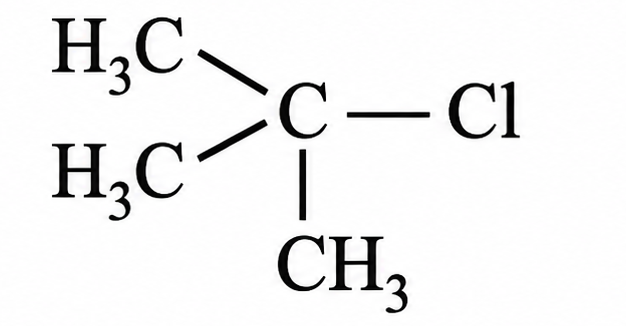
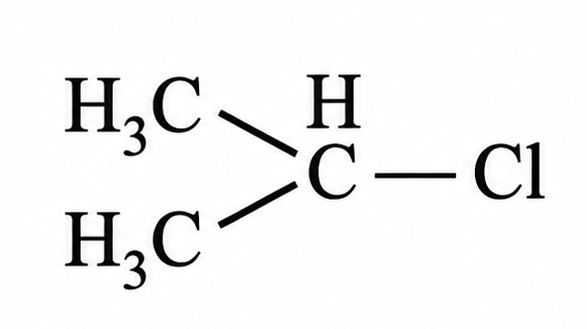
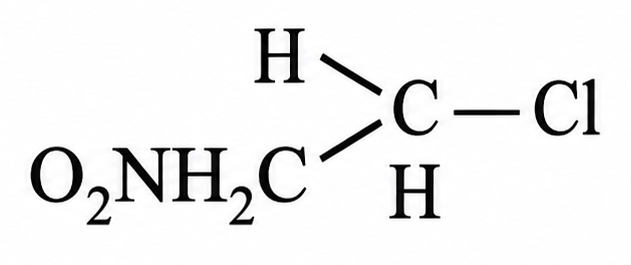
Question 125.

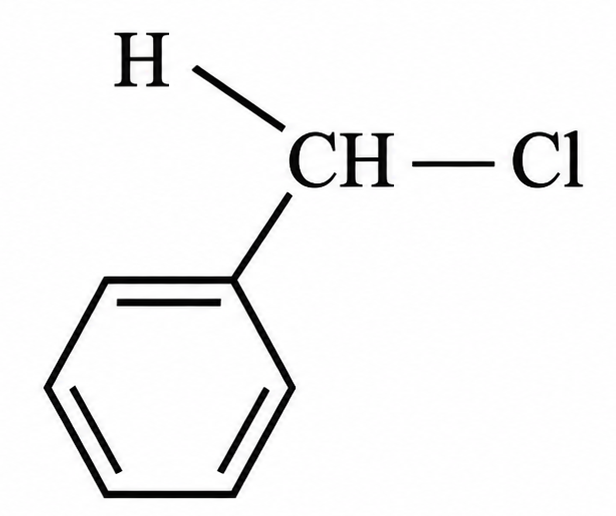
In which of the following compounds, the C–Cl bond ionisation shall give the most stable carbonium ion?

[4 Marks]
  • (A) Diagram 18 – NEET-UG 2015 Question Paper
  • (B) Diagram 19 – NEET-UG 2015 Question Paper
  • (C) Diagram 20 – NEET-UG 2015 Question Paper
  • (D) Diagram 21 – NEET-UG 2015 Question Paper
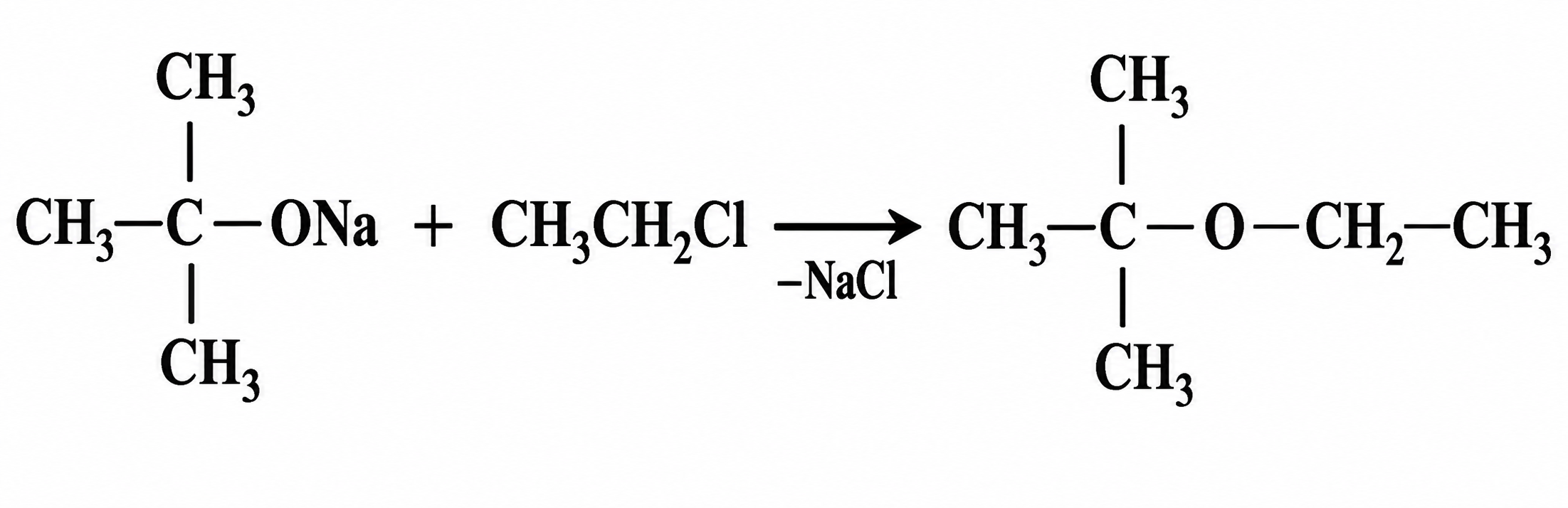
Question 126.

The reaction is called :

[4 Marks] Diagram 22 – NEET-UG 2015 Question Paper
  • (A) Gatterman - Koch reaction
  • (B) Williamson Synthesis
  • (C) Williamson continuous etherification process
  • (D) Etard reaction
Question 127.

An organic compound 'X' having molecular formula C₅H₁₀O yields phenyl hydrazone and gives negative response to the iodoform test and Tollen's test. It produces n-pentane on reduction. 'X' could be:

[4 Marks]
  • (A) 2-Pentanone
  • (B) 3-Pentanone
  • (C) Pentanal
  • (D) n-Amyl alcohol
Question 128.

Treatment of cyclopentanone with methyl lithium gives which of the following species?
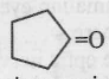
[4 Marks] Diagram 23 – NEET-UG 2015 Question Paper
  • (A) Cyclopentanonyl radical
  • (B) Cyclopentanonyl anion
  • (C) Cyclopentanonyl cation
  • (D) Cyclopentanonyl biradical
Question 129.

The enolic form of ethyl acetoacetate as below has:
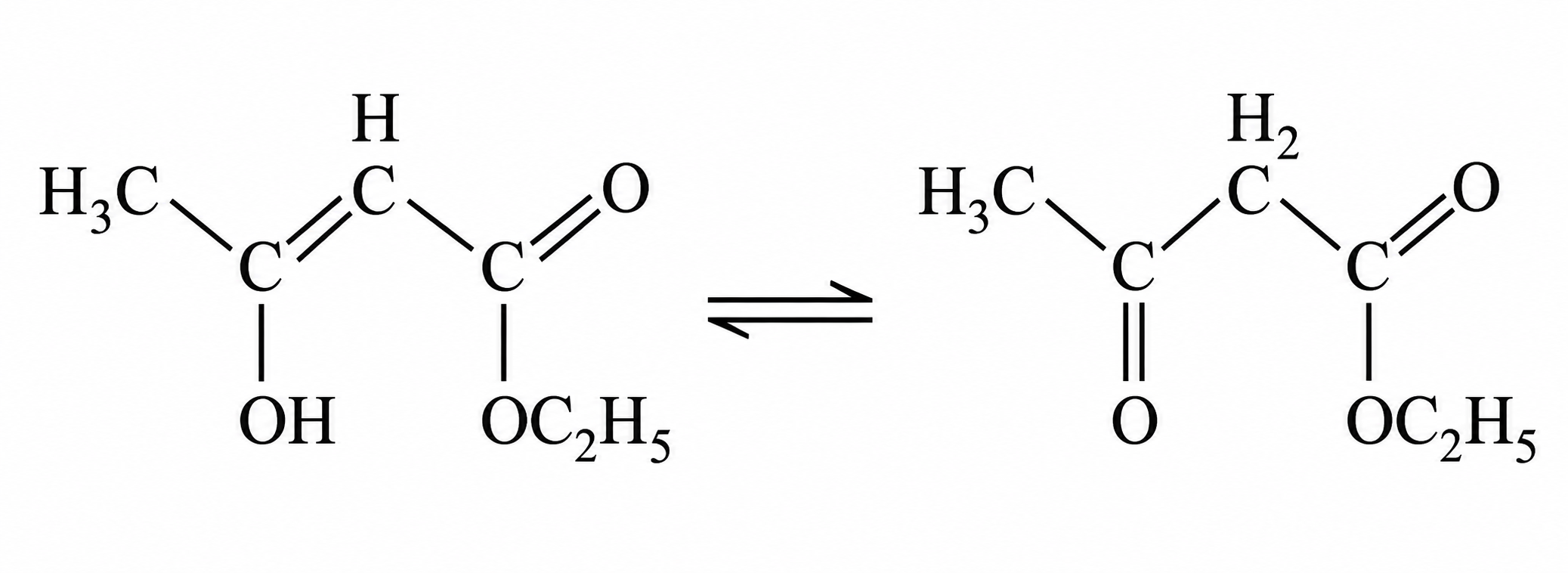
[4 Marks] Diagram 24 – NEET-UG 2015 Question Paper
  • (A) 18 sigma bonds and 2 pi - bonds
  • (B) 9 sigma bondsand 1 pi - bond
  • (C) 9 sigma bonds and 2 pi - bonds
  • (D) 16 sigma bonds and 1 pi - bond
Question 130.

The electrolytic reduction of nitrobenzene in strongly acidic medium produces:

[4 Marks]
  • (A) Azoxybenzene
  • (B) Aniline
  • (C) p-Aminophenol
  • (D) Azobenzene
Question 131.

Biodegradable polymer which can be produced from glycine and aminocaproic acid is:

[4 Marks]
  • (A) Nylon 2–Nylon 6
  • (B) Buna-N
  • (C) Nylon 6,6
  • (D) PHBV
Question 132.

Bithionol is generally added to soaps as an additive to function as a/an:

[4 Marks]
  • (A) Buffering agent
  • (B) Dryer
  • (C) Antiseptic
  • (D) Softener
Question 133.

The angular momentum of electron in 'd' orbital is equal to:

[4 Marks]
  • (A) √2h
  • (B) 2√3h
  • (C) 0h
  • (D) √6h
Question 134.

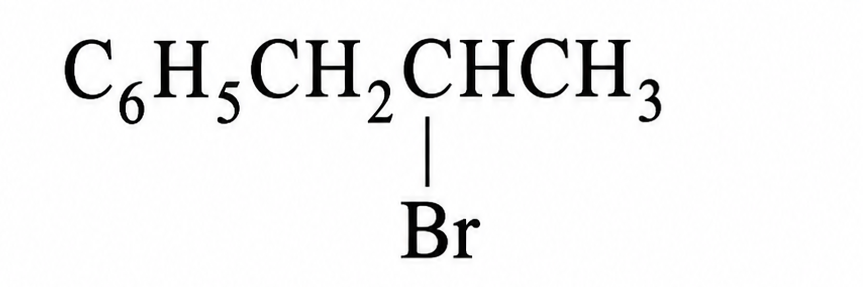
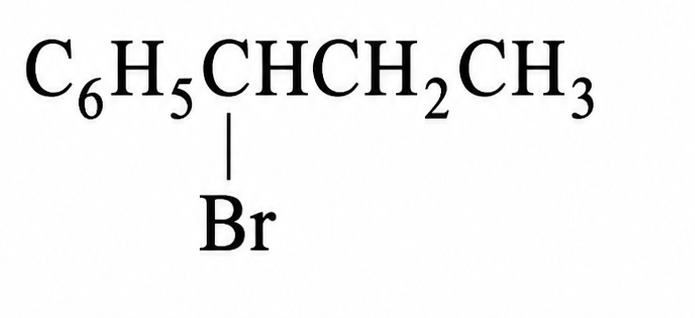
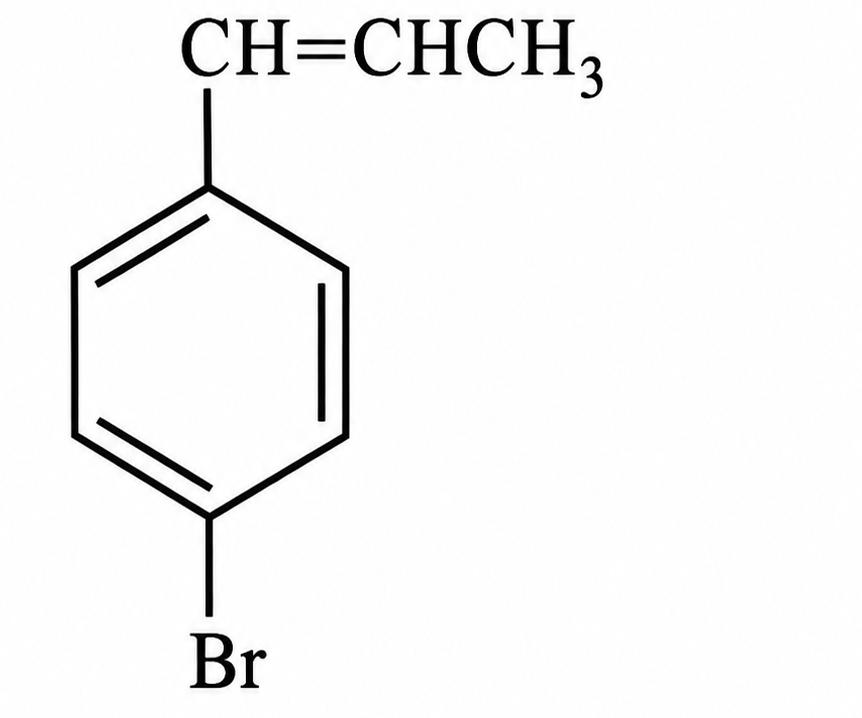
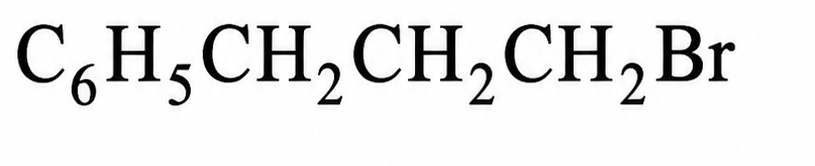
The reaction of C₆H₅CH = CHCH₃ with HBr produces:

[4 Marks]
  • (A) Diagram 25 – NEET-UG 2015 Question Paper
  • (B) Diagram 26 – NEET-UG 2015 Question Paper
  • (C) Diagram 27 – NEET-UG 2015 Question Paper
  • (D) Diagram 28 – NEET-UG 2015 Question Paper
Question 135.

Given:

The enthalpy of the hydrogenation of these compounds will be in the order as :
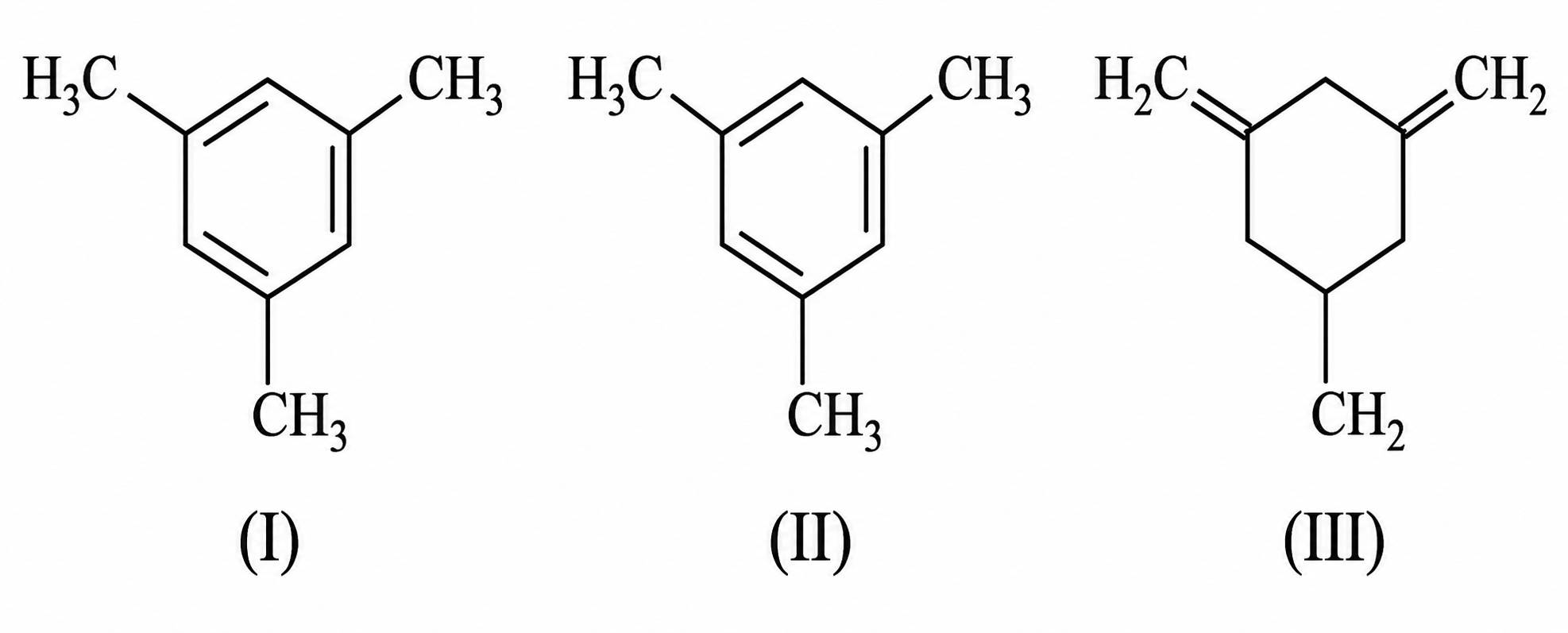
[4 Marks] Diagram 29 – NEET-UG 2015 Question Paper
  • (A) II > I > III
  • (B) I > II > III
  • (C) II > III > I
  • (D) III > II > I
Question 136.

If energy (E), velocity (V) and time (T) are chosen as the fundamental quantities, the dimensional formula of surface tension will be:

[4 Marks]
  • (A) [EV⁻¹T⁻²]
  • (B) [EV⁻²T⁻¹]
  • (C) [EV⁻²T⁻²]
  • (D) [E⁻²V⁻¹T⁻³]
Question 137.

A particle of unit mass undergoes one-dimensional motion such that its velocity varies according to v(x) = bx⁻²ⁿ where b and n are constants and x is the position of the particle. The acceleration of the particle as the function of x, is given by:

[4 Marks]
  • (A) -2nb²e⁻⁴ⁿ⁺¹
  • (B) -2nb²x⁻²ⁿ⁻¹
  • (C) -2nb²x⁻⁴ⁿ⁻¹
  • (D) -2b²x⁻²ⁿ⁺¹
Question 138.

A ship A is moving Westwards with a speed of 10 km h⁻¹ and a ship B, 100 km South of A, is moving Northwards with a speed of 10 km h⁻¹. The time after which the distance between them becomes shortest, is:

[4 Marks]
  • (A) 0 h
  • (B) 10√2 h
  • (C) 5√2 h
  • (D) 5 h
Question 139.

Three blocks A, B and C of masses 4 kg, 2 kg and 1 kg respectively, are in contact on a frictionless surface, as shown. If a force of 14 N is applied on the 4 kg block then the contact force between A and B is
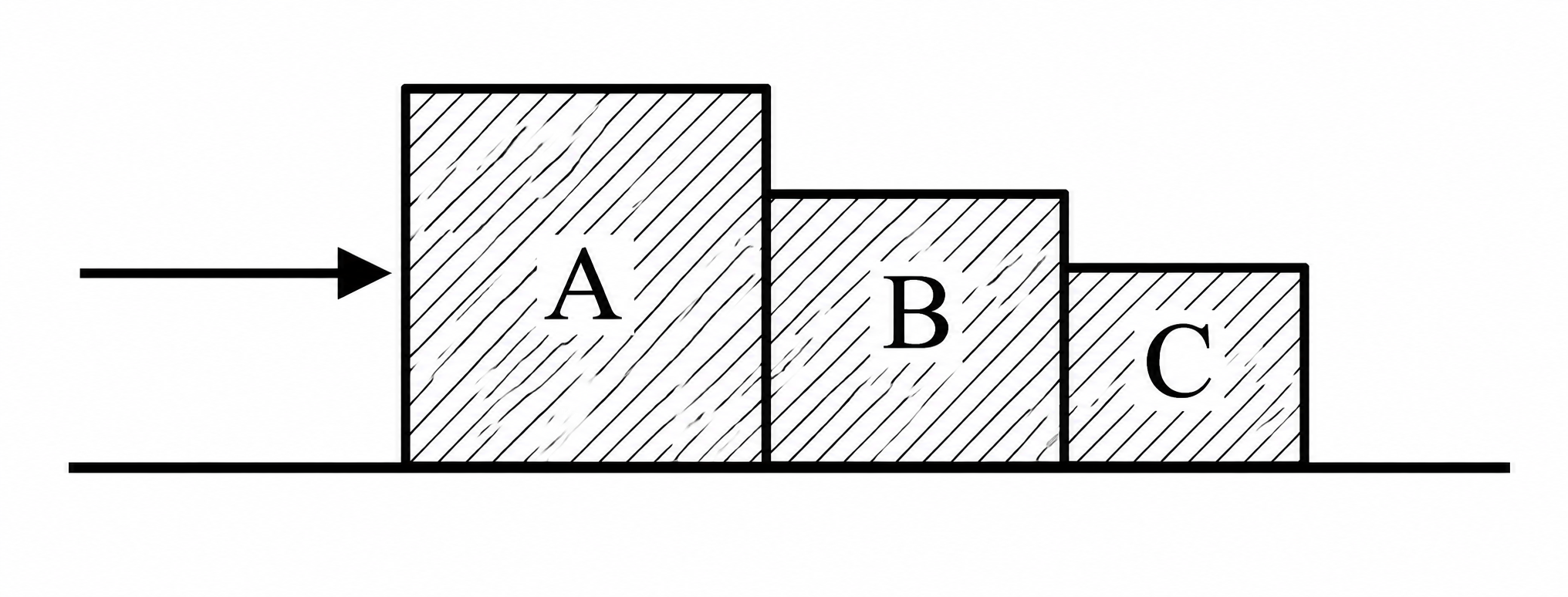
[4 Marks] Diagram 30 – NEET-UG 2015 Question Paper
  • (A) 6 N
  • (B) 8 N
  • (C) 18 N
  • (D) 2 N
Question 140.

A block A of mass m₁ rests on a horizontal table. A light string connected to it passes over a frictionless pulley at the edge of the table and from its other end another block B of mass m₂ is suspended. The coefficient of kinetic friction between the block and the table is μₖ. When the block A is sliding on the table, the tension in the string is:

[4 Marks]
  • (A) m₁m₂(1-μₖ)g / m₁+m₂
  • (B) (m₂-+μₖm₁)g / m₁+m₂
  • (C) m₁m₂(1+μₖ)g / m₁+m₂
  • (D) (m₂-μₖm₁)g / m₁+m₂
Question 141.

Two similar springs P and Q have spring constants Kₚ and K_Q, such that Kₚ > K_Q. They are stretched, first by the same amount (case a), then by the same force (case b). The work done by the springs, Wₚ and W_Q are related as, in case (a) and case (b), respectively.

[4 Marks]
  • (A) Wₚ = W_Q ; Wₚ = W_Q
  • (B) Wₚ < W_Q ; W_Q < Wₚ
  • (C) Wₚ > W_Q ; W_Q > Wₚ
  • (D) Wₚ = W_Q ; Wₚ = W_Q
Question 142.

A block of mass 10 kg, moving in x direction with a constant speed of 10 ms⁻¹, is subject to a retarding force F=0.1xJ/m during its travel from x = 20 m to 30 m. Its final KE will be:

[4 Marks]
  • (A) 450 J
  • (B) 250 J
  • (C) 275 J
  • (D) 475 J
Question 143.

A particle of mass m is driven by a machine that delivers a constant power of k watts. If the particle starts from rest, the force on the particle at time t is:

[4 Marks]
  • (A) √(mk/2) t⁻¹ᐟ²
  • (B) 1/2 √(mk) t⁻¹ᐟ²
  • (C) √(2mk) t⁻¹ᐟ²
  • (D) √(mk) t⁻¹ᐟ²
Question 144.

A mass m moves in a circle on a smooth horizontal plane with velocity v₀ at a radius R₀. The mass is attached to a string which passes through a smooth hole in the plane as shown.

The tension in the string is increased gradually and in a circle of radius R₀/2. The final value of the kinetic energy is
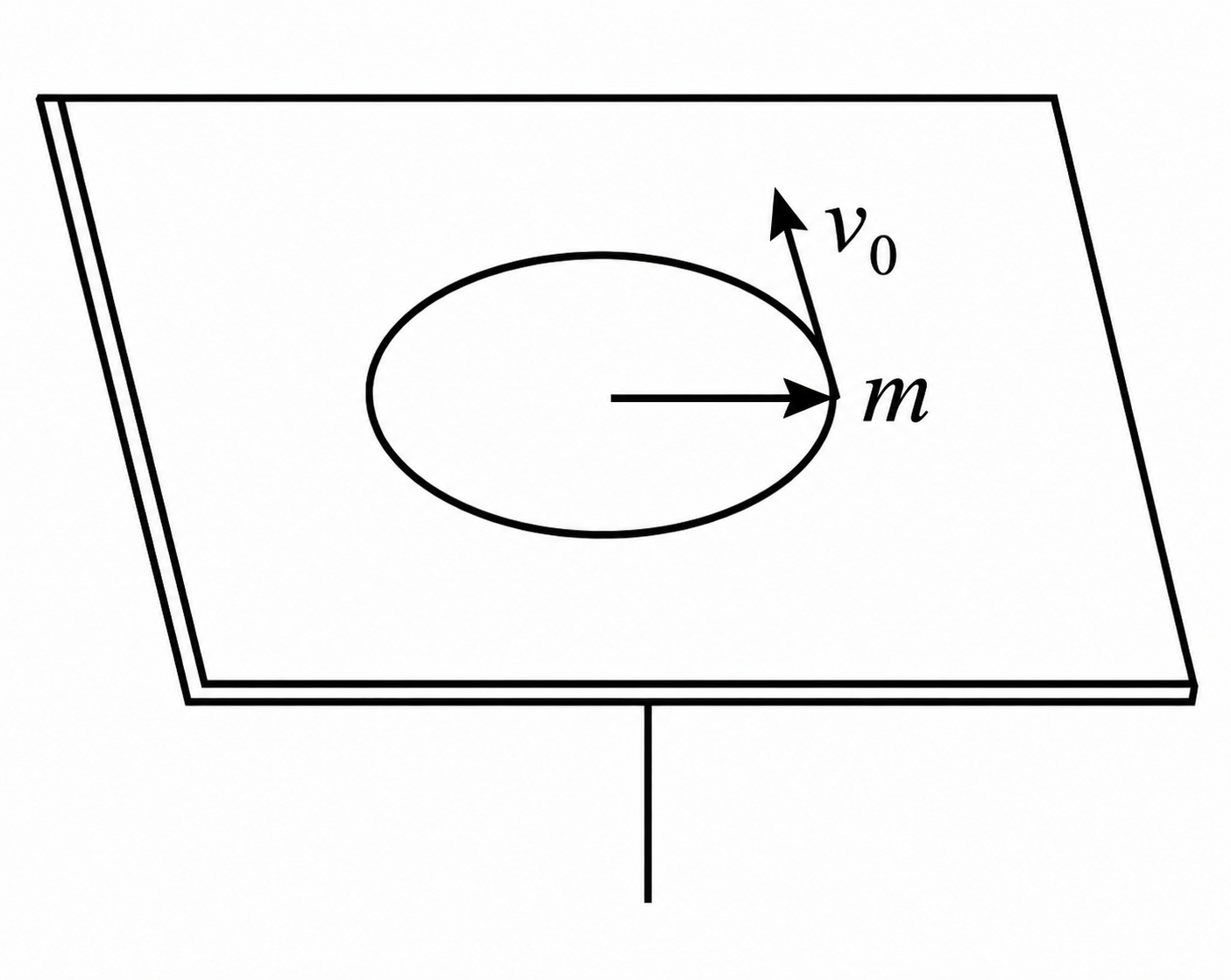
[4 Marks] Diagram 31 – NEET-UG 2015 Question Paper
  • (A) 1/4 mv₀²
  • (B) 2mv₀²
  • (C) 1/2 mv₀²
  • (D) mv₀²
Question 145.

A rod of weight W is supported by two parallel knife edges A and Band is in equilibrium in a horizontal position. The Knives are at a distance d from each other. The centre of mass of the rod is at distance x from A. The normal reaction on A is

[4 Marks]
  • (A) Wx/d
  • (B) W(d-x)/d
  • (C) W(d-x)/x
  • (D) Wd/x
Question 146.

Three identical spherical shells, each of mass m and radius rare placed as shown in figure. Consider an axis XX' which is touching to two shells and passing through diameter of third shell. Moment of inertia of the system consisting of these three spherical shells about XX' axis is
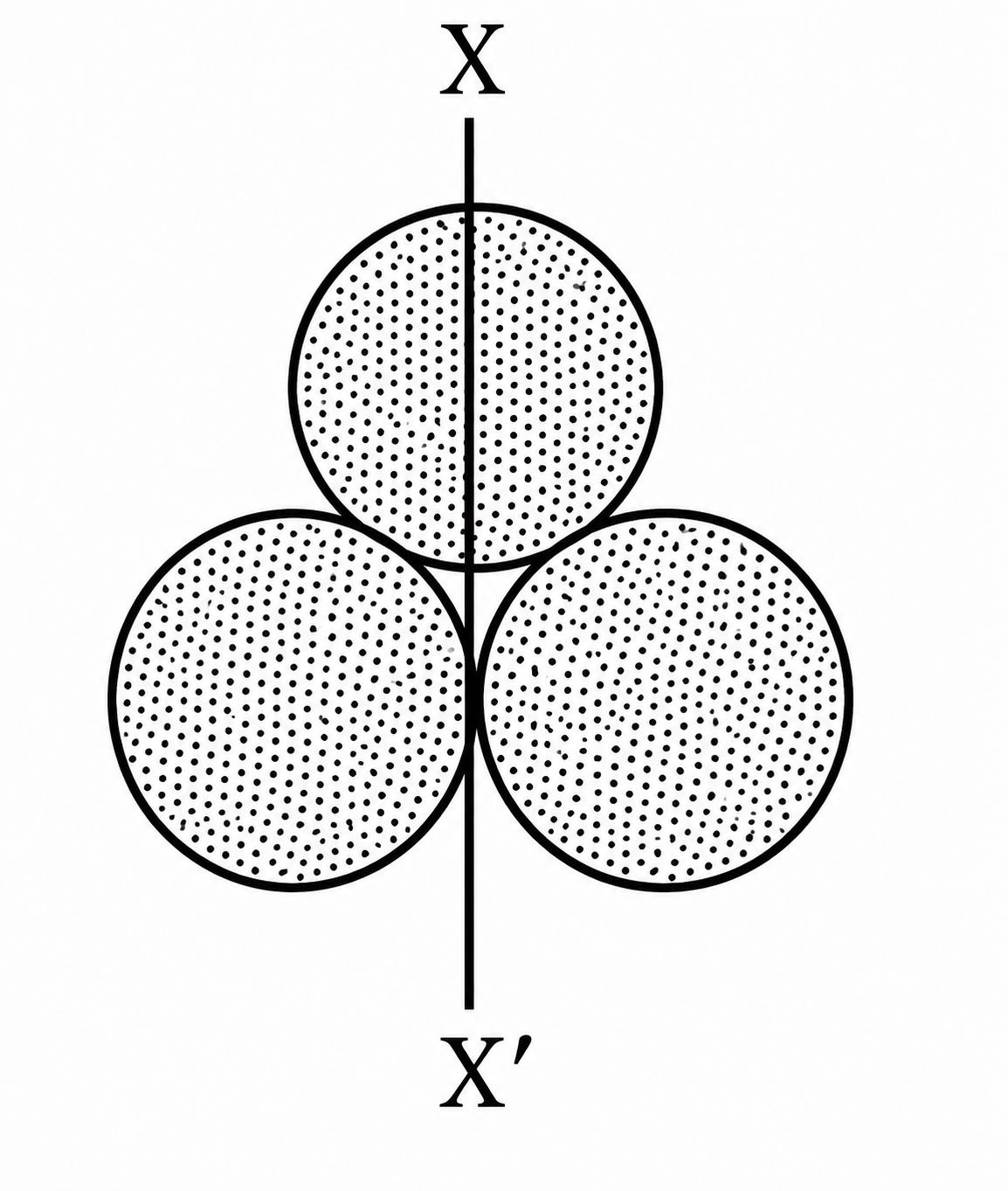
[4 Marks] Diagram 32 – NEET-UG 2015 Question Paper
  • (A) 3mr²
  • (B) 16/5 mr²
  • (C) 4mr²
  • (D) 11/5 mr²
Question 147.

Kepler's third law states that the square of the period of revolution (T) of a planet around the Sun is proportional to the third power of the average distance r between the Sun and the planet, i.e., T² = Kr³ where K is constant. If the masses of the Sun and the planet are M and m respectively, then as per Newton's law of gravitation, the force of attraction between them is F = GMm/r² where G is the gravitational constant.

The relation between G and K is described as:

[4 Marks]
  • (A) GMK = 4π²
  • (B) GK = 4π²
  • (C) K = G
  • (D) K = 1/G
Question 148.

Two spherical bodies of mass M and 5M having radii R and 2R are released in free space with initial separation between their centres equal to 12R. If they attract each other due to gravitational force only, then the distance covered by the smaller body before collision is:

[4 Marks]
  • (A) 2.5R
  • (B) 1.5R
  • (C) 7.5R
  • (D) 4.5R
Question 149.

the approximate depth of an ocean is 2700 m. The compressibility of water is 45.4×10⁻¹¹ Pa⁻¹ and the density of water is 10³ kg/m³. What fractional compression of water will be observed at the bottom of the ocean?

[4 Marks]
  • (A) 0.8×10⁻²
  • (B) 1.4×10⁻²
  • (C) 1.2×10⁻²
  • (D) 1.0×10⁻²
Question 150.

A wind with speed 40 m/s blows parallel to the roof of a house. The area of the roof is 250 m². Assuming that the pressure inside the house is atmospheric pressure, the force exerted by the wind on the roof and the direction of the force will be (ρₐᵢᵣ = 1.2 kg/m³):

[4 Marks]
  • (A) 2.4 × 10⁵ N, upwards
  • (B) 4.8 × 10⁵ N, upwards
  • (C) 4.8 × 10⁵ N, downwards
  • (D) 2.5 × 10⁵ N, downwards
Question 151.

On observing light from three different stars P, Q and R, it was found that the intensity of violet colour is maximum in the spectrum of P, the intensity of green colour is maximum in the spectrum of R and the intensity of red colour is maximum in the spectrum of Q. If Tₚ, T_Q and T_R are the respective absolute temperatures of P, Q and R, then it can be concluded from the above observations that:

[4 Marks]
  • (A) T_P ​< T_R ​< T_Q​
  • (B) T_P ​> T_R ​> T_Q​
  • (C) T_P ​< T_Q ​< T_R​
  • (D) T_P ​> T_Q ​> T_R​
Question 152.

The two ends of a metal rod are maintained at temperatures 100°C and 110°C. The rate of heat flow in the rod is found to be 4.0 J/s. If the ends are maintained at temperatures 200°C and 210°C, the rate of heat flow will be:

[4 Marks]
  • (A) 16.8 J/s
  • (B) 8.0 J/s
  • (C) 4.0 J/s
  • (D) 44.0 J/s
Question 153.

Figure below shows two paths that may be taken by a gas to go from a state A to a state C.

In process AB, 400 J of heat is added to the system and in process BC, 100 J of heat is added to the system. The heat absorbed by the system in the process AC will be
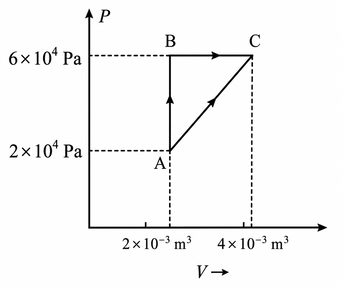
[4 Marks] Diagram 33 – NEET-UG 2015 Question Paper
  • (A) 380 J
  • (B) 300 J
  • (C) 500 J
  • (D) 460 J
Question 154.

A Carnot engine having an efficiency of 1/10 as heat engine, is used as a refrigerator. If the work done on the system is 10 J, the amount of energy absorbed from the reservoir at lower temperature is:

[4 Marks]
  • (A) 90 J
  • (B) 99 J
  • (C) 100 J
  • (D) 1 J
Question 155.

One mole of an ideal diatomic gas undergoes a transition from A to B along a path AB as shown in the figure.

The change in internal energy of the gas during the transition is:
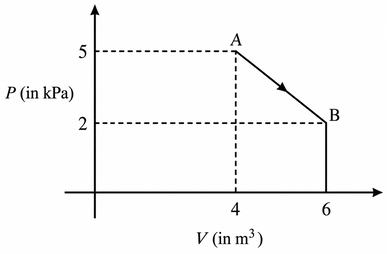
[4 Marks] Diagram 34 – NEET-UG 2015 Question Paper
  • (A) - 12 kJ
  • (B) 20 kJ
  • (C) 20 J
  • (D) - 20 kJ
Question 156.

The ratio of the specific heats Cₚ/Cᵥ = γ in terms of degrees of freedom (n) is given by:

[4 Marks]
  • (A) (1+n/2)
  • (B) (1+1/n)
  • (C) (1+n/3)
  • (D) (1+2/n)
Question 157.

When two displacements represented by y₁​ = asin(ωt) and y₂ ​= bcos(ωt) are super-imposed, the motion is:

[4 Marks]
  • (A) Simple harmonic with amplitude a/b
  • (B) Simple harmonic with amplitude √a²+b²
  • (C) Simple harmonic with amplitude a+b/2
  • (D) Not a simple harmonic.
Question 158.

A particle is executing SHM along a straight line. Its velocities at distances x₁ and x₂ from the mean position are V₁ and V₂, respectively. Its time period is:

[4 Marks]
  • (A) 2π√(x²₂-x₁²/V₁²-V²₂)
  • (B) 2π√(V₁²+V²₂/x₁²+x²₂)
  • (C) 2π√(V₁²-V²₂/x₁²-x²₂)
  • (D) 2π√(x₁²-x²₂/V₁²-V²₂)
Question 159.

The fundamental frequency of a closed organ pipe of length 20 cm is equal to the second overtone of an organ pipe open at both the ends. The length of organ pipe open at both the ends is

[4 Marks]
  • (A) 80 cm
  • (B) 120 cm
  • (C) 140 cm
  • (D) 100 cm
Question 160.

A parallel plate air capacitor of capacitance C is connected to a cell of emf V and then disconnected from it. A dielectric slab of dielectric constant K, which can just fill the air gap of the capacitor, is now inserted in it. Which of the following is incorrect?

[4 Marks]
  • (A) The change in energy stored is 1/2 CV²(1/K-1)
  • (B) The energy stored in the capacitor decreases K times.
  • (C) The charge on the capacitor is not conserved.
  • (D) The potential difference between the plates decreases K times.
Question 161.

Across a metallic conductor of non-uniform cross section a constant potential difference is applied. The quantity which remains constant along the conductor is:

[4 Marks]
  • (A) Current
  • (B) Drift velocity
  • (C) Electric field
  • (D) Current density
Question 162.

A, B and C are voltmeters of resistance R, 1.5R and 3R respectively as shown in the figure. When some potential difference is applied between X and Y, the voltmeter readings are V_A, V_B and V_C respectively. Then:
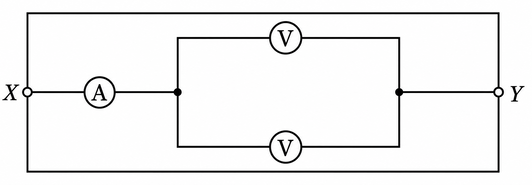
[4 Marks] Diagram 35 – NEET-UG 2015 Question Paper
  • (A) V_A ≠ V_B ≠ V_C
  • (B) V_A = V_B = V_C
  • (C) V_A = V_B ≠ V_C
  • (D) V_A ≠ V_B = V_C
Question 163.

A potentiometer wire has length 4 m and resistance 8 Ω. The resistance that must be connected in series with the wire and accumulator of e.m.f. 2 V, so as to get a potential gradient 1 mV per cm on the wire is:

[4 Marks]
  • (A) 40 Ω
  • (B) 44 Ω
  • (C) 48 Ω
  • (D) 32 Ω
Question 164.

An electron moving in a circular orbit of radius r makes n rotations per second. The magnetic field produced at the centre has magnitude:

[4 Marks]
  • (A) Zero
  • (B) μ₀n²e/r
  • (C) μ₀ne/2r
  • (D) μ₀ne/2πr
Question 165.

A wire carrying current I has the shape as shown in adjoining figure. Linear parts of the wire are very long and parallel to X-axis while semicircular portion of radius R is lying in Y-Z plane. Mngnetic field at point O is
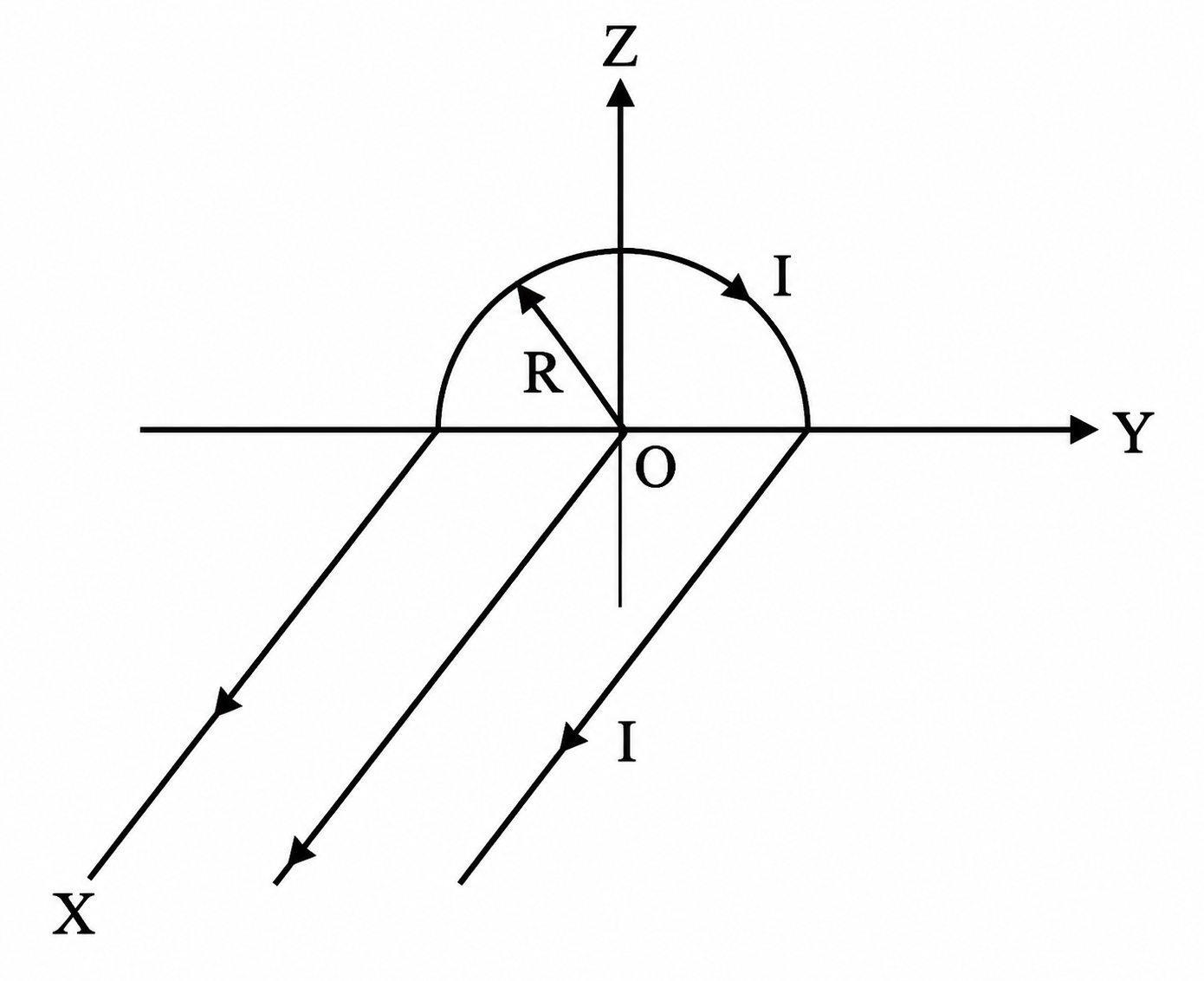
[4 Marks] Diagram 36 – NEET-UG 2015 Question Paper
  • (A) 𝐁⃗ = -μ₀/4π.I/R(μî × 2k̂)
  • (B) 𝐁⃗ = -μ₀/4π.I/R(πî + 2k̂)
  • (C) 𝐁⃗= μ₀/4π.I/R(πî + 2k̂)
  • (D) 𝐁⃗= μ₀/4π.I/R(πî - 2k̂)
Question 166.

A conducting square frame of side 'a' and a long straight wire carrying current III are located in the same plane as shown in the figure. The frame moves to the right with a constant velocity V. The emf induced in the frame will be proportional to:
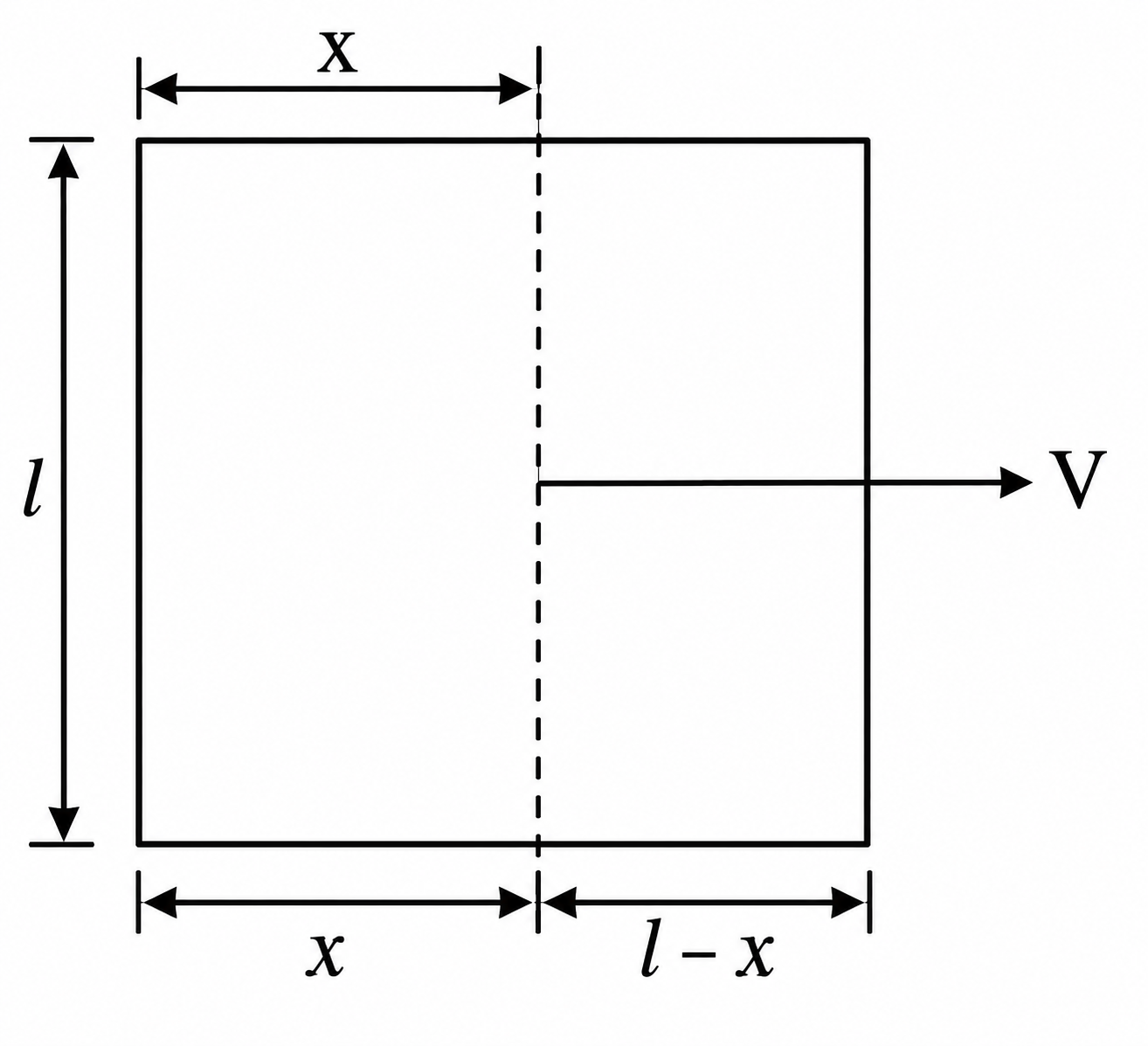
[4 Marks] Diagram 37 – NEET-UG 2015 Question Paper
  • (A) 1/x²
  • (B) 1/(2x-a)(2x+a)
  • (C) 1/(2x-a)²
  • (D) 1/(2x+a)²
Question 167.

A resistance R draws power P when connected to an AC source. If an inductance is now placed in series with the resistance, such that the impedance of the circuit becomes Z, the power drawn will be:

[4 Marks]
  • (A) P(R/Z)²
  • (B) P
  • (C) P√R/Z
  • (D) P(R/Z)
Question 168.

A radiation of energy E falls normally on a perfectly reflecting surface. The momentum transferred to the surface is (C = velocity of light).

[4 Marks]
  • (A) 2E/C
  • (B) E/C²
  • (C) 2E/C²
  • (D) E/C
Question 169.

Two identical thin plano-convex glass lenses (refractive index 1.5) each having radius of curvature of 20 cm are placed with their convex surfaces in contact at the centre. The intervening space is filled with oil of refractive index 1.7. The focal length of the combination is:

[4 Marks]
  • (A) −25 cm
  • (B) −50 cm
  • (C) 50 cm
  • (D) -20 cm
Question 170.

The refracting angle of a prism is A, and the refractive index of the material of the prism is cot (A/2). The angle of minimum deviation is:

[4 Marks]
  • (A) 90°- A
  • (B) 180°+ 2A
  • (C) 180°- 2A
  • (D) 180°- 3A
Question 171.

In a double slit experiment, the two slits are 1 mm apart and the screen is placed 1 m away. A monochromatic light of wavelength 500 nm is used. What will be the width of each slit for obtaining ten maxima on the double slit within the central maxima of single slit pattern?

[4 Marks]
  • (A) 0.2 mm
  • (B) 0.5 mm
  • (C) 0.02 mm
  • (D) 0.1 mm
Question 172.

For a parallel beam of monochromatic light of wavelength λ, diffraction is produced by a single slit whose width 'a' is the wavelength of the light. If D is the distance of the screen from the slit, the width of the central maximum will be:

[4 Marks]
  • (A) 2Dλ/a
  • (B) Da/λ ​
  • (C) Dλ​/a
  • (D) 2Da/λ ​
Question 173.

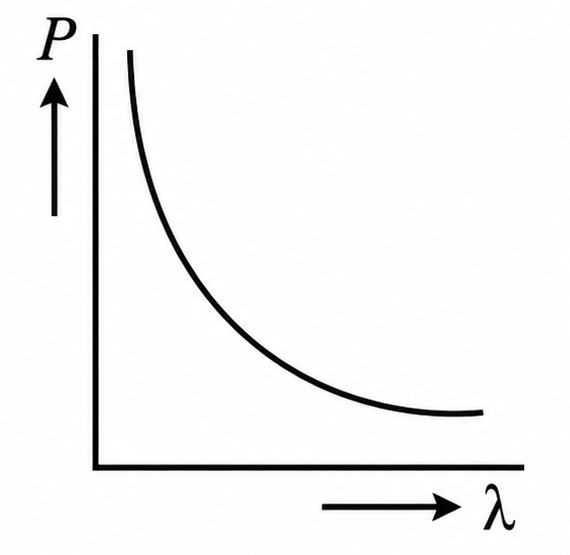
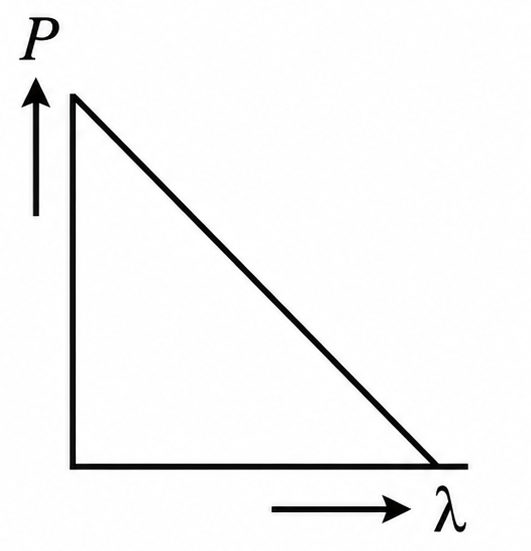
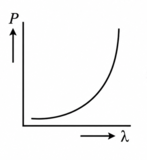
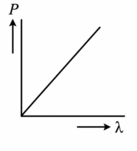
Which of the following figures represents the variation of particle momentum and the associated de-Broglie wavelength?

[4 Marks]
  • (A) Diagram 38 – NEET-UG 2015 Question Paper
  • (B) Diagram 39 – NEET-UG 2015 Question Paper
  • (C) Diagram 40 – NEET-UG 2015 Question Paper
  • (D) Diagram 41 – NEET-UG 2015 Question Paper
Question 174.

A certain metallic surface is illuminated with monochromatic light of wavelength λ. The stopping potential for photo-electric current for this light is 3V₀​. If the same surface is illuminated with light of wavelength 2λ, the stopping potential is V₀​. The threshold wavelength for this surface for photo-electric effect is:

[4 Marks]
  • (A) 6λ​
  • (B) λ​/4
  • (C) λ​/6
  • (D) 4λ
Question 175.

Consider 3rd orbit of He⁺ (Helium), using non-relativistic approach, the speed of electron in this orbit will be given K = 9 × 10⁹ constant, Z = 2 and h (Planck's Constant) = 6.6 × 10⁻³⁴ J s

[4 Marks]
  • (A) 2.92 × 10⁶ m/s
  • (B) 3.0 × 10⁸ m/s
  • (C) 0.73 × 10⁶ m/s
  • (D) 1.46 × 10⁶ m/s
Question 176.

Two particles masses m₁, m₂​ move with initial velocities u₁ and u₂​. On collision, one of the particles get excited to higher level, after absorbing energy ε. If final velocities of be v₁​ and v₂ then we must have

[4 Marks]
  • (A) m₁u₁² + m₂u₂² - ε = m₁v₁² + mv₂²
  • (B) 1/2m₁u₁² + 1/2m₂u₂² + ε = 1/2m₁v₁² + 1/2mv₂²
  • (C) 1/2m₁u₁² + 1/2m₂u₂² - ε = 1/2m₁v₁² + 1/2mv₂²
  • (D) 1/2m₁u₁² + 1/2m₂u₂² = 1/2m₁v₁² + 1/2mv₂² - ε
Question 177.

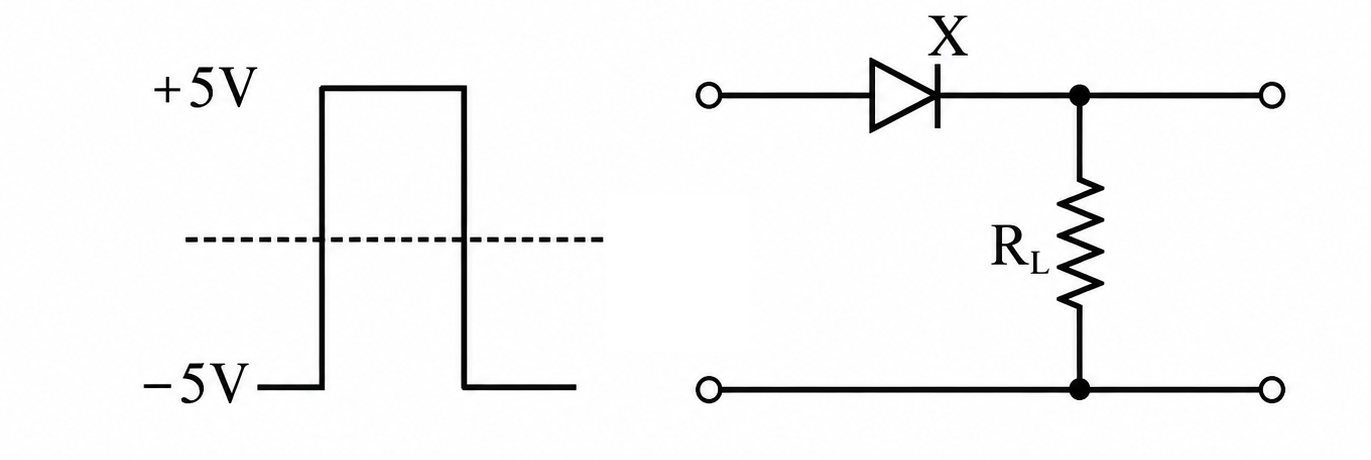
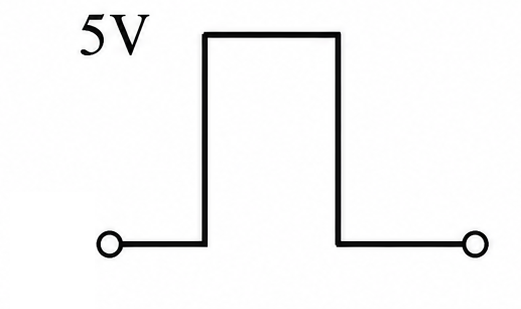
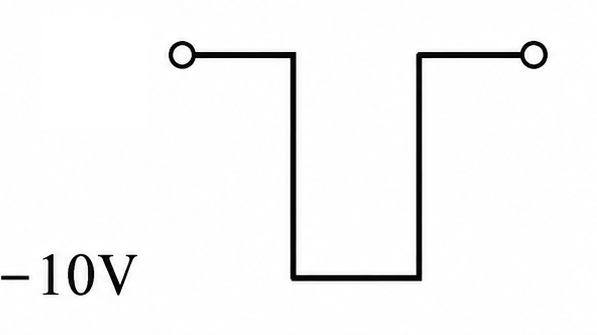
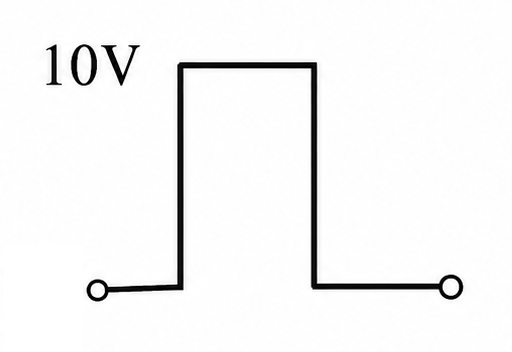
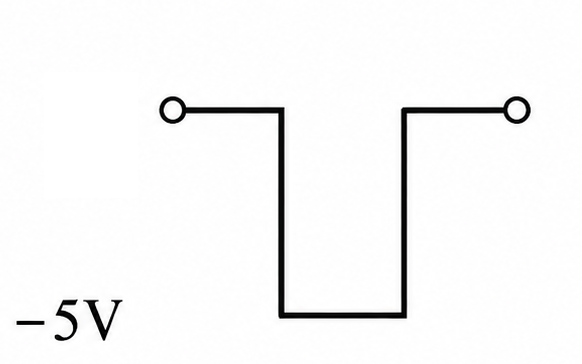
If in a p–n junction, a square input signal of 10 V is applied as shown, then the output across R_L​ will be …

[4 Marks] Diagram 42 – NEET-UG 2015 Question Paper
  • (A) Diagram 43 – NEET-UG 2015 Question Paper
  • (B) Diagram 44 – NEET-UG 2015 Question Paper
  • (C) Diagram 45 – NEET-UG 2015 Question Paper
  • (D) Diagram 46 – NEET-UG 2015 Question Paper
Question 178.

Which logic gate is represented by the following combination of logic gate?
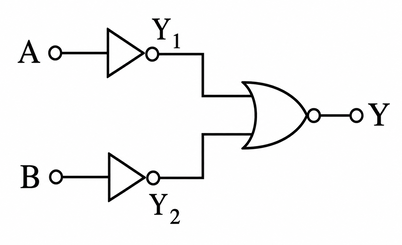
[4 Marks] Diagram 47 – NEET-UG 2015 Question Paper
  • (A) OR
  • (B) NOR
  • (C) AND
  • (D) NAND
Question 179.

The electric field in a certain region is acting radially outward and is given by

E = Aa. A charge contained in a sphere of radius 'a' centred at the origin of the field, will be

[4 Marks]
  • (A) ε₀Aa³
  • (B) 4πε₀Aa²
  • (C) 4πε₀Aa³
  • (D) Aε₀a²
Question 180.

If radius of the ²⁷₁₂Al nucleus is taken to be R_Al, then radius of ¹²⁵₅₃Te nucleus is nearly:

[4 Marks]
  • (A) (53/13)¹ᐟ³R_Al
  • (B) (13/53)¹ᐟ³R_Al
  • (C) 5/3R_Al
  • (D) 3/5R_Al