NEET-UG 2019 Question Paper

QUESTION PAPER

2019 NEET EXAM

NEET-UG 2019 Question Paper

2019

NEET-UG

CBSE EXAMINATION PAPER-2019

NEET-ZOOLOGY

(Solved)

Time allowed : 3 hours

Maximum Marks : 720

General Instructions :

Read the following instructions carefully and follow them :

  1. This question paper contains 180 questions. All questions are compulsory.
  2. This question paper is divided into 1 sections.
  3. Section A – questions number 1 to 180 are multiple choice questions
  4. There is no overall choice given in the question paper. However, an internal choice has been provided in few questions.
  5. Use of calculator is NOT allowed.

Section A

Question 1.

The unit of thermal conductivity is :

[4 Marks]
  • (A) J m⁻¹ K⁻¹
  • (B) W m K⁻¹
  • (C) J m K⁻¹
  • (D) W m⁻¹ K⁻¹
Question 2.

In an experiment, the percentage of error occurred in the measurement of physical quantities A, B, C and D are 1%, 2%, 3% and 4% respectively. Then the maximum percentage of error in the measurement X, where X= A²B¹ᐟ²/ C¹ᐟ³D³ will be:

[4 Marks]
  • (A) 16%
  • (B) -10%
  • (C) 10%
  • (D) (3/13)%
Question 3.

The speed of a swimmer in still water is 20 m/s. The speed of river water is 10 m/s and is flowing due east. If he is standing on the south bank and wishes to cross the river along the shortest path, the angle at which he should make his strokes w.r.t. north is given by:

[4 Marks]
  • (A) 30° west
  • (B) 60° west
  • (C) 0°
  • (D) 45° west
Question 4.

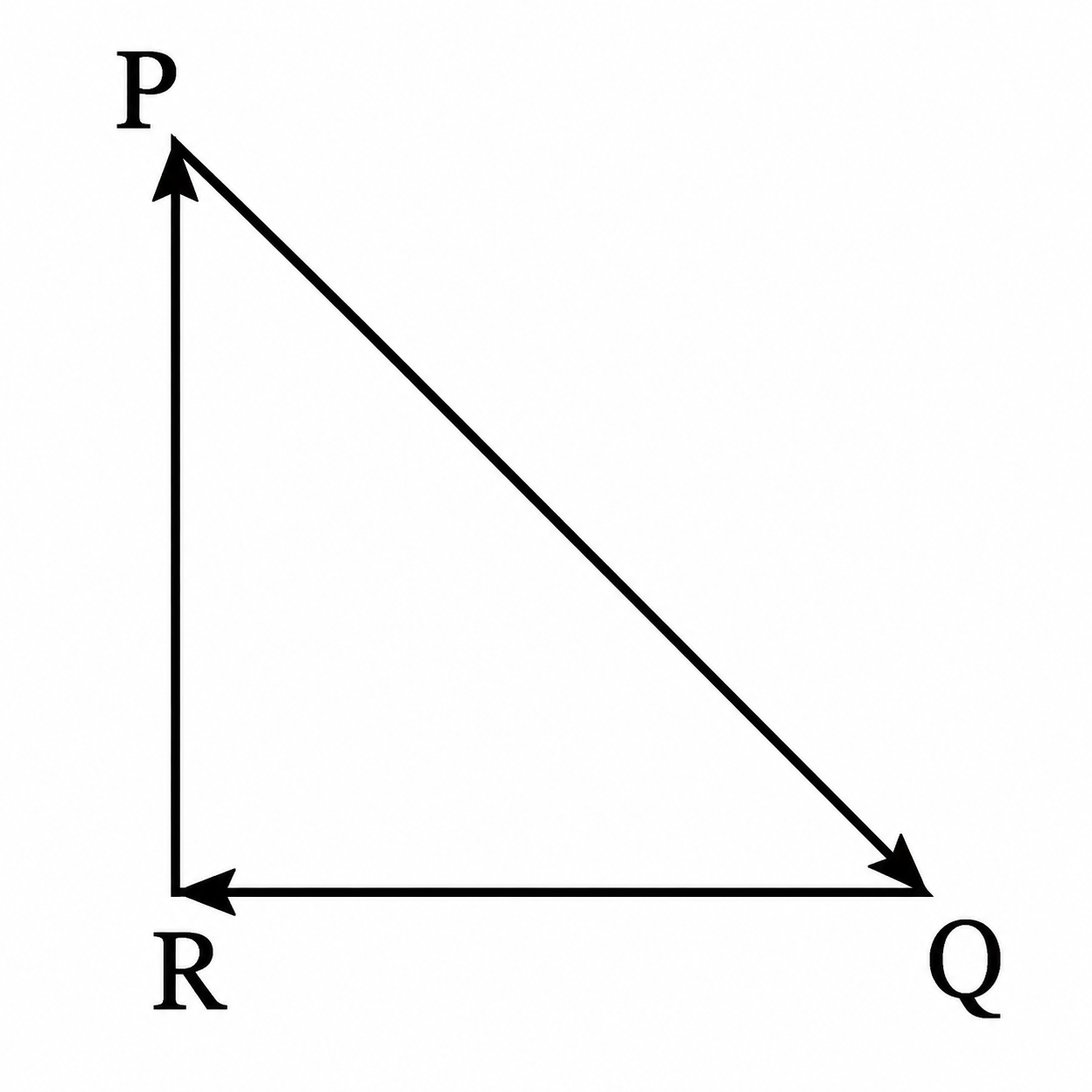
A particle moving with velocity v is acted by three forces shown by the vector triangle PQR. The velocity of the particle will:
[4 Marks] Diagram 1 – NEET-UG 2019 Question Paper
  • (A) increase
  • (B) remain constant
  • (C) decrease
  • (D) change according to the smallest force
Question 5.

A block of mass 10 kg is in contact against the inner wall of a hollow cylindrical drum of radius 1 m. The coefficient of friction between the block and the inner wall of the cylinder is 0.1. The minimum angular velocity needed for the cylinder to keep the block stationary when the cylinder is vertical and rotating about its axis, will be (g = 10 m/s²):

[4 Marks]
  • (A) 10/π² rad/s
  • (B) √10 rad/s
  • (C) 10 rad/s
  • (D) 10π rad/s
Question 6.

A force F = 20 + 10y acts on a particle in y-direction where F is in newton and y in meter. Work done by this force to move the particle from y = 0 to y = 1 m is:

[4 Marks]
  • (A) 5 J
  • (B) 25 J
  • (C) 30 J
  • (D) 20 J
Question 7.

Body A of mass 4m moving with speed u collides with another body B of mass 2m, at rest. The collision is head on and elastic in nature. After the collision the fraction of energy lost by the colliding body A is:

[4 Marks]
  • (A) 1/9
  • (B) 8/9
  • (C) 4/9
  • (D) 5/9
Question 8.

Two particles A and B are moving in uniform circular motion in concentric circles of radii rA and rB with speed vA and vB respectively. Their time period of rotation is the same. The ratio of angular speed of A to that of B will be: (a) rA : rB (b) vA : vB (c) rB : rA (d) 1 : 1

[4 Marks]
  • (A) 1 : 1
  • (B) r_B : r_A
  • (C) r_A : r_B
  • (D) v_A : v_B
Question 9.

A solid cylinder of mass 2 kg and radius 4 cm is rotating about its axis at the rate of 3 rpm. The torque required to stop after 2 revolutions is:

[4 Marks]
  • (A) 2 × 10⁻⁶ Nm
  • (B) 2 × 10⁻³ Nm
  • (C) 2 × 10⁶ Nm
  • (D) 12 × 10⁻⁴ Nm
Question 10.

A disc of radius 2 m and mass 100 kg rolls on a horizontal floor. Its centre of mass has speed of 20 cm/s. How much work is needed to stop it?

[4 Marks]
  • (A) 2 J
  • (B) 30 kJ
  • (C) 3 J
  • (D) 1 J
Question 11.

The work done to raise a mass m from the surface of the earth to a height h, which is equal to the radius of the earth, is:

[4 Marks]
  • (A) 2mgR
  • (B) mgR
  • (C) 3/2 mgR
  • (D) 1/2 mgR
Question 12.

When a block of mass M is suspended by a long wire of length L, the length of the wire becomes (L + l). The elastic potential energy stored in the extended wire is:

[4 Marks]
  • (A) Mgl
  • (B) 1/2 MgL
  • (C) MgL
  • (D) 1/2 Mgl
Question 13.

A small hole of area of cross-section 2 mm² is present near the bottom of a fully filled open tank of height 2 m. Taking g = 10 m/s², the rate of flow of water through the open hole would be:

[4 Marks]
  • (A) 12.6 × 10⁻⁶ m³/s
  • (B) 6.4 × 10⁻⁶ m³/s
  • (C) 8.9 × 10⁻⁶ m³/s
  • (D) 2.23 × 10⁻⁶ m³/s
Question 14.

A soap bubble, having radius of 1 mm, is blown from a detergent solution having a surface tension of 2.5 × 10⁻² N/m. The pressure inside the bubble equals at a point Z₀ below the free surface of water in a container. Taking g = 10 m/s², density of water = 10³ kg/m³, the value of Z₀ in cm is:

[4 Marks]
  • (A) 0.5 cm
  • (B) 10 cm
  • (C) 1 cm
  • (D) 100 cm
Question 15.

A copper rod of 88 cm and an aluminium rod of same length have their increase in length independent of increase in temperature. The length of aluminium rod is: (α_Cu = 1.7 × 10⁻⁵ K⁻¹ and α_Al = 2.2 × 10⁻⁵ K⁻¹)

[4 Marks]
  • (A) 68 cm
  • (B) 88 cm
  • (C) 113.9 cm
  • (D) 6.8 cm
Question 16.

A sample of 0.1 g of water at 100°C and normal pressure (1.013 × 10⁵ Nm⁻²) requires 54 cal of heat energy to convert it into steam at 100°C. If the volume of the steam produced is 167.1 cc, the change in internal energy of the sample, is:

[4 Marks]
  • (A) 42.2 J
  • (B) 84.5 J
  • (C) 208.7 J
  • (D) 104.3 J
Question 17.

In which of the following processes, heat is neither absorbed nor released by a system?

[4 Marks]
  • (A) isobaric
  • (B) isochoric
  • (C) isothermal
  • (D) adiabatic
Question 18.

Increase in temperature of a gas filled in a container would lead to:

[4 Marks]
  • (A) increase in its mass
  • (B) increase in its kinetic energy
  • (C) decrease in its pressure
  • (D) decrease in intermolecular distance
Question 19.

The radius of circle, the period of revolution, initial position and sense of revolution are indicated in the fig. y-projection of the radius vector of rotating particle P is:
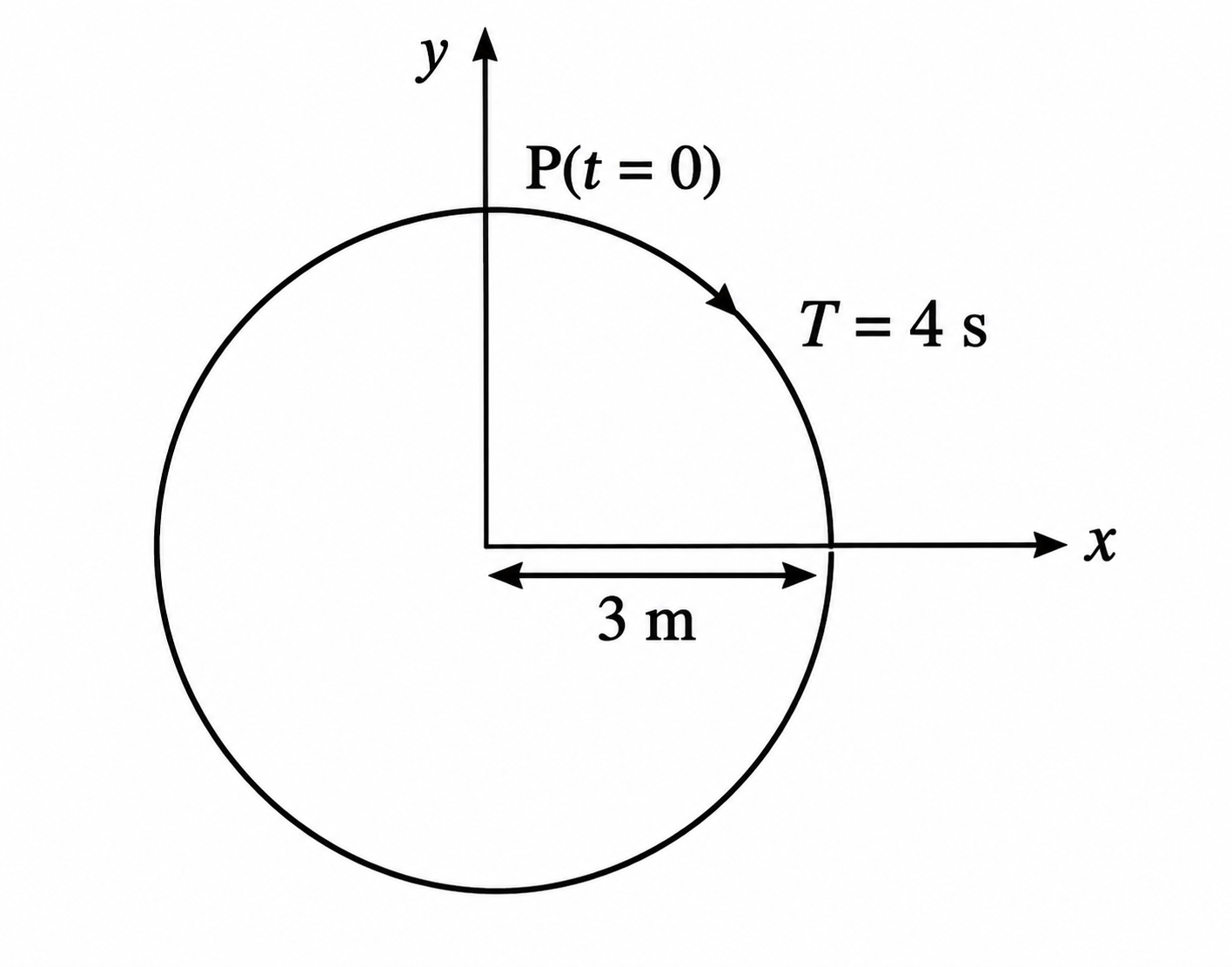
[4 Marks] Diagram 2 – NEET-UG 2019 Question Paper
  • (A) y(t) = 3 sin (3π/2) cos πt, where y in m
  • (B) y(t) = −3 cos 2πt, where y in m
  • (C) y(t) = 3 cos (πt/2), where y in m
  • (D) y(t) = 4 sin (πt/2), where y in m
Question 20.

Average velocity of a particle executing SHM in one complete oscillation is:

[4 Marks]
  • (A) Zero
  • (B) Aω²/2
  • (C) Aω
  • (D) Aω/2
Question 21.

The displacement of a particle executing simple harmonic motion is given by

y = A₀ + A sin ωt + B cos ωt.

Then the amplitude of its oscillation is given by:

[4 Marks]
  • (A) A₀ + √(A² + B²)
  • (B) A + B
  • (C) √(A₀² + (A + B)²)
  • (D) √(A² + B²)
Question 22.

Two point charges A and B, having charges +Q and −Q respectively, are placed at certain distance apart and force acting between them is F. If 25% charge of A is transferred to B, the force between the charges becomes:

[4 Marks]
  • (A) 9F/16
  • (B) F
  • (C) 4F/3
  • (D) 16F/9
Question 23.

Two parallel infinite line charges with linear charge densities +λ C/m and −λ C/m are placed at a distance of 2R in free space. What is the electric field midway between the two line charges?

[4 Marks]
  • (A) 2λ/πɛ₀R N/C
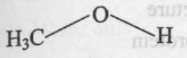
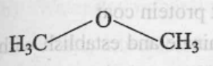
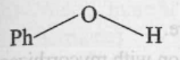
  • (B) λ/πɛ₀R N/C
  • (C) zero
  • (D) λ/2πɛ₀R N/C
Question 24.

A hollow metal sphere of radius R is uniformly charged. The electric field due to the sphere at a distance r from the centre:

[4 Marks]
  • (A) zero as r increases for r < R, decreases as r increases for r > R
  • (B) increases as r increases for r < R and for r > R
  • (C) zero as r increases for r < R, increases as r increases for r > R
  • (D) decreases as r increases for r < R and for r > R
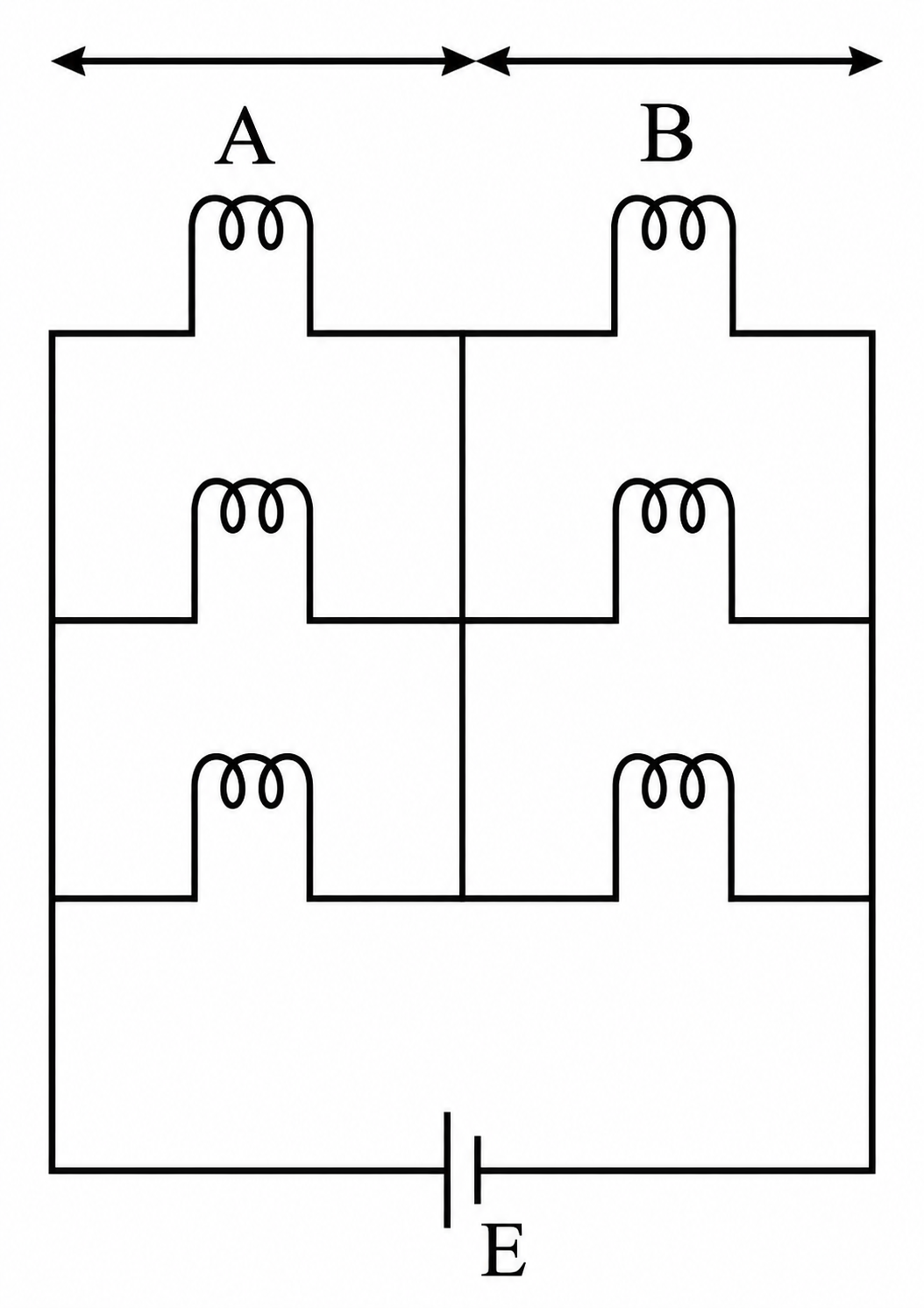
Question 25.

Six similar bulbs are connected as shown in the figure connected to a DC source of emf E, and zero internal resistance. The ratio of power consumption by the bulbs when (i) all are glowing and (ii) in the situation when two from section A and one from section B are glowing, will be:
[4 Marks] Diagram 3 – NEET-UG 2019 Question Paper
  • (A) 9 : 4
  • (B) 2 : 1
  • (C) 1 : 2
  • (D) 4 : 9
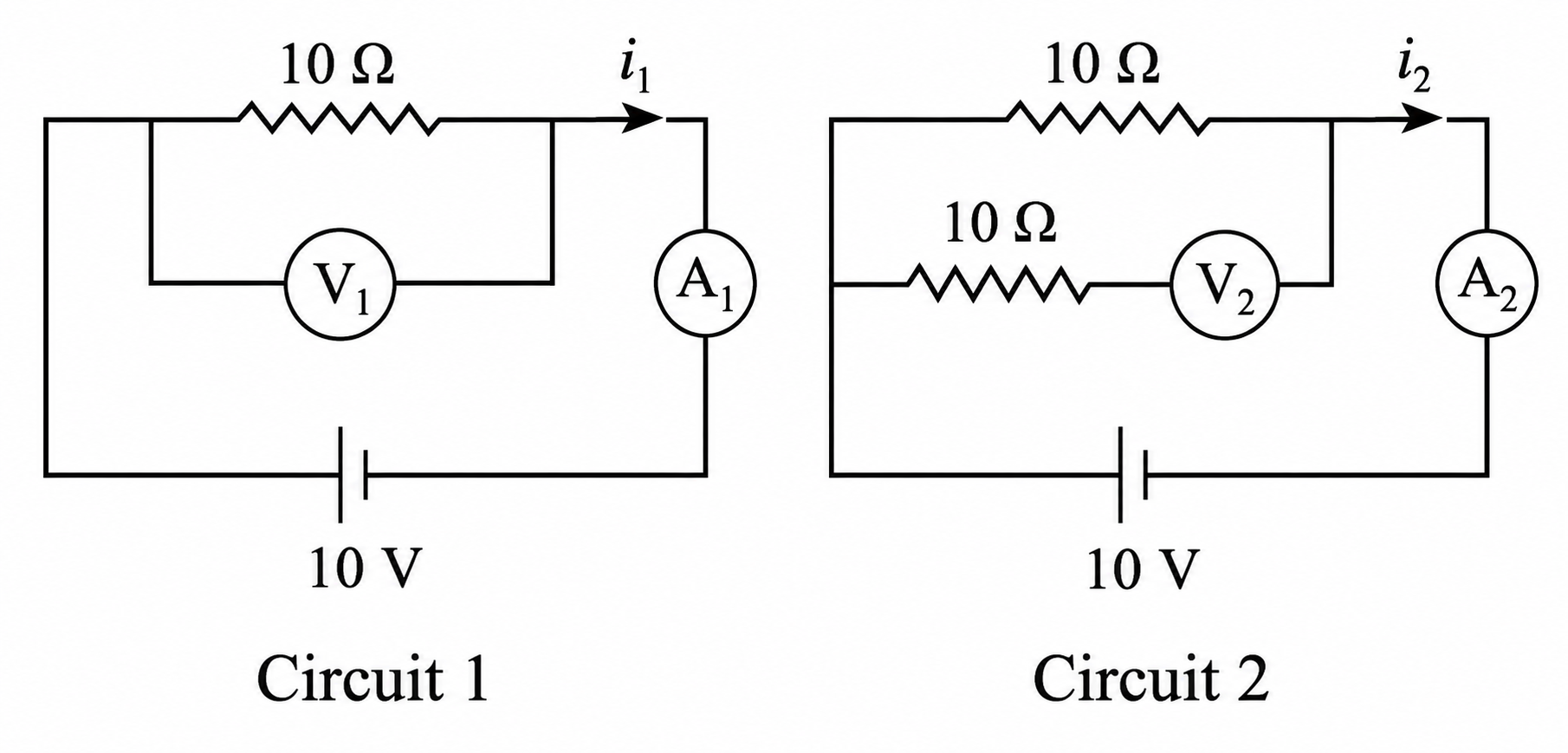
Question 26.

In the circuits shown below, the readings of the voltmeters and the ammeters will be :
[4 Marks] Diagram 4 – NEET-UG 2019 Question Paper
  • (A) V₂ > V₁ and i₁ > i₂
  • (B) V₁ = V₂ and i₁ = i₂
  • (C) V₂ > V₁ and i₁ = i₂
  • (D) V₁ = V₂ and i₁ > i₂
Question 27.

Ionized hydrogen nucleus and α-particles with same momentum enter perpendicular to a constant magnetic field, B. The ratio of their radii of their paths r_H : r_α will be:

[4 Marks]
  • (A) 1 : 4
  • (B) 1 : 2
  • (C) 4 : 1
  • (D) 2 : 1
Question 28.

At a point A on the earth's surface the angle of dip, δ = +25°. At a point B on the earth's surface the angle of dip, δ = −25°. We can interpret that:

[4 Marks]
  • (A) A is located in the northern hemisphere and B is located in the southern hemisphere.
  • (B) A and B are both located in the southern hemisphere.
  • (C) A is located in the southern hemisphere and B is located in the northern hemisphere.
  • (D) A and B are both located in the northern hemisphere.
Question 29.

A 800 turn coil of effective area 0.05 m² is kept perpendicular to magnetic field 5 × 10⁻⁵ T. When the plane of the coil is rotated by 90° around any of its coplanar axis in 0.1 s, the induced potential will be:

[4 Marks]
  • (A) 2 V
  • (B) 0.2 V
  • (C) 0.02 V
  • (D) 2 × 10⁻³ V
Question 30. In which of the following devices, the eddy current effect is not used?
[4 Marks]
  • (A) magnetic braking in train
  • (B) electromagnet
  • (C) induction furnace
  • (D) electric heater
Question 31.

Which colour of the light has the longest wavelength?

[4 Marks]
  • (A) blue
  • (B) red
  • (C) green
  • (D) violet
Question 32.

In total Internal reflection when the angle of incidence is equal to the critical angle for the pair of media in contact, what will be angle of refraction?

[4 Marks]
  • (A) 90°
  • (B) equal to angle of incidence
  • (C) 180°
  • (D) 0°
Question 33.

Two similar thin equi-convex lenses, of focal length f each, are kept coaxially in contact with each other such that the focal length of the combination is F₁. When the space between two lenses is filled with glycerin (which has the same refractive index (=1.5) as that of glass) then the equivalent focal length is F₂. The ratio F₁ : F₂ will be:

[4 Marks]
  • (A) 1 : 2
  • (B) 3 : 4
  • (C) 2 : 3
  • (D) 2 : 1
Question 34.

Pick the wrong answer in the context with rainbow.

[4 Marks]
  • (A) An observer can see a rainbow when his front is towards the sun.
  • (B) Rainbow is a combined effect of dispersion, refraction and reflection of sunlight.
  • (C) When the light rays undergo two internal reflections in a water drop, a secondary rainbow is formed.
  • (D) The order of colours is reversed in the secondary rainbow.
Question 35.

In a double slit experiment, when light of wavelength 400 nm was used, the angular width of the first minima formed on a screen placed in a way, was found to be 0.2°. What will be the angular width of the first minima, if the entire experimental apparatus is immersed in water? (μ_water = 4/3)

[4 Marks]
  • (A) 0.1°
  • (B) 0.050°
  • (C) 0.266°
  • (D) 0.15°
Question 36.

An electron is accelerated through a potential difference of 10,000 V. Its de Broglie wavelength is (nearly): (m = 9 × 10⁻³¹ kg)

[4 Marks]
  • (A) 12.2 × 10⁻¹⁴ m
  • (B) 12.2 × 10⁻¹² m
  • (C) 12.2 × 10⁻¹³ m
  • (D) 12.2 nm
Question 37.

The total energy of an electron in an atom in an orbit is −3.4 eV. Its kinetic and potential energies are, respectively:

[4 Marks]
  • (A) −3.4 eV, −6.8 eV
  • (B) −3.4 eV, −3.4 eV
  • (C) 3.4 eV, −6.8 eV
  • (D) 3.4 eV, 3.4 eV
Question 38.

α-particle consists of:

[4 Marks]
  • (A) 2 electrons, 2 protons and 2 neutrons
  • (B) 2 protons and 2 neutrons only
  • (C) 2 protons only
  • (D) 2 electrons and 4 protons only
Question 39.

For a p-type semiconductor, which of the following statements is true?

[4 Marks]
  • (A) Holes are the majority carriers and pentavalent atoms are the dopants.
  • (B) Electrons are the majority carriers and pentavalent atoms are the dopants.
  • (C) Holes are the majority carriers and trivalent atoms are the dopants.
  • (D) Electrons are the majority carriers and trivalent atoms are the dopants.
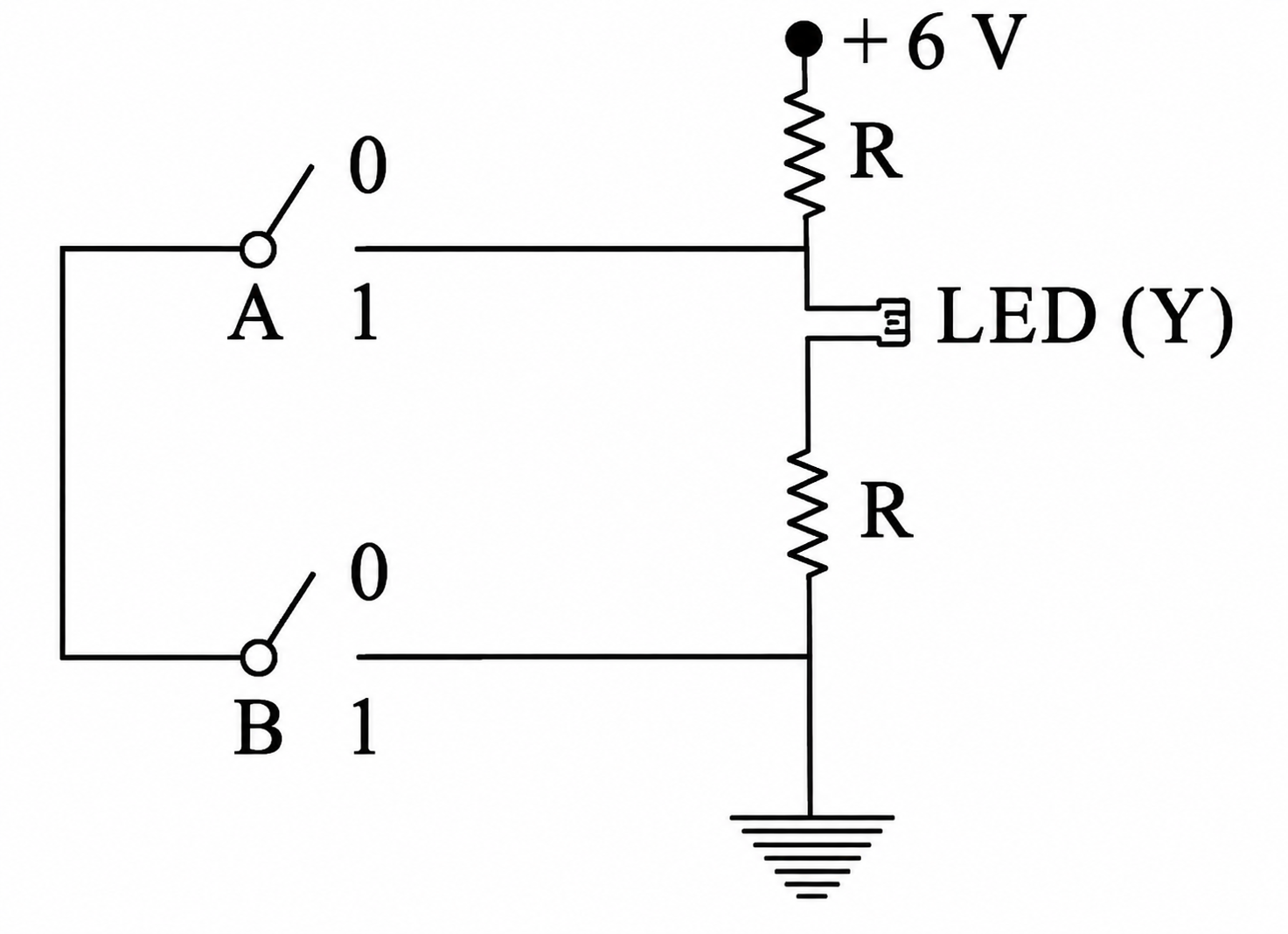
Question 40.

The correct Boolean operation represented by the circuit diagram drawn is:
[4 Marks] Diagram 5 – NEET-UG 2019 Question Paper
  • (A) AND
  • (B) NAND
  • (C) OR
  • (D) NOR
Question 41.

A body weighs 200 N on the surface of the earth. How much will it weigh half way down to the centre of the earth?

[4 Marks]
  • (A) 150 N
  • (B) 250 N
  • (C) 200 N
  • (D) 100 N
Question 42.

Which of the following acts as a circuit protection device?

[4 Marks]
  • (A) Conductor
  • (B) Fuse
  • (C) Switch
  • (D) Inductor
Question 43.

A parallel plate capacitor of capacitance 20 μF is being charged by a voltage source whose potential is changing at the rate of 3 V/s. The conduction current through the connecting wires and the displacement current through the plates of the capacitor, would be, respectively:

[4 Marks]
  • (A) zero, zero
  • (B) zero, 60 μA
  • (C) 60 μA, 60 μA
  • (D) 60 μA, zero
Question 44.

When an object is shot from the bottom of a long smooth inclined plane kept at an angle 60° with horizontal, it can travel a distance x₁ along the plane. But when the inclination is decreased to 30° and the same object is shot with the same velocity, it can travel x₂ distance. Then x₁ : x₂ will be:

[4 Marks]
  • (A) 1 : √3
  • (B) √2 : 1
  • (C) 1 : √2
  • (D) 1 : 2√3
Question 45.

The number of moles of hydrogen molecule required to produce 20 moles of ammonia under Haber’s process is:

[4 Marks]
  • (A) 10
  • (B) 20
  • (C) 30
  • (D) 40
Question 46.

Which of the following series of transitions in the spectrum of hydrogen atom falls in visible region?

[4 Marks]
  • (A) Brackett series
  • (B) Paschen series
  • (C) Lyman series
  • (D) Balmer series
Question 47.

4d, 5p, 5f and 6p orbitals are arranged in the order of decreasing energy. The correct option is:

[4 Marks]
  • (A) 5f > 6p > 4d > 5p
  • (B) 5f > 5p > 4d > 6p
  • (C) 6p > 5f > 4d > 5p
  • (D) 5f > 6p > 5p > 4d
Question 48.

For the second period elements the correct increasing order of first ionisation enthalpy is:

[4 Marks]
  • (A) Li < B < Be < C < O < N < F < Ne
  • (B) Li < Be < B < C < N < O < F < Ne
  • (C) Li < Be < B < C < O < N < F < Ne
  • (D) Li < B < Be < C < N < O < F < Ne
Question 49.

The manganate and permanganate ions are tetrahedral, due to:

[4 Marks]
  • (A) The π-bonding involves overlap of d-orbital of oxygen with d-orbitals of manganese
  • (B) The π-bonding involves overlap of p-orbital of oxygen with p-orbitals of manganese
  • (C) There is no π-bonding
  • (D) The π-bonding involves overlap of p-orbitals of oxygen with d-orbitals of manganese
Question 50.

Which of the following diatomic molecular species has only π-bonds according to Molecular Orbital Theory?

[4 Marks]
  • (A) C₂
  • (B) N₂
  • (C) Be₂
  • (D) O₂
Question 51.

A gas at 350 K and 15 bar has molar volume 20 percent smaller than ideal gas under the same conditions. The correct option about the gas and its compressibility factor (Z) is:

[4 Marks]
  • (A) Z > 1 and attractive forces are dominant
  • (B) Z > 1 and repulsive forces are dominant
  • (C) Z < 1 and attractive forces are dominant
  • (D) Z < 1 and repulsive forces are dominant
Question 52.

Under isothermal condition, a gas at 300 K expands from 0.1 L to 0.25 L against a constant external pressure of 2 bar. The work done by the gas is [Given that 1 L bar = 100 J]

[4 Marks]
  • (A) 5 kJ
  • (B) 25 J
  • (C) 30 J
  • (D) −30 J
Question 53.

In which case change in entropy is negative?

[4 Marks]
  • (A) 2H(g) → H₂(g)
  • (B) Sublimation of solid to gas
  • (C) Expansion of a gas at constant temperature
  • (D) Evaporation of water
Question 54.

Conjugate base of Bronsted acid H₂O and HF are:

[4 Marks]
  • (A) H₃O⁺ and H₂F⁺, respectively
  • (B) OH⁻ and F⁻, respectively
  • (C) OH⁻ and H₂F⁺, respectively
  • (D) H₃O⁺ and F⁻
Question 55.

If pH of a saturated solution of Ca(OH)₂ is 9. The solubility product (Kₛₚ) of Ca(OH)₂ is:

[4 Marks]
  • (A) 0.25 × 10⁻¹⁰
  • (B) 0.125 × 10⁻¹⁵
  • (C) 0.5 × 10⁻¹⁰
  • (D) 0.5 × 10⁻¹⁵
Question 56.

Which of the following reactions is disproportionation reaction?
Select the correct option from the following:
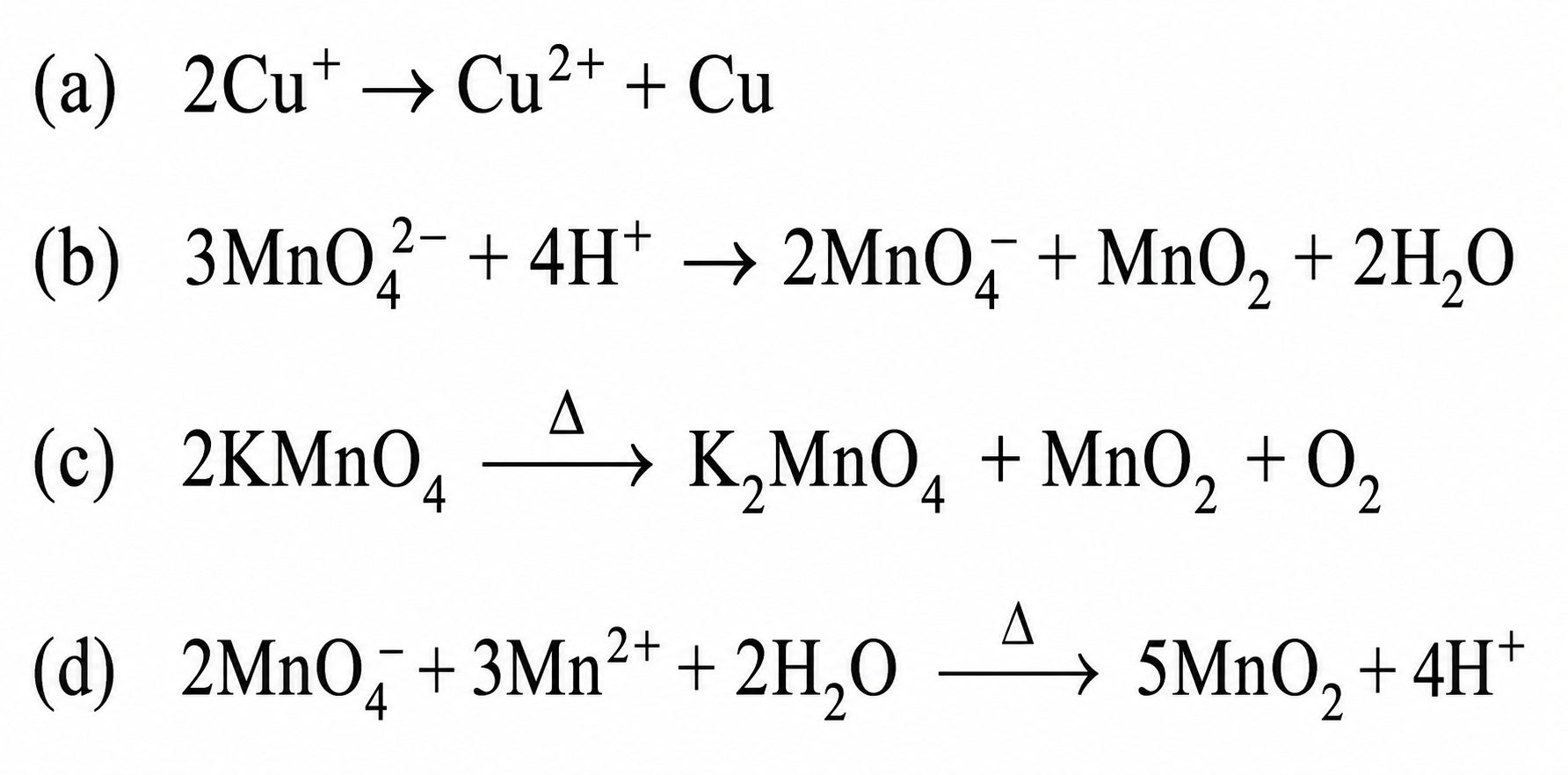
[4 Marks] Diagram 6 – NEET-UG 2019 Question Paper
  • (A) (a) and (d) only
  • (B) (a), (c) and (d)
  • (C) (a), (b) and (c)
  • (D) (a) and (b) only
Question 57.

This method used to remove temporary hardness of water:

[4 Marks]
  • (A) Calgon's method
  • (B) Clark's method
  • (C) Ion-exchange method
  • (D) Synthetic resins method
Question 58.

Which of the following is an amphoteric hydroxide?

[4 Marks]
  • (A) Sr(OH)₂
  • (B) Ca(OH)₂
  • (C) Mg(OH)₂
  • (D) Be(OH)₂
Question 59.

Enzymes that utilize ATP in phosphate transfer require an alkaline earth metal (M) as the cofactor. M is:

[4 Marks]
  • (A) Be
  • (B) Mg
  • (C) Sr
  • (D) Ca
Question 60.

Which of the following is incorrect statement?

[4 Marks]
  • (A) SiCl₄ is easily hydrolysed
  • (B) PbF₄ is covalent in nature
  • (C) GeX₄ (X = F, Cl, Br, I) is more stable than GeX₂
  • (D) SnF₄ is ionic in nature
Question 61.

Which of the following species is not stable?

[4 Marks]
  • (A) [Sn(OH)₆]²⁻
  • (B) [SiCl₆]²⁻
  • (C) [GeCl₆]²⁻
  • (D) [SiF₆]²⁻
Question 62.

The most suitable reagent for the following conversion, is:
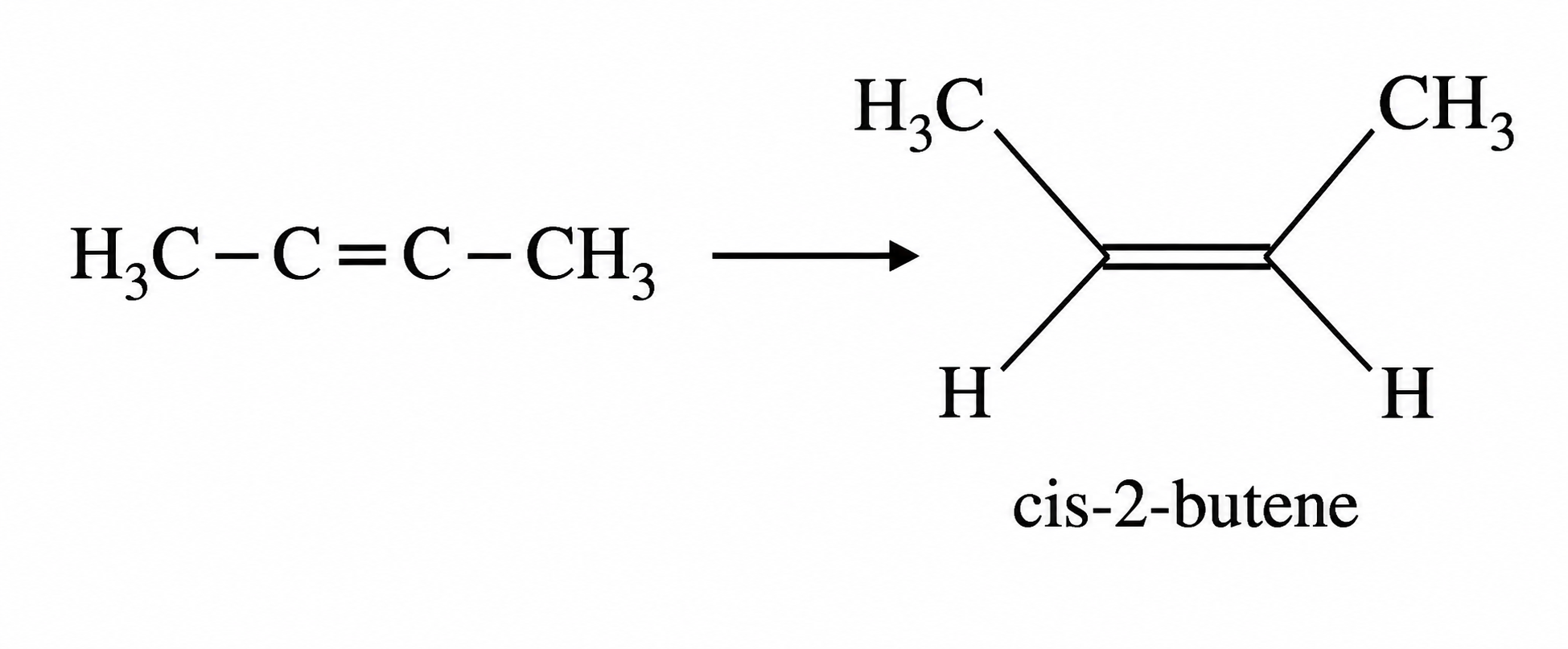
[4 Marks] Diagram 7 – NEET-UG 2019 Question Paper
  • (A) Zn/HCl
  • (B) Hg²⁺/H⁺, H₂O
  • (C) Na/liquid NH₃
  • (D) H₂, Pd/C, quinoline
Question 63.

Among the following, the one that is not a greenhouse gas is:

[4 Marks]
  • (A) methane
  • (B) nitrous oxide
  • (C) ozone
  • (D) sulphur dioxide
Question 64.

A compound is formed by cation C and anion A. The anions form hexagonal close packed (hcp) lattice and the cations occupy 75% of octahedral voids. The formula of the compound is:

[4 Marks]
  • (A) C₄A₃
  • (B) C₃A₂
  • (C) C₄A₃
  • (D) C₃A₄
Question 65.

The mixture which shows positive deviation from Raoult's law is:

[4 Marks]
  • (A) Benzene + Toluene
  • (B) Acetone + Chloroform
  • (C) Chloroethane + Bromoethane
  • (D) Ethanol + Acetone
Question 66.

The mixture that forms maximum boiling azeotrope is:

[4 Marks]
  • (A) Heptane + Octane
  • (B) Water + Nitric acid
  • (C) Acetone + Carbon disulphide
  • (D) Ethanol + Water
Question 67.

For a cell involving one electron E°_cell = 0.59 V at 298 K, the equilibrium constant for the cell reaction is:
[Given that 2.303RT/F = 0.059 V at T = 298 K]

[4 Marks]
  • (A) 1.0 × 10²
  • (B) 1.0 × 10⁵
  • (C) 1.0 × 10³⁰
  • (D) 1.0 × 10¹⁰
Question 68.

For the cell reaction
2Fe³⁺(aq) + 2I⁻(aq) → 2Fe²⁺(aq) + I₂(aq)
0.24 V at 298 K. The standard Gibbs energy (ΔG°) of the reaction is:
[Given that Faraday constant F = 96500 C mol⁻¹]

[4 Marks]
  • (A) −23.16 kJ mol⁻¹
  • (B) −46.32 kJ mol⁻¹
  • (C) 46.32 kJ mol⁻¹
  • (D) 23.16 kJ mol⁻¹
Question 69.

If the rate constant for a first order reaction is k, the time (t) required for completion of 99% of the reaction is given by:

[4 Marks]
  • (A) t = 4.606/k
  • (B) t = 0.693/k
  • (C) t = 2.303/k
  • (D) t = 6.909/k
Question 70.

For the chemical reaction
N₂(g) + 3H₂(g) ⇌ 2NH₃(g)
the correct option is:

[4 Marks]
  • (A) −d[N₂]/dt = 2 d[NH₃]/dt
  • (B) −1/3 d[H₂]/dt = −1/2 d[NH₃]/dt
  • (C) −d[N₂]/dt = 1/2 d[NH₃]/dt
  • (D) −3 d[H₂]/dt = 2d[NH₃]/dt
Question 71.

Which mixture of the solutions will lead to the formation of negatively charged colloidal [AgI]I⁻ sol?

[4 Marks]
  • (A) 50 mL of 0.1 M AgNO₃ + 50 mL of 0.1 M KI
  • (B) 50 mL of 2 M AgNO₃ + 50 mL of 1.5 M KI
  • (C) 50 mL of 1 M AgNO₃ + 50 mL of 2 M KI
  • (D) 50 mL of 1 M AgNO₃ + 50 mL of 1.5 M KI
Question 72.

Which one is malachite from the following?

[4 Marks]
  • (A) CuCO₃.Cu(OH)₂
  • (B) Fe₃O₄
  • (C) Cu(OH)₂
  • (D) CuFeS₂
Question 73.

Which is the correct thermal stability order for H₂E (E = O, S, Se, Te and Po)?

[4 Marks]
  • (A) H₂O < H₂S < H₂Se < H₂Te < H₂Po
  • (B) H₂S < H₂O < H₂Se < H₂Te < H₂Po
  • (C) H₂Po < H₂Te < H₂Se < H₂S < H₂O
  • (D) H₂Se < H₂Te < H₂Po < H₂O < H₂S
Question 74.

Match the following:

[4 Marks] Diagram 8 – NEET-UG 2019 Question Paper
  • (A) d
  • (B) c
  • (C) a
  • (D) b
Question 75.

Identify the incorrect statement related to PCl₅ from the following:

[4 Marks]
  • (A) Axial P–Cl bonds are longer than equatorial P–Cl bonds
  • (B) PCl₅ molecule is non-reactive
  • (C) Two axial P–Cl bonds make an angle of 180° with each other
  • (D) Three equatorial P–Cl bonds make an angle of 120° with each other
Question 76.

What is the correct electronic configuration of the central atom in [Fe(CN)₆]³⁻ based on crystal field theory?

[4 Marks]
  • (A) e³ _g t³₂_g
  • (B) e⁴ _g t²₂ _g
  • (C) t⁴₂_g e² _g
  • (D) t⁶₂_ge⁰_ g
Question 77.

The correct order of the basic strength of methyl substituted amines in aqueous solution is:

[4 Marks]
  • (A) (CH₃)₃N > CH₃NH₂ > (CH₃)₂NH
  • (B) (CH₃)₂NH > CH₃NH₂ > (CH₃)₃N
  • (C) (CH₃)₃N > (CH₃)₂NH > CH₃NH₂
  • (D) CH₃NH₂ > (CH₃)₂NH > (CH₃)₃N
Question 78.

The non-essential amino acid among the following is:

[4 Marks]
  • (A) valine
  • (B) leucine
  • (C) alanine
  • (D) lysine
Question 79.

The biodegradable polymer is:

[4 Marks]
  • (A) nylon-6,6
  • (B) nylon-6
  • (C) Buna-S
  • (D) nylon 2–nylon 6
Question 80.

Among the following, the narrow spectrum antibiotic is:

[4 Marks]
  • (A) penicillin G
  • (B) amoxycillin
  • (C) ampicillin
  • (D) chloramphenicol
Question 81.

For an ideal solution, the correct option is:

[4 Marks]
  • (A) Δ_mix V ≠ 0 at constant T and P
  • (B) Δ_mix S = 0 at constant T and P
  • (C) Δ_ mix H = 0 at constant T and P
  • (D) Δ_mix G = 0 at constant T and P
Question 82.

Which will make basic buffer?

[4 Marks]
  • (A) 100 mL of 0.1 M HCl + 100 mL of 0.1 M NaOH
  • (B) 100 mL of 0.1 M CH₃COOH + 100 mL of 0.1 M NaOH
  • (C) 100 mL of 0.1 M HCl + 200 mL of 0.1 M NH₄OH
  • (D) 50 mL of 0.1 M NaOH + 25 mL of 0.1 M CH₃COOH
Question 83.

The number of sigma (σ) and pi (π) bonds in pent-2-en-4-yne is:

[4 Marks]
  • (A) 10σ bonds and 3π-bonds
  • (B) 13σ bonds and no π-bond
  • (C) 11σ bonds and 2π bonds
  • (D) 8σ bonds and 5π bonds
Question 84.

Match the Xenon compounds in Column-I with its structure in Column-II and assign the correct code:
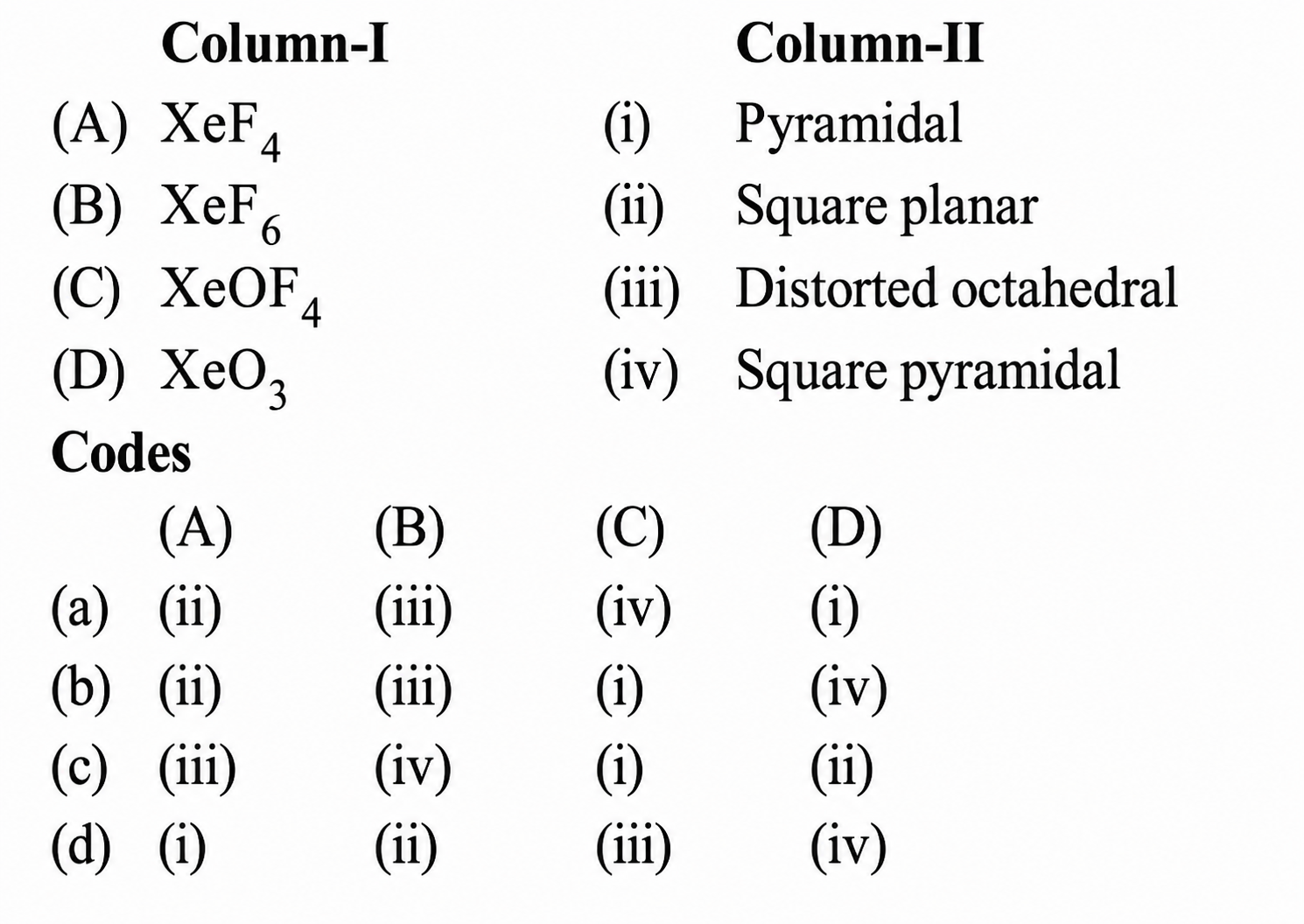
[4 Marks] Diagram 9 – NEET-UG 2019 Question Paper
  • (A) d
  • (B) a
  • (C) b
  • (D) c
Question 85.

Select the correctly written scientific name of Mango which was first described by Carolus Linnaeus:

[4 Marks]
  • (A) Mangifera Indica
  • (B) Mangifera indica
  • (C) Mangifera indica Linn.
  • (D) Mangifera indica Car. Linn.
Question 86.

The contrasting characteristics generally in a pair used for identification of animals in Taxonomic Key are referred to as:

[4 Marks]
  • (A) Alternate
  • (B) Lead
  • (C) Couplet
  • (D) Doublet
Question 87.

Among the following, the reaction that proceeds through an electrophilic substitution, is:

[4 Marks]
  • (A) b Diagram 10 – NEET-UG 2019 Question Paper
  • (B) a Diagram 11 – NEET-UG 2019 Question Paper
  • (C) c Diagram 12 – NEET-UG 2019 Question Paper
  • (D) d Diagram 13 – NEET-UG 2019 Question Paper
Question 88.

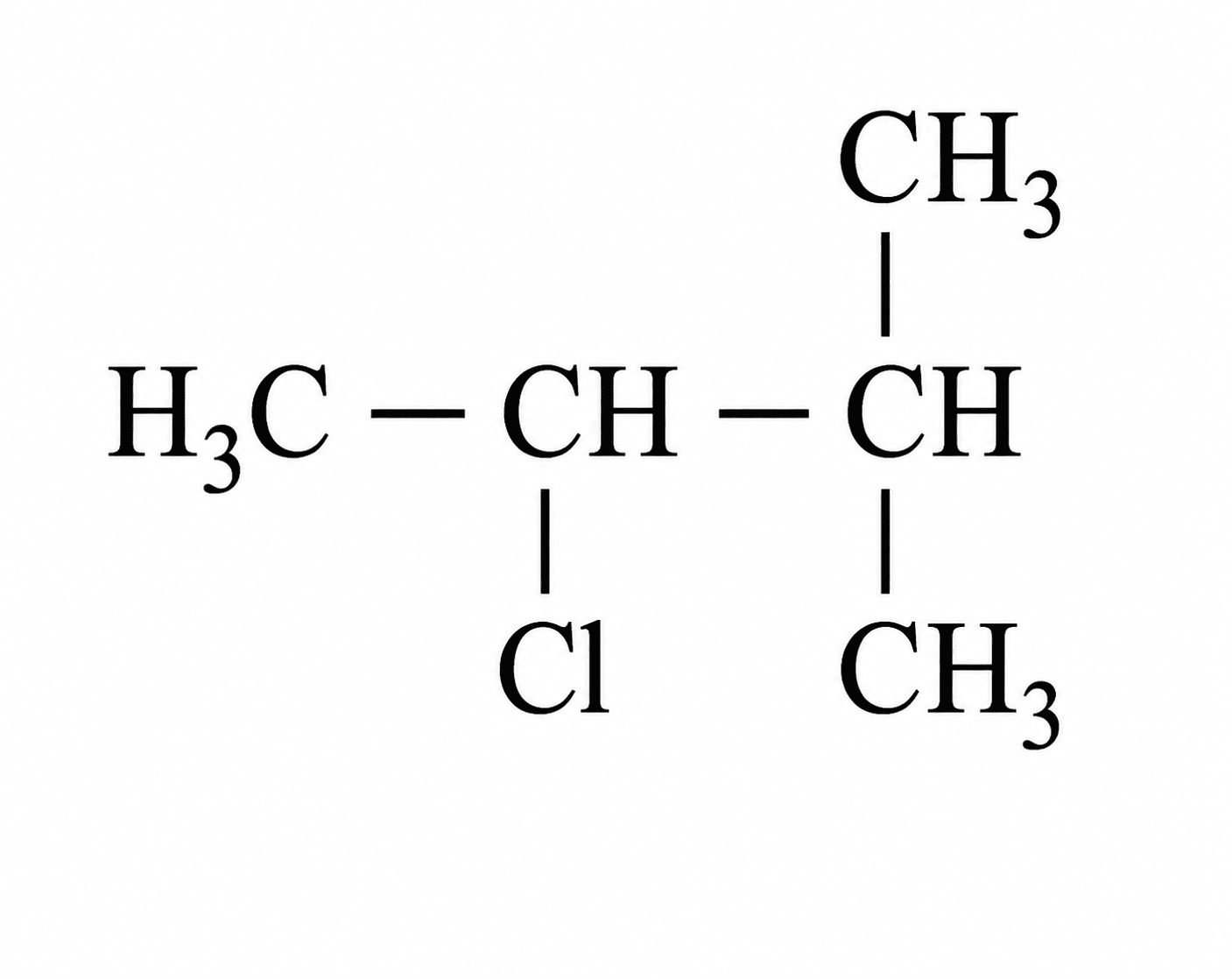
An alkene “A” on reaction with O₃ and Zn–H₂O gives propanone and ethanal in equimolar ratio. Addition of HCl to alkene “A” gives the major product. The structure of product “B” is:

[4 Marks]
  • (A) c Diagram 14 – NEET-UG 2019 Question Paper
  • (B) a Diagram 15 – NEET-UG 2019 Question Paper
  • (C) b Diagram 16 – NEET-UG 2019 Question Paper
  • (D) d Diagram 17 – NEET-UG 2019 Question Paper
Question 89.

One scientist cultured Cladophora in a suspension of Azotobacter and illuminated the culture by splitting light through a prism. He observed that bacteria accumulated mainly in the region of:

[4 Marks]
  • (A) Blue and red light
  • (B) Violet and green light
  • (C) Indigo and green light
  • (D) Orange and yellow light
Question 90.

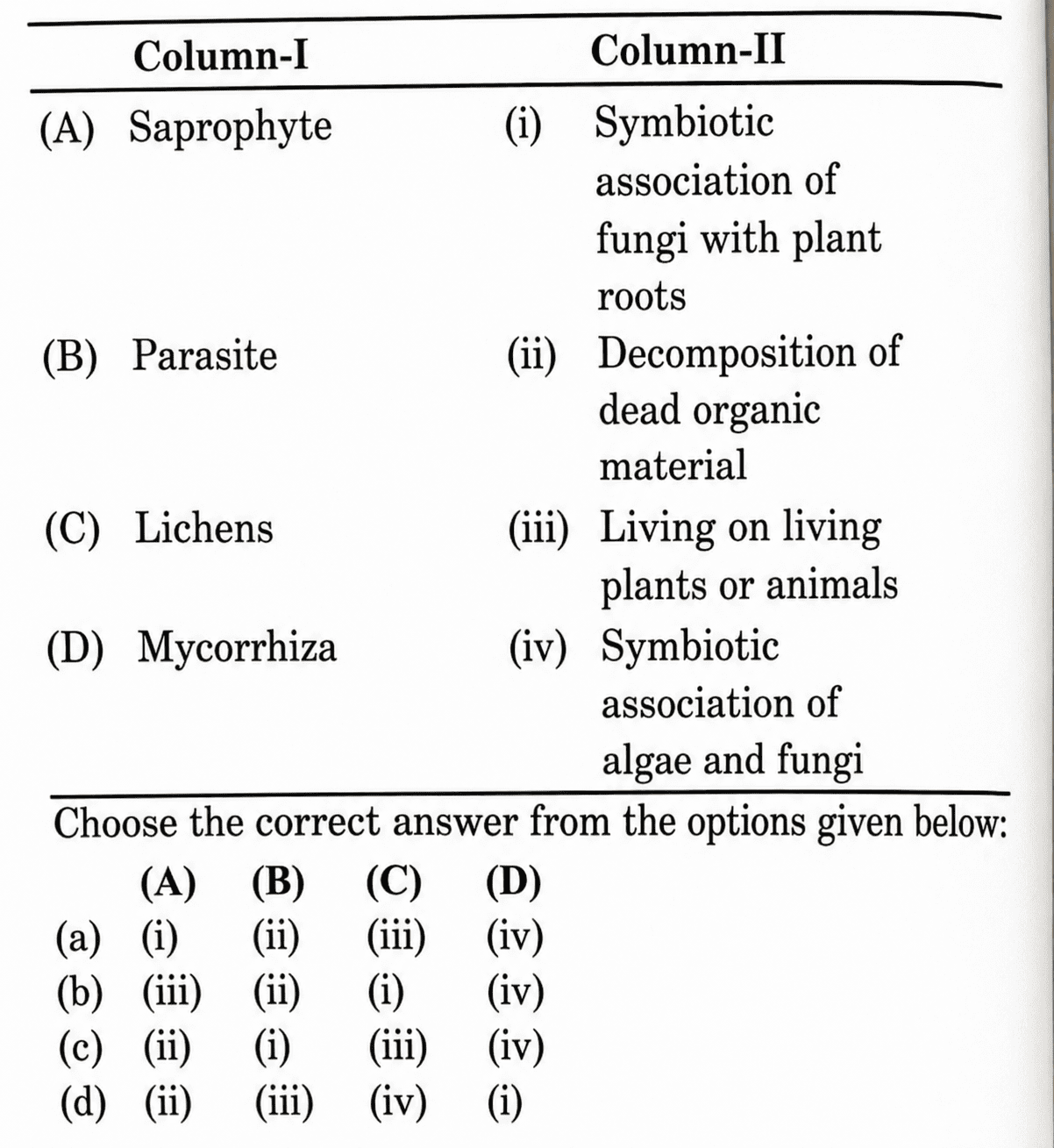
The organisms in column I with habitats in column II.

Select the correct answer from the options given below:
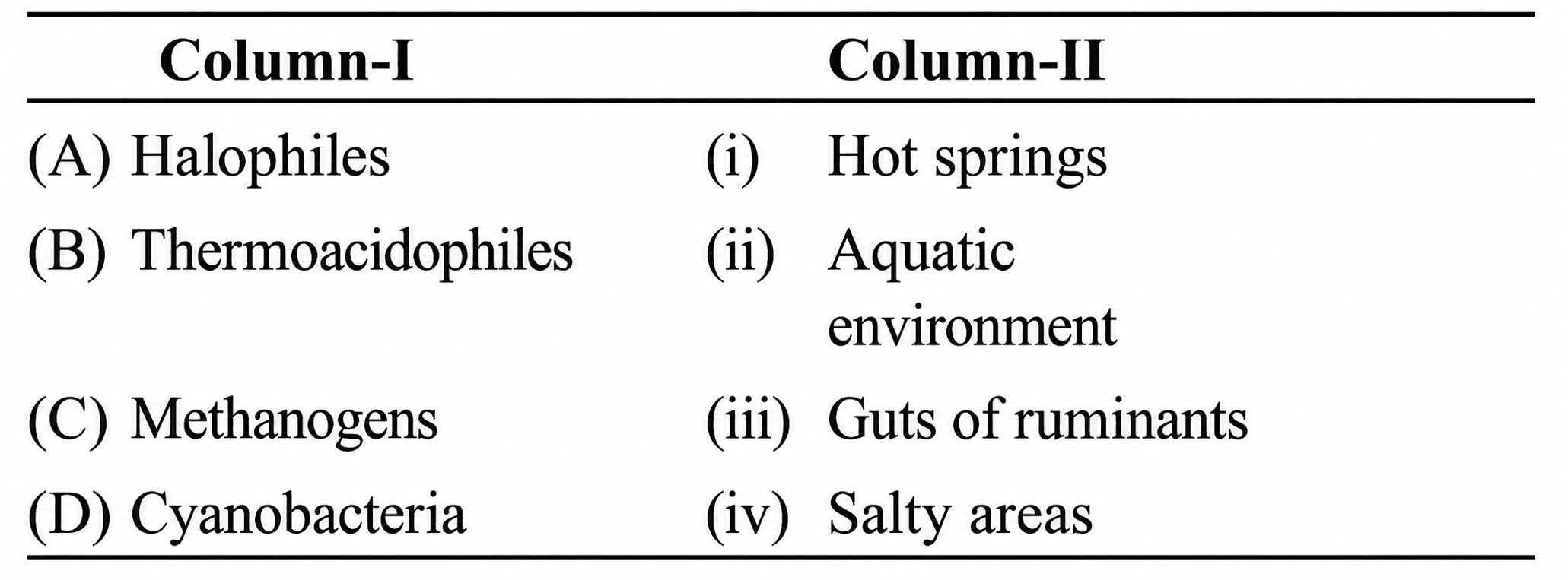
[4 Marks] Diagram 18 – NEET-UG 2019 Question Paper
  • (A) (A)-(ii), (B)-(iv), (C)-(iii), (D)-(i)
  • (B) (A)-(iv), (B)-(i), (C)-(iii), (D)-(ii)
  • (C) (A)-(i), (B)-(ii), (C)-(iii), (D)-(iv)
  • (D) (A)-(iii), (B)-(iv), (C)-(ii), (D)-(i)
Question 91.

Which of the following statements is incorrect?

[4 Marks]
  • (A) Morels and truffles are edible delicacies.
  • (B) Claviceps is a source of many alkaloids and LSD.
  • (C) Yeasts have filamentous bodies with long thread-like hyphae.
  • (D) Conidia are produced exogenously and ascospores endogenously.
Question 92.

Which of the following statements is incorrect?

[4 Marks]
  • (A) Prions consist of abnormally folded proteins.
  • (B) Viruses are obligate parasites.
  • (C) Infective constituent in viruses is the protein coat.
  • (D) Viroids lack a protein coat.
Question 93.

Mad cow disease in cattle is caused by an organism which has:

[4 Marks]
  • (A) Free DNA without protein coat
  • (B) Inert crystalline structure
  • (C) Abnormally folded protein
  • (D) Free RNA without protein coat
Question 94.

Pinus seed cannot germinate and establish without fungal association. This is because:

[4 Marks]
  • (A) it has very hard seed coat.
  • (B) its embryo is immature.
  • (C) it has obligate association with mycorrhizae.
  • (D) its seeds contain inhibitors that prevent germination.
Question 95.

Phloem in gymnosperms lacks:

[4 Marks]
  • (A) Both sieve tubes and companion cells
  • (B) Sieve tubes only
  • (C) Albuminous cells and sieve cells
  • (D) Companion cells only
Question 96.

Which of the following animals are true coelomates with bilateral symmetry?

[4 Marks]
  • (A) Platyhelminthes
  • (B) Aschelminthes
  • (C) Adult echinoderms
  • (D) Annelids
Question 97.

Consider following features:
(a) Organ system level of organisation
(b) Bilateral symmetry
(c) True coelomates with segmentation of body
Select the correct option of animal groups which possess all the above characteristics.

[4 Marks]
  • (A) Annelida, Arthropoda and Chordata
  • (B) Annelida, Arthropoda and Mollusca
  • (C) Arthropoda, Mollusca and Chordata
  • (D) Annelida, Mollusca and Chordata
Question 98.

Match the following organisms with their respective chracteristics:
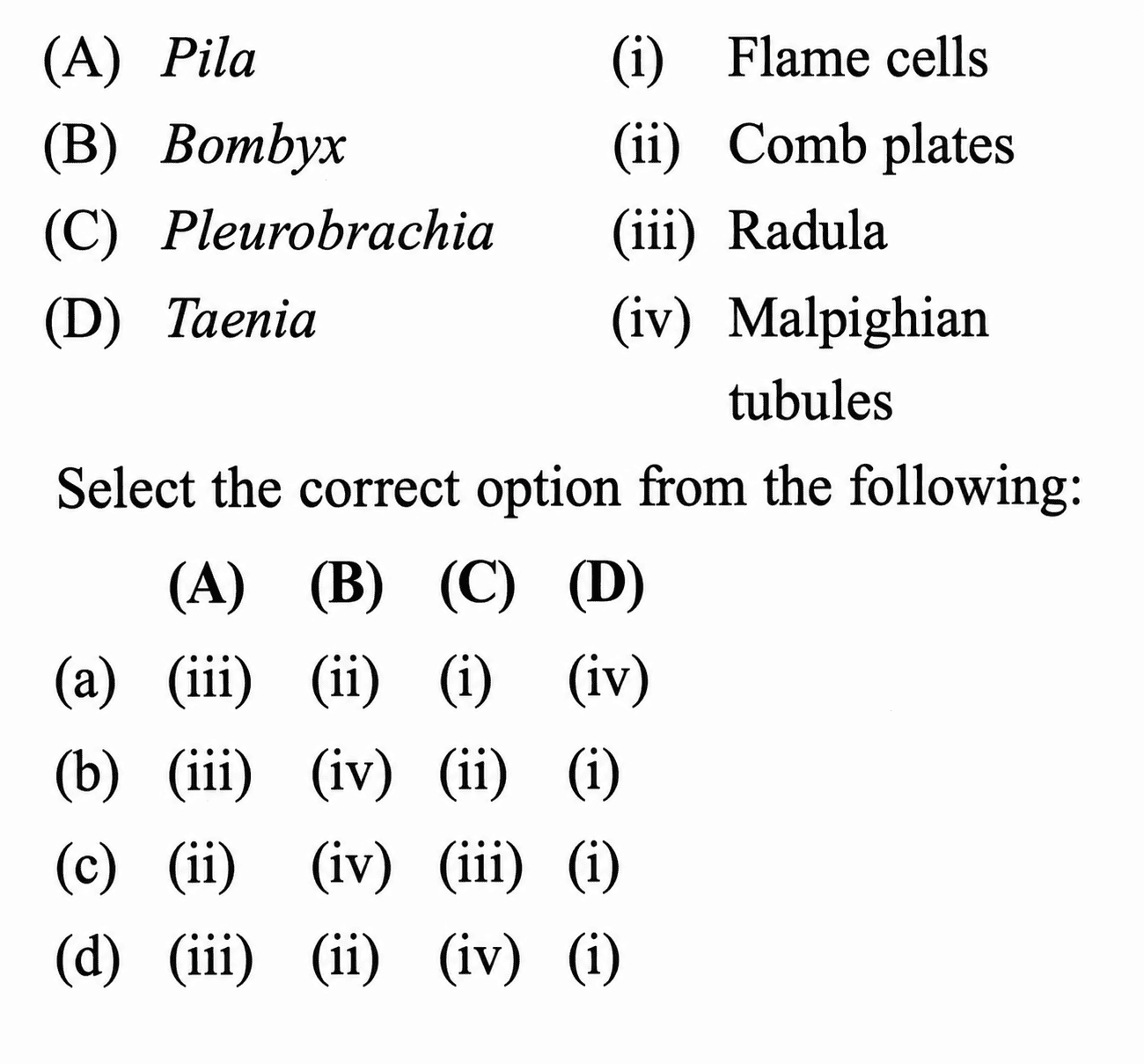
[4 Marks] Diagram 19 – NEET-UG 2019 Question Paper
  • (A) d
  • (B) c
  • (C) a
  • (D) b
Question 99.

Regeneration of damaged growing grass following grazing is largely due to:

[4 Marks]
  • (A) Secondary meristem
  • (B) Lateral meristem
  • (C) Apical meristem
  • (D) Intercalary meristem
Question 100.

Xylem translocates:

[4 Marks]
  • (A) Water, mineral salts, some organic nitrogen and hormones
  • (B) Water, mineral salts and some organic nitrogen only
  • (C) Water and mineral salts only
  • (D) Water only
Question 101.

Which of the statements given below is not true about formation of annual rings in trees?

[4 Marks]
  • (A) Annual ring is a combination of spring wood and autumn wood produced in a year.
  • (B) Differential activity of cambium causes light and dark bands of tissue – early and late wood to form respectively.
  • (C) Annual rings are not prominent in trees of temperate region.
  • (D) Activity of cambium depends upon variation in climate.
Question 102.

Match the following cell structure with its characteristic feature :
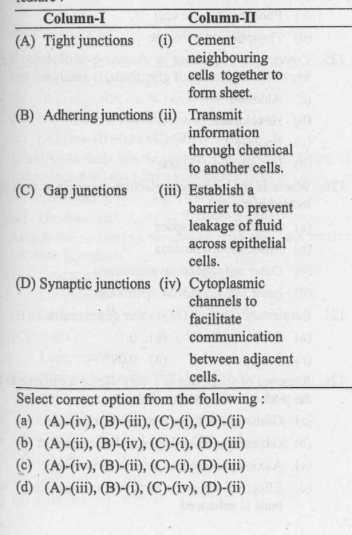
[4 Marks] Diagram 20 – NEET-UG 2019 Question Paper
  • (A) c
  • (B) d
  • (C) b
  • (D) a
Question 103.

Which of the following statements is INCORRECT?

[4 Marks]
  • (A) Female cockroach possesses sixteen ovarioles in the ovaries.
  • (B) Cockroaches exhibit mosaic vision with less sensitivity and more resolution.
  • (C) A mushroom-shaped gland is present in the 6th–7th abdominal segments of male cockroach.
  • (D) A pair of spermatheca is present in the 6th segment of female cockroach.
Question 104.

Which of the following nucleic acid is present in an organism having 70S ribosomes only?

[4 Marks]
  • (A) Double stranded circular DNA with histone proteins.
  • (B) Single stranded DNA with protein coat.
  • (C) Double stranded circular naked DNA.
  • (D) Double stranded DNA enclosed in nuclear membrane.
Question 105.

Which of the following cell organelles is present in the highest number in secretory cells?

[4 Marks]
  • (A) Lysosome
  • (B) Mitochondria
  • (C) Endoplasmic reticulum
  • (D) Golgi complex
Question 106.

Match the column I with column II

Choose the right match from options given below:
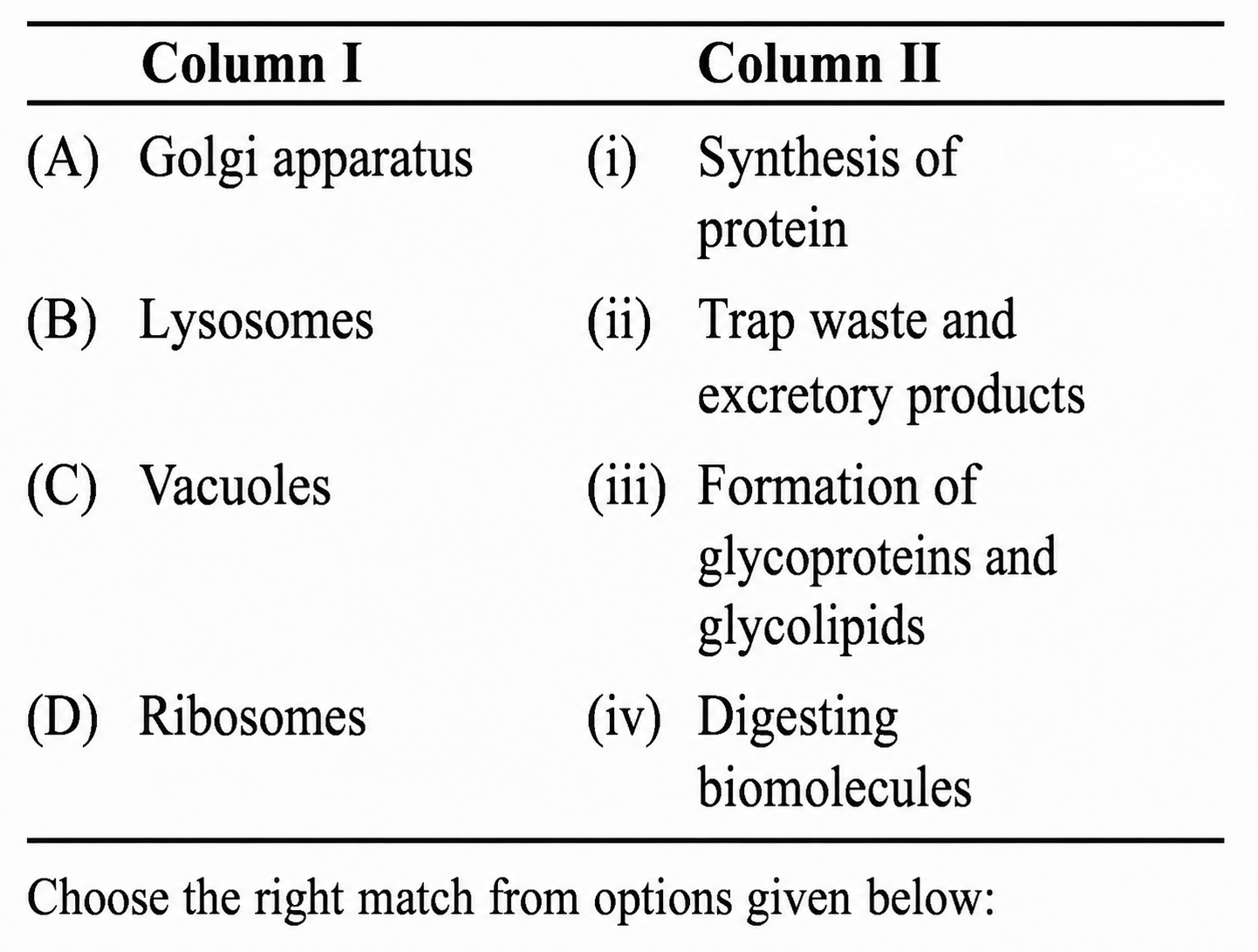
[4 Marks] Diagram 21 – NEET-UG 2019 Question Paper
  • (A) (A) (iv), B)-(iii), (C)-(i), (D)-(ii)
  • (B) (A)(iii), (B)-(ii), (C)-(iv), (D)-(i)
  • (C) (A)-(iii), (B)-(iv), (C)-(ii), (D)-(i)
  • (D) (A)-(i), B)-(ii), (C)-(iv), (D)-(iii)
Question 107.

Concanavalin A is:

[4 Marks]
  • (A) an essential oil
  • (B) an alkaloid
  • (C) a lectin
  • (D) a pigment
Question 108.

Purines found both in DNA and RNA are:

[4 Marks]
  • (A) Cytosine and thymine
  • (B) Adenine and guanine
  • (C) Guanine and cytosine
  • (D) Adenine and thymine
Question 109.

Which of the following glucose transporters is insulin-dependent?

[4 Marks]
  • (A) GLUT II
  • (B) GLUT I
  • (C) GLUT III
  • (D) GLUT IV
Question 110.

Consider the following statements:
(A) Coenzyme or metal ion that is tightly bound to enzyme protein is called prosthetic group.
(B) A complete catalytic active enzyme with its bound prosthetic group is called apoenzyme.
Select the correct option.

[4 Marks]
  • (A) Both (A) and (B) are true.
  • (B) (A) is true but (B) is false.
  • (C) (A) is false but (B) is true.
  • (D) Both (A) and (B) are false.
Question 111.

Cells in G₀ phase:

[4 Marks]
  • (A) exit the cell cycle
  • (B) enter the cell cycle
  • (C) suspend the cell cycle
  • (D) terminate the cell cycle
Question 112.

The correct sequence of phases of cell cycle is:

[4 Marks]
  • (A) M → G₁ → G₂ → S
  • (B) G₁ → G₂ → S → M
  • (C) S → G₁ → G₂ → M
  • (D) G₁ → S → G₂ → M
Question 113.

Which of the following is not a feature of active transport of solutes in plants?

[4 Marks]
  • (A) Occurs through membranes
  • (B) Non-selective
  • (C) Requires ATP
  • (D) Occurs against concentration gradient
Question 114.

What will be the direction of flow of water when a plant cell is placed in a hypotonic solution?

[4 Marks]
  • (A) Water will flow into the cell.
  • (B) Water will flow out of the cell.
  • (C) Water will flow in both directions.
  • (D) No flow of water in any direction.
Question 115.

The main difference between active and passive transport across cell membrane is:

[4 Marks]
  • (A) Active transport occurs more rapidly than passive transport.
  • (B) Passive transport requires a concentration gradient across a biological membrane whereas active transport requires energy to move solutes.
  • (C) Passive transport is non-selective whereas active transport is selective.
  • (D) Passive transport is confined to anionic carrier proteins whereas active transport is confined to cationic channel proteins.
Question 116.

What is the direction of movement of sugars in phloem?

[4 Marks]
  • (A) Non-multidirectional
  • (B) Upward
  • (C) Bi-directional
  • (D) Downward
Question 117.

Grass leaves curl inwards during very dry weather. Select the most appropriate reason from the following:

[4 Marks]
  • (A) Shrinkage of air spaces in spongy mesophyll
  • (B) Tyloses in vessels
  • (C) Closure of stomata
  • (D) Flaccidity of bulliform cells
Question 118.

Which of the following bacteria reduce nitrate in soil into nitrogen?

[4 Marks]
  • (A) Nitrobacter
  • (B) Nitrosomonas
  • (C) Nitrococcus
  • (D) Thiobacillus
Question 119.

Thiobacillus is a group of bacteria helpful in carrying out:

[4 Marks]
  • (A) Nitrogen fixation
  • (B) Chemoautotrophic fixation
  • (C) Nitrification
  • (D) Denitrification
Question 120.

In Hatch and Slack pathway, the primary CO₂ acceptor is:

[4 Marks]
  • (A) Oxaloacetic acid
  • (B) Phosphoglyceric acid
  • (C) Rubisco
  • (D) Phosphoenol pyruvate
Question 121.

Conversion of glucose to glucose-6-phosphate, the first irreversible reaction of glycolysis, is catalysed by:

[4 Marks]
  • (A) Enolase
  • (B) Hexokinase
  • (C) Aldolase
  • (D) Phosphofructokinase
Question 122.

Where is the respiratory electron transport system (ETS) located in plants?

[4 Marks]
  • (A) Outer mitochondrial membrane
  • (B) Inner mitochondrial membrane
  • (C) Mitochondrial matrix
  • (D) Intermembrane space
Question 123.

Respiratory Quotient (RQ) value of tripalmitin is:

[4 Marks]
  • (A) 0.9
  • (B) 0.07
  • (C) 0.7
  • (D) 0.09
Question 124.

Removal of shoot tips is a very useful technique to boost the production of tea leaves. This is because:

[4 Marks]
  • (A) Auxins prevent leaf drop at early stages.
  • (B) Gibberellins prevent bolting and are inactivated.
  • (C) Gibberellins delay senescence of leaves.
  • (D) Effect of auxins is removed and growth of lateral buds is enhanced.
Question 125.

In order to increase the yield of sugarcane crop, which of the following plant growth regulators should be sprayed?

[4 Marks]
  • (A) Auxins
  • (B) Gibberellins
  • (C) Cytokinins
  • (D) Ethylene
Question 126.

It takes very long time for pineapple plants to produce flowers. Which combination of hormones can be applied artificially to induce flowering in pineapple plants throughout the year to increase yield?

[4 Marks]
  • (A) Gibberellin and Abscisic acid
  • (B) Cytokinin and Abscisic acid
  • (C) Gibberellin and Cytokinin
  • (D) Auxin and Ethylene
Question 127.

What is the site of perception of photoperiod necessary for induction of flowering in plants?

[4 Marks]
  • (A) Leaves
  • (B) Shoot apex
  • (C) Pulvinus
  • (D) Lateral buds
Question 128.

Match the items given in Column-I with Column- II and choose the correct option.
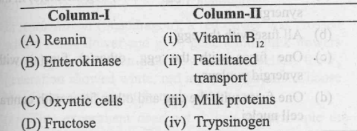
[4 Marks] Diagram 22 – NEET-UG 2019 Question Paper
  • (A) (A)-(iii), (B)-(iv), (C)-(i), (D)-(ii)
  • (B) (A)-(iv), (B)-(iii), (C)-(i), (D)-(ii)
  • (C) (A)-(iv), (B)-(iii), (C)-(ii), (D)-(i)
  • (D) (A)-(iii), (B)-(iv), (C)-(ii), (D)-(i)
Question 129.

Identify the cells whose secretion protects the lining of gastrointestinal tract from digestive enzymes.

[4 Marks]
  • (A) Chief cells
  • (B) Goblet cells
  • (C) Oxyntic cells
  • (D) Duodenal cells
Question 130.

Match the following structures with their respective location in organs:
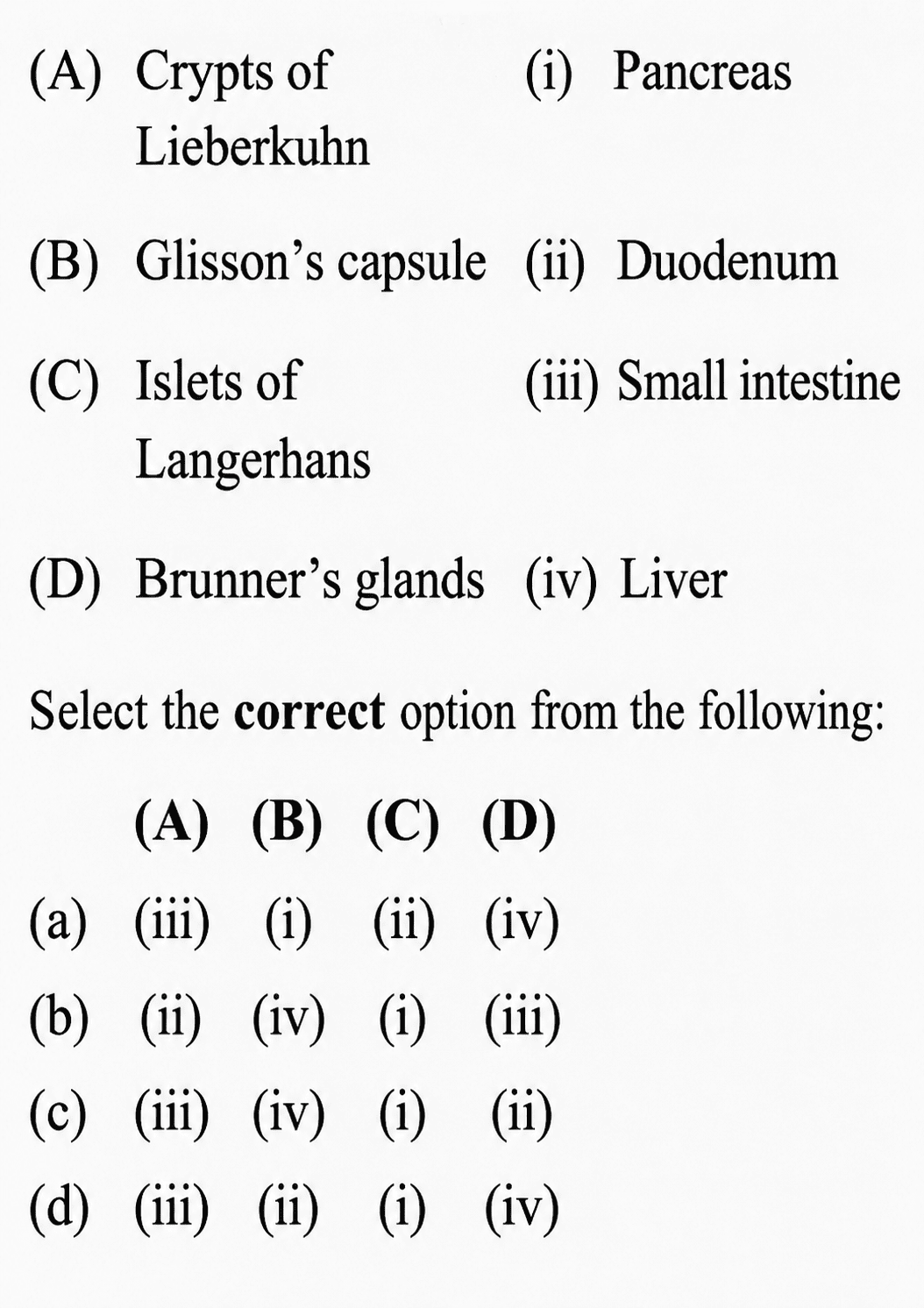
[4 Marks] Diagram 23 – NEET-UG 2019 Question Paper
  • (A) d
  • (B) c
  • (C) b
  • (D) a
Question 131.

Tidal volume and Expiratory reserve volume of an athlete is 500 mL and 1000 mL respectively. What will be his Expiratory capacity if the residual volume is 1200 mL?

[4 Marks]
  • (A) 2700 mL
  • (B) 2200 mL
  • (C) 1500 mL
  • (D) 1700 mL
Question 132.

Due to increasing air-borne allergens and pollutants, many people in urban areas are suffering from respiratory disorder causing wheezing due to:

[4 Marks]
  • (A) reduction in the secretion of surfactants by pneumocytes.
  • (B) proliferation of fibrous tissues and damage of alveolar walls.
  • (C) inflammation of bronchi and bronchioles.
  • (D) benign growth on mucous lining of nasal cavity.
Question 133.

All the components of the nodal tissue are autoexcitable. Why does the SA node act as the normal pacemaker?

[4 Marks]
  • (A) Only SA node can convey the action potential to the other components.
  • (B) SA node is the only component to generate the threshold potential.
  • (C) SA node has the lowest rate of depolarisation.
  • (D) SA node has the highest rate of depolarisation.
Question 134.

A specialised nodal tissue embedded in the lower corner of the right atrium, close to Atrio-ventricular septum, delays the spreading of impulses to heart apex for about 0.1 sec. This delay allows:

[4 Marks]
  • (A) blood to enter aorta.
  • (B) the atria to empty completely.
  • (C) blood to enter pulmonary arteries.
  • (D) the ventricles to empty completely.
Question 135.

Match the Column-I with Column-II

[4 Marks] Diagram 24 – NEET-UG 2019 Question Paper
  • (A) d
  • (B) c
  • (C) a
  • (D) b
Question 136.

What would be the heart rate of a person if the cardiac output is 5 L, blood volume in the ventricles at the end of diastole is 100 mL and at the end of ventricular systole is 50 mL?

[4 Marks]
  • (A) 100 beats per minute
  • (B) 125 beats per minute
  • (C) 75 beats per minute
  • (D) 50 beats per minute
Question 137.

Which of the following factors is responsible for the formation of concentrated urine?

[4 Marks]
  • (A) Hydrostatic pressure during glomerular filtration.
  • (B) Low levels of antidiuretic hormone.
  • (C) Maintaining hyperosmolarity towards inner medullary interstitium in the kidneys.
  • (D) Secretion of erythropoietin by juxtaglomerular complex.
Question 138.

Use of artificial kidney during haemodialysis may result in:
(A) Nitrogenous waste build-up in the body.
(B) Non-elimination of excess potassium ions.
(C) Reduced absorption of calcium ions from gastrointestinal tract.
(D) Reduced RBC production.
Which of the following options is the most appropriate?

[4 Marks]
  • (A) (A) and (B) are correct
  • (B) (B) and (C) are correct
  • (C) (C) and (D) are correct
  • (D) (A) and (D) are correct
Question 139.

Select the correct option:

[4 Marks]
  • (A) Each rib is a flat thin bone and all the ribs are connected dorsally to the thoracic vertebrae and ventrally to the sternum.
  • (B) There are seven pairs of vertebrosternal, three pairs of vertebrochondral and two pairs of vertebral ribs.
  • (C) 8th, 9th and 10th pairs of ribs articulate directly with the sternum.
  • (D) 11th and 12th pairs of ribs are connected to the sternum with the help of hyaline cartilage.
Question 140.

Which of the following muscular disorders is inherited?

[4 Marks]
  • (A) Tetany
  • (B) Muscular dystrophy
  • (C) Myasthenia gravis
  • (D) Botulism
Question 141.

Which of the following statements is not correct?

[4 Marks]
  • (A) Action potential in an axon does not move backward because the segment behind is in a refractory phase.
  • (B) In the knee-jerk reflex, stimulus is the stretching of muscle and response is its contraction.
  • (C) Rods are very sensitive and contribute to daylight vision.
  • (D) Depolarisation of hair cells of cochlea results in the opening of the mechanically gated potassium-ion channels.
Question 142.

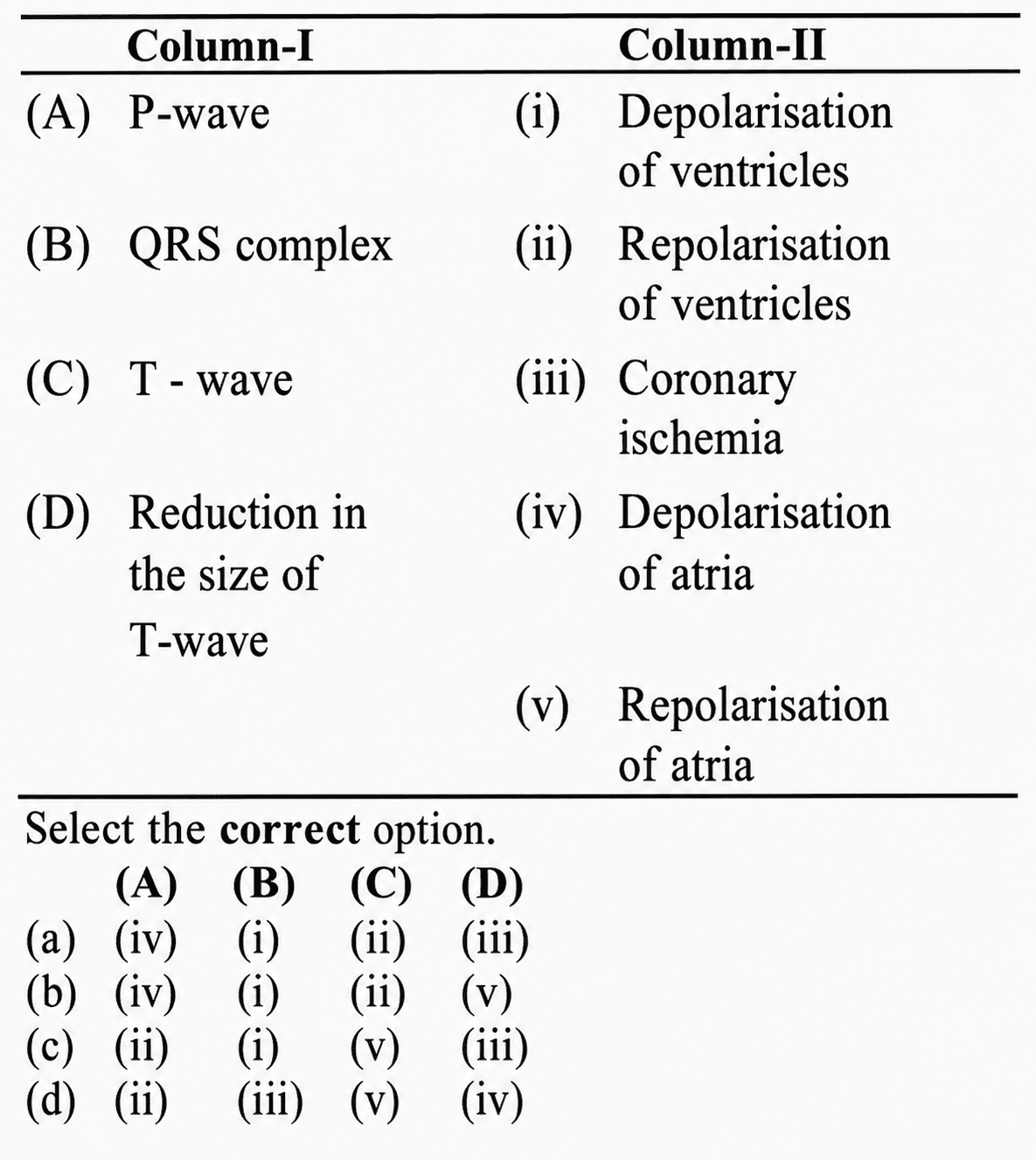
Match the following hormones with the respective disease:
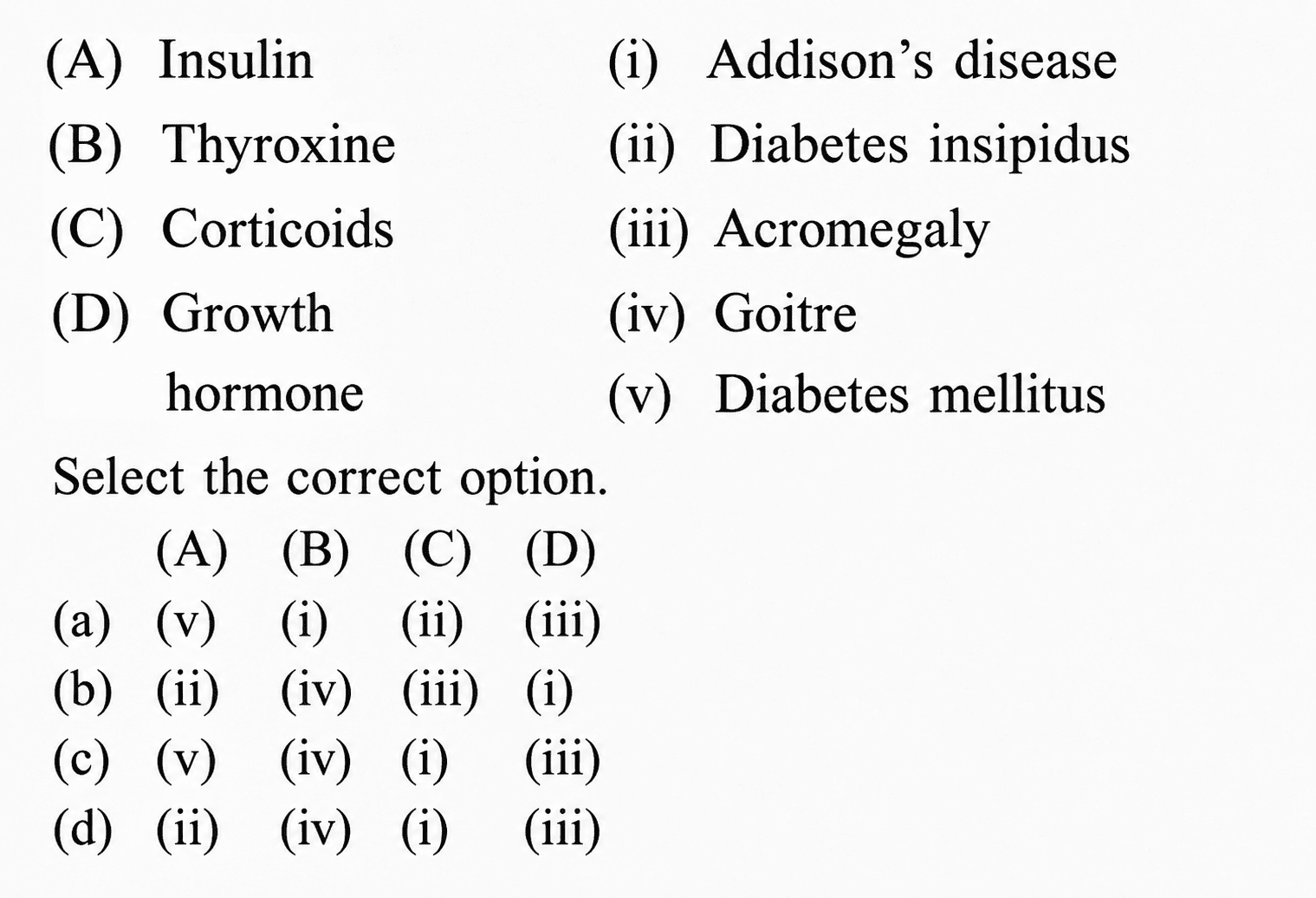
[4 Marks] Diagram 25 – NEET-UG 2019 Question Paper
  • (A) a
  • (B) b
  • (C) c
  • (D) d
Question 143.

In some plants, the female gamete develops into embryo without fertilisation. This phenomenon is known as:

[4 Marks]
  • (A) Autogamy
  • (B) Parthenocarpy
  • (C) Syngamy
  • (D) Parthenogenesis
Question 144.

What is the fate of the male gametes discharged in the synergid?

[4 Marks]
  • (A) One fuses with the egg, other(s) fuse(s) with synergid nucleus.
  • (B) One fuses with the egg and other fuses with central cell nucleus.
  • (C) All fuse with the egg.
  • (D) One fuses with the egg, other(s) degenerate(s) in the synergid.
Question 145.

Which one of the following statements regarding post-fertilisation development in flowering plants is incorrect?

[4 Marks]
  • (A) Ovary develops into fruit.
  • (B) Zygote develops into embryo.
  • (C) Ovules develop into embryo sac.
  • (D) Central cell develops into endosperm.
Question 146.

Persistent nucellus in the seed is known as:

[4 Marks]
  • (A) Perisperm
  • (B) Tegmen
  • (C) Chalaza
  • (D) Hilum
Question 147.

Extrusion of second polar body from egg nucleus occurs:

[4 Marks]
  • (A) after fertilisation
  • (B) after entry of sperm but before fertilisation
  • (C) simultaneously with first cleavage
  • (D) before entry of sperm into ovum
Question 148.

Select the correct sequence for transport of sperm cells in male reproductive system:

[4 Marks]
  • (A) Testis → Epididymis → Vasa efferentia → Vas deferens → Ejaculatory duct → Inguinal canal → Urethra → Urethral meatus
  • (B) Seminiferous tubules → Vasa efferentia → Epididymis → Inguinal canal → Urethra
  • (C) Testis → Epididymis → Vasa efferentia → Rete testis → Inguinal canal → Urethra
  • (D) Seminiferous tubules → Rete testis → Vasa efferentia → Epididymis → Vas deferens → Ejaculatory duct → Urethra → Urethral meatus
Question 149.

Which of the following contraceptive methods do involve
a role of hormone?

[4 Marks]
  • (A) CuT, Pills, Emergency contraceptives
  • (B) Pills, Emergency contraceptives, Barrier methods
  • (C) Barrier method, Lactational amenorrhea, Pills
  • (D) Lactational amenorrhea, Pills, Emergency contraceptives
Question 150.

Select the hormone-releasing Intra-Uterine Devices.

[4 Marks]
  • (A) Progestasert, LNG-20
  • (B) Lippes Loop, Multiload 375
  • (C) Multiload 375, Progestasert
  • (D) Vaults, LNG-20
Question 151.

Which of the following sexually transmitted diseases is
not completely curable?

[4 Marks]
  • (A) Genital herpes
  • (B) Chlamydiasis
  • (C) Gonorrhoea
  • (D) Genital warts
Question 152.

In Antirrhinum (Snapdragon), a red flower was crossed with a white flower and in F₁ generation, pink flowers were obtained. When pink flowers were selfed, the F₂
generation showed white, red and pink flowers. Choose the incorrect statement from the following.

[4 Marks]
  • (A) This experiment does not follow the principle of dominance.
  • (B) Pink colour in F₁ is due to incomplete dominance.
  • (C) Ratio of F₂ is ¼ (Red): ½ (Pink): ¼ (White)
  • (D) Law of Segregation does not apply in this experiment.
Question 153.

What map unit (Centimorgan) is adopted in the construction of genetic maps?

[4 Marks]
  • (A) A unit of distance between two expressed genes, representing 100% cross over.
  • (B) A unit of distance between genes on chromosomes, representing 1% cross over.
  • (C) A unit of distance between genes on chromosomes, representing 50% cross over.
  • (D) A unit of distance between two expressed genes, representing 10% cross over.
Question 154.

Select the incorrect statement.

[4 Marks]
  • (A) Male fruit fly is heterogametic.
  • (B) In male grasshoppers, 50% of sperms have no sex-chromosome.
  • (C) In domesticated fowls, sex of progeny depends on the type of sperm rather than egg.
  • (D) Human males have one, of their sex-chromosome much shorter than the other.
Question 155.

Under which of the following conditions will there be no change in the reading frame of following mRNA ?

5′ AACACGGGUGCUAUU 3′

[4 Marks]
  • (A) Deletion of GGU from 7th, 8th and 9th positions
  • (B) Insertion of A and G at 4th and 5th positions respectively
  • (C) Deletion of G from 5th position
  • (D) Insertion of G at 5th position
Question 156.

Expressed Sequence Tags (ESTs) refers to:

[4 Marks]
  • (A) DNA polymorphism
  • (B) Novel DNA sequences
  • (C) Polypeptide expression
  • (D) Genes expressed as RNA
Question 157.

Match the following genes of the Lac operon with their respective products:
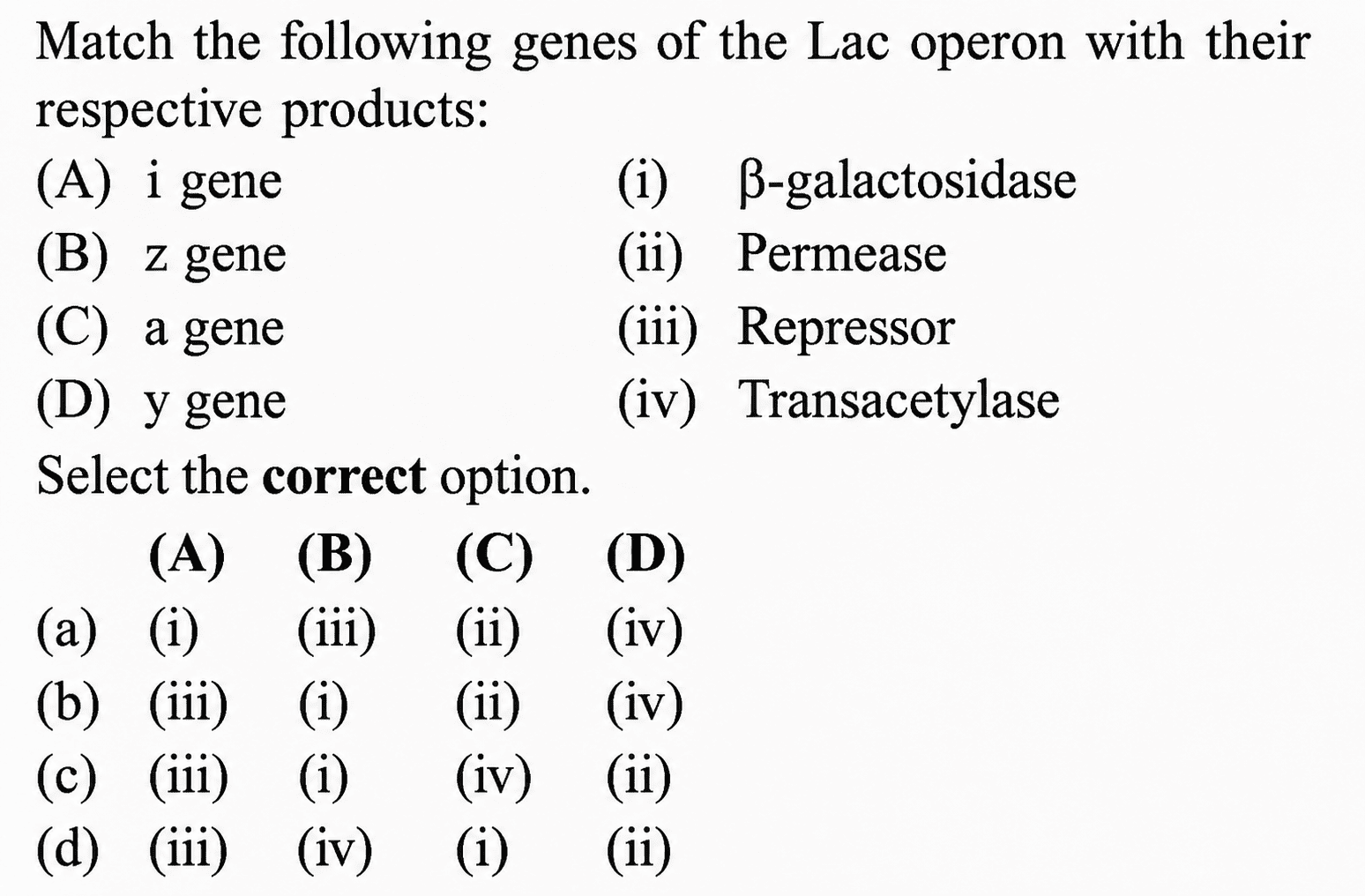
[4 Marks] Diagram 26 – NEET-UG 2019 Question Paper
  • (A) a
  • (B) b
  • (C) c
  • (D) d
Question 158.

A population of a species invades a new area. Which of the following condition will lead to adaptive radiation?

[4 Marks]
  • (A) Area with many habitats occupied by a large number of species.
  • (B) Area with large number of habitats having very low food supply.
  • (C) Area with a single type of vacant habitat.
  • (D) Area with many types of vacant habitats.
Question 159.

In Australia, marsupials and placental mammals have evolved to share many similar characteristics. This type of evolution may be referred to as:

[4 Marks]
  • (A) Convergent evolution
  • (B) Adaptive radiation
  • (C) Divergent evolution
  • (D) Cyclical evolution
Question 160.

In a species, the weight of newborn ranges from 2 to 5kg. 97% of the newborn with an average weight between 3 to 3.3 kg survive whereas 99% of the infants born with
weights from 2 to 2.5 kg or 4.5 to 5 kg die. Which type of selection process is taking place?

[4 Marks]
  • (A) Cyclical selection
  • (B) Stabilising selection
  • (C) Disruptive selection
  • (D) Directional selection
Question 161.

Which of the following statements is correct about the origin and evolution of men?

[4 Marks]
  • (A) Homo habilis probably ate meat.
  • (B) Agriculture came around 50,000 years back.
  • (C) The Dryopithecus and Ramapithecus primates existing 15 million years ago, walked like men.
  • (D) Neanderthal men lived in Asia between 1,00,000 and 40,000 years back.
Question 162.

A gene locus has two alleles A, a. If the frequency of dominant allele A is 0.4, then what will be the frequency of homozygous dominant, heterozygous and homozygous recessive individuals in the population ?

[4 Marks]
  • (A) 0.16 (AA); 0.36 (Aa); 0.48 (aa)
  • (B) 0.16 (AA); 0.48 (Aa); 0.36 (aa)
  • (C) 0.16 (AA); 0.24 (Aa); 0.36 (aa)
  • (D) 0.36 (AA); 0.48 (Aa); 0.16 (aa)
Question 163.

Match the hominids with their correct brain size:
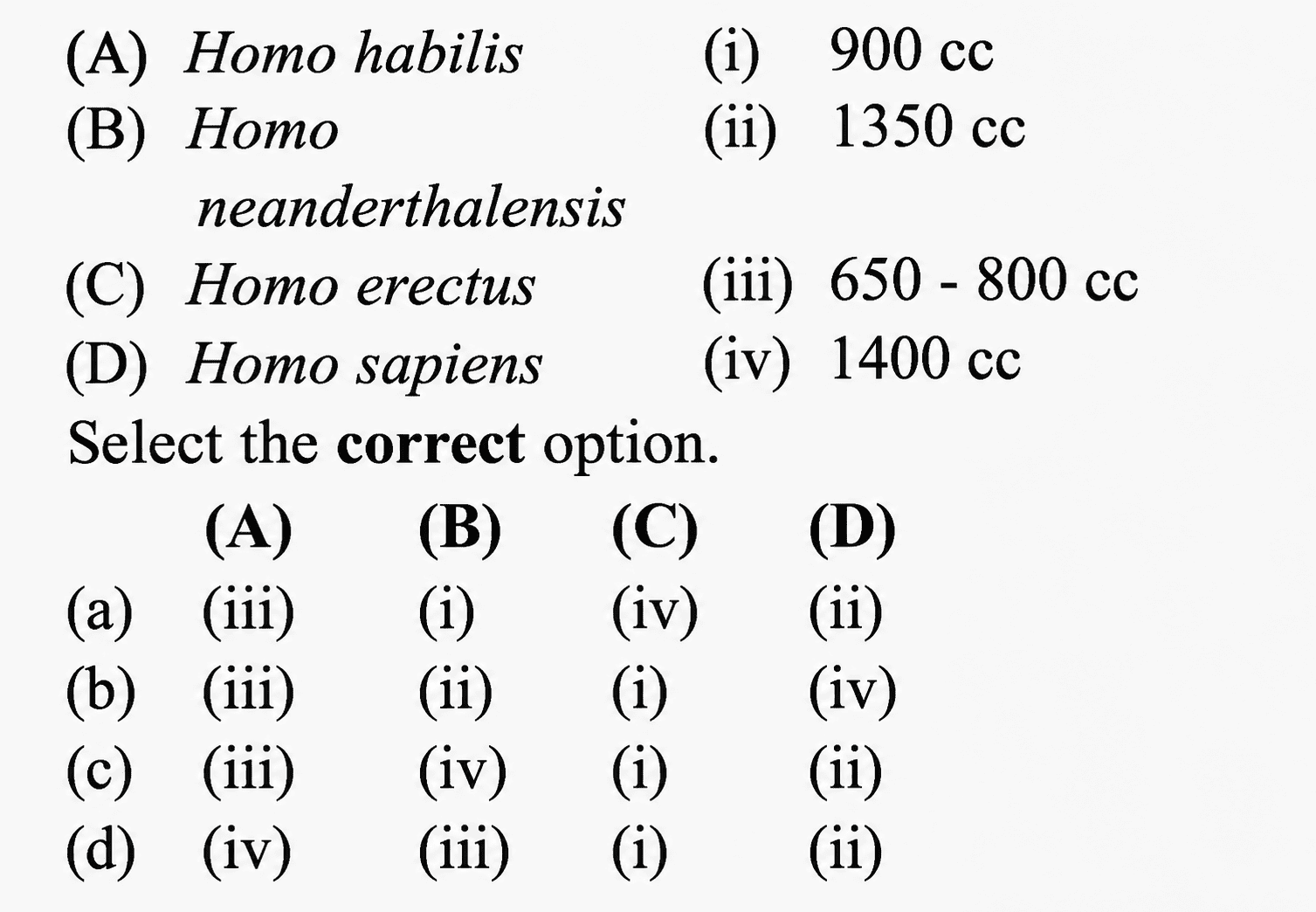
[4 Marks] Diagram 27 – NEET-UG 2019 Question Paper
  • (A) b
  • (B) a
  • (C) c
  • (D) d
Question 164.

Variations caused by mutation, as proposed by Hugo de Vries, are:

[4 Marks]
  • (A) small and directionless
  • (B) random and directionless
  • (C) random and directional
  • (D) small and directional
Question 165.

Identify the correct pair representing the causative agent of typhoid fever and the confirmatory test for the disease.

[4 Marks]
  • (A) Salmonella typhi / Widal test
  • (B) Salmonella typhi / Anthrone test
  • (C) Streptococcus pneumoniae / Widal test
  • (D) Plasmodium vivax / UTI test
Question 166.

Colostrum, the yellowish fluid, secreted by mother during the initial days of lactation is very essential to impart immunity to the newborn infants because it contains:

[4 Marks]
  • (A) Natural killer cells
  • (B) Monocytes
  • (C) Macrophages
  • (D) Immunoglobulin A
Question 167.

Select the incorrect statement regarding inbreeding.

[4 Marks]
  • (A) Inbreeding is necessary to evolve a pure line in any animal.
  • (B) Continued inbreeding reduces fertility and leads to inbreeding depression.
  • (C) Inbreeding helps in elimination of deleterious alleles from the population.
  • (D) Inbreeding depression cannot be overcome by out- crossing.
Question 168.

Select the incorrect statement.

[4 Marks]
  • (A) Inbreeding increases homozygosity.
  • (B) Inbreeding is essential to evolve purelines in any animal.
  • (C) Inbreeding selects harmful recessive genes that reduce fertility and productivity.
  • (D) Inbreeding helps in accumulation of superior genes and elimination of undesirable genes.
Question 169.

Match Column- I with Column- II.

[4 Marks] Diagram 28 – NEET-UG 2019 Question Paper
  • (A) a
  • (B) b
  • (C) d
  • (D) c
Question 170.

Match the Following organisms with the products they produce:
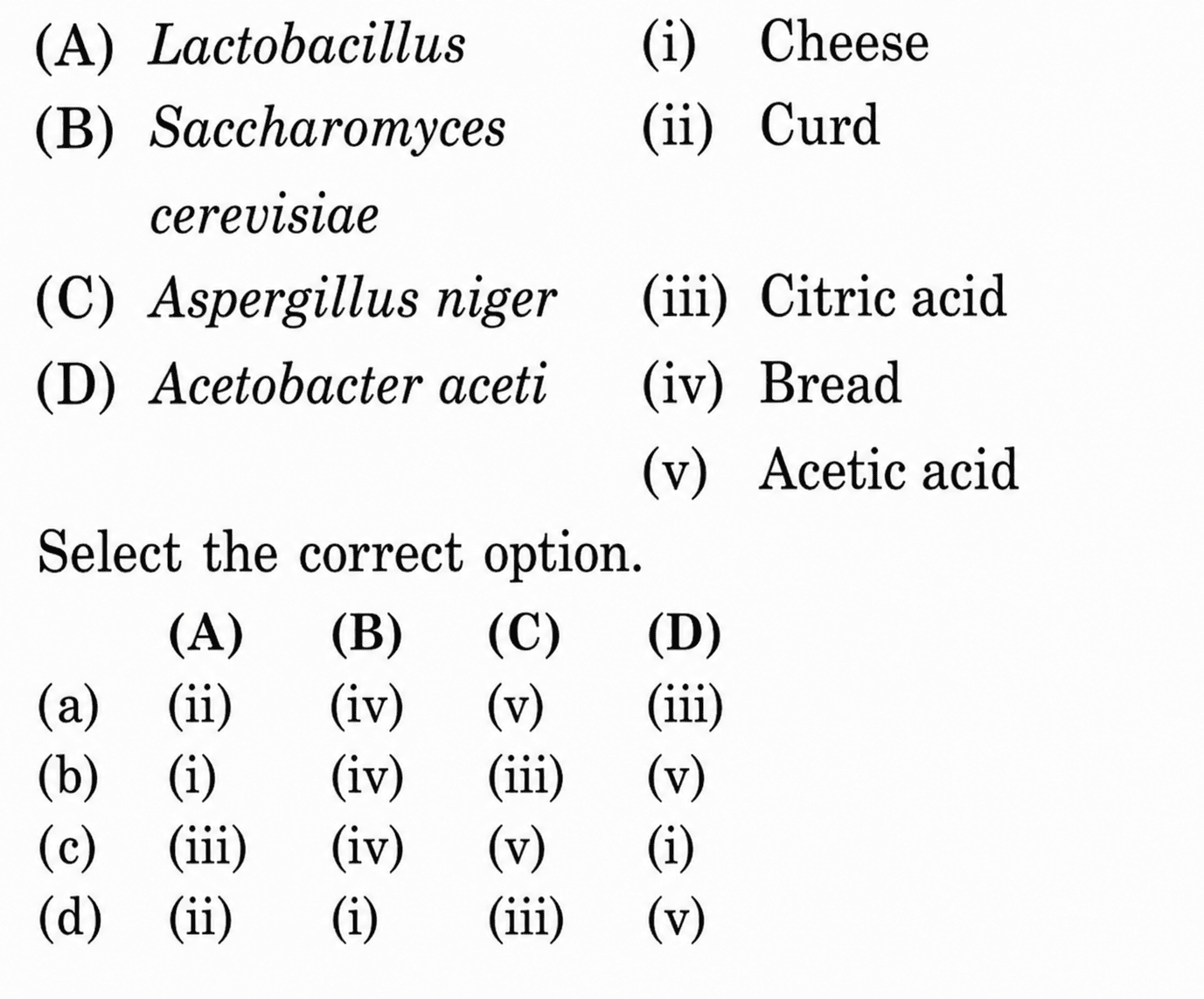
[4 Marks] Diagram 29 – NEET-UG 2019 Question Paper
  • (A) d
  • (B) c
  • (C) b
  • (D) a
Question 171.

Which of the following is a commercial blood cholesterol lowering agent?

[4 Marks]
  • (A) Cyclosporin A
  • (B) Lipases
  • (C) Streptokinase
  • (D) Statin
Question 172.

Select the correct group of biocontrol agents.

[4 Marks]
  • (A) Trichoderma, Baculovirus, Bacillus thuringiensis
  • (B) Nostoc, Azospirillum, Meloidogyne
  • (C) Oscillatoria, Rhizobium, Trichoderma
  • (D) Bacillus thuringiensis, Tobacco mosaic virus, Aphids
Question 173.

Which of the following can be used as a biocontrol agent in the treatment of plant disease?

[4 Marks]
  • (A) Anabaena
  • (B) Lactobacillus
  • (C) Chlorella
  • (D) Trichoderma
Question 174.

Which one of the following equipments is essentially required for growing microbes on a large scale, for industrial production of enzymes?

[4 Marks]
  • (A) Bioreactor
  • (B) Industrial oven
  • (C) Sludge digester
  • (D) BOD incubator
Question 175.

Following statements describe the characteristics of the enzyme Restriction Endonuclease. Identify the incorrect statement.

[4 Marks]
  • (A) The enzyme recognizes a specific palindromic nucleotide sequence in the DNA.
  • (B) The enzyme cuts DNA molecule at identified position within the DNA.
  • (C) The enzyme cuts the sugar-phosphate backbone at specific sites on each strand.
  • (D) The enzyme binds DNA at specific sites and cuts only one of the two strands.
Question 176.

DNA precipitation out of a mixture of biomolecules can be achieved by treatment with:

[4 Marks]
  • (A) Methanol at room temperature
  • (B) Chilled chloroform
  • (C) Chilled ethanol
  • (D) Isopropanol
Question 177.

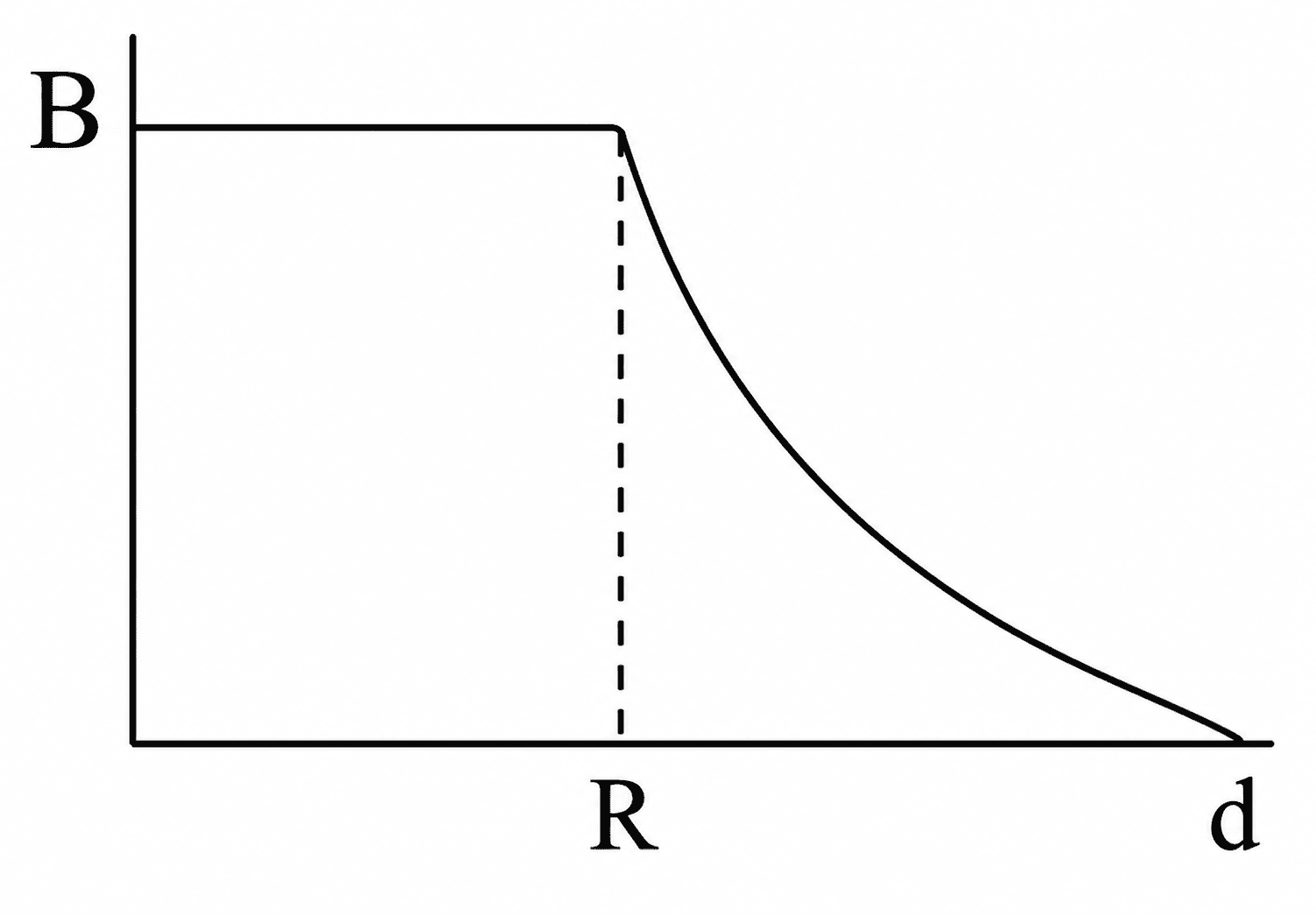
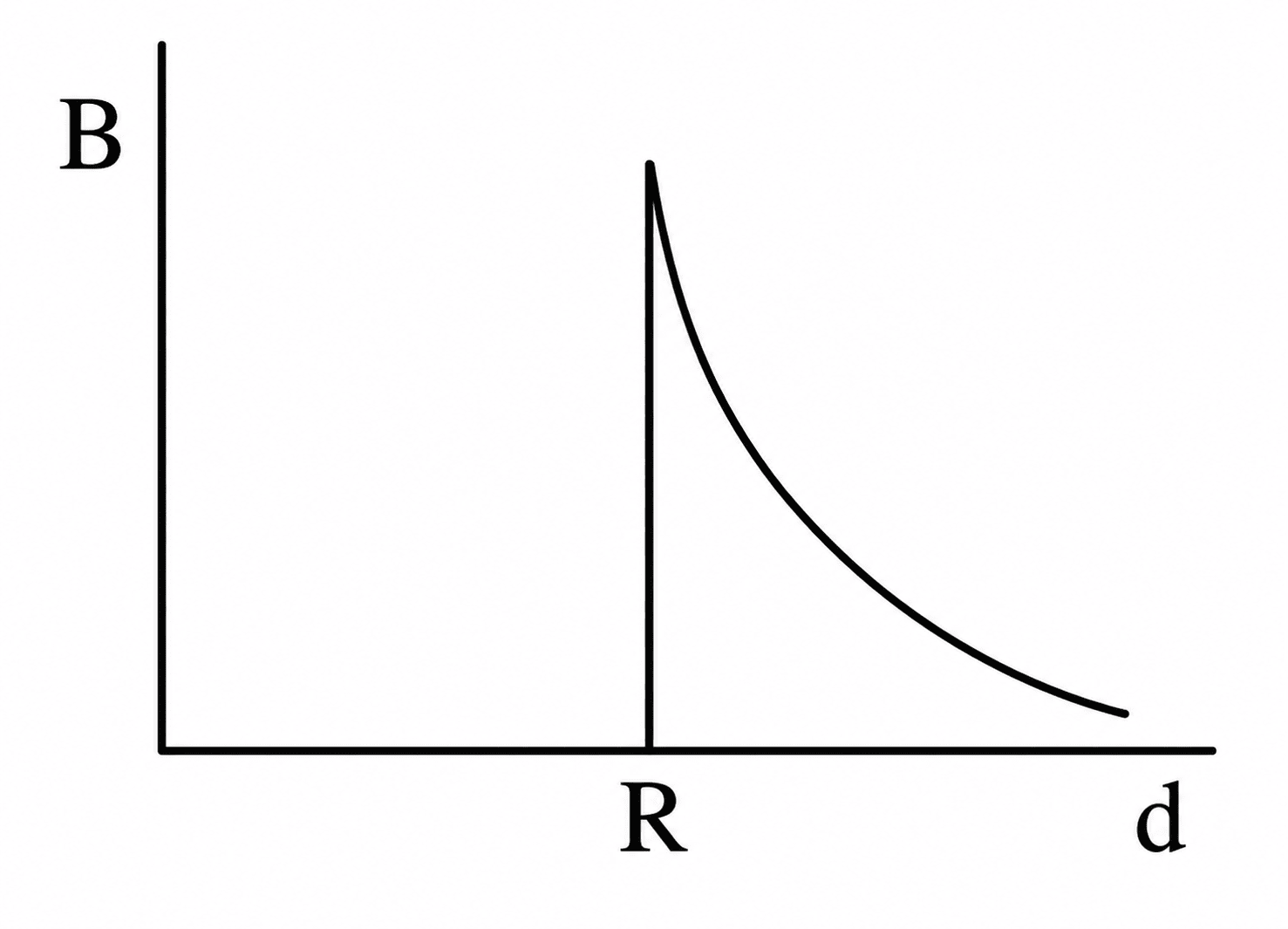
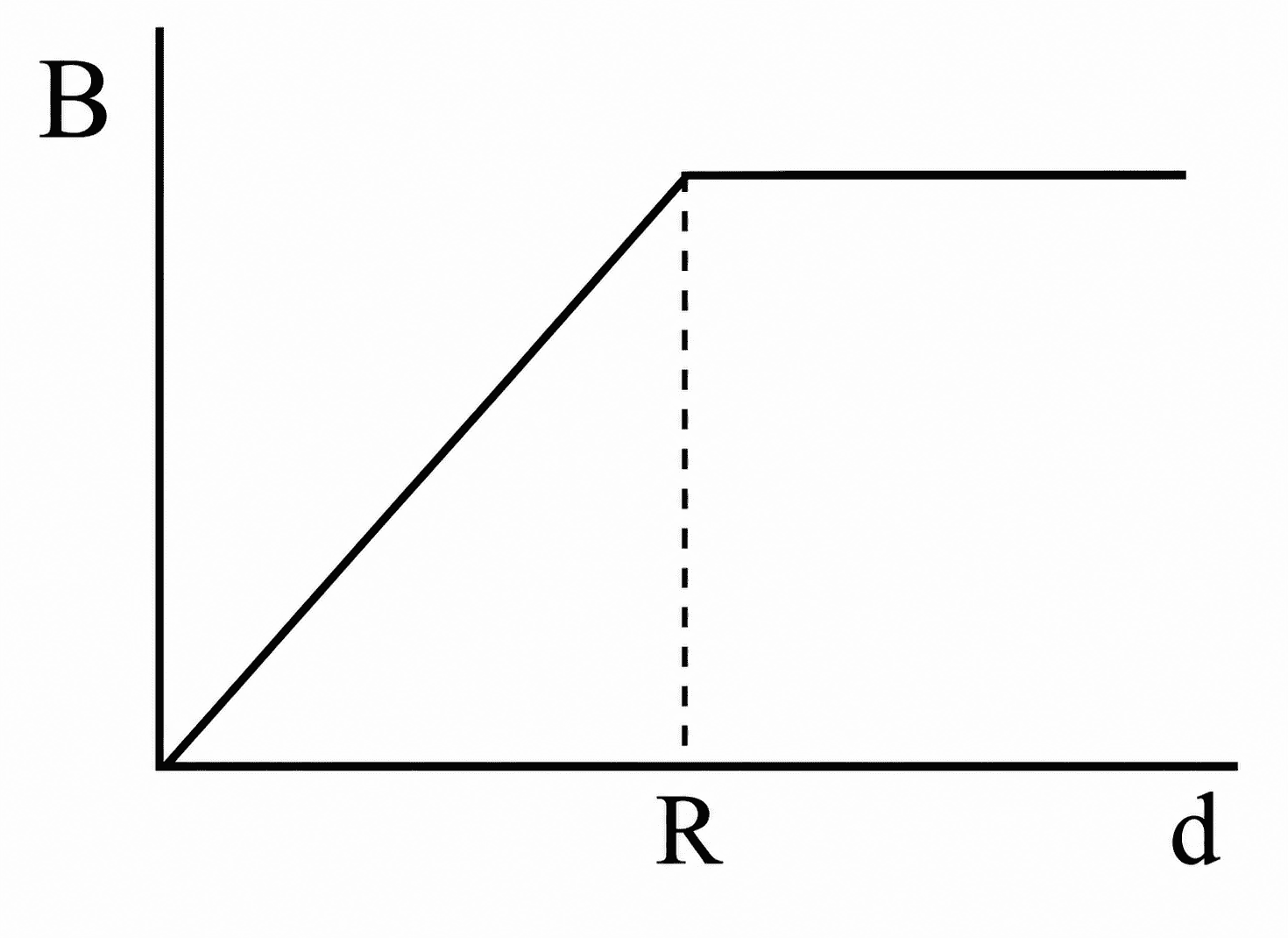
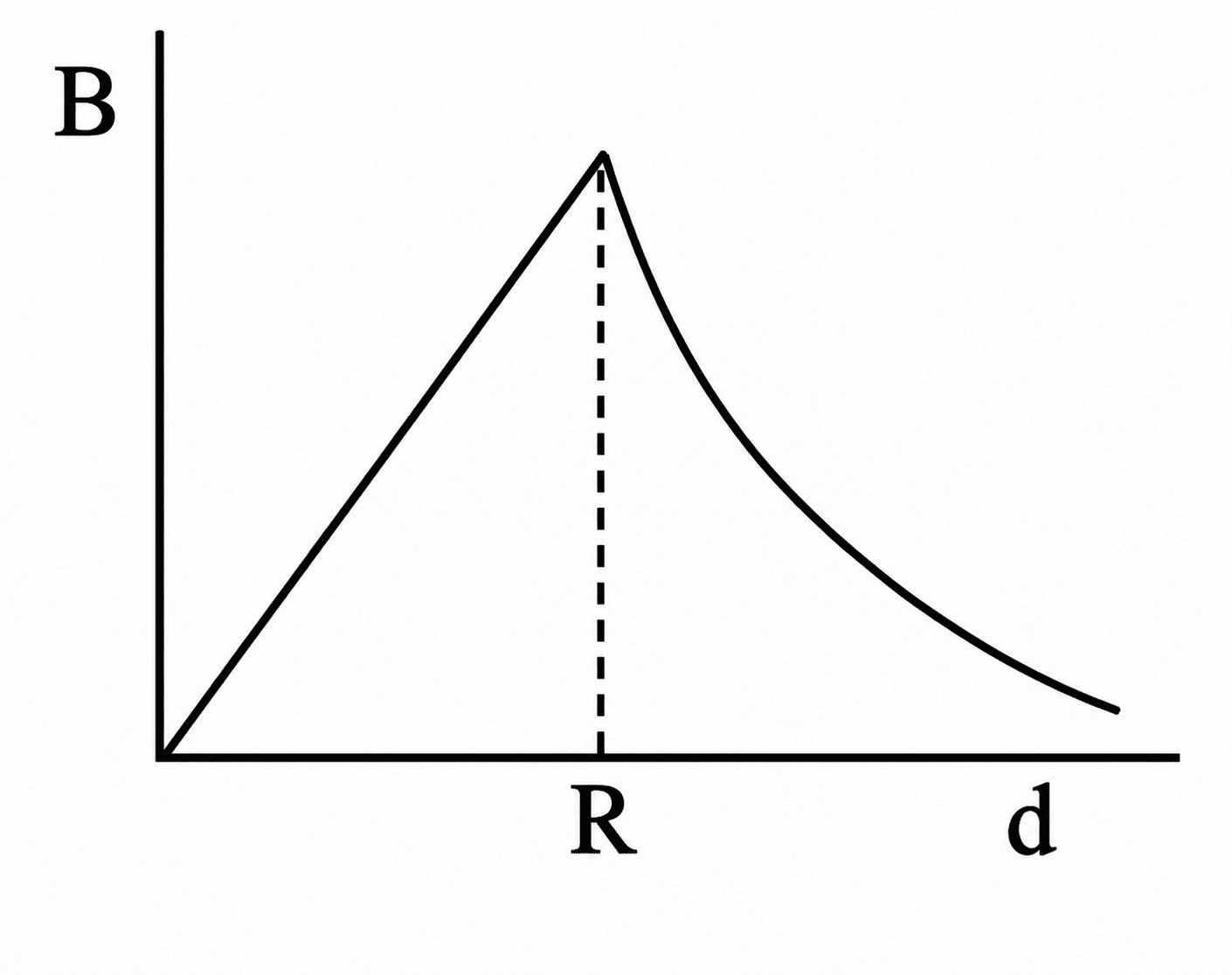
A cylindrical conductor of radius R is carrying a constant current. The plot of the magnitude of the magnetic field, B with the distance, d, from the centre of the conductor, is correctly represented by the figure:

[4 Marks]
  • (A) Diagram 30 – NEET-UG 2019 Question Paper
  • (B) Diagram 31 – NEET-UG 2019 Question Paper
  • (C) Diagram 32 – NEET-UG 2019 Question Paper
  • (D) Diagram 33 – NEET-UG 2019 Question Paper
Question 178.

The structure of intermediate A in the following reaction is:
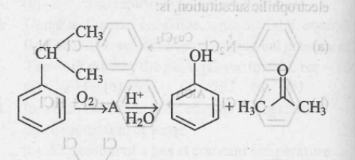
[4 Marks] Diagram 34 – NEET-UG 2019 Question Paper
  • (A) a Diagram 35 – NEET-UG 2019 Question Paper
  • (B) b Diagram 36 – NEET-UG 2019 Question Paper
  • (C) d Diagram 37 – NEET-UG 2019 Question Paper
  • (D) c Diagram 38 – NEET-UG 2019 Question Paper
Question 179.

The compound that is most difficult to protonate is:

[4 Marks]
  • (A) a Diagram 39 – NEET-UG 2019 Question Paper
  • (B) b Diagram 40 – NEET-UG 2019 Question Paper
  • (C) c Diagram 41 – NEET-UG 2019 Question Paper
  • (D) d Diagram 42 – NEET-UG 2019 Question Paper
Question 180.

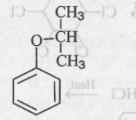
The major product of the following reaction is :
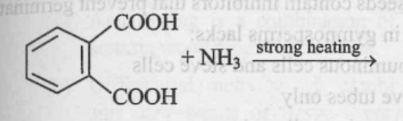
[4 Marks] Diagram 43 – NEET-UG 2019 Question Paper
  • (A) a Diagram 44 – NEET-UG 2019 Question Paper
  • (B) b Diagram 45 – NEET-UG 2019 Question Paper
  • (C) c Diagram 46 – NEET-UG 2019 Question Paper
  • (D) d Diagram 47 – NEET-UG 2019 Question Paper