CBSE EXAMINATION PAPER-2018
NEET-CHEMISTRY
(Solved)
General Instructions :
Read the following instructions carefully and follow them :
- This question paper contains 180 questions. All questions are compulsory.
- This question paper is divided into 1 sections.
- Section A – questions number 1 to 180 are multiple choice questions
- There is no overall choice given in the question paper. However, an internal choice has been provided in few questions.
- Use of calculator is NOT allowed.
Section A
A student measured the diameter of a small steel ball using a screw gauge of least count 0.001 cm. The main scale reading is 5 mm and zero of circular scale division coincides with 25 divisions above the reference level. If screw gauge has a zero error of –0.004 cm, the diameter of ball is
Diameter of the ball
= MSR + CSR × (least count) – zero error
= 0.5 cm + 25 × 0.001 – (–0.004)
= 0.5 + 0.025 + 0.004
= 0.529 cm
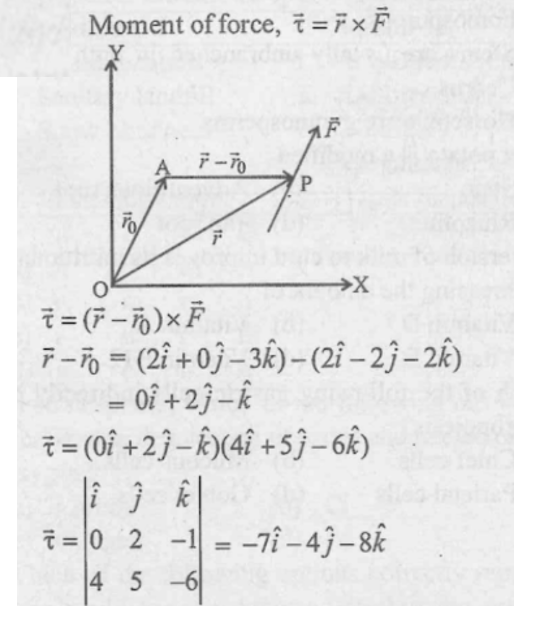
The moment of force on a force, 𝐅⃗ = 4î+ 5ĵ – 6k̂ at (2, 0, –3), about the point
(2, –2, –2), is given by
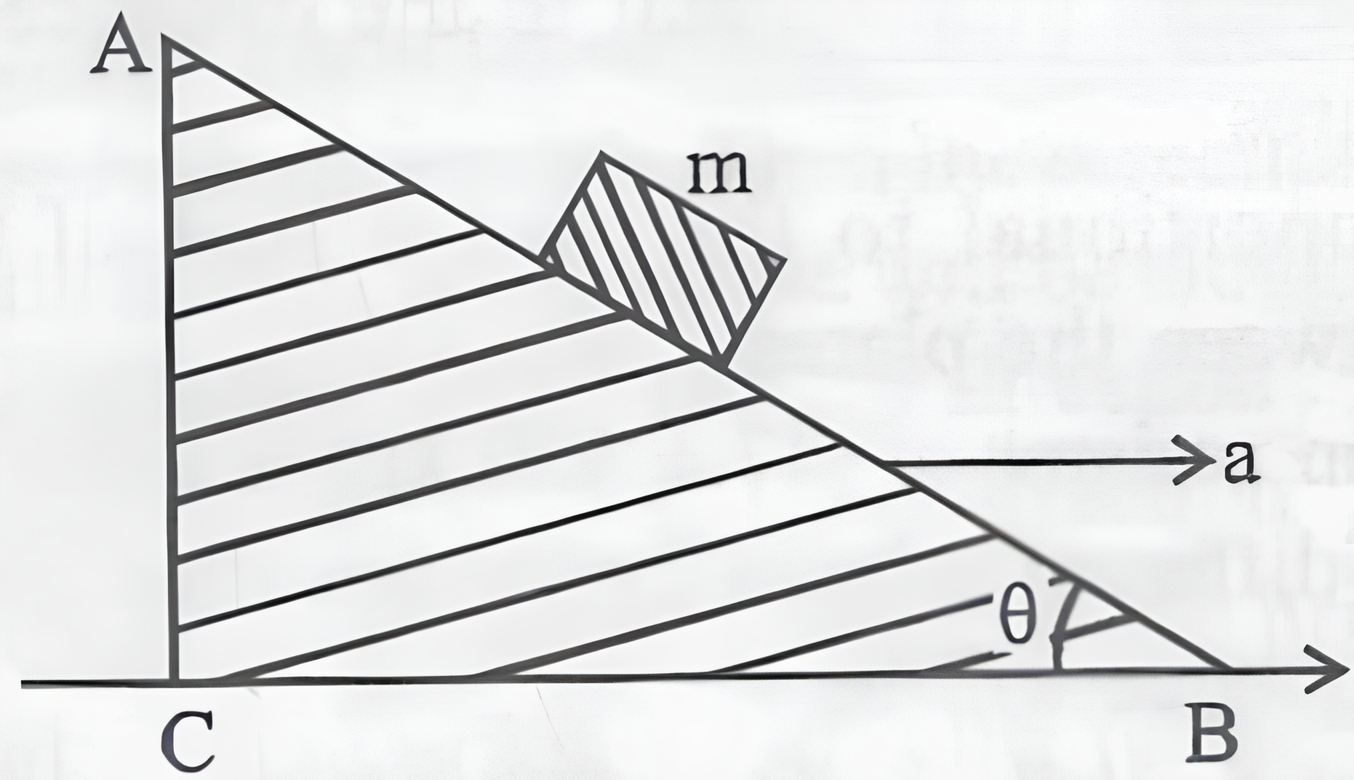
A block of mass m is placed on a smooth inclined wedge ABC of inclination θ as shown in the figure. The wedge is given an acceleration a towards the right. The relation between a and θ for the block to remain stationary on the wedge is
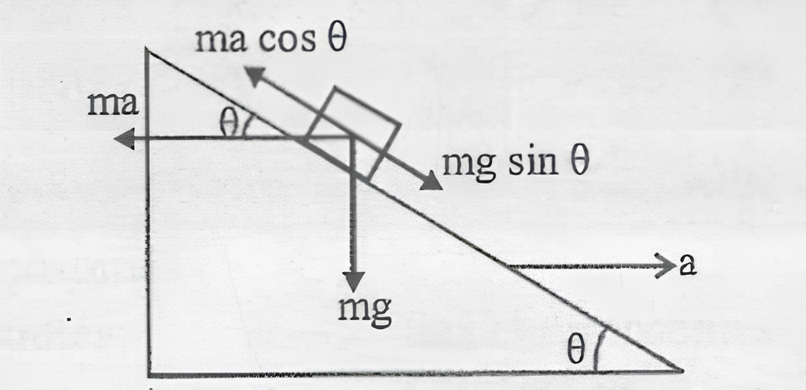
Let the mass of block is m . It will remain stationary if forces acting on it are in equilibrium, i.e. ma cos θ = mg sin θ ⇒ a = g tan θ.
Here ma = Pseudo force on block, mg = weight.
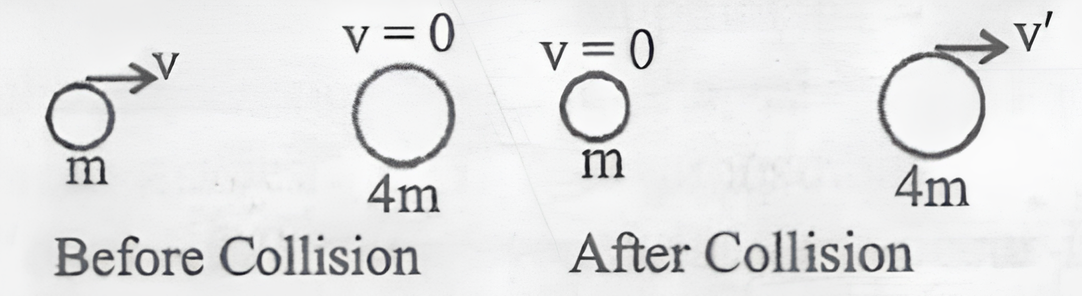
A moving block having mass m₁ collides with another stationary block having mass 4m. The lighter block comes to rest after collision. When the initial velocity of lighter block is v, then the value of coefficient of restitution (e) will be
According to law of conservation of linear momentum,
mv+4m x 0 = 4mv' + 0 ⇒ V' = v/4
Coefficient of restitution,
e = Relative velocity of separation / Relative velocity of approach v/4/v
or, e = 1/4 = 0.25
A solid sphere is rotating freely about its symmetry axis in free space. The radius of the sphere is increased keeping its mass same. Which of the following physical quantities would remain constant for the sphere?
Angular momentum, remains conserved until the torque acting on sphere remains zero. 𝝉ₑₓ = 0
So, dL/dt = 0
i.e, angular momentum L = constant.
A solid sphere is in rolling motion. In rolling motion a body possesses translational kinetic energy (Kₜ) as well as rotational kinetic energy (Kᵣ) simultaneously. The ratio Kₜ : (Kₜ + Kᵣ)) for the sphere is
In rolling motion, rotational kinetic energy,
Kₜ = 1/2 Iv²
And, Kₜ + Kᵣ = 1/2 mv² +1 / 2 lω²
= 1/2 mv² + 1/2 (2/5 mr²)(v/r²) = 7 / 10 mv²
∴ Kₜ/(Kₜ + Kᵣ) = (1/2 mv²)/(7/10 mv²) = 5/7
Three objects A (a solid sphere), B (a thin circular disk) and C (a circular ring), each have the same mass M and radius R. They all spin with the same angular speed ω about their own symmetry axes. The amount of work (W) required to bring them to rest, would satisfy the relation
Work done required to bring them to rest ΔW = ΔKE (work-energy theorem)
ΔW = 1/2 Iω² (ΔKEᵣₒₜ = 1/2 Iω²)
or, ΔW ∝ I (for same ω)
I_ Solid sphere = 2/5 MR² , I_disk = 1/2 MR²
I_(ring) = MR² ∴ W_C > W_B > W_A
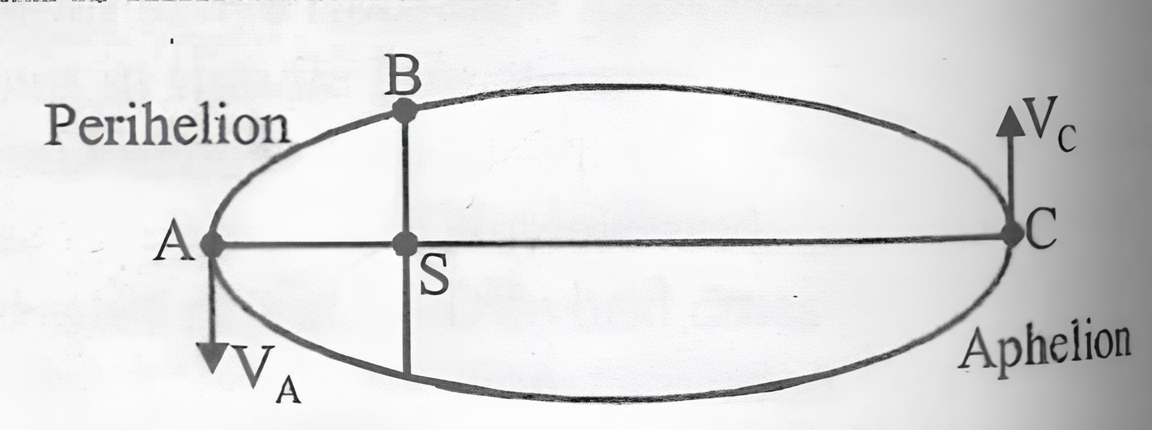
The kinetic energies of a planet in an elliptical orbit about the Sun, at positions A, B and C are K_A , K_B, and K_C respectively. AC is the major axis and SB is perpendicular to AC at the position of the Sun S as shown in the figure. Then
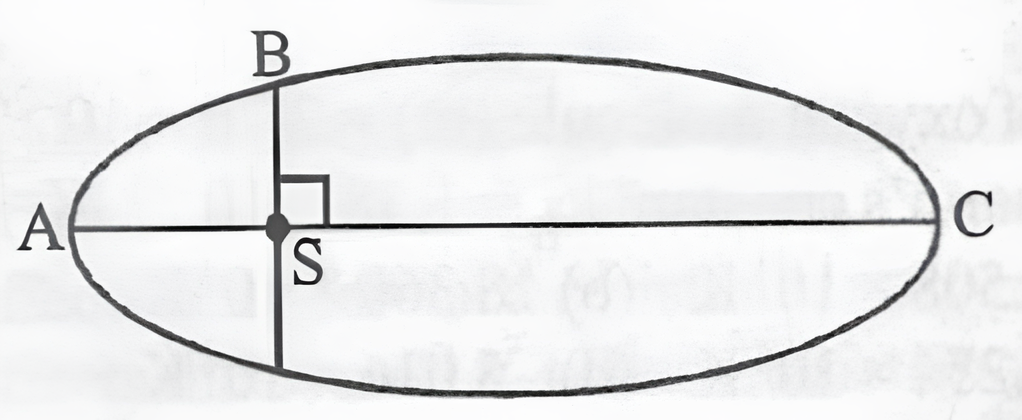
Speed of the planet will be maximum when its distance from the sun is minimum as mvr =constant.
Point A is perihelion and C is aphelion.
Clearly, V_A > V_B > V_C
So, K_A > K_B > K_C
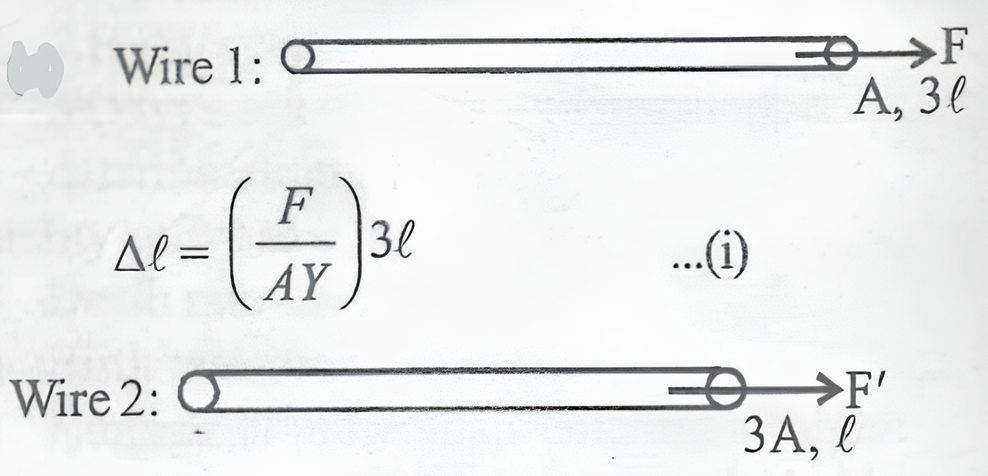
Two wires are made of the same material and have the same volume. The first wire has cross-sectional area A and the second wire has cross-sectional area 3A. If the length of the first wire is increased by Δl on applying a force F, how much force is needed to stretch the second 'wire by the same amount?
Δl = (F'/3AY)l ....(ii)
From equation (i) & (ii),
Δl =(F/AY)3l = (F' /3AY)l or, F'=9F
A small sphere of radius ‘r’ falls from rest in a viscous liquid. As a result, heat is produced due to viscous force. The rate of production of heat when the sphere attains its terminal velocity, is proportional to
Power = rate of production of heat F.V
= 6πηrV_T · V_T = 6πηrV_T²
(∵F = 6πηrV_Tr Stoke’s formula)
V_T∝ r²
∵ V_T = 2/9 ( r²(ρ − σ) / η( g)
∴ Power ∝ r⁵
The power radiated by a black body is P and it radiates maximum energy at wavelength,λ₀ If the temperature of the black body is now changed so that it radiates maximum energy at wavelength 3/4 λ₀ ,the power radiated by it becomes nP. The value of n is
From Wien’s law
λₘₐₓ T = constant
i.e., λₘₐₓ₁T₁ = λₘₐₓ₂T₂
⇒ λ₀ T = 3 λ₀/4 T
⇒ T' =4/3 T
Power radiated P ∝ T⁴
So, P₂/P₁ = n = (T'/T)⁴ = (4/3)⁴ = 256/81
The volume (V) of a monatomic gas varies with its temperature (T), as shown in the graph. The ratio of work done by the gas, to the heat absorbed by it, when it undergoes a change from state A to state B, is
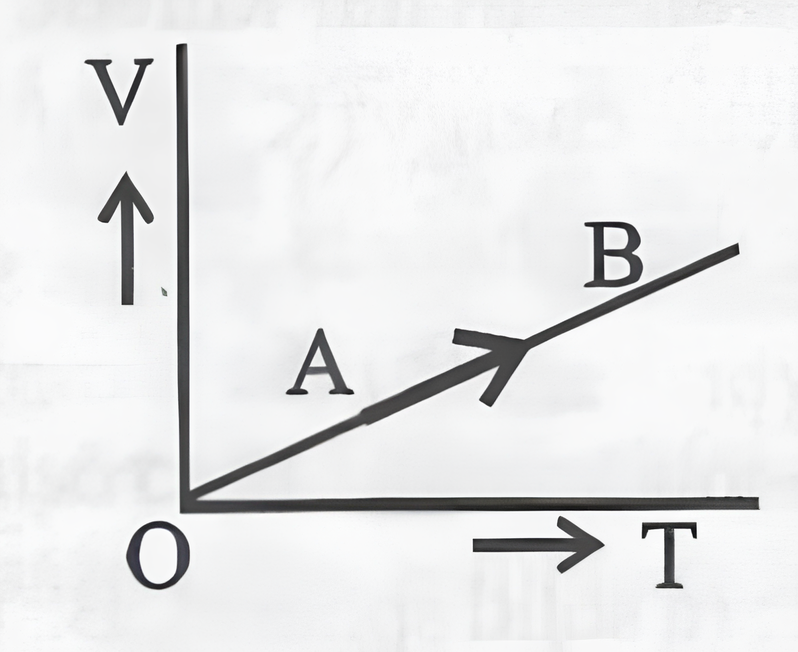
Gas is monatomic, so Cₚ = 5/2 R
Given process isobaric
∴ dQ = nCₚ dT
⇒ dQ = (5/2 R) dT
dW = PdV = nRdT
∴ Required ratio = dW/dQ = nRdT / n(5/2 R)dT = 2/5
The efficiency of an ideal heat engine working between the freezing point and boiling point of water, is
Efficiency of ideal heat engine, η = (1 − T₂/T₁)
Sink temperature, T₂ = 100°C = 100 + 273 = 373 K
Source temperature, T₁ = 0°C + 0° + 273 = 273 K
Percentage efficiency, % η = (1 − T₂/T₁) × 100
=(1- 273/373)x100 = (100/373) × 100 = 26.8%
At what temperature will the rms speed of oxygen molecules become just sufficient for escaping from the Earth’s atmosphere?
(Given:
Mass of oxygen molecule (m)=2.76 x 10⁻²⁶kg
Boltzmann’s constant k_B = 1.38 x 10⁻²³ JK⁻¹)
Let at temperature T rms speed of oxygen molecules become just sufficient for escaping from the Earth’s atmosphere.
V_escape =11200m/s
Also, Vᵣₘₛ = V_ escape = √(3k_BT/m₀₂) = 11200 m/s
Putting value of k_B and mO₂, we get,
T = 8.360 × 10⁴ K
A pendulum is hung from the roof of a sufficiently high building and is moving freely to and fro like a simple harmonic oscillator. The acceleration of the bob of the pendulum is 20 m/s² at a distance of 5 m from the mean position. The time period of oscillation is
From equation, acceleration, a = 20 m/s², and displacement, y = 5m |a| = ω²y
⇒20= ω²(5)
⇒ ω = 2 rad / s
Time period of pendulum,
T = 2π/ω = 2π/2 = πs
A tuning fork is used to produce resonance in a glass tube. The length of the air column in this tube can be adjusted by a variable piston. At room temperature of 27°C two successive resonances are produced at 20 cm and 73 cm of column length. If the frequency of the tuning fork 320 Hz, the velocity of sound in air at 27°C is
Two successive resonance are produced at 20 cm and 73 cm of column length
∴ λ/2 = (73 − 20) × 10⁻² m
⇒ λ = 2 × (73 − 20) × 10⁻²
Velocity of sound, ν = nλ
= 2 × 320 [73 − 20] × 10⁻² = 339.2 m/s⁻¹
The fundamental frequency in an open organ pipe is equal to the third harmonic of a closed organ pipe. If the length of the closed organ pipe is 20 cm, the length of the open organ pipe is
For closed organ pipe, third harmonic
n = (2N − 1)V / 4ℓ= 3V/4ℓ (∵ N = 2)
For open organ pipe, fundamental frequency
n = NV / 2ℓ′ =V/2ℓ (∵ N = 1)
According to question, 3V/4ℓ = V/2ℓ′
⇒ ℓ = 4ℓ′/3 × 2 = 2ℓ /3 = 2 x 20 / 3 =13.33cm
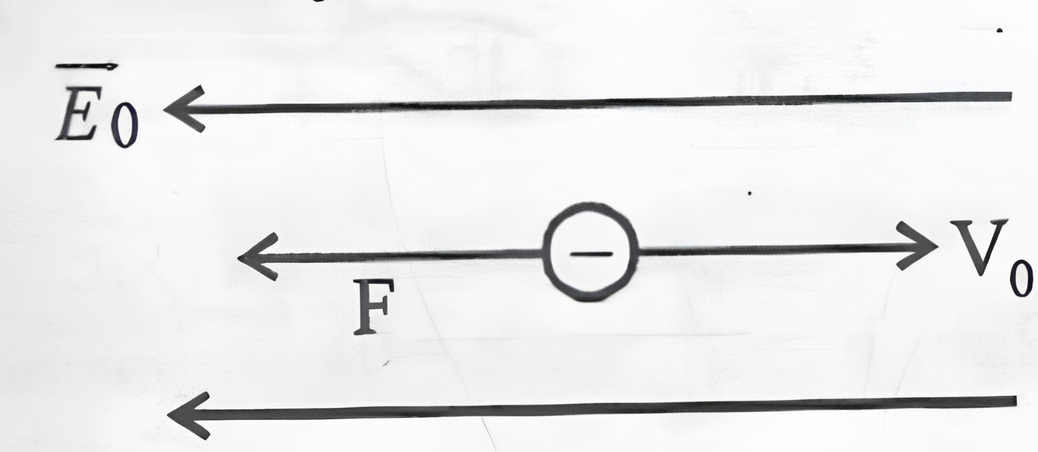
An electron falls from rest through a vertical distance h in a uniform and vertically upward directed electric field E. ‘The direction of electric field is now reversed, keeping its magnitude the same. A proton is allowed to fall from rest in it through the same vertical distance h. The time of fall of the electron, in comparison to the time of fall of the proton is
As we know, F = qE =ma
⇒ a = qE/m
h = 1qE/2m (t²)
∴ t= √(2hm/qE)
i.e., time t ∝ √m as ‘q’ is same for electron and proton. Since, electron has smaller mass so it will take smaller time.
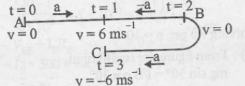
A toy car with charge q moves on a frictionless horizontal plane surface under the influence of a uniform electric field 𝐄⃗ . Due to the force q 𝐄⃗ , its velocity increases from 0 to 6 m/s in one second duration. At that instant the direction of the field is reversed. The car continues to move for two more seconds under the influence of this field. The average velocity and the average speed of the toy car between 0 to 3 seconds are respectively
Acceleration, a = v-u /t = 6-0/1
= 6 ms⁻²
For t = 0 to t = 1s,
s₁ = 1/2 x 6 (1)² = -3m ...(i)
For t=1s=tot=2s,
S₂ 6.1 -1/2 x 6(l)² = -3 ...(ii)
For t = 2s to t = 3s,
S₃ = 0-1/2 x 6(l)² = -3 (iii)
Total displacement S = S₁ + S₂ +S₃ = 3 m
Average velocity = 3/3 = 1 ms⁻¹
Total distance travelled =9 m
Average speed = 9/3 = 3 ms⁻¹
The electrostatic force between the metal plates of an isolated parallel plate capacitor C having a charge Q and area A, is
Electrostatic force between the metal plates
F_plate = Q²/ 2Aᵋ₀
For isolated capacitor Q = constant
Clearly, F is independent of the distance between plates.
A carbon resistor of (47 ±4.7) kΩ is to be marked With rings of different colours for its identification. The colour code sequence will be
Colour code for carbon resistor
0 Black
1 Brown Tolerance: ±5% Gold
2 Red ±10% Silver
3 Orange ±20% No colour
4Yellow
5 Green
6 Blue
7 Violet
8 Grey
9 White
(47 ± 4.7)KΩ= 47 × 10³ ± 10%
Yellow -Violet - Orange - Silver
A set of 'n' equal resistors, of value 'R’ each, are connect in series to a battery of emf 'E' and internal resistance 'R' The current drawn is I. Now, the 'n' resistors are connected in parallel to the same battery. Then the current d from battery becomes 10 1. The value of 'n' is
In series grouping equivalent resistance Rₛₑᵣᵢₑₛ = nR
In parallel grouping equivalent resistance Rₚₐᵣₐₗₗₑₗ = R/n
I = E/nR + R ...(i)
10I = E/R/n+R ...(ii)
Dividing eq. (ii) by (i),
10 = (n+1)R/( 1/n +1 )R
Solving we get, n = 10
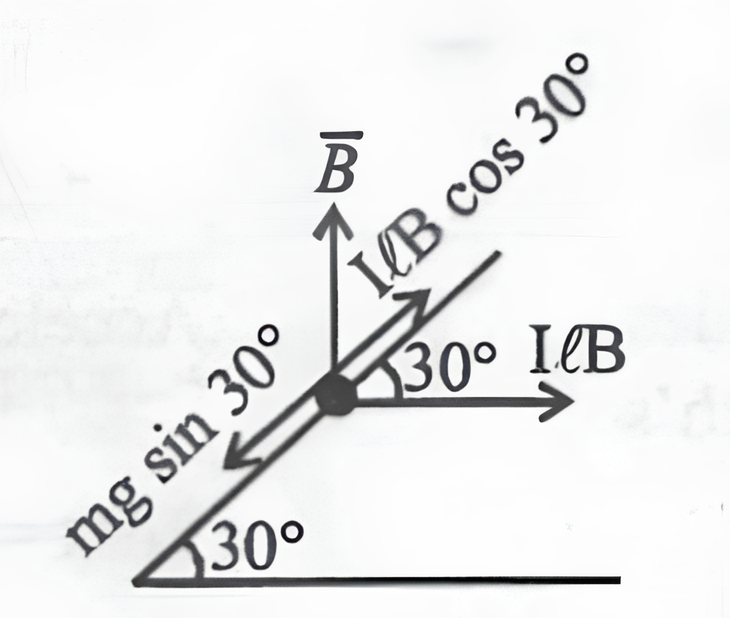
A metallic rod of mass per unit length 0.5 kg m⁻¹ is horizontally on a smooth inclined plane which makes an angle of 30⁰ with the horizontal. The rod is not allowed to ide down by flowing a current through it when a magnetic field of induction 0.25 T is acting on it in the vertical direction. The current flowing in the rod to keep it stationary is
From figure, for equilibrium,
mg sin 30°=1/B 30°
⇒ I =mg/ℓB tan 30°
= 0.5 x9.8/0.25 x√3 = 11.32A
Current sensitivity of a moving coil galvanometer is 5 div/ mA and its voltage sensitivity (angular deflection per unit voltage applied) is 20 div/V. The resistance of the galvanometer is
Current sensitivity of moving coil galvanometer
Iₛ= NBA/C ...(i)
Voltage sensitivity of moving coil galvanometer,
Vₛ= NBA/ CR_G ..(ii)
Dividing eq. (i) by (ii)
Resistance of galvanometer
R_G = Iₛ / Vₛ = 5 ×1 / 20 ×10⁻³ = 5000 / 20 = 250 Ω
A thin diamagnetic rod is placed vertically between the poles of an electromagnet. When the current in the electromagnet is switched on, then the diamagnetic rod is pushed up, out of the horizontal magnetic field. Hence the rod gains gravitational potential energy. The work required to do this comes from
Rod gains gravitational potential energy which comes from energy of current source.
The magnetic potential energy stored in a certain inductor is 25 mJ, when the current in the inductor is 60 mA. This inductor is of inductance
From question energy stored in inductor,
U = 25 × 10⁻³ J
Current, I = 60 mA
Energy stored in inductor U = 1/2LI²
25 × 10⁻³ = 1/2 × L × (60 × 10⁻³)²
L = 25 × 2 × 10⁶ x10⁻³ /3600 = 13.89 Hm
An inductor 20 mH, a capacitor 100 μFanda resistor 50Ω are connected in series across a source of emf, V.= 10 sin 314 t. The power loss in the circuit is
Power dissipated in an LCR series circuit connected to an a.c. source emf E
P = Eᵣₘₛ Iᵣₘₛ cos Φ = E²ᵣₘₛR/Z² = E²ᵣₘₛR / R² + (ωL − 1/Cω)²
(10/√2)² × 50 / (50)² + (314 × 20 × 10⁻³ − 1/(314 × 100 × 10⁻⁶))²] Solving we get, P =0.79 W
An em wave is propagating in a medium with a velocity 𝐕⃗ = 𝐕î . The instantaneous oscillating electric field of this em wave is along +y axis. Then the direction of oscillating ‘magnetic field of the em wave will be along
As we know, 𝐄⃗ × 𝐁⃗= 𝐕⃗
( 𝐄⃗ĵ × 𝐁⃗) =𝐕⃗î (∵Electric field vector is along +y axis)
So, 𝐁⃗ = Bk̂
i.e., direction of magnetic field vector is along +z direction.
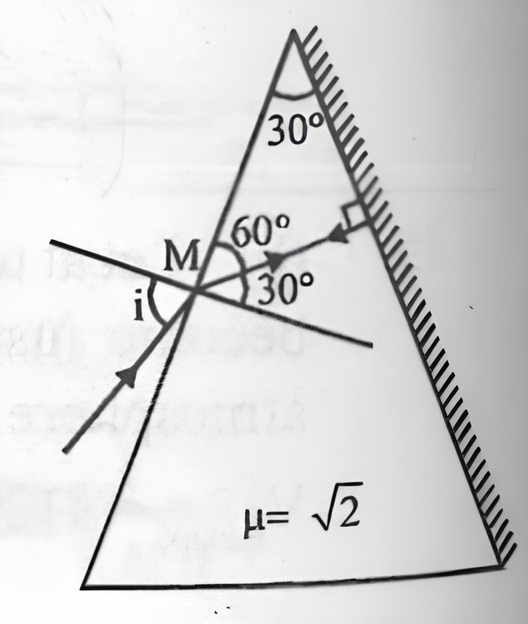
The refractive index of the material of a prism is √2 and the angle of the prism is 30°.One of the two refracting surfaces of the prism is made a mirror inwards, by silver coating. A beam of monochromatic light entering the prism from the other face will retrace its path (after reflection from the silvered surface) if its angle of incidence on the prism is
For refracting the path, light ray should be normally incident on slivered face.
A = r + o ⇒ r = 30°
Applying Snell’s law at point M,
sin i/sin30° = √2/1
⇒sin i = √2 × 1/2
or, sin r = 1/√2 i.e., i = 45°
An astronomical refracting telescope will have large angular magnification and high angular resolution, when it has an objective lens of
For telescope, angular magnification = f₀ / f_E
So, focal length of objective lens should be large.
Angular resolution = D/1.22 λ So, D objective lens of refracting telescope should have large focal length (f₀) and larger diameter D for larger magnification.
In Young's double slit experiment the separation d between the slits is 2 mm, the wavelength λ of the light used is 5896 Å and distance D between the screen and slits is 100 cm. It is found that the angular width of the fringes is 0.20°. To increase the fringe angular width to 0.21° (with same λ and D) the separation between the slits needs to be changed to
Angular width = λ/d
So, 0.20° = λ/2 mm
⇒ λ = 0.20° × 2
Again, 0.21° = λ/d
Now putting the value of λ,
d = 0.20° × 2 mm/0.21°
∴ d = 1.9 mm
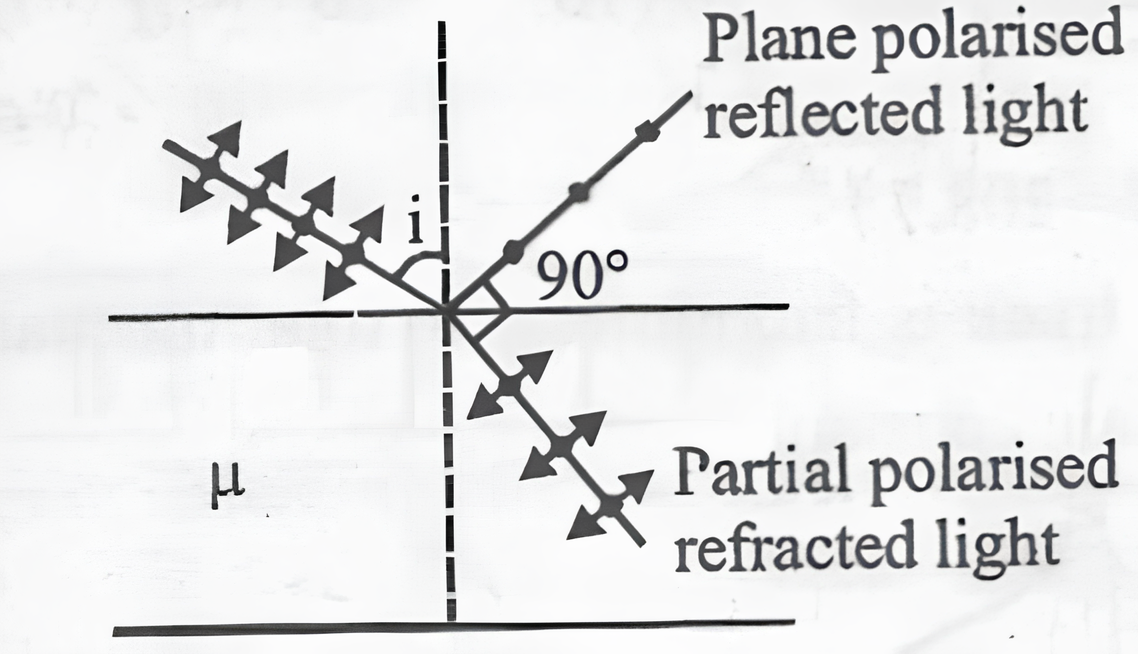
Unpolarised light is incident from air on a plane surface of a material of refractive index 'μ'. At a particular angle of incidence 'i', it is found that the reflected and refracted rays are perpendicular to each other. Which of the: following options is correct for this situation?
When reflected light rays and refracted rays are perpendicular, reflected light is polarised with electric field vector perpendicular to the plane of incidence.
Also, tan i = μ (i (Brewster angle)
An electron of mass m₀ with an initial velocity 𝐕⃗ = v₀ î (v₀ > 0) enters an electric field 𝐄⃗ = −E₀ î (E₀ = constant > 0) at t = 0. If λ₀ is its de-Broglie wavelength at t = 0, then its de-Broglie wavelength after time t is
Initial de-Broglie wavelength
λ₀ = h/(mV₀) ...(i)
Acceleration of electron
a = eE₀/m (∵ F = ma = eE₀)
Velocity after time ‘t’
V = (V₀ + (eE₀/m(t) )
So, λ = h/mV = h/m(V₀+eE₀/m(t)
= h/mV₀[1+eE₀/mV₀ (t)] = λ₀/[1+eE₀/mV₀ (t) ] ...(ii)
Dividing eqs. (ii) by (i),
de- Broglie wavelength λ = λ₀/[1+ eE₀/mV₀(t)]
The ratio of kinetic energy to the total energy of an electron in a Bohr orbit of the hydrogen atom, is
In a Bohr orbit of hydrogen atom Kinetic energy,
K = kze²/2rₙ
Total energy, E = −kze²/2rₙ
So, Kinetic energy : total energy = 1 : −1
For a radioactive material, half-life is 10 minutes. If initially there are 600 number of nuclei, the time taken (in minutes) for the disintegration of 450 nuclei is
Number of nuclei remaining, N = 600 − 450 = 150 after time ‘T’
N/N₀ = 150/600 = 1/4
N = N₀e⁻λt ⇒ ℓn(N₀/N) = λt ⇒ℓn (N₀/N ) = λt
⇒ t = 1/ λ ℓn (N₀/N)
2.303 × T₁/₂ / 0.693( log₁₀ ) N₀/N
= 2.303 × 10 / 0.693 (log₁₀ 4)
In ap-n junction diode, change in temperature due to heating
On heating, number of electron-hole pairs increases, so overall resistance of diode will change. Hence forward biasing and reversed biasing both are changed.
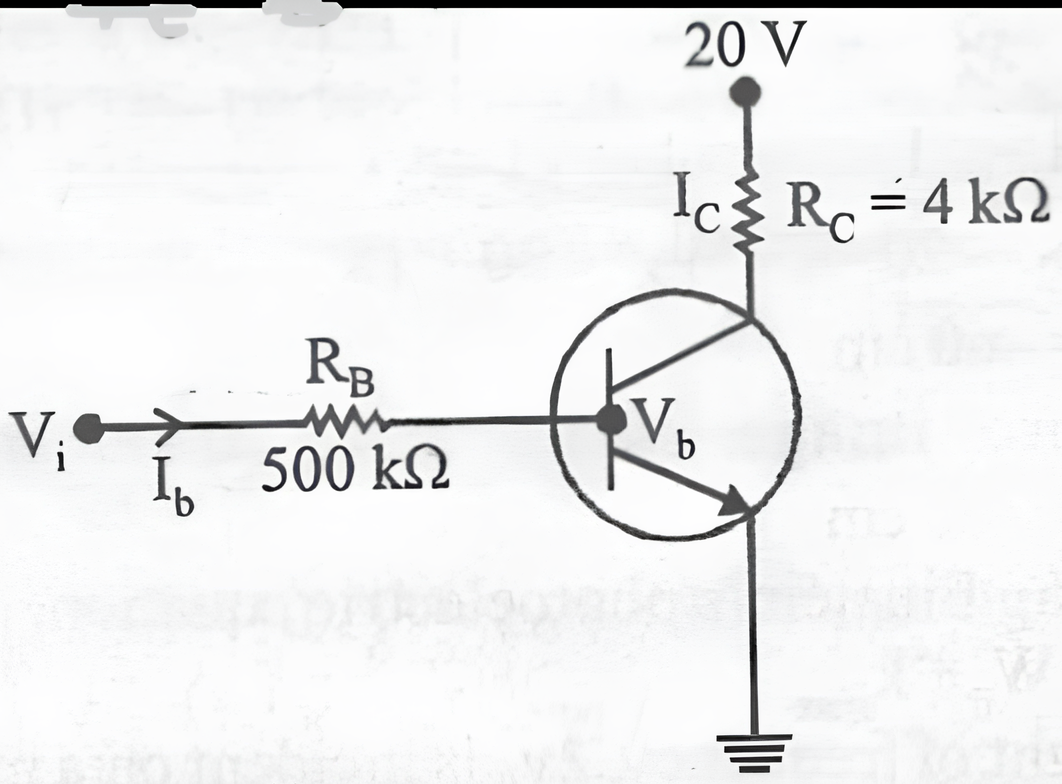
In the circuit shown in the figure, the input voltage Vᵢ is 20 V, V_BE = 0 and V_CE) = 0. The values of Iᵦ, I𝒸 and β are given by
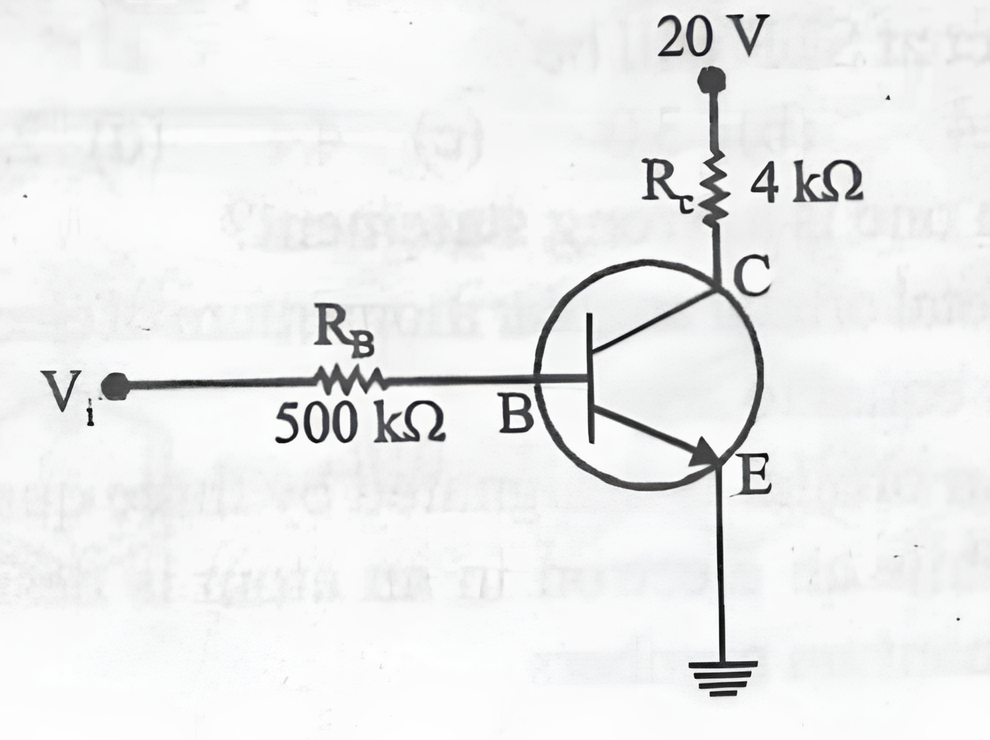
From question, V_BE = = 0, Vᵢ = 20V
V_CE = 0
V_b = 0 (earthed)
I_B = ?, I𝒸 = ?, β = ?
I𝒸 = (20 − 0)/4 × 10³ = 5 × 10⁻³ = 5 mA
Vᵢ = V_BE + I_BR_B or, Vi = 0 + I_BR_B
⇒ 20 = I_B × 500 × 10³
⇒ I_B = 20/500 × 10³ = 40 μA
β= I_c /I_b= 25 × 10⁻³ / 40 × 10⁻⁶ = 125
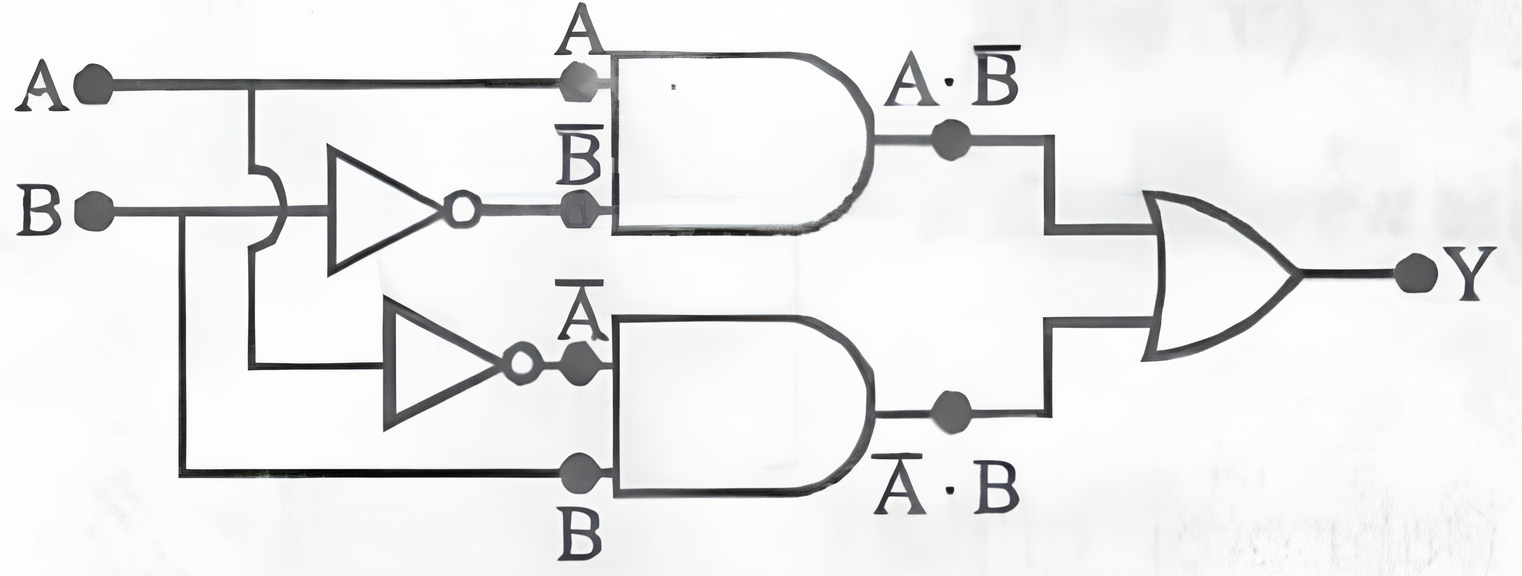
In the combination of the following gates the output Y can be written in terms of inputs A and B as
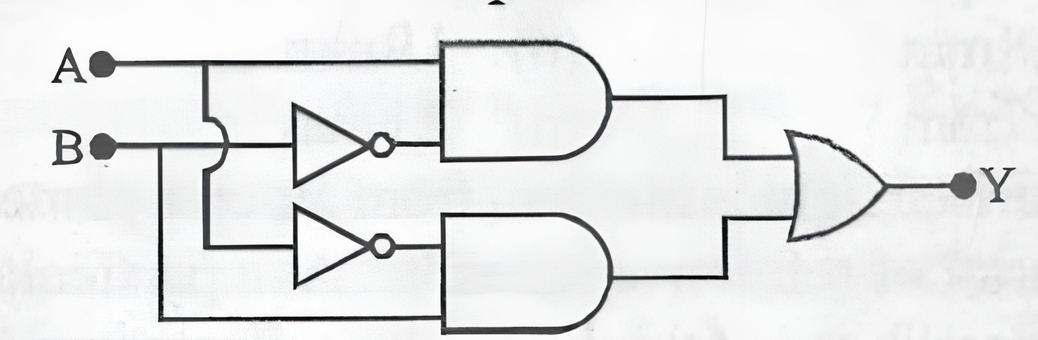
Y=(A.B̅ + A̅ . B)
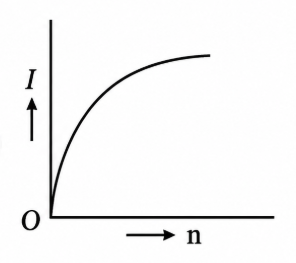
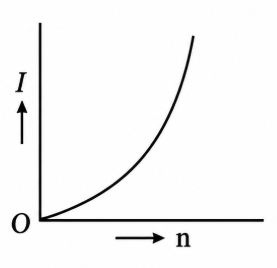
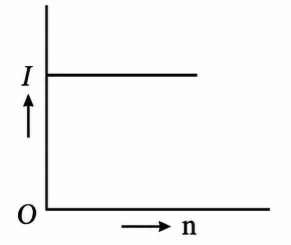
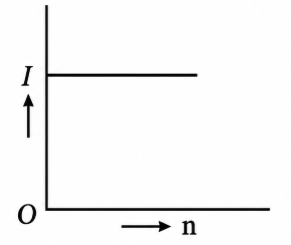
A battery consists of a variable number 'n' of identical cells (having internal resistance 'r' each) which are connected in series. The terminals of the battery are short-circuited and the current I is measured. Which of the graphs shows the correct relationship between I and n?
-
(A)
-
(B)
-
(C)
-
(D)
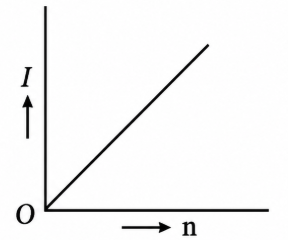
Short circuited current,
I = nε /nr1 = ε/r
So, I is independent of n and I is constant.
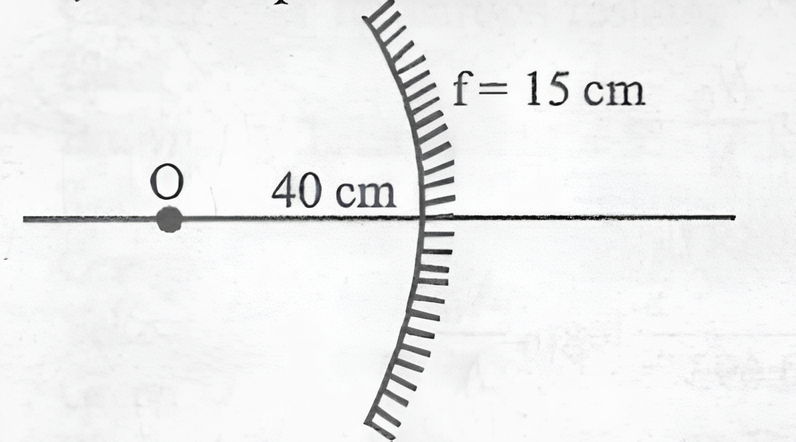
An object is placed at a distance of 40 cm from a concave mirror of focal length 15 cm. If the object is displaced through a distance of 20 cm towards the mirror, the displacement of the image will be
using mirror formula,
1/f = 1/v₁ + 1/u
-1/15 = 1/v₁ + 1/u
⇒ 1/v₁ = 1/-15 + 1/40
∴ v₁ = 24 cm
When object is displaced by 20 cm towards mirror
Now, u₂ = -20
So, 1/f = 1/v₂ + 1/u₂
1/-15 = 1/v₂ + 1/20 ⇒ 1/v₂ = 1/20 - 1/15
∴ v₂ = -60 cm
Therefore image shifts away from mirror by
60 − 24 = 36 cm
‘When the light of frequency 2v₀ (where v₀ is threshold frequency), is incident on a metal plate, the maximum velocity of electrons emitted is v₁. When the frequency of the incident radiation is increased to 5v₀, the maximum velocity of electrons emitted from the same plate is v₂. The ratio of v₁ to v₂ is’
Using Einstein's photoelectric equation,
E = W₀ + Kₘₐₓ
When light of frequency, 2v₀ is incident on a metal plate,
h(2v₀) = hv₀ +1/2 mv₁²
hν₀ = ½ mv₁² ..........(i)
When light of frequency, 5ν₀ is incident on a metal plate
h(5ν₀) = hν₀ + ½mv₂²
4hν₀ = ½mv₂² ..........(ii)
Dividing eqn. (i) by (ii),
1/4 = v₁²/v₂²
∴ v₁/v₂ = 1/2
If the mass of the Sun were ten times smaller and th universal gravitational constant were ten times larger magnitude, which of the following is not correct?
If universal gravitational constant becomes ten times,
G' = 10G
Acceleration due to gravity, g = GM/R²
So, acceleration due to gravity increases.
A sample of 0.1 g of water at 100°C and normal pressure (1.013 x 10⁵Nm⁻²) requires 54 cal of heat energy to convert to steam at 100°C. If the volume of the steam produced is 167 . 1 cc, the change in internal energy of the sample , is
Using first law of thermodynamics equation,
ΔQ = ΔU + ΔW
⇒54 × 4.18
= ΔU + 1.013 × 10⁵(167.1 × 10⁻⁶ − 0)
(∵ ΔW = PΔV)
⇒ ΔU = 208.7 J
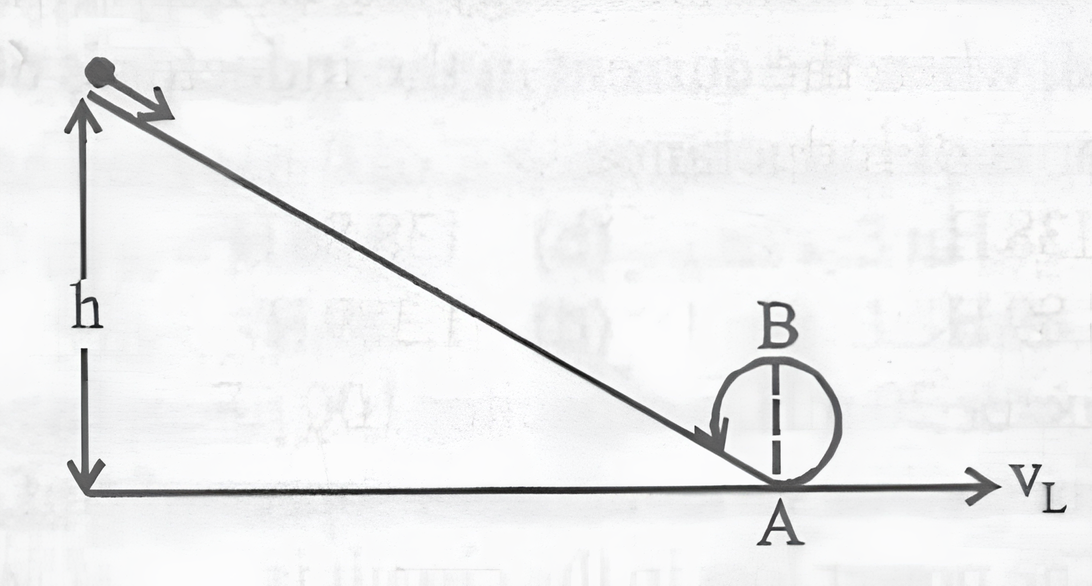
A body initially at rest and sliding along a frictionless track from a height h (as shown in the figure) just complete a vertical circle of diameter AB=D. The height h is equal
to
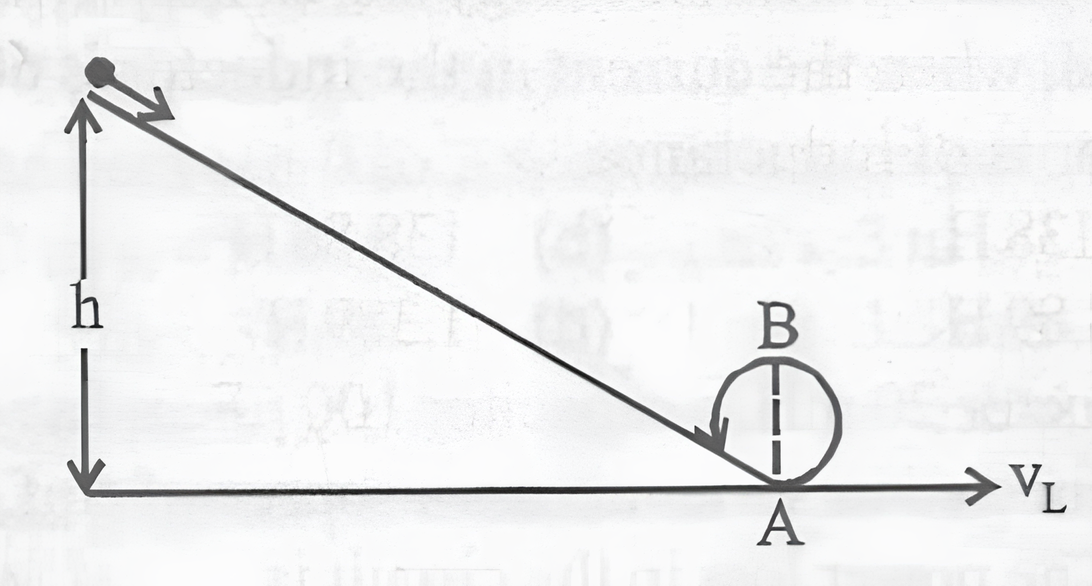
As track is frictionless, so total mechanical energy will remain constant
i.e.,0 + mgh = ½mvL² + 0
Using v² − u² = 2gh, h = v²/2g (∵ u = 0)
For completing the vertical circle, v_L ≥ √5gR
or, h = 5gR/2g = 5/2(R ) = 5/4(D)
In which case is number of molecules of water maximum?
(a) Mass of water = 18 × 1 = 18 g
Molecules of water = mole × N_A
= 18/18 N_A = N_A
(b) Molecules of water = mole × Nₐ
= 0.18/18 NA = 10⁻² N_A
(c) Molecules of water = mole × N_A
= 0.00224/0.0224 × N_A = 10⁻³ N_A
(d) Moles of water = 0.00224/22.4 = 10⁻⁴
Molecules of water = mole × N_A = 10⁻⁴ N_A
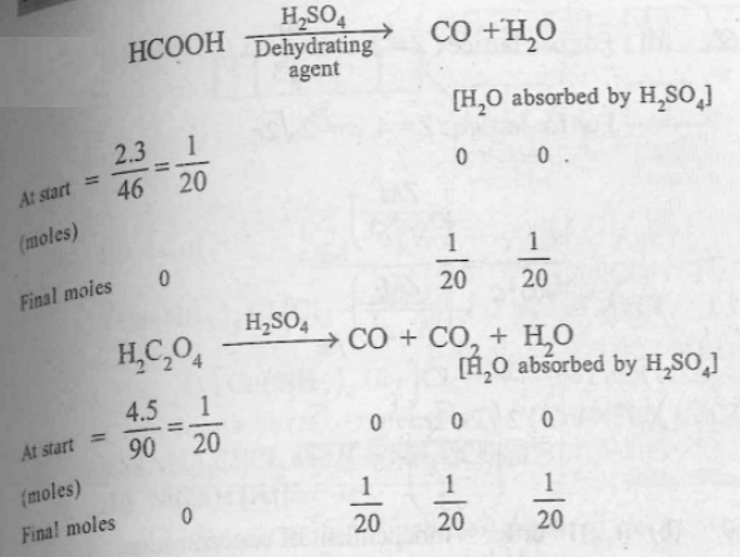
A mixture of 2.3 g formic acid and 4.5 g oxalic acid is treated with conc. H₂SO₄. The evolved gaseous mixture is passed through KOH pellets. Weight (in g) of the remaining product at STP will be
CO₂ is absorbed by KOH.
So, the remaining product is only CO.
Moles of CO formed from both reactions
= 1/20 + 1/20 = 1/10
Left mass of CO = moles × molar mass
= 1/10 × 28 = 2.8 g
Which one is a wrong statement?
The correct configuration of N' is
The correct order of atomic radii in group 13 elements is
Due to poor shielding effect of 3d electrons in Ga, the to mic radii of Ga < AL Thus, the correct order of atomic is B<Ga<Al <In<Tl
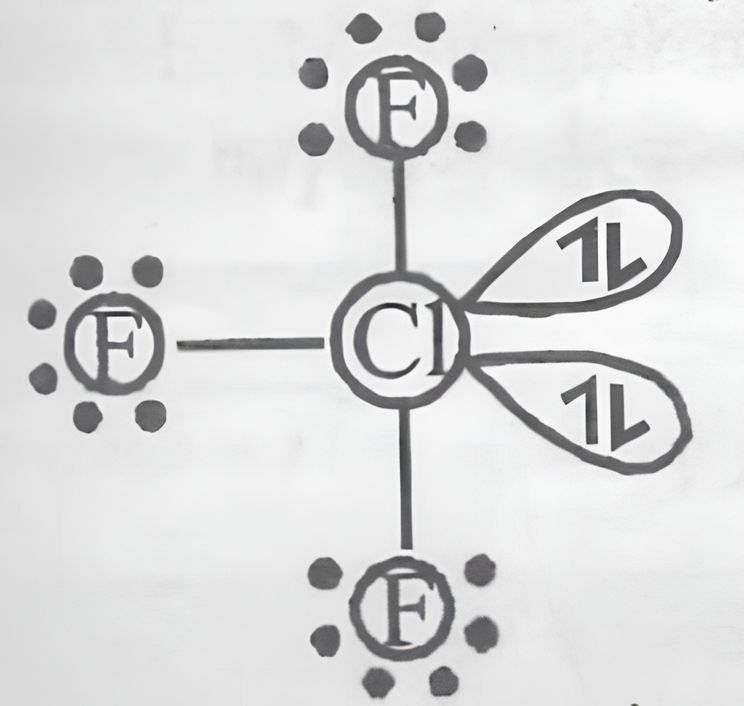
In the structure of CIF₃, the number of lone pair of electron on central atom ‘Cl’ is
The structure of CIF₃ is
The number of lone pair of electrons on central Cl is 2.
Which of the following molecules represents the order of hybridisation sp², sp², sp, sp from left to right atoms?
sp², sp², sp, sp
CH₂ = CH - C ≡ CH
Consider the following species
CN⁺, CN⁻, NO and CN
‘Which one of these will have the highest bond order?
NO : (σ1s)², (σ*s)², (σ2s)², (σ*2s)², (σ2p𝓏)²,(π2pₓ)², =(π2pᵧ)², (π*2pₓ)¹= (π2pᵧ)⁰,
B.O. = 10 − 5/2 = 2.5
CN⁻ : (σ1s)², (σ*1s)², (σ2s)², (σ*2s)², (π2pₓ)²,=(π2pᵧ)², (σ2p𝓏)²
B.O. = 10 − 4/2 = 3
CN : (σ1s)², (σ*1s)², (σ2s)², (σ*2s)², (π2pₓ)²=(π2pᵧ)², (σ2p𝓏)¹
B.O. = (9 − 4)/2 = 2.5
CN⁺ : (σ1s)², (σ*1s)², (σ2s)², (σ*2s)², (π2pₓ)² = (π2pᵧ)²
B.O. = (8 − 4)/2 = 2
Hence, option CN⁻ should be the right answer.
The correction factor ‘a’ to the ideal gas equation corresponds to
In real gas equation,
van der Wall constant (a) α forces of attraction.
Given van der Waals constants for NH₃, H₂, O₂ and CO₂ are respectively 4.17, 0.244, 1.36 and 3.59, which one of the following gases is most easily liquefied?
van der Waal constant ‘a’, signifies intermolecular forces of attraction.
Higher is the value of ‘a’, easier will be the liquefaction of gas.
The bond dissociation energies of X₂, Y₂ and XY are in the ratio of 1 : 0.5 : 1. ΔH for the formation of XY is −200 kJ mol⁻¹. The bond dissociation energy of X₂ will be :
Let B.E. of X₂, Y₂ and XY are x kJ mol⁻¹, 0.5x kJ mol⁻¹ and x kJ mol⁻¹ respectively.
1/2 X₂ + 1/2 Y₂ → XY ; ΔH = −200 kJ mol⁻¹
ΔH = Σ(B.E.)_Reactants −Σ(B.E.)_product
= [1/2 x + ½(0.5x)] − [1 x (x)]
On solving, x = 800 kJ mol⁻¹.
‘Which one of the following conditions will favour maximum formation of the product in the reaction,
A₂(g) + B₂(g) ⇌ X₂(g) ΔᵣH = −X kJ;
A₂(g) + B₂(g) ⇌ X₂(g) ΔᵣH = −X kJ;
On increasing pressure equilibrium shifts in a direction where number of moles decreases i.e. forward direction. On decreasing temperature, equilibrium shifts in exothermic direction .e., forward direction.
So, high pressure and low temperature favours maximum formation of product.
Following solutions were prepared by mixing different volumes of NaOH and HCl of different concentrations :
a- 60 mL M/10 HCl + 40 mL M/10 NaOH
b-55 mL M/10 HCl + 45 mL M/10 NaOH
c-75 mL M/5 HCl + 25 mL M/5 NaOH
d- 100 mL M/10 HCl + 100 mL M/10 NaOH
pH of which one of them will be equal to 1?
Meq. of HCl = 75 × 1/5 × 1 = 15
Meq. of NaOH = 25 × 1/5 × 1 = 5
Meq. of HCl in resulting solution = 10
Molarity of [H⁺] in resulting mixture = 10/100 = 1/10
pH = −log[H⁺] = −log[1/10] = 1.0
The solubility of BaSO₄ in water is 2.42 × 10⁻³ gL⁻¹ at 298 K. The value of its solubility product (Kₛₚ) will be
(Given molar mass of BaSO₄ = 233 g mol⁻¹)
Solubility of BaSO₄ = 2.42 × 10⁻³ g L⁻¹
∴ s = (2.42 × 10⁻³)/233 = 1.038 × 10⁻⁵ mol L⁻¹
Kₛₚ= s² = (1.038 × 10⁻⁵)² = 1.08 × 10⁻¹⁰ mol² L⁻²
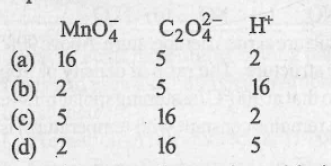
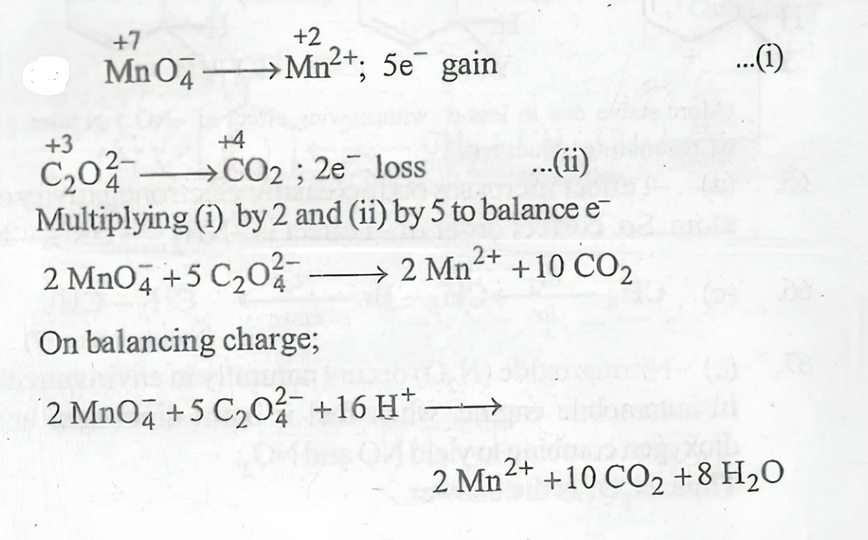
For the redox reaction
MnO₄⁻ + C₂O₄²⁻ + H⁺ → Mn²⁺ + CO₂ + H₂O
The correct coefficients of the reactants for the balanced equation are
Consider the change in oxidation state of bromine corresponding to different emf values as shown in the
diagram below :
Then the species undergoing disproportion-ation is
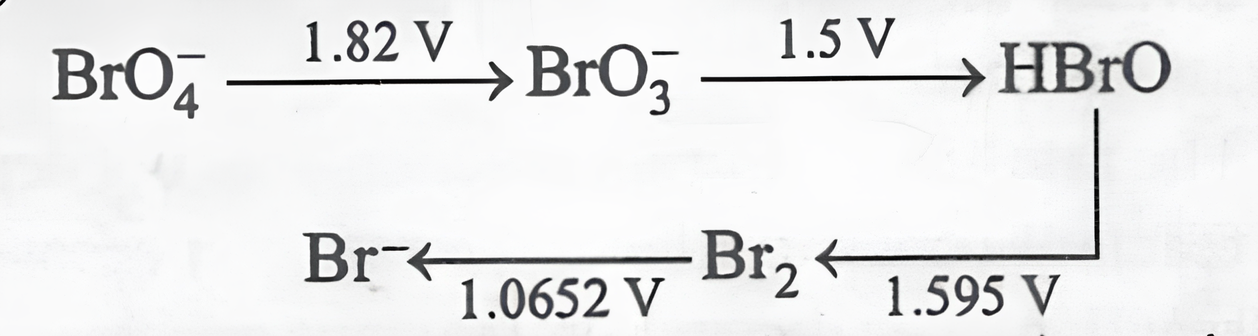
Calculate E°_cell corresponding to each compound undergoing disproportionation reaction. The reaction for which E°_cell comes out +ve is spontaneous.
HBrO → Br₂ E° = 1.595 V, SRP (cathode)
HBrO → BrO₃⁻ E° = −1.5 V, SOP (anode)
2HBrO ⟶ Br₂ + BrO₃⁻
E°_cell = SRP (cathode) − SRP (anode)
= 1.595 − 1.5
= 0.095 V
E°_cell > 0 ⇒ ΔG° < 0 [spontaneous]
Which of the following oxides is most acidic in nature?
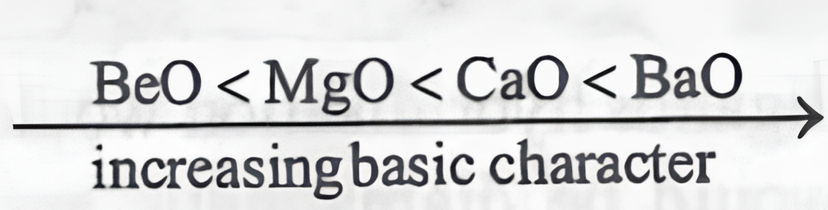
In metals ‘moving down the group, metallic character Al increases, so basic nature increases hence most acidic will be BeO.
BeO <Mg0 <Ca0 <BaO
___________________
increasing basic character
Among CaH₂, BeH₂, BaH₂, the order of ‘ionic character is
BeH₂ < CaH₂ < BaH₂
Smaller the size of cation, more will be its polarising power.
Hence, BeH₂, will be least ionic.
‘Which one of the following elements is unable to form
MF³₆⁻ ion?
Boron belongs to 2nd period and it does not have vacant d-orbital.
‘Which of the following is correct with respect to — I effect
of the substituents? (R = alkyl)
−I effect increases on increasing electronegativity of atom. So, correct order of −I effect is
−NH₂ < −OR < −F.
Hydrocarbon (A) reacts with bromine by substitution to form an alkyl bromide which by Wurtz reaction is converted to gaseous hydrocarbon containing less than four carbon
atoms. (A) is

Which oxide of nitrogen is not a common pollutant introduced into the atmosphere both due to natural and
‘human activity?
Nitrous oxide (N₂O) occurs naturally in environment.
In automobile engine, when fuel is burnt dinitrogen and dioxygen combine to yield NO and NO₂.
Thus, N₂O₅ is the answer
Iron exhibits bcc structure at room temperature. Above 900°C, it transforms to fcc structure. The ratio of density of iron at room temperature to that at 900°C (assuming molar mass and atomic radii of iron remains constant with temperature) is
For bcc lattice : Z = 2, a = 4r/√3
For fcc lattice : Z = 4, a = 2√2r
∴ d₂₅°C/d₉₀₀°C = (ZM/N_A ᵃ³)_bcc /(ZM/_Aᵃ³)_fcc
= 2/4 × (2√2r/(4r/√3)³
= 3√3/4√2
The correct difference between first and second order reactions is that
(t₁/₂)¹ˢᵗ order = Independent of concentration
(t₁/₂)²ⁿᵈ order ∝ 1/[A]₀
‘When initial concentration of the reactant is doubled, the half-life period of a zero order reaction
(t₁/₂)_zero = [A]₀/2k
∴ If [A]₀ = doubled, t₁/₂ doubled
On which of the following properties does the coagulating power of an ion depend?
According to Hardy Schulze rule, coagulating power of an ion depends on both magnitude and sign of the charge on the ion
Considering Ellingham diagram, which of the following metals can be used to reduce alumina?
Mg has more −ΔG value than alumina. So it will be in the lower part of Ellingham diagram. Metals which have more −ΔG value can reduce those metal oxides which have less −ΔG value.
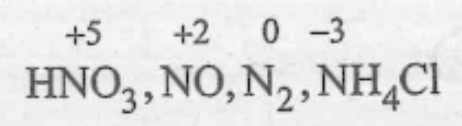
The correct order of N-compounds in its decreasing order of oxidation states is
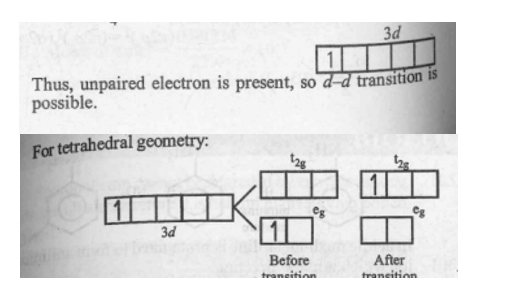
‘Which one of the following ions exhibits d-d transition and paramagnetism as well?
CrO₄²⁻ Cr⁶⁺ diamagnetic
Cr₂O₇²⁻ Cr⁶⁺ diamagnetic
MnO₄⁻ Mn⁷⁺ diamagnetic
MnO₄²⁻ Mn⁶⁺ paramagnetic
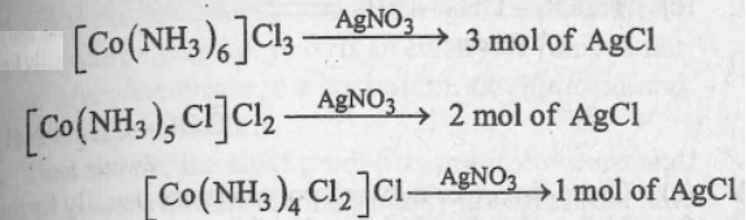
The type of isomerism shown by the complex [CoCl₂(en)₂] is
Complexes are respectively [Co(NH₃)₆]Cl₃, [Co(NH₃)₅Cl]Cl₂ and [Co(NH₃)₄Cl₂]Cl.
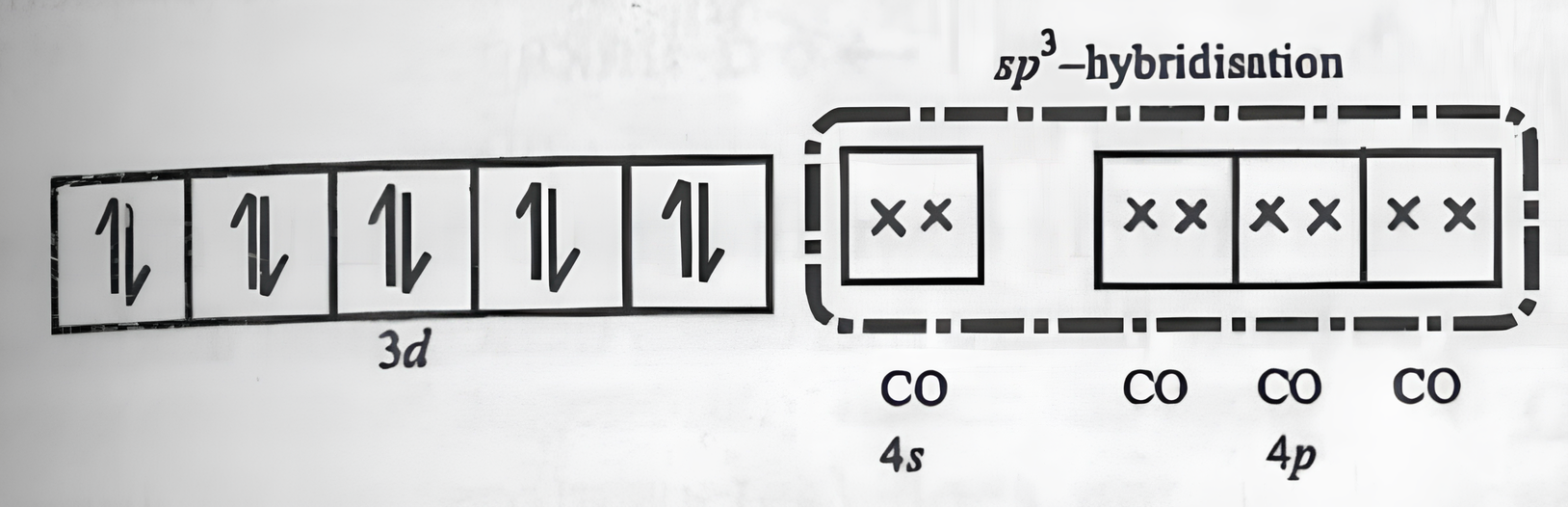
The geometry and magnetic behaviour of the complex [Ni(CO)₄] are
Ni(28) : Ar]3d⁸ 4s²
∵ CO is a strong field ligand, so unpaired electrons get paired. Hence, configuration would be:
For four 'CO' ligands hybridisation would be sp³ and thus the complex would be diamagnetic and of tetrahedral geometry.
Match the metal ions given in Column I with the spin magnetic moments of the ions given in Column II and assign the correct code :
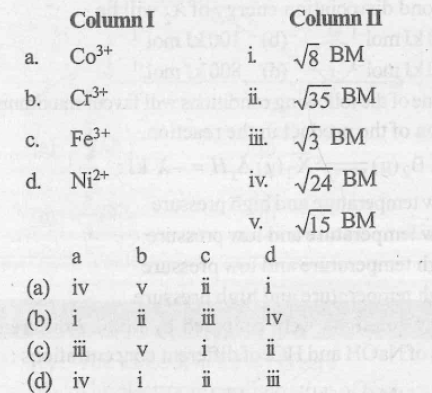
Co³⁺ = [Ar]3d⁶, unpaired e⁻(n) = 4
Spin magnetic moment
= √4(4+2) = √24 B.M.
Cr³⁺ = [Ar]3d³, unpaired e⁻(n) = 3
Spin magnetic moment
= √3(3+2) = √15 B.M.
Fe³⁺ = [Ar]3d⁵, unpaired e⁻(n) = 5
Spin magnetic moment
= √5(5+2) = √35 B.M.
Ni²⁺ = [Ar]3d⁸, unpaired e⁻(n) = 2
Spin magnetic moment
= √2(2+2) = √8 B.M.
Iron carbonyl, [Fe(CO)₅] is
[Fe(CO)₅]
EAN = Z − O.N. + 2(C.N.)
= 26 − 0 + 2(5)
= 26 + 10
= 36
Only one central metal atom/ion is present and it follows the EAN rule, so it is mononuclear.
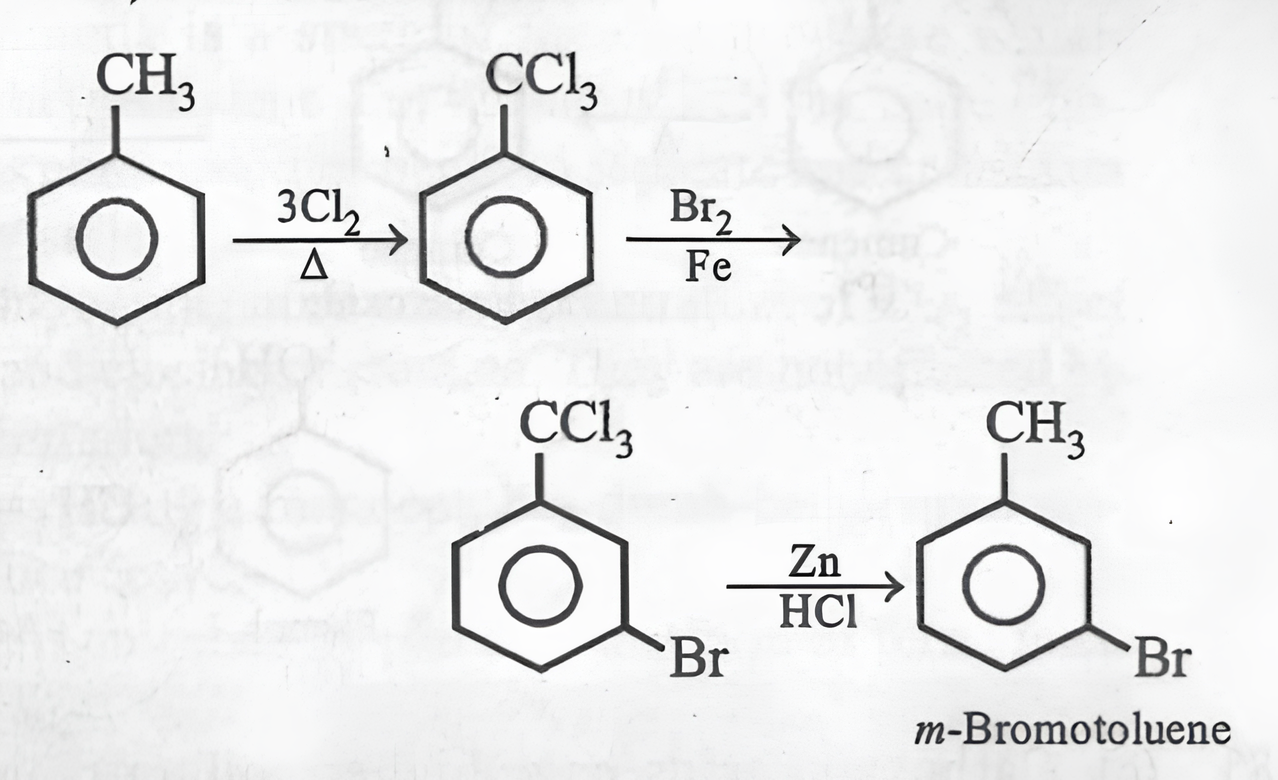
The compound C₇H₈ undergoes the following reactions:
The product 'C' is

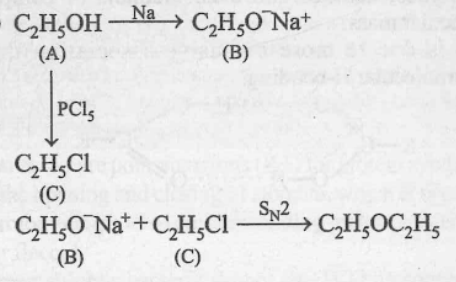
The compound A on treatment with Na gives B, and with PCl₅ gives C. B and C react together to give diethyl ether. A, B and C are in the order
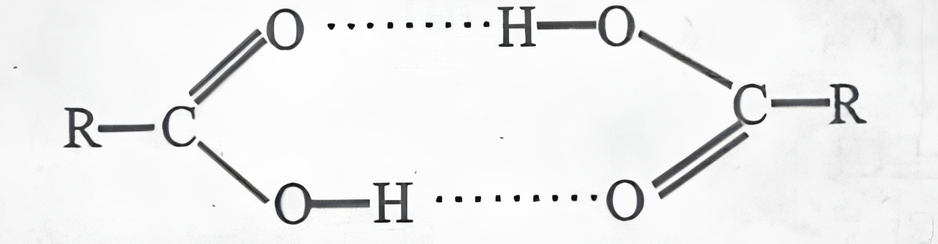
Carboxylic acids have higher boiling points than aldehydes, ketones and even alcohols of comparable molecular mass. It is due to their
Carboxylic acids have higher boiling points than
aldehydes, ketones and even alcohols of comparable
molecular mass.
This is due to more extensive association through
intermolecular H-bonding
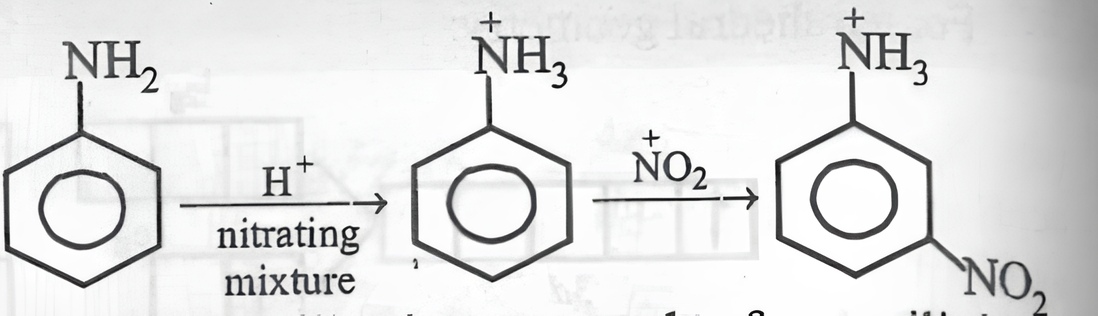
Nitration of aniline in strong acidic medium also gives mnitroaniline because
In acidic medium aniline is protonated to form anilinium
ion which is meta-directing.
‘Which of the following compounds can form a zwitterion?
HOOC–CH₂–NH₂ ⇌
Glycine
⁻OOC–CH₂–⁺NH₃
Zwitter ion
Regarding cross-linked or network polymers, which of the following statements is incorrect?
Cross-linked or network polymers are usually formed from bi-functional and tri-functional monomers and contain strong covalent bonds between various linear polymer chains like melamine, bake lite etc.
The difference between amylose and amylopectin is
Amylose and amylopectin are polymers of α-D-glucose, so β-link is not possible. Amylose is linear with 1 → 4 α-linkages whereas amylopectin is branched and has both 1 → 4 and 1 → 6 α-linkages.
So option Amylopectin has 1 -----> 4∝ -linkage and 1 ----. 6 α- linkage should be the correct option.
Which of the following oxides is most acidic in nature?
In metals moving down the group metallic character increases, so basic nature increases; hence most acidic will be BeO.
Which of the following has proved helpful in preserving pollen as fossils?
Sporopollenin cannot be degraded by enzyme: strong acids and alkali, therefore it is helpful in preserving pollen as fossil
Which among the following is not a prokaryote?
Saccharomyces i.e. yeast is an eukaryote (unicellular fungi).
Mycobacterium is a bacterium. Oscillatoria and nostoc
are cyanobacteria.
which of the following organisms are know as chief producers in the oceans?
Diatoms are the chief producers in some oceans and in some seasons as they are the primary producers and the food chain in marine ecosystem depends on it.
Ciliates differ from all other protozoans in
Ciliates differs from other protozoans in having two
types of nuclei. B.g., Paramoecium have two types of nuclei i.e. macronucleus & micronucleus.
Which one is wrongly matched?
Polysiphonia is a genus of red algae, where asexual spores and gametes are non-motile or non-flagellated.
After karyogamy followed by meiosis, spores are produced exogenously in
In Agaricus (a genus of basidiomycetes), basidio- spores or meiospores are produced exogenously. Neurosa pora (a genus of ascomycetes) produces ascospores as meiospores but endogenously inside the ascus). Alternaria (a genus of deuteromycetes) does not produce sexual spores. Saccharomyces (Unicellular ascomycetes) produces ascospores, endogenously.
Select the wrong statement :
Pseudopodia are locomotory and feeding structures in sarcodines
(amoeboid).
Which of the following animals does not undergo metamorphosis?
Metamorphosis refers to transformation of larva into adult. Animal that perform metamorphosis are said to have indirect development. Metamorphosis includes, in insects, the transformation of a maggot into an adult fly and a caterpillar into a butterfly and, in amphibians, the changing of a tadpole into a frog. In earthworm development is direct which means no larval stage are there and hence no metamorphosis.
Pneumatophores occur in
Some lateral roots of mangroves become specialised as pneumatophores in saline mud flats. These are lateral roots that grow upward (negative geotropism) for varying distances and function as the site of oxygen intake for the submerged primary root system.
Winged pollen grains are present in
Winged pollen grains are present in Pinus. Each pollen grain has two wing-like structures which enables it to float in air, as an adaptation for dispersal by the wind.
Casparian strips occur in
Casparian strip is a band of cell wall material deposited in the radial and transverse walls of the endodermis. Casparian strip is made of suberin and sometimes lignin
Secondary xylem and phloem in dicot stem are produced by
Secondary tissues are generated from the growth of a cambium. Vascular cambium gives rise to secondary xylem to the inside, and to secondary phloem to the outside.
Plants having little or no secondary growth are
Grasses are monocots and monocots usually do not have secondary growth. Palm like monocots have anomalous secondary growth.
The two functional groups characteristic of sugars are
Sugar is a carbohydrate. These are polyhydroxy aldehyde, ketone or their derivatives, which means they ‘have carbonyl and hydroxyl groups in its structure.
The stage during which separation of the paired homologous chromosomes begins is
Diplotene is a stage of meiotic prophase which follows the pachytene and during which the paired homologous chromosomes begin to separate and chiasmata become visible.
Stomatal movement is not affected by
Light, temperature and concentration of CO₂ affect opening and closing of stomata. They are not affected by O₂ concentration.
Stomata in grass leaf are
Grass being a monocot, has dumb-bell shaped stomata in their leaves.
In which of the following forms is iron absorbed by plant?
Iron is absorbed by plants in the form of ferric ions
Which of the following elements is responsible for maintaining turgor in cells?
Plants require potassium ions (K+) for protein synthesis and for the opening and closing of stomata, which is regulated by proton pumps to make surrounding guard cells either turgid or flaccid.
Oxygen is not produced by photosynthesis by
Green sulphur bacteria do not use H₂O as source of proton, therefore they do not evolve O₂.
Which of the following is not a product of light reaction of photosynthesis?
The light reactions of photosynthesis take place on the thylakoid membranes of the chloroplast. During light reactions of photosynthesis, light is absorbed and the energy is used to drive electrons from water to generate NADPH and to drive protons across a membrane. These protons return through ATP synthase to make ATP. ATP, NADPH and oxygen are products of light reaction, while NADH is a product of respiration process.
What is the role of NAD⁺ in cellular respiration?
In cellular respiration, NAD+ act as an electron carrier.
Which of the following terms describe human dentition?
In thecodont teeth are present in the sockets of the jaw bone called alveoli. In diphyodont teeth erupts twice, temporary milk or deciduous teeth are replaced by a set of permanent or adult teeth. In heterodont dentition it consists of different types of teeth namely incisors, canine, premolars and molars.
Match the items given in Column I with those in Column ll and select the correct option given below:
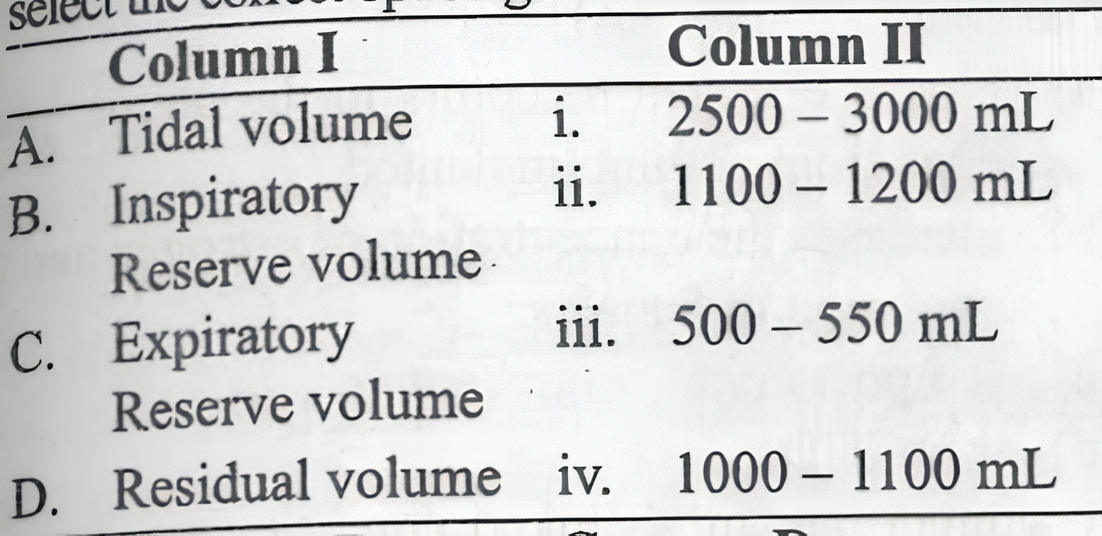
Tidal volume (TV) is volume of air inspired or expired during normal respiration. It is approximately 500 mL. Inspiratory reserve volume (IRV) is additional volume of air a person can inspire by a forceful inspiration. It is around 2500 - 3000 mL. Expiratory reserve volume (ERV) is additional volume of air a person can be expired by a forceful expiration. This averages 1000 - 1100 mL. Residual volume
(RV) is volume of air remaining in lungs even after forceful expiration. This averages 1100 - 1200 mL.
Which part of poppy plant is-used to obtain the drug “Smack''?
‘Smack’ also called as brown sugar/Heroin is formed by acetylation of morphine. It is obtained from the latex of unripe capsule of Poppy plant (Papaver somniferum).
Which of the following is an occupational respiratory disorder?
Silicosis is an occupational disease caused due to excess inhalation of silica dust in the workers involved grinding or stone breaking industries.
Match the items given in Column I with those in Column T and
select the correct option given below:
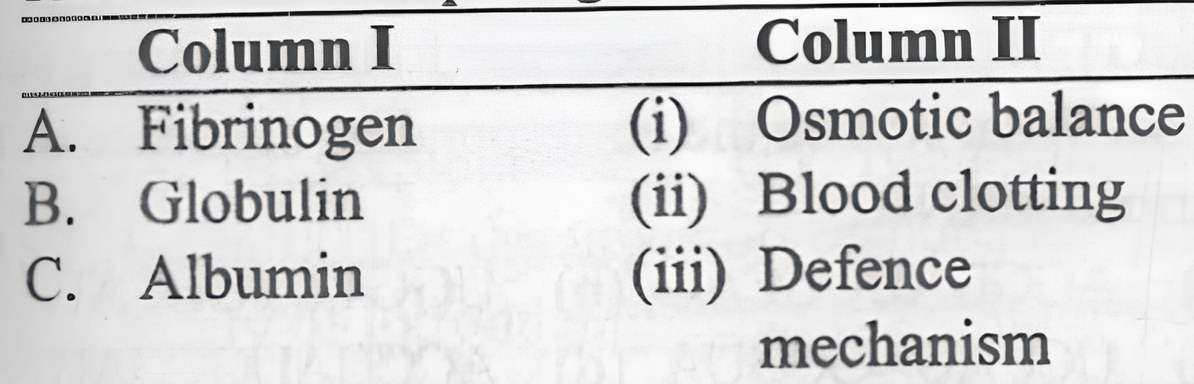
Fibrinogen forms fibrin strands during coagulation. These strands forms a network and the meshes of which are occupied by blood cells, this structure - finally forms a clot.
Match the items given in Column I with those in Column Il and
select the correct option given below:
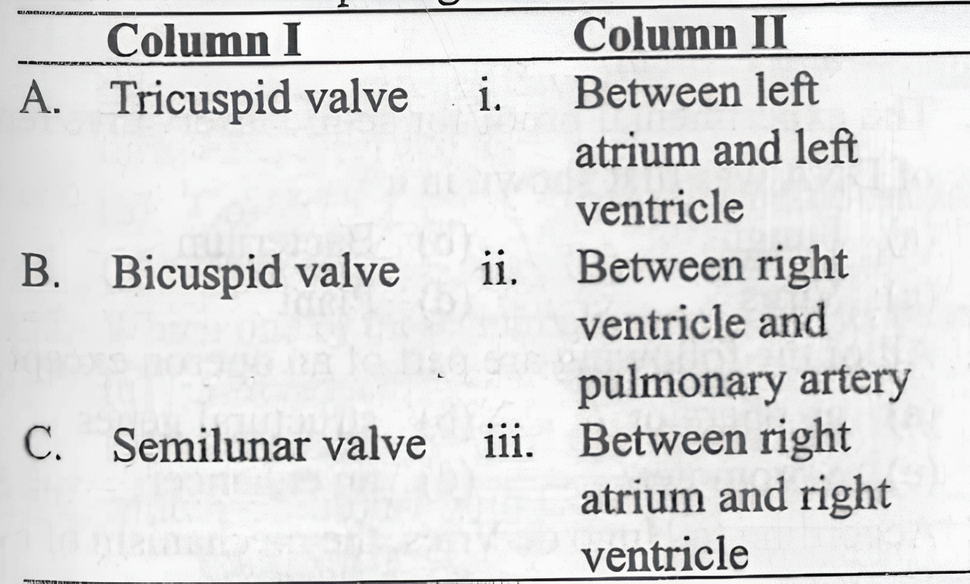
Tricuspid valves are AV valve present between right atrium and right ventricle in heart. Bicuspid valves (mitral valves) are AV valve present between left atrium and left ventricle. Semilunar valves are present at the openings of aortic and pulmonary aorta.
Match the items given in Column I with those in Column I and
select the correct option given below:
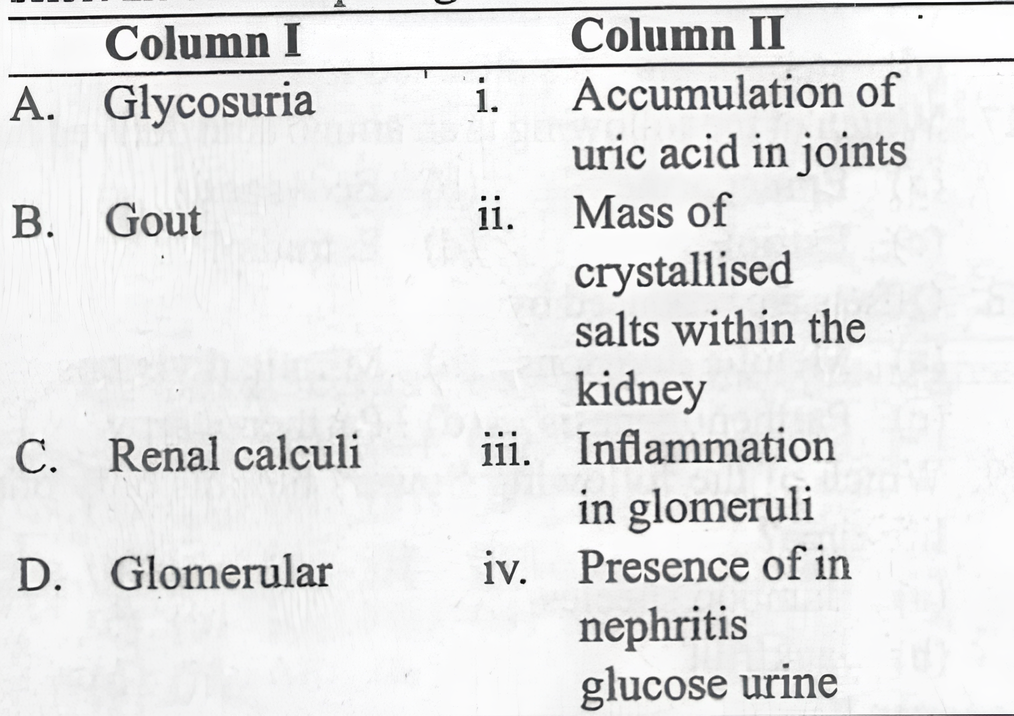
Glycosuria denotes presence of glucose in the urine. Gout is due to deposition of uric acid crystals in the joint. Renal calculi are precipitates of calcium phosphate produced in the pelvis of the kidney. Glomerular nephritis is the inflammatory condition of glomerulus characterised by proteinuria and haematuria.
Calcium is important in skeletal muscle contraction because it
The sarcoplasmic reticulum to release calcium ions into the muscle interior where they bind to troponin, thus causing tropomyosin to shift from the face of the actin filament to which myosin heads need to bind to produce contraction.
‘Which of the following is not an autoimmune disease ?
Alzheimer’s disease is a neurodegenerative disorder due to deficiency of neurotransmitter acetylcholine. Rheumatoid arthritis is an autoimmune disorder in which antibodies are produced against the synovial membrane and cartilage. Vitiligo causes white patches on skin also characterized as autoimmune disorder. Psoriasis is a skin disease that causes itchy or sore patches of thick red skin and is also autoimmune.
Which of the following hormones can play a significant role in osteoporosis?
Osteoporosis has three causes: excess parathyroid hor- ‘mone, advanced age, and lack of estrogen in older females. Estrogen promotes the activity of osteoblast. and inhibits osteoclast.
‘Parathormone promotes mobilisation of calcium from bone into blood. Excessive activity of parathormone causes demineralisation leading to osteoporosis.
Which of the following structures or regions is incorrectly paired with its functions?
The limbic system (emotional motor system) is responsible for the experience and expression of emotion but not movement. It is located in the core of the brain and includes the amygdala, hippocampus and hypothalamus.
Nissl bodies are mainly composed of
Nissl bodies are present in the soma or cell body of a neuron. When observed under electron microscope, they appear to be composed of rough endoplasmic reticulum (RER) and free ribosomes hence help in protein synthesis.
The transparent lens in the human eye is held in its place by
The muscles that move the eyeball are attached to the sclera. Suspensory ligament of lens - a series of fibers that connect the ciliary body of the eye with the lens, holding it in place.
Which of the following is an amino acid derived hormone?
Epinephrine is derived from tyrosine by the removal of carboxyl group. It is a catecholamine.
Offsets are produced by
An offset is a small, virtually complete daughter plant that has been naturally and asexually produced on the mother plant. They are clones, meaning that they, genetically identical to the mother plant. Offset is a vegetative part of a plant, formed by mitosis.
Which of the following flowers blooms only once in its life-time?
A monocarpic plant flowers and produces seeds only once before dying, e.g. bamboo. A polycarpic plant reproduces sexually more than once in its lifetime, , e.g jackfruit , papaya , mango etc.
Pollen grains can be stored for several years in liquid nitrogen having a temperature of
Pollen grains can be stored for several years in liquid nitrogen at -196°C (cryopreservation). Cryopreservation is the process of cooling and storing cells, tissues, or org y at very low temperatures; most common -196°C/-321° in liquid nitrogen (N₂) to maintain their viability.
Double fertilization is
Double fertilization is a unique phenomenon that occurs in angiosperms only.
Double fertilization = Syngamy + Triple fusion
The difference between spermiogenesis and spermiation is
Ovulation is followed by the luteal phase during the corpus luteum secretes oestrogen and progesterone hormones that exerts negative feedback on hypothalamus in turn inhibits the release of FSH and LH. This prevents the development of new follicles during the luteal phase.
Match the items given in Column I with those in Column Il and
select the correct option given below:
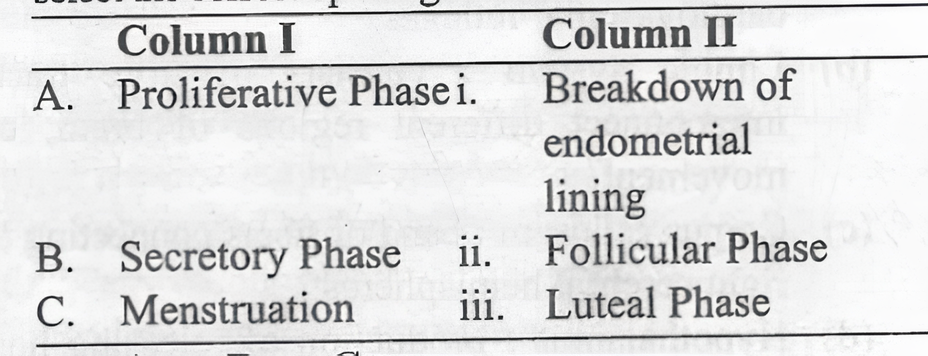
Spermiogenesis is conversion of spermatids info: spermatozoa whereas spermiation is the release of the sperms from sertoli cells into the cavity of seminiferous tubule.
The amnion of mammalian embryo is derived from
The extraembryonic membranes are amnion, chorion allantois and yolk sac. Amnion is derived from mesoderm on the outer side and ectoderm on the inner side. Chorion is formed from trophoectoderm and mesoderm, whereas allantois and yolk sac membrane have mesoderm on outerside and endoderm in inner side.
Hormones secreted by the placenta to maintain pregnancy are
The placenta s an endocrine gland that is only present during pregnancy. It relases hCG, hPL, progestogens, estro gens, etc. Human chorionic gonadotropic hormone (hCG) stimulates the corpus luteum: during pregnancy to release estrogen and progesterone. Human placental lactogen (hPL) is involved in growth of body of mother and breast. Progesterone maintains pregnancy.
The contraceptive ‘SAHELI’
Saheli is world’s first and only oral non steroidal contraceptive pill, dosage-once a week pill. Its functioning is based upon selective estrogen receptor modulation prevents egg from getting implanted.
A woman has an X-linked condition on one of her X chromosomes. This chromosome can be inherited by
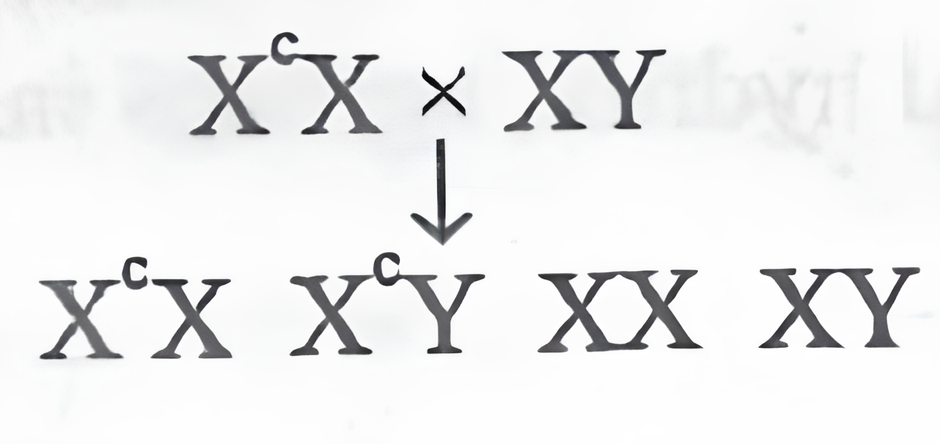
'Woman acts as a carrier. Both son & daughter X-chromosome. Although only son would be the diseaséd one.
AGGTATGCCAT is a sequence from the coding strand of a gene. What will be the corresponding sequence of the transcribed mRNA?
Coding strand and mRNA have the similar nucleotide
‘sequence except, Thymine (T) is replaced by Uracil (U) in mRNA
Select the correct match
‘Francois Jacob and Jacque Monod proposed the model of gene regulation known as operon model/lac operon. Alec Jeffreys gave DNA fingerprinting technique. Matthew Meselson and F. Stahl gave semi-conservative DNA replication in E.coli. Alfred Hershey and Martha Chase proved DNA as genetic material not protein.
The experimental proof for semiconservative replication of DNA was first shown in a
Semi-conservative DNA replication was first shown in bacterium Escherichia coli by Matthew Meselson and Franklin Stahl.
All of the following are part of an operon except
Unlike eukaryotes in prokaryotes the genes are organised into operon. Operon is a co-ordinated group of genes which are all transcribed together & regulate a metabolic pathway as a unit.
According to Hugo de Vries, the mechanism of evolution is
As per mutation theory which was given by Hugo de Vries state that the evolution is a discontinuous phenomenon or saltatory phenomenon/saltation.
Which of the following is commonly used as a vector for introducing a DNA fragment in human lymphocytes?
Retrovirus is a type of RNA virus that inserts a copy of its genome into the DNA of a host cell that it invades, thus changing the genome of that cell. Retrovirus is commonly used as vector for introducing a DNA fragment in human lymphocyte.
The correct order of steps in Polymerase Chain Reaction (PCR) is
PCR is based on three simple steps required for any
DNA synthesis reaction: (i) denaturation of the template into single strands; (ii) annealing of primers to each original strand for new strand synthesis; and (iii) extension of the new DNA strands from the primers.
Use of bioresources by multinational companies and organisations without authorisation from the concerned country and its people is called
Biopiracy refers to the use of bioresdurces by multinational companies and other organisation without proper authorisation from the countries and people concerned with compensatory payment.
In India, the organisation responsible for assessing the safety of introducing genetically modified organisms for public use is
Indian Government has setup organisation such as GEAC (Genetic Engineering Appraisal Committee) which will make decisions regarding the validity of GM research and safety of introducing GM-organism for public services.
A ‘new’ variety of rice was patented by a foreign company, though such varieties have been present in India for a long time. This is related to
In 1997, an American company got patent rights on Basmati rice through the US patent and trademark office that was actually been derived from Indian farmer’s varieties. The diversity of rice in India is one of the richest in the world, 27 documented varieties of Basmati are grown in India.
Which one of these animals is not a homeotherm?
The two extremes in the animal kingdom are endothermic homeotherms and ectothermic poikilotherms. Most mammals, including humans, as well as most birds are endothermic homeotherms, while most fish, invertebrates, reptiles, and amphibians are ectothermic poikilotherms. Chelone (Turtle) belongs to class reptilia which is poikilotherm or cold blooded.
Match Column-1 with Column-II
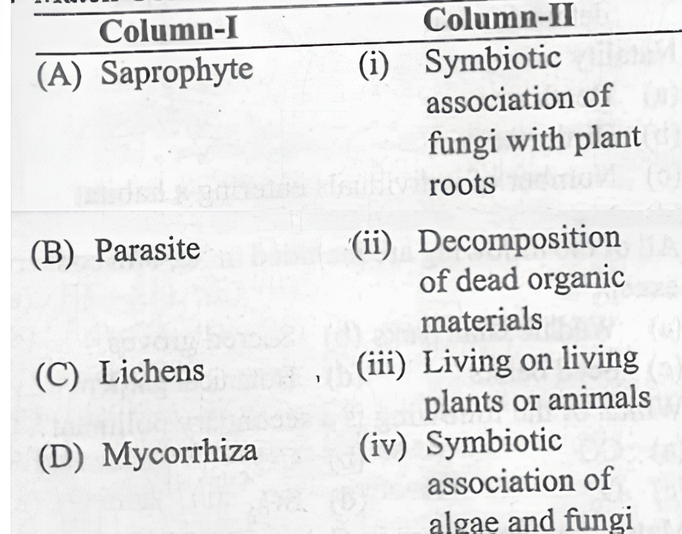
Saprophytes are organisms which live on dead organic matter and help in their decomposition. Parasites is an organisms that live in or on other living plants and animals and dependent on them for their food. Lichens represent a type of symbiotic association of algae
and fungi, in which, both of them dependent on each other
for their food and shelter.
Mycorrhiza is also a type of symbiotic association of fungi and plant roots, e.g., Cycas coralloid root.
In a growing population of a country,
Whenever the pre-reproductive individuals or the younger population size is larger than the reproductive group, the population will be an increasing population.
Which one of the following population interactions is widely used in medical science for the production of antibiotics?
Amensalism /antibiosis, association between organisms of two different species in which one is inhibited or destroyed and the other is unaffected. These are chemicals secreted by one microbial group (eg : Penicillium) which harm other microbes (eg : Staphylococcus). It has no effect on Penicillium or the organism which produces it.
Which one of the following plants shows a very close relationship with a species of moth, where none of the two can complete its life cycle without the other?
In obligate mutualism, one organism cannot survive without the other. Yucca have an obligate mutualism with a species of moth i.e. Pronuba.
World Ozone Day is celebrated on
World Ozone day is celebrated on 16th September. 5th June is World Environment Day. 21 April is National Yellow Bat Day. 22 April is National Earth Day.
Niche is
Joseph Grinnell in 1917 coined the term niche, which he used as largely equivalent to a species habitat. It refers the functional role played by the organism where it lives.
What type of ecological pyramid would be obtained with the following data?
Secondary consumer : 120 g
Primary consumer : 60 g
Primary producer : 10 g
The given data depicts the inverted pyramid of biomass, usually present in aquatic ecosystem. Upright pyramid of biomass and numbers are not possible, as the data depicts primary producer is less than primary consumer and this is less than secondary consumers. Pyramid of energy is always upright.
All of the following are included in ‘ex-situ conservation” except
In-situ conservation is the on-site conservation or the conservation of genetic resources in natural populations of plant or animal species. E.g. Sacred groves.
Which of the following is a secondary pollutant ?
A primary pollutant is an air pollutant emitted. directly from a source. A secondary pollutant is not directly emitted as such, but forms when other pollutants (primary pollutants) react in the atmosphere. O₃ (ozone) is a secondary pollutant.
Match the items given in Column I with those in Column II and select the correct option given below:
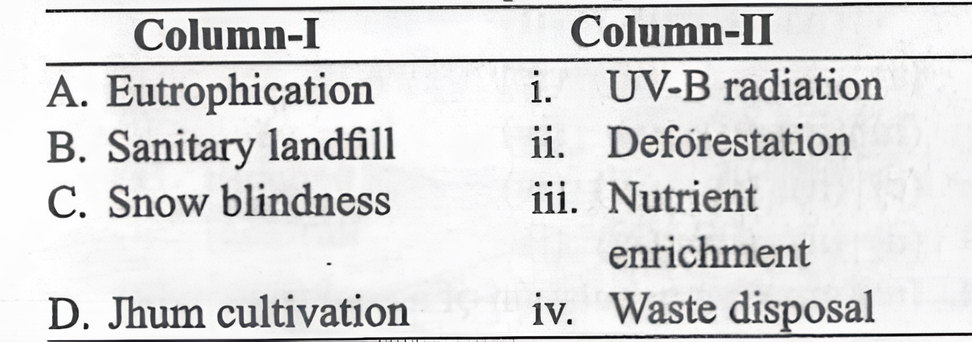
A-iii B-iv C-i D-ii
In stratosphere, which of the following elements acts as a catalyst in degradation of ozone and release of molecular oxygen?
Chloroftuorocarbons (CFCs) and other halogenated ozone depleting substances (ODS) are ‘mainly responsible for man-made chemical ozone depletion. CFCs rise into the stratosphere where they are eventually broken down by ultraviolet (UV) rays from the Sun. This causes them to release free chlorine which then reacts with oxygen leading to the chemical process of destroying ozone molecules.
Which of the following options correctly represents the lung conditions in asthma and emphysema, respectively?
Asthma is a common long-term inflammatory disease of the airways of the lungs. It is a difficulty in breathing causing wheezing due to inflammation of bronchi and bronchioles. Emphysema is a chronic disorder in which alveolar walls are damaged due to which respiratory surface is decreased, and is mainly caused by smoking.
Select the incorrect match:
Polytene chromosomes are found in salivary glands of insects of order Diptera.
Many ribosomes may associate with a single mRNA to form multiple copies of a polypeptide simultaneously. Such strings of ribosomes are termed as
A polyribosome (or polysome) is a complex of an mRNA molecule and two or more ribosomes that act to translate mRNA instructions into polypeptides.
Which of the following events does not occur in rough endoplasmic reticulum?
Phospholipid synthesis does not take place in rough endoplasmic reticulum (RER). Smooth endoplasmic reticulum (SER) is involved in lipid synthesis.
Identify the vertebrate group of animals characterized by crop and gizzard in its digestive system
The digestive tract of aves has additional chambers in their digestive system as crop and gizzard. crop is concerned with storage of food grains, whereas gizzard is a masticatory organ in birds used to crush food grain.
Which of the following features is used to identify a male cockroach from a female cockroach?
Males bear a pair of short, thread like anal styles which are absent in females. Anal/ caudal styles arise from 9th abdominal segment in male cockroach.
Match the items given in Column I with those in Column II and select the correct option given below:
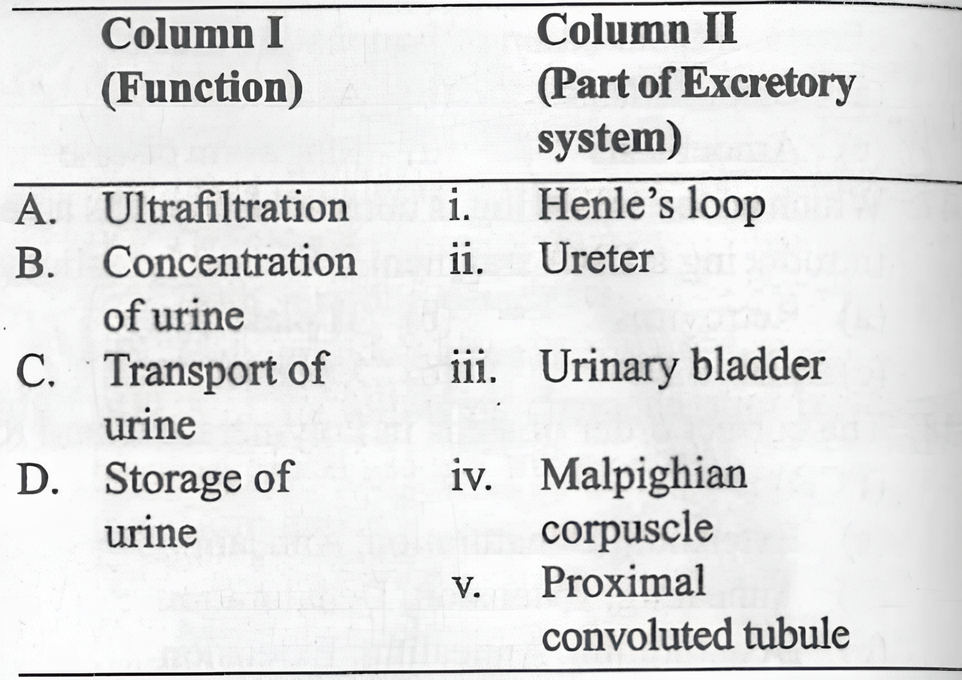
In renal physiology, ultrafiltration occurs, at the barrier between the blood and the filtrate in the glomerular capsule (Bowman’s capsule) in the kidneys. Concentration of urine refers to water absorption from glomerular filtrate created by counter-current mechanism in Henle’ loop. Urine is carried from kidney to bladder through ureter. Urinary bladder is for storage of urine
The Golgi complex participates in
Golgi complex after processing, packages them in vesicles, and either stores them for later use or sends them out of the cell. It is also the organelle that builds lysosomes (cell digestion machines).
Which of the following is true for nucleolus?
The nucleolus (plural nucleoli) is a large, distinct, spheroidal subcompartment of the nucleus of eukaryotic cells that is the site of ribosomal RNA (rRNA) synthesis and assembly of ribosomal subunits.
Select the correct match
Ribozyme is a catalytic RNA, which thus nucleic acid.
Which of the following pairs is wrongly matched?
Starch synthesis in pea is controlled by pleiotropic gene. Pleiotropy occurs when one gene influences two or more seemingly unrelated phenotypic traits.
Natality refers to
Natality is the birth rate within a population. When compared with the death or mortality rate, the growth or decrease in a population can be determined.
Match the items given in Column I with those in Column II and select the correct option given below:
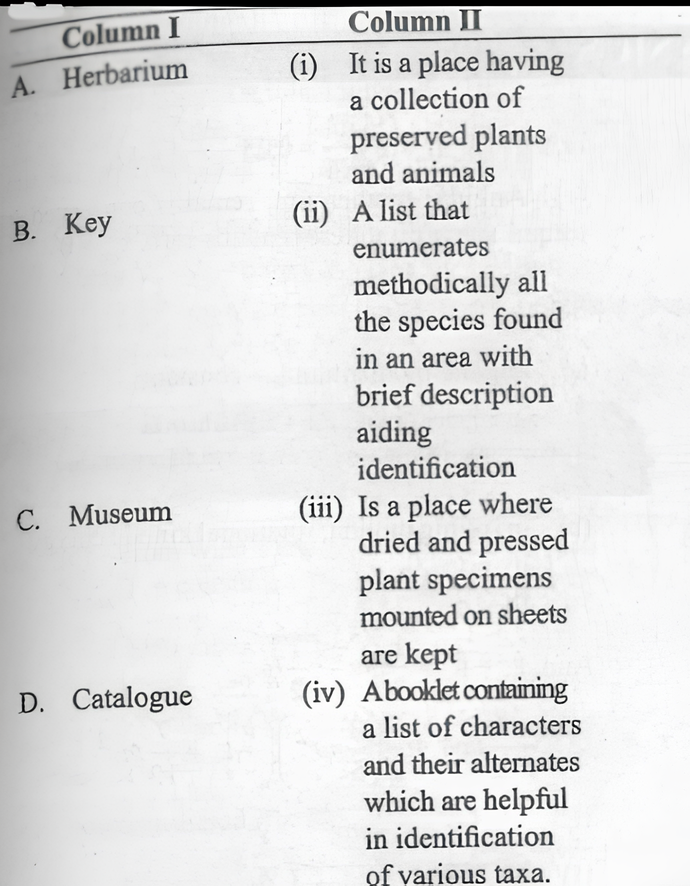
Herbarium - Dried and pressed plant specimen.
• Key - Identification tool of various taxa.
• Museum - Plant and animal specimen are prese
Which of the following statements is correct?
The gymnosperms are a group of seed-producing plants. The name is based on their unenclosed condition of their seeds (called ovules in their unfertilized state).
Sweet potato is a modified
Sweet potato is a modified adventitious root for storage of food. Rhizomes are underground modified stem. Tap root is primary root directly elongated from the radicle.
Conversion of milk to curd improves its nutritional value by increasing the amount of
Curd has enriched presence of B vitamins specially Vit-B₁₂ which improves its nutritional value than milk.
Which of the following gastric cells indirectly help in erythropoiesis?
Parietal or oxyntic cell is a source of HCl and intrinsic factor. HCl converts iron present in diet from ferric to ferrous form so that it can be absorbed easily and used during erythropoiesis. Intrinsic factor is essential for the absorption of vitamin B₁₂ and its deficiency causes
pernicious anaemia.
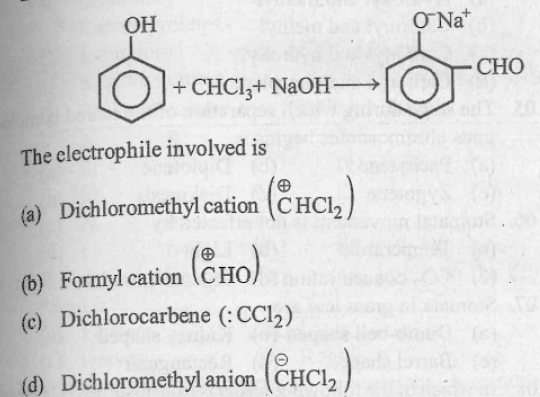
In the reaction .
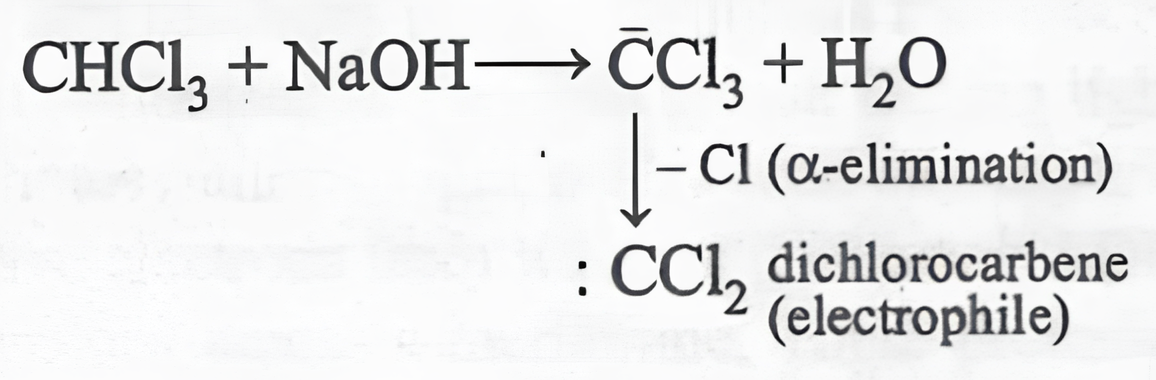
The electrophile involved is
Which one of the following statements is incorrect?
Coefficient of friction or sliding friction has no dimension.
f = μₛN ⇒ μₛ = f/N = [M⁰L⁰T⁰]
Which of the following statements is not true for halogens?
Due to high electronegativity and small size, F forms only one oxoacid, HOF known as fluoric (I) acid.
Which of these statements is incorrect?
Oxidative phosphorylation takes place in inner mitochondrial membrane.
Which of the following characteristics represent Inheritance of blood groups’ in humans?
A. Dominance
B. Co-dominance
C. Multiple allele
D. Incomplete dominance
E. Polygenic inheritance
IAIO, IBIO – Dominant-recessive relationship
IAIB – Codominance
IA, IB & IO – Three different allelic forms of a gene (multiple allelism)
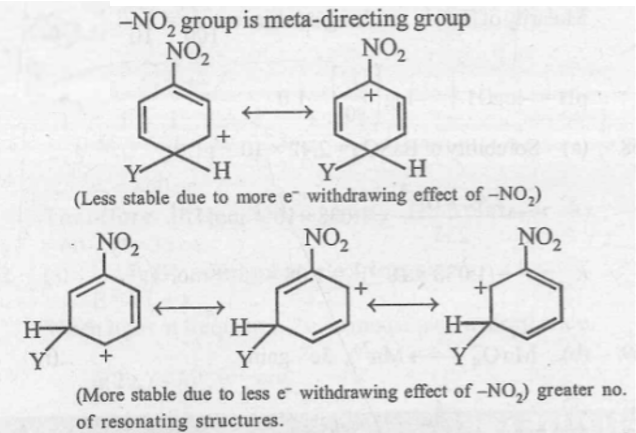
Which of the following carbocations is expected to be most. stable?
-
(A)
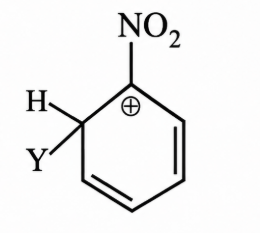
-
(B)
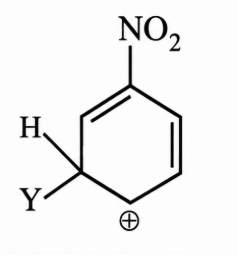
-
(C)
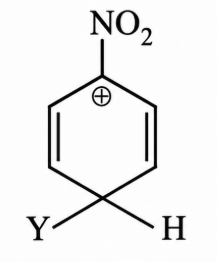
-
(D)
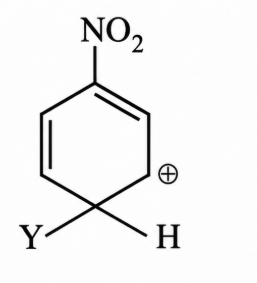
Compound A, C₈H₁₀O, is found to react with NaOI (produced by reacting Y with NaOH) and yields a yellow precipitate with characteristic smell.
A and Y are respectively
-
(A)
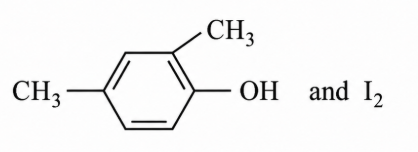
-
(B)
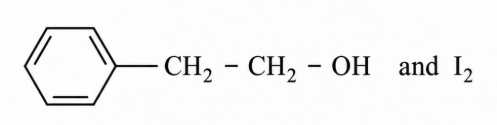
-
(C)
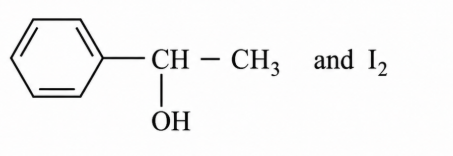
-
(D)

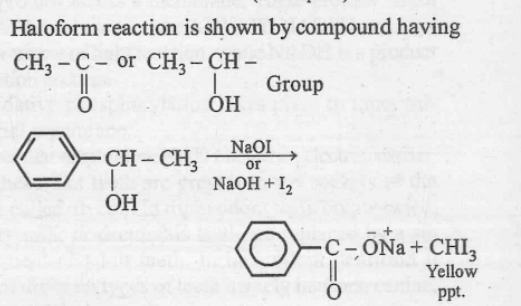
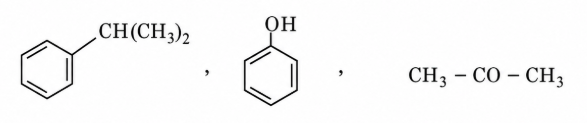
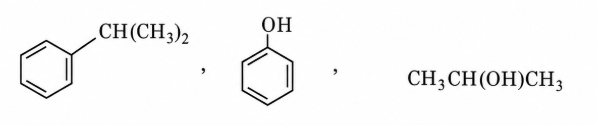
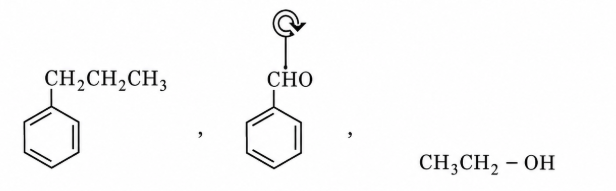
Identify the major products P, Q and R in the following sequence of reactions:
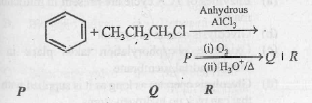
-
(A)
-
(B)
-
(C)
-
(D)
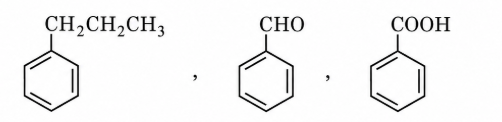
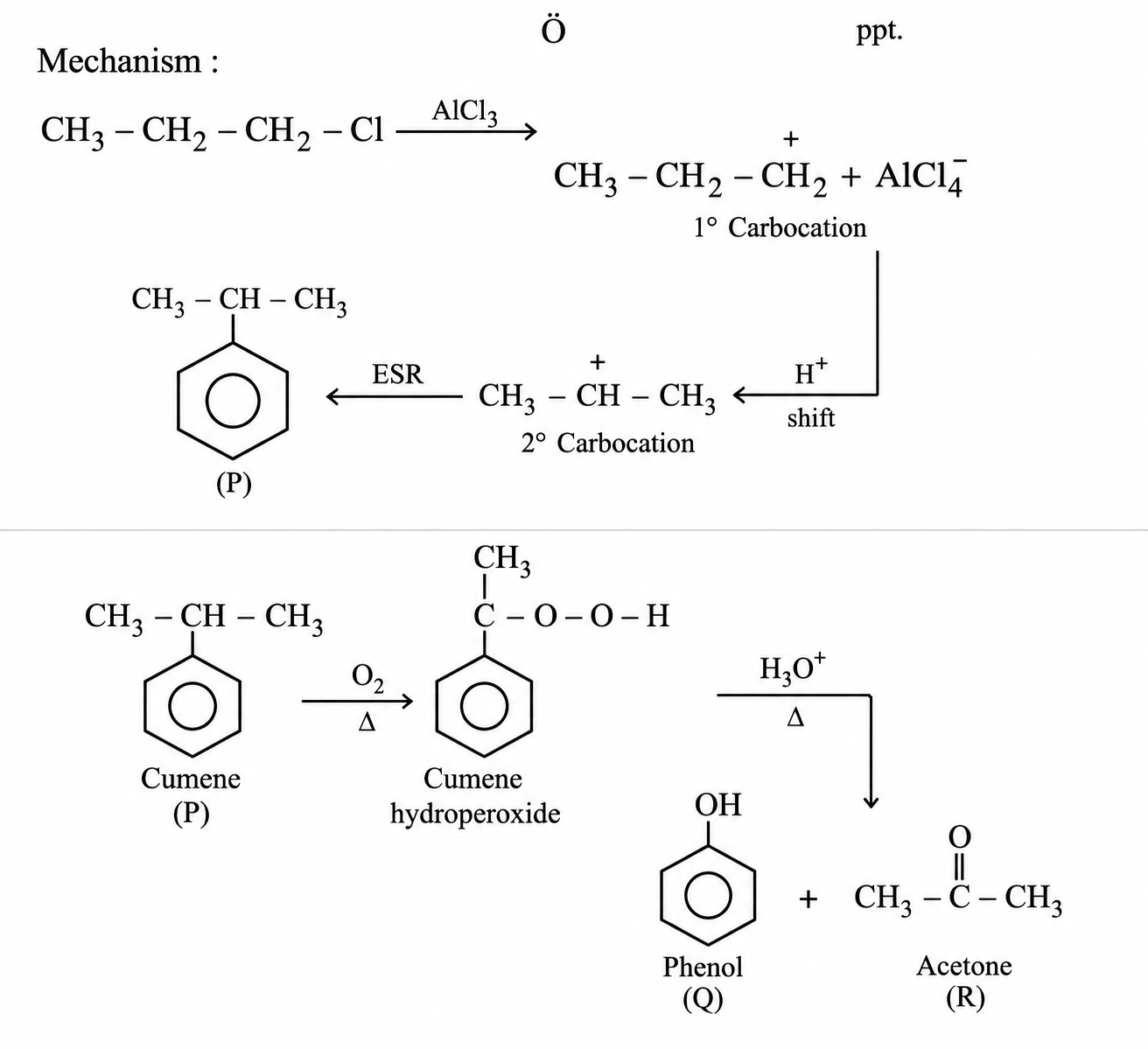
Among the following sets of examples for divergent evolution, select the incorrect option:
Divergent evolution demonstrates how species can have common (homologous) anatomical structures, where as eye of octopus, bat and man are examples of analogous rgans showing convergent evolution.
.
The similarity of bone structure in the forelimbs of many vertebrates is an example of
Bird and bat wings are analogous, as forelimb is homologous. In different vertebrates, bones of forelimbs are similar but their forelimbs are adapted in different way as per their adaptation, show homology.
In which disease does ‘mosquito transmitted pathogen cause chronic inflammation of Iymphatic vessels?
‘Smack’ also called as brown sugar/Heroin is formed by acetylation of morphine. It is obtained from the latex of unripe capsule of Poppy plant (Papaver somniferum)