NEET-UG 2011 Question Paper

QUESTION PAPER

2011 NEET EXAM

NEET-UG 2011 Question Paper

2011

NEET-UG

CBSE EXAMINATION PAPER-2011

NEET-ZOOLOGY

(Solved)

Time allowed : 3 hours

Maximum Marks : 800

General Instructions :

Read the following instructions carefully and follow them :

  1. This question paper contains 200 questions. All questions are compulsory.
  2. This question paper is divided into 1 sections.
  3. Section A – questions number 1 to 200 are multiple choice questions
  4. There is no overall choice given in the question paper. However, an internal choice has been provided in few questions.
  5. Use of calculator is NOT allowed.

Section A

Question 1.

A body is moving with velocity 30 m/s towards east. After 10 seconds its velocity becomes 40 m/s towards north. The average acceleration of the body is

[4 Marks]
  • (A) 1 m/s²
  • (B) 7 m/s²
  • (C) 5 m/s²
  • (D) 7 m/s²
Question 2.

A boy standing at the top of a tower of 20m height drops a stone. Assuming g=10 ms⁻², the velocity with which it hits the ground is

[4 Marks]
  • (A) 20.0 m/s
  • (B) 10.0 m/s
  • (C) 40.0 m/s
  • (D) 5.0 m/s
Question 3.

A missile is fired for maximum range with an initial velocity of 20 m/s. If g=10 m/s² the range of the missile is

[4 Marks]
  • (A) 40m
  • (B) 50m
  • (C) 60m
  • (D) 20m
Question 4.

A particle moves in a circle of radius 5 cm with constant speed and time period 0.2π s. The acceleration of the particle is

[4 Marks]
  • (A) 25 m/s²
  • (B) 15 m/s²
  • (C) 36 m/s²
  • (D) 5 m/s²
Question 5.

A body of mass M hits normally a rigid wall with velocity V and bounces back with the same velocity. The impulse experienced by the body is

[4 Marks]
  • (A) MV
  • (B) 1.5MV
  • (C) 2MV
  • (D) zero
Question 6.

A person of mass 60 kg is inside a lift of mass 940 kg and presses the button on control panel. The lift starts moving upwards with an acceleration 1.0 m/s². If g=10 ms⁻² the tension in the supporting cable is

[4 Marks]
  • (A) 8600N
  • (B) 9680N
  • (C) 11000N
  • (D) 1200N
Question 7.

Force F on a particle moving in a straight line varies with distance d as shown in the figure. The work done on the particle during its displacement of 12 m is

[4 Marks]
  • (A) 21J
  • (B) 18J
  • (C) 13J
  • (D) 26J
Question 8.

The potential energy of a system increases if work is done

[4 Marks]
  • (A) upon the system by a non conservative force
  • (B) by the system against a conservative force
  • (C) by the system against a non conservative force
  • (D) upon the system by a conservative force
Question 9.

A body projected vertically from the earth reaches a height equal to earth's radius before returning to the earth. The power exerted by the gravitational force is greatest

[4 Marks]
  • (A) at the instant just after the body is projected
  • (B) at the instant just before the body hits the earth
  • (C) it remains constant all through
  • (D) at the highest position of the body
Question 10.

The instantaneous angular position of a point on a rotating wheel is given by the equation θ(t) = 2t³ - 6t². The torque on the wheel becomes zero at

[4 Marks]
  • (A) t = 0.25s
  • (B) t = 2s
  • (C) t = 0.5s
  • (D) t = 1s
Question 11.

The moment of inertia of a thin uniform rod of mass M and length L about an axis passing through its midpoint and perpendicular to its length is I₀. Its moment of inertia about an axis passing through one of its ends and perpendicular to its length is

[4 Marks]
  • (A) I₀ + ML²
  • (B) I₀ + 2ML²
  • (C) I₀ + ML²/2
  • (D) I₀ + ML²/4
Question 12.

A planet moving along an elliptical orbit is closest to the sun at a distance r₁ and farthest away at a distance of r₂. If v₁ and v₂ are the linear velocities at these points respectively, then the ratio v₁/v₂ is

[4 Marks]
  • (A) (r₁/r₂)²
  • (B) r₂/r₁
  • (C) (r₂/r₁)²
  • (D) r₁/r₂
Question 13.

During an isothermal expansion, a confined ideal gas does -150 J of work against its surroundings. This implies that

[4 Marks]
  • (A) 150 J of heat has been added to the gas
  • (B) no heat is transferred because the process is isothermal
  • (C) 300 J of heat has been added to the gas
  • (D) 150 J heat has been removed from the gas
Question 14.

When 1 kg of ice at 0°C melts to water at 0°C, the resulting change in its entropy, taking latent heat of ice to be 80 cal/°C, is

[4 Marks]
  • (A) 80 cal/K
  • (B) 293 cal/K
  • (C) 8×10⁴ cal/K
  • (D) 273 cal/K
Question 15.

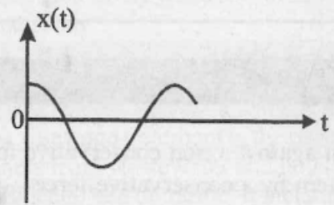
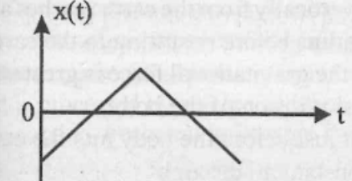
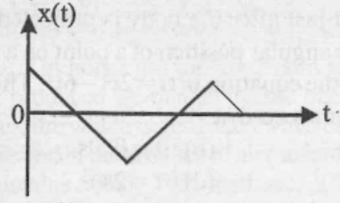
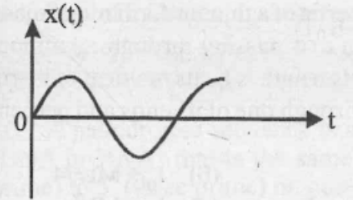
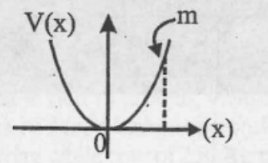
A particle of mass m is released from rest and follows a parabolic path as shown. Assuming that the displacement of the mass from the origin is small, which graph correctly depicts the position of the particle as a function of time
[4 Marks] Diagram 1 – NEET-UG 2011 Question Paper
  • (A) Diagram 2 – NEET-UG 2011 Question Paper
  • (B) Diagram 3 – NEET-UG 2011 Question Paper
  • (C) Diagram 4 – NEET-UG 2011 Question Paper
  • (D) Diagram 5 – NEET-UG 2011 Question Paper
Question 16.

Out of the following functions, representing motion of a particle, which represents SHM?

(A) y = sin(ωt) - cos(ωt)

(B) y = sin³(ωt)

(C) y = 5 cos(3π/4 - 3ωt)

(D) y = 1 + ωt + ω²t²

[4 Marks]
  • (A) Only (D) does not represent SHM
  • (B) Only (A)
  • (C) Only (A) and (C)
  • (D) Only (A) and (B)
Question 17.

Two waves are represented by the equations y₁ = a sin(ωt + kx + 0.57) m and y₂ = a cos(ωt + kx) m, where x is in meter and t in sec. The phase difference between them is

[4 Marks]
  • (A) 1.57 radian
  • (B) 0.57 radian
  • (C) 1.25 radian
  • (D) 1.0 radian
Question 18.

Sound waves travel at 350 m/s through a warm air and at 3500 m/s through brass. The wavelength of a 700 Hz acoustic wave as it enters brass from warm air

[4 Marks]
  • (A) decreases by a factor 10
  • (B) increases by a factor 20
  • (C) increases by a factor 10
  • (D) decreases by a factor 20
Question 19.

A charge Q is enclosed by a Gaussian spherical surface of radius R. If the radius is doubled, then the outward electric flux will

[4 Marks]
  • (A) remain the same
  • (B) be doubled
  • (C) increase four times
  • (D) be reduced to half
Question 20.

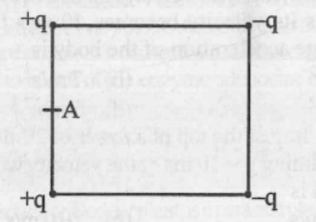
Four electric charges +q, +q, -q and -q are placed at the corners of a square of side 2L. The electric potential at point A, midway between the two charges +q and +q, is
[4 Marks] Diagram 6 – NEET-UG 2011 Question Paper
  • (A) (1/4πε₀) (2q/L) (1 + √5)
  • (B) (1/4πε₀) (2q/L) (1 + 1/√5)
  • (C) (1/4πε₀) (2q/L) (1 - 1/√5)
  • (D) zero
Question 21.

A current of 2A flows through a 2Ω resistor when connected across a battery. The same battery supplies a current of 0.5 A when connected across a 9Ω resistor. The internal resistance of the battery is

[4 Marks]
  • (A) 0.5 Ω
  • (B) 1/3 Ω
  • (C) 1/4 Ω
  • (D) 1 Ω
Question 22.

The rate of increase of thermo-e.m.f. with temperature at the neutral temperature of a thermocouple

[4 Marks]
  • (A) is positive
  • (B) is zero
  • (C) depends upon the choice of the two materials of the thermocouple
  • (D) is negative
Question 23.

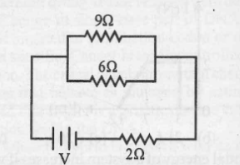
If power dissipated in the 9-Ω resistor in the circuit shown is 36 watt, the potential difference across the 2-Ω resistor is
[4 Marks] Diagram 7 – NEET-UG 2011 Question Paper
  • (A) 4 volt
  • (B) 8 volt
  • (C) 10 volt
  • (D) 2 volt
Question 24.

A uniform electric field and uniform magnetic field are acting along the same direction in a certain region. If an electron is projected in the region such that its velocity is pointed along the direction of fields, then the electron

[4 Marks]
  • (A) will turn towards right of direction of motion
  • (B) speed will decrease
  • (C) will turn towards left direction of motion
  • (D) speed will increase
Question 25.

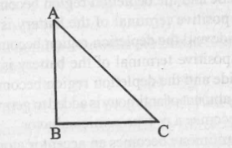
A current carrying loop in the form of a right angle isosceles triangle ABC is placed in a uniform magnetic field acting along AB. If the magnetic force on the arm BC is F, what is the force on the arm AC?
[4 Marks] Diagram 8 – NEET-UG 2011 Question Paper
  • (A) -√2 𝐅⃗
  • (B) -𝐅⃗
  • (C) √2 𝐅⃗
  • (D) 𝐅⃗
Question 26.

There are four light-weight-rod samples A, B, C, D separately suspended by threads. A bar magnet is slowly brought near each sample and the following observations are noted:

(i) A is feebly repelled

(ii) B is feebly attracted

(iii) C is strongly attracted

(iv) D remains unaffected. Which one of the following is true?

[4 Marks]
  • (A) A is of a non-magnetic material
  • (B) C is of a diamagnetic material
  • (C) B is of a paramagnetic material
  • (D) D is of a ferromagnetic material
Question 27.

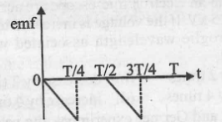
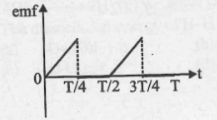
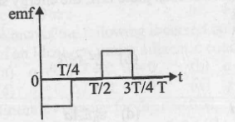
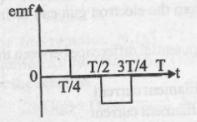
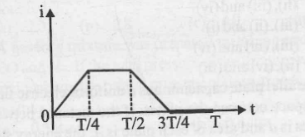
The current i in a coil varies with time as shown in the figure. The variation of induced emf with time would be
[4 Marks] Diagram 9 – NEET-UG 2011 Question Paper
  • (A) Diagram 10 – NEET-UG 2011 Question Paper
  • (B) Diagram 11 – NEET-UG 2011 Question Paper
  • (C) Diagram 12 – NEET-UG 2011 Question Paper
  • (D) Diagram 13 – NEET-UG 2011 Question Paper
Question 28.

In an ac circuit an alternating voltage e = 200√2 sin 100t volts is connected to a capacitor of capacity 1 µF. The r.m.s. value of the current in the circuit is

[4 Marks]
  • (A) 20mA
  • (B) 200mA
  • (C) 100mA
  • (D) 10mA
Question 29.

An ac voltage is applied to a resistance R and an inductor L in series. If R and the inductive reactance are both equal to 3Ω, the phase difference between the applied voltage and the current in the circuit is

[4 Marks]
  • (A) zero
  • (B) π/4
  • (C) π/2
  • (D) π/6
Question 30.

The electric and the magnetic field associated with an E.M. wave, propagating along the +z-axis, can be represented by

[4 Marks]
  • (A) [𝐄⃗ = E₀ î, 𝐁⃗ = B₀ ĵ ]
  • (B) [𝐄⃗ = E₀ 𝐊⃗, 𝐁⃗ = B₀ î ]
  • (C) [𝐄⃗ = E₀ ĵ, 𝐁⃗ = B₀ î ]
  • (D) [𝐄⃗ = E₀ ĵ, 𝐁⃗ = B₀ k̂ ]
Question 31.

The decreasing order of wavelength of infrared, microwave, ultraviolet and gamma rays is

[4 Marks]
  • (A) gamma rays, ultraviolet, infrared, microwaves
  • (B) infrared, microwave, ultraviolet, gamma rays
  • (C) microwaves, gamma rays, infrared, ultraviolet
  • (D) microwave, infrared, ultraviolet, gamma rays
Question 32.

Which of the following is not due to total internal reflection?

[4 Marks]
  • (A) Working of optical fibre
  • (B) Difference between apparent and real depth of pond
  • (C) Mirage on hot summer days
  • (D) Brilliance of diamond
Question 33.

In the Davisson and Germer experiment, the velocity of electrons emitted from the electron gun can be increased by

[4 Marks]
  • (A) increasing the filament current
  • (B) increasing the potential difference between the anode and filament
  • (C) decreasing the filament current
  • (D) decreasing the potential difference between the anode and filament
Question 34.

A biconvex lens has a radius of curvature of magnitude 20 cm. Which one of the following options best describe the image formed of an object of height 2 cm placed 30 cm from the lens?

[4 Marks]
  • (A) Virtual, upright, height = 1 cm
  • (B) Virtual, upright, height = 0.5 cm
  • (C) Real, inverted, height = 1 cm
  • (D) Real, inverted, height = 4 cm
Question 35.

Electrons used in an electron microscope are accelerated by a voltage of 25 kV. If the voltage is increased to 100kV then the de-Broglie wavelength associated with the electrons would

[4 Marks]
  • (A) increase by 4 times
  • (B) decrease by 4 times
  • (C) increase by 2 times
  • (D) decrease by 2 times
Question 36.

Photoelectric emmision occurs only when the incident light has more than a certain minimum

[4 Marks]
  • (A) frequency
  • (B) wavelength
  • (C) intensity
  • (D) power
Question 37.

The momentum of a photon of energy hv will be

[4 Marks]
  • (A) hv/c
  • (B) c/hv
  • (C) hv/c²
  • (D) hv
Question 38.

Light of two different frequencies whose photons have energies 1 eV and 2.5 eV respectively illuminate a metallic surface whose work function is 0.5 eV successively. Ratio of maximum speeds of emitted electrons will be

[4 Marks]
  • (A) 1:2
  • (B) 1:4
  • (C) 1:1
  • (D) 1:5
Question 39.

In photoelectric emission process from a metal of work function 1.8 eV, the kinetic energy of most energetic electrons is 0.5 eV. The corresponding stopping potential is

[4 Marks]
  • (A) 1.2V
  • (B) 1.8V
  • (C) 2.3V
  • (D) 0.5V
Question 40.

The wavelength of the first line of Lyman series for hydrogen atom is equal to that of the second line of Balmer series for a hydrogen like ion. The atomic number Z of hydrogen like ion is

[4 Marks]
  • (A) 2
  • (B) 1
  • (C) 3
  • (D) 4
Question 41.

The power obtained in a reactor using U²³⁵ disintegration is 1000 kW. The mass decay of U²³⁵ per hour is

[4 Marks]
  • (A) 40 microgram
  • (B) 1 microgram
  • (C) 20 microgram
  • (D) 10 microgram
Question 42.

A nucleus of mass M emits a photon of frequency v and the nucleus recoils. The recoil energy will be

[4 Marks]
  • (A) h²v² / 2Mc²
  • (B) Mc² - hv
  • (C) zero
  • (D) hv
Question 43.

Fusion reaction takes place at high temperature because

[4 Marks]
  • (A) nuclei break up at high temperature
  • (B) atoms get ionised at high temperature
  • (C) kinetic energy is high enough to overcome the coulomb repulsion between nuclei
  • (D) molecules break up at high temperature
Question 44.

The halflife of a radioactive isotope 'X' is 50 years. It decays to another element 'Y' which is stable. The two elements 'X' and 'Y' were found to be in the ratio of 1: 15 in a sample of a given rock. The age of the rock was estimated to be

[4 Marks]
  • (A) 150 years
  • (B) 200 years
  • (C) 250 years
  • (D) 100 years
Question 45.

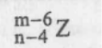
A nucleus ᵐₙX emits one α-particle and two β-particles. The resulting nucleus is

[4 Marks]
  • (A) Diagram 14 – NEET-UG 2011 Question Paper
  • (B) Diagram 15 – NEET-UG 2011 Question Paper
  • (C) Diagram 16 – NEET-UG 2011 Question Paper
  • (D) Diagram 17 – NEET-UG 2011 Question Paper
Question 46.

In forward biasing of the p-n junction

[4 Marks]
  • (A) the positive terminal of the battery is connected to p-side and the depletion region becomes thick
  • (B) the positive terminal of the battery is connected to n-side and the depletion region becomes thin
  • (C) the positive terminal of the battery is connected to n-side and the depletion region becomes thick
  • (D) the positive terminal of the battery is connected to p-side and the depletion region becomes thin
Question 47.

If a small amount of antimony is added to germanium crystal

[4 Marks]
  • (A) the antimony becomes an acceptor atom
  • (B) it becomes a p-type semiconductor
  • (C) its resistance is increased
  • (D) there will be more free electrons than holes in the semiconductor
Question 48.

A transistor is operated in common emitter configuration at V_c = 2V such that a change in the base current from 100 µA to 300 µA produces a change in the collector current from 10 mA to 20 mA. The current gain is

[4 Marks]
  • (A) 75
  • (B) 50
  • (C) 25
  • (D) 100
Question 49.

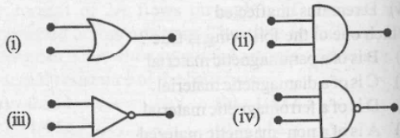
Symbolic representation of four logic gates are shown as Pick out which ones are for AND, NAND and NOT gates, respectively
[4 Marks] Diagram 18 – NEET-UG 2011 Question Paper
  • (A) (ii), (iii) and (iv)
  • (B) (iii), (ii) and (i)
  • (C) (iii), (iii) and (iv)
  • (D) (ii), (iv) and (iii)
Question 50.

A parallel plate capacitor has a uniform electric field E in the space between the plates. If the distance between the plates is d and area of each plate is A, the energy stored in the capacitor is:

[4 Marks]
  • (A) ε₀ E A d
  • (B) 1/2 ε₀ E² A d
  • (C) 1/2 ε₀ E²
  • (D) E² A d / ε₀
Question 51.

The energies E₁ and E₂ of two radiations are 25 eV and 50 eV, respectively. The relation between their wavelengths i.e., λ₁ and λ₂ will be:

[4 Marks]
  • (A) λ₁ = 4λ₂
  • (B) λ₁ = 1/2 λ₂
  • (C) λ₁ = λ₂
  • (D) λ₁ = 2λ₂
Question 52.

If n = 6, the correct sequence for filling of electrons will be:

[4 Marks]
  • (A) ns → np → (n-1)d → (n-2)f
  • (B) ns → (n-1)d → (n-2)f → np
  • (C) ns → (n-2)f → (n-1)d → np
  • (D) ns → (n-2)f → np → (n-1)d
Question 53.

The total number of atomic orbitals in fourth energy level of an atom is:

[4 Marks]
  • (A) 16
  • (B) 8
  • (C) 32
  • (D) 4
Question 54.

Which of the two ions from the list given below that have the geometry that is explained by the same hybridization of orbitals, NO₂⁻, NO₃⁻, NH₂⁻, NH₄⁺, SCN⁻?

[4 Marks]
  • (A) NO₂⁻ and NH₂⁻
  • (B) SCN⁻ and NH₂⁻
  • (C) NH₄⁺ and NO₃⁻
  • (D) NO₂⁻ and NO₃⁻
Question 55.

Considering the state of hybridization of carbon atoms, find out the molecule among the following which is linear?

[4 Marks]
  • (A) CH₃-CH₂-CH₂-CH₃
  • (B) CH₂=CH-CH₂-C≡CH
  • (C) CH₃-CH=CH-CH₃
  • (D) CH₃-C≡C-CH₃
Question 56.

Which of the following has the minimum bond length?

[4 Marks]
  • (A) O₂⁻
  • (B) O₂⁺
  • (C) O₂²⁻
  • (D) O₂
Question 57.

Two gases A and B having the same volume diffuse through a porous partition in 20 and 10 seconds respectively. The molecular mass of A is 49 u. Molecular mass of B will be:

[4 Marks]
  • (A) 25.00 u
  • (B) 6.50 u
  • (C) 12.25 u
  • (D) 50.00 u
Question 58.

By what factor does the average velocity of a gaseous molecule increase when the temperature (in Kelvin) is doubled?

[4 Marks]
  • (A) 2.0
  • (B) 2.8
  • (C) 4.0
  • (D) 1.4
Question 59.

A gaseous mixture was prepared by taking equal mole of CO and N₂. If the total pressure of the mixture was found 1 atmosphere, the partial pressure of the nitrogen (N₂) in the mixture is:

[4 Marks]
  • (A) 0.5 atm
  • (B) 0.8 atm
  • (C) 0.9 atm
  • (D) 1 atm
Question 60.

Which of the following is correct option for free expansion of an ideal gas under adiabatic condition?

[4 Marks]
  • (A) q = 0, ΔT < 0, w ≠ 0
  • (B) q = 0, ΔT = 0, w = 0
  • (C) q = 0, ΔT ≠ 0, w = 0
  • (D) q ≠ 0, ΔT = 0, w = 0
Question 61.

Enthalpy change for the reaction, 4H(g) → 2H₂(g) is -869.6 kJ. The dissociation energy of H-H bond is:

[4 Marks]
  • (A) -434.8 kJ
  • (B) -869.6 kJ
  • (C) +434.8 kJ
  • (D) +217.4 kJ
Question 62.

If the enthalpy change for the transition of liquid water to steam is 30 kJ mol⁻¹ at 27°C, the entropy change for the process would be:

[4 Marks]
  • (A) 100 J mol⁻¹K⁻¹
  • (B) 0.1 J mol⁻¹K⁻¹
  • (C) 1.0 J mol⁻¹K⁻¹
  • (D) 10 J mol⁻¹K⁻¹
Question 63.

For the reaction N₂(g) + O₂(g) ⇌ 2NO(g), the equilibrium constant is K₁. The equilibrium constant is K₂ for the reaction 2NO(g) + O₂(g) ⇌ 2NO₂(g). What is K for the reaction NO₂(g) ⇌ 1/2 N₂(g) + O₂(g)?

[4 Marks]
  • (A) 1 / (K₁K₂)
  • (B) [1 / (K₁K₂)]¹ᐟ²
  • (C) 1 / (2K₁K₂)
  • (D) 1 / (4K₁K₂)
Question 64.

Which of the following is least likely to behave as Lewis base?

[4 Marks]
  • (A) OH⁻
  • (B) BF₃
  • (C) H₂O
  • (D) NH₃
Question 65.

A buffer solution is prepared in which the concentration of NH₃ is 0.30 M and the concentration of NH₄⁺ is 0.20 M. If the equilibrium constant, K_b for NH₃ equals 1.8 × 10⁻⁵, what is the pH of this solution? (log 2.7 = 0.433).

[4 Marks]
  • (A) 8.73
  • (B) 11.72
  • (C) 9.43
  • (D) 9.08
Question 66.

Which of the following compounds has the lowest melting point?

[4 Marks]
  • (A) CaF₂
  • (B) CaI₂
  • (C) CaBr₂
  • (D) CaCl₂
Question 67.

Which one of the following is present as an active ingredient in bleaching powder for bleaching action?

[4 Marks]
  • (A) CaOCl₂
  • (B) Ca(OCl)₂
  • (C) CaCl₂
  • (D) CaO₂Cl
Question 68.

Name the type of the structure of silicate in which one oxygen atom of [SiO₄]⁴⁻ is shared?

[4 Marks]
  • (A) Pyrosilicate
  • (B) Three dimensional
  • (C) Linear chain silicate
  • (D) Sheet silicate
Question 69.

The correct order of increasing bond length of C-H, C-O, C-C and C=C is:

[4 Marks]
  • (A) C-O < C-H < C-C < C=C
  • (B) C-H < C-O < C-C < C=C
  • (C) C-H < C=C < C-O < C-C
  • (D) C-C < C=C < C-O < C-H
Question 70.

The correct IUPAC name of the compound is:
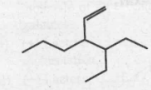
[4 Marks] Diagram 19 – NEET-UG 2011 Question Paper
  • (A) 3-(1-ethylpropyl) hex-1-ene
  • (B) 3-Ethyl-4-ethenyl heptane
  • (C) 3-Ethyl-4-propyl hex-1-ene
  • (D) 4-Ethyl-3-propyl hex-1-ene
Question 71.

In Duma's method of estimation of nitrogen 0.35 g of an organic compound gave 55 mL of nitrogen collected at 300 K temperature and 715 mm pressure. The percentage composition of nitrogen in the compound would be: (Aqueous tension at 300 K = 15 mm)

[4 Marks]
  • (A) 15.45
  • (B) 16.45
  • (C) 14.45
  • (D) 17.45
Question 72.

The Lassaigne's extract is boiled with conc. HNO₃ while testing for halogens. By doing so it:

[4 Marks]
  • (A) increases the concentration of NO₃⁻ ions.
  • (B) increases the solubility product of AgCl.
  • (C) helps in the precipitation of AgCl.
  • (D) decomposes Na₂S and NaCN, if formed.
Question 73.

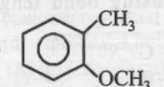
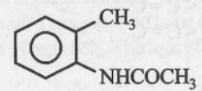
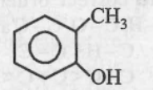
Which one of the following is most reactive towards electrophilic reagent?

[4 Marks]
  • (A) Diagram 20 – NEET-UG 2011 Question Paper
  • (B) Diagram 21 – NEET-UG 2011 Question Paper
  • (C) Diagram 22 – NEET-UG 2011 Question Paper
  • (D) Diagram 23 – NEET-UG 2011 Question Paper
Question 74.

Which one of the following statement is not true?

[4 Marks]
  • (A) pH of drinking water should be between 5.5-9.5.
  • (B) Concentration of DO below 6 ppm is good for the growth of fish.
  • (C) Clean water would have a BOD value of less than 5 ppm.
  • (D) Oxides of sulphur, nitrogen and carbon are the most widespread air pollutant.
Question 75.

The freezing point depression constant for water is -1.86 °C m⁻¹. If 5.00 g Na₂SO₄ is dissolved in 45.0 g H₂O, the freezing point is changed by -3.82 °C. Calculate the van't Hoff factor for Na₂SO₄.

[4 Marks]
  • (A) 0.381
  • (B) 3.11
  • (C) 2.05
  • (D) 2.63
Question 76.

The van't Hoff factor i for a compound which undergoes dissociation in one solvent and association in other solvent is respectively:

[4 Marks]
  • (A) less than one and greater than one.
  • (B) less than one and less than one.
  • (C) greater than one and greater than one.
  • (D) greater than one and less than one.
Question 77.

Standard electrode potential of three metals X, Y and Z are -1.2 V, +0.5 V and -3.0 V, respectively. The reducing power of these metals will be:

[4 Marks]
  • (A) X > Y > Z
  • (B) Y > Z > X
  • (C) X > Z > Y
  • (D) Z > X > Y
Question 78.

The electrode potentials for

Cu²⁺(aq) + e⁻ → Cu⁺(aq)

and Cu⁺(aq) + e⁻ → Cu(s)

are +0.15 V and +0.50 V, respectively. The value of E° _Cu²⁺/Cu will be:

[4 Marks]
  • (A) 0.500 V
  • (B) 0.325 V
  • (C) 0.650 V
  • (D) 0.150 V
Question 79.

Standard electrode potential for Sn⁴⁺/Sn²⁺ couple is +0.15 V and that for the Cr³⁺/Cr couple is -0.74 V. These two couples in their standard state are connected to make a cell. The cell potential will be:

[4 Marks]
  • (A) +1.83 V
  • (B) +0.18 V
  • (C) +0.89 V
  • (D) +1.19 V
Question 80.

If the E°_cell for a given reaction has a negative value, then which of the following gives the correct relationships for the values of ΔG° and K_eq?

[4 Marks]
  • (A) ΔG° > 0; K_eq < 1
  • (B) ΔG° < 0; K_eq < 1
  • (C) ΔG° > 0; K_eq > 1
  • (D) ΔG° < 0; K_eq > 1
Question 81.

Which one of the following statements for the order of a reaction is incorrect?

[4 Marks]
  • (A) Order of reaction is always whole number.
  • (B) Order of reaction is sum of power to the concentration terms of reactants to express the rate of reaction.
  • (C) Order can be determined only experimentally.
  • (D) Order is not influenced by stoichiometric coefficient of the reactants.
Question 82.

If x is amount of adsorbate and m is amount of adsorbent, which of the following relations is not related to adsorption process?

[4 Marks]
  • (A) x/m = f(p) at constant T.
  • (B) x/m = f(T) at constant p.
  • (C) p = f(T) at constant (x/m).
  • (D) x/m = p × T
Question 83.

Which of the following elements is present as the impurity to the maximum extent in the pig iron?

[4 Marks]
  • (A) Manganese
  • (B) Carbon
  • (C) Silicon
  • (D) Phosphorus
Question 84.

Which of the following pairs of metals is purified by van Arkel method?

[4 Marks]
  • (A) Ga and In
  • (B) Ag and Au
  • (C) Zr and Ti
  • (D) Ni and Fe
Question 85.

For the four successive transition elements (Cr, Mn, Fe and Co), the stability of +2 oxidation state will be there in which of the following order?

[4 Marks]
  • (A) Cr > Mn > Co > Fe
  • (B) Co > Mn > Fe > Cr
  • (C) Mn > Fe > Cr > Co
  • (D) Fe > Mn > Co > Cr
Question 86.

Acidified K₂Cr₂O₇ solution turns green when Na₂SO₃ is added to it. This is due to the formation of:

[4 Marks]
  • (A) Cr₂(SO₃)₃
  • (B) CrSO₄
  • (C) CrO₄²⁻
  • (D) Cr₂(SO₄)₃
Question 87.

The complexes [Co(NH₃)₆][Cr(CN)₆] and [Cr(NH₃)₆][Co(CN)₆] are the examples of which type of isomerism?

[4 Marks]
  • (A) Linkage isomerism
  • (B) Geometrical isomerism
  • (C) Coordination isomerism
  • (D) Ionization isomerism
Question 88.

The complex, [Pt(Py)(NH₃)BrCl] will have how many geometrical isomers?

[4 Marks]
  • (A) 4
  • (B) 3
  • (C) 2
  • (D) 0
Question 89.

Of the following complex ions, which is diamagnetic in nature?

[4 Marks]
  • (A) [CoF₆]³⁻
  • (B) [CuCl₄]²⁻
  • (C) [NiCl₄]²⁻
  • (D) [Ni(CN)₄]²⁻
Question 90.

The d-electron configurations of Cr²⁺, Mn²⁺, Fe²⁺ and Co²⁺ are d⁴, d⁵, d⁶ and d⁷ respectively. Which one of the following will exhibit minimum paramagnetic behaviour?

[4 Marks]
  • (A) [Fe(H₂O)₆]²⁺
  • (B) [Mn(H₂O)₆]²⁺
  • (C) [Cr(H₂O)₆]²⁺
  • (D) [Co(H₂O)₆]²⁺
Question 91.

Clemmensen reduction of a ketone is carried out in the presence of which of the following?

[4 Marks]
  • (A) H₂ and Pt as catalyst
  • (B) LiAlH₄
  • (C) Zn-Hg with HCl
  • (D) Glycol with KOH
Question 92.

In a set of reactions m-bromobenzoic acid gave a product D. Identify the product D.
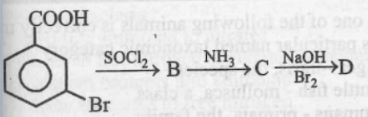
[4 Marks] Diagram 24 – NEET-UG 2011 Question Paper
  • (A) Diagram 25 – NEET-UG 2011 Question Paper
  • (B) Diagram 26 – NEET-UG 2011 Question Paper
  • (C) Diagram 27 – NEET-UG 2011 Question Paper
  • (D) Diagram 28 – NEET-UG 2011 Question Paper
Question 93.

What is the product obtained in the following reaction:
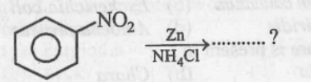
[4 Marks] Diagram 29 – NEET-UG 2011 Question Paper
  • (A) Diagram 30 – NEET-UG 2011 Question Paper
  • (B) Diagram 31 – NEET-UG 2011 Question Paper
  • (C) Diagram 32 – NEET-UG 2011 Question Paper
  • (D) Diagram 33 – NEET-UG 2011 Question Paper
Question 94.

Which one of the following statements is not true regarding (+) Lactose?

[4 Marks]
  • (A) (+) Lactose, C₁₂H₂₂O₁₁, contains 8 -OH groups.
  • (B) (+) Lactose is a reducing sugar and does not exhibit mutarotation.
  • (C) (+) Lactose is a β-glycoside formed by the union of a molecule of D(+) glucose and a molecule of D(+) galactose.
  • (D) On hydrolysis (+) Lactose gives equal amount of D(+) glucose and D(+) galactose.
Question 95.

Of the following which one is classified as polyester polymer?

[4 Marks]
  • (A) Terylene
  • (B) Bakelite
  • (C) Melamine
  • (D) Nylon-66
Question 96.

Which one of the following is employed as Antihistamine?

[4 Marks]
  • (A) Chloramphenicol
  • (B) Diphenyl hydramine
  • (C) Omeprazole
  • (D) Norethindrone
Question 97.

The half life of a substance in a certain enzyme-catalysed reaction is 138 s. The time required for the concentration of the substance to fall from 1.28 mg L⁻¹ to 0.04 mg L⁻¹ is:

[4 Marks]
  • (A) 276 s
  • (B) 690 s
  • (C) 552 s
  • (D) 414 s
Question 98.

Mole fraction of the solute in a 1.00 molal aqueous solution is:

[4 Marks]
  • (A) 0.0344
  • (B) 0.0177
  • (C) 1.7700
  • (D) 0.1770
Question 99.

Which one of the following animals is correctly matched with its particular named taxonomic category?

[4 Marks]
  • (A) Cuttle fish - mollusca, a class
  • (B) Tiger - tigris, the species
  • (C) Housefly - musca, an order
  • (D) Humans - primata, the family
Question 100.

In eubacteria, a cellular component that resembles eukaryotic cells is:

[4 Marks]
  • (A) plasma membrane
  • (B) nucleus
  • (C) ribosomes
  • (D) cell wall
Question 101.

Organisms called methanogens are most abundant in a:

[4 Marks]
  • (A) cattle yard
  • (B) sulphur rock
  • (C) polluted stream
  • (D) hot spring
Question 102.

Which one of the following organisms is not an example of eukaryotic cells?

[4 Marks]
  • (A) Paramecium caudatum
  • (B) Escherichia coli
  • (C) Amoeba proteus
  • (D) Euglena viridis
Question 103.

Archegoniophore is present in:

[4 Marks]
  • (A) Marchantia
  • (B) Chara
  • (C) Adiantum
  • (D) Funaria
Question 104.

The gametophyte is not an independent, free living generation in:

[4 Marks]
  • (A) Polytrichum
  • (B) Adiantum
  • (C) Marchantia
  • (D) Pinus
Question 105.

Compared with the gametophytes of the bryophytes the gametophytes of vascular plant are:

[4 Marks]
  • (A) smaller and have smaller sex organs.
  • (B) larger but have smaller sex organs.
  • (C) larger and have larger sex organs.
  • (D) smaller but have larger sex organs.
Question 106.

Which one of the following have the highest number of species in nature?

[4 Marks]
  • (A) Fungi
  • (B) Insects
  • (C) Birds
  • (D) Angiosperms
Question 107.

What will you look for to identify the sex of the following?

[4 Marks]
  • (A) Female Ascaris - Sharply curved posterior end
  • (B) Male frog - A copulatory pad on the first digit of the hind limb
  • (C) Male shark - Claspers borne on pelvic fins
  • (D) Female cockroach - Anal cerci
Question 108.

Which one of the following groups of animals is correctly matched with its one characteristic feature without even a single exception?

[4 Marks]
  • (A) Chordata: possess a mouth provided with an upper and lower jaw
  • (B) Reptilia: possess 3 chambered heart with one incompletely divided ventricle
  • (C) Chondrichthyes: possess cartilaginous endoskeleton
  • (D) Mammalia: give birth to young one.
Question 109.

Flowers are zygomorphic in:

[4 Marks]
  • (A) mustard
  • (B) gulmohur
  • (C) tomato
  • (D) datura
Question 110.

Which one of the following statements is correct?

[4 Marks]
  • (A) Seeds of orchids have oil-rich endosperm
  • (B) In tomato, fruit is a capsule
  • (C) Placentation in primose is basal
  • (D) Flower of tulip is a modified shoot
Question 111.

What would be the number of chromosomes of the aleurone cells of a plant with 42 chromosomes in its root tip cells?

[4 Marks]
  • (A) 42
  • (B) 63
  • (C) 21
  • (D) 84
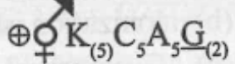
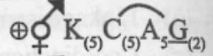
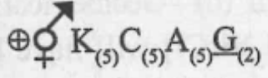
Question 112.

The correct floral formula of chilli is;

[4 Marks]
  • (A) Diagram 34 – NEET-UG 2011 Question Paper
  • (B) Diagram 35 – NEET-UG 2011 Question Paper
  • (C) Diagram 36 – NEET-UG 2011 Question Paper
  • (D) Diagram 37 – NEET-UG 2011 Question Paper
Question 113.

The ovary is half inferior in flowers of

[4 Marks]
  • (A) cucumber
  • (B) peach
  • (C) guava
  • (D) cotton
Question 114.

Ground tissue includes

[4 Marks]
  • (A) all tissues except epidermis and vascular bundles
  • (B) all tissues internal to endodermis
  • (C) epidermis and cortex
  • (D) all tissues external to endodermis
Question 115.

In land plants, the guard cells differ from other epidermal cells in having:

[4 Marks]
  • (A) endoplasmic reticulum
  • (B) chloroplasts
  • (C) mitochondria
  • (D) cytoskeleton
Question 116.

Which one of the following is wrongly matched?

[4 Marks]
  • (A) Puccinia - Smut
  • (B) Root pressure - Guttation
  • (C) Cassia - Imbricate aestivation
  • (D) Root - Exarch protoxylem
Question 117.

The cork cambium, cork and secondary cortex are collectively called:

[4 Marks]
  • (A) phellogen
  • (B) phelloderm
  • (C) periderm
  • (D) phellem
Question 118.

The ciliated columnar epithelial cells in humans are known to occur in:

[4 Marks]
  • (A) bronchioles and fallopian tubes
  • (B) eustachian tube and stomach lining
  • (C) bile duct and oesophagus
  • (D) fallopian tubes and urethra
Question 119.

One very special feature in the earthworm Pheretima is that

[4 Marks]
  • (A) fertilisation for eggs occurs inside the body
  • (B) the typhlosole greatly increases the effective absorption area of the digested food in the intestine
  • (C) it has a long dorsal tubular heart
  • (D) the S-shaped setae embedded in the integument are the defensive weapons used against the enemies
Question 120.

Which of the following is correctly stated as it happens in the common cockroach?

[4 Marks]
  • (A) Malpighian tubules are excretory organs projecting out from the colon
  • (B) Oxygen is transported by haemoglobin in blood
  • (C) Nitrogenous excretory product is urea
  • (D) The food is ground by mandibles and gizzard
Question 121.

Important site for formation of glycoproteins and glycolipids is

[4 Marks]
  • (A) vacuole
  • (B) golgi apparatus
  • (C) plastid
  • (D) lysosome
Question 122.

Peptide synthesis inside a cell takes place in:

[4 Marks]
  • (A) chloroplast
  • (B) mitochondria
  • (C) chromoplast
  • (D) ribosomes
Question 123.

What are those structures that appear as beads-on-string in the chromosomes when viewed under electron microscope?

[4 Marks]
  • (A) Genes
  • (B) Nucleotides
  • (C) Nucleosomes
  • (D) Base pairs
Question 124.

Which one of the following structural formulae of two organic compounds is correctly identified along with its related function?
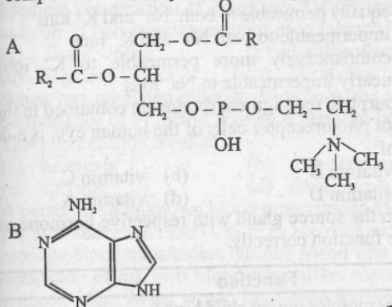
[4 Marks] Diagram 38 – NEET-UG 2011 Question Paper
  • (A) B: Adenine - a nucleotide that makes up nucleic acids
  • (B) A: Triglyceride - major source of energy
  • (C) A: Lecithin - a component of cell membrane
  • (D) B: Uracil - a component of DNA
Question 125.

The curve given below shows enzymatic activity with relation to three conditions (pH, temperature and substrate concentration.) What do the two axes (x and y) represent?
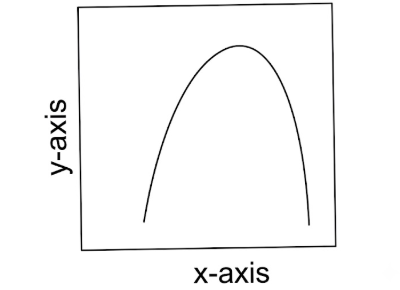
[4 Marks] Diagram 39 – NEET-UG 2011 Question Paper
  • (A) temperature - enzyme activity
  • (B) enzymatic activity - pH
  • (C) substrate concentration - enzymatic activity
  • (D) enzymatic activity - temperature
Question 126.

Select the correct option with respect to mitosis.

[4 Marks]
  • (A) Chromatids separate but remain in the centre of the cell in anaphase.
  • (B) Chromatids start moving towards opposite poles in telophase.
  • (C) Golgi complex and endoplasmic reticulum are still visible at the end of prophase.
  • (D) Chromosomes move to the spindle equator and get aligned along equatorial plate in metaphase
Question 127.

Which one of the following elements in plants is not remobilised?

[4 Marks]
  • (A) Phosphorus
  • (B) Calcium
  • (C) Potassium
  • (D) Sulphur
Question 128.

A prokaryotic autotrophic nitrogen fixing symboint is found in:

[4 Marks]
  • (A) Alnus
  • (B) Cycas
  • (C) Cicer
  • (D) Pisum
Question 129.

Nitrifying bacteria:

[4 Marks]
  • (A) oxidize ammonia to nitrates
  • (B) convert proteins into ammonia
  • (C) reduce nitrates to free nitrogen
  • (D) convert free nitrogen to nitrogen compounds
Question 130.

The function of leg haemoglobin in the root nodules of legumes is:

[4 Marks]
  • (A) inhibition of nitrogenase activity
  • (B) oxygen removal
  • (C) nodule differentiation
  • (D) expression of nif gene
Question 131.

CAM helps the plants in:

[4 Marks]
  • (A) reproduction
  • (B) disease resistance
  • (C) conserving water
  • (D) secondary growth
Question 132.

Two friends are eating together on a dining table. One of them suddenly starts coughing while swallowing some food. This coughing would have been due to improper movement of:

[4 Marks]
  • (A) epiglottis
  • (B) neck
  • (C) tongue
  • (D) diaphragm
Question 133.

Which one of the following enzymes carries out the initial step in the digestion of milk in humans?

[4 Marks]
  • (A) Pepsin
  • (B) Rennin
  • (C) Lipase
  • (D) Trypsin
Question 134.

The figure given below shows a small part of human lung where exchange of gases takes place. In which one of the options given below, the one part A, B, C or D is correctly identified along with its function?
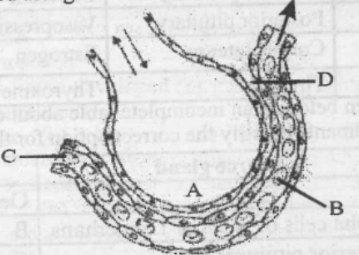
[4 Marks] Diagram 40 – NEET-UG 2011 Question Paper
  • (A) D: capillary wall O₂ and CO₂ - exchange of takes place here.
  • (B) B: red blood cell - transport of CO₂ mainly
  • (C) C: arterial capillary - passes oxygen to tissues
  • (D) A: alveolar cavity - main site of exchange of respiratory gases
Question 135.

A large proportion of oxygen is left unused in the human blood even after its uptake by the body tissues. This O₂:

[4 Marks]
  • (A) acts as a reserve during muscular exercise
  • (B) raise the pCO₂ of blood to 75 mm of Hg.
  • (C) is enough to keep oxyhaemoglobin saturation at 96%
  • (D) helps in releasing more O₂ to the epithelial tissues.
Question 136.

Which one of the following plasma proteins is involved in the coagulation of blood?

[4 Marks]
  • (A) an albumin
  • (B) serum amylase
  • (C) a globulin
  • (D) fibrinogen
Question 137.

'Bundle of His' is a part of which one of the following organs in humans?

[4 Marks]
  • (A) Brain
  • (B) Heart
  • (C) Pancreas
  • (D) Kidney
Question 138.

Arteries are best defined as the vessels which:

[4 Marks]
  • (A) supply oxygenated blood to the different organs.
  • (B) break up into capillaries which reunite to form one visceral organ.
  • (C) break up into capillaries which reunite to form a vein.
  • (D) carry blood blo from one visceral organ to another visceral organ.
Question 139.

Which one of the following statements is correct regarding blood pressure?

[4 Marks]
  • (A) 130/90 mmHg is considered high and requires treatment.
  • (B) 100/55 mmHg is considered an ideal blood pressure.
  • (C) 105/50 mm Hg makes one very active.
  • (D) 190/110 mmHg may harm vital organs like brain and kidney.
Question 140.

Uricotelic mode of passing out nitrogenous wastes is found in

[4 Marks]
  • (A) Reptiles and Bird
  • (B) Birds and Annelids
  • (C) Amphibians and Reptiles
  • (D) Insects and Amphibians
Question 141.

Which one of the following is not a part of a renal pelvis?

[4 Marks]
  • (A) Convoluted tubules
  • (B) Peritubular capillaries
  • (C) Collecting ducts
  • (D) Loops of Henle
Question 142.

Which one of the following correctly explains the function of a specific part of a human nephron?

[4 Marks]
  • (A) Podocytes: create minute spaces (slite pores) for the filtration of blood into the Bowman's capsule
  • (B) Henle's loop: most reabsorption of the major substances from the glomerular filtrate
  • (C) Distal convoluted tubule: reabsorption of K ions into the surrounding blood capillaries
  • (D) Afferent arteriole: carries the blood away from the glomerular towards renal vein.
Question 143.

Which one of the following statements is correct with respect to kidney function regulation?

[4 Marks]
  • (A) When someone drinks lot of water, ADH release is suppressed.
  • (B) Exposure to cold temperature blood flow stimulates formation of Angiotensin II.
  • (C) During summer when body loses lot of water by evaporation, the release of ADH is suppressed.
  • (D) An increase in glomerular blood flow stimulates formation of Angiotensin II.
Question 144.

When a neuron is in resting state i.e., not conducting any impulse, the axonal membrane is:

[4 Marks]
  • (A) comparatively more permeable to Na⁺ ions and nearly impermeable to K⁺ ions
  • (B) equally permeable to both Na⁺ and K⁺ ions
  • (C) comparatively more permeable to K⁺ ions and nearly impermeable to Na⁺
  • (D) impermeable to both Na⁺ and K⁺ ions
Question 145.

The purplish red pigment rhodopsin contained in the rods type of photoreceptor cells of the human eye, is a derivative of:

[4 Marks]
  • (A) vitamin B₁
  • (B) vitamin C
  • (C) vitamin D
  • (D) vitamin A
Question 146.

The "Eyes" of the potato tuber are

[4 Marks]
  • (A) root buds
  • (B) flower buds
  • (C) shoot buds
  • (D) axillary buds
Question 147.

Filiform apparatus is a characteristic feature of

[4 Marks]
  • (A) zygote
  • (B) egg
  • (C) suspensor
  • (D) synergid
Question 148.

In which one of the following pollination is autogamous?

[4 Marks]
  • (A) Xenogamy
  • (B) Geitonogamy
  • (C) Chasmogamy
  • (D) Cleistogamy
Question 149.

Wind pollination is common in

[4 Marks]
  • (A) legumes
  • (B) lilies
  • (C) orchids
  • (D) grasses
Question 150.

A drupe develops in

[4 Marks]
  • (A) mango
  • (B) wheat
  • (C) pea
  • (D) tomato
Question 151.

Nucellar polyembryony is reported in species of

[4 Marks]
  • (A) Gossypium
  • (B) Citrus
  • (C) Brassica
  • (D) Triticum
Question 152.

If for some reason, the vasa efferentia in the human reproductive system gets blocked, the gametes will not be transported from

[4 Marks]
  • (A) testes to epididymis
  • (B) epididymis to vas deferens
  • (C) ovary to uterus
  • (D) vagina to uterus
Question 153.

The testes in humans are situated outside the abdominal cavity insides pouch called scrotum. The purpose served is for

[4 Marks]
  • (A) maintaining the scrotal temperature lower than the internal body temperature
  • (B) escaping any possible compression by the visceral organs
  • (C) providing more space for the growth of epididymis
  • (D) providing a secondary sexual feature for exhibiting the male sex
Question 154.

The figure given below depicts a diagrammatic sectional view of the female reproductive system of humans. Which one set of three parts out of I-VI have been correctly identified?
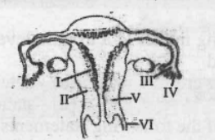
[4 Marks] Diagram 41 – NEET-UG 2011 Question Paper
  • (A) (III) Infundibulum, (IV) Fimbriae, (V) Cervix
  • (B) (IV) Oviducal funnel, (V) Uterus, (VI) Cervix
  • (C) (I) Perimetrium, (II) Myometrium, (III) Fallopian tube
  • (D) (II) Endometrium, (III) Infundibulum, (IV) Fimbriae
Question 155.

Which one of the following is the most widely accepted method of contraception in India, as at present?

[4 Marks]
  • (A) Cervical caps
  • (B) Tubectomy
  • (C) Diaphragms
  • (D) IUDs. (Intra uterine devices)
Question 156.

Medical Termination of Pregnancy (MTP) is considered safe up to how many weeks of pregnancy?

[4 Marks]
  • (A) Eight weeks
  • (B) Twelve weeks
  • (C) Eighteen weeks
  • (D) Six weeks
Question 157.

When two unrelated individuals or lines are crossed, the performance of F₁ hybrid is often superior to both parents. This phenomenon is called:

[4 Marks]
  • (A) heterosis
  • (B) transformation
  • (C) splicing
  • (D) metamorphosis
Question 158.

A person with unknown blood group under ABO system, has suffered much blood loss in an accident and needs immediate blood transfusion. His one friend who has a valid certificate of his own blood type offers blood donation without delay. What would have been the type of blood group of the donor friend?

[4 Marks]
  • (A) Type B
  • (B) Type AB
  • (C) Type O
  • (D) Type A
Question 159.

Which one of the following conditions correctly describes the manner of determining the sex in the given example?

[4 Marks]
  • (A) Homozygous sex chromosomes (ZZ) determine female sex in birds.
  • (B) XO type of sex chromosomes determine male sex in grasshopper
  • (C) Homozygous sex chromosomes (XX) produce male in Drosophila.
  • (D) XO condition in human as found in Turner syndrome, determines female sex.
Question 160.

Mutations can be induced with:

[4 Marks]
  • (A) IAA
  • (B) infra red radiations
  • (C) ethylene
  • (D) gamma radiations
Question 161.

Given below is a sample of a portion of DNA strand. What is so special shown in it? 5' -----------GAATTC---------------3'

3' --------------- CTTAAG ------------ 5'

[4 Marks]
  • (A) Replication completed
  • (B) Deletion mutation
  • (C) Palindromic sequence of base pairs
  • (D) Start codon at the 5' end
Question 162.

Which one of the following also acts as a catalyst in a bacterial cell?

[4 Marks]
  • (A) 5s rRNA
  • (B) sn RNA
  • (C) hn RNA
  • (D) 23s rRNA
Question 163.

What was the most significant trend in evolution of modern man (Homo sapiens) from his ancestors?

[4 Marks]
  • (A) Upright posture
  • (B) Shortening of jaws
  • (C) Binocular vision
  • (D) Increasing brain capacity
Question 164.

Where will you look for the sporozoites of the malarial parasite?

[4 Marks]
  • (A) Spleen of infected humans
  • (B) Saliva of infected female Anopheles mosquito
  • (C) Red blood corpuscles of humans suffering from malaria
  • (D) Salivary glands of freshly moulted female Anopheles mosquito
Question 165.

Which one of the following is categorised as a parasite in true sense ?

[4 Marks]
  • (A) The female Anopheles bites and sucks blood from humans
  • (B) Human foetus developing inside the uterus draws nourishment from the mother
  • (C) Head louse living on the human scalp as well as laying eggs on human hair
  • (D) The cuckoo (koel) lays its eggs in crow's nest.
Question 166.

Which one of the following acts as a physiological barrier to the entry of micro-organisms in human body?

[4 Marks]
  • (A) Tears
  • (B) Epithelium of urogenital tract
  • (C) Monocytes
  • (D) Skin
Question 167.

At which stage of HIV infection does one usually show symptoms of AIDS?

[4 Marks]
  • (A) When HIV replicates rapidly in helper T-lymphocytes and damages large number of these
  • (B) When viral DNA is produced by reverse trancriptase
  • (C) When the infecting retrovirus enters host cells
  • (D) Within 15 day of sexual contact with an infected person.
Question 168.

A certain patient is suspected to be suffering from Acquired Immuno Deficiency Syndrome. Which diagnostic technique will you recommend for its detection?

[4 Marks]
  • (A) ELISA
  • (B) MRI
  • (C) Ultra sound
  • (D) WIDAL
Question 169.

Jaya and Ratna developed for green revolution in India are the varieties of

[4 Marks]
  • (A) maize
  • (B) rice
  • (C) wheat
  • (D) bajra
Question 170.

Himgiri developed by hybridisation and selection for disease resistance against rust pathogens is a variety of

[4 Marks]
  • (A) chilli
  • (B) maize
  • (C) sugarcane
  • (D) wheat
Question 171.

Ethanol is commercially produced through a particular species of:

[4 Marks]
  • (A) Saccharomyces
  • (B) Clostridium
  • (C) Trichoderma
  • (D) Aspergillus
Question 172.

Which one of the following help in absorption of phosphorus from soil by plants?

[4 Marks]
  • (A) Glomus
  • (B) Rhizobium
  • (C) Frankia
  • (D) Anabaena
Question 173.

Which one of the following is not a biofertilizer?

[4 Marks]
  • (A) Agrobacterium
  • (B) Nostoc
  • (C) Rhizobium
  • (D) Mycorrhiza
Question 174.

There is a restriction endonuclease called EcoRI. What does "co" part in it stand for?

[4 Marks]
  • (A) colon
  • (B) coelom
  • (C) coenzyme
  • (D) coli
Question 175.

Agarose extracted from sea weeds finds use in:

[4 Marks]
  • (A) Tissue culture
  • (B) Spectrophotometry
  • (C) Gel electrophoresis
  • (D) PCR
Question 176.

The most common substrate used in distilleries for the production of ethanol is

[4 Marks]
  • (A) corn meal
  • (B) soya meal
  • (C) ground gram
  • (D) molasses
Question 177.

The process of RNA interference has been used in the development of plants resistant to

[4 Marks]
  • (A) nematodes
  • (B) fungi
  • (C) viruses
  • (D) insects
Question 178.

Continuous addition of sugars in 'fed batch' fermentation is done to:

[4 Marks]
  • (A) produce methane
  • (B) obtain antibiotics
  • (C) purify enzymes
  • (D) degrade sewage
Question 179.

Maximum number of existing transgenic animals is of:

[4 Marks]
  • (A) fish
  • (B) mice
  • (C) cow
  • (D) pig
Question 180.

Large woody vines are more commonly found in:

[4 Marks]
  • (A) mangroves
  • (B) tropical rainforests
  • (C) alpine forests
  • (D) temperate forest
Question 181.

Consider the following four conditions (i) - (iv) and select the correct pair of them as adaptation to environment in desert lizards. (i) Burrowing in soil to escape high temperature (ii) Losing heat rapidly from the body during high temperature (iii) Bask in sun when temperature is low (iv) Insulating body due to thick fatty dermis

[4 Marks]
  • (A) (iii), (iv)
  • (B) (i) and (iii)
  • (C) (i), (ii)
  • (D) (ii), (iv)
Question 182.

Which one of the following statements is correct for secondary succession?

[4 Marks]
  • (A) It begins on a bare rock.
  • (B) It occurs on a deforested site.
  • (C) It is similar to primary succession except that it has a relatively fast pace.
  • (D) It follows primary succession.
Question 183.

Of the total incident solar radiation the proportion of PAR is:

[4 Marks]
  • (A) more than 80%
  • (B) less than 50%
  • (C) about 60%
  • (D) about 70%
Question 184.

Mass of living matter at a trophic level in an area at any time is called

[4 Marks]
  • (A) standing crop
  • (B) deteritus
  • (C) standing state
  • (D) humus
Question 185.

Which one of the following statements for pyramid of energy is incorrect, whereas the remaining three are correct?

[4 Marks]
  • (A) Its base is broad
  • (B) It is upright in shape
  • (C) It shows energy content of different trophic level organisms
  • (D) It is inverted in shape
Question 186.

Which one of the following shows maximum genetic diversity in India?

[4 Marks]
  • (A) Groundnut
  • (B) Rice
  • (C) Maize
  • (D) Mango
Question 187.

A collection of plants and seeds having diverse alleles of all the genes of a crop is called

[4 Marks]
  • (A) germplasm
  • (B) gene library
  • (C) genome
  • (D) herbarium
Question 188.

Secondary sewage treatment is mainly a

[4 Marks]
  • (A) physical process
  • (B) mechanical process
  • (C) biological process
  • (D) chemical process
Question 189.

Which of the following is mainly produced by the activity of anaerobic bacteria on sewage?

[4 Marks]
  • (A) Laughing gas
  • (B) Mustard gas
  • (C) Propane
  • (D) Marsh gas
Question 190.

Eutrophication is often seen in

[5 Marks]
  • (A) deserts
  • (B) fresh water lakes
  • (C) mountains
  • (D) ocean
Question 191.

Which one of the following statements is wrong in case of Bhopal tragedy?

[4 Marks]
  • (A) Methyl Isocyanate gas leakage took place
  • (B) Thousands of human beings died
  • (C) Radioactive fall out engulfed Bhopal
  • (D) It took place in the night of December 2/3 1984.
Question 192.

Which one of the following expanded forms of the following acronyms is correct?

[5 Marks]
  • (A) IPCC = International Panel for Climate Change
  • (B) UNEP = United Nations Environment Policy
  • (C) IUCN = International Union for Conservation of Nature and Natural Resources
  • (D) EPA = Environmental Pollution Agency
Question 193.

Which one of following pairs of gases are the major cause of "Greenhouse effect"?

[3 Marks]
  • (A) CO₂ and O₃
  • (B) CO₂ and CO
  • (C) CFCs and SO₂
  • (D) CO₂ and N₂O
Question 194.

A drupe develops in :

[4 Marks]
  • (A) Tomato
  • (B) Mango
  • (C) Pea
  • (D) Wheat
Question 195.

Given below is an incomplete table about certain hormones, their source glands and one major effect of each on the body in humans. Identify the correct option for the three blanks A, B and C.

[4 Marks] Diagram 42 – NEET-UG 2011 Question Paper
  • (A) A-Placenta; B-Glucagon; C-Calcitonin
  • (B) A-Ovary; B-Insulin; C-Calcitonin
  • (C) A-Placenta; B-Insulin; C-Vasopressin
  • (D) A-Ovary; B-Glucagon; C-Growth hormone
Question 196.

Match the source gland with respective hormone as well as the function correctly.

[4 Marks] Diagram 43 – NEET-UG 2011 Question Paper
  • (A) a
  • (B) b
  • (C) c
  • (D) d
Question 197.

In which one of the following, the genus name, its two characters and its class/phylum are correctly matched?
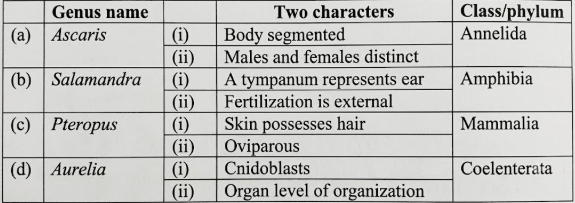
[3 Marks] Diagram 44 – NEET-UG 2011 Question Paper
  • (A) a
  • (B) b
  • (C) c
  • (D) d
Question 198.

Which one is a nucleophilic substitution reaction among the following?

[4 Marks]
  • (A) Diagram 45 – NEET-UG 2011 Question Paper
  • (B) Diagram 46 – NEET-UG 2011 Question Paper
  • (C) Diagram 47 – NEET-UG 2011 Question Paper
  • (D) Diagram 48 – NEET-UG 2011 Question Paper
Question 199.

In the following reactions,

the major products (A) and (C) are respectively:
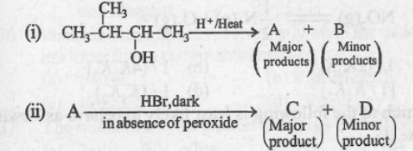
[4 Marks] Diagram 49 – NEET-UG 2011 Question Paper
  • (A) Diagram 50 – NEET-UG 2011 Question Paper
  • (B) Diagram 51 – NEET-UG 2011 Question Paper
  • (C) Diagram 52 – NEET-UG 2011 Question Paper
  • (D) Diagram 53 – NEET-UG 2011 Question Paper
Question 200.

What type of human population is represented by the following age pyramid?
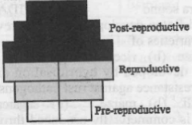
[4 Marks] Diagram 54 – NEET-UG 2011 Question Paper
  • (A) Declining population
  • (B) Expanding population
  • (C) Stable population
  • (D) Vanishing population