NEET-UG 2010 Question Paper

QUESTION PAPER

2010 NEET EXAM

NEET-UG 2010 Question Paper

2010

NEET-UG

CBSE EXAMINATION PAPER-2010

NEET-ZOOLOGY

(Solved)

Time allowed : 3 hours

Maximum Marks : 802

General Instructions :

Read the following instructions carefully and follow them :

  1. This question paper contains 200 questions. All questions are compulsory.
  2. This question paper is divided into 1 sections.
  3. Section A – questions number 1 to 200 are multiple choice questions
  4. There is no overall choice given in the question paper. However, an internal choice has been provided in few questions.
  5. Use of calculator is NOT allowed.

Section A

Question 1.

The number of atoms in 0.1 mol of a triatomic gas is: (N_A = 6.02 × 10²³ mol⁻¹)

[4 Marks]
  • (A) 1.806 × 10²³
  • (B) 1.800 × 10²²
  • (C) 3.600 × 10²³
  • (D) 6.026 × 10²²
Question 2.

Which of the following represents the correct order of increasing electron gain enthalpy with negative sign for the elements O, S, F and Cl?

[4 Marks]
  • (A) O < S < F < Cl
  • (B) F < S < O < Cl
  • (C) S < O < Cl < F
  • (D) Cl < F < O < S
Question 3.

The correct order of increasing ionic radii among the following isoelectronic species are:

[4 Marks]
  • (A) Ca²⁺ > K⁺ > S²⁻ > Cl⁻
  • (B) Cl⁻ > S²⁻ > Ca²⁺ > K⁺
  • (C) S²⁻ > Cl⁻ > K⁺ > Ca²⁺
  • (D) K⁺ > Ca²⁺ > Cl⁻ > S²⁻
Question 4.

In which one of the following species the central atom has the type of hybridization which is not the same as that present in the other three?

[4 Marks]
  • (A) SF₄
  • (B) I₃⁻
  • (C) SbCl₅²⁻
  • (D) PCl₅
Question 5.

In which of the following pairs of molecules/ions, the central atoms have sp² hybridization?

[4 Marks]
  • (A) BF₃ and NH₂⁻
  • (B) NH₂⁻ and H₂O
  • (C) BF₃ and NO₂⁻
  • (D) NO₂⁻ and NH₃
Question 6.

Which one of the following species does not exist under normal conditions?

[4 Marks]
  • (A) B₂
  • (B) Li₂
  • (C) Be₂⁺
  • (D) Be₂
Question 7.

Standard entropies of X₂, Y₂ and XY₃ are 60, 40 and 50 JK⁻¹ mol⁻¹, respectively.

(1 / 2) X₂ + (3 / 2)Y₂ ⇌ XY₃, ΔH = −30 kJ

to be at equilibrium, the temperature should be:

[4 Marks]
  • (A) 500 K
  • (B) 1250 K
  • (C) 750 K
  • (D) 1000 K
Question 8.

In which of the following equilibrium K_c and Kₚ are not equal?

[4 Marks]
  • (A) 2NO(g) ⇌ N₂(g) + O₂(g)
  • (B) SO₂(g) + NO₂(g) ⇌ SO₃(g) + NO(g)
  • (C) 2C(s) + O₂(g) ⇌ 2CO₂(g)
  • (D) H₂(g) + I₂(g) ⇌ 2HI(g)
Question 9.

Which one of the following molecular hydrides acts as a Lewis acid?

[4 Marks]
  • (A) CH₄
  • (B) B₂H₆
  • (C) NH₃
  • (D) H₂O
Question 10.

If pH of a saturated solution of Ba(OH)₂ is 12, the value of its K_sp is:

[4 Marks]
  • (A) 5.00 × 10⁻⁷ M³
  • (B) 5.00 × 10⁻⁶ M³
  • (C) 4.00 × 10⁻⁷ M³
  • (D) 4.00 × 10⁻⁶ M³
Question 11.

What is [H⁺] in mol/L of a solution that is 0.20 M in CH₃COONa and 0.10 M in CH₃COOH? (For CH₃COOH, Kₐ = 1.8 × 10⁻⁵)

[4 Marks]
  • (A) 9.0 × 10⁻⁶
  • (B) 1.8 × 10⁻⁵
  • (C) 1.1 × 10⁻⁵
  • (D) 3.5 × 10⁻⁴
Question 12.

In a buffer solution containing equal concentration of B⁻ and HB, the K_b for B⁻ is 10⁻¹⁰. The pH of the buffer solution is:

[4 Marks]
  • (A) 10
  • (B) 7
  • (C) 6
  • (D) 4
Question 13.

Which of the following alkaline earth metal sulphates has hydration enthalpy higher than the lattice enthalpy?

[4 Marks]
  • (A) CaSO₄
  • (B) BeSO₄
  • (C) BaSO₄
  • (D) SrSO₄
Question 14.

Property of the alkaline earth metals that increases with their atomic number:

[4 Marks]
  • (A) Solubility of their hydroxides in water
  • (B) Solubility of their sulphates in water
  • (C) Ionization energy
  • (D) Electronegativity
Question 15.

The tendency of BF₃, BCl₃ and BBr₃ to behave as Lewis acid decreases in the sequence:

[4 Marks]
  • (A) BF₃ > BCl₃ > BBr₃
  • (B) BBr₃ > BF₃ > BCl₃
  • (C) BBr₃ > BCl₃ > BF₃
  • (D) BCl₃ > BF₃ > BBr₃
Question 16.

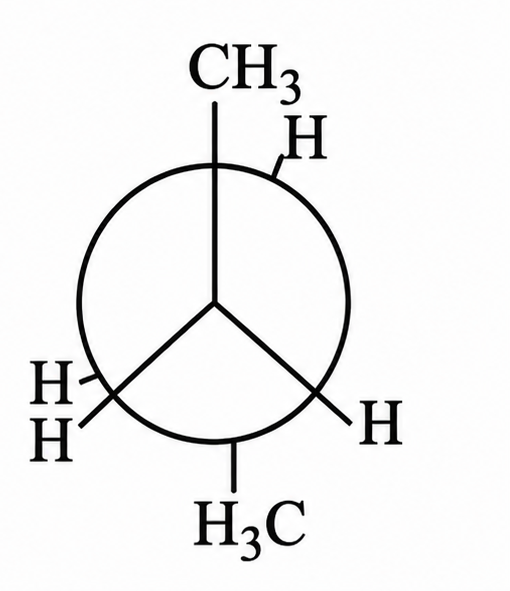
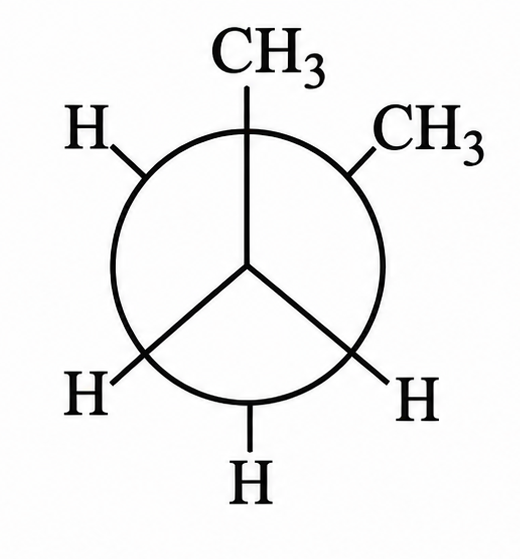
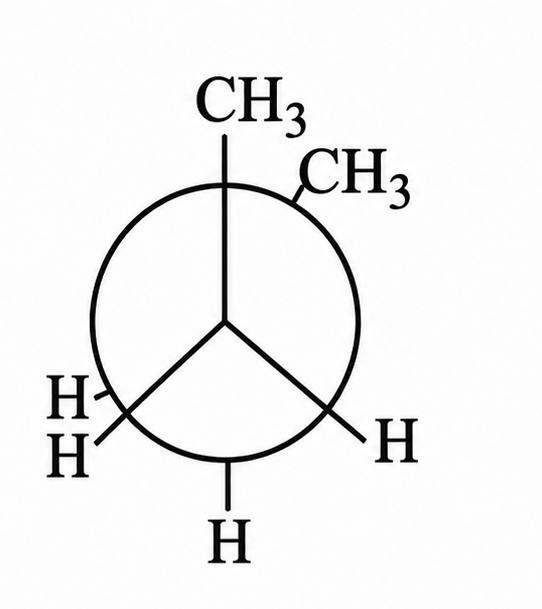
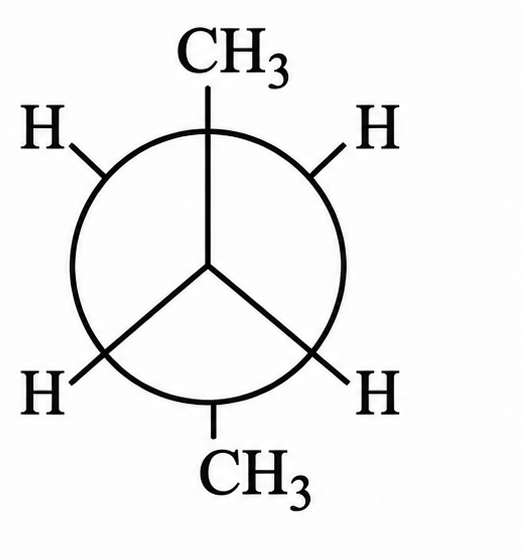
In the following the most stable conformation of n-butane is:

[4 Marks]
  • (A) Diagram 1 – NEET-UG 2010 Question Paper
  • (B) Diagram 2 – NEET-UG 2010 Question Paper
  • (C) Diagram 3 – NEET-UG 2010 Question Paper
  • (D) Diagram 4 – NEET-UG 2010 Question Paper
Question 17.

Liquid hydrocarbons can be converted to a mixture of gaseous hydrocarbons by :

[4 Marks]
  • (A) Hydrolysis
  • (B) Cracking
  • (C) Distillation under reduced pressure
  • (D) Oxidation
Question 18.

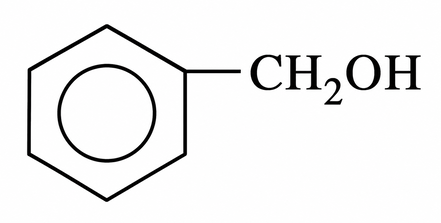
Which one is most reactive towards electrophilic reagent?

[4 Marks]
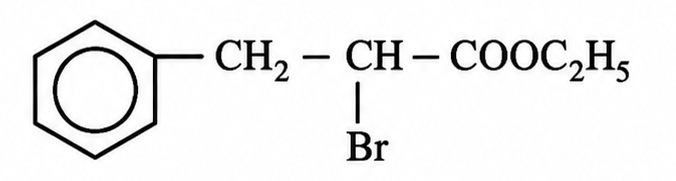
  • (A)
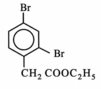
  • (B)
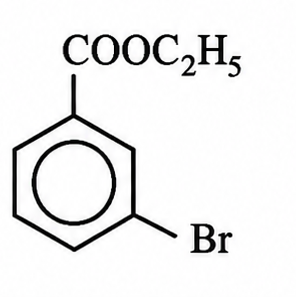
  • (C)
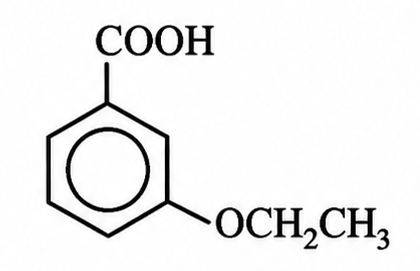
  • (D)
Question 19.

AB crystallizes in a body centred cubic lattice with edge length 'a' = 387 pm. The distance between two oppositely charged ions in the lattice is:

[4 Marks]
  • (A) 200 pm
  • (B) 300 pm
  • (C) 335 pm
  • (D) 250 pm
Question 20.

25.3 g of sodium carbonate, Na₂CO₃, is dissolved in enough water to make 250 mL of solution. If sodium carbonate dissociates completely, molar concentration of sodium ions, Na⁺, and carbonate ions, CO₃²⁻, are respectively. (Molar mass of Na₂CO₃ = 106 g mol⁻¹)

[4 Marks]
  • (A) 0.477 M and 0.477 M
  • (B) 1.90 M and 1.910 M
  • (C) 1.910 M and 0.955 M
  • (D) 0.955 M and 1.910 M
Question 21.

An aqueous solution is 1.00 molal in KI. Which change will cause the vapour pressure of the solution to increase?

[4 Marks]
  • (A) Addition of Na₂SO₄
  • (B) Addition of water
  • (C) Addition of 1.00 molal KI
  • (D) Addition of NaCl
Question 22.

A solution of sucrose (molar mass = 342 g mol⁻¹) has been prepared by dissolving 68.5 g of sucrose in 1000 g of water. The freezing point of the solution obtained will be (K_f for water = 1.86 K kg mol⁻¹):

[4 Marks]
  • (A) −0.520°C
  • (B) −0.570°C
  • (C) +0.372°C
  • (D) −0.372°C
Question 23.

An increase in equivalent conductance of a strong electrolyte with dilution is mainly due to:

[4 Marks]
  • (A) increase in ionic mobility of ions
  • (B) increase in both i.e. number of ions and ionic mobility of ions
  • (C) increase in number of ions
  • (D) 100% ionisation of electrolyte at normal dilution
Question 24.

For the reduction of silver ions with copper metal, the standard cell potential was found to be +0.46 V at 25°C. The value of standard Gibbs energy, ΔG°, will be: (F = 96500 C mol⁻¹)

[4 Marks]
  • (A) −89.0 kJ
  • (B) −44.5 kJ
  • (C) −98.0 kJ
  • (D) −89.0 J
Question 25.

For the reaction [N₂O₅(g) → 2NO₂ (g) + 1/2O₂(g)] the value rate of disappearance of N₂O₅ is given as 6.25 × 10⁻³ mol L⁻¹ s⁻¹. The rate of formation of NO₂ and O₂ is given respectively as:

[4 Marks]
  • (A) 1.25 × 10⁻² mol L⁻¹ s⁻¹ and 6.25 × 10⁻³ mol L⁻¹ s⁻¹
  • (B) 6.25 × 10⁻³mol L⁻¹ s⁻¹ and 3.125 × 10⁻³ mol L⁻¹ s⁻¹
  • (C) 1.25 × 10⁻² mol L⁻¹ s⁻¹ and 3.125 × 10⁻³ mol L⁻¹ s⁻¹
  • (D) 6.25 × 10⁻³ mol L⁻¹ s⁻¹ and 6.25 × 10⁻³ mol L⁻¹ s⁻¹
Question 26.

During the kinetic study of the reaction, 2A + B → C + D following results were obtained:
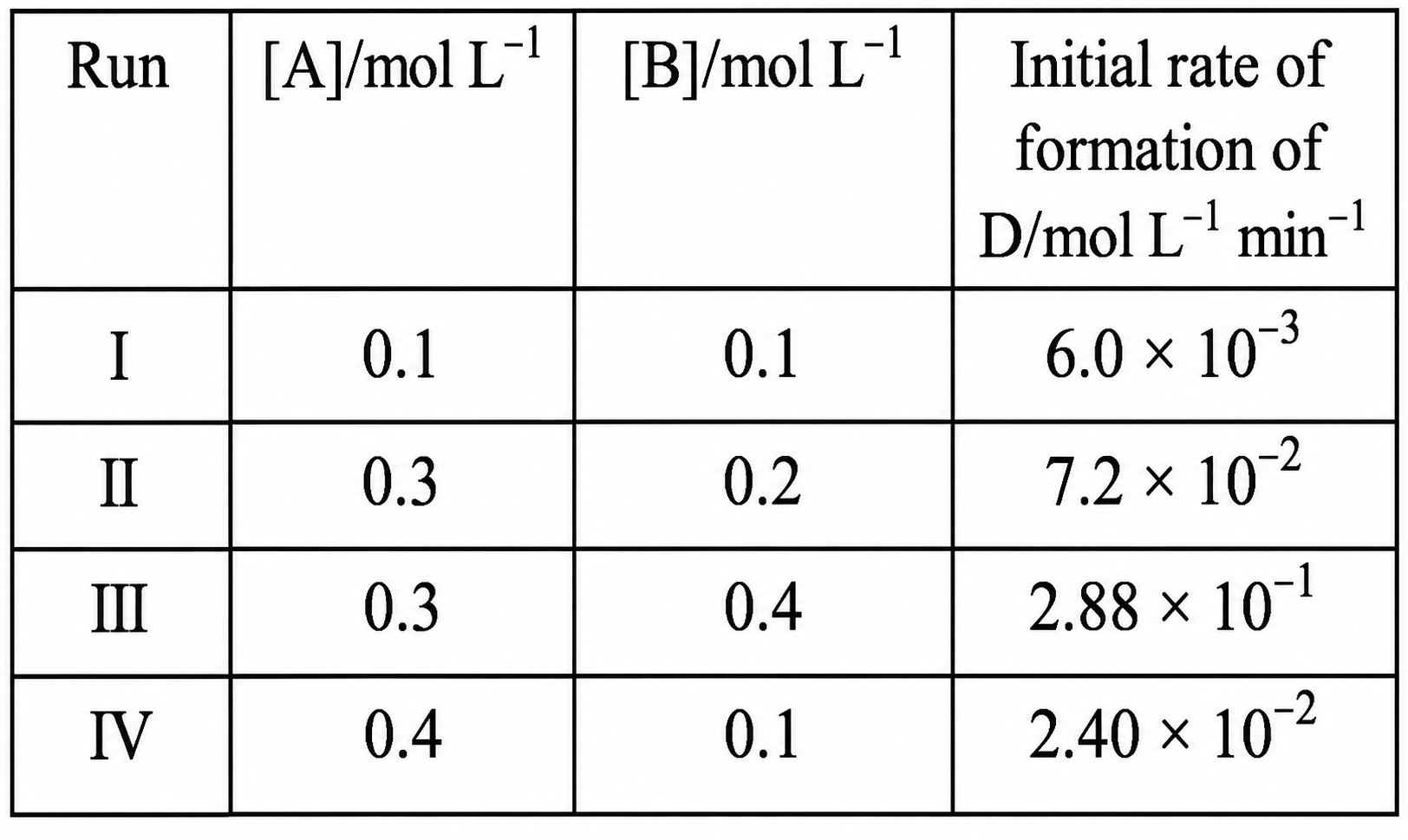
[4 Marks] Diagram 5 – NEET-UG 2010 Question Paper
  • (A) rate = k [A]² [B]
  • (B) rate = k [A]² [B]²
  • (C) rate = k [A] [B]²
  • (D) rate = k [A] [B]
Question 27.

For an endothermic reaction, energy of activation is Eₐ and enthalpy of reaction is ΔH (both of these in kJ mol⁻¹). Minimum value of Eₐ will be:

[6 Marks]
  • (A) Less than ΔH
  • (B) Equal to ΔH
  • (C) Equal to zero
  • (D) More than ΔH
Question 28.

Oxidation states of P in H₄P₂O₅, H₄P₂O₆, and H₄P₂O₇ are respectively:

[4 Marks]
  • (A) +5, +3, +4
  • (B) +3, +5, +4
  • (C) +5, +4, +3
  • (D) +3, +4, +5
Question 29.

Which one of the following compounds is a peroxide?

[4 Marks]
  • (A) BaO₂
  • (B) NO₂
  • (C) MnO₂
  • (D) KO₂
Question 30.

The correct order of increasing bond angles in the following species is:

[4 Marks]
  • (A) ClO₂⁻ < Cl₂O < ClO₂
  • (B) Cl₂O < ClO₂⁻ < ClO₂
  • (C) ClO₂ < Cl₂O < ClO₂⁻
  • (D) Cl₂O < ClO₂ < ClO₂⁻
Question 31.

Which of the following ions will exhibit colour in aqueous solutions?

[4 Marks]
  • (A) Sc³⁺ (Z = 21)
  • (B) Lu³⁺ (Z = 71)
  • (C) Ti³⁺ (Z = 22)
  • (D) La³⁺ (Z = 57)
Question 32.

Which one of the following ions has electronic configuration [Ar] 3d⁶?

(At. Nos. Mn = 25, Fe = 26, Co = 27, Ni = 28)

[4 Marks]
  • (A) Ni³⁺
  • (B) Mn³⁺
  • (C) Fe³⁺
  • (D) Co³⁺
Question 33.

Which one of the following pairs has the same size?

[4 Marks]
  • (A) Zr⁴⁺, Ti⁴⁺
  • (B) Fe²⁺, Ni²⁺
  • (C) Zr⁴⁺, Hf⁴⁺
  • (D) Zn²⁺, Hf⁴⁺
Question 34.

The existence of two different coloured complexes with the composition [Co(NH₃)₄Cl₂]⁺ is due to:

[4 Marks]
  • (A) Linkage isomerism
  • (B) Geometrical isomerism
  • (C) Coordination isomerism
  • (D) Ionization isomerism
Question 35.

Which one of the following complex ions is not expected to absorb visible light?

[4 Marks]
  • (A) [Fe(H₂O)₆]²⁺
  • (B) [Ni(H₂O)₆]²⁺
  • (C) [Cr(NH₃)₆]³⁺
  • (D) [Ni(CN)₄]²⁻
Question 36.

Crystal field stabilization energy for high-spin d⁴ octahedral complex is:

[4 Marks]
  • (A) −1.6 Δ₀ + P
  • (B) −0.6 Δ₀
  • (C) −1.8 Δ₀
  • (D) −1.2 Δ₀
Question 37.

The reaction of toluene with Cl₂ in presence of FeCl₃ gives 'X' and reaction in presence of light gives 'Y'. Thus, 'X' and 'Y' are:

[4 Marks]
  • (A) X = Benzal chloride, Y = o - Chlorotoluene
  • (B) X = Benzyl chloride, Y = m - Chlorotoluene
  • (C) X = m - Chlorotoluene, Y = p - Chlorotoluene
  • (D) X = o- and p-Chlorotoluene, Y = Trichloromethyl - benzene
Question 38.

Which one is most reactive towards S_N1 reaction?

[4 Marks]
  • (A) C₆H₅CH(CH₃)Br
  • (B) C₆H₅CH(C₆H₅)Br
  • (C) C₆H₅C(CH₃)(C₆H₅)Br
  • (D) C₆H₅CH₂Br
Question 39.

The correct order of increasing reactivity of C - X bond towards nucleophile in the following compounds is
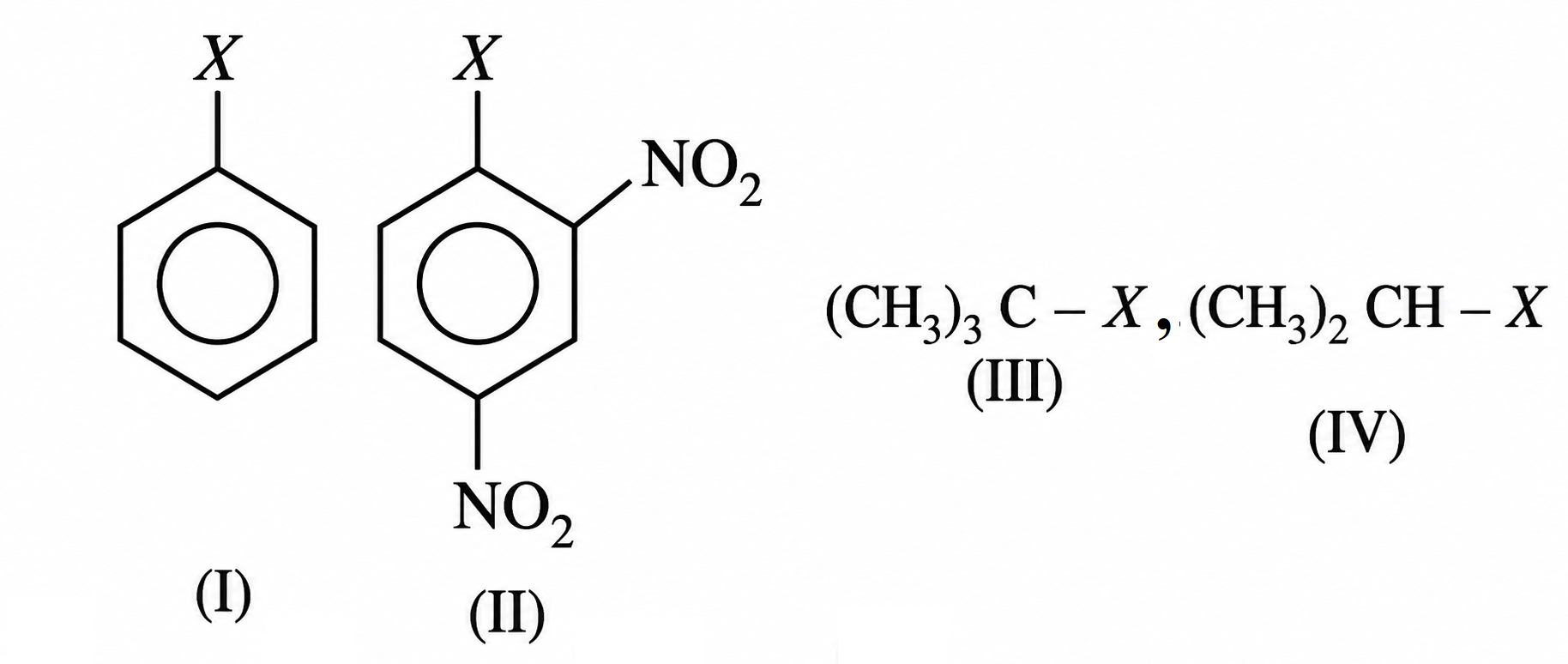
[4 Marks] Diagram 6 – NEET-UG 2010 Question Paper
  • (A) IV < III < I < II
  • (B) III < II < I < IV
  • (C) II < III < I < IV
  • (D) I < II < IV < III
Question 40.

Which one of the following compounds has the most acidic nature?

[4 Marks]
  • (A) Diagram 7 – NEET-UG 2010 Question Paper
  • (B) Diagram 8 – NEET-UG 2010 Question Paper
  • (C) Diagram 9 – NEET-UG 2010 Question Paper
  • (D) Diagram 10 – NEET-UG 2010 Question Paper
Question 41.

Which of the following reactions will not result in the formation of carbon–carbon bonds?

[4 Marks]
  • (A) Wurtz reaction
  • (B) Cannizaro reaction
  • (C) Friedel–Crafts acylation
  • (D) Reimer–Tiemann reaction
Question 42.

In a set of reactions, ethylbenzene yielded a product D.
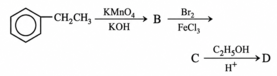
[4 Marks] Diagram 11 – NEET-UG 2010 Question Paper
  • (A) Diagram 12 – NEET-UG 2010 Question Paper
  • (B) Diagram 13 – NEET-UG 2010 Question Paper
  • (C) Diagram 14 – NEET-UG 2010 Question Paper
  • (D) Diagram 15 – NEET-UG 2010 Question Paper
Question 43.

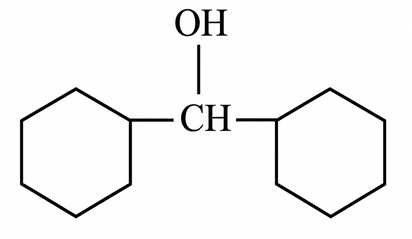
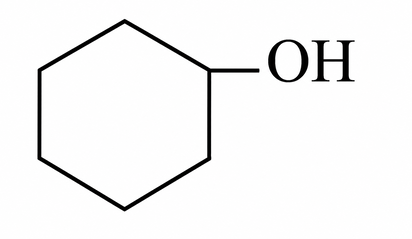
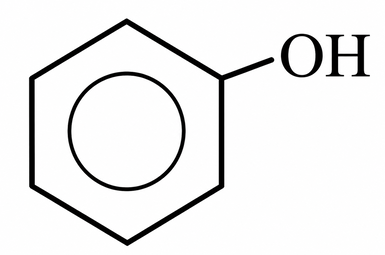
Given are cyclohexanol (I), acetic acid (II), 2,4,6-trinitrophenol (III) and phenol (IV). In these, the order of decreasing acidic character will be:

[4 Marks]
  • (A) III > II > IV > I
  • (B) II > III > IV > I
  • (C) III > IV > II > I
  • (D) II > III > I > IV
Question 44.

Among the given compounds, the most susceptible to nucleophilic attack at the carbonyl group is:

[4 Marks]
  • (A) CH₃COOCH₃
  • (B) CH₃CONH₂
  • (C) CH₃COOCOCH₃
  • (D) CH₃COCl
Question 45.

Which of the following statements about primary amines is False?

[4 Marks]
  • (A) Alkyl amines are stronger bases than ammonia.
  • (B) Aryl amines react with nitrous acid to produce phenols.
  • (C) Alkyl amines are stronger bases than aryl amines.
  • (D) Alkyl amines react with nitrous acid to produce alcohols.
Question 46.

Acetamide is treated with the following reagents separately. Which one of these would yield methylamine?

[4 Marks]
  • (A) Sodalime
  • (B) NaOH – Br₂
  • (C) Hot conc. H₂SO₄
  • (D) PCl₅
Question 47.

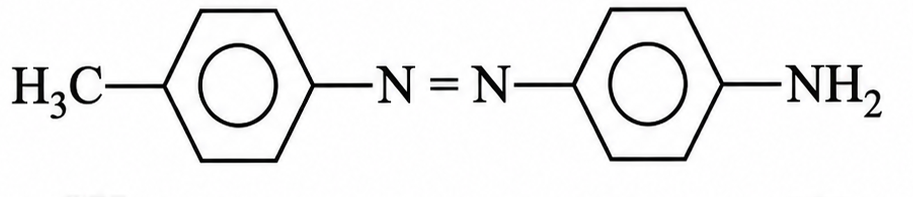
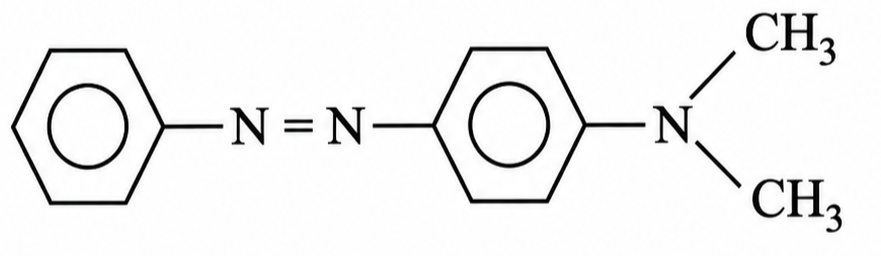
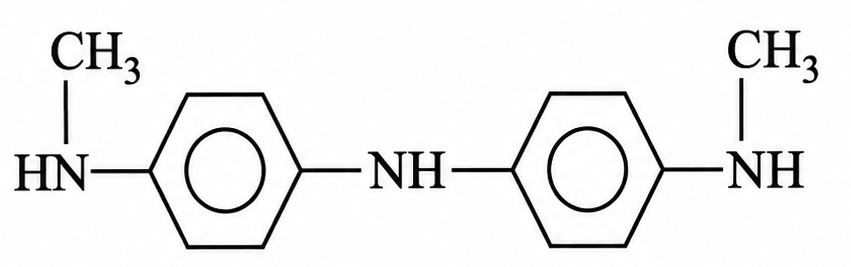
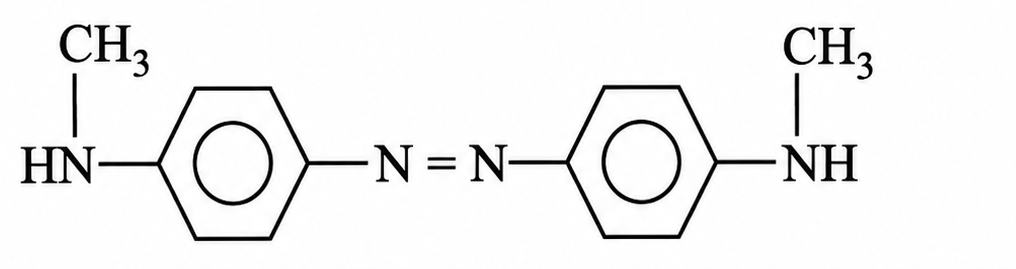
Aniline in a set of the following reactions yielded a coloured product ‘Y’

The structure of ‘Y’ would be ;
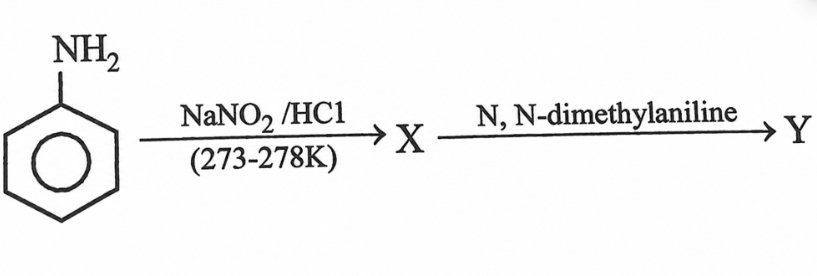
[4 Marks] Diagram 16 – NEET-UG 2010 Question Paper
  • (A) Diagram 17 – NEET-UG 2010 Question Paper
  • (B) Diagram 18 – NEET-UG 2010 Question Paper
  • (C) Diagram 19 – NEET-UG 2010 Question Paper
  • (D) Diagram 20 – NEET-UG 2010 Question Paper
Question 48.

Which one of the following does not exhibit the phenomenon of mutarotation ?

[4 Marks]
  • (A) (+) - Lactose
  • (B) (+) - Sucrose
  • (C) (+) - Maltose
  • (D) (-) - Fructose
Question 49.

Which one of the following is employed as a tranquilizer drug?

[4 Marks]
  • (A) Promethazine
  • (B) Valium
  • (C) Naproxen
  • (D) Mifepristone
Question 50.

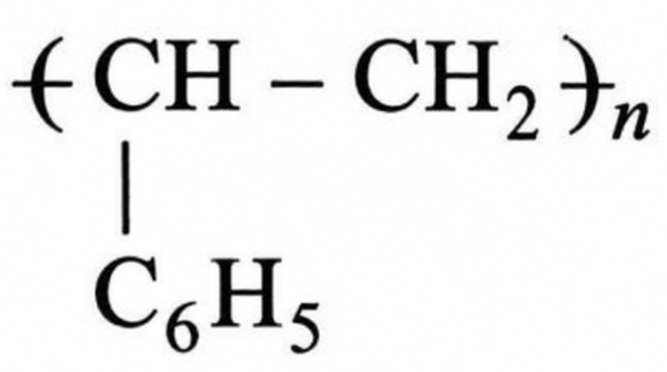
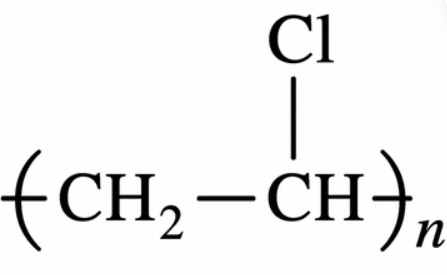
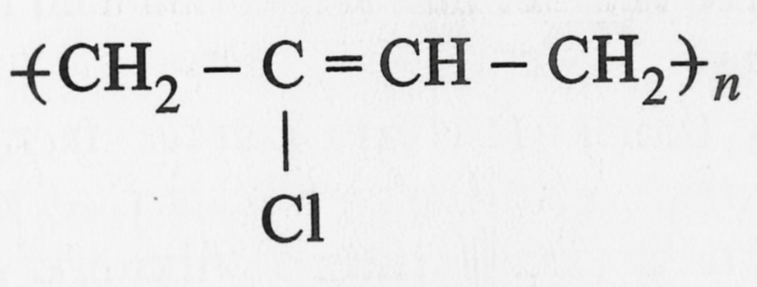
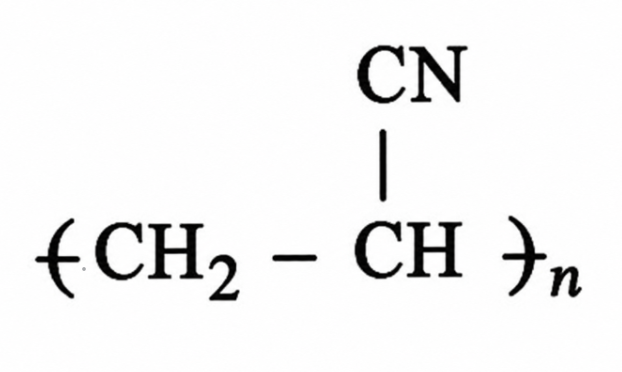
Which of the following structures represents neoprene polymer?

[4 Marks]
  • (A) Diagram 21 – NEET-UG 2010 Question Paper
  • (B) Diagram 22 – NEET-UG 2010 Question Paper
  • (C) Diagram 23 – NEET-UG 2010 Question Paper
  • (D) Diagram 24 – NEET-UG 2010 Question Paper
Question 51.

Single-celled eukaryotes are included in:

[4 Marks]
  • (A) Protista
  • (B) Fungi
  • (C) Archaea
  • (D) Monera
Question 52.

Membrane-bound organelles are absent in:

[4 Marks]
  • (A) Saccharomyces
  • (B) Streptococcus
  • (C) Chlamydomonas
  • (D) Plasmodium
Question 53.

Virus envelope is known as:

[4 Marks]
  • (A) Capsid
  • (B) Virion
  • (C) Nucleoprotein
  • (D) Core
Question 54.

Algae have cell wall made up of:

[4 Marks]
  • (A) Cellulose, galactans and mannans
  • (B) Pectins, cellulose and proteins
  • (C) Hemicellulose, pectins and proteins
  • (D) Cellulose, hemicellulose and pectins
Question 55.

Some hyperthermophilic organisms that grow in highly acidic (pH₂) habitats belong to the two groups:

[4 Marks]
  • (A) Liverworts and yeasts
  • (B) Protists and mosses
  • (C) Cyanobacteria and diatoms
  • (D) Eubacteria and archaea
Question 56.

Male and female gametophytes are independent and free-living in:

[4 Marks]
  • (A) Mustard
  • (B) Pinus
  • (C) Sphagnum
  • (D) Castor
Question 57.

Which one of the following kinds of animals are triploblastic?

[4 Marks]
  • (A) Sponges
  • (B) Flat worms
  • (C) Ctenophores
  • (D) Corals
Question 58.

One example of animals having a single opening to the outside that serves both as mouth as well as anus is:

[4 Marks]
  • (A) Octopus
  • (B) Ascidia
  • (C) Asterias
  • (D) Fasciola
Question 59.

Which one of the following statements about certain given animals is correct?

[4 Marks]
  • (A) Flat worms (Platyhelminthes) are coelomates
  • (B) Insects are pseudocoelomates
  • (C) Round worms (Aschelminthes) are pseudocoelomates.
  • (D) Molluscs are acoelomates
Question 60.

Which one of the following statements about all the four of Spongilla, Leech, Dolphin and Penguin is correct?

[4 Marks]
  • (A) Leech is a fresh water form while all others are marine
  • (B) All are bilaterally symmetrical
  • (C) Spongilla has special collared cells called choanocytes, not found in the remaining three
  • (D) Penguin is homeothermic while the remaining three are poikilothermic
Question 61.

In a unilocular ovary with a single ovule, the placentation is:

[4 Marks]
  • (A) Marginal
  • (B) Basal
  • (C) Free Central
  • (D) Axile
Question 62.

Ovary is half-inferior in the flowers of:

[4 Marks]
  • (A) Guava
  • (B) Plum
  • (C) Brinjal
  • (D) Cucumber
Question 63.

The technical term used for the androecium in a flower of China rose (Hibiscus rosa-sinensis) is:

[4 Marks]
  • (A) Monadelphous
  • (B) Polyandrous
  • (C) Diadelphous
  • (D) Polyadelphous
Question 64.

Keel is characteristic of the flowers of:

[4 Marks]
  • (A) Gulmohur
  • (B) Calotropis
  • (C) Cassia
  • (D) Bean
Question 65.

The chief water conducting elements of xylem in gymnosperms are:

[4 Marks]
  • (A) vessels
  • (B) transfusion tissue
  • (C) fibres
  • (D) tracheids
Question 66.

Which one of the following is not a lateral meristem?

[4 Marks]
  • (A) Phellogen
  • (B) Intercalary meristem
  • (C) Intrafascicular cambium
  • (D) Interfascicular cambium
Question 67.

Heartwood differs from sapwood in:

[4 Marks]
  • (A) Absence of vessels and parenchyma
  • (B) Presence of rays and fibres
  • (C) Having dead and non-conducting elements
  • (D) Being susceptible to pests and pathogens
Question 68.

The kind of epithelium which forms the inner walls of blood vessels is:

[4 Marks]
  • (A) Cuboidal epithelium
  • (B) Ciliated columnar epithelium
  • (C) Squamous epithelium
  • (D) Columnar epithelium
Question 69.

Which one of the following structures between two adjacent cells is an effective transport pathway?

[4 Marks]
  • (A) Plasmodesmata
  • (B) Endoplasmic reticulum
  • (C) Plastoquinones
  • (D) Plasmalemma
Question 70.

Which one of the following has its own DNA?

[4 Marks]
  • (A) Dictyosome
  • (B) Mitochondria
  • (C) Lysosome
  • (D) Peroxisome
Question 71.

The main arena of various types of activities of a cell is:

[4 Marks]
  • (A) Plasma membrane
  • (B) Mitochondrion
  • (C) Nucleus
  • (D) Cytoplasm
Question 72.

The plasma membrane consists mainly of:

[4 Marks]
  • (A) Phospholipids embedded in a protein bilayer
  • (B) Proteins embedded in a polymer of glucose molecules
  • (C) Proteins embedded in a phospholipid bilayer
  • (D) Proteins embedded in a carbohydrate bilayer
Question 73.

During mitosis, ER and nucleolus begin to disappear at:

[4 Marks]
  • (A) Late prophase
  • (B) Early metaphase
  • (C) Late metaphase
  • (D) Early prophase
Question 74.

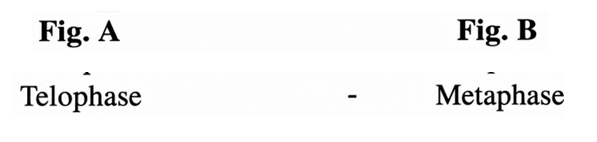
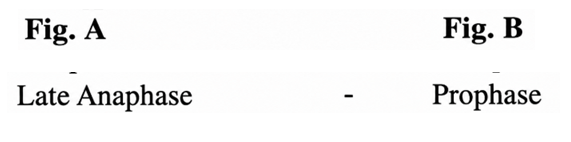
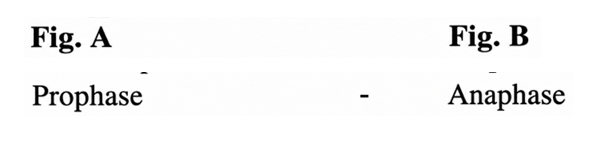
Which stages of cell division do the following figures A and B represent respectively?
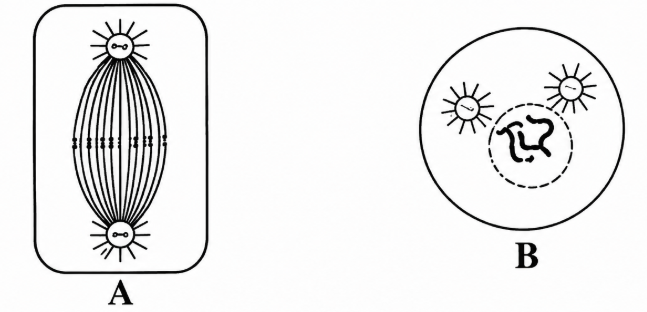
[4 Marks] Diagram 25 – NEET-UG 2010 Question Paper
  • (A) Diagram 26 – NEET-UG 2010 Question Paper
  • (B) Diagram 27 – NEET-UG 2010 Question Paper
  • (C) Diagram 28 – NEET-UG 2010 Question Paper
  • (D) Diagram 29 – NEET-UG 2010 Question Paper
Question 75.

Which one of the following is not a micronutrient?

[4 Marks]
  • (A) Molybdenum
  • (B) Magnesium
  • (C) Zinc
  • (D) Boron
Question 76.

An element playing important role in nitrogen fixation is:

[4 Marks]
  • (A) Zinc
  • (B) Manganese
  • (C) Copper
  • (D) Molybdenum
Question 77.

One of the free-living, anaerobic nitrogen-fixer is:

[4 Marks]
  • (A) Azotobacter
  • (B) Rhizobium
  • (C) Rhodospirillum
  • (D) Beijernickia
Question 78.

PGA as the first CO₂ fixation product was discovered in photosynthesis of:

[4 Marks]
  • (A) Gymnosperm
  • (B) Bryophyte
  • (C) Angiosperm
  • (D) Alga
Question 79.

C₄ plants are more efficient in photosynthesis than C₃ plants due to:

[4 Marks]
  • (A) Presence of larger number of chloroplasts in the leaf cells
  • (B) Higher leaf area
  • (C) Presence of thin cuticle
  • (D) Lower rate of photorespiration
Question 80.

The energy-releasing metabolic process in which substrate is oxidised without an external electron acceptor is called:

[4 Marks]
  • (A) Glycolysis
  • (B) Fermentation
  • (C) Aerobic respiration
  • (D) Photorespiration
Question 81.

Coiling of garden pea tendrils around any support is an example of:

[4 Marks]
  • (A) Thigmotaxis
  • (B) Thigmonasty
  • (C) Thermotaxis
  • (D) Thigmotropism
Question 82.

Phototropic curvature is the result of uneven distribution of:

[4 Marks]
  • (A) Phytochrome
  • (B) Gibberellin
  • (C) Auxin
  • (D) Cytokinins
Question 83.

Photoperiodism was first characterised in:

[4 Marks]
  • (A) Potato
  • (B) Tobacco
  • (C) Tomato
  • (D) Cotton
Question 84.

If for some reason our goblet cells are non functional, this will adversely affect:

[4 Marks]
  • (A) secretion of sebum from the sebaceous glands
  • (B) production of somatostatin
  • (C) maturation of sperms
  • (D) smooth movement of food down the intestine
Question 85.

Listed below are four respiratory capacities (i–iv) and four jumbled respiratory volumes of a normal human adult:

Respiratory capacities

Respiratory volumes

(i) Residual volume

2500 mL

(ii) Vital capacity

3500 mL

(iii) Inspiratory reserve volume

1200 mL

(iv) Inspiratory capacity

4500 mL

Which one of the following is the correct matching of two capacities and volumes?

[4 Marks]
  • (A) (iii) 1200 mL, (iv) 2500 mL
  • (B) (iv) 3500 mL, (i) 1200 mL
  • (C) (i) 4500 mL, (ii) 3500 mL
  • (D) (ii) 2500 mL, (iii) 4500 mL
Question 86.

Which two of the following changes (a–d) usually tend to occur in the plain dwellers when they move to high altitudes (3,500 m or more)?

(i) Increase in red blood cell size
(ii) Increase in red blood cell production
(iii) Increased breathing rate
(iv) Increase in thrombocyte count

Changes occurring are:

[4 Marks]
  • (A) (ii) and (iii)
  • (B) (iii) and (iv)
  • (C) (i) and (iv)
  • (D) (i) and (ii)
Question 87.

ABO blood groups in humans are controlled by the gene I. It has three alleles—Iᴬ, Iᴮ and i. Since there are three different alleles, six different genotypes are possible. How many phenotypes can occur?

[4 Marks]
  • (A) One
  • (B) Two
  • (C) Three
  • (D) Four
Question 88.

What is true about RBCs in humans?

[4 Marks]
  • (A) They do not carry CO₂ at all.
  • (B) They transport 99.5 per cent of O₂.
  • (C) They carry about 20–25 per cent of CO₂.
  • (D) They transport about 80 per cent oxygen only and the rest 20 per cent of it is transported in dissolved state in blood plasma.
Question 89.

If due to some injury the chordae tendinae of the tricuspid valve of the human heart is partially non-functional, what will be the immediate effect?

[4 Marks]
  • (A) The blood will tend to flow back into the left atrium.
  • (B) The flow of blood into the pulmonary artery will be reduced.
  • (C) The flow of blood into the aorta will be slowed down.
  • (D) The ‘pacemaker’ will stop working.
Question 90.

Which one of the following statements in regard to the excretion by the human kidneys is correct?

[4 Marks]
  • (A) Ascending limb of Loop of Henle is impermeable to electrolytes.
  • (B) Nearly 99 per cent of the glomerular filtrate is reabsorbed by the renal tubules.
  • (C) Distal convoluted tubule is incapable of reabsorbing HCO₃⁻.
  • (D) Descending limb of Loop of Henle is impermeable to water.
Question 91.

The principal nitrogenous excretory compound in humans is synthesised:

[4 Marks]
  • (A) In kidneys as well as eliminated by kidneys.
  • (B) In kidneys but eliminated mostly through liver.
  • (C) In liver and also eliminated by the same through bile.
  • (D) In the liver, but eliminated mostly through kidneys.
Question 92.

Consider the following four statements (i–iv) regarding kidney transplant and select the two correct ones out of these.

(i) Even if a kidney transplant is proper, the recipient may need to take immune suppresants for a long time.

(ii) The cell-mediated immune response is responsible for graft rejection.

(iii) The B lymphocytes are responsible for rejection of the graft.

(iv) The acceptance or rejection of a kidney transplant depends only on specific interferons.

The two correct statements are:

[4 Marks]
  • (A) (i) and (ii)
  • (B) (ii) and (iii)
  • (C) (iii) and (iv)
  • (D) (i) and (iii)
Question 93.

Low Ca⁺⁺ in the body fluid may be the cause of:

[4 Marks]
  • (A) Gout
  • (B) Angina pectoris
  • (C) Tetany
  • (D) Anaemia
Question 94.

The nerve centres which control the body temperature and the urge for eating are contained in:

[4 Marks]
  • (A) Cerebellum
  • (B) Thalamus
  • (C) Pons
  • (D) Hypothalamus
Question 95.

Injury to adrenal cortex is not likely to affect the secretion of which one of the following?

[4 Marks]
  • (A) Cortisol
  • (B) Adrenaline
  • (C) Both Androstenedione and Dehydroep iandrosterone
  • (D) Aldosterone
Question 96.

Which one of the following pairs is incorrectly matched?

[4 Marks]
  • (A) Glucagon – Beta cells (source)
  • (B) Somatostatin - Delta cells (source)
  • (C) Corpus luteum - Relaxin (secretion)
  • (D) Insulin - Diabetes mellitus (disease)
Question 97.

Toxic agents present in food which interfere with thyroxine synthesis lead to the development of:

[4 Marks]
  • (A) toxic goitre
  • (B) cretinism
  • (C) simple goitre
  • (D) thyrotoxicosis
Question 98.

Transfer of pollen grains from the anther to the stigma of another flower of the same plant is called

[4 Marks]
  • (A) Xenogamy
  • (B) Geitonogamy
  • (C) Karyogamy
  • (D) Autogamy
Question 99.

Wind pollinated flowers are

[4 Marks]
  • (A) small, producing large number of dry pollen grains
  • (B) large producing abundant nectar and pollen
  • (C) small, brightly coloured, producing large number of pollen grains
  • (D) small, producing nectar and dry pollen
Question 100.

Apomictic embryos in citrus arise from

[4 Marks]
  • (A) Synergids
  • (B) Maternal sporophytic tissue in ovule
  • (C) Antipodal cells
  • (D) Diploid egg
Question 101.

The scutellum observed in a grain of wheat or maize is comparable to which part of the seed in other monocotyledons?

[4 Marks]
  • (A) Cotyledon
  • (B) Endosperm
  • (C) Aleurone layer
  • (D) Plumule
Question 102.

Sertoli cells are found in

[4 Marks]
  • (A) adrenal cortex and secrete adrenaline
  • (B) ovaries and secrete progesterone
  • (C) seminiferous tubules and provide nutrition to germ cells
  • (D) pancreas and secrete cholecystokinin
Question 103.

Vasa efferentia are the ductules leading from

[4 Marks]
  • (A) testicular lobules to rete testis
  • (B) rete testis to vas deferens
  • (C) vas deferens to epididymis
  • (D) epididymis to urethra
Question 104.

Seminal plasma in human males is rich in :

[4 Marks]
  • (A) fructose and calcium
  • (B) glucose and calcium
  • (C) ribose and potassium
  • (D) DNA and testosterone
Question 105.

Which one of the following statements about human sperm is correct?

[4 Marks]
  • (A) Acrosome has a conical pointed structure used for piercing and penetrating the egg, resulting in fertilization
  • (B) The sperm lysins in the acrosome dissolve the egg envelope facilitating fertilisation
  • (C) Acrosome serves as a sensory structure leading the sperm towards the ovum
  • (D) Acrosome serves no particular function
Question 106.

The part of fallopian tube closest to the ovary is

[4 Marks]
  • (A) isthmus
  • (B) infundibulum
  • (C) cervix
  • (D) ampulla
Question 107.

The second maturation division of the mammalian ovum occurs

[4 Marks]
  • (A) shortly after ovulation before the ovum makes entry into the fallopian tube
  • (B) until after the ovum has been penetrated by a sperm
  • (C) until the nucleus of the sperm has fused with that of the ovum
  • (D) in the graafian follicle following the first maturation division
Question 108.

In vitro fertilisation is a technique that involves transfer of which one of the following into the fallopian tube?

[4 Marks]
  • (A) Embryo of 32 cell stage
  • (B) Either zygote or early embryo upto 8 cell stage
  • (C) Zygote only
  • (D) Embryo only, upto 8 cell stage
Question 109.

The signals for parturition originate from

[4 Marks]
  • (A) placenta only
  • (B) placenta as well as fully developed foetus
  • (C) oxytocin released from maternal pituitary
  • (D) fully developed foetus only
Question 110.

The first movements of the foetus and appearance of hair on its head are usually observed during which month of pregnancy?

[4 Marks]
  • (A) Fourth month
  • (B) Fifth month
  • (C) Third month
  • (D) Sixth month
Question 111.

Which one of the following statements about morula in humans is correct?

[4 Marks]
  • (A) It has almost equal quantity of cytoplasm as an uncleaved zygote but much more DNA.
  • (B) It has far less cytoplasm as well as less DNA than in an uncleaved zygote.
  • (C) It has more or less equal quantity of cytoplasm and DNA as in uncleaved zygote.
  • (D) It has more cytoplasm and more DNA than an uncleaved zygote.
Question 112.

Cu ions released from copper-releasing Intra Uterine Devices (IUDs):

[4 Marks]
  • (A) Increase phagocytosis of sperms.
  • (B) Make uterus unsuitable for implantation.
  • (C) Prevent ovulation.
  • (D) Suppress sperm motility.
Question 113.

The permissible use of the technique amniocentesis is for:

[4 Marks]
  • (A) Detecting any genetic abnormality.
  • (B) Artificial insemination.
  • (C) Detecting sex of the unborn foetus.
  • (D) Transfer of embryo into the uterus of the surrogate mother.
Question 114.

Which one of the following cannot be explained on the basis of Mendel's Law of Dominance?

[4 Marks]
  • (A) Factors occur in pairs.
  • (B) Alleles do not show any blending and both the characters recover as such in F₂ generation.
  • (C) Out of one pair of factors one is dominant, and the other recessive
  • (D) The discrete unit controlling a particular character is called a factor.
Question 115.

The genotype of a plant showing the dominant phenotype can be determined by:

[4 Marks]
  • (A) Test cross
  • (B) Dihybrid cross
  • (C) Pedigree analysis
  • (D) Back cross
Question 116.

Select the correct statement from the ones given below with respect to dihybrid cross.

[4 Marks]
  • (A) Tightly linked genes on the same chromosome show higher recombinations.
  • (B) Genes far apart on the same chromosome show very few recombinations.
  • (C) Tightly linked genes on the same chromosome show very few recombinations.
  • (D) Genes loosely linked on the same chromosome show similar recombinations as the tightly linked ones.
Question 117.

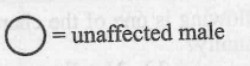
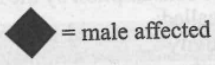
Which one of the following symbols and its representation, used in human pedigree analysis, is correct?

[4 Marks]
  • (A) Diagram 30 – NEET-UG 2010 Question Paper
  • (B) Diagram 31 – NEET-UG 2010 Question Paper
  • (C) Diagram 32 – NEET-UG 2010 Question Paper
  • (D) Diagram 33 – NEET-UG 2010 Question Paper
Question 118.

Infectious proteins are present in:

[4 Marks]
  • (A) Prions
  • (B) Gemini viruses
  • (C) Viroids
  • (D) Satellite viruses
Question 119.

Which one of the following does not follow the central dogma of molecular biology?

[4 Marks]
  • (A) Chlamydomonas
  • (B) HIV
  • (C) Mucor
  • (D) Pea
Question 120.

The one aspect which is not a salient feature of genetic code, is its being:

[4 Marks]
  • (A) ambiguous
  • (B) degenerate
  • (C) universal
  • (D) specific
Question 121.

Select the two correct statements out of the four (a–d) given below about lac operon.

(i) Glucose or galactose may bind with the repressor and inactivate it.

(ii) In the absence of lactose the repressor binds with the operator region.

(iii) The Z-gene codes for permease.

(iv) This was elucidated by Francois Jacob and Jacque Monod.

The correct statements are:

[4 Marks]
  • (A) (i) and (ii)
  • (B) (ii) and (iv)
  • (C) (ii) and (iii)
  • (D) (i) and (iii)
Question 122.

Satellite DNA is useful tool in:

[4 Marks]
  • (A) Organ transplantation
  • (B) Sex determination
  • (C) Forensic science
  • (D) Genetic engineering
Question 123.

Darwin’s finches are a good example of:

[4 Marks]
  • (A) Industrial melanism
  • (B) Connecting link
  • (C) Adaptive radiation
  • (D) Convergent evolution
Question 124.

Widal test is used for the diagnosis of:

[4 Marks]
  • (A) Malaria
  • (B) Pneumonia
  • (C) Typhoid
  • (D) Tuberculosis
Question 125.

Ringworm in humans is caused by:

[4 Marks]
  • (A) Viruses
  • (B) Nematodes
  • (C) Fungi
  • (D) Bacteria
Question 126.

Which one of the following statements is correct with respect to AIDS?

[4 Marks]
  • (A) The HIV can be transmitted through eating food together with an infected person.
  • (B) Drug addicts are least susceptible to HIV infection.
  • (C) The causative HIV retrovirus enters helper T-lymphocytes thus reducing their numbers.
  • (D) AIDS patients are being fully cured cent per cent with proper care and nutrition.
Question 127.

Select the correct statement from the ones given below?

[4 Marks]
  • (A) Barbiturates when given to criminals make them tell the truth
  • (B) Morphine is often given to persons who have undergone surgery as a pain killer
  • (C) Chewing tobacco lowers blood pressure and heart rate
  • (D) Cocaine is given to patients after surgery as it stimulates recovery
Question 128.

Breeding of crops with high levels of minerals, vitamins and proteins is called

[4 Marks]
  • (A) Micropropagation
  • (B) Biomagnification
  • (C) Biofortification
  • (D) Somatic hybridisation
Question 129.

An improved variety of transgenic basmati rice

[4 Marks]
  • (A) gives high yield but has no characteristic aroma
  • (B) is completely resistant to all insect pests and diseases of paddy
  • (C) gives high yield and is rich in vitamin A
  • (D) does not require chemical fertilizers and growth hormones
Question 130.

A common biocontrol agent for the control of plant diseases is

[4 Marks]
  • (A) Trichoderma
  • (B) Glomus
  • (C) Bacillus thuringiensis
  • (D) Baculovirus
Question 131.

The common nitrogen fixer in paddy fields is

[4 Marks]
  • (A) Azospirillum
  • (B) Rhizobium
  • (C) Oscillatoria
  • (D) Frankia
Question 132.

Which one of the following is not used in organic farming

[4 Marks]
  • (A) Glomus
  • (B) Oscillatoria
  • (C) Earthworm
  • (D) Snail
Question 133.

Select the correct statement from the following

[4 Marks]
  • (A) Biogas, commonly called gobar gas, is pure methane
  • (B) Methanobacterium is an aerobic bacterium found in rumen of cattle
  • (C) Activated sludge-sediment in settlement tanks of sewage treatment plant is a rich source of aerobic bacteria
  • (D) Biogas is produced by the activity of aerobic bacteria on animal waste
Question 134.

Which one of the following is used as vector for cloning genes info higher organisms?

[4 Marks]
  • (A) Baculovirus
  • (B) Rhizopus nigricans
  • (C) Salmonella typhimurium
  • (D) Retrovirus
Question 135.

DNA or RNA segment tagged with a radioactive molecule is called:

[4 Marks]
  • (A) Probe
  • (B) Vector
  • (C) Clone
  • (D) Plasmid
Question 136.

Restriction endonucleases are enzymes which:

[4 Marks]
  • (A) Make cuts at specific positions within the DNA molecule.
  • (B) Recognize a specific nucleotide sequence for binding of DNA ligase.
  • (C) Restrict the action of the enzyme DNA polymerase.
  • (D) Remove nucleotides from the ends of the DNA molecule.
Question 137.

Stirred tank bioreactors have been designed for:

[4 Marks]
  • (A) Ensuring anaerobic conditions in the culture vessel.
  • (B) Availability of oxygen throughout the process.
  • (C) Purification of the product.
  • (D) addition of preservatives to the product
Question 138.

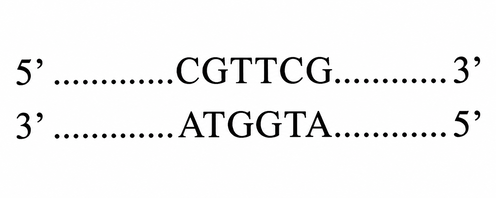
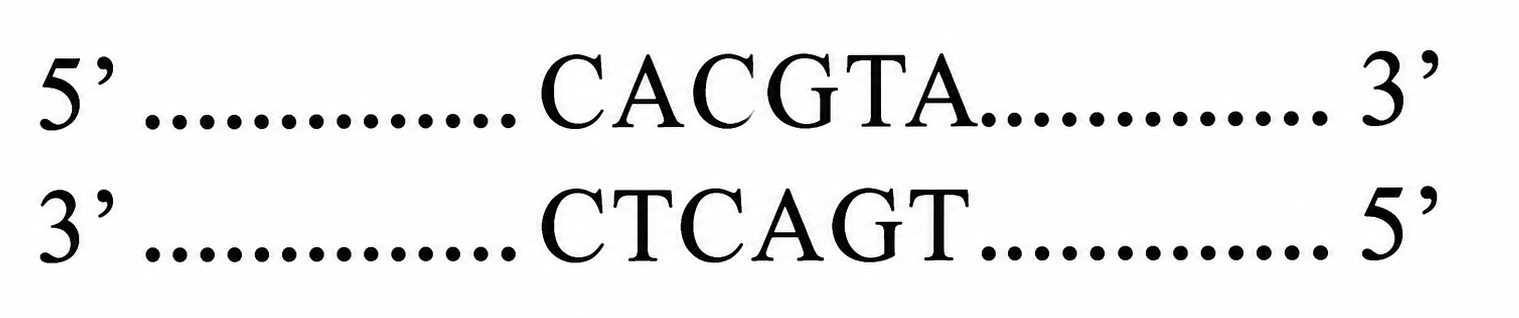
Which one of the following palindromic base sequences in DNA can be easily cut at about the middle by some particular restriction enzyme?

[4 Marks]
  • (A) Diagram 34 – NEET-UG 2010 Question Paper
  • (B) Diagram 35 – NEET-UG 2010 Question Paper
  • (C) Diagram 36 – NEET-UG 2010 Question Paper
  • (D) Diagram 37 – NEET-UG 2010 Question Paper
Question 139.

The genetically-modified (GM) brinjal in India has been developed for:

[4 Marks]
  • (A) enhancing mineral content
  • (B) drought-resistance
  • (C) insect-resistance
  • (D) enhancing shelf life
Question 140.

Some of the characteristics of Bt cotton are:

[4 Marks]
  • (A) long fibre and resistance to aphids
  • (B) medium yield, long fibre and resistance to beetle pests
  • (C) high yield and production of toxic protein crystals which kill dipteran pests
  • (D) high yield and resistance to bollworms
Question 141.

Genetic engineering has been successfully used for producing:

[4 Marks]
  • (A) Transgenic cow Rosie which produces high-fat milk for making ghee
  • (B) Transgenic models for studying new treatments for certain cardiac diseases
  • (C) Transgenic mice for testing safety of polio vaccine before use in humans
  • (D) Animals like bulls for farm work as they have super power
Question 142.

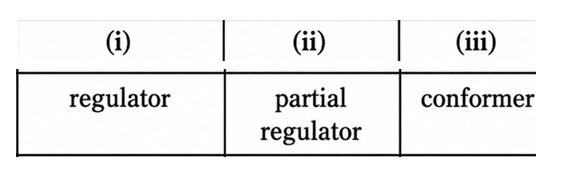
The figure given below is a diagrammatic representation of response of organisms to abiotic factors. What do a, b and c represent respectively?
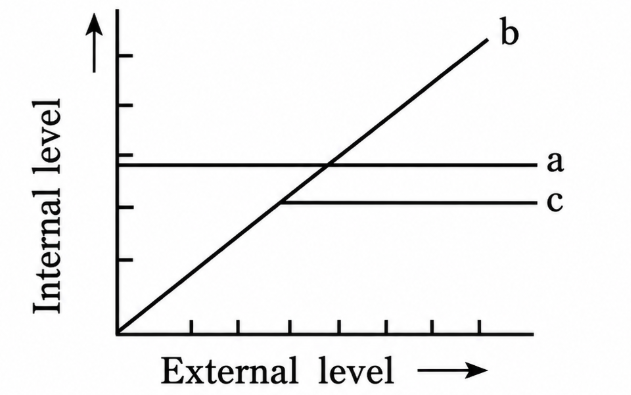
[4 Marks] Diagram 38 – NEET-UG 2010 Question Paper
  • (A) Diagram 39 – NEET-UG 2010 Question Paper
  • (B) Diagram 40 – NEET-UG 2010 Question Paper
  • (C) Diagram 41 – NEET-UG 2010 Question Paper
  • (D) Diagram 42 – NEET-UG 2010 Question Paper
Question 143.

Which one of the following is one of the characteristics of a biological community?

[4 Marks]
  • (A) Natality
  • (B) Stratification
  • (C) Mortality
  • (D) Sex ratio
Question 144.

The biomass available for consumption by the herbivores and the decomposers is called:

[4 Marks]
  • (A) Net primary productivity
  • (B) Standing crop
  • (C) Secondary productivity
  • (D) Gross primary productivity
Question 145.

Study the four statements (i–iv) given below and select the two correct ones out of them:

(i) A lion eating a deer and a sparrow feeding on grain are ecologically similar in being consumers.

(ii) Predator star fish Pisaster helps in maintaining species diversity of some invertebrates.

(iii) Predators ultimately lead to the extinction of prey species.

(iv) Production of chemicals such as nicotine, strychnine by the plants are metabolic disorders.

The two correct statements are:

[4 Marks]
  • (A) (i) and (ii)
  • (B) (i) and (iv)
  • (C) (iii) and (iv)
  • (D) (ii) and (iii)
Question 146.

Which one of the following is an example of Exsitu conservation?

[4 Marks]
  • (A) National park
  • (B) Sacred groves
  • (C) Seed bank
  • (D) Wildlife sanctuary
Question 147.

dB is a standard abbreviation used for the quantitative expression of:

[4 Marks]
  • (A) The density of bacteria in a medium
  • (B) A particular pollutant
  • (C) A certain pesticide
  • (D) The dominant Bacillus in a culture
Question 148.

A renewable exhaustible natural resource is:

[4 Marks]
  • (A) Coal
  • (B) Minerals
  • (C) Petroleum
  • (D) Forest
Question 149.

The two gases making highest relative contribution to the greenhouse gases are:

[4 Marks]
  • (A) CH₄ and N₂O
  • (B) CFC₅ and N₂O
  • (C) CO₂ and N₂O
  • (D) CO₂ and CH₄
Question 150.

Carrier ions like Na⁺ facilitate the absorption of substances like:

[4 Marks]
  • (A) Glucose and fatty acids
  • (B) Amino acids and glucose
  • (C) Fatty acids and glycerol
  • (D) Fructose and some amino acids
Question 151.

The dimension of (1 / 2)ε₀E², where ε₀ is permittivity of free space and E is electric field, is:

[4 Marks]
  • (A) [ML²T⁻²]
  • (B) [ML⁻¹T⁻²]
  • (C) [MLT⁻¹]
  • (D) [ML²T⁻¹]
Question 152.

A particle has initial velocity (3î + 4ĵ) and has acceleration (0.4î + 0.3ĵ). It's speed after 10 s is:

[4 Marks]
  • (A) 7√2 units
  • (B) 8.5 units
  • (C) 7 units
  • (D) 10 units
Question 153.

A particle moves a distance x in time t according to the equation x = (t+5)⁻¹. The acceleration of the particle is proportional to:

[4 Marks]
  • (A) (velocity)²ᐟ³
  • (B) (distance)⁻²
  • (C) (distance)²
  • (D) (velocity)³ᐟ²
Question 154.

A ball is dropped from a high-rise platform at t = 0 starting from rest. After 6 seconds, another ball is thrown downwards from the same platform with a speed v. The two balls meet at t = 18 s. What is the value of v? (Take g = 10 m/s²)

[4 Marks]
  • (A) 55 m/s
  • (B) 75 m/s
  • (C) 60 m/s
  • (D) 40 m/s
Question 155.

A man of 50 kg mass is standing in a gravity-free space at a height of 10 m above the floor. He throws a stone of 0.5 kg mass downwards with a speed of 2 m/s. When the stone reaches the floor, the distance of the man above the floor will be:

[4 Marks]
  • (A) 20 m
  • (B) 10 m
  • (C) 10.1 m
  • (D) 9.9 m
Question 156.

Six vectors, 𝐚⃗ through 𝐟⃗ have the magnitudes and directions indicated in the figure. Which of the following statements is true?
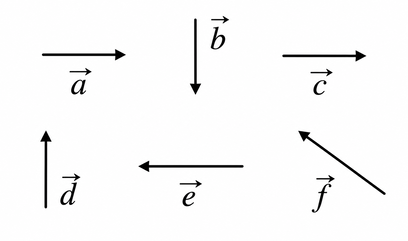
[4 Marks] Diagram 43 – NEET-UG 2010 Question Paper
  • (A) 𝐝⃗ + 𝐜⃗ = 𝐟⃗
  • (B) 𝐝⃗ + 𝐞⃗ = 𝐟⃗
  • (C) 𝐛⃗ + 𝐞⃗ = 𝐟⃗
  • (D) 𝐛⃗ + 𝐜⃗ = 𝐟⃗
Question 157.

A block of mass m is in contact with the cart C as shown in the Figure.

The coefficient of static friction between the block and the cart is μ. The acceleration α of the cart that will prevent the block from falling satisfies:
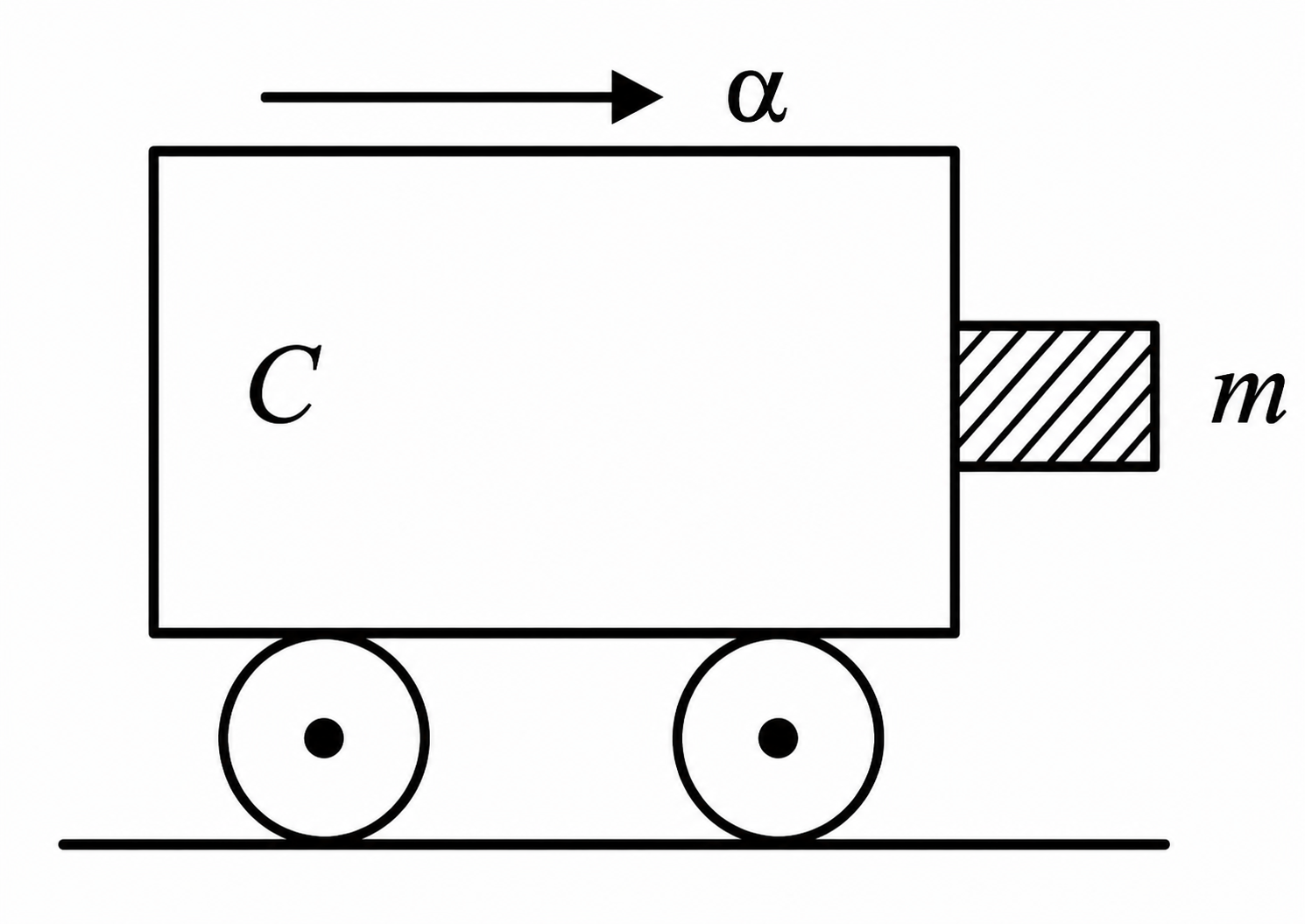
[4 Marks] Diagram 44 – NEET-UG 2010 Question Paper
  • (A) α ≥ (g / μ)
  • (B) α < (g / μ)
  • (C) α > mg / μ
  • (D) α > g / μm
Question 158.

An engine pumps water through a hose pipe. Water passes through the pipe and leaves it with a velocity of 2 m/s. The mass per unit length of water in the pipe is 100 kg/m. What is the power of the engine?

[4 Marks]
  • (A) 400 W
  • (B) 200 W
  • (C) 100 W
  • (D) 800 W
Question 159.

A ball moving with velocity 2 m/s collides head-on with another stationary ball of double the mass. If the coefficient of restitution is 0.5, then their velocities (in m/s) after collision will be:

[4 Marks]
  • (A) 1, 0.5
  • (B) 0, 1
  • (C) 1, 1
  • (D) 0, 2
Question 160.

Two particles which are initially at rest, move towards each other under the action of their internal attraction. If their speeds are v and 2v at any instant, then the speed of centre of mass of the system will be:

[4 Marks]
  • (A) zero
  • (B) 2v
  • (C) v
  • (D) 1.5
Question 161.

A circular disk of moment of inertia Iₜ is rotating in a horizontal plane, its symmetry axis, with a constant angular speed ωᵢ. Another disk of moment of inertia I_b is dropped coaxially onto the rotating disk. Initially the second disk has zero angular speed. Eventually both the disks rotate with a constant angular speed ω_f. The energy lost by the initially rotating disk to friction is:

[4 Marks]
  • (A) 1 / 2 [I_b² / (Iₜ + I_b)] ωᵢ²
  • (B) [Iₜ² / (Iₜ + I_b)] ωᵢ²
  • (C) 1 / 2 [I_b Iₜ / (Iₜ + I_b)] ωᵢ²
  • (D) [(I_b − Iₜ) / (Iₜ + I_b)] ωᵢ²
Question 162.

A particle of mass M is situated at the centre of a spherical shell of same mass and radius a. The gravitational potential at a point situated at a / 2 distance from the centre, will be:

[4 Marks]
  • (A) -2GM / a
  • (B) -3GM / a
  • (C) -GM / a
  • (D) -4GM / a
Question 163.

The radii of circular orbits of two satellites A and B of the Earth are 4R and R, respectively. If the speed of satellite A is 3 V, the speed of satellite B will be:

[4 Marks]
  • (A) 3V / 2
  • (B) 12V
  • (C) 6V
  • (D) 3V / 4
Question 164.

A cylindrical metallic rod in thermal contact with two reservoirs of heat at its two ends conducts an amount of heat Q in time t. The metallic rod is melted and the material is formed into a rod of half the radius of the original rod. What is the amount of heat conducted by the new rod, when placed in thermal contact with the two reservoirs, in time t?

[4 Marks]
  • (A) 2Q
  • (B) Q / 2
  • (C) Q / 16
  • (D) Q / 4
Question 165.

The total radiant energy per unit area, normal to the direction of incidence, received at a distance R from the centre of a star of radius r, whose surface radiates as a black body at a temperature T K is given by:

(where σ is Stefan's constant)

[4 Marks]
  • (A) 4πσr²T⁴ / R²
  • (B) σr⁴T⁴ / R⁴²
  • (C) σr² T⁴ / R²
  • (D) σr²T⁴ / 4πR²
Question 166.

If ΔU and ΔW represent the increase in internal energy and work done by the system respectively in a thermodynamical process, which of the following is true?

[4 Marks]
  • (A) ΔU = ΔW, in an adiabatic process
  • (B) ΔU = −ΔW, in an adiabatic process
  • (C) ΔU = − ΔW, in an isothermal process
  • (D) ΔU = ΔW, in an isothermal process
Question 167.

The displacement of a particle along the x-axis is given by x = a sin²(ωt). The motion of the particle corresponds to:

[4 Marks]
  • (A) Non-simple harmonic motion
  • (B) Simple harmonic motion of frequency ω / 2π
  • (C) Simple harmonic motion of frequency ω / π
  • (D) Simple harmonic motion of frequency 3ω / 2π
Question 168.

The period of oscillation of a mass M suspended from a spring of negligible mass is T. If along with it another mass M is also suspended, the period of oscillation will now be:

[4 Marks]
  • (A) T
  • (B) T/√2
  • (C) √2T
  • (D) 2T
Question 169.

A transverse wave is represented by y = Asin(ωt − kx). For what value of the wavelength is the wave velocity equal to the maximum particle velocity?

[4 Marks]
  • (A) πA/2
  • (B) 2πA
  • (C) A
  • (D) πA
Question 170.

A tuning fork of frequency 512 Hz makes 4 beats per second with the vibrating string of a piano. The beat frequency decreases to 2 beats per second when the tension in the piano string is slightly increased. The frequency of the piano string before increasing the tension was:

[4 Marks]
  • (A) 514 Hz
  • (B) 510 Hz
  • (C) 508 Hz
  • (D) 516 Hz
Question 171.

Two positive ions, each carrying a charge q, are separated by a distance d. If F the force of repulsion between the ions, the number of electrons missing from each ion will be (e being the charge of an electron):

[4 Marks]
  • (A) 4πε₀Fd² / e²
  • (B) √(4πε₀Fd² / e²)
  • (C) 4πε₀Fd² / q²
  • (D) √(4πε₀Fe² / d²)
Question 172.

A square surface of side L meter in the plane of the paper is placed in a uniform electric field E (volt/m) acting along the same plane at an angle θ with the horizontal side of the square as shown in the figure. The electric flux linked to the surface, in units of volt·m, is:
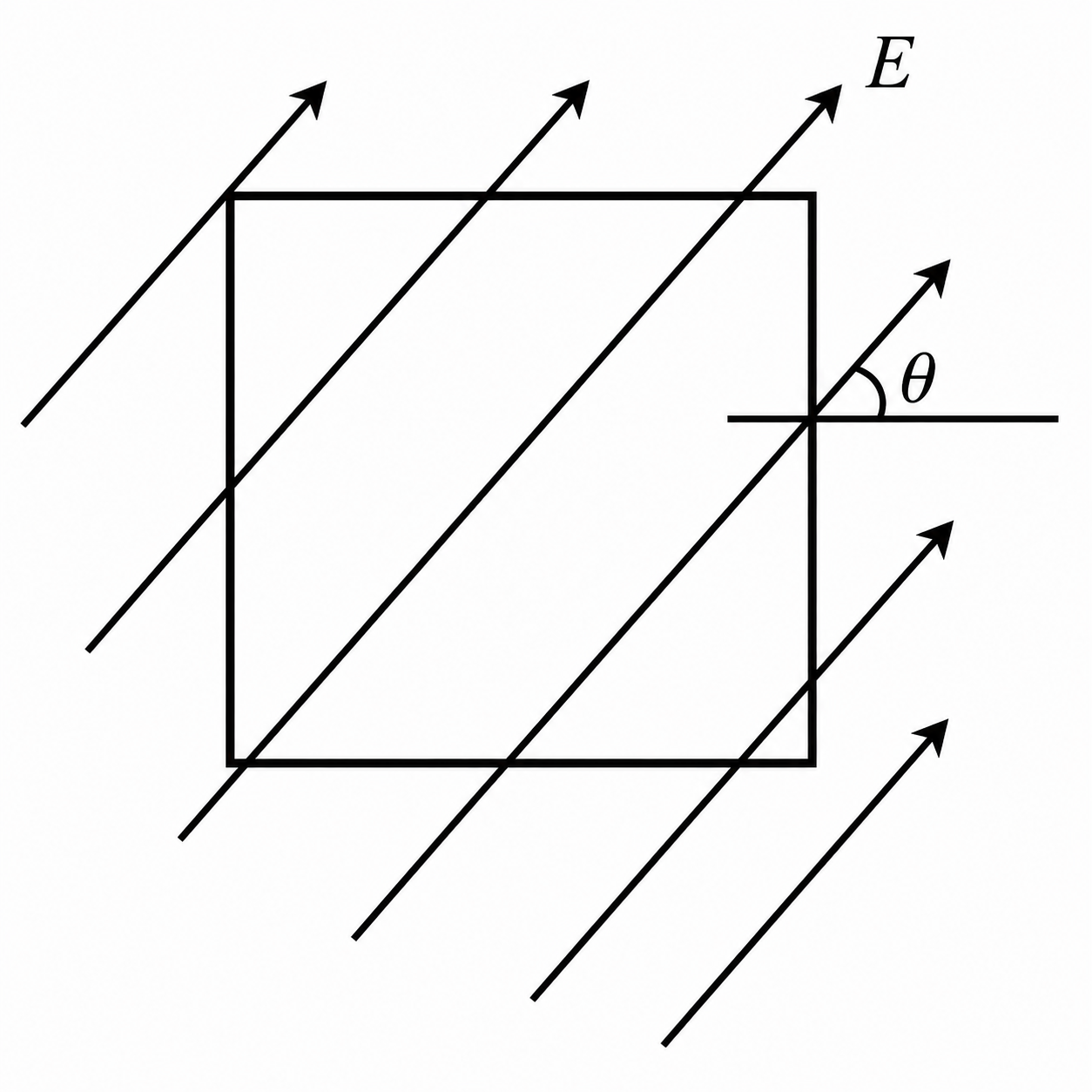
[4 Marks] Diagram 45 – NEET-UG 2010 Question Paper
  • (A) EL²
  • (B) EL² cos θ
  • (C) EL² sin θ
  • (D) zero
Question 173.

A series combination of n₁ capacitors, each of value C₁, is charged by a source of potential difference 4 V. When another parallel combination of n₂ capacitors, each of value C₂, is charged by a source of potential difference V, it has the same (total) energy stored in it, as the first combination has. The value of C₂, in terms of C₁, is then

[4 Marks]
  • (A) 2C₁ / n₁n₂
  • (B) 16(n₂ / n₁) C₁
  • (C) 2(ⁿ₂ / n₁) C₁
  • (D) 16C₁ / n₁n₂
Question 174.

In producing chlorine by electrolysis 100 kW power at 125 V is being consumed. How much chlorine per minute is liberated? (E.C.E. of chlorine is 0.367×10⁻⁶ kg/C)

[4 Marks]
  • (A) 3.67 × 10⁻³ kg
  • (B) 17.61 × 10⁻³ kg
  • (C) 9.67 × 10⁻³ kg
  • (D) 1.76 × 10⁻³ kg
Question 175.

Consider the following two statements:

(A) Kirchhoff's junction law follows from the conservation of charge.

(B) Kirchhoff's loop law follows from the conservation of energy.

Which of the following is correct?

[4 Marks]
  • (A) Both (A) and (B) are wrong
  • (B) (A) is correct and (B) is wrong
  • (C) (A) is wrong and (B) is correct
  • (D) Both (A) and (B) are correct
Question 176.

A potentiometer circuit is set up as shown. The potential gradient across the potentiometer wire is k volt/cm and the ammeter, present in the circuit, reads 1.0 A when two way key is switched off. The balance points, when the key between the terminals (i) 1 and 2 (ii) 1 and 3 is plugged in, are found to be at lengths l₁ cm and l₂ cm, respectively.

The magnitudes of the resistors R and X, in ohms, are then equal, respectively, to
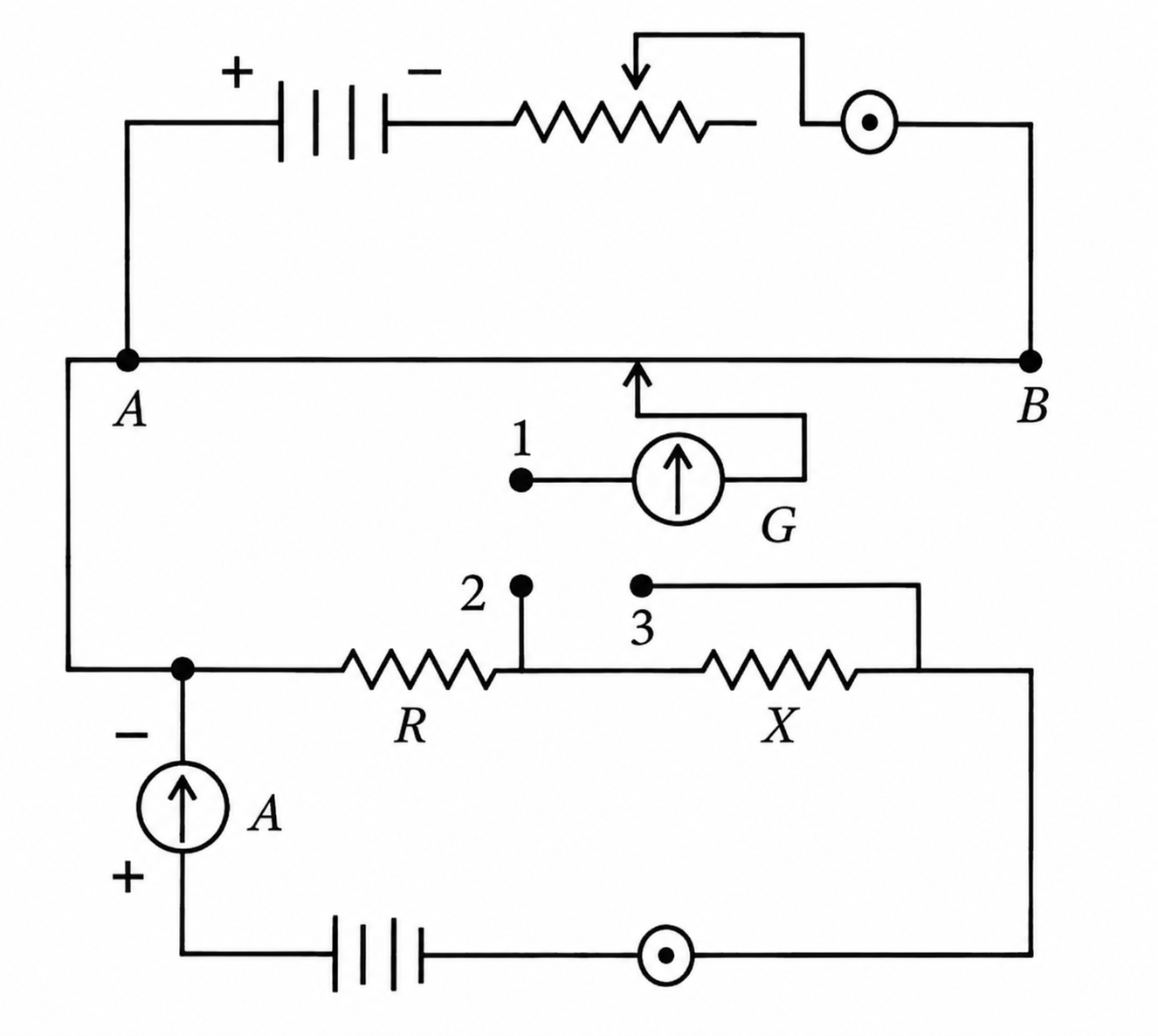
[4 Marks] Diagram 46 – NEET-UG 2010 Question Paper
  • (A) k l₁ and k l₂
  • (B) k(l₂-l₁) and k l₁
  • (C) k l₁ and k(l₂-l₁)
  • (D) k(l₂-l₁) and k l₂
Question 177.

Charge q is uniformly spread on a thin ring of radius R. The ring rotates about its axis with a uniform frequency f Hz. The magnitude of magnetic induction at the centre of the ring is

[4 Marks]
  • (A) μ₀q / 2f R
  • (B) μ₀qf / 2R
  • (C) μ₀q / 2πf R
  • (D) μ₀qf / 2πR
Question 178.

A circular coil ABCD carrying a current i is placed in a uniform magnetic field. If the magnetic force on the segment AB is 𝐅⃗, the force on the remaining segment BCDA is:
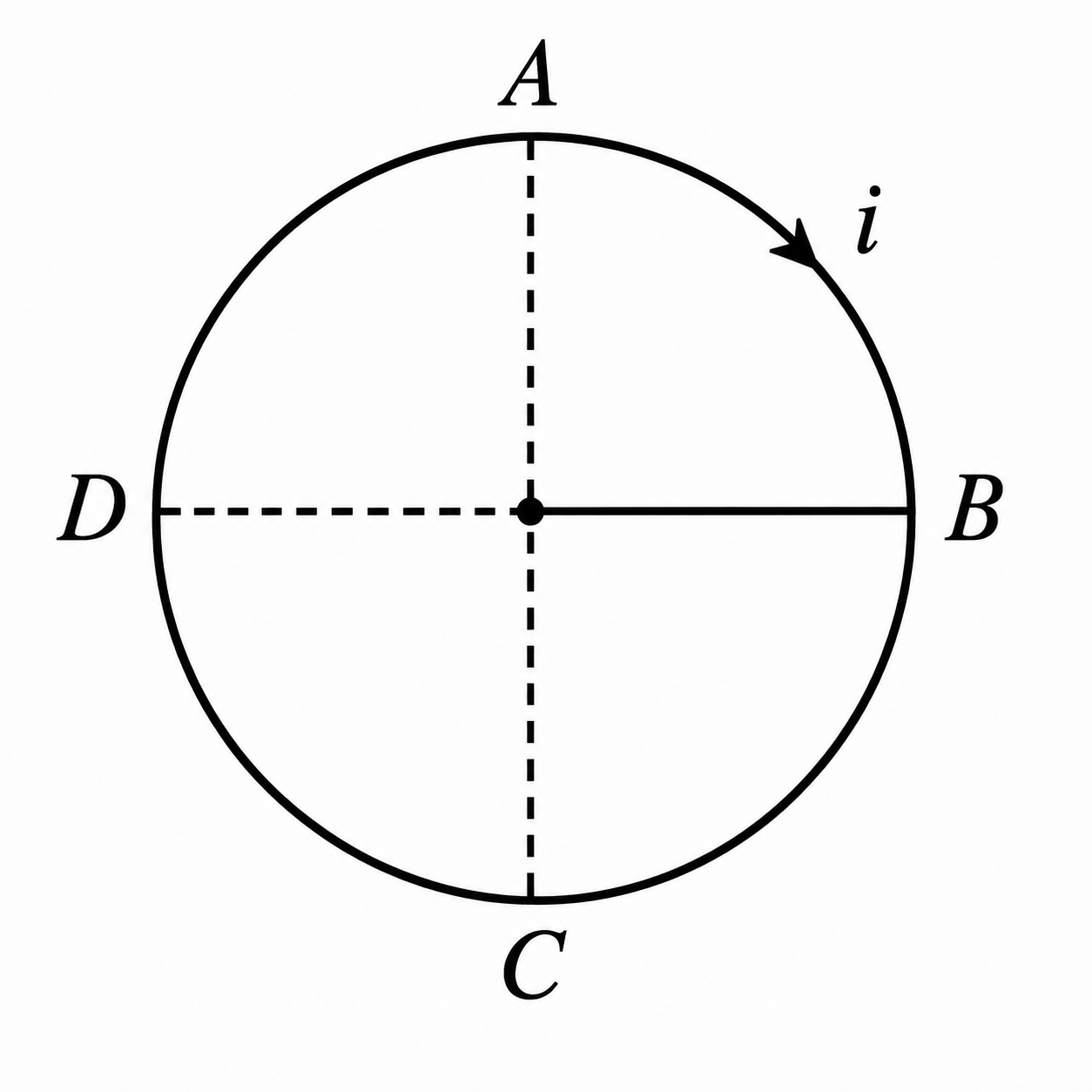
[4 Marks] Diagram 47 – NEET-UG 2010 Question Paper
  • (A) 3𝐅⃗
  • (B) -𝐅⃗
  • (C) -3𝐅⃗
  • (D) 𝐅⃗
Question 179.

A galvanometer has a coil of resistance 100 Ω and gives a full-scale deflection for 30 mA current. It is to work as a voltmeter of 30 volt range, the resistance required to be added will be:

[4 Marks]
  • (A) 900 Ω
  • (B) 1800 Ω
  • (C) 1000 Ω
  • (D) 500 Ω
Question 180.

Electromagnets are made of soft iron because soft iron has:

[4 Marks]
  • (A) Low retentivity and low coercive force
  • (B) High retentivity and low coercive force
  • (C) Low retentivity and high coercive force
  • (D) High retentivity and high coercive force
Question 181.

A vibration magnetometer placed in magnetic meridian has a small bar magnet. The magnet executes oscillations with a time period of 2 sec in Earth's horizontal magnetic field of 24 microtesla. When a horizontal field of 18 microtesla is produced opposite to the earth's field by placing a current-carrying wire, the new time period of magnet will be:

[4 Marks]
  • (A) 4 s
  • (B) 3 s
  • (C) 2 s
  • (D) 1 s
Question 182.

A conducting circular loop is placed in a uniform magnetic field, B = 0.025 T, with its plane perpendicular to the loop. The radius of the loop is made to shrink at a constant rate of 1 mm s⁻¹. The induced e.m.f. when the radius is 2 cm, is

[4 Marks]
  • (A) (π / 2) μV
  • (B) 2μ V
  • (C) π μV
  • (D) 2π μV
Question 183.

In the given circuit, the reading of voltmeter V₁ and V₂ are 300 volts each. The reading of the voltmeter V₃ and ammeter A are respectively:
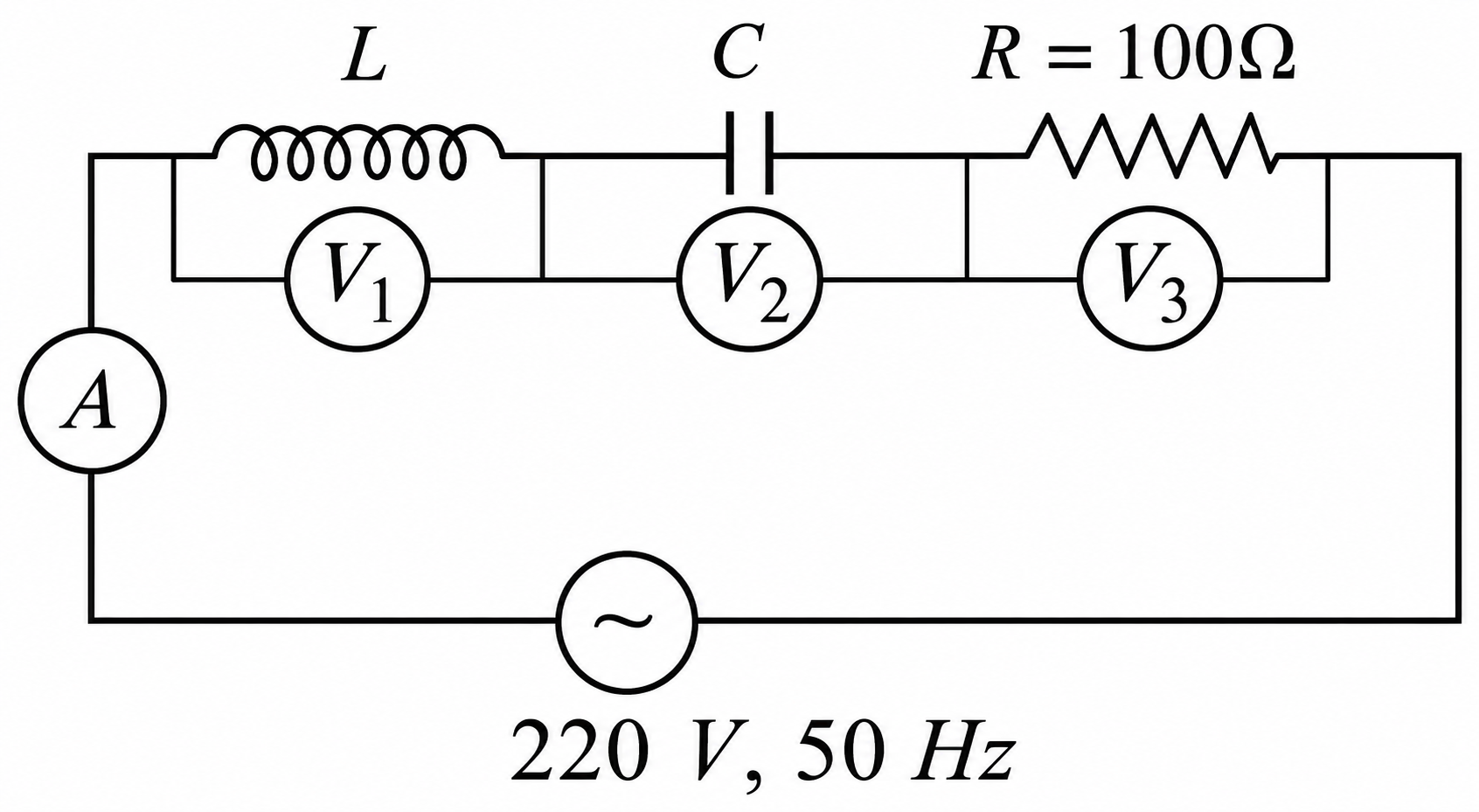
[4 Marks] Diagram 48 – NEET-UG 2010 Question Paper
  • (A) 100 V, 2.0 A
  • (B) 220 V, 2.0 A
  • (C) 150 V, 2.2 A
  • (D) 220 V, 2.2 A
Question 184.

A 220 volt input is supplied to a transformer. The output circuit draws a current of 2.0 ampere at 440 volts. If the efficiency of the transformer is 80%, the current drawn by the primary windings of the transformer is:

[4 Marks]
  • (A) 2.5 ampere
  • (B) 5.0 ampere
  • (C) 2.8 ampere
  • (D) 3.6 ampere
Question 185.

Which one of the following statements is false for the properties of electromagnetic wave?

[4 Marks]
  • (A) Both electric and magnetic field vectors are parallel to each other and perpendicular to the direction of propagation of wave.
  • (B) These waves do not require any material medium for propagation.
  • (C) Both electric and magnetic field vectors attain the maxima and minima at the same place and same time.
  • (D) The energy in electromagnetic wave is divided equally between electric and magnetic field vectors.
Question 186.

A ray of light travelling in a transparent medium of refractive index μ, falls on a surface separating the medium from air at an angle of incidence of 45°. For which of the following values of μ the ray can undergo total internal reflection?

[4 Marks]
  • (A) μ = 1.25
  • (B) μ = 1.40
  • (C) μ = 1.50
  • (D) μ = 1.33
Question 187.

A lens having focal length f and aperture of diameter d forms an image of intensity I. Aperture of diameter d/2 in the central region of the lens is covered by a black paper. Focal length of lens and intensity of image now will be respectively:

[4 Marks]
  • (A) f / 2 and I / 2
  • (B) f and 3I / 4
  • (C) f and I / 4
  • (D) 3f / 4 and I / 2
Question 188.

A source S₁ is producing 10¹⁵ photons per second of wavelength 5000 Å. Another source S₂ is producing 1.02 × 10¹⁵ photons per second of wavelength 5100 Å. Then, (power of S₂) (power of S₁) is equal to:

[4 Marks]
  • (A) 0.98
  • (B) 1.04
  • (C) 1.00
  • (D) 1.02
Question 189.

The potential difference that must be applied to stop the fastest photoelectrons emitted by a nickel surface, having work function 5.01 eV, when ultraviolet light of 200 nm falls on it, must be:

[4 Marks]
  • (A) −2.4 V
  • (B) 1.2 V
  • (C) 2.4 V
  • (D) −1.2 V
Question 190.

An alpha nucleus of energy (1 / 2)mv² bombards a heavy nuclear target of charge Ze. Then the distance of closest approach for the alpha nucleus will be proportional to:

[4 Marks]
  • (A) 1 / Ze
  • (B) v²
  • (C) 1 / v⁴
  • (D) 1 / m
Question 191.

The energy of hydrogen atom in the ground state is −13.6 eV. The energy of a He⁺ ion in the first excited state will be:

[4 Marks]
  • (A) −13.6 eV
  • (B) −27.2 eV
  • (C) −6.8 eV
  • (D) −54.4 eV
Question 192.

The mass of a ⁷₃​Li nucleus is 0.042 u less than the sum of the masses of all its nucleons. The binding energy per nucleon of the ⁷₃​Li nucleus is nearly:

[4 Marks]
  • (A) 46 MeV
  • (B) 5.6 MeV
  • (C) 3.9 MeV
  • (D) 23 MeV
Question 193.

The activity of a radioactive sample is measured as N₀ counts per minute at t = 0 and N₀/e counts per minute at t = 5 minutes. The time (in minutes) at which the activity reduces to half its value is:

[4 Marks]
  • (A) logₑ 2/5
  • (B) 5/logₑ2
  • (C) 5 logₑ2
  • (D) 5 log₁₀ 2
Question 194.

Which one of the following statement is FALSE?

[4 Marks]
  • (A) Pure Si doped with trivalent impurities gives a p-type semiconductor
  • (B) Majority carriers in a n-type semiconductor are holes
  • (C) The resistance of intrinsic semiconductor decreases with increase of temperature
  • (D) Minority carriers in a p-type semiconductor are electrons
Question 195.

Which one of the following bonds produces a solid that reflects light in the visible region and whose electrical conductivity decreases with temperature and has high melting point?

[4 Marks]
  • (A) Metallic bonding
  • (B) van der Waal's bonding
  • (C) Ionic bonding
  • (D) Covalent bonding
Question 196.

A common emitter amplifier has a voltage gain of 50, an input impedance of 100 Ω and an output impedance of 200 Ω. The power gain of the amplifier is:

[4 Marks]
  • (A) 1000
  • (B) 500
  • (C) 1250
  • (D) 50
Question 197.

The device that can act as a complete electronic circuit is:

[4 Marks]
  • (A) Junction diode
  • (B) Integrated circuit
  • (C) Junction transistor
  • (D) Zener diode
Question 198.

A beam of cathode rays is subjected to crossed electric (E) and magnetic field (B). The fields are adjusted such that the beam is not deflected. The specific charge of the cathode rays is given by:

(where V is the potential difference between cathode and anode.)

[4 Marks]
  • (A) E² / 2VB²
  • (B) 2VE² / B²
  • (C) B² / 2VE²
  • (D) 2VB² / E²
Question 199.

To get output 1 for the following circuit, the correct choice for the input is:
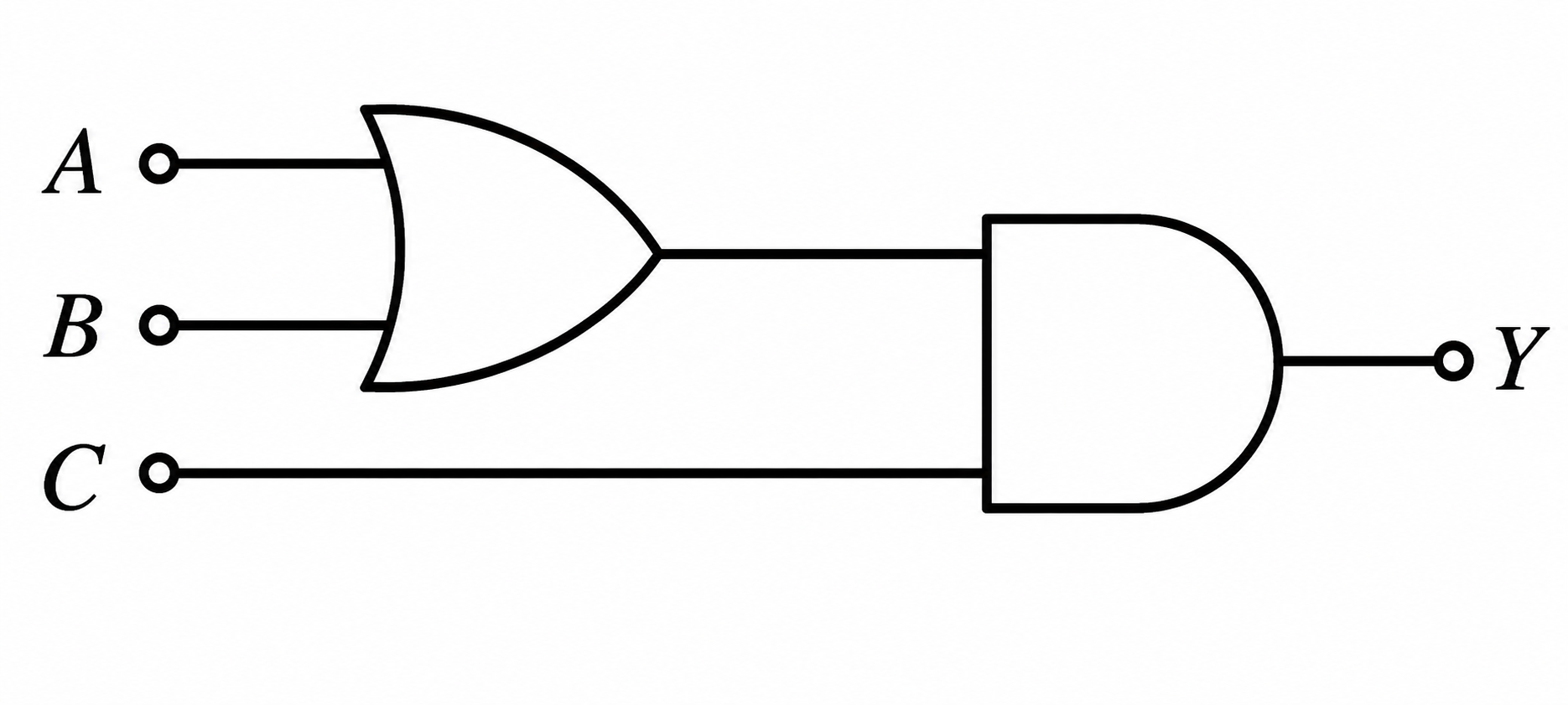
[4 Marks] Diagram 49 – NEET-UG 2010 Question Paper
  • (A) A = 0, B = 1, C = 0
  • (B) A = 1, B = 0, C = 0
  • (C) A = 1, B = 1, C = 0
  • (D) A = 1, B = 0, C = 1
Question 200.

A gramophone record is revolving with an angular velocity ω. A coin is placed at a distance r from the centre of the record. The static coefficient of friction is μ. The coin will revolve with the record if

[4 Marks]
  • (A) r ≥ μg/ω²
  • (B) r ≤ μg/ω²
  • (C) r < ω²/μg
  • (D) r = μgω²