SOLUTIONS
2026 BOARD EXAM
CBSE Class 12 Humanities Geography Board Paper 2026 — Set 3 Solutions
2026
Geography
Class 12 Humanities
CBSE EXAMINATION PAPER-2026
GEOGRAPHY
(Solved)
General Instructions :
Read the following instructions carefully and follow them :
- This question paper contains 31 questions. All questions are compulsory.
- This question paper is divided into 4 sections.
- Section A – questions number 1 to 1 are case based questions
- Section B – questions number 2 to 18 are multiple choice questions
- Section C – questions number 19 to 22 are short answer
- Section D – questions number 23 to 31 are long answer
- There is no overall choice given in the question paper. However, an internal choice has been provided in few questions.
- Use of calculator is NOT allowed.
Section A
Read the given passage carefully and answer the questions that follow :
Water Pollution
Water pollution is a source of various water-borne diseases. The diseases commonly caused due to contaminated water are diarrhoea, intestinal worms, hepatitis, etc. The World Health Organization shows that about one-fourth of the communicable diseases in India are water-borne. Though river pollution is common to all rivers, yet pollution of the river Ganga flowing through one of the most populous regions of India has caused great concerns among all. To improve the condition of the river, National Mission for Clean Ganga was initiated. The Namami Gange Programme has been launched for the same.
(1) Describe the main cause of water pollution.
[1 Mark](2) Mention any two features of the Namami Gange Programme.
[1 Mark](3) Explain the impact of water pollution on human health.
[1 Mark]According to WHO, about one-fourth of communicable diseases in India are due to water pollution.
Thus, polluted water severely affects human health and hygiene.
Section B
Which of the following is one of the main objectives of ‘human development’ ? Choose the most appropriate option.
The main objective of human development is to enable people to lead meaningful lives, which involves being healthy, gaining knowledge, having access to resources, and being free to achieve their goals. It is not just about living a long or wealthy life but about having a life with purpose where people can develop their talents and participate in society. Therefore, 'Meaningful life' is the most appropriate choice.
Which of the following aspects are true regarding the countries with low level of ‘human development’ ? Choose the most appropriate option.
I. These countries are largely facing political turmoil.
II. These countries are facing social instability.
III. The number of countries in the low level category is the largest.
IV. The health status of the people of these countries is poor.
From the context, it is clear that countries with low levels of human development often face political turmoil and social instability (statements I and II). The health status of people in these countries is poor due to high incidence of diseases and lack of investment in social sectors (statement IV). However, the number of countries in the low level human development category is not the largest; countries with medium levels of human development form the largest group (44 countries), whereas only 32 countries have low human development. Therefore, statement III is incorrect. Hence, the correct option includes statements I, II, and IV.
Which one of the following types of ports is categorised on the basis of function ?
Oil ports are categorised on the basis of specialised functions because they specifically deal with the processing and shipping of oil, either as tanker ports or refinery ports. Other types like inland ports are categorised based on location rather than function.
Which of the following are the true characteristics of cottage manufacturing ? Choose the most appropriate option.
I. The artisans use local raw materials.
II. The products of these units are supplied at distant markets.
III. Most of the times, the family members work in these units.
IV. The finished products like mats, bricks, pottery, etc. are some important examples.
According to the provided context, cottage manufacturing or household industries use local raw materials (I) and typically involve family members working in the units (III). The finished products include items like mats, bricks, and pottery (IV). However, the products are generally supplied for consumption locally or bartered within the community, not usually supplied at distant markets, so II is incorrect.
Which of the following is a product of forest-based industry ?
According to the context, forest-based industries use raw materials obtained from forests like timber, wood, bamboo and grass. These are primarily used in the paper industry. Therefore, paper is a product of forest-based industry. Leather is an animal-based product, cotton is an agro-based product, and tea is also an agro-based product.
Which of the following factors are involved in large-scale manufacturing ? Choose the most appropriate option.
I. Variety of raw material
II. Advanced technology
III. Semi-skilled worker
IV. Large investment
Large-scale manufacturing involves the use of a variety of raw materials, advanced technology, and large investment, as mentioned in the context. It requires specialised workers rather than semi-skilled workers due to complex machine technology and the need for specialised skills. Therefore, options I (Variety of raw material), II (Advanced technology), and IV (Large investment) are correct, while III (Semi-skilled worker) is incorrect.
Which one of the following is not the base of ‘international trade’ ?
Match Column I with Column II correctly and choose the most appropriate option :
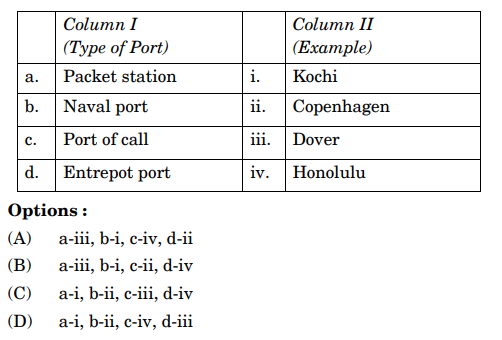
Correct Answer is Option (A) a-iii, b-i, c-iv, d-ii
Packet station: Dover (handles passenger and mail transportation across short water bodies).
Naval port: Kochi (serves purely strategic military/warship operations).
Port of call: Honolulu (serves as a refueling and provisioning stop on long sea routes).
Entrepot port: Copenhagen (acts as a collection and redistribution center for goods from different countries).
Which of the following set of states have the lowest percentage of urban population ?
The context states that Bihar has a very high percentage of rural population, indicating a low percentage of urban population. Himachal Pradesh is not directly mentioned in terms of urbanization, but among the options given, Bihar and Himachal Pradesh is the most plausible set with the lowest urban population because other options include states like Kerala, Goa, Maharashtra, Punjab, and Gujarat which are known to have higher urban populations.
Which one of the following set of places are connected by the ‘Atal Tunnel’ ?
The Atal Tunnel is a highway tunnel built under the Rohtang Pass in the Himalayas. It connects Manali to the Lahaul-Spiti valley, providing an all-weather road connectivity to the region. Other options like Manali and Manikaran, Shimla and Lahaul-Spiti, Shimla and Manikaran are incorrect as the tunnel specifically connects Manali and Lahaul-Spiti.
Which one of the following organisations constructed the Hazira-Vijaipur-Jagdishpur gas pipeline ?
The Hazira-Vijaipur-Jagdishpur (HVJ) gas pipeline, which is 1,700 km long, was constructed by GAIL (India) Ltd. GAIL stands for Gas Authority of India Limited, which was set up in 1984 as a public sector undertaking for transporting, processing, and marketing natural gas. This pipeline links Mumbai High and Bassein gas fields with various industrial complexes in India.
Which one of the following has classified ‘wastelands’ in India ?
The National Remote Sensing Centre (NRSC) has classified wastelands in India using remote sensing techniques. The NRSC provides facilities for acquisition and processing of satellite data which helps in categorizing wastelands based on the processes that have created them.
Which one of the following countries is ranked the best in Human Development Index ?
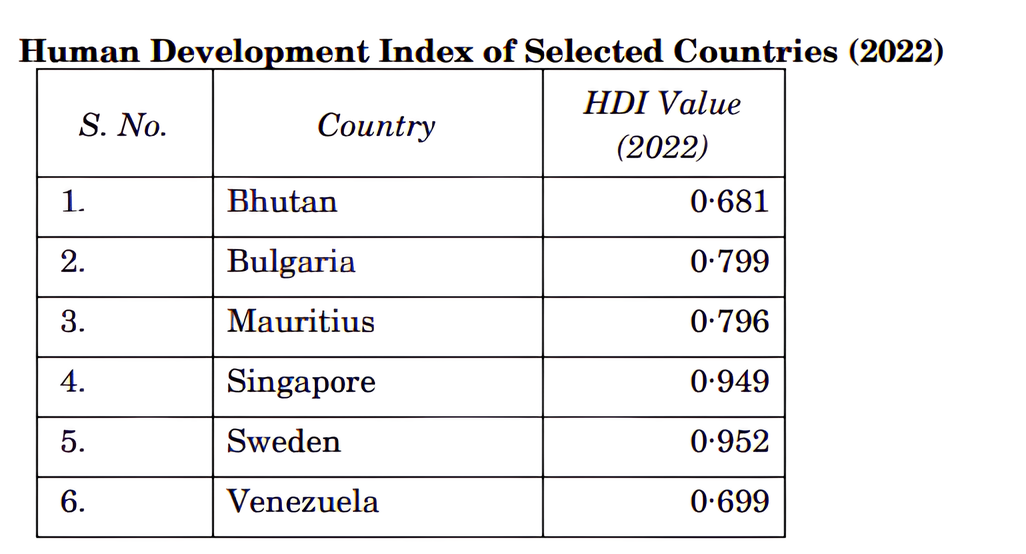
The HDI values for the given options are: Bhutan (0.681), Bulgaria (0.799), Mauritius (0.796), and Singapore (0.949).
Singapore holds the highest value among these choices.
Arrange the following countries in descending order of their HDI and choose the correct option.
I. Mauritius
II. Singapore
III. Sweden
IV. Venezuela
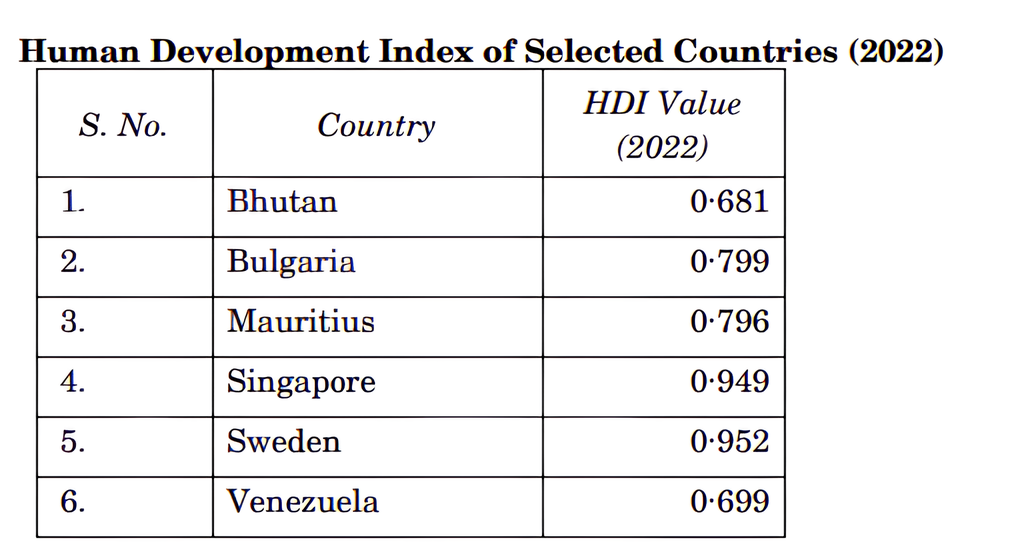
Arraging the countries in descending order (highest value to lowest value):
Sweden (0.952) – III
Singapore (0.949) – II
Mauritius (0.796) – I
Venezuela (0.699) – IV
This creates the correct sequence: III, II, I, IV.
Which continent has the highest number of countries in the given table ?
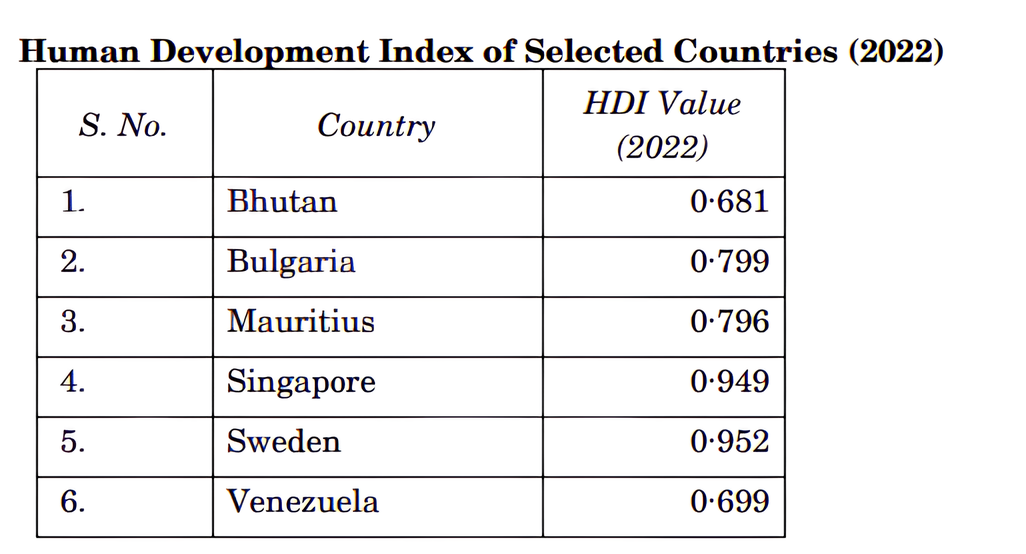
The table provided categorizes countries by their level of human development and lists the number of countries in each category. While the table does not explicitly list the number of countries by continent, it is common knowledge and consistent with the context that Africa has the highest number of countries compared to Asia, Europe, and South America. Africa consists of over 50 recognized countries, more than any other continent. Therefore, based on the understanding of global geography and the context referring to the number of countries, Africa is the continent with the highest number of countries.
Section C
Explain the concept of ‘neo-determinism’
This concept nullifies the 'either-or' dichotomy between environmental determinism and possibilism by proposing a stop-and-go system. It accounts for how human society and natural environment influence each other dynamically. For example, developed economies have modified nature but also caused issues like global warming, receding glaciers, and land degradation. Neo-determinism acknowledges these complex interrelations and emphasizes that human actions depend on environmental conditions and opportunities.
Thus, neo-determinism reflects a welfare or humanistic approach focusing on social well-being while understanding the limits and possibilities set by nature.
“The adolescent people of India have high potential but they are quite vulnerable.” Explain the statement.
However, they are quite vulnerable due to many challenges like early marriage, especially among girls, illiteracy, school dropouts, poor nutrition, high maternal mortality rates, high risk of HIV/AIDS, drug abuse, mental and physical health issues, and involvement in juvenile crimes.
Because of these vulnerabilities, adolescents need proper support and guidance to channel their energies positively. The Government of India recognizes this and has introduced policies like the National Youth Policy (NYP) 2014 to empower youth by providing education, health care, and skill development. This helps in nurturing their talents and protecting them from risks, ensuring that their potential is fully realized for the development of the country.
“The Indian government formulated the National Policy for Skill Development.” Explain the need for the policy.
Need for the Policy: India has a large youth population which needs to be skilled properly to match the demands of the growing economy. There was a lack of uniform standards and linkage between skill training and job market requirements. Many youths were either unemployed or underemployed due to inadequate skills. The policy aims to address issues like school dropouts, low skill levels, and mismatch between skills and jobs. It also seeks to enhance entrepreneurship and align skills with demand centers to improve employment opportunities. Overall, the policy is necessary to improve the quality of human resources to boost economic growth and social development by empowering youth with relevant skills.
Explain the characteristics of clustered rural settlements in India.
Clustered rural settlements are compact or closely built areas where houses are grouped together forming a distinct living area separated from farms, barns, and pastures.
The settlement shows a recognisable pattern or geometric shape such as rectangular, radial, or linear.
Such villages are commonly found in the northern plains, especially in the middle and lower Ganga plain, Chhattisgarh, and lower Himalayan valleys.
The closeness helps in social interaction and collective activities.
Clustered settlements provide better security against theft and robberies.
The pattern depends on factors like physical features (terrain, altitude, climate, availability of water), cultural and ethnic factors (social structure, caste, religion), and security needs.
Because of close proximity, agricultural lands surround the village but are separate from the residential area.
This type is different from dispersed settlements where houses are scattered and isolated.
Section D
“Quaternary activities are based on specialised knowledge and skill.” Justify the statement by giving suitable arguments.
Quaternary activities are a part of the service sector that primarily deal with knowledge-based services. They include activities such as the collection, production, and dissemination of information.
These activities require specialised knowledge and skills because they involve advanced research and development work. For example, professionals like CEOs of multinational companies, research scientists, IT experts, and medical transcriptionists all work in quaternary activities which demand a high level of expertise and technical know-how.
The nature of quaternary activities is such that they rely heavily on intellectual capabilities rather than physical labor or natural resources. This is why such jobs are not affected by the environment or location and can often be outsourced worldwide.
In summary, quaternary activities justify the statement because they revolve around specialised knowledge, data analysis, technical expertise, innovation, and information management which only skilled and highly knowledgeable individuals can perform effectively.
“Roads play a vital role in trade and commerce of a country across the world.” Support the statement with examples.
Roads form the backbone of trade and commerce by connecting producers, markets, and consumers across regions. Unlike railways which have limited coverage and fixed routes, roads offer door-to-door transport which is crucial for short-distance trade.
For example, small scale industries and agricultural markets rely heavily on road transport to move goods quickly and economically. Perishable goods like vegetables, fruits, and dairy products are transported through roads ensuring timely delivery.
Border roads laid along international boundaries help in transporting goods to remote border villages and military camps, promoting economic integration and security.
In developing countries, road transport plays a vital role since rail kilometrage is low and cannot reach all areas. Roads support local businesses, tourism and enhance employment opportunities.
During the rainy season, good quality metalled roads ensure all-weather connectivity essential for continuous trade, whereas unmetalled roads become unusable.
Hence, roads enhance trade and commerce by providing flexible, accessible, and economical transport, improving connectivity and economic development across a country.
“Railways are a mode of land transport for bulky goods and passengers over long distances in the world.” Support the statement with examples.
Railways play a vital role in transporting bulky goods and passengers over long distances efficiently and economically. Trains can carry large quantities of heavy goods like coal, iron ore, cement, agricultural products, and machinery across vast regions. For example, in India, Indian Railways transports millions of tonnes of coal from mining areas in Jharkhand to power plants in different states. Similarly, passengers travel daily by trains over long distances, such as from Delhi to Mumbai or Kolkata, comfortably and at affordable fares.
Different railway gauges are used worldwide, like broad gauge, standard gauge, and metre gauge, adapting to local requirements. Railways provide a safer and faster alternative compared to road transport for bulky freight. They also help reduce traffic congestion on roads and lower pollution per ton transported.
Therefore, railways serve as a reliable, economical, and essential mode of land transport for both bulky goods and passengers across countries, supporting trade and connectivity effectively.
‘‘Metro rail has revolutionised the urban transport system in India.’’ Support the statement with examples.
1. Ease of commuting: Metro rail provides a fast, reliable and comfortable mode of transport, reducing travel time significantly in congested cities like Delhi, Mumbai, Bangalore and Kolkata.
2. Reduction in traffic congestion: Metro systems reduce the number of private vehicles on roads, thereby decreasing traffic jams and pollution.
3. Environmental benefits: Metro uses electricity and helps reduce air pollution caused by vehicles running on fossil fuels.
4. Economic development: Areas around metro stations have seen growth in businesses, shops, and real estate, boosting the local economy.
5. Accessibility: Metro rail connects far-flung areas with city centers, making it easier for people to access education, employment and health facilities.
For example, the Delhi Metro is a model metro system which has transformed daily commuting for millions, making it quicker and safer. Similarly, Bangalore Metro has improved connectivity in a city known for heavy traffic congestion.
Thus, metro rail has modernised urban transport in India by providing an efficient, eco-friendly and affordable means of travel.
‘‘Among all the personal communication systems, Internet is the most effective and advanced one in India.’’ Support the statement with examples.
The Internet is considered the most effective and advanced personal communication system in India due to various reasons. Firstly, it allows direct and instant communication through e-mails and messaging, connecting users across the country and worldwide. Secondly, Internet access provides a vast amount of information and knowledge on various topics, which can be easily retrieved.
Thirdly, the Internet supports e-commerce and online banking, enabling users to carry out money transactions safely and conveniently from their homes. This has transformed the way people shop and do business.
Moreover, the Internet connects nearly 1,000 million people worldwide, including users in India, making it the largest electronic network. It is increasingly used for education (e-learning), governance (e-governance), and social communication, helping bridge the gap between urban and rural areas.
Unlike traditional personal communication systems like letters, telephones, or telegrams, the Internet offers multimedia and real-time communication through video calls, social media platforms, and much more. These features make it the most advanced and effective system in India today.
Thus, the Internet is not only a source of communication but also a central warehouse of information, commerce, and social interaction, making it the most efficient personal communication system in India.
Examine the agricultural development in India since independence.
Before independence, India had a largely subsistence agricultural economy, with poor performance and frequent droughts and famines. Partition caused about one-third of the irrigated land to go to Pakistan, reducing the irrigated area in India. After independence, the government focused on increasing foodgrain production by shifting from cash crops to food crops, intensifying cropping on existing land, and increasing cultivated area by bringing more land under farming.
The Green Revolution in the 1960s introduced high-yielding varieties, chemical fertilizers, and better irrigation which greatly increased food production, making India self-sufficient in food grains.
Besides food grains, there was development in allied sectors such as dairy farming, poultry, horticulture, livestock rearing, and aquaculture. These helped diversify agriculture and increase farmers' income.
The introduction of liberalization and free market policies in the 1990s influenced agricultural development by encouraging modernization and better resource management.
Overall, India transformed from a food-deficient to a food-surplus country with significant improvements in production and technology, but challenges like small land holdings and environmental concerns remain.
In summary:
1. Focus on food security by increasing production
2. Green Revolution and modern techniques
3. Development of allied agricultural sectors
4. Policy changes and liberalization effects
5. Continuous challenges for sustainability and inclusiveness.
Examine the various problems of Indian agriculture.
Indian agriculture faces numerous problems that affect its productivity and sustainability. These problems can be broadly categorized into physical, economic, and institutional issues.
(a) Physical Problems: Most farmers depend on monsoon rains which are irregular and unpredictable, leading to droughts or floods. Small and fragmented landholdings reduce efficiency and mechanization. Poor soil fertility in many regions also limits crop yields.
(b) Economic Problems: Low capital investment and limited access to modern technology restrict productivity. High cost of inputs like fertilizers, seeds, and pesticides is a burden on farmers. Inadequate storage and transportation facilities cause post-harvest losses.
(c) Institutional Problems: Lack of proper credit facilities forces farmers to rely on moneylenders with high interest rates. Inefficient marketing systems and exploitation by middlemen reduce farmers' profits. Absence of proper crop insurance makes farmers vulnerable to natural calamities.
Moreover, region-specific issues like salinity in coastal areas, soil erosion in hilly regions, and waterlogging in some parts also hamper agriculture.
To overcome these problems, there is a need for better irrigation facilities, use of improved seeds and technology, institutional reforms, and proper government support.
In conclusion, Indian agriculture faces multifaceted problems that require integrated and regionally specific solutions for sustainable development.
“Non-conventional energy sources are equitably distributed in India.” Justify the statement with suitable arguments.
“The conventional sources of energy need to be replaced due to their exhaustibility.” Justify the statement with suitable arguments.
Conventional sources of energy include fossil fuels such as coal, petroleum, natural gas, and nuclear energy. These sources are called exhaustible because they are finite and will eventually deplete with continuous use. For example, coal and petroleum are formed over millions of years and cannot be replenished within a human lifetime. Due to rapid industrialization and increased energy demand, these resources are being consumed at a much faster rate leading to their depletion.
Moreover, the use of conventional energy sources causes environmental pollution. Burning fossil fuels releases harmful gases like carbon dioxide, which contribute to global warming and climate change. Mining and drilling for these fuels also lead to land degradation and habitat loss.
On the other hand, non-conventional or renewable energy sources like solar, wind, hydro, geothermal, and biomass are inexhaustible and eco-friendly. These energy sources are naturally replenished and cause minimal pollution. They are also more equitably distributed across different regions.
Therefore, to ensure sustainable development and protect the environment for future generations, it is necessary to replace conventional exhaustible energy sources with renewable energy sources. This shift will help conserve resources, reduce pollution, and provide long-term energy security at a lower overall environmental cost.
Other Years — Geography