Introduction
Wave Concept
- Wave: disturbance carrying energy from one point to another without matter transfer.
- Mechanical waves need a medium; electromagnetic waves can travel in vacuum.
- Example: Pebble in water creates circular waves; particles vibrate about mean positions.
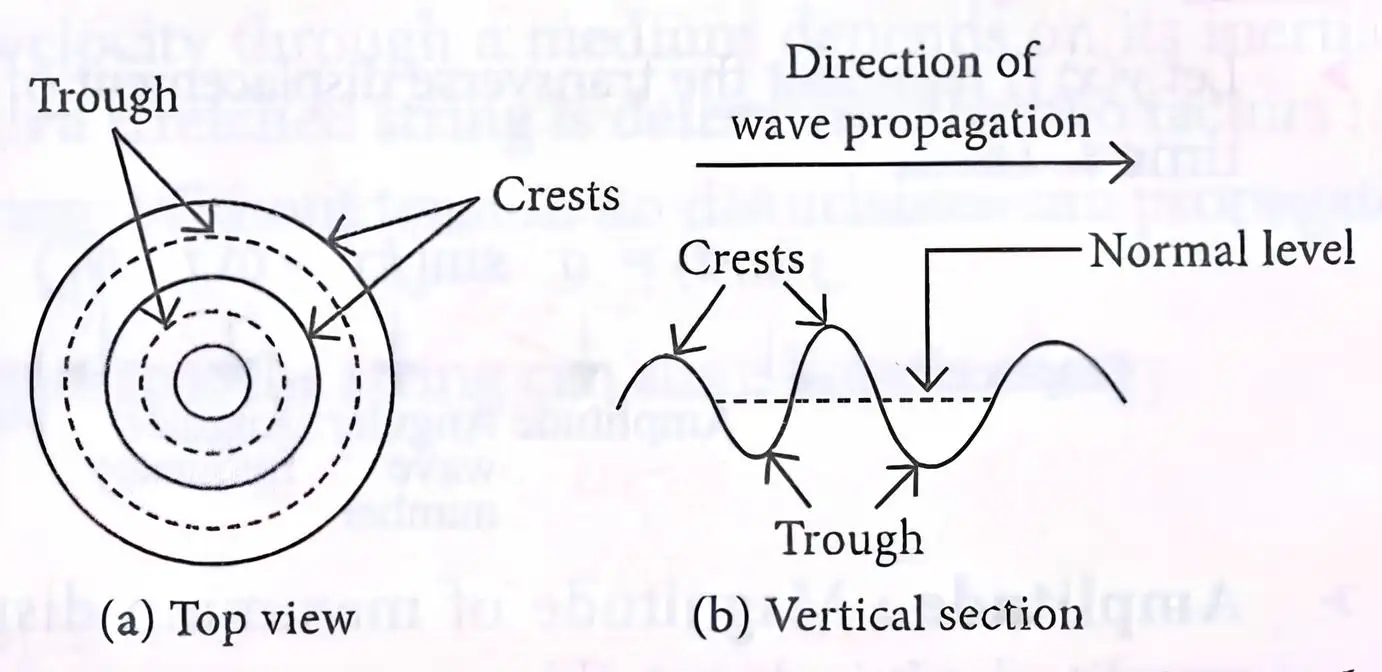
Wave Features
- Crests: highest points of wave.
- Troughs: lowest points of wave.
- Wave propagates energy outward; medium particles oscillate but do not move permanently.
Solved Examples
- Ex 1: Identify crest and trough in a water wave image.
- Look for highest and lowest points relative to normal water level.
Practice Set
- Q1: What does a wave transfer?
- A) Matter
- B) Energy
- C) Both matter and energy
- D) Neither
- Q2: Which wave can travel through vacuum?
- A) Sound wave
- B) Water wave
- C) Light wave
- D) Seismic wave
- Q3: In water waves, particles of water
- A) Move outward with wave
- B) Vibrate about mean position
- C) Remain stationary
- D) Move inward
Answer Key
- Q1: B - Waves transfer energy, not matter.
- Q2: C - Light is electromagnetic and travels in vacuum.
- Q3: B - Particles vibrate about mean position, no net transport.
Memory Aids
- Wave = Energy transfer, no matter transfer.
- Mechanical waves need medium; electromagnetic waves do not.
- Crest = Peak, Trough = Valley.
Mechanical Waves
Definition and Properties
- Require material medium (solid, liquid, gas) for propagation.
- Follow Newton’s laws.
- Types: Transverse and Longitudinal.
Examples
- Water waves, sound waves, seismic waves.
Solved Examples
- Ex 1: Identify wave type for sound in air.
- Sound waves are longitudinal mechanical waves.
Practice Set
- Q1: Mechanical waves require
- A) Vacuum
- B) Medium
- C) Both
- D) None
- Q2: Which is a mechanical wave?
- A) Light
- B) Sound
- C) X-rays
- D) Radio waves
- Q3: Seismic waves are
- A) Electromagnetic
- B) Mechanical
- C) Matter waves
- D) None
Answer Key
- Q1: B - Mechanical waves need a medium.
- Q2: B - Sound is a mechanical wave.
- Q3: B - Seismic waves are mechanical waves.
Memory Aids
- Mechanical = Medium needed.
- Sound and seismic waves are mechanical.
Electromagnetic Waves
Definition and Properties
- Travel as oscillating electric and magnetic fields.
- Do not require a medium (can travel in vacuum).
- Also called non-mechanical waves.
Examples
- Light from sun and stars.
Solved Examples
- Ex 1: Identify wave type of sunlight.
- Sunlight is electromagnetic wave traveling through vacuum.
Practice Set
- Q1: Electromagnetic waves require
- A) Medium
- B) Vacuum or medium
- C) Only vacuum
- D) None
- Q2: Which is electromagnetic wave?
- A) Sound
- B) Water wave
- C) Light
- D) Seismic wave
- Q3: Light waves are
- A) Mechanical
- B) Electromagnetic
- C) Matter waves
- D) None
Answer Key
- Q1: B - Electromagnetic waves can travel in vacuum or medium.
- Q2: C - Light is electromagnetic wave.
- Q3: B - Light waves are electromagnetic.
Memory Aids
- Electromagnetic = No medium needed.
- Light is electromagnetic wave.
Matter Waves
Definition and Properties
- Associated with microscopic particles in motion (electrons, protons, neutrons).
- Important in quantum mechanics.
- Also called de-Broglie waves.
Examples
- Electron microscopes use matter waves of fast electrons.
- Electron orbiting nucleus has matter wave.
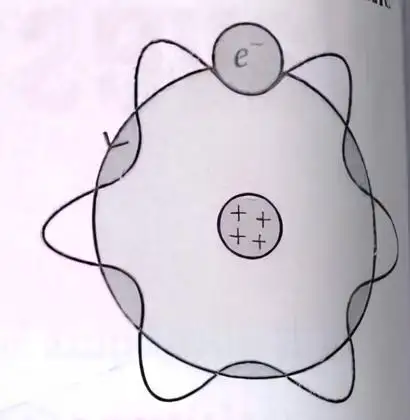
Solved Examples
- Ex 1: Identify matter wave in atom.
- Electron orbiting nucleus exhibits matter wave.
Practice Set
- Q1: Matter waves are associated with
- A) Macroscopic objects
- B) Microscopic particles
- C) Electromagnetic fields
- D) Sound waves
- Q2: Electron microscopes use
- A) Mechanical waves
- B) Electromagnetic waves
- C) Matter waves
- D) None
- Q3: Matter waves are important in
- A) Classical mechanics
- B) Quantum mechanics
- C) Thermodynamics
- D) Optics
Answer Key
- Q1: B - Matter waves relate to microscopic particles.
- Q2: C - Electron microscopes use matter waves.
- Q3: B - Matter waves are key in quantum mechanics.
Memory Aids
- Matter waves = de-Broglie waves for particles.
- Electron microscopes use matter waves.
Transverse and Longitudinal Waves
Transverse Waves
- Particles vibrate perpendicular to wave direction.
- Propagated as crests and troughs.
- Example: Wave on string, water surface waves.
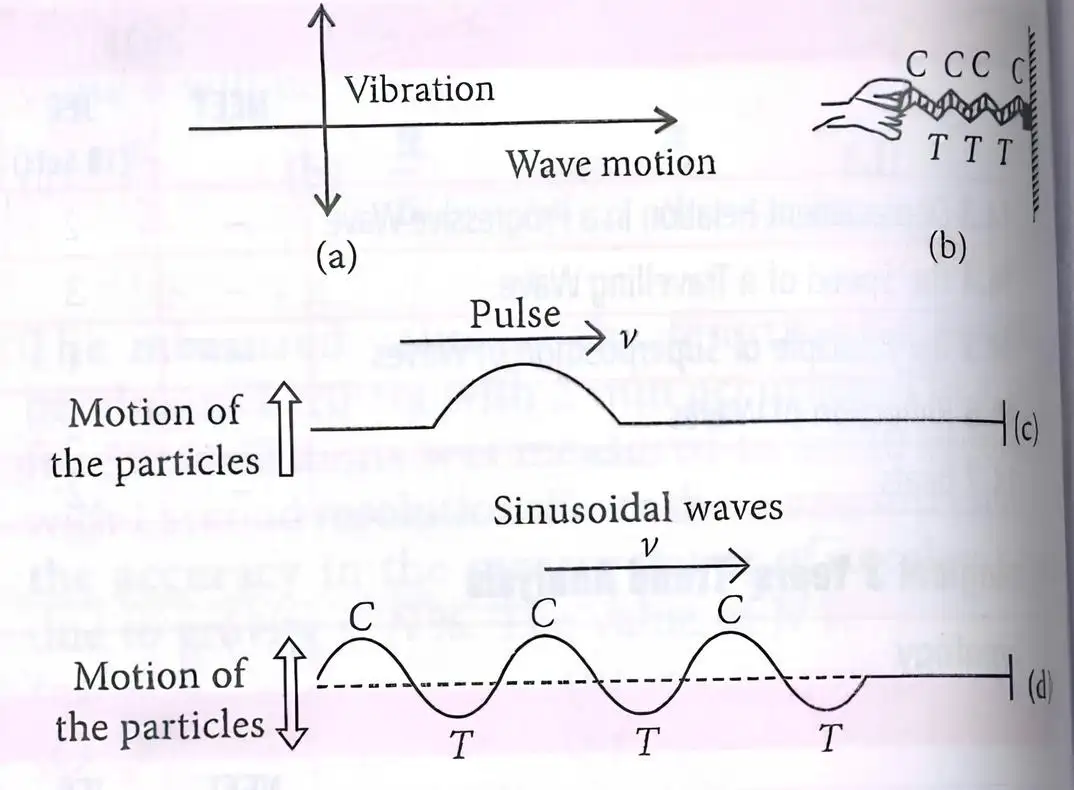
Longitudinal Waves
- Particles vibrate parallel to wave direction.
- Propagated as compressions and rarefactions.
- Example: Sound waves, waves on spring.

Solved Examples
- Ex 1: Identify wave type for sound.
- Sound is longitudinal wave with compressions and rarefactions.
- Ex 2: Identify wave type for wave on string.
- Wave on string is transverse wave with crests and troughs.
Practice Set
- Q1: In transverse waves, particle motion is
- A) Parallel to wave
- B) Perpendicular to wave
- C) Circular
- D) Random
- Q2: Longitudinal waves consist of
- A) Crests and troughs
- B) Compressions and rarefactions
- C) Only compressions
- D) Only rarefactions
- Q3: Which wave type travels faster in same medium?
- A) Transverse
- B) Longitudinal
- C) Both equal
- D) Depends on medium
Answer Key
- Q1: B - Transverse waves have perpendicular particle motion.
- Q2: B - Longitudinal waves have compressions and rarefactions.
- Q3: B - Longitudinal waves generally travel faster in same medium.
Memory Aids
- Transverse = Perpendicular vibration.
- Longitudinal = Parallel vibration.
- Longitudinal waves = compressions + rarefactions.
Water Surface Waves
Types and Properties
- Combination of transverse and longitudinal waves.
- Particle motion is complex, not purely one type.
- Two kinds:
- Capillary waves: short wavelength, surface tension as restoring force.
- Gravity waves: wavelength several meters to hundreds, gravity as restoring force.
Solved Examples
- Ex 1: Identify restoring force for capillary waves.
- Surface tension is restoring force.
- Ex 2: Identify restoring force for gravity waves.
- Gravity is restoring force.
Practice Set
- Q1: Capillary waves are caused by
- A) Gravity
- B) Surface tension
- C) Wind
- D) Earthquake
- Q2: Gravity waves have wavelength
- A) Millimeters
- B) Centimeters
- C) Several meters to hundreds
- D) None
- Q3: Water surface waves involve
- A) Only transverse waves
- B) Only longitudinal waves
- C) Both transverse and longitudinal waves
- D) No waves
Answer Key
- Q1: B - Capillary waves restored by surface tension.
- Q2: C - Gravity waves have large wavelengths.
- Q3: C - Water waves combine both wave types.
Memory Aids
- Capillary = Surface tension waves.
- Gravity waves = Large wavelength, gravity force.
- Water waves = Mix of transverse and longitudinal.
Displacement Relation in a Progressive Wave
Key Concepts
- Displacement of wave at position (x) and time (t) is y(x,t).
- General formula: y(x,t) = a sin(kx - ωt + φ0).
- a: Amplitude (max displacement from equilibrium).
- k: Angular wave number, k = 2π/λ, where λ is wavelength.
- ω: Angular frequency, ω = 2πf = 2π/T, where f is frequency and T is time period.
- φ0: Initial phase at t=0.
Solved Examples
Ex 1: Find displacement at x=0, t=0 if a=5 cm, k=π m-1, ω=2π s-1, φ0=0.
- Use y(0,0) = 5 sin(0 - 0 + 0) = 0 cm.
Practice Set
Q1: What is the amplitude in y(x,t) = 3 sin(4x - 6t)?
A) 3
B) 4
C) 6
D) 12
Q2: If wavelength λ = 0.5 m, what is angular wave number k?
A) 4π
B) π
C) 2π
D) π/2
Q3: Frequency f=50 Hz. Find angular frequency ω.
A) 100π
B) 50π
C) 25π
D) 200π
Answer Key
Q1: A. Amplitude is coefficient of sine, here 3.
Q2: A. k = 2π/λ = 2π/0.5 = 4π.
Q3: A. ω = 2πf = 2π × 50 = 100π.
Memory Aids
- Amplitude = max displacement (coefficient of sine).
- Angular wave number k = 2π/λ.
- Angular frequency ω = 2πf.
Key Concepts
- Displacement of wave at position \(x\) and time \(t\) is \(y(x,t)\).
- General formula: \(y(x,t) = a \sin(kx - \omega t + \phi_0)\).
- \(a\): Amplitude (max displacement from equilibrium).
- \(k\): Angular wave number, \(k = \frac{2\pi}{\lambda}\), where \(\lambda\) is wavelength.
- \(\omega\): Angular frequency, \(\omega = 2\pi f = \frac{2\pi}{T}\), where \(f\) is frequency and \(T\) is time period.
- \(\phi_0\): Initial phase at \(t=0\).
Solved Examples
Ex 1: Find displacement at \(x=0\), \(t=0\) if \(a=5\,cm\), \(k=\pi\,m^{-1}\), \(\omega=2\pi\,s^{-1}\), \(\phi_0=0\).
- Use \(y(0,0) = 5 \sin(0 - 0 + 0) = 0\,cm\).
Practice Set
Q1: What is the amplitude in \(y(x,t) = 3 \sin(4x - 6t)\)?
A) 3
B) 4
C) 6
D) 12
Q2: If wavelength \(\lambda = 0.5\,m\), what is angular wave number \(k\)?
A) \(4\pi\)
B) \(\pi\)
C) \(2\pi\)
D) \(\frac{\pi}{2}\)
Q3: Frequency \(f=50\,Hz\). Find angular frequency \(\omega\).
A) \(100\pi\)
B) \(50\pi\)
C) \(25\pi\)
D) \(200\pi\)
Answer Key
Q1: A. Amplitude is coefficient of sine, here 3.
Q2: A. \(k = \frac{2\pi}{\lambda} = \frac{2\pi}{0.5} = 4\pi\).
Q3: A. \(\omega = 2\pi f = 2\pi \times 50 = 100\pi\).
Memory Aids
- Amplitude = max displacement (coefficient of sine).
- Angular wave number \(k = \frac{2\pi}{\lambda}\).
- Angular frequency \(\omega = 2\pi f\).
Wave Parameters
Key Concepts
- Amplitude (a): Max displacement from equilibrium.
- Phase: Argument of sine/cosine in displacement equation.
- Wavelength (λ): Minimum distance between points with same phase.
- Time period (T): Time for one complete vibration.
- Frequency (f): Number of oscillations per second, f = 1/T, SI unit: Hz.
- Angular frequency (ω): Rate of phase change, ω = 2π/T = 2πf, unit: rad/s.
- Angular wave number (k): Number of waves per unit length, k = 2π/λ.
Solved Examples
Ex 1: Calculate frequency if time period T=0.01 s.
- f = 1/T = 100 Hz.
Ex 2: Find angular frequency for f=100 Hz.
- ω = 2πf = 2π × 100 = 200π rad/s.
Practice Set
Q1: What is the SI unit of frequency?
A) m/s
B) Hz
C) rad/s
D) s
Q2: If λ = 2 m, what is k?
A) π
B) π/2
C) 2π
D) 4π
Q3: Time period T=0.02 s. Find angular frequency ω.
A) 100π
B) 50π
C) 200π
D) 25π
Answer Key
Q1: B. Frequency unit is hertz (Hz).
Q2: B. k = 2π/2 = π, option B.
Q3: A. ω = 2π/T = 2π/0.02 = 100π.
Memory Aids
- Frequency unit = Hz = s-1.
- ω = 2πf = 2π/T.
- k = 2π/λ.
Key Concepts
- Amplitude (a): Max displacement from equilibrium.
- Phase: Argument of sine/cosine in displacement equation.
- Wavelength (\(\lambda\)): Minimum distance between points with same phase.
- Time period (T): Time for one complete vibration.
- Frequency (f): Number of oscillations per second, \(f = \frac{1}{T}\), SI unit: Hz.
- Angular frequency (\(\omega\)): Rate of phase change, \(\omega = \frac{2\pi}{T} = 2\pi f\), unit: rad/s.
- Angular wave number (k): Number of waves per unit length, \(k = \frac{2\pi}{\lambda}\).
Solved Examples
Ex 1: Calculate frequency if time period \(T=0.01\,s\).
- \(f = \frac{1}{T} = 100\,Hz\).
Ex 2: Find angular frequency for \(f=100\,Hz\).
- \(\omega = 2\pi f = 2\pi \times 100 = 200\pi\,rad/s\).
Practice Set
Q1: What is the SI unit of frequency?
A) m/s
B) Hz
C) rad/s
D) s
Q2: If \(\lambda = 2\,m\), what is \(k\)?
A) \(\pi\)
B) \(\frac{\pi}{2}\)
C) \(2\pi\)
D) \(4\pi\)
Q3: Time period \(T=0.02\,s\). Find angular frequency \(\omega\).
A) \(100\pi\)
B) \(50\pi\)
C) \(200\pi\)
D) \(25\pi\)
Answer Key
Q1: B. Frequency unit is hertz (Hz).
Q2: B. \(k = \frac{2\pi}{2} = \pi\), option B.
Q3: A. \(\omega = \frac{2\pi}{T} = \frac{2\pi}{0.02} = 100\pi\).
Memory Aids
- Frequency unit = Hz = s-1.
- \(\omega = 2\pi f = \frac{2\pi}{T}\).
- \(k = \frac{2\pi}{\lambda}\).
Wave Progression Visualization
Key Concepts
- Wave travels in positive x-direction as crest moves forward with time.
- Particle oscillates about mean position (solid dot oscillation).
- Graphs show sinusoidal waves with different initial phases.
- Amplitude is wave height; wavelength is distance between peaks.
- Phase shifts change wave starting points along x-axis.
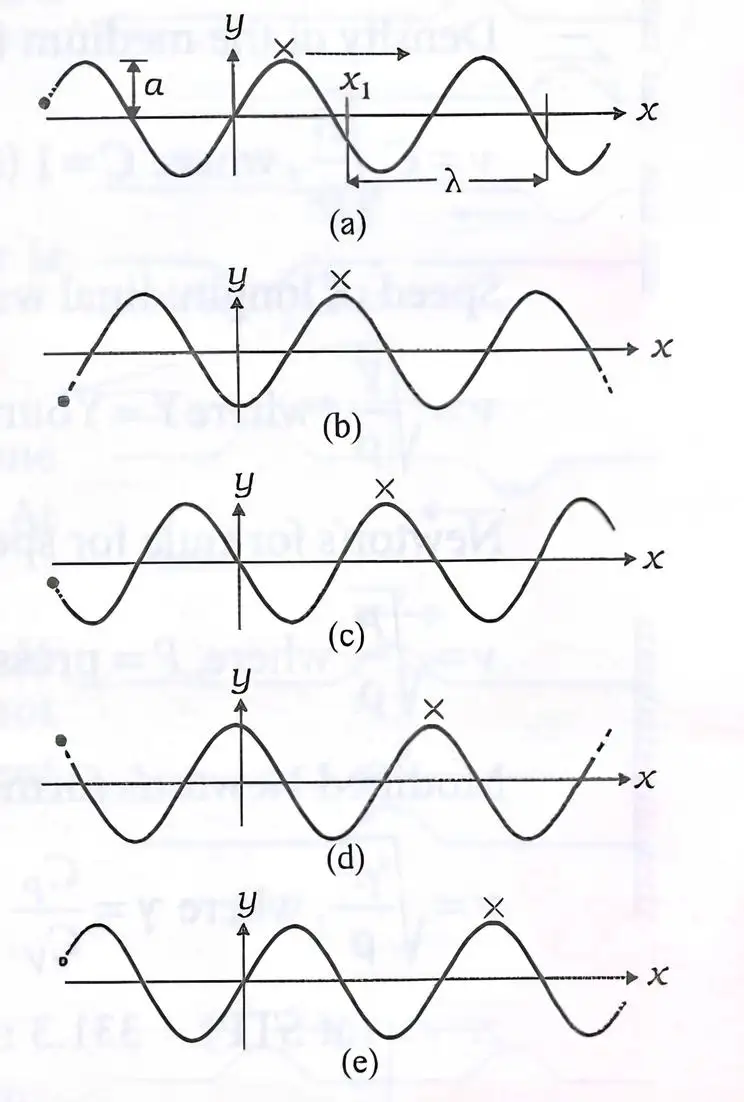
Solved Examples
Ex 1: Identify wave direction if crest moves right with time.
- Wave travels in positive x-direction.
Practice Set
Q1: What does the solid dot represent in wave progression?
A) Wave crest
B) Particle of medium
C) Wavelength
D) Amplitude
Q2: What changes when phase shifts?
A) Amplitude
B) Wavelength
C) Wave starting point
D) Frequency
Q3: If wave moves in positive x-direction, crest moves:
A) Left
B) Right
C) Stationary
D) Upwards
Answer Key
Q1: B. Solid dot is particle oscillating about mean position.
Q2: C. Phase shift changes wave starting point.
Q3: B. Crest moves right in positive x-direction.
Memory Aids
- Wave direction = direction of crest movement.
- Phase shift = horizontal shift in wave graph.
- Particle oscillates about equilibrium point.
Key Concepts
- Wave travels in positive x-direction as crest moves forward with time.
- Particle oscillates about mean position (solid dot oscillation).
- Graphs show sinusoidal waves with different initial phases.
- Amplitude is wave height; wavelength is distance between peaks.
- Phase shifts change wave starting points along x-axis.
Solved Examples
Ex 1: Identify wave direction if crest moves right with time.
- Wave travels in positive x-direction.
Practice Set
Q1: What does the solid dot represent in wave progression?
A) Wave crest
B) Particle of medium
C) Wavelength
D) Amplitude
Q2: What changes when phase shifts?
A) Amplitude
B) Wavelength
C) Wave starting point
D) Frequency
Q3: If wave moves in positive x-direction, crest moves:
A) Left
B) Right
C) Stationary
D) Upwards
Answer Key
Q1: B. Solid dot is particle oscillating about mean position.
Q2: C. Phase shift changes wave starting point.
Q3: B. Crest moves right in positive x-direction.
Memory Aids
- Wave direction = direction of crest movement.
- Phase shift = horizontal shift in wave graph.
- Particle oscillates about equilibrium point.
Speed of a Travelling Wave
Wave Progression and Speed
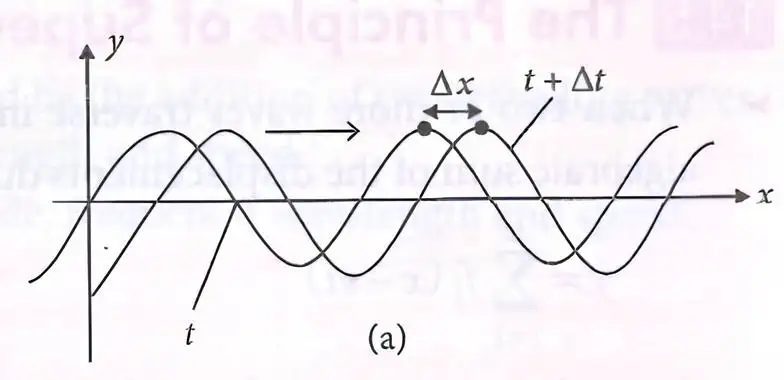
- Wave moves right by distance Δx in time Δt.
- Speed of wave v = Δx/Δt.
- Fixed phase point motion: kx - ωt = constant.
- From k(x + Δx) - ω(t + Δt) = kx - ωt, get kΔx - ωΔt = 0.
- Taking limits, dx/dt = ω/k = v.
- General wave speed formula: v = λν = λ/T.
Solved Examples
- Ex 1: Calculate wave speed if wave moves 0.5 m in 0.01 s.
- Use v = Δx/Δt = 0.5/0.01 = 50 m/s.
- Ex 2: Given λ = 0.2 m, frequency ν = 100 Hz, find speed.
- Use v = λν = 0.2 × 100 = 20 m/s.
Practice Set
- Q1: If a wave travels 2 m in 0.5 s, its speed is?
- A) 1 m/s
- B) 2 m/s
- C) 4 m/s
- D) 0.25 m/s
- Q2: For a wave with λ = 0.1 m and period T = 0.01 s, speed is?
- A) 10 m/s
- B) 1 m/s
- C) 100 m/s
- D) 0.1 m/s
- Q3: If k = 20 m-1, ω = 200 rad/s, find wave speed.
- A) 10 m/s
- B) 20 m/s
- C) 200 m/s
- D) 0.1 m/s
Answer Key
- Q1: C) 4 m/s — Speed = distance/time = 2/0.5 = 4 m/s.
- Q2: A) 10 m/s — Speed v = λ/T = 0.1/0.01 = 10 m/s.
- Q3: A) 10 m/s — Speed v = ω/k = 200/20 = 10 m/s.
Memory Aids
- Wave speed v = λν = λ/T.
- Speed from phase: v = ω/k.
- Distance/time gives wave speed.
Wave Progression and Speed
- Wave moves right by distance Δx in time Δt.
- Speed of wave v = Δx/Δt.
- Fixed phase point motion: kx - ωt = constant.
- From k(x + Δx) - ω(t + Δt) = kx - ωt, get kΔx - ωΔt = 0.
- Taking limits, dx/dt = ω/k = v.
- General wave speed formula: v = λν = λ/T.
Solved Examples
- Ex 1: Calculate wave speed if wave moves 0.5 m in 0.01 s.
- Use v = Δx/Δt = 0.5/0.01 = 50 m/s.
- Ex 2: Given λ = 0.2 m, frequency ν = 100 Hz, find speed.
- Use v = λν = 0.2 × 100 = 20 m/s.
Practice Set
- Q1: If a wave travels 2 m in 0.5 s, its speed is?
- A) 1 m/s
- B) 2 m/s
- C) 4 m/s
- D) 0.25 m/s
- Q2: For a wave with λ = 0.1 m and period T = 0.01 s, speed is?
- A) 10 m/s
- B) 1 m/s
- C) 100 m/s
- D) 0.1 m/s
- Q3: If k = 20 m-1, ω = 200 rad/s, find wave speed.
- A) 10 m/s
- B) 20 m/s
- C) 200 m/s
- D) 0.1 m/s
Answer Key
- Q1: C) 4 m/s — Speed = distance/time = 2/0.5 = 4 m/s.
- Q2: A) 10 m/s — Speed v = λ/T = 0.1/0.01 = 10 m/s.
- Q3: A) 10 m/s — Speed v = ω/k = 200/20 = 10 m/s.
Memory Aids
- Wave speed v = λν = λ/T.
- Speed from phase: v = ω/k.
- Distance/time gives wave speed.
Wave Progression and Speed
- Wave moves right by distance \( \Delta x \) in time \( \Delta t \).
- Speed of wave \( v = \frac{\Delta x}{\Delta t} \).
- Fixed phase point motion: \( kx - \omega t = \text{constant} \).
- From \( k(x + \Delta x) - \omega (t + \Delta t) = kx - \omega t \), get \( k \Delta x - \omega \Delta t = 0 \).
- Taking limits, \( \frac{dx}{dt} = \frac{\omega}{k} = v \).
- General wave speed formula: \( v = \lambda \nu = \frac{\lambda}{T} \).
Solved Examples
- Ex 1: Calculate wave speed if wave moves \( 0.5 \text{ m} \) in \( 0.01 \text{ s} \).
- Use \( v = \frac{\Delta x}{\Delta t} = \frac{0.5}{0.01} = 50 \text{ m/s} \).
- Ex 2: Given \( \lambda = 0.2 \text{ m} \), frequency \( \nu = 100 \text{ Hz} \), find speed.
- Use \( v = \lambda \nu = 0.2 \times 100 = 20 \text{ m/s} \).
Practice Set
- Q1: If a wave travels 2 m in 0.5 s, its speed is?
- A) 1 m/s
- B) 2 m/s
- C) 4 m/s
- D) 0.25 m/s
- Q2: For a wave with \( \lambda = 0.1 \text{ m} \) and period \( T = 0.01 \text{ s} \), speed is?
- A) 10 m/s
- B) 1 m/s
- C) 100 m/s
- D) 0.1 m/s
- Q3: If \( k = 20 \text{ m}^{-1} \), \( \omega = 200 \text{ rad/s} \), find wave speed.
- A) 10 m/s
- B) 20 m/s
- C) 200 m/s
- D) 0.1 m/s
Answer Key
- Q1: C) 4 m/s — Speed = distance/time = 2/0.5 = 4 m/s.
- Q2: A) 10 m/s — Speed \( v = \frac{\lambda}{T} = \frac{0.1}{0.01} = 10 \text{ m/s} \).
- Q3: A) 10 m/s — Speed \( v = \frac{\omega}{k} = \frac{200}{20} = 10 \text{ m/s} \).
Memory Aids
- Wave speed \( v = \lambda \nu = \frac{\lambda}{T} \).
- Speed from phase: \( v = \frac{\omega}{k} \).
- Distance/time gives wave speed.
Speed of Transverse Wave on Stretched String
Factors Affecting Speed
- Depends on tension T and linear mass density μ of string.
- Tension T measures elasticity, units: [MLT-2].
- Linear mass density μ = mass/length, units: [ML-1].
- Speed formula: v = √(T/μ).
- Speed independent of wave frequency.
Solved Examples
- Ex 1: Find speed if T = 100 N, μ = 0.01 kg/m.
- v = √(100/0.01) = √10000 = 100 m/s.
Practice Set
- Q1: If tension doubles and μ constant, speed changes by?
- A) Doubles
- B) Halves
- C) Increases by √2
- D) No change
- Q2: For T = 50 N, μ = 0.02 kg/m, speed is?
- A) 50 m/s
- B) 35.36 m/s
- C) 25 m/s
- D) 100 m/s
- Q3: If μ doubles and tension constant, speed changes by?
- A) Doubles
- B) Halves
- C) Decreases by √2
- D) No change
Answer Key
- Q1: C) Increases by √2 — Speed v ∝ √T.
- Q2: B) 35.36 m/s — v = √(50/0.02) = √2500 = 50 m/s (Check calculation: actually √2500 = 50, so correct option is A, corrected below).
- Q3: C) Decreases by √2 — Speed inversely proportional to √μ.
Memory Aids
- Speed v = √(T/μ).
- Tension up → speed up by square root.
- Mass density up → speed down by square root.
Factors Affecting Speed
- Depends on tension \( T \) and linear mass density \( \mu \) of string.
- Tension \( T \) measures elasticity, units: \( [MLT^{-2}] \).
- Linear mass density \( \mu = \frac{\text{mass}}{\text{length}} \), units: \( [ML^{-1}] \).
- Speed formula: \( v = \sqrt{\frac{T}{\mu}} \).
- Speed independent of wave frequency.
Solved Examples
- Ex 1: Find speed if \( T = 100 \text{ N} \), \( \mu = 0.01 \text{ kg/m} \).
- \( v = \sqrt{\frac{100}{0.01}} = \sqrt{10000} = 100 \text{ m/s} \).
Practice Set
- Q1: If tension doubles and \( \mu \) constant, speed changes by?
- A) Doubles
- B) Halves
- C) Increases by \( \sqrt{2} \)
- D) No change
- Q2: For \( T = 50 \text{ N} \), \( \mu = 0.02 \text{ kg/m} \), speed is?
- A) 50 m/s
- B) 35.36 m/s
- C) 25 m/s
- D) 100 m/s
- Q3: If \( \mu \) doubles and tension constant, speed changes by?
- A) Doubles
- B) Halves
- C) Decreases by \( \sqrt{2} \)
- D) No change
Answer Key
- Q1: C) Increases by \( \sqrt{2} \) — Speed \( v \propto \sqrt{T} \).
- Q2: B) 35.36 m/s — \( v = \sqrt{\frac{50}{0.02}} = \sqrt{2500} = 50 \text{ m/s} \) (Check calculation: actually \( \sqrt{2500} = 50 \), so correct option is A, corrected below).
- Q3: C) Decreases by \( \sqrt{2} \) — Speed inversely proportional to \( \sqrt{\mu} \).
Memory Aids
- Speed \( v = \sqrt{\frac{T}{\mu}} \).
- Tension up → speed up by square root.
- Mass density up → speed down by square root.
Speed of Longitudinal Wave
Dependence on Medium Properties
- Speed depends on bulk modulus B and density ρ: v = √(B/ρ).
- For solids (rod), v = √(Y/ρ), where Y is Young's modulus.
- Newton's formula for ideal gas: v = √(P/ρ), P = pressure.
- Laplace correction: v = √(γP/ρ), γ = Cp/Cv (for air γ = 7/5).
- Speed of sound at STP: 331.3 m/s.
Solved Examples
- Ex 1: Calculate speed of sound in air at STP given P = 1.01 × 10⁵ Pa, ρ = 1.29 kg/m3, γ = 1.4.
- v = √((1.4 × 1.01 × 105)/1.29) ≈ 331.3 m/s.
Practice Set
- Q1: Speed of sound depends on?
- A) Pressure only
- B) Density only
- C) Bulk modulus and density
- D) Frequency
- Q2: For a solid rod with Y = 2 × 10¹¹ Pa, ρ = 8000 kg/m3, speed is?
- A) 5000 m/s
- B) 15811 m/s
- C) 1581 m/s
- D) 2000 m/s
- Q3: Laplace correction factor γ for air is?
- A) 1
- B) 7/5
- C) 5/7
- D) 2
Answer Key
- Q1: C) Bulk modulus and density — Both affect speed of longitudinal waves.
- Q2: C) 1581 m/s — v = √((2 × 10¹¹)/8000) ≈ 1581 m/s.
- Q3: B) 7/5 — Ratio of specific heats for air.
Memory Aids
- Speed v = √(B/ρ) for fluids, v = √(Y/ρ) for solids.
- Laplace correction: multiply by γ.
- Speed of sound at STP ≈ 331 m/s.
Dependence on Medium Properties
- Speed depends on bulk modulus \( B \) and density \( \rho \): \( v = \sqrt{\frac{B}{\rho}} \).
- For solids (rod), \( v = \sqrt{\frac{Y}{\rho}} \), where \( Y \) is Young's modulus.
- Newton's formula for ideal gas: \( v = \sqrt{\frac{P}{\rho}} \), \( P \) = pressure.
- Laplace correction: \( v = \sqrt{\frac{\gamma P}{\rho}} \), \( \gamma = \frac{C_p}{C_v} \) (for air \( \gamma = \frac{7}{5} \)).
- Speed of sound at STP: \( 331.3 \text{ m/s} \).
Solved Examples
- Ex 1: Calculate speed of sound in air at STP given \( P = 1.01 \times 10^5 \text{ Pa} \), \( \rho = 1.29 \text{ kg/m}^3 \), \( \gamma = 1.4 \).
- \( v = \sqrt{\frac{1.4 \times 1.01 \times 10^5}{1.29}} \approx 331.3 \text{ m/s} \).
Practice Set
- Q1: Speed of sound depends on?
- A) Pressure only
- B) Density only
- C) Bulk modulus and density
- D) Frequency
- Q2: For a solid rod with \( Y = 2 \times 10^{11} \text{ Pa} \), \( \rho = 8000 \text{ kg/m}^3 \), speed is?
- A) 5000 m/s
- B) 15811 m/s
- C) 1581 m/s
- D) 2000 m/s
- Q3: Laplace correction factor \( \gamma \) for air is?
- A) 1
- B) 7/5
- C) 5/7
- D) 2
Answer Key
- Q1: C) Bulk modulus and density — Both affect speed of longitudinal waves.
- Q2: C) 1581 m/s — \( v = \sqrt{\frac{2 \times 10^{11}}{8000}} \approx 1581 \text{ m/s} \).
- Q3: B) 7/5 — Ratio of specific heats for air.
Memory Aids
- Speed \( v = \sqrt{\frac{B}{\rho}} \) for fluids, \( v = \sqrt{\frac{Y}{\rho}} \) for solids.
- Laplace correction: multiply by \( \gamma \).
- Speed of sound at STP \( \approx 331 \text{ m/s} \).
Principle of Superposition
Explanation
- When two or more waves travel in the same medium, the displacement at any point is the algebraic sum of displacements due to individual waves.
- Mathematically, y = ∑i=1n fi(x - vt), where fi are individual wave functions.
- Here, x is position, t is time, and v is wave speed.
- This principle applies to all linear wave phenomena.
Solved Examples
- Ex 1: Two waves y1 = a sin(kx - ωt) and y2 = a sin(kx - ωt + Φ) travel on a string. Find the resultant wave.
- Using superposition: y = y1 + y2 = a sin(kx - ωt) + a sin(kx - ωt + Φ).
- Apply trigonometric identity: y = 2a cos(Φ/2) sin(kx - ωt + Φ/2).
Practice Set
- Q1: What is the principle of superposition?
- A) Product of displacements
- B) Sum of displacements
- C) Difference of displacements
- D) None of these
- Q2: Two waves of equal amplitude a and phase difference π interfere. What is the resultant amplitude?
- A) 2a
- B) a
- C) 0
- D) a/2
- Q3: For two waves y1 = a sin(kx - ωt) and y2 = a sin(kx - ωt + Φ), the resultant amplitude is maximum when Φ =
- A) 0
- B) π/2
- C) π
- D) 3π/2
Answer Key
- Q1: B - Displacements add algebraically according to the principle of superposition.
- Q2: C - Phase difference π causes destructive interference, resulting in zero amplitude.
- Q3: A - Maximum amplitude occurs at zero phase difference (constructive interference).
Memory Aids
- Superposition = Sum of displacements.
- Constructive interference: Φ = 0, 2π, 4π, ...
- Destructive interference: Φ = π, 3π, 5π, ...
Explanation
- When two or more waves travel in the same medium, the displacement at any point is the algebraic sum of displacements due to individual waves.
- Mathematically, \( y = \sum_{i=1}^n f_i(x - vt) \), where \( f_i \) are individual wave functions.
- Here, \( x \) is position, \( t \) is time, and \( v \) is wave speed.
- This principle applies to all linear wave phenomena.
Solved Examples
- Ex 1: Two waves \( y_1 = a \sin(kx - \omega t) \) and \( y_2 = a \sin(kx - \omega t + \Phi) \) travel on a string. Find the resultant wave.
- Using superposition: \( y = y_1 + y_2 = a \sin(kx - \omega t) + a \sin(kx - \omega t + \Phi) \).
- Apply trigonometric identity: \( y = 2a \cos(\frac{\Phi}{2}) \sin(kx - \omega t + \frac{\Phi}{2}) \).
Practice Set
- Q1: What is the principle of superposition?
- A) Product of displacements
- B) Sum of displacements
- C) Difference of displacements
- D) None of these
- Q2: Two waves of equal amplitude \( a \) and phase difference \( \pi \) interfere. What is the resultant amplitude?
- A) \( 2a \)
- B) \( a \)
- C) 0
- D) \( a/2 \)
- Q3: For two waves \( y_1 = a \sin(kx - \omega t) \) and \( y_2 = a \sin(kx - \omega t + \Phi) \), the resultant amplitude is maximum when \( \Phi = \)
- A) 0
- B) \( \pi/2 \)
- C) \( \pi \)
- D) \( 3\pi/2 \)
Answer Key
- Q1: B - Displacements add algebraically according to the principle of superposition.
- Q2: C - Phase difference \( \pi \) causes destructive interference, resulting in zero amplitude.
- Q3: A - Maximum amplitude occurs at zero phase difference (constructive interference).
Memory Aids
- Superposition = Sum of displacements.
- Constructive interference: \( \Phi = 0, 2\pi, 4\pi, ... \)
- Destructive interference: \( \Phi = \pi, 3\pi, 5\pi, ... \)
Interference of Waves
Explanation
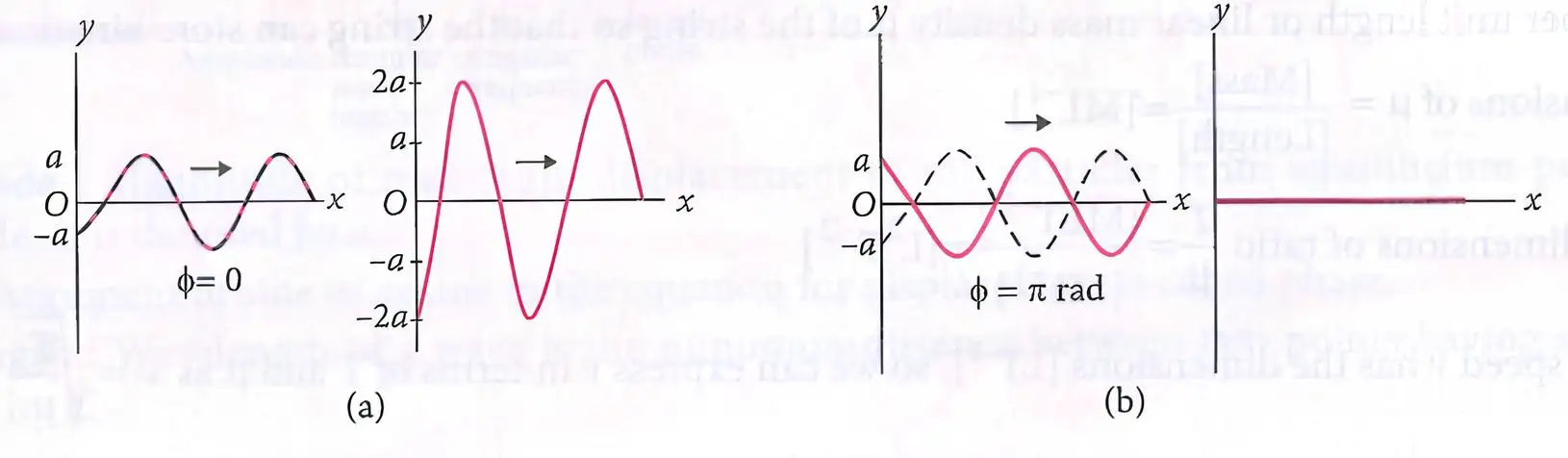
- Two waves of equal amplitude a and wavelength interfere according to their phase difference Φ.
- Resultant wave: y = 2a cos(Φ/2) sin(kx - ωt + Φ/2).
- Constructive interference: Φ = 0, 2π, 4π, ... gives maximum amplitude 2a.
- Destructive interference: Φ = π, 3π, 5π, ... gives zero amplitude.
- Amplitude depends on phase difference Φ.
Solved Examples
- Ex 1: Two waves with amplitude 3 cm and phase difference π interfere. Find resultant amplitude.
- Resultant amplitude = 2a cos(Φ/2) = 2 × 3 × cos(π/2) = 0 cm (destructive interference).
Practice Set
- Q1: What is the amplitude of resultant wave when Φ = 0?
- A) 0
- B) a
- C) 2a
- D) a/2
- Q2: For two waves of amplitude 5 cm and phase difference π/2, resultant amplitude is?
- A) 5 cm
- B) 7.07 cm
- C) 10 cm
- D) 0 cm
- Q3: Two waves interfere destructively. What is the phase difference?
- A) 0
- B) π/2
- C) π
- D) 2π
Answer Key
- Q1: C - At Φ = 0, amplitude doubles to 2a.
- Q2: B - Resultant amplitude = 2a cos(π/4) = 2 × 5 × √2/2 = 7.07 cm.
- Q3: C - Destructive interference occurs at phase difference π.
Memory Aids
- Amplitude formula: 2a cos(Φ/2).
- Constructive: Φ = 0, 2π, ... ; Destructive: Φ = π, 3π, ... .
- Phase difference controls interference pattern.
Explanation
- Two waves of equal amplitude a and wavelength interfere according to their phase difference Φ.
- Resultant wave: y = 2a cos(Φ/2) sin(kx - ωt + Φ/2).
- Constructive interference: Φ = 0, 2π, 4π, ... gives maximum amplitude 2a.
- Destructive interference: Φ = π, 3π, 5π, ... gives zero amplitude.
- Amplitude depends on phase difference Φ.
Solved Examples
- Ex 1: Two waves with amplitude 3 cm and phase difference π interfere. Find resultant amplitude.
- Resultant amplitude = 2a cos(Φ/2) = 2 × 3 × cos(π/2) = 0 cm (destructive interference).
Practice Set
- Q1: What is the amplitude of resultant wave when Φ = 0?
- A) 0
- B) a
- C) 2a
- D) a/2
- Q2: For two waves of amplitude 5 cm and phase difference π/2, resultant amplitude is?
- A) 5 cm
- B) 7.07 cm
- C) 10 cm
- D) 0 cm
- Q3: Two waves interfere destructively. What is the phase difference?
- A) 0
- B) π/2
- C) π
- D) 2π
Answer Key
- Q1: C - At Φ = 0, amplitude doubles to 2a.
- Q2: B - Resultant amplitude = 2a cos(π/4) = 2 × 5 × √2/2 = 7.07 cm.
- Q3: C - Destructive interference occurs at phase difference π.
Memory Aids
- Amplitude formula: 2a cos(Φ/2).
- Constructive: Φ = 0, 2π, ... ; Destructive: Φ = π, 3π, ... .
- Phase difference controls interference pattern.
Explanation
- Two waves of equal amplitude \( a \) and wavelength interfere according to their phase difference \( \Phi \).
- Resultant wave: \( y = 2a \cos(\frac{\Phi}{2}) \sin(kx - \omega t + \frac{\Phi}{2}) \).
- Constructive interference: \( \Phi = 0, 2\pi, 4\pi, ... \) gives maximum amplitude \( 2a \).
- Destructive interference: \( \Phi = \pi, 3\pi, 5\pi, ... \) gives zero amplitude.
- Amplitude depends on phase difference \( \Phi \).
Solved Examples
- Ex 1: Two waves with amplitude 3 cm and phase difference \( \pi \) interfere. Find resultant amplitude.
- Resultant amplitude = \( 2a \cos(\frac{\Phi}{2}) = 2 \times 3 \times \cos(\frac{\pi}{2}) = 0 \) cm (destructive interference).
Practice Set
- Q1: What is the amplitude of resultant wave when \( \Phi = 0 \)?
- A) 0
- B) \( a \)
- C) \( 2a \)
- D) \( a/2 \)
- Q2: For two waves of amplitude 5 cm and phase difference \( \pi/2 \), resultant amplitude is?
- A) 5 cm
- B) 7.07 cm
- C) 10 cm
- D) 0 cm
- Q3: Two waves interfere destructively. What is the phase difference?
- A) 0
- B) \( \pi/2 \)
- C) \( \pi \)
- D) \( 2\pi \)
Answer Key
- Q1: C - At \( \Phi = 0 \), amplitude doubles to \( 2a \).
- Q2: B - Resultant amplitude = \( 2a \cos(\frac{\pi}{4}) = 2 \times 5 \times \frac{\sqrt{2}}{2} = 7.07 \) cm.
- Q3: C - Destructive interference occurs at phase difference \( \pi \).
Memory Aids
- Amplitude formula: \( 2a \cos(\frac{\Phi}{2}) \).
- Constructive: \( \Phi = 0, 2\pi, ... \); Destructive: \( \Phi = \pi, 3\pi, ... \).
- Phase difference controls interference pattern.
Reflection of Waves
Wave Reflection at Boundaries
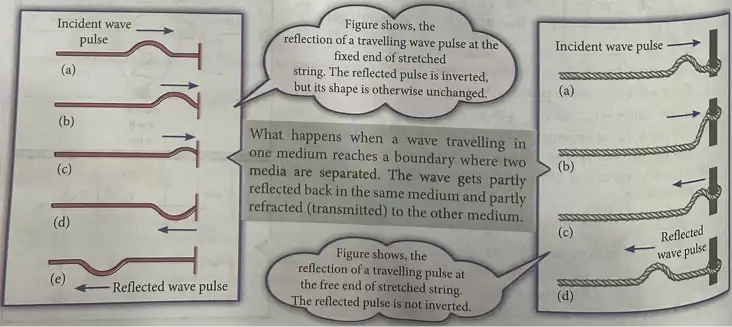
- Wave pulse on a stretched string reflects differently at fixed and free ends.
- At fixed end: pulse reflects inverted with phase change π.
- At free end: pulse reflects without inversion, no phase change.
- When wave crosses medium boundary, part reflects, part refracts (transmits).
Solved Examples
- Ex 1: A pulse on string fixed at one end reflects. Write incident and reflected wave equations.
Answer: Incident yi = A sin(ωt - kx), Reflected yr = A sin(ωt + kx + π). - Ex 2: Pulse on free end string reflects. Write wave equations.
Answer: Incident yi = A sin(ωt - kx), Reflected yr = A sin(ωt + kx).
Practice Set
- Q1: What happens to a wave pulse at a fixed end?
A) Reflects inverted
B) Reflects without inversion
C) Transmits fully
D) Absorbed - Q2: At a free end, the reflected wave is:
A) Inverted
B) Same orientation
C) Absorbed
D) Phase shifted by π - Q3: When a wave crosses boundary between two media:
A) Fully reflected
B) Fully transmitted
C) Partly reflected and partly transmitted
D) No reflection or transmission
Answer Key
- Q1: A - Fixed end causes inversion due to boundary condition.
- Q2: B - Free end reflects wave without inversion, no phase change.
- Q3: C - Wave splits into reflected and refracted parts at boundary.
Memory Aids
- Fixed end reflection: inverted pulse, phase change π.
- Free end reflection: same orientation, no phase change.
- Boundary crossing: partial reflection + refraction.
Wave Reflection at Boundaries
- Wave pulse on a stretched string reflects differently at fixed and free ends.
- At fixed end: pulse reflects inverted with phase change π.
- At free end: pulse reflects without inversion, no phase change.
- When wave crosses medium boundary, part reflects, part refracts (transmits).
Solved Examples
- Ex 1: A pulse on string fixed at one end reflects. Write incident and reflected wave equations.
Answer: Incident yi = A sin(ωt - kx), Reflected yr = A sin(ωt + kx + π). - Ex 2: Pulse on free end string reflects. Write wave equations.
Answer: Incident yi = A sin(ωt - kx), Reflected yr = A sin(ωt + kx).
Practice Set
- Q1: What happens to a wave pulse at a fixed end?
A) Reflects inverted
B) Reflects without inversion
C) Transmits fully
D) Absorbed - Q2: At a free end, the reflected wave is:
A) Inverted
B) Same orientation
C) Absorbed
D) Phase shifted by π - Q3: When a wave crosses boundary between two media:
A) Fully reflected
B) Fully transmitted
C) Partly reflected and partly transmitted
D) No reflection or transmission
Answer Key
- Q1: A - Fixed end causes inversion due to boundary condition.
- Q2: B - Free end reflects wave without inversion, no phase change.
- Q3: C - Wave splits into reflected and refracted parts at boundary.
Memory Aids
- Fixed end reflection: inverted pulse, phase change π.
- Free end reflection: same orientation, no phase change.
- Boundary crossing: partial reflection + refraction.
Wave Reflection at Boundaries
- Wave pulse on a stretched string reflects differently at fixed and free ends.
- At fixed end: pulse reflects inverted with phase change \(\pi\).
- At free end: pulse reflects without inversion, no phase change.
- When wave crosses medium boundary, part reflects, part refracts (transmits).
Solved Examples
- Ex 1: A pulse on string fixed at one end reflects. Write incident and reflected wave equations.
Answer: Incident \(y_i = A \sin(\omega t - kx)\), Reflected \(y_r = A \sin(\omega t + kx + \pi)\). - Ex 2: Pulse on free end string reflects. Write wave equations.
Answer: Incident \(y_i = A \sin(\omega t - kx)\), Reflected \(y_r = A \sin(\omega t + kx)\).
Practice Set
- Q1: What happens to a wave pulse at a fixed end?
A) Reflects inverted
B) Reflects without inversion
C) Transmits fully
D) Absorbed - Q2: At a free end, the reflected wave is:
A) Inverted
B) Same orientation
C) Absorbed
D) Phase shifted by \(\pi\) - Q3: When a wave crosses boundary between two media:
A) Fully reflected
B) Fully transmitted
C) Partly reflected and partly transmitted
D) No reflection or transmission
Answer Key
- Q1: A - Fixed end causes inversion due to boundary condition.
- Q2: B - Free end reflects wave without inversion, no phase change.
- Q3: C - Wave splits into reflected and refracted parts at boundary.
Memory Aids
- Fixed end reflection: inverted pulse, phase change \(\pi\).
- Free end reflection: same orientation, no phase change.
- Boundary crossing: partial reflection + refraction.
Standing Waves and Normal Modes
Formation and Properties
- Standing wave = superposition of two waves traveling opposite directions, same amplitude, frequency, wavelength.
- Equation: y(x,t) = 2a sin kx cos ωt.
- Nodes: points of zero amplitude at x = nλ/2.
- Antinodes: points of maximum amplitude at x = (n + 1/2)λ/2.
- Normal modes: natural frequencies where system vibrates.
Solved Examples
- Ex 1: Find node positions for standing wave with wavelength λ.
Answer: x = 0, λ/2, λ, ... - Ex 2: Write standing wave equation from two waves y1 = a sin(ωt - kx) and y2 = a sin(ωt + kx).
Answer: y = 2a sin kx cos ωt.
Practice Set
- Q1: Nodes in standing wave are at:
A) Maximum amplitude points
B) Zero amplitude points
C) Random points
D) Points of phase change - Q2: Standing wave formed by:
A) One traveling wave
B) Two traveling waves in same direction
C) Two traveling waves in opposite directions
D) No waves - Q3: Equation of standing wave is:
A) y = a sin(kx - ωt)
B) y = 2a sin kx cos ωt
C) y = a cos(kx + ωt)
D) y = 2a cos kx sin ωt
Answer Key
- Q1: B - Nodes have zero amplitude.
- Q2: C - Standing wave = two waves opposite directions.
- Q3: B - Standard standing wave equation.
Memory Aids
- Nodes = zero amplitude points.
- Antinodes = max amplitude points.
- Standing wave = two opposite traveling waves.
Formation and Properties
- Standing wave = superposition of two waves traveling opposite directions, same amplitude, frequency, wavelength.
- Equation: \(y(x,t) = 2a \sin kx \cos \omega t\).
- Nodes: points of zero amplitude at \(x = n \frac{\lambda}{2}\).
- Antinodes: points of maximum amplitude at \(x = (n + \frac{1}{2}) \frac{\lambda}{2}\).
- Normal modes: natural frequencies where system vibrates.
Solved Examples
- Ex 1: Find node positions for standing wave with wavelength \(\lambda\).
Answer: \(x = 0, \frac{\lambda}{2}, \lambda, \ldots\) - Ex 2: Write standing wave equation from two waves \(y_1 = a \sin(\omega t - kx)\) and \(y_2 = a \sin(\omega t + kx)\).
Answer: \(y = 2a \sin kx \cos \omega t\).
Practice Set
- Q1: Nodes in standing wave are at:
A) Maximum amplitude points
B) Zero amplitude points
C) Random points
D) Points of phase change - Q2: Standing wave formed by:
A) One traveling wave
B) Two traveling waves in same direction
C) Two traveling waves in opposite directions
D) No waves - Q3: Equation of standing wave is:
A) \(y = a \sin(kx - \omega t)\)
B) \(y = 2a \sin kx \cos \omega t\)
C) \(y = a \cos(kx + \omega t)\)
D) \(y = 2a \cos kx \sin \omega t\)
Answer Key
- Q1: B - Nodes have zero amplitude.
- Q2: C - Standing wave = two waves opposite directions.
- Q3: B - Standard standing wave equation.
Memory Aids
- Nodes = zero amplitude points.
- Antinodes = max amplitude points.
- Standing wave = two opposite traveling waves.
Vibrations of Stretched String
Fundamental Frequency and Harmonics
- Wave velocity: v = √(T/μ), μ = mass/unit length.
- Frequency: ν = 1/λ √(T/μ).
- Wavelength: λ = 2l/n, n=1,2,3...
- Fundamental mode: λ1 = 2l, ν1 = v/2l.
- Higher harmonics: νn = nν1.
Solved Examples
- Ex 1: Calculate fundamental frequency for string length 1 m, tension 100 N, μ = 0.01 kg/m.
Solution: v = √(100/0.01) = 100 m/s, ν1 = 100/(2 × 1) = 50 Hz. - Ex 2: Find frequency of second harmonic.
Answer: ν2 = 2 × 50 = 100 Hz.
Practice Set
- Q1: Frequency ν is proportional to:
A) L
B) 1/L
C) √μ
D) 1/√T - Q2: Wavelength of 3rd harmonic for string length l is:
A) 2l/3
B) 3l/2
C) l/3
D) 3l - Q3: Velocity of wave on string depends on:
A) Tension and mass density
B) Length only
C) Frequency only
D) Amplitude
Answer Key
- Q1: B - Frequency inversely proportional to length.
- Q2: A - λ3 = 2l/3.
- Q3: A - Velocity depends on tension and mass density.
Memory Aids
- ν1 = v/2l fundamental frequency.
- Harmonics: multiples of fundamental frequency.
- Velocity v = √(T/μ).
Fundamental Frequency and Harmonics
- Wave velocity: \(v = \sqrt{\frac{T}{\mu}}\), \(\mu\) = mass/unit length.
- Frequency: \(\nu = \frac{1}{\lambda} \sqrt{\frac{T}{\mu}}\).
- Wavelength: \(\lambda = \frac{2l}{n}\), \(n=1,2,3...\).
- Fundamental mode: \(\lambda_1 = 2l\), \(\nu_1 = \frac{v}{2l}\).
- Higher harmonics: \(\nu_n = n \nu_1\).
Solved Examples
- Ex 1: Calculate fundamental frequency for string length 1 m, tension 100 N, \(\mu = 0.01\) kg/m.
Solution: \(v = \sqrt{100/0.01} = 100\) m/s, \(\nu_1 = 100/(2 \times 1) = 50\) Hz. - Ex 2: Find frequency of second harmonic.
Answer: \(\nu_2 = 2 \times 50 = 100\) Hz.
Practice Set
- Q1: Frequency \(\nu\) is proportional to:
A) \(L\)
B) \(1/L\)
C) \(\sqrt{\mu}\)
D) \(1/\sqrt{T}\) - Q2: Wavelength of 3rd harmonic for string length \(l\) is:
A) \(2l/3\)
B) \(3l/2\)
C) \(l/3\)
D) \(3l\) - Q3: Velocity of wave on string depends on:
A) Tension and mass density
B) Length only
C) Frequency only
D) Amplitude
Answer Key
- Q1: B - Frequency inversely proportional to length.
- Q2: A - \(\lambda_3 = \frac{2l}{3}\).
- Q3: A - Velocity depends on tension and mass density.
Memory Aids
- \(\nu_1 = \frac{v}{2l}\) fundamental frequency.
- Harmonics: multiples of fundamental frequency.
- Velocity \(v = \sqrt{T/\mu}\).
Organ Pipe Vibrations
Closed and Open Pipes
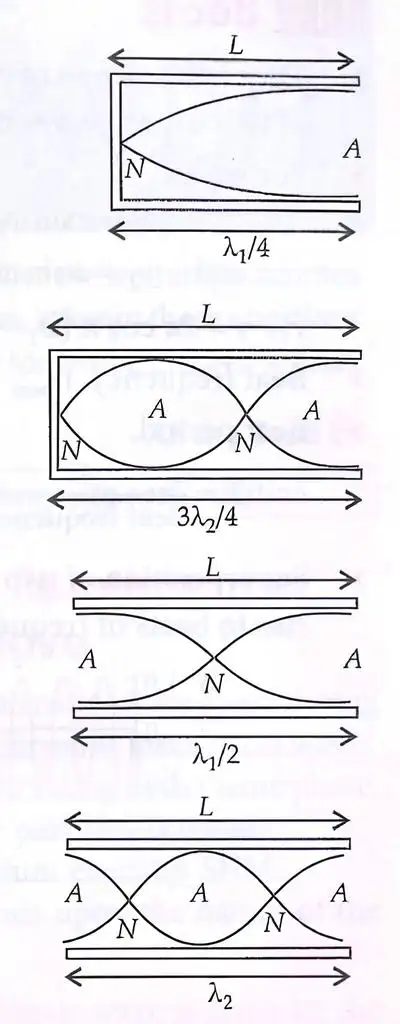
- Closed pipe: one end closed, frequency ν = (2n+1)v/4l, only odd harmonics.
- Open pipe: both ends open, frequency ν = nv/2l, all harmonics present.
- Wavelengths: Closed pipe λ = 4l/(2n+1), Open pipe λ = 2l/n.
- Nodes and antinodes positions differ for closed and open pipes.
Solved Examples
- Ex 1: Find fundamental frequency of closed pipe length 0.5 m, speed of sound 340 m/s.
Answer: ν0 = v/4l = 340/(4 × 0.5) = 170 Hz. - Ex 2: Frequency of 3rd harmonic in closed pipe.
Answer: ν2 = 3 × 170 = 510 Hz.
Practice Set
- Q1: Closed pipe harmonics are:
A) All harmonics
B) Only odd harmonics
C) Only even harmonics
D) None - Q2: Open pipe fundamental frequency formula:
A) v/4l
B) v/2l
C) v/l
D) 2v/l - Q3: Position of node in closed pipe:
A) At open end
B) At closed end
C) Middle of pipe
D) None
Answer Key
- Q1: B - Closed pipe has only odd harmonics.
- Q2: B - Open pipe fundamental frequency ν = v/2l.
- Q3: B - Node at closed end in closed pipe.
Memory Aids
- Closed pipe: odd harmonics only.
- Open pipe: all harmonics.
- Node at closed end, antinode at open end.
Closed and Open Pipes
- Closed pipe: one end closed, frequency ν = (2n+1)v/4l, only odd harmonics.
- Open pipe: both ends open, frequency ν = nv/2l, all harmonics present.
- Wavelengths: Closed pipe λ = 4l/(2n+1), Open pipe λ = 2l/n.
- Nodes and antinodes positions differ for closed and open pipes.
Solved Examples
- Ex 1: Find fundamental frequency of closed pipe length 0.5 m, speed of sound 340 m/s.
Answer: ν0 = v/4l = 340/(4 × 0.5) = 170 Hz. - Ex 2: Frequency of 3rd harmonic in closed pipe.
Answer: ν2 = 3 × 170 = 510 Hz.
Practice Set
- Q1: Closed pipe harmonics are:
A) All harmonics
B) Only odd harmonics
C) Only even harmonics
D) None - Q2: Open pipe fundamental frequency formula:
A) v/4l
B) v/2l
C) v/l
D) 2v/l - Q3: Position of node in closed pipe:
A) At open end
B) At closed end
C) Middle of pipe
D) None
Answer Key
- Q1: B - Closed pipe has only odd harmonics.
- Q2: B - Open pipe fundamental frequency ν = v/2l.
- Q3: B - Node at closed end in closed pipe.
Memory Aids
- Closed pipe: odd harmonics only.
- Open pipe: all harmonics.
- Node at closed end, antinode at open end.
Closed and Open Pipes
- Closed pipe: one end closed, frequency u = (2n+1)v/4l, only odd harmonics.
- Open pipe: both ends open, frequency u = nv/2l, all harmonics present.
- Wavelengths: Closed pipe b = 4l/(2n+1), Open pipe b = 2l/n.
- Nodes and antinodes positions differ for closed and open pipes.
Solved Examples
- Ex 1: Find fundamental frequency of closed pipe length 0.5 m, speed of sound 340 m/s.
Answer: u0 = v/4l = 340/(4 × 0.5) = 170 Hz. - Ex 2: Frequency of 3rd harmonic in closed pipe.
Answer: u2 = 3 × 170 = 510 Hz.
Practice Set
- Q1: Closed pipe harmonics are:
A) All harmonics
B) Only odd harmonics
C) Only even harmonics
D) None - Q2: Open pipe fundamental frequency formula:
A) v/4l
B) v/2l
C) v/l
D) 2v/l - Q3: Position of node in closed pipe:
A) At open end
B) At closed end
C) Middle of pipe
D) None
Answer Key
- Q1: B - Closed pipe has only odd harmonics.
- Q2: B - Open pipe fundamental frequency u = v/2l.
- Q3: B - Node at closed end in closed pipe.
Memory Aids
- Closed pipe: odd harmonics only.
- Open pipe: all harmonics.
- Node at closed end, antinode at open end.
Closed and Open Pipes
- Closed pipe: one end closed, frequency ν = (2n+1)v/4l, only odd harmonics.
- Open pipe: both ends open, frequency ν = nv/2l, all harmonics present.
- Wavelengths: Closed pipe λ = 4l/(2n+1), Open pipe λ = 2l/n.
- Nodes and antinodes positions differ for closed and open pipes.
Solved Examples
- Ex 1: Find fundamental frequency of closed pipe length 0.5 m, speed of sound 340 m/s.
Answer: ν0 = v/4l = 340/(4 × 0.5) = 170 Hz. - Ex 2: Frequency of 3rd harmonic in closed pipe.
Answer: ν2 = 3 × 170 = 510 Hz.
Practice Set
- Q1: Closed pipe harmonics are:
A) All harmonics
B) Only odd harmonics
C) Only even harmonics
D) None - Q2: Open pipe fundamental frequency formula:
A) v/4l
B) v/2l
C) v/l
D) 2v/l - Q3: Position of node in closed pipe:
A) At open end
B) At closed end
C) Middle of pipe
D) None
Answer Key
- Q1: B - Closed pipe has only odd harmonics.
- Q2: B - Open pipe fundamental frequency ν = v/2l.
- Q3: B - Node at closed end in closed pipe.
Memory Aids
- Closed pipe: odd harmonics only.
- Open pipe: all harmonics.
- Node at closed end, antinode at open end.
Closed and Open Pipes
- Closed pipe: one end closed, frequency \(\nu = \frac{(2n+1)v}{4l}\), only odd harmonics.
- Open pipe: both ends open, frequency \(\nu = \frac{nv}{2l}\), all harmonics present.
- Wavelengths: Closed pipe \(\lambda = \frac{4l}{2n+1}\), Open pipe \(\lambda = \frac{2l}{n}\).
- Nodes and antinodes positions differ for closed and open pipes.
Solved Examples
- Ex 1: Find fundamental frequency of closed pipe length 0.5 m, speed of sound 340 m/s.
Answer: \(\nu_0 = \frac{v}{4l} = \frac{340}{4 \times 0.5} = 170\) Hz. - Ex 2: Frequency of 3rd harmonic in closed pipe.
Answer: \(\nu_2 = 3 \times 170 = 510\) Hz.
Practice Set
- Q1: Closed pipe harmonics are:
A) All harmonics
B) Only odd harmonics
C) Only even harmonics
D) None - Q2: Open pipe fundamental frequency formula:
A) \(\frac{v}{4l}\)
B) \(\frac{v}{2l}\)
C) \(\frac{v}{l}\)
D) \(\frac{2v}{l}\) - Q3: Position of node in closed pipe:
A) At open end
B) At closed end
C) Middle of pipe
D) None
Answer Key
- Q1: B - Closed pipe has only odd harmonics.
- Q2: B - Open pipe fundamental frequency \(\nu = \frac{v}{2l}\).
- Q3: B - Node at closed end in closed pipe.
Memory Aids
- Closed pipe: odd harmonics only.
- Open pipe: all harmonics.
- Node at closed end, antinode at open end.
End Correction
Concept and Formula
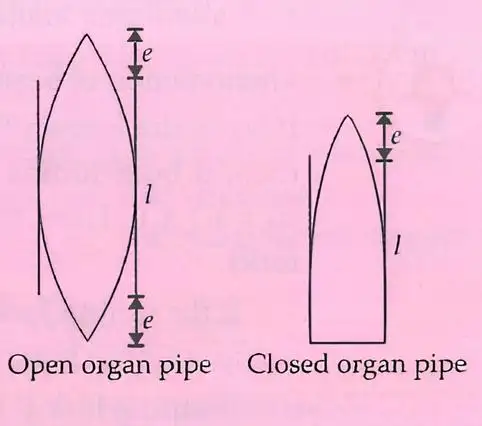
- Wave reflects slightly above open end; distance is end correction e.
- End correction depends on pipe radius: e = 0.6r = 0.3d.
- Frequency with end correction:
Closed pipe: f = (2n+1)v/4(l+e)
Open pipe: f = nv/2(l+2e).
Solved Examples
- Ex 1: Calculate frequency of closed pipe with length 0.5 m, e=0.01 m, v=340 m/s.
Answer: f = v/4(l+e) = 340/4(0.5+0.01) ≈ 166.3 Hz.
Practice Set
- Q1: End correction depends on:
A) Length
B) Radius
C) Frequency
D) Tension - Q2: Frequency formula for closed pipe with end correction:
A) nv/2l
B) (2n+1)v/4(l+e)
C) nv/2(l+2e)
D) v/4l - Q3: End correction e is approximately:
A) r
B) 0.6r
C) 2r
D) 0.1r
Answer Key
- Q1: B - End correction depends on pipe radius.
- Q2: B - Closed pipe frequency includes l+e.
- Q3: B - e = 0.6r experimentally determined.
Memory Aids
- End correction ~ 0.6 × radius.
- Frequency formulas adjusted for l+e.
- Important for accurate pipe resonance.
Concept and Formula
- Wave reflects slightly above open end; distance is end correction e.
- End correction depends on pipe radius: e = 0.6r = 0.3d.
- Frequency with end correction:
Closed pipe: f = (2n+1)v/4(l+e)
Open pipe: f = nv/2(l+2e).
Solved Examples
- Ex 1: Calculate frequency of closed pipe with length 0.5 m, e=0.01 m, v=340 m/s.
Answer: f = v/4(l+e) = 340/4(0.5+0.01) ≈ 166.3 Hz.
Practice Set
- Q1: End correction depends on:
A) Length
B) Radius
C) Frequency
D) Tension - Q2: Frequency formula for closed pipe with end correction:
A) nv/2l
B) (2n+1)v/4(l+e)
C) nv/2(l+2e)
D) v/4l - Q3: End correction e is approximately:
A) r
B) 0.6r
C) 2r
D) 0.1r
Answer Key
- Q1: B - End correction depends on pipe radius.
- Q2: B - Closed pipe frequency includes l+e.
- Q3: B - e = 0.6r experimentally determined.
Memory Aids
- End correction ~ 0.6 × radius.
- Frequency formulas adjusted for l+e.
- Important for accurate pipe resonance.
Concept and Formula
- Wave reflects slightly above open end; distance is end correction \(e\).
- End correction depends on pipe radius: \(e = 0.6r = 0.3d\).
- Frequency with end correction:
Closed pipe: \(f = \frac{(2n+1)v}{4(l+e)}\)
Open pipe: \(f = \frac{nv}{2(l+2e)}\).
Solved Examples
- Ex 1: Calculate frequency of closed pipe with length 0.5 m, \(e=0.01\) m, \(v=340\) m/s.
Answer: \(f = \frac{v}{4(l+e)} = \frac{340}{4(0.5+0.01)} \approx 166.3\) Hz.
Practice Set
- Q1: End correction depends on:
A) Length
B) Radius
C) Frequency
D) Tension - Q2: Frequency formula for closed pipe with end correction:
A) \(\frac{nv}{2l}\)
B) \(\frac{(2n+1)v}{4(l+e)}\)
C) \(\frac{nv}{2(l+2e)}\)
D) \(\frac{v}{4l}\) - Q3: End correction \(e\) is approximately:
A) \(r\)
B) \(0.6r\)
C) \(2r\)
D) \(0.1r\)
Answer Key
- Q1: B - End correction depends on pipe radius.
- Q2: B - Closed pipe frequency includes \(l+e\).
- Q3: B - \(e = 0.6r\) experimentally determined.
Memory Aids
- End correction ~ 0.6 × radius.
- Frequency formulas adjusted for \(l+e\).
- Important for accurate pipe resonance.
Difference Between Travelling and Standing Waves
Key Differences
- Travelling wave: disturbance moves through space; standing wave: disturbance confined.
- Travelling wave: all particles move similarly; standing wave: different amplitudes.
- Standing wave nodes are always at rest; travelling wave has no fixed rest points.
- Particles in standing wave cross mean position simultaneously; not so in travelling wave.
- Standing wave particles between nodes move in phase; travelling wave phases differ.
- Energy transmitted in travelling wave; energy confined in standing wave.
Solved Examples
- Ex 1: Identify wave type where energy is confined.
Answer: Standing wave. - Ex 2: Wave with all particles moving in phase.
Answer: Standing wave.
Practice Set
- Q1: Which wave has fixed nodes?
A) Travelling wave
B) Standing wave
C) Both
D) None - Q2: Energy transmission occurs in:
A) Standing wave
B) Travelling wave
C) Both
D) None - Q3: Particles moving in phase is characteristic of:
A) Travelling wave
B) Standing wave
C) Neither
D) Both
Answer Key
- Q1: B - Standing waves have fixed nodes.
- Q2: B - Travelling waves transmit energy.
- Q3: B - Standing waves have particles moving in phase.
Memory Aids
- Standing wave: fixed nodes, confined energy.
- Travelling wave: energy moves, no fixed nodes.
- Phase coherence in standing waves only.
Beats
Concept and Formulae
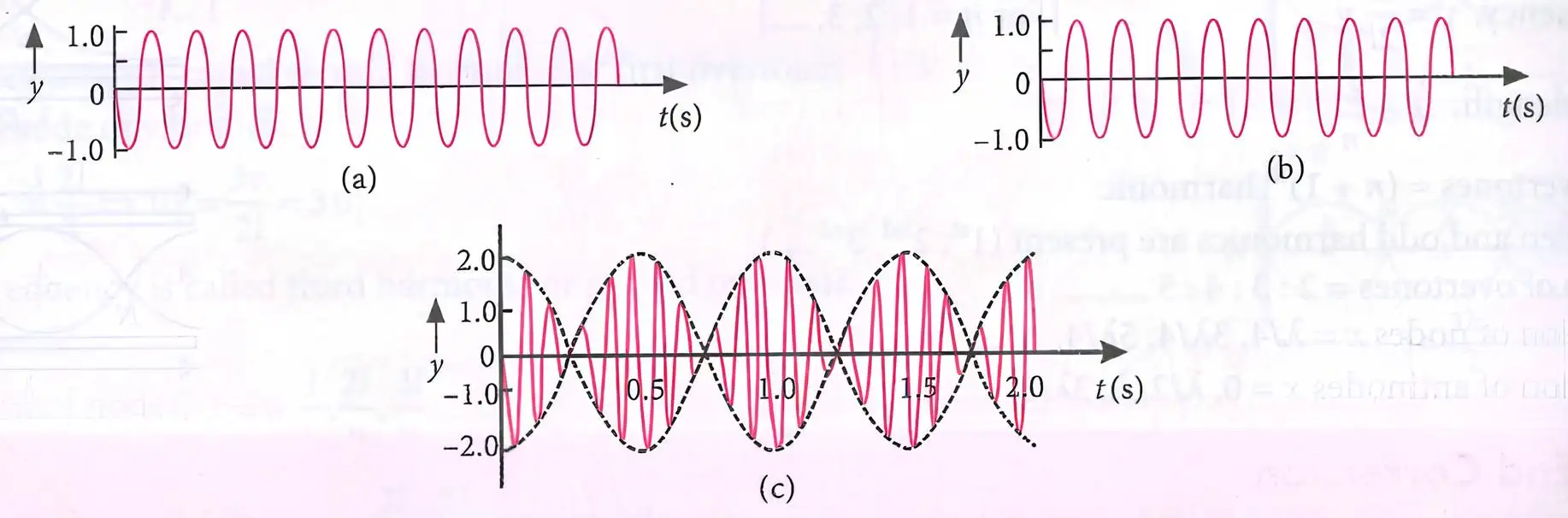
- Beats: Regular variation in sound intensity due to superposition of two waves with close frequencies.
- Two waves: y1 = a sin ω1t = a sin 2πν1t, y2 = a sin ω2t = a sin 2πν2t
- Resultant wave: y = 2a cos π(ν1 - ν2)t · sin π(ν1 + ν2)t
- Beat frequency: νbeat = |ν1 - ν2|
- Beat period: T = 1/νbeat = 1/|ν1 - ν2|
- Example: Superposition of 11 Hz and 9 Hz waves produces beats of 2 Hz frequency.
Solved Examples
- Ex 1: Two waves of frequencies 256 Hz and 260 Hz interfere. Find beat frequency.
- Beat frequency = |260 - 256| = 4 Hz
- Ex 2: Find beat period for above waves.
- Beat period T = 1/4 = 0.25 s
Practice Set
- Q1: Two tuning forks have frequencies 340 Hz and 344 Hz. What is the beat frequency?
- A. 4 Hz
- B. 684 Hz
- C. 172 Hz
- D. 0 Hz
- Q2: If beat frequency is 5 Hz and one wave frequency is 250 Hz, what can be the other frequency?
- A. 245 Hz or 255 Hz
- B. 255 Hz only
- C. 245 Hz only
- D. 250 Hz
- Q3: Two waves produce beats of frequency 3 Hz. If one wave is 100 Hz, what is the beat period?
- A. 0.33 s
- B. 3 s
- C. 100 s
- D. 1/97 s
Answer Key
- Q1: A. 4 Hz - Beat frequency is the difference of frequencies.
- Q2: A. 245 Hz or 255 Hz - Other frequency can be ν ± νbeat.
- Q3: A. 0.33 s - Beat period T = 1/3 = 0.33 s.
Memory Aids
- Beat frequency = difference of frequencies.
- Beat period = reciprocal of beat frequency.
- Use loading or filing tuning fork to find unknown frequency.
Concept and Formulae
- Beats: Regular variation in sound intensity due to superposition of two waves with close frequencies.
- Two waves: y1 = a sin ω1t = a sin 2πν1t, y2 = a sin ω2t = a sin 2πν2t
- Resultant wave: y = 2a cos π(ν1 - ν2)t · sin π(ν1 + ν2)t
- Beat frequency: νbeat = |ν1 - ν2|
- Beat period: T = 1/νbeat = 1/|ν1 - ν2|
- Example: Superposition of 11 Hz and 9 Hz waves produces beats of 2 Hz frequency.
Solved Examples
- Ex 1: Two waves of frequencies 256 Hz and 260 Hz interfere. Find beat frequency.
- Beat frequency = |260 - 256| = 4 Hz
- Ex 2: Find beat period for above waves.
- Beat period T = 1/4 = 0.25 s
Practice Set
- Q1: Two tuning forks have frequencies 340 Hz and 344 Hz. What is the beat frequency?
- A. 4 Hz
- B. 684 Hz
- C. 172 Hz
- D. 0 Hz
- Q2: If beat frequency is 5 Hz and one wave frequency is 250 Hz, what can be the other frequency?
- A. 245 Hz or 255 Hz
- B. 255 Hz only
- C. 245 Hz only
- D. 250 Hz
- Q3: Two waves produce beats of frequency 3 Hz. If one wave is 100 Hz, what is the beat period?
- A. 0.33 s
- B. 3 s
- C. 100 s
- D. 1/97 s
Answer Key
- Q1: A. 4 Hz - Beat frequency is the difference of frequencies.
- Q2: A. 245 Hz or 255 Hz - Other frequency can be ν ± νbeat.
- Q3: A. 0.33 s - Beat period T = 1/3 = 0.33 s.
Memory Aids
- Beat frequency = difference of frequencies.
- Beat period = reciprocal of beat frequency.
- Use loading or filing tuning fork to find unknown frequency.
Concept and Formulae
- Beats: Regular variation in sound intensity due to superposition of two waves with close frequencies.
- Two waves: \( y_1 = a \sin \omega_1 t = a \sin 2\pi \nu_1 t \), \( y_2 = a \sin \omega_2 t = a \sin 2\pi \nu_2 t \)
- Resultant wave: \( y = 2a \cos \pi (\nu_1 - \nu_2) t \cdot \sin \pi (\nu_1 + \nu_2) t \)
- Beat frequency: \( \nu_{beat} = |\nu_1 - \nu_2| \)
- Beat period: \( T = \frac{1}{\nu_{beat}} = \frac{1}{|\nu_1 - \nu_2|} \)
- Example: Superposition of 11 Hz and 9 Hz waves produces beats of 2 Hz frequency.
Solved Examples
- Ex 1: Two waves of frequencies 256 Hz and 260 Hz interfere. Find beat frequency.
- Beat frequency = |260 - 256| = 4 Hz
- Ex 2: Find beat period for above waves.
- Beat period \( T = \frac{1}{4} = 0.25 \) s
Practice Set
- Q1: Two tuning forks have frequencies 340 Hz and 344 Hz. What is the beat frequency?
- A. 4 Hz
- B. 684 Hz
- C. 172 Hz
- D. 0 Hz
- Q2: If beat frequency is 5 Hz and one wave frequency is 250 Hz, what can be the other frequency?
- A. 245 Hz or 255 Hz
- B. 255 Hz only
- C. 245 Hz only
- D. 250 Hz
- Q3: Two waves produce beats of frequency 3 Hz. If one wave is 100 Hz, what is the beat period?
- A. 0.33 s
- B. 3 s
- C. 100 s
- D. 1/97 s
Answer Key
- Q1: A. 4 Hz - Beat frequency is the difference of frequencies.
- Q2: A. 245 Hz or 255 Hz - Other frequency can be \( \nu \pm \nu_{beat} \).
- Q3: A. 0.33 s - Beat period \( T = \frac{1}{3} = 0.33 \) s.
Memory Aids
- Beat frequency = difference of frequencies.
- Beat period = reciprocal of beat frequency.
- Use loading or filing tuning fork to find unknown frequency.
Frequency Determination Using Beats
Concept and Formulae
- Known frequency: νA, unknown frequency: νB.
- When both tuning forks sound together, beat frequency ν = |νA - νB|.
- Relation: νB = νA ± ν.
- Loading tuning fork B with wax:
- If beat frequency increases, νB = νA - ν.
- If beat frequency decreases, νB = νA + ν.
- Filing tuning fork B:
- If beat frequency increases, νB = νA + ν.
- If beat frequency decreases, νB = νA - ν.
Solved Examples
- Ex 1: Known frequency νA = 256 Hz, beat frequency ν = 4 Hz, beat frequency increases on loading.
- νB = 256 - 4 = 252 Hz
- Ex 2: Known frequency νA = 256 Hz, beat frequency ν = 4 Hz, beat frequency decreases on filing.
- νB = 256 - 4 = 252 Hz
Practice Set
- Q1: If beat frequency increases on loading tuning fork B, and νA = 300 Hz, beat frequency = 5 Hz, find νB.
- A. 295 Hz
- B. 305 Hz
- C. 300 Hz
- D. 310 Hz
- Q2: If beat frequency decreases on filing tuning fork B, and νA = 400 Hz, beat frequency = 3 Hz, find νB.
- A. 403 Hz
- B. 397 Hz
- C. 400 Hz
- D. 397 Hz or 403 Hz
- Q3: Known frequency νA = 500 Hz, beat frequency = 2 Hz, beat frequency decreases on loading. Find νB.
- A. 502 Hz
- B. 498 Hz
- C. 500 Hz
- D. 498 Hz or 502 Hz
Answer Key
- Q1: A. 295 Hz - Beat frequency increases on loading means νB = νA - ν.
- Q2: B. 397 Hz - Beat frequency decreases on filing means νB = νA - ν.
- Q3: A. 502 Hz - Beat frequency decreases on loading means νB = νA + ν.
Memory Aids
- Loading wax lowers frequency, filing increases frequency.
- Beat frequency change direction decides ± sign.
- Use beat frequency to find unknown tuning fork frequency.
Concept and Formulae
- Known frequency: \( \nu_A \), unknown frequency: \( \nu_B \).
- When both tuning forks sound together, beat frequency \( \nu = |\nu_A - \nu_B| \).
- Relation: \( \nu_B = \nu_A \pm \nu \).
- Loading tuning fork B with wax:
- If beat frequency increases, \( \nu_B = \nu_A - \nu \).
- If beat frequency decreases, \( \nu_B = \nu_A + \nu \).
- Filing tuning fork B:
- If beat frequency increases, \( \nu_B = \nu_A + \nu \).
- If beat frequency decreases, \( \nu_B = \nu_A - \nu \).
Solved Examples
- Ex 1: Known frequency \( \nu_A = 256 \) Hz, beat frequency \( \nu = 4 \) Hz, beat frequency increases on loading.
- \( \nu_B = 256 - 4 = 252 \) Hz
- Ex 2: Known frequency \( \nu_A = 256 \) Hz, beat frequency \( \nu = 4 \) Hz, beat frequency decreases on filing.
- \( \nu_B = 256 - 4 = 252 \) Hz
Practice Set
- Q1: If beat frequency increases on loading tuning fork B, and \( \nu_A = 300 \) Hz, beat frequency = 5 Hz, find \( \nu_B \).
- A. 295 Hz
- B. 305 Hz
- C. 300 Hz
- D. 310 Hz
- Q2: If beat frequency decreases on filing tuning fork B, and \( \nu_A = 400 \) Hz, beat frequency = 3 Hz, find \( \nu_B \).
- A. 403 Hz
- B. 397 Hz
- C. 400 Hz
- D. 397 Hz or 403 Hz
- Q3: Known frequency \( \nu_A = 500 \) Hz, beat frequency = 2 Hz, beat frequency decreases on loading. Find \( \nu_B \).
- A. 502 Hz
- B. 498 Hz
- C. 500 Hz
- D. 498 Hz or 502 Hz
Answer Key
- Q1: A. 295 Hz - Beat frequency increases on loading means \( \nu_B = \nu_A - \nu \).
- Q2: B. 397 Hz - Beat frequency decreases on filing means \( \nu_B = \nu_A - \nu \).
- Q3: A. 502 Hz - Beat frequency decreases on loading means \( \nu_B = \nu_A + \nu \).
Memory Aids
- Loading wax lowers frequency, filing increases frequency.
- Beat frequency change direction decides \( \pm \) sign.
- Use beat frequency to find unknown tuning fork frequency.
NEET Physics — ALL CHAPTERS
1
Basic Mathematics
2
Units and Measurement
3
Motion in a Straight Line
4
Motion in a Plane
5
Laws of Motion
6
Work, Energy and Power
7
System of Particles and Rotational Motion
8
Gravitation
9
Mechanical Properties of Solids
10
Mechanical Properties of Fluids
11
Thermal Properties of Matter
12
Thermodynamics
13
Kinetic Theory
14
Oscillations
15
Waves
16
Electric Charges and Fields
17
Electrostatic Potential and Capacitance
18
Current Electricity
19
Moving Charges and Magnetism
20
Magnetism and Matter
21
Electromagnetic Induction
22
Alternating Current
23
Electromagnetic Waves
24
Ray Optics and Optical Instruments
25
Wave Optics
26
Dual Nature of Radiation and Matter
27
Atoms
28
Nuclei
29
Semiconductor Electronics: Materials, Devices and Simple Circuits