NEET Ug . NEET Physics . Physics . Kinetic Theory
Chapter 13: Kinetic Theory
Ch 13
NEET Physics
NEET Ug
Introduction
Overview
- Gases consist of rapidly moving atoms or molecules.
- Kinetic theory explains gas behavior by neglecting inter-atomic forces.
- Developed in 19ᵗʰ century by Maxwell, Boltzmann, and others.
- Explains molecular basis of pressure and temperature.
- Consistent with gas laws and Avogadro’s hypothesis.
- Explains specific heat capacities of gases.
Solved Examples
- Ex 1: Calculate pressure from molecular collisions.
- Use formula: Pressure = Force/Area = (Change in momentum × collisions per second)/Area.
- Apply kinetic theory assumptions for ideal gas.
Practice Set
- Q1: Kinetic theory assumes gas molecules are:
- A) Stationary
- B) Rapidly moving
- C) Strongly interacting
- D) At rest
- Q2: Kinetic theory was developed by:
- A) Newton and Galileo
- B) Maxwell and Boltzmann
- C) Dalton and Avogadro
- D) Einstein and Planck
- Q3: Kinetic theory explains:
- A) Molecular basis of pressure and temperature
- B) Only chemical reactions
- C) Solid state properties
- D) Nuclear forces
Answer Key
- Q1: B - Gas molecules are rapidly moving particles.
- Q2: B - Maxwell and Boltzmann developed kinetic theory.
- Q3: A - It explains molecular interpretation of pressure and temperature.
Memory Aids
- Gas molecules = Rapid motion + negligible forces.
- Maxwell & Boltzmann = Kinetic theory pioneers.
- Pressure & temperature = Molecular collisions.
Molecular Nature of Matter
Key Concepts
- Feynman’s atomic hypothesis: Atoms are tiny particles in constant motion, attracting at a distance, repelling when close.
- Dalton’s Atomic Theory: Atoms combine in fixed mass ratios obeying simple laws.
- First law: Fixed mass proportion in compounds.
- Second law: Masses of elements in multiple compounds are in small integer ratios.
- Gay Lussac’s law: Volumes of gases combine in small integer ratios.
- Avogadro’s hypothesis: Equal volumes of gases at same T and P contain equal molecules.
- Mean free path: Average distance a molecule travels without collision.
Solved Examples
- Ex 1: Calculate mean free path.
- Use formula: \( \lambda = \frac{1}{\sqrt{2} \pi d^2 \frac{N}{V}} \)
- Where \(d\) = molecular diameter, \(N/V\) = number density.
Practice Set
- Q1: According to Feynman, atoms:
- A) Are static
- B) Move perpetually
- C) Do not attract
- D) Are large particles
- Q2: Dalton’s first law states:
- A) Variable mass ratios in compounds
- B) Fixed mass proportion in compounds
- C) Gases combine by volume
- D) Molecules are indivisible
- Q3: Mean free path is:
- A) Time between collisions
- B) Average distance between collisions
- C) Molecular speed
- D) Volume of gas
Answer Key
- Q1: B - Atoms move in perpetual motion.
- Q2: B - Fixed mass proportion in compounds.
- Q3: B - Mean free path is average distance traveled without collision.
Memory Aids
- Feynman: Atoms always moving, attract & repel.
- Dalton: Fixed mass ratios in compounds.
- Mean free path = distance between collisions.
Behaviour of Gases
Gas Behavior at Low Temperature and High Pressure
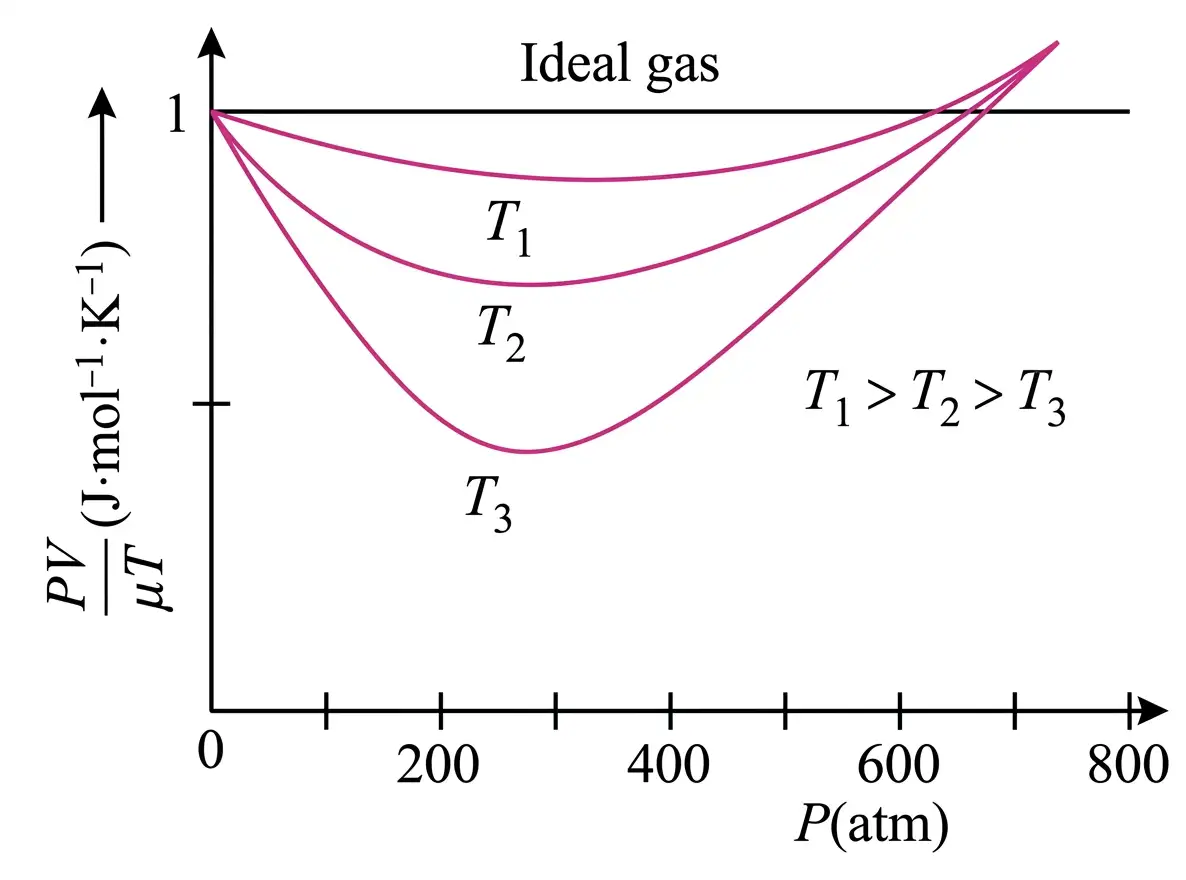
- For gases at low temperature and high pressure, (PV = KT)
- Constant K = NkB, where kB is Boltzmann constant (1.38 × 10⁻²³ J/K)
- N is the number of molecules in the gas
- At same P, V, T, number of molecules N is same for all gases
- Number of molecules in 22.4 litres of any gas = Avogadro number NA = 6.02 × 10²³
Perfect Gas Equation
- Equation: (PV = μRT) where μ = number of moles, R = NAkB = 8.314 J/mol·K
- Relation: μ = M/M0 = N/NA, where M = mass, M0 = molar mass
- Alternate form: (PV = μRT = kBNT) or (P = kBnT), where n = number density
- Real gases approach ideal gas behavior at low pressure and high temperature
- Pressure relation: (P = M/M0 RT/V = ρRT/M0), where ρ = mass density
- Ideal gas perfectly satisfies (PV = μRT) at all pressures and temperatures (theoretical model)
Solved Examples
- Ex 1: Calculate pressure P if N = 2 × 10²³, T = 300 K, and number density n = 5 × 1025 m-3 using (P = kBnT).
- P = 1.38 × 10-23 × 5 × 1025 × 300 = 2070 Pa
- Ex 2: Find volume V of 1 mole of gas at P = 1 atm, T = 273 K using (PV = μRT).
- V = μRT/P = (1 × 8.314 × 273)/(1.013 × 105) = 0.0224 m3 or 22.4 litres
Practice Set
- Q1: What is the value of Boltzmann constant kB?
- A. 1.38 × 10⁻²³ J/K
- B. 6.02 × 10²³ mol-1
- C. 8.314 J/mol·K
- D. 22.4 litres
- Q2: For an ideal gas, which equation is correct?
- A. PV = nRT
- B. PV = μRT
- C. P = kBnT
- D. All of the above
- Q3: Number of molecules in 22.4 litres of any gas at STP is?
- A. 6.02 × 10²³
- B. 1.38 × 10⁻²³
- C. 8.314
- D. 22.4
Answer Key
- Q1: A - Boltzmann constant kB = 1.38 × 10⁻²³ J/K is universal for gases.
- Q2: D - All equations represent ideal gas relations in different forms.
- Q3: A - Avogadro number 6.02 × 10²³ molecules in 22.4 litres at STP.
Memory Aids
- PV = μRT is the perfect gas equation.
- Boltzmann constant kB = 1.38 × 10⁻²³ J/K.
- Avogadro number NA = 6.02 × 10²³.
- Real gases behave ideally at low pressure, high temperature.
Gas Behavior at Low Temperature and High Pressure
- For gases at low temperature and high pressure, (PV = KT)
- Constant K = NkB, where kB is Boltzmann constant (1.38 × 10⁻²³ J/K)
- N is the number of molecules in the gas
- At same P, V, T, number of molecules N is same for all gases
- Number of molecules in 22.4 litres of any gas = Avogadro number NA = 6.02 × 10²³
Perfect Gas Equation
- Equation: (PV = μRT) where μ = number of moles, R = NAkB = 8.314 J/mol·K
- Relation: μ = M/M0 = N/NA, where M = mass, M0 = molar mass
- Alternate form: (PV = μRT = kBNT) or (P = kBnT), where n = number density
- Real gases approach ideal gas behavior at low pressure and high temperature
- Pressure relation: (P = M/M0 RT/V = ρRT/M0), where ρ = mass density
- Ideal gas perfectly satisfies (PV = μRT) at all pressures and temperatures (theoretical model)
Solved Examples
- Ex 1: Calculate pressure P if N = 2 × 10²³, T = 300 K, and number density n = 5 × 1025 m-3 using (P = kBnT).
- P = 1.38 × 10-23 × 5 × 1025 × 300 = 2070 Pa
- Ex 2: Find volume V of 1 mole of gas at P = 1 atm, T = 273 K using (PV = μRT).
- V = μRT/P = (1 × 8.314 × 273)/(1.013 × 105) = 0.0224 m3 or 22.4 litres
Practice Set
- Q1: What is the value of Boltzmann constant kB?
- A. 1.38 × 10⁻²³ J/K
- B. 6.02 × 10²³ mol-1
- C. 8.314 J/mol·K
- D. 22.4 litres
- Q2: For an ideal gas, which equation is correct?
- A. PV = nRT
- B. PV = μRT
- C. P = kBnT
- D. All of the above
- Q3: Number of molecules in 22.4 litres of any gas at STP is?
- A. 6.02 × 10²³
- B. 1.38 × 10⁻²³
- C. 8.314
- D. 22.4
Answer Key
- Q1: A - Boltzmann constant kB = 1.38 × 10⁻²³ J/K is universal for gases.
- Q2: D - All equations represent ideal gas relations in different forms.
- Q3: A - Avogadro number 6.02 × 10²³ molecules in 22.4 litres at STP.
Memory Aids
- PV = μRT is the perfect gas equation.
- Boltzmann constant kB = 1.38 × 10⁻²³ J/K.
- Avogadro number NA = 6.02 × 10²³.
- Real gases behave ideally at low pressure, high temperature.
Gas Behavior at Low Temperature and High Pressure
- For gases at low temperature and high pressure, PV = KT
- Constant K = NkB, where kB is Boltzmann constant (1.38 × 10⁻²³ J/K)
- N is the number of molecules in the gas
- At same P, V, T, number of molecules N is same for all gases
- Number of molecules in 22.4 litres of any gas = Avogadro number NA = 6.02 × 10²³
Perfect Gas Equation
- Equation: PV = μRT where μ = number of moles, R = NAkB = 8.314 J/mol·K
- Relation: μ = M/M0 = N/NA, where M = mass, M0 = molar mass
- Alternate form: PV = μRT = kBNT or P = kBnT, where n = number density
- Real gases approach ideal gas behavior at low pressure and high temperature
- Pressure relation: P = M/M0 RT/V = ρRT/M0, where ρ = mass density
- Ideal gas perfectly satisfies PV = μRT at all pressures and temperatures (theoretical model)
Solved Examples
- Ex 1: Calculate pressure P if N = 2 × 10²³, T = 300 K, and number density n = 5 × 1025 m-3 using P = kBnT.
- P = 1.38 × 10-23 × 5 × 1025 × 300 = 2070 Pa
- Ex 2: Find volume V of 1 mole of gas at P = 1 atm, T = 273 K using PV = μRT.
- V = μRT/P = (1 × 8.314 × 273)/(1.013 × 105) = 0.0224 m3 or 22.4 litres
Practice Set
- Q1: What is the value of Boltzmann constant kB?
- A. 1.38 × 10⁻²³ J/K
- B. 6.02 × 10²³ mol-1
- C. 8.314 J/mol·K
- D. 22.4 litres
- Q2: For an ideal gas, which equation is correct?
- A. PV = nRT
- B. PV = μRT
- C. P = kBnT
- D. All of the above
- Q3: Number of molecules in 22.4 litres of any gas at STP is?
- A. 6.02 × 10²³
- B. 1.38 × 10⁻²³
- C. 8.314
- D. 22.4
Answer Key
- Q1: A - Boltzmann constant kB = 1.38 × 10⁻²³ J/K is universal for gases.
- Q2: D - All equations represent ideal gas relations in different forms.
- Q3: A - Avogadro number 6.02 × 10²³ molecules in 22.4 litres at STP.
Memory Aids
- PV = μRT is the perfect gas equation.
- Boltzmann constant kB = 1.38 × 10⁻²³ J/K.
- Avogadro number NA = 6.02 × 10²³.
- Real gases behave ideally at low pressure, high temperature.
Gas Behavior at Low Temperature and High Pressure
- For gases at low temperature and high pressure, (PV = KT)
- Constant K = NkB, where kB is Boltzmann constant (1.38 × 10⁻²³ J/K)
- N is the number of molecules in the gas
- At same P, V, T, number of molecules N is same for all gases
- Number of molecules in 22.4 litres of any gas = Avogadro number NA = 6.02 × 10²³
Perfect Gas Equation
- Equation: (PV = μRT) where μ = number of moles, R = NAkB = 8.314 J/mol·K
- Relation: μ = M/M0 = N/NA, where M = mass, M0 = molar mass
- Alternate form: (PV = μRT = kBNT) or (P = kBnT), where n = number density
- Real gases approach ideal gas behavior at low pressure and high temperature
- Pressure relation: (P = M/M0 RT/V = ρRT/M0), where ρ = mass density
- Ideal gas perfectly satisfies (PV = μRT) at all pressures and temperatures (theoretical model)
Solved Examples
- Ex 1: Calculate pressure P if N = 2 × 10²³, T = 300 K, and number density n = 5 × 1025 m-3 using (P = kBnT).
- P = 1.38 × 10-23 × 5 × 1025 × 300 = 2070 Pa
- Ex 2: Find volume V of 1 mole of gas at P = 1 atm, T = 273 K using (PV = μRT).
- V = μRT/P = (1 × 8.314 × 273)/(1.013 × 105) = 0.0224 m3 or 22.4 litres
Practice Set
- Q1: What is the value of Boltzmann constant kB?
- A. 1.38 × 10⁻²³ J/K
- B. 6.02 × 10²³ mol-1
- C. 8.314 J/mol·K
- D. 22.4 litres
- Q2: For an ideal gas, which equation is correct?
- A. PV = nRT
- B. PV = μRT
- C. P = kBnT
- D. All of the above
- Q3: Number of molecules in 22.4 litres of any gas at STP is?
- A. 6.02 × 10²³
- B. 1.38 × 10⁻²³
- C. 8.314
- D. 22.4
Answer Key
- Q1: A - Boltzmann constant kB = 1.38 × 10⁻²³ J/K is universal for gases.
- Q2: D - All equations represent ideal gas relations in different forms.
- Q3: A - Avogadro number 6.02 × 10²³ molecules in 22.4 litres at STP.
Memory Aids
- PV = μRT is the perfect gas equation.
- Boltzmann constant kB = 1.38 × 10⁻²³ J/K.
- Avogadro number NA = 6.02 × 10²³.
- Real gases behave ideally at low pressure, high temperature.
Gas Behavior at Low Temperature and High Pressure
- For gases at low temperature and high pressure, \( PV = K T \)
- Constant \( K = N k_B \), where \( k_B \) is Boltzmann constant (\(1.38 \times 10^{-23} \) J/K)
- \( N \) is the number of molecules in the gas
- At same \( P, V, T \), number of molecules \( N \) is same for all gases
- Number of molecules in 22.4 litres of any gas = Avogadro number \( N_A = 6.02 \times 10^{23} \)
Perfect Gas Equation
- Equation: \( PV = \mu RT \) where \( \mu \) = number of moles, \( R = N_A k_B = 8.314 \) J/mol·K
- Relation: \( \mu = \frac{M}{M_0} = \frac{N}{N_A} \), where \( M \) = mass, \( M_0 \) = molar mass
- Alternate form: \( PV = \mu RT = k_B N T \) or \( P = k_B n T \), where \( n \) = number density
- Real gases approach ideal gas behavior at low pressure and high temperature
- Pressure relation: \( P = \frac{M}{M_0} \frac{RT}{V} = \frac{\rho RT}{M_0} \), where \( \rho \) = mass density
- Ideal gas perfectly satisfies \( PV = \mu RT \) at all pressures and temperatures (theoretical model)
Solved Examples
- Ex 1: Calculate pressure \( P \) if \( N = 2 \times 10^{23} \), \( T = 300 K \), and number density \( n = 5 \times 10^{25} \) m-3 using \( P = k_B n T \).
- \( P = 1.38 \times 10^{-23} \times 5 \times 10^{25} \times 300 = 2070 \) Pa
- Ex 2: Find volume \( V \) of 1 mole of gas at \( P = 1 \) atm, \( T = 273 K \) using \( PV = \mu RT \).
- \( V = \frac{\mu RT}{P} = \frac{1 \times 8.314 \times 273}{1.013 \times 10^{5}} = 0.0224 \) m3 or 22.4 litres
Practice Set
- Q1: What is the value of Boltzmann constant \( k_B \)?
- A. \(1.38 \times 10^{-23} \) J/K
- B. \(6.02 \times 10^{23} \) mol-1
- C. \(8.314 \) J/mol·K
- D. \(22.4 \) litres
- Q2: For an ideal gas, which equation is correct?
- A. \( PV = nRT \)
- B. \( PV = \mu RT \)
- C. \( P = k_B n T \)
- D. All of the above
- Q3: Number of molecules in 22.4 litres of any gas at STP is?
- A. \(6.02 \times 10^{23} \)
- B. \(1.38 \times 10^{-23} \)
- C. \(8.314 \)
- D. \(22.4 \)
Answer Key
- Q1: A - Boltzmann constant \( k_B = 1.38 \times 10^{-23} \) J/K is universal for gases.
- Q2: D - All equations represent ideal gas relations in different forms.
- Q3: A - Avogadro number \( 6.02 \times 10^{23} \) molecules in 22.4 litres at STP.
Memory Aids
- \( PV = \mu RT \) is the perfect gas equation.
- Boltzmann constant \( k_B = 1.38 \times 10^{-23} \) J/K.
- Avogadro number \( N_A = 6.02 \times 10^{23} \).
- Real gases behave ideally at low pressure, high temperature.
Gas Behavior at Low Temperature and High Pressure
- For gases at low temperature and high pressure, (PV = KT)
- Constant K = NkB, where kB is Boltzmann constant (1.38 × 10⁻²³ J/K)
- N is the number of molecules in the gas
- At same P, V, T, number of molecules N is same for all gases
- Number of molecules in 22.4 litres of any gas = Avogadro number NA = 6.02 × 10²³
Perfect Gas Equation
- Equation: (PV = μRT) where μ = number of moles, R = NAkB = 8.314 J/mol·K
- Relation: μ = M/M0 = N/NA, where M = mass, M0 = molar mass
- Alternate form: (PV = μRT = kBNT) or (P = kBnT), where n = number density
- Real gases approach ideal gas behavior at low pressure and high temperature
- Pressure relation: (P = M/M0 RT/V = ρRT/M0), where ρ = mass density
- Ideal gas perfectly satisfies (PV = μRT) at all pressures and temperatures (theoretical model)
Solved Examples
- Ex 1: Calculate pressure P if N = 2 × 10²³, T = 300 K, and number density n = 5 × 1025 m-3 using (P = kBnT).
- P = 1.38 × 10-23 × 5 × 1025 × 300 = 2070 Pa
- Ex 2: Find volume V of 1 mole of gas at P = 1 atm, T = 273 K using (PV = μRT).
- V = μRT/P = (1 × 8.314 × 273)/(1.013 × 105) = 0.0224 m3 or 22.4 litres
Practice Set
- Q1: What is the value of Boltzmann constant kB?
- A. 1.38 × 10⁻²³ J/K
- B. 6.02 × 10²³ mol-1
- C. 8.314 J/mol·K
- D. 22.4 litres
- Q2: For an ideal gas, which equation is correct?
- A. PV = nRT
- B. PV = μRT
- C. P = kBnT
- D. All of the above
- Q3: Number of molecules in 22.4 litres of any gas at STP is?
- A. 6.02 × 10²³
- B. 1.38 × 10⁻²³
- C. 8.314
- D. 22.4
Answer Key
- Q1: A - Boltzmann constant kB = 1.38 × 10⁻²³ J/K is universal for gases.
- Q2: D - All equations represent ideal gas relations in different forms.
- Q3: A - Avogadro number 6.02 × 10²³ molecules in 22.4 litres at STP.
Memory Aids
- PV = μRT is the perfect gas equation.
- Boltzmann constant kB = 1.38 × 10⁻²³ J/K.
- Avogadro number NA = 6.02 × 10²³.
- Real gases behave ideally at low pressure, high temperature.
Gas Behavior at Low Temperature and High Pressure
- For gases at low temperature and high pressure, PV = KT
- Constant K = NkB, where kB is Boltzmann constant (1.38 × 10⁻²³ J/K)
- N is the number of molecules in the gas
- At same P, V, T, number of molecules N is same for all gases
- Number of molecules in 22.4 litres of any gas = Avogadro number NA = 6.02 × 10²³
Perfect Gas Equation
- Equation: PV = μRT where μ = number of moles, R = NAkB = 8.314 J/mol·K
- Relation: μ = M/M0 = N/NA, where M = mass, M0 = molar mass
- Alternate form: PV = μRT = kBNT or P = kBnT, where n = number density
- Real gases approach ideal gas behavior at low pressure and high temperature
- Pressure relation: P = M/M0 RT/V = ρRT/M0, where ρ = mass density
- Ideal gas perfectly satisfies PV = μRT at all pressures and temperatures (theoretical model)
Solved Examples
- Ex 1: Calculate pressure P if N = 2 × 10²³, T = 300 K, and number density n = 5 × 1025 m-3 using P = kBnT.
- P = 1.38 × 10-23 × 5 × 1025 × 300 = 2070 Pa
- Ex 2: Find volume V of 1 mole of gas at P = 1 atm, T = 273 K using PV = μRT.
- V = μRT/P = (1 × 8.314 × 273)/(1.013 × 105) = 0.0224 m3 or 22.4 litres
Practice Set
- Q1: What is the value of Boltzmann constant kB?
- A. 1.38 × 10⁻²³ J/K
- B. 6.02 × 10²³ mol-1
- C. 8.314 J/mol·K
- D. 22.4 litres
- Q2: For an ideal gas, which equation is correct?
- A. PV = nRT
- B. PV = μRT
- C. P = kBnT
- D. All of the above
- Q3: Number of molecules in 22.4 litres of any gas at STP is?
- A. 6.02 × 10²³
- B. 1.38 × 10⁻²³
- C. 8.314
- D. 22.4
Answer Key
- Q1: A - Boltzmann constant kB = 1.38 × 10⁻²³ J/K is universal for gases.
- Q2: D - All equations represent ideal gas relations in different forms.
- Q3: A - Avogadro number 6.02 × 10²³ molecules in 22.4 litres at STP.
Memory Aids
- PV = μRT is the perfect gas equation.
- Boltzmann constant kB = 1.38 × 10⁻²³ J/K.
- Avogadro number NA = 6.02 × 10²³.
- Real gases behave ideally at low pressure, high temperature.
Gas Behavior at Low Temperature and High Pressure
- For gases at low temperature and high pressure, (PV = KT)
- Constant K = NkB, where kB is Boltzmann constant (1.38 × 10⁻²³ J/K)
- N is the number of molecules in the gas
- At same P, V, T, number of molecules N is same for all gases
- Number of molecules in 22.4 litres of any gas = Avogadro number NA = 6.02 × 10²³
Perfect Gas Equation
- Equation: (PV = μRT) where μ = number of moles, R = NAkB = 8.314 J/mol·K
- Relation: μ = M/M0 = N/NA, where M = mass, M0 = molar mass
- Alternate form: (PV = μRT = kBNT) or (P = kBnT), where n = number density
- Real gases approach ideal gas behavior at low pressure and high temperature
- Pressure relation: (P = M/M0 RT/V = ρRT/M0), where ρ = mass density
- Ideal gas perfectly satisfies (PV = μRT) at all pressures and temperatures (theoretical model)
Solved Examples
- Ex 1: Calculate pressure P if N = 2 × 10²³, T = 300 K, and number density n = 5 × 1025 m-3 using (P = kBnT).
- P = 1.38 × 10-23 × 5 × 1025 × 300 = 2070 Pa
- Ex 2: Find volume V of 1 mole of gas at P = 1 atm, T = 273 K using (PV = μRT).
- V = μRT/P = (1 × 8.314 × 273)/(1.013 × 105) = 0.0224 m3 or 22.4 litres
Practice Set
- Q1: What is the value of Boltzmann constant kB?
- A. 1.38 × 10⁻²³ J/K
- B. 6.02 × 10²³ mol-1
- C. 8.314 J/mol·K
- D. 22.4 litres
- Q2: For an ideal gas, which equation is correct?
- A. PV = nRT
- B. PV = μRT
- C. P = kBnT
- D. All of the above
- Q3: Number of molecules in 22.4 litres of any gas at STP is?
- A. 6.02 × 10²³
- B. 1.38 × 10⁻²³
- C. 8.314
- D. 22.4
Answer Key
- Q1: A - Boltzmann constant kB = 1.38 × 10⁻²³ J/K is universal for gases.
- Q2: D - All equations represent ideal gas relations in different forms.
- Q3: A - Avogadro number 6.02 × 10²³ molecules in 22.4 litres at STP.
Memory Aids
- PV = μRT is the perfect gas equation.
- Boltzmann constant kB = 1.38 × 10⁻²³ J/K.
- Avogadro number NA = 6.02 × 10²³.
- Real gases behave ideally at low pressure, high temperature.
Gas Behavior at Low Temperature and High Pressure
- For gases at low temperature and high pressure, \( PV = K T \)
- Constant \( K = N k_B \), where \( k_B \) is Boltzmann constant (\(1.38 \times 10^{-23} \) J/K)
- \( N \) is the number of molecules in the gas
- At same \( P, V, T \), number of molecules \( N \) is same for all gases
- Number of molecules in 22.4 litres of any gas = Avogadro number \( N_A = 6.02 \times 10^{23} \)
Perfect Gas Equation
- Equation: \( PV = \mu RT \) where \( \mu \) = number of moles, \( R = N_A k_B = 8.314 \) J/mol·K
- Relation: \( \mu = \frac{M}{M_0} = \frac{N}{N_A} \), where \( M \) = mass, \( M_0 \) = molar mass
- Alternate form: \( PV = \mu RT = k_B N T \) or \( P = k_B n T \), where \( n \) = number density
- Real gases approach ideal gas behavior at low pressure and high temperature
- Pressure relation: \( P = \frac{M}{M_0} \frac{RT}{V} = \frac{\rho RT}{M_0} \), where \( \rho \) = mass density
- Ideal gas perfectly satisfies \( PV = \mu RT \) at all pressures and temperatures (theoretical model)
Solved Examples
- Ex 1: Calculate pressure \( P \) if \( N = 2 \times 10^{23} \), \( T = 300 K \), and number density \( n = 5 \times 10^{25} \) m-3 using \( P = k_B n T \).
- \( P = 1.38 \times 10^{-23} \times 5 \times 10^{25} \times 300 = 2070 \) Pa
- Ex 2: Find volume \( V \) of 1 mole of gas at \( P = 1 \) atm, \( T = 273 K \) using \( PV = \mu RT \).
- \( V = \frac{\mu RT}{P} = \frac{1 \times 8.314 \times 273}{1.013 \times 10^{5}} = 0.0224 \) m3 or 22.4 litres
Practice Set
- Q1: What is the value of Boltzmann constant \( k_B \)?
- A. \(1.38 \times 10^{-23} \) J/K
- B. \(6.02 \times 10^{23} \) mol-1
- C. \(8.314 \) J/mol·K
- D. \(22.4 \) litres
- Q2: For an ideal gas, which equation is correct?
- A. \( PV = nRT \)
- B. \( PV = \mu RT \)
- C. \( P = k_B n T \)
- D. All of the above
- Q3: Number of molecules in 22.4 litres of any gas at STP is?
- A. \(6.02 \times 10^{23} \)
- B. \(1.38 \times 10^{-23} \)
- C. \(8.314 \)
- D. \(22.4 \)
Answer Key
- Q1: A - Boltzmann constant \( k_B = 1.38 \times 10^{-23} \) J/K is universal for gases.
- Q2: D - All equations represent ideal gas relations in different forms.
- Q3: A - Avogadro number \( 6.02 \times 10^{23} \) molecules in 22.4 litres at STP.
Memory Aids
- \( PV = \mu RT \) is the perfect gas equation.
- Boltzmann constant \( k_B = 1.38 \times 10^{-23} \) J/K.
- Avogadro number \( N_A = 6.02 \times 10^{23} \).
- Real gases behave ideally at low pressure, high temperature.
Boyle’s Law
Pressure-Volume Relationship
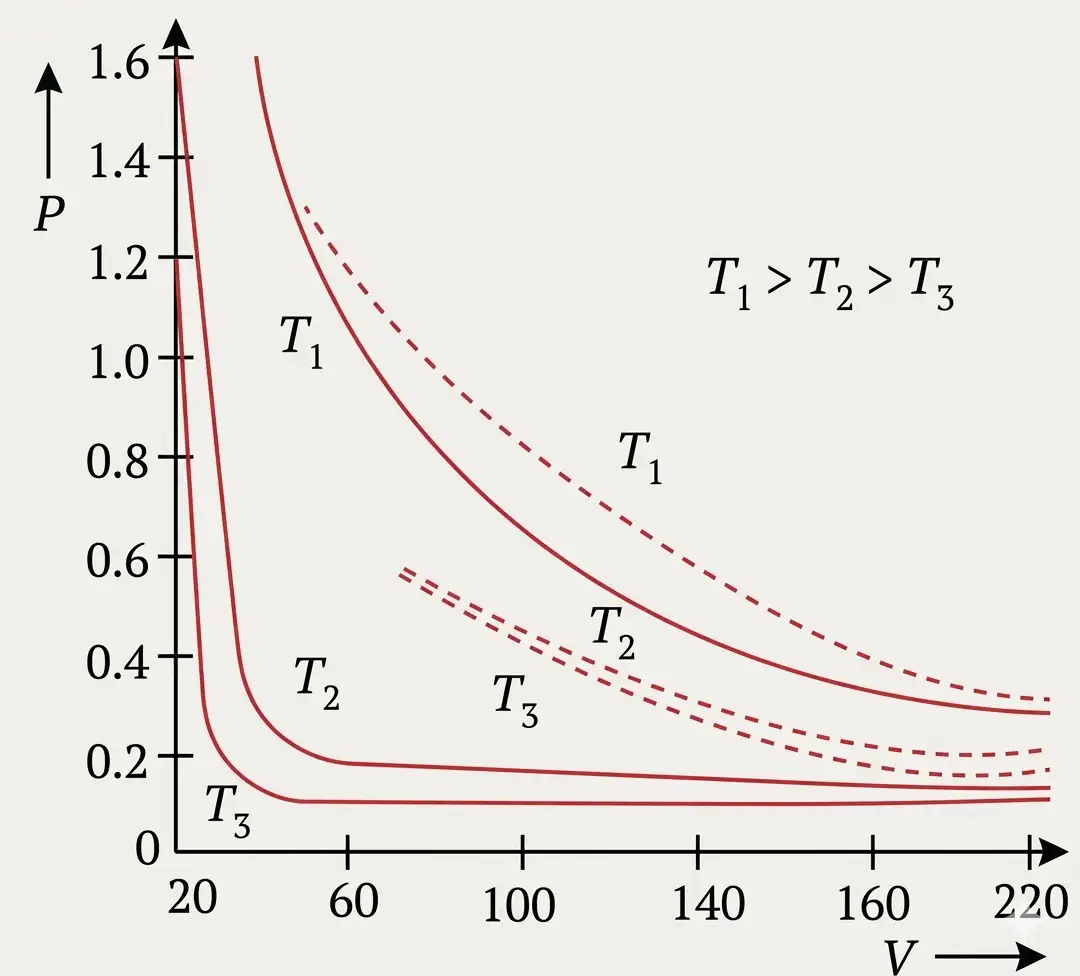
- At constant temperature (μ, T), PV = constant
- Pressure varies inversely with volume: P ∝ 1/V
- Experimental P–V curves for steam match Boyle’s law at high temperature and low pressure
Solved Examples
- Ex 1: If volume halves at constant temperature, what happens to pressure?
- Pressure doubles (P ∝ 1/V)
- Ex 2: Calculate new pressure if initial P1 = 2 atm, V1 = 4 L, and volume changes to V2 = 2 L.
- P2 = P1 V1/V2 = 2 × 4/2 = 4 atm
Practice Set
- Q1: Boyle’s law states that at constant temperature, pressure is?
- A. Directly proportional to volume
- B. Inversely proportional to volume
- C. Independent of volume
- D. Proportional to temperature
- Q2: If volume is doubled at constant temperature, pressure will?
- A. Double
- B. Halve
- C. Remain same
- D. Become zero
- Q3: For a gas at constant temperature, if pressure is 3 atm and volume is 2 L, what is volume when pressure is 6 atm?
- A. 1 L
- B. 4 L
- C. 3 L
- D. 6 L
Answer Key
- Q1: B - Pressure varies inversely with volume at constant temperature.
- Q2: B - Doubling volume halves the pressure.
- Q3: A - Using P1V1 = P2V2, V2 = 1 L.
Memory Aids
- Boyle’s law: PV = constant
- Pressure and volume are inversely related at constant temperature
Pressure-Volume Relationship
- At constant temperature \( (\mu, T) \), \( PV = \text{constant} \)
- Pressure varies inversely with volume: \( P \propto \frac{1}{V} \)
- Experimental P–V curves for steam match Boyle’s law at high temperature and low pressure
Solved Examples
- Ex 1: If volume halves at constant temperature, what happens to pressure?
- Pressure doubles (\( P \propto \frac{1}{V} \))
- Ex 2: Calculate new pressure if initial \( P_1 = 2 \) atm, \( V_1 = 4 \) L, and volume changes to \( V_2 = 2 \) L.
- \( P_2 = \frac{P_1 V_1}{V_2} = \frac{2 \times 4}{2} = 4 \) atm
Practice Set
- Q1: Boyle’s law states that at constant temperature, pressure is?
- A. Directly proportional to volume
- B. Inversely proportional to volume
- C. Independent of volume
- D. Proportional to temperature
- Q2: If volume is doubled at constant temperature, pressure will?
- A. Double
- B. Halve
- C. Remain same
- D. Become zero
- Q3: For a gas at constant temperature, if pressure is 3 atm and volume is 2 L, what is volume when pressure is 6 atm?
- A. 1 L
- B. 4 L
- C. 3 L
- D. 6 L
Answer Key
- Q1: B - Pressure varies inversely with volume at constant temperature.
- Q2: B - Doubling volume halves the pressure.
- Q3: A - Using \( P_1 V_1 = P_2 V_2 \), \( V_2 = 1 \) L.
Memory Aids
- Boyle’s law: \( PV = \text{constant} \)
- Pressure and volume are inversely related at constant temperature
Charles’ Law
Volume-Temperature Relationship
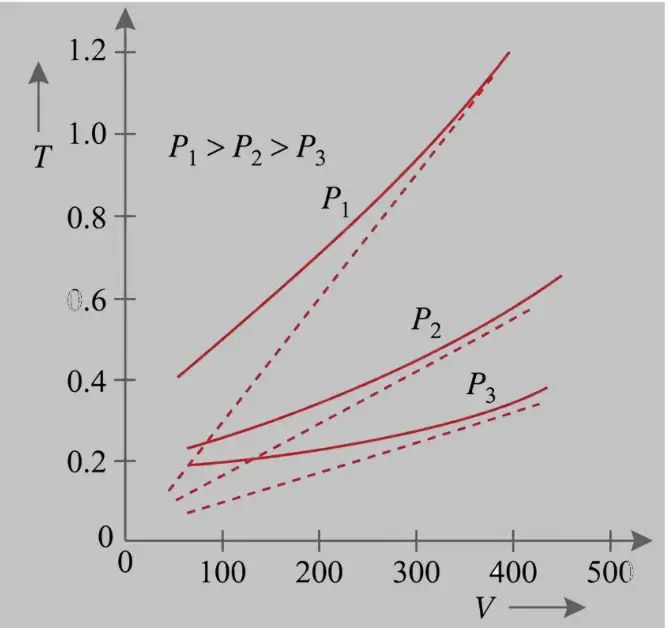
- At constant pressure, volume V is proportional to absolute temperature T: V ∝ T
- Experimental T–V curves for CO2 match Charles’ law at high temperature and low pressure
Solved Examples
- Ex 1: If volume is 2 L at 300 K, find volume at 600 K at constant pressure.
- V2 = V1 × T2/T1 = 2 × 600/300 = 4 L
- Ex 2: Calculate temperature if volume changes from 1 L to 3 L at constant pressure and initial temperature 273 K.
- T2 = T1 × V2/V1 = 273 × 3/1 = 819 K
Practice Set
- Q1: Charles’ law states volume is proportional to?
- A. Pressure
- B. Temperature (absolute)
- C. Number of moles
- D. Mass
- Q2: If temperature doubles, volume will?
- A. Halve
- B. Double
- C. Remain same
- D. Become zero
- Q3: Volume of gas is 3 L at 300 K. Find volume at 450 K at constant pressure.
- A. 4.5 L
- B. 2 L
- C. 3 L
- D. 6 L
Answer Key
- Q1: B - Volume is proportional to absolute temperature at constant pressure.
- Q2: B - Doubling temperature doubles volume.
- Q3: A - V2 = 3 × 450/300 = 4.5 L.
Memory Aids
- Charles’ law: V ∝ T at constant pressure
- Volume increases with temperature
Volume-Temperature Relationship
- At constant pressure, volume \( V \) is proportional to absolute temperature \( T \): \( V \propto T \)
- Experimental T–V curves for CO2 match Charles’ law at high temperature and low pressure
Solved Examples
- Ex 1: If volume is 2 L at 300 K, find volume at 600 K at constant pressure.
- \( V_2 = V_1 \times \frac{T_2}{T_1} = 2 \times \frac{600}{300} = 4 \) L
- Ex 2: Calculate temperature if volume changes from 1 L to 3 L at constant pressure and initial temperature 273 K.
- \( T_2 = T_1 \times \frac{V_2}{V_1} = 273 \times \frac{3}{1} = 819 \) K
Practice Set
- Q1: Charles’ law states volume is proportional to?
- A. Pressure
- B. Temperature (absolute)
- C. Number of moles
- D. Mass
- Q2: If temperature doubles, volume will?
- A. Halve
- B. Double
- C. Remain same
- D. Become zero
- Q3: Volume of gas is 3 L at 300 K. Find volume at 450 K at constant pressure.
- A. 4.5 L
- B. 2 L
- C. 3 L
- D. 6 L
Answer Key
- Q1: B - Volume is proportional to absolute temperature at constant pressure.
- Q2: B - Doubling temperature doubles volume.
- Q3: A - \( V_2 = 3 \times \frac{450}{300} = 4.5 \) L.
Memory Aids
- Charles’ law: \( V \propto T \) at constant pressure
- Volume increases with temperature
Dalton’s Law of Partial Pressures
Partial Pressure Concept
- Total pressure of gas mixture = sum of partial pressures of each gas
- At constant T and P, Ptotal = P1 + P2 + P3 + ...
- Partial pressure of ith gas: Pi = μiRT / V
- Total pressure: Ptotal = (RT / V)(μ1 + μ2 + ...) = (RT / V) μtotal
- Partial pressure relation: Pi = Ptotal × μi/μtotal, where mole fraction μi/μtotal
Solved Examples
- Ex 1: Calculate total pressure if μ1 = 1 mol, μ2 = 2 mol, R = 8.314 J/mol·K, T = 300 K, V = 0.01 m3.
- Ptotal = RT/V (μ1 + μ2) = 8.314 × 300/0.01 × 3 = 7.48 × 10⁵ Pa
- Ex 2: Find partial pressure of gas 1 if total pressure is 7.48 × 10⁵ Pa and mole fraction μ1/μtotal = 1/3.
- P1 = Ptotal × 1/3 = 2.49 × 10⁵ Pa
Practice Set
- Q1: Dalton’s law states total pressure is?
- A. Product of partial pressures
- B. Sum of partial pressures
- C. Difference of partial pressures
- D. Ratio of partial pressures
- Q2: Partial pressure of a gas is proportional to?
- A. Volume
- B. Mole fraction
- C. Temperature
- D. Mass
- Q3: If total pressure is 1 atm and mole fraction of gas A is 0.4, partial pressure of A is?
- A. 0.4 atm
- B. 0.6 atm
- C. 1 atm
- D. 0.8 atm
Answer Key
- Q1: B - Total pressure equals sum of partial pressures of gases.
- Q2: B - Partial pressure proportional to mole fraction.
- Q3: A - Partial pressure = total pressure × mole fraction = 0.4 atm.
Memory Aids
- Dalton’s law: Ptotal = ∑Pi
- Partial pressure Pi = Ptotal × mole fraction
Partial Pressure Concept
- Total pressure of gas mixture = sum of partial pressures of each gas
- At constant \( T \) and \( P \), \( P_{total} = P_1 + P_2 + P_3 + \ldots \)
- Partial pressure of \( i^{th} \) gas: \( P_i = \mu_i RT / V \)
- Total pressure: \( P_{total} = (RT / V)(\mu_1 + \mu_2 + \ldots) = (RT / V) \mu_{total} \)
- Partial pressure relation: \( P_i = P_{total} \times \frac{\mu_i}{\mu_{total}} \), where mole fraction \( \frac{\mu_i}{\mu_{total}} \)
Solved Examples
- Ex 1: Calculate total pressure if \( \mu_1 = 1 \) mol, \( \mu_2 = 2 \) mol, \( R = 8.314 \) J/mol·K, \( T = 300 K \), \( V = 0.01 \) m3.
- \( P_{total} = \frac{RT}{V} (\mu_1 + \mu_2) = \frac{8.314 \times 300}{0.01} \times 3 = 7.48 \times 10^{5} \) Pa
- Ex 2: Find partial pressure of gas 1 if total pressure is \( 7.48 \times 10^{5} \) Pa and mole fraction \( \frac{\mu_1}{\mu_{total}} = \frac{1}{3} \).
- \( P_1 = P_{total} \times \frac{1}{3} = 2.49 \times 10^{5} \) Pa
Practice Set
- Q1: Dalton’s law states total pressure is?
- A. Product of partial pressures
- B. Sum of partial pressures
- C. Difference of partial pressures
- D. Ratio of partial pressures
- Q2: Partial pressure of a gas is proportional to?
- A. Volume
- B. Mole fraction
- C. Temperature
- D. Mass
- Q3: If total pressure is 1 atm and mole fraction of gas A is 0.4, partial pressure of A is?
- A. 0.4 atm
- B. 0.6 atm
- C. 1 atm
- D. 0.8 atm
Answer Key
- Q1: B - Total pressure equals sum of partial pressures of gases.
- Q2: B - Partial pressure proportional to mole fraction.
- Q3: A - Partial pressure = total pressure × mole fraction = 0.4 atm.
Memory Aids
- Dalton’s law: \( P_{total} = \sum P_i \)
- Partial pressure \( P_i = P_{total} \times \) mole fraction
Law of Equipartition of Energy
Concept
- In thermal equilibrium, total energy is equally divided among all energy modes.
- Each mode has average energy 1/2 kBT, where kB is Boltzmann constant and T is temperature in Kelvin.
- Each translational and rotational degree of freedom contributes 1/2 kBT energy.
- Each vibrational frequency contributes 2 × 1/2 kBT = kBT due to kinetic and potential energy.
Monoatomic Molecules
- Translational kinetic energy per molecule: E = 1/2 m v̄x2 + 1/2 m v̄y2 + 1/2 m v̄z2
- Or simplified: E = 3/2 kBT
Diatomic Molecules (No Vibration)
- Kinetic energy includes translational and rotational parts:
- E = Et + Er = 1/2 m (vx2 + vy2 + vz2) + 1/2 I1ω12 + 1/2 I2ω22 = 5/2 kBT
- Assumes no vibrational energy.
Diatomic Molecules (With Vibration)
- Vibrational energy term: Ev = 1/2 m (dy/dt)2 + 1/2 ky2
- Total energy: E = Et + Er + Ev
Solved Examples
- Ex 1: Calculate average KE of a monoatomic gas molecule at temperature T = 300 K.
- Use E = 3/2 kBT
- Substitute kB = 1.38 × 10⁻²³ J/K
- E = 3/2 × 1.38 × 10-23 × 300 = 6.21 × 10⁻²¹ J
- Ex 2: Find total energy of a diatomic molecule (no vibration) at 400 K.
- Use E = 5/2 kBT
- E = 5/2 × 1.38 × 10-23 × 400 = 1.38 × 10⁻²⁰ J
Practice Set
- Q1: What is the average energy per degree of freedom at temperature T?
- A) kBT
- B) 1/2 kBT
- C) 2 kBT
- D) 3/2 kBT
- Q2: The kinetic energy of a monoatomic gas molecule at temperature 300 K is approximately:
- A) 1.38 × 10⁻²¹ J
- B) 6.21 × 10⁻²¹ J
- C) 4.14 × 10⁻²¹ J
- D) 9.0 × 10⁻²¹ J
- Q3: For a diatomic molecule with vibration considered, total energy is:
- A) 5/2 kBT
- B) 3 kBT
- C) 7/2 kBT
- D) 4 kBT
Answer Key
- Q1: B) 1/2 kBT - Each degree of freedom contributes half kBT energy.
- Q2: B) 6.21 × 10⁻²¹ J - Using 3/2 kBT at 300 K.
- Q3: D) 4 kBT - Vibration adds kBT to 5/2 kBT making total 4 kBT.
Memory Aids
- Energy per mode = 1/2 kBT
- Monoatomic KE = 3/2 kBT
- Diatomic (no vibration) KE = 5/2 kBT
- Vibration adds kBT energy
Concept
- In thermal equilibrium, total energy is equally divided among all energy modes.
- Each mode has average energy 1/2 kBT, where kB is Boltzmann constant and T is temperature in Kelvin.
- Each translational and rotational degree of freedom contributes 1/2 kBT energy.
- Each vibrational frequency contributes 2 × 1/2 kBT = kBT due to kinetic and potential energy.
Monoatomic Molecules
- Translational kinetic energy per molecule: E = 1/2 m vx2 + 1/2 m vy2 + 1/2 m vz2
- Or simplified: E = 3/2 kBT
Diatomic Molecules (No Vibration)
- Kinetic energy includes translational and rotational parts:
- E = Et + Er = 1/2 m (vx2 + vy2 + vz2) + 1/2 I1ω12 + 1/2 I2ω22 = 5/2 kBT
- Assumes no vibrational energy.
Diatomic Molecules (With Vibration)
- Vibrational energy term: Ev = 1/2 m (dy/dt)2 + 1/2 ky2
- Total energy: E = Et + Er + Ev
Solved Examples
- Ex 1: Calculate average KE of a monoatomic gas molecule at temperature T = 300 K.
- Use E = 3/2 kBT
- Substitute kB = 1.38 × 10⁻²³ J/K
- E = 3/2 × 1.38 × 10-23 × 300 = 6.21 × 10⁻²¹ J
- Ex 2: Find total energy of a diatomic molecule (no vibration) at 400 K.
- Use E = 5/2 kBT
- E = 5/2 × 1.38 × 10-23 × 400 = 1.38 × 10⁻²⁰ J
Practice Set
- Q1: What is the average energy per degree of freedom at temperature T?
- A) kBT
- B) 1/2 kBT
- C) 2 kBT
- D) 3/2 kBT
- Q2: The kinetic energy of a monoatomic gas molecule at temperature 300 K is approximately:
- A) 1.38 × 10⁻²¹ J
- B) 6.21 × 10⁻²¹ J
- C) 4.14 × 10⁻²¹ J
- D) 9.0 × 10⁻²¹ J
- Q3: For a diatomic molecule with vibration considered, total energy is:
- A) 5/2 kBT
- B) 3 kBT
- C) 7/2 kBT
- D) 4 kBT
Answer Key
- Q1: B) 1/2 kBT - Each degree of freedom contributes half kBT energy.
- Q2: B) 6.21 × 10⁻²¹ J - Using 3/2 kBT at 300 K.
- Q3: D) 4 kBT - Vibration adds kBT to 5/2 kBT making total 4 kBT.
Memory Aids
- Energy per mode = 1/2 kBT
- Monoatomic KE = 3/2 kBT
- Diatomic (no vibration) KE = 5/2 kBT
- Vibration adds kBT energy
Concept
- In thermal equilibrium, total energy is equally divided among all energy modes.
- Each mode has average energy 1/2 kBT, where kB is Boltzmann constant and T is temperature in Kelvin.
- Each translational and rotational degree of freedom contributes 1/2 kBT energy.
- Each vibrational frequency contributes 2 × 1/2 kBT = kBT due to kinetic and potential energy.
Monoatomic Molecules
- Translational kinetic energy per molecule: E = 1/2 m v̄x2 + 1/2 m v̄y2 + 1/2 m v̄z2
- Or simplified: E = 3/2 kBT
Diatomic Molecules (No Vibration)
- Kinetic energy includes translational and rotational parts:
- E = Et + Er = 1/2 m (vx2 + vy2 + vz2) + 1/2 I1ω12 + 1/2 I2ω22 = 5/2 kBT
- Assumes no vibrational energy.
Diatomic Molecules (With Vibration)
- Vibrational energy term: Ev = 1/2 m (dy/dt)2 + 1/2 ky2
- Total energy: E = Et + Er + Ev
Solved Examples
- Ex 1: Calculate average KE of a monoatomic gas molecule at temperature T = 300 K.
- Use E = 3/2 kBT
- Substitute kB = 1.38 × 10⁻²³ J/K
- E = 3/2 × 1.38 × 10-23 × 300 = 6.21 × 10⁻²¹ J
- Ex 2: Find total energy of a diatomic molecule (no vibration) at 400 K.
- Use E = 5/2 kBT
- E = 5/2 × 1.38 × 10-23 × 400 = 1.38 × 10⁻²⁰ J
Practice Set
- Q1: What is the average energy per degree of freedom at temperature T?
- A) kBT
- B) 1/2 kBT
- C) 2 kBT
- D) 3/2 kBT
- Q2: The kinetic energy of a monoatomic gas molecule at temperature 300 K is approximately:
- A) 1.38 × 10⁻²¹ J
- B) 6.21 × 10⁻²¹ J
- C) 4.14 × 10⁻²¹ J
- D) 9.0 × 10⁻²¹ J
- Q3: For a diatomic molecule with vibration considered, total energy is:
- A) 5/2 kBT
- B) 3 kBT
- C) 7/2 kBT
- D) 4 kBT
Answer Key
- Q1: B) 1/2 kBT - Each degree of freedom contributes half kBT energy.
- Q2: B) 6.21 × 10⁻²¹ J - Using 3/2 kBT at 300 K.
- Q3: D) 4 kBT - Vibration adds kBT to 5/2 kBT making total 4 kBT.
Memory Aids
- Energy per mode = 1/2 kBT
- Monoatomic KE = 3/2 kBT
- Diatomic (no vibration) KE = 5/2 kBT
- Vibration adds kBT energy
Concept
- In thermal equilibrium, total energy is equally divided among all energy modes.
- Each mode has average energy \( \frac{1}{2} k_B T \), where \( k_B \) is Boltzmann constant and \( T \) is temperature in Kelvin.
- Each translational and rotational degree of freedom contributes \( \frac{1}{2} k_B T \) energy.
- Each vibrational frequency contributes \( 2 \times \frac{1}{2} k_B T = k_B T \) due to kinetic and potential energy.
Monoatomic Molecules
- Translational kinetic energy per molecule: \( E = \frac{1}{2} m \overline{v_x^2} + \frac{1}{2} m \overline{v_y^2} + \frac{1}{2} m \overline{v_z^2} \)
- Or simplified: \( E = \frac{3}{2} k_B T \)
Diatomic Molecules (No Vibration)
- Kinetic energy includes translational and rotational parts:
- \( E = E_t + E_r = \frac{1}{2} m (v_x^2 + v_y^2 + v_z^2) + \frac{1}{2} I_1 \omega_1^2 + \frac{1}{2} I_2 \omega_2^2 = \frac{5}{2} k_B T \)
- Assumes no vibrational energy.
Diatomic Molecules (With Vibration)
- Vibrational energy term: \( E_v = \frac{1}{2} m \left( \frac{dy}{dt} \right)^2 + \frac{1}{2} k y^2 \)
- Total energy: \( E = E_t + E_r + E_v \)
Solved Examples
- Ex 1: Calculate average KE of a monoatomic gas molecule at temperature \( T = 300 K \).
- Use \( E = \frac{3}{2} k_B T \)
- Substitute \( k_B = 1.38 \times 10^{-23} J/K \)
- \( E = \frac{3}{2} \times 1.38 \times 10^{-23} \times 300 = 6.21 \times 10^{-21} J \)
- Ex 2: Find total energy of a diatomic molecule (no vibration) at \( 400 K \).
- Use \( E = \frac{5}{2} k_B T \)
- \( E = \frac{5}{2} \times 1.38 \times 10^{-23} \times 400 = 1.38 \times 10^{-20} J \)
Practice Set
- Q1: What is the average energy per degree of freedom at temperature \( T \)?
- A) \( k_B T \)
- B) \( \frac{1}{2} k_B T \)
- C) \( 2 k_B T \)
- D) \( \frac{3}{2} k_B T \)
- Q2: The kinetic energy of a monoatomic gas molecule at temperature \( 300 K \) is approximately:
- A) \( 1.38 \times 10^{-21} J \)
- B) \( 6.21 \times 10^{-21} J \)
- C) \( 4.14 \times 10^{-21} J \)
- D) \( 9.0 \times 10^{-21} J \)
- Q3: For a diatomic molecule with vibration considered, total energy is:
- A) \( \frac{5}{2} k_B T \)
- B) \( 3 k_B T \)
- C) \( \frac{7}{2} k_B T \)
- D) \( 4 k_B T \)
Answer Key
- Q1: B) \( \frac{1}{2} k_B T \) - Each degree of freedom contributes half \( k_B T \) energy.
- Q2: B) \( 6.21 \times 10^{-21} J \) - Using \( \frac{3}{2} k_B T \) at 300 K.
- Q3: D) \( 4 k_B T \) - Vibration adds \( k_B T \) to \( \frac{5}{2} k_B T \) making total \( 4 k_B T \).
Memory Aids
- Energy per mode = \( \frac{1}{2} k_B T \)
- Monoatomic KE = \( \frac{3}{2} k_B T \)
- Diatomic (no vibration) KE = \( \frac{5}{2} k_B T \)
- Vibration adds \( k_B T \) energy
Specific Heat Capacity
Key Concepts
- Specific heat capacity is the amount of heat required to raise the temperature of a substance by 1 K.
- For gases, specific heats at constant volume (Cv) and constant pressure (Cp) are important.
- Relation for ideal gases: Cp - Cv = R (gas constant).
Solved Examples
- Ex 1: Calculate Cp if Cv = 3/2R.
- Use Cp = Cv + R = 3/2R + R = 5/2R.
Practice Set
- Q1: What is the relation between Cp and Cv for an ideal gas?
- A) Cp = Cv
- B) Cp - Cv = R
- C) Cp + Cv = R
- D) Cp < Cv
- Q2: If Cv = 5/2R, find Cp.
- A) 7/2R
- B) 5/2R
- C) 3/2R
- D) 9/2R
- Q3: For an ideal gas, if Cp = 20.8 J/mol·K and R = 8.3 J/mol·K, find Cv.
- A) 12.5 J/mol·K
- B) 28.9 J/mol·K
- C) 20.8 J/mol·K
- D) 8.3 J/mol·K
Answer Key
- Q1: B - By definition for ideal gases, Cp - Cv = R.
- Q2: A - Cp = Cv + R = 5/2R + R = 7/2R.
- Q3: A - Cv = Cp - R = 20.8 - 8.3 = 12.5 J/mol·K.
Memory Aids
- Cp - Cv = R for ideal gases.
- Remember Cv = f/2R where f is degrees of freedom.
- Ratio γ = Cp/Cv is key for gas behavior.
Key Concepts
- Specific heat capacity is the amount of heat required to raise the temperature of a substance by 1 K.
- For gases, specific heats at constant volume (Cv) and constant pressure (Cp) are important.
- Relation for ideal gases: Cp - Cv = R (gas constant).
Solved Examples
- Ex 1: Calculate Cp if Cv = \(\frac{3}{2}R\).
- Use Cp = Cv + R = \(\frac{3}{2}R + R = \frac{5}{2}R\).
Practice Set
- Q1: What is the relation between Cp and Cv for an ideal gas?
- A) Cp = Cv
- B) Cp - Cv = R
- C) Cp + Cv = R
- D) Cp < Cv
- Q2: If Cv = \(\frac{5}{2}R\), find Cp.
- A) \(\frac{7}{2}R\)
- B) \(\frac{5}{2}R\)
- C) \(\frac{3}{2}R\)
- D) \(\frac{9}{2}R\)
- Q3: For an ideal gas, if Cp = 20.8 J/mol·K and R = 8.3 J/mol·K, find Cv.
- A) 12.5 J/mol·K
- B) 28.9 J/mol·K
- C) 20.8 J/mol·K
- D) 8.3 J/mol·K
Answer Key
- Q1: B - By definition for ideal gases, Cp - Cv = R.
- Q2: A - Cp = Cv + R = \(\frac{5}{2}R + R = \frac{7}{2}R\).
- Q3: A - Cv = Cp - R = 20.8 - 8.3 = 12.5 J/mol·K.
Memory Aids
- Cp - Cv = R for ideal gases.
- Remember \(C_{v} = \frac{f}{2}R\) where f is degrees of freedom.
- Ratio \(\gamma = \frac{C_{p}}{C_{v}}\) is key for gas behavior.
Monoatomic Gases
Key Concepts
- Degrees of freedom, f = 3.
- Total internal energy: U = 3/2 NA kB T = 3/2 RT.
- Specific heat at constant volume: Cv = dU/dT = 3/2 R.
- Specific heat at constant pressure: Cp = Cv + R = 5/2 R.
- Ratio of specific heats: γ = Cp/Cv = 5/3.
Solved Examples
- Ex 1: Calculate γ for monoatomic gas.
- γ = 5/3 = 1.67.
Practice Set
- Q1: Degrees of freedom for monoatomic gases?
- A) 2
- B) 3
- C) 5
- D) 6
- Q2: Value of Cv for monoatomic gases?
- A) 3/2 R
- B) 5/2 R
- C) R
- D) 3R
- Q3: Calculate Cp if Cv = 3/2 R.
- A) 3/2 R
- B) 5/2 R
- C) 2R
- D) 3R
Answer Key
- Q1: B - Monoatomic gases have 3 degrees of freedom (translational).
- Q2: A - Cv = 3/2 R for monoatomic gases.
- Q3: B - Cp = Cv + R = 5/2 R.
Memory Aids
- Monoatomic gases: f = 3, Cv = 3/2 R, γ = 5/3.
- Use γ = Cp/Cv to check values.
Key Concepts
- Degrees of freedom, f = 3.
- Total internal energy: \(U = \frac{3}{2} N_{A} k_{B} T = \frac{3}{2} RT\).
- Specific heat at constant volume: \(C_{v} = \frac{dU}{dT} = \frac{3}{2} R\).
- Specific heat at constant pressure: \(C_{p} = C_{v} + R = \frac{5}{2} R\).
- Ratio of specific heats: \(\gamma = \frac{C_{p}}{C_{v}} = \frac{5}{3}\).
Solved Examples
- Ex 1: Calculate \(\gamma\) for monoatomic gas.
- \(\gamma = \frac{5}{3} = 1.67\).
Practice Set
- Q1: Degrees of freedom for monoatomic gases?
- A) 2
- B) 3
- C) 5
- D) 6
- Q2: Value of \(C_{v}\) for monoatomic gases?
- A) \(\frac{3}{2} R\)
- B) \(\frac{5}{2} R\)
- C) R
- D) 3R
- Q3: Calculate \(C_{p}\) if \(C_{v} = \frac{3}{2} R\).
- A) \(\frac{3}{2} R\)
- B) \(\frac{5}{2} R\)
- C) 2R
- D) 3R
Answer Key
- Q1: B - Monoatomic gases have 3 degrees of freedom (translational).
- Q2: A - \(C_{v} = \frac{3}{2} R\) for monoatomic gases.
- Q3: B - \(C_{p} = C_{v} + R = \frac{5}{2} R\).
Memory Aids
- Monoatomic gases: f = 3, \(C_{v} = \frac{3}{2} R\), \(\gamma = \frac{5}{3}\).
- Use \(\gamma = \frac{C_{p}}{C_{v}}\) to check values.
Diatomic Gases
Key Concepts
- Degrees of freedom, f = 5 (3 translational + 2 rotational).
- Total internal energy: U = 5/2 RT.
- Specific heat at constant volume: Cv = 5/2 R.
- Specific heat at constant pressure: Cp = Cv + R = 7/2 R.
- Ratio of specific heats: γ = 7/5 = 1.4.
- If vibrational mode is active, U = 7/2 RT, Cv = 7/2 R, Cp = 9/2 R, γ = 9/7.
Solved Examples
- Ex 1: Calculate γ for diatomic gas without vibration.
- γ = 7/5 = 1.4.
- Ex 2: Calculate Cp if Cv = 7/2 R.
- Cp = Cv + R = 9/2 R.
Practice Set
- Q1: Degrees of freedom for diatomic gases?
- A) 3
- B) 5
- C) 6
- D) 7
- Q2: Value of γ for diatomic gases without vibration?
- A) 1.2
- B) 1.4
- C) 1.67
- D) 1.5
- Q3: If vibrational mode is active, what is Cv?
- A) 5/2 R
- B) 7/2 R
- C) 9/2 R
- D) 4R
Answer Key
- Q1: B - Diatomic gases have 5 degrees of freedom (3 translational + 2 rotational).
- Q2: B - γ = 7/5 = 1.4 without vibration.
- Q3: B - With vibration, Cv = 7/2 R.
Memory Aids
- Diatomic gases: f = 5, γ = 7/5.
- Vibrational mode adds 1 to f and increases Cv and Cp.
Key Concepts
- Degrees of freedom, f = 5 (3 translational + 2 rotational).
- Total internal energy: \(U = \frac{5}{2} RT\).
- Specific heat at constant volume: \(C_{v} = \frac{5}{2} R\).
- Specific heat at constant pressure: \(C_{p} = C_{v} + R = \frac{7}{2} R\).
- Ratio of specific heats: \(\gamma = \frac{7}{5} = 1.4\).
- If vibrational mode is active, \(U = \frac{7}{2} RT\), \(C_{v} = \frac{7}{2} R\), \(C_{p} = \frac{9}{2} R\), \(\gamma = \frac{9}{7}\).
Solved Examples
- Ex 1: Calculate \(\gamma\) for diatomic gas without vibration.
- \(\gamma = \frac{7}{5} = 1.4\).
- Ex 2: Calculate \(C_{p}\) if \(C_{v} = \frac{7}{2} R\).
- \(C_{p} = C_{v} + R = \frac{9}{2} R\).
Practice Set
- Q1: Degrees of freedom for diatomic gases?
- A) 3
- B) 5
- C) 6
- D) 7
- Q2: Value of \(\gamma\) for diatomic gases without vibration?
- A) 1.2
- B) 1.4
- C) 1.67
- D) 1.5
- Q3: If vibrational mode is active, what is \(C_{v}\)?
- A) \(\frac{5}{2} R\)
- B) \(\frac{7}{2} R\)
- C) \(\frac{9}{2} R\)
- D) \(4R\)
Answer Key
- Q1: B - Diatomic gases have 5 degrees of freedom (3 translational + 2 rotational).
- Q2: B - \(\gamma = \frac{7}{5} = 1.4\) without vibration.
- Q3: B - With vibration, \(C_{v} = \frac{7}{2} R\).
Memory Aids
- Diatomic gases: f = 5, \(\gamma = \frac{7}{5}\).
- Vibrational mode adds 1 to f and increases \(C_{v}\) and \(C_{p}\).
Polyatomic Gases
Key Concepts
- Total internal energy: U = [(3/2)kBT + (3/2)kBT + f kBT] NA.
- Specific heat at constant volume: Cv = (3 + f) R.
- Specific heat at constant pressure: Cp = (4 + f) R.
- Ratio of specific heats: γ = Cp/Cv = (4 + f)/(3 + f).
Solved Examples
- Ex 1: Calculate γ if f = 3.
- γ = (4 + 3)/(3 + 3) = 7/6 = 1.17.
Practice Set
- Q1: Expression for Cv in polyatomic gases?
- A) (3 + f) R
- B) (4 + f) R
- C) f R
- D) 3 R
- Q2: Expression for γ in polyatomic gases?
- A) (3 + f)/(4 + f)
- B) (4 + f)/(3 + f)
- C) f/3
- D) 3/f
- Q3: If f = 2, find γ.
- A) 1.2
- B) 1.25
- C) 1.3
- D) 1.4
Answer Key
- Q1: A - Cv = (3 + f) R by definition.
- Q2: B - γ = (4 + f)/(3 + f).
- Q3: B - γ = (4 + 2)/(3 + 2) = 6/5 = 1.25.
Memory Aids
- Polyatomic gases: Cv = (3 + f) R, γ = (4 + f)/(3 + f).
- Remember to add 1 to numerator and denominator for Cp and ratio.
Key Concepts
- Total internal energy: \(U = [(3/2)k_{B}T + (3/2)k_{B}T + f k_{B}T] N_{A}\).
- Specific heat at constant volume: \(C_{v} = (3 + f) R\).
- Specific heat at constant pressure: \(C_{p} = (4 + f) R\).
- Ratio of specific heats: \(\gamma = \frac{C_{p}}{C_{v}} = \frac{4 + f}{3 + f}\).
Solved Examples
- Ex 1: Calculate \(\gamma\) if \(f = 3\).
- \(\gamma = \frac{4 + 3}{3 + 3} = \frac{7}{6} = 1.17\).
Practice Set
- Q1: Expression for \(C_{v}\) in polyatomic gases?
- A) \((3 + f) R\)
- B) \((4 + f) R\)
- C) \(f R\)
- D) \(3 R\)
- Q2: Expression for \(\gamma\) in polyatomic gases?
- A) \(\frac{3 + f}{4 + f}\)
- B) \(\frac{4 + f}{3 + f}\)
- C) \(\frac{f}{3}\)
- D) \(\frac{3}{f}\)
- Q3: If \(f = 2\), find \(\gamma\).
- A) 1.2
- B) 1.25
- C) 1.3
- D) 1.4
Answer Key
- Q1: A - \(C_{v} = (3 + f) R\) by definition.
- Q2: B - \(\gamma = \frac{4 + f}{3 + f}\).
- Q3: B - \(\gamma = \frac{4 + 2}{3 + 2} = \frac{6}{5} = 1.25\).
Memory Aids
- Polyatomic gases: \(C_{v} = (3 + f) R\), \(\gamma = \frac{4 + f}{3 + f}\).
- Remember to add 1 to numerator and denominator for Cp and ratio.
Specific Heat Capacity of Solids
Key Concepts
- Consider a solid of N atoms vibrating about mean positions.
- Average energy per 1D oscillator: kB T.
- For 3D, average energy: 3 kB T.
- For 1 mole, total energy: U = 3 R T.
- Specific heat capacity: C = ΔQ/ΔT = ΔU/ΔT = 3 R (no work done).
Solved Examples
- Ex 1: Calculate specific heat capacity of a solid.
- C = 3 R = 3 × 8.314 = 24.94 ext{ J/mol·K}.
Practice Set
- Q1: Average energy of 1D oscillator?
- A) 1/2 kB T
- B) kB T
- C) 2 kB T
- D) 3 kB T
- Q2: Total energy for 3D oscillators per mole?
- A) R T
- B) 3 R T
- C) 3/2 R T
- D) 6 R T
- Q3: Specific heat capacity of solids?
- A) R
- B) 2 R
- C) 3 R
- D) 4 R
Answer Key
- Q1: B - Average energy per 1D oscillator is kB T.
- Q2: B - For 3D, total energy is 3 kB T NA = 3 R T.
- Q3: C - Specific heat capacity of solids is 3 R.
Memory Aids
- Specific heat of solids = 3R (Dulong-Petit law).
- Energy per oscillator = kB T in 1D.
Key Concepts
- Consider a solid of N atoms vibrating about mean positions.
- Average energy per 1D oscillator: \(k_{B} T\).
- For 3D, average energy: \(3 k_{B} T\).
- For 1 mole, total energy: \(U = 3 R T\).
- Specific heat capacity: \(C = \frac{\Delta Q}{\Delta T} = \frac{\Delta U}{\Delta T} = 3 R\) (no work done).
Solved Examples
- Ex 1: Calculate specific heat capacity of a solid.
- \(C = 3 R = 3 \times 8.314 = 24.94 \text{ J/mol·K}\).
Practice Set
- Q1: Average energy of 1D oscillator?
- A) \(\frac{1}{2} k_{B} T\)
- B) \(k_{B} T\)
- C) \(2 k_{B} T\)
- D) \(3 k_{B} T\)
- Q2: Total energy for 3D oscillators per mole?
- A) \(R T\)
- B) \(3 R T\)
- C) \(\frac{3}{2} R T\)
- D) \(6 R T\)
- Q3: Specific heat capacity of solids?
- A) \(R\)
- B) \(2 R\)
- C) \(3 R\)
- D) \(4 R\)
Answer Key
- Q1: B - Average energy per 1D oscillator is \(k_{B} T\).
- Q2: B - For 3D, total energy is \(3 k_{B} T N_{A} = 3 R T\).
- Q3: C - Specific heat capacity of solids is \(3 R\).
Memory Aids
- Specific heat of solids = 3R (Dulong-Petit law).
- Energy per oscillator = \(k_{B} T\) in 1D.
Mean Free Path
Concept and Formula
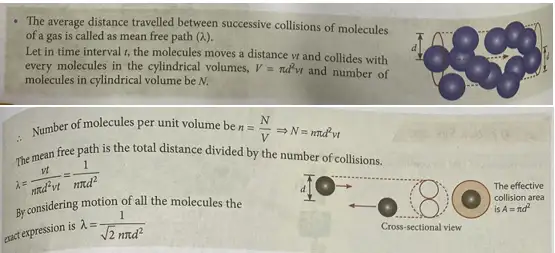
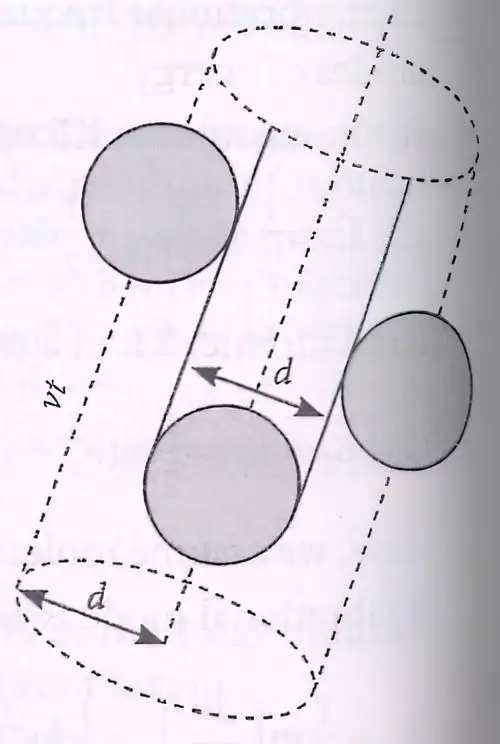
- Mean free path (λ) is the average distance a gas molecule travels between collisions.
- In time t, molecule travels distance vt and collides with molecules in a cylindrical volume V = πd2vt, where d is molecular diameter.
- Number density n = N/V, where N is number of molecules in volume V.
- Number of collisions N = nπd2vt.
- Mean free path formula: [ λ = vt/N = 1/(nπd2) ]
- Exact formula considering all molecular motion: [ λ = 1/(√2 nπd2) ]
- Effective collision area A = πd2.
Solved Examples
- Ex 1: Calculate λ if n = 2 × 1025 m-3 and d = 3 × 10⁻¹⁰ m.
- Use λ = 1/(√2 nπd2)
- λ = 1/(√2 × 2 × 1025 × π × (3 × 10⁻¹⁰)2) ≈ 4.2 × 10⁻⁸ m
Practice Set
- Q1: Mean free path depends inversely on
- A) Number density n
- B) Molecular diameter d
- C) Temperature
- D) Pressure
- Q2: If molecular diameter doubles, mean free path
- A) Doubles
- B) Halves
- C) Quadruples
- D) Quartered
- Q3: For n = 1 × 1025 m-3, d = 2 × 10⁻¹⁰ m, calculate λ (use π = 3.14)
- A) 7.1 × 10⁻⁸ m
- B) 1.1 × 10⁻⁷ m
- C) 5.6 × 10⁻⁸ m
- D) 3.2 × 10⁻⁸ m
Answer Key
- Q1: A - Mean free path λ = 1/(√2 nπd2) inversely depends on number density n.
- Q2: D - λ ∝ 1/d2, doubling d quarters λ.
- Q3: A - λ = 1/(√2 × 1 × 1025 × 3.14 × (2 × 10-10)2) ≈ 7.1 × 10⁻⁸ m.
Memory Aids
- Mean free path λ inversely ∝ nd2.
- Exact formula includes √2 factor.
- Think "collision cylinder" volume πd2vt.
Concept and Formula
- Mean free path (λ) is the average distance a gas molecule travels between collisions.
- In time t, molecule travels distance vt and collides with molecules in a cylindrical volume V = πd2vt, where d is molecular diameter.
- Number density n = N/V, where N is number of molecules in volume V.
- Number of collisions N = nπd2vt.
- Mean free path formula: [ λ = vt/N = 1/(nπd2) ]
- Exact formula considering all molecular motion: [ λ = 1/(√2 nπd2) ]
- Effective collision area A = πd2.
Solved Examples
- Ex 1: Calculate λ if n = 2 × 1025 m-3 and d = 3 × 10⁻¹⁰ m.
- Use λ = 1/(√2 nπd2)
- λ = 1/(√2 × 2 × 1025 × π × (3 × 10⁻¹⁰)2) ≈ 4.2 × 10⁻⁸ m
Practice Set
- Q1: Mean free path depends inversely on
- A) Number density n
- B) Molecular diameter d
- C) Temperature
- D) Pressure
- Q2: If molecular diameter doubles, mean free path
- A) Doubles
- B) Halves
- C) Quadruples
- D) Quartered
- Q3: For n = 1 × 1025 m-3, d = 2 × 10⁻¹⁰ m, calculate λ (use π = 3.14)
- A) 7.1 × 10⁻⁸ m
- B) 1.1 × 10⁻⁷ m
- C) 5.6 × 10⁻⁸ m
- D) 3.2 × 10⁻⁸ m
Answer Key
- Q1: A - Mean free path λ = 1/(√2 nπd2) inversely depends on number density n.
- Q2: D - λ ∝ 1/d2, doubling d quarters λ.
- Q3: A - λ = 1/(√2 × 1 × 1025 × 3.14 × (2 × 10-10)2) ≈ 7.1 × 10⁻⁸ m.
Memory Aids
- Mean free path λ inversely ∝ nd2.
- Exact formula includes √2 factor.
- Think "collision cylinder" volume πd2vt.
Concept and Formula
- Mean free path (\(\lambda\)) is the average distance a gas molecule travels between collisions.
- In time \(t\), molecule travels distance \(vt\) and collides with molecules in a cylindrical volume \(V = \pi d^2 vt\), where \(d\) is molecular diameter.
- Number density \(n = \frac{N}{V}\), where \(N\) is number of molecules in volume \(V\).
- Number of collisions \(N = n \pi d^2 vt\).
- Mean free path formula: \[ \lambda = \frac{vt}{N} = \frac{1}{n \pi d^2} \]
- Exact formula considering all molecular motion: \[ \lambda = \frac{1}{\sqrt{2} n \pi d^2} \]
- Effective collision area \(A = \pi d^2\).
Solved Examples
- Ex 1: Calculate \(\lambda\) if \(n = 2 \times 10^{25} \text{ m}^{-3}\) and \(d = 3 \times 10^{-10} \text{ m}\).
- Use \(\lambda = \frac{1}{\sqrt{2} n \pi d^2}\)
- \(\lambda = \frac{1}{\sqrt{2} \times 2 \times 10^{25} \times \pi \times (3 \times 10^{-10})^2} \approx 4.2 \times 10^{-8} \text{ m}\)
Practice Set
- Q1: Mean free path depends inversely on
- A) Number density \(n\)
- B) Molecular diameter \(d\)
- C) Temperature
- D) Pressure
- Q2: If molecular diameter doubles, mean free path
- A) Doubles
- B) Halves
- C) Quadruples
- D) Quartered
- Q3: For \(n = 1 \times 10^{25} \text{ m}^{-3}\), \(d = 2 \times 10^{-10} \text{ m}\), calculate \(\lambda\) (use \(\pi = 3.14\))
- A) \(7.1 \times 10^{-8} \text{ m}\)
- B) \(1.1 \times 10^{-7} \text{ m}\)
- C) \(5.6 \times 10^{-8} \text{ m}\)
- D) \(3.2 \times 10^{-8} \text{ m}\)
Answer Key
- Q1: A - Mean free path \(\lambda = \frac{1}{\sqrt{2} n \pi d^2}\) inversely depends on number density \(n\).
- Q2: D - \(\lambda \propto \frac{1}{d^2}\), doubling \(d\) quarters \(\lambda\).
- Q3: A - \(\lambda = \frac{1}{\sqrt{2} \times 1 \times 10^{25} \times 3.14 \times (2 \times 10^{-10})^2} \approx 7.1 \times 10^{-8} \text{ m}\).
Memory Aids
- Mean free path \(\lambda\) inversely \(\propto n d^2\).
- Exact formula includes \(\sqrt{2}\) factor.
- Think "collision cylinder" volume \(\pi d^2 vt\).
Avogadro’s Number
Definition and Value
- Number of units (atoms, molecules, ions, electrons) in one mole of substance.
- Value: 6.022140857 × 10²³ units/mole.
Solved Examples
- Ex 1: Calculate number of molecules in 2 moles of oxygen.
- Number = moles × Avogadro’s number = 2 × 6.022 × 1023 = 1.2044 × 1024
Practice Set
- Q1: Avogadro’s number represents
- A) Number of atoms in 1 gram of substance
- B) Number of units in 1 mole
- C) Number of molecules in 1 liter
- D) Number of ions in 1 kg
- Q2: Number of molecules in 3 moles of water is
- A) 1.8 × 10²³
- B) 1.8 × 1024
- C) 6.022 × 10²³
- D) 3 × 10²³
- Q3: Avogadro’s number is approximately
- A) 6.02 × 10²²
- B) 6.02 × 10²³
- C) 6.02 × 1024
- D) 6.02 × 1025
Answer Key
- Q1: B - Avogadro’s number is units per mole.
- Q2: B - 3 × 6.022 × 1023 = 1.8 × 1024.
- Q3: B - Standard value is 6.022 × 10²³.
Memory Aids
- Avogadro’s number ≈ 6.02 × 10²³.
- Represents units per mole.
- Used to convert moles to number of particles.
Definition and Value
- Number of units (atoms, molecules, ions, electrons) in one mole of substance.
- Value: \(6.022140857 \times 10^{23}\) units/mole.
Solved Examples
- Ex 1: Calculate number of molecules in 2 moles of oxygen.
- Number = moles \(\times\) Avogadro’s number = \(2 \times 6.022 \times 10^{23} = 1.2044 \times 10^{24}\)
Practice Set
- Q1: Avogadro’s number represents
- A) Number of atoms in 1 gram of substance
- B) Number of units in 1 mole
- C) Number of molecules in 1 liter
- D) Number of ions in 1 kg
- Q2: Number of molecules in 3 moles of water is
- A) \(1.8 \times 10^{23}\)
- B) \(1.8 \times 10^{24}\)
- C) \(6.022 \times 10^{23}\)
- D) \(3 \times 10^{23}\)
- Q3: Avogadro’s number is approximately
- A) \(6.02 \times 10^{22}\)
- B) \(6.02 \times 10^{23}\)
- C) \(6.02 \times 10^{24}\)
- D) \(6.02 \times 10^{25}\)
Answer Key
- Q1: B - Avogadro’s number is units per mole.
- Q2: B - \(3 \times 6.022 \times 10^{23} = 1.8 \times 10^{24}\).
- Q3: B - Standard value is \(6.022 \times 10^{23}\).
Memory Aids
- Avogadro’s number \(\approx 6.02 \times 10^{23}\).
- Represents units per mole.
- Used to convert moles to number of particles.
NEET Physics — ALL CHAPTERS
1
Basic Mathematics
2
Units and Measurement
3
Motion in a Straight Line
4
Motion in a Plane
5
Laws of Motion
6
Work, Energy and Power
7
System of Particles and Rotational Motion
8
Gravitation
9
Mechanical Properties of Solids
10
Mechanical Properties of Fluids
11
Thermal Properties of Matter
12
Thermodynamics
13
Kinetic Theory
14
Oscillations
15
Waves
16
Electric Charges and Fields
17
Electrostatic Potential and Capacitance
18
Current Electricity
19
Moving Charges and Magnetism
20
Magnetism and Matter
21
Electromagnetic Induction
22
Alternating Current
23
Electromagnetic Waves
24
Ray Optics and Optical Instruments
25
Wave Optics
26
Dual Nature of Radiation and Matter
27
Atoms
28
Nuclei
29
Semiconductor Electronics: Materials, Devices and Simple Circuits