NEET Ug . NEET Physics . Physics . Units and Measurement
Chapter 2: Units and Measurement
Ch 2
NEET Physics
NEET Ug
Units and Systems
Fundamentals of Units
- Unit: Internationally accepted standard for measurement.
- Measurement = Number + Unit.
- Base units: Fundamental quantities (length, mass, time, etc.).
- Derived units: Combination of base units.
- System of units: Complete set of base and derived units.
Systems of Units
- CGS: Centimetre, gram, second (metric).
- FPS: Foot, pound, second (British system, non-metric).
- MKS: Metre, kilogram, second (metric).
- SI (Systeme Internationale): Internationally accepted, based on 7 base units and 2 supplementary units.
Seven SI Base Units
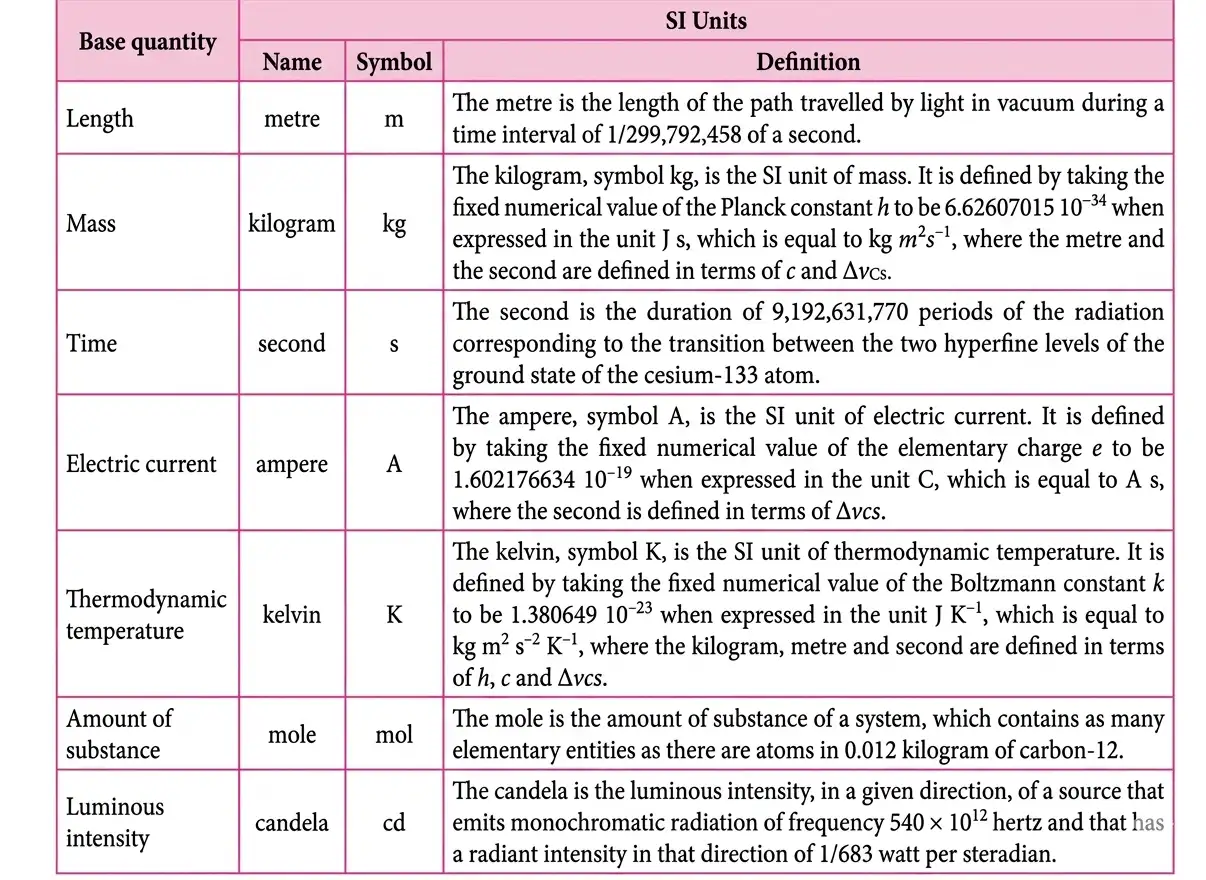
- Length: Metre (m) - distance light travels in (1/299,792,458) seconds.
- Mass: Kilogram (kg) - defined by Planck constant.
- Time: Second (s) - based on cesium atom vibrations.
- Electric current: Ampere (A) - flow of one coulomb per second.
- Temperature: Kelvin (K) - based on Boltzmann constant.
- Amount of substance: Mole (mol) - number of specified entities.
- Luminous intensity: Candela (cd) - light intensity in a given direction.
Supplementary Units
- Plane angle (radian, rad): dθ = ds/r
- Solid angle (steradian, sr): dΩ = dA/r2
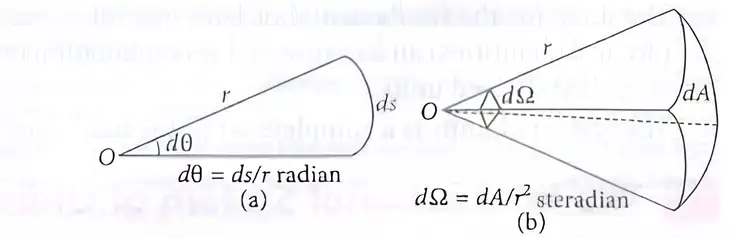
- Radian: Angle subtended by arc equal to radius.
- Steradian: Solid angle subtended by area equal to square of radius.
Advantages of SI Units
- Coherent system: Units combine without extra factors.
- Rational system: Based on rational definitions.
- Absolute system: Based on universal constants.
- Metric system: Decimal-based units.
Solved Examples
Ex 1
- Find plane angle in radians if arc length ds = 5 m and radius r = 10 m.
- Solution: dθ = ds/r = 5/10 = 0.5 rad.
Practice Set
- Q1: Which is the base unit of electric current in SI?
- A) Volt
- B) Ampere
- C) Ohm
- D) Coulomb
- Q2: What is the SI unit of solid angle?
- A) Radian
- B) Steradian
- C) Degree
- D) Grad
- Q3: If arc length is 3 m and radius is 6 m, what is the plane angle in radians?
- A) 0.5
- B) 2
- C) 18
- D) 9
Answer Key
- Q1: B - Ampere is the SI base unit of electric current.
- Q2: B - Steradian is the SI unit of solid angle.
- Q3: A - Plane angle = 3/6 = 0.5 radians.
Memory Aids
- SI base units: MKS + A (Ampere), K (Kelvin), mol, cd.
- Radian = arc length / radius.
- Steradian = area / radius2.
- SI advantages: Coherent, Rational, Absolute, Metric (CRAM).
Fundamentals of Units
- Unit: Internationally accepted standard for measurement.
- Measurement = Number + Unit.
- Base units: Fundamental quantities (length, mass, time, etc.).
- Derived units: Combination of base units.
- System of units: Complete set of base and derived units.
Systems of Units
- CGS: Centimetre, gram, second (metric).
- FPS: Foot, pound, second (British system, non-metric).
- MKS: Metre, kilogram, second (metric).
- SI (Systeme Internationale): Internationally accepted, based on 7 base units and 2 supplementary units.
Seven SI Base Units
- Length: Metre (m) - distance light travels in (1/299,792,458) seconds.
- Mass: Kilogram (kg) - defined by Planck constant.
- Time: Second (s) - based on cesium atom vibrations.
- Electric current: Ampere (A) - flow of one coulomb per second.
- Temperature: Kelvin (K) - based on Boltzmann constant.
- Amount of substance: Mole (mol) - number of specified entities.
- Luminous intensity: Candela (cd) - light intensity in a given direction.
Supplementary Units
- Plane angle (radian, rad): dθ = ds/r
- Solid angle (steradian, sr): dΩ = dA/r2
- Radian: Angle subtended by arc equal to radius.
- Steradian: Solid angle subtended by area equal to square of radius.
Advantages of SI Units
- Coherent system: Units combine without extra factors.
- Rational system: Based on rational definitions.
- Absolute system: Based on universal constants.
- Metric system: Decimal-based units.
Solved Examples
Ex 1
- Find plane angle in radians if arc length ds = 5 m and radius r = 10 m.
- Solution: dθ = ds/r = 5/10 = 0.5 rad.
Practice Set
- Q1: Which is the base unit of electric current in SI?
- A) Volt
- B) Ampere
- C) Ohm
- D) Coulomb
- Q2: What is the SI unit of solid angle?
- A) Radian
- B) Steradian
- C) Degree
- D) Grad
- Q3: If arc length is 3 m and radius is 6 m, what is the plane angle in radians?
- A) 0.5
- B) 2
- C) 18
- D) 9
Answer Key
- Q1: B - Ampere is the SI base unit of electric current.
- Q2: B - Steradian is the SI unit of solid angle.
- Q3: A - Plane angle = 3/6 = 0.5 radians.
Memory Aids
- SI base units: MKS + A (Ampere), K (Kelvin), mol, cd.
- Radian = arc length / radius.
- Steradian = area / radius2.
- SI advantages: Coherent, Rational, Absolute, Metric (CRAM).
Errors in Measurement
Types of Errors
- Systematic errors: Consistent bias in one direction.
- Random errors: Irregular fluctuations, unpredictable.
- Least count error: Due to instrument resolution limit.
Rules for SI Units
- Unit names not capitalized even if named after a person (e.g., newton, ampere).
- Symbols capitalized if named after a person (e.g., N for newton, A for ampere).
- No punctuation after unit symbols (e.g., kg m s-2, not kg. m.s-2).
Error Calculations
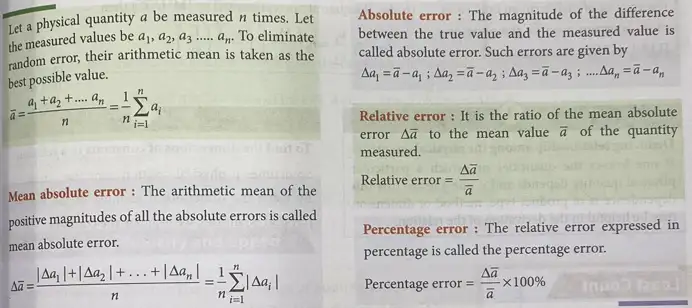
- Absolute error: |Δai| = |ai - amean|
- Mean absolute error: Δamean = ∑ |Δai|/n
- Relative error: Δamean/amean
- Percentage error: δa = Δamean/amean × 100%
Combination of Errors
- Sum/Difference: ΔZ = ΔA + ΔB
- Product/Quotient: ΔZ/Z = ΔA/A + ΔB/B
- Power: ΔZ/Z = n ΔA/A if Z = An
- General: Δy/y = l ΔA/A + m ΔB/B + n ΔC/C for y = K AlBm/Cn
Solved Examples
Ex 1
- Given measurements: 10.2, 10.4, 10.3 cm. Find mean and mean absolute error.
- Mean: (10.2 + 10.4 + 10.3)/3 = 10.3 cm.
- Absolute errors: |10.2 - 10.3|=0.1, |10.4 - 10.3|=0.1, |10.3 - 10.3|=0.
- Mean absolute error: (0.1 + 0.1 + 0)/3 = 0.067 cm.
Practice Set
- Q1: What type of error is caused by a miscalibrated instrument?
- A) Random error
- B) Systematic error
- C) Least count error
- D) Human error
- Q2: If mean absolute error is 0.05 and mean value is 2.0, what is the relative error?
- A) 0.025
- B) 0.05
- C) 0.1
- D) 0.5
- Q3: For Z = A3, if relative error in A is 2%, what is relative error in Z?
- A) 2%
- B) 3%
- C) 6%
- D) 8%
Answer Key
- Q1: B - Systematic errors cause consistent bias like miscalibration.
- Q2: A - Relative error = 0.05 / 2.0 = 0.025.
- Q3: C - Relative error in Z = 3 × 2% = 6%.
Memory Aids
- Systematic = same direction error.
- Random = unpredictable fluctuations.
- Least count = instrument resolution limit.
- Errors add in sums, add relative errors in products.
- Power rule: multiply relative error by power.
Types of Errors
- Systematic errors: Consistent bias in one direction.
- Random errors: Irregular fluctuations, unpredictable.
- Least count error: Due to instrument resolution limit.
Rules for SI Units
- Unit names not capitalized even if named after a person (e.g., newton, ampere).
- Symbols capitalized if named after a person (e.g., N for newton, A for ampere).
- No punctuation after unit symbols (e.g., kg m s-2, not kg. m.s-2).
Error Calculations
- Absolute error: |Δai| = |ai - amean|
- Mean absolute error: Δamean = ∑ |Δai|/n
- Relative error: Δamean/amean
- Percentage error: δa = Δamean/amean × 100%
Combination of Errors
- Sum/Difference: ΔZ = ΔA + ΔB
- Product/Quotient: ΔZ/Z = ΔA/A + ΔB/B
- Power: ΔZ/Z = n ΔA/A if Z = An
- General: Δy/y = l ΔA/A + m ΔB/B + n ΔC/C for y = K AlBm/Cn
Solved Examples
Ex 1
- Given measurements: 10.2, 10.4, 10.3 cm. Find mean and mean absolute error.
- Mean: (10.2 + 10.4 + 10.3)/3 = 10.3 cm.
- Absolute errors: |10.2 - 10.3|=0.1, |10.4 - 10.3|=0.1, |10.3 - 10.3|=0.
- Mean absolute error: (0.1 + 0.1 + 0)/3 = 0.067 cm.
Practice Set
- Q1: What type of error is caused by a miscalibrated instrument?
- A) Random error
- B) Systematic error
- C) Least count error
- D) Human error
- Q2: If mean absolute error is 0.05 and mean value is 2.0, what is the relative error?
- A) 0.025
- B) 0.05
- C) 0.1
- D) 0.5
- Q3: For Z = A3, if relative error in A is 2%, what is relative error in Z?
- A) 2%
- B) 3%
- C) 6%
- D) 8%
Answer Key
- Q1: B - Systematic errors cause consistent bias like miscalibration.
- Q2: A - Relative error = 0.05 / 2.0 = 0.025.
- Q3: C - Relative error in Z = 3 × 2% = 6%.
Memory Aids
- Systematic = same direction error.
- Random = unpredictable fluctuations.
- Least count = instrument resolution limit.
- Errors add in sums, add relative errors in products.
- Power rule: multiply relative error by power.
Significant Figures
Definition and Importance
- Digits accurately known in a measurement are significant figures.
- More significant figures mean higher measurement accuracy.
Rules for Counting Significant Figures
- All non-zero digits are significant.
- Zeros between non-zero digits are significant.
- Leading zeros are not significant.
- Trailing zeros without decimal point are not significant.
- Powers of 10 are not significant figures.
- Trailing zeros in decimal numbers are significant.
Arithmetic Operations with Significant Figures
- Addition/Subtraction: Result has decimal places equal to the least precise measurement.
- Multiplication/Division: Result has significant figures equal to the number with least significant figures.
Rounding Off Rules
- If the digit to drop > 5, increase preceding digit by 1.
- If the digit to drop < 5, leave preceding digit unchanged.
- If digit to drop = 5 and preceding digit even, drop 5.
- If digit to drop = 5 and preceding digit odd, increase preceding digit by 1.
Solved Examples
- Ex 1: Add 734.52 g + 341.4 g + 0.402 g = 1076.3 g (rounded to 1 decimal place)
- Ex 2: Multiply 4.237 g / 2.51 cm3 = 1.69 g/cm3 (2 significant figures)
Practice Set
- Q1: How many significant figures are in 0.00450?
A. 2
B. 3
C. 4
D. 5 - Q2: What is the result of 12.11 + 0.023 + 1.1 rounded correctly?
A. 13.233
B. 13.2
C. 14.2
D. 13.23 - Q3: Multiply 3.00 × 10⁸ m/s by 3.156 × 10⁷ s. How many significant figures should the result have?
A. 2
B. 3
C. 4
D. 5
Answer Key
- Q1: B - Leading zeros not significant, 0.00450 has 3 significant figures.
- Q2: B - Least decimal places is 1, so round to 1 decimal place: 13.2.
- Q3: A - Least significant figures in factors is 2, so result has 2 significant figures.
Memory Aids
- Non-zero digits always count.
- Zeros between non-zero digits count.
- Leading zeros never count.
- Trailing zeros count only if decimal present.
- Add/Subtract: Match decimal places.
- Multiply/Divide: Match significant figures.
Least Count
Definition and Concept
- Smallest value measurable accurately by an instrument.
- Important for precision in measurements.
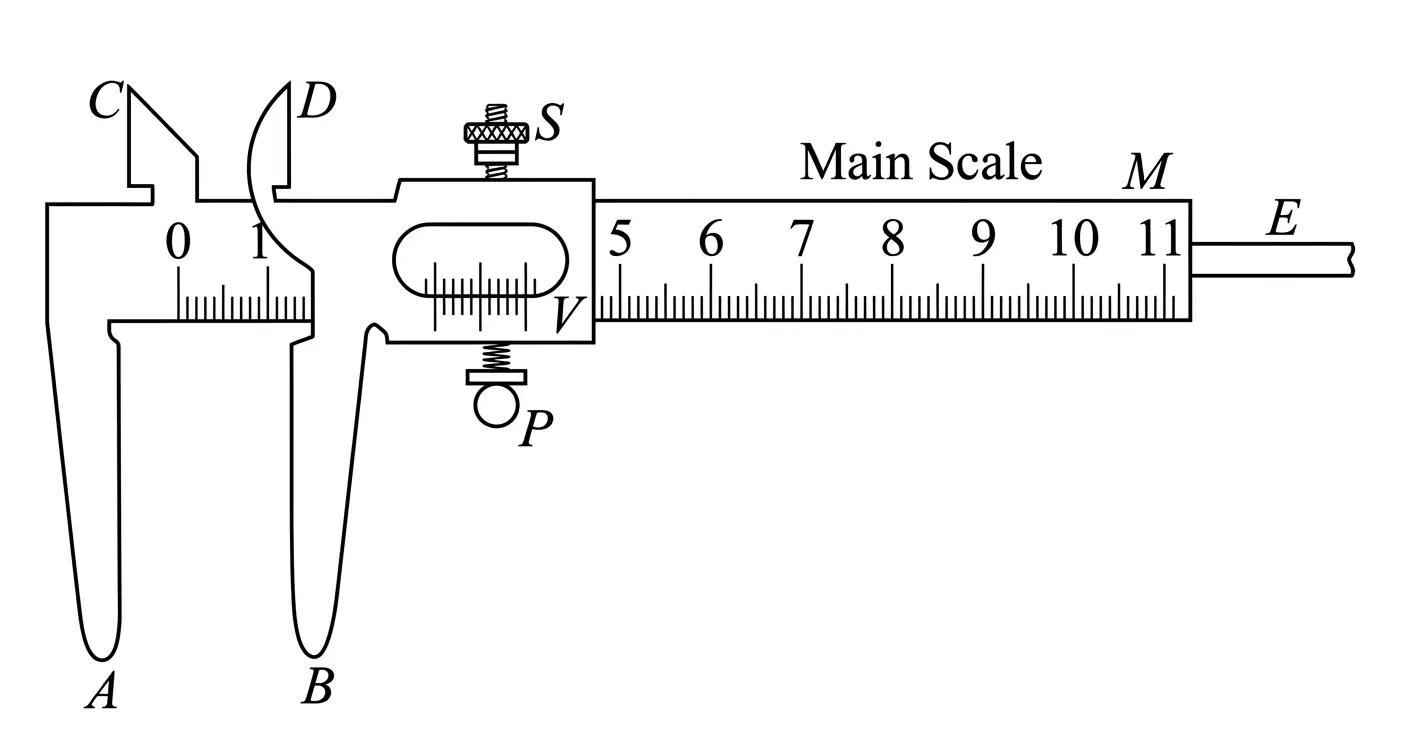
Least Count of Vernier Callipers
- Main Scale Division (M.S.D) = M units.
- Vernier Scale Division (V.S.D) = V units.
- Length of ‘a’ main scale divisions = length of ‘b’ vernier scale divisions.
- Vernier Constant (Least Count) = L.C = (b - a)/b × M
- Formula derivation: M - V = (b - a)/b × M
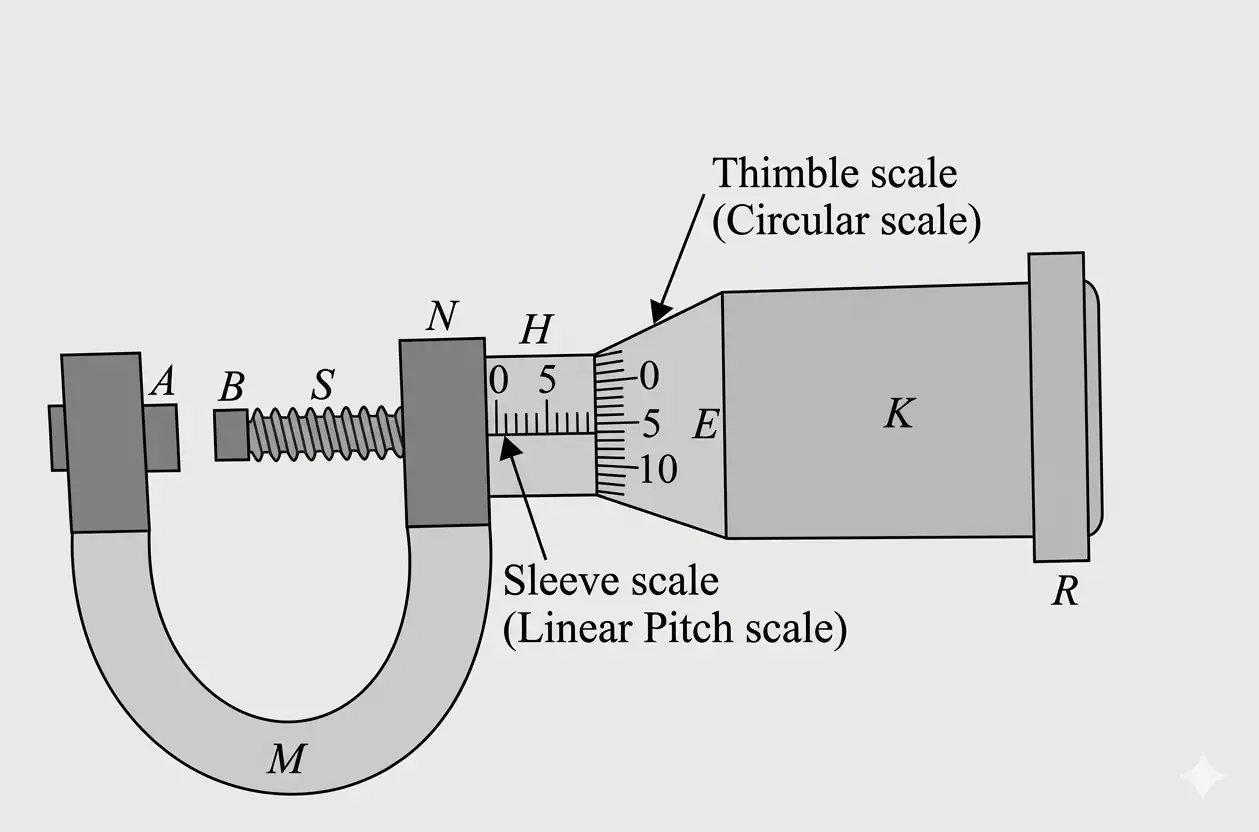
Least Count of Screw Gauge
- Least Count = Pitch / Number of divisions on circular scale.
- Pitch = Distance moved by screw per full rotation.
- Pitch = Distance moved on linear scale / Number of full rotations.
Solved Examples
- Ex 1: Vernier Callipers with M = 1 mm, a = 9, b = 10: L.C = (10-9)/10 × 1 = 0.1 mm
- Ex 2: Screw Gauge with pitch = 0.5 mm, 50 divisions: L.C = 0.5/50 = 0.01 mm
Practice Set
- Q1: If 10 main scale divisions equal 9 vernier divisions and M = 1 mm, what is the least count?
A. 0.1 mm
B. 0.09 mm
C. 0.01 mm
D. 1 mm - Q2: A screw gauge has pitch 0.5 mm and 50 divisions on circular scale. What is its least count?
A. 0.01 mm
B. 0.1 mm
C. 0.005 mm
D. 0.05 mm - Q3: If pitch is 1 mm and circular scale has 100 divisions, find least count.
A. 0.01 mm
B. 0.1 mm
C. 0.001 mm
D. 1 mm
Answer Key
- Q1: A - L.C = (10-9)/10 × 1 = 0.1 mm
- Q2: A - L.C = 0.5/50 = 0.01 mm
- Q3: C - L.C = 1/100 = 0.01 mm
Memory Aids
- Vernier L.C = (b - a)/b × M
- Screw Gauge L.C = Pitch / Number of divisions
- Pitch = distance per full rotation
Definition and Concept
- Smallest value measurable accurately by an instrument.
- Important for precision in measurements.
Least Count of Vernier Callipers
- Main Scale Division (M.S.D) = M units.
- Vernier Scale Division (V.S.D) = V units.
- Length of ‘a’ main scale divisions = length of ‘b’ vernier scale divisions.
- Vernier Constant (Least Count) = L.C = (b - a)/b × M
- Formula derivation: M - V = (b - a)/b × M
Least Count of Screw Gauge
- Least Count = Pitch / Number of divisions on circular scale.
- Pitch = Distance moved by screw per full rotation.
- Pitch = Distance moved on linear scale / Number of full rotations.
Solved Examples
- Ex 1: Vernier Callipers with M = 1 mm, a = 9, b = 10: L.C = (10-9)/10 × 1 = 0.1 mm
- Ex 2: Screw Gauge with pitch = 0.5 mm, 50 divisions: L.C = 0.5/50 = 0.01 mm
Practice Set
- Q1: If 10 main scale divisions equal 9 vernier divisions and M = 1 mm, what is the least count?
A. 0.1 mm
B. 0.09 mm
C. 0.01 mm
D. 1 mm - Q2: A screw gauge has pitch 0.5 mm and 50 divisions on circular scale. What is its least count?
A. 0.01 mm
B. 0.1 mm
C. 0.005 mm
D. 0.05 mm - Q3: If pitch is 1 mm and circular scale has 100 divisions, find least count.
A. 0.01 mm
B. 0.1 mm
C. 0.001 mm
D. 1 mm
Answer Key
- Q1: A - L.C = (10-9)/10 × 1 = 0.1 mm
- Q2: A - L.C = 0.5/50 = 0.01 mm
- Q3: C - L.C = 1/100 = 0.01 mm
Memory Aids
- Vernier L.C = (b - a)/b × M
- Screw Gauge L.C = Pitch / Number of divisions
- Pitch = distance per full rotation
Dimensions of Physical Quantities
Concept and Definition
- Physical quantities are derived from base quantities: mass (M), length (L), time (T).
- Dimension of a quantity = powers (exponents) of base quantities in its formula.
- Example: Force = mass × acceleration = M × L × T-2.
- Dimensions are expressed in square brackets, e.g., Force = [MLT-2].
Dimension Examples
- Force: [MLT-2] (1 in mass, 1 in length, -2 in time)
- Energy: [ML2T-2] (1 in mass, 2 in length, -2 in time)
Solved Examples
- Ex 1: Find dimensions of force.
- Force = mass × acceleration
- Acceleration = length/time2 = L T-2
- Force = M × L × T-2 = [MLT-2]
- Ex 2: Find dimensions of energy.
- Energy = force × distance
- Force = [MLT-2], distance = L
- Energy = [MLT-2] × L = [ML2T-2]
Practice Set
- Q1: What are the dimensions of velocity?
- A. [LT-1]
- B. [MLT-2]
- C. [L2T-1]
- D. [MT-1]
- Q2: The dimensions of power are:
- A. [ML2T-3]
- B. [MLT-2]
- C. [M2L2T-2]
- D. [ML2T-2]
- Q3: If force has dimensions [MLT-2] and displacement has dimensions [L], what are the dimensions of work done?
- A. [MLT-2]
- B. [ML2T-2]
- C. [M2LT-2]
- D. [ML2T-1]
Answer Key
- Q1: A. [LT-1] — Velocity = length/time.
- Q2: A. [ML2T-3] — Power = energy/time = [ML2T-2]/T.
- Q3: B. [ML2T-2] — Work = force × displacement.
Memory Aids
- Force dimension: "M L T to the minus two" (M L T-2).
- Energy dimension: "M L squared T to the minus two" (M L2 T-2).
- Velocity dimension: length/time = L T-1.
- Power dimension: energy/time = M L2 T-3.
Dimensional Formulae and Dimensional Equations
Concepts
- Dimensional Formula: Expression showing base quantities representing a physical quantity's dimension.
Example: Volume = [M0L3T0], Velocity = [M0LT-1] - Dimensional Equation: Equation equating a physical quantity to its dimensional formula.
Example: Force [F] = [MLT-2], Mass density [ρ] = [ML-3T0] - Dimensionless Quantities: Quantities without dimensions.
Examples include:- Pure numbers
- Ratios (e.g., density of substance/density of water)
- Exponential functions (e.g., ex)
- Logarithmic functions (e.g., log x)
- Trigonometric functions (e.g., sin x)
Solved Examples
Ex 1: Find the dimensional formula of speed.
Solution:
Speed = Distance/Time = L/T = [M0LT-1]
Ex 2: Write the dimensional equation of force.
Solution:
Force = Mass × Acceleration = M × LT-2 = [MLT-2]
Practice Set
- Q1: What is the dimensional formula of volume?
A) [M0L3T0] B) [MLT-2] C) [M1L2T-1] D) [M0L2T1] - Q2: Which of the following is a dimensionless quantity?
A) Force B) Pure number C) Velocity D) Mass density - Q3: The dimensional formula of mass density is:
A) [ML-3T0] B) [MLT-2] C) [M0L3T0] D) [M1L1T-1]
Answer Key
- Q1: A) [M0L3T0]
Volume is length cubed, no mass or time dimension. - Q2: B) Pure number
Pure numbers have no dimensions, unlike force, velocity, or density. - Q3: A) [ML-3T0]
Mass density = Mass/Volume = M/L3, no time dimension.
Memory Aids
- Volume = L3, no M or T.
- Force = M × L × T-2.
- Dimensionless = pure numbers, ratios, trig/log/exponential functions.
Dimensional Analysis
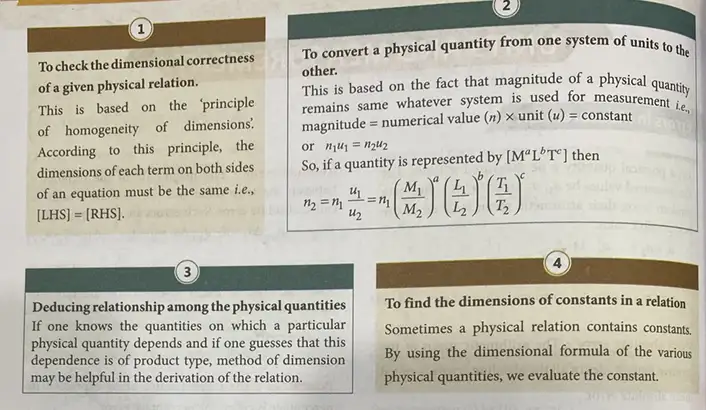
Key Concepts
- Check dimensional correctness: Dimensions on both sides of an equation must match for physical validity.
- Convert units: Physical quantity remains same; use n2 = n1 (Q1/Q2) to convert between unit systems.
- Find relations: Use dimensional homogeneity to derive formulas relating physical quantities.
- Find dimensions of constants: Use known dimensions of other quantities in the equation.
Solved Examples
- Ex 1: Add 734.52 g + 341.4 g + 0.402 g = 1076.3 g (rounded to 1 decimal place)
- Ex 2: Multiply 4.237 g / 2.51 cm3 = 1.69 g/cm3 (2 significant figures)
Ex 1
- Given measurements: 10.2, 10.4, 10.3 cm. Find mean and mean absolute error.
- Mean: (10.2 + 10.4 + 10.3)/3 = 10.3 cm.
- Absolute errors: |10.2 - 10.3|=0.1, |10.4 - 10.3|=0.1, |10.3 - 10.3|=0.
- Mean absolute error: (0.1 + 0.1 + 0)/3 = 0.067 cm.
Practice Set
- Q1: Which principle ensures dimensions on both sides of an equation are equal?
- A. Conservation of energy
- B. Principle of homogeneity
- C. Newton's second law
- D. Law of conservation of mass
- Q2: Convert 1 Newton (MKS) to dynes (CGS). What is the factor?
- A. 103
- B. 104
- C. 105
- D. 106
- Q3: Which of the following is NOT checked by dimensional analysis?
- A. Dimensional consistency
- B. Value of constants
- C. Relation among quantities
- D. Unit conversion
Answer Key
- Q1: B - Leading zeros not significant, 0.00450 has 3 significant figures.
- Q2: B - Least decimal places is 1, so round to 1 decimal place: 13.2.
- Q3: A - Least significant figures in factors is 2, so result has 2 significant figures.
Memory Aids
- Systematic = same direction error.
- Random = unpredictable fluctuations.
- Least count = instrument resolution limit.
- Errors add in sums, add relative errors in products.
- Power rule: multiply relative error by power.
Key Concepts
- Check dimensional correctness: Dimensions on both sides of an equation must match for physical validity.
- Convert units: Physical quantity remains same; use n2 = n1 (Q1/Q2) to convert between unit systems.
- Find relations: Use dimensional homogeneity to derive formulas relating physical quantities.
- Find dimensions of constants: Use known dimensions of other quantities in the equation.
Solved Examples
Ex 1: Check dimensional consistency of work done W = F × d
- Force F: [MLT-2]
- Displacement d: [L]
- Work done W: [ML2T-2]
- Check: [MLT-2] × [L] = [ML2T-2] ✓ consistent
Practice Set
- Q1: Which principle ensures dimensions on both sides of an equation are equal?
- A. Conservation of energy
- B. Principle of homogeneity
- C. Newton's second law
- D. Law of conservation of mass
- Q2: Convert 1 Newton (MKS) to dynes (CGS). What is the factor?
- A. 103
- B. 104
- C. 105
- D. 106
- Q3: Which of the following is NOT checked by dimensional analysis?
- A. Dimensional consistency
- B. Value of constants
- C. Relation among quantities
- D. Unit conversion
Answer Key
- Q1: B - Principle of homogeneity states dimensions must be same on both sides.
- Q2: C - 1 N = 105 dynes by converting kg to g and m to cm.
- Q3: B - Dimensional analysis cannot determine constant values.
Memory Aids
- Check dimensions match on both sides for correctness.
- Use n2 = n1 (Q1/Q2) for unit conversions.
- Constants' dimensions found by balancing equation dimensions.
Dimensional Consistency
Key Concepts
- Principle of homogeneity: Each term in an equation must have the same dimensions.
- Example 1: Work done W = F × d is dimensionally consistent.
- Example 2: Equation S = ut + 1/2at2 has all terms with dimension [L].
Solved Examples
Ex 1: Verify S = ut + 1/2at2
- [S] = [L]
- [ut] = [L T-1] × [T] = [L]
- [at2] = [L T-2] × [T2] = [L]
- All terms have dimension [L] ✓ consistent
Practice Set
- Q1: What must be true for an equation to be dimensionally consistent?
- A. Dimensions of terms differ
- B. Dimensions of terms are same
- C. Only first term has dimension
- D. Dimensions are ignored
- Q2: Which equation is dimensionally consistent?
- A. F = ma
- B. S = ut + at
- C. V = u + at2
- D. P = 2πr
- Q3: Dimensions of acceleration a are?
- A. [L T-1]
- B. [L T-2]
- C. [M L T-2]
- D. [M L2 T-2]
Answer Key
- Q1: B - All terms must have same dimensions for consistency.
- Q2: A - F = ma is dimensionally consistent.
- Q3: B - Acceleration has dimension [L T-2].
Memory Aids
- All terms in an equation must have identical dimensions.
- Acceleration dimension: length/time2.
- Use dimensional check to verify formula correctness.
Unit Conversion
Key Concepts
- Formula: Q1 n1 = Q2 n2 where Q is unit, n is value.
- Convert value: n2 = n1 (Q1/Q2).
- Example: Convert 1 Newton (MKS) to dynes (CGS).
- Use mass, length, time conversion factors in powers of dimensions.
Solved Examples
Ex 1: Convert 1 N to dynes
- n2 = 1 × (Kg/g)1 × (m/cm)1 × (s/s)-2
- = 1 × 1000 × 100 × 1 = 105
- 1 N = 105 dynes
Practice Set
- Q1: To convert 1 m to cm, multiply by?
- A. 0.01
- B. 10
- C. 100
- D. 1000
- Q2: 1 dyne equals how many Newtons?
- A. 10-3
- B. 10-4
- C. 10-5
- D. 10-6
- Q3: Which factor is used to convert seconds to milliseconds?
- A. 100
- B. 1000
- C. 0.001
- D. 10
Answer Key
- Q1: B - 1 m = 100 cm, so multiply by 100.
- Q2: C - 1 dyne = 10-5 Newtons.
- Q3: B - 1 s = 1000 ms.
Memory Aids
- Use ratio of units raised to power of dimensions for conversion.
- 1 N = 105 dynes.
- Multiply or divide by powers of 10 for unit changes.
Deducing Relations
Key Concepts
- Express physical quantity as product of powers of influencing quantities: T = K ma lb gc.
- Use dimensional homogeneity to find powers a, b, c.
- Example: Time period of pendulum T depends on mass m, length l, gravity g.
- Result: T = K √(l/g), mass does not affect time period.
Solved Examples
Ex 1: Find relation for pendulum time period
- Assume T = K ma lb gc
- Dimensions: [T] = [M]a [L]b [L T-2]c = [M]a [L]b+c [T]-2c
- Equate powers: a=0, b+c=0, -2c=1 ⇒ c=-1/2, b=1/2
- Relation: T = K √(l/g)
Practice Set
- Q1: Which quantity does NOT affect pendulum time period?
- A. Mass
- B. Length
- C. Gravity
- D. Amplitude
- Q2: If T ∝ l1/2 g-1/2, what is the dimension of g?
- A. [L T-1]
- B. [L T-2]
- C. [M L T-2]
- D. [M L2 T-2]
- Q3: If T = K ma lb gc and a=0, what does it imply?
- A. Time period depends on mass
- B. Time period independent of mass
- C. Mass affects length
- D. Mass affects gravity
Answer Key
- Q1: A - Mass does not affect pendulum time period.
- Q2: B - Gravity has dimension [L T-2].
- Q3: B - a=0 means no mass dependence.
Memory Aids
- Use dimensional powers to find relations.
- Pendulum time period T = K √(l/g).
- Mass does not affect pendulum time period.
Limitations
Key Concepts
- Cannot derive relations involving addition, subtraction, or trigonometric functions.
- Cannot find numerical values of constants.
- Cannot solve for more than three unknowns in mechanics using dimensional method.
- Physical quantities with same dimensions may differ in nature.
Solved Examples
Ex 1: Dimensional method cannot find constant K in T = K √(l/g).
Practice Set
- Q1: Which is NOT a limitation of dimensional analysis?
- A. Cannot find constants
- B. Cannot derive trigonometric relations
- C. Can solve all equations exactly
- D. Limited to multiplication/division relations
- Q2: Dimensional analysis fails when number of unknowns is?
- A. Less than 3
- B. Equal to 3
- C. More than 3
- D. Exactly 1
- Q3: Physical quantities with same dimensions are always?
- A. Same nature
- B. Different nature
- C. Identical
- D. None of these
Answer Key
- Q1: C - Dimensional analysis cannot solve all equations exactly.
- Q2: C - More than 3 unknowns cannot be solved dimensionally.
- Q3: B - Same dimensions may represent different physical quantities.
Memory Aids
- Dimensional analysis limited to multiplication/division.
- Cannot find constants or trigonometric relations.
- Check dimensional consistency only for complex cases.
Fundamentals of Units
- Unit: Internationally accepted standard for measurement.
- Measurement = Number + Unit.
- Base units: Fundamental quantities (length, mass, time, etc.).
- Derived units: Combination of base units.
- System of units: Complete set of base and derived units.
Systems of Units
- CGS: Centimetre, gram, second (metric).
- FPS: Foot, pound, second (British system, non-metric).
- MKS: Metre, kilogram, second (metric).
- SI (Systeme Internationale): Internationally accepted, based on 7 base units and 2 supplementary units.
Seven SI Base Units
- Length: Metre (m) - distance light travels in 1/299,792,458 seconds.
- Mass: Kilogram (kg) - defined by Planck constant.
- Time: Second (s) - based on cesium atom vibrations.
- Electric current: Ampere (A) - flow of one coulomb per second.
- Temperature: Kelvin (K) - based on Boltzmann constant.
- Amount of substance: Mole (mol) - number of specified entities.
- Luminous intensity: Candela (cd) - light intensity in a given direction.
Supplementary Units
- Plane angle (radian, rad): dθ = ds/r
- Solid angle (steradian, sr): dΩ = dA/r2
- Radian: Angle subtended by arc equal to radius.
- Steradian: Solid angle subtended by area equal to square of radius.
Advantages of SI Units
- Coherent system: Units combine without extra factors.
- Rational system: Based on rational definitions.
- Absolute system: Based on universal constants.
- Metric system: Decimal-based units.
Solved Examples
Ex 1
- Find plane angle in radians if arc length \( ds = 5 \) m and radius \( r = 10 \) m.
- Solution: \( d\theta = \frac{ds}{r} = \frac{5}{10} = 0.5 \) rad.
Practice Set
- Q1: Which is the base unit of electric current in SI?
- A) Volt
- B) Ampere
- C) Ohm
- D) Coulomb
- Q2: What is the SI unit of solid angle?
- A) Radian
- B) Steradian
- C) Degree
- D) Grad
- Q3: If arc length is 3 m and radius is 6 m, what is the plane angle in radians?
- A) 0.5
- B) 2
- C) 18
- D) 9
Answer Key
- Q1: B - Ampere is the SI base unit of electric current.
- Q2: B - Steradian is the SI unit of solid angle.
- Q3: A - Plane angle \( = \frac{3}{6} = 0.5 \) radians.
Memory Aids
- SI base units: MKS + A (Ampere), K (Kelvin), mol, cd.
- Radian = arc length / radius.
- Steradian = area / radius2.
- SI advantages: Coherent, Rational, Absolute, Metric (CRAM).
Errors in Measurement
Types of Errors
- Systematic errors: Consistent bias in one direction.
- Random errors: Irregular fluctuations, unpredictable.
- Least count error: Due to instrument resolution limit.
Rules for SI Units
- Unit names not capitalized even if named after a person (e.g., newton, ampere).
- Symbols capitalized if named after a person (e.g., N for newton, A for ampere).
- No punctuation after unit symbols (e.g., kg m s-2, not kg. m.s-2).
Error Calculations
- Absolute error: |Δai| = |ai - amean|
- Mean absolute error: Δamean = ∑|Δai|/n
- Relative error: Δamean/amean
- Percentage error: δa = Δamean/amean × 100%
Combination of Errors
- Sum/Difference: ΔZ = ΔA + ΔB
- Product/Quotient: ΔZ/Z = ΔA/A + ΔB/B
- Power: ΔZ/Z = n ΔA/A if Z = An
- General: Δy/y = l ΔA/A + m ΔB/B + n ΔC/C for y = K AlBm/Cn
Solved Examples
Ex 1
- Given measurements: 10.2, 10.4, 10.3 cm. Find mean and mean absolute error.
- Mean: (10.2 + 10.4 + 10.3)/3 = 10.3 cm.
- Absolute errors: |10.2 - 10.3|=0.1, |10.4 - 10.3|=0.1, |10.3 - 10.3|=0.
- Mean absolute error: (0.1 + 0.1 + 0)/3 = 0.067 cm.
Practice Set
- Q1: What type of error is caused by a miscalibrated instrument?
- A) Random error
- B) Systematic error
- C) Least count error
- D) Human error
- Q2: If mean absolute error is 0.05 and mean value is 2.0, what is the relative error?
- A) 0.025
- B) 0.05
- C) 0.1
- D) 0.5
- Q3: For Z = A3, if relative error in A is 2%, what is relative error in Z?
- A) 2%
- B) 3%
- C) 6%
- D) 8%
Answer Key
- Q1: B - Systematic errors cause consistent bias like miscalibration.
- Q2: A - Relative error = 0.05 / 2.0 = 0.025.
- Q3: C - Relative error in Z = 3 × 2% = 6%.
Memory Aids
- Systematic = same direction error.
- Random = unpredictable fluctuations.
- Least count = instrument resolution limit.
- Errors add in sums, add relative errors in products.
- Power rule: multiply relative error by power.
Types of Errors
- Systematic errors: Consistent bias in one direction.
- Random errors: Irregular fluctuations, unpredictable.
- Least count error: Due to instrument resolution limit.
Rules for SI Units
- Unit names not capitalized even if named after a person (e.g., newton, ampere).
- Symbols capitalized if named after a person (e.g., N for newton, A for ampere).
- No punctuation after unit symbols (e.g., kg m s-2, not kg. m.s-2).
Error Calculations
- Absolute error: \( |\Delta a_i| = |a_i - a_{mean}| \)
- Mean absolute error: \( \Delta a_{mean} = \frac{\sum |\Delta a_i|}{n} \)
- Relative error: \( \frac{\Delta a_{mean}}{a_{mean}} \)
- Percentage error: \( \delta_a = \frac{\Delta a_{mean}}{a_{mean}} \times 100\% \)
Combination of Errors
- Sum/Difference: \( \Delta Z = \Delta A + \Delta B \)
- Product/Quotient: \( \frac{\Delta Z}{Z} = \frac{\Delta A}{A} + \frac{\Delta B}{B} \)
- Power: \( \frac{\Delta Z}{Z} = n \frac{\Delta A}{A} \) if \( Z = A^n \)
- General: \( \frac{\Delta y}{y} = l \frac{\Delta A}{A} + m \frac{\Delta B}{B} + n \frac{\Delta C}{C} \) for \( y = K \frac{A^l B^m}{C^n} \)
Solved Examples
Ex 1
- Given measurements: 10.2, 10.4, 10.3 cm. Find mean and mean absolute error.
- Mean: \( \frac{10.2 + 10.4 + 10.3}{3} = 10.3 \) cm.
- Absolute errors: |10.2 - 10.3|=0.1, |10.4 - 10.3|=0.1, |10.3 - 10.3|=0.
- Mean absolute error: \( \frac{0.1 + 0.1 + 0}{3} = 0.067 \) cm.
Practice Set
- Q1: What type of error is caused by a miscalibrated instrument?
- A) Random error
- B) Systematic error
- C) Least count error
- D) Human error
- Q2: If mean absolute error is 0.05 and mean value is 2.0, what is the relative error?
- A) 0.025
- B) 0.05
- C) 0.1
- D) 0.5
- Q3: For \( Z = A^3 \), if relative error in A is 2%, what is relative error in Z?
- A) 2%
- B) 3%
- C) 6%
- D) 8%
Answer Key
- Q1: B - Systematic errors cause consistent bias like miscalibration.
- Q2: A - Relative error = 0.05 / 2.0 = 0.025.
- Q3: C - Relative error in Z = 3 × 2% = 6%.
Memory Aids
- Systematic = same direction error.
- Random = unpredictable fluctuations.
- Least count = instrument resolution limit.
- Errors add in sums, add relative errors in products.
- Power rule: multiply relative error by power.
Significant Figures
Definition and Importance
- Digits accurately known in a measurement are significant figures.
- More significant figures mean higher measurement accuracy.
Rules for Counting Significant Figures
- All non-zero digits are significant.
- Zeros between non-zero digits are significant.
- Leading zeros are not significant.
- Trailing zeros without decimal point are not significant.
- Powers of 10 are not significant figures.
- Trailing zeros in decimal numbers are significant.
Arithmetic Operations with Significant Figures
- Addition/Subtraction: Result has decimal places equal to the least precise measurement.
- Multiplication/Division: Result has significant figures equal to the number with least significant figures.
Rounding Off Rules
- If the digit to drop > 5, increase preceding digit by 1.
- If the digit to drop < 5, leave preceding digit unchanged.
- If digit to drop = 5 and preceding digit even, drop 5.
- If digit to drop = 5 and preceding digit odd, increase preceding digit by 1.
Solved Examples
- Ex 1: Add 734.52 g + 341.4 g + 0.402 g = 1076.3 g (rounded to 1 decimal place)
- Ex 2: Multiply 4.237 g / 2.51 cm3 = 1.69 g/cm3 (2 significant figures)
Practice Set
- Q1: How many significant figures are in 0.00450?
A. 2
B. 3
C. 4
D. 5 - Q2: What is the result of 12.11 + 0.023 + 1.1 rounded correctly?
A. 13.233
B. 13.2
C. 14.2
D. 13.23 - Q3: Multiply 3.00 × 10⁸ m/s by 3.156 × 10⁷ s. How many significant figures should the result have?
A. 2
B. 3
C. 4
D. 5
Answer Key
- Q1: B - Leading zeros not significant, 0.00450 has 3 significant figures.
- Q2: B - Least decimal places is 1, so round to 1 decimal place: 13.2.
- Q3: A - Least significant figures in factors is 2, so result has 2 significant figures.
Memory Aids
- Non-zero digits always count.
- Zeros between non-zero digits count.
- Leading zeros never count.
- Trailing zeros count only if decimal present.
- Add/Subtract: Match decimal places.
- Multiply/Divide: Match significant figures.
Definition and Importance
- Digits accurately known in a measurement are significant figures.
- More significant figures mean higher measurement accuracy.
Rules for Counting Significant Figures
- All non-zero digits are significant.
- Zeros between non-zero digits are significant.
- Leading zeros are not significant.
- Trailing zeros without decimal point are not significant.
- Powers of 10 are not significant figures.
- Trailing zeros in decimal numbers are significant.
Arithmetic Operations with Significant Figures
- Addition/Subtraction: Result has decimal places equal to the least precise measurement.
- Multiplication/Division: Result has significant figures equal to the number with least significant figures.
Rounding Off Rules
- If the digit to drop > 5, increase preceding digit by 1.
- If the digit to drop < 5, leave preceding digit unchanged.
- If digit to drop = 5 and preceding digit even, drop 5.
- If digit to drop = 5 and preceding digit odd, increase preceding digit by 1.
Solved Examples
- Ex 1: Add 734.52 g + 341.4 g + 0.402 g = 1076.3 g (rounded to 1 decimal place)
- Ex 2: Multiply 4.237 g / 2.51 cm3 = 1.69 g/cm3 (2 significant figures)
Practice Set
- Q1: How many significant figures are in 0.00450?
A. 2
B. 3
C. 4
D. 5 - Q2: What is the result of 12.11 + 0.023 + 1.1 rounded correctly?
A. 13.233
B. 13.2
C. 14.2
D. 13.23 - Q3: Multiply 3.00 × 10⁸ m/s by 3.156 × 10⁷ s. How many significant figures should the result have?
A. 2
B. 3
C. 4
D. 5
Answer Key
- Q1: B - Leading zeros not significant, 0.00450 has 3 significant figures.
- Q2: B - Least decimal places is 1, so round to 1 decimal place: 13.2.
- Q3: A - Least significant figures in factors is 2, so result has 2 significant figures.
Memory Aids
- Non-zero digits always count.
- Zeros between non-zero digits count.
- Leading zeros never count.
- Trailing zeros count only if decimal present.
- Add/Subtract: Match decimal places.
- Multiply/Divide: Match significant figures.
Least Count
Definition and Concept
- Smallest value measurable accurately by an instrument.
- Important for precision in measurements.
Least Count of Vernier Callipers
- Main Scale Division (M.S.D) = M units.
- Vernier Scale Division (V.S.D) = V units.
- Length of ‘a’ main scale divisions = length of ‘b’ vernier scale divisions.
- Vernier Constant (Least Count) = L.C = (b - a)/b × M
- Formula derivation: M - V = (b - a)/b × M
Least Count of Screw Gauge
- Least Count = Pitch / Number of divisions on circular scale.
- Pitch = Distance moved by screw per full rotation.
- Pitch = Distance moved on linear scale / Number of full rotations.
Solved Examples
- Ex 1: Vernier Callipers with M = 1 mm, a = 9, b = 10: L.C = (10-9)/10 × 1 = 0.1 mm
- Ex 2: Screw Gauge with pitch = 0.5 mm, 50 divisions: L.C = 0.5/50 = 0.01 mm
Practice Set
- Q1: If 10 main scale divisions equal 9 vernier divisions and M = 1 mm, what is the least count?
A. 0.1 mm
B. 0.09 mm
C. 0.01 mm
D. 1 mm - Q2: A screw gauge has pitch 0.5 mm and 50 divisions on circular scale. What is its least count?
A. 0.01 mm
B. 0.1 mm
C. 0.005 mm
D. 0.05 mm - Q3: If pitch is 1 mm and circular scale has 100 divisions, find least count.
A. 0.01 mm
B. 0.1 mm
C. 0.001 mm
D. 1 mm
Answer Key
- Q1: A - L.C = (10-9)/10 × 1 = 0.1 mm
- Q2: A - L.C = 0.5/50 = 0.01 mm
- Q3: C - L.C = 1/100 = 0.01 mm
Memory Aids
- Vernier L.C = (b - a)/b × M
- Screw Gauge L.C = Pitch / Number of divisions
- Pitch = distance per full rotation
Definition and Concept
- Smallest value measurable accurately by an instrument.
- Important for precision in measurements.
Least Count of Vernier Callipers
- Main Scale Division (M.S.D) = M units.
- Vernier Scale Division (V.S.D) = V units.
- Length of ‘a’ main scale divisions = length of ‘b’ vernier scale divisions.
- Vernier Constant (Least Count) = \( L.C = \frac{(b - a)}{b} \times M \)
- Formula derivation: \( M - V = (b - a)/b \times M \)
Least Count of Screw Gauge
- Least Count = Pitch / Number of divisions on circular scale.
- Pitch = Distance moved by screw per full rotation.
- Pitch = Distance moved on linear scale / Number of full rotations.
Solved Examples
- Ex 1: Vernier Callipers with M = 1 mm, a = 9, b = 10: \( L.C = \frac{(10-9)}{10} \times 1 = 0.1 \) mm
- Ex 2: Screw Gauge with pitch = 0.5 mm, 50 divisions: \( L.C = \frac{0.5}{50} = 0.01 \) mm
Practice Set
- Q1: If 10 main scale divisions equal 9 vernier divisions and M = 1 mm, what is the least count?
A. 0.1 mm
B. 0.09 mm
C. 0.01 mm
D. 1 mm - Q2: A screw gauge has pitch 0.5 mm and 50 divisions on circular scale. What is its least count?
A. 0.01 mm
B. 0.1 mm
C. 0.005 mm
D. 0.05 mm - Q3: If pitch is 1 mm and circular scale has 100 divisions, find least count.
A. 0.01 mm
B. 0.1 mm
C. 0.001 mm
D. 1 mm
Answer Key
- Q1: A - \( L.C = \frac{(10-9)}{10} \times 1 = 0.1 \) mm
- Q2: A - \( L.C = \frac{0.5}{50} = 0.01 \) mm
- Q3: C - \( L.C = \frac{1}{100} = 0.01 \) mm
Memory Aids
- Vernier L.C = (b - a)/b × M
- Screw Gauge L.C = Pitch / Number of divisions
- Pitch = distance per full rotation
Dimensions of Physical Quantities
Concept and Definition
- Physical quantities are derived from base quantities: mass (M), length (L), time (T).
- Dimension of a quantity = powers (exponents) of base quantities in its formula.
- Example: Force = mass × acceleration = M × L × T-2.
- Dimensions are expressed in square brackets, e.g., Force = [MLT-2].
Dimension Examples
- Force: [MLT-2] (1 in mass, 1 in length, -2 in time)
- Energy: [ML2T-2] (1 in mass, 2 in length, -2 in time)
Solved Examples
- Ex 1: Find dimensions of force.
- Force = mass × acceleration
- Acceleration = length/time2 = L T-2
- Force = M × L × T-2 = [MLT-2]
- Ex 2: Find dimensions of energy.
- Energy = force × distance
- Force = [MLT-2], distance = L
- Energy = [MLT-2] × L = [ML2T-2]
Practice Set
- Q1: What are the dimensions of velocity?
- A. [LT-1]
- B. [MLT-2]
- C. [L2T-1]
- D. [MT-1]
- Q2: The dimensions of power are:
- A. [ML2T-3]
- B. [MLT-2]
- C. [M2L2T-2]
- D. [ML2T-2]
- Q3: If force has dimensions [MLT-2] and displacement has dimensions [L], what are the dimensions of work done?
- A. [MLT-2]
- B. [ML2T-2]
- C. [M2LT-2]
- D. [ML2T-1]
Answer Key
- Q1: A. [LT-1] — Velocity = length/time.
- Q2: A. [ML2T-3] — Power = energy/time = [ML2T-2]/T.
- Q3: B. [ML2T-2] — Work = force × displacement.
Memory Aids
- Force dimension: "M L T to the minus two" (M L T-2).
- Energy dimension: "M L squared T to the minus two" (M L2 T-2).
- Velocity dimension: length/time = L T-1.
- Power dimension: energy/time = M L2 T-3.
Concept and Definition
- Physical quantities are derived from base quantities: mass (M), length (L), time (T).
- Dimension of a quantity = powers (exponents) of base quantities in its formula.
- Example: Force = mass × acceleration = M × L × T-2.
- Dimensions are expressed in square brackets, e.g., Force = [MLT-2].
Dimension Examples
- Force: [MLT-2] (1 in mass, 1 in length, -2 in time)
- Energy: [ML2T-2] (1 in mass, 2 in length, -2 in time)
Solved Examples
- Ex 1: Find dimensions of force.
- Force = mass × acceleration
- Acceleration = length/time2 = L T-2
- Force = M × L × T-2 = [MLT-2]
- Ex 2: Find dimensions of energy.
- Energy = force × distance
- Force = [MLT-2], distance = L
- Energy = [MLT-2] × L = [ML2T-2]
Practice Set
- Q1: What are the dimensions of velocity?
- A. [LT-1]
- B. [MLT-2]
- C. [L2T-1]
- D. [MT-1]
- Q2: The dimensions of power are:
- A. [ML2T-3]
- B. [MLT-2]
- C. [M2L2T-2]
- D. [ML2T-2]
- Q3: If force has dimensions [MLT-2] and displacement has dimensions [L], what are the dimensions of work done?
- A. [MLT-2]
- B. [ML2T-2]
- C. [M2LT-2]
- D. [ML2T-1]
Answer Key
- Q1: A. [LT-1] — Velocity = length/time.
- Q2: A. [ML2T-3] — Power = energy/time = [ML2T-2]/T.
- Q3: B. [ML2T-2] — Work = force × displacement.
Memory Aids
- Force dimension: "M L T to the minus two" (M L T-2).
- Energy dimension: "M L squared T to the minus two" (M L2 T-2).
- Velocity dimension: length/time = L T-1.
- Power dimension: energy/time = M L2 T-3.
Concept and Definition
- Physical quantities are derived from base quantities: mass (M), length (L), time (T).
- Dimension of a quantity = powers (exponents) of base quantities in its formula.
- Example: Force = mass × acceleration = M × L × T-2.
- Dimensions are expressed in square brackets, e.g., Force = [MLT-2].
Dimension Examples
- Force: [MLT-2] (1 in mass, 1 in length, -2 in time)
- Energy: [ML2T-2] (1 in mass, 2 in length, -2 in time)
Solved Examples
- Ex 1: Find dimensions of force.
- Force = mass × acceleration
- Acceleration = length/time2 = L T-2
- Force = M × L × T-2 = [MLT-2]
- Ex 2: Find dimensions of energy.
- Energy = force × distance
- Force = [MLT-2], distance = L
- Energy = [MLT-2] × L = [ML2T-2]
Practice Set
- Q1: What are the dimensions of velocity?
- A. [LT-1]
- B. [MLT-2]
- C. [L2T-1]
- D. [MT-1]
- Q2: The dimensions of power are:
- A. [ML2T-3]
- B. [MLT-2]
- C. [M2L2T-2]
- D. [ML2T-2]
- Q3: If force has dimensions [MLT-2] and displacement has dimensions [L], what are the dimensions of work done?
- A. [MLT-2]
- B. [ML2T-2]
- C. [M2LT-2]
- D. [ML2T-1]
Answer Key
- Q1: A. [LT-1] — Velocity = length/time.
- Q2: A. [ML2T-3] — Power = energy/time = [ML2T-2]/T.
- Q3: B. [ML2T-2] — Work = force × displacement.
Memory Aids
- Force dimension: "M L T to the minus two" (M L T-2).
- Energy dimension: "M L squared T to the minus two" (M L2 T-2).
- Velocity dimension: length/time = L T-1.
- Power dimension: energy/time = M L2 T-3.
Dimensional Formulae and Dimensional Equations
Concepts
- Dimensional Formula: Expression showing base quantities representing a physical quantity's dimension.
Example: Volume = [M0L3T0], Velocity = [M0LT-1] - Dimensional Equation: Equation equating a physical quantity to its dimensional formula.
Example: Force [F] = [MLT-2], Mass density [ρ] = [ML-3T0] - Dimensionless Quantities: Quantities without dimensions.
Examples include:- Pure numbers
- Ratios (e.g., density of substance/density of water)
- Exponential functions (e.g., ex)
- Logarithmic functions (e.g., log x)
- Trigonometric functions (e.g., sin x)
Solved Examples
Ex 1: Find the dimensional formula of speed.
Solution:
Speed = Distance/Time = L/T = [M0LT-1]
Ex 2: Write the dimensional equation of force.
Solution:
Force = Mass × Acceleration = M × LT-2 = [MLT-2]
Practice Set
- Q1: What is the dimensional formula of volume?
A) [M0L3T0] B) [MLT-2] C) [M1L2T-1] D) [M0L2T1] - Q2: Which of the following is a dimensionless quantity?
A) Force B) Pure number C) Velocity D) Mass density - Q3: The dimensional formula of mass density is:
A) [ML-3T0] B) [MLT-2] C) [M0L3T0] D) [M1L1T-1]
Answer Key
- Q1: A) [M0L3T0]
Volume is length cubed, no mass or time dimension. - Q2: B) Pure number
Pure numbers have no dimensions, unlike force, velocity, or density. - Q3: A) [ML-3T0]
Mass density = Mass/Volume = M/L3, no time dimension.
Memory Aids
- Volume = L3, no M or T.
- Force = M × L × T-2.
- Dimensionless = pure numbers, ratios, trig/log/exponential functions.
Concepts
- Dimensional Formula: Expression showing base quantities representing a physical quantity's dimension.
Example: Volume = [M0L3T0], Velocity = [M0LT-1] - Dimensional Equation: Equation equating a physical quantity to its dimensional formula.
Example: Force [F] = [MLT-2], Mass density [ρ] = [ML-3T0] - Dimensionless Quantities: Quantities without dimensions.
Examples include:- Pure numbers
- Ratios (e.g., density of substance/density of water)
- Exponential functions (e.g., ex)
- Logarithmic functions (e.g., log x)
- Trigonometric functions (e.g., sin x)
Solved Examples
Ex 1: Find the dimensional formula of speed.
Solution:
Speed = Distance/Time = L/T = [M0LT-1]
Ex 2: Write the dimensional equation of force.
Solution:
Force = Mass × Acceleration = M × LT-2 = [MLT-2]
Practice Set
- Q1: What is the dimensional formula of volume?
A) [M0L3T0] B) [MLT-2] C) [M1L2T-1] D) [M0L2T1] - Q2: Which of the following is a dimensionless quantity?
A) Force B) Pure number C) Velocity D) Mass density - Q3: The dimensional formula of mass density is:
A) [ML-3T0] B) [MLT-2] C) [M0L3T0] D) [M1L1T-1]
Answer Key
- Q1: A) [M0L3T0]
Volume is length cubed, no mass or time dimension. - Q2: B) Pure number
Pure numbers have no dimensions, unlike force, velocity, or density. - Q3: A) [ML-3T0]
Mass density = Mass/Volume = M/L3, no time dimension.
Memory Aids
- Volume = L3, no M or T.
- Force = M × L × T-2.
- Dimensionless = pure numbers, ratios, trig/log/exponential functions.
Concepts
- Dimensional Formula: Expression showing base quantities representing a physical quantity's dimension.
Example: Volume = [M0L3T0], Velocity = [M0LT-1] - Dimensional Equation: Equation equating a physical quantity to its dimensional formula.
Example: Force [F] = [MLT-2], Mass density [ρ] = [ML-3T0] - Dimensionless Quantities: Quantities without dimensions.
Examples include:- Pure numbers
- Ratios (e.g., density of substance/density of water)
- Exponential functions (e.g., ex)
- Logarithmic functions (e.g., log x)
- Trigonometric functions (e.g., sin x)
Solved Examples
Ex 1: Find the dimensional formula of speed.
Solution:
Speed = Distance/Time = L/T = [M0LT-1]
Ex 2: Write the dimensional equation of force.
Solution:
Force = Mass × Acceleration = M × LT-2 = [MLT-2]
Practice Set
- Q1: What is the dimensional formula of volume?
A) [M0L3T0] B) [MLT-2] C) [M1L2T-1] D) [M0L2T1] - Q2: Which of the following is a dimensionless quantity?
A) Force B) Pure number C) Velocity D) Mass density - Q3: The dimensional formula of mass density is:
A) [ML-3T0] B) [MLT-2] C) [M0L3T0] D) [M1L1T-1]
Answer Key
- Q1: A) [M0L3T0]
Volume is length cubed, no mass or time dimension. - Q2: B) Pure number
Pure numbers have no dimensions, unlike force, velocity, or density. - Q3: A) [ML-3T0]
Mass density = Mass/Volume = M/L3, no time dimension.
Memory Aids
- Volume = L3, no M or T.
- Force = M × L × T-2.
- Dimensionless = pure numbers, ratios, trig/log/exponential functions.
Concepts
- Dimensional Formula: Expression showing base quantities representing a physical quantity's dimension.
Example: Volume = [M0L3T0], Velocity = [M0LT-1] - Dimensional Equation: Equation equating a physical quantity to its dimensional formula.
Example: Force [F] = [MLT-2], Mass density [ρ] = [ML-3T0] - Dimensionless Quantities: Quantities without dimensions.
Examples include:- Pure numbers
- Ratios (e.g., density of substance/density of water)
- Exponential functions (e.g., ex)
- Logarithmic functions (e.g., log x)
- Trigonometric functions (e.g., sin x)
Solved Examples
Ex 1: Find the dimensional formula of speed.
Solution:
Speed = Distance/Time = L/T = [M0LT-1]
Ex 2: Write the dimensional equation of force.
Solution:
Force = Mass × Acceleration = M × LT-2 = [MLT-2]
Practice Set
- Q1: What is the dimensional formula of volume?
A) [M0L3T0] B) [MLT-2] C) [M1L2T-1] D) [M0L2T1] - Q2: Which of the following is a dimensionless quantity?
A) Force B) Pure number C) Velocity D) Mass density - Q3: The dimensional formula of mass density is:
A) [ML-3T0] B) [MLT-2] C) [M0L3T0] D) [M1L1T-1]
Answer Key
- Q1: A) [M0L3T0]
Volume is length cubed, no mass or time dimension. - Q2: B) Pure number
Pure numbers have no dimensions, unlike force, velocity, or density. - Q3: A) [ML-3T0]
Mass density = Mass/Volume = M/L3, no time dimension.
Memory Aids
- Volume = L3, no M or T.
- Force = M × L × T-2.
- Dimensionless = pure numbers, ratios, trig/log/exponential functions.
Dimensional Analysis
Key Concepts
- Check dimensional correctness: Dimensions on both sides of an equation must match for physical validity.
- Convert units: Physical quantity remains same; use n2 = n1 (Q1/Q2) to convert between unit systems.
- Find relations: Use dimensional homogeneity to derive formulas relating physical quantities.
- Find dimensions of constants: Use known dimensions of other quantities in the equation.
Solved Examples
Ex 1: Check dimensional consistency of work done W = F × d
- Force F: [MLT-2]
- Displacement d: [L]
- Work done W: [ML2T-2]
- Check: [MLT-2] × [L] = [ML2T-2] ✓ consistent
Practice Set
- Q1: Which principle ensures dimensions on both sides of an equation are equal?
- A. Conservation of energy
- B. Principle of homogeneity
- C. Newton's second law
- D. Law of conservation of mass
- Q2: Convert 1 Newton (MKS) to dynes (CGS). What is the factor?
- A. 103
- B. 104
- C. 105
- D. 106
- Q3: Which of the following is NOT checked by dimensional analysis?
- A. Dimensional consistency
- B. Value of constants
- C. Relation among quantities
- D. Unit conversion
Answer Key
- Q1: B - Principle of homogeneity states dimensions must be same on both sides.
- Q2: C - 1 N = 105 dynes by converting kg to g and m to cm.
- Q3: B - Dimensional analysis cannot determine constant values.
Memory Aids
- Check dimensions match on both sides for correctness.
- Use n2 = n1 (Q1/Q2) for unit conversions.
- Constants' dimensions found by balancing equation dimensions.
Key Concepts
- Check dimensional correctness: Dimensions on both sides of an equation must match for physical validity.
- Convert units: Physical quantity remains same; use \( n_2 = n_1 \left( \frac{Q_1}{Q_2} \right) \) to convert between unit systems.
- Find relations: Use dimensional homogeneity to derive formulas relating physical quantities.
- Find dimensions of constants: Use known dimensions of other quantities in the equation.
Solved Examples
Ex 1: Check dimensional consistency of work done \( W = F \times d \)
- Force \( F \): \([MLT^{-2}]\)
- Displacement \( d \): \([L]\)
- Work done \( W \): \([ML^2T^{-2}]\)
- Check: \([MLT^{-2}] \times [L] = [ML^2T^{-2}]\) ✓ consistent
Practice Set
- Q1: Which principle ensures dimensions on both sides of an equation are equal?
- A. Conservation of energy
- B. Principle of homogeneity
- C. Newton's second law
- D. Law of conservation of mass
- Q2: Convert 1 Newton (MKS) to dynes (CGS). What is the factor?
- A. \(10^3\)
- B. \(10^4\)
- C. \(10^5\)
- D. \(10^6\)
- Q3: Which of the following is NOT checked by dimensional analysis?
- A. Dimensional consistency
- B. Value of constants
- C. Relation among quantities
- D. Unit conversion
Answer Key
- Q1: B - Principle of homogeneity states dimensions must be same on both sides.
- Q2: C - 1 N = \(10^5\) dynes by converting kg to g and m to cm.
- Q3: B - Dimensional analysis cannot determine constant values.
Memory Aids
- Check dimensions match on both sides for correctness.
- Use \( n_2 = n_1 \left( \frac{Q_1}{Q_2} \right) \) for unit conversions.
- Constants' dimensions found by balancing equation dimensions.
Dimensional Consistency
Key Concepts
- Principle of homogeneity: Each term in an equation must have the same dimensions.
- Example 1: Work done W = F × d is dimensionally consistent.
- Example 2: Equation S = ut + 1/2at2 has all terms with dimension [L].
Solved Examples
Ex 1: Verify S = ut + 1/2at2
- [S] = [L]
- [ut] = [L T-1] × [T] = [L]
- [at2] = [L T-2] × [T2] = [L]
- All terms have dimension [L] ✓ consistent
Practice Set
- Q1: What must be true for an equation to be dimensionally consistent?
- A. Dimensions of terms differ
- B. Dimensions of terms are same
- C. Only first term has dimension
- D. Dimensions are ignored
- Q2: Which equation is dimensionally consistent?
- A. F = ma
- B. S = ut + at
- C. V = u + at2
- D. P = 2πr
- Q3: Dimensions of acceleration a are?
- A. [L T-1]
- B. [L T-2]
- C. [M L T-2]
- D. [M L2 T-2]
Answer Key
- Q1: B - All terms must have same dimensions for consistency.
- Q2: A - F = ma is dimensionally consistent.
- Q3: B - Acceleration has dimension [L T-2].
Memory Aids
- All terms in an equation must have identical dimensions.
- Acceleration dimension: length/time2.
- Use dimensional check to verify formula correctness.
Key Concepts
- Principle of homogeneity: Each term in an equation must have the same dimensions.
- Example 1: Work done W = F × d is dimensionally consistent.
- Example 2: Equation S = ut + 1/2at2 has all terms with dimension [L].
Solved Examples
Ex 1: Verify S = ut + 1/2at2
- [S] = [L]
- [ut] = [L T-1] × [T] = [L]
- [at2] = [L T-2] × [T2] = [L]
- All terms have dimension [L] ✓ consistent
Practice Set
- Q1: What must be true for an equation to be dimensionally consistent?
- A. Dimensions of terms differ
- B. Dimensions of terms are same
- C. Only first term has dimension
- D. Dimensions are ignored
- Q2: Which equation is dimensionally consistent?
- A. F = ma
- B. S = ut + at
- C. V = u + at2
- D. P = 2πr
- Q3: Dimensions of acceleration a are?
- A. [L T-1]
- B. [L T-2]
- C. [M L T-2]
- D. [M L2 T-2]
Answer Key
- Q1: B - All terms must have same dimensions for consistency.
- Q2: A - F = ma is dimensionally consistent.
- Q3: B - Acceleration has dimension [L T-2].
Memory Aids
- All terms in an equation must have identical dimensions.
- Acceleration dimension: length/time2.
- Use dimensional check to verify formula correctness.
Key Concepts
- Principle of homogeneity: Each term in an equation must have the same dimensions.
- Example 1: Work done W = F × d is dimensionally consistent.
- Example 2: Equation S = ut + 1/2at2 has all terms with dimension [L].
Solved Examples
Ex 1: Verify S = ut + 1/2at2
- [S] = [L]
- [ut] = [L T-1] × [T] = [L]
- [at2] = [L T-2] × [T2] = [L]
- All terms have dimension [L] ✓ consistent
Practice Set
- Q1: What must be true for an equation to be dimensionally consistent?
- A. Dimensions of terms differ
- B. Dimensions of terms are same
- C. Only first term has dimension
- D. Dimensions are ignored
- Q2: Which equation is dimensionally consistent?
- A. F = ma
- B. S = ut + at
- C. V = u + at2
- D. P = 2πr
- Q3: Dimensions of acceleration a are?
- A. [L T-1]
- B. [L T-2]
- C. [M L T-2]
- D. [M L2 T-2]
Answer Key
- Q1: B - All terms must have same dimensions for consistency.
- Q2: A - F = ma is dimensionally consistent.
- Q3: B - Acceleration has dimension [L T-2].
Memory Aids
- All terms in an equation must have identical dimensions.
- Acceleration dimension: length/time2.
- Use dimensional check to verify formula correctness.
Key Concepts
- Principle of homogeneity: Each term in an equation must have the same dimensions.
- Example 1: Work done \( W = F \times d \) is dimensionally consistent.
- Example 2: Equation \( S = ut + \frac{1}{2}at^2 \) has all terms with dimension \([L]\).
Solved Examples
Ex 1: Verify \( S = ut + \frac{1}{2}at^2 \)
- \( [S] = [L] \)
- \( [ut] = [L T^{-1}] \times [T] = [L] \)
- \( [at^2] = [L T^{-2}] \times [T^2] = [L] \)
- All terms have dimension \([L]\) ✓ consistent
Practice Set
- Q1: What must be true for an equation to be dimensionally consistent?
- A. Dimensions of terms differ
- B. Dimensions of terms are same
- C. Only first term has dimension
- D. Dimensions are ignored
- Q2: Which equation is dimensionally consistent?
- A. \( F = ma \)
- B. \( S = ut + at \)
- C. \( V = u + at^2 \)
- D. \( P = 2\pi r \)
- Q3: Dimensions of acceleration \( a \) are?
- A. \( [L T^{-1}] \)
- B. \( [L T^{-2}] \)
- C. \( [M L T^{-2}] \)
- D. \( [M L^2 T^{-2}] \)
Answer Key
- Q1: B - All terms must have same dimensions for consistency.
- Q2: A - \( F = ma \) is dimensionally consistent.
- Q3: B - Acceleration has dimension \( [L T^{-2}] \).
Memory Aids
- All terms in an equation must have identical dimensions.
- Acceleration dimension: length/time2.
- Use dimensional check to verify formula correctness.
Unit Conversion
Key Concepts
- Formula: Q1 n1 = Q2 n2 where Q is unit, n is value.
- Convert value: n2 = n1 (Q1/Q2).
- Example: Convert 1 Newton (MKS) to dynes (CGS).
- Use mass, length, time conversion factors in powers of dimensions.
Solved Examples
Ex 1: Convert 1 N to dynes
- n2 = 1 × (Kg/g)1 × (m/cm)1 × (s/s)-2
- = 1 × 1000 × 100 × 1 = 105
- 1 N = 105 dynes
Practice Set
- Q1: To convert 1 m to cm, multiply by?
- A. 0.01
- B. 10
- C. 100
- D. 1000
- Q2: 1 dyne equals how many Newtons?
- A. 10-3
- B. 10-4
- C. 10-5
- D. 10-6
- Q3: Which factor is used to convert seconds to milliseconds?
- A. 100
- B. 1000
- C. 0.001
- D. 10
Answer Key
- Q1: B - 1 m = 100 cm, so multiply by 100.
- Q2: C - 1 dyne = 10-5 Newtons.
- Q3: B - 1 s = 1000 ms.
Memory Aids
- Use ratio of units raised to power of dimensions for conversion.
- 1 N = 105 dynes.
- Multiply or divide by powers of 10 for unit changes.
Key Concepts
- Formula: Q1 n1 = Q2 n2 where Q is unit, n is value.
- Convert value: n2 = n1 (Q1/Q2).
- Example: Convert 1 Newton (MKS) to dynes (CGS).
- Use mass, length, time conversion factors in powers of dimensions.
Solved Examples
Ex 1: Convert 1 N to dynes
- n2 = 1 × (Kg/g)1 × (m/cm)1 × (s/s)-2
- = 1 × 1000 × 100 × 1 = 105
- 1 N = 105 dynes
Practice Set
- Q1: To convert 1 m to cm, multiply by?
- A. 0.01
- B. 10
- C. 100
- D. 1000
- Q2: 1 dyne equals how many Newtons?
- A. 10-3
- B. 10-4
- C. 10-5
- D. 10-6
- Q3: Which factor is used to convert seconds to milliseconds?
- A. 100
- B. 1000
- C. 0.001
- D. 10
Answer Key
- Q1: B - 1 m = 100 cm, so multiply by 100.
- Q2: C - 1 dyne = 10-5 Newtons.
- Q3: B - 1 s = 1000 ms.
Memory Aids
- Use ratio of units raised to power of dimensions for conversion.
- 1 N = 105 dynes.
- Multiply or divide by powers of 10 for unit changes.
Key Concepts
- Formula: Q1 n1 = Q2 n2 where Q is unit, n is value.
- Convert value: n2 = n1 (Q1/Q2).
- Example: Convert 1 Newton (MKS) to dynes (CGS).
- Use mass, length, time conversion factors in powers of dimensions.
Solved Examples
Ex 1: Convert 1 N to dynes
- n2 = 1 × (Kg/g)1 × (m/cm)1 × (s/s)-2
- = 1 × 1000 × 100 × 1 = 105
- 1 N = 105 dynes
Practice Set
- Q1: To convert 1 m to cm, multiply by?
- A. 0.01
- B. 10
- C. 100
- D. 1000
- Q2: 1 dyne equals how many Newtons?
- A. 10-3
- B. 10-4
- C. 10-5
- D. 10-6
- Q3: Which factor is used to convert seconds to milliseconds?
- A. 100
- B. 1000
- C. 0.001
- D. 10
Answer Key
- Q1: B - 1 m = 100 cm, so multiply by 100.
- Q2: C - 1 dyne = 10-5 Newtons.
- Q3: B - 1 s = 1000 ms.
Memory Aids
- Use ratio of units raised to power of dimensions for conversion.
- 1 N = 105 dynes.
- Multiply or divide by powers of 10 for unit changes.
Key Concepts
- Formula: \( Q_1 n_1 = Q_2 n_2 \) where \( Q \) is unit, \( n \) is value.
- Convert value: \( n_2 = n_1 \left( \frac{Q_1}{Q_2} \right) \).
- Example: Convert 1 Newton (MKS) to dynes (CGS).
- Use mass, length, time conversion factors in powers of dimensions.
Solved Examples
Ex 1: Convert 1 N to dynes
- \( n_2 = 1 \times \left( \frac{Kg}{g} \right)^1 \times \left( \frac{m}{cm} \right)^1 \times \left( \frac{s}{s} \right)^{-2} \)
- \( = 1 \times 1000 \times 100 \times 1 = 10^5 \)
- \( 1 N = 10^5 \) dynes
Practice Set
- Q1: To convert 1 m to cm, multiply by?
- A. 0.01
- B. 10
- C. 100
- D. 1000
- Q2: 1 dyne equals how many Newtons?
- A. \(10^{-3}\)
- B. \(10^{-4}\)
- C. \(10^{-5}\)
- D. \(10^{-6}\)
- Q3: Which factor is used to convert seconds to milliseconds?
- A. 100
- B. 1000
- C. 0.001
- D. 10
Answer Key
- Q1: B - 1 m = 100 cm, so multiply by 100.
- Q2: C - 1 dyne = \(10^{-5}\) Newtons.
- Q3: B - 1 s = 1000 ms.
Memory Aids
- Use ratio of units raised to power of dimensions for conversion.
- 1 N = \(10^5\) dynes.
- Multiply or divide by powers of 10 for unit changes.
Deducing Relations
Key Concepts
- Express physical quantity as product of powers of influencing quantities: T = Kmalbgc.
- Use dimensional homogeneity to find powers a, b, c.
- Example: Time period of pendulum T depends on mass m, length l, gravity g.
- Result: T = K√(l/g), mass does not affect time period.
Solved Examples
Ex 1: Find relation for pendulum time period
- Assume T = Kmalbgc
- Dimensions: [T] = [M]a [L]b [L T-2]c = [M]a [L]b+c [T]-2c
- Equate powers: a=0, b+c=0, -2c=1 ⇒ c=-1/2, b=1/2
- Relation: T = K√(l/g)
Practice Set
- Q1: Which quantity does NOT affect pendulum time period?
- A. Mass
- B. Length
- C. Gravity
- D. Amplitude
- Q2: If T ∝ l1/2 g-1/2, what is the dimension of g?
- A. [L T-1]
- B. [L T-2]
- C. [M L T-2]
- D. [M L2 T-2]
- Q3: If T = Kmalbgc and a=0, what does it imply?
- A. Time period depends on mass
- B. Time period independent of mass
- C. Mass affects length
- D. Mass affects gravity
Answer Key
- Q1: A - Mass does not affect pendulum time period.
- Q2: B - Gravity has dimension [L T-2].
- Q3: B - a=0 means no mass dependence.
Memory Aids
- Use dimensional powers to find relations.
- Pendulum time period T = K√(l/g).
- Mass does not affect pendulum time period.
Key Concepts
- Express physical quantity as product of powers of influencing quantities: T = Kmalbgc.
- Use dimensional homogeneity to find powers a, b, c.
- Example: Time period of pendulum T depends on mass m, length l, gravity g.
- Result: T = K√(l/g), mass does not affect time period.
Solved Examples
Ex 1: Find relation for pendulum time period
- Assume T = K ma lb gc
- Dimensions: [T] = [M]a [L]b [L T-2]c = [M]a [L]b+c [T]-2c
- Equate powers: a=0, b+c=0, -2c=1 ⇒ c=-
1 {2}, b=1 {2} - Relation: T = K √(l/g)
Practice Set
- Q1: Which quantity does NOT affect pendulum time period?
- A. Mass
- B. Length
- C. Gravity
- D. Amplitude
- Q2: If T ∝ l1/2 g-1/2, what is the dimension of g?
- A. [L T-1]
- B. [L T-2]
- C. [M L T-2]
- D. [M L2 T-2]
- Q3: If T = Kmalbgc and a=0, what does it imply?
- A. Time period depends on mass
- B. Time period independent of mass
- C. Mass affects length
- D. Mass affects gravity
Answer Key
- Q1: A - Mass does not affect pendulum time period.
- Q2: B - Gravity has dimension [L T-2].
- Q3: B - a=0 means no mass dependence.
Memory Aids
- Use dimensional powers to find relations.
- Pendulum time period T = K√(l/g).
- Mass does not affect pendulum time period.
Key Concepts
- Express physical quantity as product of powers of influencing quantities: T = Kmalbgc.
- Use dimensional homogeneity to find powers a, b, c.
- Example: Time period of pendulum T depends on mass m, length l, gravity g.
- Result: T = K√(l/g), mass does not affect time period.
Solved Examples
Ex 1: Find relation for pendulum time period
- Assume T = Kmalbgc
- Dimensions: [T] = [M]a [L]b [L T-2]c = [M]a [L]b+c [T]-2c
- Equate powers: a=0, b+c=0, -2c=1 ⇒ c=-1/2, b=1/2
- Relation: T = K√(l/g)
Practice Set
- Q1: Which quantity does NOT affect pendulum time period?
- A. Mass
- B. Length
- C. Gravity
- D. Amplitude
- Q2: If T ∝ l1/2 g-1/2, what is the dimension of g?
- A. [L T-1]
- B. [L T-2]
- C. [M L T-2]
- D. [M L2 T-2]
- Q3: If T = Kmalbgc and a=0, what does it imply?
- A. Time period depends on mass
- B. Time period independent of mass
- C. Mass affects length
- D. Mass affects gravity
Answer Key
- Q1: A - Mass does not affect pendulum time period.
- Q2: B - Gravity has dimension [L T-2].
- Q3: B - a=0 means no mass dependence.
Memory Aids
- Use dimensional powers to find relations.
- Pendulum time period T = K√(l/g).
- Mass does not affect pendulum time period.
Key Concepts
- Express physical quantity as product of powers of influencing quantities: T = Kmalbgc.
- Use dimensional homogeneity to find powers a, b, c.
- Example: Time period of pendulum T depends on mass m, length l, gravity g.
- Result: T = K√(l/g), mass does not affect time period.
Solved Examples
Ex 1: Find relation for pendulum time period
- Assume T = Kmalbgc
- Dimensions: [T] = [M]a [L]b [L T-2]c = [M]a [L]b+c [T]-2c
- Equate powers: a=0, b+c=0, -2c=1 ⇒ c=-1/2, b=1/2
- Relation: T = K√(l/g)
Practice Set
- Q1: Which quantity does NOT affect pendulum time period?
- A. Mass
- B. Length
- C. Gravity
- D. Amplitude
- Q2: If T ∝ l1/2 g-1/2, what is the dimension of g?
- A. [L T-1]
- B. [L T-2]
- C. [M L T-2]
- D. [M L2 T-2]
- Q3: If T = Kmalbgc and a=0, what does it imply?
- A. Time period depends on mass
- B. Time period independent of mass
- C. Mass affects length
- D. Mass affects gravity
Answer Key
- Q1: A - Mass does not affect pendulum time period.
- Q2: B - Gravity has dimension [L T-2].
- Q3: B - a=0 means no mass dependence.
Memory Aids
- Use dimensional powers to find relations.
- Pendulum time period T = K√(l/g).
- Mass does not affect pendulum time period.
Key Concepts
- Express physical quantity as product of powers of influencing quantities: \( T = K m^a l^b g^c \).
- Use dimensional homogeneity to find powers \( a, b, c \).
- Example: Time period of pendulum \( T \) depends on mass \( m \), length \( l \), gravity \( g \).
- Result: \( T = K \sqrt{\frac{l}{g}} \), mass does not affect time period.
Solved Examples
Ex 1: Find relation for pendulum time period
- Assume \( T = K m^a l^b g^c \)
- Dimensions: \( [T] = [M]^a [L]^b [L T^{-2}]^c = [M]^a [L]^{b+c} [T]^{-2c} \)
- Equate powers: \( a=0, b+c=0, -2c=1 \Rightarrow c=-\frac{1}{2}, b=\frac{1}{2} \)
- Relation: \( T = K \sqrt{\frac{l}{g}} \)
Practice Set
- Q1: Which quantity does NOT affect pendulum time period?
- A. Mass
- B. Length
- C. Gravity
- D. Amplitude
- Q2: If \( T \propto l^{1/2} g^{-1/2} \), what is the dimension of \( g \)?
- A. \( [L T^{-1}] \)
- B. \( [L T^{-2}] \)
- C. \( [M L T^{-2}] \)
- D. \( [M L^2 T^{-2}] \)
- Q3: If \( T = K m^a l^b g^c \) and \( a=0 \), what does it imply?
- A. Time period depends on mass
- B. Time period independent of mass
- C. Mass affects length
- D. Mass affects gravity
Answer Key
- Q1: A - Mass does not affect pendulum time period.
- Q2: B - Gravity has dimension \( [L T^{-2}] \).
- Q3: B - \( a=0 \) means no mass dependence.
Memory Aids
- Use dimensional powers to find relations.
- Pendulum time period \( T = K \sqrt{l/g} \).
- Mass does not affect pendulum time period.
Limitations
Key Concepts
- Cannot derive relations involving addition, subtraction, or trigonometric functions.
- Cannot find numerical values of constants.
- Cannot solve for more than three unknowns in mechanics using dimensional method.
- Physical quantities with same dimensions may differ in nature.
Solved Examples
Ex 1: Dimensional method cannot find constant K in T = K√(l/g).
Practice Set
- Q1: Which is NOT a limitation of dimensional analysis?
- A. Cannot find constants
- B. Cannot derive trigonometric relations
- C. Can solve all equations exactly
- D. Limited to multiplication/division relations
- Q2: Dimensional analysis fails when number of unknowns is?
- A. Less than 3
- B. Equal to 3
- C. More than 3
- D. Exactly 1
- Q3: Physical quantities with same dimensions are always?
- A. Same nature
- B. Different nature
- C. Identical
- D. None of these
Answer Key
- Q1: C - Dimensional analysis cannot solve all equations exactly.
- Q2: C - More than 3 unknowns cannot be solved dimensionally.
- Q3: B - Same dimensions may represent different physical quantities.
Memory Aids
- Dimensional analysis limited to multiplication/division.
- Cannot find constants or trigonometric relations.
- Check dimensional consistency only for complex cases.
Key Concepts
- Cannot derive relations involving addition, subtraction, or trigonometric functions.
- Cannot find numerical values of constants.
- Cannot solve for more than three unknowns in mechanics using dimensional method.
- Physical quantities with same dimensions may differ in nature.
Solved Examples
Ex 1: Dimensional method cannot find constant \( K \) in \( T = K \sqrt{l/g} \).
Practice Set
- Q1: Which is NOT a limitation of dimensional analysis?
- A. Cannot find constants
- B. Cannot derive trigonometric relations
- C. Can solve all equations exactly
- D. Limited to multiplication/division relations
- Q2: Dimensional analysis fails when number of unknowns is?
- A. Less than 3
- B. Equal to 3
- C. More than 3
- D. Exactly 1
- Q3: Physical quantities with same dimensions are always?
- A. Same nature
- B. Different nature
- C. Identical
- D. None of these
Answer Key
- Q1: C - Dimensional analysis cannot solve all equations exactly.
- Q2: C - More than 3 unknowns cannot be solved dimensionally.
- Q3: B - Same dimensions may represent different physical quantities.
Memory Aids
- Dimensional analysis limited to multiplication/division.
- Cannot find constants or trigonometric relations.
- Check dimensional consistency only for complex cases.
NEET Physics — ALL CHAPTERS
1
Basic Mathematics
2
Units and Measurement
3
Motion in a Straight Line
4
Motion in a Plane
5
Laws of Motion
6
Work, Energy and Power
7
System of Particles and Rotational Motion
8
Gravitation
9
Mechanical Properties of Solids
10
Mechanical Properties of Fluids
11
Thermal Properties of Matter
12
Thermodynamics
13
Kinetic Theory
14
Oscillations
15
Waves
16
Electric Charges and Fields
17
Electrostatic Potential and Capacitance
18
Current Electricity
19
Moving Charges and Magnetism
20
Magnetism and Matter
21
Electromagnetic Induction
22
Alternating Current
23
Electromagnetic Waves
24
Ray Optics and Optical Instruments
25
Wave Optics
26
Dual Nature of Radiation and Matter
27
Atoms
28
Nuclei
29
Semiconductor Electronics: Materials, Devices and Simple Circuits