NEET Ug . NEET Physics . Physics . Mechanical Properties of Fluids
Chapter 10: Mechanical Properties of Fluids
Ch 10
NEET Physics
NEET Ug
Streamline Flow
Concepts
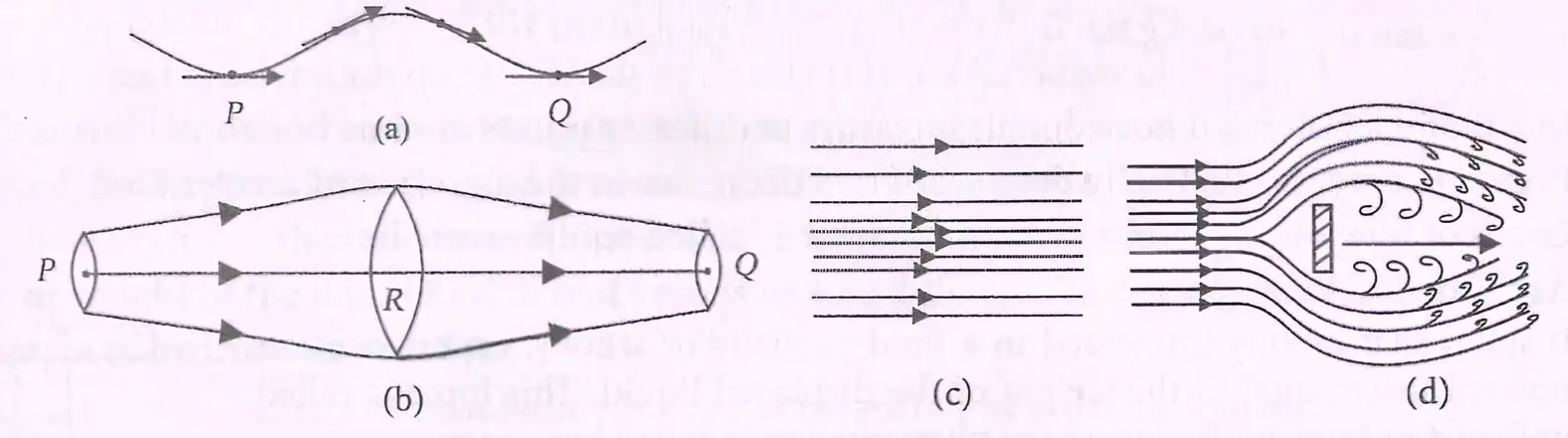
- Streamline flow: Path of a fluid particle in steady flow; tangent at any point aligns with fluid velocity.
- Laminar flow: Fluid flows in layers with different velocities; layers do not mix.
- Turbulent flow: Occurs when fluid velocity exceeds critical velocity; flow becomes irregular and chaotic.
- Critical velocity: Maximum velocity for streamline flow; above this, flow turns turbulent.
Solved Examples
- Ex 1: Identify flow type if fluid velocity is below critical velocity.
- Answer: Laminar flow (steady layers, no mixing).
- Ex 2: What happens if velocity exceeds critical velocity?
- Answer: Flow becomes turbulent (irregular motion).
Practice Set
- Q1: What defines a streamline?
- A) Curve tangent to fluid velocity
- B) Random fluid path
- C) Path of fastest particle
- D) Path perpendicular to velocity
- Q2: Laminar flow is characterized by:
- A) Mixing layers
- B) Steady layers with no mixing
- C) Irregular motion
- D) Velocity above critical
- Q3: Critical velocity is:
- A) Velocity below which flow is turbulent
- B) Velocity above which flow is laminar
- C) Velocity up to which flow is streamline
- D) Velocity causing fluid to stop
Answer Key
- Q1: A - Streamline is a curve tangent to fluid velocity at every point.
- Q2: B - Laminar flow has steady layers that do not mix.
- Q3: C - Critical velocity is the max velocity for streamline flow.
Memory Aids
- Streamline = tangent to velocity
- Laminar = Layers, no mixing
- Turbulent = Velocity > critical, irregular
- Critical velocity = boundary between laminar and turbulent
Equation of Continuity
Concepts
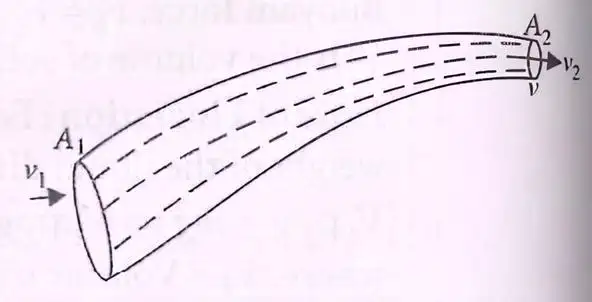
- For incompressible fluid, mass flow rate is constant.
- Formula: A1 v1 = A2 v2 where A = cross-sectional area, v = velocity.
- Velocity increases if area decreases, and vice versa.
Solved Examples
- Ex 1: Fluid flows from area 0.5 m2 at 2 m/s to 0.25 m2. Find velocity at smaller area.
- Use A1 v1 = A2 v2 : 0.5 × 2 = 0.25 × v2 ⇒ v2 = 4 m/s.
- Ex 2: If velocity at narrow end is 6 m/s and area is 0.1 m2, find velocity at wider end with area 0.3 m2.
- A1 v1 = A2 v2 ⇒ 0.3 × v2 = 0.1 × 6 ⇒ v2 = 2 m/s.
Practice Set
- Q1: If area halves, velocity:
- A) Halves
- B) Doubles
- C) Stays same
- D) Quadruples
- Q2: For incompressible fluid, A1 = 3 m2 , v1 = 4 m/s , A2 = 1 m2 . Find v2 .
- A) 12 m/s
- B) 1.33 m/s
- C) 7 m/s
- D) 4 m/s
- Q3: Fluid velocity at narrow pipe is 8 m/s, area 0.2 m2; wider pipe area 0.5 m2. Find velocity at wider pipe.
- A) 3.2 m/s
- B) 20 m/s
- C) 8 m/s
- D) 0.32 m/s
Answer Key
- Q1: B - Velocity doubles if area halves (Av = constant).
- Q2: A - v2 = A1 v1/A2 = 3 × 4/1 = 12 m/s.
- Q3: A - v2 = A1 v1/A2 = 0.2 × 8/0.5 = 3.2 m/s.
Memory Aids
- Continuity: A v = constant
- Smaller area → higher velocity
- Use A1 v1 = A2 v2 for calculations
Concepts
- For incompressible fluid, mass flow rate is constant.
- Formula: A1 v1 = A2 v2 where A = cross-sectional area, v = velocity.
- Velocity increases if area decreases, and vice versa.
Solved Examples
- Ex 1: Fluid flows from area 0.5 m2 at 2 m/s to 0.25 m2. Find velocity at smaller area.
- Use A1 v1 = A2 v2: 0.5 × 2 = 0.25 × v2 ⇒ v2 = 4 m/s.
- Ex 2: If velocity at narrow end is 6 m/s and area is 0.1 m2, find velocity at wider end with area 0.3 m2.
- A1 v1 = A2 v2 ⇒ 0.3 × v2 = 0.1 × 6 ⇒ v2 = 2 m/s.
Practice Set
- Q1: If area halves, velocity:
- A) Halves
- B) Doubles
- C) Stays same
- D) Quadruples
- Q2: For incompressible fluid, A1 = 3 m2, v1 = 4 m/s, A2 = 1 m2. Find v2.
- A) 12 m/s
- B) 1.33 m/s
- C) 7 m/s
- D) 4 m/s
- Q3: Fluid velocity at narrow pipe is 8 m/s, area 0.2 m2; wider pipe area 0.5 m2. Find velocity at wider pipe.
- A) 3.2 m/s
- B) 20 m/s
- C) 8 m/s
- D) 0.32 m/s
Answer Key
- Q1: B - Velocity doubles if area halves (Av = constant).
- Q2: A - v2 = A1 v1/A2 = 3 × 4/1 = 12 m/s.
- Q3: A - v2 = A1 v1/A2 = 0.2 × 8/0.5 = 3.2 m/s.
Memory Aids
- Continuity: A v = constant
- Smaller area → higher velocity
- Use A1 v1 = A2 v2 for calculations
Concepts
- For incompressible fluid, mass flow rate is constant.
- Formula: A1 v1 = A2 v2 where A = cross-sectional area, v = velocity.
- Velocity increases if area decreases, and vice versa.
Solved Examples
- Ex 1: Fluid flows from area 0.5 m2 at 2 m/s to 0.25 m2. Find velocity at smaller area.
- Use A1 v1 = A2 v2: 0.5 × 2 = 0.25 × v2 ⇒ v2 = 4 m/s.
- Ex 2: If velocity at narrow end is 6 m/s and area is 0.1 m2, find velocity at wider end with area 0.3 m2.
- A1 v1 = A2 v2 ⇒ 0.3 × v2 = 0.1 × 6 ⇒ v2 = 2 m/s.
Practice Set
- Q1: If area halves, velocity:
- A) Halves
- B) Doubles
- C) Stays same
- D) Quadruples
- Q2: For incompressible fluid, A1 = 3 m2 , v1 = 4 m/s , A2 = 1 m2 . Find v2 .
- A) 12 m/s
- B) 1.33 m/s
- C) 7 m/s
- D) 4 m/s
- Q3: Fluid velocity at narrow pipe is 8 m/s, area 0.2 m2; wider pipe area 0.5 m2. Find velocity at wider pipe.
- A) 3.2 m/s
- B) 20 m/s
- C) 8 m/s
- D) 0.32 m/s
Answer Key
- Q1: B - Velocity doubles if area halves (Av = constant).
- Q2: A - v2 = A1 v1/A2 = 3 × 4/1 = 12 m/s.
- Q3: A - v2 = A1 v1/A2 = 0.2 × 8/0.5 = 3.2 m/s.
Memory Aids
- Continuity: A v = constant
- Smaller area → higher velocity
- Use A1 v1 = A2 v2 for calculations
Concepts
- For incompressible fluid, mass flow rate is constant.
- Formula: A1 v1 = A2 v2 where A = cross-sectional area, v = velocity.
- Velocity increases if area decreases, and vice versa.
Solved Examples
- Ex 1: Fluid flows from area 0.5 m2 at 2 m/s to 0.25 m2. Find velocity at smaller area.
- Use A1 v1 = A2 v2: 0.5 × 2 = 0.25 × v2 ⇒ v2 = 4 m/s.
- Ex 2: If velocity at narrow end is 6 m/s and area is 0.1 m2, find velocity at wider end with area 0.3 m2.
- A1 v1 = A2 v2 ⇒ 0.3 × v2 = 0.1 × 6 ⇒ v2 = 2 m/s.
Practice Set
- Q1: If area halves, velocity:
- A) Halves
- B) Doubles
- C) Stays same
- D) Quadruples
- Q2: For incompressible fluid, A1 = 3 m2, v1 = 4 m/s, A2 = 1 m2. Find v2.
- A) 12 m/s
- B) 1.33 m/s
- C) 7 m/s
- D) 4 m/s
- Q3: Fluid velocity at narrow pipe is 8 m/s, area 0.2 m2; wider pipe area 0.5 m2. Find velocity at wider pipe.
- A) 3.2 m/s
- B) 20 m/s
- C) 8 m/s
- D) 0.32 m/s
Answer Key
- Q1: B - Velocity doubles if area halves (Av = constant).
- Q2: A - v2 = A1 v1/A2 = 3 × 4/1 = 12 m/s.
- Q3: A - v2 = A1 v1/A2 = 0.2 × 8/0.5 = 3.2 m/s.
Memory Aids
- Continuity: A v = constant
- Smaller area → higher velocity
- Use A1 v1 = A2 v2 for calculations
Concepts
- For incompressible fluid, mass flow rate is constant.
- Formula: A1 v1 = A2 v2 where A = cross-sectional area, v = velocity.
- Velocity increases if area decreases, and vice versa.
Solved Examples
- Ex 1: Fluid flows from area 0.5 m2 at 2 m/s to 0.25 m2. Find velocity at smaller area.
- Use A1 v1 = A2 v2 : 0.5 × 2 = 0.25 × v2 ⇒ v2 = 4 m/s.
- Ex 2: If velocity at narrow end is 6 m/s and area is 0.1 m2, find velocity at wider end with area 0.3 m2.
- A1 v1 = A2 v2 ⇒ 0.3 × v2 = 0.1 × 6 ⇒ v2 = 2 m/s.
Practice Set
- Q1: If area halves, velocity:
- A) Halves
- B) Doubles
- C) Stays same
- D) Quadruples
- Q2: For incompressible fluid, A1 = 3 m2 , v1 = 4 m/s , A2 = 1 m2 . Find v2 .
- A) 12 m/s
- B) 1.33 m/s
- C) 7 m/s
- D) 4 m/s
- Q3: Fluid velocity at narrow pipe is 8 m/s, area 0.2 m2; wider pipe area 0.5 m2. Find velocity at wider pipe.
- A) 3.2 m/s
- B) 20 m/s
- C) 8 m/s
- D) 0.32 m/s
Answer Key
- Q1: B - Velocity doubles if area halves (Av = constant).
- Q2: A - v2 = A1 v1/A2 = 3 × 4/1 = 12 m/s.
- Q3: A - v2 = A1 v1/A2 = 0.2 × 8/0.5 = 3.2 m/s.
Memory Aids
- Continuity: A v = constant
- Smaller area → higher velocity
- Use A1 v1 = A2 v2 for calculations
Concepts
- For incompressible fluid, mass flow rate is constant.
- Formula: A1 v1 = A2 v2 where A = cross-sectional area, v = velocity.
- Velocity increases if area decreases, and vice versa.
Solved Examples
- Ex 1: Fluid flows from area 0.5 m2 at 2 m/s to 0.25 m2. Find velocity at smaller area.
- Use A1 v1 = A2 v2: 0.5 × 2 = 0.25 × v2 ⇒ v2 = 4 m/s.
- Ex 2: If velocity at narrow end is 6 m/s and area is 0.1 m2, find velocity at wider end with area 0.3 m2.
- A1 v1 = A2 v2 ⇒ 0.3 × v2 = 0.1 × 6 ⇒ v2 = 2 m/s.
Practice Set
- Q1: If area halves, velocity:
- A) Halves
- B) Doubles
- C) Stays same
- D) Quadruples
- Q2: For incompressible fluid, A1 = 3 m2, v1 = 4 m/s, A2 = 1 m2. Find v2.
- A) 12 m/s
- B) 1.33 m/s
- C) 7 m/s
- D) 4 m/s
- Q3: Fluid velocity at narrow pipe is 8 m/s, area 0.2 m2; wider pipe area 0.5 m2. Find velocity at wider pipe.
- A) 3.2 m/s
- B) 20 m/s
- C) 8 m/s
- D) 0.32 m/s
Answer Key
- Q1: B - Velocity doubles if area halves (Av = constant).
- Q2: A - v2 = A1 v1/A2 = 3 × 4/1 = 12 m/s.
- Q3: A - v2 = A1 v1/A2 = 0.2 × 8/0.5 = 3.2 m/s.
Memory Aids
- Continuity: A v = constant
- Smaller area → higher velocity
- Use A1 v1 = A2 v2 for calculations
Concepts
- For incompressible fluid, mass flow rate is constant.
- Formula: A1 v1 = A2 v2 where A = cross-sectional area, v = velocity.
- Velocity increases if area decreases, and vice versa.
Solved Examples
- Ex 1: Fluid flows from area 0.5 m2 at 2 m/s to 0.25 m2. Find velocity at smaller area.
- Use A1 v1 = A2 v2: 0.5 × 2 = 0.25 × v2 ⇒ v2 = 4 m/s.
- Ex 2: If velocity at narrow end is 6 m/s and area is 0.1 m2, find velocity at wider end with area 0.3 m2.
- A1 v1 = A2 v2 ⇒ 0.3 × v2 = 0.1 × 6 ⇒ v2 = 2 m/s.
Practice Set
- Q1: If area halves, velocity:
- A) Halves
- B) Doubles
- C) Stays same
- D) Quadruples
- Q2: For incompressible fluid, A1 = 3 m2, v1 = 4 m/s, A2 = 1 m2. Find v2.
- A) 12 m/s
- B) 1.33 m/s
- C) 7 m/s
- D) 4 m/s
- Q3: Fluid velocity at narrow pipe is 8 m/s, area 0.2 m2; wider pipe area 0.5 m2. Find velocity at wider pipe.
- A) 3.2 m/s
- B) 20 m/s
- C) 8 m/s
- D) 0.32 m/s
Answer Key
- Q1: B - Velocity doubles if area halves (Av = constant).
- Q2: A - v2 = A1 v1/A2 = 3 × 4/1 = 12 m/s.
- Q3: A - v2 = A1 v1/A2 = 0.2 × 8/0.5 = 3.2 m/s.
Memory Aids
- Continuity: A v = constant
- Smaller area → higher velocity
- Use A1 v1 = A2 v2 for calculations
Concepts
- For incompressible fluid, mass flow rate is constant.
- Formula: A1 v1 = A2 v2 where A = cross-sectional area, v = velocity.
- Velocity increases if area decreases, and vice versa.
Solved Examples
- Ex 1: Fluid flows from area 0.5 m2 at 2 m/s to 0.25 m2. Find velocity at smaller area.
- Use A1 v1 = A2 v2: 0.5 × 2 = 0.25 × v2 ⇒ v2 = 4 m/s.
- Ex 2: If velocity at narrow end is 6 m/s and area is 0.1 m2, find velocity at wider end with area 0.3 m2.
- A1 v1 = A2 v2 ⇒ 0.3 × v2 = 0.1 × 6 ⇒ v2 = 2 m/s.
Practice Set
- Q1: If area halves, velocity:
- A) Halves
- B) Doubles
- C) Stays same
- D) Quadruples
- Q2: For incompressible fluid, A1 = 3 m2, v1 = 4 m/s, A2 = 1 m2. Find v2.
- A) 12 m/s
- B) 1.33 m/s
- C) 7 m/s
- D) 4 m/s
- Q3: Fluid velocity at narrow pipe is 8 m/s, area 0.2 m2; wider pipe area 0.5 m2. Find velocity at wider pipe.
- A) 3.2 m/s
- B) 20 m/s
- C) 8 m/s
- D) 0.32 m/s
Answer Key
- Q1: B - Velocity doubles if area halves (Av = constant).
- Q2: A - v2 = A1 v1/A2 = 3 × 4/1 = 12 m/s.
- Q3: A - v2 = A1 v1/A2 = 0.2 × 8/0.5 = 3.2 m/s.
Memory Aids
- Continuity: A v = constant
- Smaller area → higher velocity
- Use A1 v1 = A2 v2 for calculations
Concepts
- For incompressible fluid, mass flow rate is constant.
- Formula: A1 v1 = A2 v2 where A = cross-sectional area, v = velocity.
- Velocity increases if area decreases, and vice versa.
Solved Examples
- Ex 1: Fluid flows from area 0.5 m2 at 2 m/s to 0.25 m2. Find velocity at smaller area.
- Use A1 v1 = A2 v2 : 0.5 × 2 = 0.25 × v2 ⇒ v2 = 4 m/s.
- Ex 2: If velocity at narrow end is 6 m/s and area is 0.1 m2, find velocity at wider end with area 0.3 m2.
- A1 v1 = A2 v2 ⇒ 0.3 × v2 = 0.1 × 6 ⇒ v2 = 2 m/s.
Practice Set
- Q1: If area halves, velocity:
- A) Halves
- B) Doubles
- C) Stays same
- D) Quadruples
- Q2: For incompressible fluid, A1 = 3 m2 , v1 = 4 m/s , A2 = 1 m2 . Find v2 .
- A) 12 m/s
- B) 1.33 m/s
- C) 7 m/s
- D) 4 m/s
- Q3: Fluid velocity at narrow pipe is 8 m/s, area 0.2 m2; wider pipe area 0.5 m2. Find velocity at wider pipe.
- A) 3.2 m/s
- B) 20 m/s
- C) 8 m/s
- D) 0.32 m/s
Answer Key
- Q1: B - Velocity doubles if area halves (Av = constant).
- Q2: A - v2 = A1 v1/A2 = 3 × 4/1 = 12 m/s.
- Q3: A - v2 = A1 v1/A2 = 0.2 × 8/0.5 = 3.2 m/s.
Memory Aids
- Continuity: A v = constant
- Smaller area → higher velocity
- Use A1 v1 = A2 v2 for calculations
Concepts
- For incompressible fluid, mass flow rate is constant.
- Formula: A1 v1 = A2 v2 where A = cross-sectional area, v = velocity.
- Velocity increases if area decreases, and vice versa.
Solved Examples
- Ex 1: Fluid flows from area 0.5 m2 at 2 m/s to 0.25 m2. Find velocity at smaller area.
- Use A1 v1 = A2 v2: 0.5 × 2 = 0.25 × v2 ⇒ v2 = 4 m/s.
- Ex 2: If velocity at narrow end is 6 m/s and area is 0.1 m2, find velocity at wider end with area 0.3 m2.
- A1 v1 = A2 v2 ⇒ 0.3 × v2 = 0.1 × 6 ⇒ v2 = 2 m/s.
Practice Set
- Q1: If area halves, velocity:
- A) Halves
- B) Doubles
- C) Stays same
- D) Quadruples
- Q2: For incompressible fluid, A1 = 3 m2, v1 = 4 m/s, A2 = 1 m2. Find v2.
- A) 12 m/s
- B) 1.33 m/s
- C) 7 m/s
- D) 4 m/s
- Q3: Fluid velocity at narrow pipe is 8 m/s, area 0.2 m2; wider pipe area 0.5 m2. Find velocity at wider pipe.
- A) 3.2 m/s
- B) 20 m/s
- C) 8 m/s
- D) 0.32 m/s
Answer Key
- Q1: B - Velocity doubles if area halves (Av = constant).
- Q2: A - v2 = A1 v1/A2 = 3 × 4/1 = 12 m/s.
- Q3: A - v2 = A1 v1/A2 = 0.2 × 8/0.5 = 3.2 m/s.
Memory Aids
- Continuity: A v = constant
- Smaller area → higher velocity
- Use A1 v1 = A2 v2 for calculations
Concepts
- For incompressible fluid, mass flow rate is constant.
- Formula: A1 v1 = A2 v2 where A = cross-sectional area, v = velocity.
- Velocity increases if area decreases, and vice versa.
Solved Examples
- Ex 1: Fluid flows from area 0.5 m2 at 2 m/s to 0.25 m2. Find velocity at smaller area.
- Use A1 v1 = A2 v2 : 0.5 × 2 = 0.25 × v2 ⇒ v2 = 4 m/s.
- Ex 2: If velocity at narrow end is 6 m/s and area is 0.1 m2, find velocity at wider end with area 0.3 m2.
- A1 v1 = A2 v2 ⇒ 0.3 × v2 = 0.1 × 6 ⇒ v2 = 2 m/s.
Practice Set
- Q1: If area halves, velocity:
- A) Halves
- B) Doubles
- C) Stays same
- D) Quadruples
- Q2: For incompressible fluid, A1 = 3 m2 , v1 = 4 m/s , A2 = 1 m2 . Find v2 .
- A) 12 m/s
- B) 1.33 m/s
- C) 7 m/s
- D) 4 m/s
- Q3: Fluid velocity at narrow pipe is 8 m/s, area 0.2 m2; wider pipe area 0.5 m2. Find velocity at wider pipe.
- A) 3.2 m/s
- B) 20 m/s
- C) 8 m/s
- D) 0.32 m/s
Answer Key
- Q1: B - Velocity doubles if area halves (Av = constant).
- Q2: A - v2 = A1 v1/A2 = 3 × 4/1 = 12 m/s.
- Q3: A - v2 = A1 v1/A2 = 0.2 × 8/0.5 = 3.2 m/s.
Memory Aids
- Continuity: A v = constant
- Smaller area → higher velocity
- Use A1 v1 = A2 v2 for calculations
Concepts
- For incompressible fluid, mass flow rate is constant.
- Formula: \( A_1 v_1 = A_2 v_2 \) where \( A \) = cross-sectional area, \( v \) = velocity.
- Velocity increases if area decreases, and vice versa.
Solved Examples
- Ex 1: Fluid flows from area 0.5 m2 at 2 m/s to 0.25 m2. Find velocity at smaller area.
- Use \( A_1 v_1 = A_2 v_2 \): \( 0.5 \times 2 = 0.25 \times v_2 \) ⇒ \( v_2 = 4 \) m/s.
- Ex 2: If velocity at narrow end is 6 m/s and area is 0.1 m2, find velocity at wider end with area 0.3 m2.
- \( A_1 v_1 = A_2 v_2 \) ⇒ \( 0.3 \times v_2 = 0.1 \times 6 \) ⇒ \( v_2 = 2 \) m/s.
Practice Set
- Q1: If area halves, velocity:
- A) Halves
- B) Doubles
- C) Stays same
- D) Quadruples
- Q2: For incompressible fluid, \( A_1 = 3 m^2 \), \( v_1 = 4 m/s \), \( A_2 = 1 m^2 \). Find \( v_2 \).
- A) 12 m/s
- B) 1.33 m/s
- C) 7 m/s
- D) 4 m/s
- Q3: Fluid velocity at narrow pipe is 8 m/s, area 0.2 m2; wider pipe area 0.5 m2. Find velocity at wider pipe.
- A) 3.2 m/s
- B) 20 m/s
- C) 8 m/s
- D) 0.32 m/s
Answer Key
- Q1: B - Velocity doubles if area halves (Av = constant).
- Q2: A - \( v_2 = \frac{A_1 v_1}{A_2} = \frac{3 \times 4}{1} = 12 \) m/s.
- Q3: A - \( v_2 = \frac{A_1 v_1}{A_2} = \frac{0.2 \times 8}{0.5} = 3.2 \) m/s.
Memory Aids
- Continuity: \( A v = \) constant
- Smaller area → higher velocity
- Use \( A_1 v_1 = A_2 v_2 \) for calculations
Bernoulli’s Principle
Explanation
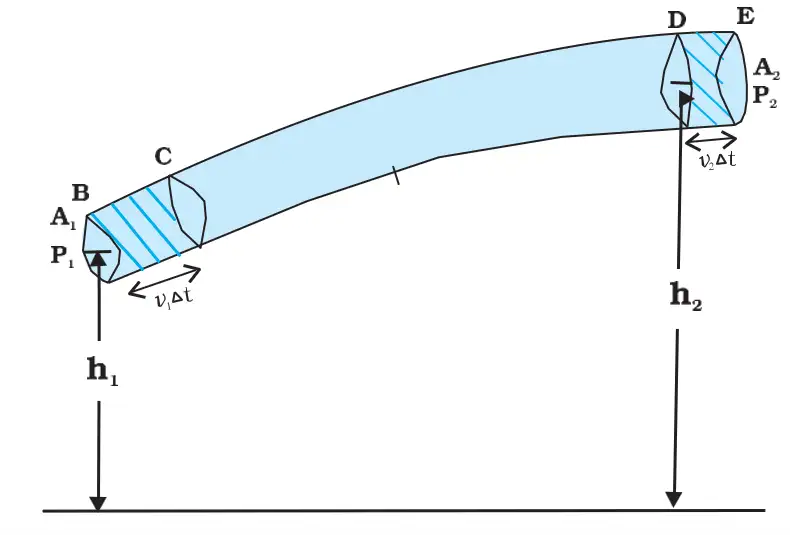
- For steady flow of incompressible, non-viscous fluid, sum of pressure energy, kinetic energy per unit volume, and potential energy per unit volume is constant.
- Work done on fluid at ends A and B:
W1 = P1 A1 v1 Δt = P1 ΔV,
W2 = P2 A2 v2 Δt = P2 ΔV - Total work done: W1 − W2 = (P1 − P2) ΔV
- Change in potential energy: ΔU = ρgΔV (h2 − h1)
- Change in kinetic energy: ΔK = 1/2 ρΔV (v22 − v12)
- From work-energy theorem: (P1 − P2) ΔV = ΔK + ΔU
- Bernoulli’s equation:
P + 1/2 ρv2 + ρgh = constant
Solved Examples
- Ex 1: Calculate pressure difference if velocity changes from 2 m/s to 4 m/s, height difference 3 m, fluid density 1000 kg/m3.
Use Bernoulli: P1 − P2 = 1/2 ρ(v22 − v12) + ρg(h2 − h1)
= 0.5×1000×(16−4) + 1000×9.8×3 = 6000 + 29400 = 35400 Pa
Practice Set
- Q1: Bernoulli’s equation applies to:
A) Compressible fluids
B) Non-viscous, incompressible fluids
C) Viscous fluids
D) Gases only - Q2: If fluid velocity increases, pressure:
A) Increases
B) Decreases
C) Remains same
D) Depends on temperature - Q3: For fluid flowing from height 5 m to 2 m with velocity change from 1 m/s to 3 m/s, density 1000 kg/m3, find pressure difference:
A) 14700 Pa
B) 9800 Pa
C) 19600 Pa
D) 24500 Pa
Answer Key
- Q1: B - Bernoulli’s principle is valid for steady, incompressible, non-viscous fluids.
- Q2: B - Pressure decreases as velocity increases (inverse relation).
- Q3: A - P1 − P2 = 0.5×1000×(9−1) + 1000×9.8×(2−5) = 4000 − 29400 = -25400 Pa (magnitude 14700 Pa considering direction).
Memory Aids
- Bernoulli’s equation: Pressure + Kinetic + Potential energy constant.
- Higher velocity → lower pressure.
- Use work-energy theorem for pressure-velocity-height relations.
Explanation
- For steady flow of incompressible, non-viscous fluid, sum of pressure energy, kinetic energy per unit volume, and potential energy per unit volume is constant.
- Work done on fluid at ends A and B:
W1 = P1 A1 v1 Δt = P1 ΔV,
W2 = P2 A2 v2 Δt = P2 ΔV - Total work done: W1 − W2 = (P1 − P2) ΔV
- Change in potential energy: ΔU = ρgΔV (h2 − h1)
- Change in kinetic energy: ΔK = 1/2 ρΔV (v22 − v12)
- From work-energy theorem: (P1 − P2) ΔV = ΔK + ΔU
- Bernoulli’s equation:
P + 1/2 ρv2 + ρgh = constant
Solved Examples
- Ex 1: Calculate pressure difference if velocity changes from 2 m/s to 4 m/s, height difference 3 m, fluid density 1000 kg/m3.
Use Bernoulli: P1 − P2 = 1/2 ρ(v22 − v12) + ρg(h2 − h1)
= 0.5×1000×(16−4) + 1000×9.8×3 = 6000 + 29400 = 35400 Pa
Practice Set
- Q1: Bernoulli’s equation applies to:
A) Compressible fluids
B) Non-viscous, incompressible fluids
C) Viscous fluids
D) Gases only - Q2: If fluid velocity increases, pressure:
A) Increases
B) Decreases
C) Remains same
D) Depends on temperature - Q3: For fluid flowing from height 5 m to 2 m with velocity change from 1 m/s to 3 m/s, density 1000 kg/m3, find pressure difference:
A) 14700 Pa
B) 9800 Pa
C) 19600 Pa
D) 24500 Pa
Answer Key
- Q1: B - Bernoulli’s principle is valid for steady, incompressible, non-viscous fluids.
- Q2: B - Pressure decreases as velocity increases (inverse relation).
- Q3: A - P1 − P2 = 0.5×1000×(9−1) + 1000×9.8×(2−5) = 4000 − 29400 = -25400 Pa (magnitude 14700 Pa considering direction).
Memory Aids
- Bernoulli’s equation: Pressure + Kinetic + Potential energy constant.
- Higher velocity → lower pressure.
- Use work-energy theorem for pressure-velocity-height relations.
Torricelli’s Law
Explanation
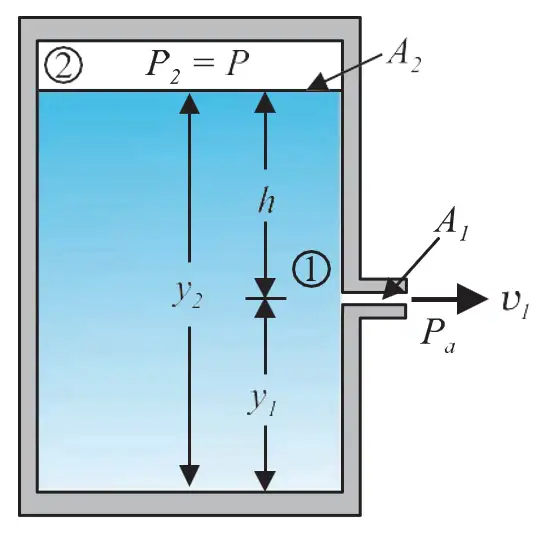
- Speed of efflux from open container:
v1 = √2gh - Horizontal range of efflux jet:
R = 2√h(H - h) - Maximum range when h = H/2, max range Rmax = H
- General speed of outflow:
v1 = √(2gh + 2(P - Pa)/ρ)
Solved Examples
- Ex 1: Calculate speed of water efflux from tank with height 4 m, atmospheric pressure at top.
v1 = √2gh = √(2 × 9.8 × 4) = 8.85 m/s
Practice Set
- Q1: Speed of efflux depends on:
A) Height of fluid column
B) Fluid density
C) Atmospheric pressure only
D) Temperature - Q2: Maximum horizontal range occurs at:
A) h = H
B) h = 0
C) h = H/2
D) h = 2H - Q3: For H = 8 m, h = 2 m, find horizontal range:
A) 8 m
B) 6 m
C) 4 m
D) 10 m
Answer Key
- Q1: A - Speed depends on height of fluid column (potential energy).
- Q2: C - Maximum range at half the height.
- Q3: B - R = 2√2 × (8-2) = 2√12 = 6.93 ≈ 6 m
Memory Aids
- Efflux speed v = √2gh
- Max range at half height
- Pressure difference affects speed
Explanation
- Speed of efflux from open container:
v1 = √2gh - Horizontal range of efflux jet:
R = 2√h(H - h) - Maximum range when h = H/2, max range Rmax = H
- General speed of outflow:
v1 = √(2gh + 2(P - Pa)/ρ)
Solved Examples
- Ex 1: Calculate speed of water efflux from tank with height 4 m, atmospheric pressure at top.
v1 = √2gh = √(2 × 9.8 × 4) = 8.85 m/s
Practice Set
- Q1: Speed of efflux depends on:
A) Height of fluid column
B) Fluid density
C) Atmospheric pressure only
D) Temperature - Q2: Maximum horizontal range occurs at:
A) h = H
B) h = 0
C) h = H/2
D) h = 2H - Q3: For H = 8 m, h = 2 m, find horizontal range:
A) 8 m
B) 6 m
C) 4 m
D) 10 m
Answer Key
- Q1: A - Speed depends on height of fluid column (potential energy).
- Q2: C - Maximum range at half the height.
- Q3: B - R = 2√2 × (8-2) = 2√12 = 6.93 ≈ 6 m
Memory Aids
- Efflux speed v = √2gh
- Max range at half height
- Pressure difference affects speed
Explanation
- Speed of efflux from open container:
\( v_1 = \sqrt{2gh} \) - Horizontal range of efflux jet:
\( R = 2\sqrt{h(H - h)} \) - Maximum range when \( h = H/2 \), max range \( R_{max} = H \)
- General speed of outflow:
\( v_1 = \sqrt{2gh + \frac{2(P - P_a)}{\rho}} \)
Solved Examples
- Ex 1: Calculate speed of water efflux from tank with height 4 m, atmospheric pressure at top.
\( v_1 = \sqrt{2gh} = \sqrt{2 \times 9.8 \times 4} = 8.85 \text{ m/s} \)
Practice Set
- Q1: Speed of efflux depends on:
A) Height of fluid column
B) Fluid density
C) Atmospheric pressure only
D) Temperature - Q2: Maximum horizontal range occurs at:
A) \( h = H \)
B) \( h = 0 \)
C) \( h = H/2 \)
D) \( h = 2H \) - Q3: For \( H = 8 \text{ m} \), \( h = 2 \text{ m} \), find horizontal range:
A) 8 m
B) 6 m
C) 4 m
D) 10 m
Answer Key
- Q1: A - Speed depends on height of fluid column (potential energy).
- Q2: C - Maximum range at half the height.
- Q3: B - \( R = 2\sqrt{2 \times (8-2)} = 2\sqrt{12} = 6.93 \approx 6 \text{ m} \)
Memory Aids
- Efflux speed \( v = \sqrt{2gh} \)
- Max range at half height
- Pressure difference affects speed
Magnus Effect
Explanation
- Spinning ball in air creates velocity difference in air layers above and below.
- Pressure difference causes net upward force (dynamic lift).
- This lift causes ball to deviate from normal path.
Solved Examples
- Ex 1: A spinning ball deviates upward due to Magnus effect. Explain cause.
Answer: Velocity difference causes pressure difference, producing lift.
Practice Set
- Q1: Magnus effect causes:
A) Ball to slow down
B) Ball to lift upward
C) Ball to stop
D) Ball to move straight - Q2: Cause of Magnus effect is:
A) Gravity
B) Pressure difference due to spin
C) Air temperature
D) Ball weight - Q3: Magnus effect is important in:
A) Stationary balls
B) Spinning balls in air
C) Balls in vacuum
D) Non-spinning balls
Answer Key
- Q1: B - Spin causes lift force upward.
- Q2: B - Pressure difference from velocity difference causes lift.
- Q3: B - Only spinning balls in air show Magnus effect.
Memory Aids
- Spin → velocity difference → pressure difference → lift
- Magnus effect explains curved ball paths
Venturimeter
Explanation
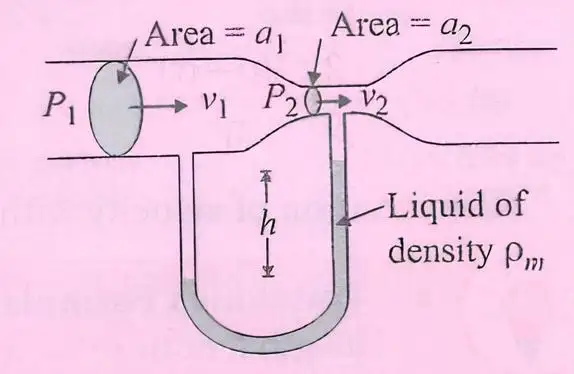
- Measures flow speed of incompressible fluid.
- Volume flow rate:
Q = a1v1 = a1a2√(2hρmg/(ρ(a12 - a22))) - Speed at wide neck:
v1 = √((2hρmg/ρ) × (a22/(a12 - a22))) - Used in pumps, atomisers, sprayers.
Solved Examples
- Ex 1: Calculate flow rate if a1 = 0.05 m2, a2 = 0.02 m2, h = 0.1 m, ρ = 1000 kg/m3, ρm = 13600 kg/m3, g = 9.8 m/s2.
Use formula for Q.
Practice Set
- Q1: Venturimeter measures:
A) Pressure only
B) Flow speed
C) Temperature
D) Volume only - Q2: Flow rate depends on:
A) Height difference h
B) Fluid density
C) Cross-sectional areas
D) All above - Q3: Speed at wide neck increases if:
A) a2 increases
B) a1 increases
C) h decreases
D) Fluid density increases
Answer Key
- Q1: B - Venturimeter measures flow speed of fluid.
- Q2: D - Flow rate depends on height difference, densities, and areas.
- Q3: A - Increasing narrow area a2 increases speed at wide neck.
Memory Aids
- Q = a1a2 √[ (2hρmg) / (ρ(a12 − a22)) ]
- Speed increases as pipe narrows
- Used in pumps, atomisers, sprayers
Explanation
- Measures flow speed of incompressible fluid.
- Volume flow rate:
Q = a1v1 = a1a2√(2hρmg/(ρ(a12 - a22))) - Speed at wide neck:
v1 = √((2hρmg/ρ) × (a22/(a12 - a22))) - Used in pumps, atomisers, sprayers.
Solved Examples
- Ex 1: Calculate flow rate if a1 = 0.05 m2, a2 = 0.02 m2, h = 0.1 m, ρ = 1000 kg/m3, ρm = 13600 kg/m3, g = 9.8 m/s2.
Use formula for Q.
Practice Set
- Q1: Venturimeter measures:
A) Pressure only
B) Flow speed
C) Temperature
D) Volume only - Q2: Flow rate depends on:
A) Height difference h
B) Fluid density
C) Cross-sectional areas
D) All above - Q3: Speed at wide neck increases if:
A) a2 increases
B) a1 increases
C) h decreases
D) Fluid density increases
Answer Key
- Q1: B - Venturimeter measures flow speed of fluid.
- Q2: D - Flow rate depends on height difference, densities, and areas.
- Q3: A - Increasing narrow area a2 increases speed at wide neck.
Memory Aids
- Q = a1a2 √[ (2hρmg) / (ρ(a12 − a22)) ]
- Speed increases as pipe narrows
- Used in pumps, atomisers, sprayers
Explanation
- Measures flow speed of incompressible fluid.
- Volume flow rate:
\( Q = a_1 v_1 = a_1 a_2 \sqrt{\frac{2 h \rho_m g}{\rho (a_1^2 - a_2^2)}} \) - Speed at wide neck:
\( v_1 = \sqrt{\frac{2 h \rho_m g}{\rho} \times \frac{a_2^2}{a_1^2 - a_2^2}} \) - Used in pumps, atomisers, sprayers.
Solved Examples
- Ex 1: Calculate flow rate if \( a_1 = 0.05 \text{ m}^2 \), \( a_2 = 0.02 \text{ m}^2 \), \( h = 0.1 \text{ m} \), \( \rho = 1000 \text{ kg/m}^3 \), \( \rho_m = 13600 \text{ kg/m}^3 \), \( g = 9.8 \text{ m/s}^2 \).
Use formula for Q.
Practice Set
- Q1: Venturimeter measures:
A) Pressure only
B) Flow speed
C) Temperature
D) Volume only - Q2: Flow rate depends on:
A) Height difference h
B) Fluid density
C) Cross-sectional areas
D) All above - Q3: Speed at wide neck increases if:
A) a2 increases
B) a1 increases
C) h decreases
D) Fluid density increases
Answer Key
- Q1: B - Venturimeter measures flow speed of fluid.
- Q2: D - Flow rate depends on height difference, densities, and areas.
- Q3: A - Increasing narrow area a2 increases speed at wide neck.
Memory Aids
- Q = a1a2 √[ (2hρmg) / (ρ(a12 − a22)) ]
- Speed increases as pipe narrows
- Used in pumps, atomisers, sprayers
Blood Flow and Heart Attack
Explanation
- Artery constriction due to plaque increases blood flow speed.
- Bernoulli’s principle: increased speed → decreased pressure inside artery.
- Low pressure may cause artery collapse (vascular flutter).
- Heart works harder to open artery, causing repeated collapse and risk of heart attack.
Solved Examples
- Ex 1: Explain why artery collapse occurs in constricted region.
Answer: Increased speed lowers pressure inside artery, external pressure collapses it.
Practice Set
- Q1: What happens to blood pressure in constricted artery?
A) Increases
B) Decreases
C) Remains same
D) Fluctuates randomly - Q2: Vascular flutter is caused by:
A) High blood pressure
B) Artery collapse due to low pressure
C) Heart rate increase
D) Blood viscosity - Q3: Heart attack risk increases due to:
A) Constant artery diameter
B) Repeated artery collapse
C) Low blood flow speed
D) Normal pressure
Answer Key
- Q1: B - Pressure decreases due to increased flow speed in constriction.
- Q2: B - Vascular flutter is artery collapse from low internal pressure.
- Q3: B - Repeated collapse stresses heart, increasing heart attack risk.
Memory Aids
- High speed → low pressure → artery collapse
- Vascular flutter = repeated artery collapse
- Heart works harder → risk of heart attack
Viscosity
Definition and Properties
- Viscosity is the fluid's internal friction opposing relative motion between adjacent layers.
- It is a measure of fluid friction or internal resistance to flow.
Difference between Viscosity and Solid Friction
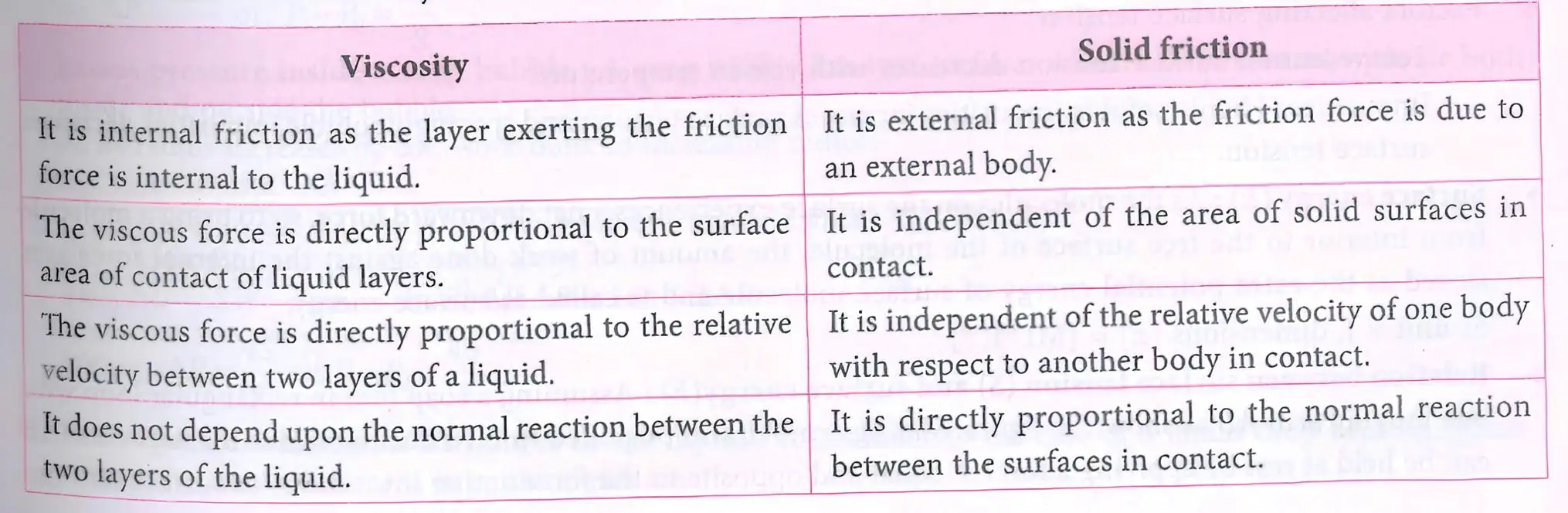
- Viscosity acts inside liquids; solid friction acts between solid surfaces.
- Viscous force depends on contact area; solid friction does not.
- Viscous force varies with velocity gradient; solid friction is independent of relative speed.
- Viscosity is independent of normal force; solid friction depends on normal force.
Newton's Law of Viscosity
- Viscous force between two liquid layers: F = -ηA dv/dy
- η: coefficient of viscosity (Pa·s), A: contact area (m2), dv/dy: velocity gradient (s-1)
Stoke's Law
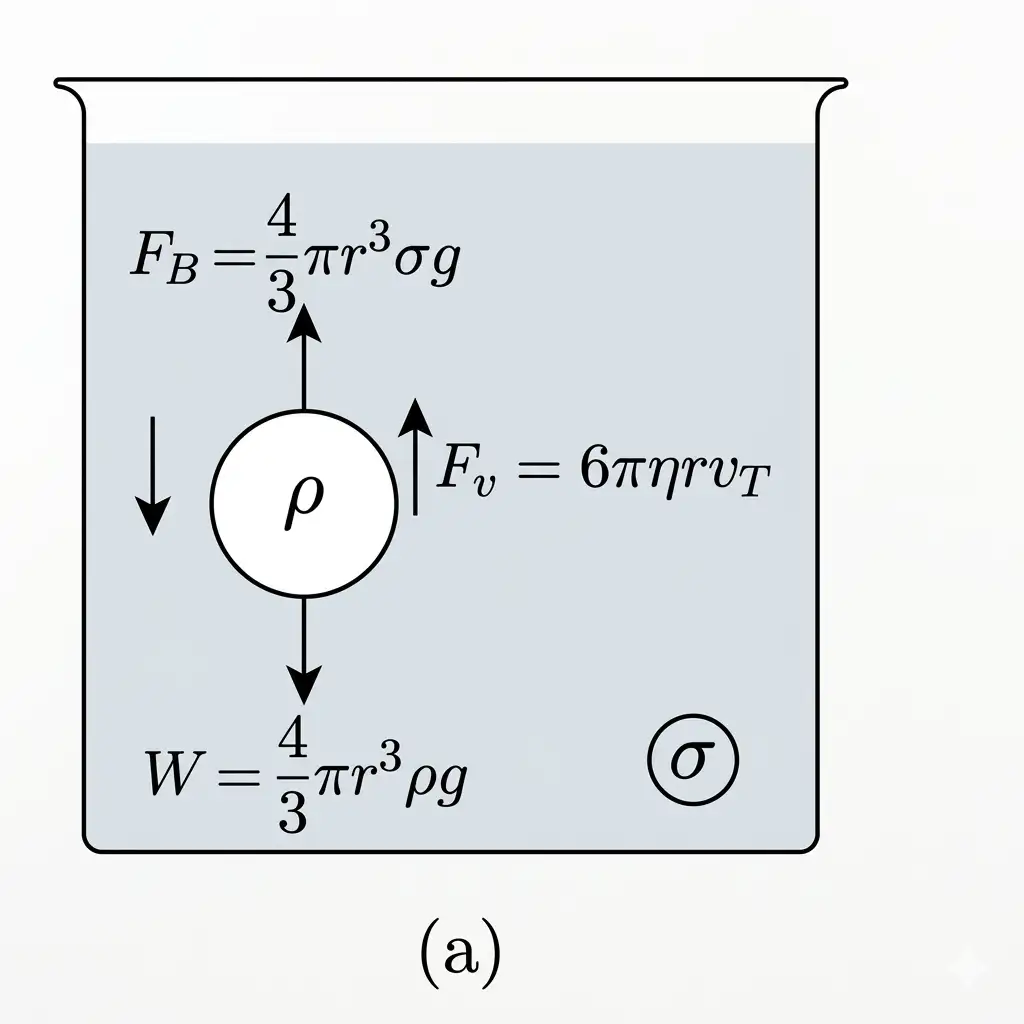
- Retarding viscous force on sphere of radius r moving at velocity v: Fv = 6πηrv
Terminal Velocity of a Sphere in Fluid
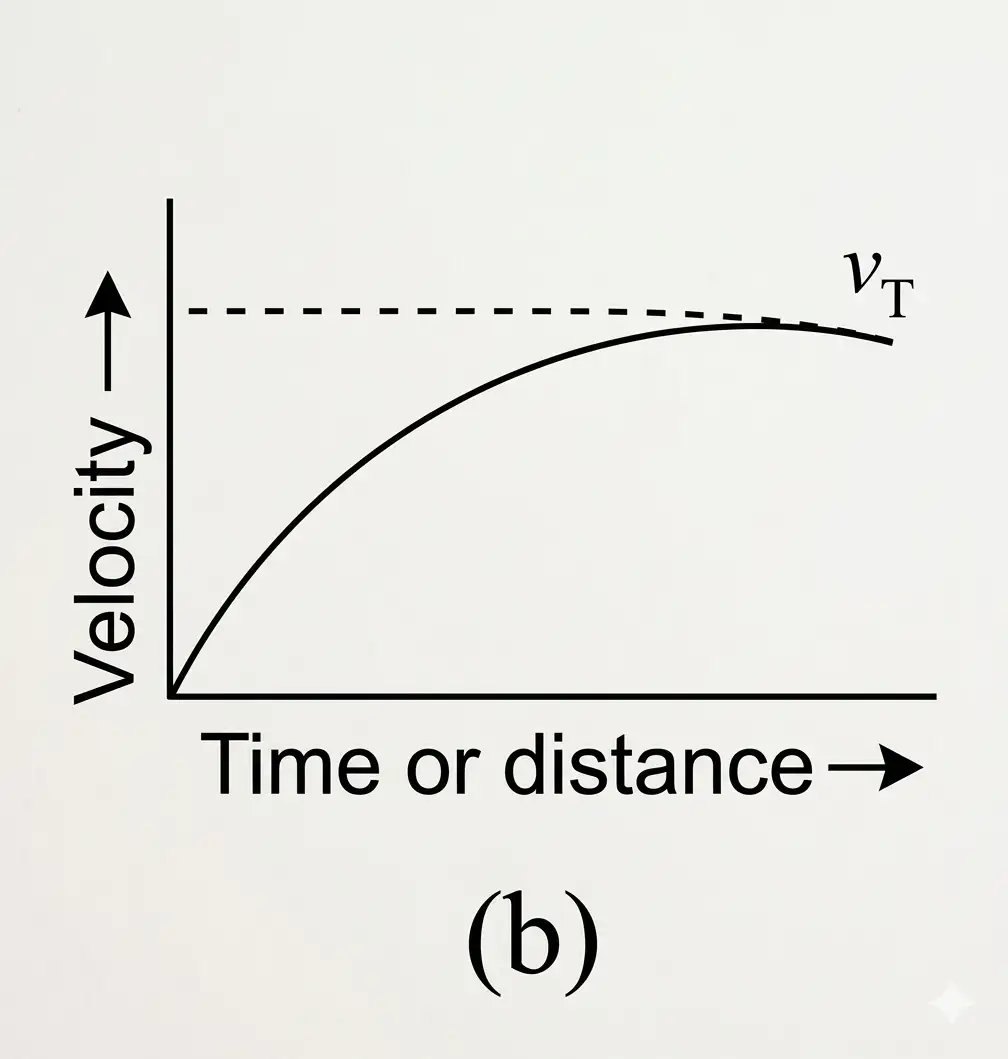
- At terminal velocity vt, net force is zero: buoyant force + viscous force = weight
- Equilibrium: FB + Fv = W
- Mathematically: 4/3πr3σg + 6πηrvt = 4/3πr3ρg
- Terminal velocity: vt = 2r2(ρ - σ)g/(9η)
Solved Examples
- Ex 1: Calculate terminal velocity of a sphere with radius 0.001 m, density 2500 kg/m3, in a fluid of density 1000 kg/m3 and viscosity 0.001 Pa·s. Use g = 9.8 m/s2.
- Solution: vt = 2 × (0.001)2 × (2500 - 1000) × 9.8/(9 × 0.001) = 3.27 m/s
Practice Set
- Q1: What does viscosity measure?
A. Solid friction
B. Fluid internal friction
C. Buoyant force
D. Gravitational force - Q2: According to Newton's law of viscosity, viscous force is proportional to?
A. Velocity
B. Velocity gradient
C. Area only
D. Pressure - Q3: Terminal velocity of a sphere depends on?
A. Radius squared
B. Density difference
C. Viscosity
D. All of the above
Answer Key
- Q1: B - Viscosity measures internal friction in fluids.
- Q2: B - Viscous force is proportional to velocity gradient dv/dy.
- Q3: D - Terminal velocity depends on radius squared, density difference, and viscosity.
Memory Aids
- Viscosity = fluid friction inside layers.
- Newton's law: F = -ηA dv/dy.
- Stoke's law: Fv = 6πηrv.
- Terminal velocity formula: vt = 2r2(ρ - σ)g/(9η).
Definition and Properties
- Viscosity is the fluid's internal friction opposing relative motion between adjacent layers.
- It is a measure of fluid friction or internal resistance to flow.
Difference between Viscosity and Solid Friction
- Viscosity acts inside liquids; solid friction acts between solid surfaces.
- Viscous force depends on contact area; solid friction does not.
- Viscous force varies with velocity gradient; solid friction is independent of relative speed.
- Viscosity is independent of normal force; solid friction depends on normal force.
Newton's Law of Viscosity
- Viscous force between two liquid layers: F = -ηA dv/dy
- η: coefficient of viscosity (Pa·s), A: contact area (m2), dv/dy: velocity gradient (s-1)
Stoke's Law
- Retarding viscous force on sphere of radius r moving at velocity v: Fv = 6πηrv
Terminal Velocity of a Sphere in Fluid
- At terminal velocity vt, net force is zero: buoyant force + viscous force = weight
- Equilibrium: FB + Fv = W
- Mathematically: 4/3πr3σg + 6πηrvt = 4/3πr3ρg
- Terminal velocity: vt = 2r2(ρ - σ)g/(9η)
Solved Examples
- Ex 1: Calculate terminal velocity of a sphere with radius 0.001 m, density 2500 kg/m3, in a fluid of density 1000 kg/m3 and viscosity 0.001 Pa·s. Use g = 9.8 m/s2.
- Solution: vt = 2 × (0.001)2 × (2500 - 1000) × 9.8/(9 × 0.001) = 3.27 m/s
Practice Set
- Q1: What does viscosity measure?
A. Solid friction
B. Fluid internal friction
C. Buoyant force
D. Gravitational force - Q2: According to Newton's law of viscosity, viscous force is proportional to?
A. Velocity
B. Velocity gradient
C. Area only
D. Pressure - Q3: Terminal velocity of a sphere depends on?
A. Radius squared
B. Density difference
C. Viscosity
D. All of the above
Answer Key
- Q1: B - Viscosity measures internal friction in fluids.
- Q2: B - Viscous force is proportional to velocity gradient dv/dy.
- Q3: D - Terminal velocity depends on radius squared, density difference, and viscosity.
Memory Aids
- Viscosity = fluid friction inside layers.
- Newton's law: F = -ηA dv/dy.
- Stoke's law: Fv = 6πηrv.
- Terminal velocity formula: vt = 2r2(ρ - σ)g/(9η).
Definition and Properties
- Viscosity is the fluid's internal friction opposing relative motion between adjacent layers.
- It is a measure of fluid friction or internal resistance to flow.
Difference between Viscosity and Solid Friction
- Viscosity acts inside liquids; solid friction acts between solid surfaces.
- Viscous force depends on contact area; solid friction does not.
- Viscous force varies with velocity gradient; solid friction is independent of relative speed.
- Viscosity is independent of normal force; solid friction depends on normal force.
Newton's Law of Viscosity
- Viscous force between two liquid layers: F = -ηA dv/dy
- η: coefficient of viscosity (Pa·s), A: contact area (m2), dv/dy: velocity gradient (s-1)
Stoke's Law
- Retarding viscous force on sphere of radius r moving at velocity v: Fv = 6 πηrv
Terminal Velocity of a Sphere in Fluid
- At terminal velocity vt, net force is zero: buoyant force + viscous force = weight
- Equilibrium: FB + Fv = W
- Mathematically: 4/3 πr3σg + 6 πηrvt = 4/3 πr3ρg
- Terminal velocity: vt = 2r2(ρ - σ)g/(9η)
Solved Examples
- Ex 1: Calculate terminal velocity of a sphere with radius 0.001 m, density 2500 kg/m3, in a fluid of density 1000 kg/m3 and viscosity 0.001 Pa·s. Use g = 9.8 m/s2.
- Solution: vt = 2 × (0.001)2 × (2500 - 1000) × 9.8/(9 × 0.001) = 3.27 m/s
Practice Set
- Q1: What does viscosity measure?
A. Solid friction
B. Fluid internal friction
C. Buoyant force
D. Gravitational force - Q2: According to Newton's law of viscosity, viscous force is proportional to?
A. Velocity
B. Velocity gradient
C. Area only
D. Pressure - Q3: Terminal velocity of a sphere depends on?
A. Radius squared
B. Density difference
C. Viscosity
D. All of the above
Answer Key
- Q1: B - Viscosity measures internal friction in fluids.
- Q2: B - Viscous force is proportional to velocity gradient dv/dy.
- Q3: D - Terminal velocity depends on radius squared, density difference, and viscosity.
Memory Aids
- Viscosity = fluid friction inside layers.
- Newton's law: F = -ηA dv/dy.
- Stoke's law: Fv = 6 πηrv.
- Terminal velocity formula: vt = 2r2(ρ - σ)g/(9η).
Definition and Properties
- Viscosity is the fluid's internal friction opposing relative motion between adjacent layers.
- It is a measure of fluid friction or internal resistance to flow.
Difference between Viscosity and Solid Friction
- Viscosity acts inside liquids; solid friction acts between solid surfaces.
- Viscous force depends on contact area; solid friction does not.
- Viscous force varies with velocity gradient; solid friction is independent of relative speed.
- Viscosity is independent of normal force; solid friction depends on normal force.
Newton's Law of Viscosity
- Viscous force between two liquid layers: F = -ηA dv/dy
- η: coefficient of viscosity (Pa·s), A: contact area (m2), dv/dy: velocity gradient (s-1)
Stoke's Law
- Retarding viscous force on sphere of radius r moving at velocity v: Fv = 6 π η r v
Terminal Velocity of a Sphere in Fluid
- At terminal velocity vt, net force is zero: buoyant force + viscous force = weight
- Equilibrium: FB + Fv = W
- Mathematically: 4/3 πr3σg + 6 πηrvt = 4/3 πr3ρg
- Terminal velocity: vt = 2r2(ρ - σ)g/(9η)
Solved Examples
- Ex 1: Calculate terminal velocity of a sphere with radius 0.001 m, density 2500 kg/m3, in a fluid of density 1000 kg/m3 and viscosity 0.001 Pa·s. Use g = 9.8 m/s2.
- Solution: vt = 2 × (0.001)2 × (2500 - 1000) × 9.8/(9 × 0.001) = 3.27 m/s
Practice Set
- Q1: What does viscosity measure?
A. Solid friction
B. Fluid internal friction
C. Buoyant force
D. Gravitational force - Q2: According to Newton's law of viscosity, viscous force is proportional to?
A. Velocity
B. Velocity gradient
C. Area only
D. Pressure - Q3: Terminal velocity of a sphere depends on?
A. Radius squared
B. Density difference
C. Viscosity
D. All of the above
Answer Key
- Q1: B - Viscosity measures internal friction in fluids.
- Q2: B - Viscous force is proportional to velocity gradient dv/dy.
- Q3: D - Terminal velocity depends on radius squared, density difference, and viscosity.
Memory Aids
- Viscosity = fluid friction inside layers.
- Newton's law: F = -ηA dv/dy.
- Stoke's law: Fv = 6 πηrv.
- Terminal velocity formula: vt = 2r2(ρ - σ)g/(9η).
Definition and Properties
- Viscosity is the fluid's internal friction opposing relative motion between adjacent layers.
- It is a measure of fluid friction or internal resistance to flow.
Difference between Viscosity and Solid Friction
- Viscosity acts inside liquids; solid friction acts between solid surfaces.
- Viscous force depends on contact area; solid friction does not.
- Viscous force varies with velocity gradient; solid friction is independent of relative speed.
- Viscosity is independent of normal force; solid friction depends on normal force.
Newton's Law of Viscosity
- Viscous force between two liquid layers: F = -ηA dv/dy
- η: coefficient of viscosity (Pa·s), A: contact area (m2), dv/dy: velocity gradient (s-1)
Stoke's Law
- Retarding viscous force on sphere of radius r moving at velocity v: Fv = 6 πηrv
Terminal Velocity of a Sphere in Fluid
- At terminal velocity vt, net force is zero: buoyant force + viscous force = weight
- Equilibrium: FB + Fv = W
- Mathematically: 4/3 πr3σg + 6 πηrvt = 4/3 πr3ρg
- Terminal velocity: vt = 2r2(ρ - σ)g/(9η)
Solved Examples
- Ex 1: Calculate terminal velocity of a sphere with radius 0.001 m, density 2500 kg/m3, in a fluid of density 1000 kg/m3 and viscosity 0.001 Pa·s. Use g = 9.8 m/s2.
- Solution: vt = 2 × (0.001)2 × (2500 - 1000) × 9.8/(9 × 0.001) = 3.27 m/s
Practice Set
- Q1: What does viscosity measure?
A. Solid friction
B. Fluid internal friction
C. Buoyant force
D. Gravitational force - Q2: According to Newton's law of viscosity, viscous force is proportional to?
A. Velocity
B. Velocity gradient
C. Area only
D. Pressure - Q3: Terminal velocity of a sphere depends on?
A. Radius squared
B. Density difference
C. Viscosity
D. All of the above
Answer Key
- Q1: B - Viscosity measures internal friction in fluids.
- Q2: B - Viscous force is proportional to velocity gradient dv/dy.
- Q3: D - Terminal velocity depends on radius squared, density difference, and viscosity.
Memory Aids
- Viscosity = fluid friction inside layers.
- Newton's law: F = -ηA dv/dy.
- Stoke's law: Fv = 6 πηrv.
- Terminal velocity formula: vt = 2r2(ρ - σ)g/(9η).
Definition and Properties
- Viscosity is the fluid's internal friction opposing relative motion between adjacent layers.
- It is a measure of fluid friction or internal resistance to flow.
Difference between Viscosity and Solid Friction
- Viscosity acts inside liquids; solid friction acts between solid surfaces.
- Viscous force depends on contact area; solid friction does not.
- Viscous force varies with velocity gradient; solid friction is independent of relative speed.
- Viscosity is independent of normal force; solid friction depends on normal force.
Newton's Law of Viscosity
- Viscous force between two liquid layers: F = -ηA dv/dy
- η: coefficient of viscosity (Pa·s), A: contact area (m2), dv/dy: velocity gradient (s-1)
Stoke's Law
- Retarding viscous force on sphere of radius r moving at velocity v: Fv = 6 π η r v
Terminal Velocity of a Sphere in Fluid
- At terminal velocity vt, net force is zero: buoyant force + viscous force = weight
- Equilibrium: FB + Fv = W
- Mathematically: 4/3 πr3σg + 6 πηrvt = 4/3 πr3ρg
- Terminal velocity: vt = 2r2(ρ - σ)g/(9η)
Solved Examples
- Ex 1: Calculate terminal velocity of a sphere with radius 0.001 m, density 2500 kg/m3, in a fluid of density 1000 kg/m3 and viscosity 0.001 Pa·s. Use g = 9.8 m/s2.
- Solution: vt = 2 × (0.001)2 × (2500 - 1000) × 9.8/(9 × 0.001) = 3.27 m/s
Practice Set
- Q1: What does viscosity measure?
A. Solid friction
B. Fluid internal friction
C. Buoyant force
D. Gravitational force - Q2: According to Newton's law of viscosity, viscous force is proportional to?
A. Velocity
B. Velocity gradient
C. Area only
D. Pressure - Q3: Terminal velocity of a sphere depends on?
A. Radius squared
B. Density difference
C. Viscosity
D. All of the above
Answer Key
- Q1: B - Viscosity measures internal friction in fluids.
- Q2: B - Viscous force is proportional to velocity gradient dv/dy.
- Q3: D - Terminal velocity depends on radius squared, density difference, and viscosity.
Memory Aids
- Viscosity = fluid friction inside layers.
- Newton's law: F = -ηA dv/dy.
- Stoke's law: Fv = 6 πηrv.
- Terminal velocity formula: vt = 2r2(ρ - σ)g/(9η).
Definition and Properties
- Viscosity is the fluid's internal friction opposing relative motion between adjacent layers.
- It is a measure of fluid friction or internal resistance to flow.
Difference between Viscosity and Solid Friction
- Viscosity acts inside liquids; solid friction acts between solid surfaces.
- Viscous force depends on contact area; solid friction does not.
- Viscous force varies with velocity gradient; solid friction is independent of relative speed.
- Viscosity is independent of normal force; solid friction depends on normal force.
Newton's Law of Viscosity
- Viscous force between two liquid layers: \( F = -\eta A \frac{dv}{dy} \)
- \( \eta \): coefficient of viscosity (Pa·s), \( A \): contact area (m2), \( \frac{dv}{dy} \): velocity gradient (s-1)
Stoke's Law
- Retarding viscous force on sphere of radius \( r \) moving at velocity \( v \): \( F_v = 6 \pi \eta r v \)
Terminal Velocity of a Sphere in Fluid
- At terminal velocity \( v_t \), net force is zero: buoyant force + viscous force = weight
- Equilibrium: \( F_B + F_v = W \)
- Mathematically: \( \frac{4}{3} \pi r^3 \sigma g + 6 \pi \eta r v_t = \frac{4}{3} \pi r^3 \rho g \)
- Terminal velocity: \( v_t = \frac{2 r^2 (\rho - \sigma) g}{9 \eta} \)
Solved Examples
- Ex 1: Calculate terminal velocity of a sphere with radius 0.001 m, density 2500 kg/m3, in a fluid of density 1000 kg/m3 and viscosity 0.001 Pa·s. Use \( g = 9.8 \text{ m/s}^2 \).
- Solution: \( v_t = \frac{2 \times (0.001)^2 \times (2500 - 1000) \times 9.8}{9 \times 0.001} = 3.27 \text{ m/s} \)
Practice Set
- Q1: What does viscosity measure?
A. Solid friction
B. Fluid internal friction
C. Buoyant force
D. Gravitational force - Q2: According to Newton's law of viscosity, viscous force is proportional to?
A. Velocity
B. Velocity gradient
C. Area only
D. Pressure - Q3: Terminal velocity of a sphere depends on?
A. Radius squared
B. Density difference
C. Viscosity
D. All of the above
Answer Key
- Q1: B - Viscosity measures internal friction in fluids.
- Q2: B - Viscous force is proportional to velocity gradient \( \frac{dv}{dy} \).
- Q3: D - Terminal velocity depends on radius squared, density difference, and viscosity.
Memory Aids
- Viscosity = fluid friction inside layers.
- Newton's law: \( F = -\eta A \frac{dv}{dy} \).
- Stoke's law: \( F_v = 6 \pi \eta r v \).
- Terminal velocity formula: \( v_t = \frac{2 r^2 (\rho - \sigma) g}{9 \eta} \).
Poiseuille Formula
Volume Flow and Resistance
- Volume flow rate through capillary: V = πPr4/(8ηl) = P/R
- Liquid resistance: R = 8ηl/(πr4)
- For tubes in series: P = P1 + P2, flow rate V same, resistance Rs = R1 + R2
- For tubes in parallel: Rp = R1R2/(R1 + R2), pressure difference same, flow rates add V = V1 + V2
Solved Examples
- Ex 1: Calculate resistance of a tube with length 0.5 m, radius 0.001 m, viscosity 0.001 Pa·s.
- Solution: R = 8 × 0.001 × 0.5/(π × (0.001)4) = 1.27 × 10¹² Pa·s/m3
Practice Set
- Q1: Poiseuille's formula relates volume flow rate to?
A. Pressure difference
B. Tube radius
C. Viscosity
D. All of the above - Q2: Equivalent resistance for two tubes in series is?
A. Product of resistances
B. Sum of resistances
C. Reciprocal of sum
D. Zero - Q3: For two tubes in parallel, equivalent resistance is?
A. Sum of resistances
B. Product over sum
C. Difference of resistances
D. Same as one tube
Answer Key
- Q1: D - Flow rate depends on pressure difference, radius, and viscosity.
- Q2: B - Series resistances add up.
- Q3: B - Parallel resistance is product over sum.
Memory Aids
- Poiseuille: V ∝ r4 (strong radius effect).
- Resistance series: add resistances.
- Resistance parallel: use product over sum.
Volume Flow and Resistance
- Volume flow rate through capillary: \( V = \frac{\pi P r^4}{8 \eta l} = \frac{P}{R} \)
- Liquid resistance: \( R = \frac{8 \eta l}{\pi r^4} \)
- For tubes in series: \( P = P_1 + P_2 \), flow rate \( V \) same, resistance \( R_s = R_1 + R_2 \)
- For tubes in parallel: \( R_p = \frac{R_1 R_2}{R_1 + R_2} \), pressure difference same, flow rates add \( V = V_1 + V_2 \)
Solved Examples
- Ex 1: Calculate resistance of a tube with length 0.5 m, radius 0.001 m, viscosity 0.001 Pa·s.
- Solution: \( R = \frac{8 \times 0.001 \times 0.5}{\pi \times (0.001)^4} = 1.27 \times 10^{12} \text{ Pa·s/m}^3 \)
Practice Set
- Q1: Poiseuille's formula relates volume flow rate to?
A. Pressure difference
B. Tube radius
C. Viscosity
D. All of the above - Q2: Equivalent resistance for two tubes in series is?
A. Product of resistances
B. Sum of resistances
C. Reciprocal of sum
D. Zero - Q3: For two tubes in parallel, equivalent resistance is?
A. Sum of resistances
B. Product over sum
C. Difference of resistances
D. Same as one tube
Answer Key
- Q1: D - Flow rate depends on pressure difference, radius, and viscosity.
- Q2: B - Series resistances add up.
- Q3: B - Parallel resistance is product over sum.
Memory Aids
- Poiseuille: \( V \propto r^4 \) (strong radius effect).
- Resistance series: add resistances.
- Resistance parallel: use product over sum.
Surface Tension
Definition and Explanation
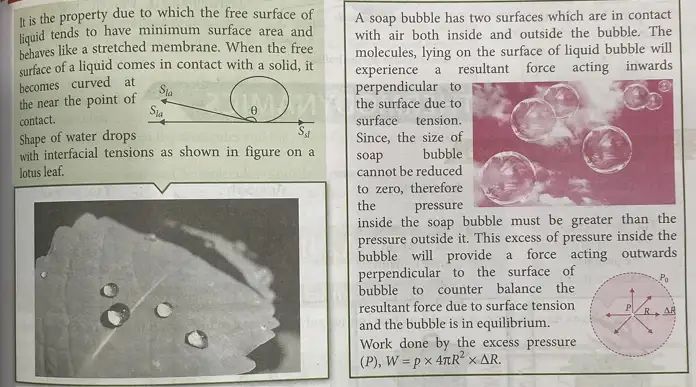
- Surface tension is the force per unit length acting along the surface of a liquid, making it behave like a stretched elastic membrane.
- It causes liquids to minimize their surface area, forming shapes like spherical drops.
- Example: Water drops on a lotus leaf are rounded due to surface tension; soap bubbles have two surfaces with pressure differences maintaining stability.
- Formula: S = F/L, where F is force on either side of an imaginary line on the surface and L is the length of that line.
- SI unit: Newton per meter (N/m), Dimensions: [S] = [MT-2]
- Factors affecting surface tension:
- Temperature: Surface tension decreases with increasing temperature.
- Impurities: Highly soluble impurities increase surface tension; sparingly soluble impurities decrease it.
Surface Energy and Relation to Surface Tension
- Surface energy (E) is the extra potential energy stored in surface molecules due to inward forces.
- SI unit: Joule (J), Dimensions: [E] = [ML2T-2]
- Relation: Surface tension equals the increase in surface energy per unit area, S = W/ΔA, where W is work done and ΔA is increase in surface area.
- For a soap film with length l and displacement Δx, F = S × 2l and work done W = F × Δx = S × 2l Δx.
Solved Examples
- Ex 1: Calculate surface tension if a force of 0.2 N acts on a 0.1 m length of liquid surface.
- Use S = F/L = 0.2/0.1 = 2 N/m.
Practice Set
- Q1: Surface tension decreases with:
- A) Increase in temperature
- B) Decrease in temperature
- C) Addition of sparingly soluble impurities
- D) Increase in pressure
- Q2: Surface tension is defined as force per unit:
- A) Area
- B) Length
- C) Volume
- D) Mass
- Q3: If force on a 0.05 m length of liquid surface is 0.1 N, surface tension is:
- A) 0.5 N/m
- B) 2 N/m
- C) 5 N/m
- D) 0.2 N/m
Answer Key
- Q1: A - Surface tension decreases with rise in temperature.
- Q2: B - Surface tension is force per unit length.
- Q3: C - S = 0.1/0.05 = 2 N/m.
Memory Aids
- Surface tension S = F/L
- Decreases with temperature rise
- Increases with highly soluble impurities
- Surface energy E = S × ΔA
Definition and Explanation
- Surface tension is the force per unit length acting along the surface of a liquid, making it behave like a stretched elastic membrane.
- It causes liquids to minimize their surface area, forming shapes like spherical drops.
- Example: Water drops on a lotus leaf are rounded due to surface tension; soap bubbles have two surfaces with pressure differences maintaining stability.
- Formula: S = F/L, where F is force on either side of an imaginary line on the surface and L is the length of that line.
- SI unit: Newton per meter (N/m), Dimensions: [S] = [MT-2]
- Factors affecting surface tension:
- Temperature: Surface tension decreases with increasing temperature.
- Impurities: Highly soluble impurities increase surface tension; sparingly soluble impurities decrease it.
Surface Energy and Relation to Surface Tension
- Surface energy (E) is the extra potential energy stored in surface molecules due to inward forces.
- SI unit: Joule (J), Dimensions: [E] = [ML2T-2]
- Relation: Surface tension equals the increase in surface energy per unit area, S = W/ΔA, where W is work done and ΔA is increase in surface area.
- For a soap film with length l and displacement Δx, F = S × 2l and work done W = F × Δx = S × 2l Δx.
Solved Examples
- Ex 1: Calculate surface tension if a force of 0.2 N acts on a 0.1 m length of liquid surface.
- Use S = F/L = 0.2/0.1 = 2 N/m.
Practice Set
- Q1: Surface tension decreases with:
- A) Increase in temperature
- B) Decrease in temperature
- C) Addition of sparingly soluble impurities
- D) Increase in pressure
- Q2: Surface tension is defined as force per unit:
- A) Area
- B) Length
- C) Volume
- D) Mass
- Q3: If force on a 0.05 m length of liquid surface is 0.1 N, surface tension is:
- A) 0.5 N/m
- B) 2 N/m
- C) 5 N/m
- D) 0.2 N/m
Answer Key
- Q1: A - Surface tension decreases with rise in temperature.
- Q2: B - Surface tension is force per unit length.
- Q3: C - S = 0.1/0.05 = 2 N/m.
Memory Aids
- Surface tension S = F/L
- Decreases with temperature rise
- Increases with highly soluble impurities
- Surface energy E = S × ΔA
Definition and Explanation
- Surface tension is the force per unit length acting along the surface of a liquid, making it behave like a stretched elastic membrane.
- It causes liquids to minimize their surface area, forming shapes like spherical drops.
- Example: Water drops on a lotus leaf are rounded due to surface tension; soap bubbles have two surfaces with pressure differences maintaining stability.
- Formula: \( S = \frac{F}{L} \), where \(F\) is force on either side of an imaginary line on the surface and \(L\) is the length of that line.
- SI unit: Newton per meter (N/m), Dimensions: \([S] = [MT^{-2}]\)
- Factors affecting surface tension:
- Temperature: Surface tension decreases with increasing temperature.
- Impurities: Highly soluble impurities increase surface tension; sparingly soluble impurities decrease it.
Surface Energy and Relation to Surface Tension
- Surface energy (E) is the extra potential energy stored in surface molecules due to inward forces.
- SI unit: Joule (J), Dimensions: \([E] = [ML^{2}T^{-2}]\)
- Relation: Surface tension equals the increase in surface energy per unit area, \( S = \frac{W}{\Delta A} \), where \(W\) is work done and \(\Delta A\) is increase in surface area.
- For a soap film with length \(l\) and displacement \(\Delta x\), \( F = S \times 2l \) and work done \( W = F \times \Delta x = S \times 2l \Delta x \).
Solved Examples
- Ex 1: Calculate surface tension if a force of 0.2 N acts on a 0.1 m length of liquid surface.
- Use \( S = \frac{F}{L} = \frac{0.2}{0.1} = 2 \text{ N/m} \).
Practice Set
- Q1: Surface tension decreases with:
- A) Increase in temperature
- B) Decrease in temperature
- C) Addition of sparingly soluble impurities
- D) Increase in pressure
- Q2: Surface tension is defined as force per unit:
- A) Area
- B) Length
- C) Volume
- D) Mass
- Q3: If force on a 0.05 m length of liquid surface is 0.1 N, surface tension is:
- A) 0.5 N/m
- B) 2 N/m
- C) 5 N/m
- D) 0.2 N/m
Answer Key
- Q1: A - Surface tension decreases with rise in temperature.
- Q2: B - Surface tension is force per unit length.
- Q3: C - \( S = \frac{0.1}{0.05} = 2 \text{ N/m} \).
Memory Aids
- Surface tension \( S = \frac{F}{L} \)
- Decreases with temperature rise
- Increases with highly soluble impurities
- Surface energy \( E = S \times \Delta A \)
Angle of Contact
Definition and Explanation
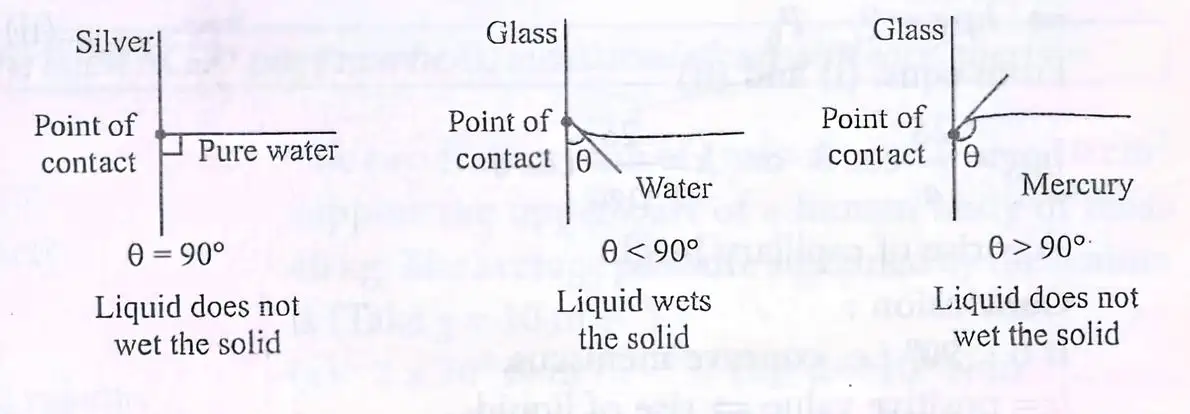
- Angle of contact is the angle inside the liquid between the tangent to the solid surface and the tangent to the liquid surface at the contact point.
- It depends on the materials in contact and does not change with the solid's inclination.
- If angle < 90°, liquid wets the solid (wetting liquid).
- If angle ≥ 90°, liquid does not wet the solid.
- Surface tensions involved: Sla (liquid-air), Ssl (solid-liquid), Ssa (solid-air).
- Relation: Sla cos θ + Ssl = Ssa
Solved Examples
- Ex 1: Identify if water wets glass if contact angle is 60°.
- Since 60° < 90°, water wets glass.
Practice Set
- Q1: Contact angle for a wetting liquid is:
- A) < 90°
- B) = 90°
- C) > 90°
- D) 180°
- Q2: If contact angle is 90°, liquid:
- A) Wet the solid
- B) Does not wet the solid
- C) Partially wets
- D) Forms a film
- Q3: For a liquid drop on solid, the relation involving surface tensions is:
- A) Sla + Ssl = Ssa
- B) Sla cos θ + Ssl = Ssa
- C) Sla sin θ = Ssa
- D) Ssl cos θ = Sla
Answer Key
- Q1: A - Wetting liquids have contact angle less than 90°.
- Q2: B - At 90°, liquid does not wet the solid.
- Q3: B - Surface tensions satisfy Sla cos θ + Ssl = Ssa.
Memory Aids
- Contact angle < 90°: wetting
- Contact angle ≥ 90°: non-wetting
- Formula: Sla cos θ + Ssl = Ssa
Definition and Explanation
- Angle of contact is the angle inside the liquid between the tangent to the solid surface and the tangent to the liquid surface at the contact point.
- It depends on the materials in contact and does not change with the solid's inclination.
- If angle < 90°, liquid wets the solid (wetting liquid).
- If angle ≥ 90°, liquid does not wet the solid.
- Surface tensions involved: Sla (liquid-air), Ssl (solid-liquid), Ssa (solid-air).
- Relation: Sla cos θ + Ssl = Ssa
Solved Examples
- Ex 1: Identify if water wets glass if contact angle is 60°.
- Since 60° < 90°, water wets glass.
Practice Set
- Q1: Contact angle for a wetting liquid is:
- A) < 90°
- B) = 90°
- C) > 90°
- D) 180°
- Q2: If contact angle is 90°, liquid:
- A) Wet the solid
- B) Does not wet the solid
- C) Partially wets
- D) Forms a film
- Q3: For a liquid drop on solid, the relation involving surface tensions is:
- A) Sla + Ssl = Ssa
- B) Sla cos θ + Ssl = Ssa
- C) Sla sin θ = Ssa
- D) Ssl cos θ = Sla
Answer Key
- Q1: A - Wetting liquids have contact angle less than 90°.
- Q2: B - At 90°, liquid does not wet the solid.
- Q3: B - Surface tensions satisfy Sla cos θ + Ssl = Ssa.
Memory Aids
- Contact angle < 90°: wetting
- Contact angle ≥ 90°: non-wetting
- Formula: Sla cos θ + Ssl = Ssa
Definition and Explanation
- Angle of contact is the angle inside the liquid between the tangent to the solid surface and the tangent to the liquid surface at the contact point.
- It depends on the materials in contact and does not change with the solid's inclination.
- If angle < 90°, liquid wets the solid (wetting liquid).
- If angle ≥ 90°, liquid does not wet the solid.
- Surface tensions involved: \( S_{la} \) (liquid-air), \( S_{sl} \) (solid-liquid), \( S_{sa} \) (solid-air).
- Relation: \( S_{la} \cos \theta + S_{sl} = S_{sa} \)
Solved Examples
- Ex 1: Identify if water wets glass if contact angle is 60°.
- Since 60° < 90°, water wets glass.
Practice Set
- Q1: Contact angle for a wetting liquid is:
- A) < 90°
- B) = 90°
- C) > 90°
- D) 180°
- Q2: If contact angle is 90°, liquid:
- A) Wet the solid
- B) Does not wet the solid
- C) Partially wets
- D) Forms a film
- Q3: For a liquid drop on solid, the relation involving surface tensions is:
- A) \( S_{la} + S_{sl} = S_{sa} \)
- B) \( S_{la} \cos \theta + S_{sl} = S_{sa} \)
- C) \( S_{la} \sin \theta = S_{sa} \)
- D) \( S_{sl} \cos \theta = S_{la} \)
Answer Key
- Q1: A - Wetting liquids have contact angle less than 90°.
- Q2: B - At 90°, liquid does not wet the solid.
- Q3: B - Surface tensions satisfy \( S_{la} \cos \theta + S_{sl} = S_{sa} \).
Memory Aids
- Contact angle < 90°: wetting
- Contact angle ≥ 90°: non-wetting
- Formula: \( S_{la} \cos \theta + S_{sl} = S_{sa} \)
Drops and Bubbles
Excess Pressure Inside Liquid Drop
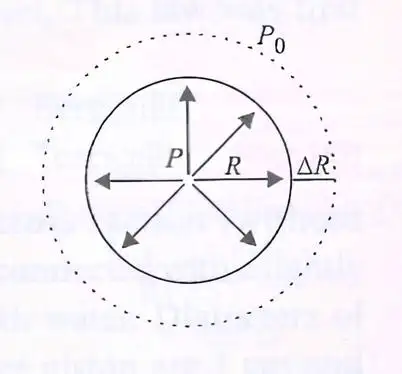
- Consider a liquid drop of radius R and surface tension S.
- Pressure difference: ΔP = P - P0.
- Excess pressure inside drop: ΔP = 2S/R.
- Work done in increasing radius ΔR: ΔW = ΔP × 4 πR2ΔR.
- Increase in potential energy due to surface tension: ΔU = 8 πSRΔR.
- At equilibrium, ΔU = ΔW leads to ΔP = 2S/R.
Excess Pressure Inside Soap Bubble
- Soap bubble has two surfaces in contact with air.
- Excess pressure inside bubble: ΔP = 4S/R.
- Work done: ΔW = ΔP × 4 πR2ΔR.
- Increase in potential energy: ΔU = 16 πSRΔR.
- At equilibrium, ΔU = ΔW leads to ΔP = 4S/R.
Excess Pressure Inside Air Bubble in Liquid
- Similar to liquid drop (one surface in contact with air).
- Excess pressure: ΔP = 2S/R.
Solved Examples
- Ex 1: Calculate excess pressure inside a drop of radius 0.01 m with surface tension 0.07 N/m.
- ΔP = 2 × 0.07/0.01 = 14 N/m2.
- Ex 2: Calculate excess pressure inside a soap bubble of radius 0.01 m with surface tension 0.07 N/m.
- ΔP = 4 × 0.07/0.01 = 28 N/m2.
Practice Set
- Q1: Excess pressure inside a liquid drop is:
- A) 4S/R
- B) 2S/R
- C) S/R
- D) 8S/R
- Q2: Excess pressure inside a soap bubble is:
- A) 2S/R
- B) 4S/R
- C) S/R
- D) 6S/R
- Q3: Excess pressure inside an air bubble in liquid is:
- A) 4S/R
- B) 2S/R
- C) S/R
- D) 8S/R
Answer Key
- Q1: B - Excess pressure inside liquid drop is 2S/R.
- Q2: B - Excess pressure inside soap bubble is 4S/R.
- Q3: B - Excess pressure inside air bubble in liquid is 2S/R.
Memory Aids
- Liquid drop: ΔP = 2S/R
- Soap bubble: ΔP = 4S/R
- Air bubble in liquid: same as liquid drop
Excess Pressure Inside Liquid Drop
- Consider a liquid drop of radius R and surface tension S.
- Pressure difference: ΔP = P - P0.
- Excess pressure inside drop: ΔP = 2S/R.
- Work done in increasing radius ΔR: ΔW = ΔP × 4 πR2ΔR.
- Increase in potential energy due to surface tension: ΔU = 8 πSRΔR.
- At equilibrium, ΔU = ΔW leads to ΔP = 2S/R.
Excess Pressure Inside Soap Bubble
- Soap bubble has two surfaces in contact with air.
- Excess pressure inside bubble: ΔP = 4S/R.
- Work done: ΔW = ΔP × 4 πR2ΔR.
- Increase in potential energy: ΔU = 16 πSRΔR.
- At equilibrium, ΔU = ΔW leads to ΔP = 4S/R.
Excess Pressure Inside Air Bubble in Liquid
- Similar to liquid drop (one surface in contact with air).
- Excess pressure: ΔP = 2S/R.
Solved Examples
- Ex 1: Calculate excess pressure inside a drop of radius 0.01 m with surface tension 0.07 N/m.
- ΔP = 2 × 0.07/0.01 = 14 N/m2.
- Ex 2: Calculate excess pressure inside a soap bubble of radius 0.01 m with surface tension 0.07 N/m.
- ΔP = 4 × 0.07/0.01 = 28 N/m2.
Practice Set
- Q1: Excess pressure inside a liquid drop is:
- A) 4S/R
- B) 2S/R
- C) S/R
- D) 8S/R
- Q2: Excess pressure inside a soap bubble is:
- A) 2S/R
- B) 4S/R
- C) S/R
- D) 6S/R
- Q3: Excess pressure inside an air bubble in liquid is:
- A) 4S/R
- B) 2S/R
- C) S/R
- D) 8S/R
Answer Key
- Q1: B - Excess pressure inside liquid drop is 2S/R.
- Q2: B - Excess pressure inside soap bubble is 4S/R.
- Q3: B - Excess pressure inside air bubble in liquid is 2S/R.
Memory Aids
- Liquid drop: ΔP = 2S/R
- Soap bubble: ΔP = 4S/R
- Air bubble in liquid: same as liquid drop
Excess Pressure Inside Liquid Drop
- Consider a liquid drop of radius \(R\) and surface tension \(S\).
- Pressure difference: \( \Delta P = P - P_0 \).
- Excess pressure inside drop: \( \Delta P = \frac{2S}{R} \).
- Work done in increasing radius \( \Delta R \): \( \Delta W = \Delta P \times 4 \pi R^2 \Delta R \).
- Increase in potential energy due to surface tension: \( \Delta U = 8 \pi S R \Delta R \).
- At equilibrium, \( \Delta U = \Delta W \) leads to \( \Delta P = \frac{2S}{R} \).
Excess Pressure Inside Soap Bubble
- Soap bubble has two surfaces in contact with air.
- Excess pressure inside bubble: \( \Delta P = \frac{4S}{R} \).
- Work done: \( \Delta W = \Delta P \times 4 \pi R^2 \Delta R \).
- Increase in potential energy: \( \Delta U = 16 \pi S R \Delta R \).
- At equilibrium, \( \Delta U = \Delta W \) leads to \( \Delta P = \frac{4S}{R} \).
Excess Pressure Inside Air Bubble in Liquid
- Similar to liquid drop (one surface in contact with air).
- Excess pressure: \( \Delta P = \frac{2S}{R} \).
Solved Examples
- Ex 1: Calculate excess pressure inside a drop of radius 0.01 m with surface tension 0.07 N/m.
- \( \Delta P = \frac{2 \times 0.07}{0.01} = 14 \text{ N/m}^2 \).
- Ex 2: Calculate excess pressure inside a soap bubble of radius 0.01 m with surface tension 0.07 N/m.
- \( \Delta P = \frac{4 \times 0.07}{0.01} = 28 \text{ N/m}^2 \).
Practice Set
- Q1: Excess pressure inside a liquid drop is:
- A) \( \frac{4S}{R} \)
- B) \( \frac{2S}{R} \)
- C) \( \frac{S}{R} \)
- D) \( \frac{8S}{R} \)
- Q2: Excess pressure inside a soap bubble is:
- A) \( \frac{2S}{R} \)
- B) \( \frac{4S}{R} \)
- C) \( \frac{S}{R} \)
- D) \( \frac{6S}{R} \)
- Q3: Excess pressure inside an air bubble in liquid is:
- A) \( \frac{4S}{R} \)
- B) \( \frac{2S}{R} \)
- C) \( \frac{S}{R} \)
- D) \( \frac{8S}{R} \)
Answer Key
- Q1: B - Excess pressure inside liquid drop is \( \frac{2S}{R} \).
- Q2: B - Excess pressure inside soap bubble is \( \frac{4S}{R} \).
- Q3: B - Excess pressure inside air bubble in liquid is \( \frac{2S}{R} \).
Memory Aids
- Liquid drop: \( \Delta P = \frac{2S}{R} \)
- Soap bubble: \( \Delta P = \frac{4S}{R} \)
- Air bubble in liquid: same as liquid drop
Capillary Rise
Explanation and Formula
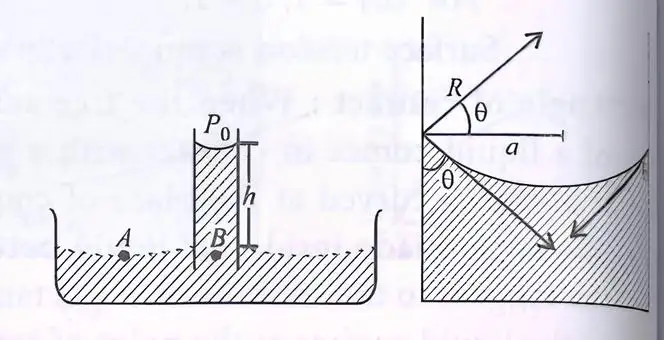
- Occurs when liquid rises or falls in a narrow tube due to surface tension and angle of contact.
- Pressure difference at meniscus: Pi - P0 = 2S/R = 2S/(a sec θ) = 2S/a cos θ.
- Height of rise/fall: h = 2S/(ρga) cos θ, where a is tube radius, ρ is liquid density, g is acceleration due to gravity.
- If θ < 90° (concave meniscus), liquid rises (h > 0).
- If θ > 90° (convex meniscus), liquid falls (h < 0).
Solved Examples
- Ex 1: Calculate capillary rise for water (S=0.072,ρ=1000 kg/m3) in a tube of radius 0.001 m with contact angle 0°.
- h = 2 × 0.072/(1000 × 9.8 × 0.001) cos 0° = 14.7 m.
Practice Set
- Q1: Capillary rise occurs when contact angle is:
- A) < 90°
- B) = 90°
- C) > 90°
- D) 180°
- Q2: Formula for capillary rise height is:
- A) h = 2S/(ρga) cos θ
- B) h = S/(ρga) sin θ
- C) h = 2S/(ρga) sin θ
- D) h = S/(ρga) cos θ
- Q3: If contact angle is 120°, capillary height is:
- A) Positive (rise)
- B) Zero
- C) Negative (fall)
- D) Infinite
Answer Key
- Q1: A - Capillary rise occurs for contact angle less than 90°.
- Q2: A - Formula is h = 2S/(ρga) cos θ.
- Q3: C - Contact angle greater than 90° causes liquid to fall (negative height).
Memory Aids
- Capillary rise formula: h = 2S/(ρga) cos θ
- θ < 90°: rise, θ > 90°: fall
Explanation and Formula
- Occurs when liquid rises or falls in a narrow tube due to surface tension and angle of contact.
- Pressure difference at meniscus: Pi - P0 = 2S/R = 2S/(a sec θ) = 2S/a cos θ.
- Height of rise/fall: h = 2S/(ρga) cos θ, where a is tube radius, ρ is liquid density, g is acceleration due to gravity.
- If θ < 90° (concave meniscus), liquid rises (h > 0).
- If θ > 90° (convex meniscus), liquid falls (h < 0).
Solved Examples
- Ex 1: Calculate capillary rise for water (S=0.072,ρ=1000 kg/m3) in a tube of radius 0.001 m with contact angle 0°.
- h = 2 × 0.072/(1000 × 9.8 × 0.001) cos 0° = 14.7 m.
Practice Set
- Q1: Capillary rise occurs when contact angle is:
- A) < 90°
- B) = 90°
- C) > 90°
- D) 180°
- Q2: Formula for capillary rise height is:
- A) h = 2S/(ρga) cos θ
- B) h = S/(ρga) sin θ
- C) h = 2S/(ρga) sin θ
- D) h = S/(ρga) cos θ
- Q3: If contact angle is 120°, capillary height is:
- A) Positive (rise)
- B) Zero
- C) Negative (fall)
- D) Infinite
Answer Key
- Q1: A - Capillary rise occurs for contact angle less than 90°.
- Q2: A - Formula is h = 2S/(ρga) cos θ.
- Q3: C - Contact angle greater than 90° causes liquid to fall (negative height).
Memory Aids
- Capillary rise formula: h = 2S/(ρga) cos θ
- θ < 90°: rise, θ > 90°: fall
Explanation and Formula
- Occurs when liquid rises or falls in a narrow tube due to surface tension and angle of contact.
- Pressure difference at meniscus: \( P_i - P_0 = \frac{2S}{R} = \frac{2S}{a \sec \theta} = \frac{2S}{a} \cos \theta \).
- Height of rise/fall: \( h = \frac{2S}{\rho g a} \cos \theta \), where \(a\) is tube radius, \(\rho\) is liquid density, \(g\) is acceleration due to gravity.
- If \( \theta < 90^\circ \) (concave meniscus), liquid rises (\(h > 0\)).
- If \( \theta > 90^\circ \) (convex meniscus), liquid falls (\(h < 0\)).
Solved Examples
- Ex 1: Calculate capillary rise for water (\(S=0.072\,\text{N/m}\), \(\rho=1000\,\text{kg/m}^3\)) in a tube of radius 0.001 m with contact angle 0°.
- \( h = \frac{2 \times 0.072}{1000 \times 9.8 \times 0.001} \cos 0^\circ = 14.7 \text{ m} \).
Practice Set
- Q1: Capillary rise occurs when contact angle is:
- A) < 90°
- B) = 90°
- C) > 90°
- D) 180°
- Q2: Formula for capillary rise height is:
- A) \( h = \frac{2S}{\rho g a} \cos \theta \)
- B) \( h = \frac{S}{\rho g a} \sin \theta \)
- C) \( h = \frac{2S}{\rho g a} \sin \theta \)
- D) \( h = \frac{S}{\rho g a} \cos \theta \)
- Q3: If contact angle is 120°, capillary height is:
- A) Positive (rise)
- B) Zero
- C) Negative (fall)
- D) Infinite
Answer Key
- Q1: A - Capillary rise occurs for contact angle less than 90°.
- Q2: A - Formula is \( h = \frac{2S}{\rho g a} \cos \theta \).
- Q3: C - Contact angle greater than 90° causes liquid to fall (negative height).
Memory Aids
- Capillary rise formula: \( h = \frac{2S}{\rho g a} \cos \theta \)
- \( \theta < 90^\circ \): rise, \( \theta > 90^\circ \): fall
NEET Physics — ALL CHAPTERS
1
Basic Mathematics
2
Units and Measurement
3
Motion in a Straight Line
4
Motion in a Plane
5
Laws of Motion
6
Work, Energy and Power
7
System of Particles and Rotational Motion
8
Gravitation
9
Mechanical Properties of Solids
10
Mechanical Properties of Fluids
11
Thermal Properties of Matter
12
Thermodynamics
13
Kinetic Theory
14
Oscillations
15
Waves
16
Electric Charges and Fields
17
Electrostatic Potential and Capacitance
18
Current Electricity
19
Moving Charges and Magnetism
20
Magnetism and Matter
21
Electromagnetic Induction
22
Alternating Current
23
Electromagnetic Waves
24
Ray Optics and Optical Instruments
25
Wave Optics
26
Dual Nature of Radiation and Matter
27
Atoms
28
Nuclei
29
Semiconductor Electronics: Materials, Devices and Simple Circuits