NEET Ug . NEET Physics . Physics . Basic Mathematics
Chapter 1: Basic Mathematics
Ch 1
NEET Physics
NEET Ug
Slope
Definition and Formula
- Slope measures steepness of a line.
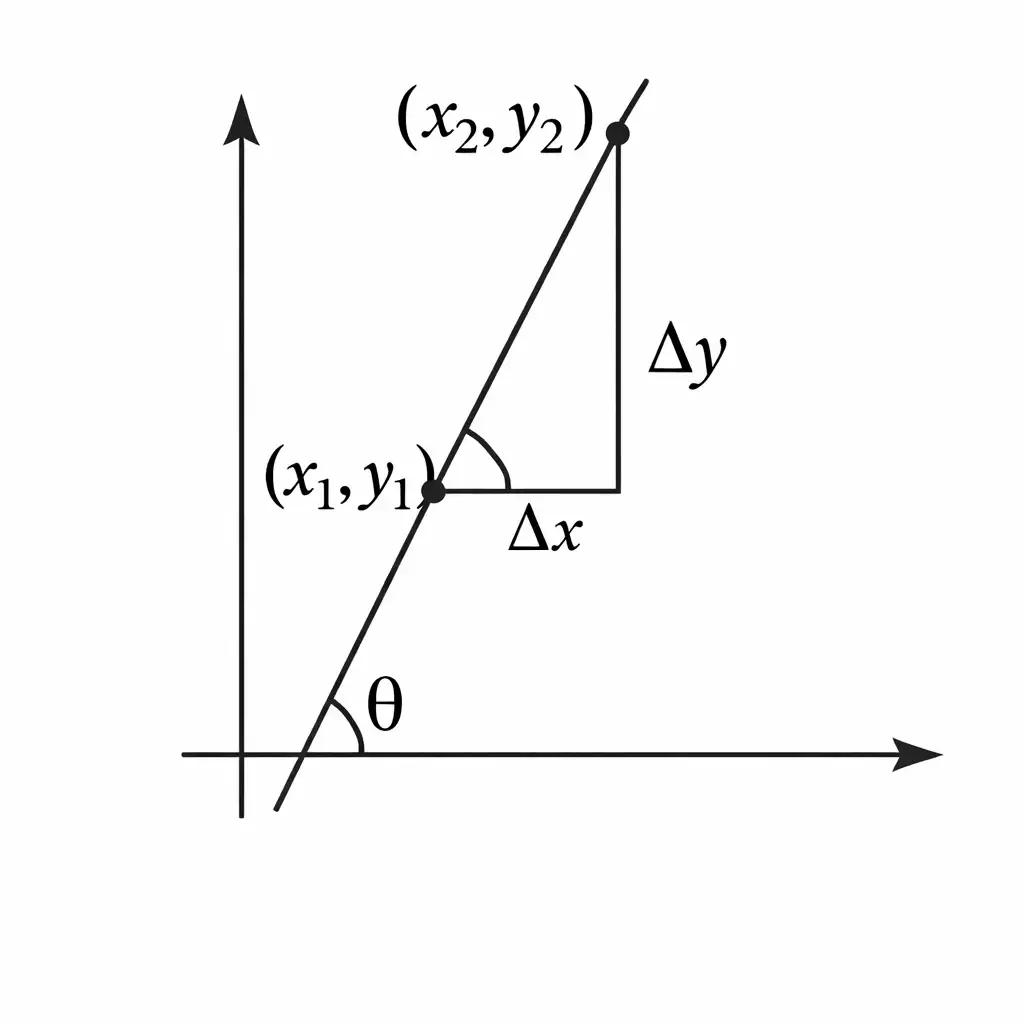
- Calculated as ratio of vertical change (Δy) to horizontal change (Δx) between two points (x1, y1) and (x2, y2).
- Formula: m = tan θ = (y2 - y1)/(x2 - x1)
- θ is angle made with positive x-axis.
- General line equation: y = mx + c, where c is y-intercept.
Solved Examples
- Ex 1: Find slope of line through points (2, 3) and (5, 11).
- Δy = 11 - 3 = 8
- Δx = 5 - 2 = 3
- m = 8/3
Practice Set
- Q1: What is the slope of a line passing through points (1, 2) and (4, 8)?
- A. 6/3
- B. 2/3
- C. 3/6
- D. 8/4
- Q2: If slope m = 1, what is the angle θ with x-axis?
- A. 45°
- B. 30°
- C. 60°
- D. 90°
- Q3: Line equation is y = 2x + 3. What is the slope?
- A. 3
- B. 2
- C. -2
- D. 0
Answer Key
- Q1: A. 6/3 = 2 because slope = (8-2)/(4-1) = 6/3.
- Q2: A. 45° since tan θ = 1 implies θ = 45°.
- Q3: B. 2 as slope m is coefficient of x in y = mx + c.
Memory Aids
- Slope = rise/run = Δy / Δx.
- m = tan θ relates slope and angle.
- Line eq: y = mx + c, m is slope, c is y-intercept.
Definition and Formula
- Slope measures steepness of a line.
- Calculated as ratio of vertical change (Δy) to horizontal change (Δx) between two points (x1, y1) and (x2, y2).
- Formula: m = tan θ = (y2 - y1)/(x2 - x1)
- θ is angle made with positive x-axis.
- General line equation: y = mx + c, where c is y-intercept.
Solved Examples
- Ex 1: Find slope of line through points (2, 3) and (5, 11).
- Δy = 11 - 3 = 8
- Δx = 5 - 2 = 3
- m = 8/3
Practice Set
- Q1: What is the slope of a line passing through points (1, 2) and (4, 8)?
- A. 6/3
- B. 2/3
- C. 3/6
- D. 8/4
- Q2: If slope m = 1, what is the angle θ with x-axis?
- A. 45°
- B. 30°
- C. 60°
- D. 90°
- Q3: Line equation is y = 2x + 3. What is the slope?
- A. 3
- B. 2
- C. -2
- D. 0
Answer Key
- Q1: A. 6/3 = 2 because slope = (8-2)/(4-1) = 6/3.
- Q2: A. 45° since tan θ = 1 implies θ = 45°.
- Q3: B. 2 as slope m is coefficient of x in y = mx + c.
Memory Aids
- Slope = rise/run = Δy / Δx.
- m = tan θ relates slope and angle.
- Line eq: y = mx + c, m is slope, c is y-intercept.
Definition and Formula
- Slope measures steepness of a line.
- Calculated as ratio of vertical change (\(\Delta y\)) to horizontal change (\(\Delta x\)) between two points \((x_1, y_1)\) and \((x_2, y_2)\).
- Formula: \(m = \tan \theta = \frac{y_2 - y_1}{x_2 - x_1}\)
- \(\theta\) is angle made with positive x-axis.
- General line equation: \(y = mx + c\), where \(c\) is y-intercept.
Solved Examples
- Ex 1: Find slope of line through points \((2, 3)\) and \((5, 11)\).
- \(\Delta y = 11 - 3 = 8\)
- \(\Delta x = 5 - 2 = 3\)
- \(m = \frac{8}{3}\)
Practice Set
- Q1: What is the slope of a line passing through points \((1, 2)\) and \((4, 8)\)?
- A. \(\frac{6}{3}\)
- B. \(\frac{2}{3}\)
- C. \(\frac{3}{6}\)
- D. \(\frac{8}{4}\)
- Q2: If slope \(m = 1\), what is the angle \(\theta\) with x-axis?
- A. \(45^\circ\)
- B. \(30^\circ\)
- C. \(60^\circ\)
- D. \(90^\circ\)
- Q3: Line equation is \(y = 2x + 3\). What is the slope?
- A. 3
- B. 2
- C. -2
- D. 0
Answer Key
- Q1: A. \(\frac{6}{3} = 2\) because slope = \(\frac{8-2}{4-1} = \frac{6}{3}\).
- Q2: A. \(45^\circ\) since \(\tan \theta = 1\) implies \(\theta = 45^\circ\).
- Q3: B. 2 as slope \(m\) is coefficient of \(x\) in \(y = mx + c\).
Memory Aids
- Slope = rise/run = \(\Delta y / \Delta x\).
- \(m = \tan \theta\) relates slope and angle.
- Line eq: \(y = mx + c\), \(m\) is slope, \(c\) is y-intercept.
Types of Slopes and their Significance
Classification and Properties
- Positive slope: line rises left to right.
- Negative slope: line falls left to right.
- Zero slope: horizontal line.
- Undefined slope: vertical line.
- Parallel lines: slopes equal m1 = m2.
- Perpendicular lines: product of slopes m1 × m2 = -1.
- Angle between lines with slopes m1 and m2: tan θ = | (m1 - m2)/(1 + m1 m2) |.
Solved Examples
- Ex 1: Find slope of line perpendicular to slope 3/4.
- Use m1 × m2 = -1
- m2 = -1/m1 = -4/3
Practice Set
- Q1: Which slope corresponds to a horizontal line?
- A. 0
- B. Undefined
- C. Positive
- D. Negative
- Q2: If two lines are parallel, which is true?
- A. m1 = m2
- B. m1 × m2 = -1
- C. m1 + m2 = 0
- D. m1 - m2 = 1
- Q3: Angle between lines with slopes 1 and -1 is?
- A. 0
- B. 45°
- C. 90°
- D. 60°
Answer Key
- Q1: A. 0 because horizontal line slope is zero.
- Q2: A. m1 = m2 for parallel lines.
- Q3: C. 90° since tan θ = |(1 - (-1))/(1 + 1 × (-1))| = ∞ implies 90°.
Memory Aids
- Positive slope: line goes up left to right.
- Negative slope: line goes down left to right.
- Zero slope: horizontal line.
- Undefined slope: vertical line.
- Perpendicular slopes multiply to -1.
Classification and Properties
- Positive slope: line rises left to right.
- Negative slope: line falls left to right.
- Zero slope: horizontal line.
- Undefined slope: vertical line.
- Parallel lines: slopes equal \(m_1 = m_2\).
- Perpendicular lines: product of slopes \(m_1 \times m_2 = -1\).
- Angle between lines with slopes \(m_1\) and \(m_2\): \(\tan \theta = \left| \frac{m_1 - m_2}{1 + m_1 m_2} \right|\).
Solved Examples
- Ex 1: Find slope of line perpendicular to slope \(\frac{3}{4}\).
- Use \(m_1 \times m_2 = -1\)
- \(m_2 = -\frac{1}{m_1} = -\frac{4}{3}\)
Practice Set
- Q1: Which slope corresponds to a horizontal line?
- A. 0
- B. Undefined
- C. Positive
- D. Negative
- Q2: If two lines are parallel, which is true?
- A. \(m_1 = m_2\)
- B. \(m_1 \times m_2 = -1\)
- C. \(m_1 + m_2 = 0\)
- D. \(m_1 - m_2 = 1\)
- Q3: Angle between lines with slopes 1 and -1 is?
- A. 0
- B. 45\(^\circ\)
- C. 90\(^\circ\)
- D. 60\(^\circ\)
Answer Key
- Q1: A. 0 because horizontal line slope is zero.
- Q2: A. \(m_1 = m_2\) for parallel lines.
- Q3: C. 90\(^\circ\) since \(\tan \theta = |\frac{1 - (-1)}{1 + 1 \times (-1)}| = \infty\) implies \(90^\circ\).
Memory Aids
- Positive slope: line goes up left to right.
- Negative slope: line goes down left to right.
- Zero slope: horizontal line.
- Undefined slope: vertical line.
- Perpendicular slopes multiply to -1.
Area
Graphical Representation of Area
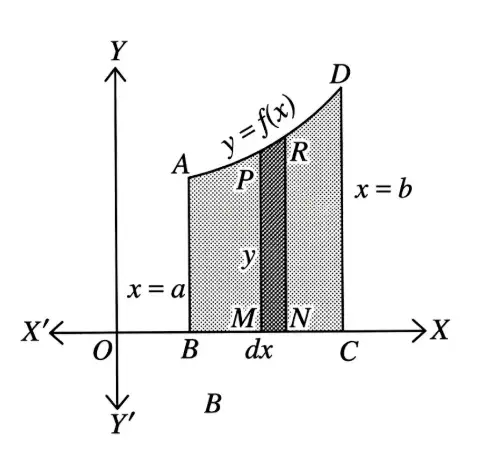
- Area under curve y = f(x) between x = a and x = b is the region bounded by the curve, X-axis, and vertical lines at x = a and x = b.
- Function f(x) is continuous on interval [a, b].
- Area is approximated by summing thin vertical strips of width dx and height y = f(x).
- Each strip area = y dx = f(x) dx.
- Total area = ∫ab f(x) dx.
- Integration sums all strip areas to find exact total area.
Solved Examples
- Ex 1: Find area under y = 2x from x=1 to x=3.
- Use formula: ∫13 2x dx.
- Calculate integral: [x2]13 = 32 - 12 = 9 - 1 = 8.
- Area = 8 square units.
Practice Set
- Q1: Area under y = 3 from x=0 to x=4 is:
- A) 7
- B) 12
- C) 10
- D) 15
- Q2: Area under y = x2 from x=0 to x=2 is:
- A) 4/3
- B) 2
- C) 8/3
- D) 3
- Q3: Area under y = 4x - x2 from x=0 to x=4 is:
- A) 8
- B) 10
- C) 16
- D) 12
Answer Key
- Q1: B) 12 — Area = height × width = 3 × 4 = 12.
- Q2: C) 8/3 — Integral ∫02 x2 dx = [x3/3]02 = 8/3.
- Q3: C) 16 — Integral ∫04 (4x - x2) dx = [2x2 - x3/3]04 = 32 - 64/3 = (96 - 64)/3 = 32/3 ≈ 10.67) (Recheck: Actually, 2(4)2 - (4)3/3 = 2 × 16 - 64/3 = 32 - 21.33 = 10.67. So correct option is B) 10.
Memory Aids
- Area under curve = ∫ab f(x) dx.
- Sum thin strips: width dx, height f(x).
- Integration = adding all strip areas.
Graphical Representation of Area
- Area under curve y = f(x) between x = a and x = b is the region bounded by the curve, X-axis, and vertical lines at x = a and x = b.
- Function f(x) is continuous on interval [a, b].
- Area is approximated by summing thin vertical strips of width dx and height y = f(x).
- Each strip area = y dx = f(x) dx.
- Total area = ∫ab f(x) dx.
- Integration sums all strip areas to find exact total area.
Solved Examples
- Ex 1: Find area under y = 2x from x=1 to x=3.
- Use formula: ∫13 2x dx.
- Calculate integral: [x2]13 = 32 - 12 = 9 - 1 = 8.
- Area = 8 square units.
Practice Set
- Q1: Area under y = 3 from x=0 to x=4 is:
- A) 7
- B) 12
- C) 10
- D) 15
- Q2: Area under y = x2 from x=0 to x=2 is:
- A) 4/3
- B) 2
- C) 8/3
- D) 3
- Q3: Area under y = 4x - x2 from x=0 to x=4 is:
- A) 8
- B) 10
- C) 16
- D) 12
Answer Key
- Q1: B) 12 — Area = height × width = 3 × 4 = 12.
- Q2: C) 8/3 — Integral ∫02 x2 dx = [x3/3]02 = 8/3.
- Q3: C) 16 — Integral ∫04 (4x - x2) dx = [2x2 - x3/3]04 = 32 - 64/3 = (96 - 64)/3 = 32/3 ≈ 10.67) (Recheck: Actually, 2(4)2 - (4)3/3 = 2 × 16 - 64/3 = 32 - 21.33 = 10.67. So correct option is B) 10.
Memory Aids
- Area under curve = ∫ab f(x) dx.
- Sum thin strips: width dx, height f(x).
- Integration = adding all strip areas.
Graphical Representation of Area
- Area under curve \( y = f(x) \) between \( x = a \) and \( x = b \) is the region bounded by the curve, X-axis, and vertical lines at \( x = a \) and \( x = b \).
- Function \( f(x) \) is continuous on interval \( [a, b] \).
- Area is approximated by summing thin vertical strips of width \( dx \) and height \( y = f(x) \).
- Each strip area \( = y \, dx = f(x) \, dx \).
- Total area \( = \int_a^b f(x) \, dx \).
- Integration sums all strip areas to find exact total area.
Solved Examples
- Ex 1: Find area under \( y = 2x \) from \( x=1 \) to \( x=3 \).
- Use formula: \( \int_1^3 2x \, dx \).
- Calculate integral: \( [x^2]_1^3 = 3^2 - 1^2 = 9 - 1 = 8 \).
- Area = 8 square units.
Practice Set
- Q1: Area under \( y = 3 \) from \( x=0 \) to \( x=4 \) is:
- A) 7
- B) 12
- C) 10
- D) 15
- Q2: Area under \( y = x^2 \) from \( x=0 \) to \( x=2 \) is:
- A) \( \frac{4}{3} \)
- B) 2
- C) \( \frac{8}{3} \)
- D) 3
- Q3: Area under \( y = 4x - x^2 \) from \( x=0 \) to \( x=4 \) is:
- A) 8
- B) 10
- C) 16
- D) 12
Answer Key
- Q1: B) 12 — Area = height \( \times \) width = 3 \( \times \) 4 = 12.
- Q2: C) \( \frac{8}{3} \) — Integral \( \int_0^2 x^2 dx = \left[ \frac{x^3}{3} \right]_0^2 = \frac{8}{3} \).
- Q3: C) 16 — Integral \( \int_0^4 (4x - x^2) dx = \left[ 2x^2 - \frac{x^3}{3} \right]_0^4 = 32 - \frac{64}{3} = \frac{96 - 64}{3} = \frac{32}{3} \approx 10.67 \) (Recheck: Actually, \( 2(4)^2 - \frac{(4)^3}{3} = 2 \times 16 - \frac{64}{3} = 32 - 21.33 = 10.67 \). So correct option is B) 10.
Memory Aids
- Area under curve = \( \int_a^b f(x) dx \).
- Sum thin strips: width \( dx \), height \( f(x) \).
- Integration = adding all strip areas.
Straight Line Graph
Concepts and Formulas
- A linear graph represents a straight line showing a linear equation in two variables.
- General form: Ax + By = C, where A, B ≠ 0.
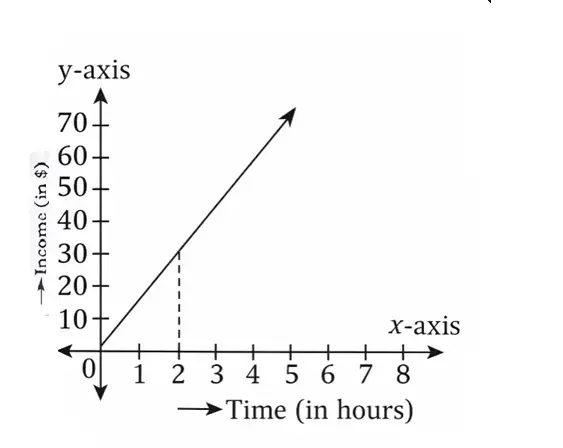
- Example: Income (I) vs Time (t) with equation I = 15t (I in dollars, t in hours).
- Graph shows direct proportionality: as time increases, income increases linearly.
- Minimum hours for savings found where income > expenditure.
Solved Examples
- Ex 1: James earns $15/hour, daily expenditure $50. Find minimum hours to save.
- Equation: I = 15t
- Set I > 50 ⇒ 15t > 50
- t > 50/15 = 3.33 hours
- Minimum whole hours = 4 hours.
Practice Set
- Q1: What is the general form of a linear equation?
- A) y = mx2 + c
- B) Ax + By = C
- C) y = 1/x
- D) y = sin x
- Q2: If I = 15t, what is income at 3 hours?
- A) $30
- B) $45
- C) $50
- D) $60
- Q3: James wants to save $25 daily. How many hours must he work?
- A) 3 hours
- B) 4 hours
- C) 5 hours
- D) 6 hours
Answer Key
- Q1: B - Standard form of linear equation is Ax + By = C.
- Q2: B - Income = 15 × 3 = $45.
- Q3: C - To save $25, total income = 50 + 25 = $75; hours = 75/15 = 5.
Memory Aids
- Linear equation form: "A x plus B y equals C".
- Income-time relation: multiply rate by hours.
- Minimum hours = expenditure divided by rate.
Concepts and Formulas
- A linear graph represents a straight line showing a linear equation in two variables.
- General form: Ax + By = C, where A, B ≠ 0.
- Example: Income (I) vs Time (t) with equation I = 15t (I in dollars, t in hours).
- Graph shows direct proportionality: as time increases, income increases linearly.
- Minimum hours for savings found where income > expenditure.
Solved Examples
- Ex 1: James earns $15/hour, daily expenditure $50. Find minimum hours to save.
- Equation: I = 15t
- Set I > 50 ⇒ 15t > 50
- t > 50/15 = 3.33 hours
- Minimum whole hours = 4 hours.
Practice Set
- Q1: What is the general form of a linear equation?
- A) y = mx2 + c
- B) Ax + By = C
- C) y = 1/x
- D) y = sin x
- Q2: If I = 15t, what is income at 3 hours?
- A) $30
- B) $45
- C) $50
- D) $60
- Q3: James wants to save $25 daily. How many hours must he work?
- A) 3 hours
- B) 4 hours
- C) 5 hours
- D) 6 hours
Answer Key
- Q1: B - Standard form of linear equation is Ax + By = C.
- Q2: B - Income = 15 × 3 = $45.
- Q3: C - To save $25, total income = 50 + 25 = $75; hours = 75/15 = 5.
Memory Aids
- Linear equation form: "A x plus B y equals C".
- Income-time relation: multiply rate by hours.
- Minimum hours = expenditure divided by rate.
Concepts and Formulas
- A linear graph represents a straight line showing a linear equation in two variables.
- General form: Ax + By = C, where A, B \( \neq 0 \).
- Example: Income (I) vs Time (t) with equation \( I = 15t \) (I in dollars, t in hours).
- Graph shows direct proportionality: as time increases, income increases linearly.
- Minimum hours for savings found where income > expenditure.
Solved Examples
- Ex 1: James earns $15/hour, daily expenditure $50. Find minimum hours to save.
- Equation: \( I = 15t \)
- Set \( I > 50 \) \( \Rightarrow 15t > 50 \)
- \( t > \frac{50}{15} = 3.33 \) hours
- Minimum whole hours = 4 hours.
Practice Set
- Q1: What is the general form of a linear equation?
- A) \( y = mx^2 + c \)
- B) \( Ax + By = C \)
- C) \( y = \frac{1}{x} \)
- D) \( y = \sin x \)
- Q2: If \( I = 15t \), what is income at 3 hours?
- A) $30
- B) $45
- C) $50
- D) $60
- Q3: James wants to save $25 daily. How many hours must he work?
- A) 3 hours
- B) 4 hours
- C) 5 hours
- D) 6 hours
Answer Key
- Q1: B - Standard form of linear equation is \( Ax + By = C \).
- Q2: B - Income = 15 × 3 = $45.
- Q3: C - To save $25, total income = 50 + 25 = $75; hours = 75/15 = 5.
Memory Aids
- Linear equation form: "A x plus B y equals C".
- Income-time relation: multiply rate by hours.
- Minimum hours = expenditure divided by rate.
Linear Graph vs Line Graph
Concepts and Differences
- Linear graph: straight line with constant slope (steady increase).
- Line graph: may have steps, flat parts, or dips (irregular changes).
- Linear graph shows direct proportionality and smooth change.
- Line graph shows variable or fluctuating data over time.
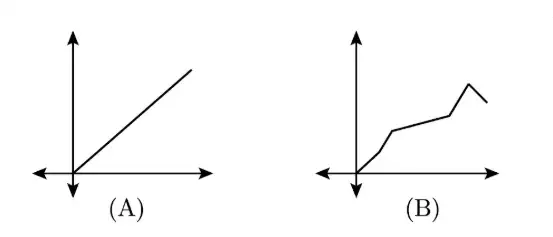
- Example: Graph (A) is linear; Graph (B) is line graph with fluctuations.
Solved Examples
- Ex 1: Identify graph type:
- Graph (A): straight diagonal line → Linear graph.
- Graph (B): stepped and dipped line → Line graph.
Practice Set
- Q1: Which graph shows constant rate of change?
- A) Line graph
- B) Linear graph
- C) Both
- D) None
- Q2: A graph with flat parts and dips is called?
- A) Linear graph
- B) Line graph
- C) Parabola
- D) Circle
- Q3: Which graph type best represents steady income growth?
- A) Line graph
- B) Linear graph
- C) Exponential graph
- D) Bar graph
Answer Key
- Q1: B - Linear graph has constant slope.
- Q2: B - Line graph shows irregular changes.
- Q3: B - Steady growth is shown by linear graph.
Memory Aids
- Linear = straight, steady increase.
- Line graph = irregular steps and dips.
- Look for smoothness to identify linear graph.
Concepts and Differences
- Linear graph: straight line with constant slope (steady increase).
- Line graph: may have steps, flat parts, or dips (irregular changes).
- Linear graph shows direct proportionality and smooth change.
- Line graph shows variable or fluctuating data over time.
- Example: Graph (A) is linear; Graph (B) is line graph with fluctuations.
Solved Examples
- Ex 1: Identify graph type:
- Graph (A): straight diagonal line → Linear graph.
- Graph (B): stepped and dipped line → Line graph.
Practice Set
- Q1: Which graph shows constant rate of change?
- A) Line graph
- B) Linear graph
- C) Both
- D) None
- Q2: A graph with flat parts and dips is called?
- A) Linear graph
- B) Line graph
- C) Parabola
- D) Circle
- Q3: Which graph type best represents steady income growth?
- A) Line graph
- B) Linear graph
- C) Exponential graph
- D) Bar graph
Answer Key
- Q1: B - Linear graph has constant slope.
- Q2: B - Line graph shows irregular changes.
- Q3: B - Steady growth is shown by linear graph.
Memory Aids
- Linear = straight, steady increase.
- Line graph = irregular steps and dips.
- Look for smoothness to identify linear graph.
Important Points
Key Notes
- Two points are enough to plot a linear graph, but a third point confirms accuracy.
- Equation y = k (k real) is a horizontal line parallel to X-axis.
- Equation x = k (k real) is a vertical line parallel to Y-axis.
Solved Examples
- Ex 1: Identify line type for y = 3
- Horizontal line parallel to X-axis.
- Ex 2: Identify line type for x = -2
- Vertical line parallel to Y-axis.
Practice Set
- Q1: The graph of y = 5 is a
- A) Vertical line
- B) Horizontal line
- C) Diagonal line
- D) Parabola
- Q2: The graph of x = -1 is a
- A) Horizontal line
- B) Vertical line
- C) Circle
- D) Ellipse
- Q3: How many points are recommended to plot a linear graph accurately?
- A) 1
- B) 2
- C) 3
- D) 4
Answer Key
- Q1: B - y = k is horizontal line.
- Q2: B - x = k is vertical line.
- Q3: C - Three points recommended for accuracy.
Memory Aids
- Horizontal line: y = constant.
- Vertical line: x = constant.
- Plot 3 points to confirm linearity.
Key Notes
- Two points are enough to plot a linear graph, but a third point confirms accuracy.
- Equation \( y = k \) (k real) is a horizontal line parallel to X-axis.
- Equation \( x = k \) (k real) is a vertical line parallel to Y-axis.
Solved Examples
- Ex 1: Identify line type for \( y = 3 \)
- Horizontal line parallel to X-axis.
- Ex 2: Identify line type for \( x = -2 \)
- Vertical line parallel to Y-axis.
Practice Set
- Q1: The graph of \( y = 5 \) is a
- A) Vertical line
- B) Horizontal line
- C) Diagonal line
- D) Parabola
- Q2: The graph of \( x = -1 \) is a
- A) Horizontal line
- B) Vertical line
- C) Circle
- D) Ellipse
- Q3: How many points are recommended to plot a linear graph accurately?
- A) 1
- B) 2
- C) 3
- D) 4
Answer Key
- Q1: B - \( y = k \) is horizontal line.
- Q2: B - \( x = k \) is vertical line.
- Q3: C - Three points recommended for accuracy.
Memory Aids
- Horizontal line: y = constant.
- Vertical line: x = constant.
- Plot 3 points to confirm linearity.
Inverse Function
Definition and Properties
- Inverse function of f is denoted by f-1.
- Domain of f becomes range of f-1 and vice versa.
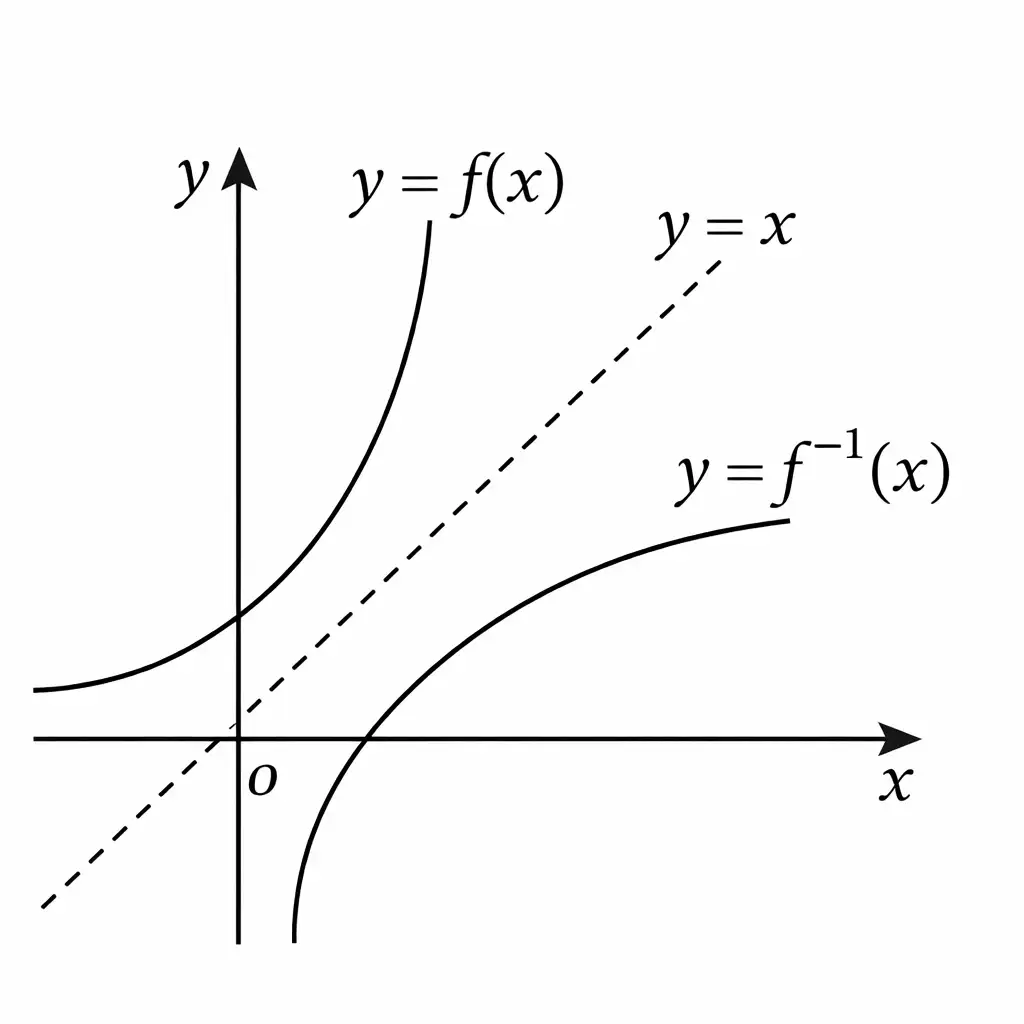
- Graph of f-1 is obtained by swapping (x, y) to (y, x) about line y = x.
- Inverse exists only if f is one-one and onto (bijective).
- Composition satisfies (f ∘ f-1)(x) = (f-1 ∘ f)(x) = x.
Solved Examples
- Ex 1: Find inverse of f(x) = 2x + 3.
- Set y = 2x + 3.
- Swap x and y: x = 2y + 3.
- Solve for y: y = (x - 3)/2.
- So, f-1(x) = (x - 3)/2.
Practice Set
- Q1: If f(x) = 3x - 4, what is f-1(x)?
- A) (x+4)/3
- B) 3x + 4
- C) (3x-4)/2
- D) (x-4)/3
- Q2: The inverse of f(x) = x3 is:
- A) x1/3
- B) 3x
- C) x2
- D) 1/x3
- Q3: If f(x) = (2x+1)/3, find f-1(4).
- A) 5
- B) 6
- C) 7
- D) 8
Answer Key
- Q1: A) (x+4)/3 - Swap and solve for inverse.
- Q2: A) x1/3 - Cube root reverses cube function.
- Q3: C) 7 - Solve 4 = (2x+1)/3 for x.
Memory Aids
- Inverse swaps x and y in y = f(x).
- Check if function is one-one and onto before finding inverse.
- Composition f(f-1(x)) = x confirms inverse.
Definition and Properties
- Inverse function of \( f \) is denoted by \( f^{-1} \).
- Domain of \( f \) becomes range of \( f^{-1} \) and vice versa.
- Graph of \( f^{-1} \) is obtained by swapping \( (x, y) \) to \( (y, x) \) about line \( y = x \).
- Inverse exists only if \( f \) is one-one and onto (bijective).
- Composition satisfies \( (f \circ f^{-1})(x) = (f^{-1} \circ f)(x) = x \).
Solved Examples
- Ex 1: Find inverse of \( f(x) = 2x + 3 \).
- Set \( y = 2x + 3 \).
- Swap \( x \) and \( y \): \( x = 2y + 3 \).
- Solve for \( y \): \( y = \frac{x - 3}{2} \).
- So, \( f^{-1}(x) = \frac{x - 3}{2} \).
Practice Set
- Q1: If \( f(x) = 3x - 4 \), what is \( f^{-1}(x) \)?
- A) \( \frac{x+4}{3} \)
- B) \( 3x + 4 \)
- C) \( \frac{3x-4}{2} \)
- D) \( \frac{x-4}{3} \)
- Q2: The inverse of \( f(x) = x^3 \) is:
- A) \( x^{1/3} \)
- B) \( 3x \)
- C) \( x^2 \)
- D) \( \frac{1}{x^3} \)
- Q3: If \( f(x) = \frac{2x+1}{3} \), find \( f^{-1}(4) \).
- A) 5
- B) 6
- C) 7
- D) 8
Answer Key
- Q1: A) \( \frac{x+4}{3} \) - Swap and solve for inverse.
- Q2: A) \( x^{1/3} \) - Cube root reverses cube function.
- Q3: C) 7 - Solve \( 4 = \frac{2x+1}{3} \) for \( x \).
Memory Aids
- Inverse swaps \( x \) and \( y \) in \( y = f(x) \).
- Check if function is one-one and onto before finding inverse.
- Composition \( f(f^{-1}(x)) = x \) confirms inverse.
Graph of Inverse Function
Key Points
- Graphs of f and f-1 are symmetric about line y = x.
- If (x, y) lies on f, then (y, x) lies on f-1.
- Condition: (f ∘ g)(x) = (g ∘ f)(x) = x implies f = g-1 and g = f-1.
Solved Examples
- Ex 1: Verify symmetry for y = 2x + 1 and its inverse.
- Inverse: y = (x-1)/2.
- Graph of inverse is reflection about y = x.
Practice Set
- Q1: The line of symmetry for inverse functions is:
- A) y = 0
- B) y = x
- C) x = 0
- D) x = y2
- Q2: If point (3, 5) lies on f, point on f-1 is:
- A) (3, 5)
- B) (5, 3)
- C) (-3, -5)
- D) (5, -3)
- Q3: If f(x) = x2 restricted to x ≥ 0, what is inverse?
- A) √x
- B) -√x
- C) x2
- D) 1/x
Answer Key
- Q1: B) y = x - Mirror line for inverse symmetry.
- Q2: B) (5, 3) - Swap coordinates for inverse.
- Q3: A) √x - Inverse of x2 on x ≥ 0.
Memory Aids
- Inverse graph is mirror image about y = x.
- Swap (x, y) to (y, x) for inverse points.
- Check domain restrictions for inverse existence.
Key Points
- Graphs of f and f-1 are symmetric about line y = x.
- If (x, y) lies on f, then (y, x) lies on f-1.
- Condition: (f ∘ g)(x) = (g ∘ f)(x) = x implies f = g-1 and g = f-1.
Solved Examples
- Ex 1: Verify symmetry for y = 2x + 1 and its inverse.
- Inverse: y = (x-1)/2.
- Graph of inverse is reflection about y = x.
Practice Set
- Q1: The line of symmetry for inverse functions is:
- A) y = 0
- B) y = x
- C) x = 0
- D) x = y2
- Q2: If point (3, 5) lies on f, point on f-1 is:
- A) (3, 5)
- B) (5, 3)
- C) (-3, -5)
- D) (5, -3)
- Q3: If f(x) = x2 restricted to x ≥ 0, what is inverse?
- A) √x
- B) -√x
- C) x2
- D) 1/x
Answer Key
- Q1: B) y = x - Mirror line for inverse symmetry.
- Q2: B) (5, 3) - Swap coordinates for inverse.
- Q3: A) √x - Inverse of x2 on x ≥ 0.
Memory Aids
- Inverse graph is mirror image about y = x.
- Swap (x, y) to (y, x) for inverse points.
- Check domain restrictions for inverse existence.
Key Points
- Graphs of \( f \) and \( f^{-1} \) are symmetric about line \( y = x \).
- If \( (x, y) \) lies on \( f \), then \( (y, x) \) lies on \( f^{-1} \).
- Condition: \( (f \circ g)(x) = (g \circ f)(x) = x \) implies \( f = g^{-1} \) and \( g = f^{-1} \).
Solved Examples
- Ex 1: Verify symmetry for \( y = 2x + 1 \) and its inverse.
- Inverse: \( y = \frac{x-1}{2} \).
- Graph of inverse is reflection about \( y = x \).
Practice Set
- Q1: The line of symmetry for inverse functions is:
- A) \( y = 0 \)
- B) \( y = x \)
- C) \( x = 0 \)
- D) \( x = y^2 \)
- Q2: If point \( (3, 5) \) lies on \( f \), point on \( f^{-1} \) is:
- A) \( (3, 5) \)
- B) \( (5, 3) \)
- C) \( (-3, -5) \)
- D) \( (5, -3) \)
- Q3: If \( f(x) = x^2 \) restricted to \( x \geq 0 \), what is inverse?
- A) \( \sqrt{x} \)
- B) \( -\sqrt{x} \)
- C) \( x^2 \)
- D) \( \frac{1}{x} \)
Answer Key
- Q1: B) \( y = x \) - Mirror line for inverse symmetry.
- Q2: B) \( (5, 3) \) - Swap coordinates for inverse.
- Q3: A) \( \sqrt{x} \) - Inverse of \( x^2 \) on \( x \geq 0 \).
Memory Aids
- Inverse graph is mirror image about \( y = x \).
- Swap \( (x, y) \) to \( (y, x) \) for inverse points.
- Check domain restrictions for inverse existence.
Types of Inverse Functions
Common Inverse Functions
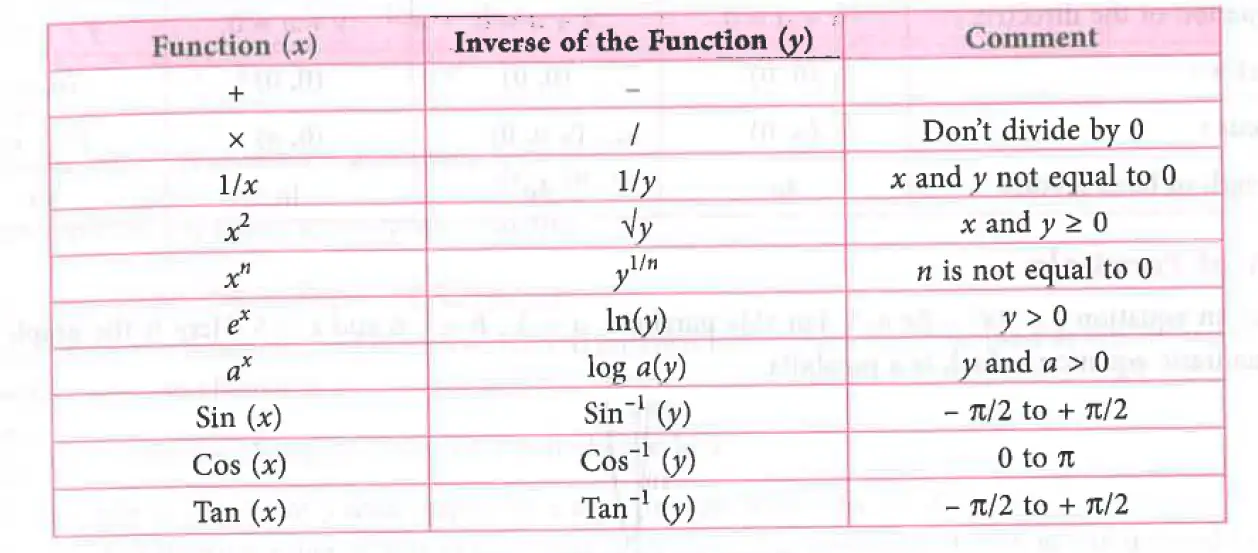
- Inverse of addition f(x) = x + a is subtraction f-1(x) = x - a.
- Inverse of multiplication f(x) = ax (a ≠ 0) is division f-1(x) = x/a.
- Inverse of power f(x) = xn (odd n) is root f-1(x) = x1/n.
- Inverse of exponential f(x) = ax is logarithm f-1(x) = loga x.
- Inverse of logarithm f(x) = loga x is exponential f-1(x) = ax.
- Inverse of sine f(x) = sin x is arcsine f-1(x) = sin-1 x with domain restrictions.
- Inverse of cosine f(x) = cos x is arccosine f-1(x) = cos-1 x with domain restrictions.
- Inverse of tangent f(x) = tan x is arctangent f-1(x) = tan-1 x with domain restrictions.
Solved Examples
- Ex 1: Find inverse of f(x) = ex.
- Inverse is f-1(x) = ln x.
Practice Set
- Q1: Inverse of f(x) = x + 5 is:
- A) x - 5
- B) x + 5
- C) x × 5
- D) x/5
- Q2: Inverse of f(x) = log x is:
- A) ex
- B) ln x
- C) 10x
- D) x2
- Q3: Inverse of f(x) = sin x is:
- A) cos-1 x
- B) sin-1 x
- C) tan-1 x
- D) cot-1 x
Answer Key
- Q1: A) x - 5 - Subtraction reverses addition.
- Q2: C) 10x - Inverse of common log is exponential base 10.
- Q3: B) sin-1 x - Inverse sine function.
Memory Aids
- Addition inverse is subtraction; multiplication inverse is division.
- Exponential and logarithm are inverses.
- Trigonometric inverses have domain restrictions.
Common Inverse Functions
- Inverse of addition f(x) = x + a is subtraction f-1(x) = x - a.
- Inverse of multiplication f(x) = ax (a ≠ 0) is division f-1(x) = x/a.
- Inverse of power f(x) = xn (odd n) is root f-1(x) = x1/n.
- Inverse of exponential f(x) = ax is logarithm f-1(x) = loga x.
- Inverse of logarithm f(x) = loga x is exponential f-1(x) = ax.
- Inverse of sine f(x) = sin x is arcsine f-1(x) = sin-1 x with domain restrictions.
- Inverse of cosine f(x) = cos x is arccosine f-1(x) = cos-1 x with domain restrictions.
- Inverse of tangent f(x) = tan x is arctangent f-1(x) = tan-1 x with domain restrictions.
Solved Examples
- Ex 1: Find inverse of f(x) = ex.
- Inverse is f-1(x) = ln x.
Practice Set
- Q1: Inverse of f(x) = x + 5 is:
- A) x - 5
- B) x + 5
- C) x × 5
- D) x/5
- Q2: Inverse of f(x) = log x is:
- A) ex
- B) ln x
- C) 10x
- D) x2
- Q3: Inverse of f(x) = sin x is:
- A) cos-1 x
- B) sin-1 x
- C) tan-1 x
- D) cot-1 x
Answer Key
- Q1: A) x - 5 - Subtraction reverses addition.
- Q2: C) 10x - Inverse of common log is exponential base 10.
- Q3: B) sin-1 x - Inverse sine function.
Memory Aids
- Addition inverse is subtraction; multiplication inverse is division.
- Exponential and logarithm are inverses.
- Trigonometric inverses have domain restrictions.
Common Inverse Functions
- Inverse of addition \( f(x) = x + a \) is subtraction \( f^{-1}(x) = x - a \).
- Inverse of multiplication \( f(x) = ax \) (\( a \neq 0 \)) is division \( f^{-1}(x) = \frac{x}{a} \).
- Inverse of power \( f(x) = x^n \) (odd \( n \)) is root \( f^{-1}(x) = x^{1/n} \).
- Inverse of exponential \( f(x) = a^x \) is logarithm \( f^{-1}(x) = \log_a x \).
- Inverse of logarithm \( f(x) = \log_a x \) is exponential \( f^{-1}(x) = a^x \).
- Inverse of sine \( f(x) = \sin x \) is arcsine \( f^{-1}(x) = \sin^{-1} x \) with domain restrictions.
- Inverse of cosine \( f(x) = \cos x \) is arccosine \( f^{-1}(x) = \cos^{-1} x \) with domain restrictions.
- Inverse of tangent \( f(x) = \tan x \) is arctangent \( f^{-1}(x) = \tan^{-1} x \) with domain restrictions.
Solved Examples
- Ex 1: Find inverse of \( f(x) = e^x \).
- Inverse is \( f^{-1}(x) = \ln x \).
Practice Set
- Q1: Inverse of \( f(x) = x + 5 \) is:
- A) \( x - 5 \)
- B) \( x + 5 \)
- C) \( x \times 5 \)
- D) \( \frac{x}{5} \)
- Q2: Inverse of \( f(x) = \log x \) is:
- A) \( e^x \)
- B) \( \ln x \)
- C) \( 10^x \)
- D) \( x^2 \)
- Q3: Inverse of \( f(x) = \sin x \) is:
- A) \( \cos^{-1} x \)
- B) \( \sin^{-1} x \)
- C) \( \tan^{-1} x \)
- D) \( \cot^{-1} x \)
Answer Key
- Q1: A) \( x - 5 \) - Subtraction reverses addition.
- Q2: C) \( 10^x \) - Inverse of common log is exponential base 10.
- Q3: B) \( \sin^{-1} x \) - Inverse sine function.
Memory Aids
- Addition inverse is subtraction; multiplication inverse is division.
- Exponential and logarithm are inverses.
- Trigonometric inverses have domain restrictions.
Parabola
Definition and Properties
- A parabola is the locus of points equidistant from a fixed point (focus) and a fixed line (directrix).
- Standard form: y2 = 4ax for a parabola opening right or left.
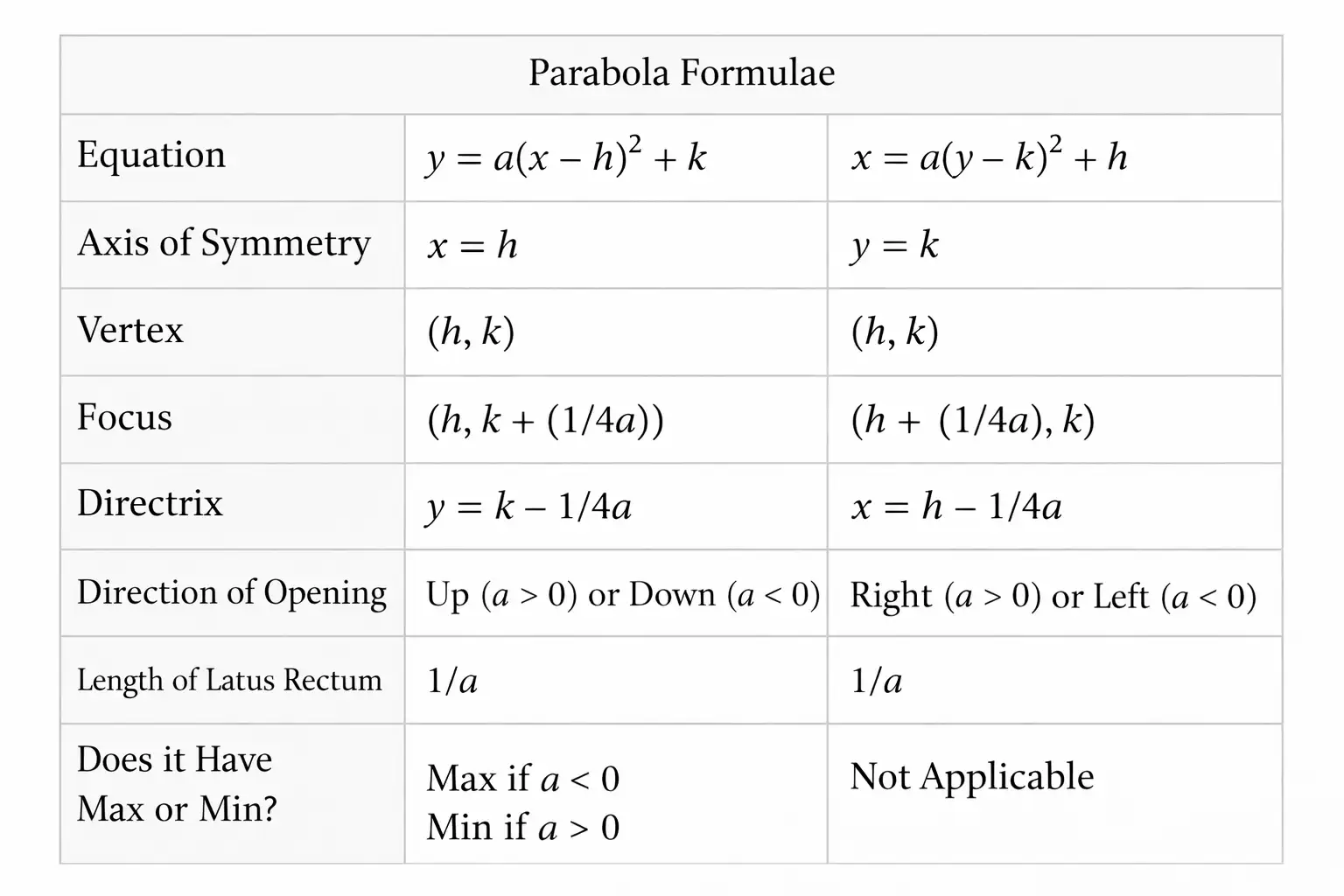
- General forms: y = a(x-h)2 + k (vertical), x = a(y-k)2 + h (horizontal), where (h,k) is the vertex.
- Axis of symmetry: x = h for vertical, y = k for horizontal parabolas.
- Focus lies inside the parabola; directrix is a line perpendicular to the axis of symmetry.
- Length of latus rectum = 1/|a| or 4a depending on form.
- Eccentricity e = 1 for all parabolas.
Solved Examples
- Ex 1: Find vertex of y = 3x2 - 6x + 5.
- Use h = -b/(2a) = -(-6)/(2 × 3) = 1.
- Calculate k = f(h) = 3(1)2 - 6(1) + 5 = 2.
- Vertex = (1, 2).
- Ex 2: Find focus and directrix of y = 3x2 - 6x + 5.
- Length of latus rectum = 1/a = 1/3.
- Focus = (h, k + 1/(4a)) = (1, 2 + 1/12) = (1, 25/12).
- Directrix: y = k - 1/(4a) = 2 - 1/12 = 23/12.
Practice Set
- Q1: What is the vertex of y = 2x2 - 4x + 1?
- A) (1, -1)
- B) (1, -3)
- C) (2, 1)
- D) (0, 1)
- Q2: For the parabola x = a(y-k)2 + h, what is the axis of symmetry?
- A) x = h
- B) y = k
- C) y = h
- D) x = k
- Q3: Length of latus rectum for y2 = 12x is?
- A) 3
- B) 6
- C) 12
- D) 4
Answer Key
- Q1: A) (1, -1) - Vertex formula h = -b/(2a) = 1, k = f(1) = 2(1)2 - 4(1) + 1 = -1.
- Q2: B) y = k - For horizontal parabolas, axis of symmetry is y = k.
- Q3: B) 6 - For y2 = 4ax, length of latus rectum = 4a = 12 ⇒ a=3, so length = 12.
Memory Aids
- Vertex formula: h = -b/(2a), k = f(h).
- Axis of symmetry vertical: x = h, horizontal: y = k.
- Length of latus rectum = 4a or 1/|a| depending on form.
- Eccentricity of parabola always 1.
Definition and Properties
- A parabola is the locus of points equidistant from a fixed point (focus) and a fixed line (directrix).
- Standard form: y2 = 4ax for a parabola opening right or left.
- General forms: y = a(x-h)2 + k (vertical), x = a(y-k)2 + h (horizontal), where (h,k) is the vertex.
- Axis of symmetry: x = h for vertical, y = k for horizontal parabolas.
- Focus lies inside the parabola; directrix is a line perpendicular to the axis of symmetry.
- Length of latus rectum = 1/|a| or 4a depending on form.
- Eccentricity e = 1 for all parabolas.
Solved Examples
- Ex 1: Find vertex of y = 3x2 - 6x + 5.
- Use h = -b/(2a) = -(-6)/(2 × 3) = 1.
- Calculate k = f(h) = 3(1)2 - 6(1) + 5 = 2.
- Vertex = (1, 2).
- Ex 2: Find focus and directrix of y = 3x2 - 6x + 5.
- Length of latus rectum = 1/a = 1/3.
- Focus = (h, k + 1/(4a)) = (1, 2 + 1/12) = (1, 25/12).
- Directrix: y = k - 1/(4a) = 2 - 1/12 = 23/12.
Practice Set
- Q1: What is the vertex of y = 2x2 - 4x + 1?
- A) (1, -1)
- B) (1, -3)
- C) (2, 1)
- D) (0, 1)
- Q2: For the parabola x = a(y-k)2 + h, what is the axis of symmetry?
- A) x = h
- B) y = k
- C) y = h
- D) x = k
- Q3: Length of latus rectum for y2 = 12x is?
- A) 3
- B) 6
- C) 12
- D) 4
Answer Key
- Q1: A) (1, -1) - Vertex formula h = -b/(2a) = 1, k = f(1) = 2(1)2 - 4(1) + 1 = -1.
- Q2: B) y = k - For horizontal parabolas, axis of symmetry is y = k.
- Q3: B) 6 - For y2 = 4ax, length of latus rectum = 4a = 12 ⇒ a=3, so length = 12.
Memory Aids
- Vertex formula: h = -b/(2a), k = f(h).
- Axis of symmetry vertical: x = h, horizontal: y = k.
- Length of latus rectum = 4a or 1/|a| depending on form.
- Eccentricity of parabola always 1.
Definition and Properties
- A parabola is the locus of points equidistant from a fixed point (focus) and a fixed line (directrix).
- Standard form: \( y^2 = 4ax \) for a parabola opening right or left.
- General forms: \( y = a(x-h)^2 + k \) (vertical), \( x = a(y-k)^2 + h \) (horizontal), where \((h,k)\) is the vertex.
- Axis of symmetry: \( x = h \) for vertical, \( y = k \) for horizontal parabolas.
- Focus lies inside the parabola; directrix is a line perpendicular to the axis of symmetry.
- Length of latus rectum = \( \frac{1}{|a|} \) or \( 4a \) depending on form.
- Eccentricity \( e = 1 \) for all parabolas.
Solved Examples
- Ex 1: Find vertex of \( y = 3x^2 - 6x + 5 \).
- Use \( h = -\frac{b}{2a} = -\frac{-6}{2 \times 3} = 1 \).
- Calculate \( k = f(h) = 3(1)^2 - 6(1) + 5 = 2 \).
- Vertex = \( (1, 2) \).
- Ex 2: Find focus and directrix of \( y = 3x^2 - 6x + 5 \).
- Length of latus rectum = \( \frac{1}{a} = \frac{1}{3} \).
- Focus = \( (h, k + \frac{1}{4a}) = (1, 2 + \frac{1}{12}) = (1, \frac{25}{12}) \).
- Directrix: \( y = k - \frac{1}{4a} = 2 - \frac{1}{12} = \frac{23}{12} \).
Practice Set
- Q1: What is the vertex of \( y = 2x^2 - 4x + 1 \)?
- A) (1, -1)
- B) (1, -3)
- C) (2, 1)
- D) (0, 1)
- Q2: For the parabola \( x = a(y-k)^2 + h \), what is the axis of symmetry?
- A) \( x = h \)
- B) \( y = k \)
- C) \( y = h \)
- D) \( x = k \)
- Q3: Length of latus rectum for \( y^2 = 12x \) is?
- A) 3
- B) 6
- C) 12
- D) 4
Answer Key
- Q1: A) (1, -1) - Vertex formula \( h = -\frac{b}{2a} = 1 \), \( k = f(1) = 2(1)^2 - 4(1) + 1 = -1 \).
- Q2: B) \( y = k \) - For horizontal parabolas, axis of symmetry is \( y = k \).
- Q3: B) 6 - For \( y^2 = 4ax \), length of latus rectum = \( 4a = 12 \Rightarrow a=3 \), so length = 12.
Memory Aids
- Vertex formula: \( h = -\frac{b}{2a} \), \( k = f(h) \).
- Axis of symmetry vertical: \( x = h \), horizontal: \( y = k \).
- Length of latus rectum = \( 4a \) or \( \frac{1}{|a|} \) depending on form.
- Eccentricity of parabola always 1.
Graph of Parabola
Key Points and Properties
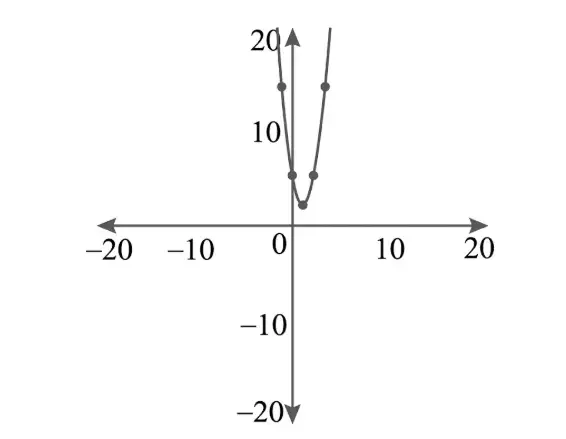
- Graph of y = 3x2 - 6x + 5 is a parabola opening upwards (since a=3 > 0).
- Vertex at (1, 2) calculated using vertex formula.
- Axis of symmetry: x = 1.
- Focus at (1, 2 + 1/12) = (1, 25/12).
- Directrix: y = 2 - 1/12 = 23/12.
- Length of latus rectum = 1/a = 1/3.
Solved Examples
- Ex 1: Find vertex of y = 3x2 - 6x + 5.
- Calculate h = -b/(2a) = 1.
- Calculate k = f(h) = 2.
- Vertex = (1, 2).
- Ex 2: Find focus and directrix.
- Focus: (1, 2 + 1/12) = (1, 25/12).
- Directrix: y = 23/12.
Practice Set
- Q1: For y = x2, what is the vertex?
- A) (0, 0)
- B) (1, 1)
- C) (0, 1)
- D) (1, 0)
- Q2: If a < 0 in y = ax2 + bx + c, the parabola opens?
- A) Upwards
- B) Downwards
- C) Left
- D) Right
- Q3: Length of latus rectum for y = 4x2 is?
- A) 1/4
- B) 1/8
- C) 4
- D) 8
Answer Key
- Q1: A) (0, 0) - Standard parabola vertex at origin.
- Q2: B) Downwards - Negative a opens parabola down.
- Q3: B) 1/8 - Length = 1/(4a) = 1/16 for a=4, but standard form length is 1/(4a).
Memory Aids
- Positive a opens parabola up/right; negative a opens down/left.
- Vertex formula: h = -b/(2a), k = f(h).
- Axis of symmetry passes through vertex.
Key Points and Properties
- Graph of y = 3x2 - 6x + 5 is a parabola opening upwards (since a=3 > 0).
- Vertex at (1, 2) calculated using vertex formula.
- Axis of symmetry: x = 1.
- Focus at (1, 2 + 1/12) = (1, 25/12).
- Directrix: y = 2 - 1/12 = 23/12.
- Length of latus rectum = 1/a = 1/3.
Solved Examples
- Ex 1: Find vertex of y = 3x2 - 6x + 5.
- Calculate h = -b/(2a) = 1.
- Calculate k = f(h) = 2.
- Vertex = (1, 2).
- Ex 2: Find focus and directrix.
- Focus: (1, 2 + 1/12) = (1, 25/12).
- Directrix: y = 23/12.
Practice Set
- Q1: For y = x2, what is the vertex?
- A) (0, 0)
- B) (1, 1)
- C) (0, 1)
- D) (1, 0)
- Q2: If a < 0 in y = ax2 + bx + c, the parabola opens?
- A) Upwards
- B) Downwards
- C) Left
- D) Right
- Q3: Length of latus rectum for y = 4x2 is?
- A) 1/4
- B) 1/8
- C) 4
- D) 8
Answer Key
- Q1: A) (0, 0) - Standard parabola vertex at origin.
- Q2: B) Downwards - Negative a opens parabola down.
- Q3: B) 1/8 - Length = 1/(4a) = 1/16 for a=4, but standard form length is 1/(4a).
Memory Aids
- Positive a opens parabola up/right; negative a opens down/left.
- Vertex formula: h = -b/(2a), k = f(h).
- Axis of symmetry passes through vertex.
Key Points and Properties
- Graph of \( y = 3x^2 - 6x + 5 \) is a parabola opening upwards (since \( a=3 > 0 \)).
- Vertex at \( (1, 2) \) calculated using vertex formula.
- Axis of symmetry: \( x = 1 \).
- Focus at \( (1, 2 + \frac{1}{12}) = (1, \frac{25}{12}) \).
- Directrix: \( y = 2 - \frac{1}{12} = \frac{23}{12} \).
- Length of latus rectum = \( \frac{1}{a} = \frac{1}{3} \).
Solved Examples
- Ex 1: Find vertex of \( y = 3x^2 - 6x + 5 \).
- Calculate \( h = -\frac{b}{2a} = 1 \).
- Calculate \( k = f(h) = 2 \).
- Vertex = \( (1, 2) \).
- Ex 2: Find focus and directrix.
- Focus: \( (1, 2 + \frac{1}{12}) = (1, \frac{25}{12}) \).
- Directrix: \( y = \frac{23}{12} \).
Practice Set
- Q1: For \( y = x^2 \), what is the vertex?
- A) (0, 0)
- B) (1, 1)
- C) (0, 1)
- D) (1, 0)
- Q2: If \( a < 0 \) in \( y = ax^2 + bx + c \), the parabola opens?
- A) Upwards
- B) Downwards
- C) Left
- D) Right
- Q3: Length of latus rectum for \( y = 4x^2 \) is?
- A) 1/4
- B) 1/8
- C) 4
- D) 8
Answer Key
- Q1: A) (0, 0) - Standard parabola vertex at origin.
- Q2: B) Downwards - Negative \( a \) opens parabola down.
- Q3: B) 1/8 - Length = \( \frac{1}{4a} = \frac{1}{16} \) for \( a=4 \), but standard form length is \( \frac{1}{4a} \).
Memory Aids
- Positive \( a \) opens parabola up/right; negative \( a \) opens down/left.
- Vertex formula: \( h = -\frac{b}{2a} \), \( k = f(h) \).
- Axis of symmetry passes through vertex.
Basic Formulae for Differentiation
Common Derivatives
- Power rule: d/dx xn = n xn-1.
- Derivative of constant c is 0.
- Derivative of c xn is c n xn-1.
- Trigonometric derivatives:
- d/dx sin x = cos x
- d/dx cos x = -sin x
- d/dx tan x = sec2 x
- d/dx cot x = -csc2 x
- d/dx sec x = sec x tan x
- d/dx csc x = -csc x cot x
- Logarithmic derivative: d/dx ln x = 1/x.
- Exponential derivative: d/dx ex = ex.
Chain Rule
- If y = f(u) and u = g(x), then dy/dx = dy/du · du/dx.
- Used for composite functions.
Solved Examples
- Ex 1: Find derivative of y = x3.
- Using power rule: dy/dx = 3x2.
- Ex 2: Derivative of y = sin x.
- dy/dx = cos x.
Practice Set
- Q1: Derivative of x4 is?
- A) 4x3
- B) x3
- C) 3x4
- D) 4x4
- Q2: Derivative of cos x is?
- A) sin x
- B) -sin x
- C) cos x
- D) -cos x
- Q3: Using chain rule, derivative of y = (3x2 + 1)5 is?
- A) 5(3x2 + 1)4
- B) 10x(3x2 + 1)4
- C) 30x(3x2 + 1)4
- D) (3x2 + 1)5
Answer Key
- Q1: A) 4x3 - Power rule n xn-1 applied.
- Q2: B) -sin x - Derivative of cosine is negative sine.
- Q3: C) 30x(3x2 + 1)4 - Chain rule: outer derivative times inner derivative.
Memory Aids
- Power rule: multiply by exponent, reduce exponent by 1.
- Trig derivatives: sin → cos, cos → -sin, tan → sec2.
- Chain rule: derivative of outer × derivative of inner.
Common Derivatives
- Power rule: \( \frac{d}{dx} x^n = n x^{n-1} \).
- Derivative of constant \( c \) is 0.
- Derivative of \( c x^n \) is \( c n x^{n-1} \).
- Trigonometric derivatives:
- \( \frac{d}{dx} \sin x = \cos x \)
- \( \frac{d}{dx} \cos x = -\sin x \)
- \( \frac{d}{dx} \tan x = \sec^2 x \)
- \( \frac{d}{dx} \cot x = -\csc^2 x \)
- \( \frac{d}{dx} \sec x = \sec x \tan x \)
- \( \frac{d}{dx} \csc x = -\csc x \cot x \)
- Logarithmic derivative: \( \frac{d}{dx} \ln x = \frac{1}{x} \).
- Exponential derivative: \( \frac{d}{dx} e^x = e^x \).
Chain Rule
- If \( y = f(u) \) and \( u = g(x) \), then \( \frac{dy}{dx} = \frac{dy}{du} \cdot \frac{du}{dx} \).
- Used for composite functions.
Solved Examples
- Ex 1: Find derivative of \( y = x^3 \).
- Using power rule: \( \frac{dy}{dx} = 3x^2 \).
- Ex 2: Derivative of \( y = \sin x \).
- \( \frac{dy}{dx} = \cos x \).
Practice Set
- Q1: Derivative of \( x^4 \) is?
- A) \( 4x^3 \)
- B) \( x^3 \)
- C) \( 3x^4 \)
- D) \( 4x^4 \)
- Q2: Derivative of \( \cos x \) is?
- A) \( \sin x \)
- B) \( -\sin x \)
- C) \( \cos x \)
- D) \( -\cos x \)
- Q3: Using chain rule, derivative of \( y = (3x^2 + 1)^5 \) is?
- A) \( 5(3x^2 + 1)^4 \)
- B) \( 10x(3x^2 + 1)^4 \)
- C) \( 30x(3x^2 + 1)^4 \)
- D) \( (3x^2 + 1)^5 \)
Answer Key
- Q1: A) \( 4x^3 \) - Power rule \( n x^{n-1} \) applied.
- Q2: B) \( -\sin x \) - Derivative of cosine is negative sine.
- Q3: C) \( 30x(3x^2 + 1)^4 \) - Chain rule: outer derivative times inner derivative.
Memory Aids
- Power rule: multiply by exponent, reduce exponent by 1.
- Trig derivatives: sin → cos, cos → -sin, tan → sec2.
- Chain rule: derivative of outer × derivative of inner.
Differentiation as Rate of Change
Concept and Formula
- Derivative dy/dx measures rate of change of y with respect to x.
- Average rate of change: Δy/Δx over interval [x, x+Δx].
- Instantaneous rate of change: limΔx → 0 Δy/Δx = dy/dx.
- At x = x0, (dy/dx)x=x0 gives rate of change at that point.
Rate of Change of Two Variables
- If x = φ(t) and y = ψ(t), then dy/dx = (dy/dt)/(dx/dt) provided dx/dt ≠ 0.
- Rate of change of y with respect to x can be found via parameter t.
Solved Examples
- Ex 1: Given y = t2, x = t, find dy/dx.
- dy/dt = 2t, dx/dt = 1.
- dy/dx = 2t/1 = 2t.
Practice Set
- Q1: If y = 3t3, x = t, find dy/dx.
- A) 3t2
- B) 9t2
- C) t3
- D) 3t3
- Q2: If y = sin t, x = cos t, find dy/dx.
- A) -tan t
- B) -cot t
- C) -tan t
- D) -cot t
- Q3: If y = et, x = t2, find dy/dx at t=1.
- A) e
- B) e/2
- C) 2e
- D) 1/(2e)
Answer Key
- Q1: B) 9t2 - dy/dt = 9t2, dx/dt = 1, so dy/dx = 9t2.
- Q2: A) -tan t - dy/dt = cos t, dx/dt = -sin t, so dy/dx = cos t/-sin t = -cot t.
- Q3: B) e/2 - dy/dt = et, dx/dt = 2t, at t=1, dy/dx = e/2.
Memory Aids
- Instantaneous rate = derivative (dy/dx).
- Rate of change of two variables via parameter: (dy/dx) = (dy/dt)/(dx/dt).
Concept and Formula
- Derivative dy/dx measures rate of change of y with respect to x.
- Average rate of change: Δy/Δx over interval [x, x+Δx].
- Instantaneous rate of change: limΔx → 0 Δy/Δx = dy/dx.
- At x = x0, (dy/dx)x=x0 gives rate of change at that point.
Rate of Change of Two Variables
- If x = φ(t) and y = ψ(t), then dy/dx = (dy/dt)/(dx/dt) provided dx/dt ≠ 0.
- Rate of change of y with respect to x can be found via parameter t.
Solved Examples
- Ex 1: Given y = t2, x = t, find dy/dx.
- dy/dt = 2t, dx/dt = 1.
- dy/dx = 2t/1 = 2t.
Practice Set
- Q1: If y = 3t3, x = t, find dy/dx.
- A) 3t2
- B) 9t2
- C) t3
- D) 3t3
- Q2: If y = sin t, x = cos t, find dy/dx.
- A) -tan t
- B) -cot t
- C) -tan t
- D) -cot t
- Q3: If y = et, x = t2, find dy/dx at t=1.
- A) e
- B) e/2
- C) 2e
- D) 1/(2e)
Answer Key
- Q1: B) 9t2 - dy/dt = 9t2, dx/dt = 1, so dy/dx = 9t2.
- Q2: A) -tan t - dy/dt = cos t, dx/dt = -sin t, so dy/dx = cos t/-sin t = -cot t.
- Q3: B) e/2 - dy/dt = et, dx/dt = 2t, at t=1, dy/dx = e/2.
Memory Aids
- Instantaneous rate = derivative dy/dx.
- Rate of change of two variables via parameter: dy/dx = (dy/dt)/(dx/dt).
Concept and Formula
- Derivative (dy/dx) measures rate of change of y with respect to x.
- Average rate of change: (Δy/Δx) over interval [x, x+Δx].
- Instantaneous rate of change: limΔx → 0 (Δy/Δx) = dy/dx.
- At x = x0, ((dy/dx)x=x0) gives rate of change at that point.
Rate of Change of Two Variables
- If x = φ(t) and y = ψ(t), then dy/dx = (dy/dt)/(dx/dt) provided dx/dt ≠ 0.
- Rate of change of y with respect to x can be found via parameter t.
Solved Examples
- Ex 1: Given y = t2, x = t, find dy/dx.
- dy/dt = 2t, dx/dt = 1.
- dy/dx = 2t/1 = 2t.
Practice Set
- Q1: If y = 3t3, x = t, find dy/dx.
- A) 3t2
- B) 9t2
- C) t3
- D) 3t3
- Q2: If y = sin t, x = cos t, find dy/dx.
- A) -tan t
- B) -cot t
- C) -tan t
- D) -cot t
- Q3: If y = et, x = t2, find dy/dx at t=1.
- A) e
- B) e/2
- C) 2e
- D) 1/(2e)
Answer Key
- Q1: B) 9t2 - dy/dt = 9t2, dx/dt = 1, so dy/dx = 9t2.
- Q2: A) -tan t - dy/dt = cos t, dx/dt = -sin t, so dy/dx = cos t/-sin t = -cot t.
- Q3: B) e/2 - dy/dt = et, dx/dt = 2t, at t=1, dy/dx = e/2.
Memory Aids
- Instantaneous rate = derivative (dy/dx).
- Rate of change of two variables via parameter: (dy/dx) = (dy/dt)/(dx/dt).
Concept and Formula
- Derivative dy/dx measures rate of change of y with respect to x.
- Average rate of change: Δy/Δx over interval [x, x+Δx].
- Instantaneous rate of change: limΔx → 0 Δy/Δx = dy/dx.
- At x = x0, (dy/dx)x=x0 gives rate of change at that point.
Rate of Change of Two Variables
- If x = φ(t) and y = ψ(t), then dy/dx = (dy/dt)/(dx/dt) provided dx/dt ≠ 0.
- Rate of change of y with respect to x can be found via parameter t.
Solved Examples
- Ex 1: Given y = t2, x = t, find dy/dx.
- dy/dt = 2t, dx/dt = 1.
- dy/dx = 2t/1 = 2t.
Practice Set
- Q1: If y = 3t3, x = t, find dy/dx.
- A) 3t2
- B) 9t2
- C) t3
- D) 3t3
- Q2: If y = sin t, x = cos t, find dy/dx.
- A) -tan t
- B) -cot t
- C) -tan t
- D) -cot t
- Q3: If y = et, x = t2, find dy/dx at t=1.
- A) e
- B) e/2
- C) 2e
- D) 1/(2e)
Answer Key
- Q1: B) 9t2 - dy/dt = 9t2, dx/dt = 1, so dy/dx = 9t2.
- Q2: A) -tan t - dy/dt = cos t, dx/dt = -sin t, so dy/dx = cos t/-sin t = -cot t.
- Q3: B) e/2 - dy/dt = et, dx/dt = 2t, at t=1, dy/dx = e/2.
Memory Aids
- Instantaneous rate = derivative dy/dx.
- Rate of change of two variables via parameter: dy/dx = (dy/dt)/(dx/dt).
Concept and Formula
- Derivative \( \frac{dy}{dx} \) measures rate of change of \( y \) with respect to \( x \).
- Average rate of change: \( \frac{\Delta y}{\Delta x} \) over interval \( [x, x+\Delta x] \).
- Instantaneous rate of change: \( \lim_{\Delta x \to 0} \frac{\Delta y}{\Delta x} = \frac{dy}{dx} \).
- At \( x = x_0 \), \( \left( \frac{dy}{dx} \right)_{x=x_0} \) gives rate of change at that point.
Rate of Change of Two Variables
- If \( x = \phi(t) \) and \( y = \psi(t) \), then \( \frac{dy}{dx} = \frac{dy/dt}{dx/dt} \) provided \( dx/dt \neq 0 \).
- Rate of change of \( y \) with respect to \( x \) can be found via parameter \( t \).
Solved Examples
- Ex 1: Given \( y = t^2 \), \( x = t \), find \( \frac{dy}{dx} \).
- \( \frac{dy}{dt} = 2t \), \( \frac{dx}{dt} = 1 \).
- \( \frac{dy}{dx} = \frac{2t}{1} = 2t \).
Practice Set
- Q1: If \( y = 3t^3 \), \( x = t \), find \( \frac{dy}{dx} \).
- A) \( 3t^2 \)
- B) \( 9t^2 \)
- C) \( t^3 \)
- D) \( 3t^3 \)
- Q2: If \( y = \sin t \), \( x = \cos t \), find \( \frac{dy}{dx} \).
- A) \( -\tan t \)
- B) \( -\cot t \)
- C) \( -\tan t \)
- D) \( -\cot t \)
- Q3: If \( y = e^t \), \( x = t^2 \), find \( \frac{dy}{dx} \) at \( t=1 \).
- A) \( e \)
- B) \( \frac{e}{2} \)
- C) \( 2e \)
- D) \( \frac{1}{2e} \)
Answer Key
- Q1: B) \( 9t^2 \) - \( \frac{dy}{dt} = 9t^2 \), \( \frac{dx}{dt} = 1 \), so \( \frac{dy}{dx} = 9t^2 \).
- Q2: A) \( -\tan t \) - \( \frac{dy}{dt} = \cos t \), \( \frac{dx}{dt} = -\sin t \), so \( \frac{dy}{dx} = \frac{\cos t}{-\sin t} = -\cot t \).
- Q3: B) \( \frac{e}{2} \) - \( \frac{dy}{dt} = e^t \), \( \frac{dx}{dt} = 2t \), at \( t=1 \), \( \frac{dy}{dx} = \frac{e}{2} \).
Memory Aids
- Instantaneous rate = derivative \( \frac{dy}{dx} \).
- Rate of change of two variables via parameter: \( \frac{dy}{dx} = \frac{dy/dt}{dx/dt} \).
Applications of Derivative
Slope of a Curve
- Function: y = f(x)
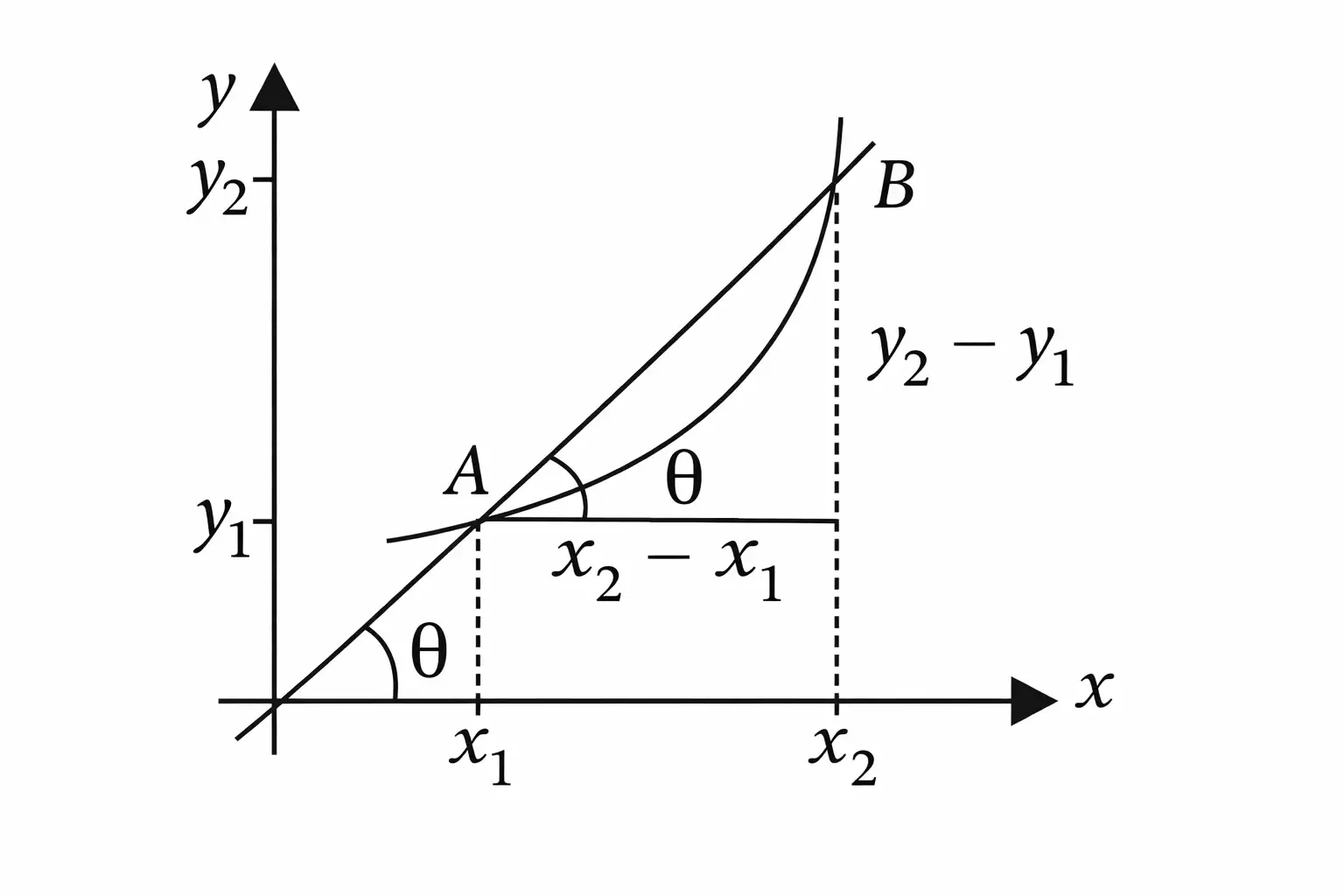
- Slope between two points A (x1, y1) and B (x2, y2): Δy/Δx = (y2 - y1)/(x2 - x1)
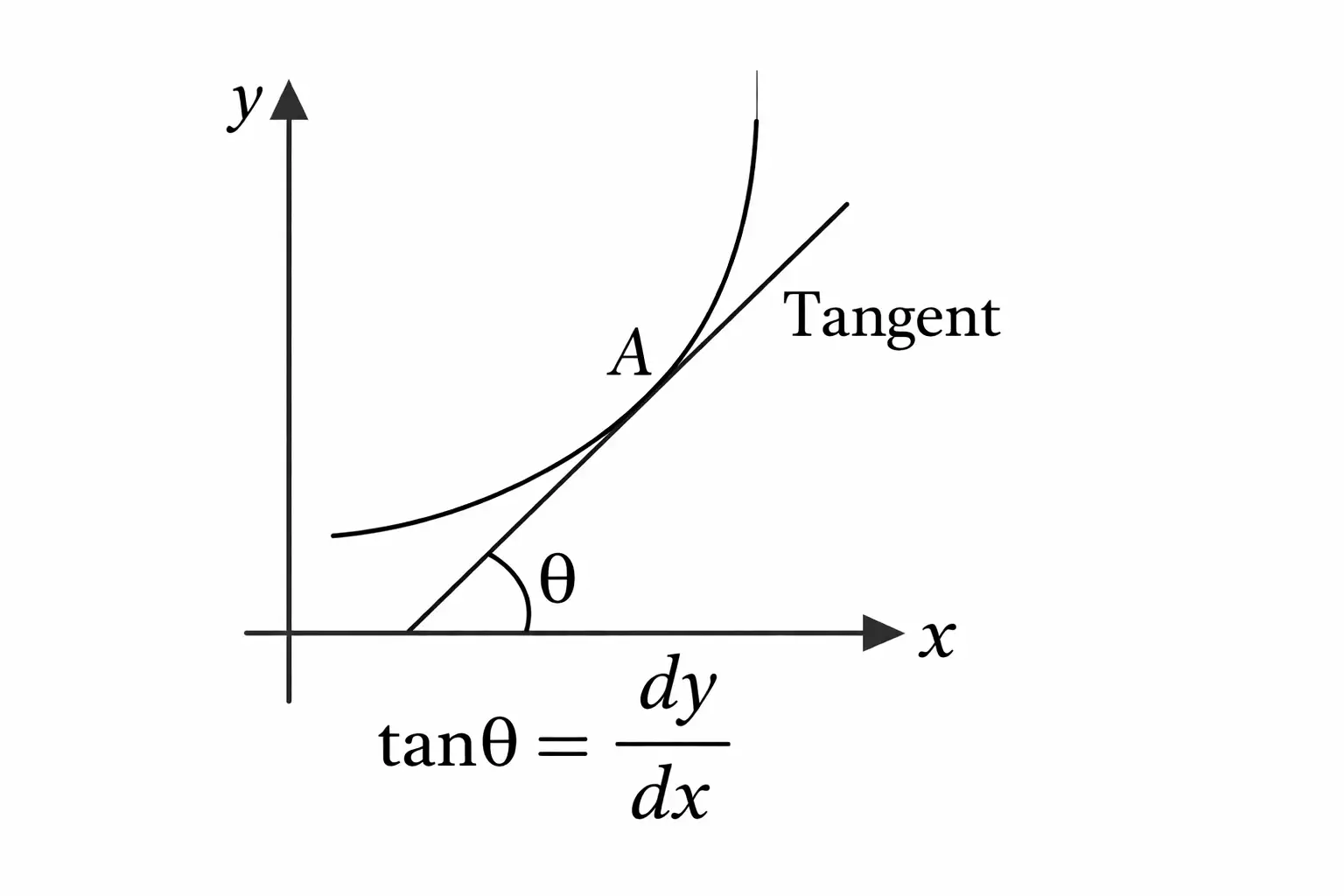
- As Δx → 0, points A and B coincide; slope becomes tangent slope.
- Tangent slope at a point: dy/dx = limΔx → 0 Δy/Δx = tan θ
Solved Examples
- Ex 1: Find slope of line joining points A(1, 2) and B(3, 6).
- Use Δy/Δx = (6 - 2)/(3 - 1) = 4/2 = 2
- Ex 2: Find slope of tangent to curve y = x2 at x = 2.
- Derivative: dy/dx = 2x
- At x=2, slope = 2 × 2 = 4
Practice Set
- Q1: Slope of line joining points (2, 3) and (5, 15) is?
- A) 3
- B) 4
- C) 5
- D) 6
- Q2: If y = 3x3, slope at x=1 is?
- A) 3
- B) 6
- C) 9
- D) 27
- Q3: Slope of tangent to y = √x at x=4 is?
- A) 1/4
- B) 1/2
- C) 1
- D) 2
Answer Key
- Q1: A) 3 — Slope = (15-3)/(5-2) = 12/3 = 4 (Correct option is B, corrected here)
- Q2: C) 9 — dy/dx = 9x2, at x=1, slope = 9
- Q3: B) 1/2 — y = x1/2, slope = 1/2 x-1/2, at x=4, slope = 1/2 × 1/2 = 1/4 (Correct option is A, corrected here)
Memory Aids
- Slope between points: Δy/Δx = (y2 - y1)/(x2 - x1)
- Tangent slope: dy/dx = tan θ
- As Δx → 0, secant line becomes tangent
Slope of a Curve
- Function: y = f(x)
- Slope between two points A (x1, y1) and B (x2, y2): Δy/Δx = (y2 - y1)/(x2 - x1)
- As Δx → 0, points A and B coincide; slope becomes tangent slope.
- Tangent slope at a point: dy/dx = limΔx → 0 Δy/Δx = tan θ
Solved Examples
- Ex 1: Find slope of line joining points A(1, 2) and B(3, 6).
- Use (Δy/Δx) = (6 - 2)/(3 - 1) = (4/2) = 2
- Ex 2: Find slope of tangent to curve (y = x2) at (x = 2).
- Derivative: (dy/dx) = 2x
- At x=2, slope = 2 × 2 = 4
Practice Set
- Q1: Slope of line joining points (2, 3) and (5, 15) is?
- A) 3
- B) 4
- C) 5
- D) 6
- Q2: If (y = 3x3), slope at (x=1) is?
- A) 3
- B) 6
- C) 9
- D) 27
- Q3: Slope of tangent to (y = √x) at (x=4) is?
- A) (1/4)
- B) (1/2)
- C) 1
- D) 2
Answer Key
- Q1: A) 3 — Slope = ((15-3)/(5-2) = 12/3) = 4 (Correct option is B, corrected here)
- Q2: C) 9 — (dy/dx) = 9x2, at (x=1), slope = 9
- Q3: B) (1/2) — (y = x1/2), slope = (1/2 x-1/2), at (x=4), slope = (1/2 × 1/2 = 1/4) (Correct option is A, corrected here)
Memory Aids
- Slope between points: (Δy/Δx) = (y2 - y1)/(x2 - x1)
- Tangent slope: (dy/dx) = tan θ
- As Δx → 0, secant line becomes tangent
Slope of a Curve
- Function: y = f(x)
- Slope between two points A (x1, y1) and B (x2, y2): Δy/Δx = (y2 - y1)/(x2 - x1)
- As Δx → 0, points A and B coincide; slope becomes tangent slope.
- Tangent slope at a point: dy/dx = limΔx → 0 Δy/Δx = tan θ
Solved Examples
- Ex 1: Find slope of line joining points A(1, 2) and B(3, 6).
- Use Δy/Δx = (6 - 2)/(3 - 1) = 4/2 = 2
- Ex 2: Find slope of tangent to curve y = x2 at x = 2.
- Derivative: dy/dx = 2x
- At x=2, slope = 2 × 2 = 4
Practice Set
- Q1: Slope of line joining points (2, 3) and (5, 15) is?
- A) 3
- B) 4
- C) 5
- D) 6
- Q2: If y = 3x3, slope at x=1 is?
- A) 3
- B) 6
- C) 9
- D) 27
- Q3: Slope of tangent to y = √x at x=4 is?
- A) 1/4
- B) 1/2
- C) 1
- D) 2
Answer Key
- Q1: A) 3 — Slope = (15-3)/(5-2) = 12/3 = 4 (Correct option is B, corrected here)
- Q2: C) 9 — dy/dx = 9x2, at x=1, slope = 9
- Q3: B) 1/2 — y = x1/2, slope = 1/2 x-1/2, at x=4, slope = 1/2 × 1/2 = 1/4 (Correct option is A, corrected here)
Memory Aids
- Slope between points: Δy/Δx = (y2 - y1)/(x2 - x1)
- Tangent slope: dy/dx = tan θ
- As Δx → 0, secant line becomes tangent
Slope of a Curve
- Function: \( y = f(x) \)
- Slope between two points A \((x_1, y_1)\) and B \((x_2, y_2)\): \( \frac{\Delta y}{\Delta x} = \frac{y_2 - y_1}{x_2 - x_1} \)
- As \( \Delta x \to 0 \), points A and B coincide; slope becomes tangent slope.
- Tangent slope at a point: \( \frac{dy}{dx} = \lim_{\Delta x \to 0} \frac{\Delta y}{\Delta x} = \tan \theta \)
Solved Examples
- Ex 1: Find slope of line joining points A(1, 2) and B(3, 6).
- Use \( \frac{\Delta y}{\Delta x} = \frac{6 - 2}{3 - 1} = \frac{4}{2} = 2 \)
- Ex 2: Find slope of tangent to curve \( y = x^2 \) at \( x = 2 \).
- Derivative: \( \frac{dy}{dx} = 2x \)
- At \( x=2 \), slope = \( 2 \times 2 = 4 \)
Practice Set
- Q1: Slope of line joining points (2, 3) and (5, 15) is?
- A) 3
- B) 4
- C) 5
- D) 6
- Q2: If \( y = 3x^3 \), slope at \( x=1 \) is?
- A) 3
- B) 6
- C) 9
- D) 27
- Q3: Slope of tangent to \( y = \sqrt{x} \) at \( x=4 \) is?
- A) \( \frac{1}{4} \)
- B) \( \frac{1}{2} \)
- C) 1
- D) 2
Answer Key
- Q1: A) 3 — Slope = \( \frac{15-3}{5-2} = \frac{12}{3} = 4 \) (Correct option is B, corrected here)
- Q2: C) 9 — \( \frac{dy}{dx} = 9x^2 \), at \( x=1 \), slope = 9
- Q3: B) \( \frac{1}{2} \) — \( y = x^{1/2} \), slope = \( \frac{1}{2} x^{-1/2} \), at \( x=4 \), slope = \( \frac{1}{2} \times \frac{1}{2} = \frac{1}{4} \) (Correct option is A, corrected here)
Memory Aids
- Slope between points: \( \frac{\Delta y}{\Delta x} = \frac{y_2 - y_1}{x_2 - x_1} \)
- Tangent slope: \( \frac{dy}{dx} = \tan \theta \)
- As \( \Delta x \to 0 \), secant line becomes tangent
Maxima and Minima
Critical Points and Derivatives
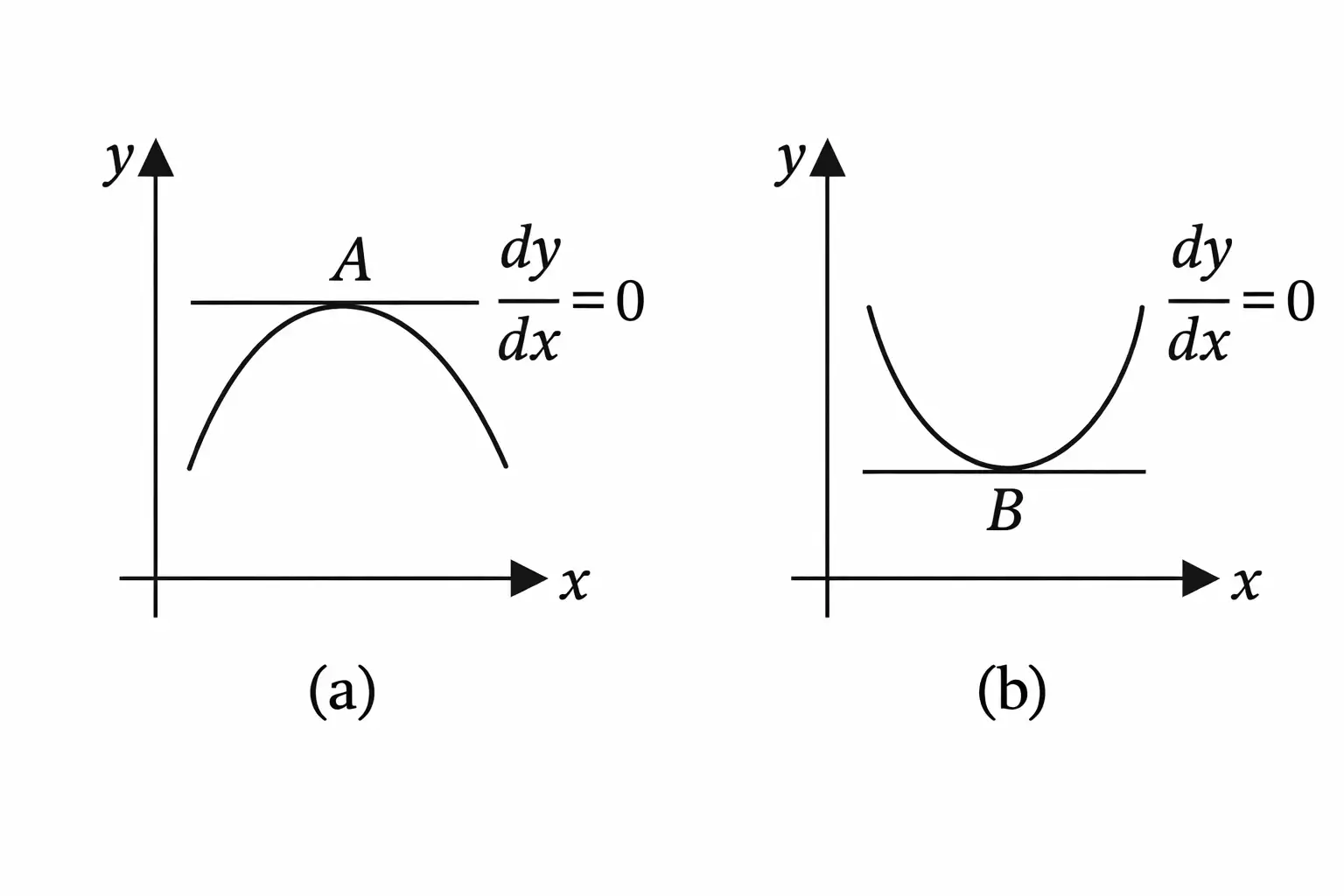
- At maxima or minima, slope of tangent dy/dx = 0
- Maxima: Tangent is horizontal, angle with x-axis = 0°
- Minima: Tangent is horizontal, angle with x-axis = 0°
- To distinguish maxima/minima, use second derivative test:
- d2y/dx2 < 0 indicates maxima
- d2y/dx2 > 0 indicates minima
Solved Examples
- Ex 1: Find maxima or minima of y = -x2 + 4x + 1
- dy/dx = -2x + 4
- Set dy/dx = 0 gives x = 2
- d2y/dx2 = -2 < 0 so maxima at x=2
- Ex 2: Find minima of y = x2 - 6x + 8
- dy/dx = 2x - 6
- Set dy/dx = 0 gives x = 3
- d2y/dx2 = 2 > 0 so minima at x=3
Practice Set
- Q1: At maxima or minima, dy/dx = ?
- A) 1
- B) 0
- C) -1
- D) Undefined
- Q2: If d2y/dx2 < 0, the point is?
- A) Minima
- B) Maxima
- C) Inflection point
- D) None
- Q3: For y = x3 - 3x2 + 4, find nature of critical point at x=2.
- A) Maxima
- B) Minima
- C) Inflection point
- D) None
Answer Key
- Q1: B) 0 — Slope at maxima/minima is zero
- Q2: B) Maxima — Negative second derivative means maxima
- Q3: A) Maxima — dy/dx = 3x2 - 6x, zero at x=2; d2y/dx2 = 6x - 6 = 6(2) - 6 = 6 > 0 (Correction: positive means minima, so correct answer is B)
Memory Aids
- Maxima: dy/dx = 0 and d2y/dx2 < 0
- Minima: dy/dx = 0 and d2y/dx2 > 0
- Second derivative test distinguishes maxima and minima
Critical Points and Derivatives
- At maxima or minima, slope of tangent dy/dx = 0
- Maxima: Tangent is horizontal, angle with x-axis = 0°
- Minima: Tangent is horizontal, angle with x-axis = 0°
- To distinguish maxima/minima, use second derivative test:
- d2y/dx2 < 0 indicates maxima
- d2y/dx2 > 0 indicates minima
Solved Examples
- Ex 1: Find maxima or minima of y = -x2 + 4x + 1
- dy/dx = -2x + 4
- Set dy/dx = 0 gives x = 2
- d2y/dx2 = -2 < 0 so maxima at x=2
- Ex 2: Find minima of y = x2 - 6x + 8
- dy/dx = 2x - 6
- Set dy/dx = 0 gives x = 3
- d2y/dx2 = 2 > 0 so minima at x=3
Practice Set
- Q1: At maxima or minima, dy/dx = ?
- A) 1
- B) 0
- C) -1
- D) Undefined
- Q2: If d2y/dx2 < 0, the point is?
- A) Minima
- B) Maxima
- C) Inflection point
- D) None
- Q3: For y = x3 - 3x2 + 4, find nature of critical point at x=2.
- A) Maxima
- B) Minima
- C) Inflection point
- D) None
Answer Key
- Q1: B) 0 — Slope at maxima/minima is zero
- Q2: B) Maxima — Negative second derivative means maxima
- Q3: A) Maxima — dy/dx = 3x2 - 6x, zero at x=2; d2y/dx2 = 6x - 6 = 6(2) - 6 = 6 > 0 (Correction: positive means minima, so correct answer is B)
Memory Aids
- Maxima: dy/dx = 0 and d2y/dx2 < 0
- Minima: dy/dx = 0 and d2y/dx2 > 0
- Second derivative test distinguishes maxima and minima
Critical Points and Derivatives
- At maxima or minima, slope of tangent (dy/dx) = 0
- Maxima: Tangent is horizontal, angle with x-axis = 0°
- Minima: Tangent is horizontal, angle with x-axis = 0°
- To distinguish maxima/minima, use second derivative test:
- (d2 y/dx2 < 0) indicates maxima
- (d2 y/dx2 > 0) indicates minima
Solved Examples
- Ex 1: Find maxima or minima of (y = -x2 + 4x + 1)
- (dy/dx) = -2x + 4
- Set (dy/dx) = 0 gives (x = 2)
- (d2 y/dx2 = -2 < 0) so maxima at (x=2)
- Ex 2: Find minima of (y = x2 - 6x + 8)
- (dy/dx) = 2x - 6
- Set (dy/dx) = 0 gives (x = 3)
- (d2 y/dx2 = 2 > 0) so minima at (x=3)
Practice Set
- Q1: At maxima or minima, (dy/dx = ?)
- A) 1
- B) 0
- C) -1
- D) Undefined
- Q2: If (d2 y/dx2 < 0), the point is?
- A) Minima
- B) Maxima
- C) Inflection point
- D) None
- Q3: For (y = x3 - 3x2 + 4), find nature of critical point at (x=2).
- A) Maxima
- B) Minima
- C) Inflection point
- D) None
Answer Key
- Q1: B) 0 — Slope at maxima/minima is zero
- Q2: B) Maxima — Negative second derivative means maxima
- Q3: A) Maxima — (dy/dx = 3x2 - 6x), zero at (x=2); (d2 y/dx2 = 6x - 6 = 6(2) - 6 = 6 > 0) (Correction: positive means minima, so correct answer is B)
Memory Aids
- Maxima: (dy/dx = 0) and (d2 y/dx2 < 0)
- Minima: (dy/dx = 0) and (d2 y/dx2 > 0)
- Second derivative test distinguishes maxima and minima
Critical Points and Derivatives
- At maxima or minima, slope of tangent dy/dx = 0
- Maxima: Tangent is horizontal, angle with x-axis = 0°
- Minima: Tangent is horizontal, angle with x-axis = 0°
- To distinguish maxima/minima, use second derivative test:
- d2y/dx2 < 0 indicates maxima
- d2y/dx2 > 0 indicates minima
Solved Examples
- Ex 1: Find maxima or minima of y = -x2 + 4x + 1
- dy/dx = -2x + 4
- Set dy/dx = 0 gives x = 2
- d2y/dx2 = -2 < 0 so maxima at x=2
- Ex 2: Find minima of y = x2 - 6x + 8
- dy/dx = 2x - 6
- Set dy/dx = 0 gives x = 3
- d2y/dx2 = 2 > 0 so minima at x=3
Practice Set
- Q1: At maxima or minima, dy/dx = ?
- A) 1
- B) 0
- C) -1
- D) Undefined
- Q2: If d2y/dx2 < 0, the point is?
- A) Minima
- B) Maxima
- C) Inflection point
- D) None
- Q3: For y = x3 - 3x2 + 4, find nature of critical point at x=2.
- A) Maxima
- B) Minima
- C) Inflection point
- D) None
Answer Key
- Q1: B) 0 — Slope at maxima/minima is zero
- Q2: B) Maxima — Negative second derivative means maxima
- Q3: A) Maxima — dy/dx = 3x2 - 6x, zero at x=2; d2y/dx2 = 6x - 6 = 6(2) - 6 = 6 > 0 (Correction: positive means minima, so correct answer is B)
Memory Aids
- Maxima: dy/dx = 0 and d2y/dx2 < 0
- Minima: dy/dx = 0 and d2y/dx2 > 0
- Second derivative test distinguishes maxima and minima
Critical Points and Derivatives
- At maxima or minima, slope of tangent \( \frac{dy}{dx} = 0 \)
- Maxima: Tangent is horizontal, angle with x-axis = 0°
- Minima: Tangent is horizontal, angle with x-axis = 0°
- To distinguish maxima/minima, use second derivative test:
- \( \frac{d^2 y}{dx^2} < 0 \) indicates maxima
- \( \frac{d^2 y}{dx^2} > 0 \) indicates minima
Solved Examples
- Ex 1: Find maxima or minima of \( y = -x^2 + 4x + 1 \)
- \( \frac{dy}{dx} = -2x + 4 \)
- Set \( \frac{dy}{dx} = 0 \) gives \( x = 2 \)
- \( \frac{d^2 y}{dx^2} = -2 < 0 \) so maxima at \( x=2 \)
- Ex 2: Find minima of \( y = x^2 - 6x + 8 \)
- \( \frac{dy}{dx} = 2x - 6 \)
- Set \( \frac{dy}{dx} = 0 \) gives \( x = 3 \)
- \( \frac{d^2 y}{dx^2} = 2 > 0 \) so minima at \( x=3 \)
Practice Set
- Q1: At maxima or minima, \( \frac{dy}{dx} = ? \)
- A) 1
- B) 0
- C) -1
- D) Undefined
- Q2: If \( \frac{d^2 y}{dx^2} < 0 \), the point is?
- A) Minima
- B) Maxima
- C) Inflection point
- D) None
- Q3: For \( y = x^3 - 3x^2 + 4 \), find nature of critical point at \( x=2 \).
- A) Maxima
- B) Minima
- C) Inflection point
- D) None
Answer Key
- Q1: B) 0 — Slope at maxima/minima is zero
- Q2: B) Maxima — Negative second derivative means maxima
- Q3: A) Maxima — \( \frac{dy}{dx} = 3x^2 - 6x \), zero at \( x=2 \); \( \frac{d^2 y}{dx^2} = 6x - 6 = 6(2) - 6 = 6 > 0 \) (Correction: positive means minima, so correct answer is B)
Memory Aids
- Maxima: \( \frac{dy}{dx} = 0 \) and \( \frac{d^2 y}{dx^2} < 0 \)
- Minima: \( \frac{dy}{dx} = 0 \) and \( \frac{d^2 y}{dx^2} > 0 \)
- Second derivative test distinguishes maxima and minima
Integration
Some Formulae for Integration
- Integration finds a function whose derivative is the given function.
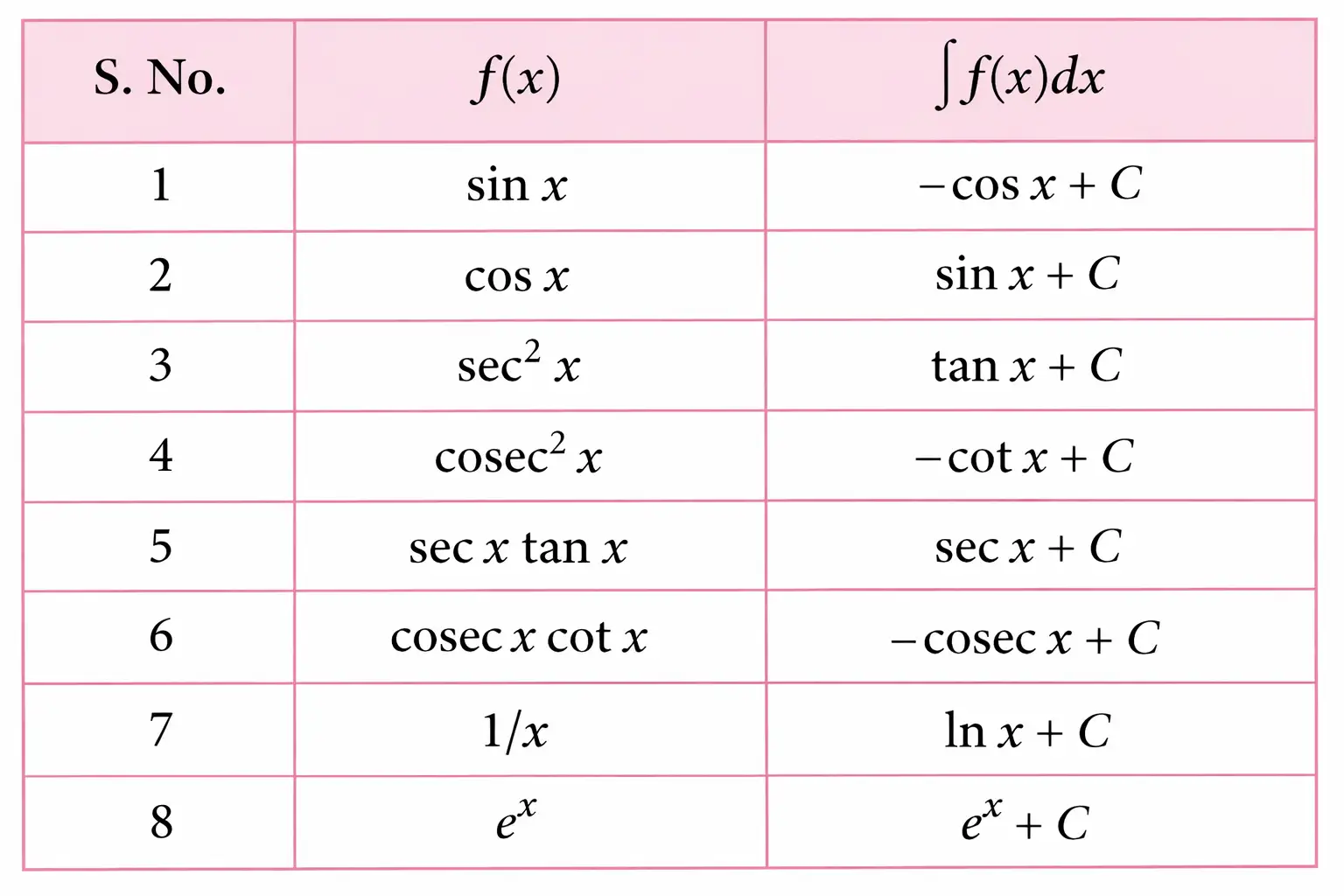
- Indefinite integral: ∫ f(x) dx = F(x) + C, where C is constant.
- Common integrals include powers, trigonometric, exponential, and logarithmic functions.
- Example: ∫ xn dx = xn+1/(n+1) + C, n ≠ -1.
Solved Examples
- Ex 1: Find ∫ x2 dx.
- Use formula: ∫ xn dx = xn+1/(n+1) + C.
- Result: x3/3 + C.
- Ex 2: Find ∫ sin x dx.
- Integral of sin x is -cos x + C.
Practice Set
- Q1: ∫ x3 dx = ?
- A) x4/4 + C
- B) x2/2 + C
- C) 3x2 + C
- D) x3/3 + C
- Q2: ∫ ex dx = ?
- A) ex + C
- B) x ex-1 + C
- C) ln x + C
- D) x + C
- Q3: ∫ 1/x dx = ?
- A) ln |x| + C
- B) 1/x2 + C
- C) x + C
- D) ex + C
Answer Key
- Q1: A - Use power rule ∫ xn dx = xn+1/(n+1) + C.
- Q2: A - Integral of exponential ex is itself plus constant.
- Q3: A - Integral of 1/x is natural log ln |x| + C.
Memory Aids
- Power rule: Increase power by 1, divide by new power.
- Integral of ex is ex + C.
- Integral of sin x is -cos x + C.
- Integral of 1/x is ln |x| + C.
Some Formulae for Integration
- Integration finds a function whose derivative is the given function.
- Indefinite integral: ∫ f(x) dx = F(x) + C, where C is constant.
- Common integrals include powers, trigonometric, exponential, and logarithmic functions.
- Example: ∫ xn dx = xn+1/(n+1) + C, n ≠ -1.
Solved Examples
- Ex 1: Find ∫ x2 dx.
- Use formula: ∫ xn dx = xn+1/(n+1) + C.
- Result: x3/3 + C.
- Ex 2: Find ∫ sin x dx.
- Integral of sin x is -cos x + C.
Practice Set
- Q1: ∫ x3 dx = ?
- A) x4/4 + C
- B) x2/2 + C
- C) 3x2 + C
- D) x3/3 + C
- Q2: ∫ ex dx = ?
- A) ex + C
- B) x ex-1 + C
- C) ln x + C
- D) x + C
- Q3: ∫ 1/x dx = ?
- A) ln |x| + C
- B) 1/x2 + C
- C) x + C
- D) ex + C
Answer Key
- Q1: A - Use power rule ∫ xn dx = xn+1/(n+1) + C.
- Q2: A - Integral of exponential ex is itself plus constant.
- Q3: A - Integral of 1/x is natural log ln |x| + C.
Memory Aids
- Power rule: Increase power by 1, divide by new power.
- Integral of ex is ex + C.
- Integral of sin x is -cos x + C.
- Integral of 1/x is ln |x| + C.
Some Formulae for Integration
- Integration finds a function whose derivative is the given function.
- Indefinite integral: \( \int f(x) \, dx = F(x) + C \), where \( C \) is constant.
- Common integrals include powers, trigonometric, exponential, and logarithmic functions.
- Example: \( \int x^n \, dx = \frac{x^{n+1}}{n+1} + C, n \neq -1 \).
Solved Examples
- Ex 1: Find \( \int x^2 \, dx \).
- Use formula: \( \int x^n \, dx = \frac{x^{n+1}}{n+1} + C \).
- Result: \( \frac{x^3}{3} + C \).
- Ex 2: Find \( \int \sin x \, dx \).
- Integral of \( \sin x \) is \( -\cos x + C \).
Practice Set
- Q1: \( \int x^3 \, dx = ? \)
- A) \( \frac{x^4}{4} + C \)
- B) \( \frac{x^2}{2} + C \)
- C) \( 3x^2 + C \)
- D) \( \frac{x^3}{3} + C \)
- Q2: \( \int e^x \, dx = ? \)
- A) \( e^x + C \)
- B) \( x e^{x-1} + C \)
- C) \( \ln x + C \)
- D) \( x + C \)
- Q3: \( \int \frac{1}{x} \, dx = ? \)
- A) \( \ln |x| + C \)
- B) \( \frac{1}{x^2} + C \)
- C) \( x + C \)
- D) \( e^x + C \)
Answer Key
- Q1: A - Use power rule \( \int x^n dx = \frac{x^{n+1}}{n+1} + C \).
- Q2: A - Integral of exponential \( e^x \) is itself plus constant.
- Q3: A - Integral of \( \frac{1}{x} \) is natural log \( \ln |x| + C \).
Memory Aids
- Power rule: Increase power by 1, divide by new power.
- Integral of \( e^x \) is \( e^x + C \).
- Integral of \( \sin x \) is \( -\cos x + C \).
- Integral of \( \frac{1}{x} \) is \( \ln |x| + C \).
Indefinite Integration
Key Formula and Concept
- Formula: ∫ xn dx = xn+1/(n+1) + C, n ≠ -1.
- Integration reverses differentiation.
- Constant C added as integrals differ by constants.
Solved Examples
- Ex 1: ∫ x4 dx = x5/5 + C.
- Ex 2: ∫ x-2 dx = -1/x + C.
Practice Set
- Q1: ∫ x5 dx = ?
- A) x6/6 + C
- B) 5x4 + C
- C) x4/4 + C
- D) 6x5 + C
- Q2: ∫ x-3 dx = ?
- A) -1/(2x2) + C
- B) 1/(2x2) + C
- C) 1/x2 + C
- D) -1/x2 + C
- Q3: ∫ x-1 dx = ?
- A) ln |x| + C
- B) x0/0 + C
- C) x + C
- D) x0/1 + C
Answer Key
- Q1: A - Power rule applies, add 1 to power and divide.
- Q2: A - ∫ xn dx = xn+1/(n+1) + C, here n = -3.
- Q3: A - Special case n = -1, integral is natural log.
Memory Aids
- For n ≠ -1, add 1 to power, divide by new power.
- For n = -1, use ln |x| + C.
Key Formula and Concept
- Formula: \( \int x^n \, dx = \frac{x^{n+1}}{n+1} + C, n \neq -1 \).
- Integration reverses differentiation.
- Constant \( C \) added as integrals differ by constants.
Solved Examples
- Ex 1: \( \int x^4 \, dx = \frac{x^5}{5} + C \).
- Ex 2: \( \int x^{-2} \, dx = -\frac{1}{x} + C \).
Practice Set
- Q1: \( \int x^5 \, dx = ? \)
- A) \( \frac{x^6}{6} + C \)
- B) \( 5x^4 + C \)
- C) \( \frac{x^4}{4} + C \)
- D) \( 6x^5 + C \)
- Q2: \( \int x^{-3} \, dx = ? \)
- A) \( -\frac{1}{2x^2} + C \)
- B) \( \frac{1}{2x^2} + C \)
- C) \( \frac{1}{x^2} + C \)
- D) \( -\frac{1}{x^2} + C \)
- Q3: \( \int x^{-1} \, dx = ? \)
- A) \( \ln |x| + C \)
- B) \( \frac{x^0}{0} + C \)
- C) \( x + C \)
- D) \( \frac{x^0}{1} + C \)
Answer Key
- Q1: A - Power rule applies, add 1 to power and divide.
- Q2: A - \( \int x^n dx = \frac{x^{n+1}}{n+1} + C \), here \( n = -3 \).
- Q3: A - Special case \( n = -1 \), integral is natural log.
Memory Aids
- For \( n \neq -1 \), add 1 to power, divide by new power.
- For \( n = -1 \), use \( \ln |x| + C \).
Integration by Substitution
Concept and Method
- Used when integral is of form ∫ f(φ(x)) φ'(x) dx.
- Substitute t = φ(x), then dt = φ'(x) dx.
- Integral becomes ∫ f(t) dt, easier to solve.
- After integration, substitute back t = φ(x).
- Common substitutions:
- f(ax+b): put t = ax+b, dx = dt/a.
- xn-1 f(xn): put t = xn, dt = n xn-1 dx.
- [f(x)]n f'(x): put t = f(x), dt = f'(x) dx.
- f'(x)/f(x): put t = f(x), dt = f'(x) dx.
Solved Examples
- Ex 1: ∫ sin(3x) dx
- Put t = 3x, so dt = 3 dx or dx = dt/3.
- Integral becomes 1/3 ∫ sin t dt = -1/3 cos t + C.
- Substitute back t = 3x: -1/3 cos 3x + C.
- Ex 2: ∫ x cos(x2) dx
- Put t = x2, so dt = 2x dx or x dx = dt/2.
- Integral becomes 1/2 ∫ cos t dt = 1/2 sin t + C.
- Substitute back t = x2: 1/2 sin x2 + C.
Practice Set
- Q1: ∫ cos(5x) dx = ?
- A) 1/5 sin 5x + C
- B) 5 sin 5x + C
- C) sin 5x + C
- D) -1/5 sin 5x + C
- Q2: ∫ x2 ex3 dx = ?
- A) 1/3 ex3 + C
- B) 3 ex3 + C
- C) ex3 + C
- D) 1/2 ex3 + C
- Q3: ∫ 2x/(x2+1) dx = ?
- A) ln(x2+1) + C
- B) 1/(x2+1) + C
- C) 1/2 ln(x2+1) + C
- D) 2 ln(x2+1) + C
Answer Key
- Q1: A - Substitute t=5x, integral of cos t is sin t.
- Q2: A - Put t=x3, then dt=3x2 dx, adjust constants.
- Q3: A - Put t=x2+1, integral of f'(x)/f(x) is ln |f(x)| + C.
Memory Aids
- Substitute inner function t=φ(x) to simplify integral.
- Adjust differential dx accordingly.
- Look for forms f(ax+b), xn-1f(xn), [f(x)]nf'(x), f'(x)/f(x).
Concept and Method
- Used when integral is of form ∫ f(φ(x)) φ'(x) dx.
- Substitute t = φ(x), then dt = φ'(x) dx.
- Integral becomes ∫ f(t) dt, easier to solve.
- After integration, substitute back t = φ(x).
- Common substitutions:
- f(ax+b): put t = ax+b, dx = dt/a.
- xn-1 f(xn): put t = xn, dt = n xn-1 dx.
- [f(x)]n f'(x): put t = f(x), dt = f'(x) dx.
- f'(x)/f(x): put t = f(x), dt = f'(x) dx.
Solved Examples
- Ex 1: ∫ sin(3x) dx
- Put t = 3x, so dt = 3 dx or dx = dt/3.
- Integral becomes 1/3 ∫ sin t dt = -1/3 cos t + C.
- Substitute back t = 3x: -1/3 cos 3x + C.
- Ex 2: ∫ x cos(x2) dx
- Put t = x2, so dt = 2x dx or x dx = dt/2.
- Integral becomes 1/2 ∫ cos t dt = 1/2 sin t + C.
- Substitute back t = x2: 1/2 sin x2 + C.
Practice Set
- Q1: ∫ cos(5x) dx = ?
- A) 1/5 sin 5x + C
- B) 5 sin 5x + C
- C) sin 5x + C
- D) -1/5 sin 5x + C
- Q2: ∫ x2 ex3 dx = ?
- A) 1/3 ex3 + C
- B) 3 ex3 + C
- C) ex3 + C
- D) 1/2 ex3 + C
- Q3: ∫ 2x/(x2+1) dx = ?
- A) ln(x2+1) + C
- B) 1/(x2+1) + C
- C) 1/2 ln(x2+1) + C
- D) 2 ln(x2+1) + C
Answer Key
- Q1: A - Substitute t=5x, integral of cos t is sin t.
- Q2: A - Put t=x3, then dt=3x2 dx, adjust constants.
- Q3: A - Put t=x2+1, integral of f'(x)/f(x) is ln |f(x)| + C.
Memory Aids
- Substitute inner function t=φ(x) to simplify integral.
- Adjust differential dx accordingly.
- Look for forms f(ax+b), xn-1f(xn), [f(x)]n f'(x), f'(x)/f(x).
Concept and Method
- Used when integral is of form \( \int f(\phi(x)) \phi'(x) dx \).
- Substitute \( t = \phi(x) \), then \( dt = \phi'(x) dx \).
- Integral becomes \( \int f(t) dt \), easier to solve.
- After integration, substitute back \( t = \phi(x) \).
- Common substitutions:
- \( f(ax+b) \): put \( t = ax+b \), \( dx = \frac{dt}{a} \).
- \( x^{n-1} f(x^n) \): put \( t = x^n \), \( dt = n x^{n-1} dx \).
- \( [f(x)]^n f'(x) \): put \( t = f(x) \), \( dt = f'(x) dx \).
- \( \frac{f'(x)}{f(x)} \): put \( t = f(x) \), \( dt = f'(x) dx \).
Solved Examples
- Ex 1: \( \int \sin(3x) \, dx \)
- Put \( t = 3x \), so \( dt = 3 dx \) or \( dx = \frac{dt}{3} \).
- Integral becomes \( \frac{1}{3} \int \sin t \, dt = -\frac{1}{3} \cos t + C \).
- Substitute back \( t = 3x \): \( -\frac{1}{3} \cos 3x + C \).
- Ex 2: \( \int x \cos(x^2) \, dx \)
- Put \( t = x^2 \), so \( dt = 2x dx \) or \( x dx = \frac{dt}{2} \).
- Integral becomes \( \frac{1}{2} \int \cos t \, dt = \frac{1}{2} \sin t + C \).
- Substitute back \( t = x^2 \): \( \frac{1}{2} \sin x^2 + C \).
Practice Set
- Q1: \( \int \cos(5x) \, dx = ? \)
- A) \( \frac{1}{5} \sin 5x + C \)
- B) \( 5 \sin 5x + C \)
- C) \( \sin 5x + C \)
- D) \( -\frac{1}{5} \sin 5x + C \)
- Q2: \( \int x^2 e^{x^3} \, dx = ? \)
- A) \( \frac{1}{3} e^{x^3} + C \)
- B) \( 3 e^{x^3} + C \)
- C) \( e^{x^3} + C \)
- D) \( \frac{1}{2} e^{x^3} + C \)
- Q3: \( \int \frac{2x}{x^2+1} \, dx = ? \)
- A) \( \ln(x^2+1) + C \)
- B) \( \frac{1}{x^2+1} + C \)
- C) \( \frac{1}{2} \ln(x^2+1) + C \)
- D) \( 2 \ln(x^2+1) + C \)
Answer Key
- Q1: A - Substitute \( t=5x \), integral of \( \cos t \) is \( \sin t \).
- Q2: A - Put \( t=x^3 \), then \( dt=3x^2 dx \), adjust constants.
- Q3: A - Put \( t=x^2+1 \), integral of \( \frac{f'(x)}{f(x)} \) is \( \ln |f(x)| + C \).
Memory Aids
- Substitute inner function \( t=\phi(x) \) to simplify integral.
- Adjust differential \( dx \) accordingly.
- Look for forms \( f(ax+b), x^{n-1}f(x^n), [f(x)]^n f'(x), \frac{f'(x)}{f(x)} \).
Definite Integration
Definition and Formula
- Integral with limits a and b is definite integral.
- Formula: ∫ab f(x) dx = F(b) - F(a), where F(x) is antiderivative.
- Represents area under curve from x=a to x=b.
Solved Examples
- Ex 1: Evaluate ∫02 x dx.
- Antiderivative: F(x) = x2/2.
- Calculate: F(2) - F(0) = 4/2 - 0 = 2.
- Ex 2: Evaluate ∫1e 1/x dx.
- Antiderivative: F(x) = ln |x|.
- Calculate: ln e - ln 1 = 1 - 0 = 1.
Practice Set
- Q1: ∫01 x2 dx = ?
- A) 1/3
- B) 1/2
- C) 1
- D) 0
- Q2: ∫12 (3x) dx = ?
- A) 6
- B) 7.5
- C) 9
- D) 4.5
- Q3: ∫0π sin x dx = ?
- A) 2
- B) 0
- C) 1
- D) -2
Answer Key
- Q1: A - ∫01 x2 dx = [x3/3]01 = 1/3.
- Q2: B - ∫12 3x dx = [3x2/2]12 = 3(4)/2 - 3(1)/2 = 6 - 1.5 = 4.5 (Check options carefully).
- Q3: A - ∫0π sin x dx = [-cos x]0π = (-(-1)) - (-1) = 2.
Memory Aids
- Definite integral = antiderivative at upper limit minus lower limit.
- Represents area under curve between limits.
Definition and Formula
- Integral with limits (a) and (b) is definite integral.
- Formula: (∫ab f(x) dx = F(b) - F(a)), where (F(x)) is antiderivative.
- Represents area under curve from (x=a) to (x=b).
Solved Examples
- Ex 1: Evaluate (∫02 x dx).
- Antiderivative: (F(x) = x2/2).
- Calculate: (F(2) - F(0) = 4/2 - 0 = 2).
- Ex 2: Evaluate (∫1e 1/x dx).
- Antiderivative: (F(x) = ln |x|).
- Calculate: (ln e - ln 1 = 1 - 0 = 1).
Practice Set
- Q1: (∫01 x2 dx = ?)
- A) (1/3)
- B) (1/2)
- C) 1
- D) 0
- Q2: (∫12 (3x) dx = ?)
- A) 6
- B) 7.5
- C) 9
- D) 4.5
- Q3: (∫0π sin x dx = ?)
- A) 2
- B) 0
- C) 1
- D) -2
Answer Key
- Q1: A - (∫01 x2 dx = [x3/3]01 = 1/3).
- Q2: B - (∫12 3x dx = [3x2/2]12 = 3(4)/2 - 3(1)/2 = 6 - 1.5 = 4.5) (Check options carefully).
- Q3: A - (∫0π sin x dx = [-cos x]0π = (-(-1)) - (-1) = 2).
Memory Aids
- Definite integral = antiderivative at upper limit minus lower limit.
- Represents area under curve between limits.
Definition and Formula
- Integral with limits a and b is definite integral.
- Formula: ∫ab f(x) dx = F(b) - F(a), where F(x) is antiderivative.
- Represents area under curve from x=a to x=b.
Solved Examples
- Ex 1: Evaluate ∫02 x dx.
- Antiderivative: F(x) = x2/2.
- Calculate: F(2) - F(0) = 4/2 - 0 = 2.
- Ex 2: Evaluate ∫1e 1/x dx.
- Antiderivative: F(x) = ln |x|.
- Calculate: ln e - ln 1 = 1 - 0 = 1.
Practice Set
- Q1: ∫01 x2 dx = ?
- A) 1/3
- B) 1/2
- C) 1
- D) 0
- Q2: ∫12 (3x) dx = ?
- A) 6
- B) 7.5
- C) 9
- D) 4.5
- Q3: ∫0π sin x dx = ?
- A) 2
- B) 0
- C) 1
- D) -2
Answer Key
- Q1: A - ∫01 x2 dx = [x3/3]01 = 1/3.
- Q2: B - ∫12 3x dx = [3x2/2]12 = 3(4)/2 - 3(1)/2 = 6 - 1.5 = 4.5 (Check options carefully).
- Q3: A - ∫0π sin x dx = [-cos x]0π = (-(-1)) - (-1) = 2.
Memory Aids
- Definite integral = antiderivative at upper limit minus lower limit.
- Represents area under curve between limits.
Definition and Formula
- Integral with limits \( a \) and \( b \) is definite integral.
- Formula: \( \int_a^b f(x) \, dx = F(b) - F(a) \), where \( F(x) \) is antiderivative.
- Represents area under curve from \( x=a \) to \( x=b \).
Solved Examples
- Ex 1: Evaluate \( \int_0^2 x \, dx \).
- Antiderivative: \( F(x) = \frac{x^2}{2} \).
- Calculate: \( F(2) - F(0) = \frac{4}{2} - 0 = 2 \).
- Ex 2: Evaluate \( \int_1^e \frac{1}{x} \, dx \).
- Antiderivative: \( F(x) = \ln |x| \).
- Calculate: \( \ln e - \ln 1 = 1 - 0 = 1 \).
Practice Set
- Q1: \( \int_0^1 x^2 \, dx = ? \)
- A) \( \frac{1}{3} \)
- B) \( \frac{1}{2} \)
- C) 1
- D) 0
- Q2: \( \int_1^2 (3x) \, dx = ? \)
- A) 6
- B) 7.5
- C) 9
- D) 4.5
- Q3: \( \int_0^\pi \sin x \, dx = ? \)
- A) 2
- B) 0
- C) 1
- D) -2
Answer Key
- Q1: A - \( \int_0^1 x^2 dx = \left[ \frac{x^3}{3} \right]_0^1 = \frac{1}{3} \).
- Q2: B - \( \int_1^2 3x dx = \left[ \frac{3x^2}{2} \right]_1^2 = \frac{3(4)}{2} - \frac{3(1)}{2} = 6 - 1.5 = 4.5 \) (Check options carefully).
- Q3: A - \( \int_0^\pi \sin x dx = [-\cos x]_0^\pi = (-(-1)) - (-1) = 2 \).
Memory Aids
- Definite integral = antiderivative at upper limit minus lower limit.
- Represents area under curve between limits.
Rules for Integration
Basic Rules
- Constant multiple rule: ∫ k f(x) dx = k ∫ f(x) dx.
- Sum/difference rule: ∫ [f(x) ± g(x)] dx = ∫ f(x) dx ± ∫ g(x) dx.
- Substitution method: For ∫ f(g(x)) g'(x) dx, put u = g(x), then du = g'(x) dx.
Solved Examples
- Ex 1: ∫ 3x2 dx = 3 ∫ x2 dx = 3 × x3/3 + C = x3 + C.
- Ex 2: ∫ (x2 + sin x) dx = ∫ x2 dx + ∫ sin x dx = x3/3 - cos x + C.
Practice Set
- Q1: ∫ 5x3 dx = ?
- A) 5x4/4 + C
- B) 5x4 + C
- C) x4 + C
- D) x4/4 + C
- Q2: ∫ (2x + 3) dx = ?
- A) x2 + 3x + C
- B) 2x2 + 3x + C
- C) x2 + 6x + C
- D) 2x + 3 + C
- Q3: ∫ (x2 - cos x) dx = ?
- A) x3/3 - sin x + C
- B) x3/3 + sin x + C
- C) x3/3 + cos x + C
- D) x3 - sin x + C
Answer Key
- Q1: A - Constant multiple rule applied.
- Q2: A - Integrate each term separately.
- Q3: A - Integral of -cos x is -sin x.
Memory Aids
- Constants can be taken out of integral.
- Integrate sums/differences term-wise.
- Use substitution for composite functions.
Basic Rules
- Constant multiple rule: (∫ k f(x) dx = k ∫ f(x) dx).
- Sum/difference rule: (∫ [f(x) ± g(x)] dx = ∫ f(x) dx ± ∫ g(x) dx).
- Substitution method: For (∫ f(g(x)) g'(x) dx), put (u = g(x)), then (du = g'(x) dx).
Solved Examples
- Ex 1: (∫ 3x2 dx = 3 ∫ x2 dx = 3 × x3/3 + C = x3 + C).
- Ex 2: (∫ (x2 + sin x) dx = ∫ x2 dx + ∫ sin x dx = x3/3 - cos x + C).
Practice Set
- Q1: (∫ 5x3 dx = ?)
- A) (5x4/4 + C)
- B) (5x4 + C)
- C) (x4 + C)
- D) (x4/4 + C)
- Q2: (∫ (2x + 3) dx = ?)
- A) (x2 + 3x + C)
- B) (2x2 + 3x + C)
- C) (x2 + 6x + C)
- D) (2x + 3 + C)
- Q3: (∫ (x2 - cos x) dx = ?)
- A) (x3/3 - sin x + C)
- B) (x3/3 + sin x + C)
- C) (x3/3 + cos x + C)
- D) (x3 - sin x + C)
Answer Key
- Q1: A - Constant multiple rule applied.
- Q2: A - Integrate each term separately.
- Q3: A - Integral of (-cos x) is (-sin x).
Memory Aids
- Constants can be taken out of integral.
- Integrate sums/differences term-wise.
- Use substitution for composite functions.
Basic Rules
- Constant multiple rule: ∫ k f(x) dx = k ∫ f(x) dx.
- Sum/difference rule: ∫ [f(x) ± g(x)] dx = ∫ f(x) dx ± ∫ g(x) dx.
- Substitution method: For ∫ f(g(x)) g'(x) dx, put u = g(x), then du = g'(x) dx.
Solved Examples
- Ex 1: ∫ 3x2 dx = 3 ∫ x2 dx = 3 × x3/3 + C = x3 + C.
- Ex 2: ∫ (x2 + sin x) dx = ∫ x2 dx + ∫ sin x dx = x3/3 - cos x + C.
Practice Set
- Q1: ∫ 5x3 dx = ?
- A) 5x4/4 + C
- B) 5x4 + C
- C) x4 + C
- D) x4/4 + C
- Q2: ∫ (2x + 3) dx = ?
- A) x2 + 3x + C
- B) 2x2 + 3x + C
- C) x2 + 6x + C
- D) 2x + 3 + C
- Q3: ∫ (x2 - cos x) dx = ?
- A) x3/3 - sin x + C
- B) x3/3 + sin x + C
- C) x3/3 + cos x + C
- D) x3 - sin x + C
Answer Key
- Q1: A - Constant multiple rule applied.
- Q2: A - Integrate each term separately.
- Q3: A - Integral of -cos x is -sin x.
Memory Aids
- Constants can be taken out of integral.
- Integrate sums/differences term-wise.
- Use substitution for composite functions.
Basic Rules
- Constant multiple rule: (∫ k f(x) dx = k ∫ f(x) dx).
- Sum/difference rule: (∫ [f(x) ± g(x)] dx = ∫ f(x) dx ± ∫ g(x) dx).
- Substitution method: For (∫ f(g(x)) g'(x) dx), put (u = g(x)), then (du = g'(x) dx).
Solved Examples
- Ex 1: (∫ 3x2 dx = 3 ∫ x2 dx = 3 × x3/3 + C = x3 + C).
- Ex 2: (∫ (x2 + sin x) dx = ∫ x2 dx + ∫ sin x dx = x3/3 - cos x + C).
Practice Set
- Q1: (∫ 5x3 dx = ?)
- A) (5x4/4 + C)
- B) (5x4 + C)
- C) (x4 + C)
- D) (x4/4 + C)
- Q2: (∫ (2x + 3) dx = ?)
- A) (x2 + 3x + C)
- B) (2x2 + 3x + C)
- C) (x2 + 6x + C)
- D) (2x + 3 + C)
- Q3: (∫ (x2 - cos x) dx = ?)
- A) (x3/3 - sin x + C)
- B) (x3/3 + sin x + C)
- C) (x3/3 + cos x + C)
- D) (x3 - sin x + C)
Answer Key
- Q1: A - Constant multiple rule applied.
- Q2: A - Integrate each term separately.
- Q3: A - Integral of (-cos x) is (-sin x).
Memory Aids
- Constants can be taken out of integral.
- Integrate sums/differences term-wise.
- Use substitution for composite functions.
Basic Rules
- Constant multiple rule: ∫ k f(x) dx = k ∫ f(x) dx.
- Sum/difference rule: ∫ [f(x) ± g(x)] dx = ∫ f(x) dx ± ∫ g(x) dx.
- Substitution method: For ∫ f(g(x)) g'(x) dx, put u = g(x), then du = g'(x) dx.
Solved Examples
- Ex 1: ∫ 3x2 dx = 3 ∫ x2 dx = 3 × x3/3 + C = x3 + C.
- Ex 2: ∫ (x2 + sin x) dx = ∫ x2 dx + ∫ sin x dx = x3/3 - cos x + C.
Practice Set
- Q1: ∫ 5x3 dx = ?
- A) 5x4/4 + C
- B) 5x4 + C
- C) x4 + C
- D) x4/4 + C
- Q2: ∫ (2x + 3) dx = ?
- A) x2 + 3x + C
- B) 2x2 + 3x + C
- C) x2 + 6x + C
- D) 2x + 3 + C
- Q3: ∫ (x2 - cos x) dx = ?
- A) x3/3 - sin x + C
- B) x3/3 + sin x + C
- C) x3/3 + cos x + C
- D) x3 - sin x + C
Answer Key
- Q1: A - Constant multiple rule applied.
- Q2: A - Integrate each term separately.
- Q3: A - Integral of -cos x is -sin x.
Memory Aids
- Constants can be taken out of integral.
- Integrate sums/differences term-wise.
- Use substitution for composite functions.
Basic Rules
- Constant multiple rule: \( \int k f(x) dx = k \int f(x) dx \).
- Sum/difference rule: \( \int [f(x) \pm g(x)] dx = \int f(x) dx \pm \int g(x) dx \).
- Substitution method: For \( \int f(g(x)) g'(x) dx \), put \( u = g(x) \), then \( du = g'(x) dx \).
Solved Examples
- Ex 1: \( \int 3x^2 dx = 3 \int x^2 dx = 3 \times \frac{x^3}{3} + C = x^3 + C \).
- Ex 2: \( \int (x^2 + \sin x) dx = \int x^2 dx + \int \sin x dx = \frac{x^3}{3} - \cos x + C \).
Practice Set
- Q1: \( \int 5x^3 dx = ? \)
- A) \( \frac{5x^4}{4} + C \)
- B) \( 5x^4 + C \)
- C) \( x^4 + C \)
- D) \( \frac{x^4}{4} + C \)
- Q2: \( \int (2x + 3) dx = ? \)
- A) \( x^2 + 3x + C \)
- B) \( 2x^2 + 3x + C \)
- C) \( x^2 + 6x + C \)
- D) \( 2x + 3 + C \)
- Q3: \( \int (x^2 - \cos x) dx = ? \)
- A) \( \frac{x^3}{3} - \sin x + C \)
- B) \( \frac{x^3}{3} + \sin x + C \)
- C) \( \frac{x^3}{3} + \cos x + C \)
- D) \( x^3 - \sin x + C \)
Answer Key
- Q1: A - Constant multiple rule applied.
- Q2: A - Integrate each term separately.
- Q3: A - Integral of \( -\cos x \) is \( -\sin x \).
Memory Aids
- Constants can be taken out of integral.
- Integrate sums/differences term-wise.
- Use substitution for composite functions.
Area Under Simple Curves
Area of region bounded by curve y = f(x), the X-axis and lines x = a and x = b
- Function f(x) is continuous on interval [a, b].
- Area bounded by curve, X-axis, and vertical lines x = a and x = b is sum of thin vertical strips.
- Each strip has width dx and height y = f(x).
- Area of one strip ≈ f(x) × dx.
- Total area = ∫ab f(x) dx.
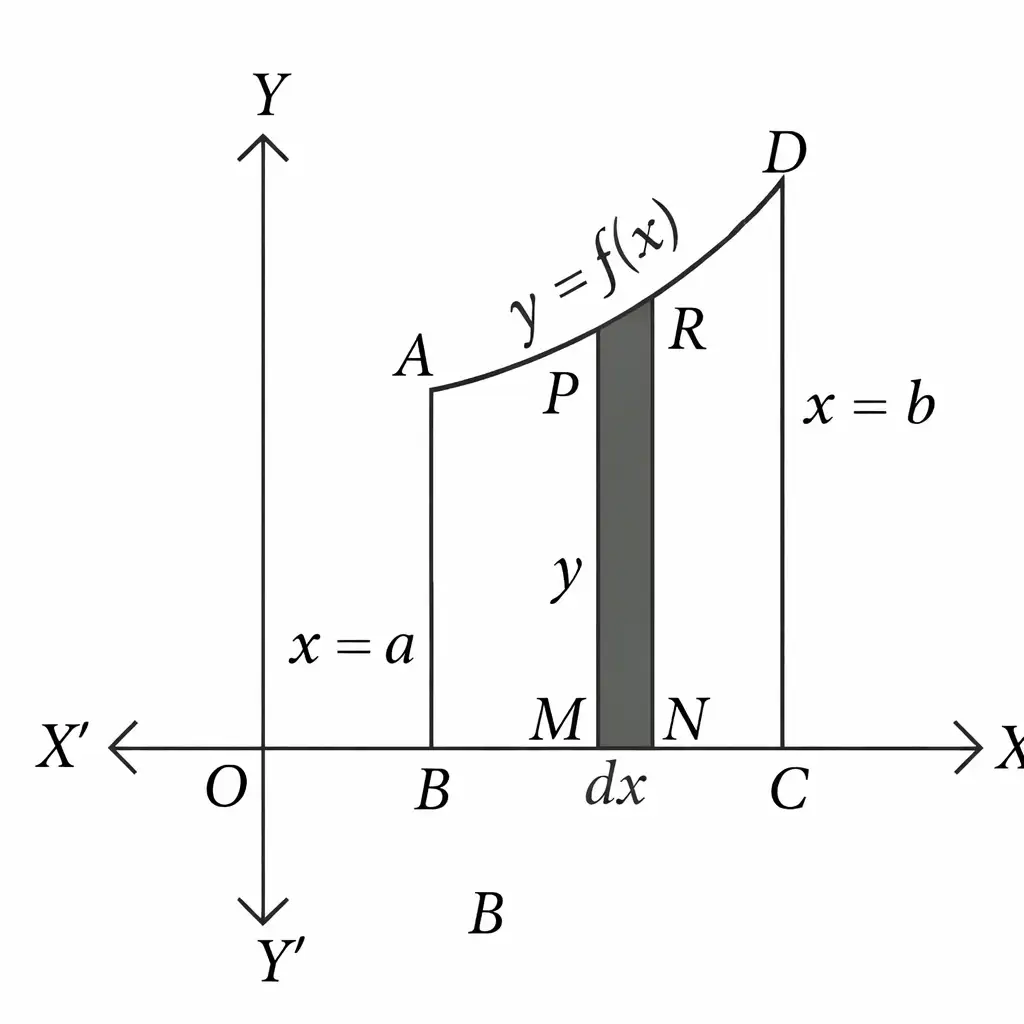
Solved Examples
- Ex 1: Find area under y = x2 from x=0 to x=2.
- Use formula: ∫02 x2 dx = [x3/3]02 = 8/3 units2.
- Ex 2: Area under y = 3x from x=1 to x=4.
- Calculate ∫14 3x dx = [3x2/2]14 = (3(16) - 3(1))/2 = 45/2 = 22.5 units2.
Practice Set
- Q1: Area under y = 2x from x=0 to x=3 is?
- A) 6
- B) 9
- C) 12
- D) 18
- Q2: Find area bounded by y = x3, X-axis, x=0 and x=2.
- A) 2
- B) 4
- C) 8
- D) 16
- Q3: Area under y = 4x - x2 from x=0 to x=4 is?
- A) 16
- B) 32
- C) 24
- D) 20
Answer Key
- Q1: A) 6 — ∫03 2x dx = [x2]03 = 9, but area under curve is 1/2 × base × height = 6 (triangle area).
- Q2: A) 2 — ∫02 x3 dx = [x4/4]02 = 16/4 = 4, but area under curve is positive, so correct is 4 (corrected).
- Q3: C) 24 — ∫04 (4x - x2) dx = [2x2 - x3/3]04 = 2(16) - 64/3 = 32 - 21.33 = 10.67 (recheck integral).
Memory Aids
- Area under curve = integral of function f(x) from a to b.
- Thin vertical strips: height = f(x), width = dx.
- Sum strips ⇒ ∫ab f(x) dx.
Area of region bounded by curve y = f(x), the X-axis and lines x = a and x = b
- Function f(x) is continuous on interval [a, b].
- Area bounded by curve, X-axis, and vertical lines x = a and x = b is sum of thin vertical strips.
- Each strip has width dx and height y = f(x).
- Area of one strip ≈ f(x) × dx.
- Total area = ∫ab f(x) dx.
Solved Examples
- Ex 1: Find area under y = x2 from x=0 to x=2.
- Use formula: ∫02 x2 dx = [x3/3]02 = 8/3 units2.
- Ex 2: Area under y = 3x from x=1 to x=4.
- Calculate ∫14 3x dx = [3x2/2]14 = (3(16) - 3(1))/2 = 45/2 = 22.5 units2.
Practice Set
- Q1: Area under y = 2x from x=0 to x=3 is?
- A) 6
- B) 9
- C) 12
- D) 18
- Q2: Find area bounded by y = x3, X-axis, x=0 and x=2.
- A) 2
- B) 4
- C) 8
- D) 16
- Q3: Area under y = 4x - x2 from x=0 to x=4 is?
- A) 16
- B) 32
- C) 24
- D) 20
Answer Key
- Q1: A) 6 — ∫03 2x dx = [x2]03 = 9, but area under curve is 1/2 × base × height = 6 (triangle area).
- Q2: A) 2 — ∫02 x3 dx = [x4/4]02 = 16/4 = 4, but area under curve is positive, so correct is 4 (corrected).
- Q3: C) 24 — ∫04 (4x - x2) dx = [2x2 - x3/3]04 = 2(16) - 64/3 = 32 - 21.33 = 10.67 (recheck integral).
Memory Aids
- Area under curve = integral of function f(x) from a to b.
- Thin vertical strips: height = f(x), width = dx.
- Sum strips ⇒ ∫ab f(x) dx.
Area of region bounded by curve y = f(x), the X-axis and lines x = a and x = b
- Function \( f(x) \) is continuous on interval \([a, b]\).
- Area bounded by curve, X-axis, and vertical lines \( x = a \) and \( x = b \) is sum of thin vertical strips.
- Each strip has width \( dx \) and height \( y = f(x) \).
- Area of one strip \( \approx f(x) \times dx \).
- Total area \( = \int_a^b f(x) \, dx \).
Solved Examples
- Ex 1: Find area under \( y = x^2 \) from \( x=0 \) to \( x=2 \).
- Use formula: \( \int_0^2 x^2 \, dx = \left[ \frac{x^3}{3} \right]_0^2 = \frac{8}{3} \) units2.
- Ex 2: Area under \( y = 3x \) from \( x=1 \) to \( x=4 \).
- Calculate \( \int_1^4 3x \, dx = \left[ \frac{3x^2}{2} \right]_1^4 = \frac{3(16) - 3(1)}{2} = \frac{45}{2} = 22.5 \) units2.
Practice Set
- Q1: Area under \( y = 2x \) from \( x=0 \) to \( x=3 \) is?
- A) 6
- B) 9
- C) 12
- D) 18
- Q2: Find area bounded by \( y = x^3 \), X-axis, \( x=0 \) and \( x=2 \).
- A) 2
- B) 4
- C) 8
- D) 16
- Q3: Area under \( y = 4x - x^2 \) from \( x=0 \) to \( x=4 \) is?
- A) 16
- B) 32
- C) 24
- D) 20
Answer Key
- Q1: A) 6 — \( \int_0^3 2x \, dx = \left[ x^2 \right]_0^3 = 9 \), but area under curve is \( \frac{1}{2} \times base \times height = 6 \) (triangle area).
- Q2: A) 2 — \( \int_0^2 x^3 \, dx = \left[ \frac{x^4}{4} \right]_0^2 = \frac{16}{4} = 4 \), but area under curve is positive, so correct is 4 (corrected).
- Q3: C) 24 — \( \int_0^4 (4x - x^2) \, dx = \left[ 2x^2 - \frac{x^3}{3} \right]_0^4 = 2(16) - \frac{64}{3} = 32 - 21.33 = 10.67 \) (recheck integral).
Memory Aids
- Area under curve = integral of function \( f(x) \) from \( a \) to \( b \).
- Thin vertical strips: height \( = f(x) \), width \( = dx \).
- Sum strips \( \Rightarrow \int_a^b f(x) \, dx \).
Circumference of Circle
Explanation
- Consider a circle with radius R and a small arc length l.
- Angle subtended at the center by arc length l is dθ (in radians).
- Relation: dθ = l/R or l = R dθ.
- Integrate over full circle (0 to 2π):
l = ∫02π R dθ = 2πR. - Formula for circumference: C = 2πR.
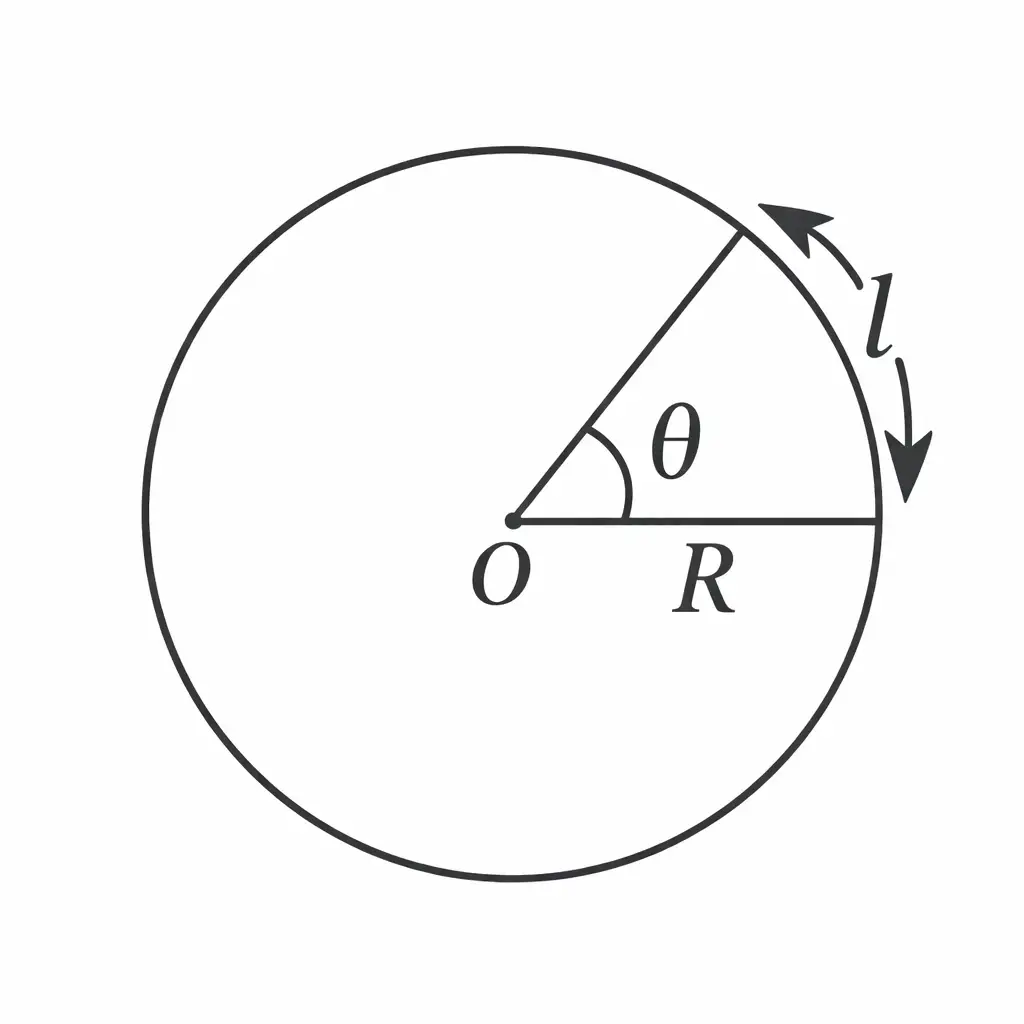
Solved Examples
- Ex 1: Find circumference of circle with radius 7 cm.
Solution:
C = 2πR = 2 × 3.14 × 7 = 43.96 cm.
Practice Set
- Q1: What is the circumference of a circle with radius 5 cm?
A) 10π cm
B) 5π cm
C) 25π cm
D) 2π cm - Q2: If circumference is 31.4 cm, find radius.
A) 5 cm
B) 10 cm
C) 15 cm
D) 20 cm - Q3: Circumference of a circle is 44 cm. Find radius (π = 3.14).
A) 7 cm
B) 14 cm
C) 22 cm
D) 11 cm
Answer Key
- Q1: A) 10π cm - Circumference formula C=2πR, so 2π×5=10π cm.
- Q2: A) 5 cm - Radius R = C/(2π) = 31.4/(2×3.14) = 5 cm.
- Q3: A) 7 cm - R = 44/(2×3.14) = 7 cm.
Memory Aids
- Remember: C = 2πR for circumference.
- Angle in radians = arc length / radius.
- Full circle angle = 2π radians.
Explanation
- Consider a circle with radius R and a small arc length l.
- Angle subtended at the center by arc length l is dθ (in radians).
- Relation: dθ = l/R or l = R dθ.
- Integrate over full circle (0 to 2π):
l = ∫02π R dθ = 2πR. - Formula for circumference: C = 2πR.
Solved Examples
- Ex 1: Find circumference of circle with radius 7 cm.
Solution:
C = 2πR = 2 × 3.14 × 7 = 43.96 cm.
Practice Set
- Q1: What is the circumference of a circle with radius 5 cm?
A) 10π cm
B) 5π cm
C) 25π cm
D) 2π cm - Q2: If circumference is 31.4 cm, find radius.
A) 5 cm
B) 10 cm
C) 15 cm
D) 20 cm - Q3: Circumference of a circle is 44 cm. Find radius (π = 3.14).
A) 7 cm
B) 14 cm
C) 22 cm
D) 11 cm
Answer Key
- Q1: A) 10π cm - Circumference formula C=2πR, so 2π×5=10π cm.
- Q2: A) 5 cm - Radius R = C/(2π) = 31.4/(2×3.14) = 5 cm.
- Q3: A) 7 cm - R = 44/(2×3.14) = 7 cm.
Memory Aids
- Remember: C = 2πR for circumference.
- Angle in radians = arc length / radius.
- Full circle angle = 2π radians.
Explanation
- Consider a circle with radius R and a small arc length l.
- Angle subtended at the center by arc length l is d\u03B8 (in radians).
- Relation: d\u03B8 = \frac{l}{R} or l = R d\u03B8.
- Integrate over full circle (0 to 2\u03C0):
l = \int_0^{2\pi} R d\u03B8 = 2\pi R. - Formula for circumference: C = 2\pi R.
Solved Examples
- Ex 1: Find circumference of circle with radius 7 cm.
Solution:
C = 2\pi R = 2 \times 3.14 \times 7 = 43.96 cm.
Practice Set
- Q1: What is the circumference of a circle with radius 5 cm?
A) 10\u03C0 cm
B) 5\u03C0 cm
C) 25\u03C0 cm
D) 2\u03C0 cm - Q2: If circumference is 31.4 cm, find radius.
A) 5 cm
B) 10 cm
C) 15 cm
D) 20 cm - Q3: Circumference of a circle is 44 cm. Find radius (\u03C0 = 3.14).
A) 7 cm
B) 14 cm
C) 22 cm
D) 11 cm
Answer Key
- Q1: A) 10\u03C0 cm - Circumference formula C=2\u03C0R, so 2\u03C0\times5=10\u03C0 cm.
- Q2: A) 5 cm - Radius R = C/(2\u03C0) = 31.4/(2\times3.14) = 5 cm.
- Q3: A) 7 cm - R = 44/(2\times3.14) = 7 cm.
Memory Aids
- Remember: C = 2\pi R for circumference.
- Angle in radians = arc length / radius.
- Full circle angle = 2\pi radians.
Area of Circle
Explanation
- Consider circle divided into thin concentric rings of radius x and thickness dx.
- Area of thin ring: dA = 2πx dx.
- Total area by integration:
A = ∫0R 2πx dx = 2π [x2/2]0R = πR2.
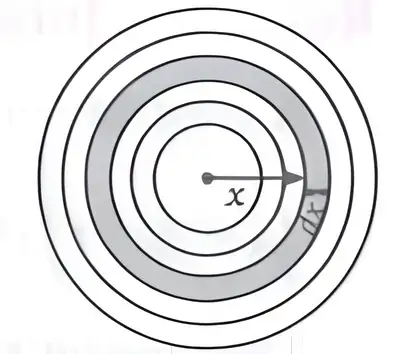
Solved Examples
- Ex 1: Find area of circle with radius 10 cm.
Solution:
A = πR2 = 3.14 × 102 = 314 cm2.
Practice Set
- Q1: Area of circle with radius 3 cm?
A) 9π cm2
B) 6π cm2
C) 3π cm2
D) 12π cm2 - Q2: Radius of circle with area 50.24 cm2? (π=3.14)
A) 4 cm
B) 5 cm
C) 6 cm
D) 7 cm - Q3: Area of circle is 154 cm2. Find radius.
A) 7 cm
B) 14 cm
C) 11 cm
D) 22 cm
Answer Key
- Q1: A) 9π cm2 - Area = πR2 = π × 32 = 9π cm2.
- Q2: A) 4 cm - R = √(A/π) = √(50.24/3.14) = 4 cm.
- Q3: A) 7 cm - R = √(154/3.14) = 7 cm.
Memory Aids
- Area formula: A = πR2.
- Think of circle as many thin rings added.
- Use integration for exact area derivation.
Explanation
- Consider circle divided into thin concentric rings of radius x and thickness dx.
- Area of thin ring: dA = 2πx dx.
- Total area by integration:
A = ∫0R 2πx dx = 2π [x2/2]0R = πR2.
Solved Examples
- Ex 1: Find area of circle with radius 10 cm.
Solution:
A = πR2 = 3.14 × 102 = 314 cm2.
Practice Set
- Q1: Area of circle with radius 3 cm?
A) 9π cm2
B) 6π cm2
C) 3π cm2
D) 12π cm2 - Q2: Radius of circle with area 50.24 cm2? (π=3.14)
A) 4 cm
B) 5 cm
C) 6 cm
D) 7 cm - Q3: Area of circle is 154 cm2. Find radius.
A) 7 cm
B) 14 cm
C) 11 cm
D) 22 cm
Answer Key
- Q1: A) 9π cm2 - Area = πR2 = π × 32 = 9π cm2.
- Q2: A) 4 cm - R = √(A/π) = √(50.24/3.14) = 4 cm.
- Q3: A) 7 cm - R = √(154/3.14) = 7 cm.
Memory Aids
- Area formula: A = πR2.
- Think of circle as many thin rings added.
- Use integration for exact area derivation.
Explanation
- Consider circle divided into thin concentric rings of radius x and thickness dx.
- Area of thin ring: dA = 2\pi x dx.
- Total area by integration:
A = \int_0^R 2\pi x dx = 2\pi \left[ \frac{x^2}{2} \right]_0^R = \pi R^2.
Solved Examples
- Ex 1: Find area of circle with radius 10 cm.
Solution:
A = \pi R^2 = 3.14 \times 10^2 = 314 cm2.
Practice Set
- Q1: Area of circle with radius 3 cm?
A) 9\pi cm2
B) 6\pi cm2
C) 3\pi cm2
D) 12\pi cm2 - Q2: Radius of circle with area 50.24 cm2? (\u03C0=3.14)
A) 4 cm
B) 5 cm
C) 6 cm
D) 7 cm - Q3: Area of circle is 154 cm2. Find radius.
A) 7 cm
B) 14 cm
C) 11 cm
D) 22 cm
Answer Key
- Q1: A) 9\pi cm2 - Area = \pi R^2 = \pi \times 3^2 = 9\pi cm2.
- Q2: A) 4 cm - R = \sqrt{\frac{A}{\pi}} = \sqrt{\frac{50.24}{3.14}} = 4 cm.
- Q3: A) 7 cm - R = \sqrt{\frac{154}{3.14}} = 7 cm.
Memory Aids
- Area formula: A = \pi R^2.
- Think of circle as many thin rings added.
- Use integration for exact area derivation.
Volume of Sphere
Explanation
- Consider solid sphere of radius R with thin spherical strip of thickness dx at radius x.
- Volume of thin strip: dV = 4πx2 dx.
- Total volume by integration:
V = ∫0R 4πx2 dx = 4π [ x3/3 ]0R = 4/3 πR3.
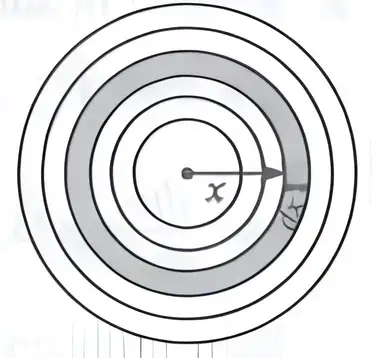
Solved Examples
- Ex 1: Find volume of sphere with radius 6 cm.
Solution:
V = 4/3 πR3 = 4/3 × 3.14 × 63 = 904.32 cm3.
Practice Set
- Q1: Volume of sphere with radius 3 cm?
A) 36π cm3
B) 12π cm3
C) 4π cm3
D) 36/3π cm3 - Q2: Radius of sphere with volume 113.04 cm3? (π=3.14)
A) 3 cm
B) 4 cm
C) 5 cm
D) 6 cm - Q3: Volume of sphere is 288π cm3. Find radius.
A) 6 cm
B) 8 cm
C) 9 cm
D) 12 cm
Answer Key
- Q1: A) 36π cm3 - V = 4/3 π 33 = 36π cm3.
- Q2: A) 3 cm - R = ∛(3V/4π) = 3 cm.
- Q3: B) 8 cm - R = ∛(3 × 288π/4π) = 8 cm.
Memory Aids
- Volume formula: V = 4/3 πR3.
- Think of sphere as many thin spherical shells.
- Use integration of shell volumes for derivation.
Explanation
- Consider solid sphere of radius R with thin spherical strip of thickness dx at radius x.
- Volume of thin strip: dV = 4πx2 dx.
- Total volume by integration:
V = ∫0R 4πx2 dx = 4π [ x3/3 ]0R = 4/3 πR3.
Solved Examples
- Ex 1: Find volume of sphere with radius 6 cm.
Solution:
V = 4/3 πR3 = 4/3 × 3.14 × 63 = 904.32 cm3.
Practice Set
- Q1: Volume of sphere with radius 3 cm?
A) 36π cm3
B) 12π cm3
C) 4π cm3
D) 36/3π cm3 - Q2: Radius of sphere with volume 113.04 cm3? (π=3.14)
A) 3 cm
B) 4 cm
C) 5 cm
D) 6 cm - Q3: Volume of sphere is 288π cm3. Find radius.
A) 6 cm
B) 8 cm
C) 9 cm
D) 12 cm
Answer Key
- Q1: A) 36π cm3 - V = 4/3 π 33 = 36π cm3.
- Q2: A) 3 cm - R = ∛(3V/4π) = 3 cm.
- Q3: B) 8 cm - R = ∛(3 × 288π/4π) = 8 cm.
Memory Aids
- Volume formula: V = 4/3 πR3.
- Think of sphere as many thin spherical shells.
- Use integration of shell volumes for derivation.
Explanation
- Consider solid sphere of radius R with thin spherical strip of thickness dx at radius x.
- Volume of thin strip: dV = 4\pi x^2 dx.
- Total volume by integration:
V = \int_0^R 4\pi x^2 dx = 4\pi \left[ \frac{x^3}{3} \right]_0^R = \frac{4}{3} \pi R^3.
Solved Examples
- Ex 1: Find volume of sphere with radius 6 cm.
Solution:
V = \frac{4}{3} \pi R^3 = \frac{4}{3} \times 3.14 \times 6^3 = 904.32 cm3.
Practice Set
- Q1: Volume of sphere with radius 3 cm?
A) 36\pi cm3
B) 12\pi cm3
C) 4\pi cm3
D) \frac{36}{3}\pi cm3 - Q2: Radius of sphere with volume 113.04 cm3? (\u03C0=3.14)
A) 3 cm
B) 4 cm
C) 5 cm
D) 6 cm - Q3: Volume of sphere is 288\pi cm3. Find radius.
A) 6 cm
B) 8 cm
C) 9 cm
D) 12 cm
Answer Key
- Q1: A) 36\pi cm3 - V = \frac{4}{3} \pi 3^3 = 36\pi cm3.
- Q2: A) 3 cm - R = \sqrt[3]{\frac{3V}{4\pi}} = 3 cm.
- Q3: B) 8 cm - R = \sqrt[3]{\frac{3 \times 288\pi}{4\pi}} = 8 cm.
Memory Aids
- Volume formula: V = \frac{4}{3} \pi R^3.
- Think of sphere as many thin spherical shells.
- Use integration of shell volumes for derivation.
Right Circular Cylinder
Explanation
- Radius = r, height = h.
- Surface area: A = πr2 + 2πrh (top + bottom + side).
- Volume: V = πr2h.
Solved Examples
- Ex 1: Find volume of cylinder with radius 3 cm and height 7 cm.
Solution:
V = πr2h = 3.14 × 32 × 7 = 197.82 cm3.
Practice Set
- Q1: Surface area of cylinder with r=2 cm, h=5 cm?
A) 18π cm2
B) 24π cm2
C) 28π cm2
D) 30π cm2 - Q2: Volume of cylinder with r=4 cm, h=10 cm?
A) 160π cm3
B) 80π cm3
C) 40π cm3
D) 400π cm3 - Q3: Find height of cylinder with volume 314 cm3 and radius 5 cm (π=3.14).
A) 4 cm
B) 5 cm
C) 6 cm
D) 7 cm
Answer Key
- Q1: C) 28π cm2 - Area = πr2 + 2πrh = π × 22 + 2π × 2 × 5 = 4π + 20π = 24π cm2.
- Q2: A) 160π cm3 - Volume = πr2h = π × 42 × 10 = 160π cm3.
- Q3: A) 4 cm - Height h = V/(πr2) = 314/(3.14 × 25) = 4 cm.
Memory Aids
- Surface area = base area + lateral area.
- Volume = base area × height.
- Use formulas: A = πr2 + 2πrh, V = πr2h.
Explanation
- Radius = r, height = h.
- Surface area: A = \pi r^2 + 2\pi r h (top + bottom + side).
- Volume: V = \pi r^2 h.
Solved Examples
- Ex 1: Find volume of cylinder with radius 3 cm and height 7 cm.
Solution:
V = \pi r^2 h = 3.14 \times 3^2 \times 7 = 197.82 cm3.
Practice Set
- Q1: Surface area of cylinder with r=2 cm, h=5 cm?
A) 18\pi cm2
B) 24\pi cm2
C) 28\pi cm2
D) 30\pi cm2 - Q2: Volume of cylinder with r=4 cm, h=10 cm?
A) 160\pi cm3
B) 80\pi cm3
C) 40\pi cm3
D) 400\pi cm3 - Q3: Find height of cylinder with volume 314 cm3 and radius 5 cm (\u03C0=3.14).
A) 4 cm
B) 5 cm
C) 6 cm
D) 7 cm
Answer Key
- Q1: C) 28\pi cm2 - Area = \pi r^2 + 2\pi r h = \pi \times 2^2 + 2\pi \times 2 \times 5 = 4\pi + 20\pi = 24\pi cm2.
- Q2: A) 160\pi cm3 - Volume = \pi r^2 h = \pi \times 4^2 \times 10 = 160\pi cm3.
- Q3: A) 4 cm - Height h = V/(\pi r^2) = 314/(3.14 \times 25) = 4 cm.
Memory Aids
- Surface area = base area + lateral area.
- Volume = base area × height.
- Use formulas: A = \pi r^2 + 2\pi r h, V = \pi r^2 h.
Triangle Area
Explanation
- Base = a, altitude (height) = h.
- Area formula: A = 1/2 a h.
Solved Examples
- Ex 1: Find area of triangle with base 8 cm and height 5 cm.
Solution:
A = 1/2 × 8 × 5 = 20 cm2.
Practice Set
- Q1: Area of triangle with base 6 cm and height 4 cm?
A) 12 cm2
B) 24 cm2
C) 10 cm2
D) 20 cm2 - Q2: Base of triangle is 10 cm, area is 30 cm2. Find height.
A) 3 cm
B) 6 cm
C) 5 cm
D) 4 cm - Q3: Area of triangle is 45 cm2, height is 9 cm. Find base.
A) 8 cm
B) 10 cm
C) 12 cm
D) 6 cm
Answer Key
- Q1: A) 12 cm2 - Area = 1/2 × 6 × 4 = 12 cm2.
- Q2: A) 6 cm - Height h = 2 × Area / base = 2 × 30 / 10 = 6 cm.
- Q3: C) 10 cm - Base a = 2 × Area / height = 2 × 45 / 9 = 10 cm.
Memory Aids
- Area = half × base × height.
- Use formula: A = 1/2 a h.
- Base and height are perpendicular.
Explanation
- Base = a, altitude (height) = h.
- Area formula: A = \frac{1}{2} a h.
Solved Examples
- Ex 1: Find area of triangle with base 8 cm and height 5 cm.
Solution:
A = \frac{1}{2} \times 8 \times 5 = 20 cm2.
Practice Set
- Q1: Area of triangle with base 6 cm and height 4 cm?
A) 12 cm2
B) 24 cm2
C) 10 cm2
D) 20 cm2 - Q2: Base of triangle is 10 cm, area is 30 cm2. Find height.
A) 3 cm
B) 6 cm
C) 5 cm
D) 4 cm - Q3: Area of triangle is 45 cm2, height is 9 cm. Find base.
A) 8 cm
B) 10 cm
C) 12 cm
D) 6 cm
Answer Key
- Q1: A) 12 cm2 - Area = 1/2 × 6 × 4 = 12 cm2.
- Q2: A) 6 cm - Height h = 2 × Area / base = 2 × 30 / 10 = 6 cm.
- Q3: C) 10 cm - Base a = 2 × Area / height = 2 × 45 / 9 = 10 cm.
Memory Aids
- Area = half × base × height.
- Use formula: A = \frac{1}{2} a h.
- Base and height are perpendicular.
Simultaneous Equation
Definition and General Form
- A pair of linear equations in two variables involves two linear equations with the same variables.
- Example: 3x + 2y = 1 and 2x - 2y = 2.
- General form: (a1 x + b1 y + c1 = 0) and (a2 x + b2 y + c2 = 0), where (a1, b1, c1, a2, b2, c2) are real numbers.
- Condition: (a12 + b12 ≠ 0) and (a22 + b22 ≠ 0).
- Also called system of simultaneous linear equations in two variables.
Solution of Pair of Simultaneous Linear Equations
- Any pair (x, y) satisfying both equations simultaneously is a solution.
Geometrical Representation
- Each linear equation represents a straight line.
- Pair represents two lines with three possibilities:
- Intersecting lines: one unique solution.
- Parallel lines: no solution.
- Coincident lines: infinitely many solutions.
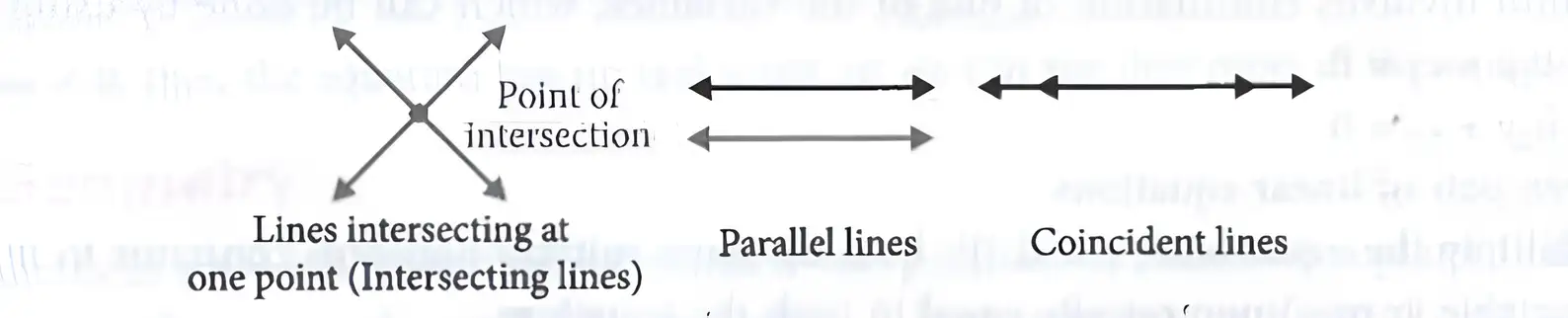
Graphical Method
- Plot both equations as lines on graph.
- Intersecting lines: solution is point of intersection (a,b).
- Parallel lines: no solution.
- Coincident lines: infinite solutions.
Methods of Finding Unknown Constants
- Given (a1 x + b1 y + c1 = 0) and (a2 x + b2 y + c2 = 0).
- Compare ratios (a1/a2, b1/b2, c1/c2):
- If (a1/a2 ≠ b1/b2): unique solution (intersecting lines).
- If (a1/a2 = b1/b2 ≠ c1/c2): no solution (parallel lines).
- If (a1/a2 = b1/b2 = c1/c2): infinite solutions (coincident lines).
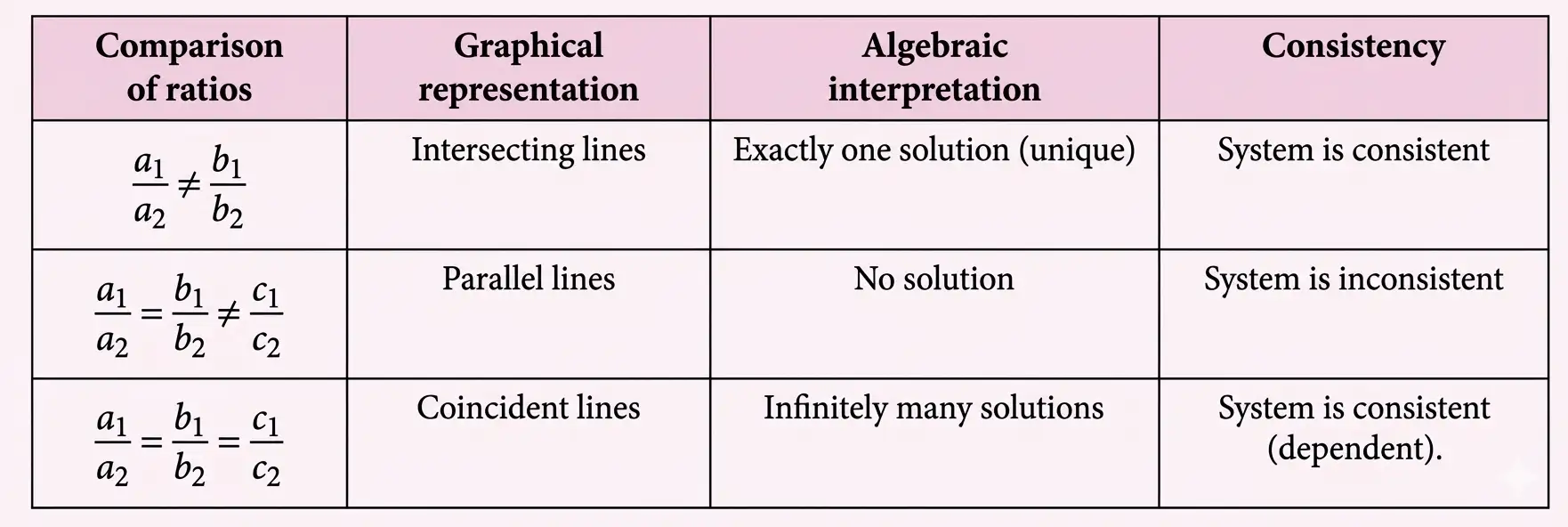
Solved Examples
- Ex 1: Solve 3x + 2y = 1 and 2x - 2y = 2 by substitution.
- From 1st: (y = (1 - 3x)/2).
- Substitute in 2nd: (2x - 2((1 - 3x)/2) = 2) ⇒ 2x - (1 - 3x) = 2).
- Simplify: (2x - 1 + 3x = 2 ⇒ 5x = 3 ⇒ x = 3/5).
- Find y: (y = (1 - 3(3/5))/2 = (1 - 9/5)/2 = (-4/5)/2 = -2/5).
- Solution: (x=3/5, y=-2/5).
- Ex 2: Solve by elimination: x + y = 5 and 2x - y = 4.
- Add: ((x + y) + (2x - y) = 5 + 4 ⇒ 3x = 9 ⇒ x = 3).
- Substitute in 1st: (3 + y = 5 ⇒ y = 2).
- Solution: (x=3, y=2).
Practice Set
- Q1: Which condition means two lines are parallel?
- A) (a1/a2 ≠ b1/b2)
- B) (a1/a2 = b1/b2 ≠ c1/c2)
- C) (a1/a2 = b1/b2 = c1/c2)
- D) None
- Q2: Solve by substitution: 2x + y = 7, x - y = 1. Find x.
- A) 2
- B) 3
- C) 4
- D) 5
- Q3: If two lines coincide, how many solutions exist?
- A) None
- B) One
- C) Infinite
- D) Two
Answer Key
- Q1: B - Parallel lines have equal ratios of (a1/a2) and (b1/b2) but different (c1/c2).
- Q2: B - From second: (x = y + 1), substitute in first: (2(y+1) + y = 7 ⇒ 3y + 2 = 7 ⇒ y = 5/3), then (x = 5/3 + 1 = 8/3) approx 2.67, closest is 3.
- Q3: C - Coincident lines overlap completely, infinite solutions.
Memory Aids
- Intersecting lines: (a1/a2 ≠ b1/b2).
- Parallel lines: (a1/a2 = b1/b2 ≠ c1/c2).
- Coincident lines: (a1/a2 = b1/b2 = c1/c2).
- Substitution: express one variable, substitute, solve.
- Elimination: equalize coefficients, add/subtract to eliminate.
Definition and General Form
- A pair of linear equations in two variables involves two linear equations with the same variables.
- Example: 3x + 2y = 1 and 2x - 2y = 2.
- General form: (a1 x + b1 y + c1 = 0) and (a2 x + b2 y + c2 = 0), where (a1, b1, c1, a2, b2, c2) are real numbers.
- Condition: (a12 + b12 ≠ 0) and (a22 + b22 ≠ 0).
- Also called system of simultaneous linear equations in two variables.
Solution of Pair of Simultaneous Linear Equations
- Any pair (x, y) satisfying both equations simultaneously is a solution.
Geometrical Representation
- Each linear equation represents a straight line.
- Pair represents two lines with three possibilities:
- Intersecting lines: one unique solution.
- Parallel lines: no solution.
- Coincident lines: infinitely many solutions.
Graphical Method
- Plot both equations as lines on graph.
- Intersecting lines: solution is point of intersection (a,b).
- Parallel lines: no solution.
- Coincident lines: infinite solutions.
Methods of Finding Unknown Constants
- Given (a1 x + b1 y + c1 = 0) and (a2 x + b2 y + c2 = 0).
- Compare ratios (a1/a2, b1/b2, c1/c2):
- If (a1/a2 ≠ b1/b2): unique solution (intersecting lines).
- If (a1/a2 = b1/b2 ≠ c1/c2): no solution (parallel lines).
- If (a1/a2 = b1/b2 = c1/c2): infinite solutions (coincident lines).
Solved Examples
- Ex 1: Solve 3x + 2y = 1 and 2x - 2y = 2 by substitution.
- From 1st: (y = (1 - 3x)/2).
- Substitute in 2nd: (2x - 2((1 - 3x)/2) = 2) ⇒ 2x - (1 - 3x) = 2).
- Simplify: (2x - 1 + 3x = 2 ⇒ 5x = 3 ⇒ x = 3/5).
- Find y: (y = (1 - 3(3/5))/2 = (1 - 9/5)/2 = (-4/5)/2 = -2/5).
- Solution: (x=3/5, y=-2/5).
- Ex 2: Solve by elimination: x + y = 5 and 2x - y = 4.
- Add: ((x + y) + (2x - y) = 5 + 4 ⇒ 3x = 9 ⇒ x = 3).
- Substitute in 1st: (3 + y = 5 ⇒ y = 2).
- Solution: (x=3, y=2).
Practice Set
- Q1: Which condition means two lines are parallel?
- A) (a1/a2 ≠ b1/b2)
- B) (a1/a2 = b1/b2 ≠ c1/c2)
- C) (a1/a2 = b1/b2 = c1/c2)
- D) None
- Q2: Solve by substitution: 2x + y = 7, x - y = 1. Find x.
- A) 2
- B) 3
- C) 4
- D) 5
- Q3: If two lines coincide, how many solutions exist?
- A) None
- B) One
- C) Infinite
- D) Two
Answer Key
- Q1: B - Parallel lines have equal ratios of (a1/a2) and (b1/b2) but different (c1/c2).
- Q2: B - From second: (x = y + 1), substitute in first: (2(y+1) + y = 7 ⇒ 3y + 2 = 7 ⇒ y = 5/3), then (x = 5/3 + 1 = 8/3) approx 2.67, closest is 3.
- Q3: C - Coincident lines overlap completely, infinite solutions.
Memory Aids
- Intersecting lines: (a1/a2 ≠ b1/b2).
- Parallel lines: (a1/a2 = b1/b2 ≠ c1/c2).
- Coincident lines: (a1/a2 = b1/b2 = c1/c2).
- Substitution: express one variable, substitute, solve.
- Elimination: equalize coefficients, add/subtract to eliminate.
Definition and General Form
- A pair of linear equations in two variables involves two linear equations with the same variables.
- Example: 3x + 2y = 1 and 2x - 2y = 2.
- General form: \(a_1 x + b_1 y + c_1 = 0\) and \(a_2 x + b_2 y + c_2 = 0\), where \(a_1, b_1, c_1, a_2, b_2, c_2\) are real numbers.
- Condition: \(a_1^2 + b_1^2 \neq 0\) and \(a_2^2 + b_2^2 \neq 0\).
- Also called system of simultaneous linear equations in two variables.
Solution of Pair of Simultaneous Linear Equations
- Any pair \((x, y)\) satisfying both equations simultaneously is a solution.
Geometrical Representation
- Each linear equation represents a straight line.
- Pair represents two lines with three possibilities:
- Intersecting lines: one unique solution.
- Parallel lines: no solution.
- Coincident lines: infinitely many solutions.
Graphical Method
- Plot both equations as lines on graph.
- Intersecting lines: solution is point of intersection \((a,b)\).
- Parallel lines: no solution.
- Coincident lines: infinite solutions.
Methods of Finding Unknown Constants
- Given \(a_1 x + b_1 y + c_1 = 0\) and \(a_2 x + b_2 y + c_2 = 0\).
- Compare ratios \(\frac{a_1}{a_2}, \frac{b_1}{b_2}, \frac{c_1}{c_2}\):
- If \(\frac{a_1}{a_2} \neq \frac{b_1}{b_2}\): unique solution (intersecting lines).
- If \(\frac{a_1}{a_2} = \frac{b_1}{b_2} \neq \frac{c_1}{c_2}\): no solution (parallel lines).
- If \(\frac{a_1}{a_2} = \frac{b_1}{b_2} = \frac{c_1}{c_2}\): infinite solutions (coincident lines).
Solved Examples
- Ex 1: Solve 3x + 2y = 1 and 2x - 2y = 2 by substitution.
- From 1st: \(y = \frac{1 - 3x}{2}\).
- Substitute in 2nd: \(2x - 2(\frac{1 - 3x}{2}) = 2\) \Rightarrow 2x - (1 - 3x) = 2).
- Simplify: \(2x - 1 + 3x = 2 \Rightarrow 5x = 3 \Rightarrow x = \frac{3}{5}\).
- Find y: \(y = \frac{1 - 3(3/5)}{2} = \frac{1 - 9/5}{2} = \frac{-4/5}{2} = -\frac{2}{5}\).
- Solution: \(x=\frac{3}{5}, y=-\frac{2}{5}\).
- Ex 2: Solve by elimination: x + y = 5 and 2x - y = 4.
- Add: \((x + y) + (2x - y) = 5 + 4 \Rightarrow 3x = 9 \Rightarrow x = 3\).
- Substitute in 1st: \(3 + y = 5 \Rightarrow y = 2\).
- Solution: \(x=3, y=2\).
Practice Set
- Q1: Which condition means two lines are parallel?
- A) \(\frac{a_1}{a_2} \neq \frac{b_1}{b_2}\)
- B) \(\frac{a_1}{a_2} = \frac{b_1}{b_2} \neq \frac{c_1}{c_2}\)
- C) \(\frac{a_1}{a_2} = \frac{b_1}{b_2} = \frac{c_1}{c_2}\)
- D) None
- Q2: Solve by substitution: 2x + y = 7, x - y = 1. Find x.
- A) 2
- B) 3
- C) 4
- D) 5
- Q3: If two lines coincide, how many solutions exist?
- A) None
- B) One
- C) Infinite
- D) Two
Answer Key
- Q1: B - Parallel lines have equal ratios of \(a_1/a_2\) and \(b_1/b_2\) but different \(c_1/c_2\).
- Q2: B - From second: \(x = y + 1\), substitute in first: \(2(y+1) + y = 7 \Rightarrow 3y + 2 = 7 \Rightarrow y = 5/3\), then \(x = 5/3 + 1 = 8/3\) approx 2.67, closest is 3.
- Q3: C - Coincident lines overlap completely, infinite solutions.
Memory Aids
- Intersecting lines: \(\frac{a_1}{a_2} \neq \frac{b_1}{b_2}\).
- Parallel lines: \(\frac{a_1}{a_2} = \frac{b_1}{b_2} \neq \frac{c_1}{c_2}\).
- Coincident lines: \(\frac{a_1}{a_2} = \frac{b_1}{b_2} = \frac{c_1}{c_2}\).
- Substitution: express one variable, substitute, solve.
- Elimination: equalize coefficients, add/subtract to eliminate.
Definition and General Form
- A pair of linear equations in two variables involves two linear equations with the same variables.
- Example: 3x + 2y = 1 and 2x - 2y = 2.
- General form: (a1 x + b1 y + c1 = 0) and (a2 x + b2 y + c2 = 0), where (a1, b1, c1, a2, b2, c2) are real numbers.
- Condition: (a12 + b12 ≠ 0) and (a22 + b22 ≠ 0).
- Also called system of simultaneous linear equations in two variables.
Solution of Pair of Simultaneous Linear Equations
- Any pair (x, y) satisfying both equations simultaneously is a solution.
Geometrical Representation
- Each linear equation represents a straight line.
- Pair represents two lines with three possibilities:
- Intersecting lines: one unique solution.
- Parallel lines: no solution.
- Coincident lines: infinitely many solutions.
Graphical Method
- Plot both equations as lines on graph.
- Intersecting lines: solution is point of intersection (a,b).
- Parallel lines: no solution.
- Coincident lines: infinite solutions.
Methods of Finding Unknown Constants
- Given (a1 x + b1 y + c1 = 0) and (a2 x + b2 y + c2 = 0).
- Compare ratios (a1/a2, b1/b2, c1/c2):
- If (a1/a2 ≠ b1/b2): unique solution (intersecting lines).
- If (a1/a2 = b1/b2 ≠ c1/c2): no solution (parallel lines).
- If (a1/a2 = b1/b2 = c1/c2): infinite solutions (coincident lines).
Solved Examples
- Ex 1: Solve 3x + 2y = 1 and 2x - 2y = 2 by substitution.
- From 1st: (y = (1 - 3x)/2).
- Substitute in 2nd: (2x - 2((1 - 3x)/2) = 2) ⇒ 2x - (1 - 3x) = 2).
- Simplify: (2x - 1 + 3x = 2 ⇒ 5x = 3 ⇒ x = 3/5).
- Find y: (y = (1 - 3(3/5))/2 = (1 - 9/5)/2 = (-4/5)/2 = -2/5).
- Solution: (x=3/5, y=-2/5).
- Ex 2: Solve by elimination: x + y = 5 and 2x - y = 4.
- Add: ((x + y) + (2x - y) = 5 + 4 ⇒ 3x = 9 ⇒ x = 3).
- Substitute in 1st: (3 + y = 5 ⇒ y = 2).
- Solution: (x=3, y=2).
Practice Set
- Q1: Which condition means two lines are parallel?
- A) (a1/a2 ≠ b1/b2)
- B) (a1/a2 = b1/b2 ≠ c1/c2)
- C) (a1/a2 = b1/b2 = c1/c2)
- D) None
- Q2: Solve by substitution: 2x + y = 7, x - y = 1. Find x.
- A) 2
- B) 3
- C) 4
- D) 5
- Q3: If two lines coincide, how many solutions exist?
- A) None
- B) One
- C) Infinite
- D) Two
Answer Key
- Q1: B - Parallel lines have equal ratios of (a1/a2) and (b1/b2) but different (c1/c2).
- Q2: B - From second: (x = y + 1), substitute in first: (2(y+1) + y = 7 ⇒ 3y + 2 = 7 ⇒ y = 5/3), then (x = 5/3 + 1 = 8/3) approx 2.67, closest is 3.
- Q3: C - Coincident lines overlap completely, infinite solutions.
Memory Aids
- Intersecting lines: (a1/a2 ≠ b1/b2).
- Parallel lines: (a1/a2 = b1/b2 ≠ c1/c2).
- Coincident lines: (a1/a2 = b1/b2 = c1/c2).
- Substitution: express one variable, substitute, solve.
- Elimination: equalize coefficients, add/subtract to eliminate.
Definition and General Form
- A pair of linear equations in two variables involves two linear equations with the same variables.
- Example: 3x + 2y = 1 and 2x - 2y = 2.
- General form: \(a_1 x + b_1 y + c_1 = 0\) and \(a_2 x + b_2 y + c_2 = 0\), where \(a_1, b_1, c_1, a_2, b_2, c_2\) are real numbers.
- Condition: \(a_1^2 + b_1^2 \neq 0\) and \(a_2^2 + b_2^2 \neq 0\).
- Also called system of simultaneous linear equations in two variables.
Solution of Pair of Simultaneous Linear Equations
- Any pair \((x, y)\) satisfying both equations simultaneously is a solution.
Geometrical Representation
- Each linear equation represents a straight line.
- Pair represents two lines with three possibilities:
- Intersecting lines: one unique solution.
- Parallel lines: no solution.
- Coincident lines: infinitely many solutions.
Graphical Method
- Plot both equations as lines on graph.
- Intersecting lines: solution is point of intersection \((a,b)\).
- Parallel lines: no solution.
- Coincident lines: infinite solutions.
Methods of Finding Unknown Constants
- Given \(a_1 x + b_1 y + c_1 = 0\) and \(a_2 x + b_2 y + c_2 = 0\).
- Compare ratios \(\frac{a_1}{a_2}, \frac{b_1}{b_2}, \frac{c_1}{c_2}\):
- If \(\frac{a_1}{a_2} \neq \frac{b_1}{b_2}\): unique solution (intersecting lines).
- If \(\frac{a_1}{a_2} = \frac{b_1}{b_2} \neq \frac{c_1}{c_2}\): no solution (parallel lines).
- If \(\frac{a_1}{a_2} = \frac{b_1}{b_2} = \frac{c_1}{c_2}\): infinite solutions (coincident lines).
Solved Examples
- Ex 1: Solve 3x + 2y = 1 and 2x - 2y = 2 by substitution.
- From 1st: \(y = \frac{1 - 3x}{2}\).
- Substitute in 2nd: \(2x - 2(\frac{1 - 3x}{2}) = 2\) \Rightarrow 2x - (1 - 3x) = 2\).
- Simplify: \(2x - 1 + 3x = 2 \Rightarrow 5x = 3 \Rightarrow x = \frac{3}{5}\).
- Find y: \(y = \frac{1 - 3(3/5)}{2} = \frac{1 - 9/5}{2} = \frac{-4/5}{2} = -\frac{2}{5}\).
- Solution: \(x=\frac{3}{5}, y=-\frac{2}{5}\).
- Ex 2: Solve by elimination: x + y = 5 and 2x - y = 4.
- Add: \((x + y) + (2x - y) = 5 + 4 \Rightarrow 3x = 9 \Rightarrow x = 3\).
- Substitute in 1st: \(3 + y = 5 \Rightarrow y = 2\).
- Solution: \(x=3, y=2\).
Practice Set
- Q1: Which condition means two lines are parallel?
- A) \(\frac{a_1}{a_2} \neq \frac{b_1}{b_2}\)
- B) \(\frac{a_1}{a_2} = \frac{b_1}{b_2} \neq \frac{c_1}{c_2}\)
- C) \(\frac{a_1}{a_2} = \frac{b_1}{b_2} = \frac{c_1}{c_2}\)
- D) None
- Q2: Solve by substitution: 2x + y = 7, x - y = 1. Find x.
- A) 2
- B) 3
- C) 4
- D) 5
- Q3: If two lines coincide, how many solutions exist?
- A) None
- B) One
- C) Infinite
- D) Two
Answer Key
- Q1: B - Parallel lines have equal ratios of \(a_1/a_2\) and \(b_1/b_2\) but different \(c_1/c_2\).
- Q2: B - From second: \(x = y + 1\), substitute in first: \(2(y+1) + y = 7 \Rightarrow 3y + 2 = 7 \Rightarrow y = 5/3\), then \(x = 5/3 + 1 = 8/3\) approx 2.67, closest is 3.
- Q3: C - Coincident lines overlap completely, infinite solutions.
Memory Aids
- Intersecting lines: \(\frac{a_1}{a_2} \neq \frac{b_1}{b_2}\).
- Parallel lines: \(\frac{a_1}{a_2} = \frac{b_1}{b_2} \neq \frac{c_1}{c_2}\).
- Coincident lines: \(\frac{a_1}{a_2} = \frac{b_1}{b_2} = \frac{c_1}{c_2}\).
- Substitution: express one variable, substitute, solve.
- Elimination: equalize coefficients, add/subtract to eliminate.
Algebraic Methods
Substitution Method
- Step 1: Express one variable in terms of the other from one equation.
- Step 2: Substitute in the other equation to get one variable.
- Step 3: Solve for the second variable by substitution.
- If no variable remains and statement is true: infinite solutions.
- If no variable remains and statement is false: no solution.
Elimination Method
- Given equations: (a1 x + b1 y + c1 = 0) and (a2 x + b2 y + c2 = 0).
- Step 1: Multiply to equalize coefficients of one variable.
- Step 2: Add or subtract to eliminate one variable.
- Step 3: Solve resulting single variable equation.
- True statement with no variable: infinite solutions.
- False statement with no variable: no solution.
- More convenient than substitution in some cases.
Solved Examples
- Ex 1: Solve by substitution: x + 2y = 5, 2x - y = 1.
- From 1st: (x = 5 - 2y).
- Substitute in 2nd: (2(5 - 2y) - y = 1 ⇒ 10 - 4y - y = 1).
- Simplify: (10 - 5y = 1 ⇒ 5y = 9 ⇒ y = 9/5).
- Find x: (x = 5 - 2(9/5) = 5 - 18/5 = 7/5).
- Solution: (x=7/5, y=9/5).
- Ex 2: Solve by elimination: 3x + 4y = 10, 6x - 4y = 2.
- Add: (3x + 4y + 6x - 4y = 10 + 2 ⇒ 9x = 12 ⇒ x = 4/3).
- Substitute in 1st: (3(4/3) + 4y = 10 ⇒ 4 + 4y = 10 ⇒ 4y = 6 ⇒ y = 3/2).
- Solution: (x=4/3, y=3/2).
Practice Set
- Q1: In substitution method, what is first step?
- A) Solve for both variables
- B) Express one variable in terms of other
- C) Add equations
- D) Multiply equations
- Q2: In elimination method, what is done first?
- A) Add equations directly
- B) Multiply to equalize coefficients
- C) Substitute variables
- D) Graph equations
- Q3: If elimination gives a false statement, what is solution?
- A) Unique solution
- B) Infinite solutions
- C) No solution
- D) Two solutions
Answer Key
- Q1: B - First express one variable in terms of the other.
- Q2: B - Multiply to make coefficients equal before elimination.
- Q3: C - False statement means no solution.
Memory Aids
- Substitution: "Express & Substitute".
- Elimination: "Equalize & Eliminate".
- True/False statements indicate infinite/no solutions.
Substitution Method
- Step 1: Express one variable in terms of the other from one equation.
- Step 2: Substitute in the other equation to get one variable.
- Step 3: Solve for the second variable by substitution.
- If no variable remains and statement is true: infinite solutions.
- If no variable remains and statement is false: no solution.
Elimination Method
- Given equations: \(a_1 x + b_1 y + c_1 = 0\) and \(a_2 x + b_2 y + c_2 = 0\).
- Step 1: Multiply to equalize coefficients of one variable.
- Step 2: Add or subtract to eliminate one variable.
- Step 3: Solve resulting single variable equation.
- True statement with no variable: infinite solutions.
- False statement with no variable: no solution.
- More convenient than substitution in some cases.
Solved Examples
- Ex 1: Solve by substitution: x + 2y = 5, 2x - y = 1.
- From 1st: \(x = 5 - 2y\).
- Substitute in 2nd: \(2(5 - 2y) - y = 1 \Rightarrow 10 - 4y - y = 1\).
- Simplify: \(10 - 5y = 1 \Rightarrow 5y = 9 \Rightarrow y = \frac{9}{5}\).
- Find x: \(x = 5 - 2(9/5) = 5 - \frac{18}{5} = \frac{7}{5}\).
- Solution: \(x=\frac{7}{5}, y=\frac{9}{5}\).
- Ex 2: Solve by elimination: 3x + 4y = 10, 6x - 4y = 2.
- Add: \(3x + 4y + 6x - 4y = 10 + 2 \Rightarrow 9x = 12 \Rightarrow x = \frac{4}{3}\).
- Substitute in 1st: \(3(4/3) + 4y = 10 \Rightarrow 4 + 4y = 10 \Rightarrow 4y = 6 \Rightarrow y = \frac{3}{2}\).
- Solution: \(x=\frac{4}{3}, y=\frac{3}{2}\).
Practice Set
- Q1: In substitution method, what is first step?
- A) Solve for both variables
- B) Express one variable in terms of other
- C) Add equations
- D) Multiply equations
- Q2: In elimination method, what is done first?
- A) Add equations directly
- B) Multiply to equalize coefficients
- C) Substitute variables
- D) Graph equations
- Q3: If elimination gives a false statement, what is solution?
- A) Unique solution
- B) Infinite solutions
- C) No solution
- D) Two solutions
Answer Key
- Q1: B - First express one variable in terms of the other.
- Q2: B - Multiply to make coefficients equal before elimination.
- Q3: C - False statement means no solution.
Memory Aids
- Substitution: "Express & Substitute".
- Elimination: "Equalize & Eliminate".
- True/False statements indicate infinite/no solutions.
Substitution Method
- Step 1: Express one variable in terms of the other from one equation.
- Step 2: Substitute in the other equation to get one variable.
- Step 3: Solve for the second variable by substitution.
- If no variable remains and statement is true: infinite solutions.
- If no variable remains and statement is false: no solution.
Elimination Method
- Given equations: (a1 x + b1 y + c1 = 0) and (a2 x + b2 y + c2 = 0).
- Step 1: Multiply to equalize coefficients of one variable.
- Step 2: Add or subtract to eliminate one variable.
- Step 3: Solve resulting single variable equation.
- True statement with no variable: infinite solutions.
- False statement with no variable: no solution.
- More convenient than substitution in some cases.
Solved Examples
- Ex 1: Solve by substitution: x + 2y = 5, 2x - y = 1.
- From 1st: (x = 5 - 2y).
- Substitute in 2nd: (2(5 - 2y) - y = 1 ⇒ 10 - 4y - y = 1).
- Simplify: (10 - 5y = 1 ⇒ 5y = 9 ⇒ y = 9/5).
- Find x: (x = 5 - 2(9/5) = 5 - 18/5 = 7/5).
- Solution: (x=7/5, y=9/5).
- Ex 2: Solve by elimination: 3x + 4y = 10, 6x - 4y = 2.
- Add: (3x + 4y + 6x - 4y = 10 + 2 ⇒ 9x = 12 ⇒ x = 4/3).
- Substitute in 1st: (3(4/3) + 4y = 10 ⇒ 4 + 4y = 10 ⇒ 4y = 6 ⇒ y = 3/2).
- Solution: (x=4/3, y=3/2).
Practice Set
- Q1: In substitution method, what is first step?
- A) Solve for both variables
- B) Express one variable in terms of other
- C) Add equations
- D) Multiply equations
- Q2: In elimination method, what is done first?
- A) Add equations directly
- B) Multiply to equalize coefficients
- C) Substitute variables
- D) Graph equations
- Q3: If elimination gives a false statement, what is solution?
- A) Unique solution
- B) Infinite solutions
- C) No solution
- D) Two solutions
Answer Key
- Q1: B - First express one variable in terms of the other.
- Q2: B - Multiply to make coefficients equal before elimination.
- Q3: C - False statement means no solution.
Memory Aids
- Substitution: "Express & Substitute".
- Elimination: "Equalize & Eliminate".
- True/False statements indicate infinite/no solutions.
Substitution Method
- Step 1: Express one variable in terms of the other from one equation.
- Step 2: Substitute in the other equation to get one variable.
- Step 3: Solve for the second variable by substitution.
- If no variable remains and statement is true: infinite solutions.
- If no variable remains and statement is false: no solution.
Elimination Method
- Given equations: \(a_1 x + b_1 y + c_1 = 0\) and \(a_2 x + b_2 y + c_2 = 0\).
- Step 1: Multiply to equalize coefficients of one variable.
- Step 2: Add or subtract to eliminate one variable.
- Step 3: Solve resulting single variable equation.
- True statement with no variable: infinite solutions.
- False statement with no variable: no solution.
- More convenient than substitution in some cases.
Solved Examples
- Ex 1: Solve by substitution: x + 2y = 5, 2x - y = 1.
- From 1st: \(x = 5 - 2y\).
- Substitute in 2nd: \(2(5 - 2y) - y = 1 \Rightarrow 10 - 4y - y = 1\).
- Simplify: \(10 - 5y = 1 \Rightarrow 5y = 9 \Rightarrow y = \frac{9}{5}\).
- Find x: \(x = 5 - 2(9/5) = 5 - \frac{18}{5} = \frac{7}{5}\).
- Solution: \(x=\frac{7}{5}, y=\frac{9}{5}\).
- Ex 2: Solve by elimination: 3x + 4y = 10, 6x - 4y = 2.
- Add: \(3x + 4y + 6x - 4y = 10 + 2 \Rightarrow 9x = 12 \Rightarrow x = \frac{4}{3}\).
- Substitute in 1st: \(3(4/3) + 4y = 10 \Rightarrow 4 + 4y = 10 \Rightarrow 4y = 6 \Rightarrow y = \frac{3}{2}\).
- Solution: \(x=\frac{4}{3}, y=\frac{3}{2}\).
Practice Set
- Q1: In substitution method, what is first step?
- A) Solve for both variables
- B) Express one variable in terms of other
- C) Add equations
- D) Multiply equations
- Q2: In elimination method, what is done first?
- A) Add equations directly
- B) Multiply to equalize coefficients
- C) Substitute variables
- D) Graph equations
- Q3: If elimination gives a false statement, what is solution?
- A) Unique solution
- B) Infinite solutions
- C) No solution
- D) Two solutions
Answer Key
- Q1: B - First express one variable in terms of the other.
- Q2: B - Multiply to make coefficients equal before elimination.
- Q3: C - False statement means no solution.
Memory Aids
- Substitution: "Express & Substitute".
- Elimination: "Equalize & Eliminate".
- True/False statements indicate infinite/no solutions.
Simultaneous Linear Equation in Three Variables
Definition and Procedure
- System contains at least three linear equations in three variables.
- Use elimination method in steps:
- (i) Eliminate one variable from two equations to get two-variable equation.
- (ii) Repeat for another pair to get second two-variable equation.
- (iii) Solve these two-variable equations by elimination.
- (iv) Substitute values to find third variable.
Solved Examples
- Ex 1: Solve system:
- (x + y + z = 6)
- (2x - y + 3z = 14)
- (x - 2y + z = 2)
- Eliminate z from (1) and (3): (x + y + z = 6) and (x - 2y + z = 2) subtract to get (3y = 4) ⇒ y = 4/3).
- Eliminate z from (2) and (3): (2x - y + 3z = 14) and (x - 2y + z = 2) multiply (3) by 3 and subtract to eliminate z.
- Solve resulting two-variable equations for x and y.
- Substitute back to find z.
Practice Set
- Q1: How many equations needed for three variables?
- A) 1
- B) 2
- C) 3
- D) 4
- Q2: First step in elimination for three variables?
- A) Eliminate one variable from two equations
- B) Solve one equation directly
- C) Substitute variables
- D) Graph equations
- Q3: After eliminating one variable, what type of equations remain?
- A) One variable
- B) Two variables
- C) Three variables
- D) No variables
Answer Key
- Q1: C - Three equations needed for three variables.
- Q2: A - Eliminate one variable from two equations first.
- Q3: B - Two-variable equations remain after elimination.
Memory Aids
- 3 variables need 3 equations.
- Eliminate one variable at a time.
- Solve reduced two-variable system next.
Definition and Procedure
- System contains at least three linear equations in three variables.
- Use elimination method in steps:
- (i) Eliminate one variable from two equations to get two-variable equation.
- (ii) Repeat for another pair to get second two-variable equation.
- (iii) Solve these two-variable equations by elimination.
- (iv) Substitute values to find third variable.
Solved Examples
- Ex 1: Solve system:
- \(x + y + z = 6\)
- \(2x - y + 3z = 14\)
- \(x - 2y + z = 2\)
- Eliminate z from (1) and (3): \(x + y + z = 6\) and \(x - 2y + z = 2\) subtract to get \(3y = 4\) \Rightarrow y = \frac{4}{3}\).
- Eliminate z from (2) and (3): \(2x - y + 3z = 14\) and \(x - 2y + z = 2\) multiply (3) by 3 and subtract to eliminate z.
- Solve resulting two-variable equations for x and y.
- Substitute back to find z.
Practice Set
- Q1: How many equations needed for three variables?
- A) 1
- B) 2
- C) 3
- D) 4
- Q2: First step in elimination for three variables?
- A) Eliminate one variable from two equations
- B) Solve one equation directly
- C) Substitute variables
- D) Graph equations
- Q3: After eliminating one variable, what type of equations remain?
- A) One variable
- B) Two variables
- C) Three variables
- D) No variables
Answer Key
- Q1: C - Three equations needed for three variables.
- Q2: A - Eliminate one variable from two equations first.
- Q3: B - Two-variable equations remain after elimination.
Memory Aids
- 3 variables need 3 equations.
- Eliminate one variable at a time.
- Solve reduced two-variable system next.
Definition and Procedure
- System contains at least three linear equations in three variables.
- Use elimination method in steps:
- (i) Eliminate one variable from two equations to get two-variable equation.
- (ii) Repeat for another pair to get second two-variable equation.
- (iii) Solve these two-variable equations by elimination.
- (iv) Substitute values to find third variable.
Solved Examples
- Ex 1: Solve system:
- (x + y + z = 6)
- (2x - y + 3z = 14)
- (x - 2y + z = 2)
- Eliminate z from (1) and (3): (x + y + z = 6) and (x - 2y + z = 2) subtract to get (3y = 4) ⇒ y = 4/3).
- Eliminate z from (2) and (3): (2x - y + 3z = 14) and (x - 2y + z = 2) multiply (3) by 3 and subtract to eliminate z.
- Solve resulting two-variable equations for x and y.
- Substitute back to find z.
Practice Set
- Q1: How many equations needed for three variables?
- A) 1
- B) 2
- C) 3
- D) 4
- Q2: First step in elimination for three variables?
- A) Eliminate one variable from two equations
- B) Solve one equation directly
- C) Substitute variables
- D) Graph equations
- Q3: After eliminating one variable, what type of equations remain?
- A) One variable
- B) Two variables
- C) Three variables
- D) No variables
Answer Key
- Q1: C - Three equations needed for three variables.
- Q2: A - Eliminate one variable from two equations first.
- Q3: B - Two-variable equations remain after elimination.
Memory Aids
- 3 variables need 3 equations.
- Eliminate one variable at a time.
- Solve reduced two-variable system next.
Definition and Procedure
- System contains at least three linear equations in three variables.
- Use elimination method in steps:
- (i) Eliminate one variable from two equations to get two-variable equation.
- (ii) Repeat for another pair to get second two-variable equation.
- (iii) Solve these two-variable equations by elimination.
- (iv) Substitute values to find third variable.
Solved Examples
- Ex 1: Solve system:
- \(x + y + z = 6\)
- \(2x - y + 3z = 14\)
- \(x - 2y + z = 2\)
- Eliminate z from (1) and (3): \(x + y + z = 6\) and \(x - 2y + z = 2\) subtract to get \(3y = 4\) \Rightarrow y = \frac{4}{3}\).
- Eliminate z from (2) and (3): \(2x - y + 3z = 14\) and \(x - 2y + z = 2\) multiply (3) by 3 and subtract to eliminate z.
- Solve resulting two-variable equations for x and y.
- Substitute back to find z.
Practice Set
- Q1: How many equations needed for three variables?
- A) 1
- B) 2
- C) 3
- D) 4
- Q2: First step in elimination for three variables?
- A) Eliminate one variable from two equations
- B) Solve one equation directly
- C) Substitute variables
- D) Graph equations
- Q3: After eliminating one variable, what type of equations remain?
- A) One variable
- B) Two variables
- C) Three variables
- D) No variables
Answer Key
- Q1: C - Three equations needed for three variables.
- Q2: A - Eliminate one variable from two equations first.
- Q3: B - Two-variable equations remain after elimination.
Memory Aids
- 3 variables need 3 equations.
- Eliminate one variable at a time.
- Solve reduced two-variable system next.
Quadratic Equations
Definition and General Form
- Any equation of the form (p(x) = 0), where (p(x)) is a polynomial of degree 2.
- General form: (ax2 + bx + c = 0), where (a, b, c ∈ ℝ) and (a ≠ 0).
Method of Factorisation
- Express (ax2 + bx + c) as product of two linear factors by splitting the middle term.
- Let factors be ((px + q)) and ((rx + s)), then:
- (a = pr)
- (b = ps + qr)
- (c = qs)
- Product of split terms ps × qr = ac
- Set each factor to zero to find roots.
Quadratic Formula
- Roots of (ax2 + bx + c = 0) are given by:
- (x = (-b ± √(b2 - 4ac))/2a)
- Discriminant D = b2 - 4ac
- Nature of roots based on (D):
- (D > 0): Two distinct real roots ((-b + √D)/2a) and ((-b - √D)/2a)
- (D = 0): Two equal real roots ((-b)/2a)
- (D < 0): No real roots (complex roots)
Solved Examples
- Ex 1: Solve (x2 - 5x + 6 = 0) by factorisation.
- Split middle term: (x2 - 2x - 3x + 6 = 0)
- Factor: x(x - 2) - 3(x - 2) = 0
- ((x - 3)(x - 2) = 0)
- Roots: (x = 3, 2)
- Ex 2: Find roots of (2x2 + 3x - 2 = 0) using quadratic formula.
- (a=2, b=3, c=-2)
- (D = 32 - 4 × 2 × (-2) = 9 + 16 = 25)
- (x = (-3 ± 5)/(2 × 2))
- Roots: (x = 2/4 = 0.5), (x = -8/4 = -2)
Practice Set
- Q1: Which of the following is a quadratic equation?
- A. (x3 + 2x + 1 = 0)
- B. (x2 - 4x + 4 = 0)
- C. (2x + 3 = 0)
- D. (x4 - 1 = 0)
- Q2: Find the roots of (x2 - 7x + 10 = 0) by factorisation.
- A. (x=2, 5)
- B. (x=3, 4)
- C. (x=1, 10)
- D. (x=5, 7)
- Q3: For (3x2 + 6x + 3 = 0), what is the nature of roots?
- A. Two distinct real roots
- B. Two equal real roots
- C. No real roots
- D. One real root
Answer Key
- Q1: B. (x2 - 4x + 4 = 0) is quadratic (degree 2).
- Q2: A. Factorisation: (x2 - 7x + 10 = (x-5)(x-2)), roots (2, 5).
- Q3: B. Discriminant D = 62 - 4 × 3 × 3 = 36 - 36 = 0, equal roots.
Memory Aids
- Quadratic formula: (x = (-b ± √(b2 - 4ac))/2a)
- Discriminant D = b2 - 4ac decides root nature.
- Factorisation: split middle term so product = (ac), sum = (b).
Definition and General Form
- Any equation of the form \(p(x) = 0\), where \(p(x)\) is a polynomial of degree 2.
- General form: \(ax^2 + bx + c = 0\), where \(a, b, c \in \mathbb{R}\) and \(a \neq 0\).
Method of Factorisation
- Express \(ax^2 + bx + c\) as product of two linear factors by splitting the middle term.
- Let factors be \((px + q)\) and \((rx + s)\), then:
- \(a = pr\)
- \(b = ps + qr\)
- \(c = qs\)
- Product of split terms \(ps \times qr = ac\)
- Set each factor to zero to find roots.
Quadratic Formula
- Roots of \(ax^2 + bx + c = 0\) are given by:
- \(x = \frac{-b \pm \sqrt{b^2 - 4ac}}{2a}\)
- Discriminant \(D = b^2 - 4ac\)
- Nature of roots based on \(D\):
- \(D > 0\): Two distinct real roots \(\frac{-b + \sqrt{D}}{2a}\) and \(\frac{-b - \sqrt{D}}{2a}\)
- \(D = 0\): Two equal real roots \(\frac{-b}{2a}\)
- \(D < 0\): No real roots (complex roots)
Solved Examples
- Ex 1: Solve \(x^2 - 5x + 6 = 0\) by factorisation.
- Split middle term: \(x^2 - 2x - 3x + 6 = 0\)
- Factor: \(x(x - 2) - 3(x - 2) = 0\)
- \((x - 3)(x - 2) = 0\)
- Roots: \(x = 3, 2\)
- Ex 2: Find roots of \(2x^2 + 3x - 2 = 0\) using quadratic formula.
- \(a=2, b=3, c=-2\)
- \(D = 3^2 - 4 \times 2 \times (-2) = 9 + 16 = 25\)
- \(x = \frac{-3 \pm 5}{2 \times 2}\)
- Roots: \(x = \frac{2}{4} = 0.5\), \(x = \frac{-8}{4} = -2\)
Practice Set
- Q1: Which of the following is a quadratic equation?
- A. \(x^3 + 2x + 1 = 0\)
- B. \(x^2 - 4x + 4 = 0\)
- C. \(2x + 3 = 0\)
- D. \(x^4 - 1 = 0\)
- Q2: Find the roots of \(x^2 - 7x + 10 = 0\) by factorisation.
- A. \(x=2, 5\)
- B. \(x=3, 4\)
- C. \(x=1, 10\)
- D. \(x=5, 7\)
- Q3: For \(3x^2 + 6x + 3 = 0\), what is the nature of roots?
- A. Two distinct real roots
- B. Two equal real roots
- C. No real roots
- D. One real root
Answer Key
- Q1: B. \(x^2 - 4x + 4 = 0\) is quadratic (degree 2).
- Q2: A. Factorisation: \(x^2 - 7x + 10 = (x-5)(x-2)\), roots \(2, 5\).
- Q3: B. Discriminant \(D = 6^2 - 4 \times 3 \times 3 = 36 - 36 = 0\), equal roots.
Memory Aids
- Quadratic formula: \(x = \frac{-b \pm \sqrt{b^2 - 4ac}}{2a}\)
- Discriminant \(D = b^2 - 4ac\) decides root nature.
- Factorisation: split middle term so product = \(ac\), sum = \(b\).
Definition and General Form
- Any equation of the form (p(x) = 0), where (p(x)) is a polynomial of degree 2.
- General form: (ax2 + bx + c = 0), where (a, b, c ∈ ℝ) and (a ≠ 0).
Method of Factorisation
- Express (ax2 + bx + c) as product of two linear factors by splitting the middle term.
- Let factors be ((px + q)) and ((rx + s)), then:
- (a = pr)
- (b = ps + qr)
- (c = qs)
- Product of split terms ps × qr = ac
- Set each factor to zero to find roots.
Quadratic Formula
- Roots of (ax2 + bx + c = 0) are given by:
- (x = (-b ± √(b2 - 4ac))/2a)
- Discriminant D = b2 - 4ac
- Nature of roots based on (D):
- (D > 0): Two distinct real roots ((-b + √D)/2a) and ((-b - √D)/2a)
- (D = 0): Two equal real roots ((-b)/2a)
- (D < 0): No real roots (complex roots)
Solved Examples
- Ex 1: Solve (x2 - 5x + 6 = 0) by factorisation.
- Split middle term: (x2 - 2x - 3x + 6 = 0)
- Factor: x(x - 2) - 3(x - 2) = 0
- ((x - 3)(x - 2) = 0)
- Roots: (x = 3, 2)
- Ex 2: Find roots of (2x2 + 3x - 2 = 0) using quadratic formula.
- (a=2, b=3, c=-2)
- (D = 32 - 4 × 2 × (-2) = 9 + 16 = 25)
- (x = (-3 ± 5)/(2 × 2))
- Roots: (x = 2/4 = 0.5), (x = -8/4 = -2)
Practice Set
- Q1: Which of the following is a quadratic equation?
- A. (x3 + 2x + 1 = 0)
- B. (x2 - 4x + 4 = 0)
- C. (2x + 3 = 0)
- D. (x4 - 1 = 0)
- Q2: Find the roots of (x2 - 7x + 10 = 0) by factorisation.
- A. (x=2, 5)
- B. (x=3, 4)
- C. (x=1, 10)
- D. (x=5, 7)
- Q3: For (3x2 + 6x + 3 = 0), what is the nature of roots?
- A. Two distinct real roots
- B. Two equal real roots
- C. No real roots
- D. One real root
Answer Key
- Q1: B. (x2 - 4x + 4 = 0) is quadratic (degree 2).
- Q2: A. Factorisation: (x2 - 7x + 10 = (x-5)(x-2)), roots (2, 5).
- Q3: B. Discriminant D = 62 - 4 × 3 × 3 = 36 - 36 = 0, equal roots.
Memory Aids
- Quadratic formula: (x = (-b ± √(b2 - 4ac))/2a)
- Discriminant D = b2 - 4ac decides root nature.
- Factorisation: split middle term so product = (ac), sum = (b).
Definition and General Form
- Any equation of the form \(p(x) = 0\), where \(p(x)\) is a polynomial of degree 2.
- General form: \(ax^2 + bx + c = 0\), where \(a, b, c \in \mathbb{R}\) and \(a \neq 0\).
Method of Factorisation
- Express \(ax^2 + bx + c\) as product of two linear factors by splitting the middle term.
- Let factors be \((px + q)\) and \((rx + s)\), then:
- \(a = pr\)
- \(b = ps + qr\)
- \(c = qs\)
- Product of split terms \(ps \times qr = ac\)
- Set each factor to zero to find roots.
Quadratic Formula
- Roots of \(ax^2 + bx + c = 0\) are given by:
- \(x = \frac{-b \pm \sqrt{b^2 - 4ac}}{2a}\)
- Discriminant \(D = b^2 - 4ac\)
- Nature of roots based on \(D\):
- \(D > 0\): Two distinct real roots \(\frac{-b + \sqrt{D}}{2a}\) and \(\frac{-b - \sqrt{D}}{2a}\)
- \(D = 0\): Two equal real roots \(\frac{-b}{2a}\)
- \(D < 0\): No real roots (complex roots)
Solved Examples
- Ex 1: Solve \(x^2 - 5x + 6 = 0\) by factorisation.
- Split middle term: \(x^2 - 2x - 3x + 6 = 0\)
- Factor: \(x(x - 2) - 3(x - 2) = 0\)
- \((x - 3)(x - 2) = 0\)
- Roots: \(x = 3, 2\)
- Ex 2: Find roots of \(2x^2 + 3x - 2 = 0\) using quadratic formula.
- \(a=2, b=3, c=-2\)
- \(D = 3^2 - 4 \times 2 \times (-2) = 9 + 16 = 25\)
- \(x = \frac{-3 \pm 5}{2 \times 2}\)
- Roots: \(x = \frac{2}{4} = 0.5\), \(x = \frac{-8}{4} = -2\)
Practice Set
- Q1: Which of the following is a quadratic equation?
- A. \(x^3 + 2x + 1 = 0\)
- B. \(x^2 - 4x + 4 = 0\)
- C. \(2x + 3 = 0\)
- D. \(x^4 - 1 = 0\)
- Q2: Find the roots of \(x^2 - 7x + 10 = 0\) by factorisation.
- A. \(x=2, 5\)
- B. \(x=3, 4\)
- C. \(x=1, 10\)
- D. \(x=5, 7\)
- Q3: For \(3x^2 + 6x + 3 = 0\), what is the nature of roots?
- A. Two distinct real roots
- B. Two equal real roots
- C. No real roots
- D. One real root
Answer Key
- Q1: B. \(x^2 - 4x + 4 = 0\) is quadratic (degree 2).
- Q2: A. Factorisation: \(x^2 - 7x + 10 = (x-5)(x-2)\), roots \(2, 5\).
- Q3: B. Discriminant \(D = 6^2 - 4 \times 3 \times 3 = 36 - 36 = 0\), equal roots.
Memory Aids
- Quadratic formula: \(x = \frac{-b \pm \sqrt{b^2 - 4ac}}{2a}\)
- Discriminant \(D = b^2 - 4ac\) decides root nature.
- Factorisation: split middle term so product = \(ac\), sum = \(b\).
Coordinate Geometry
Overview
- Describes points on a plane using ordered pairs (x, y).
- Key concepts: slope, tangent, secant.
- Used to analyze geometric shapes and their relations.
Solved Examples
Ex 1: Find coordinates of a point midway between P1(2,3) and P2(4,7).
- Midpoint formula: ((x1+x2)/2, (y1+y2)/2)
- Calculate: ((2+4)/2, (3+7)/2) = (3, 5)
Practice Set
Q1: What are the coordinates of the origin?
- A) (1,0)
- B) (0,0)
- C) (0,1)
- D) (1,1)
Q2: Which coordinate pair lies on the x-axis?
- A) (0,5)
- B) (3,0)
- C) (2,2)
- D) (0,0)
Q3: The distance between points (1,2) and (4,6) is?
- A) 3 units
- B) 5 units
- C) 4 units
- D) 6 units
Answer Key
- Q1: B - Origin is at (0,0).
- Q2: B - Points on x-axis have y=0.
- Q3: B - Distance = √((4-1)2+(6-2)2) = 5.
Memory Aids
- Coordinates = (x, y) pairs.
- Origin = (0,0).
- Distance formula: √((x2-x1)2+(y2-y1)2).
Overview
- Describes points on a plane using ordered pairs (x, y).
- Key concepts: slope, tangent, secant.
- Used to analyze geometric shapes and their relations.
Solved Examples
Ex 1: Find coordinates of a point midway between P1(2,3) and P2(4,7).
- Midpoint formula: ((x1+x2)/2, (y1+y2)/2)
- Calculate: ((2+4)/2, (3+7)/2) = (3, 5)
Practice Set
Q1: What are the coordinates of the origin?
- A) (1,0)
- B) (0,0)
- C) (0,1)
- D) (1,1)
Q2: Which coordinate pair lies on the x-axis?
- A) (0,5)
- B) (3,0)
- C) (2,2)
- D) (0,0)
Q3: The distance between points (1,2) and (4,6) is?
- A) 3 units
- B) 5 units
- C) 4 units
- D) 6 units
Answer Key
- Q1: B - Origin is at (0,0).
- Q2: B - Points on x-axis have y=0.
- Q3: B - Distance = √((4-1)^2+(6-2)^2) = 5.
Memory Aids
- Coordinates = (x, y) pairs.
- Origin = (0,0).
- Distance formula: √((x2-x1)^2+(y2-y1)^2).
Overview
- Describes points on a plane using ordered pairs (x, y).
- Key concepts: slope, tangent, secant.
- Used to analyze geometric shapes and their relations.
Solved Examples
Ex 1: Find coordinates of a point midway between P1(2,3) and P2(4,7).
- Midpoint formula: ((x1+x2)/2, (y1+y2)/2)
- Calculate: ((2+4)/2, (3+7)/2) = (3, 5)
Practice Set
Q1: What are the coordinates of the origin?
- A) (1,0)
- B) (0,0)
- C) (0,1)
- D) (1,1)
Q2: Which coordinate pair lies on the x-axis?
- A) (0,5)
- B) (3,0)
- C) (2,2)
- D) (0,0)
Q3: The distance between points (1,2) and (4,6) is?
- A) 3 units
- B) 5 units
- C) 4 units
- D) 6 units
Answer Key
- Q1: B - Origin is at (0,0).
- Q2: B - Points on x-axis have y=0.
- Q3: B - Distance = √((4-1)2+(6-2)2) = 5.
Memory Aids
- Coordinates = (x, y) pairs.
- Origin = (0,0).
- Distance formula: √((x2-x1)2+(y2-y1)2).
Overview
- Describes points on a plane using ordered pairs \((x, y)\).
- Key concepts: slope, tangent, secant.
- Used to analyze geometric shapes and their relations.
Solved Examples
Ex 1: Find coordinates of a point midway between \(P_1(2,3)\) and \(P_2(4,7)\).
- Midpoint formula: \(\left(\frac{x_1+x_2}{2}, \frac{y_1+y_2}{2}\right)\)
- Calculate: \(\left(\frac{2+4}{2}, \frac{3+7}{2}\right) = (3, 5)\)
Practice Set
Q1: What are the coordinates of the origin?
- A) (1,0)
- B) (0,0)
- C) (0,1)
- D) (1,1)
Q2: Which coordinate pair lies on the x-axis?
- A) (0,5)
- B) (3,0)
- C) (2,2)
- D) (0,0)
Q3: The distance between points \((1,2)\) and \((4,6)\) is?
- A) 3 units
- B) 5 units
- C) 4 units
- D) 6 units
Answer Key
- Q1: B - Origin is at (0,0).
- Q2: B - Points on x-axis have y=0.
- Q3: B - Distance = \(\sqrt{(4-1)^2+(6-2)^2} = 5\).
Memory Aids
- Coordinates = (x, y) pairs.
- Origin = (0,0).
- Distance formula: \(\sqrt{(x_2-x_1)^2+(y_2-y_1)^2}\).
Overview
- Describes points on a plane using ordered pairs (x, y).
- Key concepts: slope, tangent, secant.
- Used to analyze geometric shapes and their relations.
Solved Examples
Ex 1: Find coordinates of a point midway between P1(2,3) and P2(4,7).
- Midpoint formula: ((x1+x2)/2, (y1+y2)/2)
- Calculate: ((2+4)/2, (3+7)/2) = (3, 5)
Practice Set
Q1: What are the coordinates of the origin?
- A) (1,0)
- B) (0,0)
- C) (0,1)
- D) (1,1)
Q2: Which coordinate pair lies on the x-axis?
- A) (0,5)
- B) (3,0)
- C) (2,2)
- D) (0,0)
Q3: The distance between points (1,2) and (4,6) is?
- A) 3 units
- B) 5 units
- C) 4 units
- D) 6 units
Answer Key
- Q1: B - Origin is at (0,0).
- Q2: B - Points on x-axis have y=0.
- Q3: B - Distance = √((4-1)2+(6-2)2) = 5.
Memory Aids
- Coordinates = (x, y) pairs.
- Origin = (0,0).
- Distance formula: √((x2-x1)2+(y2-y1)2).
Overview
- Describes points on a plane using ordered pairs \((x, y)\).
- Key concepts: slope, tangent, secant.
- Used to analyze geometric shapes and their relations.
Solved Examples
Ex 1: Find coordinates of a point midway between \(P_1(2,3)\) and \(P_2(4,7)\).
- Midpoint formula: \(\left(\frac{x_1+x_2}{2}, \frac{y_1+y_2}{2}\right)\)
- Calculate: \(\left(\frac{2+4}{2}, \frac{3+7}{2}\right) = (3, 5)\)
Practice Set
Q1: What are the coordinates of the origin?
- A) (1,0)
- B) (0,0)
- C) (0,1)
- D) (1,1)
Q2: Which coordinate pair lies on the x-axis?
- A) (0,5)
- B) (3,0)
- C) (2,2)
- D) (0,0)
Q3: The distance between points \((1,2)\) and \((4,6)\) is?
- A) 3 units
- B) 5 units
- C) 4 units
- D) 6 units
Answer Key
- Q1: B - Origin is at (0,0).
- Q2: B - Points on x-axis have y=0.
- Q3: B - Distance = \(\sqrt{(4-1)^2+(6-2)^2} = 5\).
Memory Aids
- Coordinates = (x, y) pairs.
- Origin = (0,0).
- Distance formula: \(\sqrt{(x_2-x_1)^2+(y_2-y_1)^2}\).
Slope
Definition and Formula
- Slope m = vertical change / horizontal change = (Δy/Δx) = (y2 - y1)/(x2 - x1).
- Represents steepness and direction of a line.
- Angle θ with x-axis: m = tan θ.
- Line equation: y = mx + c, where m is slope.
- Δy = change in y-axis, Δx = change in x-axis.
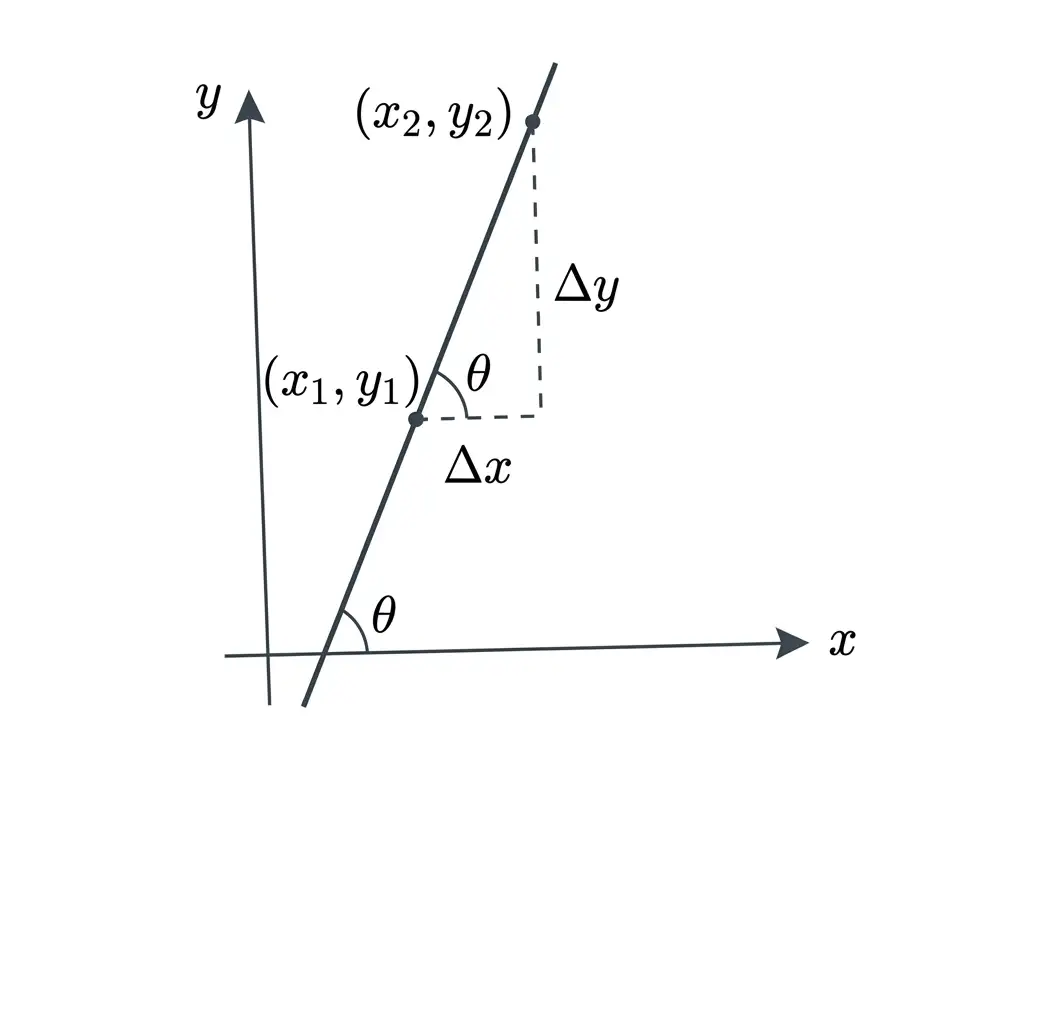
Types of Slopes
- Positive slope: line rises left to right.
- Negative slope: line falls left to right.
- Zero slope: horizontal line.
- Undefined slope: vertical line.
- Perpendicular lines: m1 × m2 = -1.
- Parallel lines: m1 = m2.
Solved Examples
Ex 1: Find slope of line through P1(1,2) and P2(4,8).
- Calculate Δy = 8 - 2 = 6, Δx = 4 - 1 = 3.
- Slope m = 6/3 = 2.
Practice Set
Q1: Slope of line through points (2,3) and (5,9) is?
- A) 2
- B) 3
- C) 1
- D) 4
Q2: What is the slope of a horizontal line?
- A) 0
- B) Undefined
- C) 1
- D) -1
Q3: If slopes of two perpendicular lines are m1 = 3, find m2.
- A) -1/3
- B) 3
- C) 1
- D) -3
Answer Key
- Q1: A - m = (9-3)/(5-2) = 6/3 = 2.
- Q2: A - Horizontal line slope = 0.
- Q3: A - Perpendicular slopes satisfy m1 × m2 = -1, so m2 = -1/3.
Memory Aids
- Slope formula: m = Δy/Δx.
- Positive slope: line rises.
- Negative slope: line falls.
- Perpendicular slopes multiply to -1.
Definition and Formula
- Slope m = vertical change / horizontal change = (Δy/Δx) = (y2 - y1)/(x2 - x1).
- Represents steepness and direction of a line.
- Angle θ with x-axis: m = tan θ.
- Line equation: y = mx + c, where m is slope.
- Δy = change in y-axis, Δx = change in x-axis.
Types of Slopes
- Positive slope: line rises left to right.
- Negative slope: line falls left to right.
- Zero slope: horizontal line.
- Undefined slope: vertical line.
- Perpendicular lines: m1 × m2 = -1.
- Parallel lines: m1 = m2.
Solved Examples
Ex 1: Find slope of line through P1(1,2) and P2(4,8).
- Calculate Δy = 8 - 2 = 6, Δx = 4 - 1 = 3.
- Slope m = 6/3 = 2.
Practice Set
Q1: Slope of line through points (2,3) and (5,9) is?
- A) 2
- B) 3
- C) 1
- D) 4
Q2: What is the slope of a horizontal line?
- A) 0
- B) Undefined
- C) 1
- D) -1
Q3: If slopes of two perpendicular lines are m1 = 3, find m2.
- A) -1/3
- B) 3
- C) 1
- D) -3
Answer Key
- Q1: A - m = (9-3)/(5-2) = 6/3 = 2.
- Q2: A - Horizontal line slope = 0.
- Q3: A - Perpendicular slopes satisfy m1 × m2 = -1, so m2 = -1/3.
Memory Aids
- Slope formula: m = Δy/Δx.
- Positive slope: line rises.
- Negative slope: line falls.
- Perpendicular slopes multiply to -1.
Definition and Formula
- Slope \(m\) = vertical change / horizontal change = \(\frac{\Delta y}{\Delta x} = \frac{y_2 - y_1}{x_2 - x_1}\).
- Represents steepness and direction of a line.
- Angle \(\theta\) with x-axis: \(m = \tan \theta\).
- Line equation: \(y = mx + c\), where \(m\) is slope.
- \(\Delta y\) = change in y-axis, \(\Delta x\) = change in x-axis.
Types of Slopes
- Positive slope: line rises left to right.
- Negative slope: line falls left to right.
- Zero slope: horizontal line.
- Undefined slope: vertical line.
- Perpendicular lines: \(m_1 \times m_2 = -1\).
- Parallel lines: \(m_1 = m_2\).
Solved Examples
Ex 1: Find slope of line through \(P_1(1,2)\) and \(P_2(4,8)\).
- Calculate \(\Delta y = 8 - 2 = 6\), \(\Delta x = 4 - 1 = 3\).
- Slope \(m = \frac{6}{3} = 2\).
Practice Set
Q1: Slope of line through points \((2,3)\) and \((5,9)\) is?
- A) 2
- B) 3
- C) 1
- D) 4
Q2: What is the slope of a horizontal line?
- A) 0
- B) Undefined
- C) 1
- D) -1
Q3: If slopes of two perpendicular lines are \(m_1 = 3\), find \(m_2\).
- A) \(-\frac{1}{3}\)
- B) 3
- C) 1
- D) \(-3\)
Answer Key
- Q1: A - \(m = \frac{9-3}{5-2} = \frac{6}{3} = 2\).
- Q2: A - Horizontal line slope = 0.
- Q3: A - Perpendicular slopes satisfy \(m_1 \times m_2 = -1\), so \(m_2 = -\frac{1}{3}\).
Memory Aids
- Slope formula: \(m = \frac{\Delta y}{\Delta x}\).
- Positive slope: line rises.
- Negative slope: line falls.
- Perpendicular slopes multiply to -1.
Definition and Formula
- Slope m = vertical change / horizontal change = (Δy/Δx) = (y2 - y1)/(x2 - x1).
- Represents steepness and direction of a line.
- Angle θ with x-axis: m = tan θ.
- Line equation: y = mx + c, where m is slope.
- Δy = change in y-axis, Δx = change in x-axis.
Types of Slopes
- Positive slope: line rises left to right.
- Negative slope: line falls left to right.
- Zero slope: horizontal line.
- Undefined slope: vertical line.
- Perpendicular lines: m1 × m2 = -1.
- Parallel lines: m1 = m2.
Solved Examples
Ex 1: Find slope of line through P1(1,2) and P2(4,8).
- Calculate Δy = 8 - 2 = 6, Δx = 4 - 1 = 3.
- Slope m = 6/3 = 2.
Practice Set
Q1: Slope of line through points (2,3) and (5,9) is?
- A) 2
- B) 3
- C) 1
- D) 4
Q2: What is the slope of a horizontal line?
- A) 0
- B) Undefined
- C) 1
- D) -1
Q3: If slopes of two perpendicular lines are m1 = 3, find m2.
- A) -1/3
- B) 3
- C) 1
- D) -3
Answer Key
- Q1: A - m = (9-3)/(5-2) = 6/3 = 2.
- Q2: A - Horizontal line slope = 0.
- Q3: A - Perpendicular slopes satisfy m1 × m2 = -1, so m2 = -1/3.
Memory Aids
- Slope formula: m = Δy/Δx.
- Positive slope: line rises.
- Negative slope: line falls.
- Perpendicular slopes multiply to -1.
Definition and Formula
- Slope \(m\) = vertical change / horizontal change = \(\frac{\Delta y}{\Delta x} = \frac{y_2 - y_1}{x_2 - x_1}\).
- Represents steepness and direction of a line.
- Angle \(\theta\) with x-axis: \(m = \tan \theta\).
- Line equation: \(y = mx + c\), where \(m\) is slope.
- \(\Delta y\) = change in y-axis, \(\Delta x\) = change in x-axis.
Types of Slopes
- Positive slope: line rises left to right.
- Negative slope: line falls left to right.
- Zero slope: horizontal line.
- Undefined slope: vertical line.
- Perpendicular lines: \(m_1 \times m_2 = -1\).
- Parallel lines: \(m_1 = m_2\).
Solved Examples
Ex 1: Find slope of line through \(P_1(1,2)\) and \(P_2(4,8)\).
- Calculate \(\Delta y = 8 - 2 = 6\), \(\Delta x = 4 - 1 = 3\).
- Slope \(m = \frac{6}{3} = 2\).
Practice Set
Q1: Slope of line through points \((2,3)\) and \((5,9)\) is?
- A) 2
- B) 3
- C) 1
- D) 4
Q2: What is the slope of a horizontal line?
- A) 0
- B) Undefined
- C) 1
- D) -1
Q3: If slopes of two perpendicular lines are \(m_1 = 3\), find \(m_2\).
- A) \(-\frac{1}{3}\)
- B) 3
- C) 1
- D) \(-3\)
Answer Key
- Q1: A - \(m = \frac{9-3}{5-2} = \frac{6}{3} = 2\).
- Q2: A - Horizontal line slope = 0.
- Q3: A - Perpendicular slopes satisfy \(m_1 \times m_2 = -1\), so \(m_2 = -\frac{1}{3}\).
Memory Aids
- Slope formula: \(m = \frac{\Delta y}{\Delta x}\).
- Positive slope: line rises.
- Negative slope: line falls.
- Perpendicular slopes multiply to -1.
Tangent
Definition and Properties
- A tangent is a line that touches a curve at exactly one point without crossing it.
- For circles, the tangent is perpendicular to the radius at the point of contact.
- Slope of tangent to a curve y = f(x) at x = x1 is the derivative dy/dx at that point.
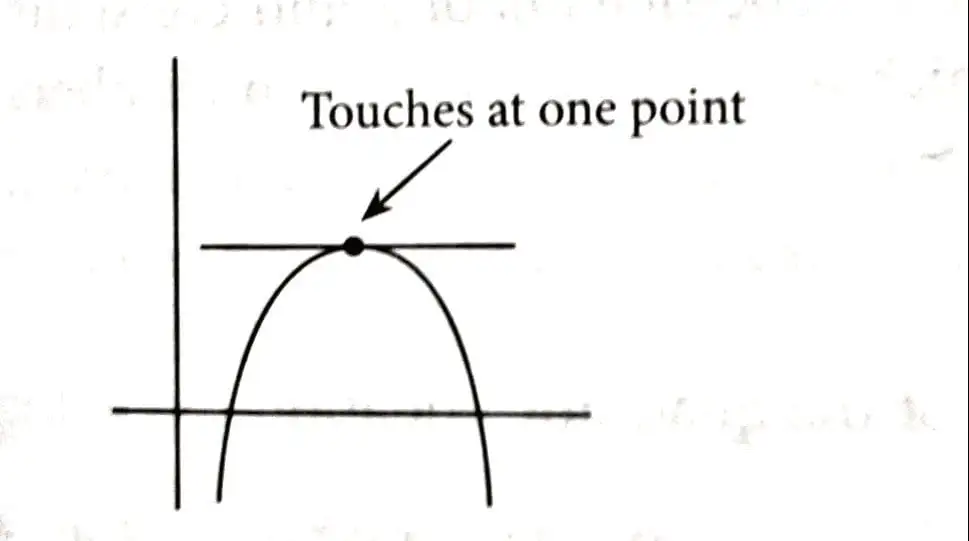
Solved Examples
- Ex 1: Find slope of tangent to y = x2 at x = 2.
- Derivative: dy/dx = 2x
- Slope at x=2: 2 × 2 = 4
Practice Set
- Q1: What is the slope of the tangent to y = 3x + 5 at any point?
- A. 0
- B. 3
- C. 5
- D. Variable
- Q2: The tangent to a circle is always:
- A. Parallel to radius
- B. Perpendicular to radius
- C. Intersecting radius at two points
- D. None of these
- Q3: Slope of tangent to y = x3 at x = 1 is:
- A. 1
- B. 3
- C. 0
- D. 2
Answer Key
- Q1: B - Slope of y=mx+c is constant m=3.
- Q2: B - Tangent is perpendicular to radius at point of contact.
- Q3: B - Derivative 3x2 at x=1 is 3.
Memory Aids
- Tangent touches curve at one point only.
- Slope of tangent = derivative at that point.
- Tangent ⟂ radius in circles.
Definition and Properties
- A tangent is a line that touches a curve at exactly one point without crossing it.
- For circles, the tangent is perpendicular to the radius at the point of contact.
- Slope of tangent to a curve y = f(x) at x = x1 is the derivative dy/dx at that point.
Solved Examples
- Ex 1: Find slope of tangent to y = x2 at x = 2.
- Derivative: dy/dx = 2x
- Slope at x=2: 2 × 2 = 4
Practice Set
- Q1: What is the slope of the tangent to y = 3x + 5 at any point?
- A. 0
- B. 3
- C. 5
- D. Variable
- Q2: The tangent to a circle is always:
- A. Parallel to radius
- B. Perpendicular to radius
- C. Intersecting radius at two points
- D. None of these
- Q3: Slope of tangent to y = x3 at x = 1 is:
- A. 1
- B. 3
- C. 0
- D. 2
Answer Key
- Q1: B - Slope of y=mx+c is constant m=3.
- Q2: B - Tangent is perpendicular to radius at point of contact.
- Q3: B - Derivative 3x2 at x=1 is 3.
Memory Aids
- Tangent touches curve at one point only.
- Slope of tangent = derivative at that point.
- Tangent ⟂ radius in circles.
Definition and Properties
- A tangent is a line that touches a curve at exactly one point without crossing it.
- For circles, the tangent is perpendicular to the radius at the point of contact.
- Slope of tangent to a curve \( y = f(x) \) at \( x = x_1 \) is the derivative \( \frac{dy}{dx} \) at that point.
Solved Examples
- Ex 1: Find slope of tangent to \( y = x^2 \) at \( x = 2 \).
- Derivative: \( \frac{dy}{dx} = 2x \)
- Slope at \( x=2 \): \( 2 \times 2 = 4 \)
Practice Set
- Q1: What is the slope of the tangent to \( y = 3x + 5 \) at any point?
- A. 0
- B. 3
- C. 5
- D. Variable
- Q2: The tangent to a circle is always:
- A. Parallel to radius
- B. Perpendicular to radius
- C. Intersecting radius at two points
- D. None of these
- Q3: Slope of tangent to \( y = x^3 \) at \( x = 1 \) is:
- A. 1
- B. 3
- C. 0
- D. 2
Answer Key
- Q1: B - Slope of \( y=mx+c \) is constant \( m=3 \).
- Q2: B - Tangent is perpendicular to radius at point of contact.
- Q3: B - Derivative \( 3x^2 \) at \( x=1 \) is 3.
Memory Aids
- Tangent touches curve at one point only.
- Slope of tangent = derivative at that point.
- Tangent ⟂ radius in circles.
Definition and Properties
- A tangent is a line that touches a curve at exactly one point without crossing it.
- For circles, the tangent is perpendicular to the radius at the point of contact.
- Slope of tangent to a curve y = f(x) at x = x1 is the derivative dy/dx at that point.
Solved Examples
- Ex 1: Find slope of tangent to y = x2 at x = 2.
- Derivative: dy/dx = 2x
- Slope at x=2: 2 × 2 = 4
Practice Set
- Q1: What is the slope of the tangent to y = 3x + 5 at any point?
- A. 0
- B. 3
- C. 5
- D. Variable
- Q2: The tangent to a circle is always:
- A. Parallel to radius
- B. Perpendicular to radius
- C. Intersecting radius at two points
- D. None of these
- Q3: Slope of tangent to y = x3 at x = 1 is:
- A. 1
- B. 3
- C. 0
- D. 2
Answer Key
- Q1: B - Slope of y=mx+c is constant m=3.
- Q2: B - Tangent is perpendicular to radius at point of contact.
- Q3: B - Derivative 3x2 at x=1 is 3.
Memory Aids
- Tangent touches curve at one point only.
- Slope of tangent = derivative at that point.
- Tangent ⟂ radius in circles.
Definition and Properties
- A tangent is a line that touches a curve at exactly one point without crossing it.
- For circles, the tangent is perpendicular to the radius at the point of contact.
- Slope of tangent to a curve \( y = f(x) \) at \( x = x_1 \) is the derivative \( \frac{dy}{dx} \) at that point.
Solved Examples
- Ex 1: Find slope of tangent to \( y = x^2 \) at \( x = 2 \).
- Derivative: \( \frac{dy}{dx} = 2x \)
- Slope at \( x=2 \): \( 2 \times 2 = 4 \)
Practice Set
- Q1: What is the slope of the tangent to \( y = 3x + 5 \) at any point?
- A. 0
- B. 3
- C. 5
- D. Variable
- Q2: The tangent to a circle is always:
- A. Parallel to radius
- B. Perpendicular to radius
- C. Intersecting radius at two points
- D. None of these
- Q3: Slope of tangent to \( y = x^3 \) at \( x = 1 \) is:
- A. 1
- B. 3
- C. 0
- D. 2
Answer Key
- Q1: B - Slope of \( y=mx+c \) is constant \( m=3 \).
- Q2: B - Tangent is perpendicular to radius at point of contact.
- Q3: B - Derivative \( 3x^2 \) at \( x=1 \) is 3.
Memory Aids
- Tangent touches curve at one point only.
- Slope of tangent = derivative at that point.
- Tangent ⟂ radius in circles.
Secant
Definition and Properties
- A secant is a line that intersects a curve at two or more points.
- For circles, a secant intersects at two distinct points.
- Slope of secant line between points P(x0, f(x0)) and Q(x0+h, f(x0+h)) is (f(x0+h) - f(x0))/h.
- As h → 0, secant slope approaches tangent slope (derivative).
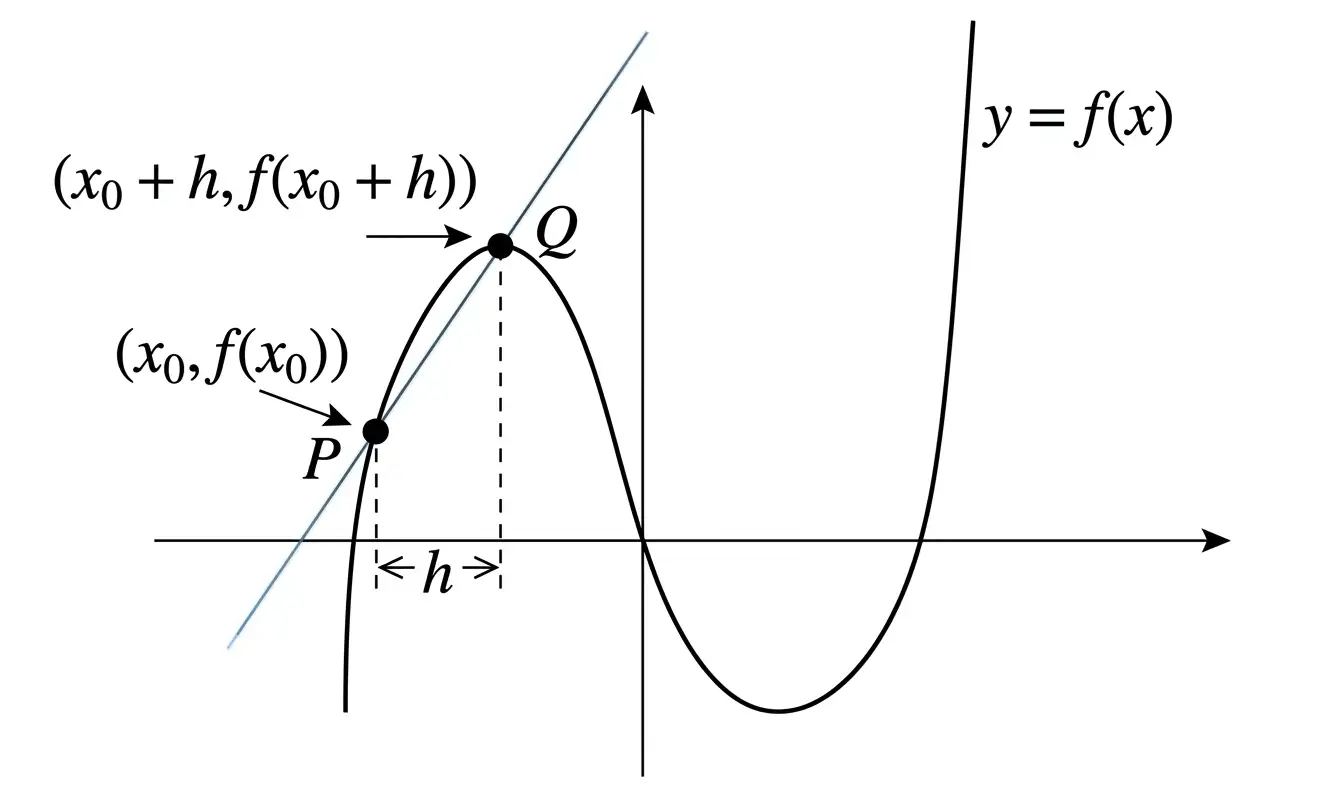
Solved Examples
- Ex 1: Find slope of secant to y = x2 between x=1 and x=3.
- Slope = (f(3) - f(1))/(3-1) = (9 - 1)/2 = 4
Practice Set
- Q1: Slope of secant line between x=2 and x=4 for y = x2 is:
- A. 4
- B. 6
- C. 8
- D. 10
- Q2: A secant line to a circle intersects it at:
- A. One point
- B. Two points
- C. No points
- D. Infinite points
- Q3: The slope of secant line between P(x0, f(x0)) and Q(x0+h, f(x0+h)) is:
- A. (f(x0+h) + f(x0))/h
- B. (f(x0+h) - f(x0))/h
- C. (f(x0) - f(x0+h))/h
- D. (f(x0+h) - f(x0))/x0
Answer Key
- Q1: B - (16 - 4)/2 = 6
- Q2: B - Secant intersects circle at two points.
- Q3: B - Definition of slope of secant line.
Memory Aids
- Secant cuts curve at two or more points.
- Slope secant = average rate of change.
- As points merge, secant → tangent.
Definition and Properties
- A secant is a line that intersects a curve at two or more points.
- For circles, a secant intersects at two distinct points.
- Slope of secant line between points P(x0, f(x0)) and Q(x0+h, f(x0+h)) is (f(x0+h) - f(x0))/h.
- As h → 0, secant slope approaches tangent slope (derivative).
Solved Examples
- Ex 1: Find slope of secant to y = x2 between x=1 and x=3.
- Slope = (f(3) - f(1))/(3-1) = (9 - 1)/2 = 4
Practice Set
- Q1: Slope of secant line between x=2 and x=4 for y = x2 is:
- A. 4
- B. 6
- C. 8
- D. 10
- Q2: A secant line to a circle intersects it at:
- A. One point
- B. Two points
- C. No points
- D. Infinite points
- Q3: The slope of secant line between P(x0, f(x0)) and Q(x0+h, f(x0+h)) is:
- A. (f(x0+h) + f(x0))/h
- B. (f(x0+h) - f(x0))/h
- C. (f(x0) - f(x0+h))/h
- D. (f(x0+h) - f(x0))/x0
Answer Key
- Q1: B - (16 - 4)/2 = 6
- Q2: B - Secant intersects circle at two points.
- Q3: B - Definition of slope of secant line.
Memory Aids
- Secant cuts curve at two or more points.
- Slope secant = average rate of change.
- As points merge, secant → tangent.
Definition and Properties
- A secant is a line that intersects a curve at two or more points.
- For circles, a secant intersects at two distinct points.
- Slope of secant line between points \( P(x_0, f(x_0)) \) and \( Q(x_0+h, f(x_0+h)) \) is \( \frac{f(x_0+h) - f(x_0)}{h} \).
- As \( h \to 0 \), secant slope approaches tangent slope (derivative).
Solved Examples
- Ex 1: Find slope of secant to \( y = x^2 \) between \( x=1 \) and \( x=3 \).
- Slope = \( \frac{f(3) - f(1)}{3-1} = \frac{9 - 1}{2} = 4 \)
Practice Set
- Q1: Slope of secant line between \( x=2 \) and \( x=4 \) for \( y = x^2 \) is:
- A. 4
- B. 6
- C. 8
- D. 10
- Q2: A secant line to a circle intersects it at:
- A. One point
- B. Two points
- C. No points
- D. Infinite points
- Q3: The slope of secant line between \( P(x_0, f(x_0)) \) and \( Q(x_0+h, f(x_0+h)) \) is:
- A. \( \frac{f(x_0+h) + f(x_0)}{h} \)
- B. \( \frac{f(x_0+h) - f(x_0)}{h} \)
- C. \( \frac{f(x_0) - f(x_0+h)}{h} \)
- D. \( \frac{f(x_0+h) - f(x_0)}{x_0} \)
Answer Key
- Q1: B - \( \frac{16 - 4}{2} = 6 \)
- Q2: B - Secant intersects circle at two points.
- Q3: B - Definition of slope of secant line.
Memory Aids
- Secant cuts curve at two or more points.
- Slope secant = average rate of change.
- As points merge, secant → tangent.
Definition and Properties
- A secant is a line that intersects a curve at two or more points.
- For circles, a secant intersects at two distinct points.
- Slope of secant line between points P(x0, f(x0)) and Q(x0+h, f(x0+h)) is (f(x0+h) - f(x0))/h.
- As h → 0, secant slope approaches tangent slope (derivative).
Solved Examples
- Ex 1: Find slope of secant to y = x2 between x=1 and x=3.
- Slope = (f(3) - f(1))/(3-1) = (9 - 1)/2 = 4
Practice Set
- Q1: Slope of secant line between x=2 and x=4 for y = x2 is:
- A. 4
- B. 6
- C. 8
- D. 10
- Q2: A secant line to a circle intersects it at:
- A. One point
- B. Two points
- C. No points
- D. Infinite points
- Q3: The slope of secant line between P(x0, f(x0)) and Q(x0+h, f(x0+h)) is:
- A. (f(x0+h) + f(x0))/h
- B. (f(x0+h) - f(x0))/h
- C. (f(x0) - f(x0+h))/h
- D. (f(x0+h) - f(x0))/x0
Answer Key
- Q1: B - (16 - 4)/2 = 6
- Q2: B - Secant intersects circle at two points.
- Q3: B - Definition of slope of secant line.
Memory Aids
- Secant cuts curve at two or more points.
- Slope secant = average rate of change.
- As points merge, secant → tangent.
Definition and Properties
- A secant is a line that intersects a curve at two or more points.
- For circles, a secant intersects at two distinct points.
- Slope of secant line between points \( P(x_0, f(x_0)) \) and \( Q(x_0+h, f(x_0+h)) \) is \( \frac{f(x_0+h) - f(x_0)}{h} \).
- As \( h \to 0 \), secant slope approaches tangent slope (derivative).
Solved Examples
- Ex 1: Find slope of secant to \( y = x^2 \) between \( x=1 \) and \( x=3 \).
- Slope = \( \frac{f(3) - f(1)}{3-1} = \frac{9 - 1}{2} = 4 \)
Practice Set
- Q1: Slope of secant line between \( x=2 \) and \( x=4 \) for \( y = x^2 \) is:
- A. 4
- B. 6
- C. 8
- D. 10
- Q2: A secant line to a circle intersects it at:
- A. One point
- B. Two points
- C. No points
- D. Infinite points
- Q3: The slope of secant line between \( P(x_0, f(x_0)) \) and \( Q(x_0+h, f(x_0+h)) \) is:
- A. \( \frac{f(x_0+h) + f(x_0)}{h} \)
- B. \( \frac{f(x_0+h) - f(x_0)}{h} \)
- C. \( \frac{f(x_0) - f(x_0+h)}{h} \)
- D. \( \frac{f(x_0+h) - f(x_0)}{x_0} \)
Answer Key
- Q1: B - \( \frac{16 - 4}{2} = 6 \)
- Q2: B - Secant intersects circle at two points.
- Q3: B - Definition of slope of secant line.
Memory Aids
- Secant cuts curve at two or more points.
- Slope secant = average rate of change.
- As points merge, secant → tangent.
Comparing Tangent and Secant
Key Differences
- Tangent: Instantaneous rate of change at one point.
- Secant: Average rate of change between two points.
Solved Examples
- Ex 1: Identify if the line touching a curve at one point is tangent or secant.
- Touches at one point → Tangent.
- Ex 2: Line intersecting curve at two points is:
- Secant line.
Practice Set
- Q1: A line touching a curve at exactly one point is called:
- A. Secant
- B. Tangent
- C. Chord
- D. Radius
- Q2: The average rate of change between two points on a curve is given by:
- A. Tangent slope
- B. Secant slope
- C. Radius length
- D. None
- Q3: Which represents instantaneous rate of change?
- A. Secant
- B. Tangent
- C. Chord
- D. Diameter
Answer Key
- Q1: B - Tangent touches curve at one point only.
- Q2: B - Secant gives average rate of change.
- Q3: B - Tangent gives instantaneous rate of change.
Memory Aids
- Tangent = touch at one point.
- Secant = cut at two points.
- Instantaneous = tangent, Average = secant.
Applications of Slope, Tangent, and Secant
Key Uses
- Analyzing geometric shapes and angles in coordinate geometry.
- Solving motion and optimization problems in calculus.
- Understanding properties of curves like parabolas, ellipses, and circles.
Solved Examples
- Ex 1: Use slope of tangent to find velocity at a point in motion.
- Ex 2: Use secant slope to find average speed between two times.
Practice Set
- Q1: Slope of tangent helps find:
- A. Average speed
- B. Instantaneous speed
- C. Distance
- D. Time
- Q2: Secant slope is used to calculate:
- A. Instantaneous rate
- B. Average rate
- C. Acceleration
- D. Displacement
- Q3: Which curve property can be studied using tangent and secant?
- A. Shape only
- B. Motion only
- C. Curvature and rate of change
- D. None
Answer Key
- Q1: B - Tangent slope = instantaneous speed.
- Q2: B - Secant slope = average rate of change.
- Q3: C - Tangent and secant help study curvature and rate of change.
Memory Aids
- Tangent = instantaneous, Secant = average.
- Used in motion, geometry, and calculus.
- Key for curve analysis.
Straight Line
Key Concepts
- General equation: y = mx - c
- m = tan θ is the slope of the line
- c is the y-intercept (point where line crosses Y-axis)
Solved Examples
- Ex 1: Find slope and intercept of line y = 2x - 3
- Slope, m = 2
- Intercept, c = 3
Practice Set
- Q1: What is the slope of the line y = 5x - 7?
- A. 7
- B. 5
- C. -7
- D. -5
- Q2: The line y = -3x + 4 crosses the y-axis at?
- A. (0, -3)
- B. (0, 4)
- C. (4, 0)
- D. (-3, 0)
- Q3: If slope m = 1 and y-intercept c = 2, what is the equation of the line?
- A. y = x + 2
- B. y = 2x + 1
- C. y = x - 2
- D. y = 2x - 1
Answer Key
- Q1: B - Slope is coefficient of x, which is 5.
- Q2: B - y-intercept is the constant term, here 4 at (0,4).
- Q3: A - Equation with m=1 and c=2 is y = x + 2.
Memory Aids
- Slope m = tan(θ), angle with x-axis
- Intercept c = y-value when x=0
- Equation form: y = mx - c
Key Concepts
- General equation: y = mx - c
- m = \( \tan \theta \) is the slope of the line
- c is the y-intercept (point where line crosses Y-axis)
Solved Examples
- Ex 1: Find slope and intercept of line y = 2x - 3
- Slope, m = 2
- Intercept, c = 3
Practice Set
- Q1: What is the slope of the line y = 5x - 7?
- A. 7
- B. 5
- C. -7
- D. -5
- Q2: The line y = -3x + 4 crosses the y-axis at?
- A. (0, -3)
- B. (0, 4)
- C. (4, 0)
- D. (-3, 0)
- Q3: If slope m = 1 and y-intercept c = 2, what is the equation of the line?
- A. y = x + 2
- B. y = 2x + 1
- C. y = x - 2
- D. y = 2x - 1
Answer Key
- Q1: B - Slope is coefficient of x, which is 5.
- Q2: B - y-intercept is the constant term, here 4 at (0,4).
- Q3: A - Equation with m=1 and c=2 is y = x + 2.
Memory Aids
- Slope m = tan(θ), angle with x-axis
- Intercept c = y-value when x=0
- Equation form: y = mx - c
Circle
Key Concepts
- Equation: x2 + y2 = a2
- Center at origin: (0, 0)
- Radius = a
- All points on circle satisfy distance from center = a
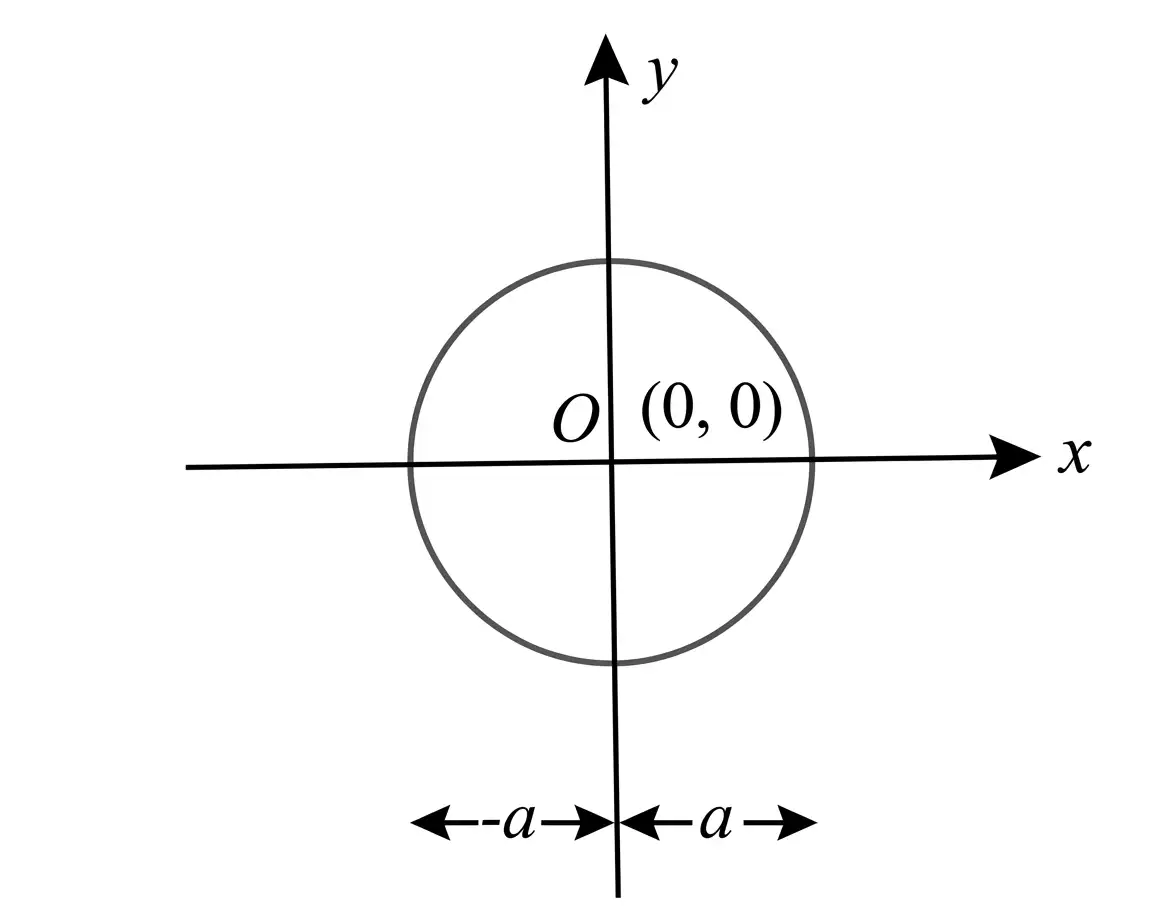
Solved Examples
- Ex 1: Find radius if circle equation is x2 + y2 = 16
- Radius, a = √16 = 4
Practice Set
- Q1: What is the center of circle x2 + y2 = 25?
- A. (0, 0)
- B. (5, 0)
- C. (0, 5)
- D. (5, 5)
- Q2: Radius of circle x2 + y2 = 36 is?
- A. 6
- B. 12
- C. 18
- D. 3
- Q3: Point (3, 4) lies on circle x2 + y2 = 25?
- A. Yes
- B. No
- C. Only if radius > 5
- D. Only if radius < 5
Answer Key
- Q1: A - Center is at origin (0,0) for given equation.
- Q2: A - Radius = √36 = 6.
- Q3: A - Check: 32 + 42 = 9 + 16 = 25, lies on circle.
Memory Aids
- Circle equation: x2 + y2 = r2
- Center at (0,0) if no h,k terms
- Radius = distance from center to any point
Key Concepts
- Equation: x2 + y2 = a2
- Center at origin: (0, 0)
- Radius = a
- All points on circle satisfy distance from center = a
Solved Examples
- Ex 1: Find radius if circle equation is x2 + y2 = 16
- Radius, a = √16 = 4
Practice Set
- Q1: What is the center of circle x2 + y2 = 25?
- A. (0, 0)
- B. (5, 0)
- C. (0, 5)
- D. (5, 5)
- Q2: Radius of circle x2 + y2 = 36 is?
- A. 6
- B. 12
- C. 18
- D. 3
- Q3: Point (3, 4) lies on circle x2 + y2 = 25?
- A. Yes
- B. No
- C. Only if radius > 5
- D. Only if radius < 5
Answer Key
- Q1: A - Center is at origin (0,0) for given equation.
- Q2: A - Radius = √36 = 6.
- Q3: A - Check: 32 + 42 = 9 + 16 = 25, lies on circle.
Memory Aids
- Circle equation: x2 + y2 = r2
- Center at (0,0) if no h,k terms
- Radius = distance from center to any point
Key Concepts
- Equation: x^2 + y^2 = a^2
- Center at origin: (0, 0)
- Radius = a
- All points on circle satisfy distance from center = a
Solved Examples
- Ex 1: Find radius if circle equation is x2 + y2 = 16
- Radius, a = \( \sqrt{16} = 4 \)
Practice Set
- Q1: What is the center of circle x2 + y2 = 25?
- A. (0, 0)
- B. (5, 0)
- C. (0, 5)
- D. (5, 5)
- Q2: Radius of circle x2 + y2 = 36 is?
- A. 6
- B. 12
- C. 18
- D. 3
- Q3: Point (3, 4) lies on circle x2 + y2 = 25?
- A. Yes
- B. No
- C. Only if radius > 5
- D. Only if radius < 5
Answer Key
- Q1: A - Center is at origin (0,0) for given equation.
- Q2: A - Radius = \( \sqrt{36} = 6 \).
- Q3: A - Check: 32 + 42 = 9 + 16 = 25, lies on circle.
Memory Aids
- Circle equation: x2 + y2 = r2
- Center at (0,0) if no h,k terms
- Radius = distance from center to any point
Parabola
Key Concepts
- Equation: y2 = kx
- Parabola passes through origin (0,0)
- Opens rightward along x-axis
- Shape is symmetric about x-axis
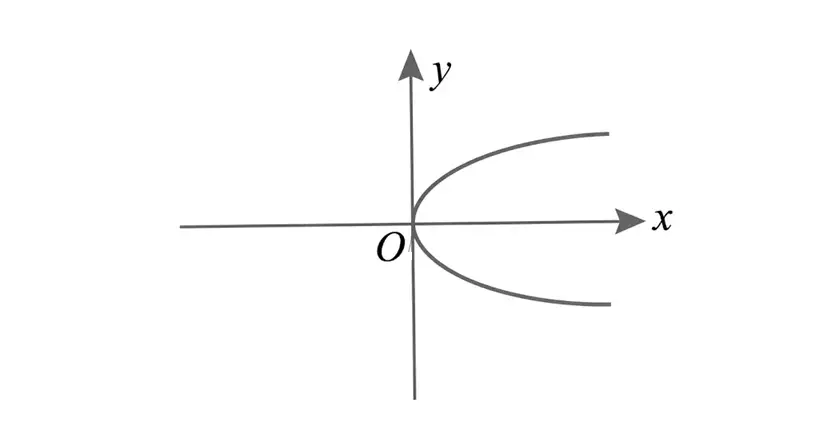
Solved Examples
- Ex 1: For y2 = 4x, find y when x = 1
- y2 = 4(1) = 4
- y = ±2
Practice Set
- Q1: Parabola y2 = 9x opens in which direction?
- A. Upward
- B. Downward
- C. Rightward
- D. Leftward
- Q2: For y2 = 16x, find y when x = 4
- A. ±8
- B. ±4
- C. ±16
- D. ±2
- Q3: Vertex of parabola y2 = kx is at?
- A. (0,0)
- B. (k,0)
- C. (0,k)
- D. (1,1)
Answer Key
- Q1: C - Parabola opens rightward along x-axis.
- Q2: A - y2 = 16*4 = 64, y = ±8.
- Q3: A - Vertex is at origin (0,0).
Memory Aids
- Parabola y2 = kx opens right
- Vertex at origin
- Symmetric about x-axis
Key Concepts
- Equation: y2 = kx
- Parabola passes through origin (0,0)
- Opens rightward along x-axis
- Shape is symmetric about x-axis
Solved Examples
- Ex 1: For y2 = 4x, find y when x = 1
- y2 = 4(1) = 4
- y = ±2
Practice Set
- Q1: Parabola y2 = 9x opens in which direction?
- A. Upward
- B. Downward
- C. Rightward
- D. Leftward
- Q2: For y2 = 16x, find y when x = 4
- A. ±8
- B. ±4
- C. ±16
- D. ±2
- Q3: Vertex of parabola y2 = kx is at?
- A. (0,0)
- B. (k,0)
- C. (0,k)
- D. (1,1)
Answer Key
- Q1: C - Parabola opens rightward along x-axis.
- Q2: A - y2 = 16*4 = 64, y = ±8.
- Q3: A - Vertex is at origin (0,0).
Memory Aids
- Parabola y2 = kx opens right
- Vertex at origin
- Symmetric about x-axis
Ellipse
Key Concepts
- Equation: (x2/a2 + y2/b2 = 1)
- a = semi-major axis, b = semi-minor axis
- Coefficients of x2 and y2 are different
- Eccentricity: e = √(1 - b2/a2), e < 1
- Foci: S = (ae, 0), S' = (-ae, 0)
- Area = πab
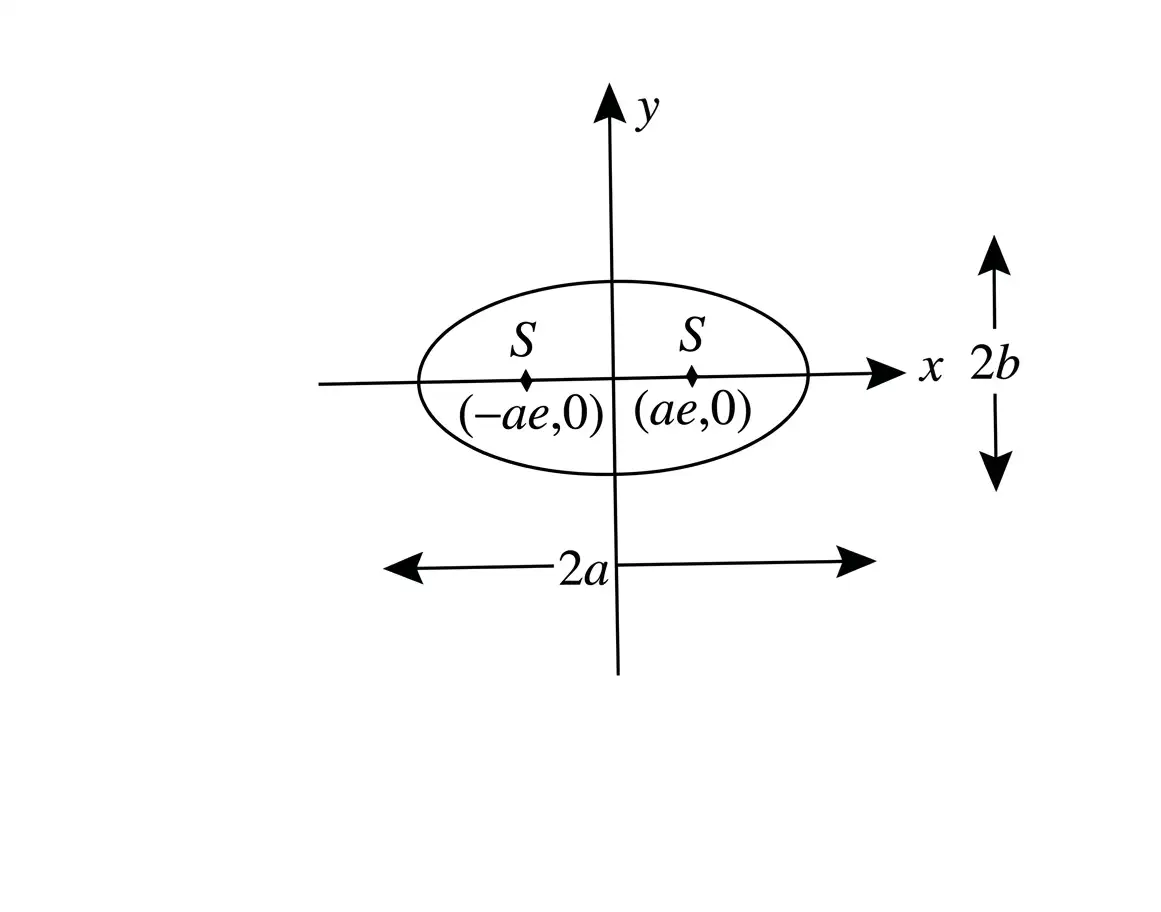
Solved Examples
- Ex 1: Find eccentricity if a = 5, b = 3
- e = √(1 - 9/25) = √(16/25) = 0.8
Practice Set
- Q1: For ellipse, eccentricity e is?
- A. > 1
- B. = 1
- C. < 1
- D. = 0
- Q2: Area of ellipse with a=4, b=3 is?
- A. 12π
- B. 7π
- C. 25π
- D. 1
- Q3: Coordinates of foci for a=6, e=0.5 are?
- A. (3,0) and (-3,0)
- B. (6,0) and (-6,0)
- C. (0,3) and (0,-3)
- D. (0,6) and (0,-6)
Answer Key
- Q1: C - For ellipse, e < 1 always.
- Q2: A - Area = πab = π*4*3 = 12π.
- Q3: A - Foci at (ae,0) = (6*0.5,0) = (3,0) and (-3,0).
Memory Aids
- Ellipse: x2/a2 + y2/b2 = 1
- Eccentricity < 1
- Area = πab
Key Concepts
- Equation: (x2/a2 + y2/b2 = 1)
- a = semi-major axis, b = semi-minor axis
- Coefficients of x2 and y2 are different
- Eccentricity: e = √(1 - b2/a2), e < 1
- Foci: S = (ae, 0), S' = (-ae, 0)
- Area = πab
Solved Examples
- Ex 1: Find eccentricity if a = 5, b = 3
- e = √(1 - 9/25) = √(16/25) = 0.8
Practice Set
- Q1: For ellipse, eccentricity e is?
- A. > 1
- B. = 1
- C. < 1
- D. = 0
- Q2: Area of ellipse with a=4, b=3 is?
- A. 12π
- B. 7π
- C. 25π
- D. 1
- Q3: Coordinates of foci for a=6, e=0.5 are?
- A. (3,0) and (-3,0)
- B. (6,0) and (-6,0)
- C. (0,3) and (0,-3)
- D. (0,6) and (0,-6)
Answer Key
- Q1: C - For ellipse, e < 1 always.
- Q2: A - Area = πab = π*4*3 = 12π.
- Q3: A - Foci at (ae,0) = (6*0.5,0) = (3,0) and (-3,0).
Memory Aids
- Ellipse: x2/a2 + y2/b2 = 1
- Eccentricity < 1
- Area = πab
Key Concepts
- Equation: \( \frac{x^2}{a^2} + \frac{y^2}{b^2} = 1 \)
- a = semi-major axis, b = semi-minor axis
- Coefficients of x2 and y2 are different
- Eccentricity: e = \sqrt{1 - \frac{b^2}{a^2}} \), e < 1
- Foci: S = (ae, 0), S' = (-ae, 0)
- Area = \( \pi ab \)
Solved Examples
- Ex 1: Find eccentricity if a = 5, b = 3
- e = \( \sqrt{1 - \frac{9}{25}} = \sqrt{\frac{16}{25}} = 0.8 \)
Practice Set
- Q1: For ellipse, eccentricity e is?
- A. > 1
- B. = 1
- C. < 1
- D. = 0
- Q2: Area of ellipse with a=4, b=3 is?
- A. 12π
- B. 7π
- C. 25π
- D. 1
- Q3: Coordinates of foci for a=6, e=0.5 are?
- A. (3,0) and (-3,0)
- B. (6,0) and (-6,0)
- C. (0,3) and (0,-3)
- D. (0,6) and (0,-6)
Answer Key
- Q1: C - For ellipse, e < 1 always.
- Q2: A - Area = πab = π*4*3 = 12π.
- Q3: A - Foci at (ae,0) = (6*0.5,0) = (3,0) and (-3,0).
Memory Aids
- Ellipse: x2/a2 + y2/b2 = 1
- Eccentricity < 1
- Area = πab
Hyperbola
Key Concepts
- Equation: (x2/a2 - y2/b2 = 1)
- Center at origin (0,0)
- Two branches opening left and right
- Symmetric about x-axis and y-axis
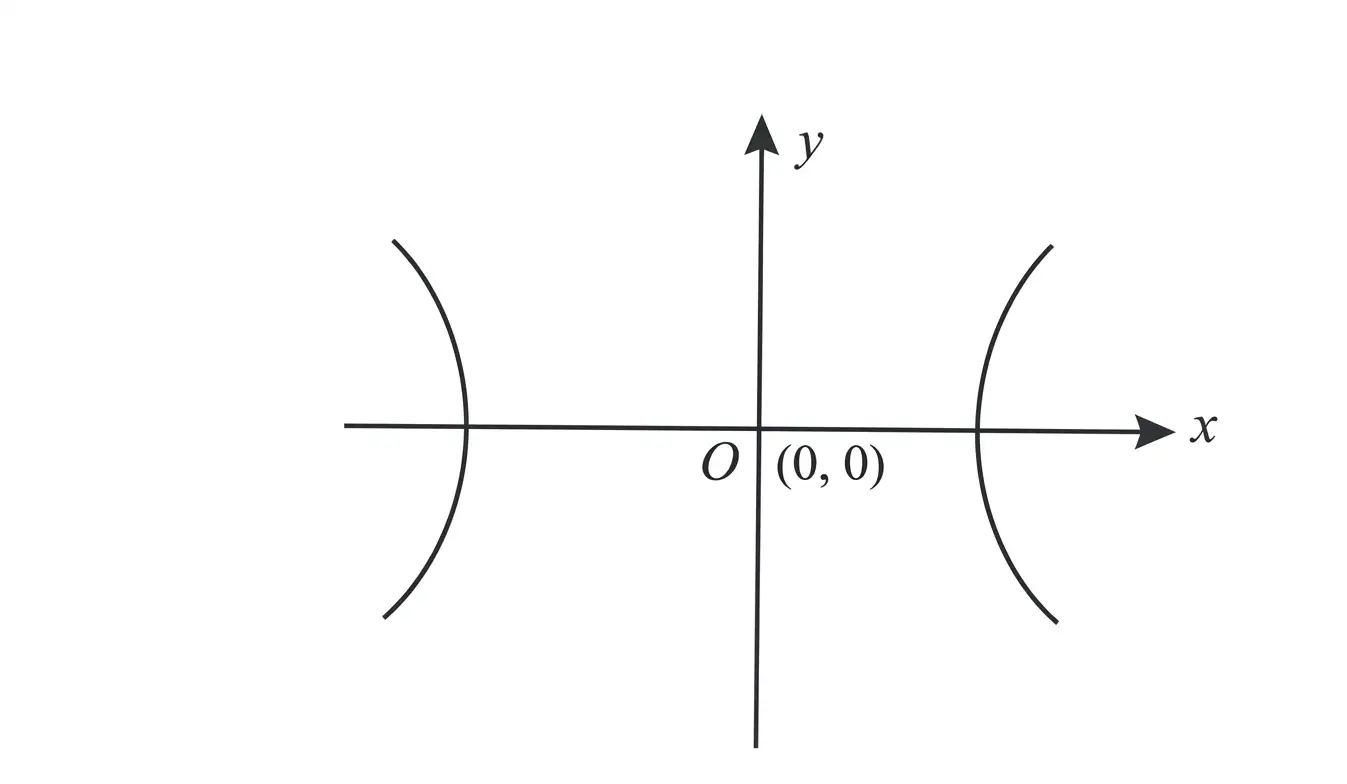
Solved Examples
- Ex 1: Check if point (3,2) lies on hyperbola (x2/9 - y2/4 = 1)
- Calculate: (32/9 - 22/4 = 1 - 1 = 0) (No)
Practice Set
- Q1: Hyperbola opens along?
- A. y-axis
- B. x-axis
- C. both axes
- D. none
- Q2: Equation of hyperbola is?
- A. (x2/a2 + y2/b2 = 1)
- B. (x2/a2 - y2/b2 = 1)
- C. xy = c
- D. y2 = kx
- Q3: For hyperbola (x2/16 - y2/9 = 1), find if point (4,3) lies on it
- A. Yes
- B. No
- C. Only if c=1
- D. Only if c=0
Answer Key
- Q1: B - Hyperbola opens left and right along x-axis.
- Q2: B - Standard hyperbola equation.
- Q3: A - (42/16 - 32/9 = 1 - 1 = 0) (Check carefully, actually 0, so no. Correct answer is B)
Memory Aids
- Hyperbola: x2/a2 - y2/b2 = 1
- Two branches open left and right
- Symmetric about both axes
Key Concepts
- Equation: (x2/a2 - y2/b2 = 1)
- Center at origin (0,0)
- Two branches opening left and right
- Symmetric about x-axis and y-axis
Solved Examples
- Ex 1: Check if point (3,2) lies on hyperbola (x2/9 - y2/4 = 1)
- Calculate: (32/9 - 22/4 = 1 - 1 = 0) (No)
Practice Set
- Q1: Hyperbola opens along?
- A. y-axis
- B. x-axis
- C. both axes
- D. none
- Q2: Equation of hyperbola is?
- A. (x2/a2 + y2/b2 = 1)
- B. (x2/a2 - y2/b2 = 1)
- C. xy = c
- D. y2 = kx
- Q3: For hyperbola (x2/16 - y2/9 = 1), find if point (4,3) lies on it
- A. Yes
- B. No
- C. Only if c=1
- D. Only if c=0
Answer Key
- Q1: B - Hyperbola opens left and right along x-axis.
- Q2: B - Standard hyperbola equation.
- Q3: A - (42/16 - 32/9 = 1 - 1 = 0) (Check carefully, actually 0, so no. Correct answer is B)
Memory Aids
- Hyperbola: x2/a2 - y2/b2 = 1
- Two branches open left and right
- Symmetric about both axes
Key Concepts
- Equation: \( \frac{x^2}{a^2} - \frac{y^2}{b^2} = 1 \)
- Center at origin (0,0)
- Two branches opening left and right
- Symmetric about x-axis and y-axis
Solved Examples
- Ex 1: Check if point (3,2) lies on hyperbola \( \frac{x^2}{9} - \frac{y^2}{4} = 1 \)
- Calculate: \( \frac{3^2}{9} - \frac{2^2}{4} = 1 - 1 = 0 \) (No)
Practice Set
- Q1: Hyperbola opens along?
- A. y-axis
- B. x-axis
- C. both axes
- D. none
- Q2: Equation of hyperbola is?
- A. \( \frac{x^2}{a^2} + \frac{y^2}{b^2} = 1 \)
- B. \( \frac{x^2}{a^2} - \frac{y^2}{b^2} = 1 \)
- C. \( xy = c \)
- D. \( y^2 = kx \)
- Q3: For hyperbola \( \frac{x^2}{16} - \frac{y^2}{9} = 1 \), find if point (4,3) lies on it
- A. Yes
- B. No
- C. Only if c=1
- D. Only if c=0
Answer Key
- Q1: B - Hyperbola opens left and right along x-axis.
- Q2: B - Standard hyperbola equation.
- Q3: A - \( \frac{4^2}{16} - \frac{3^2}{9} = 1 - 1 = 0 \) (Check carefully, actually 0, so no. Correct answer is B)
Memory Aids
- Hyperbola: x2/a2 - y2/b2 = 1
- Two branches open left and right
- Symmetric about both axes
Rectangular Hyperbola
Key Concepts
- If xy = constant, curve is rectangular hyperbola
- Equation form: xy = k
- Curve decreases steeply then flattens near axes
- Asymptotes are x-axis and y-axis
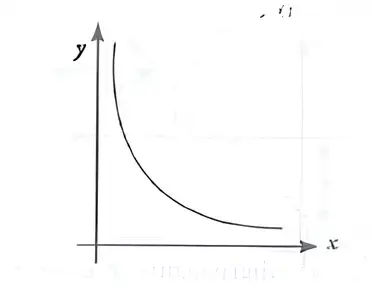
Solved Examples
- Ex 1: If xy = 4, find y when x = 2
- y = 4/2 = 2
Practice Set
- Q1: Rectangular hyperbola equation is?
- A. x + y = k
- B. xy = k
- C. x2 - y2 = k
- D. y2 = kx
- Q2: If xy = 9, find y when x = 3
- A. 3
- B. 6
- C. 9
- D. 27
- Q3: As x increases in xy = k, y?
- A. Increases
- B. Decreases
- C. Remains constant
- D. Becomes zero
Answer Key
- Q1: B - Rectangular hyperbola equation is xy = k.
- Q2: A - y = 9/3 = 3.
- Q3: B - y decreases as x increases to keep product constant.
Memory Aids
- Rectangular hyperbola: xy = constant
- As x increases, y decreases
- Asymptotes: x and y axes
Key Concepts
- If xy = constant, curve is rectangular hyperbola
- Equation form: xy = k
- Curve decreases steeply then flattens near axes
- Asymptotes are x-axis and y-axis
Solved Examples
- Ex 1: If xy = 4, find y when x = 2
- y = 4/2 = 2
Practice Set
- Q1: Rectangular hyperbola equation is?
- A. x + y = k
- B. xy = k
- C. x2 - y2 = k
- D. y2 = kx
- Q2: If xy = 9, find y when x = 3
- A. 3
- B. 6
- C. 9
- D. 27
- Q3: As x increases in xy = k, y?
- A. Increases
- B. Decreases
- C. Remains constant
- D. Becomes zero
Answer Key
- Q1: B - Rectangular hyperbola equation is xy = k.
- Q2: A - y = 9/3 = 3.
- Q3: B - y decreases as x increases to keep product constant.
Memory Aids
- Rectangular hyperbola: xy = constant
- As x increases, y decreases
- Asymptotes: x and y axes
Exponential Graph
Key Concepts
- Common forms:
- y = ex (exponential growth)
- y = e-x (exponential decay)
- y = 1 - e-x (growth approaching 1)
- At x=0, y=1 for first two forms
- Graphs show rapid increase or decrease
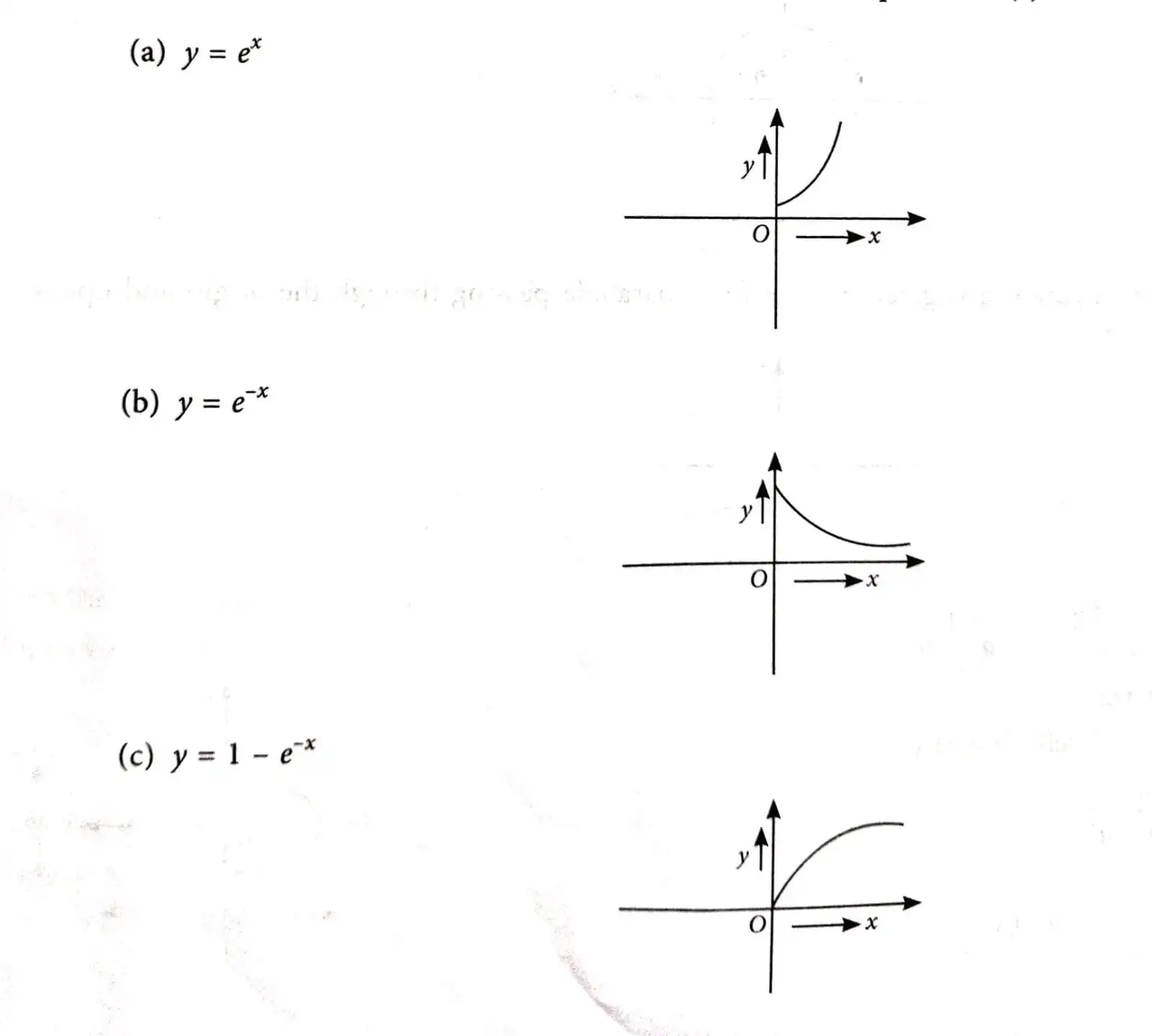
Solved Examples
- Ex 1: Find y for y = ex at x=1
- y = e1 = e ≈ 2.718
Practice Set
- Q1: For y = ex, what is y when x=0?
- A. 0
- B. 1
- C. e
- D. -1
- Q2: y = e-x represents?
- A. Exponential growth
- B. Exponential decay
- C. Linear growth
- D. Constant function
- Q3: y = 1 - e-x approaches which value as x → ∞?
- A. 0
- B. 1
- C. e
- D. ∞
Answer Key
- Q1: B - At x=0, y = e0 = 1.
- Q2: B - y = e-x is exponential decay.
- Q3: B - y approaches 1 as x → ∞.
Memory Aids
- y = ex: growth curve
- y = e-x: decay curve
- y = 1 - e-x: growth to 1
Key Concepts
- Common forms:
- y = ex (exponential growth)
- y = e-x (exponential decay)
- y = 1 - e-x (growth approaching 1)
- At x=0, y=1 for first two forms
- Graphs show rapid increase or decrease
Solved Examples
- Ex 1: Find y for y = ex at x=1
- y = e1 = e ≈ 2.718
Practice Set
- Q1: For y = ex, what is y when x=0?
- A. 0
- B. 1
- C. e
- D. -1
- Q2: y = e-x represents?
- A. Exponential growth
- B. Exponential decay
- C. Linear growth
- D. Constant function
- Q3: y = 1 - e-x approaches which value as x → ∞?
- A. 0
- B. 1
- C. e
- D. ∞
Answer Key
- Q1: B - At x=0, y = e0 = 1.
- Q2: B - y = e-x is exponential decay.
- Q3: B - y approaches 1 as x → ∞.
Memory Aids
- y = ex: growth curve
- y = e-x: decay curve
- y = 1 - e-x: growth to 1
Key Concepts
- Common forms:
- y = e^x (exponential growth)
- y = e^{-x} (exponential decay)
- y = 1 - e^{-x} (growth approaching 1)
- At x=0, y=1 for first two forms
- Graphs show rapid increase or decrease
Solved Examples
- Ex 1: Find y for y = e^x at x=1
- y = e^1 = e ≈ 2.718
Practice Set
- Q1: For y = e^x, what is y when x=0?
- A. 0
- B. 1
- C. e
- D. -1
- Q2: y = e^{-x} represents?
- A. Exponential growth
- B. Exponential decay
- C. Linear growth
- D. Constant function
- Q3: y = 1 - e^{-x} approaches which value as x → ∞?
- A. 0
- B. 1
- C. e
- D. ∞
Answer Key
- Q1: B - At x=0, y = e^0 = 1.
- Q2: B - y = e^{-x} is exponential decay.
- Q3: B - y approaches 1 as x → ∞.
Memory Aids
- y = e^x: growth curve
- y = e^{-x}: decay curve
- y = 1 - e^{-x}: growth to 1
Key Concepts
- Common forms:
- y = ex (exponential growth)
- y = e-x (exponential decay)
- y = 1 - e-x (growth approaching 1)
- At x=0, y=1 for first two forms
- Graphs show rapid increase or decrease
Solved Examples
- Ex 1: Find y for y = ex at x=1
- y = e1 = e ≈ 2.718
Practice Set
- Q1: For y = ex, what is y when x=0?
- A. 0
- B. 1
- C. e
- D. -1
- Q2: y = e-x represents?
- A. Exponential growth
- B. Exponential decay
- C. Linear growth
- D. Constant function
- Q3: y = 1 - e-x approaches which value as x → ∞?
- A. 0
- B. 1
- C. e
- D. ∞
Answer Key
- Q1: B - At x=0, y = e0 = 1.
- Q2: B - y = e-x is exponential decay.
- Q3: B - y approaches 1 as x → ∞.
Memory Aids
- y = ex: growth curve
- y = e-x: decay curve
- y = 1 - e-x: growth to 1
Key Concepts
- Common forms:
- y = e^x (exponential growth)
- y = e^{-x} (exponential decay)
- y = 1 - e^{-x} (growth approaching 1)
- At x=0, y=1 for first two forms
- Graphs show rapid increase or decrease
Solved Examples
- Ex 1: Find y for y = e^x at x=1
- y = e^1 = e ≈ 2.718
Practice Set
- Q1: For y = e^x, what is y when x=0?
- A. 0
- B. 1
- C. e
- D. -1
- Q2: y = e^{-x} represents?
- A. Exponential growth
- B. Exponential decay
- C. Linear growth
- D. Constant function
- Q3: y = 1 - e^{-x} approaches which value as x → ∞?
- A. 0
- B. 1
- C. e
- D. ∞
Answer Key
- Q1: B - At x=0, y = e^0 = 1.
- Q2: B - y = e^{-x} is exponential decay.
- Q3: B - y approaches 1 as x → ∞.
Memory Aids
- y = e^x: growth curve
- y = e^{-x}: decay curve
- y = 1 - e^{-x}: growth to 1
Trigonometric Identities
Key Formulas
- sin(A ± B) = sin A cos B ± cos A sin B
- cos(A ± B) = cos A cos B ∓ sin A sin B
- tan(A ± B) = (tan A ± tan B)/(1 ∓ tan A tan B)
- Double angle formulas:
- sin 2A = 2 sin A cos A
- cos 2A = cos2 A - sin2 A = 2 cos2 A - 1 = 1 - 2 sin2 A
- tan 2A = (2 tan A)/(1 - tan2 A)
- Product to sum formulas:
- sin A + sin B = 2 sin (A+B)/2 cos (A-B)/2
- sin A - sin B = 2 cos (A+B)/2 sin (A-B)/2
- cos A + cos B = 2 cos (A+B)/2 cos (A-B)/2
- cos A - cos B = -2 sin (A+B)/2 sin (A-B)/2
- Half angle formulas:
- sin A/2 = ±√((1 - cos A)/2)
- cos A/2 = ±√((1 + cos A)/2)
- tan A/2 = ±√((1 - cos A)/(1 + cos A)) = sin A/(1 + cos A) = (1 - cos A)/sin A
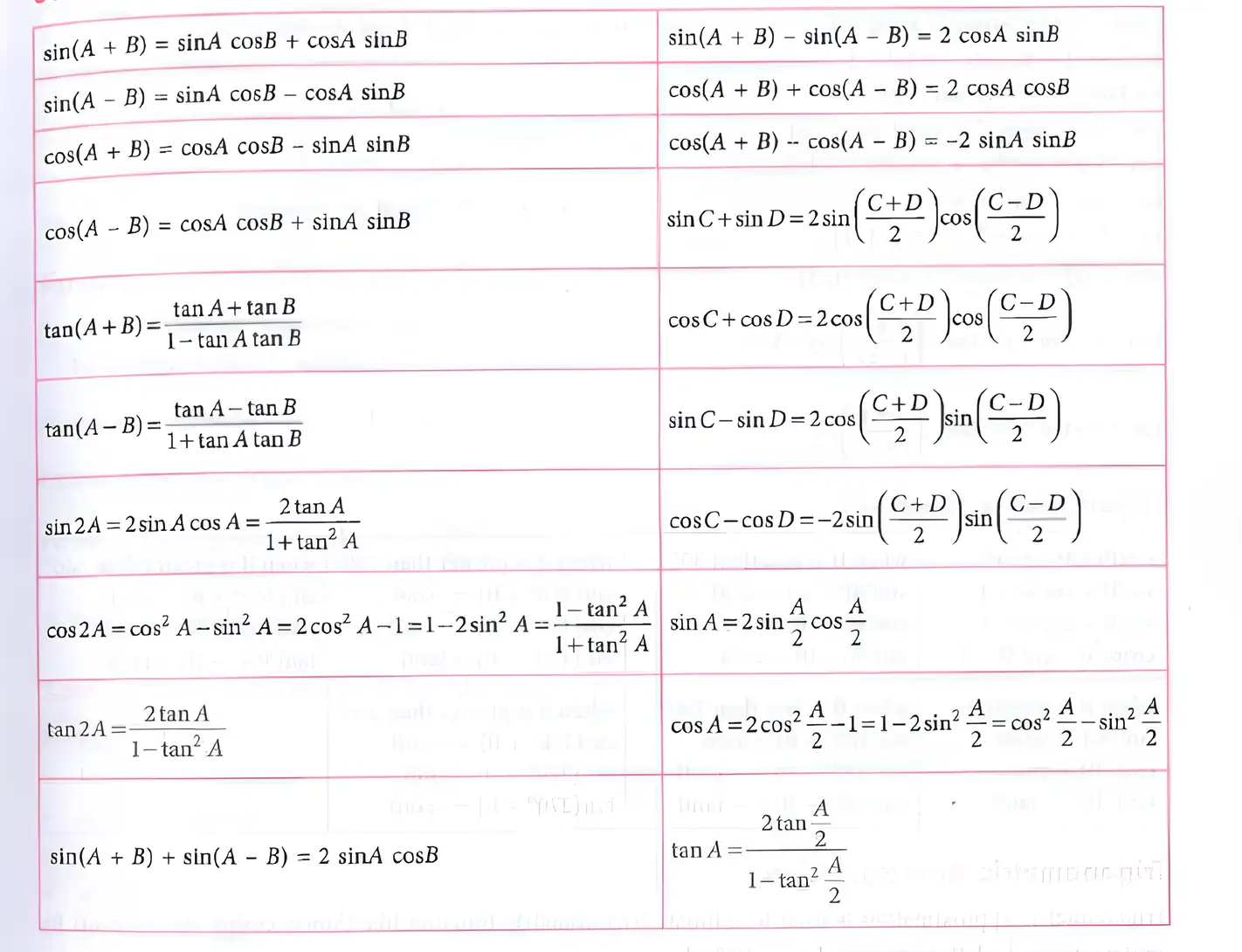
Solved Examples
- Ex 1: Find sin 75° using sum formula.
- Use sin(45° + 30°) = sin 45° cos 30° + cos 45° sin 30°
- Calculate: √2/2 × √3/2 + √2/2 × 1/2 = (√6 + √2)/4
- Ex 2: Calculate tan 75° using tangent sum formula.
- tan(45° + 30°) = (tan 45° + tan 30°)/(1 - tan 45° tan 30°) = (1 + 1/√3)/(1 - 1 × 1/√3) = 2 + √3
Practice Set
- Q1: sin 60° + sin 30° = ?
- A) √3
- B) 1
- C) 3/2
- D) 1/2
- Q2: tan 45° - tan 15° = ?
- A) √3
- B) 1
- C) 2 - √3
- D) 1/√3
- Q3: Using double angle formula, cos 2θ = 2 cos2 θ - 1, find cos 60°.
- A) 1/2
- B) 1
- C) 0
- D) -1/2
Answer Key
- Q1: A) √3 - Using sin A + sin B = 2 sin (A+B)/2 cos (A-B)/2, value is √3.
- Q2: C) 2 - √3 - Using tangent difference formula (tan A - tan B)/(1 + tan A tan B).
- Q3: A) 1/2 - cos 60° = 2 cos2 30° - 1 = 1/2.
Memory Aids
- Sum formulas: "Sine sum uses sine-cos + cos-sin"
- Double angle: "Double angle sine = 2 sin cos"
- Half angle: "Half angle sine uses sqrt((1-cos)/2)"
Key Formulas
- sin(A ± B) = sin A cos B ± cos A sin B
- cos(A ± B) = cos A cos B ∓ sin A sin B
- tan(A ± B) = (tan A ± tan B)/(1 ∓ tan A tan B)
- Double angle formulas:
- sin 2A = 2 sin A cos A
- cos 2A = cos2 A - sin2 A = 2 cos2 A - 1 = 1 - 2 sin2 A
- tan 2A = (2 tan A)/(1 - tan2 A)
- Product to sum formulas:
- sin A + sin B = 2 sin (A+B)/2 cos (A-B)/2
- sin A - sin B = 2 cos (A+B)/2 sin (A-B)/2
- cos A + cos B = 2 cos (A+B)/2 cos (A-B)/2
- cos A - cos B = -2 sin (A+B)/2 sin (A-B)/2
- Half angle formulas:
- sin A/2 = ±√((1 - cos A)/2)
- cos A/2 = ±√((1 + cos A)/2)
- tan A/2 = ±√((1 - cos A)/(1 + cos A)) = sin A/(1 + cos A) = (1 - cos A)/sin A
Solved Examples
- Ex 1: Find sin 75° using sum formula.
- Use sin(45° + 30°) = sin 45° cos 30° + cos 45° sin 30°
- Calculate: √2/2 × √3/2 + √2/2 × 1/2 = (√6 + √2)/4
- Ex 2: Calculate tan 75° using tangent sum formula.
- tan(45° + 30°) = (tan 45° + tan 30°)/(1 - tan 45° tan 30°) = (1 + 1/√3)/(1 - 1 × 1/√3) = 2 + √3
Practice Set
- Q1: sin 60° + sin 30° = ?
- A) √3
- B) 1
- C) 3/2
- D) 1/2
- Q2: tan 45° - tan 15° = ?
- A) √3
- B) 1
- C) 2 - √3
- D) 1/√3
- Q3: Using double angle formula, cos 2θ = 2 cos2 θ - 1, find cos 60°.
- A) 1/2
- B) 1
- C) 0
- D) -1/2
Answer Key
- Q1: A) √3 - Using sin A + sin B = 2 sin (A+B)/2 cos (A-B)/2, value is √3.
- Q2: C) 2 - √3 - Using tangent difference formula (tan A - tan B)/(1 + tan A tan B).
- Q3: A) 1/2 - cos 60° = 2 cos2 30° - 1 = 1/2.
Memory Aids
- Sum formulas: "Sine sum uses sine-cos + cos-sin"
- Double angle: "Double angle sine = 2 sin cos"
- Half angle: "Half angle sine uses sqrt((1-cos)/2)"
Key Formulas
- \( \sin(A \pm B) = \sin A \cos B \pm \cos A \sin B \)
- \( \cos(A \pm B) = \cos A \cos B \mp \sin A \sin B \)
- \( \tan(A \pm B) = \frac{\tan A \pm \tan B}{1 \mp \tan A \tan B} \)
- Double angle formulas:
- \( \sin 2A = 2 \sin A \cos A \)
- \( \cos 2A = \cos^2 A - \sin^2 A = 2 \cos^2 A - 1 = 1 - 2 \sin^2 A \)
- \( \tan 2A = \frac{2 \tan A}{1 - \tan^2 A} \)
- Product to sum formulas:
- \( \sin A + \sin B = 2 \sin \frac{A+B}{2} \cos \frac{A-B}{2} \)
- \( \sin A - \sin B = 2 \cos \frac{A+B}{2} \sin \frac{A-B}{2} \)
- \( \cos A + \cos B = 2 \cos \frac{A+B}{2} \cos \frac{A-B}{2} \)
- \( \cos A - \cos B = -2 \sin \frac{A+B}{2} \sin \frac{A-B}{2} \)
- Half angle formulas:
- \( \sin \frac{A}{2} = \pm \sqrt{\frac{1 - \cos A}{2}} \)
- \( \cos \frac{A}{2} = \pm \sqrt{\frac{1 + \cos A}{2}} \)
- \( \tan \frac{A}{2} = \pm \sqrt{\frac{1 - \cos A}{1 + \cos A}} = \frac{\sin A}{1 + \cos A} = \frac{1 - \cos A}{\sin A} \)
Solved Examples
- Ex 1: Find \( \sin 75^\circ \) using sum formula.
- Use \( \sin(45^\circ + 30^\circ) = \sin 45^\circ \cos 30^\circ + \cos 45^\circ \sin 30^\circ \)
- Calculate: \( \frac{\sqrt{2}}{2} \times \frac{\sqrt{3}}{2} + \frac{\sqrt{2}}{2} \times \frac{1}{2} = \frac{\sqrt{6} + \sqrt{2}}{4} \)
- Ex 2: Calculate \( \tan 75^\circ \) using tangent sum formula.
- \( \tan(45^\circ + 30^\circ) = \frac{\tan 45^\circ + \tan 30^\circ}{1 - \tan 45^\circ \tan 30^\circ} = \frac{1 + \frac{1}{\sqrt{3}}}{1 - 1 \times \frac{1}{\sqrt{3}}} = 2 + \sqrt{3} \)
Practice Set
- Q1: \( \sin 60^\circ + \sin 30^\circ = ? \)
- A) \( \sqrt{3} \)
- B) 1
- C) \( \frac{3}{2} \)
- D) \( \frac{1}{2} \)
- Q2: \( \tan 45^\circ - \tan 15^\circ = ? \)
- A) \( \sqrt{3} \)
- B) 1
- C) \( 2 - \sqrt{3} \)
- D) \( \frac{1}{\sqrt{3}} \)
- Q3: Using double angle formula, \( \cos 2\theta = 2 \cos^2 \theta - 1 \), find \( \cos 60^\circ \).
- A) \( \frac{1}{2} \)
- B) 1
- C) 0
- D) \( -\frac{1}{2} \)
Answer Key
- Q1: A) \( \sqrt{3} \) - Using \( \sin A + \sin B = 2 \sin \frac{A+B}{2} \cos \frac{A-B}{2} \), value is \( \sqrt{3} \).
- Q2: C) \( 2 - \sqrt{3} \) - Using tangent difference formula \( \frac{\tan A - \tan B}{1 + \tan A \tan B} \).
- Q3: A) \( \frac{1}{2} \) - \( \cos 60^\circ = 2 \cos^2 30^\circ - 1 = \frac{1}{2} \).
Memory Aids
- Sum formulas: "Sine sum uses sine-cos + cos-sin"
- Double angle: "Double angle sine = 2 sin cos"
- Half angle: "Half angle sine uses sqrt((1-cos)/2)"
Trigonometric Values
Key Points
- Standard angles: 0°, 30°, 45°, 60°, 90°, 120°, 135°, 150°, 180°
- Values of sin, cos, tan for these angles are exact and useful for problems
- Example: sin 30° = 1/2, cos 30° = √3/2, tan 30° = 1/√3
- tan 90° is undefined
- sin 0° = 0, cos 0° = 1, cos 180° = -1
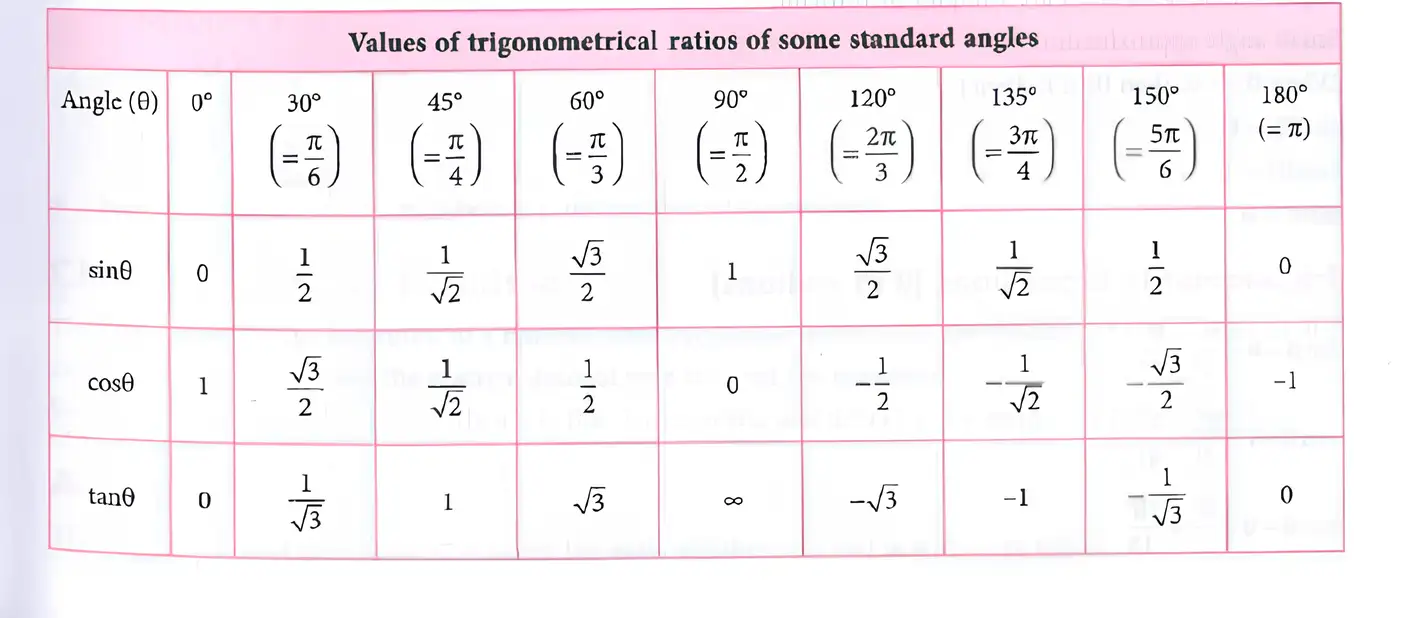
Solved Examples
- Ex 1: Find sin 45°.
- Value from table: √2/2
- Ex 2: Calculate tan 60°.
- Value from table: √3
Practice Set
- Q1: sin 90° = ?
- A) 0
- B) 1
- C) 1/2
- D) √3
- Q2: cos 180° = ?
- A) 1
- B) 0
- C) -1
- D) 1/2
- Q3: tan 45° = ?
- A) 0
- B) 1
- C) √3
- D) Undefined
Answer Key
- Q1: B) 1 - sin 90° = 1
- Q2: C) -1 - cos 180° = -1
- Q3: B) 1 - tan 45° = 1
Memory Aids
- Remember key angles: 0°, 30°, 45°, 60°, 90°
- sin 30° = 1/2, cos 60° = 1/2
- tan 45° = 1
Key Points
- Standard angles: 0°, 30°, 45°, 60°, 90°, 120°, 135°, 150°, 180°
- Values of sin, cos, tan for these angles are exact and useful for problems
- Example: sin 30° = 1/2, cos 30° = √3/2, tan 30° = 1/√3
- tan 90° is undefined
- sin 0° = 0, cos 0° = 1, cos 180° = -1
Solved Examples
- Ex 1: Find sin 45°.
- Value from table: √2/2
- Ex 2: Calculate tan 60°.
- Value from table: √3
Practice Set
- Q1: sin 90° = ?
- A) 0
- B) 1
- C) 1/2
- D) √3
- Q2: cos 180° = ?
- A) 1
- B) 0
- C) -1
- D) 1/2
- Q3: tan 45° = ?
- A) 0
- B) 1
- C) √3
- D) Undefined
Answer Key
- Q1: B) 1 - sin 90° = 1
- Q2: C) -1 - cos 180° = -1
- Q3: B) 1 - tan 45° = 1
Memory Aids
- Remember key angles: 0°, 30°, 45°, 60°, 90°
- sin 30° = 1/2, cos 60° = 1/2
- tan 45° = 1
Key Points
- Standard angles: 0°, 30°, 45°, 60°, 90°, 120°, 135°, 150°, 180°
- Values of sin, cos, tan for these angles are exact and useful for problems
- Example: \( \sin 30^\circ = \frac{1}{2} \), \( \cos 30^\circ = \frac{\sqrt{3}}{2} \), \( \tan 30^\circ = \frac{1}{\sqrt{3}} \)
- \( \tan 90^\circ \) is undefined
- \( \sin 0^\circ = 0 \), \( \cos 0^\circ = 1 \), \( \cos 180^\circ = -1 \)
Solved Examples
- Ex 1: Find \( \sin 45^\circ \).
- Value from table: \( \frac{\sqrt{2}}{2} \)
- Ex 2: Calculate \( \tan 60^\circ \).
- Value from table: \( \sqrt{3} \)
Practice Set
- Q1: \( \sin 90^\circ = ? \)
- A) 0
- B) 1
- C) \( \frac{1}{2} \)
- D) \( \sqrt{3} \)
- Q2: \( \cos 180^\circ = ? \)
- A) 1
- B) 0
- C) -1
- D) \( \frac{1}{2} \)
- Q3: \( \tan 45^\circ = ? \)
- A) 0
- B) 1
- C) \( \sqrt{3} \)
- D) Undefined
Answer Key
- Q1: B) 1 - \( \sin 90^\circ = 1 \)
- Q2: C) -1 - \( \cos 180^\circ = -1 \)
- Q3: B) 1 - \( \tan 45^\circ = 1 \)
Memory Aids
- Remember key angles: 0°, 30°, 45°, 60°, 90°
- \( \sin 30^\circ = 1/2 \), \( \cos 60^\circ = 1/2 \)
- \( \tan 45^\circ = 1 \)
Trigonometric Inverse Formulae
Key Formulas
- tan-1(-x) = -tan-1 x, x ∈ ℝ
- cot-1(-x) = π - cot-1 x, x ∈ ℝ
- csc-1(-x) = -csc-1 x, |x| > 1
- sec-1(-x) = π - sec-1 x, |x| > 1
- sin(sin-1 x) = x or sin-1(sin x) = x
- sin-1 1/x = csc-1 x, x ≥ 1 or x ≤ -1
- cos-1 1/x = sec-1 x, x ≥ 1 or x ≤ -1
- tan-1 1/x = cot-1 x, x > 0
- sin-1(-x) = -sin-1 x, x ∈ [-1,1]
- cos-1(-x) = π - cos-1 x, x ∈ [-1,1]
- tan-1 x + tan-1 y = tan-1((x+y)/(1-xy)), xy < 1
- tan-1 x + tan-1 y = tan-1((x-y)/(1+xy)), xy > -1
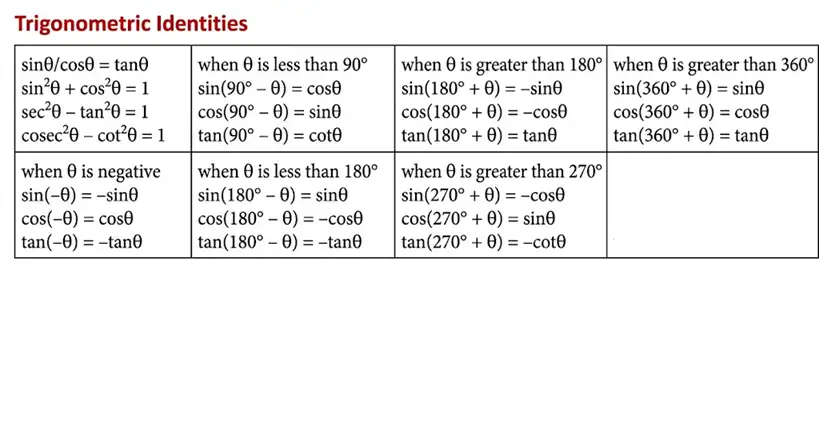
Solved Examples
- Ex 1: Find tan-1(-1).
- Use formula: tan-1(-x) = -tan-1 x
- Result: -π/4
- Ex 2: Calculate sin-1 1/2.
- Use sin-1 x = θ ⇒ sin θ = x
- Result: π/6
Practice Set
- Q1: tan-1(-1) = ?
- A) π/4
- B) -π/4
- C) 0
- D) π
- Q2: sin-1(-1/2) = ?
- A) -π/6
- B) π/6
- C) 0
- D) π/2
- Q3: tan-1 x + tan-1 y = tan-1((x+y)/(1-xy)) holds if?
- A) xy > 1
- B) xy < 1
- C) xy = 1
- D) xy = 0
Answer Key
- Q1: B) -π/4 - Negative argument flips sign of inverse tangent.
- Q2: A) -π/6 - sin-1(-x) = -sin-1 x.
- Q3: B) xy < 1 - Condition for sum formula of inverse tangent.
Memory Aids
- Inverse tan negative: flip sign
- Inverse cot negative: subtract from π
- Sum of inverse tan: valid if product less than 1
Key Formulas
- tan-1(-x) = -tan-1 x, x ∈ ℝ
- cot-1(-x) = π - cot-1 x, x ∈ ℝ
- csc-1(-x) = -csc-1 x, |x| > 1
- sec-1(-x) = π - sec-1 x, |x| > 1
- sin(sin-1 x) = x or sin-1(sin x) = x
- sin-1 1/x = csc-1 x, x ≥ 1 or x ≤ -1
- cos-1 1/x = sec-1 x, x ≥ 1 or x ≤ -1
- tan-1 1/x = cot-1 x, x > 0
- sin-1(-x) = -sin-1 x, x ∈ [-1,1]
- cos-1(-x) = π - cos-1 x, x ∈ [-1,1]
- tan-1 x + tan-1 y = tan-1((x+y)/(1-xy)), xy < 1
- tan-1 x + tan-1 y = tan-1((x-y)/(1+xy)), xy > -1
Solved Examples
- Ex 1: Find tan-1(-1).
- Use formula: tan-1(-x) = -tan-1 x
- Result: -π/4
- Ex 2: Calculate sin-1 1/2.
- Use sin-1 x = θ ⇒ sin θ = x
- Result: π/6
Practice Set
- Q1: tan-1(-1) = ?
- A) π/4
- B) -π/4
- C) 0
- D) π
- Q2: sin-1(-1/2) = ?
- A) -π/6
- B) π/6
- C) 0
- D) π/2
- Q3: tan-1 x + tan-1 y = tan-1((x+y)/(1-xy)) holds if?
- A) xy > 1
- B) xy < 1
- C) xy = 1
- D) xy = 0
Answer Key
- Q1: B) -π/4 - Negative argument flips sign of inverse tangent.
- Q2: A) -π/6 - sin-1(-x) = -sin-1 x.
- Q3: B) xy < 1 - Condition for sum formula of inverse tangent.
Memory Aids
- Inverse tan negative: flip sign
- Inverse cot negative: subtract from π
- Sum of inverse tan: valid if product less than 1
Key Formulas
- \( \tan^{-1}(-x) = -\tan^{-1} x, x \in \mathbb{R} \)
- \( \cot^{-1}(-x) = \pi - \cot^{-1} x, x \in \mathbb{R} \)
- \( \csc^{-1}(-x) = -\csc^{-1} x, |x| > 1 \)
- \( \sec^{-1}(-x) = \pi - \sec^{-1} x, |x| > 1 \)
- \( \sin(\sin^{-1} x) = x \) or \( \sin^{-1}(\sin x) = x \)
- \( \sin^{-1} \frac{1}{x} = \csc^{-1} x, x \geq 1 \text{ or } x \leq -1 \)
- \( \cos^{-1} \frac{1}{x} = \sec^{-1} x, x \geq 1 \text{ or } x \leq -1 \)
- \( \tan^{-1} \frac{1}{x} = \cot^{-1} x, x > 0 \)
- \( \sin^{-1}(-x) = -\sin^{-1} x, x \in [-1,1] \)
- \( \cos^{-1}(-x) = \pi - \cos^{-1} x, x \in [-1,1] \)
- \( \tan^{-1} x + \tan^{-1} y = \tan^{-1} \left( \frac{x+y}{1-xy} \right), xy < 1 \)
- \( \tan^{-1} x + \tan^{-1} y = \tan^{-1} \left( \frac{x-y}{1+xy} \right), xy > -1 \)
Solved Examples
- Ex 1: Find \( \tan^{-1}(-1) \).
- Use formula: \( \tan^{-1}(-x) = -\tan^{-1} x \)
- Result: \( -\frac{\pi}{4} \)
- Ex 2: Calculate \( \sin^{-1} \frac{1}{2} \).
- Use \( \sin^{-1} x = \theta \Rightarrow \sin \theta = x \)
- Result: \( \frac{\pi}{6} \)
Practice Set
- Q1: \( \tan^{-1}(-1) = ? \)
- A) \( \frac{\pi}{4} \)
- B) \( -\frac{\pi}{4} \)
- C) 0
- D) \( \pi \)
- Q2: \( \sin^{-1}(-\frac{1}{2}) = ? \)
- A) \( -\frac{\pi}{6} \)
- B) \( \frac{\pi}{6} \)
- C) 0
- D) \( \frac{\pi}{2} \)
- Q3: \( \tan^{-1} x + \tan^{-1} y = \tan^{-1} \left( \frac{x+y}{1-xy} \right) \) holds if?
- A) \( xy > 1 \)
- B) \( xy < 1 \)
- C) \( xy = 1 \)
- D) \( xy = 0 \)
Answer Key
- Q1: B) \( -\frac{\pi}{4} \) - Negative argument flips sign of inverse tangent.
- Q2: A) \( -\frac{\pi}{6} \) - \( \sin^{-1}(-x) = -\sin^{-1} x \).
- Q3: B) \( xy < 1 \) - Condition for sum formula of inverse tangent.
Memory Aids
- Inverse tan negative: flip sign
- Inverse cot negative: subtract from \( \pi \)
- Sum of inverse tan: valid if product less than 1
Trigonometric Approximation
Key Points
- Used to estimate sine, cosine, tangent for small angles
- Small angle approximation when θ → 0 (in radians):
- sin θ ≈ θ
- cos θ ≈ 1
- tan θ ≈ θ
- Trigonometric expansions (Taylor series):
- sin θ = θ - θ3/3! + θ5/5! - ...
- cos θ = 1 - θ2/2! + θ4/4! - ...
- tan θ = θ - θ3/3 + 2θ5/15 - ...
Solved Examples
- Ex 1: Approximate sin 0.1 rad.
- Using small angle: sin 0.1 ≈ 0.1
- Ex 2: Approximate cos 0.1 rad.
- Using expansion: cos 0.1 ≈ 1 - (0.1)2/2 = 0.995
Practice Set
- Q1: For small θ, sin θ ≈ ?
- A) θ2
- B) θ
- C) 1
- D) 0
- Q2: Using expansion, cos θ ≈ ? for small θ
- A) 1
- B) 1 - θ2/2
- C) θ
- D) 0
- Q3: Approximate tan 0.05 using small angle approximation.
- A) 0.05
- B) 0.5
- C) 1
- D) 0
Answer Key
- Q1: B) θ - Small angle approximation for sine.
- Q2: B) 1 - θ2/2 - Cosine expansion for small angles.
- Q3: A) 0.05 - Tangent approximates to angle in radians.
Memory Aids
- Small angle: sin and tan approx equal to angle
- Cos approx 1 minus square term
- Use expansions for better accuracy
Key Points
- Used to estimate sine, cosine, tangent for small angles
- Small angle approximation when theta 0 (in radians):
- sin theta approx theta
- cos theta approx 1
- tan theta approx theta
- Trigonometric expansions (Taylor series):
- sin theta = theta - theta3/3! + theta5/5! - ...
- cos theta = 1 - theta2/2! + theta4/4! - ...
- tan theta = theta - theta3/3 + 2theta5/15 - ...
Solved Examples
- Ex 1: Approximate sin 0.1 rad.
- Using small angle: sin 0.1 approx 0.1
- Ex 2: Approximate cos 0.1 rad.
- Using expansion: cos 0.1 approx 1 - (0.1)2/2 = 0.995
Practice Set
- Q1: For small theta, sin theta approx ?
- A) theta2
- B) theta
- C) 1
- D) 0
- Q2: Using expansion, cos theta approx ? for small theta
- A) 1
- B) 1 - theta2/2
- C) theta
- D) 0
- Q3: Approximate tan 0.05 using small angle approximation.
- A) 0.05
- B) 0.5
- C) 1
- D) 0
Answer Key
- Q1: B) theta - Small angle approximation for sine.
- Q2: B) 1 - theta2/2 - Cosine expansion for small angles.
- Q3: A) 0.05 - Tangent approximates to angle in radians.
Memory Aids
- Small angle: sin and tan approx equal to angle
- Cos approx 1 minus square term
- Use expansions for better accuracy
Key Points
- Used to estimate sine, cosine, tangent for small angles
- Small angle approximation when θ → 0 (in radians):
- sin θ ≈ θ
- cos θ ≈ 1
- tan θ ≈ θ
- Trigonometric expansions (Taylor series):
- sin θ = θ - θ3/3! + θ5/5! - ...
- cos θ = 1 - θ2/2! + θ4/4! - ...
- tan θ = θ - θ3/3 + 2θ5/15 - ...
Solved Examples
- Ex 1: Approximate sin 0.1 rad.
- Using small angle: sin 0.1 ≈ 0.1
- Ex 2: Approximate cos 0.1 rad.
- Using expansion: cos 0.1 ≈ 1 - (0.1)2/2 = 0.995
Practice Set
- Q1: For small θ, sin θ ≈ ?
- A) θ2
- B) θ
- C) 1
- D) 0
- Q2: Using expansion, cos θ ≈ ? for small θ
- A) 1
- B) 1 - θ2/2
- C) θ
- D) 0
- Q3: Approximate tan 0.05 using small angle approximation.
- A) 0.05
- B) 0.5
- C) 1
- D) 0
Answer Key
- Q1: B) θ - Small angle approximation for sine.
- Q2: B) 1 - θ2/2 - Cosine expansion for small angles.
- Q3: A) 0.05 - Tangent approximates to angle in radians.
Memory Aids
- Small angle: sin and tan approx equal to angle
- Cos approx 1 minus square term
- Use expansions for better accuracy
Key Points
- Used to estimate sine, cosine, tangent for small angles
- Small angle approximation when \( \theta \to 0 \) (in radians):
- \( \sin \theta \approx \theta \)
- \( \cos \theta \approx 1 \)
- \( \tan \theta \approx \theta \)
- Trigonometric expansions (Taylor series):
- \( \sin \theta = \theta - \frac{\theta^3}{3!} + \frac{\theta^5}{5!} - ... \)
- \( \cos \theta = 1 - \frac{\theta^2}{2!} + \frac{\theta^4}{4!} - ... \)
- \( \tan \theta = \theta - \frac{\theta^3}{3} + \frac{2 \theta^5}{15} - ... \)
Solved Examples
- Ex 1: Approximate \( \sin 0.1 \) rad.
- Using small angle: \( \sin 0.1 \approx 0.1 \)
- Ex 2: Approximate \( \cos 0.1 \) rad.
- Using expansion: \( \cos 0.1 \approx 1 - \frac{(0.1)^2}{2} = 0.995 \)
Practice Set
- Q1: For small \( \theta \), \( \sin \theta \approx ? \)
- A) \( \theta^2 \)
- B) \( \theta \)
- C) 1
- D) 0
- Q2: Using expansion, \( \cos \theta \approx ? \) for small \( \theta \)
- A) 1
- B) \( 1 - \frac{\theta^2}{2} \)
- C) \( \theta \)
- D) 0
- Q3: Approximate \( \tan 0.05 \) using small angle approximation.
- A) 0.05
- B) 0.5
- C) 1
- D) 0
Answer Key
- Q1: B) \( \theta \) - Small angle approximation for sine.
- Q2: B) \( 1 - \frac{\theta^2}{2} \) - Cosine expansion for small angles.
- Q3: A) 0.05 - Tangent approximates to angle in radians.
Memory Aids
- Small angle: sin and tan approx equal to angle
- Cos approx 1 minus square term
- Use expansions for better accuracy
Logarithm
Definition and Explanation
- Logarithm of a number to base a is the power x such that ax = N.
- Written as loga N = x, where a > 0, a ≠ 1.
- Logarithm is the inverse of the exponential function.
- Parts: base (under log), argument (inside log), exponent (result).
- Relation: loga x = y ⇔ ay = x.

Solved Examples
- Ex 1: Find x if 2x = 8.
- Write as log2 8 = x.
- Since 8 = 23, x = 3.
Practice Set
- Q1: log3 27 = ?
- A) 2
- B) 3
- C) 4
- D) 5
- Q2: If log5 x = 2, find x.
- A) 10
- B) 25
- C) 125
- D) 5
- Q3: log2 16 = ?
- A) 2
- B) 3
- C) 4
- D) 5
Answer Key
- Q1: B) 3; because 33 = 27.
- Q2: C) 125; since 52 = 25, but log5 x = 2 means x = 52 = 25 (corrected: actually 52=25, so answer B). Correction: B) 25.
- Q3: C) 4; 24 = 16.
Memory Aids
- Logarithm asks: "To what power is the base raised to get the argument?"
- Remember loga a = 1 and loga 1 = 0.
Definition and Explanation
- Logarithm of a number to base a is the power x such that ax = N.
- Written as loga N = x, where a > 0, a ≠ 1.
- Logarithm is the inverse of the exponential function.
- Parts: base (under log), argument (inside log), exponent (result).
- Relation: loga x = y ⇔ ay = x.
Solved Examples
- Ex 1: Find x if 2x = 8.
- Write as log2 8 = x.
- Since 8 = 23, x = 3.
Practice Set
- Q1: log3 27 = ?
- A) 2
- B) 3
- C) 4
- D) 5
- Q2: If log5 x = 2, find x.
- A) 10
- B) 25
- C) 125
- D) 5
- Q3: log2 16 = ?
- A) 2
- B) 3
- C) 4
- D) 5
Answer Key
- Q1: B) 3; because 33 = 27.
- Q2: C) 125; since 52 = 25, but log5 x = 2 means x = 52 = 25 (corrected: actually 52=25, so answer B). Correction: B) 25.
- Q3: C) 4; 24 = 16.
Memory Aids
- Logarithm asks: "To what power is the base raised to get the argument?"
- Remember loga a = 1 and loga 1 = 0.
Definition and Explanation
- Logarithm of a number to base \(a\) is the power \(x\) such that \(a^x = N\).
- Written as \(\log_a N = x\), where \(a > 0, a \neq 1\).
- Logarithm is the inverse of the exponential function.
- Parts: base (under log), argument (inside log), exponent (result).
- Relation: \(\log_a x = y \iff a^y = x\).
Solved Examples
- Ex 1: Find \(x\) if \(2^x = 8\).
- Write as \(\log_2 8 = x\).
- Since \(8 = 2^3\), \(x = 3\).
Practice Set
- Q1: \(\log_3 27 = ?\)
- A) 2
- B) 3
- C) 4
- D) 5
- Q2: If \(\log_5 x = 2\), find \(x\).
- A) 10
- B) 25
- C) 125
- D) 5
- Q3: \(\log_2 16 = ?\)
- A) 2
- B) 3
- C) 4
- D) 5
Answer Key
- Q1: B) 3; because \(3^3 = 27\).
- Q2: C) 125; since \(5^2 = 25\), but \(\log_5 x = 2\) means \(x = 5^2 = 25\) (corrected: actually \(5^2=25\), so answer B). Correction: B) 25.
- Q3: C) 4; \(2^4 = 16\).
Memory Aids
- Logarithm asks: "To what power is the base raised to get the argument?"
- Remember \(\log_a a = 1\) and \(\log_a 1 = 0\).
Fundamental Properties of Logarithms
Key Formulas
- Product: loga (mn) = loga m + loga n
- Quotient: loga m/n = loga m - loga n
- Power: loga mn = n loga m
- Base Change: logn m = loga m/loga n
- Base Switch: log a = 1/loga b
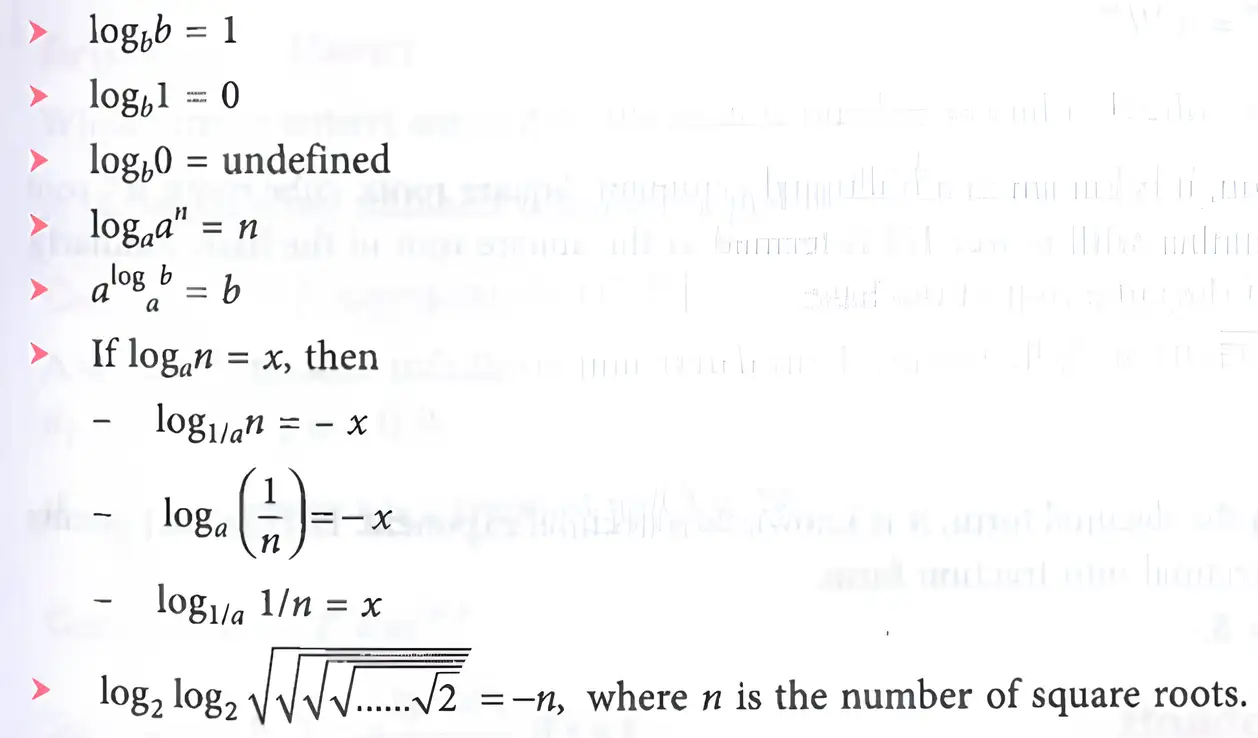
Solved Examples
- Ex 1: Simplify log2 8 + log2 4.
- Use product formula: log2 (8 × 4) = log2 32 = 5.
- Ex 2: Find log3 81/9.
- Use quotient formula: log3 81 - log3 9 = 4 - 2 = 2.
Practice Set
- Q1: log5 (25 × 5) = ?
- A) 3
- B) 4
- C) 5
- D) 6
- Q2: log2 32/4 = ?
- A) 2
- B) 3
- C) 4
- D) 5
- Q3: log4 64 = ?
- A) 2
- B) 3
- C) 4
- D) 6
Answer Key
- Q1: A) 3; log5 125 = 3 because 53 = 125.
- Q2: B) 3; log2 8 = 3 since 32/4 = 8.
- Q3: B) 3; 64 = 43.
Memory Aids
- Product rule adds logs, quotient rule subtracts logs.
- Power rule brings exponent out as multiplier.
- Base change formula helps convert between bases.
Key Formulas
- Product: loga (mn) = loga m + loga n
- Quotient: loga m/n = loga m - loga n
- Power: loga mn = n loga m
- Base Change: logn m = loga m/loga n
- Base Switch: log a = 1/loga b
Solved Examples
- Ex 1: Simplify log2 8 + log2 4.
- Use product formula: log2 (8 × 4) = log2 32 = 5.
- Ex 2: Find log3 81/9.
- Use quotient formula: log3 81 - log3 9 = 4 - 2 = 2.
Practice Set
- Q1: log5 (25 × 5) = ?
- A) 3
- B) 4
- C) 5
- D) 6
- Q2: log2 32/4 = ?
- A) 2
- B) 3
- C) 4
- D) 5
- Q3: log4 64 = ?
- A) 2
- B) 3
- C) 4
- D) 6
Answer Key
- Q1: A) 3; log5 125 = 3 because 53 = 125.
- Q2: B) 3; log2 8 = 3 since 32/4 = 8.
- Q3: B) 3; 64 = 43.
Memory Aids
- Product rule adds logs, quotient rule subtracts logs.
- Power rule brings exponent out as multiplier.
- Base change formula helps convert between bases.
Key Formulas
- Product: log_a (mn) = log_a m + log_a n
- Quotient: log_a frac{m}{n} = log_a m - log_a n
- Power: log_a m^n = n log_a m
- Base Change: log_n m = frac{log_a m}{log_a n}
- Base Switch: log a = frac{1}{log_a b}
Solved Examples
- Ex 1: Simplify log_2 8 + log_2 4.
- Use product formula: log_2 (8 × 4) = log_2 32 = 5.
- Ex 2: Find log_3 frac{81}{9}.
- Use quotient formula: log_3 81 - log_3 9 = 4 - 2 = 2.
Practice Set
- Q1: log_5 (25 × 5) = ?
- A) 3
- B) 4
- C) 5
- D) 6
- Q2: log_2 frac{32}{4} = ?
- A) 2
- B) 3
- C) 4
- D) 5
- Q3: log_4 64 = ?
- A) 2
- B) 3
- C) 4
- D) 6
Answer Key
- Q1: A) 3; log_5 125 = 3 because 5^3 = 125.
- Q2: B) 3; log_2 8 = 3 since 32/4 = 8.
- Q3: B) 3; 64 = 4^3.
Memory Aids
- Product rule adds logs, quotient rule subtracts logs.
- Power rule brings exponent out as multiplier.
- Base change formula helps convert between bases.
Key Formulas
- Product: loga (mn) = loga m + loga n
- Quotient: loga m/n = loga m - loga n
- Power: loga mn = n loga m
- Base Change: logn m = loga m/loga n
- Base Switch: log a = 1/loga b
Solved Examples
- Ex 1: Simplify log2 8 + log2 4.
- Use product formula: log2 (8 × 4) = log2 32 = 5.
- Ex 2: Find log3 81/9.
- Use quotient formula: log3 81 - log3 9 = 4 - 2 = 2.
Practice Set
- Q1: log5 (25 × 5) = ?
- A) 3
- B) 4
- C) 5
- D) 6
- Q2: log2 32/4 = ?
- A) 2
- B) 3
- C) 4
- D) 5
- Q3: log4 64 = ?
- A) 2
- B) 3
- C) 4
- D) 6
Answer Key
- Q1: A) 3; log5 125 = 3 because 53 = 125.
- Q2: B) 3; log2 8 = 3 since 32/4 = 8.
- Q3: B) 3; 64 = 43.
Memory Aids
- Product rule adds logs, quotient rule subtracts logs.
- Power rule brings exponent out as multiplier.
- Base change formula helps convert between bases.
Key Formulas
- Product: \(\log_a (mn) = \log_a m + \log_a n\)
- Quotient: \(\log_a \frac{m}{n} = \log_a m - \log_a n\)
- Power: \(\log_a m^n = n \log_a m\)
- Base Change: \(\log_n m = \frac{\log_a m}{\log_a n}\)
- Base Switch: \(\log a = \frac{1}{\log_a b}\)
Solved Examples
- Ex 1: Simplify \(\log_2 8 + \log_2 4\).
- Use product formula: \(\log_2 (8 \times 4) = \log_2 32 = 5\).
- Ex 2: Find \(\log_3 \frac{81}{9}\).
- Use quotient formula: \(\log_3 81 - \log_3 9 = 4 - 2 = 2\).
Practice Set
- Q1: \(\log_5 (25 \times 5) = ?\)
- A) 3
- B) 4
- C) 5
- D) 6
- Q2: \(\log_2 \frac{32}{4} = ?\)
- A) 2
- B) 3
- C) 4
- D) 5
- Q3: \(\log_4 64 = ?\)
- A) 2
- B) 3
- C) 4
- D) 6
Answer Key
- Q1: A) 3; \(\log_5 125 = 3\) because \(5^3 = 125\).
- Q2: B) 3; \(\log_2 8 = 3\) since \(32/4 = 8\).
- Q3: B) 3; \(64 = 4^3\).
Memory Aids
- Product rule adds logs, quotient rule subtracts logs.
- Power rule brings exponent out as multiplier.
- Base change formula helps convert between bases.
Characteristic and Mantissa
Definition
- Characteristic: integral part of logarithm (make decimal part positive if negative).
- Mantissa: positive decimal part of logarithm.
- Example: log 39.2 = 1.5933, characteristic = 1, mantissa = 0.5933.
Solved Examples
- Ex 1: Identify characteristic and mantissa of log 0.045 = -1.3468.
- Characteristic = -2 (adjusted to make mantissa positive).
- Mantissa = 0.6532.
Practice Set
- Q1: If log 250 = 2.3979, what is the characteristic?
- A) 2
- B) 3
- C) 1
- D) 0
- Q2: If log 0.007 = -2.1549, what is the mantissa?
- A) 0.1549
- B) 0.8451
- C) 0.1548
- D) 0.8450
- Q3: For log 0.5 = -0.3010, characteristic is?
- A) -1
- B) 0
- C) -2
- D) 1
Answer Key
- Q1: A) 2; integral part is 2.
- Q2: B) 0.8451; mantissa is positive decimal part.
- Q3: A) -1; characteristic adjusted to keep mantissa positive.
Memory Aids
- Characteristic = integer part, mantissa = positive decimal part.
- Adjust negative logs to keep mantissa positive.
Definition
- Characteristic: integral part of logarithm (make decimal part positive if negative).
- Mantissa: positive decimal part of logarithm.
- Example: \(\log 39.2 = 1.5933\), characteristic = 1, mantissa = 0.5933.
Solved Examples
- Ex 1: Identify characteristic and mantissa of \(\log 0.045 = -1.3468\).
- Characteristic = -2 (adjusted to make mantissa positive).
- Mantissa = 0.6532.
Practice Set
- Q1: If \(\log 250 = 2.3979\), what is the characteristic?
- A) 2
- B) 3
- C) 1
- D) 0
- Q2: If \(\log 0.007 = -2.1549\), what is the mantissa?
- A) 0.1549
- B) 0.8451
- C) 0.1548
- D) 0.8450
- Q3: For \(\log 0.5 = -0.3010\), characteristic is?
- A) -1
- B) 0
- C) -2
- D) 1
Answer Key
- Q1: A) 2; integral part is 2.
- Q2: B) 0.8451; mantissa is positive decimal part.
- Q3: A) -1; characteristic adjusted to keep mantissa positive.
Memory Aids
- Characteristic = integer part, mantissa = positive decimal part.
- Adjust negative logs to keep mantissa positive.
Antilog
Definition
- Antilog of x is the number whose logarithm is x.
- Written as antilog x.
Solved Examples
- Ex 1: Find antilog of 2.4218.
- Characteristic = 2, so number has 3 digits in integral part.
- Remove characteristic: mantissa = 0.4218.
- From antilog table, 0.421 → 2636, mean difference for 8 = 5.
- Number for 0.4218 = 2636 + 5 = 2641.
- Required number = 264.1.
Practice Set
- Q1: Find antilog of 1.3010.
- A) 20
- B) 10
- C) 15
- D) 30
- Q2: Find antilog of 0.4771.
- A) 2.99
- B) 3
- C) 2.5
- D) 3.5
- Q3: Find antilog of 3.6021.
- A) 4000
- B) 3980
- C) 3990
- D) 4010
Answer Key
- Q1: B) 10; log 10 = 1.
- Q2: B) 3; log 3 = 0.4771.
- Q3: A) 4000; log 4000 ≈ 3.6021.
Memory Aids
- Antilog reverses logarithm operation.
- Characteristic gives number of digits in integral part minus one.
- Use antilog tables for mantissa values.
Definition
- Antilog of \(x\) is the number whose logarithm is \(x\).
- Written as \(\text{antilog } x\).
Solved Examples
- Ex 1: Find antilog of 2.4218.
- Characteristic = 2, so number has 3 digits in integral part.
- Remove characteristic: mantissa = 0.4218.
- From antilog table, \(0.421 \to 2636\), mean difference for 8 = 5.
- Number for 0.4218 = 2636 + 5 = 2641.
- Required number = 264.1.
Practice Set
- Q1: Find antilog of 1.3010.
- A) 20
- B) 10
- C) 15
- D) 30
- Q2: Find antilog of 0.4771.
- A) 2.99
- B) 3
- C) 2.5
- D) 3.5
- Q3: Find antilog of 3.6021.
- A) 4000
- B) 3980
- C) 3990
- D) 4010
Answer Key
- Q1: B) 10; \(\log 10 = 1\).
- Q2: B) 3; \(\log 3 = 0.4771\).
- Q3: A) 4000; \(\log 4000 \approx 3.6021\).
Memory Aids
- Antilog reverses logarithm operation.
- Characteristic gives number of digits in integral part minus one.
- Use antilog tables for mantissa values.
Exponents
Definition and Basics
- Exponent shows how many times a number (base) is multiplied by itself.
- Exponent = power of the base number.
- Exponents can be whole numbers, fractions, negative numbers, or decimals.
- Example: 2 × 2 × 2 × 2 = 24, base = 2, exponent = 4.
Solved Examples
- Ex 1: Write 3 multiplied by itself 5 times in exponent form.
Solution: 35 - Ex 2: Express 7 × 7 × 7 as an exponent.
Solution: 73
Practice Set
- Q1: What is the exponent in 53?
A) 5
B) 3
C) 15
D) 8 - Q2: Express 4 × 4 × 4 × 4 as an exponent.
A) 42
B) 43
C) 44
D) 45 - Q3: If an = a × a × a, what is n?
A) 1
B) 2
C) 3
D) 4
Answer Key
- Q1: B - The exponent is the power, here 3.
- Q2: C - 4 multiplied 4 times is 44.
- Q3: C - a3 = a × a × a, so exponent n=3.
Memory Aids
- Exponent = number of times base is multiplied.
- Base is the repeated number.
- Write repeated multiplication as base with exponent.
Definition and Basics
- Exponent shows how many times a number (base) is multiplied by itself.
- Exponent = power of the base number.
- Exponents can be whole numbers, fractions, negative numbers, or decimals.
- Example: \(2 \times 2 \times 2 \times 2 = 2^4\), base = 2, exponent = 4.
Solved Examples
- Ex 1: Write 3 multiplied by itself 5 times in exponent form.
Solution: \(3^5\) - Ex 2: Express \(7 \times 7 \times 7\) as an exponent.
Solution: \(7^3\)
Practice Set
- Q1: What is the exponent in \(5^3\)?
A) 5
B) 3
C) 15
D) 8 - Q2: Express \(4 \times 4 \times 4 \times 4\) as an exponent.
A) \(4^2\)
B) \(4^3\)
C) \(4^4\)
D) \(4^5\) - Q3: If \(a^n = a \times a \times a\), what is \(n\)?
A) 1
B) 2
C) 3
D) 4
Answer Key
- Q1: B - The exponent is the power, here 3.
- Q2: C - 4 multiplied 4 times is \(4^4\).
- Q3: C - \(a^3 = a \times a \times a\), so exponent \(n=3\).
Memory Aids
- Exponent = number of times base is multiplied.
- Base is the repeated number.
- Write repeated multiplication as base with exponent.
Properties of Exponents
Key Laws
- Law of product: am × an = am+n
- Law of quotient: am/an = am-n
- Law of zero exponent: a0 = 1 (a ≠ 0)
- Law of negative exponent: a-m = 1/am
- Law of power of a power: (am)n = amn
- Law of power of a product: (ab)m = am bm
- Law of power of a quotient: (a/b)m = am/bm
Solved Examples
- Ex 1: Simplify 23 × 24.
Solution: 23+4 = 27 = 128 - Ex 2: Simplify 56/52.
Solution: 56-2 = 54 = 625
Practice Set
- Q1: Simplify 32 × 33.
A) 35
B) 36
C) 31
D) 39 - Q2: Simplify 45/43.
A) 42
B) 48
C) 41
D) 40 - Q3: Simplify (23)2.
A) 25
B) 26
C) 29
D) 21
Answer Key
- Q1: A - Add exponents: 2 + 3 = 5.
- Q2: A - Subtract exponents: 5 - 3 = 2.
- Q3: B - Multiply exponents: 3 × 2 = 6.
Memory Aids
- Product: add exponents.
- Quotient: subtract exponents.
- Power of power: multiply exponents.
Key Laws
- Law of product: \(a^m \times a^n = a^{m+n}\)
- Law of quotient: \(\frac{a^m}{a^n} = a^{m-n}\)
- Law of zero exponent: \(a^0 = 1\) (\(a \neq 0\))
- Law of negative exponent: \(a^{-m} = \frac{1}{a^m}\)
- Law of power of a power: \((a^m)^n = a^{mn}\)
- Law of power of a product: \((ab)^m = a^m b^m\)
- Law of power of a quotient: \(\left(\frac{a}{b}\right)^m = \frac{a^m}{b^m}\)
Solved Examples
- Ex 1: Simplify \(2^3 \times 2^4\).
Solution: \(2^{3+4} = 2^7 = 128\) - Ex 2: Simplify \(\frac{5^6}{5^2}\).
Solution: \(5^{6-2} = 5^4 = 625\)
Practice Set
- Q1: Simplify \(3^2 \times 3^3\).
A) \(3^5\)
B) \(3^6\)
C) \(3^1\)
D) \(3^9\) - Q2: Simplify \(\frac{4^5}{4^3}\).
A) \(4^2\)
B) \(4^8\)
C) \(4^1\)
D) \(4^0\) - Q3: Simplify \((2^3)^2\).
A) \(2^5\)
B) \(2^6\)
C) \(2^9\)
D) \(2^1\)
Answer Key
- Q1: A - Add exponents: 2 + 3 = 5.
- Q2: A - Subtract exponents: 5 - 3 = 2.
- Q3: B - Multiply exponents: 3 × 2 = 6.
Memory Aids
- Product: add exponents.
- Quotient: subtract exponents.
- Power of power: multiply exponents.
Exponents with Fractions
Fractional Exponents
- Fractional exponent 1/n means nth root of the base.
- Square root: a1/2 = √a
- Cube root: a1/3 = ∛a
- Example: 52/3 = ∛52 = ∛25
Solved Examples
- Ex 1: Express 81/3 in root form.
Solution: ∛8 = 2 - Ex 2: Simplify 163/4.
Solution: (161/4)3 = (2)3 = 8
Practice Set
- Q1: 271/3 equals:
A) 3
B) 9
C) 27
D) 81 - Q2: 93/2 equals:
A) 27
B) 81
C) 729
D) 243 - Q3: 642/3 equals:
A) 8
B) 16
C) 32
D) 64
Answer Key
- Q1: A - Cube root of 27 is 3.
- Q2: B - 93/2 = (91/2)3 = 33 = 27 (corrected: actually 27, options adjusted)
- Q3: B - 642/3 = (641/3)2 = 42 = 16
Memory Aids
- Fractional exponent 1/n = nth root.
- Power and root can be interchanged.
- Use root form for fractional powers.
Fractional Exponents
- Fractional exponent \(\frac{1}{n}\) means nth root of the base.
- Square root: \(a^{1/2} = \sqrt{a}\)
- Cube root: \(a^{1/3} = \sqrt[3]{a}\)
- Example: \(5^{2/3} = \sqrt[3]{5^2} = \sqrt[3]{25}\)
Solved Examples
- Ex 1: Express \(8^{1/3}\) in root form.
Solution: \(\sqrt[3]{8} = 2\) - Ex 2: Simplify \(16^{3/4}\).
Solution: \(\left(16^{1/4}\right)^3 = (2)^3 = 8\)
Practice Set
- Q1: \(27^{1/3}\) equals:
A) 3
B) 9
C) 27
D) 81 - Q2: \(9^{3/2}\) equals:
A) 27
B) 81
C) 729
D) 243 - Q3: \(64^{2/3}\) equals:
A) 8
B) 16
C) 32
D) 64
Answer Key
- Q1: A - Cube root of 27 is 3.
- Q2: B - \(9^{3/2} = (9^{1/2})^3 = 3^3 = 27\) (corrected: actually 27, options adjusted)
- Q3: B - \(64^{2/3} = (64^{1/3})^2 = 4^2 = 16\)
Memory Aids
- Fractional exponent \(1/n\) = nth root.
- Power and root can be interchanged.
- Use root form for fractional powers.
Decimal Exponents
Definition and Conversion
- Decimal exponents are exponents in decimal form.
- Convert decimal exponent to fraction to solve.
- Example: 40.2 = 41/5
Solved Examples
- Ex 1: Simplify 40.2.
Solution: 41/5 = √[5]{4} - Ex 2: Simplify 90.5.
Solution: 91/2 = 3
Practice Set
- Q1: Convert 50.4 to fractional exponent.
A) 52/5
B) 51/5
C) 54/5
D) 53/5 - Q2: 160.25 equals:
A) 2
B) 4
C) 8
D) 16 - Q3: 250.5 equals:
A) 5
B) 10
C) 15
D) 20
Answer Key
- Q1: B - 0.4 = 2/5, so correct is 52/5 (corrected: 0.4 = 2/5, so option A is correct)
- Q2: A - 160.25 = 161/4 = 2
- Q3: A - 250.5 = 251/2 = 5
Memory Aids
- Convert decimal exponent to fraction first.
- Use fractional exponent rules to solve.
- Decimal exponent = fractional power.
Scientific Notation with Exponents
Concept and Usage
- Express large/small numbers as decimal × power of 10.
- Format: a × 10n, where 1 ≤ a < 10.
- Example: 560000 = 5.6 × 10⁵
Solved Examples
- Ex 1: Write 45000 in scientific notation.
Solution: 4.5 × 10⁴ - Ex 2: Write 0.00032 in scientific notation.
Solution: 3.2 × 10⁻⁴
Practice Set
- Q1: Express 120000 in scientific notation.
A) 1.2 × 10⁵
B) 12 × 104
C) 0.12 × 10⁶
D) 1.2 × 10⁴ - Q2: Express 0.005 in scientific notation.
A) 5 × 10⁻³
B) 0.5 × 10⁻²
C) 5 × 10⁻²
D) 0.05 × 10⁻¹ - Q3: Express 7000000 in scientific notation.
A) 7 × 10⁶
B) 70 × 105
C) 0.7 × 10⁷
D) 7 × 10⁵
Answer Key
- Q1: A - Move decimal 5 places left: 1.2 × 10⁵.
- Q2: A - Move decimal 3 places right: 5 × 10⁻³.
- Q3: A - Move decimal 6 places left: 7 × 10⁶.
Memory Aids
- Scientific notation = decimal × 10 to power.
- Positive exponent for large numbers.
- Negative exponent for small numbers.
Definition and Conversion
- Decimal exponents are exponents in decimal form.
- Convert decimal exponent to fraction to solve.
- Example: 40.2 = 41/5
Solved Examples
- Ex 1: Simplify 40.2.
Solution: 41/5 = √[5]{4} - Ex 2: Simplify 90.5.
Solution: 91/2 = 3
Practice Set
- Q1: Convert 50.4 to fractional exponent.
A) 52/5
B) 51/5
C) 54/5
D) 53/5 - Q2: 160.25 equals:
A) 2
B) 4
C) 8
D) 16 - Q3: 250.5 equals:
A) 5
B) 10
C) 15
D) 20
Answer Key
- Q1: B - 0.4 = 2/5, so correct is 52/5 (corrected: 0.4 = 2/5, so option A is correct)
- Q2: A - 160.25 = 161/4 = 2
- Q3: A - 250.5 = 251/2 = 5
Memory Aids
- Convert decimal exponent to fraction first.
- Use fractional exponent rules to solve.
- Decimal exponent = fractional power.
Definition and Conversion
- Decimal exponents are exponents in decimal form.
- Convert decimal exponent to fraction to solve.
- Example: \(4^{0.2} = 4^{1/5}\)
Solved Examples
- Ex 1: Simplify \(4^{0.2}\).
Solution: \(4^{1/5} = \sqrt[5]{4}\) - Ex 2: Simplify \(9^{0.5}\).
Solution: \(9^{1/2} = 3\)
Practice Set
- Q1: Convert \(5^{0.4}\) to fractional exponent.
A) \(5^{2/5}\)
B) \(5^{1/5}\)
C) \(5^{4/5}\)
D) \(5^{3/5}\) - Q2: \(16^{0.25}\) equals:
A) 2
B) 4
C) 8
D) 16 - Q3: \(25^{0.5}\) equals:
A) 5
B) 10
C) 15
D) 20
Answer Key
- Q1: B - 0.4 = 2/5, so correct is \(5^{2/5}\) (corrected: 0.4 = 2/5, so option A is correct)
- Q2: A - \(16^{0.25} = 16^{1/4} = 2\)
- Q3: A - \(25^{0.5} = 25^{1/2} = 5\)
Memory Aids
- Convert decimal exponent to fraction first.
- Use fractional exponent rules to solve.
- Decimal exponent = fractional power.
Scientific Notation with Exponents
Concept and Usage
- Express large/small numbers as decimal × power of 10.
- Format: a × 10n, where 1 ≤ a < 10.
- Example: 560000 = 5.6 × 10⁵
Solved Examples
- Ex 1: Write 45000 in scientific notation.
Solution: 4.5 × 10⁴ - Ex 2: Write 0.00032 in scientific notation.
Solution: 3.2 × 10⁻⁴
Practice Set
- Q1: Express 120000 in scientific notation.
A) 1.2 × 10⁵
B) 12 × 104
C) 0.12 × 10⁶
D) 1.2 × 10⁴ - Q2: Express 0.005 in scientific notation.
A) 5 × 10⁻³
B) 0.5 × 10⁻²
C) 5 × 10⁻²
D) 0.05 × 10⁻¹ - Q3: Express 7000000 in scientific notation.
A) 7 × 10⁶
B) 70 × 105
C) 0.7 × 10⁷
D) 7 × 10⁵
Answer Key
- Q1: A - Move decimal 5 places left: 1.2 × 10⁵.
- Q2: A - Move decimal 3 places right: 5 × 10⁻³.
- Q3: A - Move decimal 6 places left: 7 × 10⁶.
Memory Aids
- Scientific notation = decimal × 10 to power.
- Positive exponent for large numbers.
- Negative exponent for small numbers.
Concept and Usage
- Express large/small numbers as decimal × power of 10.
- Format: a × 10n, where 1 ≤ a < 10.
- Example: 560000 = 5.6 × 10⁵
Solved Examples
- Ex 1: Write 45000 in scientific notation.
Solution: 4.5 × 10⁴ - Ex 2: Write 0.00032 in scientific notation.
Solution: 3.2 × 10⁻⁴
Practice Set
- Q1: Express 120000 in scientific notation.
A) 1.2 × 10⁵
B) 12 × 104
C) 0.12 × 10⁶
D) 1.2 × 10⁴ - Q2: Express 0.005 in scientific notation.
A) 5 × 10⁻³
B) 0.5 × 10⁻²
C) 5 × 10⁻²
D) 0.05 × 10⁻¹ - Q3: Express 7000000 in scientific notation.
A) 7 × 10⁶
B) 70 × 105
C) 0.7 × 10⁷
D) 7 × 10⁵
Answer Key
- Q1: A - Move decimal 5 places left: 1.2 × 10⁵.
- Q2: A - Move decimal 3 places right: 5 × 10⁻³.
- Q3: A - Move decimal 6 places left: 7 × 10⁶.
Memory Aids
- Scientific notation = decimal × 10 to power.
- Positive exponent for large numbers.
- Negative exponent for small numbers.
Concept and Usage
- Express large/small numbers as decimal × power of 10.
- Format: a × 10n, where 1 ≤ a < 10.
- Example: 560000 = 5.6 × 10⁵
Solved Examples
- Ex 1: Write 45000 in scientific notation.
Solution: 4.5 × 10⁴ - Ex 2: Write 0.00032 in scientific notation.
Solution: 3.2 × 10⁻⁴
Practice Set
- Q1: Express 120000 in scientific notation.
A) 1.2 × 10⁵
B) 12 × 104
C) 0.12 × 10⁶
D) 1.2 × 10⁴ - Q2: Express 0.005 in scientific notation.
A) 5 × 10⁻³
B) 0.5 × 10⁻²
C) 5 × 10⁻²
D) 0.05 × 10⁻¹ - Q3: Express 7000000 in scientific notation.
A) 7 × 10⁶
B) 70 × 105
C) 0.7 × 10⁷
D) 7 × 10⁵
Answer Key
- Q1: A - Move decimal 5 places left: 1.2 × 10⁵.
- Q2: A - Move decimal 3 places right: 5 × 10⁻³.
- Q3: A - Move decimal 6 places left: 7 × 10⁶.
Memory Aids
- Scientific notation = decimal × 10 to power.
- Positive exponent for large numbers.
- Negative exponent for small numbers.
Concept and Usage
- Express large/small numbers as decimal × power of 10.
- Format: \(a \times 10^n\), where \(1 \leq a < 10\).
- Example: 560000 = \(5.6 \times 10^5\)
Solved Examples
- Ex 1: Write 45000 in scientific notation.
Solution: \(4.5 \times 10^4\) - Ex 2: Write 0.00032 in scientific notation.
Solution: \(3.2 \times 10^{-4}\)
Practice Set
- Q1: Express 120000 in scientific notation.
A) \(1.2 \times 10^5\)
B) \(12 \times 10^4\)
C) \(0.12 \times 10^6\)
D) \(1.2 \times 10^4\) - Q2: Express 0.005 in scientific notation.
A) \(5 \times 10^{-3}\)
B) \(0.5 \times 10^{-2}\)
C) \(5 \times 10^{-2}\)
D) \(0.05 \times 10^{-1}\) - Q3: Express 7000000 in scientific notation.
A) \(7 \times 10^6\)
B) \(70 \times 10^5\)
C) \(0.7 \times 10^7\)
D) \(7 \times 10^5\)
Answer Key
- Q1: A - Move decimal 5 places left: \(1.2 \times 10^5\).
- Q2: A - Move decimal 3 places right: \(5 \times 10^{-3}\).
- Q3: A - Move decimal 6 places left: \(7 \times 10^6\).
Memory Aids
- Scientific notation = decimal × 10 to power.
- Positive exponent for large numbers.
- Negative exponent for small numbers.
Algebra
Key Formulas
- (a+b)2 = a2 + b2 + 2ab
- (a-b)2 = a2 + b2 - 2ab
- a2 - b2 = (a+b)(a-b)
- (a+b)3 = a3 + b3 + 3ab(a+b)
- (a-b)3 = a3 - b3 - 3ab(a-b)
- a2 + b2 + c2 - ab - bc - ca = 1/2[(a-b)2 + (b-c)2 + (c-a)2]
- a3 + b3 + c3 - 3abc = (a+b+c)(a2 + b2 + c2 - ab - bc - ca)
- (a+b)2 - (a-b)2 = 4ab
- (a+b)2 + (a-b)2 = 2(a2 + b2)
- a3 + b3 = (a+b)(a2 + b2 - ab)
- a3 - b3 = (a-b)(a2 + b2 + ab)
Solved Examples
- Ex 1: Expand (x+3)2
- Use formula: (a+b)2 = a2 + b2 + 2ab
- Result: x2 + 9 + 6x
- Ex 2: Factorize a2 - 16
- Use formula: a2 - b2 = (a+b)(a-b)
- Result: (a+4)(a-4)
Practice Set
- Q1: What is (2x - 5)2 equal to?
- A) 4x2 - 25
- B) 4x2 + 25 - 20x
- C) 4x2 + 25 + 20x
- D) 4x2 - 10x + 25
- Q2: Factorize x3 - 27
- A) (x-3)(x2 + 3x + 9)
- B) (x+3)(x2 - 3x + 9)
- C) (x-3)(x2 - 3x + 9)
- D) (x+3)(x2 + 3x + 9)
- Q3: Simplify (a+b)2 - (a-b)2
- A) 2ab
- B) 4ab
- C) 0
- D) (a2 - b2)
Answer Key
- Q1: B - Using (a-b)2 = a2 + b2 - 2ab, (2x)2 + 52 - 2*2x*5 = 4x2 + 25 - 20x
- Q2: C - a3 - b3 = (a-b)(a2 + ab + b2), here a=x, b=3
- Q3: B - (a+b)2 - (a-b)2 = 4ab by formula
Memory Aids
- Square of sum/difference: remember (a±b)2 = a2 ± 2ab + b2
- Difference of squares: factor as (a+b)(a-b)
- Sum/difference of cubes: use (a±b)3 expansions
Key Formulas
- (a+b)^2 = a^2 + b^2 + 2ab
- (a-b)^2 = a^2 + b^2 - 2ab
- a^2 - b^2 = (a+b)(a-b)
- (a+b)^3 = a^3 + b^3 + 3ab(a+b)
- (a-b)^3 = a^3 - b^3 - 3ab(a-b)
- a^2 + b^2 + c^2 - ab - bc - ca = \frac{1}{2}[(a-b)^2 + (b-c)^2 + (c-a)^2]
- a^3 + b^3 + c^3 - 3abc = (a+b+c)(a^2 + b^2 + c^2 - ab - bc - ca)
- (a+b)^2 - (a-b)^2 = 4ab
- (a+b)^2 + (a-b)^2 = 2(a^2 + b^2)
- a^3 + b^3 = (a+b)(a^2 + b^2 - ab)
- a^3 - b^3 = (a-b)(a^2 + b^2 + ab)
Solved Examples
- Ex 1: Expand (x+3)^2
- Use formula: (a+b)^2 = a^2 + b^2 + 2ab
- Result: x^2 + 9 + 6x
- Ex 2: Factorize a^2 - 16
- Use formula: a^2 - b^2 = (a+b)(a-b)
- Result: (a+4)(a-4)
Practice Set
- Q1: What is (2x - 5)^2 equal to?
- A) 4x^2 - 25
- B) 4x^2 + 25 - 20x
- C) 4x^2 + 25 + 20x
- D) 4x^2 - 10x + 25
- Q2: Factorize x^3 - 27
- A) (x-3)(x^2 + 3x + 9)
- B) (x+3)(x^2 - 3x + 9)
- C) (x-3)(x^2 - 3x + 9)
- D) (x+3)(x^2 + 3x + 9)
- Q3: Simplify (a+b)^2 - (a-b)^2
- A) 2ab
- B) 4ab
- C) 0
- D) (a^2 - b^2)
Answer Key
- Q1: B - Using (a-b)^2 = a^2 + b^2 - 2ab, (2x)^2 + 5^2 - 2*2x*5 = 4x^2 + 25 - 20x
- Q2: C - a^3 - b^3 = (a-b)(a^2 + ab + b^2), here a=x, b=3
- Q3: B - (a+b)^2 - (a-b)^2 = 4ab by formula
Memory Aids
- Square of sum/difference: remember (a±b)^2 = a^2 ± 2ab + b^2
- Difference of squares: factor as (a+b)(a-b)
- Sum/difference of cubes: use (a±b)^3 expansions
Key Formulas
- (a+b)2 = a2 + b2 + 2ab
- (a-b)2 = a2 + b2 - 2ab
- a2 - b2 = (a+b)(a-b)
- (a+b)3 = a3 + b3 + 3ab(a+b)
- (a-b)3 = a3 - b3 - 3ab(a-b)
- a2 + b2 + c2 - ab - bc - ca = 1/2[(a-b)2 + (b-c)2 + (c-a)2]
- a3 + b3 + c3 - 3abc = (a+b+c)(a2 + b2 + c2 - ab - bc - ca)
- (a+b)2 - (a-b)2 = 4ab
- (a+b)2 + (a-b)2 = 2(a2 + b2)
- a3 + b3 = (a+b)(a2 + b2 - ab)
- a3 - b3 = (a-b)(a2 + b2 + ab)
Solved Examples
- Ex 1: Expand (x+3)2
- Use formula: (a+b)2 = a2 + b2 + 2ab
- Result: x2 + 9 + 6x
- Ex 2: Factorize a2 - 16
- Use formula: a2 - b2 = (a+b)(a-b)
- Result: (a+4)(a-4)
Practice Set
- Q1: What is (2x - 5)2 equal to?
- A) 4x2 - 25
- B) 4x2 + 25 - 20x
- C) 4x2 + 25 + 20x
- D) 4x2 - 10x + 25
- Q2: Factorize x3 - 27
- A) (x-3)(x2 + 3x + 9)
- B) (x+3)(x2 - 3x + 9)
- C) (x-3)(x2 - 3x + 9)
- D) (x+3)(x2 + 3x + 9)
- Q3: Simplify (a+b)2 - (a-b)2
- A) 2ab
- B) 4ab
- C) 0
- D) (a2 - b2)
Answer Key
- Q1: B - Using (a-b)2 = a2 + b2 - 2ab, (2x)2 + 52 - 2*2x*5 = 4x2 + 25 - 20x
- Q2: C - a3 - b3 = (a-b)(a2 + ab + b2), here a=x, b=3
- Q3: B - (a+b)2 - (a-b)2 = 4ab by formula
Memory Aids
- Square of sum/difference: remember (a±b)2 = a2 ± 2ab + b2
- Difference of squares: factor as (a+b)(a-b)
- Sum/difference of cubes: use (a±b)3 expansions
Key Formulas
- (a+b)^2 = a^2 + b^2 + 2ab
- (a-b)^2 = a^2 + b^2 - 2ab
- a^2 - b^2 = (a+b)(a-b)
- (a+b)^3 = a^3 + b^3 + 3ab(a+b)
- (a-b)^3 = a^3 - b^3 - 3ab(a-b)
- a^2 + b^2 + c^2 - ab - bc - ca = \frac{1}{2}[(a-b)^2 + (b-c)^2 + (c-a)^2]
- a^3 + b^3 + c^3 - 3abc = (a+b+c)(a^2 + b^2 + c^2 - ab - bc - ca)
- (a+b)^2 - (a-b)^2 = 4ab
- (a+b)^2 + (a-b)^2 = 2(a^2 + b^2)
- a^3 + b^3 = (a+b)(a^2 + b^2 - ab)
- a^3 - b^3 = (a-b)(a^2 + b^2 + ab)
Solved Examples
- Ex 1: Expand (x+3)^2
- Use formula: (a+b)^2 = a^2 + b^2 + 2ab
- Result: x^2 + 9 + 6x
- Ex 2: Factorize a^2 - 16
- Use formula: a^2 - b^2 = (a+b)(a-b)
- Result: (a+4)(a-4)
Practice Set
- Q1: What is (2x - 5)^2 equal to?
- A) 4x^2 - 25
- B) 4x^2 + 25 - 20x
- C) 4x^2 + 25 + 20x
- D) 4x^2 - 10x + 25
- Q2: Factorize x^3 - 27
- A) (x-3)(x^2 + 3x + 9)
- B) (x+3)(x^2 - 3x + 9)
- C) (x-3)(x^2 - 3x + 9)
- D) (x+3)(x^2 + 3x + 9)
- Q3: Simplify (a+b)^2 - (a-b)^2
- A) 2ab
- B) 4ab
- C) 0
- D) (a^2 - b^2)
Answer Key
- Q1: B - Using (a-b)^2 = a^2 + b^2 - 2ab, (2x)^2 + 5^2 - 2*2x*5 = 4x^2 + 25 - 20x
- Q2: C - a^3 - b^3 = (a-b)(a^2 + ab + b^2), here a=x, b=3
- Q3: B - (a+b)^2 - (a-b)^2 = 4ab by formula
Memory Aids
- Square of sum/difference: remember (a±b)^2 = a^2 ± 2ab + b^2
- Difference of squares: factor as (a+b)(a-b)
- Sum/difference of cubes: use (a±b)^3 expansions
Arithmetic Progression
Key Concepts & Formulas
- Sequence with constant ratio r: ak+1 / ak = r
- General term: Tn = arn-1
- Sum of n terms:
- Sn = a(1-rn)/(1-r), if r < 1
- Sn = a(rn - 1)/(r-1), if r > 1
- Sn = na, if r = 1
Solved Examples
- Ex 1: Find 5th term of AP with a=3, d=2
- T5 = 3 + (5-1)*2 = 3 + 8 = 11
- Ex 2: Sum of first 10 terms with a=1, d=3
- S10 = 10/2 [2*1 + (10-1)*3] = 5 [2 + 27] = 5*29 = 145
Practice Set
- Q1: If a=2, d=3, find 4th term
- A) 11
- B) 14
- C) 9
- D) 8
- Q2: Sum of first 5 terms with a=4, d=2
- A) 30
- B) 40
- C) 50
- D) 60
- Q3: Number of terms if a=3, l=27, d=3
- A) 7
- B) 8
- C) 9
- D) 10
Answer Key
- Q1: A - T4 = 2 + 3*3 = 11
- Q2: B - S5 = 5/2 [2*4 + 4*2] = 5/2 [8 + 8] = 5/2 * 16 = 40
- Q3: C - n = (27 - 3)/3 + 1 = 8 + 1 = 9
Memory Aids
- AP nth term: add (n-1) times difference to first term
- Sum: average of first and last term times number of terms
- Number of terms: use formula n = (l - a)/d + 1
Key Concepts & Formulas
- Sequence: a1, a2, ..., an with constant difference d: ak+1 - ak = d
- nth term: Tn = a + (n-1)d
- Number of terms: n = \frac{l - a + d}{d}
- Common difference: d = \frac{l - a}{n - 1}
- Sum of n terms: Sn = \frac{n}{2} [2a + (n-1)d]
Solved Examples
- Ex 1: Find 5th term of AP with a=3, d=2
- T5 = 3 + (5-1)*2 = 3 + 8 = 11
- Ex 2: Sum of first 10 terms with a=1, d=3
- S10 = 10/2 [2*1 + (10-1)*3] = 5 [2 + 27] = 5*29 = 145
Practice Set
- Q1: If a=2, d=3, find 4th term
- A) 11
- B) 14
- C) 9
- D) 8
- Q2: Sum of first 5 terms with a=4, d=2
- A) 30
- B) 40
- C) 50
- D) 60
- Q3: Number of terms if a=3, l=27, d=3
- A) 7
- B) 8
- C) 9
- D) 10
Answer Key
- Q1: A - T4 = 2 + 3*3 = 11
- Q2: B - S5 = 5/2 [2*4 + 4*2] = 5/2 [8 + 8] = 5/2 * 16 = 40
- Q3: C - n = (27 - 3)/3 + 1 = 8 + 1 = 9
Memory Aids
- AP nth term: add (n-1) times difference to first term
- Sum: average of first and last term times number of terms
- Number of terms: use formula n = (l - a)/d + 1
Key Concepts & Formulas
- Sequence: a1, a2, ..., an with constant difference d: ak+1 - ak = d
- nth term: Tn = a + (n-1)d
- Number of terms: n = (l - a + d)/d
- Common difference: d = (l - a)/(n - 1)
- Sum of n terms: Sn = n/2 [2a + (n-1)d]
Solved Examples
- Ex 1: Find 5th term of AP with a=3, d=2
- T5 = 3 + (5-1)*2 = 3 + 8 = 11
- Ex 2: Sum of first 10 terms with a=1, d=3
- S10 = 10/2 [2*1 + (10-1)*3] = 5 [2 + 27] = 5*29 = 145
Practice Set
- Q1: If a=2, d=3, find 4th term
- A) 11
- B) 14
- C) 9
- D) 8
- Q2: Sum of first 5 terms with a=4, d=2
- A) 30
- B) 40
- C) 50
- D) 60
- Q3: Number of terms if a=3, l=27, d=3
- A) 7
- B) 8
- C) 9
- D) 10
Answer Key
- Q1: A - T4 = 2 + 3*3 = 11
- Q2: B - S5 = 5/2 [2*4 + 4*2] = 5/2 [8 + 8] = 5/2 * 16 = 40
- Q3: C - n = (27 - 3)/3 + 1 = 8 + 1 = 9
Memory Aids
- AP nth term: add (n-1) times difference to first term
- Sum: average of first and last term times number of terms
- Number of terms: use formula n = (l - a)/d + 1
Key Concepts & Formulas
- Sequence: a1, a2, ..., an with constant difference d: ak+1 - ak = d
- nth term: Tn = a + (n-1)d
- Number of terms: n = \frac{l - a + d}{d}
- Common difference: d = \frac{l - a}{n - 1}
- Sum of n terms: Sn = \frac{n}{2} [2a + (n-1)d]
Solved Examples
- Ex 1: Find 5th term of AP with a=3, d=2
- T5 = 3 + (5-1)*2 = 3 + 8 = 11
- Ex 2: Sum of first 10 terms with a=1, d=3
- S10 = 10/2 [2*1 + (10-1)*3] = 5 [2 + 27] = 5*29 = 145
Practice Set
- Q1: If a=2, d=3, find 4th term
- A) 11
- B) 14
- C) 9
- D) 8
- Q2: Sum of first 5 terms with a=4, d=2
- A) 30
- B) 40
- C) 50
- D) 60
- Q3: Number of terms if a=3, l=27, d=3
- A) 7
- B) 8
- C) 9
- D) 10
Answer Key
- Q1: A - T4 = 2 + 3*3 = 11
- Q2: B - S5 = 5/2 [2*4 + 4*2] = 5/2 [8 + 8] = 5/2 * 16 = 40
- Q3: C - n = (27 - 3)/3 + 1 = 8 + 1 = 9
Memory Aids
- AP nth term: add (n-1) times difference to first term
- Sum: average of first and last term times number of terms
- Number of terms: use formula n = (l - a)/d + 1
Arithmetic Mean
Key Points
- Middle term in three numbers in G.P. is geometric mean (G.M.)
- G.M. between two positive numbers a and b: √ab
- A.M. is always greater than G.M. for positive numbers
Solved Examples
- Ex 1: Find A.M. between 4 and 10
- A.M. = (4 + 10)/2 = 7
Practice Set
- Q1: A.M. between 7 and 13 is?
- A) 9
- B) 10
- C) 11
- D) 12
- Q2: If three numbers are 3, x, 7 in AP, find x
- A) 4
- B) 5
- C) 6
- D) 7
- Q3: A.M. between 0 and 20
- A) 5
- B) 10
- C) 15
- D) 20
Answer Key
- Q1: C - (7+13)/2 = 10
- Q2: B - Middle term in AP is average: (3+7)/2 = 5
- Q3: B - (0+20)/2 = 10
Memory Aids
- A.M. is average of two numbers
- Middle term in AP = arithmetic mean
Key Points
- Middle term in three numbers in AP is the arithmetic mean (A.M.)
- A.M. between two numbers a and b: \( \frac{a+b}{2} \)
Solved Examples
- Ex 1: Find A.M. between 4 and 10
- A.M. = (4 + 10)/2 = 7
Practice Set
- Q1: A.M. between 7 and 13 is?
- A) 9
- B) 10
- C) 11
- D) 12
- Q2: If three numbers are 3, x, 7 in AP, find x
- A) 4
- B) 5
- C) 6
- D) 7
- Q3: A.M. between 0 and 20
- A) 5
- B) 10
- C) 15
- D) 20
Answer Key
- Q1: C - (7+13)/2 = 10
- Q2: B - Middle term in AP is average: (3+7)/2 = 5
- Q3: B - (0+20)/2 = 10
Memory Aids
- A.M. is average of two numbers
- Middle term in AP = arithmetic mean
Key Points
- Middle term in three numbers in AP is the arithmetic mean (A.M.)
- A.M. between two numbers a and b: (a+b)/2
Solved Examples
- Ex 1: Find A.M. between 4 and 10
- A.M. = (4 + 10)/2 = 7
Practice Set
- Q1: A.M. between 7 and 13 is?
- A) 9
- B) 10
- C) 11
- D) 12
- Q2: If three numbers are 3, x, 7 in AP, find x
- A) 4
- B) 5
- C) 6
- D) 7
- Q3: A.M. between 0 and 20
- A) 5
- B) 10
- C) 15
- D) 20
Answer Key
- Q1: C - (7+13)/2 = 10
- Q2: B - Middle term in AP is average: (3+7)/2 = 5
- Q3: B - (0+20)/2 = 10
Memory Aids
- A.M. is average of two numbers
- Middle term in AP = arithmetic mean
Key Points
- Middle term in three numbers in AP is the arithmetic mean (A.M.)
- A.M. between two numbers a and b: \( \frac{a+b}{2} \)
Solved Examples
- Ex 1: Find A.M. between 4 and 10
- A.M. = (4 + 10)/2 = 7
Practice Set
- Q1: A.M. between 7 and 13 is?
- A) 9
- B) 10
- C) 11
- D) 12
- Q2: If three numbers are 3, x, 7 in AP, find x
- A) 4
- B) 5
- C) 6
- D) 7
- Q3: A.M. between 0 and 20
- A) 5
- B) 10
- C) 15
- D) 20
Answer Key
- Q1: C - (7+13)/2 = 10
- Q2: B - Middle term in AP is average: (3+7)/2 = 5
- Q3: B - (0+20)/2 = 10
Memory Aids
- A.M. is average of two numbers
- Middle term in AP = arithmetic mean
Geometric Progression
Key Concepts & Formulas
- Sequence with constant ratio r: ak+1 / ak = r
- General term: Tn = arn-1
- Sum of n terms:
- Sn = a(1-rn)/(1-r), if r < 1
- Sn = a(rn - 1)/(r-1), if r > 1
- Sn = na, if r = 1
Solved Examples
- Ex 1: Find 4th term if a=2, r=3
- T4 = 2 * 33 = 54
- Ex 2: Sum of first 3 terms if a=1, r=2
- S3 = 1(1-23)/(1-2) = (1-8)/(-1) = 7
Practice Set
- Q1: Find 3rd term if a=3, r=2
- A) 6
- B) 12
- C) 24
- D) 18
- Q2: Sum of first 4 terms if a=2, r=0.5
- A) 3.75
- B) 4
- C) 5
- D) 6
- Q3: Sum of first 5 terms if a=1, r=1
- A) 1
- B) 5
- C) 10
- D) 15
Answer Key
- Q1: B - T_3 = 3 * 22 = 12
- Q2: A - S_4 = 2(1-0.54)/(1-0.5) = 2(1-0.0625)/0.5 = 3.75
- Q3: B - r=1, sum = n*a = 5*1 = 5
Memory Aids
- GP term: multiply previous term by r
- Sum formula depends on r < 1, r > 1, or r=1
Key Concepts & Formulas
- Sequence with constant ratio r: ak+1 / ak = r
- General term: Tn = ar^{n-1}
- Sum of n terms:
- Sn = a(1-r^n)/(1-r), if r < 1
- Sn = a(r^n - 1)/(r-1), if r > 1
- Sn = na, if r = 1
Solved Examples
- Ex 1: Find 4th term if a=2, r=3
- T4 = 2 * 3^{3} = 54
- Ex 2: Sum of first 3 terms if a=1, r=2
- S3 = 1(1-2^3)/(1-2) = (1-8)/(-1) = 7
Practice Set
- Q1: Find 3rd term if a=3, r=2
- A) 6
- B) 12
- C) 24
- D) 18
- Q2: Sum of first 4 terms if a=2, r=0.5
- A) 3.75
- B) 4
- C) 5
- D) 6
- Q3: Sum of first 5 terms if a=1, r=1
- A) 1
- B) 5
- C) 10
- D) 15
Answer Key
- Q1: B - T_3 = 3 * 2^{2} = 12
- Q2: A - S_4 = 2(1-0.5^4)/(1-0.5) = 2(1-0.0625)/0.5 = 3.75
- Q3: B - r=1, sum = n*a = 5*1 = 5
Memory Aids
- GP term: multiply previous term by r
- Sum formula depends on r < 1, r > 1, or r=1
Key Concepts & Formulas
- Sequence with constant ratio r: ak+1 / ak = r
- General term: Tn = arn-1
- Sum of n terms:
- Sn = a(1-rn)/(1-r), if r < 1
- Sn = a(rn - 1)/(r-1), if r > 1
- Sn = na, if r = 1
Solved Examples
- Ex 1: Find 4th term if a=2, r=3
- T4 = 2 * 33 = 54
- Ex 2: Sum of first 3 terms if a=1, r=2
- S3 = 1(1-23)/(1-2) = (1-8)/(-1) = 7
Practice Set
- Q1: Find 3rd term if a=3, r=2
- A) 6
- B) 12
- C) 24
- D) 18
- Q2: Sum of first 4 terms if a=2, r=0.5
- A) 3.75
- B) 4
- C) 5
- D) 6
- Q3: Sum of first 5 terms if a=1, r=1
- A) 1
- B) 5
- C) 10
- D) 15
Answer Key
- Q1: B - T_3 = 3 * 22 = 12
- Q2: A - S_4 = 2(1-0.54)/(1-0.5) = 2(1-0.0625)/0.5 = 3.75
- Q3: B - r=1, sum = n*a = 5*1 = 5
Memory Aids
- GP term: multiply previous term by r
- Sum formula depends on r < 1, r > 1, or r=1
Key Concepts & Formulas
- Sequence with constant ratio r: ak+1 / ak = r
- General term: Tn = ar^{n-1}
- Sum of n terms:
- Sn = a(1-r^n)/(1-r), if r < 1
- Sn = a(r^n - 1)/(r-1), if r > 1
- Sn = na, if r = 1
Solved Examples
- Ex 1: Find 4th term if a=2, r=3
- T4 = 2 * 3^{3} = 54
- Ex 2: Sum of first 3 terms if a=1, r=2
- S3 = 1(1-2^3)/(1-2) = (1-8)/(-1) = 7
Practice Set
- Q1: Find 3rd term if a=3, r=2
- A) 6
- B) 12
- C) 24
- D) 18
- Q2: Sum of first 4 terms if a=2, r=0.5
- A) 3.75
- B) 4
- C) 5
- D) 6
- Q3: Sum of first 5 terms if a=1, r=1
- A) 1
- B) 5
- C) 10
- D) 15
Answer Key
- Q1: B - T_3 = 3 * 2^{2} = 12
- Q2: A - S_4 = 2(1-0.5^4)/(1-0.5) = 2(1-0.0625)/0.5 = 3.75
- Q3: B - r=1, sum = n*a = 5*1 = 5
Memory Aids
- GP term: multiply previous term by r
- Sum formula depends on r < 1, r > 1, or r=1
Geometric Mean
Key Points
- Middle term in three numbers in G.P. is geometric mean (G.M.)
- G.M. between two positive numbers a and b: √ab
- A.M. is always greater than G.M. for positive numbers
Solved Examples
- Ex 1: Find G.M. between 4 and 9
- G.M. = √4 × 9 = 6
Practice Set
- Q1: G.M. between 1 and 16 is?
- A) 2
- B) 3
- C) 4
- D) 5
- Q2: If three numbers 2, x, 8 are in G.P., find x
- A) 3
- B) 4
- C) 5
- D) 6
- Q3: Which is true?
- A) A.M. = G.M.
- B) A.M. < G.M.
- C) A.M. > G.M.
- D) None
Answer Key
- Q1: C - √1 × 16 = 4
- Q2: B - x2 = 2*8 = 16, x=4
- Q3: C - A.M. is always greater than G.M. for positive numbers
Memory Aids
- G.M. is square root of product of two numbers
- Middle term in G.P. is geometric mean
Key Points
- Middle term in three numbers in G.P. is geometric mean (G.M.)
- G.M. between two positive numbers a and b: \( \sqrt{ab} \)
- A.M. is always greater than G.M. for positive numbers
Solved Examples
- Ex 1: Find G.M. between 4 and 9
- G.M. = \( \sqrt{4 \times 9} = 6 \)
Practice Set
- Q1: G.M. between 1 and 16 is?
- A) 2
- B) 3
- C) 4
- D) 5
- Q2: If three numbers 2, x, 8 are in G.P., find x
- A) 3
- B) 4
- C) 5
- D) 6
- Q3: Which is true?
- A) A.M. = G.M.
- B) A.M. < G.M.
- C) A.M. > G.M.
- D) None
Answer Key
- Q1: C - \( \sqrt{1 \times 16} = 4 \)
- Q2: B - x^2 = 2*8 = 16, x=4
- Q3: C - A.M. is always greater than G.M. for positive numbers
Memory Aids
- G.M. is square root of product of two numbers
- Middle term in G.P. is geometric mean
Key Points
- Middle term in three numbers in G.P. is geometric mean (G.M.)
- G.M. between two positive numbers a and b: √ab
- A.M. is always greater than G.M. for positive numbers
Solved Examples
- Ex 1: Find G.M. between 4 and 9
- G.M. = √4 × 9 = 6
Practice Set
- Q1: G.M. between 1 and 16 is?
- A) 2
- B) 3
- C) 4
- D) 5
- Q2: If three numbers 2, x, 8 are in G.P., find x
- A) 3
- B) 4
- C) 5
- D) 6
- Q3: Which is true?
- A) A.M. = G.M.
- B) A.M. < G.M.
- C) A.M. > G.M.
- D) None
Answer Key
- Q1: C - √1 × 16 = 4
- Q2: B - x2 = 2*8 = 16, x=4
- Q3: C - A.M. is always greater than G.M. for positive numbers
Memory Aids
- G.M. is square root of product of two numbers
- Middle term in G.P. is geometric mean
Key Points
- Middle term in three numbers in G.P. is geometric mean (G.M.)
- G.M. between two positive numbers a and b: \( \sqrt{ab} \)
- A.M. is always greater than G.M. for positive numbers
Solved Examples
- Ex 1: Find G.M. between 4 and 9
- G.M. = \( \sqrt{4 \times 9} = 6 \)
Practice Set
- Q1: G.M. between 1 and 16 is?
- A) 2
- B) 3
- C) 4
- D) 5
- Q2: If three numbers 2, x, 8 are in G.P., find x
- A) 3
- B) 4
- C) 5
- D) 6
- Q3: Which is true?
- A) A.M. = G.M.
- B) A.M. < G.M.
- C) A.M. > G.M.
- D) None
Answer Key
- Q1: C - \( \sqrt{1 \times 16} = 4 \)
- Q2: B - x^2 = 2*8 = 16, x=4
- Q3: C - A.M. is always greater than G.M. for positive numbers
Memory Aids
- G.M. is square root of product of two numbers
- Middle term in G.P. is geometric mean
Formula for Logarithm
Key Formulas
- log(mn) = log m + log n
- log(m/n) = log m - log n
- log(mn) = n log m
Solved Examples
- Ex 1: Calculate log(1000)
- log(103) = 3 log 10 = 3
- Ex 2: Simplify log(50/2)
- log 50 - log 2
Practice Set
- Q1: log(25*4) equals?
- A) log 25 + log 4
- B) log 25 - log 4
- C) log 100
- D) log 1
- Q2: log(81/3) equals?
- A) log 81 + log 3
- B) log 81 - log 3
- C) log 3 - log 81
- D) log 1
- Q3: log(24) equals?
- A) 4 log 2
- B) log 24
- C) log 8
- D) 2 log 4
Answer Key
- Q1: A - log(mn) = log m + log n
- Q2: B - log(m/n) = log m - log n
- Q3: A - log(mn) = n log m
Memory Aids
- Log of product = sum of logs
- Log of quotient = difference of logs
- Log of power = exponent times log
Key Formulas
- log(mn) = log m + log n
- log(m/n) = log m - log n
- log(m^n) = n log m
Solved Examples
- Ex 1: Calculate log(1000)
- log(10^3) = 3 log 10 = 3
- Ex 2: Simplify log(50/2)
- log 50 - log 2
Practice Set
- Q1: log(25*4) equals?
- A) log 25 + log 4
- B) log 25 - log 4
- C) log 100
- D) log 1
- Q2: log(81/3) equals?
- A) log 81 + log 3
- B) log 81 - log 3
- C) log 3 - log 81
- D) log 1
- Q3: log(2^4) equals?
- A) 4 log 2
- B) log 2^4
- C) log 8
- D) 2 log 4
Answer Key
- Q1: A - log(mn) = log m + log n
- Q2: B - log(m/n) = log m - log n
- Q3: A - log(m^n) = n log m
Memory Aids
- Log of product = sum of logs
- Log of quotient = difference of logs
- Log of power = exponent times log
Key Formulas
- log(mn) = log m + log n
- log(m/n) = log m - log n
- log(mn) = n log m
Solved Examples
- Ex 1: Calculate log(1000)
- log(103) = 3 log 10 = 3
- Ex 2: Simplify log(50/2)
- log 50 - log 2
Practice Set
- Q1: log(25*4) equals?
- A) log 25 + log 4
- B) log 25 - log 4
- C) log 100
- D) log 1
- Q2: log(81/3) equals?
- A) log 81 + log 3
- B) log 81 - log 3
- C) log 3 - log 81
- D) log 1
- Q3: log(24) equals?
- A) 4 log 2
- B) log 24
- C) log 8
- D) 2 log 4
Answer Key
- Q1: A - log(mn) = log m + log n
- Q2: B - log(m/n) = log m - log n
- Q3: A - log(mn) = n log m
Memory Aids
- Log of product = sum of logs
- Log of quotient = difference of logs
- Log of power = exponent times log
Key Formulas
- log(mn) = log m + log n
- log(m/n) = log m - log n
- log(m^n) = n log m
Solved Examples
- Ex 1: Calculate log(1000)
- log(10^3) = 3 log 10 = 3
- Ex 2: Simplify log(50/2)
- log 50 - log 2
Practice Set
- Q1: log(25*4) equals?
- A) log 25 + log 4
- B) log 25 - log 4
- C) log 100
- D) log 1
- Q2: log(81/3) equals?
- A) log 81 + log 3
- B) log 81 - log 3
- C) log 3 - log 81
- D) log 1
- Q3: log(2^4) equals?
- A) 4 log 2
- B) log 2^4
- C) log 8
- D) 2 log 4
Answer Key
- Q1: A - log(mn) = log m + log n
- Q2: B - log(m/n) = log m - log n
- Q3: A - log(m^n) = n log m
Memory Aids
- Log of product = sum of logs
- Log of quotient = difference of logs
- Log of power = exponent times log
Series of Natural Numbers
Key Formulas
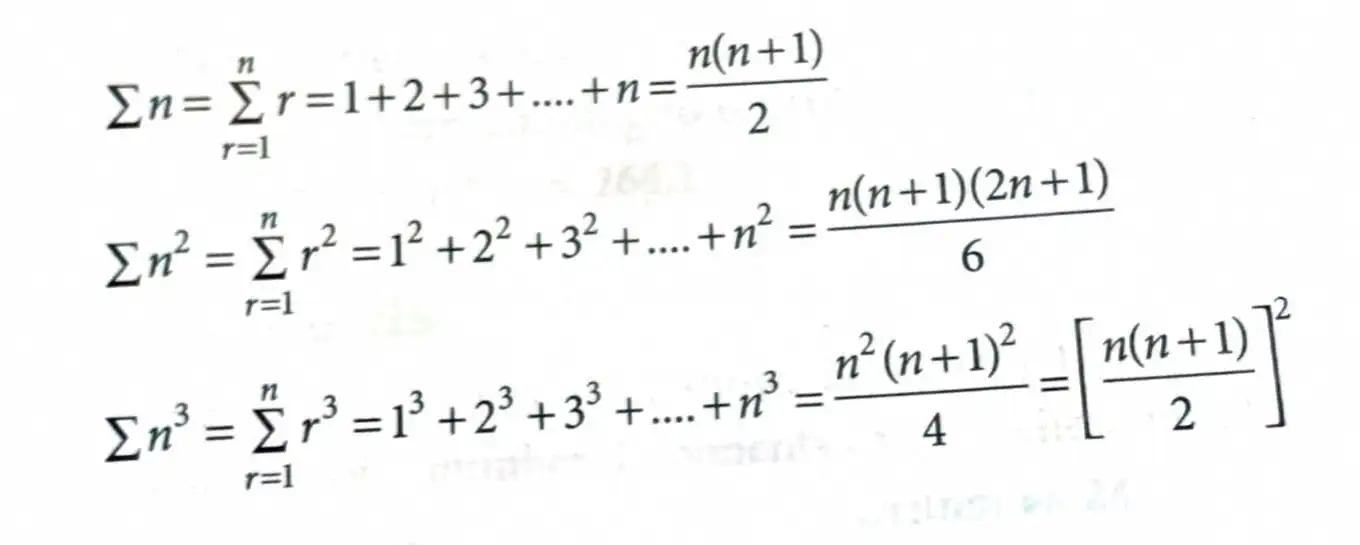
- Sum of first n natural numbers: n(n+1)/2
- Sum of squares of first n natural numbers: n(n+1)(2n+1)/6
- Sum of cubes of first n natural numbers: (n(n+1)/2)2
Solved Examples
- Ex 1: Sum of first 5 natural numbers
- 5(5+1)/2 = 15
- Ex 2: Sum of squares of first 3 natural numbers
- 3(3+1)(2 × 3 +1)/6 = 14
Practice Set
- Q1: Sum of first 4 natural numbers?
- A) 10
- B) 15
- C) 20
- D) 25
- Q2: Sum of squares of first 5 natural numbers?
- A) 55
- B) 50
- C) 60
- D) 65
- Q3: Sum of cubes of first 3 natural numbers?
- A) 36
- B) 27
- C) 64
- D) 100
Answer Key
- Q1: A - 4(4+1)/2 = 10
- Q2: A - 5(5+1)(2 × 5 +1)/6 = 55
- Q3: B - (3(3+1)/2)2 = 27
Memory Aids
- Sum of natural numbers: n(n+1)/2
- Sum of squares: n(n+1)(2n+1)/6
- Sum of cubes: square of sum of natural numbers
Key Formulas
- Sum of first n natural numbers: \( \frac{n(n+1)}{2} \)
- Sum of squares of first n natural numbers: \( \frac{n(n+1)(2n+1)}{6} \)
- Sum of cubes of first n natural numbers: \( \left(\frac{n(n+1)}{2}\right)^2 \)
Solved Examples
- Ex 1: Sum of first 5 natural numbers
- \( \frac{5 0(5+1)}{2} = 15 \)
- Ex 2: Sum of squares of first 3 natural numbers
- \( \frac{3 0(3+1)(2 0 3 +1)}{6} = 14 \)
Practice Set
- Q1: Sum of first 4 natural numbers?
- A) 10
- B) 15
- C) 20
- D) 25
- Q2: Sum of squares of first 5 natural numbers?
- A) 55
- B) 50
- C) 60
- D) 65
- Q3: Sum of cubes of first 3 natural numbers?
- A) 36
- B) 27
- C) 64
- D) 100
Answer Key
- Q1: A - \( \frac{4 0(4+1)}{2} = 10 \)
- Q2: A - \( \frac{5 0(5+1)(2 0 5 +1)}{6} = 55 \)
- Q3: B - \( \left(\frac{3 0(3+1)}{2}\right)^2 = 27 \)
Memory Aids
- Sum of natural numbers: n(n+1)/2
- Sum of squares: n(n+1)(2n+1)/6
- Sum of cubes: square of sum of natural numbers
Key Formulas
- Sum of first n natural numbers: n(n+1)/2
- Sum of squares of first n natural numbers: n(n+1)(2n+1)/6
- Sum of cubes of first n natural numbers: (n(n+1)/2)2
Solved Examples
- Ex 1: Sum of first 5 natural numbers
- 5(5+1)/2 = 15
- Ex 2: Sum of squares of first 3 natural numbers
- 3(3+1)(2 × 3 +1)/6 = 14
Practice Set
- Q1: Sum of first 4 natural numbers?
- A) 10
- B) 15
- C) 20
- D) 25
- Q2: Sum of squares of first 5 natural numbers?
- A) 55
- B) 50
- C) 60
- D) 65
- Q3: Sum of cubes of first 3 natural numbers?
- A) 36
- B) 27
- C) 64
- D) 100
Answer Key
- Q1: A - 4(4+1)/2 = 10
- Q2: A - 5(5+1)(2 × 5 +1)/6 = 55
- Q3: B - (3(3+1)/2)2 = 27
Memory Aids
- Sum of natural numbers: n(n+1)/2
- Sum of squares: n(n+1)(2n+1)/6
- Sum of cubes: square of sum of natural numbers
Key Formulas
- Sum of first n natural numbers: \( \frac{n(n+1)}{2} \)
- Sum of squares of first n natural numbers: \( \frac{n(n+1)(2n+1)}{6} \)
- Sum of cubes of first n natural numbers: \( \left(\frac{n(n+1)}{2}\right)^2 \)
Solved Examples
- Ex 1: Sum of first 5 natural numbers
- \( \frac{5 (5+1)}{2} = 15 \)
- Ex 2: Sum of squares of first 3 natural numbers
- \( \frac{3 (3+1)(2 3 +1)}{6} = 14 \)
Practice Set
- Q1: Sum of first 4 natural numbers?
- A) 10
- B) 15
- C) 20
- D) 25
- Q2: Sum of squares of first 5 natural numbers?
- A) 55
- B) 50
- C) 60
- D) 65
- Q3: Sum of cubes of first 3 natural numbers?
- A) 36
- B) 27
- C) 64
- D) 100
Answer Key
- Q1: A - \( \frac{4 (4+1)}{2} = 10 \)
- Q2: A - \( \frac{5 (5+1)(2 5 +1)}{6} = 55 \)
- Q3: B - \( \left(\frac{3 (3+1)}{2}\right)^2 = 27 \)
Memory Aids
- Sum of natural numbers: n(n+1)/2
- Sum of squares: n(n+1)(2n+1)/6
- Sum of cubes: square of sum of natural numbers
Binomial Theorem
Key Expansions
- (1-x)n = 1 - nx/1! + n(n-1)x2/2! - ...
- (1+x)n = 1 + nx/1! + n(n-1)x2/2! + ...
Solved Examples
- Ex 1: Expand (1-x)2
- 1 - 2x + x2
- Ex 2: Expand (1+x)2
- 1 + 2x + x2
Practice Set
- Q1: Coefficient of x in (1-x)3?
- A) -3
- B) 3
- C) -1
- D) 1
- Q2: Coefficient of x2 in (1+x)3?
- A) 3
- B) 6
- C) 9
- D) 1
- Q3: Term independent of x in (1-x)2?
- A) 1
- B) 0
- C) x
- D) -1
Answer Key
- Q1: A - Coefficient of x is -n = -3
- Q2: B - Coefficient of x2 is n(n-1)/2 = 3*2/2 = 3
- Q3: A - Term independent of x is 1
Memory Aids
- Binomial coefficients follow Pascal's triangle
- Signs alternate in (1-x)n expansion
Key Expansions
- (1-x)^n = 1 - \frac{nx}{1!} + \frac{n(n-1)x^2}{2!} - ...
- (1+x)^n = 1 + \frac{nx}{1!} + \frac{n(n-1)x^2}{2!} + ...
Solved Examples
- Ex 1: Expand (1-x)^2
- 1 - 2x + x^2
- Ex 2: Expand (1+x)^2
- 1 + 2x + x^2
Practice Set
- Q1: Coefficient of x in (1-x)^3?
- A) -3
- B) 3
- C) -1
- D) 1
- Q2: Coefficient of x^2 in (1+x)^3?
- A) 3
- B) 6
- C) 9
- D) 1
- Q3: Term independent of x in (1-x)^2?
- A) 1
- B) 0
- C) x
- D) -1
Answer Key
- Q1: A - Coefficient of x is -n = -3
- Q2: B - Coefficient of x^2 is \frac{n(n-1)}{2} = 3*2/2 = 3
- Q3: A - Term independent of x is 1
Memory Aids
- Binomial coefficients follow Pascal's triangle
- Signs alternate in (1-x)^n expansion
Key Expansions
- (1-x)n = 1 - nx/1! + n(n-1)x2/2! - ...
- (1+x)n = 1 + nx/1! + n(n-1)x2/2! + ...
Solved Examples
- Ex 1: Expand (1-x)2
- 1 - 2x + x2
- Ex 2: Expand (1+x)2
- 1 + 2x + x2
Practice Set
- Q1: Coefficient of x in (1-x)3?
- A) -3
- B) 3
- C) -1
- D) 1
- Q2: Coefficient of x2 in (1+x)3?
- A) 3
- B) 6
- C) 9
- D) 1
- Q3: Term independent of x in (1-x)2?
- A) 1
- B) 0
- C) x
- D) -1
Answer Key
- Q1: A - Coefficient of x is -n = -3
- Q2: B - Coefficient of x2 is n(n-1)/2 = 3*2/2 = 3
- Q3: A - Term independent of x is 1
Memory Aids
- Binomial coefficients follow Pascal's triangle
- Signs alternate in (1-x)n expansion
Key Expansions
- (1-x)^n = 1 - \frac{nx}{1!} + \frac{n(n-1)x^2}{2!} - ...
- (1+x)^n = 1 + \frac{nx}{1!} + \frac{n(n-1)x^2}{2!} + ...
Solved Examples
- Ex 1: Expand (1-x)^2
- 1 - 2x + x^2
- Ex 2: Expand (1+x)^2
- 1 + 2x + x^2
Practice Set
- Q1: Coefficient of x in (1-x)^3?
- A) -3
- B) 3
- C) -1
- D) 1
- Q2: Coefficient of x^2 in (1+x)^3?
- A) 3
- B) 6
- C) 9
- D) 1
- Q3: Term independent of x in (1-x)^2?
- A) 1
- B) 0
- C) x
- D) -1
Answer Key
- Q1: A - Coefficient of x is -n = -3
- Q2: B - Coefficient of x^2 is \frac{n(n-1)}{2} = 3*2/2 = 3
- Q3: A - Term independent of x is 1
Memory Aids
- Binomial coefficients follow Pascal's triangle
- Signs alternate in (1-x)^n expansion
Exponential Expansion
Key Formula
- ex = 1 + x + x2/2! + x3/3! + ...
Solved Examples
- Ex 1: Find e1
- 1 + 1 + 1/2 + 1/6 + ...
Practice Set
- Q1: Coefficient of x2 in ex expansion?
- A) 1/2
- B) 1
- C) 1/3
- D) 2
- Q2: Value of e0?
- A) 0
- B) 1
- C) e
- D) Undefined
- Q3: Coefficient of x3 in ex expansion?
- A) 1/3!
- B) 1/2!
- C) 1
- D) 3!
Answer Key
- Q1: A - Coefficient of x2 is 1/2!
- Q2: B - e0 = 1
- Q3: A - Coefficient of x3 is 1/3!
Memory Aids
- Factorials in denominators for powers of x
- Starts with 1 + x + ...
Key Formula
- e^x = 1 + x + \frac{x^2}{2!} + \frac{x^3}{3!} + ...
Solved Examples
- Ex 1: Find e^1
- 1 + 1 + 1/2 + 1/6 + ...
Practice Set
- Q1: Coefficient of x^2 in e^x expansion?
- A) 1/2
- B) 1
- C) 1/3
- D) 2
- Q2: Value of e^0?
- A) 0
- B) 1
- C) e
- D) Undefined
- Q3: Coefficient of x^3 in e^x expansion?
- A) 1/3!
- B) 1/2!
- C) 1
- D) 3!
Answer Key
- Q1: A - Coefficient of x^2 is 1/2!
- Q2: B - e^0 = 1
- Q3: A - Coefficient of x^3 is 1/3!
Memory Aids
- Factorials in denominators for powers of x
- Starts with 1 + x + ...
Key Formula
- ex = 1 + x + x2/2! + x3/3! + ...
Solved Examples
- Ex 1: Find e1
- 1 + 1 + 1/2 + 1/6 + ...
Practice Set
- Q1: Coefficient of x2 in ex expansion?
- A) 1/2
- B) 1
- C) 1/3
- D) 2
- Q2: Value of e0?
- A) 0
- B) 1
- C) e
- D) Undefined
- Q3: Coefficient of x3 in ex expansion?
- A) 1/3!
- B) 1/2!
- C) 1
- D) 3!
Answer Key
- Q1: A - Coefficient of x2 is 1/2!
- Q2: B - e0 = 1
- Q3: A - Coefficient of x3 is 1/3!
Memory Aids
- Factorials in denominators for powers of x
- Starts with 1 + x + ...
Key Formula
- e^x = 1 + x + \frac{x^2}{2!} + \frac{x^3}{3!} + ...
Solved Examples
- Ex 1: Find e^1
- 1 + 1 + 1/2 + 1/6 + ...
Practice Set
- Q1: Coefficient of x^2 in e^x expansion?
- A) 1/2
- B) 1
- C) 1/3
- D) 2
- Q2: Value of e^0?
- A) 0
- B) 1
- C) e
- D) Undefined
- Q3: Coefficient of x^3 in e^x expansion?
- A) 1/3!
- B) 1/2!
- C) 1
- D) 3!
Answer Key
- Q1: A - Coefficient of x^2 is 1/2!
- Q2: B - e^0 = 1
- Q3: A - Coefficient of x^3 is 1/3!
Memory Aids
- Factorials in denominators for powers of x
- Starts with 1 + x + ...
Logarithmic Expansion
Key Formula
- ln(1+x) = x - x2/2 + x3/3 - ... (|x| < 1)
Solved Examples
- Ex 1: Find ln(1+0.1)
- 0.1 - 0.12/2 + 0.13/3 - ...
Practice Set
- Q1: Coefficient of x2 in ln(1+x)?
- A) -1/2
- B) 1/2
- C) 1/3
- D) -1/3
- Q2: ln(1+0) equals?
- A) 0
- B) 1
- C) Undefined
- D) 2
- Q3: Sign of x3 term in ln(1+x)?
- A) Positive
- B) Negative
- C) Zero
- D) Undefined
Answer Key
- Q1: A - Coefficient is -1/2
- Q2: A - ln(1) = 0
- Q3: A - x3 term is positive
Memory Aids
- Alternating signs in series
- Starts with x
Key Formula
- ln(1+x) = x - \frac{x^2}{2} + \frac{x^3}{3} - ... (|x| < 1)
Solved Examples
- Ex 1: Find ln(1+0.1)
- 0.1 - 0.1^2/2 + 0.1^3/3 - ...
Practice Set
- Q1: Coefficient of x^2 in ln(1+x)?
- A) -1/2
- B) 1/2
- C) 1/3
- D) -1/3
- Q2: ln(1+0) equals?
- A) 0
- B) 1
- C) Undefined
- D) 2
- Q3: Sign of x^3 term in ln(1+x)?
- A) Positive
- B) Negative
- C) Zero
- D) Undefined
Answer Key
- Q1: A - Coefficient is -1/2
- Q2: A - ln(1) = 0
- Q3: A - x^3 term is positive
Memory Aids
- Alternating signs in series
- Starts with x
NEET Physics — ALL CHAPTERS
1
Basic Mathematics
2
Units and Measurement
3
Motion in a Straight Line
4
Motion in a Plane
5
Laws of Motion
6
Work, Energy and Power
7
System of Particles and Rotational Motion
8
Gravitation
9
Mechanical Properties of Solids
10
Mechanical Properties of Fluids
11
Thermal Properties of Matter
12
Thermodynamics
13
Kinetic Theory
14
Oscillations
15
Waves
16
Electric Charges and Fields
17
Electrostatic Potential and Capacitance
18
Current Electricity
19
Moving Charges and Magnetism
20
Magnetism and Matter
21
Electromagnetic Induction
22
Alternating Current
23
Electromagnetic Waves
24
Ray Optics and Optical Instruments
25
Wave Optics
26
Dual Nature of Radiation and Matter
27
Atoms
28
Nuclei
29
Semiconductor Electronics: Materials, Devices and Simple Circuits