Introduction
Historical Background
- Nicolaus Copernicus (1473–1543) proposed heliocentric model: planets move in circles around the Sun.
- Galileo supported Copernicus but faced prosecution for his beliefs.
- Tycho Brahe (1546–1601) made precise naked-eye planetary observations.
- Johannes Kepler (1571–1640) derived three laws of planetary motion from Brahe's data.
- Newton used Kepler's laws to formulate the universal law of gravitation.
Solved Examples
Practice Set
- Q1: Who proposed the heliocentric model?
A. Galileo
B. Tycho Brahe
C. Nicolaus Copernicus
D. Johannes Kepler - Q2: What did Tycho Brahe contribute?
A. Laws of planetary motion
B. Naked-eye planetary observations
C. Universal gravitation
D. Elliptical orbits - Q3: Who formulated the universal law of gravitation?
A. Copernicus
B. Galileo
C. Newton
D. Kepler
Answer Key
- Q1: C - Copernicus proposed the heliocentric model.
- Q2: B - Brahe made precise naked-eye observations.
- Q3: C - Newton formulated universal gravitation using Kepler's laws.
Memory Aids
- Copernicus: Sun-centered model.
- Brahe: Data collector.
- Kepler: Laws from Brahe's data.
- Newton: Gravity law from Kepler.
Kepler's Laws
Law of Orbits
- Planets move in elliptical orbits with the Sun at one focus.
Law of Areas
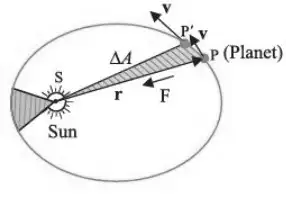
- Line joining planet and Sun sweeps equal areas in equal times.
- Area swept in small time Δt: ΔA = 1/2 rvΔt
- Vector form: Δ vector A = 1/2 (vector r × vector v Δt)
- Rate of area swept: Δ vector A/Δt = 1/2 (vector r × vector v)
- Using momentum vector p = m vector v: Δ vector A/Δt = vector r × vector p/2m
- Angular momentum vector L = vector r × vector p is constant for central force.
- Therefore, Δ vector A/Δt = vector L/2m = constant
Law of Periods
- Square of orbital period T2 is proportional to cube of semi-major axis R3:
- T2 ∝ R3
Solved Examples
Practice Set
- Q1: What shape is a planet's orbit according to Kepler's first law?
A. Circle
B. Ellipse
C. Parabola
D. Hyperbola - Q2: According to Kepler's second law, the line joining planet and Sun sweeps out equal areas in equal times. What does this imply about the planet's speed?
A. Constant speed
B. Faster when closer to Sun
C. Slower when closer to Sun
D. No relation to speed - Q3: If the semi-major axis of a planet's orbit is doubled, how does its orbital period change?
A. Doubles
B. Quadruples
C. Increases by 23/2
D. Halves
Answer Key
- Q1: B - Orbits are elliptical with Sun at one focus.
- Q2: B - Planet moves faster when closer to the Sun to sweep equal areas.
- Q3: C - T2 ∝ R3 so T ∝ R3/2, doubling R increases T by 23/2.
Memory Aids
- Orbits: Ellipse with Sun focus.
- Areas: Equal areas in equal times.
- Periods: T2 ∝ R3.
Law of Orbits
- Planets move in elliptical orbits with the Sun at one focus.
Law of Areas
- Line joining planet and Sun sweeps equal areas in equal times.
- Area swept in small time Δt: ΔA = 1/2 rvΔt
- Vector form: Δ vector A = 1/2 (vector r × vector v Δt)
- Rate of area swept: Δ vector A/Δt = 1/2 (vector r × vector v)
- Using momentum vector p = m vector v: Δ vector A/Δt = vector r × vector p/2m
- Angular momentum vector L = vector r × vector p is constant for central force.
- Therefore, Δ vector A/Δt = vector L/2m = constant
Law of Periods
- Square of orbital period T2 is proportional to cube of semi-major axis R3:
- T2 ∝ R3
Solved Examples
Practice Set
- Q1: What shape is a planet's orbit according to Kepler's first law?
A. Circle
B. Ellipse
C. Parabola
D. Hyperbola - Q2: According to Kepler's second law, the line joining planet and Sun sweeps out equal areas in equal times. What does this imply about the planet's speed?
A. Constant speed
B. Faster when closer to Sun
C. Slower when closer to Sun
D. No relation to speed - Q3: If the semi-major axis of a planet's orbit is doubled, how does its orbital period change?
A. Doubles
B. Quadruples
C. Increases by 23/2
D. Halves
Answer Key
- Q1: B - Orbits are elliptical with Sun at one focus.
- Q2: B - Planet moves faster when closer to the Sun to sweep equal areas.
- Q3: C - T2 ∝ R3 so T ∝ R3/2, doubling R increases T by 23/2.
Memory Aids
- Orbits: Ellipse with Sun focus.
- Areas: Equal areas in equal times.
- Periods: T2 ∝ R3.
Law of Orbits
- Planets move in elliptical orbits with the Sun at one focus.
Law of Areas
- Line joining planet and Sun sweeps equal areas in equal times.
- Area swept in small time Δt: ΔA = 1/2 r v Δt
- Vector form: Δ vector A = 1/2 (vector r × vector v Δt)
- Rate of area swept: Δ vector A/Δt = 1/2 (vector r × vector v)
- Using momentum vector p = m vector v: Δ vector A/Δt = vector r × vector p/2m
- Angular momentum vector L = vector r × vector p is constant for central force.
- Therefore, Δ vector A/Δt = vector L/2m = constant
Law of Periods
- Square of orbital period T2 is proportional to cube of semi-major axis R3:
- T2 ∝ R3
Solved Examples
Practice Set
- Q1: What shape is a planet's orbit according to Kepler's first law?
A. Circle
B. Ellipse
C. Parabola
D. Hyperbola - Q2: According to Kepler's second law, the line joining planet and Sun sweeps out equal areas in equal times. What does this imply about the planet's speed?
A. Constant speed
B. Faster when closer to Sun
C. Slower when closer to Sun
D. No relation to speed - Q3: If the semi-major axis of a planet's orbit is doubled, how does its orbital period change?
A. Doubles
B. Quadruples
C. Increases by 23/2
D. Halves
Answer Key
- Q1: B - Orbits are elliptical with Sun at one focus.
- Q2: B - Planet moves faster when closer to the Sun to sweep equal areas.
- Q3: C - T2 ∝ R3 so T ∝ R3/2, doubling R increases T by 23/2.
Memory Aids
- Orbits: Ellipse with Sun focus.
- Areas: Equal areas in equal times.
- Periods: T2 ∝ R3.
Law of Orbits
- Planets move in elliptical orbits with the Sun at one focus.
Law of Areas
- Line joining planet and Sun sweeps equal areas in equal times.
- Area swept in small time Δt: ΔA = 1/2 rvΔt
- Vector form: Δ vector A = 1/2 (vector r × vector v Δt)
- Rate of area swept: Δ vector A/Δt = 1/2 (vector r × vector v)
- Using momentum vector p = m vector v: Δ vector A/Δt = vector r × vector p/2m
- Angular momentum vector L = vector r × vector p is constant for central force.
- Therefore, Δ vector A/Δt = vector L/2m = constant
Law of Periods
- Square of orbital period T2 is proportional to cube of semi-major axis R3:
- T2 ∝ R3
Solved Examples
Practice Set
- Q1: What shape is a planet's orbit according to Kepler's first law?
A. Circle
B. Ellipse
C. Parabola
D. Hyperbola - Q2: According to Kepler's second law, the line joining planet and Sun sweeps out equal areas in equal times. What does this imply about the planet's speed?
A. Constant speed
B. Faster when closer to Sun
C. Slower when closer to Sun
D. No relation to speed - Q3: If the semi-major axis of a planet's orbit is doubled, how does its orbital period change?
A. Doubles
B. Quadruples
C. Increases by 23/2
D. Halves
Answer Key
- Q1: B - Orbits are elliptical with Sun at one focus.
- Q2: B - Planet moves faster when closer to the Sun to sweep equal areas.
- Q3: C - T2 ∝ R3 so T ∝ R3/2, doubling R increases T by 23/2.
Memory Aids
- Orbits: Ellipse with Sun focus.
- Areas: Equal areas in equal times.
- Periods: T2 ∝ R3.
Law of Orbits
- Planets move in elliptical orbits with the Sun at one focus.
Law of Areas
- Line joining planet and Sun sweeps equal areas in equal times.
- Area swept in small time Δt: ΔA = 1/2 r v Δt
- Vector form: Δ vector A = 1/2 (vector r × vector v Δt)
- Rate of area swept: Δ vector A/Δt = 1/2 (vector r × vector v)
- Using momentum vector p = m vector v: Δ vector A/Δt = vector r × vector p/2m
- Angular momentum vector L = vector r × vector p is constant for central force.
- Therefore, Δ vector A/Δt = vector L/2m = constant
Law of Periods
- Square of orbital period T2 is proportional to cube of semi-major axis R3:
- T2 ∝ R3
Solved Examples
Practice Set
- Q1: What shape is a planet's orbit according to Kepler's first law?
A. Circle
B. Ellipse
C. Parabola
D. Hyperbola - Q2: According to Kepler's second law, the line joining planet and Sun sweeps out equal areas in equal times. What does this imply about the planet's speed?
A. Constant speed
B. Faster when closer to Sun
C. Slower when closer to Sun
D. No relation to speed - Q3: If the semi-major axis of a planet's orbit is doubled, how does its orbital period change?
A. Doubles
B. Quadruples
C. Increases by 23/2
D. Halves
Answer Key
- Q1: B - Orbits are elliptical with Sun at one focus.
- Q2: B - Planet moves faster when closer to the Sun to sweep equal areas.
- Q3: C - T2 ∝ R3 so T ∝ R3/2, doubling R increases T by 23/2.
Memory Aids
- Orbits: Ellipse with Sun focus.
- Areas: Equal areas in equal times.
- Periods: T2 ∝ R3.
Law of Orbits
- Planets move in elliptical orbits with the Sun at one focus.
Law of Areas
- Line joining planet and Sun sweeps equal areas in equal times.
- Area swept in small time \( \Delta t \): \( \Delta A = \frac{1}{2} r v \Delta t \)
- Vector form: \( \Delta \vec{A} = \frac{1}{2} (\vec{r} \times \vec{v} \Delta t) \)
- Rate of area swept: \( \frac{\Delta \vec{A}}{\Delta t} = \frac{1}{2} (\vec{r} \times \vec{v}) \)
- Using momentum \( \vec{p} = m \vec{v} \): \( \frac{\Delta \vec{A}}{\Delta t} = \frac{\vec{r} \times \vec{p}}{2m} \)
- Angular momentum \( \vec{L} = \vec{r} \times \vec{p} \) is constant for central force.
- Therefore, \( \frac{\Delta \vec{A}}{\Delta t} = \frac{\vec{L}}{2m} = \text{constant} \)
Law of Periods
- Square of orbital period \( T^2 \) is proportional to cube of semi-major axis \( R^3 \):
- \( T^2 \propto R^3 \)
Solved Examples
Practice Set
- Q1: What shape is a planet's orbit according to Kepler's first law?
A. Circle
B. Ellipse
C. Parabola
D. Hyperbola - Q2: According to Kepler's second law, the line joining planet and Sun sweeps out equal areas in equal times. What does this imply about the planet's speed?
A. Constant speed
B. Faster when closer to Sun
C. Slower when closer to Sun
D. No relation to speed - Q3: If the semi-major axis of a planet's orbit is doubled, how does its orbital period change?
A. Doubles
B. Quadruples
C. Increases by \( 2^{3/2} \)
D. Halves
Answer Key
- Q1: B - Orbits are elliptical with Sun at one focus.
- Q2: B - Planet moves faster when closer to the Sun to sweep equal areas.
- Q3: C - \( T^2 \propto R^3 \) so \( T \propto R^{3/2} \), doubling \( R \) increases \( T \) by \( 2^{3/2} \).
Memory Aids
- Orbits: Ellipse with Sun focus.
- Areas: Equal areas in equal times.
- Periods: \( T^2 \propto R^3 \).
Universal Law of Gravitation
Newton's Law
- Every particle attracts every other particle.
- Force F ∝ product of masses m1m2.
- Force F ∝ inverse square of distance r2.
- Mathematical form: F = Gm1m2/r2.
- G is universal gravitational constant, same everywhere.
Characteristics of Gravitational Force
- Always attractive, along line joining particles.
- Action-reaction pair: vector F1 = -vector F2.
- Independent of medium.
- Valid for all distances (interplanetary to atomic).
- Conservative force: work done independent of path.
- No work done in closed path.
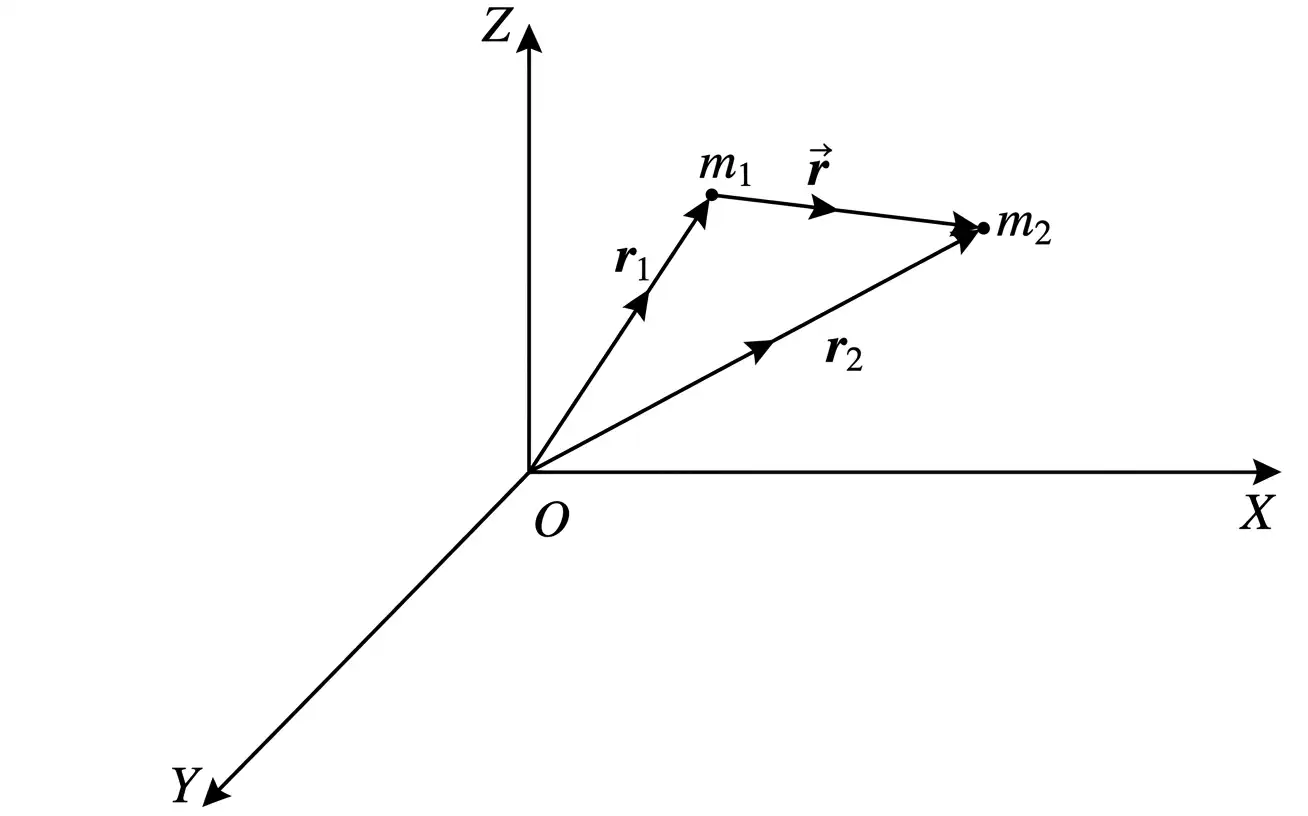
- Vector form: vector F = -Gm1m2/r2 r̂ = -Gm1m2/|vector r|3 vector r.
Solved Examples
- Ex 1: Calculate force between masses m1 = 2 kg, m2 = 3 kg, distance r = 4 m, G = 6.67 × 10⁻¹¹ N·m2/kg2.
- Use F = Gm1m2/r2 = 6.67 × 10-11 × 2 × 3/42 = 2.5 × 10⁻¹¹ N.
Practice Set
- Q1: The gravitational force between two masses is doubled if the distance between them is changed from r to:
- A) r/2
- B) 2r
- C) r/4
- D) 4r
- Q2: Two masses m and 2m are separated by distance d. The force between them is F. What is the force if distance is doubled?
- A) F/2
- B) F/4
- C) F/8
- D) F/16
- Q3: If the gravitational force between two masses is 3 × 10⁻¹⁰ N at distance 1 m, what is the force at 3 m?
- A) 3.33 × 10⁻¹¹ N
- B) 3.33 × 10⁻¹⁰ N
- C) 3 × 10⁻⁹ N
- D) 1 × 10⁻¹⁰ N
Answer Key
- Q1: A) r/2 - Force ∝ 1/r2, halving distance quadruples force.
- Q2: B) F/4 - Doubling distance reduces force by 4.
- Q3: A) 3.33 × 10⁻¹¹ N - Force decreases by (1/3)2 = 1/9.
Memory Aids
- Force ∝ m1m2 / r2.
- Always attractive, along line joining masses.
- Action = Reaction (equal & opposite).
- Conservative force: path independent work.
Newton's Law
- Every particle attracts every other particle.
- Force F ∝ product of masses m1m2.
- Force F ∝ inverse square of distance r2.
- Mathematical form: F = Gm1m2/r2.
- G is universal gravitational constant, same everywhere.
Characteristics of Gravitational Force
- Always attractive, along line joining particles.
- Action-reaction pair: vector F1 = -vector F2.
- Independent of medium.
- Valid for all distances (interplanetary to atomic).
- Conservative force: work done independent of path.
- No work done in closed path.
- Vector form: vector F = -Gm1m2/r2 r̂ = -Gm1m2/|vector r|3 vector r.
Solved Examples
- Ex 1: Calculate force between masses m1 = 2 kg, m2 = 3 kg, distance r = 4 m, G = 6.67 × 10⁻¹¹ N·m2/kg2.
- Use F = Gm1m2/r2 = 6.67 × 10-11 × 2 × 3/42 = 2.5 × 10⁻¹¹ N.
Practice Set
- Q1: The gravitational force between two masses is doubled if the distance between them is changed from r to:
- A) r/2
- B) 2r
- C) r/4
- D) 4r
- Q2: Two masses m and 2m are separated by distance d. The force between them is F. What is the force if distance is doubled?
- A) F/2
- B) F/4
- C) F/8
- D) F/16
- Q3: If the gravitational force between two masses is 3 × 10⁻¹⁰ N at distance 1 m, what is the force at 3 m?
- A) 3.33 × 10⁻¹¹ N
- B) 3.33 × 10⁻¹⁰ N
- C) 3 × 10⁻⁹ N
- D) 1 × 10⁻¹⁰ N
Answer Key
- Q1: A) r/2 - Force ∝ 1/r2, halving distance quadruples force.
- Q2: B) F/4 - Doubling distance reduces force by 4.
- Q3: A) 3.33 × 10⁻¹¹ N - Force decreases by (1/3)2 = 1/9.
Memory Aids
- Force ∝ m1m2 / r2.
- Always attractive, along line joining masses.
- Action = Reaction (equal & opposite).
- Conservative force: path independent work.
Newton's Law
- Every particle attracts every other particle.
- Force \( F \) \( \propto \) product of masses \( m_1 m_2 \).
- Force \( F \) \( \propto \) inverse square of distance \( r^2 \).
- Mathematical form: \( F = \frac{G m_1 m_2}{r^2} \).
- \( G \) is universal gravitational constant, same everywhere.
Characteristics of Gravitational Force
- Always attractive, along line joining particles.
- Action-reaction pair: \( \vec{F}_1 = -\vec{F}_2 \).
- Independent of medium.
- Valid for all distances (interplanetary to atomic).
- Conservative force: work done independent of path.
- No work done in closed path.
- Vector form: \( \vec{F} = -G \frac{m_1 m_2}{r^2} \hat{r} = -G \frac{m_1 m_2}{|\vec{r}|^3} \vec{r} \).
Solved Examples
- Ex 1: Calculate force between masses \( m_1 = 2\,kg \), \( m_2 = 3\,kg \), distance \( r = 4\,m \), \( G = 6.67 \times 10^{-11} \) N·m2/kg2.
- Use \( F = \frac{G m_1 m_2}{r^2} = \frac{6.67 \times 10^{-11} \times 2 \times 3}{4^2} = 2.5 \times 10^{-11} \) N.
Practice Set
- Q1: The gravitational force between two masses is doubled if the distance between them is changed from \( r \) to:
- A) \( r/2 \)
- B) \( 2r \)
- C) \( r/4 \)
- D) \( 4r \)
- Q2: Two masses \( m \) and \( 2m \) are separated by distance \( d \). The force between them is \( F \). What is the force if distance is doubled?
- A) \( F/2 \)
- B) \( F/4 \)
- C) \( F/8 \)
- D) \( F/16 \)
- Q3: If the gravitational force between two masses is \( 3 \times 10^{-10} \) N at distance \( 1 \) m, what is the force at \( 3 \) m?
- A) \( 3.33 \times 10^{-11} \) N
- B) \( 3.33 \times 10^{-10} \) N
- C) \( 3 \times 10^{-9} \) N
- D) \( 1 \times 10^{-10} \) N
Answer Key
- Q1: A) \( r/2 \) - Force \( \propto 1/r^2 \), halving distance quadruples force.
- Q2: B) \( F/4 \) - Doubling distance reduces force by \( 4 \).
- Q3: A) \( 3.33 \times 10^{-11} \) N - Force decreases by \( (1/3)^2 = 1/9 \).
Memory Aids
- Force \( \propto m_1 m_2 / r^2 \).
- Always attractive, along line joining masses.
- Action = Reaction (equal & opposite).
- Conservative force: path independent work.
Gravitational Force on Multiple Masses
Vector Sum of Forces
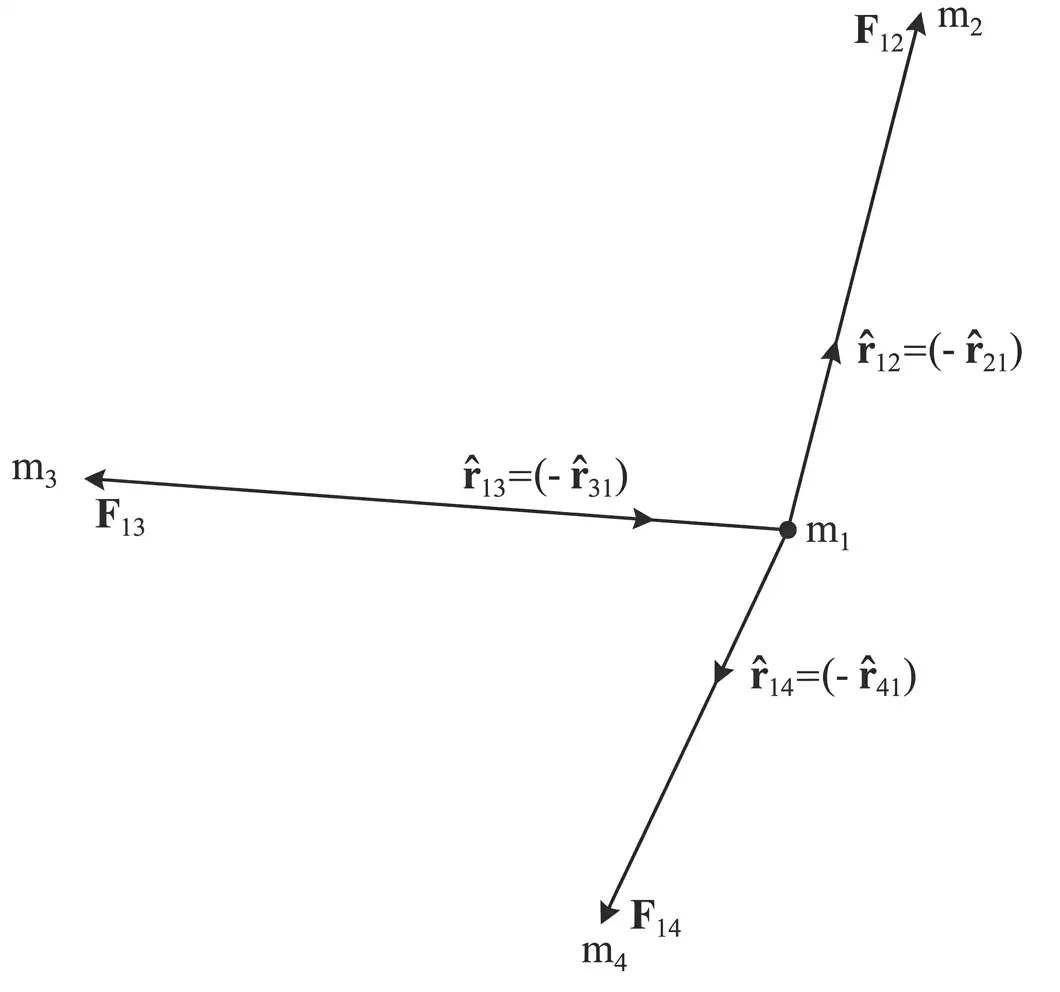
- Force on a mass due to multiple masses is vector sum of individual forces.
- For mass m1 due to m2, m3, m4: [ vector F1 = Gm1m2/r212 r̂21 + Gm1m3/r312 r̂31 + Gm1m4/r412 r̂41 ]
- Unit vectors r̂ij point from mass mi to mj.
- r̂ij = -r̂ji (opposite directions).
Solved Examples
- Ex 1: Calculate net force on m1 = 2 kg due to m2 = 3 kg at 4 m and m3 = 4 kg at 3 m along different directions.
- Calculate each force using F = Gm1mi/r2 and add vectorially.
Practice Set
- Q1: If m1 = 1 kg, m2 = 2 kg, m3 = 3 kg, distances 1 m and 2 m respectively, net force on m1 is:
- A) Sum of magnitudes
- B) Vector sum of forces
- C) Zero
- D) Product of forces
- Q2: Unit vector r̂ij points from:
- A) mi to mj
- B) mj to mi
- C) Origin to mi
- D) Origin to mj
- Q3: If vector F12 = -vector F21, this means:
- A) Forces are equal and opposite
- B) Forces are zero
- C) Forces are perpendicular
- D) Forces are unrelated
Answer Key
- Q1: B) Vector sum of forces - Forces add vectorially.
- Q2: A) mi to mj - Unit vector direction.
- Q3: A) Forces are equal and opposite - Action-reaction pair.
Memory Aids
- Net force = vector sum of individual forces.
- Unit vector points from source mass to target mass.
- Action = Reaction forces are equal & opposite.
Vector Sum of Forces
- Force on a mass due to multiple masses is vector sum of individual forces.
- For mass m1 due to m2, m3, m4: [ vector F1 = Gm1m2/r212 r̂21 + Gm1m3/r312 r̂31 + Gm1m4/r412 r̂41 ]
- Unit vectors r̂ij point from mass mi to mj.
- r̂ij = -r̂ji (opposite directions).
Solved Examples
- Ex 1: Calculate net force on m1 = 2 kg due to m2 = 3 kg at 4 m and m3 = 4 kg at 3 m along different directions.
- Calculate each force using F = Gm1mi/r2 and add vectorially.
Practice Set
- Q1: If m1 = 1 kg, m2 = 2 kg, m3 = 3 kg, distances 1 m and 2 m respectively, net force on m1 is:
- A) Sum of magnitudes
- B) Vector sum of forces
- C) Zero
- D) Product of forces
- Q2: Unit vector r̂ij points from:
- A) mi to mj
- B) mj to mi
- C) Origin to mi
- D) Origin to mj
- Q3: If vector F12 = -vector F21, this means:
- A) Forces are equal and opposite
- B) Forces are zero
- C) Forces are perpendicular
- D) Forces are unrelated
Answer Key
- Q1: B) Vector sum of forces - Forces add vectorially.
- Q2: A) mi to mj - Unit vector direction.
- Q3: A) Forces are equal and opposite - Action-reaction pair.
Memory Aids
- Net force = vector sum of individual forces.
- Unit vector points from source mass to target mass.
- Action = Reaction forces are equal & opposite.
Vector Sum of Forces
- Force on a mass due to multiple masses is vector sum of individual forces.
- For mass \( m_1 \) due to \( m_2, m_3, m_4 \): \[ \vec{F}_1 = \frac{G m_1 m_2}{r_{21}^2} \hat{r}_{21} + \frac{G m_1 m_3}{r_{31}^2} \hat{r}_{31} + \frac{G m_1 m_4}{r_{41}^2} \hat{r}_{41} \]
- Unit vectors \( \hat{r}_{ij} \) point from mass \( m_i \) to \( m_j \).
- \( \hat{r}_{ij} = -\hat{r}_{ji} \) (opposite directions).
Solved Examples
- Ex 1: Calculate net force on \( m_1 = 2\,kg \) due to \( m_2 = 3\,kg \) at 4 m and \( m_3 = 4\,kg \) at 3 m along different directions.
- Calculate each force using \( F = \frac{G m_1 m_i}{r^2} \) and add vectorially.
Practice Set
- Q1: If \( m_1 = 1\,kg \), \( m_2 = 2\,kg \), \( m_3 = 3\,kg \), distances 1 m and 2 m respectively, net force on \( m_1 \) is:
- A) Sum of magnitudes
- B) Vector sum of forces
- C) Zero
- D) Product of forces
- Q2: Unit vector \( \hat{r}_{ij} \) points from:
- A) \( m_i \) to \( m_j \)
- B) \( m_j \) to \( m_i \)
- C) Origin to \( m_i \)
- D) Origin to \( m_j \)
- Q3: If \( \vec{F}_{12} = -\vec{F}_{21} \), this means:
- A) Forces are equal and opposite
- B) Forces are zero
- C) Forces are perpendicular
- D) Forces are unrelated
Answer Key
- Q1: B) Vector sum of forces - Forces add vectorially.
- Q2: A) \( m_i \) to \( m_j \) - Unit vector direction.
- Q3: A) Forces are equal and opposite - Action-reaction pair.
Memory Aids
- Net force = vector sum of individual forces.
- Unit vector points from source mass to target mass.
- Action = Reaction forces are equal & opposite.
The Gravitational Constant
Definition and Historical Context
- The gravitational constant G quantifies the strength of gravity between two masses.
- First measured by Henry Cavendish in 1798 using a torsion balance experiment.
- Current accepted value: G = 6.67 × 10⁻¹¹ N m2/kg2.
Schematic of Cavendish's Experiment
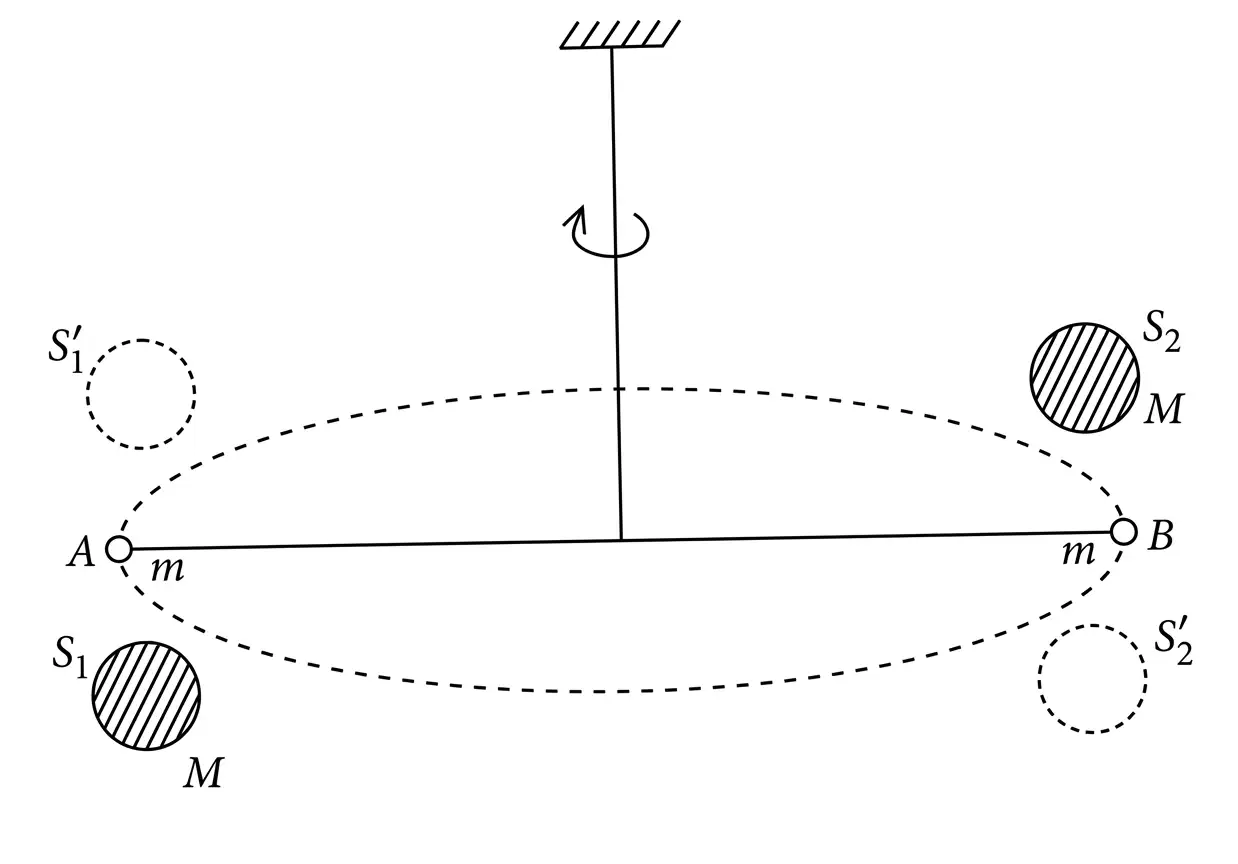
- Two small masses m fixed at points A and B on a light rod, rotating about a vertical axis.
- Two large spheres S1 and S2 placed near the small masses exert gravitational force.
- When large spheres are moved to opposite sides (positions S'1 and S'2), the rod rotates due to torque reversal.
- Rotation angle θ is measured to calculate G.
Equilibrium Condition and Formula
- At equilibrium, gravitational torque equals restoring torque from the wire.
- Mathematically: GMm/r2 L = kθ, where:
- M = mass of large sphere
- m = mass of small sphere
- r = distance between centers of large and small spheres
- L = length of the rod
- k = torsion constant of the wire
- θ = angle of twist
- Rearranged formula to find G:
- [ G = kθr2/MmL ]
Solved Examples
- Ex 1: Given k = 2 × 10⁻⁶ Nm/rad, θ = 0.01 rad, r = 0.05 m, M = 1 kg, m = 0.01 kg, L = 0.4 m, find G.
- Solution: G = 2 × 10-6 × 0.01 × (0.05)2/(1 × 0.01 × 0.4) = 1.25 × 10⁻¹¹ N m2/kg2.
Practice Set
- Q1: Who first determined the value of G?
A. Isaac Newton
B. Albert Einstein
C. Henry Cavendish
D. Galileo Galilei - Q2: In Cavendish's experiment, the torque due to gravitational force is balanced by:
A. Magnetic force
B. Restoring torque of the wire
C. Centrifugal force
D. Electrostatic force - Q3: Calculate G if k = 3 × 10⁻⁶ Nm/rad, θ = 0.02 rad, r = 0.04 m, M = 2 kg, m = 0.02 kg, L = 0.5 m.
A. 1.92 × 10⁻¹¹
B. 2.4 × 10⁻¹¹
C. 3.84 × 10⁻¹¹
D. 4.8 × 10⁻¹¹
Answer Key
- Q1: C - Henry Cavendish first measured G in 1798 using a torsion balance.
- Q2: B - The restoring torque of the wire balances the gravitational torque at equilibrium.
- Q3: A - Using formula G = kθr2/MmL = 3 × 10-6 × 0.02 × (0.04)2/(2 × 0.02 × 0.5) = 1.92 × 10⁻¹¹.
Memory Aids
- Remember G relates gravitational force to masses and distance squared.
- Formula: G = kθr2/MmL from Cavendish's torsion balance.
- Value: 6.67 × 10⁻¹¹ N m2/kg2.
Definition and Historical Context
- The gravitational constant G quantifies the strength of gravity between two masses.
- First measured by Henry Cavendish in 1798 using a torsion balance experiment.
- Current accepted value: G = 6.67 × 10⁻¹¹ N m2/kg2.
Schematic of Cavendish's Experiment
- Two small masses m fixed at points A and B on a light rod, rotating about a vertical axis.
- Two large spheres S1 and S2 placed near the small masses exert gravitational force.
- When large spheres are moved to opposite sides (positions S'1 and S'2), the rod rotates due to torque reversal.
- Rotation angle θ is measured to calculate G.
Equilibrium Condition and Formula
- At equilibrium, gravitational torque equals restoring torque from the wire.
- Mathematically: G Mm/r2 L = kθ, where:
- M = mass of large sphere
- m = mass of small sphere
- r = distance between centers of large and small spheres
- L = length of the rod
- k = torsion constant of the wire
- θ = angle of twist
- Rearranged formula to find G:
- [ G = kθr2/MmL ]
Solved Examples
- Ex 1: Given k = 2 × 10⁻⁶ Nm/rad, θ = 0.01 rad, r = 0.05 m, M = 1 kg, m = 0.01 kg, L = 0.4 m, find G.
- Solution: G = 2 × 10-6 × 0.01 × (0.05)2/(1 × 0.01 × 0.4) = 1.25 × 10⁻¹¹ N m2/kg2.
Practice Set
- Q1: Who first determined the value of G?
A. Isaac Newton
B. Albert Einstein
C. Henry Cavendish
D. Galileo Galilei - Q2: In Cavendish's experiment, the torque due to gravitational force is balanced by:
A. Magnetic force
B. Restoring torque of the wire
C. Centrifugal force
D. Electrostatic force - Q3: Calculate G if k = 3 × 10⁻⁶ Nm/rad, θ = 0.02 rad, r = 0.04 m, M = 2 kg, m = 0.02 kg, L = 0.5 m.
A. 1.92 × 10⁻¹¹
B. 2.4 × 10⁻¹¹
C. 3.84 × 10⁻¹¹
D. 4.8 × 10⁻¹¹
Answer Key
- Q1: C - Henry Cavendish first measured G in 1798 using a torsion balance.
- Q2: B - The restoring torque of the wire balances the gravitational torque at equilibrium.
- Q3: A - Using formula G = kθr2/MmL = 3 × 10-6 × 0.02 × (0.04)2/(2 × 0.02 × 0.5) = 1.92 × 10⁻¹¹.
Memory Aids
- Remember G relates gravitational force to masses and distance squared.
- Formula: G = kθr2/MmL from Cavendish's torsion balance.
- Value: 6.67 × 10⁻¹¹ N m2/kg2.
Definition and Historical Context
- The gravitational constant G quantifies the strength of gravity between two masses.
- First measured by Henry Cavendish in 1798 using a torsion balance experiment.
- Current accepted value: G = 6.67 × 10⁻¹¹ N m2/kg2.
Schematic of Cavendish's Experiment
- Two small masses m fixed at points A and B on a light rod, rotating about a vertical axis.
- Two large spheres S1 and S2 placed near the small masses exert gravitational force.
- When large spheres are moved to opposite sides (positions S'1 and S'2), the rod rotates due to torque reversal.
- Rotation angle θ is measured to calculate G.
Equilibrium Condition and Formula
- At equilibrium, gravitational torque equals restoring torque from the wire.
- Mathematically: GMm/r2 L = kθ, where:
- M = mass of large sphere
- m = mass of small sphere
- r = distance between centers of large and small spheres
- L = length of the rod
- k = torsion constant of the wire
- θ = angle of twist
- Rearranged formula to find G:
- [ G = kθr2/MmL ]
Solved Examples
- Ex 1: Given k = 2 × 10⁻⁶ Nm/rad, θ = 0.01 rad, r = 0.05 m, M = 1 kg, m = 0.01 kg, L = 0.4 m, find G.
- Solution: G = 2 × 10-6 × 0.01 × (0.05)2/(1 × 0.01 × 0.4) = 1.25 × 10⁻¹¹ N m2/kg2.
Practice Set
- Q1: Who first determined the value of G?
A. Isaac Newton
B. Albert Einstein
C. Henry Cavendish
D. Galileo Galilei - Q2: In Cavendish's experiment, the torque due to gravitational force is balanced by:
A. Magnetic force
B. Restoring torque of the wire
C. Centrifugal force
D. Electrostatic force - Q3: Calculate G if k = 3 × 10⁻⁶ Nm/rad, θ = 0.02 rad, r = 0.04 m, M = 2 kg, m = 0.02 kg, L = 0.5 m.
A. 1.92 × 10⁻¹¹
B. 2.4 × 10⁻¹¹
C. 3.84 × 10⁻¹¹
D. 4.8 × 10⁻¹¹
Answer Key
- Q1: C - Henry Cavendish first measured G in 1798 using a torsion balance.
- Q2: B - The restoring torque of the wire balances the gravitational torque at equilibrium.
- Q3: A - Using formula G = kθr2/MmL = 3 × 10-6 × 0.02 × (0.04)2/(2 × 0.02 × 0.5) = 1.92 × 10⁻¹¹.
Memory Aids
- Remember G relates gravitational force to masses and distance squared.
- Formula: G = kθr2/MmL from Cavendish's torsion balance.
- Value: 6.67 × 10⁻¹¹ N m2/kg2.
Definition and Historical Context
- The gravitational constant \( G \) quantifies the strength of gravity between two masses.
- First measured by Henry Cavendish in 1798 using a torsion balance experiment.
- Current accepted value: \( G = 6.67 \times 10^{-11} \text{ N m}^2/\text{kg}^2 \).
Schematic of Cavendish's Experiment
- Two small masses \( m \) fixed at points A and B on a light rod, rotating about a vertical axis.
- Two large spheres \( S_1 \) and \( S_2 \) placed near the small masses exert gravitational force.
- When large spheres are moved to opposite sides (positions \( S'_1 \) and \( S'_2 \)), the rod rotates due to torque reversal.
- Rotation angle \( \theta \) is measured to calculate \( G \).
Equilibrium Condition and Formula
- At equilibrium, gravitational torque equals restoring torque from the wire.
- Mathematically: \( G \frac{Mm}{r^2} L = k \theta \), where:
- \( M \) = mass of large sphere
- \( m \) = mass of small sphere
- \( r \) = distance between centers of large and small spheres
- \( L \) = length of the rod
- \( k \) = torsion constant of the wire
- \( \theta \) = angle of twist
- Rearranged formula to find \( G \):
- \[ G = \frac{k \theta r^2}{M m L} \]
Solved Examples
- Ex 1: Given \( k = 2 \times 10^{-6} \text{ Nm/rad} \), \( \theta = 0.01 \text{ rad} \), \( r = 0.05 \text{ m} \), \( M = 1 \text{ kg} \), \( m = 0.01 \text{ kg} \), \( L = 0.4 \text{ m} \), find \( G \).
- Solution: \( G = \frac{2 \times 10^{-6} \times 0.01 \times (0.05)^2}{1 \times 0.01 \times 0.4} = 1.25 \times 10^{-11} \text{ N m}^2/\text{kg}^2 \).
Practice Set
- Q1: Who first determined the value of \( G \)?
A. Isaac Newton
B. Albert Einstein
C. Henry Cavendish
D. Galileo Galilei - Q2: In Cavendish's experiment, the torque due to gravitational force is balanced by:
A. Magnetic force
B. Restoring torque of the wire
C. Centrifugal force
D. Electrostatic force - Q3: Calculate \( G \) if \( k = 3 \times 10^{-6} \text{ Nm/rad} \), \( \theta = 0.02 \text{ rad} \), \( r = 0.04 \text{ m} \), \( M = 2 \text{ kg} \), \( m = 0.02 \text{ kg} \), \( L = 0.5 \text{ m} \).
A. \( 1.92 \times 10^{-11} \)
B. \( 2.4 \times 10^{-11} \)
C. \( 3.84 \times 10^{-11} \)
D. \( 4.8 \times 10^{-11} \)
Answer Key
- Q1: C - Henry Cavendish first measured \( G \) in 1798 using a torsion balance.
- Q2: B - The restoring torque of the wire balances the gravitational torque at equilibrium.
- Q3: A - Using formula \( G = \frac{k \theta r^2}{M m L} = \frac{3 \times 10^{-6} \times 0.02 \times (0.04)^2}{2 \times 0.02 \times 0.5} = 1.92 \times 10^{-11} \).
Memory Aids
- Remember \( G \) relates gravitational force to masses and distance squared.
- Formula: \( G = \frac{k \theta r^2}{M m L} \) from Cavendish's torsion balance.
- Value: \( 6.67 \times 10^{-11} \text{ N m}^2/\text{kg}^2 \).
Acceleration due to Gravity
Concept and Definition
- Acceleration produced in a body falling freely towards Earth due to gravity.
- Standard value on Earth’s surface: g = 9.8 m/s2.
- Depends on Earth’s mass ME and radius RE.
Explanation with Diagram
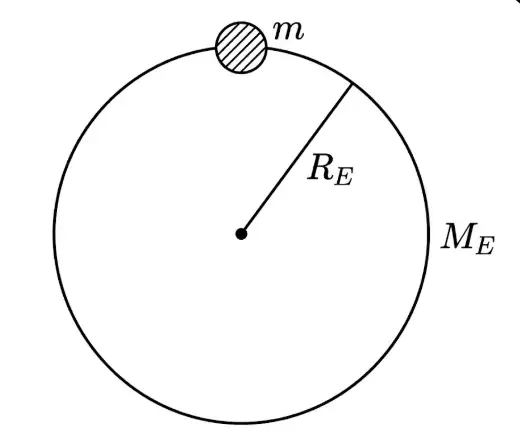
- Earth represented as a large circle with center point.
- Mass of Earth: ME.
- Small object mass: m, orbiting at radius RE from Earth’s center.
- Object moves due to gravitational attraction.
Gravitational Force Formula
- Force between Earth and object: F = GMEm/RE2.
- Weight of object: W = mg.
- Equating weight and force: mg = GMEm/RE2 ⇒ g = GME/RE2.
- Numerical: g = 6.67 × 10-11 × 6 × 1024/(6400 × 103)2 = 9.8 m/s2.
Solved Examples
- Ex 1: Calculate g using G = 6.67 × 10⁻¹¹ Nm2/kg2, ME = 6 × 1024 kg, RE = 6400 km.
- Use formula: g = GME/RE2.
- Convert RE to meters: 6400 × 103 m.
- Calculate g = 9.8 m/s2.
Practice Set
- Q1: What is the acceleration due to gravity on Earth’s surface?
- A) 9.8 m/s2
- B) 10 m/s2
- C) 9.2 m/s2
- D) 8.9 m/s2
- Q2: If Earth’s radius doubles, what happens to g?
- A) Doubles
- B) Halves
- C) Quartered
- D) Remains same
- Q3: Given G = 6.67 × 10⁻¹¹, ME = 6 × 1024, RE = 6400 × 103, calculate g.
- A) 9.8 m/s2
- B) 10.5 m/s2
- C) 8.9 m/s2
- D) 9.2 m/s2
Answer Key
- Q1: A - Standard acceleration due to gravity on Earth’s surface is 9.8 m/s2.
- Q2: C - g is inversely proportional to square of radius, so doubling radius quarters g.
- Q3: A - Direct calculation using formula gives 9.8 m/s2.
Memory Aids
- Formula: g = GME/RE2.
- Remember: g depends on Earth’s mass and radius only.
- Value on Earth’s surface: 9.8 m/s2.
Concept and Definition
- Acceleration produced in a body falling freely towards Earth due to gravity.
- Standard value on Earth’s surface: g = 9.8 m/s2.
- Depends on Earth’s mass ME and radius RE.
Explanation with Diagram
- Earth represented as a large circle with center point.
- Mass of Earth: ME.
- Small object mass: m, orbiting at radius RE from Earth’s center.
- Object moves due to gravitational attraction.
Gravitational Force Formula
- Force between Earth and object: F = GMEm/RE2.
- Weight of object: W = mg.
- Equating weight and force: mg = GMEm/RE2 ⇒ g = GME/RE2.
- Numerical: g = 6.67 × 10-11 × 6 × 1024/(6400 × 103)2 = 9.8 m/s2.
Solved Examples
- Ex 1: Calculate g using G = 6.67 × 10⁻¹¹ Nm2/kg2, ME = 6 × 1024 kg, RE = 6400 km.
- Use formula: g = GME/RE2.
- Convert RE to meters: 6400 × 103 m.
- Calculate g = 9.8 m/s2.
Practice Set
- Q1: What is the acceleration due to gravity on Earth’s surface?
- A) 9.8 m/s2
- B) 10 m/s2
- C) 9.2 m/s2
- D) 8.9 m/s2
- Q2: If Earth’s radius doubles, what happens to g?
- A) Doubles
- B) Halves
- C) Quartered
- D) Remains same
- Q3: Given G = 6.67 × 10⁻¹¹, ME = 6 × 1024, RE = 6400 × 103, calculate g.
- A) 9.8 m/s2
- B) 10.5 m/s2
- C) 8.9 m/s2
- D) 9.2 m/s2
Answer Key
- Q1: A - Standard acceleration due to gravity on Earth’s surface is 9.8 m/s2.
- Q2: C - g is inversely proportional to square of radius, so doubling radius quarters g.
- Q3: A - Direct calculation using formula gives 9.8 m/s2.
Memory Aids
- Formula: g = GME/RE2.
- Remember: g depends on Earth’s mass and radius only.
- Value on Earth’s surface: 9.8 m/s2.
Concept and Definition
- Acceleration produced in a body falling freely towards Earth due to gravity.
- Standard value on Earth’s surface: \( g = 9.8 \ \mathrm{m/s^2} \).
- Depends on Earth’s mass \( M_E \) and radius \( R_E \).
Explanation with Diagram
- Earth represented as a large circle with center point.
- Mass of Earth: \( M_E \).
- Small object mass: \( m \), orbiting at radius \( R_E \) from Earth’s center.
- Object moves due to gravitational attraction.
Gravitational Force Formula
- Force between Earth and object: \( F = \frac{G M_E m}{R_E^2} \).
- Weight of object: \( W = mg \).
- Equating weight and force: \( mg = \frac{G M_E m}{R_E^2} \Rightarrow g = \frac{G M_E}{R_E^2} \).
- Numerical: \( g = \frac{6.67 \times 10^{-11} \times 6 \times 10^{24}}{(6400 \times 10^3)^2} = 9.8 \ \mathrm{m/s^2} \).
Solved Examples
- Ex 1: Calculate \( g \) using \( G = 6.67 \times 10^{-11} \ \mathrm{Nm^2/kg^2} \), \( M_E = 6 \times 10^{24} \ \mathrm{kg} \), \( R_E = 6400 \ \mathrm{km} \).
- Use formula: \( g = \frac{G M_E}{R_E^2} \).
- Convert \( R_E \) to meters: \( 6400 \times 10^3 \ \mathrm{m} \).
- Calculate \( g = 9.8 \ \mathrm{m/s^2} \).
Practice Set
- Q1: What is the acceleration due to gravity on Earth’s surface?
- A) 9.8 m/s2
- B) 10 m/s2
- C) 9.2 m/s2
- D) 8.9 m/s2
- Q2: If Earth’s radius doubles, what happens to \( g \)?
- A) Doubles
- B) Halves
- C) Quartered
- D) Remains same
- Q3: Given \( G = 6.67 \times 10^{-11} \), \( M_E = 6 \times 10^{24} \), \( R_E = 6400 \times 10^3 \), calculate \( g \).
- A) 9.8 m/s2
- B) 10.5 m/s2
- C) 8.9 m/s2
- D) 9.2 m/s2
Answer Key
- Q1: A - Standard acceleration due to gravity on Earth’s surface is 9.8 m/s2.
- Q2: C - \( g \) is inversely proportional to square of radius, so doubling radius quarters \( g \).
- Q3: A - Direct calculation using formula gives 9.8 m/s2.
Memory Aids
- Formula: \( g = \frac{G M_E}{R_E^2} \).
- Remember: \( g \) depends on Earth’s mass and radius only.
- Value on Earth’s surface: 9.8 m/s2.
Relationship between g and G
Formula and Explanation
- g = GME/RE2 = G4/3 πRE3ρ / RE2 = 4/3 πGREρ.
- ρ is uniform density of Earth.
- Shows g depends on G, Earth’s radius, and density.
Solved Examples
- Ex 1: Calculate g if ρ = 5500 kg/m3, RE = 6400 × 103 m, G = 6.67 × 10⁻¹¹.
- Use formula: g = 4/3 πGREρ.
- Calculate g ≈ 9.8 m/s2.
Practice Set
- Q1: Which quantity does g depend on?
- A) Mass of object
- B) Earth’s radius and density
- C) Velocity of object
- D) Temperature
- Q2: If Earth’s density doubles, what happens to g?
- A) Doubles
- B) Halves
- C) No change
- D) Quadruples
- Q3: Given G = 6.67 × 10⁻¹¹, RE = 6400 × 103, ρ = 5500, calculate g.
- A) 9.8 m/s2
- B) 10.5 m/s2
- C) 8.9 m/s2
- D) 9.2 m/s2
Answer Key
- Q1: B - g depends on Earth’s radius and density, not object mass.
- Q2: A - g is directly proportional to density, so doubling density doubles g.
- Q3: A - Calculation using formula yields 9.8 m/s2.
Memory Aids
- Formula: g = 4/3 πGREρ.
- g depends on Earth’s radius and density.
- G is universal gravitational constant.
Formula and Explanation
- \( g = \frac{G M_E}{R_E^2} = G \frac{4}{3} \pi R_E^3 \rho / R_E^2 = \frac{4}{3} \pi G R_E \rho \).
- \( \rho \) is uniform density of Earth.
- Shows \( g \) depends on \( G \), Earth’s radius, and density.
Solved Examples
- Ex 1: Calculate \( g \) if \( \rho = 5500 \ \mathrm{kg/m^3} \), \( R_E = 6400 \times 10^3 \ \mathrm{m} \), \( G = 6.67 \times 10^{-11} \).
- Use formula: \( g = \frac{4}{3} \pi G R_E \rho \).
- Calculate \( g \approx 9.8 \ \mathrm{m/s^2} \).
Practice Set
- Q1: Which quantity does \( g \) depend on?
- A) Mass of object
- B) Earth’s radius and density
- C) Velocity of object
- D) Temperature
- Q2: If Earth’s density doubles, what happens to \( g \)?
- A) Doubles
- B) Halves
- C) No change
- D) Quadruples
- Q3: Given \( G = 6.67 \times 10^{-11} \), \( R_E = 6400 \times 10^3 \), \( \rho = 5500 \), calculate \( g \).
- A) 9.8 m/s2
- B) 10.5 m/s2
- C) 8.9 m/s2
- D) 9.2 m/s2
Answer Key
- Q1: B - \( g \) depends on Earth’s radius and density, not object mass.
- Q2: A - \( g \) is directly proportional to density, so doubling density doubles \( g \).
- Q3: A - Calculation using formula yields 9.8 m/s2.
Memory Aids
- Formula: \( g = \frac{4}{3} \pi G R_E \rho \).
- \( g \) depends on Earth’s radius and density.
- \( G \) is universal gravitational constant.
Gravitational Field
Definition and Intensity
- Space around a body where its gravitational pull is felt is called gravitational field.
- Intensity E at a point: force per unit mass placed at that point.
- E = -GM/r2, negative sign indicates attraction.
Solved Examples
- Ex 1: Calculate gravitational field intensity at r = 10 m from mass M = 1000 kg, G = 6.67 × 10⁻¹¹.
- Use formula: E = -GM/r2.
- Calculate E = -6.67 × 10-11 × 1000/102 = -6.67 × 10⁻¹¹ N/kg.
Practice Set
- Q1: What does gravitational field represent?
- A) Space where gravitational pull is felt
- B) Magnetic field
- C) Electric field
- D) Space with no forces
- Q2: Intensity of gravitational field at distance r is?
- A) GM/r
- B) -GM/r2
- C) GM/r3
- D) -GM/r
- Q3: Calculate gravitational field intensity at r = 5 m from mass 500 kg, G = 6.67 × 10⁻¹¹.
- A) -1.33 × 10⁻⁹ N/kg
- B) -2.67 × 10⁻⁹ N/kg
- C) -6.67 × 10⁻¹⁰ N/kg
- D) -1.33 × 10⁻¹⁰ N/kg
Answer Key
- Q1: A - Gravitational field is the space where gravitational pull is experienced.
- Q2: B - Intensity formula is E = -GM/r2.
- Q3: A - Calculation: E = -6.67 × 10-11 × 500/52 = -1.33 × 10⁻⁹ N/kg.
Memory Aids
- Formula: E = -GM/r2.
- Negative sign means attraction.
- Field intensity = force per unit mass.
Definition and Intensity
- Space around a body where its gravitational pull is felt is called gravitational field.
- Intensity E at a point: force per unit mass placed at that point.
- E = - GM/r2, negative sign indicates attraction.
Solved Examples
- Ex 1: Calculate gravitational field intensity at r = 10 m from mass M = 1000 kg, G = 6.67 × 10⁻¹¹.
- Use formula: E = - GM/r2.
- Calculate E = - 6.67 × 10-11 × 1000/102 = -6.67 × 10⁻¹¹ N/kg.
Practice Set
- Q1: What does gravitational field represent?
- A) Space where gravitational pull is felt
- B) Magnetic field
- C) Electric field
- D) Space with no forces
- Q2: Intensity of gravitational field at distance r is?
- A) GM/r
- B) - GM/r2
- C) GM/r3
- D) - GM/r
- Q3: Calculate gravitational field intensity at r = 5 m from mass 500 kg, G = 6.67 × 10⁻¹¹.
- A) -1.33 × 10⁻⁹ N/kg
- B) -2.67 × 10⁻⁹ N/kg
- C) -6.67 × 10⁻¹⁰ N/kg
- D) -1.33 × 10⁻¹⁰ N/kg
Answer Key
- Q1: A - Gravitational field is the space where gravitational pull is experienced.
- Q2: B - Intensity formula is E = - GM/r2.
- Q3: A - Calculation: E = - 6.67 × 10-11 × 500/52 = -1.33 × 10⁻⁹ N/kg.
Memory Aids
- Formula: E = - GM/r2.
- Negative sign means attraction.
- Field intensity = force per unit mass.
Definition and Intensity
- Space around a body where its gravitational pull is felt is called gravitational field.
- Intensity E at a point: force per unit mass placed at that point.
- E = -GM/r2, negative sign indicates attraction.
Solved Examples
- Ex 1: Calculate gravitational field intensity at r = 10 m from mass M = 1000 kg, G = 6.67 × 10⁻¹¹.
- Use formula: E = -GM/r2.
- Calculate E = -6.67 × 10-11 × 1000/102 = -6.67 × 10⁻¹¹ N/kg.
Practice Set
- Q1: What does gravitational field represent?
- A) Space where gravitational pull is felt
- B) Magnetic field
- C) Electric field
- D) Space with no forces
- Q2: Intensity of gravitational field at distance r is?
- A) GM/r
- B) -GM/r2
- C) GM/r3
- D) -GM/r
- Q3: Calculate gravitational field intensity at r = 5 m from mass 500 kg, G = 6.67 × 10⁻¹¹.
- A) -1.33 × 10⁻⁹ N/kg
- B) -2.67 × 10⁻⁹ N/kg
- C) -6.67 × 10⁻¹⁰ N/kg
- D) -1.33 × 10⁻¹⁰ N/kg
Answer Key
- Q1: A - Gravitational field is the space where gravitational pull is experienced.
- Q2: B - Intensity formula is E = -GM/r2.
- Q3: A - Calculation: E = -6.67 × 10-11 × 500/52 = -1.33 × 10⁻⁹ N/kg.
Memory Aids
- Formula: E = -GM/r2.
- Negative sign means attraction.
- Field intensity = force per unit mass.
Definition and Intensity
- Space around a body where its gravitational pull is felt is called gravitational field.
- Intensity E at a point: force per unit mass placed at that point.
- E = -GM/r2, negative sign indicates attraction.
Solved Examples
- Ex 1: Calculate gravitational field intensity at r = 10 m from mass M = 1000 kg, G = 6.67 × 10⁻¹¹.
- Use formula: E = -GM/r2.
- Calculate E = -6.67 × 10-11 × 1000/102 = -6.67 × 10⁻¹¹ N/kg.
Practice Set
- Q1: What does gravitational field represent?
- A) Space where gravitational pull is felt
- B) Magnetic field
- C) Electric field
- D) Space with no forces
- Q2: Intensity of gravitational field at distance r is?
- A) GM/r
- B) -GM/r2
- C) GM/r3
- D) -GM/r
- Q3: Calculate gravitational field intensity at r = 5 m from mass 500 kg, G = 6.67 × 10⁻¹¹.
- A) -1.33 × 10⁻⁹ N/kg
- B) -2.67 × 10⁻⁹ N/kg
- C) -6.67 × 10⁻¹⁰ N/kg
- D) -1.33 × 10⁻¹⁰ N/kg
Answer Key
- Q1: A - Gravitational field is the space where gravitational pull is experienced.
- Q2: B - Intensity formula is E = -GM/r2.
- Q3: A - Calculation: E = -6.67 × 10-11 × 500/52 = -1.33 × 10⁻⁹ N/kg.
Memory Aids
- Formula: E = -GM/r2.
- Negative sign means attraction.
- Field intensity = force per unit mass.
Definition and Intensity
- Space around a body where its gravitational pull is felt is called gravitational field.
- Intensity \( E \) at a point: force per unit mass placed at that point.
- \( E = - \frac{GM}{r^2} \), negative sign indicates attraction.
Solved Examples
- Ex 1: Calculate gravitational field intensity at \( r = 10 \ \mathrm{m} \) from mass \( M = 1000 \ \mathrm{kg} \), \( G = 6.67 \times 10^{-11} \).
- Use formula: \( E = - \frac{GM}{r^2} \).
- Calculate \( E = - \frac{6.67 \times 10^{-11} \times 1000}{10^2} = -6.67 \times 10^{-11} \ \mathrm{N/kg} \).
Practice Set
- Q1: What does gravitational field represent?
- A) Space where gravitational pull is felt
- B) Magnetic field
- C) Electric field
- D) Space with no forces
- Q2: Intensity of gravitational field at distance \( r \) is?
- A) \( \frac{GM}{r} \)
- B) \( - \frac{GM}{r^2} \)
- C) \( \frac{GM}{r^3} \)
- D) \( - \frac{GM}{r} \)
- Q3: Calculate gravitational field intensity at \( r = 5 \ \mathrm{m} \) from mass \( 500 \ \mathrm{kg} \), \( G = 6.67 \times 10^{-11} \).
- A) \( -1.33 \times 10^{-9} \ \mathrm{N/kg} \)
- B) \( -2.67 \times 10^{-9} \ \mathrm{N/kg} \)
- C) \( -6.67 \times 10^{-10} \ \mathrm{N/kg} \)
- D) \( -1.33 \times 10^{-10} \ \mathrm{N/kg} \)
Answer Key
- Q1: A - Gravitational field is the space where gravitational pull is experienced.
- Q2: B - Intensity formula is \( E = - \frac{GM}{r^2} \).
- Q3: A - Calculation: \( E = - \frac{6.67 \times 10^{-11} \times 500}{5^2} = -1.33 \times 10^{-9} \ \mathrm{N/kg} \).
Memory Aids
- Formula: \( E = - \frac{GM}{r^2} \).
- Negative sign means attraction.
- Field intensity = force per unit mass.
Acceleration due to Gravity Below and Above Earth Surface
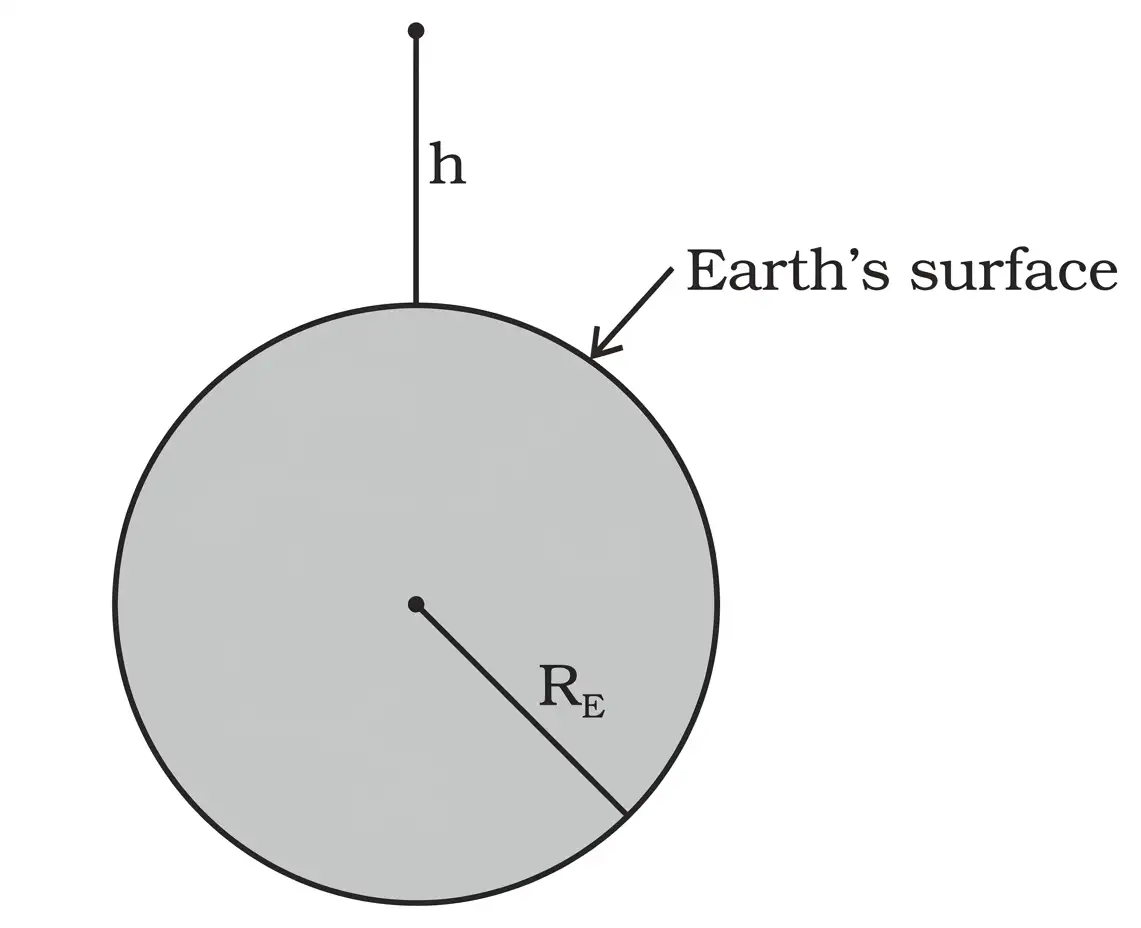
Effect of Altitude
- Force on mass m at height h: F(h) = GMEm/(RE + h)2
- Acceleration due to gravity at height h: g(h) = F(h)/m = GME/(RE + h)2 = g (1 + h/RE)-2
- For small height h (h ≪ RE), using binomial approximation: g(h) ≈ g (1 - 2h/RE)
- Gravity decreases with altitude by factor (1 - 2h/RE)
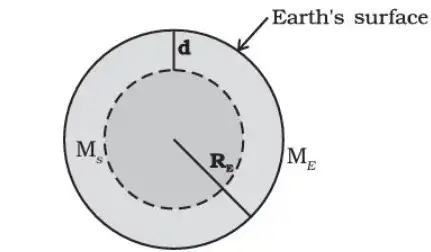
Effect of Depth
- Mass of smaller sphere at depth d: Ms/ME = ((RE - d)/RE)3
- Force on mass m at depth d: F(d) = GMsm/(RE - d)2 = GMEm(RE - d)/RE3
- Acceleration due to gravity at depth d: g(d) = F(d)/m = g (1 - d/RE)
- Gravity decreases linearly with depth by factor (1 - d/RE)
Solved Examples
- Ex 1: Calculate g(h) at height h = 1000 m above Earth surface. Given g = 9.8 m/s2, RE = 6.4 × 10⁶ m.
- Use g(h) ≈ g (1 - 2h/RE) = 9.8 (1 - 2 × 1000/6.4 × 106) = 9.8 × 0.9996875 = 9.796 m/s2
- Ex 2: Find g(d) at depth d = 5000 m below Earth surface.
- Use g(d) = g (1 - d/RE) = 9.8 (1 - 5000/6.4 × 106) = 9.8 × 0.99922 = 9.792 m/s2
Practice Set
- Q1: At a height h above Earth surface, acceleration due to gravity g(h) is given by:
- A) g (1 + h/RE)2
- B) g (1 + h/RE)-2
- C) g (1 - h/RE)2
- D) g (1 - 2h/RE)-1
- Q2: At depth d below Earth surface, acceleration due to gravity g(d) is:
- A) g (1 + d/RE)
- B) g (1 - d/RE)
- C) g (1 - 2d/RE)
- D) g (1 + 2d/RE)
- Q3: If g = 9.8 m/s2, RE = 6.4 × 10⁶ m, find g(h) at h = 6400 m.
- A) 9.78 m/s2
- B) 9.76 m/s2
- C) 9.74 m/s2
- D) 9.72 m/s2
Answer Key
- Q1: B - Formula for gravity at height is g(h) = g (1 + h/RE)-2
- Q2: B - Gravity decreases linearly with depth as g(d) = g (1 - d/RE)
- Q3: A - Using g(h) ≈ g (1 - 2h/RE) = 9.8 × (1 - 2 × 6400/6.4 × 106) = 9.78
Memory Aids
- Gravity decreases with altitude: g(h) ≈ g (1 - 2h/RE)
- Gravity decreases with depth: g(d) = g (1 - d/RE)
- Use binomial approximation for small heights
Effect of Altitude
- Force on mass m at height h: F(h) = GMEm/(RE + h)2
- Acceleration due to gravity at height h: g(h) = F(h)/m = GME/(RE + h)2 = g (1 + h/RE)-2
- For small height h (h ≪ RE), using binomial approximation: g(h) ≈ g (1 - 2h/RE)
- Gravity decreases with altitude by factor (1 - 2h/RE)
Effect of Depth
- Mass of smaller sphere at depth d: Ms/ME = ((RE - d)/RE)3
- Force on mass m at depth d: F(d) = GMsm/(RE - d)2 = GMEm(RE - d)/RE3
- Acceleration due to gravity at depth d: g(d) = F(d)/m = g (1 - d/RE)
- Gravity decreases linearly with depth by factor (1 - d/RE)
Solved Examples
- Ex 1: Calculate g(h) at height h = 1000 m above Earth surface. Given g = 9.8 m/s2, RE = 6.4 × 10⁶ m.
- Use g(h) ≈ g (1 - 2h/RE) = 9.8 (1 - 2 × 1000/6.4 × 106) = 9.8 × 0.9996875 = 9.796 m/s2
- Ex 2: Find g(d) at depth d = 5000 m below Earth surface.
- Use g(d) = g (1 - d/RE) = 9.8 (1 - 5000/6.4 × 106) = 9.8 × 0.99922 = 9.792 m/s2
Practice Set
- Q1: At a height h above Earth surface, acceleration due to gravity g(h) is given by:
- A) g (1 + h/RE)2
- B) g (1 + h/RE)-2
- C) g (1 - h/RE)2
- D) g (1 - 2h/RE)-1
- Q2: At depth d below Earth surface, acceleration due to gravity g(d) is:
- A) g (1 + d/RE)
- B) g (1 - d/RE)
- C) g (1 - 2d/RE)
- D) g (1 + 2d/RE)
- Q3: If g = 9.8 m/s2, RE = 6.4 × 10⁶ m, find g(h) at h = 6400 m.
- A) 9.78 m/s2
- B) 9.76 m/s2
- C) 9.74 m/s2
- D) 9.72 m/s2
Answer Key
- Q1: B - Formula for gravity at height is g(h) = g (1 + h/RE)-2
- Q2: B - Gravity decreases linearly with depth as g(d) = g (1 - d/RE)
- Q3: A - Using g(h) ≈ g (1 - 2h/RE) = 9.8 × (1 - 2 × 6400/6.4 × 106) = 9.78
Memory Aids
- Gravity decreases with altitude: g(h) ≈ g (1 - 2h/RE)
- Gravity decreases with depth: g(d) = g (1 - d/RE)
- Use binomial approximation for small heights
Effect of Altitude
- Force on mass \( m \) at height \( h \): \( F(h) = \frac{GM_Em}{(R_E + h)^2} \)
- Acceleration due to gravity at height \( h \): \( g(h) = \frac{F(h)}{m} = \frac{GM_E}{(R_E + h)^2} = g \left(1 + \frac{h}{R_E}\right)^{-2} \)
- For small height \( h \) (\( h \ll R_E \)), using binomial approximation: \( g(h) \approx g \left(1 - \frac{2h}{R_E}\right) \)
- Gravity decreases with altitude by factor \( (1 - 2h/R_E) \)
Effect of Depth
- Mass of smaller sphere at depth \( d \): \( \frac{M_s}{M_E} = \left(\frac{R_E - d}{R_E}\right)^3 \)
- Force on mass \( m \) at depth \( d \): \( F(d) = \frac{GM_sm}{(R_E - d)^2} = \frac{GM_Em(R_E - d)}{R_E^3} \)
- Acceleration due to gravity at depth \( d \): \( g(d) = \frac{F(d)}{m} = g \left(1 - \frac{d}{R_E}\right) \)
- Gravity decreases linearly with depth by factor \( (1 - d/R_E) \)
Solved Examples
- Ex 1: Calculate \( g(h) \) at height \( h = 1000 \) m above Earth surface. Given \( g = 9.8 \ \mathrm{m/s^2} \), \( R_E = 6.4 \times 10^6 \) m.
- Use \( g(h) \approx g \left(1 - \frac{2h}{R_E}\right) = 9.8 \left(1 - \frac{2 \times 1000}{6.4 \times 10^6}\right) = 9.8 \times 0.9996875 = 9.796 \ \mathrm{m/s^2} \)
- Ex 2: Find \( g(d) \) at depth \( d = 5000 \) m below Earth surface.
- Use \( g(d) = g \left(1 - \frac{d}{R_E}\right) = 9.8 \left(1 - \frac{5000}{6.4 \times 10^6}\right) = 9.8 \times 0.99922 = 9.792 \ \mathrm{m/s^2} \)
Practice Set
- Q1: At a height \( h \) above Earth surface, acceleration due to gravity \( g(h) \) is given by:
- A) \( g \left(1 + \frac{h}{R_E}\right)^2 \)
- B) \( g \left(1 + \frac{h}{R_E}\right)^{-2} \)
- C) \( g \left(1 - \frac{h}{R_E}\right)^2 \)
- D) \( g \left(1 - \frac{2h}{R_E}\right)^{-1} \)
- Q2: At depth \( d \) below Earth surface, acceleration due to gravity \( g(d) \) is:
- A) \( g \left(1 + \frac{d}{R_E}\right) \)
- B) \( g \left(1 - \frac{d}{R_E}\right) \)
- C) \( g \left(1 - \frac{2d}{R_E}\right) \)
- D) \( g \left(1 + \frac{2d}{R_E}\right) \)
- Q3: If \( g = 9.8 \ \mathrm{m/s^2} \), \( R_E = 6.4 \times 10^6 \) m, find \( g(h) \) at \( h = 6400 \) m.
- A) 9.78 \( \mathrm{m/s^2} \)
- B) 9.76 \( \mathrm{m/s^2} \)
- C) 9.74 \( \mathrm{m/s^2} \)
- D) 9.72 \( \mathrm{m/s^2} \)
Answer Key
- Q1: B - Formula for gravity at height is \( g(h) = g \left(1 + \frac{h}{R_E}\right)^{-2} \)
- Q2: B - Gravity decreases linearly with depth as \( g(d) = g \left(1 - \frac{d}{R_E}\right) \)
- Q3: A - Using \( g(h) \approx g \left(1 - \frac{2h}{R_E}\right) = 9.8 \times (1 - \frac{2 \times 6400}{6.4 \times 10^6}) = 9.78 \)
Memory Aids
- Gravity decreases with altitude: \( g(h) \approx g (1 - 2h/R_E) \)
- Gravity decreases with depth: \( g(d) = g (1 - d/R_E) \)
- Use binomial approximation for small heights
Variation in Acceleration due to Gravity
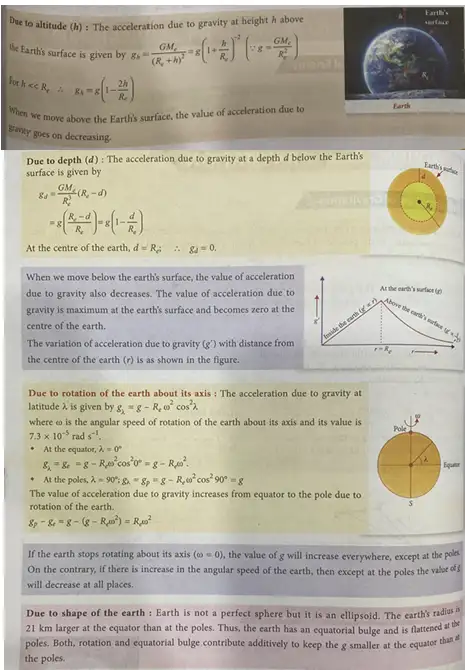
Factors Affecting Gravity
- Gravity decreases above Earth's surface with height.
- Gravity decreases below Earth's surface with depth, zero at center.
- Earth's rotation reduces gravity at equator due to centrifugal force.
- Gravity varies with latitude λ: gλ = g - REω2cos2 λ
- Minimum gravity at equator (λ=0°), maximum at poles (λ=90°).
- Earth's shape: equatorial bulge reduces gravity at equator.
Solved Examples
- Ex 1: Calculate gravity at equator given g = 9.8 m/s2, RE = 6.4 × 10⁶ m, ω = 7.27 × 10⁻⁵ rad/s.
- ge = g - REω2 = 9.8 - 6.4 × 106 × (7.27 × 10-5)2 = 9.8 - 0.0339 = 9.766 m/s2
- Ex 2: Find difference in gravity between poles and equator.
- gp - ge = REω2 = 0.0339 m/s2
Practice Set
- Q1: Gravity at latitude λ is given by:
- A) g + REω2cos2 λ
- B) g - REω2cos2 λ
- C) g - REω2sin2 λ
- D) g + REω2sin2 λ
- Q2: Gravity is minimum at:
- A) Poles
- B) Equator
- C) Mid-latitudes
- D) Center of Earth
- Q3: If Earth did not rotate, gravity at equator would be:
- A) Greater than current
- B) Less than current
- C) Same as poles
- D) Zero
Answer Key
- Q1: B - Gravity reduces by centrifugal force term REω2cos2 λ
- Q2: B - Minimum gravity at equator due to rotation and bulge
- Q3: A - Without rotation, no centrifugal force, gravity stronger at equator
Memory Aids
- Gravity gλ = g - REω2cos2 λ
- Minimum gravity at equator, maximum at poles
- Earth's bulge reduces gravity at equator
Factors Affecting Gravity
- Gravity decreases above Earth's surface with height.
- Gravity decreases below Earth's surface with depth, zero at center.
- Earth's rotation reduces gravity at equator due to centrifugal force.
- Gravity varies with latitude λ: gλ = g - REω2cos2 λ
- Minimum gravity at equator (λ=0°), maximum at poles (λ=90°).
- Earth's shape: equatorial bulge reduces gravity at equator.
Solved Examples
- Ex 1: Calculate gravity at equator given g = 9.8 m/s2, RE = 6.4 × 10⁶ m, ω = 7.27 × 10⁻⁵ rad/s.
- ge = g - REω2 = 9.8 - 6.4 × 106 × (7.27 × 10-5)2 = 9.8 - 0.0339 = 9.766 m/s2
- Ex 2: Find difference in gravity between poles and equator.
- gp - ge = REω2 = 0.0339 m/s2
Practice Set
- Q1: Gravity at latitude λ is given by:
- A) g + REω2cos2 λ
- B) g - REω2cos2 λ
- C) g - REω2sin2 λ
- D) g + REω2sin2 λ
- Q2: Gravity is minimum at:
- A) Poles
- B) Equator
- C) Mid-latitudes
- D) Center of Earth
- Q3: If Earth did not rotate, gravity at equator would be:
- A) Greater than current
- B) Less than current
- C) Same as poles
- D) Zero
Answer Key
- Q1: B - Gravity reduces by centrifugal force term REω2cos2 λ
- Q2: B - Minimum gravity at equator due to rotation and bulge
- Q3: A - Without rotation, no centrifugal force, gravity stronger at equator
Memory Aids
- Gravity gλ = g - REω2cos2 λ
- Minimum gravity at equator, maximum at poles
- Earth's bulge reduces gravity at equator
Factors Affecting Gravity
- Gravity decreases above Earth's surface with height.
- Gravity decreases below Earth's surface with depth, zero at center.
- Earth's rotation reduces gravity at equator due to centrifugal force.
- Gravity varies with latitude \( \lambda \): \( g_\lambda = g - R_E \omega^2 \cos^2 \lambda \)
- Minimum gravity at equator (\( \lambda=0^\circ \)), maximum at poles (\( \lambda=90^\circ \)).
- Earth's shape: equatorial bulge reduces gravity at equator.
Solved Examples
- Ex 1: Calculate gravity at equator given \( g = 9.8 \ \mathrm{m/s^2} \), \( R_E = 6.4 \times 10^6 \) m, \( \omega = 7.27 \times 10^{-5} \ \mathrm{rad/s} \).
- \( g_e = g - R_E \omega^2 = 9.8 - 6.4 \times 10^6 \times (7.27 \times 10^{-5})^2 = 9.8 - 0.0339 = 9.766 \ \mathrm{m/s^2} \)
- Ex 2: Find difference in gravity between poles and equator.
- \( g_p - g_e = R_E \omega^2 = 0.0339 \ \mathrm{m/s^2} \)
Practice Set
- Q1: Gravity at latitude \( \lambda \) is given by:
- A) \( g + R_E \omega^2 \cos^2 \lambda \)
- B) \( g - R_E \omega^2 \cos^2 \lambda \)
- C) \( g - R_E \omega^2 \sin^2 \lambda \)
- D) \( g + R_E \omega^2 \sin^2 \lambda \)
- Q2: Gravity is minimum at:
- A) Poles
- B) Equator
- C) Mid-latitudes
- D) Center of Earth
- Q3: If Earth did not rotate, gravity at equator would be:
- A) Greater than current
- B) Less than current
- C) Same as poles
- D) Zero
Answer Key
- Q1: B - Gravity reduces by centrifugal force term \( R_E \omega^2 \cos^2 \lambda \)
- Q2: B - Minimum gravity at equator due to rotation and bulge
- Q3: A - Without rotation, no centrifugal force, gravity stronger at equator
Memory Aids
- Gravity \( g_\lambda = g - R_E \omega^2 \cos^2 \lambda \)
- Minimum gravity at equator, maximum at poles
- Earth's bulge reduces gravity at equator
Gravitational Field and Potential of Continuous Mass Distributions
Key Formulas
- Gravitational potential V: work done per unit mass from infinity to point
- Relation: E = -dV/dr
- Uniform ring (mass M, radius R):
- Field on axis: E = -GMx/(R2 + x2)3/2
- Potential on axis: V = -GM/√(R2 + x2)
- Uniform disc (mass M, radius R):
- Field on axis: E = -2GM/R2 (1 - x/√(R2 + x2))
- Potential on axis: V = -2GM/R2 (x - √(R2 + x2))
- Thin spherical shell (mass M, radius R):
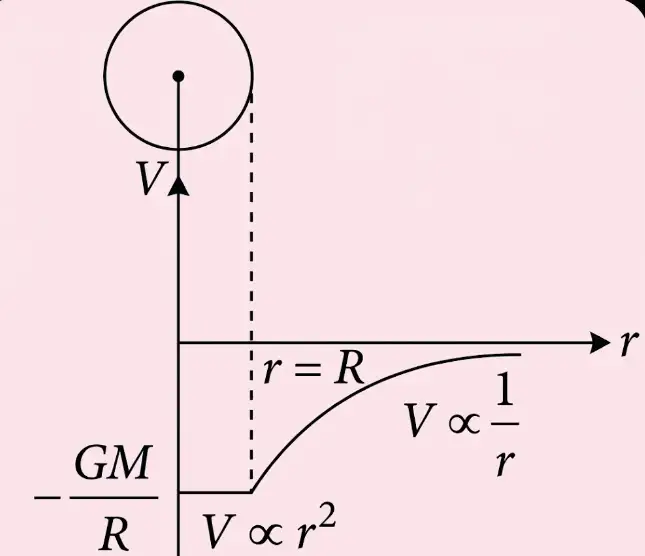
- Inside (r < R): E = 0, V = -GM/R
- On surface (r = R): E = -GM/R2, V = -GM/R
- Outside (r > R): E = -GM/r2, V = -GM/r
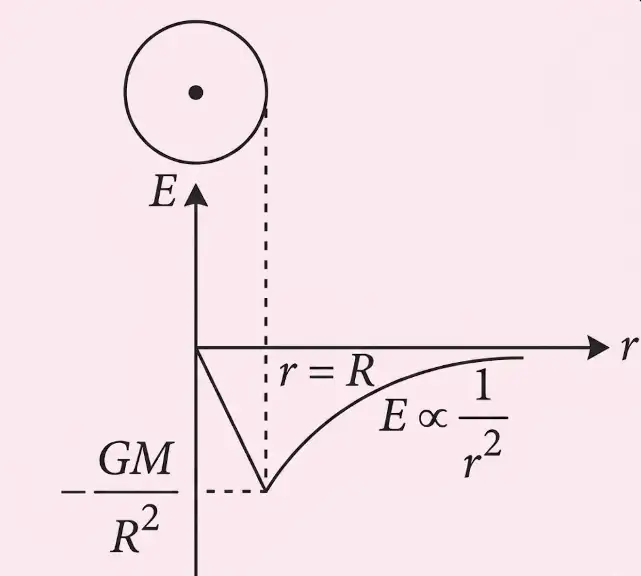
- Solid sphere (mass M, radius R, uniform density):
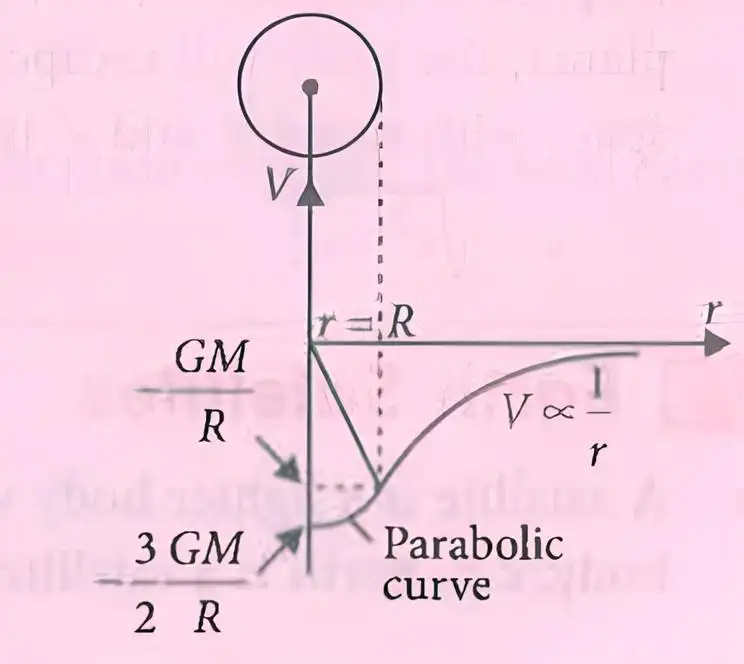
- Inside (r < R): E = -GMr/R3, V = -GM/2R3 (3R2 - r2)
- On surface (r = R): E = -GM/R2, V = -GM/R
- Outside (r > R): E = -GM/r2, V = -GM/r
- Center (r = 0): V = -3GM/2R
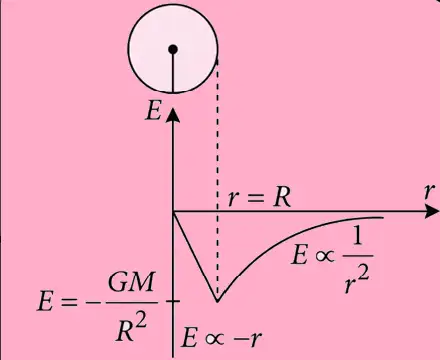
- Ex 1: Find gravitational field E on axis of ring at distance x = R.
- E = -GMx/(R2 + x2)3/2 = -GMR/(R2 + R2)3/2 = -GMR/(2R2)3/2 = -GM/2√2R2
- Ex 2: Calculate gravitational potential V on axis of uniform disc at x = 0.
- V = -2GM/R2 (0 - R) = 2GM/R
- Q1: Gravitational field on axis of ring at distance x is:
- A) -GMx/(R2 + x2)3/2
- B) -GM/(R2 + x2)1/2
- C) -2GM/R2 (1 - x/√(R2 + x2))
- D) 0
- Q2: Gravitational potential on axis of uniform disc at distance x is:
- A) -GM/√(R2 + x2)
- B) -2GM/R2 (x - √(R2 + x2))
- C) -GMx/(R2 + x2)3/2
- D) 0
- Q3: Inside thin spherical shell, gravitational field E(r < R) is:
- A) -GM/R2
- B) 0
- C) -GM/r2
- D) -GM/r
- Q1: A - Formula for gravitational field on ring axis
- Q2: B - Formula for gravitational potential on disc axis
- Q3: B - Field inside shell is zero
- Field and potential formulas depend on shape and position
- Inside shell: field zero, potential constant
- Outside shell: treat mass as point at center
- Gravitational potential V: work done per unit mass from infinity to point
- Relation: E = -dV/dr
- Uniform ring (mass M, radius R):
- Field on axis: E = -GMx/(R2 + x2)3/2
- Potential on axis: V = -GM/√(R2 + x2)
- Uniform disc (mass M, radius R):
- Field on axis: E = -2GM/R2 (1 - x/√(R2 + x2))
- Potential on axis: V = -2GM/R2 (x - √(R2 + x2))
- Thin spherical shell (mass M, radius R):
- Inside (r < R): E = 0, V = -GM/R
- On surface (r = R): E = -GM/R2, V = -GM/R
- Outside (r > R): E = -GM/r2, V = -GM/r
- Solid sphere (mass M, radius R, uniform density):
- Inside (r < R): E = -GMr/R3, V = -GM/2R3 (3R2 - r2)
- On surface (r = R): E = -GM/R2, V = -GM/R
- Outside (r > R): E = -GM/r2, V = -GM/r
- Center (r = 0): V = -3GM/2R
- Ex 1: Find gravitational field E on axis of ring at distance x = R.
- E = -GMx/(R2 + x2)3/2 = -GMR/(R2 + R2)3/2 = -GMR/(2R2)3/2 = -GM/2√2R2
- Ex 2: Calculate gravitational potential V on axis of uniform disc at x = 0.
- V = -2GM/R2 (0 - R) = 2GM/R
- Q1: Gravitational field on axis of ring at distance x is:
- A) -GMx/(R2 + x2)3/2
- B) -GM/(R2 + x2)1/2
- C) -2GM/R2 (1 - x/√(R2 + x2))
- D) 0
- Q2: Gravitational potential on axis of uniform disc at distance x is:
- A) -GM/√(R2 + x2)
- B) -2GM/R2 (x - √(R2 + x2))
- C) -GMx/(R2 + x2)3/2
- D) 0
- Q3: Inside thin spherical shell, gravitational field E(r < R) is:
- A) -GM/R2
- B) 0
- C) -GM/r2
- D) -GM/r
- Q1: A - Formula for gravitational field on ring axis
- Q2: B - Formula for gravitational potential on disc axis
- Q3: B - Field inside shell is zero
- Field and potential formulas depend on shape and position
- Inside shell: field zero, potential constant
- Outside shell: treat mass as point at center
- Gravitational potential \( V \): work done per unit mass from infinity to point
- Relation: \( E = -\frac{dV}{dr} \)
- Uniform ring (mass \( M \), radius \( R \)):
- Field on axis: \( E = -\frac{GMx}{(R^2 + x^2)^{3/2}} \)
- Potential on axis: \( V = -\frac{GM}{\sqrt{R^2 + x^2}} \)
- Uniform disc (mass \( M \), radius \( R \)):
- Field on axis: \( E = -\frac{2GM}{R^2} \left(1 - \frac{x}{\sqrt{R^2 + x^2}}\right) \)
- Potential on axis: \( V = -\frac{2GM}{R^2} \left(x - \sqrt{R^2 + x^2}\right) \)
- Thin spherical shell (mass \( M \), radius \( R \)):
- Inside (\( r < R \)): \( E = 0, V = -\frac{GM}{R} \)
- On surface (\( r = R \)): \( E = -\frac{GM}{R^2}, V = -\frac{GM}{R} \)
- Outside (\( r > R \)): \( E = -\frac{GM}{r^2}, V = -\frac{GM}{r} \)
- Solid sphere (mass \( M \), radius \( R \), uniform density):
- Inside (\( r < R \)): \( E = -\frac{GMr}{R^3} \), \( V = -\frac{GM}{2R^3} (3R^2 - r^2) \)
- On surface (\( r = R \)): \( E = -\frac{GM}{R^2} \), \( V = -\frac{GM}{R} \)
- Outside (\( r > R \)): \( E = -\frac{GM}{r^2} \), \( V = -\frac{GM}{r} \)
- Center (\( r = 0 \)): \( V = -\frac{3GM}{2R} \)
- Ex 1: Find gravitational field \( E \) on axis of ring at distance \( x = R \).
- \( E = -\frac{GMx}{(R^2 + x^2)^{3/2}} = -\frac{GMR}{(R^2 + R^2)^{3/2}} = -\frac{GMR}{(2R^2)^{3/2}} = -\frac{GM}{2\sqrt{2}R^2} \)
- Ex 2: Calculate gravitational potential \( V \) on axis of uniform disc at \( x = 0 \).
- \( V = -\frac{2GM}{R^2} (0 - R) = \frac{2GM}{R} \)
- Q1: Gravitational field on axis of ring at distance \( x \) is:
- A) \( -\frac{GMx}{(R^2 + x^2)^{3/2}} \)
- B) \( -\frac{GM}{(R^2 + x^2)^{1/2}} \)
- C) \( -\frac{2GM}{R^2} \left(1 - \frac{x}{\sqrt{R^2 + x^2}}\right) \)
- D) \( 0 \)
- Q2: Gravitational potential on axis of uniform disc at distance \( x \) is:
- A) \( -\frac{GM}{\sqrt{R^2 + x^2}} \)
- B) \( -\frac{2GM}{R^2} \left(x - \sqrt{R^2 + x^2}\right) \)
- C) \( -\frac{GMx}{(R^2 + x^2)^{3/2}} \)
- D) \( 0 \)
- Q3: Inside thin spherical shell, gravitational field \( E(r < R) \) is:
- A) \( -\frac{GM}{R^2} \)
- B) \( 0 \)
- C) \( -\frac{GM}{r^2} \)
- D) \( -\frac{GM}{r} \)
- Q1: A - Formula for gravitational field on ring axis
- Q2: B - Formula for gravitational potential on disc axis
- Q3: B - Field inside shell is zero
- Field and potential formulas depend on shape and position
- Inside shell: field zero, potential constant
- Outside shell: treat mass as point at center
- Work done to bring a body from infinity to a point in a gravitational field.
- Between two masses M and m separated by distance r: U = -GMm/r
- Potential energy at infinity is zero: U → 0 as r → ∞
- Scalar quantity, SI unit: Joule (J), Dimensional formula: [ML2T-2]
- At height h above Earth surface: Uh = -GMEm/(RE + h)
- On Earth surface: Us = -GMEm/RE
- Change in potential energy when moved up by h:
ΔU = Uh - Us = GMEm (1/RE - 1/(RE + h)) = GMEmh/(RE2 (1 + h/RE)) = mgh/(1 + h/RE) - Since GME/RE2 = g, for small heights (h << RE), ΔU ≈ mgh
- Ex 1: Calculate gravitational potential energy of 2 kg mass at 10 m above Earth surface.
Given: m=2 kg, h=10 m, g=9.8 m/s2
Use: ΔU = mgh
ΔU = 2 × 9.8 × 10 = 196 J - Q1: Gravitational potential energy between two masses M and m separated by distance r is:
A) GMm/r B) -GMm/r C) GMm/r2 D) -GMm/r2 - Q2: The change in gravitational potential energy when a body is moved from surface to height h (h << RE) is:
A) mgh B) mg C) mgh/2 D) 2mgh - Q3: If the radius of Earth is doubled, the gravitational potential energy on surface for mass m becomes:
A) -GMEm/2RE B) -GMEm/4RE C) -GMEm/RE D) -2GMEm/RE - Q1: B - Formula for gravitational potential energy is negative: U = -GMm/r.
- Q2: A - For small heights, change in potential energy is mgh.
- Q3: B - Doubling radius increases denominator, so energy becomes -GMEm/(2RE × 2) = -GMEm/4RE.
- Potential energy is negative and zero at infinity.
- Near Earth, ΔU ≈ mgh for small heights.
- Formula: U = -GMm/r always negative.
- Work done to bring a body from infinity to a point in a gravitational field.
- Between two masses M and m separated by distance r: U = -\frac{GMm}{r}
- Potential energy at infinity is zero: U \to 0 \text{ as } r \to \infty
- Scalar quantity, SI unit: Joule (J), Dimensional formula: [ML2T-2]
- At height h above Earth surface: U_h = -\frac{GM_Em}{R_E + h}
- On Earth surface: U_s = -\frac{GM_Em}{R_E}
- Change in potential energy when moved up by h:
\Delta U = U_h - U_s = GM_Em \left( \frac{1}{R_E} - \frac{1}{R_E + h} \right) = \frac{GM_Emh}{R_E^2 (1 + \frac{h}{R_E})} = \frac{mgh}{1 + \frac{h}{R_E}} - Since \frac{GM_E}{R_E^2} = g, for small heights (h << R_E), \Delta U \approx mgh
- Ex 1: Calculate gravitational potential energy of 2 kg mass at 10 m above Earth surface.
Given: m=2 kg, h=10 m, g=9.8 m/s2
Use: \( \Delta U = mgh \)
\( \Delta U = 2 \times 9.8 \times 10 = 196 \text{ J} \) - Q1: Gravitational potential energy between two masses M and m separated by distance r is:
A) \( \frac{GMm}{r} \) B) \( -\frac{GMm}{r} \) C) \( \frac{GMm}{r^2} \) D) \( -\frac{GMm}{r^2} \) - Q2: The change in gravitational potential energy when a body is moved from surface to height h (h << R_E) is:
A) \( mgh \) B) \( mg \) C) \( \frac{mgh}{2} \) D) \( 2mgh \) - Q3: If the radius of Earth is doubled, the gravitational potential energy on surface for mass m becomes:
A) \( -\frac{GM_Em}{2R_E} \) B) \( -\frac{GM_Em}{4R_E} \) C) \( -\frac{GM_Em}{R_E} \) D) \( -\frac{2GM_Em}{R_E} \) - Q1: B - Formula for gravitational potential energy is negative: \( U = -\frac{GMm}{r} \).
- Q2: A - For small heights, change in potential energy is \( mgh \).
- Q3: B - Doubling radius increases denominator, so energy becomes \( -\frac{GM_Em}{2R_E \times 2} = -\frac{GM_Em}{4R_E} \).
- Potential energy is negative and zero at infinity.
- Near Earth, \( \Delta U \approx mgh \) for small heights.
- Formula: \( U = -\frac{GMm}{r} \) always negative.
- Minimum speed to escape a planet's gravitational field without returning.
- Escape speed, ve = √(2GM/R)
- Where, M = mass of planet, R = radius of planet, G = gravitational constant.
- Using volume and density: ve = √(2G × volume × ρ/R) = √(2G/R × 4/3 πR3ρ) = √(8πGρR2/3)
- ρ = density of the planet.
- For Earth, ve = 11.2 km/s
- If projection speed v < ve, body may orbit or fall back.
- If v > ve, body escapes gravitational field with speed v' = √(v2 - ve2).
- Ex 1: Calculate escape speed from a planet of mass 5 × 1024 kg and radius 6 × 10⁶ m.
- Use ve = √(2GM/R)
- Substitute G = 6.67 × 10⁻¹¹ Nm2/kg2
- Calculate ve
- Ex 2: Find speed v' if a body is projected at 15 km/s from Earth.
- Given v = 15 km/s, ve = 11.2 km/s
- Calculate v' = √(v2 - ve2) = √(152 - 11.22)
- Result v' in km/s
- Q1: Escape speed depends on
- A) Mass and radius of planet
- B) Only mass
- C) Only radius
- D) None
- Q2: Escape speed from Earth is approximately
- A) 9.8 m/s
- B) 11.2 km/s
- C) 30 km/s
- D) 3 km/s
- Q3: A body projected at 14 km/s from a planet with escape speed 12 km/s will
- A) Fall back
- B) Orbit planet
- C) Escape with speed √(142 - 122) km/s
- D) Stop at max height
- Q1: A - Escape speed depends on both mass and radius as ve = √(2GM/R).
- Q2: B - Earth's escape speed is 11.2 km/s.
- Q3: C - Speed after escape is √(v2 - ve2).
- Escape speed formula: ve = √(2GM/R)
- For Earth, remember 11.2 km/s
- If v < ve, body returns or orbits; if v > ve, body escapes
- Minimum speed to escape a planet's gravitational field without returning.
- Escape speed, \( v_e = \sqrt{\frac{2GM}{R}} \)
- Where, \( M \) = mass of planet, \( R \) = radius of planet, \( G \) = gravitational constant.
- Using volume and density: \( v_e = \sqrt{\frac{2G \times \text{volume} \times \rho}{R}} = \sqrt{\frac{2G}{R} \times \frac{4}{3} \pi R^3 \rho} = \sqrt{\frac{8 \pi G \rho R^2}{3}} \)
- \( \rho \) = density of the planet.
- For Earth, \( v_e = 11.2 \text{ km/s} \)
- If projection speed \( v < v_e \), body may orbit or fall back.
- If \( v > v_e \), body escapes gravitational field with speed \( v' = \sqrt{v^2 - v_e^2} \).
- Ex 1: Calculate escape speed from a planet of mass \( 5 \times 10^{24} \text{ kg} \) and radius \( 6 \times 10^6 \text{ m} \).
- Use \( v_e = \sqrt{\frac{2GM}{R}} \)
- Substitute \( G = 6.67 \times 10^{-11} \text{ Nm}^2/\text{kg}^2 \)
- Calculate \( v_e \)
- Ex 2: Find speed \( v' \) if a body is projected at \( 15 \text{ km/s} \) from Earth.
- Given \( v = 15 \text{ km/s}, v_e = 11.2 \text{ km/s} \)
- Calculate \( v' = \sqrt{v^2 - v_e^2} = \sqrt{15^2 - 11.2^2} \)
- Result \( v' \) in km/s
- Q1: Escape speed depends on
- A) Mass and radius of planet
- B) Only mass
- C) Only radius
- D) None
- Q2: Escape speed from Earth is approximately
- A) 9.8 m/s
- B) 11.2 km/s
- C) 30 km/s
- D) 3 km/s
- Q3: A body projected at 14 km/s from a planet with escape speed 12 km/s will
- A) Fall back
- B) Orbit planet
- C) Escape with speed \( \sqrt{14^2 - 12^2} \) km/s
- D) Stop at max height
- Q1: A - Escape speed depends on both mass and radius as \( v_e = \sqrt{\frac{2GM}{R}} \).
- Q2: B - Earth's escape speed is 11.2 km/s.
- Q3: C - Speed after escape is \( \sqrt{v^2 - v_e^2} \).
- Escape speed formula: \( v_e = \sqrt{\frac{2GM}{R}} \)
- For Earth, remember 11.2 km/s
- If \( v < v_e \), body returns or orbits; if \( v > v_e \), body escapes
- A satellite is a lighter body revolving continuously in an orbit around a much larger body.
- Example: Earth is a satellite of the Sun; Moon is a satellite of Earth.
- Ex 1: Identify the satellite in the Earth-Sun system.
Answer: Earth is the satellite revolving around the Sun. - Q1: Which of the following is a natural satellite?
A. Sun
B. Earth
C. Moon
D. Mars - Q2: The Earth is a satellite of which body?
A. Moon
B. Sun
C. Mars
D. Jupiter - Q3: Which of the following is NOT a satellite?
A. Moon
B. Earth
C. Sun
D. Artificial satellite - Q1: C - Moon is a natural satellite of Earth.
- Q2: B - Earth revolves around the Sun, making it a satellite of the Sun.
- Q3: C - Sun is a star, not a satellite.
- Satellite = smaller body orbiting a larger one.
- Earth → Sun, Moon → Earth.
- Satellites move in circular orbits around Earth.
- Velocity direction is tangent to the orbit.
- Acceleration is directed towards the center of the orbit (centripetal acceleration).
- Ex 1: Direction of velocity and acceleration of a satellite in orbit.
Velocity is tangent; acceleration points to orbit center. - Q1: The acceleration of a satellite in circular orbit is directed:
A. Tangent to orbit
B. Away from Earth
C. Towards the center of orbit
D. Opposite to velocity - Q2: The velocity of a satellite is always:
A. Radial
B. Tangential
C. Zero
D. Constant in direction - Q3: What type of path does a satellite follow?
A. Elliptical
B. Circular
C. Parabolic
D. Straight line - Q1: C - Acceleration is centripetal, towards orbit center.
- Q2: B - Velocity is tangent to the orbit path.
- Q3: B - Satellite moves in a circular path.
- Velocity tangent, acceleration center-directed.
- Circular orbit = constant radius.
- Minimum speed to keep satellite in orbit around Earth.
- Orbital speed at height h:
v0 = √(GME/(RE + h)) = RE√(g/(RE + h)) - Near Earth's surface (h ≪ RE):
v0 = √(gRE) - Orbital speed is independent of satellite's mass.
- Ex 1: Calculate orbital speed near Earth's surface.
Use v0 = √(gRE). - Q1: Orbital speed depends on:
A. Mass of satellite
B. Height of orbit
C. Both A and B
D. None - Q2: Orbital speed near Earth's surface is approximately:
A. √(gRE)
B. gRE
C. g/RE
D. √(g/RE) - Q3: If height h increases, orbital speed:
A. Increases
B. Decreases
C. Remains same
D. Becomes zero - Q1: B - Orbital speed depends on orbit height, not satellite mass.
- Q2: A - Near surface, v0 = √(gRE).
- Q3: B - Orbital speed decreases with increasing height.
- v0 = √(GME/(RE + h))
- Near surface: v0 = √(gRE)
- Minimum speed to keep satellite in orbit around Earth.
- Orbital speed at height h:
\( v_0 = \sqrt{\frac{GM_E}{R_E + h}} = R_E \sqrt{\frac{g}{R_E + h}} \) - Near Earth's surface (\( h \ll R_E \)):
\( v_0 = \sqrt{g R_E} \) - Orbital speed is independent of satellite's mass.
- Ex 1: Calculate orbital speed near Earth's surface.
Use \( v_0 = \sqrt{g R_E} \). - Q1: Orbital speed depends on:
A. Mass of satellite
B. Height of orbit
C. Both A and B
D. None - Q2: Orbital speed near Earth's surface is approximately:
A. \( \sqrt{g R_E} \)
B. \( g R_E \)
C. \( \frac{g}{R_E} \)
D. \( \sqrt{\frac{g}{R_E}} \) - Q3: If height \( h \) increases, orbital speed:
A. Increases
B. Decreases
C. Remains same
D. Becomes zero - Q1: B - Orbital speed depends on orbit height, not satellite mass.
- Q2: A - Near surface, \( v_0 = \sqrt{g R_E} \).
- Q3: B - Orbital speed decreases with increasing height.
- \( v_0 = \sqrt{\frac{GM_E}{R_E + h}} \)
- Near surface: \( v_0 = \sqrt{g R_E} \)
- Minimum speed to keep satellite in orbit around Earth.
- Orbital speed at height h:
v0 = √(GME/(RE + h)) = RE√(g/(RE + h)) - Near Earth's surface (h ≪ RE):
v0 = √(gRE) - Orbital speed is independent of satellite's mass.
- Ex 1: Calculate orbital speed near Earth's surface.
Use v0 = √(gRE). - Q1: Orbital speed depends on:
A. Mass of satellite
B. Height of orbit
C. Both A and B
D. None - Q2: Orbital speed near Earth's surface is approximately:
A. √(gRE)
B. gRE
C. g/RE
D. √(g/RE) - Q3: If height h increases, orbital speed:
A. Increases
B. Decreases
C. Remains same
D. Becomes zero - Q1: B - Orbital speed depends on orbit height, not satellite mass.
- Q2: A - Near surface, v0 = √(gRE).
- Q3: B - Orbital speed decreases with increasing height.
- v0 = √(GME/(RE + h))
- Near surface: v0 = √(gRE)
- Minimum speed to keep satellite in orbit around Earth.
- Orbital speed at height h:
\( v_0 = \sqrt{\frac{GM_E}{R_E + h}} = R_E \sqrt{\frac{g}{R_E + h}} \) - Near Earth's surface (\( h \ll R_E \)):
\( v_0 = \sqrt{g R_E} \) - Orbital speed is independent of satellite's mass.
- Ex 1: Calculate orbital speed near Earth's surface.
Use \( v_0 = \sqrt{g R_E} \). - Q1: Orbital speed depends on:
A. Mass of satellite
B. Height of orbit
C. Both A and B
D. None - Q2: Orbital speed near Earth's surface is approximately:
A. \( \sqrt{g R_E} \)
B. \( g R_E \)
C. \( \frac{g}{R_E} \)
D. \( \sqrt{\frac{g}{R_E}} \) - Q3: If height \( h \) increases, orbital speed:
A. Increases
B. Decreases
C. Remains same
D. Becomes zero - Q1: B - Orbital speed depends on orbit height, not satellite mass.
- Q2: A - Near surface, \( v_0 = \sqrt{g R_E} \).
- Q3: B - Orbital speed decreases with increasing height.
- \( v_0 = \sqrt{\frac{GM_E}{R_E + h}} \)
- Near surface: \( v_0 = \sqrt{g R_E} \)
- Time for one complete revolution around Earth.
- General formula:
T = 2π√((RE + h)3/GME) = 2π/√g √((RE + h)3/RE2) - Near Earth's surface (h ≪ RE):
T = 2π√(RE/g) = 84.6 min - Ex 1: Calculate time period near Earth's surface.
Use T = 2π√(RE/g). - Q1: Time period depends on:
A. Mass of satellite
B. Height of orbit
C. Both A and B
D. None - Q2: Time period near Earth's surface is approximately:
A. 60 min
B. 84.6 min
C. 120 min
D. 30 min - Q3: If height h increases, time period:
A. Increases
B. Decreases
C. Remains same
D. Becomes zero - Q1: B - Time period depends on orbit height, not satellite mass.
- Q2: B - Near surface, time period is about 84.6 minutes.
- Q3: A - Time period increases with height.
- T = 2π√((RE + h)3/GME)
- Near surface: T = 2π√(RE/g)
- Time for one complete revolution around Earth.
- General formula:
\( T = 2\pi \sqrt{\frac{(R_E + h)^3}{GM_E}} = \frac{2\pi}{\sqrt{g}} \sqrt{\frac{(R_E + h)^3}{R_E^2}} \) - Near Earth's surface (\( h \ll R_E \)):
\( T = 2\pi \sqrt{\frac{R_E}{g}} = 84.6 \text{ min} \) - Ex 1: Calculate time period near Earth's surface.
Use \( T = 2\pi \sqrt{\frac{R_E}{g}} \). - Q1: Time period depends on:
A. Mass of satellite
B. Height of orbit
C. Both A and B
D. None - Q2: Time period near Earth's surface is approximately:
A. 60 min
B. 84.6 min
C. 120 min
D. 30 min - Q3: If height \( h \) increases, time period:
A. Increases
B. Decreases
C. Remains same
D. Becomes zero - Q1: B - Time period depends on orbit height, not satellite mass.
- Q2: B - Near surface, time period is about 84.6 minutes.
- Q3: A - Time period increases with height.
- \( T = 2\pi \sqrt{\frac{(R_E + h)^3}{GM_E}} \)
- Near surface: \( T = 2\pi \sqrt{\frac{R_E}{g}} \)
- Time for one complete revolution around Earth.
- General formula:
T = 2π√((RE + h)3/GME) = 2π/√g √((RE + h)3/RE2) - Near Earth's surface (h ≪ RE):
T = 2π√(RE/g) = 84.6 min - Ex 1: Calculate time period near Earth's surface.
Use T = 2π√(RE/g). - Q1: Time period depends on:
A. Mass of satellite
B. Height of orbit
C. Both A and B
D. None - Q2: Time period near Earth's surface is approximately:
A. 60 min
B. 84.6 min
C. 120 min
D. 30 min - Q3: If height h increases, time period:
A. Increases
B. Decreases
C. Remains same
D. Becomes zero - Q1: B - Time period depends on orbit height, not satellite mass.
- Q2: B - Near surface, time period is about 84.6 minutes.
- Q3: A - Time period increases with height.
- T = 2π√((RE + h)3/GME)
- Near surface: T = 2π√(RE/g)
- Time for one complete revolution around Earth.
- General formula:
\( T = 2\pi \sqrt{\frac{(R_E + h)^3}{GM_E}} = \frac{2\pi}{\sqrt{g}} \sqrt{\frac{(R_E + h)^3}{R_E^2}} \) - Near Earth's surface (\( h \ll R_E \)):
\( T = 2\pi \sqrt{\frac{R_E}{g}} = 84.6 \text{ min} \) - Ex 1: Calculate time period near Earth's surface.
Use \( T = 2\pi \sqrt{\frac{R_E}{g}} \). - Q1: Time period depends on:
A. Mass of satellite
B. Height of orbit
C. Both A and B
D. None - Q2: Time period near Earth's surface is approximately:
A. 60 min
B. 84.6 min
C. 120 min
D. 30 min - Q3: If height \( h \) increases, time period:
A. Increases
B. Decreases
C. Remains same
D. Becomes zero - Q1: B - Time period depends on orbit height, not satellite mass.
- Q2: B - Near surface, time period is about 84.6 minutes.
- Q3: A - Time period increases with height.
- \( T = 2\pi \sqrt{\frac{(R_E + h)^3}{GM_E}} \)
- Near surface: \( T = 2\pi \sqrt{\frac{R_E}{g}} \)
- Height h from Earth’s surface related to time period T:
h = ((T2RE2g)/(4π2))1/3 - RE - Ex 1: Calculate height for given time period T using formula.
- Q1: Height of satellite depends on:
A. Time period
B. Mass of satellite
C. Both A and B
D. None - Q2: If time period T increases, height h:
A. Increases
B. Decreases
C. Remains same
D. Becomes zero - Q3: Formula for height involves:
A. T2
B. RE2
C. g
D. All of the above - Q1: A - Height depends on time period, not satellite mass.
- Q2: A - Height increases with increasing time period.
- Q3: D - Formula includes T2, RE2, g.
- h = ((T2RE2g)/(4π2))1/3 - RE
- Height linked to time period cube root.
- Height \( h \) from Earth’s surface related to time period \( T \):
\( h = \left( \frac{T^2 R_E^2 g}{4 \pi^2} \right)^{1/3} - R_E \) - Ex 1: Calculate height for given time period \( T \) using formula.
- Q1: Height of satellite depends on:
A. Time period
B. Mass of satellite
C. Both A and B
D. None - Q2: If time period \( T \) increases, height \( h \):
A. Increases
B. Decreases
C. Remains same
D. Becomes zero - Q3: Formula for height involves:
A. \( T^2 \)
B. \( R_E^2 \)
C. \( g \)
D. All of the above - Q1: A - Height depends on time period, not satellite mass.
- Q2: A - Height increases with increasing time period.
- Q3: D - Formula includes \( T^2, R_E^2, g \).
- \( h = \left( \frac{T^2 R_E^2 g}{4 \pi^2} \right)^{1/3} - R_E \)
- Height linked to time period cube root.
- Satellite energy consists of potential energy (U), kinetic energy (K), and total mechanical energy (E).
- Potential energy: U = -GMEm/(RE + h)
- Kinetic energy: K = 1/2 mv02 = 1/2 GMEm/(RE + h) = |U|/2
- Total energy: E = K + U = -GMEm/2(RE + h) = U/2
- For orbits close to Earth surface (h ≪ RE), E = -GMEm/2RE
- Kinetic energy equals negative total energy: K = -E
- Potential energy equals twice total energy: U = 2E
- Binding energy (energy to remove satellite to infinity): EB = -E = GMEm/2(RE + h)
- In elliptical orbits, K.E. and P.E. vary, but total energy remains constant and negative.
- Ex 1: Calculate total energy of a satellite at height h from Earth surface.
- Use E = -GMEm/2(RE + h)
- Substitute known values of G, ME, m, RE, h
- Calculate E in joules (J)
- Ex 2: Find kinetic energy if potential energy is U = -2 × 10⁷ J.
- Use K = |U|/2 = 1 × 10⁷ J
- Q1: What is the formula for potential energy of a satellite at height h?
- A) -GMEm/(RE + h)
- B) GMEm/(RE + h)
- C) -GMEm/2(RE + h)
- D) GMEm/2(RE + h)
- Q2: If total energy of a satellite is -5 × 10⁶ J, what is its kinetic energy?
- A) 5 × 10⁶ J
- B) -5 × 10⁶ J
- C) 2.5 × 10⁶ J
- D) -2.5 × 10⁶ J
- Q3: Binding energy required to remove a satellite at height h is given by?
- A) GMEm/(RE + h)
- B) -GMEm/2(RE + h)
- C) GMEm/2(RE + h)
- D) -GMEm/(RE + h)
- Q1: A; Potential energy formula is U = -GMEm/(RE + h).
- Q2: A; Kinetic energy K = -E = 5 × 10⁶ J.
- Q3: C; Binding energy EB = -E = GMEm/2(RE + h).
- Potential energy is negative and inversely proportional to orbit radius.
- Kinetic energy is half the magnitude of potential energy.
- Total energy is half of potential energy and negative.
- Binding energy equals the magnitude of total energy.
- Satellite energy consists of potential energy (U), kinetic energy (K), and total mechanical energy (E).
- Potential energy: \( U = - \frac{GM_E m}{R_E + h} \)
- Kinetic energy: \( K = \frac{1}{2} m v_0^2 = \frac{1}{2} \frac{GM_E m}{R_E + h} = \frac{|U|}{2} \)
- Total energy: \( E = K + U = - \frac{GM_E m}{2(R_E + h)} = \frac{U}{2} \)
- For orbits close to Earth surface (\( h \ll R_E \)), \( E = - \frac{GM_E m}{2 R_E} \)
- Kinetic energy equals negative total energy: \( K = -E \)
- Potential energy equals twice total energy: \( U = 2E \)
- Binding energy (energy to remove satellite to infinity): \( E_B = -E = \frac{GM_E m}{2(R_E + h)} \)
- In elliptical orbits, K.E. and P.E. vary, but total energy remains constant and negative.
- Ex 1: Calculate total energy of a satellite at height \( h \) from Earth surface.
- Use \( E = - \frac{GM_E m}{2(R_E + h)} \)
- Substitute known values of \( G, M_E, m, R_E, h \)
- Calculate \( E \) in joules (J)
- Ex 2: Find kinetic energy if potential energy is \( U = -2 \times 10^7 \) J.
- Use \( K = \frac{|U|}{2} = 1 \times 10^7 \) J
- Q1: What is the formula for potential energy of a satellite at height \( h \)?
- A) \( - \frac{GM_E m}{R_E + h} \)
- B) \( \frac{GM_E m}{R_E + h} \)
- C) \( - \frac{GM_E m}{2(R_E + h)} \)
- D) \( \frac{GM_E m}{2(R_E + h)} \)
- Q2: If total energy of a satellite is \( -5 \times 10^6 \) J, what is its kinetic energy?
- A) \( 5 \times 10^6 \) J
- B) \( -5 \times 10^6 \) J
- C) \( 2.5 \times 10^6 \) J
- D) \( -2.5 \times 10^6 \) J
- Q3: Binding energy required to remove a satellite at height \( h \) is given by?
- A) \( \frac{GM_E m}{R_E + h} \)
- B) \( - \frac{GM_E m}{2(R_E + h)} \)
- C) \( \frac{GM_E m}{2(R_E + h)} \)
- D) \( - \frac{GM_E m}{R_E + h} \)
- Q1: A; Potential energy formula is \( U = - \frac{GM_E m}{R_E + h} \).
- Q2: A; Kinetic energy \( K = -E = 5 \times 10^6 ") J.
- Q3: C; Binding energy \( E_B = -E = \frac{GM_E m}{2(R_E + h)} \).
- Potential energy is negative and inversely proportional to orbit radius.
- Kinetic energy is half the magnitude of potential energy.
- Total energy is half of potential energy and negative.
- Binding energy equals the magnitude of total energy.
- Satellite energy consists of potential energy (U), kinetic energy (K), and total mechanical energy (E).
- Potential energy: U = -GMEm/(RE + h)
- Kinetic energy: K = 1/2 mv02 = 1/2 GMEm/(RE + h) = |U|/2
- Total energy: E = K + U = -GMEm/2(RE + h) = U/2
- For orbits close to Earth surface (h ≪ RE), E = -GMEm/2RE
- Kinetic energy equals negative total energy: K = -E
- Potential energy equals twice total energy: U = 2E
- Binding energy (energy to remove satellite to infinity): EB = -E = GMEm/2(RE + h)
- In elliptical orbits, K.E. and P.E. vary, but total energy remains constant and negative.
- Ex 1: Calculate total energy of a satellite at height h from Earth surface.
- Use E = -GMEm/2(RE + h)
- Substitute known values of G, ME, m, RE, h
- Calculate E in joules (J)
- Ex 2: Find kinetic energy if potential energy is U = -2 × 10⁷ J.
- Use K = |U|/2 = 1 × 10⁷ J
- Q1: What is the formula for potential energy of a satellite at height h?
- A) -GMEm/(RE + h)
- B) GMEm/(RE + h)
- C) -GMEm/2(RE + h)
- D) GMEm/2(RE + h)
- Q2: If total energy of a satellite is -5 × 10⁶ J, what is its kinetic energy?
- A) 5 × 10⁶ J
- B) -5 × 10⁶ J
- C) 2.5 × 10⁶ J
- D) -2.5 × 10⁶ J
- Q3: Binding energy required to remove a satellite at height h is given by?
- A) GMEm/(RE + h)
- B) -GMEm/2(RE + h)
- C) GMEm/2(RE + h)
- D) -GMEm/(RE + h)
- Q1: A; Potential energy formula is U = -GMEm/(RE + h).
- Q2: A; Kinetic energy K = -E = 5 × 10⁶ J.
- Q3: C; Binding energy EB = -E = GMEm/2(RE + h).
- Potential energy is negative and inversely proportional to orbit radius.
- Kinetic energy is half the magnitude of potential energy.
- Total energy is half of potential energy and negative.
- Binding energy equals the magnitude of total energy.
- Satellite energy consists of potential energy (U), kinetic energy (K), and total mechanical energy (E).
- Potential energy: \( U = - \frac{GM_E m}{R_E + h} \)
- Kinetic energy: \( K = \frac{1}{2} m v_0^2 = \frac{1}{2} \frac{GM_E m}{R_E + h} = \frac{|U|}{2} \)
- Total energy: \( E = K + U = - \frac{GM_E m}{2(R_E + h)} = \frac{U}{2} \)
- For orbits close to Earth surface (\( h \ll R_E \)), \( E = - \frac{GM_E m}{2 R_E} \)
- Kinetic energy equals negative total energy: \( K = -E \)
- Potential energy equals twice total energy: \( U = 2E \)
- Binding energy (energy to remove satellite to infinity): \( E_B = -E = \frac{GM_E m}{2(R_E + h)} \)
- In elliptical orbits, K.E. and P.E. vary, but total energy remains constant and negative.
- Ex 1: Calculate total energy of a satellite at height \( h \) from Earth surface.
- Use \( E = - \frac{GM_E m}{2(R_E + h)} \)
- Substitute known values of \( G, M_E, m, R_E, h \)
- Calculate \( E \) in joules (J)
- Ex 2: Find kinetic energy if potential energy is \( U = -2 \times 10^7 \) J.
- Use \( K = \frac{|U|}{2} = 1 \times 10^7 \) J
- Q1: What is the formula for potential energy of a satellite at height \( h \)?
- A) \( - \frac{GM_E m}{R_E + h} \)
- B) \( \frac{GM_E m}{R_E + h} \)
- C) \( - \frac{GM_E m}{2(R_E + h)} \)
- D) \( \frac{GM_E m}{2(R_E + h)} \)
- Q2: If total energy of a satellite is \( -5 \times 10^6 \) J, what is its kinetic energy?
- A) \( 5 \times 10^6 \) J
- B) \( -5 \times 10^6 \) J
- C) \( 2.5 \times 10^6 \) J
- D) \( -2.5 \times 10^6 \) J
- Q3: Binding energy required to remove a satellite at height \( h \) is given by?
- A) \( \frac{GM_E m}{R_E + h} \)
- B) \( - \frac{GM_E m}{2(R_E + h)} \)
- C) \( \frac{GM_E m}{2(R_E + h)} \)
- D) \( - \frac{GM_E m}{R_E + h} \)
- Q1: A; Potential energy formula is \( U = - \frac{GM_E m}{R_E + h} \).
- Q2: A; Kinetic energy \( K = -E = 5 \times 10^6 \) J.
- Q3: C; Binding energy \( E_B = -E = \frac{GM_E m}{2(R_E + h)} \).
- Potential energy is negative and inversely proportional to orbit radius.
- Kinetic energy is half the magnitude of potential energy.
- Total energy is half of potential energy and negative.
- Binding energy equals the magnitude of total energy.
Solved Examples
Practice Set
Answer Key
Memory Aids
Key Formulas
Solved Examples
Practice Set
Answer Key
Memory Aids
Key Formulas
Solved Examples
Practice Set
Answer Key
Memory Aids
Key Formulas
Solved Examples
Practice Set
Answer Key
Memory Aids
Key Formulas
Solved Examples
Practice Set
Answer Key
Memory Aids
Key Formulas
Solved Examples
Practice Set
Answer Key
Memory Aids
Key Formulas
Solved Examples
Practice Set
Answer Key
Memory Aids
Key Formulas
Solved Examples
Practice Set
Answer Key
Memory Aids
Key Formulas
Solved Examples
Practice Set
Answer Key
Memory Aids
Key Formulas
Solved Examples
Practice Set
Answer Key
Memory Aids
Key Formulas
Solved Examples
Practice Set
Answer Key
Memory Aids
Key Formulas
Solved Examples
Practice Set
Answer Key
Memory Aids
Key Formulas
Solved Examples
Practice Set
Answer Key
Memory Aids
Key Formulas
Solved Examples
Practice Set
Answer Key
Memory Aids
Key Formulas
Solved Examples
Practice Set
Answer Key
Memory Aids
Key Formulas
Solved Examples
Practice Set
Answer Key
Memory Aids
Gravitational Potential Energy
Definition and Formula
Potential Energy Near Earth
Solved Examples
Practice Set
Answer Key
Memory Aids
Definition and Formula
Potential Energy Near Earth
Solved Examples
Practice Set
Answer Key
Memory Aids
Definition and Formula
Potential Energy Near Earth
Solved Examples
Practice Set
Answer Key
Memory Aids
Definition and Formula
Potential Energy Near Earth
Solved Examples
Practice Set
Answer Key
Memory Aids
Definition and Formula
Potential Energy Near Earth
Solved Examples
Practice Set
Answer Key
Memory Aids
Definition and Formula
Potential Energy Near Earth
Solved Examples
Practice Set
Answer Key
Memory Aids
Escape Speed
Definition and Formula
Alternate Formula Using Density
Earth's Escape Speed
Speed Comparison Effects
Solved Examples
Practice Set
Answer Key
Memory Aids
Definition and Formula
Alternate Formula Using Density
Earth's Escape Speed
Speed Comparison Effects
Solved Examples
Practice Set
Answer Key
Memory Aids
Definition and Formula
Alternate Formula Using Density
Earth's Escape Speed
Speed Comparison Effects
Solved Examples
Practice Set
Answer Key
Memory Aids
Definition and Formula
Alternate Formula Using Density
Earth's Escape Speed
Speed Comparison Effects
Solved Examples
Practice Set
Answer Key
Memory Aids
Definition and Formula
Alternate Formula Using Density
Earth's Escape Speed
Speed Comparison Effects
Solved Examples
Practice Set
Answer Key
Memory Aids
Earth Satellites
Definition
Solved Examples
Practice Set
Answer Key
Memory Aids
Definition
Solved Examples
Practice Set
Answer Key
Memory Aids
Motion of a Satellite
Key Points
Solved Examples
Practice Set
Answer Key
Memory Aids
Key Points
Solved Examples
Practice Set
Answer Key
Memory Aids
Orbital Speed of a Satellite
Definition & Formula
Solved Examples
Practice Set
Answer Key
Memory Aids
Definition & Formula
Solved Examples
Practice Set
Answer Key
Memory Aids
Definition & Formula
Solved Examples
Practice Set
Answer Key
Memory Aids
Definition & Formula
Solved Examples
Practice Set
Answer Key
Memory Aids
Definition & Formula
Solved Examples
Practice Set
Answer Key
Memory Aids
Definition & Formula
Solved Examples
Practice Set
Answer Key
Memory Aids
Time Period of a Satellite
Definition & Formula
Solved Examples
Practice Set
Answer Key
Memory Aids
Definition & Formula
Solved Examples
Practice Set
Answer Key
Memory Aids
Definition & Formula
Solved Examples
Practice Set
Answer Key
Memory Aids
Definition & Formula
Solved Examples
Practice Set
Answer Key
Memory Aids
Definition & Formula
Solved Examples
Practice Set
Answer Key
Memory Aids
Definition & Formula
Solved Examples
Practice Set
Answer Key
Memory Aids
Height of Satellite Above Earth’s Surface
Formula
Solved Examples
Practice Set
Answer Key
Memory Aids
Formula
Solved Examples
Practice Set
Answer Key
Memory Aids
Formula
Solved Examples
Practice Set
Answer Key
Memory Aids
Formula
Solved Examples
Practice Set
Answer Key
Memory Aids
Formula
Solved Examples
Practice Set
Answer Key
Memory Aids
Formula
Solved Examples
Practice Set
Answer Key
Memory Aids
Energy of an Orbiting Satellite
Key Concepts
Solved Examples
Practice Set
Answer Key
Memory Aids
Key Concepts
Solved Examples
Practice Set
Answer Key
Memory Aids
Key Concepts
Solved Examples
Practice Set
Answer Key
Memory Aids
Key Concepts
Solved Examples
Practice Set
Answer Key
Memory Aids
Key Concepts
Solved Examples
Practice Set
Answer Key
Memory Aids
Key Concepts
Solved Examples
Practice Set
Answer Key
Memory Aids
Key Concepts
Solved Examples
Practice Set
Answer Key
Memory Aids
NEET Physics — ALL CHAPTERS
1
Basic Mathematics
2
Units and Measurement
3
Motion in a Straight Line
4
Motion in a Plane
5
Laws of Motion
6
Work, Energy and Power
7
System of Particles and Rotational Motion
8
Gravitation
9
Mechanical Properties of Solids
10
Mechanical Properties of Fluids
11
Thermal Properties of Matter
12
Thermodynamics
13
Kinetic Theory
14
Oscillations
15
Waves
16
Electric Charges and Fields
17
Electrostatic Potential and Capacitance
18
Current Electricity
19
Moving Charges and Magnetism
20
Magnetism and Matter
21
Electromagnetic Induction
22
Alternating Current
23
Electromagnetic Waves
24
Ray Optics and Optical Instruments
25
Wave Optics
26
Dual Nature of Radiation and Matter
27
Atoms
28
Nuclei
29
Semiconductor Electronics: Materials, Devices and Simple Circuits