External Force
Concepts
- External force: force applied by an outside agency to move or stop a body.
- Examples:
- Kicking a football at rest.
- Wind moving tree branches or heavy objects.
- Boat moving in flowing river without rowing.
- Bar magnet attracting iron nail from distance (non-contact force).
- Stone falling from building due to gravity.
- External forces can be contact or non-contact forces.
- No external force needed to maintain uniform motion (Newton's First Law).
Solved Examples
- Q1: Which force acts when an object is at rest and resists initial motion?
- A. Kinetic friction
- B. Static friction
- C. Rolling friction
- D. Buoyant force
- Q2: Which friction force is smallest in magnitude?
- A. Static friction
- B. Sliding friction
- C. Rolling friction
- D. Limiting friction
- Q3: What type of force is tension in a string?
- A. Contact force
- B. Gravitational force
- C. Magnetic force
- D. Electrostatic force
Practice Set
- Q1: Which of the following is a non-contact external force?
- A. Friction
- B. Magnetic force
- C. Applied push
- D. Tension
- Q2: A boat moves in a flowing river without rowing. What force causes this?
- A. Contact force from water flow
- B. Magnetic force
- C. Gravitational force
- D. No force needed
- Q3: To keep a body moving at constant velocity on a rough surface, an external force is needed to:
- A. Overcome friction
- B. Increase speed
- C. Change direction
- D. Stop the body
Answer Key
- Q1: B - Magnetic force acts at a distance without contact.
- Q2: A - Flowing water exerts contact force moving the boat.
- Q3: A - External force balances friction to maintain motion.
Memory Aids
- Static friction = force to start motion.
- Rolling friction < sliding friction < static friction.
- Tension acts along string, away from object.
Friction
Definition & Basics
- Friction opposes relative motion or tendency of motion between surfaces in contact.
- Friction force (except static) is proportional to normal reaction: fr ∝ N.
- Types: static, limiting, kinetic (sliding), rolling.
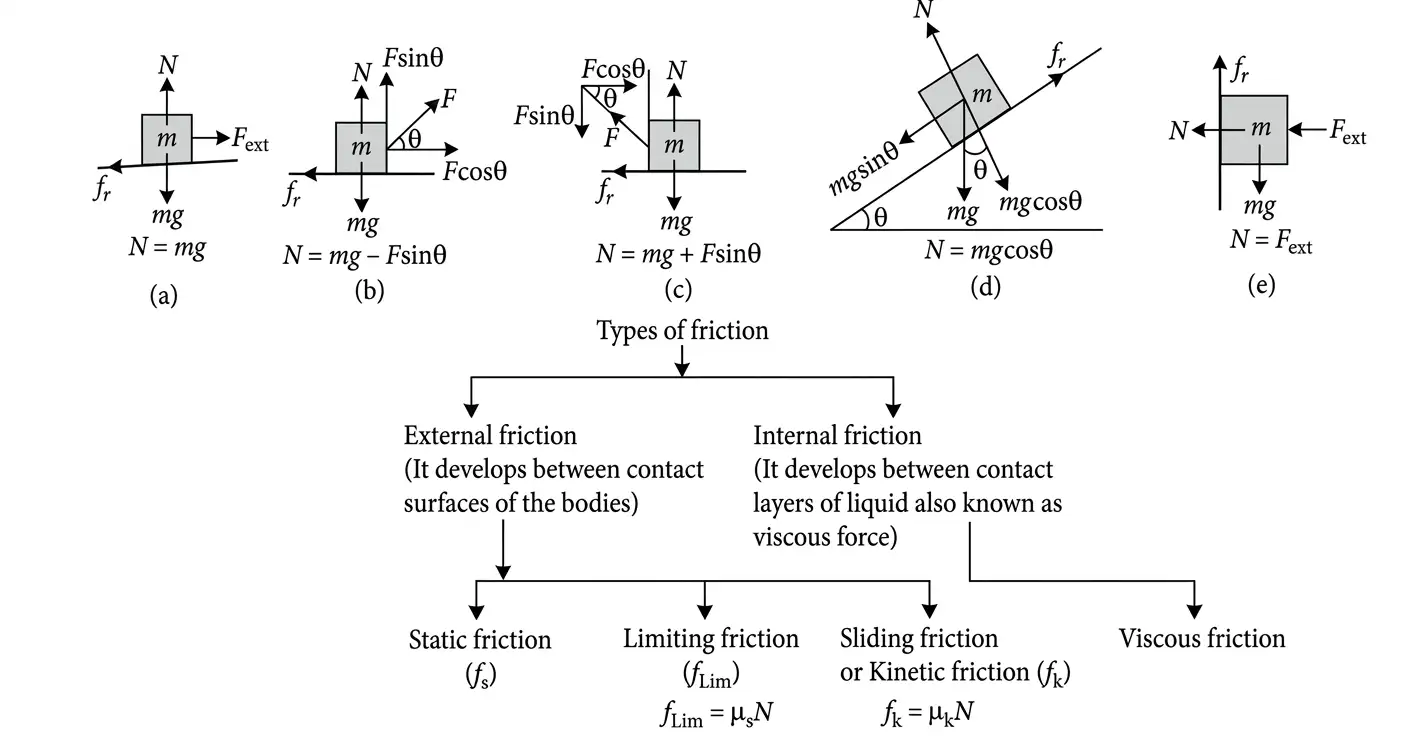
Static Friction
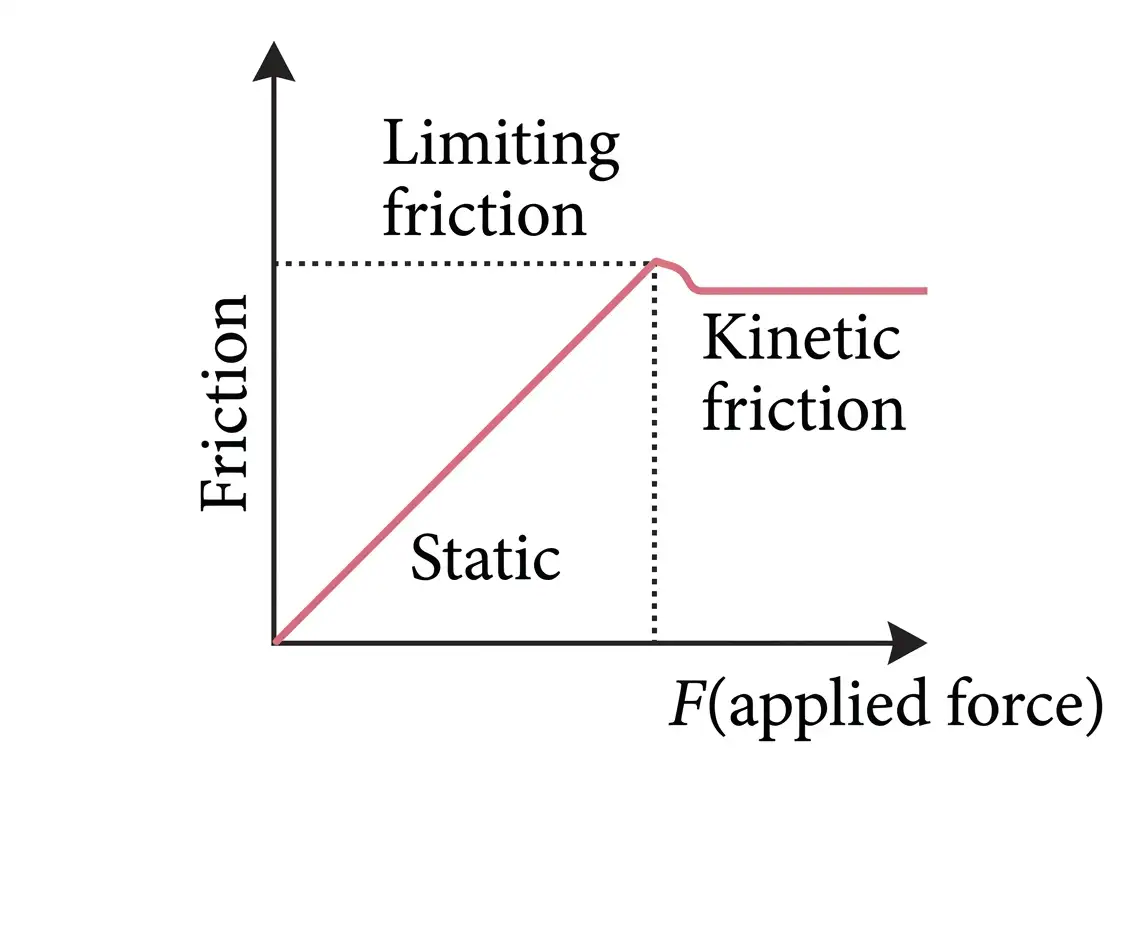
- Self-adjusting force equal to applied force up to maximum.
- Maximum static friction = limiting friction: flim = μs N.
Limiting Friction
- Directly proportional to normal reaction: f ∝ N.
- Opposes impending motion direction.
- Independent of contact area.
- Depends on surface roughness and material.
- Value is greater than other friction types.
Kinetic Friction
- Opposes motion of moving bodies.
- Less than limiting friction.
- Formula: fk = μk N.
Variation of Friction Force
Angle of Friction (λ)
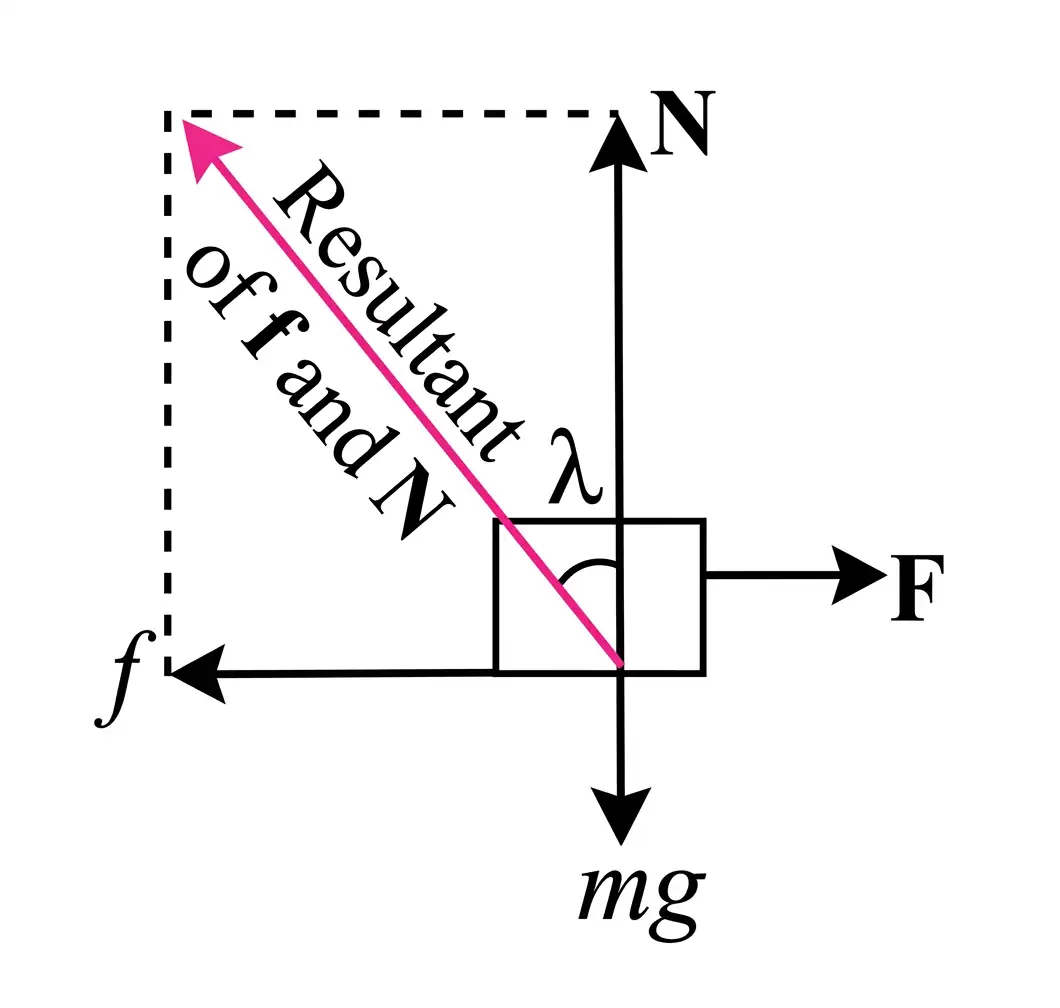
- Angle between resultant of limiting friction and normal reaction.
- tan λ = f/N = μ
- λ = tan-1 μ
Angle of Repose
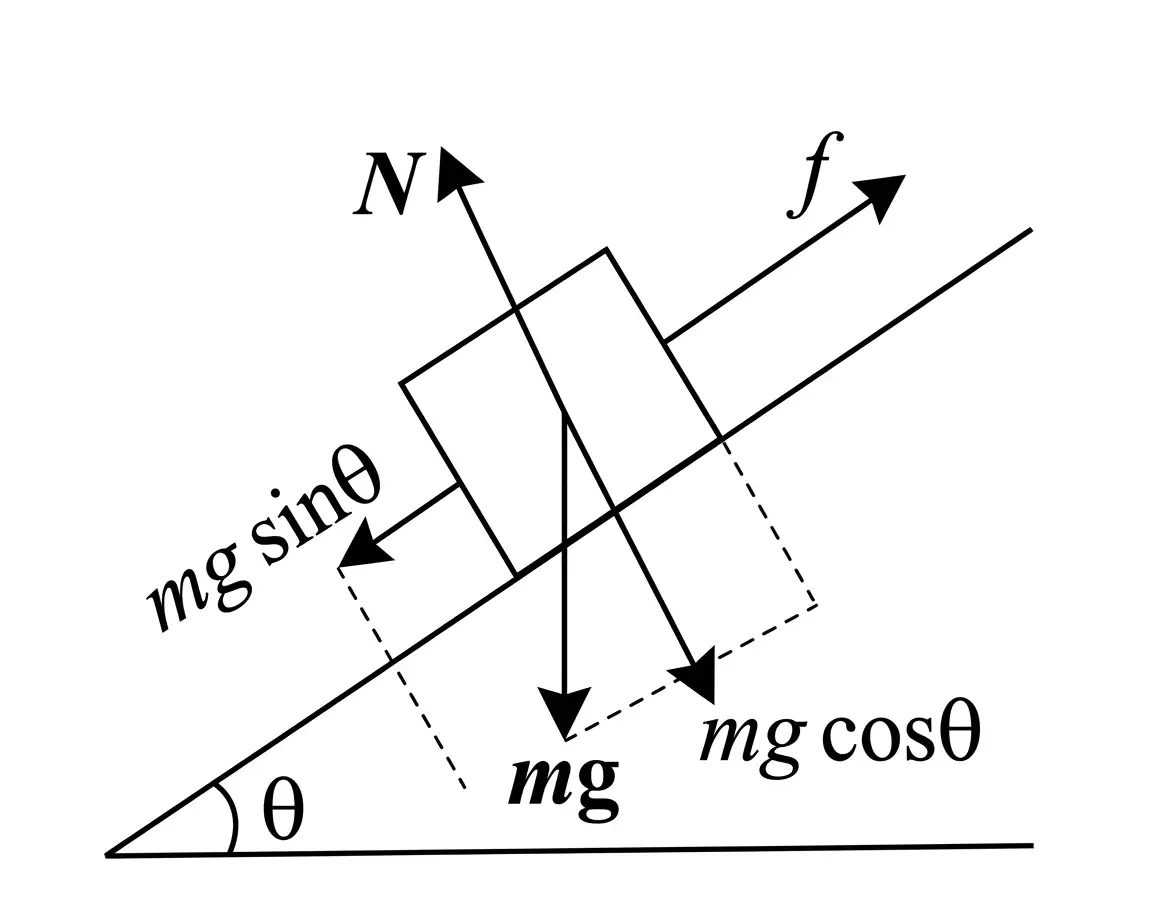
- Maximum angle of incline where body just begins to slide.
- f = mg sin θ, N = mg cos θ
- Coefficient of static friction: μs = tan θ
- Angle of repose = angle of friction.
Rolling Friction
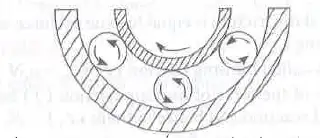
- Opposes rolling motion due to deformation at contact area.
- Much smaller than static and kinetic friction.
- Used in ball bearings to reduce friction in machines.
Solved Examples
Practice Set
- Q1: What is the formula for limiting friction?
- A. flim = μk N
- B. flim = μs N
- C. flim = N / μs
- D. flim = mg
- Q2: Angle of friction is 30°. What is the coefficient of friction?
- A. 0.5
- B. 0.58
- C. 0.87
- D. 1.0
- Q3: A block on an incline of 45° just starts sliding. Find μs.
- A. 0.5
- B. 1.0
- C. 0.7
- D. 0.3
Answer Key
- Q1: B - Limiting friction formula uses static friction coefficient.
- Q2: B - μ = tan 30° = 0.58.
- Q3: B - μs = tan 45° = 1.0.
Memory Aids
- flim = μs N for limiting friction.
- Angle of friction λ = tan-1 μ.
- Angle of repose = angle of friction.
Definition & Basics
- Friction opposes relative motion or tendency of motion between surfaces in contact.
- Friction force (except static) is proportional to normal reaction: fr ∝ N.
- Types: static, limiting, kinetic (sliding), rolling.
Static Friction
- Self-adjusting force equal to applied force up to maximum.
- Maximum static friction = limiting friction: flim = μs N.
Limiting Friction
- Directly proportional to normal reaction: f ∝ N.
- Opposes impending motion direction.
- Independent of contact area.
- Depends on surface roughness and material.
- Value is greater than other friction types.
Kinetic Friction
- Opposes motion of moving bodies.
- Less than limiting friction.
- Formula: fk = μk N.
Variation of Friction Force
Angle of Friction (λ)
- Angle between resultant of limiting friction and normal reaction.
- tan λ = f/N = μ
- λ = tan-1 μ
Angle of Repose
- Maximum angle of incline where body just begins to slide.
- f = mg sin θ, N = mg cos θ
- Coefficient of static friction: μs = tan θ
- Angle of repose = angle of friction.
Rolling Friction
- Opposes rolling motion due to deformation at contact area.
- Much smaller than static and kinetic friction.
- Used in ball bearings to reduce friction in machines.
Solved Examples
Practice Set
- Q1: What is the formula for limiting friction?
- A. flim = μk N
- B. flim = μs N
- C. flim = N / μs
- D. flim = mg
- Q2: Angle of friction is 30°. What is the coefficient of friction?
- A. 0.5
- B. 0.58
- C. 0.87
- D. 1.0
- Q3: A block on an incline of 45° just starts sliding. Find μs.
- A. 0.5
- B. 1.0
- C. 0.7
- D. 0.3
Answer Key
- Q1: B - Limiting friction formula uses static friction coefficient.
- Q2: B - μ = tan 30° = 0.58.
- Q3: B - μs = tan 45° = 1.0.
Memory Aids
- flim = μs N for limiting friction.
- Angle of friction λ = tan-1 μ.
- Angle of repose = angle of friction.
Definition & Basics
- Friction opposes relative motion or tendency of motion between surfaces in contact.
- Friction force (except static) is proportional to normal reaction: fr ∝ N.
- Types: static, limiting, kinetic (sliding), rolling.
Static Friction
- Self-adjusting force equal to applied force up to maximum.
- Maximum static friction = limiting friction: flim = μs N.
Limiting Friction
- Directly proportional to normal reaction: f ∝ N.
- Opposes impending motion direction.
- Independent of contact area.
- Depends on surface roughness and material.
- Value is greater than other friction types.
Kinetic Friction
- Opposes motion of moving bodies.
- Less than limiting friction.
- Formula: fk = μk N.
Variation of Friction Force
Angle of Friction (λ)
- Angle between resultant of limiting friction and normal reaction.
- tan λ = f/N = μ
- λ = tan-1 μ
Angle of Repose
- Maximum angle of incline where body just begins to slide.
- f = mg sin θ, N = mg cos θ
- Coefficient of static friction: μs = tan θ
- Angle of repose = angle of friction.
Rolling Friction
- Opposes rolling motion due to deformation at contact area.
- Much smaller than static and kinetic friction.
- Used in ball bearings to reduce friction in machines.
Solved Examples
Aristotle's Fallacy
Concepts
- Aristotle's law: external force is required to keep a body in motion (incorrect).
- In reality, force is needed only to overcome friction, not to maintain motion.
- Friction opposes motion; external force counters friction in practice.
- Galileo's concept: in frictionless world, uniform motion continues without force.
Solved Examples
- Ex 1: A block slides on a rough surface and stops. Why?
Solution: Friction opposes motion; no external force to balance it, so block stops. - Ex 2: In a frictionless surface, a body moves at constant velocity without force. Explain.
Solution: No friction means no opposing force; external force not needed to maintain motion.
Practice Set
- Q1: According to Aristotle, what is needed to keep a body moving?
- A. No force
- B. External force
- C. Frictional force
- D. Gravitational force
- Q2: What force actually stops a moving body on Earth?
- A. Magnetic force
- B. Frictional force
- C. Applied force
- D. Gravitational force
- Q3: Galileo's idea about motion states:
- A. Motion needs continuous force
- B. Motion stops without force
- C. Uniform motion continues without force if no friction
- D. Force increases velocity
Answer Key
- Q1: B - Aristotle wrongly claimed continuous force needed for motion.
- Q2: B - Friction opposes and stops motion.
- Q3: C - Galileo's principle of inertia in frictionless environment.
Memory Aids
- Aristotle: force needed to keep moving (wrong).
- Galileo: no force needed for uniform motion without friction.
- Friction opposes motion; external force balances it.
The Law of Inertia
Concept and Explanation
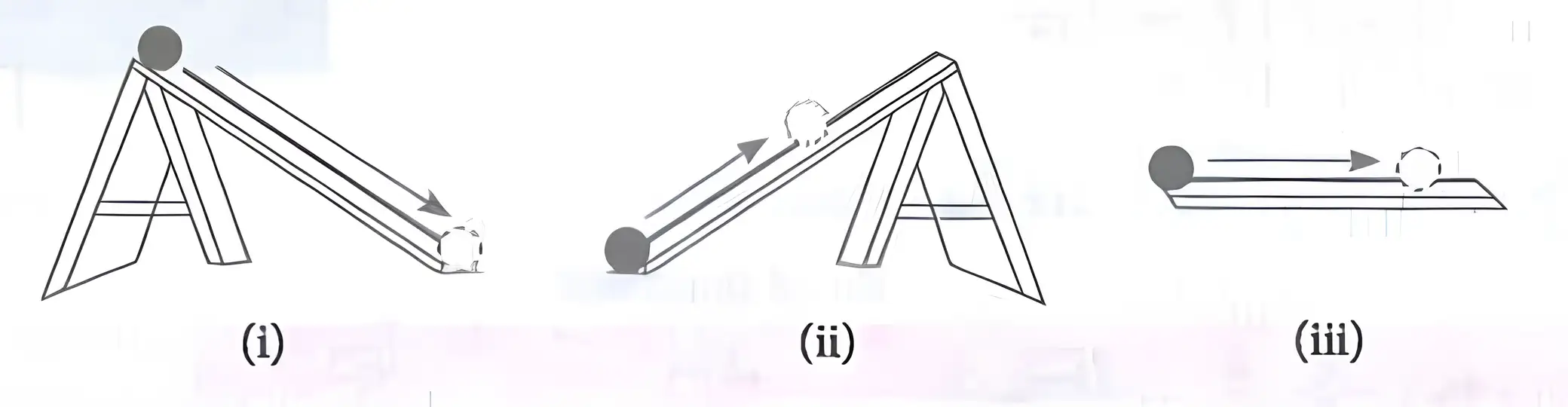
- Galileo's experiments on inclined planes show:
- Objects moving down an incline accelerate.
- Objects moving up an incline retard (decelerate).
- Objects on a frictionless horizontal plane move with constant velocity (no acceleration or retardation).
- Double inclined plane experiment:
- A ball released from rest on one incline rolls down and climbs the other.
- If friction is absent, the final height equals the initial height.
- Height reached does not depend on the shape of the incline.
- Curved track experiment:
- Ball rolling upward slows down due to gravity.
- Ball rolling downward speeds up due to gravity.
- Inertia:
- Property of a body to resist change in its state of rest or uniform motion.
- If net external force is zero, a body at rest stays at rest, and a body in motion continues with uniform velocity.
- Inertia means resistance to change in motion.

Solved Examples
- Ex 1: A ball rolls on a frictionless horizontal surface with velocity 5 m/s. What is its acceleration?
- Since no external force acts, acceleration a = 0.
- Ex 2: A ball released from height 2 m on one incline rolls up the other incline. What is the final height reached (neglect friction)?
- Final height = Initial height = 2 m.
Practice Set
- Q1: What happens to a ball moving on a frictionless horizontal plane?
- A) It accelerates
- B) It retards
- C) It moves with constant velocity
- D) It stops immediately
- Q2: A ball rolls down a smooth incline from height 5 m. What height will it reach on the opposite incline (no friction)?
- A) Less than 5 m
- B) Equal to 5 m
- C) More than 5 m
- D) Zero
- Q3: A ball moves on a curved track. When it moves upward, its speed:
- A) Increases
- B) Decreases
- C) Remains constant
- D) Becomes zero instantly
Answer Key
- Q1: C - No net external force means constant velocity.
- Q2: B - Without friction, final height equals initial height.
- Q3: B - Moving upward against gravity slows the ball down.
Memory Aids
- Inertia = Resistance to change in motion.
- Frictionless horizontal plane → constant velocity.
- Double incline: final height = initial height (no friction).
- Upward motion → speed decreases; downward → speed increases.
Concept and Explanation
- Galileo's experiments on inclined planes show:
- Objects moving down an incline accelerate.
- Objects moving up an incline retard (decelerate).
- Objects on a frictionless horizontal plane move with constant velocity (no acceleration or retardation).
- Double inclined plane experiment:
- A ball released from rest on one incline rolls down and climbs the other.
- If friction is absent, the final height equals the initial height.
- Height reached does not depend on the shape of the incline.
- Curved track experiment:
- Ball rolling upward slows down due to gravity.
- Ball rolling downward speeds up due to gravity.
- Inertia:
- Property of a body to resist change in its state of rest or uniform motion.
- If net external force is zero, a body at rest stays at rest, and a body in motion continues with uniform velocity.
- Inertia means resistance to change in motion.
Solved Examples
- Ex 1: A ball rolls on a frictionless horizontal surface with velocity 5 m/s. What is its acceleration?
- Since no external force acts, acceleration \( a = 0 \).
- Ex 2: A ball released from height 2 m on one incline rolls up the other incline. What is the final height reached (neglect friction)?
- Final height = Initial height = 2 m.
Practice Set
- Q1: What happens to a ball moving on a frictionless horizontal plane?
- A) It accelerates
- B) It retards
- C) It moves with constant velocity
- D) It stops immediately
- Q2: A ball rolls down a smooth incline from height 5 m. What height will it reach on the opposite incline (no friction)?
- A) Less than 5 m
- B) Equal to 5 m
- C) More than 5 m
- D) Zero
- Q3: A ball moves on a curved track. When it moves upward, its speed:
- A) Increases
- B) Decreases
- C) Remains constant
- D) Becomes zero instantly
Answer Key
- Q1: C - No net external force means constant velocity.
- Q2: B - Without friction, final height equals initial height.
- Q3: B - Moving upward against gravity slows the ball down.
Memory Aids
- Inertia = Resistance to change in motion.
- Frictionless horizontal plane → constant velocity.
- Double incline: final height = initial height (no friction).
- Upward motion → speed decreases; downward → speed increases.
Newton's Second Law of Motion
Explanation
- Rate of change of linear momentum (\vec{P}) is proportional to applied force (\vec{F}).
- Mathematically, (\vec{F} = d\vec{P}/dt).
- For constant mass, (\vec{P} = m\vec{v}), so (\vec{F} = m d\vec{v}/dt = m\vec{a}).
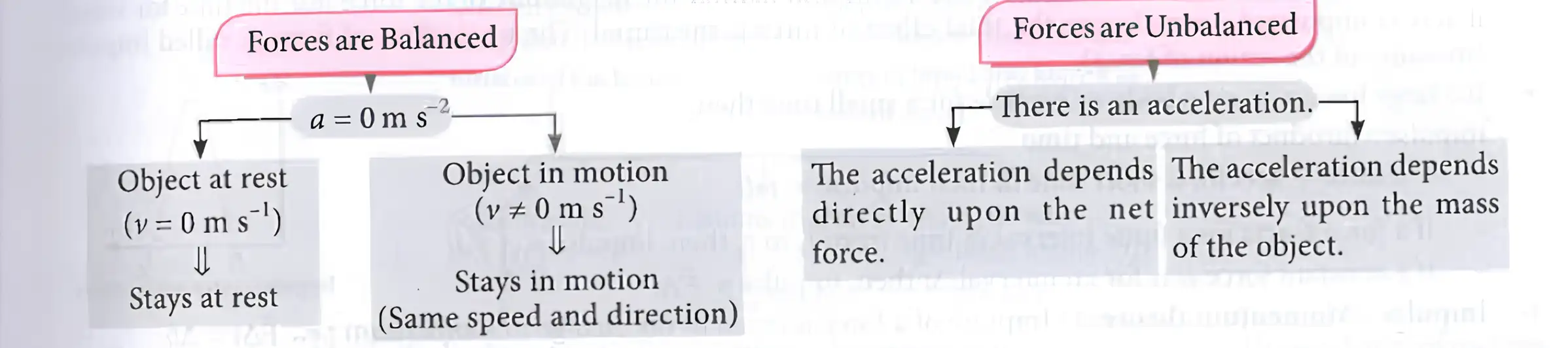
- Acceleration (a) is directly proportional to net force (Fnet) and inversely proportional to mass (m): (a ∝ Fnet/m).
- In SI units, (Fnet = ma) with (k=1).
- Balanced forces mean zero acceleration; unbalanced forces cause acceleration.
- More general form: (Fnet,external = d(mv)/dt = m dv/dt + v dm/dt).
Solved Examples
- Ex 1: A 5 kg object is pushed with a net force of 20 N. Find acceleration.
Solution: (a = F/m = 20/5 = 4 m/s2). - Ex 2: If acceleration is 3 m/s2 for a 10 kg mass, find net force.
Solution: (F = ma = 10 × 3 = 30 N).
Practice Set
- Q1: What is the acceleration of a 2 kg object under a 10 N net force?
A) 2 m/s2
B) 5 m/s2
C) 10 m/s2
D) 20 m/s2 - Q2: A force of 15 N acts on a 3 kg object. What is its acceleration?
A) 3 m/s2
B) 5 m/s2
C) 45 m/s2
D) 18 m/s2 - Q3: A 4 kg object accelerates at 6 m/s2. What is the net force?
A) 10 N
B) 12 N
C) 24 N
D) 30 N
Answer Key
- Q1: B - (a = F/m = 10/2 = 5 m/s2).
- Q2: B - (a = F/m = 15/3 = 5 m/s2).
- Q3: C - (F = ma = 4 × 6 = 24 N).
Memory Aids
- Force equals mass times acceleration: (F = ma).
- Acceleration (a) increases with force, decreases with mass.
- Balanced forces → zero acceleration.
Explanation
- Rate of change of linear momentum (\vec{P}) is proportional to applied force (\vec{F}).
- Mathematically, (\vec{F} = d\vec{P}/dt).
- For constant mass, (\vec{P} = m\vec{v}), so (\vec{F} = m d\vec{v}/dt = m\vec{a}).
- Acceleration (a) is directly proportional to net force (Fnet) and inversely proportional to mass (m): (a ∝ Fnet/m).
- In SI units, (Fnet = ma) with (k=1).
- Balanced forces mean zero acceleration; unbalanced forces cause acceleration.
- More general form: (Fnet,external = d(mv)/dt = m dv/dt + v dm/dt).
Solved Examples
- Ex 1: A 5 kg object is pushed with a net force of 20 N. Find acceleration.
Solution: (a = F/m = 20/5 = 4 m/s2). - Ex 2: If acceleration is 3 m/s2 for a 10 kg mass, find net force.
Solution: (F = ma = 10 × 3 = 30 N).
Practice Set
- Q1: What is the acceleration of a 2 kg object under a 10 N net force?
A) 2 m/s2
B) 5 m/s2
C) 10 m/s2
D) 20 m/s2 - Q2: A force of 15 N acts on a 3 kg object. What is its acceleration?
A) 3 m/s2
B) 5 m/s2
C) 45 m/s2
D) 18 m/s2 - Q3: A 4 kg object accelerates at 6 m/s2. What is the net force?
A) 10 N
B) 12 N
C) 24 N
D) 30 N
Answer Key
- Q1: B - (a = F/m = 10/2 = 5 m/s2).
- Q2: B - (a = F/m = 15/3 = 5 m/s2).
- Q3: C - (F = ma = 4 × 6 = 24 N).
Memory Aids
- Force equals mass times acceleration: (F = ma).
- Acceleration (a) increases with force, decreases with mass.
- Balanced forces → zero acceleration.
Explanation
- Rate of change of linear momentum \( \vec{P} \) is proportional to applied force \( \vec{F} \).
- Mathematically, \( \vec{F} = \frac{d\vec{P}}{dt} \).
- For constant mass, \( \vec{P} = m\vec{v} \), so \( \vec{F} = m \frac{d\vec{v}}{dt} = m\vec{a} \).
- Acceleration \( a \) is directly proportional to net force \( F_{net} \) and inversely proportional to mass \( m \): \( a ∝ \frac{F_{net}}{m} \).
- In SI units, \( F_{net} = ma \) with \( k=1 \).
- Balanced forces mean zero acceleration; unbalanced forces cause acceleration.
- More general form: \( F_{net,external} = \frac{d(mv)}{dt} = m \frac{dv}{dt} + v \frac{dm}{dt} \).
Solved Examples
- Ex 1: A 5 kg object is pushed with a net force of 20 N. Find acceleration.
Solution: \( a = \frac{F}{m} = \frac{20}{5} = 4 \text{ m/s}^2 \). - Ex 2: If acceleration is 3 m/s2 for a 10 kg mass, find net force.
Solution: \( F = ma = 10 × 3 = 30 \text{ N} \).
Practice Set
- Q1: What is the acceleration of a 2 kg object under a 10 N net force?
A) 2 m/s2
B) 5 m/s2
C) 10 m/s2
D) 20 m/s2 - Q2: A force of 15 N acts on a 3 kg object. What is its acceleration?
A) 3 m/s2
B) 5 m/s2
C) 45 m/s2
D) 18 m/s2 - Q3: A 4 kg object accelerates at 6 m/s2. What is the net force?
A) 10 N
B) 12 N
C) 24 N
D) 30 N
Answer Key
- Q1: B - \( a = \frac{F}{m} = \frac{10}{2} = 5 \text{ m/s}^2 \).
- Q2: B - \( a = \frac{F}{m} = \frac{15}{3} = 5 \text{ m/s}^2 \).
- Q3: C - \( F = ma = 4 × 6 = 24 \text{ N} \).
Memory Aids
- Force equals mass times acceleration: \( F = ma \).
- Acceleration \( a \) increases with force, decreases with mass.
- Balanced forces → zero acceleration.
Explanation
- Rate of change of linear momentum (\vec{P}) is proportional to applied force (\vec{F}).
- Mathematically, (\vec{F} = d\vec{P}/dt).
- For constant mass, (\vec{P} = m\vec{v}), so (\vec{F} = m d\vec{v}/dt = m\vec{a}).
- Acceleration (a) is directly proportional to net force (Fnet) and inversely proportional to mass (m): (a ∝ Fnet/m).
- In SI units, (Fnet = ma) with (k=1).
- Balanced forces mean zero acceleration; unbalanced forces cause acceleration.
- More general form: (Fnet,external = d(mv)/dt = m dv/dt + v dm/dt).
Solved Examples
- Ex 1: A 5 kg object is pushed with a net force of 20 N. Find acceleration.
Solution: (a = F/m = 20/5 = 4 m/s2). - Ex 2: If acceleration is 3 m/s2 for a 10 kg mass, find net force.
Solution: (F = ma = 10 × 3 = 30 N).
Practice Set
- Q1: What is the acceleration of a 2 kg object under a 10 N net force?
A) 2 m/s2
B) 5 m/s2
C) 10 m/s2
D) 20 m/s2 - Q2: A force of 15 N acts on a 3 kg object. What is its acceleration?
A) 3 m/s2
B) 5 m/s2
C) 45 m/s2
D) 18 m/s2 - Q3: A 4 kg object accelerates at 6 m/s2. What is the net force?
A) 10 N
B) 12 N
C) 24 N
D) 30 N
Answer Key
- Q1: B - (a = F/m = 10/2 = 5 m/s2).
- Q2: B - (a = F/m = 15/3 = 5 m/s2).
- Q3: C - (F = ma = 4 × 6 = 24 N).
Memory Aids
- Force equals mass times acceleration: (F = ma).
- Acceleration (a) increases with force, decreases with mass.
- Balanced forces → zero acceleration.
Explanation
- Rate of change of linear momentum \( \vec{P} \) is proportional to applied force \( \vec{F} \).
- Mathematically, \( \vec{F} = \frac{d\vec{P}}{dt} \).
- For constant mass, \( \vec{P} = m\vec{v} \), so \( \vec{F} = m \frac{d\vec{v}}{dt} = m\vec{a} \).
- Acceleration \( a \) is directly proportional to net force \( F_{net} \) and inversely proportional to mass \( m \): \( a \propto \frac{F_{net}}{m} \).
- In SI units, \( F_{net} = ma \) with \( k=1 \).
- Balanced forces mean zero acceleration; unbalanced forces cause acceleration.
- More general form: \( F_{net,external} = \frac{d(mv)}{dt} = m \frac{dv}{dt} + v \frac{dm}{dt} \).
Solved Examples
- Ex 1: A 5 kg object is pushed with a net force of 20 N. Find acceleration.
Solution: \( a = \frac{F}{m} = \frac{20}{5} = 4 \text{ m/s}^2 \). - Ex 2: If acceleration is 3 m/s2 for a 10 kg mass, find net force.
Solution: \( F = ma = 10 \times 3 = 30 \text{ N} \).
Practice Set
- Q1: What is the acceleration of a 2 kg object under a 10 N net force?
A) 2 m/s2
B) 5 m/s2
C) 10 m/s2
D) 20 m/s2 - Q2: A force of 15 N acts on a 3 kg object. What is its acceleration?
A) 3 m/s2
B) 5 m/s2
C) 45 m/s2
D) 18 m/s2 - Q3: A 4 kg object accelerates at 6 m/s2. What is the net force?
A) 10 N
B) 12 N
C) 24 N
D) 30 N
Answer Key
- Q1: B - \( a = \frac{F}{m} = \frac{10}{2} = 5 \text{ m/s}^2 \).
- Q2: B - \( a = \frac{F}{m} = \frac{15}{3} = 5 \text{ m/s}^2 \).
- Q3: C - \( F = ma = 4 \times 6 = 24 \text{ N} \).
Memory Aids
- Force equals mass times acceleration: \( F = ma \).
- Acceleration \( a \) increases with force, decreases with mass.
- Balanced forces → zero acceleration.
Newton's Third Law of Motion
Key Points
- For every action force (\vec{F}), there is an equal and opposite reaction force (-\vec{F}).
- Action and reaction forces act on different bodies along the same line.
- They never cancel each other as they act on different objects.
- Forces can arise from contact or at a distance.
- Applicable for bodies at rest or in motion.
- Force always exists in pairs; isolated single force is impossible.
Solved Examples
- Ex 1: Body A exerts force (\vec{F} = 10\,N) on body B. Find force on A by B.
Solution: Force on A by B is (-\vec{F} = -10\,N) (equal magnitude, opposite direction).
Practice Set
- Q1: If a force of 5 N is applied by object A on B, the force on A by B is:
A) 0 N
B) 5 N in same direction
C) 5 N in opposite direction
D) 10 N
- Q2: Action and reaction forces:
A) Act on the same body
B) Act on different bodies
C) Cancel each other
D) Are always zero
- Q3: Which of the following is true about Newton's third law?
A) Forces act along different lines
B) Forces act on the same body
C) Forces are equal and opposite
D) Forces can be isolated
Answer Key
- Q1: C - Reaction force is equal in magnitude and opposite in direction.
- Q2: B - Action and reaction act on different bodies.
- Q3: C - Forces are equal in magnitude and opposite in direction.
Memory Aids
- "Action = - Reaction"
- Forces always come in pairs.
- They act on different bodies, never cancel.
Key Points
- For every action force (\vec{F}), there is an equal and opposite reaction force (-\vec{F}).
- Action and reaction forces act on different bodies along the same line.
- They never cancel each other as they act on different objects.
- Forces can arise from contact or at a distance.
- Applicable for bodies at rest or in motion.
- Force always exists in pairs; isolated single force is impossible.
Solved Examples
- Ex 1: Body A exerts force (\vec{F} = 10\,\text{N}) on body B. Find force on A by B.
Solution: Force on A by B is (-\vec{F} = -10\,\text{N}) (equal magnitude, opposite direction).
Practice Set
- Q1: If a force of 5 N is applied by object A on B, the force on A by B is:
A) 0 N
B) 5 N in same direction
C) 5 N in opposite direction
D) 10 N
- Q2: Action and reaction forces:
A) Act on the same body
B) Act on different bodies
C) Cancel each other
D) Are always zero
- Q3: Which of the following is true about Newton's third law?
A) Forces act along different lines
B) Forces act on the same body
C) Forces are equal and opposite
D) Forces can be isolated
Answer Key
- Q1: C - Reaction force is equal in magnitude and opposite in direction.
- Q2: B - Action and reaction act on different bodies.
- Q3: C - Forces are equal in magnitude and opposite in direction.
Memory Aids
- "Action = - Reaction"
- Forces always come in pairs.
- They act on different bodies, never cancel.
Key Points
- For every action force (\vec{F}), there is an equal and opposite reaction force (-\vec{F}).
- Action and reaction forces act on different bodies along the same line.
- They never cancel each other as they act on different objects.
- Forces can arise from contact or at a distance.
- Applicable for bodies at rest or in motion.
- Force always exists in pairs; isolated single force is impossible.
Solved Examples
- Ex 1: Body A exerts force (\vec{F} = 10\,N) on body B. Find force on A by B.
Solution: Force on A by B is (-\vec{F} = -10\,N) (equal magnitude, opposite direction).
Practice Set
- Q1: If a force of 5 N is applied by object A on B, the force on A by B is:
A) 0 N
B) 5 N in same direction
C) 5 N in opposite direction
D) 10 N
- Q2: Action and reaction forces:
A) Act on the same body
B) Act on different bodies
C) Cancel each other
D) Are always zero
- Q3: Which of the following is true about Newton's third law?
A) Forces act along different lines
B) Forces act on the same body
C) Forces are equal and opposite
D) Forces can be isolated
Answer Key
- Q1: C - Reaction force is equal in magnitude and opposite in direction.
- Q2: B - Action and reaction act on different bodies.
- Q3: C - Forces are equal in magnitude and opposite in direction.
Memory Aids
- "Action = - Reaction"
- Forces always come in pairs.
- They act on different bodies, never cancel.
Key Points
- For every action force \( \vec{F} \), there is an equal and opposite reaction force \( -\vec{F} \).
- Action and reaction forces act on different bodies along the same line.
- They never cancel each other as they act on different objects.
- Forces can arise from contact or at a distance.
- Applicable for bodies at rest or in motion.
- Force always exists in pairs; isolated single force is impossible.
Solved Examples
- Ex 1: Body A exerts force \( \vec{F} = 10\,\text{N} \) on body B. Find force on A by B.
Solution: Force on A by B is \( -\vec{F} = -10\,\text{N} \) (equal magnitude, opposite direction).
Practice Set
- Q1: If a force of 5 N is applied by object A on B, the force on A by B is:
A) 0 N
B) 5 N in same direction
C) 5 N in opposite direction
D) 10 N
- Q2: Action and reaction forces:
A) Act on the same body
B) Act on different bodies
C) Cancel each other
D) Are always zero
- Q3: Which of the following is true about Newton's third law?
A) Forces act along different lines
B) Forces act on the same body
C) Forces are equal and opposite
D) Forces can be isolated
Answer Key
- Q1: C - Reaction force is equal in magnitude and opposite in direction.
- Q2: B - Action and reaction act on different bodies.
- Q3: C - Forces are equal in magnitude and opposite in direction.
Memory Aids
- "Action = - Reaction"
- Forces always come in pairs.
- They act on different bodies, never cancel.
Key Points
- For every action force (\vec{F}), there is an equal and opposite reaction force (-\vec{F}).
- Action and reaction forces act on different bodies along the same line.
- They never cancel each other as they act on different objects.
- Forces can arise from contact or at a distance.
- Applicable for bodies at rest or in motion.
- Force always exists in pairs; isolated single force is impossible.
Solved Examples
- Ex 1: Body A exerts force (\vec{F} = 10\,N) on body B. Find force on A by B.
Solution: Force on A by B is (-\vec{F} = -10\,N) (equal magnitude, opposite direction).
Practice Set
- Q1: If a force of 5 N is applied by object A on B, the force on A by B is:
A) 0 N
B) 5 N in same direction
C) 5 N in opposite direction
D) 10 N
- Q2: Action and reaction forces:
A) Act on the same body
B) Act on different bodies
C) Cancel each other
D) Are always zero
- Q3: Which of the following is true about Newton's third law?
A) Forces act along different lines
B) Forces act on the same body
C) Forces are equal and opposite
D) Forces can be isolated
Answer Key
- Q1: C - Reaction force is equal in magnitude and opposite in direction.
- Q2: B - Action and reaction act on different bodies.
- Q3: C - Forces are equal in magnitude and opposite in direction.
Memory Aids
- "Action = - Reaction"
- Forces always come in pairs.
- They act on different bodies, never cancel.
Key Points
- For every action force \( \vec{F} \), there is an equal and opposite reaction force \( -\vec{F} \).
- Action and reaction forces act on different bodies along the same line.
- They never cancel each other as they act on different objects.
- Forces can arise from contact or at a distance.
- Applicable for bodies at rest or in motion.
- Force always exists in pairs; isolated single force is impossible.
Solved Examples
- Ex 1: Body A exerts force \( \vec{F} = 10\,\text{N} \) on body B. Find force on A by B.
Solution: Force on A by B is \( -\vec{F} = -10\,\text{N} \) (equal magnitude, opposite direction).
Practice Set
- Q1: If a force of 5 N is applied by object A on B, the force on A by B is:
A) 0 N
B) 5 N in same direction
C) 5 N in opposite direction
D) 10 N
- Q2: Action and reaction forces:
A) Act on the same body
B) Act on different bodies
C) Cancel each other
D) Are always zero
- Q3: Which of the following is true about Newton's third law?
A) Forces act along different lines
B) Forces act on the same body
C) Forces are equal and opposite
D) Forces can be isolated
Answer Key
- Q1: C - Reaction force is equal in magnitude and opposite in direction.
- Q2: B - Action and reaction act on different bodies.
- Q3: C - Forces are equal in magnitude and opposite in direction.
Memory Aids
- "Action = - Reaction"
- Forces always come in pairs.
- They act on different bodies, never cancel.
Pseudo Force
Key Points
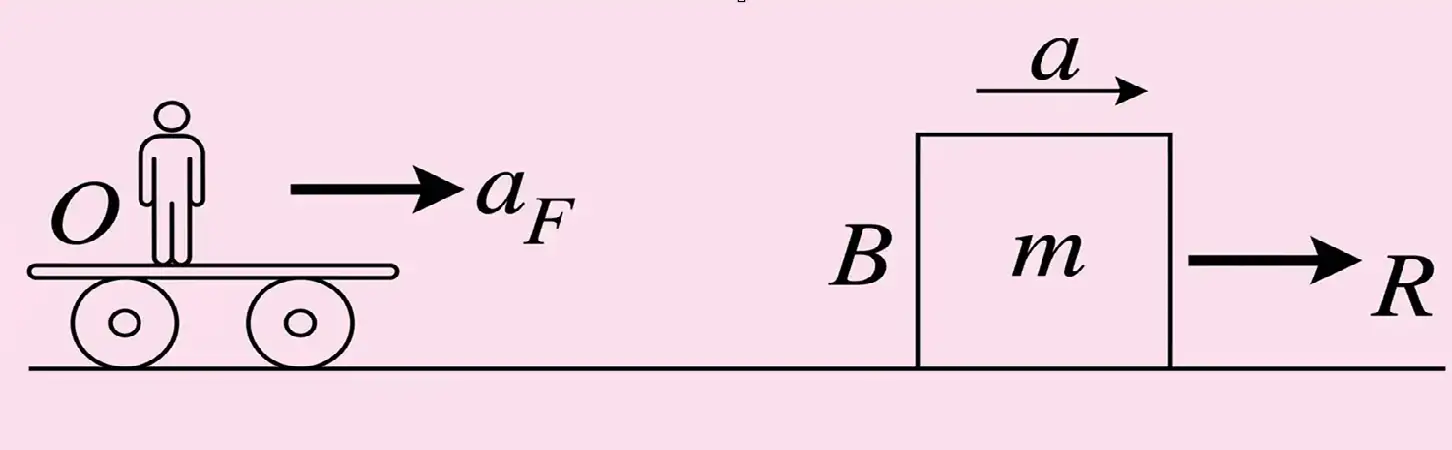
- Appears in non-inertial frames (accelerating frames).
- Not a real force; imaginary force to apply Newton's laws.
- Magnitude: (Fpseudo = maf), where (af) is acceleration of the frame.
- Direction opposite to acceleration of the frame.
- Newton's third law does not apply to pseudo forces.
- Effective force in non-inertial frame: (vector Fext + vector Fpseudo = m vector a).
Solved Examples
- Ex 1: A block of mass 2 kg is in a frame accelerating at (3 m/s2). Find pseudo force.
Solution: (Fpseudo = maf = 2 × 3 = 6 N) opposite to frame acceleration.
Practice Set
- Q1: Pseudo force acts:
A) In inertial frame
B) In non-inertial frame
C) Only at rest
D) Only in vacuum
- Q2: Magnitude of pseudo force on mass 5 kg in frame accelerating at (4 m/s2) is:
A) 20 N
B) 9.8 N
C) 1.25 N
D) 0 N
- Q3: If acceleration of frame is (vector af), pseudo force is:
A) (m vector af)
B) (-m vector af)
C) Zero
D) (m vector a)
Answer Key
- Q1: B - Pseudo force appears only in non-inertial frames.
- Q2: A - (Fpseudo = 5 × 4 = 20 N).
- Q3: B - Pseudo force is opposite to frame acceleration.
Memory Aids
- Pseudo force = mass × acceleration of frame (opposite direction).
- Only in accelerating frames.
- Imaginary force to apply Newton's laws.
Key Points
- Appears in non-inertial frames (accelerating frames).
- Not a real force; imaginary force to apply Newton's laws.
- Magnitude: (Fpseudo = maf), where (af) is acceleration of the frame.
- Direction opposite to acceleration of the frame.
- Newton's third law does not apply to pseudo forces.
- Effective force in non-inertial frame: (vector Fext + vector Fpseudo = m vector a).
Solved Examples
- Ex 1: A block of mass 2 kg is in a frame accelerating at (3 m/s2). Find pseudo force.
Solution: (Fpseudo = maf = 2 × 3 = 6 N) opposite to frame acceleration.
Practice Set
- Q1: Pseudo force acts:
A) In inertial frame
B) In non-inertial frame
C) Only at rest
D) Only in vacuum
- Q2: Magnitude of pseudo force on mass 5 kg in frame accelerating at (4 m/s2) is:
A) 20 N
B) 9.8 N
C) 1.25 N
D) 0 N
- Q3: If acceleration of frame is (vector af), pseudo force is:
A) (m vector af)
B) (-m vector af)
C) Zero
D) (m vector a)
Answer Key
- Q1: B - Pseudo force appears only in non-inertial frames.
- Q2: A - (Fpseudo = 5 × 4 = 20 N).
- Q3: B - Pseudo force is opposite to frame acceleration.
Memory Aids
- Pseudo force = mass × acceleration of frame (opposite direction).
- Only in accelerating frames.
- Imaginary force to apply Newton's laws.
Key Points
- Appears in non-inertial frames (accelerating frames).
- Not a real force; imaginary force to apply Newton's laws.
- Magnitude: (Fpseudo = maf), where (af) is acceleration of the frame.
- Direction opposite to acceleration of the frame.
- Newton's third law does not apply to pseudo forces.
- Effective force in non-inertial frame: (\vec{F}ext + \vec{F}pseudo = m \vec{a}).
Solved Examples
- Ex 1: A block of mass 2 kg is in a frame accelerating at (3\,m/s2). Find pseudo force.
Solution: (Fpseudo = maf = 2 × 3 = 6\,N) opposite to frame acceleration.
Practice Set
- Q1: Pseudo force acts:
A) In inertial frame
B) In non-inertial frame
C) Only at rest
D) Only in vacuum
- Q2: Magnitude of pseudo force on mass 5 kg in frame accelerating at (4\,m/s2) is:
A) 20 N
B) 9.8 N
C) 1.25 N
D) 0 N
- Q3: If acceleration of frame is (\vec{a}f), pseudo force is:
A) (m \vec{a}f)
B) (-m \vec{a}f)
C) Zero
D) (m \vec{a})
Answer Key
- Q1: B - Pseudo force appears only in non-inertial frames.
- Q2: A - (Fpseudo = 5 × 4 = 20\,N).
- Q3: B - Pseudo force is opposite to frame acceleration.
Memory Aids
- Pseudo force = mass × acceleration of frame (opposite direction).
- Only in accelerating frames.
- Imaginary force to apply Newton's laws.
Key Points
- Appears in non-inertial frames (accelerating frames).
- Not a real force; imaginary force to apply Newton's laws.
- Magnitude: \( F_{pseudo} = m a_f \), where \( a_f \) is acceleration of the frame.
- Direction opposite to acceleration of the frame.
- Newton's third law does not apply to pseudo forces.
- Effective force in non-inertial frame: \( \vec{F}_{ext} + \vec{F}_{pseudo} = m \vec{a} \).
Solved Examples
- Ex 1: A block of mass 2 kg is in a frame accelerating at \( 3\,\text{m/s}^2 \). Find pseudo force.
Solution: \( F_{pseudo} = m a_f = 2 \times 3 = 6\,\text{N} \) opposite to frame acceleration.
Practice Set
- Q1: Pseudo force acts:
A) In inertial frame
B) In non-inertial frame
C) Only at rest
D) Only in vacuum
- Q2: Magnitude of pseudo force on mass 5 kg in frame accelerating at \( 4\,\text{m/s}^2 \) is:
A) 20 N
B) 9.8 N
C) 1.25 N
D) 0 N
- Q3: If acceleration of frame is \( \vec{a}_f \), pseudo force is:
A) \( m \vec{a}_f \)
B) \( -m \vec{a}_f \)
C) Zero
D) \( m \vec{a} \)
Answer Key
- Q1: B - Pseudo force appears only in non-inertial frames.
- Q2: A - \( F_{pseudo} = 5 \times 4 = 20\,\text{N} \).
- Q3: B - Pseudo force is opposite to frame acceleration.
Memory Aids
- Pseudo force = mass × acceleration of frame (opposite direction).
- Only in accelerating frames.
- Imaginary force to apply Newton's laws.
Key Points
- Appears in non-inertial frames (accelerating frames).
- Not a real force; imaginary force to apply Newton's laws.
- Magnitude: (Fpseudo = maf), where (af) is acceleration of the frame.
- Direction opposite to acceleration of the frame.
- Newton's third law does not apply to pseudo forces.
- Effective force in non-inertial frame: (\vec{F}ext + \vec{F}pseudo = m \vec{a}).
Solved Examples
- Ex 1: A block of mass 2 kg is in a frame accelerating at (3\,m/s2). Find pseudo force.
Solution: (Fpseudo = maf = 2 × 3 = 6\,N) opposite to frame acceleration.
Practice Set
- Q1: Pseudo force acts:
A) In inertial frame
B) In non-inertial frame
C) Only at rest
D) Only in vacuum
- Q2: Magnitude of pseudo force on mass 5 kg in frame accelerating at (4\,m/s2) is:
A) 20 N
B) 9.8 N
C) 1.25 N
D) 0 N
- Q3: If acceleration of frame is (\vec{a}f), pseudo force is:
A) (m \vec{a}f)
B) (-m \vec{a}f)
C) Zero
D) (m \vec{a})
Answer Key
- Q1: B - Pseudo force appears only in non-inertial frames.
- Q2: A - (Fpseudo = 5 × 4 = 20\,N).
- Q3: B - Pseudo force is opposite to frame acceleration.
Memory Aids
- Pseudo force = mass × acceleration of frame (opposite direction).
- Only in accelerating frames.
- Imaginary force to apply Newton's laws.
Key Points
- Appears in non-inertial frames (accelerating frames).
- Not a real force; imaginary force to apply Newton's laws.
- Magnitude: \( F_{pseudo} = m a_f \), where \( a_f \) is acceleration of the frame.
- Direction opposite to acceleration of the frame.
- Newton's third law does not apply to pseudo forces.
- Effective force in non-inertial frame: \( \vec{F}_{ext} + \vec{F}_{pseudo} = m \vec{a} \).
Solved Examples
- Ex 1: A block of mass 2 kg is in a frame accelerating at \( 3\,\text{m/s}^2 \). Find pseudo force.
Solution: \( F_{pseudo} = m a_f = 2 \times 3 = 6\,\text{N} \) opposite to frame acceleration.
Practice Set
- Q1: Pseudo force acts:
A) In inertial frame
B) In non-inertial frame
C) Only at rest
D) Only in vacuum
- Q2: Magnitude of pseudo force on mass 5 kg in frame accelerating at \( 4\,\text{m/s}^2 \) is:
A) 20 N
B) 9.8 N
C) 1.25 N
D) 0 N
- Q3: If acceleration of frame is \( \vec{a}_f \), pseudo force is:
A) \( m \vec{a}_f \)
B) \( -m \vec{a}_f \)
C) Zero
D) \( m \vec{a} \)
Answer Key
- Q1: B - Pseudo force appears only in non-inertial frames.
- Q2: A - \( F_{pseudo} = 5 \times 4 = 20\,\text{N} \).
- Q3: B - Pseudo force is opposite to frame acceleration.
Memory Aids
- Pseudo force = mass × acceleration of frame (opposite direction).
- Only in accelerating frames.
- Imaginary force to apply Newton's laws.
Conservation of Momentum
Key Concepts
- No external force on a system means total linear momentum is conserved.
- Newton's second law: (vector F = dvector P/dt).
- For isolated system: (vector F = 0 ⇒ dvector P/dt = 0 ⇒ vector P = constant).
- Total momentum: (vector P1 + vector P2 + ⋯ + vector Pn = constant).
Solved Examples
- Ex 1: Two particles with momenta (vector P1 = 3î) kg·m/s and (vector P2 = -3î) kg·m/s collide in isolation. Find total momentum after collision.
- Total momentum before collision = 3 - 3 = 0 kg·m/s.
- Since isolated, total momentum after collision = 0 kg·m/s.
Practice Set
- Q1: If no external force acts on a system, the total momentum is:
- A) Increasing
- B) Decreasing
- C) Constant
- D) Zero
- Q2: For an isolated system, (vector F = 0) implies:
- A) (dvector P/dt = 0)
- B) (vector P) changes with time
- C) External force acts
- D) Momentum is zero
- Q3: Two particles collide in isolation. If initial momenta are (5 î) and (-2 î) kg·m/s, total momentum after collision is:
- A) 3 kg·m/s
- B) -3 kg·m/s
- C) 7 kg·m/s
- D) 0 kg·m/s
Answer Key
- Q1: C) Constant — No external force means momentum conserved.
- Q2: A) (dvector P/dt = 0) — Zero external force means momentum derivative zero.
- Q3: A) 3 kg·m/s — Total momentum is sum: 5 + (-2) = 3 kg·m/s.
Memory Aids
- Momentum conserved if no external force.
- (vector F = dvector P/dt) links force and momentum change.
- Total momentum = constant in isolated system.
Key Concepts
- No external force on a system means total linear momentum is conserved.
- Newton's second law: vector F = dvector P/dt.
- For isolated system: vector F = 0 ⇒ dvector P/dt = 0 ⇒ vector P = constant.
- Total momentum: vector P1 + vector P2 + ⋯ + vector Pn = constant.
Solved Examples
- Ex 1: Two particles with momenta vector P1 = 3î kg·m/s and vector P2 = -3î kg·m/s collide in isolation. Find total momentum after collision.
- Total momentum before collision = 3 - 3 = 0 kg·m/s.
- Since isolated, total momentum after collision = 0 kg·m/s.
Practice Set
- Q1: If no external force acts on a system, the total momentum is:
- A) Increasing
- B) Decreasing
- C) Constant
- D) Zero
- Q2: For an isolated system, vector F = 0 implies:
- A) dvector P/dt = 0
- B) vector P changes with time
- C) External force acts
- D) Momentum is zero
- Q3: Two particles collide in isolation. If initial momenta are 5 î and -2 î kg·m/s, total momentum after collision is:
- A) 3 kg·m/s
- B) -3 kg·m/s
- C) 7 kg·m/s
- D) 0 kg·m/s
Answer Key
- Q1: C) Constant — No external force means momentum conserved.
- Q2: A) dvector P/dt = 0 — Zero external force means momentum derivative zero.
- Q3: A) 3 kg·m/s — Total momentum is sum: 5 + (-2) = 3 kg·m/s.
Memory Aids
- Momentum conserved if no external force.
- vector F = dvector P/dt links force and momentum change.
- Total momentum = constant in isolated system.
Key Concepts
- No external force on a system means total linear momentum is conserved.
- Newton's second law: (\vec{F} = d\vec{P}/dt).
- For isolated system: (\vec{F} = 0 ⇒ d\vec{P}/dt = 0 ⇒ \vec{P} = constant).
- Total momentum: (\vec{P}1 + \vec{P}2 + ⋯ + \vec{P}n = constant).
Solved Examples
- Ex 1: Two particles with momenta (\vec{P}1 = 3î) kg·m/s and (\vec{P}2 = -3î) kg·m/s collide in isolation. Find total momentum after collision.
- Total momentum before collision = 3 - 3 = 0 kg·m/s.
- Since isolated, total momentum after collision = 0 kg·m/s.
Practice Set
- Q1: If no external force acts on a system, the total momentum is:
- A) Increasing
- B) Decreasing
- C) Constant
- D) Zero
- Q2: For an isolated system, (\vec{F} = 0) implies:
- A) (d\vec{P}/dt = 0)
- B) (\vec{P}) changes with time
- C) External force acts
- D) Momentum is zero
- Q3: Two particles collide in isolation. If initial momenta are (5 î) and (-2 î) kg·m/s, total momentum after collision is:
- A) 3 kg·m/s
- B) -3 kg·m/s
- C) 7 kg·m/s
- D) 0 kg·m/s
Answer Key
- Q1: C) Constant — No external force means momentum conserved.
- Q2: A) (d\vec{P}/dt = 0) — Zero external force means momentum derivative zero.
- Q3: A) 3 kg·m/s — Total momentum is sum: 5 + (-2) = 3 kg·m/s.
Memory Aids
- Momentum conserved if no external force.
- (\vec{F} = d\vec{P}/dt) links force and momentum change.
- Total momentum = constant in isolated system.
Key Concepts
- No external force on a system means total linear momentum is conserved.
- Newton's second law: \( \vec{F} = \frac{d\vec{P}}{dt} \).
- For isolated system: \( \vec{F} = 0 \Rightarrow \frac{d\vec{P}}{dt} = 0 \Rightarrow \vec{P} = \text{constant} \).
- Total momentum: \( \vec{P}_1 + \vec{P}_2 + \cdots + \vec{P}_n = \text{constant} \).
Solved Examples
- Ex 1: Two particles with momenta \( \vec{P}_1 = 3\hat{i} \) kg·m/s and \( \vec{P}_2 = -3\hat{i} \) kg·m/s collide in isolation. Find total momentum after collision.
- Total momentum before collision = \( 3 - 3 = 0 \) kg·m/s.
- Since isolated, total momentum after collision = 0 kg·m/s.
Practice Set
- Q1: If no external force acts on a system, the total momentum is:
- A) Increasing
- B) Decreasing
- C) Constant
- D) Zero
- Q2: For an isolated system, \( \vec{F} = 0 \) implies:
- A) \( \frac{d\vec{P}}{dt} = 0 \)
- B) \( \vec{P} \) changes with time
- C) External force acts
- D) Momentum is zero
- Q3: Two particles collide in isolation. If initial momenta are \( 5 \hat{i} \) and \( -2 \hat{i} \) kg·m/s, total momentum after collision is:
- A) 3 kg·m/s
- B) -3 kg·m/s
- C) 7 kg·m/s
- D) 0 kg·m/s
Answer Key
- Q1: C) Constant — No external force means momentum conserved.
- Q2: A) \( \frac{d\vec{P}}{dt} = 0 \) — Zero external force means momentum derivative zero.
- Q3: A) 3 kg·m/s — Total momentum is sum: 5 + (-2) = 3 kg·m/s.
Memory Aids
- Momentum conserved if no external force.
- \( \vec{F} = \frac{d\vec{P}}{dt} \) links force and momentum change.
- Total momentum = constant in isolated system.
Key Concepts
- No external force on a system means total linear momentum is conserved.
- Newton's second law: (\vec{F} = d\vec{P}/dt).
- For isolated system: (\vec{F} = 0 ⇒ d\vec{P}/dt = 0 ⇒ \vec{P} = constant).
- Total momentum: (\vec{P}1 + \vec{P}2 + ⋯ + \vec{P}n = constant).
Solved Examples
- Ex 1: Two particles with momenta (\vec{P}1 = 3î) kg·m/s and (\vec{P}2 = -3î) kg·m/s collide in isolation. Find total momentum after collision.
- Total momentum before collision = 3 - 3 = 0 kg·m/s.
- Since isolated, total momentum after collision = 0 kg·m/s.
Practice Set
- Q1: If no external force acts on a system, the total momentum is:
- A) Increasing
- B) Decreasing
- C) Constant
- D) Zero
- Q2: For an isolated system, (\vec{F} = 0) implies:
- A) (d\vec{P}/dt = 0)
- B) (\vec{P}) changes with time
- C) External force acts
- D) Momentum is zero
- Q3: Two particles collide in isolation. If initial momenta are (5 î) and (-2 î) kg·m/s, total momentum after collision is:
- A) 3 kg·m/s
- B) -3 kg·m/s
- C) 7 kg·m/s
- D) 0 kg·m/s
Answer Key
- Q1: C) Constant — No external force means momentum conserved.
- Q2: A) (d\vec{P}/dt = 0) — Zero external force means momentum derivative zero.
- Q3: A) 3 kg·m/s — Total momentum is sum: 5 + (-2) = 3 kg·m/s.
Memory Aids
- Momentum conserved if no external force.
- (\vec{F} = d\vec{P}/dt) links force and momentum change.
- Total momentum = constant in isolated system.
Key Concepts
- No external force on a system means total linear momentum is conserved.
- Newton's second law: \( \vec{F} = \frac{d\vec{P}}{dt} \).
- For isolated system: \( \vec{F} = 0 \Rightarrow \frac{d\vec{P}}{dt} = 0 \Rightarrow \vec{P} = \text{constant} \).
- Total momentum: \( \vec{P}_1 + \vec{P}_2 + \cdots + \vec{P}_n = \text{constant} \).
Solved Examples
- Ex 1: Two particles with momenta \( \vec{P}_1 = 3\hat{i} \) kg·m/s and \( \vec{P}_2 = -3\hat{i} \) kg·m/s collide in isolation. Find total momentum after collision.
- Total momentum before collision = \( 3 - 3 = 0 \) kg·m/s.
- Since isolated, total momentum after collision = 0 kg·m/s.
Practice Set
- Q1: If no external force acts on a system, the total momentum is:
- A) Increasing
- B) Decreasing
- C) Constant
- D) Zero
- Q2: For an isolated system, \( \vec{F} = 0 \) implies:
- A) \( \frac{d\vec{P}}{dt} = 0 \)
- B) \( \vec{P} \) changes with time
- C) External force acts
- D) Momentum is zero
- Q3: Two particles collide in isolation. If initial momenta are \( 5 \hat{i} \) and \( -2 \hat{i} \) kg·m/s, total momentum after collision is:
- A) 3 kg·m/s
- B) -3 kg·m/s
- C) 7 kg·m/s
- D) 0 kg·m/s
Answer Key
- Q1: C) Constant — No external force means momentum conserved.
- Q2: A) \( \frac{d\vec{P}}{dt} = 0 \) — Zero external force means momentum derivative zero.
- Q3: A) 3 kg·m/s — Total momentum is sum: 5 + (-2) = 3 kg·m/s.
Memory Aids
- Momentum conserved if no external force.
- \( \vec{F} = \frac{d\vec{P}}{dt} \) links force and momentum change.
- Total momentum = constant in isolated system.
Impulse
Key Concepts
- Impulse measures total effect of force over time.
- Impulse = Force × time interval (vector F Δt).
- For short time dt, impulse = vector F dt.
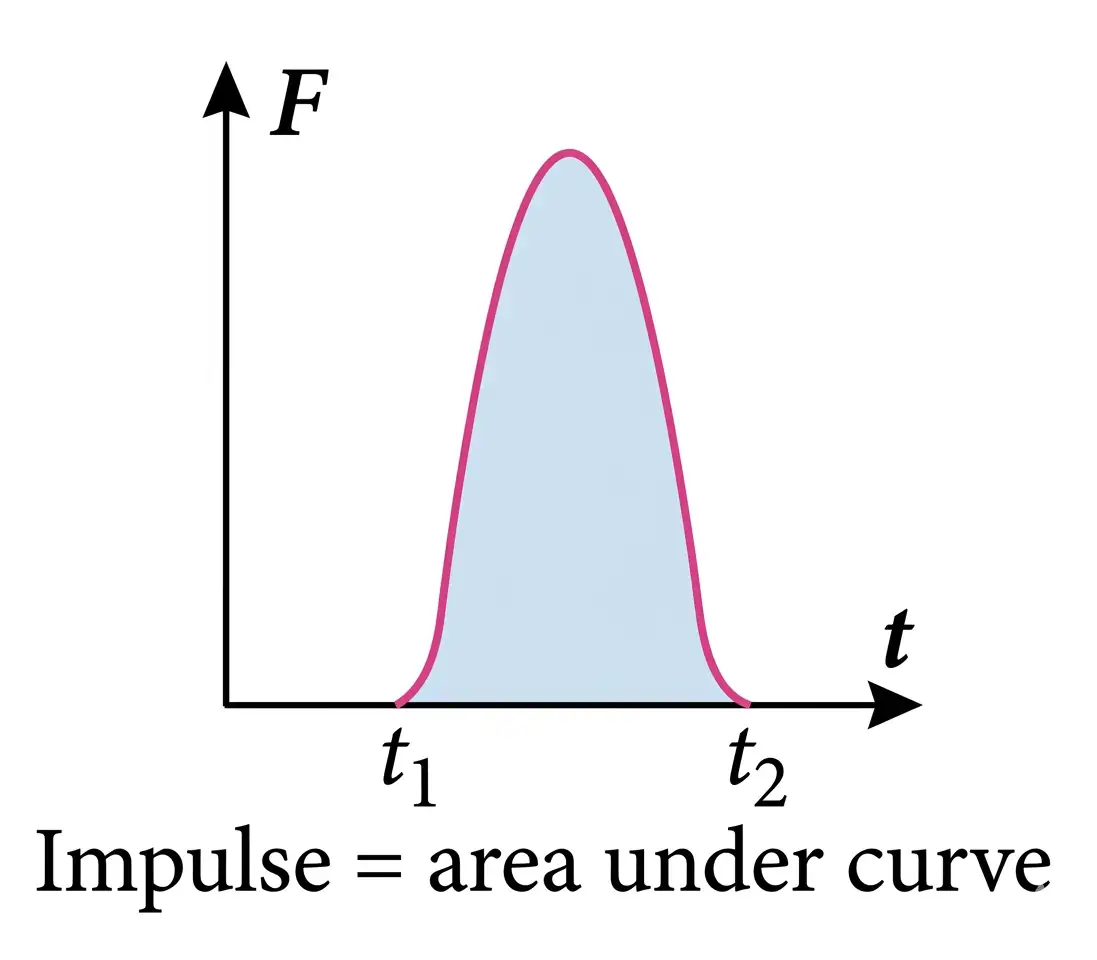
- For finite time t1 to t2, impulse = ∫t1t2 vector F dt (area under force-time graph).
- Impulse changes momentum: vector F Δt = Δvector P (Impulse-Momentum theorem).
Solved Examples
- Ex 1: A force of 10 N acts for 0.5 s on a body. Find impulse.
- Impulse = Force × time = 10 × 0.5 = 5 N·s.
- Ex 2: Force varies with time as shown in graph. Find impulse by area under curve from (t1) to (t2).
- Calculate area under force-time graph for impulse.
Practice Set
- Q1: Impulse is defined as:
- A) Force × distance
- B) Force × time
- C) Momentum × time
- D) Force / time
- Q2: A force of 20 N acts for 0.1 s. Impulse is:
- A) 2 N·s
- B) 200 N·s
- C) 0.2 N·s
- D) 20 N·s
- Q3: Impulse equals change in:
- A) Velocity
- B) Acceleration
- C) Momentum
- D) Force
Answer Key
- Q1: B) Force × time — Definition of impulse.
- Q2: A) 2 N·s — Impulse = 20 × 0.1 = 2 N·s.
- Q3: C) Momentum — Impulse changes momentum.
Memory Aids
- Impulse = Force × time.
- Impulse = area under force-time graph.
- Impulse = change in momentum.
Key Concepts
- Impulse measures total effect of force over time.
- Impulse = Force × time interval (vector F Δt).
- For short time dt, impulse = vector F dt.
- For finite time t1 to t2, impulse = ∫t1t2 vector F dt (area under force-time graph).
- Impulse changes momentum: vector F Δt = Δvector P (Impulse-Momentum theorem).
Solved Examples
- Ex 1: A force of 10 N acts for 0.5 s on a body. Find impulse.
- Impulse = Force × time = 10 × 0.5 = 5 N·s.
- Ex 2: Force varies with time as shown in graph. Find impulse by area under curve from t1 to t2.
- Calculate area under force-time graph for impulse.
Practice Set
- Q1: Impulse is defined as:
- A) Force × distance
- B) Force × time
- C) Momentum × time
- D) Force / time
- Q2: A force of 20 N acts for 0.1 s. Impulse is:
- A) 2 N·s
- B) 200 N·s
- C) 0.2 N·s
- D) 20 N·s
- Q3: Impulse equals change in:
- A) Velocity
- B) Acceleration
- C) Momentum
- D) Force
Answer Key
- Q1: B) Force × time — Definition of impulse.
- Q2: A) 2 N·s — Impulse = 20 × 0.1 = 2 N·s.
- Q3: C) Momentum — Impulse changes momentum.
Memory Aids
- Impulse = Force × time.
- Impulse = area under force-time graph.
- Impulse = change in momentum.
Key Concepts
- Impulse measures total effect of force over time.
- Impulse = Force × time interval (\vec{F} Δt).
- For short time dt, impulse = \vec{F} dt.
- For finite time t1 to t2, impulse = ∫t1t2 \vec{F} dt (area under force-time graph).
- Impulse changes momentum: \vec{F} Δt = Δ\vec{P} (Impulse-Momentum theorem).
Solved Examples
- Ex 1: A force of 10 N acts for 0.5 s on a body. Find impulse.
- Impulse = Force × time = 10 × 0.5 = 5 N·s.
- Ex 2: Force varies with time as shown in graph. Find impulse by area under curve from (t1) to (t2).
- Calculate area under force-time graph for impulse.
Practice Set
- Q1: Impulse is defined as:
- A) Force × distance
- B) Force × time
- C) Momentum × time
- D) Force / time
- Q2: A force of 20 N acts for 0.1 s. Impulse is:
- A) 2 N·s
- B) 200 N·s
- C) 0.2 N·s
- D) 20 N·s
- Q3: Impulse equals change in:
- A) Velocity
- B) Acceleration
- C) Momentum
- D) Force
Answer Key
- Q1: B) Force × time — Definition of impulse.
- Q2: A) 2 N·s — Impulse = 20 × 0.1 = 2 N·s.
- Q3: C) Momentum — Impulse changes momentum.
Memory Aids
- Impulse = Force × time.
- Impulse = area under force-time graph.
- Impulse = change in momentum.
Key Concepts
- Impulse measures total effect of force over time.
- Impulse = Force × time interval \( (\vec{F} \Delta t) \).
- For short time \( dt \), impulse = \( \vec{F} dt \).
- For finite time \( t_1 \) to \( t_2 \), impulse = \( \int_{t_1}^{t_2} \vec{F} dt \) (area under force-time graph).
- Impulse changes momentum: \( \vec{F} \Delta t = \Delta \vec{P} \) (Impulse-Momentum theorem).
Solved Examples
- Ex 1: A force of 10 N acts for 0.5 s on a body. Find impulse.
- Impulse = Force × time = 10 × 0.5 = 5 N·s.
- Ex 2: Force varies with time as shown in graph. Find impulse by area under curve from \( t_1 \) to \( t_2 \).
- Calculate area under force-time graph for impulse.
Practice Set
- Q1: Impulse is defined as:
- A) Force × distance
- B) Force × time
- C) Momentum × time
- D) Force / time
- Q2: A force of 20 N acts for 0.1 s. Impulse is:
- A) 2 N·s
- B) 200 N·s
- C) 0.2 N·s
- D) 20 N·s
- Q3: Impulse equals change in:
- A) Velocity
- B) Acceleration
- C) Momentum
- D) Force
Answer Key
- Q1: B) Force × time — Definition of impulse.
- Q2: A) 2 N·s — Impulse = 20 × 0.1 = 2 N·s.
- Q3: C) Momentum — Impulse changes momentum.
Memory Aids
- Impulse = Force × time.
- Impulse = area under force-time graph.
- Impulse = change in momentum.
Key Concepts
- Impulse measures total effect of force over time.
- Impulse = Force × time interval (\vec{F} Δt).
- For short time dt, impulse = \vec{F} dt.
- For finite time t1 to t2, impulse = ∫t1t2 \vec{F} dt (area under force-time graph).
- Impulse changes momentum: \vec{F} Δt = Δ\vec{P} (Impulse-Momentum theorem).
Solved Examples
- Ex 1: A force of 10 N acts for 0.5 s on a body. Find impulse.
- Impulse = Force × time = 10 × 0.5 = 5 N·s.
- Ex 2: Force varies with time as shown in graph. Find impulse by area under curve from (t1) to (t2).
- Calculate area under force-time graph for impulse.
Practice Set
- Q1: Impulse is defined as:
- A) Force × distance
- B) Force × time
- C) Momentum × time
- D) Force / time
- Q2: A force of 20 N acts for 0.1 s. Impulse is:
- A) 2 N·s
- B) 200 N·s
- C) 0.2 N·s
- D) 20 N·s
- Q3: Impulse equals change in:
- A) Velocity
- B) Acceleration
- C) Momentum
- D) Force
Answer Key
- Q1: B) Force × time — Definition of impulse.
- Q2: A) 2 N·s — Impulse = 20 × 0.1 = 2 N·s.
- Q3: C) Momentum — Impulse changes momentum.
Memory Aids
- Impulse = Force × time.
- Impulse = area under force-time graph.
- Impulse = change in momentum.
Key Concepts
- Impulse measures total effect of force over time.
- Impulse = Force × time interval \( (\vec{F} \Delta t) \).
- For short time \( dt \), impulse = \( \vec{F} dt \).
- For finite time \( t_1 \) to \( t_2 \), impulse = \( \int_{t_1}^{t_2} \vec{F} dt \) (area under force-time graph).
- Impulse changes momentum: \( \vec{F} \Delta t = \Delta \vec{P} \) (Impulse-Momentum theorem).
Solved Examples
- Ex 1: A force of 10 N acts for 0.5 s on a body. Find impulse.
- Impulse = Force × time = 10 × 0.5 = 5 N·s.
- Ex 2: Force varies with time as shown in graph. Find impulse by area under curve from \( t_1 \) to \( t_2 \).
- Calculate area under force-time graph for impulse.
Practice Set
- Q1: Impulse is defined as:
- A) Force × distance
- B) Force × time
- C) Momentum × time
- D) Force / time
- Q2: A force of 20 N acts for 0.1 s. Impulse is:
- A) 2 N·s
- B) 200 N·s
- C) 0.2 N·s
- D) 20 N·s
- Q3: Impulse equals change in:
- A) Velocity
- B) Acceleration
- C) Momentum
- D) Force
Answer Key
- Q1: B) Force × time — Definition of impulse.
- Q2: A) 2 N·s — Impulse = 20 × 0.1 = 2 N·s.
- Q3: C) Momentum — Impulse changes momentum.
Memory Aids
- Impulse = Force × time.
- Impulse = area under force-time graph.
- Impulse = change in momentum.
Equilibrium of a Particle
Concepts and Conditions
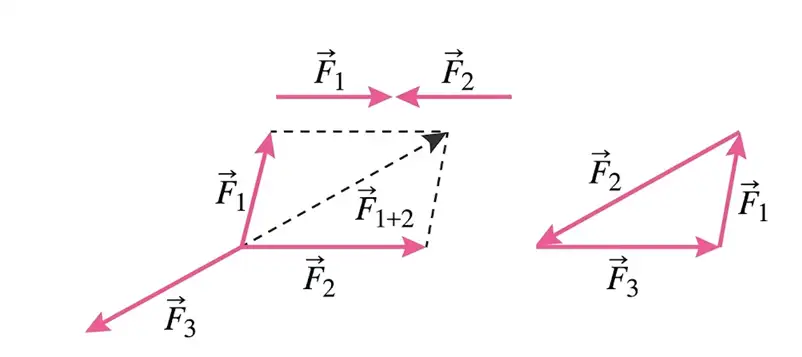
- For two forces (vector F1) and (vector F2) acting on a particle, equilibrium requires:
(vector F1 = - vector F2)
- For three concurrent forces (vector F1, vector F2, vector F3), equilibrium requires:
(vector F1 + vector F2 + vector F3 = 0)
- Concurrent forces act at the same point on a body.
- Equilibrium means the resultant force is zero or forces form a closed polygon.
- Vector addition of forces:
- Represent forces as arrows (vectors) with direction and magnitude.
- Add vectors using parallelogram or triangle method.
Solved Examples
- Ex 1: Two forces (vector F1 = 5 N) and (vector F2) act on a particle in opposite directions. Find (vector F2) for equilibrium.
- Use (vector F1 = - vector F2)
- (vector F2 = -5 N) (opposite direction)
- Ex 2: Three forces (3 N, 4 N, 5 N) act concurrently. Check equilibrium.
- Check if (vector F1 + vector F2 + vector F3 = 0)
- Use vector addition or polygon method.
- If resultant =0, forces are in equilibrium.
Practice Set
- Q1: Two forces of 10 N and 10 N act in opposite directions on a particle. What is the resultant force?
- A) 0 N
- B) 10 N
- C) 20 N
- D) 5 N
- Q2: Three concurrent forces (5 N, 12 N, 13 N) act on a particle. Are they in equilibrium?
- A) Yes
- B) No
- C) Only if angles are 90°
- D) Only if forces are equal
- Q3: If (vector F1 = 4 N) and (vector F2 = 3 N) act at 180° to each other, what is the resultant force?
- A) 7 N
- B) 1 N
- C) 5 N
- D) 0 N
Answer Key
- Q1: A) 0 N - Forces are equal and opposite, resultant is zero.
- Q2: B) No - Magnitudes alone don't ensure equilibrium; angles matter.
- Q3: B) 1 N - Resultant is difference since forces are opposite.
Memory Aids
- Equilibrium: Sum of forces = 0
- Two forces: (vector F1 = - vector F2)
- Three forces: Vector sum zero or closed triangle
- Vector addition: Parallelogram or triangle method
Concepts and Conditions
- For two forces vector F1 and vector F2 acting on a particle, equilibrium requires:
vector F1 = - vector F2
- For three concurrent forces vector F1, vector F2, vector F3, equilibrium requires:
vector F1 + vector F2 + vector F3 = 0
- Concurrent forces act at the same point on a body.
- Equilibrium means the resultant force is zero or forces form a closed polygon.
- Vector addition of forces:
- Represent forces as arrows (vectors) with direction and magnitude.
- Add vectors using parallelogram or triangle method.
Solved Examples
- Ex 1: Two forces vector F1 = 5 N and vector F2 act on a particle in opposite directions. Find vector F2 for equilibrium.
- Use vector F1 = - vector F2
- vector F2 = -5 N (opposite direction)
- Ex 2: Three forces 3 N, 4 N, 5 N act concurrently. Check equilibrium.
- Check if vector F1 + vector F2 + vector F3 = 0
- Use vector addition or polygon method.
- If resultant =0, forces are in equilibrium.
Practice Set
- Q1: Two forces of 10 N and 10 N act in opposite directions on a particle. What is the resultant force?
- A) 0 N
- B) 10 N
- C) 20 N
- D) 5 N
- Q2: Three concurrent forces 5 N, 12 N, 13 N act on a particle. Are they in equilibrium?
- A) Yes
- B) No
- C) Only if angles are 90°
- D) Only if forces are equal
- Q3: If vector F1 = 4 N and vector F2 = 3 N act at 180° to each other, what is the resultant force?
- A) 7 N
- B) 1 N
- C) 5 N
- D) 0 N
Answer Key
- Q1: A) 0 N - Forces are equal and opposite, resultant is zero.
- Q2: B) No - Magnitudes alone don't ensure equilibrium; angles matter.
- Q3: B) 1 N - Resultant is difference since forces are opposite.
Memory Aids
- Equilibrium: Sum of forces = 0
- Two forces: vector F1 = - vector F2
- Three forces: Vector sum zero or closed triangle
- Vector addition: Parallelogram or triangle method
Concepts and Conditions
- For two forces (\vec{F1}) and (\vec{F2}) acting on a particle, equilibrium requires:
(\vec{F1} = - \vec{F2})
- For three concurrent forces (\vec{F1}, \vec{F2}, \vec{F3}), equilibrium requires:
(\vec{F1} + \vec{F2} + \vec{F3} = 0)
- Concurrent forces act at the same point on a body.
- Equilibrium means the resultant force is zero or forces form a closed polygon.
- Vector addition of forces:
- Represent forces as arrows (vectors) with direction and magnitude.
- Add vectors using parallelogram or triangle method.
Solved Examples
- Ex 1: Two forces (\vec{F1} = 5\,N) and (\vec{F2}) act on a particle in opposite directions. Find (\vec{F2}) for equilibrium.
- Use (\vec{F1} = - \vec{F2})
- (\vec{F2} = -5\,N) (opposite direction)
- Ex 2: Three forces (3\,N, 4\,N, 5\,N) act concurrently. Check equilibrium.
- Check if (\vec{F1} + \vec{F2} + \vec{F3} = 0)
- Use vector addition or polygon method.
- If resultant =0, forces are in equilibrium.
Practice Set
- Q1: Two forces of 10 N and 10 N act in opposite directions on a particle. What is the resultant force?
- A) 0 N
- B) 10 N
- C) 20 N
- D) 5 N
- Q2: Three concurrent forces (5\,N, 12\,N, 13\,N) act on a particle. Are they in equilibrium?
- A) Yes
- B) No
- C) Only if angles are 90°
- D) Only if forces are equal
- Q3: If (\vec{F1} = 4\,N) and (\vec{F2} = 3\,N) act at 180° to each other, what is the resultant force?
- A) 7 N
- B) 1 N
- C) 5 N
- D) 0 N
Answer Key
- Q1: A) 0 N - Forces are equal and opposite, resultant is zero.
- Q2: B) No - Magnitudes alone don't ensure equilibrium; angles matter.
- Q3: B) 1 N - Resultant is difference since forces are opposite.
Memory Aids
- Equilibrium: Sum of forces = 0
- Two forces: (\vec{F1} = - \vec{F2})
- Three forces: Vector sum zero or closed triangle
- Vector addition: Parallelogram or triangle method
Concepts and Conditions
- For two forces \( \vec{F_1} \) and \( \vec{F_2} \) acting on a particle, equilibrium requires:
\( \vec{F_1} = - \vec{F_2} \)
- For three concurrent forces \( \vec{F_1}, \vec{F_2}, \vec{F_3} \), equilibrium requires:
\( \vec{F_1} + \vec{F_2} + \vec{F_3} = 0 \)
- Concurrent forces act at the same point on a body.
- Equilibrium means the resultant force is zero or forces form a closed polygon.
- Vector addition of forces:
- Represent forces as arrows (vectors) with direction and magnitude.
- Add vectors using parallelogram or triangle method.
Solved Examples
- Ex 1: Two forces \( \vec{F_1} = 5\,N \) and \( \vec{F_2} \) act on a particle in opposite directions. Find \( \vec{F_2} \) for equilibrium.
- Use \( \vec{F_1} = - \vec{F_2} \)
- \( \vec{F_2} = -5\,N \) (opposite direction)
- Ex 2: Three forces \( 3\,N, 4\,N, 5\,N \) act concurrently. Check equilibrium.
- Check if \( \vec{F_1} + \vec{F_2} + \vec{F_3} = 0 \)
- Use vector addition or polygon method.
- If resultant \(=0\), forces are in equilibrium.
Practice Set
- Q1: Two forces of 10 N and 10 N act in opposite directions on a particle. What is the resultant force?
- A) 0 N
- B) 10 N
- C) 20 N
- D) 5 N
- Q2: Three concurrent forces \( 5\,N, 12\,N, 13\,N \) act on a particle. Are they in equilibrium?
- A) Yes
- B) No
- C) Only if angles are 90°
- D) Only if forces are equal
- Q3: If \( \vec{F_1} = 4\,N \) and \( \vec{F_2} = 3\,N \) act at 180° to each other, what is the resultant force?
- A) 7 N
- B) 1 N
- C) 5 N
- D) 0 N
Answer Key
- Q1: A) 0 N - Forces are equal and opposite, resultant is zero.
- Q2: B) No - Magnitudes alone don't ensure equilibrium; angles matter.
- Q3: B) 1 N - Resultant is difference since forces are opposite.
Memory Aids
- Equilibrium: Sum of forces = 0
- Two forces: \( \vec{F_1} = - \vec{F_2} \)
- Three forces: Vector sum zero or closed triangle
- Vector addition: Parallelogram or triangle method
Concepts and Conditions
- For two forces (\vec{F1}) and (\vec{F2}) acting on a particle, equilibrium requires:
(\vec{F1} = - \vec{F2})
- For three concurrent forces (\vec{F1}, \vec{F2}, \vec{F3}), equilibrium requires:
(\vec{F1} + \vec{F2} + \vec{F3} = 0)
- Concurrent forces act at the same point on a body.
- Equilibrium means the resultant force is zero or forces form a closed polygon.
- Vector addition of forces:
- Represent forces as arrows (vectors) with direction and magnitude.
- Add vectors using parallelogram or triangle method.
Solved Examples
- Ex 1: Two forces (\vec{F1} = 5\,N) and (\vec{F2}) act on a particle in opposite directions. Find (\vec{F2}) for equilibrium.
- Use (\vec{F1} = - \vec{F2})
- (\vec{F2} = -5\,N) (opposite direction)
- Ex 2: Three forces (3\,N, 4\,N, 5\,N) act concurrently. Check equilibrium.
- Check if (\vec{F1} + \vec{F2} + \vec{F3} = 0)
- Use vector addition or polygon method.
- If resultant =0, forces are in equilibrium.
Practice Set
- Q1: Two forces of 10 N and 10 N act in opposite directions on a particle. What is the resultant force?
- A) 0 N
- B) 10 N
- C) 20 N
- D) 5 N
- Q2: Three concurrent forces (5\,N, 12\,N, 13\,N) act on a particle. Are they in equilibrium?
- A) Yes
- B) No
- C) Only if angles are 90°
- D) Only if forces are equal
- Q3: If (\vec{F1} = 4\,N) and (\vec{F2} = 3\,N) act at 180° to each other, what is the resultant force?
- A) 7 N
- B) 1 N
- C) 5 N
- D) 0 N
Answer Key
- Q1: A) 0 N - Forces are equal and opposite, resultant is zero.
- Q2: B) No - Magnitudes alone don't ensure equilibrium; angles matter.
- Q3: B) 1 N - Resultant is difference since forces are opposite.
Memory Aids
- Equilibrium: Sum of forces = 0
- Two forces: (\vec{F1} = - \vec{F2})
- Three forces: Vector sum zero or closed triangle
- Vector addition: Parallelogram or triangle method
Concepts and Conditions
- For two forces \( \vec{F_1} \) and \( \vec{F_2} \) acting on a particle, equilibrium requires:
\( \vec{F_1} = - \vec{F_2} \)
- For three concurrent forces \( \vec{F_1}, \vec{F_2}, \vec{F_3} \), equilibrium requires:
\( \vec{F_1} + \vec{F_2} + \vec{F_3} = 0 \)
- Concurrent forces act at the same point on a body.
- Equilibrium means the resultant force is zero or forces form a closed polygon.
- Vector addition of forces:
- Represent forces as arrows (vectors) with direction and magnitude.
- Add vectors using parallelogram or triangle method.
Solved Examples
- Ex 1: Two forces \( \vec{F_1} = 5\,N \) and \( \vec{F_2} \) act on a particle in opposite directions. Find \( \vec{F_2} \) for equilibrium.
- Use \( \vec{F_1} = - \vec{F_2} \)
- \( \vec{F_2} = -5\,N \) (opposite direction)
- Ex 2: Three forces \( 3\,N, 4\,N, 5\,N \) act concurrently. Check equilibrium.
- Check if \( \vec{F_1} + \vec{F_2} + \vec{F_3} = 0 \)
- Use vector addition or polygon method.
- If resultant \(=0\), forces are in equilibrium.
Practice Set
- Q1: Two forces of 10 N and 10 N act in opposite directions on a particle. What is the resultant force?
- A) 0 N
- B) 10 N
- C) 20 N
- D) 5 N
- Q2: Three concurrent forces \( 5\,N, 12\,N, 13\,N \) act on a particle. Are they in equilibrium?
- A) Yes
- B) No
- C) Only if angles are 90°
- D) Only if forces are equal
- Q3: If \( \vec{F_1} = 4\,N \) and \( \vec{F_2} = 3\,N \) act at 180° to each other, what is the resultant force?
- A) 7 N
- B) 1 N
- C) 5 N
- D) 0 N
Answer Key
- Q1: A) 0 N - Forces are equal and opposite, resultant is zero.
- Q2: B) No - Magnitudes alone don't ensure equilibrium; angles matter.
- Q3: B) 1 N - Resultant is difference since forces are opposite.
Memory Aids
- Equilibrium: Sum of forces = 0
- Two forces: \( \vec{F_1} = - \vec{F_2} \)
- Three forces: Vector sum zero or closed triangle
- Vector addition: Parallelogram or triangle method
Concurrent Forces
Concepts and Conditions
- Concurrent forces act at the same point on a body.
- Equilibrium condition for (n) concurrent forces:
(vector F1 + vector F2 + vector F3 + ... + vector Fn = 0)
- Forces in equilibrium can be represented by a closed polygon of vectors.
Solved Examples
- Ex 1: Four concurrent forces (2 N, 3 N, 4 N, 5 N) act on a point. Check equilibrium.
- Sum vectors: (vector F1 + vector F2 + vector F3 + vector F4 = 0)?
- If yes, forces are in equilibrium.
Practice Set
- Q1: What is the condition for equilibrium of concurrent forces?
- A) Sum of magnitudes = 0
- B) Sum of vectors = 0
- C) Forces are equal
- D) Forces act in same direction
- Q2: Concurrent forces acting on a body are in equilibrium if:
- A) Resultant force is zero
- B) Forces are parallel
- C) Forces have same magnitude
- D) Forces act at different points
- Q3: If three concurrent forces form a closed triangle, what is true?
- A) They are in equilibrium
- B) They are not in equilibrium
- C) They have equal magnitudes
- D) They act in same direction
Answer Key
- Q1: B) Sum of vectors = 0 - Vector sum zero means equilibrium.
- Q2: A) Resultant force is zero - Equilibrium means no net force.
- Q3: A) They are in equilibrium - Closed polygon means zero resultant.
Memory Aids
- Concurrent forces: Act at one point
- Equilibrium: Vector sum zero
- Closed polygon = equilibrium
Concepts and Conditions
- Concurrent forces act at the same point on a body.
- Equilibrium condition for n concurrent forces:
vector F1 + vector F2 + vector F3 + ... + vector Fn = 0
- Forces in equilibrium can be represented by a closed polygon of vectors.
Solved Examples
- Ex 1: Four concurrent forces 2 N, 3 N, 4 N, 5 N act on a point. Check equilibrium.
- Sum vectors: vector F1 + vector F2 + vector F3 + vector F4 = 0?
- If yes, forces are in equilibrium.
Practice Set
- Q1: What is the condition for equilibrium of concurrent forces?
- A) Sum of magnitudes = 0
- B) Sum of vectors = 0
- C) Forces are equal
- D) Forces act in same direction
- Q2: Concurrent forces acting on a body are in equilibrium if:
- A) Resultant force is zero
- B) Forces are parallel
- C) Forces have same magnitude
- D) Forces act at different points
- Q3: If three concurrent forces form a closed triangle, what is true?
- A) They are in equilibrium
- B) They are not in equilibrium
- C) They have equal magnitudes
- D) They act in same direction
Answer Key
- Q1: B) Sum of vectors = 0 - Vector sum zero means equilibrium.
- Q2: A) Resultant force is zero - Equilibrium means no net force.
- Q3: A) They are in equilibrium - Closed polygon means zero resultant.
Memory Aids
- Concurrent forces: Act at one point
- Equilibrium: Vector sum zero
- Closed polygon = equilibrium
Concepts and Conditions
- Concurrent forces act at the same point on a body.
- Equilibrium condition for (n) concurrent forces:
(vector F1 + vector F2 + vector F3 + ... + vector Fn = 0)
- Forces in equilibrium can be represented by a closed polygon of vectors.
Solved Examples
- Ex 1: Four concurrent forces (2 N, 3 N, 4 N, 5 N) act on a point. Check equilibrium.
- Sum vectors: (vector F1 + vector F2 + vector F3 + vector F4 = 0)?
- If yes, forces are in equilibrium.
Practice Set
- Q1: What is the condition for equilibrium of concurrent forces?
- A) Sum of magnitudes = 0
- B) Sum of vectors = 0
- C) Forces are equal
- D) Forces act in same direction
- Q2: Concurrent forces acting on a body are in equilibrium if:
- A) Resultant force is zero
- B) Forces are parallel
- C) Forces have same magnitude
- D) Forces act at different points
- Q3: If three concurrent forces form a closed triangle, what is true?
- A) They are in equilibrium
- B) They are not in equilibrium
- C) They have equal magnitudes
- D) They act in same direction
Answer Key
- Q1: B) Sum of vectors = 0 - Vector sum zero means equilibrium.
- Q2: A) Resultant force is zero - Equilibrium means no net force.
- Q3: A) They are in equilibrium - Closed polygon means zero resultant.
Memory Aids
- Concurrent forces: Act at one point
- Equilibrium: Vector sum zero
- Closed polygon = equilibrium
Concepts and Conditions
- Concurrent forces act at the same point on a body.
- Equilibrium condition for (n) concurrent forces:
(\vec{F1} + \vec{F2} + \vec{F3} + ... + \vec{Fn} = 0)
- Forces in equilibrium can be represented by a closed polygon of vectors.
Solved Examples
- Ex 1: Four concurrent forces (2\,N, 3\,N, 4\,N, 5\,N) act on a point. Check equilibrium.
- Sum vectors: (\vec{F1} + \vec{F2} + \vec{F3} + \vec{F4} = 0)?
- If yes, forces are in equilibrium.
Practice Set
- Q1: What is the condition for equilibrium of concurrent forces?
- A) Sum of magnitudes = 0
- B) Sum of vectors = 0
- C) Forces are equal
- D) Forces act in same direction
- Q2: Concurrent forces acting on a body are in equilibrium if:
- A) Resultant force is zero
- B) Forces are parallel
- C) Forces have same magnitude
- D) Forces act at different points
- Q3: If three concurrent forces form a closed triangle, what is true?
- A) They are in equilibrium
- B) They are not in equilibrium
- C) They have equal magnitudes
- D) They act in same direction
Answer Key
- Q1: B) Sum of vectors = 0 - Vector sum zero means equilibrium.
- Q2: A) Resultant force is zero - Equilibrium means no net force.
- Q3: A) They are in equilibrium - Closed polygon means zero resultant.
Memory Aids
- Concurrent forces: Act at one point
- Equilibrium: Vector sum zero
- Closed polygon = equilibrium
Concepts and Conditions
- Concurrent forces act at the same point on a body.
- Equilibrium condition for \( n \) concurrent forces:
\( \vec{F_1} + \vec{F_2} + \vec{F_3} + ... + \vec{F_n} = 0 \)
- Forces in equilibrium can be represented by a closed polygon of vectors.
Solved Examples
- Ex 1: Four concurrent forces \( 2\,N, 3\,N, 4\,N, 5\,N \) act on a point. Check equilibrium.
- Sum vectors: \( \vec{F_1} + \vec{F_2} + \vec{F_3} + \vec{F_4} = 0 \)?
- If yes, forces are in equilibrium.
Practice Set
- Q1: What is the condition for equilibrium of concurrent forces?
- A) Sum of magnitudes = 0
- B) Sum of vectors = 0
- C) Forces are equal
- D) Forces act in same direction
- Q2: Concurrent forces acting on a body are in equilibrium if:
- A) Resultant force is zero
- B) Forces are parallel
- C) Forces have same magnitude
- D) Forces act at different points
- Q3: If three concurrent forces form a closed triangle, what is true?
- A) They are in equilibrium
- B) They are not in equilibrium
- C) They have equal magnitudes
- D) They act in same direction
Answer Key
- Q1: B) Sum of vectors = 0 - Vector sum zero means equilibrium.
- Q2: A) Resultant force is zero - Equilibrium means no net force.
- Q3: A) They are in equilibrium - Closed polygon means zero resultant.
Memory Aids
- Concurrent forces: Act at one point
- Equilibrium: Vector sum zero
- Closed polygon = equilibrium
Concepts and Conditions
- Concurrent forces act at the same point on a body.
- Equilibrium condition for (n) concurrent forces:
(\vec{F1} + \vec{F2} + \vec{F3} + ... + \vec{Fn} = 0)
- Forces in equilibrium can be represented by a closed polygon of vectors.
Solved Examples
- Ex 1: Four concurrent forces (2\,N, 3\,N, 4\,N, 5\,N) act on a point. Check equilibrium.
- Sum vectors: (\vec{F1} + \vec{F2} + \vec{F3} + \vec{F4} = 0)?
- If yes, forces are in equilibrium.
Practice Set
- Q1: What is the condition for equilibrium of concurrent forces?
- A) Sum of magnitudes = 0
- B) Sum of vectors = 0
- C) Forces are equal
- D) Forces act in same direction
- Q2: Concurrent forces acting on a body are in equilibrium if:
- A) Resultant force is zero
- B) Forces are parallel
- C) Forces have same magnitude
- D) Forces act at different points
- Q3: If three concurrent forces form a closed triangle, what is true?
- A) They are in equilibrium
- B) They are not in equilibrium
- C) They have equal magnitudes
- D) They act in same direction
Answer Key
- Q1: B) Sum of vectors = 0 - Vector sum zero means equilibrium.
- Q2: A) Resultant force is zero - Equilibrium means no net force.
- Q3: A) They are in equilibrium - Closed polygon means zero resultant.
Memory Aids
- Concurrent forces: Act at one point
- Equilibrium: Vector sum zero
- Closed polygon = equilibrium
Concepts and Conditions
- Concurrent forces act at the same point on a body.
- Equilibrium condition for \( n \) concurrent forces:
\( \vec{F_1} + \vec{F_2} + \vec{F_3} + ... + \vec{F_n} = 0 \)
- Forces in equilibrium can be represented by a closed polygon of vectors.
Solved Examples
- Ex 1: Four concurrent forces \( 2\,N, 3\,N, 4\,N, 5\,N \) act on a point. Check equilibrium.
- Sum vectors: \( \vec{F_1} + \vec{F_2} + \vec{F_3} + \vec{F_4} = 0 \)?
- If yes, forces are in equilibrium.
Practice Set
- Q1: What is the condition for equilibrium of concurrent forces?
- A) Sum of magnitudes = 0
- B) Sum of vectors = 0
- C) Forces are equal
- D) Forces act in same direction
- Q2: Concurrent forces acting on a body are in equilibrium if:
- A) Resultant force is zero
- B) Forces are parallel
- C) Forces have same magnitude
- D) Forces act at different points
- Q3: If three concurrent forces form a closed triangle, what is true?
- A) They are in equilibrium
- B) They are not in equilibrium
- C) They have equal magnitudes
- D) They act in same direction
Answer Key
- Q1: B) Sum of vectors = 0 - Vector sum zero means equilibrium.
- Q2: A) Resultant force is zero - Equilibrium means no net force.
- Q3: A) They are in equilibrium - Closed polygon means zero resultant.
Memory Aids
- Concurrent forces: Act at one point
- Equilibrium: Vector sum zero
- Closed polygon = equilibrium
Lami's Theorem
Concepts and Formula
- Applies to three concurrent forces (vector F1, vector F2, vector F3) in equilibrium.
- Formula:
[(F1)/(sin α) = (F2)/(sin β) = (F3)/(sin γ)]
- Where angles are:
- (α): between (vector F2) and (vector F3)
- (β): between (vector F3) and (vector F1)
- (γ): between (vector F1) and (vector F2)
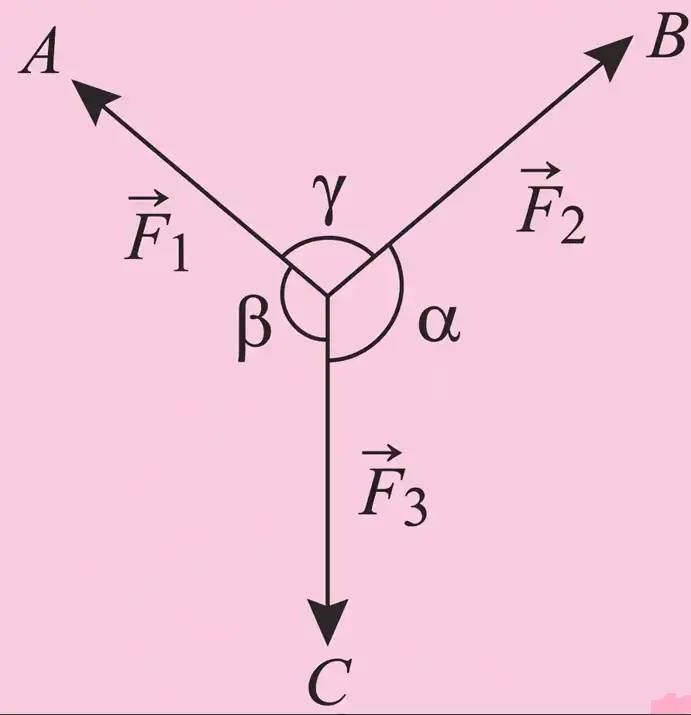
Solved Examples
- Ex 1: Three forces (F1=10 N, F2=15 N, F3=20 N) act at a point with angles (α=60°, β=45°, γ=75°). Check equilibrium using Lami's theorem.
- Calculate (F1/sin α, F2/sin β, F3/sin γ)
- If equal, forces are in equilibrium.
Practice Set
- Q1: For three forces in equilibrium, Lami's theorem states:
- A) (F1/sin α = F2/sin β = F3/sin γ)
- B) (F1 + F2 + F3 = 0)
- C) (F1 = F2 = F3)
- D) (sin α = sin β = sin γ)
- Q2: If (F1=8 N, F2=6 N, F3=10 N) and angles (α=30°, β=45°, γ=105°), are forces in equilibrium?
- A) Yes
- B) No
- C) Only if angles are equal
- D) Only if forces are equal
- Q3: In Lami's theorem, (α) is the angle between which forces?
- A) (vector F2) and (vector F3)
- B) (vector F1) and (vector F2)
- C) (vector F1) and (vector F3)
- D) (vector F1) and resultant force
Answer Key
- Q1: A) (F1/sin α = F2/sin β = F3/sin γ) - This is Lami's theorem formula.
- Q2: B) No - Calculate ratios; if unequal, no equilibrium.
- Q3: A) (vector F2) and (vector F3) - By definition of angles in theorem.
Memory Aids
- Lami's theorem: (F/sin(angle) = constant)
- Angles opposite to forces
- Useful for three-force equilibrium
Concepts and Formula
- Applies to three concurrent forces vector F1, vector F2, vector F3 in equilibrium.
- Formula:
[ F1/(sin α) = F2/(sin β) = F3/(sin γ) ]
- Where angles are:
- α: between vector F2 and vector F3
- β: between vector F3 and vector F1
- γ: between vector F1 and vector F2
Solved Examples
- Ex 1: Three forces F1=10 N, F2=15 N, F3=20 N act at a point with angles α=60°, β=45°, γ=75°. Check equilibrium using Lami's theorem.
- Calculate F1/sin α, F2/sin β, F3/sin γ
- If equal, forces are in equilibrium.
Practice Set
- Q1: For three forces in equilibrium, Lami's theorem states:
- A) F1/sin α = F2/sin β = F3/sin γ
- B) F1 + F2 + F3 = 0
- C) F1 = F2 = F3
- D) sin α = sin β = sin γ
- Q2: If F1=8 N, F2=6 N, F3=10 N and angles α=30°, β=45°, γ=105°, are forces in equilibrium?
- A) Yes
- B) No
- C) Only if angles are equal
- D) Only if forces are equal
- Q3: In Lami's theorem, α is the angle between which forces?
- A) vector F2 and vector F3
- B) vector F1 and vector F2
- C) vector F1 and vector F3
- D) vector F1 and resultant force
Answer Key
- Q1: A) F1/sin α = F2/sin β = F3/sin γ - This is Lami's theorem formula.
- Q2: B) No - Calculate ratios; if unequal, no equilibrium.
- Q3: A) vector F2 and vector F3 - By definition of angles in theorem.
Memory Aids
- Lami's theorem: F/sin(angle) = constant
- Angles opposite to forces
- Useful for three-force equilibrium
Concepts and Formula
- Applies to three concurrent forces (vector F1, vector F2, vector F3) in equilibrium.
- Formula:
(F1)/(sin α) = (F2)/(sin β) = (F3)/(sin γ)
- Where angles are:
- (α): between (vector F2) and (vector F3)
- (β): between (vector F3) and (vector F1)
- (γ): between (vector F1) and (vector F2)
Solved Examples
- Ex 1: Three forces (F1=10 N, F2=15 N, F3=20 N) act at a point with angles (α=60°, β=45°, γ=75°). Check equilibrium using Lami's theorem.
- Calculate (F1/sin α, F2/sin β, F3/sin γ)
- If equal, forces are in equilibrium.
Practice Set
- Q1: For three forces in equilibrium, Lami's theorem states:
- A) (F1/sin α = F2/sin β = F3/sin γ)
- B) (F1 + F2 + F3 = 0)
- C) (F1 = F2 = F3)
- D) (sin α = sin β = sin γ)
- Q2: If (F1=8 N, F2=6 N, F3=10 N) and angles (α=30°, β=45°, γ=105°), are forces in equilibrium?
- A) Yes
- B) No
- C) Only if angles are equal
- D) Only if forces are equal
- Q3: In Lami's theorem, (α) is the angle between which forces?
- A) (vector F2) and (vector F3)
- B) (vector F1) and (vector F2)
- C) (vector F1) and (vector F3)
- D) (vector F1) and resultant force
Answer Key
- Q1: A) (F1/sin α = F2/sin β = F3/sin γ) - This is Lami's theorem formula.
- Q2: B) No - Calculate ratios; if unequal, no equilibrium.
- Q3: A) (vector F2) and (vector F3) - By definition of angles in theorem.
Memory Aids
- Lami's theorem: (F/sin(angle) = constant)
- Angles opposite to forces
- Useful for three-force equilibrium
Concepts and Formula
- Applies to three concurrent forces vector F1, vector F2, vector F3 in equilibrium.
- Formula:
[ F1/(sin α) = F2/(sin β) = F3/(sin γ) ]
- Where angles are:
- α: between vector F2 and vector F3
- β: between vector F3 and vector F1
- γ: between vector F1 and vector F2
Solved Examples
- Ex 1: Three forces F1=10 N, F2=15 N, F3=20 N act at a point with angles α=60°, β=45°, γ=75°. Check equilibrium using Lami's theorem.
- Calculate F1/sin α, F2/sin β, F3/sin γ
- If equal, forces are in equilibrium.
Practice Set
- Q1: For three forces in equilibrium, Lami's theorem states:
- A) F1/sin α = F2/sin β = F3/sin γ
- B) F1 + F2 + F3 = 0
- C) F1 = F2 = F3
- D) sin α = sin β = sin γ
- Q2: If F1=8 N, F2=6 N, F3=10 N and angles α=30°, β=45°, γ=105°, are forces in equilibrium?
- A) Yes
- B) No
- C) Only if angles are equal
- D) Only if forces are equal
- Q3: In Lami's theorem, α is the angle between which forces?
- A) vector F2 and vector F3
- B) vector F1 and vector F2
- C) vector F1 and vector F3
- D) vector F1 and resultant force
Answer Key
- Q1: A) F1/sin α = F2/sin β = F3/sin γ - This is Lami's theorem formula.
- Q2: B) No - Calculate ratios; if unequal, no equilibrium.
- Q3: A) vector F2 and vector F3 - By definition of angles in theorem.
Memory Aids
- Lami's theorem: F/sin(angle) = constant
- Angles opposite to forces
- Useful for three-force equilibrium
Concepts and Formula
- Applies to three concurrent forces (\vec{F1}, \vec{F2}, \vec{F3}) in equilibrium.
- Formula:
[(F1)/(sin α) = (F2)/(sin β) = (F3)/(sin γ)]
- Where angles are:
- (α): between (\vec{F2}) and (\vec{F3})
- (β): between (\vec{F3}) and (\vec{F1})
- (γ): between (\vec{F1}) and (\vec{F2})
Solved Examples
- Ex 1: Three forces (F1=10\,N, F2=15\,N, F3=20\,N) act at a point with angles (α=60°, β=45°, γ=75°). Check equilibrium using Lami's theorem.
- Calculate (F1/sin α, F2/sin β, F3/sin γ)
- If equal, forces are in equilibrium.
Practice Set
- Q1: For three forces in equilibrium, Lami's theorem states:
- A) (F1/sin α = F2/sin β = F3/sin γ)
- B) (F1 + F2 + F3 = 0)
- C) (F1 = F2 = F3)
- D) (sin α = sin β = sin γ)
- Q2: If (F1=8\,N, F2=6\,N, F3=10\,N) and angles (α=30°, β=45°, γ=105°), are forces in equilibrium?
- A) Yes
- B) No
- C) Only if angles are equal
- D) Only if forces are equal
- Q3: In Lami's theorem, (α) is the angle between which forces?
- A) (\vec{F2}) and (\vec{F3})
- B) (\vec{F1}) and (\vec{F2})
- C) (\vec{F1}) and (\vec{F3})
- D) (\vec{F1}) and resultant force
Answer Key
- Q1: A) (F1/sin α = F2/sin β = F3/sin γ) - This is Lami's theorem formula.
- Q2: B) No - Calculate ratios; if unequal, no equilibrium.
- Q3: A) (\vec{F2}) and (\vec{F3}) - By definition of angles in theorem.
Memory Aids
- Lami's theorem: (F/sin(angle) = constant)
- Angles opposite to forces
- Useful for three-force equilibrium
Concepts and Formula
- Applies to three concurrent forces \( \vec{F_1}, \vec{F_2}, \vec{F_3} \) in equilibrium.
- Formula:
\[ \frac{F_1}{\sin \alpha} = \frac{F_2}{\sin \beta} = \frac{F_3}{\sin \gamma} \]
- Where angles are:
- \( \alpha \): between \( \vec{F_2} \) and \( \vec{F_3} \)
- \( \beta \): between \( \vec{F_3} \) and \( \vec{F_1} \)
- \( \gamma \): between \( \vec{F_1} \) and \( \vec{F_2} \)
Solved Examples
- Ex 1: Three forces \( F_1=10\,N, F_2=15\,N, F_3=20\,N \) act at a point with angles \( \alpha=60^\circ, \beta=45^\circ, \gamma=75^\circ \). Check equilibrium using Lami's theorem.
- Calculate \( \frac{F_1}{\sin \alpha}, \frac{F_2}{\sin \beta}, \frac{F_3}{\sin \gamma} \)
- If equal, forces are in equilibrium.
Practice Set
- Q1: For three forces in equilibrium, Lami's theorem states:
- A) \( \frac{F_1}{\sin \alpha} = \frac{F_2}{\sin \beta} = \frac{F_3}{\sin \gamma} \)
- B) \( F_1 + F_2 + F_3 = 0 \)
- C) \( F_1 = F_2 = F_3 \)
- D) \( \sin \alpha = \sin \beta = \sin \gamma \)
- Q2: If \( F_1=8\,N, F_2=6\,N, F_3=10\,N \) and angles \( \alpha=30^\circ, \beta=45^\circ, \gamma=105^\circ \), are forces in equilibrium?
- A) Yes
- B) No
- C) Only if angles are equal
- D) Only if forces are equal
- Q3: In Lami's theorem, \( \alpha \) is the angle between which forces?
- A) \( \vec{F_2} \) and \( \vec{F_3} \)
- B) \( \vec{F_1} \) and \( \vec{F_2} \)
- C) \( \vec{F_1} \) and \( \vec{F_3} \)
- D) \( \vec{F_1} \) and resultant force
Answer Key
- Q1: A) \( \frac{F_1}{\sin \alpha} = \frac{F_2}{\sin \beta} = \frac{F_3}{\sin \gamma} \) - This is Lami's theorem formula.
- Q2: B) No - Calculate ratios; if unequal, no equilibrium.
- Q3: A) \( \vec{F_2} \) and \( \vec{F_3} \) - By definition of angles in theorem.
Memory Aids
- Lami's theorem: \( F/sin(angle) = constant \)
- Angles opposite to forces
- Useful for three-force equilibrium
Concepts and Formula
- Applies to three concurrent forces (\vec{F1}, \vec{F2}, \vec{F3}) in equilibrium.
- Formula:
[(F1)/(sin α) = (F2)/(sin β) = (F3)/(sin γ)]
- Where angles are:
- (α): between (\vec{F2}) and (\vec{F3})
- (β): between (\vec{F3}) and (\vec{F1})
- (γ): between (\vec{F1}) and (\vec{F2})
Solved Examples
- Ex 1: Three forces (F1=10\,N, F2=15\,N, F3=20\,N) act at a point with angles (α=60°, β=45°, γ=75°). Check equilibrium using Lami's theorem.
- Calculate (F1/sin α, F2/sin β, F3/sin γ)
- If equal, forces are in equilibrium.
Practice Set
- Q1: For three forces in equilibrium, Lami's theorem states:
- A) (F1/sin α = F2/sin β = F3/sin γ)
- B) (F1 + F2 + F3 = 0)
- C) (F1 = F2 = F3)
- D) (sin α = sin β = sin γ)
- Q2: If (F1=8\,N, F2=6\,N, F3=10\,N) and angles (α=30°, β=45°, γ=105°), are forces in equilibrium?
- A) Yes
- B) No
- C) Only if angles are equal
- D) Only if forces are equal
- Q3: In Lami's theorem, (α) is the angle between which forces?
- A) (\vec{F2}) and (\vec{F3})
- B) (\vec{F1}) and (\vec{F2})
- C) (\vec{F1}) and (\vec{F3})
- D) (\vec{F1}) and resultant force
Answer Key
- Q1: A) (F1/sin α = F2/sin β = F3/sin γ) - This is Lami's theorem formula.
- Q2: B) No - Calculate ratios; if unequal, no equilibrium.
- Q3: A) (\vec{F2}) and (\vec{F3}) - By definition of angles in theorem.
Memory Aids
- Lami's theorem: (F/sin(angle) = constant)
- Angles opposite to forces
- Useful for three-force equilibrium
Concepts and Formula
- Applies to three concurrent forces \( \vec{F_1}, \vec{F_2}, \vec{F_3} \) in equilibrium.
- Formula:
\[ \frac{F_1}{\sin \alpha} = \frac{F_2}{\sin \beta} = \frac{F_3}{\sin \gamma} \]
- Where angles are:
- \( \alpha \): between \( \vec{F_2} \) and \( \vec{F_3} \)
- \( \beta \): between \( \vec{F_3} \) and \( \vec{F_1} \)
- \( \gamma \): between \( \vec{F_1} \) and \( \vec{F_2} \)
Solved Examples
- Ex 1: Three forces \( F_1=10\,N, F_2=15\,N, F_3=20\,N \) act at a point with angles \( \alpha=60^\circ, \beta=45^\circ, \gamma=75^\circ \). Check equilibrium using Lami's theorem.
- Calculate \( \frac{F_1}{\sin \alpha}, \frac{F_2}{\sin \beta}, \frac{F_3}{\sin \gamma} \)
- If equal, forces are in equilibrium.
Practice Set
- Q1: For three forces in equilibrium, Lami's theorem states:
- A) \( \frac{F_1}{\sin \alpha} = \frac{F_2}{\sin \beta} = \frac{F_3}{\sin \gamma} \)
- B) \( F_1 + F_2 + F_3 = 0 \)
- C) \( F_1 = F_2 = F_3 \)
- D) \( \sin \alpha = \sin \beta = \sin \gamma \)
- Q2: If \( F_1=8\,N, F_2=6\,N, F_3=10\,N \) and angles \( \alpha=30^\circ, \beta=45^\circ, \gamma=105^\circ \), are forces in equilibrium?
- A) Yes
- B) No
- C) Only if angles are equal
- D) Only if forces are equal
- Q3: In Lami's theorem, \( \alpha \) is the angle between which forces?
- A) \( \vec{F_2} \) and \( \vec{F_3} \)
- B) \( \vec{F_1} \) and \( \vec{F_2} \)
- C) \( \vec{F_1} \) and \( \vec{F_3} \)
- D) \( \vec{F_1} \) and resultant force
Answer Key
- Q1: A) \( \frac{F_1}{\sin \alpha} = \frac{F_2}{\sin \beta} = \frac{F_3}{\sin \gamma} \) - This is Lami's theorem formula.
- Q2: B) No - Calculate ratios; if unequal, no equilibrium.
- Q3: A) \( \vec{F_2} \) and \( \vec{F_3} \) - By definition of angles in theorem.
Memory Aids
- Lami's theorem: \( F/sin(angle) = constant \)
- Angles opposite to forces
- Useful for three-force equilibrium
Common Forces
Overview
- Most forces in mechanics are contact forces except gravitational force.
- Common forces: friction, normal reaction, buoyant force, spring force, tension in string.
Types of Friction
- Static friction: Prevents motion until a threshold force is applied.
- Sliding friction: Opposes motion when objects slide past each other.
- Rolling friction: Opposes motion of rolling objects, usually much smaller than static or sliding friction.
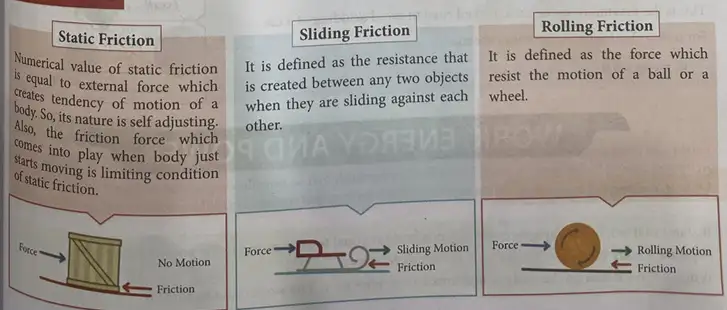
Solved Examples
Practice Set
- Q1: Which force acts when an object is at rest and resists initial motion?
- A. Kinetic friction
- B. Static friction
- C. Rolling friction
- D. Buoyant force
- Q2: Which friction force is smallest in magnitude?
- A. Static friction
- B. Sliding friction
- C. Rolling friction
- D. Limiting friction
- Q3: What type of force is tension in a string?
- A. Contact force
- B. Gravitational force
- C. Magnetic force
- D. Electrostatic force
Answer Key
- Q1: B - Static friction prevents initial motion.
- Q2: C - Rolling friction is smallest among friction types.
- Q3: A - Tension is a contact force in the string.
Memory Aids
- Static friction = force to start motion.
- Rolling friction < sliding friction < static friction.
- Tension acts along string, away from object.
Overview
- Most forces in mechanics are contact forces except gravitational force.
- Common forces: friction, normal reaction, buoyant force, spring force, tension in string.
Types of Friction
- Static friction: Prevents motion until a threshold force is applied.
- Sliding friction: Opposes motion when objects slide past each other.
- Rolling friction: Opposes motion of rolling objects, usually much smaller than static or sliding friction.
Solved Examples
Practice Set
- Q1: Which force acts when an object is at rest and resists initial motion?
- A. Kinetic friction
- B. Static friction
- C. Rolling friction
- D. Buoyant force
- Q2: Which friction force is smallest in magnitude?
- A. Static friction
- B. Sliding friction
- C. Rolling friction
- D. Limiting friction
- Q3: What type of force is tension in a string?
- A. Contact force
- B. Gravitational force
- C. Magnetic force
- D. Electrostatic force
Answer Key
- Q1: B - Static friction prevents initial motion.
- Q2: C - Rolling friction is smallest among friction types.
- Q3: A - Tension is a contact force in the string.
Memory Aids
- Static friction = force to start motion.
- Rolling friction < sliding friction < static friction.
- Tension acts along string, away from object.
Overview
- Most forces in mechanics are contact forces except gravitational force.
- Common forces: friction, normal reaction, buoyant force, spring force, tension in string.
Types of Friction
- Static friction: Prevents motion until a threshold force is applied.
- Sliding friction: Opposes motion when objects slide past each other.
- Rolling friction: Opposes motion of rolling objects, usually much smaller than static or sliding friction.
Solved Examples
Practice Set
- Q1: Which force acts when an object is at rest and resists initial motion?
- A. Kinetic friction
- B. Static friction
- C. Rolling friction
- D. Buoyant force
- Q2: Which friction force is smallest in magnitude?
- A. Static friction
- B. Sliding friction
- C. Rolling friction
- D. Limiting friction
- Q3: What type of force is tension in a string?
- A. Contact force
- B. Gravitational force
- C. Magnetic force
- D. Electrostatic force
Answer Key
- Q1: B - Static friction prevents initial motion.
- Q2: C - Rolling friction is smallest among friction types.
- Q3: A - Tension is a contact force in the string.
Memory Aids
- Static friction = force to start motion.
- Rolling friction < sliding friction < static friction.
- Tension acts along string, away from object.
Friction
Definition & Basics
- Friction opposes relative motion or tendency of motion between surfaces in contact.
- Friction force (except static) is proportional to normal reaction: fr ∝ N.
- Types: static, limiting, kinetic (sliding), rolling.
Static Friction
- Self-adjusting force equal to applied force up to maximum.
- Maximum static friction = limiting friction: flim = μs N.
Limiting Friction
- Directly proportional to normal reaction: f ∝ N.
- Opposes impending motion direction.
- Independent of contact area.
- Depends on surface roughness and material.
- Value is greater than other friction types.
Kinetic Friction
- Opposes motion of moving bodies.
- Less than limiting friction.
- Formula: fk = μk N.
Variation of Friction Force
Angle of Friction (λ)
- Angle between resultant of limiting friction and normal reaction.
- tan λ = f/N = μ
- λ = tan-1 μ
Angle of Repose
- Maximum angle of incline where body just begins to slide.
- f = mg sin θ, N = mg cos θ
- Coefficient of static friction: μs = tan θ
- Angle of repose = angle of friction.
Rolling Friction
- Opposes rolling motion due to deformation at contact area.
- Much smaller than static and kinetic friction.
- Used in ball bearings to reduce friction in machines.
Solved Examples
Practice Set
- Q1: What is the formula for limiting friction?
- A. flim = μk N
- B. flim = μs N
- C. flim = N / μs
- D. flim = mg
- Q2: Angle of friction is 30°. What is the coefficient of friction?
- A. 0.5
- B. 0.58
- C. 0.87
- D. 1.0
- Q3: A block on an incline of 45° just starts sliding. Find μs.
- A. 0.5
- B. 1.0
- C. 0.7
- D. 0.3
Answer Key
- Q1: B - Limiting friction formula uses static friction coefficient.
- Q2: B - μ = tan 30° = 0.58.
- Q3: B - μs = tan 45° = 1.0.
Memory Aids
- flim = μs N for limiting friction.
- Angle of friction λ = tan-1 μ.
- Angle of repose = angle of friction.
Definition & Basics
- Friction opposes relative motion or tendency of motion between surfaces in contact.
- Friction force (except static) is proportional to normal reaction: fr ∝ N.
- Types: static, limiting, kinetic (sliding), rolling.
Static Friction
- Self-adjusting force equal to applied force up to maximum.
- Maximum static friction = limiting friction: flim = μs N.
Limiting Friction
- Directly proportional to normal reaction: f ∝ N.
- Opposes impending motion direction.
- Independent of contact area.
- Depends on surface roughness and material.
- Value is greater than other friction types.
Kinetic Friction
- Opposes motion of moving bodies.
- Less than limiting friction.
- Formula: fk = μk N.
Variation of Friction Force
Angle of Friction (λ)
- Angle between resultant of limiting friction and normal reaction.
- tan λ = f/N = μ
- λ = tan-1 μ
Angle of Repose
- Maximum angle of incline where body just begins to slide.
- f = mg sin θ, N = mg cos θ
- Coefficient of static friction: μs = tan θ
- Angle of repose = angle of friction.
Rolling Friction
- Opposes rolling motion due to deformation at contact area.
- Much smaller than static and kinetic friction.
- Used in ball bearings to reduce friction in machines.
Solved Examples
Practice Set
- Q1: What is the formula for limiting friction?
- A. flim = μk N
- B. flim = μs N
- C. flim = N / μs
- D. flim = mg
- Q2: Angle of friction is 30°. What is the coefficient of friction?
- A. 0.5
- B. 0.58
- C. 0.87
- D. 1.0
- Q3: A block on an incline of 45° just starts sliding. Find μs.
- A. 0.5
- B. 1.0
- C. 0.7
- D. 0.3
Answer Key
- Q1: B - Limiting friction formula uses static friction coefficient.
- Q2: B - μ = tan 30° = 0.58.
- Q3: B - μs = tan 45° = 1.0.
Memory Aids
- flim = μs N for limiting friction.
- Angle of friction λ = tan-1 μ.
- Angle of repose = angle of friction.
Static Friction
- Self-adjusting force equal to applied force up to maximum.
- Maximum static friction = limiting friction: \( f_{lim} = \mu_s N \).
Limiting Friction
- Directly proportional to normal reaction: \( f \propto N \).
- Opposes impending motion direction.
- Independent of contact area.
- Depends on surface roughness and material.
- Value is greater than other friction types.
Kinetic Friction
- Opposes motion of moving bodies.
- Less than limiting friction.
- Formula: \( f_k = \mu_k N \).
Variation of Friction Force
Angle of Friction (\( \lambda \))
- Angle between resultant of limiting friction and normal reaction.
- \( \tan \lambda = \frac{f}{N} = \mu \)
- \( \lambda = \tan^{-1} \mu \)
Angle of Repose
- Maximum angle of incline where body just begins to slide.
- \( f = mg \sin \theta, \quad N = mg \cos \theta \)
- Coefficient of static friction: \( \mu_s = \tan \theta \)
- Angle of repose = angle of friction.
Rolling Friction
- Opposes rolling motion due to deformation at contact area.
- Much smaller than static and kinetic friction.
- Used in ball bearings to reduce friction in machines.
Solved Examples
Practice Set
- Q1: What is the formula for limiting friction?
- A. \( f_{lim} = \mu_k N \)
- B. \( f_{lim} = \mu_s N \)
- C. \( f_{lim} = N / \mu_s \)
- D. \( f_{lim} = mg \)
- Q2: Angle of friction is 30°. What is the coefficient of friction?
- A. 0.5
- B. 0.58
- C. 0.87
- D. 1.0
- Q3: A block on an incline of 45° just starts sliding. Find \( \mu_s \).
- A. 0.5
- B. 1.0
- C. 0.7
- D. 0.3
Answer Key
- Q1: B - Limiting friction formula uses static friction coefficient.
- Q2: B - \( \mu = \tan 30^\circ = 0.58 \).
- Q3: B - \( \mu_s = \tan 45^\circ = 1.0 \).
Memory Aids
- \( f_{lim} = \mu_s N \) for limiting friction.
- Angle of friction \( \lambda = \tan^{-1} \mu \).
- Angle of repose = angle of friction.
Tension in String
Properties & Rules
- Ideal string: massless, perfectly smooth, inextensible.
- Tension develops when string ends are pulled opposite directions.
- Tension force acts along the string, away from the object.
- Tension is uniform throughout an ideal string.
- Tension in string or chain is extensional only.
- In rods, tension can be extensional or compressional.

Solved Examples
Practice Set
- Q1: What is true for tension in an ideal string?
- A. Varies along the string
- B. Acts perpendicular to string
- C. Same at all points
- D. Only compressional
- Q2: Tension force direction is?
- A. Along string, towards object
- B. Along string, away from object
- C. Perpendicular to string
- D. Random direction
- Q3: Which is NOT a property of an ideal string?
- A. Massless
- B. Extensible
- C. Smooth
- D. Inextensible
Answer Key
- Q1: C - Tension is uniform in ideal string.
- Q2: B - Tension acts along string away from object.
- Q3: B - Ideal string is inextensible, not extensible.
Memory Aids
- Tension = pulling force along string.
- Ideal string: massless, smooth, inextensible.
- Tension uniform throughout string.
Properties & Rules
- Ideal string: massless, perfectly smooth, inextensible.
- Tension develops when string ends are pulled opposite directions.
- Tension force acts along the string, away from the object.
- Tension is uniform throughout an ideal string.
- Tension in string or chain is extensional only.
- In rods, tension can be extensional or compressional.
Solved Examples
Practice Set
- Q1: What is true for tension in an ideal string?
- A. Varies along the string
- B. Acts perpendicular to string
- C. Same at all points
- D. Only compressional
- Q2: Tension force direction is?
- A. Along string, towards object
- B. Along string, away from object
- C. Perpendicular to string
- D. Random direction
- Q3: Which is NOT a property of an ideal string?
- A. Massless
- B. Extensible
- C. Smooth
- D. Inextensible
Answer Key
- Q1: C - Tension is uniform in ideal string.
- Q2: B - Tension acts along string away from object.
- Q3: B - Ideal string is inextensible, not extensible.
Memory Aids
- Tension = pulling force along string.
- Ideal string: massless, smooth, inextensible.
- Tension uniform throughout string.
Properties & Rules
- Ideal string: massless, perfectly smooth, inextensible.
- Tension develops when string ends are pulled opposite directions.
- Tension force acts along the string, away from the object.
- Tension is uniform throughout an ideal string.
- Tension in string or chain is extensional only.
- In rods, tension can be extensional or compressional.
Solved Examples
Practice Set
- Q1: What is true for tension in an ideal string?
- A. Varies along the string
- B. Acts perpendicular to string
- C. Same at all points
- D. Only compressional
- Q2: Tension force direction is?
- A. Along string, towards object
- B. Along string, away from object
- C. Perpendicular to string
- D. Random direction
- Q3: Which is NOT a property of an ideal string?
- A. Massless
- B. Extensible
- C. Smooth
- D. Inextensible
Answer Key
- Q1: C - Tension is uniform in ideal string.
- Q2: B - Tension acts along string away from object.
- Q3: B - Ideal string is inextensible, not extensible.
Memory Aids
- Tension = pulling force along string.
- Ideal string: massless, smooth, inextensible.
- Tension uniform throughout string.
Properties & Rules
- Ideal string: massless, perfectly smooth, inextensible.
- Tension develops when string ends are pulled opposite directions.
- Tension force acts along the string, away from the object.
- Tension is uniform throughout an ideal string.
- Tension in string or chain is extensional only.
- In rods, tension can be extensional or compressional.
Solved Examples
Practice Set
- Q1: What is true for tension in an ideal string?
- A. Varies along the string
- B. Acts perpendicular to string
- C. Same at all points
- D. Only compressional
- Q2: Tension force direction is?
- A. Along string, towards object
- B. Along string, away from object
- C. Perpendicular to string
- D. Random direction
- Q3: Which is NOT a property of an ideal string?
- A. Massless
- B. Extensible
- C. Smooth
- D. Inextensible
Answer Key
- Q1: C - Tension is uniform in ideal string.
- Q2: B - Tension acts along string away from object.
- Q3: B - Ideal string is inextensible, not extensible.
Memory Aids
- Tension = pulling force along string.
- Ideal string: massless, smooth, inextensible.
- Tension uniform throughout string.
Circular Motion
Motion of a car on a level road
- Centripetal force is provided by friction between tyres and road: f ≤ μs N = mv2/R
- Maximum safe speed: v = √(μs R g)
- Forces: Normal force N, gravitational force mg, friction force f
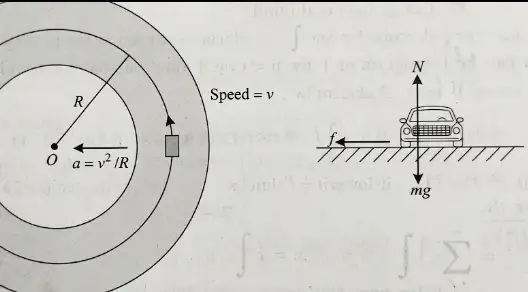
Motion of a car on a banked road
- Centripetal force from components: friction f cos θ and normal reaction N sin θ
- Maximum permissible speed to avoid slipping: [ vmax = √(Rg(μs + tan θ)/(1 - μs tan θ)) ]
- If road is smooth (μs = 0): [ vmax = √(Rg tan θ) ]
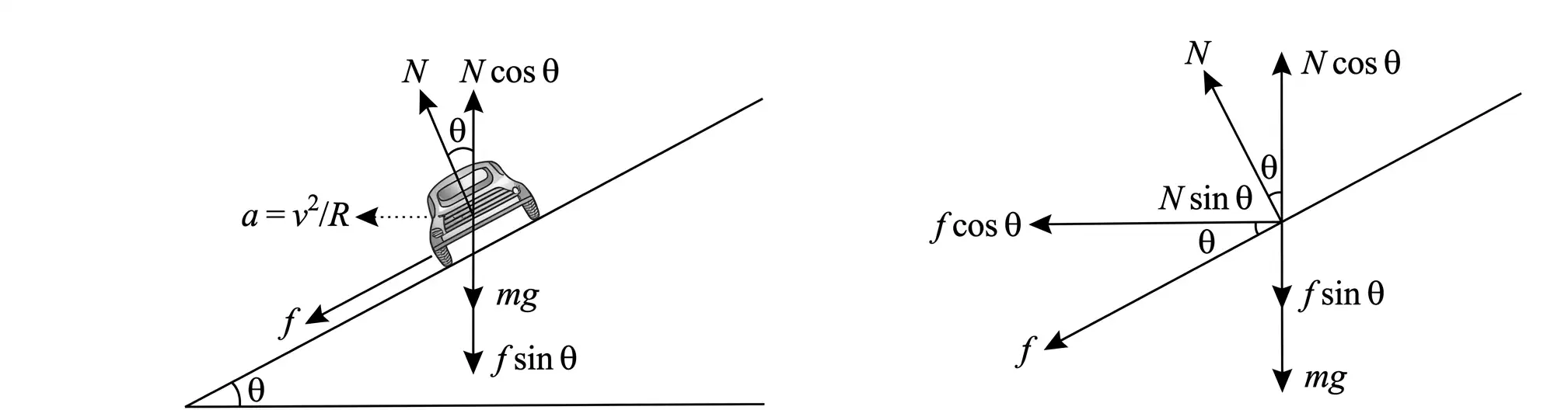
Bending of cyclist on circular turning for safe going
- Normal reaction components: [ N sin θ = mv2/r and N cos θ = mg ]
- Maximum speed of cyclist: [ v = √(rg tan θ) ]
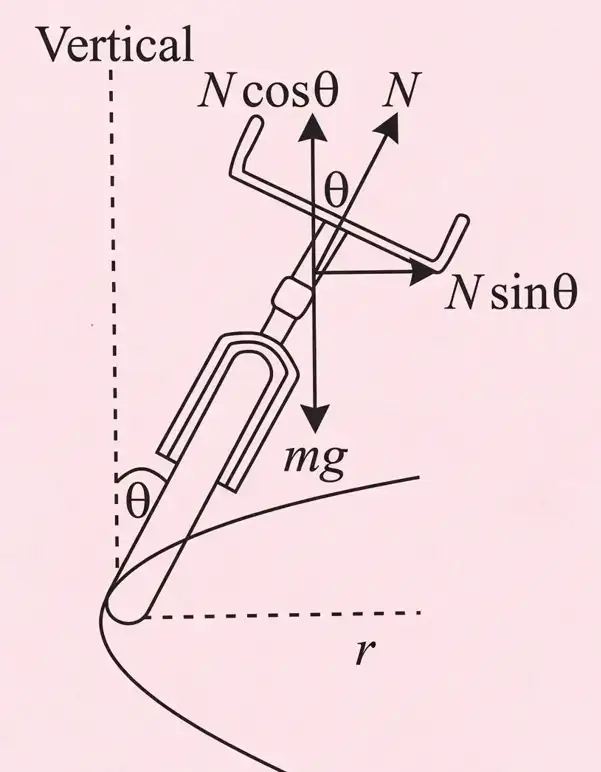
Solved Examples
Ex 1
- Find max speed of car on level road with μs = 0.4, R = 50 m, g = 9.8 m/s2. [ v = √(0.4 × 50 × 9.8) = √196 = 14 m/s ]
Ex 2
- Calculate max speed on banked road with θ = 30°, μs = 0.2, R = 40 m, g = 9.8 m/s2. [ vmax = √(40 × 9.8 (0.2 + tan 30°)/(1 - 0.2 × tan 30°)) ≈ √(392 (0.2 + 0.577)/(1 - 0.115)) = √(392 × 0.777/0.885) ≈ √344 = 18.5 m/s ]
Ex 3
- Find max speed of cyclist leaning at 45° on curve radius r = 20 m, g = 9.8 m/s2. [ v = √(20 × 9.8 × tan 45°) = √196 = 14 m/s ]
Practice Set
Q1
- What provides centripetal force for a car on a flat circular road?
- A. Gravity
- B. Friction
- C. Normal force
- D. Air resistance
- Maximum speed for safe turning on a level road depends on:
- A. √(μs R g)
- B. √(R/g)
- C. μs R
- D. √(g/μs R)
- For a car on a banked road with μs = 0, the max speed is:
- A. √(Rg tan θ)
- B. √(Rg / tan θ)
- C. √(μs R g)
- D. √(R / g tan θ)
- Q1: B - Friction provides the centripetal force on a flat road.
- Q2: A - Maximum speed formula is v = √(μs R g).
- Q3: A - For smooth banked road, max speed is √(Rg tan θ).
- Level road max speed: v = √(μs R g)
- Banked road max speed: vmax = √(Rg(μs + tan θ)/(1 - μs tan θ))
- Cyclist max speed: v = √(rg tan θ)
- Friction provides centripetal force on flat road
- Bank angle θ controls speed on banked curves
- Centripetal force from components: friction f cos θ and normal reaction N sin θ
- Maximum permissible speed to avoid slipping: [ vmax = √(Rg(μs + tan θ)/(1 - μs tan θ)) ]
- If road is smooth (μs = 0): [ vmax = √(Rg tan θ) ]
- Normal reaction components: [ N sin θ = mv2/r and N cos θ = mg ]
- Maximum speed of cyclist: [ v = √(rg tan θ) ]
- Find max speed of car on level road with μs = 0.4, R = 50 m, g = 9.8 m/s2. [ v = √(0.4 × 50 × 9.8) = √196 = 14 m/s ]
- Calculate max speed on banked road with θ = 30°, μs = 0.2, R = 40 m, g = 9.8 m/s2. [ vmax = √(40 × 9.8 (0.2 + tan 30°)/(1 - 0.2 × tan 30°)) ≈ √(392 (0.2 + 0.577)/(1 - 0.115)) = √(392 × 0.777/0.885) ≈ √344 = 18.5 m/s ]
- Find max speed of cyclist leaning at 45° on curve radius r = 20 m, g = 9.8 m/s2. [ v = √(20 × 9.8 × tan 45°) = √196 = 14 m/s ]
- What provides centripetal force for a car on a flat circular road?
- A. Gravity
- B. Friction
- C. Normal force
- D. Air resistance
- Maximum speed for safe turning on a level road depends on:
- A. √(μs R g)
- B. √(R/g)
- C. μs R
- D. √(g/μs R)
- For a car on a banked road with μs = 0, the max speed is:
- A. √(Rg tan θ)
- B. √(Rg / tan θ)
- C. √(μs R g)
- D. √(R / g tan θ)
- Q1: B - Friction provides the centripetal force on a flat road.
- Q2: A - Maximum speed formula is v = √(μs R g).
- Q3: A - For smooth banked road, max speed is √(Rg tan θ).
- Level road max speed: v = √(μs R g)
- Banked road max speed: vmax = √(Rg(μs + tan θ)/(1 - μs tan θ))
- Cyclist max speed: v = √(rg tan θ)
- Friction provides centripetal force on flat road
- Bank angle θ controls speed on banked curves
- Centripetal force is provided by friction between tyres and road: f ≤ μs N = mv2/R
- Maximum safe speed: v = √(μs R g)
- Forces: Normal force N, gravitational force mg, friction force f
- Centripetal force from components: friction f cos θ and normal reaction N sin θ
- Maximum permissible speed to avoid slipping: [vmax = √(Rg(μs + tan θ)/(1 - μs tan θ))]
- If road is smooth (μs = 0): [vmax = √(Rg tan θ)]
- Normal reaction components: [N sin θ = mv2/r and N cos θ = mg]
- Maximum speed of cyclist: [v = √(rg tan θ)]
- Find max speed of car on level road with μs = 0.4, R = 50 m, g = 9.8 m/s2. [v = √(0.4 × 50 × 9.8) = √196 = 14 m/s]
- Calculate max speed on banked road with θ = 30°, μs = 0.2, R = 40 m, g = 9.8 m/s2. [vmax = √(40 × 9.8 (0.2 + tan 30°)/(1 - 0.2 × tan 30°)) ≈ √(392 (0.2 + 0.577)/(1 - 0.115)) = √(392 × 0.777/0.885) ≈ √344 = 18.5 m/s]
- Find max speed of cyclist leaning at 45° on curve radius r = 20 m, g = 9.8 m/s2. [v = √(20 × 9.8 × tan 45°) = √196 = 14 m/s]
- What provides centripetal force for a car on a flat circular road?
- A. Gravity
- B. Friction
- C. Normal force
- D. Air resistance
- Maximum speed for safe turning on a level road depends on:
- A. √(μs R g)
- B. √(R/g)
- C. μs R
- D. √(g/μs R)
- For a car on a banked road with μs = 0, the max speed is:
- A. √(Rg tan θ)
- B. √(Rg / tan θ)
- C. √(μs R g)
- D. √(R / g tan θ)
- Q1: B - Friction provides the centripetal force on a flat road.
- Q2: A - Maximum speed formula is v = √(μs R g).
- Q3: A - For smooth banked road, max speed is √(Rg tan θ).
- Level road max speed: v = √(μs R g)
- Banked road max speed: vmax = √(Rg(μs + tan θ)/(1 - μs tan θ))
- Cyclist max speed: v = √(rg tan θ)
- Friction provides centripetal force on flat road
- Bank angle θ controls speed on banked curves
- Centripetal force is provided by friction between tyres and road: f ≤ μs N = mv2/R
- Maximum safe speed: v = √(μs R g)
- Forces: Normal force N, gravitational force mg, friction force f
- Centripetal force from components: friction f cos θ and normal reaction N sin θ
- Maximum permissible speed to avoid slipping: [ vmax = √(Rg(μs + tan θ)/(1 - μs tan θ)) ]
- If road is smooth (μs = 0): [ vmax = √(Rg tan θ) ]
- Normal reaction components: [ N sin θ = mv2/r and N cos θ = mg ]
- Maximum speed of cyclist: [ v = √(rg tan θ) ]
- Find max speed of car on level road with μs = 0.4, R = 50 m, g = 9.8 m/s2. [ v = √(0.4 × 50 × 9.8) = √196 = 14 m/s ]
- Calculate max speed on banked road with θ = 30°, μs = 0.2, R = 40 m, g = 9.8 m/s2. [ vmax = √(40 × 9.8 (0.2 + tan 30°)/(1 - 0.2 × tan 30°)) ≈ √(392 (0.2 + 0.577)/(1 - 0.115)) = √(392 × 0.777/0.885) ≈ √344 = 18.5 m/s ]
- Find max speed of cyclist leaning at 45° on curve radius r = 20 m, g = 9.8 m/s2. [ v = √(20 × 9.8 × tan 45°) = √196 = 14 m/s ]
- What provides centripetal force for a car on a flat circular road?
- A. Gravity
- B. Friction
- C. Normal force
- D. Air resistance
- Maximum speed for safe turning on a level road depends on:
- A. √(μs R g)
- B. √(R/g)
- C. μs R
- D. √(g/μs R)
- For a car on a banked road with μs = 0, the max speed is:
- A. √(Rg tan θ)
- B. √(Rg / tan θ)
- C. √(μs R g)
- D. √(R / g tan θ)
- Q1: B - Friction provides the centripetal force on a flat road.
- Q2: A - Maximum speed formula is v = √(μs R g).
- Q3: A - For smooth banked road, max speed is √(Rg tan θ).
- Level road max speed: v = √(μs R g)
- Banked road max speed: vmax = √(Rg(μs + tan θ)/(1 - μs tan θ))
- Cyclist max speed: v = √(rg tan θ)
- Friction provides centripetal force on flat road
- Bank angle θ controls speed on banked curves
- Centripetal force from components: friction f cos θ and normal reaction N sin θ
- Maximum permissible speed to avoid slipping: [vmax = √(Rg(μs + tan θ)/(1 - μs tan θ))]
- If road is smooth (μs = 0): [vmax = √(Rg tan θ)]
- Normal reaction components: [N sin θ = mv2/r and N cos θ = mg]
- Maximum speed of cyclist: [v = √(rg tan θ)]
- Find max speed of car on level road with μs = 0.4, R = 50 m, g = 9.8 m/s2. [v = √(0.4 × 50 × 9.8) = √196 = 14 m/s]
- Calculate max speed on banked road with θ = 30°, μs = 0.2, R = 40 m, g = 9.8 m/s2. [vmax = √(40 × 9.8 (0.2 + tan 30°)/(1 - 0.2 × tan 30°)) ≈ √(392 (0.2 + 0.577)/(1 - 0.115)) = √(392 × 0.777/0.885) ≈ √344 = 18.5 m/s]
- Find max speed of cyclist leaning at 45° on curve radius r = 20 m, g = 9.8 m/s2. [v = √(20 × 9.8 × tan 45°) = √196 = 14 m/s]
- What provides centripetal force for a car on a flat circular road?
- A. Gravity
- B. Friction
- C. Normal force
- D. Air resistance
- Maximum speed for safe turning on a level road depends on:
- A. √(μs R g)
- B. √(R/g)
- C. μs R
- D. √(g/μs R)
- For a car on a banked road with μs = 0, the max speed is:
- A. √(Rg tan θ)
- B. √(Rg / tan θ)
- C. √(μs R g)
- D. √(R / g tan θ)
- Q1: B - Friction provides the centripetal force on a flat road.
- Q2: A - Maximum speed formula is v = √(μs R g).
- Q3: A - For smooth banked road, max speed is √(Rg tan θ).
- Level road max speed: v = √(μs R g)
- Banked road max speed: vmax = √(Rg(μs + tan θ)/(1 - μs tan θ))
- Cyclist max speed: v = √(rg tan θ)
- Friction provides centripetal force on flat road
- Bank angle θ controls speed on banked curves
- Centripetal force is provided by friction between tyres and road: \( f \leq \mu_s N = \frac{mv^2}{R} \)
- Maximum safe speed: \( v = \sqrt{\mu_s R g} \)
- Forces: Normal force \( N \), gravitational force \( mg \), friction force \( f \)
- Centripetal force from components: friction \( f \cos \theta \) and normal reaction \( N \sin \theta \)
- Maximum permissible speed to avoid slipping: \[ v_{max} = \sqrt{\frac{Rg(\mu_s + \tan \theta)}{1 - \mu_s \tan \theta}} \]
- If road is smooth (\( \mu_s = 0 \)): \[ v_{max} = \sqrt{Rg \tan \theta} \]
- Normal reaction components: \[ N \sin \theta = \frac{mv^2}{r} \quad \text{and} \quad N \cos \theta = mg \]
- Maximum speed of cyclist: \[ v = \sqrt{rg \tan \theta} \]
- Find max speed of car on level road with \( \mu_s = 0.4 \), \( R = 50 \) m, \( g = 9.8 \) m/s2. \[ v = \sqrt{0.4 \times 50 \times 9.8} = \sqrt{196} = 14 \text{ m/s} \]
- Calculate max speed on banked road with \( \theta = 30^\circ \), \( \mu_s = 0.2 \), \( R = 40 \) m, \( g = 9.8 \) m/s2. \[ v_{max} = \sqrt{\frac{40 \times 9.8 (0.2 + \tan 30^\circ)}{1 - 0.2 \times \tan 30^\circ}} \approx \sqrt{\frac{392 (0.2 + 0.577)}{1 - 0.115}} = \sqrt{\frac{392 \times 0.777}{0.885}} \approx \sqrt{344} = 18.5 \text{ m/s} \]
- Find max speed of cyclist leaning at \( 45^\circ \) on curve radius \( r = 20 \) m, \( g = 9.8 \) m/s2. \[ v = \sqrt{20 \times 9.8 \times \tan 45^\circ} = \sqrt{196} = 14 \text{ m/s} \]
- What provides centripetal force for a car on a flat circular road?
- A. Gravity
- B. Friction
- C. Normal force
- D. Air resistance
- Maximum speed for safe turning on a level road depends on:
- A. \( \sqrt{\mu_s R g} \)
- B. \( \sqrt{R/g} \)
- C. \( \mu_s R \)
- D. \( \sqrt{g/\mu_s R} \)
- For a car on a banked road with \( \mu_s = 0 \), the max speed is:
- A. \( \sqrt{Rg \tan \theta} \)
- B. \( \sqrt{Rg / \tan \theta} \)
- C. \( \sqrt{\mu_s R g} \)
- D. \( \sqrt{R / g \tan \theta} \)
- Q1: B - Friction provides the centripetal force on a flat road.
- Q2: A - Maximum speed formula is \( v = \sqrt{\mu_s R g} \).
- Q3: A - For smooth banked road, max speed is \( \sqrt{Rg \tan \theta} \).
- Level road max speed: \( v = \sqrt{\mu_s R g} \)
- Banked road max speed: \( v_{max} = \sqrt{\frac{Rg(\mu_s + \tan \theta)}{1 - \mu_s \tan \theta}} \)
- Cyclist max speed: \( v = \sqrt{rg \tan \theta} \)
- Friction provides centripetal force on flat road
- Bank angle \( \theta \) controls speed on banked curves
- Draw schematic diagram of assembly, links, supports.
- Select a convenient part as a single system.
- Draw free body diagram showing all forces on the system by the rest of the assembly and other agencies.
- Include known forces (magnitude & direction) and treat unknowns to be found using laws of motion.
- Use Newton’s third law for forces between interacting bodies: force on A by B is vector F, force on B by A is -vector F.
- Ex 1: Draw free body diagram for a block on inclined plane with forces: gravity, normal, friction, applied force.
- Ex 2: Identify unknown forces and apply Newton’s laws to solve for them.
- Q1: What is the purpose of a free body diagram?
A. Show forces on environment
B. Show forces on system by environment
C. Show forces on system by system
D. Show forces inside the system - Q2: Newton’s third law states:
A. Forces are equal and opposite on same body
B. Forces are equal and opposite on interacting bodies
C. Forces act only on one body
D. Forces are always unbalanced - Q3: In a free body diagram, unknown forces are:
A. Ignored
B. Treated as zero
C. Treated as variables to solve
D. Given directly - Q1: B - Free body diagram shows forces on the system by the environment and other bodies.
- Q2: B - Newton’s third law states forces between two bodies are equal and opposite.
- Q3: C - Unknown forces are treated as variables to be determined using laws of motion.
- Free body diagram = forces on chosen system only.
- Newton’s third law: action = -reaction.
- Unknown forces = variables in equations.
- Normal force: N = mg cos θ - F sin α
- Force balance along slope: F cos α = mg sin θ + μ N = mg sin θ + μ (mg cos θ - F sin α)
- Minimum pulling force: F = mg(sin θ + μ cos θ)/(cos α + μ sin α)
- For minimum F, maximize denominator: cos α + μ sin α
- Condition: d/dα (cos α + μ sin α) = 0 ⇒ sin α + μ cos α = 0
- Angle for minimum force: tan α = μ ⇒ α = tan-1 μ
- Minimum force value: Fmin = mg(sin θ + μ cos θ)/√(1 + μ2)
- Ex 1: Calculate minimum force to pull 10 kg block on 30° incline with μ = 0.2.
Step 1: α = tan-1 0.2 = 11.31°
Step 2: Fmin = 10 × 9.8 (sin 30° + 0.2 cos 30°)/√(1 + 0.22) = 54.3 N - Q1: What is the expression for normal force on inclined plane?
A. mg sin θ + F sin α
B. mg cos θ - F sin α
C. mg cos θ + F cos α
D. mg sin θ - F cos α - Q2: For minimum pulling force, angle α satisfies:
A. tan α = 0
B. tan α = μ
C. tan α = θ
D. tan α = 1/μ - Q3: Minimum force to pull a block depends on:
A. Only mass
B. Mass and friction coefficient
C. Mass, friction coefficient, and incline angle
D. Only friction coefficient - Q1: B - Normal force is mg cos θ - F sin α.
- Q2: B - Minimum force angle satisfies tan α = μ.
- Q3: C - Minimum force depends on mass, friction coefficient, and incline angle.
- Minimum force formula denominator max when tan α = μ.
- Normal force reduced by component of applied force perpendicular to slope.
- Friction opposes motion along slope.
- Normal force: N = mg cos θ - F sin α
- Force balance along slope: F cos α = mg sin θ + μ N = mg sin θ + μ (mg cos θ - F sin α)
- Minimum pulling force: F = mg(sin θ + μ cos θ)/(cos α + μ sin α)
- For minimum F, maximize denominator: cos α + μ sin α
- Condition: d/dα (cos α + μ sin α) = 0 ⇒ sin α + μ cos α = 0
- Angle for minimum force: tan α = μ ⇒ α = tan-1 μ
- Minimum force value: Fmin = mg(sin θ + μ cos θ)/√(1 + μ2)
- Ex 1: Calculate minimum force to pull 10 kg block on 30° incline with μ = 0.2.
Step 1: α = tan-1 0.2 = 11.31°
Step 2: Fmin = 10 × 9.8 (sin 30° + 0.2 cos 30°)/√(1 + 0.22) = 54.3 N - Q1: What is the expression for normal force on inclined plane?
A. mg sin θ + F sin α
B. mg cos θ - F sin α
C. mg cos θ + F cos α
D. mg sin θ - F cos α - Q2: For minimum pulling force, angle α satisfies:
A. tan α = 0
B. tan α = μ
C. tan α = θ
D. tan α = 1/μ - Q3: Minimum force to pull a block depends on:
A. Only mass
B. Mass and friction coefficient
C. Mass, friction coefficient, and incline angle
D. Only friction coefficient - Q1: B - Normal force is mg cos θ - F sin α.
- Q2: B - Minimum force angle satisfies tan α = μ.
- Q3: C - Minimum force depends on mass, friction coefficient, and incline angle.
- Minimum force formula denominator max when tan α = μ.
- Normal force reduced by component of applied force perpendicular to slope.
- Friction opposes motion along slope.
- Normal force: \( N = mg \cos \theta - F \sin \alpha \)
- Force balance along slope: \( F \cos \alpha = mg \sin \theta + \mu N = mg \sin \theta + \mu (mg \cos \theta - F \sin \alpha) \)
- Minimum pulling force: \( F = \frac{mg(\sin \theta + \mu \cos \theta)}{\cos \alpha + \mu \sin \alpha} \)
- For minimum \( F \), maximize denominator: \( \cos \alpha + \mu \sin \alpha \)
- Condition: \( \frac{d}{d\alpha} (\cos \alpha + \mu \sin \alpha) = 0 \Rightarrow \sin \alpha + \mu \cos \alpha = 0 \)
- Angle for minimum force: \( \tan \alpha = \mu \Rightarrow \alpha = \tan^{-1} \mu \)
- Minimum force value: \( F_{min} = \frac{mg(\sin \theta + \mu \cos \theta)}{\sqrt{1 + \mu^2}} \)
- Ex 1: Calculate minimum force to pull 10 kg block on 30° incline with \( \mu = 0.2 \).
Step 1: \( \alpha = \tan^{-1} 0.2 = 11.31^\circ \)
Step 2: \( F_{min} = \frac{10 \times 9.8 (\sin 30^\circ + 0.2 \cos 30^\circ)}{\sqrt{1 + 0.2^2}} = 54.3 \text{ N} \) - Q1: What is the expression for normal force on inclined plane?
A. \( mg \sin \theta + F \sin \alpha \)
B. \( mg \cos \theta - F \sin \alpha \)
C. \( mg \cos \theta + F \cos \alpha \)
D. \( mg \sin \theta - F \cos \alpha \) - Q2: For minimum pulling force, angle \( \alpha \) satisfies:
A. \( \tan \alpha = 0 \)
B. \( \tan \alpha = \mu \)
C. \( \tan \alpha = \theta \)
D. \( \tan \alpha = 1/\mu \) - Q3: Minimum force to pull a block depends on:
A. Only mass
B. Mass and friction coefficient
C. Mass, friction coefficient, and incline angle
D. Only friction coefficient - Q1: B - Normal force is \( mg \cos \theta - F \sin \alpha \).
- Q2: B - Minimum force angle satisfies \( \tan \alpha = \mu \).
- Q3: C - Minimum force depends on mass, friction coefficient, and incline angle.
- Minimum force formula denominator max when \( \tan \alpha = \mu \).
- Normal force reduced by component of applied force perpendicular to slope.
- Friction opposes motion along slope.
Q2
Q3
Answer Key
Memory Aids
Motion of a car on a banked road
Bending of cyclist on circular turning for safe going
Solved Examples
Ex 1
Ex 2
Ex 3
Practice Set
Q1
Q2
Q3
Answer Key
Memory Aids
Motion of a car on a level road
Motion of a car on a banked road
Bending of cyclist on circular turning for safe going
Solved Examples
Ex 1
Ex 2
Ex 3
Practice Set
Q1
Q2
Q3
Answer Key
Memory Aids
Motion of a car on a level road
Motion of a car on a banked road
Bending of cyclist on circular turning for safe going
Solved Examples
Ex 1
Ex 2
Ex 3
Practice Set
Q1
Q2
Q3
Answer Key
Memory Aids
Motion of a car on a level road
Motion of a car on a banked road
Bending of cyclist on circular turning for safe going
Solved Examples
Ex 1
Ex 2
Ex 3
Practice Set
Q1
Q2
Q3
Answer Key
Memory Aids
Motion of a car on a banked road
Bending of cyclist on circular turning for safe going
Solved Examples
Ex 1
Ex 2
Ex 3
Practice Set
Q1
Q2
Q3
Answer Key
Memory Aids
Motion of a car on a level road
Motion of a car on a banked road
Bending of cyclist on circular turning for safe going
Solved Examples
Ex 1
Ex 2
Ex 3
Practice Set
Q1
Q2
Q3
Answer Key
Memory Aids
Solving Problems in Mechanics
Systematic Approach
Solved Examples
Practice Set
Answer Key
Memory Aids
Solved Examples
Practice Set
Answer Key
Memory Aids
Systematic Approach
Solved Examples
Practice Set
Answer Key
Memory Aids
Solved Examples
Practice Set
Answer Key
Memory Aids
Minimum Force on Inclined Plane
Key Formulas and Concepts
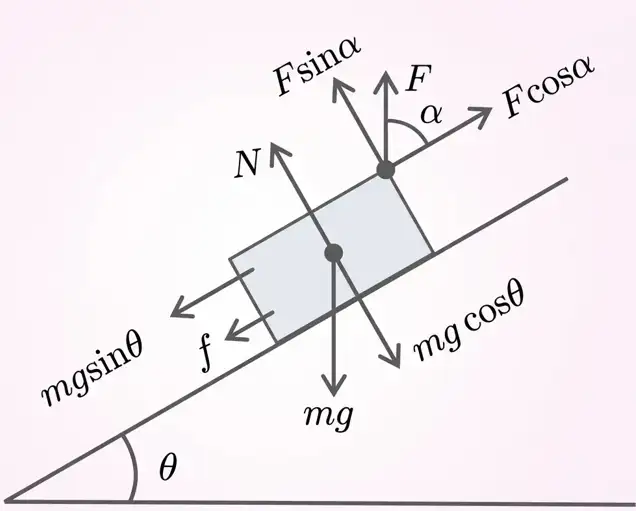
Solved Examples
Practice Set
Answer Key
Memory Aids
Key Formulas and Concepts
Solved Examples
Practice Set
Answer Key
Memory Aids
Solved Examples
Practice Set
Answer Key
Memory Aids
Key Formulas and Concepts
Solved Examples
Practice Set
Answer Key
Memory Aids
Key Formulas and Concepts
Solved Examples
Practice Set
Answer Key
Memory Aids
Key Formulas and Concepts
Solved Examples
Practice Set
Answer Key
Memory Aids
Solved Examples
Practice Set
Answer Key
Memory Aids
Key Formulas and Concepts
Solved Examples
Practice Set
Answer Key
Memory Aids
NEET Physics — ALL CHAPTERS
1
Basic Mathematics
2
Units and Measurement
3
Motion in a Straight Line
4
Motion in a Plane
5
Laws of Motion
6
Work, Energy and Power
7
System of Particles and Rotational Motion
8
Gravitation
9
Mechanical Properties of Solids
10
Mechanical Properties of Fluids
11
Thermal Properties of Matter
12
Thermodynamics
13
Kinetic Theory
14
Oscillations
15
Waves
16
Electric Charges and Fields
17
Electrostatic Potential and Capacitance
18
Current Electricity
19
Moving Charges and Magnetism
20
Magnetism and Matter
21
Electromagnetic Induction
22
Alternating Current
23
Electromagnetic Waves
24
Ray Optics and Optical Instruments
25
Wave Optics
26
Dual Nature of Radiation and Matter
27
Atoms
28
Nuclei
29
Semiconductor Electronics: Materials, Devices and Simple Circuits