Plum Pudding Model
Model Description
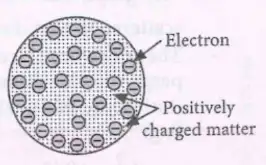
- Proposed by J.J. Thomson in 1898.
- Atom consists of a sphere of positive charge with electrons embedded like seeds in a watermelon.
- Positive charge is uniformly distributed throughout the atom's volume.
- Electrons are negatively charged and scattered inside the positive sphere.
- Model was later disproved by experiments showing different charge distribution.
Solved Examples
- Ex 1: Identify the charge distribution in the plum pudding model.
Answer: Positive charge is spread uniformly; electrons embedded inside.
Practice Set
- Q1: What does the plum pudding model propose about the atom?
A. Nucleus at center
B. Electrons orbit nucleus
C. Positive charge spread uniformly with embedded electrons
D. Electrons outside nucleus - Q2: According to the plum pudding model, electrons are:
A. Orbiting nucleus
B. Embedded in positive charge
C. Free particles
D. Absent - Q3: Which experiment disproved the plum pudding model?
A. Photoelectric effect
B. Rutherford's alpha scattering
C. Compton scattering
D. Davisson-Germer experiment
Answer Key
- Q1: C - Positive charge is uniformly spread with electrons embedded inside.
- Q2: B - Electrons are embedded in the positive charge sphere.
- Q3: B - Rutherford's alpha scattering experiment disproved this model.
Memory Aids
- Think "plums in pudding" for electrons in positive charge.
- Positive charge = pudding; electrons = plums.
Alpha Particle Scattering
Experiment Setup
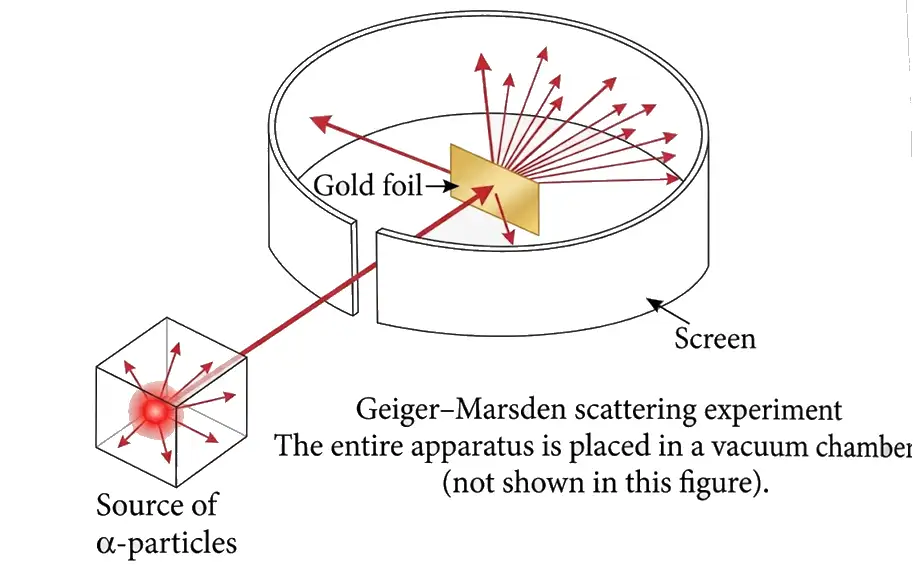
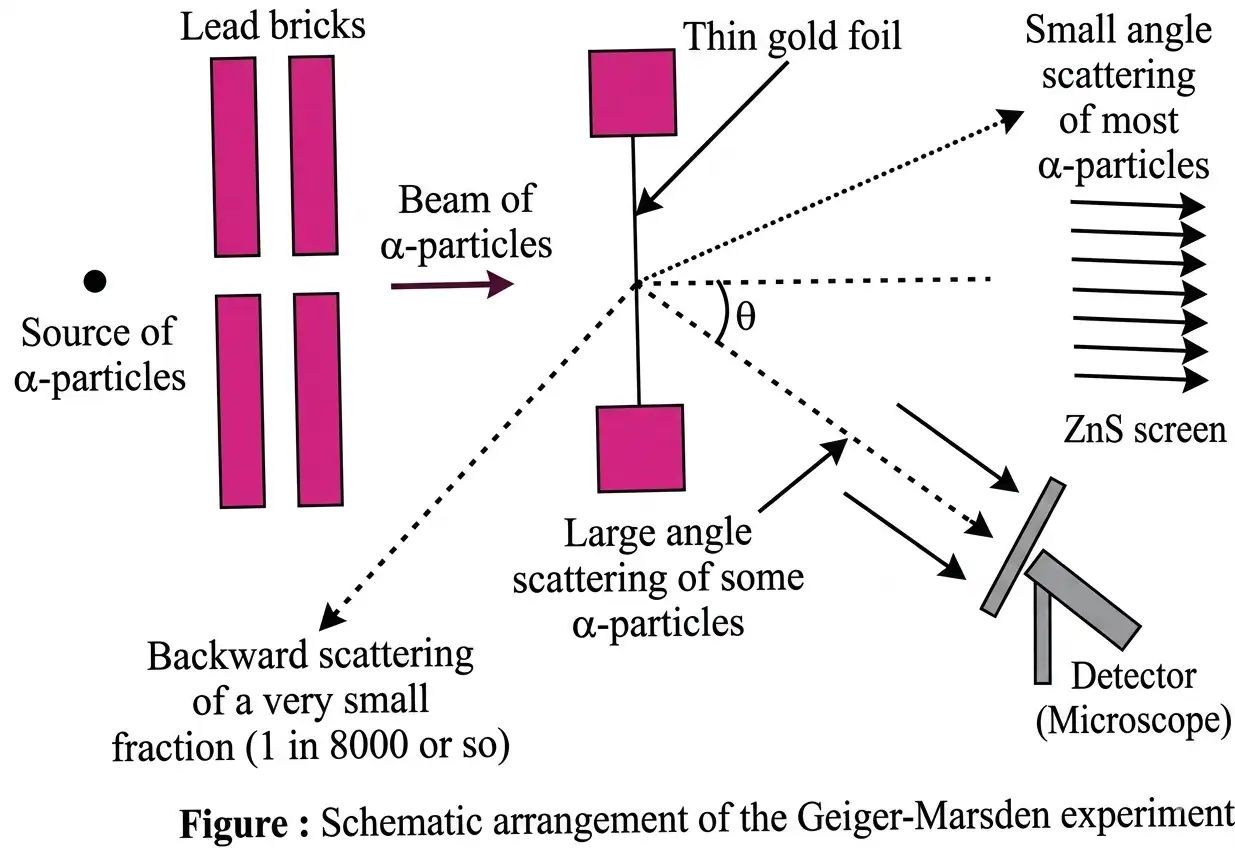
- Performed by Geiger and Marsden under Rutherford's suggestion in 1911.
- 5.5 MeV alpha particles from 21483Bi source directed at thin gold foil (thickness 2.1 × 10⁻⁷ m).
- Alpha particles collimated into narrow beam using lead bricks.
- Scattered particles detected by rotatable zinc sulphide screen and microscope.
- Scintillations on ZnS screen indicate alpha particle impacts.
Observations
- Most alpha particles pass through gold foil undeflected → atom mostly empty space.
- Some alpha particles deflect at various angles → presence of small, dense, positively charged nucleus.
- Very few (1 in 8000) deflect by 180° → nucleus size is very small (~1/8000 of atom size).
- Number of scattered particles N ∝ 1/sin4(θ/2).
Solved Examples
- Ex 1: What does the deflection of alpha particles indicate?
Answer: Presence of a small, dense, positively charged nucleus. - Ex 2: Calculate the ratio of nucleus size to atom size if 1 in 8000 alpha particles deflect by 180°.
Answer: Nucleus size ≈ 1/8000 of atom size.
Practice Set
- Q1: What does most alpha particles passing through gold foil indicate?
A. Atom is solid
B. Atom is mostly empty
C. Atom has no nucleus
D. Alpha particles are absorbed - Q2: The scattering angle of alpha particles depends on:
A. Electron charge
B. Impact parameter
C. Alpha particle mass
D. Foil thickness - Q3: The number of scattered alpha particles N varies with scattering angle θ as:
A. N ∝ sin2 θ
B. N ∝ cos2 θ
C. N ∝ 1/sin4(θ/2)
D. N ∝ tan θ
Answer Key
- Q1: B - Most alpha particles pass through, showing atom is mostly empty.
- Q2: B - Scattering angle depends on impact parameter (distance from nucleus).
- Q3: C - Number of scattered particles varies as 1/sin4(θ/2).
Memory Aids
- Alpha scattering → nucleus discovery.
- Deflection angle ↔ impact parameter.
- N ∝ 1/sin4(θ/2) curve shape.
Experiment Setup
- Performed by Geiger and Marsden under Rutherford's suggestion in 1911.
- 5.5 MeV alpha particles from 21483Bi source directed at thin gold foil (thickness 2.1 × 10⁻⁷ m).
- Alpha particles collimated into narrow beam using lead bricks.
- Scattered particles detected by rotatable zinc sulphide screen and microscope.
- Scintillations on ZnS screen indicate alpha particle impacts.
Observations
- Most alpha particles pass through gold foil undeflected → atom mostly empty space.
- Some alpha particles deflect at various angles → presence of small, dense, positively charged nucleus.
- Very few (1 in 8000) deflect by 180° → nucleus size is very small (~1/8000 of atom size).
- Number of scattered particles N ∝ 1/sin4(θ/2).
Solved Examples
- Ex 1: What does the deflection of alpha particles indicate?
Answer: Presence of a small, dense, positively charged nucleus. - Ex 2: Calculate the ratio of nucleus size to atom size if 1 in 8000 alpha particles deflect by 180°.
Answer: Nucleus size ≈ 1/8000 of atom size.
Practice Set
- Q1: What does most alpha particles passing through gold foil indicate?
A. Atom is solid
B. Atom is mostly empty
C. Atom has no nucleus
D. Alpha particles are absorbed - Q2: The scattering angle of alpha particles depends on:
A. Electron charge
B. Impact parameter
C. Alpha particle mass
D. Foil thickness - Q3: The number of scattered alpha particles N varies with scattering angle θ as:
A. N ∝ sin2 θ
B. N ∝ cos2 θ
C. N ∝ 1/sin4(θ/2)
D. N ∝ tan θ
Answer Key
- Q1: B - Most alpha particles pass through, showing atom is mostly empty.
- Q2: B - Scattering angle depends on impact parameter (distance from nucleus).
- Q3: C - Number of scattered particles varies as 1/sin4(θ/2).
Memory Aids
- Alpha scattering → nucleus discovery.
- Deflection angle ↔ impact parameter.
- N ∝ 1/sin4(θ/2) curve shape.
Experiment Setup
- Performed by Geiger and Marsden under Rutherford's suggestion in 1911.
- 5.5 MeV alpha particles from \(^{214}_{83}Bi\) source directed at thin gold foil (thickness \(2.1 \times 10^{-7}\) m).
- Alpha particles collimated into narrow beam using lead bricks.
- Scattered particles detected by rotatable zinc sulphide screen and microscope.
- Scintillations on ZnS screen indicate alpha particle impacts.
Observations
- Most alpha particles pass through gold foil undeflected → atom mostly empty space.
- Some alpha particles deflect at various angles → presence of small, dense, positively charged nucleus.
- Very few (1 in 8000) deflect by 180° → nucleus size is very small (~1/8000 of atom size).
- Number of scattered particles \(N \propto \frac{1}{\sin^4(\theta/2)}\).
Solved Examples
- Ex 1: What does the deflection of alpha particles indicate?
Answer: Presence of a small, dense, positively charged nucleus. - Ex 2: Calculate the ratio of nucleus size to atom size if 1 in 8000 alpha particles deflect by 180°.
Answer: Nucleus size ≈ \(\frac{1}{8000}\) of atom size.
Practice Set
- Q1: What does most alpha particles passing through gold foil indicate?
A. Atom is solid
B. Atom is mostly empty
C. Atom has no nucleus
D. Alpha particles are absorbed - Q2: The scattering angle of alpha particles depends on:
A. Electron charge
B. Impact parameter
C. Alpha particle mass
D. Foil thickness - Q3: The number of scattered alpha particles \(N\) varies with scattering angle \(\theta\) as:
A. \(N \propto \sin^2 \theta\)
B. \(N \propto \cos^2 \theta\)
C. \(N \propto \frac{1}{\sin^4(\theta/2)}\)
D. \(N \propto \tan \theta\)
Answer Key
- Q1: B - Most alpha particles pass through, showing atom is mostly empty.
- Q2: B - Scattering angle depends on impact parameter (distance from nucleus).
- Q3: C - Number of scattered particles varies as \(1/\sin^4(\theta/2)\).
Memory Aids
- Alpha scattering → nucleus discovery.
- Deflection angle ↔ impact parameter.
- \(N \propto 1/\sin^4(\theta/2)\) curve shape.
Rutherford's Nuclear Model
Postulates
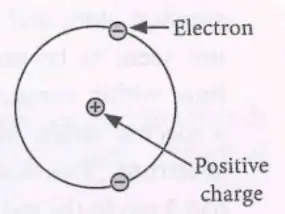
- Positive charge and most mass concentrated in tiny nucleus (~10-14 m diameter).
- Electrons revolve around nucleus in empty space, held by electrostatic attraction.
- Atom is electrically neutral: total positive charge = total negative charge.
Drawbacks
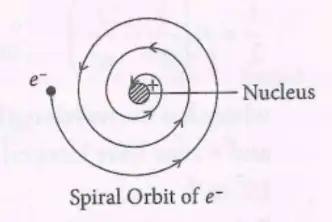
- Accelerated electrons should radiate energy and spiral into nucleus, collapsing atom (not observed).
- Predicted continuous energy spectrum, but actual atomic spectra are discrete.
Solved Examples
- Ex 1: Why does Rutherford model predict atom collapse?
Answer: Accelerated electrons radiate energy, lose it, and spiral into nucleus. - Ex 2: What is the size difference between atom and nucleus?
Answer: Atom ~10-10 m, nucleus ~10-14 m.
Practice Set
- Q1: What is concentrated in the nucleus according to Rutherford?
A. Electrons
B. Positive charge and mass
C. Neutrons only
D. Empty space - Q2: Why does Rutherford model fail to explain atomic stability?
A. Electrons do not revolve
B. Electrons radiate energy and collapse
C. Nucleus is too big
D. Atoms are not neutral - Q3: What type of spectrum does Rutherford model fail to explain?
A. Continuous
B. Discrete
C. Emission
D. Absorption
Answer Key
- Q1: B - Positive charge and mass are concentrated in nucleus.
- Q2: B - Accelerated electrons radiate energy and collapse atom.
- Q3: A - Model predicts continuous spectrum, but actual is discrete.
Memory Aids
- Nucleus = dense positive core.
- Electron spiral collapse = drawback.
- Atom mostly empty space.
Postulates
- Positive charge and most mass concentrated in tiny nucleus (~10-14 m diameter).
- Electrons revolve around nucleus in empty space, held by electrostatic attraction.
- Atom is electrically neutral: total positive charge = total negative charge.
Drawbacks
- Accelerated electrons should radiate energy and spiral into nucleus, collapsing atom (not observed).
- Predicted continuous energy spectrum, but actual atomic spectra are discrete.
Solved Examples
- Ex 1: Why does Rutherford model predict atom collapse?
Answer: Accelerated electrons radiate energy, lose it, and spiral into nucleus. - Ex 2: What is the size difference between atom and nucleus?
Answer: Atom ~10-10 m, nucleus ~10-14 m.
Practice Set
- Q1: What is concentrated in the nucleus according to Rutherford?
A. Electrons
B. Positive charge and mass
C. Neutrons only
D. Empty space - Q2: Why does Rutherford model fail to explain atomic stability?
A. Electrons do not revolve
B. Electrons radiate energy and collapse
C. Nucleus is too big
D. Atoms are not neutral - Q3: What type of spectrum does Rutherford model fail to explain?
A. Continuous
B. Discrete
C. Emission
D. Absorption
Answer Key
- Q1: B - Positive charge and mass are concentrated in nucleus.
- Q2: B - Accelerated electrons radiate energy and collapse atom.
- Q3: A - Model predicts continuous spectrum, but actual is discrete.
Memory Aids
- Nucleus = dense positive core.
- Electron spiral collapse = drawback.
- Atom mostly empty space.
Postulates
- Positive charge and most mass concentrated in tiny nucleus (~\(10^{-14}\) m diameter).
- Electrons revolve around nucleus in empty space, held by electrostatic attraction.
- Atom is electrically neutral: total positive charge = total negative charge.
Drawbacks
- Accelerated electrons should radiate energy and spiral into nucleus, collapsing atom (not observed).
- Predicted continuous energy spectrum, but actual atomic spectra are discrete.
Solved Examples
- Ex 1: Why does Rutherford model predict atom collapse?
Answer: Accelerated electrons radiate energy, lose it, and spiral into nucleus. - Ex 2: What is the size difference between atom and nucleus?
Answer: Atom ~\(10^{-10}\) m, nucleus ~\(10^{-14}\) m.
Practice Set
- Q1: What is concentrated in the nucleus according to Rutherford?
A. Electrons
B. Positive charge and mass
C. Neutrons only
D. Empty space - Q2: Why does Rutherford model fail to explain atomic stability?
A. Electrons do not revolve
B. Electrons radiate energy and collapse
C. Nucleus is too big
D. Atoms are not neutral - Q3: What type of spectrum does Rutherford model fail to explain?
A. Continuous
B. Discrete
C. Emission
D. Absorption
Answer Key
- Q1: B - Positive charge and mass are concentrated in nucleus.
- Q2: B - Accelerated electrons radiate energy and collapse atom.
- Q3: A - Model predicts continuous spectrum, but actual is discrete.
Memory Aids
- Nucleus = dense positive core.
- Electron spiral collapse = drawback.
- Atom mostly empty space.
Electron Orbits
Forces and Energy
- Electrostatic force Fe provides centripetal force Fc for electron orbit.
- Fe = Fc ⇒ 1/(4π ε0) e2/r2 = mv2/r
- Orbit radius: r = e2/(4π ε0mv2)
- Kinetic energy: K = 1/2 mv2 = e2/(8π ε0r)
- Potential energy: U = - e2/(4π ε0r)
- Total energy: E = K + U = - e2/(8π ε0r) (negative, electron bound to nucleus)
Solved Examples
- Ex 1: Calculate orbit radius if electron velocity v is known.
Use r = e2/(4π ε0mv2). - Ex 2: Find total energy of electron in orbit radius r.
Use E = - e2/(8π ε0r).
Practice Set
- Q1: What force keeps electron in orbit?
A. Gravitational
B. Electrostatic attraction
C. Magnetic
D. Nuclear - Q2: Total energy of electron in orbit is:
A. Positive
B. Zero
C. Negative
D. Infinite - Q3: If electron velocity increases, orbit radius:
A. Increases
B. Decreases
C. Remains same
D. Becomes zero
Answer Key
- Q1: B - Electrostatic force provides centripetal force.
- Q2: C - Total energy is negative, electron is bound.
- Q3: B - Radius inversely proportional to square of velocity.
Memory Aids
- Orbit radius r ∝ 1/v2.
- Total energy negative → bound electron.
- Electrostatic force = centripetal force.
Forces and Energy
- Electrostatic force \(F_e\) provides centripetal force \(F_c\) for electron orbit.
- \(F_e = F_c \Rightarrow \frac{1}{4\pi \epsilon_0} \frac{e^2}{r^2} = \frac{mv^2}{r}\)
- Orbit radius: \(r = \frac{e^2}{4\pi \epsilon_0 mv^2}\)
- Kinetic energy: \(K = \frac{1}{2} mv^2 = \frac{e^2}{8\pi \epsilon_0 r}\)
- Potential energy: \(U = - \frac{e^2}{4\pi \epsilon_0 r}\)
- Total energy: \(E = K + U = - \frac{e^2}{8\pi \epsilon_0 r}\) (negative, electron bound to nucleus)
Solved Examples
- Ex 1: Calculate orbit radius if electron velocity \(v\) is known.
Use \(r = \frac{e^2}{4\pi \epsilon_0 mv^2}\). - Ex 2: Find total energy of electron in orbit radius \(r\).
Use \(E = - \frac{e^2}{8\pi \epsilon_0 r}\).
Practice Set
- Q1: What force keeps electron in orbit?
A. Gravitational
B. Electrostatic attraction
C. Magnetic
D. Nuclear - Q2: Total energy of electron in orbit is:
A. Positive
B. Zero
C. Negative
D. Infinite - Q3: If electron velocity increases, orbit radius:
A. Increases
B. Decreases
C. Remains same
D. Becomes zero
Answer Key
- Q1: B - Electrostatic force provides centripetal force.
- Q2: C - Total energy is negative, electron is bound.
- Q3: B - Radius inversely proportional to square of velocity.
Memory Aids
- Orbit radius \(r \propto \frac{1}{v^2}\).
- Total energy negative → bound electron.
- Electrostatic force = centripetal force.
Atomic Spectra
Emission Line Spectrum
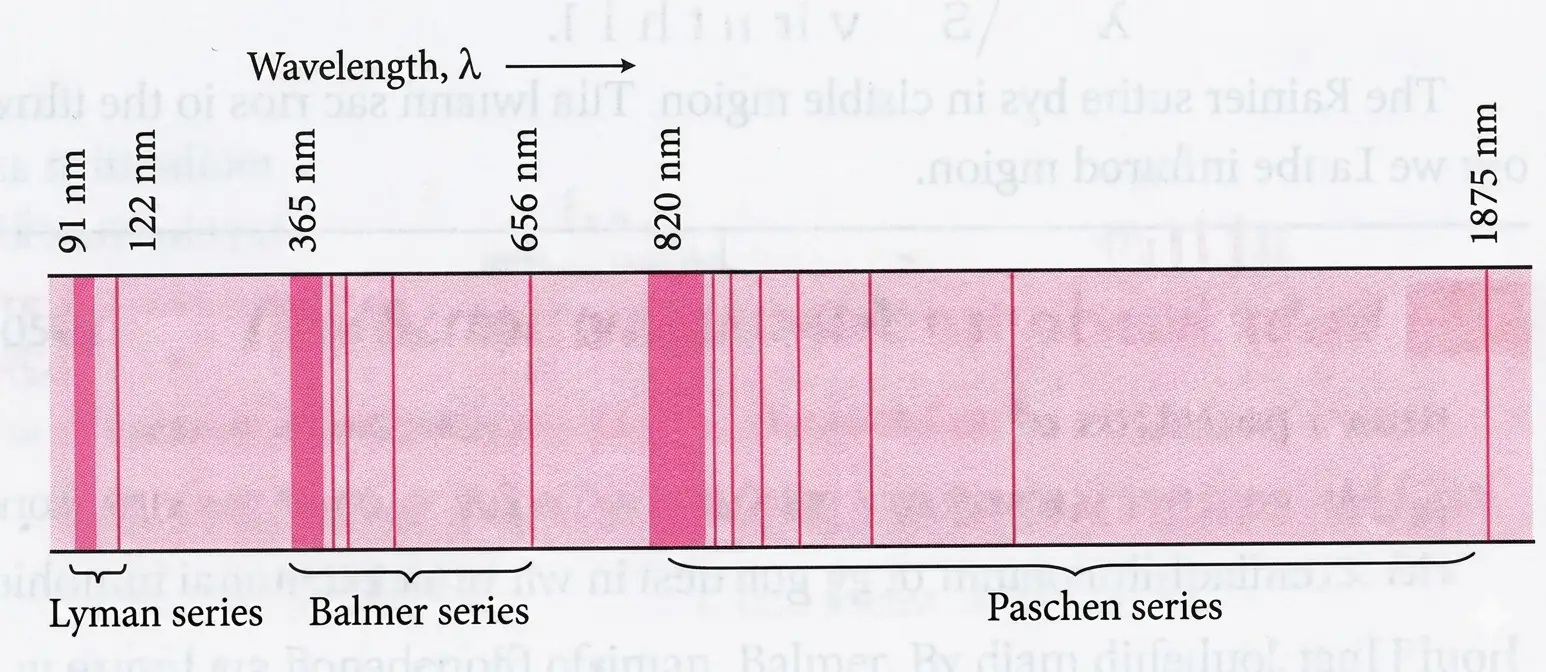
- Excited atomic gas emits radiation at specific wavelengths only.
- Emission line spectrum: bright lines on dark background.
- Example: Hydrogen emission spectrum shows distinct lines.
Explanation of Hydrogen Spectrum
- Electrons change energy levels, emitting light at specific wavelengths.
- Series: Lyman (UV), Balmer (visible), Paschen (IR).
- Lyman: 91-122 nm, Balmer: 365-656 nm, Paschen: 820-1875 nm.
- Each line = electron dropping to lower energy level, releasing photon.
Solved Examples
- Ex 1: Identify the series for a line at 486.1 nm.
Solution: 486.1 nm lies in visible range → Balmer series.
Practice Set
- Q1: Which series of hydrogen spectrum lies in the ultraviolet region?
A. Balmer
B. Paschen
C. Lyman
D. Brackett - Q2: The emission line at 656.3 nm belongs to which series?
A. Lyman
B. Balmer
C. Paschen
D. Pfund - Q3: What happens when an electron falls from n=4 to n=2 in hydrogen?
A. Emits photon in Balmer series
B. Emits photon in Lyman series
C. Absorbs photon
D. Emits photon in Paschen series
Answer Key
- Q1: C - Lyman series is ultraviolet.
- Q2: B - 656.3 nm is Hα line in Balmer series.
- Q3: A - Transition from n=4 to n=2 emits Balmer series photon.
Memory Aids
- Lyman: UV, n=1 final level.
- Balmer: Visible, n=2 final level.
- Paschen: IR, n=3 final level.
Emission Line Spectrum
- Excited atomic gas emits radiation at specific wavelengths only.
- Emission line spectrum: bright lines on dark background.
- Example: Hydrogen emission spectrum shows distinct lines.
Explanation of Hydrogen Spectrum
- Electrons change energy levels, emitting light at specific wavelengths.
- Series: Lyman (UV), Balmer (visible), Paschen (IR).
- Lyman: 91-122 nm, Balmer: 365-656 nm, Paschen: 820-1875 nm.
- Each line = electron dropping to lower energy level, releasing photon.
Solved Examples
- Ex 1: Identify the series for a line at 486.1 nm.
Solution: 486.1 nm lies in visible range → Balmer series.
Practice Set
- Q1: Which series of hydrogen spectrum lies in the ultraviolet region?
A. Balmer
B. Paschen
C. Lyman
D. Brackett - Q2: The emission line at 656.3 nm belongs to which series?
A. Lyman
B. Balmer
C. Paschen
D. Pfund - Q3: What happens when an electron falls from n=4 to n=2 in hydrogen?
A. Emits photon in Balmer series
B. Emits photon in Lyman series
C. Absorbs photon
D. Emits photon in Paschen series
Answer Key
- Q1: C - Lyman series is ultraviolet.
- Q2: B - 656.3 nm is Hα line in Balmer series.
- Q3: A - Transition from n=4 to n=2 emits Balmer series photon.
Memory Aids
- Lyman: UV, n=1 final level.
- Balmer: Visible, n=2 final level.
- Paschen: IR, n=3 final level.
Absorption Spectrum
Key Points
- White light passing through gas shows dark lines at specific wavelengths.
- Dark lines match emission lines of the gas.
- Called absorption spectrum of the gas.
Solved Examples
- Ex 1: Why do dark lines appear in absorption spectrum?
Solution: Gas atoms absorb light at specific wavelengths, causing dark lines.
Practice Set
- Q1: What causes dark lines in absorption spectrum?
A. Emission of light
B. Absorption of specific wavelengths
C. Scattering of light
D. Reflection of light - Q2: Absorption lines correspond to which of the following?
A. Random wavelengths
B. Emission lines of the gas
C. Continuous spectrum
D. Infrared radiation only - Q3: Absorption spectrum is observed when white light passes through?
A. Vacuum
B. Gas
C. Solid
D. Liquid
Answer Key
- Q1: B - Gas absorbs specific wavelengths causing dark lines.
- Q2: B - Absorption lines match emission lines of the gas.
- Q3: B - Absorption spectrum occurs when light passes through gas.
Memory Aids
- Absorption = dark lines, emission = bright lines.
- Absorption lines match emission lines of same gas.
Spectral Series
Definition and Pattern
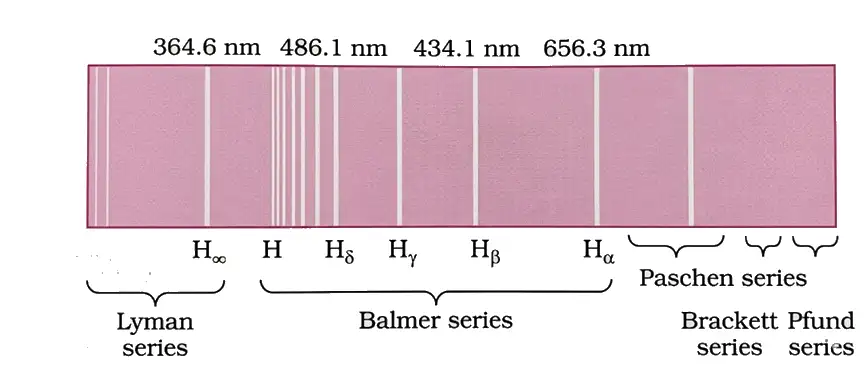
- Light frequencies emitted by elements show regular patterns called spectral series.
- Hydrogen has simplest spectrum with sets of lines called series.
- Balmer series observed in visible region (1885).
- Lines get closer and weaker as wavelength decreases.
- Balmer formula: 1/λ = R ( 1/22 - 1/n2 ), n=3,4,5,...
- R = Rydberg constant = 1.097 × 10⁷ m-1
Spectral Series of Hydrogen
- Lyman: 1/λ = R ( 1/12 - 1/n2 ), n=2,3,4,... (UV)
- Balmer: 1/λ = R ( 1/22 - 1/n2 ), n=3,4,5,... (Visible)
- Paschen: 1/λ = R ( 1/32 - 1/n2 ), n=4,5,6,... (IR)
- Brackett: 1/λ = R ( 1/42 - 1/n2 ), n=5,6,7,... (IR)
- Pfund: 1/λ = R ( 1/52 - 1/n2 ), n=6,7,8,... (IR)
Solved Examples
- Ex 1: Calculate wavelength for Balmer line with n=3.
Solution: 1/λ = R (1/22 - 1/32) = 1.097 × 10⁷ (1/4 - 1/9) = 1.52 × 10⁶ m-1
λ = 6.58 × 10⁻⁷ m = 658 nm
Practice Set
- Q1: Which series corresponds to electron transition to n=1?
A. Balmer
B. Lyman
C. Paschen
D. Brackett - Q2: The Rydberg constant value is?
A. 1.097 × 10⁷ m-1
B. 9.8 m/s2
C. 3 × 10⁸ m/s
D. 6.63 × 10⁻³⁴ Js - Q3: Wavelength of Paschen series line for transition n=5 → n=3 is?
A. Calculate using 1/λ = R (1/32 - 1/52)
B. 656.3 nm
C. 486.1 nm
D. 91.2 nm
Answer Key
- Q1: B - Lyman series ends at n=1.
- Q2: A - Rydberg constant is 1.097 × 10⁷ m-1.
- Q3: A - Use formula 1/λ = R (1/32 - 1/52) to calculate.
Memory Aids
- Series final levels: Lyman=1, Balmer=2, Paschen=3.
- Balmer visible, Lyman UV, others IR.
- Formula: 1/λ = R (1/nf2 - 1/ni2).
Definition and Pattern
- Light frequencies emitted by elements show regular patterns called spectral series.
- Hydrogen has simplest spectrum with sets of lines called series.
- Balmer series observed in visible region (1885).
- Lines get closer and weaker as wavelength decreases.
- Balmer formula: 1/λ = R ( 1/22 - 1/n2 ), n=3,4,5,...
- R = Rydberg constant = 1.097 × 10⁷ m-1
Spectral Series of Hydrogen
- Lyman: 1/λ = R ( 1/12 - 1/n2 ), n=2,3,4,... (UV)
- Balmer: 1/λ = R ( 1/22 - 1/n2 ), n=3,4,5,... (Visible)
- Paschen: 1/λ = R ( 1/32 - 1/n2 ), n=4,5,6,... (IR)
- Brackett: 1/λ = R ( 1/42 - 1/n2 ), n=5,6,7,... (IR)
- Pfund: 1/λ = R ( 1/52 - 1/n2 ), n=6,7,8,... (IR)
Solved Examples
- Ex 1: Calculate wavelength for Balmer line with n=3.
Solution: 1/λ = R (1/22 - 1/32) = 1.097 × 10⁷ (1/4 - 1/9) = 1.52 × 10⁶ m-1
λ = 6.58 × 10⁻⁷ m = 658 nm
Practice Set
- Q1: Which series corresponds to electron transition to n=1?
A. Balmer
B. Lyman
C. Paschen
D. Brackett - Q2: The Rydberg constant value is?
A. 1.097 × 10⁷ m-1
B. 9.8 m/s2
C. 3 × 10⁸ m/s
D. 6.63 × 10⁻³⁴ Js - Q3: Wavelength of Paschen series line for transition n=5 → n=3 is?
A. Calculate using 1/λ = R (1/32 - 1/52)
B. 656.3 nm
C. 486.1 nm
D. 91.2 nm
Answer Key
- Q1: B - Lyman series ends at n=1.
- Q2: A - Rydberg constant is 1.097 × 10⁷ m-1.
- Q3: A - Use formula 1/λ = R (1/32 - 1/52) to calculate.
Memory Aids
- Series final levels: Lyman=1, Balmer=2, Paschen=3.
- Balmer visible, Lyman UV, others IR.
- Formula: 1/λ = R (1/nf2 - 1/ni2).
Definition and Pattern
- Light frequencies emitted by elements show regular patterns called spectral series.
- Hydrogen has simplest spectrum with sets of lines called series.
- Balmer series observed in visible region (1885).
- Lines get closer and weaker as wavelength decreases.
- Balmer formula: \( \frac{1}{\lambda} = R \left( \frac{1}{2^2} - \frac{1}{n^2} \right) \), \( n=3,4,5,... \)
- R = Rydberg constant = \(1.097 \times 10^7 \text{ m}^{-1}\)
Spectral Series of Hydrogen
- Lyman: \( \frac{1}{\lambda} = R \left( \frac{1}{1^2} - \frac{1}{n^2} \right), n=2,3,4,... \) (UV)
- Balmer: \( \frac{1}{\lambda} = R \left( \frac{1}{2^2} - \frac{1}{n^2} \right), n=3,4,5,... \) (Visible)
- Paschen: \( \frac{1}{\lambda} = R \left( \frac{1}{3^2} - \frac{1}{n^2} \right), n=4,5,6,... \) (IR)
- Brackett: \( \frac{1}{\lambda} = R \left( \frac{1}{4^2} - \frac{1}{n^2} \right), n=5,6,7,... \) (IR)
- Pfund: \( \frac{1}{\lambda} = R \left( \frac{1}{5^2} - \frac{1}{n^2} \right), n=6,7,8,... \) (IR)
Solved Examples
- Ex 1: Calculate wavelength for Balmer line with \( n=3 \).
Solution: \( \frac{1}{\lambda} = R (\frac{1}{2^2} - \frac{1}{3^2}) = 1.097 \times 10^7 (\frac{1}{4} - \frac{1}{9}) = 1.52 \times 10^6 \text{ m}^{-1} \)
\( \lambda = 6.58 \times 10^{-7} \text{ m} = 658 \text{ nm} \)
Practice Set
- Q1: Which series corresponds to electron transition to \( n=1 \)?
A. Balmer
B. Lyman
C. Paschen
D. Brackett - Q2: The Rydberg constant value is?
A. \(1.097 \times 10^7 \text{ m}^{-1}\)
B. \(9.8 \text{ m/s}^2\)
C. \(3 \times 10^8 \text{ m/s}\)
D. \(6.63 \times 10^{-34} \text{ Js}\) - Q3: Wavelength of Paschen series line for transition \( n=5 \to n=3 \) is?
A. Calculate using \( \frac{1}{\lambda} = R (\frac{1}{3^2} - \frac{1}{5^2}) \)
B. \( 656.3 \text{ nm} \)
C. \( 486.1 \text{ nm} \)
D. \( 91.2 \text{ nm} \)
Answer Key
- Q1: B - Lyman series ends at \( n=1 \).
- Q2: A - Rydberg constant is \(1.097 \times 10^7 \text{ m}^{-1}\).
- Q3: A - Use formula \( \frac{1}{\lambda} = R (\frac{1}{3^2} - \frac{1}{5^2}) \) to calculate.
Memory Aids
- Series final levels: Lyman=1, Balmer=2, Paschen=3.
- Balmer visible, Lyman UV, others IR.
- Formula: \( \frac{1}{\lambda} = R (\frac{1}{n_f^2} - \frac{1}{n_i^2}) \).
Bohr Model
Bohr's Postulates
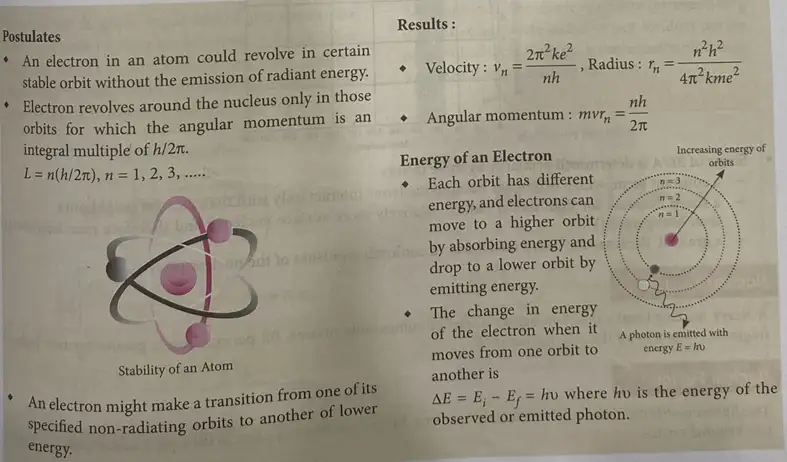
- Electrons revolve in fixed stable orbits without emitting energy.
- Angular momentum of electron in orbit: mvr = n h/2π, where n = 1, 2, 3, ... .
- Electron transitions between orbits emit or absorb energy as photons: hν = Ei - Ef.
- Energy quantization: electrons have discrete energy levels.
Solved Examples
- Ex 1: Calculate angular momentum for n=2: L = 2 × h/2π = 2h/2π.
- Ex 2: Energy of photon emitted when electron falls from n=3 to n=2: hν = E3 - E2.
Practice Set
- Q1: What is the angular momentum of electron in n=1 orbit?
- A) h/2π
- B) h
- C) 2h
- D) Zero
- Q2: When electron jumps from higher to lower orbit, it:
- A) Absorbs energy
- B) Emits energy as photon
- C) Remains same energy
- D) Emits sound
- Q3: Electron in n=3 orbit has angular momentum:
- A) 3 h/2π
- B) h/2π
- C) 2 h/2π
- D) Zero
Answer Key
- Q1: A - By Bohr's postulate, angular momentum is n h/2π, for n=1 it is h/2π.
- Q2: B - Electron emits photon energy when falling to lower orbit.
- Q3: A - Angular momentum is integral multiple of h/2π, here n=3.
Memory Aids
- Angular momentum = n h/2π
- Energy emitted/absorbed = hν = Ei - Ef
- Electron orbits are stable and quantized
Bohr's Postulates
- Electrons revolve in fixed stable orbits without emitting energy.
- Angular momentum of electron in orbit: mvr = n h/2π, where n = 1, 2, 3, ... .
- Electron transitions between orbits emit or absorb energy as photons: hν = Ei - Ef.
- Energy quantization: electrons have discrete energy levels.
Solved Examples
- Ex 1: Calculate angular momentum for n=2: L = 2 × h/2π = 2h/2π.
- Ex 2: Energy of photon emitted when electron falls from n=3 to n=2: hν = E3 - E2.
Practice Set
- Q1: What is the angular momentum of electron in n=1 orbit?
- A) h/2π
- B) h
- C) 2h
- D) Zero
- Q2: When electron jumps from higher to lower orbit, it:
- A) Absorbs energy
- B) Emits energy as photon
- C) Remains same energy
- D) Emits sound
- Q3: Electron in n=3 orbit has angular momentum:
- A) 3 h/2π
- B) h/2π
- C) 2 h/2π
- D) Zero
Answer Key
- Q1: A - By Bohr's postulate, angular momentum is n h/2π, for n=1 it is h/2π.
- Q2: B - Electron emits photon energy when falling to lower orbit.
- Q3: A - Angular momentum is integral multiple of h/2π, here n=3.
Memory Aids
- Angular momentum = n h/2π
- Energy emitted/absorbed = hν = Ei - Ef
- Electron orbits are stable and quantized
Bohr's Postulates
- Electrons revolve in fixed stable orbits without emitting energy.
- Angular momentum of electron in orbit: \( mvr = n \frac{h}{2\pi} \), where \( n = 1, 2, 3, \ldots \).
- Electron transitions between orbits emit or absorb energy as photons: \( h\nu = E_i - E_f \).
- Energy quantization: electrons have discrete energy levels.
Solved Examples
- Ex 1: Calculate angular momentum for \( n=2 \): \( L = 2 \times \frac{h}{2\pi} = \frac{2h}{2\pi} \).
- Ex 2: Energy of photon emitted when electron falls from \( n=3 \) to \( n=2 \): \( h\nu = E_3 - E_2 \).
Practice Set
- Q1: What is the angular momentum of electron in \( n=1 \) orbit?
- A) \( \frac{h}{2\pi} \)
- B) \( h \)
- C) \( 2h \)
- D) Zero
- Q2: When electron jumps from higher to lower orbit, it:
- A) Absorbs energy
- B) Emits energy as photon
- C) Remains same energy
- D) Emits sound
- Q3: Electron in \( n=3 \) orbit has angular momentum:
- A) \( 3 \frac{h}{2\pi} \)
- B) \( \frac{h}{2\pi} \)
- C) \( 2 \frac{h}{2\pi} \)
- D) Zero
Answer Key
- Q1: A - By Bohr's postulate, angular momentum is \( n \frac{h}{2\pi} \), for \( n=1 \) it is \( \frac{h}{2\pi} \).
- Q2: B - Electron emits photon energy when falling to lower orbit.
- Q3: A - Angular momentum is integral multiple of \( \frac{h}{2\pi} \), here \( n=3 \).
Memory Aids
- Angular momentum \( = n \frac{h}{2\pi} \)
- Energy emitted/absorbed \( = h\nu = E_i - E_f \)
- Electron orbits are stable and quantized
Energy Transitions
Electron Orbit Transitions
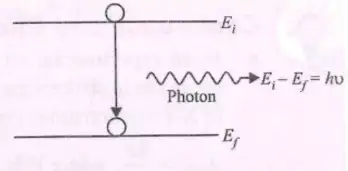
- Electron moves from higher energy Ei to lower Ef orbit emitting photon energy hν = Ei - Ef.
- Photon frequency ν relates to energy difference.
- Energy levels are discrete and quantized.
Solved Examples
- Ex 1: Calculate photon energy when electron falls from E3 = -1.51 eV to E2 = -3.4 eV: hν = |-1.51 - (-3.4)| = 1.89 eV.
Practice Set
- Q1: What happens when electron jumps from higher to lower orbit?
- A) Absorbs photon
- B) Emits photon
- C) No energy change
- D) Emits electron
- Q2: Energy of photon emitted equals:
- A) Ef - Ei
- B) Ei - Ef
- C) Ei + Ef
- D) Zero
- Q3: Electron falls from n=4 to n=2, energy emitted is:
- A) 0.85 - 3.4 eV
- B) 3.4 - 0.85 eV
- C) |-0.85 - (-3.4)| eV
- D) 0 eV
Answer Key
- Q1: B - Electron emits photon when moving to lower orbit.
- Q2: B - Photon energy equals difference Ei - Ef.
- Q3: C - Energy emitted is difference of energy levels.
Memory Aids
- Energy emitted = hν = Ei - Ef
- Photon frequency ν proportional to energy difference
- Electron jumps cause emission or absorption
Electron Orbit Transitions
- Electron moves from higher energy Ei to lower Ef orbit emitting photon energy hν = Ei - Ef.
- Photon frequency ν relates to energy difference.
- Energy levels are discrete and quantized.
Solved Examples
- Ex 1: Calculate photon energy when electron falls from E3 = -1.51 eV to E2 = -3.4 eV: hν = |-1.51 - (-3.4)| = 1.89 eV.
Practice Set
- Q1: What happens when electron jumps from higher to lower orbit?
- A) Absorbs photon
- B) Emits photon
- C) No energy change
- D) Emits electron
- Q2: Energy of photon emitted equals:
- A) Ef - Ei
- B) Ei - Ef
- C) Ei + Ef
- D) Zero
- Q3: Electron falls from n=4 to n=2, energy emitted is:
- A) 0.85 - 3.4 eV
- B) 3.4 - 0.85 eV
- C) |-0.85 - (-3.4)| eV
- D) 0 eV
Answer Key
- Q1: B - Electron emits photon when moving to lower orbit.
- Q2: B - Photon energy equals difference Ei - Ef.
- Q3: C - Energy emitted is difference of energy levels.
Memory Aids
- Energy emitted = hν = Ei - Ef
- Photon frequency ν proportional to energy difference
- Electron jumps cause emission or absorption
Electron Orbit Transitions
- Electron moves from higher energy \( E_i \) to lower \( E_f \) orbit emitting photon energy \( h\nu = E_i - E_f \).
- Photon frequency \( \nu \) relates to energy difference.
- Energy levels are discrete and quantized.
Solved Examples
- Ex 1: Calculate photon energy when electron falls from \( E_3 = -1.51 \text{ eV} \) to \( E_2 = -3.4 \text{ eV} \): \( h\nu = |-1.51 - (-3.4)| = 1.89 \text{ eV} \).
Practice Set
- Q1: What happens when electron jumps from higher to lower orbit?
- A) Absorbs photon
- B) Emits photon
- C) No energy change
- D) Emits electron
- Q2: Energy of photon emitted equals:
- A) \( E_f - E_i \)
- B) \( E_i - E_f \)
- C) \( E_i + E_f \)
- D) Zero
- Q3: Electron falls from \( n=4 \) to \( n=2 \), energy emitted is:
- A) \( 0.85 - 3.4 \text{ eV} \)
- B) \( 3.4 - 0.85 \text{ eV} \)
- C) \( |-0.85 - (-3.4)| \text{ eV} \)
- D) \( 0 \text{ eV} \)
Answer Key
- Q1: B - Electron emits photon when moving to lower orbit.
- Q2: B - Photon energy equals difference \( E_i - E_f \).
- Q3: C - Energy emitted is difference of energy levels.
Memory Aids
- Energy emitted = \( h\nu = E_i - E_f \)
- Photon frequency \( \nu \) proportional to energy difference
- Electron jumps cause emission or absorption
Orbit Radius & Energy Levels
Formulas and Energy Levels
- Centripetal force: mvn2/rn = 1/(4πϵ0) · eZe/rn2
- Angular momentum: Ln = m vn rn = n h/2π
- Radius of nth orbit: rn = n2 h2 ϵ0/(π m e2 Z) = 0.53 n2/Z Å
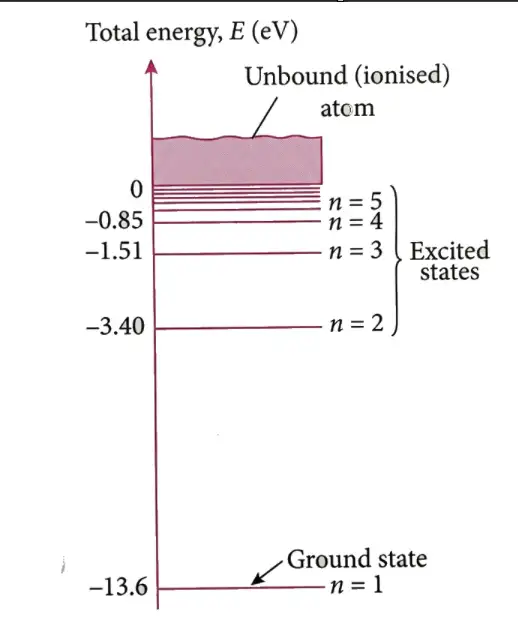
- Energy levels: En = -13.6/n2 eV for hydrogen atom (Z=1)
- Ground state (n=1) energy: -13.6 eV, higher states have less negative energy.
Solved Examples
- Ex 1: Calculate radius for n=2 in hydrogen: r2 = 0.53 × 22/1 = 2.12 Å.
- Ex 2: Energy at n=3: E3 = -13.6/32 = -1.51 eV.
Practice Set
- Q1: Radius of n=1 orbit in hydrogen is:
- A) 0.53 Å
- B) 1.06 Å
- C) 2.12 Å
- D) 0.26 Å
- Q2: Energy of electron in n=4 orbit is:
- A) -0.85 eV
- B) -3.4 eV
- C) -13.6 eV
- D) -1.51 eV
- Q3: Radius rn is proportional to:
- A) n
- B) n2/Z
- C) Z/n2
- D) 1/n
Answer Key
- Q1: A - Bohr radius for hydrogen ground state is 0.53 Å.
- Q2: A - Energy at n=4 is -13.6/42 = -0.85 eV.
- Q3: B - Radius varies as n2/Z.
Memory Aids
- Radius rn = 0.53 n2/Z Å
- Energy En = -13.6/n2 eV
- Ground state energy = -13.6 eV
Formulas and Energy Levels
- Centripetal force: mvn2/rn = 1/(4πϵ0) · eZe/rn2
- Angular momentum: Ln = m vn rn = n h/2π
- Radius of nth orbit: rn = n2 h2 ϵ0/(π m e2 Z) = 0.53 n2/Z Å
- Energy levels: En = -13.6/n2 eV for hydrogen atom (Z=1)
- Ground state (n=1) energy: -13.6 eV, higher states have less negative energy.
Solved Examples
- Ex 1: Calculate radius for n=2 in hydrogen: r2 = 0.53 × 22/1 = 2.12 Å.
- Ex 2: Energy at n=3: E3 = -13.6/32 = -1.51 eV.
Practice Set
- Q1: Radius of n=1 orbit in hydrogen is:
- A) 0.53 Å
- B) 1.06 Å
- C) 2.12 Å
- D) 0.26 Å
- Q2: Energy of electron in n=4 orbit is:
- A) -0.85 eV
- B) -3.4 eV
- C) -13.6 eV
- D) -1.51 eV
- Q3: Radius rn is proportional to:
- A) n
- B) n2/Z
- C) Z/n2
- D) 1/n
Answer Key
- Q1: A - Bohr radius for hydrogen ground state is 0.53 Å.
- Q2: A - Energy at n=4 is -13.6/42 = -0.85 eV.
- Q3: B - Radius varies as n2/Z.
Memory Aids
- Radius rn = 0.53 n2/Z Å
- Energy En = -13.6/n2 eV
- Ground state energy = -13.6 eV
Formulas and Energy Levels
- Centripetal force: \( \frac{mv_n^2}{r_n} = \frac{1}{4\pi\epsilon_0} \frac{eZe}{r_n^2} \)
- Angular momentum: \( L_n = m v_n r_n = n \frac{h}{2\pi} \)
- Radius of nth orbit: \( r_n = \frac{n^2 h^2 \epsilon_0}{\pi m e^2 Z} = 0.53 \frac{n^2}{Z} \text{ Å} \)
- Energy levels: \( E_n = -\frac{13.6}{n^2} \text{ eV} \) for hydrogen atom (Z=1)
- Ground state (n=1) energy: \( -13.6 \text{ eV} \), higher states have less negative energy.
Solved Examples
- Ex 1: Calculate radius for \( n=2 \) in hydrogen: \( r_2 = 0.53 \times \frac{2^2}{1} = 2.12 \text{ Å} \).
- Ex 2: Energy at \( n=3 \): \( E_3 = -\frac{13.6}{3^2} = -1.51 \text{ eV} \).
Practice Set
- Q1: Radius of \( n=1 \) orbit in hydrogen is:
- A) 0.53 Å
- B) 1.06 Å
- C) 2.12 Å
- D) 0.26 Å
- Q2: Energy of electron in \( n=4 \) orbit is:
- A) -0.85 eV
- B) -3.4 eV
- C) -13.6 eV
- D) -1.51 eV
- Q3: Radius \( r_n \) is proportional to:
- A) \( n \)
- B) \( n^2/Z \)
- C) \( Z/n^2 \)
- D) \( 1/n \)
Answer Key
- Q1: A - Bohr radius for hydrogen ground state is 0.53 Å.
- Q2: A - Energy at \( n=4 \) is \( -13.6/4^2 = -0.85 \text{ eV} \).
- Q3: B - Radius varies as \( n^2/Z \).
Memory Aids
- Radius \( r_n = 0.53 \frac{n^2}{Z} \) Å
- Energy \( E_n = -\frac{13.6}{n^2} \) eV
- Ground state energy = -13.6 eV
Energy Quantization
Concept of Energy Quantization
- Electron energy in orbits is discrete, not continuous.
- Only certain energy values allowed for electron in atom.
- Explains stability of atoms and spectral lines.
Solved Examples
- Ex 1: Electron cannot have energy between -13.6 eV and -3.4 eV in hydrogen atom.
Practice Set
- Q1: Energy levels in atom are:
- A) Continuous
- B) Discrete
- C) Random
- D) Infinite
- Q2: Energy quantization explains:
- A) Atomic stability
- B) Continuous spectra
- C) Electron emission only
- D) Nuclear reactions
- Q3: Electron energy between allowed levels is:
- A) Allowed
- B) Forbidden
- C) Random
- D) Infinite
Answer Key
- Q1: B - Energy levels are discrete, not continuous.
- Q2: A - Quantization explains atomic stability and spectra.
- Q3: B - Electron cannot have energy between allowed levels.
Memory Aids
- Energy levels = discrete values only
- Electron jumps cause photon emission/absorption
- Quantization explains atomic spectra
Concept of Energy Quantization
- Electron energy in orbits is discrete, not continuous.
- Only certain energy values allowed for electron in atom.
- Explains stability of atoms and spectral lines.
Solved Examples
- Ex 1: Electron cannot have energy between \( -13.6 \text{ eV} \) and \( -3.4 \text{ eV} \) in hydrogen atom.
Practice Set
- Q1: Energy levels in atom are:
- A) Continuous
- B) Discrete
- C) Random
- D) Infinite
- Q2: Energy quantization explains:
- A) Atomic stability
- B) Continuous spectra
- C) Electron emission only
- D) Nuclear reactions
- Q3: Electron energy between allowed levels is:
- A) Allowed
- B) Forbidden
- C) Random
- D) Infinite
Answer Key
- Q1: B - Energy levels are discrete, not continuous.
- Q2: A - Quantization explains atomic stability and spectra.
- Q3: B - Electron cannot have energy between allowed levels.
Memory Aids
- Energy levels = discrete values only
- Electron jumps cause photon emission/absorption
- Quantization explains atomic spectra
Line Spectra of Hydrogen
Energy Transitions and Rydberg Formula
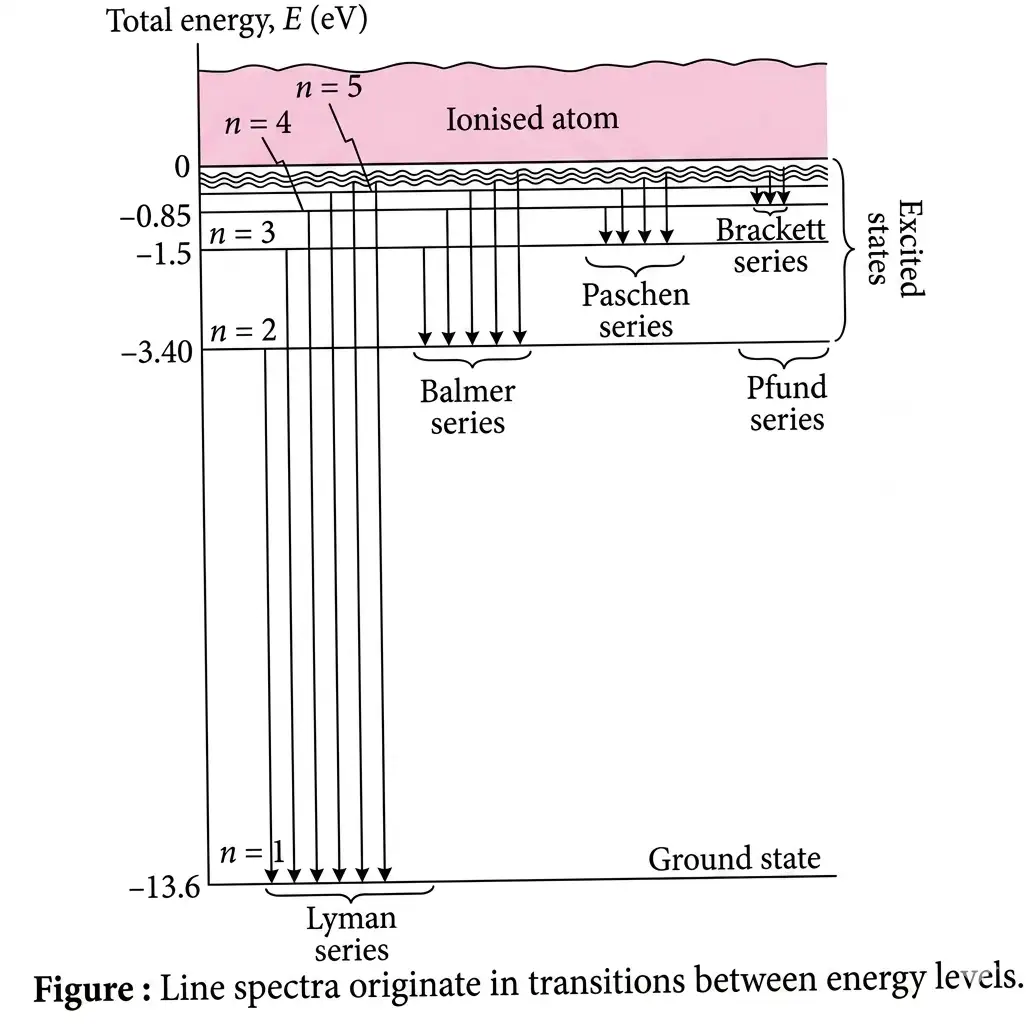
- Electron transitions from higher energy level ni to lower nf emit photon of frequency νif.
- Energy difference: hνif = Eni - Enf = me4/(8ε02h2) (1/nf2 - 1/ni2).
- Frequency formula: νif = me4/(8ε02h3) (1/nf2 - 1/ni2).
- Discrete frequencies arise due to integer quantum numbers ni, nf.
- Series: Lyman (nf=1), Balmer (nf=2), Paschen (nf=3), Brackett (nf=4), Pfund (nf=5).
Solved Examples
- Ex 1: Calculate frequency for transition ni=3 to nf=2 in hydrogen.
- Use ν = me4/(8ε02h3) (1/22 - 1/32).
- Substitute constants and compute ν.
Practice Set
- Q1: Which series corresponds to transitions ending at n=2?
- A. Lyman
- B. Balmer
- C. Paschen
- D. Brackett
- Q2: The frequency of emitted photon for transition ni=4 to nf=1 is proportional to?
- A. 1/12 - 1/42
- B. 1/42 - 1/12
- C. 1/22 - 1/32
- D. 1/32 - 1/22
- Q3: For hydrogen, which series involves transitions to n=3?
- A. Lyman
- B. Balmer
- C. Paschen
- D. Pfund
Answer Key
- Q1: B. Balmer - Transitions ending at n=2 form Balmer series.
- Q2: A. 1/12 - 1/42 - Frequency depends on difference 1/nf2 - 1/ni2.
- Q3: C. Paschen - Transitions to n=3 define Paschen series.
Memory Aids
- Rydberg formula key: ν = R (1/nf2 - 1/ni2).
- Series order: Lyman (1), Balmer (2), Paschen (3), Brackett (4), Pfund (5).
- Higher ni to lower nf emits photon.
Energy Transitions and Rydberg Formula
- Electron transitions from higher energy level ni to lower nf emit photon of frequency νif.
- Energy difference: hνif = Eni - Enf = me4/(8ε02h2) (1/nf2 - 1/ni2).
- Frequency formula: νif = me4/(8ε02h3) (1/nf2 - 1/ni2).
- Discrete frequencies arise due to integer quantum numbers ni, nf.
- Series: Lyman (nf=1), Balmer (nf=2), Paschen (nf=3), Brackett (nf=4), Pfund (nf=5).
Solved Examples
- Ex 1: Calculate frequency for transition ni=3 to nf=2 in hydrogen.
- Use ν = me4/(8ε02h3) (1/22 - 1/32).
- Substitute constants and compute ν.
Practice Set
- Q1: Which series corresponds to transitions ending at n=2?
- A. Lyman
- B. Balmer
- C. Paschen
- D. Brackett
- Q2: The frequency of emitted photon for transition ni=4 to nf=1 is proportional to?
- A. 1/12 - 1/42
- B. 1/42 - 1/12
- C. 1/22 - 1/32
- D. 1/32 - 1/22
- Q3: For hydrogen, which series involves transitions to n=3?
- A. Lyman
- B. Balmer
- C. Paschen
- D. Pfund
Answer Key
- Q1: B. Balmer - Transitions ending at n=2 form Balmer series.
- Q2: A. 1/12 - 1/42 - Frequency depends on difference 1/nf2 - 1/ni2.
- Q3: C. Paschen - Transitions to n=3 define Paschen series.
Memory Aids
- Rydberg formula key: ν = R (1/nf2 - 1/ni2).
- Series order: Lyman (1), Balmer (2), Paschen (3), Brackett (4), Pfund (5).
- Higher ni to lower nf emits photon.
Energy Transitions and Rydberg Formula
- Electron transitions from higher energy level \( n_i \) to lower \( n_f \) emit photon of frequency \( \nu_{if} \).
- Energy difference: \( h\nu_{if} = E_{n_i} - E_{n_f} = \frac{me^4}{8\varepsilon_0^2 h^2} \left( \frac{1}{n_f^2} - \frac{1}{n_i^2} \right) \).
- Frequency formula: \( \nu_{if} = \frac{me^4}{8\varepsilon_0^2 h^3} \left( \frac{1}{n_f^2} - \frac{1}{n_i^2} \right) \).
- Discrete frequencies arise due to integer quantum numbers \( n_i, n_f \).
- Series: Lyman (\( n_f=1 \)), Balmer (\( n_f=2 \)), Paschen (\( n_f=3 \)), Brackett (\( n_f=4 \)), Pfund (\( n_f=5 \)).
Solved Examples
- Ex 1: Calculate frequency for transition \( n_i=3 \) to \( n_f=2 \) in hydrogen.
- Use \( \nu = \frac{me^4}{8\varepsilon_0^2 h^3} \left( \frac{1}{2^2} - \frac{1}{3^2} \right) \).
- Substitute constants and compute \( \nu \).
Practice Set
- Q1: Which series corresponds to transitions ending at \( n=2 \)?
- A. Lyman
- B. Balmer
- C. Paschen
- D. Brackett
- Q2: The frequency of emitted photon for transition \( n_i=4 \) to \( n_f=1 \) is proportional to?
- A. \( \frac{1}{1^2} - \frac{1}{4^2} \)
- B. \( \frac{1}{4^2} - \frac{1}{1^2} \)
- C. \( \frac{1}{2^2} - \frac{1}{3^2} \)
- D. \( \frac{1}{3^2} - \frac{1}{2^2} \)
- Q3: For hydrogen, which series involves transitions to \( n=3 \)?
- A. Lyman
- B. Balmer
- C. Paschen
- D. Pfund
Answer Key
- Q1: B. Balmer - Transitions ending at \( n=2 \) form Balmer series.
- Q2: A. \( \frac{1}{1^2} - \frac{1}{4^2} \) - Frequency depends on difference \( \frac{1}{n_f^2} - \frac{1}{n_i^2} \).
- Q3: C. Paschen - Transitions to \( n=3 \) define Paschen series.
Memory Aids
- Rydberg formula key: \( \nu = R \left( \frac{1}{n_f^2} - \frac{1}{n_i^2} \right) \).
- Series order: Lyman (1), Balmer (2), Paschen (3), Brackett (4), Pfund (5).
- Higher \( n_i \) to lower \( n_f \) emits photon.
Continuous and Characteristic X-rays
X-ray Production and Cutoff Wavelength
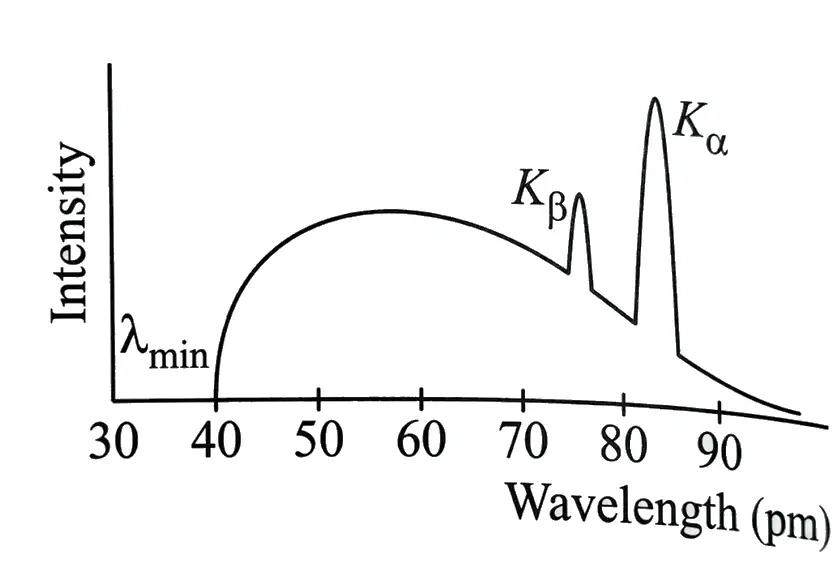
- Electrons accelerated by potential V strike metal target producing X-rays.
- Cutoff wavelength: λmin = hc/eV or λmin (nm) = 1242/V (volt).
- λmin depends only on accelerating voltage, not target material.
Characteristic X-rays and Electron Transitions
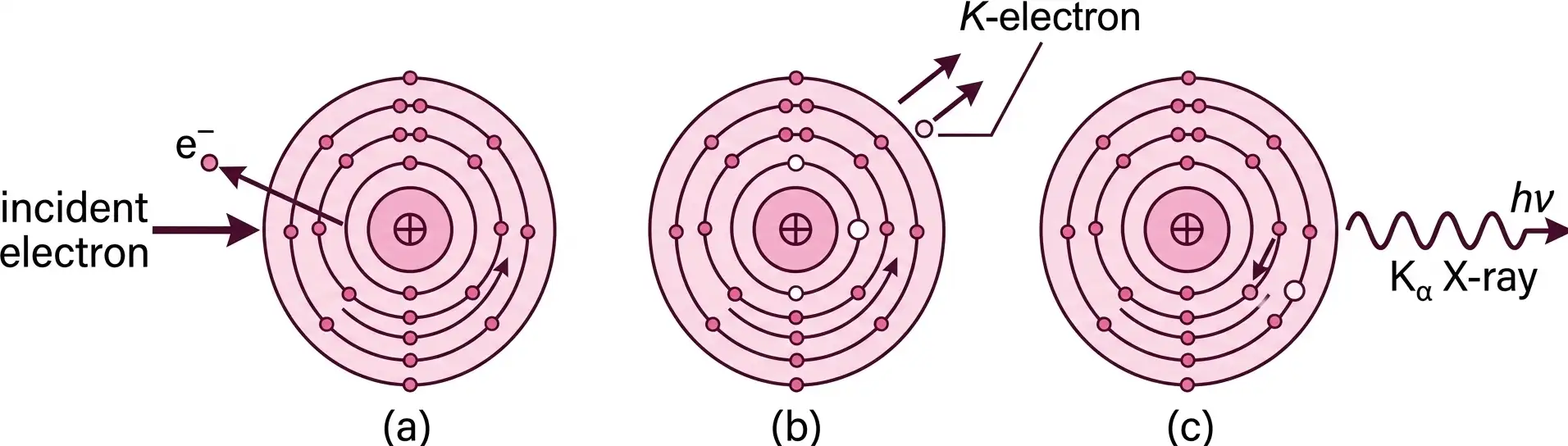
- Incident electron knocks out inner shell electron (K-shell), creating vacancy.
- Electron from higher shell fills vacancy, emitting characteristic X-ray photon.
- Common X-ray lines: Kα, Kβ, Lα.
- Wavelength formulas:
- λ = hc/(EK - EL) for Kα.
- λ = hc/(EK - EM) for Kβ.
- λ = hc/(EL - EM) for Lα.
Solved Examples
- Ex 1: Calculate cutoff wavelength for V=2000 V.
- Use λmin = 1242/V = 1242/2000 = 0.621 nm.
Practice Set
- Q1: Cutoff wavelength λmin depends on?
- A. Target material
- B. Accelerating voltage
- C. Electron mass
- D. Atomic number
- Q2: Characteristic X-rays are produced when?
- A. Electron slows down in target
- B. Electron knocks out inner shell electron
- C. Electron accelerates in vacuum
- D. Electron collides with outer shell electron
- Q3: Wavelength of Kα X-ray is given by?
- A. hc/(EK - EL)
- B. hc/(EL - EM)
- C. hc/(EK - EM)
- D. hc/(EM - EN)
Answer Key
- Q1: B. Accelerating voltage - λmin depends only on V.
- Q2: B. Electron knocks out inner shell electron - characteristic X-rays arise from inner shell vacancies.
- Q3: A. hc/(EK - EL) - Formula for Kα wavelength.
Memory Aids
- λmin = 1242/V nm for cutoff wavelength.
- Characteristic X-rays: electron transitions to inner shell vacancies.
- K, L, M shells correspond to X-ray lines Kα, Kβ, Lα.
X-ray Production and Cutoff Wavelength
- Electrons accelerated by potential V strike metal target producing X-rays.
- Cutoff wavelength: λmin = hc/eV or λmin (nm) = 1242/V (volt).
- λmin depends only on accelerating voltage, not target material.
Characteristic X-rays and Electron Transitions
- Incident electron knocks out inner shell electron (K-shell), creating vacancy.
- Electron from higher shell fills vacancy, emitting characteristic X-ray photon.
- Common X-ray lines: Kα, Kβ, Lα.
- Wavelength formulas:
- λ = hc/(EK - EL) for Kα.
- λ = hc/(EK - EM) for Kβ.
- λ = hc/(EL - EM) for Lα.
Solved Examples
- Ex 1: Calculate cutoff wavelength for V=2000 V.
- Use λmin = 1242/V = 1242/2000 = 0.621 nm.
Practice Set
- Q1: Cutoff wavelength λmin depends on?
- A. Target material
- B. Accelerating voltage
- C. Electron mass
- D. Atomic number
- Q2: Characteristic X-rays are produced when?
- A. Electron slows down in target
- B. Electron knocks out inner shell electron
- C. Electron accelerates in vacuum
- D. Electron collides with outer shell electron
- Q3: Wavelength of Kα X-ray is given by?
- A. hc/(EK - EL)
- B. hc/(EL - EM)
- C. hc/(EK - EM)
- D. hc/(EM - EN)
Answer Key
- Q1: B. Accelerating voltage - λmin depends only on V.
- Q2: B. Electron knocks out inner shell electron - characteristic X-rays arise from inner shell vacancies.
- Q3: A. hc/(EK - EL) - Formula for Kα wavelength.
Memory Aids
- λmin = 1242/V nm for cutoff wavelength.
- Characteristic X-rays: electron transitions to inner shell vacancies.
- K, L, M shells correspond to X-ray lines Kα, Kβ, Lα.
X-ray Production and Cutoff Wavelength
- Electrons accelerated by potential \( V \) strike metal target producing X-rays.
- Cutoff wavelength: \( \lambda_{min} = \frac{hc}{eV} \) or \( \lambda_{min} (nm) = \frac{1242}{V (volt)} \).
- \( \lambda_{min} \) depends only on accelerating voltage, not target material.
Characteristic X-rays and Electron Transitions
- Incident electron knocks out inner shell electron (K-shell), creating vacancy.
- Electron from higher shell fills vacancy, emitting characteristic X-ray photon.
- Common X-ray lines: \( K_\alpha, K_\beta, L_\alpha \).
- Wavelength formulas:
- \( \lambda = \frac{hc}{E_K - E_L} \) for \( K_\alpha \).
- \( \lambda = \frac{hc}{E_K - E_M} \) for \( K_\beta \).
- \( \lambda = \frac{hc}{E_L - E_M} \) for \( L_\alpha \).
Solved Examples
- Ex 1: Calculate cutoff wavelength for \( V=2000 \) V.
- Use \( \lambda_{min} = \frac{1242}{V} = \frac{1242}{2000} = 0.621 \) nm.
Practice Set
- Q1: Cutoff wavelength \( \lambda_{min} \) depends on?
- A. Target material
- B. Accelerating voltage
- C. Electron mass
- D. Atomic number
- Q2: Characteristic X-rays are produced when?
- A. Electron slows down in target
- B. Electron knocks out inner shell electron
- C. Electron accelerates in vacuum
- D. Electron collides with outer shell electron
- Q3: Wavelength of \( K_\alpha \) X-ray is given by?
- A. \( \frac{hc}{E_K - E_L} \)
- B. \( \frac{hc}{E_L - E_M} \)
- C. \( \frac{hc}{E_K - E_M} \)
- D. \( \frac{hc}{E_M - E_N} \)
Answer Key
- Q1: B. Accelerating voltage - \( \lambda_{min} \) depends only on \( V \).
- Q2: B. Electron knocks out inner shell electron - characteristic X-rays arise from inner shell vacancies.
- Q3: A. \( \frac{hc}{E_K - E_L} \) - Formula for \( K_\alpha \) wavelength.
Memory Aids
- \( \lambda_{min} = \frac{1242}{V} \) nm for cutoff wavelength.
- Characteristic X-rays: electron transitions to inner shell vacancies.
- K, L, M shells correspond to X-ray lines \( K_\alpha, K_\beta, L_\alpha \).
De-Broglie Explanation of Bohr’s Second Postulate
Concepts
- Bohr’s second postulate: Angular momentum quantised as Ln = n h/2π, n=1,2,3...
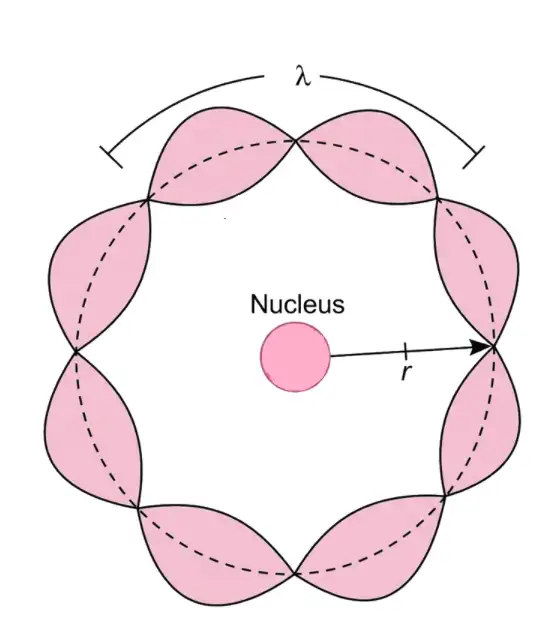
- De Broglie hypothesis: Electron behaves as a particle wave in circular orbit.
- Standing waves form when orbit circumference equals integral multiples of wavelength: n λ = 2π rn
- De Broglie wavelength: λ = h/mvn
- From n λ = 2π rn and λ = h/mvn, get m vn rn = n h/2π (Bohr’s quantisation)
- Only orbits with standing waves (resonant condition) are allowed.
Solved Examples
- Ex 1: Find angular momentum for n=2 orbit.
- Use Ln = n h/2π
- L2 = 2 h/2π = h/π
Practice Set
- Q1: What is the de Broglie wavelength formula?
- A) λ = h/mv
- B) λ = mv
- C) λ = mv/h
- D) λ = h v
- Q2: For an electron in 3rd orbit, circumference is:
- A) 2π r3
- B) 3 λ
- C) Both A and B
- D) None
- Q3: Angular momentum for n=1 orbit is:
- A) h/2π
- B) h
- C) 2π h
- D) h/π
Answer Key
- Q1: A - De Broglie wavelength is λ = h/mv.
- Q2: C - Circumference equals n λ, so both are equal.
- Q3: A - For n=1, L = h/2π.
Memory Aids
- Angular momentum quantised as multiples of h/2π.
- Standing waves form only if orbit circumference = integral × wavelength.
- De Broglie wavelength λ = h/mv.
Concepts
- Bohr’s second postulate: Angular momentum quantised as Ln = n h/2π, n=1,2,3...
- De Broglie hypothesis: Electron behaves as a particle wave in circular orbit.
- Standing waves form when orbit circumference equals integral multiples of wavelength: n λ = 2π rn
- De Broglie wavelength: λ = h/mvn
- From n λ = 2π rn and λ = h/mvn, get m vn rn = n h/2π (Bohr’s quantisation)
- Only orbits with standing waves (resonant condition) are allowed.
Solved Examples
- Ex 1: Find angular momentum for n=2 orbit.
- Use Ln = n h/2π
- L2 = 2 h/2π = h/π
Practice Set
- Q1: What is the de Broglie wavelength formula?
- A) λ = h/mv
- B) λ = mv
- C) λ = mv/h
- D) λ = h v
- Q2: For an electron in 3rd orbit, circumference is:
- A) 2π r3
- B) 3 λ
- C) Both A and B
- D) None
- Q3: Angular momentum for n=1 orbit is:
- A) h/2π
- B) h
- C) 2π h
- D) h/π
Answer Key
- Q1: A - De Broglie wavelength is λ = h/mv.
- Q2: C - Circumference equals n λ, so both are equal.
- Q3: A - For n=1, L = h/2π.
Memory Aids
- Angular momentum quantised as multiples of h/2π.
- Standing waves form only if orbit circumference = integral × wavelength.
- De Broglie wavelength λ = h/mv.
Concepts
- Bohr’s second postulate: Angular momentum quantised as \( L_n = \frac{n h}{2\pi} \), \( n=1,2,3... \)
- De Broglie hypothesis: Electron behaves as a particle wave in circular orbit.
- Standing waves form when orbit circumference equals integral multiples of wavelength: \( n \lambda = 2\pi r_n \)
- De Broglie wavelength: \( \lambda = \frac{h}{mv_n} \)
- From \( n \lambda = 2\pi r_n \) and \( \lambda = \frac{h}{mv_n} \), get \( m v_n r_n = \frac{n h}{2\pi} \) (Bohr’s quantisation)
- Only orbits with standing waves (resonant condition) are allowed.
Solved Examples
- Ex 1: Find angular momentum for \( n=2 \) orbit.
- Use \( L_n = \frac{n h}{2\pi} \)
- \( L_2 = \frac{2 h}{2\pi} = \frac{h}{\pi} \)
Practice Set
- Q1: What is the de Broglie wavelength formula?
- A) \( \lambda = \frac{h}{mv} \)
- B) \( \lambda = mv \)
- C) \( \lambda = \frac{mv}{h} \)
- D) \( \lambda = h v \)
- Q2: For an electron in 3rd orbit, circumference is:
- A) \( 2\pi r_3 \)
- B) \( 3 \lambda \)
- C) Both A and B
- D) None
- Q3: Angular momentum for \( n=1 \) orbit is:
- A) \( \frac{h}{2\pi} \)
- B) \( h \)
- C) \( 2\pi h \)
- D) \( \frac{h}{\pi} \)
Answer Key
- Q1: A - De Broglie wavelength is \( \lambda = \frac{h}{mv} \).
- Q2: C - Circumference equals \( n \lambda \), so both are equal.
- Q3: A - For \( n=1 \), \( L = \frac{h}{2\pi} \).
Memory Aids
- Angular momentum quantised as multiples of \( \frac{h}{2\pi} \).
- Standing waves form only if orbit circumference = integral \( \times \) wavelength.
- De Broglie wavelength \( \lambda = \frac{h}{mv} \).
Limitations of Bohr’s Theory
Concepts
- Valid only for single-electron atoms (H, He+, Li2+).
- Cannot explain fine structure of spectral lines.
- Fails to explain molecular bonding and stability.
- Cannot fully explain Zeeman and Stark effects.
- Does not explain electron distribution in orbits.
- Ignores electron-electron interactions in multi-electron atoms.
- Cannot explain intensity variations in hydrogen emission spectrum.
Solved Examples
- Ex 1: Identify if Bohr’s theory applies to He atom.
- He has 2 electrons → multi-electron atom.
- Bohr’s theory fails here.
Practice Set
- Q1: Bohr’s theory is valid for:
- A) Multi-electron atoms
- B) Single-electron atoms
- C) Molecules
- D) None
- Q2: Which effect is NOT explained by Bohr’s theory?
- A) Zeeman effect
- B) Stark effect
- C) Fine structure
- D) All of the above
- Q3: Bohr’s theory ignores:
- A) Electron-nucleus force
- B) Electron-electron force
- C) Nuclear force
- D) Gravitational force
Answer Key
- Q1: B - Valid only for single-electron atoms.
- Q2: D - Bohr’s theory fails to explain all listed effects.
- Q3: B - Ignores electron-electron interactions.
Memory Aids
- Bohr’s model = single-electron only.
- Fails for fine structure, Zeeman, Stark effects.
- Ignores electron-electron repulsion.
Moseley’s Law
Concepts
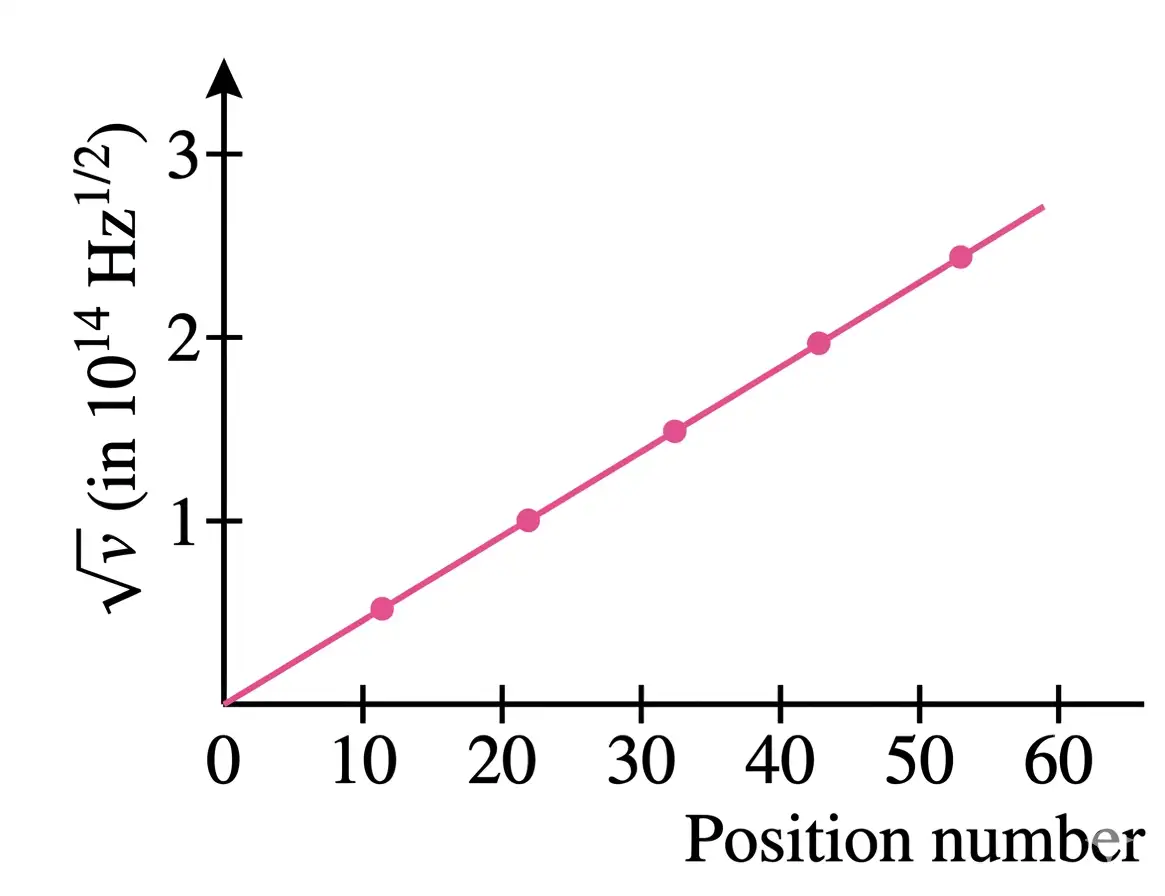
- X-ray frequency relation: √ν = a(Z - b)
- Constants a, b; b ≈ 1
- Bohr’s model fits if Z replaced by Z - b
- Energy released for n=2 → n=1: ΔE = h ν = R h c (Z - b)2 (1 - 1/4)
Solved Examples
- Ex 1: Calculate √ν for Z=30, b=1, a=constant.
- √ν = a(Z - b) = a(30 - 1) = 29a
Practice Set
- Q1: Moseley’s law relates √ν to:
- A) Atomic number Z
- B) Z - b
- C) Wavelength λ
- D) Energy E
- Q2: In Moseley’s law, constant b is approximately:
- A) 0
- B) 1
- C) 2
- D) 3
- Q3: Energy released in transition n=2 → n=1 depends on:
- A) (Z - b)2
- B) Z2
- C) b2
- D) None
Answer Key
- Q1: B - Frequency depends on effective atomic number Z - b.
- Q2: B - Constant b ≈ 1.
- Q3: A - Energy depends on square of Z - b.
Memory Aids
- √ν linear with Z - b.
- b ≈ 1 adjusts atomic number.
- Energy ∝ (Z - b)2.
Concepts
- X-ray frequency relation: √ν = a(Z - b)
- Constants a, b; b ≈ 1
- Bohr’s model fits if Z replaced by Z - b
- Energy released for n=2 → n=1: ΔE = h ν = R h c (Z - b)2 (1 - 1/4)
Solved Examples
- Ex 1: Calculate √ν for Z=30, b=1, a=constant.
- √ν = a(Z - b) = a(30 - 1) = 29a
Practice Set
- Q1: Moseley’s law relates √ν to:
- A) Atomic number Z
- B) Z - b
- C) Wavelength λ
- D) Energy E
- Q2: In Moseley’s law, constant b is approximately:
- A) 0
- B) 1
- C) 2
- D) 3
- Q3: Energy released in transition n=2 → n=1 depends on:
- A) (Z - b)2
- B) Z2
- C) b2
- D) None
Answer Key
- Q1: B - Frequency depends on effective atomic number Z - b.
- Q2: B - Constant b ≈ 1.
- Q3: A - Energy depends on square of Z - b.
Memory Aids
- √ν linear with Z - b.
- b ≈ 1 adjusts atomic number.
- Energy ∝ (Z - b)2.
Concepts
- X-ray frequency relation: \( \sqrt{\nu} = a(Z - b) \)
- Constants \( a, b \); \( b \approx 1 \)
- Bohr’s model fits if \( Z \) replaced by \( Z - b \)
- Energy released for \( n=2 \to n=1 \): \( \Delta E = h \nu = R h c (Z - b)^2 (1 - \frac{1}{4}) \)
Solved Examples
- Ex 1: Calculate \( \sqrt{\nu} \) for \( Z=30, b=1, a=constant \).
- \( \sqrt{\nu} = a(Z - b) = a(30 - 1) = 29a \)
Practice Set
- Q1: Moseley’s law relates \( \sqrt{\nu} \) to:
- A) Atomic number \( Z \)
- B) \( Z - b \)
- C) Wavelength \( \lambda \)
- D) Energy \( E \)
- Q2: In Moseley’s law, constant \( b \) is approximately:
- A) 0
- B) 1
- C) 2
- D) 3
- Q3: Energy released in transition \( n=2 \to n=1 \) depends on:
- A) \( (Z - b)^2 \)
- B) \( Z^2 \)
- C) \( b^2 \)
- D) None
Answer Key
- Q1: B - Frequency depends on effective atomic number \( Z - b \).
- Q2: B - Constant \( b \approx 1 \).
- Q3: A - Energy depends on square of \( Z - b \).
Memory Aids
- \( \sqrt{\nu} \) linear with \( Z - b \).
- \( b \approx 1 \) adjusts atomic number.
- Energy \( \propto (Z - b)^2 \).
Bragg’s Law
Concepts
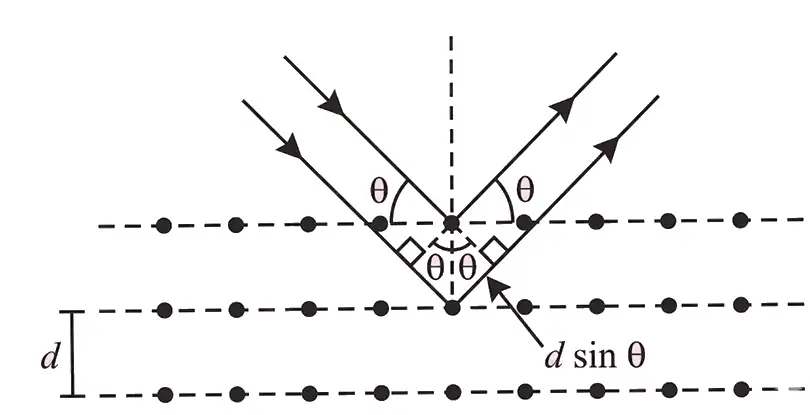
- Condition for X-ray diffraction: 2 d sin θ = n λ
- n: order of spectrum (1,2,3...)
- d: distance between crystal planes (m)
- θ: glancing angle
- λ: X-ray wavelength (m)
- Path difference between waves: d sin θ
- Constructive interference occurs when path difference = integral multiples of wavelength.
Solved Examples
- Ex 1: Calculate θ for first order diffraction with d=0.2 nm, λ=0.1 nm.
- Use 2 d sin θ = n λ
- 2 × 0.2 × sin θ = 1 × 0.1 → sin θ = 0.25
- θ = sin-1 0.25 = 14.48°
Practice Set
- Q1: Bragg’s law formula is:
- A) 2 d sin θ = n λ
- B) d = 2 λ sin θ
- C) n = 2 d sin θ
- D) λ = 2 d sin θ
- Q2: In Bragg’s law, d is:
- A) Distance between atoms
- B) Distance between adjacent planes
- C) Wavelength
- D) Glancing angle
- Q3: For n=2, d=0.3 nm, λ=0.15 nm, find θ.
- A) 30°
- B) 45°
- C) 60°
- D) 90°
Answer Key
- Q1: A - Bragg’s law is 2 d sin θ = n λ.
- Q2: B - d is distance between adjacent crystal planes.
- Q3: A - 2 × 0.3 × sin θ = 2 × 0.15 → sin θ = 0.5 → θ = 30°.
Memory Aids
- Bragg’s law: 2 d sin θ = n λ.
- d = interplanar spacing.
- Constructive interference requires path difference = integral multiples of wavelength.
Concepts
- Condition for X-ray diffraction: 2 d sin θ = n λ
- n: order of spectrum (1,2,3...)
- d: distance between crystal planes (m)
- θ: glancing angle
- λ: X-ray wavelength (m)
- Path difference between waves: d sin θ
- Constructive interference occurs when path difference = integral multiples of wavelength.
Solved Examples
- Ex 1: Calculate θ for first order diffraction with d=0.2 nm, λ=0.1 nm.
- Use 2 d sin θ = n λ
- 2 × 0.2 × sin θ = 1 × 0.1 → sin θ = 0.25
- θ = sin-1 0.25 = 14.48°
Practice Set
- Q1: Bragg’s law formula is:
- A) 2 d sin θ = n λ
- B) d = 2 λ sin θ
- C) n = 2 d sin θ
- D) λ = 2 d sin θ
- Q2: In Bragg’s law, d is:
- A) Distance between atoms
- B) Distance between adjacent planes
- C) Wavelength
- D) Glancing angle
- Q3: For n=2, d=0.3 nm, λ=0.15 nm, find θ.
- A) 30°
- B) 45°
- C) 60°
- D) 90°
Answer Key
- Q1: A - Bragg’s law is 2 d sin θ = n λ.
- Q2: B - d is distance between adjacent crystal planes.
- Q3: A - 2 × 0.3 × sin θ = 2 × 0.15 → sin θ = 0.5 → θ = 30°.
Memory Aids
- Bragg’s law: 2 d sin θ = n λ.
- d = interplanar spacing.
- Constructive interference requires path difference = integral multiples of wavelength.
Concepts
- Condition for X-ray diffraction: \( 2 d \sin \theta = n \lambda \)
- \( n \): order of spectrum (1,2,3...)
- \( d \): distance between crystal planes (m)
- \( \theta \): glancing angle
- \( \lambda \): X-ray wavelength (m)
- Path difference between waves: \( d \sin \theta \)
- Constructive interference occurs when path difference = integral multiples of wavelength.
Solved Examples
- Ex 1: Calculate \( \theta \) for first order diffraction with \( d=0.2 \text{ nm} \), \( \lambda=0.1 \text{ nm} \).
- Use \( 2 d \sin \theta = n \lambda \)
- \( 2 \times 0.2 \times \sin \theta = 1 \times 0.1 \Rightarrow \sin \theta = 0.25 \)
- \( \theta = \sin^{-1} 0.25 = 14.48^\circ \)
Practice Set
- Q1: Bragg’s law formula is:
- A) \( 2 d \sin \theta = n \lambda \)
- B) \( d = 2 \lambda \sin \theta \)
- C) \( n = 2 d \sin \theta \)
- D) \( \lambda = 2 d \sin \theta \)
- Q2: In Bragg’s law, \( d \) is:
- A) Distance between atoms
- B) Distance between adjacent planes
- C) Wavelength
- D) Glancing angle
- Q3: For \( n=2 \), \( d=0.3 \text{ nm} \), \( \lambda=0.15 \text{ nm} \), find \( \theta \).
- A) 30°
- B) 45°
- C) 60°
- D) 90°
Answer Key
- Q1: A - Bragg’s law is \( 2 d \sin \theta = n \lambda \).
- Q2: B - \( d \) is distance between adjacent crystal planes.
- Q3: A - \( 2 \times 0.3 \times \sin \theta = 2 \times 0.15 \Rightarrow \sin \theta = 0.5 \Rightarrow \theta = 30^\circ \).
Memory Aids
- Bragg’s law: \( 2 d \sin \theta = n \lambda \).
- \( d \) = interplanar spacing.
- Constructive interference requires path difference = integral multiples of wavelength.
NEET Physics — ALL CHAPTERS
1
Basic Mathematics
2
Units and Measurement
3
Motion in a Straight Line
4
Motion in a Plane
5
Laws of Motion
6
Work, Energy and Power
7
System of Particles and Rotational Motion
8
Gravitation
9
Mechanical Properties of Solids
10
Mechanical Properties of Fluids
11
Thermal Properties of Matter
12
Thermodynamics
13
Kinetic Theory
14
Oscillations
15
Waves
16
Electric Charges and Fields
17
Electrostatic Potential and Capacitance
18
Current Electricity
19
Moving Charges and Magnetism
20
Magnetism and Matter
21
Electromagnetic Induction
22
Alternating Current
23
Electromagnetic Waves
24
Ray Optics and Optical Instruments
25
Wave Optics
26
Dual Nature of Radiation and Matter
27
Atoms
28
Nuclei
29
Semiconductor Electronics: Materials, Devices and Simple Circuits