Introduction
Key Points
- Positive charge and mass concentrated in nucleus at atom's center.
- Volume of nucleus ≈ 10-15 times volume of atom.
- Atom is mostly empty space.
- Chapter covers nuclear size, mass, stability, radioactivity, fission, fusion.
Solved Examples
Practice Set
- Q1: What fraction of an atom's volume is occupied by its nucleus?
- A) 10-10
- B) 10-15
- C) 10-5
- D) 10-20
- Q2: The nucleus contains
- A) Only electrons
- B) Protons and neutrons
- C) Only protons
- D) Electrons and neutrons
- Q3: Which phenomenon is NOT related to the nucleus?
- A) Radioactivity
- B) Fission
- C) Chemical bonding
- D) Fusion
Answer Key
- Q1: B - Nucleus volume is about 10-15 times the atom's volume.
- Q2: B - Nucleus contains protons and neutrons (nucleons).
- Q3: C - Chemical bonding involves electrons, not nucleus.
Memory Aids
- Remember: Atom = mostly empty, nucleus tiny but dense.
- 10-15 volume ratio is key fact.
- Nucleus = protons + neutrons only.
Atomic Masses and Composition of Nucleus
Atomic Mass
- Average atomic mass = weighted average of isotopes' masses.
- 1 amu = 1/12 × mass of carbon-12 atom = 1.660539 × 10⁻²⁷ kg.
- 1 amu = 931 MeV/c2 (energy equivalent).
Composition of Nucleus
- Nucleons = protons + neutrons.
- Atomic number Z = number of protons.
- Mass number A = Z + N (protons + neutrons).
- Nuclear mass = total mass of protons and neutrons.
- Nuclide notation: AZX, where X = element symbol.
Properties of Nucleons
- Proton (p): charge +e, mass ~1 amu, rest energy ~938 MeV.
- Neutron (n): charge 0, mass ~1 amu, rest energy ~940 MeV.

Solved Examples
- Ex 1: Calculate mass of nucleus with 6 protons and 6 neutrons.
- Mass = (6 + 6) × 1 amu = 12 amu
Practice Set
- Q1: 1 amu equals
- A) 1.660539 × 10⁻²⁷ kg
- B) 1.992647 × 10⁻²⁶ kg
- C) 931 MeV/c2
- D) Both A and C
- Q2: Atomic number Z is
- A) Number of neutrons
- B) Number of protons
- C) Sum of protons and neutrons
- D) Number of electrons
- Q3: Nuclide notation AZX means
- A) A = atomic number, Z = mass number
- B) Z = atomic number, A = mass number
- C) A = number of protons, Z = number of neutrons
- D) X = neutron symbol
Answer Key
- Q1: D - 1 amu = 1.660539 × 10⁻²⁷ kg and 931 MeV/c2.
- Q2: B - Atomic number is number of protons.
- Q3: B - Z is atomic number, A is mass number.
Memory Aids
- 1 amu = mass of 12C atom / 12.
- Atomic number = protons; Mass number = protons + neutrons.
- Nuclide notation: AZX.
Atomic Mass
- Average atomic mass = weighted average of isotopes' masses.
- 1 amu = (1/12) × mass of carbon-12 atom = 1.660539 × 10⁻²⁷ kg.
- 1 amu = 931 MeV/c2 (energy equivalent).
Composition of Nucleus
- Nucleons = protons + neutrons.
- Atomic number Z = number of protons.
- Mass number A = Z + N (protons + neutrons).
- Nuclear mass = total mass of protons and neutrons.
- Nuclide notation: AZX, where X = element symbol.
Properties of Nucleons
- Proton (p): charge +e, mass ~1 amu, rest energy ~938 MeV.
- Neutron (n): charge 0, mass ~1 amu, rest energy ~940 MeV.
Solved Examples
- Ex 1: Calculate mass of nucleus with 6 protons and 6 neutrons.
- Mass = (6 + 6) × 1 amu = 12 amu
Practice Set
- Q1: 1 amu equals
- A) 1.660539 × 10⁻²⁷ kg
- B) 1.992647 × 10⁻²⁶ kg
- C) 931 MeV/c2
- D) Both A and C
- Q2: Atomic number Z is
- A) Number of neutrons
- B) Number of protons
- C) Sum of protons and neutrons
- D) Number of electrons
- Q3: Nuclide notation AZX means
- A) A = atomic number, Z = mass number
- B) Z = atomic number, A = mass number
- C) A = number of protons, Z = number of neutrons
- D) X = neutron symbol
Answer Key
- Q1: D - 1 amu = 1.660539 × 10⁻²⁷ kg and 931 MeV/c2.
- Q2: B - Atomic number is number of protons.
- Q3: B - Z is atomic number, A is mass number.
Memory Aids
- 1 amu = mass of 12C atom / 12.
- Atomic number = protons; Mass number = protons + neutrons.
- Nuclide notation: AZX.
Atomic Mass
- Average atomic mass = weighted average of isotopes' masses.
- 1 amu = 1/12 × mass of carbon-12 atom = 1.660539 × 10⁻²⁷ kg.
- 1 amu = 931 MeV/c2 (energy equivalent).
Composition of Nucleus
- Nucleons = protons + neutrons.
- Atomic number Z = number of protons.
- Mass number A = Z + N (protons + neutrons).
- Nuclear mass = total mass of protons and neutrons.
- Nuclide notation: AZX, where X = element symbol.
Properties of Nucleons
- Proton (p): charge +e, mass ~1 amu, rest energy ~938 MeV.
- Neutron (n): charge 0, mass ~1 amu, rest energy ~940 MeV.
Solved Examples
- Ex 1: Calculate mass of nucleus with 6 protons and 6 neutrons.
- Mass = (6 + 6) × 1 amu = 12 amu
Practice Set
- Q1: 1 amu equals
- A) 1.660539 × 10⁻²⁷ kg
- B) 1.992647 × 10⁻²⁶ kg
- C) 931 MeV/c2
- D) Both A and C
- Q2: Atomic number Z is
- A) Number of neutrons
- B) Number of protons
- C) Sum of protons and neutrons
- D) Number of electrons
- Q3: Nuclide notation AZX means
- A) A = atomic number, Z = mass number
- B) Z = atomic number, A = mass number
- C) A = number of protons, Z = number of neutrons
- D) X = neutron symbol
Answer Key
- Q1: D - 1 amu = 1.660539 × 10⁻²⁷ kg and 931 MeV/c2.
- Q2: B - Atomic number is number of protons.
- Q3: B - Z is atomic number, A is mass number.
Memory Aids
- 1 amu = mass of 12C atom / 12.
- Atomic number = protons; Mass number = protons + neutrons.
- Nuclide notation: AZX.
Atomic Mass
- Average atomic mass = weighted average of isotopes' masses.
- 1 amu = (1/12) × mass of carbon-12 atom = 1.660539 × 10⁻²⁷ kg.
- 1 amu = 931 MeV/c2 (energy equivalent).
Composition of Nucleus
- Nucleons = protons + neutrons.
- Atomic number Z = number of protons.
- Mass number A = Z + N (protons + neutrons).
- Nuclear mass = total mass of protons and neutrons.
- Nuclide notation: AZX, where X = element symbol.
Properties of Nucleons
- Proton (p): charge +e, mass ~1 amu, rest energy ~938 MeV.
- Neutron (n): charge 0, mass ~1 amu, rest energy ~940 MeV.
Solved Examples
- Ex 1: Calculate mass of nucleus with 6 protons and 6 neutrons.
- Mass = (6 + 6) × 1 amu = 12 amu
Practice Set
- Q1: 1 amu equals
- A) 1.660539 × 10⁻²⁷ kg
- B) 1.992647 × 10⁻²⁶ kg
- C) 931 MeV/c2
- D) Both A and C
- Q2: Atomic number Z is
- A) Number of neutrons
- B) Number of protons
- C) Sum of protons and neutrons
- D) Number of electrons
- Q3: Nuclide notation AZX means
- A) A = atomic number, Z = mass number
- B) Z = atomic number, A = mass number
- C) A = number of protons, Z = number of neutrons
- D) X = neutron symbol
Answer Key
- Q1: D - 1 amu = 1.660539 × 10⁻²⁷ kg and 931 MeV/c2.
- Q2: B - Atomic number is number of protons.
- Q3: B - Z is atomic number, A is mass number.
Memory Aids
- 1 amu = mass of 12C atom / 12.
- Atomic number = protons; Mass number = protons + neutrons.
- Nuclide notation: AZX.
Atomic Mass
- Average atomic mass = weighted average of isotopes' masses.
- 1 amu = 1/12 × mass of carbon-12 atom = 1.660539 × 10⁻²⁷ kg.
- 1 amu = 931 MeV/c2 (energy equivalent).
Composition of Nucleus
- Nucleons = protons + neutrons.
- Atomic number Z = number of protons.
- Mass number A = Z + N (protons + neutrons).
- Nuclear mass = total mass of protons and neutrons.
- Nuclide notation: AZX, where X = element symbol.
Properties of Nucleons
- Proton (p): charge +e, mass ~1 amu, rest energy ~938 MeV.
- Neutron (n): charge 0, mass ~1 amu, rest energy ~940 MeV.
Solved Examples
- Ex 1: Calculate mass of nucleus with 6 protons and 6 neutrons.
- Mass = (6 + 6) × 1 amu = 12 amu
Practice Set
- Q1: 1 amu equals
- A) 1.660539 × 10⁻²⁷ kg
- B) 1.992647 × 10⁻²⁶ kg
- C) 931 MeV/c2
- D) Both A and C
- Q2: Atomic number Z is
- A) Number of neutrons
- B) Number of protons
- C) Sum of protons and neutrons
- D) Number of electrons
- Q3: Nuclide notation AZX means
- A) A = atomic number, Z = mass number
- B) Z = atomic number, A = mass number
- C) A = number of protons, Z = number of neutrons
- D) X = neutron symbol
Answer Key
- Q1: D - 1 amu = 1.660539 × 10⁻²⁷ kg and 931 MeV/c2.
- Q2: B - Atomic number is number of protons.
- Q3: B - Z is atomic number, A is mass number.
Memory Aids
- 1 amu = mass of 12C atom / 12.
- Atomic number = protons; Mass number = protons + neutrons.
- Nuclide notation: AZX.
Isotopes Isobars Isotones and Isomers
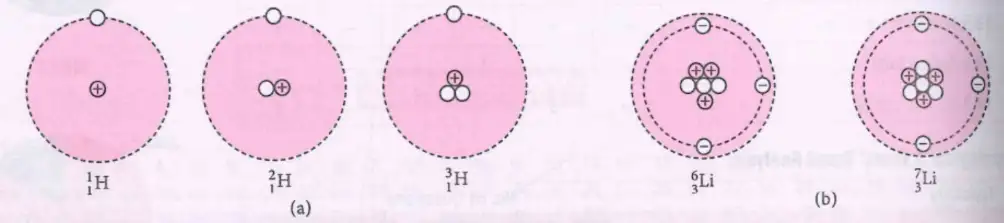
Isotopes
- Same atomic number Z, different mass number A.
- Examples: Hydrogen isotopes - 1H, 2H, 3H.
- Lithium isotopes - 6Li, 7Li.
Isobars
- Same mass number A, different atomic number Z.
- Examples: 31H and 32He, 3717Cl and 3716S.
Isotones
- Same number of neutrons, different atomic number Z.
- Example: 3717Cl and 3919K.
Isomers
- Same atomic number and mass number but different energy states.
Solved Examples
- Ex 1: Identify isotopes among 6Li and 7Li.
- Same Z=3, different A=6,7 → isotopes.
Practice Set
- Q1: Isotopes have
- A) Same mass number, different atomic number
- B) Same atomic number, different mass number
- C) Same number of neutrons, different atomic number
- D) Same atomic and mass number, different energy
- Q2: Isobars are atoms with
- A) Same atomic number, different mass number
- B) Same mass number, different atomic number
- C) Same number of neutrons, different atomic number
- D) Same atomic and mass number, different energy
- Q3: Isotones have
- A) Same atomic number, different mass number
- B) Same mass number, different atomic number
- C) Same number of neutrons, different atomic number
- D) Same atomic and mass number, different energy
Answer Key
- Q1: B - Isotopes differ in mass number but have same atomic number.
- Q2: B - Isobars have same mass number but different atomic number.
- Q3: C - Isotones have same neutron number but different atomic number.
Memory Aids
- Isotopes: Same Z, different A.
- Isobars: Same A, different Z.
- Isotones: Same N, different Z.
- Isomers: Same A and Z, different energy.
Isotopes
- Same atomic number Z, different mass number A.
- Examples: Hydrogen isotopes - 1H, 2H, 3H.
- Lithium isotopes - 6Li, 7Li.
Isobars
- Same mass number A, different atomic number Z.
- Examples: 31H and 32He, 3717Cl and 3716S.
Isotones
- Same number of neutrons, different atomic number Z.
- Example: 3717Cl and 3919K.
Isomers
- Same atomic number and mass number but different energy states.
Solved Examples
- Ex 1: Identify isotopes among 6Li and 7Li.
- Same Z=3, different A=6,7 → isotopes.
Practice Set
- Q1: Isotopes have
- A) Same mass number, different atomic number
- B) Same atomic number, different mass number
- C) Same number of neutrons, different atomic number
- D) Same atomic and mass number, different energy
- Q2: Isobars are atoms with
- A) Same atomic number, different mass number
- B) Same mass number, different atomic number
- C) Same number of neutrons, different atomic number
- D) Same atomic and mass number, different energy
- Q3: Isotones have
- A) Same atomic number, different mass number
- B) Same mass number, different atomic number
- C) Same number of neutrons, different atomic number
- D) Same atomic and mass number, different energy
Answer Key
- Q1: B - Isotopes differ in mass number but have same atomic number.
- Q2: B - Isobars have same mass number but different atomic number.
- Q3: C - Isotones have same neutron number but different atomic number.
Memory Aids
- Isotopes: Same Z, different A.
- Isobars: Same A, different Z.
- Isotones: Same N, different Z.
- Isomers: Same A and Z, different energy.
Size of the Nucleus
Nuclear Size
- Volume of nucleus ∝ number of nucleons (mass number A)
- Formula: 4/3 πR3 ∝ A or R ∝ A1/3
- Radius: R = R0A1/3, where R0 = 1.2 × 10⁻¹⁵ m
Nuclear Density
- Different elements have different A, so nuclei have different sizes
- Density formula: ρ = mass of nucleus/volume of nucleus
- ρ = A × 1 amu/4/3 πR3
- Using radius formula: ρ = A × 1.66 × 10⁻²⁷/4/3 πR03 A = 1.66 × 10⁻²⁷/4/3 πR03 = 2.29 × 10¹⁷ kg/m3
- Density is constant for all nuclei, independent of A
- Density is maximum at nucleus center and decreases towards edges; no sharp boundaries
- High density (~1017 kg/m3) indicates nucleus is highly compact
Solved Examples
Ex 1: Calculate the radius of a nucleus with mass number A = 64.
- Use R = R0A1/3
- R = 1.2 × 10-15 × 641/3 = 1.2 × 10-15 × 4 = 4.8 × 10⁻¹⁵ m
Ex 2: Find the nuclear density using R0 = 1.2 × 10⁻¹⁵ m.
- ρ = 1.66 × 10⁻²⁷/4/3 π(1.2 × 10⁻¹⁵)3 = 2.29 × 10¹⁷ kg/m3
Practice Set
- Q1: The radius of a nucleus with mass number 27 is:
- A) 3.6 × 10⁻¹⁵ m
- B) 1.2 × 10⁻¹⁵ m
- C) 2.4 × 10⁻¹⁵ m
- D) 4.8 × 10⁻¹⁵ m
- Q2: Nuclear density is approximately:
- A) 1010 kg/m3
- B) 1017 kg/m3
- C) 105 kg/m3
- D) 103 kg/m3
- Q3: If the radius of a nucleus doubles, its volume changes by a factor of:
- A) 2
- B) 4
- C) 6
- D) 8
Answer Key
- Q1: A) 3.6 × 10⁻¹⁵ m — Using R = R0A1/3 = 1.2 × 10-15 × 271/3 = 3.6 × 10⁻¹⁵ m
- Q2: B) 1017 kg/m3 — Nuclear density is constant and very high (~2.29 × 10¹⁷ kg/m3)
- Q3: D) 8 — Volume ∝ R3, doubling radius increases volume by 23 = 8
Memory Aids
- Radius R = R0A1/3 (cube root relation)
- Density constant ≈ 2.3 × 10¹⁷ kg/m3 for all nuclei
- Volume ∝ A, density independent of mass number
- High density means nucleus is very compact
Mass-Energy Equivalence
Key Concepts
- Mass is a form of energy; can convert mass to energy and vice versa.
- Einstein's relation: E = mc2, where E is energy (J), m is mass (kg), c = 3 × 10⁸ m/s.
- Energy from mass conversion can appear as kinetic or other energy forms.
Solved Examples
- Ex 1: Calculate energy equivalent of 1 g mass.
- Convert mass: 1 g = 0.001 kg
- Use E = mc2 = 0.001 × (3 × 108)2 = 9 × 10¹³ J
Practice Set
- Q1: Energy equivalent of 2 g mass is?
- A) 1.8 × 10¹⁴ J
- B) 1.8 × 10¹³ J
- C) 9 × 10¹³ J
- D) 3 × 10⁸ J
- Q2: If mass decreases by 0.5 kg, energy released is?
- A) 4.5 × 10¹⁶ J
- B) 4.5 × 10¹⁷ J
- C) 1.5 × 10¹⁷ J
- D) 1.5 × 10¹⁶ J
- Q3: Which is true about mass-energy equivalence?
- A) Mass can be fully converted to energy
- B) Energy can be converted to mass
- C) Both A and B
- D) Neither A nor B
Answer Key
- Q1: A; E = 0.002 × (3 × 108)2 = 1.8 × 10¹⁴ J
- Q2: B; E = 0.5 × (3 × 108)2 = 4.5 × 10¹⁶ J
- Q3: C; Mass and energy are interchangeable as per E=mc2
Memory Aids
- Remember: E=mc2 means mass times speed of light squared.
- Mass-energy conversion is huge energy for small mass.
Key Points
- Positive charge and mass concentrated in nucleus at atom's center.
- Volume of nucleus ≈ 10-15 times volume of atom.
- Atom is mostly empty space.
- Chapter covers nuclear size, mass, stability, radioactivity, fission, fusion.
Solved Examples
Practice Set
- Q1: What fraction of an atom's volume is occupied by its nucleus?
- A) 10-10
- B) 10-15
- C) 10-5
- D) 10-20
- Q2: The nucleus contains
- A) Only electrons
- B) Protons and neutrons
- C) Only protons
- D) Electrons and neutrons
- Q3: Which phenomenon is NOT related to the nucleus?
- A) Radioactivity
- B) Fission
- C) Chemical bonding
- D) Fusion
Answer Key
- Q1: B - Nucleus volume is about 10-15 times the atom's volume.
- Q2: B - Nucleus contains protons and neutrons (nucleons).
- Q3: C - Chemical bonding involves electrons, not nucleus.
Memory Aids
- Remember: Atom = mostly empty, nucleus tiny but dense.
- 10-15 volume ratio is key fact.
- Nucleus = protons + neutrons only.
Key Points
- Positive charge and mass concentrated in nucleus at atom's center.
- Volume of nucleus \( \approx 10^{-15} \) times volume of atom.
- Atom is mostly empty space.
- Chapter covers nuclear size, mass, stability, radioactivity, fission, fusion.
Solved Examples
Practice Set
- Q1: What fraction of an atom's volume is occupied by its nucleus?
- A) \(10^{-10}\)
- B) \(10^{-15}\)
- C) \(10^{-5}\)
- D) \(10^{-20}\)
- Q2: The nucleus contains
- A) Only electrons
- B) Protons and neutrons
- C) Only protons
- D) Electrons and neutrons
- Q3: Which phenomenon is NOT related to the nucleus?
- A) Radioactivity
- B) Fission
- C) Chemical bonding
- D) Fusion
Answer Key
- Q1: B - Nucleus volume is about \(10^{-15}\) times the atom's volume.
- Q2: B - Nucleus contains protons and neutrons (nucleons).
- Q3: C - Chemical bonding involves electrons, not nucleus.
Memory Aids
- Remember: Atom = mostly empty, nucleus tiny but dense.
- \(10^{-15}\) volume ratio is key fact.
- Nucleus = protons + neutrons only.
Atomic Masses and Composition of Nucleus
Atomic Mass
- Average atomic mass = weighted average of isotopes' masses.
- 1 amu = 1/12 × mass of carbon-12 atom = 1.660539 × 10⁻²⁷ kg.
- 1 amu = 931 MeV/c2 (energy equivalent).
Composition of Nucleus
- Nucleons = protons + neutrons.
- Atomic number Z = number of protons.
- Mass number A = Z + N (protons + neutrons).
- Nuclear mass = total mass of protons and neutrons.
- Nuclide notation: AZX, where X = element symbol.
Properties of Nucleons
- Proton (p): charge +e, mass ~1 amu, rest energy ~938 MeV.
- Neutron (n): charge 0, mass ~1 amu, rest energy ~940 MeV.
Solved Examples
- Ex 1: Calculate mass of nucleus with 6 protons and 6 neutrons.
- Mass = (6 + 6) × 1 amu = 12 amu
Practice Set
- Q1: 1 amu equals
- A) 1.660539 × 10⁻²⁷ kg
- B) 1.992647 × 10⁻²⁶ kg
- C) 931 MeV/c2
- D) Both A and C
- Q2: Atomic number Z is
- A) Number of neutrons
- B) Number of protons
- C) Sum of protons and neutrons
- D) Number of electrons
- Q3: Nuclide notation AZX means
- A) A = atomic number, Z = mass number
- B) Z = atomic number, A = mass number
- C) A = number of protons, Z = number of neutrons
- D) X = neutron symbol
Answer Key
- Q1: D - 1 amu = 1.660539 × 10⁻²⁷ kg and 931 MeV/c2.
- Q2: B - Atomic number is number of protons.
- Q3: B - Z is atomic number, A is mass number.
Memory Aids
- 1 amu = mass of 12C atom / 12.
- Atomic number = protons; Mass number = protons + neutrons.
- Nuclide notation: AZX.
Atomic Mass
- Average atomic mass = weighted average of isotopes' masses.
- 1 amu = (1/12) × mass of carbon-12 atom = 1.660539 × 10⁻²⁷ kg.
- 1 amu = 931 MeV/c2 (energy equivalent).
Composition of Nucleus
- Nucleons = protons + neutrons.
- Atomic number Z = number of protons.
- Mass number A = Z + N (protons + neutrons).
- Nuclear mass = total mass of protons and neutrons.
- Nuclide notation: AZX, where X = element symbol.
Properties of Nucleons
- Proton (p): charge +e, mass ~1 amu, rest energy ~938 MeV.
- Neutron (n): charge 0, mass ~1 amu, rest energy ~940 MeV.
Solved Examples
- Ex 1: Calculate mass of nucleus with 6 protons and 6 neutrons.
- Mass = (6 + 6) × 1 amu = 12 amu
Practice Set
- Q1: 1 amu equals
- A) 1.660539 × 10⁻²⁷ kg
- B) 1.992647 × 10⁻²⁶ kg
- C) 931 MeV/c2
- D) Both A and C
- Q2: Atomic number Z is
- A) Number of neutrons
- B) Number of protons
- C) Sum of protons and neutrons
- D) Number of electrons
- Q3: Nuclide notation AZX means
- A) A = atomic number, Z = mass number
- B) Z = atomic number, A = mass number
- C) A = number of protons, Z = number of neutrons
- D) X = neutron symbol
Answer Key
- Q1: D - 1 amu = 1.660539 × 10⁻²⁷ kg and 931 MeV/c2.
- Q2: B - Atomic number is number of protons.
- Q3: B - Z is atomic number, A is mass number.
Memory Aids
- 1 amu = mass of 12C atom / 12.
- Atomic number = protons; Mass number = protons + neutrons.
- Nuclide notation: AZX.
Atomic Mass
- Average atomic mass = weighted average of isotopes' masses.
- 1 amu = 1/12 × mass of carbon-12 atom = 1.660539 × 10⁻²⁷ kg.
- 1 amu = 931 MeV/c2 (energy equivalent).
Composition of Nucleus
- Nucleons = protons + neutrons.
- Atomic number Z = number of protons.
- Mass number A = Z + N (protons + neutrons).
- Nuclear mass = total mass of protons and neutrons.
- Nuclide notation: AZX, where X = element symbol.
Properties of Nucleons
- Proton (p): charge +e, mass ~1 amu, rest energy ~938 MeV.
- Neutron (n): charge 0, mass ~1 amu, rest energy ~940 MeV.
Solved Examples
- Ex 1: Calculate mass of nucleus with 6 protons and 6 neutrons.
- Mass = (6 + 6) × 1 amu = 12 amu
Practice Set
- Q1: 1 amu equals
- A) 1.660539 × 10⁻²⁷ kg
- B) 1.992647 × 10⁻²⁶ kg
- C) 931 MeV/c2
- D) Both A and C
- Q2: Atomic number Z is
- A) Number of neutrons
- B) Number of protons
- C) Sum of protons and neutrons
- D) Number of electrons
- Q3: Nuclide notation AZX means
- A) A = atomic number, Z = mass number
- B) Z = atomic number, A = mass number
- C) A = number of protons, Z = number of neutrons
- D) X = neutron symbol
Answer Key
- Q1: D - 1 amu = 1.660539 × 10⁻²⁷ kg and 931 MeV/c2.
- Q2: B - Atomic number is number of protons.
- Q3: B - Z is atomic number, A is mass number.
Memory Aids
- 1 amu = mass of 12C atom / 12.
- Atomic number = protons; Mass number = protons + neutrons.
- Nuclide notation: AZX.
Atomic Mass
- Average atomic mass = weighted average of isotopes' masses.
- 1 amu = \( \frac{1}{12} \times \) mass of carbon-12 atom = \(1.660539 \times 10^{-27} \) kg.
- 1 amu = 931 MeV/c2 (energy equivalent).
Composition of Nucleus
- Nucleons = protons + neutrons.
- Atomic number \(Z\) = number of protons.
- Mass number \(A = Z + N\) (protons + neutrons).
- Nuclear mass = total mass of protons and neutrons.
- Nuclide notation: \( ^A_Z X \), where \(X\) = element symbol.
Properties of Nucleons
- Proton (\(p\)): charge +e, mass ~1 amu, rest energy ~938 MeV.
- Neutron (\(n\)): charge 0, mass ~1 amu, rest energy ~940 MeV.
Solved Examples
- Ex 1: Calculate mass of nucleus with 6 protons and 6 neutrons.
- Mass \(= (6 + 6) \times 1 \text{ amu} = 12 \text{ amu} \)
Practice Set
- Q1: 1 amu equals
- A) \(1.660539 \times 10^{-27} \) kg
- B) \(1.992647 \times 10^{-26} \) kg
- C) \(931 \) MeV/c2
- D) Both A and C
- Q2: Atomic number \(Z\) is
- A) Number of neutrons
- B) Number of protons
- C) Sum of protons and neutrons
- D) Number of electrons
- Q3: Nuclide notation \( ^A_Z X \) means
- A) \(A\) = atomic number, \(Z\) = mass number
- B) \(Z\) = atomic number, \(A\) = mass number
- C) \(A\) = number of protons, \(Z\) = number of neutrons
- D) \(X\) = neutron symbol
Answer Key
- Q1: D - 1 amu = \(1.660539 \times 10^{-27} \) kg and 931 MeV/c2.
- Q2: B - Atomic number is number of protons.
- Q3: B - \(Z\) is atomic number, \(A\) is mass number.
Memory Aids
- 1 amu = mass of \(^{12}C\) atom / 12.
- Atomic number = protons; Mass number = protons + neutrons.
- Nuclide notation: \( ^A_Z X \).
Isotopes Isobars Isotones and Isomers
Isotopes
- Same atomic number Z, different mass number A.
- Examples: Hydrogen isotopes - 1H, 2H, 3H.
- Lithium isotopes - 6Li, 7Li.
Isobars
- Same mass number A, different atomic number Z.
- Examples: 31H and 32He, 3717Cl and 3716S.
Isotones
- Same number of neutrons, different atomic number Z.
- Example: 3717Cl and 3919K.
Isomers
- Same atomic number and mass number but different energy states.
Solved Examples
- Ex 1: Identify isotopes among 6Li and 7Li.
- Same Z=3, different A=6,7 → isotopes.
Practice Set
- Q1: Isotopes have
- A) Same mass number, different atomic number
- B) Same atomic number, different mass number
- C) Same number of neutrons, different atomic number
- D) Same atomic and mass number, different energy
- Q2: Isobars are atoms with
- A) Same atomic number, different mass number
- B) Same mass number, different atomic number
- C) Same number of neutrons, different atomic number
- D) Same atomic and mass number, different energy
- Q3: Isotones have
- A) Same atomic number, different mass number
- B) Same mass number, different atomic number
- C) Same number of neutrons, different atomic number
- D) Same atomic and mass number, different energy
Answer Key
- Q1: B - Isotopes differ in mass number but have same atomic number.
- Q2: B - Isobars have same mass number but different atomic number.
- Q3: C - Isotones have same neutron number but different atomic number.
Memory Aids
- Isotopes: Same Z, different A.
- Isobars: Same A, different Z.
- Isotones: Same N, different Z.
- Isomers: Same A and Z, different energy.
Isotopes
- Same atomic number \(Z\), different mass number \(A\).
- Examples: Hydrogen isotopes - \(^{1}H\), \(^{2}H\), \(^{3}H\).
- Lithium isotopes - \(^{6}Li\), \(^{7}Li\).
Isobars
- Same mass number \(A\), different atomic number \(Z\).
- Examples: \(^{3}_{1}H\) and \(^{3}_{2}He\), \(^{37}_{17}Cl\) and \(^{37}_{16}S\).
Isotones
- Same number of neutrons, different atomic number \(Z\).
- Example: \(^{37}_{17}Cl\) and \(^{39}_{19}K\).
Isomers
- Same atomic number and mass number but different energy states.
Solved Examples
- Ex 1: Identify isotopes among \(^{6}Li\) and \(^{7}Li\).
- Same \(Z=3\), different \(A=6,7\) → isotopes.
Practice Set
- Q1: Isotopes have
- A) Same mass number, different atomic number
- B) Same atomic number, different mass number
- C) Same number of neutrons, different atomic number
- D) Same atomic and mass number, different energy
- Q2: Isobars are atoms with
- A) Same atomic number, different mass number
- B) Same mass number, different atomic number
- C) Same number of neutrons, different atomic number
- D) Same atomic and mass number, different energy
- Q3: Isotones have
- A) Same atomic number, different mass number
- B) Same mass number, different atomic number
- C) Same number of neutrons, different atomic number
- D) Same atomic and mass number, different energy
Answer Key
- Q1: B - Isotopes differ in mass number but have same atomic number.
- Q2: B - Isobars have same mass number but different atomic number.
- Q3: C - Isotones have same neutron number but different atomic number.
Memory Aids
- Isotopes: Same Z, different A.
- Isobars: Same A, different Z.
- Isotones: Same N, different Z.
- Isomers: Same A and Z, different energy.
Size of the Nucleus
Nuclear Size
- Volume of nucleus ∝ number of nucleons (mass number A)
- Formula: 4/3 πR3 ∝ A or R ∝ A1/3
- Radius: R = R0A1/3, where R0 = 1.2 × 10⁻¹⁵ m
Nuclear Density
- Different elements have different A, so nuclei have different sizes
- Density formula: ρ = mass of nucleus/volume of nucleus
- ρ = A × 1 amu/4/3 πR3
- Using radius formula: ρ = A × 1.66 × 10⁻²⁷/4/3 πR03 A = 1.66 × 10⁻²⁷/4/3 πR03 = 2.29 × 10¹⁷ kg/m3
- Density is constant for all nuclei, independent of A
- Density is maximum at nucleus center and decreases towards edges; no sharp boundaries
- High density (~1017 kg/m3) indicates nucleus is highly compact
Solved Examples
Ex 1: Calculate the radius of a nucleus with mass number A = 64.
- Use R = R0A1/3
- R = 1.2 × 10-15 × 641/3 = 1.2 × 10-15 × 4 = 4.8 × 10⁻¹⁵ m
Ex 2: Find the nuclear density using R0 = 1.2 × 10⁻¹⁵ m.
- ρ = 1.66 × 10⁻²⁷/4/3 π(1.2 × 10⁻¹⁵)3 = 2.29 × 10¹⁷ kg/m3
Practice Set
- Q1: The radius of a nucleus with mass number 27 is:
- A) 3.6 × 10⁻¹⁵ m
- B) 1.2 × 10⁻¹⁵ m
- C) 2.4 × 10⁻¹⁵ m
- D) 4.8 × 10⁻¹⁵ m
- Q2: Nuclear density is approximately:
- A) 1010 kg/m3
- B) 1017 kg/m3
- C) 105 kg/m3
- D) 103 kg/m3
- Q3: If the radius of a nucleus doubles, its volume changes by a factor of:
- A) 2
- B) 4
- C) 6
- D) 8
Answer Key
- Q1: A) 3.6 × 10⁻¹⁵ m — Using R = R0A1/3 = 1.2 × 10-15 × 271/3 = 3.6 × 10⁻¹⁵ m
- Q2: B) 1017 kg/m3 — Nuclear density is constant and very high (~2.29 × 10¹⁷ kg/m3)
- Q3: D) 8 — Volume ∝ R3, doubling radius increases volume by 23 = 8
Memory Aids
- Radius R = R0A1/3 (cube root relation)
- Density constant ≈ 2.3 × 10¹⁷ kg/m3 for all nuclei
- Volume ∝ A, density independent of mass number
- High density means nucleus is very compact
Nuclear Size
- Volume of nucleus ∝ number of nucleons (mass number A)
- Formula: 4/3 πR3 ∝ A or R ∝ A1/3
- Radius: R = R0A1/3, where R0 = 1.2 × 10⁻¹⁵ m
Nuclear Density
- Different elements have different A, so nuclei have different sizes
- Density formula: ρ = mass of nucleus/volume of nucleus
- ρ = A × 1 amu/4/3 πR3
- Using radius formula: ρ = A × 1.66 × 10⁻²⁷/4/3 πR03 A = 1.66 × 10⁻²⁷/4/3 πR03 = 2.29 × 10¹⁷ kg/m3
- Density is constant for all nuclei, independent of A
- Density is maximum at nucleus center and decreases towards edges; no sharp boundaries
- High density (~1017 kg/m3) indicates nucleus is highly compact
Solved Examples
Ex 1: Calculate the radius of a nucleus with mass number A = 64.
- Use R = R0A1/3
- R = 1.2 × 10-15 × 641/3 = 1.2 × 10-15 × 4 = 4.8 × 10⁻¹⁵ m
Ex 2: Find the nuclear density using R0 = 1.2 × 10⁻¹⁵ m.
- ρ = 1.66 × 10⁻²⁷/4/3 π(1.2 × 10⁻¹⁵)3 = 2.29 × 10¹⁷ kg/m3
Practice Set
- Q1: The radius of a nucleus with mass number 27 is:
- A) 3.6 × 10⁻¹⁵ m
- B) 1.2 × 10⁻¹⁵ m
- C) 2.4 × 10⁻¹⁵ m
- D) 4.8 × 10⁻¹⁵ m
- Q2: Nuclear density is approximately:
- A) 1010 kg/m3
- B) 1017 kg/m3
- C) 105 kg/m3
- D) 103 kg/m3
- Q3: If the radius of a nucleus doubles, its volume changes by a factor of:
- A) 2
- B) 4
- C) 6
- D) 8
Answer Key
- Q1: A) 3.6 × 10⁻¹⁵ m — Using R = R0A1/3 = 1.2 × 10-15 × 271/3 = 3.6 × 10⁻¹⁵ m
- Q2: B) 1017 kg/m3 — Nuclear density is constant and very high (~2.29 × 10¹⁷ kg/m3)
- Q3: D) 8 — Volume ∝ R3, doubling radius increases volume by 23 = 8
Memory Aids
- Radius R = R0A1/3 (cube root relation)
- Density constant ≈ 2.3 × 10¹⁷ kg/m3 for all nuclei
- Volume ∝ A, density independent of mass number
- High density means nucleus is very compact
Nuclear Size
- Volume of nucleus ∝ number of nucleons (mass number A)
- Formula: 4/3 πR3 ∝ A or R ∝ A1/3
- Radius: R = R0A1/3, where R0 = 1.2 × 10⁻¹⁵ m
Nuclear Density
- Different elements have different A, so nuclei have different sizes
- Density formula: ρ = mass of nucleus/volume of nucleus
- ρ = A × 1 amu/4/3 πR3
- Using radius formula: ρ = A × 1.66 × 10⁻²⁷/4/3 πR03 A = 1.66 × 10⁻²⁷/4/3 πR03 = 2.29 × 10¹⁷ kg/m3
- Density is constant for all nuclei, independent of A
- Density is maximum at nucleus center and decreases towards edges; no sharp boundaries
- High density (~1017 kg/m3) indicates nucleus is highly compact
Solved Examples
Ex 1: Calculate the radius of a nucleus with mass number A = 64.
- Use R = R0A1/3
- R = 1.2 × 10-15 × 641/3 = 1.2 × 10-15 × 4 = 4.8 × 10⁻¹⁵ m
Ex 2: Find the nuclear density using R0 = 1.2 × 10⁻¹⁵ m.
- ρ = 1.66 × 10⁻²⁷/4/3 π(1.2 × 10⁻¹⁵)3 = 2.29 × 10¹⁷ kg/m3
Practice Set
- Q1: The radius of a nucleus with mass number 27 is:
- A) 3.6 × 10⁻¹⁵ m
- B) 1.2 × 10⁻¹⁵ m
- C) 2.4 × 10⁻¹⁵ m
- D) 4.8 × 10⁻¹⁵ m
- Q2: Nuclear density is approximately:
- A) 1010 kg/m3
- B) 1017 kg/m3
- C) 105 kg/m3
- D) 103 kg/m3
- Q3: If the radius of a nucleus doubles, its volume changes by a factor of:
- A) 2
- B) 4
- C) 6
- D) 8
Answer Key
- Q1: A) 3.6 × 10⁻¹⁵ m — Using R = R0A1/3 = 1.2 × 10-15 × 271/3 = 3.6 × 10⁻¹⁵ m
- Q2: B) 1017 kg/m3 — Nuclear density is constant and very high (~2.29 × 10¹⁷ kg/m3)
- Q3: D) 8 — Volume ∝ R3, doubling radius increases volume by 23 = 8
Memory Aids
- Radius R = R0A1/3 (cube root relation)
- Density constant ≈ 2.3 × 10¹⁷ kg/m3 for all nuclei
- Volume ∝ A, density independent of mass number
- High density means nucleus is very compact
Nuclear Size
- Volume of nucleus \( \propto \) number of nucleons (mass number \( A \))
- Formula: \( \frac{4}{3} \pi R^3 \propto A \) or \( R \propto A^{1/3} \)
- Radius: \( R = R_0 A^{1/3} \), where \( R_0 = 1.2 \times 10^{-15} \) m
Nuclear Density
- Different elements have different \( A \), so nuclei have different sizes
- Density formula: \( \rho = \frac{\text{mass of nucleus}}{\text{volume of nucleus}} \)
- \( \rho = \frac{A \times 1 \text{ amu}}{\frac{4}{3} \pi R^3} \)
- Using radius formula: \( \rho = \frac{A \times 1.66 \times 10^{-27}}{\frac{4}{3} \pi R_0^3 A} = \frac{1.66 \times 10^{-27}}{\frac{4}{3} \pi R_0^3} = 2.29 \times 10^{17} \text{ kg/m}^3 \)
- Density is constant for all nuclei, independent of \( A \)
- Density is maximum at nucleus center and decreases towards edges; no sharp boundaries
- High density (~\( 10^{17} \) kg/m3) indicates nucleus is highly compact
Solved Examples
Ex 1: Calculate the radius of a nucleus with mass number \( A = 64 \).
- Use \( R = R_0 A^{1/3} \)
- \( R = 1.2 \times 10^{-15} \times 64^{1/3} = 1.2 \times 10^{-15} \times 4 = 4.8 \times 10^{-15} \) m
Ex 2: Find the nuclear density using \( R_0 = 1.2 \times 10^{-15} \) m.
- \( \rho = \frac{1.66 \times 10^{-27}}{\frac{4}{3} \pi (1.2 \times 10^{-15})^3} = 2.29 \times 10^{17} \) kg/m3
Practice Set
- Q1: The radius of a nucleus with mass number 27 is:
- A) \( 3.6 \times 10^{-15} \) m
- B) \( 1.2 \times 10^{-15} \) m
- C) \( 2.4 \times 10^{-15} \) m
- D) \( 4.8 \times 10^{-15} \) m
- Q2: Nuclear density is approximately:
- A) \( 10^{10} \) kg/m3
- B) \( 10^{17} \) kg/m3
- C) \( 10^{5} \) kg/m3
- D) \( 10^{3} \) kg/m3
- Q3: If the radius of a nucleus doubles, its volume changes by a factor of:
- A) 2
- B) 4
- C) 6
- D) 8
Answer Key
- Q1: A) \( 3.6 \times 10^{-15} \) m — Using \( R = R_0 A^{1/3} = 1.2 \times 10^{-15} \times 27^{1/3} = 3.6 \times 10^{-15} \) m
- Q2: B) \( 10^{17} \) kg/m3 — Nuclear density is constant and very high (~\( 2.29 \times 10^{17} \) kg/m3)
- Q3: D) 8 — Volume \( \propto R^3 \), doubling radius increases volume by \( 2^3 = 8 \)
Memory Aids
- Radius \( R = R_0 A^{1/3} \) (cube root relation)
- Density constant \( \approx 2.3 \times 10^{17} \) kg/m3 for all nuclei
- Volume \( \propto A \), density independent of mass number
- High density means nucleus is very compact
Mass-Energy Equivalence
Key Concepts
- Mass is a form of energy; can convert mass to energy and vice versa.
- Einstein's relation: E = mc2, where E is energy (J), m is mass (kg), c = 3 × 10⁸ m/s.
- Energy from mass conversion can appear as kinetic or other energy forms.
Solved Examples
- Ex 1: Calculate energy equivalent of 1 g mass.
- Convert mass: 1 g = 0.001 kg
- Use E = mc2 = 0.001 × (3 × 108)2 = 9 × 10¹³ J
Practice Set
- Q1: Energy equivalent of 2 g mass is?
- A) 1.8 × 10¹⁴ J
- B) 1.8 × 10¹³ J
- C) 9 × 10¹³ J
- D) 3 × 10⁸ J
- Q2: If mass decreases by 0.5 kg, energy released is?
- A) 4.5 × 10¹⁶ J
- B) 4.5 × 10¹⁷ J
- C) 1.5 × 10¹⁷ J
- D) 1.5 × 10¹⁶ J
- Q3: Which is true about mass-energy equivalence?
- A) Mass can be fully converted to energy
- B) Energy can be converted to mass
- C) Both A and B
- D) Neither A nor B
Answer Key
- Q1: A; E = 0.002 × (3 × 108)2 = 1.8 × 10¹⁴ J
- Q2: B; E = 0.5 × (3 × 108)2 = 4.5 × 10¹⁶ J
- Q3: C; Mass and energy are interchangeable as per E=mc2
Memory Aids
- Remember: E=mc2 means mass times speed of light squared.
- Mass-energy conversion is huge energy for small mass.
Key Concepts
- Mass is a form of energy; can convert mass to energy and vice versa.
- Einstein's relation: E = mc2, where E is energy (J), m is mass (kg), c = 3 × 10⁸ m/s.
- Energy from mass conversion can appear as kinetic or other energy forms.
Solved Examples
- Ex 1: Calculate energy equivalent of 1 g mass.
- Convert mass: 1 g = 0.001 kg
- Use E = mc2 = 0.001 × (3 × 108)2 = 9 × 10¹³ J
Practice Set
- Q1: Energy equivalent of 2 g mass is?
- A) 1.8 × 10¹⁴ J
- B) 1.8 × 10¹³ J
- C) 9 × 10¹³ J
- D) 3 × 10⁸ J
- Q2: If mass decreases by 0.5 kg, energy released is?
- A) 4.5 × 10¹⁶ J
- B) 4.5 × 10¹⁷ J
- C) 1.5 × 10¹⁷ J
- D) 1.5 × 10¹⁶ J
- Q3: Which is true about mass-energy equivalence?
- A) Mass can be fully converted to energy
- B) Energy can be converted to mass
- C) Both A and B
- D) Neither A nor B
Answer Key
- Q1: A; E = 0.002 × (3 × 108)2 = 1.8 × 10¹⁴ J
- Q2: B; E = 0.5 × (3 × 108)2 = 4.5 × 10¹⁶ J
- Q3: C; Mass and energy are interchangeable as per E=mc2
Memory Aids
- Remember: E=mc2 means mass times speed of light squared.
- Mass-energy conversion is huge energy for small mass.
Key Concepts
- Mass is a form of energy; can convert mass to energy and vice versa.
- Einstein's relation: E = mc2, where E is energy (J), m is mass (kg), c = 3 × 10⁸ m/s.
- Energy from mass conversion can appear as kinetic or other energy forms.
Solved Examples
- Ex 1: Calculate energy equivalent of 1 g mass.
- Convert mass: 1 g = 0.001 kg
- Use E = mc2 = 0.001 × (3 × 108)2 = 9 × 10¹³ J
Practice Set
- Q1: Energy equivalent of 2 g mass is?
- A) 1.8 × 10¹⁴ J
- B) 1.8 × 10¹³ J
- C) 9 × 10¹³ J
- D) 3 × 10⁸ J
- Q2: If mass decreases by 0.5 kg, energy released is?
- A) 4.5 × 10¹⁶ J
- B) 4.5 × 10¹⁷ J
- C) 1.5 × 10¹⁷ J
- D) 1.5 × 10¹⁶ J
- Q3: Which is true about mass-energy equivalence?
- A) Mass can be fully converted to energy
- B) Energy can be converted to mass
- C) Both A and B
- D) Neither A nor B
Answer Key
- Q1: A; E = 0.002 × (3 × 108)2 = 1.8 × 10¹⁴ J
- Q2: B; E = 0.5 × (3 × 108)2 = 4.5 × 10¹⁶ J
- Q3: C; Mass and energy are interchangeable as per E=mc2
Memory Aids
- Remember: E=mc2 means mass times speed of light squared.
- Mass-energy conversion is huge energy for small mass.
Key Concepts
- Mass is a form of energy; can convert mass to energy and vice versa.
- Einstein's relation: \( E = mc^2 \), where \(E\) is energy (J), \(m\) is mass (kg), \(c = 3 \times 10^8\, m/s\).
- Energy from mass conversion can appear as kinetic or other energy forms.
Solved Examples
- Ex 1: Calculate energy equivalent of 1 g mass.
- Convert mass: 1 g = 0.001 kg
- Use \( E = mc^2 = 0.001 \times (3 \times 10^8)^2 = 9 \times 10^{13} \) J
Practice Set
- Q1: Energy equivalent of 2 g mass is?
- A) \(1.8 \times 10^{14}\) J
- B) \(1.8 \times 10^{13}\) J
- C) \(9 \times 10^{13}\) J
- D) \(3 \times 10^{8}\) J
- Q2: If mass decreases by 0.5 kg, energy released is?
- A) \(4.5 \times 10^{16}\) J
- B) \(4.5 \times 10^{17}\) J
- C) \(1.5 \times 10^{17}\) J
- D) \(1.5 \times 10^{16}\) J
- Q3: Which is true about mass-energy equivalence?
- A) Mass can be fully converted to energy
- B) Energy can be converted to mass
- C) Both A and B
- D) Neither A nor B
Answer Key
- Q1: A; \(E = 0.002 \times (3 \times 10^8)^2 = 1.8 \times 10^{14} J\)
- Q2: B; \(E = 0.5 \times (3 \times 10^8)^2 = 4.5 \times 10^{16} J\)
- Q3: C; Mass and energy are interchangeable as per \(E=mc^2\)
Memory Aids
- Remember: \(E=mc^2\) means mass times speed of light squared.
- Mass-energy conversion is huge energy for small mass.
Nuclear Binding Energy
Key Concepts
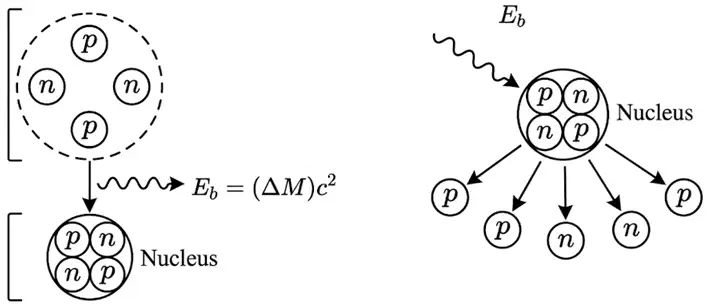
- Binding energy Eb holds nucleons (protons + neutrons) in nucleus.
- Mass defect ΔM = [Z mp + (A-Z) mn] - M, where Z = protons, A = mass number, mp, mn = proton/neutron mass, M = nucleus mass.
- Binding energy formula: Eb = ΔM c2 = ([Z mp + (A-Z) mn] - M)c2.
- Binding energy per nucleon: ΔEbn = Eb/A (average energy to remove one nucleon).
- Energy released when nucleons bind; energy absorbed when nucleus splits (fission).
Solved Examples
- Ex 1: Calculate binding energy if Z=2, A=4, mp=1.0073,u, mn=1.0087,u, nucleus mass M=4.0026,u.
- Mass defect ΔM = (2 × 1.0073 + 2 × 1.0087) - 4.0026 = 0.0288,u
- Convert to kg: 1 u = 1.66 × 10⁻²⁷ kg
- ΔM = 0.0288 × 1.66 × 10-27 = 4.78 × 10⁻²⁹ kg
- Binding energy Eb = ΔM c2 = 4.78 × 10-29 × (3 × 108)2 = 4.3 × 10⁻¹² J
Practice Set
- Q1: Mass defect is difference between?
- A) Mass of nucleons and nucleus
- B) Mass of electrons and nucleus
- C) Mass of protons and neutrons
- D) Mass of atom and nucleus
- Q2: Binding energy per nucleon is?
- A) Eb × A
- B) Eb/A
- C) Eb + A
- D) Eb - A
- Q3: Which nucleus is most stable?
- A) Hydrogen (A=1)
- B) Iron (A=56)
- C) Uranium (A=238)
- D) Helium (A=4)
Answer Key
- Q1: A; Mass defect is difference between total nucleon mass and nucleus mass.
- Q2: B; Binding energy per nucleon = total binding energy divided by mass number.
- Q3: B; Iron has highest binding energy per nucleon, most stable nucleus.
Memory Aids
- Binding energy Eb = ΔM c2.
- Mass defect = sum of nucleon masses - nucleus mass.
- Higher binding energy per nucleon means more stability.
Key Concepts
- Binding energy Eb holds nucleons (protons + neutrons) in nucleus.
- Mass defect ΔM = [Z mp + (A-Z) mn] - M, where Z = protons, A = mass number, mp, mn = proton/neutron mass, M = nucleus mass.
- Binding energy formula: Eb = ΔM c2 = ([Z mp + (A-Z) mn] - M)c2.
- Binding energy per nucleon: ΔEbn = Eb/A (average energy to remove one nucleon).
- Energy released when nucleons bind; energy absorbed when nucleus splits (fission).
Solved Examples
- Ex 1: Calculate binding energy if Z=2, A=4, mp=1.0073,u, mn=1.0087,u, nucleus mass M=4.0026,u.
- Mass defect ΔM = (2 × 1.0073 + 2 × 1.0087) - 4.0026 = 0.0288,u
- Convert to kg: 1 u = 1.66 × 10⁻²⁷ kg
- ΔM = 0.0288 × 1.66 × 10-27 = 4.78 × 10⁻²⁹ kg
- Binding energy Eb = ΔM c2 = 4.78 × 10-29 × (3 × 108)2 = 4.3 × 10⁻¹² J
Practice Set
- Q1: Mass defect is difference between?
- A) Mass of nucleons and nucleus
- B) Mass of electrons and nucleus
- C) Mass of protons and neutrons
- D) Mass of atom and nucleus
- Q2: Binding energy per nucleon is?
- A) Eb × A
- B) Eb/A
- C) Eb + A
- D) Eb - A
- Q3: Which nucleus is most stable?
- A) Hydrogen (A=1)
- B) Iron (A=56)
- C) Uranium (A=238)
- D) Helium (A=4)
Answer Key
- Q1: A; Mass defect is difference between total nucleon mass and nucleus mass.
- Q2: B; Binding energy per nucleon = total binding energy divided by mass number.
- Q3: B; Iron has highest binding energy per nucleon, most stable nucleus.
Memory Aids
- Binding energy Eb = ΔM c2.
- Mass defect = sum of nucleon masses - nucleus mass.
- Higher binding energy per nucleon means more stability.
Key Concepts
- Binding energy \(E_b\) holds nucleons (protons + neutrons) in nucleus.
- Mass defect \(\Delta M = [Z m_p + (A-Z) m_n] - M\), where \(Z\) = protons, \(A\) = mass number, \(m_p, m_n\) = proton/neutron mass, \(M\) = nucleus mass.
- Binding energy formula: \(E_b = \Delta M c^2 = \left([Z m_p + (A-Z) m_n] - M\right) c^2\).
- Binding energy per nucleon: \(\Delta E_{bn} = \frac{E_b}{A}\) (average energy to remove one nucleon).
- Energy released when nucleons bind; energy absorbed when nucleus splits (fission).
Solved Examples
- Ex 1: Calculate binding energy if \(Z=2\), \(A=4\), \(m_p=1.0073\,u\), \(m_n=1.0087\,u\), nucleus mass \(M=4.0026\,u\).
- Mass defect \(\Delta M = (2 \times 1.0073 + 2 \times 1.0087) - 4.0026 = 0.0288\,u\)
- Convert to kg: \(1 u = 1.66 \times 10^{-27} kg\)
- \(\Delta M = 0.0288 \times 1.66 \times 10^{-27} = 4.78 \times 10^{-29} kg\)
- Binding energy \(E_b = \Delta M c^2 = 4.78 \times 10^{-29} \times (3 \times 10^8)^2 = 4.3 \times 10^{-12} J\)
Practice Set
- Q1: Mass defect is difference between?
- A) Mass of nucleons and nucleus
- B) Mass of electrons and nucleus
- C) Mass of protons and neutrons
- D) Mass of atom and nucleus
- Q2: Binding energy per nucleon is?
- A) \(E_b \times A\)
- B) \(\frac{E_b}{A}\)
- C) \(E_b + A\)
- D) \(E_b - A\)
- Q3: Which nucleus is most stable?
- A) Hydrogen (A=1)
- B) Iron (A=56)
- C) Uranium (A=238)
- D) Helium (A=4)
Answer Key
- Q1: A; Mass defect is difference between total nucleon mass and nucleus mass.
- Q2: B; Binding energy per nucleon = total binding energy divided by mass number.
- Q3: B; Iron has highest binding energy per nucleon, most stable nucleus.
Memory Aids
- Binding energy \(E_b = \Delta M c^2\).
- Mass defect = sum of nucleon masses - nucleus mass.
- Higher binding energy per nucleon means more stability.
Binding Energy Curve
Key Concepts
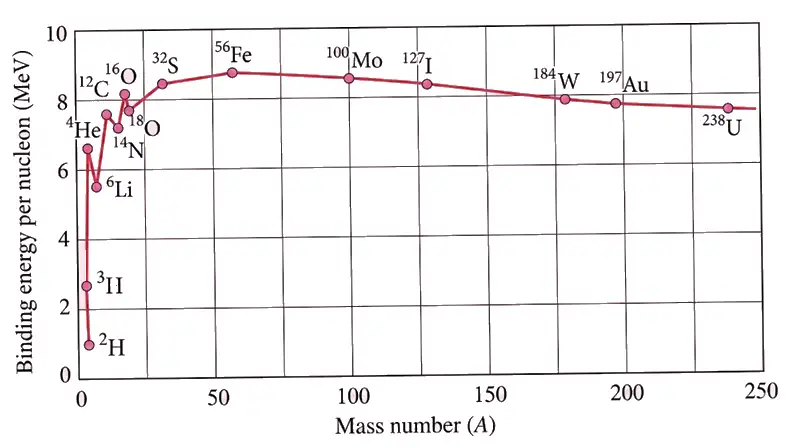
- Binding energy per nucleon Ebn vs mass number A graph shows nuclear stability.
- Peak at A ≈ 56 (Iron), highest stability, Ebn ≈ 8.75 MeV.
- Lighter and very heavy nuclei have lower Ebn, less stable.
- Energy release explained by nuclear fission and fusion:
- Fission: heavy nucleus splits into lighter nuclei with higher Ebn.
- Fusion: light nuclei combine to form heavier nucleus with higher Ebn.
Solved Examples
- Ex 1: Explain energy release in fission of uranium.
- Uranium nucleus splits into lighter nuclei with higher binding energy per nucleon.
- Energy released = difference in total binding energies.
Practice Set
- Q1: Maximum binding energy per nucleon occurs at?
- A) Hydrogen
- B) Iron
- C) Uranium
- D) Helium
- Q2: Nuclear fission releases energy because?
- A) Heavy nucleus has lower binding energy per nucleon than fragments
- B) Heavy nucleus has higher binding energy per nucleon
- C) Fragments have lower binding energy
- D) No energy change
- Q3: Nuclear fusion involves?
- A) Splitting heavy nucleus
- B) Combining light nuclei
- C) No change in binding energy
- D) Decreasing binding energy per nucleon
Answer Key
- Q1: B; Iron has the highest binding energy per nucleon, most stable nucleus.
- Q2: A; Fission releases energy as fragments have higher binding energy per nucleon.
- Q3: B; Fusion combines light nuclei to form heavier nucleus with higher binding energy.
Memory Aids
- Peak of binding energy curve = most stable nucleus (Iron).
- Fission: heavy → lighter nuclei + energy.
- Fusion: light nuclei → heavier nucleus + energy.
Key Concepts
- Binding energy per nucleon Ebn vs mass number A graph shows nuclear stability.
- Peak at A ≈ 56 (Iron), highest stability, Ebn ≈ 8.75 MeV.
- Lighter and very heavy nuclei have lower Ebn, less stable.
- Energy release explained by nuclear fission and fusion:
- Fission: heavy nucleus splits into lighter nuclei with higher Ebn.
- Fusion: light nuclei combine to form heavier nucleus with higher Ebn.
Solved Examples
- Ex 1: Explain energy release in fission of uranium.
- Uranium nucleus splits into lighter nuclei with higher binding energy per nucleon.
- Energy released = difference in total binding energies.
Practice Set
- Q1: Maximum binding energy per nucleon occurs at?
- A) Hydrogen
- B) Iron
- C) Uranium
- D) Helium
- Q2: Nuclear fission releases energy because?
- A) Heavy nucleus has lower binding energy per nucleon than fragments
- B) Heavy nucleus has higher binding energy per nucleon
- C) Fragments have lower binding energy
- D) No energy change
- Q3: Nuclear fusion involves?
- A) Splitting heavy nucleus
- B) Combining light nuclei
- C) No change in binding energy
- D) Decreasing binding energy per nucleon
Answer Key
- Q1: B; Iron has the highest binding energy per nucleon, most stable nucleus.
- Q2: A; Fission releases energy as fragments have higher binding energy per nucleon.
- Q3: B; Fusion combines light nuclei to form heavier nucleus with higher binding energy.
Memory Aids
- Peak of binding energy curve = most stable nucleus (Iron).
- Fission: heavy → lighter nuclei + energy.
- Fusion: light nuclei → heavier nucleus + energy.
Key Concepts
- Binding energy per nucleon \(E_{bn}\) vs mass number \(A\) graph shows nuclear stability.
- Peak at \(A \approx 56\) (Iron), highest stability, \(E_{bn} \approx 8.75\) MeV.
- Lighter and very heavy nuclei have lower \(E_{bn}\), less stable.
- Energy release explained by nuclear fission and fusion:
- Fission: heavy nucleus splits into lighter nuclei with higher \(E_{bn}\).
- Fusion: light nuclei combine to form heavier nucleus with higher \(E_{bn}\).
Solved Examples
- Ex 1: Explain energy release in fission of uranium.
- Uranium nucleus splits into lighter nuclei with higher binding energy per nucleon.
- Energy released = difference in total binding energies.
Practice Set
- Q1: Maximum binding energy per nucleon occurs at?
- A) Hydrogen
- B) Iron
- C) Uranium
- D) Helium
- Q2: Nuclear fission releases energy because?
- A) Heavy nucleus has lower binding energy per nucleon than fragments
- B) Heavy nucleus has higher binding energy per nucleon
- C) Fragments have lower binding energy
- D) No energy change
- Q3: Nuclear fusion involves?
- A) Splitting heavy nucleus
- B) Combining light nuclei
- C) No change in binding energy
- D) Decreasing binding energy per nucleon
Answer Key
- Q1: B; Iron has the highest binding energy per nucleon, most stable nucleus.
- Q2: A; Fission releases energy as fragments have higher binding energy per nucleon.
- Q3: B; Fusion combines light nuclei to form heavier nucleus with higher binding energy.
Memory Aids
- Peak of binding energy curve = most stable nucleus (Iron).
- Fission: heavy → lighter nuclei + energy.
- Fusion: light nuclei → heavier nucleus + energy.
Nuclear Force
Properties and Characteristics
- Electrostatic repulsion in nucleus is very strong compared to gravitational attraction: Fe/Fg = 1036.
- Nuclear force is one of the strongest attractive forces, acting within a range of few femtometers (≈ 4.2 × 10⁻¹⁵ m).
- It balances electrostatic repulsion between protons, holding nucleons together.
- Short-range force: strongly attractive only within a small range (~1 fm).
- Charge independent: same magnitude between proton-proton, proton-neutron, and neutron-neutron pairs.
- Attractive force arises from exchange of π mesons (π0, π+, π-).
- Saturated force: acts only between nearest neighboring nucleons, not all neighbors.
- Strongest force in nature: ~102 times stronger than electrostatic force, ~1038 times stronger than gravitational force within its range.
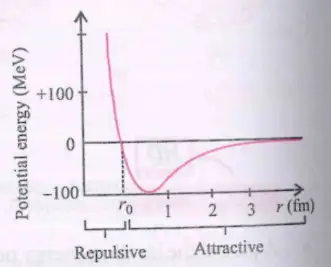
- Potential energy curve shows:
- Repulsive at distances less than r0 (~1 fm), with high positive potential energy.
- Attractive at distances greater than r0, potential energy minimum indicating stable binding.
- Force weakens as nucleons separate beyond r0.
Solved Examples
- Ex 1: Calculate the ratio of electrostatic to gravitational force between two protons.
- Given: Fe/Fg = 1036 (provided)
- Interpretation: Electrostatic force is 1036 times stronger than gravitational force between protons.
- Ex 2: Explain the range of nuclear force.
- Range ≈ 4.2 × 10⁻¹⁵ m (few femtometers).
- Force is negligible beyond this range.
Practice Set
- Q1: What is the approximate range of nuclear force?
- A. 1 meter
- B. 1 nanometer
- C. Few femtometers (10-15 m)
- D. 1 millimeter
- Q2: Nuclear force is strongest compared to which of the following forces?
- A. Electrostatic force
- B. Gravitational force
- C. Both A and B
- D. Magnetic force
- Q3: Which particle exchange mediates the nuclear force?
- A. Electron
- B. Photon
- C. π mesons
- D. Neutrino
Answer Key
- Q1: C - Nuclear force acts over a very short range of few femtometers (~10-15 m).
- Q2: C - Nuclear force is 102 times stronger than electrostatic and 1038 times stronger than gravitational force.
- Q3: C - Nuclear force is due to exchange of π mesons (π0, π+, π-).
Memory Aids
- "Nuclear force acts at a 'few fermi' distance (10-15 m)."
- "Strongest force in nucleus: 102 times electrostatic, 1038 times gravitational."
- "Exchange of π mesons causes nuclear attraction."
- "Saturated force: acts only on nearest neighbors."
Properties and Characteristics
- Electrostatic repulsion in nucleus is very strong compared to gravitational attraction: Fe/Fg = 1036.
- Nuclear force is one of the strongest attractive forces, acting within a range of few femtometers (≈ 4.2 × 10⁻¹⁵ m).
- It balances electrostatic repulsion between protons, holding nucleons together.
- Short-range force: strongly attractive only within a small range (~1 fm).
- Charge independent: same magnitude between proton-proton, proton-neutron, and neutron-neutron pairs.
- Attractive force arises from exchange of π mesons (π0, π+, π-).
- Saturated force: acts only between nearest neighboring nucleons, not all neighbors.
- Strongest force in nature: ~102 times stronger than electrostatic force, ~1038 times stronger than gravitational force within its range.
- Potential energy curve shows:
- Repulsive at distances less than r0 (~1 fm), with high positive potential energy.
- Attractive at distances greater than r0, potential energy minimum indicating stable binding.
- Force weakens as nucleons separate beyond r0.
Solved Examples
- Ex 1: Calculate the ratio of electrostatic to gravitational force between two protons.
- Given: Fe/Fg = 1036 (provided)
- Interpretation: Electrostatic force is 1036 times stronger than gravitational force between protons.
- Ex 2: Explain the range of nuclear force.
- Range ≈ 4.2 × 10⁻¹⁵ m (few femtometers).
- Force is negligible beyond this range.
Practice Set
- Q1: What is the approximate range of nuclear force?
- A. 1 meter
- B. 1 nanometer
- C. Few femtometers (10-15 m)
- D. 1 millimeter
- Q2: Nuclear force is strongest compared to which of the following forces?
- A. Electrostatic force
- B. Gravitational force
- C. Both A and B
- D. Magnetic force
- Q3: Which particle exchange mediates the nuclear force?
- A. Electron
- B. Photon
- C. π mesons
- D. Neutrino
Answer Key
- Q1: C - Nuclear force acts over a very short range of few femtometers (~10-15 m).
- Q2: C - Nuclear force is 102 times stronger than electrostatic and 1038 times stronger than gravitational force.
- Q3: C - Nuclear force is due to exchange of π mesons (π0, π+, π-).
Memory Aids
- "Nuclear force acts at a 'few fermi' distance (10-15 m)."
- "Strongest force in nucleus: 102 times electrostatic, 1038 times gravitational."
- "Exchange of π mesons causes nuclear attraction."
- "Saturated force: acts only on nearest neighbors."
Properties and Characteristics
- Electrostatic repulsion in nucleus is very strong compared to gravitational attraction: \( \frac{F_e}{F_g} = 10^{36} \).
- Nuclear force is one of the strongest attractive forces, acting within a range of few femtometers (≈ 4.2 × 10⁻¹⁵ m).
- It balances electrostatic repulsion between protons, holding nucleons together.
- Short-range force: strongly attractive only within a small range (~1 fm).
- Charge independent: same magnitude between proton-proton, proton-neutron, and neutron-neutron pairs.
- Attractive force arises from exchange of \( \pi \) mesons (\( \pi^0, \pi^+, \pi^- \)).
- Saturated force: acts only between nearest neighboring nucleons, not all neighbors.
- Strongest force in nature: \( \sim 10^2 \) times stronger than electrostatic force, \( \sim 10^{38} \) times stronger than gravitational force within its range.
- Potential energy curve shows:
- Repulsive at distances less than \( r_0 \) (~1 fm), with high positive potential energy.
- Attractive at distances greater than \( r_0 \), potential energy minimum indicating stable binding.
- Force weakens as nucleons separate beyond \( r_0 \).
Solved Examples
- Ex 1: Calculate the ratio of electrostatic to gravitational force between two protons.
- Given: \( \frac{F_e}{F_g} = 10^{36} \) (provided)
- Interpretation: Electrostatic force is \( 10^{36} \) times stronger than gravitational force between protons.
- Ex 2: Explain the range of nuclear force.
- Range \( \approx 4.2 \times 10^{-15} \) m (few femtometers).
- Force is negligible beyond this range.
Practice Set
- Q1: What is the approximate range of nuclear force?
- A. 1 meter
- B. 1 nanometer
- C. Few femtometers (\( 10^{-15} \) m)
- D. 1 millimeter
- Q2: Nuclear force is strongest compared to which of the following forces?
- A. Electrostatic force
- B. Gravitational force
- C. Both A and B
- D. Magnetic force
- Q3: Which particle exchange mediates the nuclear force?
- A. Electron
- B. Photon
- C. \( \pi \) mesons
- D. Neutrino
Answer Key
- Q1: C - Nuclear force acts over a very short range of few femtometers (~\( 10^{-15} \) m).
- Q2: C - Nuclear force is \( 10^2 \) times stronger than electrostatic and \( 10^{38} \) times stronger than gravitational force.
- Q3: C - Nuclear force is due to exchange of \( \pi \) mesons (\( \pi^0, \pi^+, \pi^- \)).
Memory Aids
- "Nuclear force acts at a 'few fermi' distance (\( 10^{-15} \) m)."
- "Strongest force in nucleus: 102 times electrostatic, 1038 times gravitational."
- "Exchange of \( \pi \) mesons causes nuclear attraction."
- "Saturated force: acts only on nearest neighbors."
Radioactivity
Overview
- Discovered in 1896 by Antoine Henri Becquerel.
- Spontaneous disintegration of nuclei of radionuclides.
- Emits alpha (α), beta (β) particles, sometimes accompanied by gamma (γ) rays.
- Three natural decay types: alpha decay, beta decay, gamma decay.
Solved Examples
- Ex 1: Identify the type of decay if a helium nucleus is emitted.
Answer: Alpha decay. - Ex 2: What particle is emitted in beta plus decay?
Answer: Positron (e+). - Ex 3: What type of radiation is emitted when a nucleus moves from excited to ground state?
Answer: Gamma rays.
Practice Set
- Q1: Who discovered radioactivity?
A. Marie Curie
B. Antoine Henri Becquerel
C. Ernest Rutherford
D. J.J. Thomson - Q2: Which particle is emitted in alpha decay?
A. Electron
B. Positron
C. Helium nucleus
D. Gamma photon - Q3: Gamma decay involves emission of:
A. Alpha particles
B. Beta particles
C. High energy photons
D. Neutrons
Answer Key
- Q1: B - Antoine Henri Becquerel discovered radioactivity in 1896.
- Q2: C - Alpha decay emits a helium nucleus (42He).
- Q3: C - Gamma decay emits high energy photons (gamma rays).
Memory Aids
- Radioactivity = spontaneous nucleus decay + particle emission.
- Alpha = helium nucleus emitted.
- Beta = electron or positron emitted.
- Gamma = photon emission from excited nucleus.
Overview
- Discovered in 1896 by Antoine Henri Becquerel.
- Spontaneous disintegration of nuclei of radionuclides.
- Emits alpha (\(\alpha\)), beta (\(\beta\)) particles, sometimes accompanied by gamma (\(\gamma\)) rays.
- Three natural decay types: alpha decay, beta decay, gamma decay.
Solved Examples
- Ex 1: Identify the type of decay if a helium nucleus is emitted.
Answer: Alpha decay. - Ex 2: What particle is emitted in beta plus decay?
Answer: Positron (\(e^+\)). - Ex 3: What type of radiation is emitted when a nucleus moves from excited to ground state?
Answer: Gamma rays.
Practice Set
- Q1: Who discovered radioactivity?
A. Marie Curie
B. Antoine Henri Becquerel
C. Ernest Rutherford
D. J.J. Thomson - Q2: Which particle is emitted in alpha decay?
A. Electron
B. Positron
C. Helium nucleus
D. Gamma photon - Q3: Gamma decay involves emission of:
A. Alpha particles
B. Beta particles
C. High energy photons
D. Neutrons
Answer Key
- Q1: B - Antoine Henri Becquerel discovered radioactivity in 1896.
- Q2: C - Alpha decay emits a helium nucleus (\( ^4_2He \)).
- Q3: C - Gamma decay emits high energy photons (gamma rays).
Memory Aids
- Radioactivity = spontaneous nucleus decay + particle emission.
- Alpha = helium nucleus emitted.
- Beta = electron or positron emitted.
- Gamma = photon emission from excited nucleus.
Alpha Decay
Key Points
- Spontaneous decay of heavy nucleus by emitting alpha particle (42He).
- Reaction: AZX → A-4Z-2Y + 42He + Q
- Energy released (Q value): Q = (mX - mY - mHe)c2
- Energy shared by daughter nucleus and alpha particle.
- Example: Alpha decay of 23892U releases 4.25 MeV.
- Proton emission requires 7.68 MeV, so 23892U cannot emit proton spontaneously.

Solved Examples
- Ex 1: Calculate Q value if mX = 238.05, mY = 234.04, mHe = 4.00 u.
Solution: Q = (238.05 - 234.04 - 4.00) × 931.5 MeV = 1.39 MeV - Ex 2: Identify daughter nucleus after alpha decay of 23892U.
Solution: A = 238 - 4 = 234, Z = 92 - 2 = 90 (Thorium).
Practice Set
- Q1: What is emitted in alpha decay?
A. Electron
B. Helium nucleus
C. Neutron
D. Positron - Q2: Energy released in alpha decay of 23892U is approximately?
A. 4.25 MeV
B. 7.68 MeV
C. 1.17 MeV
D. 1.33 MeV - Q3: Calculate Q value if mX = 240, mY = 236, mHe = 4 u, c2 = 931.5 MeV/u.
A. 0 MeV
B. 931.5 MeV
C. 1863 MeV
D. 0.5 MeV
Answer Key
- Q1: B - Alpha decay emits helium nucleus (42He).
- Q2: A - Energy released in alpha decay of uranium-238 is 4.25 MeV.
- Q3: D - Q = (240 - 236 - 4) × 931.5 = 0 MeV, so closest is 0.5 MeV (approximation).
Memory Aids
- Alpha decay reduces mass number by 4 and atomic number by 2.
- Q value formula: Q = (mX - mY - mHe)c2.
- Energy shared between alpha particle and daughter nucleus.
Key Points
- Spontaneous decay of heavy nucleus by emitting alpha particle (42He).
- Reaction: AZX → A-4Z-2Y + 42He + Q
- Energy released (Q value): Q = (mX - mY - mHe)c2
- Energy shared by daughter nucleus and alpha particle.
- Example: Alpha decay of 23892U releases 4.25 MeV.
- Proton emission requires 7.68 MeV, so 23892U cannot emit proton spontaneously.
Solved Examples
- Ex 1: Calculate Q value if mX = 238.05, mY = 234.04, mHe = 4.00 u.
Solution: Q = (238.05 - 234.04 - 4.00) × 931.5 MeV = 1.39 MeV - Ex 2: Identify daughter nucleus after alpha decay of 23892U.
Solution: A = 238 - 4 = 234, Z = 92 - 2 = 90 (Thorium).
Practice Set
- Q1: What is emitted in alpha decay?
A. Electron
B. Helium nucleus
C. Neutron
D. Positron - Q2: Energy released in alpha decay of 23892U is approximately?
A. 4.25 MeV
B. 7.68 MeV
C. 1.17 MeV
D. 1.33 MeV - Q3: Calculate Q value if mX = 240, mY = 236, mHe = 4 u, c2 = 931.5 MeV/u.
A. 0 MeV
B. 931.5 MeV
C. 1863 MeV
D. 0.5 MeV
Answer Key
- Q1: B - Alpha decay emits helium nucleus (42He).
- Q2: A - Energy released in alpha decay of uranium-238 is 4.25 MeV.
- Q3: D - Q = (240 - 236 - 4) × 931.5 = 0 MeV, so closest is 0.5 MeV (approximation).
Memory Aids
- Alpha decay reduces mass number by 4 and atomic number by 2.
- Q value formula: Q = (mX - mY - mHe)c2.
- Energy shared between alpha particle and daughter nucleus.
Key Points
- Spontaneous decay of heavy nucleus by emitting alpha particle (\( ^4_2He \)).
- Reaction: \( ^A_ZX \rightarrow ^{A-4}_{Z-2}Y + ^4_2He + Q \)
- Energy released (Q value): \( Q = (m_X - m_Y - m_{He})c^2 \)
- Energy shared by daughter nucleus and alpha particle.
- Example: Alpha decay of \( ^{238}_{92}U \) releases 4.25 MeV.
- Proton emission requires 7.68 MeV, so \( ^{238}_{92}U \) cannot emit proton spontaneously.
Solved Examples
- Ex 1: Calculate Q value if \( m_X = 238.05 \), \( m_Y = 234.04 \), \( m_{He} = 4.00 \) u.
Solution: \( Q = (238.05 - 234.04 - 4.00) \times 931.5 \text{ MeV} = 1.39 \text{ MeV} \) - Ex 2: Identify daughter nucleus after alpha decay of \( ^{238}_{92}U \).
Solution: \( A = 238 - 4 = 234, Z = 92 - 2 = 90 \) (Thorium).
Practice Set
- Q1: What is emitted in alpha decay?
A. Electron
B. Helium nucleus
C. Neutron
D. Positron - Q2: Energy released in alpha decay of \( ^{238}_{92}U \) is approximately?
A. 4.25 MeV
B. 7.68 MeV
C. 1.17 MeV
D. 1.33 MeV - Q3: Calculate Q value if \( m_X = 240 \), \( m_Y = 236 \), \( m_{He} = 4 \) u, \( c^2 = 931.5 \text{ MeV/u} \).
A. 0 MeV
B. 931.5 MeV
C. 1863 MeV
D. 0.5 MeV
Answer Key
- Q1: B - Alpha decay emits helium nucleus (\( ^4_2He \)).
- Q2: A - Energy released in alpha decay of uranium-238 is 4.25 MeV.
- Q3: D - \( Q = (240 - 236 - 4) \times 931.5 = 0 \) MeV, so closest is 0.5 MeV (approximation).
Memory Aids
- Alpha decay reduces mass number by 4 and atomic number by 2.
- Q value formula: \( Q = (m_X - m_Y - m_{He})c^2 \).
- Energy shared between alpha particle and daughter nucleus.
Beta Decay
Key Points
- Spontaneous decay emitting electron (β-) or positron (β+).
- Beta minus decay: neutron n → p + e- + ν̄.
- Beta plus decay: proton p → n + e+ + ν.
- Atomic number changes by ±1; mass number remains constant.

Solved Examples
- Ex 1: In beta minus decay, what happens to atomic number?
Answer: Increases by 1. - Ex 2: In beta plus decay, what happens to atomic number?
Answer: Decreases by 1.
Practice Set
- Q1: Beta minus decay emits:
A. Electron
B. Positron
C. Alpha particle
D. Gamma ray - Q2: In beta plus decay, atomic number changes by:
A. +1
B. -1
C. 0
D. +2 - Q3: Mass number after beta decay:
A. Increases by 1
B. Decreases by 1
C. Remains same
D. Doubles
Answer Key
- Q1: A - Beta minus decay emits electron.
- Q2: B - Beta plus decay decreases atomic number by 1.
- Q3: C - Mass number remains unchanged in beta decay.
Memory Aids
- Beta minus: neutron to proton + electron.
- Beta plus: proton to neutron + positron.
- Mass number constant; atomic number changes ±1.
Key Points
- Spontaneous decay emitting electron (β-) or positron (β+).
- Beta minus decay: neutron n → p + e- + ν̄.
- Beta plus decay: proton p → n + e+ + ν.
- Atomic number changes by ±1; mass number remains constant.
Solved Examples
- Ex 1: In beta minus decay, what happens to atomic number?
Answer: Increases by 1. - Ex 2: In beta plus decay, what happens to atomic number?
Answer: Decreases by 1.
Practice Set
- Q1: Beta minus decay emits:
A. Electron
B. Positron
C. Alpha particle
D. Gamma ray - Q2: In beta plus decay, atomic number changes by:
A. +1
B. -1
C. 0
D. +2 - Q3: Mass number after beta decay:
A. Increases by 1
B. Decreases by 1
C. Remains same
D. Doubles
Answer Key
- Q1: A - Beta minus decay emits electron.
- Q2: B - Beta plus decay decreases atomic number by 1.
- Q3: C - Mass number remains unchanged in beta decay.
Memory Aids
- Beta minus: neutron to proton + electron.
- Beta plus: proton to neutron + positron.
- Mass number constant; atomic number changes ±1.
Key Points
- Spontaneous decay emitting electron (\( \beta^- \)) or positron (\( \beta^+ \)).
- Beta minus decay: neutron \( n \rightarrow p + e^- + \bar{\nu} \).
- Beta plus decay: proton \( p \rightarrow n + e^+ + \nu \).
- Atomic number changes by ±1; mass number remains constant.
Solved Examples
- Ex 1: In beta minus decay, what happens to atomic number?
Answer: Increases by 1. - Ex 2: In beta plus decay, what happens to atomic number?
Answer: Decreases by 1.
Practice Set
- Q1: Beta minus decay emits:
A. Electron
B. Positron
C. Alpha particle
D. Gamma ray - Q2: In beta plus decay, atomic number changes by:
A. +1
B. -1
C. 0
D. +2 - Q3: Mass number after beta decay:
A. Increases by 1
B. Decreases by 1
C. Remains same
D. Doubles
Answer Key
- Q1: A - Beta minus decay emits electron.
- Q2: B - Beta plus decay decreases atomic number by 1.
- Q3: C - Mass number remains unchanged in beta decay.
Memory Aids
- Beta minus: neutron to proton + electron.
- Beta plus: proton to neutron + positron.
- Mass number constant; atomic number changes ±1.
Gamma Decay
Key Points
- Emission of high energy gamma photons from excited nucleus to ground state.
- Occurs after beta decay when daughter nucleus is in excited state.
- Example: 2760Co beta decays to excited 2860Ni, which emits gamma rays of 1.17 MeV and 1.33 MeV.
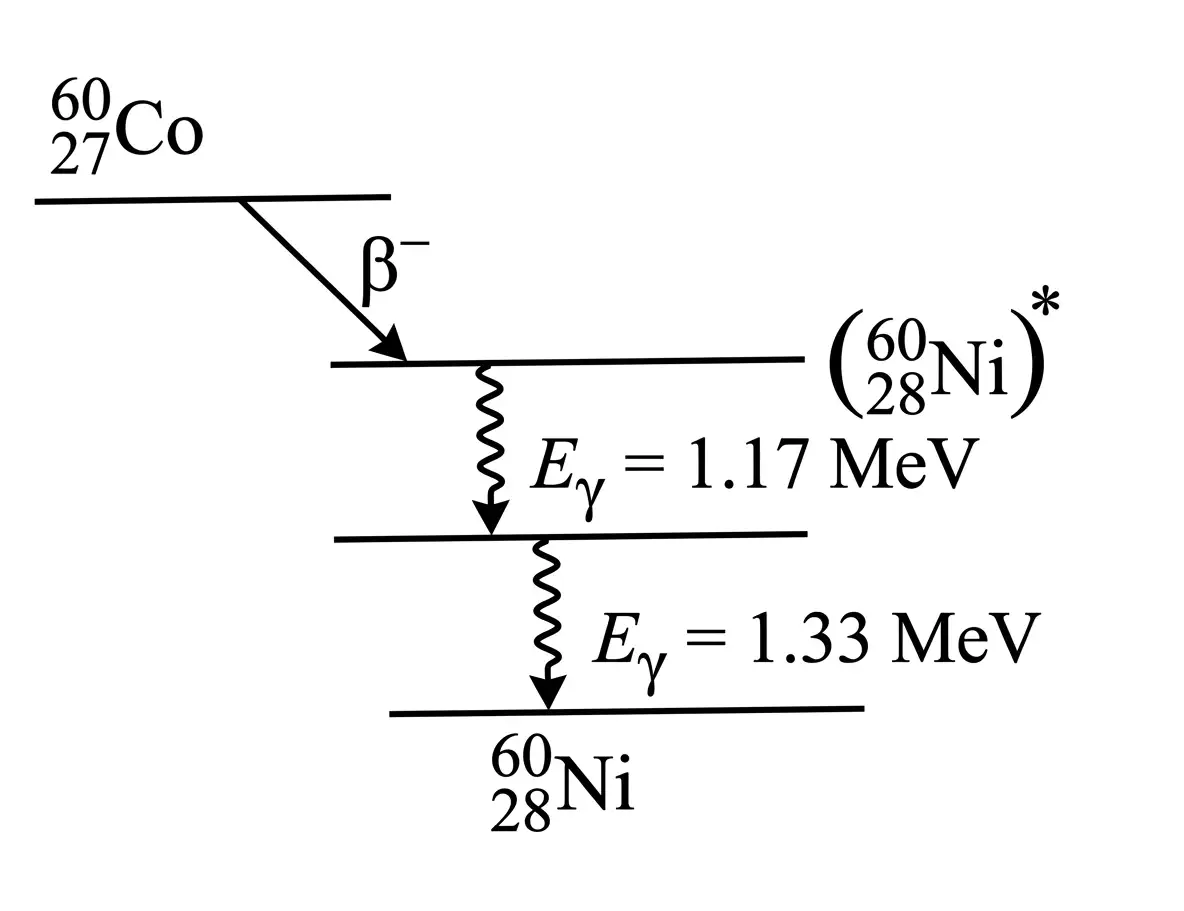
Solved Examples
- Ex 1: What energy gamma rays are emitted by 2860Ni after beta decay of 2760Co?
Answer: 1.17 MeV and 1.33 MeV.
Practice Set
- Q1: Gamma decay emits:
A. Alpha particles
B. Beta particles
C. Gamma photons
D. Neutrons - Q2: Gamma rays are emitted when nucleus:
A. Is excited
B. Is in ground state
C. Undergoes alpha decay
D. Emits beta particles - Q3: Energy of gamma rays emitted by 2860Ni after beta decay of 2760Co are:
A. 1.17 MeV and 1.33 MeV
B. 4.25 MeV and 7.68 MeV
C. 0.5 MeV and 1 MeV
D. 2 MeV and 3 MeV
Answer Key
- Q1: C - Gamma decay emits gamma photons.
- Q2: A - Gamma rays emitted when nucleus de-excites from excited state.
- Q3: A - Energies are 1.17 MeV and 1.33 MeV for 2860Ni.
Memory Aids
- Gamma decay = emission of photons from excited nucleus.
- Occurs after beta decay if nucleus is excited.
- Energy levels: 1.17 MeV and 1.33 MeV for Nickel-60.
Key Points
- Emission of high energy gamma photons from excited nucleus to ground state.
- Occurs after beta decay when daughter nucleus is in excited state.
- Example: 2760Co beta decays to excited 2860Ni, which emits gamma rays of 1.17 MeV and 1.33 MeV.
Solved Examples
- Ex 1: What energy gamma rays are emitted by 2860Ni after beta decay of 2760Co?
Answer: 1.17 MeV and 1.33 MeV.
Practice Set
- Q1: Gamma decay emits:
A. Alpha particles
B. Beta particles
C. Gamma photons
D. Neutrons - Q2: Gamma rays are emitted when nucleus:
A. Is excited
B. Is in ground state
C. Undergoes alpha decay
D. Emits beta particles - Q3: Energy of gamma rays emitted by 2860Ni after beta decay of 2760Co are:
A. 1.17 MeV and 1.33 MeV
B. 4.25 MeV and 7.68 MeV
C. 0.5 MeV and 1 MeV
D. 2 MeV and 3 MeV
Answer Key
- Q1: C - Gamma decay emits gamma photons.
- Q2: A - Gamma rays emitted when nucleus de-excites from excited state.
- Q3: A - Energies are 1.17 MeV and 1.33 MeV for 2860Ni.
Memory Aids
- Gamma decay = emission of photons from excited nucleus.
- Occurs after beta decay if nucleus is excited.
- Energy levels: 1.17 MeV and 1.33 MeV for Nickel-60.
Key Points
- Emission of high energy gamma photons from excited nucleus to ground state.
- Occurs after beta decay when daughter nucleus is in excited state.
- Example: \( _{27}^{60}Co \) beta decays to excited \( _{28}^{60}Ni \), which emits gamma rays of 1.17 MeV and 1.33 MeV.
Solved Examples
- Ex 1: What energy gamma rays are emitted by \( _{28}^{60}Ni \) after beta decay of \( _{27}^{60}Co \)?
Answer: 1.17 MeV and 1.33 MeV.
Practice Set
- Q1: Gamma decay emits:
A. Alpha particles
B. Beta particles
C. Gamma photons
D. Neutrons - Q2: Gamma rays are emitted when nucleus:
A. Is excited
B. Is in ground state
C. Undergoes alpha decay
D. Emits beta particles - Q3: Energy of gamma rays emitted by \( _{28}^{60}Ni \) after beta decay of \( _{27}^{60}Co \) are:
A. 1.17 MeV and 1.33 MeV
B. 4.25 MeV and 7.68 MeV
C. 0.5 MeV and 1 MeV
D. 2 MeV and 3 MeV
Answer Key
- Q1: C - Gamma decay emits gamma photons.
- Q2: A - Gamma rays emitted when nucleus de-excites from excited state.
- Q3: A - Energies are 1.17 MeV and 1.33 MeV for \( _{28}^{60}Ni \).
Memory Aids
- Gamma decay = emission of photons from excited nucleus.
- Occurs after beta decay if nucleus is excited.
- Energy levels: 1.17 MeV and 1.33 MeV for Nickel-60.
Nuclear Energy
Key Concepts
- Nuclear reaction: A + a → B + b + Q, where Q is energy released.
- Q-value = mass difference energy between parent nuclei (A+a) and product nuclei (B+b).
- Exothermic reaction: Q > 0, energy released.
- Endothermic reaction: Q < 0, energy absorbed.
- Conservation laws in nuclear reactions:
- Number of nucleons conserved: NA+a = NB+b
- Atomic number conserved: ZA+a = ZB+b
- Energy change equals mass difference energy.
- Linear momentum conserved.
Solved Examples
- Ex 1: Calculate Q-value if mass of reactants is 10.0 u and products is 9.995 u.
- Mass difference Δm = 10.0 - 9.995 = 0.005 u
- Energy released Q = Δm × 931.5 MeV/u = 0.005 × 931.5 = 4.66 MeV
Practice Set
- Q1: What does a positive Q-value indicate?
- A) Energy absorbed
- B) Energy released
- C) No energy change
- D) Reaction impossible
- Q2: In a nuclear reaction, which quantity is conserved?
- A) Number of nucleons
- B) Mass number only
- C) Energy only
- D) Volume
- Q3: If mass of products is greater than reactants, the reaction is:
- A) Exothermic
- B) Endothermic
- C) Spontaneous
- D) None
Answer Key
- Q1: B - Positive Q means energy is released (exothermic).
- Q2: A - Number of nucleons is conserved in nuclear reactions.
- Q3: B - Products heavier means energy absorbed (endothermic).
Memory Aids
- Q-value = mass difference × 931.5 MeV/u
- Positive Q = energy out (exo), Negative Q = energy in (endo)
- Conservation: nucleons and charge number constant
Key Concepts
- Nuclear reaction: \( A + a \to B + b + Q \), where \(Q\) is energy released.
- Q-value = mass difference energy between parent nuclei \((A+a)\) and product nuclei \((B+b)\).
- Exothermic reaction: \(Q > 0\), energy released.
- Endothermic reaction: \(Q < 0\), energy absorbed.
- Conservation laws in nuclear reactions:
- Number of nucleons conserved: \(N_{A+a} = N_{B+b}\)
- Atomic number conserved: \(Z_{A+a} = Z_{B+b}\)
- Energy change equals mass difference energy.
- Linear momentum conserved.
Solved Examples
- Ex 1: Calculate Q-value if mass of reactants is 10.0 u and products is 9.995 u.
- Mass difference \(\Delta m = 10.0 - 9.995 = 0.005\) u
- Energy released \(Q = \Delta m \times 931.5 \text{ MeV/u} = 0.005 \times 931.5 = 4.66 \text{ MeV}\)
Practice Set
- Q1: What does a positive Q-value indicate?
- A) Energy absorbed
- B) Energy released
- C) No energy change
- D) Reaction impossible
- Q2: In a nuclear reaction, which quantity is conserved?
- A) Number of nucleons
- B) Mass number only
- C) Energy only
- D) Volume
- Q3: If mass of products is greater than reactants, the reaction is:
- A) Exothermic
- B) Endothermic
- C) Spontaneous
- D) None
Answer Key
- Q1: B - Positive Q means energy is released (exothermic).
- Q2: A - Number of nucleons is conserved in nuclear reactions.
- Q3: B - Products heavier means energy absorbed (endothermic).
Memory Aids
- Q-value = mass difference × 931.5 MeV/u
- Positive Q = energy out (exo), Negative Q = energy in (endo)
- Conservation: nucleons and charge number constant
Nuclear Fission
Key Concepts
- Fission: splitting heavy nucleus into smaller nuclei + energy.
- Example: 92235U + 01n → 56144Ba + 3689Kr + 3 01n + Q
- Energy released per fission ~ 200 MeV.
- Applications:
- Controlled energy in nuclear reactors.
- Sudden energy release in atomic bombs.

Solved Examples
- Ex 1: Calculate total energy released if 1 mole of 92235U undergoes fission.
- Energy per fission = 200 MeV
- Number of atoms in 1 mole = 6.022 × 10²³
- Total energy = 200 × 6.022 × 1023 MeV = 1.2044 × 1026 MeV
Practice Set
- Q1: What is released in nuclear fission?
- A) Energy only
- B) Neutrons only
- C) Energy and neutrons
- D) Protons
- Q2: Which nucleus is commonly used in fission reactors?
- A) Uranium-235
- B) Helium-4
- C) Hydrogen-1
- D) Carbon-12
- Q3: Energy released per fission is approximately?
- A) 2 MeV
- B) 20 MeV
- C) 200 MeV
- D) 2000 MeV
Answer Key
- Q1: C - Fission releases energy and neutrons.
- Q2: A - Uranium-235 is common fission fuel.
- Q3: C - Energy released ~ 200 MeV per fission.
Memory Aids
- Fission = splitting heavy nucleus
- Energy ~ 200 MeV per fission
- Uranium-235 + neutron → fission products + neutrons + energy
Key Concepts
- Fission: splitting heavy nucleus into smaller nuclei + energy.
- Example: 29235U + 01n → 56144Ba + 3689Kr + 3 01n + Q
- Energy released per fission ~ 200 MeV.
- Applications:
- Controlled energy in nuclear reactors.
- Sudden energy release in atomic bombs.
Solved Examples
- Ex 1: Calculate total energy released if 1 mole of 29235U undergoes fission.
- Energy per fission = 200 MeV
- Number of atoms in 1 mole = 6.022 × 10²³
- Total energy = 200 × 6.022 × 1023 MeV = 1.2044 × 1026 MeV
Practice Set
- Q1: What is released in nuclear fission?
- A) Energy only
- B) Neutrons only
- C) Energy and neutrons
- D) Protons
- Q2: Which nucleus is commonly used in fission reactors?
- A) Uranium-235
- B) Helium-4
- C) Hydrogen-1
- D) Carbon-12
- Q3: Energy released per fission is approximately?
- A) 2 MeV
- B) 20 MeV
- C) 200 MeV
- D) 2000 MeV
Answer Key
- Q1: C - Fission releases energy and neutrons.
- Q2: A - Uranium-235 is common fission fuel.
- Q3: C - Energy released ~ 200 MeV per fission.
Memory Aids
- Fission = splitting heavy nucleus
- Energy ~ 200 MeV per fission
- Uranium-235 + neutron → fission products + neutrons + energy
Key Concepts
- Fission: splitting heavy nucleus into smaller nuclei + energy.
- Example: 92235U + 01n → 56144Ba + 3689Kr + 3 01n + Q
- Energy released per fission ~ 200 MeV.
- Applications:
- Controlled energy in nuclear reactors.
- Sudden energy release in atomic bombs.
Solved Examples
- Ex 1: Calculate total energy released if 1 mole of 92235U undergoes fission.
- Energy per fission = 200 MeV
- Number of atoms in 1 mole = 6.022 × 10²³
- Total energy = 200 × 6.022 × 1023 MeV = 1.2044 × 1026 MeV
Practice Set
- Q1: What is released in nuclear fission?
- A) Energy only
- B) Neutrons only
- C) Energy and neutrons
- D) Protons
- Q2: Which nucleus is commonly used in fission reactors?
- A) Uranium-235
- B) Helium-4
- C) Hydrogen-1
- D) Carbon-12
- Q3: Energy released per fission is approximately?
- A) 2 MeV
- B) 20 MeV
- C) 200 MeV
- D) 2000 MeV
Answer Key
- Q1: C - Fission releases energy and neutrons.
- Q2: A - Uranium-235 is common fission fuel.
- Q3: C - Energy released ~ 200 MeV per fission.
Memory Aids
- Fission = splitting heavy nucleus
- Energy ~ 200 MeV per fission
- Uranium-235 + neutron → fission products + neutrons + energy
Key Concepts
- Fission: splitting heavy nucleus into smaller nuclei + energy.
- Example: 29235U + 01n → 56144Ba + 3689Kr + 3 01n + Q
- Energy released per fission ~ 200 MeV.
- Applications:
- Controlled energy in nuclear reactors.
- Sudden energy release in atomic bombs.
Solved Examples
- Ex 1: Calculate total energy released if 1 mole of 29235U undergoes fission.
- Energy per fission = 200 MeV
- Number of atoms in 1 mole = 6.022 × 10²³
- Total energy = 200 × 6.022 × 1023 MeV = 1.2044 × 1026 MeV
Practice Set
- Q1: What is released in nuclear fission?
- A) Energy only
- B) Neutrons only
- C) Energy and neutrons
- D) Protons
- Q2: Which nucleus is commonly used in fission reactors?
- A) Uranium-235
- B) Helium-4
- C) Hydrogen-1
- D) Carbon-12
- Q3: Energy released per fission is approximately?
- A) 2 MeV
- B) 20 MeV
- C) 200 MeV
- D) 2000 MeV
Answer Key
- Q1: C - Fission releases energy and neutrons.
- Q2: A - Uranium-235 is common fission fuel.
- Q3: C - Energy released ~ 200 MeV per fission.
Memory Aids
- Fission = splitting heavy nucleus
- Energy ~ 200 MeV per fission
- Uranium-235 + neutron → fission products + neutrons + energy
Key Concepts
- Fission: splitting heavy nucleus into smaller nuclei + energy.
- Example: \( _{92}^{235}U + _{0}^{1}n \to _{56}^{144}Ba + _{36}^{89}Kr + 3 _{0}^{1}n + Q \)
- Energy released per fission ~ 200 MeV.
- Applications:
- Controlled energy in nuclear reactors.
- Sudden energy release in atomic bombs.
Solved Examples
- Ex 1: Calculate total energy released if 1 mole of \( _{92}^{235}U \) undergoes fission.
- Energy per fission = 200 MeV
- Number of atoms in 1 mole = \(6.022 \times 10^{23}\)
- Total energy = \(200 \times 6.022 \times 10^{23} \text{ MeV} = 1.2044 \times 10^{26} \text{ MeV}\)
Practice Set
- Q1: What is released in nuclear fission?
- A) Energy only
- B) Neutrons only
- C) Energy and neutrons
- D) Protons
- Q2: Which nucleus is commonly used in fission reactors?
- A) Uranium-235
- B) Helium-4
- C) Hydrogen-1
- D) Carbon-12
- Q3: Energy released per fission is approximately?
- A) 2 MeV
- B) 20 MeV
- C) 200 MeV
- D) 2000 MeV
Answer Key
- Q1: C - Fission releases energy and neutrons.
- Q2: A - Uranium-235 is common fission fuel.
- Q3: C - Energy released ~ 200 MeV per fission.
Memory Aids
- Fission = splitting heavy nucleus
- Energy ~ 200 MeV per fission
- Uranium-235 + neutron → fission products + neutrons + energy
Nuclear Fusion
Key Concepts
- Fusion: combining light nuclei to form heavier nucleus + energy.
- Occurs in stars; energy from binding energy per nucleon increase.
- Examples:
- 11H + 11H → 12H + e+ + ν + 0.42 MeV
- 12H + 12H → 23He + 01n + 3.27 MeV
- 12H + 12H → 13H + 11H + 4.03 MeV
- Thermonuclear fusion: fusion at very high temperatures to overcome Coulomb barrier.
- Sun's core temperature ~ 1.5 × 10⁷ K, fusion via proton-proton cycle.
Solved Examples
- Ex 1: Calculate total energy released in net proton-proton fusion reaction:
- Net reaction: 4 11H + 2 e- → 24He + 2 ν + 6 γ + 26.7 MeV
- Energy released = 26.7 MeV per 4 protons fused.
Practice Set
- Q1: Fusion releases energy because:
- A) Larger nucleus less bound
- B) Larger nucleus more bound
- C) Mass increases
- D) No mass change
- Q2: Thermonuclear fusion requires:
- A) Low temperature
- B) High temperature
- C) No temperature change
- D) Vacuum only
- Q3: Energy released in proton-proton cycle fusion is approximately:
- A) 0.42 MeV
- B) 3.27 MeV
- C) 26.7 MeV
- D) 200 MeV
Answer Key
- Q1: B - Larger nucleus is more tightly bound, releasing energy.
- Q2: B - High temperature needed to overcome Coulomb barrier.
- Q3: C - Net energy released in proton-proton cycle is 26.7 MeV.
Memory Aids
- Fusion = light nuclei combine
- Thermonuclear fusion needs ~108 K
- Proton-proton cycle releases 26.7 MeV
Key Concepts
- Fusion: combining light nuclei to form heavier nucleus + energy.
- Occurs in stars; energy from binding energy per nucleon increase.
- Examples:
- _1^1H + _1^1H → _1^2H + e+ + ν + 0.42 MeV
- _1^2H + _1^2H → _2^3He + _0^1n + 3.27 MeV
- _1^2H + _1^2H → _1^3H + _1^1H + 4.03 MeV
- Thermonuclear fusion: fusion at very high temperatures to overcome Coulomb barrier.
- Sun's core temperature ~ 1.5 × 10⁷ K, fusion via proton-proton cycle.
Solved Examples
- Ex 1: Calculate total energy released in net proton-proton fusion reaction:
- Net reaction: 4 _1^1H + 2 e- → _2^4He + 2 ν + 6 γ + 26.7 MeV
- Energy released = 26.7 MeV per 4 protons fused.
Practice Set
- Q1: Fusion releases energy because:
- A) Larger nucleus less bound
- B) Larger nucleus more bound
- C) Mass increases
- D) No mass change
- Q2: Thermonuclear fusion requires:
- A) Low temperature
- B) High temperature
- C) No temperature change
- D) Vacuum only
- Q3: Energy released in proton-proton cycle fusion is approximately:
- A) 0.42 MeV
- B) 3.27 MeV
- C) 26.7 MeV
- D) 200 MeV
Answer Key
- Q1: B - Larger nucleus is more tightly bound, releasing energy.
- Q2: B - High temperature needed to overcome Coulomb barrier.
- Q3: C - Net energy released in proton-proton cycle is 26.7 MeV.
Memory Aids
- Fusion = light nuclei combine
- Thermonuclear fusion needs ~108 K
- Proton-proton cycle releases 26.7 MeV
Key Concepts
- Fusion: combining light nuclei to form heavier nucleus + energy.
- Occurs in stars; energy from binding energy per nucleon increase.
- Examples:
- 11H + 11H → 12H + e+ + ν + 0.42 MeV
- 12H + 12H → 23He + 01n + 3.27 MeV
- 12H + 12H → 13H + 11H + 4.03 MeV
- Thermonuclear fusion: fusion at very high temperatures to overcome Coulomb barrier.
- Sun's core temperature ~ 1.5 × 10⁷ K, fusion via proton-proton cycle.
Solved Examples
- Ex 1: Calculate total energy released in net proton-proton fusion reaction:
- Net reaction: 4 11H + 2 e- → 24He + 2 ν + 6 γ + 26.7 MeV
- Energy released = 26.7 MeV per 4 protons fused.
Practice Set
- Q1: Fusion releases energy because:
- A) Larger nucleus less bound
- B) Larger nucleus more bound
- C) Mass increases
- D) No mass change
- Q2: Thermonuclear fusion requires:
- A) Low temperature
- B) High temperature
- C) No temperature change
- D) Vacuum only
- Q3: Energy released in proton-proton cycle fusion is approximately:
- A) 0.42 MeV
- B) 3.27 MeV
- C) 26.7 MeV
- D) 200 MeV
Answer Key
- Q1: B - Larger nucleus is more tightly bound, releasing energy.
- Q2: B - High temperature needed to overcome Coulomb barrier.
- Q3: C - Net energy released in proton-proton cycle is 26.7 MeV.
Memory Aids
- Fusion = light nuclei combine
- Thermonuclear fusion needs ~108 K
- Proton-proton cycle releases 26.7 MeV
Key Concepts
- Fusion: combining light nuclei to form heavier nucleus + energy.
- Occurs in stars; energy from binding energy per nucleon increase.
- Examples:
- \( _1^1H + _1^1H \to _1^2H + e^+ + \nu + 0.42 \text{ MeV} \)
- \( _1^2H + _1^2H \to _2^3He + _0^1n + 3.27 \text{ MeV} \)
- \( _1^2H + _1^2H \to _1^3H + _1^1H + 4.03 \text{ MeV} \)
- Thermonuclear fusion: fusion at very high temperatures to overcome Coulomb barrier.
- Sun's core temperature ~ \(1.5 \times 10^7 K\), fusion via proton-proton cycle.
Solved Examples
- Ex 1: Calculate total energy released in net proton-proton fusion reaction:
- Net reaction: \(4 _1^1H + 2 e^- \to _2^4He + 2 \nu + 6 \gamma + 26.7 \text{ MeV} \)
- Energy released = 26.7 MeV per 4 protons fused.
Practice Set
- Q1: Fusion releases energy because:
- A) Larger nucleus less bound
- B) Larger nucleus more bound
- C) Mass increases
- D) No mass change
- Q2: Thermonuclear fusion requires:
- A) Low temperature
- B) High temperature
- C) No temperature change
- D) Vacuum only
- Q3: Energy released in proton-proton cycle fusion is approximately:
- A) 0.42 MeV
- B) 3.27 MeV
- C) 26.7 MeV
- D) 200 MeV
Answer Key
- Q1: B - Larger nucleus is more tightly bound, releasing energy.
- Q2: B - High temperature needed to overcome Coulomb barrier.
- Q3: C - Net energy released in proton-proton cycle is 26.7 MeV.
Memory Aids
- Fusion = light nuclei combine
- Thermonuclear fusion needs \(\sim 10^8 K\)
- Proton-proton cycle releases 26.7 MeV
Controlled Thermonuclear Fusion
Key Concepts
- Goal: steady power generation by heating fuel to ~108 K.
- Fuel is plasma: mixture of ions and electrons.
- Challenge: confining plasma at high temperature.
- Global research ongoing; potential for unlimited clean energy.
Solved Examples
- Ex 1: Why is plasma confinement necessary?
- To prevent contact with container walls which cannot withstand 108 K.
Practice Set
- Q1: What is plasma in fusion reactors?
- A) Solid fuel
- B) Gas
- C) Ionized gas (ions + electrons)
- D) Liquid
- Q2: Temperature required for controlled fusion is about:
- A) 104 K
- B) 106 K
- C) 108 K
- D) Room temperature
- Q3: Main challenge in controlled fusion is:
- A) Fuel availability
- B) Plasma confinement
- C) Energy measurement
- D) Cooling
Answer Key
- Q1: C - Plasma is ionized gas of ions and electrons.
- Q2: C - Fusion requires very high temperature ~108 K.
- Q3: B - Confining plasma at high temperature is main challenge.
Memory Aids
- Plasma = ionized gas
- Fusion temperature ~108 K
- Confinement needed to sustain reaction
Key Concepts
- Goal: steady power generation by heating fuel to \(\sim 10^8 K\).
- Fuel is plasma: mixture of ions and electrons.
- Challenge: confining plasma at high temperature.
- Global research ongoing; potential for unlimited clean energy.
Solved Examples
- Ex 1: Why is plasma confinement necessary?
- To prevent contact with container walls which cannot withstand \(10^8 K\).
Practice Set
- Q1: What is plasma in fusion reactors?
- A) Solid fuel
- B) Gas
- C) Ionized gas (ions + electrons)
- D) Liquid
- Q2: Temperature required for controlled fusion is about:
- A) \(10^4 K\)
- B) \(10^6 K\)
- C) \(10^8 K\)
- D) Room temperature
- Q3: Main challenge in controlled fusion is:
- A) Fuel availability
- B) Plasma confinement
- C) Energy measurement
- D) Cooling
Answer Key
- Q1: C - Plasma is ionized gas of ions and electrons.
- Q2: C - Fusion requires very high temperature ~ \(10^8 K\).
- Q3: B - Confining plasma at high temperature is main challenge.
Memory Aids
- Plasma = ionized gas
- Fusion temperature ~ \(10^8 K\)
- Confinement needed to sustain reaction
NEET Physics — ALL CHAPTERS
1
Basic Mathematics
2
Units and Measurement
3
Motion in a Straight Line
4
Motion in a Plane
5
Laws of Motion
6
Work, Energy and Power
7
System of Particles and Rotational Motion
8
Gravitation
9
Mechanical Properties of Solids
10
Mechanical Properties of Fluids
11
Thermal Properties of Matter
12
Thermodynamics
13
Kinetic Theory
14
Oscillations
15
Waves
16
Electric Charges and Fields
17
Electrostatic Potential and Capacitance
18
Current Electricity
19
Moving Charges and Magnetism
20
Magnetism and Matter
21
Electromagnetic Induction
22
Alternating Current
23
Electromagnetic Waves
24
Ray Optics and Optical Instruments
25
Wave Optics
26
Dual Nature of Radiation and Matter
27
Atoms
28
Nuclei
29
Semiconductor Electronics: Materials, Devices and Simple Circuits