NEET Ug . NEET Physics . Physics . Thermal Properties of Matter
Chapter 11: Thermal Properties of Matter
Ch 11
NEET Physics
NEET Ug
Introduction
Concept Overview
- Temperature measures the hotness or coldness of a body.
- During phase changes like boiling or freezing, temperature remains constant despite heat flow.
- Thermal properties explain why ice feels cold and why temperature stays steady during state changes.
Solved Examples
- Ex 1: Why does temperature remain constant during boiling?
- Heat energy is used for phase change, not temperature rise.
Practice Set
- Q1: What does temperature measure?
- A) Energy content B) Hotness or coldness C) Heat flow D) Pressure
- Q2: During freezing, temperature of water
- A) Increases B) Decreases C) Remains constant D) Fluctuates
- Q3: Why does ice feel cold to touch?
- A) It has low temperature B) It absorbs heat from hand C) It emits heat D) It has high temperature
Answer Key
- Q1: B - Temperature indicates hotness or coldness, not energy or heat flow.
- Q2: C - Temperature remains constant during freezing as heat is used for phase change.
- Q3: B - Ice absorbs heat from the hand, making it feel cold.
Memory Aids
- Temperature = Hotness/Coldness indicator
- Phase change = Constant temperature despite heat flow
- Ice feels cold because it absorbs heat
Temperature and Heat
Key Concepts
- Temperature: Relative measure of hotness or coldness (SI unit: Kelvin, °C).
- Heat: Energy transferred due to temperature difference (SI unit: Joule).
- Heat transfer causes changes: temperature rise, expansion, or state change.
- Heat flow direction: from higher to lower temperature.
Solved Examples
- Ex 1: Define heat.
- Heat is energy transferred due to temperature difference.
- Ex 2: What happens when an object is heated?
- Temperature may rise, object may expand or change state.
Practice Set
- Q1: Heat is transferred because of
- A) Pressure difference B) Temperature difference C) Volume difference D) Mass difference
- Q2: Which is a relative measure?
- A) Heat B) Temperature C) Energy D) Work
- Q3: When an object is heated, which change is NOT possible?
- A) Temperature rise B) Expansion C) Change of state D) Decrease in temperature
Answer Key
- Q1: B - Heat flows due to temperature difference.
- Q2: B - Temperature is a relative measure of hotness or coldness.
- Q3: D - Heating cannot decrease temperature.
Memory Aids
- Heat = Energy transfer due to temperature difference
- Temperature = Relative hotness/coldness
- Heating effects: Rise in temperature, expansion, or phase change
Measurement of Temperature
Thermometer and Temperature Measurement
- A thermometer measures temperature using physical properties that change with temperature.
- Commonly used property: volume variation of liquids like mercury or alcohol in glass thermometers.
- Volume of these liquids changes linearly with temperature over a wide range.
Temperature Scales and Fixed Points
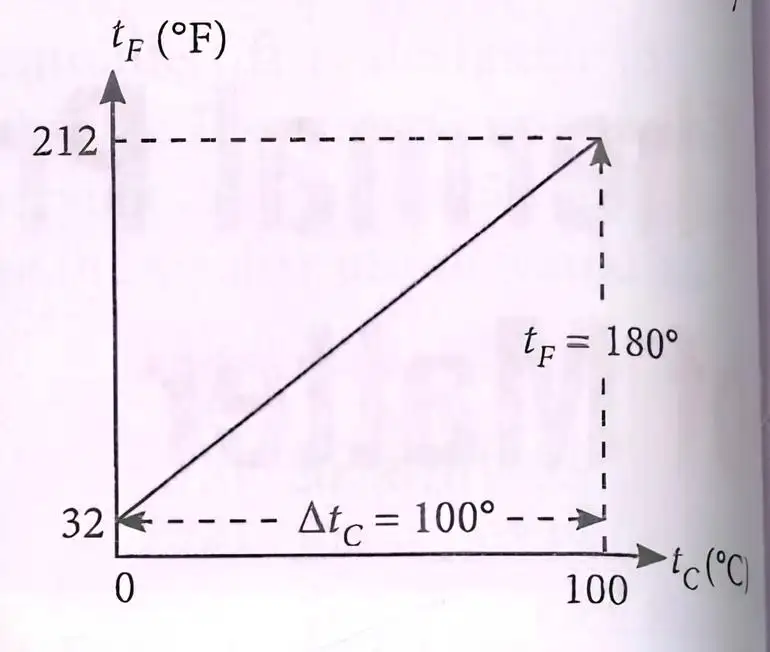
- Two fixed reference points define temperature scales: ice point (freezing) and steam point (boiling) of water.
- Ice point = 0°C (32°F), Steam point = 100°C (212°F).
- Common scales: Celsius (°C) and Fahrenheit (°F).
Relation Between Celsius and Fahrenheit
- Formula: (tF - 32)/180 = tC/100
- Where tF = temperature in Fahrenheit, tC = temperature in Celsius.
Solved Examples
- Ex 1: Convert 25°C to Fahrenheit.
- Use formula: tF = 180/100 × tC + 32
- Calculation: tF = 1.8 × 25 + 32 = 45 + 32 = 77°F
- Ex 2: Convert 95°F to Celsius.
- Use formula: tC = 100/180 (tF - 32)
- Calculation: tC = 100/180 (95 - 32) = 100/180 × 63 = 35°C
Practice Set
- Q1: What is the freezing point of water in Fahrenheit?
- A) 0°F
- B) 32°F
- C) 100°F
- D) 212°F
- Q2: Convert 40°C to Fahrenheit.
- A) 104°F
- B) 72°F
- C) 90°F
- D) 68°F
- Q3: If the temperature is 86°F, what is it in Celsius?
- A) 30°C
- B) 32°C
- C) 28°C
- D) 25°C
Answer Key
- Q1: B) 32°F - Freezing point of water is 32°F on Fahrenheit scale.
- Q2: A) 104°F - Using formula: 1.8 × 40 + 32 = 104°F.
- Q3: A) 30°C - Using formula: 100/180 (86 - 32) = 30°C.
Memory Aids
- Freezing point: 0°C = 32°F
- Boiling point: 100°C = 212°F
- Conversion formula: tF = 1.8 tC + 32, tC = 5/9 (tF - 32)
- Volume of mercury/alcohol changes linearly with temperature in thermometers.
Thermometer and Temperature Measurement
- A thermometer measures temperature using physical properties that change with temperature.
- Commonly used property: volume variation of liquids like mercury or alcohol in glass thermometers.
- Volume of these liquids changes linearly with temperature over a wide range.
Temperature Scales and Fixed Points
- Two fixed reference points define temperature scales: ice point (freezing) and steam point (boiling) of water.
- Ice point = 0°C (32°F), Steam point = 100°C (212°F).
- Common scales: Celsius (°C) and Fahrenheit (°F).
Relation Between Celsius and Fahrenheit
- Formula: (tF - 32)/180 = tC/100
- Where tF = temperature in Fahrenheit, tC = temperature in Celsius.
Solved Examples
- Ex 1: Convert 25°C to Fahrenheit.
- Use formula: tF = 180/100 × tC + 32
- Calculation: tF = 1.8 × 25 + 32 = 45 + 32 = 77°F
- Ex 2: Convert 95°F to Celsius.
- Use formula: tC = 100/180 (tF - 32)
- Calculation: tC = 100/180 (95 - 32) = 100/180 × 63 = 35°C
Practice Set
- Q1: What is the freezing point of water in Fahrenheit?
- A) 0°F
- B) 32°F
- C) 100°F
- D) 212°F
- Q2: Convert 40°C to Fahrenheit.
- A) 104°F
- B) 72°F
- C) 90°F
- D) 68°F
- Q3: If the temperature is 86°F, what is it in Celsius?
- A) 30°C
- B) 32°C
- C) 28°C
- D) 25°C
Answer Key
- Q1: B) 32°F - Freezing point of water is 32°F on Fahrenheit scale.
- Q2: A) 104°F - Using formula: 1.8 × 40 + 32 = 104°F.
- Q3: A) 30°C - Using formula: 100/180 (86 - 32) = 30°C.
Memory Aids
- Freezing point: 0°C = 32°F
- Boiling point: 100°C = 212°F
- Conversion formula: tF = 1.8 tC + 32, tC = 5/9 (tF - 32)
- Volume of mercury/alcohol changes linearly with temperature in thermometers.
Thermometer and Temperature Measurement
- A thermometer measures temperature using physical properties that change with temperature.
- Commonly used property: volume variation of liquids like mercury or alcohol in glass thermometers.
- Volume of these liquids changes linearly with temperature over a wide range.
Temperature Scales and Fixed Points
- Two fixed reference points define temperature scales: ice point (freezing) and steam point (boiling) of water.
- Ice point = 0°C (32°F), Steam point = 100°C (212°F).
- Common scales: Celsius (°C) and Fahrenheit (°F).
Relation Between Celsius and Fahrenheit
- Formula: \( \frac{t_F - 32}{180} = \frac{t_C}{100} \)
- Where \( t_F \) = temperature in Fahrenheit, \( t_C \) = temperature in Celsius.
Solved Examples
- Ex 1: Convert 25°C to Fahrenheit.
- Use formula: \( t_F = \frac{180}{100} \times t_C + 32 \)
- Calculation: \( t_F = 1.8 \times 25 + 32 = 45 + 32 = 77°F \)
- Ex 2: Convert 95°F to Celsius.
- Use formula: \( t_C = \frac{100}{180} (t_F - 32) \)
- Calculation: \( t_C = \frac{100}{180} (95 - 32) = \frac{100}{180} \times 63 = 35°C \)
Practice Set
- Q1: What is the freezing point of water in Fahrenheit?
- A) 0°F
- B) 32°F
- C) 100°F
- D) 212°F
- Q2: Convert 40°C to Fahrenheit.
- A) 104°F
- B) 72°F
- C) 90°F
- D) 68°F
- Q3: If the temperature is 86°F, what is it in Celsius?
- A) 30°C
- B) 32°C
- C) 28°C
- D) 25°C
Answer Key
- Q1: B) 32°F - Freezing point of water is 32°F on Fahrenheit scale.
- Q2: A) 104°F - Using formula: \( 1.8 \times 40 + 32 = 104°F \).
- Q3: A) 30°C - Using formula: \( \frac{100}{180} (86 - 32) = 30°C \).
Memory Aids
- Freezing point: 0°C = 32°F
- Boiling point: 100°C = 212°F
- Conversion formula: \( t_F = 1.8 t_C + 32 \), \( t_C = \frac{5}{9} (t_F - 32) \)
- Volume of mercury/alcohol changes linearly with temperature in thermometers.
Thermal Expansion
Concepts
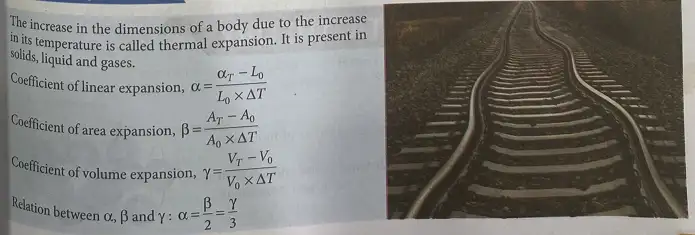
- Thermal expansion: Increase in dimensions due to temperature rise.
- Occurs in solids (length, area, volume), liquids and gases (volume only).
- Gases can expand at constant volume or pressure.
- Expansion depends on material and state (solid, liquid, gas).
Solved Examples
- Ex 1: Calculate length increase of a rod of length 1 m heated by 10°C with linear expansion coefficient α = 1 × 10⁻⁵ °C-1.
- Use ΔL = L0 α ΔT = 1 × 1 × 10-5 × 10 = 0.0001 m = 0.1 mm
Practice Set
- Q1: Thermal expansion occurs in which states of matter?
- A. Solids only
- B. Liquids only
- C. Solids, liquids, and gases
- D. Gases only
- Q2: Which dimension expands in liquids on heating?
- A. Length
- B. Area
- C. Volume
- D. None
- Q3: A gas is heated at constant volume. Which property changes?
- A. Volume
- B. Pressure
- C. Temperature
- D. Both B and C
Answer Key
- Q1: C - Thermal expansion occurs in solids, liquids, and gases.
- Q2: C - Liquids expand only in volume as they have no fixed shape.
- Q3: D - At constant volume, pressure and temperature change.
Memory Aids
- Thermal expansion = size increase with temperature.
- Solids: length, area, volume expand.
- Liquids & gases: volume expands only.
Concepts
- Thermal expansion: Increase in dimensions due to temperature rise.
- Occurs in solids (length, area, volume), liquids and gases (volume only).
- Gases can expand at constant volume or pressure.
- Expansion depends on material and state (solid, liquid, gas).
Solved Examples
- Ex 1: Calculate length increase of a rod of length 1 m heated by 10°C with linear expansion coefficient \(\alpha = 1 \times 10^{-5} \degree C^{-1}\).
- Use \(\Delta L = L_0 \alpha \Delta T = 1 \times 1 \times 10^{-5} \times 10 = 0.0001 \text{ m} = 0.1 \text{ mm}\)
Practice Set
- Q1: Thermal expansion occurs in which states of matter?
- A. Solids only
- B. Liquids only
- C. Solids, liquids, and gases
- D. Gases only
- Q2: Which dimension expands in liquids on heating?
- A. Length
- B. Area
- C. Volume
- D. None
- Q3: A gas is heated at constant volume. Which property changes?
- A. Volume
- B. Pressure
- C. Temperature
- D. Both B and C
Answer Key
- Q1: C - Thermal expansion occurs in solids, liquids, and gases.
- Q2: C - Liquids expand only in volume as they have no fixed shape.
- Q3: D - At constant volume, pressure and temperature change.
Memory Aids
- Thermal expansion = size increase with temperature.
- Solids: length, area, volume expand.
- Liquids & gases: volume expands only.
Thermal Expansion in Solids
Types
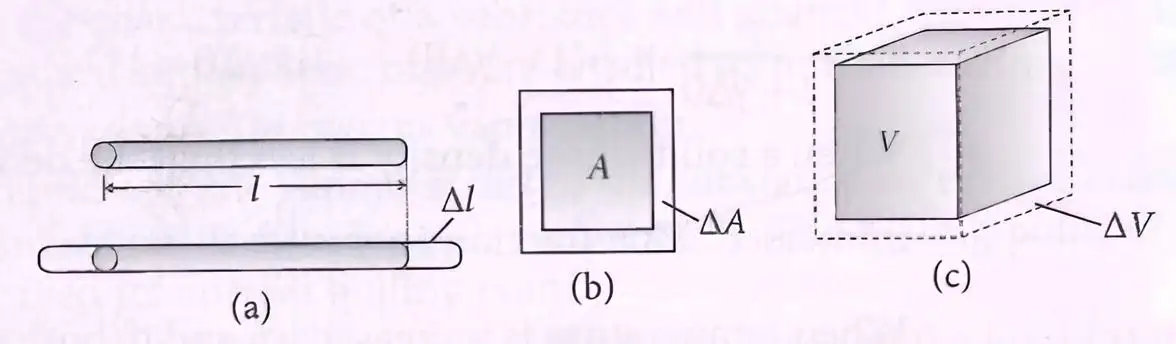
- Linear expansion: Increase in length ΔL.
- Area expansion: Increase in surface area ΔA.
- Volume expansion: Increase in volume ΔV.
Solved Examples
- Ex 1: Rod length l=2m, α=1.2 × 10⁻⁵ °C-1, temperature rise ΔT=50°C.
- New length LT = L0(1 + α ΔT) = 2(1 + 1.2 × 10-5 × 50) = 2.0012 m
Practice Set
- Q1: Linear expansion changes which dimension?
- A. Length
- B. Area
- C. Volume
- D. Density
- Q2: Area expansion coefficient β relates to increase in?
- A. Length
- B. Surface area
- C. Volume
- D. Mass
- Q3: Volume expansion coefficient γ is defined as?
- A. Increase in volume per unit volume per degree rise
- B. Increase in length per unit length per degree rise
- C. Increase in area per unit area per degree rise
- D. None
Answer Key
- Q1: A - Linear expansion changes length.
- Q2: B - Area expansion relates to surface area increase.
- Q3: A - Volume expansion coefficient defines volume increase per unit volume per degree.
Memory Aids
- α: linear expansion coefficient.
- β = 2α, γ = 3α.
- Use LT = L0(1 + α ΔT) for length.
Types
- Linear expansion: Increase in length ΔL.
- Area expansion: Increase in surface area ΔA.
- Volume expansion: Increase in volume ΔV.
Solved Examples
- Ex 1: Rod length l=2m, α=1.2 × 10⁻⁵ °C-1, temperature rise ΔT=50°C.
- New length LT = L0(1 + α ΔT) = 2(1 + 1.2 × 10-5 × 50) = 2.0012 m
Practice Set
- Q1: Linear expansion changes which dimension?
- A. Length
- B. Area
- C. Volume
- D. Density
- Q2: Area expansion coefficient β relates to increase in?
- A. Length
- B. Surface area
- C. Volume
- D. Mass
- Q3: Volume expansion coefficient γ is defined as?
- A. Increase in volume per unit volume per degree rise
- B. Increase in length per unit length per degree rise
- C. Increase in area per unit area per degree rise
- D. None
Answer Key
- Q1: A - Linear expansion changes length.
- Q2: B - Area expansion relates to surface area increase.
- Q3: A - Volume expansion coefficient defines volume increase per unit volume per degree.
Memory Aids
- α: linear expansion coefficient.
- β = 2α, γ = 3α.
- Use LT = L0(1 + α ΔT) for length.
Types
- Linear expansion: Increase in length \(\Delta L\).
- Area expansion: Increase in surface area \(\Delta A\).
- Volume expansion: Increase in volume \(\Delta V\).
Solved Examples
- Ex 1: Rod length \(l=2m\), \(\alpha=1.2 \times 10^{-5} \degree C^{-1}\), temperature rise \(\Delta T=50\degree C\).
- New length \(L_T = L_0(1 + \alpha \Delta T) = 2(1 + 1.2 \times 10^{-5} \times 50) = 2.0012 m\)
Practice Set
- Q1: Linear expansion changes which dimension?
- A. Length
- B. Area
- C. Volume
- D. Density
- Q2: Area expansion coefficient \(\beta\) relates to increase in?
- A. Length
- B. Surface area
- C. Volume
- D. Mass
- Q3: Volume expansion coefficient \(\gamma\) is defined as?
- A. Increase in volume per unit volume per degree rise
- B. Increase in length per unit length per degree rise
- C. Increase in area per unit area per degree rise
- D. None
Answer Key
- Q1: A - Linear expansion changes length.
- Q2: B - Area expansion relates to surface area increase.
- Q3: A - Volume expansion coefficient defines volume increase per unit volume per degree.
Memory Aids
- \(\alpha\): linear expansion coefficient.
- \(\beta = 2\alpha\), \(\gamma = 3\alpha\).
- Use \(L_T = L_0(1 + \alpha \Delta T)\) for length.
Coefficients of Thermal Expansion
Definitions & Relations
- Coefficient of linear expansion α = ΔL/(L0 ΔT).
- Coefficient of area expansion β = ΔA/(A0 ΔT).
- Coefficient of volume expansion γ = ΔV/(V0 ΔT).
- Relation: α = β/2 = γ/3.
- Units: °C-1 or K-1.
Solved Examples
- Ex 1: Given α = 1 × 10⁻⁵ °C-1, find β and γ.
- β = 2α = 2 × 10⁻⁵ °C-1
- γ = 3α = 3 × 10⁻⁵ °C-1
Practice Set
- Q1: If α = 2 × 10⁻⁵ °C-1, then β = ?
- A. 1 × 10⁻⁵
- B. 2 × 10⁻⁵
- C. 4 × 10⁻⁵
- D. 6 × 10⁻⁵
- Q2: Relation between coefficients is?
- A. α = β = γ
- B. α = β/2 = γ/3
- C. α = 2β = 3γ
- D. None
- Q3: Units of α, β, γ are?
- A. m
- B. °C-1
- C. kg/m3
- D. N/m2
Answer Key
- Q1: C - β = 2α = 4 × 10⁻⁵ °C-1.
- Q2: B - α = β/2 = γ/3 is correct relation.
- Q3: B - Units are per degree Celsius or Kelvin.
Memory Aids
- Remember: β = 2α, γ = 3α.
- All coefficients have same units.
Definitions & Relations
- Coefficient of linear expansion \(\alpha = \frac{\Delta L}{L_0 \Delta T}\).
- Coefficient of area expansion \(\beta = \frac{\Delta A}{A_0 \Delta T}\).
- Coefficient of volume expansion \(\gamma = \frac{\Delta V}{V_0 \Delta T}\).
- Relation: \(\alpha = \frac{\beta}{2} = \frac{\gamma}{3}\).
- Units: \(\degree C^{-1}\) or \(K^{-1}\).
Solved Examples
- Ex 1: Given \(\alpha = 1 \times 10^{-5} \degree C^{-1}\), find \(\beta\) and \(\gamma\).
- \(\beta = 2\alpha = 2 \times 10^{-5} \degree C^{-1}\)
- \(\gamma = 3\alpha = 3 \times 10^{-5} \degree C^{-1}\)
Practice Set
- Q1: If \(\alpha = 2 \times 10^{-5} \degree C^{-1}\), then \(\beta = ?\)
- A. \(1 \times 10^{-5}\)
- B. \(2 \times 10^{-5}\)
- C. \(4 \times 10^{-5}\)
- D. \(6 \times 10^{-5}\)
- Q2: Relation between coefficients is?
- A. \(\alpha = \beta = \gamma\)
- B. \(\alpha = \frac{\beta}{2} = \frac{\gamma}{3}\)
- C. \(\alpha = 2\beta = 3\gamma\)
- D. None
- Q3: Units of \(\alpha, \beta, \gamma\) are?
- A. m
- B. \(\degree C^{-1}\)
- C. kg/m3
- D. N/m2
Answer Key
- Q1: C - \(\beta = 2\alpha = 4 \times 10^{-5} \degree C^{-1}\).
- Q2: B - \(\alpha = \frac{\beta}{2} = \frac{\gamma}{3}\) is correct relation.
- Q3: B - Units are per degree Celsius or Kelvin.
Memory Aids
- Remember: \(\beta = 2\alpha\), \(\gamma = 3\alpha\).
- All coefficients have same units.
Anomalous Expansion of Water
Key Points
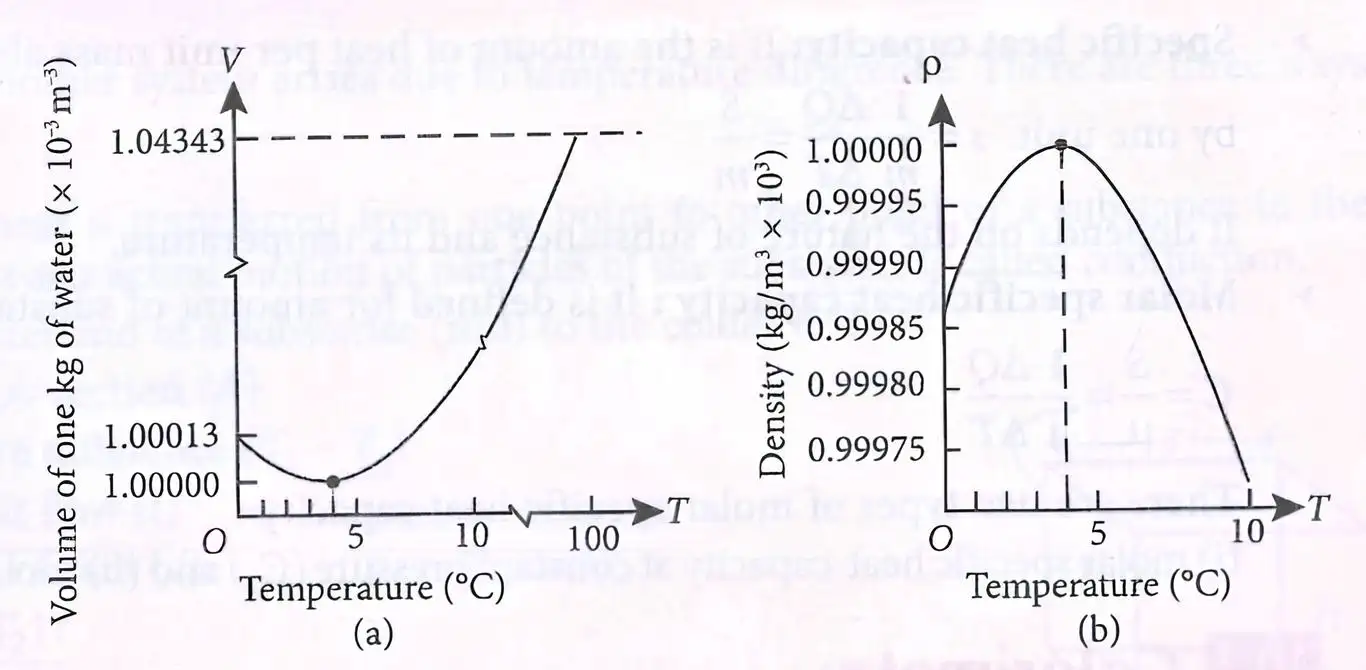
- Water contracts on heating from 0°C to 4°C (negative volume expansion).
- Water expands on heating above 4°C.
- Maximum density at 4°C.
- Explains ice floating and freezing from top.
Solved Examples
- Ex 1: Explain why ice floats on water.
- Due to anomalous expansion, water is densest at 4°C; ice is less dense and floats.
Practice Set
- Q1: Water has maximum density at?
- A. 0°C
- B. 4°C
- C. 100°C
- D. -4°C
- Q2: Between 0°C and 4°C, water volume?
- A. Increases on heating
- B. Decreases on heating
- C. Remains constant
- D. Expands on cooling
- Q3: Anomalous expansion means?
- A. Normal expansion
- B. Expansion only in solids
- C. Contraction on heating in 0-4°C range
- D. No expansion
Answer Key
- Q1: B - Water is densest at 4°C.
- Q2: B - Water contracts on heating from 0°C to 4°C.
- Q3: C - Anomalous expansion means contraction on heating in 0-4°C.
Memory Aids
- Water densest at 4°C.
- Volume decreases on heating 0-4°C.
- Ice floats due to lower density.
Key Points
- Water contracts on heating from 0°C to 4°C (negative volume expansion).
- Water expands on heating above 4°C.
- Maximum density at 4°C.
- Explains ice floating and freezing from top.
Solved Examples
- Ex 1: Explain why ice floats on water.
- Due to anomalous expansion, water is densest at 4°C; ice is less dense and floats.
Practice Set
- Q1: Water has maximum density at?
- A. 0°C
- B. 4°C
- C. 100°C
- D. -4°C
- Q2: Between 0°C and 4°C, water volume?
- A. Increases on heating
- B. Decreases on heating
- C. Remains constant
- D. Expands on cooling
- Q3: Anomalous expansion means?
- A. Normal expansion
- B. Expansion only in solids
- C. Contraction on heating in 0-4°C range
- D. No expansion
Answer Key
- Q1: B - Water is densest at 4°C.
- Q2: B - Water contracts on heating from 0°C to 4°C.
- Q3: C - Anomalous expansion means contraction on heating in 0-4°C.
Memory Aids
- Water densest at 4°C.
- Volume decreases on heating 0-4°C.
- Ice floats due to lower density.
Thermal Stress
Concepts & Formulas
- Thermal stress arises when expansion is prevented.
- Thermal strain = ΔL/L = α ΔT.
- Thermal stress = Y × thermal strain = Y α ΔT, where Y is Young's modulus.
- Force developed = Y A α ΔT, A is cross-sectional area.
Solved Examples
- Ex 1: Rod with Y=2 × 10¹¹ Pa, α=1 × 10⁻⁵ °C-1, ΔT=50°C, A=0.01 m2.
- Thermal stress = 2 × 1011 × 1 × 10-5 × 50 = 1 × 10⁸ Pa
- Force = 1 × 108 × 0.01 = 1 × 10⁶ N
Practice Set
- Q1: Thermal stress occurs when?
- A. Expansion is free
- B. Expansion is prevented
- C. Temperature decreases
- D. No temperature change
- Q2: Thermal strain formula is?
- A. α ΔT
- B. ΔL/L
- C. Both A and B
- D. None
- Q3: Force developed depends on?
- A. Young's modulus, area, α, ΔT
- B. Only temperature
- C. Only area
- D. None
Answer Key
- Q1: B - Stress arises when expansion is prevented.
- Q2: C - Thermal strain = α ΔT = ΔL/L.
- Q3: A - Force = Y A α ΔT.
Memory Aids
- Stress = Young's modulus × strain.
- Strain = α ΔT.
- Force = stress × area.
Concepts & Formulas
- Thermal stress arises when expansion is prevented.
- Thermal strain \(= \frac{\Delta L}{L} = \alpha \Delta T\).
- Thermal stress \(= Y \times \text{thermal strain} = Y \alpha \Delta T\), where \(Y\) is Young's modulus.
- Force developed \(= Y A \alpha \Delta T\), \(A\) is cross-sectional area.
Solved Examples
- Ex 1: Rod with \(Y=2 \times 10^{11} \text{Pa}\), \(\alpha=1 \times 10^{-5} \degree C^{-1}\), \(\Delta T=50\degree C\), \(A=0.01 m^2\).
- Thermal stress \(= 2 \times 10^{11} \times 1 \times 10^{-5} \times 50 = 1 \times 10^{8} \text{Pa}\)
- Force \(= 1 \times 10^{8} \times 0.01 = 1 \times 10^{6} \text{N}\)
Practice Set
- Q1: Thermal stress occurs when?
- A. Expansion is free
- B. Expansion is prevented
- C. Temperature decreases
- D. No temperature change
- Q2: Thermal strain formula is?
- A. \(\alpha \Delta T\)
- B. \(\frac{\Delta L}{L}\)
- C. Both A and B
- D. None
- Q3: Force developed depends on?
- A. Young's modulus, area, \(\alpha\), \(\Delta T\)
- B. Only temperature
- C. Only area
- D. None
Answer Key
- Q1: B - Stress arises when expansion is prevented.
- Q2: C - Thermal strain = \(\alpha \Delta T = \frac{\Delta L}{L}\).
- Q3: A - Force = \(Y A \alpha \Delta T\).
Memory Aids
- Stress = Young's modulus × strain.
- Strain = \(\alpha \Delta T\).
- Force = stress × area.
Specific Heat Capacity
Definition and Formula
- Heat capacity (S) = ΔQ/ΔT = ms
- ΔQ: heat supplied to change temperature from T to T + ΔT
- m: mass of the substance
- s: specific heat capacity
Specific Heat Capacity
- Heat absorbed or released per unit mass to change temperature by 1 unit
- Formula: s = (1/m) ΔQ/ΔT = S/m
- Depends on substance nature and temperature
Molar Specific Heat Capacity
- Heat capacity per mole of substance (in gram moles)
- Formula: C = S/μ = (1/μ) ΔQ/ΔT
- Two types:
- At constant pressure: Cp
- At constant volume: CV
Solved Examples
- Ex 1: Calculate specific heat capacity if ΔQ = 500 J, m = 2 kg, ΔT = 5 K.
- Use s = ΔQ/(m ΔT) = 500/(2 × 5) = 50 J/kg K
- Ex 2: Find molar specific heat capacity if S = 100 J/K, μ = 4 mol.
- Use C = S/μ = 100/4 = 25 J/mol K
Practice Set
- Q1: Heat capacity S is defined as:
- A) ΔT/ΔQ
- B) ΔQ/ΔT
- C) m × s
- D) (1/m) ΔQ/ΔT
- Q2: Specific heat capacity s depends on:
- A) Mass only
- B) Nature of substance and temperature
- C) Volume only
- D) Pressure only
- Q3: Molar specific heat capacity at constant volume is denoted by:
- A) Cp
- B) CV
- C) s
- D) S
Answer Key
- Q1: B - Heat capacity is heat supplied per unit temperature change ΔQ/ΔT.
- Q2: B - Specific heat depends on the substance's nature and temperature.
- Q3: B - CV denotes molar specific heat at constant volume.
Memory Aids
- Heat capacity S = ms
- Specific heat s = S/m
- Molar heat C = S/μ
- Cp at constant pressure, CV at constant volume
Definition and Formula
- Heat capacity (S) = \( \frac{\Delta Q}{\Delta T} = ms \)
- \( \Delta Q \): heat supplied to change temperature from \( T \) to \( T + \Delta T \)
- \( m \): mass of the substance
- \( s \): specific heat capacity
Specific Heat Capacity
- Heat absorbed or released per unit mass to change temperature by 1 unit
- Formula: \( s = \frac{1}{m} \frac{\Delta Q}{\Delta T} = \frac{S}{m} \)
- Depends on substance nature and temperature
Molar Specific Heat Capacity
- Heat capacity per mole of substance (in gram moles)
- Formula: \( C = \frac{S}{\mu} = \frac{1}{\mu} \frac{\Delta Q}{\Delta T} \)
- Two types:
- At constant pressure: \( C_p \)
- At constant volume: \( C_V \)
Solved Examples
- Ex 1: Calculate specific heat capacity if \( \Delta Q = 500 \text{ J} \), \( m = 2 \text{ kg} \), \( \Delta T = 5 \text{ K} \).
- Use \( s = \frac{\Delta Q}{m \Delta T} = \frac{500}{2 \times 5} = 50 \text{ J/kg K} \)
- Ex 2: Find molar specific heat capacity if \( S = 100 \text{ J/K} \), \( \mu = 4 \text{ mol} \).
- Use \( C = \frac{S}{\mu} = \frac{100}{4} = 25 \text{ J/mol K} \)
Practice Set
- Q1: Heat capacity \( S \) is defined as:
- A) \( \frac{\Delta T}{\Delta Q} \)
- B) \( \frac{\Delta Q}{\Delta T} \)
- C) \( m \times s \)
- D) \( \frac{1}{m} \frac{\Delta Q}{\Delta T} \)
- Q2: Specific heat capacity \( s \) depends on:
- A) Mass only
- B) Nature of substance and temperature
- C) Volume only
- D) Pressure only
- Q3: Molar specific heat capacity at constant volume is denoted by:
- A) \( C_p \)
- B) \( C_V \)
- C) \( s \)
- D) \( S \)
Answer Key
- Q1: B - Heat capacity is heat supplied per unit temperature change \( \frac{\Delta Q}{\Delta T} \).
- Q2: B - Specific heat depends on the substance's nature and temperature.
- Q3: B - \( C_V \) denotes molar specific heat at constant volume.
Memory Aids
- Heat capacity \( S = ms \)
- Specific heat \( s = \frac{S}{m} \)
- Molar heat \( C = \frac{S}{\mu} \)
- \( C_p \) at constant pressure, \( C_V \) at constant volume
Calorimetry
Concept and Device
- Calorimetry measures specific heat or latent heat of substances.
- A calorimeter is the device used for heat measurement.
- Heat transfer occurs between bodies at different temperatures until thermal equilibrium.
Principle
- Based on the law of conservation of energy.
- Heat lost by hot body = Heat gained by cold body (no heat loss to surroundings).
- Formula: Heat Lost = Heat Gained
Solved Examples
- Ex 1: A 100 g hot metal at 100°C is placed in 200 g water at 25°C. Find final temperature if no heat loss occurs. Use specific heat of metal = 0.4 J/g°C, water = 4.2 J/g°C.
- Heat lost by metal = Heat gained by water
- 100 × 0.4 × (100 - T) = 200 × 4.2 × (T - 25)
- Solve for T: T ≈ 28.6°C
Practice Set
- Q1: What is the principle of calorimetry?
- A) Heat lost = Heat gained
- B) Heat lost > Heat gained
- C) Heat lost < Heat gained
- D) No heat transfer
- Q2: A 50 g metal at 150°C is dropped into 100 g water at 20°C. Final temperature is 30°C. If specific heat of water is 4.2 J/g°C, find specific heat of metal.
- A) 0.84 J/g°C
- B) 0.42 J/g°C
- C) 1.68 J/g°C
- D) 0.21 J/g°C
- Q3: In a calorimeter, 200 g of water at 25°C is mixed with 100 g of ice at 0°C. What is the final temperature? (Latent heat of fusion of ice = 336 J/g, specific heat of water = 4.2 J/g°C)
- A) 0°C
- B) 5°C
- C) 10°C
- D) 15°C
Answer Key
- Q1: A - Principle states heat lost equals heat gained in calorimetry.
- Q2: B - Using heat lost = heat gained, specific heat of metal = (100 × 4.2 × (30-20))/(50 × (150-30)) = 0.42 J/g°C.
- Q3: A - Ice melts absorbing heat, final temperature remains 0°C until all ice melts.
Memory Aids
- Heat lost = Heat gained (No heat loss to surroundings).
- Use formula: m c ΔT for heat transfer.
- Latent heat involved during phase change, no temperature change.
Concept and Device
- Calorimetry measures specific heat or latent heat of substances.
- A calorimeter is the device used for heat measurement.
- Heat transfer occurs between bodies at different temperatures until thermal equilibrium.
Principle
- Based on the law of conservation of energy.
- Heat lost by hot body = Heat gained by cold body (no heat loss to surroundings).
- Formula: Heat Lost = Heat Gained
Solved Examples
- Ex 1: A 100 g hot metal at 100°C is placed in 200 g water at 25°C. Find final temperature if no heat loss occurs. Use specific heat of metal = 0.4 J/g°C, water = 4.2 J/g°C.
- Heat lost by metal = Heat gained by water
- 100 × 0.4 × (100 - T) = 200 × 4.2 × (T - 25)
- Solve for T: T ≈ 28.6°C
Practice Set
- Q1: What is the principle of calorimetry?
- A) Heat lost = Heat gained
- B) Heat lost > Heat gained
- C) Heat lost < Heat gained
- D) No heat transfer
- Q2: A 50 g metal at 150°C is dropped into 100 g water at 20°C. Final temperature is 30°C. If specific heat of water is 4.2 J/g°C, find specific heat of metal.
- A) 0.84 J/g°C
- B) 0.42 J/g°C
- C) 1.68 J/g°C
- D) 0.21 J/g°C
- Q3: In a calorimeter, 200 g of water at 25°C is mixed with 100 g of ice at 0°C. What is the final temperature? (Latent heat of fusion of ice = 336 J/g, specific heat of water = 4.2 J/g°C)
- A) 0°C
- B) 5°C
- C) 10°C
- D) 15°C
Answer Key
- Q1: A - Principle states heat lost equals heat gained in calorimetry.
- Q2: B - Using heat lost = heat gained, specific heat of metal = \( \frac{100 \times 4.2 \times (30-20)}{50 \times (150-30)} = 0.42 \) J/g°C.
- Q3: A - Ice melts absorbing heat, final temperature remains 0°C until all ice melts.
Memory Aids
- Heat lost = Heat gained (No heat loss to surroundings).
- Use formula: \( m c \Delta T \) for heat transfer.
- Latent heat involved during phase change, no temperature change.
Heat Transfer
Overview
- Heat transfer occurs due to temperature difference between systems.
- Three modes: Conduction, Convection, Radiation.
Solved Examples
- Ex 1: Heat flows from hot to cold due to temperature difference.
Practice Set
- Q1: Which mode of heat transfer requires no medium?
A. Conduction
B. Convection
C. Radiation
D. None - Q2: Heat transfer by actual motion of particles occurs in:
A. Conduction
B. Convection
C. Radiation
D. All - Q3: Heat transfer due to temperature difference is called:
A. Work
B. Heat Transfer
C. Energy Transfer
D. Power
Answer Key
- Q1: C - Radiation transfers heat without a medium.
- Q2: B - Convection involves motion of heated particles.
- Q3: B - Heat transfer occurs due to temperature difference.
Memory Aids
- Heat transfer modes: Conduction (solid), Convection (fluid), Radiation (vacuum).
- Heat flows from hot to cold.
Conduction
Key Points
- Heat transfer through a substance without particle motion.
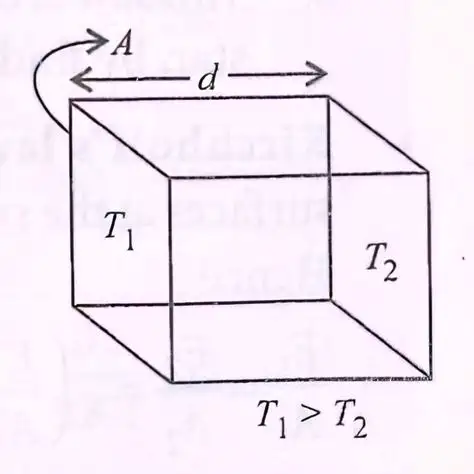
- Heat flow rate: Q ∝ A (T1 - T2) t/d
- Formula: Q = K A (T1 - T2) t/d, where K is thermal conductivity.
- Rate of heat flow: dQ/dt = -K A dT/dx
- Negative sign indicates heat flows opposite to temperature gradient.
Solved Examples
- Ex 1: Calculate heat flow through rod with area A, thickness d, temperature difference T1 - T2, time t, and conductivity K.
Use Q = K A (T1 - T2) t/d.
Practice Set
- Q1: Heat conduction depends on:
A. Area
B. Temperature difference
C. Thickness
D. All - Q2: If thickness doubles, heat flow:
A. Doubles
B. Halves
C. Unchanged
D. Quadruples - Q3: Rate of heat flow formula is:
A. dQ/dt = K A dT/dx
B. dQ/dt = -K A dT/dx
C. Q = K A (T1 - T2) t
D. None
Answer Key
- Q1: D - All factors affect conduction.
- Q2: B - Heat flow inversely proportional to thickness.
- Q3: B - Correct formula includes negative sign.
Memory Aids
- Conduction formula: Q = K A ΔT t/d.
- Heat flows opposite to temperature gradient.
Key Points
- Heat transfer through a substance without particle motion.
- Heat flow rate: Q ∝ A (T1 - T2) t/d
- Formula: Q = K A (T1 - T2) t/d, where K is thermal conductivity.
- Rate of heat flow: dQ/dt = -K A dT/dx
- Negative sign indicates heat flows opposite to temperature gradient.
Solved Examples
- Ex 1: Calculate heat flow through rod with area A, thickness d, temperature difference T1 - T2, time t, and conductivity K.
Use Q = K A (T1 - T2) t/d.
Practice Set
- Q1: Heat conduction depends on:
A. Area
B. Temperature difference
C. Thickness
D. All - Q2: If thickness doubles, heat flow:
A. Doubles
B. Halves
C. Unchanged
D. Quadruples - Q3: Rate of heat flow formula is:
A. dQ/dt = K A dT/dx
B. dQ/dt = -K A dT/dx
C. Q = K A (T1 - T2) t
D. None
Answer Key
- Q1: D - All factors affect conduction.
- Q2: B - Heat flow inversely proportional to thickness.
- Q3: B - Correct formula includes negative sign.
Memory Aids
- Conduction formula: Q = K A ΔT t/d.
- Heat flows opposite to temperature gradient.
Key Points
- Heat transfer through a substance without particle motion.
- Heat flow rate: \( Q \propto \frac{A (T_1 - T_2) t}{d} \)
- Formula: \( Q = \frac{K A (T_1 - T_2) t}{d} \), where \(K\) is thermal conductivity.
- Rate of heat flow: \( \frac{dQ}{dt} = -K A \frac{dT}{dx} \)
- Negative sign indicates heat flows opposite to temperature gradient.
Solved Examples
- Ex 1: Calculate heat flow through rod with area \(A\), thickness \(d\), temperature difference \(T_1 - T_2\), time \(t\), and conductivity \(K\).
Use \( Q = \frac{K A (T_1 - T_2) t}{d} \).
Practice Set
- Q1: Heat conduction depends on:
A. Area
B. Temperature difference
C. Thickness
D. All - Q2: If thickness doubles, heat flow:
A. Doubles
B. Halves
C. Unchanged
D. Quadruples - Q3: Rate of heat flow formula is:
A. \( \frac{dQ}{dt} = K A \frac{dT}{dx} \)
B. \( \frac{dQ}{dt} = -K A \frac{dT}{dx} \)
C. \( Q = K A (T_1 - T_2) t \)
D. None
Answer Key
- Q1: D - All factors affect conduction.
- Q2: B - Heat flow inversely proportional to thickness.
- Q3: B - Correct formula includes negative sign.
Memory Aids
- Conduction formula: \( Q = \frac{K A \Delta T t}{d} \).
- Heat flows opposite to temperature gradient.
Convection
Key Points
- Heat transfer by actual motion of heated particles in liquids and gases.
- Causes natural phenomena: trade winds, monsoons, land and sea breezes.
Solved Examples
- Ex 1: Identify convection in atmospheric phenomena like monsoons.
Practice Set
- Q1: Convection occurs in:
A. Solids
B. Liquids and gases
C. Vacuum
D. None - Q2: Which causes monsoons?
A. Conduction
B. Convection
C. Radiation
D. Reflection - Q3: Heat transfer by particle motion is:
A. Radiation
B. Conduction
C. Convection
D. None
Answer Key
- Q1: B - Convection occurs in fluids.
- Q2: B - Monsoons caused by convection.
- Q3: C - Particle motion heat transfer is convection.
Memory Aids
- Convection = fluid motion heat transfer.
- Think of wind and water currents.
Radiation
Key Points
- Heat transfer without heating the medium.
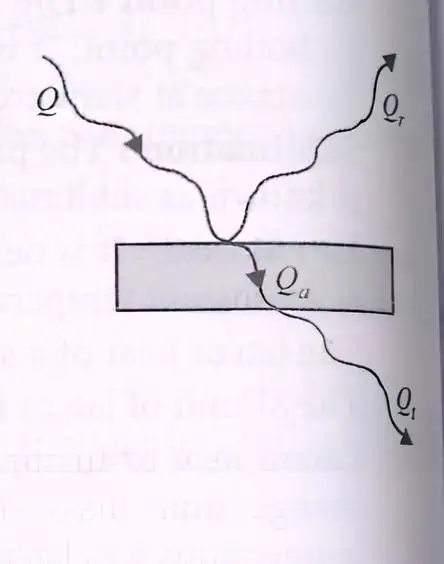
- Heat radiations (Q) on a body are partly reflected (Qr), absorbed (Qa), and transmitted (Qt).
- Energy balance: Q = Qa + Qr + Qt
- Coefficients: absorptance a = Qa/Q, reflectance r = Qr/Q, transmittance t = Qt/Q
- Sum: a + r + t = 1
- Perfect bodies: reflector (r=1), absorber (a=1), transmitter (t=1).
- Perfect black body: a=1, r=0, t=0
Solved Examples
- Ex 1: Calculate absorptance if Qa = 50J and total radiation Q = 100J.
Use a = Qa/Q = 0.5.
Practice Set
- Q1: Sum of absorptance, reflectance, transmittance is:
A. 0
B. 1
C. Depends
D. None - Q2: A perfect absorber has:
A. a=1, r=0, t=0
B. a=0, r=1, t=0
C. a=0, r=0, t=1
D. a=1, r=1, t=1 - Q3: Radiation heat transfer requires:
A. Medium
B. Vacuum
C. Solid
D. Liquid
Answer Key
- Q1: B - Sum of coefficients equals 1.
- Q2: A - Perfect absorber absorbs all radiation.
- Q3: B - Radiation can occur in vacuum.
Memory Aids
- Radiation = no medium needed.
- Sum of a, r, t = 1.
- Black body absorbs all.
Key Points
- Heat transfer without heating the medium.
- Heat radiations (Q) on a body are partly reflected (Qr), absorbed (Qa), and transmitted (Qt).
- Energy balance: Q = Qa + Qr + Qt
- Coefficients: absorptance a = Qa/Q, reflectance r = Qr/Q, transmittance t = Qt/Q
- Sum: a + r + t = 1
- Perfect bodies: reflector (r=1), absorber (a=1), transmitter (t=1).
- Perfect black body: a=1, r=0, t=0
Solved Examples
- Ex 1: Calculate absorptance if Qa = 50J and total radiation Q = 100J.
Use a = Qa/Q = 0.5.
Practice Set
- Q1: Sum of absorptance, reflectance, transmittance is:
A. 0
B. 1
C. Depends
D. None - Q2: A perfect absorber has:
A. a=1, r=0, t=0
B. a=0, r=1, t=0
C. a=0, r=0, t=1
D. a=1, r=1, t=1 - Q3: Radiation heat transfer requires:
A. Medium
B. Vacuum
C. Solid
D. Liquid
Answer Key
- Q1: B - Sum of coefficients equals 1.
- Q2: A - Perfect absorber absorbs all radiation.
- Q3: B - Radiation can occur in vacuum.
Memory Aids
- Radiation = no medium needed.
- Sum of a, r, t = 1.
- Black body absorbs all.
Key Points
- Heat transfer without heating the medium.
- Heat radiations (Q) on a body are partly reflected (Qr), absorbed (Qa), and transmitted (Qt).
- Energy balance: \( Q = Q_a + Q_r + Q_t \)
- Coefficients: absorptance \(a = \frac{Q_a}{Q}\), reflectance \(r = \frac{Q_r}{Q}\), transmittance \(t = \frac{Q_t}{Q}\)
- Sum: \( a + r + t = 1 \)
- Perfect bodies: reflector (r=1), absorber (a=1), transmitter (t=1).
- Perfect black body: \( a=1, r=0, t=0 \)
Solved Examples
- Ex 1: Calculate absorptance if \( Q_a = 50J \) and total radiation \( Q = 100J \).
Use \( a = \frac{Q_a}{Q} = 0.5 \).
Practice Set
- Q1: Sum of absorptance, reflectance, transmittance is:
A. 0
B. 1
C. Depends
D. None - Q2: A perfect absorber has:
A. a=1, r=0, t=0
B. a=0, r=1, t=0
C. a=0, r=0, t=1
D. a=1, r=1, t=1 - Q3: Radiation heat transfer requires:
A. Medium
B. Vacuum
C. Solid
D. Liquid
Answer Key
- Q1: B - Sum of coefficients equals 1.
- Q2: A - Perfect absorber absorbs all radiation.
- Q3: B - Radiation can occur in vacuum.
Memory Aids
- Radiation = no medium needed.
- Sum of a, r, t = 1.
- Black body absorbs all.
Wien’s Displacement Law
Key Points
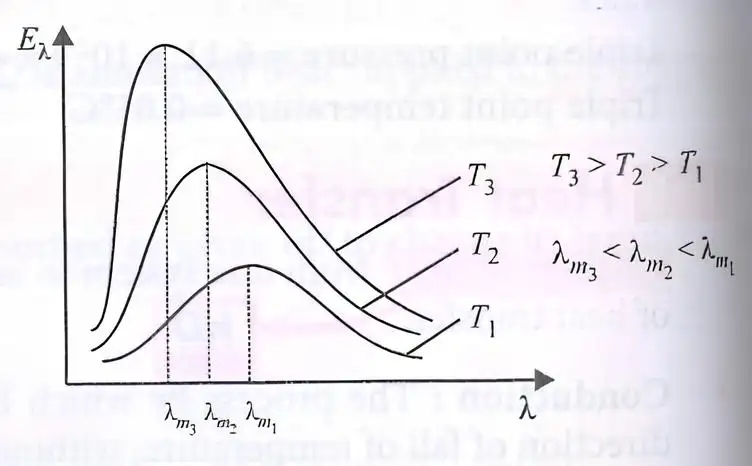
- Product of wavelength of max intensity and temperature is constant: λm T = b = 2.89 × 10⁻³ mK
- As temperature increases, peak wavelength shifts to shorter wavelengths.
- Used to find star temperature: T = b/λm
Solved Examples
- Ex 1: Find temperature if peak wavelength λm = 500 nm.
Use T = 2.89 × 10⁻³/(500 × 10-9) = 5780 K.
Practice Set
- Q1: Wien’s constant b value is:
A. 2.89 × 10⁻³ mK
B. 3.0 × 10⁸ m/s
C. 5.67 × 10⁻⁸ W/m2K4
D. None - Q2: Peak wavelength shifts when temperature:
A. Increases
B. Decreases
C. Constant
D. None - Q3: Temperature of star with λm = 1 μm is:
A. 2890 K
B. 5780 K
C. 1000 K
D. 2000 K
Answer Key
- Q1: A - Wien’s constant is 2.89 × 10⁻³ mK.
- Q2: A - Peak wavelength decreases as temperature increases.
- Q3: A - T = 2.89 × 10⁻³/(1 × 10-6) = 2890 K.
Memory Aids
- Wien’s law: λm T = constant.
- Hotter objects peak at shorter wavelengths.
Key Points
- Product of wavelength of max intensity and temperature is constant: λm T = b = 2.89 × 10⁻³ mK
- As temperature increases, peak wavelength shifts to shorter wavelengths.
- Used to find star temperature: T = b/λm
Solved Examples
- Ex 1: Find temperature if peak wavelength λm = 500 nm.
Use T = 2.89 × 10⁻³/(500 × 10-9) = 5780 K.
Practice Set
- Q1: Wien’s constant b value is:
A. 2.89 × 10⁻³ mK
B. 3.0 × 10⁸ m/s
C. 5.67 × 10⁻⁸ W/m2K4
D. None - Q2: Peak wavelength shifts when temperature:
A. Increases
B. Decreases
C. Constant
D. None - Q3: Temperature of star with λm = 1 μm is:
A. 2890 K
B. 5780 K
C. 1000 K
D. 2000 K
Answer Key
- Q1: A - Wien’s constant is 2.89 × 10⁻³ mK.
- Q2: A - Peak wavelength decreases as temperature increases.
- Q3: A - T = 2.89 × 10⁻³/(1 × 10-6) = 2890 K.
Memory Aids
- Wien’s law: λm T = constant.
- Hotter objects peak at shorter wavelengths.
Key Points
- Product of wavelength of max intensity and temperature is constant: \( \lambda_m T = b = 2.89 \times 10^{-3} \text{ mK} \)
- As temperature increases, peak wavelength shifts to shorter wavelengths.
- Used to find star temperature: \( T = \frac{b}{\lambda_m} \)
Solved Examples
- Ex 1: Find temperature if peak wavelength \( \lambda_m = 500 \text{ nm} \).
Use \( T = \frac{2.89 \times 10^{-3}}{500 \times 10^{-9}} = 5780 \text{ K} \).
Practice Set
- Q1: Wien’s constant \( b \) value is:
A. \( 2.89 \times 10^{-3} \text{ mK} \)
B. \( 3.0 \times 10^{8} \text{ m/s} \)
C. \( 5.67 \times 10^{-8} \text{ W/m}^2\text{K}^4 \)
D. None - Q2: Peak wavelength shifts when temperature:
A. Increases
B. Decreases
C. Constant
D. None - Q3: Temperature of star with \( \lambda_m = 1 \mu m \) is:
A. 2890 K
B. 5780 K
C. 1000 K
D. 2000 K
Answer Key
- Q1: A - Wien’s constant is \( 2.89 \times 10^{-3} \text{ mK} \).
- Q2: A - Peak wavelength decreases as temperature increases.
- Q3: A - \( T = \frac{2.89 \times 10^{-3}}{1 \times 10^{-6}} = 2890 K \).
Memory Aids
- Wien’s law: \( \lambda_m T = \text{constant} \).
- Hotter objects peak at shorter wavelengths.
Kirchhoff’s Law
Key Points
- Ratio of emissive power to absorptive power is same for all surfaces at same temperature.
- Equal to emissive power of a perfect black body at that temperature.
- Mathematically: E1/A1 = E2/A2 = ⋯ = E/A (perfect black body)
Solved Examples
- Ex 1: For two surfaces at same temperature, E1/A1 = E2/A2.
Practice Set
- Q1: Kirchhoff’s law relates:
A. Emissive and absorptive powers
B. Reflectance and transmittance
C. Temperature and wavelength
D. None - Q2: Emissive power ratio is equal to:
A. Absorptive power ratio
B. Reflective power ratio
C. Transmittance ratio
D. None - Q3: Kirchhoff’s law applies to:
A. Different temperatures
B. Same temperature
C. Vacuum only
D. None
Answer Key
- Q1: A - Kirchhoff’s law relates emissive and absorptive powers.
- Q2: A - Ratios of emissive and absorptive powers are equal.
- Q3: B - Applies at same temperature.
Memory Aids
- Emissive/absorptive power ratio constant at given temperature.
- Perfect black body reference.
Key Points
- Ratio of emissive power to absorptive power is same for all surfaces at same temperature.
- Equal to emissive power of a perfect black body at that temperature.
- Mathematically: \( \frac{E_1}{A_1} = \frac{E_2}{A_2} = \cdots = \frac{E}{A} \) (perfect black body)
Solved Examples
- Ex 1: For two surfaces at same temperature, \( \frac{E_1}{A_1} = \frac{E_2}{A_2} \).
Practice Set
- Q1: Kirchhoff’s law relates:
A. Emissive and absorptive powers
B. Reflectance and transmittance
C. Temperature and wavelength
D. None - Q2: Emissive power ratio is equal to:
A. Absorptive power ratio
B. Reflective power ratio
C. Transmittance ratio
D. None - Q3: Kirchhoff’s law applies to:
A. Different temperatures
B. Same temperature
C. Vacuum only
D. None
Answer Key
- Q1: A - Kirchhoff’s law relates emissive and absorptive powers.
- Q2: A - Ratios of emissive and absorptive powers are equal.
- Q3: B - Applies at same temperature.
Memory Aids
- Emissive/absorptive power ratio constant at given temperature.
- Perfect black body reference.
Stefan’s Law
Key Points
- Radiant energy emitted per unit area by perfect black body E ∝ T4.
- Formula: E = σT4, σ = 5.67 × 10⁻⁸ W/m2K4.
- For ordinary body: E = eσT4, where e is emissivity.
- Stefan-Boltzmann law: E = eAσ(T4 - T04)t when surrounded by body at T0.
Solved Examples
- Ex 1: Calculate radiant energy for body with emissivity e, area A, temperature T, time t.
Use Q = eAσT4t.
Practice Set
- Q1: Stefan’s constant σ value is:
A. 5.67 × 10⁻⁸ W/m2K4
B. 2.89 × 10⁻³ mK
C. 3.0 × 10⁸ m/s
D. None - Q2: Radiant energy E is proportional to:
A. T
B. T2
C. T4
D. T3 - Q3: Stefan-Boltzmann law includes:
A. T4 - T04
B. T - T0
C. T2 - T02
D. None
Answer Key
- Q1: A - Stefan’s constant value is 5.67 × 10⁻⁸ W/m2K4.
- Q2: C - Radiant energy proportional to T4.
- Q3: A - Stefan-Boltzmann law uses difference of fourth powers.
Memory Aids
- Stefan’s law: E = σT4.
- Emissivity e modifies for ordinary bodies.
Key Points
- Radiant energy emitted per unit area by perfect black body \( E \propto T^4 \).
- Formula: \( E = \sigma T^4 \), \( \sigma = 5.67 \times 10^{-8} \text{ W/m}^2\text{K}^4 \).
- For ordinary body: \( E = e \sigma T^4 \), where \( e \) is emissivity.
- Stefan-Boltzmann law: \( E = e A \sigma (T^4 - T_0^4) t \) when surrounded by body at \( T_0 \).
Solved Examples
- Ex 1: Calculate radiant energy for body with emissivity \( e \), area \( A \), temperature \( T \), time \( t \).
Use \( Q = e A \sigma T^4 t \).
Practice Set
- Q1: Stefan’s constant \( \sigma \) value is:
A. \( 5.67 \times 10^{-8} \text{ W/m}^2\text{K}^4 \)
B. \( 2.89 \times 10^{-3} \text{ mK} \)
C. \( 3.0 \times 10^{8} \text{ m/s} \)
D. None - Q2: Radiant energy \( E \) is proportional to:
A. \( T \)
B. \( T^2 \)
C. \( T^4 \)
D. \( T^3 \) - Q3: Stefan-Boltzmann law includes:
A. \( T^4 - T_0^4 \)
B. \( T - T_0 \)
C. \( T^2 - T_0^2 \)
D. None
Answer Key
- Q1: A - Stefan’s constant value is \( 5.67 \times 10^{-8} \text{ W/m}^2\text{K}^4 \).
- Q2: C - Radiant energy proportional to \( T^4 \).
- Q3: A - Stefan-Boltzmann law uses difference of fourth powers.
Memory Aids
- Stefan’s law: \( E = \sigma T^4 \).
- Emissivity \( e \) modifies for ordinary bodies.
Ohm’s Law for Thermal Conduction
Key Points
- Thermal current: dQ/dt = (T1 - T2)/Rth
- Thermal resistance: Rth = L/(K A)
- Equivalent to Ohm’s law with temperature as potential difference.
- Rate of heat flow: H = ΔT/Rth

Solved Examples
- Ex 1: Calculate thermal current for rod with T1, T2, L, K, A.
Use H = K A (T1 - T2)/L.
Practice Set
- Q1: Thermal resistance Rth is:
A. L/(K A)
B. K A/L
C. L K A
D. None - Q2: Thermal current is analogous to:
A. Voltage
B. Resistance
C. Electric current
D. Power - Q3: Rate of heat flow formula:
A. H = ΔT/Rth
B. H = RthΔT
C. H = ΔTRth
D. None
Answer Key
- Q1: A - Thermal resistance formula.
- Q2: C - Thermal current analogous to electric current.
- Q3: A - Rate of heat flow formula.
Memory Aids
- Thermal resistance Rth = L/(K A).
- Heat flow like current, temperature like voltage.
Key Points
- Thermal current: dQ/dt = (T1 - T2)/Rth
- Thermal resistance: Rth = L/(K A)
- Equivalent to Ohm’s law with temperature as potential difference.
- Rate of heat flow: H = ΔT/Rth
Solved Examples
- Ex 1: Calculate thermal current for rod with T1, T2, L, K, A.
Use H = K A (T1 - T2)/L.
Practice Set
- Q1: Thermal resistance Rth is:
A. L/(K A)
B. K A/L
C. L K A
D. None - Q2: Thermal current is analogous to:
A. Voltage
B. Resistance
C. Electric current
D. Power - Q3: Rate of heat flow formula:
A. H = ΔT/Rth
B. H = RthΔT
C. H = ΔTRth
D. None
Answer Key
- Q1: A - Thermal resistance formula.
- Q2: C - Thermal current analogous to electric current.
- Q3: A - Rate of heat flow formula.
Memory Aids
- Thermal resistance Rth = L/(K A).
- Heat flow like current, temperature like voltage.
Key Points
- Thermal current: \( \frac{dQ}{dt} = \frac{T_1 - T_2}{R_{th}} \)
- Thermal resistance: \( R_{th} = \frac{L}{K A} \)
- Equivalent to Ohm’s law with temperature as potential difference.
- Rate of heat flow: \( H = \frac{\Delta T}{R_{th}} \)
Solved Examples
- Ex 1: Calculate thermal current for rod with \( T_1, T_2, L, K, A \).
Use \( H = \frac{K A (T_1 - T_2)}{L} \).
Practice Set
- Q1: Thermal resistance \( R_{th} \) is:
A. \( \frac{L}{K A} \)
B. \( \frac{K A}{L} \)
C. \( L K A \)
D. None - Q2: Thermal current is analogous to:
A. Voltage
B. Resistance
C. Electric current
D. Power - Q3: Rate of heat flow formula:
A. \( H = \frac{\Delta T}{R_{th}} \)
B. \( H = R_{th} \Delta T \)
C. \( H = \Delta T R_{th} \)
D. None
Answer Key
- Q1: A - Thermal resistance formula.
- Q2: C - Thermal current analogous to electric current.
- Q3: A - Rate of heat flow formula.
Memory Aids
- Thermal resistance \( R_{th} = \frac{L}{K A} \).
- Heat flow like current, temperature like voltage.
Thermal Conduction in Slabs
Key Points
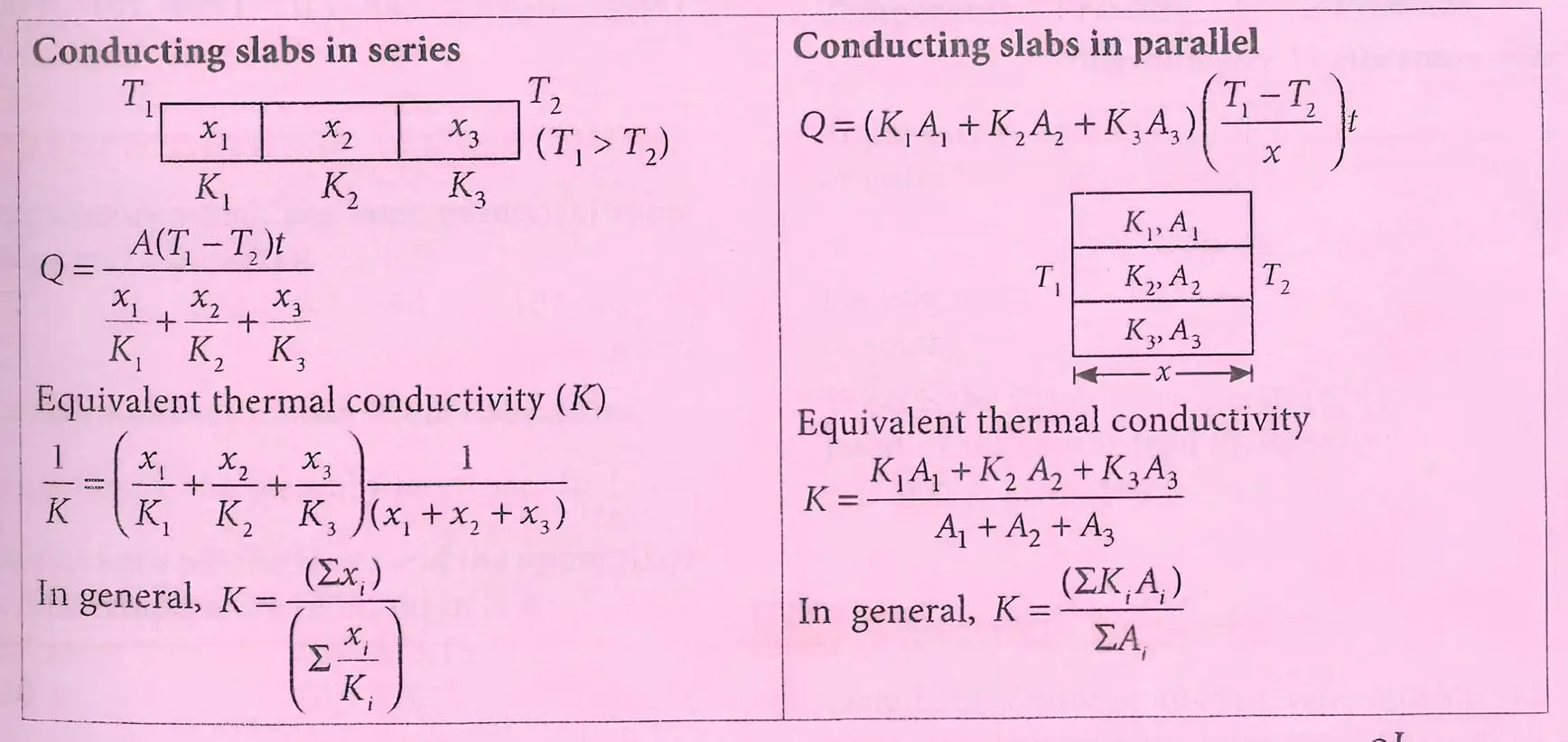
- Series arrangement: Slabs stacked one after another.
- Heat flow: Q = A (T1 - T2) t/(x1/K1 + x2/K2 + x3/K3)
- Equivalent conductivity: 1/K = (x1/K1 + x2/K2 + x3/K3)/(x1 + x2 + x3)
- Parallel arrangement: Slabs side by side.
- Heat flow: Q = (K1 A1 + K2 A2 + K3 A3) (T1 - T2)/x t
- Equivalent conductivity: K = (K1 A1 + K2 A2 + K3 A3)/(A1 + A2 + A3)
Solved Examples
- Ex 1: Calculate heat flow through series slabs using given thickness and conductivity.
- Ex 2: Calculate equivalent conductivity for parallel slabs.
Practice Set
- Q1: In series slabs, total resistance is:
A. Sum of individual resistances
B. Product of resistances
C. Average resistance
D. None - Q2: Equivalent conductivity in parallel slabs is:
A. Weighted average
B. Sum
C. Difference
D. None - Q3: Heat flow in series slabs depends on:
A. Total thickness
B. Individual conductivities
C. Both
D. None
Answer Key
- Q1: A - Resistances add in series.
- Q2: A - Weighted average by area.
- Q3: C - Both thickness and conductivity affect heat flow.
Memory Aids
- Series: resistances add, conductivity inverse sum.
- Parallel: conductivity weighted average.
Key Points
- Series arrangement: Slabs stacked one after another.
- Heat flow: Q = A (T1 - T2) t/(x1/K1 + x2/K2 + x3/K3)
- Equivalent conductivity: 1/K = (x1/K1 + x2/K2 + x3/K3)/(x1 + x2 + x3)
- Parallel arrangement: Slabs side by side.
- Heat flow: Q = (K1 A1 + K2 A2 + K3 A3) (T1 - T2)/x t
- Equivalent conductivity: K = (K1 A1 + K2 A2 + K3 A3)/(A1 + A2 + A3)
Solved Examples
- Ex 1: Calculate heat flow through series slabs using given thickness and conductivity.
- Ex 2: Calculate equivalent conductivity for parallel slabs.
Practice Set
- Q1: In series slabs, total resistance is:
A. Sum of individual resistances
B. Product of resistances
C. Average resistance
D. None - Q2: Equivalent conductivity in parallel slabs is:
A. Weighted average
B. Sum
C. Difference
D. None - Q3: Heat flow in series slabs depends on:
A. Total thickness
B. Individual conductivities
C. Both
D. None
Answer Key
- Q1: A - Resistances add in series.
- Q2: A - Weighted average by area.
- Q3: C - Both thickness and conductivity affect heat flow.
Memory Aids
- Series: resistances add, conductivity inverse sum.
- Parallel: conductivity weighted average.
Key Points
- Series arrangement: Slabs stacked one after another.
- Heat flow: \( Q = \frac{A (T_1 - T_2) t}{\frac{x_1}{K_1} + \frac{x_2}{K_2} + \frac{x_3}{K_3}} \)
- Equivalent conductivity: \( \frac{1}{K} = \left( \frac{x_1}{K_1} + \frac{x_2}{K_2} + \frac{x_3}{K_3} \right) \frac{1}{x_1 + x_2 + x_3} \)
- Parallel arrangement: Slabs side by side.
- Heat flow: \( Q = (K_1 A_1 + K_2 A_2 + K_3 A_3) \frac{(T_1 - T_2)}{x} t \)
- Equivalent conductivity: \( K = \frac{K_1 A_1 + K_2 A_2 + K_3 A_3}{A_1 + A_2 + A_3} \)
Solved Examples
- Ex 1: Calculate heat flow through series slabs using given thickness and conductivity.
- Ex 2: Calculate equivalent conductivity for parallel slabs.
Practice Set
- Q1: In series slabs, total resistance is:
A. Sum of individual resistances
B. Product of resistances
C. Average resistance
D. None - Q2: Equivalent conductivity in parallel slabs is:
A. Weighted average
B. Sum
C. Difference
D. None - Q3: Heat flow in series slabs depends on:
A. Total thickness
B. Individual conductivities
C. Both
D. None
Answer Key
- Q1: A - Resistances add in series.
- Q2: A - Weighted average by area.
- Q3: C - Both thickness and conductivity affect heat flow.
Memory Aids
- Series: resistances add, conductivity inverse sum.
- Parallel: conductivity weighted average.
Ice Layer Growth Time
Key Points
- Time to grow ice layer from thickness x1 to x2:
- t = (ρL)/(2KT) (x22 - x12), where T is atmosphere temperature.
- Time intervals ratio for thickness changes: Δt1 : Δt2 : Δt3 = 1 : 3 : 5.
Solved Examples
- Ex 1: Calculate time to grow ice from 0 to x using given parameters.
Practice Set
- Q1: Time to grow ice layer depends on:
A. Thickness squared difference
B. Temperature
C. Thermal conductivity
D. All - Q2: Ratio of time intervals for thickness growth is:
A. 1:2:3
B. 1:3:5
C. 2:4:6
D. 1:1:1 - Q3: Ice growth time formula includes:
A. ρL
B. K
C. T
D. All
Answer Key
- Q1: D - All factors affect ice growth time.
- Q2: B - Time intervals ratio is 1:3:5.
- Q3: D - Formula includes density, latent heat, conductivity, temperature.
Memory Aids
- Ice growth time ∝ (x22 - x12).
- Time intervals increase as odd numbers.
Key Points
- Time to grow ice layer from thickness \( x_1 \) to \( x_2 \):
- \( t = \frac{\rho L}{2 K T} (x_2^2 - x_1^2) \), where \( T \) is atmosphere temperature.
- Time intervals ratio for thickness changes: \( \Delta t_1 : \Delta t_2 : \Delta t_3 = 1 : 3 : 5 \).
Solved Examples
- Ex 1: Calculate time to grow ice from 0 to \( x \) using given parameters.
Practice Set
- Q1: Time to grow ice layer depends on:
A. Thickness squared difference
B. Temperature
C. Thermal conductivity
D. All - Q2: Ratio of time intervals for thickness growth is:
A. 1:2:3
B. 1:3:5
C. 2:4:6
D. 1:1:1 - Q3: Ice growth time formula includes:
A. \( \rho L \)
B. \( K \)
C. \( T \)
D. All
Answer Key
- Q1: D - All factors affect ice growth time.
- Q2: B - Time intervals ratio is 1:3:5.
- Q3: D - Formula includes density, latent heat, conductivity, temperature.
Memory Aids
- Ice growth time \( \propto (x_2^2 - x_1^2) \).
- Time intervals increase as odd numbers.
Newton's Law of Cooling
Explanation
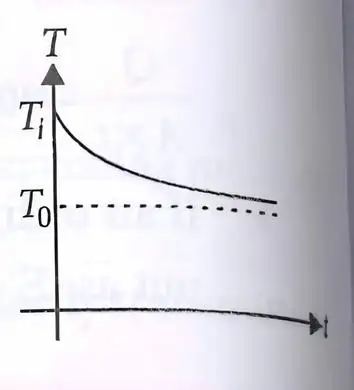
- Rate of cooling -dQ/dt is proportional to temperature difference (T2 - T1) if difference < 40°C.
- Mathematically, dQ/dt = k (T2 - T1), where k depends on surface area and nature.
- Temperature decreases exponentially: T = T0 + (Ti - T0) e-kt, k = constant.
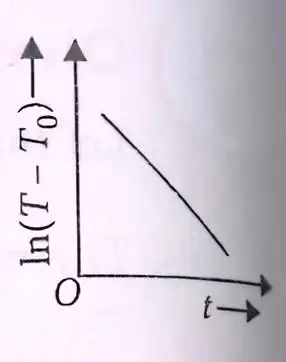
- Plot of ln(T - T0) vs time t is a straight line with slope -k and intercept ln(Ti - T0).
- Shortcut formula: (T1 - T2)/t = k ((T1 + T2)/2 - T0) to avoid calculating e-kt.
Solved Examples
- Ex 1: Find temperature after time t if Ti = 80° C, T0 = 30° C, k = 0.1 min-1.
- Use T = T0 + (Ti - T0) e-kt
- Calculate T = 30 + (80 - 30) e-0.1t
- Ex 2: Given ln(T - T0) vs t graph slope = -0.05, find k.
- From slope m = -k, so k = 0.05
Practice Set
- Q1: If initial temperature Ti = 90° C, surrounding T0 = 30° C, and k = 0.2 min-1, temperature after 5 min is?
- A) 40°C
- B) 50°C
- C) 60°C
- D) 70°C
- Q2: The plot of ln(T - T0) vs time is a straight line with slope -0.1. What is the value of k?
- A) 0.1
- B) -0.1
- C) 1
- D) -1
- Q3: Using shortcut formula, if T1 = 80° C, T2 = 60° C, T0 = 30° C, and time t = 10 min, find k.
- A) 0.05
- B) 0.1
- C) 0.15
- D) 0.2
Answer Key
- Q1: B) 50°C - Use T = 30 + 60 e-0.2 × 5 = 30 + 60 e-1 ≈ 50° C.
- Q2: A) 0.1 - Slope m = -k, so k = 0.1.
- Q3: A) 0.05 - Using (T1 - T2)/t = k ((T1 + T2)/2 - T0), solve for k.
Memory Aids
- Cooling rate ∝ temperature difference (small difference).
- Temperature formula: T = T0 + (Ti - T0) e-kt.
- Plot ln(T - T0) vs t is straight line with slope -k.
- Shortcut: (T1 - T2)/t = k ((T1 + T2)/2 - T0).
Explanation
- Rate of cooling -dQ/dt is proportional to temperature difference (T2 - T1) if difference < 40°C.
- Mathematically, dQ/dt = k (T2 - T1), where k depends on surface area and nature.
- Temperature decreases exponentially: T = T0 + (Ti - T0) e-kt, k = constant.
- Plot of ln(T - T0) vs time t is a straight line with slope -k and intercept ln(Ti - T0).
- Shortcut formula: (T1 - T2)/t = k ((T1 + T2)/2 - T0) to avoid calculating e-kt.
Solved Examples
- Ex 1: Find temperature after time t if Ti = 80° C, T0 = 30° C, k = 0.1 min-1.
- Use T = T0 + (Ti - T0) e-kt
- Calculate T = 30 + (80 - 30) e-0.1t
- Ex 2: Given ln(T - T0) vs t graph slope = -0.05, find k.
- From slope m = -k, so k = 0.05
Practice Set
- Q1: If initial temperature Ti = 90° C, surrounding T0 = 30° C, and k = 0.2 min-1, temperature after 5 min is?
- A) 40°C
- B) 50°C
- C) 60°C
- D) 70°C
- Q2: The plot of ln(T - T0) vs time is a straight line with slope -0.1. What is the value of k?
- A) 0.1
- B) -0.1
- C) 1
- D) -1
- Q3: Using shortcut formula, if T1 = 80° C, T2 = 60° C, T0 = 30° C, and time t = 10 min, find k.
- A) 0.05
- B) 0.1
- C) 0.15
- D) 0.2
Answer Key
- Q1: B) 50°C - Use T = 30 + 60 e-0.2 × 5 = 30 + 60 e-1 ≈ 50° C.
- Q2: A) 0.1 - Slope m = -k, so k = 0.1.
- Q3: A) 0.05 - Using (T1 - T2)/t = k ((T1 + T2)/2 - T0), solve for k.
Memory Aids
- Cooling rate ∝ temperature difference (small difference).
- Temperature formula: T = T0 + (Ti - T0) e-kt.
- Plot ln(T - T0) vs t is straight line with slope -k.
- Shortcut: (T1 - T2)/t = k ((T1 + T2)/2 - T0).
Explanation
- Rate of cooling \( -\frac{dQ}{dt} \) is proportional to temperature difference \( (T_2 - T_1) \) if difference < 40°C.
- Mathematically, \( \frac{dQ}{dt} = k (T_2 - T_1) \), where \( k \) depends on surface area and nature.
- Temperature decreases exponentially: \( T = T_0 + (T_i - T_0) e^{-kt} \), \( k \) = constant.
- Plot of \( \ln(T - T_0) \) vs time \( t \) is a straight line with slope \( -k \) and intercept \( \ln(T_i - T_0) \).
- Shortcut formula: \( \frac{T_1 - T_2}{t} = k \left( \frac{T_1 + T_2}{2} - T_0 \right) \) to avoid calculating \( e^{-kt} \).
Solved Examples
- Ex 1: Find temperature after time \( t \) if \( T_i = 80^\circ C \), \( T_0 = 30^\circ C \), \( k = 0.1 \) min\(^{-1}\).
- Use \( T = T_0 + (T_i - T_0) e^{-kt} \)
- Calculate \( T = 30 + (80 - 30) e^{-0.1t} \)
- Ex 2: Given \( \ln(T - T_0) \) vs \( t \) graph slope \( = -0.05 \), find \( k \).
- From slope \( m = -k \), so \( k = 0.05 \)
Practice Set
- Q1: If initial temperature \( T_i = 90^\circ C \), surrounding \( T_0 = 30^\circ C \), and \( k = 0.2 \) min\(^{-1}\), temperature after 5 min is?
- A) 40°C
- B) 50°C
- C) 60°C
- D) 70°C
- Q2: The plot of \( \ln(T - T_0) \) vs time is a straight line with slope \(-0.1\). What is the value of \( k \)?
- A) 0.1
- B) -0.1
- C) 1
- D) -1
- Q3: Using shortcut formula, if \( T_1 = 80^\circ C \), \( T_2 = 60^\circ C \), \( T_0 = 30^\circ C \), and time \( t = 10 \) min, find \( k \).
- A) 0.05
- B) 0.1
- C) 0.15
- D) 0.2
Answer Key
- Q1: B) 50°C - Use \( T = 30 + 60 e^{-0.2 \times 5} = 30 + 60 e^{-1} \approx 50^\circ C \).
- Q2: A) 0.1 - Slope \( m = -k \), so \( k = 0.1 \).
- Q3: A) 0.05 - Using \( \frac{T_1 - T_2}{t} = k \left( \frac{T_1 + T_2}{2} - T_0 \right) \), solve for \( k \).
Memory Aids
- Cooling rate ∝ temperature difference (small difference).
- Temperature formula: \( T = T_0 + (T_i - T_0) e^{-kt} \).
- Plot \( \ln(T - T_0) \) vs \( t \) is straight line with slope \( -k \).
- Shortcut: \( \frac{T_1 - T_2}{t} = k \left( \frac{T_1 + T_2}{2} - T_0 \right) \).
NEET Physics — ALL CHAPTERS
1
Basic Mathematics
2
Units and Measurement
3
Motion in a Straight Line
4
Motion in a Plane
5
Laws of Motion
6
Work, Energy and Power
7
System of Particles and Rotational Motion
8
Gravitation
9
Mechanical Properties of Solids
10
Mechanical Properties of Fluids
11
Thermal Properties of Matter
12
Thermodynamics
13
Kinetic Theory
14
Oscillations
15
Waves
16
Electric Charges and Fields
17
Electrostatic Potential and Capacitance
18
Current Electricity
19
Moving Charges and Magnetism
20
Magnetism and Matter
21
Electromagnetic Induction
22
Alternating Current
23
Electromagnetic Waves
24
Ray Optics and Optical Instruments
25
Wave Optics
26
Dual Nature of Radiation and Matter
27
Atoms
28
Nuclei
29
Semiconductor Electronics: Materials, Devices and Simple Circuits