NEET Ug . NEET Physics . Physics . Electromagnetic Waves
Chapter 23: Electromagnetic Waves
Ch 23
NEET Physics
NEET Ug
Introduction
Key Points
- Maxwell identified inconsistency in Ampere’s circuital law for magnetic field outside a capacitor with time-varying current.
- He introduced displacement current to resolve this inconsistency.
- Maxwell’s equations unify electric and magnetic fields with their sources (charge and current densities).
- Hertz experimentally confirmed electromagnetic waves in 1885; Marconi used them for communication revolution.
Solved Examples
- Ex 1: Explain why displacement current is needed in Ampere’s law.
- Charging capacitor shows magnetic field discontinuity if only conduction current considered.
- Displacement current term added to maintain continuity and satisfy Kirchhoff’s law.
Practice Set
- Q1: What did Maxwell add to Ampere’s law?
- A) Magnetic flux
- B) Displacement current
- C) Electric charge
- D) Electric flux
- Q2: Who experimentally demonstrated electromagnetic waves?
- A) Maxwell
- B) Marconi
- C) Hertz
- D) Faraday
- Q3: Maxwell’s equations relate which of the following?
- A) Only electric fields
- B) Only magnetic fields
- C) Electric and magnetic fields with charges and currents
- D) Only charges and currents
Answer Key
- Q1: B - Displacement current added to fix Ampere’s law inconsistency.
- Q2: C - Hertz demonstrated electromagnetic waves experimentally.
- Q3: C - Maxwell’s equations unify electric and magnetic fields with sources.
Memory Aids
- Displacement current = changing electric flux × permittivity.
- Maxwell’s equations unify electricity and magnetism.
- Hertz = electromagnetic waves proof.
Displacement Current
Concepts
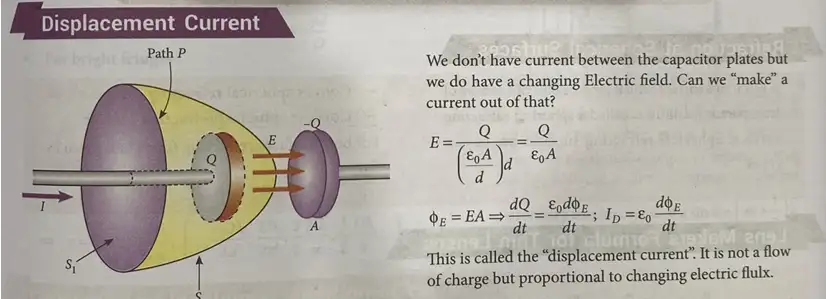
- Changing electric field produces magnetic field (Maxwell’s insight).
- Displacement current ID = ε0 dΦE/dt acts like current in capacitor gap.
- Electric field between capacitor plates: E = Q/(ε0A).
- Electric flux: ΦE = EA.
- No real charge flows through capacitor gap, but changing E creates displacement current.
Solved Examples
- Ex 1: Calculate displacement current if dΦE/dt = 5 × 10⁻⁶ Wb/s and ε0 = 8.85 × 10⁻¹² F/m .
- ID = ε0 dΦE/dt = 8.85 × 10-12 × 5 × 10-6 = 4.425 × 10⁻¹⁷ A
Practice Set
- Q1: Displacement current arises due to?
- A) Constant electric field
- B) Changing electric field
- C) Magnetic field
- D) Static charge
- Q2: Electric field between capacitor plates is given by?
- A) E = Q/(ε0A)
- B) E = Q/A
- C) E = ε0QA
- D) E = A/Q
- Q3: Displacement current is?
- A) Actual charge flow
- B) Magnetic flux
- C) Equivalent current due to changing electric field
- D) Zero
Answer Key
- Q1: B - Displacement current arises from changing electric field.
- Q2: A - Electric field E = Q/(ε0A).
- Q3: C - Displacement current behaves like current due to changing electric field.
Memory Aids
- Displacement current ID = ε0 dΦE/dt.
- Electric flux ΦE = EA.
- No real charge crosses capacitor gap.
Concepts
- Changing electric field produces magnetic field (Maxwell’s insight).
- Displacement current ID = ε0 dΦE/dt acts like current in capacitor gap.
- Electric field between capacitor plates: E = Q/(ε0A).
- Electric flux: ΦE = EA.
- No real charge flows through capacitor gap, but changing E creates displacement current.
Solved Examples
- Ex 1: Calculate displacement current if dΦE/dt = 5 × 10⁻⁶ Wb/s and ε0 = 8.85 × 10⁻¹² F/m .
- ID = ε0 dΦE/dt = 8.85 × 10-12 × 5 × 10-6 = 4.425 × 10⁻¹⁷ A
Practice Set
- Q1: Displacement current arises due to?
- A) Constant electric field
- B) Changing electric field
- C) Magnetic field
- D) Static charge
- Q2: Electric field between capacitor plates is given by?
- A) E = Q/(ε0A)
- B) E = Q/A
- C) E = ε0QA
- D) E = A/Q
- Q3: Displacement current is?
- A) Actual charge flow
- B) Magnetic flux
- C) Equivalent current due to changing electric field
- D) Zero
Answer Key
- Q1: B - Displacement current arises from changing electric field.
- Q2: A - Electric field E = Q/(ε0A).
- Q3: C - Displacement current behaves like current due to changing electric field.
Memory Aids
- Displacement current ID = ε0 dΦE/dt.
- Electric flux ΦE = EA.
- No real charge crosses capacitor gap.
Concepts
- Changing electric field produces magnetic field (Maxwell’s insight).
- Displacement current (ID) = ε0 dΦE/dt acts like current in capacitor gap.
- Electric field between capacitor plates: E = Q/(ε0A).
- Electric flux: ΦE = EA.
- No real charge flows through capacitor gap, but changing E creates displacement current.
Solved Examples
- Ex 1: Calculate displacement current if dΦE/dt = 5 × 10⁻⁶ Wb/s and ε0 = 8.85 × 10⁻¹² F/m .
- ID = ε0 dΦE/dt = 8.85 × 10-12 × 5 × 10-6 = 4.425 × 10⁻¹⁷ A
Practice Set
- Q1: Displacement current arises due to?
- A) Constant electric field
- B) Changing electric field
- C) Magnetic field
- D) Static charge
- Q2: Electric field between capacitor plates is given by?
- A) E = Q/(ε0A)
- B) E = Q/A
- C) E = ε0QA
- D) E = A/Q
- Q3: Displacement current is?
- A) Actual charge flow
- B) Magnetic flux
- C) Equivalent current due to changing electric field
- D) Zero
Answer Key
- Q1: B - Displacement current arises from changing electric field.
- Q2: A - Electric field E = Q/(ε0A).
- Q3: C - Displacement current behaves like current due to changing electric field.
Memory Aids
- Displacement current ID = ε0 dΦE/dt.
- Electric flux ΦE = EA.
- No real charge crosses capacitor gap.
Concepts
- Changing electric field produces magnetic field (Maxwell’s insight).
- Displacement current ID = ε0 dΦE/dt acts like current in capacitor gap.
- Electric field between capacitor plates: E = Q/(ε0A).
- Electric flux: ΦE = EA.
- No real charge flows through capacitor gap, but changing E creates displacement current.
Solved Examples
- Ex 1: Calculate displacement current if dΦE/dt = 5 × 10⁻⁶ Wb/s and ε0 = 8.85 × 10⁻¹² F/m .
- ID = ε0 dΦE/dt = 8.85 × 10-12 × 5 × 10-6 = 4.425 × 10⁻¹⁷ A
Practice Set
- Q1: Displacement current arises due to?
- A) Constant electric field
- B) Changing electric field
- C) Magnetic field
- D) Static charge
- Q2: Electric field between capacitor plates is given by?
- A) E = Q/(ε0A)
- B) E = Q/A
- C) E = ε0QA
- D) E = A/Q
- Q3: Displacement current is?
- A) Actual charge flow
- B) Magnetic flux
- C) Equivalent current due to changing electric field
- D) Zero
Answer Key
- Q1: B - Displacement current arises from changing electric field.
- Q2: A - Electric field E = Q/(ε0A).
- Q3: C - Displacement current behaves like current due to changing electric field.
Memory Aids
- Displacement current ID = ε0 dΦE/dt.
- Electric flux ΦE = EA.
- No real charge crosses capacitor gap.
Concepts
- Changing electric field produces magnetic field (Maxwell’s insight).
- Displacement current \(I_D = \varepsilon_0 \frac{d\Phi_E}{dt}\) acts like current in capacitor gap.
- Electric field between capacitor plates: \(E = \frac{Q}{\varepsilon_0 A}\).
- Electric flux: \(\Phi_E = EA\).
- No real charge flows through capacitor gap, but changing \(E\) creates displacement current.
Solved Examples
- Ex 1: Calculate displacement current if \(\frac{d\Phi_E}{dt} = 5 \times 10^{-6} \text{ Wb/s} \) and \(\varepsilon_0 = 8.85 \times 10^{-12} \text{ F/m} \).
- \(I_D = \varepsilon_0 \frac{d\Phi_E}{dt} = 8.85 \times 10^{-12} \times 5 \times 10^{-6} = 4.425 \times 10^{-17} \text{ A}\)
Practice Set
- Q1: Displacement current arises due to?
- A) Constant electric field
- B) Changing electric field
- C) Magnetic field
- D) Static charge
- Q2: Electric field between capacitor plates is given by?
- A) \(E = \frac{Q}{\varepsilon_0 A}\)
- B) \(E = \frac{Q}{A}\)
- C) \(E = \varepsilon_0 Q A\)
- D) \(E = \frac{A}{Q}\)
- Q3: Displacement current is?
- A) Actual charge flow
- B) Magnetic flux
- C) Equivalent current due to changing electric field
- D) Zero
Answer Key
- Q1: B - Displacement current arises from changing electric field.
- Q2: A - Electric field \(E = \frac{Q}{\varepsilon_0 A}\).
- Q3: C - Displacement current behaves like current due to changing electric field.
Memory Aids
- Displacement current \(I_D = \varepsilon_0 \frac{d\Phi_E}{dt}\).
- Electric flux \(\Phi_E = EA\).
- No real charge crosses capacitor gap.
Concepts
- Changing electric field produces magnetic field (Maxwell’s insight).
- Displacement current ID = ε0 dΦE/dt acts like current in capacitor gap.
- Electric field between capacitor plates: E = Q/(ε0A).
- Electric flux: ΦE = EA.
- No real charge flows through capacitor gap, but changing E creates displacement current.
Solved Examples
- Ex 1: Calculate displacement current if dΦE/dt = 5 × 10⁻⁶ Wb/s and ε0 = 8.85 × 10⁻¹² F/m .
- ID = ε0 dΦE/dt = 8.85 × 10-12 × 5 × 10-6 = 4.425 × 10⁻¹⁷ A
Practice Set
- Q1: Displacement current arises due to?
- A) Constant electric field
- B) Changing electric field
- C) Magnetic field
- D) Static charge
- Q2: Electric field between capacitor plates is given by?
- A) E = Q/(ε0A)
- B) E = Q/A
- C) E = ε0QA
- D) E = A/Q
- Q3: Displacement current is?
- A) Actual charge flow
- B) Magnetic flux
- C) Equivalent current due to changing electric field
- D) Zero
Answer Key
- Q1: B - Displacement current arises from changing electric field.
- Q2: A - Electric field E = Q/(ε0A).
- Q3: C - Displacement current behaves like current due to changing electric field.
Memory Aids
- Displacement current ID = ε0 dΦE/dt.
- Electric flux ΦE = EA.
- No real charge crosses capacitor gap.
Concepts
- Changing electric field produces magnetic field (Maxwell’s insight).
- Displacement current (ID) = ε0 dΦE/dt acts like current in capacitor gap.
- Electric field between capacitor plates: E = Q/(ε0A).
- Electric flux: ΦE = EA.
- No real charge flows through capacitor gap, but changing E creates displacement current.
Solved Examples
- Ex 1: Calculate displacement current if dΦE/dt = 5 × 10⁻⁶ Wb/s and ε0 = 8.85 × 10⁻¹² F/m .
- ID = ε0 dΦE/dt = 8.85 × 10-12 × 5 × 10-6 = 4.425 × 10⁻¹⁷ A
Practice Set
- Q1: Displacement current arises due to?
- A) Constant electric field
- B) Changing electric field
- C) Magnetic field
- D) Static charge
- Q2: Electric field between capacitor plates is given by?
- A) E = Q/(ε0A)
- B) E = Q/A
- C) E = ε0QA
- D) E = A/Q
- Q3: Displacement current is?
- A) Actual charge flow
- B) Magnetic flux
- C) Equivalent current due to changing electric field
- D) Zero
Answer Key
- Q1: B - Displacement current arises from changing electric field.
- Q2: A - Electric field E = Q/(ε0A).
- Q3: C - Displacement current behaves like current due to changing electric field.
Memory Aids
- Displacement current ID = ε0 dΦE/dt.
- Electric flux ΦE = EA.
- No real charge crosses capacitor gap.
Concepts
- Changing electric field produces magnetic field (Maxwell’s insight).
- Displacement current ID = ε0 dΦE/dt acts like current in capacitor gap.
- Electric field between capacitor plates: E = Q/(ε0A).
- Electric flux: ΦE = EA.
- No real charge flows through capacitor gap, but changing E creates displacement current.
Solved Examples
- Ex 1: Calculate displacement current if dΦE/dt = 5 × 10⁻⁶ Wb/s and ε0 = 8.85 × 10⁻¹² F/m .
- ID = ε0 dΦE/dt = 8.85 × 10-12 × 5 × 10-6 = 4.425 × 10⁻¹⁷ A
Practice Set
- Q1: Displacement current arises due to?
- A) Constant electric field
- B) Changing electric field
- C) Magnetic field
- D) Static charge
- Q2: Electric field between capacitor plates is given by?
- A) E = Q/(ε0A)
- B) E = Q/A
- C) E = ε0QA
- D) E = A/Q
- Q3: Displacement current is?
- A) Actual charge flow
- B) Magnetic flux
- C) Equivalent current due to changing electric field
- D) Zero
Answer Key
- Q1: B - Displacement current arises from changing electric field.
- Q2: A - Electric field E = Q/(ε0A).
- Q3: C - Displacement current behaves like current due to changing electric field.
Memory Aids
- Displacement current ID = ε0 dΦE/dt.
- Electric flux ΦE = EA.
- No real charge crosses capacitor gap.
Concepts
- Changing electric field produces magnetic field (Maxwell’s insight).
- Displacement current \(I_D = \varepsilon_0 \frac{d\Phi_E}{dt}\) acts like current in capacitor gap.
- Electric field between capacitor plates: \(E = \frac{Q}{\varepsilon_0 A}\).
- Electric flux: \(\Phi_E = EA\).
- No real charge flows through capacitor gap, but changing \(E\) creates displacement current.
Solved Examples
- Ex 1: Calculate displacement current if \(\frac{d\Phi_E}{dt} = 5 \times 10^{-6} \text{ Wb/s} \) and \(\varepsilon_0 = 8.85 \times 10^{-12} \text{ F/m} \).
- \(I_D = \varepsilon_0 \frac{d\Phi_E}{dt} = 8.85 \times 10^{-12} \times 5 \times 10^{-6} = 4.425 \times 10^{-17} \text{ A}\)
Practice Set
- Q1: Displacement current arises due to?
- A) Constant electric field
- B) Changing electric field
- C) Magnetic field
- D) Static charge
- Q2: Electric field between capacitor plates is given by?
- A) \(E = \frac{Q}{\varepsilon_0 A}\)
- B) \(E = \frac{Q}{A}\)
- C) \(E = \varepsilon_0 Q A\)
- D) \(E = \frac{A}{Q}\)
- Q3: Displacement current is?
- A) Actual charge flow
- B) Magnetic flux
- C) Equivalent current due to changing electric field
- D) Zero
Answer Key
- Q1: B - Displacement current arises from changing electric field.
- Q2: A - Electric field \(E = \frac{Q}{\varepsilon_0 A}\).
- Q3: C - Displacement current behaves like current due to changing electric field.
Memory Aids
- Displacement current \(I_D = \varepsilon_0 \frac{d\Phi_E}{dt}\).
- Electric flux \(\Phi_E = EA\).
- No real charge crosses capacitor gap.
Inconsistency of Ampere’s Circuital Law
Key Points
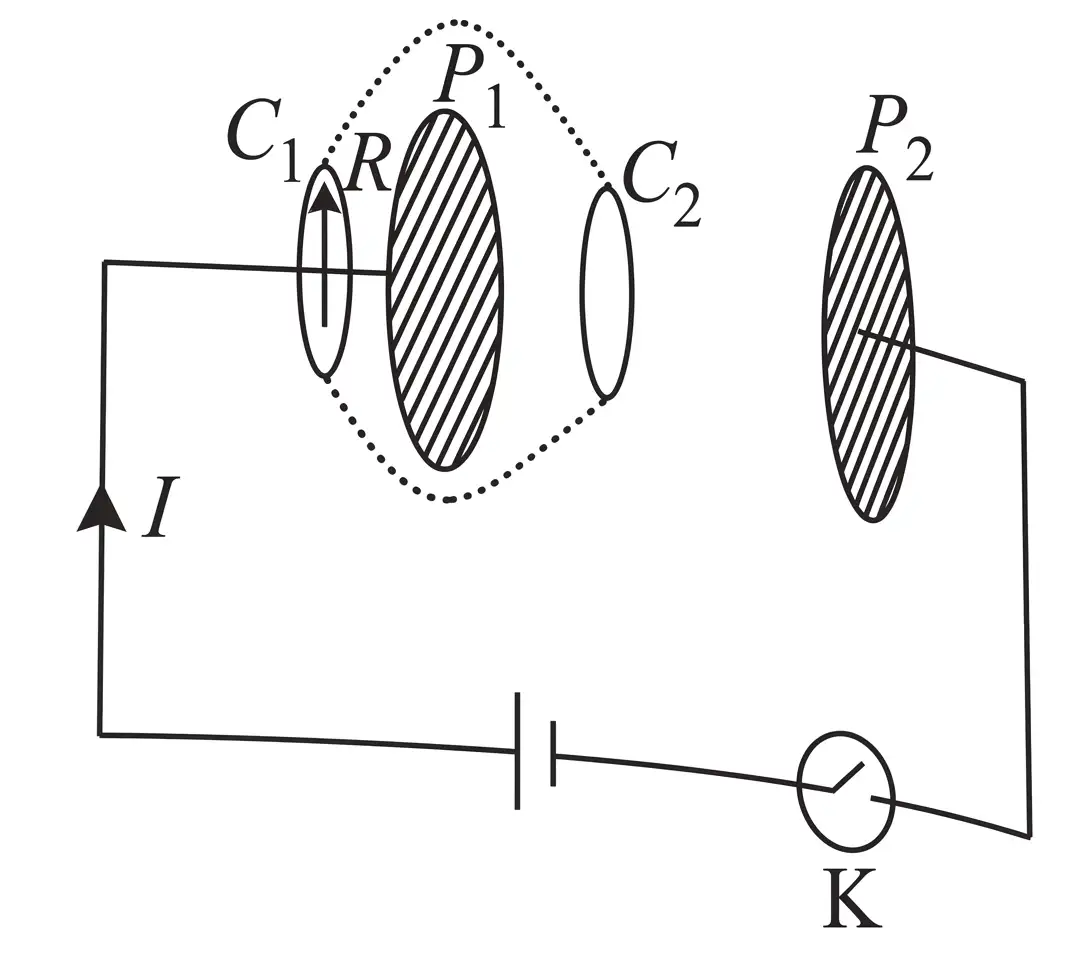
- Charging capacitor shows current I enters plate P1 but no conduction current beyond it.
- Kirchhoff’s first law seems violated as current appears to stop.
- Two loops C1 (around wire) and C2 (between plates) give different magnetic field results using Ampere’s law.
- Loop C1: ∮ B · dl = μ0I ≠ 0.
- Loop C2: ∮ B · dl = 0 as conduction current is zero.
- This discontinuity contradicts continuous magnetic field observed physically.
- Maxwell proposed modifying Ampere’s law to include displacement current.
Solved Examples
- Ex 1: Explain why magnetic field is discontinuous using Ampere’s law.
- Loop C1 encloses conduction current I, magnetic field non-zero.
- Loop C2 encloses no conduction current, magnetic field zero.
- Physical magnetic field is continuous, so Ampere’s law incomplete.
Practice Set
- Q1: What causes inconsistency in Ampere’s law?
- A) Magnetic field discontinuity
- B) Electric field discontinuity
- C) Charge accumulation
- D) Current continuity
- Q2: Loop C2 in capacitor gap shows magnetic field?
- A) Equal to μ0I
- B) Zero
- C) Infinite
- D) Negative
- Q3: Why is Kirchhoff’s law apparently violated?
- A) Current stops at capacitor plate
- B) No displacement current considered
- C) Magnetic field is zero
- D) Electric field is constant
Answer Key
- Q1: A - Magnetic field discontinuity causes inconsistency.
- Q2: B - Loop C2 has zero conduction current, so magnetic field zero.
- Q3: B - Displacement current missing causes Kirchhoff’s law violation.
Memory Aids
- Ampere’s law incomplete without displacement current.
- Magnetic field must be continuous.
- Displacement current fixes discontinuity.
Key Points
- Charging capacitor shows current I enters plate P1 but no conduction current beyond it.
- Kirchhoff’s first law seems violated as current appears to stop.
- Two loops C1 (around wire) and C2 (between plates) give different magnetic field results using Ampere’s law.
- Loop C1: ∮ B · dl = μ0I ≠ 0.
- Loop C2: ∮ B · dl = 0 as conduction current is zero.
- This discontinuity contradicts continuous magnetic field observed physically.
- Maxwell proposed modifying Ampere’s law to include displacement current.
Solved Examples
- Ex 1: Explain why magnetic field is discontinuous using Ampere’s law.
- Loop C1 encloses conduction current I, magnetic field non-zero.
- Loop C2 encloses no conduction current, magnetic field zero.
- Physical magnetic field is continuous, so Ampere’s law incomplete.
Practice Set
- Q1: What causes inconsistency in Ampere’s law?
- A) Magnetic field discontinuity
- B) Electric field discontinuity
- C) Charge accumulation
- D) Current continuity
- Q2: Loop C2 in capacitor gap shows magnetic field?
- A) Equal to μ0I
- B) Zero
- C) Infinite
- D) Negative
- Q3: Why is Kirchhoff’s law apparently violated?
- A) Current stops at capacitor plate
- B) No displacement current considered
- C) Magnetic field is zero
- D) Electric field is constant
Answer Key
- Q1: A - Magnetic field discontinuity causes inconsistency.
- Q2: B - Loop C2 has zero conduction current, so magnetic field zero.
- Q3: B - Displacement current missing causes Kirchhoff’s law violation.
Memory Aids
- Ampere’s law incomplete without displacement current.
- Magnetic field must be continuous.
- Displacement current fixes discontinuity.
Key Points
- Charging capacitor shows current \(I\) enters plate \(P_1\) but no conduction current beyond it.
- Kirchhoff’s first law seems violated as current appears to stop.
- Two loops \(C_1\) (around wire) and \(C_2\) (between plates) give different magnetic field results using Ampere’s law.
- Loop \(C_1\): \(\oint \vec{B} \cdot d\vec{l} = \mu_0 I \neq 0\).
- Loop \(C_2\): \(\oint \vec{B} \cdot d\vec{l} = 0\) as conduction current is zero.
- This discontinuity contradicts continuous magnetic field observed physically.
- Maxwell proposed modifying Ampere’s law to include displacement current.
Solved Examples
- Ex 1: Explain why magnetic field is discontinuous using Ampere’s law.
- Loop \(C_1\) encloses conduction current \(I\), magnetic field non-zero.
- Loop \(C_2\) encloses no conduction current, magnetic field zero.
- Physical magnetic field is continuous, so Ampere’s law incomplete.
Practice Set
- Q1: What causes inconsistency in Ampere’s law?
- A) Magnetic field discontinuity
- B) Electric field discontinuity
- C) Charge accumulation
- D) Current continuity
- Q2: Loop \(C_2\) in capacitor gap shows magnetic field?
- A) Equal to \(\mu_0 I\)
- B) Zero
- C) Infinite
- D) Negative
- Q3: Why is Kirchhoff’s law apparently violated?
- A) Current stops at capacitor plate
- B) No displacement current considered
- C) Magnetic field is zero
- D) Electric field is constant
Answer Key
- Q1: A - Magnetic field discontinuity causes inconsistency.
- Q2: B - Loop \(C_2\) has zero conduction current, so magnetic field zero.
- Q3: B - Displacement current missing causes Kirchhoff’s law violation.
Memory Aids
- Ampere’s law incomplete without displacement current.
- Magnetic field must be continuous.
- Displacement current fixes discontinuity.
Key Points
- Charging capacitor shows current I enters plate P1 but no conduction current beyond it.
- Kirchhoff’s first law seems violated as current appears to stop.
- Two loops C1 (around wire) and C2 (between plates) give different magnetic field results using Ampere’s law.
- Loop C1: ∮ B · dl = μ0I ≠ 0.
- Loop C2: ∮ B · dl = 0 as conduction current is zero.
- This discontinuity contradicts continuous magnetic field observed physically.
- Maxwell proposed modifying Ampere’s law to include displacement current.
Solved Examples
- Ex 1: Explain why magnetic field is discontinuous using Ampere’s law.
- Loop C1 encloses conduction current I, magnetic field non-zero.
- Loop C2 encloses no conduction current, magnetic field zero.
- Physical magnetic field is continuous, so Ampere’s law incomplete.
Practice Set
- Q1: What causes inconsistency in Ampere’s law?
- A) Magnetic field discontinuity
- B) Electric field discontinuity
- C) Charge accumulation
- D) Current continuity
- Q2: Loop C2 in capacitor gap shows magnetic field?
- A) Equal to μ0I
- B) Zero
- C) Infinite
- D) Negative
- Q3: Why is Kirchhoff’s law apparently violated?
- A) Current stops at capacitor plate
- B) No displacement current considered
- C) Magnetic field is zero
- D) Electric field is constant
Answer Key
- Q1: A - Magnetic field discontinuity causes inconsistency.
- Q2: B - Loop C2 has zero conduction current, so magnetic field zero.
- Q3: B - Displacement current missing causes Kirchhoff’s law violation.
Memory Aids
- Ampere’s law incomplete without displacement current.
- Magnetic field must be continuous.
- Displacement current fixes discontinuity.
Key Points
- Charging capacitor shows current \(I\) enters plate \(P_1\) but no conduction current beyond it.
- Kirchhoff’s first law seems violated as current appears to stop.
- Two loops \(C_1\) (around wire) and \(C_2\) (between plates) give different magnetic field results using Ampere’s law.
- Loop \(C_1\): \(\oint \vec{B} \cdot d\vec{l} = \mu_0 I \neq 0\).
- Loop \(C_2\): \(\oint \vec{B} \cdot d\vec{l} = 0\) as conduction current is zero.
- This discontinuity contradicts continuous magnetic field observed physically.
- Maxwell proposed modifying Ampere’s law to include displacement current.
Solved Examples
- Ex 1: Explain why magnetic field is discontinuous using Ampere’s law.
- Loop \(C_1\) encloses conduction current \(I\), magnetic field non-zero.
- Loop \(C_2\) encloses no conduction current, magnetic field zero.
- Physical magnetic field is continuous, so Ampere’s law incomplete.
Practice Set
- Q1: What causes inconsistency in Ampere’s law?
- A) Magnetic field discontinuity
- B) Electric field discontinuity
- C) Charge accumulation
- D) Current continuity
- Q2: Loop \(C_2\) in capacitor gap shows magnetic field?
- A) Equal to \(\mu_0 I\)
- B) Zero
- C) Infinite
- D) Negative
- Q3: Why is Kirchhoff’s law apparently violated?
- A) Current stops at capacitor plate
- B) No displacement current considered
- C) Magnetic field is zero
- D) Electric field is constant
Answer Key
- Q1: A - Magnetic field discontinuity causes inconsistency.
- Q2: B - Loop \(C_2\) has zero conduction current, so magnetic field zero.
- Q3: B - Displacement current missing causes Kirchhoff’s law violation.
Memory Aids
- Ampere’s law incomplete without displacement current.
- Magnetic field must be continuous.
- Displacement current fixes discontinuity.
Modified Ampere’s Law by Maxwell
Key Points
- Maxwell modified Ampere’s law to include displacement current ID.
- Generalized law: ∮ B · dl = μ0 [I + ID].
- Displacement current: ID = ε0 dΦE/dt, where ΦE = EA.
- This modification ensures magnetic field continuity and Kirchhoff’s law validity.
Solved Examples
- Ex 1: Write generalized Ampere’s law.
- ∮ B · dl = μ0 [I + ε0 dΦE/dt]
Practice Set
- Q1: Displacement current formula is?
- A) ID = ε0 dΦE/dt
- B) ID = μ0I
- C) ID = Q/A
- D) ID = 0
- Q2: Generalized Ampere’s law includes?
- A) Only conduction current
- B) Only displacement current
- C) Both conduction and displacement currents
- D) Neither
- Q3: Displacement current exists where?
- A) Outside capacitor plates
- B) Inside capacitor gap with changing electric flux
- C) In resistors
- D) In open air only
Answer Key
- Q1: A - Displacement current formula ID = ε0 dΦE/dt.
- Q2: C - Generalized law includes both currents.
- Q3: B - Displacement current exists in capacitor gap with changing flux.
Memory Aids
- Generalized Ampere’s law: ∮ B · dl = μ0 [I + ID].
- Displacement current equals conduction current in magnitude.
- Ensures magnetic field continuity.
Key Points
- Maxwell modified Ampere’s law to include displacement current (ID).
- Generalized law: ∮ B · dl = μ0 [I + ID].
- Displacement current: ID = ε0 dΦE/dt, where ΦE = EA.
- This modification ensures magnetic field continuity and Kirchhoff’s law validity.
Solved Examples
- Ex 1: Write generalized Ampere’s law.
- ∮ B · dl = μ0 [I + ε0 dΦE/dt]
Practice Set
- Q1: Displacement current formula is?
- A) ID = ε0 dΦE/dt
- B) ID = μ0I
- C) ID = Q/A
- D) ID = 0
- Q2: Generalized Ampere’s law includes?
- A) Only conduction current
- B) Only displacement current
- C) Both conduction and displacement currents
- D) Neither
- Q3: Displacement current exists where?
- A) Outside capacitor plates
- B) Inside capacitor gap with changing electric flux
- C) In resistors
- D) In open air only
Answer Key
- Q1: A - Displacement current formula ID = ε0 dΦE/dt.
- Q2: C - Generalized law includes both currents.
- Q3: B - Displacement current exists in capacitor gap with changing flux.
Memory Aids
- Generalized Ampere’s law: ∮ B · dl = μ0 [I + ID].
- Displacement current equals conduction current in magnitude.
- Ensures magnetic field continuity.
Key Points
- Maxwell modified Ampere’s law to include displacement current ID.
- Generalized law: ∮ B · dl = μ0 [I + ID].
- Displacement current: ID = ε0 dΦE/dt, where ΦE = EA.
- This modification ensures magnetic field continuity and Kirchhoff’s law validity.
Solved Examples
- Ex 1: Write generalized Ampere’s law.
- ∮ B · dl = μ0 [I + ε0 dΦE/dt]
Practice Set
- Q1: Displacement current formula is?
- A) ID = ε0 dΦE/dt
- B) ID = μ0I
- C) ID = Q/A
- D) ID = 0
- Q2: Generalized Ampere’s law includes?
- A) Only conduction current
- B) Only displacement current
- C) Both conduction and displacement currents
- D) Neither
- Q3: Displacement current exists where?
- A) Outside capacitor plates
- B) Inside capacitor gap with changing electric flux
- C) In resistors
- D) In open air only
Answer Key
- Q1: A - Displacement current formula ID = ε0 dΦE/dt.
- Q2: C - Generalized law includes both currents.
- Q3: B - Displacement current exists in capacitor gap with changing flux.
Memory Aids
- Generalized Ampere’s law: ∮ B · dl = μ0 [I + ID].
- Displacement current equals conduction current in magnitude.
- Ensures magnetic field continuity.
Key Points
- Maxwell modified Ampere’s law to include displacement current \(I_D\).
- Generalized law: \(\oint \vec{B} \cdot d\vec{l} = \mu_0 [I + I_D]\).
- Displacement current: \(I_D = \varepsilon_0 \frac{d\Phi_E}{dt}\), where \(\Phi_E = EA\).
- This modification ensures magnetic field continuity and Kirchhoff’s law validity.
Solved Examples
- Ex 1: Write generalized Ampere’s law.
- \(\oint \vec{B} \cdot d\vec{l} = \mu_0 [I + \varepsilon_0 \frac{d\Phi_E}{dt}]\)
Practice Set
- Q1: Displacement current formula is?
- A) \(I_D = \varepsilon_0 \frac{d\Phi_E}{dt}\)
- B) \(I_D = \mu_0 I\)
- C) \(I_D = \frac{Q}{A}\)
- D) \(I_D = 0\)
- Q2: Generalized Ampere’s law includes?
- A) Only conduction current
- B) Only displacement current
- C) Both conduction and displacement currents
- D) Neither
- Q3: Displacement current exists where?
- A) Outside capacitor plates
- B) Inside capacitor gap with changing electric flux
- C) In resistors
- D) In open air only
Answer Key
- Q1: A - Displacement current formula \(I_D = \varepsilon_0 \frac{d\Phi_E}{dt}\).
- Q2: C - Generalized law includes both currents.
- Q3: B - Displacement current exists in capacitor gap with changing flux.
Memory Aids
- Generalized Ampere’s law: \(\oint \vec{B} \cdot d\vec{l} = \mu_0 [I + I_D]\).
- Displacement current equals conduction current in magnitude.
- Ensures magnetic field continuity.
Consistency of Modified Ampere’s Law
Key Points
- Loop C1: ID = 0, magnetic field due to conduction current only.
- Loop C2: I = 0, magnetic field due to displacement current ID.
- Magnetic field is continuous inside and outside capacitor plates.
- Displacement current magnitude equals conduction current ID = I.
- Kirchhoff’s first law holds with displacement current included.
Solved Examples
- Ex 1: Show ID = I using electric flux.
- ΦE = EA = q/(ε0A) × A = q/ε0
- dΦE/dt = 1/ε0 dq/dt = I/ε0
- ID = ε0 × I/ε0 = I
Practice Set
- Q1: Displacement current magnitude compared to conduction current is?
- A) Zero
- B) Half
- C) Equal
- D) Double
- Q2: Kirchhoff’s first law applies when?
- A) Only conduction current present
- B) Only displacement current present
- C) Both conduction and displacement currents present
- D) No current present
- Q3: Magnetic field continuity ensured by?
- A) Conduction current only
- B) Displacement current only
- C) Both conduction and displacement currents
- D) Neither
Answer Key
- Q1: C - Displacement current equals conduction current.
- Q2: C - Kirchhoff’s law valid with both currents.
- Q3: C - Magnetic field continuity needs both currents.
Memory Aids
- Displacement current ID = I.
- Kirchhoff’s law valid with displacement current.
- Magnetic field continuous everywhere.
Key Points
- Loop \(C_1\): \(I_D = 0\), magnetic field due to conduction current only.
- Loop \(C_2\): \(I = 0\), magnetic field due to displacement current \(I_D\).
- Magnetic field is continuous inside and outside capacitor plates.
- Displacement current magnitude equals conduction current \(I_D = I\).
- Kirchhoff’s first law holds with displacement current included.
Solved Examples
- Ex 1: Show \(I_D = I\) using electric flux.
- \(\Phi_E = EA = \frac{q}{\varepsilon_0 A} \times A = \frac{q}{\varepsilon_0}\)
- \(\frac{d\Phi_E}{dt} = \frac{1}{\varepsilon_0} \frac{dq}{dt} = \frac{I}{\varepsilon_0}\)
- \(I_D = \varepsilon_0 \times \frac{I}{\varepsilon_0} = I\)
Practice Set
- Q1: Displacement current magnitude compared to conduction current is?
- A) Zero
- B) Half
- C) Equal
- D) Double
- Q2: Kirchhoff’s first law applies when?
- A) Only conduction current present
- B) Only displacement current present
- C) Both conduction and displacement currents present
- D) No current present
- Q3: Magnetic field continuity ensured by?
- A) Conduction current only
- B) Displacement current only
- C) Both conduction and displacement currents
- D) Neither
Answer Key
- Q1: C - Displacement current equals conduction current.
- Q2: C - Kirchhoff’s law valid with both currents.
- Q3: C - Magnetic field continuity needs both currents.
Memory Aids
- Displacement current \(I_D = I\).
- Kirchhoff’s law valid with displacement current.
- Magnetic field continuous everywhere.
Key Points
- Loop C1: ID = 0, magnetic field due to conduction current only.
- Loop C2: I = 0, magnetic field due to displacement current ID.
- Magnetic field is continuous inside and outside capacitor plates.
- Displacement current magnitude equals conduction current ID = I.
- Kirchhoff’s first law holds with displacement current included.
Solved Examples
- Ex 1: Show ID = I using electric flux.
- ΦE = EA = q/(ε0A) × A = q/ε0
- dΦE/dt = 1/ε0 dq/dt = I/ε0
- ID = ε0 × I/ε0 = I
Practice Set
- Q1: Displacement current magnitude compared to conduction current is?
- A) Zero
- B) Half
- C) Equal
- D) Double
- Q2: Kirchhoff’s first law applies when?
- A) Only conduction current present
- B) Only displacement current present
- C) Both conduction and displacement currents present
- D) No current present
- Q3: Magnetic field continuity ensured by?
- A) Conduction current only
- B) Displacement current only
- C) Both conduction and displacement currents
- D) Neither
Answer Key
- Q1: C - Displacement current equals conduction current.
- Q2: C - Kirchhoff’s law valid with both currents.
- Q3: C - Magnetic field continuity needs both currents.
Memory Aids
- Displacement current ID = I.
- Kirchhoff’s law valid with displacement current.
- Magnetic field continuous everywhere.
Key Points
- Loop \(C_1\): \(I_D = 0\), magnetic field due to conduction current only.
- Loop \(C_2\): \(I = 0\), magnetic field due to displacement current \(I_D\).
- Magnetic field is continuous inside and outside capacitor plates.
- Displacement current magnitude equals conduction current \(I_D = I\).
- Kirchhoff’s first law holds with displacement current included.
Solved Examples
- Ex 1: Show \(I_D = I\) using electric flux.
- \(\Phi_E = EA = \frac{q}{\varepsilon_0 A} \times A = \frac{q}{\varepsilon_0}\)
- \(\frac{d\Phi_E}{dt} = \frac{1}{\varepsilon_0} \frac{dq}{dt} = \frac{I}{\varepsilon_0}\)
- \(I_D = \varepsilon_0 \times \frac{I}{\varepsilon_0} = I\)
Practice Set
- Q1: Displacement current magnitude compared to conduction current is?
- A) Zero
- B) Half
- C) Equal
- D) Double
- Q2: Kirchhoff’s first law applies when?
- A) Only conduction current present
- B) Only displacement current present
- C) Both conduction and displacement currents present
- D) No current present
- Q3: Magnetic field continuity ensured by?
- A) Conduction current only
- B) Displacement current only
- C) Both conduction and displacement currents
- D) Neither
Answer Key
- Q1: C - Displacement current equals conduction current.
- Q2: C - Kirchhoff’s law valid with both currents.
- Q3: C - Magnetic field continuity needs both currents.
Memory Aids
- Displacement current \(I_D = I\).
- Kirchhoff’s law valid with displacement current.
- Magnetic field continuous everywhere.
Maxwell’s Equations
Key Points
- Four fundamental laws of electricity and magnetism.
- Explain production of electromagnetic waves.
- 1. Gauss’s law for electricity: ∮S E · dS = qinside/ε0.
- 2. Gauss’s law for magnetism: ∮S B · dS = 0.
- 3. Faraday’s law: ∮l E · dl = - d/dt ∮S B · dS.
- 4. Modified Ampere’s law: ∮l B · dl = μ0 [I + ε0 d/dt ∮S E · dS].
- Changing electric field produces magnetic field and vice versa.
Solved Examples
- Ex 1: Write Maxwell’s four equations.
- 1) ∮S E · dS = q/ε0
- 2) ∮S B · dS = 0
- 3) ∮l E · dl = - d/dt ∮S B · dS
- 4) ∮l B · dl = μ0 [I + ε0 d/dt ∮S E · dS]
Practice Set
- Q1: Gauss’s law for electricity states?
- A) Magnetic flux through closed surface is zero
- B) Electric flux through closed surface equals charge inside divided by ε0
- C) Induced emf equals rate of change of magnetic flux
- D) Magnetic field line integral equals current
- Q2: Faraday’s law relates induced emf to?
- A) Electric flux change
- B) Magnetic flux change
- C) Charge change
- D) Current change
- Q3: Modified Ampere’s law includes?
- A) Only conduction current
- B) Only displacement current
- C) Both conduction and displacement currents
- D) Neither
Answer Key
- Q1: B - Electric flux equals charge inside divided by permittivity.
- Q2: B - Induced emf proportional to rate of change of magnetic flux.
- Q3: C - Includes both conduction and displacement currents.
Memory Aids
- Gauss’s law (electric): flux = charge/ε0.
- Gauss’s law (magnetic): flux = 0.
- Faraday: emf = -d(magnetic flux)/dt.
- Ampere-Maxwell: magnetic field line integral = μ0(conduction + displacement current).
Key Points
- Four fundamental laws of electricity and magnetism.
- Explain production of electromagnetic waves.
- 1. Gauss’s law for electricity: \(\oint_S \vec{E} \cdot d\vec{S} = \frac{q_{inside}}{\varepsilon_0}\).
- 2. Gauss’s law for magnetism: \(\oint_S \vec{B} \cdot d\vec{S} = 0\).
- 3. Faraday’s law: \(\oint_l \vec{E} \cdot d\vec{l} = - \frac{d}{dt} \oint_S \vec{B} \cdot d\vec{S}\).
- 4. Modified Ampere’s law: \(\oint_l \vec{B} \cdot d\vec{l} = \mu_0 \left[I + \varepsilon_0 \frac{d}{dt} \oint_S \vec{E} \cdot d\vec{S} \right]\).
- Changing electric field produces magnetic field and vice versa.
Solved Examples
- Ex 1: Write Maxwell’s four equations.
- 1) \(\oint_S \vec{E} \cdot d\vec{S} = \frac{q}{\varepsilon_0}\)
- 2) \(\oint_S \vec{B} \cdot d\vec{S} = 0\)
- 3) \(\oint_l \vec{E} \cdot d\vec{l} = - \frac{d}{dt} \oint_S \vec{B} \cdot d\vec{S}\)
- 4) \(\oint_l \vec{B} \cdot d\vec{l} = \mu_0 \left[I + \varepsilon_0 \frac{d}{dt} \oint_S \vec{E} \cdot d\vec{S} \right]\)
Practice Set
- Q1: Gauss’s law for electricity states?
- A) Magnetic flux through closed surface is zero
- B) Electric flux through closed surface equals charge inside divided by \(\varepsilon_0\)
- C) Induced emf equals rate of change of magnetic flux
- D) Magnetic field line integral equals current
- Q2: Faraday’s law relates induced emf to?
- A) Electric flux change
- B) Magnetic flux change
- C) Charge change
- D) Current change
- Q3: Modified Ampere’s law includes?
- A) Only conduction current
- B) Only displacement current
- C) Both conduction and displacement currents
- D) Neither
Answer Key
- Q1: B - Electric flux equals charge inside divided by permittivity.
- Q2: B - Induced emf proportional to rate of change of magnetic flux.
- Q3: C - Includes both conduction and displacement currents.
Memory Aids
- Gauss’s law (electric): flux = charge/\(\varepsilon_0\).
- Gauss’s law (magnetic): flux = 0.
- Faraday: emf = -d(magnetic flux)/dt.
- Ampere-Maxwell: magnetic field line integral = \(\mu_0\)(conduction + displacement current).
Electromagnetic Waves
Definition and Properties
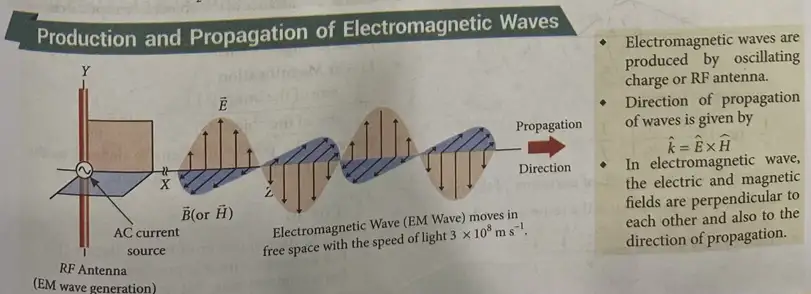
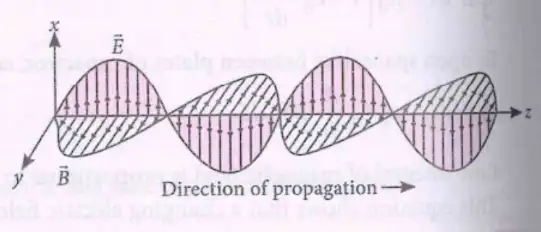
- Electromagnetic waves have sinusoidal electric and magnetic fields oscillating perpendicular to each other and to the direction of wave propagation.
- Produced by alternating electric and magnetic fields as per Maxwell's equations.
- Frequency of the wave equals frequency of oscillating fields or accelerated charges.
- Carry energy and momentum through space at speed of light c = 3 × 10⁸ m/s in vacuum.
Production of Electromagnetic Waves
- Accelerated charges emit electromagnetic waves.
- Oscillating charges produce oscillating electric and magnetic fields regenerating each other.
- Energy of wave comes from energy of accelerating charge.
Solved Examples
- Ex 1: An antenna oscillates charges at frequency 1 MHz. What is the frequency of emitted EM wave?
Solution: Frequency of EM wave = frequency of oscillation = 1 MHz.
Practice Set
- Q1: What causes electromagnetic waves?
A. Stationary charges
B. Uniform motion charges
C. Accelerated charges
D. None of these - Q2: The electric and magnetic fields in an EM wave are:
A. Parallel
B. Perpendicular to each other and to wave direction
C. Perpendicular only to each other
D. Randomly oriented - Q3: If an EM wave frequency is doubled, its wavelength:
A. Doubles
B. Halves
C. Remains same
D. Quadruples
Answer Key
- Q1: C - Accelerated charges produce EM waves.
- Q2: B - Fields are perpendicular to each other and direction of propagation.
- Q3: B - Wavelength inversely proportional to frequency.
Memory Aids
- EM waves = Oscillating E and B fields at right angles.
- Accelerated charges = EM wave source.
- Frequency of wave = frequency of oscillation.
Definition and Properties
- Electromagnetic waves have sinusoidal electric and magnetic fields oscillating perpendicular to each other and to the direction of wave propagation.
- Produced by alternating electric and magnetic fields as per Maxwell's equations.
- Frequency of the wave equals frequency of oscillating fields or accelerated charges.
- Carry energy and momentum through space at speed of light c = 3 × 10⁸ m/s in vacuum.
Production of Electromagnetic Waves
- Accelerated charges emit electromagnetic waves.
- Oscillating charges produce oscillating electric and magnetic fields regenerating each other.
- Energy of wave comes from energy of accelerating charge.
Solved Examples
- Ex 1: An antenna oscillates charges at frequency 1 MHz. What is the frequency of emitted EM wave?
Solution: Frequency of EM wave = frequency of oscillation = 1 MHz.
Practice Set
- Q1: What causes electromagnetic waves?
A. Stationary charges
B. Uniform motion charges
C. Accelerated charges
D. None of these - Q2: The electric and magnetic fields in an EM wave are:
A. Parallel
B. Perpendicular to each other and to wave direction
C. Perpendicular only to each other
D. Randomly oriented - Q3: If an EM wave frequency is doubled, its wavelength:
A. Doubles
B. Halves
C. Remains same
D. Quadruples
Answer Key
- Q1: C - Accelerated charges produce EM waves.
- Q2: B - Fields are perpendicular to each other and direction of propagation.
- Q3: B - Wavelength inversely proportional to frequency.
Memory Aids
- EM waves = Oscillating E and B fields at right angles.
- Accelerated charges = EM wave source.
- Frequency of wave = frequency of oscillation.
Definition and Properties
- Electromagnetic waves have sinusoidal electric and magnetic fields oscillating perpendicular to each other and to the direction of wave propagation.
- Produced by alternating electric and magnetic fields as per Maxwell's equations.
- Frequency of the wave equals frequency of oscillating fields or accelerated charges.
- Carry energy and momentum through space at speed of light \( c = 3 \times 10^{8} \) m/s in vacuum.
Production of Electromagnetic Waves
- Accelerated charges emit electromagnetic waves.
- Oscillating charges produce oscillating electric and magnetic fields regenerating each other.
- Energy of wave comes from energy of accelerating charge.
Solved Examples
- Ex 1: An antenna oscillates charges at frequency 1 MHz. What is the frequency of emitted EM wave?
Solution: Frequency of EM wave = frequency of oscillation = 1 MHz.
Practice Set
- Q1: What causes electromagnetic waves?
A. Stationary charges
B. Uniform motion charges
C. Accelerated charges
D. None of these - Q2: The electric and magnetic fields in an EM wave are:
A. Parallel
B. Perpendicular to each other and to wave direction
C. Perpendicular only to each other
D. Randomly oriented - Q3: If an EM wave frequency is doubled, its wavelength:
A. Doubles
B. Halves
C. Remains same
D. Quadruples
Answer Key
- Q1: C - Accelerated charges produce EM waves.
- Q2: B - Fields are perpendicular to each other and direction of propagation.
- Q3: B - Wavelength inversely proportional to frequency.
Memory Aids
- EM waves = Oscillating E and B fields at right angles.
- Accelerated charges = EM wave source.
- Frequency of wave = frequency of oscillation.
Definition and Properties
- Electromagnetic waves have sinusoidal electric and magnetic fields oscillating perpendicular to each other and to the direction of wave propagation.
- Produced by alternating electric and magnetic fields as per Maxwell's equations.
- Frequency of the wave equals frequency of oscillating fields or accelerated charges.
- Carry energy and momentum through space at speed of light c = 3 × 10⁸ m/s in vacuum.
Production of Electromagnetic Waves
- Accelerated charges emit electromagnetic waves.
- Oscillating charges produce oscillating electric and magnetic fields regenerating each other.
- Energy of wave comes from energy of accelerating charge.
Solved Examples
- Ex 1: An antenna oscillates charges at frequency 1 MHz. What is the frequency of emitted EM wave?
Solution: Frequency of EM wave = frequency of oscillation = 1 MHz.
Practice Set
- Q1: What causes electromagnetic waves?
A. Stationary charges
B. Uniform motion charges
C. Accelerated charges
D. None of these - Q2: The electric and magnetic fields in an EM wave are:
A. Parallel
B. Perpendicular to each other and to wave direction
C. Perpendicular only to each other
D. Randomly oriented - Q3: If an EM wave frequency is doubled, its wavelength:
A. Doubles
B. Halves
C. Remains same
D. Quadruples
Answer Key
- Q1: C - Accelerated charges produce EM waves.
- Q2: B - Fields are perpendicular to each other and direction of propagation.
- Q3: B - Wavelength inversely proportional to frequency.
Memory Aids
- EM waves = Oscillating E and B fields at right angles.
- Accelerated charges = EM wave source.
- Frequency of wave = frequency of oscillation.
Definition and Properties
- Electromagnetic waves have sinusoidal electric and magnetic fields oscillating perpendicular to each other and to the direction of wave propagation.
- Produced by alternating electric and magnetic fields as per Maxwell's equations.
- Frequency of the wave equals frequency of oscillating fields or accelerated charges.
- Carry energy and momentum through space at speed of light \( c = 3 \times 10^{8} \) m/s in vacuum.
Production of Electromagnetic Waves
- Accelerated charges emit electromagnetic waves.
- Oscillating charges produce oscillating electric and magnetic fields regenerating each other.
- Energy of wave comes from energy of accelerating charge.
Solved Examples
- Ex 1: An antenna oscillates charges at frequency 1 MHz. What is the frequency of emitted EM wave?
Solution: Frequency of EM wave = frequency of oscillation = 1 MHz.
Practice Set
- Q1: What causes electromagnetic waves?
A. Stationary charges
B. Uniform motion charges
C. Accelerated charges
D. None of these - Q2: The electric and magnetic fields in an EM wave are:
A. Parallel
B. Perpendicular to each other and to wave direction
C. Perpendicular only to each other
D. Randomly oriented - Q3: If an EM wave frequency is doubled, its wavelength:
A. Doubles
B. Halves
C. Remains same
D. Quadruples
Answer Key
- Q1: C - Accelerated charges produce EM waves.
- Q2: B - Fields are perpendicular to each other and direction of propagation.
- Q3: B - Wavelength inversely proportional to frequency.
Memory Aids
- EM waves = Oscillating E and B fields at right angles.
- Accelerated charges = EM wave source.
- Frequency of wave = frequency of oscillation.
Hertz Experiment
Setup and Working
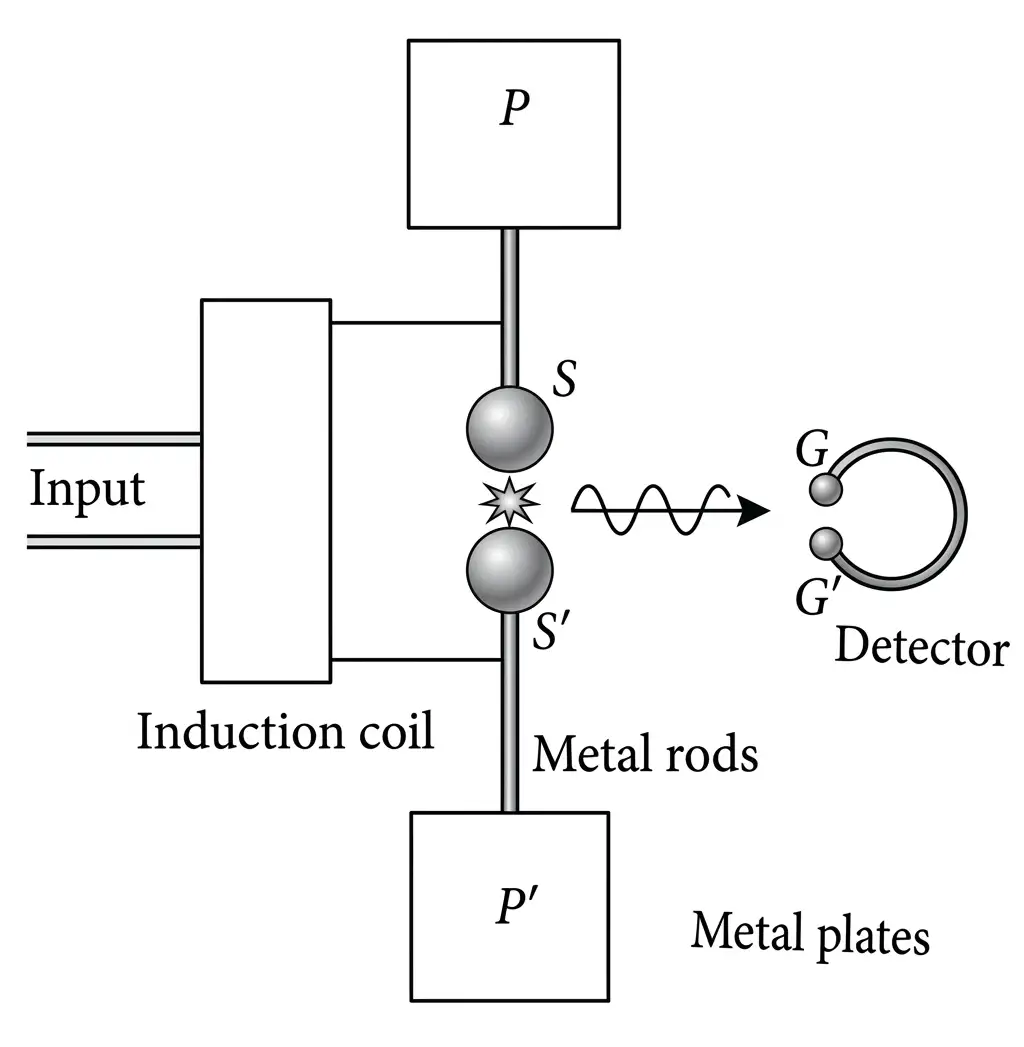
- Two metal plates connected to spheres and induction coil produce high-frequency oscillations.
- High potential ionizes air gap, causing sparks and oscillating electric field.
- Oscillating magnetic field perpendicular to electric field is produced.
- EM waves generated propagate through space and detected by a loop with gap producing sparks.
Solved Examples
- Ex 1: What causes the spark in Hertz's detector?
Solution: EM waves induce emf in detector loop causing spark.
Practice Set
- Q1: What ionizes air in Hertz's experiment?
A. Low potential difference
B. High potential difference
C. Magnetic field
D. Electric current - Q2: The resonant frequency in Hertz's setup depends on:
A. Inductance and capacitance
B. Resistance only
C. Voltage only
D. Current only - Q3: What is the role of induction coil?
A. Produce sparks
B. Cause oscillations in spheres
C. Detect EM waves
D. None of these
Answer Key
- Q1: B - High potential difference ionizes air.
- Q2: A - Resonant frequency ν = 1/(2π√LC).
- Q3: B - Induction coil causes oscillations in spheres.
Memory Aids
- High voltage = air ionization = sparks.
- Resonant frequency depends on L and C.
- Induction coil drives oscillations.
Setup and Working
- Two metal plates connected to spheres and induction coil produce high-frequency oscillations.
- High potential ionizes air gap, causing sparks and oscillating electric field.
- Oscillating magnetic field perpendicular to electric field is produced.
- EM waves generated propagate through space and detected by a loop with gap producing sparks.
Solved Examples
- Ex 1: What causes the spark in Hertz's detector?
Solution: EM waves induce emf in detector loop causing spark.
Practice Set
- Q1: What ionizes air in Hertz's experiment?
A. Low potential difference
B. High potential difference
C. Magnetic field
D. Electric current - Q2: The resonant frequency in Hertz's setup depends on:
A. Inductance and capacitance
B. Resistance only
C. Voltage only
D. Current only - Q3: What is the role of induction coil?
A. Produce sparks
B. Cause oscillations in spheres
C. Detect EM waves
D. None of these
Answer Key
- Q1: B - High potential difference ionizes air.
- Q2: A - Resonant frequency \( \nu = \frac{1}{2\pi\sqrt{LC}} \).
- Q3: B - Induction coil causes oscillations in spheres.
Memory Aids
- High voltage = air ionization = sparks.
- Resonant frequency depends on L and C.
- Induction coil drives oscillations.
Nature of Electromagnetic Waves
Wave Properties and Equations
- Electric field Ex = E0 sin(kz - ωt) = E0 sin[2π(z/λ - νt)].
- Magnetic field By = B0 sin(kz - ωt) = B0 sin[2π(z/λ - νt)].
- Relation: E/B = c or E0/B0 = c.
- Speed in vacuum: c = 1/√(μ0ε0).
- Speed in medium: v = 1/√(μϵ), where μ and ϵ are permeability and permittivity.
- EM waves are transverse; E and B fields perpendicular to each other and propagation direction.
- Carry energy and momentum; momentum p = U/c where U is energy transferred.
Energy Density
- Energy density of electric field: uE = 1/2 ε0E2.
- Energy density of magnetic field: uB = 1/(2μ0) B2.
- Total energy density: u = uE + uB = 1/2 ε0E2rms + 1/(2μ0) B2rms.
- Using c = Erms/Brms and c = 1/√(μ0ε0), u = ε0E2rms = B2rms/μ0.
Solved Examples
- Ex 1: Calculate energy density if Erms = 100 V/m.
Solution: u = ε0E2rms = 8.85 × 10-12 × (100)2 = 8.85 × 10⁻⁸ J/m3.
Practice Set
- Q1: The ratio E/B in EM waves equals:
A. Speed of sound
B. Speed of light
C. Frequency
D. Wavelength - Q2: The speed of EM wave in vacuum depends on:
A. Permeability and permittivity
B. Frequency
C. Amplitude
D. Medium temperature - Q3: Energy density of magnetic field is:
A. 1/2 ε0E2
B. 1/(2μ0) B2
C. ε0E2
D. B2/ε0
Answer Key
- Q1: B - E/B = c, speed of light.
- Q2: A - c = 1/√(μ0ε0).
- Q3: B - Magnetic energy density = 1/(2μ0) B2.
Memory Aids
- EM wave speed c = 1/√(μ0ε0).
- Energy density u = ε0E2rms = B2rms/μ0.
- Fields perpendicular and transverse wave.
Wave Properties and Equations
- Electric field Ex = E0 sin(kz - ωt) = E0 sin[2π(z/λ - νt)].
- Magnetic field By = B0 sin(kz - ωt) = B0 sin[2π(z/λ - νt)].
- Relation: E/B = c or E0/B0 = c.
- Speed in vacuum: c = 1/√(μ0ε0).
- Speed in medium: v = 1/√(μϵ), where μ and ϵ are permeability and permittivity.
- EM waves are transverse; E and B fields perpendicular to each other and propagation direction.
- Carry energy and momentum; momentum p = U/c where U is energy transferred.
Energy Density
- Energy density of electric field: uE = 1/2 ε0E2.
- Energy density of magnetic field: uB = 1/(2μ0) B2.
- Total energy density: u = uE + uB = 1/2 ε0E2rms + 1/(2μ0) B2rms.
- Using c = Erms/Brms and c = 1/√(μ0ε0), u = ε0E2rms = B2rms/μ0.
Solved Examples
- Ex 1: Calculate energy density if Erms = 100 V/m.
Solution: u = ε0E2rms = 8.85 × 10-12 × (100)2 = 8.85 × 10⁻⁸ J/m3.
Practice Set
- Q1: The ratio E/B in EM waves equals:
A. Speed of sound
B. Speed of light
C. Frequency
D. Wavelength - Q2: The speed of EM wave in vacuum depends on:
A. Permeability and permittivity
B. Frequency
C. Amplitude
D. Medium temperature - Q3: Energy density of magnetic field is:
A. 1/2 ε0E2
B. 1/(2μ0) B2
C. ε0E2
D. B2/ε0
Answer Key
- Q1: B - E/B = c, speed of light.
- Q2: A - c = 1/√(μ0ε0).
- Q3: B - Magnetic energy density = 1/(2μ0) B2.
Memory Aids
- EM wave speed c = 1/√(μ0ε0).
- Energy density u = ε0E2rms = B2rms/μ0.
- Fields perpendicular and transverse wave.
Wave Properties and Equations
- Electric field \( E_x = E_0 \sin(kz - \omega t) = E_0 \sin[2\pi(z/\lambda - \nu t)] \).
- Magnetic field \( B_y = B_0 \sin(kz - \omega t) = B_0 \sin[2\pi(z/\lambda - \nu t)] \).
- Relation: \( \frac{E}{B} = c \) or \( \frac{E_0}{B_0} = c \).
- Speed in vacuum: \( c = \frac{1}{\sqrt{\mu_0 \epsilon_0}} \).
- Speed in medium: \( v = \frac{1}{\sqrt{\mu \epsilon}} \), where \( \mu \) and \( \epsilon \) are permeability and permittivity.
- EM waves are transverse; E and B fields perpendicular to each other and propagation direction.
- Carry energy and momentum; momentum \( p = \frac{U}{c} \) where \( U \) is energy transferred.
Energy Density
- Energy density of electric field: \( u_E = \frac{1}{2} \epsilon_0 E^2 \).
- Energy density of magnetic field: \( u_B = \frac{1}{2 \mu_0} B^2 \).
- Total energy density: \( u = u_E + u_B = \frac{1}{2} \epsilon_0 E^2_{rms} + \frac{1}{2 \mu_0} B^2_{rms} \).
- Using \( c = \frac{E_{rms}}{B_{rms}} \) and \( c = \frac{1}{\sqrt{\mu_0 \epsilon_0}} \), \( u = \epsilon_0 E^2_{rms} = \frac{B^2_{rms}}{\mu_0} \).
Solved Examples
- Ex 1: Calculate energy density if \( E_{rms} = 100 \) V/m.
Solution: \( u = \epsilon_0 E^2_{rms} = 8.85 \times 10^{-12} \times (100)^2 = 8.85 \times 10^{-8} \) J/m3.
Practice Set
- Q1: The ratio \( \frac{E}{B} \) in EM waves equals:
A. Speed of sound
B. Speed of light
C. Frequency
D. Wavelength - Q2: The speed of EM wave in vacuum depends on:
A. Permeability and permittivity
B. Frequency
C. Amplitude
D. Medium temperature - Q3: Energy density of magnetic field is:
A. \( \frac{1}{2} \epsilon_0 E^2 \)
B. \( \frac{1}{2 \mu_0} B^2 \)
C. \( \epsilon_0 E^2 \)
D. \( \frac{B^2}{\epsilon_0} \)
Answer Key
- Q1: B - \( E/B = c \), speed of light.
- Q2: A - \( c = 1/\sqrt{\mu_0 \epsilon_0} \).
- Q3: B - Magnetic energy density \( = \frac{1}{2 \mu_0} B^2 \).
Memory Aids
- EM wave speed \( c = 1/\sqrt{\mu_0 \epsilon_0} \).
- Energy density \( u = \epsilon_0 E^2_{rms} = B^2_{rms}/\mu_0 \).
- Fields perpendicular and transverse wave.
Electromagnetic Spectrum
Overview
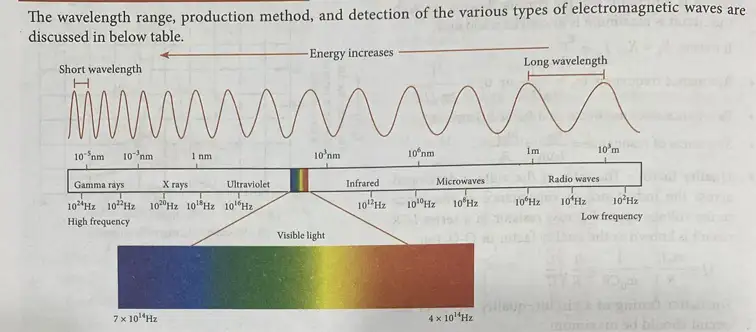
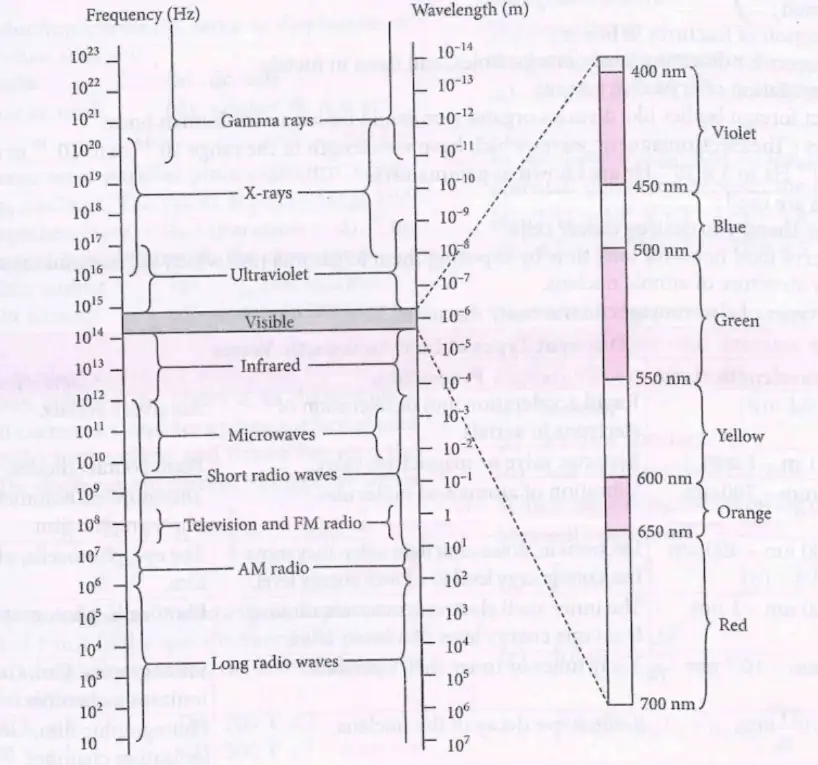
- Electromagnetic spectrum: orderly distribution of waves by frequency or wavelength.
- Wavelength range: gamma rays (shortest) to radio waves (longest).
- Frequency and energy increase as wavelength decreases.
- Visible light: small part of spectrum, wavelength 400–700 nm, frequency 4 × 10¹⁴ to 7 × 10¹⁴ Hz.
- Energy relation: E = hν (energy proportional to frequency).
Solved Examples
- Ex 1: Calculate frequency of visible light with wavelength 500 nm.
- Use ν = c/λ, c = 3 × 10⁸ m/s, λ = 500 × 10-9 m.
- ν = 3 × 10⁸/(500 × 10-9) = 6 × 10¹⁴ Hz.
Practice Set
- Q1: Which wave has the highest frequency?
- A. Radio waves
- B. Microwaves
- C. X-rays
- D. Gamma rays
- Q2: Visible light wavelength range is:
- A. 400–700 nm
- B. 700–1000 nm
- C. 100–400 nm
- D. 1–10 nm
- Q3: Energy of a photon is directly proportional to:
- A. Wavelength
- B. Frequency
- C. Amplitude
- D. Speed
Answer Key
- Q1: D. Gamma rays have the highest frequency and shortest wavelength.
- Q2: A. Visible light ranges from 400 to 700 nm wavelength.
- Q3: B. Energy E = hν is proportional to frequency.
Memory Aids
- Frequency ↑ → Wavelength ↓ → Energy ↑
- Visible light colors: VIBGYOR (Violet shortest wavelength)
- Energy formula: E = hν
Overview
- Electromagnetic spectrum: orderly distribution of waves by frequency or wavelength.
- Wavelength range: gamma rays (shortest) to radio waves (longest).
- Frequency and energy increase as wavelength decreases.
- Visible light: small part of spectrum, wavelength 400–700 nm, frequency 4 × 10¹⁴ to 7 × 10¹⁴ Hz.
- Energy relation: E = hν (energy proportional to frequency).
Solved Examples
- Ex 1: Calculate frequency of visible light with wavelength 500 nm.
- Use ν = c/λ, c = 3 × 10⁸ m/s, λ = 500 × 10-9 m.
- ν = 3 × 10⁸/(500 × 10-9) = 6 × 10¹⁴ Hz.
Practice Set
- Q1: Which wave has the highest frequency?
- A. Radio waves
- B. Microwaves
- C. X-rays
- D. Gamma rays
- Q2: Visible light wavelength range is:
- A. 400–700 nm
- B. 700–1000 nm
- C. 100–400 nm
- D. 1–10 nm
- Q3: Energy of a photon is directly proportional to:
- A. Wavelength
- B. Frequency
- C. Amplitude
- D. Speed
Answer Key
- Q1: D. Gamma rays have the highest frequency and shortest wavelength.
- Q2: A. Visible light ranges from 400 to 700 nm wavelength.
- Q3: B. Energy E = hν is proportional to frequency.
Memory Aids
- Frequency ↑ → Wavelength ↓ → Energy ↑
- Visible light colors: VIBGYOR (Violet shortest wavelength)
- Energy formula: E = hν
Overview
- Electromagnetic spectrum: orderly distribution of waves by frequency or wavelength.
- Wavelength range: gamma rays (shortest) to radio waves (longest).
- Frequency and energy increase as wavelength decreases.
- Visible light: small part of spectrum, wavelength 400–700 nm, frequency 4 × 10¹⁴ to 7 × 10¹⁴ Hz.
- Energy relation: \( E = h \nu \) (energy proportional to frequency).
Solved Examples
- Ex 1: Calculate frequency of visible light with wavelength 500 nm.
- Use \( \nu = \frac{c}{\lambda} \), \( c = 3 \times 10^8 \) m/s, \( \lambda = 500 \times 10^{-9} \) m.
- \( \nu = \frac{3 \times 10^8}{500 \times 10^{-9}} = 6 \times 10^{14} \) Hz.
Practice Set
- Q1: Which wave has the highest frequency?
- A. Radio waves
- B. Microwaves
- C. X-rays
- D. Gamma rays
- Q2: Visible light wavelength range is:
- A. 400–700 nm
- B. 700–1000 nm
- C. 100–400 nm
- D. 1–10 nm
- Q3: Energy of a photon is directly proportional to:
- A. Wavelength
- B. Frequency
- C. Amplitude
- D. Speed
Answer Key
- Q1: D. Gamma rays have the highest frequency and shortest wavelength.
- Q2: A. Visible light ranges from 400 to 700 nm wavelength.
- Q3: B. Energy \( E = h \nu \) is proportional to frequency.
Memory Aids
- Frequency \( \uparrow \) → Wavelength \( \downarrow \) → Energy \( \uparrow \)
- Visible light colors: VIBGYOR (Violet shortest wavelength)
- Energy formula: \( E = h \nu \)
Radio Waves
Properties and Uses
- Frequency range: 500 kHz to 1000 MHz.
- Used in communication: radio, TV, cellular phones.
Solved Examples
- Ex 1: Find wavelength of radio wave with frequency 1 MHz.
- λ = c/ν = 3 × 10⁸/(1 × 106) = 300 m.
Practice Set
- Q1: Radio waves frequency range is:
- A. 500 kHz to 1000 MHz
- B. 1 MHz to 10 GHz
- C. 100 MHz to 1 GHz
- D. 10 kHz to 500 kHz
- Q2: Radio waves are mainly used for:
- A. Cooking
- B. Communication
- C. Medical imaging
- D. Sterilization
- Q3: Wavelength of a 500 kHz radio wave is:
- A. 600 m
- B. 300 m
- C. 150 m
- D. 1000 m
Answer Key
- Q1: A. Radio waves frequency range is 500 kHz to 1000 MHz.
- Q2: B. Radio waves are used in communication systems.
- Q3: A. λ = 3 × 10⁸/(5 × 105) = 600 m.
Memory Aids
- Radio waves = Communication waves
- Frequency range: 500 kHz to 1000 MHz
- Wavelength λ = c/ν
Properties and Uses
- Frequency range: 500 kHz to 1000 MHz.
- Used in communication: radio, TV, cellular phones.
Solved Examples
- Ex 1: Find wavelength of radio wave with frequency 1 MHz.
- \( \lambda = \frac{c}{\nu} = \frac{3 \times 10^8}{1 \times 10^6} = 300 \) m.
Practice Set
- Q1: Radio waves frequency range is:
- A. 500 kHz to 1000 MHz
- B. 1 MHz to 10 GHz
- C. 100 MHz to 1 GHz
- D. 10 kHz to 500 kHz
- Q2: Radio waves are mainly used for:
- A. Cooking
- B. Communication
- C. Medical imaging
- D. Sterilization
- Q3: Wavelength of a 500 kHz radio wave is:
- A. 600 m
- B. 300 m
- C. 150 m
- D. 1000 m
Answer Key
- Q1: A. Radio waves frequency range is 500 kHz to 1000 MHz.
- Q2: B. Radio waves are used in communication systems.
- Q3: A. \( \lambda = \frac{3 \times 10^8}{5 \times 10^5} = 600 \) m.
Memory Aids
- Radio waves = Communication waves
- Frequency range: 500 kHz to 1000 MHz
- Wavelength \( \lambda = \frac{c}{\nu} \)
Microwaves
Properties and Uses
- Shortest wavelength radio waves, smaller than other radio waves but longer than visible light.
- Used in radar for aircraft navigation and speed detection of moving objects.
Solved Examples
- Ex 1: Calculate wavelength of microwave with frequency 10 GHz.
- λ = 3 × 10⁸/(10 × 109) = 0.03 m (3 cm).
Practice Set
- Q1: Microwaves are used in:
- A. Communication only
- B. Radar systems
- C. X-ray imaging
- D. Sterilization
- Q2: Microwave wavelength is generally:
- A. Longer than radio waves
- B. Shorter than visible light
- C. Between radio waves and visible light
- D. Same as infrared waves
- Q3: Radar using microwaves can detect speed of:
- A. Stationary objects
- B. Moving balls and automobiles
- C. Only airplanes
- D. Only ships
Answer Key
- Q1: B. Microwaves are used in radar systems.
- Q2: C. Microwaves have wavelengths between radio waves and visible light.
- Q3: B. Radar detects speed of moving balls and automobiles.
Memory Aids
- Microwaves = Radar + short radio waves
- Wavelength between radio and visible light
- Used for speed detection
Properties and Uses
- Shortest wavelength radio waves, smaller than other radio waves but longer than visible light.
- Used in radar for aircraft navigation and speed detection of moving objects.
Solved Examples
- Ex 1: Calculate wavelength of microwave with frequency 10 GHz.
- \( \lambda = \frac{3 \times 10^8}{10 \times 10^9} = 0.03 \) m (3 cm).
Practice Set
- Q1: Microwaves are used in:
- A. Communication only
- B. Radar systems
- C. X-ray imaging
- D. Sterilization
- Q2: Microwave wavelength is generally:
- A. Longer than radio waves
- B. Shorter than visible light
- C. Between radio waves and visible light
- D. Same as infrared waves
- Q3: Radar using microwaves can detect speed of:
- A. Stationary objects
- B. Moving balls and automobiles
- C. Only airplanes
- D. Only ships
Answer Key
- Q1: B. Microwaves are used in radar systems.
- Q2: C. Microwaves have wavelengths between radio waves and visible light.
- Q3: B. Radar detects speed of moving balls and automobiles.
Memory Aids
- Microwaves = Radar + short radio waves
- Wavelength between radio and visible light
- Used for speed detection
Infrared Waves
Properties and Uses
- Frequency range: 3 × 10¹¹ to 4 × 10¹⁴ Hz.
- Used in infrared lamps for physical therapy.
- Used in infrared detectors on Earth satellites.
- Used in LEDs for remote controls (TV, AC, CD players).
- Used in solar water heaters and cookers.
- Used in greenhouses to maintain temperature (greenhouse effect).
- Infrared radiation trapped by greenhouse gases maintains Earth's temperature.
Solved Examples
- Ex 1: Calculate wavelength of infrared wave with frequency 1 × 10¹³ Hz.
- λ = 3 × 10⁸/(1 × 1013) = 3 × 10⁻⁵ m (30 µm).
Practice Set
- Q1: Infrared waves frequency range is:
- A. 3 × 10¹¹ to 4 × 10¹⁴ Hz
- B. 4 × 10¹⁴ to 7 × 10¹⁴ Hz
- C. 8 × 10¹⁴ to 5 × 10¹⁷ Hz
- D. 3 × 10¹⁸ to 3 × 10²² Hz
- Q2: Infrared waves are used in:
- A. Physical therapy lamps
- B. Water sterilization
- C. X-ray imaging
- D. Cancer therapy
- Q3: Greenhouse effect is caused by:
- A. Visible light trapped by atmosphere
- B. Infrared radiation trapped by greenhouse gases
- C. Ultraviolet rays absorbed by ozone
- D. Gamma rays heating Earth
Answer Key
- Q1: A. Infrared frequency range is 3 × 10¹¹ to 4 × 10¹⁴ Hz.
- Q2: A. Infrared lamps are used in physical therapy.
- Q3: B. Infrared radiation trapped by CO2 and water vapor causes greenhouse effect.
Memory Aids
- Infrared = Heat waves
- Frequency range: 3 × 10¹¹ to 4 × 10¹⁴ Hz
- Greenhouse effect traps infrared radiation
Properties and Uses
- Frequency range: 3 × 10¹¹ to 4 × 10¹⁴ Hz.
- Used in infrared lamps for physical therapy.
- Used in infrared detectors on Earth satellites.
- Used in LEDs for remote controls (TV, AC, CD players).
- Used in solar water heaters and cookers.
- Used in greenhouses to maintain temperature (greenhouse effect).
- Infrared radiation trapped by greenhouse gases maintains Earth's temperature.
Solved Examples
- Ex 1: Calculate wavelength of infrared wave with frequency 1 × 10¹³ Hz.
- \( \lambda = \frac{3 \times 10^8}{1 \times 10^{13}} = 3 \times 10^{-5} \) m (30 µm).
Practice Set
- Q1: Infrared waves frequency range is:
- A. 3 × 10¹¹ to 4 × 10¹⁴ Hz
- B. 4 × 10¹⁴ to 7 × 10¹⁴ Hz
- C. 8 × 10¹⁴ to 5 × 10¹⁷ Hz
- D. 3 × 10¹⁸ to 3 × 10²² Hz
- Q2: Infrared waves are used in:
- A. Physical therapy lamps
- B. Water sterilization
- C. X-ray imaging
- D. Cancer therapy
- Q3: Greenhouse effect is caused by:
- A. Visible light trapped by atmosphere
- B. Infrared radiation trapped by greenhouse gases
- C. Ultraviolet rays absorbed by ozone
- D. Gamma rays heating Earth
Answer Key
- Q1: A. Infrared frequency range is 3 × 10¹¹ to 4 × 10¹⁴ Hz.
- Q2: A. Infrared lamps are used in physical therapy.
- Q3: B. Infrared radiation trapped by CO2 and water vapor causes greenhouse effect.
Memory Aids
- Infrared = Heat waves
- Frequency range: 3 × 10¹¹ to 4 × 10¹⁴ Hz
- Greenhouse effect traps infrared radiation
Visible Rays
Properties and Uses
- Wavelength: 400 to 700 nm.
- Frequency: 4 × 10¹⁴ to 7 × 10¹⁴ Hz.
- Visible to human eye; colors from violet (shortest wavelength) to red (longest).
- Used in electric bulbs, tube lights, lasers, and cinema screens.
Solved Examples
- Ex 1: Find frequency of red light with wavelength 700 nm.
- ν = 3 × 10⁸/(700 × 10-9) = 4.29 × 10¹⁴ Hz.
Practice Set
- Q1: Visible light wavelength range is:
- A. 400–700 nm
- B. 700–1000 nm
- C. 100–400 nm
- D. 1–10 nm
- Q2: Which color has the shortest wavelength?
- A. Red
- B. Green
- C. Violet
- D. Yellow
- Q3: Visible light frequency range is:
- A. 4 × 10¹⁴ to 7 × 10¹⁴ Hz
- B. 3 × 10¹¹ to 4 × 10¹⁴ Hz
- C. 8 × 10¹⁴ to 5 × 10¹⁷ Hz
- D. 3 × 10¹⁸ to 3 × 10²² Hz
Answer Key
- Q1: A. Visible light wavelength is 400–700 nm.
- Q2: C. Violet has the shortest wavelength in visible spectrum.
- Q3: A. Frequency range is 4 × 10¹⁴ to 7 × 10¹⁴ Hz.
Memory Aids
- VIBGYOR for colors
- Wavelength increases from violet to red
- Frequency decreases from violet to red
Ultraviolet Rays
Properties and Uses
- Wavelength: 400 to 700 nm.
- Frequency: 4 × 10¹⁴ to 7 × 10¹⁴ Hz.
- Visible to human eye; colors from violet (shortest wavelength) to red (longest).
- Used in electric bulbs, tube lights, lasers, and cinema screens.
Solved Examples
- Ex 1: Find frequency of red light with wavelength 700 nm.
- ν = 3 × 10⁸/(700 × 10-9) = 4.29 × 10¹⁴ Hz.
Practice Set
- Q1: Visible light wavelength range is:
- A. 400–700 nm
- B. 700–1000 nm
- C. 100–400 nm
- D. 1–10 nm
- Q2: Which color has the shortest wavelength?
- A. Red
- B. Green
- C. Violet
- D. Yellow
- Q3: Visible light frequency range is:
- A. 4 × 10¹⁴ to 7 × 10¹⁴ Hz
- B. 3 × 10¹¹ to 4 × 10¹⁴ Hz
- C. 8 × 10¹⁴ to 5 × 10¹⁷ Hz
- D. 3 × 10¹⁸ to 3 × 10²² Hz
Answer Key
- Q1: A. Visible light wavelength is 400–700 nm.
- Q2: C. Violet has the shortest wavelength in visible spectrum.
- Q3: A. Frequency range is 4 × 10¹⁴ to 7 × 10¹⁴ Hz.
Memory Aids
- VIBGYOR for colors
- Wavelength increases from violet to red
- Frequency decreases from violet to red
Properties and Uses
- Wavelength: 400 to 700 nm.
- Frequency: 4 × 10¹⁴ to 7 × 10¹⁴ Hz.
- Visible to human eye; colors from violet (shortest wavelength) to red (longest).
- Used in electric bulbs, tube lights, lasers, and cinema screens.
Solved Examples
- Ex 1: Find frequency of red light with wavelength 700 nm.
- \( \nu = \frac{3 \times 10^8}{700 \times 10^{-9}} = 4.29 \times 10^{14} \) Hz.
Practice Set
- Q1: Visible light wavelength range is:
- A. 400–700 nm
- B. 700–1000 nm
- C. 100–400 nm
- D. 1–10 nm
- Q2: Which color has the shortest wavelength?
- A. Red
- B. Green
- C. Violet
- D. Yellow
- Q3: Visible light frequency range is:
- A. 4 × 10¹⁴ to 7 × 10¹⁴ Hz
- B. 3 × 10¹¹ to 4 × 10¹⁴ Hz
- C. 8 × 10¹⁴ to 5 × 10¹⁷ Hz
- D. 3 × 10¹⁸ to 3 × 10²² Hz
Answer Key
- Q1: A. Visible light wavelength is 400–700 nm.
- Q2: C. Violet has the shortest wavelength in visible spectrum.
- Q3: A. Frequency range is 4 × 10¹⁴ to 7 × 10¹⁴ Hz.
Memory Aids
- VIBGYOR for colors
- Wavelength increases from violet to red
- Frequency decreases from violet to red
Ultraviolet Rays
Properties and Uses
- Wavelength range: 0.6 to 400 nm.
- Frequency range: 8 × 10¹⁴ to 5 × 10¹⁷ Hz.
- Used for sterilizing surgical instruments and killing germs in water purifiers.
- Used in LASIK eye surgery and mineral fluorescence detection.
- Used in burglar alarms.
Solved Examples
- Ex 1: Calculate wavelength of UV ray with frequency 1 × 10¹⁵ Hz.
- λ = 3 × 10⁸/(1 × 1015) = 3 × 10⁻⁷ m (300 nm).
Practice Set
- Q1: Ultraviolet rays wavelength range is:
- A. 0.6–400 nm
- B. 400–700 nm
- C. 700–1000 nm
- D. 1–10 nm
- Q2: UV rays are used for:
- A. Cooking
- B. Sterilization
- C. Communication
- D. Heating
- Q3: UV rays frequency range is:
- A. 8 × 10¹⁴ to 5 × 10¹⁷ Hz
- B. 3 × 10¹¹ to 4 × 10¹⁴ Hz
- C. 4 × 10¹⁴ to 7 × 10¹⁴ Hz
- D. 3 × 10¹⁸ to 3 × 10²² Hz
Answer Key
- Q1: A. UV wavelength range is 0.6–400 nm.
- Q2: B. UV rays sterilize instruments and kill germs.
- Q3: A. Frequency range is 8 × 10¹⁴ to 5 × 10¹⁷ Hz.
Memory Aids
- UV = Sterilization and fluorescence
- Wavelength shorter than visible light
- Frequency higher than visible light
Properties and Uses
- Wavelength range: 0.6 to 400 nm.
- Frequency range: 8 × 10¹⁴ to 5 × 10¹⁷ Hz.
- Used for sterilizing surgical instruments and killing germs in water purifiers.
- Used in LASIK eye surgery and mineral fluorescence detection.
- Used in burglar alarms.
Solved Examples
- Ex 1: Calculate wavelength of UV ray with frequency 1 × 10¹⁵ Hz.
- \( \lambda = \frac{3 \times 10^8}{1 \times 10^{15}} = 3 \times 10^{-7} \) m (300 nm).
Practice Set
- Q1: Ultraviolet rays wavelength range is:
- A. 0.6–400 nm
- B. 400–700 nm
- C. 700–1000 nm
- D. 1–10 nm
- Q2: UV rays are used for:
- A. Cooking
- B. Sterilization
- C. Communication
- D. Heating
- Q3: UV rays frequency range is:
- A. 8 × 10¹⁴ to 5 × 10¹⁷ Hz
- B. 3 × 10¹¹ to 4 × 10¹⁴ Hz
- C. 4 × 10¹⁴ to 7 × 10¹⁴ Hz
- D. 3 × 10¹⁸ to 3 × 10²² Hz
Answer Key
- Q1: A. UV wavelength range is 0.6–400 nm.
- Q2: B. UV rays sterilize instruments and kill germs.
- Q3: A. Frequency range is 8 × 10¹⁴ to 5 × 10¹⁷ Hz.
Memory Aids
- UV = Sterilization and fluorescence
- Wavelength shorter than visible light
- Frequency higher than visible light
X-rays
Properties and Uses
- Wavelength range: 10-4 nm to 10 nm.
- Used for bone fracture detection and metal flaw detection.
- Used in crystal structure investigation and detecting foreign bodies in humans.
Solved Examples
- Ex 1: Calculate frequency of X-ray with wavelength 0.1 nm.
- ν = 3 × 10⁸/(0.1 × 10-9) = 3 × 10¹⁸ Hz.
Practice Set
- Q1: X-rays wavelength range is:
- A. 10-4 nm to 10 nm
- B. 400–700 nm
- C. 0.6–400 nm
- D. 500 kHz to 1000 MHz
- Q2: X-rays are used for:
- A. Detecting fractures
- B. Communication
- C. Cooking
- D. Sterilization
- Q3: X-rays help detect:
- A. Mineral fluorescence
- B. Foreign bodies in human body
- C. Speed of moving objects
- D. Greenhouse gases
Answer Key
- Q1: A. X-rays wavelength range is 10-4 nm to 10 nm.
- Q2: A. Used for detecting fractures in bones.
- Q3: B. Detect foreign bodies like stones and bullets.
Memory Aids
- X-rays = Medical imaging and metal inspection
- Wavelength very short, frequency very high
- Used to detect fractures and flaws
Properties and Uses
- Wavelength range: 10-4 nm to 10 nm.
- Used for bone fracture detection and metal flaw detection.
- Used in crystal structure investigation and detecting foreign bodies in humans.
Solved Examples
- Ex 1: Calculate frequency of X-ray with wavelength 0.1 nm.
- \( \nu = \frac{3 \times 10^8}{0.1 \times 10^{-9}} = 3 \times 10^{18} \) Hz.
Practice Set
- Q1: X-rays wavelength range is:
- A. 10-4 nm to 10 nm
- B. 400–700 nm
- C. 0.6–400 nm
- D. 500 kHz to 1000 MHz
- Q2: X-rays are used for:
- A. Detecting fractures
- B. Communication
- C. Cooking
- D. Sterilization
- Q3: X-rays help detect:
- A. Mineral fluorescence
- B. Foreign bodies in human body
- C. Speed of moving objects
- D. Greenhouse gases
Answer Key
- Q1: A. X-rays wavelength range is 10-4 nm to 10 nm.
- Q2: A. Used for detecting fractures in bones.
- Q3: B. Detect foreign bodies like stones and bullets.
Memory Aids
- X-rays = Medical imaging and metal inspection
- Wavelength very short, frequency very high
- Used to detect fractures and flaws
Gamma Rays
Properties and Uses
- Wavelength range: 10-14 m to 10-10 m.
- Frequency range: 3 × 10¹⁸ Hz to 3 × 10²² Hz.
- Used in cancer therapy to destroy cancer cells.
- Used to preserve food by killing microorganisms.
- Used to study atomic nucleus structure.
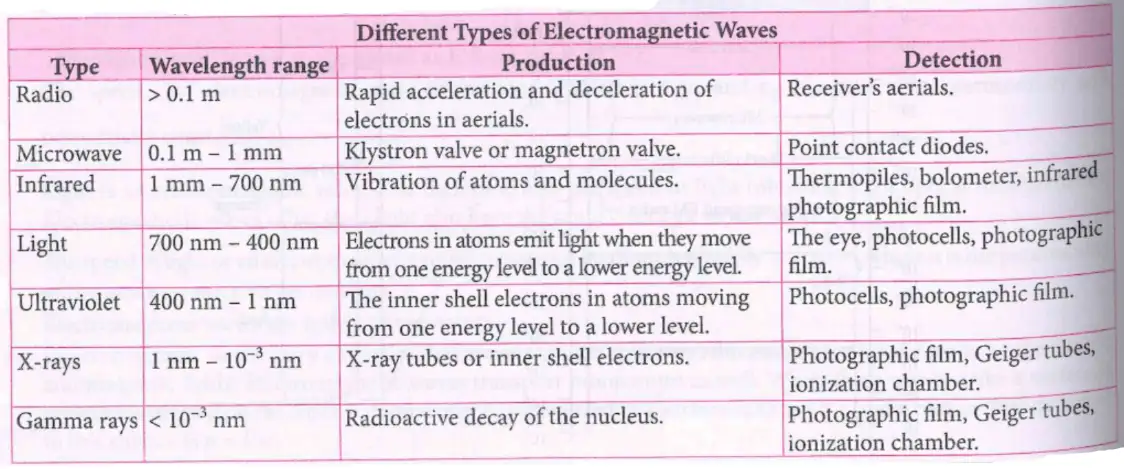
Solved Examples
- Ex 1: Calculate frequency of gamma ray with wavelength 10-12 m.
- ν = 3 × 10⁸/(10-12) = 3 × 10²⁰ Hz.
Practice Set
- Q1: Gamma rays wavelength range is:
- A. 10-14 m to 10-10 m
- B. 400–700 nm
- C. 0.6–400 nm
- D. 500 kHz to 1000 MHz
- Q2: Gamma rays are used for:
- A. Cancer therapy
- B. Communication
- C. Cooking
- D. Sterilization
- Q3: Gamma rays help in:
- A. Studying atomic nucleus
- B. Detecting fractures
- C. Speed detection
- D. Greenhouse effect
Answer Key
- Q1: A. Gamma rays have wavelength 10-14 m to 10-10 m.
- Q2: A. Used in cancer therapy to destroy cells.
- Q3: A. Used to study atomic nucleus structure.
Memory Aids
- Gamma rays = Highest frequency, shortest wavelength
- Used in cancer therapy and food preservation
- Frequency range: 3 × 10¹⁸ to 3 × 10²² Hz
Properties and Uses
- Wavelength range: 10-14 m to 10-10 m.
- Frequency range: 3 × 10¹⁸ Hz to 3 × 10²² Hz.
- Used in cancer therapy to destroy cancer cells.
- Used to preserve food by killing microorganisms.
- Used to study atomic nucleus structure.
Solved Examples
- Ex 1: Calculate frequency of gamma ray with wavelength 10-12 m.
- \( \nu = \frac{3 \times 10^8}{10^{-12}} = 3 \times 10^{20} \) Hz.
Practice Set
- Q1: Gamma rays wavelength range is:
- A. 10-14 m to 10-10 m
- B. 400–700 nm
- C. 0.6–400 nm
- D. 500 kHz to 1000 MHz
- Q2: Gamma rays are used for:
- A. Cancer therapy
- B. Communication
- C. Cooking
- D. Sterilization
- Q3: Gamma rays help in:
- A. Studying atomic nucleus
- B. Detecting fractures
- C. Speed detection
- D. Greenhouse effect
Answer Key
- Q1: A. Gamma rays have wavelength 10-14 m to 10-10 m.
- Q2: A. Used in cancer therapy to destroy cells.
- Q3: A. Used to study atomic nucleus structure.
Memory Aids
- Gamma rays = Highest frequency, shortest wavelength
- Used in cancer therapy and food preservation
- Frequency range: 3 × 10¹⁸ to 3 × 10²² Hz
NEET Physics — ALL CHAPTERS
1
Basic Mathematics
2
Units and Measurement
3
Motion in a Straight Line
4
Motion in a Plane
5
Laws of Motion
6
Work, Energy and Power
7
System of Particles and Rotational Motion
8
Gravitation
9
Mechanical Properties of Solids
10
Mechanical Properties of Fluids
11
Thermal Properties of Matter
12
Thermodynamics
13
Kinetic Theory
14
Oscillations
15
Waves
16
Electric Charges and Fields
17
Electrostatic Potential and Capacitance
18
Current Electricity
19
Moving Charges and Magnetism
20
Magnetism and Matter
21
Electromagnetic Induction
22
Alternating Current
23
Electromagnetic Waves
24
Ray Optics and Optical Instruments
25
Wave Optics
26
Dual Nature of Radiation and Matter
27
Atoms
28
Nuclei
29
Semiconductor Electronics: Materials, Devices and Simple Circuits