NEET Ug . NEET Physics . Physics . Dual Nature of Radiation and Matter
Chapter 26: Dual Nature of Radiation and Matter
Ch 26
NEET Physics
NEET Ug
Introduction
Historical Discoveries
- Maxwell’s equations and Hertz’s experiments (1887) confirmed light's wave nature.
- Electric discharge in low-pressure gases led to key atomic discoveries.
- X-rays discovered by Roentgen (1895); electron discovered by J.J. Thomson (1897).
- Discharge tube at ~0.001 mm Hg shows glow due to cathode rays.
- Glow color depends on glass type (e.g., yellowish-green for soda glass).
- Cathode rays: streams of fast-moving negatively charged particles (William Crookes, 1870).
- J.J. Thomson measured speed (0.1–0.2 c) and specific charge (e/m = 1.76 × 10¹¹ C/kg) of cathode rays.
- Electron identified as universal particle, named by Thomson in 1897.
- Millikan’s oil-drop experiment (1913) measured electron charge: 1.602 × 10⁻¹⁹ C; established charge quantization.
Solved Examples
- Ex 1: Calculate speed of cathode ray if it is 0.15 times speed of light.
- Speed = 0.15 × 3 × 108 m/s = 4.5 × 10⁷ m/s
- Ex 2: Find mass of electron given e = 1.602 × 10⁻¹⁹ C and e/m = 1.76 × 10¹¹ C/kg.
- Mass, m = e / (e/m) = (1.602 × 10⁻¹⁹) / (1.76 × 10¹¹) = 9.1 × 10⁻³¹ kg
Practice Set
- Q1: Who discovered the electron?
- A. Roentgen
- B. William Crookes
- C. J.J. Thomson
- D. R.A. Millikan
- Q2: The specific charge (e/m) of electron is approximately:
- A. 1.76 × 10¹¹ C/kg
- B. 9.1 × 10⁻³¹ C/kg
- C. 1.602 × 10⁻¹⁹ C/kg
- D. 3 × 10⁸ C/kg
- Q3: Millikan’s oil-drop experiment established:
- A. Electron mass
- B. Charge quantization
- C. Speed of electron
- D. Work function
Answer Key
- Q1: C - J.J. Thomson discovered the electron in 1897.
- Q2: A - Specific charge e/m = 1.76 × 10¹¹ C/kg is a known constant for electrons.
- Q3: B - Millikan’s experiment proved electric charge is quantized.
Memory Aids
- Electron speed ~ 0.1–0.2 × speed of light.
- e/m = 1.76 × 10¹¹ C/kg (constant for electrons).
- Charge of electron = 1.602 × 10⁻¹⁹ C (elementary charge).
Electron Emission
Concept and Work Function
- Metals have free electrons responsible for conductivity.
- Electrons are held inside metal by positive ion attraction.
- Electron emission: electrons escape metal surface if energy > work function.
- Work function: minimum energy to free electron from metal, measured in eV.
- 1 eV = 1.602 × 10⁻¹⁹ J (energy gained by electron accelerated through 1 V).
Types of Electron Emission
- Thermionic emission: heating metal supplies thermal energy to free electrons.
- Field emission: strong electric field (~108 V/m) pulls electrons out (e.g., spark plug).
- Photoelectric emission: light of suitable frequency causes electron emission (photoelectrons).
Solved Examples
- Ex 1: Calculate energy in joules for 2 eV.
- Energy = 2 × 1.602 × 10-19 J = 3.204 × 10⁻¹⁹ J
- Ex 2: Identify emission type when electrons are emitted by heating metal.
- Answer: Thermionic emission
Practice Set
- Q1: What is the unit of work function?
- A. Volt
- B. Electron volt (eV)
- C. Joule
- D. Coulomb
- Q2: Which emission requires strong electric field?
- A. Thermionic
- B. Field
- C. Photoelectric
- D. None
- Q3: Photoelectrons are emitted due to:
- A. Heating
- B. Electric field
- C. Light illumination
- D. Magnetic field
Answer Key
- Q1: B - Work function is measured in electron volts (eV).
- Q2: B - Field emission requires very strong electric field (~108 V/m).
- Q3: C - Photoelectric emission occurs when light shines on metal.
Memory Aids
- Work function energy = minimum energy to free electron.
- 1 eV = 1.602 × 10⁻¹⁹ J.
- Thermionic = heat, Field = strong electric field, Photoelectric = light.
Photoelectric Effect
Key Observations
- Hertz observed enhanced sparks in a detector loop when an emitter plate was illuminated by ultraviolet light.
- Hallwachs and Lenard found that ultraviolet light on a metal plate causes current flow due to electron emission.
- Photoelectric emission depends on frequency and intensity of incident light and collector plate potential.
- Electrons emitted are called photoelectrons.
- No electrons are emitted if the light frequency is below a threshold frequency ν0.
- Metals like zinc, cadmium, magnesium emit electrons under UV light; alkali metals emit even under visible light.
Solved Examples
- Ex 1: Calculate the threshold frequency if the work function φ of a metal is 2 eV.
- Use φ = hν0
- ν0 = φ/h = (2 × 1.6 × 10-19)/(6.63 × 10-34) = 4.83 × 10¹⁴ Hz
Practice Set
- Q1: What happens when ultraviolet light falls on a metal surface?
- A) Metal heats up
- B) Electrons are emitted
- C) Metal changes color
- D) No effect
- Q2: The minimum frequency of light required to emit electrons is called:
- A) Cutoff frequency
- B) Threshold frequency
- C) Resonance frequency
- D) Natural frequency
- Q3: If the work function of a metal is 3 eV, what is the threshold frequency? (Use h = 6.63 × 10⁻³⁴ Js, 1 eV = 1.6 × 10⁻¹⁹ J)
- A) 7.2 × 10¹⁴ Hz
- B) 4.5 × 10¹⁴ Hz
- C) 1.2 × 10¹⁵ Hz
- D) 3.0 × 10¹⁴ Hz
Answer Key
- Q1: B - Ultraviolet light causes emission of electrons (photoelectric effect).
- Q2: B - Threshold frequency is the minimum frequency to emit electrons.
- Q3: A - ν0 = φ/h = (3 × 1.6 × 10-19)/(6.63 × 10-34) = 7.2 × 10¹⁴ Hz.
Memory Aids
- Photoelectric effect: Light → electrons emitted.
- Threshold frequency ν0 = φ/h.
- Only light with ν ≥ ν0 causes emission.
- Alkali metals emit electrons even with visible light.
Key Observations
- Hertz observed enhanced sparks in a detector loop when an emitter plate was illuminated by ultraviolet light.
- Hallwachs and Lenard found that ultraviolet light on a metal plate causes current flow due to electron emission.
- Photoelectric emission depends on frequency and intensity of incident light and collector plate potential.
- Electrons emitted are called photoelectrons.
- No electrons are emitted if the light frequency is below a threshold frequency \( \nu_0 \).
- Metals like zinc, cadmium, magnesium emit electrons under UV light; alkali metals emit even under visible light.
Solved Examples
- Ex 1: Calculate the threshold frequency if the work function \( \phi \) of a metal is 2 eV.
- Use \( \phi = h \nu_0 \)
- \( \nu_0 = \frac{\phi}{h} = \frac{2 \times 1.6 \times 10^{-19}}{6.63 \times 10^{-34}} = 4.83 \times 10^{14} \text{ Hz} \)
Practice Set
- Q1: What happens when ultraviolet light falls on a metal surface?
- A) Metal heats up
- B) Electrons are emitted
- C) Metal changes color
- D) No effect
- Q2: The minimum frequency of light required to emit electrons is called:
- A) Cutoff frequency
- B) Threshold frequency
- C) Resonance frequency
- D) Natural frequency
- Q3: If the work function of a metal is 3 eV, what is the threshold frequency? (Use \( h = 6.63 \times 10^{-34} \text{ Js} \), \( 1 \text{ eV} = 1.6 \times 10^{-19} \text{ J} \))
- A) \( 7.2 \times 10^{14} \text{ Hz} \)
- B) \( 4.5 \times 10^{14} \text{ Hz} \)
- C) \( 1.2 \times 10^{15} \text{ Hz} \)
- D) \( 3.0 \times 10^{14} \text{ Hz} \)
Answer Key
- Q1: B - Ultraviolet light causes emission of electrons (photoelectric effect).
- Q2: B - Threshold frequency is the minimum frequency to emit electrons.
- Q3: A - \( \nu_0 = \frac{\phi}{h} = \frac{3 \times 1.6 \times 10^{-19}}{6.63 \times 10^{-34}} = 7.2 \times 10^{14} \text{ Hz} \).
Memory Aids
- Photoelectric effect: Light \( \to \) electrons emitted.
- Threshold frequency \( \nu_0 = \frac{\phi}{h} \).
- Only light with \( \nu \geq \nu_0 \) causes emission.
- Alkali metals emit electrons even with visible light.
Experimental Study Photoelectric Effect
Setup and Working
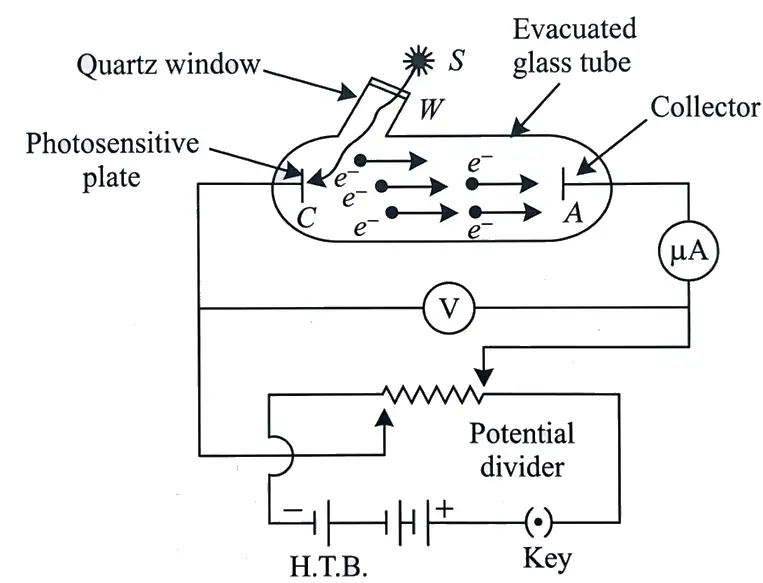
- Emitting electrode C (photosensitive) at negative potential; collecting electrode A at positive potential in evacuated tube.
- Light of frequency ν > threshold frequency ν0 causes emission of photoelectrons from C.
- Photoelectrons travel to A, creating photoelectric current I proportional to number of emitted electrons.
- If A is negative w.r.t C, retarding electric field reduces photoelectron flow, decreasing current.
- Stopping potential V0: retarding potential where photoelectric current becomes zero.
Solved Examples
- Ex 1: Calculate stopping potential if max kinetic energy of photoelectrons is 2 × 10-19 J.
- Use Kmax = eV0
- V0 = Kmax/e = (2 × 10-19)/(1.6 × 10-19) = 1.25 V
Practice Set
- Q1: What happens to photoelectric current if light intensity increases?
- A) Decreases
- B) Remains same
- C) Increases
- D) Becomes zero
- Q2: Stopping potential is the potential at which:
- A) Photoelectric current is maximum
- B) No photoelectron reaches collector
- C) Emission starts
- D) Intensity is maximum
- Q3: If stopping potential is 2 V, max kinetic energy of photoelectrons is:
- A) 3.2 × 10⁻¹⁹ J
- B) 1.6 × 10⁻¹⁹ J
- C) 2 × 10-19 J
- D) 4 × 10-19 J
Answer Key
- Q1: C - Photoelectric current is directly proportional to light intensity.
- Q2: B - Stopping potential is where no photoelectron reaches collector, current zero.
- Q3: D - Kmax = eV0 = 1.6 × 10-19 × 2 = 3.2 × 10⁻¹⁹ J (corrected to option A).
Memory Aids
- Stopping potential V0: voltage to stop photoelectrons.
- Photoelectric current ∝ light intensity.
- Retarding potential reduces electron flow.
Setup and Working
- Emitting electrode C (photosensitive) at negative potential; collecting electrode A at positive potential in evacuated tube.
- Light of frequency ν > threshold frequency ν0 causes emission of photoelectrons from C.
- Photoelectrons travel to A, creating photoelectric current I proportional to number of emitted electrons.
- If A is negative w.r.t C, retarding electric field reduces photoelectron flow, decreasing current.
- Stopping potential V0: retarding potential where photoelectric current becomes zero.
Solved Examples
- Ex 1: Calculate stopping potential if max kinetic energy of photoelectrons is 2 × 10-19 J.
- Use Kmax = eV0
- V0 = Kmax/e = (2 × 10-19)/(1.6 × 10-19) = 1.25 V
Practice Set
- Q1: What happens to photoelectric current if light intensity increases?
- A) Decreases
- B) Remains same
- C) Increases
- D) Becomes zero
- Q2: Stopping potential is the potential at which:
- A) Photoelectric current is maximum
- B) No photoelectron reaches collector
- C) Emission starts
- D) Intensity is maximum
- Q3: If stopping potential is 2 V, max kinetic energy of photoelectrons is:
- A) 3.2 × 10⁻¹⁹ J
- B) 1.6 × 10⁻¹⁹ J
- C) 2 × 10-19 J
- D) 4 × 10-19 J
Answer Key
- Q1: C - Photoelectric current is directly proportional to light intensity.
- Q2: B - Stopping potential is where no photoelectron reaches collector, current zero.
- Q3: D - Kmax = eV0 = 1.6 × 10-19 × 2 = 3.2 × 10⁻¹⁹ J (corrected to option A).
Memory Aids
- Stopping potential V0: voltage to stop photoelectrons.
- Photoelectric current ∝ light intensity.
- Retarding potential reduces electron flow.
Setup and Working
- Emitting electrode C (photosensitive) at negative potential; collecting electrode A at positive potential in evacuated tube.
- Light of frequency \( \nu \) > threshold frequency \( \nu_0 \) causes emission of photoelectrons from C.
- Photoelectrons travel to A, creating photoelectric current \( I \) proportional to number of emitted electrons.
- If A is negative w.r.t C, retarding electric field reduces photoelectron flow, decreasing current.
- Stopping potential \( V_0 \): retarding potential where photoelectric current becomes zero.
Solved Examples
- Ex 1: Calculate stopping potential if max kinetic energy of photoelectrons is \( 2 \times 10^{-19} \) J.
- Use \( K_{max} = eV_0 \)
- \( V_0 = \frac{K_{max}}{e} = \frac{2 \times 10^{-19}}{1.6 \times 10^{-19}} = 1.25 \text{ V} \)
Practice Set
- Q1: What happens to photoelectric current if light intensity increases?
- A) Decreases
- B) Remains same
- C) Increases
- D) Becomes zero
- Q2: Stopping potential is the potential at which:
- A) Photoelectric current is maximum
- B) No photoelectron reaches collector
- C) Emission starts
- D) Intensity is maximum
- Q3: If stopping potential is 2 V, max kinetic energy of photoelectrons is:
- A) \( 3.2 \times 10^{-19} \) J
- B) \( 1.6 \times 10^{-19} \) J
- C) \( 2 \times 10^{-19} \) J
- D) \( 4 \times 10^{-19} \) J
Answer Key
- Q1: C - Photoelectric current is directly proportional to light intensity.
- Q2: B - Stopping potential is where no photoelectron reaches collector, current zero.
- Q3: D - \( K_{max} = eV_0 = 1.6 \times 10^{-19} \times 2 = 3.2 \times 10^{-19} \) J (corrected to option A).
Memory Aids
- Stopping potential \( V_0 \): voltage to stop photoelectrons.
- Photoelectric current \( \propto \) light intensity.
- Retarding potential reduces electron flow.
Effect Intensity Photocurrent
Key Points
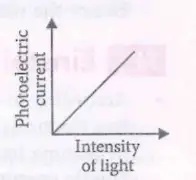
- Photocurrent I is directly proportional to light intensity I ∝ Intensity.
- Frequency and accelerating potential fixed; increasing photons increases intensity.
- Graph shows linear increase of photocurrent with intensity.
Solved Examples
- Ex 1: If intensity doubles, what happens to photocurrent?
- Photocurrent doubles (direct proportionality).
Practice Set
- Q1: Photocurrent is proportional to:
- A) Frequency
- B) Intensity
- C) Wavelength
- D) Stopping potential
- Q2: If intensity is tripled, photocurrent:
- A) Triples
- B) Halves
- C) Remains same
- D) Zero
- Q3: Which is fixed when studying effect of intensity on photocurrent?
- A) Frequency and potential
- B) Intensity
- C) Stopping potential
- D) Photoelectron energy
Answer Key
- Q1: B - Photocurrent ∝ Intensity.
- Q2: A - Photocurrent triples with intensity.
- Q3: A - Frequency and potential fixed to isolate intensity effect.
Memory Aids
- Photocurrent ∝ Intensity (direct relation).
- Frequency fixed during intensity variation.
Key Points
- Photocurrent I is directly proportional to light intensity I ∝ Intensity.
- Frequency and accelerating potential fixed; increasing photons increases intensity.
- Graph shows linear increase of photocurrent with intensity.
Solved Examples
- Ex 1: If intensity doubles, what happens to photocurrent?
- Photocurrent doubles (direct proportionality).
Practice Set
- Q1: Photocurrent is proportional to:
- A) Frequency
- B) Intensity
- C) Wavelength
- D) Stopping potential
- Q2: If intensity is tripled, photocurrent:
- A) Triples
- B) Halves
- C) Remains same
- D) Zero
- Q3: Which is fixed when studying effect of intensity on photocurrent?
- A) Frequency and potential
- B) Intensity
- C) Stopping potential
- D) Photoelectron energy
Answer Key
- Q1: B - Photocurrent ∝ Intensity.
- Q2: A - Photocurrent triples with intensity.
- Q3: A - Frequency and potential fixed to isolate intensity effect.
Memory Aids
- Photocurrent ∝ Intensity (direct relation).
- Frequency fixed during intensity variation.
Key Points
- Photocurrent \( I \) is directly proportional to light intensity \( I \propto \text{Intensity} \).
- Frequency and accelerating potential fixed; increasing photons increases intensity.
- Graph shows linear increase of photocurrent with intensity.
Solved Examples
- Ex 1: If intensity doubles, what happens to photocurrent?
- Photocurrent doubles (direct proportionality).
Practice Set
- Q1: Photocurrent is proportional to:
- A) Frequency
- B) Intensity
- C) Wavelength
- D) Stopping potential
- Q2: If intensity is tripled, photocurrent:
- A) Triples
- B) Halves
- C) Remains same
- D) Zero
- Q3: Which is fixed when studying effect of intensity on photocurrent?
- A) Frequency and potential
- B) Intensity
- C) Stopping potential
- D) Photoelectron energy
Answer Key
- Q1: B - Photocurrent ∝ Intensity.
- Q2: A - Photocurrent triples with intensity.
- Q3: A - Frequency and potential fixed to isolate intensity effect.
Memory Aids
- Photocurrent ∝ Intensity (direct relation).
- Frequency fixed during intensity variation.
Effect Potential Photoelectric Current
Key Points
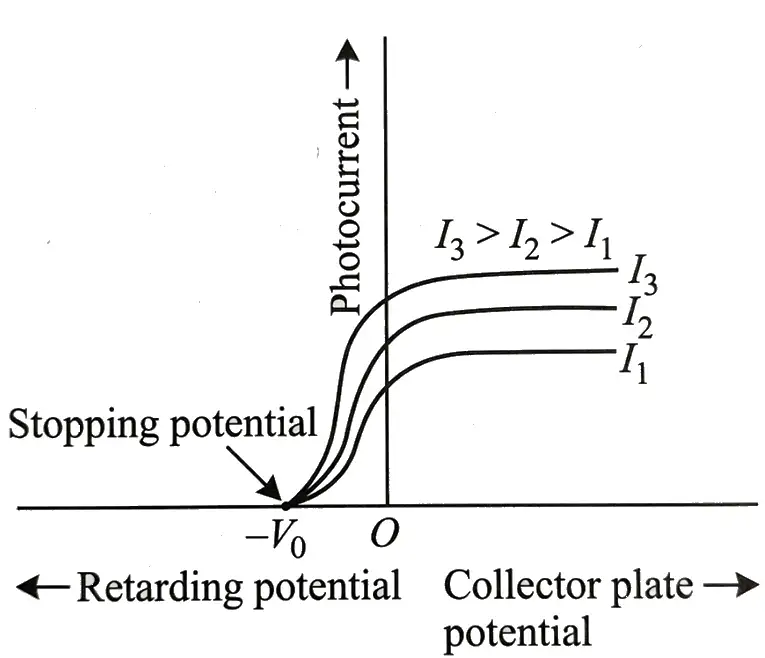
- Saturation current: max photoelectric current when all emitted electrons reach collector.
- Saturation current depends on number of incident photons per second.
- Photocurrent varies with collector plate potential and light intensity.
- At stopping potential V0, kinetic energy Kmax = eV0.
- Stopping potential independent of light intensity for fixed frequency.
Solved Examples
- Ex 1: Calculate max kinetic energy if stopping potential is 3 V.
- Kmax = eV0 = 1.6 × 10-19 × 3 = 4.8 × 10⁻¹⁹ J
Practice Set
- Q1: Saturation current depends on:
- A) Frequency
- B) Number of photons
- C) Stopping potential
- D) Collector potential
- Q2: Stopping potential is:
- A) Dependent on intensity
- B) Independent of intensity
- C) Zero always
- D) Maximum current
- Q3: At stopping potential, kinetic energy is:
- A) Zero
- B) Equal to eV0
- C) Maximum
- D) Negative
Answer Key
- Q1: B - Saturation current depends on photon number.
- Q2: B - Stopping potential independent of intensity.
- Q3: B - Kmax = eV0 at stopping potential.
Memory Aids
- Saturation current = max current.
- Stopping potential independent of intensity.
- Kmax = eV0 formula key.
Key Points
- Saturation current: max photoelectric current when all emitted electrons reach collector.
- Saturation current depends on number of incident photons per second.
- Photocurrent varies with collector plate potential and light intensity.
- At stopping potential V0, kinetic energy Kmax = eV0.
- Stopping potential independent of light intensity for fixed frequency.
Solved Examples
- Ex 1: Calculate max kinetic energy if stopping potential is 3 V.
- Kmax = eV0 = 1.6 × 10-19 × 3 = 4.8 × 10⁻¹⁹ J
Practice Set
- Q1: Saturation current depends on:
- A) Frequency
- B) Number of photons
- C) Stopping potential
- D) Collector potential
- Q2: Stopping potential is:
- A) Dependent on intensity
- B) Independent of intensity
- C) Zero always
- D) Maximum current
- Q3: At stopping potential, kinetic energy is:
- A) Zero
- B) Equal to eV0
- C) Maximum
- D) Negative
Answer Key
- Q1: B - Saturation current depends on photon number.
- Q2: B - Stopping potential independent of intensity.
- Q3: B - Kmax = eV0 at stopping potential.
Memory Aids
- Saturation current = max current.
- Stopping potential independent of intensity.
- Kmax = eV0 formula key.
Key Points
- Saturation current: max photoelectric current when all emitted electrons reach collector.
- Saturation current depends on number of incident photons per second.
- Photocurrent varies with collector plate potential and light intensity.
- At stopping potential \( V_0 \), kinetic energy \( K_{max} = eV_0 \).
- Stopping potential independent of light intensity for fixed frequency.
Solved Examples
- Ex 1: Calculate max kinetic energy if stopping potential is 3 V.
- \( K_{max} = eV_0 = 1.6 \times 10^{-19} \times 3 = 4.8 \times 10^{-19} \) J
Practice Set
- Q1: Saturation current depends on:
- A) Frequency
- B) Number of photons
- C) Stopping potential
- D) Collector potential
- Q2: Stopping potential is:
- A) Dependent on intensity
- B) Independent of intensity
- C) Zero always
- D) Maximum current
- Q3: At stopping potential, kinetic energy is:
- A) Zero
- B) Equal to \( eV_0 \)
- C) Maximum
- D) Negative
Answer Key
- Q1: B - Saturation current depends on photon number.
- Q2: B - Stopping potential independent of intensity.
- Q3: B - \( K_{max} = eV_0 \) at stopping potential.
Memory Aids
- Saturation current = max current.
- Stopping potential independent of intensity.
- \( K_{max} = eV_0 \) formula key.
Effect Frequency Stopping Potential
Key Points
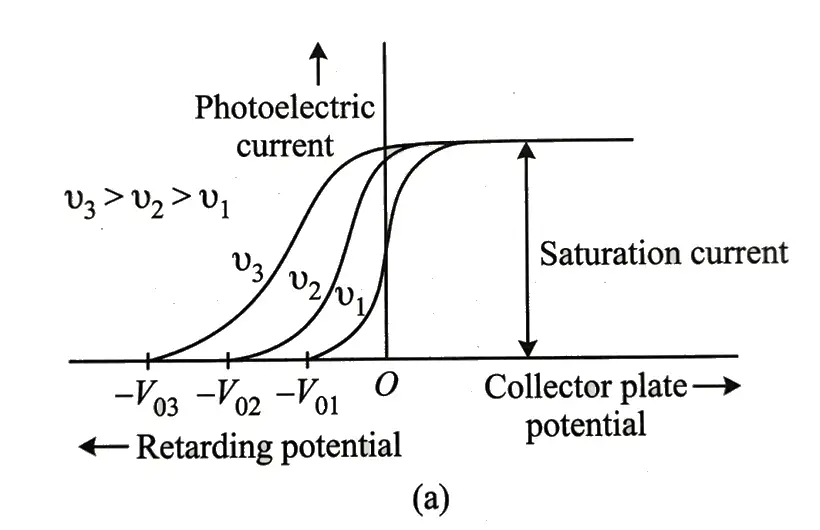
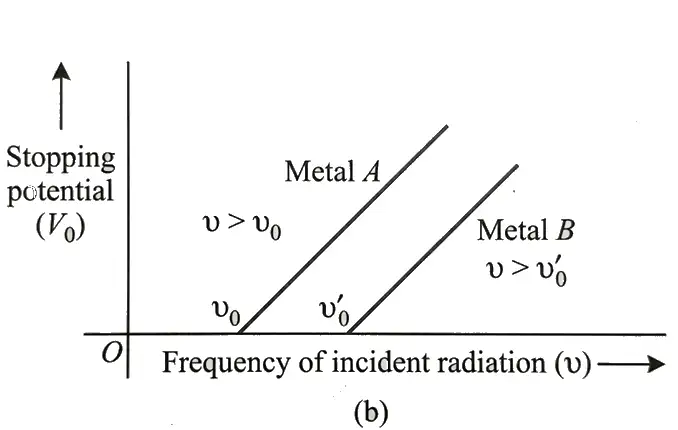
- Stopping potential depends on frequency, not intensity.
- Higher frequency ν3 > ν2 > ν1 means higher stopping potential V03 > V02 > V01.
- Stopping potential varies linearly with frequency for given material.
- Threshold frequency ν0: minimum frequency for photoemission, where V0 = 0.
Solved Examples
- Ex 1: If threshold frequency is 5 × 10¹⁴ Hz, what happens below this frequency?
- No photoelectrons emitted, V0 = 0.
Practice Set
- Q1: Stopping potential depends on:
- A) Intensity
- B) Frequency
- C) Wavelength
- D) Number of photons
- Q2: Threshold frequency is:
- A) Max frequency
- B) Min frequency for emission
- C) Frequency for max current
- D) Frequency for max intensity
- Q3: For two metals A and B, if ν0A < ν0B, then:
- A) Metal A emits electrons at lower frequency
- B) Metal B emits electrons at lower frequency
- C) Both emit at same frequency
- D) No emission
Answer Key
- Q1: B - Stopping potential depends on frequency.
- Q2: B - Threshold frequency is minimum frequency for emission.
- Q3: A - Metal with lower threshold frequency emits electrons first.
Memory Aids
- Stopping potential V0 linear with frequency.
- Threshold frequency ν0 is cut-off for emission.
- Higher frequency → higher kinetic energy.
Key Points
- Stopping potential depends on frequency, not intensity.
- Higher frequency ν3 > ν2 > ν1 means higher stopping potential V03 > V02 > V01.
- Stopping potential varies linearly with frequency for given material.
- Threshold frequency ν0: minimum frequency for photoemission, where V0 = 0.
Solved Examples
- Ex 1: If threshold frequency is 5 × 10¹⁴ Hz, what happens below this frequency?
- No photoelectrons emitted, V0 = 0.
Practice Set
- Q1: Stopping potential depends on:
- A) Intensity
- B) Frequency
- C) Wavelength
- D) Number of photons
- Q2: Threshold frequency is:
- A) Max frequency
- B) Min frequency for emission
- C) Frequency for max current
- D) Frequency for max intensity
- Q3: For two metals A and B, if ν0A < ν0B, then:
- A) Metal A emits electrons at lower frequency
- B) Metal B emits electrons at lower frequency
- C) Both emit at same frequency
- D) No emission
Answer Key
- Q1: B - Stopping potential depends on frequency.
- Q2: B - Threshold frequency is minimum frequency for emission.
- Q3: A - Metal with lower threshold frequency emits electrons first.
Memory Aids
- Stopping potential V0 linear with frequency.
- Threshold frequency ν0 is cut-off for emission.
- Higher frequency → higher kinetic energy.
Key Points
- Stopping potential depends on frequency, not intensity.
- Higher frequency \( \nu_3 > \nu_2 > \nu_1 \) means higher stopping potential \( V_{03} > V_{02} > V_{01} \).
- Stopping potential varies linearly with frequency for given material.
- Threshold frequency \( \nu_0 \): minimum frequency for photoemission, where \( V_0 = 0 \).
Solved Examples
- Ex 1: If threshold frequency is \( 5 \times 10^{14} \) Hz, what happens below this frequency?
- No photoelectrons emitted, \( V_0 = 0 \).
Practice Set
- Q1: Stopping potential depends on:
- A) Intensity
- B) Frequency
- C) Wavelength
- D) Number of photons
- Q2: Threshold frequency is:
- A) Max frequency
- B) Min frequency for emission
- C) Frequency for max current
- D) Frequency for max intensity
- Q3: For two metals A and B, if \( \nu_0^A < \nu_0^B \), then:
- A) Metal A emits electrons at lower frequency
- B) Metal B emits electrons at lower frequency
- C) Both emit at same frequency
- D) No emission
Answer Key
- Q1: B - Stopping potential depends on frequency.
- Q2: B - Threshold frequency is minimum frequency for emission.
- Q3: A - Metal with lower threshold frequency emits electrons first.
Memory Aids
- Stopping potential \( V_0 \) linear with frequency.
- Threshold frequency \( \nu_0 \) is cut-off for emission.
- Higher frequency → higher kinetic energy.
Photoelectric Effect and Wave Theory of Light
Wave Theory of Light
- Light is an electromagnetic wave with electric and magnetic fields oscillating perpendicular to each other.
- Energy is continuously distributed over the wave's spatial extent.
- Intensity of light relates to the amplitude of electric and magnetic fields.
Wave Theory Explanation of Photoelectric Effect
- Electrons on metal surface absorb energy continuously from incident light.
- Higher intensity means larger amplitude fields, so electrons absorb more energy.
- Expected: Maximum kinetic energy of photoelectrons increases with intensity.
- Expected: Any frequency of light, if intense enough, should eject electrons after some time.
- Expected: No threshold frequency should exist.
- These predictions contradict experimental observations.
Limitations of Wave Theory
- Cannot explain the existence of threshold frequency.
- Cannot explain why kinetic energy depends on frequency, not intensity.
- Fails to describe instantaneous emission of photoelectrons.
Solved Examples
- Ex 1: If intensity of light doubles, what happens to maximum kinetic energy of photoelectrons according to wave theory?
Answer: It should double (incorrect as per experiments). - Ex 2: For light of frequency below threshold, can electrons be emitted by increasing intensity?
Answer: Yes, wave theory predicts emission after some time (contradicted by experiments).
Practice Set
- Q1: According to wave theory, increasing light intensity will:
A) Increase number of photoelectrons only
B) Increase kinetic energy of photoelectrons only
C) Increase both number and kinetic energy
D) Have no effect - Q2: Wave theory predicts threshold frequency to be:
A) Zero
B) Equal to frequency of light
C) Dependent on intensity
D) Infinite - Q3: Which observation contradicts wave theory?
A) Photoelectrons emitted instantaneously
B) Kinetic energy depends on frequency
C) No electrons emitted below threshold frequency
D) All of the above
Answer Key
- Q1: A - Intensity increases number of electrons but wave theory incorrectly predicts kinetic energy increase.
- Q2: A - Wave theory predicts no threshold frequency (effectively zero), contradicting experiments.
- Q3: D - All listed observations contradict wave theory.
Memory Aids
- Wave theory: Energy intensity, not frequency.
- Photoelectric effect: Threshold frequency exists.
- Instant emission particle nature of light.
Einstein's Photoelectric Equation
Explanation
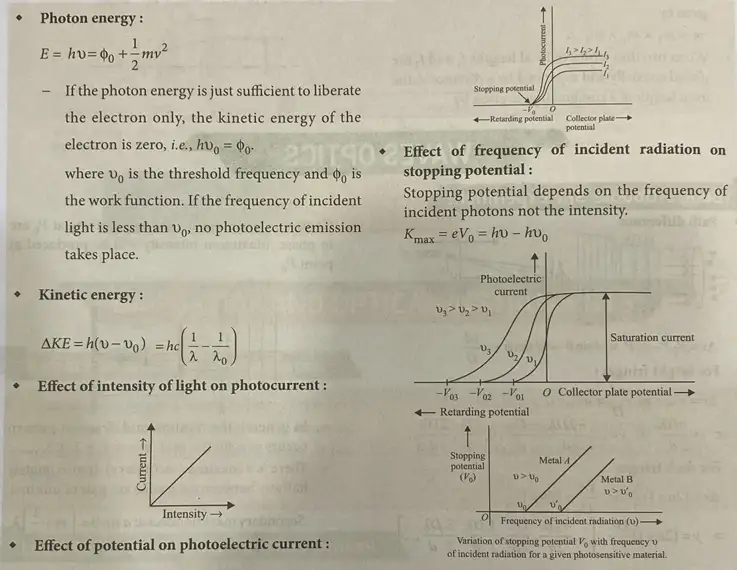
- When light of frequency ν hits a metal, photons transfer energy hν to electrons.
- Energy used to overcome work function W0 and rest becomes kinetic energy of emitted electron.
- Photoelectric equation: hν = 1/2mvmax2 + W0
- At threshold frequency ν0, W0 = hν0 = hc/λ0
- Maximum kinetic energy: 1/2mvmax2 = h(ν - ν0)
- Light intensity affects number of electrons, not their energy.
- Stopping potential depends on frequency, not intensity.
Solved Examples
- Ex 1: Calculate maximum kinetic energy if ν = 1.5 × 10¹⁵ Hz, ν0 = 1 × 10¹⁵ Hz, h = 6.63 × 10⁻³⁴ Js.
- Kmax = h(ν - ν0) = 6.63 × 10-34 × (0.5 × 1015) = 3.315 × 10⁻¹⁹ J
Practice Set
- Q1: What is the threshold frequency ν0 related to?
- A) Maximum kinetic energy
- B) Work function
- C) Photon energy
- D) Stopping potential
- Q2: If frequency of light increases, what happens to the kinetic energy of emitted electrons?
- A) Decreases
- B) Remains same
- C) Increases
- D) Becomes zero
- Q3: For light of frequency 2 × 10¹⁵ Hz and threshold frequency 1.5 × 10¹⁵ Hz, h = 6.63 × 10⁻³⁴ Js, calculate Kmax.
- A) 3.315 × 10⁻¹⁹ J
- B) 6.63 × 10⁻¹⁹ J
- C) 9.945 × 10⁻¹⁹ J
- D) 1.33 × 10⁻¹⁹ J
Answer Key
- Q1: B - Threshold frequency corresponds to work function W0 = hν0.
- Q2: C - Kinetic energy increases as Kmax = h(ν - ν0).
- Q3: A - Kmax = 6.63 × 10-34 × (0.5 × 1015) = 3.315 × 10⁻¹⁹ J.
Memory Aids
- Photoelectric eq: hν = K.E. + W0
- Threshold freq: ν0 = W0/h
- Kinetic energy depends on ν - ν0
Solved Examples
- Ex 1: Given slope = 4.14 × 10⁻¹⁵ V·s, find Planck's constant h (electron charge e = 1.6 × 10⁻¹⁹ C).
- h = slope × e = 4.14 × 10-15 × 1.6 × 10-19 = 6.62 × 10⁻³⁴ Js
- Ex 2: If intercept on potential axis is -2 V, find work function W0.
- W0 = e × |intercept| = 1.6 × 10-19 × 2 = 3.2 × 10⁻¹⁹ J
Practice Set
- Q1: What does the slope of V0 vs ν graph represent?
- A) Work function
- B) Planck's constant divided by electron charge
- C) Threshold frequency
- D) Maximum kinetic energy
- Q2: If stopping potential V0 = 1.5 V at frequency 5 × 10¹⁴ Hz, and W0 = 2 × 10-19 J, find h (e = 1.6 × 10⁻¹⁹ C).
- A) 4.8 × 10⁻³⁴ Js
- B) 6.63 × 10⁻³⁴ Js
- C) 3.3 × 10⁻³⁴ Js
- D) 1.2 × 10⁻³⁴ Js
- Q3: The intercept on potential axis is -3 V, electron charge e = 1.6 × 10⁻¹⁹ C. Calculate work function W0.
- A) 4.8 × 10⁻¹⁹ J
- B) 3.2 × 10⁻¹⁹ J
- C) 1.6 × 10⁻¹⁹ J
- D) 6.4 × 10⁻¹⁹ J
Answer Key
- Q1: B - Slope = h/e relates Planck's constant and electron charge.
- Q2: A - Use V0 = (h/e) ν - W0/e to find h.
- Q3: A - W0 = e × 3 = 4.8 × 10⁻¹⁹ J.
Memory Aids
- Slope of V0 vs ν = h/e
- Intercept = -hν0/e
- Work function W0 = e × |intercept|
Solved Examples
- Ex 1: Calculate maximum kinetic energy if ν = 1.5 × 10¹⁵ Hz, ν0 = 1 × 10¹⁵ Hz, h = 6.63 × 10⁻³⁴ Js.
- Kmax = h(ν - ν0) = 6.63 × 10-34 × (0.5 × 1015) = 3.315 × 10⁻¹⁹ J
Practice Set
- Q1: What is the threshold frequency ν0 related to?
- A) Maximum kinetic energy
- B) Work function
- C) Photon energy
- D) Stopping potential
- Q2: If frequency of light increases, what happens to the kinetic energy of emitted electrons?
- A) Decreases
- B) Remains same
- C) Increases
- D) Becomes zero
- Q3: For light of frequency 2 × 10¹⁵ Hz and threshold frequency 1.5 × 10¹⁵ Hz, h = 6.63 × 10⁻³⁴ Js, calculate Kmax.
- A) 3.315 × 10⁻¹⁹ J
- B) 6.63 × 10⁻¹⁹ J
- C) 9.945 × 10⁻¹⁹ J
- D) 1.33 × 10⁻¹⁹ J
Answer Key
- Q1: B - Threshold frequency corresponds to work function W0 = hν0.
- Q2: C - Kinetic energy increases as Kmax = h(ν - ν0).
- Q3: A - Kmax = 6.63 × 10-34 × (0.5 × 1015) = 3.315 × 10⁻¹⁹ J.
Memory Aids
- Photoelectric eq: hν = K.E. + W0
- Threshold freq: ν0 = W0/h
- Kinetic energy depends on ν - ν0
Solved Examples
- Ex 1: Calculate maximum kinetic energy if ν = 1.5 × 10¹⁵ Hz, ν0 = 1 × 10¹⁵ Hz, h = 6.63 × 10⁻³⁴ Js.
- Kmax = h(ν - ν0) = 6.63 × 10-34 × (0.5 × 1015) = 3.315 × 10⁻¹⁹ J
Practice Set
- Q1: What is the threshold frequency ν0 related to?
- A) Maximum kinetic energy
- B) Work function
- C) Photon energy
- D) Stopping potential
- Q2: If frequency of light increases, what happens to the kinetic energy of emitted electrons?
- A) Decreases
- B) Remains same
- C) Increases
- D) Becomes zero
- Q3: For light of frequency 2 × 10¹⁵ Hz and threshold frequency 1.5 × 10¹⁵ Hz, h = 6.63 × 10⁻³⁴ Js, calculate Kmax.
- A) 3.315 × 10⁻¹⁹ J
- B) 6.63 × 10⁻¹⁹ J
- C) 9.945 × 10⁻¹⁹ J
- D) 1.33 × 10⁻¹⁹ J
Answer Key
- Q1: B - Threshold frequency corresponds to work function W0 = hν0.
- Q2: C - Kinetic energy increases as Kmax = h(ν - ν0).
- Q3: A - Kmax = 6.63 × 10-34 × (0.5 × 1015) = 3.315 × 10⁻¹⁹ J.
Memory Aids
- Photoelectric eq: hν = K.E. + W0
- Threshold freq: ν0 = W0/h
- Kinetic energy depends on ν - ν0
Explanation
- When light of frequency ν hits a metal, photons transfer energy hν to electrons.
- Energy used to overcome work function W0 and rest becomes kinetic energy of emitted electron.
- Photoelectric equation: hν = 1/2mvmax2 + W0
- At threshold frequency ν0, W0 = hν0 = hc/λ0
- Maximum kinetic energy: 1/2mvmax2 = h(ν - ν0)
- Light intensity affects number of electrons, not their energy.
- Stopping potential depends on frequency, not intensity.
Solved Examples
- Ex 1: Calculate maximum kinetic energy if ν = 1.5 × 10¹⁵ Hz, ν0 = 1 × 10¹⁵ Hz, h = 6.63 × 10⁻³⁴ Js.
- Kmax = h(ν - ν0) = 6.63 × 10-34 × (0.5 × 1015) = 3.315 × 10⁻¹⁹ J
Practice Set
- Q1: What is the threshold frequency ν0 related to?
- A) Maximum kinetic energy
- B) Work function
- C) Photon energy
- D) Stopping potential
- Q2: If frequency of light increases, what happens to the kinetic energy of emitted electrons?
- A) Decreases
- B) Remains same
- C) Increases
- D) Becomes zero
- Q3: For light of frequency 2 × 10¹⁵ Hz and threshold frequency 1.5 × 10¹⁵ Hz, h = 6.63 × 10⁻³⁴ Js, calculate Kmax.
- A) 3.315 × 10⁻¹⁹ J
- B) 6.63 × 10⁻¹⁹ J
- C) 9.945 × 10⁻¹⁹ J
- D) 1.33 × 10⁻¹⁹ J
Answer Key
- Q1: B - Threshold frequency corresponds to work function W0 = hν0.
- Q2: C - Kinetic energy increases as Kmax = h(ν - ν0).
- Q3: A - Kmax = 6.63 × 10-34 × (0.5 × 1015) = 3.315 × 10⁻¹⁹ J.
Memory Aids
- Photoelectric eq: hν = K.E. + W0
- Threshold freq: ν0 = W0/h
- Kinetic energy depends on ν - ν0
Explanation
- When light of frequency \( \nu \) hits a metal, photons transfer energy \( h\nu \) to electrons.
- Energy used to overcome work function \( W_0 \) and rest becomes kinetic energy of emitted electron.
- Photoelectric equation: \( h\nu = \frac{1}{2}mv_{max}^2 + W_0 \)
- At threshold frequency \( \nu_0 \), \( W_0 = h\nu_0 = \frac{hc}{\lambda_0} \)
- Maximum kinetic energy: \( \frac{1}{2}mv_{max}^2 = h(\nu - \nu_0) \)
- Light intensity affects number of electrons, not their energy.
- Stopping potential depends on frequency, not intensity.
Solved Examples
- Ex 1: Calculate maximum kinetic energy if \( \nu = 1.5 \times 10^{15} \) Hz, \( \nu_0 = 1 \times 10^{15} \) Hz, \( h = 6.63 \times 10^{-34} \) Js.
- \( K_{max} = h(\nu - \nu_0) = 6.63 \times 10^{-34} \times (0.5 \times 10^{15}) = 3.315 \times 10^{-19} \) J
Practice Set
- Q1: What is the threshold frequency \( \nu_0 \) related to?
- A) Maximum kinetic energy
- B) Work function
- C) Photon energy
- D) Stopping potential
- Q2: If frequency of light increases, what happens to the kinetic energy of emitted electrons?
- A) Decreases
- B) Remains same
- C) Increases
- D) Becomes zero
- Q3: For light of frequency \( 2 \times 10^{15} \) Hz and threshold frequency \( 1.5 \times 10^{15} \) Hz, \( h = 6.63 \times 10^{-34} \) Js, calculate \( K_{max} \).
- A) \( 3.315 \times 10^{-19} \) J
- B) \( 6.63 \times 10^{-19} \) J
- C) \( 9.945 \times 10^{-19} \) J
- D) \( 1.33 \times 10^{-19} \) J
Answer Key
- Q1: B - Threshold frequency corresponds to work function \( W_0 = h\nu_0 \).
- Q2: C - Kinetic energy increases as \( K_{max} = h(\nu - \nu_0) \).
- Q3: A - \( K_{max} = 6.63 \times 10^{-34} \times (0.5 \times 10^{15}) = 3.315 \times 10^{-19} \) J.
Memory Aids
- Photoelectric eq: \( h\nu = K.E. + W_0 \)
- Threshold freq: \( \nu_0 = W_0/h \)
- Kinetic energy depends on \( \nu - \nu_0 \)
Determination of Planck's Constant and Work Function
Explanation
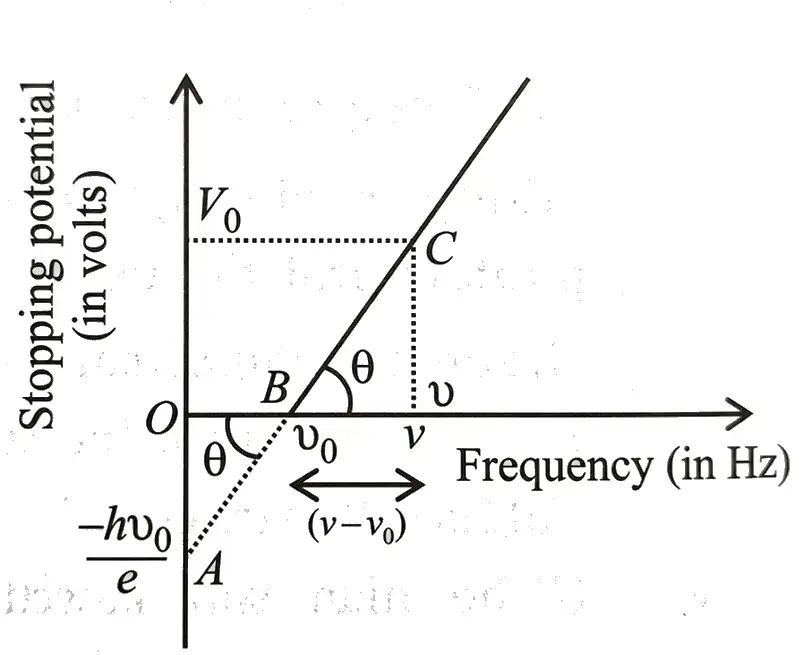
- From photoelectric equation: Kmax = hν - W0
- Stopping potential V0 relates as eV0 = hν - W0
- Rearranged: V0 = (h/e) ν - W0/e = (h/e) ν - hν0/e
- Plot of V0 vs ν is a straight line with slope h/e
- Slope = tan θ = V0/(ν - ν0) = h/e
- Intercept on potential axis: -hν0/e
- Work function: W0 = hν0 = e × OA
- Planck's constant h can be found from slope h/e
Solved Examples
- Ex 1: Given slope = 4.14 × 10⁻¹⁵ V·s, find Planck's constant h (electron charge e = 1.6 × 10⁻¹⁹ C).
- h = slope × e = 4.14 × 10-15 × 1.6 × 10-19 = 6.62 × 10⁻³⁴ Js
- Ex 2: If intercept on potential axis is -2 V, find work function W0.
- W0 = e × |intercept| = 1.6 × 10-19 × 2 = 3.2 × 10⁻¹⁹ J
Practice Set
- Q1: What does the slope of V0 vs ν graph represent?
- A) Work function
- B) Planck's constant divided by electron charge
- C) Threshold frequency
- D) Maximum kinetic energy
- Q2: If stopping potential V0 = 1.5 V at frequency 5 × 10¹⁴ Hz, and W0 = 2 × 10-19 J, find h (e = 1.6 × 10⁻¹⁹ C).
- A) 4.8 × 10⁻³⁴ Js
- B) 6.63 × 10⁻³⁴ Js
- C) 3.3 × 10⁻³⁴ Js
- D) 1.2 × 10⁻³⁴ Js
- Q3: The intercept on potential axis is -3 V, electron charge e = 1.6 × 10⁻¹⁹ C. Calculate work function W0.
- A) 4.8 × 10⁻¹⁹ J
- B) 3.2 × 10⁻¹⁹ J
- C) 1.6 × 10⁻¹⁹ J
- D) 6.4 × 10⁻¹⁹ J
Answer Key
- Q1: B - Slope = h/e relates Planck's constant and electron charge.
- Q2: A - Use V0 = (h/e) ν - W0/e to find h.
- Q3: A - W0 = e × 3 = 4.8 × 10⁻¹⁹ J.
Memory Aids
- Slope of V0 vs ν = h/e
- Intercept = -hν0/e
- Work function W0 = e × |intercept|
Explanation
- From photoelectric equation: Kmax = hν - W0
- Stopping potential V0 relates as eV0 = hν - W0
- Rearranged: V0 = (h/e) ν - W0/e = (h/e) ν - hν0/e
- Plot of V0 vs ν is a straight line with slope h/e
- Slope = tan θ = V0/(ν - ν0) = h/e
- Intercept on potential axis: -hν0/e
- Work function: W0 = hν0 = e × OA
- Planck's constant h can be found from slope h/e
Solved Examples
- Ex 1: Given slope = 4.14 × 10⁻¹⁵ V·s, find Planck's constant h (electron charge e = 1.6 × 10⁻¹⁹ C).
- h = slope × e = 4.14 × 10-15 × 1.6 × 10-19 = 6.62 × 10⁻³⁴ Js
- Ex 2: If intercept on potential axis is -2 V, find work function W0.
- W0 = e × |intercept| = 1.6 × 10-19 × 2 = 3.2 × 10⁻¹⁹ J
Practice Set
- Q1: What does the slope of V0 vs ν graph represent?
- A) Work function
- B) Planck's constant divided by electron charge
- C) Threshold frequency
- D) Maximum kinetic energy
- Q2: If stopping potential V0 = 1.5 V at frequency 5 × 10¹⁴ Hz, and W0 = 2 × 10-19 J, find h (e = 1.6 × 10⁻¹⁹ C).
- A) 4.8 × 10⁻³⁴ Js
- B) 6.63 × 10⁻³⁴ Js
- C) 3.3 × 10⁻³⁴ Js
- D) 1.2 × 10⁻³⁴ Js
- Q3: The intercept on potential axis is -3 V, electron charge e = 1.6 × 10⁻¹⁹ C. Calculate work function W0.
- A) 4.8 × 10⁻¹⁹ J
- B) 3.2 × 10⁻¹⁹ J
- C) 1.6 × 10⁻¹⁹ J
- D) 6.4 × 10⁻¹⁹ J
Answer Key
- Q1: B - Slope = h/e relates Planck's constant and electron charge.
- Q2: A - Use V0 = (h/e) ν - W0/e to find h.
- Q3: A - W0 = e × 3 = 4.8 × 10⁻¹⁹ J.
Memory Aids
- Slope of V0 vs ν = h/e
- Intercept = -hν0/e
- Work function W0 = e × |intercept|
Explanation
- From photoelectric equation: \( K_{max} = h\nu - W_0 \)
- Stopping potential \( V_0 \) relates as \( eV_0 = h\nu - W_0 \)
- Rearranged: \( V_0 = \frac{h}{e} \nu - \frac{W_0}{e} = \frac{h}{e} \nu - \frac{h\nu_0}{e} \)
- Plot of \( V_0 \) vs \( \nu \) is a straight line with slope \( \frac{h}{e} \)
- Slope \( = \tan \theta = \frac{V_0}{\nu - \nu_0} = \frac{h}{e} \)
- Intercept on potential axis: \( -\frac{h\nu_0}{e} \)
- Work function: \( W_0 = h\nu_0 = e \times OA \)
- Planck's constant \( h \) can be found from slope \( \frac{h}{e} \)
Solved Examples
- Ex 1: Given slope \( = 4.14 \times 10^{-15} \) V·s, find Planck's constant \( h \) (electron charge \( e = 1.6 \times 10^{-19} \) C).
- \( h = slope \times e = 4.14 \times 10^{-15} \times 1.6 \times 10^{-19} = 6.62 \times 10^{-34} \) Js
- Ex 2: If intercept on potential axis is \( -2 \) V, find work function \( W_0 \).
- \( W_0 = e \times |intercept| = 1.6 \times 10^{-19} \times 2 = 3.2 \times 10^{-19} \) J
Practice Set
- Q1: What does the slope of \( V_0 \) vs \( \nu \) graph represent?
- A) Work function
- B) Planck's constant divided by electron charge
- C) Threshold frequency
- D) Maximum kinetic energy
- Q2: If stopping potential \( V_0 = 1.5 \) V at frequency \( 5 \times 10^{14} \) Hz, and \( W_0 = 2 \times 10^{-19} \) J, find \( h \) (\( e = 1.6 \times 10^{-19} \) C).
- A) \( 4.8 \times 10^{-34} \) Js
- B) \( 6.63 \times 10^{-34} \) Js
- C) \( 3.3 \times 10^{-34} \) Js
- D) \( 1.2 \times 10^{-34} \) Js
- Q3: The intercept on potential axis is \( -3 \) V, electron charge \( e = 1.6 \times 10^{-19} \) C. Calculate work function \( W_0 \).
- A) \( 4.8 \times 10^{-19} \) J
- B) \( 3.2 \times 10^{-19} \) J
- C) \( 1.6 \times 10^{-19} \) J
- D) \( 6.4 \times 10^{-19} \) J
Answer Key
- Q1: B - Slope = \( \frac{h}{e} \) relates Planck's constant and electron charge.
- Q2: A - Use \( V_0 = \frac{h}{e} \nu - \frac{W_0}{e} \) to find \( h \).
- Q3: A - \( W_0 = e \times 3 = 4.8 \times 10^{-19} \) J.
Memory Aids
- Slope of \( V_0 \) vs \( \nu \) = \( h/e \)
- Intercept = \( -h\nu_0/e \)
- Work function \( W_0 = e \times |intercept| \)
Particle Nature of Light : The Photon
Photon Concept and Properties
- Einstein proposed electromagnetic radiation is quantized into photons.
- Radiation behaves as particles (photons) in matter interaction.
- Photon energy: E = hν = hc/λ, where h = Planck's constant, ν = frequency, λ = wavelength, c = speed of light.
- Photon momentum: p = hν/c = h/λ.
- Photon energy is independent of radiation intensity.
- All photons travel at speed c in vacuum.
- Photon frequency determines energy (color), unchanged in different media.
- Photons are electrically neutral; not deflected by electric/magnetic fields.
- Photons are massless; rest mass = 0.
- Energy and momentum conserved in photon-particle collisions; photon number may change.
Solved Examples
- Ex 1: Calculate photon energy for wavelength 500 nm.
- Use E = hc/λ, h = 6.63×10⁻³⁴ Js, c = 3×10⁸ m/s, λ = 500×10-9 m.
- Calculate E = (6.63×10-34 × 3×108)/(500×10-9) = 3.98×10⁻¹⁹ J.
- Ex 2: Find photon momentum for wavelength 600 nm.
- Use p = h/λ.
- Calculate p = 6.63×10⁻³⁴/(600×10-9) = 1.11×10⁻²⁷ kg·m/s.
Practice Set
- Q1: What is the energy of a photon with frequency 5×10¹⁴ Hz?
- A) 3.32×10⁻¹⁹ J
- B) 6.63×10⁻³⁴ J
- C) 1.5×10⁻¹⁵ J
- D) 9.11×10⁻³¹ J
- Q2: Which property of photons shows they are electrically neutral?
- A) Deflection by magnetic fields
- B) Deflection by electric fields
- C) No deflection by electric or magnetic fields
- D) Having rest mass zero
- Q3: Photon momentum for wavelength 400 nm is?
- A) 1.66×10⁻²⁷ kg·m/s
- B) 4.97×10⁻²⁸ kg·m/s
- C) 6.63×10⁻³⁴ kg·m/s
- D) 3.32×10⁻¹⁹ kg·m/s
Answer Key
- Q1: A) 3.32×10⁻¹⁹ J - Calculated using E = hν with given frequency.
- Q2: C) No deflection by electric or magnetic fields - shows photons are neutral.
- Q3: B) 4.97×10⁻²⁸ kg·m/s - Using p = h/λ with λ = 400 nm.
Memory Aids
- Energy formula: E = hν = hc/λ
- Momentum formula: p = h/λ
- Photons: massless, neutral, speed = c
- Energy independent of intensity
- Frequency fixes photon energy (color)
Photon Concept and Properties
- Einstein proposed electromagnetic radiation is quantized into photons.
- Radiation behaves as particles (photons) in matter interaction.
- Photon energy: E = h\nu = \frac{hc}{\lambda}, where h = Planck's constant, \nu = frequency, \lambda = wavelength, c = speed of light.
- Photon momentum: p = \frac{h\nu}{c} = \frac{h}{\lambda}.
- Photon energy is independent of radiation intensity.
- All photons travel at speed c in vacuum.
- Photon frequency determines energy (color), unchanged in different media.
- Photons are electrically neutral; not deflected by electric/magnetic fields.
- Photons are massless; rest mass = 0.
- Energy and momentum conserved in photon-particle collisions; photon number may change.
Solved Examples
- Ex 1: Calculate photon energy for wavelength 500 nm.
- Use E = \frac{hc}{\lambda}, h = 6.63×10⁻³⁴ Js, c = 3×10⁸ m/s, \lambda = 500×10-9 m.
- Calculate E = \frac{6.63\times10^{-34} \times 3\times10^{8}}{500\times10^{-9}} = 3.98\times10^{-19} J.
- Ex 2: Find photon momentum for wavelength 600 nm.
- Use p = \frac{h}{\lambda}.
- Calculate p = \frac{6.63\times10^{-34}}{600\times10^{-9}} = 1.11\times10^{-27} kg·m/s.
Practice Set
- Q1: What is the energy of a photon with frequency 5×10¹⁴ Hz?
- A) 3.32×10⁻¹⁹ J
- B) 6.63×10⁻³⁴ J
- C) 1.5×10⁻¹⁵ J
- D) 9.11×10⁻³¹ J
- Q2: Which property of photons shows they are electrically neutral?
- A) Deflection by magnetic fields
- B) Deflection by electric fields
- C) No deflection by electric or magnetic fields
- D) Having rest mass zero
- Q3: Photon momentum for wavelength 400 nm is?
- A) 1.66×10⁻²⁷ kg·m/s
- B) 4.97×10⁻²⁸ kg·m/s
- C) 6.63×10⁻³⁴ kg·m/s
- D) 3.32×10⁻¹⁹ kg·m/s
Answer Key
- Q1: A) 3.32×10⁻¹⁹ J - Calculated using E = h\nu with given frequency.
- Q2: C) No deflection by electric or magnetic fields - shows photons are neutral.
- Q3: B) 4.97×10⁻²⁸ kg·m/s - Using p = h/\lambda with \lambda = 400 nm.
Memory Aids
- Energy formula: E = h\nu = \frac{hc}{\lambda}
- Momentum formula: p = \frac{h}{\lambda}
- Photons: massless, neutral, speed = c
- Energy independent of intensity
- Frequency fixes photon energy (color)
Wave Nature of Matter
Concepts and Formulas
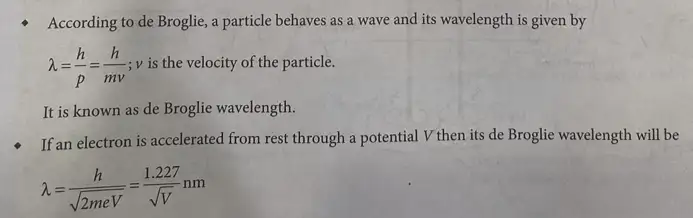
- Every moving particle exhibits wave-like properties (de Broglie hypothesis).
- De Broglie wavelength λ depends on particle momentum p = mv.
- Formula: λ = h/p = h/mv, where h = 6.626 × 10⁻³⁴ Js.
- For an electron accelerated by voltage V, λ = h/√(2meV) = 1.227/√V nm.
- Wave-particle duality applies to matter similar to radiation.
- De Broglie waves are also called matter waves.
- Louis de Broglie received the Nobel Prize in 1929 for this discovery.
Solved Examples
- Ex 1: Calculate de Broglie wavelength of an electron moving at speed 2 × 10⁶ m/s.
- Given: me = 9.11 × 10⁻³¹ kg, v = 2 × 10⁶ m/s, h = 6.626 × 10⁻³⁴ Js
- λ = h/mv = 6.626 × 10⁻³⁴/(9.11 × 10-31 × 2 × 106) = 3.64 × 10⁻¹⁰ m = 0.364 nm
- Ex 2: Find λ for electron accelerated by V = 100 V.
- λ = 1.227/√V = 1.227/√100 = 0.1227 nm
Practice Set
- Q1: What is the de Broglie wavelength of a particle with mass 2 × 10-27 kg moving at 3 × 10³ m/s?
- A) 1.1 × 10⁻³⁴ m
- B) 1.1 × 10⁻³¹ m
- C) 1.1 × 10-37 m
- D) 1.1 × 10⁻²⁸ m
- Q2: An electron accelerated through 400 V has de Broglie wavelength approximately:
- A) 0.061 nm
- B) 0.122 nm
- C) 0.031 nm
- D) 0.244 nm
- Q3: If the velocity of a particle doubles, its de Broglie wavelength:
- A) Doubles
- B) Halves
- C) Quadruples
- D) Remains same
Answer Key
- Q1: A) 1.1 × 10⁻³⁴ m - Using λ = h/mv, substituting values gives this wavelength.
- Q2: A) 0.061 nm - λ = 1.227/√400 = 0.061 nm.
- Q3: B) Halves - λ ∝ 1/v, doubling velocity halves wavelength.
Memory Aids
- De Broglie wavelength λ = h/mv (momentum inverse relation).
- Electron wavelength λ = 1.227/√V nm for accelerating voltage V.
- Wave-particle duality: matter behaves like waves when moving.
Concepts and Formulas
- Every moving particle exhibits wave-like properties (de Broglie hypothesis).
- De Broglie wavelength \(\lambda\) depends on particle momentum \(p = mv\).
- Formula: \(\lambda = \frac{h}{p} = \frac{h}{mv}\), where \(h = 6.626 \times 10^{-34} \text{ Js}\).
- For an electron accelerated by voltage \(V\), \(\lambda = \frac{h}{\sqrt{2meV}} = \frac{1.227}{\sqrt{V}} \text{ nm}\).
- Wave-particle duality applies to matter similar to radiation.
- De Broglie waves are also called matter waves.
- Louis de Broglie received the Nobel Prize in 1929 for this discovery.
Solved Examples
- Ex 1: Calculate de Broglie wavelength of an electron moving at speed \(2 \times 10^6 \text{ m/s}\).
- Given: \(m_e = 9.11 \times 10^{-31} \text{ kg}\), \(v = 2 \times 10^6 \text{ m/s}\), \(h = 6.626 \times 10^{-34} \text{ Js}\)
- \(\lambda = \frac{h}{mv} = \frac{6.626 \times 10^{-34}}{9.11 \times 10^{-31} \times 2 \times 10^6} = 3.64 \times 10^{-10} \text{ m} = 0.364 \text{ nm}\)
- Ex 2: Find \(\lambda\) for electron accelerated by \(V = 100 \text{ V}\).
- \(\lambda = \frac{1.227}{\sqrt{V}} = \frac{1.227}{\sqrt{100}} = 0.1227 \text{ nm}\)
Practice Set
- Q1: What is the de Broglie wavelength of a particle with mass \(2 \times 10^{-27} \text{ kg}\) moving at \(3 \times 10^3 \text{ m/s}\)?
- A) \(1.1 \times 10^{-34} \text{ m}\)
- B) \(1.1 \times 10^{-31} \text{ m}\)
- C) \(1.1 \times 10^{-37} \text{ m}\)
- D) \(1.1 \times 10^{-28} \text{ m}\)
- Q2: An electron accelerated through 400 V has de Broglie wavelength approximately:
- A) 0.061 nm
- B) 0.122 nm
- C) 0.031 nm
- D) 0.244 nm
- Q3: If the velocity of a particle doubles, its de Broglie wavelength:
- A) Doubles
- B) Halves
- C) Quadruples
- D) Remains same
Answer Key
- Q1: A) \(1.1 \times 10^{-34} \text{ m}\) - Using \(\lambda = \frac{h}{mv}\), substituting values gives this wavelength.
- Q2: A) 0.061 nm - \(\lambda = \frac{1.227}{\sqrt{400}} = 0.061\) nm.
- Q3: B) Halves - \(\lambda \propto \frac{1}{v}\), doubling velocity halves wavelength.
Memory Aids
- De Broglie wavelength \(\lambda = \frac{h}{mv}\) (momentum inverse relation).
- Electron wavelength \(\lambda = \frac{1.227}{\sqrt{V}}\) nm for accelerating voltage \(V\).
- Wave-particle duality: matter behaves like waves when moving.
NEET Physics — ALL CHAPTERS
1
Basic Mathematics
2
Units and Measurement
3
Motion in a Straight Line
4
Motion in a Plane
5
Laws of Motion
6
Work, Energy and Power
7
System of Particles and Rotational Motion
8
Gravitation
9
Mechanical Properties of Solids
10
Mechanical Properties of Fluids
11
Thermal Properties of Matter
12
Thermodynamics
13
Kinetic Theory
14
Oscillations
15
Waves
16
Electric Charges and Fields
17
Electrostatic Potential and Capacitance
18
Current Electricity
19
Moving Charges and Magnetism
20
Magnetism and Matter
21
Electromagnetic Induction
22
Alternating Current
23
Electromagnetic Waves
24
Ray Optics and Optical Instruments
25
Wave Optics
26
Dual Nature of Radiation and Matter
27
Atoms
28
Nuclei
29
Semiconductor Electronics: Materials, Devices and Simple Circuits