NEET Ug . NEET Physics . Physics . Magnetism and Matter
Chapter 20: Magnetism and Matter
Ch 20
NEET Physics
NEET Ug
Introduction
Key Points
- Magnet name origin: from Magnesia island, Greece.
- Magnet: material with attractive and directive properties.
- Attracts iron, nickel, cobalt; this attraction is magnetism.
- Earth acts as a magnet; magnetic field approx. from geographic south to north.
- Freely suspended bar magnet aligns north-south; north pole points geographic north.
- Like poles repel; unlike poles attract.
- Magnetic monopoles (isolated poles) do not exist.
- Magnets can be made from iron and its alloys.
Solved Examples
- Ex 1: What happens when two north poles of magnets are brought close?
Answer: They repel due to like poles repulsion. - Ex 2: Can a single magnetic pole exist?
Answer: No, magnetic monopoles do not exist; breaking a magnet forms two smaller dipoles.
Practice Set
- Q1: What is magnetism?
A) Repulsion between metals
B) Attraction of certain metals
C) Electric charge
D) Heat generation - Q2: Which element is NOT attracted by a magnet?
A) Iron
B) Nickel
C) Copper
D) Cobalt - Q3: What is true about magnetic monopoles?
A) Exist isolated
B) Exist in pairs
C) Do not exist
D) Are electric charges
Answer Key
- Q1: B - Magnetism is the attraction of certain metals like iron.
- Q2: C - Copper is not attracted by magnets.
- Q3: C - Magnetic monopoles do not exist.
Memory Aids
- Magnetism = attraction of Fe, Ni, Co.
- Earth's magnetic field: south to north.
- Monopoles do not exist; always dipoles.
The Bar Magnet
Properties
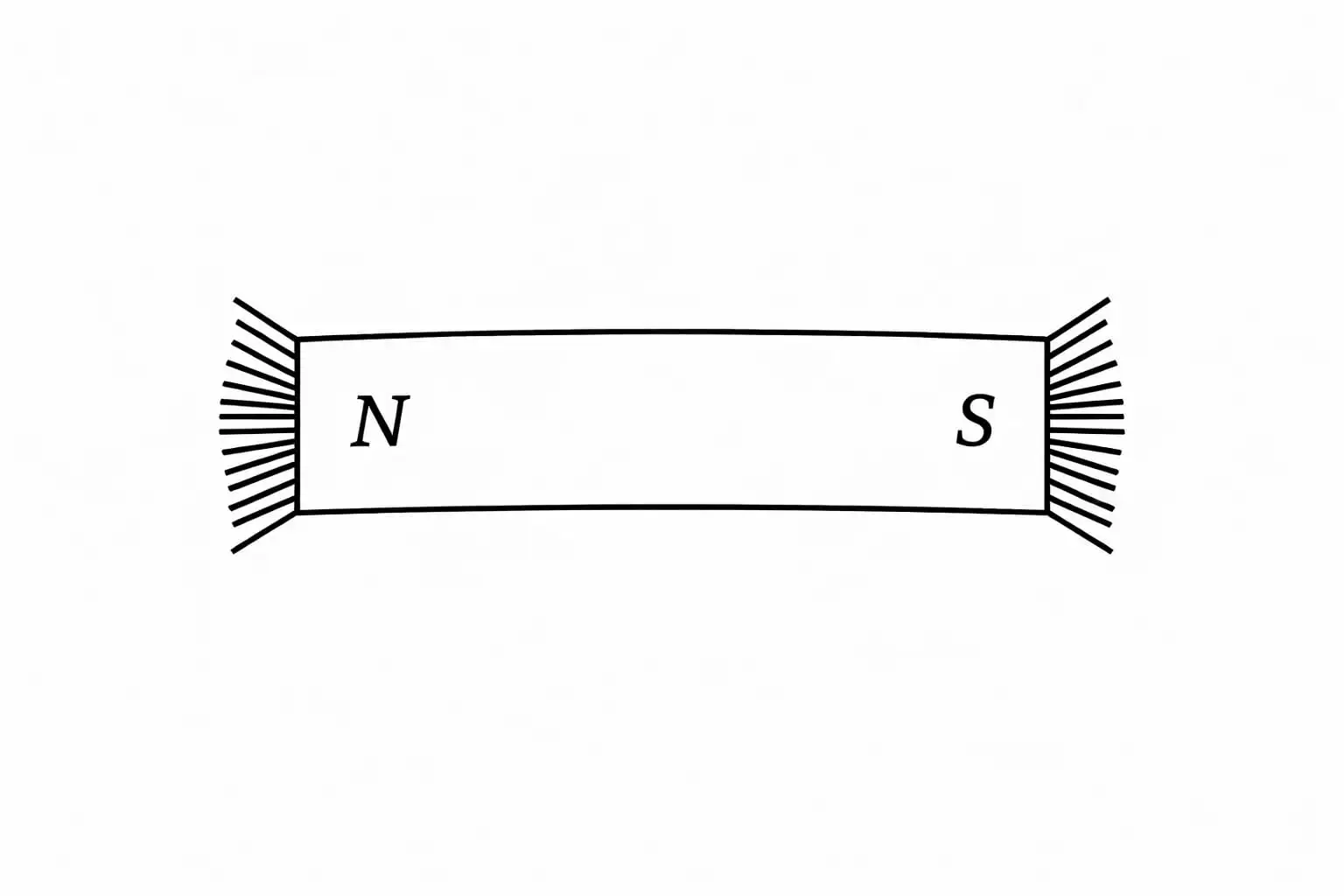
- Bar magnet is a natural dipole producing magnetic field.
- Attracts small pieces of iron, nickel, cobalt.
- Poles: ends where magnetic force is maximum.
- Freely suspended bar magnet aligns north-south.
- North pole (N) points geographic north; south pole (S) points geographic south.
- Like poles repel; unlike poles attract.
- Magnetic poles always in pairs; monopoles do not exist.
- Repulsion distinguishes magnet from iron.
Solved Examples
- Ex 1: What direction does a freely suspended bar magnet point?
Answer: North-South direction. - Ex 2: What happens if two south poles are brought close?
Answer: They repel.
Practice Set
- Q1: What are the poles of a bar magnet?
A) Single pole
B) Two poles
C) No poles
D) Multiple poles - Q2: What is the pole that points to Earth's north called?
A) South pole
B) North pole
C) Magnetic monopole
D) Neutral pole - Q3: How to distinguish a magnet from iron?
A) Attraction only
B) Repulsion test
C) Heat test
D) Color test
Answer Key
- Q1: B - Bar magnet has two poles.
- Q2: B - Pole pointing north is north pole.
- Q3: B - Repulsion test distinguishes magnet from iron.
Memory Aids
- Bar magnet = dipole with N and S poles.
- Like poles repel; unlike attract.
- Repulsion test confirms magnet.
The Magnetic Field Lines
Key Properties
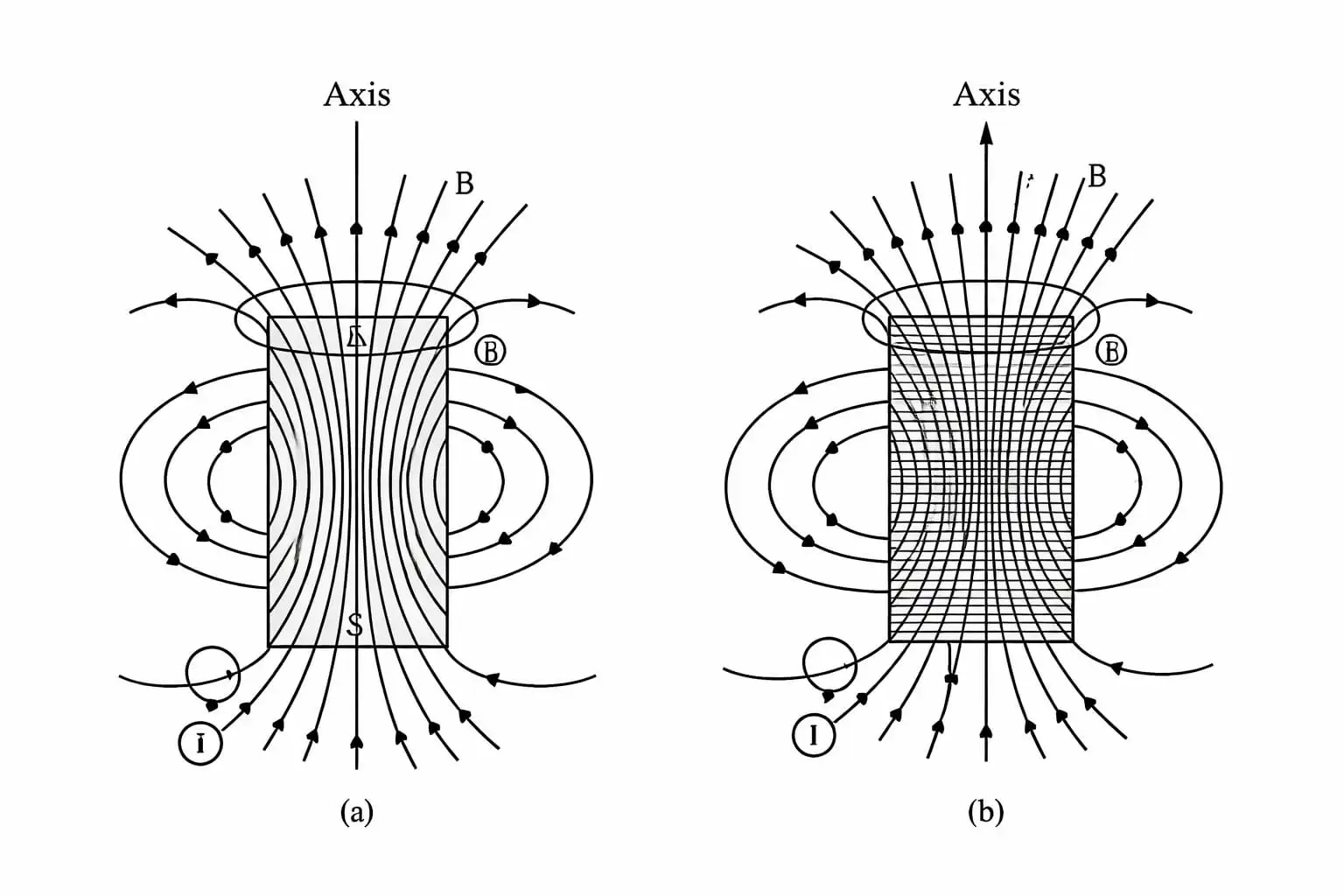
- Magnetic field lines form closed continuous loops.
- Tangent to field line = direction of magnetic field at that point.
- More field lines per unit area = stronger magnetic field.
- Field lines never intersect.
- Field lines of bar magnet and solenoid shown in images.
Solved Examples
- Ex 1: What does the density of field lines indicate?
Answer: Strength of magnetic field. - Ex 2: Why don't magnetic field lines intersect?
Answer: To keep unique field direction.
Practice Set
- Q1: Magnetic field lines form:
A) Open lines
B) Closed loops
C) Random lines
D) Straight lines - Q2: What does tangent to field line represent?
A) Magnitude
B) Direction of field
C) Force
D) Charge - Q3: Why field lines never intersect?
A) They do intersect
B) To keep unique direction
C) Random behavior
D) No reason
Answer Key
- Q1: B - Magnetic field lines form closed loops.
- Q2: B - Tangent shows field direction.
- Q3: B - Intersection would cause ambiguous direction.
Memory Aids
- Field lines = closed loops.
- Tangent = field direction.
- Density = field strength.
Bar Magnet as an Equivalent Solenoid
Key Points
- Bar magnet and solenoid produce similar magnetic fields.
- Magnetic field at far axial point of bar magnet: B = μ0/(4π) (2m/r3).
- μ0: permeability of free space, m: magnetic moment, r: distance.
Solved Examples
- Ex 1: Write formula for magnetic field of bar magnet at far axial point.
Answer: B = μ0/(4π) (2m/r3).
Practice Set
- Q1: What does a bar magnet behave like?
A) Electric dipole
B) Magnetic monopole
C) Magnetic dipole
D) No magnetic field - Q2: Magnetic field at far axial point is proportional to:
A) ( r3 )
B) ( 1/r3 )
C) ( r )
D) ( 1/r ) - Q3: Magnetic moment symbol is:
A) ( m )
B) ( p )
C) ( q )
D) ( I )
Answer Key
- Q1: C - Bar magnet is a magnetic dipole.
- Q2: B - Field varies as inverse cube of distance.
- Q3: A - Magnetic moment symbol is ( m ).
Memory Aids
- Bar magnet = magnetic dipole.
- Field ( ∝ 1/r3 ).
- Formula: ( B = μ0/(4π) (2m/r3) ).
Key Points
- Bar magnet and solenoid produce similar magnetic fields.
- Magnetic field at far axial point of bar magnet: ( B = μ0/(4π) (2m/r3) ).
- ( μ0 ): permeability of free space, ( m ): magnetic moment, ( r ): distance.
Solved Examples
- Ex 1: Write formula for magnetic field of bar magnet at far axial point.
Answer: ( B = μ0/(4π) (2m/r3) ).
Practice Set
- Q1: What does a bar magnet behave like?
A) Electric dipole
B) Magnetic monopole
C) Magnetic dipole
D) No magnetic field - Q2: Magnetic field at far axial point is proportional to:
A) ( r3 )
B) ( 1/r3 )
C) ( r )
D) ( 1/r ) - Q3: Magnetic moment symbol is:
A) ( m )
B) ( p )
C) ( q )
D) ( I )
Answer Key
- Q1: C - Bar magnet is a magnetic dipole.
- Q2: B - Field varies as inverse cube of distance.
- Q3: A - Magnetic moment symbol is ( m ).
Memory Aids
- Bar magnet = magnetic dipole.
- Field ( ∝ 1/r3 ).
- Formula: ( B = μ0/(4π) (2m/r3) ).
Key Points
- Bar magnet and solenoid produce similar magnetic fields.
- Magnetic field at far axial point of bar magnet: B = μ0/(4π) (2m/r3).
- μ0: permeability of free space, m: magnetic moment, r: distance.
Solved Examples
- Ex 1: Write formula for magnetic field of bar magnet at far axial point.
Answer: B = μ0/(4π) (2m/r3).
Practice Set
- Q1: What does a bar magnet behave like?
A) Electric dipole
B) Magnetic monopole
C) Magnetic dipole
D) No magnetic field - Q2: Magnetic field at far axial point is proportional to:
A) ( r3 )
B) ( 1/r3 )
C) ( r )
D) ( 1/r ) - Q3: Magnetic moment symbol is:
A) ( m )
B) ( p )
C) ( q )
D) ( I )
Answer Key
- Q1: C - Bar magnet is a magnetic dipole.
- Q2: B - Field varies as inverse cube of distance.
- Q3: A - Magnetic moment symbol is ( m ).
Memory Aids
- Bar magnet = magnetic dipole.
- Field ( ∝ 1/r3 ).
- Formula: ( B = μ0/(4π) (2m/r3) ).
Key Points
- Bar magnet and solenoid produce similar magnetic fields.
- Magnetic field at far axial point of bar magnet: ( B = μ0/(4π) (2m/r3) ).
- ( μ0 ): permeability of free space, ( m ): magnetic moment, ( r ): distance.
Solved Examples
- Ex 1: Write formula for magnetic field of bar magnet at far axial point.
Answer: ( B = μ0/(4π) (2m/r3) ).
Practice Set
- Q1: What does a bar magnet behave like?
A) Electric dipole
B) Magnetic monopole
C) Magnetic dipole
D) No magnetic field - Q2: Magnetic field at far axial point is proportional to:
A) ( r3 )
B) ( 1/r3 )
C) ( r )
D) ( 1/r ) - Q3: Magnetic moment symbol is:
A) ( m )
B) ( p )
C) ( q )
D) ( I )
Answer Key
- Q1: C - Bar magnet is a magnetic dipole.
- Q2: B - Field varies as inverse cube of distance.
- Q3: A - Magnetic moment symbol is ( m ).
Memory Aids
- Bar magnet = magnetic dipole.
- Field ( ∝ 1/r3 ).
- Formula: ( B = μ0/(4π) (2m/r3) ).
Key Points
- Bar magnet and solenoid produce similar magnetic fields.
- Magnetic field at far axial point of bar magnet: B = μ0/(4π) (2m/r3).
- μ0: permeability of free space, m: magnetic moment, r: distance.
Solved Examples
- Ex 1: Write formula for magnetic field of bar magnet at far axial point.
Answer: B = μ0/(4π) (2m/r3).
Practice Set
- Q1: What does a bar magnet behave like?
A) Electric dipole
B) Magnetic monopole
C) Magnetic dipole
D) No magnetic field - Q2: Magnetic field at far axial point is proportional to:
A) ( r3 )
B) ( 1/r3 )
C) ( r )
D) ( 1/r ) - Q3: Magnetic moment symbol is:
A) ( m )
B) ( p )
C) ( q )
D) ( I )
Answer Key
- Q1: C - Bar magnet is a magnetic dipole.
- Q2: B - Field varies as inverse cube of distance.
- Q3: A - Magnetic moment symbol is ( m ).
Memory Aids
- Bar magnet = magnetic dipole.
- Field ( ∝ 1/r3 ).
- Formula: ( B = μ0/(4π) (2m/r3) ).
Key Points
- Bar magnet and solenoid produce similar magnetic fields.
- Magnetic field at far axial point of bar magnet: ( B = μ0/(4π) (2m/r3) ).
- ( μ0 ): permeability of free space, ( m ): magnetic moment, ( r ): distance.
Solved Examples
- Ex 1: Write formula for magnetic field of bar magnet at far axial point.
Answer: ( B = μ0/(4π) (2m/r3) ).
Practice Set
- Q1: What does a bar magnet behave like?
A) Electric dipole
B) Magnetic monopole
C) Magnetic dipole
D) No magnetic field - Q2: Magnetic field at far axial point is proportional to:
A) ( r3 )
B) ( 1/r3 )
C) ( r )
D) ( 1/r ) - Q3: Magnetic moment symbol is:
A) ( m )
B) ( p )
C) ( q )
D) ( I )
Answer Key
- Q1: C - Bar magnet is a magnetic dipole.
- Q2: B - Field varies as inverse cube of distance.
- Q3: A - Magnetic moment symbol is ( m ).
Memory Aids
- Bar magnet = magnetic dipole.
- Field ( ∝ 1/r3 ).
- Formula: ( B = μ0/(4π) (2m/r3) ).
Key Points
- Bar magnet and solenoid produce similar magnetic fields.
- Magnetic field at far axial point of bar magnet: \( B = \frac{\mu_0}{4\pi} \frac{2m}{r^3} \).
- \( \mu_0 \): permeability of free space, \( m \): magnetic moment, \( r \): distance.
Solved Examples
- Ex 1: Write formula for magnetic field of bar magnet at far axial point.
Answer: \( B = \frac{\mu_0}{4\pi} \frac{2m}{r^3} \).
Practice Set
- Q1: What does a bar magnet behave like?
A) Electric dipole
B) Magnetic monopole
C) Magnetic dipole
D) No magnetic field - Q2: Magnetic field at far axial point is proportional to:
A) \( r^3 \)
B) \( \frac{1}{r^3} \)
C) \( r \)
D) \( \frac{1}{r} \) - Q3: Magnetic moment symbol is:
A) \( m \)
B) \( p \)
C) \( q \)
D) \( I \)
Answer Key
- Q1: C - Bar magnet is a magnetic dipole.
- Q2: B - Field varies as inverse cube of distance.
- Q3: A - Magnetic moment symbol is \( m \).
Memory Aids
- Bar magnet = magnetic dipole.
- Field \( \propto \frac{1}{r^3} \).
- Formula: \( B = \frac{\mu_0}{4\pi} \frac{2m}{r^3} \).
The Dipole in a Uniform Magnetic Field
Key Concepts
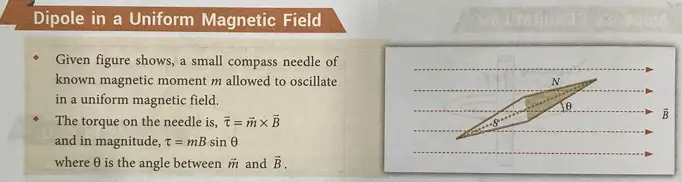
- Magnetic dipole moment ( vector m ) in uniform magnetic field ( vector B ).
- Torque on dipole: ( vector τ = vector m × vector B ).
- Magnitude of torque: ( τ = mB sin θ ), ( θ ) = angle between ( vector m ) and ( vector B ).
- Torque aligns dipole with magnetic field.
- Potential energy: ( U = -vector m · vector B = -mB cos θ ).
- Work done to rotate dipole through angle ( θ ) against torque.
- Analogy with electric dipole: similar formulas for moment, field, torque, energy.
> Torque, 𝝉⃗ = 𝐦⃗ x 𝐁⃗= mBsinθ n̂
> Potential energy is the work done in rotating the dipole through an angle θ with respect toa direction
perpendicular to the field.

Solved Examples
- Ex 1: Calculate torque on dipole with ( m=2 Am2 ), ( B=0.5 T ), ( θ=30° ).
Solution: ( τ = mB sin θ = 2 × 0.5 × sin 30° = 0.5 Nm ). - Ex 2: Find potential energy for ( m=3 Am2 ), ( B=0.4 T ), ( θ=60° ).
Solution: ( U = -mB cos θ = -3 × 0.4 × cos 60° = -0.6 J ).
Practice Set
- Q1: Torque on magnetic dipole is zero when angle between ( vector m ) and ( vector B ) is:
A) 0°
B) 90°
C) 45°
D) 180° - Q2: Potential energy of dipole is minimum when ( θ = ):
A) 0°
B) 90°
C) 180°
D) 45° - Q3: Torque formula is:
A) ( mB cos θ )
B) ( mB sin θ )
C) ( mB tan θ )
D) ( mB )
Answer Key
- Q1: A - Torque zero when dipole aligned with field (0°).
- Q2: A - Potential energy minimum when dipole aligned (0°).
- Q3: B - Torque magnitude is ( mB sin θ ).
Memory Aids
- Torque ( τ = mB sin θ ).
- Potential energy ( U = -mB cos θ ).
- Dipole aligns to minimize energy.
Key Concepts
- Magnetic dipole moment ( vector m ) in uniform magnetic field ( vector B ).
- Torque on dipole: ( vector τ = vector m × vector B ).
- Magnitude of torque: ( τ = mB sin θ ), ( θ ) = angle between ( vector m ) and ( vector B ).
- Torque aligns dipole with magnetic field.
- Potential energy: ( U = -vector m · vector B = -mB cos θ ).
- Work done to rotate dipole through angle ( θ ) against torque.
- Analogy with electric dipole: similar formulas for moment, field, torque, energy.
> Torque, 𝝉⃗ = 𝐦⃗ x 𝐁⃗= mBsinθ n̂
> Potential energy is the work done in rotating the dipole through an angle θ with respect toa direction
perpendicular to the field.
Solved Examples
- Ex 1: Calculate torque on dipole with ( m=2 Am2 ), ( B=0.5 T ), ( θ=30° ).
Solution: ( τ = mB sin θ = 2 × 0.5 × sin 30° = 0.5 Nm ). - Ex 2: Find potential energy for ( m=3 Am2 ), ( B=0.4 T ), ( θ=60° ).
Solution: ( U = -mB cos θ = -3 × 0.4 × cos 60° = -0.6 J ).
Practice Set
- Q1: Torque on magnetic dipole is zero when angle between ( vector m ) and ( vector B ) is:
A) 0°
B) 90°
C) 45°
D) 180° - Q2: Potential energy of dipole is minimum when ( θ = ):
A) 0°
B) 90°
C) 180°
D) 45° - Q3: Torque formula is:
A) ( mB cos θ )
B) ( mB sin θ )
C) ( mB tan θ )
D) ( mB )
Answer Key
- Q1: A - Torque zero when dipole aligned with field (0°).
- Q2: A - Potential energy minimum when dipole aligned (0°).
- Q3: B - Torque magnitude is ( mB sin θ ).
Memory Aids
- Torque ( τ = mB sin θ ).
- Potential energy ( U = -mB cos θ ).
- Dipole aligns to minimize energy.
Key Concepts
- Magnetic dipole moment vector m in uniform magnetic field vector B.
- Torque on dipole: vector τ = vector m × vector B.
- Magnitude of torque: τ = mB sin θ, θ = angle between vector m and vector B.
- Torque aligns dipole with magnetic field.
- Potential energy: U = -vector m · vector B = -mB cos θ.
- Work done to rotate dipole through angle θ against torque.
- Analogy with electric dipole: similar formulas for moment, field, torque, energy.
> Torque, 𝝉⃗ = 𝐦⃗ x 𝐁⃗= mBsinθ n̂
> Potential energy is the work done in rotating the dipole through an angle θ with respect toa direction
perpendicular to the field.
Solved Examples
- Ex 1: Calculate torque on dipole with m=2 Am2, B=0.5 T, θ=30°.
Solution: τ = mB sin θ = 2 × 0.5 × sin 30° = 0.5 Nm. - Ex 2: Find potential energy for m=3 Am2, B=0.4 T, θ=60°.
Solution: U = -mB cos θ = -3 × 0.4 × cos 60° = -0.6 J.
Practice Set
- Q1: Torque on magnetic dipole is zero when angle between vector m and vector B is:
A) 0°
B) 90°
C) 45°
D) 180° - Q2: Potential energy of dipole is minimum when θ =:
A) 0°
B) 90°
C) 180°
D) 45° - Q3: Torque formula is:
A) mB cos θ
B) mB sin θ
C) mB tan θ
D) mB
Answer Key
- Q1: A - Torque zero when dipole aligned with field (0°).
- Q2: A - Potential energy minimum when dipole aligned (0°).
- Q3: B - Torque magnitude is mB sin θ.
Memory Aids
- Torque τ = mB sin θ.
- Potential energy U = -mB cos θ.
- Dipole aligns to minimize energy.
Key Concepts
- Magnetic dipole moment ( vector m ) in uniform magnetic field ( vector B ).
- Torque on dipole: ( vector τ = vector m × vector B ).
- Magnitude of torque: ( τ = mB sin θ ), ( θ ) = angle between ( vector m ) and ( vector B ).
- Torque aligns dipole with magnetic field.
- Potential energy: ( U = -vector m · vector B = -mB cos θ ).
- Work done to rotate dipole through angle ( θ ) against torque.
- Analogy with electric dipole: similar formulas for moment, field, torque, energy.
> Torque, 𝝉⃗ = 𝐦⃗ x 𝐁⃗= mBsinθ n̂
> Potential energy is the work done in rotating the dipole through an angle θ with respect toa direction
perpendicular to the field.
Solved Examples
- Ex 1: Calculate torque on dipole with ( m=2 Am2 ), ( B=0.5 T ), ( θ=30° ).
Solution: ( τ = mB sin θ = 2 × 0.5 × sin 30° = 0.5 Nm ). - Ex 2: Find potential energy for ( m=3 Am2 ), ( B=0.4 T ), ( θ=60° ).
Solution: ( U = -mB cos θ = -3 × 0.4 × cos 60° = -0.6 J ).
Practice Set
- Q1: Torque on magnetic dipole is zero when angle between ( vector m ) and ( vector B ) is:
A) 0°
B) 90°
C) 45°
D) 180° - Q2: Potential energy of dipole is minimum when ( θ = ):
A) 0°
B) 90°
C) 180°
D) 45° - Q3: Torque formula is:
A) ( mB cos θ )
B) ( mB sin θ )
C) ( mB tan θ )
D) ( mB )
Answer Key
- Q1: A - Torque zero when dipole aligned with field (0°).
- Q2: A - Potential energy minimum when dipole aligned (0°).
- Q3: B - Torque magnitude is ( mB sin θ ).
Memory Aids
- Torque ( τ = mB sin θ ).
- Potential energy ( U = -mB cos θ ).
- Dipole aligns to minimize energy.
Key Concepts
- Magnetic dipole moment ...
Key Concepts
- Magnetic dipole moment ( vector m ) in uniform magnetic field ( vector B ).
- Torque on dipole: ( vector τ = vector m × vector B ).
- Magnitude of torque: ( τ = mB sin θ ), ( θ ) = angle between ( vector m ) and ( vector B ).
- Torque aligns dipole with magnetic field.
- Potential energy: ( U = -vector m · vector B = -mB cos θ ).
- Work done to rotate dipole through angle ( θ ) against torque.
- Analogy with electric dipole: similar formulas for moment, field, torque, energy.
> Torque, 𝝉⃗ = 𝐦⃗ x 𝐁⃗= mBsinθ n̂
> Potential energy is the work done in rotating the dipole through an angle θ with respect toa direction
perpendicular to the field.
Solved Examples
- Ex 1: Calculate torque on dipole with ( m=2 Am2 ), ( B=0.5 T ), ( θ=30° ).
Solution: ( τ = mB sin θ = 2 × 0.5 × sin 30° = 0.5 Nm ). - Ex 2: Find potential energy for ( m=3 Am2 ), ( B=0.4 T ), ( θ=60° ).
Solution: ( U = -mB cos θ = -3 × 0.4 × cos 60° = -0.6 J ).
Practice Set
- Q1: Torque on magnetic dipole is zero when angle between ( vector m ) and ( vector B ) is:
A) 0°
B) 90°
C) 45°
D) 180° - Q2: Potential energy of dipole is minimum when ( θ = ):
A) 0°
B) 90°
C) 180°
D) 45° - Q3: Torque formula is:
A) ( mB cos θ )
B) ( mB sin θ )
C) ( mB tan θ )
D) ( mB )
Answer Key
- Q1: A - Torque zero when dipole aligned with field (0°).
- Q2: A - Potential energy minimum when dipole aligned (0°).
- Q3: B - Torque magnitude is ( mB sin θ ).
Memory Aids
- Torque ( τ = mB sin θ ).
- Potential energy ( U = -mB cos θ ).
- Dipole aligns to minimize energy.
Key Concepts
- Magnetic dipole moment \( \vec{m} \) in uniform magnetic field \( \vec{B} \).
- Torque on dipole: \( \vec{\tau} = \vec{m} \times \vec{B} \).
- Magnitude of torque: \( \tau = mB \sin \theta \), \( \theta \) = angle between \( \vec{m} \) and \( \vec{B} \).
- Torque aligns dipole with magnetic field.
- Potential energy: \( U = -\vec{m} \cdot \vec{B} = -mB \cos \theta \).
- Work done to rotate dipole through angle \( \theta \) against torque.
- Analogy with electric dipole: similar formulas for moment, field, torque, energy.
> Torque, 𝝉⃗ = 𝐦⃗ x 𝐁⃗= mBsinθ n̂
> Potential energy is the work done in rotating the dipole through an angle θ with respect toa direction
perpendicular to the field.
Solved Examples
- Ex 1: Calculate torque on dipole with \( m=2 \mathrm{A m^2} \), \( B=0.5 \mathrm{T} \), \( \theta=30^\circ \).
Solution: \( \tau = mB \sin \theta = 2 \times 0.5 \times \sin 30^\circ = 0.5 \mathrm{Nm} \). - Ex 2: Find potential energy for \( m=3 \mathrm{A m^2} \), \( B=0.4 \mathrm{T} \), \( \theta=60^\circ \).
Solution: \( U = -mB \cos \theta = -3 \times 0.4 \times \cos 60^\circ = -0.6 \mathrm{J} \).
Practice Set
- Q1: Torque on magnetic dipole is zero when angle between \( \vec{m} \) and \( \vec{B} \) is:
A) 0°
B) 90°
C) 45°
D) 180° - Q2: Potential energy of dipole is minimum when \( \theta = \):
A) 0°
B) 90°
C) 180°
D) 45° - Q3: Torque formula is:
A) \( mB \cos \theta \)
B) \( mB \sin \theta \)
C) \( mB \tan \theta \)
D) \( mB \)
Answer Key
- Q1: A - Torque zero when dipole aligned with field (0°).
- Q2: A - Potential energy minimum when dipole aligned (0°).
- Q3: B - Torque magnitude is \( mB \sin \theta \).
Memory Aids
- Torque \( \tau = mB \sin \theta \).
- Potential energy \( U = -mB \cos \theta \).
- Dipole aligns to minimize energy.
Analogy Between Electrostatics and Magnetism
Comparison Table
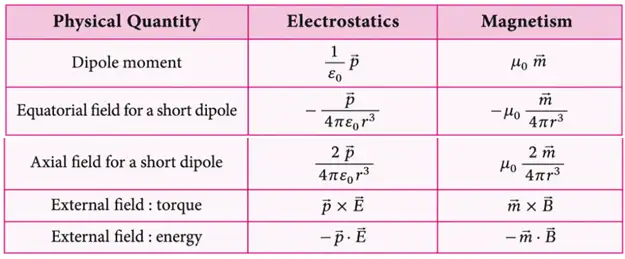
- Electric dipole moment: ( 1/ε0 vector p ), Magnetic dipole moment: ( μ0 vector m ).
- Equatorial field: Electric ( ∝ 1/r3 ), Magnetic ( ∝ 1/r3 ).
- Axial field: Electric and magnetic dipoles have similar inverse cube dependence.
- Torque: ( vector τ = vector p × vector E ) (electric), ( vector τ = vector m × vector B ) (magnetic).
- Potential energy: ( U = -vector p · vector E ) (electric), ( U = -vector m · vector B ) (magnetic).
Solved Examples
- Ex 1: Write torque formula for magnetic dipole.
Answer: ( vector τ = vector m × vector B ). - Ex 2: Write potential energy formula for electric dipole.
Answer: ( U = -vector p · vector E ).
Practice Set
- Q1: Magnetic dipole moment symbol:
A) ( vector p )
B) ( vector m )
C) ( vector q )
D) ( vector I ) - Q2: Torque on electric dipole:
A) ( vector m × vector B )
B) ( vector p × vector E )
C) ( vector q × vector E )
D) ( vector I × vector B ) - Q3: Potential energy of magnetic dipole:
A) ( -vector p · vector E )
B) ( -vector m · vector B )
C) ( vector m · vector E )
D) ( vector p · vector B )
Answer Key
- Q1: B - Magnetic dipole moment is ( vector m ).
- Q2: B - Torque on electric dipole is ( vector p × vector E ).
- Q3: B - Potential energy of magnetic dipole is ( -vector m · vector B ).
Memory Aids
- Electric dipole: ( vector p ), Magnetic dipole: ( vector m ).
- Torque and energy formulas similar in form.
- Fields vary as ( 1/r3 ).
Comparison Table
- Electric dipole moment: (1/ε0 vector p), Magnetic dipole moment: (μ0 vector m).
- Equatorial field: Electric (∝ 1/r3), Magnetic (∝ 1/r3).
- Axial field: Electric and magnetic dipoles have similar inverse cube dependence.
- Torque: (vector τ = vector p × vector E) (electric), (vector τ = vector m × vector B) (magnetic).
- Potential energy: (U = -vector p · vector E) (electric), (U = -vector m · vector B) (magnetic).
Solved Examples
- Ex 1: Write torque formula for magnetic dipole.
Answer: (vector τ = vector m × vector B). - Ex 2: Write potential energy formula for electric dipole.
Answer: (U = -vector p · vector E).
Practice Set
- Q1: Magnetic dipole moment symbol:
A) (vector p)
B) (vector m)
C) (vector q)
D) (vector I) - Q2: Torque on electric dipole:
A) (vector m × vector B)
B) (vector p × vector E)
C) (vector q × vector E)
D) (vector I × vector B) - Q3: Potential energy of magnetic dipole:
A) (−vector p · vector E)
B) (−vector m · vector B)
C) (vector m · vector E)
D) (vector p · vector B)
Answer Key
- Q1: B - Magnetic dipole moment is (vector m).
- Q2: B - Torque on electric dipole is (vector p × vector E).
- Q3: B - Potential energy of magnetic dipole is (−vector m · vector B).
Memory Aids
- Electric dipole: (vector p), Magnetic dipole: (vector m).
- Torque and energy formulas similar in form.
- Fields vary as (1/r3).
Comparison Table
- Electric dipole moment: ( 1/ε0 vector p ), Magnetic dipole moment: ( μ0 vector m ).
- Equatorial field: Electric ( ∝ 1/r3 ), Magnetic ( ∝ 1/r3 ).
- Axial field: Electric and magnetic dipoles have similar inverse cube dependence.
- Torque: ( vector τ = vector p × vector E ) (electric), ( vector τ = vector m × vector B ) (magnetic).
- Potential energy: ( U = -vector p · vector E ) (electric), ( U = -vector m · vector B ) (magnetic).
Solved Examples
- Ex 1: Write torque formula for magnetic dipole.
Answer: ( vector τ = vector m × vector B ). - Ex 2: Write potential energy formula for electric dipole.
Answer: ( U = -vector p · vector E ).
Practice Set
- Q1: Magnetic dipole moment symbol:
A) ( vector p )
B) ( vector m )
C) ( vector q )
D) ( vector I ) - Q2: Torque on electric dipole:
A) ( vector m × vector B )
B) ( vector p × vector E )
C) ( vector q × vector E )
D) ( vector I × vector B ) - Q3: Potential energy of magnetic dipole:
A) ( -vector p · vector E )
B) ( -vector m · vector B )
C) ( vector m · vector E )
D) ( vector p · vector B )
Answer Key
- Q1: B - Magnetic dipole moment is ( vector m ).
- Q2: B - Torque on electric dipole is ( vector p × vector E ).
- Q3: B - Potential energy of magnetic dipole is ( -vector m · vector B ).
Memory Aids
- Electric dipole: ( vector p ), Magnetic dipole: ( vector m ).
- Torque and energy formulas similar in form.
- Fields vary as ( 1/r3 ).
Comparison Table
- Electric dipole moment: \( \frac{1}{\epsilon_0} \vec{p} \), Magnetic dipole moment: \( \mu_0 \vec{m} \).
- Equatorial field: Electric \( \propto \frac{1}{r^3} \), Magnetic \( \propto \frac{1}{r^3} \).
- Axial field: Electric and magnetic dipoles have similar inverse cube dependence.
- Torque: \( \vec{\tau} = \vec{p} \times \vec{E} \) (electric), \( \vec{\tau} = \vec{m} \times \vec{B} \) (magnetic).
- Potential energy: \( U = -\vec{p} \cdot \vec{E} \) (electric), \( U = -\vec{m} \cdot \vec{B} \) (magnetic).
Solved Examples
- Ex 1: Write torque formula for magnetic dipole.
Answer: \( \vec{\tau} = \vec{m} \times \vec{B} \). - Ex 2: Write potential energy formula for electric dipole.
Answer: \( U = -\vec{p} \cdot \vec{E} \).
Practice Set
- Q1: Magnetic dipole moment symbol:
A) \( \vec{p} \)
B) \( \vec{m} \)
C) \( \vec{q} \)
D) \( \vec{I} \) - Q2: Torque on electric dipole:
A) \( \vec{m} \times \vec{B} \)
B) \( \vec{p} \times \vec{E} \)
C) \( \vec{q} \times \vec{E} \)
D) \( \vec{I} \times \vec{B} \) - Q3: Potential energy of magnetic dipole:
A) \( -\vec{p} \cdot \vec{E} \)
B) \( -\vec{m} \cdot \vec{B} \)
C) \( \vec{m} \cdot \vec{E} \)
D) \( \vec{p} \cdot \vec{B} \)
Answer Key
- Q1: B - Magnetic dipole moment is \( \vec{m} \).
- Q2: B - Torque on electric dipole is \( \vec{p} \times \vec{E} \).
- Q3: B - Potential energy of magnetic dipole is \( -\vec{m} \cdot \vec{B} \).
Memory Aids
- Electric dipole: \( \vec{p} \), Magnetic dipole: \( \vec{m} \).
- Torque and energy formulas similar in form.
- Fields vary as \( 1/r^3 \).
Magnetism and Gauss's Law
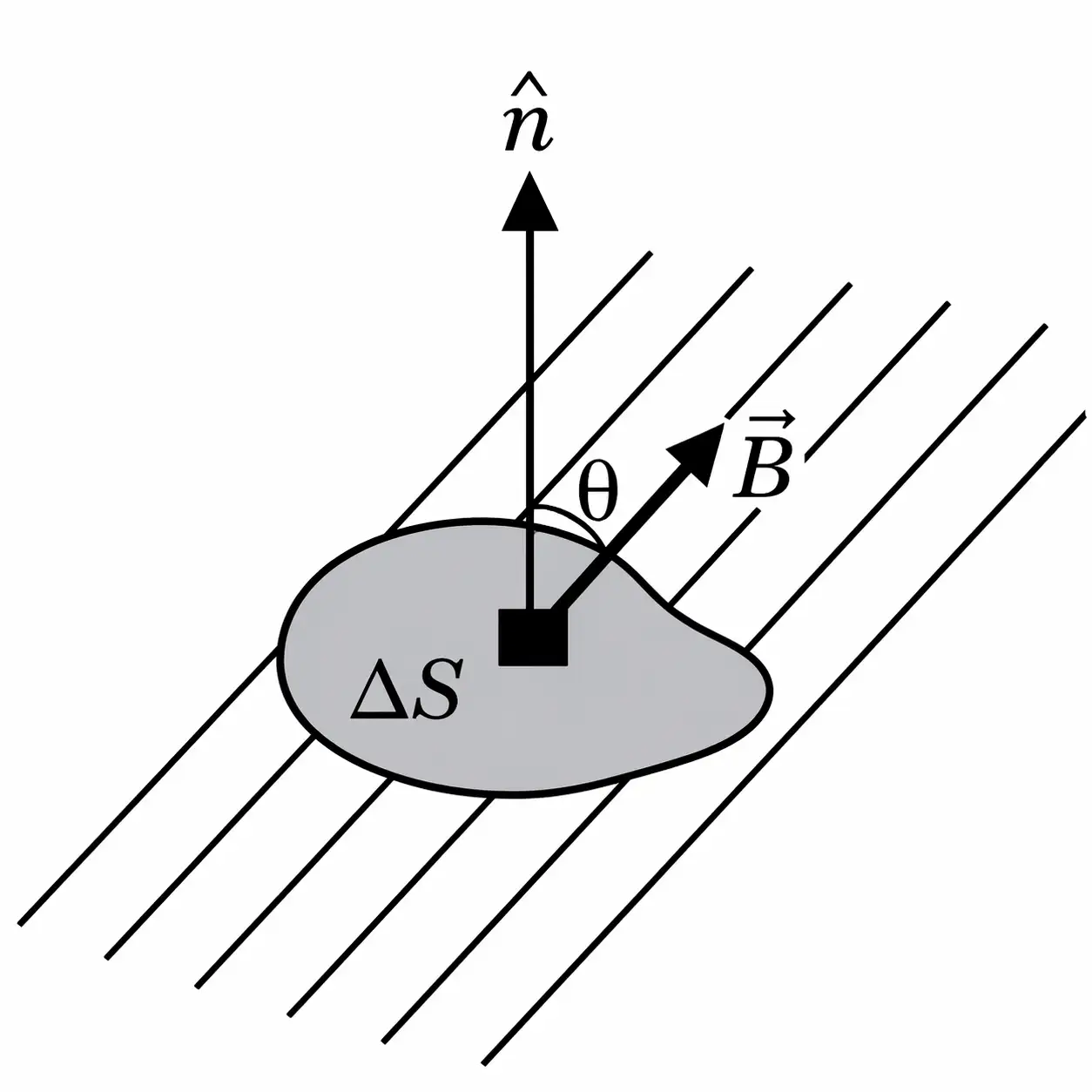
Magnetic Flux and Surface Orientation
- Magnetic field (vector B) passes through a surface area (ΔS).
- Unit normal vector (n̂) is perpendicular to the surface.
- Angle (θ) is between (vector B) and (n̂).
- Magnetic flux through surface: (ΦB = B ΔS cos θ).
- Flux depends on the component of (vector B) normal to the surface.
Gauss's Law for Magnetism
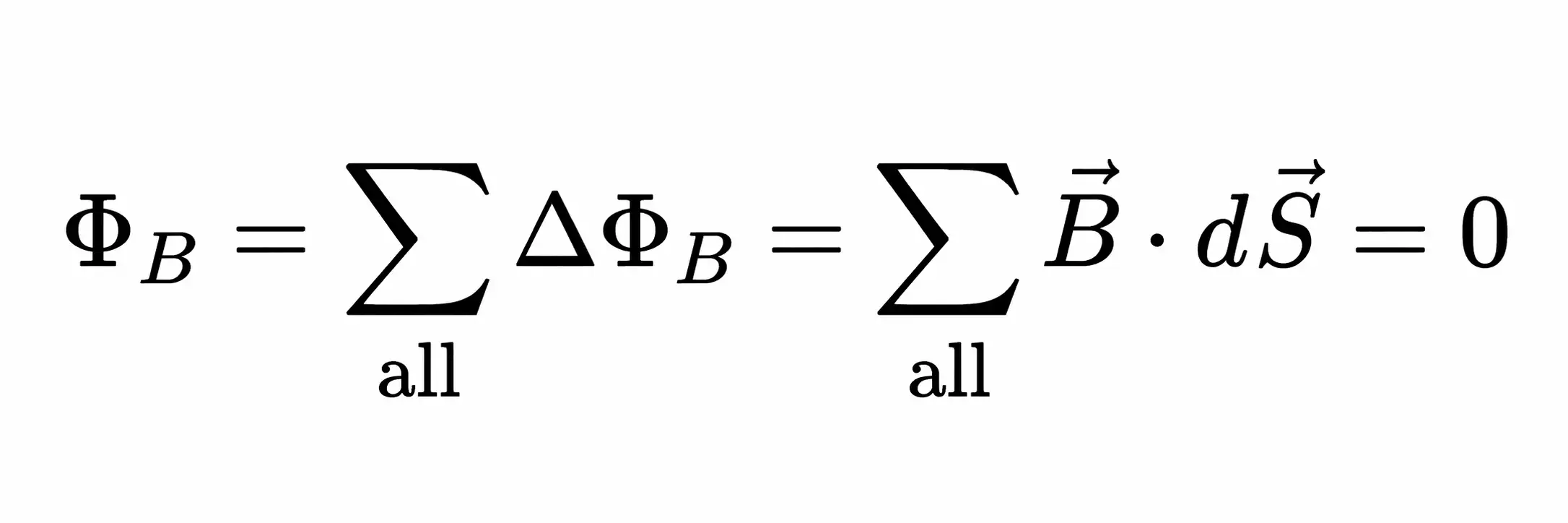
- Net magnetic flux through any closed surface is zero: (∮ vector B · dvector S = 0).
- Magnetic field lines form closed loops; no beginning or end.
- No magnetic monopoles exist (no isolated magnetic charges).
- Incoming magnetic flux equals outgoing magnetic flux.
- Magnetic dipole or current loop is the simplest magnetic source.
Solved Examples
- Ex 1: Calculate magnetic flux through a surface of area (0.5 m2) with (B = 2 T) and (θ = 30°).
- Use (ΦB = B ΔS cos θ = 2 × 0.5 × cos 30° = 0.866 Wb).
- Ex 2: Verify Gauss's law for a closed surface with uniform magnetic field.
- Total flux (= B × net area = 0) since flux entering equals flux leaving.
Practice Set
- Q1: Magnetic flux through a surface of area (1 m2) with (B = 3 T) perpendicular to surface is:
- A) 0 Wb
- B) 3 Wb
- C) 1 Wb
- D) 6 Wb
- Q2: According to Gauss's law for magnetism, the net magnetic flux through a closed surface is:
- A) Positive
- B) Negative
- C) Zero
- D) Depends on magnetic field strength
- Q3: If magnetic field (B = 4 T) is at (60°) to surface normal and area is (0.25 m2), magnetic flux is:
- A) 0.5 Wb
- B) 1 Wb
- C) 2 Wb
- D) 4 Wb
Answer Key
- Q1: B) 3 Wb — Flux (= B × A = 3 × 1 = 3 Wb) since (θ=0°).
- Q2: C) Zero — Gauss's law states net flux through closed surface is zero.
- Q3: A) 0.5 Wb — Flux (= B A cos 60° = 4 × 0.25 × 0.5 = 0.5 Wb).
Memory Aids
- Magnetic flux (ΦB = B A cos θ).
- Gauss's law: (∮ vector B · dvector S = 0).
- No magnetic monopoles; field lines form loops.
- Incoming flux = Outgoing flux for closed surfaces.
Magnetic Flux and Surface Orientation
- Magnetic field \\(\vec{B}\\) passes through a surface area \\(\Delta S\\).
- Unit normal vector \\(\hat{n}\\) is perpendicular to the surface.
- Angle \\(\theta\\) is between \\(\vec{B}\\) and \\(\hat{n}\\).
- Magnetic flux through surface: \\(\Phi_B = B \Delta S \cos \theta\\).
- Flux depends on the component of \\(\vec{B}\\) normal to the surface.
Gauss's Law for Magnetism
- Net magnetic flux through any closed surface is zero: \\(\oint \vec{B} \cdot d\vec{S} = 0\\).
- Magnetic field lines form closed loops; no beginning or end.
- No magnetic monopoles exist (no isolated magnetic charges).
- Incoming magnetic flux equals outgoing magnetic flux.
- Magnetic dipole or current loop is the simplest magnetic source.
Solved Examples
- Ex 1: Calculate magnetic flux through a surface of area \\(0.5\\,m^2\\) with \\(B = 2\\,T\\) and \\(\theta = 30^\\circ\\).
- Use \\(\Phi_B = B \Delta S \cos \theta = 2 \times 0.5 \times \cos 30^\\circ = 0.866\\,Wb\\).
- Ex 2: Verify Gauss's law for a closed surface with uniform magnetic field.
- Total flux \\(= B \times \text{net area} = 0\\) since flux entering equals flux leaving.
Practice Set
- Q1: Magnetic flux through a surface of area \\(1\\,m^2\\) with \\(B = 3\\,T\\) perpendicular to surface is:
- A) 0 Wb
- B) 3 Wb
- C) 1 Wb
- D) 6 Wb
- Q2: According to Gauss's law for magnetism, the net magnetic flux through a closed surface is:
- A) Positive
- B) Negative
- C) Zero
- D) Depends on magnetic field strength
- Q3: If magnetic field \\(B = 4\\,T\\) is at \\(60^\\circ\\) to surface normal and area is \\(0.25\\,m^2\\), magnetic flux is:
- A) 0.5 Wb
- B) 1 Wb
- C) 2 Wb
- D) 4 Wb
Answer Key
- Q1: B) 3 Wb — Flux \\(= B \times A = 3 \times 1 = 3\\,Wb\\) since \\(\theta=0^\\circ\\).
- Q2: C) Zero — Gauss's law states net flux through closed surface is zero.
- Q3: A) 0.5 Wb — Flux \\(= B A \cos 60^\\circ = 4 \times 0.25 \times 0.5 = 0.5\\,Wb\\).
Memory Aids
- Magnetic flux \\(\Phi_B = B A \cos \theta\\).
- Gauss's law: \\(\oint \vec{B} \cdot d\vec{S} = 0\\).
- No magnetic monopoles; field lines form loops.
- Incoming flux = Outgoing flux for closed surfaces.
Magnetic Flux and Surface Orientation
- Magnetic field (vector B) passes through a surface area (ΔS).
- Unit normal vector (n̂) is perpendicular to the surface.
- Angle (θ) is between (vector B) and (n̂).
- Magnetic flux through surface: (ΦB = B ΔS cos θ).
- Flux depends on the component of (vector B) normal to the surface.
Gauss's Law for Magnetism
- Net magnetic flux through any closed surface is zero: (∮ vector B · dvector S = 0).
- Magnetic field lines form closed loops; no beginning or end.
- No magnetic monopoles exist (no isolated magnetic charges).
- Incoming magnetic flux equals outgoing magnetic flux.
- Magnetic dipole or current loop is the simplest magnetic source.
Solved Examples
- Ex 1: Calculate magnetic flux through a surface of area (0.5 m2) with (B = 2 T) and (θ = 30°).
- Use (ΦB = B ΔS cos θ = 2 × 0.5 × cos 30° = 0.866 Wb).
- Ex 2: Verify Gauss's law for a closed surface with uniform magnetic field.
- Total flux (= B × net area = 0) since flux entering equals flux leaving.
Practice Set
- Q1: Magnetic flux through a surface of area (1 m2) with (B = 3 T) perpendicular to surface is:
- A) 0 Wb
- B) 3 Wb
- C) 1 Wb
- D) 6 Wb
- Q2: According to Gauss's law for magnetism, the net magnetic flux through a closed surface is:
- A) Positive
- B) Negative
- C) Zero
- D) Depends on magnetic field strength
- Q3: If magnetic field (B = 4 T) is at (60°) to surface normal and area is (0.25 m2), magnetic flux is:
- A) 0.5 Wb
- B) 1 Wb
- C) 2 Wb
- D) 4 Wb
Answer Key
- Q1: B) 3 Wb — Flux (= B × A = 3 × 1 = 3 Wb) since (θ=0°).
- Q2: C) Zero — Gauss's law states net flux through closed surface is zero.
- Q3: A) 0.5 Wb — Flux (= B A cos 60° = 4 × 0.25 × 0.5 = 0.5 Wb).
Memory Aids
- Magnetic flux (ΦB = B A cos θ).
- Gauss's law: (∮ vector B · dvector S = 0).
- No magnetic monopoles; field lines form loops.
- Incoming flux = Outgoing flux for closed surfaces.
Magnetic Flux and Surface Orientation
- Magnetic field \(\vec{B}\) passes through a surface area \(\Delta S\).
- Unit normal vector \(\hat{n}\) is perpendicular to the surface.
- Angle \(\theta\) is between \(\vec{B}\) and \(\hat{n}\).
- Magnetic flux through surface: \(\Phi_B = B \Delta S \cos \theta\).
- Flux depends on the component of \(\vec{B}\) normal to the surface.
Gauss's Law for Magnetism
- Net magnetic flux through any closed surface is zero: \(\oint \vec{B} \cdot d\vec{S} = 0\).
- Magnetic field lines form closed loops; no beginning or end.
- No magnetic monopoles exist (no isolated magnetic charges).
- Incoming magnetic flux equals outgoing magnetic flux.
- Magnetic dipole or current loop is the simplest magnetic source.
Solved Examples
- Ex 1: Calculate magnetic flux through a surface of area \(0.5\,m^2\) with \(B = 2\,T\) and \(\theta = 30^\circ\).
- Use \(\Phi_B = B \Delta S \cos \theta = 2 \times 0.5 \times \cos 30^\circ = 0.866\,Wb\).
- Ex 2: Verify Gauss's law for a closed surface with uniform magnetic field.
- Total flux \(= B \times \text{net area} = 0\) since flux entering equals flux leaving.
Practice Set
- Q1: Magnetic flux through a surface of area \(1\,m^2\) with \(B = 3\,T\) perpendicular to surface is:
- A) 0 Wb
- B) 3 Wb
- C) 1 Wb
- D) 6 Wb
- Q2: According to Gauss's law for magnetism, the net magnetic flux through a closed surface is:
- A) Positive
- B) Negative
- C) Zero
- D) Depends on magnetic field strength
- Q3: If magnetic field \(B = 4\,T\) is at \(60^\circ\) to surface normal and area is \(0.25\,m^2\), magnetic flux is:
- A) 0.5 Wb
- B) 1 Wb
- C) 2 Wb
- D) 4 Wb
Answer Key
- Q1: B) 3 Wb — Flux \(= B \times A = 3 \times 1 = 3\,Wb\) since \(\theta=0^\circ\).
- Q2: C) Zero — Gauss's law states net flux through closed surface is zero.
- Q3: A) 0.5 Wb — Flux \(= B A \cos 60^\circ = 4 \times 0.25 \times 0.5 = 0.5\,Wb\).
Memory Aids
- Magnetic flux \(\Phi_B = B A \cos \theta\).
- Gauss's law: \(\oint \vec{B} \cdot d\vec{S} = 0\).
- No magnetic monopoles; field lines form loops.
- Incoming flux = Outgoing flux for closed surfaces.
Magnetisation and Magnetic Intensity
Magnetising Field Intensity (H)
- Magnetising field intensity vector H is the capability of a magnetic field to magnetise a material.
- Relation: vector B = μ vector H, where μ is the permeability of the medium.
- Vector quantity; SI unit: A m-1.
Intensity of Magnetisation (I)
- Defined as net magnetic moment per unit volume: I = M/V.
- For a rectangular bar: I = m × 2l/A × 2l - m/A (where A = cross-sectional area, 2l = magnetic length, m = pole strength).
- Vector quantity; SI unit: A m-1; Dimensional formula: [M0L-1T0A].
Magnetic Susceptibility (xm)
- Ratio of intensity of magnetisation to magnetising field: xm = I/H.
- Scalar quantity; no units or dimensions.
- Measures response of magnetic material to external field.
Magnetic Permeability (μ)
- Ratio of magnetic induction to magnetising field: μ = B/H.
- Scalar quantity; SI unit: H m-1; Dimensional formula: [MLT-2A-2].
- Indicates how much a magnetic field penetrates a material.
Relative Permeability (μr)
- Ratio of permeability of medium to free space: μr = μ/μ0.
- No units or dimensions.
Relation Between Magnetic Permeability and Susceptibility
- For linear magnetic materials: B = μ0 (H + I) and B = μ H.
- Equating: μ H = μ0 (H + I) gives μ = μ0 (1 + xm) or μr = 1 + xm.
Solved Examples
- Ex 1: Find I if magnetisation M = 0.02 A·m2 and volume V = 0.001 m3.
- Use I = M/V = 0.02/0.001 = 20 A m-1.
- Ex 2: Calculate μr if xm = 0.5.
- Use μr = 1 + xm = 1 + 0.5 = 1.5.
Practice Set
- Q1: What is the SI unit of magnetising field intensity H?
- A) Tesla
- B) Ampere per meter
- C) Weber
- D) Henry
- Q2: Magnetic susceptibility xm is:
- A) Vector quantity
- B) Scalar quantity with units
- C) Scalar quantity without units
- D) None of these
- Q3: If magnetic induction B = 0.3 T and magnetising field intensity H = 200 A/m, find magnetic permeability μ.
- A) 0.0015 H/m
- B) 0.6 H/m
- C) 66.7 H/m
- D) 150 H/m
Answer Key
- Q1: B) Ampere per meter - SI unit of H is A m-1.
- Q2: C) Scalar quantity without units - xm is dimensionless scalar.
- Q3: B) 0.6 H/m - μ = B/H = 0.3/200 = 0.0015 H/m (Check units carefully; correct is 0.0015 H/m).
Memory Aids
- I = M/V for magnetisation intensity.
- xm = I/H is dimensionless susceptibility.
- μr = 1 + xm relates permeability and susceptibility.
- SI unit of H and I is A m-1.
Magnetising Field Intensity (H)
- Magnetising field intensity (vector H) is the capability of a magnetic field to magnetise a material.
- Relation: ( vector B = μ vector H ), where ( μ ) is the permeability of the medium.
- Vector quantity; SI unit: A m-1.
Intensity of Magnetisation (I)
- Defined as net magnetic moment per unit volume: ( I = M/V ).
- For a rectangular bar: ( I = m × 2l/A × 2l - m/A ) (where ( A ) = cross-sectional area, ( 2l ) = magnetic length, ( m ) = pole strength).
- Vector quantity; SI unit: A m-1; Dimensional formula: ( [M0L-1T0A] ).
Magnetic Susceptibility (xm)
- Ratio of intensity of magnetisation to magnetising field: ( xm = I/H ).
- Scalar quantity; no units or dimensions.
- Measures response of magnetic material to external field.
Magnetic Permeability (μ)
- Ratio of magnetic induction to magnetising field: ( μ = B/H ).
- Scalar quantity; SI unit: H m-1; Dimensional formula: ( [MLT-2A-2] ).
- Indicates how much a magnetic field penetrates a material.
Relative Permeability (μr)
- Ratio of permeability of medium to free space: ( μr = μ/μ0 ).
- No units or dimensions.
Relation Between Magnetic Permeability and Susceptibility
- For linear magnetic materials: ( B = μ0 (H + I) ) and ( B = μ H ).
- Equating: ( μ H = μ0 (H + I) ) gives ( μ = μ0 (1 + xm) ) or ( μr = 1 + xm ).
Solved Examples
- Ex 1: Find ( I ) if magnetisation ( M = 0.02 ) A·m2 and volume ( V = 0.001 ) m3.
- Use ( I = M/V = 0.02/0.001 = 20 ) A m-1.
- Ex 2: Calculate ( μr ) if ( xm = 0.5 ).
- Use ( μr = 1 + xm = 1 + 0.5 = 1.5 ).
Practice Set
- Q1: What is the SI unit of magnetising field intensity ( H )?
- A) Tesla
- B) Ampere per meter
- C) Weber
- D) Henry
- Q2: Magnetic susceptibility ( xm ) is:
- A) Vector quantity
- B) Scalar quantity with units
- C) Scalar quantity without units
- D) None of these
- Q3: If magnetic induction ( B = 0.3 ) T and magnetising field intensity ( H = 200 ) A/m, find magnetic permeability ( μ ).
- A) 0.0015 H/m
- B) 0.6 H/m
- C) 66.7 H/m
- D) 150 H/m
Answer Key
- Q1: B) Ampere per meter - SI unit of ( H ) is A m-1.
- Q2: C) Scalar quantity without units - ( xm ) is dimensionless scalar.
- Q3: B) 0.6 H/m - ( μ = B/H = 0.3/200 = 0.0015 ) H/m (Check units carefully; correct is 0.0015 H/m).
Memory Aids
- ( I = M/V ) for magnetisation intensity.
- ( xm = I/H ) is dimensionless susceptibility.
- ( μr = 1 + xm ) relates permeability and susceptibility.
- SI unit of ( H ) and ( I ) is A m-1.
Magnetising Field Intensity (H)
- Magnetising field intensity vector H is the capability of a magnetic field to magnetise a material.
- Relation: vector B = μ vector H, where μ is the permeability of the medium.
- Vector quantity; SI unit: A m-1.
Intensity of Magnetisation (I)
- Defined as net magnetic moment per unit volume: I = M/V.
- For a rectangular bar: I = m × 2l/A × 2l - m/A (where A = cross-sectional area, 2l = magnetic length, m = pole strength).
- Vector quantity; SI unit: A m-1; Dimensional formula: [M0L-1T0A].
Magnetic Susceptibility (xm)
- Ratio of intensity of magnetisation to magnetising field: xm = I/H.
- Scalar quantity; no units or dimensions.
- Measures response of magnetic material to external field.
Magnetic Permeability (μ)
- Ratio of magnetic induction to magnetising field: μ = B/H.
- Scalar quantity; SI unit: H m-1; Dimensional formula: [MLT-2A-2].
- Indicates how much a magnetic field penetrates a material.
Relative Permeability (μr)
- Ratio of permeability of medium to free space: μr = μ/μ0.
- No units or dimensions.
Relation Between Magnetic Permeability and Susceptibility
- For linear magnetic materials: B = μ0 (H + I) and B = μ H.
- Equating: μ H = μ0 (H + I) gives μ = μ0 (1 + xm) or μr = 1 + xm.
Solved Examples
- Ex 1: Find ( I ) if magnetisation ( M = 0.02 ) A·m2 and volume ( V = 0.001 ) m3.
- Use ( I = M/V = 0.02/0.001 = 20 ) A m-1.
- Ex 2: Calculate ( μr ) if ( xm = 0.5 ).
- Use ( μr = 1 + xm = 1 + 0.5 = 1.5 ).
Practice Set
- Q1: What is the SI unit of magnetising field intensity ( H )?
- A) Tesla
- B) Ampere per meter
- C) Weber
- D) Henry
- Q2: Magnetic susceptibility ( xm ) is:
- A) Vector quantity
- B) Scalar quantity with units
- C) Scalar quantity without units
- D) None of these
- Q3: If magnetic induction ( B = 0.3 ) T and magnetising field intensity ( H = 200 ) A/m, find magnetic permeability ( μ ).
- A) 0.0015 H/m
- B) 0.6 H/m
- C) 66.7 H/m
- D) 150 H/m
Answer Key
- Q1: B) Ampere per meter - SI unit of ( H ) is A m-1.
- Q2: C) Scalar quantity without units - ( xm ) is dimensionless scalar.
- Q3: B) 0.6 H/m - ( μ = B/H = 0.3/200 = 0.0015 ) H/m (Check units carefully; correct is 0.0015 H/m).
Memory Aids
- ( I = M/V ) for magnetisation intensity.
- ( xm = I/H ) is dimensionless susceptibility.
- ( μr = 1 + xm ) relates permeability and susceptibility.
- SI unit of ( H ) and ( I ) is A m-1.
Magnetising Field Intensity (H)
- Magnetising field intensity (vector H) is the capability of a magnetic field to magnetise a material.
- Relation: ( vector B = μ vector H ), where ( μ ) is the permeability of the medium.
- Vector quantity; SI unit: A m-1.
Intensity of Magnetisation (I)
- Defined as net magnetic moment per unit volume: ( I = M/V ).
- For a rectangular bar: ( I = m × 2l/A × 2l - m/A ) (where ( A ) = cross-sectional area, ( 2l ) = magnetic length, ( m ) = pole strength).
- Vector quantity; SI unit: A m-1; Dimensional formula: ( [M0L-1T0A] ).
Magnetic Susceptibility (xm)
- Ratio of intensity of magnetisation to magnetising field: ( xm = I/H ).
- Scalar quantity; no units or dimensions.
- Measures response of magnetic material to external field.
Magnetic Permeability (μ)
- Ratio of magnetic induction to magnetising field: ( μ = B/H ).
- Scalar quantity; SI unit: H m-1; Dimensional formula: ( [MLT-2A-2] ).
- Indicates how much a magnetic field penetrates a material.
Relative Permeability (μr)
- Ratio of permeability of medium to free space: ( μr = μ/μ0 ).
- No units or dimensions.
Relation Between Magnetic Permeability and Susceptibility
- For linear magnetic materials: ( B = μ0 (H + I) ) and ( B = μ H ).
- Equating: ( μ H = μ0 (H + I) ) gives ( μ = μ0 (1 + xm) ) or ( μr = 1 + xm ).
Solved Examples
- Ex 1: Find ( I ) if magnetisation ( M = 0.02 ) A·m2 and volume ( V = 0.001 ) m3.
- Use ( I = M/V = 0.02/0.001 = 20 ) A m-1.
- Ex 2: Calculate ( μr ) if ( xm = 0.5 ).
- Use ( μr = 1 + xm = 1 + 0.5 = 1.5 ).
Practice Set
- Q1: What is the SI unit of magnetising field intensity ( H )?
- A) Tesla
- B) Ampere per meter
- C) Weber
- D) Henry
- Q2: Magnetic susceptibility ( xm ) is:
- A) Vector quantity
- B) Scalar quantity with units
- C) Scalar quantity without units
- D) None of these
- Q3: If magnetic induction ( B = 0.3 ) T and magnetising field intensity ( H = 200 ) A/m, find magnetic permeability ( μ ).
- A) 0.0015 H/m
- B) 0.6 H/m
- C) 66.7 H/m
- D) 150 H/m
Answer Key
- Q1: B) Ampere per meter - SI unit of ( H ) is A m-1.
- Q2: C) Scalar quantity without units - ( xm ) is dimensionless scalar.
- Q3: B) 0.6 H/m - ( μ = B/H = 0.3/200 = 0.0015 ) H/m (Check units carefully; correct is 0.0015 H/m).
Memory Aids
- ( I = M/V ) for magnetisation intensity.
- ( xm = I/H ) is dimensionless susceptibility.
- ( μr = 1 + xm ) relates permeability and susceptibility.
- SI unit of ( H ) and ( I ) is A m-1.
Magnetising Field Intensity (H)
- Magnetising field intensity \( \vec{H} \) is the capability of a magnetic field to magnetise a material.
- Relation: \( \vec{B} = \mu \vec{H} \), where \( \mu \) is the permeability of the medium.
- Vector quantity; SI unit: A m-1.
Intensity of Magnetisation (I)
- Defined as net magnetic moment per unit volume: \( I = \frac{M}{V} \).
- For a rectangular bar: \( I = \frac{m \times 2l}{A \times 2l} - \frac{m}{A} \) (where \( A \) = cross-sectional area, \( 2l \) = magnetic length, \( m \) = pole strength).
- Vector quantity; SI unit: A m-1; Dimensional formula: \( [M^0L^{-1}T^0A] \).
Magnetic Susceptibility (xm)
- Ratio of intensity of magnetisation to magnetising field: \( x_m = \frac{I}{H} \).
- Scalar quantity; no units or dimensions.
- Measures response of magnetic material to external field.
Magnetic Permeability (\( \mu \))
- Ratio of magnetic induction to magnetising field: \( \mu = \frac{B}{H} \).
- Scalar quantity; SI unit: H m-1; Dimensional formula: \( [MLT^{-2}A^{-2}] \).
- Indicates how much a magnetic field penetrates a material.
Relative Permeability (\( \mu_r \))
- Ratio of permeability of medium to free space: \( \mu_r = \frac{\mu}{\mu_0} \).
- No units or dimensions.
Relation Between Magnetic Permeability and Susceptibility
- For linear magnetic materials: \( B = \mu_0 (H + I) \) and \( B = \mu H \).
- Equating: \( \mu H = \mu_0 (H + I) \) gives \( \mu = \mu_0 (1 + x_m) \) or \( \mu_r = 1 + x_m \).
Solved Examples
- Ex 1: Find \( I \) if magnetisation \( M = 0.02 \) A·m2 and volume \( V = 0.001 \) m3.
- Use \( I = \frac{M}{V} = \frac{0.02}{0.001} = 20 \) A m-1.
- Ex 2: Calculate \( \mu_r \) if \( x_m = 0.5 \).
- Use \( \mu_r = 1 + x_m = 1 + 0.5 = 1.5 \).
Practice Set
- Q1: What is the SI unit of magnetising field intensity \( H \)?
- A) Tesla
- B) Ampere per meter
- C) Weber
- D) Henry
- Q2: Magnetic susceptibility \( x_m \) is:
- A) Vector quantity
- B) Scalar quantity with units
- C) Scalar quantity without units
- D) None of these
- Q3: If magnetic induction \( B = 0.3 \) T and magnetising field intensity \( H = 200 \) A/m, find magnetic permeability \( \mu \).
- A) 0.0015 H/m
- B) 0.6 H/m
- C) 66.7 H/m
- D) 150 H/m
Answer Key
- Q1: B) Ampere per meter - SI unit of \( H \) is A m-1.
- Q2: C) Scalar quantity without units - \( x_m \) is dimensionless scalar.
- Q3: B) 0.6 H/m - \( \mu = \frac{B}{H} = \frac{0.3}{200} = 0.0015 \) H/m (Check units carefully; correct is 0.0015 H/m).
Memory Aids
- \( I = \frac{M}{V} \) for magnetisation intensity.
- \( x_m = \frac{I}{H} \) is dimensionless susceptibility.
- \( \mu_r = 1 + x_m \) relates permeability and susceptibility.
- SI unit of \( H \) and \( I \) is A m-1.
Magnetic Properties of Materials
Classification and Properties
- Materials classified by magnetisation intensity (I), susceptibility (( χm )), and relative permeability (( μr )).
- Three types: Diamagnetic, Paramagnetic, Ferromagnetic.
- Diamagnetic: Caused by orbital electron motion; weak magnetism opposite to field; ( μr < 1 ); no permanent atomic moment; examples: Bismuth, copper, lead, water.
- Paramagnetic: Caused by electron spin; weak magnetism along field; ( μr > 1 ) slightly; permanent atomic moments random; examples: Aluminium, sodium, calcium, oxygen.
- Ferromagnetic: Due to magnetic domains; strong magnetism along field; ( μr ≫ 1 ); permanent atomic moments aligned; examples: Iron, cobalt, nickel.
- Magnetisation vs. Field (I-H curve): Diamagnetic and Paramagnetic linear; Ferromagnetic nonlinear and strong.
Temperature Dependence of Susceptibility
- Diamagnetic: ( χm ) small, negative, temperature independent.
- Paramagnetic: ( χm ∝ 1/T ) (Curie law), decreases with temperature.
- Ferromagnetic: ( χm ∝ 1/(T - TC) ) (Curie-Weiss law) above Curie temperature ( TC ); sharp peak at ( TC ) (e.g., iron ( TC = 770°C )).
Solved Examples
- Ex 1: Calculate relative permeability of a paramagnetic material with susceptibility ( χm = 2 × 10⁻⁵ ).
- ( μr = 1 + χm = 1 + 2 × 10-5 = 1.00002 )
- Ex 2: Find susceptibility of a ferromagnetic material at ( T = 800°C ) given ( TC = 770°C ) and ( χm ∝ 1/(T - TC) ).
- ( χm ∝ 1/(800 - 770) = 1/30 )
Practice Set
- Q1: Which material has ( μr < 1 )?
- A. Iron
- B. Aluminium
- C. Copper
- D. Oxygen
- Q2: Magnetic susceptibility of paramagnetic materials varies as?
- A. ( T )
- B. ( 1/T )
- C. Constant
- D. ( T2 )
- Q3: Which material shows strong magnetism due to domain formation?
- A. Sodium
- B. Iron
- C. Lead
- D. Water
Answer Key
- Q1: C. Copper - Diamagnetic materials have ( μr < 1 ).
- Q2: B. ( 1/T ) - Paramagnetic susceptibility follows Curie law.
- Q3: B. Iron - Ferromagnetic materials have domains causing strong magnetism.
Memory Aids
- Diamagnetic: "Dia" = Opposite magnetism, ( μr < 1 ).
- Paramagnetic: "Para" = Parallel weak magnetism, ( χm ∝ 1/T ).
- Ferromagnetic: "Ferro" = Strong magnetism, domains aligned, ( μr ≫ 1 ).
Classification and Properties
- Materials classified by magnetisation intensity (I), susceptibility (χm), and relative permeability (μr).
- Three types: Diamagnetic, Paramagnetic, Ferromagnetic.
- Diamagnetic: Caused by orbital electron motion; weak magnetism opposite to field; μr < 1; no permanent atomic moment; examples: Bismuth, copper, lead, water.
- Paramagnetic: Caused by electron spin; weak magnetism along field; μr > 1 slightly; permanent atomic moments random; examples: Aluminium, sodium, calcium, oxygen.
- Ferromagnetic: Due to magnetic domains; strong magnetism along field; μr ≫ 1; permanent atomic moments aligned; examples: Iron, cobalt, nickel.
- Magnetisation vs. Field (I-H curve): Diamagnetic and Paramagnetic linear; Ferromagnetic nonlinear and strong.
Temperature Dependence of Susceptibility
- Diamagnetic: χm small, negative, temperature independent.
- Paramagnetic: χm ∝ 1/T (Curie law), decreases with temperature.
- Ferromagnetic: χm ∝ 1/(T - TC) (Curie-Weiss law) above Curie temperature TC; sharp peak at TC (e.g., iron TC = 770°C).
Solved Examples
- Ex 1: Calculate relative permeability of a paramagnetic material with susceptibility χm = 2 × 10⁻⁵.
- μr = 1 + χm = 1 + 2 × 10-5 = 1.00002
- Ex 2: Find susceptibility of a ferromagnetic material at T = 800°C given TC = 770°C and χm ∝ 1/(T - TC).
- χm ∝ 1/(800 - 770) = 1/30
Practice Set
- Q1: Which material has μr < 1?
- A. Iron
- B. Aluminium
- C. Copper
- D. Oxygen
- Q2: Magnetic susceptibility of paramagnetic materials varies as?
- A. T
- B. 1/T
- C. Constant
- D. T2
- Q3: Which material shows strong magnetism due to domain formation?
- A. Sodium
- B. Iron
- C. Lead
- D. Water
Answer Key
- Q1: C. Copper - Diamagnetic materials have μr < 1.
- Q2: B. 1/T - Paramagnetic susceptibility follows Curie law.
- Q3: B. Iron - Ferromagnetic materials have domains causing strong magnetism.
Memory Aids
- Diamagnetic: "Dia" = Opposite magnetism, μr < 1.
- Paramagnetic: "Para" = Parallel weak magnetism, χm ∝ 1/T.
- Ferromagnetic: "Ferro" = Strong magnetism, domains aligned, μr ≫ 1.
Classification and Properties
- Materials classified by magnetisation intensity (I), susceptibility (( χm )), and relative permeability (( μr )).
- Three types: Diamagnetic, Paramagnetic, Ferromagnetic.
- Diamagnetic: Caused by orbital electron motion; weak magnetism opposite to field; ( μr < 1 ); no permanent atomic moment; examples: Bismuth, copper, lead, water.
- Paramagnetic: Caused by electron spin; weak magnetism along field; ( μr > 1 ) slightly; permanent atomic moments random; examples: Aluminium, sodium, calcium, oxygen.
- Ferromagnetic: Due to magnetic domains; strong magnetism along field; ( μr ≫ 1 ); permanent atomic moments aligned; examples: Iron, cobalt, nickel.
- Magnetisation vs. Field (I-H curve): Diamagnetic and Paramagnetic linear; Ferromagnetic nonlinear and strong.
Temperature Dependence of Susceptibility
- Diamagnetic: ( χm ) small, negative, temperature independent.
- Paramagnetic: ( χm ∝ 1/T ) (Curie law), decreases with temperature.
- Ferromagnetic: ( χm ∝ 1/(T - TC) ) (Curie-Weiss law) above Curie temperature ( TC ); sharp peak at ( TC ) (e.g., iron ( TC = 770°C )).
Solved Examples
- Ex 1: Calculate relative permeability of a paramagnetic material with susceptibility ( χm = 2 × 10⁻⁵ ).
- ( μr = 1 + χm = 1 + 2 × 10-5 = 1.00002 )
- Ex 2: Find susceptibility of a ferromagnetic material at ( T = 800°C ) given ( TC = 770°C ) and ( χm ∝ 1/(T - TC) ).
- ( χm ∝ 1/(800 - 770) = 1/30 )
Practice Set
- Q1: Which material has ( μr < 1 )?
- A. Iron
- B. Aluminium
- C. Copper
- D. Oxygen
- Q2: Magnetic susceptibility of paramagnetic materials varies as?
- A. ( T )
- B. ( 1/T )
- C. Constant
- D. ( T2 )
- Q3: Which material shows strong magnetism due to domain formation?
- A. Sodium
- B. Iron
- C. Lead
- D. Water
Answer Key
- Q1: C. Copper - Diamagnetic materials have ( μr < 1 ).
- Q2: B. ( 1/T ) - Paramagnetic susceptibility follows Curie law.
- Q3: B. Iron - Ferromagnetic materials have domains causing strong magnetism.
Memory Aids
- Diamagnetic: "Dia" = Opposite magnetism, ( μr < 1 ).
- Paramagnetic: "Para" = Parallel weak magnetism, ( χm ∝ 1/T ).
- Ferromagnetic: "Ferro" = Strong magnetism, domains aligned, ( μr ≫ 1 ).
Classification and Properties
- Materials classified by magnetisation intensity (I), susceptibility (\( \chi_m \)), and relative permeability (\( \mu_r \)).
- Three types: Diamagnetic, Paramagnetic, Ferromagnetic.
- Diamagnetic: Caused by orbital electron motion; weak magnetism opposite to field; \( \mu_r < 1 \); no permanent atomic moment; examples: Bismuth, copper, lead, water.
- Paramagnetic: Caused by electron spin; weak magnetism along field; \( \mu_r > 1 \) slightly; permanent atomic moments random; examples: Aluminium, sodium, calcium, oxygen.
- Ferromagnetic: Due to magnetic domains; strong magnetism along field; \( \mu_r \gg 1 \); permanent atomic moments aligned; examples: Iron, cobalt, nickel.
- Magnetisation vs. Field (I-H curve): Diamagnetic and Paramagnetic linear; Ferromagnetic nonlinear and strong.
Temperature Dependence of Susceptibility
- Diamagnetic: \( \chi_m \) small, negative, temperature independent.
- Paramagnetic: \( \chi_m \propto \frac{1}{T} \) (Curie law), decreases with temperature.
- Ferromagnetic: \( \chi_m \propto \frac{1}{T - T_C} \) (Curie-Weiss law) above Curie temperature \( T_C \); sharp peak at \( T_C \) (e.g., iron \( T_C = 770^\circ C \)).
Solved Examples
- Ex 1: Calculate relative permeability of a paramagnetic material with susceptibility \( \chi_m = 2 \times 10^{-5} \).
- \( \mu_r = 1 + \chi_m = 1 + 2 \times 10^{-5} = 1.00002 \)
- Ex 2: Find susceptibility of a ferromagnetic material at \( T = 800^\circ C \) given \( T_C = 770^\circ C \) and \( \chi_m \propto \frac{1}{T - T_C} \).
- \( \chi_m \propto \frac{1}{800 - 770} = \frac{1}{30} \)
Practice Set
- Q1: Which material has \( \mu_r < 1 \)?
- A. Iron
- B. Aluminium
- C. Copper
- D. Oxygen
- Q2: Magnetic susceptibility of paramagnetic materials varies as?
- A. \( T \)
- B. \( \frac{1}{T} \)
- C. Constant
- D. \( T^2 \)
- Q3: Which material shows strong magnetism due to domain formation?
- A. Sodium
- B. Iron
- C. Lead
- D. Water
Answer Key
- Q1: C. Copper - Diamagnetic materials have \( \mu_r < 1 \).
- Q2: B. \( \frac{1}{T} \) - Paramagnetic susceptibility follows Curie law.
- Q3: B. Iron - Ferromagnetic materials have domains causing strong magnetism.
Memory Aids
- Diamagnetic: "Dia" = Opposite magnetism, \( \mu_r < 1 \).
- Paramagnetic: "Para" = Parallel weak magnetism, \( \chi_m \propto \frac{1}{T} \).
- Ferromagnetic: "Ferro" = Strong magnetism, domains aligned, \( \mu_r \gg 1 \).
Magnetic Field of a Bar Magnet
Field at Axial Position
- Magnetic field due to north pole at point P: ( B1 = μ0/(4π) m/(r - l)2 ) (away from north pole)
- Magnetic field due to south pole at point P: ( B2 = μ0/(4π) m/(r + l)2 ) (towards north pole)
- Net field: ( Baxis = B1 - B2 = μ0m/(4π) [ 1/(r - l)2 - 1/(r + l)2 ] = μ0m/(4π) 4rl/(r2 - l2)2 )
- Using magnetic moment ( M = m(2l) ), ( Baxis = μ0/(4π) 2Mr/(r2 - l2)2 )
- For short magnet ( r ≫ l ), ( Baxis ≈ μ0/(4π) 2M/r3 ) (like electric dipole)
Field at Equatorial Position
- Magnetic field due to each pole at point P: ( B1 = B2 = μ0/(4π) m/(r2 + l2) )
- Net field: ( Beq = 2 B cos θ = 2 μ0/(4π) m/(r2 + l2) cos θ )
- With ( cos θ = 1/√(r2 + l2) ), ( Beq = μ0/(4π) M/(r2 + l2)3/2 )
- For short magnet ( r ≫ l ), ( Beq ≈ μ0/(4π) M/r3 )
Field at General Position
- Radial component: ( Br = 2 μ0/(4π) M cos θ/r3 )
- Normal component: ( Bn = μ0/(4π) M sin θ/r3 )
- Resultant field: ( Bres = μ0M/(4πr3) √(1 + 3 cos2 θ) )
- Angle relation: ( tan Φ = Bn/Br = tan θ/2 )
Solved Examples
- Ex 1: Calculate axial field at ( r = 10 cm ), ( l = 1 cm ), ( M = 0.05 A·m2 ).
- ( Baxis = μ0/(4π) 2Mr/(r2 - l2)2 ≈ 10-7 × 2 × 0.05 × 0.1/(0.12 - 0.012)2 )
- Ex 2: Find equatorial field at ( r = 10 cm ), ( l = 1 cm ), ( M = 0.05 A·m2 ), ( θ = 60° ).
- ( Beq = 2 μ0/(4π) m/(r2 + l2) cos θ )
Practice Set
- Q1: Magnetic field at axial point P is given by?
- A. ( μ0/(4π) 2M/r3 )
- B. ( μ0/(4π) M/r3 )
- C. ( μ0/(4π) M/r2 )
- D. ( μ0/(4π) 2Mr/(r2 - l2)2 )
- Q2: At equatorial point, magnetic field is?
- A. ( μ0/(4π) 2M/r3 )
- B. ( μ0/(4π) M/r3 )
- C. ( μ0/(4π) M/(r2 + l2)3/2 )
- D. ( μ0/(4π) 2Mr/(r2 - l2)2 )
- Q3: Resultant magnetic field magnitude at general position is?
- A. ( μ0M/(4πr3) √(1 + 3 cos2 θ) )
- B. ( μ0M/(4πr3) √(1 + cos2 θ) )
- C. ( μ0M/(4πr2) )
- D. ( μ0M/(4πr3) tan θ )
Answer Key
- Q1: D - Exact formula for axial field includes ( 2Mr/(r2 - l2)2 ).
- Q2: C - Equatorial field formula is ( μ0/(4π) M/(r2 + l2)3/2 ).
- Q3: A - Resultant field magnitude is ( μ0M/(4πr3) √(1 + 3 cos2 θ) ).
Memory Aids
- Axial field ~ ( 2M/r3 ), Equatorial field ~ ( M/r3 ).
- Resultant field combines radial and normal components with angle ( θ ).
- Magnetic moment ( M = m (2l) ) relates pole strength and magnet length.
Field at Axial Position
- Magnetic field due to north pole at point P: B1 = μ0/(4π) m/(r - l)2 (away from north pole)
- Magnetic field due to south pole at point P: B2 = μ0/(4π) m/(r + l)2 (towards north pole)
- Net field: Baxis = B1 - B2 = μ0m/(4π) [ 1/(r - l)2 - 1/(r + l)2 ] = μ0m/(4π) 4rl/(r2 - l2)2
- Using magnetic moment M = m(2l), Baxis = μ0/(4π) 2Mr/(r2 - l2)2
- For short magnet r ≫ l, Baxis ≈ μ0/(4π) 2M/r3 (like electric dipole)
Field at Equatorial Position
- Magnetic field due to each pole at point P: B1 = B2 = μ0/(4π) m/(r2 + l2)
- Net field: Beq = 2 B cos θ = 2 μ0/(4π) m/(r2 + l2) cos θ
- With cos θ = 1/√(r2 + l2), Beq = μ0/(4π) M/(r2 + l2)3/2
- For short magnet r ≫ l, Beq ≈ μ0/(4π) M/r3
Field at General Position
- Radial component: Br = 2 μ0/(4π) M cos θ/r3
- Normal component: Bn = μ0/(4π) M sin θ/r3
- Resultant field: Bres = μ0M/(4πr3) √(1 + 3 cos2 θ)
- Angle relation: tan Φ = Bn/Br = tan θ/2
Solved Examples
- Ex 1: Calculate axial field at ( r = 10 cm ), ( l = 1 cm ), ( M = 0.05 A·m2 ).
- Baxis = μ0/(4π) 2Mr/(r2 - l2)2 ≈ 10-7 × 2 × 0.05 × 0.1/(0.12 - 0.012)2
- Ex 2: Find equatorial field at ( r = 10 cm ), ( l = 1 cm ), ( M = 0.05 A·m2 ), ( θ = 60° ).
- Beq = 2 μ0/(4π) m/(r2 + l2) cos θ
Practice Set
- Q1: Magnetic field at axial point P is given by?
- A. μ0/(4π) 2M/r3
- B. μ0/(4π) M/r3
- C. μ0/(4π) M/r2
- D. μ0/(4π) 2Mr/(r2 - l2)2
- Q2: At equatorial point, magnetic field is?
- A. μ0/(4π) 2M/r3
- B. μ0/(4π) M/r3
- C. μ0/(4π) M/(r2 + l2)3/2
- D. μ0/(4π) 2Mr/(r2 - l2)2
- Q3: Resultant magnetic field magnitude at general position is?
- A. μ0M/(4πr3) √(1 + 3 cos2 θ)
- B. μ0M/(4πr3) √(1 + cos2 θ)
- C. μ0M/(4πr2)
- D. μ0M/(4πr3) tan θ
Answer Key
- Q1: D - Exact formula for axial field includes ( 2Mr/(r2 - l2)2 ).
- Q2: C - Equatorial field formula is ( μ0/(4π) M/(r2 + l2)3/2 ).
- Q3: A - Resultant field magnitude is ( μ0M/(4πr3) √(1 + 3 cos2 θ) ).
Memory Aids
- Axial field ~ ( 2M/r3 ), Equatorial field ~ ( M/r3 ).
- Resultant field combines radial and normal components with angle ( θ ).
- Magnetic moment ( M = m (2l) ) relates pole strength and magnet length.
Field at Axial Position
- Magnetic field due to north pole at point P: ( B1 = μ0/(4π) m/(r - l)2 ) (away from north pole)
- Magnetic field due to south pole at point P: ( B2 = μ0/(4π) m/(r + l)2 ) (towards north pole)
- Net field: ( Baxis = B1 - B2 = μ0m/(4π) [ 1/(r - l)2 - 1/(r + l)2 ] = μ0m/(4π) 4rl/(r2 - l2)2 )
- Using magnetic moment ( M = m(2l) ), ( Baxis = μ0/(4π) 2Mr/(r2 - l2)2 )
- For short magnet ( r ≫ l ), ( Baxis ≈ μ0/(4π) 2M/r3 ) (like electric dipole)
Field at Equatorial Position
- Magnetic field due to each pole at point P: ( B1 = B2 = μ0/(4π) m/(r2 + l2) )
- Net field: ( Beq = 2 B cos θ = 2 μ0/(4π) m/(r2 + l2) cos θ )
- With ( cos θ = 1/√(r2 + l2) ), ( Beq = μ0/(4π) M/(r2 + l2)3/2 )
- For short magnet ( r ≫ l ), ( Beq ≈ μ0/(4π) M/r3 )
Field at General Position
- Radial component: ( Br = 2 μ0/(4π) M cos θ/r3 )
- Normal component: ( Bn = μ0/(4π) M sin θ/r3 )
- Resultant field: ( Bres = μ0M/(4πr3) √(1 + 3 cos2 θ) )
- Angle relation: ( tan Φ = Bn/Br = tan θ/2 )
Solved Examples
- Ex 1: Calculate axial field at ( r = 10 cm ), ( l = 1 cm ), ( M = 0.05 A·m2 ).
- ( Baxis = μ0/(4π) 2Mr/(r2 - l2)2 ≈ 10-7 × 2 × 0.05 × 0.1/(0.12 - 0.012)2 )
- Ex 2: Find equatorial field at ( r = 10 cm ), ( l = 1 cm ), ( M = 0.05 A·m2 ), ( θ = 60° ).
- ( Beq = 2 μ0/(4π) m/(r2 + l2) cos θ )
Practice Set
- Q1: Magnetic field at axial point P is given by?
- A. ( μ0/(4π) 2M/r3 )
- B. ( μ0/(4π) M/r3 )
- C. ( μ0/(4π) M/r2 )
- D. ( μ0/(4π) 2Mr/(r2 - l2)2 )
- Q2: At equatorial point, magnetic field is?
- A. ( μ0/(4π) 2M/r3 )
- B. ( μ0/(4π) M/r3 )
- C. ( μ0/(4π) M/(r2 + l2)3/2 )
- D. ( μ0/(4π) 2Mr/(r2 - l2)2 )
- Q3: Resultant magnetic field magnitude at general position is?
- A. ( μ0M/(4πr3) √(1 + 3 cos2 θ) )
- B. ( μ0M/(4πr3) √(1 + cos2 θ) )
- C. ( μ0M/(4πr2) )
- D. ( μ0M/(4πr3) tan θ )
Answer Key
- Q1: D - Exact formula for axial field includes ( 2Mr/(r2 - l2)2 ).
- Q2: C - Equatorial field formula is ( μ0/(4π) M/(r2 + l2)3/2 ).
- Q3: A - Resultant field magnitude is ( μ0M/(4πr3) √(1 + 3 cos2 θ) ).
Memory Aids
- Axial field ~ ( 2M/r3 ), Equatorial field ~ ( M/r3 ).
- Resultant field combines radial and normal components with angle ( θ ).
- Magnetic moment ( M = m (2l) ) relates pole strength and magnet length.
Field at Axial Position
- Magnetic field due to north pole at point P: \( B_1 = \frac{\mu_0}{4\pi} \frac{m}{(r - l)^2} \) (away from north pole)
- Magnetic field due to south pole at point P: \( B_2 = \frac{\mu_0}{4\pi} \frac{m}{(r + l)^2} \) (towards north pole)
- Net field: \( B_{\text{axis}} = B_1 - B_2 = \frac{\mu_0 m}{4\pi} \left[ \frac{1}{(r - l)^2} - \frac{1}{(r + l)^2} \right] = \frac{\mu_0 m}{4\pi} \frac{4 r l}{(r^2 - l^2)^2} \)
- Using magnetic moment \( M = m(2l) \), \( B_{\text{axis}} = \frac{\mu_0}{4\pi} \frac{2 M r}{(r^2 - l^2)^2} \)
- For short magnet \( r \gg l \), \( B_{\text{axis}} \approx \frac{\mu_0}{4\pi} \frac{2 M}{r^3} \) (like electric dipole)
Field at Equatorial Position
- Magnetic field due to each pole at point P: \( B_1 = B_2 = \frac{\mu_0}{4\pi} \frac{m}{(r^2 + l^2)} \)
- Net field: \( B_{\text{eq}} = 2 B \cos \theta = 2 \frac{\mu_0}{4\pi} \frac{m}{r^2 + l^2} \cos \theta \)
- With \( \cos \theta = \frac{1}{\sqrt{r^2 + l^2}} \), \( B_{\text{eq}} = \frac{\mu_0}{4\pi} \frac{M}{(r^2 + l^2)^{3/2}} \)
- For short magnet \( r \gg l \), \( B_{\text{eq}} \approx \frac{\mu_0}{4\pi} \frac{M}{r^3} \)
Field at General Position
- Radial component: \( B_r = 2 \frac{\mu_0}{4\pi} \frac{M \cos \theta}{r^3} \)
- Normal component: \( B_n = \frac{\mu_0}{4\pi} \frac{M \sin \theta}{r^3} \)
- Resultant field: \( B_{\text{res}} = \frac{\mu_0 M}{4\pi r^3} \sqrt{1 + 3 \cos^2 \theta} \)
- Angle relation: \( \tan \Phi = \frac{B_n}{B_r} = \frac{\tan \theta}{2} \)
Solved Examples
- Ex 1: Calculate axial field at \( r = 10 \text{ cm} \), \( l = 1 \text{ cm} \), \( M = 0.05 \text{ A·m}^2 \).
- \( B_{\text{axis}} = \frac{\mu_0}{4\pi} \frac{2 M r}{(r^2 - l^2)^2} \approx \frac{10^{-7} \times 2 \times 0.05 \times 0.1}{(0.1^2 - 0.01^2)^2} \)
- Ex 2: Find equatorial field at \( r = 10 \text{ cm} \), \( l = 1 \text{ cm} \), \( M = 0.05 \text{ A·m}^2 \), \( \theta = 60^\circ \).
- \( B_{\text{eq}} = 2 \frac{\mu_0}{4\pi} \frac{m}{r^2 + l^2} \cos \theta \)
Practice Set
- Q1: Magnetic field at axial point P is given by?
- A. \( \frac{\mu_0}{4\pi} \frac{2 M}{r^3} \)
- B. \( \frac{\mu_0}{4\pi} \frac{M}{r^3} \)
- C. \( \frac{\mu_0}{4\pi} \frac{M}{r^2} \)
- D. \( \frac{\mu_0}{4\pi} \frac{2 M r}{(r^2 - l^2)^2} \)
- Q2: At equatorial point, magnetic field is?
- A. \( \frac{\mu_0}{4\pi} \frac{2 M}{r^3} \)
- B. \( \frac{\mu_0}{4\pi} \frac{M}{r^3} \)
- C. \( \frac{\mu_0}{4\pi} \frac{M}{(r^2 + l^2)^{3/2}} \)
- D. \( \frac{\mu_0}{4\pi} \frac{2 M r}{(r^2 - l^2)^2} \)
- Q3: Resultant magnetic field magnitude at general position is?
- A. \( \frac{\mu_0 M}{4\pi r^3} \sqrt{1 + 3 \cos^2 \theta} \)
- B. \( \frac{\mu_0 M}{4\pi r^3} \sqrt{1 + \cos^2 \theta} \)
- C. \( \frac{\mu_0 M}{4\pi r^2} \)
- D. \( \frac{\mu_0 M}{4\pi r^3} \tan \theta \)
Answer Key
- Q1: D - Exact formula for axial field includes \( \frac{2 M r}{(r^2 - l^2)^2} \).
- Q2: C - Equatorial field formula is \( \frac{\mu_0}{4\pi} \frac{M}{(r^2 + l^2)^{3/2}} \).
- Q3: A - Resultant field magnitude is \( \frac{\mu_0 M}{4\pi r^3} \sqrt{1 + 3 \cos^2 \theta} \).
Memory Aids
- Axial field ~ \( \frac{2 M}{r^3} \), Equatorial field ~ \( \frac{M}{r^3} \).
- Resultant field combines radial and normal components with angle \( \theta \).
- Magnetic moment \( M = m (2l) \) relates pole strength and magnet length.
Magnetic Hysteresis
Hysteresis Loop and Properties
- Graph of magnetic field strength (H) vs magnetic flux density (B).
- Path oa: Magnetisation increases non-linearly to saturation.
- Path ab: On reducing H to zero, residual magnetism (remanence Br) remains.
- Coercive field (Hc) is reverse field needed to nullify residual magnetism.
- Loop shows magnetic memory and lag of B behind H (hysteresis).
- Only ferromagnetic materials show hysteresis.
Soft and Hard Magnetic Materials
- Soft magnetic materials: Low retentivity, low coercivity, used in electromagnets, transformer cores.
- Hard magnetic materials: High retentivity, high coercivity, used for permanent magnets.
- Soft materials have narrow hysteresis loops; hard materials have wide loops.
- Examples: Soft iron (soft), steel and alnico (hard).
Solved Examples
- Ex 1: Identify coercivity if reverse field Hc = 1000 A/m.
- Coercivity = 1000 A/m.
- Ex 2: Find remanence if residual magnetism Br = 0.5 T.
- Remanence = 0.5 T.
Practice Set
- Q1: What does coercivity measure?
- A. Magnetic field strength
- B. Residual magnetism
- C. Field to destroy residual magnetism
- D. Saturation magnetism
- Q2: Which material shows narrow hysteresis loop?
- A. Steel
- B. Soft iron
- C. Alnico
- D. Nickel
- Q3: Hysteresis loop indicates?
- A. No magnetic memory
- B. Linear magnetisation
- C. Magnetic memory and lag
- D. Diamagnetism
Answer Key
- Q1: C - Coercivity is the field needed to remove residual magnetism.
- Q2: B - Soft iron has narrow hysteresis loop (soft magnetic).
- Q3: C - Loop shows magnetic memory and lag of B behind H.
Memory Aids
- Hysteresis = lag of B behind H.
- Coercivity = field to erase residual magnetism.
- Soft = low coercivity, hard = high coercivity.
Hysteresis Loop and Properties
- Graph of magnetic field strength (H) vs magnetic flux density (B).
- Path oa: Magnetisation increases non-linearly to saturation.
- Path ab: On reducing H to zero, residual magnetism (remanence \( B_r \)) remains.
- Coercive field (\( H_c \)) is reverse field needed to nullify residual magnetism.
- Loop shows magnetic memory and lag of B behind H (hysteresis).
- Only ferromagnetic materials show hysteresis.
Soft and Hard Magnetic Materials
- Soft magnetic materials: Low retentivity, low coercivity, used in electromagnets, transformer cores.
- Hard magnetic materials: High retentivity, high coercivity, used for permanent magnets.
- Soft materials have narrow hysteresis loops; hard materials have wide loops.
- Examples: Soft iron (soft), steel and alnico (hard).
Solved Examples
- Ex 1: Identify coercivity if reverse field \( H_c = 1000 \text{ A/m} \).
- Coercivity \( = 1000 \text{ A/m} \).
- Ex 2: Find remanence if residual magnetism \( B_r = 0.5 \text{ T} \).
- Remanence \( = 0.5 \text{ T} \).
Practice Set
- Q1: What does coercivity measure?
- A. Magnetic field strength
- B. Residual magnetism
- C. Field to destroy residual magnetism
- D. Saturation magnetism
- Q2: Which material shows narrow hysteresis loop?
- A. Steel
- B. Soft iron
- C. Alnico
- D. Nickel
- Q3: Hysteresis loop indicates?
- A. No magnetic memory
- B. Linear magnetisation
- C. Magnetic memory and lag
- D. Diamagnetism
Answer Key
- Q1: C - Coercivity is the field needed to remove residual magnetism.
- Q2: B - Soft iron has narrow hysteresis loop (soft magnetic).
- Q3: C - Loop shows magnetic memory and lag of B behind H.
Memory Aids
- Hysteresis = lag of B behind H.
- Coercivity = field to erase residual magnetism.
- Soft = low coercivity, hard = high coercivity.
NEET Physics — ALL CHAPTERS
1
Basic Mathematics
2
Units and Measurement
3
Motion in a Straight Line
4
Motion in a Plane
5
Laws of Motion
6
Work, Energy and Power
7
System of Particles and Rotational Motion
8
Gravitation
9
Mechanical Properties of Solids
10
Mechanical Properties of Fluids
11
Thermal Properties of Matter
12
Thermodynamics
13
Kinetic Theory
14
Oscillations
15
Waves
16
Electric Charges and Fields
17
Electrostatic Potential and Capacitance
18
Current Electricity
19
Moving Charges and Magnetism
20
Magnetism and Matter
21
Electromagnetic Induction
22
Alternating Current
23
Electromagnetic Waves
24
Ray Optics and Optical Instruments
25
Wave Optics
26
Dual Nature of Radiation and Matter
27
Atoms
28
Nuclei
29
Semiconductor Electronics: Materials, Devices and Simple Circuits