SOLUTIONS
2026 BOARD EXAM
CBSE Class 10 Social Science Board Paper 2026 — Set 5 Solutions
2026
Social Science
Class 10
CBSE EXAMINATION PAPER-2026
SOCIAL SCIENCE
(Solved)
General Instructions :
Read the following instructions carefully and follow them :
- This question paper contains 44 questions. All questions are compulsory.
- This question paper is divided into 5 sections.
- Section A – questions number 1 to 4 are case based questions
- Section B – questions number 5 to 24 are multiple choice questions
- Section C – questions number 25 to 30 are very short answer
- Section D – questions number 31 to 36 are short answer
- Section E – questions number 37 to 44 are long answer
- There is no overall choice given in the question paper. However, an internal choice has been provided in few questions.
- Use of calculator is NOT allowed.
Section A
Read the given source carefully and answer the questions that follow :
The sense of collective belonging
As the national movement developed, nationalist leaders became more and more aware of such icons and symbols in unifying people and inspiring in them a feeling of nationalism. Another means of creating a feeling of nationalism was through reinterpretation of history. By the end of the nineteenth century many Indians began feeling that to instill a sense of pride in the nation, Indian history had to be thought about differently. The British saw Indians as backward and primitive, incapable of governing themselves. In response, Indians began looking into the past to discover India’s great achievements. They wrote about the glorious developments in ancient times when art and architecture, science and mathematics, religion and culture, law and philosophy, crafts and trade had flourished. This glorious time, in their view, was followed by a history of decline, when India was colonised. These nationalist histories urged the readers to take pride in India’s great achievements in the past and struggle to change the miserable conditions of life under British rule.
(1) Why did nationalists feel the need to rewrite Indian history ?
[1 Mark](2) How did icons help to unite Indians during the freedom struggle ?
[1 Mark]This helped people see themselves as one nation with a common goal of independence.
(3) How did nationalist histories portray India’s past and present ?
[2 Marks]This reinterpretation helped create a feeling of nationalism by challenging the British view of Indians as backward and incapable.
Read the given source carefully and answer the questions that follow :
Pradhan Mantri Krishi Sinchayee Yojana
Floods have not only devastated life and property but also caused extensive soil erosion. Sedimentation also meant that the flood plains were deprived of silt, a natural fertilizer, further adding on to the problem of land degradation. It was also observed that the multipurpose projects induced earthquakes, caused water-borne diseases and pests and pollution resulting from excessive use of water. Irrigation has also changed the cropping pattern of many regions with farmers shifting to water intensive and commercial crops. This has great ecological consequences like salinisation of the soil.
Pradhan Mantri Krishi Sinchayee Yojana has been started which ensures access to some means to protective irrigation for all agricultural farms in the country, thus bringing much desired rural prosperity. Some of the broad objectives of this programme are to enhance the physical access of water on the farm and expand cultivable area under assured irrigation (har khet ko pani), improve on farm water, use efficiency to reduce wastage and increase availability both in duration and extent, irrigation and other water saving technologies (per drop more crop) and introduce sustainable water conservation practices, etc.
(1) Explain the role of floods in land degradation.
[1 Mark]Due to sedimentation, flood plains are deprived of silt, which acts as a natural fertilizer, adding to land degradation.
Thus, floods contribute significantly to the deterioration of land quality as stated in the case passage.
(2) How has irrigation changed cropping pattern ?
[1 Mark](3) Explain any two objectives of the ‘Pradhan Mantri Krishi Sinchayee Yojana’.
[2 Marks]Objective 2: To improve on-farm water use efficiency by adopting irrigation and water-saving technologies like 'per drop more crop', reducing wastage and increasing water availability in terms of duration and extent. These objectives help in sustainable water conservation and bring rural prosperity as mentioned in the case.
Read the given source carefully and answer the questions that follow :
Forms of Power-sharing
The idea of power-sharing has emerged in opposition to the notions of undivided political power. For a long time, it was believed that all power of a government must reside in one person or group of persons located at one place. It was felt that if the power to decide is dispersed, it would not be possible to take quick decisions and to enforce them. But these notions have changed with the emergence of democracy. One basic principle of democracy is that people are the source of all political power. In a democracy, people rule themselves through institutions of selfgovernment. In a good democratic government, due respect is given to diverse groups and views that exist in a society. Everyone has a voice in the shaping of public policies. Therefore, it follows that in a democracy, political power should be distributed among as many citizens as possible
(1) How are pressure groups part of the power sharing mechanism ?
[1 Mark](2) How does power sharing contribute to the spirit of democracy ?
[2 Marks](3) How does power sharing promote stability of political order ?
[1 Mark]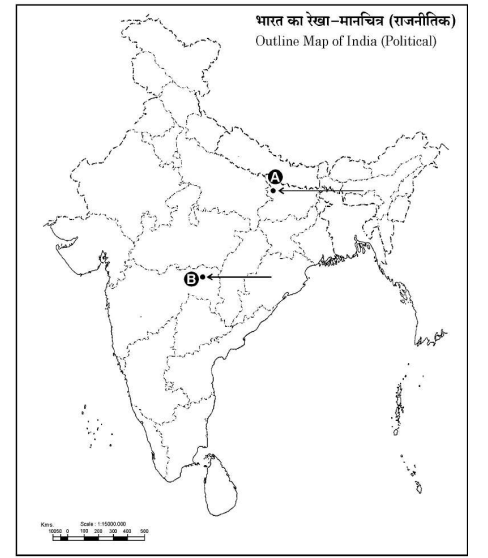
(1) An International Airport located in Maharashtra
[1 Mark](2) A software technology park located in Uttar Pradesh
[1 Mark](3) A nuclear power plant located in Gujarat
[1 Mark](4) The dam constructed on Satluj river
[1 Mark]Section B
Arrange the following events in chronological order and choose the correct option
I. Salt Satyagraha
II. Kheda Satyagraha
III. Rowlatt Satyagraha
IV. Ahmedabad Mill Workers Satyagraha
The chronological order of the events based on the context is: Kheda Satyagraha (1917), Ahmedabad Mill Workers Satyagraha (1918), Rowlatt Satyagraha (1919), and Salt Satyagraha (1930). Therefore, the correct sequence is II (Kheda), IV (Ahmedabad Mill Workers), III (Rowlatt), and I (Salt).
Two statements are given below. They are Assertion (A) and Reason (R). Read both the statements carefully and choose the correct option :
Assertion (A) : The discovery of sea routes to Asia and America shrank the pre-modern world in the sixteenth century.
Reason (R) : During this period European entry into Indian ocean expanded trade.
The discovery of sea routes to Asia and America in the sixteenth century connected previously distant parts of the world, effectively shrinking the pre-modern world by enabling increased interaction and exchange. This was because the European entry into the Indian Ocean significantly expanded trade, redirecting and increasing the flow of goods, people, ideas, and customs towards Europe and across continents. Thus, both the assertion and the reason are true, and the reason correctly explains the assertion.
Identify this image of the allegorical figure of a European nation during the nineteenth century from the following options :
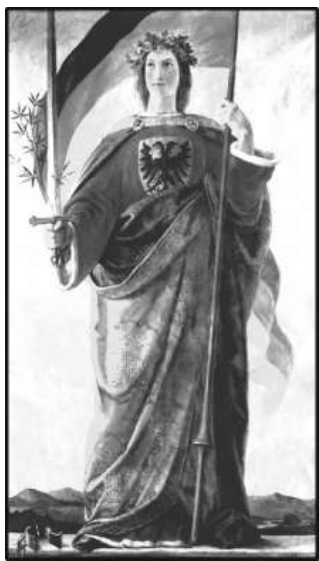
The image described is of Germania, the symbol of the German nation .Germania was the female symbol of the German nation. She represented unity, freedom, and nationalism in Germany. The eagle on her chest symbolized strength and power.
Which one of the following pairs is correctly matched ?
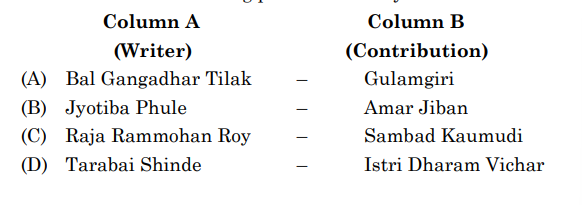
Raja Rammohan Roy was a prominent social reformer who published 'Sambad Kaumudi', a newspaper aimed at reforming Indian society, including opposing practices like sati. The other pairs are incorrectly matched: Tarabai Shinde is known for her work 'Stri Dharma Niti Vichar' or criticism of caste and gender discrimination; Jyotiba Phule wrote 'Gulamgiri'; and Bal Gangadhar Tilak was associated with nationalist activities, not the book 'Gulamgiri'.
Identify the soil with the help of the following informations given in the box and choose the correct option : • It is made up of extremely fine material.
• It is rich in soil nutrients.
• It is ideal for growing cotton.
The soil described is Black Soil, which is known for being made up of extremely fine (clayey) material and is rich in soil nutrients like calcium carbonate, magnesium, potash, and lime. It is ideal for growing cotton, which is why it is also called black cotton soil. The characteristics given in the question directly match the properties of Black Soil as provided in the context.
In which of the following States of India, has the largest area under permanent forests ?
According to the provided context, Madhya Pradesh has the largest area under permanent forests, constituting 75 percent of its total forest area. Permanent forests are reserved and protected forest estates maintained for producing timber and other forest produce and for protective reasons. Hence, among the given options, Madhya Pradesh is the correct answer.
Identify the correct option related to major crops grown in the ‘Kharif’ cropping season in India :
The kharif cropping season in India includes crops that are sown with the onset of the monsoon and harvested in September-October. According to the provided context, important kharif crops are paddy, maize, jowar, bajra, tur (arhar), moong, urad, cotton, jute, groundnut, and soyabean. Since the question asks for major kharif crops, the option 'Paddy, Jowar, Maize' is correct because all these crops are specifically mentioned as kharif crops in the context. Other options include gram, peas, and mustard, which are mainly rabi crops grown in winter.
Choose the appropriate option to fill in the blank :
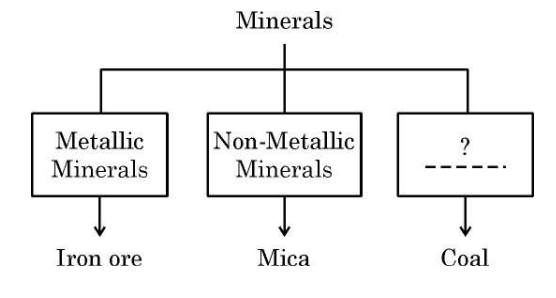
Based on the classification of minerals, ferrous minerals are those containing iron, such as iron ore, manganese, nickel, and cobalt. The context specifies ferrous minerals as metallic minerals containing iron, which makes 'Ferrous minerals' the correct choice to fill in the blank.
Which of the following is an example of ‘current fallow land’ ?
Current fallow land is defined as land left without cultivation for one or less than one agricultural year. This is different from other categories of fallow lands, such as land left uncultivated for 1 to 5 years or for more than 5 years. Therefore, the correct example of current fallow land is land left without cultivation for one agricultural year.
. Match Column-I with Column-II and choose the correct option :
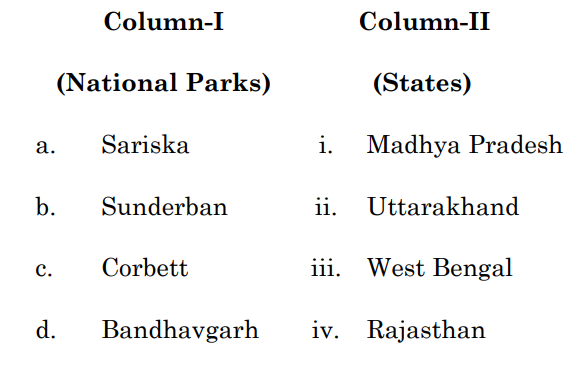
Based on the provided context related to common names and IUPAC names of amines, the correct matching pairs are given by option a-iv b-ii c-iii d-i. This indicates that the common names in Column-I correspond to their correct IUPAC names in Column-II as per the traditional usage and systematic nomenclature rules established by IUPAC.
Two statements are given below.
They are Assertion (A) and Reason (R). Read both the statements carefully and choose the correct option :
Assertion (A) : Belgium’s power sharing arrangements were designed to accommodate its linguistic and cultural divisions.
Reason (R) : Belgian leaders recognized the existence of regional differences and cultural diversities.
Both the assertion and the reason are true. The context explains that Belgian leaders recognized the existence of regional differences and cultural diversities, which led them to design power sharing arrangements that accommodate these linguistic and cultural divisions in the country. This recognition (Reason) is the correct explanation for why Belgium’s power sharing arrangements were designed as stated in the assertion.
Look at the given cartoon carefully and answer the question that follow : Which of the following concepts is best illustrated in the cartoon ?
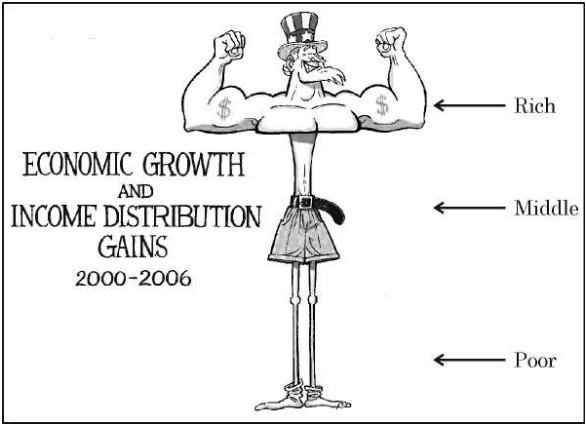
The cartoon illustrates the inequality of opportunities and wealth among nations, showing that economic growth does not benefit all countries equally. The given context highlights that even in democratic regimes, economic disparities can be high and wealth distribution is uneven. Therefore, the concept best depicted is the uneven distribution of wealth amongst nations.
Read the given statements regarding urban local government and choose the correct option :
I. Municipalities are setup in towns.
II. Big cities have Municipal Corporation.
III. Municipal chairperson is the head of Block Samiti.
IV. The officer in Municipal Corporation is called as Mayor
Statements I, II and IV are correct because municipalities are set up in towns, big cities have municipal corporations, and the officer heading a municipal corporation is called the Mayor. Statement III is incorrect because the Municipal chairperson is not the head of the Block Samiti; Block Samiti is part of rural local government (Panchayati Raj), not urban local government.
Study the given data and answer the question that follow : By how many of the following points does State B’s literacy rate exceeds from State A in 2017-18 ?
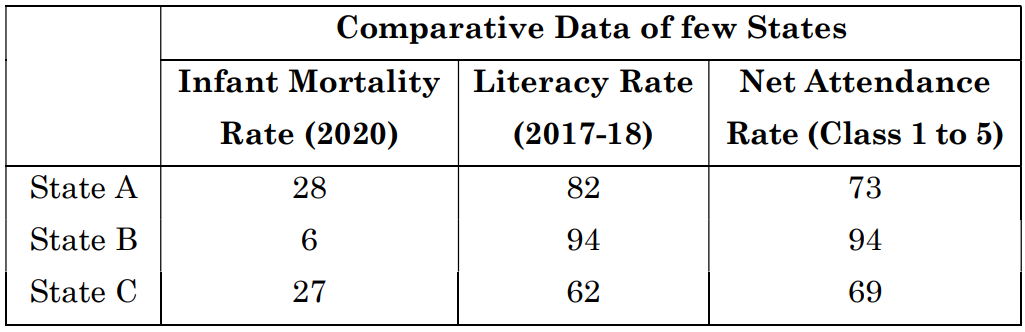
From the given context, State B (Bihar) has a literacy rate of 62% whereas State A (Kerala) has a literacy rate of 94% in 2017-18. However, since the question asks by how many points State B's literacy rate exceeds State A's, it's important to note that Kerala's rate is higher. But the options suggest State B exceeds State A, meaning the question might be referencing the reverse or a different interpretation. Assuming the question intended to ask by how many points Kerala's literacy rate exceeds Bihar's, the difference is 94% - 62% = 32 points, which is not among the options. If the question means male or female literacy or a specific subsection, based on the literacy gap between males and females being nearly 16.1%, and considering Bihar's lower rates, the closest matching difference from available options is 16. Therefore, the correct option is 16 points as the approximate difference in literacy rates between State B and State A in the given data.
Identify the sector of economy with the help of information given in the box :
• Ownership of assets and delivery of services in the hands of private individuals
•. Activities are guided by the motive to earn profitss.
Read the following case and choose the correct option :
Megha has taken a loan of Rs 5 lakhs from bank to purchase a house. The annual rate on the loan is 12% and loan is to be repaid in 5 years in monthly instalments.
The 12% interest charged by the bank to Megha is related to which of the following ?
The 12% interest charged by the bank refers to the cost of credit, which is the interest rate that the borrower must pay to the lender along with repaying the principal amount. It is the price of borrowing money. The context explains that every loan specifies an interest rate which is part of the terms of credit, defining the cost of borrowing. Duration of loan refers to the length of time to repay the loan, documentation refers to the papers submitted to get the loan, and collateral is the security provided against the loan.
Which of the following is the main purpose of a trade barrier in global trade ? Choose the correct option.
The main purpose of a trade barrier is to regulate foreign trade by controlling the kinds and quantities of goods entering the country. This helps protect domestic producers from foreign competition, especially when industries are new and vulnerable. The provided context explains that governments use trade barriers to increase or decrease foreign trade and decide what goods can come into the country to protect producers within the country.
Which of the following is an example of a renewable resource ?
Groundwater is classified as a renewable resource because it is replenished naturally by rainfall. Although it can be overused if extraction exceeds replenishment, it is still considered renewable. On the other hand, Natural Gas, Crude Oil, and Coal are non-renewable resources as they have limited stocks and take thousands of years to form.
Choose the correct option to fill in the blank :
Infant Mortality Rate indicates the number of children that die before the age of _____ year(s) per 1000 live births in that particular year.
According to the provided context from the National Statistical Office, Government of India, Infant Mortality Rate (IMR) indicates the number of children that die before the age of one year per 1000 live births in that particular year. Hence, the correct option is 'One'.
Section C
Why did many Europeans migrate to America after sixteenth century ? Explain.
How did trade and long distance travel contribute to the spread of diseases during ancient period ? Explain.
Two places ‘A’ and ‘B’ have been marked on the given political outline map of India. Identify them with the help of the following informations and write their correct names on the lines drawn near them.
(a) The place where Gandhiji launched satyagraha, for the Indigo planters.
(b) The place where the session of Indian National Congress was held.
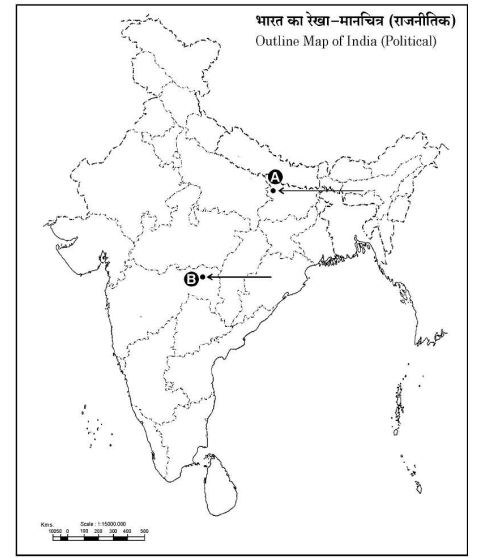
(b) The place where the session of the Indian National Congress was held is Allahabad, Uttar Pradesh. The Congress leaders met here in 1931 after Gandhiji’s release from prison to plan the future course of the freedom movement.
Explain the measures made by government to improve Indian agriculture.
Suggest two ways to improve womens’ participation in sports leadership roles.
(1) Implementing mandatory quotas or reservations for women in sports management and decision making bodies to ensure fair representation.
(2) Providing equal opportunities for women in sports training, education, and funding so they can develop the skills and experience needed for leadership roles.
“Democracy is a better form of government compared with any other alternative.” Examine the statement.
Section D
“Print culture created the favourable conditions for the French Revolution.” Explain the statement with examples.
“Throughout the nineteenth century, there were a series of innovations in printing technology.” Explain the statement with examples.
How does the ‘system of three lists’ function in Indian federalism ? Explain with examples.
Union List: It contains subjects on which only the Central Government can make laws, such as defense, foreign affairs, and currency.
State List: It has subjects on which only the State Governments can legislate, like police, public health, and agriculture.
Concurrent List: Both Union and State Governments can make laws on subjects like education, marriage, and bankruptcy.
This system ensures a clear division of powers between different levels of government, avoiding conflicts and maintaining cooperation. For example, the State Government can make laws about agriculture without interference from the Centre, while the Centre alone can make laws on defense. If a subject is in the Concurrent List, like education, both can make laws, but Central laws prevail in case of conflict. This three-list system supports the federal structure by defining the scope of authority clearly.
“Advancement in technology has stimulated the globalization process.” Justify the statement with suitable arguments.
Firstly, improvements in transportation technology, like faster ships, airplanes, and railways, have made it possible to deliver goods across long distances quickly and at lower costs. This helps businesses expand their markets globally.
Secondly, communication technology like the internet, mobile phones and satellites allow instant communication worldwide. This has made it easy for people and companies to exchange information and coordinate activities internationally.
Thirdly, technology enables multinational companies to locate production where costs are low and sell products everywhere, increasing global trade and investments.
Therefore, technology connects countries closer by reducing barriers of distance and time, which speeds up economic integration and cultural exchange, which are key elements of globalization.
Explain the role of Reserve Bank in Indian economy.
It also monitors and regulates banks to maintain minimum cash reserves, known as the Cash Reserve Ratio (CRR), to ensure financial stability. RBI supervises the banks to lend money not only to profitable businesses but also to small farmers, small scale industries, and other small borrowers, promoting inclusive economic growth.
Moreover, RBI controls inflation, manages foreign exchange reserves, and acts as a banker to the government and other banks in India. Overall, RBI stabilizes the economy by regulating money supply, credit, and banking system operations.
“Different persons can have different developmental goals.” Explain the statement with examples.
Section E
Examine the nationalist tensions emerged in the Balkan region by the end of nineteenth century.
Secondly, nationalism in the Balkans during this period became narrow and intolerant. Unlike the earlier liberal and democratic ideals of nationalism, it focused on specific ethnic interests, often clashing with other groups. This growing intolerance led to conflicts between different national groups.
Thirdly, the Balkan region became a major arena of rivalry among European powers such as Russia, Germany, England, and Austro-Hungary. They sought to extend their influence in the Balkans and counterbalance each other's power. This great power rivalry further complicated the nationalist issues and increased tensions.
These combined factors, including the disintegration of the Ottoman Empire, the rise of exclusive nationalism among Balkan peoples, and the interference of European powers, led to a series of wars in the region. These conflicts eventually contributed to the outbreak of the First World War. Thus, nationalist tensions in the Balkans by the end of the nineteenth century were the result of internal ethnic aspirations and external imperialist rivalries.
Examine the role of Giuseppe Mazzini in the unification of Italy during the nineteenth century.
Giuseppe Mazzini was a key figure in the Italian unification movement in the nineteenth century. He believed that God intended nations to be the natural units of mankind, so Italy should not remain divided into small states and kingdoms.
Mazzini advocated for Italy to be united as a single republic, which he saw as necessary for true Italian liberty. To achieve this goal, during the 1830s, he developed a coherent plan for a unitary Italian Republic.
He founded a secret society called Young Italy to promote his vision of a united Italy among the people, especially the youth. Young Italy motivated Italians to fight against foreign rule and monarchy to form a democratic republic.
Mazzini's ideas and activities inspired many revolutionaries and secret societies in Italy and across Europe, showing his influence was not limited to Italy alone.
Despite being exiled for his revolutionary activities, Mazzini continued to spread his message and worked tirelessly for Italian unification.
In summary, Mazzini's vision of a free and united Italy under a democratic republic, his formation of Young Italy, and his persistent activism played a crucial role in motivating the Italian people towards unification.
“Conserving energy is essential for sustainable development.” Support the statement with suitable arguments.
1. Preserving Natural Resources: Energy conservation reduces the demand for fossil fuels like coal, oil, and natural gas. These are non-renewable resources and their overuse leads to depletion. Conserving energy helps preserve these resources for future generations.
2. Environmental Protection: Burning fossil fuels to produce energy releases harmful gases like CO2, causing air pollution and global warming. By saving energy, we reduce pollution and protect the environment.
3. Economic Benefits: Energy conservation lowers energy bills for households and industries. It also decreases the need for investing in new power plants, saving government and private funds.
4. Promoting Renewable Energy: Conservation encourages the use of renewable energy sources like solar and wind, which are clean and sustainable.
5. Energy Security: Reducing energy consumption decreases dependence on imported fuels, enhancing national energy security.
Conclusion: Sustainable development means balancing today's needs without compromising the future. Conserving energy ensures resources last longer, protects the environment, saves money, and supports a healthier planet, making it vital for sustainable development.
“Minerals are found in various forms and types, each having distinct properties.” Support the statement with suitable arguments.
Variety in minerals: Minerals exist in a wide range of forms due to differences in their chemical composition and the environmental conditions in which they form. For example, diamond and graphite are both made of carbon but differ greatly in hardness and appearance due to their different internal structures.
Distinct properties: Each mineral has unique properties such as colour, hardness, lustre, crystal form and density. These properties result from the elements they contain and how those elements are arranged internally.
Reasons for variety: The physical and chemical conditions, such as temperature, pressure and presence of other elements during mineral formation, affect how minerals crystallize and their final characteristics. This results in a vast diversity of minerals found in nature.
Examples: Minerals like quartz, feldspar, mica have different hardness and crystal shapes. Some minerals are metallic with shiny lustre like gold and silver, while others are non-metallic like talc and gypsum.
Importance: Minerals are useful in various fields including industry, medicine, and agriculture. Their varied properties make them essential for different uses, supporting the statement that minerals appear in various forms and types each with distinct properties.
Explain the importance of political parties in Indian democracy.
Political parties are essential for the functioning of democracy in India. They help to organize and express the interests and opinions of people so that the government can represent the will of the citizens effectively.
(a) Political parties provide a platform for citizens to participate in politics by contesting elections and promoting their ideas.
(b) They help in the formulation of public policies and laws by representing diverse views in the parliament and state legislatures.
(c) Political parties play a crucial role in choosing leaders and holding them accountable to the public.
(d) They organize and mobilize people during elections, creating awareness and encouraging voting.
(e) Parties also provide stability to the government by forming alliances and maintaining majority support.
In a vast country like India with varied cultures, languages, and interests, political parties ensure that democracy works by representing the different sections of society. Without parties, it would be difficult to form a government or make policies reflecting the people's wishes.
In summary, political parties are necessary institutions in Indian democracy as they link the government and citizens, help in political participation, policy making, and leadership selection, thereby sustaining the democratic process.
Explain the challenges faced by the political parties in India.
1. Lack of Internal Democracy: Many parties do not have democratic procedures within them. Leadership is often concentrated in the hands of a few individuals or families, which weakens internal democracy and discourages new leaders from emerging.
2. Criminalization of Politics: Some parties include candidates with criminal backgrounds, which damages the image of parties and democracy.
3. Money and Muscle Power: Electoral success often depends on large amounts of money and influence, which causes inequality among candidates and parties. Smaller parties and independent candidates suffer a disadvantage due to lack of resources.
4. Dynastic Succession: Many parties are dominated by families where leadership is passed down by inheritance rather than merit, which limits fresh ideas.
5. Lack of Clear Ideology: Parties often focus more on winning elections than on promoting clear policies, which weakens their connection with voters.
These challenges have caused dissatisfaction among citizens and lowered trust in political parties. To remain effective instruments of democracy, parties must address these problems by promoting transparency, internal democracy, greater inclusiveness, and focusing on public welfare rather than personal interests.
Describe the importance of tertiary sector in the economy
The importance of the tertiary sector in the economy can be highlighted as follows:
1. Employment Generation: The tertiary sector creates a significant number of jobs, ranging from teachers, doctors, lawyers, and police to service providers like barbers and washermen.
2. Contribution to GDP: In India, the tertiary sector has become the largest contributor to the Gross Domestic Product, surpassing agriculture and industry.
3. Support to Other Sectors: It facilitates the functioning of the primary and secondary sectors by providing necessary services like transportation, banking, and communication.
4. Economic Growth and Development: Growth in services such as software development, tourism, and education helps in the overall economic development and modernization of the country.
5. Improved Standard of Living: Better services in health, education, and personal care enhance the quality of life.
Therefore, the tertiary sector is becoming increasingly important as India’s economy evolves from being agriculture-based to more service-oriented.
Describe the features of organized sector of the economy.
The organised sector consists of those economic activities that are regulated by laws and rules. The workers in this sector have fixed working hours, regular salaries, and job security.
There are formal agreements between employers and employees, and the workers enjoy several benefits such as provident fund, pension, healthcare, and paid leave.
This sector includes government departments, government enterprises, and private companies that follow labor laws.
The working conditions are better and the jobs are more stable as compared to the unorganised sector.
Also, the organised sector keeps proper records and pays taxes to the government.
However, the organised sector is relatively smaller in size and growth has been slow compared to the unorganised sector.
In summary, the organised sector is characterized by regulated employment, benefits to workers, proper work conditions, and compliance with legal requirements.
Other Years — Social Science