SOLUTIONS
2026 BOARD EXAM
CBSE Class 10 Social Science Board Paper 2026 — Set 2 Solutions
2026
Social Science
Class 10
CBSE EXAMINATION PAPER-2026
SOCIAL SCIENCE
(Solved)
General Instructions :
Read the following instructions carefully and follow them :
- This question paper contains 45 questions. All questions are compulsory.
- This question paper is divided into 5 sections.
- Section A – questions number 1 to 4 are case based questions
- Section B – questions number 5 to 25 are multiple choice questions
- Section C – questions number 26 to 31 are very short answer
- Section D – questions number 32 to 37 are short answer
- Section E – questions number 38 to 45 are long answer
- There is no overall choice given in the question paper. However, an internal choice has been provided in few questions.
- Use of calculator is NOT allowed.
Section A
Read the given source carefully and answer the questions that follow :
Print and Censorship
After the revolt of 1857, the attitude of the colonial government towards freedom of the press changed. Enraged Englishmen demanded a clamp down on the ‘native’ press. As vernacular newspapers became assertively nationalist, the colonial government began debating measures of stricter control. In 1878, the Vernacular Press Act was passed, modelled on the Irish Press Laws. It provided the government with extensive rights to censor reports and editorials in the vernacular press. From now on the government kept regular track of the vernacular newspapers published in different provinces. When a report was judged as seditious, the newspaper was warned, and if the warning was ignored, the press was liable to be seized and the printing machinery confiscated.
(1) Which Act was the inspiration of the ‘Vernacular Press Act’ ?
[1 Mark](2) Which two powers were given by the Vernacular Press Act to the colonial government ?
[2 Marks](3) Why was the colonial government not in favour of freedom of the press ?
[1 Mark]Read the given source carefully and answer the questions that follow :
Cropping Pattern
Rabi crops are sown in winter from October to December and harvested in summer from April to June. Kharif crops are grown with the onset of monsoon in different parts of the country and these are harvested in September-October. In between the rabi and the kharif seasons, there is a short season during the summer months known as the zaid season.
(1) Rice cultivation is an example of which type of agricultural season ?
[1 Mark](2) Mention any two zaid crops.
[2 Marks](3) Name any one crop which is harvested between April to June in India.
[1 Mark]This shows the importance of rabi cropping pattern in Indian agriculture.
Read the given source carefully and answer the questions that follow :
How many political parties?
In some countries, only one party is allowed to control and run the government. These are called one-party systems. In some countries, power usually changes between two main parties. Several other parties may exist, contest elections and win a few seats in the national legislatures. Such a party system is called two-party system. If several parties compete for power, and more than two parties have a reasonable chance of coming to power either on their own strength or in alliance with others, we call it a multiparty system.
(1) Explain the main feature of ‘multi-party system’.
[1 Mark](2) Why is a ‘one-party system’ not compatible with democracy?
[1 Mark](3) Explain the main characteristics of a coalition government.
[2 Marks]On the outline map of India , locate and label any three of the following with suitable symbols :
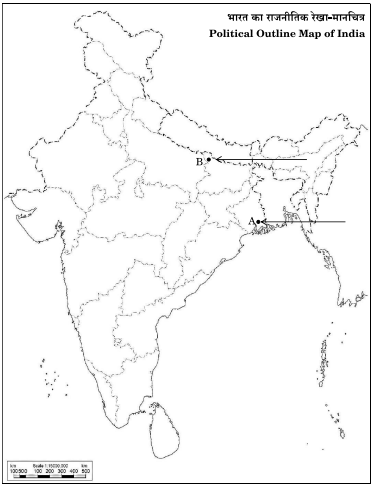
(1) A major dam built on the Mahanadi river
[1 Mark](2) A major sea port located in Tamil Nadu
[1 Mark](3) A Software Technology Park located in Uttar Pradesh
[1 Mark](4) Eastern-most terminal station of East-West Corridor of India.
[1 Mark]Section B
Which country was the most affected by the potato famine during 1845–1849 ?
Arrange the following historical events in chronological order and choose the correct option :
I. Publication of Bengal Gazette
II. Publication of Diamond Sutra
III. Publication of Bible by Johan Gutenberg
IV. Return of Marco Polo to Italy from China
The Diamond Sutra was published first in AD 868, making it the earliest event. Marco Polo returned to Italy in 1295, which comes after the Diamond Sutra. Johan Gutenberg published the Bible around 1455, which is after Marco Polo's return. Finally, the Bengal Gazette was published much later, in the 18th century. Hence, the correct chronological order is: II (Diamond Sutra), IV (Marco Polo's return), III (Gutenberg Bible), I (Bengal Gazette).
Two statements labelled as Assertion (A) and Reason (R) are given below. Read both the statements carefully and choose the correct option :
Assertion (A) : Giuseppe Mazzini was a revolutionary from Italy.
Reason (R) : He founded underground organisations.
The assertion is true because Giuseppe Mazzini was indeed a revolutionary from Italy who wanted to unify Italy into a single republic. The reason is also true because he founded underground organisations such as Young Italy and Young Europe to mobilise support for the cause of Italian unification and revolution. Hence, the reason correctly explains the assertion.
Whom does this picture represent? Choose the correct option.
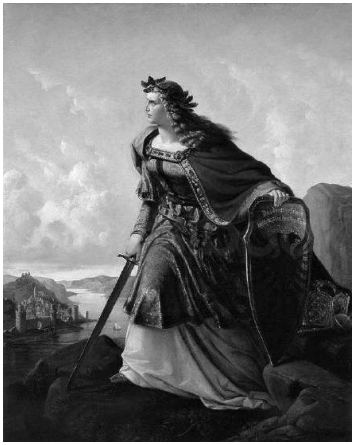
The context explains that the figure sitting triumphantly over the globe is Britannia, who is the symbol of the British nation. The image celebrates the British Empire, showing Britannia as the central figure representing Britain. The other options represent different national symbols: Marianne for France, Germania for Germany, and Columbia for the United States.
Which of the following deadly disease spread in America through Portugal and Spain in mid-sixteenth century?
Smallpox was the disease that spread in America through Portugal and Spain in the mid-sixteenth century. The original inhabitants of America had no immunity against smallpox, which made it a deadly killer. It spread rapidly, even ahead of European settlers, killing and decimating whole communities and paving the way for conquest. The context specifically highlights smallpox as the most powerful weapon of the Spanish conquerors because of the lack of immunity among Native Americans.
In which Indian state is ‘Bamboo drip irrigation’ system used ?
The Bamboo drip irrigation system is a traditional method used in Meghalaya. It involves tapping stream and spring water using bamboo pipes to transport water over long distances, where it is reduced to drops that irrigate the plants at the root. This method is prevalent in Meghalaya as per the given context.
Identify the plantation crop from the following :
Rubber is a plantation crop grown in tropical regions where moist and humid climate conditions prevail. The context states that in India, important plantation crops include tea, coffee, rubber, sugarcane, and banana. Rubber requires a rainfall of more than 200 cm and temperatures above 25°C, and it is mainly grown in Kerala, Tamil Nadu, Karnataka, and other tropical areas. Wheat, rice, and bajra are not plantation crops; they are food crops generally grown in fields and not in large plantations.
Read the following statements about the functions of political parties and choose the correct option :
I. Political parties build public opinion.
II. Political parties play the role of the opposition.
III. Political parties present their programmes to the public.
IV. Political parties make foreign policy.
Statements I, II and III are correct because political parties build public opinion by shaping and highlighting issues (I), play the role of the opposition by supporting or restraining the government and making policies (II), and present their programmes to the public through election campaigns and public communication (III). Statement IV is incorrect because making foreign policy is the function of the government, not political parties directly.
Match Column I with Column II and choose the correct option :
Column I (List) ---------------- Column II (Subject)
a. Union List --------------- i. Police
b. State List --------------- ii. Computer software
c. Concurrent List ----------- iii. Adoption
d. Residuary subjects --------- iv. Defence
In Sri Lanka, which one of the following changes to the 1956 law gave rise to the possibility of civil war ?
The 1956 Act in Sri Lanka recognised Sinhala as the only official language, disregarding Tamil. This led to discrimination against the Tamil-speaking community in government jobs and education, creating ethnic tensions. The imposition of Sinhala as the sole official language marginalized Tamils and fueled demands for Tamil recognition and autonomy, ultimately escalating the conflict and leading to the possibility of civil war.
Which one of the following countries is an example of a ‘coming together federation’ ?
Australia is an example of a 'coming together federation' where constituent states retain their identity and have equal power relative to the federal government. Other examples given in the context for this type of federation are the USA and Switzerland. In contrast, countries like India, Spain, and Belgium exemplify 'holding together federations' where the central government is stronger.
Study the following table and arrange the States from lower to higher on the basis of ‘Life Expectancy at Birth’ and choose the correct option :
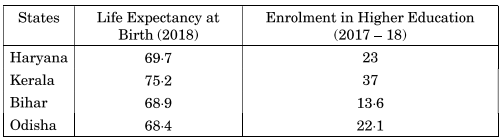
Based on the comparative socio-economic data provided, Kerala has the highest life expectancy due to better health indicators such as the lowest Infant Mortality Rate (IMR) and higher literacy rates. Haryana is better than Bihar and Odisha but behind Kerala. Bihar and Odisha have lower life expectancy due to higher infant mortality and lower per capita income compared to Haryana and Kerala. Typically, Bihar has lower life expectancy than Haryana but Odisha is slightly better than Bihar, so the order from lowest to highest life expectancy is Odisha, Bihar, Haryana, Kerala.
Two statements labelled as Assertion (A) and Reason (R) are given below. Read both the statements and choose the correct option :
Assertion (A) : Agricultural production related activities are included in the tertiary sector.
Reason (R) : Tertiary sector is called as service sector.
The Assertion (A) is false because agricultural production related activities are part of the primary sector, not the tertiary sector. The primary sector includes activities like agriculture, fishing, forestry, and mining. The Reason (R) is true because the tertiary sector is indeed called the service sector, which includes activities providing support and services to primary and secondary sectors such as transport, banking, insurance, and education. Therefore, only Reason (R) is true.
Why do some countries impose tariffs on imported goods in the context of globalization? Choose the correct reason from the following options :
Countries impose tariffs on imported goods to protect their local industries from foreign competition. As explained in the context, after Independence, India set trade barriers to shield its developing industries from imports, allowing them time to grow without facing competition from established foreign companies. Tariffs increase the cost of imported goods, making local products more competitive in the domestic market.
Which of the following is an example of public sector ?
Indian Railways is owned and operated by the government, making it an example of the public sector. On the other hand, Tata Iron and Steel Company, Reliance Industries Limited, and Birla Cement are privately owned companies and belong to the private sector. The public sector consists of industries that are owned and managed by the government to provide services for the public.
Smt. Deepti is a resident of X country. Her country is a developed country. Which of the following would be a characteristic of her country ?
A developed country is characterized by a high standard of living, which includes a high per capita income. The other options such as High Infant Mortality Rate, Low Literacy Rate, and Low Net Attendance Ratio are typically characteristics of developing or underdeveloped countries. The context comparing Kerala (a developed state) with Bihar (a less developed state) shows that Kerala has low infant mortality rate (7), high literacy rate (94%), and high net attendance ratio (83), all indicating development. Therefore, High Per Capita Income is a key characteristic of a developed country.
Which one of the following is the purpose of collateral in a loan ?
Collateral acts as a guarantee to the lender until the loan is repaid. It is an asset that the borrower owns and pledges, such as land, buildings, or deposits with banks. If the borrower fails to repay the loan, the lender has the right to sell the collateral to recover the loan amount. Therefore, the primary purpose of collateral is to secure the loan for the lender.
Which of the following countries was granted autonomy by the Habsburg rulers in 1867 ?
According to the context, the Habsburg rulers granted more autonomy to the Hungarians in 1867. This was part of the Austro-Hungarian Compromise of 1867, which created the Dual Monarchy of Austria-Hungary, giving Hungary self-governance while still being under the Habsburg monarchy. The other options, Italy, Russia, and England, were not granted autonomy by the Habsburgs in 1867.
Section C
Two places ‘A’ and ‘B’ have been marked on the given political outline map of India . Identify them with the help of the following information and write their correct names on the lines drawn near them :
A. The place where the session of the Indian National Congress was held in September 1920.
B. The place where Mahatma Gandhi led the Peasant Movement against Indigo Cultivation.
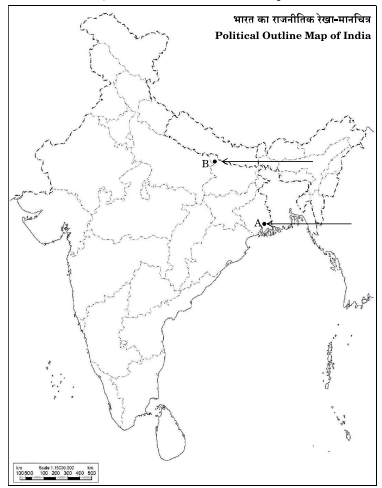
(b) Place B is Champaran in Bihar, where Mahatma Gandhi led the Peasant Movement against the forced indigo cultivation by British landlords. This was Gandhi’s first major Satyagraha in India and helped improve the peasants’ conditions.
Describe the role of communities in the conservation of forests in India.
Describe any two steps taken by the Government of India to protect forests and wildlife.
1. The Indian Wildlife (Protection) Act was implemented in 1972 to provide legal protection to endangered species and to ban hunting of wild animals.
2. The government has established national parks and wildlife sanctuaries to conserve natural habitats and protect flora and fauna from destruction.
These steps help in conserving biodiversity and preventing extinction of species.
Suggest any two reforms to strengthen ‘party system’ in India.
(a) Introduce internal democracy in political parties by conducting regular organisational elections and allowing members to participate in decision-making processes.
(b) Ensure transparency and accountability by making political parties file their income tax returns and follow strict codes of conduct to prevent corruption and misuse of funds.
“Complaints are the testimony to the success of Democracy.” Explain the statement with examples.
Thus, complaints are a sign that democracy is working and people trust their power.
Explain ‘Disguised Unemployment’ with example.
Section D
Analyse the role of language in the development of nationalism in Poland during the nineteenth century.
Analyse the main provisions of the Treaty of Vienna of 1815.
The Treaty of Vienna was signed after the defeat of Napoleon to restore stability in Europe. The main provisions were:
1. Restoration of Monarchies: The Bourbon dynasty was restored to power in France and other monarchies overthrown by Napoleon were reinstated.
2. Territorial Changes: France lost the territories annexed by Napoleon. Russia received part of Poland, and Prussia was given a portion of Saxony.
3. German Confederation: The German Confederation of 39 states, set up by Napoleon, was maintained but under loose control.
4. Balance of Power: The treaty aimed at creating a new conservative order to prevent future wars by establishing a balance of power among European nations.
5. Strengthening of Autocratic Monarchies: The treaty supported autocratic regimes with strong armies, bureaucracies, and abolished feudalism to ensure stability.
Overall, the treaty sought to undo the changes caused by the Napoleonic wars and restore old regimes to create lasting peace in Europe.
Explain any three main factors responsible for land degradation.
(a) Deforestation: Cutting down of trees for agriculture, mining, or construction reduces vegetation cover, which leads to soil erosion and loss of soil fertility.
(b) Overgrazing: When too many animals graze the land excessively, the vegetation is destroyed and soil becomes exposed to erosion, leading to degradation.
(c) Over-irrigation: Excessive use of water in agriculture leads to waterlogging and salinization of soil, thereby reducing its productivity and causing degradation.
“The creation of linguistic states was the first and a major test for democratic politics in India.” Explain the statement.
When India became independent in 1947, its states were not organized on linguistic lines but more on historical or administrative bases.
The demand for states based on languages emerged from different regions as people wanted to preserve their language, culture, and identity.
This posed a challenge for democracy as the government had to balance unity with diversity.
Eventually, after much debate, the States Reorganisation Act of 1956 was passed, creating states on linguistic lines.
This decision helped in promoting democracy by giving people a sense of belonging and better administration.
It proved that India's democratic system could accommodate diversity and address people's aspirations peacefully.
Thus, the creation of linguistic states strengthened India's unity and showed democracy's resilience in handling complex issues.
Suggest any three measures for labour safety in the unorganised sector.
(a) Providing proper safety equipment and training: Workers should be given helmets, gloves, masks and other safety gear along with proper training to use them effectively to prevent workplace injuries.
(b) Implementing strict safety regulations: Government and employers should enforce strict safety standards and regular inspections to ensure that workplaces follow safety norms and prevent hazardous working conditions.
(c) Creating awareness and health facilities: Labourers should be made aware of occupational hazards and health risks. Basic healthcare and emergency medical facilities should be available near the work sites to treat any injuries quickly.
Define the term ‘Body Mass Index’. Explain the method of its calculation.
Method of Calculation:
To calculate BMI, the formula is BMI = weight (in kilograms) / height (in meters) squared.
Steps to calculate BMI:
1. Measure the person's weight in kilograms.
2. Measure the person's height in meters.
3. Square the height value (height * height).
4. Divide the weight by the squared height value.
The resulting number is the BMI value. For example, if a person weighs 70 kg and is 1.75 m tall, the BMI will be 70 / (1.75 * 1.75) = 22.86.
Based on the BMI value, the health status is interpreted.
Section E
“Women played an important role during the Civil Disobedience Movement.” Support the statement with appropriate arguments.
Women played a crucial role in the Civil Disobedience Movement by actively participating in protests and demonstrations against British rule. Initially, even Mahatma Gandhi was hesitant about women's participation, but leaders like Sarojini Naidu convinced him to allow women to join, marking a major shift.
1. Large-Scale Participation: Women from different backgrounds took part in the salt satyagraha and other forms of civil disobedience. They broke salt laws and marched fearlessly, putting their lives at risk.
2. Showing Solidarity and Strength: Their presence helped unite various communities by showing solidarity with the movement. Women took part in public rallies, which drew attention to the injustice of British policies and raised awareness nationally and internationally.
3. Inspiring Social Change: Women’s involvement challenged traditional gender roles and inspired social change. This encouraged more women to demand rights and participate in public life.
4. Voice Against Injustice: The Civil Disobedience Movement gave women a platform to raise their voices against violations and discriminatory laws affecting them.
In conclusion, women were not only participants but also leaders and motivators in the movement, making their role indispensable in the fight for India’s independence.
“The revival of Indian folklore strengthened nationalism in India.” Support the statement with appropriate arguments.
The movement to revive Indian folklore began in the late nineteenth century as nationalists aimed to rediscover and preserve India's rich cultural heritage. Artists and scholars collected folk tales, songs, legends, and ballads from villages to protect these traditions from dying out due to foreign rule.
Folk traditions highlighted the diverse yet unified cultural identity of India, reminding people of their shared past and values. This helped create a sense of pride and belonging among Indians.
Prominent figures like Rabindranath Tagore in Bengal led efforts to collect and popularize nursery rhymes, myths, and folk ballads. Similarly, in Madras, Natesa Sastri published extensive folklore collections. These efforts brought folk culture into the national spotlight.
Folk stories and songs often contained themes of bravery, sacrifice, and resistance which inspired people to unite against colonial oppression. They symbolized India's rich history and created emotional connections between people and their land.
Moreover, folklore revival challenged British colonial narratives that depicted Indians as backward. By rediscovering a glorious past through folk culture, Indians developed a stronger national consciousness and self-respect.
In conclusion, the revival of folklore helped awaken national pride, unite diverse communities, and build a cultural foundation crucial for India’s freedom movement and the growth of nationalism.
Explain the reasons why most of the Jute industries in India are located in West Bengal.
1. Proximity to jute producing areas: Most of the jute producing regions lie close to West Bengal, especially the floodplains along the Ganges and its tributaries which provide fertile alluvial soil ideal for jute cultivation.
2. Transportation facilities: The Hugli river basin offers inexpensive water transport for raw jute. This is supported by a good network of railways, roadways and waterways facilitating easy movement of raw materials to the mills.
3. Abundant water supply: Jute processing requires large quantities of water, and the rivers and water bodies in West Bengal provide abundant water necessary for retting and processing of jute.
4. Cheap Labour: West Bengal and adjoining states like Bihar, Odisha and Uttar Pradesh provide cheap and skilled labour required for jute mills.
5. Urban Support Services: Kolkata, being a major urban centre nearby, provides banking, insurance, and port facilities which are essential for export and business operations of jute industries.
6. Historical Factors: The first jute mill was established in 1855 near Kolkata, establishing a base and infrastructure which encouraged growth of the industry in that region.
These factors combined have made West Bengal the hub for majority of India’s jute industries.
Explain the measures to reduce industrial pollution.
Industrial pollution can be reduced by adopting several important measures.
(a) Separation of Residential and Industrial Areas: Densely populated residential areas should be located far away from industrial zones to minimize exposure to harmful pollutants.
(b) Awareness of Hazardous Substances: People living near industries should be informed about the storage of toxic or hazardous substances and the possible effects if an accident occurs.
(c) Fire Warning and Fighting Systems: Industries should improve their fire detection and firefighting mechanisms to handle emergencies efficiently.
(d) Water Pollution Control: Industrial waste water pollutes freshwater significantly. To reduce this, industries should reuse and recycle water in multiple stages and harvest rainwater to meet water needs.
(e) Air Pollution Control: Air pollution can be decreased by fitting smoke stacks with electrostatic precipitators, fabric filters, scrubbers, and inertial separators to remove particulate matter.
Using cleaner fuels such as oil or gas instead of coal and installing silencers on machinery and generators also reduce pollution.
(f) Waste Management: Proper treatment and disposal of industrial effluents and wastes prevent land and water degradation.
Overall, strict regulation and adoption of cleaner technologies help reduce industrial pollution and protect the environment.
Compare the Belgian model and the Sri Lankan model of power sharing.
Belgium and Sri Lanka are both democracies that faced demands for power sharing, but they handled these challenges differently.
Belgian model: Belgium adopted a federal system of government where power is shared between the central government and different linguistic communities, mainly Dutch-speaking and French-speaking groups. The Belgian Constitution ensures equal representation of these communities in the central government, for example, by prescribing that the number of Dutch and French-speaking ministers must be equal. Certain important laws require majority support from both linguistic groups, so no single community can make decisions on its own. This model respects the diversity of language and culture by accommodating regional autonomy within a democratic federal framework, fostering unity through mutual respect and cooperation.
Sri Lankan model: Sri Lanka, on the other hand, remained largely a unitary state where the national government holds most of the power. Despite demands from the Tamil minority for greater autonomy and a federal system, the majority community did not agree to share power effectively. This refusal to share power and accommodate minority concerns led to conflict and unrest. The Sri Lankan example shows that when a majority community dominates and denies others a fair share in power, democracy suffers and social harmony is threatened.
In summary, Belgium illustrates how respecting different communities and sharing power can keep a nation united, while Sri Lanka shows the problems that arise when power is concentrated and minorities are excluded.
Why is power sharing necessary in a democracy? Explain.
When power is shared, citizens feel they have a stake in the government and its policies. This makes the government more legitimate and trustworthy. Power sharing also allows different political parties and pressure groups to compete and influence those in power, which prevents the misuse of power and promotes accountability.
Moreover, power sharing ensures that decisions take into account the interests of diverse groups in society and reduce conflicts. It supports the idea of freedom to choose among many contenders for power, ensuring that power does not remain in one hand for long.
Therefore, power sharing distributes political power among as many citizens as possible and promotes equality, fairness and peace in a democracy. It takes many forms, such as sharing power between different levels of government, political parties, and social groups, which makes democracy stronger and more inclusive.
Differentiate between the formal and informal sources of credit.
1. Definition:
Formal sources of credit are financial institutions that are regulated by the government, such as banks, cooperative societies, and other recognized credit agencies. Informal sources of credit are non-institutional lenders like moneylenders, relatives, friends, and traders.
2. Interest Rates:
Formal sources generally charge low and fixed interest rates. Informal sources usually charge high and variable interest rates which may be exploitative.
3. Documentation and Procedures:
Formal credit involves proper documentation and formal procedures, which might be time-consuming. Informal credit usually involves little or no documentation and simple procedures.
4. Loan Amount and Tenure:
Formal institutions provide larger loan amounts with longer repayment periods. Informal sources mostly provide small loans with short repayment durations.
5. Accessibility:
Formal loans are more accessible to the richer sections of society and people with stable income. Poor people often depend on informal sources due to lack of collateral or credit history.
6. Legal Protection:
Formal credit is protected legally and disputes can be settled through courts. Informal credit is mostly based on trust and personal relations, with no legal protection.
Conclusion:
It is important to increase the availability and accessibility of formal credit to reduce dependence on expensive and sometimes exploitative informal credit sources, especially for the poor.
Explain the functioning of ‘Self-Help Groups’.
Self-Help Groups are small voluntary associations of 15-20 members, usually women, from the same locality who come together to save regularly and support each other financially and socially.
1. Regular Savings: Members meet regularly to save a small amount of money, creating a common fund for the group.
2. Internal Lending: Members can borrow small loans from this pooled savings at a low-interest rate compared to moneylenders. These loans help to meet day-to-day needs or expand small businesses.
3. Bank Linkage: After a period of disciplined savings and repayment, the SHG becomes eligible to receive loans from banks. The loan is sanctioned in the name of the group instead of individual members, and the group as a whole is responsible for repayment.
4. Social Support: Besides economic activities, SHGs provide a platform for women to discuss and address social issues like health, nutrition, education, and domestic violence.
5. Collective Responsibility: In case a member fails to repay a loan, the group members collectively ensure recovery, which builds trust among banks and promotes credit discipline.
Thus, SHGs empower rural poor women by promoting savings, providing easy credit, and fostering social awareness and unity.
Other Years — Social Science