QUESTION PAPER
2026 BOARD EXAM
CBSE Class 10 Social Science Board Paper 2026 — Set 2
2026
Social Science
Class 10
CBSE EXAMINATION PAPER-2026
SOCIAL SCIENCE
(Solved)
General Instructions :
Read the following instructions carefully and follow them :
- This question paper contains 45 questions. All questions are compulsory.
- This question paper is divided into 5 sections.
- Section A – questions number 1 to 4 are case based questions
- Section B – questions number 5 to 25 are multiple choice questions
- Section C – questions number 26 to 31 are very short answer
- Section D – questions number 32 to 37 are short answer
- Section E – questions number 38 to 45 are long answer
- There is no overall choice given in the question paper. However, an internal choice has been provided in few questions.
- Use of calculator is NOT allowed.
Section A
Read the given source carefully and answer the questions that follow :
Print and Censorship
After the revolt of 1857, the attitude of the colonial government towards freedom of the press changed. Enraged Englishmen demanded a clamp down on the ‘native’ press. As vernacular newspapers became assertively nationalist, the colonial government began debating measures of stricter control. In 1878, the Vernacular Press Act was passed, modelled on the Irish Press Laws. It provided the government with extensive rights to censor reports and editorials in the vernacular press. From now on the government kept regular track of the vernacular newspapers published in different provinces. When a report was judged as seditious, the newspaper was warned, and if the warning was ignored, the press was liable to be seized and the printing machinery confiscated.
(1) Which Act was the inspiration of the ‘Vernacular Press Act’ ?
[1 Mark](2) Which two powers were given by the Vernacular Press Act to the colonial government ?
[2 Marks](3) Why was the colonial government not in favour of freedom of the press ?
[1 Mark]Read the given source carefully and answer the questions that follow :
Cropping Pattern
Rabi crops are sown in winter from October to December and harvested in summer from April to June. Kharif crops are grown with the onset of monsoon in different parts of the country and these are harvested in September-October. In between the rabi and the kharif seasons, there is a short season during the summer months known as the zaid season.
(1) Rice cultivation is an example of which type of agricultural season ?
[1 Mark](2) Mention any two zaid crops.
[2 Marks](3) Name any one crop which is harvested between April to June in India.
[1 Mark]Read the given source carefully and answer the questions that follow :
How many political parties?
In some countries, only one party is allowed to control and run the government. These are called one-party systems. In some countries, power usually changes between two main parties. Several other parties may exist, contest elections and win a few seats in the national legislatures. Such a party system is called two-party system. If several parties compete for power, and more than two parties have a reasonable chance of coming to power either on their own strength or in alliance with others, we call it a multiparty system.
(1) Explain the main feature of ‘multi-party system’.
[1 Mark](2) Why is a ‘one-party system’ not compatible with democracy?
[1 Mark](3) Explain the main characteristics of a coalition government.
[2 Marks]On the outline map of India , locate and label any three of the following with suitable symbols :
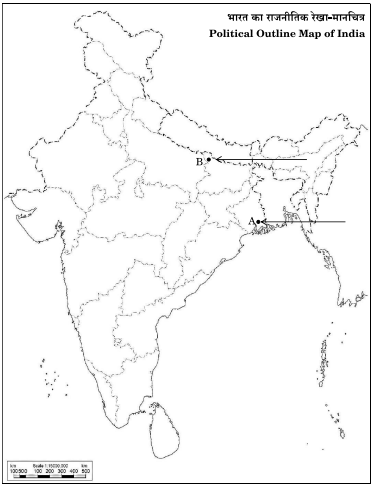
(1) A major dam built on the Mahanadi river
[1 Mark](2) A major sea port located in Tamil Nadu
[1 Mark](3) A Software Technology Park located in Uttar Pradesh
[1 Mark](4) Eastern-most terminal station of East-West Corridor of India.
[1 Mark]Section B
Which country was the most affected by the potato famine during 1845–1849 ?
Arrange the following historical events in chronological order and choose the correct option :
I. Publication of Bengal Gazette
II. Publication of Diamond Sutra
III. Publication of Bible by Johan Gutenberg
IV. Return of Marco Polo to Italy from China
Two statements labelled as Assertion (A) and Reason (R) are given below. Read both the statements carefully and choose the correct option :
Assertion (A) : Giuseppe Mazzini was a revolutionary from Italy.
Reason (R) : He founded underground organisations.
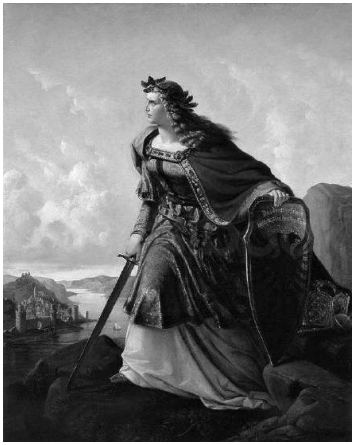
Whom does this picture represent? Choose the correct option.
Which of the following deadly disease spread in America through Portugal and Spain in mid-sixteenth century?
In which Indian state is ‘Bamboo drip irrigation’ system used ?
Identify the plantation crop from the following :
Read the following statements about the functions of political parties and choose the correct option :
I. Political parties build public opinion.
II. Political parties play the role of the opposition.
III. Political parties present their programmes to the public.
IV. Political parties make foreign policy.
Match Column I with Column II and choose the correct option :
Column I (List) ---------------- Column II (Subject)
a. Union List --------------- i. Police
b. State List --------------- ii. Computer software
c. Concurrent List ----------- iii. Adoption
d. Residuary subjects --------- iv. Defence
In Sri Lanka, which one of the following changes to the 1956 law gave rise to the possibility of civil war ?
Which one of the following countries is an example of a ‘coming together federation’ ?
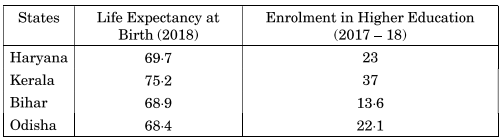
Study the following table and arrange the States from lower to higher on the basis of ‘Life Expectancy at Birth’ and choose the correct option :
Two statements labelled as Assertion (A) and Reason (R) are given below. Read both the statements and choose the correct option :
Assertion (A) : Agricultural production related activities are included in the tertiary sector.
Reason (R) : Tertiary sector is called as service sector.
Why do some countries impose tariffs on imported goods in the context of globalization? Choose the correct reason from the following options :
Which of the following is an example of public sector ?
Smt. Deepti is a resident of X country. Her country is a developed country. Which of the following would be a characteristic of her country ?
Which one of the following is the purpose of collateral in a loan ?
Which of the following countries was granted autonomy by the Habsburg rulers in 1867 ?
Section C
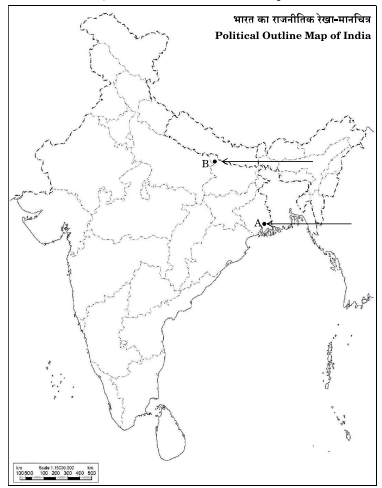
Two places ‘A’ and ‘B’ have been marked on the given political outline map of India . Identify them with the help of the following information and write their correct names on the lines drawn near them :
A. The place where the session of the Indian National Congress was held in September 1920.
B. The place where Mahatma Gandhi led the Peasant Movement against Indigo Cultivation.
Describe the role of communities in the conservation of forests in India.
Describe any two steps taken by the Government of India to protect forests and wildlife.
Suggest any two reforms to strengthen ‘party system’ in India.
“Complaints are the testimony to the success of Democracy.” Explain the statement with examples.
Explain ‘Disguised Unemployment’ with example.
Section D
Analyse the role of language in the development of nationalism in Poland during the nineteenth century.
Analyse the main provisions of the Treaty of Vienna of 1815.
Explain any three main factors responsible for land degradation.
“The creation of linguistic states was the first and a major test for democratic politics in India.” Explain the statement.
Suggest any three measures for labour safety in the unorganised sector.
Define the term ‘Body Mass Index’. Explain the method of its calculation.
Section E
“Women played an important role during the Civil Disobedience Movement.” Support the statement with appropriate arguments.
“The revival of Indian folklore strengthened nationalism in India.” Support the statement with appropriate arguments.
Explain the reasons why most of the Jute industries in India are located in West Bengal.
Explain the measures to reduce industrial pollution.
Compare the Belgian model and the Sri Lankan model of power sharing.
Why is power sharing necessary in a democracy? Explain.
Differentiate between the formal and informal sources of credit.
Explain the functioning of ‘Self-Help Groups’.
Other Years — Social Science