SOLUTIONS
2026 BOARD EXAM
CBSE Class 12 Humanities Political Science Board Paper 2026 — Set 5 Solutions
2026
Political Science
Class 12 Humanities
CBSE EXAMINATION PAPER-2026
POLITICAL SCIENCE
(Solved)
General Instructions :
Read the following instructions carefully and follow them :
- This question paper contains 36 questions. All questions are compulsory.
- This question paper is divided into 5 sections.
- Section A – questions number 1 to 3 are case based questions
- Section B – questions number 4 to 15 are multiple choice questions
- Section C – questions number 16 to 21 are short answer
- Section D – questions number 22 to 28 are long answer type i
- Section E – questions number 29 to 36 are long answer type ii
- There is no overall choice given in the question paper. However, an internal choice has been provided in few questions.
- Use of calculator is NOT allowed.
Section A
Read the following passage carefully and answer the questions based on it :
‘‘The defeat of the Congress party in 1989 marked the end of Congress dominance over the Indian party system. It did not, however, mean the emergence of any other single party to fill in its place. Thus, began an era of multi-party system, in which regional parties played a crucial role in forming the alliances.’’
(1) In which year did the Congress party face a setback for the first time and lose power in some states ? (A) 1962 (B) 1967 (C) 1971 (D) 1977
(2) Which one of the following regional parties never formed a government in any state ? (A) Bahujan Samaj Party (B) Dravida Munnetra Kazhagam (C) Bharatiya Kranti Dal (D) Shiromani Akali Dal
(3) Which party was the largest party in the Lok Sabha after the 1989 elections ? (A) National Front (B) Indian National Congress (C) Bharatiya Janata Party (D) Janata Party
(4) Which political party/alliance formed the first coalition government in December 1989 ? (A) National Conference (B) National Front (C) Indian National Congress (D) United Front
In the given political outline map of India (on page 15), four States have been marked as(Ⓐ, Ⓑ, Ⓒ,and Ⓓ) . Identify these States on the basis of the information given below and write their correct names in your answer-book along with the respective serial number of the information used and the concerned alphabets given in the map as per the following format :
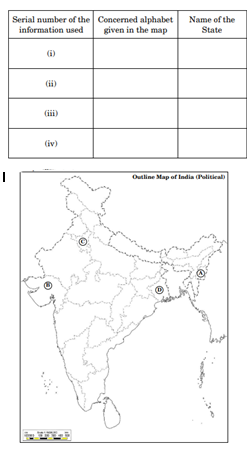
(1) The state which was bifurcated between India and Pakistan at the time of the partition.
[1 Mark](2) The state which was created in 1966.
[1 Mark](3) The state to which the first Deputy Prime Minister Sardar Vallabhbhai Patel belonged.
[1 Mark](4) The state to which Maharaja Bodhchandra Singh belonged.
[1 Mark]Study the cartoon given below and answer the questions based on it
Note : The man shown in the suit is President Musharraf and the same man shown in the cap is General Musharraf. On the basis of politics in Pakistan, answer the following questions.
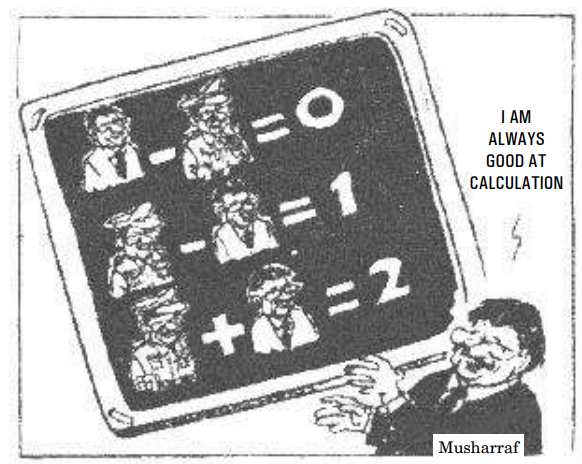
(1) What message is given by the uppermost equation ? Explain.
[1 Mark]It conveys that the identity of General Musharraf minus General Musharraf leaves no difference. Hence, it represents the dual roles of Musharraf as both President and General where his presence in both roles cancel each other out in political terms.
(2) Explain the message given by the middle line.
[1 Mark](3) Highlight the message conveyed by the whole cartoon.
[1 Mark]The cartoon's message is that calculating or understanding Pakistan's politics under Musharraf was like solving a simple but tricky math problem.
This reflects how Musharraf controlled the country through military power while presenting a democratic image as President.
(4) Explain the message given by the lowest line.
[1 Mark]Section B
Which one of the following was not a republic of the Soviet Union ?
Afghanistan was never part of the Soviet Union and therefore was not one of its republics. The Soviet Union consisted of republics such as Tajikistan, Uzbekistan, and Azerbaijan, which are mentioned in the context as Central Asian republics or other member republics that joined the Commonwealth of Independent States (CIS) after the USSR dissolved in 1991.
Who among the following was the General Secretary of the Communist Party of Soviet Union in 1985 ?
Mikhail Gorbachev was elected as the General Secretary of the Communist Party of the Soviet Union in March 1985. This position made him the leader of the Soviet Union at that time. The other options, Joseph Stalin, Leonid Brezhnev, and Nikita Khrushchev, were leaders of the Soviet Union at different earlier periods.
Assertion (A) : In April 2006, there were massive countrywide pro-democracy protests in Nepal.
Reason (R) : In 2002, the king abolished the parliament and dismissed the government.
Both the Assertion and Reason are true. In 2002, the king of Nepal abolished the parliament and dismissed the government, which ended the limited democracy that existed in Nepal. This action led to widespread dissatisfaction and ultimately resulted in massive countrywide pro-democracy protests in April 2006. Therefore, the reason given correctly explains the assertion.
Match the following correctly :
A - B
1. General Zia-ul-Haq - (i) Bangladesh
2. Ziaur Rahman - (ii) Nepal
3. Rajapaksa - (iii) Pakistan
4. Seven Party Alliance - (iv) Sri Lanka
General Zia-ul-Haq was a military ruler of Pakistan, so he matches with (iii) Pakistan. Ziaur Rahman was a military ruler of Bangladesh, so he matches with (i) Bangladesh. Rajapaksa is a political leader from Sri Lanka, so he matches with (iv) Sri Lanka. The Seven Party Alliance is a political coalition in Nepal, so it matches with (ii) Nepal.
Choose the correct full form of the ‘SALT’ treaty from the options given below :
The correct full form of SALT is Strategic Arms Limitation Treaty. This is supported by the context which mentions that the US and Soviet Union signed several arms control treaties including the Strategic Arms Limitations Treaty II (SALT II). Other options like Secret Arms Limitation Treaty or South Asia Local Treaty are incorrect and do not relate to the arms control agreements between the US and the Soviet Union.
Which one of the following is not a new source of threat to security ?
According to the context, new sources of threats to security include terrorism, poverty, and migration, which are non-traditional threats focusing on human and global security beyond conventional military conflict. War is an older, traditional source of security threat, whereas the other options represent new kinds of security challenges.
Who among the following advanced the ‘Two-nation theory’ ?
The 'Two-nation theory' was advanced by the Muslim League, which stated that India consisted of two separate nations - Hindus and Muslims. The Muslim League was formed to protect the interests of Muslims and was at the forefront of the demand for a separate Muslim nation, which ultimately led to the creation of Pakistan. Other options like Khan Abdul Gaffar Khan opposed the theory, and the British Government and Lord Mountbatten played administrative roles but did not propose the theory.
Assertion (A) : There were killings and atrocities on both sides of the border of India in 1947.
Reason (R) : The planned transfer of the population had failed.
The assertion is true because in 1947, during the partition of India, there were killings and atrocities on both sides of the border due to communal violence. The reason is also true as the planned transfer of population between India and Pakistan did not work smoothly, leading to widespread violence and massacre. Therefore, the failure of the planned transfer of populations directly caused the killings and atrocities, making the Reason (R) the correct explanation of the Assertion (A).
Arrange the following events in chronological order :
(i) P.C. Mahalanobis led a Five-Year Plan.
(ii) K.N. Raj was involved in drafting the First Five-Year Plan.
(iii) The ‘Bombay Plan’ was drafted
(iv) The Planning Commission was set up.
The correct chronological order is: (iii) The ‘Bombay Plan’ was drafted first, in 1944, which was a proposal for India's post-independence economic future. (iv) The Planning Commission was set up next, in 1950, to formulate and monitor Five-Year Plans. (ii) K.N. Raj was involved in drafting the First Five-Year Plan after the Commission was set up, around 1951. (i) P.C. Mahalanobis led the Second Five-Year Plan which began in 1956, focusing on industrial development. Thus, the sequence (iii), (iv), (ii), (i) correctly represents the historical order.
The government of which political party/alliance decided to implement the recommendations of the Mandal Commission ?
The National Front government, led by V.P. Singh in 1990, decided to implement the recommendations of the Mandal Commission. The National Front was an alliance that included the Janata Dal and other regional parties, and it received support from both the BJP and the Left Front. This decision marked an important development in Indian politics related to reservation policies for Other Backward Classes (OBCs).
Choose the name of that political party which has Gandhian Socialism along with cultural nationalism as its ideology.
According to the context, the Bharatiya Janata Party (BJP) initially adopted a platform embracing ‘Gandhian Socialism’ along with cultural nationalism as its ideology. This sets BJP apart from the other parties mentioned, as the Socialist Party and others focused more on socialism without the cultural nationalism aspect, and BJP later emphasized nationalism and Hindutva. Therefore, BJP combines Gandhian Socialism with cultural nationalism.
Section C
Name any four principal organs of the United Nations.
1. General Assembly: It includes all the member countries and acts as a forum for discussion and decision-making.
2. Security Council: Responsible for maintaining international peace and security. It has 15 members including 5 permanent members with veto power.
3. Economic and Social Council (ECOSOC): Deals with international economic and social cooperation and development.
4. Secretariat: Provides administrative support to the UN and is headed by the Secretary-General, who is appointed by the General Assembly on the recommendation of the Security Council.
Explain the meaning of globalisation.
Analyse any two reasons for resistance to globalisation in India.
(a) Economic Inequality: One major reason for resistance to globalisation in India is the fear that it may increase economic inequality. While globalisation brings new opportunities for growth, it tends to benefit large corporations and rich individuals more, leaving small farmers, artisans, and workers vulnerable. This growing gap between the rich and the poor creates unrest and opposition.
(b) Cultural Impact and Loss of Identity: Another important reason is the concern over the loss of cultural identity. Globalisation often promotes western values and lifestyles, which may threaten India's diverse cultural heritage and traditional practices. Many people fear that their customs, languages, and local arts could be overshadowed or diminished by global culture, leading to resistance against globalisation.
Show the ideology of the Jana Sangh that makes it different from other parties.
The Jana Sangh was different from other parties because it emphasised the idea of one country, one culture and one nation. It believed that India could become modern, progressive and strong by following Indian culture and traditions. It traced its lineage to the Rashtriya Swayamsevak Sangh and Hindu Mahasabha.
Unlike other parties, Jana Sangh focused on cultural nationalism and nationalism as the core of its ideology. It stood for the unity of the country and promoted the concept of Hindutva for political mobilisation. Over time, it merged into the Janata Party and later its supporters formed the Bharatiya Janata Party (BJP), which adopted a broader political platform including Gandhian socialism along with cultural nationalism.
Highlight any two features of the nature of the Congress party as a social and ideological coalition.
Explain any two immediate consequences of the implementation of the recommendations of the Mandal Commission in August 1990.
(a) Widespread protests and agitations: The decision to reserve 27 per cent of educational seats and government jobs for Other Backward Classes (OBCs) led to violent protests and demonstrations, especially in northern India. Many students and youth groups opposed the reservation policy, leading to strikes and unrest.
(b) Legal challenges and the Supreme Court case: The implementation faced legal opposition and was challenged in the Supreme Court, resulting in the famous Indira Sawhney case. The Court upheld reservations for OBCs but also imposed limits like the 50 per cent cap on total reservations. This case became a landmark judgement on affirmative action in India.
Section D
‘‘Indo-Russian relations are embedded in the history of trust and common interests.’’ Support the statement with four examples.
(1) Economic Cooperation: During the Soviet era, Russia helped India's public sector companies when assistance was hard to find globally. More than 80 bilateral agreements have been signed under the Indo-Russian Strategic Agreement of 2001, strengthening economic ties.
(2) Defense Collaboration: India and Russia have maintained strong defense cooperation, with Russia being a key supplier of military equipment to India. This cooperation has helped India enhance its defense capabilities.
(3) Cultural Exchange: Indian film stars like Raj Kapoor and Amitabh Bachchan are very popular in Russia and post-Soviet countries, reflecting a long-standing cultural bond.
(4) Strategic Cooperation: Both countries cooperate on important global issues like counter-terrorism, stability in Central Asia, and balancing China's influence, showing their common geopolitical interests.
Thus, the relationship is multifaceted, built on trust, economic and defense ties, cultural affinity, and shared strategic goals.
Soviet system was to ensure the welfare of the people.’’ Support the statement with four examples.
(1) The government provided a minimum standard of living for all citizens, meaning no one was left without basic needs.
(2) It subsidised essential services like health care, education, and childcare, making these accessible and affordable to everyone.
(3) The Soviet state controlled industries to produce consumer goods from pins to cars, ensuring availability of basic commodities.
(4) Welfare schemes were implemented to support families, the unemployed, and the elderly, promoting social security and equality.
These examples show how the Soviet system was designed to care for its people and guarantee their basic welfare.
Describe any four changes that occurred in the world after the end of the Cold War.
(a) The collapse of the Soviet Union: The Soviet Union, which was one of the two superpowers during the Cold War, collapsed in 1991. This resulted in the emergence of multiple independent countries and the end of the communist ideology in Eastern Europe.
(b) The United States became the sole superpower: With the collapse of the Soviet Union, the US emerged as the strongest power in the world. This changed the global balance of power and influenced international relations.
(c) The unification of Germany: After being divided for decades, East and West Germany were unified in 1990. This was a significant event showing the end of division caused by ideological differences.
(d) The shift in international relations and the role of the United Nations: The end of the Cold War changed the global political context. The UN's role evolved to handle new types of conflicts and promote peace in a world without the East-West confrontation. Countries in Eastern Europe replaced their communist governments through peaceful protests, indicating a major political shift.
These changes marked a new era in world history with new challenges and opportunities.
Highlight any four choices available to a state when its security is threatened by a possible war.
(1) Surrender: The state may choose to surrender to avoid the cost and destruction of war, though this compromises sovereignty and independence.
(2) Deterrence: The state can prevent the other side from attacking by promising to raise the costs of war to an unacceptable level, making war unattractive.
(3) Defense: The state can prepare to defend itself militarily if war breaks out, protecting its territorial integrity and citizens.
(4) Balance of Power: The state may form alliances or increase military capacity to balance out stronger threats, reducing the chance of being attacked.
These choices help a state safeguard its sovereignty, independence, and security against external military threats.
Explain any two major reasons for the split in the Congress party after the 1967 elections.
(a) Ideological differences: The Congress party was divided into two groups - the Old Congress and the New Congress. Indira Gandhi, leading the New Congress, promoted policies that supported the poor and socialist ideas. In contrast, the Old Congress members were conservatives and supported the rich. This ideological clash created tensions within the party.
(b) Leadership and personal ambitions: After the 1967 elections, the Congress party lost power in several states and had only a reduced majority at the Centre. This weakened the unity within the party as many leaders had personal ambitions to become more powerful. The struggle for leadership and control over the party led to a split, with Indira Gandhi forming her own faction distinct from the Old Congress members.
These reasons together caused a significant split in the Congress party, changing the political landscape of India.
Explain any four reasons for the popularity of Prime Minister Indira Gandhi before the fifth general elections.
Was the Emergency declared in 1975 necessary ? Support your answer with two arguments.
The Emergency declared in 1975 was controversial and many argue it was not necessary. However, the government justified it on the grounds of internal disturbances threatening the stability of the nation.
Argument 1: The government believed that there was a serious threat of internal disturbance that could disrupt law and order and affect the security of the country. Such a situation warranted extraordinary powers to maintain stability and peace.
Argument 2: The Emergency provision was used to prevent political chaos and protect the constitutional system, as the political crisis at that time was considered more serious than the constitutional crisis. Moreover, this led to amendments that clarified and restricted the grounds and procedure for declaring Emergency in future.
Thus, although its necessity is debated, the government felt that Emergency was required to protect the nation from internal disorder and to safeguard the Constitution.
Section E
Analyse any four decisions made by the Chinese leadership that led to the rise of the Chinese economy.
(a) Opening up diplomatic relations with the United States in 1972 ended China’s political and economic isolation. This allowed China to engage with the global economy and paved the way for foreign trade and investment.
(b) Introduction of new economic policies marked a shift from a purely planned economy to a market-oriented system where the state still played a central role. This helped overcome economic stagnation and encouraged growth.
(c) Privatization of agriculture greatly increased agricultural production and rural incomes. This boost in rural prosperity led to higher savings and the growth of rural industries, providing a strong base for overall economic growth.
(d) Establishment of Special Economic Zones and new trading laws attracted foreign investment and technology, resulting in a phenomenal rise in foreign trade and industrial development. These zones served as experimental areas for market-oriented reforms and opening to global markets.
Analyse any four reasons that make the European Union an influential regional organisation
(1) Economic Power: The EU is one of the largest economic entities in the world, which allows it to influence economic policies and trade with its neighbours and other continents like Asia and Africa.
(2) Political and Diplomatic Influence: The EU acts as a unified political entity with member countries coordinating policies. Members like France hold permanent seats on the UN Security Council, enhancing its diplomatic strength.
(3) Role in International Organisations: The EU functions as an important bloc in organisations such as the World Trade Organisation (WTO), helping shape global trade rules.
(4) Expansion and Integration: The EU has expanded by incorporating many countries, including those from the former Soviet bloc, increasing its influence significantly in Europe.
These factors combined make the European Union a powerful and influential regional organisation.
Explain the concept of ‘common but differentiated responsibilities’ to conserve, protect and restore the health of the environment.
Explanation: Developed countries have historically contributed more to global environmental problems due to industrialisation and therefore bear greater responsibility in taking action. They have more technological and financial resources to help conserve, protect, and restore the environment. Developing countries have special needs and fewer resources, so their responsibilities are different and adjusted accordingly. This principle was accepted at the 1992 Earth Summit in Rio, highlighting that all nations must work together while recognising their different capabilities and impacts.
Importance: It promotes fairness and cooperation in global environmental governance. For example, protecting the ozone layer, reducing pollution, and conserving forests are common goals, but developed countries are expected to lead efforts and support developing nations. This helps ensure sustainable development for present and future generations, maintaining the ecological balance and protecting natural resources that are essential for all.
In summary: The concept encourages shared commitment but recognises differing duties, helping the world address environmental challenges collectively and effectively.
Explain any four steps taken by the Government of India to save the environment from degradation
1. National Auto-fuel Policy: This policy mandates the use of cleaner fuels for vehicles, which reduces air pollution and harmful emissions.
2. Energy Conservation Act, 2001: It promotes initiatives to improve energy efficiency in industries and homes, reducing overall energy consumption and lowering pollution.
3. Electricity Act, 2003: This act encourages the generation and use of renewable energy sources such as solar and wind energy, which are environment-friendly.
4. Promotion of clean coal technologies and natural gas imports: These efforts aim to reduce the environmental impact of fossil fuels by adopting cleaner technologies and using cleaner fuels like natural gas instead of coal or petrol.
These steps show that India is actively working towards controlling environmental degradation by adopting cleaner energy and fuel sources and improving energy efficiency.
Explain any three reasons that are responsible for the strained relations between India and China.
(a) Border Disputes: The primary reason for strained relations between India and China is their long-standing border disputes. The two countries have disagreed over the boundary lines in regions like Aksai Chin and Arunachal Pradesh. These boundary issues have led to conflicts, including the war of 1962.
(b) China-Pakistan Economic Corridor (CPEC): China’s support to Pakistan through the CPEC, which passes through Pakistan-occupied Kashmir, is seen by India as a violation of its sovereignty. This economic corridor has increased tensions between India and China.
(c) China's Support to Pakistan in International Forums: China has often supported Pakistan at platforms like the United Nations against India’s efforts to counter terrorism. This political backing to Pakistan causes mistrust and worsens diplomatic relations between India and China.
These factors together contribute to the strained relations between the two countries despite efforts made at diplomatic talks and improving trade relations in recent years.
Explain any three important features of India’s Nuclear Policy
(a) Peaceful Use: India is committed to using nuclear energy only for peaceful purposes such as generating electricity and medical research. It opposes the use of nuclear weapons for aggression.
(b) Strategic Deterrence: India maintains a credible nuclear deterrent to protect its national security. This means it has developed nuclear weapons to prevent nuclear threats and attacks from other countries, especially in the context of its relations with neighbours like China and Pakistan.
(c) Non-Proliferation Stance: India has opposed international treaties like the Nuclear Non-Proliferation Treaty (NPT) as they are selectively applied and favor only five nuclear powers. India supports strengthening international norms that protect its security interests while maintaining its right to develop nuclear technology independently.
These features together reflect India’s approach to balance peaceful development with national security and sovereignty in the nuclear domain.
‘Regional aspirations and demands are part and parcel of democratic politics.’ Support the statement with three examples.
(a) In India, the demand for separate states such as Telangana arose due to distinct regional identity and developmental needs, showing that democracy accommodates regional aspirations peacefully.
(b) The rise of regional parties like the Dravida Munnetra Kazhagam (DMK) in Tamil Nadu highlights how regional aspirations find political expression within a democratic framework.
(c) In the United Kingdom, regional demands from Scotland and Wales for greater autonomy or independence show that even established democracies face regional aspirations but manage them through democratic processes.
These examples show that regional identities and demands are natural in diverse societies, and democratic politics provides a platform for their expression and resolution, thus strengthening democratic governance.
Suggest any three measures to strengthen ‘unity in diversity’ in India.
(a) Promoting Cultural Awareness and Respect: Educating people about different cultures, languages, and traditions helps in creating mutual respect and understanding among diverse communities. Celebrating festivals of various groups together can bring people closer.
(b) Implementing Inclusive Policies: The government should ensure that laws and policies respect and protect the rights of all communities without discrimination, such as promoting a uniform civil code that supports equality and fairness.
(c) Encouraging National Integration: Promoting the idea of India as one nation despite differences through national symbols like the flag, and encouraging people to work together for common goals helps in building a sense of unity.
Other Years — Political Science