SOLUTIONS
2026 BOARD EXAM
CBSE Class 12 Humanities Political Science Board Paper 2026 — Set 4 Solutions
2026
Political Science
Class 12 Humanities
CBSE EXAMINATION PAPER-2026
POLITICAL SCIENCE
(Solved)
General Instructions :
Read the following instructions carefully and follow them :
- This question paper contains 36 questions. All questions are compulsory.
- This question paper is divided into 5 sections.
- Section A – questions number 1 to 3 are case based questions
- Section B – questions number 4 to 15 are multiple choice questions
- Section C – questions number 16 to 21 are short answer
- Section D – questions number 22 to 28 are long answer type i
- Section E – questions number 29 to 36 are long answer type ii
- There is no overall choice given in the question paper. However, an internal choice has been provided in few questions.
- Use of calculator is NOT allowed.
Section A
Read the following passage carefully and answer the questions based on it :
‘‘After the Chinese revolution, India was one of the first countries to recognise the communist government. Nehru felt strongly for this neighbour and helped the new government in international fora. A joint enunciation of peaceful coexistence was signed by Indian Prime Minister and the Chinese premier in 1954. But two developments strained this relationship. China annexed Tibet and removed a historical buffer between the two countries. A little earlier, a boundary dispute had surfaced between India and China.’’
(1) In which year was Tibet annexed by China ? (A) 1949 (B) 1950 (C) 1951 (D) 1952
India initially did not openly oppose this annexation, but later became uneasy after more information came about.
Hence, the correct answer is option (B) 1950.
(2) Which one of the following was jointly signed by India and China in 1954 ? (A) Non-Alignment Agreement (B) Panchsheel (C) Agreement on Apartheid (D) Principles of Socialism
(3) The reason of the Chinese invasion in 1962 was : (A) Boundary dispute (B) India’s interference in Tibet (C) India’s policy of non-alignment (D) India’s good relations with USA
(4) Choose the name of the Tibetan spiritual leader who had obtained political asylum in India. (A) Dalai Lama (B) Kazi Dorzi (C) Zhou Enlai (D) V.K.S. Menon
In the given political outline map of India (on page 15), four States have been marked as (Ⓐ, Ⓑ, Ⓒ,and Ⓓ) Identify these States on the basis of the information given below and write their correct names in your answer-book along with the respective serial number of the information used and the concerned alphabets given in the map as per the following format :
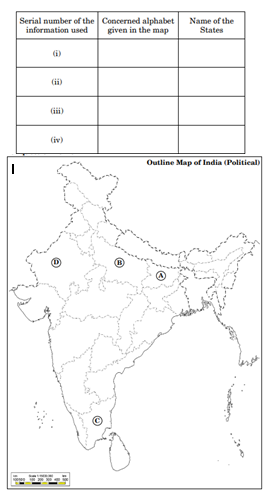
(1) The State from where Indira Gandhi got elected in the 1971 elections.
[1 Mark](2) The State to which Chief Minister C. Natrajan Annadurai belonged
[1 Mark]From the passage, it is clear that he was associated with the Madras province and Tamil Nadu state. Hence, the state marked as (Ⓐ, Ⓑ, Ⓒ, or Ⓓ) corresponding to Tamil Nadu is the correct answer.
This is based on the information about his political career and the map labelling Tamil Nadu as Madras.
(3) The State where Karpoori Thakur was the Chief Minister.
[1 Mark]State: Bihar (Karpoori Thakur was its Chief Minister).
(4) The State with which the phrase ‘Aya Ram, Gaya Ram’ is related.
[1 Mark]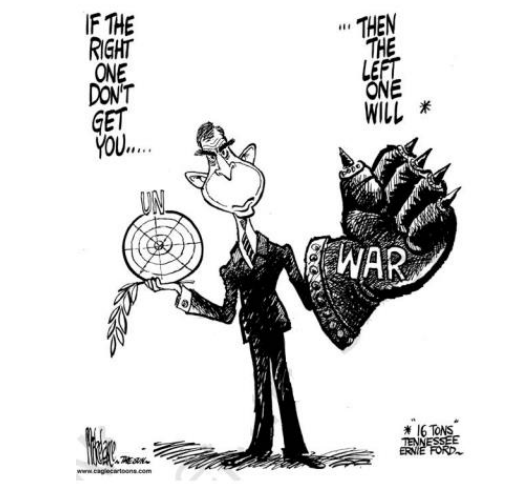
(1) What is missing in the UN logo shown in the cartoon ?
[1 Mark](2) Which country is being represented by the man shown in the cartoon ?
[1 Mark](3) Explain the message conveyed by the cartoon.
[2 Marks]This helps us see contradictions in politics and realize the importance of fair resource distribution, as described in the case passage.
Section B
Which one of the following countries is not a member of SAARC ?
SAARC (South Asian Association for Regional Cooperation) is an organization composed of South Asian countries. The member countries include India, Pakistan, Bangladesh, Sri Lanka, Nepal, Bhutan, Maldives, and Afghanistan. China is not a member of SAARC as it is not part of South Asia.
In which year was a multi-party system introduced in the Maldives ?
A multi-party democratic system was formally introduced in Maldives in 2008, when a new constitution came into effect and the first multi-party presidential election was held.
Which one organ of the United Nations stands suspended at present ?
The Trusteeship Council is the organ of the United Nations that stands suspended at present. It was responsible for supervising trust territories until the last trust territory ceased to exist. Since 1 November 1994, it has been inactive and no longer has a functioning mandate but remains part of the UN Charter. The other organs like the International Court of Justice, Secretariat, and Economic and Social Council are active and functioning.
Arrange the following in chronological order :
(i) Creation of the World Bank
(ii) Foundation of the United Nations
(iii) World Trade Organisation was set up
(iv) Establishment of the International Atomic Energy Agency
Assertion (A) : India signed and ratified the Kyoto Protocol in August 2002.
Reason (R) : India was reluctant to participate in global efforts of environment conservation.
India did sign and ratify the Kyoto Protocol in August 2002, showing participation in global environmental efforts. However, India was not reluctant to participate in environmental conservation; rather, it insisted on equity and exemptions for developing countries in emission reductions, emphasizing that its per capita emissions were much lower than developed countries. Therefore, the reason given is false.
Which one of the following statements is true about Global Commons ?
Global Commons are resources or areas that are not owned by any one state but are shared by the international community. According to the provided context, these include the earth’s atmosphere, Antarctica, the ocean floor, and outer space, which lie outside the sovereign jurisdiction of any single country and require common governance. This makes the statement 'Global Commons are outside the sovereign jurisdiction of any one state.' the correct answer. The Kyoto Protocol does not determine Global Commons, nor are they owned by big powers. While the United Nations may play a role in governance, Global Commons themselves are defined by their status outside individual state sovereignty.
Match the Leaders in the Column ‘A’ with the Facts listed in the Column ‘B’ correctly.
Column A - Column B
1. Sardar Vallabhbhai Patel - (i) Tryst with Destiny
2. Bodhchandra Singh - (ii) First Deputy Prime Minister
3. Potti Sriramulu - (iii) Vishalandhra Movement
4. Jawaharlal Nehru - (iv) Maharaja of a Princely State
Sardar Vallabhbhai Patel was the first Deputy Prime Minister of independent India and played a key role in the integration of Princely States, hence 1-(ii) is correct. Bodhchandra Singh was the Maharaja of a Princely State, so 2-(iv) is correct. Potti Sriramulu is associated with the Vishalandhra Movement, thus 3-(iii) is accurate. Jawaharlal Nehru delivered the famous speech 'Tryst with Destiny' after India's independence, confirming 4-(i). Therefore, the correct matching is 1-(ii), 2-(iv), 3-(iii), 4-(i).
Given below are two statements :
Statement I : During colonial period, the state boundaries were drawn on the administrative convenience. Statement II : After independence, redrawing of the boundaries of the states was based on different languages. In the light of the above given statements,
choose the correct answer from the options given below :
In which state was a coalition government formed in 1957 under the leadership of Communist Party of India ?
In the 1957 assembly elections held in Kerala, the Communist Party of India (CPI) won the largest number of seats and formed a coalition government under the leadership of E. M. S. Namboodiripad. This was significant as it was the first time in the world that a Communist party came to power through democratic elections. Therefore, the correct answer is Kerala.
To which political party did Rafi Ahmed Kidwai belong ?
Rafi Ahmed Kidwai was a leader of the Indian National Congress from Uttar Pradesh. He served as a minister in the U.P. government and later held ministerial positions in independent India within the first ministry, representing the Indian National Congress party.
Choose the correct full form of ‘NITI’ of NITI Aayog.
The Government of India replaced the Planning Commission with a new institution named NITI Aayog, which stands for National Institution for Transforming India. This was officially established on 1 January 2015 to promote the country's development and transformation.
The focus of the Second Five Year Plan was
Section C
How can the economy of the European Union pose a threat to the US economy ? Explain.
Name any four Global Commons.
1. The earth's atmosphere - the layer of gases surrounding the planet that supports life.
2. Antarctica - the southernmost continent which is preserved for peaceful and scientific purposes.
3. The ocean floor - the seabed beyond national jurisdictions which holds many resources.
4. Outer space - the vast expanse beyond Earth's atmosphere used for exploration and communication.
These commons require international cooperation for their protection and sustainable use.
‘‘Water is a crucial resource that is relevant to global politics.’’ Justify the statement with the help of one example.
Why did the Communist Party of India abandon the path of violent revolution in 1951 ? Explain
Highlight any two steps taken by India for Asian and Afro-Asian Unity.
(a) India convened the Asian Relations Conference in March 1947, which helped to establish closer contacts among Asian countries just before India attained its independence.
(b) India actively participated in the Afro-Asian Conference held at Bandung in 1955, which was an important milestone for cooperation among newly independent countries of Asia and Africa and later led to the formation of the Non-Aligned Movement (NAM).
Analyse any two major problems of Indian politics from 1989 to 1999.
(b) Rise of Communalism: There was a significant increase in communal tensions, especially with the rise of the Bharatiya Janata Party (BJP) and events like the Babri Masjid demolition in 1992. This created social divisions and affected national unity. These problems made Indian politics during the 1990s complex and challenging.
Section D
Analyse the relations between India and China since independence.
Since then, the focus shifted more towards trade and economic relations between the two nations. Efforts to resolve the border dispute began with a series of talks starting in 1981, though the problem remained unresolved.
After the Cold War ended, India-China relations evolved to include both strategic and economic dimensions, reflecting their growing importance globally. The border issues remain a key challenge involving geography and politics. Overall, the relationship has seen phases of conflict and cooperation since independence.
Explain the reasons for ethnic conflict in Sri Lanka and its impact on India.
The conflict mainly arises because of ethnic tensions between the Sinhala majority and the Tamil minority. The Sinhala nationalists believe Sri Lanka belongs only to the Sinhala people and oppose giving concessions to Tamils. Tamils, many of whom migrated from India and settled in Sri Lanka even after independence, faced neglect and discrimination, which led to militant Tamil nationalism.
Impact on India:
India finds it hard to stay neutral as many Tamils in India sympathise with Sri Lankan Tamils who are unhappy politically and face violence. There was pressure from Indian Tamils on the Indian government to protect Sri Lankan Tamil interests. In 1987, India got directly involved by signing an accord with Sri Lanka and sending troops to stabilise relations between the Sri Lankan government and Tamils. The ethnic conflict in Sri Lanka thus affected India's foreign relations and internal politics significantly.
Explain any four reasons for good relations between Nepal and India.
1. Historical and Cultural Ties: Nepal and India share deep historical and cultural bonds due to their shared religion, festivals, and traditions that have been interlinked for centuries.
2. Open Border and Freedom of Movement: Both countries have an open border policy allowing citizens to travel and work freely without visas, enhancing people-to-people contact.
3. Cooperation in Trade and Resources: India and Nepal collaborate on trade, electricity generation, and interlocking water management systems which keep the two countries economically connected.
4. Political Support and Stability: Despite occasional political differences, India supports Nepal's democracy and reconstruction efforts, helping maintain peaceful and stable bilateral relations.
Show with the help of examples that flows of ideas, capital, commodities and people are instrumental for globalisation.
Flows of Capital: Capital flows include investments and money moving across borders. Multinational companies invest in different countries, like an American company setting up a factory in India, which promotes economic integration.
Flows of Commodities: Commodities such as goods and raw materials are traded globally. For example, India exports textiles to the USA and imports electronic devices from China, showing how trade links economies worldwide.
Flows of People: People migrate to various countries seeking better jobs and education. For instance, many students from India go to the USA and UK for higher studies, enabling cultural exchange and global connectivity.
These flows are essential for globalisation because they connect countries economically, culturally, and socially, making the world more interdependent and connected.
Describe any four consequences of the partition of British India .
(a) Mass Migration: Partition led to one of the largest mass migrations in history where millions of people moved across the newly drawn borders with Hindus and Sikhs migrating to India, and Muslims moving to Pakistan. This caused immense hardship and suffering.
(b) Communal Violence: The partition triggered widespread communal riots, killings, and persecution as people were fearful and angry. Many lives were lost and communities were deeply affected.
(c) Displacement and Refugee Crisis: The sudden migration created a huge refugee crisis with millions displaced from their homes. Both India and Pakistan struggled to rehabilitate and provide for these refugees.
(d) Political and Territorial Disputes: Partition created disagreements over princely states like Kashmir, leading to tensions and conflicts between India and Pakistan that continue even today.
These consequences marked a painful and difficult chapter in the history of the Indian subcontinent after British rule ended.
Describe any four problems of the process of partition of British India.
(a) Communal Violence: The process of partition led to large-scale communal riots and violence between Hindus, Muslims, and Sikhs. Many people were killed and thousands were injured during this time.
(b) Mass Migration: The partition caused one of the largest migrations in history, where millions of people moved across the new borders to join their chosen nation. This migration was chaotic, often dangerous, and led to loss of property and lives.
(c) Problem of Minorities: After partition, minorities were left on both sides of the border, leading to fear, insecurity, and discrimination. Muslims in India and Hindus and Sikhs in Pakistan faced persecution.
(d) Economic and Administrative Difficulties: The division affected resources and properties. Important assets like railway systems, military equipment, and government offices had to be divided, creating administrative chaos and economic hardships for both countries.
Explain any four steps taken by the government to control the opposition to Emergency imposed in 1975.
1. Censorship of Press: The government imposed severe censorship on newspapers and electronic media to prevent criticism and control the flow of information.
2. Arresting Opposition Leaders: Many opposition leaders and activists were arrested and detained without trial to stop them from organizing protests or spreading dissent.
3. Suspension of Fundamental Rights: The government suspended fundamental rights such as freedom of speech and expression which limited the opposition's ability to express and organize against the Emergency.
4. Control over Political Activities: Political meetings and rallies were banned to restrict the opposition parties from mobilizing public opinion against the government.
These steps effectively weakened the opposition and helped the government maintain control during the Emergency period.
Section E
Why is ‘Shock Therapy’ considered a painful process of transition from an authoritarian socialist system to a democratic capitalist system ? Explain any three reasons.
(a) Sudden Economic Changes: Shock therapy involved a rapid shift from a controlled socialist economy to a free-market capitalist economy, which caused severe economic instability. Many state industries closed down, leading to massive unemployment and loss of income for many people.
(b) Social Hardships: The sudden removal of state subsidies and social welfare programs caused hardship for ordinary people. Prices of basic goods rose quickly, and many could not afford them, resulting in increased poverty and inequality.
(c) Political and Institutional Instability: Transitioning to democracy and capitalism at once was not only economic but also political. The absence of strong democratic institutions and rule of law meant corruption and confusion increased, making the transition painful and difficult for the society as a whole.
Thus, shock therapy was painful because people faced economic hardships, social instability, and political uncertainty during the rapid transition.
Explain any four reasons for the disintegration of the Soviet Union.
(a) Rise of Nationalism: Various republics like the Baltic states (Estonia, Latvia, Lithuania), Ukraine, Georgia, and others wanted sovereignty and independence, which weakened the unity of the USSR.
(b) Economic Problems: The Soviet economy was inefficient and could not meet the needs of its people. The central planning system led to shortages and low productivity.
(c) Political Reforms: Mikhail Gorbachev introduced reforms like Perestroika (restructuring) and Glasnost (openness) which unintentionally loosened the Soviet control and encouraged dissent.
(d) Weakening of Communist Party: The Communist Party lost its influence and control as people demanded more freedom and democracy, leading to the collapse of the political system that held the USSR together.
Analyse the non-traditional notion of security as a notion of human security.
The non-traditional notion of security shifts the focus from protecting states to protecting individuals and communities. It answers the question "Security for who?" by including not just states but also people as the main concern. This concept is called human security.
Unlike traditional security that mainly considers military threats and territorial integrity, human security looks at a wider range of threats that affect people's lives such as poverty, disease, environmental hazards, social injustice, and political oppression.
Human security emphasizes protecting fundamental freedoms and ensuring freedom from fear and want. It broadens the approach to security to include economic security, food security, health security, environmental security, personal security, community security, and political security.
This perspective recognizes that the well-being and dignity of individuals are crucial for overall security. It moves beyond state-centric views towards a more inclusive understanding that addresses global and local challenges affecting human life.
In summary, the non-traditional notion of security as human security expands the concept of security by focusing on the safety and development of individuals and communities from a broad range of threats beyond just military ones.
‘‘India has given priority to non-traditional security in the last two decades.’’ Analyse the statement with examples.
India's security strategy has evolved beyond traditional military threats to encompass non-traditional security challenges such as terrorism, environmental degradation, health pandemics, economic security, and cyber security. In the last twenty years, India has given greater attention to these emerging challenges which do not involve direct military conflict but pose serious risks to its national and human security.
Examples:
1. Counter-Terrorism: India has faced several terrorist attacks internally and from across its borders, so non-traditional security concerns like terrorism have become a priority with strengthening internal security forces and intelligence capabilities.
2. Environmental Security: Issues like pollution, water scarcity, and climate change have been increasingly recognized as threats to the country's security and development.
3. Health Security: The COVID-19 pandemic highlighted the importance of health and bio-security, leading India to enhance its healthcare infrastructure and preparedness.
4. Cyber Security: Rising cyber threats to India's critical infrastructure and digital economy have pushed the government to develop stronger cyber security measures.
5. International Cooperation: India has actively participated in UN peacekeeping operations to support global security and promote cooperative security mechanisms.
Thus, India’s approach in the last two decades reflects an expanded understanding of security that includes protection of its people and environment, not just its borders and military forces.
Describe any three major developments witnessed by Punjab that led to dissatisfaction and violence.
(a) Formation of Punjabi Suba and political changes: The creation of a Punjabi-speaking State in 1966 after the carving out of Haryana and Himachal Pradesh changed the social and political landscape. Although the Akali Dal led the demand for Punjabi Suba, the political power struggles and coalition politics created unrest among different communities.
(b) Water dispute and rise of Sikh identity movement: In the 1980s, the Akali Dal demanded a fair distribution of river water between Punjab and neighbouring states. Alongside, Sikh religious leaders emphasized a distinct autonomous Sikh identity. This led to a rise of militant and extremist groups among Sikhs, increasing tensions.
(c) Operation Blue Star and its aftermath: In June 1984, the Indian government carried out Operation Blue Star to remove militants who had fortified themselves in the Golden Temple, a sacred Sikh shrine. This military action hurt Sikh sentiments deeply. Following this, the assassination of Prime Minister Indira Gandhi by her Sikh bodyguards in October 1984 triggered anti-Sikh riots, further deepening violence and dissatisfaction in Punjab.
Describe any three measures that can be taken by the Union government to address the regional movements and demands.
(a) Granting Autonomy: The government can provide greater autonomy to regions by creating autonomous councils or special status areas. This allows regions to have more control over their internal affairs, satisfy local aspirations, and reduce conflicts.
(b) Dialogue and Negotiation: Engaging directly with the leaders of regional movements through dialogue helps to understand their demands and find peaceful solutions. Negotiation can lead to compromises that maintain national unity while addressing specific regional concerns.
(c) Economic Development and Integration: The government can promote economic development in troubled regions by investing in infrastructure, education, and employment opportunities. Development helps reduce alienation and opposition to outsiders by improving living conditions and creating inclusive growth.
These measures together help balance democratic rights with national unity and address the root causes of regional tensions effectively.
State any four major political happenings of the decade of the nineties which had a widespread impact.
1. Defeat of Congress in 1989 elections: Congress, which had won 415 seats in 1984, was reduced to 197 seats in 1989, marking the end of its dominance.
2. Rise of coalition politics: No single party won a majority in four elections held between 1989 and 1998, leading to coalition governments and changing the nature of Indian politics.
3. Increased importance of the Presidential office: With unstable coalition governments, the President's role became more important in government formation.
4. More frequent constitutional amendments: The 1990s saw several important amendments shaping the political and economic framework of the country, reflecting changing political realities.
These events collectively led to a more competitive and diverse political system in India during the 1990s.
Describe any four issues on which a broad agreement has emerged among most of the political parties in India.
(a) National Integration: Most parties agree on the importance of keeping India united despite its diversity. They work towards maintaining harmony among various regions, languages, and communities.
(b) Protection of International Boundaries: Political parties broadly agree on safeguarding India’s borders and maintaining national security against external threats.
(c) New Economic Policies: There is a consensus on adopting economic reforms that promote development and growth of the country, while different parties may have minor differences in approach.
(d) National Unity and Territorial Integrity: All major parties emphasize preserving the country’s unity and territorial integrity and oppose any attempts to divide or weaken India.
These agreements help in maintaining a stable political environment despite competition and conflicts among parties.
Other Years — Political Science