SOLUTIONS
2026 BOARD EXAM
CBSE Class 12 Humanities Political Science Board Paper 2026 — Set 2 Solutions
2026
Political Science
Class 12 Humanities
CBSE EXAMINATION PAPER-2026
POLITICAL SCIENCE
(Solved)
General Instructions :
Read the following instructions carefully and follow them :
- This question paper contains 36 questions. All questions are compulsory.
- This question paper is divided into 5 sections.
- Section A – questions number 1 to 3 are case based questions
- Section B – questions number 4 to 15 are multiple choice questions
- Section C – questions number 16 to 21 are short answer
- Section D – questions number 22 to 28 are long answer type i
- Section E – questions number 29 to 36 are long answer type ii
- There is no overall choice given in the question paper. However, an internal choice has been provided in few questions.
- Use of calculator is NOT allowed.
Section A
(1) Which Indian leader played an important role in manifesting the Afro-Asian unity ? (A) Sardar Vallabhbhai Patel (B) Jawaharlal Nehru (C) Mahatma Gandhi (D) Lal Bahadur Shastri
[1 Mark](2) In which year did the Non-Alignment Movement become the symbol of Afro-Asian unity ? (A) 1959 (B) 1960 (C) 1961 (D) 1962
[1 Mark](3) Identify the main intention behind the strengthening Afro-Asian unity. (A) To gain economic support from the USA bloc (B) To co-operate with the USSR bloc in enhancing its global policies (C) To form military alliances in the era of Cold War (D) To maintain distance from both the superpowers (USA and USSR) in order to protect its freedom
[1 Mark]This helped newly independent countries safeguard their sovereignty and support the global decolonisation process.
(4) The first summit of the Non-Aligned Movement (NAM) was held in which year ? (A) 1961 (B) 1962 (C) 1963 (D) 1964
[1 Mark]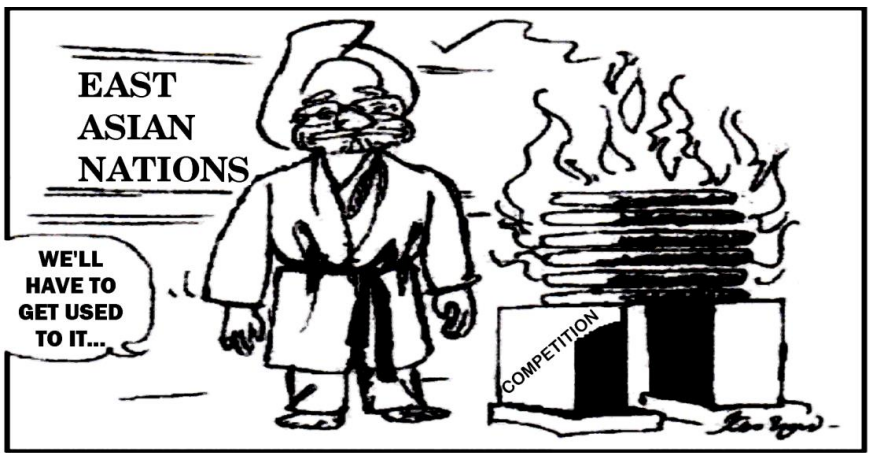
(1) Identify and name the leader shown in the cartoon.
[1 Mark](2) Name any two countries of East Asia
[1 Mark](3) Explain the meaning of the sentence given in the cartoon ‘WE’LL HAVE TO GET USED TO IT’.
[2 Marks]In the given political outline map of India (on page 17), four States have been marked (Ⓐ, Ⓑ, Ⓒ, and Ⓓ). Identify these States on the basis of the information given below and write their correct names in your answer-book along with their respective serial number of the information used and the concerned alphabet given in the map as per the following format :
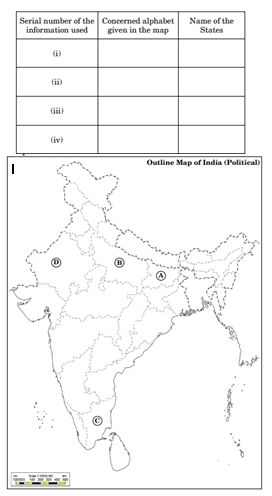
(1) The state related to Prime Minister Lal Bahadur Shastri.
[1 Mark](2) The state for which K. Kamaraj initiated Mid-day Meal programme to increase enrolment in education.
[1 Mark](3) The state in which the Congress Party did not get majority in the Assembly Elections of 1967, but formed a government with the support of other parties.
[1 Mark](4) The state where Non-Congress coalition government was formed after the Assembly Elections of 1967
[1 Mark]From the case passage: Rajasthan is mentioned specifically where Congress did not get majority but still formed government with others' help. This matches the condition of a Non-Congress coalition government being formed.
Section B
Given below are two statements :
Statement I : The World Bank was created after the Second World War in the year 1945.
Statement II : The activities of the World Bank are focused on the developing countries. In the light of above statements, choose the correct answer from the options given below :
Statement I is false because the World Bank was created during the Second World War in 1944, not after the war in 1945. Statement II is true since the World Bank primarily focuses on providing financial and technical assistance to developing countries to support their economic development and reconstruction.
The concept of ‘sustainable development’ emphasises on :
According to the provided context, sustainable development is defined as an approach to development that combines economic growth with ecological responsibility. This means achieving development goals without compromising the environment, ensuring that growth is balanced with the conservation of natural resources. Other options like utilizing maximum resources, solely increasing GDP, or only focusing on environmental conservation do not cover this balanced approach which is the essence of sustainable development.
Match the States given in List-I with the States from which these were carved out given in List-II correctly. Choose the correct answer from the codes given below :
List-I -List-II
1.Gujarat- (i) Assam,
2.Haryana- (ii) Bombay,
3.Meghalaya- (iii) Madhya Pradesh ,
4. Chhattisgarh- (iv) Punjab,
Given below are two statements, one is labelled as Assertion (A) and other as Reason (R). Read these statements and choose the correct answer from the given below options :
Assertion (A) : The European Union has its own flag, anthem, founding date and currency.
Reason (R) : The European Union has a major influence on the economic, political and military fields in the contemporary world.
The Assertion (A) is true because the European Union indeed has its own flag, anthem, founding date, and currency. The Reason (R) is also true since the EU has a significant influence in economic and political fields globally and some form of a common foreign and security policy, although its military influence is limited compared to nation-states. However, Reason (R) is not the correct explanation of Assertion (A) because the existence of the EU's symbols like flag and currency does not depend on its influence in these fields. The EU having these symbols reflects its nature as a supranational entity acting somewhat like a nation state, but its influence is a separate aspect.
The States Reorganisation Commission was appointed in 1953 :
The States Reorganisation Commission was appointed in 1953 to address the demand for the creation of linguistic states. It recommended that state boundaries should be redrawn to reflect linguistic boundaries. This led to the States Reorganisation Act of 1956, which reorganized states to better represent linguistic groups, making administration more efficient and accommodating the linguistic identities of different groups in India.
Arrange the following events in a chronological order :
(i) Atomic test conducted by China
(ii) First nuclear explosion conducted by India
(iii) Implementation of Nuclear Non-Proliferation Treaty
(iv) Initiation of the atomic programme in India under the guidance of Homi Jehangir Bhabha
Choose the correct option :
Which one of the following was the decision of the Supreme Court given on 24 June, 1975 about the Indira Gandhi case ?
The Allahabad High Court had declared Indira Gandhi's election to the Lok Sabha invalid on the grounds that she had used the services of government servants in her election campaign, which was against election rules. This order meant she could not remain an MP or Prime Minister unless re-elected. However, on 24 June 1975, the Supreme Court granted Indira Gandhi a partial stay on this High Court judgment. This allowed her to remain a member of Parliament, but she was barred from participating in Lok Sabha proceedings. Thus, she was allowed to continue temporarily but with certain restrictions.
Which one of the following countries was not a founder of ASEAN ?
ASEAN was established in 1967 by five countries: Indonesia, Malaysia, the Philippines, Singapore, and Thailand. China was not one of the founding members. Therefore, among the options given, China was not a founder of ASEAN.
Section C
Name any four republics of the Soviet Union.
Hence, four republics of the Soviet Union are Russia, Ukraine, Belarus, and Lithuania.
‘‘Globalization has been a boon for the economy of India despite the resistance shown by certain groups.’’ Support the statement.
Globalization has helped India grow economically by increasing trade, investment, and technology exchange with other countries. It has allowed India to specialize in what it does best, like IT services and manufacturing, creating jobs and raising income levels.
Despite resistance from some groups fearing loss of local businesses and culture, globalization has led to more competition and innovation in the market, benefiting consumers with better products and services.
Globalization has also attracted foreign direct investment, boosting infrastructure and increasing exports, which strengthens the country's economy. Though challenges remain, intelligent policies can ensure the benefits of globalization reach all sections of society, making it a boon rather than a bane for India.
Highlight any two fundamental differences between the First Five Year Plan and the Second Five Year Plan.
(b) The First Plan emphasized revival and stabilization of the economy after independence, focusing on immediate needs like food and infrastructure, whereas the Second Plan focused on long-term economic growth by promoting a socialistic pattern of society and building a strong industrial base.
Which two reasons were given by the Government for declaring the National Emergency in 1975 ?
1. Threat of Internal Disturbances: The government believed that there was a serious threat of internal disturbances which could disrupt the peace and order of the country.
2. Grave Crisis: It felt that a grave crisis had arisen which made it necessary to impose Emergency to maintain stability and ensure the smooth functioning of the government.
These reasons were cited under Article 352 of the Constitution, which allows Emergency to be declared on grounds of internal disturbance or external aggression.
How has Information Technology been responsible in accelerating globalization across the world ? Explain with two examples.
Example 1: The internet connects people across the globe instantly through emails, social media, and video calls, allowing businesses to operate internationally without physical presence.
Example 2: E-commerce platforms like Amazon and Alibaba allow buyers and sellers from different countries to trade goods easily, breaking traditional barriers of distance and time. Thus, IT has increased the flow of ideas, goods, and services globally, making the world more interconnected and supporting the growth of globalization.
Analyse any two factors responsible for the change in the nature of coalition governments at the Centre after the General Elections of 2014
1. Clear Majority of a Single Party: In 2014, the Bharatiya Janata Party (BJP) won a clear majority on its own, breaking the trend of coalition governments where no single party had a majority since 1989. This reduced the dependence on regional parties for forming a government.
2. Decline in Influence of Regional Parties: The elections in 2014 saw a decreased role of regional parties in government formation at the Centre as the voters preferred a strong, single-party government to provide stability and decisive governance. This shifted the coalition dynamics significantly.
Thus, these factors ended the era of fragile coalition governments and brought in a phase of relatively stable single-party rule at the Centre after 2014.
Section D
Explain any two major concerns of Indian government regarding the reorganisation of states on the basis of language after the end of colonial rule.
(a) Unity and Integrity of the Nation: The government was concerned that forming states strictly on linguistic lines might encourage regionalism and create divisions among people. There was a fear that this could lead to demands for more states, which might weaken the unity and integrity of India as many diverse groups lived close to each other.
(b) Administrative Challenges and Economic Issues: The reorganisation based on language could create administrative difficulties as some areas had mixed populations speaking different languages. Also, there were concerns about uneven economic development because some states were richer while others were poorer, and creating states on linguistic basis might increase regional disparities. The government wanted to ensure proper development while maintaining social harmony.
Overall, while the demand for linguistic states was strong, the government had to carefully balance these concerns to maintain peace and progress in the newly independent country.
Highlight any four effects of the shock therapy after the disintegration of the Soviet Union.
1. Economic Decline: Shock therapy led to a sudden and severe economic downturn. Many state-owned industries were closed or privatized rapidly, resulting in a sharp drop in industrial output and GDP.
2. Inflation and Unemployment: The rapid removal of price controls caused hyperinflation, making basic goods unaffordable for many people. This also caused a rise in unemployment as many businesses failed.
3. Social Impact: Poverty increased significantly, and social services deteriorated. The gap between rich and poor widened, leading to social unrest and dissatisfaction.
4. Political Instability: The harsh economic conditions and social problems contributed to political unrest and weakened the legitimacy of new governments, making the transition difficult.
Overall, shock therapy brought economic hardship and social challenges instead of the promised quick prosperity.
Analyse any two major challenges faced by the Election Commission before conducting the first General Elections in India after independence
“The United Nations Organisation is generally regarded as the great hope of humanity for peace and progress.” Support the statement with two arguments.
The United Nations Organisation (UNO) is called the great hope of humanity for peace and progress for the following two reasons:
1. Maintaining International Peace and Security: One of the main objectives of the UN is to prevent wars and conflicts between countries. It provides a platform for dialogue and negotiation, which helps in resolving disputes peacefully and avoids bloodshed. For example, the UN peacekeeping forces help maintain ceasefires and support post-conflict peace building.
2. Promoting Human Rights and Social Progress: The UN promotes respect for human rights and fundamental freedoms all over the world. It works to ensure equality, justice and development for all people, which contributes to the progress of humanity. Through various programmes, the UN supports education, health, economic development and environmental protection, which help improve living standards globally.
Thus, the UN plays a vital role in bringing countries together to maintain peace and foster progress for all nations.
Suggest any four measures to make the United Nations Organisation more relevant in the current scenario.
1. Reform of the Security Council: Increase permanent and non-permanent membership to better represent Asia, Africa, and South America, reflecting current global realities.
2. Creation of a Peacebuilding Commission: Establish a dedicated body to support countries in post-conflict peacebuilding to prevent relapse into conflict.
3. Greater Responsibility in International Failures: The UN should accept international responsibility when peacekeeping missions or interventions fail, improving accountability.
4. Focus on Emerging Global Issues: Adapt and expand the UN's jurisdiction to effectively address new challenges like climate change, terrorism, and pandemics.
These measures will help the UN adapt to changing global dynamics and improve its effectiveness in promoting peace and security.
Why have the global efforts to protect the environment not been as successful as desired ? Analyse the reasons.
(a) Conflicting Interests: Different countries have different priorities; developing countries focus on economic growth while developed countries emphasize environmental conservation. This leads to disagreements in international agreements.
(b) Bias Towards Economic Growth: Many global policies, like Agenda 21, have been criticized for favoring economic development over ecology, which weakens efforts at environmental protection.
(c) Lack of Coordination: Environmental problems are global, but responses are often fragmented and not well coordinated internationally.
(d) Insufficient Implementation: Even when agreements are made, enforcement is weak due to lack of binding commitments and resources.
(e) Political and Economic Constraints: Some countries may prioritize short-term economic gains over long-term environmental health due to poverty or political pressures.
Hence, these reasons together reduce the effectiveness of global environmental protection efforts.
Evaluate the efforts made to achieve the objectives of the Rio Declaration by the developed and developing countries.
Efforts by Developed Countries: Developed countries focused on immediate environmental conservation and pushed for equal responsibility from all nations. They worked on international agreements related to climate change, biodiversity, and forestry, and supported the implementation of Agenda 21, which recommended sustainable development practices. However, some developing countries criticized them for not adequately addressing their historical environmental impact and for not providing sufficient financial and technological support.
Efforts by Developing Countries: Developing countries emphasized their need for economic growth and argued that developed countries were mainly responsible for ecological degradation due to their long industrial history. They sought special considerations and support in global environmental policies. Developing nations adopted sustainable development goals but highlighted that poverty eradication and development must be prioritized alongside environmental conservation.
Overall Evaluation: While the Rio Declaration succeeded in bringing environmental issues to the global political arena and signing important conventions, significant differences between developed and developing countries remain. The developed countries generally pursue stronger environmental measures, whereas developing countries demand flexibility and support to balance development with conservation. This has led to ongoing debates in international environmental law and policy, indicating partial success in achieving Rio's objectives but also showing unresolved challenges.
Section E
Describe the sequence of events responsible for the establishment of democracy in Nepal.
1. Monarchy and Initial Conflict: Initially, Nepal was ruled by a monarchy. During the 1990s, the Maoists spread their influence by supporting armed insurrection against the king and ruling elite, which resulted in violent conflict between Maoist guerrillas and the king's armed forces.
2. Desire for Democracy: Throughout this time, political parties and common people demanded a more open and responsive government, but the king and army retained control, limiting democracy.
3. Constituent Assembly and Negotiations: Nepal formed a constituent assembly to draft a new constitution. Some wanted a nominal monarchy to keep historical ties while Maoists agreed to suspend armed struggle. Maoists aimed for social and economic reforms, but there were disagreements among political groups.
4. Abolition of Monarchy and Republic Formation: In 2008, the monarchy was abolished, and Nepal became a democratic republic.
5. Adoption of New Constitution: Later in 2015, Nepal adopted a new constitution solidifying its democratic framework.
These events highlight Nepal's unique journey toward democracy despite conflicts, political struggles, and negotiations.
Describe the sequence of events responsible for the end of the military government and establishment of democracy in Bangladesh.
After the assassination of Sheikh Mujibur Rahman in 1975 during a military uprising, Bangladesh experienced a period of military rule. Lt Gen Ziaur Rahman took power, formed the Bangladesh National Party, and was elected in 1979. However, Ziaur Rahman was also assassinated. Subsequently, Lt Gen H. M. Ershad assumed control through another military takeover. His rule faced strong opposition from the people, especially students, who demanded democracy. Under pressure, Ershad allowed limited political activity and later became president for five years. Mass protests continued against his rule, and finally in 1990, Ershad resigned. Democratic elections were held in 1991, restoring multi-party representative democracy in Bangladesh. This transition marked the end of military dictatorship and the establishment of a democratic government committed to secularism and socialism as per the constitution initially drafted in Bangladesh.
Explain the efforts of the Punjab government and the Indian government to foster peace in the State of Punjab.
(1) Efforts by the Indian Government: The Indian government acknowledged the mistakes of the past, especially concerning the events of 1984, and expressed regret, which helped build trust. It pursued a policy of dialogue and negotiation with the regional groups rather than treating the problem only as a law and order issue. Political settlements were made with various groups, showing that peaceful negotiation could resolve separatist movements. Security measures were also strengthened to restore law and order.
(2) Efforts by the Punjab Government: The Punjab government worked closely with the central government to implement policies promoting peace and reconciliation. It supported initiatives to promote social harmony and development projects to improve the economic conditions in the region. The government encouraged community participation to reduce tensions among different groups.
Both governments focused on addressing the root causes of unrest, promoted justice, and aimed to rebuild trust among people. These combined efforts helped in reducing violence and fostering lasting peace in Punjab.
Explain the main factors responsible for the demands of autonomy by the north-eastern states in India.
Firstly, these states faced cultural and linguistic differences from Assam, as many tribal communities felt that Assamese language and culture were being imposed on them. This created resentment and a feeling of neglect among non-Assamese groups.
Secondly, the political control by the Assam government over the entire region and the central government's dominance in administrative matters led to demands for more administrative powers at the state level. The people wanted to manage their own local affairs without excessive interference.
Thirdly, the region's geographical isolation, weak communication links with the rest of India, and its backwardness economically added to the feelings of neglect and the desire for self-rule.
Fourthly, the presence of diverse ethnic groups with distinct identities created demands for separate political units to preserve their cultural heritage and political rights.
Lastly, the vast international borders and fears related to outside influence also motivated the people to seek greater autonomy for better governance and protection. These factors collectively resulted in complex and strong demands for autonomy from various north-eastern states.
How did the Mandal Commission recommendations prove to be an effort to solve the problems of Other Backward Classes (OBCs) ? Analyse.
The Mandal Commission, chaired by Bindeshwari Prasad Mandal, was set up to identify the socially and educationally backward classes in India, specifically the Other Backward Classes (OBCs), and recommend measures for their advancement. It recommended reserving 27 percent of government jobs and seats in educational institutions for OBCs. This was a significant step in addressing historical social and economic discrimination faced by these groups. The implementation of these reservations by the National Front government in 1990 aimed to provide greater access to education and employment opportunities for the OBC communities. Besides reservations, the Commission suggested other reforms like land reforms to improve the economic conditions of OBCs. Politically, the Mandal Commission increased awareness among OBC communities about their identity, leading to greater social and political mobilization. Although its recommendations triggered widespread protests and debate known as the 'Mandal issue', it played a crucial role in shaping Indian politics by empowering previously underrepresented groups. Thus, the Mandal Commission was an important effort to uplift OBCs socially, educationally, economically, and politically by recommending affirmative action and reforms tailored to their needs.
Examine any three grounds on which the regional parties support the various coalition governments formed at the Centre in India.
Three grounds for support by regional parties are:
(a) To safeguard regional interests: Regional parties support coalition governments to protect and promote the interests of their states. They use their influence to ensure that their regions receive sufficient funds, projects, and development schemes from the Centre.
(b) To gain political power and influence: By supporting a coalition government, regional parties get the chance to participate in central governance. They can get ministerial posts and have a say in policy making which increases their importance in national politics.
(c) To maintain stability and avoid frequent elections: Regional parties support coalitions to provide political stability. Frequent elections can be costly and uncertain, so by joining hands, they help in creating lasting governments at the Centre.
Conclusion: Thus, regional parties support coalition governments based on regional benefits, political gains, and the need for stable governance, making Indian politics more inclusive and diverse.
Highlight the differences between the external and internal notions of security in the contemporary world.
(a) External Notions of Security: External security traditionally refers to protection against threats from other countries or external forces. It mainly focuses on safeguarding national borders from military attacks, invasions, or wars. The main concern is national defense and protecting a country from foreign aggression.
(b) Internal Notions of Security: Internal security deals with maintaining peace and order within a country. It involves protecting citizens from violence, crime, terrorism, and other threats that arise inside the country. It ensures law and order and a safe environment for people to live in.
(c) Key Differences: External security is about protecting a nation from outside threats such as enemy states or external forces, while internal security focuses on threats within the nation like communal violence, insurgency, or criminal activities. External security usually involves armed forces and defense systems, whereas internal security relies on police, intelligence, and administrative measures.
In conclusion, both external and internal notions of security are crucial for a country's overall safety and stability in the contemporary world, addressing different dimensions of threats and challenges.
“The non-traditional notions of security are more comprehensive than the traditional notions of security.” Support the statement with the help of suitable examples.
On the other hand, non-traditional security includes a wide range of threats affecting individuals, communities, and even global humanity. It covers human security which prioritizes protection of people from threats like poverty, hunger, disease, environmental hazards, terrorism, and human rights abuses. For instance, threats like climate change or pandemics do not target a state but affect millions of people globally.
Thus, non-traditional security is more inclusive and holistic as it asks 'security for whom?' and expands the focus beyond just the state to individuals and communities. It addresses economic security, food security, health security, and environmental security, which traditional security overlooks. This broader view makes non-traditional notions more comprehensive in dealing with modern-day challenges that cannot be handled only by military or political means.
Other Years — Political Science