QUESTION PAPER
2026 BOARD EXAM
CBSE Class 12 Humanities Political Science Board Paper 2026 — Set 5
2026
Political Science
Class 12 Humanities
CBSE EXAMINATION PAPER-2026
POLITICAL SCIENCE
(Solved)
General Instructions :
Read the following instructions carefully and follow them :
- This question paper contains 36 questions. All questions are compulsory.
- This question paper is divided into 5 sections.
- Section A – questions number 1 to 3 are case based questions
- Section B – questions number 4 to 15 are multiple choice questions
- Section C – questions number 16 to 21 are short answer
- Section D – questions number 22 to 28 are long answer type i
- Section E – questions number 29 to 36 are long answer type ii
- There is no overall choice given in the question paper. However, an internal choice has been provided in few questions.
- Use of calculator is NOT allowed.
Section A
Read the following passage carefully and answer the questions based on it :
‘‘The defeat of the Congress party in 1989 marked the end of Congress dominance over the Indian party system. It did not, however, mean the emergence of any other single party to fill in its place. Thus, began an era of multi-party system, in which regional parties played a crucial role in forming the alliances.’’
(1) In which year did the Congress party face a setback for the first time and lose power in some states ? (A) 1962 (B) 1967 (C) 1971 (D) 1977
(2) Which one of the following regional parties never formed a government in any state ? (A) Bahujan Samaj Party (B) Dravida Munnetra Kazhagam (C) Bharatiya Kranti Dal (D) Shiromani Akali Dal
(3) Which party was the largest party in the Lok Sabha after the 1989 elections ? (A) National Front (B) Indian National Congress (C) Bharatiya Janata Party (D) Janata Party
(4) Which political party/alliance formed the first coalition government in December 1989 ? (A) National Conference (B) National Front (C) Indian National Congress (D) United Front
In the given political outline map of India (on page 15), four States have been marked as(Ⓐ, Ⓑ, Ⓒ,and Ⓓ) . Identify these States on the basis of the information given below and write their correct names in your answer-book along with the respective serial number of the information used and the concerned alphabets given in the map as per the following format :
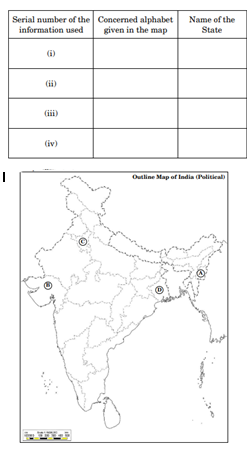
(1) The state which was bifurcated between India and Pakistan at the time of the partition.
[1 Mark](2) The state which was created in 1966.
[1 Mark](3) The state to which the first Deputy Prime Minister Sardar Vallabhbhai Patel belonged.
[1 Mark](4) The state to which Maharaja Bodhchandra Singh belonged.
[1 Mark]Study the cartoon given below and answer the questions based on it
Note : The man shown in the suit is President Musharraf and the same man shown in the cap is General Musharraf. On the basis of politics in Pakistan, answer the following questions.
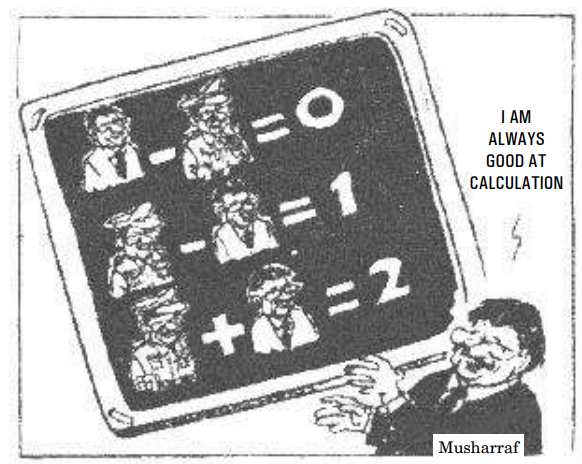
(1) What message is given by the uppermost equation ? Explain.
[1 Mark](2) Explain the message given by the middle line.
[1 Mark](3) Highlight the message conveyed by the whole cartoon.
[1 Mark](4) Explain the message given by the lowest line.
[1 Mark]Section B
Which one of the following was not a republic of the Soviet Union ?
Who among the following was the General Secretary of the Communist Party of Soviet Union in 1985 ?
Assertion (A) : In April 2006, there were massive countrywide pro-democracy protests in Nepal.
Reason (R) : In 2002, the king abolished the parliament and dismissed the government.
Match the following correctly :
A - B
1. General Zia-ul-Haq - (i) Bangladesh
2. Ziaur Rahman - (ii) Nepal
3. Rajapaksa - (iii) Pakistan
4. Seven Party Alliance - (iv) Sri Lanka
Choose the correct full form of the ‘SALT’ treaty from the options given below :
Which one of the following is not a new source of threat to security ?
Who among the following advanced the ‘Two-nation theory’ ?
Assertion (A) : There were killings and atrocities on both sides of the border of India in 1947.
Reason (R) : The planned transfer of the population had failed.
Arrange the following events in chronological order :
(i) P.C. Mahalanobis led a Five-Year Plan.
(ii) K.N. Raj was involved in drafting the First Five-Year Plan.
(iii) The ‘Bombay Plan’ was drafted
(iv) The Planning Commission was set up.
The government of which political party/alliance decided to implement the recommendations of the Mandal Commission ?
Choose the name of that political party which has Gandhian Socialism along with cultural nationalism as its ideology.
Section C
Name any four principal organs of the United Nations.
Explain the meaning of globalisation.
Analyse any two reasons for resistance to globalisation in India.
Show the ideology of the Jana Sangh that makes it different from other parties.
Highlight any two features of the nature of the Congress party as a social and ideological coalition.
Explain any two immediate consequences of the implementation of the recommendations of the Mandal Commission in August 1990.
Section D
‘‘Indo-Russian relations are embedded in the history of trust and common interests.’’ Support the statement with four examples.
Soviet system was to ensure the welfare of the people.’’ Support the statement with four examples.
Describe any four changes that occurred in the world after the end of the Cold War.
Highlight any four choices available to a state when its security is threatened by a possible war.
Explain any two major reasons for the split in the Congress party after the 1967 elections.
Explain any four reasons for the popularity of Prime Minister Indira Gandhi before the fifth general elections.
Was the Emergency declared in 1975 necessary ? Support your answer with two arguments.
Section E
Analyse any four decisions made by the Chinese leadership that led to the rise of the Chinese economy.
Analyse any four reasons that make the European Union an influential regional organisation
Explain the concept of ‘common but differentiated responsibilities’ to conserve, protect and restore the health of the environment.
Explain any four steps taken by the Government of India to save the environment from degradation
Explain any three reasons that are responsible for the strained relations between India and China.
Explain any three important features of India’s Nuclear Policy
‘Regional aspirations and demands are part and parcel of democratic politics.’ Support the statement with three examples.
Suggest any three measures to strengthen ‘unity in diversity’ in India.
Other Years — Political Science