QUESTION PAPER
2026 BOARD EXAM
CBSE Class 12 Humanities Political Science Board Paper 2026 — Set 4
2026
Political Science
Class 12 Humanities
CBSE EXAMINATION PAPER-2026
POLITICAL SCIENCE
(Solved)
General Instructions :
Read the following instructions carefully and follow them :
- This question paper contains 36 questions. All questions are compulsory.
- This question paper is divided into 5 sections.
- Section A – questions number 1 to 3 are case based questions
- Section B – questions number 4 to 15 are multiple choice questions
- Section C – questions number 16 to 21 are short answer
- Section D – questions number 22 to 28 are long answer type i
- Section E – questions number 29 to 36 are long answer type ii
- There is no overall choice given in the question paper. However, an internal choice has been provided in few questions.
- Use of calculator is NOT allowed.
Section A
Read the following passage carefully and answer the questions based on it :
‘‘After the Chinese revolution, India was one of the first countries to recognise the communist government. Nehru felt strongly for this neighbour and helped the new government in international fora. A joint enunciation of peaceful coexistence was signed by Indian Prime Minister and the Chinese premier in 1954. But two developments strained this relationship. China annexed Tibet and removed a historical buffer between the two countries. A little earlier, a boundary dispute had surfaced between India and China.’’
(1) In which year was Tibet annexed by China ? (A) 1949 (B) 1950 (C) 1951 (D) 1952
(2) Which one of the following was jointly signed by India and China in 1954 ? (A) Non-Alignment Agreement (B) Panchsheel (C) Agreement on Apartheid (D) Principles of Socialism
(3) The reason of the Chinese invasion in 1962 was : (A) Boundary dispute (B) India’s interference in Tibet (C) India’s policy of non-alignment (D) India’s good relations with USA
(4) Choose the name of the Tibetan spiritual leader who had obtained political asylum in India. (A) Dalai Lama (B) Kazi Dorzi (C) Zhou Enlai (D) V.K.S. Menon
In the given political outline map of India (on page 15), four States have been marked as (Ⓐ, Ⓑ, Ⓒ,and Ⓓ) Identify these States on the basis of the information given below and write their correct names in your answer-book along with the respective serial number of the information used and the concerned alphabets given in the map as per the following format :
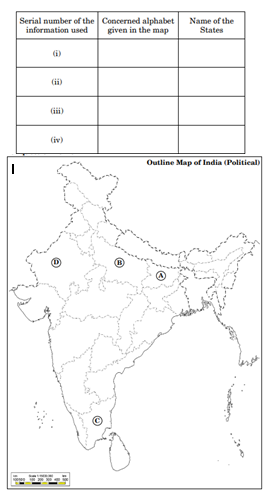
(1) The State from where Indira Gandhi got elected in the 1971 elections.
[1 Mark](2) The State to which Chief Minister C. Natrajan Annadurai belonged
[1 Mark](3) The State where Karpoori Thakur was the Chief Minister.
[1 Mark](4) The State with which the phrase ‘Aya Ram, Gaya Ram’ is related.
[1 Mark]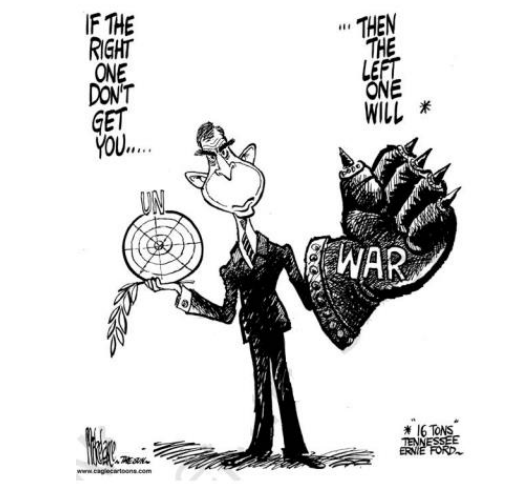
(1) What is missing in the UN logo shown in the cartoon ?
[1 Mark](2) Which country is being represented by the man shown in the cartoon ?
[1 Mark](3) Explain the message conveyed by the cartoon.
[2 Marks]Section B
Which one of the following countries is not a member of SAARC ?
In which year was a multi-party system introduced in the Maldives ?
Which one organ of the United Nations stands suspended at present ?
Arrange the following in chronological order :
(i) Creation of the World Bank
(ii) Foundation of the United Nations
(iii) World Trade Organisation was set up
(iv) Establishment of the International Atomic Energy Agency
Assertion (A) : India signed and ratified the Kyoto Protocol in August 2002.
Reason (R) : India was reluctant to participate in global efforts of environment conservation.
Which one of the following statements is true about Global Commons ?
Match the Leaders in the Column ‘A’ with the Facts listed in the Column ‘B’ correctly.
Column A - Column B
1. Sardar Vallabhbhai Patel - (i) Tryst with Destiny
2. Bodhchandra Singh - (ii) First Deputy Prime Minister
3. Potti Sriramulu - (iii) Vishalandhra Movement
4. Jawaharlal Nehru - (iv) Maharaja of a Princely State
Given below are two statements :
Statement I : During colonial period, the state boundaries were drawn on the administrative convenience. Statement II : After independence, redrawing of the boundaries of the states was based on different languages. In the light of the above given statements,
choose the correct answer from the options given below :
In which state was a coalition government formed in 1957 under the leadership of Communist Party of India ?
To which political party did Rafi Ahmed Kidwai belong ?
Choose the correct full form of ‘NITI’ of NITI Aayog.
The focus of the Second Five Year Plan was
Section C
How can the economy of the European Union pose a threat to the US economy ? Explain.
Name any four Global Commons.
‘‘Water is a crucial resource that is relevant to global politics.’’ Justify the statement with the help of one example.
Why did the Communist Party of India abandon the path of violent revolution in 1951 ? Explain
Highlight any two steps taken by India for Asian and Afro-Asian Unity.
Analyse any two major problems of Indian politics from 1989 to 1999.
Section D
Analyse the relations between India and China since independence.
Explain the reasons for ethnic conflict in Sri Lanka and its impact on India.
Explain any four reasons for good relations between Nepal and India.
Show with the help of examples that flows of ideas, capital, commodities and people are instrumental for globalisation.
Describe any four consequences of the partition of British India .
Describe any four problems of the process of partition of British India.
Explain any four steps taken by the government to control the opposition to Emergency imposed in 1975.
Section E
Why is ‘Shock Therapy’ considered a painful process of transition from an authoritarian socialist system to a democratic capitalist system ? Explain any three reasons.
Explain any four reasons for the disintegration of the Soviet Union.
Analyse the non-traditional notion of security as a notion of human security.
‘‘India has given priority to non-traditional security in the last two decades.’’ Analyse the statement with examples.
Describe any three major developments witnessed by Punjab that led to dissatisfaction and violence.
Describe any three measures that can be taken by the Union government to address the regional movements and demands.
State any four major political happenings of the decade of the nineties which had a widespread impact.
Describe any four issues on which a broad agreement has emerged among most of the political parties in India.
Other Years — Political Science