QUESTION PAPER
2026 BOARD EXAM
CBSE Class 12 Humanities Political Science Board Paper 2026 — Set 2
2026
Political Science
Class 12 Humanities
CBSE EXAMINATION PAPER-2026
POLITICAL SCIENCE
(Solved)
General Instructions :
Read the following instructions carefully and follow them :
- This question paper contains 36 questions. All questions are compulsory.
- This question paper is divided into 5 sections.
- Section A – questions number 1 to 3 are case based questions
- Section B – questions number 4 to 15 are multiple choice questions
- Section C – questions number 16 to 21 are short answer
- Section D – questions number 22 to 28 are long answer type i
- Section E – questions number 29 to 36 are long answer type ii
- There is no overall choice given in the question paper. However, an internal choice has been provided in few questions.
- Use of calculator is NOT allowed.
Section A
(1) Which Indian leader played an important role in manifesting the Afro-Asian unity ? (A) Sardar Vallabhbhai Patel (B) Jawaharlal Nehru (C) Mahatma Gandhi (D) Lal Bahadur Shastri
[1 Mark](2) In which year did the Non-Alignment Movement become the symbol of Afro-Asian unity ? (A) 1959 (B) 1960 (C) 1961 (D) 1962
[1 Mark](3) Identify the main intention behind the strengthening Afro-Asian unity. (A) To gain economic support from the USA bloc (B) To co-operate with the USSR bloc in enhancing its global policies (C) To form military alliances in the era of Cold War (D) To maintain distance from both the superpowers (USA and USSR) in order to protect its freedom
[1 Mark](4) The first summit of the Non-Aligned Movement (NAM) was held in which year ? (A) 1961 (B) 1962 (C) 1963 (D) 1964
[1 Mark]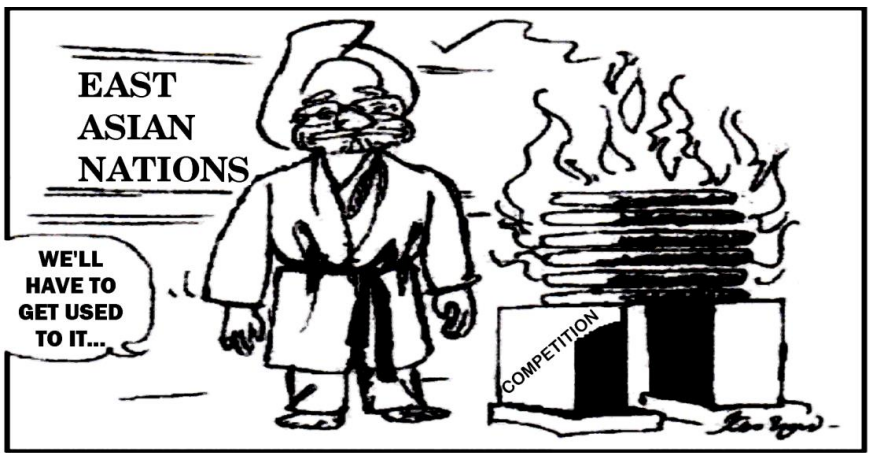
(1) Identify and name the leader shown in the cartoon.
[1 Mark](2) Name any two countries of East Asia
[1 Mark](3) Explain the meaning of the sentence given in the cartoon ‘WE’LL HAVE TO GET USED TO IT’.
[2 Marks]In the given political outline map of India (on page 17), four States have been marked (Ⓐ, Ⓑ, Ⓒ, and Ⓓ). Identify these States on the basis of the information given below and write their correct names in your answer-book along with their respective serial number of the information used and the concerned alphabet given in the map as per the following format :
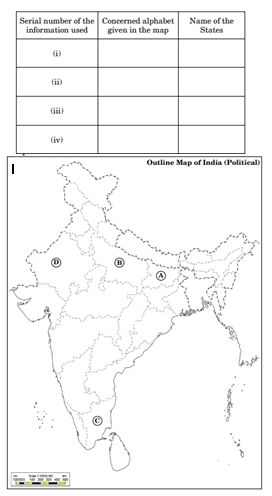
(1) The state related to Prime Minister Lal Bahadur Shastri.
[1 Mark](2) The state for which K. Kamaraj initiated Mid-day Meal programme to increase enrolment in education.
[1 Mark](3) The state in which the Congress Party did not get majority in the Assembly Elections of 1967, but formed a government with the support of other parties.
[1 Mark](4) The state where Non-Congress coalition government was formed after the Assembly Elections of 1967
[1 Mark]Section B
Given below are two statements :
Statement I : The World Bank was created after the Second World War in the year 1945.
Statement II : The activities of the World Bank are focused on the developing countries. In the light of above statements, choose the correct answer from the options given below :
The concept of ‘sustainable development’ emphasises on :
Match the States given in List-I with the States from which these were carved out given in List-II correctly. Choose the correct answer from the codes given below :
List-I -List-II
1.Gujarat- (i) Assam,
2.Haryana- (ii) Bombay,
3.Meghalaya- (iii) Madhya Pradesh ,
4. Chhattisgarh- (iv) Punjab,
Given below are two statements, one is labelled as Assertion (A) and other as Reason (R). Read these statements and choose the correct answer from the given below options :
Assertion (A) : The European Union has its own flag, anthem, founding date and currency.
Reason (R) : The European Union has a major influence on the economic, political and military fields in the contemporary world.
The States Reorganisation Commission was appointed in 1953 :
Arrange the following events in a chronological order :
(i) Atomic test conducted by China
(ii) First nuclear explosion conducted by India
(iii) Implementation of Nuclear Non-Proliferation Treaty
(iv) Initiation of the atomic programme in India under the guidance of Homi Jehangir Bhabha
Choose the correct option :
Which one of the following was the decision of the Supreme Court given on 24 June, 1975 about the Indira Gandhi case ?
Which one of the following countries was not a founder of ASEAN ?
Section C
Name any four republics of the Soviet Union.
‘‘Globalization has been a boon for the economy of India despite the resistance shown by certain groups.’’ Support the statement.
Highlight any two fundamental differences between the First Five Year Plan and the Second Five Year Plan.
Which two reasons were given by the Government for declaring the National Emergency in 1975 ?
How has Information Technology been responsible in accelerating globalization across the world ? Explain with two examples.
Analyse any two factors responsible for the change in the nature of coalition governments at the Centre after the General Elections of 2014
Section D
Explain any two major concerns of Indian government regarding the reorganisation of states on the basis of language after the end of colonial rule.
Highlight any four effects of the shock therapy after the disintegration of the Soviet Union.
Analyse any two major challenges faced by the Election Commission before conducting the first General Elections in India after independence
“The United Nations Organisation is generally regarded as the great hope of humanity for peace and progress.” Support the statement with two arguments.
Suggest any four measures to make the United Nations Organisation more relevant in the current scenario.
Why have the global efforts to protect the environment not been as successful as desired ? Analyse the reasons.
Evaluate the efforts made to achieve the objectives of the Rio Declaration by the developed and developing countries.
Section E
Describe the sequence of events responsible for the establishment of democracy in Nepal.
Describe the sequence of events responsible for the end of the military government and establishment of democracy in Bangladesh.
Explain the efforts of the Punjab government and the Indian government to foster peace in the State of Punjab.
Explain the main factors responsible for the demands of autonomy by the north-eastern states in India.
How did the Mandal Commission recommendations prove to be an effort to solve the problems of Other Backward Classes (OBCs) ? Analyse.
Examine any three grounds on which the regional parties support the various coalition governments formed at the Centre in India.
Highlight the differences between the external and internal notions of security in the contemporary world.
“The non-traditional notions of security are more comprehensive than the traditional notions of security.” Support the statement with the help of suitable examples.
Other Years — Political Science