Class 11 PCB . Biology . Biology . Structural Organization in Animals
Chapter 7: Structural Organization In Animals
Ch 7
Biology
Class 11 PCB
Introduction
Organisation in Multicellular Animals
Tissue — A group of similar cells, together with intercellular substances, that performs a specific function.
Levels of Organisation
- Similar cells and intercellular substances form a tissue.
- Different tissues are arranged in specific proportions and patterns to form an organ.
- Two or more organs interact physically and/or chemically to form an organ system.
- Organ systems work together to support the survival of the whole organism.
Division of Labour
- Unicellular animals: A single cell performs functions such as digestion, respiration and reproduction.
- Multicellular animals: Different groups of cells carry out functions in an organised way.
- Tissues: Complex animals have four basic tissue types, combined in different proportions and patterns.
- Example: The heart contains epithelial, connective, muscular and neural tissues.
- Importance: Organisation divides work and allows the body's cells to function more efficiently and in coordination.
Organs, Organ Systems and Study of Animals
- Organs: Each organ consists of one or more tissue types and performs particular functions.
- Organ systems: Organs associate and coordinate to carry out common functions; examples include the digestive and respiratory systems.
- Evolutionary trend: Complexity in organs and organ systems shows a discernible trend called the evolutionary trend.
- Morphology: The study of form and externally visible features; in animals, it includes the external appearance of body parts and organs.
- Anatomy: The study of the internal organs of animals.
| Aspect | Morphology | Anatomy |
|---|---|---|
| Focus | External form and visible features | Internal organs |
| In animals | External appearance of organs or body parts | Internal structure of organs |
Frog: Classification and General Features
- Habitat: Frogs live both on land and in freshwater.
- Classification: Frogs belong to class Amphibia of phylum Chordata; a common Indian species is *Rana tigrina*.
- Poikilotherms: Frogs do not maintain a constant body temperature; it varies with the environmental temperature.
- Camouflage: Frogs can change colour to blend with their surroundings and hide from enemies; this protective coloration is called mimicry in the text.
- Seasonal dormancy: They shelter in deep burrows during extreme weather—summer sleep is aestivation, and winter sleep is hibernation.
| Feature | Aestivation | Hibernation |
|---|---|---|
| Season | Summer | Winter |
| Purpose | Protection from extreme heat | Protection from extreme cold |
Frog Morphology
Skin and Body Plan
- Skin: Smooth, slippery because of mucus, and kept moist.
- Colour: The dorsal side is generally olive green with dark irregular spots; the ventral side is uniformly pale yellow.
- Water uptake: Frogs do not drink water; they absorb it through their skin.
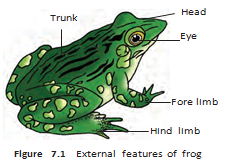
- Body divisions: The body has a head and trunk; a neck and tail are absent.
Sense Organs and Limbs
- Nostrils: A pair is present above the mouth.
- Eyes: Bulging eyes are protected in water by a nictitating membrane.
- Tympanum: A membranous structure on each side of the eyes receives sound signals.
- Forelimbs: End in four digits.
- Hind limbs: Larger and more muscular than the forelimbs; they end in five digits.
- Movement: Limbs help in swimming, walking, leaping and burrowing; webbed feet aid swimming.
Sexual Dimorphism
- Male frogs: Have sound-producing vocal sacs and a copulatory pad on the first digit of the forelimbs.
- Female frogs: Lack vocal sacs and the copulatory pad.
How are the male and female frogs distinguished externally?
What is the difference between aestivation and hibernation?
Quick recap
- Tissues are groups of similar cells and intercellular substances performing a specific function.
- Tissues form organs, and interacting organs form organ systems; this organisation supports division of labour.
- Morphology concerns external form, whereas anatomy concerns internal organs.
- Frogs are amphibians and poikilotherms; they use aestivation in summer and hibernation in winter.
- A frog has a moist, mucus-covered skin, a head and trunk, and no neck or tail.
- Males have vocal sacs and a forelimb copulatory pad; webbed feet and muscular hind limbs support movement.
External features of frog
External Features
Body and limbs
- Body division: The body has a head and trunk; a neck and tail are absent.
- Skin: Mucous glands are present, and the highly vascularised skin also helps in respiration.
- Head: A pair of nostrils lies above the mouth. Bulging eyes are protected in water by a nictitating membrane.
- Hearing: A membranous tympanum on each side of the eyes receives sound signals.
- Limbs: Forelimbs have four digits; larger, more muscular hind limbs have five digits. Webbed feet aid swimming.
- Movement: Limbs help the frog swim, walk, leap and burrow.
| Feature | Male | Female |
|---|---|---|
| Vocal sacs | Present; produce sound | Absent |
| Copulatory pad | Present on the first digit of the forelimb | Absent |
Digestive System
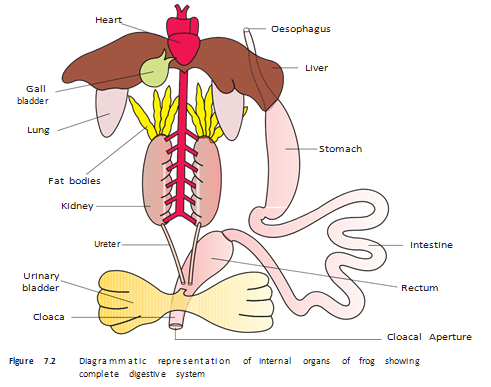
Digestive system — It consists of the alimentary canal and digestive glands; the canal is short because frogs are carnivores and have a reduced intestine.
Food digestion and absorption
- Food capture: The bilobed tongue captures prey.
- Canal sequence: Mouth → buccal cavity → pharynx → oesophagus → stomach → intestine → rectum → cloaca.
- Digestive glands: The liver secretes bile, which is stored in the gall bladder; the pancreas produces enzyme-containing pancreatic juice.
- Stomach: Hydrochloric acid and gastric juices digest food; partially digested food, called chyme, passes to the duodenum.
- Duodenum: Receives bile and pancreatic juice through a common bile duct. Bile emulsifies fats; pancreatic juice digests carbohydrates and proteins.
- Intestine: Final digestion occurs here. Villi and microvilli absorb digested food through the intestinal wall.
- Egestion: Undigested solid waste enters the rectum and passes out through the cloaca.
| Structure | Role |
|---|---|
| Liver and gall bladder | The liver produces bile, stored in the gall bladder; bile emulsifies fats. |
| Pancreas | Produces pancreatic juice, which digests carbohydrates and proteins. |
| Villi and microvilli | Increase the intestinal surface for absorption of digested food. |
Respiratory System
Cutaneous respiration — Gas exchange through the skin; frogs use it in water and during aestivation and hibernation.
Respiratory surfaces
- In water: Dissolved oxygen diffuses through the skin.
- On land: The buccal cavity, skin and lungs act as respiratory organs; lung-based respiration is pulmonary respiration.
- Lungs: A pair of elongated, pink, sac-like structures in the upper trunk (thorax).
- Air pathway: Nostrils → buccal cavity → lungs.
- During dormancy: Gaseous exchange during aestivation and hibernation takes place through the skin.
| Mode or surface | Where/when |
|---|---|
| Cutaneous respiration — skin | In water; also during aestivation and hibernation |
| Pulmonary respiration — lungs | On land |
| Buccal cavity and skin | Also participate in respiration on land |
Circulatory System
Circulatory system — The frog has a well-developed, closed circulatory system with single circulation; a muscular heart pumps blood around the body.
Heart, blood vessels and blood
- Heart: Located in the upper body cavity; it has two atria and one ventricle and is enclosed by the pericardium.
- Heart connections: The triangular sinus venosus joins the right atrium and receives blood through the venae cavae. The ventricle opens into the conus arteriosus.
- Vessels: Arteries carry blood away from the heart; veins return blood to it.
- Portal systems: The hepatic portal system connects the intestine and liver; the renal portal system connects the kidneys and lower parts of the body.
- Blood: Contains plasma, red blood cells (RBCs/erythrocytes), white blood cells (WBCs/leucocytes) and platelets.
- RBCs: Nucleated and contain the red pigment haemoglobin.
- Transport: Blood carries nutrients, gases and water to their respective sites.
Lymphatic system
- Lymph: Unlike blood, it lacks RBCs and contains fewer proteins.
| Feature | Blood | Lymph |
|---|---|---|
| RBCs | Present; nucleated in frogs | Absent |
| Proteins | More proteins | Fewer proteins |
Excretory System
Ureotelic — An animal that excretes nitrogenous waste mainly as urea; the frog is ureotelic.
Excretory organs and pathways
- Organs: A pair of kidneys, ureters, cloaca and urinary bladder form the excretory system.
- Kidneys: Compact, dark-red, bean-shaped organs located behind the main body region, on either side of the vertebral column.
- Nephrons: Each kidney contains many uriniferous tubules, also called nephrons; these are its structural and functional units.
- Waste removal: Blood carries excretory wastes to the kidneys, where they are separated and excreted.
- Urinary bladder: Thin-walled and situated ventral to the rectum; it opens into the cloaca.
| Feature | Male frog | Female frog |
|---|---|---|
| Ureter | Acts as a urinogenital duct and opens into the cloaca | Opens into the cloaca separately from the oviduct |
| Oviduct | Not part of the male pathway | Opens separately into the cloaca |
Control and Coordination
Nervous system
- Central nervous system: Brain and spinal cord.
- Peripheral nervous system: Cranial and spinal nerves; the brain gives rise to ten pairs of cranial nerves.
- Autonomic nervous system: Sympathetic and parasympathetic divisions.
- Brain covering: The brain is enclosed in the cranium (brain box).
- Brain regions: Forebrain, midbrain and hindbrain.
- Forebrain: Olfactory lobes, paired cerebral hemispheres and unpaired diencephalon.
- Midbrain: Characterised by a pair of optic lobes.
- Hindbrain: Contains the cerebellum and medulla oblongata. The medulla passes through the foramen magnum and continues as the spinal cord within the vertebral column.
Endocrine glands
- Main glands: Pituitary, thyroid, parathyroid, thymus, pineal body, pancreatic islets, adrenals and gonads.
Sense Organs
Senses and their structures
- Touch: Sensory papillae.
- Taste: Taste buds.
- Smell: Nasal epithelium.
- Vision: A pair of simple, spherical eyes, each with one unit, lies in the skull's orbits.
- Hearing and balance: The tympanum is visible externally; internal ears are involved in hearing and equilibrium.
- External ear: Absent; only the tympanum can be seen externally.
- Organisation: Eyes and internal ears are well-organised structures; the other sense organs are cellular aggregations around nerve endings.
| Sense | Organ or structure |
|---|---|
| Touch | Sensory papillae |
| Taste | Taste buds |
| Smell | Nasal epithelium |
| Vision | Eyes |
| Hearing and equilibrium | Tympanum and internal ears |
Reproductive System and Development
Male reproductive system
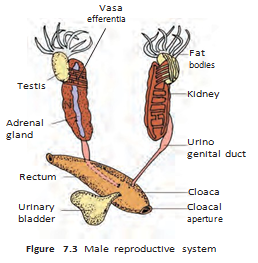
- Testes: A pair of yellowish, ovoid testes is attached to the upper kidneys by a double fold of peritoneum called the mesorchium.
- Sperm pathway: Testes → 10–12 vasa efferentia → kidneys → Bidder's canal → urinogenital duct → cloaca.
- Cloaca: A small median chamber through which faeces, urine and sperms pass to the exterior.
Female reproductive system
- Ovaries: A pair lies near the kidneys but has no functional connection with them.
- Oviducts: A pair of oviducts arising from the ovaries opens separately into the cloaca.
- Egg production: A mature female can lay 2,500–3,000 ova at a time.
Fertilisation and development
- Fertilisation occurs externally in water.
- Eggs hatch into tadpoles.
- The tadpole undergoes metamorphosis to become an adult frog.
Importance of Frogs
- Crop protection: Frogs eat insects that can damage crops.
- Ecological role: Frogs are important links in food chains and food webs, helping maintain ecological balance.
- Human use: In some countries, people eat the muscular legs of frogs.
How does a frog respire in water and on land?
Describe the frog's heart and blood cells.
State the main features of frog reproduction and development.
Quick recap
- The frog's body has a head and trunk, with no neck or tail; webbed hind feet help it swim.
- Its short alimentary canal ends at the cloaca; villi and microvilli absorb digested food.
- Frogs respire through the skin in water and use the buccal cavity, skin and lungs on land.
- The frog has a closed circulatory system with single circulation, a three-chambered heart and nucleated RBCs.
- The frog is ureotelic; its kidneys contain nephrons and its urinary system opens into the cloaca.
- Males have testes and a urinogenital duct; females have ovaries and separate oviducts.
- Fertilisation is external in water; tadpoles metamorphose into adult frogs.
Biology — ALL CHAPTERS
1
The Living World
2
Biological Classification
3
Plant Kingdom
4
Animal Kingdom
5
Morphology of Flowering Plants
6
Anatomy Of Flowering Plants
7
Structural Organization In Animals
8
Cell The Unit Of Life
9
Biomolecules
10
Cell Cycle And Cell Division
11
Photosynthesis in Higher Plants
12
Respiration In Plants
13
Plant Growth And Development
14
Breathing And Exchange Of Gases
15
Body Fluids And Circulation
16
Excretory Products And Their Elimination
17
Locomotion And Movement
18
Neural Control And Coordination
19
Chemical Coordination and integration