CLASS 11-PCB . BIOLOGY . BIOLOGY . NEURAL CONTROL-AND-COORDINATION
Chapter 18 : Neural Control And Coordination
Ch 18
BIOLOGY
CLASS 11-PCB
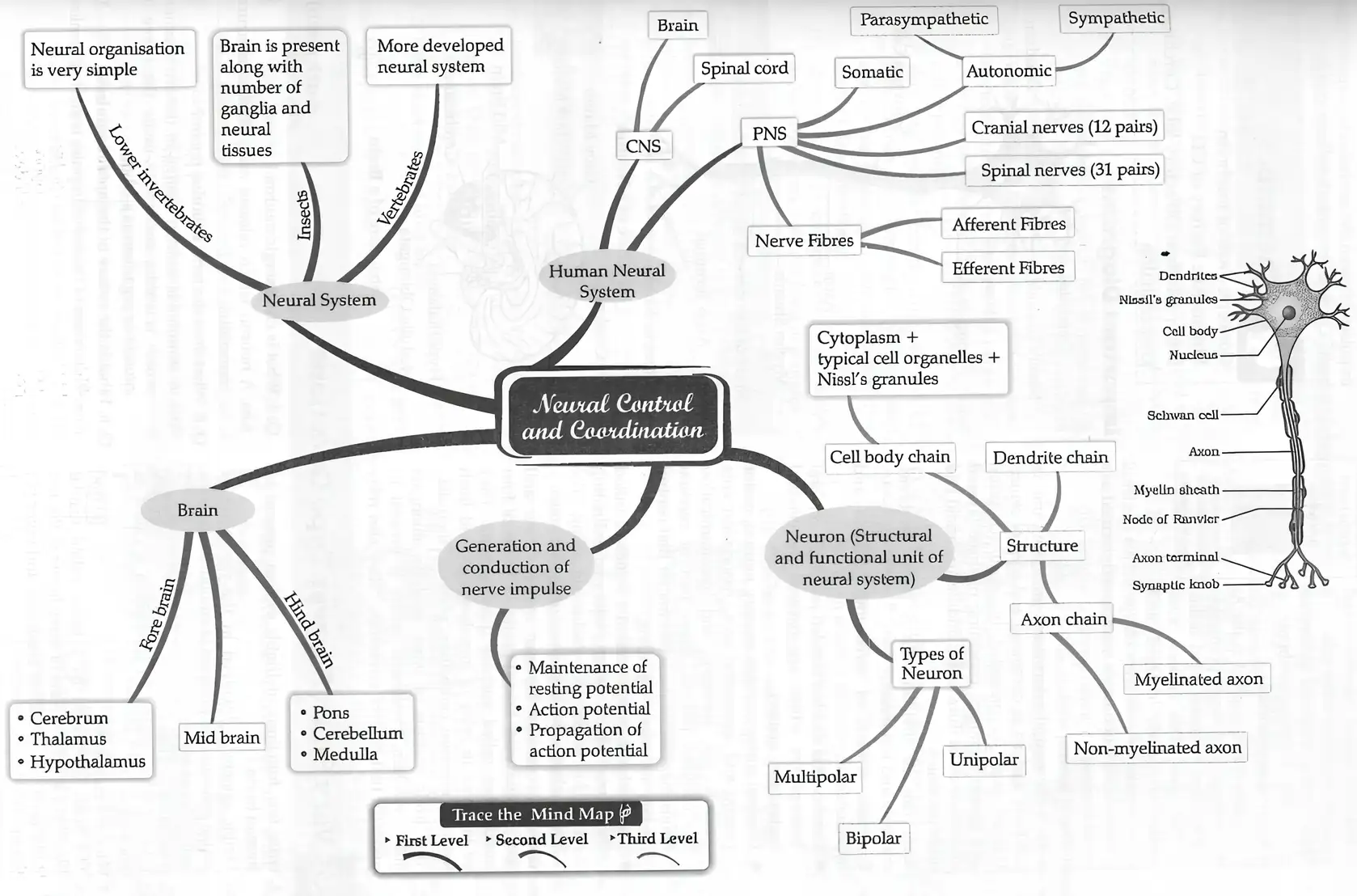
Neural System
Overview of Neural System
The neural system is a complex network responsible for detecting stimuli, processing information, and coordinating responses in animals. It ranges from simple networks in lower invertebrates to highly developed systems in vertebrates, including humans.
Human Neural System Structure
The human neural system is divided into two main parts:
- Central Nervous System (CNS): Comprises the brain and spinal cord, serving as the primary control and processing center.
- Peripheral Nervous System (PNS): Consists of all nerves outside the CNS, connecting it to limbs and organs.
Peripheral Nervous System Divisions
The PNS is further divided into:
- Somatic Nervous System: Controls voluntary movements by transmitting impulses to skeletal muscles.
- Autonomic Nervous System: Regulates involuntary functions and smooth muscles; subdivided into sympathetic and parasympathetic systems.
Neuron Structure
Basic Unit of Neural System
The neuron is the fundamental structural and functional unit of the neural system, specialized for transmitting nerve impulses.
Parts of a Neuron
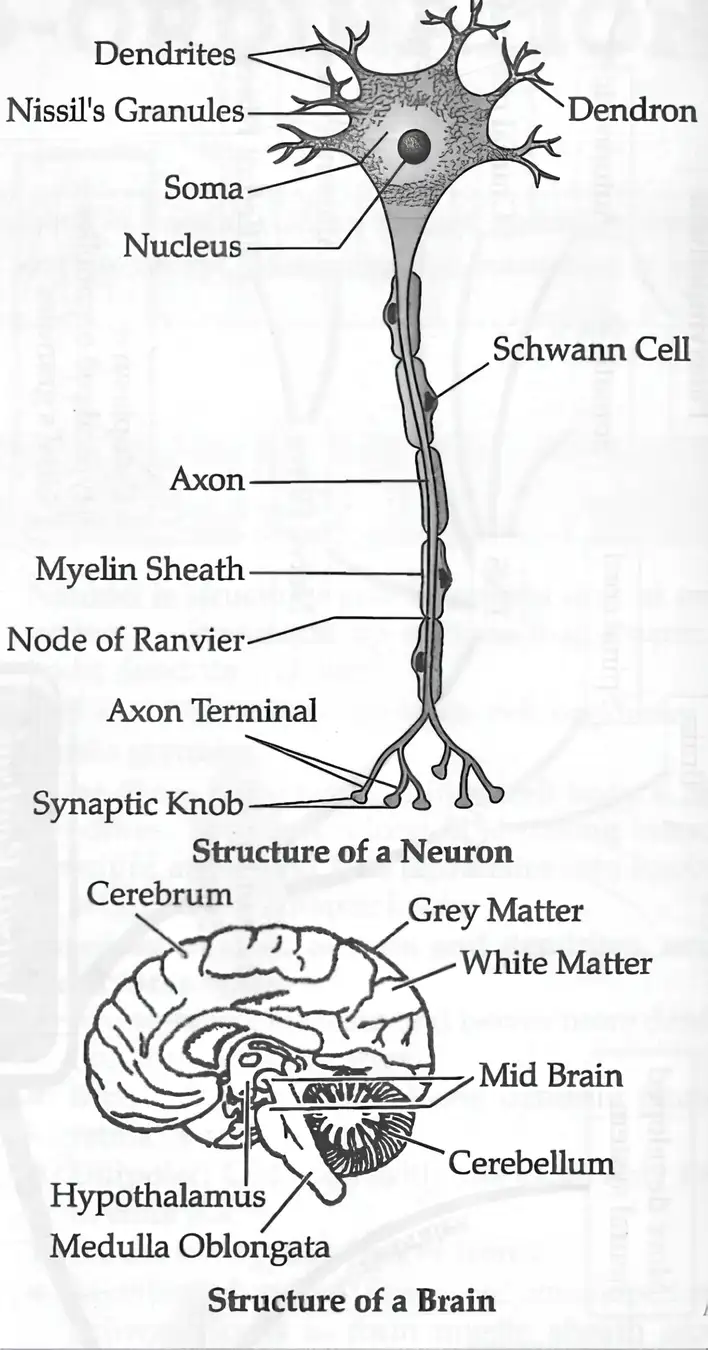
- Cell Body (Soma): Contains the nucleus, cytoplasm, organelles, and Nissl's granules essential for neuron function.
- Dendrites: Short, branched fibers that receive signals from other neurons.
- Axon: A long fiber that transmits impulses away from the cell body, often covered by a myelin sheath.
- Myelin Sheath: Formed by Schwann cells, it insulates the axon and speeds up impulse transmission.
- Nodes of Ranvier: Gaps in the myelin sheath that facilitate rapid conduction of nerve impulses.
- Synaptic Knobs: Terminal ends of axons that transmit signals to other neurons or muscles.
Types of Neurons
- Multipolar Neurons: One axon and multiple dendrites; found in the cerebral cortex.
- Bipolar Neurons: One axon and one dendrite; located in the retina of the eye.
- Unipolar Neurons: Single axon; present mainly in embryos.
Nerve Fibres
Classification of Nerve Fibres
Nerve fibres are classified based on the presence or absence of myelin sheath:
- Myelinated Nerve Fibres: Axons enveloped by Schwann cells forming a myelin sheath; found in spinal and cranial nerves.
- Unmyelinated Nerve Fibres: Axons enclosed by Schwann cells without forming a myelin sheath; found in autonomic and somatic nervous systems.
Types of Nerve Fibres in PNS
- Afferent (Sensory) Fibres: Transmit impulses from tissues or organs to the CNS.
- Efferent (Motor) Fibres: Carry impulses from the CNS to muscles and glands.
Nerve Impulse
Generation of Nerve Impulse
Neurons maintain a resting potential due to selective permeability of their membranes and active ion transport:
- At rest, the axonal membrane is more permeable to potassium ions (K⁺) and less permeable to sodium ions (Na⁺), creating a negative charge inside and positive outside.
- The sodium-potassium pump actively transports ions to maintain this ionic gradient.
Action Potential
When a stimulus exceeds the threshold:
- Sodium channels open, allowing Na⁺ ions to rush inside, reversing the membrane polarity (inside becomes positive).
- This rapid change in electrical charge is called the action potential or nerve impulse.
- The impulse propagates along the axon as the process repeats at adjacent segments.
Brain Structure
Protection and Layers
The brain is protected by the skull (cranium) and three meninges layers:
- Dura Mater: Outer tough layer.
- Arachnoid: Middle web-like layer.
- Pia Mater: Inner delicate layer adhering to the brain surface.
Divisions of the Brain
- Forebrain: Includes cerebrum, thalamus, and hypothalamus.
- Midbrain: Located between forebrain and hindbrain; contains corpora quadrigemina involved in reflexes.
- Hindbrain: Comprises pons, cerebellum, and medulla oblongata; controls balance, posture, and vital functions.
Forebrain Details
- Cerebrum: Divided into left and right hemispheres covered by cerebral cortex (grey matter) responsible for sensory, motor, and association functions.
- Thalamus: Acts as a relay center for sensory and motor signals.
- Hypothalamus: Regulates body temperature, hunger, thirst, and other autonomic functions.
Hindbrain Functions
- Cerebellum: Controls balance and coordination.
- Pons and Medulla Oblongata: Regulate respiration, heartbeat, and other involuntary functions.
Solved Examples
Example 1: Explain the role of myelin sheath in nerve impulse conduction.
Solution: The myelin sheath, formed by Schwann cells, insulates the axon and prevents ion leakage. This insulation allows the nerve impulse to jump between the Nodes of Ranvier in a process called saltatory conduction, significantly increasing the speed of impulse transmission.
Example 2: Describe the difference between afferent and efferent nerve fibres.
Solution: Afferent fibres carry sensory impulses from tissues or organs to the CNS, enabling the brain to receive information about the environment. Efferent fibres transmit motor impulses from the CNS to muscles and glands, facilitating responses and actions.
Practice Set
- Level 1 (Easy): What are the main parts of a neuron?
- Level 2 (Moderate): Differentiate between the somatic and autonomic nervous systems.
- Level 3 (Challenging): Explain how the resting potential is maintained in a neuron and describe what happens during an action potential.
Answer Key
- Level 1: The main parts of a neuron are the cell body (soma), dendrites, and axon.
- Level 2: The somatic nervous system controls voluntary movements by transmitting impulses to skeletal muscles, while the autonomic nervous system regulates involuntary functions and smooth muscles, further divided into sympathetic and parasympathetic systems.
- Level 3: Resting potential is maintained by selective permeability of the axonal membrane to K⁺ ions and active transport of ions by the sodium-potassium pump, creating a negative charge inside the neuron. During an action potential, a stimulus causes Na⁺ channels to open, allowing Na⁺ influx, reversing the membrane polarity and generating a nerve impulse.
Quick Reference Table
- Neuron: Basic unit of the neural system; parts include dendrites, cell body, axon.
- Myelin Sheath: Insulates axon; speeds up nerve impulse conduction.
- Resting Potential: Electrical potential difference across the membrane at rest; inside negative.
- Action Potential: Rapid change in membrane potential during nerve impulse.
- CNS: Brain and spinal cord; control center.
- PNS: Nerves outside CNS; connects CNS to body.
- Somatic Nervous System: Controls voluntary muscles.
- Autonomic Nervous System: Controls involuntary functions; includes sympathetic and parasympathetic divisions.
- Forebrain: Cerebrum, thalamus, hypothalamus; sensory, motor, and regulatory functions.
- Hindbrain: Cerebellum, pons, medulla; balance and vital functions.
Common Mistakes and Misconceptions
- Confusing the roles of afferent and efferent fibres; afferent carry impulses to CNS, efferent carry impulses away.
- Assuming all neurons have the same structure; neurons vary as multipolar, bipolar, or unipolar.
- Believing myelin sheath is continuous; it has gaps called Nodes of Ranvier essential for impulse conduction.
- Mixing up the functions of different brain parts; cerebrum is for higher functions, cerebellum for balance.
Glossary
- Neuron: Nerve cell that transmits impulses.
- Dendrite: Branch-like structures receiving signals.
- Axon: Long fiber transmitting impulses away from cell body.
- Myelin Sheath: Fatty layer insulating axons.
- Resting Potential: Electrical state of neuron at rest.
- Action Potential: Electrical impulse generated by neuron.
- Synapse: Junction between two neurons.
- Cerebrum: Largest brain part controlling voluntary actions.
- Cerebellum: Brain part controlling balance and coordination.
- Thalamus: Relay center for sensory and motor signals.
- Hypothalamus: Regulates autonomic functions.