Classification of Plants: Algae, Bryophyta and Pteridophyta
Plant Kingdom Overview
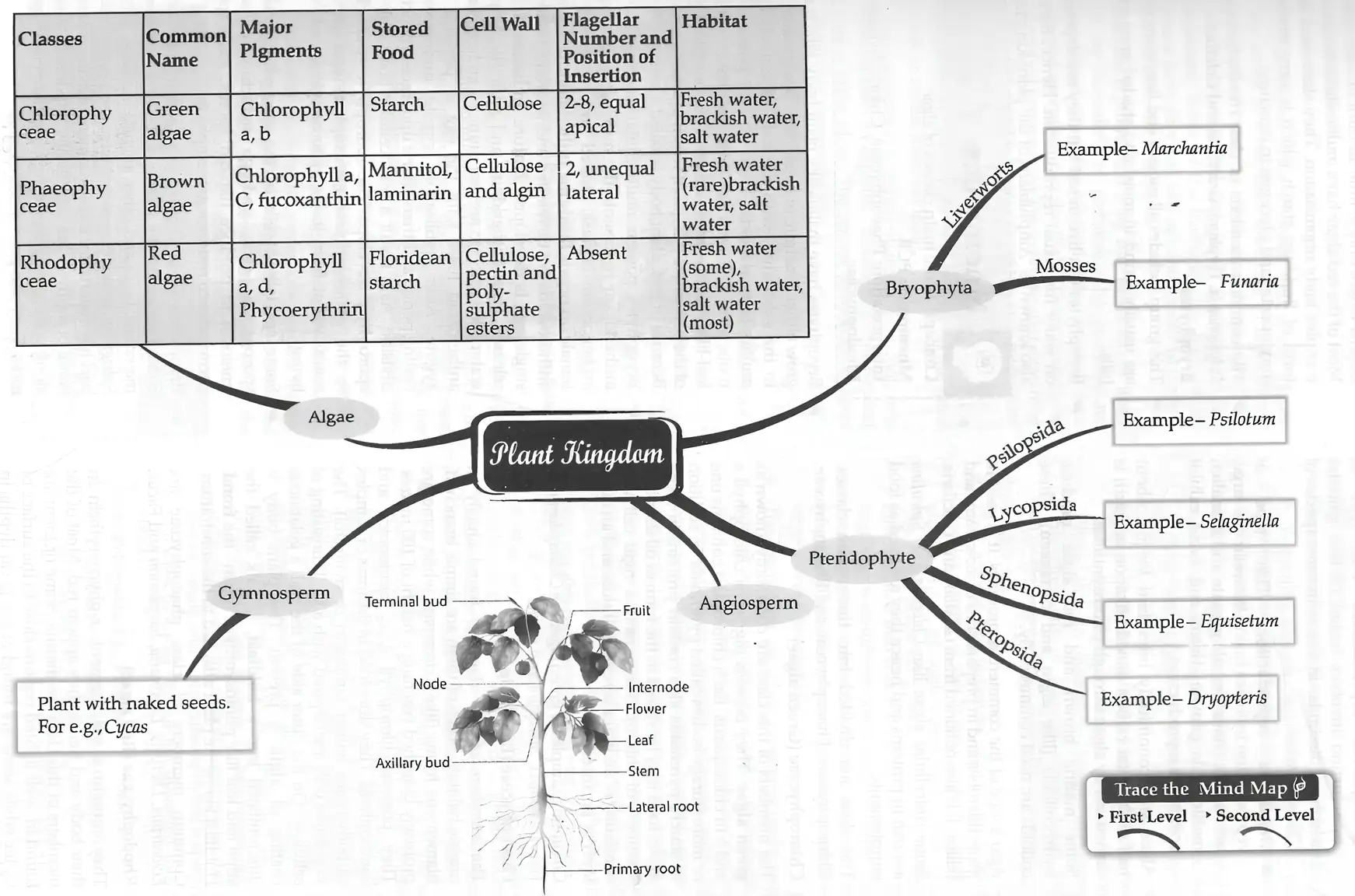
The Plant Kingdom is divided into major groups: Algae, Bryophyta, Pteridophyta, Gymnosperms, and Angiosperms. Each group has distinct characteristics and adaptations.
Types of Classification
Artificial System: Proposed by Carolus Linnaeus, based on androecium structure and vegetative characters.
Natural System: Proposed by George Bentham and J.D. Hooker, based on natural affinities among organisms.
Phylogenetic System: Based on evolutionary relationships, organisms in the same taxa share a common ancestor.
Taxonomy Methods
Numerical Taxonomy: Uses all observable characteristics, assigning numbers and codes processed by computers.
Cytotaxonomy: Based on cytological information like chromosome number and structure.
Chemotaxonomy: Uses chemical constituents for classification.
Algae
Algae are simple, thalloid, autotrophic, mostly aquatic organisms found in diverse habitats. They vary in form from unicellular to large marine kelps. They reproduce vegetatively, asexually, and sexually.
Vegetative Reproduction: Fragmentation is common in filamentous algae, where each fragment grows into a new thallus.
Asexual Reproduction: Involves production of motile zoospores that germinate into new plants.
Sexual Reproduction: Fusion of gametes occurs in three types:
- Isogamous: Gametes similar in size, may be flagellated or non-flagellated.
- Anisogamous: Gametes dissimilar in size.
- Oogamous: Fusion of large non-motile female gamete and smaller motile male gamete.
Algae are economically important for carbon fixation and production of hydrocolloids like algin and carrageen. Agar, used in microbiology and food, is obtained from some red algae. Some unicellular algae are protein-rich food supplements.
Classes of Algae
- Chlorophyceae (Green Algae): Contain chlorophyll a and b, store starch and protein in pyrenoids, have cellulose and pectose cell walls. Examples: Chlamydomonas, Volvox, Spirogyra.
- Phaeophyceae (Brown Algae): Marine, contain chlorophyll a, c, carotenoids, store laminarin or mannitol, have algin coating. Body differentiated into holdfast, stipe, and frond. Examples: Ectocarpus, Laminaria, Fucus.
- Rhodophyceae (Red Algae): Contain red pigment r-phycoerythrin, mostly marine, store floridean starch. Examples: Polysiphonia, Porphyra, Gelidium.
Bryophytes
Bryophytes include mosses and liverworts, found in moist shaded areas. They are non-vascular and depend on water for sexual reproduction, earning the name "Amphibians of the plant kingdom."
The plant body is thallus-like, attached by rhizoids, and lacks true roots, stems, or leaves. The dominant phase is the haploid gametophyte which produces gametes.
Sex organs are multicellular: antheridium (male) produces biflagellate antherozoids, archegonium (female) produces a single egg. Fertilization occurs in water, forming a zygote that develops into a sporophyte attached to the gametophyte.
Sporogenous cells in the sporophyte undergo meiosis to produce haploid spores that germinate into gametophytes.
Bryophytes have ecological importance, preventing soil erosion and serving as food for some animals. They are divided into liverworts and mosses.
Liverworts
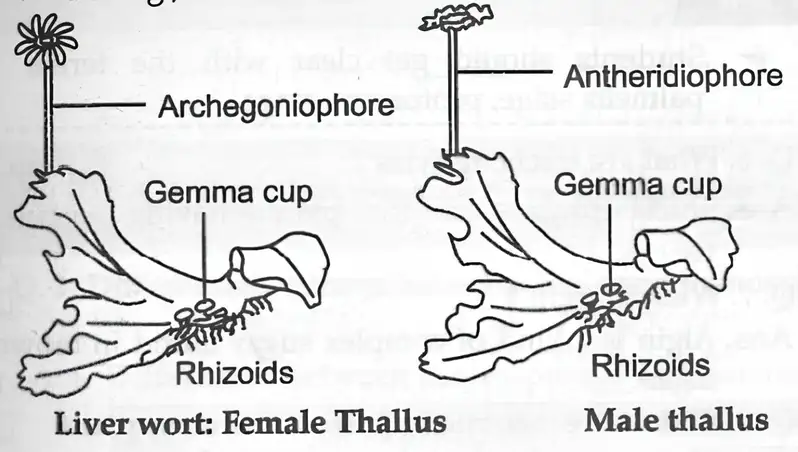
Grow in moist, shady places. The thallus is dorsiventral and closely appressed to the substrate. Some have tiny leaf-like appendages.
Asexual reproduction occurs by fragmentation or gemmae formed in gemma cups. Sexual organs may be on the same or different thalli.
The sporophyte has foot, seta, and capsule where spores develop and germinate into gametophytes. Example: Marchantia.
Mosses
Moss life cycle has a predominant gametophytic phase with protonema (filamentous stage) and leafy stage bearing sex organs.
Vegetative reproduction by fragmentation and budding occurs. Sex organs are at the apex of leafy shoots. Fertilization produces a zygote developing into a sporophyte with foot, seta, and capsule producing spores by meiosis.
Examples: Funaria, Polytrichum, Sphagnum.
Pteridophytes
First terrestrial plants with vascular tissues (xylem and phloem). Found in cool, damp places. The sporophyte is dominant with true roots, stems, and leaves.
Sporangia are borne on sporophylls; spores produced by meiosis germinate into free-living gametophytes (prothallus) bearing sex organs. Fertilization requires water.
Most are homosporous; some are heterosporous producing macrospores and microspores developing into female and male gametophytes respectively.
Classes include Psilopsida (Psilotum), Lycopsida (Selaginella), Sphenopsida (Equisetum), and Pteropsida (ferns).
Solved Examples
Example 1: Describe the main differences between Bryophytes and Pteridophytes.
Solution:
- Bryophytes: Non-vascular, no true roots/stems/leaves, dominant gametophyte, require water for fertilization.
- Pteridophytes: Vascular tissues present, true roots/stems/leaves, dominant sporophyte, require water for fertilization.
Example 2: Explain the types of sexual reproduction in algae with examples.
Solution:
- Isogamous: Fusion of similar gametes, e.g., Chlamydomonas.
- Anisogamous: Fusion of dissimilar gametes, e.g., some Chlamydomonas species.
- Oogamous: Fusion of large non-motile female and small motile male gametes, e.g., Volvox, Fucus.
Practice Set
Conceptual Questions:
- Level 1: What are the main characteristics of Bryophytes?
- Level 2: How do Pteridophytes differ from Bryophytes in terms of vascular tissue and life cycle?
- Level 3: Explain the economic importance of algae with examples.
Answer Key
- Level 1: Bryophytes are non-vascular plants with a dominant gametophyte phase, require water for fertilization, and have rhizoids instead of roots.
- Level 2: Pteridophytes have vascular tissues (xylem and phloem), a dominant sporophyte phase, and produce true roots, stems, and leaves, unlike Bryophytes.
- Level 3: Algae fix about half of the earth's carbon dioxide, produce hydrocolloids like algin and carrageen used commercially, and some unicellular algae like Spirulina are protein-rich food supplements.
Gymnosperms
Characteristics
Gymnosperms have naked ovules and seeds not enclosed in an ovary. They are shrubs or trees with roots sometimes associated with fungi (mycorrhiza) or nitrogen-fixing cyanobacteria (coralloid roots).
Stems may be branched or unbranched. Leaves can be simple or compound; conifers have needle-like leaves with adaptations to reduce water loss.
Gymnosperms are heterosporous, producing microspores and megaspores on sporophylls arranged in cones (strobili). Male cones bear microsporophylls with microsporangia; female cones bear megasporophylls with ovules.
Reproduction
Pollen grains develop within microsporangia and represent reduced male gametophytes. Megaspore mother cells in ovules undergo meiosis to form megaspores, one of which develops into the female gametophyte retained within the megasporangium.
Male gametes are delivered to archegonia via pollen tubes. Fertilization produces a zygote developing into an embryo; ovules develop into naked seeds.
Examples and Mnemonics
Examples include Gingko, Cycas, and Pinus. Mnemonic: "Going to CP" (Gingko, Cycas, Pinus).
Solved Examples
Example 1: Describe the structure and function of gymnosperm cones.
Solution: Male cones bear microsporophylls with microsporangia producing pollen grains. Female cones bear megasporophylls with ovules where megaspores develop into female gametophytes. Cones facilitate reproduction by producing and protecting spores.
Example 2: Explain the role of pollen tubes in gymnosperm fertilization.
Solution: Pollen tubes grow from pollen grains to archegonia, delivering male gametes for fertilization, enabling zygote formation inside the ovule.
Practice Set
Conceptual Questions:
- Level 1: What are the key features of gymnosperm seeds?
- Level 2: How do gymnosperms differ from pteridophytes in reproduction?
- Level 3: Describe the association of gymnosperm roots with fungi and cyanobacteria.
Answer Key
- Level 1: Gymnosperm seeds are naked, not enclosed in an ovary, and develop from fertilized ovules.
- Level 2: Gymnosperms produce seeds and have pollen tubes for fertilization, while pteridophytes produce spores and require water for sperm motility.
- Level 3: Some gymnosperm roots form mycorrhizal associations with fungi for nutrient absorption; others like Cycas have coralloid roots with nitrogen-fixing cyanobacteria.
Quick Reference Table
Algae: Simple, autotrophic, aquatic; classes: Chlorophyceae (green), Phaeophyceae (brown), Rhodophyceae (red).
Bryophytes: Non-vascular, dominant gametophyte, require water for fertilization; includes mosses and liverworts.
Pteridophytes: Vascular, dominant sporophyte, produce spores; includes ferns and allies.
Gymnosperms: Seed plants with naked seeds, heterosporous, pollen tubes deliver male gametes.
Common Mistakes and Misconceptions
- Confusing gametophyte and sporophyte dominance in plant groups.
- Assuming all plants produce seeds; bryophytes and pteridophytes do not.
- Believing algae are only microscopic; some are large like kelps.
- Thinking gymnosperm seeds are enclosed; they are naked.
Glossary
- Gametophyte: Haploid phase producing gametes.
- Sporophyte: Diploid phase producing spores.
- Isogamy: Fusion of similar gametes.
- Anisogamy: Fusion of dissimilar gametes.
- Oogamy: Fusion of large non-motile female and small motile male gametes.
- Rhizoids: Root-like structures in bryophytes.
- Prothallus: Gametophyte of pteridophytes.
- Strobilus: Cone-like structure bearing sporophylls.
- Mycorrhiza: Symbiotic association of roots with fungi.
- Coralloid roots: Roots with nitrogen-fixing cyanobacteria.