Classification of Animals
Basis of Classification
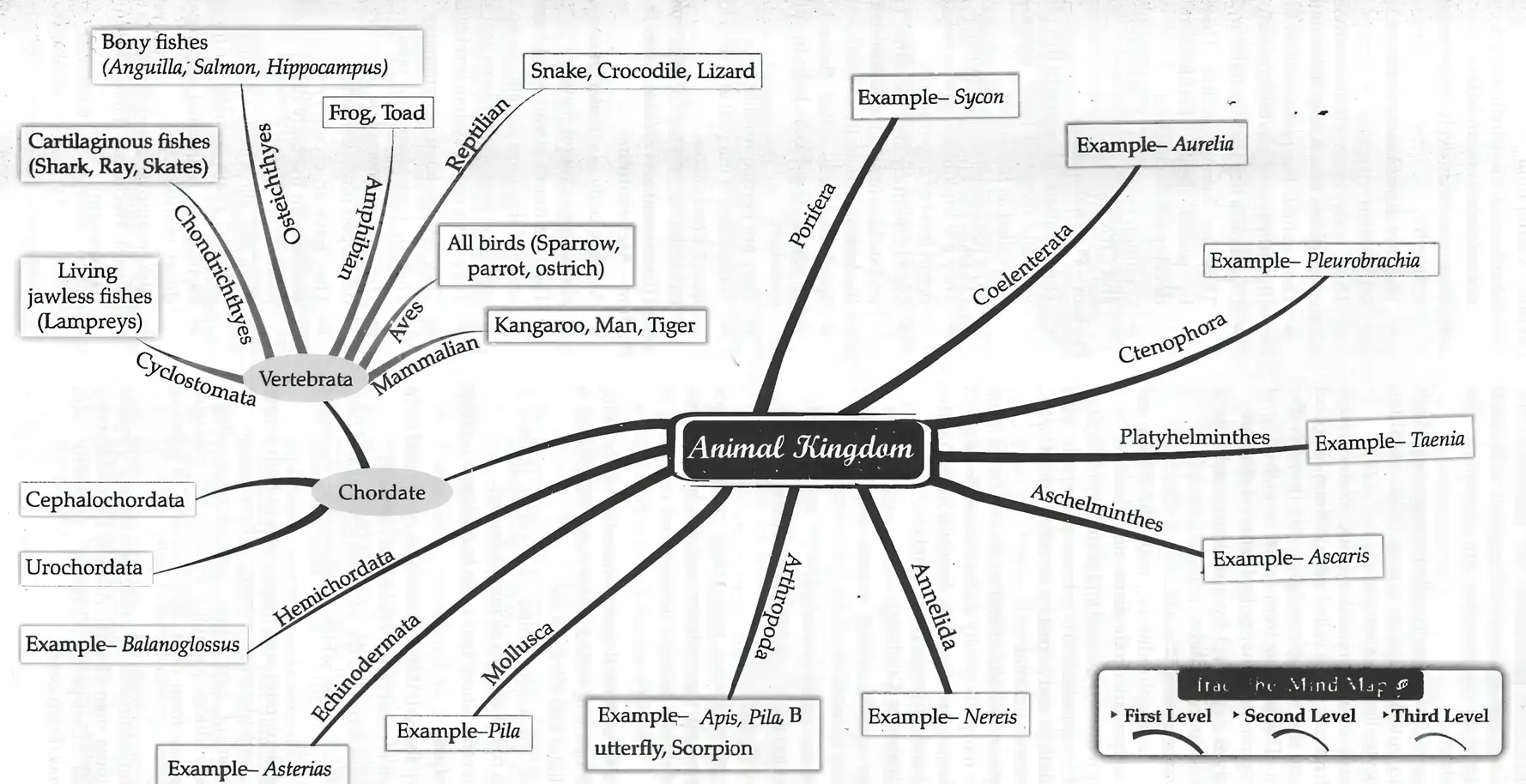
Animals are classified based on the arrangement of cells, body symmetry, nature of coelom, and patterns of digestive, circulatory, and reproductive systems. This systematic classification helps in understanding the diversity and evolutionary relationships among animals.
Major Animal Phyla
The Animal Kingdom is divided into several phyla, each characterized by distinct features:
- Phylum Porifera: Asymmetrical, primitive multicellular animals with cellular level of organization. They have a porous body with a water canal system and reproduce both sexually and asexually. Examples include Sycon and Spongilla.
- Phylum Coelenterata (Cnidaria): Radially symmetrical, diploblastic animals with tissue level organization. They possess cnidocytes for defense and capturing prey. Body forms include polyp and medusa. Examples are Hydra and Aurelia.
- Phylum Ctenophora: Marine, radially symmetrical diploblastic animals with comb plates for locomotion and bioluminescence. Examples include Pleurobrachia.
- Phylum Platyhelminthes: Bilaterally symmetrical, triploblastic, acoelomate flatworms, mostly parasitic. They have organ level organization and flame cells for excretion. Examples are Taenia and Fasciola.
- Phylum Aschelminthes: Roundworms with pseudocoelom, bilateral symmetry, and complete digestive system. They are dioecious and found in various habitats. Examples include Ascaris and Wuchereria.
- Phylum Annelida: Segmented worms with coelom, bilateral symmetry, and closed circulatory system. They have nephridia for excretion. Examples are Nereis and Earthworm.
- Phylum Arthropoda: Largest phylum with segmented, coelomate animals having exoskeleton and jointed appendages. They have open circulatory system and various respiratory organs. Examples include insects like Apis and vectors like Anopheles.
- Phylum Mollusca: Soft-bodied, coelomate animals with a calcareous shell, radula for feeding, and mantle cavity for respiration. Examples are Pila and Octopus.
- Phylum Echinodermata: Marine animals with radial symmetry in adults, water vascular system, and calcareous endoskeleton. Examples include Starfish and Sea urchin.
- Phylum Hemichordata: Worm-like marine animals with coelom, open circulatory system, and gill respiration. Examples are Balanoglossus.
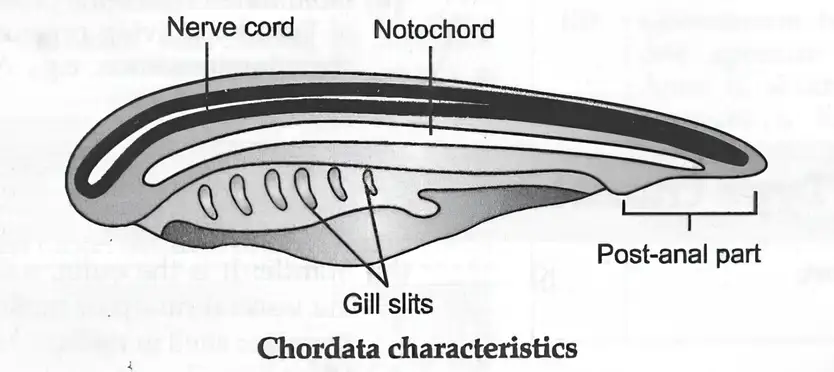
- Phylum Chordata: Animals with notochord, dorsal hollow nerve cord, pharyngeal gill slits, and post-anal tail. They are bilaterally symmetrical, coelomate, and have organ-system level organization.
Subphyla of Chordata
- Urochordata: Notochord present only in larval tail. Examples: Ascidia.
- Cephalochordata: Notochord extends from head to tail throughout life. Example: Branchiostoma.
- Vertebrata: Notochord replaced by vertebral column in adults. Divided into Agnatha (jawless) and Gnathostomata (jawed vertebrates).
Classes of Vertebrata
- Agnatha (Cyclostomata): Jawless, cartilaginous fish with sucking mouth. Examples: Lamprey.
- Gnathostomata: Jawed vertebrates divided into:
- Pisces: Fish with fins, including Chondrichthyes (cartilaginous fish like sharks) and Osteichthyes (bony fish like Rohu).
- Tetrapoda: Four-limbed vertebrates including Amphibia (frogs), Reptilia (snakes), Aves (birds), and Mammalia (mammals).
Solved Examples
Example 1: Identify the phylum of an animal that has a segmented body, jointed appendages, and an exoskeleton.
Solution: The animal belongs to Phylum Arthropoda because these features are characteristic of arthropods.
Example 2: Name the phylum of animals that exhibit radial symmetry and possess cnidocytes.
Solution: These animals belong to Phylum Coelenterata (Cnidaria), which are radially symmetrical and have cnidocytes.
Example 3: What are the distinguishing features of Phylum Chordata?
Solution: Phylum Chordata is characterized by the presence of a notochord, dorsal hollow nerve cord, pharyngeal gill slits, post-anal tail, bilateral symmetry, triploblastic and coelomate body organization, and organ-system level of organization.
Practice Set
- Level 1 (Easy): What type of symmetry do animals in Phylum Porifera exhibit?
- Level 2 (Moderate): Explain the difference between acoelomate and coelomate animals with examples.
- Level 3 (Challenging): Describe the life cycle and body forms of Coelenterata, highlighting the alternation of generations.
Answer Key
- Level 1: Animals in Phylum Porifera exhibit asymmetry.
- Level 2: Acoelomate animals lack a body cavity (coelom) between the digestive tract and body wall, e.g., Platyhelminthes. Coelomate animals have a true coelom lined by mesoderm, e.g., Annelida.
- Level 3: Coelenterates have two body forms: polyp (sessile) and medusa (free-swimming). Polyp reproduces asexually to produce medusae, and medusa reproduces sexually to produce polyps, showing alternation of generations.
Quick Reference Table
Phylum | Symmetry | Body Cavity | Organization | Examples
- Porifera | Asymmetrical | None | Cellular | Sycon, Spongilla
- Coelenterata | Radial | None | Tissue | Hydra, Aurelia
- Platyhelminthes | Bilateral | None (Acoelomate) | Organ | Taenia, Fasciola
- Aschelminthes | Bilateral | Pseudocoelom | Organ-system | Ascaris, Wuchereria
- Annelida | Bilateral | Coelom | Organ-system | Earthworm, Nereis
- Arthropoda | Bilateral | Coelom | Organ-system | Insects, Crustaceans
- Mollusca | Bilateral | Coelom | Organ-system | Pila, Octopus
- Echinodermata | Radial (adult) | Coelom | Organ-system | Starfish, Sea urchin
- Hemichordata | Bilateral | Coelom | Organ-system | Balanoglossus
- Chordata | Bilateral | Coelom | Organ-system | Vertebrates
Common Mistakes and Misconceptions
- Confusing radial symmetry with bilateral symmetry; radial symmetry is like spokes on a wheel, bilateral symmetry has distinct left and right halves.
- Assuming all animals with a body cavity have a true coelom; some have pseudocoelom which is not fully lined by mesoderm.
- Believing that all chordates have a vertebral column; some chordates like urochordates and cephalochordates lack vertebrae.
- Thinking that all fish have jaws; jawless fish belong to Agnatha.
Glossary
- Asymmetry: Lack of symmetry in body structure.
- Coelom: A fluid-filled body cavity lined by mesoderm.
- Diploblastic: Having two germ layers (ectoderm and endoderm).
- Triploblastic: Having three germ layers (ectoderm, mesoderm, endoderm).
- Hermaphrodite: An organism having both male and female reproductive organs.
- Polyp: Sessile body form of coelenterates.
- Medusa: Free-swimming body form of coelenterates.
- Notochord: A flexible rod that supports the body in chordates.
- Pharyngeal gill slits: Openings in the pharynx used for filter feeding or respiration.
- Post-anal tail: Tail extending beyond the anus in chordates.