CLASS 11-PCB . BIOLOGY . BIOLOGY . MORPHOLOGY OF-FLOWERING-PLANTS
Chapter 5 : Morphology of Flowering Plants
Ch 5
BIOLOGY
CLASS 11-PCB
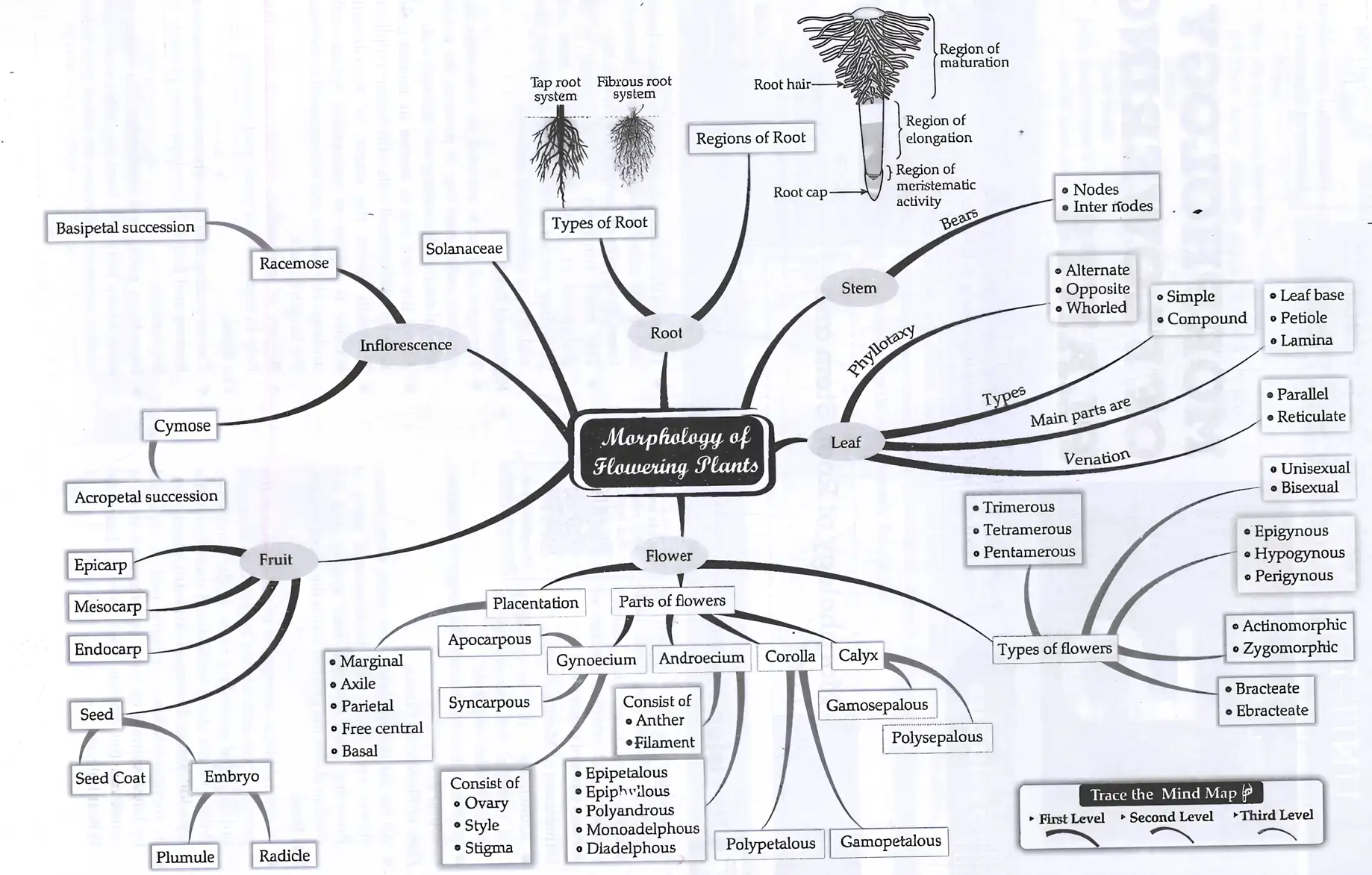
Morphology of Root, Stem and Leaf
Introduction to Morphology
Morphology is the branch of biological science that deals with the study of form, size, colour, structure and relative position of various parts of organisms. It is essential for the recognition and identification of plants and provides information about the range of variations found in a species.
Parts of Flowering Plants
Flowering plants consist of several main parts: root, stem, leaf, flower, fruit, and inflorescence. The underground parts form the root system, while the above-ground parts form the shoot system.
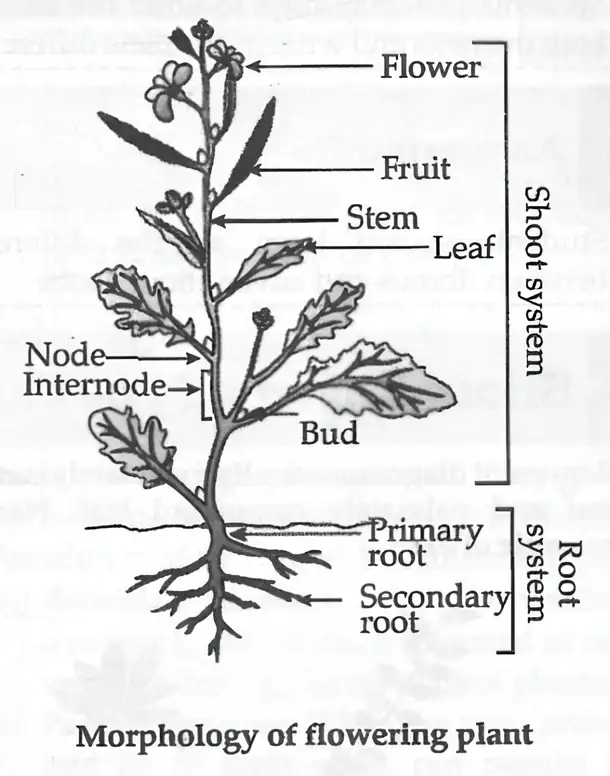
The Root
In dicotyledons, the primary root develops from the radicle and forms a tap root system with lateral roots. Examples include mustard and gram. In monocotyledons, the primary root is replaced by numerous roots at the base of the stem forming a fibrous root system, as seen in wheat and rice. Adventitious roots arise from parts other than the radicle, such as in grass and banyan tree. Roots absorb water and minerals, provide anchorage, and store food.
Regions of Root
The root apex is protected by a root cap. Above it lies the region of meristematic activity with small, dense cells. The region of elongation follows, where cells grow in length. The region of maturation contains root hairs that absorb water and minerals.
The Stem
The stem is the ascending part of the plant axis bearing branches, leaves, flowers, and fruits. It develops from the plumule of the embryo and has nodes (where leaves attach) and internodes (stem segments between nodes). The stem supports the plant, conducts water and minerals, and may perform special functions like storage and vegetative propagation.
The Leaf
Leaves are green, flattened lateral outgrowths borne on the stem nodes, specialized for photosynthesis. They originate from the shoot apical meristem and are arranged acropetally. A typical leaf has three parts: leaf base, petiole, and lamina. The leaf base may bear stipules. The midrib is the central vein providing rigidity and transport channels. Venation refers to the pattern of veins in the lamina.
Leaves can be simple (undivided lamina) or compound (lamina divided into leaflets). Compound leaves may be pinnately compound (leaflets on a common rachis) or palmately compound (leaflets attached at a common point). Phyllotaxy is the arrangement of leaves on the stem and can be alternate, opposite, or whorled. Leaves may also be modified into tendrils or spines for climbing or defense.
Solved Examples
Example 1: Identify the type of root system in wheat and explain its characteristics.
Solution: Wheat has a fibrous root system. In this system, the primary root is replaced by numerous roots arising from the base of the stem. These roots are thin, thread-like, and spread out in the soil, providing good anchorage and efficient absorption of water and minerals.
Example 2: Describe the difference between simple and compound leaves with examples.
Solution: A simple leaf has an undivided lamina, such as mango or guava leaves. The incisions do not reach the midrib. A compound leaf has a lamina divided into multiple leaflets, such as neem (pinnately compound) or silk cotton (palmately compound).
Practice Set
- Level 1 (Easy): What is the function of root hairs in the root system?
- Level 2 (Moderate): Differentiate between tap root and fibrous root systems with examples.
- Level 3 (Challenging): Explain the significance of phyllotaxy in plants and describe its three types.
Answer Key
- Level 1: Root hairs increase the surface area of roots for absorption of water and minerals from the soil.
- Level 2: Tap root system has a main primary root with lateral branches (e.g., mustard), while fibrous root system has many roots arising from the stem base without a main root (e.g., wheat).
- Level 3: Phyllotaxy is the arrangement of leaves on the stem, important for optimal light capture and air circulation. Types: alternate (one leaf per node), opposite (two leaves per node), and whorled (more than two leaves per node).
Flower, Fruits and Seed; Family Solanaceae
Flower Structure and Inflorescence
A flower is a modified shoot where the shoot apical meristem transforms into a floral meristem. Inflorescence is the arrangement of flowers on the floral axis, mainly racemose (main axis grows continuously with lateral flowers) and cymose (main axis ends in a flower).
Parts of a Flower
A typical flower has four whorls arranged on the thalamus: calyx, corolla, androecium, and gynoecium. Flowers with both androecium and gynoecium are bisexual; those with either are unisexual. Flower symmetry can be actinomorphic (radial) or zygomorphic (bilateral). Floral parts may be trimerous, tetramerous, or pentamerous based on multiples of 3, 4, or 5.
Types of Flowers Based on Ovary Position
- Hypogynous: Ovary superior, other parts below (e.g., mustard).
- Perigynous: Ovary half-inferior, floral parts on thalamus rim (e.g., rose).
- Epigynous: Ovary inferior, thalamus fused around ovary (e.g., guava).
Whorls of Flower
- Calyx: Outer whorl of sepals, usually green, protects flower bud. Sepals may be united (gamosepalous) or free (polysepalous).
- Corolla: Petals, often colorful to attract pollinators, may be united (gamopetalous) or free (polypetalous).
- Aestivation: Arrangement of sepals or petals in bud; types include valvate, twisted, imbricate, and vexillary.
- Androecium: Male reproductive part consisting of stamens (filament and anther). Stamens may be free or united in bundles.
- Gynoecium: Female reproductive part made of carpels (stigma, style, ovary). Carpels may be free (apocarpous) or fused (syncarpous). After fertilization, ovules become seeds and ovary matures into fruit.
Placentation and Fruit
Placentation is the arrangement of ovules within the ovary and includes types such as marginal, axile, parietal, basal, central, and free central. Fruit is the mature ovary, sometimes formed without fertilization (parthenocarpic). The pericarp has three layers: epicarp, mesocarp, and endocarp.
Seed Structure
Dicot seeds have a seed coat (testa and tegmen) and an embryo with embryonal axis, radicle, and cotyledons. Monocot seeds have an endosperm separated from the embryo by the aleurone layer. The embryo parts are enclosed in protective sheaths called coleoptile and coleorhiza.
Family Solanaceae
Commonly known as the potato family, Solanaceae includes herbs, shrubs, and small trees. Stems are herbaceous, leaves alternate and simple, flowers bisexual and actinomorphic. The family has five united sepals and petals, five epipetalous stamens, and a bicarpellary syncarpous ovary. Fruits are berries or capsules with many seeds. Important plants include tomato, brinjal, potato, chilli, tobacco, and petunia.
Solved Examples
Example 1: Define inflorescence and differentiate between racemose and cymose types.
Solution: Inflorescence is the arrangement of flowers on the floral axis. In racemose inflorescence, the main axis grows continuously and flowers are borne laterally in acropetal succession. In cymose inflorescence, the main axis ends in a flower and growth is limited; flowers develop in basipetal order.
Example 2: Describe the floral formula of Solanaceae and explain its significance.
Solution: The floral formula of Solanaceae is ⊕⚥K₍₅₎↷C₍₅₎A₍₅₎₋G₍₂₎. It indicates actinomorphic, bisexual flowers with 5 sepals (united), 5 petals (united), 5 stamens, and 2 fused carpels. This formula summarizes the flower structure concisely.
Practice Set
- Level 1 (Easy): What are the four whorls of a typical flower?
- Level 2 (Moderate): Explain the difference between hypogynous and epigynous flowers with examples.
- Level 3 (Challenging): Describe the characteristics of the Solanaceae family and name three economically important plants from this family.
Answer Key
- Level 1: Calyx, corolla, androecium, and gynoecium.
- Level 2: Hypogynous flowers have a superior ovary with other parts below (e.g., mustard). Epigynous flowers have an inferior ovary with thalamus fused around it (e.g., guava).
- Level 3: Solanaceae plants are mostly herbs or shrubs with alternate simple leaves, bisexual actinomorphic flowers, 5 united sepals and petals, 5 epipetalous stamens, and bicarpellary syncarpous ovary. Important plants include potato, tomato, and brinjal.
Quick Reference Table
Root System: Tap root (dicots), Fibrous root (monocots), Adventitious roots.
Regions of Root: Root cap, Meristematic region, Elongation region, Maturation region with root hairs.
Leaf Types: Simple, Compound (Pinnate, Palmate), Phyllotaxy (Alternate, Opposite, Whorled).
Flower Whorls: Calyx (sepals), Corolla (petals), Androecium (stamens), Gynoecium (carpels).
Flower Types: Bisexual, Unisexual; Symmetry: Actinomorphic, Zygomorphic.
Inflorescence: Racemose, Cymose.
Ovary Position: Hypogynous (superior), Perigynous (half-inferior), Epigynous (inferior).
Placentation Types: Marginal, Axile, Parietal, Basal, Central, Free central.
Family Solanaceae: Herbaceous plants, alternate leaves, bisexual flowers, 5 united sepals and petals, 5 stamens, bicarpellary ovary, fruits are berries or capsules.
Common Mistakes and Misconceptions
- Confusing tap root and fibrous root systems; remember tap root has a main root, fibrous does not.
- Misidentifying simple and compound leaves; simple leaves have undivided lamina, compound leaves have leaflets.
- Assuming all flowers are bisexual; some are unisexual with only male or female parts.
- Mixing up flower symmetry types; actinomorphic flowers have radial symmetry, zygomorphic have bilateral symmetry.
- Incorrectly identifying ovary position; hypogynous flowers have superior ovary, epigynous have inferior ovary.
- Overlooking the importance of phyllotaxy in leaf arrangement and plant growth.
Glossary
- Adventitious Roots: Roots arising from parts other than the radicle.
- Aestivation: Arrangement of sepals or petals in a flower bud.
- Androecium: Male reproductive part of a flower consisting of stamens.
- Apocarpous: Carpels free and not fused.
- Bisexual Flower: Flower having both male and female reproductive organs.
- Calyp: Outer whorl of sepals in a flower.
- Compound Leaf: Leaf with lamina divided into leaflets.
- Epigynous Flower: Flower with inferior ovary.
- Gynoecium: Female reproductive part of a flower consisting of carpels.
- Inflorescence: Arrangement of flowers on a floral axis.
- Phyllotaxy: Arrangement of leaves on a stem.
- Placentation: Arrangement of ovules within the ovary.
- Syncarpous: Carpels fused together.
- Tap Root: Main root with lateral branches.
- Venation: Pattern of veins in a leaf.