CLASS 11-PCB . BIOLOGY . BIOLOGY . ANATOMY OF-FLOWERING-PLANTS
Chapter 6 : Anatomy Of Flowering Plants
Ch 6
BIOLOGY
CLASS 11-PCB
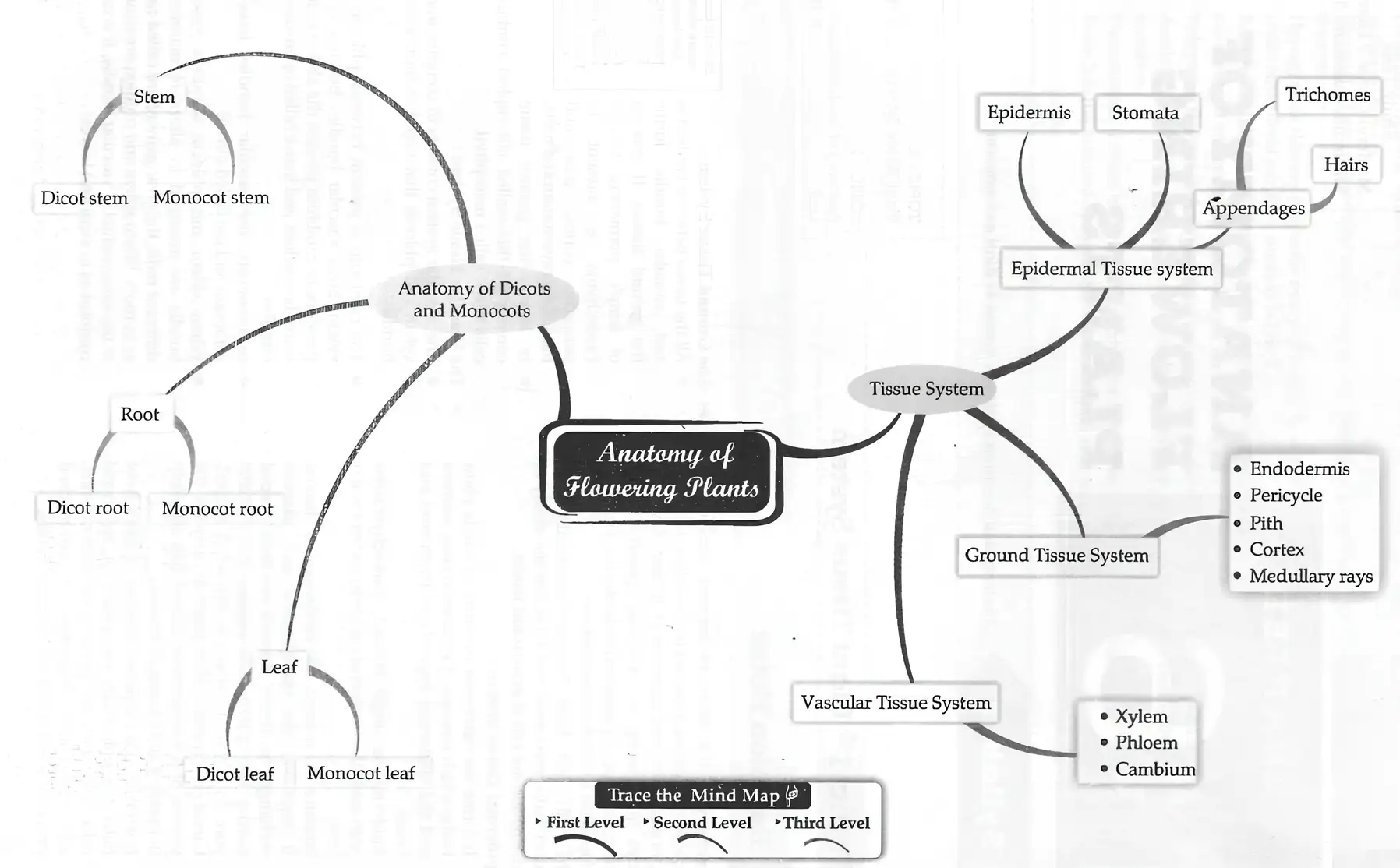
Plant Tissue System
Epidermal Tissue System
The epidermal tissue system forms the outermost covering of the entire plant body. It consists of epidermal cells, stomata, and epidermal appendages such as trichomes and hairs. The epidermis is a single layer of parenchymatous cells covered with a waxy cuticle that prevents water loss. Stomata, present mainly on leaves, regulate transpiration and gaseous exchange. In dicots, stomata are bean-shaped with two guard cells, while in monocots, they are dumb-bell shaped. Guard cells contain chloroplasts and control the opening and closing of stomata. Root hairs are unicellular extensions of epidermal cells that increase surface area for absorption. Trichomes on stems are multicellular and help reduce water loss.
Ground Tissue System
The ground tissue system includes all tissues between the epidermis and vascular bundles. It is composed of simple permanent tissues like parenchyma found in the pericycle, cortex, pith, and medullary rays of stems and roots. In leaves, the ground tissue is called mesophyll, consisting of thin-walled chloroplast-containing cells responsible for photosynthesis.
Vascular Tissue System
The vascular tissue system comprises complex tissues: xylem and phloem, which together form vascular bundles. Cambium, a meristematic tissue, lies between xylem and phloem in open vascular bundles, enabling secondary growth by producing secondary xylem and phloem. In monocots, vascular bundles lack cambium and are called closed. The arrangement of xylem and phloem can be radial, as in roots where they are on different radii, or conjoint, as in stems and leaves where they are on the same radius.
Solved Examples
Example 1: Describe the difference between open and closed vascular bundles.
Solution:
Open vascular bundles contain cambium between xylem and phloem, allowing secondary growth by producing secondary xylem and phloem. Closed vascular bundles lack cambium and cannot produce secondary tissues. Monocots typically have closed vascular bundles, while dicots have open vascular bundles.
Example 2: Explain the role of stomata in plants.
Solution:
Stomata are pores on the epidermis of leaves that regulate transpiration and gaseous exchange. Guard cells control the opening and closing of stomata, balancing water loss with the need for carbon dioxide for photosynthesis.
Practice Set
- Level 1: What is the main function of the epidermal tissue system?
- Level 2: Differentiate between radial and conjoint vascular bundle arrangements.
- Level 3: Explain how the presence or absence of cambium affects the vascular bundles in monocots and dicots.
Answer Key
- Level 1: The epidermal tissue system protects the plant by forming the outermost covering and prevents water loss.
- Level 2: In radial vascular bundles, xylem and phloem are arranged on different radii, typical of roots. In conjoint vascular bundles, xylem and phloem are on the same radius, found in stems and leaves.
- Level 3: Cambium is present in dicot vascular bundles (open bundles), allowing secondary growth. Monocot vascular bundles lack cambium (closed bundles) and cannot produce secondary tissues.
Anatomy of Root, Stem and Leaf
Dicotyledonous Root
The outermost layer is the epidermis with unicellular root hairs. Beneath it lies the cortex, composed of multiple layers of thin-walled parenchymatous cells with intercellular spaces. The innermost cortex layer is the endodermis, containing suberin-rich casparian strips that are impermeable to water. Below the endodermis is the pericycle. The vascular tissue includes two to four patches of xylem and phloem. All tissues inside the endodermis form the stele.
Monocotyledonous Root
Similar to dicots in epidermis, cortex, endodermis, and pith, but with more than six vascular bundles and a larger pith.
Dicotyledonous Stem
The epidermis is the outermost layer with a thin cuticle and may have trichomes and hairs. The cortex has three sub-layers: outer hypodermis (collenchymatous), middle cortical layer (parenchymatous), and inner endodermis rich in starch grains (starch sheath). Vascular bundles are conjoint, open, and endarch with protoxylem. The pith is parenchymatous with intercellular spaces.
Monocotyledonous Stem
Features a sclerenchymatous hypodermis and numerous scattered vascular bundles surrounded by sclerenchymatous bundle sheaths. Vascular bundles are closed and conjoint, and phloem parenchyma is absent.
Dicotyledonous Leaf (Dorsiventral)
The leaf has three regions: epidermis, mesophyll, and vascular system. The epidermis covers both upper (adaxial) and lower (abaxial) surfaces, with more stomata on the abaxial side. The mesophyll contains chlorophyll-bearing parenchyma cells, differentiated into palisade (elongated) and spongy (loosely arranged) parenchyma. Vascular bundles are present in veins and midribs, surrounded by thick bundle sheath cells.
Monocotyledonous Leaf (Isobilateral)
Similar to dicot leaves but stomata are present on both epidermal surfaces. Mesophyll cells are not differentiated into palisade and spongy types. In grasses, some adaxial epidermal cells near veins are modified into bulliform cells, which help the leaf curl during water stress and become turgid when water is abundant.
Solved Examples
Example 1: Describe the structure of a dicotyledonous root.
Solution:
The dicot root has an outer epidermis with unicellular root hairs, a cortex of thin-walled parenchyma with intercellular spaces, an endodermis with casparian strips, a pericycle beneath the endodermis, and vascular tissue with two to four patches of xylem and phloem. The tissues inside the endodermis form the stele.
Example 2: How do monocot and dicot stems differ in vascular bundle arrangement?
Solution:
Dicot stems have conjoint, open vascular bundles arranged in a ring with cambium present, allowing secondary growth. Monocot stems have scattered, closed vascular bundles without cambium, preventing secondary growth.
Practice Set
- Level 1: What is the function of root hairs in dicot roots?
- Level 2: Explain the role of the endodermis in roots.
- Level 3: Compare the mesophyll structure in dicot and monocot leaves.
Answer Key
- Level 1: Root hairs increase the surface area for water and mineral absorption.
- Level 2: The endodermis regulates the movement of water and minerals into the vascular tissue by its casparian strips, which are impermeable to water.
- Level 3: Dicot leaves have differentiated mesophyll with palisade and spongy parenchyma, while monocot leaves have undifferentiated mesophyll cells.
Key Terms
Tissue
A group of cells with common origin, structure, and function working together to perform a specific function.
Xylem
A complex permanent tissue that conducts water and minerals upward from roots to the plant.
Phloem
A complex permanent tissue that transports food synthesized in leaves to other parts of the plant.
Open Vascular Bundles
Vascular bundles containing cambium between xylem and phloem, allowing secondary growth.
Closed Vascular Bundles
Vascular bundles lacking cambium, unable to produce secondary tissues.