Class 11 PCB . Biology . Biology . Plant Growth and Development
Chapter 13: Plant Growth And Development
Ch 13
Biology
Class 11 PCB
Introduction
Plant Development
Development — The sum of growth and differentiation through which a mature plant develops from a zygote.
- Ordered sequence: A zygote develops into a plant with roots, leaves, branches, flowers, fruits and seeds; eventually, it dies.
- Differentiation: Cells descended from one zygote develop different structures and functions.
- Germination: Seed growth begins when environmental conditions are favourable.
- Dormancy/rest: In unfavourable conditions, seeds enter suspended growth; favourable conditions restart metabolism and growth.
- Control: Plant development is regulated by intrinsic (internal) and extrinsic (external) factors.
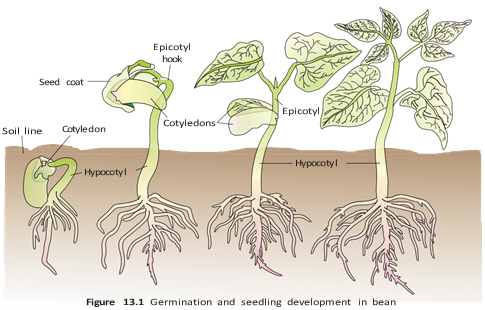
Growth
Growth — An irreversible, permanent increase in the size of an organ, its parts or an individual cell.
- Metabolism and energy: Growth is generally accompanied by anabolic and catabolic processes that use energy.
- Example: Expansion of a leaf is growth.
Plant Growth Is Generally Indeterminate
- Indeterminate growth: Plants can grow throughout life because their meristems retain the capacity to divide.
- Meristem cells: They divide and self-perpetuate; their products usually lose the ability to divide and form the plant body.
- Open growth: Meristem activity continually adds new cells to the plant body.
- Apical meristems: Root and shoot apical meristems cause primary growth, mainly elongating the plant along its axis.
- Lateral meristems: Vascular cambium and cork cambium appear later in dicots and gymnosperms and increase the girth of active organs.
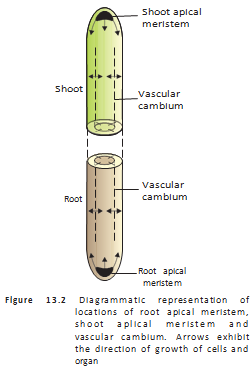
| Point | Primary growth | Secondary growth |
|---|---|---|
| Meristem | Root and shoot apical meristems | Lateral meristems: vascular cambium and cork cambium |
| Main effect | Elongation along the plant axis | Increase in girth |
| Occurrence | At root and shoot tips | Develops later in dicots and gymnosperms |
Growth Is Measurable
- Cellular basis: Growth mainly reflects an increase in protoplasm, which is difficult to measure directly.
- Measurements: Growth can be estimated by changes in fresh weight, dry weight, length, area, volume or cell number.
- Cell number: One maize root apical meristem can produce more than 17,500 new cells per hour.
- Cell size: A watermelon cell may increase in size up to 350,000 times.
- Examples: Pollen-tube growth is measured by length; growth of a dorsiventral leaf is measured by surface area.
What is open growth in plants, and why is it possible?
Distinguish primary growth from secondary growth.
Name four ways to measure plant growth.
Quick recap
- Development combines growth and differentiation in an ordered progression from zygote to mature plant.
- Germination begins under favourable conditions; in unfavourable conditions, seeds remain in suspended growth.
- Growth is a permanent, irreversible increase in size and is generally accompanied by energy-using metabolism.
- Meristems permit continued growth; apical meristems increase length and lateral meristems increase girth.
- Measurements of growth include weight, length, area, volume and cell number.
Phases of Growth
Three Phases of Growth
Growth Rates
Length after time \(t\) for constant-rate growth.
Arithmetic-growth symbols
- \(L_t\): Length at time \(t\); \(L_0\): length at time zero.
- \(r\): Growth rate, or elongation per unit time.
Exponential expression for growth.
Geometrical-growth symbols and curve
- \(W_1\): Final size (weight, height or number); \(W_0\): initial size.
- \(r\): Growth rate; \(t\): time of growth; \(e\): base of natural logarithms.
- Typical curve: The sigmoid (S-shaped) curve has a lag phase, an exponential phase and a stationary phase.
- Stationary phase: Growth slows when resources, such as nutrients, become limited.
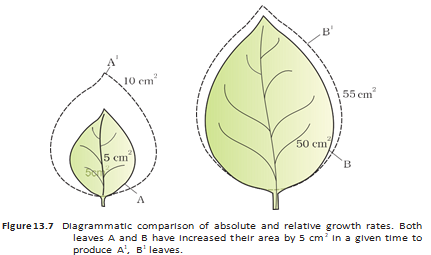
| Point | Absolute growth rate | Relative growth rate |
|---|---|---|
| Meaning | Total growth per unit time. | Growth per unit time expressed on a common basis, such as per unit of the initial parameter. |
| Comparison | Compares the total increase. | Compares increase relative to initial size; the smaller starting leaf has the higher relative increase if both gain the same area. |
Conditions for Growth
How do arithmetic and geometrical growth differ?
Quick recap
- Growth proceeds through meristematic, elongation and maturation phases.
- Arithmetic growth is constant and linear; geometrical growth is exponential and typically sigmoid.
- A sigmoid curve has lag, exponential and stationary phases.
- Absolute growth measures total increase per time; relative growth expresses increase against an initial basis.
- Water, oxygen, nutrients, suitable temperature, light and gravity influence plant growth.
Differentiation, Dedifferentiaion And Redifferentiation
Differentiation and Reversal of Differentiation
Examples and applications
- Woody dicots: Secondary xylem, secondary phloem and cork are examples of tissues that mature through redifferentiation.
- Plant tissue culture: Parenchyma cells induced to divide under controlled laboratory conditions undergo dedifferentiation.
Open Growth and Open Differentiation
Development
Plasticity and Heterophylly
Relationship and Control of Development
How do differentiation, dedifferentiation and redifferentiation differ?
What is plasticity? Give examples.
Quick recap
- Differentiation matures meristem-derived cells into specialised forms.
- Dedifferentiation restores division ability in living differentiated cells; redifferentiation matures their descendants.
- Open differentiation allows cells from the same meristem to mature differently, in part according to their position.
- Development spans changes from germination to senescence and broadly combines growth and differentiation.
- Plasticity is developmental flexibility; heterophylly shows leaf-shape differences linked to life stage or environment.
- Developmental control involves intrinsic genetic and chemical factors and extrinsic conditions such as light, water and temperature.
Plant Growth Regulators
Characteristics and Classification
Plant growth regulators (PGRs) — Small, simple molecules of diverse chemical composition that regulate plant growth and development.
- Chemical forms: PGRs include indole compounds (IAA), adenine derivatives (kinetin), carotenoid derivatives (ABA), terpenes (GA₃) and gases such as ethylene (\(C_2H_4\)).
- Other names: They are also called plant growth substances, plant hormones or phytohormones.
- Growth promoters: Auxins, gibberellins and cytokinins promote cell division and enlargement, pattern formation, tropic growth, flowering, fruiting and seed formation.
- Growth inhibitors: ABA contributes to biotic and abiotic stress responses and growth-inhibiting processes such as dormancy and abscission.
- Ethylene: It can fit either group, but is mainly a growth inhibitor.
| Group | Main roles | Examples |
|---|---|---|
| Growth promoters | Promote growth and development | Auxins, gibberellins, cytokinins |
| Growth inhibitors | Stress responses; dormancy and abscission | Abscisic acid (ABA) |
| Can act in either group | Mostly inhibits growth | Ethylene |
Discovery of the Five Major PGR Groups
Key discoveries
- Auxin: Charles Darwin and Francis Darwin observed that canary-grass coleoptiles bend towards one-sided light. They concluded that the tip sends a signal causing the bending; F. W. Went later isolated auxin from oat coleoptile tips.
- Gibberellin: Rice seedlings with “bakanae” (foolish seedling) disease were linked to the fungus *Gibberella fujikuroi*. In 1926, E. Kurosawa found that sterile fungal filtrates caused the symptoms; the active substances were later identified as gibberellic acids.
- Cytokinin: F. Skoog and colleagues found that tobacco-stem callus proliferated with auxin only when the nutrient medium also contained certain extracts or DNA. In 1955, Miller and colleagues identified and crystallised the active cell-division-promoting substance, named kinetin.
- Abscisic acid: In the mid-1960s, three inhibitors— inhibitor-B, abscission II and dormin—were purified and characterised; they proved chemically identical and were named abscisic acid (ABA).
- Ethylene: In 1910, H. H. Cousins confirmed that ripened oranges release a volatile substance that hastens ripening of stored unripe bananas. This substance was later identified as ethylene.
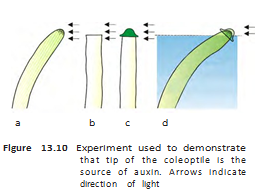
Auxins
Auxin — A group of growth-regulating compounds, including IAA, that generally form in growing shoot and root tips and move to the regions where they act.
Types and effects
- Natural auxins: IAA (indole-3-acetic acid) and IBA (indole butyric acid) occur in plants; auxin was first isolated from human urine.
- Synthetic auxins: NAA (naphthalene acetic acid) and 2,4-D (2,4-dichlorophenoxyacetic acid) are widely used in agriculture and horticulture.
- Propagation: Auxins stimulate root initiation on stem cuttings.
- Flowering and fruiting: They can promote flowering, for example in pineapples, and induce parthenocarpy, for example in tomatoes.
- Abscission: They prevent early dropping of leaves and fruits, but promote abscission of older mature leaves and fruits.
- Other roles: Auxins help control xylem differentiation and promote cell division.
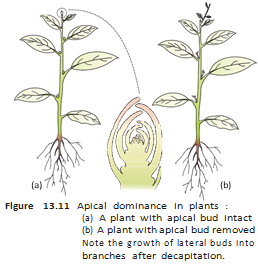
Apical dominance — Suppression of lateral (axillary) bud growth by the growing apical bud.
- Decapitation: Removing the shoot tip removes apical dominance, allowing lateral buds to grow.
- Applications: Decapitation is used in tea plantations and hedge-making to encourage branching.
- Weed control: 2,4-D kills dicot weeds but does not affect mature monocot plants; it is used to make weed-free lawns.
Gibberellins
Gibberellins (GAs) — A group of acidic plant growth promoters that cause a wide range of physiological responses, including increased axis length.
Key effects and uses
- Types: More than 100 gibberellins are known from fungi and higher plants; they are named GA₁, GA₂, GA₃, and so on. GA₃ was among the first discovered and is extensively studied.
- Axis elongation: GAs increase axis length; this is used to lengthen grape stalks and improve apple shape by elongating the fruit.
- Delayed senescence: GAs delay ageing, allowing fruits to remain on trees longer and extending their market period.
- Industry: GA₃ speeds up malting in the brewing industry.
- Crop yield: Gibberellin spraying elongates sugarcane stems, where sugar is stored, and can increase yield by as much as 20 tonnes per acre.
- Early reproduction: Spraying juvenile conifers with GAs hastens maturity and leads to earlier seed production.
- Bolting: GAs promote bolting—internode elongation just before flowering—in beet, cabbage and other rosette plants.
What is apical dominance, and what happens after decapitation?
Give two agricultural or horticultural uses of auxins.
What is bolting, and which PGR promotes it?
Quick recap
- PGRs are diverse molecules that regulate plant growth; auxins, gibberellins and cytokinins are promoters, while ABA inhibits growth and ethylene is mainly inhibitory.
- Auxin discovery followed coleoptile phototropism; Went isolated it from oat coleoptile tips.
- Auxins promote rooting, flowering, parthenocarpy and xylem differentiation, and can control weeds; removing the shoot tip releases lateral buds.
- Gibberellins promote axis and internode elongation, delay senescence and have agricultural and industrial uses.
- Kinetin was identified as a cytokinin; ABA was named after several inhibitors proved identical, and ethylene was linked to fruit ripening.
Cytokinins
Cytokinins
Cytokinins — Plant growth regulators that promote cytokinesis and influence several aspects of plant growth and development.
Discovery, synthesis and effects
- Kinetin: Identified from autoclaved herring sperm DNA; it is a modified adenine (a purine) and does not occur naturally in plants.
- Zeatin: A naturally occurring cytokinin isolated from corn kernels and coconut milk; natural and synthetic cytokinins are now known.
- Synthesis sites: Natural cytokinins are produced in regions of rapid cell division, including root apices, developing shoot buds and young fruits.
- Growth effects: Promote new leaves, chloroplast development, lateral shoot growth and adventitious shoot formation; they also help overcome apical dominance.
- Senescence: Promote nutrient mobilisation, which delays leaf senescence.
Ethylene
Ethylene — A simple gaseous plant growth regulator produced in large amounts by senescing tissues and ripening fruits.
Major effects of ethylene
- Seedlings: Causes horizontal growth, axis swelling and apical-hook formation in dicot seedlings.
- Senescence and abscission: Promotes ageing and shedding of plant organs, especially leaves and flowers.
- Fruit ripening: Highly effective in ripening fruits and increases their respiration rate; this rise is called the respiratory climacteric.
- Dormancy and sprouting: Breaks seed and bud dormancy; initiates germination in peanut seeds and sprouting in potato tubers.
- Growth in water: Promotes rapid internode and petiole elongation in deep-water rice, helping upper shoots and leaves remain above water.
- Roots: Promotes root growth and root-hair formation, increasing the surface available for absorption.
- Flowering and fruit set: Used to induce flowering and synchronise fruit set in pineapple; it also induces flowering in mango.
Ethephon: an ethylene-releasing compound
Agricultural uses
- Ethephon: The most widely used source of ethylene; its aqueous solution is absorbed and transported through the plant, then releases ethylene slowly.
- Ripening: Hastens ripening in tomatoes and apples.
- Abscission and thinning: Accelerates shedding of flowers and fruits; used for thinning cotton, cherry and walnut crops.
- Cucumbers: Promotes female flowers, which can increase yield.
Abscisic Acid (ABA)
Abscisic acid (ABA) — A plant growth regulator that generally inhibits growth and metabolism and helps plants respond to stress.
Functions of ABA
- Growth inhibition: Acts as a general growth inhibitor and inhibits plant metabolism and seed germination.
- Water conservation: Stimulates stomatal closure and increases tolerance to different kinds of stress; hence it is called the stress hormone.
- Seeds: Supports seed development and maturation, and induces dormancy.
- Dormancy benefit: Dormant seeds can withstand desiccation and other conditions unfavourable for growth.
- Hormone interaction: In most situations, ABA acts antagonistically to gibberellins (GAs).
Interactions and control of plant development
Plant growth regulators and other controls
- Five principal PGR groups: Auxins, gibberellins, cytokinins, abscisic acid and ethylene.
- Multiple roles: One or more PGRs can influence every phase of plant growth, differentiation and development.
- Interactions: PGRs may act individually or together; their effects can be synergistic (working together) or antagonistic (opposing one another).
- Shared processes: Dormancy, abscission, senescence and apical dominance can be influenced by more than one PGR.
- Control factors: PGRs are one form of intrinsic control, alongside genomic control; external factors also influence plant development.
- Extrinsic factors: Light and temperature can affect development through PGRs; other influences include nutrition, oxygen status and gravity. Related events include flowering, vernalisation, dormancy, seed germination and plant movements.
What is the respiratory climacteric?
How does ABA help seeds survive unfavourable conditions?
Give two agricultural uses of ethephon.
Quick recap
- Cytokinins promote cytokinesis, shoot growth and nutrient mobilisation, and delay leaf senescence.
- Kinetin was identified from autoclaved herring sperm DNA; zeatin is a natural cytokinin.
- Ethylene promotes fruit ripening, the respiratory climacteric, abscission and several growth responses.
- Ethephon is an absorbed, slow-release source of ethylene used in agriculture.
- ABA inhibits growth, closes stomata and induces seed dormancy; it often opposes GAs.
- The five principal PGR groups are auxins, gibberellins, cytokinins, ABA and ethylene; PGRs interact with genomic and environmental controls.
Biology — ALL CHAPTERS
1
The Living World
2
Biological Classification
3
Plant Kingdom
4
Animal Kingdom
5
Morphology of Flowering Plants
6
Anatomy Of Flowering Plants
7
Structural Organization In Animals
8
Cell The Unit Of Life
9
Biomolecules
10
Cell Cycle And Cell Division
11
Photosynthesis in Higher Plants
12
Respiration In Plants
13
Plant Growth And Development
14
Breathing And Exchange Of Gases
15
Body Fluids And Circulation
16
Excretory Products And Their Elimination
17
Locomotion And Movement
18
Neural Control And Coordination
19
Chemical Coordination and integration