CLASS 11-PCB . BIOLOGY . BIOLOGY . PHOTOSYNTHESIS IN-HIGHER-PLANTS
Chapter 11 : Photosynthesis in Higher Plants
Ch 11
BIOLOGY
CLASS 11-PCB
Photosynthesis and Pigments
Process Overview
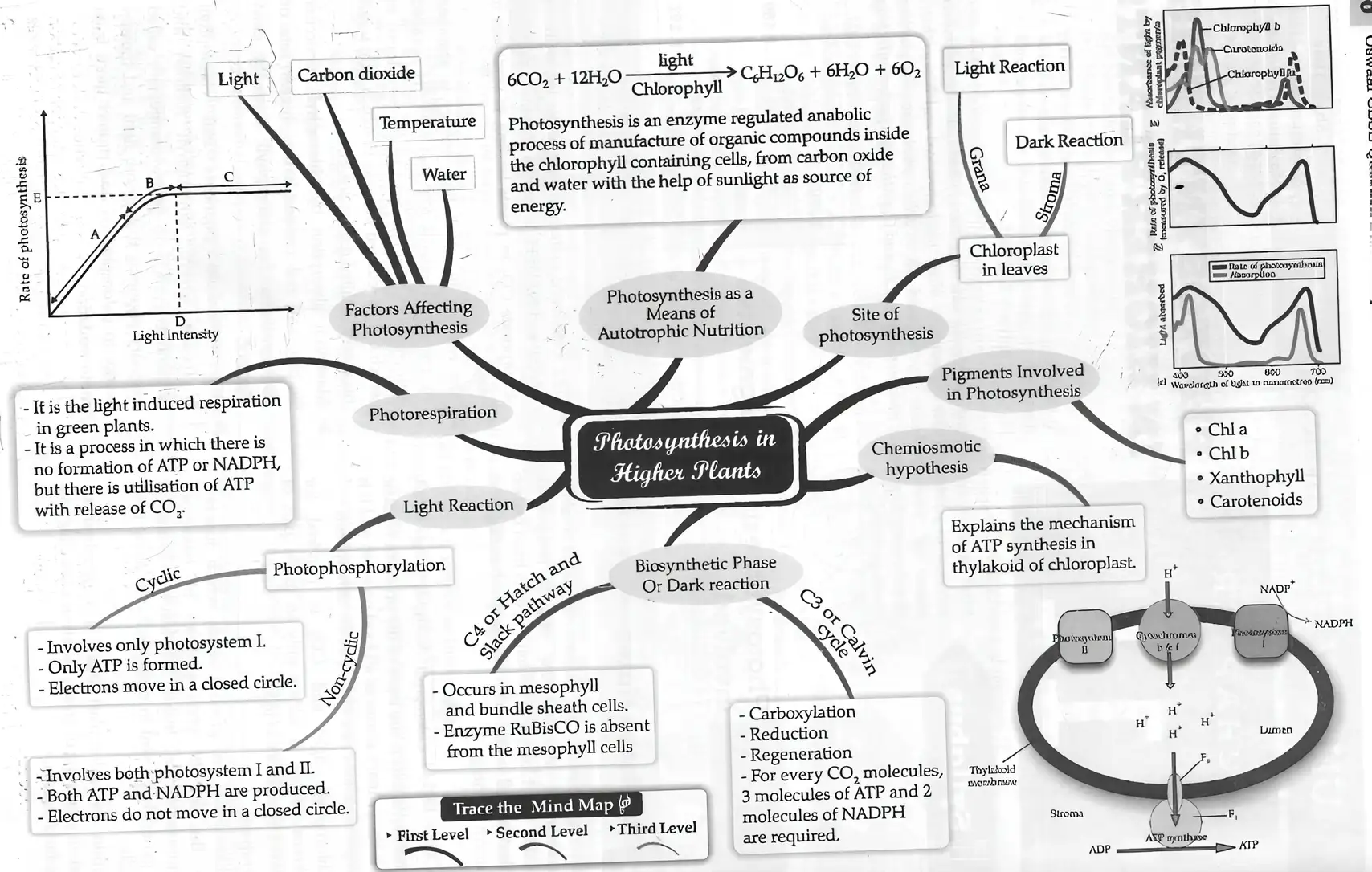
Photosynthesis is an enzyme-regulated anabolic process by which green plants manufacture organic compounds inside chlorophyll-containing cells using carbon dioxide and water, with sunlight as the energy source. It primarily occurs in the chloroplasts of leaf cells, especially in the mesophyll cells.
Site and Structure
Chloroplasts are green plastids that contain a membranous system of grana (stacks of thylakoids), stroma lamellae, and fluid stroma. The grana are the site of light-dependent reactions, while the stroma hosts the dark reactions.
Stages of Photosynthesis
The process consists of two main stages:
- Light Reaction: Occurs in the grana where light energy is absorbed by pigments to produce ATP and NADPH, and oxygen is released by splitting water.
- Dark Reaction (Calvin Cycle): Occurs in the stroma where ATP and NADPH are used to fix carbon dioxide into glucose.
Photosynthetic Pigments
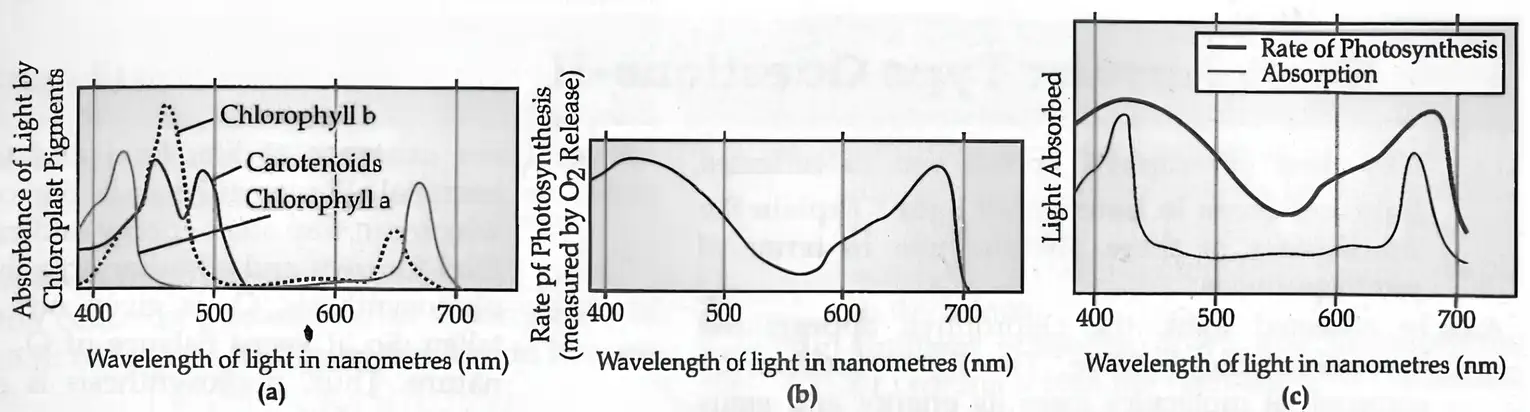
Chlorophyll a is the chief pigment absorbing mainly blue and red light. Accessory pigments include chlorophyll b (yellow-green), xanthophyll (yellow), and carotenoids (yellow to yellow-orange), which absorb light and transfer energy to chlorophyll a and protect it from photo-oxidation.
Solved Examples
Example 1: Write the balanced chemical equation for photosynthesis and explain the role of each reactant and product.
Solution:
The balanced chemical equation is:
6CO2 + 12H2O + light energy → C6H12O6 + 6O2 + 6H2O
Explanation:
- Carbon dioxide (CO2) is taken from the atmosphere and used as a carbon source.
- Water (H2O) is absorbed from the soil and split during the light reaction to release oxygen.
- Light energy is absorbed by chlorophyll to drive the reactions.
- Glucose (C6H12O6) is synthesized as food.
- Oxygen (O2) is released as a byproduct.
Practice Set
- Level 1 (Easy): What is the main pigment involved in photosynthesis and what colors of light does it absorb most effectively?
- Level 2 (Moderate): Explain the role of accessory pigments in photosynthesis.
- Level 3 (Challenging): Describe the structure of chloroplast and explain how it supports the process of photosynthesis.
Answer Key
- Level 1: Chlorophyll a is the main pigment; it absorbs blue and red light most effectively.
- Level 2: Accessory pigments like chlorophyll b, xanthophyll, and carotenoids absorb additional wavelengths of light and transfer the energy to chlorophyll a. They also protect chlorophyll from photo-oxidation.
- Level 3: Chloroplasts have grana (thylakoid stacks) where light reactions occur, and stroma where dark reactions occur. This compartmentalization allows efficient light absorption, ATP and NADPH production, and carbon fixation.
Photosynthetic Pathways and Factors
Light Reaction Details
The light reaction involves:
- Light absorption by pigments organized in light harvesting complexes (LHC) within Photosystem I (PSI) and Photosystem II (PSII).
- Water splitting (photolysis) releasing oxygen, protons, and electrons.
- Electron transport through cytochromes generating ATP and NADPH.
- Photophosphorylation, the synthesis of ATP using light energy.
Electron Transport and Photophosphorylation
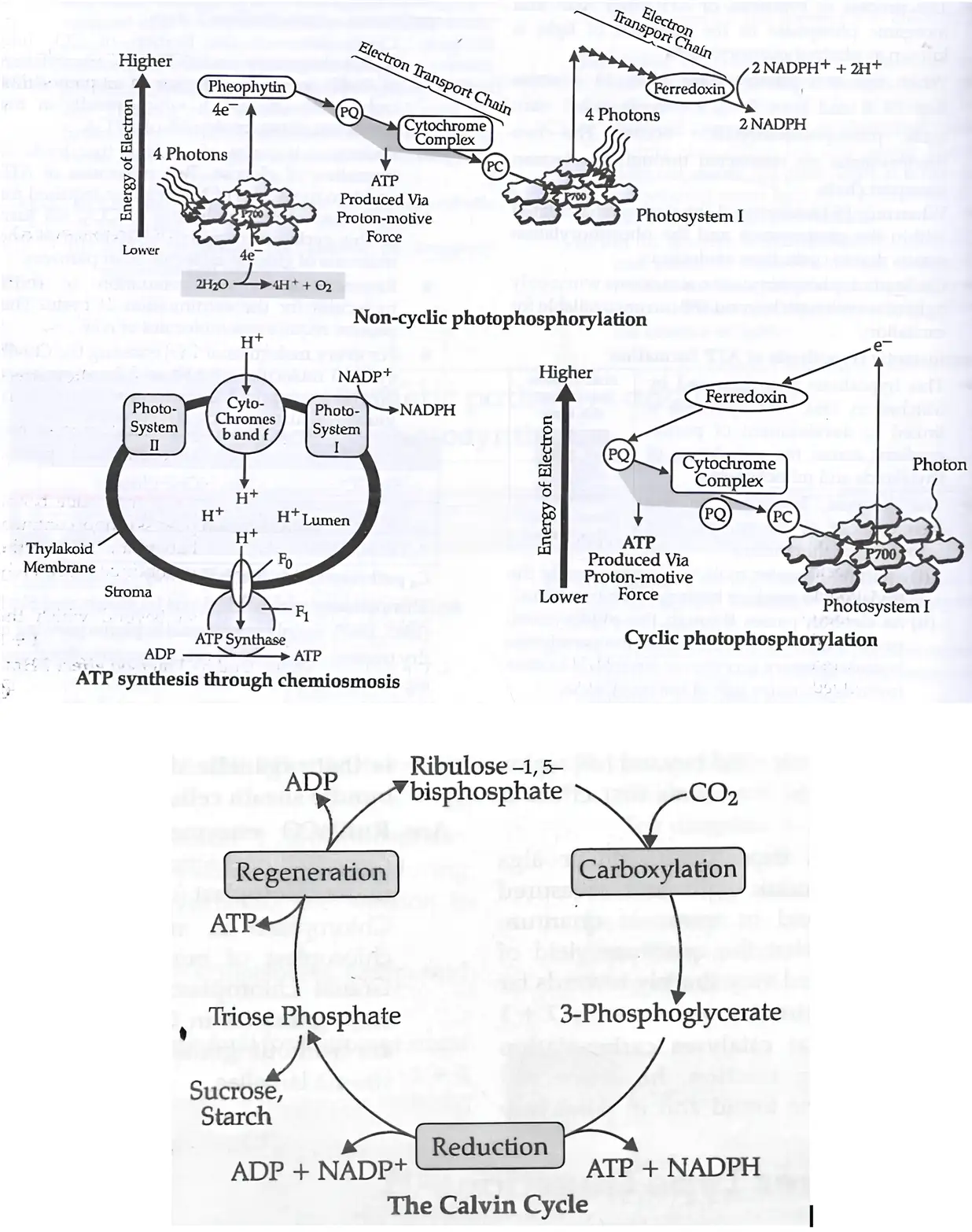
Electrons excited in PSII (P680) move through an electron transport chain to PSI (P700), releasing energy used to form ATP and NADPH. This is called the Z-scheme. Photolysis of water replenishes electrons in PSII.
Photophosphorylation occurs in two forms:
- Non-cyclic: Electrons flow from water to NADP+, producing ATP, NADPH, and oxygen.
- Cyclic: Electrons cycle back to PSI, producing ATP only.
Chemiosmotic Hypothesis
ATP synthesis is driven by a proton gradient across the thylakoid membrane. Protons accumulate inside the thylakoid lumen during electron transport and water splitting. They flow back through ATP synthase, powering ATP formation.
Calvin Cycle (C3 Pathway)
The Calvin cycle fixes CO2 into organic molecules in three steps:
- Carboxylation: CO2 is fixed to ribulose bisphosphate (RuBP) by RuBisCO, forming 3-phosphoglyceric acid (3-PGA).
- Reduction: ATP and NADPH reduce 3-PGA to glyceraldehyde-3-phosphate (G3P), a sugar precursor.
- Regeneration: ATP regenerates RuBP to continue the cycle.
Six turns of the cycle produce one glucose molecule.
C4 Pathway
In C4 plants like maize and sugarcane, CO2 is first fixed into a 4-carbon compound (oxaloacetic acid) in mesophyll cells by PEP carboxylase. This compound is transported to bundle sheath cells where CO2 is released for the Calvin cycle. This adaptation reduces photorespiration and is efficient in hot, dry climates.
Photorespiration
Photorespiration occurs when RuBisCO binds oxygen instead of CO2, producing phosphoglycolate and releasing CO2 without producing ATP or NADPH. It reduces photosynthetic efficiency and occurs mainly in C3 plants under high oxygen and light conditions.
Factors Affecting Photosynthesis
- Light intensity: Rate increases with light until saturation.
- Carbon dioxide concentration: Rate increases with CO2 until compensation point.
- Temperature: Affects enzyme activity; high temperatures can denature enzymes.
- Water availability: Essential but rate plateaus after saturation.
The law of limiting factors states that the rate of photosynthesis is limited by the factor in shortest supply.
Solved Examples
Example 1: Explain the difference between cyclic and non-cyclic photophosphorylation.
Solution:
Cyclic photophosphorylation involves only Photosystem I where electrons cycle back to the electron transport chain, producing ATP but no NADPH or oxygen.
Non-cyclic photophosphorylation involves both Photosystem II and I, producing ATP, NADPH, and oxygen by splitting water.
Example 2: Describe the role of ATP and NADPH in the Calvin cycle.
Solution:
ATP provides energy, and NADPH provides reducing power (electrons) to convert 3-phosphoglyceric acid into glyceraldehyde-3-phosphate, which is used to form glucose.
Practice Set
- Level 1 (Easy): What is photolysis and what are its products?
- Level 2 (Moderate): Explain the chemiosmotic hypothesis of ATP formation in photosynthesis.
- Level 3 (Challenging): Compare the C3 and C4 pathways of photosynthesis highlighting their adaptations.
Answer Key
- Level 1: Photolysis is the splitting of water molecules during the light reaction, producing oxygen, protons (H+), and electrons.
- Level 2: The chemiosmotic hypothesis states that ATP synthesis is driven by a proton gradient across the thylakoid membrane. Protons accumulate inside the thylakoid lumen and flow back through ATP synthase, powering ATP formation.
- Level 3: C3 pathway fixes CO2 directly via RuBisCO in mesophyll cells; it is common in temperate plants. C4 pathway first fixes CO2 into a 4-carbon compound in mesophyll cells, which is transported to bundle sheath cells for the Calvin cycle; it is adapted to hot, dry environments and reduces photorespiration.
Quick Reference Table
Photosynthesis Key Points:
- Site: Chloroplast (grana and stroma)
- Main Pigment: Chlorophyll a
- Light Reaction: Produces ATP, NADPH, and O2
- Dark Reaction (Calvin Cycle): Fixes CO2 into glucose
- Photolysis: 2H2O → 4H+ + O2 + 4e-
- Photophosphorylation: ATP synthesis using light energy
- Photorespiration: RuBisCO oxygenation reaction reducing photosynthesis efficiency
- C3 Pathway: Calvin cycle, first product 3-PGA
- C4 Pathway: First product oxaloacetic acid, reduces photorespiration
Common Mistakes and Misconceptions
- Confusing light and dark reactions: Dark reaction does not require light but depends on products of light reaction.
- Assuming all chlorophyll pigments absorb the same wavelengths equally.
- Believing photorespiration produces energy; it actually consumes energy and reduces photosynthesis efficiency.
- Thinking oxygen is a reactant; it is a byproduct of photolysis.
- Mixing up cyclic and non-cyclic photophosphorylation roles and products.
Glossary
- Photosynthesis: Process by which green plants synthesize organic compounds using light energy.
- Chloroplast: Organelle where photosynthesis occurs.
- Chlorophyll: Green pigment that absorbs light energy.
- Photolysis: Splitting of water molecules during light reaction.
- Photophosphorylation: Formation of ATP using light energy.
- Calvin Cycle: Series of reactions fixing CO2 into glucose.
- Photorespiration: Oxygenation of RuBP leading to CO2 release without energy production.
- C3 Plants: Plants using Calvin cycle as main photosynthetic pathway.
- C4 Plants: Plants with an additional CO2 fixation step reducing photorespiration.