CLASS 11-PCB . BIOLOGY . BIOLOGY . CELL CYCLE-AND-CELL-DIVISION
Chapter 10 : Cell Cycle And Cell Division
Ch 10
BIOLOGY
CLASS 11-PCB
Cell Cycle and Mitosis
Overview of Cell Cycle
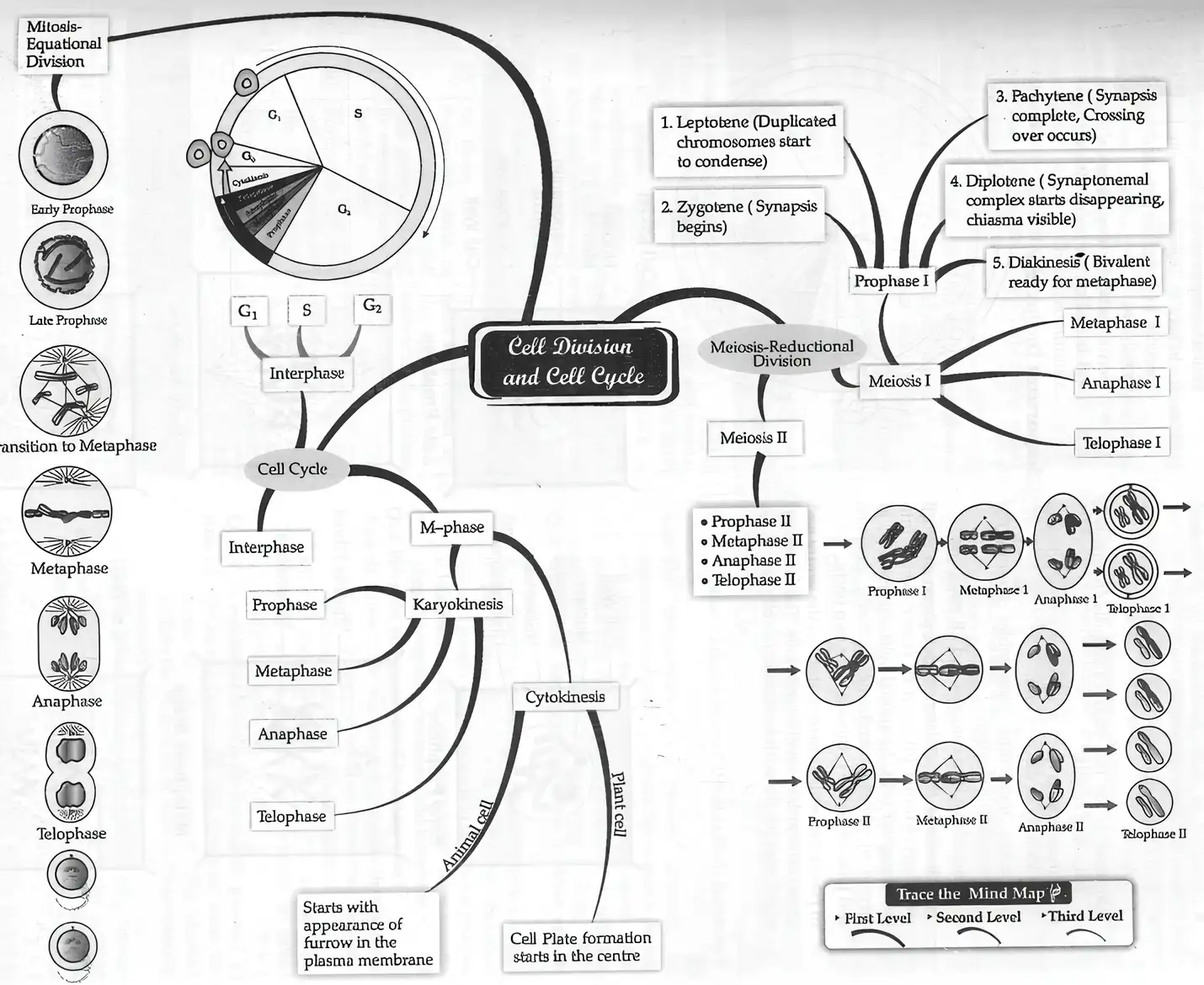
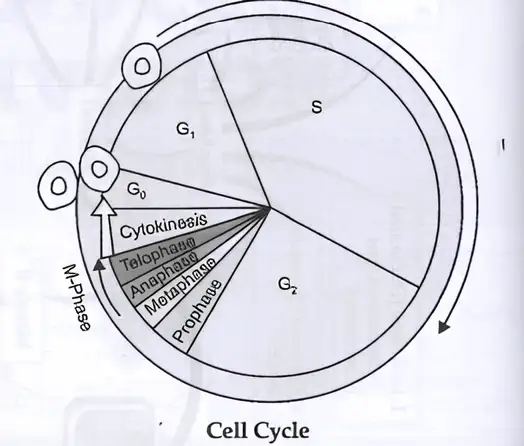
The cell cycle is the sequence of events by which a cell duplicates its genome, synthesizes other cell constituents, and eventually divides into two daughter cells. It consists of two main phases: Interphase and M phase.
Interphase
Interphase is the phase between two successive mitotic divisions and lasts for about 95% of the cell cycle. It is subdivided into three stages:
- G1 phase: The cell grows and performs normal metabolic activities. It represents the interval between mitosis and the initiation of DNA replication.
- S phase: DNA synthesis occurs, resulting in the doubling of the DNA content in the cell.
- G2 phase: The cell continues to grow and synthesizes proteins necessary for mitosis.
Some cells exit the cycle and enter a quiescent stage called G0, where they remain metabolically active but do not divide.
M Phase (Mitosis)
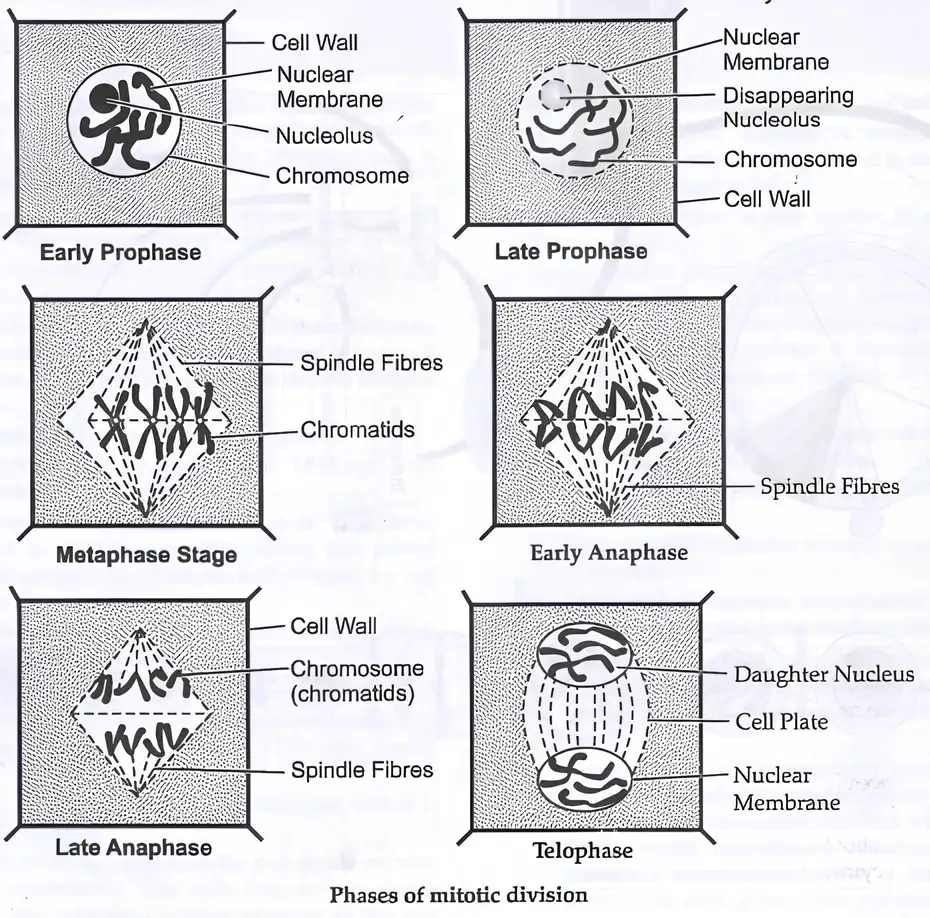
Mitosis is the process of nuclear division followed by cytokinesis, resulting in two genetically identical daughter cells. It includes the following stages:
- Prophase: Chromosomes condense and become visible. Centrioles move to opposite poles. The nuclear membrane and nucleolus disappear.
- Metaphase: Chromosomes align at the cell's equatorial plane (metaphase plate). Spindle fibers attach to kinetochores on the centromeres.
- Anaphase: Sister chromatids separate at the centromere and move toward opposite poles.
- Telophase: Chromosomes reach the poles and decondense. Nuclear membranes and nucleoli reappear.
- Cytokinesis: The cytoplasm divides, forming two daughter cells. In animal cells, a cleavage furrow forms; in plant cells, a cell plate develops.
Significance of Mitosis
- Produces diploid daughter cells identical to the parent cell.
- Essential for growth, repair, and maintenance of tissues.
- Enables continuous growth in plants through meristematic cell division.
Solved Examples
Example 1: Describe the events that occur during the S phase of the cell cycle.
Solution: During the S phase, DNA replication occurs. The cell synthesizes an exact copy of its DNA, doubling the amount of genetic material. This ensures that each daughter cell receives a complete set of chromosomes after cell division.
Example 2: Explain the difference in cytokinesis between animal and plant cells.
Solution: In animal cells, cytokinesis occurs by the formation of a cleavage furrow that pinches the cell membrane inward until the cell splits into two. In plant cells, a cell plate forms at the center of the cell, which grows outward to develop into a new cell wall, dividing the cell into two daughter cells.
Practice Set
- Level 1 (Easy): What is the main purpose of mitosis in multicellular organisms?
- Level 2 (Moderate): Describe the changes that occur during metaphase of mitosis.
- Level 3 (Challenging): Explain why the G0 phase is important for certain cells in the body.
Answer Key
- Level 1: Mitosis allows for growth, repair, and replacement of cells by producing genetically identical daughter cells.
- Level 2: During metaphase, chromosomes align at the cell's equatorial plane, and spindle fibers attach to the kinetochores of each chromosome, preparing for separation.
- Level 3: The G0 phase allows cells to remain metabolically active without dividing, which is important for cells that do not need to divide frequently, such as nerve cells.
Meiosis and Significance
Overview of Meiosis
Meiosis is a specialized type of cell division that reduces the chromosome number by half, producing four haploid daughter cells. It is essential for sexual reproduction and genetic diversity.
Phases of Meiosis I
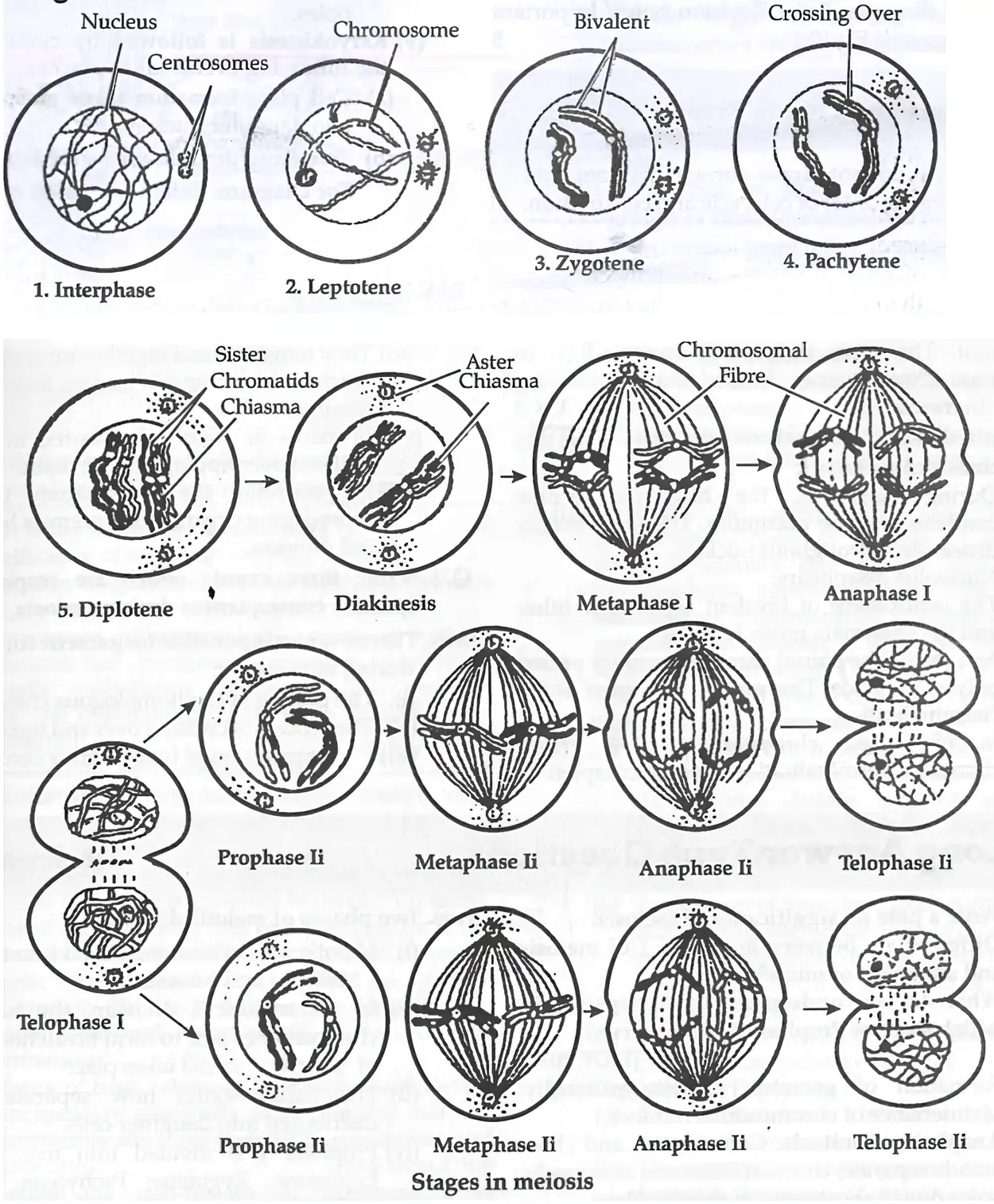
Meiosis I includes the following stages:
- Prophase I: The longest phase, subdivided into leptotene, zygotene, pachytene, diplotene, and diakinesis. Homologous chromosomes pair (synapsis) and exchange genetic material through crossing over.
- Metaphase I: Paired homologous chromosomes align at the equatorial plate.
- Anaphase I: Homologous chromosomes separate and move to opposite poles; sister chromatids remain attached.
- Telophase I: Nuclear membranes reform, and cytokinesis produces two haploid cells called dyads.
Interkinesis
A short resting phase between meiosis I and II where no DNA replication occurs.
Phases of Meiosis II
Meiosis II resembles mitosis and includes:
- Prophase II: Chromosomes condense, and nuclear membranes disappear.
- Metaphase II: Chromosomes align at the equator.
- Anaphase II: Sister chromatids separate and move to opposite poles.
- Telophase II: Nuclear membranes reform, followed by cytokinesis, resulting in four haploid daughter cells.
Significance of Meiosis
- Produces haploid gametes necessary for sexual reproduction.
- Crossing over during prophase I increases genetic variation.
- Maintains chromosome number across generations.
Solved Examples
Example 1: What is synapsis and during which phase of meiosis does it occur?
Solution: Synapsis is the pairing of homologous chromosomes to form a synaptonemal complex, occurring during the zygotene stage of prophase I in meiosis.
Example 2: Explain the significance of crossing over in meiosis.
Solution: Crossing over is the exchange of genetic material between non-sister chromatids of homologous chromosomes during pachytene of prophase I. It increases genetic diversity by producing new combinations of alleles.
Practice Set
- Level 1 (Easy): How many daughter cells are produced at the end of meiosis, and what is their chromosome number relative to the parent cell?
- Level 2 (Moderate): Describe the events that occur during diplotene of prophase I.
- Level 3 (Challenging): Explain the role of chiasmata in meiosis.
Answer Key
- Level 1: Four haploid daughter cells are produced, each having half the chromosome number of the parent cell.
- Level 2: During diplotene, the synaptonemal complex dissolves, and homologous chromosomes begin to separate but remain connected at chiasmata, the sites of crossing over.
- Level 3: Chiasmata are the X-shaped structures where crossing over occurs; they hold homologous chromosomes together and facilitate the exchange of genetic material, ensuring genetic recombination.
Quick Reference Table
- Cell Cycle: Sequence of growth and division phases (G1, S, G2, M, G0).
- Mitosis: Prophase, Metaphase, Anaphase, Telophase, Cytokinesis; produces two identical diploid cells.
- Meiosis: Two divisions (Meiosis I and II) producing four haploid cells; includes synapsis and crossing over.
- Synapsis: Pairing of homologous chromosomes during prophase I.
- Crossing Over: Exchange of genetic material between homologous chromosomes.
- Chiasma: Site of crossing over visible during diplotene.
- G0 phase: Resting phase where cells do not divide.
Common Mistakes and Misconceptions
- Confusing mitosis with meiosis; mitosis produces identical diploid cells, meiosis produces haploid cells with genetic variation.
- Assuming DNA replication occurs during meiosis; it occurs only once before meiosis I.
- Believing cytokinesis is part of mitosis; cytokinesis follows mitosis but is a separate process.
- Thinking all cells continuously divide; some enter G0 and do not divide.
- Misunderstanding crossing over as random; it occurs at specific sites called chiasmata.
Glossary
- Cell Cycle: The life cycle of a cell from one division to the next.
- Interphase: The phase of cell growth and DNA replication.
- Mitosis: Nuclear division producing two identical daughter cells.
- Cytokinesis: Division of the cytoplasm to form two cells.
- Meiosis: Cell division reducing chromosome number by half, producing gametes.
- Synapsis: Pairing of homologous chromosomes during meiosis.
- Crossing Over: Exchange of genetic material between homologous chromosomes.
- Chiasma: The point where crossing over occurs.
- G0 phase: A resting phase where cells do not divide.